International Journal of Trend in Scientific Research and Development (IJTSRD)
Volume 5 Issue 5, July-August 2021 Available Online: www.ijtsrd.com e-ISSN: 2456 – 6470
@ IJTSRD | Unique Paper ID – IJTSRD45106 | Volume – 5 | Issue – 5 | Jul-Aug 2021 Page 1540
A Study on Ratio Analysis
R. Krupakar1
, Dr. P Basaiah2
1
Student, 2
Assistant Professor,
1,2
School of Management Studies, JNTU Ananthapur, Andhra Pradesh, India
ABSTRACT
The project report to “A study on ratio analysis at BHARATHI
CEMENT CORPORATION PVT LTD”. The main objective of the
study is to analyze the financial position of the company. It is the
process of identifying the financial strength and weaknesses of the
firm properly establishing a relationship between the item of balance
sheet and profit and loss account. The details regarding the history
and finance details were collected through discussion with the
company officers. Secondary data are based on the annual reports of
2015-16 to 2019-20. The various tools used for the study are ratio
analysis, funds flow statement, and cash flow statement. Charts and
tables are used for better understanding. Through ratio analysis, the
company could be able to assess the Profitability, Liquidity,
Leverage, Turnover positions of the company.
KEYWORDS: Liquidity ratio, Profitability ratio, Financial leverage
ratio, Turnover
How to cite this paper: R. Krupakar |
Dr. P Basaiah "A Study on Ratio
Analysis" Published
in International
Journal of Trend in
Scientific Research
and Development
(ijtsrd), ISSN: 2456-
6470, Volume-5 |
Issue-5, August
2021, pp.1540-1546, URL:
www.ijtsrd.com/papers/ijtsrd45106.pdf
Copyright © 2021 by author (s) and
International Journal of Trend in
Scientific Research and Development
Journal. This is an
Open Access article
distributed under the
terms of the Creative Commons
Attribution License (CC BY 4.0)
(http://creativecommons.org/licenses/by/4.0)
INTRODUCTION
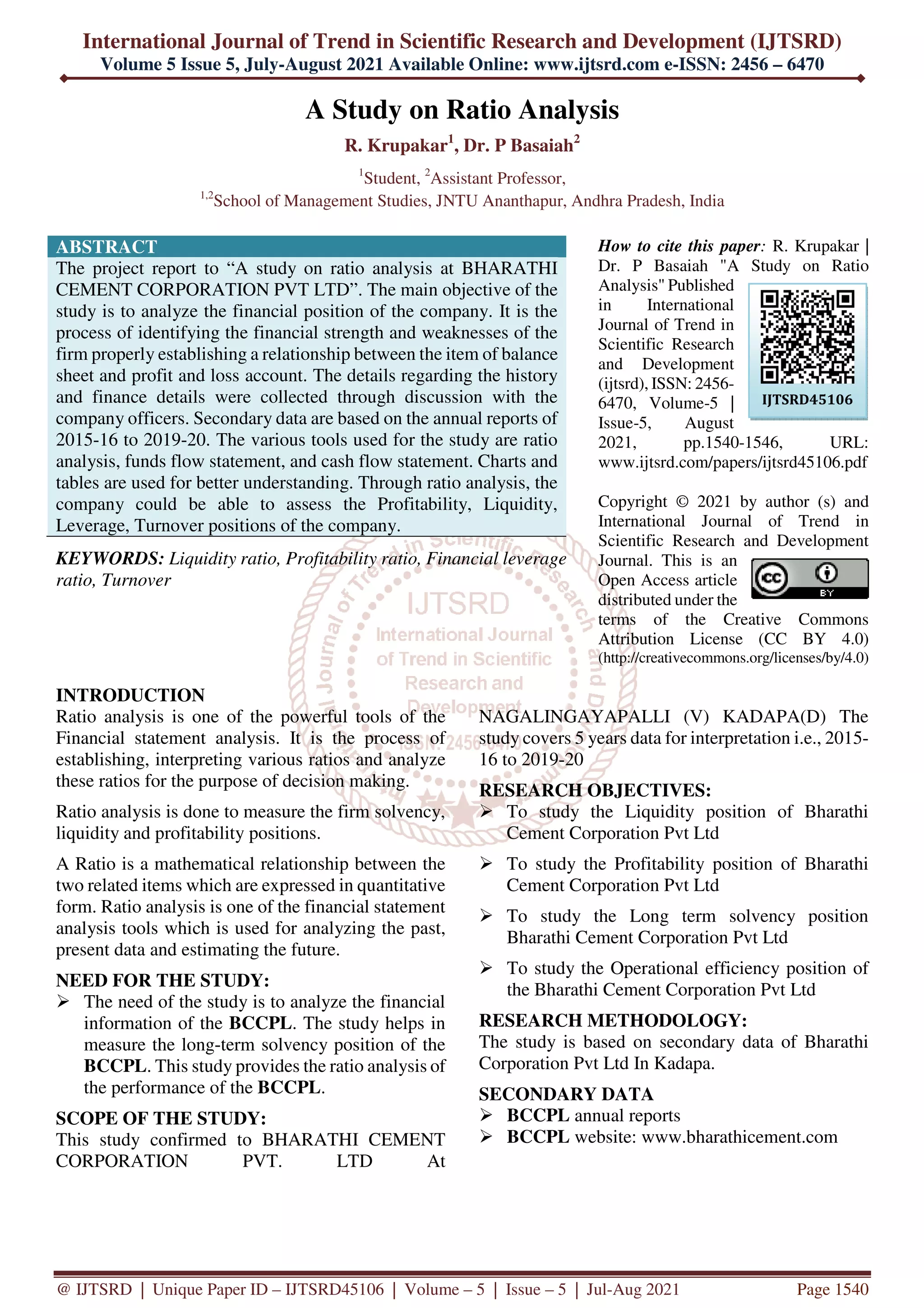
Ratio analysis is one of the powerful tools of the
Financial statement analysis. It is the process of
establishing, interpreting various ratios and analyze
these ratios for the purpose of decision making.
Ratio analysis is done to measure the firm solvency,
liquidity and profitability positions.
A Ratio is a mathematical relationship between the
two related items which are expressed in quantitative
form. Ratio analysis is one of the financial statement
analysis tools which is used for analyzing the past,
present data and estimating the future.
NEED FOR THE STUDY:
The need of the study is to analyze the financial
information of the BCCPL. The study helps in
measure the long-term solvency position of the
BCCPL. This study provides the ratio analysis of
the performance of the BCCPL.
SCOPE OF THE STUDY:
This study confirmed to BHARATHI CEMENT
CORPORATION PVT. LTD At
NAGALINGAYAPALLI (V) KADAPA(D) The
study covers 5 years data for interpretation i.e., 2015-
16 to 2019-20
RESEARCH OBJECTIVES:
To study the Liquidity position of Bharathi
Cement Corporation Pvt Ltd
To study the Profitability position of Bharathi
Cement Corporation Pvt Ltd
To study the Long term solvency position
Bharathi Cement Corporation Pvt Ltd
To study the Operational efficiency position of
the Bharathi Cement Corporation Pvt Ltd
RESEARCH METHODOLOGY:
The study is based on secondary data of Bharathi
Corporation Pvt Ltd In Kadapa.
SECONDARY DATA
BCCPL annual reports
BCCPL website: www.bharathicement.com
IJTSRD45106
International Journal of Trend in Scientific Research and Development @ www.ijtsrd.com eISSN: 2456-6470
@ IJTSRD | Unique Paper ID – IJTSRD45106 | Volume – 5 | Issue – 5 | Jul-Aug 2021 Page 1541
1. LIQUIDITY RATIOS:
A. Current Ratio:
Current ratio is calculated by dividing current
assets by current liabilities
Current assets
Current ratio =
Current liabilities
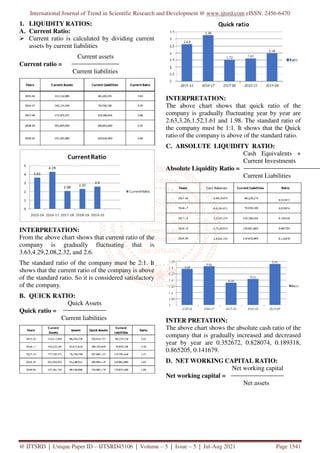
INTERPRETATION:
From the above chart shows that current ratio of the
company is gradually fluctuating that is
3.63,4.29,2.08,2.32, and 2.6.
The standard ratio of the company must be 2:1. It
shows that the current ratio of the company is above
of the standard ratio. So it is considered satisfactory
of the company.
B. QUICK RATIO:
Quick Assets
Quick ratio =
Current liabilities
INTERPRETATION:
The above chart shows that quick ratio of the
company is gradually fluctuating year by year are
2.63,3.26,1.52,1.61 and 1.98. The standard ratio of
the company must be 1:1. It shows that the Quick
ratio of the company is above of the standard ratio.
C. ABSOLUTE LIQUIDITY RATIO:
Cash Equivalents +
Current Investments
Absolute Liquidity Ratio =
Current Liabilities
INTER PRETATION:
The above chart shows the absolute cash ratio of the
company that is gradually increased and decreased
year by year are 0.352672, 0.828074, 0.189318,
0.865205, 0.141679.
D. NET WORKING CAPITAL RATIO:
Net working capital
Net working capital =
Net assets
International Journal of Trend in Scientific Research and Development @ www.ijtsrd.com eISSN: 2456-6470
@ IJTSRD | Unique Paper ID – IJTSRD45106 | Volume – 5 | Issue – 5 | Jul-Aug 2021 Page 1542
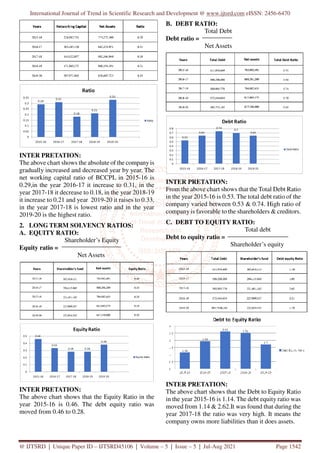
INTER PRETATION:
The above chart shows the absolute of the company is
gradually increased and decreased year by year. The
net working capital ratio of BCCPL in 2015-16 is
0.29,in the year 2016-17 it increase to 0.31, in the
year 2017-18 it decrease to 0.18, in the year 2018-19
it increase to 0.21 and year 2019-20 it raises to 0.33,
in the year 2017-18 is lowest ratio and in the year
2019-20 is the highest ratio.
2. LONG TERM SOLVENCY RATIOS:
A. EQUITY RATIO:
Shareholder’s Equity
Equity ratio =
Net Assets
INTER PRETATION:
The above chart shows that the Equity Ratio in the
year 2015-16 is 0.46. The debt equity ratio was
moved from 0.46 to 0.28.
B. DEBT RATIO:
Total Debt
Debt ratio =
Net Assets
INTER PRETATION:
From the above chart shows that the Total Debt Ratio
in the year 2015-16 is 0.53. The total debt ratio of the
company varied between 0.53 & 0.74. High ratio of
company is favorable to the shareholders & creditors.
C. DEBT TO EQUITY RATIO:
Total debt
Debt to equity ratio =
Shareholder’s equity
INTER PRETATION:
The above chart shows that the Debt to Equity Ratio
in the year 2015-16 is 1.14. The debt equity ratio was
moved from 1.14 & 2.62.It was found that during the
year 2017-18 the ratio was very high. It means the
company owns more liabilities than it does assets.
International Journal of Trend in Scientific Research and Development @ www.ijtsrd.com eISSN: 2456-6470
@ IJTSRD | Unique Paper ID – IJTSRD45106 | Volume – 5 | Issue – 5 | Jul-Aug 2021 Page 1543
3. ACTIVITY RATIOS:
A. TOTALASSETS TURNOVER RATIO
Sales
Assets Turnover ratio =
Total Assets
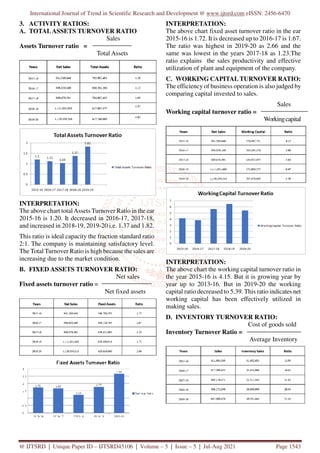
INTERPRETATION:
The above chart totalAssets Turnover Ratio in the ear
2015-16 is 1.20. It decreased in 2016-17, 2017-18,
and increased in 2018-19, 2019-20 i.e. 1.37 and 1.82.
This ratio is ideal capacity the fraction standard ratio
2:1. The company is maintaining satisfactory level.
The Total Turnover Ratio is high because the sales are
increasing due to the market condition.
B. FIXED ASSETS TURNOVER RATIO:
Net sales
Fixed assets turnover ratio =
Net fixed assets
INTERPRETATION:
The above chart fixed asset turnover ratio in the ear
2015-16 is 1.72. It is decreased up to 2016-17 is 1.67.
The ratio was highest in 2019-20 as 2.66 and the
same was lowest in the years 2017-18 as 1.23.The
ratio explains the sales productivity and effective
utilization of plant and equipment of the company.
C. WORKING CAPITAL TURNOVER RATIO:
The efficiency of business operation is also judged by
comparing capital invested to sales.
Sales
Working capital turnover ratio =
Workingcapital
INTERPRETATION:
The above chart the working capital turnover ratio in
the year 2015-16 is 4.15. But it is growing year by
year up to 2013-16. But in 2019-20 the working
capital ratio decreased to 5.39. This ratio indicates net
working capital has been effectively utilized in
making sales.
D. INVENTORY TURNOVER RATIO:
Cost of goods sold
Inventory Turnover Ratio =
Average Inventory
International Journal of Trend in Scientific Research and Development @ www.ijtsrd.com eISSN: 2456-6470
@ IJTSRD | Unique Paper ID – IJTSRD45106 | Volume – 5 | Issue – 5 | Jul-Aug 2021 Page 1544
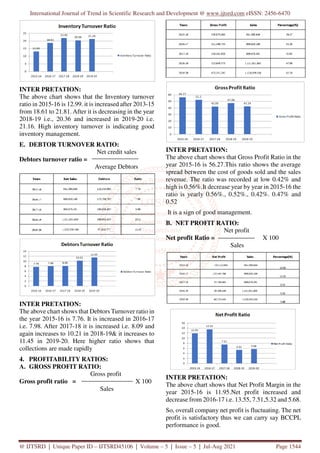
INTER PRETATION:
The above chart shows that the Inventory turnover
ratio in 2015-16 is 12.99. it is increased after 2013-15
from 18.61 to 21.81. After it is decreasing in the year
2018-19 i.e., 20.36 and increased in 2019-20 i.e.
21.16. High inventory turnover is indicating good
inventory management.
E. DEBTOR TURNOVER RATIO:
Net credit sales
Debtors turnover ratio =
Average Debtors
INTER PRETATION:
The above chart shows that Debtors Turnover ratio in
the year 2015-16 is 7.76. It is increased in 2016-17
i.e. 7.98. After 2017-18 it is increased i.e. 8.09 and
again increases to 10.21 in 2018-19& it increases to
11.45 in 2019-20. Here higher ratio shows that
collections are made rapidly
4. PROFITABILITY RATIOS:
A. GROSS PROFIT RATIO:
Gross profit
Gross profit ratio = X 100
Sales
INTER PRETATION:
The above chart shows that Gross Profit Ratio in the
year 2015-16 is 56.27.This ratio shows the average
spread between the cost of goods sold and the sales
revenue. The ratio was recorded at low 0.42% and
high is 0.56%.It decrease year by year in 2015-16 the
ratio is yearly 0.56%., 0.52%., 0.42%. 0.47% and
0.52
It is a sign of good management.
B. NET PROFIT RATIO:
Net profit
Net profit Ratio = X 100
Sales
INTER PRETATION:
The above chart shows that Net Profit Margin in the
year 2015-16 is 11.95.Net profit increased and
decrease from 2016-17 i.e. 13.55, 7.51,5.32 and 5.68.
So, overall company net profit is fluctuating. The net
profit is satisfactory thus we can carry say BCCPL
performance is good.
International Journal of Trend in Scientific Research and Development @ www.ijtsrd.com eISSN: 2456-6470
@ IJTSRD | Unique Paper ID – IJTSRD45106 | Volume – 5 | Issue – 5 | Jul-Aug 2021 Page 1545
C. OPERATING PROFIT RATIO:
Operating Profit
Operating Profit Ratio =
Sales
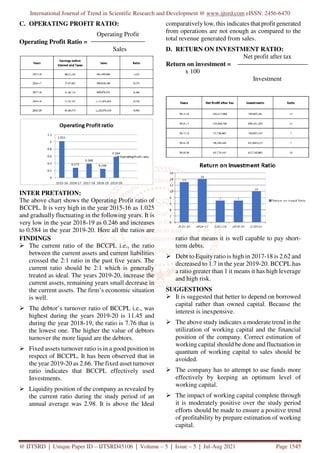
INTER PRETATION:
The above chart shows the Operating Profit ratio of
BCCPL. It is very high in the year 2015-16 as 1.025
and gradually fluctuating in the following years. It is
very low in the year 2018-19 as 0.246 and increases
to 0.584 in the year 2019-20. Here all the ratios are
comparatively low, this indicates that profit generated
from operations are not enough as compared to the
total revenue generated from sales.
D. RETURN ON INVESTMENT RATIO:
Net profit after tax
Return on investment =
x 100
Investment
FINDINGS
The current ratio of the BCCPL i.e., the ratio
between the current assets and current liabilities
crossed the 2:1 ratio in the past five years. The
current ratio should be 2:1 which is generally
treated as ideal. The years 2019-20, increase the
current assets, remaining years small decrease in
the current assets. The firm’s economic situation
is well.
The debtor’s turnover ratio of BCCPL i.e., was
highest during the years 2019-20 is 11.45 and
during the year 2018-19, the ratio is 7.76 that is
the lowest one. The higher the value of debtors
turnover the more liquid are the debtors.
Fixed assets turnover ratio is in a good position in
respect of BCCPL. It has been observed that in
the year 2019-20 as 2.66. The fixed asset turnover
ratio indicates that BCCPL effectively used
Investments.
Liquidity position of the company as revealed by
the current ratio during the study period of an
annual average was 2.98. It is above the Ideal
ratio that means it is well capable to pay short-
term debts.
Debt to Equity ratio is high in 2017-18 is 2.62 and
decreased to 1.7 in the year 2019-20. BCCPL has
a ratio greater than 1 it means it has high leverage
and high risk.
SUGGESTIONS
It is suggested that better to depend on borrowed
capital rather than owned capital. Because the
interest is inexpensive.
The above study indicates a moderate trend in the
utilization of working capital and the financial
position of the company. Correct estimation of
working capital should be done and fluctuation in
quantum of working capital to sales should be
avoided.
The company has to attempt to use funds more
effectively by keeping an optimum level of
working capital.
The impact of working capital complete through
it is moderately positive over the study period
efforts should be made to ensure a positive trend
of profitability by prepare estimation of working
capital.
International Journal of Trend in Scientific Research and Development @ www.ijtsrd.com eISSN: 2456-6470
@ IJTSRD | Unique Paper ID – IJTSRD45106 | Volume – 5 | Issue – 5 | Jul-Aug 2021 Page 1546
The company has to give importance to the
management resources because the operating
profit is less.
CONCLUSION
After evaluating and analyzing the liquidity, leverage,
profitability, efficiency ratios of Bharathi Cement Ltd.
The following conclusion is drawn.
The liquidity position of the company was revealed
by the current ratio during the study period was
crossed by the ideal ratio. So that BCCPL is liquidity
position in future also, the position of the debt the
capitalization of the firm is always low. So it is
unfavorable to shareholders and creditors.

A Study on Ratio Analysis

  • 1.
    International Journal ofTrend in Scientific Research and Development (IJTSRD) Volume 5 Issue 5, July-August 2021 Available Online: www.ijtsrd.com e-ISSN: 2456 – 6470 @ IJTSRD | Unique Paper ID – IJTSRD45106 | Volume – 5 | Issue – 5 | Jul-Aug 2021 Page 1540 A Study on Ratio Analysis R. Krupakar1 , Dr. P Basaiah2 1 Student, 2 Assistant Professor, 1,2 School of Management Studies, JNTU Ananthapur, Andhra Pradesh, India ABSTRACT The project report to “A study on ratio analysis at BHARATHI CEMENT CORPORATION PVT LTD”. The main objective of the study is to analyze the financial position of the company. It is the process of identifying the financial strength and weaknesses of the firm properly establishing a relationship between the item of balance sheet and profit and loss account. The details regarding the history and finance details were collected through discussion with the company officers. Secondary data are based on the annual reports of 2015-16 to 2019-20. The various tools used for the study are ratio analysis, funds flow statement, and cash flow statement. Charts and tables are used for better understanding. Through ratio analysis, the company could be able to assess the Profitability, Liquidity, Leverage, Turnover positions of the company. KEYWORDS: Liquidity ratio, Profitability ratio, Financial leverage ratio, Turnover How to cite this paper: R. Krupakar | Dr. P Basaiah "A Study on Ratio Analysis" Published in International Journal of Trend in Scientific Research and Development (ijtsrd), ISSN: 2456- 6470, Volume-5 | Issue-5, August 2021, pp.1540-1546, URL: www.ijtsrd.com/papers/ijtsrd45106.pdf Copyright © 2021 by author (s) and International Journal of Trend in Scientific Research and Development Journal. This is an Open Access article distributed under the terms of the Creative Commons Attribution License (CC BY 4.0) (http://creativecommons.org/licenses/by/4.0) INTRODUCTION Ratio analysis is one of the powerful tools of the Financial statement analysis. It is the process of establishing, interpreting various ratios and analyze these ratios for the purpose of decision making. Ratio analysis is done to measure the firm solvency, liquidity and profitability positions. A Ratio is a mathematical relationship between the two related items which are expressed in quantitative form. Ratio analysis is one of the financial statement analysis tools which is used for analyzing the past, present data and estimating the future. NEED FOR THE STUDY: The need of the study is to analyze the financial information of the BCCPL. The study helps in measure the long-term solvency position of the BCCPL. This study provides the ratio analysis of the performance of the BCCPL. SCOPE OF THE STUDY: This study confirmed to BHARATHI CEMENT CORPORATION PVT. LTD At NAGALINGAYAPALLI (V) KADAPA(D) The study covers 5 years data for interpretation i.e., 2015- 16 to 2019-20 RESEARCH OBJECTIVES: To study the Liquidity position of Bharathi Cement Corporation Pvt Ltd To study the Profitability position of Bharathi Cement Corporation Pvt Ltd To study the Long term solvency position Bharathi Cement Corporation Pvt Ltd To study the Operational efficiency position of the Bharathi Cement Corporation Pvt Ltd RESEARCH METHODOLOGY: The study is based on secondary data of Bharathi Corporation Pvt Ltd In Kadapa. SECONDARY DATA BCCPL annual reports BCCPL website: www.bharathicement.com IJTSRD45106
  • 2.
    International Journal ofTrend in Scientific Research and Development @ www.ijtsrd.com eISSN: 2456-6470 @ IJTSRD | Unique Paper ID – IJTSRD45106 | Volume – 5 | Issue – 5 | Jul-Aug 2021 Page 1541 1. LIQUIDITY RATIOS: A. Current Ratio: Current ratio is calculated by dividing current assets by current liabilities Current assets Current ratio = Current liabilities INTERPRETATION: From the above chart shows that current ratio of the company is gradually fluctuating that is 3.63,4.29,2.08,2.32, and 2.6. The standard ratio of the company must be 2:1. It shows that the current ratio of the company is above of the standard ratio. So it is considered satisfactory of the company. B. QUICK RATIO: Quick Assets Quick ratio = Current liabilities INTERPRETATION: The above chart shows that quick ratio of the company is gradually fluctuating year by year are 2.63,3.26,1.52,1.61 and 1.98. The standard ratio of the company must be 1:1. It shows that the Quick ratio of the company is above of the standard ratio. C. ABSOLUTE LIQUIDITY RATIO: Cash Equivalents + Current Investments Absolute Liquidity Ratio = Current Liabilities INTER PRETATION: The above chart shows the absolute cash ratio of the company that is gradually increased and decreased year by year are 0.352672, 0.828074, 0.189318, 0.865205, 0.141679. D. NET WORKING CAPITAL RATIO: Net working capital Net working capital = Net assets
  • 3.
    International Journal ofTrend in Scientific Research and Development @ www.ijtsrd.com eISSN: 2456-6470 @ IJTSRD | Unique Paper ID – IJTSRD45106 | Volume – 5 | Issue – 5 | Jul-Aug 2021 Page 1542 INTER PRETATION: The above chart shows the absolute of the company is gradually increased and decreased year by year. The net working capital ratio of BCCPL in 2015-16 is 0.29,in the year 2016-17 it increase to 0.31, in the year 2017-18 it decrease to 0.18, in the year 2018-19 it increase to 0.21 and year 2019-20 it raises to 0.33, in the year 2017-18 is lowest ratio and in the year 2019-20 is the highest ratio. 2. LONG TERM SOLVENCY RATIOS: A. EQUITY RATIO: Shareholder’s Equity Equity ratio = Net Assets INTER PRETATION: The above chart shows that the Equity Ratio in the year 2015-16 is 0.46. The debt equity ratio was moved from 0.46 to 0.28. B. DEBT RATIO: Total Debt Debt ratio = Net Assets INTER PRETATION: From the above chart shows that the Total Debt Ratio in the year 2015-16 is 0.53. The total debt ratio of the company varied between 0.53 & 0.74. High ratio of company is favorable to the shareholders & creditors. C. DEBT TO EQUITY RATIO: Total debt Debt to equity ratio = Shareholder’s equity INTER PRETATION: The above chart shows that the Debt to Equity Ratio in the year 2015-16 is 1.14. The debt equity ratio was moved from 1.14 & 2.62.It was found that during the year 2017-18 the ratio was very high. It means the company owns more liabilities than it does assets.
  • 4.
    International Journal ofTrend in Scientific Research and Development @ www.ijtsrd.com eISSN: 2456-6470 @ IJTSRD | Unique Paper ID – IJTSRD45106 | Volume – 5 | Issue – 5 | Jul-Aug 2021 Page 1543 3. ACTIVITY RATIOS: A. TOTALASSETS TURNOVER RATIO Sales Assets Turnover ratio = Total Assets INTERPRETATION: The above chart totalAssets Turnover Ratio in the ear 2015-16 is 1.20. It decreased in 2016-17, 2017-18, and increased in 2018-19, 2019-20 i.e. 1.37 and 1.82. This ratio is ideal capacity the fraction standard ratio 2:1. The company is maintaining satisfactory level. The Total Turnover Ratio is high because the sales are increasing due to the market condition. B. FIXED ASSETS TURNOVER RATIO: Net sales Fixed assets turnover ratio = Net fixed assets INTERPRETATION: The above chart fixed asset turnover ratio in the ear 2015-16 is 1.72. It is decreased up to 2016-17 is 1.67. The ratio was highest in 2019-20 as 2.66 and the same was lowest in the years 2017-18 as 1.23.The ratio explains the sales productivity and effective utilization of plant and equipment of the company. C. WORKING CAPITAL TURNOVER RATIO: The efficiency of business operation is also judged by comparing capital invested to sales. Sales Working capital turnover ratio = Workingcapital INTERPRETATION: The above chart the working capital turnover ratio in the year 2015-16 is 4.15. But it is growing year by year up to 2013-16. But in 2019-20 the working capital ratio decreased to 5.39. This ratio indicates net working capital has been effectively utilized in making sales. D. INVENTORY TURNOVER RATIO: Cost of goods sold Inventory Turnover Ratio = Average Inventory
  • 5.
    International Journal ofTrend in Scientific Research and Development @ www.ijtsrd.com eISSN: 2456-6470 @ IJTSRD | Unique Paper ID – IJTSRD45106 | Volume – 5 | Issue – 5 | Jul-Aug 2021 Page 1544 INTER PRETATION: The above chart shows that the Inventory turnover ratio in 2015-16 is 12.99. it is increased after 2013-15 from 18.61 to 21.81. After it is decreasing in the year 2018-19 i.e., 20.36 and increased in 2019-20 i.e. 21.16. High inventory turnover is indicating good inventory management. E. DEBTOR TURNOVER RATIO: Net credit sales Debtors turnover ratio = Average Debtors INTER PRETATION: The above chart shows that Debtors Turnover ratio in the year 2015-16 is 7.76. It is increased in 2016-17 i.e. 7.98. After 2017-18 it is increased i.e. 8.09 and again increases to 10.21 in 2018-19& it increases to 11.45 in 2019-20. Here higher ratio shows that collections are made rapidly 4. PROFITABILITY RATIOS: A. GROSS PROFIT RATIO: Gross profit Gross profit ratio = X 100 Sales INTER PRETATION: The above chart shows that Gross Profit Ratio in the year 2015-16 is 56.27.This ratio shows the average spread between the cost of goods sold and the sales revenue. The ratio was recorded at low 0.42% and high is 0.56%.It decrease year by year in 2015-16 the ratio is yearly 0.56%., 0.52%., 0.42%. 0.47% and 0.52 It is a sign of good management. B. NET PROFIT RATIO: Net profit Net profit Ratio = X 100 Sales INTER PRETATION: The above chart shows that Net Profit Margin in the year 2015-16 is 11.95.Net profit increased and decrease from 2016-17 i.e. 13.55, 7.51,5.32 and 5.68. So, overall company net profit is fluctuating. The net profit is satisfactory thus we can carry say BCCPL performance is good.
  • 6.
    International Journal ofTrend in Scientific Research and Development @ www.ijtsrd.com eISSN: 2456-6470 @ IJTSRD | Unique Paper ID – IJTSRD45106 | Volume – 5 | Issue – 5 | Jul-Aug 2021 Page 1545 C. OPERATING PROFIT RATIO: Operating Profit Operating Profit Ratio = Sales INTER PRETATION: The above chart shows the Operating Profit ratio of BCCPL. It is very high in the year 2015-16 as 1.025 and gradually fluctuating in the following years. It is very low in the year 2018-19 as 0.246 and increases to 0.584 in the year 2019-20. Here all the ratios are comparatively low, this indicates that profit generated from operations are not enough as compared to the total revenue generated from sales. D. RETURN ON INVESTMENT RATIO: Net profit after tax Return on investment = x 100 Investment FINDINGS The current ratio of the BCCPL i.e., the ratio between the current assets and current liabilities crossed the 2:1 ratio in the past five years. The current ratio should be 2:1 which is generally treated as ideal. The years 2019-20, increase the current assets, remaining years small decrease in the current assets. The firm’s economic situation is well. The debtor’s turnover ratio of BCCPL i.e., was highest during the years 2019-20 is 11.45 and during the year 2018-19, the ratio is 7.76 that is the lowest one. The higher the value of debtors turnover the more liquid are the debtors. Fixed assets turnover ratio is in a good position in respect of BCCPL. It has been observed that in the year 2019-20 as 2.66. The fixed asset turnover ratio indicates that BCCPL effectively used Investments. Liquidity position of the company as revealed by the current ratio during the study period of an annual average was 2.98. It is above the Ideal ratio that means it is well capable to pay short- term debts. Debt to Equity ratio is high in 2017-18 is 2.62 and decreased to 1.7 in the year 2019-20. BCCPL has a ratio greater than 1 it means it has high leverage and high risk. SUGGESTIONS It is suggested that better to depend on borrowed capital rather than owned capital. Because the interest is inexpensive. The above study indicates a moderate trend in the utilization of working capital and the financial position of the company. Correct estimation of working capital should be done and fluctuation in quantum of working capital to sales should be avoided. The company has to attempt to use funds more effectively by keeping an optimum level of working capital. The impact of working capital complete through it is moderately positive over the study period efforts should be made to ensure a positive trend of profitability by prepare estimation of working capital.
  • 7.
    International Journal ofTrend in Scientific Research and Development @ www.ijtsrd.com eISSN: 2456-6470 @ IJTSRD | Unique Paper ID – IJTSRD45106 | Volume – 5 | Issue – 5 | Jul-Aug 2021 Page 1546 The company has to give importance to the management resources because the operating profit is less. CONCLUSION After evaluating and analyzing the liquidity, leverage, profitability, efficiency ratios of Bharathi Cement Ltd. The following conclusion is drawn. The liquidity position of the company was revealed by the current ratio during the study period was crossed by the ideal ratio. So that BCCPL is liquidity position in future also, the position of the debt the capitalization of the firm is always low. So it is unfavorable to shareholders and creditors.