DATA ANALYSIS
IN QUALITATIVE
RESEARCH
ALI DJAMHURI
THREE ANALYSIS STRATEGIES
 Preparing and organizing the data for
analysis
 Reducing the data into Themes through
process of coding and condensing the codes
 Alternative example or as supplementary steps
are:
 Writing marginal notes,
 Drafting summaries of fieldnotes
 Noting relationship among the categories as well as
toward theoretical point of view
 Representing the data in figures, tables,
and / or discusson (narration)
GENERALDATA ANALYSIS BY AUTHORS
Analysis
Strategy
Madison (2005) Huberman &
Miles(1994)
Wolcott
(1994b)
Sketching ideas Write Margin
notes in
fieldnotes
Highlight
certain
information in
description
Taking Notes Writing
Reflective
passage in Notes
Summarizing
Fieldnotes
Draft summary
sheet on
fieldnotes
Woirking with
words
Make metaphors
Identifying
Codes
Do abstract
coding or
concrete coding
Write code
memos
GENERALDATA ANALYSIS BY
AUTHORS (CONTINUED)
Analysis Strategy Madison (2005) Huberman &
Miles(1994)
Wolcott (1994b)
Reducing codes
to themes
Identify salient
themes or
patterns
Note patterns
and themes
Identify
patterned
regularities
Counting
frequency of
codes
Count
frequency of
codes
Relating
categories
Factor, Note
relations among
variables, build a
logical chain of
evidence
Realting
categories to
analytic
framework in
literatures
Contextualize in
framework from
literature
GENERALDATA ANALYSIS BY
AUTHORS (CONTINUED - 1)
Analysis Strategy Madison (2005) Huberman &
Miles(1994)
Wolcott (1994b)
Creating Points of
view
For scenes,
audieence, and
readers
Displaying the
Data
Create a graph or
pictureof the
framework
Make contrast
and comparison
Display findings
in tables, charts,
diagrams, and
figures, compare
cases,compare
with standards
(criteria or
theories)
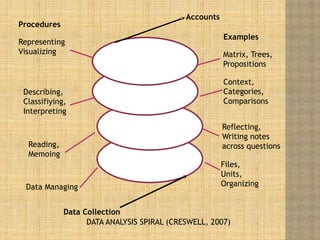
Representing
Visualizing
Describing,
Classifiying,
Interpreting
Reading,
Memoing
Data Managing
Matrix, Trees,
Propositions
Context,
Categories,
Comparisons
Reflecting,
Writing notes
across questions
Files,
Units,
Organizing
Procedures
Examples
Accounts
Data Collection
DATA ANALYSIS SPIRAL (CRESWELL, 2007)
DATA ANALYSIS IN CASE STUDY
 Direct
Interpretaation
 Looking at Single
instance and drawing
the meanings from it
without looking for
multiple instances
 Looking patterns and
correspondences
 Getting similarities
and differences from
data
 Categorical
Aggregation
 Seeking a collection
of instances from
the data and trying
to get relevant
issuess that may
emerge the
meanings

A STEPS IN QUALITATIVE DATA ANALYSIS.pptx

  • 1.
  • 2.
    THREE ANALYSIS STRATEGIES Preparing and organizing the data for analysis  Reducing the data into Themes through process of coding and condensing the codes  Alternative example or as supplementary steps are:  Writing marginal notes,  Drafting summaries of fieldnotes  Noting relationship among the categories as well as toward theoretical point of view  Representing the data in figures, tables, and / or discusson (narration)
  • 3.
    GENERALDATA ANALYSIS BYAUTHORS Analysis Strategy Madison (2005) Huberman & Miles(1994) Wolcott (1994b) Sketching ideas Write Margin notes in fieldnotes Highlight certain information in description Taking Notes Writing Reflective passage in Notes Summarizing Fieldnotes Draft summary sheet on fieldnotes Woirking with words Make metaphors Identifying Codes Do abstract coding or concrete coding Write code memos
  • 4.
    GENERALDATA ANALYSIS BY AUTHORS(CONTINUED) Analysis Strategy Madison (2005) Huberman & Miles(1994) Wolcott (1994b) Reducing codes to themes Identify salient themes or patterns Note patterns and themes Identify patterned regularities Counting frequency of codes Count frequency of codes Relating categories Factor, Note relations among variables, build a logical chain of evidence Realting categories to analytic framework in literatures Contextualize in framework from literature
  • 5.
    GENERALDATA ANALYSIS BY AUTHORS(CONTINUED - 1) Analysis Strategy Madison (2005) Huberman & Miles(1994) Wolcott (1994b) Creating Points of view For scenes, audieence, and readers Displaying the Data Create a graph or pictureof the framework Make contrast and comparison Display findings in tables, charts, diagrams, and figures, compare cases,compare with standards (criteria or theories)
  • 6.
    Representing Visualizing Describing, Classifiying, Interpreting Reading, Memoing Data Managing Matrix, Trees, Propositions Context, Categories, Comparisons Reflecting, Writingnotes across questions Files, Units, Organizing Procedures Examples Accounts Data Collection DATA ANALYSIS SPIRAL (CRESWELL, 2007)
  • 7.
    DATA ANALYSIS INCASE STUDY  Direct Interpretaation  Looking at Single instance and drawing the meanings from it without looking for multiple instances  Looking patterns and correspondences  Getting similarities and differences from data  Categorical Aggregation  Seeking a collection of instances from the data and trying to get relevant issuess that may emerge the meanings