A Semantic Web Primer
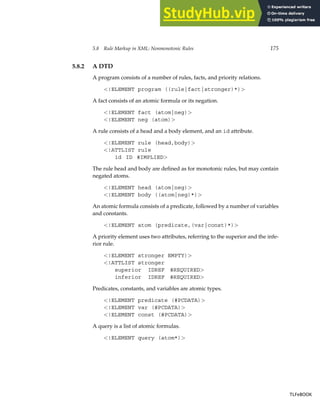
Grigoris Antoniou and Frank van Harmelen
TLFeBOOK
TLFeBOOK
A
Semantic
Web
Primer
TLFeBOOK
TLFeBOOK
Cooperative Information Systems
Michael Papazoglou, Joachim W. Schmidt, and John Mylopoulos, editors
Advances in Object-Oriented Data Modeling
Michael P. Papazoglou, Stefano Spaccapietra, and Zahir Tari, editors, 2000
Workflow Management: Models, Methods, and Systems
Wil van der Aalst and Kees Max van Hee, 2002
A Semantic Web Primer
Grigoris Antoniou and Frank van Harmelen, 2004
TLFeBOOK
TLFeBOOK
A
Semantic
Web
Primer
Grigoris Antoniou
and
Frank van Harmelen
The MIT Press
Cambridge, Massachusetts
London, England
TLFeBOOK
TLFeBOOK
© 2004 Massachusetts Institute of Technology
All rights reserved. No part of this book may be reproduced in any form by any
electronic or mechanical means (including photocopying, recording, or information
storage and retrieval) without permission in writing from the publisher.
This book was set in 10/13 Palatino by the authors using L
A
TEX2ε.
Printed and bound in the United States of America.
Library of Congress Cataloging-in-Publication Data
Antoniou, G. (Grigoris)
A semantic Web primer/ Grigoris Antoniou and Frank van Harmelen.
p. cm.–(Cooperative information systems)
Includes bibliographical references and index.
ISBN 0-262-01210-3 (hc.: alk. paper)
1. Semantic Web. I. Van Harmelen, Frank. II. Title. III. Series.
TK5105.88815. A58 2004
025.04–dc22
2003065165
10 9 8 7 6 5 4 3 2 1
TLFeBOOK
TLFeBOOK
Dedicated to Konstantina
G.A.
TLFeBOOK
TLFeBOOK
TLFeBOOK
TLFeBOOK
Brief Contents
1 The Semantic Web Vision 1
2 Structured Web Documents in XML 23
3 Describing Web Resources in RDF 61
4 Web Ontology Language: OWL 109
5 Logic and Inference: Rules 151
6 Applications 179
7 Ontology Engineering 205
8 Conclusion and Outlook 223
A Abstract OWL Syntax 227
TLFeBOOK
TLFeBOOK
TLFeBOOK
TLFeBOOK
Contents
List of Figures xiii
Series Foreword xv
Preface xix
1 The Semantic Web Vision 1
1.1 Today’s Web 1
1.2 From Today’s Web to the Semantic Web: Examples 3
1.3 Semantic Web Technologies 7
1.4 A Layered Approach 16
1.5 Book Overview 19
1.6 Summary 19
Suggested Reading 20
2 Structured Web Documents in XML 23
2.1 Introduction 23
2.2 The XML Language 27
2.3 Structuring 31
2.4 Namespaces 43
2.5 Addressing and Querying XML Documents 45
2.6 Processing 49
2.7 Summary 55
Suggested Reading 57
Exercises and Projects 58
TLFeBOOK
TLFeBOOK
x Contents
3 Describing Web Resources in RDF 61
3.1 Introduction 61
3.2 RDF: Basic Ideas 63
3.3 RDF: XML-Based Syntax 69
3.4 RDF Schema: Basic Ideas 80
3.5 RDF Schema: The Language 84
3.6 RDF and RDF Schema in RDF Schema 91
3.7 An Axiomatic Semantics for RDF and RDF Schema 94
3.8 A Direct Inference System for RDF and RDFS 99
3.9 Querying in RQL 100
3.10 Summary 104
Suggested Reading 105
Exercises and Projects 106
4 Web Ontology Language: OWL 109
4.1 Introduction 109
4.2 The OWL Language 115
4.3 Examples 129
4.4 OWL in OWL 138
4.5 Future Extensions 144
4.6 Summary 146
Suggested Reading 146
Exercises and Projects 148
5 Logic and Inference: Rules 151
5.1 Introduction 151
5.2 Example of Monotonic Rules: Family Relationships 154
5.3 Monotonic Rules: Syntax 155
5.4 Monotonic Rules: Semantics 158
5.5 Nonmonotonic Rules: Motivation and Syntax 161
5.6 Example of Nonmonotonic Rules: Brokered Trade 163
5.7 Rule Markup in XML: Monotonic Rules 167
5.8 Rule Markup in XML: Nonmonotonic Rules 173
5.9 Summary 176
Suggested Reading 176
Exercises and Projects 177
TLFeBOOK
TLFeBOOK
Contents xi
6 Applications 179
6.1 Introduction 179
6.2 Horizontal Information Products at Elsevier 179
6.3 Data Integration at Audi 182
6.4 Skill Finding at Swiss Life 185
6.5 Think Tank Portal at EnerSearch 187
6.6 e-Learning 191
6.7 Web Services 194
6.8 Other Scenarios 199
Suggested Reading 201
7 Ontology Engineering 205
7.1 Introduction 205
7.2 Constructing Ontologies Manually 205
7.3 Reusing Existing Ontologies 209
7.4 Using Semiautomatic Methods 211
7.5 On-To-Knowledge Semantic Web Architecture 215
Suggested Reading 218
Project 218
8 Conclusion and Outlook 223
8.1 How It All Fits Together 223
8.2 Some Technical Questions 224
8.3 Predicting the Future 224
A Abstract OWL Syntax 227
Index 235
TLFeBOOK
TLFeBOOK
TLFeBOOK
TLFeBOOK
List of Figures
1.1 A hierarchy 11
1.2 Intelligent personal agents 15
1.3 A layered approach to the Semantic Web 18
2.1 Tree representation of an XML document 31
2.2 Tree representation of a library document 46
2.3 Tree representation of query 4 48
2.4 Tree representation of query 5 48
2.5 A template 52
2.6 XSLT as tree transformation 56
3.1 Graph representation of triple 65
3.2 A semantic net 65
3.3 Representation of a tertiary predicate 68
3.4 Representation of a tertiary predicate 78
3.5 A hierarchy of classes 82
3.6 RDF and RDFS layers 84
3.7 Subclass hierarchy of some modeling primitives of RDFS 87
3.8 Instance relationships of some modeling primitives of RDFS 87
3.9 Class hierarchy for the motor vehicles example 90
4.1 Subclass relationships between OWL and RDF/RDFS 115
4.2 Inverse properties 119
4.3 Classes and subclasses of the African wildlife ontology 129
4.4 Branches are parts of trees 129
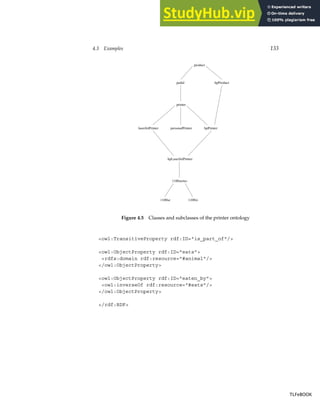
4.5 Classes and subclasses of the printer ontology 133
TLFeBOOK
TLFeBOOK
xiv List of Figures
5.1 Monotonic rules DTD versus RuleML 172
6.1 Querying across data sources at Elsevier 181
6.2 Semantic map of part of the EnerSearch Web site 189
6.3 Semantic distance between EnerSearch authors 190
6.4 Browsing ontologically organized papers in Spectacle 191
6.5 Top level of the process ontology 198
7.1 Semantic Web knowledge management architecture 215
TLFeBOOK
TLFeBOOK
Series Foreword
The traditional view of information systems as tailor-made, cost-intensive
database applications is changing rapidly. The change is fueled partly by
a maturing software industry, which is making greater use of off-the-shelf
generic components and standard software solutions, and partly by the on-
slaught of the information revolution. In turn, this change has resulted in a
new set of demands for information services that are homogeneous in their
presentation and interaction patterns, open in their software architecture,
and global in their scope. The demands have come mostly from applica-
tion domains such as e-commerce and banking, manufacturing (including
the software industry itself), training, education, and environmental man-
agement, to mention just a few.
Future information systems will have to support smooth interaction with
a large variety of independent multi-vendor data sources and legacy applica-
tions, running on heterogeneous platforms and distributed information net-
works. Metadata will play a crucial role in describing the contents of such
data sources and in facilitating their integration.
As well, a greater variety of community-oriented interaction patterns will
have to be supported by next-generation information systems. Such inter-
actions may involve navigation, querying and retrieval, and will have to be
combined with personalized notification, annotation, and profiling mecha-
nisms. Such interactions will also have to be intelligently interfaced with
application software, and will need to be dynamically integrated into cus-
tomized and highly connected cooperative environments. Moreover, the
massive investments in information resources, by governments and busi-
nesses alike, call for specific measures that ensure security, privacy and ac-
curacy of their contents.
All these are challenges for the next generation of information systems.
We call such systems Cooperative Information Systems, and they are the focus
of this series.
TLFeBOOK
TLFeBOOK
xvi Series Foreword
In lay terms, cooperative information systems are servicing a diverse
mix of demands characterized by content—community—commerce. These de-
mands are originating in current trends for off-the-shelf software solutions,
such as enterprise resource planning and e-commerce systems.
A major challenge in building cooperative information systems is to de-
velop technologies that permit continuous enhancement and evolution of
current massive investments in information resources and systems. Such
technologies must offer an appropriate infrastructure that supports not only
development, but also evolution of software.
Early research results on cooperative information systems are becoming
the core technology for community-oriented information portals or gate-
ways. An information gateway provides a “one-stop-shopping” place for
a wide range of information resources and services, thereby creating a loyal
user community.
The research advances that will lead to cooperative information systems
will not come from any single research area within the field of Information
Technology. Database and knowledge-based systems, distributed systems,
groupware, and graphical user interfaces have all matured as technologies.
While further enhancements for individual technologies are desirable, the
greatest leverage for technological advancement is expected to come from
their evolution into a seamless technology for building and managing coop-
erative information systems.
The MIT Press Cooperative Information Systems series will cover this area
through textbooks, and research editions intended for the researcher and the
professional who wishes to remain up-to-date on current developments and
future trends.
The series will include three types of books:
• Textbooks or resource books intended for upper level undergraduate or
graduate level courses;
• Research monographs, which collect and summarize research results and
development experiences over a number of years;
• Edited volumes, including collections of papers on a particular topic.
Data in a data source are useful because they model some part of the real
world, its subject matter (or application, or domain of discourse). The problem
of data semantics is establishing and maintaining the correspondence between
a data source, hereafter a model, and its intended subject matter. The model
may be a database storing data about employees in a company, a database
TLFeBOOK
TLFeBOOK
xvii
schema describing parts, projects and suppliers, a Web site presenting infor-
mation about a university, or a plain text file describing the battle of Wa-
terloo. The problem has been with us since the development of the first
databases. However, the problem remained under control as long as the op-
erational environment of a database remained closed and relatively stable.
In such a setting, the meaning of the data was factored out from the database
proper and entrusted to the small group of regular users and application
programs.
The advent of the Web has changed all that. Databases today are made
available, in some form, on the Web where users, application programs, and
uses are open-ended and ever changing. In such a setting, the semantics of
the data has to be made available along with the data. For human users, this
is done through an appropriate choice of presentation format. For applica-
tion programs, however, this semantics has to be provided in a formal and
machine processable form. Hence the call for the Semantic Web.1
Not surprisingly, this call by Tim Berners-Lee has received tremendous at-
tention by researchers and practitioners alike. There is now an International
Semantic Web Conference series,2
a Web Semantic Journal published by Else-
vier,3
as well as industrial committees that are looking at the first generation
of standards for the Semantic Web.
The current book constitutes a timely publication, given the fast-moving
nature of Semantic Web concepts, technologies, and standards. The book of-
fers a gentle introduction to Semantic Web concepts, including XML, DTDs,
and XML schemas, RDF and RDFS, OWL, Logic, and Inference. Throughout,
the book includes examples and applications to illustrate the use of concepts.
We are pleased to include this book on the Semantic Web in the series on
Cooperative Information Systems. We hope that readers will find it interest-
ing, insightful, and useful.
John Mylopoulos Michael Papazoglou
jm@cs.toronto.edu M.P.Papazoglou@kub.nl
Dept. of Computer Science INFOLAB
University of Toronto P.O. Box 90153
Toronto, Ontario LE Tilburg
Canada The Netherlands
1. Tim Berners-Lee and Mark Fischetti, Weaving the Web: The Original Design and Ultimate Destiny
of the World Wide Web by Its Inventor (San Francisco: HarperCollins, 1999).
2. <http://iswc.semanticweb.org>
3. <http://www.semanticwebjournal.org>
TLFeBOOK
TLFeBOOK
TLFeBOOK
TLFeBOOK
Preface
The World Wide Web (WWW) has changed the way people communicate
with each other, how information is disseminated and retrieved, and how
business is conducted. The term Semantic Web comprises techniques that
promise to dramatically improve the current WWW and its use. This book is
about this emerging technology.
The success of each book should be judged against the authors’ aims. This
is an introductory textbook about the Semantic Web. Its main use will be to
serve as the basis for university courses about the Semantic Web. It can also
be used for self -study by anyone who wishes to learn about Semantic Web
technologies.
The question arises whether there is a need for a textbook, given that all
information is available online. We think there is a need because on the Web
there are too many sources of varying quality and too much information.
Some information is valid, some outdated, some wrong, and most sources
talk about obscure details. Anyone who is a newcomer and wishes to learn
something about the Semantic Web, or who wishes to set up a course on the
Semantic Web, is faced with these problems. This book is meant to help out.
A textbook must be selective in the topics it covers. Particularly in a field
as fast developing as this, a textbook should concentrate on fundamental
aspects that can reasonably be expected to remain relevant some time into
the future. But, of course, authors always have their personal bias.
Even for the topics covered, this book is not meant to be a reference work
that describes every small detail. Long books have already been written on
certain topics, such as XML. And there is no need for a reference work in
the Semantic Web area because all definitions and manuals are available on-
line. Instead, we concentrate on the main ideas and techniques and provide
enough detail to enable readers to engage with the material constructively
and to build applications of their own.
TLFeBOOK
TLFeBOOK
xx Preface
This way readers will be equipped with sufficient knowledge to easily get
the remaining details from other sources. In fact, an annotated list of refer-
ences is found at the end of each chapter.
Acknowledgments
We thank Jeen Broekstra, Michel Klein, and Marta Sabou for pioneering
much of this material in our course on Web-based knowledge representa-
tion at the Free University in Amsterdam, and Annette ten Teije, Zharko
Aleksovski and Wouter Jansweijer for critically reading early versions of the
manuscript.
We thank Christoph Grimmer and Peter Koenig for proofreading parts of
the book and assisting with the creation of the figures and with LaTeX pro-
cessing.
Also, we wish to thank the MIT Press people for their professional assis-
tance with the final preparation of the manuscript, and Christopher Manning
for his L
A
TEX2ε macros.
TLFeBOOK
TLFeBOOK
1 The Semantic Web Vision
1.1 Today’s Web
The World Wide Web has changed the way people communicate with each
other and the way business is conducted. It lies at the heart of a revolu-
tion that is currently transforming the developed world toward a knowledge
economy and, more broadly speaking, to a knowledge society.
This development has also changed the way we think of computers. Orig-
inally they were used for computing numerical calculations. Currently their
predominant use is for information processing, typical applications being
data bases, text processing, and games. At present there is a transition of
focus towards the view of computers as entry points to the information high-
ways.
Most of today’s Web content is suitable for human consumption. Even
Web content that is generated automatically from databases is usually
presented without the original structural information found in databases.
Typical uses of the Web today involve people’s seeking and making use of
information, searching for and getting in touch with other people, review-
ing catalogs of online stores and ordering products by filling out forms, and
viewing adult material.
These activities are not particularly well supported by software tools.
Apart from the existence of links that establish connections between docu-
ments, the main valuable, indeed indispensable, tools are search engines.
Keyword-based search engines, such as AltaVista, Yahoo, and Google, are
the main tools for using today’s Web. It is clear that the Web would not have
been the huge success it was, were it not for search engines. However, there
are serious problems associated with their use:
TLFeBOOK
TLFeBOOK
2 1 The Semantic Web Vision
• High recall, low precision. Even if the main relevant pages are retrieved,
they are of little use if another 28,758 mildly relevant or irrelevant doc-
uments were also retrieved. Too much can easily become as bad as too
little.
• Low or no recall. Often it happens that we don’t get any answer for our
request, or that important and relevant pages are not retrieved. Although
low recall is a less frequent problem with current search engines, it does
occur.
• Results are highly sensitive to vocabulary. Often our initial keywords do
not get the results we want; in these cases the relevant documents use dif-
ferent terminology from the original query. This is unsatisfactory because
semantically similar queries should return similar results.
• Results are single Web pages. If we need information that is spread over
various documents, we must initiate several queries to collect the relevant
documents, and then we must manually extract the partial information
and put it together.
Interestingly, despite improvements in search engine technology, the diffi-
culties remain essentially the same. It seems that the amount of Web content
outpaces technological progress.
But even if a search is successful, it is the person who must browse selected
documents to extract the information he is looking for. That is, there is not
much support for retrieving the information, a very time-consuming activ-
ity. Therefore, the term information retrieval, used in association with search
engines, is somewhat misleading; location finder might be a more appropri-
ate term. Also, results of Web searches are not readily accessible by other
software tools; search engines are often isolated applications.
The main obstacle to providing better support to Web users is that, at
present, the meaning of Web content is not machine-accessible. Of course,
there are tools that can retrieve texts, split them into parts, check the spelling,
count their words. But when it comes to interpreting sentences and extracting
useful information for users, the capabilities of current software are still very
limited. It is simply difficult to distinguish the meaning of
I am a professor of computer science.
from
I am a professor of computer science, you may think. Well, . . .
TLFeBOOK
TLFeBOOK
1.2 From Today’s Web to the Semantic Web: Examples 3
Using text processing, how can the current situation be improved? One so-
lution is to use the content as it is represented today and to develop increas-
ingly sophisticated techniques based on artificial intelligence and computa-
tional linguistics. This approach has been followed for some time now, but
despite some advances the task still appears too ambitious.
An alternative approach is to represent Web content in a form that is more
easily machine-processable1
and to use intelligent techniques to take advan-
tage of these representations. We refer to this plan of revolutionizing the Web
as the Semantic Web initiative. It is important to understand that the Seman-
tic Web will not be a new global information highway parallel to the existing
World Wide Web; instead it will gradually evolve out of the existing Web.
The Semantic Web is propagated by the World Wide Web Consortium
(W3C), an international standardization body for the Web. The driving force
of the Semantic Web initiative is Tim Berners-Lee, the very person who in-
vented the WWW in the late 1980s. He expects from this initiative the re-
alization of his original vision of the Web, a vision where the meaning of
information played a far more important role than it does in today’s Web.
The development of the Semantic Web has a lot of industry momentum,
and governments are investing heavily. The U.S. government has established
the DARPA Agent Markup Language (DAML) Project, and the Semantic
Web is among the key action lines of the European Union’s Sixth Framework
Programme.
1.2 From Today’s Web to the Semantic Web: Examples
1.2.1 Knowledge Management
Knowledge management concerns itself with acquiring, accessing, and
maintaining knowledge within an organization. It has emerged as a key
activity of large businesses because they view internal knowledge as an in-
tellectual asset from which they can draw greater productivity, create new
value, and increase their competitiveness. Knowledge management is par-
ticularly important for international organizations with geographically dis-
persed departments.
1. In the literature the term machine understandable is used quite often. We believe it is the wrong
word because it gives the wrong impression. It is not necessary for intelligent agents to under-
stand information; it is sufficient for them to process information effectively, which sometimes
causes people to think the machine really understands.
TLFeBOOK
TLFeBOOK
4 1 The Semantic Web Vision
Most information is currently available in a weakly structured form, for
example, text, audio, and video. From the knowledge management perspec-
tive, the current technology suffers from limitations in the following areas:
• Searching information. Companies usually depend on keyword-based
search engines, the limitations of which we have outlined.
• Extracting information. Human time and effort are required to browse the
retrieved documents for relevant information. Current intelligent agents
are unable to carry out this task in a satisfactory fashion.
• Maintaining information. Currently there are problems, such as inconsis-
tencies in terminology and failure to remove outdated information.
• Uncovering information. New knowledge implicitly existing in corpo-
rate databases is extracted using data mining. However, this task is still
difficult for distributed, weakly structured collections of documents.
• Viewing information. Often it is desirable to restrict access to certain in-
formation to certain groups of employees. “Views”, which hide certain
information, are known from the area of databases but are hard to realize
over an intranet (or the Web).
The aim of the Semantic Web is to allow much more advanced knowledge
management systems:
• Knowledge will be organized in conceptual spaces according to its mean-
ing.
• Automated tools will support maintenance by checking for inconsisten-
cies and extracting new knowledge.
• Keyword-based search will be replaced by query answering: requested
knowledge will be retrieved, extracted, and presented in a human-
friendly way.
• Query answering over several documents will be supported.
• Defining who may view certain parts of information (even parts of docu-
ments) will be possible.
TLFeBOOK
TLFeBOOK
1.2 From Today’s Web to the Semantic Web: Examples 5
1.2.2 Business-to-Consumer Electronic Commerce
Business-to-consumer (B2C) electronic commerce is the predominant com-
mercial experience of Web users. A typical scenario involves a user’s visiting
one or several online shops, browsing their offers, selecting and ordering
products.
Ideally, a user would collect information about prices, terms, and condi-
tions (such as availability) of all, or at least all major, online shops and then
proceed to select the best offer. But manual browsing is too time-consuming
to be conducted on this scale. Typically a user will visit one or a very few
online stores before making a decision.
To alleviate this situation, tools for shopping around on the Web are avail-
able in the form of shopbots, software agents that visit several shops, extract
product and price information, and compile a market overview. Their func-
tionality is provided by wrappers, programs that extract information from
an online store. One wrapper per store must be developed. This approach
suffers from several drawbacks.
The information is extracted from the online store site through keyword
search and other means of textual analysis. This process makes use of as-
sumptions about the proximity of certain pieces of information (for example,
the price is indicated by the word price followed by the symbol $ followed by
a positive number). This heuristic approach is error-prone; it is not always
guaranteed to work. Because of these difficulties only limited information
is extracted. For example, shipping expenses, delivery times, restrictions on
the destination country, level of security, and privacy policies are typically
not extracted. But all these factors may be significant for the user’s deci-
sion making. In addition, programming wrappers is time-consuming, and
changes in the online store outfit require costly reprogramming.
The Semantic Web will allow the development of software agents that can
interpret the product information and the terms of service.
• Pricing and product information will be extracted correctly, and delivery
and privacy policies will be interpreted and compared to the user require-
ments.
• Additional information about the reputation of online shops will be re-
trieved from other sources, for example, independent rating agencies or
consumer bodies.
• The low-level programming of wrappers will become obsolete.
TLFeBOOK
TLFeBOOK
6 1 The Semantic Web Vision
• More sophisticated shopping agents will be able to conduct automated
negotiations, on the buyer’s behalf, with shop agents.
1.2.3 Business-to-Business Electronic Commerce
Most users associate the commercial part of the Web with B2C e-commerce,
but the greatest economic promise of all online technologies lies in the area
of business-to-business (B2B) e-commerce.
Traditionally businesses have exchanged their data using the Electronic
Data Interchange (EDI) approach. However this technology is complicated
and understood only by experts. It is difficult to program and maintain, and
it is error-prone. Each B2B communication requires separate programming,
so such communications are costly. Finally, EDI is an isolated technology.
The interchanged data cannot be easily integrated with other business appli-
cations.
The Internet appears to be an ideal infrastructure for business-to-business
communication. Businesses have increasingly been looking at Internet-based
solutions, and new business models such as B2B portals have emerged. Still,
B2B e-commerce is hampered by the lack of standards. HTML (hypertext
markup language) is too weak to support the outlined activities effectively:
it provides neither the structure nor the semantics of information. The new
standard of XML is a big improvement but can still support communications
only in cases where there is a priori agreement on the vocabulary to be used
and on its meaning.
The realization of the Semantic Web will allow businesses to enter partner-
ships without much overhead. Differences in terminology will be resolved
using standard abstract domain models, and data will be interchanged using
translation services. Auctioning, negotiations, and drafting contracts will be
carried out automatically (or semiautomatically) by software agents.
1.2.4 Personal Agents: A Future Scenario
Michael had just had a minor car accident and was feeling some neck pain.
His primary care physician suggested a series of physical therapy sessions.
Michael asked his Semantic Web agent to work out some possibilities.
The agent retrieved details of the recommended therapy from the doctor’s
agent and looked up the list of therapists maintained by Michael’s health
insurance company. The agent checked for those located within a radius of 10
km from Michael’s office or home, and looked up their reputation according
TLFeBOOK
TLFeBOOK
1.3 Semantic Web Technologies 7
to trusted rating services. Then it tried to match available appointment times
with Michael’s calendar. In a few minutes the agent returned two proposals.
Unfortunately, Michael was not happy with either of them. One therapist
had offered appointments in two weeks’ time; for the other Michael would
have to drive during rush hour. Therefore, Michael decided to set stricter
time constraints and asked the agent to try again.
A few minutes later the agent came back with an alternative: A therapist
with an excellent reputation who had available appointments starting in two
days. However, there were a few minor problems. Some of Michael’s less im-
portant work appointments would have to be rescheduled. The agent offered
to make arrangements if this solution were adopted. Also, the therapist was
not listed on the insurer’s site because he charged more than the insurer’s
maximum coverage. The agent had found his name from an independent
list of therapists and had already checked that Michael was entitled to the
insurer’s maximum coverage, according to the insurer’s policy. It had also
negotiated with the therapist’s agent a special discount. The therapist had
only recently decided to charge more than average and was keen to find new
patients.
Michael was happy with the recommendation because he would have to
pay only a few dollars extra. However, because he had installed the Semantic
Web agent a few days ago, he asked it for explanations of some of its asser-
tions: how was the therapist’s reputation established, why was it necessary
for Michael to reschedule some of his work appointments, how was the price
negotiation conducted? The agent provided appropriate information.
Michael was satisfied. His new Semantic Web agent was going to make his
busy life easier. He asked the agent to take all necessary steps to finalize the
task.
1.3 Semantic Web Technologies
The scenarios outlined in section 1.2 are not science fiction; they do not re-
quire revolutionary scientific progress to be achieved. We can reasonably
claim that the challenge is an engineering and technology adoption rather
than a scientific one: partial solutions to all important parts of the problem
exist. At present, the greatest needs are in the areas of integration, standard-
ization, development of tools, and adoption by users. But, of course, further
technological progress will lead to a more advanced Semantic Web than can,
in principle, be achieved today.
TLFeBOOK
TLFeBOOK
8 1 The Semantic Web Vision
In the following sections we outline a few technologies that are necessary
for achieving the functionalities previously outlined.
1.3.1 Explicit Metadata
Currently, Web content is formatted for human readers rather than programs.
HTML is the predominant language in which Web pages are written (directly
or using tools). A portion of a typical Web page of a physical therapist might
look like this:
<h1>Agilitas Physiotherapy Centre</h1>
Welcome to the home page of the Agilitas Physiotherapy Centre.
Do you feel pain? Have you had an injury? Let our staff
Lisa Davenport, Kelly Townsend (our lovely secretary)
and Steve Matthews take care of your body and soul.
<h2>Consultation hours</h2>
Mon 11am - 7pm<br>
Tue 11am - 7pm<br>
Wed 3pm - 7pm<br>
Thu 11am - 7pm<br>
Fri 11am - 3pm<p>
But note that we do not offer consultation
during the weeks of the
<a href=". . .">State Of Origin</a> games.
For people the information is presented in a satisfactory way, but machines
will have their problems. Keyword-based searches will identify the words
physiotherapy and consultation hours. And an intelligent agent might even be
able to identify the personnel of the center. But it will have trouble distin-
guishing therapists from the secretary, and even more trouble with finding
the exact consultation hours (for which it would have to follow the link to
the State Of Origin games to find when they take place).
The Semantic Web approach to solving these problems is not the devel-
opment of superintelligent agents. Instead it proposes to attack the problem
from the Web page side. If HTML is replaced by more appropriate languages,
then the Web pages could carry their content on their sleeve. In addition
to containing formatting information aimed at producing a document for
human readers, they could contain information about their content. In our
example, there might be information such as
TLFeBOOK
TLFeBOOK
1.3 Semantic Web Technologies 9
<company>
<treatmentOffered>Physiotherapy</treatmentOffered>
<companyName>Agilitas Physiotherapy Centre</companyName>
<staff>
<therapist>Lisa Davenport</therapist>
<therapist>Steve Matthews</therapist>
<secretary>Kelly Townsend</secretary>
</staff>
</company>
This representation is far more easily processable by machines. The term
metadata refers to such information: data about data. Metadata capture part
of the meaning of data, thus the term semantic in Semantic Web.
In our example scenarios in section 1.2 there seemed to be no barriers in the
access to information in Web pages: therapy details, calendars and appoint-
ments, prices and product descriptions, it seemed like all this information
could be directly retrieved from existing Web content. But, as we explained,
this will not happen using text-based manipulation of information but rather
by taking advantage of machine-processable metadata.
As with the current development of Web pages, users will not have to be
computer science experts to develop Web pages; they will be able to use tools
for this purpose. Still, the question remains why users should care, why they
should abandon HTML for Semantic Web languages. Perhaps we can give an
optimistic answer if we compare the situation today to the beginnings of the
Web. The first users decided to adopt HTML because it had been adopted
as a standard and they were expecting benefits from being early adopters.
Others followed when more and better Web tools became available. And
soon HTML was a universally accepted standard.
Similarly, we are currently observing the early adoption of XML. While not
sufficient in itself for the realization of the Semantic Web vision, XML is an
important first step. Early users, perhaps some large organizations interested
in knowledge management and B2B e-commerce, will adopt XML and RDF,
the current Semantic Web-related W3C standards. And the momentum will
lead to more and more tool vendors’ and end users’ adopting the technology.
This will be a decisive step in the Semantic Web venture, but it is also a
challenge. As we mentioned, the greatest current challenge is not scientific
but rather one of technology adoption.
TLFeBOOK
TLFeBOOK
10 1 The Semantic Web Vision
1.3.2 Ontologies
The term ontology originates from philosophy. In that context, it is used as
the name of a subfield of philosophy, namely, the study of the nature of ex-
istence (the literal translation of the Greek word Oντoλoγiα), the branch of
metaphysics concerned with identifying, in the most general terms, the kinds
of things that actually exist, and how to describe them. For example, the ob-
servation that the world is made up of specific objects that can be grouped
into abstract classes based on shared properties is a typical ontological com-
mitment.
However, in more recent years, ontology has become one of the many
words hijacked by computer science and given a specific technical meaning
that is rather different from the original one. Instead of “ontology” we now
speak of “an ontology”. For our purposes, we will uses T.R. Gruber’s defini-
tion, later refined by R. Studer: An ontology is an explicit and formal specification
of a conceptualization.
In general, an ontology describes formally a domain of discourse. Typi-
cally, an ontology consists of a finite list of terms and the relationships be-
tween these terms. The terms denote important concepts (classes of objects) of
the domain. For example, in a university setting, staff members, students,
courses, lecture theaters, and disciplines are some important concepts.
The relationships typically include hierarchies of classes. A hierarchy spec-
ifies a class C to be a subclass of another class C′
if every object in C is also
included in C′
. For example, all faculty are staff members. Figure 1.1 shows
a hierarchy for the university domain.
Apart from subclass relationships, ontologies may include information
such as
• properties (X teaches Y)
• value restrictions (only faculty members can teach courses)
• disjointness statements (faculty and general staff are disjoint)
• specification of logical relationships between objects (every department
must include at least ten faculty members)
In the context of the Web, ontologies provide a shared understanding of a do-
main. Such a shared understanding is necessary to overcome differences in
terminology. One application’s zip code may be the same as another applica-
tion’s area code. Another problem is that two applications may use the same
TLFeBOOK
TLFeBOOK
1.3 Semantic Web Technologies 11
staff
administration
staff
technical
support
staff
research
staff
visiting
staff
staff
faculty
regular
academic
staff
students
undergraduate postgraduate
people
university
Figure 1.1 A hierarchy
term with different meanings. In university A, a course may refer to a degree
(like computer science), while in university B it may mean a single subject
(CS 101). Such differences can be overcome by mapping the particular ter-
minology to a shared ontology or by defining direct mappings between the
ontologies. In either case, it is easy to see that ontologies support semantic
interoperability .
Ontologies are useful for the organization and navigation of Web sites.
Many Web sites today expose on the left-hand side of the page the top levels
of a concept hierarchy of terms. The user may click on one of them to expand
the subcategories.
Also, ontologies are useful for improving the accuracy of Web searches.
The search engines can look for pages that refer to a precise concept in an on-
tology instead of collecting all pages in which certain, generally ambiguous,
keywords occur. In this way, differences in terminology between Web pages
and the queries can be overcome.
In addition, Web searches can exploit generalization/specialization infor-
mation. If a query fails to find any relevant documents, the search engine
may suggest to the user a more general query. It is even conceivable for the
engine to run such queries proactively to reduce the reaction time in case the
TLFeBOOK
TLFeBOOK
12 1 The Semantic Web Vision
user adopts a suggestion. Or if too many answers are retrieved, the search
engine may suggest to the user some specializations.
In Artificial Intelligence (AI) there is a long tradition of developing and us-
ing ontology languages. It is a foundation Semantic Web research can build
upon. At present, the most important ontology languages for the Web are
the following:
• XML provides a surface syntax for structured documents but imposes no
semantic constraints on the meaning of these documents.
• XML Schema is a language for restricting the structure of XML docu-
ments.
• RDF is a data model for objects (“resources”) and relations between them;
it provides a simple semantics for this data model; and these data models
can be represented in an XML syntax.
• RDF Schema is a vocabulary description language for describing prop-
erties and classes of RDF resources, with a semantics for generalization
hierarchies of such properties and classes.
• OWL is a richer vocabulary description language for describing prop-
erties and classes, such as relations between classes (e.g., disjointness),
cardinality (e.g. “exactly one”), equality, richer typing of properties, char-
acteristics of properties (e.g., symmetry), and enumerated classes.
1.3.3 Logic
Logic is the discipline that studies the principles of reasoning; it goes back to
Aristotle. In general, logic offers, first, formal languages for expressing know-
ledge. Second, logic provides us with well-understood formal semantics: in
most logics, the meaning of sentences is defined without the need to oper-
ationalize the knowledge. Often we speak of declarative knowledge: we
describe what holds without caring about how it can be deduced.
And third, automated reasoners can deduce (infer) conclusions from the
given knowledge, thus making implicit knowledge explicit. Such reason-
ers have been studied extensively in AI. Here is an example of an inference.
Suppose we know that all professors are faculty members, that all faculty
members are staff members, and that Michael is a professor. In predicate
logic the information is expressed as follows:
TLFeBOOK
TLFeBOOK
1.3 Semantic Web Technologies 13
prof(X) → faculty(X)
faculty(X) → staff(X)
prof(michael)
Then we can deduce the following:
faculty(michael)
staff(michael)
prof(X) → staff(X)
Note that this example involves knowledge typically found in ontologies.
Thus logic can be used to uncover ontological knowledge that is implicitly
given. By doing so, it can also help uncover unexpected relationships and
inconsistencies.
But logic is more general than ontologies. It can also be used by intelligent
agents for making decisions and selecting courses of action. For example, a
shop agent may decide to grant a discount to a customer based on the rule
loyalCustomer(X) → discount(5%)
where the loyalty of customers is determined from data stored in the cor-
porate database. Generally there is a trade-off between expressive power
and computational efficiency. The more expressive a logic is, the more com-
putationally expensive it becomes to draw conclusions. And drawing cer-
tain conclusions may become impossible if noncomputability barriers are
encountered. Luckily, most knowledge relevant to the Semantic Web seems
to be of a relatively restricted form. For example, our previous examples in-
volved rules of the form, “If conditions, then conclusion,” and only finitely
many objects needed to be considered. This subset of logic is tractable and is
supported by efficient reasoning tools.
An important advantage of logic is that it can provide explanations for
conclusions: the series of inference steps can be retraced. Moreover AI re-
searchers have developed ways of presenting an explanation in a human-
friendly way, by organizing a proof as a natural deduction and by grouping
a number of low-level inference steps into metasteps that a person will typ-
ically consider a single proof step. Ultimately an explanation will trace an
answer back to a given set of facts and the inference rules used.
Explanations are important for the Semantic Web because they increase
users’ confidence in Semantic Web agents (see the physiotherapy example in
TLFeBOOK
TLFeBOOK
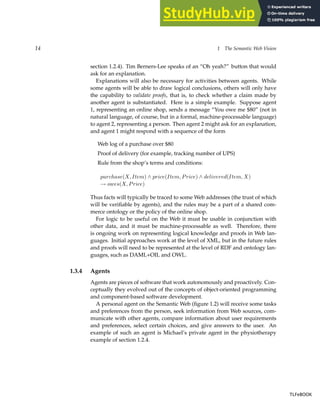
14 1 The Semantic Web Vision
section 1.2.4). Tim Berners-Lee speaks of an “Oh yeah?” button that would
ask for an explanation.
Explanations will also be necessary for activities between agents. While
some agents will be able to draw logical conclusions, others will only have
the capability to validate proofs, that is, to check whether a claim made by
another agent is substantiated. Here is a simple example. Suppose agent
1, representing an online shop, sends a message “You owe me $80” (not in
natural language, of course, but in a formal, machine-processable language)
to agent 2, representing a person. Then agent 2 might ask for an explanation,
and agent 1 might respond with a sequence of the form
Web log of a purchase over $80
Proof of delivery (for example, tracking number of UPS)
Rule from the shop’s terms and conditions:
purchase(X, Item) ∧ price(Item, Price) ∧ delivered(Item, X)
→ owes(X, Price)
Thus facts will typically be traced to some Web addresses (the trust of which
will be verifiable by agents), and the rules may be a part of a shared com-
merce ontology or the policy of the online shop.
For logic to be useful on the Web it must be usable in conjunction with
other data, and it must be machine-processable as well. Therefore, there
is ongoing work on representing logical knowledge and proofs in Web lan-
guages. Initial approaches work at the level of XML, but in the future rules
and proofs will need to be represented at the level of RDF and ontology lan-
guages, such as DAML+OIL and OWL.
1.3.4 Agents
Agents are pieces of software that work autonomously and proactively. Con-
ceptually they evolved out of the concepts of object-oriented programming
and component-based software development.
A personal agent on the Semantic Web (figure 1.2) will receive some tasks
and preferences from the person, seek information from Web sources, com-
municate with other agents, compare information about user requirements
and preferences, select certain choices, and give answers to the user. An
example of such an agent is Michael’s private agent in the physiotherapy
example of section 1.2.4.
TLFeBOOK
TLFeBOOK
1.3 Semantic Web Technologies 15
User
Present in
web browser
Search
engine
docs
www
User
Personal agent
Intelligent
services
infrastructure
Today In the future
WWW
docs
Figure 1.2 Intelligent personal agents
It should be noted that agents will not replace human users on the Seman-
tic Web, nor will they necessarily make decisions. In many, if not most, cases
their role will be to collect and organize information, and present choices for
the users to select from, as Michael’s personal agent did in offering a selec-
tion between the two best solutions it could find, or as a travel agent does
that looks for travel offers to fit a person’s given preferences.
Semantic Web agents will make use of all the technologies we have out-
lined:
• Metadata will be used to identify and extract information from Web
sources.
• Ontologies will be used to assist in Web searches, to interpret retrieved
information, and to communicate with other agents.
• Logic will be used for processing retrieved information and for drawing
conclusions.
Further technologies will also be needed, such as agent communication lan-
guages. Also, for advanced applications it will be useful to represent for-
TLFeBOOK
TLFeBOOK
16 1 The Semantic Web Vision
mally the beliefs, desires, and intentions of agents, and to create and main-
tain user models. However, these points are somewhat orthogonal to the
Semantic Web technologies. Therefore they are not discussed further in this
book.
1.3.5 The Semantic Web versus Artificial Intelligence
As we have said, most of the technologies needed for the realization of the
Semantic Web build upon work in the area of artificial intelligence. Given
that AI has a long history, not always commercially successful, one might
worry that, in the worst case, the Semantic Web will repeat AI’s errors: big
promises that raise too high expectations, which turn out not to be fulfilled
(at least not in the promised time frame).
This worry is unjustified. The realization of the Semantic Web vision does
not rely on human-level intelligence; in fact, as we have tried to explain, the
challenges are approached in a different way. The full problem of AI is a
deep scientific one, perhaps comparable to the central problems of physics
(explain the physical world) or biology (explain the living world). So seen,
the difficulties in achieving human-level Artificial Intelligence within ten or
twenty years, as promised at some points in the past, should not have come
as a surprise.
But on the Semantic Web partial solutions will work. Even if an intelligent
agent is not able to come to all conclusions that a human user might draw, the
agent will still contribute to a Web much superior to the current Web. This
brings us to another difference. If the ultimate goal of AI is to build an intel-
ligent agent exhibiting human-level intelligence (and higher), the goal of the
Semantic Web is to assist human users in their day-to-day online activities.
It is clear that the Semantic Web will make extensive use of current AI tech-
nology and that advances in that technology will lead to a better Semantic
Web. But there is no need to wait until AI reaches a higher level of achieve-
ment; current AI technology is already sufficient to go a long way toward
realizing the Semantic Web vision.
1.4 A Layered Approach
The development of the Semantic Web proceeds in steps, each step building
a layer on top of another. The pragmatic justification for this approach is that
it is easier to achieve consensus on small steps, whereas it is much harder
to get everyone on board if too much is attempted. Usually there are sev-
TLFeBOOK
TLFeBOOK
1.4 A Layered Approach 17
eral research groups moving in different directions; this competition of ideas
is a major driving force for scientific progress. However, from an engineer-
ing perspective there is a need to standardize. So, if most researchers agree
on certain issues and disagree on others, it makes sense to fix the points of
agreement. This way, even if the more ambitious research efforts should fail,
there will be at least partial positive outcomes.
Once a standard has been established, many more groups and companies
will adopt it, instead of waiting to see which of the alternative research lines
will be successful in the end. The nature of the Semantic Web is such that
companies and single users must build tools, add content, and use that con-
tent. We cannot wait until the full Semantic Web vision materializes — it may
take another ten years for it to be realized to its full extent (as envisioned
today, of course).
In building one layer of the Semantic Web on top of another, two principles
should be followed:
• Downward compatibility. Agents fully aware of a layer should also be
able to interpret and use information written at lower levels. For exam-
ple, agents aware of the semantics of OWL can take full advantage of
information written in RDF and RDF Schema.
• Upward partial understanding. On the other hand, agents fully aware of a
layer should take at least partial advantage of information at higher levels.
For example, an agent aware only of the RDF and RDF Schema semantics
can interpret knowledge written in OWL partly, by disregarding those
elements that go beyond RDF and RDF Schema.
Figure 1.3 shows the “layer cake” of the Semantic Web (due to Tim Berners-
Lee), which describes the main layers of the Semantic Web design and vision.
At the bottom we find XML, a language that lets one write structured Web
documents with a user-defined vocabulary. XML is particularly suitable for
sending documents across the Web.
RDF is a basic data model, like the entity-relationship model, for writing
simple statements about Web objects (resources). The RDF data model does
not rely on XML, but RDF has an XML-based syntax. Therefore, in figure 1.3,
it is located on top of the XML layer.
RDF Schema provides modeling primitives for organizing Web objects into
hierarchies. Key primitives are classes and properties, subclass and subprop-
erty relationships, and domain and range restrictions. RDF Schema is based
on RDF.
TLFeBOOK
TLFeBOOK
18 1 The Semantic Web Vision
Figure 1.3 A layered approach to the Semantic Web
RDF Schema can be viewed as a primitive language for writing ontolo-
gies. But there is a need for more powerful ontology languages that expand
RDF Schema and allow the representations of more complex relationships
between Web objects. The Logic layer is used to enhance the ontology lan-
guage further and to allow the writing of application-specific declarative
knowledge.
The Proof layer involves the actual deductive process as well as the repre-
sentation of proofs in Web languages (from lower levels) and proof valida-
tion.
Finally, the Trust layer will emerge through the use of digital signatures and
other kinds of knowledge, based on recommendations by trusted agents or
on rating and certification agencies and consumer bodies. Sometimes “Web
of Trust” is used to indicate that trust will be organized in the same dis-
tributed and chaotic way as the WWW itself. Being located at the top of the
pyramid, trust is a high-level and crucial concept: the Web will only achieve
its full potential when users have trust in its operations (security) and in the
quality of information provided.
TLFeBOOK
TLFeBOOK
1.5 Book Overview 19
1.5 Book Overview
In this book we concentrate on the Semantic Web technologies that have
reached a reasonable degree of maturity.
In Chapter 2 we discuss XML and related technologies. XML introduces
structure to Web documents, thus supporting syntactic interoperability. The
structure of a document can be made machine-accessible through DTDs and
XML Schema. We also discuss namespaces; accessing and querying XML
documents using XPath; and transforming XML documents with XSLT.
In Chapter 3 we discuss RDF and RDF Schema. RDF is a language in
which we can express statements about objects (resources); it is a standard
data model for machine-processable semantics. RDF Schema offers a number
of modeling primitives for organizing RDF vocabularies in typed hierarchies.
Chapter 4 discusses OWL, the current proposal for a Web ontology lan-
guage. It offers more modeling primitives, compared to RDF Schema, and
has a clean, formal semantics.
Chapter 5 is devoted to rules, both monotonic and nonmonotonic, in the
framework of the Semantic Web. While this layer has not yet been fully de-
fined, the principles to be adopted are quite clear, so it makes sense to present
them.
Chapter 6 discusses several application domains and explains the benefits
that they will draw from the materialization of the Semantic Web vision.
Chapter 7 describes the development of ontology-based systems for the
Web and contains a miniproject that employs much of the technology de-
scribed in this book.
Finally, chapter 8 discusses briefly a few issues which are currently under
debate in the Semantic Web community.
1.6 Summary
• The Semantic Web is an initiative that aims at improving the current state
of the World Wide Web.
• The key idea is the use of machine-processable Web information.
• Key technologies include explicit metadata, ontologies, logic and infer-
encing, and intelligent agents.
• The development of the Semantic Web proceeds in layers.
TLFeBOOK
TLFeBOOK
20 1 The Semantic Web Vision
Suggested Reading
An excellent introductory article, from which, among others, the scenario in
section 1.2.4 was adapted.
• T. Berners-Lee, J. Hendler, and O. Lassila. The Semantic Web. Scientific
American 284 (May 2001): 34-43.
An inspirational book about the history (and the future) of the Web is
• T. Berners-Lee, with M. Fischetti. Weaving the Web. San Francisco: Harper,
1999.
Many introductory articles on the Semantic Web are available online. Here
we list a few:
• T. Berners-Lee. Semantic Web Road Map. September 1998.
<http://www.w3.org/DesignIssues/Semantic.html>.
• T. Berners-Lee. Evolvability. March 1998.
<http://www.w3.org/DesignIssues/Evolution.html>.
• T. Berners-Lee. What the Semantic Web Can Represent. September 1998.
<http://www.w3.org/DesignIssues/RDFnot.html>.
• E. Dumbill. The Semantic Web: A Primer. November 1, 2000.
<http://www.xml.com/pub/a/2000/11/01/semanticweb/>.
• F. van Harmelen and D. Fensel. Practical Knowledge Representation for
the Web. <http://www.cs.vu.nl/∼frankh/postscript/IJCAI99-III.html>.
• J. Hendler. Agents and the Semantic Web. IEEE Intelligent Systems 16
(March-April 2001): 30-37.
Preprint at <http://www.cs.umd.edu/users/hendler/AgentWeb.html>.
• S. Palmer. The Semantic Web, Taking Form.
<http://infomesh.net/2001/06/swform/>.
• S. Palmer. The Semantic Web: An Introduction.
<http://infomesh.net/2001/Swintro/>.
• A. Swartz. The Semantic Web in Breadth.
<http://logicerror.com/semanticWeb-long>.
TLFeBOOK
TLFeBOOK
Suggested Reading 21
• A. Swartz and J. Hendler. The Semantic Web: A Network of Content for
the Digital City. <http://blogspace.com/rdf/SwartzHendler.html>.
• R. Jasper and A. Tyler. The Role of Semantics and Inference in the Seman-
tic Web: A Commercial Challenge.
<http://www.semanticweb.org/SWWS/program/position/
soi-jasper.pdf>.
There are several courses on the Semantic Web that have extensive material
online:
• F. van Harmelen et al. Web-Based Knowledge Representation.
<http://www.cs.vu.nl/∼marta/wbkr.html>.
• J. Heflin. The Semantic Web.
<http://www.cse.lehigh.edu/∼heflin/courses/semweb/>.
• A. Sheth. Semantic Web.
<http://lsdis.cs.uga.edu/SemWebCourse/index.html>.
• H. Boley, S. Decker, and M. Sintek. Tutorial on Knowledge Markup Tech-
niques. <http://www.dfki.uni-kl.de/km/knowmark/>.
A number of Web sites maintain up-to-date information about the Semantic
Web and related topics:
• <http://www.SemanticWeb.org>.
• <http://www.w3.org/2001/sw/>.
• <http://www.ontology.org>.
There is a good selection of research papers providing technical information
on issues relating to the Semantic Web:
• D. Fensel, J. Hendler, H. Lieberman and W. Wahlster, eds. Spinning the
Semantic Web. Cambridge, MA: MIT Press, 2003.
• J. Davies, D. Fensel and F. van Harmelen, eds. Towards the Semantic Web:
Ontology-Driven Knowledge Management. New York: Wiley, 2002.
• The conference series of the International Semantic Web Conference (see
<http://www.semanticweb.org/>).
TLFeBOOK
TLFeBOOK
TLFeBOOK
TLFeBOOK
2 Structured Web Documents in XML
2.1 Introduction
Today HTML (hypertext markup language) is the standard language in
which Web pages are written. HTML, in turn, was derived from SGML (stan-
dard generalized markup language), an international standard (ISO 8879) for
the definition of device- and system-independent methods of representing
information, both human- and machine-readable. Such standards are impor-
tant because they enable effective communication, thus supporting techno-
logical progress and business collaboration. In the WWW area, standards
are set by the W3C (World Wide Web Consortium); they are called recom-
mendations, in acknowledgment of the fact that in a distributed environment
without central authority, standards cannot be enforced.
Languages conforming to SGML are called SGML applications. HTML is
such an application; it was developed because SGML was considered far too
complex for Internet-related purposes. XML (extensible markup language) is
another SGML application, and its development was driven by shortcomings
of HTML. We can work out some of the motivations for XML by considering
a simple example, a Web page that contains information about a particular
book.
<h2>Nonmonotonic Reasoning: Context-Dependent
Reasoning</h2>
<i>by <b>V. Marek</b> and <b>M. Truszczynski</b></i><br>
Springer 1993<br>
ISBN 0387976892
A typical XML representation of the the same information might look like
this:
TLFeBOOK
TLFeBOOK
24 2 Structured Web Documents in XML
<book>
<title>
Nonmonotonic Reasoning: Context-Dependent Reasoning
</title>
<author>V. Marek</author>
<author>M. Truszczynski</author>
<publisher>Springer</publisher>
<year>1993</year>
<ISBN>0387976892</ISBN>
</book>
Before we turn to differences between the HTML and XML representations,
let us observe a few similarities. First, both representations use tags, such as
<h2> and </year>. Indeed both HTML and XML are markup languages:
they allow one to write some content and provide information about what
role that content plays.
Like HTML, XML is based on tags. These tags may be nested (tags within
tags). All tags in XML must be closed (for example, for an opening tag
<title> there must be a closing tag </title>), whereas in HTML some
tags, such as <br>, may be left open. The enclosed content, together with
its opening and closing tags, is referred to as an element. (The recent devel-
opment of XHTML has brought HTML more in line with XML: any valid
XHTML document is also a valid XML document, and as a consequence,
opening and closing tags in XHTML are balanced).
A less formal observation is that human userss can read both HTML and
XML representations quite easily. Both languages were designed to be easily
understandable and usable by humans. But how about machines? Imagine
an intelligent agent trying to retrieve the names of the authors of the book
in the previous example. Suppose the HTML page could be located with
a Web search (something that is not at all clear; the limitations of current
search engines are well documented). There is no explicit information as to
who the authors are. A reasonable guess would be that the authors’ names
appear immediately after the title or immediately follow the word by. But
there is no guarantee that these conventions are always followed. And even
if they were, are there two authors, “V. Marek” and “M. Truszczynski”, or just
one, called “V. Marek and M. Truszczynski”? Clearly, more text processing is
needed to answer this question, processing that is open to errors.
The problems arise from the fact that the HTML document does not con-
tain structural information, that is, information about pieces of the document
and their relationships. In contrast, the XML document is far more easily ac-
TLFeBOOK
TLFeBOOK
2.1 Introduction 25
cessible to machines because every piece of information is described. More-
over, their relations are also defined through the nesting structure. For exam-
ple, the <author> tags appear within the <book> tags, so they describe
properties of the particular book. A machine processing the XML document
would be able to deduce that the author element refers to the enclosing
book element, rather than having to infer this fact from proximity considera-
tions, as in HTML. An additional advantage is that XML allows the definition
of constraints on values (for example, that a year must be a number of four
digits, that the number must be less than 3,000). XML allows the representation
of information that is also machine-accessible.
Of course, we must admit that the HTML representation provides more
than the XML representation: the formatting of the document is also de-
scribed. However, this feature is not a strength but a weakness of HTML:
it must specify the formatting; in fact, the main use of an HTML document is
to display information (apart from linking to other documents). On the other
hand, XML separates content from formatting. The same information can be
displayed in different ways, without requiring multiple copies of the same
content; moreover, the content may be used for purposes other than display.
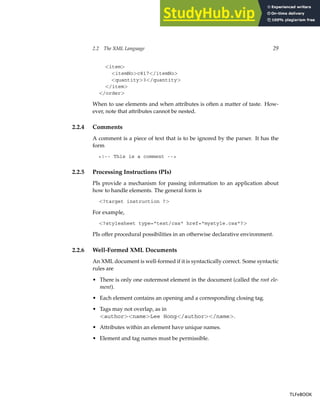
Let us now consider another example, a famous law of physics. Consider
the HTML text
<h2>Relationship force-mass</h2>
<i>F = M × a</i>
and the XML representation
<equation>
<meaning>Relationship force-mass</meaning>
<leftside>F</leftside>
<rightside>M × a</rightside>
</equation>
If we compare the HTML document to the previous HTML document, we
notice that both use basically the same tags. That is not surprising, since
they are predefined. In contrast, the second XML document uses completely
different tags from the first XML document. This observation is related to
the intended use of representations. HTML representations are intended to
display information, so the set of tags is fixed: lists, bold, color, and so on.
In XML we may use information in various ways, and it is up to the user to
define a vocabulary suitable for the application. Therefore, XML is a metalan-
guage for markup: it does not have a fixed set of tags but allows users to define tags
of their own.
TLFeBOOK
TLFeBOOK
26 2 Structured Web Documents in XML
Just as people cannot communicate effectively if they don’t use a common
language, applications on the WWW must agree on common vocabularies
if they need to communicate and collaborate. Communities and business
sectors are in the process of defining their specialized vocabularies, creat-
ing XML applications (or extensions; thus the term extensible in the name of
XML). Such XML applications have been defined in various domains, for
example, mathematics (MathML), bioinformatics (BSML), human resources
(HRML), astronomy (AML), news (NewsML), and investment (IRML).
Also, the W3C has defined various languages on top of XML, such as SVG
and SMIL. This approach has also been taken for RDF (see chapter 3).
It should be noted that XML can serve as a uniform data exchange format
between applications. In fact, XML’s use as a data exchange format between
applications nowadays far outstrips its originally intended use as document
markup language. Companies often need to retrieve information from their
customers and business partners, and update their corporate databases ac-
cordingly. If there is not an agreed common standard like XML, then special-
ized processing and querying software must be developed for each partner
separately, leading to technical overhead; moreover, the software must be
updated every time a partner decides to change its own database format.
In this chapter, section 2.2 describes the XML language in more detail,
and section 2.3 describes the structuring of XML documents. In relational
databases, the structure of tables must be defined. Similarly, the structure of
an XML document must be defined. This can be done by writing a DTD (doc-
ument data definition), the older approach, or an XML schema, the modern
approach that will gradually replace DTDs.
Section 2.4 describes namespaces, which support the modularization of
DTDs and XML schemas. Section 2.5 is devoted to the accessing and query-
ing of XML documents, using XPath. Finally, section 2.6 shows how XML
documents can be transformed to be displayed (or for other purposes), using
XSL and XSLT.
TLFeBOOK
TLFeBOOK
2.2 The XML Language 27
2.2 The XML Language
An XML document consists of a prolog, a number of elements, and an optional
epilog (not discussed here).
2.2.1 Prolog
The prolog consists of an XML declaration and an optional reference to ex-
ternal structuring documents. Here is an example of an XML declaration:
<?xml version="1.0" encoding="UTF-16"?>
It specifies that the current document is an XML document, and defines the
version and the character encoding used in the particular system (such as
UTF-8, UTF-16, and ISO 8859-1). The character encoding is not mandatory,
but its specification is considered good practice. Sometimes we also specify
whether the document is self-contained, that is, whether it does not refer to
external structuring documents:
<?xml version="1.0" encoding="UTF-16" standalone="no" ?>
A reference to external structuring documents looks like this:
<!DOCTYPE book SYSTEM "book.dtd">
Here the structuring information is found in a local file called book.dtd.
Instead, the reference might be a URL. If only a locally recognized name or
only a URL is used, then the label SYSTEM is used. If, however, one wishes
to give both a local name and a URL, then the label PUBLIC should be used
instead.
2.2.2 Elements
XML elements represent the “things” the XML document talks about, such
as books, authors, and publishers. They compose the main concept of XML
documents. An element consists of an opening tag, its content, and a closing
tag. For example,
<lecturer>David Billington</lecturer>
Tag names can be chosen almost freely; there are very few restrictions. The
most important ones are that the first character must be a letter, an under-
score, or a colon; and that no name may begin with the string “xml” in any
combination of cases (such as “Xml” and “xML”).
TLFeBOOK
TLFeBOOK
28 2 Structured Web Documents in XML
The content may be text, or other elements, or nothing. For example,
<lecturer>
<name>David Billington</name>
<phone>+61-7-3875 507</phone>
</lecturer>
If there is no content, then the element is called empty. An empty element
like
<lecturer></lecturer>
can be abbreviated as
<lecturer/>
2.2.3 Attributes
An empty element is not necessarily meaningless, because it may have some
properties in terms of attributes. An attribute is a name-value pair inside the
opening tag of an element:
<lecturer name="David Billington" phone="+61-7-3875 507"/>
Here is an example of attributes for a nonempty element:
<order orderNo="23456" customer="John Smith"
date="October 15, 2002">
<item itemNo="a528" quantity="1"/>
<item itemNo="c817" quantity="3"/>
</order>
The same information could have been written as follows, replacing at-
tributes by nested elements:
<order>
<orderNo>23456</orderNo>
<customer>John Smith</customer>
<date>October 15, 2002</date>
<item>
<itemNo>a528</itemNo>
<quantity>1</quantity>
</item>
TLFeBOOK
TLFeBOOK
2.2 The XML Language 29
<item>
<itemNo>c817</itemNo>
<quantity>3</quantity>
</item>
</order>
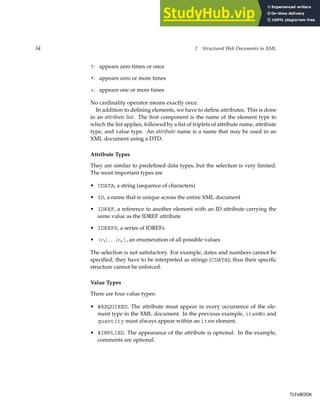
When to use elements and when attributes is often a matter of taste. How-
ever, note that attributes cannot be nested.
2.2.4 Comments
A comment is a piece of text that is to be ignored by the parser. It has the
form
<!-- This is a comment -->
2.2.5 Processing Instructions (PIs)
PIs provide a mechanism for passing information to an application about
how to handle elements. The general form is
<?target instruction ?>
For example,
<?stylesheet type="text/css" href="mystyle.css"?>
PIs offer procedural possibilities in an otherwise declarative environment.
2.2.6 Well-Formed XML Documents
An XML document is well-formed if it is syntactically correct. Some syntactic
rules are
• There is only one outermost element in the document (called the root ele-
ment).
• Each element contains an opening and a corresponding closing tag.
• Tags may not overlap, as in
<author><name>Lee Hong</author></name>.
• Attributes within an element have unique names.
• Element and tag names must be permissible.
TLFeBOOK
TLFeBOOK
30 2 Structured Web Documents in XML
2.2.7 The Tree Model of XML Documents
It is possible to represent well-formed XML documents as trees; thus trees
provide a formal data model for XML. This representation is often instruc-
tive. As an example, consider the following document:
<?xml version="1.0" encoding="UTF-16"?>
<!DOCTYPE email SYSTEM "email.dtd">
<email>
<head>
<from name="Michael Maher"
address="michaelmaher@cs.gu.edu.au"/>
<to name="Grigoris Antoniou"
address="grigoris@cs.unibremen.de"/>
<subject>Where is your draft?</subject>
</head>
<body>
Grigoris, where is the draft of the paper
you promised me last week?
</body>
</email>
Figure 2.1 shows the tree representation of this XML document. It is an or-
dered labeled tree:
• There is exactly one root.
• There are no cycles.
• Each node, other than the root, has exactly one parent.
• Each node has a label.
• The order of elements is important.
However, whereas the order of elements is important, the order of attributes
is not. So, the following two elements are equivalent:
<person lastname="Woo" firstname="Jason"/>
<person firstname="Jason" lastname="Woo"/>
This aspect is not represented properly in the tree. In general, we would
require a more refined tree concept; for example, we should also differenti-
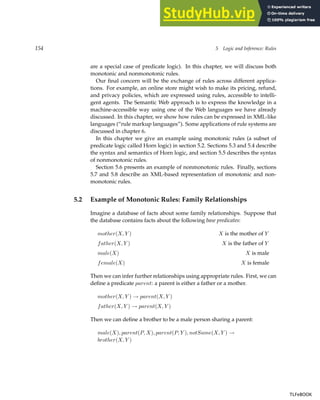
ate between the different types of nodes (element node, attribute node etc.).
TLFeBOOK
TLFeBOOK
2.3 Structuring 31
body
Grigoris,
where is the
draft of the
paper you
promised me
last week?
email
Root
from
name address
Michael michaelmaher@
Maher cs.gu.edu.au
head
Where is
your draft?
subject
name address
to
Antoniou
Grigoris grigoris@
cs.unibremen.de
Figure 2.1 Tree representation of an XML document
However, here we use graphs as illustrations, so we do not go into further
detail.
Figure 2.1 also shows the difference between the root (representing the
XML document), and the root element, in our case the email element. This
distinction will play a role when we discuss addressing and querying XML
documents in section 2.5.
2.3 Structuring
An XML document is well-formed if it respects certain syntactic rules. How-
ever, those rules say nothing specific about the structure of the document.
Now, imagine two applications that try to communicate, and that they wish
to use the same vocabulary. For this purpose it is necessary to define all
the element and attribute names that may be used. Moreover, the structure
should also be defined: what values an attribute may take, which elements
may or must occur within other elements, and so on.
In the presence of such structuring information we have an enhanced pos-
sibility of document validation. We say that an XML document is valid if it
TLFeBOOK
TLFeBOOK
32 2 Structured Web Documents in XML
is well-formed, uses structuring information, and respects that structuring
information.
There are two ways of defining the structure of XML documents: DTDs,
the older and more restricted way, and XML Schema, which offers extended
possibilities, mainly for the definition of data types.
2.3.1 DTDs
External and Internal DTDs
The components of a DTD can be defined in a separate file (external DTD) or
within the XML document itself (internal DTD). Usually it is better to use ex-
ternal DTDs, because their definitions can be used across several documents;
otherwise duplication is inevitable, and the maintenance of consistency over
time becomes difficult.
Elements
Consider the element
<lecturer>
<name>David Billington</name>
<phone>+61-7-3875 507</phone>
</lecturer>
from the previous section. A DTD for this element type1
looks like this:
<!ELEMENT lecturer (name,phone)>
<!ELEMENT name (#PCDATA)>
<!ELEMENT phone (#PCDATA)>
The meaning of this DTD is as follows:
• The element types lecturer, name, and phone may be used in the doc-
ument.
• A lecturer element contains a name element and a phone element, in
that order.
1. The distinction between the element type lecturer and a particular element of this type,
such as David Billington, should be clear. All particular elements of type lecturer (re-
ferred to as lecturer elements) share the same structure, which is defined here.
TLFeBOOK
TLFeBOOK
2.3 Structuring 33
• A name element and a phone element may have any content. In DTDs,
#PCDATA is the only atomic type for elements.
We express that a lecturer element contains either a name element or a
phone element as follows:
<!ELEMENT lecturer (name|phone)>
It gets more difficult when we wish to specify that a lecturer element con-
tains a name element and a phone element in any order. We can only use the
trick
<!ELEMENT lecturer ((name,phone)|(phone,name))>
However, this approach suffers from practical limitations (imagine ten ele-
ments in any order).
Attributes
Consider the element
<order orderNo="23456" customer="John Smith"
date="October 15, 2002">
<item itemNo="a528" quantity="1"/>
<item itemNo="c817" quantity="3"/>
</order>
from the previous section. A DTD for it looks like this:
<!ELEMENT order (item+)>
<!ATTLIST order
orderNo ID #REQUIRED
customer CDATA #REQUIRED
date CDATA #REQUIRED>
<!ELEMENT item EMPTY>
<!ATTLIST item
itemNo ID #REQUIRED
quantity CDATA #REQUIRED
comments CDATA #IMPLIED>
Compared to the previous example, a new aspect is that the item element
type is defined to be empty. Another new aspect is the appearance of + after
item in the definition of the order element type. It is one of the cardinality
operators:
TLFeBOOK
TLFeBOOK
34 2 Structured Web Documents in XML
?: appears zero times or once
*: appears zero or more times
+: appears one or more times
No cardinality operator means exactly once.
In addition to defining elements, we have to define attributes. This is done
in an attribute list. The first component is the name of the element type to
which the list applies, followed by a list of triplets of attribute name, attribute
type, and value type. An attribute name is a name that may be used in an
XML document using a DTD.
Attribute Types
They are similar to predefined data types, but the selection is very limited.
The most important types are
• CDATA, a string (sequence of characters)
• ID, a name that is unique across the entire XML document
• IDREF, a reference to another element with an ID attribute carrying the
same value as the IDREF attribute
• IDREFS, a series of IDREFs
• (v1| . . . |vn), an enumeration of all possible values
The selection is not satisfactory. For example, dates and numbers cannot be
specified; they have to be interpreted as strings (CDATA); thus their specific
structure cannot be enforced.
Value Types
There are four value types:
• #REQUIRED. The attribute must appear in every occurrence of the ele-
ment type in the XML document. In the previous example, itemNo and
quantity must always appear within an item element.
• #IMPLIED. The appearance of the attribute is optional. In the example,
comments are optional.
TLFeBOOK
TLFeBOOK
2.3 Structuring 35
• #FIXED "value". Every element must have this attribute, which has
always the value given after #FIXED in the DTD. A value given in an XML
document is meaningless because it is overridden by the fixed value.
• "value". This specifies the default value for the attribute. If a specific
value appears in the XML document, it overrides the default value. For
example, the default encoding of the e-mail system may be “mime”, but
“binhex” will be used if specified explicitly by the user.
Referencing
Here is an example for the use of IDREF and IDREFS. First we give a DTD:
<!ELEMENT family (person*)>
<!ELEMENT person (name)>
<!ELEMENT name (#PCDATA)>
<!ATTLIST person
id ID #REQUIRED
mother IDREF #IMPLIED
father IDREF #IMPLIED
children IDREFS #IMPLIED>
An XML element that respects this DTD is the following:
<family>
<person id="bob" mother="mary" father="peter">
<name>Bob Marley</name>
</person>
<person id="bridget" mother="mary">
<name>Bridget Jones</name>
</person>
<person id="mary" children="bob bridget">
<name>Mary Poppins</name>
</person>
<person id="peter" children="bob">
<name>Peter Marley</name>
</person>
</family>
TLFeBOOK
TLFeBOOK
36 2 Structured Web Documents in XML
Readers should study the references between persons.
A Concluding Example
As a final example we give a DTD for the email element from the section
2.2.7:
<!ELEMENT email (head,body)>
<!ELEMENT head (from,to+,cc*,subject)>
<!ELEMENT from EMPTY>
<!ATTLIST from
name CDATA #IMPLIED
address CDATA #REQUIRED>
<!ELEMENT to EMPTY>
<!ATTLIST to
name CDATA #IMPLIED
address CDATA #REQUIRED>
<!ELEMENT cc EMPTY>
<!ATTLIST cc
name CDATA #IMPLIED
address CDATA #REQUIRED>
<!ELEMENT subject (#PCDATA)>
<!ELEMENT body (text,attachment*)>
<!ELEMENT text (#PCDATA)>
<!ELEMENT attachment EMPTY>
<!ATTLIST attachment
encoding (mime|binhex) "mime"
file CDATA #REQUIRED>
We go through some interesting parts of this DTD:
• A head element contains a from element, at least one to element, zero or
more cc elements, and a subject element, in that order.
• In from, to, and cc elements the name attribute is not required; the ad-
dress attribute on the other hand is always required.
• A body element contains a text element, possibly followed by a number
of attachment elements.
• The encoding attribute of an attachment element must have either the
value “mime” or “binhex”, the former being the default value.
TLFeBOOK
TLFeBOOK
2.3 Structuring 37
We conclude with two more remarks on DTDs. Firstly, a DTD can be inter-
preted as an Extended Backus-Naur Form (EBNF). For example, the declara-
tion
<!ELEMENT email (head,body)>
is equivalent to the rule
email ::= head body
which means that an e-mail consists of a head followed by a body. And
second, recursive definitions are possible in DTDs. For example,
<!ELEMENT bintree ((bintree root bintree)|emptytree)>
defines binary trees: a binary tree is the empty tree, or consists of a left sub-
tree, a root, and a right subtree.
2.3.2 XML Schema
XML Schema offers a significantly richer language for defining the structure
of XML documents. One of its characteristics is that its syntax is based on
XML itself. This design decision provides a significant improvement in read-
ability, but more important, it also allows significant reuse of technology. It
is no longer necessary to write separate parsers, editors, pretty printers, and
so on, to obtain a separate syntax, as was required for DTDs; any XML will
do. An even more important improvement is the possibility of reusing and
refining schemas. XML Schema allows one to define new types by extend-
ing or restricting already existing ones. In combination with an XML-based
syntax, this feature allows one to build schemas from other schemas, thus
reducing the workload. Finally, XML Schema provides a sophisticated set of
data types that can be used in XML documents (DTDs were limited to strings
only).
An XML schema is an element with an opening tag like
<xsd:schema
xmlns:xsd="http://www.w3.org/2000/10/XMLSchema"
version="1.0">
The element uses the schema of XML Schema found at the W3C Web site.
It is, so to speak, the foundation on which new schemas can be built. The
prefix xsd denotes the namespace of that schema (more on namespaces in
the next section). If the prefix is omitted in the xmlns attribute, then we are
using elements from this namespace by default:
TLFeBOOK
TLFeBOOK
38 2 Structured Web Documents in XML
<schema
xmlns="http://www.w3.org/2000/10/XMLSchema"
version="1.0">
In the following we omit the xsd prefix.
Now we turn to schema elements. Their most important contents are
the definitions of element and attribute types, which are defined using data
types.
Element Types
The syntax of element types is
<element name=". . ."/>
and they may have a number of optional attributes, such as types,
type=". . ." (more on types later)
or cardinality constraints
• minOccurs="x", where x may be any natural number (including zero)
• maxOccurs="x", where x may be any natural number (including zero)
or unbounded
minOccurs and maxOccurs are generalizations of the cardinality operators
?, *, and +, offered by DTDs. When cardinality constraints are not provided
explicitly, minOccurs and maxOccurs have value 1 by default.
Here are a few examples.
<element name="email"/>
<element name="head" minOccurs="1" maxOccurs="1"/>
<element name="to" minOccurs="1"/>
Attribute Types
The syntax of attribute types is
<attribute name=". . ."/>
and they may have a number of optional attributes, such as types,
TLFeBOOK
TLFeBOOK
2.3 Structuring 39
type=". . ."
or existence (corresponds to #OPTIONAL and #IMPLIED in DTDs),
use="x", where x may be optional or required.
or a default value (corresponds to #FIXED and default values in DTDs)
use="x" value=". . .", where x may be default or fixed
Here are examples:
<attribute name="id" type="ID" use="required"/>
<element name="speaks" type="Language" use="default"
value="en"/>
Data Types
We have already recognized the very restricted selection of data types as
a key weakness of DTDs. XML Schema provides powerful capabilities for
defining data type. First there is a variety of built-in data types. Here we list a
few:
• Numerical data types, including integer, Short, Byte, Long, Float,
Decimal
• String data types, including string, ID, IDREF, CDATA, Language
• Date and time data types, including time, Date, Month, Year
There are also user-defined data types, comprising simple data types, which can-
not use elements or attributes, and complex data types, which can use elements
and attributes. We discuss complex types first, deferring discussion of simple
data types until we talk about restriction. Complex types are defined from
already existing data types by defining some attributes (if any) and using
• sequence, a sequence of existing data type elements, the appearance of
which in a predefined order is important
• all, a collection of elements that must appear, but the order of which is
not important
• choice, a collection of elements, of which one will be chosen.
TLFeBOOK
TLFeBOOK
40 2 Structured Web Documents in XML
Here is an example:
<complexType name="lecturerType">
<sequence>
<element name="firstname" type="string"
minOccurs="0" maxOccurs="unbounded"/>
<element name="lastname" type="string"/>
</sequence>
<attribute name="title" type="string" use="optional"/>
</complexType>
The meaning is that an element in an XML document that is declared to be
of type lecturerType may have a title attribute; it may also include any
number of firstname elements and must include exactly one lastname
element.
Data Type Extension
Already existing data types can be extended by new elements or attributes.
As an example, we extend the lecturer data type.
<complexType name="extendedLecturerType">
<extension base="lecturerType">
<sequence>
<element name="email" type="string"
minOccurs="0" maxOccurs="1"/>
</sequence>
<attribute name="rank" type="string" use="required"/>
</extension>
</complexType>
In this example, lecturerType is extended by an email element and a
rank attribute. The resulting data type looks like this:
<complexType name="extendedLecturerType">
<sequence>
<element name="firstname" type="string"
minOccurs="0" maxOccurs="unbounded"/>
<element name="lastname" type="string"/>
<element name="email" type="string"
minOccurs="0" maxOccurs="1"/>
</sequence>
<attribute name="title" type="string" use="optional"/>
TLFeBOOK
TLFeBOOK
2.3 Structuring 41
<attribute name="rank" type="string" use="required"/>
</complexType>
A hierarchical relationship exists between the original and the extended type.
Instances of the extended type are also instances of the original type. They may
contain additional information, but neither less information, nor information
of the wrong type.
Data Type Restriction
An existing data type may also be restricted by adding constraints on certain
values. For example, new type and use attributes may be added, or the
numerical constraints of minOccurs and maxOccurs tightened.
It is important to understand that restriction is not the opposite process
from extension. Restriction is not achieved by deleting elements or attributes.
Therefore, the following hierarchical relationship still holds: Instances of the
restricted type are also instances of the original type. They satisfy at least the
constraints of the original type, and some new ones.
As an example, we restrict the lecturer data type as follows:
<complexType name="restrictedLecturerType">
<restriction base="lecturerType">
<sequence>
<element name="firstname" type="string"
minOccurs="1" maxOccurs="2"/>
</sequence>
<attribute name="title" type="string" use="required"/>
</restriction>
</complexType>
The tightened constraints are shown in boldface. Readers should compare
them with the original ones.
Simple data types can also be defined by restricting existing data types.
For example, we can define a type dayOfMonth that admits values from 1
to 31 as follows:
<simpleType name="dayOfMonth">
<restriction base="integer">
<minInclusive value="1"/>
<maxInclusive value="31"/>
</restriction>
</simpleType>
TLFeBOOK
TLFeBOOK
42 2 Structured Web Documents in XML
It is also possible to define a data type by listing all the possible values. For
example, we can define a data type dayOfWeek as follows:
<simpleType name="dayOfWeek">
<restriction base="string">
<enumeration value="Mon"/>
<enumeration value="Tue"/>
<enumeration value="Wed"/>
<enumeration value="Thu"/>
<enumeration value="Fri"/>
<enumeration value="Sat"/>
<enumeration value="Sun"/>
</restriction>
</simpleType>
A Concluding Example
Here we define an XML schema for e-Mail, so that it can be compared to
the DTD provided on page 36.
<element name="email" type="emailType"/>
<complexType name="emailType">
<sequence>
<element name="head" type="headType"/>
<element name="body" type="bodyType"/>
</sequence>
</complexType>
<complexType name="headType">
<sequence>
<element name="from" type="nameAddress"/>
<element name="to" type="nameAddress"
minOccurs="1" maxOccurs="unbounded"/>
<element name="cc" type="nameAddress"
minOccurs="0" maxOccurs="unbounded"/>
<element name="subject" type="string"/>
</sequence>
</complexType>
<complexType name="nameAddress">
<attribute name="name" type="string" use="optional"/>
<attribute name="address" type="string" use="required"/>
</complexType>
TLFeBOOK
TLFeBOOK
2.4 Namespaces 43
<complexType name="bodyType">
<sequence>
<element name="text" type="string"/>
<element name="attachment" minOccurs="0"
maxOccurs="unbounded">
<complexType>
<attribute name="encoding" use="default"
value="mime">
<simpleType>
<restriction base="string">
<enumeration value="mime"/>
<enumeration value="binhex"/>
</restriction>
</simpleType>
</attribute>
<attribute name="file" type="string"
use="required"/>
</complexType>
</element>
</sequence>
</complexType>
Note that some data types are defined separately and given names, while
others are defined within other types and defined anonymously (the types
for the attachment element and the encoding attribute). In general, if a
type is only used once, it makes sense to define it anonymously for local use.
However, this approach reaches its limitations quickly if nesting becomes too
deep.
2.4 Namespaces
One of the main advantages of using XML as a universal (meta) markup lan-
guage is that information from various sources may be accessed; in technical
terms, an XML document may use more than one DTD or schema. But since
each structuring document was developed independently, name clashes ap-
pear inevitable. If DTD A and DTD B define an element type e in different
ways, a parser that tries to validate an XML document in which an e element
appears must be told which DTD to use for validation purposes.
TLFeBOOK
TLFeBOOK
44 2 Structured Web Documents in XML
The technical solution is simple: disambiguation is achieved by using a
different prefix for each DTD or schema. The prefix is separated from the
local name by a colon:
prefix:name
As an example, consider an (imaginary) joint venture of an Australian uni-
versity, say, Griffith University, and an American university, say, University
of Kentucky, to present a unified view for online students. Each university
uses its own terminology, and there are differences. For example, lecturers
in the United States are not considered regular faculty, whereas in Australia
they are (in fact, they correspond to assistant professors in the United States).
The following example shows how disambiguation can be achieved.
<?xml version="1.0" encoding="UTF-16"?>
<vu:instructors
xmlns:vu="http://www.vu.com/empDTD"
xmlns:gu="http://www.gu.au/empDTD"
xmlns:uky="http://www.uky.edu/empDTD">
<uky:faculty
uky:title="assistant professor"
uky:name="John Smith"
uky:department="Computer Science"/>
<gu:academicStaff
gu:title="lecturer"
gu:name="Mate Jones"
gu:school="Information Technology"/>
</vu:instructors>
So, namespaces are declared within an element and can be used in that ele-
ment and any of its children (elements and attributes). A namespace decla-
ration has the form:
xmlns:prefix="location"
where location is the address of the DTD or schema. If a prefix is not speci-
fied, as in
xmlns="location"
then the location is used by default. For example, the previous example is
equivalent to the following document:
TLFeBOOK
TLFeBOOK
2.5 Addressing and Querying XML Documents 45
<?xml version="1.0" encoding="UTF-16"?>
<vu:instructors
xmlns:vu="http://www.vu.com/empDTD"
xmlns="http://www.gu.au/empDTD"
xmlns:uky="http://www.uky.edu/empDTD">
<uky:faculty
uky:title="assistant professor"
uky:name="John Smith"
uky:department="Computer Science"/>
<academicStaff
title="lecturer"
name="Mate Jones"
school="Information Technology"/>
</vu:instructors>
2.5 Addressing and Querying XML Documents
In relational databases, parts of a database can be selected and retrieved us-
ing query languages such as SQL. The same is true for XML documents, for
which there exist a number of proposals for query languages, such as XQL,
XML-QL, and XQuery.
The central concept of XML query languages is a path expression that spec-
ifies how a node, or a set of nodes, in the tree representation of the XML
document can be reached. We introduce path expressions in the form of
XPath because they can be used for purposes other than querying, namely,
for transforming XML documents.
XPath is a language for addressing parts of an XML document. It operates
on the tree data model of XML and has a non-XML syntax. The key concepts
are path expressions. They can be
• Absolute (starting at the root of the tree); syntactically they begin with
the symbol /, which refers to the root of the document, situated one level
above the root element of the document;
• Relative to a context node.
Consider the following XML document:
<?xml version="1.0" encoding="UTF-16"?>
<!DOCTYPE library PUBLIC "library.dtd">
<library location="Bremen">
TLFeBOOK
TLFeBOOK
46 2 Structured Web Documents in XML
author
title title title
book
book
book
name
Artificial
Intelligence
Smart
William
Computation
of
Theory
Web
Modern
Sevices
Artificial
Intelligence
Wise
Henry Cynthia
Singleton
author
title title
book
book
name
library
root
name
author
title
book
location
Bremen
Revised
Technology
Browser
Web
Semantic
The
Figure 2.2 Tree representation of a library document
<author name="Henry Wise">
<book title="Artificial Intelligence"/>
<book title="Modern Web Services"/>
<book title="Theory of Computation"/>
</author>
<author name="William Smart">
<book title="Artificial Intelligence"/>
</author>
<author name="Cynthia Singleton">
<book title="The Semantic Web"/>
<book title="Browser Technology Revised"/>
</author>
</library>
Its tree representation is shown in figure 2.2.
In the following we illustrate the capabilities of XPath with a few examples
of path expressions.
1. Address all author elements.
/library/author
This path expression addresses all author elements that are children of
the library element node, which resides immediately below the root.
TLFeBOOK
TLFeBOOK
2.5 Addressing and Querying XML Documents 47
Using a sequence /t1/ . . . /tn, where each ti+1 is a child node of ti, we
define a path through the tree representation.
2. An alternative solution for the previous example is
//author
Here // says that we should consider all elements in the document and
check whether they are of type author. In other words, this path expres-
sion addresses all author elements anywhere in the document. Because
of the specific structure of our XML document, this expression and the
previous one lead to the same result; however, they may lead to different
results, in general.
3. Address the location attribute nodes within library element nodes.
/library/@location
The symbol @ is used to denote attribute nodes.
4. Address all title attribute nodes within book elements anywhere in the
document, which have the value “Artificial Intelligence” (see
figure 2.3).
//book/@title="Artificial Intelligence"
5. Address all books with title “Artificial Intelligence” (see figure
2.4).
//book[@title="Artificial Intelligence"]
We call a test within square brackets a filter expression. It restricts the set of
addressed nodes.
Note the difference between this expression and the one in query 4. Here
we address book elements the title of which satisfies a certain condition.
In query 4 we collected title attribute nodes of book elements. A com-
parison of figures 2.3 and 2.4 illustrates the difference.
6. Address the first author element node in the XML document.
//author[1]
TLFeBOOK
TLFeBOOK
48 2 Structured Web Documents in XML
author
title title title
book
book
book
name
location
Henry
Computation
of
Theory
Web
Modern
Sevices
Artificial
Intelligence
Wise
Bremen
name
Artificial
Intelligence
Smart
William
name
author
title
book
library
root
book
Revised
Technology
Browser
Web
Semantic
The
Cynthia
Singleton
book
title
title
author
Figure 2.3 Tree representation of query 4
author
title title title
book
book
book
name
location
Bremen
Computation
of
Theory
Web
Modern
Sevices
Artificial
Intelligence
Wise
Henry
name
Artificial
Intelligence
Smart
William
name
author
title
book
library
root
book
Revised
Technology
Browser
Web
Semantic
The
Cynthia
Singleton
author
title title
book
Figure 2.4 Tree representation of query 5
TLFeBOOK
TLFeBOOK
2.6 Processing 49
7. Address the last book element within the first author element node in
the document.
//author[1]/book[last()]
8. Address all book element nodes without a title attribute.
//book[not @title]
These examples are meant to give a feeling of the expressive power of path
expressions. In general, a path expression consists of a series of steps, sep-
arated by slashes. A step consists of an axis specifier, a node test, and an
optional predicate.
• An axis specifier determines the tree relationship between the nodes to be
addressed and the context node. Examples are parent, ancestor, child (the
default), sibling, attribute node. // is such an axis specifier; it denotes
descendant or self.
• A node test specifies which nodes to address. The most common node tests
are element names (which may use namespace information), but there
are others. For example, * addresses all element nodes, comment() all
comment nodes, and so on.
• Predicates (or filter expressions) are optional and are used to refine the set of
addressed nodes. For example, the expression [1] selects the first node,
[position()=last()] selects the last node, [position() mod 2 =
0] the even nodes, and so on.
We have only presented the abbreviated syntax, XPath actually has a more
complicated full syntax. References are found at the end of this chapter.
2.6 Processing
So far we have not provided any information about how XML documents
can be displayed. Such information is necessary because unlike HTML doc-
uments, XML documents do not contain formatting information. The advan-
tage is that a given XML document can be presented in various ways, when
different style sheets are applied to it. For example, consider the XML element
TLFeBOOK
TLFeBOOK
50 2 Structured Web Documents in XML
<author>
<name>Grigoris Antoniou</name>
<affiliation>University of Bremen</affiliation>
<email>ga@tzi.de</email>
</author>
The output might look like the following, if a style sheet is used:
Grigoris Antoniou
University of Bremen
ga@tzi.de
Or it might appear as follows, if a different style sheet is used:
Grigoris Antoniou
University of Bremen
ga@tzi.de
Style sheets can be written in various languages, for example, in CSS2 (cas-
cading style sheets level 2). The other possibility is XSL (extensible stylesheet
language).
XSL includes both a transformation language (XSLT) and a formatting lan-
guage. Each of these is, of course, an XML application. XSLT specifies rules
with which an input XML document is transformed to another XML doc-
ument, an HTML document, or plain text. The output document may use
the same DTD or schema as the input document, or it may use a completely
different vocabulary.
XSLT (XSL transformations) can be used independently of the format-
ting language. Its ability to move data and metadata from one XML rep-
resentation to another makes it a most valuable tool for XML-based applica-
tions. Generally XSLT is chosen when applications that use different DTDs or
schemas need to communicate. XSLT is a tool that can be used for machine-
processing of content without any regard to displaying the information for
people to read. Despite this fact, in the following we use XSLT only to display
XML documents.
One way of defining the presentation of an XML document is to trans-
form it into an HTML document. Here is an example. We define an XSLT
document that will be applied to the author example.
TLFeBOOK
TLFeBOOK
2.6 Processing 51
<?xml version="1.0" encoding="UTF-16"?>
<xsl:stylesheet version="1.0"
xmlns:xsl="http://www.w3.org/1999/XSL/Transform">
<xsl:template match="/author">
<html>
<head><title>An author< /title></head>
<body bgcolor="white">
<b><xsl:value-of select="name"/></b><br>
<xsl:value-of select="affiliation"/><br>
<i><xsl:value-of select="email"/></i>
</body>
</html>
</xsl:template>
</xsl:stylesheet>
The output of this style sheet, applied to the previous XML document, pro-
duces the following HTML document (which now defines the presentation):
<html>
<head><title>An author< /title></head>
<body bgcolor="white">
<b>Grigoris Antoniou</b><br>
University of Bremen<br>
<i>ga@tzi.de</i>
</body>
</html>
Let us make a few observations. XSLT documents are XML documents. So
XSLT resides on top of XML (that is, it is an XML application). The XSLT
document defines a template; in this case an HTML document, with some
placeholders for content to be inserted (see figure 2.5).
In the previous XSLT document, xsl:value-of retrieves the value of
an element and copies it into the output document. That is, it places some
content into the template.
Now suppose we had an XML document with details of several authors. It
would clearly be a waste of effort to treat each author element separately. In
such cases, a special template is defined for author elements, which is used
by the main template. We illustrate this approach referring to the following
input document:
TLFeBOOK
TLFeBOOK
52 2 Structured Web Documents in XML
<html>
<head><title>An author</title></head>
<body bgcolor="white">
<b>...</b><br>
...<br>
<i>...</i>
</body>
</html>
Figure 2.5 A template
<authors>
<author>
<name>Grigoris Antoniou</name>
<affiliation>University of Bremen</affiliation>
<email>ga@tzi.de</email>
</author>
<author>
<name>David Billington</name>
<affiliation>Griffith University</affiliation>
<email>david@gu.edu.net</email>
</author>
</authors>
We define the following XSLT document:
<?xml version="1.0" encoding="UTF-16"?>
<xsl:stylesheet version="1.0"
xmlns:xsl="http://www.w3.org/1999/XSL/Transform">
<xsl:template match="/">
<html>
<head><title>Authors< /title></head>
<body bgcolor="white">
<xsl:apply-templates select="authors"/>
<!-- Apply templates for AUTHORS children -->
</body>
</html>
</xsl:template>
TLFeBOOK
TLFeBOOK
2.6 Processing 53
<xsl:template match="authors">
<xsl:apply-templates select="author"/>
</xsl:template>
<xsl:template match="author">
<h2><xsl:value-of select="name"/></h2>
Affiliation:<xsl:value-of select="affiliation"/><br>
Email: <xsl:value-of select="email"/>
<p>
</xsl:template>
</xsl:stylesheet>
The output produced is
<html>
<head><title>Authors< /title></head>
<body bgcolor="white">
<h2>Grigoris Antoniou</h2>
Affiliation: University of Bremen<br>
Email: ga@tzi.de
<p>
<h2>David Billington</h2>
Affiliation: Griffith University<br>
Email: david@gu.edu.net
<p>
</body>
</html>
The xsl:apply-templates element causes all children of the context
node to be matched against the selected path expression. For example, if the
current template applies to / (that is, if the current context node is the root),
then the element xsl:apply-templates applies to the root element, in
this case, the authors element (remember that / is located above the root
element). And if the current context node is the authors element, then the
element xsl:apply-templates select="author" causes the template
for the author elements to be applied to all author children of the au-
thors element.
It is good practice to define a template for each element type in the doc-
ument. Even if no specific processing is applied to certain elements, in our
example authors, the xsl:apply-templates element should be used.
TLFeBOOK
TLFeBOOK
54 2 Structured Web Documents in XML
That way, we work our way from the root to the leaves of the tree, and all
templates are indeed applied.
Now we turn our attention to attributes. Suppose we wish to process the
element
<person firstname="John" lastname="Woo"/>
with XSLT. Let us attempt the easiest task imaginable, a transformation of
the element to itself. One might be tempted to write
<xsl:template match="person">
<person
firstname="<xsl:value-of select="@firstname">"
lastname="<xsl:value-of select="@lastname">"/>
</xsl:template>
However, this is not a well-formed XML document because tags are not al-
lowed within the values of attributes. But the intention is clear; we wish to
add attribute values into the template. In XSLT, data enclosed in curly brack-
ets take the place of the xsl:value-of element. The correct way to define
a template for this example is as follows:
<xsl:template match="person">
<person
firstname="{@firstname}"
lastname="{@lastname}"/>
</xsl:template>
Finally we give a transformation example from one XML document to an-
other, which does not specify the display. Again we use the authors docu-
ment as input and define an XSLT document as follows:
<?xml version="1.0" encoding="UTF-16"?>
<xsl:stylesheet version="1.0"
xmlns:xsl="http://www.w3.org/1999/XSL/Transform">
<xsl:template match="/">
<?xml version="1.0" encoding="UTF-16"?>
<authors>
<xsl:apply-templates select="authors"/>
</authors>
</xsl:template>
TLFeBOOK
TLFeBOOK
2.7 Summary 55
<xsl:template match="authors">
<author>
<xsl:apply-templates select="author"/>
</author>
</xsl:template>
<xsl:template match="author">
<name><xsl:value-of select="name"/></name>
<contact>
<institution>
<xsl:value-of select="affiliation"/>
</institution>
<email><xsl:value-of select="email"/></email>
</contact>
</xsl:template>
</xsl:stylesheet>
The output document should be obvious. We present its tree representation
in figure 2.6 to illustrate the tree transformation character of XSLT.
2.7 Summary
• XML is a metalanguage that allows users to define markup for their doc-
uments using tags.
• Nesting of tags introduces structure. The structure of documents can be
enforced using schemas or DTDs.
• XML separates content and structure from formatting.
• XML is the de facto standard for the representation of structured informa-
tion on the Web and supports machine processing of information.
• XML supports the exchange of structured information across different ap-
plications through markup, structure, and transformations.
• XML is supported by query languages.
Some points discussed in subsequent chapters include
• The nesting of tags does not have standard meaning.
TLFeBOOK
TLFeBOOK
56 2 Structured Web Documents in XML
name affilation email
author
Grigoris
Antoniou
University
of Bremen
ga@tzi.de
name affilation email
author
David
Billington
Griffith david@gu.edu.net
University
root
authors
name
author author
contact
email
institute
Griffith
University
david@gu.edu.net
name
David
Billington
contact
email
institute
University
of Bremen
ga@tzi.de
root
authors
Grigoris
Antoniou
Figure 2.6 XSLT as tree transformation
TLFeBOOK
TLFeBOOK
Suggested Reading 57
• The semantics of XML documents is not accessible to machines, only to
people.
• Collaboration and exchange are supported if there is an underlying
shared understanding of the vocabulary. XML is well-suited for close col-
laboration, where domain- or community-based vocabularies are used. It
is not so well-suited for global communication.
Suggested Reading
Generally the official W3C documents are found at <http://www.w3.org>.
Here we give a few of the most important links, together with some other
useful references.
• T. Bray, J. Paoli, C. M. Sperberg-McQueen, E. Maler, eds. Extensible
Markup Language (XML) 1.0, 2nd ed, W3C Recommendation, October
6, 2000. <http://www.w3.org/TR/REC-xml>.
• T. Bray, D. Hollander, A. Layman, eds. Namespaces in XML, January 14,
1999. <http://www.w3.org/TR/REC-xml-names/>.
• J. Clark, S. DeRose, eds. XML Path Language (XPath) Version 1.0, W3C
Recommendation, November 16, 1999.
<http://www.w3.org/TR/xpath>.
• S. Adler et al. Extensible Stylesheet Language (XSL) Version 1.0, W3C
Recommendation, October 15, 2001. <http://www.w3.org/TR/xsl/>.
• J. Clark, ed. XSL Transformations (XSLT) Version 1.0, W3C Recommenda-
tion, November 16, 1999. <http://www.w3.org/TR/xslt>.
Recent trends in XML querying may be found at
• <http://www.w3.org/XML/Query.html>.
XML has attracted a lot of attention in industry, and many books covering
the technicalities in depth exist. Two books for further reading on XML are
• E. R. Harold. XML Bible, 2nd ed. New York: Wiley (Hungry Minds), 2001.
• D. Mercer. XML: A Beginner’s Guide. New York: McGraw Hill (Osborne),
2001.
TLFeBOOK
TLFeBOOK
58 2 Structured Web Documents in XML
There are several sites with teaching material on XML and related technolo-
gies:
• <http://www.xml.com>, where the following papers may be found:
– N. Walsh. A Technical Introduction to XML. October 3, 1998.
– T. Bray. XML Namespaces by Example. January 19, 1999.
– E. van der Vlist. Using W3C XML Schema. October 17, 2001.
– G. Holman. What Is XSLT? (I): The Context of XSL Transformations
and the XML Path Language. August 16, 2000.
• <http://www.w3schools.com>
• <http://www.topxml.com>
• <http://www.zvon.org>
• <http://www.xslt.com>
Exercises and Projects
2.1 In our e-mail example we specified the body of an e-mail to contain
exactly one text and a number of attachments. Modify the schema to
allow for an arbitrary number of texts and attachments in any order.
2.2 Search the Web for XML applications, with keywords such as “XML
DTD” or “XML schema”.
2.3 Read the official W3C documents on namespaces, XPath, XSL, and
XSLT. Identify some issues that were not covered in this chapter, in
particular, the general notation and capabilities of XPath. Write small
documents that use these new aspects.
2.4 In this chapter, we did not cover links, a crucial ingredient of Web
pages. XLink provides linking capabilities that go beyond HTML links.
Check out XLink on the official W3C pages. Note that simple links can
be created as follows:
<mylink xmlns:xlink=http://www.w3.org/1999/xlink"
xlink:type="simple" xlink:href="target.html">
Click here </mylink>
TLFeBOOK
TLFeBOOK
Exercises and Projects 59
2.5 Discuss the relevance of XSLT for defining views on Web sites (“views”
hide certain parts of Web sites and display only those parts meant for
the particular user’s viewing).
2.6 Draw a comparison between document markup using XML and using
TeX/LaTeX, also between XML transformations and BibTeX.
For the following projects you are asked to “design a vocabulary”. This
includes designing a vocabulary, writing a corresponding DTD or schema,
writing sample XML documents, and transforming these documents into
HTML and viewing them in a Web browser.
2.7 Design a vocabulary to model (parts of) your workplace. For example,
if you are at a university, design a vocabulary about courses, teaching
staff, rooms, publications, and so on.
2.8 For one of your hobbies, design a vocabulary for exchanging informa-
tion with others who share your interest.
2.9 Perhaps you read books of certain categories? Design a vocabulary for
describing them and communicating about them with other people.
2.10 Are you an investor? Design a vocabulary about available investment
options and their properties (for example, risk, return, investor age,
investor character).
2.11 Do you like cooking? Design a vocabulary about foods, tastes, and
recipes.
2.12 For each of the above vocabularies, consider writing a second XSL style
sheet, this time not translating the XML to HTML but instead to a
different markup language, such as WML, the markup language for
WAP-enabled mobile telephones. Such a style sheet should be geared
toward displaying the information on small mobile devices with lim-
ited bandwidth and limited screen space. You could use one of the
freely available WAP simulators to display the results.
TLFeBOOK
TLFeBOOK
TLFeBOOK
TLFeBOOK
3 Describing Web Resources in RDF
3.1 Introduction
XML is a universal metalanguage for defining markup. It provides a uni-
form framework, and a set of tools like parsers, for interchange of data and
metadata between applications. However, XML does not provide any means
of talking about the semantics (meaning) of data. For example, there is no
intended meaning associated with the nesting of tags; it is up to each appli-
cation to interpret the nesting. Let us illustrate this point using an example.
Suppose we want to express the following fact:
David Billington is a lecturer of Discrete Mathematics.
There are various ways of representing this sentence in XML. Three possibil-
ities are
<course name="Discrete Mathematics">
<lecturer>David Billington</lecturer>
</course>
<lecturer name="David Billington">
<teaches>Discrete Mathematics</teaches>
</lecturer>
<teachingOffering>
<lecturer>David Billington</lecturer>
<course>Discrete Mathematics</course>
</teachingOffering>
TLFeBOOK
TLFeBOOK
62 3 Describing Web Resources in RDF
Note that the first two formalizations include essentially an opposite nesting
although they represent the same information. So there is no standard way
of assigning meaning to tag nesting.
Although often called a “language” (and we commit this sin ourselves
in this book), RDF is essentially a data-model. Its basic building block is an
object-attribute-value triple, called a statement. The preceding sentence about
Billington is such a statement. Of course, an abstract data model needs a con-
crete syntax in order to be represented and transmitted, and RDF has been
given a syntax in XML. As a result, it inherits the benefits associated with
XML. However, it is important to understand that other syntactic represen-
tations of RDF, not based on XML, are also possible; XML-based syntax is not
a necessary component of the RDF model.
RDF is domain-independent in that no assumptions about a particular do-
main of use are made. It is up to users to define their own terminology in a
schema language called RDF Schema (RDFS). The name RDF Schema is now
widely regarded as an unfortunate choice. It suggests that RDF Schema has a
similar relation to RDF as XML Schema has to XML, but in fact this is not the
case. XML Schema constrains the structure of XML documents, whereas RDF
Schema defines the vocabulary used in RDF data models. In RDFS we can
define the vocabulary, specify which properties apply to which kinds of ob-
jects and what values they can take, and describe the relationships between
objects. For example, we can write
Lecturer is a subclass of academic staff member.
This sentence means that all lecturers are also academic staff members. It is
important to understand that there is an intended meaning associated with
“is a subclass of”. It is not up to the application to interpret this term; its in-
tended meaning must be respected by all RDF processing software. Through
fixing the semantics of certain ingredients, RDF/RDFS enables us to model
particular domains.
We illustrate the importance of RDF Schema with an example. Consider
the following XML elements:
<academicStaffMember>Grigoris Antoniou</academicStaffMember>
<professor>Michael Maher</professor>
<course name="Discrete Mathematics">
<isTaughtBy>David Billington</isTaughtBy>
</course>
TLFeBOOK
TLFeBOOK
3.2 RDF: Basic Ideas 63
Suppose we want to collect all academic staff members. A path expression
in Xpath might be
//academicStaffMember
The result is only Grigoris Antoniou. While correct from the XML viewpoint,
this answer is semantically unsatisfactory. Human readers would have also
included Michael Maher and David Billington in the answer because
• All professors are academic staff members (that is, professor is a sub-
class of academicStaffMember).
• Courses are only taught by academic staff members.
This kind of information makes use of the semantic model of the particular
domain, and cannot be represented in XML or in RDF but is typical of know-
ledge written in RDF Schema. Thus RDFS makes semantic information machine-
accessible, in accordance with the Semantic Web vision.
In this chapter, sections 3.2 and 3.3 discuss RDF: the basic ideas of RDF and
its XML-based syntax, and sections 3.4 and 3.5 introduce the basic concepts
and the language of RDF Schema.
Section 3.6 shows the definition of some elements of the namespaces of
RDF and RDF Schema. Section 3.7 presents an axiomatic semantics for RDF
and RDFS. This semantics uses predicate logic and formalizes the intuitive
meaning of the modeling primitives of the languages.
Section 3.8 provides a direct semantics based on inference rules, and sec-
tion 3.9 is devoted to the querying of RDF/RDFS documents using RQL.
3.2 RDF: Basic Ideas
The fundamental concepts of RDF are resources, properties and statements.
3.2.1 Resources
We can think of a resource as an object, a “thing” we want to talk about.
Resources may be authors, books, publishers, places, people, hotels, rooms,
search queries, and so on. Every resource has a URI, a Universal Resource
Identifier. A URI can be a URL (Unified Resource Locator, or Web address)
or some other kind of unique identifier; note that an identifier does not nec-
essarily enable access to a resource. URI schemes have been defined not only
TLFeBOOK
TLFeBOOK
64 3 Describing Web Resources in RDF
for web-locations but also for such diverse objects as telephone numbers,
ISBN numbers and geographic locations. There has been a long discussion
about the nature of URIs, even touching philosophical questions (for exam-
ple, what is an appropriate unique identifier for a person?), but we will not
go into into detail here. In general, we assume that a URI is the identifier of
a Web resource.
3.2.2 Properties
Properties are a special kind of resources; they describe relations between
resources, for example “written by”, “age”, “title”, and so on. Properties in
RDF are also identified by URIs (and in practice by URLs). This idea of using
URIs to identify “things” and the relations between is quite important. This
choice gives us in one stroke a global, worldwide, unique naming scheme.
The use of such a scheme greatly reduces the homonym problem that has
plagued distributed datarepresentation until now.
3.2.3 Statements
Statements assert the properties of resources. A statement is an object-
attribute-value triple, consisting of a resource, a property, and a value. Val-
ues can either be resources or literals. Literals are atomic values (strings), the
structure of which we do not discuss further.
3.2.4 Three Views of a Statement
An example of a statement is
David Billington is the owner of the Web page
http://www.cit.gu.edu.au/∼db.
The simplest way of interpreting this statement is to use the definition and
consider the triple
( “David Billington”, http://www.mydomain.org/site-owner,
http://www.cit.gu.edu.au/∼db).
We can think of this triple (x, P, y) as a logical formula P(x, y), where the
binary predicate P relates the object x to the object y. In fact, RDF offers only
binary predicates (properties). Note that the property “site-owner” and one of
TLFeBOOK
TLFeBOOK
3.2 RDF: Basic Ideas 65
www.cit.gu.edu.au/~db David Billington
site−owner
Figure 3.1 Graph representation of triple
www.cit.gu.edu.au/~db David Billington
www.cit.gu.edu.au/~arock/defeasible/Defeasible.cgi
Andrew Rock
site−owner
uses
phone
site−owner
3875 507
Figure 3.2 A semantic net
the two objects are identified by URLs, whereas the other object is simply
identified by a string.
A second view is graph-based. Figure 3.1 shows the graph corresponding
to the preceding statement. It is a directed graph with labeled nodes and
arcs; the arcs are directed from the resource (the subject of the statement) to
the value (the object of the statement). This kind of graph is known in the
Artificial Intelligence community as a semantic net .
As we already said, the value of a statement may be a resource. Therefore,
it may be linked to other resources. Consider the following triples:
( http://www.cit.gu.edu.au/∼db, http://www.mydomain.org/site-
owner,
“David Billington”)
( “David Billington”, http://www.mydomain.org/phone, “3875507”)
( “David Billington”, http://www.mydomain.org/uses,
http://www.cit.gu.edu.au/∼arock/defeasible/Defeasible.cgi)
( “www.cit.gu.edu.au/∼arock/defeasible/Defeasible.cgi”,
http://www.mydomain.org/site-owner, “Andrew Rock”)
The graphic representation is found in figure 3.2.
Graphs are a powerful tool for human understanding. But the Semantic
Web vision requires machine-accessible and machine-processable represen-
tations.
TLFeBOOK
TLFeBOOK
66 3 Describing Web Resources in RDF
Therefore, there is a third representation possibility based on XML. Ac-
cording to this possibility, an RDF document is represented by an XML ele-
ment with the tag rdf:RDF. The content of this element is a number of de-
scriptions, which use rdf:Description tags. Every description makes a
statement about a resource, which is identified in one of three different ways:
• an about attribute, referencing an existing resource
• an ID attribute, creating a new resource
• without a name, creating an anonymous resource
We will discuss the XML-based syntax of RDF in section 3.3, here we just
show the representation of our first statement:
<?xml version="1.0" encoding="UTF-16"?>
<rdf:RDF
xmlns:rdf="http://www.w3.org/1999/02/22-rdf-syntax-ns#"
xmlns:mydomain="http://www.mydomain.org/my-rdf-ns">
<rdf:Description rdf:about="http://www.cit.gu.edu.au/~db">
<mydomain:site-owner>
David Billington
</mydomain:site-owner>
</rdf:Description>
</rdf:RDF>
The first line specifies that we are using XML. In the following examples we
omit this line, but keep in mind that it must be present in any RDF document
with XML-based syntax.
The rdf:Description element makes a statement about the resource
http://www.cit.gu.edu.au/∼db. Within the description the property
is used as a tag, and the content is the value of the property.
The descriptions are given in a certain order, in other words the XML syn-
tax imposes a serialization. The order of descriptions (or resources) is not
significant according to the abstract model of RDF. This again shows that the
graph model is the real data model of RDF and that XML is just a possible
serial representation of the graph.
TLFeBOOK
TLFeBOOK
3.2 RDF: Basic Ideas 67
3.2.5 Reification
In RDF it is possible to make statements about statements, such as
Grigoris believes that David Billington is the creator of the Web page
http://www.cit.gu.edu.au/∼db.
This kind of statement can be used to describe belief or trust in in other state-
ments, which is important in some kinds of applications. The solution is to
assign a unique identifier to each statement, which can be used to refer to the
statement. RDF allows this using, a reification mechanism (see section 3.3.6).
The key idea is to introduce an auxiliary object, say, belief1, and relate it
to each of the three parts of the original statement through the properties
subject, predicate and object. In the preceding example the subject of belief1
would be David Billington, the predicate would be creator, and the object
http://www.cit.gu.edu.au/∼db. Note that this rather cumbersome approach is
necessary because there are only triples in RDF; therefore we cannot add an
identifier directly to a triple (then it would be a quadruple).
3.2.6 Data Types
Consider the telephone number “3875507”. A program reading this RDF
data model cannot know if the literal “3875507” is to be interpreted as an
integer (an object on which it would make sense to, say, divide it by 17)
or as a string, or indeed if it is a integer, whether it is in decimal or octal
representation. A program can only know how to interpret this resource if
the application is explicitly given the information that the literal is intended
to represent a number, and which number the literal is supposed to represent.
The common practice in programming languages or database systems is to
provide this kind of information by associating a data type with the literal,
in this case, a data type like decimal or integer. In RDF, typed literals are used
to provide this kind of information.
Using a typed literal, we could describe David Billington’s age as being
the integer number 27 using the triple:
(“David Billington”, http://www.mydomain.org/age,
“27”^^http://www.w3.org/2001/XMLSchema#integer )
This example shows two things: the use of the ^^-notation to indicate the
type of a literal,1
and the use of data types that are predefined by XML
1. This notation will take a different form in the XML-based syntax described in section 3.3.
TLFeBOOK
TLFeBOOK
68 3 Describing Web Resources in RDF
player1
player2
chessGame
Z
Y
X
referee
Figure 3.3 Representation of a tertiary predicate
Schema. Strictly speaking, the use of any externally defined data typing
scheme is allowed in RDF documents, but in practice, the most widely used
data typing scheme will be the one by XML Schema. XML Schema predefines
a large range of data types, including Booleans, integers and floating-point
numbers, times and dates.
3.2.7 A Critical View of RDF
We have already pointed out that RDF uses only binary properties. This
restriction seems quite serious because often we use predicates with more
than two arguments. Luckily, such predicates can be simulated by a number
of binary predicates. We illustrate this technique for a predicate referee with
three arguments. The intuitive meaning of referee(X, Y, Z) is:
X is the referee in a chess game between players Y and Z.
We now introduce a new auxiliary resource chessGame and the binary pred-
icates ref, player1, and player2. Then we can represent referee(X, Y, Z) as fol-
lows:
ref(chessGame, X)
player1(chessGame, Y)
player2(chessGame, Z)
The graphic representation is shown in figure 3.3. Although the solution is
sound, the problem remains that the original predicate with three arguments
was simpler and more natural.
TLFeBOOK
TLFeBOOK
3.3 RDF: XML-Based Syntax 69
Another problem with RDF has to do with the handling of properties. As
mentioned, properties are special kinds of resources. Therefore, properties
themselves can be used as the object in an object-attribute-value triple (state-
ment). While this possibility offers flexibility, it is rather unusual for model-
ing languages, and can be confusing for modelers.
Also, the reification mechanism is quite powerful and appears misplaced
in a simple language like RDF. Making statements about statements intro-
duces a level of complexity that is not necessary for a basic layer of the Se-
mantic Web. Instead, it would have appeared more natural to include it in
more powerful layers, which provide richer representational capabilities.
Finally, the XML-based syntax of RDF is well suited for machine process-
ing but is not particularly human-friendly.
In summary, RDF has its idiosyncrasies and is not an optimal modeling
language. However, we have to live with the fact that it is already a de facto
standard. In the history of technology, often the better technology was not
adopted. For example, the video system VHS was probably the technically
weakest of the three systems that were available on the market at one time
(the others were Beta and Video 2000), not to mention hardware and software
standards in personal computing, which were arguably not adopted because
of their technical merit.
On the positive side, it is true that RDF has sufficient expressive power
(at least as a basis on which more layers can be built). And ultimately the
Semantic Web will not be programmed in RDF, but rather with user-friendly
tools that will automatically translate higher representations into RDF. Using
RDF offers the benefit that information maps unambiguously to a model.
And since it is likely that RDF will become a standard, the benefits of drafting
data in RDF can be seen as similar to drafting information in HTML in the
early days of the Web.
3.3 RDF: XML-Based Syntax
An RDF document consists of an rdf:RDF element, the content of which is
a number of descriptions. For example, consider the domain of university
courses and lecturers at Griffith University in the year 2001.
<!DOCTYPE owl [
<!ENTITY xsd "http://www.w3.org/2001/XMLSchema#">
]>
TLFeBOOK
TLFeBOOK
70 3 Describing Web Resources in RDF
<rdf:RDF
xmlns:rdf="http://www.w3.org/1999/02/22-rdf-syntax-ns#"
xmlns:xsd="http://www.w3.org/2001/XLMSchema#"
xmlns:uni="http://www.mydomain.org/uni-ns#">
<rdf:Description rdf:about="949352">
<uni:name>Grigoris Antoniou</uni:name>
<uni:title>Professor</uni:title>
</rdf:Description>
<rdf:Description rdf:about="949318">
<uni:name>David Billington</uni:name>
<uni:title>Associate Professor</uni:title>
<uni:age rdf:datatype="&xsd;integer">27</uni:age>
</rdf:Description>
<rdf:Description rdf:about="949111">
<uni:name>Michael Maher</uni:name>
<uni:title>Professor</uni:title>
</rdf:Description>
<rdf:Description rdf:about="CIT1111">
<uni:courseName>Discrete Mathematics</uni:courseName>
<uni:isTaughtBy>David Billington</uni:isTaughtBy>
</rdf:Description>
<rdf:Description rdf:about="CIT1112">
<uni:courseName>Concrete Mathematics</uni:courseName>
<uni:isTaughtBy>Grigoris Antoniou</uni:isTaughtBy>
</rdf:Description>
<rdf:Description rdf:about="CIT2112">
<uni:courseName>Programming III</uni:courseName>
<uni:isTaughtBy>Michael Maher</uni:isTaughtBy>
</rdf:Description>
<rdf:Description rdf:about="CIT3112">
<uni:courseName>Theory of Computation</uni:courseName>
<uni:isTaughtBy>David Billington</uni:isTaughtBy>
</rdf:Description>
<rdf:Description rdf:about="CIT3116">
TLFeBOOK
TLFeBOOK
3.3 RDF: XML-Based Syntax 71
<uni:courseName>Knowledge Representation</uni:courseName>
<uni:isTaughtBy>Grigoris Antoniou</uni:isTaughtBy>
</rdf:Description>
</rdf:RDF>
Let us make a few comments. First, the namespace mechanism of XML is
used, but in an expanded way. In XML namespaces are only used for dis-
ambiguation purposes. In RDF external namespaces are expected to be RDF
documents defining resources, which are then used in the importing RDF
document. This mechanism allows the reuse of resources by other people
who may decide to insert additional features into these resources. The result
is the emergence of large, distributed collections of knowledge.
Second, the rdf:about attribute of the element rdf:Description is
strictly speaking equivalent meaning to that of an ID attribute, but it is often
used to suggest that the object about which a statement is made has already
been “defined” elsewhere. Formally speaking, a set of RDF statements to-
gether simply forms a large graph, relating things to other things through
properties, and there is no such thing as “defining” an object in one place
and referring to it elsewhere. Nevertheless, in the serialized XML syntax, it is
sometimes useful (if only for human readability) to suggest that one location
in the XML serialization is the “defining” location, while other locations state
“additional” properties about an object that has been “defined” elsewhere.
In fact the preceding example is slightly misleading. If we wanted to be
absolutely correct, we should replace all occurrences of course and staff ID’s,
such as 949352 and CIT3112, by references to the external namespace, for
example
<rdf:Description
rdf:about="http://www.mydomain.org/uni-ns/#CIT3112">
We have refrained from doing so to improve readability of our initial exam-
ple because we are primarily interested here in the ideas of RDF. However,
readers should be aware that this would be the precise way of writing a cor-
rect RDF document.
The content of rdf:Description elements are called property elements.
For example, in the description
<rdf:Description rdf:about="CIT3116">
<uni:courseName>Knowledge Representation</uni:courseName>
<uni:isTaughtBy>Grigoris Antoniou</uni:isTaughtBy>
</rdf:Description>
TLFeBOOK
TLFeBOOK
72 3 Describing Web Resources in RDF
the two elements uni:courseName and uni:isTaughtBy both define
property-value pairs for CIT3116. The preceding description corresponds
to two RDF statements.
Third, the attribute rdf:datatype="&xsd;integer" is used to indi-
cate the data type of the value of the age property. Even though the age
property has been defined to have "&xsd;integer" as its range, it is still
required to indicate the type of the value of this property each time it is used.
This is to ensure that an RDF processor can assign the correct type of the
property value even if it has not seen the corresponding RDF Schema defini-
tion before (a scenario that is quite likely to occur in the unrestricted World
Wide Web).
Finally, the property elements of a description must be read conjunctively.
In the preceding example, the subject is called “Knowledge Representation”
and is taught by Grigoris Antoniou.
3.3.1 The rdf:resource Attribute
The preceding example was not satisfactory in one respect: the relationships
between courses and lecturers were not formally defined but existed implic-
itly through the use of the same name. To a machine, the use of the same
name may just be a coincidence: for example, the David Billington who
teaches CIT3112 may not be the same person as the person with ID 949318
who happens to be called David Billington. What we need instead is a for-
mal specification of the fact that, for example, the teacher of CIT1111 is the
staff member with number 949318, whose name is David Billington. We can
achieve this effect using an rdf:resource attribute:
<rdf:Description rdf:about="CIT1111">
<uni:courseName>Discrete Mathematics</uni:courseName>
<uni:isTaughtBy rdf:resource="949318"/>
</rdf:Description>
<rdf:Description rdf:about="949318">
<uni:name>David Billington</uni:name>
<uni:title>Associate Professor</uni:title>
</rdf:Description>
We note that in case we had defined the resource of the staff member with ID
number 939318 in the RDF document using the ID attribute instead of the
about attribute, we would have had to use a # symbol in front of 949318 in
the value of rdf:resource:
TLFeBOOK
TLFeBOOK
3.3 RDF: XML-Based Syntax 73
<rdf:Description rdf:about="CIT1111">
<uni:courseName>Discrete Mathematics</uni:courseName>
<uni:isTaughtBy rdf:resource="#949318"/>
</rdf:Description>
<rdf:Description rdf:ID="#949318">
<uni:name>David Billington</uni:name>
<uni:title>Associate Professor</uni:title>
</rdf:Description>
The same is true for externally defined resources: For example, we refer to
the externally defined resource CIT1111 by using
http://www.mydomain.org/uni-ns/#CIT1111
as the value of rdf:about, where www.mydomain.org/uni-ns/ is the
URI where the definition of CIT1111 is found. In other words, a descrip-
tion with an ID defines a fragment URI, which can be used to reference the
defined description.
3.3.2 Nested Descriptions
Descriptions may be defined within other descriptions. For example, we may
replace the descriptions of the previous example with the following, nested
description:
<rdf:Description rdf:about="CIT1111">
<uni:courseName>Discrete Mathematics</uni:courseName>
<uni:isTaughtBy>
<rdf:Description rdf:about="949318">
<uni:name>David Billington</uni:name>
<uni:title>Associate Professor</uni:title>
</rdf:Description>
</uni:isTaughtBy>
</rdf:Description>
Other courses, such as CIT3112, can still refer to the new resource 949318. In
other words, although a description may be defined within another descrip-
tion, its scope is global.
3.3.3 The rdf:type Element
In our examples so far, the descriptions fall into two categories: courses and
lecturers. This fact is clear to human readers, but has not been formally de-
TLFeBOOK
TLFeBOOK
74 3 Describing Web Resources in RDF
clared anywhere, so it is not accessible to machines. In RDF it is possible to
make such statements using the rdf:type element. Here are a couple of
descriptions that include typing information.
<rdf:Description rdf:about="CIT1111">
<rdf:type rdf:resource="&uni;course"/>
<uni:courseName>Discrete Mathematics</uni:courseName>
<uni:isTaughtBy rdf:resource="949318"/>
</rdf:Description>
<rdf:Description rdf:about="949318">
<rdf:type rdf:resource="&uni;lecturer"/>
<uni:name>David Billington</uni:name>
<uni:title>Associate Professor</uni:title>
</rdf:Description>
Note that rdf:type allows us to introduce some structure to the RDF docu-
ment. More structuring possibilities are introduced later in this chapter when
we discuss RDF Schema.
3.3.4 Abbreviated Syntax
It is possible to abbreviate the syntax of RDF documents. The simplification
rules are
1. Childless property elements within description elements may be replaced
by XML attributes, as in XML.
2. For description elements with a typing element we can use the name spec-
ified in the rdf:type element instead of rdf:Description.
For example, the description
<rdf:Description rdf:ID="CIT1111">
<rdf:type rdf:resource="&uni;course"/>
<uni:courseName>Discrete Mathematics</uni:courseName>
<uni:isTaughtBy rdf:resource="#949318"/>
</rdf:Description>
is (according to rule 1 applied to uni:courseName) equivalent to
<rdf:Description rdf:ID="CIT1111"
uni:courseName="Discrete Mathematics">
TLFeBOOK
TLFeBOOK
3.3 RDF: XML-Based Syntax 75
<rdf:type rdf:resource="&uni;course"/>
<uni:isTaughtBy rdf:resource="#949318"/>
</rdf:Description>
and also (by rule 2) to
<uni:course rdf:ID="CIT1111"
uni:courseName="Discrete Mathematics">
<uni:isTaughtBy rdf:resource="#949318"/>
</uni:course>
Keep in mind that these three representations are just syntactic variations of
the same RDF statement. That is, they are equivalent according to the RDF
data model, although they have different XML syntax.
3.3.5 Container Elements
Container elements are used to collect a number of resources or attributes
about which we want to make statements as a whole. In our example, we may
wish to talk about the courses given by a particular lecturer. Three types of
containers are available in RDF:
rdf:Bag an unordered container, which may contain multiple occurrences
(not true for a set). Typical examples are members of the faculty board
and documents in a folder — examples where an order is not imposed.
rdf:Seq an ordered container, which may contain multiple occurrences.
Typical examples are the modules of a course, items on an agenda, an
alphabetized list of staff members — examples where an order is imposed.
rdf:Alt a set of alternatives. Typical examples are the document home
and mirrors, and translations of a document in various languages.
The content of container elements are elements which are named rdf:_1,
rdf:_2, and so on. Let us reformulate our entire RDF document.
<rdf:RDF
xmlns:rdf="http://www.w3.org/1999/02/22-rdf-syntax-ns#"
xmlns:uni="http://www.mydomain.org/uni-ns#">
<uni:lecturer rdf:about="949352"
uni:name="Grigoris Antoniou"
uni:title="Professor">
TLFeBOOK
TLFeBOOK
76 3 Describing Web Resources in RDF
<uni:coursesTaught>
<rdf:Bag>
<rdf:_1 rdf:resource="CIT1112"/>
<rdf:_2 rdf:resource="CIT3116"/>
</rdf:Bag>
</uni:coursesTaught>
</uni:lecturer>
<uni:lecturer rdf:about="949318"
uni:name="David Billington"
uni:title="Associate Professor">
<uni:coursesTaught>
<rdf:Bag>
<rdf:_1 rdf:resource="CIT1111"/>
<rdf:_2 rdf:resource="CIT3112"/>
</rdf:Bag>
</uni:coursesTaught>
</uni:lecturer>
<uni:lecturer rdf:about="949111"
uni:name="Michael Maher"
uni:title="Professor">
<uni:coursesTaught rdf:resource="CIT2112"/>
</uni:lecturer>
<uni:course rdf:about="CIT1111"
uni:courseName="Discrete Mathematics">
<uni:isTaughtBy rdf:resource="949318"/>
</uni:course>
<uni:course rdf:about="CIT1112"
uni:courseName="Concrete Mathematics">
<uni:isTaughtBy rdf:resource="949352"/>
</uni:course>
<uni:course rdf:about="CIT2112"
uni:courseName="Programming III">
<uni:isTaughtBy rdf:resource="949111"/>
</uni:course>
<uni:course rdf:about="CIT3112"
uni:courseName="Theory of Computation">
TLFeBOOK
TLFeBOOK
3.3 RDF: XML-Based Syntax 77
<uni:isTaughtBy rdf:resource="949318"/>
</uni:course>
<uni:course rdf:about="CIT3116"
uni:courseName="Knowledge Representation">
<uni:isTaughtBy rdf:resource="949352"/>
</uni:course>
</rdf:RDF>
Instead of rdf:_1, rdf:_2 ...it is possible to write rdf:li. We use this
syntactic variant in the following example. Suppose the course CIT1111 is
taught by either Grigoris Antoniou or David Billington:
<uni:course rdf:about="CIT1111"
uni:courseName="Discrete Mathematics">
<uni:lecturer>
<rdf:Alt>
<rdf:li rdf:resource="949352"/>
<rdf:li rdf:resource="949318"/>
</rdf:Alt>
</uni:lecturer>
</uni:course>
The container elements have an optional ID attribute, with which the con-
tainer can be identified and referred to:
<uni:lecturer rdf:about="949318"
uni:name="David Billington"
uni:title="Associate Professor">
<uni:coursesTaught>
<rdf:Bag rdf:ID="DBcourses">
<rdf:_1 rdf:resource="CIT1111"/>
<rdf:_2 rdf:resource="CIT3112"/>
</rdf:Bag>
</uni:coursesTaught>
</uni:lecturer>
A typical application of container elements is the representation of predi-
cates with more than two arguments. We reconsider the example referee(X, Y,
Z), where X is the referee of a chess game between players Y and Z. One so-
lution is to distinguish the referee X from the players Y and Z. The graphic
representation is found in figure 3.4. The solution in XML-based syntax looks
like this:
TLFeBOOK
TLFeBOOK
78 3 Describing Web Resources in RDF
X
Y
Z
rdf:_2
rdf:_1
Figure 3.4 Representation of a tertiary predicate
<referee rdf:about=". . .#X">
<players>
<rdf:Bag>
<rdf:li rdf:resource=". . .#Y"/>
<rdf:li rdf:resource=". . .#Z"/>
</rdf:Bag>
</players>
</referee>
Note that rdf:Bag defines an anonymous auxiliary resource. We chose to
use a bag because we assumed that no distinction between the players is
made. If order were important, say the first-named player has White and the
second Black, we would use a sequence instead.
A limitation of these containers is that there is no way to close them, to
say “these are all the members of the container”. This is because, while one
graph may describe some of the members, there is no way to exclude the
possibility that there is another graph somewhere that describes additional
members. RDF provides support for describing groups containing only the
specified members, in the form of RDF collections. An RDF collection is a
group of things represented as a list structure in the RDF graph. This list
structure is constructed using a predefined collection vocabulary consisting
of the predefined type rdf:List, the predefined properties rdf:first
and rdf:rest, and the predefined resource rdf:nil. This allows us to
write
TLFeBOOK
TLFeBOOK
3.3 RDF: XML-Based Syntax 79
<rdf:Description rdf:about="CIT2112">
<uni:isTaughtBy>
<rdf:List>
<rdf:first>
<rdf:Description rdf:about="949111"/>
</rdf:first>
<rdf:rest>
<rdf:List>
<rdf:first>
<rdf:Description rdf:about="949352"/>
</rdf:first>
<rdf:rest>
<rdf:List>
<rdf:first>
<rdf:Description rdf:about="949318"/>
</rdf:first>
<rdf:rest>
<rdf:Description rdf:about="&rdf;nil"/>
</rdf:rest>
</rdf:List>
</rdf:rest>
</rdf:List>
</rdf:rest>
</rdf:List>
</uni:isTaughtBy>
</rdf:Description>
This states that CIT2112 is taught by teachers identified as the resources
949111, 949352, and 949318, and nobody else (indicated by the termina-
tor symbol nil). A shorthand syntax for this has been defined, using the
“Collection” value for the rdf:parseType attribute:
<rdf:Description rdf:about="CIT2112">
<uni:isTaughtBy rdf:parseType="Collection">
<rdf:Description rdf:about="949111"/>
<rdf:Description rdf:about="949352"/>
<rdf:Description rdf:about="949318"/>
</uni:isTaughtBy>
</rdf:Description>
TLFeBOOK
TLFeBOOK
80 3 Describing Web Resources in RDF
3.3.6 Reification
As we have said, sometimes we wish to make statements about other state-
ments. To do so we must be able to refer to a statement using an identifier.
RDF allows such reference through a reification mechanism which turns a
statement into a resource. For example, the description
<rdf:Description rdf:about="949352">
<uni:name>Grigoris Antoniou</uni:name>
</rdf:Description>
reifies as
<rdf:Statement rdf:about="StatementAbout949352">
<rdf:subject rdf:resource="949352"/>
<rdf:predicate rdf:resource="&uni;name"/>
<rdf:object>Grigoris Antoniou</rdf:object>
</rdf:Statement>
Note that rdf:subject, rdf:predicate, and rdf:object allow us to
access the parts of a statement.
The ID of the statement can be used to refer to it, as can be done for any
description. We can either write an rdf:Description if we don’t want to
talk about it further, or an rdf:Statement if we wish to refer to it.
If more than one property element is contained in a description element,
the elements correspond to more than one statement. These statements can
either be placed in a bag and referred to as an entity, or they can reify sepa-
rately (see exercise 3.1).
3.4 RDF Schema: Basic Ideas
RDF is a universal language that lets users describe resources using their
own vocabularies. RDF does not make assumptions about any particular
application domain, nor does it define the semantics of any domain. Is it up
to the user to do so in RDF Schema (RDFS).
3.4.1 Classes and Properties
How do we describe a particular domain? Let us consider the domain of
courses and lecturers at Griffith University. First we have to specify the
“things” we want to talk about. Here we make a first, fundamental distinc-
tion. On one hand, we want to talk about particular lecturers, such as David
TLFeBOOK
TLFeBOOK
3.4 RDF Schema: Basic Ideas 81
Billington, and particular courses, such as Discrete Mathematics; we have
already done so in RDF. But we also want to talk about courses, first-year
courses, lecturers, professors, and so on. What is the difference? In the first
case we talk about individual objects (resources), in the second we talk about
classes that define types of objects.
A class can be thought of as a set of elements. Individual objects that
belong to a class are referred to as instances of that class. We have al-
ready defined the relationship between instances and classes in RDF using
rdf:type.
An important use of classes is to impose restrictions on what can be stated
in an RDF document using the schema. In programming languages, typing
is used to prevent nonsense from being written (such as A + 1, where A is an
array; we lay down that the arguments of + must be numbers). The same is
needed in RDF. After all, we would like to disallow statements such as
Discrete Mathematics is taught by Concrete Mathematics.
Room MZH5760 is taught by David Billington.
The first statement is nonsensical because we want courses to be taught by
lecturers only. This imposes a restriction on the values of the property “is
taught by”. In mathematical terms, we restrict the range of the property.
The second statement is nonsensical because only courses can be taught.
This imposes a restriction on the objects to which the property can be applied.
In mathematical terms, we restrict the domain of the property.
3.4.2 Class Hierarchies and Inheritance
Once we have classes we would also like to establish relationships between
them. For example, suppose that we have classes for
staff members assistant professors
academic staff members administrative staff members
professors technical support staff members
associate professors
These classes are not unrelated to each other. For example, every professor is
an academic staff member. We say that “professor” is a subclass of “academic
staff member”, or equivalently, that “academic staff member” is a superclass
of “professor”. The subclass relationship defines a hierarchy of classes, as
shown in figure 3.5. In general, A is a subclass of B if every instance of A is
also an instance of B. There is no requirement in RDF Schema that the classes
TLFeBOOK
TLFeBOOK
82 3 Describing Web Resources in RDF
staff
member
administration
staff member member
technical
support staff
academic
staff member
professor
associate
professor professor
assistant
Figure 3.5 A hierarchy of classes
together form a strict hierarchy. In other words, a subclass graph as in figure
3.5 need not be a tree. A class may have multiple superclasses. If a class A is
a subclass of both B1 and B2, this simply means that every instance of A is
both an instance of B1 and an instance of B2.
A hierarchical organization of classes has a very important practical sig-
nificance, which we outline now. Consider the range restriction
Courses must be taught by academic staff members only.
Suppose Michael Maher were defined as a professor. Then, according to the
preceding restriction, he is not allowed to teach courses. The reason is that
there is no statement specifying that Michael Maher is also an academic staff
member. It would be counterintuitive to overcome this difficulty by adding
that statement to our description. Instead we would like Michael Maher to
inherit the ability to teach from the class of academic staff members. Exactly
this is done in RDF Schema.
By doing so, RDF Schema fixes the semantics of “is a subclass of”. Now
it is not up to an application to interpret “is a subclass of”; instead its in-
tended meaning must be used by all RDF processing software. By making
such semantic definitions RDFS is a (still limited), language for defining the
TLFeBOOK
TLFeBOOK
3.4 RDF Schema: Basic Ideas 83
semantics of particular domains. Stated another way, RDF Schema is a prim-
itive ontology language.
Classes, inheritance, and properties are, of course, known in other fields of
computing, for example in object-oriented programming. But while there are
many similarities, there are differences, too. In object-oriented programming,
an object class defines the properties that apply to it. To add new properties
to a class means to modify the class.
However, in RDFS, properties are defined globally, that is, they are not
encapsulated as attributes in class definitions. It is possible to define new
properties that apply to an existing class without changing that class.
On one hand, this is a powerful mechanism with far-reaching conse-
quences: we may use classes defined by others and adapt them to our re-
quirements through new properties. On the other hand, this handling of
properties deviates from the standard approach that has emerged in the area
of modeling and object-oriented programming. It is another idiosyncratic
feature of RDF/RDFS.
3.4.3 Property Hierarchies
We saw that hierarchical relationships between classes can be defined. The
same can be done for properties. For example, “is taught by” is a subproperty
of “involves”. If a course c is taught by an academic staff member a, then
c also involves a. The converse is not necessarily true. For example, a may
be the convener of the course, or a tutor who marks student homework but
does not teach c.
In general, P is a subproperty of Q if Q(x, y) whenever P(x, y).
3.4.4 RDF versus RDFS Layers
As a final point, we illustrate the different layers involved in RDF and RDFS
using a simple example. Consider the RDF statement
Discrete Mathematics is taught by David Billington.
The schema for this statement may contain classes such as lecturers, acade-
mic staff members, staff members, first-year courses, and properties such as
is taught by, involves, phone, employee id. Figure 3.6 illustrates the layers of
RDF and RDF Schema for this example. In this figure, blocks are properties,
ellipses above the dashed line are classes, and ellipses below the dashed line
are instances.
TLFeBOOK
TLFeBOOK
84 3 Describing Web Resources in RDF
involves
isTaugthBy
Academic
Staff
Member
Assistant
Professor
Course
Member
Staff
Literal
phone
id
David Billington
Discrete Mathematics
isTaughtBy
Professor
Associate
RDFS
RDF
subPropertyOf
range
range
domain
domain
subClassOf
subClassOf
range range
domain
domain
subClassOf
type
type
Professor
subClassOf
Figure 3.6 RDF and RDFS layers
The schema in figure 3.6 is itself written in a formal language, RDF
Schema, that can express its ingredients: subClassOf, Class, Property,
subPropertyOf, Resource, and so on. Next we describe the language of
RDF Schema in more detail.
3.5 RDF Schema: The Language
RDF Schema provides modeling primitives for expressing the information
described in section 3.4. One decision that must be made is what formal lan-
TLFeBOOK
TLFeBOOK
3.5 RDF Schema: The Language 85
guage to use. It should not be surprising that RDF itself will be used: the
modeling primitives of RDF Schema are defined using resources and prop-
erties. This choice can be justified by looking at figure 3.6: we presented this
figure as displaying a class/property hierarchy plus instances, but it is, of
course, itself simply a labeled graph that can be encoded in RDF. Remember
that RDF allows one to express any statement about any resource, and that
anything that has a URI can be a resource. So, if we wish to say that the class
“lecturer” is a subclass of “academic staff member”, we may
1. define resources lecturer, academicStaffMember, and subClassOf
2. define subClassOf to be a property
3. write the triple (subClassOf,lecturer,academicStaffMember)
All these steps are within the capabilities of RDF. So, an RDFS document (that
is an RDF schema) is just an RDF document, and we use the XML-based
syntax of RDF. In particular, all syntactic definitions of section 3.3 must be
followed.
Now we define the modeling primitives of RDF Schema.
3.5.1 Core Classes
The core classes are
rdfs:Resource, the class of all resources.
rdfs:Class, the class of all classes.
rdfs:Literal, the class of all literals (strings). At present, literals form
the only “data type” of RDF/RDFS.
rdf:Property, the class of all properties.
rdf:Statement, the class of all reified statements.
For example, a class lecturer can be defined as follows:
<rdfs:Class rdf:ID="lecturer">
. . .
</rdfs:Class>
TLFeBOOK
TLFeBOOK
86 3 Describing Web Resources in RDF
3.5.2 Core Properties for Defining Relationships
The core properties for defining relationships are
rdf:type, which relates a resource to its class (see section 3.3.3). The re-
source is declared to be an instance of that class.
rdfs:subClassOf, which relates a class to one of its superclasses; all in-
stances of a class are instances of its superclass. Note that a class may be
a subclass of more than one class. As an example, the class femalePro-
fessor may be a subclass of both female and professor.
rdfs:subPropertyOf, which relates a property to one of its superprop-
erties.
Here is an example stating that all lecturers are staff members:
<rdfs:Class rdf:about="lecturer">
<rdfs:subClassOf rdf:resource="staffMember"/>
</rdfs:Class>
Note that rdfs:subClassOf and rdfs:subPropertyOf are transitive,
by definition. Also, it is interesting that rdfs:Class is a subclass of
rdfs:Resource (every class is a resource), and rdfs:Resource is an in-
stance of rdfs:Class (rdfs:Resource is the class of all resources, so it is
a class!). For the same reason, every class is an instance of rdfs:Class.
3.5.3 Core Properties for Restricting Properties
The core properties for restricting properties are
rdfs:domain, which specifies the domain of a property P, that is, the class
of those resources that may appear as subjects in a triple with predicate
P. If the domain is not specified, then any resource can be the subject.
rdfs:range, which specifies the range of a property P, that is, the class of
those resources that may appear as values in a triple with predicate P.
Here is an example, stating that phone applies to staff members only and
that its value is always a literal.
<rdf:Property rdf:ID="phone">
<rdfs:domain rdf:resource="#staffMember"/>
<rdfs:range rdf:resource="&rdf;Literal"/>
</rdf:Property>
TLFeBOOK
TLFeBOOK
3.5 RDF Schema: The Language 87
rdfs:ConstraintProperty
rdfs:Class rdf:Property
rdfs:ConstraintResource
rdfs:Resource
Figure 3.7 Subclass hierarchy of some modeling primitives of RDFS
rdfs:Resource rdfs:Class
rdf:Property
rdfs:ConstraintResource rdfs:Literal rdfs:domain rdfs:range
rdfs:ConstraintProperty
Figure 3.8 Instance relationships of some modeling primitives of RDFS
In RDF Schema there are also
rdfs:ConstraintResource, the class of all constraints
rdfs:ConstraintProperty, which contains all properties that define
constraints. It has only two instances, rdfs:domain and rdfs:range.
It is defined to be a subclass of rdfs:ConstraintResource and
rdf:Property
Figures 3.7 and 3.8 show the relationships between core modeling primitives
in RDFS.
TLFeBOOK
TLFeBOOK
88 3 Describing Web Resources in RDF
3.5.4 Useful Properties for Reification
The following are some useful propoerties for reification (see section 3.3.6):
rdf:subject, which relates a reified statement to its subject
rdf:predicate, which relates a reified statement to its predicate
rdf:object, which relates a reified statement to its object
3.5.5 Container Classes
As mentioned in section 3.3.5, the container elements are
rdf:Bag, the class of bags
rdf:Seq, the class of sequences
rdf:Alt, the class of alternatives.
rdfs:Container, which is a superclass of all container classes, including
the three preceding ones.
3.5.6 Utility Properties
A resource may be defined and described in many places on the Web. The
following properties allow us to define links to those addresses:
rdfs:seeAlso relates a resource to another resource that explains it
rdfs:isDefinedBy is a subproperty of rdfs:seeAlso and relates a re-
source to the place where its definition, typically an RDF schema, is found.
Often it is useful to provide more information, intended for human readers.
This can be done with the following properties:
rfds:comment. Comments, typically longer text, can be associated with a
resource.
rdfs:label. A human-friendly label (name) is associated with a resource.
Among other purposes, it may serve as the name of a node in a graphic
representation of the RDF document.
TLFeBOOK
TLFeBOOK
3.5 RDF Schema: The Language 89
3.5.7 Example: A University
We refer to the courses and lecturers example, and provide a conceptual
model of the domain, that is, an ontology.
<rdf:RDF
xmlns:rdf="http://www.w3.org/1999/02/22-rdf-syntax-ns#"
xmlns:rdfs="http://www.w3.org/2000/01/rdf-schema#">
<rdfs:Class rdf:ID="lecturer">
<rdfs:comment>
The class of lecturers
All lecturers are academic staff members.
</rdfs:comment>
<rdfs:subClassOf rdf:resource="#academicStaffMember"/>
</rdfs:Class>
<rdfs:Class rdf:ID="academicStaffMember">
<rdfs:comment>
The class of academic staff members
</rdfs:comment>
<rdfs:subClassOf rdf:resource="#staffMember"/>
</rdfs:Class>
<rdfs:Class rdf:ID="staffMember">
<rdfs:comment>The class of staff members</rdfs:comment>
</rdfs:Class>
<rdfs:Class rdf:ID="course">
<rdfs:comment>The class of courses</rdfs:comment>
</rdfs:Class>
<rdf:Property rdf:ID="involves">
<rdfs:comment>
It relates only courses to lecturers.
</rdfs:comment>
<rdfs:domain rdf:resource="#course"/>
<rdfs:range rdf:resource="#lecturer"/>
</rdf:Property>
<rdf:Property rdf:ID="isTaughtBy">
<rdfs:comment>
Inherits its domain ("course") and range ("lecturer")
TLFeBOOK
TLFeBOOK
90 3 Describing Web Resources in RDF
motorVehicle
passengerVehicle
van truck
miniVan
Figure 3.9 Class hierarchy for the motor vehicles example
from its superproperty "involves"
</rdfs:comment>
<rdfs:subPropertyOf rdf:resource="#involves"/>
</rdf:Property>
<rdf:Property rdf:ID="phone">
<rdfs:comment>
It is a property of staff members
and takes literals as values.
</rdfs:comment>
<rdfs:domain rdf:resource="#staffMember"/>
<rdfs:range rdf:resource="&rdf;Literal"/>
</rdf:Property>
</rdf:RDF>
3.5.8 Example: Motor Vehicles
Here we present a simple ontology of motor vehicles. The class relationships
are shown in figure 3.9.
<rdf:RDF
xmlns:rdf="http://www.w3.org/1999/02/22-rdf-syntax-ns#"
TLFeBOOK
TLFeBOOK
3.6 RDF and RDF Schema in RDF Schema 91
xmlns:rdfs="http://www.w3.org/2000/01/rdf-schema#">
<rdfs:Class rdf:ID="motorVehicle"/>
<rdfs:Class rdf:ID="van">
<rdfs:subClassOf rdf:resource="#motorVehicle"/>
</rdfs:Class>
<rdfs:Class rdf:ID="truck">
<rdfs:subClassOf rdf:resource="#motorVehicle"/>
</rdfs:Class>
<rdfs:Class rdf:ID="passengerVehicle">
<rdfs:subClassOf rdf:resource="#motorVehicle"/>
</rdfs:Class>
<rdfs:Class rdf:ID="miniVan">
<rdfs:subClassOf rdf:resource="#passengerVehicle"/>
<rdfs:subClassOf rdf:resource="#van"/>
</rdfs:Class>
</rdf:RDF>
3.6 RDF and RDF Schema in RDF Schema
Now that we know the main components of the RDF and RDFS languages,
it may be instructive to look at the definitions of RDF and RDFS. These defi-
nitions are expressed in the language of RDF Schema. One task is to see how
easily they can be read now that the meaning of each component has been
clarified.
The following definitions are just part of the full language specification.
The remaining parts are found in the namespaces specified in rdf:RDF.
3.6.1 RDF
<?xml version="1.0" encoding="UTF-16"?>
<rdf:RDF
xmlns:rdf="http://www.w3.org/1999/02/22-rdf-syntax-ns#"
xmlns:rdfs="http://www.w3.org/2000/01/rdf-schema#">
<rdfs:Class rdf:ID="Statement"
rdfs:comment="The class of triples consisting of a
TLFeBOOK
TLFeBOOK
92 3 Describing Web Resources in RDF
predicate, a subject and an object
(that is, a reified statement)"/>
<rdfs:Class rdf:ID="Property"
rdfs:comment="The class of properties"/>
<rdfs:Class rdf:ID="Bag"
rdfs:comment="The class of unordered collections"/>
<rdfs:Class rdf:ID="Seq"
rdfs:comment="The class of ordered collections"/>
<rdfs:Class rdf:ID="Alt"
rdfs:comment="The class of collections of alternatives"/>
<rdf:Property rdf:ID="predicate"
rdfs:comment="Identifies the property used in a statement
when representing the statement
in reified form">
<rdfs:domain rdf:resource="#Statement"/>
<rdfs:range rdf:resource="#Property"/>
</rdf:Property>
<rdf:Property rdf:ID="subject"
rdfs:comment="Identifies the resource that a statement is
describing when representing the statement
in reified form">
<rdfs:domain rdf:resource="#Statement"/>
</rdf:Property>
<rdf:Property rdf:ID="object"
rdfs:comment="Identifies the object of a statement
when representing the statement
in reified form"/>
<rdf:Property rdf:ID="type"
rdfs:comment="Identifies the class of a resource.
The resource is an instance
of that class."/>
</rdf:RDF>
TLFeBOOK
TLFeBOOK
3.6 RDF and RDF Schema in RDF Schema 93
3.6.2 RDF Schema
<rdf:RDF
xmlns:rdf="http://www.w3.org/1999/02/22-rdf-syntax-ns#"
xmlns:rdfs="http://www.w3.org/2000/01/rdf-schema#">
<rdfs:Class rdf:ID="Resource"
rdfs:comment="The most general class"/>
<rdfs:Class rdf:ID="comment"
rdfs:comment="Use this for descriptions">
<rdfs:domain rdf:resource="#Resource"/>
<rdfs:range rdf:resource="#Literal"/>
</rdfs:Class>
<rdfs:Class rdf:ID="Class"
rdfs:comment="The concept of classes.
All classes are resources">
<rdfs:subClassOf rdf:resource="#Resource"/>
</rdfs:Class>
<rdf:Property rdf:ID="subClassOf">
<rdfs:domain rdf:resource="#Class"/>
<rdfs:range rdf:resource="#Class"/>
</rdf:Property>
<rdf:Property rdf:ID="subPropertyOf">
<rdfs:domain rdf:resource="&rdf;Property"/>
<rdfs:range rdf:resource="&rdf;Property"/>
</rdf:Property>
</rdf:RDF>
The namespaces do not provide the full definition of RDF and RDF Schema.
Consider, for example, rdfs:subClassOf. The namespace specifies only
that it applies to classes and has a class as a value. The meaning of being
a subclass, namely, that all instances of one class are also instances of its
superclass, is not expressed anywhere. In fact, it cannot be expressed in an
RDF document. If it could, there would be no need for defining RDF Schema.
We provide a formal semantics in the next section. Of course, RDF parsers
and other software tools for RDF (including query processors) must be aware
of the full semantics.
TLFeBOOK
TLFeBOOK
94 3 Describing Web Resources in RDF
3.7 An Axiomatic Semantics for RDF and RDF Schema
In this section we formalize the meaning of the modeling primitives of RDF
and RDF Schema. Thus we capture the semantics of RDF and RDFS.
The formal language we use is predicate logic, universally accepted as the
foundation of all (symbolic) knowledge representation. Formulas used in the
formalization are referred to as axioms.
By describing the semantics of RDF and RDFS in a formal language like
logic we make the semantics unambiguous and machine accessible. Also, we
provide a basis for reasoning support by automated reasoners manipulating
logical formulas.
3.7.1 The Approach
All language primitives in RDF and RDF Schema are represented by con-
stants: Resource, Class, Property, subClassOf, and so on. A few predefined
predicates are used as a foundation for expressing relationships between the
constants.
An auxiliary theory of lists is used. It has function symbols
nil (empty list)
cons(x, l) (adds an element to the front of the list)
first(l) (returns the first element)
rest(l) (returns the rest of the list)
and predicate symbols
item(x, l) (tests if an element occurs in the list)
list(l) (tests whether l is a list)
Lists are used to represent containers in RDF. They are also needed to capture
the meaning of certain constructs (such as cardinality constraints) in richer
ontology languages.
Most axioms provide typing information. For example,
Type(subClassOf, Property)
says that subClassOf is a property. We use predicate logic with equality.
Variable names begin with ?. All axioms are implicitly universally quanti-
fied.
TLFeBOOK
TLFeBOOK
3.7 An Axiomatic Semantics for RDF and RDF Schema 95
Here we show the definition of most elements of RDF and RDF Schema.
The axiomatic semantics of the full languages is found in an online docu-
ment; see reference (Fikes and McGuinness 2001).
3.7.2 Basic Predicates
The basic precicates are
PropV al(P, R, V ), a predicate with three arguments, which is used to rep-
resent an RDF statement with resource R, property P and value V
Type(R, T), short for PropV al(type, R, T), which specifies that the resource
R has the type T
Type(?r, ?t) ←→ PropV al(type, ?r, ?t)
3.7.3 RDF
An RDF statement (triple) (P, R, V ) is represented as PropV al(P, R, V ).
Classes
In our language we have constants Class, Resource, Property, Literal. All
classes are instances of Class, that is, they have the type Class:
Type(Class, Class)
Type(Resource, Class)
Type(Property, Class)
Type(Literal, Class)
Resource is the most general class: every object is a resource. Therefore,
every class and every property is a resource:
Type(?p, Property) −→ Type(?p, Resource)
Type(?c, Class) −→ Type(?c, Resource)
Finally, the predicate in an RDF statement must be a property:
PropV al(?p, ?r, ?v) −→ Type(?p, Property)
TLFeBOOK
TLFeBOOK
96 3 Describing Web Resources in RDF
The type Property
type is a property:
Type(type, Property)
Note that it is equivalent to PropV al(type, type, Property): the type of type
is Property. type can be applied to resources and has a class as its value:
Type(?r, ?c) −→ (Type(?r, Resource) ∧ Type(?c, Class))
The Auxiliary FuncProp Property
A functional property is a property that is a function: it relates a resource to
at most one value. Functional properties are not a concept of RDF but are
used in the axiomatization of other primitives.
The constant FuncProp represents the class of all functional properties. P
is a functional property if, and only if, it is a property, and there are no x, y1,
and y2 such that P(x, y1), P(x, y2), and y1 = y2.
Type(?p, FuncProp) ←→
(Type(?p, Property) ∧ ∀?r∀?v1∀?v2
(PropV al(?p, ?r, ?v1) ∧ PropV al(?p, ?r, ?v2) −→?v1 =?v2))
Reified Statements
The constant Statement represents the class of all reified statements. All
reified statements are resources, and Statement is an instance of Class:
Type(?s, Statement) −→ Type(?s, Resource)
Type(Statement, Class)
A reified statement can be decomposed into the three parts of an RDF triple:
Type(?st, Statement) −→
∃?p∃?r∃?v(PropV al(Predicate, ?st, ?p)∧
PropV al(Subject, ?st, ?r) ∧ PropV al(Object, ?st, ?v))
Subject, Predicate, and Object are functional properties, that is, every state-
ment has exactly one subject, one predicate and one object:
TLFeBOOK
TLFeBOOK
3.7 An Axiomatic Semantics for RDF and RDF Schema 97
Type(Subject, FuncProp)
Type(Predicate, FuncProp)
Type(Object, FuncProp)
Their typing information is
PropV al(Subject, ?st, ?r) −→
(Type(?st, Statement) ∧ Type(?r, Resource))
PropV al(Predicate, ?st, ?p) −→
(Type(?st, Statement) ∧ Type(?p, Property))
PropV al(Object, ?st, ?v) −→
(Type(?st, Statement) ∧ (Type(?v, Resource) ∨ Type(?v, Literal)))
The last axiom says, if Object appears as the property in an RDF statement,
then it must apply to a reified statement and have as value either a resource
or a literal.
Containers
All containers are resources:
Type(?c, Container) −→ Type(?c, Resource)
Containers are lists:
Type(?c, Container) −→ list(?c)
Containers are bags or sequences or alternatives:
Type(?c, Container) ←→
(Type(?c, Bag) ∨ Type(?c, Seq) ∨ Type(?c, Alt))
Bags and sequences are disjoint:
¬(Type(?x, Bag) ∧ Type(?x, Seq))
For every natural number n  0, there is the selector _n, which selects the
nth element of a container. It is a functional property
Type(_n, FuncProp)
and applies to containers only:
PropV al(_n, ?c, ?o) −→ Type(?c, Container)
TLFeBOOK
TLFeBOOK
98 3 Describing Web Resources in RDF
3.7.4 RDF Schema
Subclasses and Subproperties
subClassOf is a property:
Type(subClassOf, Property)
If a class C is a subclass of a class C′
, then all instances of C are also instances
of C′
:
PropV al(subClassOf, ?c, ?c′
) ←−
(Type(?c, Class) ∧ Type(?c′
, Class)∧
∀?x(Type(?x, ?c) −→ Type(?x, ?c′
)))
Similarly for subPropertyOf: P is a subproperty of P′
if P′
(x, y) whenever
P(x, y):
Type(subPropertyOf, Property)
PropV al(subPropertyOf, ?p, ?p′
) ←→
(Type(?p, Property) ∧ Type(?p′
, Property)∧
∀?r∀?v(PropV al(?p, ?r, ?v) −→ PropV al(?p′
, ?r, ?v)))
Constraints
Every constraint resource is a resource:
PropV al(subClassOf, ConstraintResource, Resource)
Constraint properties are all properties that are also constraint resources:
Type(?cp, ConstraintProperty) ←→
(Type(?cp, ConstraintResource) ∧ Type(?cp, Property))
domain and range are constraint properties:
Type(domain, ConstraintProperty)
Type(range, ConstraintProperty)
domain and range define the domain, respectively range, of a property.
Recall that the domain of a property P is the set of all objects to which P
applies. If the domain of P is D, then for every P(x, y), x ∈ D.
TLFeBOOK
TLFeBOOK
3.8 A Direct Inference System for RDF and RDFS 99
PropV al(domain, ?p, ?d) −→
∀?x∀?y(PropV al(?p, ?x, ?y) −→ Type(?x, ?d))
The range of a property P is the set of all values P can take. If the range of
P is R, then for every P(x, y), y ∈ R.
PropV al(range, ?p, ?r) −→
∀?x∀?y(PropV al(?p, ?x, ?y) −→ Type(?y, ?r))
Formulas that can be inferred from the precedings ones:
PropV al(domain, range, Property)
PropV al(range, range, Class)
PropV al(domain, domain, Property)
PropV al(range, domain, Class)
Thus we have formalized the semantics of RDF and RDFS. An agent
equipped with this knowledge is able to draw interesting conclusions. For
example, given that the domain of teaches is academicStaffMember, that aca-
demicStaffMember is a subclass of staffMembers, and that teaches(DB, DiMa),
the agent can automatically deduce staffMember(DB) using the predicate logic
semantics or one of the predicate logic proof systems.
3.8 A Direct Inference System for RDF and RDFS
As stated above, the axiomatic semantics detailed in section 3.7 can be used
for automated reasoning with RDF and RDF Schema. However, it requires a
first-order logic proof system to do so. This is a very heavy requirement and
also one that is unlikely to scale when millions of statements are involved
(e.g. millions of statements of the form Type(?r, ?c)).
For this reason, RDF has also been given a semantics (and an inference
systems that is sound and complete for this semantics) directly in terms of
RDF triples instead of restating RDF in terms of first-order logic, as was done
in the axiomatic semantics of section 3.7.
This inference system consists of rules of the form
IF E contains certain triples
THEN add to E certain additional triples
TLFeBOOK
TLFeBOOK
100 3 Describing Web Resources in RDF
(where E is an arbitrary set of RDF triples).
Without repeating the entire set of inference rules (which can be found in
the official RDF documents), we give here a few basic examples:
IF E contains the triple (?x, ?p, ?y)
THEN E also contains the triple (?p, rdf : type, rdf : property)
This states that any resource ?p that is used in the property position of a triple
can be inferred to be a member of the class rdf:property.
A somewhat more interesting example is the following rule:
IF E contains the triples (?u, rdfs : subClassOf, ?v)
and (?v, rdfs : subclassOf, ?w)
THEN E also contains the triple (?u, rdfs : subClassOf, ?w)
which encodes the transitivity of the subclass relation.
Closely related is the rule
IF E contains the triples (?x, rdf : type, ?u)
and (?u, rdfs : subClassOf, ?v)
THEN E also contains the triple (?x, rdf : type, ?v)
which is the essential definition of the meaning of rdfs:subClassOf.
A final example often comes as a surprise to people first looking at RDF
Schema:
IF E contains the triples (?x, ?p, ?y)
and (?p, rdfs : range, ?u)
THEN E also contains the triple (?y, rdf : type, ?u)
This rule states that any resource ?y which appears as the value of a property
?p can be inferred to be a member of the range of ?p. This shows that range
definitions in RDF Schema are not used to restrict the range of a property, but
rather to infer the membership of the range.
The total set of these closure rules is no larger than a few dozen and can be
efficiently implemented without sophisticated theorem-proving technology.
3.9 Querying in RQL
In this section we will introduce a query language for RDF. Before doing
so, we have to say why we need a new query language instead of using an
XML query language. The answer is that XML is located at a lower level
of abstraction than RDF. This fact would lead to complications if we were
TLFeBOOK
TLFeBOOK
3.9 Querying in RQL 101
querying RDF documents with an XML-based language. Let us illustrate
this point.
As we have already seen, there are various ways of syntactically represent-
ing an RDF statement in XML. For example, suppose we wish to retrieve the
titles of all lecturers. The description of a particular lecturer might look like
this:
rdf:Description rdf:about=949318
rdf:type rdf:resource=uni;lecturer/
uni:nameDavid Billington/uni:name
uni:titleAssociate Professor/uni:title
/rdf:Description
An appropriate Xpath query is
/rdf:Description[rdf:type=
http://www.mydomain.org/uni-ns#lecturer]/uni:title
But we could have written the same description as follows:
uni:lecturer rdf:about=949318
uni:nameDavid Billington/uni:name
uni:titleAssociate Professor/uni:title
/uni:lecturer
Now the previous XPath query does not work; we have to write
//uni:lecturer/uni:title
instead. And a third possible representation of the same description is
uni:lecturer rdf:about=949318
uni:name=David Billington
uni:title=Associate Professor/
For this syntactic variation, yet another XPath query must be provided:
//uni:lecturer/@uni:title
Since each description of an individual lecturer may have any of these equiv-
alent forms, we must write different XPath queries.
A better way is, of course, to write queries at the level of RDF. An appro-
priate query language must understand RDF, that is, it must understand not
only the syntax but also the data model of RDF and the semantics of RDF
vocabulary.
In addition, a query language should also understand the semantics of
RDF Schema. For example, given the information
TLFeBOOK
TLFeBOOK
102 3 Describing Web Resources in RDF
uni:lecturer rdf:about=949352
uni:nameGrigoris Antoniou/uni:name
/uni:lecturer
uni:professor rdf:about=949318
uni:nameDavid Billington/uni:name
/uni:professor
rdfs:Class rdf:about=uni;professor
rdfs:subClassOf rdf:resource=uni;lecturer/
/rdfs:Class
a query for the names of all lecturers should return both Grigoris Antoniou
and David Billington.
At the time of writing (mid 2003), there is no standardization of query
languages for RDF and RDFS, neither de jure by W3C, nor de facto by the
community. In our discussion we have chosen to discuss RQL because it
illustrates a number of features that will be part of any reasonable query lan-
guage for RDF and RDFS, such as path expressions and schema awareness.
However, other query languages exist (e.g., RDQL), and even RQL itself is
subject to change.
3.9.1 Basic Queries
The query Class retrieves all classes, and the query Property retrieves
all properties. To retrieve the instances of a class, for example, course, we
write
course
This query will return all instances of the subclasses of course, too, which
is perfectly correct. But if we do not wish to retrieve inherited instances, then
we have to write
^course
The resources and values of triples with a specific property, for example,
involves, are retrieved using simply the query involves. The result in-
cludes all subproperties of involves, for example, it retrieves also inherited
triples from property isTaughtBy. If we do not want these additional re-
sults, then we have to write ^involves instead.
TLFeBOOK
TLFeBOOK
3.9 Querying in RQL 103
3.9.2 Using select-from-where
As in SQL,
select specifies the number and order of retrieved data
from is used to navigate through the data model
where imposes constraints on possible solutions
For example, to retrieve all phone numbers of staff members, we can write
select X,Y
from {X}phone{Y}
Here X and Y are variables, and {X}phone{Y} represents a resource-
property-value triple. To retrieve all lecturers and their phone numbers, we
can write
select X,Y
from lecturer{X}.phone{Y}
Here lecturer{X} collects all instances of the class lecturer, as dis-
cussed, and binds the result to the variable X. The second part collects all
triples with predicate phone. But there is an implicit join here, in that we re-
strict the second query only to those triples, the resource of which is in the
variable X; in our example, we restrict the domain of phone to lecturers. A dot
. denotes the implicit join.
We demonstrate an explicit join by a query that retrieves the name of all
courses taught by the lecturer with ID 949352.
select N
from course{X}.isTaughtBy{Y}, {C}name{N}
where Y=949352 and X=C
Apart from = there exist other comparison operators. For example, XY means
“X is lower than Y”. In case X and Y are strings, X comes before Y in the
lexicographic order. If X and Y are classes, X is a subclass of Y.
3.9.3 Querying the Schema
RQL allows us to retrieve schema information. Schema variables have a
name with prefix $ (for classes) or @ (for properties). For example,
TLFeBOOK
TLFeBOOK
104 3 Describing Web Resources in RDF
select X,$X,Y,$Y
from {X:$X}phone{Y:$Y}
retrieves all resources and values of triples with property phone, or any of
its subproperties, and their classes. Note that these classes may not coincide
with the defined domain and range of phone, because they may be sub-
classes of the domain or range. For example, given
phone(“949352”,“5041”)
type(“949352”,lecturer)
subclass(lecturer,staffMember)
domain(phone,staffMember)
range(phone,literal)
we get
(“949352”,lecturer,“5041”,literal)
although lecturer is not the domain of phone.
The domain and range of a property can be retrieved as follows:
select domain(@P),range(@P)
from @P
where @P=phone
For more details see the RQL User Manual (v2.0) (2003).
3.10 Summary
• RDF provides a foundation for representing and processing metadata.
• RDF has a graph-based data model. Its key concepts are resource, prop-
erty, and statement. A statement is a resource-property-value triple.
• RDF has an XML-based syntax to support syntactic interoperability. XML
and RDF complement each other because RDF supports semantic inter-
operability.
• RDF has a decentralized philosophy and allows incremental building of
knowledge, and its sharing and reuse.
• RDF is domain-independent. RDF Schema provides a mechanism for de-
scribing specific domains.
TLFeBOOK
TLFeBOOK
Suggested Reading 105
• RDF Schema is a primitive ontology language. It offers certain modelling
primitives with fixed meaning. Key concepts of RDF Schema are class,
subclass relations, property, subproperty relations, and domain and range
restrictions.
• There exist query languages for RDF and RDFS.
Some points that will be discussed in the next chapter:
• RDF Schema is quite primitive as a modelling language for the Web.
Many desirable modelling primitives are missing.
• Therefore we need an ontology layer on top of RDF/RDFS.
Suggested Reading
The following are some official online documents:
• G. Klyne and J. Carroll, eds. Resource Description Framework (RDF):
Concepts and Abstract Syntax. January 23, 2003.
http://www.w3.org/TR/rdf-concepts.
• D. Brickley and R.V. Guha, eds. RDF Vocabulary Description Language
1.0: RDF Schema, January 23, 2003.
http://www.w3.org/TR/rdf-schema.
• P. Hayes, ed. RDF Semantics, January 23,2003.
http://www.w3.org/TR/rdf-mt/.
• D. Beckett, ed. RDF/XML Syntax Specification, January 23, 2003.
http://www.w3.org/TR/rdf-syntax-grammar/.
• F. Manola and E. Miller, eds. RDF Primer.
http://www.w3.org/TR/rdf-primer/.
• R. Fikes and D. McGuinness. An Axiomatic Semantics for RDF, RDF
Schema and DAML+OIL, October 2001.
http://www.daml.org/2001/03/axiomatic-semantics.html.
• The RQL v2.0 User Manual, July 12, 2003.
http://139.91.183.30:9090/RDF/RQL/Manual.html.
Here are some further useful readings:
TLFeBOOK
TLFeBOOK
106 3 Describing Web Resources in RDF
• S. Decker et al. The Semantic Web: The Roles of XML and RDF. IEEE
Internet Computing 15,3 (October 2000): 63–74.
• D. Dodds et al. Professional XML Meta Data. Birmingham, U.K., Wrox
Press, 2001.
• J. Hjelm. Creating the Semantic Web with RDF. New York, Wiley, 2001.
• G. Karvounarakis, V. Christophides, D. Plexousakis, and S. Alexaki.
Querying Community Web Portals. Technical Report, ICS-FORTH, Herak-
lion, Greece, November 2000.
http://139.91.183.30:9090/RDF/publications/sigmod2000.html.
• J. Broekstra, Sesame RQL: a tutorial.
http://sesame.aduna.biz/publications/rql-tutorial.html.
• M. Nic. RDF Tutorial - Part I: Basic Syntax and Containers.
http://www.zvon.org/xxl/RDFTutorial/General/book.html.
An extensive list of tools and other resources is maintained at:
• http://www.ilrt.bris.ac.uk/discovery/rdf/resources/.
• http://www.w3.org/RDF
Exercises and Projects
3.1 Read the RDFS namespace and try to understand the elements that
were not presented in this chapter.
3.2 Read the manual on RQL, focusing on points not discussed here.
3.3 The RDFS specification allows more than one domain to be defined for
a property and uses the union of these domains. Discuss the pros and
cons of taking the union versus taking the intersection of domains.
3.4 In an older version of the RDFS specification, rdfs:subClassOf was
not allowed to have cycles. Try to imagine situations where a cyclic
class relationship would be beneficial. (Hint: Think of equivalence be-
tween classes.)
3.5 Discuss the difference between the following statements, and draw
graphs to illustrate the difference:
TLFeBOOK
TLFeBOOK
Exercises and Projects 107
X supports the proposal; Y supports the proposal; Z supports the proposal.
The group of X, Y, and Z supports the proposal.
Draw graphs to illustrate the difference.
3.6 Compare rdfs:subClassOf with type extensions in XML Schema.
3.7 Consider the formal specification of rdf:_n in the axiomatic seman-
tics. Does it capture the intended meaning of rdf:_n as the selector of
the nth element of a collection? If not, suggest a full axiomatization.
3.8 Prove the inferred formulas at the end of section 3.7 using the previous
axioms.
3.9 Discuss why RDF/S does not allow logical contradictions: any RDF/S
document is consistent, thus it has at least one model.
3.10 Try to map the relational database model on RDF.
3.11 Compare entity-relationship modelling to RDF.
3.12 Model part of a library in RDF Schema: books, authors, publishers,
years, copies, dates, and so on. Then write some statements in RDF,
and query them using RQL.
3.13 Write an ontology about geography: cities, countries, capitals, borders,
states, and so on.
3.14 In chapter 2 you were asked to consider various domains and develop
appropriate vocabularies for them. Try to model these domains by
defining suitable classes and properties, and a conceptual model. Then
write sample statements in RDF.
In the following you are asked to think about limitations of RDFS, specifi-
cally, what should actually be expressed, and whether it can be represented
in RDF Schema. These limitations will be relevant in chapter 4, where we
present a richer modelling language.
3.15 Consider the classes of males, and females. Name a relationship be-
tween them that should be included in an ontology.
3.16 Consider the classes of persons, males and females. Name a relation-
ship between all three that should be included in an ontology. Which
part of this relationship can be expressed in RDF Schema?
TLFeBOOK
TLFeBOOK
108 3 Describing Web Resources in RDF
3.17 Suppose we declare Bob and Peter to be the father of Mary. Obviously
there is a semantic error here. How should the semantic model make
this error impossible?
3.18 What relationship exists between “is child of” and “is parent of”?
3.19 Consider the property eats with domain animal and range animal or
plant. Suppose we define a new class vegetarian. Name a desirable re-
striction on eats for this class. Do you think that this restriction can be
expressed in RDF Schema by using rdfs:range?
3.20 Evaluate some RQL queries against the RDF repositories that are avail-
able at http://sesame.aduna.biz.
3.21 Construct an RDF Schema vocabulary on a topic of your choice, and
use the FRODO RDFSViz visualisation tool2
to construct a class and
property diagram for your vocabulary.
2. http://www.dfki.uni-kl.de/frodo/RDFSViz/
TLFeBOOK
TLFeBOOK
4 Web Ontology Language: OWL
4.1 Introduction
The expressivity of RDF and RDF Schema that we described in the previ-
ous chapter is deliberately very limited: RDF is (roughly) limited to binary
ground predicates, and RDF Schema is (roughly) limited to a subclass hier-
archy and a property hierarchy, with domain and range definitions of these
properties.
However, the Web Ontology Working Group of W3C1
identified a number
of characteristic use-cases for the Semantic Web that would require much
more expressiveness than RDF and RDF Schema offer.
A number of research groups in both the United States and Europe had al-
ready identified the need for a more powerful ontology modeling language.
This led to a joint initiative to define a richer language, called DAML+OIL2
(the name is a join of the names of the U.S. proposal DAML-ONT,3
and the
European language OIL4
).
DAML+OIL in turn was taken as the starting point for the W3C Web On-
tology Working Group in defining OWL, the language that is aimed to be the
standardized and broadly accepted ontology language of the Semantic Web.
In this chapter, we first describe the motivation for OWL in terms of its
requirements, and its resulting nontrivial relation with RDF Schema. We
then describe the various language elements of OWL in some detail.
1. http://www.w3.org/2001/sw/WebOnt/
2. http://www.daml.org/2001/03/daml+oil-index.html
3. http://www.daml.org/2000/10/daml-ont.html
4. http://www.ontoknowledge.org/oil/
TLFeBOOK
TLFeBOOK
110 4 Web Ontology Language: OWL
4.1.1 Requirements for Ontology Languages
Ontology languages allow users to write explicit, formal conceptualizations
of domain models. The main requirements are
a well-defined syntax efficient reasoning support
a formal semantics sufficient expressive power
convenience of expression.
The importance of a well-defined syntax is clear, and known from the area of
programming languages; it is a necessary condition for machine-processing
of information. All the languages we have presented so far have a well-
defined syntax. DAML+OIL and OWL build upon RDF and RDFS and have
the same kind of syntax.
Of course, it is questionable whether the XML-based RDF syntax is very
user-friendly; there are alternatives better suitable for human users (for ex-
ample, see the OIL syntax). However, this drawback is not very significant
because ultimately users will be developing their own ontologies using au-
thoring tools, or more generally, ontology development tools, instead of writing
them directly in DAML+OIL or OWL.
A formal semantics describes the meaning of knowledge precisely. Precisely
here means that the semantics does not refer to subjective intuitions, nor is
it open to different interpretations by different people (or machines). The
importance of a formal semantics is well-established in the domain of math-
ematical logic, for instance.
One use of a formal semantics is to allow people to reason about the know-
ledge. For ontological knowledge, we may reason about
• Class membership. If x is an instance of a class C, and C is a subclass of
D, then we can infer that x is an instance of D.
• Equivalence of classes. If class A is equivalent to class B, and class B is
equivalent to class C, then A is equivalent to C, too.
• Consistency. Suppose we have declared x to be an instance of the class A
and that A is a subclass of B ∩ C, A is a subclass of D, and B and D are
disjoint. Then we have an inconsistency because A should be empty, but
has the instance x. This is an indication of an error in the ontology.
• Classification. If we have declared that certain property-value pairs are a
sufficient condition for membership in a class A, then if an individual x
satisfies such conditions, we can conclude that x must be an instance of A.
TLFeBOOK
TLFeBOOK
4.1 Introduction 111
Semantics is a prerequisite for reasoning support. Derivations such as the
preceding ones can be made mechanically instead of being made by hand.
Reasoning support is important because it allows one to
• check the consistency of the ontology and the knowledge
• check for unintended relationships between classes
• automatically classify instances in classes
Automated reasoning support allows one to check many more cases than
could be checked manually. Checks like the precedings ones are valuable
for designing large ontologies, where multiple authors are involved, and for
integrating and sharing ontologies from various sources.
A Formal semantics and reasoning support are usually provided by map-
ping an ontology language to a known logical formalism, and by using auto-
mated reasoners that already exist for those formalisms. OWL is (partially)
mapped on a description logic, and makes use of existing reasoners such as
FaCT and RACER. Description logics are a subset of predicate logic for which
efficient reasoning support is possible.
4.1.2 Limitations of the Expressive Power of RDF Schema
RDF and RDFS allow the representation of some ontological knowledge. The
main modeling primitives of RDF/RDFS concern the organization of vocab-
ularies in typed hierarchies: subclass and subproperty relationships, domain
and range restrictions, and instances of classes. However, a number of other
features are missing. Here we list a few:
• Local scope of properties. rdfs:range defines the range of a property,
say eats, for all classes. Thus in RDF Schema we cannot declare range
restrictions that apply to some classes only. For example, we cannot say
that cows eat only plants, while other animals may eat meat, too.
• Disjointness of classes. Sometimes we wish to say that classes are disjoint.
For example, male and female are disjoint. But in RDF Schema we can
only state subclass relationships, e.g., female is a subclass of person.
• Boolean combinations of classes. Sometimes we wish to build new classes
by combining other classes using union, intersection, and complement.
For example, we may wish to define the class person to be the disjoint
TLFeBOOK
TLFeBOOK
112 4 Web Ontology Language: OWL
union of the classes male and female. RDF Schema does not allow such
definitions.
• Cardinality restrictions. Sometimes we wish to place restrictions on how
many distinct values a property may or must take. For example, we
would like to say that a person has exactly two parents, or that a course is
taught by at least one lecturer. Again, such restrictions are impossible to
express in RDF Schema.
• Special characteristics of properties. Sometimes it is useful to say that a
property is transitive (like “greater than”), unique (like “is mother of”), or
the inverse of another property (like “eats” and “is eaten by”).
Thus we need an ontology language that is richer than RDF Schema, a lan-
guage that offers these features and more. In designing such a language one
should be aware of the trade-off between expressive power and efficient rea-
soning support. Generally speaking, the richer the language is, the more
inefficient the reasoning support becomes, often crossing the border of non-
computability. Thus we need a compromise, a language that can be sup-
ported by reasonably efficient reasoners while being sufficiently expressive
to express large classes of ontologies and knowledge.
4.1.3 Compatibility of OWL with RDF/RDFS
Ideally, OWL would be an extension of RDF Schema, in the sense that
OWL would use the RDF meaning of classes and properties ( rdfs:Class,
rdfs:subClassOf, etc.) and would add language primitives to support
the richer expressiveness required. Such an extension of RDF Schema would
also be consistent with the layered architecture of the Semantic Web (see fig-
ure 1.3).
Unfortunately, simply extending RDF Schema would work against ob-
taining expressive power and efficient reasoning. RDF Schema has some
very powerful modeling primitives (see figure 3.8). Constructions such as
rdfs:Class (the class of all classes) and rdf:Property (the class of all
properties) are very expressive and would lead to uncontrollable computa-
tional properties if the logic were extended with such expressive primitives.
TLFeBOOK
TLFeBOOK
4.1 Introduction 113
4.1.4 Three Species of OWL
The full set of requirements for an ontology language that seem unobtain-
able: efficient reasoning support and convenience of expression for a lan-
guage as powerful as a combination of RDF Schema with a full logic.
Indeed, these requirements have prompted W3C’s Web Ontology Working
Group to define OWL as three different sublanguages, each geared toward
fulfilling different aspects of this full set of requirements.
OWL Full
The entire language is called OWL Full and uses all the OWL languages
primitives. It also allows the combination of these primitives in arbitrary
ways with RDF and RDF Schema. This includes the possibility (also present
in RDF) of changing the meaning of the predefined (RDF or OWL) primitives
by applying the language primitives to each other. For example, in OWL
Full, we could impose a cardinality constraint on the class of all classes, es-
sentially limiting the number of classes that can be described in any ontology.
The advantage of OWL Full is that it is fully upward-compatible with RDF,
both syntactically and semantically: any legal RDF document is also a legal
OWL Full document, and any valid RDF/RDF Schema conclusion is also a
valid OWL Full conclusion. The disadvantage of OWL Full is that the lan-
guage has become so powerful as to be undecidable, dashing any hope of
complete (or efficient) reasoning support.
OWL DL
In order to regain computational efficiency, OWL DL (short for Description
Logic) is a sublanguage of OWL Full that restricts how the constructors from
OWL and RDF may be used: essentially application of OWL’s constructor’s
to each other is disallowed, thus ensuring that the language corresponds to
a well studied description logic.
The advantage of this is that it permits efficient reasoning support. The
disadvantage is that we lose full compatibility with RDF: an RDF document
will in general have to be extended in some ways and restricted in others
before it is a legal OWL DL document. Every legal OWL DL document is a
legal RDF document.
TLFeBOOK
TLFeBOOK
114 4 Web Ontology Language: OWL
OWL Lite
An even further restriction limits OWL DL to a subset of the language con-
structors. For example, OWL Lite excludes enumerated classes, disjointness
statements, and arbitrary cardinality.
The advantage of this is a language that is both easier to grasp (for users)
and easier to implement (for tool builders). The disadvantage is of course a
restricted expressivity.
Ontology developers adopting OWL should consider which sublanguage
best suits their needs. The choice between OWL Lite and OWL DL depends
on the extent to which users require the more expressive constructs provided
by OWL DL and OWL Full. The choice between OWL DL and OWL Full
mainly depends on the extent to which users require the metamodeling facil-
ities of RDF Schema (e.g., defining classes of classes, or attaching properties
to classes). When using OWL Full as compared to OWL DL, reasoning sup-
port is less predictable because complete OWL Full implementations will be
impossible.
There are strict notions of upward compatibility between these three sub-
languages:
• Every legal OWL Lite ontology is a legal OWL DL ontology.
• Every legal OWL DL ontology is a legal OWL Full ontology.
• Every valid OWL Lite conclusion is a valid OWL DL conclusion.
• Every valid OWL DL conclusion is a valid OWL Full conclusion.
OWL still uses RDF and RDF Schema to a large extent:
• All varieties of OWL use RDF for their syntax.
• Instances are declared as in RDF, using RDF descriptions and typing in-
formation.
• OWL constructors like owl:Class, and owl:DatatypeProperty, and
owl:ObjectProperty are specialisations of their RDF counterparts.
Figure 4.1 shows the subclass relationships between some modeling primi-
tives of OWL and RDF/RDFS.
TLFeBOOK
TLFeBOOK
4.2 The OWL Language 115
rdfs:Class
owl:Class owl:DatatypeProperty
owl:ObjectProperty
rdf:Property
rdfs:Resource
Figure 4.1 Subclass relationships between OWL and RDF/RDFS
One of the main motivations behind the layered architecture of the Se-
mantic Web (see Figure 1.3) is a hope for downward compatibility with cor-
responding reuse of software across the various layers. However, the advan-
tage of full downward compatibility for OWL (that any OWL-aware proces-
sor will also provide correct interpretations of any RDF Schema document)
is only achieved for OWL Full, at the cost of computational intractability.
In this chapter, section 4.2 presents OWL in some detail, and section 4.3
illustrates the language with examples.
Part of the OWL definition can be written in OWL itself. as shown in sec-
tion 4.4. Section 4.5 discusses some representational requirements not han-
dled by OWL, which may be the subject of future extensions.
4.2 The OWL Language
4.2.1 Syntax
OWL builds on RDF and RDF Schema and uses RDF’s XML-based syntax.
Since this is the primary syntax for OWL, we use it here, but RDF/XML does
not provide a very readable syntax. Because of this, other syntactic forms for
OWL have also been defined:
• An XML-based syntax5
that does not follow the RDF conventions and is
thus more easily read by human users.
5. defined in http://www.w3.org/TR/owl-xmlsyntax/
TLFeBOOK
TLFeBOOK
116 4 Web Ontology Language: OWL
• An abstract syntax, used in the language specification document6
, that
is much more compact and readable then either the XML syntax or the
RDF/XML syntax. Appendix A lists all the RDF/XML code in this chap-
ter in this abstract syntax.
• a graphic syntax based on the conventions of UML (Unified Modeling
Language), which is widely used, and is thus an easy way for people to
become familiar with OWL.
4.2.2 Header
OWL documents are usually called OWL ontologies and are RDF documents.
The root element of an OWL ontology is an rdf:RDF element, which also
specifies a number of namespaces:
rdf:RDF
xmlns:owl =http://www.w3.org/2002/07/owl#
xmlns:rdf =http://www.w3.org/1999/02/22-rdf-syntax-ns#
xmlns:rdfs=http://www.w3.org/2000/01/rdf-schema#
xmlns:xsd =http://www.w3.org/2001/XMLSchema#
An OWL ontology may start with a collection of assertions for housekeeping
purposes. These assertions are grouped under an owl:Ontology element,
which contains comments, version control, and inclusion of other ontologies.
For example:
owl:Ontology rdf:about=
rdfs:commentAn example OWL ontology/rdfs:comment
owl:priorVersion
rdf:resource=http://www.mydomain.org/uni-ns-old/
owl:imports
rdf:resource=http://www.mydomain.org/persons/
rdfs:labelUniversity Ontology/rdfs:label
/owl:Ontology
Only one of these assertions has any consequences for the logical meaning of
the ontology: owl:imports, which lists other ontologies whose content is
assumed to be part of the current ontology. Note that while namespaces are
used for disambiguation, imported ontologies provide definitions that can
6. http://www.w3.org/TR/owl-semantics/
TLFeBOOK
TLFeBOOK
4.2 The OWL Language 117
be used. Usually there will be an import element for each namespace used,
but it is possible to import additional ontologies, for example, ontologies that
provide definitions without introducing any new names.
Also note that owl:imports is a transitive property: if ontology A im-
ports ontology B, and ontology B imports ontology C, then ontology A also
imports ontology C.
4.2.3 Class Elements
Classes are defined using an owl:Class element.7
For example, we can
define a class associateProfessor as follows:
owl:Class rdf:ID=associateProfessor
rdfs:subClassOf rdf:resource=#academicStaffMember/
/owl:Class
We can also say that this class is disjoint from the assistantProfessor
and professor classes using owl:disjointWith elements. These ele-
ments can be included in the preceding definition, or added by referring to
the ID using rdf:about. This mechanism is inherited from RDF.
owl:Class rdf:about=#associateProfessor
owl:disjointWith rdf:resource=#professor/
owl:disjointWith rdf:resource=#assistantProfessor/
/owl:Class
Equivalence of classes can be defined using an owl:equivalentClass ele-
ment:
owl:Class rdf:ID=faculty
owl:equivalentClass rdf:resource=#academicStaffMember/
/owl:Class
Finally, there are two predefined classes, owl:Thing and owl:Nothing.
The former is the most general class, which contains everything (everything
is a thing), and the latter is the empty class. Thus every class is a subclass of
owl:Thing and a superclass of owl:Nothing.
7. owl:Class is a subclass of rdfs:Class.
TLFeBOOK
TLFeBOOK
118 4 Web Ontology Language: OWL
4.2.4 Property Elements
In OWL there are two kinds of properties:
• Object properties, which relate objects to other objects. Examples are is-
TaughtBy and supervises.
• Data type properties, which relate objects to datatype values. Examples
are phone, title and age etc. OWL does not have any predefined data
types, nor does it provide special definition facilities. Instead, it allows
one to use XML Schema data types, thus making use of the layered archi-
tecture of the Semantic Web
Here is an example of a datatype property:
owl:DatatypeProperty rdf:ID=age
rdfs:range rdf:resource=http://www.w3.org/2001/XMLSchema
#nonNegativeInteger/
/owl:DatatypeProperty
User-defined data types will usually be collected in an XML schema and then
used in an OWL ontology.
Here is an example of an object property:
owl:ObjectProperty rdf:ID=isTaughtBy
rdfs:domain rdf:resource=#course/
rdfs:range rdf:resource=#academicStaffMember/
rdfs:subPropertyOf rdf:resource=#involves/
/owl:ObjectProperty
More than one domain and range may be declared. In this case the intersec-
tion of the domains, respectively ranges, is taken.
OWL allows us to relate “inverse properties”. A typical example is the pair
isTaughtBy and teaches:
owl:ObjectProperty rdf:ID=teaches
rdfs:range rdf:resource=#course/
rdfs:domain rdf:resource=#academicStaffMember/
owl:inverseOf rdf:resource=#isTaughtBy/
/owl:ObjectProperty
Figure 4.2 illustrates the relationship between a property and its inverse. Ac-
tually domain and range can be inherited from the inverse property (inter-
change domain with range).
TLFeBOOK
TLFeBOOK
4.2 The OWL Language 119
l c
isTaughtBy
teaches
Figure 4.2 Inverse properties
Equivalence of properties can be defined through the use of the element
owl:equivalentProperty.
owl:ObjectProperty rdf:ID=lecturesIn
owl:equivalentProperty rdf:resource=#teaches/
/owl:ObjectProperty
4.2.5 Property Restrictions
With rdfs:subClassOf we can specify a class C to be subclass of another
class C′
; then every instance of C is also an instance of C′
.
Suppose we wish to declare, instead, that the class C satisfies certain con-
ditions, that is, all instances of C satisfy the conditions. This is equivalent to
saying that C is subclass of a class C′
, where C′
collects all objects that satisfy
the conditions. That is exactly how it is done in OWL. Note that, in general,
C′
can remain anonymous.
The following element requires first-year courses to be taught by profes-
sors only (according to a questionable view, older and more senior academics
are better at teaching):
owl:Class rdf:about=#firstYearCourse
rdfs:subClassOf
owl:Restriction
owl:onProperty rdf:resource=#isTaughtBy/
owl:allValuesFrom rdf:resource=#Professor/
/owl:Restriction
/rdfs:subClassOf
/owl:Class
owl:allValuesFrom is used to specify the class of possible values the
property specified by owl:onProperty can take (in other words, all values
TLFeBOOK
TLFeBOOK
120 4 Web Ontology Language: OWL
of the property must come from this class). In our example, only professors
are allowed as values of the property isTaughtBy.
We can declare that mathematics courses are taught by David Billington as
follows:
owl:Class rdf:about=#mathCourse
rdfs:subClassOf
owl:Restriction
owl:onProperty rdf:resource=#isTaughtBy/
owl:hasValue rdf:resource=#949352/
/owl:Restriction
/rdfs:subClassOf
/owl:Class
owl:hasValue states a specific value that the property specified by
owl:onProperty must have.
And we can declare that all academic staff members must teach at least
one undergraduate course:
owl:Class rdf:about=#academicStaffMember
rdfs:subClassOf
owl:Restriction
owl:onProperty rdf:resource=#teaches/
owl:someValuesFrom
rdf:resource=#undergraduateCourse/
/owl:Restriction
/rdfs:subClassOf
/owl:Class
Let us compare owl:allValuesFrom and owl:someValuesFrom. The
example using the former requires every person who teaches an instance of
the class, a first-year subject, to be a professor. In terms of logic, we have a
universal quantification.
The example using the latter requires that there exists an undergraduate
course taught by an instance of the class, an academic staff member. It is still
possible that the same academic teaches postgraduate courses in addition. In
terms of logic, we have an existential quantification.
In general, an owl:Restriction element contains an owl:onProperty
element and one or more restriction declarations. One type of restriction dec-
larations defines restrictions on the kinds of values the property can take:
owl:allValuesFrom, owl:hasValue, and owl:someValuesFrom. An-
TLFeBOOK
TLFeBOOK
4.2 The OWL Language 121
other type defines cardinality restrictions. For example, we can require every
course to be taught by at least someone:
owl:Class rdf:about=#course
rdfs:subClassOf
owl:Restriction
owl:onProperty rdf:resource=#isTaughtBy/
owl:minCardinality
rdf:datatype=xsd;nonNegativeInteger
1
/owl:minCardinality
/owl:Restriction
/rdfs:subClassOf
/owl:Class
Notice that we had to specify that the literal “1” is to be interpreted as non-
NegativeInteger (instead of, say, a string), and that we used the xsd
namespace declaration made in the header element to refer to the XML
Schema document.
Or we might specify that, for practical reasons, a department must have at
least ten and at most thirty members:
owl:Class rdf:about=#department
rdfs:subClassOf
owl:Restriction
owl:onProperty rdf:resource=#hasMember/
owl:minCardinality
rdf:datatype=xsd;nonNegativeInteger
10
/owl:minCardinality
/owl:Restriction
/rdfs:subClassOf
rdfs:subClassOf
owl:Restriction
owl:onProperty rdf:resource=#hasMember/
owl:maxCardinality
rdf:datatype=xsd;nonNegativeInteger
30
/owl:maxCardinality
/owl:Restriction
/rdfs:subClassOf
/owl:Class
TLFeBOOK
TLFeBOOK
122 4 Web Ontology Language: OWL
It is possible to specify a precise number, for example, a Ph.D. student must
have exactly two supervisors. This can be achieved by using the same
number in owl:minCardinality and owl:maxCardinality. For con-
venience, OWL offers also owl:cardinality.
We conclude by noting that owl:Restriction defines an anonymous
class which has no ID, is not defined by owl:Class, and has only local
scope: it can only be used in the one place where the restriction appears.
When we talk about classes, please keep in mind the twofold meaning:
classes that are defined by owl:Class with an ID, and local anonymous
classes as collections of objects that satisfy certain restriction conditions, or
as combinations of other classes. The latter are sometimes called class expres-
sions.
4.2.6 Special Properties
Some properties of property elements can be defined directly:
owl:TransitiveProperty defines a transitive property, such as “has
better grade than”, “is taller than”, or “is ancestor of”.
owl:SymmetricProperty defines a symmetric property, such as “has
same grade as” or “is sibling of”.
owl:FunctionalProperty defines a property that has at most one value
for each object, such as “age”, “height”, or “directSupervisor”.
owl:InverseFunctionalProperty defines a property for which two
different objects cannot have the same value, for example, the property
“isTheSocialSecurityNumberfor” (a social security number is assigned to
one person only).
An example of the syntactic forms for these is:
owl:ObjectProperty rdf:ID=hasSameGradeAs
rdf:type rdf:resource=owl;TransitiveProperty /
rdf:type rdf:resource=owl;SymmetricProperty /
rdfs:domain rdf:resource=#student /
rdfs:range rdf:resource=#student /
/owl:ObjectProperty
TLFeBOOK
TLFeBOOK
4.2 The OWL Language 123
4.2.7 Boolean Combinations
It is possible to talk about Boolean combinations (union, intersection, com-
plement) of classes (be they defined by owl:Class or by class expressions).
For example, we can say that courses and staff members are disjoint as fol-
lows:
owl:Class rdf:about=#course
rdfs:subClassOf
owl:Class
owl:complementOf rdf:resource=#staffMember/
/owl:Class
/rdfs:subClassOf
/owl:Class
This says that every course is an instance of the complement of staff mem-
bers, that is, no course is a staff member. Note that this statement could also
have been expressed using owl:disjointWith.
The union of classes is built using owl:unionOf:
owl:Class rdf:ID=peopleAtUni
owl:unionOf rdf:parseType=Collection
owl:Class rdf:about=#staffMember/
owl:Class rdf:about=#student/
/owl:unionOf
/owl:Class
This does not say that the new class is a subclass of the union, but rather
that the new class is equal to the union. In other words, we have stated an
equivalence of classes. Also, we did not specify that the two classes must be
disjoint: it is possible for a staff member to also be a student.
Intersection is stated with owl:intersectionOf:
owl:Class rdf:ID=facultyInCS
owl:intersectionOf rdf:parseType=Collection
owl:Class rdf:about=#faculty/
owl:Restriction
owl:onProperty rdf:resource=#belongsTo/
owl:hasValue rdf:resource=#CSDepartment/
/owl:Restriction
/owl:intersectionOf
/owl:Class
TLFeBOOK
TLFeBOOK
124 4 Web Ontology Language: OWL
Note that we have built the intersection of two classes, one of which was
defined anonymously: the class of all objects belonging to the CS depart-
ment. This class is intersected with faculty to give us the faculty in the CS
department.
Boolean combinations can be nested arbitrarily. The following example
defines administrative staff to be those staff members that are neither faculty
nor technical support staff:
owl:Class rdf:ID=adminStaff
owl:intersectionOf rdf:parseType=Collection
owl:Class rdf:about=#staffMember/
owl:Class
owl:complementOf
owl:Class
owl:unionOf rdf:parseType=Collection
owl:Class rdf:about=#faculty/
owl:Class rdf:about=#techSupportStaff/
/owl:unionOf
/owl:Class
/owl:complementOf
/owl:Class
/owl:intersectionOf
/owl:Class
4.2.8 Enumerations
An enumeration is an owl:oneOf element, used to define a class by listing
all its elements:
owl:Class rdf:ID=weekdays
owl:oneOf rdf:parseType=Collection
owl:Thing rdf:about=#Monday/
owl:Thing rdf:about=#Tuesday/
owl:Thing rdf:about=#Wednesday/
owl:Thing rdf:about=#Thursday/
owl:Thing rdf:about=#Friday/
owl:Thing rdf:about=#Saturday/
owl:Thing rdf:about=#Sunday/
/owl:oneOf
/owl:Class
TLFeBOOK
TLFeBOOK
4.2 The OWL Language 125
4.2.9 Instances
Instances of classes are declared as in RDF:
rdf:Description rdf:ID=949352
rdf:type rdf:resource=#academicStaffMember/
/rdf:Description
or equivalently
academicStaffMember rdf:ID=949352/
We can also provide further details, such as
academicStaffMember rdf:ID=949352
uni:age rdf:datatype=xsd;integer39/uni:age
/academicStaffMember
Unlike typical database systems, OWL does not adopt the unique-names as-
sumption; just because two instances have a different name or ID does not
imply that they are different individuals. For example, if we state that each
course is taught by at most one staff member
owl:ObjectProperty rdf:ID=isTaughtBy
rdf:type rdf:resource=owl;FunctionalProperty /
/owl:ObjectProperty
and we subsequently state that a given course is taught by two staff members
course rdf:ID=CIT1111
isTaughtBy rdf:resource=#949318/
isTaughtBy rdf:resource=#949352/
/course
this does not cause an OWL reasoner to flag an error. After all, the system
could validly infer that the resources 949318 and 949352 are appar-
ently equal. To ensure that different individuals are indeed recognized as
such, we must explicitly assert their inequality:
lecturer rdf:ID=949318
owl:differentFrom rdf:resource=#949352/
/lecturer
Because such inequality statements occur frequently, and the required num-
ber of such statements would explode if we wanted to state the inequality of
a large number of individuals, OWL provides a shorthand notation to assert
the pairwise inequality of all individuals in a given list:
TLFeBOOK
TLFeBOOK
126 4 Web Ontology Language: OWL
owl:AllDifferent
owl:distinctMembers rdf:parseType=Collection
lecturer rdf:about=#949318/
lecturer rdf:about=#949352/
lecturer rdf:about=#949111/
/owl:distinctMembers
/owl:AllDifferent
Note that owl:distinctMembers can only be used in combination with
owl:allDifferent.
4.2.10 Data Types
Although XML Schema provides a mechanism to construct user-defined data
types (e.g., the data type of adultAge as all integers greater than 18, or the
data type of all strings starting with a number), such derived data types can-
not be used in OWL. In fact, not even all of the many built-in XML Schema
data types can be used in OWL. The OWL reference document lists all the
XML Schema data types that can be used, but these include the most fre-
quently used types such as string, integer, Boolean, time, and date.
4.2.11 Versioning Information
We have already seen the owl:priorVersion statement as part of the
header information to indicate earlier versions of the current ontology. This
information has no formal model-theoretic semantics but can be exploited
by human readers and programs alike for the purposes of ontology manage-
ment.
Besides owl:priorVersion, OWL has three more statements to indicate
further informal versioning information. None of these carry any formal
meaning.
owl:versionInfo generally contains a string giving information about
the current version, for example RCS/CVS keywords.
owl:backwardCompatibleWith contains a reference to another ontol-
ogy. This identifies the specified ontology as a prior version of the contain-
ing ontology and further indicates that it is backward-compatible with it.
In particular, this indicates that all identifiers from the previous version
have the same intended interpretations in the new version. Thus, it is a
hint to document authors that they can safely change their documents to
TLFeBOOK
TLFeBOOK
4.2 The OWL Language 127
commit to the new version (by simply updating namespace declarations
and owl:imports statements to refer to the URL of the new version).
owl:incompatibleWith, on the other hand, indicates that the containing
ontology is a later version of the referenced ontology but is not backward-
compatible with it. Essentially, this is for use by ontology authors who
want to be explicit that documents cannot upgrade to use the new version
without checking whether changes are required.
4.2.12 Layering of OWL
Now that we have discussed all the language constructors of OWL, we can
completely specify which features of the language may be used in which
sublanguage (OWL Full, OWL or OWL Lite).
OWL Full
In OWL Full, all the language constructors may be used in any combination
as long as the result is legal RDF.
OWL DL
In order to exploit the formal underpinnings and computational tractability
of Description Logics, the following constraints must be obeyed in an OWL
DL ontology:
• Vocabulary partitioning. Any resource is allowed to be only a class, a data
type, a data type property, an object property, an individual, a data value,
or part of the built-in vocabulary, and not more than one of these. This
means that, for example, a class cannot at the same time be an individual,
or that a property cannot have some values from a data type and some
values from a class (this would make it both a data type property and an
object property).
• Explicit typing. Not only must all resources be partitioned (as prescribed
in the previous constraint) but this partitioning must be stated explicitly.
For example, if an ontology contains the following:
owl:Class rdf:ID=C1
rdfs:subClassOf rdf:about=#C2 /
/owl:Class
TLFeBOOK
TLFeBOOK
128 4 Web Ontology Language: OWL
this already entails that C2 is a class (by virtue of the range specification of
rdfs:subClassOf). Nevertheless, an OWL DL ontology must explicitly
state this information:
owl:Class rdf:ID=C2/
• Property separation. By virtue of the first constraint, the set of object prop-
erties and data type properties are disjoint. This implies that the following
can never be specified for data type properties:
owl:inverseOf,
owl:FunctionalProperty,
owl:InverseFunctionalProperty, and
owl:SymmetricProperty.
• No transitive cardinality restrictions. No cardinality restrictions may be
placed on transitive properties (or their subproperties, which are of course
also transitive, by implication).
• Restricted anonymous classes. Anonymous classes are only allowed
to occur as the domain and range of either owl :equivalentClass
or owl:disjointWith, and as the range (but not the domain) of
rdfs:subClassOf.
OWL Lite
An OWL Lite ontology must be an OWL DL ontology and must further sat-
isfy the following constraints:
• The constructors owl:oneOf, owl:disjointWith, owl:unionOf,
owl:complementOf and owl:hasValue are not allowed.
• Cardinality statements ( minimal, maximal, and exact cardinality) can
only be made on the values 0 or 1 and no longer on arbitrary non-negative
integers.
• owl:equivalentClass statements can no longer be made between
anonymous classes but only between class identifiers.
TLFeBOOK
TLFeBOOK
4.3 Examples 129
giraffe
herbivore carnivore
lion
animal plant
tree
Figure 4.3 Classes and subclasses of the African wildlife ontology
branch
isPartOf
tree
isSubclassOf
onProperty
toClass
Figure 4.4 Branches are parts of trees
4.3 Examples
4.3.1 An African Wildlife Ontology
This example shows an ontology that describes African wildlife. Figure 4.3
shows the basic classes and their subclass relationships. Note that the sub-
class information is only part of the information included in the ontology.
The entire graph is much larger. Figure 4.4 shows the graphic representation
of the statement that branches are parts of trees.
The ontology includes comments written using rdfs:comment.
rdf:RDF
xmlns:rdf=http://www.w3.org/1999/02/22-rdf-syntax-ns#
xmlns:rdfs=http://www.w3.org/2000/01/rdf-schema#
xmlns:owl =http://www.w3.org/2002/07/owl#
TLFeBOOK
TLFeBOOK
130 4 Web Ontology Language: OWL
owl:Ontology rdf:about=xml:base/
owl:Class rdf:ID=animal
rdfs:commentAnimals form a class./rdfs:comment
/owl:Class
owl:Class rdf:ID=plant
rdfs:comment
Plants form a class disjoint from animals.
/rdfs:comment
owl:disjointWith rdf:resource=#animal/
/owl:Class
owl:Class rdf:ID=tree
rdfs:commentTrees are a type of plant./rdfs:comment
rdfs:subClassOf rdf:resource=#plant/
/owl:Class
owl:Class rdf:ID=branch
rdfs:commentBranches are parts of trees./rdfs:comment
rdfs:subClassOf
owl:Restriction
owl:onProperty rdf:resource=#is_part_of/
owl:allValuesFrom rdf:resource=#tree/
/owl:Restriction
/rdfs:subClassOf
/owl:Class
owl:Class rdf:ID=leaf
rdfs:commentLeaves are parts of branches./rdfs:comment
rdfs:subClassOf
owl:Restriction
owl:onProperty rdf:resource=#is_part_of/
owl:allValuesFrom rdf:resource=#branch/
/owl:Restriction
/rdfs:subClassOf
/owl:Class
owl:Class rdf:ID=herbivore
rdfs:comment
Herbivores are exactly those animals that eat only plants
TLFeBOOK
TLFeBOOK
4.3 Examples 131
or parts of plants.
/rdfs:comment
owl:intersectionOf rdf:parseType=Collection
owl:Class rdf:about=#animal/
owl:Restriction
owl:onProperty rdf:resource=#eats/
owl:allValuesFrom
owl:Class
owl:unionOf rdf:parseType=Collection
owl:Class rdf:about=#plant/
owl:Restriction
owl:onProperty rdf:resource=#is_part_of/
owl:allValuesFrom rdf:resource=#plant/
/owl:Restriction
/owl:unionOf
/owl:Class
/owl:allValuesFrom
/owl:Restriction
/owl:intersectionOf
/owl:Class
owl:Class rdf:ID=carnivore
rdfs:comment
Carnivores are exactly those animals that eat animals.
/rdfs:comment
owl:intersectionOf rdf:parseType=Collection
owl:Class rdf:about=#animal/
owl:Restriction
owl:onProperty rdf:resource=#eats/
owl:someValuesFrom rdf:resource=#animal/
/owl:Restriction
/owl:intersectionOf
/owl:Class
owl:Class rdf:ID=giraffe
rdfs:comment
Giraffes are herbivores, and they eat only leaves.
/rdfs:comment
rdfs:subClassOf rdf:resource=#herbivore/
rdfs:subClassOf
owl:Restriction
owl:onProperty rdf:resource=#eats/
TLFeBOOK
TLFeBOOK
132 4 Web Ontology Language: OWL
owl:allValuesFrom rdf:resource=#leaf/
/owl:Restriction
/rdfs:subClassOf
/owl:Class
owl:Class rdf:ID=lion
rdfs:comment
Lions are animals that eat only herbivores.
/rdfs:comment
rdfs:subClassOf rdf:resource=#carnivore/
rdfs:subClassOf
owl:Restriction
owl:onProperty rdf:resource=#eats/
owl:allValuesFrom rdf:resource=#herbivore/
/owl:Restriction
/rdfs:subClassOf
/owl:Class
owl:Class rdf:ID=tasty_plant
rdfs:comment
Tasty plants are plants that are eaten
both by herbivores and carnivores.
/rdfs:comment
rdfs:subClassOf rdf:resource=#plant/
rdfs:subClassOf
owl:Restriction
owl:onProperty rdf:resource=#eaten_by/
owl:someValuesFrom
owl:Class rdf:about=#herbivore/
/owl:someValuesFrom
/owl:Restriction
/rdfs:subClassOf
rdfs:subClassOf
owl:Restriction
owl:onProperty rdf:resource=#eaten_by/
owl:someValuesFrom
owl:Class rdf:about=#carnivore/
/owl:someValuesFrom
/owl:Restriction
/rdfs:subClassOf
/owl:Class
TLFeBOOK
TLFeBOOK
4.3 Examples 133
product
padid hpProduct
printer
personalPrinter hpPrinter
laserJetPrinter
hpLaserJetPrinter
1100series
1100xi
1100se
Figure 4.5 Classes and subclasses of the printer ontology
owl:TransitiveProperty rdf:ID=is_part_of/
owl:ObjectProperty rdf:ID=eats
rdfs:domain rdf:resource=#animal/
/owl:ObjectProperty
owl:ObjectProperty rdf:ID=eaten_by
owl:inverseOf rdf:resource=#eats/
/owl:ObjectProperty
/rdf:RDF
TLFeBOOK
TLFeBOOK
134 4 Web Ontology Language: OWL
4.3.2 A Printer Ontology
Classes and subclass relationships in this example are shown in figure 4.5.
!DOCTYPE owl [
!ENTITY xsd http://www.w3.org/2001/XMLSchema# 
]
rdf:RDF
xmlns:rdf=http://www.w3.org/1999/02/22-rdf-syntax-ns#
xmlns:rdfs=http://www.w3.org/2000/01/rdf-schema#
xmlns:xsd=http://www.w3.org/2001/XMLSchema#
xmlns:owl =http://www.w3.org/2002/07/owl#
xmlns=http://www.cs.vu.nl/~frankh/spool/printer.owl#
owl:Ontology rdf:about=
owl:versionInfo
My example version 1.2, 17 October 2002
/owl:versionInfo
/owl:Ontology
owl:Class rdf:ID=product
rdfs:commentProducts form a class./rdfs:comment
/owl:Class
owl:Class rdf:ID=padid
rdfs:comment
Printing and digital imaging devices
form a subclass of products.
/rdfs:comment
rdfs:labelDevice/rdfs:label
rdfs:subClassOf rdf:resource=#product/
/owl:Class
owl:Class rdf:ID=hpProduct
rdfs:comment
HP products are exactly those products
that are manufactured by Hewlett Packard.
/rdfs:comment
owl:intersectionOf rdf:parseType=Collection
owl:Class rdf:about=#product/
owl:Restriction
owl:onProperty rdf:resource=#manufactured_by/
TLFeBOOK
TLFeBOOK
4.3 Examples 135
owl:hasValue rdf:datatype=xsd;string
Hewlett Packard
/owl:hasValue
/owl:Restriction
/owl:intersectionOf
/owl:Class
owl:Class rdf:ID=printer
rdfs:comment
Printers are printing and digital imaging devices.
/rdfs:comment
rdfs:subClassOf rdf:resource=#padid/
/owl:Class
owl:Class rdf:ID=personalPrinter
rdfs:comment
Printers for personal use form a subclass of printers.
/rdfs:comment
rdfs:subClassOf rdf:resource=#printer/
/owl:Class
owl:Class rdf:ID=hpPrinter
rdfs:comment
HP printers are HP products and printers.
/rdfs:comment
rdfs:subClassOf rdf:resource=#printer/
rdfs:subClassOf rdf:resource=#hpProduct/
/owl:Class
owl:Class rdf:ID=laserJetPrinter
rdfs:comment
Laser jet printers are exactly those
printers that use laser jet printing technology.
/rdfs:comment
owl:intersectionOf rdf:parseType=Collection
owl:Class rdf:about=#printer/
owl:Restriction
owl:onProperty rdf:resource=#printingTechnology/
owl:hasValue rdf:datatype=xsd;string
laser jet
/owl:hasValue
/owl:Restriction
TLFeBOOK
TLFeBOOK
136 4 Web Ontology Language: OWL
/owl:intersectionOf
/owl:Class
owl:Class rdf:ID=hpLaserJetPrinter
rdfs:comment
HP laser jet printers are HP products
and laser jet printers.
/rdfs:comment
rdfs:subClassOf rdf:resource=#laserJetPrinter/
rdfs:subClassOf rdf:resource=#hpPrinter/
/owl:Class
owl:Class rdf:ID=1100series
rdfs:comment
1100series printers are HP laser jet printers with
8ppm printing speed and 600dpi printing resolution.
/rdfs:comment
rdfs:subClassOf rdf:resource=#hpLaserJetPrinter/
rdfs:subClassOf
owl:Restriction
owl:onProperty rdf:resource=#printingSpeed/
owl:hasValue rdf:datatype=xsd;string
8ppm
/owl:hasValue
/owl:Restriction
/rdfs:subClassOf
rdfs:subClassOf
owl:Restriction
owl:onProperty rdf:resource=#printingResolution/
owl:hasValue rdf:datatype=xsd;string
600dpi
/owl:hasValue
/owl:Restriction
/rdfs:subClassOf
/owl:Class
owl:Class rdf:ID=1100se
rdfs:comment
1100se printers belong to the 1100 series and cost $450.
/rdfs:comment
rdfs:subClassOf rdf:resource=#1100series/
rdfs:subClassOf
TLFeBOOK
TLFeBOOK
4.3 Examples 137
owl:Restriction
owl:onProperty rdf:resource=#price/
owl:hasValue rdf:datatype=xsd;integer
450
/owl:hasValue
/owl:Restriction
/rdfs:subClassOf
/owl:Class
owl:Class rdf:ID=1100xi
rdfs:comment
1100xi printers belong to the 1100 series and cost $350.
/rdfs:comment
rdfs:subClassOf rdf:resource=#1100series/
rdfs:subClassOf
owl:Restriction
owl:onProperty rdf:resource=#price/
owl:hasValue rdf:datatype=xsd;integer
350
/owl:hasValue
/owl:Restriction
/rdfs:subClassOf
/owl:Class
owl:DatatypeProperty rdf:ID=manufactured_by
rdfs:domain rdf:resource=#product/
rdfs:range rdf:resource=xsd;string/
/owl:DatatypeProperty
owl:DatatypeProperty rdf:ID=price
rdfs:domain rdf:resource=#product/
rdfs:range rdf:resource=xsd;nonNegativeInteger/
/owl:DatatypeProperty
owl:DatatypeProperty rdf:ID=printingTechnology
rdfs:domain rdf:resource=#printer/
rdfs:range rdf:resource=xsd;string/
/owl:DatatypeProperty
owl:DatatypeProperty rdf:ID=printingResolution
rdfs:domain rdf:resource=#printer/
rdfs:range rdf:resource=xsd;string/
TLFeBOOK
TLFeBOOK
138 4 Web Ontology Language: OWL
/owl:DatatypeProperty
owl:DatatypeProperty rdf:ID=printingSpeed
rdfs:domain rdf:resource=#printer/
rdfs:range rdf:resource=xsd;string/
/owl:DatatypeProperty
/rdf:RDF
This ontology demonstrates that siblings in a hierarchy tree need not be
disjoint. For example, a personal printer may be an HP printer or a LaserJet
printer, although the three classes involved are subclasses of the class of all
printers.
4.4 OWL in OWL
Here we present a part of the definition of OWL in terms of itself. The full
description is found on the Web (see Suggested Reading). In our presentation
we comment on some aspects of OWL that have not been discussed so far.
4.4.1 Namespaces
?xml version=1.0?
!DOCTYPE owl [
!ENTITY rdf http://www.w3.org/1999/02/22-rdf-syntax-ns#
!ENTITY rdfs http://www.w3.org/2000/01/rdf-schema#
!ENTITY xsd http://www.w3.org/2001/XMLSchema#
!ENTITY owl http://www.w3.org/2002/07/owl# ]
rdf:RDF
xml:base =http://www.w3.org/2002/07/owl
xmlns =owl;
xmlns:owl =owl;
xmlns:rdf =rdf;
xmlns:rdfs=rdfs;
xmlns:dc =http://purl.org/dc/elements/1.1/
The URI of the current document (the OWL definition) is defined as the
default namespace. Therefore, the prefix owl: will not be used in the fol-
lowing. Also, note the use of XML entity definitions, which allows us to
abbreviate URLs appearing in attribute values.
TLFeBOOK
TLFeBOOK
4.4 OWL in OWL 139
4.4.2 Classes of Classes (Metaclasses)
The class of all OWL classes is itself a subclass of the class of all RDF Schema
classes:
rdfs:Class rdf:ID=Class
rdfs:labelClass/rdfs:label
rdfs:commentThe class of all OWL classes/rdfs:comment
rdfs:subClassOf rdf:resource=rdfs;Class/
/rdfs:Class
Thing is the most general object class in OWL, and Nothing the most spe-
cific, that is, the empty object class. The following relationships hold:
Thing = Nothing ∪ Nothingc
Nothing = Thingc
= Nothingc
∩ Nothingcc
= ∅
Class rdf:ID=Thing
rdfs:labelThing/rdfs:label
unionOf rdf:parseType=Collection
Class rdf:about=#Nothing/
Class
complementOf rdf:resource=#Nothing/
/Class
/unionOf
/Class
Class rdf:ID=Nothing
rdfs:labelNothing/rdfs:label
complementOf rdf:resource=#Thing/
/Class
4.4.3 Class Equivalence
Class equivalence, expressed by owl:EquivalentClass, implies a sub-
class relationship and is always stated between two classes. This is analogous
for owl:EquivalentProperty. Disjointness statements can only be stated
between classes.
rdf:Property rdf:ID=EquivalentClass
rdfs:labelEquivalentClass/rdfs:label
rdfs:subPropertyOf rdf:resource=rdfs;subClassOf/
rdfs:domain rdf:resource=#Class/
TLFeBOOK
TLFeBOOK
140 4 Web Ontology Language: OWL
rdfs:range rdf:resource=#Class/
/rdf:Property
rdf:Property rdf:ID=EquivalentProperty
rdfs:labelEquivalentProperty/rdfs:label
rdfs:subPropertyOf rdf:resource=rdfs;subPropertyOf/
/rdf:Property
rdf:Property rdf:ID=disjointWith
rdfs:labeldisjointWith/rdfs:label
rdfs:domain rdf:resource=#Class/
rdfs:range rdf:resource=#Class/
/rdf:Property
Equality and inequality can be stated between arbitrary things; in OWL Full
this statement can also be applied to classes. owl:sameAs is simply a syn-
onym for owl:sameIndividualAs.
rdf:Property rdf:ID=sameIndividualAs
rdfs:labelsameIndividualAs/rdfs:label
rdfs:domain rdf:resource=#Thing/
rdfs:range rdf:resource=#Thing/
/rdf:Property
rdf:Property rdf:ID=differentFrom
rdfs:labeldifferentFrom/rdfs:label
rdfs:domain rdf:resource=#Thing/
rdfs:range rdf:resource=#Thing/
/rdf:Property
rdf:Property rdf:ID=sameAs
rdfs:labelsameAs/rdfs:label
EquivalentProperty rdf:resource=#sameIndividualAs/
/rdf:Property
owl:distinctMembers can only be used for owl:AllDifferent:
rdfs:Class rdf:ID=AllDifferent
rdfs:labelAllDifferent/rdfs:label
/rdfs:Class
rdf:Property rdf:ID=distinctMembers
rdfs:labeldistinctMembers/rdfs:label
TLFeBOOK
TLFeBOOK
4.4 OWL in OWL 141
rdfs:domain rdf:resource=#AllDifferent/
rdfs:range rdf:resource=rdf;List/
/rdf:Property
4.4.4 Building Classes from Other Classes
owl:unionOf builds a class from a list (assumed to be a list of other class
expressions).
rdf:Property rdf:ID=unionOf
rdfs:labelunionOf/rdfs:label
rdfs:domain rdf:resource=#Class/
rdfs:range rdf:resource=rdf;List/
/rdf:Property
and so do owl:intersectionOf and owl:oneOf, although for these the
list is assumed to be a list of individuals. owl:complementOf defines a
class in terms of a single other class:
rdf:Property rdf:ID=complementOf
rdfs:labelcomplementOf/rdfs:label
rdfs:domain rdf:resource=#Class/
rdfs:range rdf:resource=#Class/
/rdf:Property
4.4.5 Restricting Properties of Classes
Restrictions in OWL define the class of those objects that satisfy some at-
tached conditions:
rdfs:Class rdf:ID=Restriction
rdfs:labelRestriction/rdfs:label
rdfs:subClassOf rdf:resource=#Class/
/rdfs:Class
All the following properties are only allowed to occur within a restriction
definition, that is, their domain is owl:Restriction, but they differ with
respect to their range:
rdf:Property rdf:ID=onProperty
rdfs:labelonProperty/rdfs:label
rdfs:domain rdf:resource=#Restriction/
TLFeBOOK
TLFeBOOK
142 4 Web Ontology Language: OWL
rdfs:range rdf:resource=rdf;Property/
/rdf:Property
rdf:Property rdf:ID=allValuesFrom
rdfs:labelallValuesFrom/rdfs:label
rdfs:domain rdf:resource=#Restriction/
rdfs:range rdf:resource=rdfs;Class/
/rdf:Property
rdf:Property rdf:ID=hasValue
rdfs:labelhasValue/rdfs:label
rdfs:domain rdf:resource=#Restriction/
/rdf:Property
rdf:Property rdf:ID=minCardinality
rdfs:labelminCardinality/rdfs:label
rdfs:domain rdf:resource=#Restriction/
rdfs:range rdf:resource=xsd;nonNegativeInteger/
/rdf:Property
owl:maxCardinality and owl:cardinality are defined analogously
to owl:minCardinality, and owl:someValuesFrom is defined analo-
gously to owl:allValuesFrom
It is also worth noting that owl:onProperty allows the restriction on an
object or data type property. Therefore, the range of the restricting properties
like owl:allValuesFrom is not owl:Class (object classes) but the more
general rdfs:Class.
Properties
owl:ObjectProperty is a special case of rdf:Property
rdfs:Class rdf:ID=ObjectProperty
rdfs:labelObjectProperty/rdfs:label
rdfs:subClassOf rdf:resource=rdf;Property/
/rdfs:Class
and similarly for owl:DatatypeProperty.
owl:TransitiveProperty can only be applied to object properties
rdfs:Class rdf:ID=TransitiveProperty
rdfs:labelTransitiveProperty/rdfs:label
TLFeBOOK
TLFeBOOK
4.4 OWL in OWL 143
rdfs:subClassOf rdf:resource=#ObjectProperty/
/rdfs:Class
and similarly for symmetric, functional and inverse functional properties.
Finally, owl:inverseOf relates two object properties:
rdf:Property rdf:ID=inverseOf
rdfs:labelinverseOf/rdfs:label
rdfs:domain rdf:resource=#ObjectProperty/
rdfs:range rdf:resource=#ObjectProperty/
/rdf:Property
Although not stated in the online references, the following would also seem
to be true:
TransitiveProperty rdf:ID=rdfs;subClassOf/
TransitiveProperty rdf:ID=rdfs;subProperty/
TransitiveProperty rdf:ID=EquivalentClass/
SymmetricProperty rdf:ID=EquivalentClass/
SymmetricProperty rdf:ID=disjointWith/
TransitiveProperty rdf:ID=EquivalentProperty/
SymmetricProperty rdf:ID=EquivalentProperty/
TransitiveProperty rdf:ID=sameIndividualAs/
SymmetricProperty rdf:ID=sameIndividualAs/
SymmetricProperty rdf:ID=differentFrom/
SymmetricProperty rdf:ID=complementOf/
rdf:Property rdf:about=complementOf
rdfs:subPropertyOf rdf:resource=disjointWith/
/rdf:Property
rdf:Property rdf:about=cardinality
rdfs:subPropertyOf rdf:resource=mincardinality/
rdfs:subPropertyOf rdf:resource=maxcardinality/
/rdf:Property
SymmetricProperty rdf:ID=inverseOf/
TLFeBOOK
TLFeBOOK
144 4 Web Ontology Language: OWL
rdf:Property rdf:about=inverseOf
inverseOf rdf:resource=inverseOf/
/rdf:Property
Although this captures some of OWL’s meaning in OWL, it does not cap-
ture the entire semantics, so a separate semantic specification (as given in the
OWL standard) remains necessary.
4.5 Future Extensions
Clearly, OWL is not the final word on ontology languages for the Semantic
Web. A number of additional features have already been identified in the
OWL Requirements Document, and many others are under discussion. In
this section, we briefly list a few of these possible extensions and improve-
ments to OWL.
4.5.1 Modules and Imports
Importing ontologies defined by others will be the norm on the Semantic
Web. However, the importing facility of OWL is very trivial: it only allows
importing of an entire ontology, specified by location. Even if one would
want to use only a small portion of another ontology, one would be forced
to import that entire ontology. Module-constructions in programming lan-
guages are based on a notion of information hiding: the module promises
to provide some functionality to the outside world (the export clause of the
module), but the importing module need not concern itself with how this
functionality is achieved. It is an open research question what a correspond-
ing notion of information hiding for ontologies would be, and how it could
be used as the basis for a good import construction
4.5.2 Defaults
Many practical knowledge representation systems allow inherited values to
be overridden by more specific classes in the hierarchy, treating the inherited
values as defaults. Although this is widely used in practice, no consensus
has been reached on the right formalization for the nonmonotonic behaviour
of default values.
TLFeBOOK
TLFeBOOK
4.5 Future Extensions 145
4.5.3 Closed-World Assumption
The semantics of OWL currently adopts the standard logical model of an
open-world assumption: a statement cannot be assumed true on the basis
of a failure to prove it. Clearly, on the huge and only partially knowable
World Wide Web, this is the correct assumption. Nevertheless, the opposite
approach (a closed-world assumption: a statement is true when its negation
cannot be proved) is also useful in certain applications. The closed-world
assumption is closely tied to the notion of defaults and leads to the same
nonmonotonic behaviour, a reason for it not to be included in OWL.
4.5.4 Unique-Names Assumption
Typical database applications assume that individuals with different names
are indeed different individuals. OWL follows the usual logical paradigm
where this is not the case. If two individuals (or classes or properties) have
different names, we may still derive by inference that they must be the same.
As with the non-closed-world assumption, the non-unique-names assump-
tion is the most plausible one to make on the World Wide Web, but as before,
situations exist where the unique-names assumption is useful. More subtly,
one may want to indicate portions of the ontology for which the assumption
does or does not hold.
4.5.5 Procedural Attachment
A common concept in knowledge representation is to define the meaning of
a term not through explicit definitions in the language (as is done in OWL)
but by attaching a piece of code to be executed for computing the meaning
of the term. Although widely used, this concept does not lend itself very
well to integration in a system with a formal semantics, and it has not been
included in OWL.
4.5.6 Rules for Property Chaining
As explained previously, for reasons of decidability OWL does currently not
allow the composition of properties, but of course in many applications this
is a useful operation. Even more generally, one would want to define prop-
erties as general rules (Horn or otherwise) over other properties. Such in-
tegration of rule-based knowledge representation and DL-style knowledge
representation is currently an active area of research.
TLFeBOOK
TLFeBOOK
146 4 Web Ontology Language: OWL
Some of the issues mentioned here (rules, nonmonotonicity) will be ad-
dressed in chapter 5.
4.6 Summary
• OWL is the proposed standard for Web ontologies. It allows us to describe
the semantics of knowledge in a machine-accessible way.
• OWL builds upon RDF and RDF Schema: (XML-based) RDF syntax is
used; instances are defined using RDF descriptions; and most RDFS mod-
eling primitives are used.
• Formal semantics and reasoning support is provided through the map-
ping of OWL on logics. Predicate logic and description logics have been
used for this purpose.
While OWL is sufficiently rich to be used in practice, extensions are in the
making. They will provide further logical features, including rules.
Suggested Reading
Here are the key references for OWL:
• D. McGuinness and F van Harmelen, eds. OWL Web Ontology Language
Overview. August 18, 2003. http://www.w3.org/TR/owl-features/.
• M. Dean and G. Schreiber, eds. F. van Harmelen, J. Hendler, I. Horrocks,
D. McGuinness, P. Patel-Schneider, L. Stein, OWL Web Ontology Language
Reference. August 18, 2003. http://www.w3.org/TR/owl-ref/.
• M. Smith, C. Welty, and D. McGuinness, eds. OWL Web Ontology Language:
Guide. August 18, 2003. http://www.w3.org/TR/owl-guide/.
Interesting articles related to DAML+OIL and OIL include
• J. Broekstra, M. Klein, S. Decker, D. Fensel, F. van Harmelen, and I. Hor-
rocks, Enabling knowledge representation on the Web by Extending RDF
Schema. In Proceedings of the 10th World Wide Web Conference (WWW10),
2001. http://www10.org/cdrom/papers/291/
TLFeBOOK
TLFeBOOK
Suggested Reading 147
• D. Fensel, I. Horrocks, F. van Harmelen, D. McGuinness and P. Patel-
Schneider. OIL: An Ontology Infrastructure for the Semantic Web. IEEE
Intelligent Systems 16 March-April (2001): 38–45.
http://www.cs.vu.nl/ frankh/abstracts/IEEE-IS01.html.
• D. McGuiness. Ontologies come of age. In Spinning the Semantic Web, ed.
D. Fensel, J. Hendler, H. Lieberman and W. Wahlster. MIT Press 2003.
• P. Patel-Schneider, I. Horrocks and F. van Harmelen, Reviewing the De-
sign of DAML+OIL: An Ontology Language for the Semantic Web, In
Proceedings of the 18th National Conference on Artificial Intelligence (AAAI02).
2002. http://www.cs.vu.nl/ frankh/abstracts/AAAI02.html.
Here are a few references regarding description logics:
• F. Baader, D. Calvanese, D. McGuinness, D. Nardi, P. Patel-Schneider, eds.
The Description Logic Handbook: Theory, Implementation and Applications.
Cambrdge: Cambridge University Press, 2002.
• E. Franconi. Description Logics Course Informaton.
http://www.cs.man.ac.uk/∼franconi/dl/course/.
• I. Horrocks and U. Sattler. Ontology Reasoning in the SHOQ(D) Descrip-
tion Logic. In Proceedings of the 17th International Joint Conference on Artifi-
cial Intelligence (IJCAI-01). 2001, 199–204.
• I. Horrocks. Tutorial on Description Logic.
http://www.cs.man.ac.uk/∼horrocks/Slides/IJCAR-tutorial/Print/.
Here are two interesting Web sites:
• http://www.w3.org/2001/sw/WebOnt/. Information on OWL.
• http://www.daml.org. Information on DAML+OIL. See especially the
pages /language, /ontologies and /tools.
The following are a few links related to the general notion of ontologies but
quite different in nature from the content of this chapter. Thesauri are simple
kinds of informal ontologies.
• http://www.lub.lu.se/metadata/subject-help.html. An extensive col-
lection of pointers to thesauri.
TLFeBOOK
TLFeBOOK
148 4 Web Ontology Language: OWL
• http://www.topicmaps.org. Topic maps constitute a simple ontology
language in use today.
• http://dublincore.org. An example of an ontology used extensively in
the digital library domain is the Dublin Core.
Exercises and Projects
4.1 Read the online specification and the complete namespace of OWL, at
http://w3.org.
4.2 Give three different ways of stating that two classes are disjoint.
4.3 Express the fact that all mathematics courses are taught by David
Billington only (no other lecturer may be involved). Also express the
fact that the mathematics courses are exactly the courses taught by
David Billington. Is the difference clear?
4.4 Strictly speaking, the notion of SymmetricProperty was not needed
in OWL, because it could have been expressed in terms of other lan-
guage primitives. Explain how this can be done. (Hint: Consider the
inverse, too).
4.5 Similar question for FunctionalProperty. Show how it can be ex-
pressed using other OWL language constructions.
4.6 Determine in general which features of OWL are necessary, and which
are only convenient but can be simulated by other modeling primitives.
4.7 In the African wildlife example ontology, what problem would emerge
if we replaced owl:allValuesFrom by owl:someValuesFrom in
the definition of carnivores? (Hint: Consider the definition of tasty
plants).
4.8 State the relationship between the concepts
FunctionalProperty,
InverseFunctionalProperty, and
Inverseof.
4.9 Explain why it was necessary to declare owl:Class as a subclass of
rdfs:Class.
TLFeBOOK
TLFeBOOK
Exercises and Projects 149
4.10 In chapter 3 we presented an axiomatic semantics for RDF. A similar
axiomatic semantics can be developed for OWL. Define the axiomatic
semantics of intersectionOf.
4.11 Define the axiomatic semantics of inverseOf.
4.12 In this exercise you are asked to develop an axiomatic semantics for
cardinality restrictions.
(a) Define noRepeatsList. L is a “no repeats list” if there is not an
element that occurs in L more than once. The concept is not part
of the OWL language but will be used to count the elements for
cardinality restrictions.
(b) Define minCardinality and maxCardinality as properties
with domain Restriction and range NonNegativeInteger.
(c) Give an axiom that captures the meaning of minCardinality:
If onProperty(R, P) and minCardinality(R, n) then x is an in-
stance of R if, and only if, there is a “no repeats list” L of length
≥ n, such that P(x, y) for all y ∈ L.
(d) Express the meaning of maxCardinality in a similar way.
4.13 Have a look at some ontologies at
http://www.daml.org/ontologies.
4.14 Write your own ontologies in OWL.
4.15 OIL is a predecessor of OWL. Read the pages about the OIL language
and some of the example ontologies. Compare the OIL language to
the OWL language, paying attention both to commonalities and differ-
ences.
4.16 Compare the online documents on OWL to those for DAML+OIL.
4.17 Rewrite some examples from the DAML+OIL documents using OWL
terminology.
4.18 Try to think of features that are still missing in OWL. Hint: Think of
projects and persons involved. What should be true for each project,
and what for each person (to be valuable to their company)? Can you
express these conditions in OWL?
TLFeBOOK
TLFeBOOK
TLFeBOOK
TLFeBOOK
5 Logic and Inference: Rules
5.1 Introduction
From an abstract viewpoint, the subjects of the previous chapters were re-
lated to the representation of knowledge: knowledge about the content of Web
resources, and knowledge about the concepts of a domain of discourse and
their relationships (ontology).
Knowledge representation had been studied long before the emergence of
the World Wide Web, in the area of artificial intelligence and, before that,
in philosophy. In fact, it can be traced back to ancient Greece; Aristotle is
considered to be the father of logic. Logic is still the foundation of knowledge
representation, particularly in the form of predicate logic (also known as first-
order logic). Here we list a few reasons for the popularity and importance of
logic:
• It provides a high-level language in which knowledge can be expressed
in a transparent way. And it has a high expressive power.
• It has a well-understood formal semantics, which assigns an unambigu-
ous meaning to logical statements.
• There is precise notion of logical consequence, which determines whether
a statement follows semantically from a set of other statements (premises).
In fact, the primary original motivation of logic was the study of objective
laws of logical consequence.
• There exist proof systems that can automatically derive statements syn-
tactically from a set of premises.
• There exist proof systems for which semantic logical consequence coin-
cides with syntactic derivation within the proof system. Proof systems
TLFeBOOK
TLFeBOOK
152 5 Logic and Inference: Rules
should be sound (all derived statements follow semantically from the
premises) and complete (all logical consequences of the premises can be
derived in the proof system).
• Predicate logic is unique in the sense that sound and complete proof sys-
tems do exist. More expressive logics (higher-order logics) do not have
such proof systems.
• Because of the existence of proof systems, it is possible to trace the proof
that leads to a logical consequence. In this sense, the logic can provide
explanations for answers.
The languages of RDF and OWL (Lite and DL) can be viewed as specializa-
tions of predicate logic. The correspondence was illustrated by the axiomatic
semantics in the form of logical axioms.
One justification for the existence of such specialized languages is that they
provide a syntax that fits well with the intended use (in our case, Web lan-
guages based on tags). The other major justification is that they define rea-
sonable subsets of logic. As mentioned in section 4.1, there is a trade-off
between the expressive power and the computational complexity of certain
logics: the more expressive the language, the less efficient (in the worst case)
the corresponding proof systems. As we stated, OWL Lite and OWL DL cor-
respond roughly to a description logic, a subset of predicate logic for which
efficient proof systems exist.
Another subset of predicate logic with efficient proof systems comprises
the so-called rule systems (also known as Horn logic or definite logic programs) .
A rule has the form
A1, . . . An → B
where Ai and B are atomic formulas. In fact, there are two intuitive ways of
reading such a rule:
1. If A1, . . . , An are known to be true, then B is also true. Rules with this
interpretation are referred to as deductive rules.
2. If the conditions A1, . . . , An are true, then carry out the action B. Rules
with this interpretation are referred to as reactive rules.
Both views have important applications. However, in this chapter we take
the deductive approach. We study the language and possible queries that
TLFeBOOK
TLFeBOOK
5.1 Introduction 153
one can ask, as well as appropriate answers. Also we outline the working of
a proof mechanism that can return such answers.
It is interesting to note that description logics and Horn logic are orthogo-
nal in the sense that neither of them is a subset of the other. For example, it
is impossible to assert that persons who study and live in the same city are
“home students” in OWL, whereas this can be done easily using rules:
studies(X, Y ), lives(X, Z), loc(Y, U), loc(Z, U) → homeStudent(X)
On the other hand, rules cannot assert the information that a person is either
a man or a woman, whereas this information is easily expressed in OWL
using disjoint union.
Then we turn our attention to another kind of rules. We give a simple
example. Suppose an online vendor wants to give a special discount if it is a
customer’s birthday. An easy way to represent this application with rules is
as follows:
R1 : If birthday, then special discount.
R2 : If not birthday, then not special discount.
This solution works properly in case the birthday is known. But imagine a
customer who refuses to provide his birthday because of privacy concerns.
In such a case, the preceding rules cannot be applied because their premises
are not known. To capture this situation we need to write something like
R1 : If birthday, then special discount.
R2′
: If birthday is not known, then not special discount.
However, the premise of rule R2′
is not within the expressive power of predi-
cate logic. Thus we need a new kind of rule system. We note that the solution
with rules R1 and R2 works in case we have complete information about the
situation (for example, either birthday or not birthday). The new kind of
rule system will find application in cases where the available information is
incomplete.
Predicate logic and its special cases are monotonic in the following sense: if
a conclusion can be drawn, it remains valid even if new knowledge becomes
available. But if rule R2′
is applied to derive “not special discount,” then this
conclusion may become invalid if the customer’s birthday becomes known
at a later stage and it happens to coincide with the purchase date. Thus we
talk of nonmonotonic rules to distinguish them from monotonic rules (which
TLFeBOOK
TLFeBOOK
154 5 Logic and Inference: Rules
are a special case of predicate logic). In this chapter, we will discuss both
monotonic and nonmonotonic rules.
Our final concern will be the exchange of rules across different applica-
tions. For example, an online store might wish to make its pricing, refund,
and privacy policies, which are expressed using rules, accessible to intelli-
gent agents. The Semantic Web approach is to express the knowledge in a
machine-accessible way using one of the Web languages we have already
discussed. In this chapter, we show how rules can be expressed in XML-like
languages (“rule markup languages”). Some applications of rule systems are
discussed in chapter 6.
In this chapter we give an example using monotonic rules (a subset of
predicate logic called Horn logic) in section 5.2. Sections 5.3 and 5.4 describe
the syntax and semantics of Horn logic, and section 5.5 describes the syntax
of nonmonotonic rules.
Section 5.6 presents an example of nonmonotonic rules. Finally, sections
5.7 and 5.8 describe an XML-based representation of monotonic and non-
monotonic rules.
5.2 Example of Monotonic Rules: Family Relationships
Imagine a database of facts about some family relationships. Suppose that
the database contains facts about the following base predicates:
mother(X, Y ) X is the mother of Y
father(X, Y ) X is the father of Y
male(X) X is male
female(X) X is female
Then we can infer further relationships using appropriate rules. First, we can
define a predicate parent: a parent is either a father or a mother.
mother(X, Y ) → parent(X, Y )
father(X, Y ) → parent(X, Y )
Then we can define a brother to be a male person sharing a parent:
male(X), parent(P, X), parent(P, Y ), notSame(X, Y ) →
brother(X, Y )
TLFeBOOK
TLFeBOOK
5.3 Monotonic Rules: Syntax 155
The predicate notSame denotes inequality; we assume that such facts are
kept in a database. Of course, every practical logical system offers conve-
nient ways of expressing equality and inequality, but we chose the abstract
solution to keep the discussion general.
Similarly, sister is defined as follows:
female(X), parent(P, X), parent(P, Y ), notSame(X, Y ) →
sister(X, Y )
An uncle is a brother of a parent:
brother(X, P), parent(P, Y ) → uncle(X, Y )
A grandmother is the mother of a parent:
mother(X, P), parent(P, Y ) → grandmother(X, Y )
An ancestor is either a parent or an ancestor of a parent:
parent(X, Y ) → ancestor(X, Y )
ancestor(X, P), parent(P, Y ) → ancestor(X, Y )
5.3 Monotonic Rules: Syntax
Let us consider a simple rule stating that all loyal customers aged over 60 are
entitled to a special discount:
loyalCustomer(X), age(X)  60 → discount(X)
We distinguish some ingredients of rules:
• variables, which are placeholders for values: X
• constants, which denote fixed values: 60
• predicates, which relate objects: loyalCustomer, 
• function symbols, which return a value for certain arguments: age
TLFeBOOK
TLFeBOOK
156 5 Logic and Inference: Rules
5.3.1 Rules
A rule has the form
B1, . . . , Bn → A
where A, B1, . . . , Bn are atomic formulas. A is the head of the rule, and
B1, . . . , Bn are the premises of the rule. The set {B1, . . . , Bn} is referred to
as the body of the rule.
The commas in the rule body are read conjunctively: if B1 and B2 and . . .
and Bn are true, then A is also true (or equivalently, to prove A it is sufficient
to prove all B1, . . . , Bn).
Note that variables may occur in A, B1, . . . , Bn. For example,
loyalCustomer(X), age(X)  60 → discount(X)
This rule is applied for any customer: if a customer happens to be loyal and
over 60, then she gets the discount. In other words, the variable X is implic-
itly universally quantified (using ∀X). In general, all variables occurring in
a rule are implicitly universally quantified.
In summary, a rule r
B1, . . . , Bn → A
is interpreted as the following formula, denoted by pl(r):
∀X1 . . . ∀Xk((B1 ∧ . . . ∧ Bn) → A)
or equivalently,
∀X1 . . . ∀Xk(A ∨ ¬B1 ∨ . . . ∨ ¬Bn)
where X1, . . . , Xk are all variables occurring in A, B1, . . . , Bn.
5.3.2 Facts
A fact is an atomic formula, such as loyalCustomer(a345678); it says that
the customer with ID a345678 is loyal. The variables of a fact are implicitly
universally quantified.
5.3.3 Logic Programs
A logic program P is a finite set of facts and rules. Its predicate logic transla-
tion pl(P) is the set of all predicate logic interpretations of rules and facts in
P.
TLFeBOOK
TLFeBOOK
5.3 Monotonic Rules: Syntax 157
5.3.4 Goals
A goal denotes a query G asked to a logic program. It has the form
B1, . . . , Bn →
If n = 0 we have the empty goal ✷.
Our next task is to interpret goals in predicate logic. Using the ideas we de-
veloped before (interpretations of commas as conjunction, implicit universal
quantification) we get the following interpretation:
∀X1 . . . ∀Xk(¬B1 ∨ . . . ∨ ¬Bn)
This formula is the same as pl(r), with the only difference that the rule head
A is omitted1
.
An equivalent representation in predicate logic is
¬∃X1 . . . ∃Xk(B1 ∧ . . . ∧ Bn)
where X1, . . . , Xk are all variables occurring in B1, . . . , Bn. Let us briefly
explain this formula. Suppose we know
p(a)
and we have the goal
p(X) →
Actually, we want to know whether there is a value for which p is true. We
expect a positive answer because of the fact p(a). Thus p(X) is existentially
quantified. But then why do we negate the formula? The explanation is that
we use a proof technique from mathematics called proof by contradiction. This
technique proves that a statement A follows from a statement B by assuming
that A is false and deriving a contradiction, when combined with B. Then A
must follow from B.
In logic programming we prove that a goal can be answered positively by
negating the goal and proving that we get a contradiction using the logic
program. For example, given the logic program
p(a)
1. Note that the formula is equivalent to ∀X1 . . . ∀Xk(false ∨ ¬B1 ∨ . . . ∨ ¬Bn), so a missing
rule head can be thought of as a contradiction false.
TLFeBOOK
TLFeBOOK
158 5 Logic and Inference: Rules
and the goal
¬∃Xp(X)
we get a logical contradiction: the second formula says that no element has
the property p, but the first formula says that the value of a does have the
property p. Thus ∃Xp(X) follows from p(a).
5.4 Monotonic Rules: Semantics
5.4.1 Predicate Logic Semantics
One way of answering a query is to use the predicate logic interpretation of
rules, facts, and queries, and to make use of the well-known semantics of
predicate logic. To be more precise, given a logic program P and a query
B1, . . . , Bn →
with the variables X1, . . . , Xk, we answer positively if, and only if,
pl(P) |= ∃X1 . . . ∃Xk(B1 ∧ . . . ∧ Bn) (1)
or equivalently, if
pl(P) ∪ {¬∃X1 . . . ∃Xk(B1 ∧ . . . ∧ Bn)} is unsatisfiable (2)
In other words, we give a positive answer if the predicate logic representa-
tion of the program P, together with the predicate logic interpretation of the
query, is unsatisfiable (a contradiction).
The formal definition of the semantic concepts of predicate logic is found
in the literature. Here we just give an informal presentation. The compo-
nents of the logical language (signature) may have any meaning we like. A
predicate logic model A assigns a certain meaning. In particular, it consists of
• a domain dom(A), a nonempty set of objects about which the formulas
make statements
• an element from the domain for each constant
• a concrete function on dom(A) for every function symbol
• a concrete relation on dom(A) for every predicate
TLFeBOOK
TLFeBOOK
5.4 Monotonic Rules: Semantics 159
The meanings of the logical connectives ¬, ∨, ∧, →, ∀, ∃ are defined according
to their intuitive meaning: not, or, and, implies, for all, there is. This way we
define when a formula is true in a model A, denoted as A |= ϕ.
A formula ϕ follows from a set M of formulas if ϕ is true in all models A in
which M is true (that is, all formulas in M are true in A).
Now we are able to explain (1) and (2). Regardless of how we interpret the
constants, predicates, and function symbols occurring in P and the query,
once the predicate logic interpretation of P is true, ∃X1 . . . ∃Xk(B1 ∧. . .∧Bn)
must be true, too. That is, there are values for the variables X1, . . . , Xk such
that all atomic formulas Bi become true.
For example, suppose P is the program
p(a)
p(X) → q(X)
Consider the query
q(X) →
Clearly, q(a) follows from pl(P). Therefore, ∃Xq(X) follows from pl(P), thus
pl(P) ∪ {¬∃Xq(X)} is unsatisfiable, and we give a positive answer. But if we
consider the query
q(b) →
then we must give a negative answer because q(b) does not follow from
pl(P).
The other kind of semantics for logic programs, least Herbrand model se-
mantics, requires more technical treatment, and is not discussed here.
5.4.2 Ground and Parameterized Witnesses
So far we have focused on yes/no answers to queries. However, such an-
swers are not necessarily optimal. Suppose that we have the fact
p(a)
and the query
p(X) →
TLFeBOOK
TLFeBOOK
160 5 Logic and Inference: Rules
The answer yes is correct but not satisfactory. It resembles the joke where
you are asked, “Do you know what time it is?”, and you look at your watch
and answer “yes.” In our example, the appropriate answer is a substitution
{X/a}
which gives an instantiation for X, making the answer positive. The constant
a is called a ground witness. Given the facts
p(a)
p(b)
there are two ground witnesses to the same query: a and b. Or equivalently,
we should return the substitutions:
{X/a}
{X/b}
While valuable, ground witnesses are not always the optimal answer. Con-
sider the logic program
add(X, 0, X)
add(X, Y, Z) → add(X, s(Y ), s(Z))
This program computes addition, if we read s as the “successor function,”
which returns as value the value of its argument plus 1. The third argument
of add computes the sum of its first two arguments. Consider the query
add(X, s8
(0), Z) →
Possible ground witnesses are determined by the substitutions
{X/0, Z/s8
(0)}
{X/s(0), Z/s9
(0)}
{X/s(s(0)), Z/s10
(0)}
. . .
However, the parameterized witness Z = s8
(X) is the most general way to
witness the existential query
∃X∃Z add(X, s8
(0), Z)
TLFeBOOK
TLFeBOOK
5.5 Nonmonotonic Rules: Motivation and Syntax 161
The computation of such most general witnesses is the primary aim of the
proof theory, called SLD resolution,2
the presentation of which is beyond the
scope of this book.
5.5 Nonmonotonic Rules: Motivation and Syntax
5.5.1 Informal Discussion
Now we turn our attention to nonmonotonic rule systems. So far, once the
premises of a rule were proved, the rule could be applied and its head could
be derived as a conclusion. In nonmonotonic rule systems, a rule may not be
applied even if all premises are known because we have to consider contrary
reasoning chains. In general, the rules we consider from now on are called
defeasible, because they can be defeated by other rules. To allow conflicts
between rules, negated atomic formulas may occur in the head and the body of
rules. For example, we may write
p(X) → q(X)
r(X) → ¬q(X)
To distinguish between defeasible rules and standard, monotonic rules, we
use a different arrow:
p(X) ⇒ q(X)
r(X) ⇒ ¬q(X)
In this example, given also the facts
p(a)
r(a)
we conclude neither q(a) nor ¬q(a). It is a typical example of two rules block-
ing each other. This conflict may be resolved using priorities among rules.
Suppose we knew somehow that the first rule is stronger than the second;
then we could indeed derive q(a).
Priorities arise naturally in practice, and may be based on various princi-
ples:
2. SLD resolution stands for “selective linear resolution for definite clauses.”
TLFeBOOK
TLFeBOOK
162 5 Logic and Inference: Rules
• The source of one rule may be more reliable than the source of the second
rule, or may have higher authority. For example, in law, federal law pre-
empts state law. And in business administration, higher management has
more authority than middle management.
• One rule may be preferred over another because it is more recent.
• One rule may be preferred over another because it is more specific. A
typical example is a general rule with some exceptions; in such cases, the
exceptions are stronger than the general rule.
Specificity may often be computed based on the given rules, but the other
two principles cannot be determined from the logical formalization. There-
fore, we abstract from the specific prioritization principle used, and assume
the existence of an external priority relation on the set of rules. To express the
relation syntactically, we extend the rule syntax to include a unique label, for
example,
r1 : p(X) ⇒ q(X)
r2 : r(X) ⇒ ¬q(X)
Then we can write
r1  r2
to specify that r1 is stronger than r2.
We do not impose many conditions on . It is not even required that the
rules form a complete ordering. We only require the priority relation to be
acyclic. That is, it is impossible to have cycles of the form
r1  r2  . . .  rn  r1
Note that priorities are meant to resolve conflicts among competing rules. In
simple cases two rules are competing only if the head of one rule is the nega-
tion of the head of the other. But in applications it is often the case that once a
predicate p is derived, some other predicates are excluded from holding. For
example, an investment consultant may base his recommendations on three
levels of risk investors are willing to take: low, moderate, and high. Obvi-
ously, only one risk level per investor is allowed to hold at any given time.
Technically, these situations are modeled by maintaining a conflict set C(L)
for each literal L. C(L) always contains the negation of L but may contain
more literals.
TLFeBOOK
TLFeBOOK
5.6 Example of Nonmonotonic Rules: Brokered Trade 163
5.5.2 Definition of the Syntax
A defeasible rule has the form
r : L1, . . . , Ln ⇒ L
where r is the label, {L1, . . . , Ln} the body (or premises), and L the head of
the rule. L, L1, . . . , Ln are positive or negative literals (a literal is an atomic
formula p(t1, . . . , tm) or its negation ¬p(t1, . . . , tm)). No function symbols
may occur in the rule.3
Sometimes we denote the head of a rule as head(r),
and its body as body(r). Slightly abusing notation, sometimes we use the
label r to refer to the whole rule.
A defeasible logic program is a triple (F, R, ) consisting of a set F of facts,
a finite set R of defeasible rules, and an acyclic binary relation  on R (pre-
cisely, a set of pairs r  r′
where r and r′
are labels of rules in R).
5.6 Example of Nonmonotonic Rules: Brokered Trade
This example shows how rules can be used in an electronic commerce appli-
cation (which will ideally run on the Semantic Web). Brokered trades take
place via an independent third party, the broker. The broker matches the
buyer’s requirements and the sellers’ capabilities, and proposes a transaction
when both parties can be satisfied by the trade.
As a concrete application we will discuss apartment renting,4
an activity
that is common and often tedious and time-consuming. Appropriate Web
services can reduce the effort considerably. We begin by presenting the po-
tential renter’s requirements.
Carlos is looking for an apartment of at least 45 sq m with at least two
bedrooms. If it is on the third floor or higher, the house must have an
elevator. Also, pet animals must be allowed.
Carlos is willing to pay $300 for a centrally located 45 sq m apartment,
and $250 for a similar flat in the suburbs. In addition, he is willing to
pay an extra $5 per square meter for a larger apartment, and $2 per
square meter for a garden.
3. This restriction is imposed for technical reasons, the discussion of which is beyond the scope
of this chapter.
4. In this case, the landlord takes the role of the abstract seller.
TLFeBOOK
TLFeBOOK
164 5 Logic and Inference: Rules
He is unable to pay more than $400 in total. If given the choice, he
would go for the cheapest option. His second priority is the presence
of a garden; his lowest priority is additional space.
5.6.1 Formalization of Carlos’s Requirements
We use the following predicates to describe properties of apartments:
size(x, y) y is the size of apartment x (in sq m)
bedrooms(x, y) x has y bedrooms
price(x, y) y is the price for x
floor(x, y) x is on the yth floor
garden(x, y) x has a garden of size y
lift(x) there is an elevator in the house of x
pets(x) pets are allowed in x
central(x) x is centrally located
We also make use of the following predicates:
acceptable(x) flat x satisfies Carlos’s requirements
offer(x, y) Carlos is willing to pay $ y for flat x
Now we present Carlos’s firm requirements. Any apartment is a priori ac-
ceptable.
r1 : ⇒ acceptable(X)
However, Y is unacceptable if one of Carlos’s requirements is not met.
r2 : bedrooms(X, Y ), Y  2 ⇒ ¬acceptable(X)
r3 : size(X, Y ), Y  45 ⇒ ¬acceptable(X)
r4 : ¬pets(X) ⇒ ¬acceptable(X)
r5 : floor(X, Y ), Y  2, ¬lift(X) ⇒ ¬acceptable(X)
r6 : price(X, Y ), Y  400 ⇒ ¬acceptable(X)
Rules r2-r6 are exceptions to rule r1, so we add
r2  r1, r3  r1, r4  r1, r5  r1, r6  r1
TLFeBOOK
TLFeBOOK
5.6 Example of Nonmonotonic Rules: Brokered Trade 165
Next we calculate the price Carlos is willing to pay for an apartment.
r7 : size(X, Y ), Y ≥ 45, garden(X, Z), central(X) ⇒ offer(X, 300 +
2Z + 5(Y − 45))
r8 : size(X, Y ), Y ≥ 45, garden(X, Z), ¬central(X) ⇒ offer(X, 250 +
2Z + 5(Y − 45))
An apartment is only acceptable if the amount Carlos is willing to pay is not
less than the price specified by the landlord (we assume no bargaining can
take place).
r9 : offer(X, Y ), price(X, Z), Y  Z ⇒ ¬acceptable(X)
r9  r1
5.6.2 Representation of Available Apartments
Each available apartment is given a unique name, and its properties are rep-
resented as facts. For example, apartment a1 might be described as follows:
bedrooms(a1, 1)
size(a1, 50)
central(a1)
floor(a1, 1)
¬lift(a1)
pets(a1)
garden(a1, 0)
price(a1, 300)
The description of the available apartments are summarized in table 5.1. In
practice, the flats on offer could be stored in a relational database.
If we match Carlos’s requirements and the available apartments, we see
that
• flat a1 is not acceptable because it has one bedroom only (rule r2)
• flats a4 and a6 are unacceptable because pets are not allowed (rule r4)
• for a2, Carlos is willing to pay $300, but the price is higher (rules r7 and
r9)
• flats a3, a5, and a7 are acceptable (rule r1)
TLFeBOOK
TLFeBOOK
166 5 Logic and Inference: Rules
Flat Bedrooms Size Central Floor Lift Pets Garden Price
a1 1 50 yes 1 no yes 0 300
a2 2 45 yes 0 no yes 0 335
a3 2 65 no 2 no yes 0 350
a4 2 55 no 1 yes no 15 330
a5 3 55 yes 0 no yes 15 350
a6 2 60 yes 3 no no 0 370
a7 3 65 yes 1 no yes 12 375
Table 5.1 Available apartments
5.6.3 Selecting an Apartment
So far we have identified the apartments acceptable to Carlos. This selection
is valuable in itself, since it reduces the focus to relevant flats, which may
then be physically inspected. But it is also possible to reduce the number
further, even down to a single apartment, by taking further preferences into
account. Carlos’s preferences are based on price, garden size, and size, in
that order. We represent them as follows:
r10 : cheapest(X) ⇒ rent(X)
r11 : cheapest(X), largestGarden(X) ⇒ rent(X)
r12 : cheapest(X), largestGarden(X), largest(X) ⇒ rent(X)
r12  r10
r12  r11
r11  r10
Also, we need to specify that at most one apartment can be rented, using
conflict sets:
C(rent(x)) = {¬rent(x)} ∪ {rent(y) | y = x}
The prerequisites of these rules can be derived from the set of acceptable
apartments using further rules. Here we keep the discussion simple by just
stating the facts for our example:
TLFeBOOK
TLFeBOOK
5.7 Rule Markup in XML: Monotonic Rules 167
cheapest(a3)
cheapest(a5)
largest(a3)
largest(a7)
largestGarden(a5)
Now the theory is able to derive the decision to rent a5:
• Rule r11 can be applied to a5.
• Rule r10 can be applied to a3, thus establishing an attack. However, this
attack is successfully countered because r11 is stronger than r10.
• This is indeed the only attack, because neither r11 nor r12 applies to any
other apartment.
Thus a selection has been made, and Carlos will soon move in.
5.7 Rule Markup in XML: Monotonic Rules
Our aim here is to make knowledge in the form of rules machine-accessible,
in accordance with the Semantic Web vision. We outline an encoding of
monotonic rules in XML.
5.7.1 Terms
Terms are represented using XML tags term, function, var,
and const. For example, the term
f(X, a, g(b, Y ))
is represented as follows:
term
functionf/function
term
varX/var
/term
term
consta/const
TLFeBOOK
TLFeBOOK
168 5 Logic and Inference: Rules
/term
term
functiong/function
term
constb/const
/term
term
varY/var
/term
/term
/term
5.7.2 Atomic Formulas
For atomic formulas we use additionally the tag atom and the tag
predicate. For example, the formula
p(X, a, f(b, Y ))
is represented as follows:
atom
predicatep/predicate
term
varX/var
/term
term
consta/const
/term
term
functionf/function
term
constb/const
/term
term
varY/var
/term
/term
/atom
TLFeBOOK
TLFeBOOK
5.7 Rule Markup in XML: Monotonic Rules 169
Note that the distinction between function symbols, predicates, and con-
stants, implicit in the logical syntax we have used so far, becomes explicit
in XML.
5.7.3 Facts
A fact is just an atomic formula, enclosed by opening and closing fact
tags. For example, the fact p(a) is represented as follows:
fact
atom
predicatep/predicate
term
consta/const
/term
/atom
/fact
5.7.4 Rules
A rule consist of a head and a body. A head is an atomic formula. The body is
a (possibly empty) sequence of atomic formulas. We use new tags rule,
head, and body. For example, the rule
p(X, a), q(Y, b) → r(X, Y )
is represented as follows:
rule
head
atom
predicater/predicate
term
varX/var
/term
term
varY/var
/term
/atom
/head
TLFeBOOK
TLFeBOOK
170 5 Logic and Inference: Rules
body
atom
predicatep/predicate
term
varX/var
/term
term
consta/const
/term
/atom
atom
predicateq/predicate
term
varY/var
/term
term
constb/const
/term
/atom
/body
/rule
5.7.5 Queries
Queries are represented as the bodies of rules, surrounded by query
tags.
5.7.6 A DTD
A program consists of a number of rules and facts.
!ELEMENT program ((rule|fact)*)
A fact consists of an atomic formula.
!ELEMENT fact (atom)
A rule consists of a head and a body.
!ELEMENT rule (head,body)
TLFeBOOK
TLFeBOOK
5.7 Rule Markup in XML: Monotonic Rules 171
A head consists of an atomic formula.
!ELEMENT head (atom)
A body is a list of atomic formulas.
!ELEMENT body (atom*)
An atomic formula consists of a predicate, followed by a number of terms.
!ELEMENT atom (predicate,term*)
A term is a constant, a variable, or a composite term consisting of a function
symbol, followed by a number of terms.
!ELEMENT term (const|var|(function,term*))
Predicates, function symbols, constants, and variables are atomic types.
!ELEMENT predicate (#PCDATA)
!ELEMENT function (#PCDATA)
!ELEMENT var (#PCDATA)
!ELEMENT const (#PCDATA)
A query is a list of atomic formulas.
!ELEMENT query (atom*)
5.7.7 The Alternative Data Model of RuleML
RuleML is an important standardization effort in the area of rules in the con-
text of the Semantic Web. It uses similar ideas to those presented in the DTD
(figure 5.1 shows a comparison of tags used in the DTD and in RuleML.)
But RuleML has developed an alternative data model that combines features
of XML and RDF. Recall that in XML the order of elements is important,
whereas it is ignored in RDF.
RuleML is at present based on XML but uses RDF-like “role tags,” the
position of which in an expression is irrelevant. For example, if we use the
role tags _head and _body, the expression:
TLFeBOOK
TLFeBOOK
172 5 Logic and Inference: Rules
Our DTD RuleML
program rulebase
fact fact
rule imp
head _head
body _body
atom atom
atom* and
predicate rel
const ind
var var
Figure 5.1 Monotonic rules DTD versus RuleML
rule
_head
atom
predicatep/predicate
term
consta/const
/term
/atom
/_head
_body
atom
predicateq/predicate
term
constb/const
/term
/atom
/_body
/rule
is equivalent to
rule
_body
atom
TLFeBOOK
TLFeBOOK
5.8 Rule Markup in XML: Nonmonotonic Rules 173
predicateq/predicate
term
constb/const
/term
/atom
/_body
_head
atom
predicatep/predicate
term
consta/const
/term
/atom
/_head
/rule
although they are different under the XML data model, in which the order is
important. For a discussion of this idea, see Suggested Reading.
It should be clear that we can express in XML not only programs and
queries but also substitutions and proofs.
5.8 Rule Markup in XML: Nonmonotonic Rules
Compared to monotonic rules, nonmonotonic rules have the following syn-
tactic differences:
• There are no function symbols; therefore the term structure is flat.
• Negated atoms may occur in the head and the body of a rule.
• Each rule has a label.
• Apart from rules and facts, a program also contains priority statements.
5.8.1 An Example
Consider the defeasible program
r1 : p(X) ⇒ s(X)
r2 : q(X) ⇒ ¬s(X)
TLFeBOOK
TLFeBOOK
174 5 Logic and Inference: Rules
p(a)
q(a)
r1  r2
We use a stronger tag to represent priorities, and an ID label in rules to
denote their name.
Rule r1 is represented as follows:
rule id=r1
head
atom
predicates/predicate
term
varX/var
/term
/atom
/head
body
atom
predicatep/predicate
term
varX/var
/term
/atom
/body
/rule
Rule r2 is represented accordingly. The fact p(a) is represented as follows:
fact
atom
predicatep/predicate
term
consta/const
/term
/atom
/fact
And the priority relation r1  r2 is represented as follows:
stronger superior=r1 inferior=r2/
TLFeBOOK
TLFeBOOK
5.8 Rule Markup in XML: Nonmonotonic Rules 175
5.8.2 A DTD
A program consists of a number of rules, facts, and priority relations.
!ELEMENT program ((rule|fact|stronger)*)
A fact consists of an atomic formula or its negation.
!ELEMENT fact (atom|neg)
!ELEMENT neg (atom)
A rule consists of a head and a body element, and an id attribute.
!ELEMENT rule (head,body)
!ATTLIST rule
id ID #IMPLIED
The rule head and body are defined as for monotonic rules, but may contain
negated atoms.
!ELEMENT head (atom|neg)
!ELEMENT body ((atom|neg)*)
An atomic formula consists of a predicate, followed by a number of variables
and constants.
!ELEMENT atom (predicate,(var|const)*)
A priority element uses two attributes, referring to the superior and the infe-
rior rule.
!ELEMENT stronger EMPTY)
!ATTLIST stronger
superior IDREF #REQUIRED
inferior IDREF #REQUIRED
Predicates, constants, and variables are atomic types.
!ELEMENT predicate (#PCDATA)
!ELEMENT var (#PCDATA)
!ELEMENT const (#PCDATA)
A query is a list of atomic formulas.
!ELEMENT query (atom*)
TLFeBOOK
TLFeBOOK
176 5 Logic and Inference: Rules
5.9 Summary
• Horn logic is a subset of predicate logic that allows efficient reasoning. It
forms a subset orthogonal to description logics.
• Horn logic is the basis of monotonic rules.
• Nonmonotonic rules are useful in situations where the available informa-
tion is incomplete. They are rules that may be overridden by contrary
evidence (other rules).
• Priorities are used to resolve some conflicts between nonmonotonic rules.
• The representation of rules in XML-like languages is straightforward.
Suggested Reading
Monotonic rules are a standard topic in logic. More information can be found
in relevant textbooks, such as the following:
• E. Burke and E. Foxley. Logic and Its Applications. Upper Saddle River, N.J:
Prentice Hall, 1996.
• M. A. Covington, D. Nute, and A. Vellino. Prolog Programming in Depth,
2nd ed. Upper Saddle River, N.J: Prentice Hall, 1997.
• A. Nerode and R. A. Shore. Logic for Applications. New York: Springer,
1997.
• U. Nilsson and J. Maluszynski. Logic, Programming and Prolog, 2nd ed.
New York: Wiley, 1995.
• N. Nissanke. Introductory Logic and Sets for Computer Scientists. Boston:
Addison-Wesley, 1998.
Nonmonotonic rules are a quite new topic. Information can be found in Cov-
ington, Nute and Vellino, Prolog Programming in Depth, and in the following:
• G. Antoniou, D. Billington, G. Governatori, and M. J. Maher. Representa-
tion results for defeasible logic. ACM Transactions on Computational Logic
2 (April 2001): 255-287.
• B. N. Grosof. Prioritized Conflict Handling for Logic Programs. In Pro-
ceedings of the International Logic Programming Symposium. 1997, 197-211.
TLFeBOOK
TLFeBOOK
Exercises and Projects 177
• B. N. Grosof, Y. Labrou, and H. Y. Chan. A Declarative Approach to Busi-
ness Rules in Contracts: Courteous Logic Programs in XML. In Proceedings
of the 1st ACM Conference on Electronic Commerce (EC-99), 1999.
• D. Nute. Defeasible Logic. In Handbook of Logic in Artificial Intelligence and
Logic Programming Vol. 3, D. M. Gabbay, C. J. Hogger, and J. A. Robinson,
eds. New York: Oxford University Press, 1994.
• http://www.informatik.uni- bremen.de/∼ga/research/ruleml.html.
General information about markup languages for rules and their use in the
Semantic Web can be found at the RuleML Web site:
• http://www.dfki.uni-kl.de/ruleml/.
A paper describing the RuleML data model in some detail is
• H. Boley. The Rule Markup Language: RDF-XML Data Model, XML
Schema Hierarchy, and XSL Transformations. 2001.
http://www.dfki.uni-kl.de/∼boley/ruleml-mht.pdf.
TRIPLE is an inference system designed for the Semantic Web. Details can
be found at
• http://triple.semanticweb.org/.
Exercises and Projects
5.1 We refer to the example in section 5.2. Define the predicates aunt,
grandfather, sibling, and descendant.
5.2 Consider a graph with nodes and directed edges, and let an edge from
node a to node b be represented by a fact edge(a, b). Define a binary
predicate path that is true for nodes c and d if, and only if, there is a
path from c to d in the graph.
5.3 Propose a combination of nonmonotonic rules with ontologies. In par-
ticular, propose an integration such that
(a) an ontology is used to derive some facts,
(b) defeasible rules may use facts from (a),
TLFeBOOK
TLFeBOOK
178 5 Logic and Inference: Rules
(c) the predicates of rule heads do not occur in the ontology (that is,
rules may only use, but not derive, new ontological knowledge).
5.4 For monotonic rules, propose a proof markup in XML. Among others,
you should define markup for substitutions and SLD derivations (for
those familiar with SLD resolution).
5.5 Determine which constructs of RDFS and OWL can be expressed using
monotonic rules. For example, the subclass relation is represented as
c(X) → c′
(X) (c is a subclass of c′
).
TLFeBOOK
TLFeBOOK
6 Applications
6.1 Introduction
In this chapter we describe a number of applications in which the technol-
ogy described in this book have been or could be put to use. We have, aimed
to describe realistic scenarios only; if the scenarios are not already imple-
mented, they are at least being seriously considered by major industrial firms
in different sectors.
The descriptions in this chapter give a general overview of the kinds of
uses to which Semantic Web technology can be applied. These include hor-
izontal information products, data integration, skill-finding, a think tank
portal, e-learning, web services, multimedia collection indexing, on-line pro-
curement, and device interoperability.
6.2 Horizontal Information Products at Elsevier
6.2.1 The Setting
Elsevier is a leading scientific publisher. Its products, like those of many of
its competitors, are organized mainly along traditional lines: subscriptions
to journals. Online availability of these journals has until now not really
changed the organization of the productline. Although individual papers
are available online, this is only in the form in which they appeared in the
journal, and collections of articles are organized according to the journal in
which they appeared. Customers of Elsevier can take subscriptions to on-
line content, but again these subscriptions are organized according to the
traditional product lines: journals or bundles of journals.
TLFeBOOK
TLFeBOOK
180 6 Applications
6.2.2 The Problem
These traditional journals can be described as vertical products: the prod-
ucts are split up into a number of separate columns (e.g., biology, chemistry,
medicine), and each product covers one such column (or more likely part of
one such column). However, with the rapid developments in the various sci-
ences (information sciences, life sciences, physical sciences), the traditional
division into separate sciences covered by distinct journals is no longer sat-
isfactory. Customers of Elsevier are instead interested in covering certain
topic areas that spread across the traditional disciplines. A pharmaceutical
company wants to buy from Elsevier all the information it has about, say,
Alzheimer’s disease, regardless of whether this comes from a biology jour-
nal, a medical journal, or a chemistry journal. Thus, the demand is rather
for horizontal products: all the information Elsevier has about a given topic,
sliced across all the separate traditional disciplines and journal boundaries.
Currently, it is difficult for large publishers like Elsevier to offer such hor-
izontal products. The information published by Elsevier is locked inside the
separate journals, each with its own indexing system, organized according
to different physical, syntactic, and semantic standards. Barriers of physical
and syntactic heterogeneity can be solved. Elsevier has translated much of
its content to an XML format that allows cross-journal querying. However,
the semantic problem remains largely unsolved. Of course, it is possible to
search across multiple journals for articles containing the same keywords,
but given the extensive homonym and synonym problems within and be-
tween the various disciplines, this is unlikely to provide satisfactory results.
What is needed is a way to search the various journals on a coherent set of
concepts against which all of these journals are indexed.
6.2.3 The Contribution of Semantic Web Technology
Ontologies and thesauri, which can be seen as very lightweight ontologies,
have proved to be a key technology for effective information access because
they help to overcome some of the problems of free-text search by relating
and grouping relevant terms in a specific domain as well as providing a
controlled vocabulary for indexing information. A number of thesauri have
been developed in different domains of expertise. Examples from the area
of medical information include MeSH1
and Elsevier’s life science thesaurus
1. http://www.nlm.nih.gov/mesh.
TLFeBOOK
TLFeBOOK
6.2 Horizontal Information Products at Elsevier 181
RDF
Schema
EMTREE
Query
interface
RDF
Datasource
1
RDF
Datasource
n
….
Figure 6.1 Querying across data sources at Elsevier
EMTREE.2
These thesauri are already used to access information sources like
MBASE3
or Science Direct, however, currently there are no links between
the different information sources and the specific thesauri used to index and
query these sources.
Elsevier is experimenting with the possibility of providing access to multi-
ple information sources in the area of the life sciences through a single inter-
face, using EMTREE as the single underlying ontology against which all the
vertical information sources are indexed (see figure 6.1).
Semantic Web technology plays multiple roles in this architecture. First,
RDF is used as an interoperability format between heterogeneous data
sources. Second, an ontology (in this case, EMTREE) is itself represented
in RDF (even though this is by no means its native format). Each of the sepa-
rate data sources is mapped onto this unifying ontology, which is then used
as the single point of entry for all of these data sources.
This problem is not unique to Elsevier. The entire scientific publishing
industry is currently struggling with these problems. Actually, Elsevier is
one of the leaders in trying to adapt its contents to new styles of delivery and
organization.
2. 42,000 indexing terms, 175,000 synonyms.
3. http://www.embase.com; 4000 journals, 8 million records.
TLFeBOOK
TLFeBOOK
182 6 Applications
6.3 Data Integration at Audi
6.3.1 The Setting
The problem described in the previous section is essentially a data integra-
tion problem. Elsevier is trying to solve this data integration problem for the
benefit of its customers. But data integration is also a huge problem internal
to companies. In fact, it is widely seen as the highest cost factor in the infor-
mation technology budget of large companies. A company the size of Audi
(51,000 employees, $22 billion revenue, 700,000 cars produced annually) op-
erates thousands of databases, often duplicating and reduplicating the same
information, and missing out on opportunities because data sources are not
interconnected. Current practice is that corporations rely on costly manual
code generation and point-to-point translation scripts for data integration.
6.3.2 The Problem
While traditional middleware improves and simplifies the integration pro-
cess, it does not address the fundamental challenge of integration: the shar-
ing of information based on the intended meaning, the semantics of the data.
6.3.3 The Contribution of Semantic Web Technology
Using ontologies as semantic data models can rationalize disparate data
sources into one body of information. By creating ontologies for data and
content sources and adding generic domain information, integration of dis-
parate sources in the enterprise can be performed without disturbing exist-
ing applications. The ontology is mapped to the data sources (fields, records,
files, documents), giving applications direct access to the data through the
ontology.
We illustrate the general idea using a camera example.4
Here is one way
in which a particular data source or application may talk about cameras:
SLR rdf:ID=Olympus-OM-10
viewFindertwin mirror/viewFinder
optics
Lens
focal-length75-300mm zoom/focal-length
f-stop4.0-4.5/f-stop
4. By R. Costello, at http://www.xfront.com/avoiding-syntactic-rigor-mortis.html.
TLFeBOOK
TLFeBOOK
6.3 Data Integration at Audi 183
/Lens
/optics
shutter-speed1/2000 sec. to 10 sec./shutter-speed
/SLR
This can be interpreted (by human readers) to say that Olympus-OM-10 is an
SLR (which we know by previous experience to be a type of camera), that it
has a twin-mirror viewfinder, and to give values for focal length range, f-stop
intervals, and minimal and maximal shutter speed. Note that this interpre-
tation is strictly done by a human reader. There is no way that a computer
can know that Olympus-OM-10 is a type of SLR, whereas 75-300 mm is the
value of the focal length.
This is just one way of syntactically encoding this information. A second
data source may well have chosen an entirely different format:
Camera rdf:ID=Olympus-OM-10
viewFindertwin mirror/viewFinder
optics
Lens
size300mm zoom/size
aperture4.5/aperture
/Lens
/optics
shutter-speed1/2000 sec. to 10 sec./shutter-speed
/Camera
Human readers can see that these two different formats talk about the
same object. After all, we know that SLR is a kind of camera, and that f-
stop is a synonym for aperture. Of course, we can provide a simple ad hoc
integration of these data sources by simply writing a translator from one to
the other. But this would only solve this specific integration problem, and we
would have to do the same again when we encountered the next data format
for cameras.
Instead, we might well write a simple camera ontology in OWL:
owl:Class rdf:ID=SLR
rdfs:subClassOf rdf:resource=#Camera/
/owl:Class
owl:DatatypeProperty rdf:ID=f-stop
rdfs:domain rdf:resource=#Lens/
/owl:DatatypeProperty
TLFeBOOK
TLFeBOOK
184 6 Applications
owl:DatatypeProperty rdf:ID=aperture
owl:equivalentProperty rdf:resource=#f-stop/
/owl:DatatypeProperty
owl:DatatypeProperty rdf:ID=focal-length
rdfs:domain rdf:resource=#Lens/
/owl:DatatypeProperty
owl:DatatypeProperty rdf:ID=size
owl:equivalentProperty rdf:resource=#focal-length/
/owl:DatatypeProperty
in other words: SLR is a type of camera, f-stop is synonymous with aperture,
and focal length is synonymous with lens size.
Now suppose that an application A is using the second encoding (cam-
era, aperture, lens size), and that it is receiving data from an application B
using the first encoding (SLR, f-stop, focal length). As application A parses
the XML document that it received from application B, it encounters SLR. It
doesn’t “understand” SLR so it “consults” the camera ontology: “What do
you know about SLR?”. The Ontology returns “SLR is a type of Camera”.
This knowledge provides the link for application A to “understand” the re-
lation between something it doesn’t know (SLR) to something it does know
(Camera). When application A continues parsing, it encounters f-stop.
Again, application A was not coded to understand f-stop, so it consults
the camera ontology: “What do you know about f-stop?”. The Ontology
returns: “f-stop is synonymous with aperture”. Once again, this know-
ledge serves to bridge the terminology gap between something application
A doesn’t know to something application A does know. And similarly for
focal length.
The main point here is that syntactic divergence is no longer a hindrance.
In fact, syntactic divergence can be encouraged, so that each application uses
the syntactic form that best suits its needs. The ontology provides for a sin-
gle integration of these different syntactical forms rather n2
individual map-
pings between the different formats.
Audi is not the only company investigating Semantic Web technology for
solving their data integration problems. The same holds for large compa-
nies such as Boeing, Daimler Chrysler, Hewlett Packard and others (see Sug-
gested Reading). This application scenario is now realistic enough that com-
panies like Unicorn (Israel), Ontoprise (Germany), Network Inference (UK)
TLFeBOOK
TLFeBOOK
6.4 Skill Finding at Swiss Life 185
and others world-wide are staking their business interests on this use of Se-
mantic Web technology.
6.4 Skill Finding at Swiss Life
6.4.1 The Setting
Swiss Life is one of Europe’s leading life insurers, with 11,000 employees
world wide, and some $14 billion of written premiums. Swiss Life has sub-
sidiaries, branches, representative offices, and partners representing its inter-
ests in about fifty different countries.
The tacit knowledge, personal competencies, and skills of its employees
are the most important resources of any company for solving knowledge-
intensive tasks; they are the real substance of the company’s success. Estab-
lishing an electronically accessible repository of people’s capabilities, experi-
ences, and key knowledge areas is one of the major building blocks in setting
up enterprise knowledge management. Such a skills repository can be used
to enable a search for people with specific skills, expose skill gaps and com-
petency levels, direct training as part of career planning, and document the
company’s intellectual capital.
6.4.2 The Problem
With such a large and international workforce, distributed over many geo-
graphical and culturally diverse areas, the construction of a company-wide
skills repository is a difficult task. How to list the large number of different
skills? How to organise them so that they can be retrieved across geograph-
ical and cultural boundaries? How to ensure that the repository is updated
frequently?
6.4.3 The Contribution of Semantic Web Technology
The experiment at Swiss Life performed in the On-To-Knowledge project (see
Suggested Reading) used a hand -built ontology to cover skills in three orga-
nizational units of Swiss Life: Information Technology, Private Insurance and
Human Resources. Across these three sections, the ontology consisted of 700
concepts, with an additional 180 educational concepts and 130 job function
concepts that were not subdivided across the three domains.
TLFeBOOK
TLFeBOOK
186 6 Applications
Here, we give a glimpse of part of the ontology, to give a flavor of the kind
of expressivity that was used:
owl:Class rdf:ID=Skills
rdfs:subClassOf
owl:Restriction
owl:onProperty rdf:resource=#HasSkillsLevel/
owl:cardinality rdf:datatype=xsd;nonNegativeInteger
1
/owl:cardinality
/owl:Restriction
/rdfs:subClassOf
/owl:Class
owl:ObjectProperty rdf:ID=HasSkills
rdfs:domain rdf:resource=#Employee/
rdfs:range rdf:resource=#Skills/
/owl:ObjectProperty
owl:ObjectProperty rdf:ID=WorksInProject
rdfs:domain rdf:resource=#Employee/
rdfs:range rdf:resource=#Project/
owl:inverseOf rdf:resource=#ProjectMembers/
/owl:ObjectProperty
owl:ObjectProperty rdf:ID=ManagementLevel
rdfs:domain rdf:resource=#Employee/
rdfs:range
owl:oneOf rdf:parseType=Collection
owl:Thing rdf:about=#member/
owl:Thing rdf:about=#HeadOfGroup/
owl:Thing rdf:about=#HeadOfDept/
owl:Thing rdf:about=#CEO/
/owl:oneOf
/rdfs:range
/owl:ObjectProperty
owl:Class rdf:ID=Publishing
rdfs:subClassOf rdf:resource=#Skills/
/owl:Class
owl:Class rdf:ID=DocumentProcessing
rdfs:subClassOf rdf:resource=#Skills/
TLFeBOOK
TLFeBOOK
6.5 Think Tank Portal at EnerSearch 187
/owl:Class
owl:Class rdf:ID=DeskTopPublishing
rdfs:subClassOf rdf:resource=#Publishing/
rdfs:subClassOf rdf:resource=#DocumentProcessing/
/owl:Class
Individual employees within Swiss Life were asked to create “home pages”
based on form filling that was driven by the skills-ontology. The correspond-
ing collection of instances could be queried using a form-based interface that
generated RQL queries (see chapter 3).
Although the system never left the prototype stage, it was in use by ini-
tially 100 (later 150) people in selected departments at Swiss Life headquar-
ters.
6.5 Think Tank Portal at EnerSearch
6.5.1 The Setting
EnerSearch is an industrial research consortium focused on information tech-
nology in energy. Its aim is to create and disseminate knowledge on how the
use of advanced IT will impact on the energy utility sector, particularly in
view of the liberalization of this sector across Europe.
EnerSearch has a structure that is very different from a traditional research
company. Research projects are carried out by a varied and changing group
of researchers spread over different countries (Sweden, United States, the
Netherlands, Germany, France). Many of them, although funded for their
work, are not employees of EnerSearch. Thus, EnerSearch is organized as a
virtual organization. The insights derived from the conducted research are
intended for interested utility industries and IT suppliers. Here, EnerSearch
has the structure of a limited company, which is owned by a number of
firms in the industry sector that have an express interest in the research be-
ing carried out. Shareholding companies include large utility companies in
different European countries, including Sweden (Sydkraft), Portugal (EDP),
the Netherlands (ENECO), Spain (Iberdrola) and Germany (Eon), as well as
some worldwide IT suppliers to this sector (IBM, ABB). Because of this wide
geographical spread, EnerSearch also has the character of a virtual organiza-
tion from a knowledge distribution point of view.
TLFeBOOK
TLFeBOOK
188 6 Applications
6.5.2 The Problem
Dissemination of knowledge is a key function of EnerSearch. The EnerSearch
web site is an important mechanism for knowledge dissemination. (In fact,
one of the shareholding companies actually entered EnerSearch directly as a
result of getting to know the web site). Nevertheless, the information struc-
ture of the web site leaves much to be desired. Its main organization is in
terms of “about us” information: what projects have been done, which re-
searchers are involved, papers, reports and presentations. Consequently, it
does not satisfy the needs of information seekers. They are generally not in-
terested in knowing what the projects are, or who the authors are, but rather
in finding answers to questions that are important in this industry domain,
such as: does load management lead to cost-saving? If so, how big are they,
and what are the required upfront investments? Can powerline communica-
tion be technically competitive to ADSL or cable modems?
6.5.3 The Contribution of Semantic Web Technology
The EnerSearch web-site is in fact used by different target groups: re-
searchers in the field, staff and management of utility industries, and so on.
It is quite possible to form a clear picture of what kind of topics and questions
would be relevant for these target groups. Finally, the knowledge domain in
which EnerSearch works is relatively well defined. As a result of these fac-
tors, it is possible to define a domain ontology that is sufficiently stable and
of good enough quality. In fact, the On-To-Knowledge project ran successful
experiments using a lightweight “EnerSearch lunchtime ontology” that took
developers no more than a few hours to develop (over lunchtime).
This lightweight ontology consisted only of a taxonomical hierarchy (and
therefore only needed RDF Schema expressivity). The following is a snap-
shot of one of the branches of this ontology in informal notation:
...
IT
Hardware
Software
Applications
Communication
Powerline
Agent
Electronic Commerce
Agents
TLFeBOOK
TLFeBOOK
6.5 Think Tank Portal at EnerSearch 189
Figure 6.2 Semantic map of part of the EnerSearch Web site
Multi-agent systems
Intelligent agents
Market/auction
Resource allocation
Algorithms
This ontology was used in a number of different ways to drive naviga-
tion tools on the EnerSearch web site. Figure 6.2 shows a semantic map of
the EnerSearch web site for the subtopics of the concept “agent” and figure
6.3 shows the semantic distance between different authors, in terms of their
disciplinary fields of research and publication.5
Figure 6.4 shows how some of the same information is displayed to the
user in an entirely different manner with the Spectacle Server semantic
5. Both figures display results obtained by using semantic clustering visualization software
from Aduna, http://www.aduna.biz.
TLFeBOOK
TLFeBOOK
190 6 Applications
Figure 6.3 Semantic distance between EnerSearch authors
browsing software.6
The user selected the “By Author” option, then chose
the author Fredrik Ygge and the concept “cable length”. The result lists all
the pages with publication on this topic by Fredrik Ygge.
A third way of displaying the information was created by the QuizRDF
tool7
. Rather then choosing between either an entirely ontology based dis-
play (as in the three displayed figures), or a traditional keyword based search
without any semantic grounding, QuizRDF aims to combine both: the user
can type in general keywords. This will result in a traditional list of papers
containing these keywords. However, it also displays those concepts in the
hierarchy which describe these papers, allowing the user to embark on an
ontology-driven search starting from the hits that resulted from a keyword-
based search.
In this application scenario we have seen how a traditional information
source can be disclosed in a number of innovative ways. All these disclosure
mechanisms (textual and graphic, searching or browsing) are based on a sin-
gle underlying lightweight ontology but cater for a broad spectrum of users
with different needs and backgrounds.
6. From Aduna, http://www.aduna.biz.
7. Prototyped by British Telecom Research Labs.
TLFeBOOK
TLFeBOOK
6.6 e-Learning 191
Figure 6.4 Browsing ontologically organized papers in Spectacle
6.6 e-Learning
6.6.1 The Setting
The World Wide Web is currently changing many areas of human activity,
among them learning. Traditionally learning has been characterized by the
following properties:
• Educator-driven. The instructor selects the content and the pedagogical
means of delivery, and sets the agenda and the pace of learning.
• Linear access. Knowledge is taught in a predetermined order. The learner
is not supposed to deviate from this order by selecting pieces of particular
interest.
• Time- and locality-dependent. Learning takes place at specific times and
specific places.
As a consequence, learning has not been personalized but rather aimed at
mass participation. Though efficient and in many instances effective, tradi-
TLFeBOOK
TLFeBOOK
192 6 Applications
tional learning processes have not been suitable for every potential learner.
The emergence of the Internet has paved the way for implementing new ed-
ucational processes.
The changes are already visible in higher education. Increasingly, univer-
sities are refocusing their activities to provide more flexibility for learners.
Virtual universities and online courses are only a small part of these activi-
ties. Flexibility and new educational means are also implemented on tradi-
tional campuses, where students’ presence is still required but with fewer
constraints. Increasingly, students can make choices, determine the con-
tent and evaluation procedures, the pace of their learning, and the learning
method most suitable for them.
We can calso expect e-learning to have an even greater impact on work-
related qualifications and life long learning activities. One of the critical
support mechanisms for increasing an organization’s competitiveness is the
improvement of the skills of its employees. Organizations require learning
processes that are just-in-time, tailored to their specific needs, and ideally
integrated into day-to-day work patterns. These requirements are not com-
patible with traditional learning, but e-learning shows great promise for ad-
dressing these concerns.
6.6.2 The Problem
Compared to traditional learning, e-learning is not driven by the instructor.
In particular, learners can access material in an order that is not predefined,
and can compose individual courses by selecting educational material. For
this approach to work, learning material must be equipped with additional
information to support effective indexing and retrieval.
The use of metadata is a natural answer and has been followed, in a limited
way, by librarians for a long time. In the e-learning community, standards
such as IEEE LOM have emerged. They associate with learning materials in-
formation, such as educational and pedagogical properties, access rights and
conditions of use, and relations to other educational resources. Although
these standards are useful, they suffer from a drawback common to all solu-
tions based solely on metadata (XML-like approaches): lack of semantics. As
a consequence combining of materials by different authors may be difficult;
retrieval may not be optimally supported; and the retrieval and organization
of learning resources must be made manually (instead of, say, by a person-
alized automated agent). These kinds of problems may be avoided if the
Semantic Web approach is adopted.
TLFeBOOK
TLFeBOOK
6.6 e-Learning 193
6.6.3 The Contribution of Semantic Web Technology
The key ideas of the Semantic Web, namely, common shared meaning (ontol-
ogy) and machine-processable metadata, establish a promising approach for
satisfying the e-learning requirements. It can support both semantic query-
ing and the conceptual navigation of learning materials.
• Learner-driven. Learning materials, possibly by different authors, can
be linked to commonly agreed ontologies. Personalized courses can be
designed through semantic querying, and learning materials can be re-
trieved in the context of actual problems, as decided by the learner.
• Flexible access. Knowledge can be accessed in any order the learner
wishes, according to her interests and needs. Of course, appropriate se-
mantic annotation will still set constraints in cases where prerequisites are
necessary. But overall nonlinear access will be supported.
• Integration. The Semantic Web can provide a uniform platform for the
business processes of organizations, and learning activities can be inte-
grated in these processes. This solution may be particularly valuable for
commercial companies.
6.6.4 Ontologies for e-Learning
In an e-learning environment the situation can easily arise that different au-
thors use different terminologies, in which case the combination of learn-
ing materials becomes difficult. The retrieval problem is additionally com-
pounded by the fact that typically instructors and learners have very differ-
ent backgrounds and levels of knowledge. Therefore, some mechanism for
establishing a shared understanding is needed. Ontologies are a powerful
mechanism for achieving this task. In an e-learning environment it makes
sense to distinguish between three types of knowledge, and thus of ontolo-
gies: content, pedagogy, and structure.
A content ontology describes the basic concepts of the domain in which
learning takes place (e.g., history or computer science). It includes also the
relations between these concepts, and some basic properties. For example,
the study of Classical Athens is part of the history of Ancient Greece, which
in turn is part of Ancient History. The ontology should include the relation
“is part of” and the fact that it is transitive (e.g., expressed in OWL). In this
way, an automated learning support agent can infer that knowledge on Clas-
TLFeBOOK
TLFeBOOK
194 6 Applications
sical Athens can be found under Ancient History. The content ontology can
also use relations to capture synonyms, abbreviations, and so on.
Pedagogical issues can be addressed in a pedagogy ontology. For example,
material can be classified as lecture, tutorial, example, walk-through, exer-
cise, solution, and so on. Finally, a structure ontology is used to define the
logical structure of the learning materials. Typical knowledge of this kind
includes hierarchical and navigational relations like previous, next, hasPart,
isPartOf, requires, and isBasedOn. Relationships between these relations can
also be defined; for example, hasPart and isPartOf are inverse relations. It
is natural to develop e-learning systems on the Web; thus a Web ontology
language should be used.
We should mention that most of the inferences drawn from learning on-
tologies cannot be expected to be very deep. Human readers can easily deal
with relations such as hasPart and isPartOf and their interplay. The point is,
though, that this kind of reasoning should be exhibited by automated agents,
and the semantic information is necessary for reasoning to occur in an auto-
mated fashion.
6.7 Web Services
6.7.1 The Setting
By web services we mean Web sites that do not merely provide static in-
formation, but involve interaction with users and often allow users to effect
some action. Usually a distinction is made between simple and complex Web
services.
Simple Web services involve a single Web-accessible program, sensor, or
device that does not rely upon other Web services nor requires further inter-
action with the user, beyond a simple response. Typical examples are infor-
mation provision services, such as a flight finder and a service that returns
the postal code of a given address.
Complex Web services are composed of simpler services, and often require
ongoing interaction with the user, whereby the user can make choices or
provide information conditionally. For example, user interaction with an
online music store involves searching for CDs and titles by various criteria,
reading reviews and listening to samples, adding CDs to a shopping cart,
providing credit card details, shipping details, and delivery address.
TLFeBOOK
TLFeBOOK
6.7 Web Services 195
6.7.2 The Problem and the Contribution of Semantic Web Technology
At present, the use of Web services requires human involvement. For ex-
ample, information has to be browsed and forms need to be filled in. The
Semantic Web vision, as applied to Web services, aims at automating the
discovery, invocation, composition and monitoring of Web services by pro-
viding machine-interpretable descriptions of services.
Web sites should be able to employ a set of basic classes and properties by
declaring and describing services, an ontology of services. DAML-S is an initia-
tive that is developing an ontology language for Web services. It makes use
of DAML+OIL, that is, it can be viewed as a layer on top of DAML+OIL (a
DAML+OIL application). Currently DAML-S is very much under develop-
ment (among other things DAML-S is migrated to OWL), so we will refrain
from providing technical details, and will concentrate on the basic ideas in-
stead.
There are three basic kinds of knowledge associated with a service: service
profiles, service models, and service groundings.
A service profile is a description of the offerings and requirements of a ser-
vice, in a sense, its specification. This information is essential for a service
discovery: a service-seeking agent can determine whether a service is appro-
priate for its purposes, based on the service profile. It is also interesting to
note that a service profile may not be a description of an existing service but
rather a specification of a needed service, provided by a service requester.
A service model describes how a service works, that is, what exactly hap-
pens when the service is carried out. Such information may be important for
a service-seeking agent for composing services to perform a complex task,
and for monitoring the execution of the service.
A service grounding specifies details of how an agent can access a ser-
vice. Typically a grounding will specify a communication protocol and port
numbers to be used in contacting the service.
In the following we briefly discuss service profiles and service models in
DAML-S.
Service Profiles
Service profiles provide a way to describe services offered by a Web site but
also services needed by requesters. This way, matching of requests and of-
ferings is supported. In general, a service profile in DAML-S provides the
following information:
TLFeBOOK
TLFeBOOK
196 6 Applications
• A human-readable description of the service and its provider
• A specification of the functionalities provided by the service
• Additional information, such as expected response time and geographic
constraints.
All this information is encoded in the modelling primitives of DAML-
S: DAML-S classes and properties, which in turn are defined using the
DAML+OIL language. For example, an offering of a service is an instance
of the class OfferedService, which is defined as follows:
rdfs:Class rdf:ID=OfferedService
rdfs:labelOfferedService/rdfs:label
rdfs:subClassOf rdf:resource= http://www.daml.org/
services/daml-s/2001/10/Service.daml#/
/rdfs:Class
A number of properties are defined on this class: intendedPurpose,
serviceName, and providedBy. The range of the first two properties com-
prises strings, and the range of the third property is a new class, Service-
Provider, which has various properties. Here is a simple example of an
instance:
profile:ServiceProvider rdf:ID=SportsNews
profile:phone1234 5678/profile:phone
profile:fax1234 5679/profile:fax
profile:emailabc@defgh.com/profile:email
profile:webURLwww.defgh.com/profile:webURL
profile:physicalAddress150 Nowhere St,
111 Somewhere, Australia/profile:PhysicalAddress
/profile:ServiceProvider
The functional description of a service profile defines properties describing
the functionality provided by the service. The main properties are
input which describes the parameters necessary for providing the service.
For example, a sports news service might require the following input:
date, sports category, customer credit card details.
output which specifies the outputs of the service. In the sports news ex-
ample, the output would be the news articles in the specified category at
the given date.
TLFeBOOK
TLFeBOOK
6.7 Web Services 197
precondition which specifies the conditions that need to hold for the
service to be provided effectively. The distinction between inputs and
preconditions can be illustrated in our running example: the credit card
details are an input, and preconditions are that the credit card is valid and
not overcharged.
effect, a property that specifies the effects of the service. In our example,
an effect might be that the credit card is charged $1 per news article.
At present, the modelling primitives of DAML-S are very limited regarding
the functional description of services, because of limitations of the under-
lying DAML+OIL language. (These same limitations apply to OWL). For
example, it is not possible to define logical relationships between inputs and
outputs, as one would do in, say, software specification. The developers
of DAML-S intend to provide such possibilities once the Web ontology lan-
guage is augmented by logical capabilities, e.g., rules.
Service Models
Service models are based on the key concept of a process, which describes
a service in terms of inputs, outputs, preconditions, effects, and where ap-
propriate, its composition of component subprocesses. We have already dis-
cussed inputs, outputs, preconditions, and effects for the profile model, so
here we concentrate on the composition of a complex process from simpler
processes.
Figure 6.5 shows the top level of the process ontology. We see the top class
Process with its three subclasses:
• Atomic processes can be directly invoked by passing them appropriate mes-
sages; they execute in one step.
• Simple processes are elements of abstraction; they can be thought of as hav-
ing single-step executions but are not invocable.
• Composite processes consist of other, simpler processes.
Let us describe a few properties shown in figure 6.5.
• hasProfile and hasProcess are two properties that state the relation-
ship between a process and its profile.
• A simple process may be realized by an atomic process.
TLFeBOOK
TLFeBOOK
198 6 Applications
Process Profile
hasProfile
hasProcess
Atomic
Process
Single
Process
Composite
Process
Control
Construct
RepeatUntil
realizes
realizedBy
collaps
expands
composedBy
Sequence
Figure 6.5 Top level of the process ontology
• Alternatively, it is used for abstraction purposes and expands to a compos-
ite process.
Finally, a composite process is composed of a number of control constructs:
rdf:Property rdf:ID=composedBy
rdfs:domain rdf:resource=#CompositeProcess/
rdfs:range rdf:resource=#ControlConstruct/
/rdf:Property
The control constructs currently offered by DAML-S include, sequence,
choice, if-then-else and repeat-until.
As for service profiles, the process model of DAML-S is still under devel-
opment.
TLFeBOOK
TLFeBOOK
6.8 Other Scenarios 199
AI and Web Services
Web services are an application area where Artificial Intelligence techniques
can be used effectively, for instance, for matching between service offers and
service requests, and for composing complex services from simpler services,
where automated planning can be utilized. A few links to relevant references
are found in the Suggested Reading.
6.8 Other Scenarios
In this section, we mention in somewhat less detail a number of other ap-
plication scenarios that are being pursued in various sectors of industry or
research.
6.8.1 Multimedia Collection Indexing at Scotland Yard
Special sections of police forces such as Scotland Yard and Interpol are con-
cerned with theft of art and antique objects. It is often hard enough to track
down the perpetrators of such thefts, but even when this has been success-
fully done, and when some of the stolen artifacts have been recovered, it
turns out to be a surprisingly hard problem to return the objects to their orig-
inal owners. Even though international databases of stolen art objects exist,
it is difficult to locate specific objects in these databases, because different
parties are likely to offer different descriptions. A museum reporting a theft
may describe an object as “a Song dynasty Ying Ging lotus vase”, whereas a
police officer reporting a recovered item may simply enter a “12.5 inch high
pale green vase with floral designs”. It currently takes human experts to
recognize that the vase entered as stolen is indeed the same one reported as
recovered.
Part of the solution is to develop controlled vocabularies such as the
Art and Architecture Thesaurus (AAT) from the Getty Trust,8
or Iconclass
thesaurus9
to extend them into full-blown ontologies, to develop software
that can automatically recognize classified objects from descriptions of their
physical appearance using ontological background knowledge, and to deal
with the ontology-mapping problem that exists when different parties have
described the same artifacts using different ontologies.
8. http://www.getty.edu/research/tools/vocabulary/aat.
9. http://www.iconclass.nl/.
TLFeBOOK
TLFeBOOK
200 6 Applications
6.8.2 Online Procurement at Daimler-Chrysler
Like all car-manufacturing companies today, Daimler-Chrysler interacts with
hundreds of suppliers in order to obtain all the parts that go into making
a single car. In recent years, online procurement has been identified as a
major potential cost saver, for instance the paper-based process of exchang-
ing contracts, orders, invoices, and money transfers can be replaced by an
electronic process of data-interchange between software applications. Also,
static, long-term agreements with a fixed set of suppliers can be replaced by
dynamic, short-term agreements in a competitive open marketplace. When-
ever a supplier is offering a better deal, Daimler-Chrysler wants to be able to
switch rather then being locked into a long-term arrangement with another
supplier.
This online procurement is one of the major drivers behind business-to-
business (B2B) e-commerce. Current efforts in B2B e-commerce rely heav-
ily on a priori standardization of data formats, that is, off-line industrywide
agreements on data formats and their intended semantics. Organizations
such as Rosetta Net10
are dedicated to such standardization efforts. To quote
from RosettaNet’s Web site:
RosettaNet [is] a self-funded, non-profit organization. [It] is a consor-
tium of major Information Technology, Electronic Components, Semi-
conductor Manufacturing, and Telecommunications companies work-
ing to create and implement industrywide, open e-business process
standards. These standards form a common e-business language,
aligning processes between supply chain partners on a global basis.
Since such data formats are specified in XML, no semantics can be read from
the file alone, and partners must agree in time-consuming and expensive
standards negotiations, followed by hard-coding the intended semantics of
the data format into their code.
A more attractive road would use formats such as RDF Schema and OWL,
with their explicitly defined formal semantics. This would make product de-
scriptions “carry their semantics on their sleeve,” opening the way for much
more liberal online B2B procurement processes than currently possible.
10. http://www.rosettanet.org.
TLFeBOOK
TLFeBOOK
Suggested Reading 201
6.8.3 Device interoperability at Nokia
(This section is based on a use-case from the OWL Requirements document;
see Suggested Reading section.) Recent years have seen an explosive pro-
liferation of digital devices in our daily environment: PDAs, mobile tele-
phones, digital cameras, laptops, wireless access in public locations, GPS-
enabled cars. Given this proliferation, interoperability among these devices
is becoming highly desirable. The pervasiveness and the wireless nature
of these devices require network architectures to support automatic, ad hoc
configuration.
A key technology of true ad hoc networks is service discovery, function-
ality by which services (functions offered by various devices such as cell
phones, printers and sensors) can be described, advertised, and discovered
by others. All current service discovery and capability description mecha-
nisms (e.g., Sun’s JINI, Microsoft’s UPnP) are based on ad hoc representation
schemes and rely heavily on standardization (on a priori identification of all
those things one would want to communicate or discuss).
More attractive than this a priori standardization is “serendipitous inter-
operability,” interoperability under “unchoreographed” conditions, that is,
devices that are not necessarily designed to work together (such as ones built
for different purposes, by different manufacturers, at a different time) should
be able to discover each others’ functionality and be able to take advantage
of it. Being able to “understand” other devices and reason about their ser-
vices/functionality is necessary, because full-blown ubiquitous computing
scenarios involve dozens if not hundreds of devices, and a priori standard-
ization of the usage scenarios is an unmanageable task.
Similar to the scenario of online procurement, ontologies (with their stan-
dardized semantics) are required to make such “unchoreographed” under-
standing of functionalities possible.
Suggested Reading
A nontechnical book on the use of ontologies in electronic commerce and
knowledge management:
• D. Fensel. Ontologies: A Silver Bullet for Knowledge Management and Elec-
tronic Commerce. New York: Springer 2001.
The use-case document for OWL describes a number of use-cases that moti-
vated the W3C’s Web Ontology Working Group in defining OWL:
TLFeBOOK
TLFeBOOK
202 6 Applications
• J. Heflin. OWL Web Ontology Language Use Cases and Requirements.
August 18, 2003.http://www.w3.org/TR/webont-req/.
The following book describes three different application case-studies that
were performed in the On-To-Knowledge project. More information on this
project can also be found at http://www.ontoknowledge.org.
• J. Davies, D. Fensel, and F. van Harmelen. Towards the Semantic Web:
Ontology-Driven Knowledge Management. New York: Wiley, 2003.
A collection of papers on industrial applications of Semantic Web technology
can be found in the Industrial Track papers of the International Semantic Web
Conferences, starting from the 2003 conference:
• D. Fensel, K. Sycara, J. Mylopoulos, eds. Proceedings of the 2nd International
Semantic Web Conference. New York. Springer, 2003. Lecture Notes in
Computer Science, volume 2870.
A paper describing the potential benefits of the Semantic Web for e-
learning:
• L. Stojanovic, S. Staab and R. Studer. eLearning Based on the Semantic
Web. In Proceedings of WebNet 2001 - World Conference on the WWW and the
Internet.
http://www.aifb.uni-karlsruhe.de/WBS/Publ/2001/
WebNet_lstsstrst_2001.pdf
Two relevant references for Semantic Web portal applications:
• S. Staab et al. Semantic Community Web Portals. In Proceedings of the 9th
International WWW Conference. 2000
http://www9.org/w9cdrom/134/134.html
• N. Stojanovic et al. SEAL – A Framework for Developing SEmantic Por-
tALs. In Proceedings of the 1st International Conference on Knowledge Capture
(K-CAP). 2001.
http://www.aifb.uni-karlsruhe.de/WBS/Publ/2001/sealkcap2.pdf
The main page on DAML-S and DAML-enabled Web services is
• http://www.daml.org/services/
Some relevant publications:
TLFeBOOK
TLFeBOOK
Suggested Reading 203
• The DAML Services Coalition. DAML-S: Web Service Description for the
Semantic Web. In Proceedings of the 1st International Semantic Web Confer-
ence (ISWC). New York: Springer 2002. Lecture Notes in AI Volume 2342.
http://www.daml.org/services/ISWC2002-DAMLS.pdf
• M. Paolucci et al. Semantic Matching of Web Services Capabilities. In
Proceedings of the 1st International Semantic Web Conference (ISWC). New
York: Springer 2002. Lecture Notes in AI Volume 2342.
http://www.daml.org/services/ISWC2002-Matchmaker.pdf
• S. McIlraith, T.C. Son, and H. Zeng. Mobilizing the Semantic Web with
DAML-Enabled Web Services. In Proceedings of the 2nd International Work-
shop on the Semantic Web (SemWeb 2001).
http://www.daml.org/services/SemWeb01-KSL.pdf
Some useful websites with collections of tools are:
http://business.semanticweb.org. A very good resource on the use of Se-
mantic Web technolgy in companies, and a list of providers of Semantic
Web technology.
http://www.daml.org/tools is an extensive repository of tools. Al-
though at present, these are for DAML+OIL, but many are exptected to
be upgraded to OWL.
http://www.w3.org/2001/sw/WebOnt/impls#Implementations and
http://www.cs.man.ac.uk/∼horrocks/OntoWeb/SIG/node3.html
is a list of the first tools that came out after the OWL specification stabi-
lized.
http://www.ilrt.bris.ac.uk/discovery/rdf/resources/.
Tools, projects, and applications for RDF and RDF Schema.
TLFeBOOK
TLFeBOOK
TLFeBOOK
TLFeBOOK
7 Ontology Engineering
7.1 Introduction
In this book, we have focused mainly on the techniques that are essential to
the Semantic Web: representation languages, query languages, transforma-
tion and inference techniques, tools. Clearly, the introduction of such a large
volume of new tools and techniques also raises methodological questions:
how can tools and techniques best be appliled? Which languages and tools
should be used in which circumstances, and in which order? What about
issues of quality control and resource management?
Many of these questions for the Semantic Web have been studied in other
contexts, for example in software engineering, object-oriented design, and
knowledge engineering. It is beyond the scope of this book to give a com-
prehensive treatment of all of these issues. Nevertheless, in this chapter, we
briefly discuss some of the methodological issues that arise when building
ontologies, in particular, constructing ontologies manually, reusing existing
ontologies, and using semiautomatic methods.
7.2 Constructing Ontologies Manually
For our discussion of the manual construction of ontologies, we follow
mainly Noy and McGuinness, “Ontology Development 101: A Guide to Cre-
ating Your First Ontology.” Further references are provided in Suggested
Reading.
We can distinguish the following main stages in the ontology development
process:
TLFeBOOK
TLFeBOOK
206 7 Ontology Engineering
1. Determine scope. 5. Define properties.
2. Consider reuse. 6. Define facets.
3. Enumerate terms. 7. Define instances.
4. Define taxonomy. 8. Check for anomalies.
Like any development process, this is in practice not a linear process. These
above steps will have to be iterated, and backtracking to earlier steps may
be necessary at any point in the process. We will not further discuss this
complex process management. Instead, we turn to the individual steps:
7.2.1 Determine Scope
Developing an ontology of the domain is not a goal in itself. Developing an
ontology is akin to defining a set of data and their structure for other pro-
grams to use. In other words, an ontology is a model of a particular domain,
built for a particular purpose. As a consequence, there is no correct ontology
of a specific domain. An ontology is by necessity an abstraction of a partic-
ular domain, and there are always viable alternatives. What is included in
this abstraction should be determined by the use to which the ontology will
be put, and by future extensions that are already anticipated. Basic questions
to be answered at this stage are: What is the domain that the ontology will
cover? For what we are going to use the ontology? For what types of ques-
tions should the ontology provide answers? Who will use and maintain the
ontology?
7.2.2 Consider Reuse
With the spreading deployment of the Semantic Web, ontologies will become
more widely available. Already we rarely have to start from scratch when
defining an ontology. There is almost always an ontology available from a
third party that provides at least a useful starting point for our own ontology.
(See section 7.3).
7.2.3 Enumerate Terms
A first step toward the actual definition of the ontology is to write down
in an unstructured list all the relevant terms that are expected to appear in
the ontology. Typically, nouns form the basis for class names, and verbs (or
verb phrases) form the basis for property names (for example, is part of, has
component).
TLFeBOOK
TLFeBOOK
7.2 Constructing Ontologies Manually 207
Traditional knowledge engineering tools such as laddering and grid anal-
ysis can be productively used in this stage to obtain both the set of terms and
an initial structure for these terms.
7.2.4 Define Taxonomy
After the identification of relevant terms, these terms must be organized in a
taxonomic hierarchy. Opinions differ on whether it is more efficient/reliable
to do this in a top-down or a bottom-up fashion.
It is, of course, important to ensure that the hierarchy is indeed a taxo-
nomic (subclass) hierarchy. In other words, if A is a subclass of B, then every
instance of A must also be an instance of B. Only this will ensure that we
respect the built-in semantics of primitives such as owl:subClassOf and
rdfs:subClassOf.
7.2.5 Define Properties
This step is often interleaved with the previous one: it is natural to orga-
nize the properties that link the classes while organizing these classes in a
hierarchy.
Remember that the semantics of the subClassOf relation demands that
whenever A is a subclass of B, every property statement that holds for in-
stances of B must also apply to instances of A. Because of this inheritance, it
makes sense to attach properties to the highest class in the hierarchy to which
they apply.
While attaching properties to classes, it makes sense to immediately pro-
vide statements about the domain and range of these properties. There is a
methodological tension here between generality and specificity. On the one
hand, it is attractive to give properties as general a domain and range as pos-
sible, enabling the properties to be used (through inheritance) by subclasses.
On the other hand, it is useful to define domains and range as narrowly as
possible, enabling us to detect potential inconsistencies and misconceptions
in the ontology by spotting domain and range violations.
7.2.6 Define Facets
It is interesting to note that after all these steps, the ontology will only re-
quire the expressivity provided by RDF Schema and does not use any of the
TLFeBOOK
TLFeBOOK
208 7 Ontology Engineering
additional primitives in OWL. This will change in the current step, that of
enriching the previously defined properties with facets:
• Cardinality. Specify for as many properties as possible whether they are
allowed or required to have a certain number of different values. Often,
occurring cases are “at least one value” (i.e., required properties) and “at
most one value” (i.e., single-valued properties).
• Required values. Often, classes are defined by virtue of a certain prop-
erty’s having particular values, and such required values can be speci-
fied in OWL, using owl:hasValue. Sometimes the requirements are less
stringent: a property is required to have some values from a given class
(and not necessarily a specific value, owl:someValuesFrom).
• Relational characteristics. The final family of facets concerns the relational
characteristics of properties: symmetry, transitivity, inverse properties,
functional values.
After this step in the ontology construction process, it will be possible to
check the ontology for internal inconsistencies. (This is not possible before
this step, simply because RDF Schema is not rich enough to express incon-
sistencies). Examples of often occurring inconsistencies are incompatible do-
main and range definitions for transitive, symmetric, or inverse properties.
Similarly, cardinality properties are frequent sources of inconsistencies. Fi-
nally, requirements on property values can conflict with domain and range
restrictions, giving yet another source of possible inconsistencies.
7.2.7 Define Instances
Of course, we do rarely define ontologies for their own sake. Instead we use
ontologies to organize sets instances, and it is a separate step to fill the ontolo-
gies with such intances. Typically, the number of instances is many orders of
magnitude larger then the number of classes from the ontology. Ontologies
vary in size from a few hundred classes to tens of thousands of classes; the
number of instances varies from hundreds to hundreds of thousands, or even
larger.
Because of these large numbers, populating an ontology with instances is
typically not done manually. Often, instances are retrieved from legacy data-
sources such as databases. Another often used technique is the automated
extraction of instances from a text corpus.
TLFeBOOK
TLFeBOOK
7.3 Reusing Existing Ontologies 209
7.2.8 Check for Anomalies
An important advantage of the use of OWL over RDF Schema is the possi-
bility to detect inconsistencies in the ontology itself, or in the set of instances
that were defined to populate the ontology. Some examples of often occur-
ring anomalies are the following: As mentioned above, examples of often
occurring inconsistencies are incompatible domain and range definitions for
transitive, symmetric, or inverse properties. Similarly, cardinality properties
are frequent sources of inconsistencies. Finally, the requirements on property
values can conflict with domain and range restrictions, giving yet another
source of possible inconsistencies.
7.3 Reusing Existing Ontologies
One should begin with an existing ontology if possible. Existing ontologies
come in a wide variety.
7.3.1 Codified Bodies of Expert Knowledge
Some ontologies are carefully crafted, by a large team of experts over many
years. An example in the medical domain is the cancer ontology from the
National Cancer Institute in the United States.1
Examples in the cultural
domain are the Art and Architecture Thesaurus (AAT)2
containing 125,000
terms and the Union List of Artist Names (ULAN),3
with 220,000 entries on
artists. Another example is the Iconclass vocabulary of 28,000 terms for de-
scribing cultural images.4
An example from the geographical domain is the
Getty Thesaurus of Geographic Names (TGN),5
containing over 1 million
entries.
7.3.2 Integrated Vocabularies
Sometimes attempts have been made to merge a number of independently
developed vocabularies into a single large resource. The prime example of
this is the Unified Medical Language System,6
which integrates 100 biomed-
1. http://www.mindswap.org/2003/CancerOntology/.
2. http://www.getty.edu/research/tools/vocabulary/aat.
3. http://www.getty.edu/research/conducting_research/vocabularies/ulan/.
4. http://www.iconclass.nl.
5. http://www.getty.edu/research/conducting_research/vocabularies/tgn/.
6. http://umlsinfo.nlm.nih.gov.
TLFeBOOK
TLFeBOOK
210 7 Ontology Engineering
ical vocabularies and classifications. The UMLS metathesaurus alone con-
tains 750,000 concepts, with over 10 million links between them. Not surpris-
ingly, the semantics of such a resource that integrates many independently
developed vocabularies is rather low, but nevertheless it has turned out to be
very useful in many applications, at least as a starting point.
7.3.3 Upper-Level Ontologies
Whereas the preceding ontologies are all highly domain-specific, some at-
tempts have been made to define very generally applicable ontologies (some-
times known as upper-level ontologies). The two prime examples are Cyc,7
with 60,000 assertions on 6,000 concepts, and the Standard Upperlevel On-
tology (SUO).8
7.3.4 Topic Hierarchies
Other “ontologies” hardly deserve this name in a strict sense: they are simply
sets of terms, loosely organized in a specialization hierarchy. This hierarchy
is typically not a strict taxonomy but rather mixes different specialization
relations, such as is-a, part-of, contained-in. Nevertheless, such resources are
often very useful as a starting point. A large example is the Open Directory
hierarchy9
, containing more then 400,000 hierarchically organized categories
and available in RDF format.
7.3.5 Linguistic Resources
Some resources were originally built not as abstractions of a particular do-
main, but rather as linguistic resources. Again, these have been shown to be
useful as starting places for ontology development. The prime example in
this category is WordNet, with over 90,000 word senses.10
7.3.6 Ontology Libraries
Attempts are currently underway to construct online libraries of online on-
tologies. Examples may be found at the Ontology Engineering Group’s Web
7. http://www.opencyc.org/.
8. http://suo.ieee.org/.
9. http://dmoz.org.
10. http://www.cogsci.princeton.edu/∼wn, available in RDF at
http://www.semanticweb.org/library/.
TLFeBOOK
TLFeBOOK
7.4 Using Semiautomatic Methods 211
site11
and at the DAML Web site.12
Work on XML Schema development, al-
though strictly speaking not ontologies, may also be a useful starting point
for development work.13
It is rarely the case that existing ontologies can be reused without changes.
Typically, refine existing concepts and properties must be refined (using
owl:subClassOf and owl:subPropertyOf). Also, alternative names
must be introduced which are better suited to the particular domain (for ex-
ample, using owl:equivalentClass and owl:equivalentProperty).
Also, this is an opportunity for fruitfully exploiting the fact that RDF and
OWL allow private refinements of classes defined in other ontologies.
The general question of importing ontologies and establishing mappings
between different mappings is still wide open, and is considered to be one of
the hardest (and most urgent) Semantic Web research issues.
7.4 Using Semiautomatic Methods
There are two core challenges for putting the vision of the Semantic Web into
action.
First, one has to support the re-engineering task of semantic enrichment
for building the Web of meta-data. The success of the Semantic Web greatly
depends on the proliferation of ontologies and relational metadata. This re-
quires that such metadata can be produced at high speed and low cost. To
this end, the task of merging and aligning ontologies for establishing seman-
tic interoperability may be supported by machine learning techniques
Second, one has to provide a means for maintaining and adopting the
machine-processable data that is the basic for the Semantic Web. Thus, we
need mechanisms that support the dynamic nature of the Web.
Although ontology engineering tools have matured over the last decade,
manual ontology acquisition remains a time-consuming, expensive, highly
skilled, and sometimes cumbersome task that can easily result in a know-
ledge acquisition bottleneck.
These problems resemble those that knowledge engineers have dealt with
over the last two decades as they worked on knowledge acquisition method-
ologies or workbenches for defining knowledge bases. The integration of
11. http://www.ontology.or.kr/ontology/onto_lib.asp.
12. http://www.daml.org.
13. See for example the DTD/Schema registry at http://XML.org
and Rosetta Net http://www.rosettanet.org.
TLFeBOOK
TLFeBOOK
212 7 Ontology Engineering
knowledge acquisition with machine learning techniques proved beneficial
for knowledge acquisition.
The research area of machine learning has a long history, both on know-
ledge acquisition or extraction and on knowledge revision or maintenance,
and it provides a large number of techniques that may be applied to solve
these challenges. The following tasks can be supported by machine learning
techniques:
• Extraction of ontologies from existing data on the Web
• Extraction of relational data and metadata from existing data on the Web
• Merging and mapping ontologies by analyzing extensions of concepts
• Maintaining ontologies by analyzing instance data
• Improving Semantic Web applications by observing users
Machine learning provides a number of techniques that can be used to
support these tasks:
• Clustering
• Incremental ontology updates
• Support for the knowledge engineer
• Improving large natural language ontologies
• Pure (domain) ontology learning
Omalayenko identifies three types of ontologies that can be supported using
machine learning techniques and identifies the current state of the art in these
areas
Natural Language Ontologies
Natural language ontologies (NLOs) contain lexical relations between lan-
guage concepts; they are large in size and do not require frequent updates.
Usually they represent the background knowledge of the system and are
used to expand user queries The state of the art in NLO learning looks quite
optimistic: not only does a stable general-purpose NLO exist but so do tech-
niques for automatically or semiautomatically constructing and enriching
domain-specific NLOs.
TLFeBOOK
TLFeBOOK
7.4 Using Semiautomatic Methods 213
Domain Ontologies
Domain ontologies capture knowledge of one particular domain, for in-
stance, pharmacological, or printer knowledge. These ontologies provide a
detailed description of the domain concepts from a restricted domain. Usu-
ally, they are constructed manually but different learning techniques can
assist the (especially inexperienced) knowledge engineer. Learning of the
domain ontologies is far less developed than NLO improvement. The ac-
quisition of the domain ontologies is still guided by a human knowledge
engineer, and automated learning techniques play a minor role in knowledge
acquisition. They have to find statistically valid dependencies in the domain
texts and suggest them to the knowledge engineer.
Ontology Instances
Ontology instances can be generated automatically and frequently updated
(e.g., a company profile from the Yellow Pages will be updated frequently)
while the ontology remains unchanged. The task of learning of the ontology
instances fits nicely into a machine learning framework, and there are several
successful applications of machine learning algorithms for this. But these ap-
plications are either strictly dependent on the domain ontology or populate
the markup without relating to any domain theory. A general-purpose tech-
nique for extracting ontology instances from texts given the domain ontology
as input has still not been developed.
Besides the different types of ontologies that can be supported, there are
also different uses for ontology learning. The first three tasks in the following
list (again taken from Omalayenko) relate to ontology acquisition tasks in
knowledge engineering, and the last three to ontology maintenance tasks.
• Ontology creation from scratch by the knowledge engineer. In this task
machine learning assists the knowledge engineer by suggesting the most
important relations in the field or checking and verifying the constructed
knowledge bases.
• Ontology schema extraction from Web documents. In this task machine
learning systems take the data and metaknowledge (like a metaontology)
as input and generate the ready-to-use ontology as output with the possi-
ble help of the knowledge engineer.
• Extraction of ontology instances populates given ontology schemas and
extracts the instances of the ontology presented in the Web documents.
TLFeBOOK
TLFeBOOK
214 7 Ontology Engineering
This task is similar to information extraction and page annotation, and
can apply the techniques developed in these areas.
• Ontology integration and navigation deal with reconstructing and navi-
gating in large and possibly machine-learned knowledge bases. For ex-
ample, the task can be to change the propositional-level knowledge base
of the machine learner into a first-order knowledge base.
• An ontology maintenance task is updating some parts of an ontology that
are designed to be updated (like formatting tags that have to track the
changes made in the page layout).
• Ontology enrichment (or ontology tuning) includes automated modifica-
tion of minor relations into an existing ontology. This does not change
major concepts and structures but makes an ontology more precise.
A wide variety of techniques, algorithms, and tools is available from ma-
chine learning. However, an important requirement for ontology representa-
tion is that ontologies must be symbolic, human-readable, and understand-
able. This forces us to deal only with symbolic learning algorithms that make
generalizations, and to skip other methods like neural networks and genetic
algorithms. Potentially applicable algorithms include
• Propositional rule learning algorithms that learn association rules, or
other forms of attribute-value rules.
• Bayesian learning is mostly represented by the Naive Bayes classifier. It
is based on the Bayes theorem and generates probabilistic attribute-value
rules based on the assumption of conditional independence between the
attributes of the training instances.
• First-order logic rules learning induces the rules that contain variables,
called first-order Horn clauses.
• Clustering algorithms group the instances together based on the similar-
ity or distance measures between a pair of instances defined in terms of
their attribute values.
In conclusion, we can say that although there is much potential for ma-
chine learning techniques to be deployed for Semantic Web engineering, this
is far from a well-understood area. No off-the-shelf techniques or tools are
currently available, although this is likely to change in the near future.
TLFeBOOK
TLFeBOOK
7.5 On-To-Knowledge Semantic Web Architecture 215
Figure 7.1 Semantic Web knowledge management architecture
7.5 On-To-Knowledge Semantic Web Architecture
Building the Semantic Web not only involves using the new languages de-
scribed in this book, but also a rather different style of engineering and a
rather different approach to application integration. To illustrate this, we
describe in this section how a number of Semantic Web-related tools can be
integrated in a single lightweight architecture using Semantic Web standards
to achieve interoperability between independently engineered tools (see fig-
ure 7.1).
TLFeBOOK
TLFeBOOK
216 7 Ontology Engineering
7.5.1 Knowledge Acquisition
At the bottom of figure 7.1 we find tools that use surface analysis techniques
to obtain content from documents. These can be either unstructured natural
language documents or structured and semistructured documents (such as
HTML tables and spreadsheets).
In the case of unstructured documents, the tools typically use a combi-
nation of statistical techniques and shallow natural language technology to
extract key concepts from documents.
In the case of more structured documents, the tools use techniques such as
wrappers, induction, and pattern recognition to extract the content from the
weak structures found in these documents.
7.5.2 Knowledge Storage
The output of the analysis tools is sets of concepts, organized in a shal-
low concept hierarchy with at best very few cross-taxonomical relationships.
RDF and RDF Schema are sufficiently expressive to represent the extracted
information.
Besides simply storing the knowledge produced by the extraction tools,
the repository must of course provide the ability to retrieve this knowledge,
preferably using a structured query language such as discussed in chapter
3. Any reasonable RDF Schema repository will also support the RDF model
theory, including deduction of class membership based on domain and range
definitions, and deriving the transitive closure of the subClassOf relation-
ship.
Note that the repository will store both the ontology (class hierarchy, prop-
erty definitions) and the instances of the ontology (specific individuals that
belong to classes, pairs of individuals between which a specific property
holds).
7.5.3 Knowledge Maintenance
Besides basic storage and retrieval functionality, a practical Semantic Web
repository will have to provide functionality for managing and maintaining
the ontology: change management, access and ownership rights, transaction
management.
Besides lightweight ontologies that are automatically generated from un-
structured and semistructured data, there must be support for human engi-
TLFeBOOK
TLFeBOOK
7.5 On-To-Knowledge Semantic Web Architecture 217
neering of much more knowledge-intensive ontologies. Sophisticated edit-
ing environments must be able to retrieve ontologies from the repository,
allow a knowledge engineer to manipulate it, and place it back in the repos-
itory.
7.5.4 Knowledge Use
The ontologies and data in the repository are to be used by applications that
serve an enduser. We have already described a number of such applications.
7.5.5 Technical Interoperability
In the On-To-Knowledge project,14
the architecture of figure 7.1 was imple-
mented with very lightweight connections between the components. Syn-
tactic interoperability was achieved because all components communicated
in RDF. Semantic interoperability was achieved because all semantics was
expressed using RDF Schema. Physical interoperability was achieved be-
cause all communications between components were established using sim-
ple HTTP connections, and all but one of the components (the ontology
editor) were implemented as remote services. When operating the On-To-
Knowledge system from Amsterdam, the ontology extraction tool, running
in Norway was given a London-based URL of a document to analyze; the re-
sulting RDF and RDF Schema were uploaded to a repository server running
in Amersfoort (the Netherlands). These data were uploaded into a locally in-
stalled ontology editor, and after editing downloaded back into the Amers-
foort server. The data were then used to drive a Swedish ontology-based
Web site generator (see the EnerSearch case-study in chapter 6), as well as a
U.K.-based search engine, both displaying their results in the browser on the
screen in Amsterdam.
In summary, all these tools were running remotely, were independently
engineered, and only relied on HTTP and RDF to obtain a high degree of
interoperability.
14. http://www.ontoknowledge.org.
TLFeBOOK
TLFeBOOK
218 7 Ontology Engineering
Suggested Reading
Some key papers that were used as the basis for this chapter are:
• Ontology Development 101: A Guide to Creating Your First Ontology Na-
talya. F. Noy and Deborah L. McGuinness
http://www.ksl.stanford.edu/people/dlm/papers/ontology101/
ontology101-noy-mcguinness.html.
• M. Uschold, and M. Gruninger. Ontologies: Principles, Methods and
Applications. Knowledge Engineering Review, Volume 11 Number 2, (June
1996).
• B. Omelayenko. Learning of Ontologies for the Web: the Analysis of Ex-
isting Approaches, In: Proceedings of the International Workshop on Web Dy-
namics, 8th International Conference on Database Theory (ICDTŠ01). 2001.
http://www.cs.vu.nl/ borys/papers/WebDyn01.pdf
Two often cited books are:
• A. Maedche, Ontology Learning for the Semantic Web, Kluwer International
Series in Engineering and Computer Science, Volume 665, 2002.
• J. Davies, D. Fensel, and F. van Harmelen. Towards the Semantic Web:
Ontology-Driven Knowledge Management. New York: Wiley, 2003.
Project
This project is a mediumscale exercise that will occupy two or three people
for about two to three weeks. All required software is freely available. We
provide some pointers to software that we have used successfully, but given
the very active state of development of the field, the availability of software
is likely to change rapidly. Also, if certain software is not mentioned, this
does not indicate our disapproval of it.
The assignment consists of tree parts.
1. In the first part, you will create an ontology that describes the domain and
contains the information needed by your own application. You will use
the terms defined in the ontology to describe concrete data. In this step,
you will be applying the methodology for ontology construction outlined
in the first part of this chapter, and you will be using OWL as a represen-
tation language for your ontology (see chapter 4).
TLFeBOOK
TLFeBOOK
Project 219
2. In the second part, you will use your ontology to construct different views
on your data, and you will query the ontology and the data to extract
information needed for each view. In this part, you will be applying RDF
storage and querying facilities (see chapter 3).
3. In the third part, you will create different graphic presentations of the
extracted data using XSLT technology (see chapter 2).
Part I. Creating an Ontology
As a first step, you need to decide on an application domain to tackle in
your project. Preferably, this is a domain in which you yourself have suffi-
cient knowledge or for which you have easy access to an expert with that
knowledge.
In this description of the project, we will use the domain we use in our own
course, namely, the domain of a university faculty, with its teachers, courses,
and departments, but of course you can replace this with any domain of your
own choosing.
Second, you will build an ontology expressed in OWL that describes the
domain (for example, your faculty). The ontology does not have to cover
the whole domain, but it should contain at least a few dozen classes. Pay
special attention to the quality (breadth, depth) of the ontology, and aim to
use as much of OWL’s expressiveness as possible. There are a number of
possible tools to use at this stage. We have good experiences with OILed,15
but other editors can also be used, e.g., Protégé,16
or OntoEdit.17
If you are
ambitious, you may even want to start your ontology development using
ontology extraction tools from text (but we have no experience with this in
our own course), or to experiment with some of the tools that allow you to
import semistructured data sources, such as Excell sheets, tab-delimited files,
etc. See, for example, Excel2RDF and ConvertToRDF.18
Of course, you may
choose to start from some existing ontologies in this area.19
Preferably, also use an inference engine to validate your ontology and
check it for inconsistencies. We have experience using the FaCT reasoning
engine that is closely coupled with OILed, but OntoEdit has its own inference
engine. If you use Protégé, you may want to exploit some of the available
15. http://oiled.man.ac.uk.
16. http://protege.stanford.edu.
17. http://ontoprise.de.
18. http://www.mindswap.org.
19. For example those found in http://www.daml.org/ontologies.
TLFeBOOK
TLFeBOOK
220 7 Ontology Engineering
plug-ins for this editor, such as multiple visualizations for your ontology, or
reasoning in Prolog or Jess.
Third, you export your ontology in RDF Schema. Of course, this will result
in information loss from your rich OWL ontology, but this is inevitable given
the limited capabilities of the tools used in subsequent steps, and this is also
likely to be a realistic scenario in actual Semantic Web applications.
Finally, you should populate your ontology with concrete instances and
their properties. Depending on the choice of editing tool, this can either
be done with the same tool (OntoEdit) or will have to be done in another
way (OILed). Given the simple syntactic structure of instances in RDF, you
may even decide to write these by hand, or to code some simple scripts to
extract the instance information from available online sources (in our own
course, students got some of the information from the faculty’s phonebook).
You may want to use the the validation service offered by W3C.20
This ser-
vice not only validates your files for syntactic correctness but also provides
a visualization of the existing triples. Also, at this stage, you may be able
to experiment with some of the tools that allow you to import data from
semistructured sources,
At the end of this step, you should be able to produce the following:
• The full OWL ontology
• The reduced version of this ontology as exported to RDF Schema
• The instances of the ontology, described in RDF
• A report describing the scope of the ontology and the main design deci-
sions you have taken during modeling it.
Part II. Profile Building with RQL Queries
In this step, you will use query facilities to extract certain relevant parts of
your ontology and data. For this you will need some way of storing your
ontology in a repository that also supports query facilities. You may use the
Sesame RDF storage and query facility,21
but other options exist, such as the
KAON server,22
or JENA.23
20. http://www.w3.org /RDF/Validator/.
21. http://sesame.aidministrator.nl.
22. http://kaon.semanticweb.org.
23. http://www.hpl.hp.com/semweb.
TLFeBOOK
TLFeBOOK
Project 221
The first step is to upload your ontology (in RDF Schema form) and asso-
ciated instances to the repository. This may involve some installation effort.
Next, use the query language associated with the repository to define dif-
ferent user profiles and to use queries to extract the data relevant for each
profile.
Although these programs support different query languages (RQL for
Sesame, RDQL for Jena, KAON Query for the KAON server), they all pro-
vide sufficient expressiveness to define rich profiles. In the example of mod-
eling your own faculty, you may, for example, choose to define profiles for
students from different years, profiles for students from abroad, profiles for
students and teachers, profiles for access over broadband or slow modem-
lines, and so on.
The output of the queries that define a profile will typically be in an XML
format: RDF/XML, or some other form of XML.
Part III. Presenting Profile-Based Information
In this final part, use the XML output of the queries from part II to generate
a human-readable presentation of the different profiles.
The obvious technology to use in this final part is XML Style Sheets, in
particular XSLT (see Chapter 2). A variety of different editors exist for XSLT,
as well as a variety of XSLT processors.24
The challenge of this part is to define browsable, highly interlinked pre-
sentations of the data generated and selected in parts I and II.
Conclusion
After you have finished all parts of this proposed project, you will effectively
have implemented large parts of the architecture shown in figure 7.1. You
will have used most of the languages described in this book (XML, XSLT,
RDF, RDF Schema, OWL), and you will have built a genuine Semantic Web
application: modeling a part of the world in an ontology, using querying to
define user-specific views on this ontology, and using XML technology to
define browsable presentations of such user-specific views.
24. See, for example, http://www.xslt.com.
TLFeBOOK
TLFeBOOK
TLFeBOOK
TLFeBOOK
8 Conclusion and Outlook
8.1 How It All Fits Together
At this time it may be instructive to look back at chapter 1, where the Seman-
tic Web vision was described. In this book, we described the key Semantic
Web technologies. Now we consider an automated bargaining scenario to
see how all technologies discussed fit together.
• Each bargaining party is represented by a software agent. We have not
discussed agents in this book and refer readers to the extensive litera-
ture. Often, agents are treated as black boxes, which solve all problems
miraculously. We preferred to concentrate on the internals of agents, and
refrained from discussing aspects of agent communication and collabora-
tion.
• The agents need to agree on the meaning of certain terms by committing
to a shared ontology, e.g., written in OWL.
• Case facts, offers, and decisions can be represented using RDF statements.
These statements become really useful when linked to an ontology.
• Information is exchanged between the agents in some XML-based (or RDF-
based) language.
• The agent negotiation strategies are described in a logical language.
• An agent decides about the next course of action through inferring con-
clusions from the negotiation strategy, case facts, and previous offers and
counteroffers.
TLFeBOOK
TLFeBOOK
224 8 Conclusion and Outlook
8.2 Some Technical Questions
8.2.1 Web Ontology Language: Is Less More?
Much of the effort in Semantic Web research has gone into developing an ap-
propriate Web ontology language, resulting in OWL as the current standard.
One key question is whether the ontology languages need to be very com-
plex. While one can always think of cases that one might wish to model and
that are beyond the expressive power of full first-order logic, the question
remains whether these issues are important in practice.
There are reasons to expect that most ontological knowledge will be of a
rather simple nature, and that less expressive languages will be sufficient.
The advantages of simple ontology languages are a more efficient reasoning
support, a simpler language for tool vendors to support, and a more easily
usable language. The latter may turn out to be of crucial importance for the
success of the Semantic Web. OWL Lite is a step in the right direction.
8.2.2 Rules and Ontologies
As we said in chapter 4, the current (advanced) Web ontology languages
are based on description logics. On the other hand, it has been recognized
that rules are an important and simple representation formalism with many
applications. Currently there is ongoing work on combining both.
We believe that a formalism that combines the full power of both descrip-
tion logics and rules would be overkill. Apart from questions regarding the
need for such rich languages, the research has revealed several complexity
and computability barriers that are difficult to overcome.
A sensible compromise approach may be to take RDFS and put rules on
top, as an alternative to going down the path of description logics. There
are no real technical problems with this approach. And it is not as restrictive
as it looks, because many features of description logics (and thus OWL) are
definable using rules.
8.3 Predicting the Future
So, will the Semantic Web initiative succeed? While many people believe in
it (and in fact are investing in it), the outcome is still open. As suggested at
the beginning of this book, the question is not so much a technological but
rather a practical one: Will we be able to demonstrate the usefulness of this
TLFeBOOK
TLFeBOOK
8.3 Predicting the Future 225
technology quickly and powerfully enough to create momentum (recreating
something similar to the early stages of the World Wide Web)?
Where will the ontologies come from? We already see the solutions to this
potential bottleneck: some large ontologies are becoming de facto standards
(WordNet, NCIBI’s cancer ontology), and many small ontologies are either
hand-created by organizations (e.g., RosettaNet) or by machine through ma-
chine learning techniques, natural language analysis, and borrowing from
legacy resources (e.g., database schemas).
Where will the semantic markup come from? It is clear that the bulk of the
required large volumes of semantic markup will not be created by hand
(unlike the start of the World Wide Web, which did happen through hand-
coded HTML pages). Instead, analysis of documents through natural lan-
guage techniques and borrowing from legacy sources (e.g., databases) will
be prominent techniques here.
Where will the tools come from? This is a potential bottleneck that is al-
ready in the process of being resolved. A large variety of tools is already
available for every aspect of the Semantic Web application life cycle (editors,
storage, query and inference infrastructure, visualization, versioning tools).
Currently these tools are mostly in the academic domain, but they are quickly
being taken up by the commercial sector, in particular, by highly innovative
startups, both in the United States and in the European Union.
How should one deal with a multitude of ontologies? This problem (known as
the ontology mapping problem) is perhaps the hardest problem to be solved.
Many approaches are being investigated (based on negotiating agents, ma-
chine learning, or linguistic analysis), but the jury is still out on this one.
Possibly the first success stories will not emerge in the open heterogeneous
environment of the WWW but rather in intranets of large organizations. In
such environments, central control may impose the use of standards and
technologies, and possibly the first real success stories will emerge. Thus we
believe that knowledge management for large organizations may be the most
promising area to start.
Other areas that will be quick to follow are so-called e-science: the use of
the Semantic Web by scientists (just as the use by scientists was an important
catalyst for the World Wide Web). It could well be that e-commerce, with
all its associated problems of privacy, security, and trust, will only be a later
application of the Semantic Web.
All in all, we are optimistic about the future of the Semantic Web and hope
that this book as a teaching resource will play its role in “bringing the Web
to its full potential”.
TLFeBOOK
TLFeBOOK
TLFeBOOK
TLFeBOOK
A Abstract OWL Syntax
The XML syntax for OWL, as we have used it in chapter 4 is rather verbose,
and hard to read. OWL also has an abstract syntax1
, which is much easier to
read.
This appendix lists the abstract syntax for all the OWL code discussed in
chapter 4.
4.2.2: Header
Ontology(
Annotation(rdfs:comment An example OWL ontology)
Annotation(rdfs:label University Ontology)
Annotation(owl:imports http://www.mydomain.org/persons)
)
4.2.3: Class Elements
Class(associateProfessor partial academicStaffMember)
Class(professor partial)
DisjointClasses(associateProfessor assistantProfessor)
DisjointClasses(professor associateProfessor)
Class(faculty complete academicStaffMember)
1. Defined in http://www.w3.org/TR/owl-semantics/
TLFeBOOK
TLFeBOOK
228 A Abstract OWL Syntax
4.2.4: Property Elements
DatatypeProperty(age range(xsd:nonNegativeInteger))
ObjectProperty(isTaughtBy
domain(course)
range(academicStaffMember))
SubPropertyOf(isTaughtBy involves)
ObjectProperty(teaches
inverseOf(isTaughtBy)
domain(academicStaffMember)
range(course))
ObjectProperty(lecturesIn)
EquivalentProperties(lecturesIn teaches)
4.2.5: Property Restrictions
Class(firstYearCourse partial
restriction(isTaughtBy allValuesFrom (Professor)))
Class(mathCourse partial
restriction(isTaughtBy hasValue (949352)))
Class(academicStaffMember partial
restriction(teaches someValuesFrom (undergraduateCourse)))
Class(course partial
restriction(isTaughtBy minCardinality(1)))
Class(department partial
restriction(hasMember minCardinality(10))
restriction(hasMember maxCardinality(30)))
4.2.6: Special Properties
ObjectProperty(hasSameGradeAs Transitive Symmetric
domain(student)
range(student))
TLFeBOOK
TLFeBOOK
229
4.2.7: Boolean Combinations
Class(course partial
complementOf(staffMember))
Class(peopleAtUni complete
unionOf(staffMember student))
Class(facultyInCS complete
intersectionOf(faculty
restriction(belongsTo
hasValue
(CSDepartment))))
Class(adminStaff complete
intersectionOf(staffMember
complementOf(unionOf(faculty
techSupportStaff))))
4.2.8: Enumerations
EnumeratedClass(weekdays Monday
Tuesday
Wednesday
Thursday
Friday
Saturday
Sunday)
4.2.9: Instances
Individual(949352
type(academicStaffMember))
Individual(949352
type(academicStaffMember)
value(age 39^^xsd;integer))
ObjectProperty(isTaughtBy Functional)
Individual(CIT1111
type(course)
TLFeBOOK
TLFeBOOK
230 A Abstract OWL Syntax
value(isTaughtBy 949352)
value(isTaughtBy 949318))
Individual(949318
type(lecturer))
DifferentIndividuals(949318 949352)
DifferentIndividuals(949352 949111 949318)
4.3.1: African Wildlife Ontology
Ontology(
ObjectProperty(eaten-by inverseOf(eats))
ObjectProperty(eats domain(animal))
ObjectProperty(is-part-of Transitive)
Class(animal partial
annotation(rdfs:comment Animals form a class.))
Class(branch partial
annotation(rdfs:comment Branches are parts of trees.)
restriction(is-part-of allValuesFrom (tree)))
Class(carnivore complete
annotation(rdfs:comment
Carnivores are exactly those animals that eat
animals.)
intersectionOf(animal
restriction(eats someValuesFrom (animal))))
Class(giraffe partial
annotation(rdfs:comment
Giraffes are herbivores,
and they eat only leaves.)
herbivore
restriction(eats allValuesFrom (leaf)))
Class(herbivore complete
annotation(rdfs:comment
Herbivores are exactly those animals that
eat only plants or parts of plants.)
TLFeBOOK
TLFeBOOK
231
intersectionOf(
animal
restriction(eats
allValuesFrom
(unionOf(plant
restriction(is-part-of
allValuesFrom
(plant)))))))
Class(leaf partial
annotation(rdfs:comment Leaves are parts of branches.)
restriction(is-part-of allValuesFrom (branch)))
Class(lion partial
annotation(rdfs:comment
Lions are animals that eat only herbivores.)
carnivore
restriction(eats allValuesFrom (herbivore)))
Class(plant partial
annotation(rdfs:comment
Plants form a class disjoint from animals.))
Class(tasty-plant partial
annotation(rdfs:comment
Tasty plants are plants that are eaten
both by herbivores and carnivores.)
plant
restriction(eaten-by someValuesFrom (herbivore))
restriction(eaten-by someValuesFrom (carnivore)))
Class(tree partial
annotation(rdfs:comment Trees are a type of plant.)
plant)
AnnotationProperty(rdfs:comment)
DisjointClasses(plant animal)
)
TLFeBOOK
TLFeBOOK
232 A Abstract OWL Syntax
4.3.2: Printer Ontology
Ontology(
Annotation(owl:versionInfo
My example version 1.2, 17 October 2002)
DatatypeProperty(manufactured-by
domain(product)
range(xsd:string))
DatatypeProperty(price
domain(product)
range(xsd:nonNegativeInteger))
DatatypeProperty(printingResolution
domain(printer)
range(xsd:string))
DatatypeProperty(printingSpeed
domain(printer)
range(xsd:string))
DatatypeProperty(printingTechnology
domain(printer)
range(xsd:string))
Class(1100se partial
annotation(rdfs:comment
1100se printers belong to the 1100 series
and cost $450.)
1100series
restriction(price hasValue (450^^xsd;integer)))
Class(1100series partial
annotation(rdfs:comment
1100series printers are HP laser jet
printers with 8ppm printing speed and 600dpi
printing resolution.)
hpLaserJetPrinter
restriction(printingSpeed hasValue (8ppm^^xsd;string))
restriction(printingResolution
TLFeBOOK
TLFeBOOK
233
hasValue (600dpi^^xsd;string)))
Class(1100xi partial
annotation(rdfs:comment
1100xi printers belong to the 1100 series
and cost $350.)
1100series
restriction(price hasValue (350^^xsd;integer)))
Class(hpLaserJetPrinter partial
annotation(rdfs:comment
HP laser jet printers are HP products
and laser jet printers.)
laserJetPrinter
hpPrinter)
Class(hpPrinter partial
annotation(rdfs:comment
HP printers are HP products and printers.)
hpProduct
printer)
Class(hpProduct complete
annotation(rdfs:comment
HP products are exactly those products
that are manufactured by Hewlett Packard.)
intersectionOf(
product
restriction(manufactured-by
hasValue (Hewlett Packard^^xsd;string))))
Class(laserJetPrinter complete
annotation(rdfs:comment
Laser jet printers are exactly those printers
that use laser jet printing technology.)
intersectionOf(
printer
restriction(printingTechnology
hasValue (laser jet^^xsd;string))))
Class(padid partial
annotation(rdfs:comment
TLFeBOOK
TLFeBOOK
234 A Abstract OWL Syntax
Printing and digital imaging devices
form a subclass of products.)
annotation(rdfs:label Device)
product)
Class(personalPrinter partial
annotation(rdfs:comment Printers for personal use form
a subclass of printers.)
printer)
Class(printer partial
annotation(rdfs:comment Printers are printing and
digital imaging devices.)
padid)
Class(product partial
annotation(rdfs:comment Products form a class.))
)
TLFeBOOK
TLFeBOOK
Index
#PCDATA, 33
AAT, 199, 209
Aduna, 189, 190
agent, 14
aim of the authors, xix
Art and Architecture Thesaurus, 199,
209
artificial intelligence, 16
attribute types, 34, 38
axiomatic semantics, 94
B2B e-commerce, 6, 200
B2B portals, 6
B2C e-commerce, 5
cancer ontology, 209
cardinality restrictions, 121
CDATA, 34
class expressions, 122
class hierarchy, 81
classes, 81
closed-world assumption, 145
complete proof system, 152
constant, 155
container elements, 75
CSS2, 50
Cyc, 210
DAML, 3
DAML+OIL, 109
data integration, 182
data type, 39, 67, 72
data type extension, 40
data type restriction, 41
defaults, 144
defeasible logic program, 163
defeasible rule, 163
definite logic program, 152
domain, 81
downward compatibility, 17
DTD, 32
e-commerce, 200
e-learning, 192
element, 24
element types, 38
EMTREE, 181
enumerations, 124
explicit metadata, 8
fact, 156
filter expression, 47
first-order logic, 151
follows, 159
formal semantics, 110
FRODO RDFSViz, 108
function symbol, 155
goal, 157
Horn logic, 152
HTML, 23
TLFeBOOK
TLFeBOOK
236 Index
Iconclass, 199, 209
ID, 34
IDREF, 34
IDREFS, 34
inference system, 99
inheritance, 82
instances, 81
knowledge management, 3, 185
knowledge representation, 151
layer, 16
layering of OWL, 127
literals, 64
logic, 12, 151
logic layer, 18
machine learning, 211
machine-processable Web content, 3
markup languages, 24
MBASE, 181
MeSH, 180
metaclasses, 139
model, 158
modules, 144
monotonic logic program, 156
monotonic rule, 156
multimedia, 199
namespace, 43, 71
nonmonotonic rule, 153
nonmonotonic rule system, 161
OIL, 109
On-To-Knowledge, 215, 217
ontology, 10
ontology development process, 205
Open Directory, 210
OWL, 109
OWL DL, 113, 127
OWL Full, 113, 127
OWL Lite, 114, 128
OWL species, 113
owl:AllDifferent, 140
owl:allValuesFrom, 119, 142
owl:backwardCompatibleWith, 126
owl:cardinality, 122, 142
owl:Class, 117
owl:complementOf, 123, 141
owl:DatatypeProperty, 118
owl:differentFrom, 140
owl:disjointWith, 117, 139
owl:distinctMembers, 140
owl:EquivalentClass, 139
owl:equivalentClass, 117
owl:EquivalentProperty, 139
owl:equivalentProperty, 119
owl:FunctionalProperty, 122
owl:hasValue, 119
owl:imports, 116
owl:incompatibleWith, 127
owl:intersectionOf, 123, 141
owl:InverseFunctionalProperty, 122
owl:inverseOf, 118, 143
owl:maxCardinality, 122, 142
owl:minCardinality, 122, 142
owl:Nothing, 117
owl:ObjectProperty, 118
owl:oneOf, 124, 141
owl:onProperty, 119, 142
owl:Ontology, 116
owl:priorVersion, 126
owl:Restriction, 119, 141
owl:sameAs, 140
owl:sameIndividualAs, 140
owl:someValuesFrom, 119, 142
owl:SymmetricProperty, 122
owl:Thing, 117
owl:TransitiveProperty, 122
owl:unionOf, 123, 141
owl:versionInfo, 126
path expression, 45
portal, 187
predicate, 155
TLFeBOOK
TLFeBOOK
Index 237
predicate logic, 151
priority, 161
procedural attachment, 145
proof layer, 18
proof system, 151
property, 81
property chaining, 145
property hierarchy, 83
range, 81
RDF, 61
RDF property, 64
RDF query language, 100
RDF resource, 63
RDF Schema, 80
RDF Schema limitations, 111
RDF statement, 64
rdf:_1, 75
rdf:about, 71
rdf:Alt, 75
rdf:Bag, 75
rdf:Description, 66
rdf:first, 78
rdf:List, 78
rdf:nil, 78
rdf:object, 80
rdf:predicate, 80
rdf:Property, 85
rdf:resource, 72
rdf:rest, 78
rdf:Seq, 75
rdf:Statement, 85
rdf:subject, 80
rdf:type, 74, 86
rdfs:Class, 85
rdfs:ConstraintProperty, 87
rdfs:ConstraintResource, 87
rdfs:domain, 86
rdfs:isDefinedBy, 88
rdfs:label, 88
rdfs:Literal, 85
rdfs:range, 86
rdfs:Resource, 85
rdfs:seeAlso, 88
rdfs:subClassOf, 86
rdfs:subPropertyOf, 86
recommendations, 23
reification, 67, 80
rfds:comment, 88
root, 31
root element, 31
Rosetta Net, 200, 211
RQL, 100
rule body, 156, 163
rule head, 156, 163
rule markup, 167, 173
rule markup language, 154
RuleML, 171
rules, 145, 152, 224
search engines, 1
select-from-where, 103
semantic interoperability, 11
semantics, 12
service grounding, 195
service models, 197
service profiles, 195
shopbots, 5
SLD resolution, 161
sound proof system, 152
Standard Upperlevel Ontology, 210
standards, 17, 23
style sheet, 50
subclass, 81
subproperty, 83
SUO, 210
superclass, 81
tags, 24
TGN, 209
thesaurus, 180
Thesaurus of Geographic Names, 209
triple, 64
trust layer, 18
TLFeBOOK
TLFeBOOK
238 Index
typed literals, 67
ULAN, 209
UMLS, 210
Unified Medical Language System,
209
Union List of Artist Names, 209
unique-names assumption, 125, 145
upward partial understanding, 17
variable, 155
versioning, 126
visualization, 189
Web Ontology Working Group, 109
Web services, 194
well-formed XML document, 29
witness, 160
WordNet, 210
World Wide Web, 1
World Wide Web Consortium, 3
wrappers, 5
XLink, 58
XML, 23
XML attributes, 28
XML declaration, 27
XML document, 27
XML elements, 27
XML Schema, 37
XPath, 45
Xpath, 101
XSL, 50
XSLT, 50
XSLT template, 51
TLFeBOOK
TLFeBOOK

A semantic web primer.pdf

  • 1.
    A Semantic WebPrimer Grigoris Antoniou and Frank van Harmelen TLFeBOOK TLFeBOOK
  • 2.
  • 3.
    Cooperative Information Systems MichaelPapazoglou, Joachim W. Schmidt, and John Mylopoulos, editors Advances in Object-Oriented Data Modeling Michael P. Papazoglou, Stefano Spaccapietra, and Zahir Tari, editors, 2000 Workflow Management: Models, Methods, and Systems Wil van der Aalst and Kees Max van Hee, 2002 A Semantic Web Primer Grigoris Antoniou and Frank van Harmelen, 2004 TLFeBOOK TLFeBOOK
  • 4.
    A Semantic Web Primer Grigoris Antoniou and Frank vanHarmelen The MIT Press Cambridge, Massachusetts London, England TLFeBOOK TLFeBOOK
  • 5.
    © 2004 MassachusettsInstitute of Technology All rights reserved. No part of this book may be reproduced in any form by any electronic or mechanical means (including photocopying, recording, or information storage and retrieval) without permission in writing from the publisher. This book was set in 10/13 Palatino by the authors using L A TEX2ε. Printed and bound in the United States of America. Library of Congress Cataloging-in-Publication Data Antoniou, G. (Grigoris) A semantic Web primer/ Grigoris Antoniou and Frank van Harmelen. p. cm.–(Cooperative information systems) Includes bibliographical references and index. ISBN 0-262-01210-3 (hc.: alk. paper) 1. Semantic Web. I. Van Harmelen, Frank. II. Title. III. Series. TK5105.88815. A58 2004 025.04–dc22 2003065165 10 9 8 7 6 5 4 3 2 1 TLFeBOOK TLFeBOOK
  • 6.
  • 7.
  • 8.
    Brief Contents 1 TheSemantic Web Vision 1 2 Structured Web Documents in XML 23 3 Describing Web Resources in RDF 61 4 Web Ontology Language: OWL 109 5 Logic and Inference: Rules 151 6 Applications 179 7 Ontology Engineering 205 8 Conclusion and Outlook 223 A Abstract OWL Syntax 227 TLFeBOOK TLFeBOOK
  • 9.
  • 10.
    Contents List of Figuresxiii Series Foreword xv Preface xix 1 The Semantic Web Vision 1 1.1 Today’s Web 1 1.2 From Today’s Web to the Semantic Web: Examples 3 1.3 Semantic Web Technologies 7 1.4 A Layered Approach 16 1.5 Book Overview 19 1.6 Summary 19 Suggested Reading 20 2 Structured Web Documents in XML 23 2.1 Introduction 23 2.2 The XML Language 27 2.3 Structuring 31 2.4 Namespaces 43 2.5 Addressing and Querying XML Documents 45 2.6 Processing 49 2.7 Summary 55 Suggested Reading 57 Exercises and Projects 58 TLFeBOOK TLFeBOOK
  • 11.
    x Contents 3 DescribingWeb Resources in RDF 61 3.1 Introduction 61 3.2 RDF: Basic Ideas 63 3.3 RDF: XML-Based Syntax 69 3.4 RDF Schema: Basic Ideas 80 3.5 RDF Schema: The Language 84 3.6 RDF and RDF Schema in RDF Schema 91 3.7 An Axiomatic Semantics for RDF and RDF Schema 94 3.8 A Direct Inference System for RDF and RDFS 99 3.9 Querying in RQL 100 3.10 Summary 104 Suggested Reading 105 Exercises and Projects 106 4 Web Ontology Language: OWL 109 4.1 Introduction 109 4.2 The OWL Language 115 4.3 Examples 129 4.4 OWL in OWL 138 4.5 Future Extensions 144 4.6 Summary 146 Suggested Reading 146 Exercises and Projects 148 5 Logic and Inference: Rules 151 5.1 Introduction 151 5.2 Example of Monotonic Rules: Family Relationships 154 5.3 Monotonic Rules: Syntax 155 5.4 Monotonic Rules: Semantics 158 5.5 Nonmonotonic Rules: Motivation and Syntax 161 5.6 Example of Nonmonotonic Rules: Brokered Trade 163 5.7 Rule Markup in XML: Monotonic Rules 167 5.8 Rule Markup in XML: Nonmonotonic Rules 173 5.9 Summary 176 Suggested Reading 176 Exercises and Projects 177 TLFeBOOK TLFeBOOK
  • 12.
    Contents xi 6 Applications179 6.1 Introduction 179 6.2 Horizontal Information Products at Elsevier 179 6.3 Data Integration at Audi 182 6.4 Skill Finding at Swiss Life 185 6.5 Think Tank Portal at EnerSearch 187 6.6 e-Learning 191 6.7 Web Services 194 6.8 Other Scenarios 199 Suggested Reading 201 7 Ontology Engineering 205 7.1 Introduction 205 7.2 Constructing Ontologies Manually 205 7.3 Reusing Existing Ontologies 209 7.4 Using Semiautomatic Methods 211 7.5 On-To-Knowledge Semantic Web Architecture 215 Suggested Reading 218 Project 218 8 Conclusion and Outlook 223 8.1 How It All Fits Together 223 8.2 Some Technical Questions 224 8.3 Predicting the Future 224 A Abstract OWL Syntax 227 Index 235 TLFeBOOK TLFeBOOK
  • 13.
  • 14.
    List of Figures 1.1A hierarchy 11 1.2 Intelligent personal agents 15 1.3 A layered approach to the Semantic Web 18 2.1 Tree representation of an XML document 31 2.2 Tree representation of a library document 46 2.3 Tree representation of query 4 48 2.4 Tree representation of query 5 48 2.5 A template 52 2.6 XSLT as tree transformation 56 3.1 Graph representation of triple 65 3.2 A semantic net 65 3.3 Representation of a tertiary predicate 68 3.4 Representation of a tertiary predicate 78 3.5 A hierarchy of classes 82 3.6 RDF and RDFS layers 84 3.7 Subclass hierarchy of some modeling primitives of RDFS 87 3.8 Instance relationships of some modeling primitives of RDFS 87 3.9 Class hierarchy for the motor vehicles example 90 4.1 Subclass relationships between OWL and RDF/RDFS 115 4.2 Inverse properties 119 4.3 Classes and subclasses of the African wildlife ontology 129 4.4 Branches are parts of trees 129 4.5 Classes and subclasses of the printer ontology 133 TLFeBOOK TLFeBOOK
  • 15.
    xiv List ofFigures 5.1 Monotonic rules DTD versus RuleML 172 6.1 Querying across data sources at Elsevier 181 6.2 Semantic map of part of the EnerSearch Web site 189 6.3 Semantic distance between EnerSearch authors 190 6.4 Browsing ontologically organized papers in Spectacle 191 6.5 Top level of the process ontology 198 7.1 Semantic Web knowledge management architecture 215 TLFeBOOK TLFeBOOK
  • 16.
    Series Foreword The traditionalview of information systems as tailor-made, cost-intensive database applications is changing rapidly. The change is fueled partly by a maturing software industry, which is making greater use of off-the-shelf generic components and standard software solutions, and partly by the on- slaught of the information revolution. In turn, this change has resulted in a new set of demands for information services that are homogeneous in their presentation and interaction patterns, open in their software architecture, and global in their scope. The demands have come mostly from applica- tion domains such as e-commerce and banking, manufacturing (including the software industry itself), training, education, and environmental man- agement, to mention just a few. Future information systems will have to support smooth interaction with a large variety of independent multi-vendor data sources and legacy applica- tions, running on heterogeneous platforms and distributed information net- works. Metadata will play a crucial role in describing the contents of such data sources and in facilitating their integration. As well, a greater variety of community-oriented interaction patterns will have to be supported by next-generation information systems. Such inter- actions may involve navigation, querying and retrieval, and will have to be combined with personalized notification, annotation, and profiling mecha- nisms. Such interactions will also have to be intelligently interfaced with application software, and will need to be dynamically integrated into cus- tomized and highly connected cooperative environments. Moreover, the massive investments in information resources, by governments and busi- nesses alike, call for specific measures that ensure security, privacy and ac- curacy of their contents. All these are challenges for the next generation of information systems. We call such systems Cooperative Information Systems, and they are the focus of this series. TLFeBOOK TLFeBOOK
  • 17.
    xvi Series Foreword Inlay terms, cooperative information systems are servicing a diverse mix of demands characterized by content—community—commerce. These de- mands are originating in current trends for off-the-shelf software solutions, such as enterprise resource planning and e-commerce systems. A major challenge in building cooperative information systems is to de- velop technologies that permit continuous enhancement and evolution of current massive investments in information resources and systems. Such technologies must offer an appropriate infrastructure that supports not only development, but also evolution of software. Early research results on cooperative information systems are becoming the core technology for community-oriented information portals or gate- ways. An information gateway provides a “one-stop-shopping” place for a wide range of information resources and services, thereby creating a loyal user community. The research advances that will lead to cooperative information systems will not come from any single research area within the field of Information Technology. Database and knowledge-based systems, distributed systems, groupware, and graphical user interfaces have all matured as technologies. While further enhancements for individual technologies are desirable, the greatest leverage for technological advancement is expected to come from their evolution into a seamless technology for building and managing coop- erative information systems. The MIT Press Cooperative Information Systems series will cover this area through textbooks, and research editions intended for the researcher and the professional who wishes to remain up-to-date on current developments and future trends. The series will include three types of books: • Textbooks or resource books intended for upper level undergraduate or graduate level courses; • Research monographs, which collect and summarize research results and development experiences over a number of years; • Edited volumes, including collections of papers on a particular topic. Data in a data source are useful because they model some part of the real world, its subject matter (or application, or domain of discourse). The problem of data semantics is establishing and maintaining the correspondence between a data source, hereafter a model, and its intended subject matter. The model may be a database storing data about employees in a company, a database TLFeBOOK TLFeBOOK
  • 18.
    xvii schema describing parts,projects and suppliers, a Web site presenting infor- mation about a university, or a plain text file describing the battle of Wa- terloo. The problem has been with us since the development of the first databases. However, the problem remained under control as long as the op- erational environment of a database remained closed and relatively stable. In such a setting, the meaning of the data was factored out from the database proper and entrusted to the small group of regular users and application programs. The advent of the Web has changed all that. Databases today are made available, in some form, on the Web where users, application programs, and uses are open-ended and ever changing. In such a setting, the semantics of the data has to be made available along with the data. For human users, this is done through an appropriate choice of presentation format. For applica- tion programs, however, this semantics has to be provided in a formal and machine processable form. Hence the call for the Semantic Web.1 Not surprisingly, this call by Tim Berners-Lee has received tremendous at- tention by researchers and practitioners alike. There is now an International Semantic Web Conference series,2 a Web Semantic Journal published by Else- vier,3 as well as industrial committees that are looking at the first generation of standards for the Semantic Web. The current book constitutes a timely publication, given the fast-moving nature of Semantic Web concepts, technologies, and standards. The book of- fers a gentle introduction to Semantic Web concepts, including XML, DTDs, and XML schemas, RDF and RDFS, OWL, Logic, and Inference. Throughout, the book includes examples and applications to illustrate the use of concepts. We are pleased to include this book on the Semantic Web in the series on Cooperative Information Systems. We hope that readers will find it interest- ing, insightful, and useful. John Mylopoulos Michael Papazoglou jm@cs.toronto.edu M.P.Papazoglou@kub.nl Dept. of Computer Science INFOLAB University of Toronto P.O. Box 90153 Toronto, Ontario LE Tilburg Canada The Netherlands 1. Tim Berners-Lee and Mark Fischetti, Weaving the Web: The Original Design and Ultimate Destiny of the World Wide Web by Its Inventor (San Francisco: HarperCollins, 1999). 2. <http://iswc.semanticweb.org> 3. <http://www.semanticwebjournal.org> TLFeBOOK TLFeBOOK
  • 19.
  • 20.
    Preface The World WideWeb (WWW) has changed the way people communicate with each other, how information is disseminated and retrieved, and how business is conducted. The term Semantic Web comprises techniques that promise to dramatically improve the current WWW and its use. This book is about this emerging technology. The success of each book should be judged against the authors’ aims. This is an introductory textbook about the Semantic Web. Its main use will be to serve as the basis for university courses about the Semantic Web. It can also be used for self -study by anyone who wishes to learn about Semantic Web technologies. The question arises whether there is a need for a textbook, given that all information is available online. We think there is a need because on the Web there are too many sources of varying quality and too much information. Some information is valid, some outdated, some wrong, and most sources talk about obscure details. Anyone who is a newcomer and wishes to learn something about the Semantic Web, or who wishes to set up a course on the Semantic Web, is faced with these problems. This book is meant to help out. A textbook must be selective in the topics it covers. Particularly in a field as fast developing as this, a textbook should concentrate on fundamental aspects that can reasonably be expected to remain relevant some time into the future. But, of course, authors always have their personal bias. Even for the topics covered, this book is not meant to be a reference work that describes every small detail. Long books have already been written on certain topics, such as XML. And there is no need for a reference work in the Semantic Web area because all definitions and manuals are available on- line. Instead, we concentrate on the main ideas and techniques and provide enough detail to enable readers to engage with the material constructively and to build applications of their own. TLFeBOOK TLFeBOOK
  • 21.
    xx Preface This wayreaders will be equipped with sufficient knowledge to easily get the remaining details from other sources. In fact, an annotated list of refer- ences is found at the end of each chapter. Acknowledgments We thank Jeen Broekstra, Michel Klein, and Marta Sabou for pioneering much of this material in our course on Web-based knowledge representa- tion at the Free University in Amsterdam, and Annette ten Teije, Zharko Aleksovski and Wouter Jansweijer for critically reading early versions of the manuscript. We thank Christoph Grimmer and Peter Koenig for proofreading parts of the book and assisting with the creation of the figures and with LaTeX pro- cessing. Also, we wish to thank the MIT Press people for their professional assis- tance with the final preparation of the manuscript, and Christopher Manning for his L A TEX2ε macros. TLFeBOOK TLFeBOOK
  • 22.
    1 The SemanticWeb Vision 1.1 Today’s Web The World Wide Web has changed the way people communicate with each other and the way business is conducted. It lies at the heart of a revolu- tion that is currently transforming the developed world toward a knowledge economy and, more broadly speaking, to a knowledge society. This development has also changed the way we think of computers. Orig- inally they were used for computing numerical calculations. Currently their predominant use is for information processing, typical applications being data bases, text processing, and games. At present there is a transition of focus towards the view of computers as entry points to the information high- ways. Most of today’s Web content is suitable for human consumption. Even Web content that is generated automatically from databases is usually presented without the original structural information found in databases. Typical uses of the Web today involve people’s seeking and making use of information, searching for and getting in touch with other people, review- ing catalogs of online stores and ordering products by filling out forms, and viewing adult material. These activities are not particularly well supported by software tools. Apart from the existence of links that establish connections between docu- ments, the main valuable, indeed indispensable, tools are search engines. Keyword-based search engines, such as AltaVista, Yahoo, and Google, are the main tools for using today’s Web. It is clear that the Web would not have been the huge success it was, were it not for search engines. However, there are serious problems associated with their use: TLFeBOOK TLFeBOOK
  • 23.
    2 1 TheSemantic Web Vision • High recall, low precision. Even if the main relevant pages are retrieved, they are of little use if another 28,758 mildly relevant or irrelevant doc- uments were also retrieved. Too much can easily become as bad as too little. • Low or no recall. Often it happens that we don’t get any answer for our request, or that important and relevant pages are not retrieved. Although low recall is a less frequent problem with current search engines, it does occur. • Results are highly sensitive to vocabulary. Often our initial keywords do not get the results we want; in these cases the relevant documents use dif- ferent terminology from the original query. This is unsatisfactory because semantically similar queries should return similar results. • Results are single Web pages. If we need information that is spread over various documents, we must initiate several queries to collect the relevant documents, and then we must manually extract the partial information and put it together. Interestingly, despite improvements in search engine technology, the diffi- culties remain essentially the same. It seems that the amount of Web content outpaces technological progress. But even if a search is successful, it is the person who must browse selected documents to extract the information he is looking for. That is, there is not much support for retrieving the information, a very time-consuming activ- ity. Therefore, the term information retrieval, used in association with search engines, is somewhat misleading; location finder might be a more appropri- ate term. Also, results of Web searches are not readily accessible by other software tools; search engines are often isolated applications. The main obstacle to providing better support to Web users is that, at present, the meaning of Web content is not machine-accessible. Of course, there are tools that can retrieve texts, split them into parts, check the spelling, count their words. But when it comes to interpreting sentences and extracting useful information for users, the capabilities of current software are still very limited. It is simply difficult to distinguish the meaning of I am a professor of computer science. from I am a professor of computer science, you may think. Well, . . . TLFeBOOK TLFeBOOK
  • 24.
    1.2 From Today’sWeb to the Semantic Web: Examples 3 Using text processing, how can the current situation be improved? One so- lution is to use the content as it is represented today and to develop increas- ingly sophisticated techniques based on artificial intelligence and computa- tional linguistics. This approach has been followed for some time now, but despite some advances the task still appears too ambitious. An alternative approach is to represent Web content in a form that is more easily machine-processable1 and to use intelligent techniques to take advan- tage of these representations. We refer to this plan of revolutionizing the Web as the Semantic Web initiative. It is important to understand that the Seman- tic Web will not be a new global information highway parallel to the existing World Wide Web; instead it will gradually evolve out of the existing Web. The Semantic Web is propagated by the World Wide Web Consortium (W3C), an international standardization body for the Web. The driving force of the Semantic Web initiative is Tim Berners-Lee, the very person who in- vented the WWW in the late 1980s. He expects from this initiative the re- alization of his original vision of the Web, a vision where the meaning of information played a far more important role than it does in today’s Web. The development of the Semantic Web has a lot of industry momentum, and governments are investing heavily. The U.S. government has established the DARPA Agent Markup Language (DAML) Project, and the Semantic Web is among the key action lines of the European Union’s Sixth Framework Programme. 1.2 From Today’s Web to the Semantic Web: Examples 1.2.1 Knowledge Management Knowledge management concerns itself with acquiring, accessing, and maintaining knowledge within an organization. It has emerged as a key activity of large businesses because they view internal knowledge as an in- tellectual asset from which they can draw greater productivity, create new value, and increase their competitiveness. Knowledge management is par- ticularly important for international organizations with geographically dis- persed departments. 1. In the literature the term machine understandable is used quite often. We believe it is the wrong word because it gives the wrong impression. It is not necessary for intelligent agents to under- stand information; it is sufficient for them to process information effectively, which sometimes causes people to think the machine really understands. TLFeBOOK TLFeBOOK
  • 25.
    4 1 TheSemantic Web Vision Most information is currently available in a weakly structured form, for example, text, audio, and video. From the knowledge management perspec- tive, the current technology suffers from limitations in the following areas: • Searching information. Companies usually depend on keyword-based search engines, the limitations of which we have outlined. • Extracting information. Human time and effort are required to browse the retrieved documents for relevant information. Current intelligent agents are unable to carry out this task in a satisfactory fashion. • Maintaining information. Currently there are problems, such as inconsis- tencies in terminology and failure to remove outdated information. • Uncovering information. New knowledge implicitly existing in corpo- rate databases is extracted using data mining. However, this task is still difficult for distributed, weakly structured collections of documents. • Viewing information. Often it is desirable to restrict access to certain in- formation to certain groups of employees. “Views”, which hide certain information, are known from the area of databases but are hard to realize over an intranet (or the Web). The aim of the Semantic Web is to allow much more advanced knowledge management systems: • Knowledge will be organized in conceptual spaces according to its mean- ing. • Automated tools will support maintenance by checking for inconsisten- cies and extracting new knowledge. • Keyword-based search will be replaced by query answering: requested knowledge will be retrieved, extracted, and presented in a human- friendly way. • Query answering over several documents will be supported. • Defining who may view certain parts of information (even parts of docu- ments) will be possible. TLFeBOOK TLFeBOOK
  • 26.
    1.2 From Today’sWeb to the Semantic Web: Examples 5 1.2.2 Business-to-Consumer Electronic Commerce Business-to-consumer (B2C) electronic commerce is the predominant com- mercial experience of Web users. A typical scenario involves a user’s visiting one or several online shops, browsing their offers, selecting and ordering products. Ideally, a user would collect information about prices, terms, and condi- tions (such as availability) of all, or at least all major, online shops and then proceed to select the best offer. But manual browsing is too time-consuming to be conducted on this scale. Typically a user will visit one or a very few online stores before making a decision. To alleviate this situation, tools for shopping around on the Web are avail- able in the form of shopbots, software agents that visit several shops, extract product and price information, and compile a market overview. Their func- tionality is provided by wrappers, programs that extract information from an online store. One wrapper per store must be developed. This approach suffers from several drawbacks. The information is extracted from the online store site through keyword search and other means of textual analysis. This process makes use of as- sumptions about the proximity of certain pieces of information (for example, the price is indicated by the word price followed by the symbol $ followed by a positive number). This heuristic approach is error-prone; it is not always guaranteed to work. Because of these difficulties only limited information is extracted. For example, shipping expenses, delivery times, restrictions on the destination country, level of security, and privacy policies are typically not extracted. But all these factors may be significant for the user’s deci- sion making. In addition, programming wrappers is time-consuming, and changes in the online store outfit require costly reprogramming. The Semantic Web will allow the development of software agents that can interpret the product information and the terms of service. • Pricing and product information will be extracted correctly, and delivery and privacy policies will be interpreted and compared to the user require- ments. • Additional information about the reputation of online shops will be re- trieved from other sources, for example, independent rating agencies or consumer bodies. • The low-level programming of wrappers will become obsolete. TLFeBOOK TLFeBOOK
  • 27.
    6 1 TheSemantic Web Vision • More sophisticated shopping agents will be able to conduct automated negotiations, on the buyer’s behalf, with shop agents. 1.2.3 Business-to-Business Electronic Commerce Most users associate the commercial part of the Web with B2C e-commerce, but the greatest economic promise of all online technologies lies in the area of business-to-business (B2B) e-commerce. Traditionally businesses have exchanged their data using the Electronic Data Interchange (EDI) approach. However this technology is complicated and understood only by experts. It is difficult to program and maintain, and it is error-prone. Each B2B communication requires separate programming, so such communications are costly. Finally, EDI is an isolated technology. The interchanged data cannot be easily integrated with other business appli- cations. The Internet appears to be an ideal infrastructure for business-to-business communication. Businesses have increasingly been looking at Internet-based solutions, and new business models such as B2B portals have emerged. Still, B2B e-commerce is hampered by the lack of standards. HTML (hypertext markup language) is too weak to support the outlined activities effectively: it provides neither the structure nor the semantics of information. The new standard of XML is a big improvement but can still support communications only in cases where there is a priori agreement on the vocabulary to be used and on its meaning. The realization of the Semantic Web will allow businesses to enter partner- ships without much overhead. Differences in terminology will be resolved using standard abstract domain models, and data will be interchanged using translation services. Auctioning, negotiations, and drafting contracts will be carried out automatically (or semiautomatically) by software agents. 1.2.4 Personal Agents: A Future Scenario Michael had just had a minor car accident and was feeling some neck pain. His primary care physician suggested a series of physical therapy sessions. Michael asked his Semantic Web agent to work out some possibilities. The agent retrieved details of the recommended therapy from the doctor’s agent and looked up the list of therapists maintained by Michael’s health insurance company. The agent checked for those located within a radius of 10 km from Michael’s office or home, and looked up their reputation according TLFeBOOK TLFeBOOK
  • 28.
    1.3 Semantic WebTechnologies 7 to trusted rating services. Then it tried to match available appointment times with Michael’s calendar. In a few minutes the agent returned two proposals. Unfortunately, Michael was not happy with either of them. One therapist had offered appointments in two weeks’ time; for the other Michael would have to drive during rush hour. Therefore, Michael decided to set stricter time constraints and asked the agent to try again. A few minutes later the agent came back with an alternative: A therapist with an excellent reputation who had available appointments starting in two days. However, there were a few minor problems. Some of Michael’s less im- portant work appointments would have to be rescheduled. The agent offered to make arrangements if this solution were adopted. Also, the therapist was not listed on the insurer’s site because he charged more than the insurer’s maximum coverage. The agent had found his name from an independent list of therapists and had already checked that Michael was entitled to the insurer’s maximum coverage, according to the insurer’s policy. It had also negotiated with the therapist’s agent a special discount. The therapist had only recently decided to charge more than average and was keen to find new patients. Michael was happy with the recommendation because he would have to pay only a few dollars extra. However, because he had installed the Semantic Web agent a few days ago, he asked it for explanations of some of its asser- tions: how was the therapist’s reputation established, why was it necessary for Michael to reschedule some of his work appointments, how was the price negotiation conducted? The agent provided appropriate information. Michael was satisfied. His new Semantic Web agent was going to make his busy life easier. He asked the agent to take all necessary steps to finalize the task. 1.3 Semantic Web Technologies The scenarios outlined in section 1.2 are not science fiction; they do not re- quire revolutionary scientific progress to be achieved. We can reasonably claim that the challenge is an engineering and technology adoption rather than a scientific one: partial solutions to all important parts of the problem exist. At present, the greatest needs are in the areas of integration, standard- ization, development of tools, and adoption by users. But, of course, further technological progress will lead to a more advanced Semantic Web than can, in principle, be achieved today. TLFeBOOK TLFeBOOK
  • 29.
    8 1 TheSemantic Web Vision In the following sections we outline a few technologies that are necessary for achieving the functionalities previously outlined. 1.3.1 Explicit Metadata Currently, Web content is formatted for human readers rather than programs. HTML is the predominant language in which Web pages are written (directly or using tools). A portion of a typical Web page of a physical therapist might look like this: <h1>Agilitas Physiotherapy Centre</h1> Welcome to the home page of the Agilitas Physiotherapy Centre. Do you feel pain? Have you had an injury? Let our staff Lisa Davenport, Kelly Townsend (our lovely secretary) and Steve Matthews take care of your body and soul. <h2>Consultation hours</h2> Mon 11am - 7pm<br> Tue 11am - 7pm<br> Wed 3pm - 7pm<br> Thu 11am - 7pm<br> Fri 11am - 3pm<p> But note that we do not offer consultation during the weeks of the <a href=". . .">State Of Origin</a> games. For people the information is presented in a satisfactory way, but machines will have their problems. Keyword-based searches will identify the words physiotherapy and consultation hours. And an intelligent agent might even be able to identify the personnel of the center. But it will have trouble distin- guishing therapists from the secretary, and even more trouble with finding the exact consultation hours (for which it would have to follow the link to the State Of Origin games to find when they take place). The Semantic Web approach to solving these problems is not the devel- opment of superintelligent agents. Instead it proposes to attack the problem from the Web page side. If HTML is replaced by more appropriate languages, then the Web pages could carry their content on their sleeve. In addition to containing formatting information aimed at producing a document for human readers, they could contain information about their content. In our example, there might be information such as TLFeBOOK TLFeBOOK
  • 30.
    1.3 Semantic WebTechnologies 9 <company> <treatmentOffered>Physiotherapy</treatmentOffered> <companyName>Agilitas Physiotherapy Centre</companyName> <staff> <therapist>Lisa Davenport</therapist> <therapist>Steve Matthews</therapist> <secretary>Kelly Townsend</secretary> </staff> </company> This representation is far more easily processable by machines. The term metadata refers to such information: data about data. Metadata capture part of the meaning of data, thus the term semantic in Semantic Web. In our example scenarios in section 1.2 there seemed to be no barriers in the access to information in Web pages: therapy details, calendars and appoint- ments, prices and product descriptions, it seemed like all this information could be directly retrieved from existing Web content. But, as we explained, this will not happen using text-based manipulation of information but rather by taking advantage of machine-processable metadata. As with the current development of Web pages, users will not have to be computer science experts to develop Web pages; they will be able to use tools for this purpose. Still, the question remains why users should care, why they should abandon HTML for Semantic Web languages. Perhaps we can give an optimistic answer if we compare the situation today to the beginnings of the Web. The first users decided to adopt HTML because it had been adopted as a standard and they were expecting benefits from being early adopters. Others followed when more and better Web tools became available. And soon HTML was a universally accepted standard. Similarly, we are currently observing the early adoption of XML. While not sufficient in itself for the realization of the Semantic Web vision, XML is an important first step. Early users, perhaps some large organizations interested in knowledge management and B2B e-commerce, will adopt XML and RDF, the current Semantic Web-related W3C standards. And the momentum will lead to more and more tool vendors’ and end users’ adopting the technology. This will be a decisive step in the Semantic Web venture, but it is also a challenge. As we mentioned, the greatest current challenge is not scientific but rather one of technology adoption. TLFeBOOK TLFeBOOK
  • 31.
    10 1 TheSemantic Web Vision 1.3.2 Ontologies The term ontology originates from philosophy. In that context, it is used as the name of a subfield of philosophy, namely, the study of the nature of ex- istence (the literal translation of the Greek word Oντoλoγiα), the branch of metaphysics concerned with identifying, in the most general terms, the kinds of things that actually exist, and how to describe them. For example, the ob- servation that the world is made up of specific objects that can be grouped into abstract classes based on shared properties is a typical ontological com- mitment. However, in more recent years, ontology has become one of the many words hijacked by computer science and given a specific technical meaning that is rather different from the original one. Instead of “ontology” we now speak of “an ontology”. For our purposes, we will uses T.R. Gruber’s defini- tion, later refined by R. Studer: An ontology is an explicit and formal specification of a conceptualization. In general, an ontology describes formally a domain of discourse. Typi- cally, an ontology consists of a finite list of terms and the relationships be- tween these terms. The terms denote important concepts (classes of objects) of the domain. For example, in a university setting, staff members, students, courses, lecture theaters, and disciplines are some important concepts. The relationships typically include hierarchies of classes. A hierarchy spec- ifies a class C to be a subclass of another class C′ if every object in C is also included in C′ . For example, all faculty are staff members. Figure 1.1 shows a hierarchy for the university domain. Apart from subclass relationships, ontologies may include information such as • properties (X teaches Y) • value restrictions (only faculty members can teach courses) • disjointness statements (faculty and general staff are disjoint) • specification of logical relationships between objects (every department must include at least ten faculty members) In the context of the Web, ontologies provide a shared understanding of a do- main. Such a shared understanding is necessary to overcome differences in terminology. One application’s zip code may be the same as another applica- tion’s area code. Another problem is that two applications may use the same TLFeBOOK TLFeBOOK
  • 32.
    1.3 Semantic WebTechnologies 11 staff administration staff technical support staff research staff visiting staff staff faculty regular academic staff students undergraduate postgraduate people university Figure 1.1 A hierarchy term with different meanings. In university A, a course may refer to a degree (like computer science), while in university B it may mean a single subject (CS 101). Such differences can be overcome by mapping the particular ter- minology to a shared ontology or by defining direct mappings between the ontologies. In either case, it is easy to see that ontologies support semantic interoperability . Ontologies are useful for the organization and navigation of Web sites. Many Web sites today expose on the left-hand side of the page the top levels of a concept hierarchy of terms. The user may click on one of them to expand the subcategories. Also, ontologies are useful for improving the accuracy of Web searches. The search engines can look for pages that refer to a precise concept in an on- tology instead of collecting all pages in which certain, generally ambiguous, keywords occur. In this way, differences in terminology between Web pages and the queries can be overcome. In addition, Web searches can exploit generalization/specialization infor- mation. If a query fails to find any relevant documents, the search engine may suggest to the user a more general query. It is even conceivable for the engine to run such queries proactively to reduce the reaction time in case the TLFeBOOK TLFeBOOK
  • 33.
    12 1 TheSemantic Web Vision user adopts a suggestion. Or if too many answers are retrieved, the search engine may suggest to the user some specializations. In Artificial Intelligence (AI) there is a long tradition of developing and us- ing ontology languages. It is a foundation Semantic Web research can build upon. At present, the most important ontology languages for the Web are the following: • XML provides a surface syntax for structured documents but imposes no semantic constraints on the meaning of these documents. • XML Schema is a language for restricting the structure of XML docu- ments. • RDF is a data model for objects (“resources”) and relations between them; it provides a simple semantics for this data model; and these data models can be represented in an XML syntax. • RDF Schema is a vocabulary description language for describing prop- erties and classes of RDF resources, with a semantics for generalization hierarchies of such properties and classes. • OWL is a richer vocabulary description language for describing prop- erties and classes, such as relations between classes (e.g., disjointness), cardinality (e.g. “exactly one”), equality, richer typing of properties, char- acteristics of properties (e.g., symmetry), and enumerated classes. 1.3.3 Logic Logic is the discipline that studies the principles of reasoning; it goes back to Aristotle. In general, logic offers, first, formal languages for expressing know- ledge. Second, logic provides us with well-understood formal semantics: in most logics, the meaning of sentences is defined without the need to oper- ationalize the knowledge. Often we speak of declarative knowledge: we describe what holds without caring about how it can be deduced. And third, automated reasoners can deduce (infer) conclusions from the given knowledge, thus making implicit knowledge explicit. Such reason- ers have been studied extensively in AI. Here is an example of an inference. Suppose we know that all professors are faculty members, that all faculty members are staff members, and that Michael is a professor. In predicate logic the information is expressed as follows: TLFeBOOK TLFeBOOK
  • 34.
    1.3 Semantic WebTechnologies 13 prof(X) → faculty(X) faculty(X) → staff(X) prof(michael) Then we can deduce the following: faculty(michael) staff(michael) prof(X) → staff(X) Note that this example involves knowledge typically found in ontologies. Thus logic can be used to uncover ontological knowledge that is implicitly given. By doing so, it can also help uncover unexpected relationships and inconsistencies. But logic is more general than ontologies. It can also be used by intelligent agents for making decisions and selecting courses of action. For example, a shop agent may decide to grant a discount to a customer based on the rule loyalCustomer(X) → discount(5%) where the loyalty of customers is determined from data stored in the cor- porate database. Generally there is a trade-off between expressive power and computational efficiency. The more expressive a logic is, the more com- putationally expensive it becomes to draw conclusions. And drawing cer- tain conclusions may become impossible if noncomputability barriers are encountered. Luckily, most knowledge relevant to the Semantic Web seems to be of a relatively restricted form. For example, our previous examples in- volved rules of the form, “If conditions, then conclusion,” and only finitely many objects needed to be considered. This subset of logic is tractable and is supported by efficient reasoning tools. An important advantage of logic is that it can provide explanations for conclusions: the series of inference steps can be retraced. Moreover AI re- searchers have developed ways of presenting an explanation in a human- friendly way, by organizing a proof as a natural deduction and by grouping a number of low-level inference steps into metasteps that a person will typ- ically consider a single proof step. Ultimately an explanation will trace an answer back to a given set of facts and the inference rules used. Explanations are important for the Semantic Web because they increase users’ confidence in Semantic Web agents (see the physiotherapy example in TLFeBOOK TLFeBOOK
  • 35.
    14 1 TheSemantic Web Vision section 1.2.4). Tim Berners-Lee speaks of an “Oh yeah?” button that would ask for an explanation. Explanations will also be necessary for activities between agents. While some agents will be able to draw logical conclusions, others will only have the capability to validate proofs, that is, to check whether a claim made by another agent is substantiated. Here is a simple example. Suppose agent 1, representing an online shop, sends a message “You owe me $80” (not in natural language, of course, but in a formal, machine-processable language) to agent 2, representing a person. Then agent 2 might ask for an explanation, and agent 1 might respond with a sequence of the form Web log of a purchase over $80 Proof of delivery (for example, tracking number of UPS) Rule from the shop’s terms and conditions: purchase(X, Item) ∧ price(Item, Price) ∧ delivered(Item, X) → owes(X, Price) Thus facts will typically be traced to some Web addresses (the trust of which will be verifiable by agents), and the rules may be a part of a shared com- merce ontology or the policy of the online shop. For logic to be useful on the Web it must be usable in conjunction with other data, and it must be machine-processable as well. Therefore, there is ongoing work on representing logical knowledge and proofs in Web lan- guages. Initial approaches work at the level of XML, but in the future rules and proofs will need to be represented at the level of RDF and ontology lan- guages, such as DAML+OIL and OWL. 1.3.4 Agents Agents are pieces of software that work autonomously and proactively. Con- ceptually they evolved out of the concepts of object-oriented programming and component-based software development. A personal agent on the Semantic Web (figure 1.2) will receive some tasks and preferences from the person, seek information from Web sources, com- municate with other agents, compare information about user requirements and preferences, select certain choices, and give answers to the user. An example of such an agent is Michael’s private agent in the physiotherapy example of section 1.2.4. TLFeBOOK TLFeBOOK
  • 36.
    1.3 Semantic WebTechnologies 15 User Present in web browser Search engine docs www User Personal agent Intelligent services infrastructure Today In the future WWW docs Figure 1.2 Intelligent personal agents It should be noted that agents will not replace human users on the Seman- tic Web, nor will they necessarily make decisions. In many, if not most, cases their role will be to collect and organize information, and present choices for the users to select from, as Michael’s personal agent did in offering a selec- tion between the two best solutions it could find, or as a travel agent does that looks for travel offers to fit a person’s given preferences. Semantic Web agents will make use of all the technologies we have out- lined: • Metadata will be used to identify and extract information from Web sources. • Ontologies will be used to assist in Web searches, to interpret retrieved information, and to communicate with other agents. • Logic will be used for processing retrieved information and for drawing conclusions. Further technologies will also be needed, such as agent communication lan- guages. Also, for advanced applications it will be useful to represent for- TLFeBOOK TLFeBOOK
  • 37.
    16 1 TheSemantic Web Vision mally the beliefs, desires, and intentions of agents, and to create and main- tain user models. However, these points are somewhat orthogonal to the Semantic Web technologies. Therefore they are not discussed further in this book. 1.3.5 The Semantic Web versus Artificial Intelligence As we have said, most of the technologies needed for the realization of the Semantic Web build upon work in the area of artificial intelligence. Given that AI has a long history, not always commercially successful, one might worry that, in the worst case, the Semantic Web will repeat AI’s errors: big promises that raise too high expectations, which turn out not to be fulfilled (at least not in the promised time frame). This worry is unjustified. The realization of the Semantic Web vision does not rely on human-level intelligence; in fact, as we have tried to explain, the challenges are approached in a different way. The full problem of AI is a deep scientific one, perhaps comparable to the central problems of physics (explain the physical world) or biology (explain the living world). So seen, the difficulties in achieving human-level Artificial Intelligence within ten or twenty years, as promised at some points in the past, should not have come as a surprise. But on the Semantic Web partial solutions will work. Even if an intelligent agent is not able to come to all conclusions that a human user might draw, the agent will still contribute to a Web much superior to the current Web. This brings us to another difference. If the ultimate goal of AI is to build an intel- ligent agent exhibiting human-level intelligence (and higher), the goal of the Semantic Web is to assist human users in their day-to-day online activities. It is clear that the Semantic Web will make extensive use of current AI tech- nology and that advances in that technology will lead to a better Semantic Web. But there is no need to wait until AI reaches a higher level of achieve- ment; current AI technology is already sufficient to go a long way toward realizing the Semantic Web vision. 1.4 A Layered Approach The development of the Semantic Web proceeds in steps, each step building a layer on top of another. The pragmatic justification for this approach is that it is easier to achieve consensus on small steps, whereas it is much harder to get everyone on board if too much is attempted. Usually there are sev- TLFeBOOK TLFeBOOK
  • 38.
    1.4 A LayeredApproach 17 eral research groups moving in different directions; this competition of ideas is a major driving force for scientific progress. However, from an engineer- ing perspective there is a need to standardize. So, if most researchers agree on certain issues and disagree on others, it makes sense to fix the points of agreement. This way, even if the more ambitious research efforts should fail, there will be at least partial positive outcomes. Once a standard has been established, many more groups and companies will adopt it, instead of waiting to see which of the alternative research lines will be successful in the end. The nature of the Semantic Web is such that companies and single users must build tools, add content, and use that con- tent. We cannot wait until the full Semantic Web vision materializes — it may take another ten years for it to be realized to its full extent (as envisioned today, of course). In building one layer of the Semantic Web on top of another, two principles should be followed: • Downward compatibility. Agents fully aware of a layer should also be able to interpret and use information written at lower levels. For exam- ple, agents aware of the semantics of OWL can take full advantage of information written in RDF and RDF Schema. • Upward partial understanding. On the other hand, agents fully aware of a layer should take at least partial advantage of information at higher levels. For example, an agent aware only of the RDF and RDF Schema semantics can interpret knowledge written in OWL partly, by disregarding those elements that go beyond RDF and RDF Schema. Figure 1.3 shows the “layer cake” of the Semantic Web (due to Tim Berners- Lee), which describes the main layers of the Semantic Web design and vision. At the bottom we find XML, a language that lets one write structured Web documents with a user-defined vocabulary. XML is particularly suitable for sending documents across the Web. RDF is a basic data model, like the entity-relationship model, for writing simple statements about Web objects (resources). The RDF data model does not rely on XML, but RDF has an XML-based syntax. Therefore, in figure 1.3, it is located on top of the XML layer. RDF Schema provides modeling primitives for organizing Web objects into hierarchies. Key primitives are classes and properties, subclass and subprop- erty relationships, and domain and range restrictions. RDF Schema is based on RDF. TLFeBOOK TLFeBOOK
  • 39.
    18 1 TheSemantic Web Vision Figure 1.3 A layered approach to the Semantic Web RDF Schema can be viewed as a primitive language for writing ontolo- gies. But there is a need for more powerful ontology languages that expand RDF Schema and allow the representations of more complex relationships between Web objects. The Logic layer is used to enhance the ontology lan- guage further and to allow the writing of application-specific declarative knowledge. The Proof layer involves the actual deductive process as well as the repre- sentation of proofs in Web languages (from lower levels) and proof valida- tion. Finally, the Trust layer will emerge through the use of digital signatures and other kinds of knowledge, based on recommendations by trusted agents or on rating and certification agencies and consumer bodies. Sometimes “Web of Trust” is used to indicate that trust will be organized in the same dis- tributed and chaotic way as the WWW itself. Being located at the top of the pyramid, trust is a high-level and crucial concept: the Web will only achieve its full potential when users have trust in its operations (security) and in the quality of information provided. TLFeBOOK TLFeBOOK
  • 40.
    1.5 Book Overview19 1.5 Book Overview In this book we concentrate on the Semantic Web technologies that have reached a reasonable degree of maturity. In Chapter 2 we discuss XML and related technologies. XML introduces structure to Web documents, thus supporting syntactic interoperability. The structure of a document can be made machine-accessible through DTDs and XML Schema. We also discuss namespaces; accessing and querying XML documents using XPath; and transforming XML documents with XSLT. In Chapter 3 we discuss RDF and RDF Schema. RDF is a language in which we can express statements about objects (resources); it is a standard data model for machine-processable semantics. RDF Schema offers a number of modeling primitives for organizing RDF vocabularies in typed hierarchies. Chapter 4 discusses OWL, the current proposal for a Web ontology lan- guage. It offers more modeling primitives, compared to RDF Schema, and has a clean, formal semantics. Chapter 5 is devoted to rules, both monotonic and nonmonotonic, in the framework of the Semantic Web. While this layer has not yet been fully de- fined, the principles to be adopted are quite clear, so it makes sense to present them. Chapter 6 discusses several application domains and explains the benefits that they will draw from the materialization of the Semantic Web vision. Chapter 7 describes the development of ontology-based systems for the Web and contains a miniproject that employs much of the technology de- scribed in this book. Finally, chapter 8 discusses briefly a few issues which are currently under debate in the Semantic Web community. 1.6 Summary • The Semantic Web is an initiative that aims at improving the current state of the World Wide Web. • The key idea is the use of machine-processable Web information. • Key technologies include explicit metadata, ontologies, logic and infer- encing, and intelligent agents. • The development of the Semantic Web proceeds in layers. TLFeBOOK TLFeBOOK
  • 41.
    20 1 TheSemantic Web Vision Suggested Reading An excellent introductory article, from which, among others, the scenario in section 1.2.4 was adapted. • T. Berners-Lee, J. Hendler, and O. Lassila. The Semantic Web. Scientific American 284 (May 2001): 34-43. An inspirational book about the history (and the future) of the Web is • T. Berners-Lee, with M. Fischetti. Weaving the Web. San Francisco: Harper, 1999. Many introductory articles on the Semantic Web are available online. Here we list a few: • T. Berners-Lee. Semantic Web Road Map. September 1998. <http://www.w3.org/DesignIssues/Semantic.html>. • T. Berners-Lee. Evolvability. March 1998. <http://www.w3.org/DesignIssues/Evolution.html>. • T. Berners-Lee. What the Semantic Web Can Represent. September 1998. <http://www.w3.org/DesignIssues/RDFnot.html>. • E. Dumbill. The Semantic Web: A Primer. November 1, 2000. <http://www.xml.com/pub/a/2000/11/01/semanticweb/>. • F. van Harmelen and D. Fensel. Practical Knowledge Representation for the Web. <http://www.cs.vu.nl/∼frankh/postscript/IJCAI99-III.html>. • J. Hendler. Agents and the Semantic Web. IEEE Intelligent Systems 16 (March-April 2001): 30-37. Preprint at <http://www.cs.umd.edu/users/hendler/AgentWeb.html>. • S. Palmer. The Semantic Web, Taking Form. <http://infomesh.net/2001/06/swform/>. • S. Palmer. The Semantic Web: An Introduction. <http://infomesh.net/2001/Swintro/>. • A. Swartz. The Semantic Web in Breadth. <http://logicerror.com/semanticWeb-long>. TLFeBOOK TLFeBOOK
  • 42.
    Suggested Reading 21 •A. Swartz and J. Hendler. The Semantic Web: A Network of Content for the Digital City. <http://blogspace.com/rdf/SwartzHendler.html>. • R. Jasper and A. Tyler. The Role of Semantics and Inference in the Seman- tic Web: A Commercial Challenge. <http://www.semanticweb.org/SWWS/program/position/ soi-jasper.pdf>. There are several courses on the Semantic Web that have extensive material online: • F. van Harmelen et al. Web-Based Knowledge Representation. <http://www.cs.vu.nl/∼marta/wbkr.html>. • J. Heflin. The Semantic Web. <http://www.cse.lehigh.edu/∼heflin/courses/semweb/>. • A. Sheth. Semantic Web. <http://lsdis.cs.uga.edu/SemWebCourse/index.html>. • H. Boley, S. Decker, and M. Sintek. Tutorial on Knowledge Markup Tech- niques. <http://www.dfki.uni-kl.de/km/knowmark/>. A number of Web sites maintain up-to-date information about the Semantic Web and related topics: • <http://www.SemanticWeb.org>. • <http://www.w3.org/2001/sw/>. • <http://www.ontology.org>. There is a good selection of research papers providing technical information on issues relating to the Semantic Web: • D. Fensel, J. Hendler, H. Lieberman and W. Wahlster, eds. Spinning the Semantic Web. Cambridge, MA: MIT Press, 2003. • J. Davies, D. Fensel and F. van Harmelen, eds. Towards the Semantic Web: Ontology-Driven Knowledge Management. New York: Wiley, 2002. • The conference series of the International Semantic Web Conference (see <http://www.semanticweb.org/>). TLFeBOOK TLFeBOOK
  • 43.
  • 44.
    2 Structured WebDocuments in XML 2.1 Introduction Today HTML (hypertext markup language) is the standard language in which Web pages are written. HTML, in turn, was derived from SGML (stan- dard generalized markup language), an international standard (ISO 8879) for the definition of device- and system-independent methods of representing information, both human- and machine-readable. Such standards are impor- tant because they enable effective communication, thus supporting techno- logical progress and business collaboration. In the WWW area, standards are set by the W3C (World Wide Web Consortium); they are called recom- mendations, in acknowledgment of the fact that in a distributed environment without central authority, standards cannot be enforced. Languages conforming to SGML are called SGML applications. HTML is such an application; it was developed because SGML was considered far too complex for Internet-related purposes. XML (extensible markup language) is another SGML application, and its development was driven by shortcomings of HTML. We can work out some of the motivations for XML by considering a simple example, a Web page that contains information about a particular book. <h2>Nonmonotonic Reasoning: Context-Dependent Reasoning</h2> <i>by <b>V. Marek</b> and <b>M. Truszczynski</b></i><br> Springer 1993<br> ISBN 0387976892 A typical XML representation of the the same information might look like this: TLFeBOOK TLFeBOOK
  • 45.
    24 2 StructuredWeb Documents in XML <book> <title> Nonmonotonic Reasoning: Context-Dependent Reasoning </title> <author>V. Marek</author> <author>M. Truszczynski</author> <publisher>Springer</publisher> <year>1993</year> <ISBN>0387976892</ISBN> </book> Before we turn to differences between the HTML and XML representations, let us observe a few similarities. First, both representations use tags, such as <h2> and </year>. Indeed both HTML and XML are markup languages: they allow one to write some content and provide information about what role that content plays. Like HTML, XML is based on tags. These tags may be nested (tags within tags). All tags in XML must be closed (for example, for an opening tag <title> there must be a closing tag </title>), whereas in HTML some tags, such as <br>, may be left open. The enclosed content, together with its opening and closing tags, is referred to as an element. (The recent devel- opment of XHTML has brought HTML more in line with XML: any valid XHTML document is also a valid XML document, and as a consequence, opening and closing tags in XHTML are balanced). A less formal observation is that human userss can read both HTML and XML representations quite easily. Both languages were designed to be easily understandable and usable by humans. But how about machines? Imagine an intelligent agent trying to retrieve the names of the authors of the book in the previous example. Suppose the HTML page could be located with a Web search (something that is not at all clear; the limitations of current search engines are well documented). There is no explicit information as to who the authors are. A reasonable guess would be that the authors’ names appear immediately after the title or immediately follow the word by. But there is no guarantee that these conventions are always followed. And even if they were, are there two authors, “V. Marek” and “M. Truszczynski”, or just one, called “V. Marek and M. Truszczynski”? Clearly, more text processing is needed to answer this question, processing that is open to errors. The problems arise from the fact that the HTML document does not con- tain structural information, that is, information about pieces of the document and their relationships. In contrast, the XML document is far more easily ac- TLFeBOOK TLFeBOOK
  • 46.
    2.1 Introduction 25 cessibleto machines because every piece of information is described. More- over, their relations are also defined through the nesting structure. For exam- ple, the <author> tags appear within the <book> tags, so they describe properties of the particular book. A machine processing the XML document would be able to deduce that the author element refers to the enclosing book element, rather than having to infer this fact from proximity considera- tions, as in HTML. An additional advantage is that XML allows the definition of constraints on values (for example, that a year must be a number of four digits, that the number must be less than 3,000). XML allows the representation of information that is also machine-accessible. Of course, we must admit that the HTML representation provides more than the XML representation: the formatting of the document is also de- scribed. However, this feature is not a strength but a weakness of HTML: it must specify the formatting; in fact, the main use of an HTML document is to display information (apart from linking to other documents). On the other hand, XML separates content from formatting. The same information can be displayed in different ways, without requiring multiple copies of the same content; moreover, the content may be used for purposes other than display. Let us now consider another example, a famous law of physics. Consider the HTML text <h2>Relationship force-mass</h2> <i>F = M × a</i> and the XML representation <equation> <meaning>Relationship force-mass</meaning> <leftside>F</leftside> <rightside>M × a</rightside> </equation> If we compare the HTML document to the previous HTML document, we notice that both use basically the same tags. That is not surprising, since they are predefined. In contrast, the second XML document uses completely different tags from the first XML document. This observation is related to the intended use of representations. HTML representations are intended to display information, so the set of tags is fixed: lists, bold, color, and so on. In XML we may use information in various ways, and it is up to the user to define a vocabulary suitable for the application. Therefore, XML is a metalan- guage for markup: it does not have a fixed set of tags but allows users to define tags of their own. TLFeBOOK TLFeBOOK
  • 47.
    26 2 StructuredWeb Documents in XML Just as people cannot communicate effectively if they don’t use a common language, applications on the WWW must agree on common vocabularies if they need to communicate and collaborate. Communities and business sectors are in the process of defining their specialized vocabularies, creat- ing XML applications (or extensions; thus the term extensible in the name of XML). Such XML applications have been defined in various domains, for example, mathematics (MathML), bioinformatics (BSML), human resources (HRML), astronomy (AML), news (NewsML), and investment (IRML). Also, the W3C has defined various languages on top of XML, such as SVG and SMIL. This approach has also been taken for RDF (see chapter 3). It should be noted that XML can serve as a uniform data exchange format between applications. In fact, XML’s use as a data exchange format between applications nowadays far outstrips its originally intended use as document markup language. Companies often need to retrieve information from their customers and business partners, and update their corporate databases ac- cordingly. If there is not an agreed common standard like XML, then special- ized processing and querying software must be developed for each partner separately, leading to technical overhead; moreover, the software must be updated every time a partner decides to change its own database format. In this chapter, section 2.2 describes the XML language in more detail, and section 2.3 describes the structuring of XML documents. In relational databases, the structure of tables must be defined. Similarly, the structure of an XML document must be defined. This can be done by writing a DTD (doc- ument data definition), the older approach, or an XML schema, the modern approach that will gradually replace DTDs. Section 2.4 describes namespaces, which support the modularization of DTDs and XML schemas. Section 2.5 is devoted to the accessing and query- ing of XML documents, using XPath. Finally, section 2.6 shows how XML documents can be transformed to be displayed (or for other purposes), using XSL and XSLT. TLFeBOOK TLFeBOOK
  • 48.
    2.2 The XMLLanguage 27 2.2 The XML Language An XML document consists of a prolog, a number of elements, and an optional epilog (not discussed here). 2.2.1 Prolog The prolog consists of an XML declaration and an optional reference to ex- ternal structuring documents. Here is an example of an XML declaration: <?xml version="1.0" encoding="UTF-16"?> It specifies that the current document is an XML document, and defines the version and the character encoding used in the particular system (such as UTF-8, UTF-16, and ISO 8859-1). The character encoding is not mandatory, but its specification is considered good practice. Sometimes we also specify whether the document is self-contained, that is, whether it does not refer to external structuring documents: <?xml version="1.0" encoding="UTF-16" standalone="no" ?> A reference to external structuring documents looks like this: <!DOCTYPE book SYSTEM "book.dtd"> Here the structuring information is found in a local file called book.dtd. Instead, the reference might be a URL. If only a locally recognized name or only a URL is used, then the label SYSTEM is used. If, however, one wishes to give both a local name and a URL, then the label PUBLIC should be used instead. 2.2.2 Elements XML elements represent the “things” the XML document talks about, such as books, authors, and publishers. They compose the main concept of XML documents. An element consists of an opening tag, its content, and a closing tag. For example, <lecturer>David Billington</lecturer> Tag names can be chosen almost freely; there are very few restrictions. The most important ones are that the first character must be a letter, an under- score, or a colon; and that no name may begin with the string “xml” in any combination of cases (such as “Xml” and “xML”). TLFeBOOK TLFeBOOK
  • 49.
    28 2 StructuredWeb Documents in XML The content may be text, or other elements, or nothing. For example, <lecturer> <name>David Billington</name> <phone>+61-7-3875 507</phone> </lecturer> If there is no content, then the element is called empty. An empty element like <lecturer></lecturer> can be abbreviated as <lecturer/> 2.2.3 Attributes An empty element is not necessarily meaningless, because it may have some properties in terms of attributes. An attribute is a name-value pair inside the opening tag of an element: <lecturer name="David Billington" phone="+61-7-3875 507"/> Here is an example of attributes for a nonempty element: <order orderNo="23456" customer="John Smith" date="October 15, 2002"> <item itemNo="a528" quantity="1"/> <item itemNo="c817" quantity="3"/> </order> The same information could have been written as follows, replacing at- tributes by nested elements: <order> <orderNo>23456</orderNo> <customer>John Smith</customer> <date>October 15, 2002</date> <item> <itemNo>a528</itemNo> <quantity>1</quantity> </item> TLFeBOOK TLFeBOOK
  • 50.
    2.2 The XMLLanguage 29 <item> <itemNo>c817</itemNo> <quantity>3</quantity> </item> </order> When to use elements and when attributes is often a matter of taste. How- ever, note that attributes cannot be nested. 2.2.4 Comments A comment is a piece of text that is to be ignored by the parser. It has the form <!-- This is a comment --> 2.2.5 Processing Instructions (PIs) PIs provide a mechanism for passing information to an application about how to handle elements. The general form is <?target instruction ?> For example, <?stylesheet type="text/css" href="mystyle.css"?> PIs offer procedural possibilities in an otherwise declarative environment. 2.2.6 Well-Formed XML Documents An XML document is well-formed if it is syntactically correct. Some syntactic rules are • There is only one outermost element in the document (called the root ele- ment). • Each element contains an opening and a corresponding closing tag. • Tags may not overlap, as in <author><name>Lee Hong</author></name>. • Attributes within an element have unique names. • Element and tag names must be permissible. TLFeBOOK TLFeBOOK
  • 51.
    30 2 StructuredWeb Documents in XML 2.2.7 The Tree Model of XML Documents It is possible to represent well-formed XML documents as trees; thus trees provide a formal data model for XML. This representation is often instruc- tive. As an example, consider the following document: <?xml version="1.0" encoding="UTF-16"?> <!DOCTYPE email SYSTEM "email.dtd"> <email> <head> <from name="Michael Maher" address="michaelmaher@cs.gu.edu.au"/> <to name="Grigoris Antoniou" address="grigoris@cs.unibremen.de"/> <subject>Where is your draft?</subject> </head> <body> Grigoris, where is the draft of the paper you promised me last week? </body> </email> Figure 2.1 shows the tree representation of this XML document. It is an or- dered labeled tree: • There is exactly one root. • There are no cycles. • Each node, other than the root, has exactly one parent. • Each node has a label. • The order of elements is important. However, whereas the order of elements is important, the order of attributes is not. So, the following two elements are equivalent: <person lastname="Woo" firstname="Jason"/> <person firstname="Jason" lastname="Woo"/> This aspect is not represented properly in the tree. In general, we would require a more refined tree concept; for example, we should also differenti- ate between the different types of nodes (element node, attribute node etc.). TLFeBOOK TLFeBOOK
  • 52.
    2.3 Structuring 31 body Grigoris, whereis the draft of the paper you promised me last week? email Root from name address Michael michaelmaher@ Maher cs.gu.edu.au head Where is your draft? subject name address to Antoniou Grigoris grigoris@ cs.unibremen.de Figure 2.1 Tree representation of an XML document However, here we use graphs as illustrations, so we do not go into further detail. Figure 2.1 also shows the difference between the root (representing the XML document), and the root element, in our case the email element. This distinction will play a role when we discuss addressing and querying XML documents in section 2.5. 2.3 Structuring An XML document is well-formed if it respects certain syntactic rules. How- ever, those rules say nothing specific about the structure of the document. Now, imagine two applications that try to communicate, and that they wish to use the same vocabulary. For this purpose it is necessary to define all the element and attribute names that may be used. Moreover, the structure should also be defined: what values an attribute may take, which elements may or must occur within other elements, and so on. In the presence of such structuring information we have an enhanced pos- sibility of document validation. We say that an XML document is valid if it TLFeBOOK TLFeBOOK
  • 53.
    32 2 StructuredWeb Documents in XML is well-formed, uses structuring information, and respects that structuring information. There are two ways of defining the structure of XML documents: DTDs, the older and more restricted way, and XML Schema, which offers extended possibilities, mainly for the definition of data types. 2.3.1 DTDs External and Internal DTDs The components of a DTD can be defined in a separate file (external DTD) or within the XML document itself (internal DTD). Usually it is better to use ex- ternal DTDs, because their definitions can be used across several documents; otherwise duplication is inevitable, and the maintenance of consistency over time becomes difficult. Elements Consider the element <lecturer> <name>David Billington</name> <phone>+61-7-3875 507</phone> </lecturer> from the previous section. A DTD for this element type1 looks like this: <!ELEMENT lecturer (name,phone)> <!ELEMENT name (#PCDATA)> <!ELEMENT phone (#PCDATA)> The meaning of this DTD is as follows: • The element types lecturer, name, and phone may be used in the doc- ument. • A lecturer element contains a name element and a phone element, in that order. 1. The distinction between the element type lecturer and a particular element of this type, such as David Billington, should be clear. All particular elements of type lecturer (re- ferred to as lecturer elements) share the same structure, which is defined here. TLFeBOOK TLFeBOOK
  • 54.
    2.3 Structuring 33 •A name element and a phone element may have any content. In DTDs, #PCDATA is the only atomic type for elements. We express that a lecturer element contains either a name element or a phone element as follows: <!ELEMENT lecturer (name|phone)> It gets more difficult when we wish to specify that a lecturer element con- tains a name element and a phone element in any order. We can only use the trick <!ELEMENT lecturer ((name,phone)|(phone,name))> However, this approach suffers from practical limitations (imagine ten ele- ments in any order). Attributes Consider the element <order orderNo="23456" customer="John Smith" date="October 15, 2002"> <item itemNo="a528" quantity="1"/> <item itemNo="c817" quantity="3"/> </order> from the previous section. A DTD for it looks like this: <!ELEMENT order (item+)> <!ATTLIST order orderNo ID #REQUIRED customer CDATA #REQUIRED date CDATA #REQUIRED> <!ELEMENT item EMPTY> <!ATTLIST item itemNo ID #REQUIRED quantity CDATA #REQUIRED comments CDATA #IMPLIED> Compared to the previous example, a new aspect is that the item element type is defined to be empty. Another new aspect is the appearance of + after item in the definition of the order element type. It is one of the cardinality operators: TLFeBOOK TLFeBOOK
  • 55.
    34 2 StructuredWeb Documents in XML ?: appears zero times or once *: appears zero or more times +: appears one or more times No cardinality operator means exactly once. In addition to defining elements, we have to define attributes. This is done in an attribute list. The first component is the name of the element type to which the list applies, followed by a list of triplets of attribute name, attribute type, and value type. An attribute name is a name that may be used in an XML document using a DTD. Attribute Types They are similar to predefined data types, but the selection is very limited. The most important types are • CDATA, a string (sequence of characters) • ID, a name that is unique across the entire XML document • IDREF, a reference to another element with an ID attribute carrying the same value as the IDREF attribute • IDREFS, a series of IDREFs • (v1| . . . |vn), an enumeration of all possible values The selection is not satisfactory. For example, dates and numbers cannot be specified; they have to be interpreted as strings (CDATA); thus their specific structure cannot be enforced. Value Types There are four value types: • #REQUIRED. The attribute must appear in every occurrence of the ele- ment type in the XML document. In the previous example, itemNo and quantity must always appear within an item element. • #IMPLIED. The appearance of the attribute is optional. In the example, comments are optional. TLFeBOOK TLFeBOOK
  • 56.
    2.3 Structuring 35 •#FIXED "value". Every element must have this attribute, which has always the value given after #FIXED in the DTD. A value given in an XML document is meaningless because it is overridden by the fixed value. • "value". This specifies the default value for the attribute. If a specific value appears in the XML document, it overrides the default value. For example, the default encoding of the e-mail system may be “mime”, but “binhex” will be used if specified explicitly by the user. Referencing Here is an example for the use of IDREF and IDREFS. First we give a DTD: <!ELEMENT family (person*)> <!ELEMENT person (name)> <!ELEMENT name (#PCDATA)> <!ATTLIST person id ID #REQUIRED mother IDREF #IMPLIED father IDREF #IMPLIED children IDREFS #IMPLIED> An XML element that respects this DTD is the following: <family> <person id="bob" mother="mary" father="peter"> <name>Bob Marley</name> </person> <person id="bridget" mother="mary"> <name>Bridget Jones</name> </person> <person id="mary" children="bob bridget"> <name>Mary Poppins</name> </person> <person id="peter" children="bob"> <name>Peter Marley</name> </person> </family> TLFeBOOK TLFeBOOK
  • 57.
    36 2 StructuredWeb Documents in XML Readers should study the references between persons. A Concluding Example As a final example we give a DTD for the email element from the section 2.2.7: <!ELEMENT email (head,body)> <!ELEMENT head (from,to+,cc*,subject)> <!ELEMENT from EMPTY> <!ATTLIST from name CDATA #IMPLIED address CDATA #REQUIRED> <!ELEMENT to EMPTY> <!ATTLIST to name CDATA #IMPLIED address CDATA #REQUIRED> <!ELEMENT cc EMPTY> <!ATTLIST cc name CDATA #IMPLIED address CDATA #REQUIRED> <!ELEMENT subject (#PCDATA)> <!ELEMENT body (text,attachment*)> <!ELEMENT text (#PCDATA)> <!ELEMENT attachment EMPTY> <!ATTLIST attachment encoding (mime|binhex) "mime" file CDATA #REQUIRED> We go through some interesting parts of this DTD: • A head element contains a from element, at least one to element, zero or more cc elements, and a subject element, in that order. • In from, to, and cc elements the name attribute is not required; the ad- dress attribute on the other hand is always required. • A body element contains a text element, possibly followed by a number of attachment elements. • The encoding attribute of an attachment element must have either the value “mime” or “binhex”, the former being the default value. TLFeBOOK TLFeBOOK
  • 58.
    2.3 Structuring 37 Weconclude with two more remarks on DTDs. Firstly, a DTD can be inter- preted as an Extended Backus-Naur Form (EBNF). For example, the declara- tion <!ELEMENT email (head,body)> is equivalent to the rule email ::= head body which means that an e-mail consists of a head followed by a body. And second, recursive definitions are possible in DTDs. For example, <!ELEMENT bintree ((bintree root bintree)|emptytree)> defines binary trees: a binary tree is the empty tree, or consists of a left sub- tree, a root, and a right subtree. 2.3.2 XML Schema XML Schema offers a significantly richer language for defining the structure of XML documents. One of its characteristics is that its syntax is based on XML itself. This design decision provides a significant improvement in read- ability, but more important, it also allows significant reuse of technology. It is no longer necessary to write separate parsers, editors, pretty printers, and so on, to obtain a separate syntax, as was required for DTDs; any XML will do. An even more important improvement is the possibility of reusing and refining schemas. XML Schema allows one to define new types by extend- ing or restricting already existing ones. In combination with an XML-based syntax, this feature allows one to build schemas from other schemas, thus reducing the workload. Finally, XML Schema provides a sophisticated set of data types that can be used in XML documents (DTDs were limited to strings only). An XML schema is an element with an opening tag like <xsd:schema xmlns:xsd="http://www.w3.org/2000/10/XMLSchema" version="1.0"> The element uses the schema of XML Schema found at the W3C Web site. It is, so to speak, the foundation on which new schemas can be built. The prefix xsd denotes the namespace of that schema (more on namespaces in the next section). If the prefix is omitted in the xmlns attribute, then we are using elements from this namespace by default: TLFeBOOK TLFeBOOK
  • 59.
    38 2 StructuredWeb Documents in XML <schema xmlns="http://www.w3.org/2000/10/XMLSchema" version="1.0"> In the following we omit the xsd prefix. Now we turn to schema elements. Their most important contents are the definitions of element and attribute types, which are defined using data types. Element Types The syntax of element types is <element name=". . ."/> and they may have a number of optional attributes, such as types, type=". . ." (more on types later) or cardinality constraints • minOccurs="x", where x may be any natural number (including zero) • maxOccurs="x", where x may be any natural number (including zero) or unbounded minOccurs and maxOccurs are generalizations of the cardinality operators ?, *, and +, offered by DTDs. When cardinality constraints are not provided explicitly, minOccurs and maxOccurs have value 1 by default. Here are a few examples. <element name="email"/> <element name="head" minOccurs="1" maxOccurs="1"/> <element name="to" minOccurs="1"/> Attribute Types The syntax of attribute types is <attribute name=". . ."/> and they may have a number of optional attributes, such as types, TLFeBOOK TLFeBOOK
  • 60.
    2.3 Structuring 39 type=".. ." or existence (corresponds to #OPTIONAL and #IMPLIED in DTDs), use="x", where x may be optional or required. or a default value (corresponds to #FIXED and default values in DTDs) use="x" value=". . .", where x may be default or fixed Here are examples: <attribute name="id" type="ID" use="required"/> <element name="speaks" type="Language" use="default" value="en"/> Data Types We have already recognized the very restricted selection of data types as a key weakness of DTDs. XML Schema provides powerful capabilities for defining data type. First there is a variety of built-in data types. Here we list a few: • Numerical data types, including integer, Short, Byte, Long, Float, Decimal • String data types, including string, ID, IDREF, CDATA, Language • Date and time data types, including time, Date, Month, Year There are also user-defined data types, comprising simple data types, which can- not use elements or attributes, and complex data types, which can use elements and attributes. We discuss complex types first, deferring discussion of simple data types until we talk about restriction. Complex types are defined from already existing data types by defining some attributes (if any) and using • sequence, a sequence of existing data type elements, the appearance of which in a predefined order is important • all, a collection of elements that must appear, but the order of which is not important • choice, a collection of elements, of which one will be chosen. TLFeBOOK TLFeBOOK
  • 61.
    40 2 StructuredWeb Documents in XML Here is an example: <complexType name="lecturerType"> <sequence> <element name="firstname" type="string" minOccurs="0" maxOccurs="unbounded"/> <element name="lastname" type="string"/> </sequence> <attribute name="title" type="string" use="optional"/> </complexType> The meaning is that an element in an XML document that is declared to be of type lecturerType may have a title attribute; it may also include any number of firstname elements and must include exactly one lastname element. Data Type Extension Already existing data types can be extended by new elements or attributes. As an example, we extend the lecturer data type. <complexType name="extendedLecturerType"> <extension base="lecturerType"> <sequence> <element name="email" type="string" minOccurs="0" maxOccurs="1"/> </sequence> <attribute name="rank" type="string" use="required"/> </extension> </complexType> In this example, lecturerType is extended by an email element and a rank attribute. The resulting data type looks like this: <complexType name="extendedLecturerType"> <sequence> <element name="firstname" type="string" minOccurs="0" maxOccurs="unbounded"/> <element name="lastname" type="string"/> <element name="email" type="string" minOccurs="0" maxOccurs="1"/> </sequence> <attribute name="title" type="string" use="optional"/> TLFeBOOK TLFeBOOK
  • 62.
    2.3 Structuring 41 <attributename="rank" type="string" use="required"/> </complexType> A hierarchical relationship exists between the original and the extended type. Instances of the extended type are also instances of the original type. They may contain additional information, but neither less information, nor information of the wrong type. Data Type Restriction An existing data type may also be restricted by adding constraints on certain values. For example, new type and use attributes may be added, or the numerical constraints of minOccurs and maxOccurs tightened. It is important to understand that restriction is not the opposite process from extension. Restriction is not achieved by deleting elements or attributes. Therefore, the following hierarchical relationship still holds: Instances of the restricted type are also instances of the original type. They satisfy at least the constraints of the original type, and some new ones. As an example, we restrict the lecturer data type as follows: <complexType name="restrictedLecturerType"> <restriction base="lecturerType"> <sequence> <element name="firstname" type="string" minOccurs="1" maxOccurs="2"/> </sequence> <attribute name="title" type="string" use="required"/> </restriction> </complexType> The tightened constraints are shown in boldface. Readers should compare them with the original ones. Simple data types can also be defined by restricting existing data types. For example, we can define a type dayOfMonth that admits values from 1 to 31 as follows: <simpleType name="dayOfMonth"> <restriction base="integer"> <minInclusive value="1"/> <maxInclusive value="31"/> </restriction> </simpleType> TLFeBOOK TLFeBOOK
  • 63.
    42 2 StructuredWeb Documents in XML It is also possible to define a data type by listing all the possible values. For example, we can define a data type dayOfWeek as follows: <simpleType name="dayOfWeek"> <restriction base="string"> <enumeration value="Mon"/> <enumeration value="Tue"/> <enumeration value="Wed"/> <enumeration value="Thu"/> <enumeration value="Fri"/> <enumeration value="Sat"/> <enumeration value="Sun"/> </restriction> </simpleType> A Concluding Example Here we define an XML schema for e-Mail, so that it can be compared to the DTD provided on page 36. <element name="email" type="emailType"/> <complexType name="emailType"> <sequence> <element name="head" type="headType"/> <element name="body" type="bodyType"/> </sequence> </complexType> <complexType name="headType"> <sequence> <element name="from" type="nameAddress"/> <element name="to" type="nameAddress" minOccurs="1" maxOccurs="unbounded"/> <element name="cc" type="nameAddress" minOccurs="0" maxOccurs="unbounded"/> <element name="subject" type="string"/> </sequence> </complexType> <complexType name="nameAddress"> <attribute name="name" type="string" use="optional"/> <attribute name="address" type="string" use="required"/> </complexType> TLFeBOOK TLFeBOOK
  • 64.
    2.4 Namespaces 43 <complexTypename="bodyType"> <sequence> <element name="text" type="string"/> <element name="attachment" minOccurs="0" maxOccurs="unbounded"> <complexType> <attribute name="encoding" use="default" value="mime"> <simpleType> <restriction base="string"> <enumeration value="mime"/> <enumeration value="binhex"/> </restriction> </simpleType> </attribute> <attribute name="file" type="string" use="required"/> </complexType> </element> </sequence> </complexType> Note that some data types are defined separately and given names, while others are defined within other types and defined anonymously (the types for the attachment element and the encoding attribute). In general, if a type is only used once, it makes sense to define it anonymously for local use. However, this approach reaches its limitations quickly if nesting becomes too deep. 2.4 Namespaces One of the main advantages of using XML as a universal (meta) markup lan- guage is that information from various sources may be accessed; in technical terms, an XML document may use more than one DTD or schema. But since each structuring document was developed independently, name clashes ap- pear inevitable. If DTD A and DTD B define an element type e in different ways, a parser that tries to validate an XML document in which an e element appears must be told which DTD to use for validation purposes. TLFeBOOK TLFeBOOK
  • 65.
    44 2 StructuredWeb Documents in XML The technical solution is simple: disambiguation is achieved by using a different prefix for each DTD or schema. The prefix is separated from the local name by a colon: prefix:name As an example, consider an (imaginary) joint venture of an Australian uni- versity, say, Griffith University, and an American university, say, University of Kentucky, to present a unified view for online students. Each university uses its own terminology, and there are differences. For example, lecturers in the United States are not considered regular faculty, whereas in Australia they are (in fact, they correspond to assistant professors in the United States). The following example shows how disambiguation can be achieved. <?xml version="1.0" encoding="UTF-16"?> <vu:instructors xmlns:vu="http://www.vu.com/empDTD" xmlns:gu="http://www.gu.au/empDTD" xmlns:uky="http://www.uky.edu/empDTD"> <uky:faculty uky:title="assistant professor" uky:name="John Smith" uky:department="Computer Science"/> <gu:academicStaff gu:title="lecturer" gu:name="Mate Jones" gu:school="Information Technology"/> </vu:instructors> So, namespaces are declared within an element and can be used in that ele- ment and any of its children (elements and attributes). A namespace decla- ration has the form: xmlns:prefix="location" where location is the address of the DTD or schema. If a prefix is not speci- fied, as in xmlns="location" then the location is used by default. For example, the previous example is equivalent to the following document: TLFeBOOK TLFeBOOK
  • 66.
    2.5 Addressing andQuerying XML Documents 45 <?xml version="1.0" encoding="UTF-16"?> <vu:instructors xmlns:vu="http://www.vu.com/empDTD" xmlns="http://www.gu.au/empDTD" xmlns:uky="http://www.uky.edu/empDTD"> <uky:faculty uky:title="assistant professor" uky:name="John Smith" uky:department="Computer Science"/> <academicStaff title="lecturer" name="Mate Jones" school="Information Technology"/> </vu:instructors> 2.5 Addressing and Querying XML Documents In relational databases, parts of a database can be selected and retrieved us- ing query languages such as SQL. The same is true for XML documents, for which there exist a number of proposals for query languages, such as XQL, XML-QL, and XQuery. The central concept of XML query languages is a path expression that spec- ifies how a node, or a set of nodes, in the tree representation of the XML document can be reached. We introduce path expressions in the form of XPath because they can be used for purposes other than querying, namely, for transforming XML documents. XPath is a language for addressing parts of an XML document. It operates on the tree data model of XML and has a non-XML syntax. The key concepts are path expressions. They can be • Absolute (starting at the root of the tree); syntactically they begin with the symbol /, which refers to the root of the document, situated one level above the root element of the document; • Relative to a context node. Consider the following XML document: <?xml version="1.0" encoding="UTF-16"?> <!DOCTYPE library PUBLIC "library.dtd"> <library location="Bremen"> TLFeBOOK TLFeBOOK
  • 67.
    46 2 StructuredWeb Documents in XML author title title title book book book name Artificial Intelligence Smart William Computation of Theory Web Modern Sevices Artificial Intelligence Wise Henry Cynthia Singleton author title title book book name library root name author title book location Bremen Revised Technology Browser Web Semantic The Figure 2.2 Tree representation of a library document <author name="Henry Wise"> <book title="Artificial Intelligence"/> <book title="Modern Web Services"/> <book title="Theory of Computation"/> </author> <author name="William Smart"> <book title="Artificial Intelligence"/> </author> <author name="Cynthia Singleton"> <book title="The Semantic Web"/> <book title="Browser Technology Revised"/> </author> </library> Its tree representation is shown in figure 2.2. In the following we illustrate the capabilities of XPath with a few examples of path expressions. 1. Address all author elements. /library/author This path expression addresses all author elements that are children of the library element node, which resides immediately below the root. TLFeBOOK TLFeBOOK
  • 68.
    2.5 Addressing andQuerying XML Documents 47 Using a sequence /t1/ . . . /tn, where each ti+1 is a child node of ti, we define a path through the tree representation. 2. An alternative solution for the previous example is //author Here // says that we should consider all elements in the document and check whether they are of type author. In other words, this path expres- sion addresses all author elements anywhere in the document. Because of the specific structure of our XML document, this expression and the previous one lead to the same result; however, they may lead to different results, in general. 3. Address the location attribute nodes within library element nodes. /library/@location The symbol @ is used to denote attribute nodes. 4. Address all title attribute nodes within book elements anywhere in the document, which have the value “Artificial Intelligence” (see figure 2.3). //book/@title="Artificial Intelligence" 5. Address all books with title “Artificial Intelligence” (see figure 2.4). //book[@title="Artificial Intelligence"] We call a test within square brackets a filter expression. It restricts the set of addressed nodes. Note the difference between this expression and the one in query 4. Here we address book elements the title of which satisfies a certain condition. In query 4 we collected title attribute nodes of book elements. A com- parison of figures 2.3 and 2.4 illustrates the difference. 6. Address the first author element node in the XML document. //author[1] TLFeBOOK TLFeBOOK
  • 69.
    48 2 StructuredWeb Documents in XML author title title title book book book name location Henry Computation of Theory Web Modern Sevices Artificial Intelligence Wise Bremen name Artificial Intelligence Smart William name author title book library root book Revised Technology Browser Web Semantic The Cynthia Singleton book title title author Figure 2.3 Tree representation of query 4 author title title title book book book name location Bremen Computation of Theory Web Modern Sevices Artificial Intelligence Wise Henry name Artificial Intelligence Smart William name author title book library root book Revised Technology Browser Web Semantic The Cynthia Singleton author title title book Figure 2.4 Tree representation of query 5 TLFeBOOK TLFeBOOK
  • 70.
    2.6 Processing 49 7.Address the last book element within the first author element node in the document. //author[1]/book[last()] 8. Address all book element nodes without a title attribute. //book[not @title] These examples are meant to give a feeling of the expressive power of path expressions. In general, a path expression consists of a series of steps, sep- arated by slashes. A step consists of an axis specifier, a node test, and an optional predicate. • An axis specifier determines the tree relationship between the nodes to be addressed and the context node. Examples are parent, ancestor, child (the default), sibling, attribute node. // is such an axis specifier; it denotes descendant or self. • A node test specifies which nodes to address. The most common node tests are element names (which may use namespace information), but there are others. For example, * addresses all element nodes, comment() all comment nodes, and so on. • Predicates (or filter expressions) are optional and are used to refine the set of addressed nodes. For example, the expression [1] selects the first node, [position()=last()] selects the last node, [position() mod 2 = 0] the even nodes, and so on. We have only presented the abbreviated syntax, XPath actually has a more complicated full syntax. References are found at the end of this chapter. 2.6 Processing So far we have not provided any information about how XML documents can be displayed. Such information is necessary because unlike HTML doc- uments, XML documents do not contain formatting information. The advan- tage is that a given XML document can be presented in various ways, when different style sheets are applied to it. For example, consider the XML element TLFeBOOK TLFeBOOK
  • 71.
    50 2 StructuredWeb Documents in XML <author> <name>Grigoris Antoniou</name> <affiliation>University of Bremen</affiliation> <email>ga@tzi.de</email> </author> The output might look like the following, if a style sheet is used: Grigoris Antoniou University of Bremen ga@tzi.de Or it might appear as follows, if a different style sheet is used: Grigoris Antoniou University of Bremen ga@tzi.de Style sheets can be written in various languages, for example, in CSS2 (cas- cading style sheets level 2). The other possibility is XSL (extensible stylesheet language). XSL includes both a transformation language (XSLT) and a formatting lan- guage. Each of these is, of course, an XML application. XSLT specifies rules with which an input XML document is transformed to another XML doc- ument, an HTML document, or plain text. The output document may use the same DTD or schema as the input document, or it may use a completely different vocabulary. XSLT (XSL transformations) can be used independently of the format- ting language. Its ability to move data and metadata from one XML rep- resentation to another makes it a most valuable tool for XML-based applica- tions. Generally XSLT is chosen when applications that use different DTDs or schemas need to communicate. XSLT is a tool that can be used for machine- processing of content without any regard to displaying the information for people to read. Despite this fact, in the following we use XSLT only to display XML documents. One way of defining the presentation of an XML document is to trans- form it into an HTML document. Here is an example. We define an XSLT document that will be applied to the author example. TLFeBOOK TLFeBOOK
  • 72.
    2.6 Processing 51 <?xmlversion="1.0" encoding="UTF-16"?> <xsl:stylesheet version="1.0" xmlns:xsl="http://www.w3.org/1999/XSL/Transform"> <xsl:template match="/author"> <html> <head><title>An author< /title></head> <body bgcolor="white"> <b><xsl:value-of select="name"/></b><br> <xsl:value-of select="affiliation"/><br> <i><xsl:value-of select="email"/></i> </body> </html> </xsl:template> </xsl:stylesheet> The output of this style sheet, applied to the previous XML document, pro- duces the following HTML document (which now defines the presentation): <html> <head><title>An author< /title></head> <body bgcolor="white"> <b>Grigoris Antoniou</b><br> University of Bremen<br> <i>ga@tzi.de</i> </body> </html> Let us make a few observations. XSLT documents are XML documents. So XSLT resides on top of XML (that is, it is an XML application). The XSLT document defines a template; in this case an HTML document, with some placeholders for content to be inserted (see figure 2.5). In the previous XSLT document, xsl:value-of retrieves the value of an element and copies it into the output document. That is, it places some content into the template. Now suppose we had an XML document with details of several authors. It would clearly be a waste of effort to treat each author element separately. In such cases, a special template is defined for author elements, which is used by the main template. We illustrate this approach referring to the following input document: TLFeBOOK TLFeBOOK
  • 73.
    52 2 StructuredWeb Documents in XML <html> <head><title>An author</title></head> <body bgcolor="white"> <b>...</b><br> ...<br> <i>...</i> </body> </html> Figure 2.5 A template <authors> <author> <name>Grigoris Antoniou</name> <affiliation>University of Bremen</affiliation> <email>ga@tzi.de</email> </author> <author> <name>David Billington</name> <affiliation>Griffith University</affiliation> <email>david@gu.edu.net</email> </author> </authors> We define the following XSLT document: <?xml version="1.0" encoding="UTF-16"?> <xsl:stylesheet version="1.0" xmlns:xsl="http://www.w3.org/1999/XSL/Transform"> <xsl:template match="/"> <html> <head><title>Authors< /title></head> <body bgcolor="white"> <xsl:apply-templates select="authors"/> <!-- Apply templates for AUTHORS children --> </body> </html> </xsl:template> TLFeBOOK TLFeBOOK
  • 74.
    2.6 Processing 53 <xsl:templatematch="authors"> <xsl:apply-templates select="author"/> </xsl:template> <xsl:template match="author"> <h2><xsl:value-of select="name"/></h2> Affiliation:<xsl:value-of select="affiliation"/><br> Email: <xsl:value-of select="email"/> <p> </xsl:template> </xsl:stylesheet> The output produced is <html> <head><title>Authors< /title></head> <body bgcolor="white"> <h2>Grigoris Antoniou</h2> Affiliation: University of Bremen<br> Email: ga@tzi.de <p> <h2>David Billington</h2> Affiliation: Griffith University<br> Email: david@gu.edu.net <p> </body> </html> The xsl:apply-templates element causes all children of the context node to be matched against the selected path expression. For example, if the current template applies to / (that is, if the current context node is the root), then the element xsl:apply-templates applies to the root element, in this case, the authors element (remember that / is located above the root element). And if the current context node is the authors element, then the element xsl:apply-templates select="author" causes the template for the author elements to be applied to all author children of the au- thors element. It is good practice to define a template for each element type in the doc- ument. Even if no specific processing is applied to certain elements, in our example authors, the xsl:apply-templates element should be used. TLFeBOOK TLFeBOOK
  • 75.
    54 2 StructuredWeb Documents in XML That way, we work our way from the root to the leaves of the tree, and all templates are indeed applied. Now we turn our attention to attributes. Suppose we wish to process the element <person firstname="John" lastname="Woo"/> with XSLT. Let us attempt the easiest task imaginable, a transformation of the element to itself. One might be tempted to write <xsl:template match="person"> <person firstname="<xsl:value-of select="@firstname">" lastname="<xsl:value-of select="@lastname">"/> </xsl:template> However, this is not a well-formed XML document because tags are not al- lowed within the values of attributes. But the intention is clear; we wish to add attribute values into the template. In XSLT, data enclosed in curly brack- ets take the place of the xsl:value-of element. The correct way to define a template for this example is as follows: <xsl:template match="person"> <person firstname="{@firstname}" lastname="{@lastname}"/> </xsl:template> Finally we give a transformation example from one XML document to an- other, which does not specify the display. Again we use the authors docu- ment as input and define an XSLT document as follows: <?xml version="1.0" encoding="UTF-16"?> <xsl:stylesheet version="1.0" xmlns:xsl="http://www.w3.org/1999/XSL/Transform"> <xsl:template match="/"> <?xml version="1.0" encoding="UTF-16"?> <authors> <xsl:apply-templates select="authors"/> </authors> </xsl:template> TLFeBOOK TLFeBOOK
  • 76.
    2.7 Summary 55 <xsl:templatematch="authors"> <author> <xsl:apply-templates select="author"/> </author> </xsl:template> <xsl:template match="author"> <name><xsl:value-of select="name"/></name> <contact> <institution> <xsl:value-of select="affiliation"/> </institution> <email><xsl:value-of select="email"/></email> </contact> </xsl:template> </xsl:stylesheet> The output document should be obvious. We present its tree representation in figure 2.6 to illustrate the tree transformation character of XSLT. 2.7 Summary • XML is a metalanguage that allows users to define markup for their doc- uments using tags. • Nesting of tags introduces structure. The structure of documents can be enforced using schemas or DTDs. • XML separates content and structure from formatting. • XML is the de facto standard for the representation of structured informa- tion on the Web and supports machine processing of information. • XML supports the exchange of structured information across different ap- plications through markup, structure, and transformations. • XML is supported by query languages. Some points discussed in subsequent chapters include • The nesting of tags does not have standard meaning. TLFeBOOK TLFeBOOK
  • 77.
    56 2 StructuredWeb Documents in XML name affilation email author Grigoris Antoniou University of Bremen ga@tzi.de name affilation email author David Billington Griffith david@gu.edu.net University root authors name author author contact email institute Griffith University david@gu.edu.net name David Billington contact email institute University of Bremen ga@tzi.de root authors Grigoris Antoniou Figure 2.6 XSLT as tree transformation TLFeBOOK TLFeBOOK
  • 78.
    Suggested Reading 57 •The semantics of XML documents is not accessible to machines, only to people. • Collaboration and exchange are supported if there is an underlying shared understanding of the vocabulary. XML is well-suited for close col- laboration, where domain- or community-based vocabularies are used. It is not so well-suited for global communication. Suggested Reading Generally the official W3C documents are found at <http://www.w3.org>. Here we give a few of the most important links, together with some other useful references. • T. Bray, J. Paoli, C. M. Sperberg-McQueen, E. Maler, eds. Extensible Markup Language (XML) 1.0, 2nd ed, W3C Recommendation, October 6, 2000. <http://www.w3.org/TR/REC-xml>. • T. Bray, D. Hollander, A. Layman, eds. Namespaces in XML, January 14, 1999. <http://www.w3.org/TR/REC-xml-names/>. • J. Clark, S. DeRose, eds. XML Path Language (XPath) Version 1.0, W3C Recommendation, November 16, 1999. <http://www.w3.org/TR/xpath>. • S. Adler et al. Extensible Stylesheet Language (XSL) Version 1.0, W3C Recommendation, October 15, 2001. <http://www.w3.org/TR/xsl/>. • J. Clark, ed. XSL Transformations (XSLT) Version 1.0, W3C Recommenda- tion, November 16, 1999. <http://www.w3.org/TR/xslt>. Recent trends in XML querying may be found at • <http://www.w3.org/XML/Query.html>. XML has attracted a lot of attention in industry, and many books covering the technicalities in depth exist. Two books for further reading on XML are • E. R. Harold. XML Bible, 2nd ed. New York: Wiley (Hungry Minds), 2001. • D. Mercer. XML: A Beginner’s Guide. New York: McGraw Hill (Osborne), 2001. TLFeBOOK TLFeBOOK
  • 79.
    58 2 StructuredWeb Documents in XML There are several sites with teaching material on XML and related technolo- gies: • <http://www.xml.com>, where the following papers may be found: – N. Walsh. A Technical Introduction to XML. October 3, 1998. – T. Bray. XML Namespaces by Example. January 19, 1999. – E. van der Vlist. Using W3C XML Schema. October 17, 2001. – G. Holman. What Is XSLT? (I): The Context of XSL Transformations and the XML Path Language. August 16, 2000. • <http://www.w3schools.com> • <http://www.topxml.com> • <http://www.zvon.org> • <http://www.xslt.com> Exercises and Projects 2.1 In our e-mail example we specified the body of an e-mail to contain exactly one text and a number of attachments. Modify the schema to allow for an arbitrary number of texts and attachments in any order. 2.2 Search the Web for XML applications, with keywords such as “XML DTD” or “XML schema”. 2.3 Read the official W3C documents on namespaces, XPath, XSL, and XSLT. Identify some issues that were not covered in this chapter, in particular, the general notation and capabilities of XPath. Write small documents that use these new aspects. 2.4 In this chapter, we did not cover links, a crucial ingredient of Web pages. XLink provides linking capabilities that go beyond HTML links. Check out XLink on the official W3C pages. Note that simple links can be created as follows: <mylink xmlns:xlink=http://www.w3.org/1999/xlink" xlink:type="simple" xlink:href="target.html"> Click here </mylink> TLFeBOOK TLFeBOOK
  • 80.
    Exercises and Projects59 2.5 Discuss the relevance of XSLT for defining views on Web sites (“views” hide certain parts of Web sites and display only those parts meant for the particular user’s viewing). 2.6 Draw a comparison between document markup using XML and using TeX/LaTeX, also between XML transformations and BibTeX. For the following projects you are asked to “design a vocabulary”. This includes designing a vocabulary, writing a corresponding DTD or schema, writing sample XML documents, and transforming these documents into HTML and viewing them in a Web browser. 2.7 Design a vocabulary to model (parts of) your workplace. For example, if you are at a university, design a vocabulary about courses, teaching staff, rooms, publications, and so on. 2.8 For one of your hobbies, design a vocabulary for exchanging informa- tion with others who share your interest. 2.9 Perhaps you read books of certain categories? Design a vocabulary for describing them and communicating about them with other people. 2.10 Are you an investor? Design a vocabulary about available investment options and their properties (for example, risk, return, investor age, investor character). 2.11 Do you like cooking? Design a vocabulary about foods, tastes, and recipes. 2.12 For each of the above vocabularies, consider writing a second XSL style sheet, this time not translating the XML to HTML but instead to a different markup language, such as WML, the markup language for WAP-enabled mobile telephones. Such a style sheet should be geared toward displaying the information on small mobile devices with lim- ited bandwidth and limited screen space. You could use one of the freely available WAP simulators to display the results. TLFeBOOK TLFeBOOK
  • 81.
  • 82.
    3 Describing WebResources in RDF 3.1 Introduction XML is a universal metalanguage for defining markup. It provides a uni- form framework, and a set of tools like parsers, for interchange of data and metadata between applications. However, XML does not provide any means of talking about the semantics (meaning) of data. For example, there is no intended meaning associated with the nesting of tags; it is up to each appli- cation to interpret the nesting. Let us illustrate this point using an example. Suppose we want to express the following fact: David Billington is a lecturer of Discrete Mathematics. There are various ways of representing this sentence in XML. Three possibil- ities are <course name="Discrete Mathematics"> <lecturer>David Billington</lecturer> </course> <lecturer name="David Billington"> <teaches>Discrete Mathematics</teaches> </lecturer> <teachingOffering> <lecturer>David Billington</lecturer> <course>Discrete Mathematics</course> </teachingOffering> TLFeBOOK TLFeBOOK
  • 83.
    62 3 DescribingWeb Resources in RDF Note that the first two formalizations include essentially an opposite nesting although they represent the same information. So there is no standard way of assigning meaning to tag nesting. Although often called a “language” (and we commit this sin ourselves in this book), RDF is essentially a data-model. Its basic building block is an object-attribute-value triple, called a statement. The preceding sentence about Billington is such a statement. Of course, an abstract data model needs a con- crete syntax in order to be represented and transmitted, and RDF has been given a syntax in XML. As a result, it inherits the benefits associated with XML. However, it is important to understand that other syntactic represen- tations of RDF, not based on XML, are also possible; XML-based syntax is not a necessary component of the RDF model. RDF is domain-independent in that no assumptions about a particular do- main of use are made. It is up to users to define their own terminology in a schema language called RDF Schema (RDFS). The name RDF Schema is now widely regarded as an unfortunate choice. It suggests that RDF Schema has a similar relation to RDF as XML Schema has to XML, but in fact this is not the case. XML Schema constrains the structure of XML documents, whereas RDF Schema defines the vocabulary used in RDF data models. In RDFS we can define the vocabulary, specify which properties apply to which kinds of ob- jects and what values they can take, and describe the relationships between objects. For example, we can write Lecturer is a subclass of academic staff member. This sentence means that all lecturers are also academic staff members. It is important to understand that there is an intended meaning associated with “is a subclass of”. It is not up to the application to interpret this term; its in- tended meaning must be respected by all RDF processing software. Through fixing the semantics of certain ingredients, RDF/RDFS enables us to model particular domains. We illustrate the importance of RDF Schema with an example. Consider the following XML elements: <academicStaffMember>Grigoris Antoniou</academicStaffMember> <professor>Michael Maher</professor> <course name="Discrete Mathematics"> <isTaughtBy>David Billington</isTaughtBy> </course> TLFeBOOK TLFeBOOK
  • 84.
    3.2 RDF: BasicIdeas 63 Suppose we want to collect all academic staff members. A path expression in Xpath might be //academicStaffMember The result is only Grigoris Antoniou. While correct from the XML viewpoint, this answer is semantically unsatisfactory. Human readers would have also included Michael Maher and David Billington in the answer because • All professors are academic staff members (that is, professor is a sub- class of academicStaffMember). • Courses are only taught by academic staff members. This kind of information makes use of the semantic model of the particular domain, and cannot be represented in XML or in RDF but is typical of know- ledge written in RDF Schema. Thus RDFS makes semantic information machine- accessible, in accordance with the Semantic Web vision. In this chapter, sections 3.2 and 3.3 discuss RDF: the basic ideas of RDF and its XML-based syntax, and sections 3.4 and 3.5 introduce the basic concepts and the language of RDF Schema. Section 3.6 shows the definition of some elements of the namespaces of RDF and RDF Schema. Section 3.7 presents an axiomatic semantics for RDF and RDFS. This semantics uses predicate logic and formalizes the intuitive meaning of the modeling primitives of the languages. Section 3.8 provides a direct semantics based on inference rules, and sec- tion 3.9 is devoted to the querying of RDF/RDFS documents using RQL. 3.2 RDF: Basic Ideas The fundamental concepts of RDF are resources, properties and statements. 3.2.1 Resources We can think of a resource as an object, a “thing” we want to talk about. Resources may be authors, books, publishers, places, people, hotels, rooms, search queries, and so on. Every resource has a URI, a Universal Resource Identifier. A URI can be a URL (Unified Resource Locator, or Web address) or some other kind of unique identifier; note that an identifier does not nec- essarily enable access to a resource. URI schemes have been defined not only TLFeBOOK TLFeBOOK
  • 85.
    64 3 DescribingWeb Resources in RDF for web-locations but also for such diverse objects as telephone numbers, ISBN numbers and geographic locations. There has been a long discussion about the nature of URIs, even touching philosophical questions (for exam- ple, what is an appropriate unique identifier for a person?), but we will not go into into detail here. In general, we assume that a URI is the identifier of a Web resource. 3.2.2 Properties Properties are a special kind of resources; they describe relations between resources, for example “written by”, “age”, “title”, and so on. Properties in RDF are also identified by URIs (and in practice by URLs). This idea of using URIs to identify “things” and the relations between is quite important. This choice gives us in one stroke a global, worldwide, unique naming scheme. The use of such a scheme greatly reduces the homonym problem that has plagued distributed datarepresentation until now. 3.2.3 Statements Statements assert the properties of resources. A statement is an object- attribute-value triple, consisting of a resource, a property, and a value. Val- ues can either be resources or literals. Literals are atomic values (strings), the structure of which we do not discuss further. 3.2.4 Three Views of a Statement An example of a statement is David Billington is the owner of the Web page http://www.cit.gu.edu.au/∼db. The simplest way of interpreting this statement is to use the definition and consider the triple ( “David Billington”, http://www.mydomain.org/site-owner, http://www.cit.gu.edu.au/∼db). We can think of this triple (x, P, y) as a logical formula P(x, y), where the binary predicate P relates the object x to the object y. In fact, RDF offers only binary predicates (properties). Note that the property “site-owner” and one of TLFeBOOK TLFeBOOK
  • 86.
    3.2 RDF: BasicIdeas 65 www.cit.gu.edu.au/~db David Billington site−owner Figure 3.1 Graph representation of triple www.cit.gu.edu.au/~db David Billington www.cit.gu.edu.au/~arock/defeasible/Defeasible.cgi Andrew Rock site−owner uses phone site−owner 3875 507 Figure 3.2 A semantic net the two objects are identified by URLs, whereas the other object is simply identified by a string. A second view is graph-based. Figure 3.1 shows the graph corresponding to the preceding statement. It is a directed graph with labeled nodes and arcs; the arcs are directed from the resource (the subject of the statement) to the value (the object of the statement). This kind of graph is known in the Artificial Intelligence community as a semantic net . As we already said, the value of a statement may be a resource. Therefore, it may be linked to other resources. Consider the following triples: ( http://www.cit.gu.edu.au/∼db, http://www.mydomain.org/site- owner, “David Billington”) ( “David Billington”, http://www.mydomain.org/phone, “3875507”) ( “David Billington”, http://www.mydomain.org/uses, http://www.cit.gu.edu.au/∼arock/defeasible/Defeasible.cgi) ( “www.cit.gu.edu.au/∼arock/defeasible/Defeasible.cgi”, http://www.mydomain.org/site-owner, “Andrew Rock”) The graphic representation is found in figure 3.2. Graphs are a powerful tool for human understanding. But the Semantic Web vision requires machine-accessible and machine-processable represen- tations. TLFeBOOK TLFeBOOK
  • 87.
    66 3 DescribingWeb Resources in RDF Therefore, there is a third representation possibility based on XML. Ac- cording to this possibility, an RDF document is represented by an XML ele- ment with the tag rdf:RDF. The content of this element is a number of de- scriptions, which use rdf:Description tags. Every description makes a statement about a resource, which is identified in one of three different ways: • an about attribute, referencing an existing resource • an ID attribute, creating a new resource • without a name, creating an anonymous resource We will discuss the XML-based syntax of RDF in section 3.3, here we just show the representation of our first statement: <?xml version="1.0" encoding="UTF-16"?> <rdf:RDF xmlns:rdf="http://www.w3.org/1999/02/22-rdf-syntax-ns#" xmlns:mydomain="http://www.mydomain.org/my-rdf-ns"> <rdf:Description rdf:about="http://www.cit.gu.edu.au/~db"> <mydomain:site-owner> David Billington </mydomain:site-owner> </rdf:Description> </rdf:RDF> The first line specifies that we are using XML. In the following examples we omit this line, but keep in mind that it must be present in any RDF document with XML-based syntax. The rdf:Description element makes a statement about the resource http://www.cit.gu.edu.au/∼db. Within the description the property is used as a tag, and the content is the value of the property. The descriptions are given in a certain order, in other words the XML syn- tax imposes a serialization. The order of descriptions (or resources) is not significant according to the abstract model of RDF. This again shows that the graph model is the real data model of RDF and that XML is just a possible serial representation of the graph. TLFeBOOK TLFeBOOK
  • 88.
    3.2 RDF: BasicIdeas 67 3.2.5 Reification In RDF it is possible to make statements about statements, such as Grigoris believes that David Billington is the creator of the Web page http://www.cit.gu.edu.au/∼db. This kind of statement can be used to describe belief or trust in in other state- ments, which is important in some kinds of applications. The solution is to assign a unique identifier to each statement, which can be used to refer to the statement. RDF allows this using, a reification mechanism (see section 3.3.6). The key idea is to introduce an auxiliary object, say, belief1, and relate it to each of the three parts of the original statement through the properties subject, predicate and object. In the preceding example the subject of belief1 would be David Billington, the predicate would be creator, and the object http://www.cit.gu.edu.au/∼db. Note that this rather cumbersome approach is necessary because there are only triples in RDF; therefore we cannot add an identifier directly to a triple (then it would be a quadruple). 3.2.6 Data Types Consider the telephone number “3875507”. A program reading this RDF data model cannot know if the literal “3875507” is to be interpreted as an integer (an object on which it would make sense to, say, divide it by 17) or as a string, or indeed if it is a integer, whether it is in decimal or octal representation. A program can only know how to interpret this resource if the application is explicitly given the information that the literal is intended to represent a number, and which number the literal is supposed to represent. The common practice in programming languages or database systems is to provide this kind of information by associating a data type with the literal, in this case, a data type like decimal or integer. In RDF, typed literals are used to provide this kind of information. Using a typed literal, we could describe David Billington’s age as being the integer number 27 using the triple: (“David Billington”, http://www.mydomain.org/age, “27”^^http://www.w3.org/2001/XMLSchema#integer ) This example shows two things: the use of the ^^-notation to indicate the type of a literal,1 and the use of data types that are predefined by XML 1. This notation will take a different form in the XML-based syntax described in section 3.3. TLFeBOOK TLFeBOOK
  • 89.
    68 3 DescribingWeb Resources in RDF player1 player2 chessGame Z Y X referee Figure 3.3 Representation of a tertiary predicate Schema. Strictly speaking, the use of any externally defined data typing scheme is allowed in RDF documents, but in practice, the most widely used data typing scheme will be the one by XML Schema. XML Schema predefines a large range of data types, including Booleans, integers and floating-point numbers, times and dates. 3.2.7 A Critical View of RDF We have already pointed out that RDF uses only binary properties. This restriction seems quite serious because often we use predicates with more than two arguments. Luckily, such predicates can be simulated by a number of binary predicates. We illustrate this technique for a predicate referee with three arguments. The intuitive meaning of referee(X, Y, Z) is: X is the referee in a chess game between players Y and Z. We now introduce a new auxiliary resource chessGame and the binary pred- icates ref, player1, and player2. Then we can represent referee(X, Y, Z) as fol- lows: ref(chessGame, X) player1(chessGame, Y) player2(chessGame, Z) The graphic representation is shown in figure 3.3. Although the solution is sound, the problem remains that the original predicate with three arguments was simpler and more natural. TLFeBOOK TLFeBOOK
  • 90.
    3.3 RDF: XML-BasedSyntax 69 Another problem with RDF has to do with the handling of properties. As mentioned, properties are special kinds of resources. Therefore, properties themselves can be used as the object in an object-attribute-value triple (state- ment). While this possibility offers flexibility, it is rather unusual for model- ing languages, and can be confusing for modelers. Also, the reification mechanism is quite powerful and appears misplaced in a simple language like RDF. Making statements about statements intro- duces a level of complexity that is not necessary for a basic layer of the Se- mantic Web. Instead, it would have appeared more natural to include it in more powerful layers, which provide richer representational capabilities. Finally, the XML-based syntax of RDF is well suited for machine process- ing but is not particularly human-friendly. In summary, RDF has its idiosyncrasies and is not an optimal modeling language. However, we have to live with the fact that it is already a de facto standard. In the history of technology, often the better technology was not adopted. For example, the video system VHS was probably the technically weakest of the three systems that were available on the market at one time (the others were Beta and Video 2000), not to mention hardware and software standards in personal computing, which were arguably not adopted because of their technical merit. On the positive side, it is true that RDF has sufficient expressive power (at least as a basis on which more layers can be built). And ultimately the Semantic Web will not be programmed in RDF, but rather with user-friendly tools that will automatically translate higher representations into RDF. Using RDF offers the benefit that information maps unambiguously to a model. And since it is likely that RDF will become a standard, the benefits of drafting data in RDF can be seen as similar to drafting information in HTML in the early days of the Web. 3.3 RDF: XML-Based Syntax An RDF document consists of an rdf:RDF element, the content of which is a number of descriptions. For example, consider the domain of university courses and lecturers at Griffith University in the year 2001. <!DOCTYPE owl [ <!ENTITY xsd "http://www.w3.org/2001/XMLSchema#"> ]> TLFeBOOK TLFeBOOK
  • 91.
    70 3 DescribingWeb Resources in RDF <rdf:RDF xmlns:rdf="http://www.w3.org/1999/02/22-rdf-syntax-ns#" xmlns:xsd="http://www.w3.org/2001/XLMSchema#" xmlns:uni="http://www.mydomain.org/uni-ns#"> <rdf:Description rdf:about="949352"> <uni:name>Grigoris Antoniou</uni:name> <uni:title>Professor</uni:title> </rdf:Description> <rdf:Description rdf:about="949318"> <uni:name>David Billington</uni:name> <uni:title>Associate Professor</uni:title> <uni:age rdf:datatype="&xsd;integer">27</uni:age> </rdf:Description> <rdf:Description rdf:about="949111"> <uni:name>Michael Maher</uni:name> <uni:title>Professor</uni:title> </rdf:Description> <rdf:Description rdf:about="CIT1111"> <uni:courseName>Discrete Mathematics</uni:courseName> <uni:isTaughtBy>David Billington</uni:isTaughtBy> </rdf:Description> <rdf:Description rdf:about="CIT1112"> <uni:courseName>Concrete Mathematics</uni:courseName> <uni:isTaughtBy>Grigoris Antoniou</uni:isTaughtBy> </rdf:Description> <rdf:Description rdf:about="CIT2112"> <uni:courseName>Programming III</uni:courseName> <uni:isTaughtBy>Michael Maher</uni:isTaughtBy> </rdf:Description> <rdf:Description rdf:about="CIT3112"> <uni:courseName>Theory of Computation</uni:courseName> <uni:isTaughtBy>David Billington</uni:isTaughtBy> </rdf:Description> <rdf:Description rdf:about="CIT3116"> TLFeBOOK TLFeBOOK
  • 92.
    3.3 RDF: XML-BasedSyntax 71 <uni:courseName>Knowledge Representation</uni:courseName> <uni:isTaughtBy>Grigoris Antoniou</uni:isTaughtBy> </rdf:Description> </rdf:RDF> Let us make a few comments. First, the namespace mechanism of XML is used, but in an expanded way. In XML namespaces are only used for dis- ambiguation purposes. In RDF external namespaces are expected to be RDF documents defining resources, which are then used in the importing RDF document. This mechanism allows the reuse of resources by other people who may decide to insert additional features into these resources. The result is the emergence of large, distributed collections of knowledge. Second, the rdf:about attribute of the element rdf:Description is strictly speaking equivalent meaning to that of an ID attribute, but it is often used to suggest that the object about which a statement is made has already been “defined” elsewhere. Formally speaking, a set of RDF statements to- gether simply forms a large graph, relating things to other things through properties, and there is no such thing as “defining” an object in one place and referring to it elsewhere. Nevertheless, in the serialized XML syntax, it is sometimes useful (if only for human readability) to suggest that one location in the XML serialization is the “defining” location, while other locations state “additional” properties about an object that has been “defined” elsewhere. In fact the preceding example is slightly misleading. If we wanted to be absolutely correct, we should replace all occurrences of course and staff ID’s, such as 949352 and CIT3112, by references to the external namespace, for example <rdf:Description rdf:about="http://www.mydomain.org/uni-ns/#CIT3112"> We have refrained from doing so to improve readability of our initial exam- ple because we are primarily interested here in the ideas of RDF. However, readers should be aware that this would be the precise way of writing a cor- rect RDF document. The content of rdf:Description elements are called property elements. For example, in the description <rdf:Description rdf:about="CIT3116"> <uni:courseName>Knowledge Representation</uni:courseName> <uni:isTaughtBy>Grigoris Antoniou</uni:isTaughtBy> </rdf:Description> TLFeBOOK TLFeBOOK
  • 93.
    72 3 DescribingWeb Resources in RDF the two elements uni:courseName and uni:isTaughtBy both define property-value pairs for CIT3116. The preceding description corresponds to two RDF statements. Third, the attribute rdf:datatype="&xsd;integer" is used to indi- cate the data type of the value of the age property. Even though the age property has been defined to have "&xsd;integer" as its range, it is still required to indicate the type of the value of this property each time it is used. This is to ensure that an RDF processor can assign the correct type of the property value even if it has not seen the corresponding RDF Schema defini- tion before (a scenario that is quite likely to occur in the unrestricted World Wide Web). Finally, the property elements of a description must be read conjunctively. In the preceding example, the subject is called “Knowledge Representation” and is taught by Grigoris Antoniou. 3.3.1 The rdf:resource Attribute The preceding example was not satisfactory in one respect: the relationships between courses and lecturers were not formally defined but existed implic- itly through the use of the same name. To a machine, the use of the same name may just be a coincidence: for example, the David Billington who teaches CIT3112 may not be the same person as the person with ID 949318 who happens to be called David Billington. What we need instead is a for- mal specification of the fact that, for example, the teacher of CIT1111 is the staff member with number 949318, whose name is David Billington. We can achieve this effect using an rdf:resource attribute: <rdf:Description rdf:about="CIT1111"> <uni:courseName>Discrete Mathematics</uni:courseName> <uni:isTaughtBy rdf:resource="949318"/> </rdf:Description> <rdf:Description rdf:about="949318"> <uni:name>David Billington</uni:name> <uni:title>Associate Professor</uni:title> </rdf:Description> We note that in case we had defined the resource of the staff member with ID number 939318 in the RDF document using the ID attribute instead of the about attribute, we would have had to use a # symbol in front of 949318 in the value of rdf:resource: TLFeBOOK TLFeBOOK
  • 94.
    3.3 RDF: XML-BasedSyntax 73 <rdf:Description rdf:about="CIT1111"> <uni:courseName>Discrete Mathematics</uni:courseName> <uni:isTaughtBy rdf:resource="#949318"/> </rdf:Description> <rdf:Description rdf:ID="#949318"> <uni:name>David Billington</uni:name> <uni:title>Associate Professor</uni:title> </rdf:Description> The same is true for externally defined resources: For example, we refer to the externally defined resource CIT1111 by using http://www.mydomain.org/uni-ns/#CIT1111 as the value of rdf:about, where www.mydomain.org/uni-ns/ is the URI where the definition of CIT1111 is found. In other words, a descrip- tion with an ID defines a fragment URI, which can be used to reference the defined description. 3.3.2 Nested Descriptions Descriptions may be defined within other descriptions. For example, we may replace the descriptions of the previous example with the following, nested description: <rdf:Description rdf:about="CIT1111"> <uni:courseName>Discrete Mathematics</uni:courseName> <uni:isTaughtBy> <rdf:Description rdf:about="949318"> <uni:name>David Billington</uni:name> <uni:title>Associate Professor</uni:title> </rdf:Description> </uni:isTaughtBy> </rdf:Description> Other courses, such as CIT3112, can still refer to the new resource 949318. In other words, although a description may be defined within another descrip- tion, its scope is global. 3.3.3 The rdf:type Element In our examples so far, the descriptions fall into two categories: courses and lecturers. This fact is clear to human readers, but has not been formally de- TLFeBOOK TLFeBOOK
  • 95.
    74 3 DescribingWeb Resources in RDF clared anywhere, so it is not accessible to machines. In RDF it is possible to make such statements using the rdf:type element. Here are a couple of descriptions that include typing information. <rdf:Description rdf:about="CIT1111"> <rdf:type rdf:resource="&uni;course"/> <uni:courseName>Discrete Mathematics</uni:courseName> <uni:isTaughtBy rdf:resource="949318"/> </rdf:Description> <rdf:Description rdf:about="949318"> <rdf:type rdf:resource="&uni;lecturer"/> <uni:name>David Billington</uni:name> <uni:title>Associate Professor</uni:title> </rdf:Description> Note that rdf:type allows us to introduce some structure to the RDF docu- ment. More structuring possibilities are introduced later in this chapter when we discuss RDF Schema. 3.3.4 Abbreviated Syntax It is possible to abbreviate the syntax of RDF documents. The simplification rules are 1. Childless property elements within description elements may be replaced by XML attributes, as in XML. 2. For description elements with a typing element we can use the name spec- ified in the rdf:type element instead of rdf:Description. For example, the description <rdf:Description rdf:ID="CIT1111"> <rdf:type rdf:resource="&uni;course"/> <uni:courseName>Discrete Mathematics</uni:courseName> <uni:isTaughtBy rdf:resource="#949318"/> </rdf:Description> is (according to rule 1 applied to uni:courseName) equivalent to <rdf:Description rdf:ID="CIT1111" uni:courseName="Discrete Mathematics"> TLFeBOOK TLFeBOOK
  • 96.
    3.3 RDF: XML-BasedSyntax 75 <rdf:type rdf:resource="&uni;course"/> <uni:isTaughtBy rdf:resource="#949318"/> </rdf:Description> and also (by rule 2) to <uni:course rdf:ID="CIT1111" uni:courseName="Discrete Mathematics"> <uni:isTaughtBy rdf:resource="#949318"/> </uni:course> Keep in mind that these three representations are just syntactic variations of the same RDF statement. That is, they are equivalent according to the RDF data model, although they have different XML syntax. 3.3.5 Container Elements Container elements are used to collect a number of resources or attributes about which we want to make statements as a whole. In our example, we may wish to talk about the courses given by a particular lecturer. Three types of containers are available in RDF: rdf:Bag an unordered container, which may contain multiple occurrences (not true for a set). Typical examples are members of the faculty board and documents in a folder — examples where an order is not imposed. rdf:Seq an ordered container, which may contain multiple occurrences. Typical examples are the modules of a course, items on an agenda, an alphabetized list of staff members — examples where an order is imposed. rdf:Alt a set of alternatives. Typical examples are the document home and mirrors, and translations of a document in various languages. The content of container elements are elements which are named rdf:_1, rdf:_2, and so on. Let us reformulate our entire RDF document. <rdf:RDF xmlns:rdf="http://www.w3.org/1999/02/22-rdf-syntax-ns#" xmlns:uni="http://www.mydomain.org/uni-ns#"> <uni:lecturer rdf:about="949352" uni:name="Grigoris Antoniou" uni:title="Professor"> TLFeBOOK TLFeBOOK
  • 97.
    76 3 DescribingWeb Resources in RDF <uni:coursesTaught> <rdf:Bag> <rdf:_1 rdf:resource="CIT1112"/> <rdf:_2 rdf:resource="CIT3116"/> </rdf:Bag> </uni:coursesTaught> </uni:lecturer> <uni:lecturer rdf:about="949318" uni:name="David Billington" uni:title="Associate Professor"> <uni:coursesTaught> <rdf:Bag> <rdf:_1 rdf:resource="CIT1111"/> <rdf:_2 rdf:resource="CIT3112"/> </rdf:Bag> </uni:coursesTaught> </uni:lecturer> <uni:lecturer rdf:about="949111" uni:name="Michael Maher" uni:title="Professor"> <uni:coursesTaught rdf:resource="CIT2112"/> </uni:lecturer> <uni:course rdf:about="CIT1111" uni:courseName="Discrete Mathematics"> <uni:isTaughtBy rdf:resource="949318"/> </uni:course> <uni:course rdf:about="CIT1112" uni:courseName="Concrete Mathematics"> <uni:isTaughtBy rdf:resource="949352"/> </uni:course> <uni:course rdf:about="CIT2112" uni:courseName="Programming III"> <uni:isTaughtBy rdf:resource="949111"/> </uni:course> <uni:course rdf:about="CIT3112" uni:courseName="Theory of Computation"> TLFeBOOK TLFeBOOK
  • 98.
    3.3 RDF: XML-BasedSyntax 77 <uni:isTaughtBy rdf:resource="949318"/> </uni:course> <uni:course rdf:about="CIT3116" uni:courseName="Knowledge Representation"> <uni:isTaughtBy rdf:resource="949352"/> </uni:course> </rdf:RDF> Instead of rdf:_1, rdf:_2 ...it is possible to write rdf:li. We use this syntactic variant in the following example. Suppose the course CIT1111 is taught by either Grigoris Antoniou or David Billington: <uni:course rdf:about="CIT1111" uni:courseName="Discrete Mathematics"> <uni:lecturer> <rdf:Alt> <rdf:li rdf:resource="949352"/> <rdf:li rdf:resource="949318"/> </rdf:Alt> </uni:lecturer> </uni:course> The container elements have an optional ID attribute, with which the con- tainer can be identified and referred to: <uni:lecturer rdf:about="949318" uni:name="David Billington" uni:title="Associate Professor"> <uni:coursesTaught> <rdf:Bag rdf:ID="DBcourses"> <rdf:_1 rdf:resource="CIT1111"/> <rdf:_2 rdf:resource="CIT3112"/> </rdf:Bag> </uni:coursesTaught> </uni:lecturer> A typical application of container elements is the representation of predi- cates with more than two arguments. We reconsider the example referee(X, Y, Z), where X is the referee of a chess game between players Y and Z. One so- lution is to distinguish the referee X from the players Y and Z. The graphic representation is found in figure 3.4. The solution in XML-based syntax looks like this: TLFeBOOK TLFeBOOK
  • 99.
    78 3 DescribingWeb Resources in RDF X Y Z rdf:_2 rdf:_1 Figure 3.4 Representation of a tertiary predicate <referee rdf:about=". . .#X"> <players> <rdf:Bag> <rdf:li rdf:resource=". . .#Y"/> <rdf:li rdf:resource=". . .#Z"/> </rdf:Bag> </players> </referee> Note that rdf:Bag defines an anonymous auxiliary resource. We chose to use a bag because we assumed that no distinction between the players is made. If order were important, say the first-named player has White and the second Black, we would use a sequence instead. A limitation of these containers is that there is no way to close them, to say “these are all the members of the container”. This is because, while one graph may describe some of the members, there is no way to exclude the possibility that there is another graph somewhere that describes additional members. RDF provides support for describing groups containing only the specified members, in the form of RDF collections. An RDF collection is a group of things represented as a list structure in the RDF graph. This list structure is constructed using a predefined collection vocabulary consisting of the predefined type rdf:List, the predefined properties rdf:first and rdf:rest, and the predefined resource rdf:nil. This allows us to write TLFeBOOK TLFeBOOK
  • 100.
    3.3 RDF: XML-BasedSyntax 79 <rdf:Description rdf:about="CIT2112"> <uni:isTaughtBy> <rdf:List> <rdf:first> <rdf:Description rdf:about="949111"/> </rdf:first> <rdf:rest> <rdf:List> <rdf:first> <rdf:Description rdf:about="949352"/> </rdf:first> <rdf:rest> <rdf:List> <rdf:first> <rdf:Description rdf:about="949318"/> </rdf:first> <rdf:rest> <rdf:Description rdf:about="&rdf;nil"/> </rdf:rest> </rdf:List> </rdf:rest> </rdf:List> </rdf:rest> </rdf:List> </uni:isTaughtBy> </rdf:Description> This states that CIT2112 is taught by teachers identified as the resources 949111, 949352, and 949318, and nobody else (indicated by the termina- tor symbol nil). A shorthand syntax for this has been defined, using the “Collection” value for the rdf:parseType attribute: <rdf:Description rdf:about="CIT2112"> <uni:isTaughtBy rdf:parseType="Collection"> <rdf:Description rdf:about="949111"/> <rdf:Description rdf:about="949352"/> <rdf:Description rdf:about="949318"/> </uni:isTaughtBy> </rdf:Description> TLFeBOOK TLFeBOOK
  • 101.
    80 3 DescribingWeb Resources in RDF 3.3.6 Reification As we have said, sometimes we wish to make statements about other state- ments. To do so we must be able to refer to a statement using an identifier. RDF allows such reference through a reification mechanism which turns a statement into a resource. For example, the description <rdf:Description rdf:about="949352"> <uni:name>Grigoris Antoniou</uni:name> </rdf:Description> reifies as <rdf:Statement rdf:about="StatementAbout949352"> <rdf:subject rdf:resource="949352"/> <rdf:predicate rdf:resource="&uni;name"/> <rdf:object>Grigoris Antoniou</rdf:object> </rdf:Statement> Note that rdf:subject, rdf:predicate, and rdf:object allow us to access the parts of a statement. The ID of the statement can be used to refer to it, as can be done for any description. We can either write an rdf:Description if we don’t want to talk about it further, or an rdf:Statement if we wish to refer to it. If more than one property element is contained in a description element, the elements correspond to more than one statement. These statements can either be placed in a bag and referred to as an entity, or they can reify sepa- rately (see exercise 3.1). 3.4 RDF Schema: Basic Ideas RDF is a universal language that lets users describe resources using their own vocabularies. RDF does not make assumptions about any particular application domain, nor does it define the semantics of any domain. Is it up to the user to do so in RDF Schema (RDFS). 3.4.1 Classes and Properties How do we describe a particular domain? Let us consider the domain of courses and lecturers at Griffith University. First we have to specify the “things” we want to talk about. Here we make a first, fundamental distinc- tion. On one hand, we want to talk about particular lecturers, such as David TLFeBOOK TLFeBOOK
  • 102.
    3.4 RDF Schema:Basic Ideas 81 Billington, and particular courses, such as Discrete Mathematics; we have already done so in RDF. But we also want to talk about courses, first-year courses, lecturers, professors, and so on. What is the difference? In the first case we talk about individual objects (resources), in the second we talk about classes that define types of objects. A class can be thought of as a set of elements. Individual objects that belong to a class are referred to as instances of that class. We have al- ready defined the relationship between instances and classes in RDF using rdf:type. An important use of classes is to impose restrictions on what can be stated in an RDF document using the schema. In programming languages, typing is used to prevent nonsense from being written (such as A + 1, where A is an array; we lay down that the arguments of + must be numbers). The same is needed in RDF. After all, we would like to disallow statements such as Discrete Mathematics is taught by Concrete Mathematics. Room MZH5760 is taught by David Billington. The first statement is nonsensical because we want courses to be taught by lecturers only. This imposes a restriction on the values of the property “is taught by”. In mathematical terms, we restrict the range of the property. The second statement is nonsensical because only courses can be taught. This imposes a restriction on the objects to which the property can be applied. In mathematical terms, we restrict the domain of the property. 3.4.2 Class Hierarchies and Inheritance Once we have classes we would also like to establish relationships between them. For example, suppose that we have classes for staff members assistant professors academic staff members administrative staff members professors technical support staff members associate professors These classes are not unrelated to each other. For example, every professor is an academic staff member. We say that “professor” is a subclass of “academic staff member”, or equivalently, that “academic staff member” is a superclass of “professor”. The subclass relationship defines a hierarchy of classes, as shown in figure 3.5. In general, A is a subclass of B if every instance of A is also an instance of B. There is no requirement in RDF Schema that the classes TLFeBOOK TLFeBOOK
  • 103.
    82 3 DescribingWeb Resources in RDF staff member administration staff member member technical support staff academic staff member professor associate professor professor assistant Figure 3.5 A hierarchy of classes together form a strict hierarchy. In other words, a subclass graph as in figure 3.5 need not be a tree. A class may have multiple superclasses. If a class A is a subclass of both B1 and B2, this simply means that every instance of A is both an instance of B1 and an instance of B2. A hierarchical organization of classes has a very important practical sig- nificance, which we outline now. Consider the range restriction Courses must be taught by academic staff members only. Suppose Michael Maher were defined as a professor. Then, according to the preceding restriction, he is not allowed to teach courses. The reason is that there is no statement specifying that Michael Maher is also an academic staff member. It would be counterintuitive to overcome this difficulty by adding that statement to our description. Instead we would like Michael Maher to inherit the ability to teach from the class of academic staff members. Exactly this is done in RDF Schema. By doing so, RDF Schema fixes the semantics of “is a subclass of”. Now it is not up to an application to interpret “is a subclass of”; instead its in- tended meaning must be used by all RDF processing software. By making such semantic definitions RDFS is a (still limited), language for defining the TLFeBOOK TLFeBOOK
  • 104.
    3.4 RDF Schema:Basic Ideas 83 semantics of particular domains. Stated another way, RDF Schema is a prim- itive ontology language. Classes, inheritance, and properties are, of course, known in other fields of computing, for example in object-oriented programming. But while there are many similarities, there are differences, too. In object-oriented programming, an object class defines the properties that apply to it. To add new properties to a class means to modify the class. However, in RDFS, properties are defined globally, that is, they are not encapsulated as attributes in class definitions. It is possible to define new properties that apply to an existing class without changing that class. On one hand, this is a powerful mechanism with far-reaching conse- quences: we may use classes defined by others and adapt them to our re- quirements through new properties. On the other hand, this handling of properties deviates from the standard approach that has emerged in the area of modeling and object-oriented programming. It is another idiosyncratic feature of RDF/RDFS. 3.4.3 Property Hierarchies We saw that hierarchical relationships between classes can be defined. The same can be done for properties. For example, “is taught by” is a subproperty of “involves”. If a course c is taught by an academic staff member a, then c also involves a. The converse is not necessarily true. For example, a may be the convener of the course, or a tutor who marks student homework but does not teach c. In general, P is a subproperty of Q if Q(x, y) whenever P(x, y). 3.4.4 RDF versus RDFS Layers As a final point, we illustrate the different layers involved in RDF and RDFS using a simple example. Consider the RDF statement Discrete Mathematics is taught by David Billington. The schema for this statement may contain classes such as lecturers, acade- mic staff members, staff members, first-year courses, and properties such as is taught by, involves, phone, employee id. Figure 3.6 illustrates the layers of RDF and RDF Schema for this example. In this figure, blocks are properties, ellipses above the dashed line are classes, and ellipses below the dashed line are instances. TLFeBOOK TLFeBOOK
  • 105.
    84 3 DescribingWeb Resources in RDF involves isTaugthBy Academic Staff Member Assistant Professor Course Member Staff Literal phone id David Billington Discrete Mathematics isTaughtBy Professor Associate RDFS RDF subPropertyOf range range domain domain subClassOf subClassOf range range domain domain subClassOf type type Professor subClassOf Figure 3.6 RDF and RDFS layers The schema in figure 3.6 is itself written in a formal language, RDF Schema, that can express its ingredients: subClassOf, Class, Property, subPropertyOf, Resource, and so on. Next we describe the language of RDF Schema in more detail. 3.5 RDF Schema: The Language RDF Schema provides modeling primitives for expressing the information described in section 3.4. One decision that must be made is what formal lan- TLFeBOOK TLFeBOOK
  • 106.
    3.5 RDF Schema:The Language 85 guage to use. It should not be surprising that RDF itself will be used: the modeling primitives of RDF Schema are defined using resources and prop- erties. This choice can be justified by looking at figure 3.6: we presented this figure as displaying a class/property hierarchy plus instances, but it is, of course, itself simply a labeled graph that can be encoded in RDF. Remember that RDF allows one to express any statement about any resource, and that anything that has a URI can be a resource. So, if we wish to say that the class “lecturer” is a subclass of “academic staff member”, we may 1. define resources lecturer, academicStaffMember, and subClassOf 2. define subClassOf to be a property 3. write the triple (subClassOf,lecturer,academicStaffMember) All these steps are within the capabilities of RDF. So, an RDFS document (that is an RDF schema) is just an RDF document, and we use the XML-based syntax of RDF. In particular, all syntactic definitions of section 3.3 must be followed. Now we define the modeling primitives of RDF Schema. 3.5.1 Core Classes The core classes are rdfs:Resource, the class of all resources. rdfs:Class, the class of all classes. rdfs:Literal, the class of all literals (strings). At present, literals form the only “data type” of RDF/RDFS. rdf:Property, the class of all properties. rdf:Statement, the class of all reified statements. For example, a class lecturer can be defined as follows: <rdfs:Class rdf:ID="lecturer"> . . . </rdfs:Class> TLFeBOOK TLFeBOOK
  • 107.
    86 3 DescribingWeb Resources in RDF 3.5.2 Core Properties for Defining Relationships The core properties for defining relationships are rdf:type, which relates a resource to its class (see section 3.3.3). The re- source is declared to be an instance of that class. rdfs:subClassOf, which relates a class to one of its superclasses; all in- stances of a class are instances of its superclass. Note that a class may be a subclass of more than one class. As an example, the class femalePro- fessor may be a subclass of both female and professor. rdfs:subPropertyOf, which relates a property to one of its superprop- erties. Here is an example stating that all lecturers are staff members: <rdfs:Class rdf:about="lecturer"> <rdfs:subClassOf rdf:resource="staffMember"/> </rdfs:Class> Note that rdfs:subClassOf and rdfs:subPropertyOf are transitive, by definition. Also, it is interesting that rdfs:Class is a subclass of rdfs:Resource (every class is a resource), and rdfs:Resource is an in- stance of rdfs:Class (rdfs:Resource is the class of all resources, so it is a class!). For the same reason, every class is an instance of rdfs:Class. 3.5.3 Core Properties for Restricting Properties The core properties for restricting properties are rdfs:domain, which specifies the domain of a property P, that is, the class of those resources that may appear as subjects in a triple with predicate P. If the domain is not specified, then any resource can be the subject. rdfs:range, which specifies the range of a property P, that is, the class of those resources that may appear as values in a triple with predicate P. Here is an example, stating that phone applies to staff members only and that its value is always a literal. <rdf:Property rdf:ID="phone"> <rdfs:domain rdf:resource="#staffMember"/> <rdfs:range rdf:resource="&rdf;Literal"/> </rdf:Property> TLFeBOOK TLFeBOOK
  • 108.
    3.5 RDF Schema:The Language 87 rdfs:ConstraintProperty rdfs:Class rdf:Property rdfs:ConstraintResource rdfs:Resource Figure 3.7 Subclass hierarchy of some modeling primitives of RDFS rdfs:Resource rdfs:Class rdf:Property rdfs:ConstraintResource rdfs:Literal rdfs:domain rdfs:range rdfs:ConstraintProperty Figure 3.8 Instance relationships of some modeling primitives of RDFS In RDF Schema there are also rdfs:ConstraintResource, the class of all constraints rdfs:ConstraintProperty, which contains all properties that define constraints. It has only two instances, rdfs:domain and rdfs:range. It is defined to be a subclass of rdfs:ConstraintResource and rdf:Property Figures 3.7 and 3.8 show the relationships between core modeling primitives in RDFS. TLFeBOOK TLFeBOOK
  • 109.
    88 3 DescribingWeb Resources in RDF 3.5.4 Useful Properties for Reification The following are some useful propoerties for reification (see section 3.3.6): rdf:subject, which relates a reified statement to its subject rdf:predicate, which relates a reified statement to its predicate rdf:object, which relates a reified statement to its object 3.5.5 Container Classes As mentioned in section 3.3.5, the container elements are rdf:Bag, the class of bags rdf:Seq, the class of sequences rdf:Alt, the class of alternatives. rdfs:Container, which is a superclass of all container classes, including the three preceding ones. 3.5.6 Utility Properties A resource may be defined and described in many places on the Web. The following properties allow us to define links to those addresses: rdfs:seeAlso relates a resource to another resource that explains it rdfs:isDefinedBy is a subproperty of rdfs:seeAlso and relates a re- source to the place where its definition, typically an RDF schema, is found. Often it is useful to provide more information, intended for human readers. This can be done with the following properties: rfds:comment. Comments, typically longer text, can be associated with a resource. rdfs:label. A human-friendly label (name) is associated with a resource. Among other purposes, it may serve as the name of a node in a graphic representation of the RDF document. TLFeBOOK TLFeBOOK
  • 110.
    3.5 RDF Schema:The Language 89 3.5.7 Example: A University We refer to the courses and lecturers example, and provide a conceptual model of the domain, that is, an ontology. <rdf:RDF xmlns:rdf="http://www.w3.org/1999/02/22-rdf-syntax-ns#" xmlns:rdfs="http://www.w3.org/2000/01/rdf-schema#"> <rdfs:Class rdf:ID="lecturer"> <rdfs:comment> The class of lecturers All lecturers are academic staff members. </rdfs:comment> <rdfs:subClassOf rdf:resource="#academicStaffMember"/> </rdfs:Class> <rdfs:Class rdf:ID="academicStaffMember"> <rdfs:comment> The class of academic staff members </rdfs:comment> <rdfs:subClassOf rdf:resource="#staffMember"/> </rdfs:Class> <rdfs:Class rdf:ID="staffMember"> <rdfs:comment>The class of staff members</rdfs:comment> </rdfs:Class> <rdfs:Class rdf:ID="course"> <rdfs:comment>The class of courses</rdfs:comment> </rdfs:Class> <rdf:Property rdf:ID="involves"> <rdfs:comment> It relates only courses to lecturers. </rdfs:comment> <rdfs:domain rdf:resource="#course"/> <rdfs:range rdf:resource="#lecturer"/> </rdf:Property> <rdf:Property rdf:ID="isTaughtBy"> <rdfs:comment> Inherits its domain ("course") and range ("lecturer") TLFeBOOK TLFeBOOK
  • 111.
    90 3 DescribingWeb Resources in RDF motorVehicle passengerVehicle van truck miniVan Figure 3.9 Class hierarchy for the motor vehicles example from its superproperty "involves" </rdfs:comment> <rdfs:subPropertyOf rdf:resource="#involves"/> </rdf:Property> <rdf:Property rdf:ID="phone"> <rdfs:comment> It is a property of staff members and takes literals as values. </rdfs:comment> <rdfs:domain rdf:resource="#staffMember"/> <rdfs:range rdf:resource="&rdf;Literal"/> </rdf:Property> </rdf:RDF> 3.5.8 Example: Motor Vehicles Here we present a simple ontology of motor vehicles. The class relationships are shown in figure 3.9. <rdf:RDF xmlns:rdf="http://www.w3.org/1999/02/22-rdf-syntax-ns#" TLFeBOOK TLFeBOOK
  • 112.
    3.6 RDF andRDF Schema in RDF Schema 91 xmlns:rdfs="http://www.w3.org/2000/01/rdf-schema#"> <rdfs:Class rdf:ID="motorVehicle"/> <rdfs:Class rdf:ID="van"> <rdfs:subClassOf rdf:resource="#motorVehicle"/> </rdfs:Class> <rdfs:Class rdf:ID="truck"> <rdfs:subClassOf rdf:resource="#motorVehicle"/> </rdfs:Class> <rdfs:Class rdf:ID="passengerVehicle"> <rdfs:subClassOf rdf:resource="#motorVehicle"/> </rdfs:Class> <rdfs:Class rdf:ID="miniVan"> <rdfs:subClassOf rdf:resource="#passengerVehicle"/> <rdfs:subClassOf rdf:resource="#van"/> </rdfs:Class> </rdf:RDF> 3.6 RDF and RDF Schema in RDF Schema Now that we know the main components of the RDF and RDFS languages, it may be instructive to look at the definitions of RDF and RDFS. These defi- nitions are expressed in the language of RDF Schema. One task is to see how easily they can be read now that the meaning of each component has been clarified. The following definitions are just part of the full language specification. The remaining parts are found in the namespaces specified in rdf:RDF. 3.6.1 RDF <?xml version="1.0" encoding="UTF-16"?> <rdf:RDF xmlns:rdf="http://www.w3.org/1999/02/22-rdf-syntax-ns#" xmlns:rdfs="http://www.w3.org/2000/01/rdf-schema#"> <rdfs:Class rdf:ID="Statement" rdfs:comment="The class of triples consisting of a TLFeBOOK TLFeBOOK
  • 113.
    92 3 DescribingWeb Resources in RDF predicate, a subject and an object (that is, a reified statement)"/> <rdfs:Class rdf:ID="Property" rdfs:comment="The class of properties"/> <rdfs:Class rdf:ID="Bag" rdfs:comment="The class of unordered collections"/> <rdfs:Class rdf:ID="Seq" rdfs:comment="The class of ordered collections"/> <rdfs:Class rdf:ID="Alt" rdfs:comment="The class of collections of alternatives"/> <rdf:Property rdf:ID="predicate" rdfs:comment="Identifies the property used in a statement when representing the statement in reified form"> <rdfs:domain rdf:resource="#Statement"/> <rdfs:range rdf:resource="#Property"/> </rdf:Property> <rdf:Property rdf:ID="subject" rdfs:comment="Identifies the resource that a statement is describing when representing the statement in reified form"> <rdfs:domain rdf:resource="#Statement"/> </rdf:Property> <rdf:Property rdf:ID="object" rdfs:comment="Identifies the object of a statement when representing the statement in reified form"/> <rdf:Property rdf:ID="type" rdfs:comment="Identifies the class of a resource. The resource is an instance of that class."/> </rdf:RDF> TLFeBOOK TLFeBOOK
  • 114.
    3.6 RDF andRDF Schema in RDF Schema 93 3.6.2 RDF Schema <rdf:RDF xmlns:rdf="http://www.w3.org/1999/02/22-rdf-syntax-ns#" xmlns:rdfs="http://www.w3.org/2000/01/rdf-schema#"> <rdfs:Class rdf:ID="Resource" rdfs:comment="The most general class"/> <rdfs:Class rdf:ID="comment" rdfs:comment="Use this for descriptions"> <rdfs:domain rdf:resource="#Resource"/> <rdfs:range rdf:resource="#Literal"/> </rdfs:Class> <rdfs:Class rdf:ID="Class" rdfs:comment="The concept of classes. All classes are resources"> <rdfs:subClassOf rdf:resource="#Resource"/> </rdfs:Class> <rdf:Property rdf:ID="subClassOf"> <rdfs:domain rdf:resource="#Class"/> <rdfs:range rdf:resource="#Class"/> </rdf:Property> <rdf:Property rdf:ID="subPropertyOf"> <rdfs:domain rdf:resource="&rdf;Property"/> <rdfs:range rdf:resource="&rdf;Property"/> </rdf:Property> </rdf:RDF> The namespaces do not provide the full definition of RDF and RDF Schema. Consider, for example, rdfs:subClassOf. The namespace specifies only that it applies to classes and has a class as a value. The meaning of being a subclass, namely, that all instances of one class are also instances of its superclass, is not expressed anywhere. In fact, it cannot be expressed in an RDF document. If it could, there would be no need for defining RDF Schema. We provide a formal semantics in the next section. Of course, RDF parsers and other software tools for RDF (including query processors) must be aware of the full semantics. TLFeBOOK TLFeBOOK
  • 115.
    94 3 DescribingWeb Resources in RDF 3.7 An Axiomatic Semantics for RDF and RDF Schema In this section we formalize the meaning of the modeling primitives of RDF and RDF Schema. Thus we capture the semantics of RDF and RDFS. The formal language we use is predicate logic, universally accepted as the foundation of all (symbolic) knowledge representation. Formulas used in the formalization are referred to as axioms. By describing the semantics of RDF and RDFS in a formal language like logic we make the semantics unambiguous and machine accessible. Also, we provide a basis for reasoning support by automated reasoners manipulating logical formulas. 3.7.1 The Approach All language primitives in RDF and RDF Schema are represented by con- stants: Resource, Class, Property, subClassOf, and so on. A few predefined predicates are used as a foundation for expressing relationships between the constants. An auxiliary theory of lists is used. It has function symbols nil (empty list) cons(x, l) (adds an element to the front of the list) first(l) (returns the first element) rest(l) (returns the rest of the list) and predicate symbols item(x, l) (tests if an element occurs in the list) list(l) (tests whether l is a list) Lists are used to represent containers in RDF. They are also needed to capture the meaning of certain constructs (such as cardinality constraints) in richer ontology languages. Most axioms provide typing information. For example, Type(subClassOf, Property) says that subClassOf is a property. We use predicate logic with equality. Variable names begin with ?. All axioms are implicitly universally quanti- fied. TLFeBOOK TLFeBOOK
  • 116.
    3.7 An AxiomaticSemantics for RDF and RDF Schema 95 Here we show the definition of most elements of RDF and RDF Schema. The axiomatic semantics of the full languages is found in an online docu- ment; see reference (Fikes and McGuinness 2001). 3.7.2 Basic Predicates The basic precicates are PropV al(P, R, V ), a predicate with three arguments, which is used to rep- resent an RDF statement with resource R, property P and value V Type(R, T), short for PropV al(type, R, T), which specifies that the resource R has the type T Type(?r, ?t) ←→ PropV al(type, ?r, ?t) 3.7.3 RDF An RDF statement (triple) (P, R, V ) is represented as PropV al(P, R, V ). Classes In our language we have constants Class, Resource, Property, Literal. All classes are instances of Class, that is, they have the type Class: Type(Class, Class) Type(Resource, Class) Type(Property, Class) Type(Literal, Class) Resource is the most general class: every object is a resource. Therefore, every class and every property is a resource: Type(?p, Property) −→ Type(?p, Resource) Type(?c, Class) −→ Type(?c, Resource) Finally, the predicate in an RDF statement must be a property: PropV al(?p, ?r, ?v) −→ Type(?p, Property) TLFeBOOK TLFeBOOK
  • 117.
    96 3 DescribingWeb Resources in RDF The type Property type is a property: Type(type, Property) Note that it is equivalent to PropV al(type, type, Property): the type of type is Property. type can be applied to resources and has a class as its value: Type(?r, ?c) −→ (Type(?r, Resource) ∧ Type(?c, Class)) The Auxiliary FuncProp Property A functional property is a property that is a function: it relates a resource to at most one value. Functional properties are not a concept of RDF but are used in the axiomatization of other primitives. The constant FuncProp represents the class of all functional properties. P is a functional property if, and only if, it is a property, and there are no x, y1, and y2 such that P(x, y1), P(x, y2), and y1 = y2. Type(?p, FuncProp) ←→ (Type(?p, Property) ∧ ∀?r∀?v1∀?v2 (PropV al(?p, ?r, ?v1) ∧ PropV al(?p, ?r, ?v2) −→?v1 =?v2)) Reified Statements The constant Statement represents the class of all reified statements. All reified statements are resources, and Statement is an instance of Class: Type(?s, Statement) −→ Type(?s, Resource) Type(Statement, Class) A reified statement can be decomposed into the three parts of an RDF triple: Type(?st, Statement) −→ ∃?p∃?r∃?v(PropV al(Predicate, ?st, ?p)∧ PropV al(Subject, ?st, ?r) ∧ PropV al(Object, ?st, ?v)) Subject, Predicate, and Object are functional properties, that is, every state- ment has exactly one subject, one predicate and one object: TLFeBOOK TLFeBOOK
  • 118.
    3.7 An AxiomaticSemantics for RDF and RDF Schema 97 Type(Subject, FuncProp) Type(Predicate, FuncProp) Type(Object, FuncProp) Their typing information is PropV al(Subject, ?st, ?r) −→ (Type(?st, Statement) ∧ Type(?r, Resource)) PropV al(Predicate, ?st, ?p) −→ (Type(?st, Statement) ∧ Type(?p, Property)) PropV al(Object, ?st, ?v) −→ (Type(?st, Statement) ∧ (Type(?v, Resource) ∨ Type(?v, Literal))) The last axiom says, if Object appears as the property in an RDF statement, then it must apply to a reified statement and have as value either a resource or a literal. Containers All containers are resources: Type(?c, Container) −→ Type(?c, Resource) Containers are lists: Type(?c, Container) −→ list(?c) Containers are bags or sequences or alternatives: Type(?c, Container) ←→ (Type(?c, Bag) ∨ Type(?c, Seq) ∨ Type(?c, Alt)) Bags and sequences are disjoint: ¬(Type(?x, Bag) ∧ Type(?x, Seq)) For every natural number n 0, there is the selector _n, which selects the nth element of a container. It is a functional property Type(_n, FuncProp) and applies to containers only: PropV al(_n, ?c, ?o) −→ Type(?c, Container) TLFeBOOK TLFeBOOK
  • 119.
    98 3 DescribingWeb Resources in RDF 3.7.4 RDF Schema Subclasses and Subproperties subClassOf is a property: Type(subClassOf, Property) If a class C is a subclass of a class C′ , then all instances of C are also instances of C′ : PropV al(subClassOf, ?c, ?c′ ) ←− (Type(?c, Class) ∧ Type(?c′ , Class)∧ ∀?x(Type(?x, ?c) −→ Type(?x, ?c′ ))) Similarly for subPropertyOf: P is a subproperty of P′ if P′ (x, y) whenever P(x, y): Type(subPropertyOf, Property) PropV al(subPropertyOf, ?p, ?p′ ) ←→ (Type(?p, Property) ∧ Type(?p′ , Property)∧ ∀?r∀?v(PropV al(?p, ?r, ?v) −→ PropV al(?p′ , ?r, ?v))) Constraints Every constraint resource is a resource: PropV al(subClassOf, ConstraintResource, Resource) Constraint properties are all properties that are also constraint resources: Type(?cp, ConstraintProperty) ←→ (Type(?cp, ConstraintResource) ∧ Type(?cp, Property)) domain and range are constraint properties: Type(domain, ConstraintProperty) Type(range, ConstraintProperty) domain and range define the domain, respectively range, of a property. Recall that the domain of a property P is the set of all objects to which P applies. If the domain of P is D, then for every P(x, y), x ∈ D. TLFeBOOK TLFeBOOK
  • 120.
    3.8 A DirectInference System for RDF and RDFS 99 PropV al(domain, ?p, ?d) −→ ∀?x∀?y(PropV al(?p, ?x, ?y) −→ Type(?x, ?d)) The range of a property P is the set of all values P can take. If the range of P is R, then for every P(x, y), y ∈ R. PropV al(range, ?p, ?r) −→ ∀?x∀?y(PropV al(?p, ?x, ?y) −→ Type(?y, ?r)) Formulas that can be inferred from the precedings ones: PropV al(domain, range, Property) PropV al(range, range, Class) PropV al(domain, domain, Property) PropV al(range, domain, Class) Thus we have formalized the semantics of RDF and RDFS. An agent equipped with this knowledge is able to draw interesting conclusions. For example, given that the domain of teaches is academicStaffMember, that aca- demicStaffMember is a subclass of staffMembers, and that teaches(DB, DiMa), the agent can automatically deduce staffMember(DB) using the predicate logic semantics or one of the predicate logic proof systems. 3.8 A Direct Inference System for RDF and RDFS As stated above, the axiomatic semantics detailed in section 3.7 can be used for automated reasoning with RDF and RDF Schema. However, it requires a first-order logic proof system to do so. This is a very heavy requirement and also one that is unlikely to scale when millions of statements are involved (e.g. millions of statements of the form Type(?r, ?c)). For this reason, RDF has also been given a semantics (and an inference systems that is sound and complete for this semantics) directly in terms of RDF triples instead of restating RDF in terms of first-order logic, as was done in the axiomatic semantics of section 3.7. This inference system consists of rules of the form IF E contains certain triples THEN add to E certain additional triples TLFeBOOK TLFeBOOK
  • 121.
    100 3 DescribingWeb Resources in RDF (where E is an arbitrary set of RDF triples). Without repeating the entire set of inference rules (which can be found in the official RDF documents), we give here a few basic examples: IF E contains the triple (?x, ?p, ?y) THEN E also contains the triple (?p, rdf : type, rdf : property) This states that any resource ?p that is used in the property position of a triple can be inferred to be a member of the class rdf:property. A somewhat more interesting example is the following rule: IF E contains the triples (?u, rdfs : subClassOf, ?v) and (?v, rdfs : subclassOf, ?w) THEN E also contains the triple (?u, rdfs : subClassOf, ?w) which encodes the transitivity of the subclass relation. Closely related is the rule IF E contains the triples (?x, rdf : type, ?u) and (?u, rdfs : subClassOf, ?v) THEN E also contains the triple (?x, rdf : type, ?v) which is the essential definition of the meaning of rdfs:subClassOf. A final example often comes as a surprise to people first looking at RDF Schema: IF E contains the triples (?x, ?p, ?y) and (?p, rdfs : range, ?u) THEN E also contains the triple (?y, rdf : type, ?u) This rule states that any resource ?y which appears as the value of a property ?p can be inferred to be a member of the range of ?p. This shows that range definitions in RDF Schema are not used to restrict the range of a property, but rather to infer the membership of the range. The total set of these closure rules is no larger than a few dozen and can be efficiently implemented without sophisticated theorem-proving technology. 3.9 Querying in RQL In this section we will introduce a query language for RDF. Before doing so, we have to say why we need a new query language instead of using an XML query language. The answer is that XML is located at a lower level of abstraction than RDF. This fact would lead to complications if we were TLFeBOOK TLFeBOOK
  • 122.
    3.9 Querying inRQL 101 querying RDF documents with an XML-based language. Let us illustrate this point. As we have already seen, there are various ways of syntactically represent- ing an RDF statement in XML. For example, suppose we wish to retrieve the titles of all lecturers. The description of a particular lecturer might look like this: rdf:Description rdf:about=949318 rdf:type rdf:resource=uni;lecturer/ uni:nameDavid Billington/uni:name uni:titleAssociate Professor/uni:title /rdf:Description An appropriate Xpath query is /rdf:Description[rdf:type= http://www.mydomain.org/uni-ns#lecturer]/uni:title But we could have written the same description as follows: uni:lecturer rdf:about=949318 uni:nameDavid Billington/uni:name uni:titleAssociate Professor/uni:title /uni:lecturer Now the previous XPath query does not work; we have to write //uni:lecturer/uni:title instead. And a third possible representation of the same description is uni:lecturer rdf:about=949318 uni:name=David Billington uni:title=Associate Professor/ For this syntactic variation, yet another XPath query must be provided: //uni:lecturer/@uni:title Since each description of an individual lecturer may have any of these equiv- alent forms, we must write different XPath queries. A better way is, of course, to write queries at the level of RDF. An appro- priate query language must understand RDF, that is, it must understand not only the syntax but also the data model of RDF and the semantics of RDF vocabulary. In addition, a query language should also understand the semantics of RDF Schema. For example, given the information TLFeBOOK TLFeBOOK
  • 123.
    102 3 DescribingWeb Resources in RDF uni:lecturer rdf:about=949352 uni:nameGrigoris Antoniou/uni:name /uni:lecturer uni:professor rdf:about=949318 uni:nameDavid Billington/uni:name /uni:professor rdfs:Class rdf:about=uni;professor rdfs:subClassOf rdf:resource=uni;lecturer/ /rdfs:Class a query for the names of all lecturers should return both Grigoris Antoniou and David Billington. At the time of writing (mid 2003), there is no standardization of query languages for RDF and RDFS, neither de jure by W3C, nor de facto by the community. In our discussion we have chosen to discuss RQL because it illustrates a number of features that will be part of any reasonable query lan- guage for RDF and RDFS, such as path expressions and schema awareness. However, other query languages exist (e.g., RDQL), and even RQL itself is subject to change. 3.9.1 Basic Queries The query Class retrieves all classes, and the query Property retrieves all properties. To retrieve the instances of a class, for example, course, we write course This query will return all instances of the subclasses of course, too, which is perfectly correct. But if we do not wish to retrieve inherited instances, then we have to write ^course The resources and values of triples with a specific property, for example, involves, are retrieved using simply the query involves. The result in- cludes all subproperties of involves, for example, it retrieves also inherited triples from property isTaughtBy. If we do not want these additional re- sults, then we have to write ^involves instead. TLFeBOOK TLFeBOOK
  • 124.
    3.9 Querying inRQL 103 3.9.2 Using select-from-where As in SQL, select specifies the number and order of retrieved data from is used to navigate through the data model where imposes constraints on possible solutions For example, to retrieve all phone numbers of staff members, we can write select X,Y from {X}phone{Y} Here X and Y are variables, and {X}phone{Y} represents a resource- property-value triple. To retrieve all lecturers and their phone numbers, we can write select X,Y from lecturer{X}.phone{Y} Here lecturer{X} collects all instances of the class lecturer, as dis- cussed, and binds the result to the variable X. The second part collects all triples with predicate phone. But there is an implicit join here, in that we re- strict the second query only to those triples, the resource of which is in the variable X; in our example, we restrict the domain of phone to lecturers. A dot . denotes the implicit join. We demonstrate an explicit join by a query that retrieves the name of all courses taught by the lecturer with ID 949352. select N from course{X}.isTaughtBy{Y}, {C}name{N} where Y=949352 and X=C Apart from = there exist other comparison operators. For example, XY means “X is lower than Y”. In case X and Y are strings, X comes before Y in the lexicographic order. If X and Y are classes, X is a subclass of Y. 3.9.3 Querying the Schema RQL allows us to retrieve schema information. Schema variables have a name with prefix $ (for classes) or @ (for properties). For example, TLFeBOOK TLFeBOOK
  • 125.
    104 3 DescribingWeb Resources in RDF select X,$X,Y,$Y from {X:$X}phone{Y:$Y} retrieves all resources and values of triples with property phone, or any of its subproperties, and their classes. Note that these classes may not coincide with the defined domain and range of phone, because they may be sub- classes of the domain or range. For example, given phone(“949352”,“5041”) type(“949352”,lecturer) subclass(lecturer,staffMember) domain(phone,staffMember) range(phone,literal) we get (“949352”,lecturer,“5041”,literal) although lecturer is not the domain of phone. The domain and range of a property can be retrieved as follows: select domain(@P),range(@P) from @P where @P=phone For more details see the RQL User Manual (v2.0) (2003). 3.10 Summary • RDF provides a foundation for representing and processing metadata. • RDF has a graph-based data model. Its key concepts are resource, prop- erty, and statement. A statement is a resource-property-value triple. • RDF has an XML-based syntax to support syntactic interoperability. XML and RDF complement each other because RDF supports semantic inter- operability. • RDF has a decentralized philosophy and allows incremental building of knowledge, and its sharing and reuse. • RDF is domain-independent. RDF Schema provides a mechanism for de- scribing specific domains. TLFeBOOK TLFeBOOK
  • 126.
    Suggested Reading 105 •RDF Schema is a primitive ontology language. It offers certain modelling primitives with fixed meaning. Key concepts of RDF Schema are class, subclass relations, property, subproperty relations, and domain and range restrictions. • There exist query languages for RDF and RDFS. Some points that will be discussed in the next chapter: • RDF Schema is quite primitive as a modelling language for the Web. Many desirable modelling primitives are missing. • Therefore we need an ontology layer on top of RDF/RDFS. Suggested Reading The following are some official online documents: • G. Klyne and J. Carroll, eds. Resource Description Framework (RDF): Concepts and Abstract Syntax. January 23, 2003. http://www.w3.org/TR/rdf-concepts. • D. Brickley and R.V. Guha, eds. RDF Vocabulary Description Language 1.0: RDF Schema, January 23, 2003. http://www.w3.org/TR/rdf-schema. • P. Hayes, ed. RDF Semantics, January 23,2003. http://www.w3.org/TR/rdf-mt/. • D. Beckett, ed. RDF/XML Syntax Specification, January 23, 2003. http://www.w3.org/TR/rdf-syntax-grammar/. • F. Manola and E. Miller, eds. RDF Primer. http://www.w3.org/TR/rdf-primer/. • R. Fikes and D. McGuinness. An Axiomatic Semantics for RDF, RDF Schema and DAML+OIL, October 2001. http://www.daml.org/2001/03/axiomatic-semantics.html. • The RQL v2.0 User Manual, July 12, 2003. http://139.91.183.30:9090/RDF/RQL/Manual.html. Here are some further useful readings: TLFeBOOK TLFeBOOK
  • 127.
    106 3 DescribingWeb Resources in RDF • S. Decker et al. The Semantic Web: The Roles of XML and RDF. IEEE Internet Computing 15,3 (October 2000): 63–74. • D. Dodds et al. Professional XML Meta Data. Birmingham, U.K., Wrox Press, 2001. • J. Hjelm. Creating the Semantic Web with RDF. New York, Wiley, 2001. • G. Karvounarakis, V. Christophides, D. Plexousakis, and S. Alexaki. Querying Community Web Portals. Technical Report, ICS-FORTH, Herak- lion, Greece, November 2000. http://139.91.183.30:9090/RDF/publications/sigmod2000.html. • J. Broekstra, Sesame RQL: a tutorial. http://sesame.aduna.biz/publications/rql-tutorial.html. • M. Nic. RDF Tutorial - Part I: Basic Syntax and Containers. http://www.zvon.org/xxl/RDFTutorial/General/book.html. An extensive list of tools and other resources is maintained at: • http://www.ilrt.bris.ac.uk/discovery/rdf/resources/. • http://www.w3.org/RDF Exercises and Projects 3.1 Read the RDFS namespace and try to understand the elements that were not presented in this chapter. 3.2 Read the manual on RQL, focusing on points not discussed here. 3.3 The RDFS specification allows more than one domain to be defined for a property and uses the union of these domains. Discuss the pros and cons of taking the union versus taking the intersection of domains. 3.4 In an older version of the RDFS specification, rdfs:subClassOf was not allowed to have cycles. Try to imagine situations where a cyclic class relationship would be beneficial. (Hint: Think of equivalence be- tween classes.) 3.5 Discuss the difference between the following statements, and draw graphs to illustrate the difference: TLFeBOOK TLFeBOOK
  • 128.
    Exercises and Projects107 X supports the proposal; Y supports the proposal; Z supports the proposal. The group of X, Y, and Z supports the proposal. Draw graphs to illustrate the difference. 3.6 Compare rdfs:subClassOf with type extensions in XML Schema. 3.7 Consider the formal specification of rdf:_n in the axiomatic seman- tics. Does it capture the intended meaning of rdf:_n as the selector of the nth element of a collection? If not, suggest a full axiomatization. 3.8 Prove the inferred formulas at the end of section 3.7 using the previous axioms. 3.9 Discuss why RDF/S does not allow logical contradictions: any RDF/S document is consistent, thus it has at least one model. 3.10 Try to map the relational database model on RDF. 3.11 Compare entity-relationship modelling to RDF. 3.12 Model part of a library in RDF Schema: books, authors, publishers, years, copies, dates, and so on. Then write some statements in RDF, and query them using RQL. 3.13 Write an ontology about geography: cities, countries, capitals, borders, states, and so on. 3.14 In chapter 2 you were asked to consider various domains and develop appropriate vocabularies for them. Try to model these domains by defining suitable classes and properties, and a conceptual model. Then write sample statements in RDF. In the following you are asked to think about limitations of RDFS, specifi- cally, what should actually be expressed, and whether it can be represented in RDF Schema. These limitations will be relevant in chapter 4, where we present a richer modelling language. 3.15 Consider the classes of males, and females. Name a relationship be- tween them that should be included in an ontology. 3.16 Consider the classes of persons, males and females. Name a relation- ship between all three that should be included in an ontology. Which part of this relationship can be expressed in RDF Schema? TLFeBOOK TLFeBOOK
  • 129.
    108 3 DescribingWeb Resources in RDF 3.17 Suppose we declare Bob and Peter to be the father of Mary. Obviously there is a semantic error here. How should the semantic model make this error impossible? 3.18 What relationship exists between “is child of” and “is parent of”? 3.19 Consider the property eats with domain animal and range animal or plant. Suppose we define a new class vegetarian. Name a desirable re- striction on eats for this class. Do you think that this restriction can be expressed in RDF Schema by using rdfs:range? 3.20 Evaluate some RQL queries against the RDF repositories that are avail- able at http://sesame.aduna.biz. 3.21 Construct an RDF Schema vocabulary on a topic of your choice, and use the FRODO RDFSViz visualisation tool2 to construct a class and property diagram for your vocabulary. 2. http://www.dfki.uni-kl.de/frodo/RDFSViz/ TLFeBOOK TLFeBOOK
  • 130.
    4 Web OntologyLanguage: OWL 4.1 Introduction The expressivity of RDF and RDF Schema that we described in the previ- ous chapter is deliberately very limited: RDF is (roughly) limited to binary ground predicates, and RDF Schema is (roughly) limited to a subclass hier- archy and a property hierarchy, with domain and range definitions of these properties. However, the Web Ontology Working Group of W3C1 identified a number of characteristic use-cases for the Semantic Web that would require much more expressiveness than RDF and RDF Schema offer. A number of research groups in both the United States and Europe had al- ready identified the need for a more powerful ontology modeling language. This led to a joint initiative to define a richer language, called DAML+OIL2 (the name is a join of the names of the U.S. proposal DAML-ONT,3 and the European language OIL4 ). DAML+OIL in turn was taken as the starting point for the W3C Web On- tology Working Group in defining OWL, the language that is aimed to be the standardized and broadly accepted ontology language of the Semantic Web. In this chapter, we first describe the motivation for OWL in terms of its requirements, and its resulting nontrivial relation with RDF Schema. We then describe the various language elements of OWL in some detail. 1. http://www.w3.org/2001/sw/WebOnt/ 2. http://www.daml.org/2001/03/daml+oil-index.html 3. http://www.daml.org/2000/10/daml-ont.html 4. http://www.ontoknowledge.org/oil/ TLFeBOOK TLFeBOOK
  • 131.
    110 4 WebOntology Language: OWL 4.1.1 Requirements for Ontology Languages Ontology languages allow users to write explicit, formal conceptualizations of domain models. The main requirements are a well-defined syntax efficient reasoning support a formal semantics sufficient expressive power convenience of expression. The importance of a well-defined syntax is clear, and known from the area of programming languages; it is a necessary condition for machine-processing of information. All the languages we have presented so far have a well- defined syntax. DAML+OIL and OWL build upon RDF and RDFS and have the same kind of syntax. Of course, it is questionable whether the XML-based RDF syntax is very user-friendly; there are alternatives better suitable for human users (for ex- ample, see the OIL syntax). However, this drawback is not very significant because ultimately users will be developing their own ontologies using au- thoring tools, or more generally, ontology development tools, instead of writing them directly in DAML+OIL or OWL. A formal semantics describes the meaning of knowledge precisely. Precisely here means that the semantics does not refer to subjective intuitions, nor is it open to different interpretations by different people (or machines). The importance of a formal semantics is well-established in the domain of math- ematical logic, for instance. One use of a formal semantics is to allow people to reason about the know- ledge. For ontological knowledge, we may reason about • Class membership. If x is an instance of a class C, and C is a subclass of D, then we can infer that x is an instance of D. • Equivalence of classes. If class A is equivalent to class B, and class B is equivalent to class C, then A is equivalent to C, too. • Consistency. Suppose we have declared x to be an instance of the class A and that A is a subclass of B ∩ C, A is a subclass of D, and B and D are disjoint. Then we have an inconsistency because A should be empty, but has the instance x. This is an indication of an error in the ontology. • Classification. If we have declared that certain property-value pairs are a sufficient condition for membership in a class A, then if an individual x satisfies such conditions, we can conclude that x must be an instance of A. TLFeBOOK TLFeBOOK
  • 132.
    4.1 Introduction 111 Semanticsis a prerequisite for reasoning support. Derivations such as the preceding ones can be made mechanically instead of being made by hand. Reasoning support is important because it allows one to • check the consistency of the ontology and the knowledge • check for unintended relationships between classes • automatically classify instances in classes Automated reasoning support allows one to check many more cases than could be checked manually. Checks like the precedings ones are valuable for designing large ontologies, where multiple authors are involved, and for integrating and sharing ontologies from various sources. A Formal semantics and reasoning support are usually provided by map- ping an ontology language to a known logical formalism, and by using auto- mated reasoners that already exist for those formalisms. OWL is (partially) mapped on a description logic, and makes use of existing reasoners such as FaCT and RACER. Description logics are a subset of predicate logic for which efficient reasoning support is possible. 4.1.2 Limitations of the Expressive Power of RDF Schema RDF and RDFS allow the representation of some ontological knowledge. The main modeling primitives of RDF/RDFS concern the organization of vocab- ularies in typed hierarchies: subclass and subproperty relationships, domain and range restrictions, and instances of classes. However, a number of other features are missing. Here we list a few: • Local scope of properties. rdfs:range defines the range of a property, say eats, for all classes. Thus in RDF Schema we cannot declare range restrictions that apply to some classes only. For example, we cannot say that cows eat only plants, while other animals may eat meat, too. • Disjointness of classes. Sometimes we wish to say that classes are disjoint. For example, male and female are disjoint. But in RDF Schema we can only state subclass relationships, e.g., female is a subclass of person. • Boolean combinations of classes. Sometimes we wish to build new classes by combining other classes using union, intersection, and complement. For example, we may wish to define the class person to be the disjoint TLFeBOOK TLFeBOOK
  • 133.
    112 4 WebOntology Language: OWL union of the classes male and female. RDF Schema does not allow such definitions. • Cardinality restrictions. Sometimes we wish to place restrictions on how many distinct values a property may or must take. For example, we would like to say that a person has exactly two parents, or that a course is taught by at least one lecturer. Again, such restrictions are impossible to express in RDF Schema. • Special characteristics of properties. Sometimes it is useful to say that a property is transitive (like “greater than”), unique (like “is mother of”), or the inverse of another property (like “eats” and “is eaten by”). Thus we need an ontology language that is richer than RDF Schema, a lan- guage that offers these features and more. In designing such a language one should be aware of the trade-off between expressive power and efficient rea- soning support. Generally speaking, the richer the language is, the more inefficient the reasoning support becomes, often crossing the border of non- computability. Thus we need a compromise, a language that can be sup- ported by reasonably efficient reasoners while being sufficiently expressive to express large classes of ontologies and knowledge. 4.1.3 Compatibility of OWL with RDF/RDFS Ideally, OWL would be an extension of RDF Schema, in the sense that OWL would use the RDF meaning of classes and properties ( rdfs:Class, rdfs:subClassOf, etc.) and would add language primitives to support the richer expressiveness required. Such an extension of RDF Schema would also be consistent with the layered architecture of the Semantic Web (see fig- ure 1.3). Unfortunately, simply extending RDF Schema would work against ob- taining expressive power and efficient reasoning. RDF Schema has some very powerful modeling primitives (see figure 3.8). Constructions such as rdfs:Class (the class of all classes) and rdf:Property (the class of all properties) are very expressive and would lead to uncontrollable computa- tional properties if the logic were extended with such expressive primitives. TLFeBOOK TLFeBOOK
  • 134.
    4.1 Introduction 113 4.1.4Three Species of OWL The full set of requirements for an ontology language that seem unobtain- able: efficient reasoning support and convenience of expression for a lan- guage as powerful as a combination of RDF Schema with a full logic. Indeed, these requirements have prompted W3C’s Web Ontology Working Group to define OWL as three different sublanguages, each geared toward fulfilling different aspects of this full set of requirements. OWL Full The entire language is called OWL Full and uses all the OWL languages primitives. It also allows the combination of these primitives in arbitrary ways with RDF and RDF Schema. This includes the possibility (also present in RDF) of changing the meaning of the predefined (RDF or OWL) primitives by applying the language primitives to each other. For example, in OWL Full, we could impose a cardinality constraint on the class of all classes, es- sentially limiting the number of classes that can be described in any ontology. The advantage of OWL Full is that it is fully upward-compatible with RDF, both syntactically and semantically: any legal RDF document is also a legal OWL Full document, and any valid RDF/RDF Schema conclusion is also a valid OWL Full conclusion. The disadvantage of OWL Full is that the lan- guage has become so powerful as to be undecidable, dashing any hope of complete (or efficient) reasoning support. OWL DL In order to regain computational efficiency, OWL DL (short for Description Logic) is a sublanguage of OWL Full that restricts how the constructors from OWL and RDF may be used: essentially application of OWL’s constructor’s to each other is disallowed, thus ensuring that the language corresponds to a well studied description logic. The advantage of this is that it permits efficient reasoning support. The disadvantage is that we lose full compatibility with RDF: an RDF document will in general have to be extended in some ways and restricted in others before it is a legal OWL DL document. Every legal OWL DL document is a legal RDF document. TLFeBOOK TLFeBOOK
  • 135.
    114 4 WebOntology Language: OWL OWL Lite An even further restriction limits OWL DL to a subset of the language con- structors. For example, OWL Lite excludes enumerated classes, disjointness statements, and arbitrary cardinality. The advantage of this is a language that is both easier to grasp (for users) and easier to implement (for tool builders). The disadvantage is of course a restricted expressivity. Ontology developers adopting OWL should consider which sublanguage best suits their needs. The choice between OWL Lite and OWL DL depends on the extent to which users require the more expressive constructs provided by OWL DL and OWL Full. The choice between OWL DL and OWL Full mainly depends on the extent to which users require the metamodeling facil- ities of RDF Schema (e.g., defining classes of classes, or attaching properties to classes). When using OWL Full as compared to OWL DL, reasoning sup- port is less predictable because complete OWL Full implementations will be impossible. There are strict notions of upward compatibility between these three sub- languages: • Every legal OWL Lite ontology is a legal OWL DL ontology. • Every legal OWL DL ontology is a legal OWL Full ontology. • Every valid OWL Lite conclusion is a valid OWL DL conclusion. • Every valid OWL DL conclusion is a valid OWL Full conclusion. OWL still uses RDF and RDF Schema to a large extent: • All varieties of OWL use RDF for their syntax. • Instances are declared as in RDF, using RDF descriptions and typing in- formation. • OWL constructors like owl:Class, and owl:DatatypeProperty, and owl:ObjectProperty are specialisations of their RDF counterparts. Figure 4.1 shows the subclass relationships between some modeling primi- tives of OWL and RDF/RDFS. TLFeBOOK TLFeBOOK
  • 136.
    4.2 The OWLLanguage 115 rdfs:Class owl:Class owl:DatatypeProperty owl:ObjectProperty rdf:Property rdfs:Resource Figure 4.1 Subclass relationships between OWL and RDF/RDFS One of the main motivations behind the layered architecture of the Se- mantic Web (see Figure 1.3) is a hope for downward compatibility with cor- responding reuse of software across the various layers. However, the advan- tage of full downward compatibility for OWL (that any OWL-aware proces- sor will also provide correct interpretations of any RDF Schema document) is only achieved for OWL Full, at the cost of computational intractability. In this chapter, section 4.2 presents OWL in some detail, and section 4.3 illustrates the language with examples. Part of the OWL definition can be written in OWL itself. as shown in sec- tion 4.4. Section 4.5 discusses some representational requirements not han- dled by OWL, which may be the subject of future extensions. 4.2 The OWL Language 4.2.1 Syntax OWL builds on RDF and RDF Schema and uses RDF’s XML-based syntax. Since this is the primary syntax for OWL, we use it here, but RDF/XML does not provide a very readable syntax. Because of this, other syntactic forms for OWL have also been defined: • An XML-based syntax5 that does not follow the RDF conventions and is thus more easily read by human users. 5. defined in http://www.w3.org/TR/owl-xmlsyntax/ TLFeBOOK TLFeBOOK
  • 137.
    116 4 WebOntology Language: OWL • An abstract syntax, used in the language specification document6 , that is much more compact and readable then either the XML syntax or the RDF/XML syntax. Appendix A lists all the RDF/XML code in this chap- ter in this abstract syntax. • a graphic syntax based on the conventions of UML (Unified Modeling Language), which is widely used, and is thus an easy way for people to become familiar with OWL. 4.2.2 Header OWL documents are usually called OWL ontologies and are RDF documents. The root element of an OWL ontology is an rdf:RDF element, which also specifies a number of namespaces: rdf:RDF xmlns:owl =http://www.w3.org/2002/07/owl# xmlns:rdf =http://www.w3.org/1999/02/22-rdf-syntax-ns# xmlns:rdfs=http://www.w3.org/2000/01/rdf-schema# xmlns:xsd =http://www.w3.org/2001/XMLSchema# An OWL ontology may start with a collection of assertions for housekeeping purposes. These assertions are grouped under an owl:Ontology element, which contains comments, version control, and inclusion of other ontologies. For example: owl:Ontology rdf:about= rdfs:commentAn example OWL ontology/rdfs:comment owl:priorVersion rdf:resource=http://www.mydomain.org/uni-ns-old/ owl:imports rdf:resource=http://www.mydomain.org/persons/ rdfs:labelUniversity Ontology/rdfs:label /owl:Ontology Only one of these assertions has any consequences for the logical meaning of the ontology: owl:imports, which lists other ontologies whose content is assumed to be part of the current ontology. Note that while namespaces are used for disambiguation, imported ontologies provide definitions that can 6. http://www.w3.org/TR/owl-semantics/ TLFeBOOK TLFeBOOK
  • 138.
    4.2 The OWLLanguage 117 be used. Usually there will be an import element for each namespace used, but it is possible to import additional ontologies, for example, ontologies that provide definitions without introducing any new names. Also note that owl:imports is a transitive property: if ontology A im- ports ontology B, and ontology B imports ontology C, then ontology A also imports ontology C. 4.2.3 Class Elements Classes are defined using an owl:Class element.7 For example, we can define a class associateProfessor as follows: owl:Class rdf:ID=associateProfessor rdfs:subClassOf rdf:resource=#academicStaffMember/ /owl:Class We can also say that this class is disjoint from the assistantProfessor and professor classes using owl:disjointWith elements. These ele- ments can be included in the preceding definition, or added by referring to the ID using rdf:about. This mechanism is inherited from RDF. owl:Class rdf:about=#associateProfessor owl:disjointWith rdf:resource=#professor/ owl:disjointWith rdf:resource=#assistantProfessor/ /owl:Class Equivalence of classes can be defined using an owl:equivalentClass ele- ment: owl:Class rdf:ID=faculty owl:equivalentClass rdf:resource=#academicStaffMember/ /owl:Class Finally, there are two predefined classes, owl:Thing and owl:Nothing. The former is the most general class, which contains everything (everything is a thing), and the latter is the empty class. Thus every class is a subclass of owl:Thing and a superclass of owl:Nothing. 7. owl:Class is a subclass of rdfs:Class. TLFeBOOK TLFeBOOK
  • 139.
    118 4 WebOntology Language: OWL 4.2.4 Property Elements In OWL there are two kinds of properties: • Object properties, which relate objects to other objects. Examples are is- TaughtBy and supervises. • Data type properties, which relate objects to datatype values. Examples are phone, title and age etc. OWL does not have any predefined data types, nor does it provide special definition facilities. Instead, it allows one to use XML Schema data types, thus making use of the layered archi- tecture of the Semantic Web Here is an example of a datatype property: owl:DatatypeProperty rdf:ID=age rdfs:range rdf:resource=http://www.w3.org/2001/XMLSchema #nonNegativeInteger/ /owl:DatatypeProperty User-defined data types will usually be collected in an XML schema and then used in an OWL ontology. Here is an example of an object property: owl:ObjectProperty rdf:ID=isTaughtBy rdfs:domain rdf:resource=#course/ rdfs:range rdf:resource=#academicStaffMember/ rdfs:subPropertyOf rdf:resource=#involves/ /owl:ObjectProperty More than one domain and range may be declared. In this case the intersec- tion of the domains, respectively ranges, is taken. OWL allows us to relate “inverse properties”. A typical example is the pair isTaughtBy and teaches: owl:ObjectProperty rdf:ID=teaches rdfs:range rdf:resource=#course/ rdfs:domain rdf:resource=#academicStaffMember/ owl:inverseOf rdf:resource=#isTaughtBy/ /owl:ObjectProperty Figure 4.2 illustrates the relationship between a property and its inverse. Ac- tually domain and range can be inherited from the inverse property (inter- change domain with range). TLFeBOOK TLFeBOOK
  • 140.
    4.2 The OWLLanguage 119 l c isTaughtBy teaches Figure 4.2 Inverse properties Equivalence of properties can be defined through the use of the element owl:equivalentProperty. owl:ObjectProperty rdf:ID=lecturesIn owl:equivalentProperty rdf:resource=#teaches/ /owl:ObjectProperty 4.2.5 Property Restrictions With rdfs:subClassOf we can specify a class C to be subclass of another class C′ ; then every instance of C is also an instance of C′ . Suppose we wish to declare, instead, that the class C satisfies certain con- ditions, that is, all instances of C satisfy the conditions. This is equivalent to saying that C is subclass of a class C′ , where C′ collects all objects that satisfy the conditions. That is exactly how it is done in OWL. Note that, in general, C′ can remain anonymous. The following element requires first-year courses to be taught by profes- sors only (according to a questionable view, older and more senior academics are better at teaching): owl:Class rdf:about=#firstYearCourse rdfs:subClassOf owl:Restriction owl:onProperty rdf:resource=#isTaughtBy/ owl:allValuesFrom rdf:resource=#Professor/ /owl:Restriction /rdfs:subClassOf /owl:Class owl:allValuesFrom is used to specify the class of possible values the property specified by owl:onProperty can take (in other words, all values TLFeBOOK TLFeBOOK
  • 141.
    120 4 WebOntology Language: OWL of the property must come from this class). In our example, only professors are allowed as values of the property isTaughtBy. We can declare that mathematics courses are taught by David Billington as follows: owl:Class rdf:about=#mathCourse rdfs:subClassOf owl:Restriction owl:onProperty rdf:resource=#isTaughtBy/ owl:hasValue rdf:resource=#949352/ /owl:Restriction /rdfs:subClassOf /owl:Class owl:hasValue states a specific value that the property specified by owl:onProperty must have. And we can declare that all academic staff members must teach at least one undergraduate course: owl:Class rdf:about=#academicStaffMember rdfs:subClassOf owl:Restriction owl:onProperty rdf:resource=#teaches/ owl:someValuesFrom rdf:resource=#undergraduateCourse/ /owl:Restriction /rdfs:subClassOf /owl:Class Let us compare owl:allValuesFrom and owl:someValuesFrom. The example using the former requires every person who teaches an instance of the class, a first-year subject, to be a professor. In terms of logic, we have a universal quantification. The example using the latter requires that there exists an undergraduate course taught by an instance of the class, an academic staff member. It is still possible that the same academic teaches postgraduate courses in addition. In terms of logic, we have an existential quantification. In general, an owl:Restriction element contains an owl:onProperty element and one or more restriction declarations. One type of restriction dec- larations defines restrictions on the kinds of values the property can take: owl:allValuesFrom, owl:hasValue, and owl:someValuesFrom. An- TLFeBOOK TLFeBOOK
  • 142.
    4.2 The OWLLanguage 121 other type defines cardinality restrictions. For example, we can require every course to be taught by at least someone: owl:Class rdf:about=#course rdfs:subClassOf owl:Restriction owl:onProperty rdf:resource=#isTaughtBy/ owl:minCardinality rdf:datatype=xsd;nonNegativeInteger 1 /owl:minCardinality /owl:Restriction /rdfs:subClassOf /owl:Class Notice that we had to specify that the literal “1” is to be interpreted as non- NegativeInteger (instead of, say, a string), and that we used the xsd namespace declaration made in the header element to refer to the XML Schema document. Or we might specify that, for practical reasons, a department must have at least ten and at most thirty members: owl:Class rdf:about=#department rdfs:subClassOf owl:Restriction owl:onProperty rdf:resource=#hasMember/ owl:minCardinality rdf:datatype=xsd;nonNegativeInteger 10 /owl:minCardinality /owl:Restriction /rdfs:subClassOf rdfs:subClassOf owl:Restriction owl:onProperty rdf:resource=#hasMember/ owl:maxCardinality rdf:datatype=xsd;nonNegativeInteger 30 /owl:maxCardinality /owl:Restriction /rdfs:subClassOf /owl:Class TLFeBOOK TLFeBOOK
  • 143.
    122 4 WebOntology Language: OWL It is possible to specify a precise number, for example, a Ph.D. student must have exactly two supervisors. This can be achieved by using the same number in owl:minCardinality and owl:maxCardinality. For con- venience, OWL offers also owl:cardinality. We conclude by noting that owl:Restriction defines an anonymous class which has no ID, is not defined by owl:Class, and has only local scope: it can only be used in the one place where the restriction appears. When we talk about classes, please keep in mind the twofold meaning: classes that are defined by owl:Class with an ID, and local anonymous classes as collections of objects that satisfy certain restriction conditions, or as combinations of other classes. The latter are sometimes called class expres- sions. 4.2.6 Special Properties Some properties of property elements can be defined directly: owl:TransitiveProperty defines a transitive property, such as “has better grade than”, “is taller than”, or “is ancestor of”. owl:SymmetricProperty defines a symmetric property, such as “has same grade as” or “is sibling of”. owl:FunctionalProperty defines a property that has at most one value for each object, such as “age”, “height”, or “directSupervisor”. owl:InverseFunctionalProperty defines a property for which two different objects cannot have the same value, for example, the property “isTheSocialSecurityNumberfor” (a social security number is assigned to one person only). An example of the syntactic forms for these is: owl:ObjectProperty rdf:ID=hasSameGradeAs rdf:type rdf:resource=owl;TransitiveProperty / rdf:type rdf:resource=owl;SymmetricProperty / rdfs:domain rdf:resource=#student / rdfs:range rdf:resource=#student / /owl:ObjectProperty TLFeBOOK TLFeBOOK
  • 144.
    4.2 The OWLLanguage 123 4.2.7 Boolean Combinations It is possible to talk about Boolean combinations (union, intersection, com- plement) of classes (be they defined by owl:Class or by class expressions). For example, we can say that courses and staff members are disjoint as fol- lows: owl:Class rdf:about=#course rdfs:subClassOf owl:Class owl:complementOf rdf:resource=#staffMember/ /owl:Class /rdfs:subClassOf /owl:Class This says that every course is an instance of the complement of staff mem- bers, that is, no course is a staff member. Note that this statement could also have been expressed using owl:disjointWith. The union of classes is built using owl:unionOf: owl:Class rdf:ID=peopleAtUni owl:unionOf rdf:parseType=Collection owl:Class rdf:about=#staffMember/ owl:Class rdf:about=#student/ /owl:unionOf /owl:Class This does not say that the new class is a subclass of the union, but rather that the new class is equal to the union. In other words, we have stated an equivalence of classes. Also, we did not specify that the two classes must be disjoint: it is possible for a staff member to also be a student. Intersection is stated with owl:intersectionOf: owl:Class rdf:ID=facultyInCS owl:intersectionOf rdf:parseType=Collection owl:Class rdf:about=#faculty/ owl:Restriction owl:onProperty rdf:resource=#belongsTo/ owl:hasValue rdf:resource=#CSDepartment/ /owl:Restriction /owl:intersectionOf /owl:Class TLFeBOOK TLFeBOOK
  • 145.
    124 4 WebOntology Language: OWL Note that we have built the intersection of two classes, one of which was defined anonymously: the class of all objects belonging to the CS depart- ment. This class is intersected with faculty to give us the faculty in the CS department. Boolean combinations can be nested arbitrarily. The following example defines administrative staff to be those staff members that are neither faculty nor technical support staff: owl:Class rdf:ID=adminStaff owl:intersectionOf rdf:parseType=Collection owl:Class rdf:about=#staffMember/ owl:Class owl:complementOf owl:Class owl:unionOf rdf:parseType=Collection owl:Class rdf:about=#faculty/ owl:Class rdf:about=#techSupportStaff/ /owl:unionOf /owl:Class /owl:complementOf /owl:Class /owl:intersectionOf /owl:Class 4.2.8 Enumerations An enumeration is an owl:oneOf element, used to define a class by listing all its elements: owl:Class rdf:ID=weekdays owl:oneOf rdf:parseType=Collection owl:Thing rdf:about=#Monday/ owl:Thing rdf:about=#Tuesday/ owl:Thing rdf:about=#Wednesday/ owl:Thing rdf:about=#Thursday/ owl:Thing rdf:about=#Friday/ owl:Thing rdf:about=#Saturday/ owl:Thing rdf:about=#Sunday/ /owl:oneOf /owl:Class TLFeBOOK TLFeBOOK
  • 146.
    4.2 The OWLLanguage 125 4.2.9 Instances Instances of classes are declared as in RDF: rdf:Description rdf:ID=949352 rdf:type rdf:resource=#academicStaffMember/ /rdf:Description or equivalently academicStaffMember rdf:ID=949352/ We can also provide further details, such as academicStaffMember rdf:ID=949352 uni:age rdf:datatype=xsd;integer39/uni:age /academicStaffMember Unlike typical database systems, OWL does not adopt the unique-names as- sumption; just because two instances have a different name or ID does not imply that they are different individuals. For example, if we state that each course is taught by at most one staff member owl:ObjectProperty rdf:ID=isTaughtBy rdf:type rdf:resource=owl;FunctionalProperty / /owl:ObjectProperty and we subsequently state that a given course is taught by two staff members course rdf:ID=CIT1111 isTaughtBy rdf:resource=#949318/ isTaughtBy rdf:resource=#949352/ /course this does not cause an OWL reasoner to flag an error. After all, the system could validly infer that the resources 949318 and 949352 are appar- ently equal. To ensure that different individuals are indeed recognized as such, we must explicitly assert their inequality: lecturer rdf:ID=949318 owl:differentFrom rdf:resource=#949352/ /lecturer Because such inequality statements occur frequently, and the required num- ber of such statements would explode if we wanted to state the inequality of a large number of individuals, OWL provides a shorthand notation to assert the pairwise inequality of all individuals in a given list: TLFeBOOK TLFeBOOK
  • 147.
    126 4 WebOntology Language: OWL owl:AllDifferent owl:distinctMembers rdf:parseType=Collection lecturer rdf:about=#949318/ lecturer rdf:about=#949352/ lecturer rdf:about=#949111/ /owl:distinctMembers /owl:AllDifferent Note that owl:distinctMembers can only be used in combination with owl:allDifferent. 4.2.10 Data Types Although XML Schema provides a mechanism to construct user-defined data types (e.g., the data type of adultAge as all integers greater than 18, or the data type of all strings starting with a number), such derived data types can- not be used in OWL. In fact, not even all of the many built-in XML Schema data types can be used in OWL. The OWL reference document lists all the XML Schema data types that can be used, but these include the most fre- quently used types such as string, integer, Boolean, time, and date. 4.2.11 Versioning Information We have already seen the owl:priorVersion statement as part of the header information to indicate earlier versions of the current ontology. This information has no formal model-theoretic semantics but can be exploited by human readers and programs alike for the purposes of ontology manage- ment. Besides owl:priorVersion, OWL has three more statements to indicate further informal versioning information. None of these carry any formal meaning. owl:versionInfo generally contains a string giving information about the current version, for example RCS/CVS keywords. owl:backwardCompatibleWith contains a reference to another ontol- ogy. This identifies the specified ontology as a prior version of the contain- ing ontology and further indicates that it is backward-compatible with it. In particular, this indicates that all identifiers from the previous version have the same intended interpretations in the new version. Thus, it is a hint to document authors that they can safely change their documents to TLFeBOOK TLFeBOOK
  • 148.
    4.2 The OWLLanguage 127 commit to the new version (by simply updating namespace declarations and owl:imports statements to refer to the URL of the new version). owl:incompatibleWith, on the other hand, indicates that the containing ontology is a later version of the referenced ontology but is not backward- compatible with it. Essentially, this is for use by ontology authors who want to be explicit that documents cannot upgrade to use the new version without checking whether changes are required. 4.2.12 Layering of OWL Now that we have discussed all the language constructors of OWL, we can completely specify which features of the language may be used in which sublanguage (OWL Full, OWL or OWL Lite). OWL Full In OWL Full, all the language constructors may be used in any combination as long as the result is legal RDF. OWL DL In order to exploit the formal underpinnings and computational tractability of Description Logics, the following constraints must be obeyed in an OWL DL ontology: • Vocabulary partitioning. Any resource is allowed to be only a class, a data type, a data type property, an object property, an individual, a data value, or part of the built-in vocabulary, and not more than one of these. This means that, for example, a class cannot at the same time be an individual, or that a property cannot have some values from a data type and some values from a class (this would make it both a data type property and an object property). • Explicit typing. Not only must all resources be partitioned (as prescribed in the previous constraint) but this partitioning must be stated explicitly. For example, if an ontology contains the following: owl:Class rdf:ID=C1 rdfs:subClassOf rdf:about=#C2 / /owl:Class TLFeBOOK TLFeBOOK
  • 149.
    128 4 WebOntology Language: OWL this already entails that C2 is a class (by virtue of the range specification of rdfs:subClassOf). Nevertheless, an OWL DL ontology must explicitly state this information: owl:Class rdf:ID=C2/ • Property separation. By virtue of the first constraint, the set of object prop- erties and data type properties are disjoint. This implies that the following can never be specified for data type properties: owl:inverseOf, owl:FunctionalProperty, owl:InverseFunctionalProperty, and owl:SymmetricProperty. • No transitive cardinality restrictions. No cardinality restrictions may be placed on transitive properties (or their subproperties, which are of course also transitive, by implication). • Restricted anonymous classes. Anonymous classes are only allowed to occur as the domain and range of either owl :equivalentClass or owl:disjointWith, and as the range (but not the domain) of rdfs:subClassOf. OWL Lite An OWL Lite ontology must be an OWL DL ontology and must further sat- isfy the following constraints: • The constructors owl:oneOf, owl:disjointWith, owl:unionOf, owl:complementOf and owl:hasValue are not allowed. • Cardinality statements ( minimal, maximal, and exact cardinality) can only be made on the values 0 or 1 and no longer on arbitrary non-negative integers. • owl:equivalentClass statements can no longer be made between anonymous classes but only between class identifiers. TLFeBOOK TLFeBOOK
  • 150.
    4.3 Examples 129 giraffe herbivorecarnivore lion animal plant tree Figure 4.3 Classes and subclasses of the African wildlife ontology branch isPartOf tree isSubclassOf onProperty toClass Figure 4.4 Branches are parts of trees 4.3 Examples 4.3.1 An African Wildlife Ontology This example shows an ontology that describes African wildlife. Figure 4.3 shows the basic classes and their subclass relationships. Note that the sub- class information is only part of the information included in the ontology. The entire graph is much larger. Figure 4.4 shows the graphic representation of the statement that branches are parts of trees. The ontology includes comments written using rdfs:comment. rdf:RDF xmlns:rdf=http://www.w3.org/1999/02/22-rdf-syntax-ns# xmlns:rdfs=http://www.w3.org/2000/01/rdf-schema# xmlns:owl =http://www.w3.org/2002/07/owl# TLFeBOOK TLFeBOOK
  • 151.
    130 4 WebOntology Language: OWL owl:Ontology rdf:about=xml:base/ owl:Class rdf:ID=animal rdfs:commentAnimals form a class./rdfs:comment /owl:Class owl:Class rdf:ID=plant rdfs:comment Plants form a class disjoint from animals. /rdfs:comment owl:disjointWith rdf:resource=#animal/ /owl:Class owl:Class rdf:ID=tree rdfs:commentTrees are a type of plant./rdfs:comment rdfs:subClassOf rdf:resource=#plant/ /owl:Class owl:Class rdf:ID=branch rdfs:commentBranches are parts of trees./rdfs:comment rdfs:subClassOf owl:Restriction owl:onProperty rdf:resource=#is_part_of/ owl:allValuesFrom rdf:resource=#tree/ /owl:Restriction /rdfs:subClassOf /owl:Class owl:Class rdf:ID=leaf rdfs:commentLeaves are parts of branches./rdfs:comment rdfs:subClassOf owl:Restriction owl:onProperty rdf:resource=#is_part_of/ owl:allValuesFrom rdf:resource=#branch/ /owl:Restriction /rdfs:subClassOf /owl:Class owl:Class rdf:ID=herbivore rdfs:comment Herbivores are exactly those animals that eat only plants TLFeBOOK TLFeBOOK
  • 152.
    4.3 Examples 131 orparts of plants. /rdfs:comment owl:intersectionOf rdf:parseType=Collection owl:Class rdf:about=#animal/ owl:Restriction owl:onProperty rdf:resource=#eats/ owl:allValuesFrom owl:Class owl:unionOf rdf:parseType=Collection owl:Class rdf:about=#plant/ owl:Restriction owl:onProperty rdf:resource=#is_part_of/ owl:allValuesFrom rdf:resource=#plant/ /owl:Restriction /owl:unionOf /owl:Class /owl:allValuesFrom /owl:Restriction /owl:intersectionOf /owl:Class owl:Class rdf:ID=carnivore rdfs:comment Carnivores are exactly those animals that eat animals. /rdfs:comment owl:intersectionOf rdf:parseType=Collection owl:Class rdf:about=#animal/ owl:Restriction owl:onProperty rdf:resource=#eats/ owl:someValuesFrom rdf:resource=#animal/ /owl:Restriction /owl:intersectionOf /owl:Class owl:Class rdf:ID=giraffe rdfs:comment Giraffes are herbivores, and they eat only leaves. /rdfs:comment rdfs:subClassOf rdf:resource=#herbivore/ rdfs:subClassOf owl:Restriction owl:onProperty rdf:resource=#eats/ TLFeBOOK TLFeBOOK
  • 153.
    132 4 WebOntology Language: OWL owl:allValuesFrom rdf:resource=#leaf/ /owl:Restriction /rdfs:subClassOf /owl:Class owl:Class rdf:ID=lion rdfs:comment Lions are animals that eat only herbivores. /rdfs:comment rdfs:subClassOf rdf:resource=#carnivore/ rdfs:subClassOf owl:Restriction owl:onProperty rdf:resource=#eats/ owl:allValuesFrom rdf:resource=#herbivore/ /owl:Restriction /rdfs:subClassOf /owl:Class owl:Class rdf:ID=tasty_plant rdfs:comment Tasty plants are plants that are eaten both by herbivores and carnivores. /rdfs:comment rdfs:subClassOf rdf:resource=#plant/ rdfs:subClassOf owl:Restriction owl:onProperty rdf:resource=#eaten_by/ owl:someValuesFrom owl:Class rdf:about=#herbivore/ /owl:someValuesFrom /owl:Restriction /rdfs:subClassOf rdfs:subClassOf owl:Restriction owl:onProperty rdf:resource=#eaten_by/ owl:someValuesFrom owl:Class rdf:about=#carnivore/ /owl:someValuesFrom /owl:Restriction /rdfs:subClassOf /owl:Class TLFeBOOK TLFeBOOK
  • 154.
    4.3 Examples 133 product padidhpProduct printer personalPrinter hpPrinter laserJetPrinter hpLaserJetPrinter 1100series 1100xi 1100se Figure 4.5 Classes and subclasses of the printer ontology owl:TransitiveProperty rdf:ID=is_part_of/ owl:ObjectProperty rdf:ID=eats rdfs:domain rdf:resource=#animal/ /owl:ObjectProperty owl:ObjectProperty rdf:ID=eaten_by owl:inverseOf rdf:resource=#eats/ /owl:ObjectProperty /rdf:RDF TLFeBOOK TLFeBOOK
  • 155.
    134 4 WebOntology Language: OWL 4.3.2 A Printer Ontology Classes and subclass relationships in this example are shown in figure 4.5. !DOCTYPE owl [ !ENTITY xsd http://www.w3.org/2001/XMLSchema# ] rdf:RDF xmlns:rdf=http://www.w3.org/1999/02/22-rdf-syntax-ns# xmlns:rdfs=http://www.w3.org/2000/01/rdf-schema# xmlns:xsd=http://www.w3.org/2001/XMLSchema# xmlns:owl =http://www.w3.org/2002/07/owl# xmlns=http://www.cs.vu.nl/~frankh/spool/printer.owl# owl:Ontology rdf:about= owl:versionInfo My example version 1.2, 17 October 2002 /owl:versionInfo /owl:Ontology owl:Class rdf:ID=product rdfs:commentProducts form a class./rdfs:comment /owl:Class owl:Class rdf:ID=padid rdfs:comment Printing and digital imaging devices form a subclass of products. /rdfs:comment rdfs:labelDevice/rdfs:label rdfs:subClassOf rdf:resource=#product/ /owl:Class owl:Class rdf:ID=hpProduct rdfs:comment HP products are exactly those products that are manufactured by Hewlett Packard. /rdfs:comment owl:intersectionOf rdf:parseType=Collection owl:Class rdf:about=#product/ owl:Restriction owl:onProperty rdf:resource=#manufactured_by/ TLFeBOOK TLFeBOOK
  • 156.
    4.3 Examples 135 owl:hasValuerdf:datatype=xsd;string Hewlett Packard /owl:hasValue /owl:Restriction /owl:intersectionOf /owl:Class owl:Class rdf:ID=printer rdfs:comment Printers are printing and digital imaging devices. /rdfs:comment rdfs:subClassOf rdf:resource=#padid/ /owl:Class owl:Class rdf:ID=personalPrinter rdfs:comment Printers for personal use form a subclass of printers. /rdfs:comment rdfs:subClassOf rdf:resource=#printer/ /owl:Class owl:Class rdf:ID=hpPrinter rdfs:comment HP printers are HP products and printers. /rdfs:comment rdfs:subClassOf rdf:resource=#printer/ rdfs:subClassOf rdf:resource=#hpProduct/ /owl:Class owl:Class rdf:ID=laserJetPrinter rdfs:comment Laser jet printers are exactly those printers that use laser jet printing technology. /rdfs:comment owl:intersectionOf rdf:parseType=Collection owl:Class rdf:about=#printer/ owl:Restriction owl:onProperty rdf:resource=#printingTechnology/ owl:hasValue rdf:datatype=xsd;string laser jet /owl:hasValue /owl:Restriction TLFeBOOK TLFeBOOK
  • 157.
    136 4 WebOntology Language: OWL /owl:intersectionOf /owl:Class owl:Class rdf:ID=hpLaserJetPrinter rdfs:comment HP laser jet printers are HP products and laser jet printers. /rdfs:comment rdfs:subClassOf rdf:resource=#laserJetPrinter/ rdfs:subClassOf rdf:resource=#hpPrinter/ /owl:Class owl:Class rdf:ID=1100series rdfs:comment 1100series printers are HP laser jet printers with 8ppm printing speed and 600dpi printing resolution. /rdfs:comment rdfs:subClassOf rdf:resource=#hpLaserJetPrinter/ rdfs:subClassOf owl:Restriction owl:onProperty rdf:resource=#printingSpeed/ owl:hasValue rdf:datatype=xsd;string 8ppm /owl:hasValue /owl:Restriction /rdfs:subClassOf rdfs:subClassOf owl:Restriction owl:onProperty rdf:resource=#printingResolution/ owl:hasValue rdf:datatype=xsd;string 600dpi /owl:hasValue /owl:Restriction /rdfs:subClassOf /owl:Class owl:Class rdf:ID=1100se rdfs:comment 1100se printers belong to the 1100 series and cost $450. /rdfs:comment rdfs:subClassOf rdf:resource=#1100series/ rdfs:subClassOf TLFeBOOK TLFeBOOK
  • 158.
    4.3 Examples 137 owl:Restriction owl:onPropertyrdf:resource=#price/ owl:hasValue rdf:datatype=xsd;integer 450 /owl:hasValue /owl:Restriction /rdfs:subClassOf /owl:Class owl:Class rdf:ID=1100xi rdfs:comment 1100xi printers belong to the 1100 series and cost $350. /rdfs:comment rdfs:subClassOf rdf:resource=#1100series/ rdfs:subClassOf owl:Restriction owl:onProperty rdf:resource=#price/ owl:hasValue rdf:datatype=xsd;integer 350 /owl:hasValue /owl:Restriction /rdfs:subClassOf /owl:Class owl:DatatypeProperty rdf:ID=manufactured_by rdfs:domain rdf:resource=#product/ rdfs:range rdf:resource=xsd;string/ /owl:DatatypeProperty owl:DatatypeProperty rdf:ID=price rdfs:domain rdf:resource=#product/ rdfs:range rdf:resource=xsd;nonNegativeInteger/ /owl:DatatypeProperty owl:DatatypeProperty rdf:ID=printingTechnology rdfs:domain rdf:resource=#printer/ rdfs:range rdf:resource=xsd;string/ /owl:DatatypeProperty owl:DatatypeProperty rdf:ID=printingResolution rdfs:domain rdf:resource=#printer/ rdfs:range rdf:resource=xsd;string/ TLFeBOOK TLFeBOOK
  • 159.
    138 4 WebOntology Language: OWL /owl:DatatypeProperty owl:DatatypeProperty rdf:ID=printingSpeed rdfs:domain rdf:resource=#printer/ rdfs:range rdf:resource=xsd;string/ /owl:DatatypeProperty /rdf:RDF This ontology demonstrates that siblings in a hierarchy tree need not be disjoint. For example, a personal printer may be an HP printer or a LaserJet printer, although the three classes involved are subclasses of the class of all printers. 4.4 OWL in OWL Here we present a part of the definition of OWL in terms of itself. The full description is found on the Web (see Suggested Reading). In our presentation we comment on some aspects of OWL that have not been discussed so far. 4.4.1 Namespaces ?xml version=1.0? !DOCTYPE owl [ !ENTITY rdf http://www.w3.org/1999/02/22-rdf-syntax-ns# !ENTITY rdfs http://www.w3.org/2000/01/rdf-schema# !ENTITY xsd http://www.w3.org/2001/XMLSchema# !ENTITY owl http://www.w3.org/2002/07/owl# ] rdf:RDF xml:base =http://www.w3.org/2002/07/owl xmlns =owl; xmlns:owl =owl; xmlns:rdf =rdf; xmlns:rdfs=rdfs; xmlns:dc =http://purl.org/dc/elements/1.1/ The URI of the current document (the OWL definition) is defined as the default namespace. Therefore, the prefix owl: will not be used in the fol- lowing. Also, note the use of XML entity definitions, which allows us to abbreviate URLs appearing in attribute values. TLFeBOOK TLFeBOOK
  • 160.
    4.4 OWL inOWL 139 4.4.2 Classes of Classes (Metaclasses) The class of all OWL classes is itself a subclass of the class of all RDF Schema classes: rdfs:Class rdf:ID=Class rdfs:labelClass/rdfs:label rdfs:commentThe class of all OWL classes/rdfs:comment rdfs:subClassOf rdf:resource=rdfs;Class/ /rdfs:Class Thing is the most general object class in OWL, and Nothing the most spe- cific, that is, the empty object class. The following relationships hold: Thing = Nothing ∪ Nothingc Nothing = Thingc = Nothingc ∩ Nothingcc = ∅ Class rdf:ID=Thing rdfs:labelThing/rdfs:label unionOf rdf:parseType=Collection Class rdf:about=#Nothing/ Class complementOf rdf:resource=#Nothing/ /Class /unionOf /Class Class rdf:ID=Nothing rdfs:labelNothing/rdfs:label complementOf rdf:resource=#Thing/ /Class 4.4.3 Class Equivalence Class equivalence, expressed by owl:EquivalentClass, implies a sub- class relationship and is always stated between two classes. This is analogous for owl:EquivalentProperty. Disjointness statements can only be stated between classes. rdf:Property rdf:ID=EquivalentClass rdfs:labelEquivalentClass/rdfs:label rdfs:subPropertyOf rdf:resource=rdfs;subClassOf/ rdfs:domain rdf:resource=#Class/ TLFeBOOK TLFeBOOK
  • 161.
    140 4 WebOntology Language: OWL rdfs:range rdf:resource=#Class/ /rdf:Property rdf:Property rdf:ID=EquivalentProperty rdfs:labelEquivalentProperty/rdfs:label rdfs:subPropertyOf rdf:resource=rdfs;subPropertyOf/ /rdf:Property rdf:Property rdf:ID=disjointWith rdfs:labeldisjointWith/rdfs:label rdfs:domain rdf:resource=#Class/ rdfs:range rdf:resource=#Class/ /rdf:Property Equality and inequality can be stated between arbitrary things; in OWL Full this statement can also be applied to classes. owl:sameAs is simply a syn- onym for owl:sameIndividualAs. rdf:Property rdf:ID=sameIndividualAs rdfs:labelsameIndividualAs/rdfs:label rdfs:domain rdf:resource=#Thing/ rdfs:range rdf:resource=#Thing/ /rdf:Property rdf:Property rdf:ID=differentFrom rdfs:labeldifferentFrom/rdfs:label rdfs:domain rdf:resource=#Thing/ rdfs:range rdf:resource=#Thing/ /rdf:Property rdf:Property rdf:ID=sameAs rdfs:labelsameAs/rdfs:label EquivalentProperty rdf:resource=#sameIndividualAs/ /rdf:Property owl:distinctMembers can only be used for owl:AllDifferent: rdfs:Class rdf:ID=AllDifferent rdfs:labelAllDifferent/rdfs:label /rdfs:Class rdf:Property rdf:ID=distinctMembers rdfs:labeldistinctMembers/rdfs:label TLFeBOOK TLFeBOOK
  • 162.
    4.4 OWL inOWL 141 rdfs:domain rdf:resource=#AllDifferent/ rdfs:range rdf:resource=rdf;List/ /rdf:Property 4.4.4 Building Classes from Other Classes owl:unionOf builds a class from a list (assumed to be a list of other class expressions). rdf:Property rdf:ID=unionOf rdfs:labelunionOf/rdfs:label rdfs:domain rdf:resource=#Class/ rdfs:range rdf:resource=rdf;List/ /rdf:Property and so do owl:intersectionOf and owl:oneOf, although for these the list is assumed to be a list of individuals. owl:complementOf defines a class in terms of a single other class: rdf:Property rdf:ID=complementOf rdfs:labelcomplementOf/rdfs:label rdfs:domain rdf:resource=#Class/ rdfs:range rdf:resource=#Class/ /rdf:Property 4.4.5 Restricting Properties of Classes Restrictions in OWL define the class of those objects that satisfy some at- tached conditions: rdfs:Class rdf:ID=Restriction rdfs:labelRestriction/rdfs:label rdfs:subClassOf rdf:resource=#Class/ /rdfs:Class All the following properties are only allowed to occur within a restriction definition, that is, their domain is owl:Restriction, but they differ with respect to their range: rdf:Property rdf:ID=onProperty rdfs:labelonProperty/rdfs:label rdfs:domain rdf:resource=#Restriction/ TLFeBOOK TLFeBOOK
  • 163.
    142 4 WebOntology Language: OWL rdfs:range rdf:resource=rdf;Property/ /rdf:Property rdf:Property rdf:ID=allValuesFrom rdfs:labelallValuesFrom/rdfs:label rdfs:domain rdf:resource=#Restriction/ rdfs:range rdf:resource=rdfs;Class/ /rdf:Property rdf:Property rdf:ID=hasValue rdfs:labelhasValue/rdfs:label rdfs:domain rdf:resource=#Restriction/ /rdf:Property rdf:Property rdf:ID=minCardinality rdfs:labelminCardinality/rdfs:label rdfs:domain rdf:resource=#Restriction/ rdfs:range rdf:resource=xsd;nonNegativeInteger/ /rdf:Property owl:maxCardinality and owl:cardinality are defined analogously to owl:minCardinality, and owl:someValuesFrom is defined analo- gously to owl:allValuesFrom It is also worth noting that owl:onProperty allows the restriction on an object or data type property. Therefore, the range of the restricting properties like owl:allValuesFrom is not owl:Class (object classes) but the more general rdfs:Class. Properties owl:ObjectProperty is a special case of rdf:Property rdfs:Class rdf:ID=ObjectProperty rdfs:labelObjectProperty/rdfs:label rdfs:subClassOf rdf:resource=rdf;Property/ /rdfs:Class and similarly for owl:DatatypeProperty. owl:TransitiveProperty can only be applied to object properties rdfs:Class rdf:ID=TransitiveProperty rdfs:labelTransitiveProperty/rdfs:label TLFeBOOK TLFeBOOK
  • 164.
    4.4 OWL inOWL 143 rdfs:subClassOf rdf:resource=#ObjectProperty/ /rdfs:Class and similarly for symmetric, functional and inverse functional properties. Finally, owl:inverseOf relates two object properties: rdf:Property rdf:ID=inverseOf rdfs:labelinverseOf/rdfs:label rdfs:domain rdf:resource=#ObjectProperty/ rdfs:range rdf:resource=#ObjectProperty/ /rdf:Property Although not stated in the online references, the following would also seem to be true: TransitiveProperty rdf:ID=rdfs;subClassOf/ TransitiveProperty rdf:ID=rdfs;subProperty/ TransitiveProperty rdf:ID=EquivalentClass/ SymmetricProperty rdf:ID=EquivalentClass/ SymmetricProperty rdf:ID=disjointWith/ TransitiveProperty rdf:ID=EquivalentProperty/ SymmetricProperty rdf:ID=EquivalentProperty/ TransitiveProperty rdf:ID=sameIndividualAs/ SymmetricProperty rdf:ID=sameIndividualAs/ SymmetricProperty rdf:ID=differentFrom/ SymmetricProperty rdf:ID=complementOf/ rdf:Property rdf:about=complementOf rdfs:subPropertyOf rdf:resource=disjointWith/ /rdf:Property rdf:Property rdf:about=cardinality rdfs:subPropertyOf rdf:resource=mincardinality/ rdfs:subPropertyOf rdf:resource=maxcardinality/ /rdf:Property SymmetricProperty rdf:ID=inverseOf/ TLFeBOOK TLFeBOOK
  • 165.
    144 4 WebOntology Language: OWL rdf:Property rdf:about=inverseOf inverseOf rdf:resource=inverseOf/ /rdf:Property Although this captures some of OWL’s meaning in OWL, it does not cap- ture the entire semantics, so a separate semantic specification (as given in the OWL standard) remains necessary. 4.5 Future Extensions Clearly, OWL is not the final word on ontology languages for the Semantic Web. A number of additional features have already been identified in the OWL Requirements Document, and many others are under discussion. In this section, we briefly list a few of these possible extensions and improve- ments to OWL. 4.5.1 Modules and Imports Importing ontologies defined by others will be the norm on the Semantic Web. However, the importing facility of OWL is very trivial: it only allows importing of an entire ontology, specified by location. Even if one would want to use only a small portion of another ontology, one would be forced to import that entire ontology. Module-constructions in programming lan- guages are based on a notion of information hiding: the module promises to provide some functionality to the outside world (the export clause of the module), but the importing module need not concern itself with how this functionality is achieved. It is an open research question what a correspond- ing notion of information hiding for ontologies would be, and how it could be used as the basis for a good import construction 4.5.2 Defaults Many practical knowledge representation systems allow inherited values to be overridden by more specific classes in the hierarchy, treating the inherited values as defaults. Although this is widely used in practice, no consensus has been reached on the right formalization for the nonmonotonic behaviour of default values. TLFeBOOK TLFeBOOK
  • 166.
    4.5 Future Extensions145 4.5.3 Closed-World Assumption The semantics of OWL currently adopts the standard logical model of an open-world assumption: a statement cannot be assumed true on the basis of a failure to prove it. Clearly, on the huge and only partially knowable World Wide Web, this is the correct assumption. Nevertheless, the opposite approach (a closed-world assumption: a statement is true when its negation cannot be proved) is also useful in certain applications. The closed-world assumption is closely tied to the notion of defaults and leads to the same nonmonotonic behaviour, a reason for it not to be included in OWL. 4.5.4 Unique-Names Assumption Typical database applications assume that individuals with different names are indeed different individuals. OWL follows the usual logical paradigm where this is not the case. If two individuals (or classes or properties) have different names, we may still derive by inference that they must be the same. As with the non-closed-world assumption, the non-unique-names assump- tion is the most plausible one to make on the World Wide Web, but as before, situations exist where the unique-names assumption is useful. More subtly, one may want to indicate portions of the ontology for which the assumption does or does not hold. 4.5.5 Procedural Attachment A common concept in knowledge representation is to define the meaning of a term not through explicit definitions in the language (as is done in OWL) but by attaching a piece of code to be executed for computing the meaning of the term. Although widely used, this concept does not lend itself very well to integration in a system with a formal semantics, and it has not been included in OWL. 4.5.6 Rules for Property Chaining As explained previously, for reasons of decidability OWL does currently not allow the composition of properties, but of course in many applications this is a useful operation. Even more generally, one would want to define prop- erties as general rules (Horn or otherwise) over other properties. Such in- tegration of rule-based knowledge representation and DL-style knowledge representation is currently an active area of research. TLFeBOOK TLFeBOOK
  • 167.
    146 4 WebOntology Language: OWL Some of the issues mentioned here (rules, nonmonotonicity) will be ad- dressed in chapter 5. 4.6 Summary • OWL is the proposed standard for Web ontologies. It allows us to describe the semantics of knowledge in a machine-accessible way. • OWL builds upon RDF and RDF Schema: (XML-based) RDF syntax is used; instances are defined using RDF descriptions; and most RDFS mod- eling primitives are used. • Formal semantics and reasoning support is provided through the map- ping of OWL on logics. Predicate logic and description logics have been used for this purpose. While OWL is sufficiently rich to be used in practice, extensions are in the making. They will provide further logical features, including rules. Suggested Reading Here are the key references for OWL: • D. McGuinness and F van Harmelen, eds. OWL Web Ontology Language Overview. August 18, 2003. http://www.w3.org/TR/owl-features/. • M. Dean and G. Schreiber, eds. F. van Harmelen, J. Hendler, I. Horrocks, D. McGuinness, P. Patel-Schneider, L. Stein, OWL Web Ontology Language Reference. August 18, 2003. http://www.w3.org/TR/owl-ref/. • M. Smith, C. Welty, and D. McGuinness, eds. OWL Web Ontology Language: Guide. August 18, 2003. http://www.w3.org/TR/owl-guide/. Interesting articles related to DAML+OIL and OIL include • J. Broekstra, M. Klein, S. Decker, D. Fensel, F. van Harmelen, and I. Hor- rocks, Enabling knowledge representation on the Web by Extending RDF Schema. In Proceedings of the 10th World Wide Web Conference (WWW10), 2001. http://www10.org/cdrom/papers/291/ TLFeBOOK TLFeBOOK
  • 168.
    Suggested Reading 147 •D. Fensel, I. Horrocks, F. van Harmelen, D. McGuinness and P. Patel- Schneider. OIL: An Ontology Infrastructure for the Semantic Web. IEEE Intelligent Systems 16 March-April (2001): 38–45. http://www.cs.vu.nl/ frankh/abstracts/IEEE-IS01.html. • D. McGuiness. Ontologies come of age. In Spinning the Semantic Web, ed. D. Fensel, J. Hendler, H. Lieberman and W. Wahlster. MIT Press 2003. • P. Patel-Schneider, I. Horrocks and F. van Harmelen, Reviewing the De- sign of DAML+OIL: An Ontology Language for the Semantic Web, In Proceedings of the 18th National Conference on Artificial Intelligence (AAAI02). 2002. http://www.cs.vu.nl/ frankh/abstracts/AAAI02.html. Here are a few references regarding description logics: • F. Baader, D. Calvanese, D. McGuinness, D. Nardi, P. Patel-Schneider, eds. The Description Logic Handbook: Theory, Implementation and Applications. Cambrdge: Cambridge University Press, 2002. • E. Franconi. Description Logics Course Informaton. http://www.cs.man.ac.uk/∼franconi/dl/course/. • I. Horrocks and U. Sattler. Ontology Reasoning in the SHOQ(D) Descrip- tion Logic. In Proceedings of the 17th International Joint Conference on Artifi- cial Intelligence (IJCAI-01). 2001, 199–204. • I. Horrocks. Tutorial on Description Logic. http://www.cs.man.ac.uk/∼horrocks/Slides/IJCAR-tutorial/Print/. Here are two interesting Web sites: • http://www.w3.org/2001/sw/WebOnt/. Information on OWL. • http://www.daml.org. Information on DAML+OIL. See especially the pages /language, /ontologies and /tools. The following are a few links related to the general notion of ontologies but quite different in nature from the content of this chapter. Thesauri are simple kinds of informal ontologies. • http://www.lub.lu.se/metadata/subject-help.html. An extensive col- lection of pointers to thesauri. TLFeBOOK TLFeBOOK
  • 169.
    148 4 WebOntology Language: OWL • http://www.topicmaps.org. Topic maps constitute a simple ontology language in use today. • http://dublincore.org. An example of an ontology used extensively in the digital library domain is the Dublin Core. Exercises and Projects 4.1 Read the online specification and the complete namespace of OWL, at http://w3.org. 4.2 Give three different ways of stating that two classes are disjoint. 4.3 Express the fact that all mathematics courses are taught by David Billington only (no other lecturer may be involved). Also express the fact that the mathematics courses are exactly the courses taught by David Billington. Is the difference clear? 4.4 Strictly speaking, the notion of SymmetricProperty was not needed in OWL, because it could have been expressed in terms of other lan- guage primitives. Explain how this can be done. (Hint: Consider the inverse, too). 4.5 Similar question for FunctionalProperty. Show how it can be ex- pressed using other OWL language constructions. 4.6 Determine in general which features of OWL are necessary, and which are only convenient but can be simulated by other modeling primitives. 4.7 In the African wildlife example ontology, what problem would emerge if we replaced owl:allValuesFrom by owl:someValuesFrom in the definition of carnivores? (Hint: Consider the definition of tasty plants). 4.8 State the relationship between the concepts FunctionalProperty, InverseFunctionalProperty, and Inverseof. 4.9 Explain why it was necessary to declare owl:Class as a subclass of rdfs:Class. TLFeBOOK TLFeBOOK
  • 170.
    Exercises and Projects149 4.10 In chapter 3 we presented an axiomatic semantics for RDF. A similar axiomatic semantics can be developed for OWL. Define the axiomatic semantics of intersectionOf. 4.11 Define the axiomatic semantics of inverseOf. 4.12 In this exercise you are asked to develop an axiomatic semantics for cardinality restrictions. (a) Define noRepeatsList. L is a “no repeats list” if there is not an element that occurs in L more than once. The concept is not part of the OWL language but will be used to count the elements for cardinality restrictions. (b) Define minCardinality and maxCardinality as properties with domain Restriction and range NonNegativeInteger. (c) Give an axiom that captures the meaning of minCardinality: If onProperty(R, P) and minCardinality(R, n) then x is an in- stance of R if, and only if, there is a “no repeats list” L of length ≥ n, such that P(x, y) for all y ∈ L. (d) Express the meaning of maxCardinality in a similar way. 4.13 Have a look at some ontologies at http://www.daml.org/ontologies. 4.14 Write your own ontologies in OWL. 4.15 OIL is a predecessor of OWL. Read the pages about the OIL language and some of the example ontologies. Compare the OIL language to the OWL language, paying attention both to commonalities and differ- ences. 4.16 Compare the online documents on OWL to those for DAML+OIL. 4.17 Rewrite some examples from the DAML+OIL documents using OWL terminology. 4.18 Try to think of features that are still missing in OWL. Hint: Think of projects and persons involved. What should be true for each project, and what for each person (to be valuable to their company)? Can you express these conditions in OWL? TLFeBOOK TLFeBOOK
  • 171.
  • 172.
    5 Logic andInference: Rules 5.1 Introduction From an abstract viewpoint, the subjects of the previous chapters were re- lated to the representation of knowledge: knowledge about the content of Web resources, and knowledge about the concepts of a domain of discourse and their relationships (ontology). Knowledge representation had been studied long before the emergence of the World Wide Web, in the area of artificial intelligence and, before that, in philosophy. In fact, it can be traced back to ancient Greece; Aristotle is considered to be the father of logic. Logic is still the foundation of knowledge representation, particularly in the form of predicate logic (also known as first- order logic). Here we list a few reasons for the popularity and importance of logic: • It provides a high-level language in which knowledge can be expressed in a transparent way. And it has a high expressive power. • It has a well-understood formal semantics, which assigns an unambigu- ous meaning to logical statements. • There is precise notion of logical consequence, which determines whether a statement follows semantically from a set of other statements (premises). In fact, the primary original motivation of logic was the study of objective laws of logical consequence. • There exist proof systems that can automatically derive statements syn- tactically from a set of premises. • There exist proof systems for which semantic logical consequence coin- cides with syntactic derivation within the proof system. Proof systems TLFeBOOK TLFeBOOK
  • 173.
    152 5 Logicand Inference: Rules should be sound (all derived statements follow semantically from the premises) and complete (all logical consequences of the premises can be derived in the proof system). • Predicate logic is unique in the sense that sound and complete proof sys- tems do exist. More expressive logics (higher-order logics) do not have such proof systems. • Because of the existence of proof systems, it is possible to trace the proof that leads to a logical consequence. In this sense, the logic can provide explanations for answers. The languages of RDF and OWL (Lite and DL) can be viewed as specializa- tions of predicate logic. The correspondence was illustrated by the axiomatic semantics in the form of logical axioms. One justification for the existence of such specialized languages is that they provide a syntax that fits well with the intended use (in our case, Web lan- guages based on tags). The other major justification is that they define rea- sonable subsets of logic. As mentioned in section 4.1, there is a trade-off between the expressive power and the computational complexity of certain logics: the more expressive the language, the less efficient (in the worst case) the corresponding proof systems. As we stated, OWL Lite and OWL DL cor- respond roughly to a description logic, a subset of predicate logic for which efficient proof systems exist. Another subset of predicate logic with efficient proof systems comprises the so-called rule systems (also known as Horn logic or definite logic programs) . A rule has the form A1, . . . An → B where Ai and B are atomic formulas. In fact, there are two intuitive ways of reading such a rule: 1. If A1, . . . , An are known to be true, then B is also true. Rules with this interpretation are referred to as deductive rules. 2. If the conditions A1, . . . , An are true, then carry out the action B. Rules with this interpretation are referred to as reactive rules. Both views have important applications. However, in this chapter we take the deductive approach. We study the language and possible queries that TLFeBOOK TLFeBOOK
  • 174.
    5.1 Introduction 153 onecan ask, as well as appropriate answers. Also we outline the working of a proof mechanism that can return such answers. It is interesting to note that description logics and Horn logic are orthogo- nal in the sense that neither of them is a subset of the other. For example, it is impossible to assert that persons who study and live in the same city are “home students” in OWL, whereas this can be done easily using rules: studies(X, Y ), lives(X, Z), loc(Y, U), loc(Z, U) → homeStudent(X) On the other hand, rules cannot assert the information that a person is either a man or a woman, whereas this information is easily expressed in OWL using disjoint union. Then we turn our attention to another kind of rules. We give a simple example. Suppose an online vendor wants to give a special discount if it is a customer’s birthday. An easy way to represent this application with rules is as follows: R1 : If birthday, then special discount. R2 : If not birthday, then not special discount. This solution works properly in case the birthday is known. But imagine a customer who refuses to provide his birthday because of privacy concerns. In such a case, the preceding rules cannot be applied because their premises are not known. To capture this situation we need to write something like R1 : If birthday, then special discount. R2′ : If birthday is not known, then not special discount. However, the premise of rule R2′ is not within the expressive power of predi- cate logic. Thus we need a new kind of rule system. We note that the solution with rules R1 and R2 works in case we have complete information about the situation (for example, either birthday or not birthday). The new kind of rule system will find application in cases where the available information is incomplete. Predicate logic and its special cases are monotonic in the following sense: if a conclusion can be drawn, it remains valid even if new knowledge becomes available. But if rule R2′ is applied to derive “not special discount,” then this conclusion may become invalid if the customer’s birthday becomes known at a later stage and it happens to coincide with the purchase date. Thus we talk of nonmonotonic rules to distinguish them from monotonic rules (which TLFeBOOK TLFeBOOK
  • 175.
    154 5 Logicand Inference: Rules are a special case of predicate logic). In this chapter, we will discuss both monotonic and nonmonotonic rules. Our final concern will be the exchange of rules across different applica- tions. For example, an online store might wish to make its pricing, refund, and privacy policies, which are expressed using rules, accessible to intelli- gent agents. The Semantic Web approach is to express the knowledge in a machine-accessible way using one of the Web languages we have already discussed. In this chapter, we show how rules can be expressed in XML-like languages (“rule markup languages”). Some applications of rule systems are discussed in chapter 6. In this chapter we give an example using monotonic rules (a subset of predicate logic called Horn logic) in section 5.2. Sections 5.3 and 5.4 describe the syntax and semantics of Horn logic, and section 5.5 describes the syntax of nonmonotonic rules. Section 5.6 presents an example of nonmonotonic rules. Finally, sections 5.7 and 5.8 describe an XML-based representation of monotonic and non- monotonic rules. 5.2 Example of Monotonic Rules: Family Relationships Imagine a database of facts about some family relationships. Suppose that the database contains facts about the following base predicates: mother(X, Y ) X is the mother of Y father(X, Y ) X is the father of Y male(X) X is male female(X) X is female Then we can infer further relationships using appropriate rules. First, we can define a predicate parent: a parent is either a father or a mother. mother(X, Y ) → parent(X, Y ) father(X, Y ) → parent(X, Y ) Then we can define a brother to be a male person sharing a parent: male(X), parent(P, X), parent(P, Y ), notSame(X, Y ) → brother(X, Y ) TLFeBOOK TLFeBOOK
  • 176.
    5.3 Monotonic Rules:Syntax 155 The predicate notSame denotes inequality; we assume that such facts are kept in a database. Of course, every practical logical system offers conve- nient ways of expressing equality and inequality, but we chose the abstract solution to keep the discussion general. Similarly, sister is defined as follows: female(X), parent(P, X), parent(P, Y ), notSame(X, Y ) → sister(X, Y ) An uncle is a brother of a parent: brother(X, P), parent(P, Y ) → uncle(X, Y ) A grandmother is the mother of a parent: mother(X, P), parent(P, Y ) → grandmother(X, Y ) An ancestor is either a parent or an ancestor of a parent: parent(X, Y ) → ancestor(X, Y ) ancestor(X, P), parent(P, Y ) → ancestor(X, Y ) 5.3 Monotonic Rules: Syntax Let us consider a simple rule stating that all loyal customers aged over 60 are entitled to a special discount: loyalCustomer(X), age(X) 60 → discount(X) We distinguish some ingredients of rules: • variables, which are placeholders for values: X • constants, which denote fixed values: 60 • predicates, which relate objects: loyalCustomer, • function symbols, which return a value for certain arguments: age TLFeBOOK TLFeBOOK
  • 177.
    156 5 Logicand Inference: Rules 5.3.1 Rules A rule has the form B1, . . . , Bn → A where A, B1, . . . , Bn are atomic formulas. A is the head of the rule, and B1, . . . , Bn are the premises of the rule. The set {B1, . . . , Bn} is referred to as the body of the rule. The commas in the rule body are read conjunctively: if B1 and B2 and . . . and Bn are true, then A is also true (or equivalently, to prove A it is sufficient to prove all B1, . . . , Bn). Note that variables may occur in A, B1, . . . , Bn. For example, loyalCustomer(X), age(X) 60 → discount(X) This rule is applied for any customer: if a customer happens to be loyal and over 60, then she gets the discount. In other words, the variable X is implic- itly universally quantified (using ∀X). In general, all variables occurring in a rule are implicitly universally quantified. In summary, a rule r B1, . . . , Bn → A is interpreted as the following formula, denoted by pl(r): ∀X1 . . . ∀Xk((B1 ∧ . . . ∧ Bn) → A) or equivalently, ∀X1 . . . ∀Xk(A ∨ ¬B1 ∨ . . . ∨ ¬Bn) where X1, . . . , Xk are all variables occurring in A, B1, . . . , Bn. 5.3.2 Facts A fact is an atomic formula, such as loyalCustomer(a345678); it says that the customer with ID a345678 is loyal. The variables of a fact are implicitly universally quantified. 5.3.3 Logic Programs A logic program P is a finite set of facts and rules. Its predicate logic transla- tion pl(P) is the set of all predicate logic interpretations of rules and facts in P. TLFeBOOK TLFeBOOK
  • 178.
    5.3 Monotonic Rules:Syntax 157 5.3.4 Goals A goal denotes a query G asked to a logic program. It has the form B1, . . . , Bn → If n = 0 we have the empty goal ✷. Our next task is to interpret goals in predicate logic. Using the ideas we de- veloped before (interpretations of commas as conjunction, implicit universal quantification) we get the following interpretation: ∀X1 . . . ∀Xk(¬B1 ∨ . . . ∨ ¬Bn) This formula is the same as pl(r), with the only difference that the rule head A is omitted1 . An equivalent representation in predicate logic is ¬∃X1 . . . ∃Xk(B1 ∧ . . . ∧ Bn) where X1, . . . , Xk are all variables occurring in B1, . . . , Bn. Let us briefly explain this formula. Suppose we know p(a) and we have the goal p(X) → Actually, we want to know whether there is a value for which p is true. We expect a positive answer because of the fact p(a). Thus p(X) is existentially quantified. But then why do we negate the formula? The explanation is that we use a proof technique from mathematics called proof by contradiction. This technique proves that a statement A follows from a statement B by assuming that A is false and deriving a contradiction, when combined with B. Then A must follow from B. In logic programming we prove that a goal can be answered positively by negating the goal and proving that we get a contradiction using the logic program. For example, given the logic program p(a) 1. Note that the formula is equivalent to ∀X1 . . . ∀Xk(false ∨ ¬B1 ∨ . . . ∨ ¬Bn), so a missing rule head can be thought of as a contradiction false. TLFeBOOK TLFeBOOK
  • 179.
    158 5 Logicand Inference: Rules and the goal ¬∃Xp(X) we get a logical contradiction: the second formula says that no element has the property p, but the first formula says that the value of a does have the property p. Thus ∃Xp(X) follows from p(a). 5.4 Monotonic Rules: Semantics 5.4.1 Predicate Logic Semantics One way of answering a query is to use the predicate logic interpretation of rules, facts, and queries, and to make use of the well-known semantics of predicate logic. To be more precise, given a logic program P and a query B1, . . . , Bn → with the variables X1, . . . , Xk, we answer positively if, and only if, pl(P) |= ∃X1 . . . ∃Xk(B1 ∧ . . . ∧ Bn) (1) or equivalently, if pl(P) ∪ {¬∃X1 . . . ∃Xk(B1 ∧ . . . ∧ Bn)} is unsatisfiable (2) In other words, we give a positive answer if the predicate logic representa- tion of the program P, together with the predicate logic interpretation of the query, is unsatisfiable (a contradiction). The formal definition of the semantic concepts of predicate logic is found in the literature. Here we just give an informal presentation. The compo- nents of the logical language (signature) may have any meaning we like. A predicate logic model A assigns a certain meaning. In particular, it consists of • a domain dom(A), a nonempty set of objects about which the formulas make statements • an element from the domain for each constant • a concrete function on dom(A) for every function symbol • a concrete relation on dom(A) for every predicate TLFeBOOK TLFeBOOK
  • 180.
    5.4 Monotonic Rules:Semantics 159 The meanings of the logical connectives ¬, ∨, ∧, →, ∀, ∃ are defined according to their intuitive meaning: not, or, and, implies, for all, there is. This way we define when a formula is true in a model A, denoted as A |= ϕ. A formula ϕ follows from a set M of formulas if ϕ is true in all models A in which M is true (that is, all formulas in M are true in A). Now we are able to explain (1) and (2). Regardless of how we interpret the constants, predicates, and function symbols occurring in P and the query, once the predicate logic interpretation of P is true, ∃X1 . . . ∃Xk(B1 ∧. . .∧Bn) must be true, too. That is, there are values for the variables X1, . . . , Xk such that all atomic formulas Bi become true. For example, suppose P is the program p(a) p(X) → q(X) Consider the query q(X) → Clearly, q(a) follows from pl(P). Therefore, ∃Xq(X) follows from pl(P), thus pl(P) ∪ {¬∃Xq(X)} is unsatisfiable, and we give a positive answer. But if we consider the query q(b) → then we must give a negative answer because q(b) does not follow from pl(P). The other kind of semantics for logic programs, least Herbrand model se- mantics, requires more technical treatment, and is not discussed here. 5.4.2 Ground and Parameterized Witnesses So far we have focused on yes/no answers to queries. However, such an- swers are not necessarily optimal. Suppose that we have the fact p(a) and the query p(X) → TLFeBOOK TLFeBOOK
  • 181.
    160 5 Logicand Inference: Rules The answer yes is correct but not satisfactory. It resembles the joke where you are asked, “Do you know what time it is?”, and you look at your watch and answer “yes.” In our example, the appropriate answer is a substitution {X/a} which gives an instantiation for X, making the answer positive. The constant a is called a ground witness. Given the facts p(a) p(b) there are two ground witnesses to the same query: a and b. Or equivalently, we should return the substitutions: {X/a} {X/b} While valuable, ground witnesses are not always the optimal answer. Con- sider the logic program add(X, 0, X) add(X, Y, Z) → add(X, s(Y ), s(Z)) This program computes addition, if we read s as the “successor function,” which returns as value the value of its argument plus 1. The third argument of add computes the sum of its first two arguments. Consider the query add(X, s8 (0), Z) → Possible ground witnesses are determined by the substitutions {X/0, Z/s8 (0)} {X/s(0), Z/s9 (0)} {X/s(s(0)), Z/s10 (0)} . . . However, the parameterized witness Z = s8 (X) is the most general way to witness the existential query ∃X∃Z add(X, s8 (0), Z) TLFeBOOK TLFeBOOK
  • 182.
    5.5 Nonmonotonic Rules:Motivation and Syntax 161 The computation of such most general witnesses is the primary aim of the proof theory, called SLD resolution,2 the presentation of which is beyond the scope of this book. 5.5 Nonmonotonic Rules: Motivation and Syntax 5.5.1 Informal Discussion Now we turn our attention to nonmonotonic rule systems. So far, once the premises of a rule were proved, the rule could be applied and its head could be derived as a conclusion. In nonmonotonic rule systems, a rule may not be applied even if all premises are known because we have to consider contrary reasoning chains. In general, the rules we consider from now on are called defeasible, because they can be defeated by other rules. To allow conflicts between rules, negated atomic formulas may occur in the head and the body of rules. For example, we may write p(X) → q(X) r(X) → ¬q(X) To distinguish between defeasible rules and standard, monotonic rules, we use a different arrow: p(X) ⇒ q(X) r(X) ⇒ ¬q(X) In this example, given also the facts p(a) r(a) we conclude neither q(a) nor ¬q(a). It is a typical example of two rules block- ing each other. This conflict may be resolved using priorities among rules. Suppose we knew somehow that the first rule is stronger than the second; then we could indeed derive q(a). Priorities arise naturally in practice, and may be based on various princi- ples: 2. SLD resolution stands for “selective linear resolution for definite clauses.” TLFeBOOK TLFeBOOK
  • 183.
    162 5 Logicand Inference: Rules • The source of one rule may be more reliable than the source of the second rule, or may have higher authority. For example, in law, federal law pre- empts state law. And in business administration, higher management has more authority than middle management. • One rule may be preferred over another because it is more recent. • One rule may be preferred over another because it is more specific. A typical example is a general rule with some exceptions; in such cases, the exceptions are stronger than the general rule. Specificity may often be computed based on the given rules, but the other two principles cannot be determined from the logical formalization. There- fore, we abstract from the specific prioritization principle used, and assume the existence of an external priority relation on the set of rules. To express the relation syntactically, we extend the rule syntax to include a unique label, for example, r1 : p(X) ⇒ q(X) r2 : r(X) ⇒ ¬q(X) Then we can write r1 r2 to specify that r1 is stronger than r2. We do not impose many conditions on . It is not even required that the rules form a complete ordering. We only require the priority relation to be acyclic. That is, it is impossible to have cycles of the form r1 r2 . . . rn r1 Note that priorities are meant to resolve conflicts among competing rules. In simple cases two rules are competing only if the head of one rule is the nega- tion of the head of the other. But in applications it is often the case that once a predicate p is derived, some other predicates are excluded from holding. For example, an investment consultant may base his recommendations on three levels of risk investors are willing to take: low, moderate, and high. Obvi- ously, only one risk level per investor is allowed to hold at any given time. Technically, these situations are modeled by maintaining a conflict set C(L) for each literal L. C(L) always contains the negation of L but may contain more literals. TLFeBOOK TLFeBOOK
  • 184.
    5.6 Example ofNonmonotonic Rules: Brokered Trade 163 5.5.2 Definition of the Syntax A defeasible rule has the form r : L1, . . . , Ln ⇒ L where r is the label, {L1, . . . , Ln} the body (or premises), and L the head of the rule. L, L1, . . . , Ln are positive or negative literals (a literal is an atomic formula p(t1, . . . , tm) or its negation ¬p(t1, . . . , tm)). No function symbols may occur in the rule.3 Sometimes we denote the head of a rule as head(r), and its body as body(r). Slightly abusing notation, sometimes we use the label r to refer to the whole rule. A defeasible logic program is a triple (F, R, ) consisting of a set F of facts, a finite set R of defeasible rules, and an acyclic binary relation on R (pre- cisely, a set of pairs r r′ where r and r′ are labels of rules in R). 5.6 Example of Nonmonotonic Rules: Brokered Trade This example shows how rules can be used in an electronic commerce appli- cation (which will ideally run on the Semantic Web). Brokered trades take place via an independent third party, the broker. The broker matches the buyer’s requirements and the sellers’ capabilities, and proposes a transaction when both parties can be satisfied by the trade. As a concrete application we will discuss apartment renting,4 an activity that is common and often tedious and time-consuming. Appropriate Web services can reduce the effort considerably. We begin by presenting the po- tential renter’s requirements. Carlos is looking for an apartment of at least 45 sq m with at least two bedrooms. If it is on the third floor or higher, the house must have an elevator. Also, pet animals must be allowed. Carlos is willing to pay $300 for a centrally located 45 sq m apartment, and $250 for a similar flat in the suburbs. In addition, he is willing to pay an extra $5 per square meter for a larger apartment, and $2 per square meter for a garden. 3. This restriction is imposed for technical reasons, the discussion of which is beyond the scope of this chapter. 4. In this case, the landlord takes the role of the abstract seller. TLFeBOOK TLFeBOOK
  • 185.
    164 5 Logicand Inference: Rules He is unable to pay more than $400 in total. If given the choice, he would go for the cheapest option. His second priority is the presence of a garden; his lowest priority is additional space. 5.6.1 Formalization of Carlos’s Requirements We use the following predicates to describe properties of apartments: size(x, y) y is the size of apartment x (in sq m) bedrooms(x, y) x has y bedrooms price(x, y) y is the price for x floor(x, y) x is on the yth floor garden(x, y) x has a garden of size y lift(x) there is an elevator in the house of x pets(x) pets are allowed in x central(x) x is centrally located We also make use of the following predicates: acceptable(x) flat x satisfies Carlos’s requirements offer(x, y) Carlos is willing to pay $ y for flat x Now we present Carlos’s firm requirements. Any apartment is a priori ac- ceptable. r1 : ⇒ acceptable(X) However, Y is unacceptable if one of Carlos’s requirements is not met. r2 : bedrooms(X, Y ), Y 2 ⇒ ¬acceptable(X) r3 : size(X, Y ), Y 45 ⇒ ¬acceptable(X) r4 : ¬pets(X) ⇒ ¬acceptable(X) r5 : floor(X, Y ), Y 2, ¬lift(X) ⇒ ¬acceptable(X) r6 : price(X, Y ), Y 400 ⇒ ¬acceptable(X) Rules r2-r6 are exceptions to rule r1, so we add r2 r1, r3 r1, r4 r1, r5 r1, r6 r1 TLFeBOOK TLFeBOOK
  • 186.
    5.6 Example ofNonmonotonic Rules: Brokered Trade 165 Next we calculate the price Carlos is willing to pay for an apartment. r7 : size(X, Y ), Y ≥ 45, garden(X, Z), central(X) ⇒ offer(X, 300 + 2Z + 5(Y − 45)) r8 : size(X, Y ), Y ≥ 45, garden(X, Z), ¬central(X) ⇒ offer(X, 250 + 2Z + 5(Y − 45)) An apartment is only acceptable if the amount Carlos is willing to pay is not less than the price specified by the landlord (we assume no bargaining can take place). r9 : offer(X, Y ), price(X, Z), Y Z ⇒ ¬acceptable(X) r9 r1 5.6.2 Representation of Available Apartments Each available apartment is given a unique name, and its properties are rep- resented as facts. For example, apartment a1 might be described as follows: bedrooms(a1, 1) size(a1, 50) central(a1) floor(a1, 1) ¬lift(a1) pets(a1) garden(a1, 0) price(a1, 300) The description of the available apartments are summarized in table 5.1. In practice, the flats on offer could be stored in a relational database. If we match Carlos’s requirements and the available apartments, we see that • flat a1 is not acceptable because it has one bedroom only (rule r2) • flats a4 and a6 are unacceptable because pets are not allowed (rule r4) • for a2, Carlos is willing to pay $300, but the price is higher (rules r7 and r9) • flats a3, a5, and a7 are acceptable (rule r1) TLFeBOOK TLFeBOOK
  • 187.
    166 5 Logicand Inference: Rules Flat Bedrooms Size Central Floor Lift Pets Garden Price a1 1 50 yes 1 no yes 0 300 a2 2 45 yes 0 no yes 0 335 a3 2 65 no 2 no yes 0 350 a4 2 55 no 1 yes no 15 330 a5 3 55 yes 0 no yes 15 350 a6 2 60 yes 3 no no 0 370 a7 3 65 yes 1 no yes 12 375 Table 5.1 Available apartments 5.6.3 Selecting an Apartment So far we have identified the apartments acceptable to Carlos. This selection is valuable in itself, since it reduces the focus to relevant flats, which may then be physically inspected. But it is also possible to reduce the number further, even down to a single apartment, by taking further preferences into account. Carlos’s preferences are based on price, garden size, and size, in that order. We represent them as follows: r10 : cheapest(X) ⇒ rent(X) r11 : cheapest(X), largestGarden(X) ⇒ rent(X) r12 : cheapest(X), largestGarden(X), largest(X) ⇒ rent(X) r12 r10 r12 r11 r11 r10 Also, we need to specify that at most one apartment can be rented, using conflict sets: C(rent(x)) = {¬rent(x)} ∪ {rent(y) | y = x} The prerequisites of these rules can be derived from the set of acceptable apartments using further rules. Here we keep the discussion simple by just stating the facts for our example: TLFeBOOK TLFeBOOK
  • 188.
    5.7 Rule Markupin XML: Monotonic Rules 167 cheapest(a3) cheapest(a5) largest(a3) largest(a7) largestGarden(a5) Now the theory is able to derive the decision to rent a5: • Rule r11 can be applied to a5. • Rule r10 can be applied to a3, thus establishing an attack. However, this attack is successfully countered because r11 is stronger than r10. • This is indeed the only attack, because neither r11 nor r12 applies to any other apartment. Thus a selection has been made, and Carlos will soon move in. 5.7 Rule Markup in XML: Monotonic Rules Our aim here is to make knowledge in the form of rules machine-accessible, in accordance with the Semantic Web vision. We outline an encoding of monotonic rules in XML. 5.7.1 Terms Terms are represented using XML tags term, function, var, and const. For example, the term f(X, a, g(b, Y )) is represented as follows: term functionf/function term varX/var /term term consta/const TLFeBOOK TLFeBOOK
  • 189.
    168 5 Logicand Inference: Rules /term term functiong/function term constb/const /term term varY/var /term /term /term 5.7.2 Atomic Formulas For atomic formulas we use additionally the tag atom and the tag predicate. For example, the formula p(X, a, f(b, Y )) is represented as follows: atom predicatep/predicate term varX/var /term term consta/const /term term functionf/function term constb/const /term term varY/var /term /term /atom TLFeBOOK TLFeBOOK
  • 190.
    5.7 Rule Markupin XML: Monotonic Rules 169 Note that the distinction between function symbols, predicates, and con- stants, implicit in the logical syntax we have used so far, becomes explicit in XML. 5.7.3 Facts A fact is just an atomic formula, enclosed by opening and closing fact tags. For example, the fact p(a) is represented as follows: fact atom predicatep/predicate term consta/const /term /atom /fact 5.7.4 Rules A rule consist of a head and a body. A head is an atomic formula. The body is a (possibly empty) sequence of atomic formulas. We use new tags rule, head, and body. For example, the rule p(X, a), q(Y, b) → r(X, Y ) is represented as follows: rule head atom predicater/predicate term varX/var /term term varY/var /term /atom /head TLFeBOOK TLFeBOOK
  • 191.
    170 5 Logicand Inference: Rules body atom predicatep/predicate term varX/var /term term consta/const /term /atom atom predicateq/predicate term varY/var /term term constb/const /term /atom /body /rule 5.7.5 Queries Queries are represented as the bodies of rules, surrounded by query tags. 5.7.6 A DTD A program consists of a number of rules and facts. !ELEMENT program ((rule|fact)*) A fact consists of an atomic formula. !ELEMENT fact (atom) A rule consists of a head and a body. !ELEMENT rule (head,body) TLFeBOOK TLFeBOOK
  • 192.
    5.7 Rule Markupin XML: Monotonic Rules 171 A head consists of an atomic formula. !ELEMENT head (atom) A body is a list of atomic formulas. !ELEMENT body (atom*) An atomic formula consists of a predicate, followed by a number of terms. !ELEMENT atom (predicate,term*) A term is a constant, a variable, or a composite term consisting of a function symbol, followed by a number of terms. !ELEMENT term (const|var|(function,term*)) Predicates, function symbols, constants, and variables are atomic types. !ELEMENT predicate (#PCDATA) !ELEMENT function (#PCDATA) !ELEMENT var (#PCDATA) !ELEMENT const (#PCDATA) A query is a list of atomic formulas. !ELEMENT query (atom*) 5.7.7 The Alternative Data Model of RuleML RuleML is an important standardization effort in the area of rules in the con- text of the Semantic Web. It uses similar ideas to those presented in the DTD (figure 5.1 shows a comparison of tags used in the DTD and in RuleML.) But RuleML has developed an alternative data model that combines features of XML and RDF. Recall that in XML the order of elements is important, whereas it is ignored in RDF. RuleML is at present based on XML but uses RDF-like “role tags,” the position of which in an expression is irrelevant. For example, if we use the role tags _head and _body, the expression: TLFeBOOK TLFeBOOK
  • 193.
    172 5 Logicand Inference: Rules Our DTD RuleML program rulebase fact fact rule imp head _head body _body atom atom atom* and predicate rel const ind var var Figure 5.1 Monotonic rules DTD versus RuleML rule _head atom predicatep/predicate term consta/const /term /atom /_head _body atom predicateq/predicate term constb/const /term /atom /_body /rule is equivalent to rule _body atom TLFeBOOK TLFeBOOK
  • 194.
    5.8 Rule Markupin XML: Nonmonotonic Rules 173 predicateq/predicate term constb/const /term /atom /_body _head atom predicatep/predicate term consta/const /term /atom /_head /rule although they are different under the XML data model, in which the order is important. For a discussion of this idea, see Suggested Reading. It should be clear that we can express in XML not only programs and queries but also substitutions and proofs. 5.8 Rule Markup in XML: Nonmonotonic Rules Compared to monotonic rules, nonmonotonic rules have the following syn- tactic differences: • There are no function symbols; therefore the term structure is flat. • Negated atoms may occur in the head and the body of a rule. • Each rule has a label. • Apart from rules and facts, a program also contains priority statements. 5.8.1 An Example Consider the defeasible program r1 : p(X) ⇒ s(X) r2 : q(X) ⇒ ¬s(X) TLFeBOOK TLFeBOOK
  • 195.
    174 5 Logicand Inference: Rules p(a) q(a) r1 r2 We use a stronger tag to represent priorities, and an ID label in rules to denote their name. Rule r1 is represented as follows: rule id=r1 head atom predicates/predicate term varX/var /term /atom /head body atom predicatep/predicate term varX/var /term /atom /body /rule Rule r2 is represented accordingly. The fact p(a) is represented as follows: fact atom predicatep/predicate term consta/const /term /atom /fact And the priority relation r1 r2 is represented as follows: stronger superior=r1 inferior=r2/ TLFeBOOK TLFeBOOK
  • 196.
    5.8 Rule Markupin XML: Nonmonotonic Rules 175 5.8.2 A DTD A program consists of a number of rules, facts, and priority relations. !ELEMENT program ((rule|fact|stronger)*) A fact consists of an atomic formula or its negation. !ELEMENT fact (atom|neg) !ELEMENT neg (atom) A rule consists of a head and a body element, and an id attribute. !ELEMENT rule (head,body) !ATTLIST rule id ID #IMPLIED The rule head and body are defined as for monotonic rules, but may contain negated atoms. !ELEMENT head (atom|neg) !ELEMENT body ((atom|neg)*) An atomic formula consists of a predicate, followed by a number of variables and constants. !ELEMENT atom (predicate,(var|const)*) A priority element uses two attributes, referring to the superior and the infe- rior rule. !ELEMENT stronger EMPTY) !ATTLIST stronger superior IDREF #REQUIRED inferior IDREF #REQUIRED Predicates, constants, and variables are atomic types. !ELEMENT predicate (#PCDATA) !ELEMENT var (#PCDATA) !ELEMENT const (#PCDATA) A query is a list of atomic formulas. !ELEMENT query (atom*) TLFeBOOK TLFeBOOK
  • 197.
    176 5 Logicand Inference: Rules 5.9 Summary • Horn logic is a subset of predicate logic that allows efficient reasoning. It forms a subset orthogonal to description logics. • Horn logic is the basis of monotonic rules. • Nonmonotonic rules are useful in situations where the available informa- tion is incomplete. They are rules that may be overridden by contrary evidence (other rules). • Priorities are used to resolve some conflicts between nonmonotonic rules. • The representation of rules in XML-like languages is straightforward. Suggested Reading Monotonic rules are a standard topic in logic. More information can be found in relevant textbooks, such as the following: • E. Burke and E. Foxley. Logic and Its Applications. Upper Saddle River, N.J: Prentice Hall, 1996. • M. A. Covington, D. Nute, and A. Vellino. Prolog Programming in Depth, 2nd ed. Upper Saddle River, N.J: Prentice Hall, 1997. • A. Nerode and R. A. Shore. Logic for Applications. New York: Springer, 1997. • U. Nilsson and J. Maluszynski. Logic, Programming and Prolog, 2nd ed. New York: Wiley, 1995. • N. Nissanke. Introductory Logic and Sets for Computer Scientists. Boston: Addison-Wesley, 1998. Nonmonotonic rules are a quite new topic. Information can be found in Cov- ington, Nute and Vellino, Prolog Programming in Depth, and in the following: • G. Antoniou, D. Billington, G. Governatori, and M. J. Maher. Representa- tion results for defeasible logic. ACM Transactions on Computational Logic 2 (April 2001): 255-287. • B. N. Grosof. Prioritized Conflict Handling for Logic Programs. In Pro- ceedings of the International Logic Programming Symposium. 1997, 197-211. TLFeBOOK TLFeBOOK
  • 198.
    Exercises and Projects177 • B. N. Grosof, Y. Labrou, and H. Y. Chan. A Declarative Approach to Busi- ness Rules in Contracts: Courteous Logic Programs in XML. In Proceedings of the 1st ACM Conference on Electronic Commerce (EC-99), 1999. • D. Nute. Defeasible Logic. In Handbook of Logic in Artificial Intelligence and Logic Programming Vol. 3, D. M. Gabbay, C. J. Hogger, and J. A. Robinson, eds. New York: Oxford University Press, 1994. • http://www.informatik.uni- bremen.de/∼ga/research/ruleml.html. General information about markup languages for rules and their use in the Semantic Web can be found at the RuleML Web site: • http://www.dfki.uni-kl.de/ruleml/. A paper describing the RuleML data model in some detail is • H. Boley. The Rule Markup Language: RDF-XML Data Model, XML Schema Hierarchy, and XSL Transformations. 2001. http://www.dfki.uni-kl.de/∼boley/ruleml-mht.pdf. TRIPLE is an inference system designed for the Semantic Web. Details can be found at • http://triple.semanticweb.org/. Exercises and Projects 5.1 We refer to the example in section 5.2. Define the predicates aunt, grandfather, sibling, and descendant. 5.2 Consider a graph with nodes and directed edges, and let an edge from node a to node b be represented by a fact edge(a, b). Define a binary predicate path that is true for nodes c and d if, and only if, there is a path from c to d in the graph. 5.3 Propose a combination of nonmonotonic rules with ontologies. In par- ticular, propose an integration such that (a) an ontology is used to derive some facts, (b) defeasible rules may use facts from (a), TLFeBOOK TLFeBOOK
  • 199.
    178 5 Logicand Inference: Rules (c) the predicates of rule heads do not occur in the ontology (that is, rules may only use, but not derive, new ontological knowledge). 5.4 For monotonic rules, propose a proof markup in XML. Among others, you should define markup for substitutions and SLD derivations (for those familiar with SLD resolution). 5.5 Determine which constructs of RDFS and OWL can be expressed using monotonic rules. For example, the subclass relation is represented as c(X) → c′ (X) (c is a subclass of c′ ). TLFeBOOK TLFeBOOK
  • 200.
    6 Applications 6.1 Introduction Inthis chapter we describe a number of applications in which the technol- ogy described in this book have been or could be put to use. We have, aimed to describe realistic scenarios only; if the scenarios are not already imple- mented, they are at least being seriously considered by major industrial firms in different sectors. The descriptions in this chapter give a general overview of the kinds of uses to which Semantic Web technology can be applied. These include hor- izontal information products, data integration, skill-finding, a think tank portal, e-learning, web services, multimedia collection indexing, on-line pro- curement, and device interoperability. 6.2 Horizontal Information Products at Elsevier 6.2.1 The Setting Elsevier is a leading scientific publisher. Its products, like those of many of its competitors, are organized mainly along traditional lines: subscriptions to journals. Online availability of these journals has until now not really changed the organization of the productline. Although individual papers are available online, this is only in the form in which they appeared in the journal, and collections of articles are organized according to the journal in which they appeared. Customers of Elsevier can take subscriptions to on- line content, but again these subscriptions are organized according to the traditional product lines: journals or bundles of journals. TLFeBOOK TLFeBOOK
  • 201.
    180 6 Applications 6.2.2The Problem These traditional journals can be described as vertical products: the prod- ucts are split up into a number of separate columns (e.g., biology, chemistry, medicine), and each product covers one such column (or more likely part of one such column). However, with the rapid developments in the various sci- ences (information sciences, life sciences, physical sciences), the traditional division into separate sciences covered by distinct journals is no longer sat- isfactory. Customers of Elsevier are instead interested in covering certain topic areas that spread across the traditional disciplines. A pharmaceutical company wants to buy from Elsevier all the information it has about, say, Alzheimer’s disease, regardless of whether this comes from a biology jour- nal, a medical journal, or a chemistry journal. Thus, the demand is rather for horizontal products: all the information Elsevier has about a given topic, sliced across all the separate traditional disciplines and journal boundaries. Currently, it is difficult for large publishers like Elsevier to offer such hor- izontal products. The information published by Elsevier is locked inside the separate journals, each with its own indexing system, organized according to different physical, syntactic, and semantic standards. Barriers of physical and syntactic heterogeneity can be solved. Elsevier has translated much of its content to an XML format that allows cross-journal querying. However, the semantic problem remains largely unsolved. Of course, it is possible to search across multiple journals for articles containing the same keywords, but given the extensive homonym and synonym problems within and be- tween the various disciplines, this is unlikely to provide satisfactory results. What is needed is a way to search the various journals on a coherent set of concepts against which all of these journals are indexed. 6.2.3 The Contribution of Semantic Web Technology Ontologies and thesauri, which can be seen as very lightweight ontologies, have proved to be a key technology for effective information access because they help to overcome some of the problems of free-text search by relating and grouping relevant terms in a specific domain as well as providing a controlled vocabulary for indexing information. A number of thesauri have been developed in different domains of expertise. Examples from the area of medical information include MeSH1 and Elsevier’s life science thesaurus 1. http://www.nlm.nih.gov/mesh. TLFeBOOK TLFeBOOK
  • 202.
    6.2 Horizontal InformationProducts at Elsevier 181 RDF Schema EMTREE Query interface RDF Datasource 1 RDF Datasource n …. Figure 6.1 Querying across data sources at Elsevier EMTREE.2 These thesauri are already used to access information sources like MBASE3 or Science Direct, however, currently there are no links between the different information sources and the specific thesauri used to index and query these sources. Elsevier is experimenting with the possibility of providing access to multi- ple information sources in the area of the life sciences through a single inter- face, using EMTREE as the single underlying ontology against which all the vertical information sources are indexed (see figure 6.1). Semantic Web technology plays multiple roles in this architecture. First, RDF is used as an interoperability format between heterogeneous data sources. Second, an ontology (in this case, EMTREE) is itself represented in RDF (even though this is by no means its native format). Each of the sepa- rate data sources is mapped onto this unifying ontology, which is then used as the single point of entry for all of these data sources. This problem is not unique to Elsevier. The entire scientific publishing industry is currently struggling with these problems. Actually, Elsevier is one of the leaders in trying to adapt its contents to new styles of delivery and organization. 2. 42,000 indexing terms, 175,000 synonyms. 3. http://www.embase.com; 4000 journals, 8 million records. TLFeBOOK TLFeBOOK
  • 203.
    182 6 Applications 6.3Data Integration at Audi 6.3.1 The Setting The problem described in the previous section is essentially a data integra- tion problem. Elsevier is trying to solve this data integration problem for the benefit of its customers. But data integration is also a huge problem internal to companies. In fact, it is widely seen as the highest cost factor in the infor- mation technology budget of large companies. A company the size of Audi (51,000 employees, $22 billion revenue, 700,000 cars produced annually) op- erates thousands of databases, often duplicating and reduplicating the same information, and missing out on opportunities because data sources are not interconnected. Current practice is that corporations rely on costly manual code generation and point-to-point translation scripts for data integration. 6.3.2 The Problem While traditional middleware improves and simplifies the integration pro- cess, it does not address the fundamental challenge of integration: the shar- ing of information based on the intended meaning, the semantics of the data. 6.3.3 The Contribution of Semantic Web Technology Using ontologies as semantic data models can rationalize disparate data sources into one body of information. By creating ontologies for data and content sources and adding generic domain information, integration of dis- parate sources in the enterprise can be performed without disturbing exist- ing applications. The ontology is mapped to the data sources (fields, records, files, documents), giving applications direct access to the data through the ontology. We illustrate the general idea using a camera example.4 Here is one way in which a particular data source or application may talk about cameras: SLR rdf:ID=Olympus-OM-10 viewFindertwin mirror/viewFinder optics Lens focal-length75-300mm zoom/focal-length f-stop4.0-4.5/f-stop 4. By R. Costello, at http://www.xfront.com/avoiding-syntactic-rigor-mortis.html. TLFeBOOK TLFeBOOK
  • 204.
    6.3 Data Integrationat Audi 183 /Lens /optics shutter-speed1/2000 sec. to 10 sec./shutter-speed /SLR This can be interpreted (by human readers) to say that Olympus-OM-10 is an SLR (which we know by previous experience to be a type of camera), that it has a twin-mirror viewfinder, and to give values for focal length range, f-stop intervals, and minimal and maximal shutter speed. Note that this interpre- tation is strictly done by a human reader. There is no way that a computer can know that Olympus-OM-10 is a type of SLR, whereas 75-300 mm is the value of the focal length. This is just one way of syntactically encoding this information. A second data source may well have chosen an entirely different format: Camera rdf:ID=Olympus-OM-10 viewFindertwin mirror/viewFinder optics Lens size300mm zoom/size aperture4.5/aperture /Lens /optics shutter-speed1/2000 sec. to 10 sec./shutter-speed /Camera Human readers can see that these two different formats talk about the same object. After all, we know that SLR is a kind of camera, and that f- stop is a synonym for aperture. Of course, we can provide a simple ad hoc integration of these data sources by simply writing a translator from one to the other. But this would only solve this specific integration problem, and we would have to do the same again when we encountered the next data format for cameras. Instead, we might well write a simple camera ontology in OWL: owl:Class rdf:ID=SLR rdfs:subClassOf rdf:resource=#Camera/ /owl:Class owl:DatatypeProperty rdf:ID=f-stop rdfs:domain rdf:resource=#Lens/ /owl:DatatypeProperty TLFeBOOK TLFeBOOK
  • 205.
    184 6 Applications owl:DatatypePropertyrdf:ID=aperture owl:equivalentProperty rdf:resource=#f-stop/ /owl:DatatypeProperty owl:DatatypeProperty rdf:ID=focal-length rdfs:domain rdf:resource=#Lens/ /owl:DatatypeProperty owl:DatatypeProperty rdf:ID=size owl:equivalentProperty rdf:resource=#focal-length/ /owl:DatatypeProperty in other words: SLR is a type of camera, f-stop is synonymous with aperture, and focal length is synonymous with lens size. Now suppose that an application A is using the second encoding (cam- era, aperture, lens size), and that it is receiving data from an application B using the first encoding (SLR, f-stop, focal length). As application A parses the XML document that it received from application B, it encounters SLR. It doesn’t “understand” SLR so it “consults” the camera ontology: “What do you know about SLR?”. The Ontology returns “SLR is a type of Camera”. This knowledge provides the link for application A to “understand” the re- lation between something it doesn’t know (SLR) to something it does know (Camera). When application A continues parsing, it encounters f-stop. Again, application A was not coded to understand f-stop, so it consults the camera ontology: “What do you know about f-stop?”. The Ontology returns: “f-stop is synonymous with aperture”. Once again, this know- ledge serves to bridge the terminology gap between something application A doesn’t know to something application A does know. And similarly for focal length. The main point here is that syntactic divergence is no longer a hindrance. In fact, syntactic divergence can be encouraged, so that each application uses the syntactic form that best suits its needs. The ontology provides for a sin- gle integration of these different syntactical forms rather n2 individual map- pings between the different formats. Audi is not the only company investigating Semantic Web technology for solving their data integration problems. The same holds for large compa- nies such as Boeing, Daimler Chrysler, Hewlett Packard and others (see Sug- gested Reading). This application scenario is now realistic enough that com- panies like Unicorn (Israel), Ontoprise (Germany), Network Inference (UK) TLFeBOOK TLFeBOOK
  • 206.
    6.4 Skill Findingat Swiss Life 185 and others world-wide are staking their business interests on this use of Se- mantic Web technology. 6.4 Skill Finding at Swiss Life 6.4.1 The Setting Swiss Life is one of Europe’s leading life insurers, with 11,000 employees world wide, and some $14 billion of written premiums. Swiss Life has sub- sidiaries, branches, representative offices, and partners representing its inter- ests in about fifty different countries. The tacit knowledge, personal competencies, and skills of its employees are the most important resources of any company for solving knowledge- intensive tasks; they are the real substance of the company’s success. Estab- lishing an electronically accessible repository of people’s capabilities, experi- ences, and key knowledge areas is one of the major building blocks in setting up enterprise knowledge management. Such a skills repository can be used to enable a search for people with specific skills, expose skill gaps and com- petency levels, direct training as part of career planning, and document the company’s intellectual capital. 6.4.2 The Problem With such a large and international workforce, distributed over many geo- graphical and culturally diverse areas, the construction of a company-wide skills repository is a difficult task. How to list the large number of different skills? How to organise them so that they can be retrieved across geograph- ical and cultural boundaries? How to ensure that the repository is updated frequently? 6.4.3 The Contribution of Semantic Web Technology The experiment at Swiss Life performed in the On-To-Knowledge project (see Suggested Reading) used a hand -built ontology to cover skills in three orga- nizational units of Swiss Life: Information Technology, Private Insurance and Human Resources. Across these three sections, the ontology consisted of 700 concepts, with an additional 180 educational concepts and 130 job function concepts that were not subdivided across the three domains. TLFeBOOK TLFeBOOK
  • 207.
    186 6 Applications Here,we give a glimpse of part of the ontology, to give a flavor of the kind of expressivity that was used: owl:Class rdf:ID=Skills rdfs:subClassOf owl:Restriction owl:onProperty rdf:resource=#HasSkillsLevel/ owl:cardinality rdf:datatype=xsd;nonNegativeInteger 1 /owl:cardinality /owl:Restriction /rdfs:subClassOf /owl:Class owl:ObjectProperty rdf:ID=HasSkills rdfs:domain rdf:resource=#Employee/ rdfs:range rdf:resource=#Skills/ /owl:ObjectProperty owl:ObjectProperty rdf:ID=WorksInProject rdfs:domain rdf:resource=#Employee/ rdfs:range rdf:resource=#Project/ owl:inverseOf rdf:resource=#ProjectMembers/ /owl:ObjectProperty owl:ObjectProperty rdf:ID=ManagementLevel rdfs:domain rdf:resource=#Employee/ rdfs:range owl:oneOf rdf:parseType=Collection owl:Thing rdf:about=#member/ owl:Thing rdf:about=#HeadOfGroup/ owl:Thing rdf:about=#HeadOfDept/ owl:Thing rdf:about=#CEO/ /owl:oneOf /rdfs:range /owl:ObjectProperty owl:Class rdf:ID=Publishing rdfs:subClassOf rdf:resource=#Skills/ /owl:Class owl:Class rdf:ID=DocumentProcessing rdfs:subClassOf rdf:resource=#Skills/ TLFeBOOK TLFeBOOK
  • 208.
    6.5 Think TankPortal at EnerSearch 187 /owl:Class owl:Class rdf:ID=DeskTopPublishing rdfs:subClassOf rdf:resource=#Publishing/ rdfs:subClassOf rdf:resource=#DocumentProcessing/ /owl:Class Individual employees within Swiss Life were asked to create “home pages” based on form filling that was driven by the skills-ontology. The correspond- ing collection of instances could be queried using a form-based interface that generated RQL queries (see chapter 3). Although the system never left the prototype stage, it was in use by ini- tially 100 (later 150) people in selected departments at Swiss Life headquar- ters. 6.5 Think Tank Portal at EnerSearch 6.5.1 The Setting EnerSearch is an industrial research consortium focused on information tech- nology in energy. Its aim is to create and disseminate knowledge on how the use of advanced IT will impact on the energy utility sector, particularly in view of the liberalization of this sector across Europe. EnerSearch has a structure that is very different from a traditional research company. Research projects are carried out by a varied and changing group of researchers spread over different countries (Sweden, United States, the Netherlands, Germany, France). Many of them, although funded for their work, are not employees of EnerSearch. Thus, EnerSearch is organized as a virtual organization. The insights derived from the conducted research are intended for interested utility industries and IT suppliers. Here, EnerSearch has the structure of a limited company, which is owned by a number of firms in the industry sector that have an express interest in the research be- ing carried out. Shareholding companies include large utility companies in different European countries, including Sweden (Sydkraft), Portugal (EDP), the Netherlands (ENECO), Spain (Iberdrola) and Germany (Eon), as well as some worldwide IT suppliers to this sector (IBM, ABB). Because of this wide geographical spread, EnerSearch also has the character of a virtual organiza- tion from a knowledge distribution point of view. TLFeBOOK TLFeBOOK
  • 209.
    188 6 Applications 6.5.2The Problem Dissemination of knowledge is a key function of EnerSearch. The EnerSearch web site is an important mechanism for knowledge dissemination. (In fact, one of the shareholding companies actually entered EnerSearch directly as a result of getting to know the web site). Nevertheless, the information struc- ture of the web site leaves much to be desired. Its main organization is in terms of “about us” information: what projects have been done, which re- searchers are involved, papers, reports and presentations. Consequently, it does not satisfy the needs of information seekers. They are generally not in- terested in knowing what the projects are, or who the authors are, but rather in finding answers to questions that are important in this industry domain, such as: does load management lead to cost-saving? If so, how big are they, and what are the required upfront investments? Can powerline communica- tion be technically competitive to ADSL or cable modems? 6.5.3 The Contribution of Semantic Web Technology The EnerSearch web-site is in fact used by different target groups: re- searchers in the field, staff and management of utility industries, and so on. It is quite possible to form a clear picture of what kind of topics and questions would be relevant for these target groups. Finally, the knowledge domain in which EnerSearch works is relatively well defined. As a result of these fac- tors, it is possible to define a domain ontology that is sufficiently stable and of good enough quality. In fact, the On-To-Knowledge project ran successful experiments using a lightweight “EnerSearch lunchtime ontology” that took developers no more than a few hours to develop (over lunchtime). This lightweight ontology consisted only of a taxonomical hierarchy (and therefore only needed RDF Schema expressivity). The following is a snap- shot of one of the branches of this ontology in informal notation: ... IT Hardware Software Applications Communication Powerline Agent Electronic Commerce Agents TLFeBOOK TLFeBOOK
  • 210.
    6.5 Think TankPortal at EnerSearch 189 Figure 6.2 Semantic map of part of the EnerSearch Web site Multi-agent systems Intelligent agents Market/auction Resource allocation Algorithms This ontology was used in a number of different ways to drive naviga- tion tools on the EnerSearch web site. Figure 6.2 shows a semantic map of the EnerSearch web site for the subtopics of the concept “agent” and figure 6.3 shows the semantic distance between different authors, in terms of their disciplinary fields of research and publication.5 Figure 6.4 shows how some of the same information is displayed to the user in an entirely different manner with the Spectacle Server semantic 5. Both figures display results obtained by using semantic clustering visualization software from Aduna, http://www.aduna.biz. TLFeBOOK TLFeBOOK
  • 211.
    190 6 Applications Figure6.3 Semantic distance between EnerSearch authors browsing software.6 The user selected the “By Author” option, then chose the author Fredrik Ygge and the concept “cable length”. The result lists all the pages with publication on this topic by Fredrik Ygge. A third way of displaying the information was created by the QuizRDF tool7 . Rather then choosing between either an entirely ontology based dis- play (as in the three displayed figures), or a traditional keyword based search without any semantic grounding, QuizRDF aims to combine both: the user can type in general keywords. This will result in a traditional list of papers containing these keywords. However, it also displays those concepts in the hierarchy which describe these papers, allowing the user to embark on an ontology-driven search starting from the hits that resulted from a keyword- based search. In this application scenario we have seen how a traditional information source can be disclosed in a number of innovative ways. All these disclosure mechanisms (textual and graphic, searching or browsing) are based on a sin- gle underlying lightweight ontology but cater for a broad spectrum of users with different needs and backgrounds. 6. From Aduna, http://www.aduna.biz. 7. Prototyped by British Telecom Research Labs. TLFeBOOK TLFeBOOK
  • 212.
    6.6 e-Learning 191 Figure6.4 Browsing ontologically organized papers in Spectacle 6.6 e-Learning 6.6.1 The Setting The World Wide Web is currently changing many areas of human activity, among them learning. Traditionally learning has been characterized by the following properties: • Educator-driven. The instructor selects the content and the pedagogical means of delivery, and sets the agenda and the pace of learning. • Linear access. Knowledge is taught in a predetermined order. The learner is not supposed to deviate from this order by selecting pieces of particular interest. • Time- and locality-dependent. Learning takes place at specific times and specific places. As a consequence, learning has not been personalized but rather aimed at mass participation. Though efficient and in many instances effective, tradi- TLFeBOOK TLFeBOOK
  • 213.
    192 6 Applications tionallearning processes have not been suitable for every potential learner. The emergence of the Internet has paved the way for implementing new ed- ucational processes. The changes are already visible in higher education. Increasingly, univer- sities are refocusing their activities to provide more flexibility for learners. Virtual universities and online courses are only a small part of these activi- ties. Flexibility and new educational means are also implemented on tradi- tional campuses, where students’ presence is still required but with fewer constraints. Increasingly, students can make choices, determine the con- tent and evaluation procedures, the pace of their learning, and the learning method most suitable for them. We can calso expect e-learning to have an even greater impact on work- related qualifications and life long learning activities. One of the critical support mechanisms for increasing an organization’s competitiveness is the improvement of the skills of its employees. Organizations require learning processes that are just-in-time, tailored to their specific needs, and ideally integrated into day-to-day work patterns. These requirements are not com- patible with traditional learning, but e-learning shows great promise for ad- dressing these concerns. 6.6.2 The Problem Compared to traditional learning, e-learning is not driven by the instructor. In particular, learners can access material in an order that is not predefined, and can compose individual courses by selecting educational material. For this approach to work, learning material must be equipped with additional information to support effective indexing and retrieval. The use of metadata is a natural answer and has been followed, in a limited way, by librarians for a long time. In the e-learning community, standards such as IEEE LOM have emerged. They associate with learning materials in- formation, such as educational and pedagogical properties, access rights and conditions of use, and relations to other educational resources. Although these standards are useful, they suffer from a drawback common to all solu- tions based solely on metadata (XML-like approaches): lack of semantics. As a consequence combining of materials by different authors may be difficult; retrieval may not be optimally supported; and the retrieval and organization of learning resources must be made manually (instead of, say, by a person- alized automated agent). These kinds of problems may be avoided if the Semantic Web approach is adopted. TLFeBOOK TLFeBOOK
  • 214.
    6.6 e-Learning 193 6.6.3The Contribution of Semantic Web Technology The key ideas of the Semantic Web, namely, common shared meaning (ontol- ogy) and machine-processable metadata, establish a promising approach for satisfying the e-learning requirements. It can support both semantic query- ing and the conceptual navigation of learning materials. • Learner-driven. Learning materials, possibly by different authors, can be linked to commonly agreed ontologies. Personalized courses can be designed through semantic querying, and learning materials can be re- trieved in the context of actual problems, as decided by the learner. • Flexible access. Knowledge can be accessed in any order the learner wishes, according to her interests and needs. Of course, appropriate se- mantic annotation will still set constraints in cases where prerequisites are necessary. But overall nonlinear access will be supported. • Integration. The Semantic Web can provide a uniform platform for the business processes of organizations, and learning activities can be inte- grated in these processes. This solution may be particularly valuable for commercial companies. 6.6.4 Ontologies for e-Learning In an e-learning environment the situation can easily arise that different au- thors use different terminologies, in which case the combination of learn- ing materials becomes difficult. The retrieval problem is additionally com- pounded by the fact that typically instructors and learners have very differ- ent backgrounds and levels of knowledge. Therefore, some mechanism for establishing a shared understanding is needed. Ontologies are a powerful mechanism for achieving this task. In an e-learning environment it makes sense to distinguish between three types of knowledge, and thus of ontolo- gies: content, pedagogy, and structure. A content ontology describes the basic concepts of the domain in which learning takes place (e.g., history or computer science). It includes also the relations between these concepts, and some basic properties. For example, the study of Classical Athens is part of the history of Ancient Greece, which in turn is part of Ancient History. The ontology should include the relation “is part of” and the fact that it is transitive (e.g., expressed in OWL). In this way, an automated learning support agent can infer that knowledge on Clas- TLFeBOOK TLFeBOOK
  • 215.
    194 6 Applications sicalAthens can be found under Ancient History. The content ontology can also use relations to capture synonyms, abbreviations, and so on. Pedagogical issues can be addressed in a pedagogy ontology. For example, material can be classified as lecture, tutorial, example, walk-through, exer- cise, solution, and so on. Finally, a structure ontology is used to define the logical structure of the learning materials. Typical knowledge of this kind includes hierarchical and navigational relations like previous, next, hasPart, isPartOf, requires, and isBasedOn. Relationships between these relations can also be defined; for example, hasPart and isPartOf are inverse relations. It is natural to develop e-learning systems on the Web; thus a Web ontology language should be used. We should mention that most of the inferences drawn from learning on- tologies cannot be expected to be very deep. Human readers can easily deal with relations such as hasPart and isPartOf and their interplay. The point is, though, that this kind of reasoning should be exhibited by automated agents, and the semantic information is necessary for reasoning to occur in an auto- mated fashion. 6.7 Web Services 6.7.1 The Setting By web services we mean Web sites that do not merely provide static in- formation, but involve interaction with users and often allow users to effect some action. Usually a distinction is made between simple and complex Web services. Simple Web services involve a single Web-accessible program, sensor, or device that does not rely upon other Web services nor requires further inter- action with the user, beyond a simple response. Typical examples are infor- mation provision services, such as a flight finder and a service that returns the postal code of a given address. Complex Web services are composed of simpler services, and often require ongoing interaction with the user, whereby the user can make choices or provide information conditionally. For example, user interaction with an online music store involves searching for CDs and titles by various criteria, reading reviews and listening to samples, adding CDs to a shopping cart, providing credit card details, shipping details, and delivery address. TLFeBOOK TLFeBOOK
  • 216.
    6.7 Web Services195 6.7.2 The Problem and the Contribution of Semantic Web Technology At present, the use of Web services requires human involvement. For ex- ample, information has to be browsed and forms need to be filled in. The Semantic Web vision, as applied to Web services, aims at automating the discovery, invocation, composition and monitoring of Web services by pro- viding machine-interpretable descriptions of services. Web sites should be able to employ a set of basic classes and properties by declaring and describing services, an ontology of services. DAML-S is an initia- tive that is developing an ontology language for Web services. It makes use of DAML+OIL, that is, it can be viewed as a layer on top of DAML+OIL (a DAML+OIL application). Currently DAML-S is very much under develop- ment (among other things DAML-S is migrated to OWL), so we will refrain from providing technical details, and will concentrate on the basic ideas in- stead. There are three basic kinds of knowledge associated with a service: service profiles, service models, and service groundings. A service profile is a description of the offerings and requirements of a ser- vice, in a sense, its specification. This information is essential for a service discovery: a service-seeking agent can determine whether a service is appro- priate for its purposes, based on the service profile. It is also interesting to note that a service profile may not be a description of an existing service but rather a specification of a needed service, provided by a service requester. A service model describes how a service works, that is, what exactly hap- pens when the service is carried out. Such information may be important for a service-seeking agent for composing services to perform a complex task, and for monitoring the execution of the service. A service grounding specifies details of how an agent can access a ser- vice. Typically a grounding will specify a communication protocol and port numbers to be used in contacting the service. In the following we briefly discuss service profiles and service models in DAML-S. Service Profiles Service profiles provide a way to describe services offered by a Web site but also services needed by requesters. This way, matching of requests and of- ferings is supported. In general, a service profile in DAML-S provides the following information: TLFeBOOK TLFeBOOK
  • 217.
    196 6 Applications •A human-readable description of the service and its provider • A specification of the functionalities provided by the service • Additional information, such as expected response time and geographic constraints. All this information is encoded in the modelling primitives of DAML- S: DAML-S classes and properties, which in turn are defined using the DAML+OIL language. For example, an offering of a service is an instance of the class OfferedService, which is defined as follows: rdfs:Class rdf:ID=OfferedService rdfs:labelOfferedService/rdfs:label rdfs:subClassOf rdf:resource= http://www.daml.org/ services/daml-s/2001/10/Service.daml#/ /rdfs:Class A number of properties are defined on this class: intendedPurpose, serviceName, and providedBy. The range of the first two properties com- prises strings, and the range of the third property is a new class, Service- Provider, which has various properties. Here is a simple example of an instance: profile:ServiceProvider rdf:ID=SportsNews profile:phone1234 5678/profile:phone profile:fax1234 5679/profile:fax profile:emailabc@defgh.com/profile:email profile:webURLwww.defgh.com/profile:webURL profile:physicalAddress150 Nowhere St, 111 Somewhere, Australia/profile:PhysicalAddress /profile:ServiceProvider The functional description of a service profile defines properties describing the functionality provided by the service. The main properties are input which describes the parameters necessary for providing the service. For example, a sports news service might require the following input: date, sports category, customer credit card details. output which specifies the outputs of the service. In the sports news ex- ample, the output would be the news articles in the specified category at the given date. TLFeBOOK TLFeBOOK
  • 218.
    6.7 Web Services197 precondition which specifies the conditions that need to hold for the service to be provided effectively. The distinction between inputs and preconditions can be illustrated in our running example: the credit card details are an input, and preconditions are that the credit card is valid and not overcharged. effect, a property that specifies the effects of the service. In our example, an effect might be that the credit card is charged $1 per news article. At present, the modelling primitives of DAML-S are very limited regarding the functional description of services, because of limitations of the under- lying DAML+OIL language. (These same limitations apply to OWL). For example, it is not possible to define logical relationships between inputs and outputs, as one would do in, say, software specification. The developers of DAML-S intend to provide such possibilities once the Web ontology lan- guage is augmented by logical capabilities, e.g., rules. Service Models Service models are based on the key concept of a process, which describes a service in terms of inputs, outputs, preconditions, effects, and where ap- propriate, its composition of component subprocesses. We have already dis- cussed inputs, outputs, preconditions, and effects for the profile model, so here we concentrate on the composition of a complex process from simpler processes. Figure 6.5 shows the top level of the process ontology. We see the top class Process with its three subclasses: • Atomic processes can be directly invoked by passing them appropriate mes- sages; they execute in one step. • Simple processes are elements of abstraction; they can be thought of as hav- ing single-step executions but are not invocable. • Composite processes consist of other, simpler processes. Let us describe a few properties shown in figure 6.5. • hasProfile and hasProcess are two properties that state the relation- ship between a process and its profile. • A simple process may be realized by an atomic process. TLFeBOOK TLFeBOOK
  • 219.
    198 6 Applications ProcessProfile hasProfile hasProcess Atomic Process Single Process Composite Process Control Construct RepeatUntil realizes realizedBy collaps expands composedBy Sequence Figure 6.5 Top level of the process ontology • Alternatively, it is used for abstraction purposes and expands to a compos- ite process. Finally, a composite process is composed of a number of control constructs: rdf:Property rdf:ID=composedBy rdfs:domain rdf:resource=#CompositeProcess/ rdfs:range rdf:resource=#ControlConstruct/ /rdf:Property The control constructs currently offered by DAML-S include, sequence, choice, if-then-else and repeat-until. As for service profiles, the process model of DAML-S is still under devel- opment. TLFeBOOK TLFeBOOK
  • 220.
    6.8 Other Scenarios199 AI and Web Services Web services are an application area where Artificial Intelligence techniques can be used effectively, for instance, for matching between service offers and service requests, and for composing complex services from simpler services, where automated planning can be utilized. A few links to relevant references are found in the Suggested Reading. 6.8 Other Scenarios In this section, we mention in somewhat less detail a number of other ap- plication scenarios that are being pursued in various sectors of industry or research. 6.8.1 Multimedia Collection Indexing at Scotland Yard Special sections of police forces such as Scotland Yard and Interpol are con- cerned with theft of art and antique objects. It is often hard enough to track down the perpetrators of such thefts, but even when this has been success- fully done, and when some of the stolen artifacts have been recovered, it turns out to be a surprisingly hard problem to return the objects to their orig- inal owners. Even though international databases of stolen art objects exist, it is difficult to locate specific objects in these databases, because different parties are likely to offer different descriptions. A museum reporting a theft may describe an object as “a Song dynasty Ying Ging lotus vase”, whereas a police officer reporting a recovered item may simply enter a “12.5 inch high pale green vase with floral designs”. It currently takes human experts to recognize that the vase entered as stolen is indeed the same one reported as recovered. Part of the solution is to develop controlled vocabularies such as the Art and Architecture Thesaurus (AAT) from the Getty Trust,8 or Iconclass thesaurus9 to extend them into full-blown ontologies, to develop software that can automatically recognize classified objects from descriptions of their physical appearance using ontological background knowledge, and to deal with the ontology-mapping problem that exists when different parties have described the same artifacts using different ontologies. 8. http://www.getty.edu/research/tools/vocabulary/aat. 9. http://www.iconclass.nl/. TLFeBOOK TLFeBOOK
  • 221.
    200 6 Applications 6.8.2Online Procurement at Daimler-Chrysler Like all car-manufacturing companies today, Daimler-Chrysler interacts with hundreds of suppliers in order to obtain all the parts that go into making a single car. In recent years, online procurement has been identified as a major potential cost saver, for instance the paper-based process of exchang- ing contracts, orders, invoices, and money transfers can be replaced by an electronic process of data-interchange between software applications. Also, static, long-term agreements with a fixed set of suppliers can be replaced by dynamic, short-term agreements in a competitive open marketplace. When- ever a supplier is offering a better deal, Daimler-Chrysler wants to be able to switch rather then being locked into a long-term arrangement with another supplier. This online procurement is one of the major drivers behind business-to- business (B2B) e-commerce. Current efforts in B2B e-commerce rely heav- ily on a priori standardization of data formats, that is, off-line industrywide agreements on data formats and their intended semantics. Organizations such as Rosetta Net10 are dedicated to such standardization efforts. To quote from RosettaNet’s Web site: RosettaNet [is] a self-funded, non-profit organization. [It] is a consor- tium of major Information Technology, Electronic Components, Semi- conductor Manufacturing, and Telecommunications companies work- ing to create and implement industrywide, open e-business process standards. These standards form a common e-business language, aligning processes between supply chain partners on a global basis. Since such data formats are specified in XML, no semantics can be read from the file alone, and partners must agree in time-consuming and expensive standards negotiations, followed by hard-coding the intended semantics of the data format into their code. A more attractive road would use formats such as RDF Schema and OWL, with their explicitly defined formal semantics. This would make product de- scriptions “carry their semantics on their sleeve,” opening the way for much more liberal online B2B procurement processes than currently possible. 10. http://www.rosettanet.org. TLFeBOOK TLFeBOOK
  • 222.
    Suggested Reading 201 6.8.3Device interoperability at Nokia (This section is based on a use-case from the OWL Requirements document; see Suggested Reading section.) Recent years have seen an explosive pro- liferation of digital devices in our daily environment: PDAs, mobile tele- phones, digital cameras, laptops, wireless access in public locations, GPS- enabled cars. Given this proliferation, interoperability among these devices is becoming highly desirable. The pervasiveness and the wireless nature of these devices require network architectures to support automatic, ad hoc configuration. A key technology of true ad hoc networks is service discovery, function- ality by which services (functions offered by various devices such as cell phones, printers and sensors) can be described, advertised, and discovered by others. All current service discovery and capability description mecha- nisms (e.g., Sun’s JINI, Microsoft’s UPnP) are based on ad hoc representation schemes and rely heavily on standardization (on a priori identification of all those things one would want to communicate or discuss). More attractive than this a priori standardization is “serendipitous inter- operability,” interoperability under “unchoreographed” conditions, that is, devices that are not necessarily designed to work together (such as ones built for different purposes, by different manufacturers, at a different time) should be able to discover each others’ functionality and be able to take advantage of it. Being able to “understand” other devices and reason about their ser- vices/functionality is necessary, because full-blown ubiquitous computing scenarios involve dozens if not hundreds of devices, and a priori standard- ization of the usage scenarios is an unmanageable task. Similar to the scenario of online procurement, ontologies (with their stan- dardized semantics) are required to make such “unchoreographed” under- standing of functionalities possible. Suggested Reading A nontechnical book on the use of ontologies in electronic commerce and knowledge management: • D. Fensel. Ontologies: A Silver Bullet for Knowledge Management and Elec- tronic Commerce. New York: Springer 2001. The use-case document for OWL describes a number of use-cases that moti- vated the W3C’s Web Ontology Working Group in defining OWL: TLFeBOOK TLFeBOOK
  • 223.
    202 6 Applications •J. Heflin. OWL Web Ontology Language Use Cases and Requirements. August 18, 2003.http://www.w3.org/TR/webont-req/. The following book describes three different application case-studies that were performed in the On-To-Knowledge project. More information on this project can also be found at http://www.ontoknowledge.org. • J. Davies, D. Fensel, and F. van Harmelen. Towards the Semantic Web: Ontology-Driven Knowledge Management. New York: Wiley, 2003. A collection of papers on industrial applications of Semantic Web technology can be found in the Industrial Track papers of the International Semantic Web Conferences, starting from the 2003 conference: • D. Fensel, K. Sycara, J. Mylopoulos, eds. Proceedings of the 2nd International Semantic Web Conference. New York. Springer, 2003. Lecture Notes in Computer Science, volume 2870. A paper describing the potential benefits of the Semantic Web for e- learning: • L. Stojanovic, S. Staab and R. Studer. eLearning Based on the Semantic Web. In Proceedings of WebNet 2001 - World Conference on the WWW and the Internet. http://www.aifb.uni-karlsruhe.de/WBS/Publ/2001/ WebNet_lstsstrst_2001.pdf Two relevant references for Semantic Web portal applications: • S. Staab et al. Semantic Community Web Portals. In Proceedings of the 9th International WWW Conference. 2000 http://www9.org/w9cdrom/134/134.html • N. Stojanovic et al. SEAL – A Framework for Developing SEmantic Por- tALs. In Proceedings of the 1st International Conference on Knowledge Capture (K-CAP). 2001. http://www.aifb.uni-karlsruhe.de/WBS/Publ/2001/sealkcap2.pdf The main page on DAML-S and DAML-enabled Web services is • http://www.daml.org/services/ Some relevant publications: TLFeBOOK TLFeBOOK
  • 224.
    Suggested Reading 203 •The DAML Services Coalition. DAML-S: Web Service Description for the Semantic Web. In Proceedings of the 1st International Semantic Web Confer- ence (ISWC). New York: Springer 2002. Lecture Notes in AI Volume 2342. http://www.daml.org/services/ISWC2002-DAMLS.pdf • M. Paolucci et al. Semantic Matching of Web Services Capabilities. In Proceedings of the 1st International Semantic Web Conference (ISWC). New York: Springer 2002. Lecture Notes in AI Volume 2342. http://www.daml.org/services/ISWC2002-Matchmaker.pdf • S. McIlraith, T.C. Son, and H. Zeng. Mobilizing the Semantic Web with DAML-Enabled Web Services. In Proceedings of the 2nd International Work- shop on the Semantic Web (SemWeb 2001). http://www.daml.org/services/SemWeb01-KSL.pdf Some useful websites with collections of tools are: http://business.semanticweb.org. A very good resource on the use of Se- mantic Web technolgy in companies, and a list of providers of Semantic Web technology. http://www.daml.org/tools is an extensive repository of tools. Al- though at present, these are for DAML+OIL, but many are exptected to be upgraded to OWL. http://www.w3.org/2001/sw/WebOnt/impls#Implementations and http://www.cs.man.ac.uk/∼horrocks/OntoWeb/SIG/node3.html is a list of the first tools that came out after the OWL specification stabi- lized. http://www.ilrt.bris.ac.uk/discovery/rdf/resources/. Tools, projects, and applications for RDF and RDF Schema. TLFeBOOK TLFeBOOK
  • 225.
  • 226.
    7 Ontology Engineering 7.1Introduction In this book, we have focused mainly on the techniques that are essential to the Semantic Web: representation languages, query languages, transforma- tion and inference techniques, tools. Clearly, the introduction of such a large volume of new tools and techniques also raises methodological questions: how can tools and techniques best be appliled? Which languages and tools should be used in which circumstances, and in which order? What about issues of quality control and resource management? Many of these questions for the Semantic Web have been studied in other contexts, for example in software engineering, object-oriented design, and knowledge engineering. It is beyond the scope of this book to give a com- prehensive treatment of all of these issues. Nevertheless, in this chapter, we briefly discuss some of the methodological issues that arise when building ontologies, in particular, constructing ontologies manually, reusing existing ontologies, and using semiautomatic methods. 7.2 Constructing Ontologies Manually For our discussion of the manual construction of ontologies, we follow mainly Noy and McGuinness, “Ontology Development 101: A Guide to Cre- ating Your First Ontology.” Further references are provided in Suggested Reading. We can distinguish the following main stages in the ontology development process: TLFeBOOK TLFeBOOK
  • 227.
    206 7 OntologyEngineering 1. Determine scope. 5. Define properties. 2. Consider reuse. 6. Define facets. 3. Enumerate terms. 7. Define instances. 4. Define taxonomy. 8. Check for anomalies. Like any development process, this is in practice not a linear process. These above steps will have to be iterated, and backtracking to earlier steps may be necessary at any point in the process. We will not further discuss this complex process management. Instead, we turn to the individual steps: 7.2.1 Determine Scope Developing an ontology of the domain is not a goal in itself. Developing an ontology is akin to defining a set of data and their structure for other pro- grams to use. In other words, an ontology is a model of a particular domain, built for a particular purpose. As a consequence, there is no correct ontology of a specific domain. An ontology is by necessity an abstraction of a partic- ular domain, and there are always viable alternatives. What is included in this abstraction should be determined by the use to which the ontology will be put, and by future extensions that are already anticipated. Basic questions to be answered at this stage are: What is the domain that the ontology will cover? For what we are going to use the ontology? For what types of ques- tions should the ontology provide answers? Who will use and maintain the ontology? 7.2.2 Consider Reuse With the spreading deployment of the Semantic Web, ontologies will become more widely available. Already we rarely have to start from scratch when defining an ontology. There is almost always an ontology available from a third party that provides at least a useful starting point for our own ontology. (See section 7.3). 7.2.3 Enumerate Terms A first step toward the actual definition of the ontology is to write down in an unstructured list all the relevant terms that are expected to appear in the ontology. Typically, nouns form the basis for class names, and verbs (or verb phrases) form the basis for property names (for example, is part of, has component). TLFeBOOK TLFeBOOK
  • 228.
    7.2 Constructing OntologiesManually 207 Traditional knowledge engineering tools such as laddering and grid anal- ysis can be productively used in this stage to obtain both the set of terms and an initial structure for these terms. 7.2.4 Define Taxonomy After the identification of relevant terms, these terms must be organized in a taxonomic hierarchy. Opinions differ on whether it is more efficient/reliable to do this in a top-down or a bottom-up fashion. It is, of course, important to ensure that the hierarchy is indeed a taxo- nomic (subclass) hierarchy. In other words, if A is a subclass of B, then every instance of A must also be an instance of B. Only this will ensure that we respect the built-in semantics of primitives such as owl:subClassOf and rdfs:subClassOf. 7.2.5 Define Properties This step is often interleaved with the previous one: it is natural to orga- nize the properties that link the classes while organizing these classes in a hierarchy. Remember that the semantics of the subClassOf relation demands that whenever A is a subclass of B, every property statement that holds for in- stances of B must also apply to instances of A. Because of this inheritance, it makes sense to attach properties to the highest class in the hierarchy to which they apply. While attaching properties to classes, it makes sense to immediately pro- vide statements about the domain and range of these properties. There is a methodological tension here between generality and specificity. On the one hand, it is attractive to give properties as general a domain and range as pos- sible, enabling the properties to be used (through inheritance) by subclasses. On the other hand, it is useful to define domains and range as narrowly as possible, enabling us to detect potential inconsistencies and misconceptions in the ontology by spotting domain and range violations. 7.2.6 Define Facets It is interesting to note that after all these steps, the ontology will only re- quire the expressivity provided by RDF Schema and does not use any of the TLFeBOOK TLFeBOOK
  • 229.
    208 7 OntologyEngineering additional primitives in OWL. This will change in the current step, that of enriching the previously defined properties with facets: • Cardinality. Specify for as many properties as possible whether they are allowed or required to have a certain number of different values. Often, occurring cases are “at least one value” (i.e., required properties) and “at most one value” (i.e., single-valued properties). • Required values. Often, classes are defined by virtue of a certain prop- erty’s having particular values, and such required values can be speci- fied in OWL, using owl:hasValue. Sometimes the requirements are less stringent: a property is required to have some values from a given class (and not necessarily a specific value, owl:someValuesFrom). • Relational characteristics. The final family of facets concerns the relational characteristics of properties: symmetry, transitivity, inverse properties, functional values. After this step in the ontology construction process, it will be possible to check the ontology for internal inconsistencies. (This is not possible before this step, simply because RDF Schema is not rich enough to express incon- sistencies). Examples of often occurring inconsistencies are incompatible do- main and range definitions for transitive, symmetric, or inverse properties. Similarly, cardinality properties are frequent sources of inconsistencies. Fi- nally, requirements on property values can conflict with domain and range restrictions, giving yet another source of possible inconsistencies. 7.2.7 Define Instances Of course, we do rarely define ontologies for their own sake. Instead we use ontologies to organize sets instances, and it is a separate step to fill the ontolo- gies with such intances. Typically, the number of instances is many orders of magnitude larger then the number of classes from the ontology. Ontologies vary in size from a few hundred classes to tens of thousands of classes; the number of instances varies from hundreds to hundreds of thousands, or even larger. Because of these large numbers, populating an ontology with instances is typically not done manually. Often, instances are retrieved from legacy data- sources such as databases. Another often used technique is the automated extraction of instances from a text corpus. TLFeBOOK TLFeBOOK
  • 230.
    7.3 Reusing ExistingOntologies 209 7.2.8 Check for Anomalies An important advantage of the use of OWL over RDF Schema is the possi- bility to detect inconsistencies in the ontology itself, or in the set of instances that were defined to populate the ontology. Some examples of often occur- ring anomalies are the following: As mentioned above, examples of often occurring inconsistencies are incompatible domain and range definitions for transitive, symmetric, or inverse properties. Similarly, cardinality properties are frequent sources of inconsistencies. Finally, the requirements on property values can conflict with domain and range restrictions, giving yet another source of possible inconsistencies. 7.3 Reusing Existing Ontologies One should begin with an existing ontology if possible. Existing ontologies come in a wide variety. 7.3.1 Codified Bodies of Expert Knowledge Some ontologies are carefully crafted, by a large team of experts over many years. An example in the medical domain is the cancer ontology from the National Cancer Institute in the United States.1 Examples in the cultural domain are the Art and Architecture Thesaurus (AAT)2 containing 125,000 terms and the Union List of Artist Names (ULAN),3 with 220,000 entries on artists. Another example is the Iconclass vocabulary of 28,000 terms for de- scribing cultural images.4 An example from the geographical domain is the Getty Thesaurus of Geographic Names (TGN),5 containing over 1 million entries. 7.3.2 Integrated Vocabularies Sometimes attempts have been made to merge a number of independently developed vocabularies into a single large resource. The prime example of this is the Unified Medical Language System,6 which integrates 100 biomed- 1. http://www.mindswap.org/2003/CancerOntology/. 2. http://www.getty.edu/research/tools/vocabulary/aat. 3. http://www.getty.edu/research/conducting_research/vocabularies/ulan/. 4. http://www.iconclass.nl. 5. http://www.getty.edu/research/conducting_research/vocabularies/tgn/. 6. http://umlsinfo.nlm.nih.gov. TLFeBOOK TLFeBOOK
  • 231.
    210 7 OntologyEngineering ical vocabularies and classifications. The UMLS metathesaurus alone con- tains 750,000 concepts, with over 10 million links between them. Not surpris- ingly, the semantics of such a resource that integrates many independently developed vocabularies is rather low, but nevertheless it has turned out to be very useful in many applications, at least as a starting point. 7.3.3 Upper-Level Ontologies Whereas the preceding ontologies are all highly domain-specific, some at- tempts have been made to define very generally applicable ontologies (some- times known as upper-level ontologies). The two prime examples are Cyc,7 with 60,000 assertions on 6,000 concepts, and the Standard Upperlevel On- tology (SUO).8 7.3.4 Topic Hierarchies Other “ontologies” hardly deserve this name in a strict sense: they are simply sets of terms, loosely organized in a specialization hierarchy. This hierarchy is typically not a strict taxonomy but rather mixes different specialization relations, such as is-a, part-of, contained-in. Nevertheless, such resources are often very useful as a starting point. A large example is the Open Directory hierarchy9 , containing more then 400,000 hierarchically organized categories and available in RDF format. 7.3.5 Linguistic Resources Some resources were originally built not as abstractions of a particular do- main, but rather as linguistic resources. Again, these have been shown to be useful as starting places for ontology development. The prime example in this category is WordNet, with over 90,000 word senses.10 7.3.6 Ontology Libraries Attempts are currently underway to construct online libraries of online on- tologies. Examples may be found at the Ontology Engineering Group’s Web 7. http://www.opencyc.org/. 8. http://suo.ieee.org/. 9. http://dmoz.org. 10. http://www.cogsci.princeton.edu/∼wn, available in RDF at http://www.semanticweb.org/library/. TLFeBOOK TLFeBOOK
  • 232.
    7.4 Using SemiautomaticMethods 211 site11 and at the DAML Web site.12 Work on XML Schema development, al- though strictly speaking not ontologies, may also be a useful starting point for development work.13 It is rarely the case that existing ontologies can be reused without changes. Typically, refine existing concepts and properties must be refined (using owl:subClassOf and owl:subPropertyOf). Also, alternative names must be introduced which are better suited to the particular domain (for ex- ample, using owl:equivalentClass and owl:equivalentProperty). Also, this is an opportunity for fruitfully exploiting the fact that RDF and OWL allow private refinements of classes defined in other ontologies. The general question of importing ontologies and establishing mappings between different mappings is still wide open, and is considered to be one of the hardest (and most urgent) Semantic Web research issues. 7.4 Using Semiautomatic Methods There are two core challenges for putting the vision of the Semantic Web into action. First, one has to support the re-engineering task of semantic enrichment for building the Web of meta-data. The success of the Semantic Web greatly depends on the proliferation of ontologies and relational metadata. This re- quires that such metadata can be produced at high speed and low cost. To this end, the task of merging and aligning ontologies for establishing seman- tic interoperability may be supported by machine learning techniques Second, one has to provide a means for maintaining and adopting the machine-processable data that is the basic for the Semantic Web. Thus, we need mechanisms that support the dynamic nature of the Web. Although ontology engineering tools have matured over the last decade, manual ontology acquisition remains a time-consuming, expensive, highly skilled, and sometimes cumbersome task that can easily result in a know- ledge acquisition bottleneck. These problems resemble those that knowledge engineers have dealt with over the last two decades as they worked on knowledge acquisition method- ologies or workbenches for defining knowledge bases. The integration of 11. http://www.ontology.or.kr/ontology/onto_lib.asp. 12. http://www.daml.org. 13. See for example the DTD/Schema registry at http://XML.org and Rosetta Net http://www.rosettanet.org. TLFeBOOK TLFeBOOK
  • 233.
    212 7 OntologyEngineering knowledge acquisition with machine learning techniques proved beneficial for knowledge acquisition. The research area of machine learning has a long history, both on know- ledge acquisition or extraction and on knowledge revision or maintenance, and it provides a large number of techniques that may be applied to solve these challenges. The following tasks can be supported by machine learning techniques: • Extraction of ontologies from existing data on the Web • Extraction of relational data and metadata from existing data on the Web • Merging and mapping ontologies by analyzing extensions of concepts • Maintaining ontologies by analyzing instance data • Improving Semantic Web applications by observing users Machine learning provides a number of techniques that can be used to support these tasks: • Clustering • Incremental ontology updates • Support for the knowledge engineer • Improving large natural language ontologies • Pure (domain) ontology learning Omalayenko identifies three types of ontologies that can be supported using machine learning techniques and identifies the current state of the art in these areas Natural Language Ontologies Natural language ontologies (NLOs) contain lexical relations between lan- guage concepts; they are large in size and do not require frequent updates. Usually they represent the background knowledge of the system and are used to expand user queries The state of the art in NLO learning looks quite optimistic: not only does a stable general-purpose NLO exist but so do tech- niques for automatically or semiautomatically constructing and enriching domain-specific NLOs. TLFeBOOK TLFeBOOK
  • 234.
    7.4 Using SemiautomaticMethods 213 Domain Ontologies Domain ontologies capture knowledge of one particular domain, for in- stance, pharmacological, or printer knowledge. These ontologies provide a detailed description of the domain concepts from a restricted domain. Usu- ally, they are constructed manually but different learning techniques can assist the (especially inexperienced) knowledge engineer. Learning of the domain ontologies is far less developed than NLO improvement. The ac- quisition of the domain ontologies is still guided by a human knowledge engineer, and automated learning techniques play a minor role in knowledge acquisition. They have to find statistically valid dependencies in the domain texts and suggest them to the knowledge engineer. Ontology Instances Ontology instances can be generated automatically and frequently updated (e.g., a company profile from the Yellow Pages will be updated frequently) while the ontology remains unchanged. The task of learning of the ontology instances fits nicely into a machine learning framework, and there are several successful applications of machine learning algorithms for this. But these ap- plications are either strictly dependent on the domain ontology or populate the markup without relating to any domain theory. A general-purpose tech- nique for extracting ontology instances from texts given the domain ontology as input has still not been developed. Besides the different types of ontologies that can be supported, there are also different uses for ontology learning. The first three tasks in the following list (again taken from Omalayenko) relate to ontology acquisition tasks in knowledge engineering, and the last three to ontology maintenance tasks. • Ontology creation from scratch by the knowledge engineer. In this task machine learning assists the knowledge engineer by suggesting the most important relations in the field or checking and verifying the constructed knowledge bases. • Ontology schema extraction from Web documents. In this task machine learning systems take the data and metaknowledge (like a metaontology) as input and generate the ready-to-use ontology as output with the possi- ble help of the knowledge engineer. • Extraction of ontology instances populates given ontology schemas and extracts the instances of the ontology presented in the Web documents. TLFeBOOK TLFeBOOK
  • 235.
    214 7 OntologyEngineering This task is similar to information extraction and page annotation, and can apply the techniques developed in these areas. • Ontology integration and navigation deal with reconstructing and navi- gating in large and possibly machine-learned knowledge bases. For ex- ample, the task can be to change the propositional-level knowledge base of the machine learner into a first-order knowledge base. • An ontology maintenance task is updating some parts of an ontology that are designed to be updated (like formatting tags that have to track the changes made in the page layout). • Ontology enrichment (or ontology tuning) includes automated modifica- tion of minor relations into an existing ontology. This does not change major concepts and structures but makes an ontology more precise. A wide variety of techniques, algorithms, and tools is available from ma- chine learning. However, an important requirement for ontology representa- tion is that ontologies must be symbolic, human-readable, and understand- able. This forces us to deal only with symbolic learning algorithms that make generalizations, and to skip other methods like neural networks and genetic algorithms. Potentially applicable algorithms include • Propositional rule learning algorithms that learn association rules, or other forms of attribute-value rules. • Bayesian learning is mostly represented by the Naive Bayes classifier. It is based on the Bayes theorem and generates probabilistic attribute-value rules based on the assumption of conditional independence between the attributes of the training instances. • First-order logic rules learning induces the rules that contain variables, called first-order Horn clauses. • Clustering algorithms group the instances together based on the similar- ity or distance measures between a pair of instances defined in terms of their attribute values. In conclusion, we can say that although there is much potential for ma- chine learning techniques to be deployed for Semantic Web engineering, this is far from a well-understood area. No off-the-shelf techniques or tools are currently available, although this is likely to change in the near future. TLFeBOOK TLFeBOOK
  • 236.
    7.5 On-To-Knowledge SemanticWeb Architecture 215 Figure 7.1 Semantic Web knowledge management architecture 7.5 On-To-Knowledge Semantic Web Architecture Building the Semantic Web not only involves using the new languages de- scribed in this book, but also a rather different style of engineering and a rather different approach to application integration. To illustrate this, we describe in this section how a number of Semantic Web-related tools can be integrated in a single lightweight architecture using Semantic Web standards to achieve interoperability between independently engineered tools (see fig- ure 7.1). TLFeBOOK TLFeBOOK
  • 237.
    216 7 OntologyEngineering 7.5.1 Knowledge Acquisition At the bottom of figure 7.1 we find tools that use surface analysis techniques to obtain content from documents. These can be either unstructured natural language documents or structured and semistructured documents (such as HTML tables and spreadsheets). In the case of unstructured documents, the tools typically use a combi- nation of statistical techniques and shallow natural language technology to extract key concepts from documents. In the case of more structured documents, the tools use techniques such as wrappers, induction, and pattern recognition to extract the content from the weak structures found in these documents. 7.5.2 Knowledge Storage The output of the analysis tools is sets of concepts, organized in a shal- low concept hierarchy with at best very few cross-taxonomical relationships. RDF and RDF Schema are sufficiently expressive to represent the extracted information. Besides simply storing the knowledge produced by the extraction tools, the repository must of course provide the ability to retrieve this knowledge, preferably using a structured query language such as discussed in chapter 3. Any reasonable RDF Schema repository will also support the RDF model theory, including deduction of class membership based on domain and range definitions, and deriving the transitive closure of the subClassOf relation- ship. Note that the repository will store both the ontology (class hierarchy, prop- erty definitions) and the instances of the ontology (specific individuals that belong to classes, pairs of individuals between which a specific property holds). 7.5.3 Knowledge Maintenance Besides basic storage and retrieval functionality, a practical Semantic Web repository will have to provide functionality for managing and maintaining the ontology: change management, access and ownership rights, transaction management. Besides lightweight ontologies that are automatically generated from un- structured and semistructured data, there must be support for human engi- TLFeBOOK TLFeBOOK
  • 238.
    7.5 On-To-Knowledge SemanticWeb Architecture 217 neering of much more knowledge-intensive ontologies. Sophisticated edit- ing environments must be able to retrieve ontologies from the repository, allow a knowledge engineer to manipulate it, and place it back in the repos- itory. 7.5.4 Knowledge Use The ontologies and data in the repository are to be used by applications that serve an enduser. We have already described a number of such applications. 7.5.5 Technical Interoperability In the On-To-Knowledge project,14 the architecture of figure 7.1 was imple- mented with very lightweight connections between the components. Syn- tactic interoperability was achieved because all components communicated in RDF. Semantic interoperability was achieved because all semantics was expressed using RDF Schema. Physical interoperability was achieved be- cause all communications between components were established using sim- ple HTTP connections, and all but one of the components (the ontology editor) were implemented as remote services. When operating the On-To- Knowledge system from Amsterdam, the ontology extraction tool, running in Norway was given a London-based URL of a document to analyze; the re- sulting RDF and RDF Schema were uploaded to a repository server running in Amersfoort (the Netherlands). These data were uploaded into a locally in- stalled ontology editor, and after editing downloaded back into the Amers- foort server. The data were then used to drive a Swedish ontology-based Web site generator (see the EnerSearch case-study in chapter 6), as well as a U.K.-based search engine, both displaying their results in the browser on the screen in Amsterdam. In summary, all these tools were running remotely, were independently engineered, and only relied on HTTP and RDF to obtain a high degree of interoperability. 14. http://www.ontoknowledge.org. TLFeBOOK TLFeBOOK
  • 239.
    218 7 OntologyEngineering Suggested Reading Some key papers that were used as the basis for this chapter are: • Ontology Development 101: A Guide to Creating Your First Ontology Na- talya. F. Noy and Deborah L. McGuinness http://www.ksl.stanford.edu/people/dlm/papers/ontology101/ ontology101-noy-mcguinness.html. • M. Uschold, and M. Gruninger. Ontologies: Principles, Methods and Applications. Knowledge Engineering Review, Volume 11 Number 2, (June 1996). • B. Omelayenko. Learning of Ontologies for the Web: the Analysis of Ex- isting Approaches, In: Proceedings of the International Workshop on Web Dy- namics, 8th International Conference on Database Theory (ICDTŠ01). 2001. http://www.cs.vu.nl/ borys/papers/WebDyn01.pdf Two often cited books are: • A. Maedche, Ontology Learning for the Semantic Web, Kluwer International Series in Engineering and Computer Science, Volume 665, 2002. • J. Davies, D. Fensel, and F. van Harmelen. Towards the Semantic Web: Ontology-Driven Knowledge Management. New York: Wiley, 2003. Project This project is a mediumscale exercise that will occupy two or three people for about two to three weeks. All required software is freely available. We provide some pointers to software that we have used successfully, but given the very active state of development of the field, the availability of software is likely to change rapidly. Also, if certain software is not mentioned, this does not indicate our disapproval of it. The assignment consists of tree parts. 1. In the first part, you will create an ontology that describes the domain and contains the information needed by your own application. You will use the terms defined in the ontology to describe concrete data. In this step, you will be applying the methodology for ontology construction outlined in the first part of this chapter, and you will be using OWL as a represen- tation language for your ontology (see chapter 4). TLFeBOOK TLFeBOOK
  • 240.
    Project 219 2. Inthe second part, you will use your ontology to construct different views on your data, and you will query the ontology and the data to extract information needed for each view. In this part, you will be applying RDF storage and querying facilities (see chapter 3). 3. In the third part, you will create different graphic presentations of the extracted data using XSLT technology (see chapter 2). Part I. Creating an Ontology As a first step, you need to decide on an application domain to tackle in your project. Preferably, this is a domain in which you yourself have suffi- cient knowledge or for which you have easy access to an expert with that knowledge. In this description of the project, we will use the domain we use in our own course, namely, the domain of a university faculty, with its teachers, courses, and departments, but of course you can replace this with any domain of your own choosing. Second, you will build an ontology expressed in OWL that describes the domain (for example, your faculty). The ontology does not have to cover the whole domain, but it should contain at least a few dozen classes. Pay special attention to the quality (breadth, depth) of the ontology, and aim to use as much of OWL’s expressiveness as possible. There are a number of possible tools to use at this stage. We have good experiences with OILed,15 but other editors can also be used, e.g., Protégé,16 or OntoEdit.17 If you are ambitious, you may even want to start your ontology development using ontology extraction tools from text (but we have no experience with this in our own course), or to experiment with some of the tools that allow you to import semistructured data sources, such as Excell sheets, tab-delimited files, etc. See, for example, Excel2RDF and ConvertToRDF.18 Of course, you may choose to start from some existing ontologies in this area.19 Preferably, also use an inference engine to validate your ontology and check it for inconsistencies. We have experience using the FaCT reasoning engine that is closely coupled with OILed, but OntoEdit has its own inference engine. If you use Protégé, you may want to exploit some of the available 15. http://oiled.man.ac.uk. 16. http://protege.stanford.edu. 17. http://ontoprise.de. 18. http://www.mindswap.org. 19. For example those found in http://www.daml.org/ontologies. TLFeBOOK TLFeBOOK
  • 241.
    220 7 OntologyEngineering plug-ins for this editor, such as multiple visualizations for your ontology, or reasoning in Prolog or Jess. Third, you export your ontology in RDF Schema. Of course, this will result in information loss from your rich OWL ontology, but this is inevitable given the limited capabilities of the tools used in subsequent steps, and this is also likely to be a realistic scenario in actual Semantic Web applications. Finally, you should populate your ontology with concrete instances and their properties. Depending on the choice of editing tool, this can either be done with the same tool (OntoEdit) or will have to be done in another way (OILed). Given the simple syntactic structure of instances in RDF, you may even decide to write these by hand, or to code some simple scripts to extract the instance information from available online sources (in our own course, students got some of the information from the faculty’s phonebook). You may want to use the the validation service offered by W3C.20 This ser- vice not only validates your files for syntactic correctness but also provides a visualization of the existing triples. Also, at this stage, you may be able to experiment with some of the tools that allow you to import data from semistructured sources, At the end of this step, you should be able to produce the following: • The full OWL ontology • The reduced version of this ontology as exported to RDF Schema • The instances of the ontology, described in RDF • A report describing the scope of the ontology and the main design deci- sions you have taken during modeling it. Part II. Profile Building with RQL Queries In this step, you will use query facilities to extract certain relevant parts of your ontology and data. For this you will need some way of storing your ontology in a repository that also supports query facilities. You may use the Sesame RDF storage and query facility,21 but other options exist, such as the KAON server,22 or JENA.23 20. http://www.w3.org /RDF/Validator/. 21. http://sesame.aidministrator.nl. 22. http://kaon.semanticweb.org. 23. http://www.hpl.hp.com/semweb. TLFeBOOK TLFeBOOK
  • 242.
    Project 221 The firststep is to upload your ontology (in RDF Schema form) and asso- ciated instances to the repository. This may involve some installation effort. Next, use the query language associated with the repository to define dif- ferent user profiles and to use queries to extract the data relevant for each profile. Although these programs support different query languages (RQL for Sesame, RDQL for Jena, KAON Query for the KAON server), they all pro- vide sufficient expressiveness to define rich profiles. In the example of mod- eling your own faculty, you may, for example, choose to define profiles for students from different years, profiles for students from abroad, profiles for students and teachers, profiles for access over broadband or slow modem- lines, and so on. The output of the queries that define a profile will typically be in an XML format: RDF/XML, or some other form of XML. Part III. Presenting Profile-Based Information In this final part, use the XML output of the queries from part II to generate a human-readable presentation of the different profiles. The obvious technology to use in this final part is XML Style Sheets, in particular XSLT (see Chapter 2). A variety of different editors exist for XSLT, as well as a variety of XSLT processors.24 The challenge of this part is to define browsable, highly interlinked pre- sentations of the data generated and selected in parts I and II. Conclusion After you have finished all parts of this proposed project, you will effectively have implemented large parts of the architecture shown in figure 7.1. You will have used most of the languages described in this book (XML, XSLT, RDF, RDF Schema, OWL), and you will have built a genuine Semantic Web application: modeling a part of the world in an ontology, using querying to define user-specific views on this ontology, and using XML technology to define browsable presentations of such user-specific views. 24. See, for example, http://www.xslt.com. TLFeBOOK TLFeBOOK
  • 243.
  • 244.
    8 Conclusion andOutlook 8.1 How It All Fits Together At this time it may be instructive to look back at chapter 1, where the Seman- tic Web vision was described. In this book, we described the key Semantic Web technologies. Now we consider an automated bargaining scenario to see how all technologies discussed fit together. • Each bargaining party is represented by a software agent. We have not discussed agents in this book and refer readers to the extensive litera- ture. Often, agents are treated as black boxes, which solve all problems miraculously. We preferred to concentrate on the internals of agents, and refrained from discussing aspects of agent communication and collabora- tion. • The agents need to agree on the meaning of certain terms by committing to a shared ontology, e.g., written in OWL. • Case facts, offers, and decisions can be represented using RDF statements. These statements become really useful when linked to an ontology. • Information is exchanged between the agents in some XML-based (or RDF- based) language. • The agent negotiation strategies are described in a logical language. • An agent decides about the next course of action through inferring con- clusions from the negotiation strategy, case facts, and previous offers and counteroffers. TLFeBOOK TLFeBOOK
  • 245.
    224 8 Conclusionand Outlook 8.2 Some Technical Questions 8.2.1 Web Ontology Language: Is Less More? Much of the effort in Semantic Web research has gone into developing an ap- propriate Web ontology language, resulting in OWL as the current standard. One key question is whether the ontology languages need to be very com- plex. While one can always think of cases that one might wish to model and that are beyond the expressive power of full first-order logic, the question remains whether these issues are important in practice. There are reasons to expect that most ontological knowledge will be of a rather simple nature, and that less expressive languages will be sufficient. The advantages of simple ontology languages are a more efficient reasoning support, a simpler language for tool vendors to support, and a more easily usable language. The latter may turn out to be of crucial importance for the success of the Semantic Web. OWL Lite is a step in the right direction. 8.2.2 Rules and Ontologies As we said in chapter 4, the current (advanced) Web ontology languages are based on description logics. On the other hand, it has been recognized that rules are an important and simple representation formalism with many applications. Currently there is ongoing work on combining both. We believe that a formalism that combines the full power of both descrip- tion logics and rules would be overkill. Apart from questions regarding the need for such rich languages, the research has revealed several complexity and computability barriers that are difficult to overcome. A sensible compromise approach may be to take RDFS and put rules on top, as an alternative to going down the path of description logics. There are no real technical problems with this approach. And it is not as restrictive as it looks, because many features of description logics (and thus OWL) are definable using rules. 8.3 Predicting the Future So, will the Semantic Web initiative succeed? While many people believe in it (and in fact are investing in it), the outcome is still open. As suggested at the beginning of this book, the question is not so much a technological but rather a practical one: Will we be able to demonstrate the usefulness of this TLFeBOOK TLFeBOOK
  • 246.
    8.3 Predicting theFuture 225 technology quickly and powerfully enough to create momentum (recreating something similar to the early stages of the World Wide Web)? Where will the ontologies come from? We already see the solutions to this potential bottleneck: some large ontologies are becoming de facto standards (WordNet, NCIBI’s cancer ontology), and many small ontologies are either hand-created by organizations (e.g., RosettaNet) or by machine through ma- chine learning techniques, natural language analysis, and borrowing from legacy resources (e.g., database schemas). Where will the semantic markup come from? It is clear that the bulk of the required large volumes of semantic markup will not be created by hand (unlike the start of the World Wide Web, which did happen through hand- coded HTML pages). Instead, analysis of documents through natural lan- guage techniques and borrowing from legacy sources (e.g., databases) will be prominent techniques here. Where will the tools come from? This is a potential bottleneck that is al- ready in the process of being resolved. A large variety of tools is already available for every aspect of the Semantic Web application life cycle (editors, storage, query and inference infrastructure, visualization, versioning tools). Currently these tools are mostly in the academic domain, but they are quickly being taken up by the commercial sector, in particular, by highly innovative startups, both in the United States and in the European Union. How should one deal with a multitude of ontologies? This problem (known as the ontology mapping problem) is perhaps the hardest problem to be solved. Many approaches are being investigated (based on negotiating agents, ma- chine learning, or linguistic analysis), but the jury is still out on this one. Possibly the first success stories will not emerge in the open heterogeneous environment of the WWW but rather in intranets of large organizations. In such environments, central control may impose the use of standards and technologies, and possibly the first real success stories will emerge. Thus we believe that knowledge management for large organizations may be the most promising area to start. Other areas that will be quick to follow are so-called e-science: the use of the Semantic Web by scientists (just as the use by scientists was an important catalyst for the World Wide Web). It could well be that e-commerce, with all its associated problems of privacy, security, and trust, will only be a later application of the Semantic Web. All in all, we are optimistic about the future of the Semantic Web and hope that this book as a teaching resource will play its role in “bringing the Web to its full potential”. TLFeBOOK TLFeBOOK
  • 247.
  • 248.
    A Abstract OWLSyntax The XML syntax for OWL, as we have used it in chapter 4 is rather verbose, and hard to read. OWL also has an abstract syntax1 , which is much easier to read. This appendix lists the abstract syntax for all the OWL code discussed in chapter 4. 4.2.2: Header Ontology( Annotation(rdfs:comment An example OWL ontology) Annotation(rdfs:label University Ontology) Annotation(owl:imports http://www.mydomain.org/persons) ) 4.2.3: Class Elements Class(associateProfessor partial academicStaffMember) Class(professor partial) DisjointClasses(associateProfessor assistantProfessor) DisjointClasses(professor associateProfessor) Class(faculty complete academicStaffMember) 1. Defined in http://www.w3.org/TR/owl-semantics/ TLFeBOOK TLFeBOOK
  • 249.
    228 A AbstractOWL Syntax 4.2.4: Property Elements DatatypeProperty(age range(xsd:nonNegativeInteger)) ObjectProperty(isTaughtBy domain(course) range(academicStaffMember)) SubPropertyOf(isTaughtBy involves) ObjectProperty(teaches inverseOf(isTaughtBy) domain(academicStaffMember) range(course)) ObjectProperty(lecturesIn) EquivalentProperties(lecturesIn teaches) 4.2.5: Property Restrictions Class(firstYearCourse partial restriction(isTaughtBy allValuesFrom (Professor))) Class(mathCourse partial restriction(isTaughtBy hasValue (949352))) Class(academicStaffMember partial restriction(teaches someValuesFrom (undergraduateCourse))) Class(course partial restriction(isTaughtBy minCardinality(1))) Class(department partial restriction(hasMember minCardinality(10)) restriction(hasMember maxCardinality(30))) 4.2.6: Special Properties ObjectProperty(hasSameGradeAs Transitive Symmetric domain(student) range(student)) TLFeBOOK TLFeBOOK
  • 250.
    229 4.2.7: Boolean Combinations Class(coursepartial complementOf(staffMember)) Class(peopleAtUni complete unionOf(staffMember student)) Class(facultyInCS complete intersectionOf(faculty restriction(belongsTo hasValue (CSDepartment)))) Class(adminStaff complete intersectionOf(staffMember complementOf(unionOf(faculty techSupportStaff)))) 4.2.8: Enumerations EnumeratedClass(weekdays Monday Tuesday Wednesday Thursday Friday Saturday Sunday) 4.2.9: Instances Individual(949352 type(academicStaffMember)) Individual(949352 type(academicStaffMember) value(age 39^^xsd;integer)) ObjectProperty(isTaughtBy Functional) Individual(CIT1111 type(course) TLFeBOOK TLFeBOOK
  • 251.
    230 A AbstractOWL Syntax value(isTaughtBy 949352) value(isTaughtBy 949318)) Individual(949318 type(lecturer)) DifferentIndividuals(949318 949352) DifferentIndividuals(949352 949111 949318) 4.3.1: African Wildlife Ontology Ontology( ObjectProperty(eaten-by inverseOf(eats)) ObjectProperty(eats domain(animal)) ObjectProperty(is-part-of Transitive) Class(animal partial annotation(rdfs:comment Animals form a class.)) Class(branch partial annotation(rdfs:comment Branches are parts of trees.) restriction(is-part-of allValuesFrom (tree))) Class(carnivore complete annotation(rdfs:comment Carnivores are exactly those animals that eat animals.) intersectionOf(animal restriction(eats someValuesFrom (animal)))) Class(giraffe partial annotation(rdfs:comment Giraffes are herbivores, and they eat only leaves.) herbivore restriction(eats allValuesFrom (leaf))) Class(herbivore complete annotation(rdfs:comment Herbivores are exactly those animals that eat only plants or parts of plants.) TLFeBOOK TLFeBOOK
  • 252.
    231 intersectionOf( animal restriction(eats allValuesFrom (unionOf(plant restriction(is-part-of allValuesFrom (plant))))))) Class(leaf partial annotation(rdfs:comment Leavesare parts of branches.) restriction(is-part-of allValuesFrom (branch))) Class(lion partial annotation(rdfs:comment Lions are animals that eat only herbivores.) carnivore restriction(eats allValuesFrom (herbivore))) Class(plant partial annotation(rdfs:comment Plants form a class disjoint from animals.)) Class(tasty-plant partial annotation(rdfs:comment Tasty plants are plants that are eaten both by herbivores and carnivores.) plant restriction(eaten-by someValuesFrom (herbivore)) restriction(eaten-by someValuesFrom (carnivore))) Class(tree partial annotation(rdfs:comment Trees are a type of plant.) plant) AnnotationProperty(rdfs:comment) DisjointClasses(plant animal) ) TLFeBOOK TLFeBOOK
  • 253.
    232 A AbstractOWL Syntax 4.3.2: Printer Ontology Ontology( Annotation(owl:versionInfo My example version 1.2, 17 October 2002) DatatypeProperty(manufactured-by domain(product) range(xsd:string)) DatatypeProperty(price domain(product) range(xsd:nonNegativeInteger)) DatatypeProperty(printingResolution domain(printer) range(xsd:string)) DatatypeProperty(printingSpeed domain(printer) range(xsd:string)) DatatypeProperty(printingTechnology domain(printer) range(xsd:string)) Class(1100se partial annotation(rdfs:comment 1100se printers belong to the 1100 series and cost $450.) 1100series restriction(price hasValue (450^^xsd;integer))) Class(1100series partial annotation(rdfs:comment 1100series printers are HP laser jet printers with 8ppm printing speed and 600dpi printing resolution.) hpLaserJetPrinter restriction(printingSpeed hasValue (8ppm^^xsd;string)) restriction(printingResolution TLFeBOOK TLFeBOOK
  • 254.
    233 hasValue (600dpi^^xsd;string))) Class(1100xi partial annotation(rdfs:comment 1100xiprinters belong to the 1100 series and cost $350.) 1100series restriction(price hasValue (350^^xsd;integer))) Class(hpLaserJetPrinter partial annotation(rdfs:comment HP laser jet printers are HP products and laser jet printers.) laserJetPrinter hpPrinter) Class(hpPrinter partial annotation(rdfs:comment HP printers are HP products and printers.) hpProduct printer) Class(hpProduct complete annotation(rdfs:comment HP products are exactly those products that are manufactured by Hewlett Packard.) intersectionOf( product restriction(manufactured-by hasValue (Hewlett Packard^^xsd;string)))) Class(laserJetPrinter complete annotation(rdfs:comment Laser jet printers are exactly those printers that use laser jet printing technology.) intersectionOf( printer restriction(printingTechnology hasValue (laser jet^^xsd;string)))) Class(padid partial annotation(rdfs:comment TLFeBOOK TLFeBOOK
  • 255.
    234 A AbstractOWL Syntax Printing and digital imaging devices form a subclass of products.) annotation(rdfs:label Device) product) Class(personalPrinter partial annotation(rdfs:comment Printers for personal use form a subclass of printers.) printer) Class(printer partial annotation(rdfs:comment Printers are printing and digital imaging devices.) padid) Class(product partial annotation(rdfs:comment Products form a class.)) ) TLFeBOOK TLFeBOOK
  • 256.
    Index #PCDATA, 33 AAT, 199,209 Aduna, 189, 190 agent, 14 aim of the authors, xix Art and Architecture Thesaurus, 199, 209 artificial intelligence, 16 attribute types, 34, 38 axiomatic semantics, 94 B2B e-commerce, 6, 200 B2B portals, 6 B2C e-commerce, 5 cancer ontology, 209 cardinality restrictions, 121 CDATA, 34 class expressions, 122 class hierarchy, 81 classes, 81 closed-world assumption, 145 complete proof system, 152 constant, 155 container elements, 75 CSS2, 50 Cyc, 210 DAML, 3 DAML+OIL, 109 data integration, 182 data type, 39, 67, 72 data type extension, 40 data type restriction, 41 defaults, 144 defeasible logic program, 163 defeasible rule, 163 definite logic program, 152 domain, 81 downward compatibility, 17 DTD, 32 e-commerce, 200 e-learning, 192 element, 24 element types, 38 EMTREE, 181 enumerations, 124 explicit metadata, 8 fact, 156 filter expression, 47 first-order logic, 151 follows, 159 formal semantics, 110 FRODO RDFSViz, 108 function symbol, 155 goal, 157 Horn logic, 152 HTML, 23 TLFeBOOK TLFeBOOK
  • 257.
    236 Index Iconclass, 199,209 ID, 34 IDREF, 34 IDREFS, 34 inference system, 99 inheritance, 82 instances, 81 knowledge management, 3, 185 knowledge representation, 151 layer, 16 layering of OWL, 127 literals, 64 logic, 12, 151 logic layer, 18 machine learning, 211 machine-processable Web content, 3 markup languages, 24 MBASE, 181 MeSH, 180 metaclasses, 139 model, 158 modules, 144 monotonic logic program, 156 monotonic rule, 156 multimedia, 199 namespace, 43, 71 nonmonotonic rule, 153 nonmonotonic rule system, 161 OIL, 109 On-To-Knowledge, 215, 217 ontology, 10 ontology development process, 205 Open Directory, 210 OWL, 109 OWL DL, 113, 127 OWL Full, 113, 127 OWL Lite, 114, 128 OWL species, 113 owl:AllDifferent, 140 owl:allValuesFrom, 119, 142 owl:backwardCompatibleWith, 126 owl:cardinality, 122, 142 owl:Class, 117 owl:complementOf, 123, 141 owl:DatatypeProperty, 118 owl:differentFrom, 140 owl:disjointWith, 117, 139 owl:distinctMembers, 140 owl:EquivalentClass, 139 owl:equivalentClass, 117 owl:EquivalentProperty, 139 owl:equivalentProperty, 119 owl:FunctionalProperty, 122 owl:hasValue, 119 owl:imports, 116 owl:incompatibleWith, 127 owl:intersectionOf, 123, 141 owl:InverseFunctionalProperty, 122 owl:inverseOf, 118, 143 owl:maxCardinality, 122, 142 owl:minCardinality, 122, 142 owl:Nothing, 117 owl:ObjectProperty, 118 owl:oneOf, 124, 141 owl:onProperty, 119, 142 owl:Ontology, 116 owl:priorVersion, 126 owl:Restriction, 119, 141 owl:sameAs, 140 owl:sameIndividualAs, 140 owl:someValuesFrom, 119, 142 owl:SymmetricProperty, 122 owl:Thing, 117 owl:TransitiveProperty, 122 owl:unionOf, 123, 141 owl:versionInfo, 126 path expression, 45 portal, 187 predicate, 155 TLFeBOOK TLFeBOOK
  • 258.
    Index 237 predicate logic,151 priority, 161 procedural attachment, 145 proof layer, 18 proof system, 151 property, 81 property chaining, 145 property hierarchy, 83 range, 81 RDF, 61 RDF property, 64 RDF query language, 100 RDF resource, 63 RDF Schema, 80 RDF Schema limitations, 111 RDF statement, 64 rdf:_1, 75 rdf:about, 71 rdf:Alt, 75 rdf:Bag, 75 rdf:Description, 66 rdf:first, 78 rdf:List, 78 rdf:nil, 78 rdf:object, 80 rdf:predicate, 80 rdf:Property, 85 rdf:resource, 72 rdf:rest, 78 rdf:Seq, 75 rdf:Statement, 85 rdf:subject, 80 rdf:type, 74, 86 rdfs:Class, 85 rdfs:ConstraintProperty, 87 rdfs:ConstraintResource, 87 rdfs:domain, 86 rdfs:isDefinedBy, 88 rdfs:label, 88 rdfs:Literal, 85 rdfs:range, 86 rdfs:Resource, 85 rdfs:seeAlso, 88 rdfs:subClassOf, 86 rdfs:subPropertyOf, 86 recommendations, 23 reification, 67, 80 rfds:comment, 88 root, 31 root element, 31 Rosetta Net, 200, 211 RQL, 100 rule body, 156, 163 rule head, 156, 163 rule markup, 167, 173 rule markup language, 154 RuleML, 171 rules, 145, 152, 224 search engines, 1 select-from-where, 103 semantic interoperability, 11 semantics, 12 service grounding, 195 service models, 197 service profiles, 195 shopbots, 5 SLD resolution, 161 sound proof system, 152 Standard Upperlevel Ontology, 210 standards, 17, 23 style sheet, 50 subclass, 81 subproperty, 83 SUO, 210 superclass, 81 tags, 24 TGN, 209 thesaurus, 180 Thesaurus of Geographic Names, 209 triple, 64 trust layer, 18 TLFeBOOK TLFeBOOK
  • 259.
    238 Index typed literals,67 ULAN, 209 UMLS, 210 Unified Medical Language System, 209 Union List of Artist Names, 209 unique-names assumption, 125, 145 upward partial understanding, 17 variable, 155 versioning, 126 visualization, 189 Web Ontology Working Group, 109 Web services, 194 well-formed XML document, 29 witness, 160 WordNet, 210 World Wide Web, 1 World Wide Web Consortium, 3 wrappers, 5 XLink, 58 XML, 23 XML attributes, 28 XML declaration, 27 XML document, 27 XML elements, 27 XML Schema, 37 XPath, 45 Xpath, 101 XSL, 50 XSLT, 50 XSLT template, 51 TLFeBOOK TLFeBOOK