A scientist’s
view toward
Social Media
& Twitter
Craig R. McClain @DrCraigMc
You$are$free$to:$
Copy,$share,$adapt,$or$re2mix;$
Photograph,$film,$or$broadcast;$
Blog,$live2blog,$or$post$video$of;$
Provided$that:$
You$a?ribute$the$work$to$its$author$and$respect$the$rights$and$licenses$associated$with$its$components.$
First Lesson: Have A Slide Like This
Craig R. McClain @DrCraigMc #dukescicomm
slide thanks to @ethanwhite
Deep Sea News
Deep Sea
News
D
SN
Chief Editor DSN
#deepsndeepseanews.com @deepseanews
scienceofthesouth.com
storyofsize.com
Why Should
I Even Give
A Flying Flip?
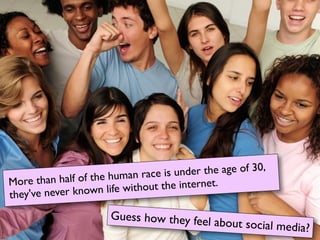
More than half of the human race is under the age of 30,
they've never known life without the internet.
Guess how they feel about social media?
3 out of 4 Americans use social technology
-Forrester, The Growth of Social Technology Adoption, 2008
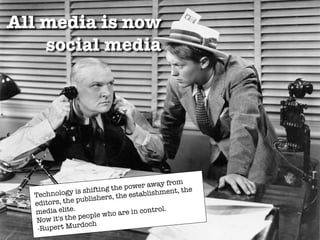
All media is now
social media
Technology is shifting the power away from
editors, the publishers, the establishment, the
media elite.
Now it's the people who are in control.
-Rupert Murdoch
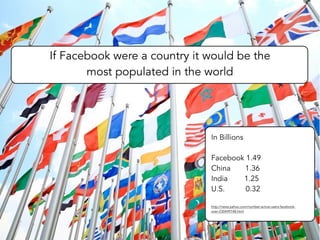
If Facebook were a country it would be the
most populated in the world
In Billions
Facebook 1.49
China 1.36
India 1.25
U.S. 0.32
http://news.yahoo.com/number-active-users-facebook-
over-230449748.html
http://www.insidefacebook.com/2010/02/15/new-facebook-statistics-show-big-increase-in-content-sharing-local-business-pages/
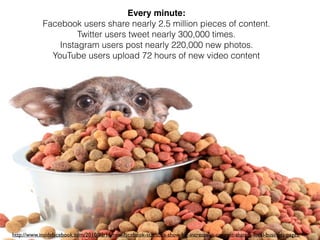
Every minute:
Facebook users share nearly 2.5 million pieces of content.
Twitter users tweet nearly 300,000 times.
Instagram users post nearly 220,000 new photos.
YouTube users upload 72 hours of new video content
http://www.dailyillini.com/features/health_and_living/article_323b7fd8-966a-11e2-b435-001a4bcf6878.html
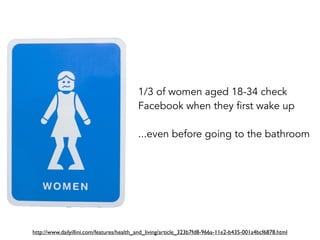
1/3 of women aged 18-34 check
Facebook when they first wake up
...even before going to the bathroom
Of all the social media venues,
why should scientists focus on Twitter?
1.Easy to start and use
2.Massive usage
3.Scientific community is already engaging
4.Clear benefits for scientists
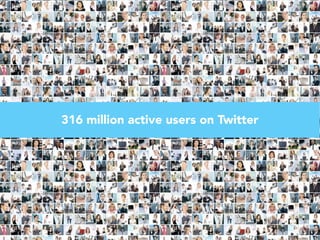
316 million active users on Twitter
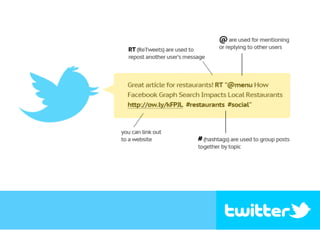
anatomy of a tweet
#hashtags
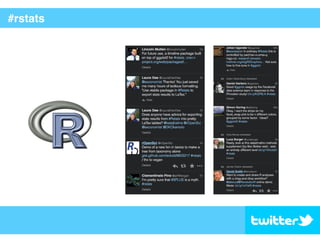
#rstats
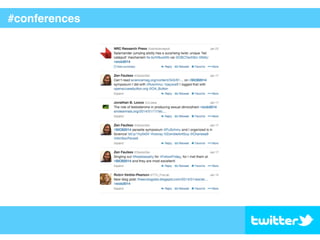
#conferences
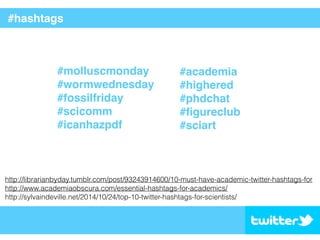
#hashtags
#molluscmonday
#wormwednesday
#fossilfriday
#scicomm
#icanhazpdf
#academia
#highered
#phdchat
#figureclub
#sciart
http://librarianbyday.tumblr.com/post/93243914600/10-must-have-academic-twitter-hashtags-for
http://www.academiaobscura.com/essential-hashtags-for-academics/
http://sylvaindeville.net/2014/10/24/top-10-twitter-hashtags-for-scientists/
Assignment
Check out a #hashtag.
Tweet something to it.
Tweet something to
#dukescicomm
economy of space
140
characters
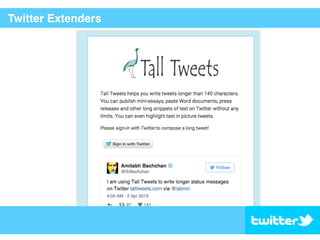
Twitter Extenders
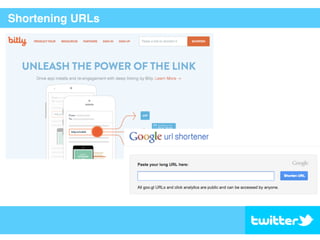
Shortening URLs
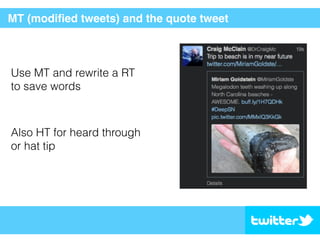
MT (modified tweets) and the quote tweet
Use MT and rewrite a RT
to save words
Also HT for heard through
or hat tip
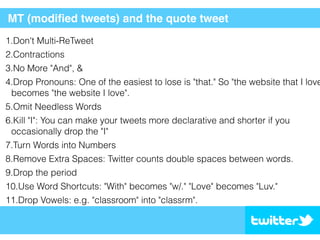
MT (modified tweets) and the quote tweet
1.Don't Multi-ReTweet
2.Contractions
3.No More "And", &
4.Drop Pronouns: One of the easiest to lose is "that." So "the website that I love
becomes "the website I love".
5.Omit Needless Words
6.Kill "I": You can make your tweets more declarative and shorter if you
occasionally drop the "I"
7.Turn Words into Numbers
8.Remove Extra Spaces: Twitter counts double spaces between words.
9.Drop the period
10.Use Word Shortcuts: "With" becomes "w/." "Love" becomes "Luv."
11.Drop Vowels: e.g. "classroom" into "classrm".
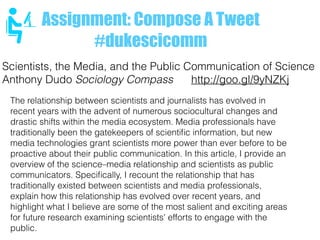
Assignment: Compose A Tweet
#dukescicomm
The relationship between scientists and journalists has evolved in
recent years with the advent of numerous sociocultural changes and
drastic shifts within the media ecosystem. Media professionals have
traditionally been the gatekeepers of scientific information, but new
media technologies grant scientists more power than ever before to be
proactive about their public communication. In this article, I provide an
overview of the science–media relationship and scientists as public
communicators. Specifically, I recount the relationship that has
traditionally existed between scientists and media professionals,
explain how this relationship has evolved over recent years, and
highlight what I believe are some of the most salient and exciting areas
for future research examining scientists' efforts to engage with the
public.
Scientists, the Media, and the Public Communication of Science
Anthony Dudo Sociology Compass http://goo.gl/9yNZKj
what do I tweet
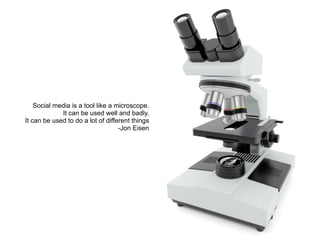
Social media is a tool like a microscope.
It can be used well and badly.
It can be used to do a lot of different things
-Jon Eisen
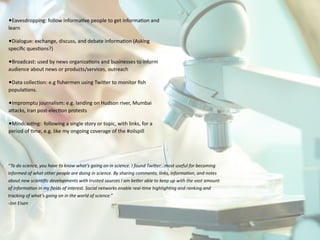
•Eavesdropping:	
  follow	
  informa4ve	
  people	
  to	
  get	
  informa4on	
  and	
  
learn	
  
•Dialogue:	
  exchange,	
  discuss,	
  and	
  debate	
  informa4on	
  (Asking	
  
specific	
  ques4ons?)	
  
•Broadcast:	
  used	
  by	
  news	
  organiza4ons	
  and	
  businesses	
  to	
  inform	
  
audience	
  about	
  news	
  or	
  products/services,	
  outreach	
  
•Data	
  collec4on:	
  e.g	
  fishermen	
  using	
  TwiJer	
  to	
  monitor	
  fish	
  
popula4ons.	
  
•Impromptu	
  journalism:	
  e.g.	
  landing	
  on	
  Hudson	
  river,	
  Mumbai	
  
aJacks,	
  Iran	
  post-­‐elec4on	
  protests	
  
•Mindcas4ng:	
  	
  following	
  a	
  single	
  story	
  or	
  topic,	
  with	
  links,	
  for	
  a	
  
period	
  of	
  4me,	
  e.g.	
  like	
  my	
  ongoing	
  coverage	
  of	
  the	
  #oilspill
“To	
  do	
  science,	
  you	
  have	
  to	
  know	
  what’s	
  going	
  on	
  in	
  science.	
  I	
  found	
  Twi9er…most	
  useful	
  for	
  becoming	
  
informed	
  of	
  what	
  other	
  people	
  are	
  doing	
  in	
  science.	
  By	
  sharing	
  comments,	
  links,	
  informaAon,	
  and	
  notes	
  
about	
  new	
  scienAfic	
  developments	
  with	
  trusted	
  sources	
  I	
  am	
  be9er	
  able	
  to	
  keep	
  up	
  with	
  the	
  vast	
  amount	
  
of	
  informaAon	
  in	
  my	
  fields	
  of	
  interest.	
  Social	
  networks	
  enable	
  real-­‐Ame	
  highlighAng	
  and	
  ranking	
  and	
  
tracking	
  of	
  what’s	
  going	
  on	
  in	
  the	
  world	
  of	
  science.”	
  	
  
-­‐Jon	
  Eisen
Inreach
versus
Outreach
*
*Mr. T has nothing to do with this. I simply have always wanted to put a photo of Mr. T in a presentation.
followers and lists
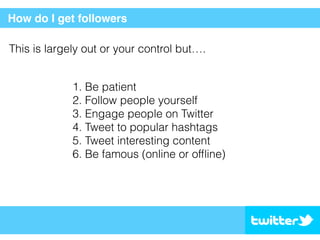
How do I get followers
This is largely out or your control but….
1. Be patient
2. Follow people yourself
3. Engage people on Twitter
4. Tweet to popular hashtags
5. Tweet interesting content
6. Be famous (online or offline)
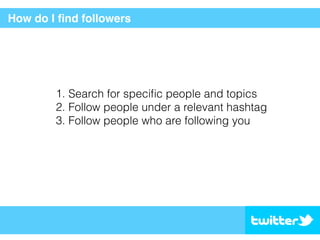
How do I find followers
1. Search for specific people and topics
2. Follow people under a relevant hashtag
3. Follow people who are following you
Lists
A list is a curated group of Twitter users. You can create your
own lists or subscribe to lists created by others. Viewing a list
timeline will show you a stream of Tweets from only the users
on that list.
Note: Lists are used for reading Tweets only. You cannot send
or direct a Tweet to members of a list, for only those list
members to see.
https://support.twitter.com/articles/76460
Assignment
Create A List
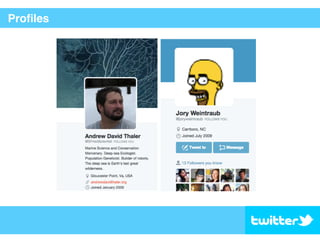
profiles
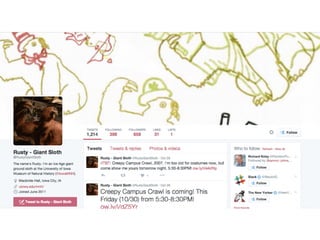
Profiles
Assignment
Create/Update Your Profile
popularity and virality
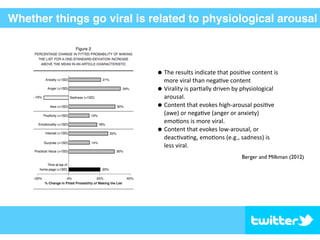
Berger and Milkman (2012)
•The	
  results	
  indicate	
  that	
  posi4ve	
  content	
  is	
  
more	
  viral	
  than	
  nega4ve	
  content	
  
•Virality	
  is	
  par4ally	
  driven	
  by	
  physiological	
  
arousal.	
  	
  
•Content	
  that	
  evokes	
  high-­‐arousal	
  posi4ve	
  
(awe)	
  or	
  nega4ve	
  (anger	
  or	
  anxiety)	
  
emo4ons	
  is	
  more	
  viral.	
  	
  
•Content	
  that	
  evokes	
  low-­‐arousal,	
  or	
  
deac4va4ng,	
  emo4ons	
  (e.g.,	
  sadness)	
  is	
  
less	
  viral.
Whether things go viral is related to physiological arousal
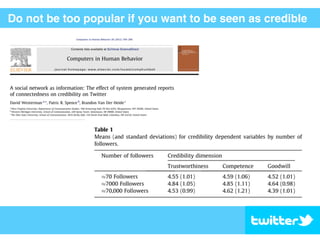
Do not be too popular if you want to be seen as credible
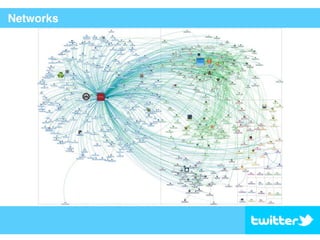
Networks
managing the stream
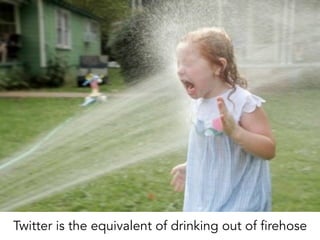
Twitter is the equivalent of drinking out of firehose
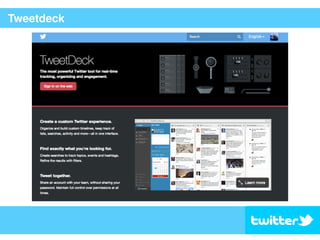
Tweetdeck
Storify
https://storify.com/DrCraigMc/wood-fall
Assignment
Download Tweetdeck
& Explore
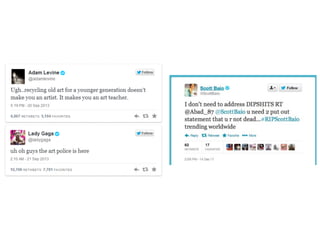
tweets gone wrong and trolls
Subtweets & Trolls
subtweet: (on Twitter) a post that refers to a particular
user without directly mentioning them, typically as a form
of furtive mockery or criticism.
internet troll: a person who sows discord on the Internet
by starting arguments or upsetting people, by posting
inflammatory, extraneous, or off-topic messages in an
online community with the deliberate intent of provoking
readers into an emotional response or of otherwise
disrupting normal on-topic discussion, often for their
own amusement
A Scientist's View of Twitter

A Scientist's View of Twitter