





Outreach Through Social Media

Christie Wilcox
University of Hawaii at Manoa
Hawaii Institute of Marine Biology
Discover Magazine
#OSMSocial
#2014OSM
@NerdyChristie
Internet = Information
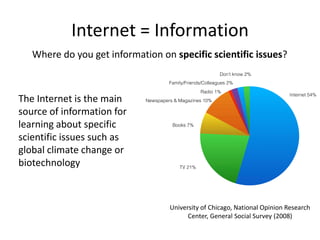
Where do you get information on specific scientific issues?

The Internet is the main
source of information for
learning about specific
scientific issues such as
global climate change or
biotechnology

University of Chicago, National Opinion Research
Center, General Social Survey (2008)
Barriers to Communication
Social Media: Tools To Break Down Barriers
Beyond Computers
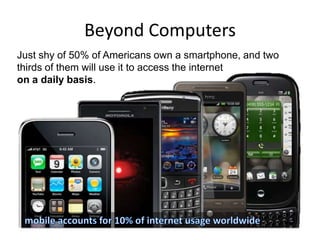
Just shy of 50% of Americans own a smartphone, and two
thirds of them will use it to access the internet
on a daily basis.
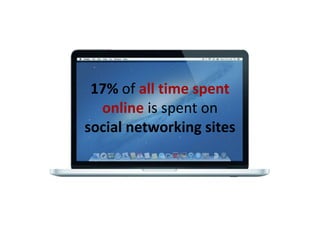
17% of all time spent
online is spent on
social networking sites
57% of Americans say they
talk to people more online
than they do in real life
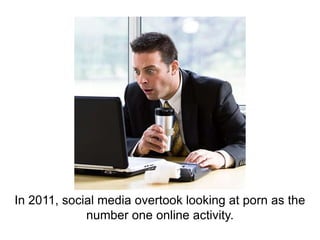
In 2011, social media overtook looking at porn as the
number one online activity.
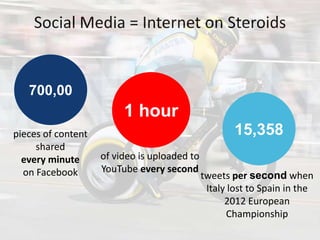
Social Media = Internet on Steroids

700,00

1 hour
pieces of content
shared
every minute
on Facebook

15,358
of video is uploaded to
YouTube every second

tweets per second when
Italy lost to Spain in the
2012 European
Championship
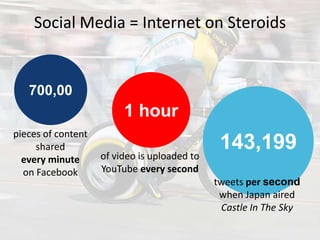
Social Media = Internet on Steroids

700,00

1 hour
pieces of content
shared
every minute
on Facebook

15,358

of video is uploaded to
YouTube every second

143,199
tweets per second
when Japan aired
Castle In The Sky
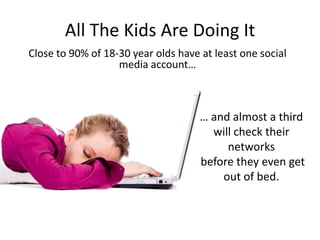
All The Kids Are Doing It
Close to 90% of 18-30 year olds have at least one social
media account…

… and almost a third
will check their
networks
before they even get
out of bed.
All The Kids Are Doing It
"Younger generations aren’t going to look for your
company or society in print—they‟re going to go
directly to your Web site and then maybe your
Facebook page, and, if interested, they will follow you
on Twitter.
If you’re not there, neither will they be—and
you’ve lost them at a critical point of contact."
- Kea Giles
Managing Editor at the Geological Society of America
“One of the things I hear most
frequently about a new hire is how
disturbing it is that he doesn‟t
have a web presence.

Something must be wrong, right?”
danah boyd
Assistant Professor, NYU; Visiting Researcher, Harvard Law
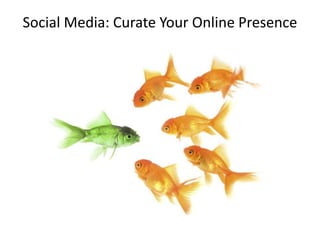
Social Media: Curate Your Online Presence
Social Media: Develop New Skills
Online Communities
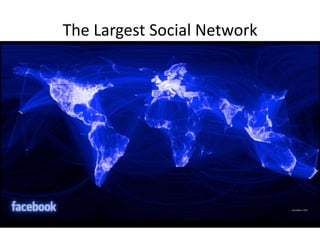
The Largest Social Network
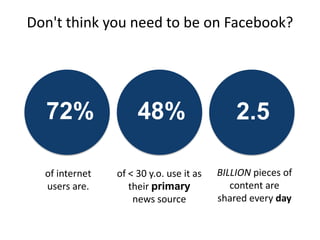
Don't think you need to be on Facebook?

72%

48%

2.5

of internet
users are.

of < 30 y.o. use it as
their primary
news source

BILLION pieces of
content are
shared every day
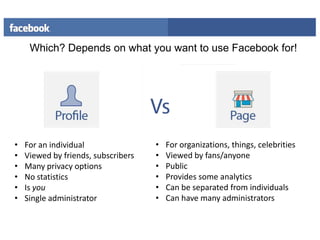
Which? Depends on what you want to use Facebook for!

•
•
•
•
•
•

For an individual
Viewed by friends, subscribers
Many privacy options
No statistics
Is you
Single administrator

•
•
•
•
•
•

For organizations, things, celebrities
Viewed by fans/anyone
Public
Provides some analytics
Can be separated from individuals
Can have many administrators
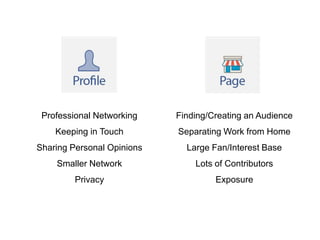
Professional Networking

Finding/Creating an Audience

Keeping in Touch

Separating Work from Home

Sharing Personal Opinions

Large Fan/Interest Base

Smaller Network

Lots of Contributors

Privacy

Exposure
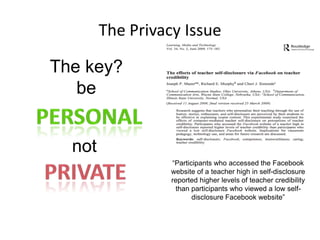
The Privacy Issue
The key?
be

not
“Participants who accessed the Facebook
website of a teacher high in self-disclosure
reported higher levels of teacher credibility
than participants who viewed a low selfdisclosure Facebook website”
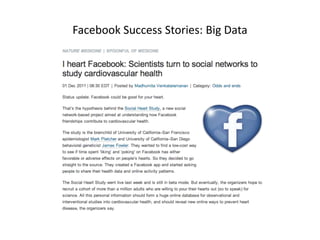
Facebook Success Stories: Big Data
Facebook Success Stories: Collective Intelligence
“We didn’t have really the time
or resources to [identify the
specimens] the way that we
would traditionally do it”
— Brian Sidlauskas, lead scientist

“In less than 24 hours, this approach
identified approximately 90 percent
of the posted specimens to at least
the level of genus, revealed the
presence of at least two likely
undescribed species, indicated two
new records for Guyana and
generated several loan requests.”
— Smithsonian blog post
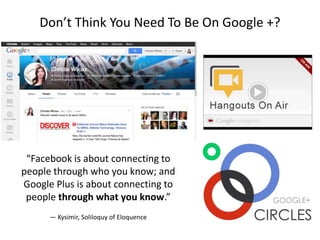
Don’t Think You Need To Be On Google +?

“Facebook is about connecting to
people through who you know; and
Google Plus is about connecting to
people through what you know.”
— Kysimir, Soliloquy of Eloquence
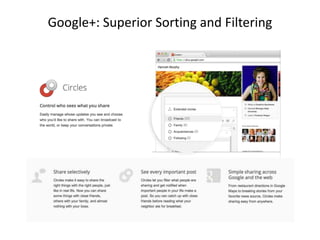
Google+: Superior Sorting and Filtering
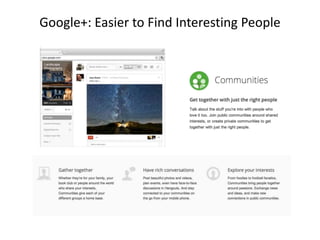
Google+: Easier to Find Interesting People
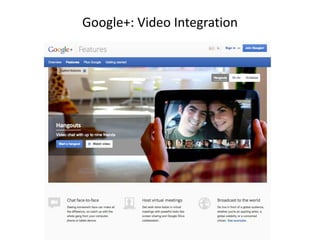
Google+: Video Integration
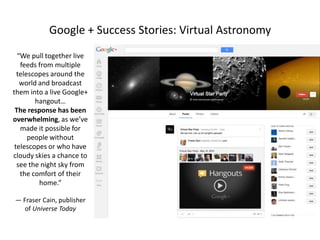
Google + Success Stories: Virtual Astronomy
“We pull together live
feeds from multiple
telescopes around the
world and broadcast
them into a live Google+
hangout…
The response has been
overwhelming, as we’ve
made it possible for
people without
telescopes or who have
cloudy skies a chance to
see the night sky from
the comfort of their
home.”
— Fraser Cain, publisher
of Universe Today
Microblogs

A web service that allows users to broadcast short messages to other subscribers of the
service
#1 Microblogging Platform: Twitter

"The qualities that make
Twitter seem inane and halfbaked are what make it so
powerful."
Jonathan Zittrain
Harvard University Law professor and Faculty CoDirector, Berkman Center for Internet and Society
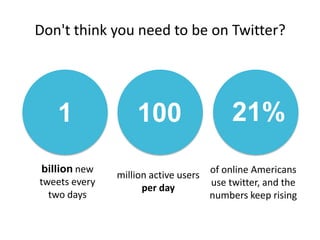
Don't think you need to be on Twitter?

1

200
100

billion new
tweets every
two days

million active users
per day

21%
of online Americans
use twitter, and the
numbers keep rising
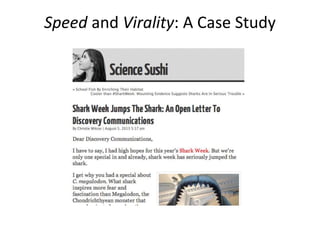
Speed and Virality: A Case Study

150,000 pageviews
in 48 hours.
Speed and Virality: A Case Study
Why Statisticians Love Twitter
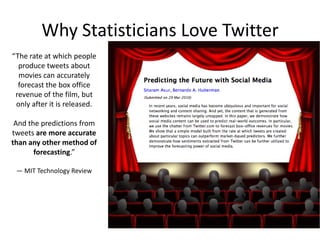
“The rate at which people
produce tweets about
movies can accurately
forecast the box office
revenue of the film, but
only after it is released.
And the predictions from
tweets are more accurate
than any other method of
forecasting.”
— MIT Technology Review
Why Statisticians Love Twitter

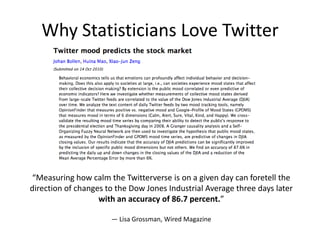
“Measuring how calm the Twitterverse is on a given day can foretell the
direction of changes to the Dow Jones Industrial Average three days later
with an accuracy of 86.7 percent.”
— Lisa Grossman, Wired Magazine
Twitter Predicts Citations

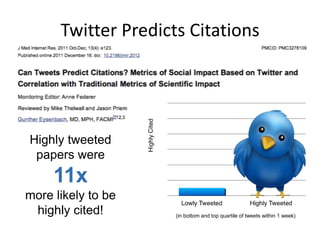
Highly tweeted
papers were

11x
more likely to be
highly cited!

(in bottom and top quartile of tweets within 1 week)
Twitter 101
A brief introduction to the Twitterverse
Filtering The Deluge

You have to accept the fact that you cannot,
and will not, see everything.
The Lingo
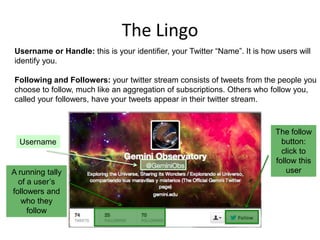
Username or Handle: this is your identifier, your Twitter “Name”. It is how users will
identify you.
Following and Followers: your twitter stream consists of tweets from the people you
choose to follow, much like an aggregation of subscriptions. Others who follow you,
called your followers, have your tweets appear in their twitter stream.

Username

A running tally
of a user‟s
followers and
who they
follow

The follow
button:
click to
follow this
user
The Lingo
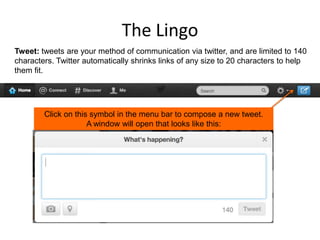
Tweet: tweets are your method of communication via twitter, and are limited to 140
characters. Twitter automatically shrinks links of any size to 20 characters to help
them fit.

Click on this symbol in the menu bar to compose a new tweet.
A window will open that looks like this:
The Lingo
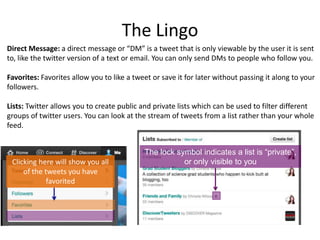
Direct Message: a direct message or “DM” is a tweet that is only viewable by the user it is sent
to, like the twitter version of a text or email. You can only send DMs to people who follow you.

Favorites: Favorites allow you to like a tweet or save it for later without passing it along to your
followers.
Lists: Twitter allows you to create public and private lists which can be used to filter different
groups of twitter users. You can look at the stream of tweets from a list rather than your whole
feed.

Clicking here will show you all
of the tweets you have
favorited

The lock symbol indicates a list is “private”,
or only visible to you
The Lingo
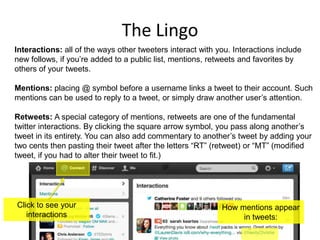
Interactions: all of the ways other tweeters interact with you. Interactions include
new follows, if you‟re added to a public list, mentions, retweets and favorites by
others of your tweets.

Mentions: placing @ symbol before a username links a tweet to their account. Such
mentions can be used to reply to a tweet, or simply draw another user‟s attention.
Retweets: A special category of mentions, retweets are one of the fundamental
twitter interactions. By clicking the square arrow symbol, you pass along another‟s
tweet in its entirety. You can also add commentary to another‟s tweet by adding your
two cents then pasting their tweet after the letters “RT” (retweet) or “MT” (modified
tweet, if you had to alter their tweet to fit.)

Click to see your
interactions

How mentions appear
in tweets:
The Lingo
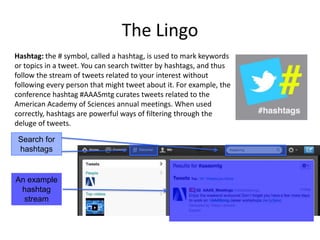
Hashtag: the # symbol, called a hashtag, is used to mark keywords
or topics in a tweet. You can search twitter by hashtags, and thus
follow the stream of tweets related to your interest without
following every person that might tweet about it. For example, the
conference hashtag #AAASmtg curates tweets related to the
American Academy of Sciences annual meetings. When used
correctly, hashtags are powerful ways of filtering through the
deluge of tweets.
Search for
hashtags

An example
hashtag
stream
Twitter Success Stories: The Power of Twitter

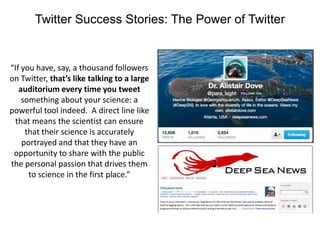
“If you have, say, a thousand followers
on Twitter, that’s like talking to a large
auditorium every time you tweet
something about your science: a
powerful tool indeed. A direct line like
that means the scientist can ensure
that their science is accurately
portrayed and that they have an
opportunity to share with the public
the personal passion that drives them
to science in the first place.”
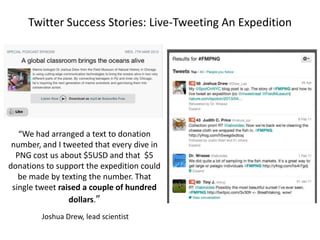
Twitter Success Stories: Live-Tweeting An Expedition

“We had arranged a text to donation
number, and I tweeted that every dive in
PNG cost us about $5USD and that $5
donations to support the expedition could
be made by texting the number. That
single tweet raised a couple of hundred
dollars.”
Joshua Drew, lead scientist
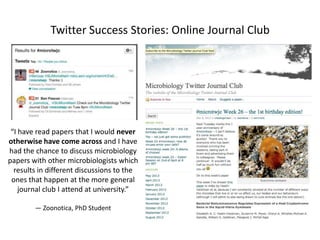
Twitter Success Stories: Online Journal Club

“I have read papers that I would never
otherwise have come across and I have
had the chance to discuss microbiology
papers with other microbiologists which
results in different discussions to the
ones that happen at the more general
journal club I attend at university.”
— Zoonotica, PhD Student
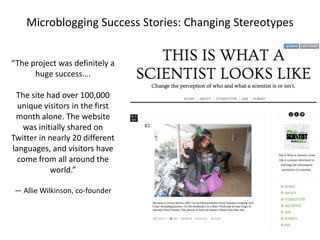
Microblogging Success Stories: Changing Stereotypes
“The project was definitely a
huge success….

The site had over 100,000
unique visitors in the first
month alone. The website
was initially shared on
Twitter in nearly 20 different
languages, and visitors have
come from all around the
world.”
— Allie Wilkinson, co-founder
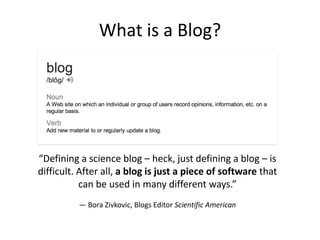
What is a Blog?

“Defining a science blog – heck, just defining a blog – is
difficult. After all, a blog is just a piece of software that
can be used in many different ways.”
— Bora Zivkovic, Blogs Editor Scientific American
Blogs: The New Frontier
“A new generation of young researchers has grown
up with an ever-present Internet. Publishers have
been quicker than academics to react to this new
world, but scientists must catch up. Even if you
choose not to blog, you can certainly expect that
your papers and ideas will increasingly be blogged
about. So there it is — blog or be blogged.”
— Paul Knoepfler, Research Scientist & Blogger
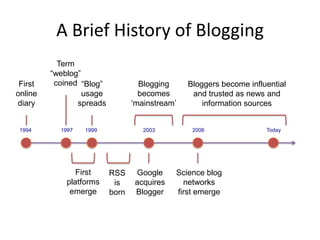
A Brief History of Blogging
First
online
diary

1994

Term
“weblog”
coined “Blog”
usage
spreads

1997

Blogging
becomes
„mainstream‟

1999

First
platforms
emerge

Bloggers become influential
and trusted as news and
information sources

2003

RSS
is
born

2006

Google
acquires
Blogger

Science blog
networks
first emerge

Today
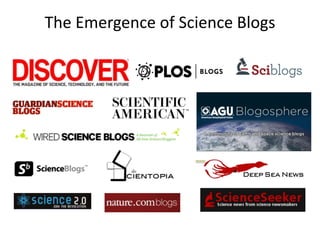
The Emergence of Science Blogs
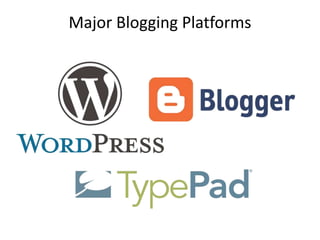
Major Blogging Platforms
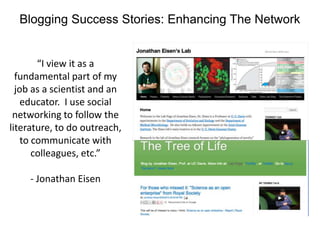
Blogging Success Stories: Enhancing The Network

“I view it as a
fundamental part of my
job as a scientist and an
educator. I use social
networking to follow the
literature, to do outreach,
to communicate with
colleagues, etc.”
- Jonathan Eisen
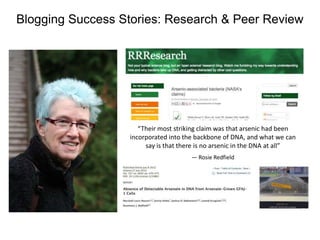
Blogging Success Stories: Research & Peer Review

,
“Their most striking claim was that arsenic had been
incorporated into the backbone of DNA, and what we can
say is that there is no arsenic in the DNA at all”
— Rosie Redfield
What is a Wiki?

“Wikis create a sense of shared knowledge, which
may be carried across courses, curricula, or
countries.”
— Toby Coley, Wikis in Writing Education Research
Wikipedia
“Imagine a world in
which every single person
on the planet is given
free access to the sum of
all human knowledge.
That's what we're doing.”
— Jimmy Wales, Founder of
Wikipedia
Free Wiki Platforms/Software
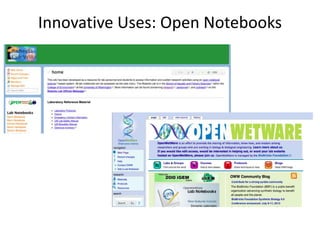
Innovative Uses: Open Notebooks
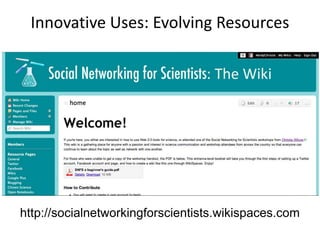
Innovative Uses: Evolving Resources

http://socialnetworkingforscientists.wikispaces.com
Be Creative
Why Do Visuals Matter?
• More than 1/3 — 36% — of tweets are images
• Articles with images get 94% more total views

• Including a photo and a video in a press release increases
views by over 45%
• Photo and video posts on Pinterest refer more traffic than
Twitter, StumbleUpon, LinkedIn and Google +
Images
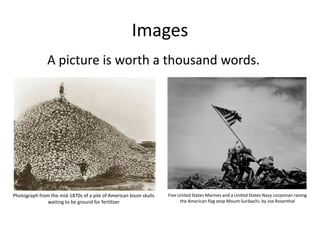
A picture is worth a thousand words.

Photograph from the mid-1870s of a pile of American bison skulls
waiting to be ground for fertilizer

Five United States Marines and a United States Navy corpsman raising
the American flag atop Mount Suribachi; by Joe Rosenthal
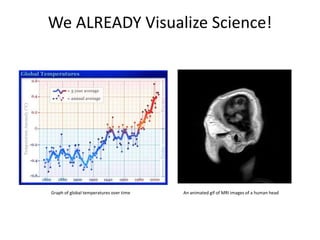
We ALREADY Visualize Science!

Graph of global temperatures over time

An animated gif of MRI images of a human head
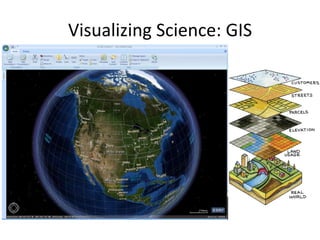
Visualizing Science: GIS
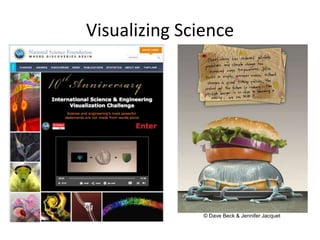
Visualizing Science

© Dave Beck & Jennifer Jacquet
Image Platforms
Video

On Facebook, videos
are shared 12x
more than links &
text posts combined
Video Platforms
Audio
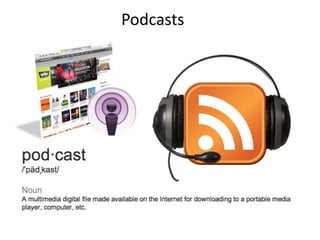
Podcasts
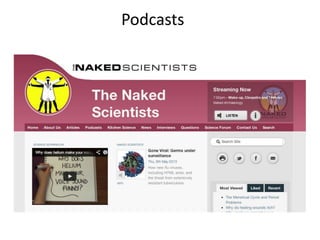
Podcasts
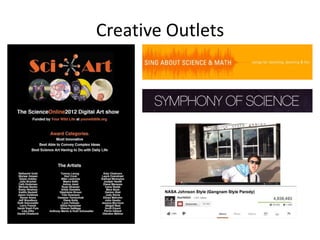
Creative Outlets
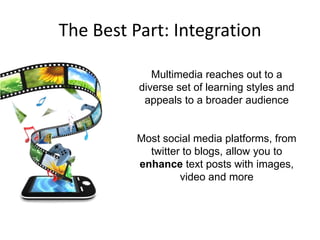
The Best Part: Integration
Multimedia reaches out to a
diverse set of learning styles and
appeals to a broader audience

Most social media platforms, from
twitter to blogs, allow you to
enhance text posts with images,
video and more
“Facebook” For Scientists
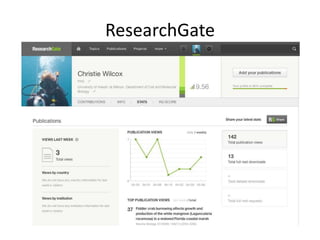
ResearchGate
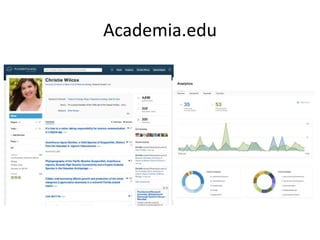
Academia.edu
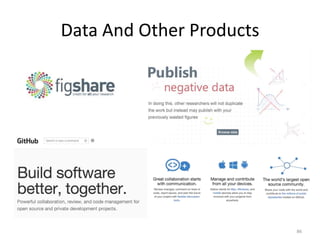
Data And Other Products

86
Reference Management
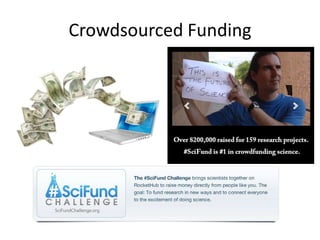
Crowdsourced Funding
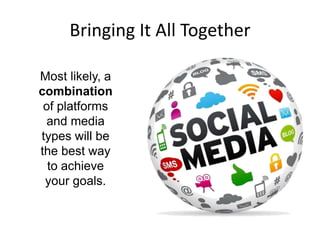
Bringing It All Together
Most likely, a
combination
of platforms
and media
types will be
the best way
to achieve
your goals.
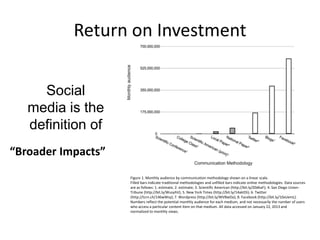
Return on Investment
Social
media is the
definition of
“Broader Impacts”
Figure 1. Monthly audience by communication methodology shown on a linear scale.
Filled bars indicate traditional methodologies and unfilled bars indicate online methodologies. Data sources
are as follows: 1. estimate; 2. estimate; 3. Scientific American (http://bit.ly/Z0dkaF); 4. San Diego UnionTribune (http://bit.ly/WusyhV); 5. New York Times (http://bit.ly/14aktDi); 6. Twitter
(http://tcrn.ch/146wWsy); 7. Wordpress (http://bit.ly/WVBwDa); 8. Facebook (http://bit.ly/10xUemL).
Numbers reflect the potential monthly audience for each medium, and not necessarily the number of users
who access a particular content item on that medium. All data accessed on January 22, 2013 and
normalized to monthly views.
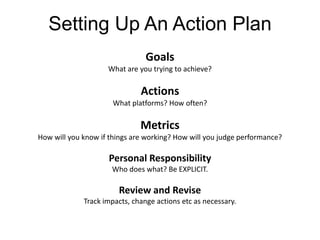
Setting Up An Action Plan
Goals
What are you trying to achieve?

Actions
What platforms? How often?

Metrics
How will you know if things are working? How will you judge performance?

Personal Responsibility
Who does what? Be EXPLICIT.

Review and Revise
Track impacts, change actions etc as necessary.
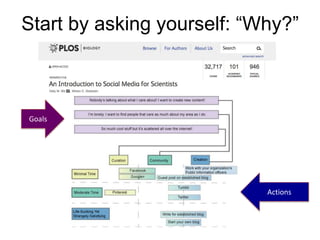
Start by asking yourself: “Why?”

Goals

Actions
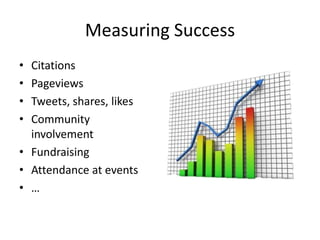
Measuring Success
•
•
•
•

Citations
Pageviews
Tweets, shares, likes
Community
involvement
• Fundraising
• Attendance at events
• …
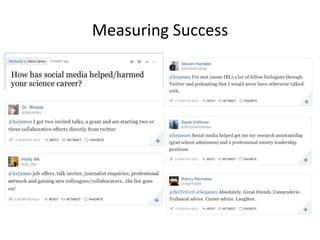
Measuring Success
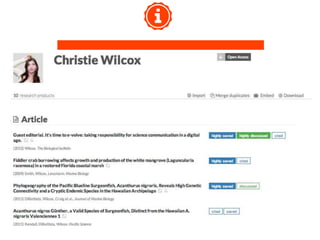
Measuring Success
“Coming up with good metrics requires some critical
thinking. Don’t rely solely on the easy analytics, like
pageviews. Spend some time and mental energy to
figure out what you really want… then spend some
more time and mental energy to come up with
meaningful ways to determine whether you’re
getting it.”
— Matt Shipman, PIO and Science Writer
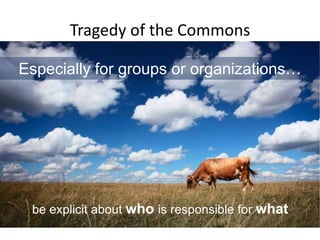
Tragedy of the Commons
Especially for groups or organizations…

be explicit about who is responsible for what
If At First You Don‟t Succeed…
No one expects you to get everything right the first time.
• Use your metrics
• Experiment with new techniques and ideas
• See what works and what doesn‟t
• Tweak the plan along the way
One more time…
Goals
What are you trying to achieve?

Actions
What platforms? How often?

Metrics
How will you know if things are working? How will you judge performance?

Personal Responsibility
Who does what? Be EXPLICIT.

Review and Revise
Track impacts, change actions etc as necessary.
The Internet is Yours!

Outreach Through Social Media | Ocean Sciences 2014

  • 1.
    Outreach Through SocialMedia Christie Wilcox University of Hawaii at Manoa Hawaii Institute of Marine Biology Discover Magazine
  • 2.
  • 3.
    Internet = Information Wheredo you get information on specific scientific issues? The Internet is the main source of information for learning about specific scientific issues such as global climate change or biotechnology University of Chicago, National Opinion Research Center, General Social Survey (2008)
  • 4.
  • 5.
    Social Media: ToolsTo Break Down Barriers
  • 6.
    Beyond Computers Just shyof 50% of Americans own a smartphone, and two thirds of them will use it to access the internet on a daily basis.
  • 7.
    17% of alltime spent online is spent on social networking sites
  • 8.
    57% of Americanssay they talk to people more online than they do in real life
  • 9.
    In 2011, socialmedia overtook looking at porn as the number one online activity.
  • 10.
    Social Media =Internet on Steroids 700,00 1 hour pieces of content shared every minute on Facebook 15,358 of video is uploaded to YouTube every second tweets per second when Italy lost to Spain in the 2012 European Championship
  • 11.
    Social Media =Internet on Steroids 700,00 1 hour pieces of content shared every minute on Facebook 15,358 of video is uploaded to YouTube every second 143,199 tweets per second when Japan aired Castle In The Sky
  • 12.
    All The KidsAre Doing It Close to 90% of 18-30 year olds have at least one social media account… … and almost a third will check their networks before they even get out of bed.
  • 13.
    All The KidsAre Doing It "Younger generations aren’t going to look for your company or society in print—they‟re going to go directly to your Web site and then maybe your Facebook page, and, if interested, they will follow you on Twitter. If you’re not there, neither will they be—and you’ve lost them at a critical point of contact." - Kea Giles Managing Editor at the Geological Society of America
  • 17.
    “One of thethings I hear most frequently about a new hire is how disturbing it is that he doesn‟t have a web presence. Something must be wrong, right?” danah boyd Assistant Professor, NYU; Visiting Researcher, Harvard Law
  • 18.
    Social Media: CurateYour Online Presence
  • 19.
  • 22.
  • 23.
  • 24.
    Don't think youneed to be on Facebook? 72% 48% 2.5 of internet users are. of < 30 y.o. use it as their primary news source BILLION pieces of content are shared every day
  • 25.
    Which? Depends onwhat you want to use Facebook for! • • • • • • For an individual Viewed by friends, subscribers Many privacy options No statistics Is you Single administrator • • • • • • For organizations, things, celebrities Viewed by fans/anyone Public Provides some analytics Can be separated from individuals Can have many administrators
  • 26.
    Professional Networking Finding/Creating anAudience Keeping in Touch Separating Work from Home Sharing Personal Opinions Large Fan/Interest Base Smaller Network Lots of Contributors Privacy Exposure
  • 27.
    The Privacy Issue Thekey? be not “Participants who accessed the Facebook website of a teacher high in self-disclosure reported higher levels of teacher credibility than participants who viewed a low selfdisclosure Facebook website”
  • 28.
  • 29.
    Facebook Success Stories:Collective Intelligence “We didn’t have really the time or resources to [identify the specimens] the way that we would traditionally do it” — Brian Sidlauskas, lead scientist “In less than 24 hours, this approach identified approximately 90 percent of the posted specimens to at least the level of genus, revealed the presence of at least two likely undescribed species, indicated two new records for Guyana and generated several loan requests.” — Smithsonian blog post
  • 30.
    Don’t Think YouNeed To Be On Google +? “Facebook is about connecting to people through who you know; and Google Plus is about connecting to people through what you know.” — Kysimir, Soliloquy of Eloquence
  • 31.
  • 32.
    Google+: Easier toFind Interesting People
  • 33.
  • 34.
    Google + SuccessStories: Virtual Astronomy “We pull together live feeds from multiple telescopes around the world and broadcast them into a live Google+ hangout… The response has been overwhelming, as we’ve made it possible for people without telescopes or who have cloudy skies a chance to see the night sky from the comfort of their home.” — Fraser Cain, publisher of Universe Today
  • 35.
    Microblogs A web servicethat allows users to broadcast short messages to other subscribers of the service
  • 36.
    #1 Microblogging Platform:Twitter "The qualities that make Twitter seem inane and halfbaked are what make it so powerful." Jonathan Zittrain Harvard University Law professor and Faculty CoDirector, Berkman Center for Internet and Society
  • 37.
    Don't think youneed to be on Twitter? 1 200 100 billion new tweets every two days million active users per day 21% of online Americans use twitter, and the numbers keep rising
  • 38.
    Speed and Virality:A Case Study
  • 39.
    Speed and Virality:A Case Study 150,000 pageviews in 48 hours.
  • 40.
    Speed and Virality:A Case Study
  • 41.
    Speed and Virality:A Case Study
  • 42.
    Speed and Virality:A Case Study
  • 43.
    Why Statisticians LoveTwitter “The rate at which people produce tweets about movies can accurately forecast the box office revenue of the film, but only after it is released. And the predictions from tweets are more accurate than any other method of forecasting.” — MIT Technology Review
  • 44.
    Why Statisticians LoveTwitter “Measuring how calm the Twitterverse is on a given day can foretell the direction of changes to the Dow Jones Industrial Average three days later with an accuracy of 86.7 percent.” — Lisa Grossman, Wired Magazine
  • 45.
    Twitter Predicts Citations Highlytweeted papers were 11x more likely to be highly cited! (in bottom and top quartile of tweets within 1 week)
  • 46.
    Twitter 101 A briefintroduction to the Twitterverse
  • 47.
    Filtering The Deluge Youhave to accept the fact that you cannot, and will not, see everything.
  • 48.
    The Lingo Username orHandle: this is your identifier, your Twitter “Name”. It is how users will identify you. Following and Followers: your twitter stream consists of tweets from the people you choose to follow, much like an aggregation of subscriptions. Others who follow you, called your followers, have your tweets appear in their twitter stream. Username A running tally of a user‟s followers and who they follow The follow button: click to follow this user
  • 49.
    The Lingo Tweet: tweetsare your method of communication via twitter, and are limited to 140 characters. Twitter automatically shrinks links of any size to 20 characters to help them fit. Click on this symbol in the menu bar to compose a new tweet. A window will open that looks like this:
  • 50.
    The Lingo Direct Message:a direct message or “DM” is a tweet that is only viewable by the user it is sent to, like the twitter version of a text or email. You can only send DMs to people who follow you. Favorites: Favorites allow you to like a tweet or save it for later without passing it along to your followers. Lists: Twitter allows you to create public and private lists which can be used to filter different groups of twitter users. You can look at the stream of tweets from a list rather than your whole feed. Clicking here will show you all of the tweets you have favorited The lock symbol indicates a list is “private”, or only visible to you
  • 51.
    The Lingo Interactions: allof the ways other tweeters interact with you. Interactions include new follows, if you‟re added to a public list, mentions, retweets and favorites by others of your tweets. Mentions: placing @ symbol before a username links a tweet to their account. Such mentions can be used to reply to a tweet, or simply draw another user‟s attention. Retweets: A special category of mentions, retweets are one of the fundamental twitter interactions. By clicking the square arrow symbol, you pass along another‟s tweet in its entirety. You can also add commentary to another‟s tweet by adding your two cents then pasting their tweet after the letters “RT” (retweet) or “MT” (modified tweet, if you had to alter their tweet to fit.) Click to see your interactions How mentions appear in tweets:
  • 52.
    The Lingo Hashtag: the# symbol, called a hashtag, is used to mark keywords or topics in a tweet. You can search twitter by hashtags, and thus follow the stream of tweets related to your interest without following every person that might tweet about it. For example, the conference hashtag #AAASmtg curates tweets related to the American Academy of Sciences annual meetings. When used correctly, hashtags are powerful ways of filtering through the deluge of tweets. Search for hashtags An example hashtag stream
  • 53.
    Twitter Success Stories:The Power of Twitter “If you have, say, a thousand followers on Twitter, that’s like talking to a large auditorium every time you tweet something about your science: a powerful tool indeed. A direct line like that means the scientist can ensure that their science is accurately portrayed and that they have an opportunity to share with the public the personal passion that drives them to science in the first place.”
  • 54.
    Twitter Success Stories:Live-Tweeting An Expedition “We had arranged a text to donation number, and I tweeted that every dive in PNG cost us about $5USD and that $5 donations to support the expedition could be made by texting the number. That single tweet raised a couple of hundred dollars.” Joshua Drew, lead scientist
  • 55.
    Twitter Success Stories:Online Journal Club “I have read papers that I would never otherwise have come across and I have had the chance to discuss microbiology papers with other microbiologists which results in different discussions to the ones that happen at the more general journal club I attend at university.” — Zoonotica, PhD Student
  • 56.
    Microblogging Success Stories:Changing Stereotypes “The project was definitely a huge success…. The site had over 100,000 unique visitors in the first month alone. The website was initially shared on Twitter in nearly 20 different languages, and visitors have come from all around the world.” — Allie Wilkinson, co-founder
  • 57.
    What is aBlog? “Defining a science blog – heck, just defining a blog – is difficult. After all, a blog is just a piece of software that can be used in many different ways.” — Bora Zivkovic, Blogs Editor Scientific American
  • 58.
    Blogs: The NewFrontier “A new generation of young researchers has grown up with an ever-present Internet. Publishers have been quicker than academics to react to this new world, but scientists must catch up. Even if you choose not to blog, you can certainly expect that your papers and ideas will increasingly be blogged about. So there it is — blog or be blogged.” — Paul Knoepfler, Research Scientist & Blogger
  • 59.
    A Brief Historyof Blogging First online diary 1994 Term “weblog” coined “Blog” usage spreads 1997 Blogging becomes „mainstream‟ 1999 First platforms emerge Bloggers become influential and trusted as news and information sources 2003 RSS is born 2006 Google acquires Blogger Science blog networks first emerge Today
  • 60.
    The Emergence ofScience Blogs
  • 61.
  • 62.
    Blogging Success Stories:Enhancing The Network “I view it as a fundamental part of my job as a scientist and an educator. I use social networking to follow the literature, to do outreach, to communicate with colleagues, etc.” - Jonathan Eisen
  • 63.
    Blogging Success Stories:Research & Peer Review , “Their most striking claim was that arsenic had been incorporated into the backbone of DNA, and what we can say is that there is no arsenic in the DNA at all” — Rosie Redfield
  • 64.
    What is aWiki? “Wikis create a sense of shared knowledge, which may be carried across courses, curricula, or countries.” — Toby Coley, Wikis in Writing Education Research
  • 65.
    Wikipedia “Imagine a worldin which every single person on the planet is given free access to the sum of all human knowledge. That's what we're doing.” — Jimmy Wales, Founder of Wikipedia
  • 66.
  • 67.
  • 68.
    Innovative Uses: EvolvingResources http://socialnetworkingforscientists.wikispaces.com
  • 69.
  • 70.
    Why Do VisualsMatter? • More than 1/3 — 36% — of tweets are images • Articles with images get 94% more total views • Including a photo and a video in a press release increases views by over 45% • Photo and video posts on Pinterest refer more traffic than Twitter, StumbleUpon, LinkedIn and Google +
  • 71.
    Images A picture isworth a thousand words. Photograph from the mid-1870s of a pile of American bison skulls waiting to be ground for fertilizer Five United States Marines and a United States Navy corpsman raising the American flag atop Mount Suribachi; by Joe Rosenthal
  • 72.
    We ALREADY VisualizeScience! Graph of global temperatures over time An animated gif of MRI images of a human head
  • 73.
  • 74.
    Visualizing Science © DaveBeck & Jennifer Jacquet
  • 75.
  • 76.
    Video On Facebook, videos areshared 12x more than links & text posts combined
  • 77.
  • 78.
  • 79.
  • 80.
  • 81.
  • 82.
    The Best Part:Integration Multimedia reaches out to a diverse set of learning styles and appeals to a broader audience Most social media platforms, from twitter to blogs, allow you to enhance text posts with images, video and more
  • 83.
  • 84.
  • 85.
  • 86.
    Data And OtherProducts 86
  • 87.
  • 88.
  • 89.
    Bringing It AllTogether Most likely, a combination of platforms and media types will be the best way to achieve your goals.
  • 90.
    Return on Investment Social mediais the definition of “Broader Impacts” Figure 1. Monthly audience by communication methodology shown on a linear scale. Filled bars indicate traditional methodologies and unfilled bars indicate online methodologies. Data sources are as follows: 1. estimate; 2. estimate; 3. Scientific American (http://bit.ly/Z0dkaF); 4. San Diego UnionTribune (http://bit.ly/WusyhV); 5. New York Times (http://bit.ly/14aktDi); 6. Twitter (http://tcrn.ch/146wWsy); 7. Wordpress (http://bit.ly/WVBwDa); 8. Facebook (http://bit.ly/10xUemL). Numbers reflect the potential monthly audience for each medium, and not necessarily the number of users who access a particular content item on that medium. All data accessed on January 22, 2013 and normalized to monthly views.
  • 91.
    Setting Up AnAction Plan Goals What are you trying to achieve? Actions What platforms? How often? Metrics How will you know if things are working? How will you judge performance? Personal Responsibility Who does what? Be EXPLICIT. Review and Revise Track impacts, change actions etc as necessary.
  • 92.
    Start by askingyourself: “Why?” Goals Actions
  • 93.
    Measuring Success • • • • Citations Pageviews Tweets, shares,likes Community involvement • Fundraising • Attendance at events • …
  • 94.
  • 97.
    Measuring Success “Coming upwith good metrics requires some critical thinking. Don’t rely solely on the easy analytics, like pageviews. Spend some time and mental energy to figure out what you really want… then spend some more time and mental energy to come up with meaningful ways to determine whether you’re getting it.” — Matt Shipman, PIO and Science Writer
  • 98.
    Tragedy of theCommons Especially for groups or organizations… be explicit about who is responsible for what
  • 99.
    If At FirstYou Don‟t Succeed… No one expects you to get everything right the first time. • Use your metrics • Experiment with new techniques and ideas • See what works and what doesn‟t • Tweak the plan along the way
  • 100.
    One more time… Goals Whatare you trying to achieve? Actions What platforms? How often? Metrics How will you know if things are working? How will you judge performance? Personal Responsibility Who does what? Be EXPLICIT. Review and Revise Track impacts, change actions etc as necessary.
  • 101.

Editor's Notes

  • #7 http://services.google.com/fh/files/blogs/our_mobile_planet_us_en.pdf
  • #10 http://www.nerve.com/news/web/social-media-overtakes-porn-as-the-number-one-online-activity
  • #11 http://thesocialskinny.com/216-social-media-and-internet-statistics-september-2012/
  • #12 http://thesocialskinny.com/216-social-media-and-internet-statistics-september-2012/
  • #15 It is especially important that we engage in social networking because studies have shown science literacy is only a small factor in how people form their opinions, while the interplay between values, religious affiliation, and the opinions of others whom they trust is much more influential.While political parties and religious organizations jump head first into discussions of their beliefs with anyone who will listen, thus playing an active role in the decision-making process, scientists stand back, hand out facts, and expect that information alone is enough to sway attitudes. Instead of appearing as beacons of knowledge, our actions make us appear stuffy, elitist, and disengaged. By connecting scientists with the rest of the world, social media is the most powerful tool available for us to shift this paradigm.
  • #16 Proverbial tree in the forest
  • #54 “Don’t be afraid. Spend as much time or as little time as you want on this. These systems are tools, no more or no less. You decided how to use them just like you decide how to use a microscope. But like a microscope they can be really useful – so consider experimenting with them”
  • #63 “Don’t be afraid. Spend as much time or as little time as you want on this. These systems are tools, no more or no less. You decided how to use them just like you decide how to use a microscope. But like a microscope they can be really useful – so consider experimenting with them”
  • #64 “Don’t be afraid. Spend as much time or as little time as you want on this. These systems are tools, no more or no less. You decided how to use them just like you decide how to use a microscope. But like a microscope they can be really useful – so consider experimenting with them”