#NAFNext2014
A Roadmap from High School
to Engineering Colleges
Presenters:
Saundra Johnson Austin, NACME
Dr. Bevlee Watford, NSF/VA-Tech
Lawrence “Tony” Howell, NJIT
What is NACME?
Our Mission
To ensure American competitiveness in a flat world by leading and
supporting the national effort to expand U.S. capability through increasing
the number of successful African American, American Indian, and Latino
young women and men in science, technology, engineering and
mathematics (STEM) education and careers.
Our Vision
An engineering workforce that looks like America.
NACME Board of Directors
Role of the Board of Directors: to provide support and advocacy for NACME’s mission.
NACME Corporate Council
Role of the Corporate Council: to provide support and advocacy for NACME’s mission.
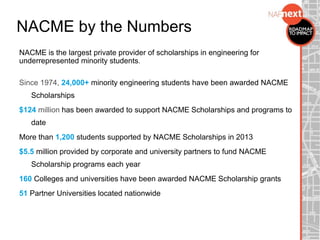
NACME by the Numbers
NACME is the largest private provider of scholarships in engineering for
underrepresented minority students.
Since 1974, 24,000+ minority engineering students have been awarded NACME
Scholarships
$124 million has been awarded to support NACME Scholarships and programs to
date
More than 1,200 students supported by NACME Scholarships in 2013
$5.5 million provided by corporate and university partners to fund NACME
Scholarship programs each year
160 Colleges and universities have been awarded NACME Scholarship grants
51 Partner Universities located nationwide
Pre-Engineering Program Strategy
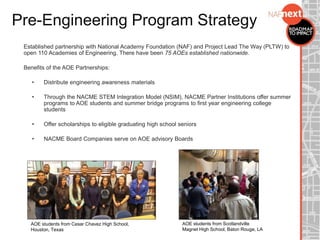
Established partnership with National Academy Foundation (NAF) and Project Lead The Way (PLTW) to
open 110 Academies of Engineering. There have been 75 AOEs established nationwide.
Benefits of the AOE Partnerships:
• Distribute engineering awareness materials
• Through the NACME STEM Integration Model (NSIM), NACME Partner Institutions offer summer
programs to AOE students and summer bridge programs to first year engineering college
students
• Offer scholarships to eligible graduating high school seniors
• NACME Board Companies serve on AOE advisory Boards
AOE students from Cesar Chavez High School,
Houston, Texas
AOE students from Scotlandville
Magnet High School, Baton Rouge, LA
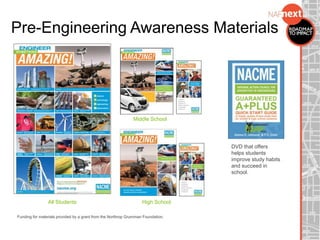
High School
Funding for materials provided by a grant from the Northrop Grumman Foundation.
All Students
Middle School
DVD that offers
helps students
improve study habits
and succeed in
school.
Pre-Engineering Awareness Materials
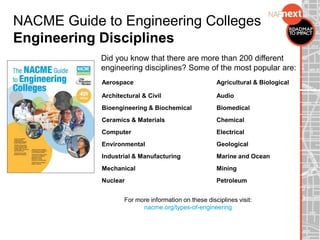
Did you know that there are more than 200 different
engineering disciplines? Some of the most popular are:
NACME Guide to Engineering Colleges
Engineering Disciplines
Aerospace Agricultural & Biological
Architectural & Civil Audio
Bioengineering & Biochemical Biomedical
Ceramics & Materials Chemical
Computer Electrical
Environmental Geological
Industrial & Manufacturing Marine and Ocean
Mechanical Mining
Nuclear Petroleum
For more information on these disciplines visit:
nacme.org/types-of-engineering
• How to improve your chances of being admitted to college?
– Keep your high school GPA up
– Take challenging math and science courses
– Take courses on local college campus for credit
– Work hard to get a good score on standardized tests (SAT and
ACT)
– Seek community service and extra-curricular activities to show
a well rounded student
– Take time to create your personal statement
– Give guidance counselor enough time to write letter of
recommendations
NACME Guide to Engineering Colleges
FAQs
• Freshman Year:
– Meet with Guidance Counselor to establish academic track and start
to take challenging math and science classes
• Sophomore Year:
– Take PSAT Exam and participate in extra-curricular activities and
search for summer programs
• Junior Year:
– Take SAT or ACT Exam
– Search for college scholarships, visit colleges, enroll in AP exams,
and participate in summer programs
• Senior Year:
– Apply for college and financial aid
– Apply for NACME Pre-Engineering Scholarship
NACME Guide to Engineering Colleges
Timeline for High School Students
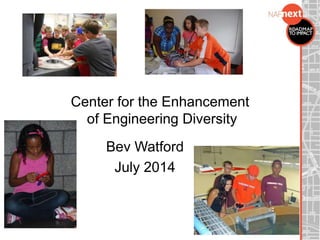
Center for the Enhancement
of Engineering Diversity
Bev Watford
July 2014
Center for the Enhancement of
Engineering Diversity
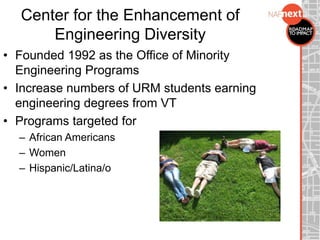
• Founded 1992 as the Office of Minority
Engineering Programs
• Increase numbers of URM students earning
engineering degrees from VT
• Programs targeted for
– African Americans
– Women
– Hispanic/Latina/o
CEED
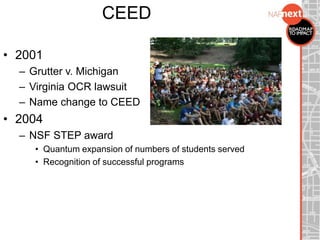
• 2001
– Grutter v. Michigan
– Virginia OCR lawsuit
– Name change to CEED
• 2004
– NSF STEP award
• Quantum expansion of numbers of students served
• Recognition of successful programs
CEED
• 2010
– STEP 1B award with College of Science
– Collaboration with Residence Life - inVenTs
• 2013 - Suite of Programs
– Middle school (Imagination, inVenTs Outreach,
Summer BLAST)
– High school (C-Tech2, PCI, RISE, Women’s
Preview Weekend)
– Pre-freshman (STEP Bridge)
– Undergraduate (Mentoring, Hypatia, Galileo,
inVenTs)
CEED
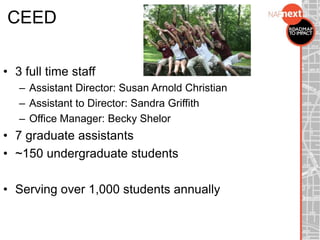
• 3 full time staff
– Assistant Director: Susan Arnold Christian
– Assistant to Director: Sandra Griffith
– Office Manager: Becky Shelor
• 7 graduate assistants
• ~150 undergraduate students
• Serving over 1,000 students annually
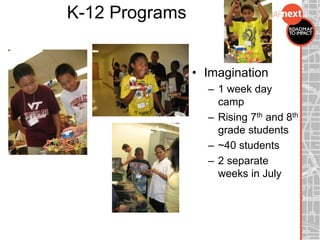
K-12 Programs
• Imagination
– 1 week day
camp
– Rising 7th and 8th
grade students
– ~40 students
– 2 separate
weeks in July
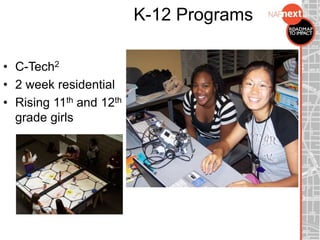
K-12 Programs
• C-Tech2
• 2 week residential
• Rising 11th and 12th
grade girls
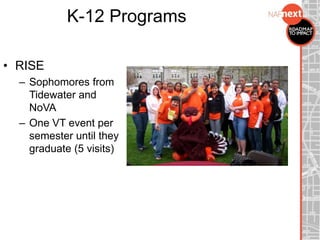
K-12 Programs
• RISE
– Sophomores from
Tidewater and
NoVA
– One VT event per
semester until they
graduate (5 visits)
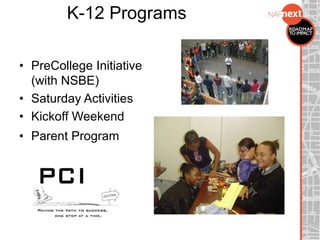
K-12 Programs
• PreCollege Initiative
(with NSBE)
• Saturday Activities
• Kickoff Weekend
• Parent Program
K-12 Programs
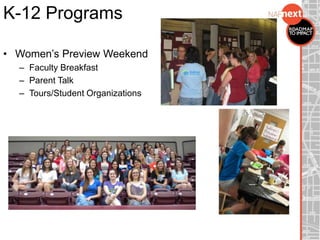
• Women’s Preview Weekend
– Faculty Breakfast
– Parent Talk
– Tours/Student Organizations
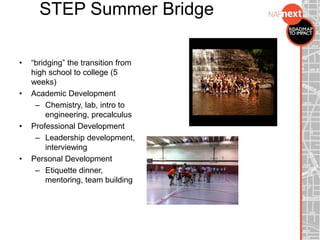
STEP Summer Bridge
• “bridging” the transition from
high school to college (5
weeks)
• Academic Development
– Chemistry, lab, intro to
engineering, precalculus
• Professional Development
– Leadership development,
interviewing
• Personal Development
– Etiquette dinner,
mentoring, team building
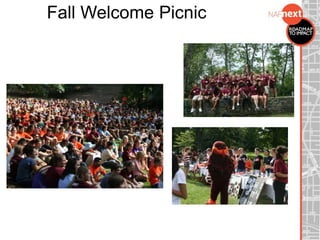
Fall Welcome Picnic
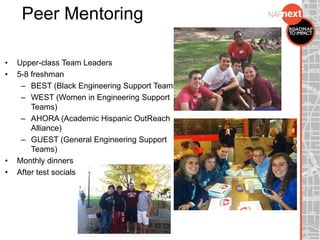
Peer Mentoring
• Upper-class Team Leaders
• 5-8 freshman
– BEST (Black Engineering Support Teams)
– WEST (Women in Engineering Support
Teams)
– AHORA (Academic Hispanic OutReach
Alliance)
– GUEST (General Engineering Support
Teams)
• Monthly dinners
• After test socials
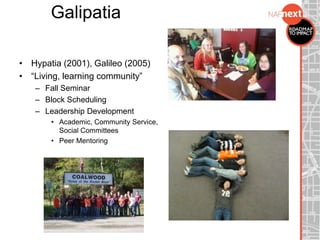
Galipatia
• Hypatia (2001), Galileo (2005)
• “Living, learning community”
– Fall Seminar
– Block Scheduling
– Leadership Development
• Academic, Community Service,
Social Committees
• Peer Mentoring
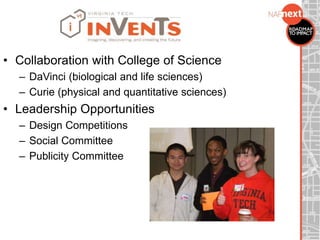
• Collaboration with College of Science
– DaVinci (biological and life sciences)
– Curie (physical and quantitative sciences)
• Leadership Opportunities
– Design Competitions
– Social Committee
– Publicity Committee
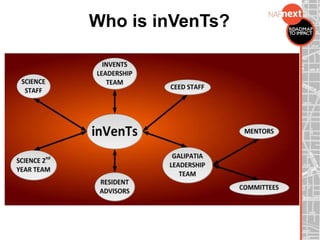
Who is inVenTs?
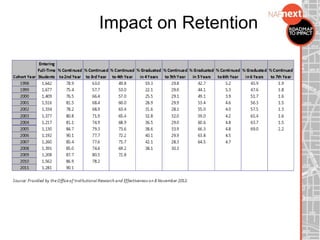
Impact on Retention
Presenter: Lawrence “Tony” Howell
Executive Director, Educational
Opportunity Programs
 The Center for Pre-College Programs was established in 1978 in order to increase
access to scientific and technological fields among traditionally underrepresented
populations and to improve the teaching of science and mathematics in secondary
and elementary schools. All programs involve corporate partners, local school
districts, non-profit educational organizations, and NJIT
 The corporate partners provide classroom speakers, financial support, role models,
field trips, and expertise in the teaching of science and engineering
 Over three decades of involvement in pre-college science and engineering programs
have convinced NJIT and its partners that intervention must begin in the elementary
grades
 NJIT has greatly increased its activities aimed at improving science teaching in the
classroom and reforming the elementary science curriculum as early as kindergarten
 The Center for Pre-College Programs annually serves more than 3,000 elementary
and secondary students and their teachers in a variety of programs
NJIT Center for Pre-College Programs
32
Early College Preparatory Programs
 Women in Engineering & Technology Initiatives FEMME Program
• Environmental Engineering FEMME -- 4th Grade / Female
• Aeronautical Engineering FEMME -- 5th Grade / Female
• Mechanical Engineering FEMME -- 6th Grade / Female
• Chemical Engineering FEMME -- 7th Grade / Female
• Biomedical Engineering FEMME -- 8th Grade / Female
 Environmental Science and Engineering Program (ESEP) -- 4th Grade
 Aeronautical Engineering Program (AEP) -- 5th Grade
 Pre-Engineering Program (PrEP) -- 6th Grade
 Explore Careers in Technology and Engineering (ExCITE) -- 7th Grade
 Medical Robotics (MEDIBOTICS) -- 8th Grade
 Introduction to Chemical Industry in Engineering Program (IChIME) -- 7th
and 8th Grade
 Fundamentals of Physical Sciences (FPS) -- 9th through 11th Grade
• Chemistry
• Physics
33
NACME/NJIT NACME NSIM Linkage
Summer 2013 Pre-College Program
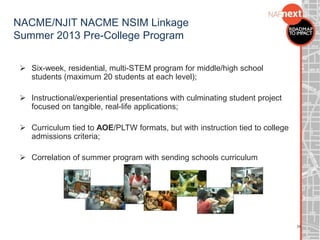
 Six-week, residential, multi-STEM program for middle/high school
students (maximum 20 students at each level);
 Instructional/experiential presentations with culminating student project
focused on tangible, real-life applications;
 Curriculum tied to AOE/PLTW formats, but with instruction tied to college
admissions criteria;
 Correlation of summer program with sending schools curriculum
34

A Roadmap from High School to Engineering Colleges

  • 1.
  • 2.
    A Roadmap fromHigh School to Engineering Colleges Presenters: Saundra Johnson Austin, NACME Dr. Bevlee Watford, NSF/VA-Tech Lawrence “Tony” Howell, NJIT
  • 3.
    What is NACME? OurMission To ensure American competitiveness in a flat world by leading and supporting the national effort to expand U.S. capability through increasing the number of successful African American, American Indian, and Latino young women and men in science, technology, engineering and mathematics (STEM) education and careers. Our Vision An engineering workforce that looks like America.
  • 4.
    NACME Board ofDirectors Role of the Board of Directors: to provide support and advocacy for NACME’s mission.
  • 5.
    NACME Corporate Council Roleof the Corporate Council: to provide support and advocacy for NACME’s mission.
  • 6.
    NACME by theNumbers NACME is the largest private provider of scholarships in engineering for underrepresented minority students. Since 1974, 24,000+ minority engineering students have been awarded NACME Scholarships $124 million has been awarded to support NACME Scholarships and programs to date More than 1,200 students supported by NACME Scholarships in 2013 $5.5 million provided by corporate and university partners to fund NACME Scholarship programs each year 160 Colleges and universities have been awarded NACME Scholarship grants 51 Partner Universities located nationwide
  • 7.
    Pre-Engineering Program Strategy Establishedpartnership with National Academy Foundation (NAF) and Project Lead The Way (PLTW) to open 110 Academies of Engineering. There have been 75 AOEs established nationwide. Benefits of the AOE Partnerships: • Distribute engineering awareness materials • Through the NACME STEM Integration Model (NSIM), NACME Partner Institutions offer summer programs to AOE students and summer bridge programs to first year engineering college students • Offer scholarships to eligible graduating high school seniors • NACME Board Companies serve on AOE advisory Boards AOE students from Cesar Chavez High School, Houston, Texas AOE students from Scotlandville Magnet High School, Baton Rouge, LA
  • 8.
    High School Funding formaterials provided by a grant from the Northrop Grumman Foundation. All Students Middle School DVD that offers helps students improve study habits and succeed in school. Pre-Engineering Awareness Materials
  • 9.
    Did you knowthat there are more than 200 different engineering disciplines? Some of the most popular are: NACME Guide to Engineering Colleges Engineering Disciplines Aerospace Agricultural & Biological Architectural & Civil Audio Bioengineering & Biochemical Biomedical Ceramics & Materials Chemical Computer Electrical Environmental Geological Industrial & Manufacturing Marine and Ocean Mechanical Mining Nuclear Petroleum For more information on these disciplines visit: nacme.org/types-of-engineering
  • 10.
    • How toimprove your chances of being admitted to college? – Keep your high school GPA up – Take challenging math and science courses – Take courses on local college campus for credit – Work hard to get a good score on standardized tests (SAT and ACT) – Seek community service and extra-curricular activities to show a well rounded student – Take time to create your personal statement – Give guidance counselor enough time to write letter of recommendations NACME Guide to Engineering Colleges FAQs
  • 11.
    • Freshman Year: –Meet with Guidance Counselor to establish academic track and start to take challenging math and science classes • Sophomore Year: – Take PSAT Exam and participate in extra-curricular activities and search for summer programs • Junior Year: – Take SAT or ACT Exam – Search for college scholarships, visit colleges, enroll in AP exams, and participate in summer programs • Senior Year: – Apply for college and financial aid – Apply for NACME Pre-Engineering Scholarship NACME Guide to Engineering Colleges Timeline for High School Students
  • 12.
    Center for theEnhancement of Engineering Diversity Bev Watford July 2014
  • 13.
    Center for theEnhancement of Engineering Diversity • Founded 1992 as the Office of Minority Engineering Programs • Increase numbers of URM students earning engineering degrees from VT • Programs targeted for – African Americans – Women – Hispanic/Latina/o
  • 14.
    CEED • 2001 – Grutterv. Michigan – Virginia OCR lawsuit – Name change to CEED • 2004 – NSF STEP award • Quantum expansion of numbers of students served • Recognition of successful programs
  • 15.
    CEED • 2010 – STEP1B award with College of Science – Collaboration with Residence Life - inVenTs • 2013 - Suite of Programs – Middle school (Imagination, inVenTs Outreach, Summer BLAST) – High school (C-Tech2, PCI, RISE, Women’s Preview Weekend) – Pre-freshman (STEP Bridge) – Undergraduate (Mentoring, Hypatia, Galileo, inVenTs)
  • 16.
    CEED • 3 fulltime staff – Assistant Director: Susan Arnold Christian – Assistant to Director: Sandra Griffith – Office Manager: Becky Shelor • 7 graduate assistants • ~150 undergraduate students • Serving over 1,000 students annually
  • 17.
    K-12 Programs • Imagination –1 week day camp – Rising 7th and 8th grade students – ~40 students – 2 separate weeks in July
  • 18.
    K-12 Programs • C-Tech2 •2 week residential • Rising 11th and 12th grade girls
  • 19.
    K-12 Programs • RISE –Sophomores from Tidewater and NoVA – One VT event per semester until they graduate (5 visits)
  • 20.
    K-12 Programs • PreCollegeInitiative (with NSBE) • Saturday Activities • Kickoff Weekend • Parent Program
  • 21.
    K-12 Programs • Women’sPreview Weekend – Faculty Breakfast – Parent Talk – Tours/Student Organizations
  • 22.
    STEP Summer Bridge •“bridging” the transition from high school to college (5 weeks) • Academic Development – Chemistry, lab, intro to engineering, precalculus • Professional Development – Leadership development, interviewing • Personal Development – Etiquette dinner, mentoring, team building
  • 23.
  • 24.
    Peer Mentoring • Upper-classTeam Leaders • 5-8 freshman – BEST (Black Engineering Support Teams) – WEST (Women in Engineering Support Teams) – AHORA (Academic Hispanic OutReach Alliance) – GUEST (General Engineering Support Teams) • Monthly dinners • After test socials
  • 25.
    Galipatia • Hypatia (2001),Galileo (2005) • “Living, learning community” – Fall Seminar – Block Scheduling – Leadership Development • Academic, Community Service, Social Committees • Peer Mentoring
  • 26.
    • Collaboration withCollege of Science – DaVinci (biological and life sciences) – Curie (physical and quantitative sciences) • Leadership Opportunities – Design Competitions – Social Committee – Publicity Committee
  • 27.
  • 29.
  • 31.
    Presenter: Lawrence “Tony”Howell Executive Director, Educational Opportunity Programs
  • 32.
     The Centerfor Pre-College Programs was established in 1978 in order to increase access to scientific and technological fields among traditionally underrepresented populations and to improve the teaching of science and mathematics in secondary and elementary schools. All programs involve corporate partners, local school districts, non-profit educational organizations, and NJIT  The corporate partners provide classroom speakers, financial support, role models, field trips, and expertise in the teaching of science and engineering  Over three decades of involvement in pre-college science and engineering programs have convinced NJIT and its partners that intervention must begin in the elementary grades  NJIT has greatly increased its activities aimed at improving science teaching in the classroom and reforming the elementary science curriculum as early as kindergarten  The Center for Pre-College Programs annually serves more than 3,000 elementary and secondary students and their teachers in a variety of programs NJIT Center for Pre-College Programs 32
  • 33.
    Early College PreparatoryPrograms  Women in Engineering & Technology Initiatives FEMME Program • Environmental Engineering FEMME -- 4th Grade / Female • Aeronautical Engineering FEMME -- 5th Grade / Female • Mechanical Engineering FEMME -- 6th Grade / Female • Chemical Engineering FEMME -- 7th Grade / Female • Biomedical Engineering FEMME -- 8th Grade / Female  Environmental Science and Engineering Program (ESEP) -- 4th Grade  Aeronautical Engineering Program (AEP) -- 5th Grade  Pre-Engineering Program (PrEP) -- 6th Grade  Explore Careers in Technology and Engineering (ExCITE) -- 7th Grade  Medical Robotics (MEDIBOTICS) -- 8th Grade  Introduction to Chemical Industry in Engineering Program (IChIME) -- 7th and 8th Grade  Fundamentals of Physical Sciences (FPS) -- 9th through 11th Grade • Chemistry • Physics 33
  • 34.
    NACME/NJIT NACME NSIMLinkage Summer 2013 Pre-College Program  Six-week, residential, multi-STEM program for middle/high school students (maximum 20 students at each level);  Instructional/experiential presentations with culminating student project focused on tangible, real-life applications;  Curriculum tied to AOE/PLTW formats, but with instruction tied to college admissions criteria;  Correlation of summer program with sending schools curriculum 34

Editor's Notes

  • #4 Our Goal To engineer opportunity for minorities in STEM Our Purpose Through partnerships with like-minded entities, we serve as a catalyst to increase the proportion of African American, American Indian, and Latino women and men in STEM careers. We inspire and encourage excellence in engineering education and career development toward achieving a diverse and dynamic American workforce. Our Beliefs We believe that diversity drives innovation. We believe in the concept of the “learning organization,” a community in which each member is encouraged and assisted to grow and develop. We support a NACME culture that is informed by our mission. We strive to be effective team members who are committed to doing our best work and to delivering the best results for our partners along the continuum from middle school to workforce entry.
  • #6 The newest companies on the Corporate Council are Bayer, CSC (Computer Science Corporation), Molex, Neustar, Occidental Petroleum Corporation, and Seagate. UL is actually Underwriter’s Laboratory.