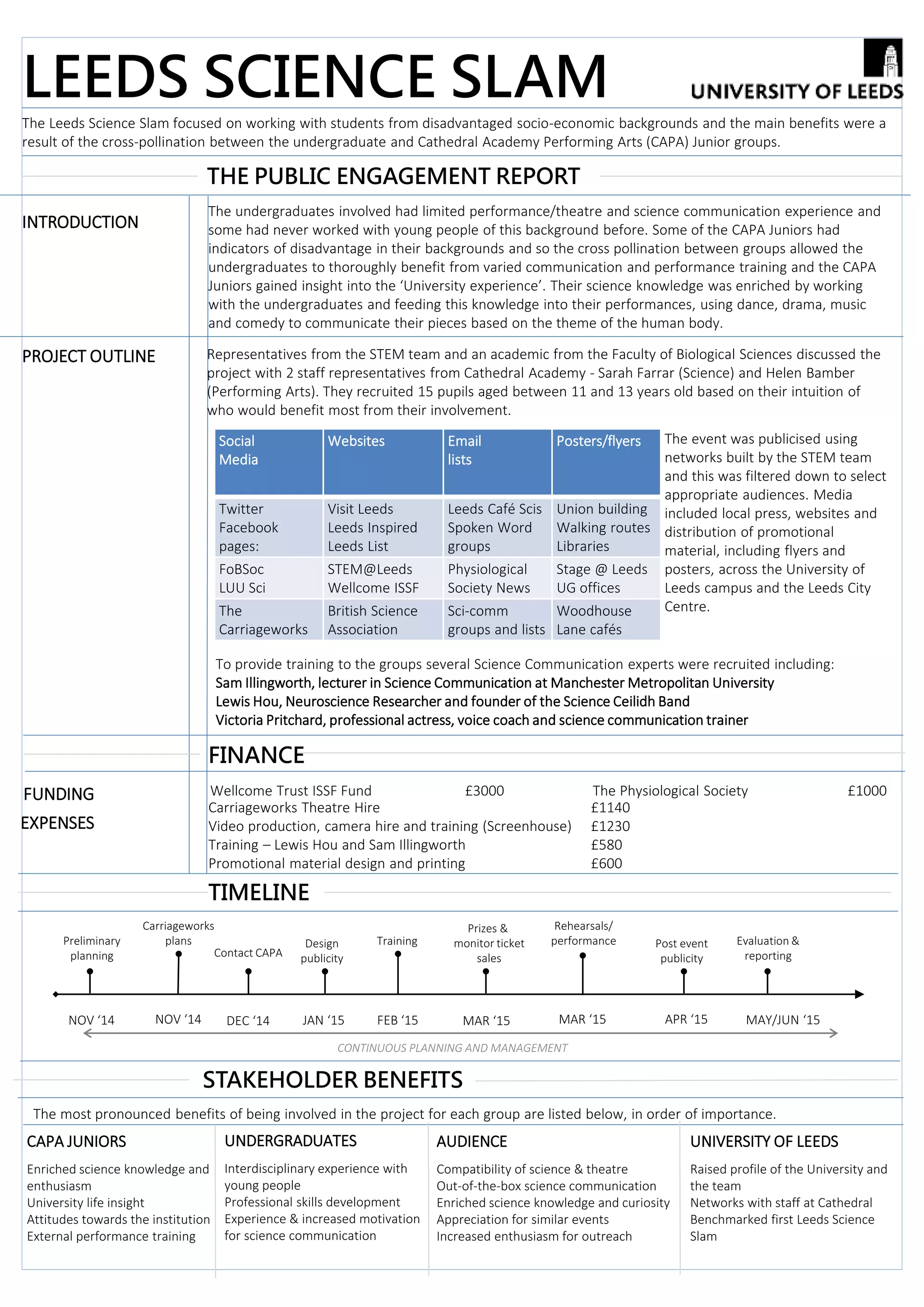
LEEDS SCIENCE SLAM
THE PUBLIC ENGAGEMENT REPORT
The Leeds Science Slam focused on working with students from disadvantaged socio-economic backgrounds and the main benefits were a
result of the cross-pollination between the undergraduate and Cathedral Academy Performing Arts (CAPA) Junior groups.
Parkinson
Building
INTRODUCTION
The undergraduates involved had limited performance/theatre and science communication experience and
some had never worked with young people of this background before. Some of the CAPA Juniors had
indicators of disadvantage in their backgrounds and so the cross pollination between groups allowed the
undergraduates to thoroughly benefit from varied communication and performance training and the CAPA
Juniors gained insight into the ‘University experience’. Their science knowledge was enriched by working
with the undergraduates and feeding this knowledge into their performances, using dance, drama, music
and comedy to communicate their pieces based on the theme of the human body.
PROJECT OUTLINE Representatives from the STEM team and an academic from the Faculty of Biological Sciences discussed the
project with 2 staff representatives from Cathedral Academy - Sarah Farrar (Science) and Helen Bamber
(Performing Arts). They recruited 15 pupils aged between 11 and 13 years old based on their intuition of
who would benefit most from their involvement.
FINANCE
FUNDING
EXPENSES
Wellcome Trust ISSF Fund £3000 The Physiological Society £1000
Carriageworks Theatre Hire £1140
Video production, camera hire and training (Screenhouse) £1230
Training – Lewis Hou and Sam Illingworth £580
Promotional material design and printing £600
STAKEHOLDER BENEFITS
TIMELINE
CONTINUOUS PLANNING AND MANAGEMENT
UNIVERSITY OF LEEDS
Raised profile of the University and
the team
Networks with staff at Cathedral
Benchmarked first Leeds Science
Slam
UNDERGRADUATES
Interdisciplinary experience with
young people
Professional skills development
Experience & increased motivation
for science communication
CAPA JUNIORS
Enriched science knowledge and
enthusiasm
University life insight
Attitudes towards the institution
External performance training
AUDIENCE
Compatibility of science & theatre
Out-of-the-box science communication
Enriched science knowledge and curiosity
Appreciation for similar events
Increased enthusiasm for outreach
Social
Media
Websites Email
lists
Posters/flyers
Twitter
Facebook
pages:
Visit Leeds
Leeds Inspired
Leeds List
Leeds Café Scis
Spoken Word
groups
Union building
Walking routes
Libraries
FoBSoc
LUU Sci
STEM@Leeds
Wellcome ISSF
Physiological
Society News
Stage @ Leeds
UG offices
The
Carriageworks
British Science
Association
Sci-comm
groups and lists
Woodhouse
Lane cafés
The event was publicised using
networks built by the STEM team
and this was filtered down to select
appropriate audiences. Media
included local press, websites and
distribution of promotional
material, including flyers and
posters, across the University of
Leeds campus and the Leeds City
Centre.
To provide training to the groups several Science Communication experts were recruited including:
Sam Illingworth, lecturer in Science Communication at Manchester Metropolitan University
Lewis Hou, Neuroscience Researcher and founder of the Science Ceilidh Band
Victoria Pritchard, professional actress, voice coach and science communication trainer
Design
publicity
Prizes &
monitor ticket
sales
Post event
publicity
Evaluation &
reporting
JAN ‘15 MAR ‘15 MAR ‘15 APR ‘15
Rehearsals/
performanceTraining
NOV ‘14
Carriageworks
plans
NOV ‘14
Preliminary
planning Contact CAPA
DEC ‘14 FEB ‘15 MAY/JUN ‘15
The most pronounced benefits of being involved in the project for each group are listed below, in order of importance.
EVALUATION, REPORTING AND RESULTS
AIMS & OBJECTIVES
The report will be a resource towards the establishment of a central public engagement strategy and
institution at the University of Leeds and provide a basis for similar projects..
UNDERGRADUATES Provide professional science communication training and experience of working with
young people from disadvantaged backgrounds.
CAPA JUNIORS Dispel opinions that science and theatre are incompatible
Provide insight and experience into University campus life and higher education
Enrich science knowledge and increase enthusiasm for STEM
RESULTS &
FEEDBACK
GENERIC LEARNING
OUTCOMES
The performers
(undergraduates and
CAPA Juniors) were given
self-rating questionnaires
to score themselves on
different skills. These were
then matched to Generic
Learning Outcomes
(GLO’s) which were used
as a basis for comparison
between both groups.
Evaluation was carried out from the beginning of the project with planned follow up after Summer 2015.
Generic Learning Outcome (GLO) Corresponding skill set(s)
Knowledge and understanding Practical skills
Body language
Skills Practical skills
Presentations
Teamwork
Body language
Working under pressure
Attitudes and values Self critique
Sharing thoughts, ideas and opinions
Confidence
Enjoyment, Inspiration & Creativity Creativity, exploration and experimentation
Thinking out of the box
Sharing thoughts, ideas and opinions
Activity Behaviour & Progression Self-critique
Confidence
19%
6%
2%
2%
6%
2%
21%
20%
4%
14%
4%
Friends or
family
University of
Leeds website
Alumni email
Carriageworks
publicity
Facebook
Yorkshire
Evening Post
CAPA Publicity
Know
participant
Poster publicity
University
colleague
STEM Website
How did the audience hear
about the event?
• 79% of those who responded to evaluation said
they would come again
• 39% of those who responded to evaluation said
they found the event entertaining
• The undergraduates reported an average 21%
increase in score of their ability to use body
language to communicate after completion of
the project
• The CAPA Juniors reported an average 26%
increase in score of their ability to work under
pressure after completion of the project
“This was a creative project that allowed our
students to work with undergraduates with lots of
excellent training provided and it raised the profile of
science across the school.” – Sarah Farrar, Cathedral
Academy
“I love the idea of getting
undergraduates to work with
young students and combining
science with performing arts”
Measurements of success
Skill set CAPA average
difference
UG average
difference
1. Presentations 0.9 1.3
2. Confidence 0.6 1.6
3.Team-work -0.1 1.1
4. Using body language 1.2 2.6
5. Working under pressure 2.6 0.7
6. Sharing thoughts, ideas and opinions 0.1 1.8
7. Learning practical skills -0.1 1.2
8. Thinking out of the box 0.9 1.2
9. Creativity, exploration and
experimentation
-0.2 1.6
10. Self-critique 0.9 0.5
Both groups of entrants gave a self-rated score for the listed skills before and after training in the project.

Project summary

  • 1.
    LEEDS SCIENCE SLAM THEPUBLIC ENGAGEMENT REPORT The Leeds Science Slam focused on working with students from disadvantaged socio-economic backgrounds and the main benefits were a result of the cross-pollination between the undergraduate and Cathedral Academy Performing Arts (CAPA) Junior groups. Parkinson Building INTRODUCTION The undergraduates involved had limited performance/theatre and science communication experience and some had never worked with young people of this background before. Some of the CAPA Juniors had indicators of disadvantage in their backgrounds and so the cross pollination between groups allowed the undergraduates to thoroughly benefit from varied communication and performance training and the CAPA Juniors gained insight into the ‘University experience’. Their science knowledge was enriched by working with the undergraduates and feeding this knowledge into their performances, using dance, drama, music and comedy to communicate their pieces based on the theme of the human body. PROJECT OUTLINE Representatives from the STEM team and an academic from the Faculty of Biological Sciences discussed the project with 2 staff representatives from Cathedral Academy - Sarah Farrar (Science) and Helen Bamber (Performing Arts). They recruited 15 pupils aged between 11 and 13 years old based on their intuition of who would benefit most from their involvement. FINANCE FUNDING EXPENSES Wellcome Trust ISSF Fund £3000 The Physiological Society £1000 Carriageworks Theatre Hire £1140 Video production, camera hire and training (Screenhouse) £1230 Training – Lewis Hou and Sam Illingworth £580 Promotional material design and printing £600 STAKEHOLDER BENEFITS TIMELINE CONTINUOUS PLANNING AND MANAGEMENT UNIVERSITY OF LEEDS Raised profile of the University and the team Networks with staff at Cathedral Benchmarked first Leeds Science Slam UNDERGRADUATES Interdisciplinary experience with young people Professional skills development Experience & increased motivation for science communication CAPA JUNIORS Enriched science knowledge and enthusiasm University life insight Attitudes towards the institution External performance training AUDIENCE Compatibility of science & theatre Out-of-the-box science communication Enriched science knowledge and curiosity Appreciation for similar events Increased enthusiasm for outreach Social Media Websites Email lists Posters/flyers Twitter Facebook pages: Visit Leeds Leeds Inspired Leeds List Leeds Café Scis Spoken Word groups Union building Walking routes Libraries FoBSoc LUU Sci STEM@Leeds Wellcome ISSF Physiological Society News Stage @ Leeds UG offices The Carriageworks British Science Association Sci-comm groups and lists Woodhouse Lane cafés The event was publicised using networks built by the STEM team and this was filtered down to select appropriate audiences. Media included local press, websites and distribution of promotional material, including flyers and posters, across the University of Leeds campus and the Leeds City Centre. To provide training to the groups several Science Communication experts were recruited including: Sam Illingworth, lecturer in Science Communication at Manchester Metropolitan University Lewis Hou, Neuroscience Researcher and founder of the Science Ceilidh Band Victoria Pritchard, professional actress, voice coach and science communication trainer Design publicity Prizes & monitor ticket sales Post event publicity Evaluation & reporting JAN ‘15 MAR ‘15 MAR ‘15 APR ‘15 Rehearsals/ performanceTraining NOV ‘14 Carriageworks plans NOV ‘14 Preliminary planning Contact CAPA DEC ‘14 FEB ‘15 MAY/JUN ‘15 The most pronounced benefits of being involved in the project for each group are listed below, in order of importance.
  • 2.
    EVALUATION, REPORTING ANDRESULTS AIMS & OBJECTIVES The report will be a resource towards the establishment of a central public engagement strategy and institution at the University of Leeds and provide a basis for similar projects.. UNDERGRADUATES Provide professional science communication training and experience of working with young people from disadvantaged backgrounds. CAPA JUNIORS Dispel opinions that science and theatre are incompatible Provide insight and experience into University campus life and higher education Enrich science knowledge and increase enthusiasm for STEM RESULTS & FEEDBACK GENERIC LEARNING OUTCOMES The performers (undergraduates and CAPA Juniors) were given self-rating questionnaires to score themselves on different skills. These were then matched to Generic Learning Outcomes (GLO’s) which were used as a basis for comparison between both groups. Evaluation was carried out from the beginning of the project with planned follow up after Summer 2015. Generic Learning Outcome (GLO) Corresponding skill set(s) Knowledge and understanding Practical skills Body language Skills Practical skills Presentations Teamwork Body language Working under pressure Attitudes and values Self critique Sharing thoughts, ideas and opinions Confidence Enjoyment, Inspiration & Creativity Creativity, exploration and experimentation Thinking out of the box Sharing thoughts, ideas and opinions Activity Behaviour & Progression Self-critique Confidence 19% 6% 2% 2% 6% 2% 21% 20% 4% 14% 4% Friends or family University of Leeds website Alumni email Carriageworks publicity Facebook Yorkshire Evening Post CAPA Publicity Know participant Poster publicity University colleague STEM Website How did the audience hear about the event? • 79% of those who responded to evaluation said they would come again • 39% of those who responded to evaluation said they found the event entertaining • The undergraduates reported an average 21% increase in score of their ability to use body language to communicate after completion of the project • The CAPA Juniors reported an average 26% increase in score of their ability to work under pressure after completion of the project “This was a creative project that allowed our students to work with undergraduates with lots of excellent training provided and it raised the profile of science across the school.” – Sarah Farrar, Cathedral Academy “I love the idea of getting undergraduates to work with young students and combining science with performing arts” Measurements of success Skill set CAPA average difference UG average difference 1. Presentations 0.9 1.3 2. Confidence 0.6 1.6 3.Team-work -0.1 1.1 4. Using body language 1.2 2.6 5. Working under pressure 2.6 0.7 6. Sharing thoughts, ideas and opinions 0.1 1.8 7. Learning practical skills -0.1 1.2 8. Thinking out of the box 0.9 1.2 9. Creativity, exploration and experimentation -0.2 1.6 10. Self-critique 0.9 0.5 Both groups of entrants gave a self-rated score for the listed skills before and after training in the project.