3rd ICMET 2019
Surabaya 21 November 2019 – Sheraton Hotel Surabaya
A Review of Smart Port in Indonesia
Rizqiya Windy Saputra
rizqiya@alumni.itb.ac.id
Electric Technical Officer Department
Merchant Marine Polytechnic Malahayati Aceh
Aceh, Indonesia
Akhmad Kasan Ghufron
ahgufron2005@gmail.com
Electric Technical Officer Department
Merchant Marine Polytechnic Malahayati Aceh
Aceh, Indonesia
Budi Riyanto
budi_riyan_pipsmg@yahoo.com
Electric Technical Officer Department
Merchant Marine Polytechnic Malahayati Aceh
Aceh, Indonesia
Abstract
The rapid increasing of utilizing level in advanced technology has provided many
developments in various aspects of port activities. This development has forced
Indonesia to participate in implementing smart systems in the form of smart
ports. The implementation of the smart port technology has an impact on the
emergence of new regulations affecting the users, regulators and stakeholders. In
this research, we try to collect various kinds of information about smart port
implementation in Indonesia and embrace it to be a paper. Information collected
is based on questionnaires, articles and papers. This paper is supposed to explain
smart port by Indonesia perspective, type of technology used in smart port, some
study cases and comparisons with another country. In the end, this papers can be
proposed as a new policy related to smart port for government.
Key words: smart port, smart system, port management
3rd ICMET 2019
Surabaya 21 November 2019 – Sheraton Hotel Surabaya
Indonesia is a vast archipelago with a total of 16,000 islands in 2017 based on data from
the Indonesian National Statistics Agency (Kusnandar, 2018). The geography condition
provides an opportunity for Indonesia as one of the strong maritime countries and a
benchmark for the development of ports in the world. The growth of development and
implementation of advanced technology also give Indonesia the big opportunity to
strength their maritime sector.
In era of technology as today, effectuation of technology in every sector of government
activities is a must. In providing good transportation services and getting enhancement
of transportation value in the city, government implements smart transportation
concept. Smart education implements to help students and teacher catch up the
technology growth and expanse more technological education concept in teaching area,
government enforce the concept of smart city to level up the happiness of living in city,
and in sector of maritime, Indonesian government in process of providing smart port to
escalate the level of services in maritime sectors.
Enlargement of port services is becoming more complex in recent day. Ports represent
major role in supporting the mobility of goods and people and the economy in maritime
sector of Indonesia (Azhar, Mardiana, etc. 2018). The complexity of many services
running in port sector is becoming a problem in smart technology implementation.
Aspect transportation, good containers, supply chain process and other port activities
that have been implemented are having similar complex problem in implementation of
smart system.
Despite the recent appears of smart port concept and its implementation of activity
domain at strategic ports in Indonesia have not well addressed or published in
literature. This paper aims to propose a smart port review in aspect of implementation
with Indonesian perspective and its activity domains based on some literatures
provided. Therefore, for this research we collected many references and information
originating from Tanjung Priok port located in Jakarta and Tanjung Perak that are
located in Surabaya.
Working on research through smart port system is very large and comprehensive as
mentioned in paragraph before. In this paper, we will limit the wide of discussion by
focusing on the defining services and strategy of smart port in Indonesia. The research
information collected from questionnaires, articles and papers will be provided as
related previous works. The second section will discuss some point of smart port and
some concepts of providing the reliable and sustainable smart port. In the last section,
the paper will provide the result of the research and gives many suggestion and
recommendation in development smart port in Indonesia and some future works to
research and studied.
Related work
In general term, we can describe the aim of Smart Port is to strengthen the local
economy and community through a better complement between demand and supply of
port activities. Smart Port should head to closer cooperation between the universities,
government, stakeholders and the port community, where every element can contribute
3rd ICMET 2019
Surabaya 21 November 2019 – Sheraton Hotel Surabaya
to the attraction of knowledge-intensive companies to the port and city (Kuipers,
Zuidwijk, et al, 2013). Without limiting the spread of the discussion in smart port
concepts, (MED Maritime, 2014) mentions that three big important issues of a smart
port are environment, operations and energy consumption.
Especially for development of country in the industrial sectors of port, efforts to adapt
smart or advanced technology at ports have been steadily progressing. In 2010,
Germany launched the Smart Port Logistics project in its Hamburg port: IoT sensors
were installed throughout the port to establish a system to exchange data from every
part of the port, including the ships, trucks, and transformation system (Jun, Lee & Choi,
2018). Thus, smart port technology has improved the flow of traffic and cargo in the
Hamburg port (Ferretti and Schiavone, 2016). Similarly, Rotterdam Port in the
Netherlands, which opened the first automated container terminal, the core of the smart
port, back in 1993, continued to lead the smart port industry by opening the APM
terminal and Rotterdam world gateway in 2015. In the US, Long Beach Container
Terminal (LBCT), a completely automated container terminal applying smart port
technology, was opened in 2016 (Jun, Lee & Choi, 2018).
The Korean government start the smart port from the initial stage, the government has
established the Basic Long-term Port Technology Development Plan (1999–2011) in
order to become a global port technology powerhouse (Jun, Lee & Choi, 2018). The goal
of this plan is to establish basic technology related to ports and take a new leap forward
in advanced port technology. As a following stage, the Korean government recently
established the National Logistics Master Plan (2016–2025) in August 2016 to establish
a comprehensive roadmap for next generation futuristic smart port construction, which
is a major project to lead the next generation of port logistics technology.
Framework for building a smart port model is also published in a research. We can say
that the digital port describes as a connected port that combines broadband
communications infrastructure, flexible and service-oriented computing infrastructure,
and innovative services to meet demands. An intelligent port has all the infrastructure
and info-structure of information technology and the most recent technologies in
telecommunications, electronic, and mechanic. A knowledge port is designed encourage
the nurturing of knowledge (Molavi, Lim & Race, 2019).
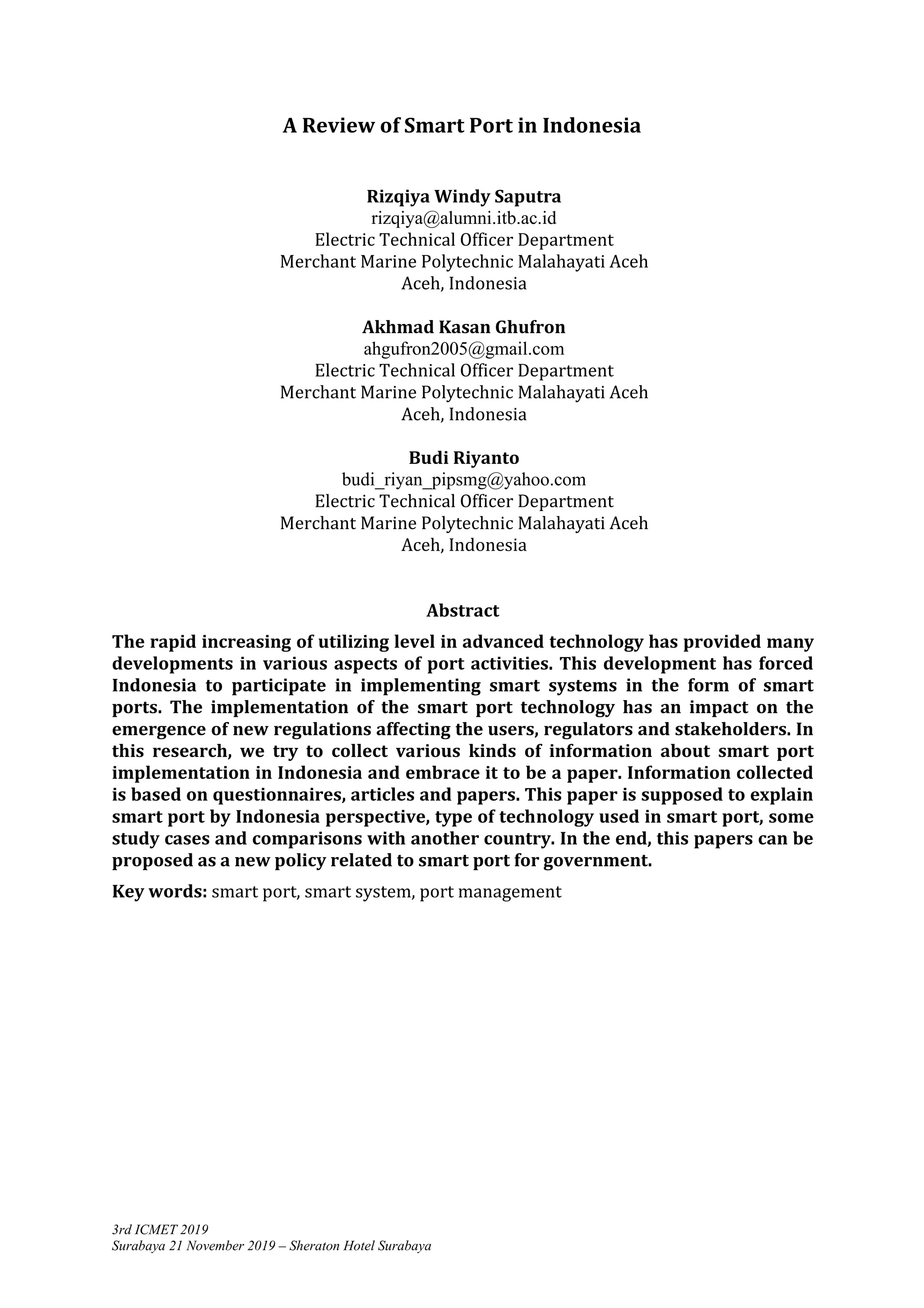
In the framework of smart port provided by Molavi & et al, they mentioned some main
domains in smart port activity. A smart port consists of four main activity domains.
There are operations, environment, energy, and safety and security. The research also
mentioned wider area that called by sub-domains of a smart port. Sub-domains are
mentioned are the possibilities of technology implemented in area of smart system. The
Sub-domain also can be changed or adjusted based on local condition, community needs
or local government regulations. The domains and sub-domains mentioned in Figure 2
below,
3rd ICMET 2019
Surabaya 21 November 2019 – Sheraton Hotel Surabaya
Figure 1. Smart Port Domains and Sub-domains (Molavi, Lim & Race, 2019; MED
Maritime, 2014)
Result and Discussion
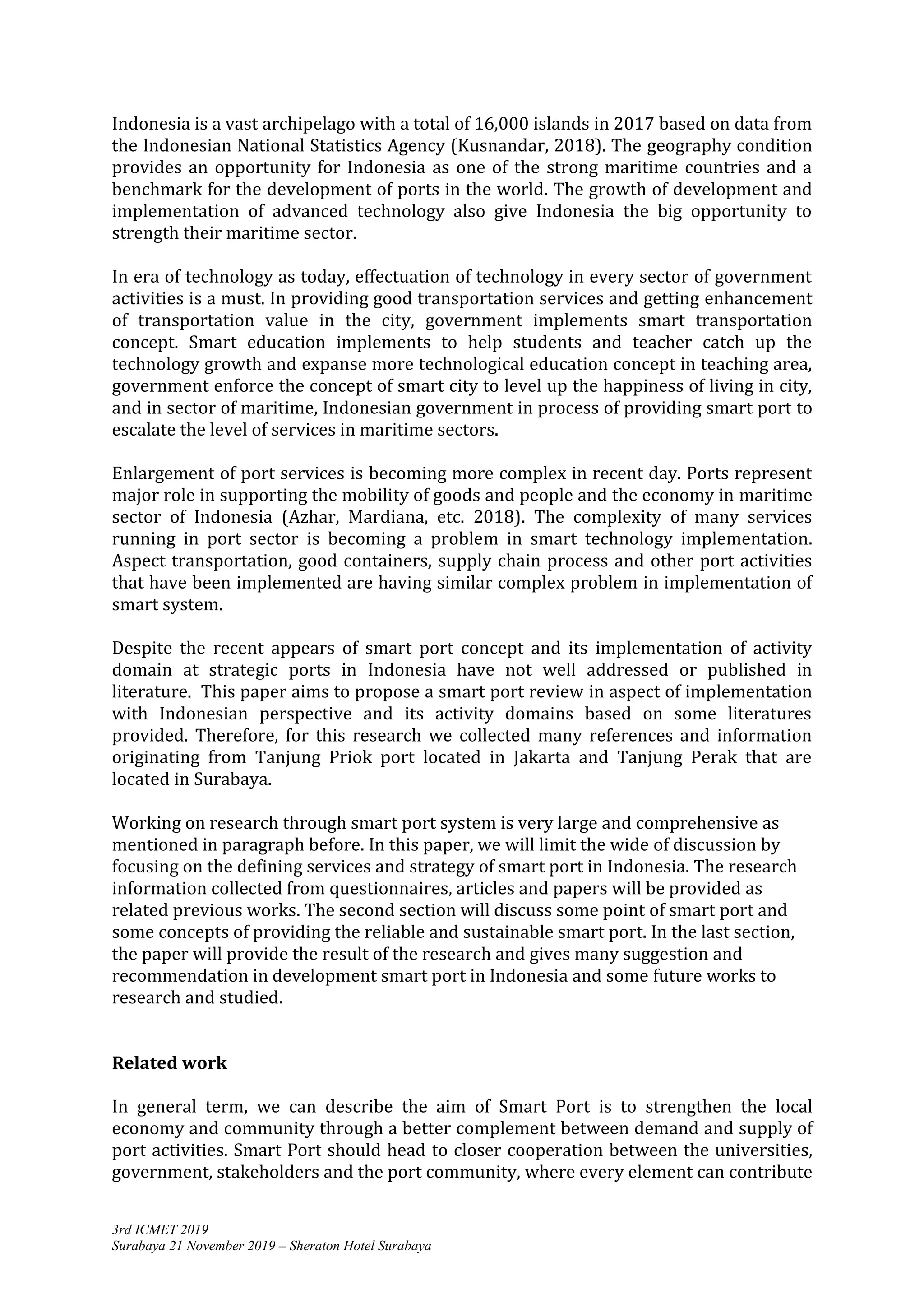
Figure 2 Outline of port activities and procedures for entering and leaving (Pelindo II, 2016)
3rd ICMET 2019
Surabaya 21 November 2019 – Sheraton Hotel Surabaya
Figure 1 explains the complexity of running activities around the port. Smart Port as a
solution that will encourage port activities with facilities and services that are
connected to advanced technology services and can be accessed with the port
management system through technology integration model. For example, energy sector
in port activities request high number of resources in energy. So, smart port aims to
reduce energy consumption and costs.
In paragraph above mentioned one of many services can be implemented in area of
smart port. Smart energy management is taking huge aspect to be research and
implemented in every area of smart port. By monitoring the huge of energy consumed
by port. Top level management can fulfill high demands and activities in port area while
reducing the loss of energy and ongoing development process with renewable energy
implementation.
Many governments elements involved in port activities as figure in Figure 1 above.
Ministry of Health, Ministry of Justice, Ministry of transportation, Ministry of Finance,
etc., are having their own responsibility and necessity in port activities. Theirs part on
port activities have to be supported by participating in regulation taking and system
implementation. So, the regulation will combine every ministry necessary and
responsibilities.
Figure 3 Ports development throughout the history (Molavi, Lim & Race, 2019)
Beside regulation concerns, the port activities also remain many important aspects.
Transportation includes on sea and land, and security awareness also have to be monitored
real-time. Transportation in port area is crowded and unpredictable in point of time
predictions. Implementations of time predictions in loading and unloading process of a vessel
is very challenging. Many problems involved in it, Cadet, regulations, ship conditions and
weather conditions influenced the process.
Figure 3 above describes the condition of development of port since Pre-1960s. Since the
very first of development, port’s development in current day is the 5th
generation of port
development and Indonesia is running on the right path in developing process. Smart port
fifth generation identified with implementation of skilled and well-educated workforce,
3rd ICMET 2019
Surabaya 21 November 2019 – Sheraton Hotel Surabaya
intelligent infrastructure and automation, optimized operations, enhanced resiliency and safe
activities (Molavi, Lim & Race, 2019).
In preparing of well-educated workforce, Indonesia in process of increasing some marine
schools with focused in marine training like marine polytechnic or marine training center
under Ministry of Sea Transportation. The ministry is preparing many cadets to improve their
skill in marine necessity. Another ongoing process in marine education process is providing
education in port management. In point of automation and intelligent infrastructure, the
government have been starting the establishment of digital port since 2015 (Pelindo II, 2018)
and growing in development every year until now. The establishment process pointed to
implementation of six digital service features effectively, hence the services provided have
succeeded in increasing customer satisfaction and loyalty, which in turn improving the
Company's performance (Pelindo II, 2018).
Some regulation is becoming another problem in port development. Although not directly
impact to digitizing process, the problem affected intelligence and autonomous infrastructure
analyzing. This condition is mentioned in a research worked in Tanjung Priok Port.
(Budisiswanto, N., Miharja, etc., 2018). The research mentioned that Indonesia does not have
a good implementation of multimodal freight. In spite of having regulations on procedures
for the transportation of multimodal goods, field implementation of these regulations and
procedures has not been strong enough. concurrently, there is access problem for multimodal
transportation, such as when goods are unloaded at Tanjung Priok Port, the subsequent access
of goods transport is only via road. The problem come in consequence of limited road traffic
capacity, Tanjung Priok Port congestion, and government regime change. Access to existing
port railways is becoming another problem in effectiveness even though rail lines are
available. In addition, Indonesia (Budisiswanto, N., Miharja, etc., 2018) also mentioned that
access from the Tanjung Priok Railway is still not accessible directly to the container yard
from and to other stations, and there are still inadequate transit warehouse, both at port and at
sea port.
Density at the port is a common problem in Indonesia. The condition hold the port to run
optimally. The implementation of online Delivery Order (DO) is actually applied in part
digitizing port management system at Tanjung Priok port (Azhar, Z., Mardiana, H., etc.
2018). The platform called by MyCargo, it can be an example of a platform that can be
applied to the online DO feature. Online DO will work well if the cargo owners want to use
the online DO system in carrying out their activities. Along with the online DO, the
application will be more useful if the stakeholders are able to provide trust and transparency
and eliminate the nature of sectoral ego. The platform offer some advantages due to its
cashless, paperless, and integrated system. (Azhar, Z., Mardiana, H., etc. 2018) mentioned
that using this platform, reducing or eliminating the density that occurs in Tanjung Priok
Port, facilitating the movement of goods and people, reducing wasting time, and increasing
revenue in Indonesia through effective exports and imports at ports are becoming more
vantage for port management.
3rd ICMET 2019
Surabaya 21 November 2019 – Sheraton Hotel Surabaya
Figure 4. Digitizing Port Management (Pelindo II, 2018)
The breakthrough innovation implemented in smart port have been doing by Pelindo II
or Indonesia Port Corporation (IPC). In their annual report, they mentioned some
innovations related to smart port implemented in port activities specially in their
working area (Pelindo, 2018). In realizing digital ports, IPC uses innovations aimed at
service and operational improvements. In 2018, implementation of digital ports for its
land and sea lines, including the implementation of auto gate, Integrated Container
Freight Station (CFS Center), Online Temporary Storage (TPS), Terminal Operating
System (TOS) and Auto Tally in container terminals, and the implementation of the
Marine Operating System (MOS), VTS (Vessel Traffic System), Vessel Management
System (VMS), and E-Service in a number of Port Branches.
Optimizing information technology in port services is not only aimed at facilitating
service users in transactions, but also to support Good Corporate Governance (GCG)
related to the transparency of service costs. In the operational side, IPC has also
developed a customer interaction management system that aims to increase service
user satisfaction. IPC runs six digital Customer Relationship Management (CRM)
application features in all Branch Offices and its two IPC Subsidiaries (PT Tanjung Priok
Port and PT IPC Container Terminal). The six Digital CRM application features includes:
Customer Data Master; Customer Profiling; Customer Service; Customer Visit
Management; Customer Survey; and Sales, all of which have gone live. This application
is part of the strategy and process of managing interactions with customers.
Social aspect is another main point to be related in implementation of smart port in
Indonesia. Local community is having different impact in the existence of smart port at
this time. With the good experiences their have, the output will be deliver to the
Government to make a good regulations. (Chen, J., Huang, T., Xie, X., etc. 2019)
mentioned some aspects of developing the green port. They mentioned three aspect in
research included port operation strategies, technical means, and approaches of
3rd ICMET 2019
Surabaya 21 November 2019 – Sheraton Hotel Surabaya
implementation. Environmental and community approach is indirect approaches that must
still be developed when developing or implementing smart port.
Community approach is also in research process (Firdaus, M., Sucherly, Sumawihardja, S., &
Kaltum, U., 2017). The approach involve discipline and delivery efficiency approach in
interaction of warehouse ang port management. In terms of discipline, the human resources
department through its staff needs to have managerial experience through direct company
review in order to know clearly how problems managers face in terms of human resources. In
terms of delivery efficiency, it is necessary to foster a harmonious relationship between the
warehouse, the operational department and the vendor of both shipping and trucking.
Based of some discussions of many researches above, this paper deliver comparison between
the current conditions of technology implemented and the future technology should be
considered to develop. The explanation pictured in figure 5 Below,
Figure 5. Smart system recommendations to be developed and implemented in
Indonesia Ports.
The figure 5 above explain some recommendation of smart services to be developed and
implemented in the future. The first step ahead is integration every running data in port
management or any related outside port management. The integration will help development
teams to expanse the process in port management to automation processes. After both first
identified system implemented, the next process is intelligence system. This part will
recommend other services of real-time monitoring on part of port management or security
and surveillance system in port.
Smart system recommended in figure 5 above also deliver some possibilities of technology to
implemented in developing of smart port. The system can be divided to technical issues or
management. The changes in the system model can be committed based on local condition,
community needs, local government regulations or other local non-technical issues.
Collaboration with other port authority will increase the probability of delivering good
services in smart port. Some similar studies can be implemented in Indonesia with different
approach adjusted to local community and local condition. in the end, the existence of
technology cannot always replace the important role of humans in port activities in Indonesia.
3rd ICMET 2019
Surabaya 21 November 2019 – Sheraton Hotel Surabaya
This is certainly determined by many binding community factors in Indonesia. These non-
technical factors must be well identified in the ongoing development process at this time.
Conclusion and Future Research
Indonesia with huge archipelago country is potential asset in developing smart port.
Enlargement of many port services is becoming more complex in recent day and
Indonesia port also represent major role in supporting the mobility of goods and people
and the economy in maritime sector. With port digitizing have been running in
Indonesia, progress towards the right smart port is increasingly possible.
With limitation of well published documents and articles, this research provided a
prosperous information could be a good enlightenment for future research. Analysis
aspect in each section of running technology implemented will be a challenging in
future. The changes of technology trends also impact the human resources in port
researcher to keep going with many possibility researches in the future.
References
Alamsyah, I. E. (2018). Menyambut Era Baru Pelabuhan Bersistem Digital. Retrieved
November 9, 2019, from replubika.co.id website:
https://www.republika.co.id/berita/ekonomi/korporasi/18/11/18/piedi0349-menyambut-
era-baru-pelabuhan-bersistem-digital
Azhar, Z., Mardiana, H., Didiet, R., Hidayat, R., & Himawan, D. (2018). The Implementation
of Smart Port in Tanjung Priok Port for Utilization and Green Port Optimization. 132–
138.
Azhar, Z., Mardiana, H., Didiet, R., Hidayat, R., & Himawan, D. (2018). The Implementation
of Smart Port in Tanjung Priok Port for Utilization and Green Port Optimization. 132–
138.
Budisiswanto, N., Miharja, M., Kombaitan, B., & Pradono, P. (2018). Multimodal Freight
Transport Regulations in Indonesia and Its Implementation (A Case Study of Tanjung
Priok Port). IOP Conference Series: Earth and Environmental Science, 158(1).
https://doi.org/10.1088/1755-1315/158/1/012021
Chen, J., Huang, T., Xie, X., Lee, P. T. W., & Hua, C. (2019). Constructing governance
framework of a green and smart port. Journal of Marine Science and Engineering, 7(4).
https://doi.org/10.3390/jmse7040083
Ferretti, M., & Schiavone, F. (2016). Internet of Things and business processes redesign in
seaports: The case of Hamburg. Business Process Management Journal, 22(2), 271–
284. https://doi.org/10.1108/BPMJ-05-2015-0079
Firdaus, M., Sucherly, Sumawihardja, S., & Kaltum, U. (2017). Efficiency and Discipline
Study of Goods Delivery From Werehouse To Tanjung Priok Ports. Internationa
Journal of Scuentific and Research Publication, 7(7), 16–26. Retrieved from
www.ijsrp.org
Jun, W. K., Lee, M. K., & Choi, J. Y. (2018). Impact of the smart port industry on the Korean
national economy using input-output analysis. Transportation Research Part A: Policy
and Practice, 118(July), 480–493. https://doi.org/10.1016/j.tra.2018.10.004
Kuipers, B., Zuidwijk, R., Smart, E., & Rotterdam, P. (2013). Smart Port Perspectives Essays
in honour of Hans Smits Smart Port Perspectives Essays in honour of Hans Smits.
3rd ICMET 2019
Surabaya 21 November 2019 – Sheraton Hotel Surabaya
Retrieved from https://rzuidwijk.files.wordpress.com/2014/02/smart-port-
perspectives.pdf
Kusnandar, V. B. (2018). Jumlah Pulau di Indonesia Menurut Provinsi (2017). Retrieved
November 9, 2019, from databoks.katadata.co.id website:
https://databoks.katadata.co.id/datapublish/2019/06/12/jumlah-pulau-di-indonesia-
berkurang-menjadi-16-ribu
Molavi, A., Lim, G. J., & Race, B. (2019). A framework for building a smart port and smart
port index. International Journal of Sustainable Transportation, (April).
https://doi.org/10.1080/15568318.2019.1610919
Pelindo II, PT. Pelabuhan Indonesia II. (2018). Annual Report 2018: Establishment of
Excellence Digital Port.
Programme, MED. (2014). Action Plan towards the SMART PORT concept in the
Mediterranean Area. Retrieved from
http://www.medmaritimeprojects.eu/download/ProjectSmartport/RESERVED_Folder/D
1_1_Smart_port_criteria_Final.pdf
Rachmadi, A., & PT. Pelabuhan Indonesia II (Pelindo II). (2016). Pengembangan
Infrastruktur Pelabuhan Indonesia. 12(1), 1–12. Presentation slides is presented at
Bandung Institute of Technology, Bandung on 13th
October 2016.

A Review of Smart Port in Indonesia

  • 1.
    3rd ICMET 2019 Surabaya21 November 2019 – Sheraton Hotel Surabaya A Review of Smart Port in Indonesia Rizqiya Windy Saputra rizqiya@alumni.itb.ac.id Electric Technical Officer Department Merchant Marine Polytechnic Malahayati Aceh Aceh, Indonesia Akhmad Kasan Ghufron ahgufron2005@gmail.com Electric Technical Officer Department Merchant Marine Polytechnic Malahayati Aceh Aceh, Indonesia Budi Riyanto budi_riyan_pipsmg@yahoo.com Electric Technical Officer Department Merchant Marine Polytechnic Malahayati Aceh Aceh, Indonesia Abstract The rapid increasing of utilizing level in advanced technology has provided many developments in various aspects of port activities. This development has forced Indonesia to participate in implementing smart systems in the form of smart ports. The implementation of the smart port technology has an impact on the emergence of new regulations affecting the users, regulators and stakeholders. In this research, we try to collect various kinds of information about smart port implementation in Indonesia and embrace it to be a paper. Information collected is based on questionnaires, articles and papers. This paper is supposed to explain smart port by Indonesia perspective, type of technology used in smart port, some study cases and comparisons with another country. In the end, this papers can be proposed as a new policy related to smart port for government. Key words: smart port, smart system, port management
  • 2.
    3rd ICMET 2019 Surabaya21 November 2019 – Sheraton Hotel Surabaya Indonesia is a vast archipelago with a total of 16,000 islands in 2017 based on data from the Indonesian National Statistics Agency (Kusnandar, 2018). The geography condition provides an opportunity for Indonesia as one of the strong maritime countries and a benchmark for the development of ports in the world. The growth of development and implementation of advanced technology also give Indonesia the big opportunity to strength their maritime sector. In era of technology as today, effectuation of technology in every sector of government activities is a must. In providing good transportation services and getting enhancement of transportation value in the city, government implements smart transportation concept. Smart education implements to help students and teacher catch up the technology growth and expanse more technological education concept in teaching area, government enforce the concept of smart city to level up the happiness of living in city, and in sector of maritime, Indonesian government in process of providing smart port to escalate the level of services in maritime sectors. Enlargement of port services is becoming more complex in recent day. Ports represent major role in supporting the mobility of goods and people and the economy in maritime sector of Indonesia (Azhar, Mardiana, etc. 2018). The complexity of many services running in port sector is becoming a problem in smart technology implementation. Aspect transportation, good containers, supply chain process and other port activities that have been implemented are having similar complex problem in implementation of smart system. Despite the recent appears of smart port concept and its implementation of activity domain at strategic ports in Indonesia have not well addressed or published in literature. This paper aims to propose a smart port review in aspect of implementation with Indonesian perspective and its activity domains based on some literatures provided. Therefore, for this research we collected many references and information originating from Tanjung Priok port located in Jakarta and Tanjung Perak that are located in Surabaya. Working on research through smart port system is very large and comprehensive as mentioned in paragraph before. In this paper, we will limit the wide of discussion by focusing on the defining services and strategy of smart port in Indonesia. The research information collected from questionnaires, articles and papers will be provided as related previous works. The second section will discuss some point of smart port and some concepts of providing the reliable and sustainable smart port. In the last section, the paper will provide the result of the research and gives many suggestion and recommendation in development smart port in Indonesia and some future works to research and studied. Related work In general term, we can describe the aim of Smart Port is to strengthen the local economy and community through a better complement between demand and supply of port activities. Smart Port should head to closer cooperation between the universities, government, stakeholders and the port community, where every element can contribute
  • 3.
    3rd ICMET 2019 Surabaya21 November 2019 – Sheraton Hotel Surabaya to the attraction of knowledge-intensive companies to the port and city (Kuipers, Zuidwijk, et al, 2013). Without limiting the spread of the discussion in smart port concepts, (MED Maritime, 2014) mentions that three big important issues of a smart port are environment, operations and energy consumption. Especially for development of country in the industrial sectors of port, efforts to adapt smart or advanced technology at ports have been steadily progressing. In 2010, Germany launched the Smart Port Logistics project in its Hamburg port: IoT sensors were installed throughout the port to establish a system to exchange data from every part of the port, including the ships, trucks, and transformation system (Jun, Lee & Choi, 2018). Thus, smart port technology has improved the flow of traffic and cargo in the Hamburg port (Ferretti and Schiavone, 2016). Similarly, Rotterdam Port in the Netherlands, which opened the first automated container terminal, the core of the smart port, back in 1993, continued to lead the smart port industry by opening the APM terminal and Rotterdam world gateway in 2015. In the US, Long Beach Container Terminal (LBCT), a completely automated container terminal applying smart port technology, was opened in 2016 (Jun, Lee & Choi, 2018). The Korean government start the smart port from the initial stage, the government has established the Basic Long-term Port Technology Development Plan (1999–2011) in order to become a global port technology powerhouse (Jun, Lee & Choi, 2018). The goal of this plan is to establish basic technology related to ports and take a new leap forward in advanced port technology. As a following stage, the Korean government recently established the National Logistics Master Plan (2016–2025) in August 2016 to establish a comprehensive roadmap for next generation futuristic smart port construction, which is a major project to lead the next generation of port logistics technology. Framework for building a smart port model is also published in a research. We can say that the digital port describes as a connected port that combines broadband communications infrastructure, flexible and service-oriented computing infrastructure, and innovative services to meet demands. An intelligent port has all the infrastructure and info-structure of information technology and the most recent technologies in telecommunications, electronic, and mechanic. A knowledge port is designed encourage the nurturing of knowledge (Molavi, Lim & Race, 2019). In the framework of smart port provided by Molavi & et al, they mentioned some main domains in smart port activity. A smart port consists of four main activity domains. There are operations, environment, energy, and safety and security. The research also mentioned wider area that called by sub-domains of a smart port. Sub-domains are mentioned are the possibilities of technology implemented in area of smart system. The Sub-domain also can be changed or adjusted based on local condition, community needs or local government regulations. The domains and sub-domains mentioned in Figure 2 below,
  • 4.
    3rd ICMET 2019 Surabaya21 November 2019 – Sheraton Hotel Surabaya Figure 1. Smart Port Domains and Sub-domains (Molavi, Lim & Race, 2019; MED Maritime, 2014) Result and Discussion Figure 2 Outline of port activities and procedures for entering and leaving (Pelindo II, 2016)
  • 5.
    3rd ICMET 2019 Surabaya21 November 2019 – Sheraton Hotel Surabaya Figure 1 explains the complexity of running activities around the port. Smart Port as a solution that will encourage port activities with facilities and services that are connected to advanced technology services and can be accessed with the port management system through technology integration model. For example, energy sector in port activities request high number of resources in energy. So, smart port aims to reduce energy consumption and costs. In paragraph above mentioned one of many services can be implemented in area of smart port. Smart energy management is taking huge aspect to be research and implemented in every area of smart port. By monitoring the huge of energy consumed by port. Top level management can fulfill high demands and activities in port area while reducing the loss of energy and ongoing development process with renewable energy implementation. Many governments elements involved in port activities as figure in Figure 1 above. Ministry of Health, Ministry of Justice, Ministry of transportation, Ministry of Finance, etc., are having their own responsibility and necessity in port activities. Theirs part on port activities have to be supported by participating in regulation taking and system implementation. So, the regulation will combine every ministry necessary and responsibilities. Figure 3 Ports development throughout the history (Molavi, Lim & Race, 2019) Beside regulation concerns, the port activities also remain many important aspects. Transportation includes on sea and land, and security awareness also have to be monitored real-time. Transportation in port area is crowded and unpredictable in point of time predictions. Implementations of time predictions in loading and unloading process of a vessel is very challenging. Many problems involved in it, Cadet, regulations, ship conditions and weather conditions influenced the process. Figure 3 above describes the condition of development of port since Pre-1960s. Since the very first of development, port’s development in current day is the 5th generation of port development and Indonesia is running on the right path in developing process. Smart port fifth generation identified with implementation of skilled and well-educated workforce,
  • 6.
    3rd ICMET 2019 Surabaya21 November 2019 – Sheraton Hotel Surabaya intelligent infrastructure and automation, optimized operations, enhanced resiliency and safe activities (Molavi, Lim & Race, 2019). In preparing of well-educated workforce, Indonesia in process of increasing some marine schools with focused in marine training like marine polytechnic or marine training center under Ministry of Sea Transportation. The ministry is preparing many cadets to improve their skill in marine necessity. Another ongoing process in marine education process is providing education in port management. In point of automation and intelligent infrastructure, the government have been starting the establishment of digital port since 2015 (Pelindo II, 2018) and growing in development every year until now. The establishment process pointed to implementation of six digital service features effectively, hence the services provided have succeeded in increasing customer satisfaction and loyalty, which in turn improving the Company's performance (Pelindo II, 2018). Some regulation is becoming another problem in port development. Although not directly impact to digitizing process, the problem affected intelligence and autonomous infrastructure analyzing. This condition is mentioned in a research worked in Tanjung Priok Port. (Budisiswanto, N., Miharja, etc., 2018). The research mentioned that Indonesia does not have a good implementation of multimodal freight. In spite of having regulations on procedures for the transportation of multimodal goods, field implementation of these regulations and procedures has not been strong enough. concurrently, there is access problem for multimodal transportation, such as when goods are unloaded at Tanjung Priok Port, the subsequent access of goods transport is only via road. The problem come in consequence of limited road traffic capacity, Tanjung Priok Port congestion, and government regime change. Access to existing port railways is becoming another problem in effectiveness even though rail lines are available. In addition, Indonesia (Budisiswanto, N., Miharja, etc., 2018) also mentioned that access from the Tanjung Priok Railway is still not accessible directly to the container yard from and to other stations, and there are still inadequate transit warehouse, both at port and at sea port. Density at the port is a common problem in Indonesia. The condition hold the port to run optimally. The implementation of online Delivery Order (DO) is actually applied in part digitizing port management system at Tanjung Priok port (Azhar, Z., Mardiana, H., etc. 2018). The platform called by MyCargo, it can be an example of a platform that can be applied to the online DO feature. Online DO will work well if the cargo owners want to use the online DO system in carrying out their activities. Along with the online DO, the application will be more useful if the stakeholders are able to provide trust and transparency and eliminate the nature of sectoral ego. The platform offer some advantages due to its cashless, paperless, and integrated system. (Azhar, Z., Mardiana, H., etc. 2018) mentioned that using this platform, reducing or eliminating the density that occurs in Tanjung Priok Port, facilitating the movement of goods and people, reducing wasting time, and increasing revenue in Indonesia through effective exports and imports at ports are becoming more vantage for port management.
  • 7.
    3rd ICMET 2019 Surabaya21 November 2019 – Sheraton Hotel Surabaya Figure 4. Digitizing Port Management (Pelindo II, 2018) The breakthrough innovation implemented in smart port have been doing by Pelindo II or Indonesia Port Corporation (IPC). In their annual report, they mentioned some innovations related to smart port implemented in port activities specially in their working area (Pelindo, 2018). In realizing digital ports, IPC uses innovations aimed at service and operational improvements. In 2018, implementation of digital ports for its land and sea lines, including the implementation of auto gate, Integrated Container Freight Station (CFS Center), Online Temporary Storage (TPS), Terminal Operating System (TOS) and Auto Tally in container terminals, and the implementation of the Marine Operating System (MOS), VTS (Vessel Traffic System), Vessel Management System (VMS), and E-Service in a number of Port Branches. Optimizing information technology in port services is not only aimed at facilitating service users in transactions, but also to support Good Corporate Governance (GCG) related to the transparency of service costs. In the operational side, IPC has also developed a customer interaction management system that aims to increase service user satisfaction. IPC runs six digital Customer Relationship Management (CRM) application features in all Branch Offices and its two IPC Subsidiaries (PT Tanjung Priok Port and PT IPC Container Terminal). The six Digital CRM application features includes: Customer Data Master; Customer Profiling; Customer Service; Customer Visit Management; Customer Survey; and Sales, all of which have gone live. This application is part of the strategy and process of managing interactions with customers. Social aspect is another main point to be related in implementation of smart port in Indonesia. Local community is having different impact in the existence of smart port at this time. With the good experiences their have, the output will be deliver to the Government to make a good regulations. (Chen, J., Huang, T., Xie, X., etc. 2019) mentioned some aspects of developing the green port. They mentioned three aspect in research included port operation strategies, technical means, and approaches of
  • 8.
    3rd ICMET 2019 Surabaya21 November 2019 – Sheraton Hotel Surabaya implementation. Environmental and community approach is indirect approaches that must still be developed when developing or implementing smart port. Community approach is also in research process (Firdaus, M., Sucherly, Sumawihardja, S., & Kaltum, U., 2017). The approach involve discipline and delivery efficiency approach in interaction of warehouse ang port management. In terms of discipline, the human resources department through its staff needs to have managerial experience through direct company review in order to know clearly how problems managers face in terms of human resources. In terms of delivery efficiency, it is necessary to foster a harmonious relationship between the warehouse, the operational department and the vendor of both shipping and trucking. Based of some discussions of many researches above, this paper deliver comparison between the current conditions of technology implemented and the future technology should be considered to develop. The explanation pictured in figure 5 Below, Figure 5. Smart system recommendations to be developed and implemented in Indonesia Ports. The figure 5 above explain some recommendation of smart services to be developed and implemented in the future. The first step ahead is integration every running data in port management or any related outside port management. The integration will help development teams to expanse the process in port management to automation processes. After both first identified system implemented, the next process is intelligence system. This part will recommend other services of real-time monitoring on part of port management or security and surveillance system in port. Smart system recommended in figure 5 above also deliver some possibilities of technology to implemented in developing of smart port. The system can be divided to technical issues or management. The changes in the system model can be committed based on local condition, community needs, local government regulations or other local non-technical issues. Collaboration with other port authority will increase the probability of delivering good services in smart port. Some similar studies can be implemented in Indonesia with different approach adjusted to local community and local condition. in the end, the existence of technology cannot always replace the important role of humans in port activities in Indonesia.
  • 9.
    3rd ICMET 2019 Surabaya21 November 2019 – Sheraton Hotel Surabaya This is certainly determined by many binding community factors in Indonesia. These non- technical factors must be well identified in the ongoing development process at this time. Conclusion and Future Research Indonesia with huge archipelago country is potential asset in developing smart port. Enlargement of many port services is becoming more complex in recent day and Indonesia port also represent major role in supporting the mobility of goods and people and the economy in maritime sector. With port digitizing have been running in Indonesia, progress towards the right smart port is increasingly possible. With limitation of well published documents and articles, this research provided a prosperous information could be a good enlightenment for future research. Analysis aspect in each section of running technology implemented will be a challenging in future. The changes of technology trends also impact the human resources in port researcher to keep going with many possibility researches in the future. References Alamsyah, I. E. (2018). Menyambut Era Baru Pelabuhan Bersistem Digital. Retrieved November 9, 2019, from replubika.co.id website: https://www.republika.co.id/berita/ekonomi/korporasi/18/11/18/piedi0349-menyambut- era-baru-pelabuhan-bersistem-digital Azhar, Z., Mardiana, H., Didiet, R., Hidayat, R., & Himawan, D. (2018). The Implementation of Smart Port in Tanjung Priok Port for Utilization and Green Port Optimization. 132– 138. Azhar, Z., Mardiana, H., Didiet, R., Hidayat, R., & Himawan, D. (2018). The Implementation of Smart Port in Tanjung Priok Port for Utilization and Green Port Optimization. 132– 138. Budisiswanto, N., Miharja, M., Kombaitan, B., & Pradono, P. (2018). Multimodal Freight Transport Regulations in Indonesia and Its Implementation (A Case Study of Tanjung Priok Port). IOP Conference Series: Earth and Environmental Science, 158(1). https://doi.org/10.1088/1755-1315/158/1/012021 Chen, J., Huang, T., Xie, X., Lee, P. T. W., & Hua, C. (2019). Constructing governance framework of a green and smart port. Journal of Marine Science and Engineering, 7(4). https://doi.org/10.3390/jmse7040083 Ferretti, M., & Schiavone, F. (2016). Internet of Things and business processes redesign in seaports: The case of Hamburg. Business Process Management Journal, 22(2), 271– 284. https://doi.org/10.1108/BPMJ-05-2015-0079 Firdaus, M., Sucherly, Sumawihardja, S., & Kaltum, U. (2017). Efficiency and Discipline Study of Goods Delivery From Werehouse To Tanjung Priok Ports. Internationa Journal of Scuentific and Research Publication, 7(7), 16–26. Retrieved from www.ijsrp.org Jun, W. K., Lee, M. K., & Choi, J. Y. (2018). Impact of the smart port industry on the Korean national economy using input-output analysis. Transportation Research Part A: Policy and Practice, 118(July), 480–493. https://doi.org/10.1016/j.tra.2018.10.004 Kuipers, B., Zuidwijk, R., Smart, E., & Rotterdam, P. (2013). Smart Port Perspectives Essays in honour of Hans Smits Smart Port Perspectives Essays in honour of Hans Smits.
  • 10.
    3rd ICMET 2019 Surabaya21 November 2019 – Sheraton Hotel Surabaya Retrieved from https://rzuidwijk.files.wordpress.com/2014/02/smart-port- perspectives.pdf Kusnandar, V. B. (2018). Jumlah Pulau di Indonesia Menurut Provinsi (2017). Retrieved November 9, 2019, from databoks.katadata.co.id website: https://databoks.katadata.co.id/datapublish/2019/06/12/jumlah-pulau-di-indonesia- berkurang-menjadi-16-ribu Molavi, A., Lim, G. J., & Race, B. (2019). A framework for building a smart port and smart port index. International Journal of Sustainable Transportation, (April). https://doi.org/10.1080/15568318.2019.1610919 Pelindo II, PT. Pelabuhan Indonesia II. (2018). Annual Report 2018: Establishment of Excellence Digital Port. Programme, MED. (2014). Action Plan towards the SMART PORT concept in the Mediterranean Area. Retrieved from http://www.medmaritimeprojects.eu/download/ProjectSmartport/RESERVED_Folder/D 1_1_Smart_port_criteria_Final.pdf Rachmadi, A., & PT. Pelabuhan Indonesia II (Pelindo II). (2016). Pengembangan Infrastruktur Pelabuhan Indonesia. 12(1), 1–12. Presentation slides is presented at Bandung Institute of Technology, Bandung on 13th October 2016.