A REVIEW
WHAT CAN YOU REVIEW?
• Book (fiction)
• Book (non-fiction)
• Film
• Play
• Concert
• Exhibition
• TV programme
• A holiday
• A product
• A website
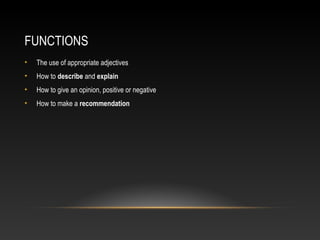
FUNCTIONS
• The use of appropriate adjectives
• How to describe and explain
• How to give an opinion, positive or negative
• How to make a recommendation
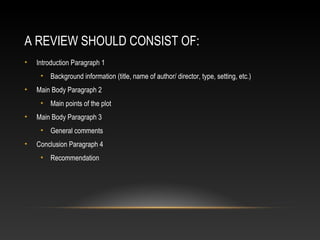
A REVIEW SHOULD CONSIST OF:
• Introduction Paragraph 1
• Background information (title, name of author/ director, type, setting, etc.)
• Main Body Paragraph 2
• Main points of the plot
• Main Body Paragraph 3
• General comments
• Conclusion Paragraph 4
• Recommendation
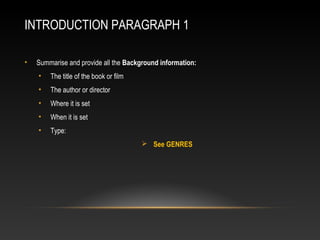
INTRODUCTION PARAGRAPH 1
• Summarise and provide all the Background information:
• The title of the book or film
• The author or director
• Where it is set
• When it is set
• Type:
 See GENRES
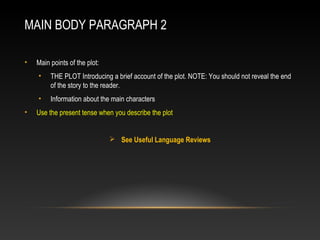
MAIN BODY PARAGRAPH 2
• Main points of the plot:
• THE PLOT Introducing a brief account of the plot. NOTE: You should not reveal the end
of the story to the reader.
• Information about the main characters
• Use the present tense when you describe the plot
 See Useful Language Reviews
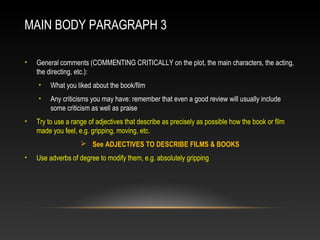
MAIN BODY PARAGRAPH 3
• General comments (COMMENTING CRITICALLY on the plot, the main characters, the acting,
the directing, etc.):
• What you liked about the book/film
• Any criticisms you may have: remember that even a good review will usually include
some criticism as well as praise
• Try to use a range of adjectives that describe as precisely as possible how the book or film
made you feel, e.g. gripping, moving, etc.
 See ADJECTIVES TO DESCRIBE FILMS & BOOKS
• Use adverbs of degree to modify them, e.g. absolutely gripping
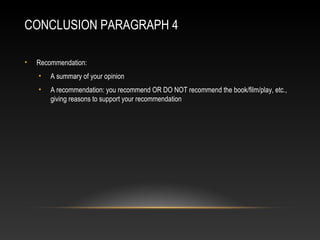
CONCLUSION PARAGRAPH 4
• Recommendation:
• A summary of your opinion
• A recommendation: you recommend OR DO NOT recommend the book/film/play, etc.,
giving reasons to support your recommendation
WHERE ARE REVIEWS FOUND?
• In newspapers
• In magazines
• In websites
• As parts of a letter
THE STYLE YOU USE
• Depends on:
• The publication
• The intended reader
• Can be:
• Formal
• Semi-formal
• You normally use present tenses.

A review

  • 1.
  • 2.
    WHAT CAN YOUREVIEW? • Book (fiction) • Book (non-fiction) • Film • Play • Concert • Exhibition • TV programme • A holiday • A product • A website
  • 3.
    FUNCTIONS • The useof appropriate adjectives • How to describe and explain • How to give an opinion, positive or negative • How to make a recommendation
  • 4.
    A REVIEW SHOULDCONSIST OF: • Introduction Paragraph 1 • Background information (title, name of author/ director, type, setting, etc.) • Main Body Paragraph 2 • Main points of the plot • Main Body Paragraph 3 • General comments • Conclusion Paragraph 4 • Recommendation
  • 5.
    INTRODUCTION PARAGRAPH 1 •Summarise and provide all the Background information: • The title of the book or film • The author or director • Where it is set • When it is set • Type:  See GENRES
  • 6.
    MAIN BODY PARAGRAPH2 • Main points of the plot: • THE PLOT Introducing a brief account of the plot. NOTE: You should not reveal the end of the story to the reader. • Information about the main characters • Use the present tense when you describe the plot  See Useful Language Reviews
  • 7.
    MAIN BODY PARAGRAPH3 • General comments (COMMENTING CRITICALLY on the plot, the main characters, the acting, the directing, etc.): • What you liked about the book/film • Any criticisms you may have: remember that even a good review will usually include some criticism as well as praise • Try to use a range of adjectives that describe as precisely as possible how the book or film made you feel, e.g. gripping, moving, etc.  See ADJECTIVES TO DESCRIBE FILMS & BOOKS • Use adverbs of degree to modify them, e.g. absolutely gripping
  • 8.
    CONCLUSION PARAGRAPH 4 •Recommendation: • A summary of your opinion • A recommendation: you recommend OR DO NOT recommend the book/film/play, etc., giving reasons to support your recommendation
  • 9.
    WHERE ARE REVIEWSFOUND? • In newspapers • In magazines • In websites • As parts of a letter
  • 10.
    THE STYLE YOUUSE • Depends on: • The publication • The intended reader • Can be: • Formal • Semi-formal • You normally use present tenses.