RBG Communiversity


             OPEN/STUDY/SHARE/DOWNLOAD THE FULL GUIDEBOOK (568 Pages)

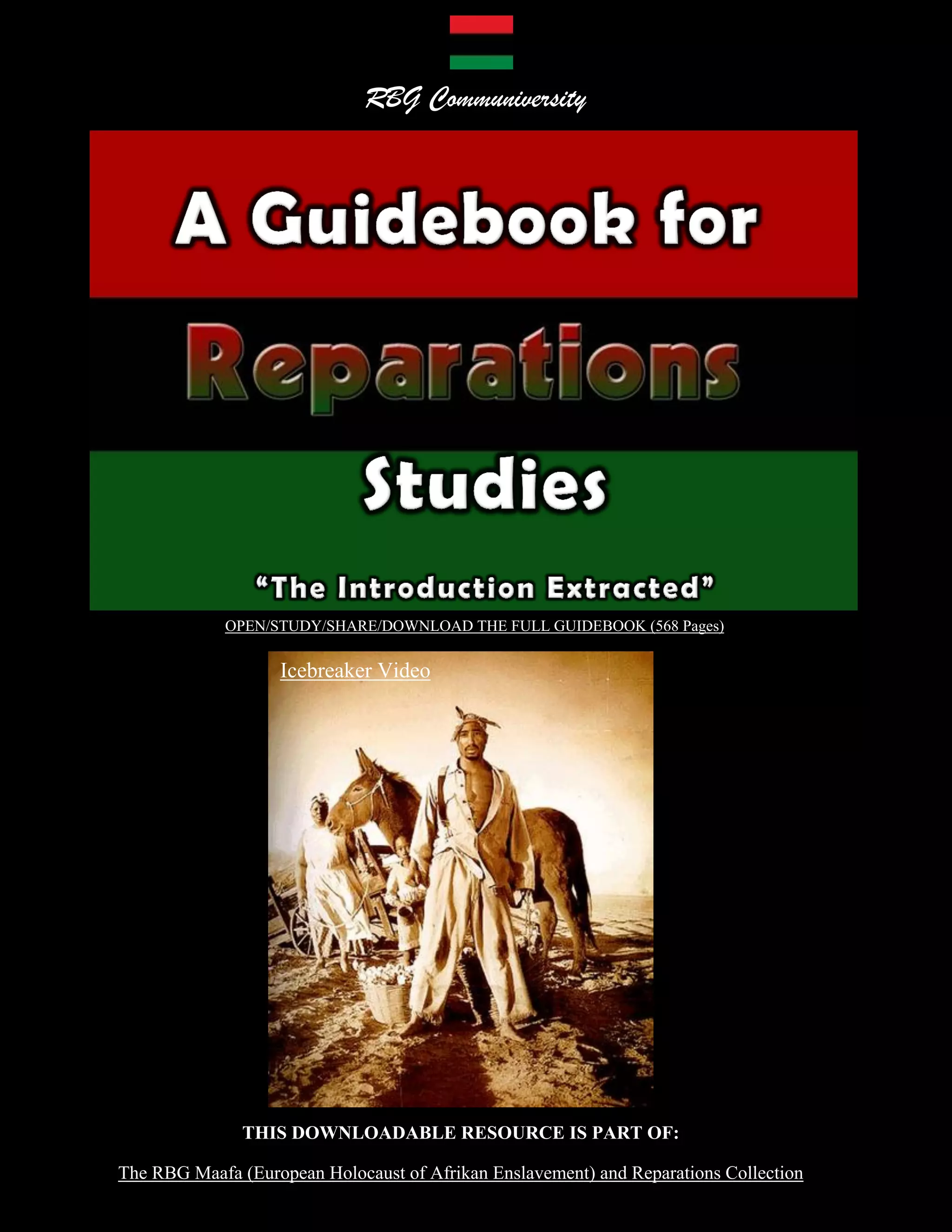
                   Icebreaker Video


               THIS DOWNLOADABLE RESOURCE IS PART OF:
                                           1
The RBG Maafa (European Holocaust of Afrikan Enslavement) and Reparations Collection
PRESCRIPT:
For 246 years, enslaved Afrikan (our ancestors) endured inhuman living conditions, torture and
rape, legally enforced servitude, and other horrendous crimes against humanity. Meanwhile,
countless American corporations sponsored and/or benefited from the uncompensated labor and
exploitation of these slaves.

In 1863, “President Lincoln's Emancipation Proclamation began the process of freeing” the more
than 4 million slaves of Afrikan descent in the United States. But while chattel slavery was
abolished, sharecropping, "black codes", Jim Crow laws, lynching, psychic violence and socio-
structural and institutional racism perpetuated restrictions upon the “freed” Afrikans nonetheless.
Dozens of corporations continued to this very day to benefit from unpaid labor of our ancestors,
allowing these companies to flourish, while unemployment sores to all time post-chattel highs as
I write. Citing the persisting legacy of slavery, suffering and death we as descendants of these
slaves must continue to fight for reparations and reconciliation on behalf of the approximately 35
million living descendants of our enslaved ancestors.

Although I personally believe that the immorality of the American system, business and culture
of white supremacy / racism will never see fit to give us reparations; the principles and
documentation of our fight for such a just caused must be carried forward. At the end of the day,
I agree 101% with Minister Malcolm X when he says “Nobody can give you freedom. Nobody
can give you equality or justice or anything. If you're a man, you take it.” (From: Malcolm X
Speaks, 1965) Thus, as we struggle against continued U.S. colonization New Afrikans must have
a determined sense of history in regard to the New Afrikan Nation’s historical struggle,
movement in and relationship to the United States. The work that has been done and is being
done towards reparations is “bread and butter knowledge”. Without such knowledge; our
practice will continue to be confused and chaotic, lacking the historical continuity which serves
to give practical guidance to our struggle and movement on the road to full independence. It is
with these notions in mind that I have compiled this booklet. A tremendous amount of scholarly,
diligent and valuable work has been done by our people over the past 30 years on the issue of
reparations, especially by the still active National Coalition Of Blacks for Reparations in
America (N'COBRA). As a teacher and inspire of our youth, I believe young New Afrikan
revolutionaries and activist must get up to speed on the sequence, progress and details of this
potent work to best “carry the torch and keep the fire burning”

The booklet is comprised of an interactive introduction drawn by myself, as to so-called “break
the ice”; followed by select resources published over the past 30 years by National Coalition Of
Blacks for Reparations in America.

By placing this data in a single document for download, it is my hope and intention that our
young people will come into a new revelation as to the strength of our spirit to fight for what is
right, and become energized to learn from the historical principals that have been at the center of
the reparations movement. And for those of us that have been around a while longer, I desire to
resurrect fond memories and transmit a rational hope for the future as you guide in your wisdom.
And most of all, I intend to catalyze all New Afrikans to “Be Down with the Reparations Clique”.
                                                2
RBG Street Scholar/August, 2012
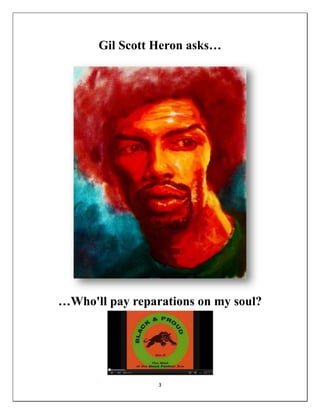
Gil Scott Heron asks…


…Who'll pay reparations on my soul?


                 3
QUOTES REGARDING REPARATIONS


N'COBRA
http://www.ncobra.org/

“We must prepare African people and communities for the
demands of the new millennium. Reparations are needed to
repair the wrongs, injury, and damage done to us by the US
federal and State governments, their agents, and representatives.
These have proved that their vision for African people in
America is joblessness, more prisons (more killer kkkops), more
black women and men in private prisons, AIDS and violence.
"The US Eurocentric educational system has failed to prepare
African children for liberation, nation-building, and self-
determination. This educational system produces people who are
anti-black; including many blacks who are self-alienated and
anti-black. We want our resources, our inheritance, to do for
ourselves without US Federal and State involvement."


                                4
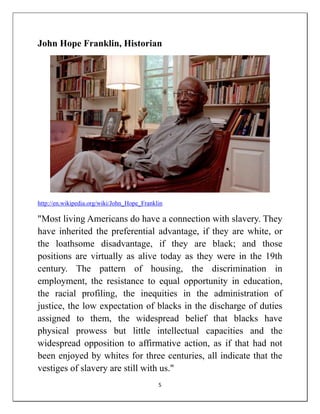
John Hope Franklin, Historian


http://en.wikipedia.org/wiki/John_Hope_Franklin

"Most living Americans do have a connection with slavery. They
have inherited the preferential advantage, if they are white, or
the loathsome disadvantage, if they are black; and those
positions are virtually as alive today as they were in the 19th
century. The pattern of housing, the discrimination in
employment, the resistance to equal opportunity in education,
the racial profiling, the inequities in the administration of
justice, the low expectation of blacks in the discharge of duties
assigned to them, the widespread belief that blacks have
physical prowess but little intellectual capacities and the
widespread opposition to affirmative action, as if that had not
been enjoyed by whites for three centuries, all indicate that the
vestiges of slavery are still with us."
                                             5
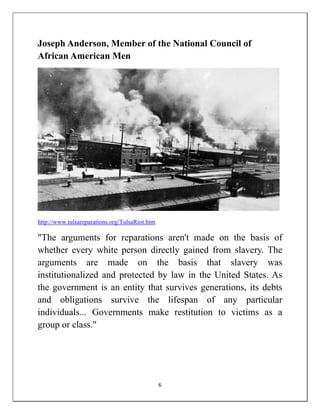
Joseph Anderson, Member of the National Council of
African American Men


http://www.tulsareparations.org/TulsaRiot.htm

"The arguments for reparations aren't made on the basis of
whether every white person directly gained from slavery. The
arguments are made on the basis that slavery was
institutionalized and protected by law in the United States. As
the government is an entity that survives generations, its debts
and obligations survive the lifespan of any particular
individuals... Governments make restitution to victims as a
group or class."


                                                6
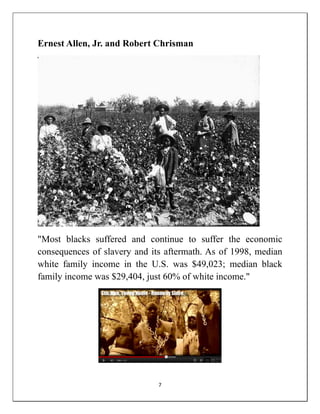
Ernest Allen, Jr. and Robert Chrisman


"Most blacks suffered and continue to suffer the economic
consequences of slavery and its aftermath. As of 1998, median
white family income in the U.S. was $49,023; median black
family income was $29,404, just 60% of white income."


                              7
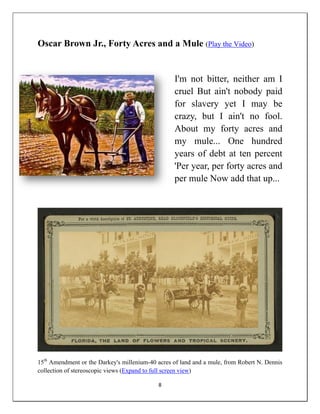
Oscar Brown Jr., Forty Acres and a Mule (Play the Video)


                                                  I'm not bitter, neither am I
                                                  cruel But ain't nobody paid
                                                  for slavery yet I may be
                                                  crazy, but I ain't no fool.
                                                  About my forty acres and
                                                  my mule... One hundred
                                                  years of debt at ten percent
                                                  'Per year, per forty acres and
                                                  per mule Now add that up...


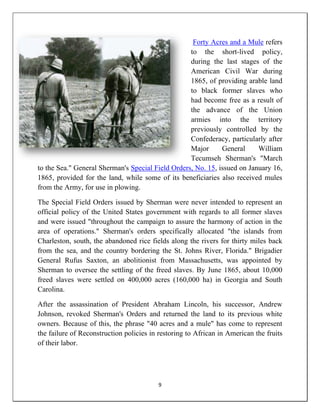
15th Amendment or the Darkey's millenium-40 acres of land and a mule, from Robert N. Dennis
collection of stereoscopic views (Expand to full screen view)

                                            8
Forty Acres and a Mule refers
                                                   to the short-lived policy,
                                                   during the last stages of the
                                                   American Civil War during
                                                   1865, of providing arable land
                                                   to black former slaves who
                                                   had become free as a result of
                                                   the advance of the Union
                                                   armies into the territory
                                                   previously controlled by the
                                                   Confederacy, particularly after
                                                   Major      General     William
                                                   Tecumseh Sherman's "March
to the Sea." General Sherman's Special Field Orders, No. 15, issued on January 16,
1865, provided for the land, while some of its beneficiaries also received mules
from the Army, for use in plowing.

The Special Field Orders issued by Sherman were never intended to represent an
official policy of the United States government with regards to all former slaves
and were issued "throughout the campaign to assure the harmony of action in the
area of operations." Sherman's orders specifically allocated "the islands from
Charleston, south, the abandoned rice fields along the rivers for thirty miles back
from the sea, and the country bordering the St. Johns River, Florida." Brigadier
General Rufus Saxton, an abolitionist from Massachusetts, was appointed by
Sherman to oversee the settling of the freed slaves. By June 1865, about 10,000
freed slaves were settled on 400,000 acres (160,000 ha) in Georgia and South
Carolina.

After the assassination of President Abraham Lincoln, his successor, Andrew
Johnson, revoked Sherman's Orders and returned the land to its previous white
owners. Because of this, the phrase "40 acres and a mule" has come to represent
the failure of Reconstruction policies in restoring to African in American the fruits
of their labor.


                                         9
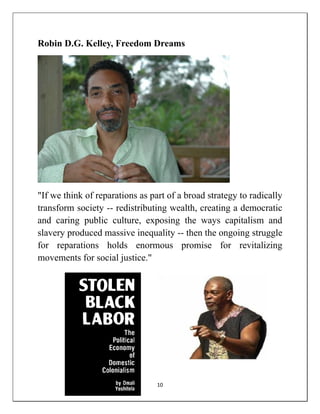
Robin D.G. Kelley, Freedom Dreams


"If we think of reparations as part of a broad strategy to radically
transform society -- redistributing wealth, creating a democratic
and caring public culture, exposing the ways capitalism and
slavery produced massive inequality -- then the ongoing struggle
for reparations holds enormous promise for revitalizing
movements for social justice."


                                 10
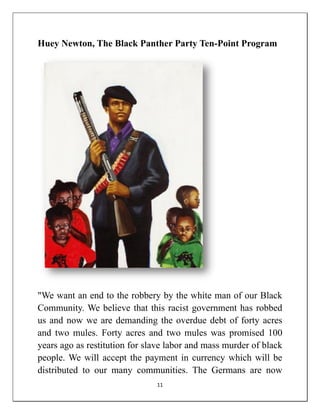
Huey Newton, The Black Panther Party Ten-Point Program


"We want an end to the robbery by the white man of our Black
Community. We believe that this racist government has robbed
us and now we are demanding the overdue debt of forty acres
and two mules. Forty acres and two mules was promised 100
years ago as restitution for slave labor and mass murder of black
people. We will accept the payment in currency which will be
distributed to our many communities. The Germans are now
                               11
aiding the Jews in Israel for the genocide of the Jewish people.
The Germans murdered six million Jews. The American racist
has taken part in the slaughter of over fifty million black people;
therefore, we feel that this is a modest demand that we make."
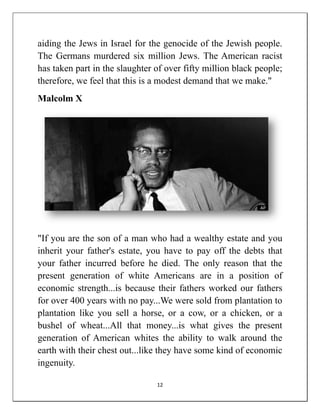
Malcolm X


"If you are the son of a man who had a wealthy estate and you
inherit your father's estate, you have to pay off the debts that
your father incurred before he died. The only reason that the
present generation of white Americans are in a position of
economic strength...is because their fathers worked our fathers
for over 400 years with no pay...We were sold from plantation to
plantation like you sell a horse, or a cow, or a chicken, or a
bushel of wheat...All that money...is what gives the present
generation of American whites the ability to walk around the
earth with their chest out...like they have some kind of economic
ingenuity.

                                12
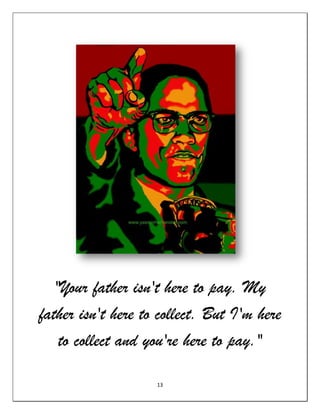
"Your father isn't here to pay. My
father isn't here to collect. But I'm here
    to collect and you're here to pay."

                    13
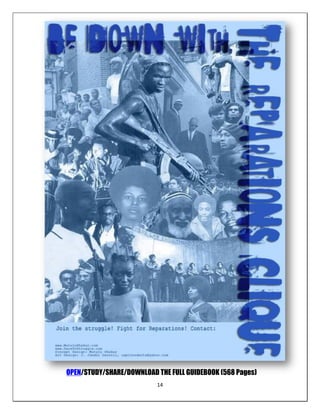
OPEN/STUDY/SHARE/DOWNLOAD THE FULL GUIDEBOOK (568 Pages)
                          14

A RBG Guidebook for Reparations Studies: Interactive Introduction

  • 1.
    RBG Communiversity OPEN/STUDY/SHARE/DOWNLOAD THE FULL GUIDEBOOK (568 Pages) Icebreaker Video THIS DOWNLOADABLE RESOURCE IS PART OF: 1 The RBG Maafa (European Holocaust of Afrikan Enslavement) and Reparations Collection
  • 2.
    PRESCRIPT: For 246 years,enslaved Afrikan (our ancestors) endured inhuman living conditions, torture and rape, legally enforced servitude, and other horrendous crimes against humanity. Meanwhile, countless American corporations sponsored and/or benefited from the uncompensated labor and exploitation of these slaves. In 1863, “President Lincoln's Emancipation Proclamation began the process of freeing” the more than 4 million slaves of Afrikan descent in the United States. But while chattel slavery was abolished, sharecropping, "black codes", Jim Crow laws, lynching, psychic violence and socio- structural and institutional racism perpetuated restrictions upon the “freed” Afrikans nonetheless. Dozens of corporations continued to this very day to benefit from unpaid labor of our ancestors, allowing these companies to flourish, while unemployment sores to all time post-chattel highs as I write. Citing the persisting legacy of slavery, suffering and death we as descendants of these slaves must continue to fight for reparations and reconciliation on behalf of the approximately 35 million living descendants of our enslaved ancestors. Although I personally believe that the immorality of the American system, business and culture of white supremacy / racism will never see fit to give us reparations; the principles and documentation of our fight for such a just caused must be carried forward. At the end of the day, I agree 101% with Minister Malcolm X when he says “Nobody can give you freedom. Nobody can give you equality or justice or anything. If you're a man, you take it.” (From: Malcolm X Speaks, 1965) Thus, as we struggle against continued U.S. colonization New Afrikans must have a determined sense of history in regard to the New Afrikan Nation’s historical struggle, movement in and relationship to the United States. The work that has been done and is being done towards reparations is “bread and butter knowledge”. Without such knowledge; our practice will continue to be confused and chaotic, lacking the historical continuity which serves to give practical guidance to our struggle and movement on the road to full independence. It is with these notions in mind that I have compiled this booklet. A tremendous amount of scholarly, diligent and valuable work has been done by our people over the past 30 years on the issue of reparations, especially by the still active National Coalition Of Blacks for Reparations in America (N'COBRA). As a teacher and inspire of our youth, I believe young New Afrikan revolutionaries and activist must get up to speed on the sequence, progress and details of this potent work to best “carry the torch and keep the fire burning” The booklet is comprised of an interactive introduction drawn by myself, as to so-called “break the ice”; followed by select resources published over the past 30 years by National Coalition Of Blacks for Reparations in America. By placing this data in a single document for download, it is my hope and intention that our young people will come into a new revelation as to the strength of our spirit to fight for what is right, and become energized to learn from the historical principals that have been at the center of the reparations movement. And for those of us that have been around a while longer, I desire to resurrect fond memories and transmit a rational hope for the future as you guide in your wisdom. And most of all, I intend to catalyze all New Afrikans to “Be Down with the Reparations Clique”. 2 RBG Street Scholar/August, 2012
  • 3.
    Gil Scott Heronasks… …Who'll pay reparations on my soul? 3
  • 4.
    QUOTES REGARDING REPARATIONS N'COBRA http://www.ncobra.org/ “Wemust prepare African people and communities for the demands of the new millennium. Reparations are needed to repair the wrongs, injury, and damage done to us by the US federal and State governments, their agents, and representatives. These have proved that their vision for African people in America is joblessness, more prisons (more killer kkkops), more black women and men in private prisons, AIDS and violence. "The US Eurocentric educational system has failed to prepare African children for liberation, nation-building, and self- determination. This educational system produces people who are anti-black; including many blacks who are self-alienated and anti-black. We want our resources, our inheritance, to do for ourselves without US Federal and State involvement." 4
  • 5.
    John Hope Franklin,Historian http://en.wikipedia.org/wiki/John_Hope_Franklin "Most living Americans do have a connection with slavery. They have inherited the preferential advantage, if they are white, or the loathsome disadvantage, if they are black; and those positions are virtually as alive today as they were in the 19th century. The pattern of housing, the discrimination in employment, the resistance to equal opportunity in education, the racial profiling, the inequities in the administration of justice, the low expectation of blacks in the discharge of duties assigned to them, the widespread belief that blacks have physical prowess but little intellectual capacities and the widespread opposition to affirmative action, as if that had not been enjoyed by whites for three centuries, all indicate that the vestiges of slavery are still with us." 5
  • 6.
    Joseph Anderson, Memberof the National Council of African American Men http://www.tulsareparations.org/TulsaRiot.htm "The arguments for reparations aren't made on the basis of whether every white person directly gained from slavery. The arguments are made on the basis that slavery was institutionalized and protected by law in the United States. As the government is an entity that survives generations, its debts and obligations survive the lifespan of any particular individuals... Governments make restitution to victims as a group or class." 6
  • 7.
    Ernest Allen, Jr.and Robert Chrisman "Most blacks suffered and continue to suffer the economic consequences of slavery and its aftermath. As of 1998, median white family income in the U.S. was $49,023; median black family income was $29,404, just 60% of white income." 7
  • 8.
    Oscar Brown Jr.,Forty Acres and a Mule (Play the Video) I'm not bitter, neither am I cruel But ain't nobody paid for slavery yet I may be crazy, but I ain't no fool. About my forty acres and my mule... One hundred years of debt at ten percent 'Per year, per forty acres and per mule Now add that up... 15th Amendment or the Darkey's millenium-40 acres of land and a mule, from Robert N. Dennis collection of stereoscopic views (Expand to full screen view) 8
  • 9.
    Forty Acres anda Mule refers to the short-lived policy, during the last stages of the American Civil War during 1865, of providing arable land to black former slaves who had become free as a result of the advance of the Union armies into the territory previously controlled by the Confederacy, particularly after Major General William Tecumseh Sherman's "March to the Sea." General Sherman's Special Field Orders, No. 15, issued on January 16, 1865, provided for the land, while some of its beneficiaries also received mules from the Army, for use in plowing. The Special Field Orders issued by Sherman were never intended to represent an official policy of the United States government with regards to all former slaves and were issued "throughout the campaign to assure the harmony of action in the area of operations." Sherman's orders specifically allocated "the islands from Charleston, south, the abandoned rice fields along the rivers for thirty miles back from the sea, and the country bordering the St. Johns River, Florida." Brigadier General Rufus Saxton, an abolitionist from Massachusetts, was appointed by Sherman to oversee the settling of the freed slaves. By June 1865, about 10,000 freed slaves were settled on 400,000 acres (160,000 ha) in Georgia and South Carolina. After the assassination of President Abraham Lincoln, his successor, Andrew Johnson, revoked Sherman's Orders and returned the land to its previous white owners. Because of this, the phrase "40 acres and a mule" has come to represent the failure of Reconstruction policies in restoring to African in American the fruits of their labor. 9
  • 10.
    Robin D.G. Kelley,Freedom Dreams "If we think of reparations as part of a broad strategy to radically transform society -- redistributing wealth, creating a democratic and caring public culture, exposing the ways capitalism and slavery produced massive inequality -- then the ongoing struggle for reparations holds enormous promise for revitalizing movements for social justice." 10
  • 11.
    Huey Newton, TheBlack Panther Party Ten-Point Program "We want an end to the robbery by the white man of our Black Community. We believe that this racist government has robbed us and now we are demanding the overdue debt of forty acres and two mules. Forty acres and two mules was promised 100 years ago as restitution for slave labor and mass murder of black people. We will accept the payment in currency which will be distributed to our many communities. The Germans are now 11
  • 12.
    aiding the Jewsin Israel for the genocide of the Jewish people. The Germans murdered six million Jews. The American racist has taken part in the slaughter of over fifty million black people; therefore, we feel that this is a modest demand that we make." Malcolm X "If you are the son of a man who had a wealthy estate and you inherit your father's estate, you have to pay off the debts that your father incurred before he died. The only reason that the present generation of white Americans are in a position of economic strength...is because their fathers worked our fathers for over 400 years with no pay...We were sold from plantation to plantation like you sell a horse, or a cow, or a chicken, or a bushel of wheat...All that money...is what gives the present generation of American whites the ability to walk around the earth with their chest out...like they have some kind of economic ingenuity. 12
  • 13.
    "Your father isn'there to pay. My father isn't here to collect. But I'm here to collect and you're here to pay." 13
  • 14.
    OPEN/STUDY/SHARE/DOWNLOAD THE FULLGUIDEBOOK (568 Pages) 14