A Quick look at QUIC
Geoff Huston, Joao Damas,
APNIC Labs
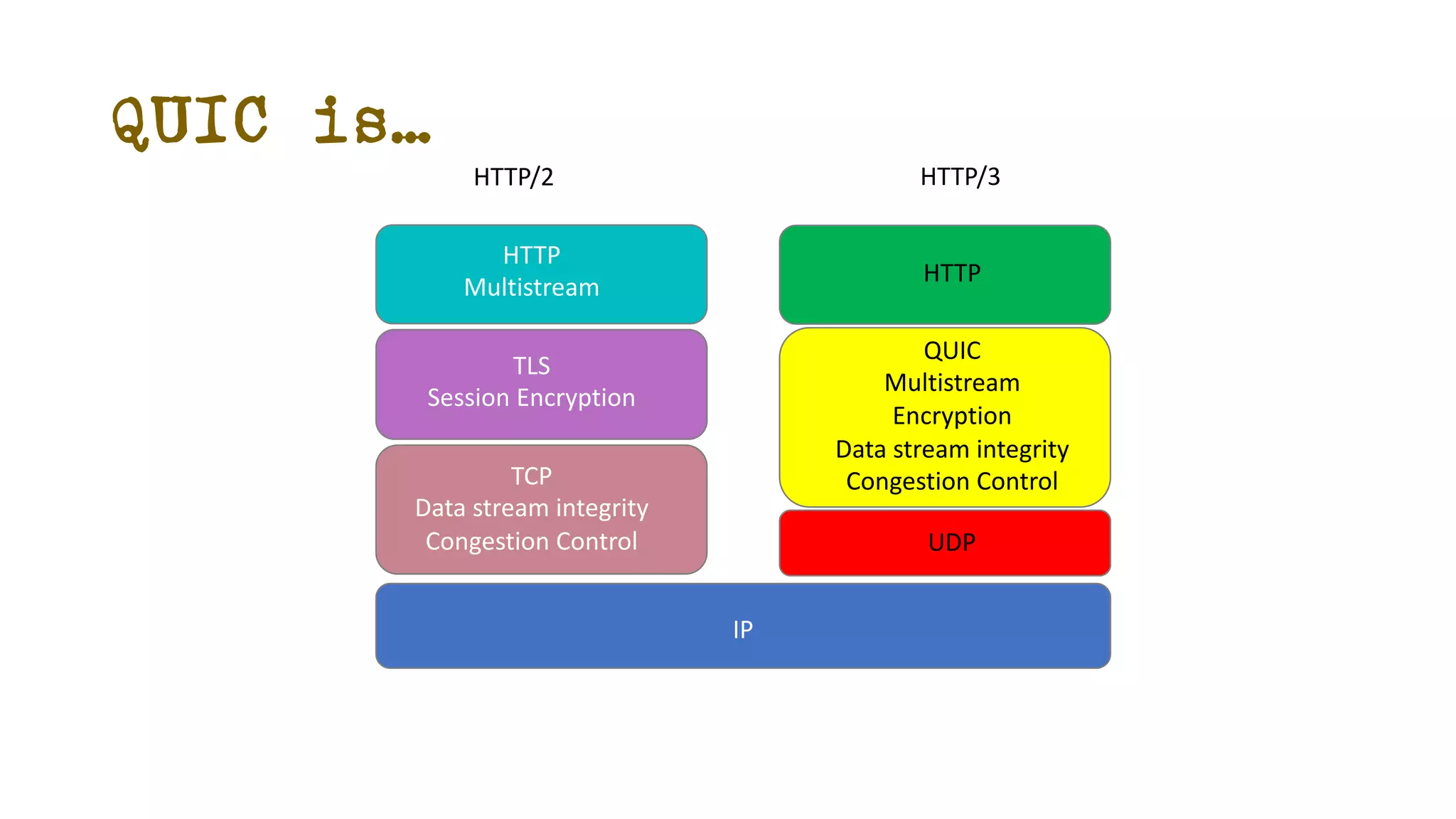
QUIC is…
HTTP
Multistream
TLS
Session Encryption
TCP
Data stream integrity
Congestion Control
HTTP
QUIC
Multistream
Encryption
Data stream integrity
Congestion Control
UDP
IP
HTTP/2 HTTP/3
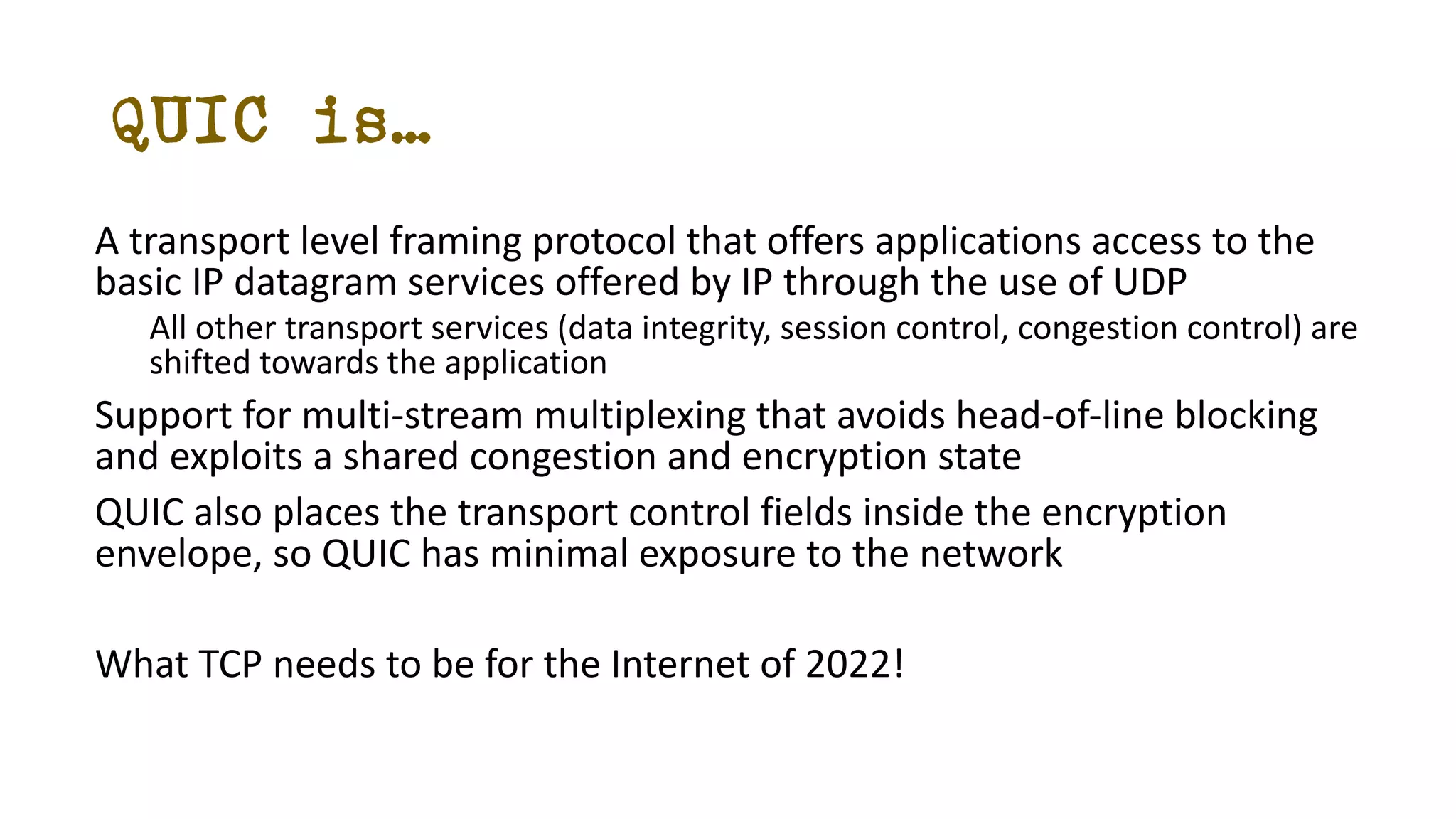
QUIC is…
A transport level framing protocol that offers applications access to the
basic IP datagram services offered by IP through the use of UDP
All other transport services (data integrity, session control, congestion control) are
shifted towards the application
Support for multi-stream multiplexing that avoids head-of-line blocking
and exploits a shared congestion and encryption state
QUIC also places the transport control fields inside the encryption
envelope, so QUIC has minimal exposure to the network
What TCP needs to be for the Internet of 2022!
Looking for QUIC
• At APNIC we use Ads to perform large scale measurements of
network service capabilities as seen by users
• IPv6 deployment
• DNSSEC validation
• Fragmentation
• Can we use this measurement platform to see the level of use of
QUIC in today’s network?
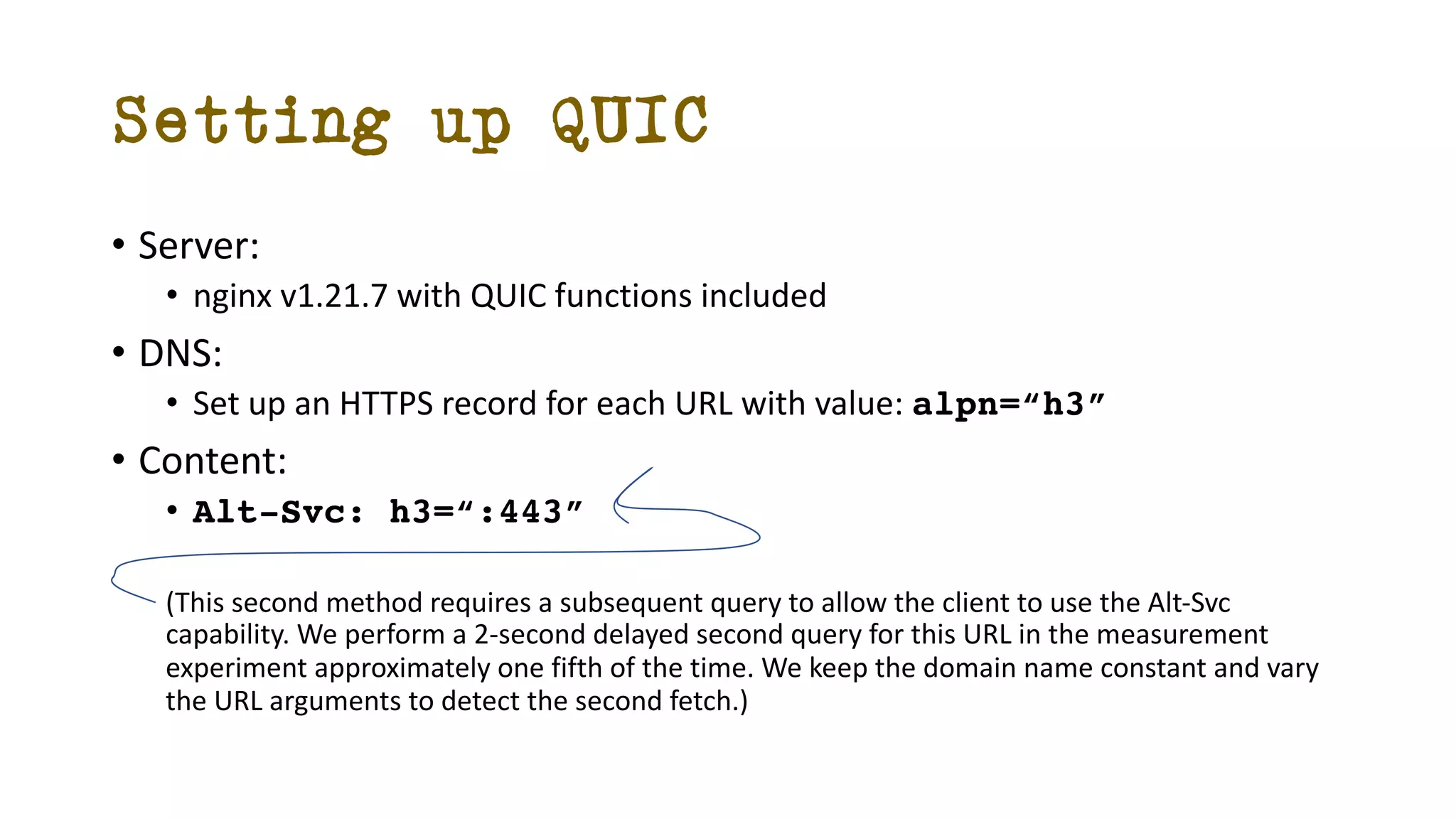
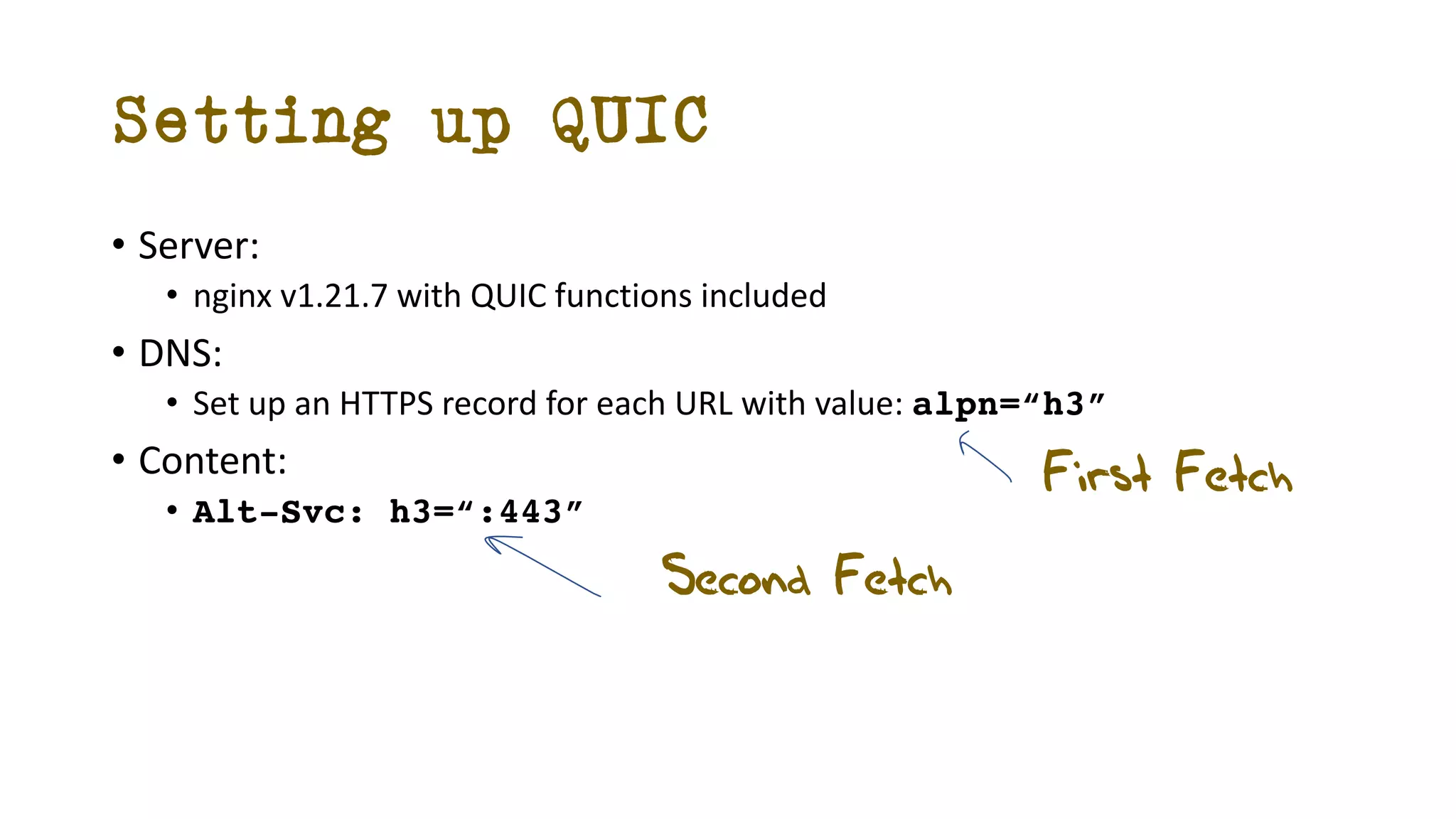
Setting up QUIC
• Server:
• nginx v1.21.7 with QUIC functions included
• DNS:
• Set up an HTTPS record for each URL with value: alpn=“h3”
• Content:
• Alt-Svc: h3=“:443”
(This second method requires a subsequent query to allow the client to use the Alt-Svc
capability. We perform a 2-second delayed second query for this URL in the measurement
experiment approximately one fifth of the time. We keep the domain name constant and vary
the URL arguments to detect the second fetch.)
• Server:
• nginx v1.21.7 with QUIC functions included
• DNS:
• Set up an HTTPS record for each URL with value: alpn=“h3”
• Content:
• Alt-Svc: h3=“:443”
Setting up QUIC
First Fetch
Second Fetch
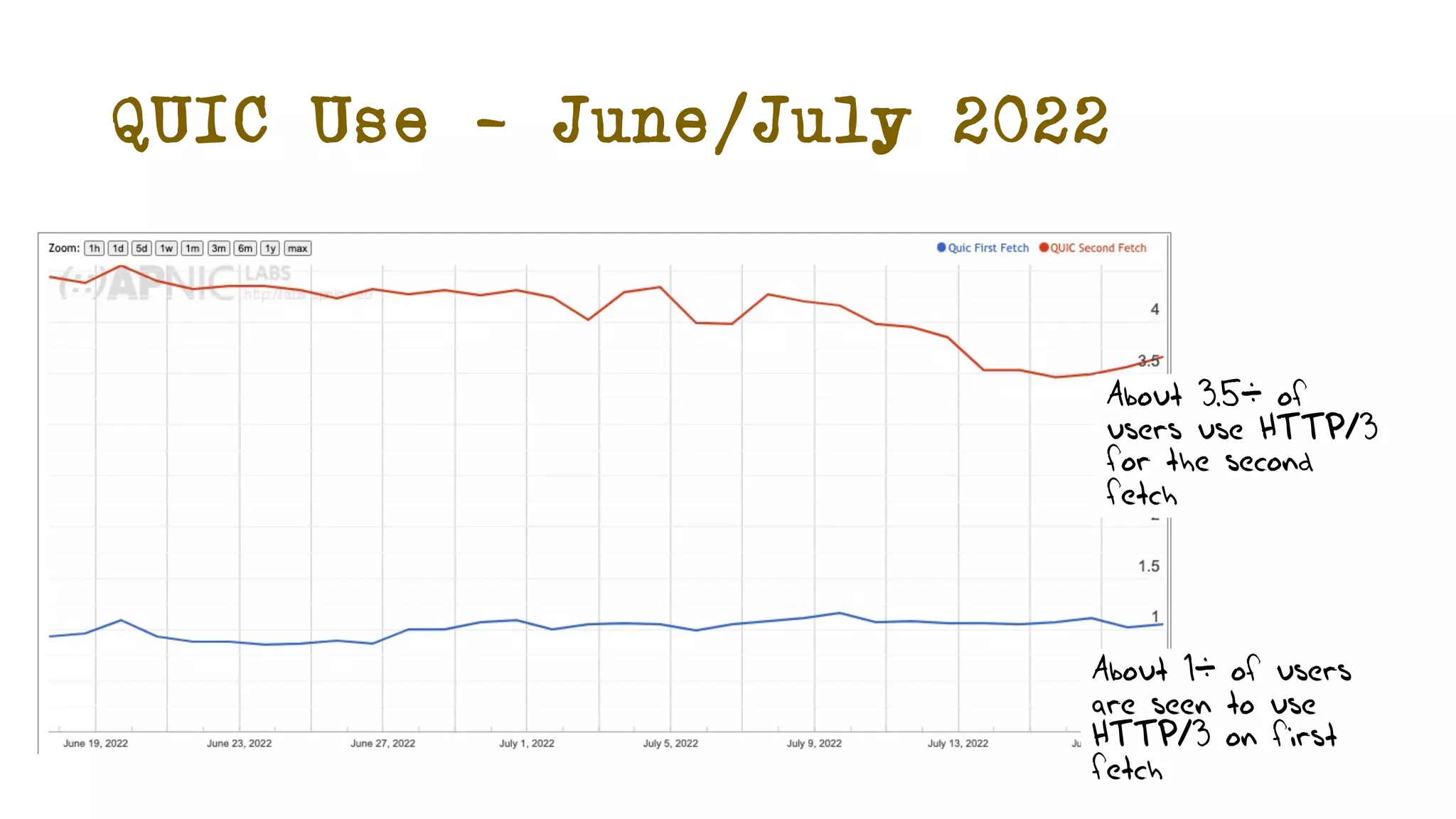
QUIC Use – June/July 2022
About 3.5% of
users use HTTP/3
for the second
fetch
About 1% of users
are seen to use
HTTP/3 on first
fetch
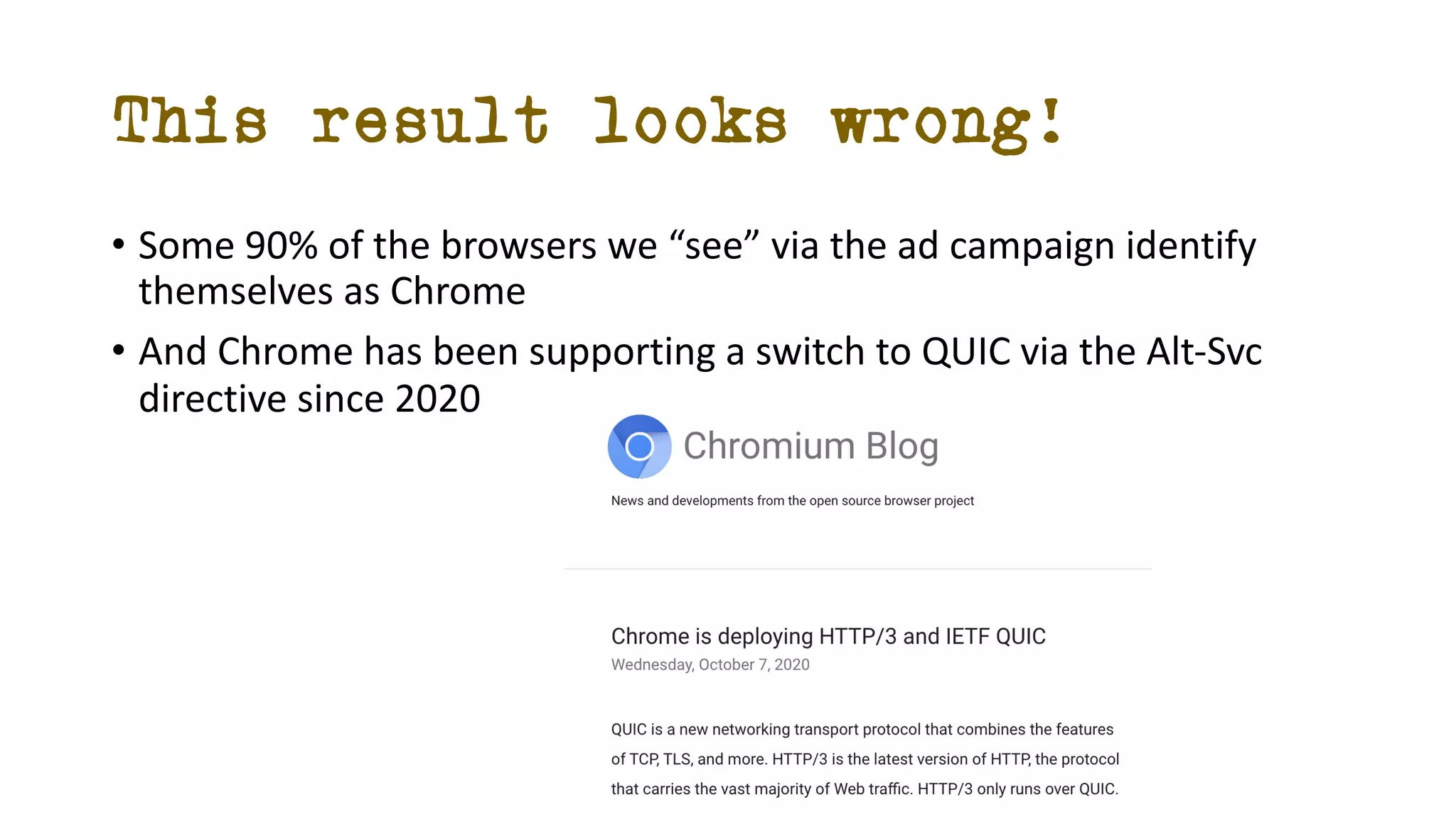
This result looks wrong!
• Some 90% of the browsers we “see” via the ad campaign identify
themselves as Chrome
• And Chrome has been supporting a switch to QUIC via the Alt-Svc
directive since 2020
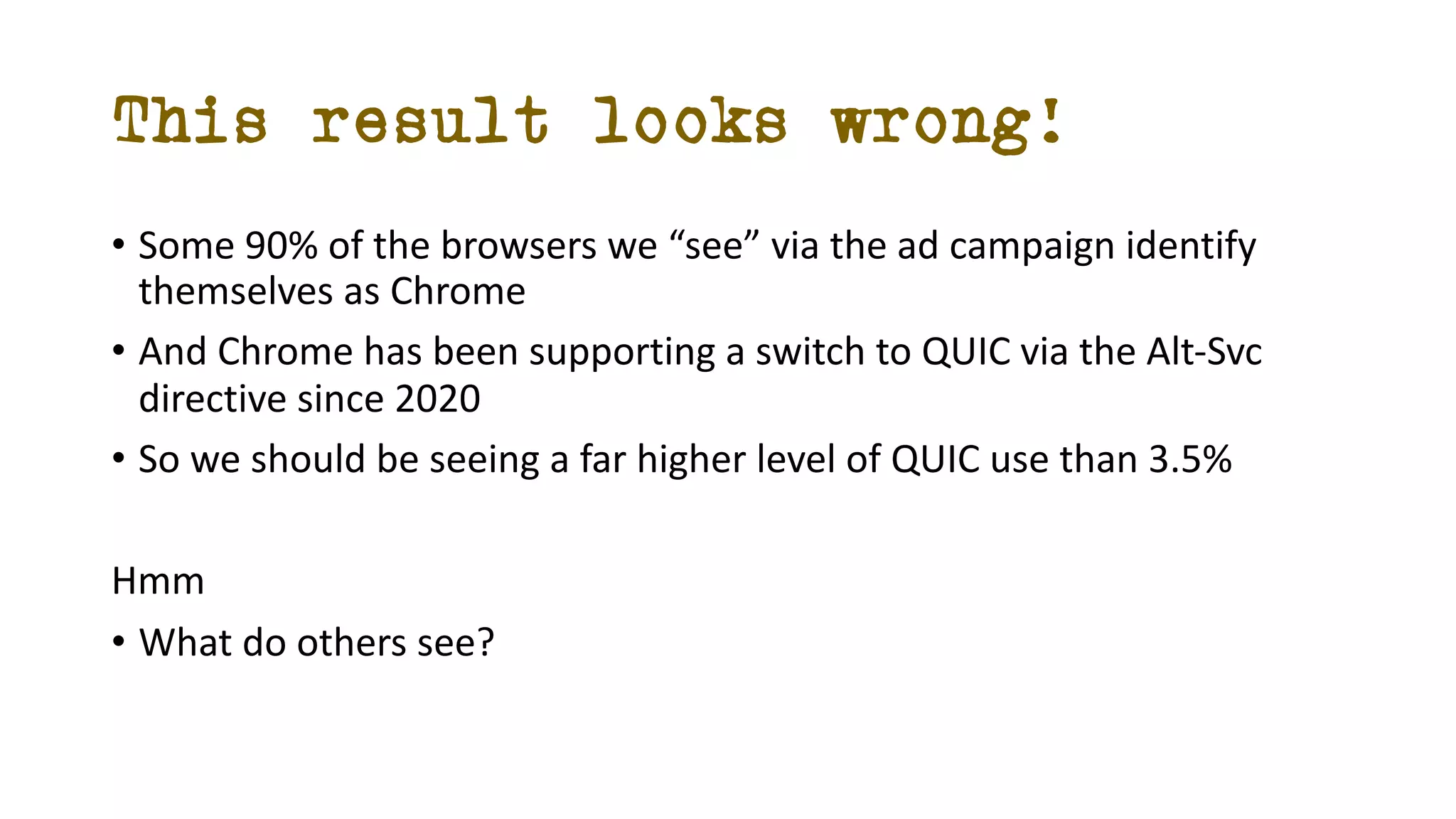
This result looks wrong!
• Some 90% of the browsers we “see” via the ad campaign identify
themselves as Chrome
• And Chrome has been supporting a switch to QUIC via the Alt-Svc
directive since 2020
• So we should be seeing a far higher level of QUIC use than 3.5%
Hmm
• What do others see?
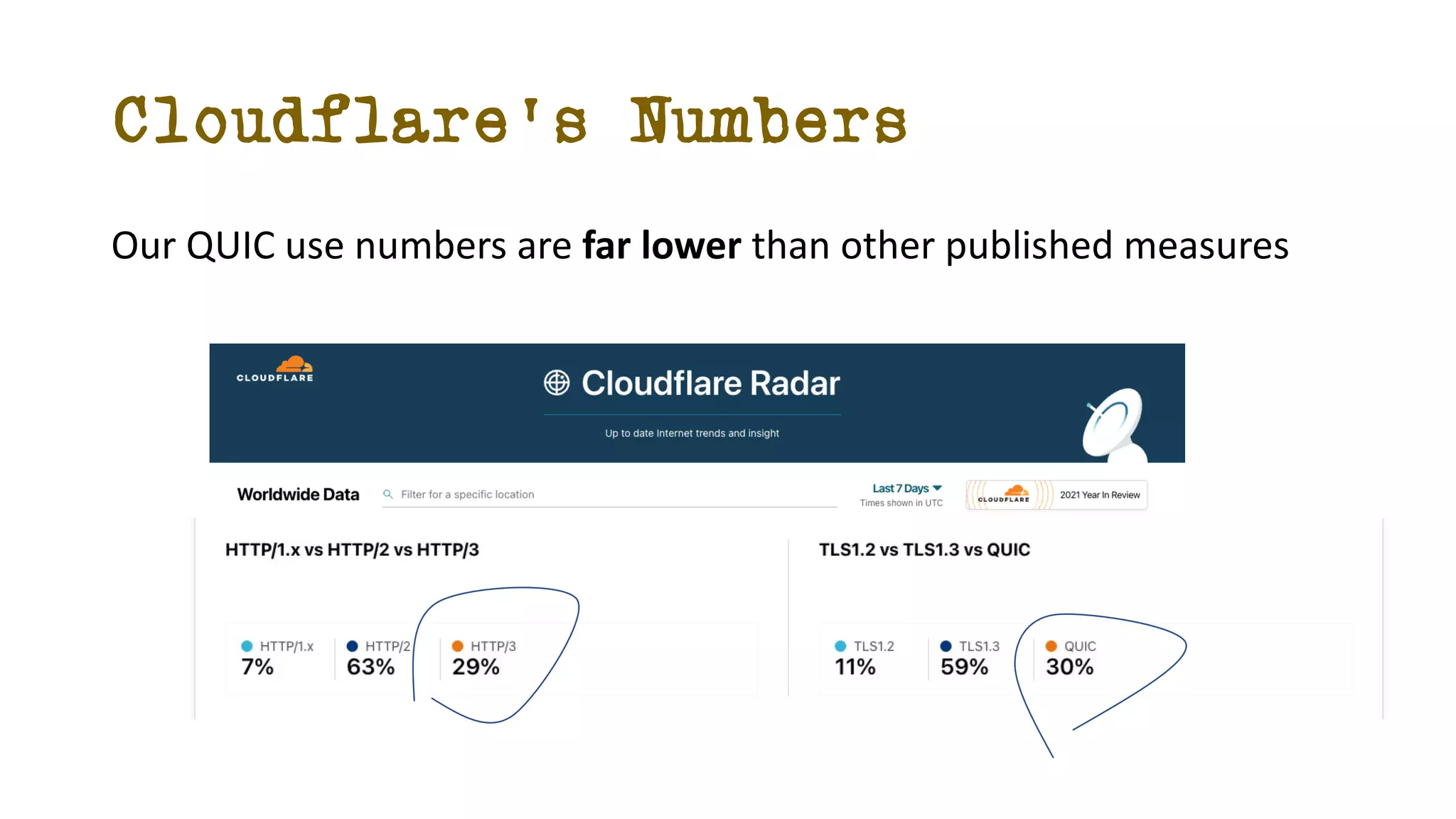
Cloudflare’s Numbers
Our QUIC use numbers are far lower than other published measures
Maybe 2 fetches is not enough?
• So we changed the experiment to fetch the same URL 7 times with a 2
second pause between each fetch
• Surely this would flush out QUIC use!
Nope!
• No change!
• The problem appears to be related to HTTP/2 and persistent
connections
• When the browser performs the followup fetch the connection is
likely still open and then the browser will prefer to use the open
connection over opening up a new QUIC connect
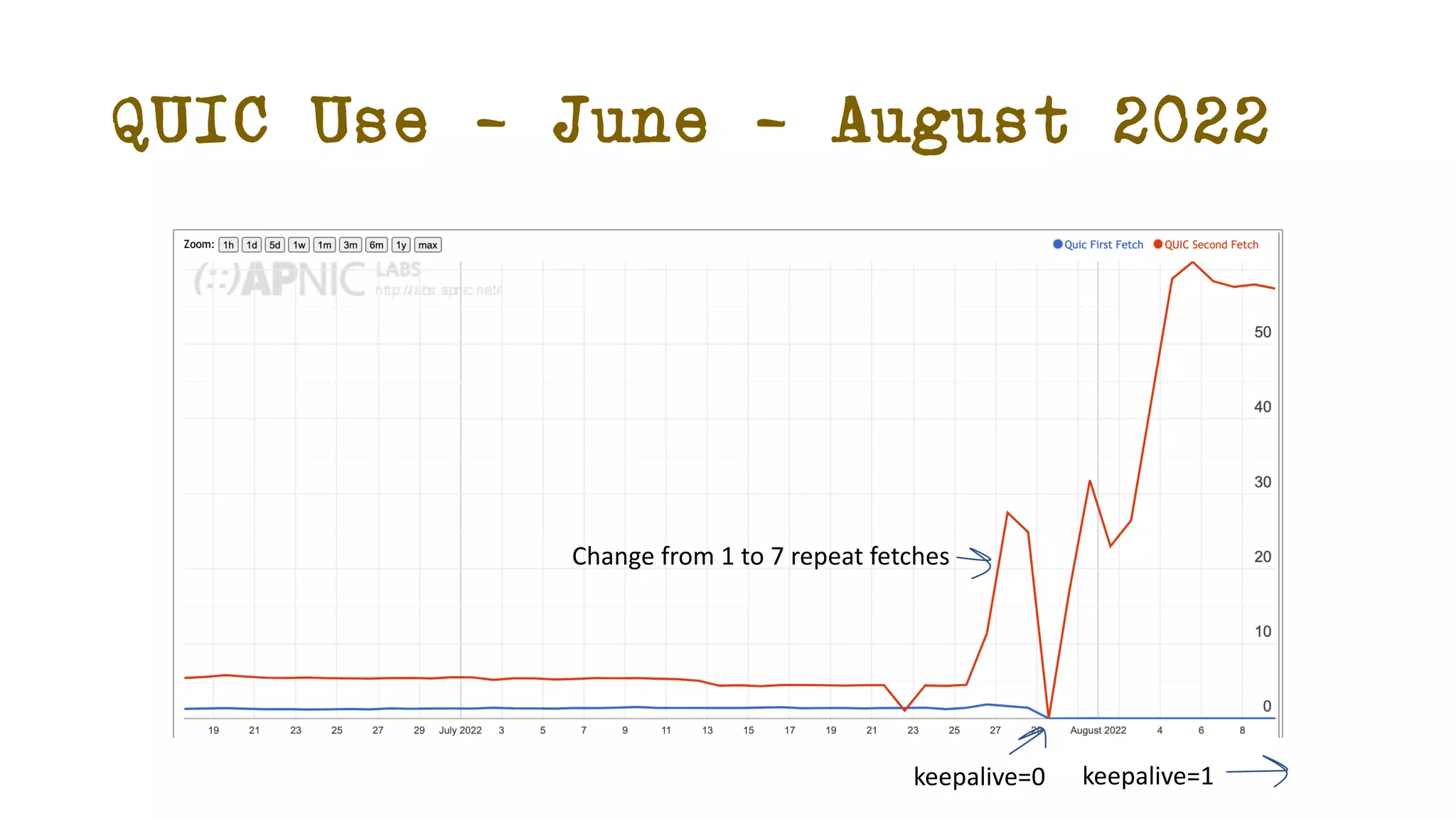
• So on the NGINX server let’s set the keepalive session parameter to 0
seconds
• Yes?
Still Nope!
• That was worse!
• We didn’t see any use of QUIC at all
• Nothing. Nada. Not even a little bit.
• Seems that if you set keepalive to zero then NGINX disables QUIC
completely!
• So we then set the session keepalive parameter to 1 second
• Better?
QUIC Use – June - August 2022
keepalive=0 keepalive=1
Change from 1 to 7 repeat fetches
Yes!
• We are seeing a 57% QUIC on the repeat fetches, corresponding to a
rate of 63% QUIC use of Chrome clients
Yes, and No
• We are seeing a 57% QUIC on the repeat fetches, corresponding to a
rate of 63% QUIC use of Chrome clients
• But at the same time the first fetch use dropped from 1% to minimal
levels
• Which appears to be an issue with Safari, and iOS (and MAC OS)
• Chrome and Firefox were also behaving erratically across the 7 repeat
fetches flipping between HTTP/2 and HTTP/3
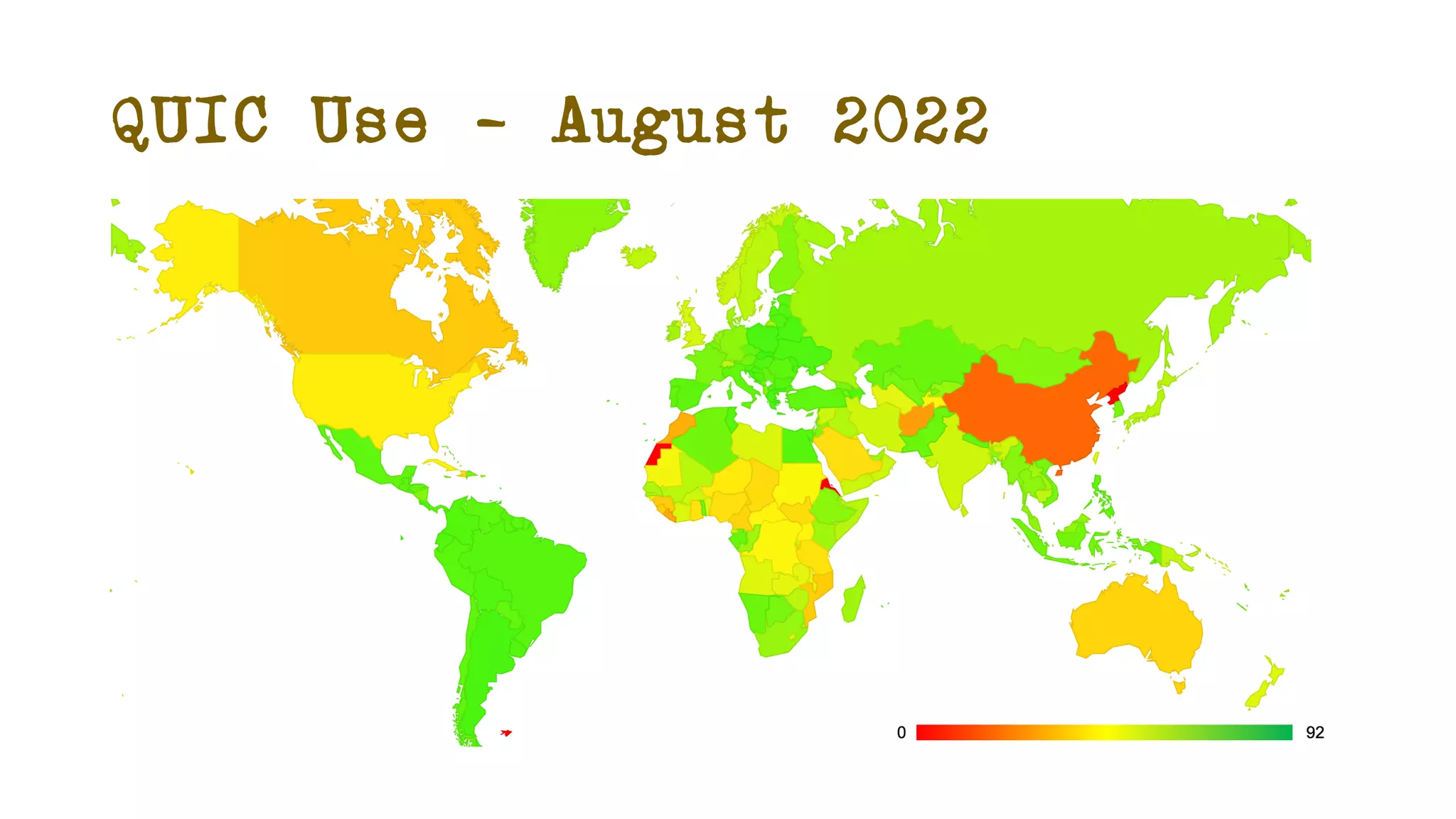
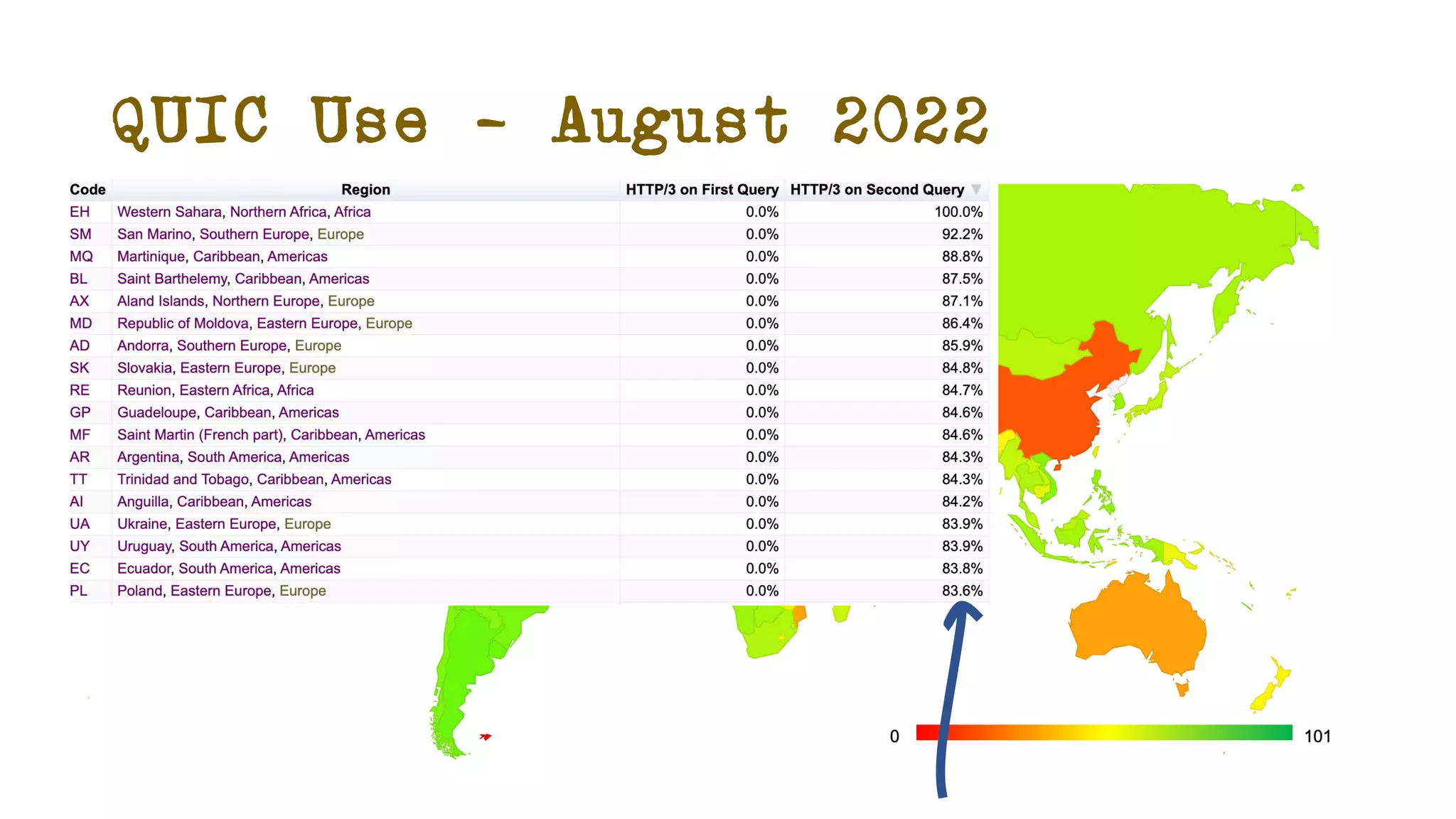
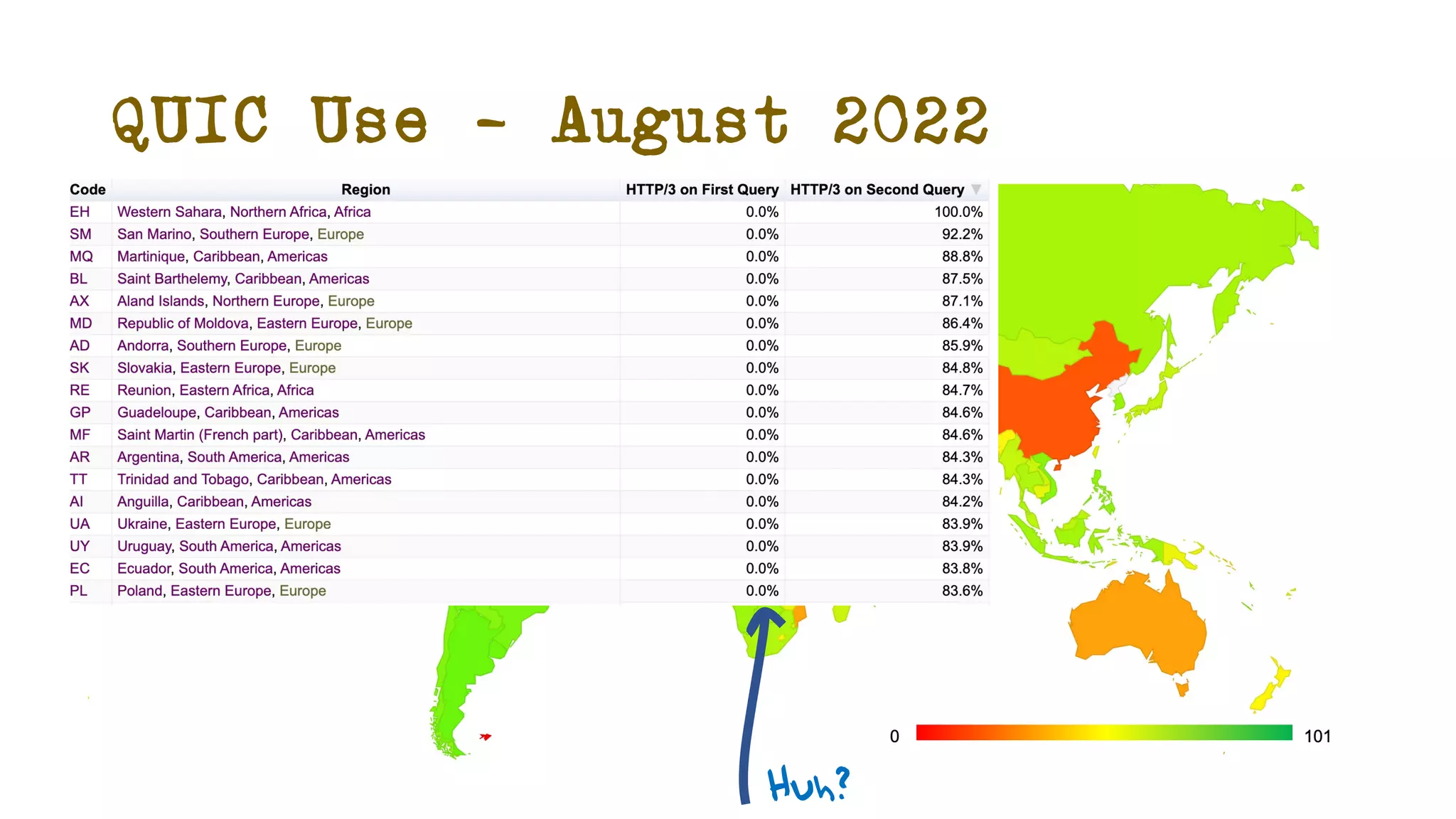
QUIC Use – August 2022
Huh?
Yes, and No
• We are seeing a 57% QUIC on the repeat fetches, corresponding to a
rate of 63% QUIC use of Chrome clients
• But at the same time the first fetch use dropped from 1% to minimal
levels
• Which appears to be an issue with Safari, and iOS (and MAC OS)
• Interestingly, Safari technology preview (release 150, safari 16.0,
webkit 17614.1.22.1.1) does not show this behaviour within our test
rig
• So we were unsure what is going on here between Safari clients and
our NGINX-based QUIC server
Its all about Keepalive Timers
• After much searching under many rocks we are advised (many thanks
to Ryan Hamilton, Martin Thompson and Tommy Pauly for various
clues at this stage) that a server keepalive timer value of 1 is also a
Really Bad setting!
• The server is dropping the QUIC connection too aggressively and the
browser client drops back to HTTP/2
• The default value of 65 seconds for the server keepalive interval
seems to be too long
• And 1 second is too short
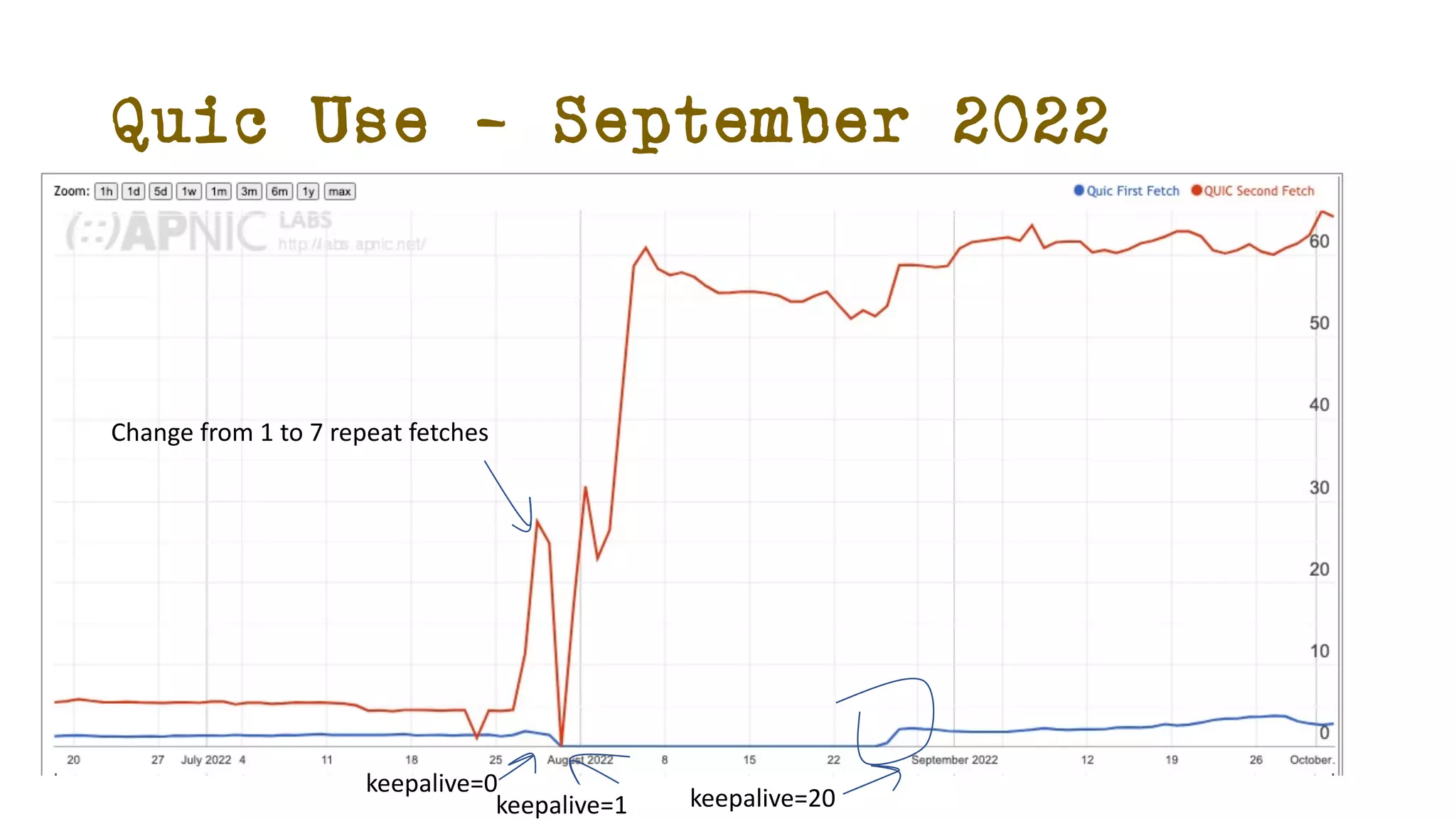
• So now let’s try a value of 20 seconds…
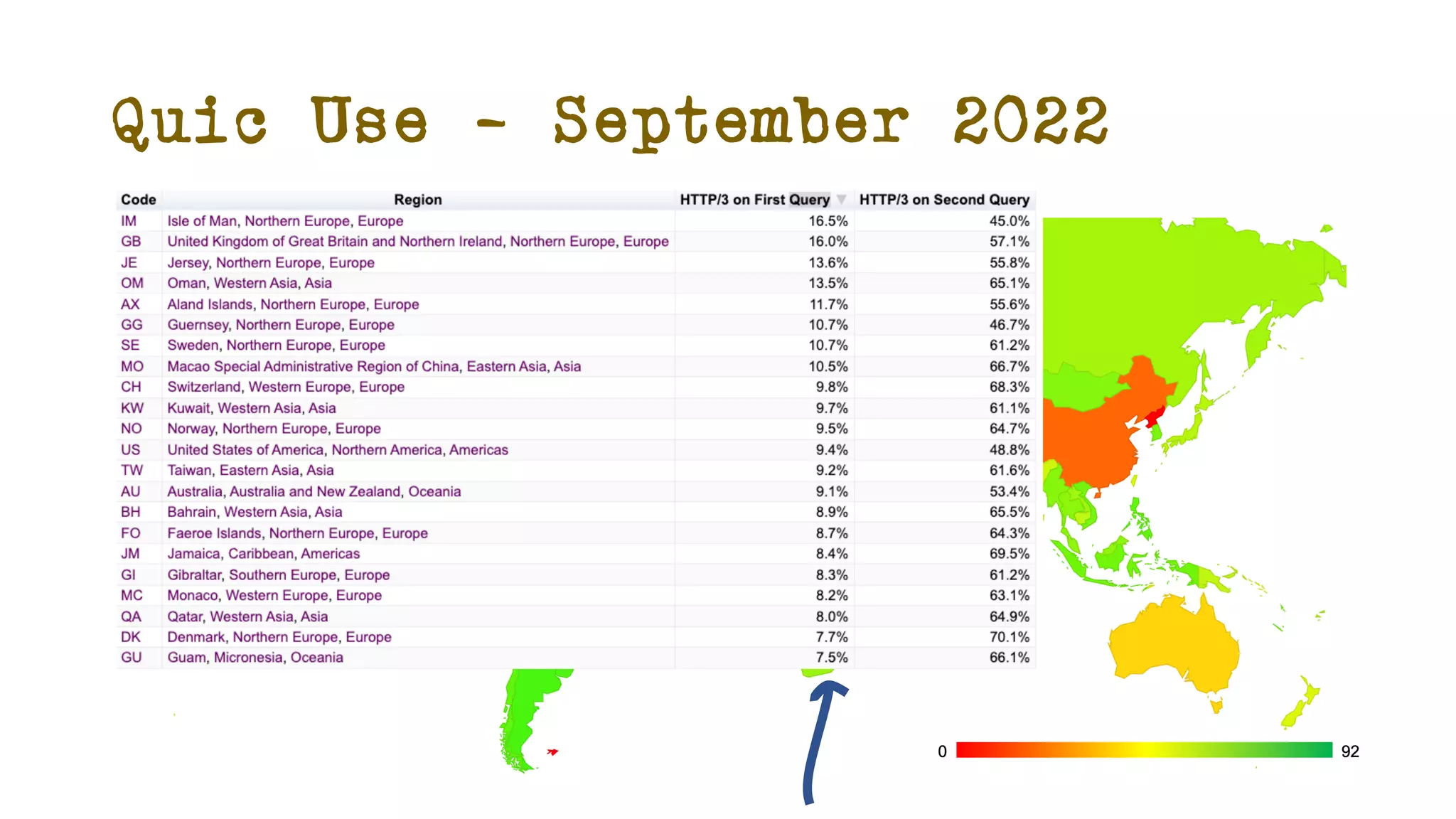
Quic Use – September 2022
Change from 1 to 7 repeat fetches
keepalive=0
keepalive=1 keepalive=20
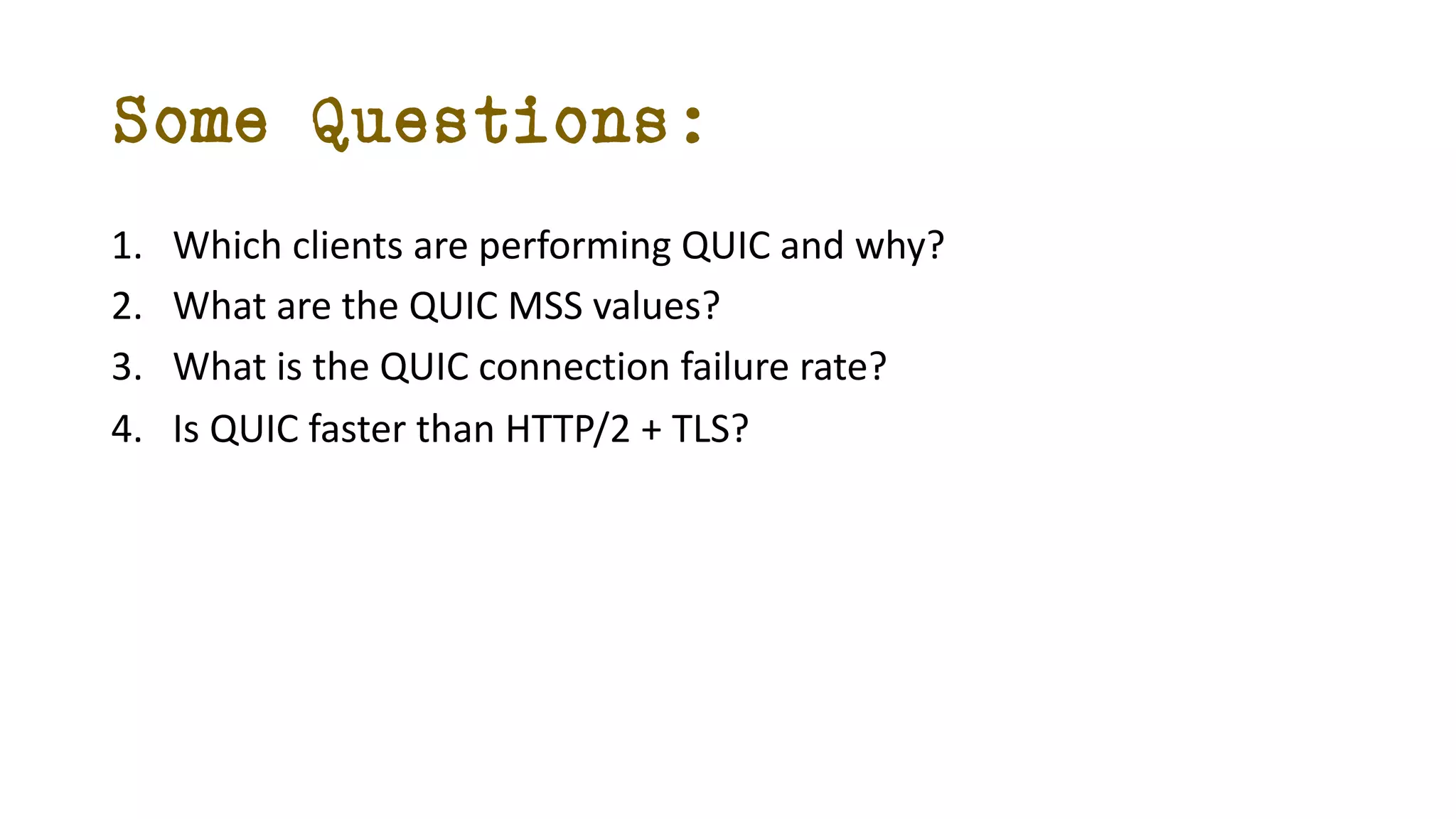
Some Questions:
1. Which clients are performing QUIC and why?
2. What are the QUIC MSS values?
3. What is the QUIC connection failure rate?
4. Is QUIC faster than HTTP/2 + TLS?
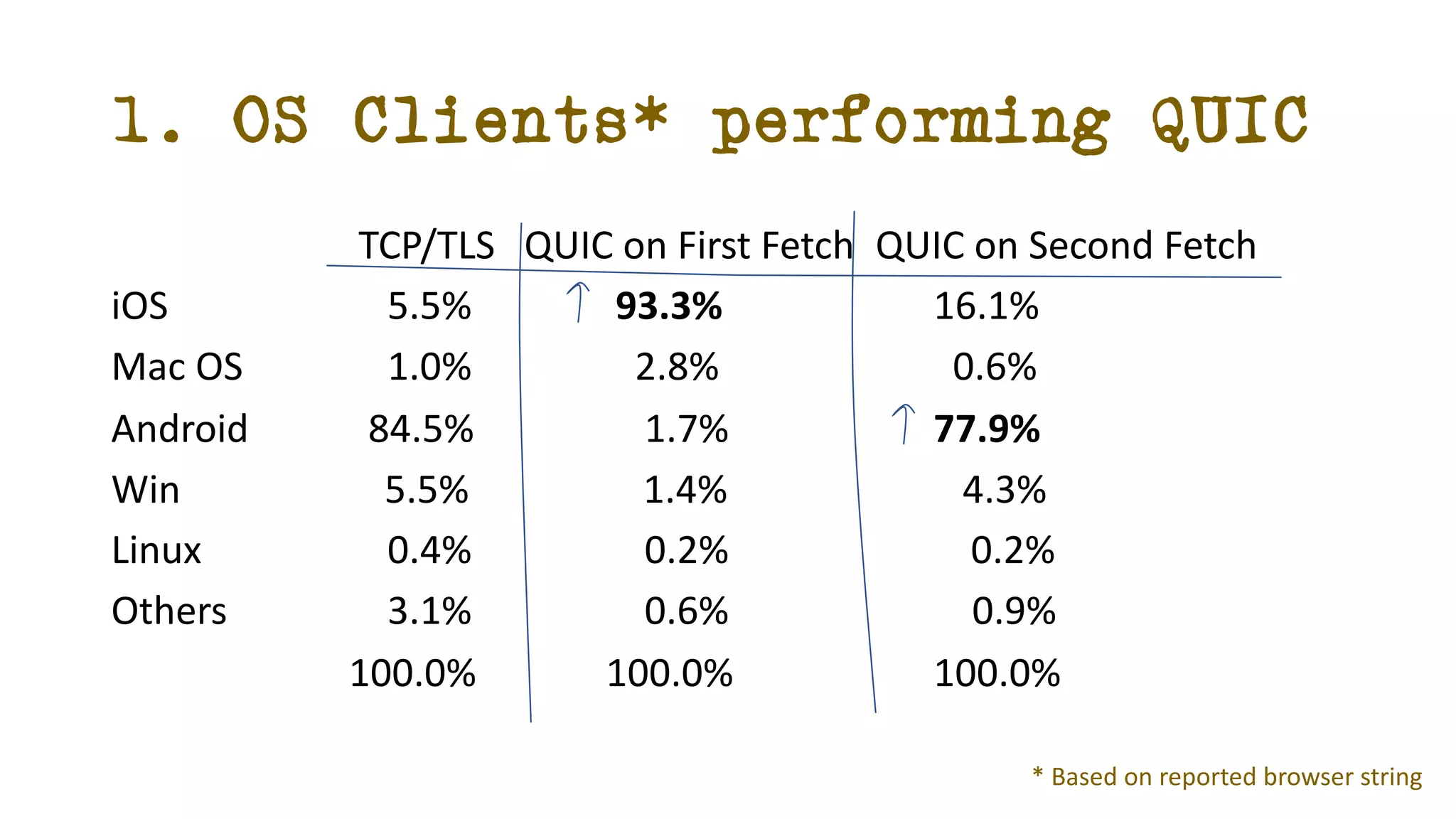
TCP/TLS QUIC on First Fetch QUIC on Second Fetch
iOS 5.5% 93.3% 16.1%
Mac OS 1.0% 2.8% 0.6%
Android 84.5% 1.7% 77.9%
Win 5.5% 1.4% 4.3%
Linux 0.4% 0.2% 0.2%
Others 3.1% 0.6% 0.9%
100.0% 100.0% 100.0%
1. OS Clients* performing QUIC
* Based on reported browser string
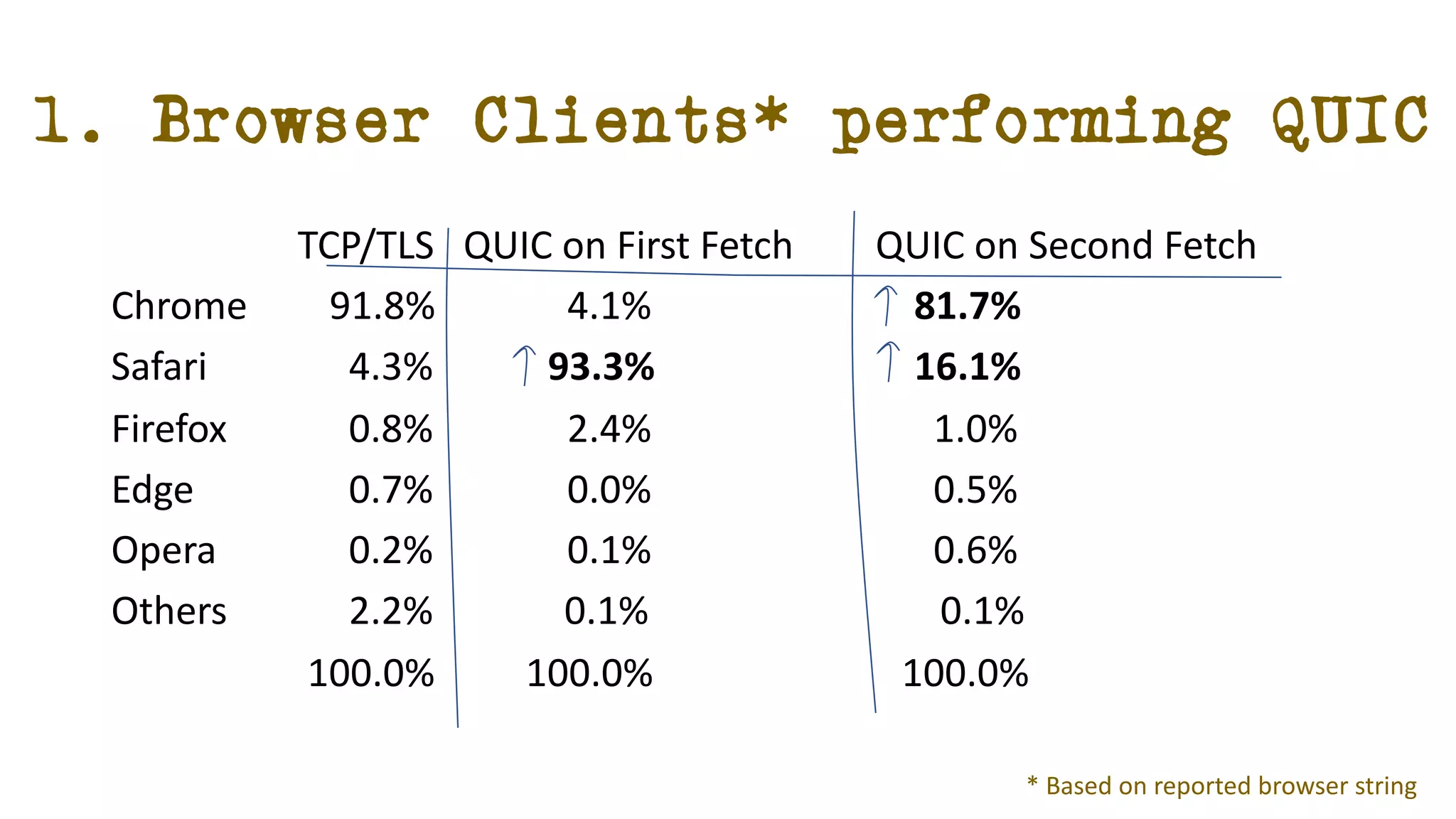
1. Browser Clients* performing QUIC
TCP/TLS QUIC on First Fetch QUIC on Second Fetch
Chrome 91.8% 4.1% 81.7%
Safari 4.3% 93.3% 16.1%
Firefox 0.8% 2.4% 1.0%
Edge 0.7% 0.0% 0.5%
Opera 0.2% 0.1% 0.6%
Others 2.2% 0.1% 0.1%
100.0% 100.0% 100.0%
* Based on reported browser string
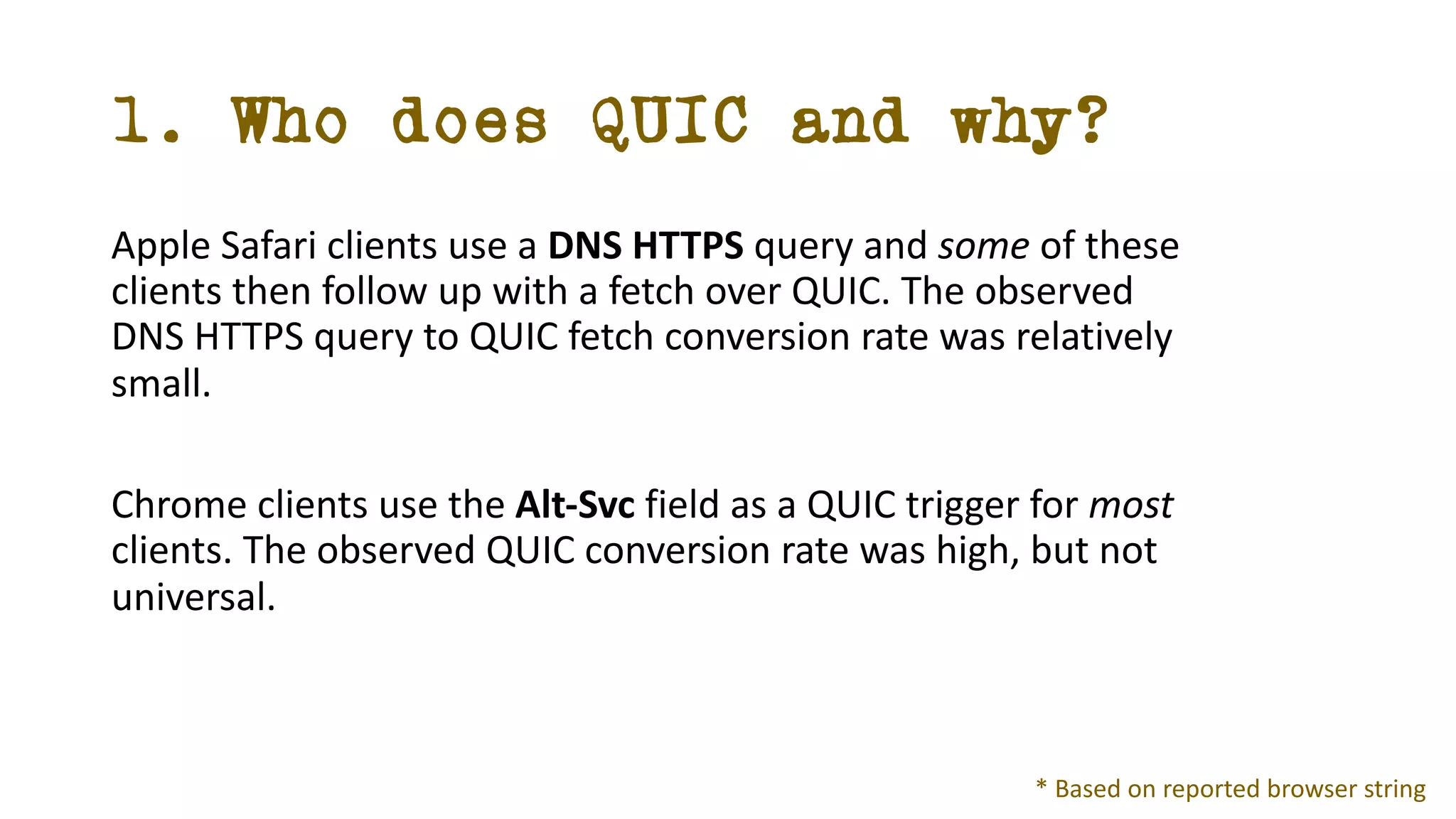
1. Who does QUIC and why?
Apple Safari clients use a DNS HTTPS query and some of these
clients then follow up with a fetch over QUIC. The observed
DNS HTTPS query to QUIC fetch conversion rate was relatively
small.
Chrome clients use the Alt-Svc field as a QUIC trigger for most
clients. The observed QUIC conversion rate was high, but not
universal.
* Based on reported browser string
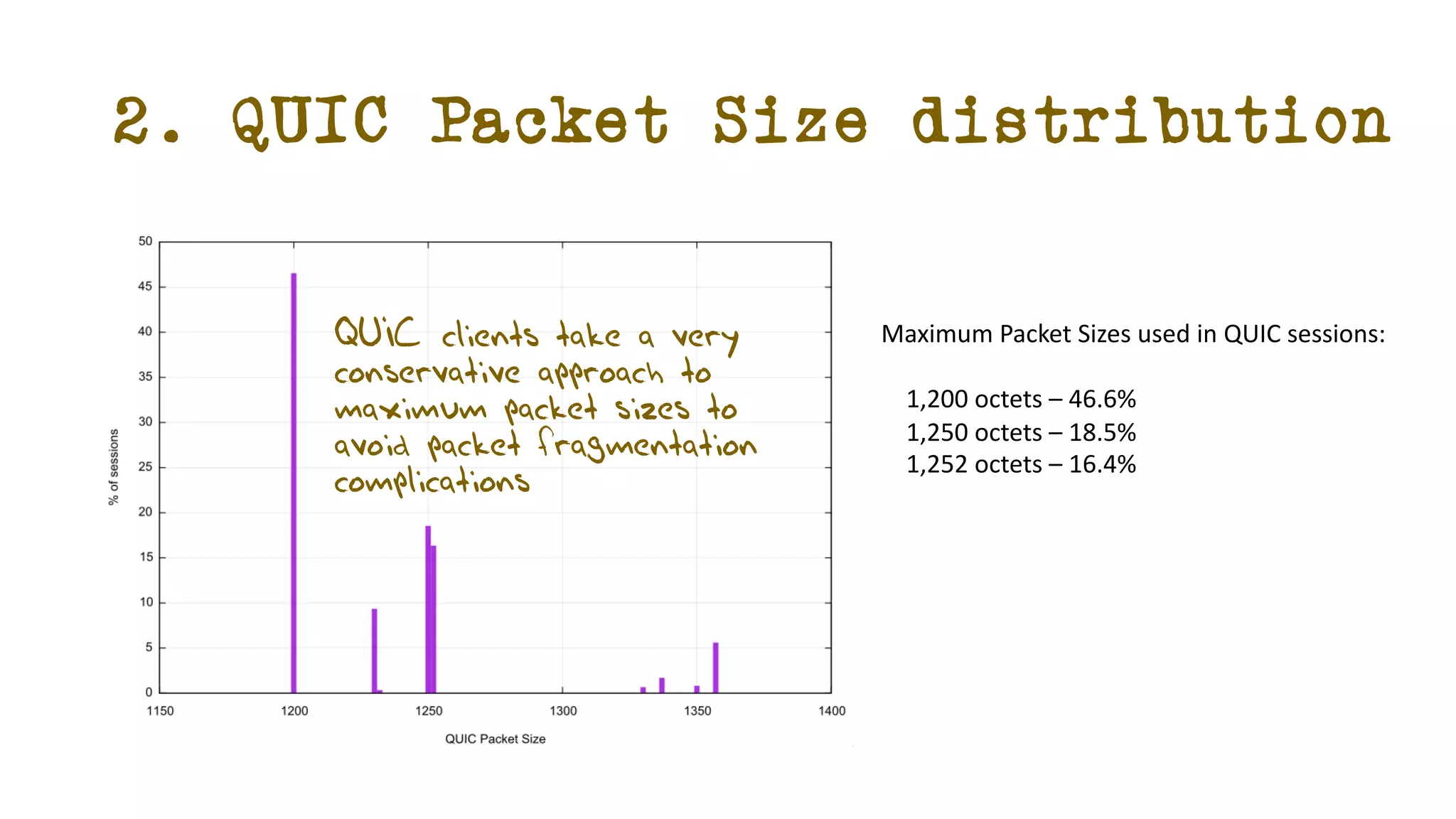
2. QUIC Packet Size distribution
Maximum Packet Sizes used in QUIC sessions:
1,200 octets – 46.6%
1,250 octets – 18.5%
1,252 octets – 16.4%
QUIC clients take a very
conservative approach to
maximum packet sizes to
avoid packet fragmentation
complications
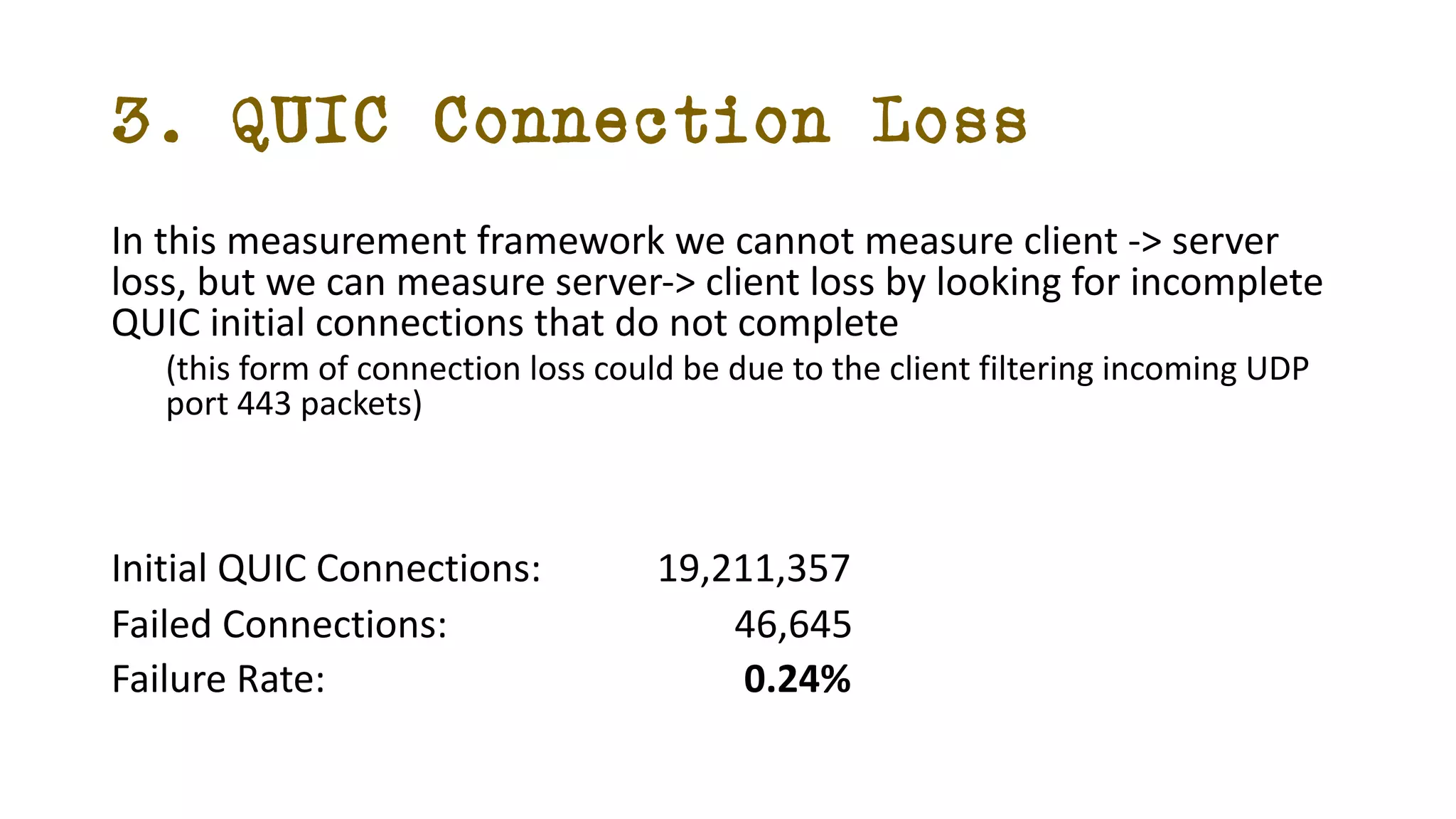
3. QUIC Connection Loss
In this measurement framework we cannot measure client -> server
loss, but we can measure server-> client loss by looking for incomplete
QUIC initial connections that do not complete
(this form of connection loss could be due to the client filtering incoming UDP
port 443 packets)
Initial QUIC Connections: 19,211,357
Failed Connections: 46,645
Failure Rate: 0.24%
4. Is QUIC Faster?
Let’s compare the user-measured time to load an object using HTTP/2
and the same user’s measured time to load the same object using
HTTP/3
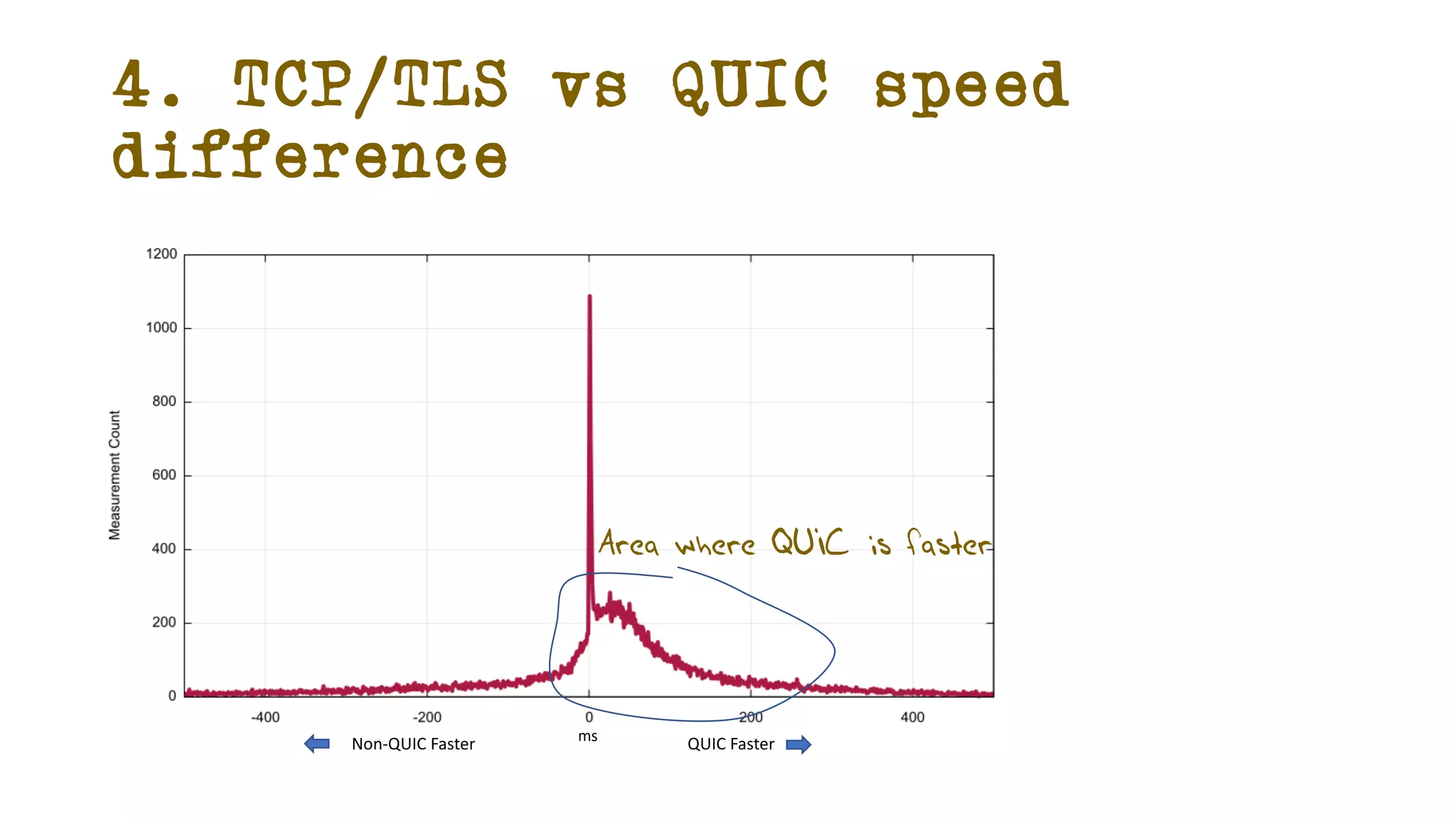
• There are a number of variables in the user time measurement, including
varying time penalties relating to the internal task scheduling within the
browser, but these individual factors should be cancelled out over a large
enough sample set
4. TCP/TLS vs QUIC speed
difference
Area where QUIC is faster
Non-QUIC Faster QUIC Faster
ms
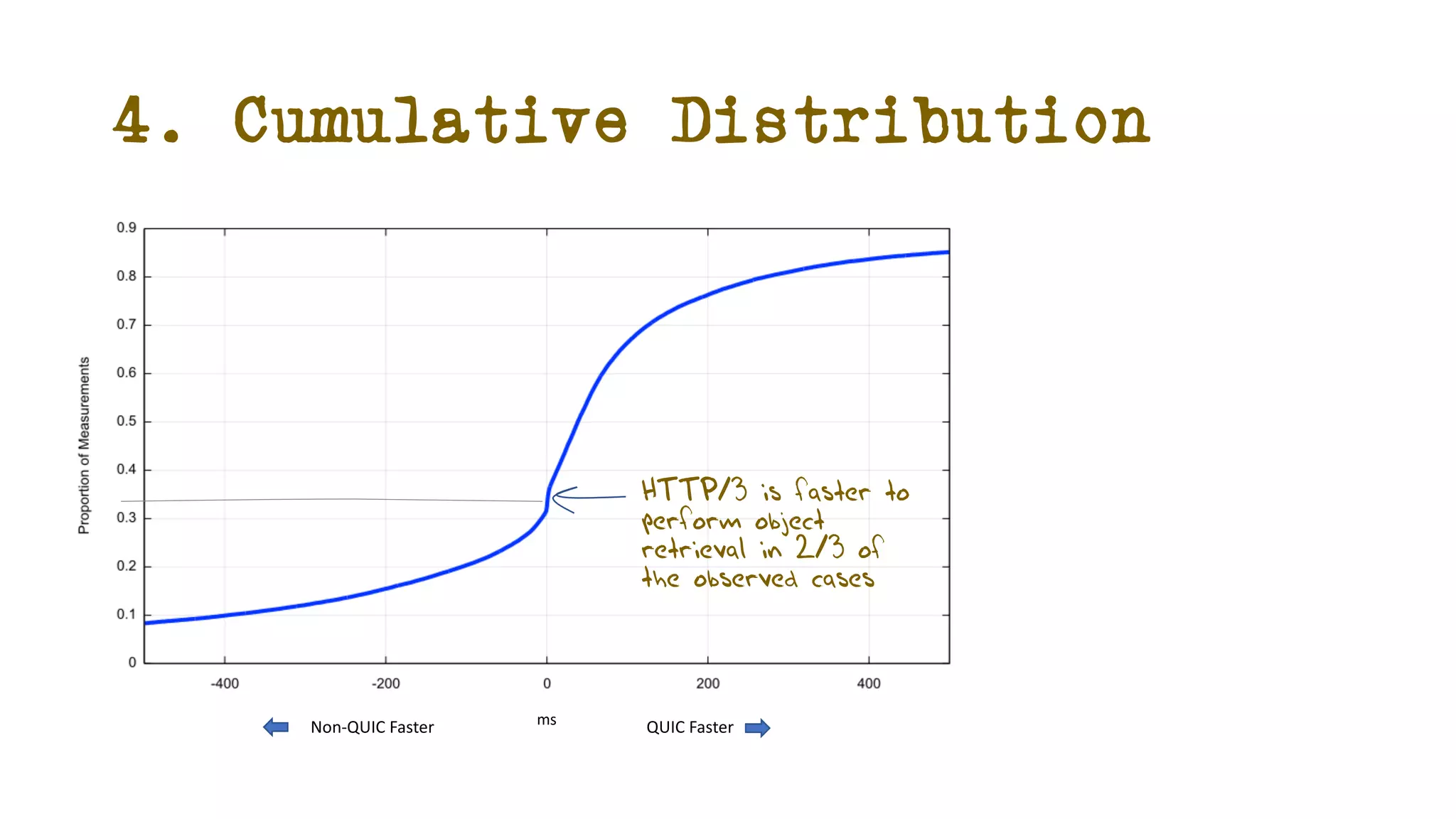
4. Cumulative Distribution
HTTP/3 is faster to
perform object
retrieval in 2/3 of
the observed cases
Non-QUIC Faster QUIC Faster
ms
Some Answers:
1. Which clients are performing QUIC?
The recent change appears to relate predominately to iOS 15.x clients (iPhones and iPads) using
HTTPS queries and selectively performing an object retrieval over HTTP/3 at a rate of
approximately 1 in 5
2. What are the QUIC MSS values?
Most QUIC clients limit their total IP packet size to a max of either 1,250 or 1,252 octets. Largest
observed packet was 1,357 octets
3. What is the QUIC connection failure rate?
Extremely small at 0.24%. This falls within the bounds of experimental error in this experiment’s
framework.
4. Is QUIC faster than HTTP/2 + TLS?
Yes, more than 2/3 of the time QUIC will complete in less elapsed time than the equivalent HTTP/2
retrieval
Thanks!
Ongoing HTTP/3 Measurement Report at APNIC Labs:
https://stats.labs.apnic.net/quic

A Quick Look at QUIC, presentation for RIPE 85 by Geoff Huston.pdf

  • 1.
    A Quick lookat QUIC Geoff Huston, Joao Damas, APNIC Labs
  • 2.
    QUIC is… HTTP Multistream TLS Session Encryption TCP Datastream integrity Congestion Control HTTP QUIC Multistream Encryption Data stream integrity Congestion Control UDP IP HTTP/2 HTTP/3
  • 3.
    QUIC is… A transportlevel framing protocol that offers applications access to the basic IP datagram services offered by IP through the use of UDP All other transport services (data integrity, session control, congestion control) are shifted towards the application Support for multi-stream multiplexing that avoids head-of-line blocking and exploits a shared congestion and encryption state QUIC also places the transport control fields inside the encryption envelope, so QUIC has minimal exposure to the network What TCP needs to be for the Internet of 2022!
  • 4.
    Looking for QUIC •At APNIC we use Ads to perform large scale measurements of network service capabilities as seen by users • IPv6 deployment • DNSSEC validation • Fragmentation • Can we use this measurement platform to see the level of use of QUIC in today’s network?
  • 5.
    Setting up QUIC •Server: • nginx v1.21.7 with QUIC functions included • DNS: • Set up an HTTPS record for each URL with value: alpn=“h3” • Content: • Alt-Svc: h3=“:443” (This second method requires a subsequent query to allow the client to use the Alt-Svc capability. We perform a 2-second delayed second query for this URL in the measurement experiment approximately one fifth of the time. We keep the domain name constant and vary the URL arguments to detect the second fetch.)
  • 6.
    • Server: • nginxv1.21.7 with QUIC functions included • DNS: • Set up an HTTPS record for each URL with value: alpn=“h3” • Content: • Alt-Svc: h3=“:443” Setting up QUIC First Fetch Second Fetch
  • 7.
    QUIC Use –June/July 2022 About 3.5% of users use HTTP/3 for the second fetch About 1% of users are seen to use HTTP/3 on first fetch
  • 8.
    This result lookswrong! • Some 90% of the browsers we “see” via the ad campaign identify themselves as Chrome • And Chrome has been supporting a switch to QUIC via the Alt-Svc directive since 2020
  • 9.
    This result lookswrong! • Some 90% of the browsers we “see” via the ad campaign identify themselves as Chrome • And Chrome has been supporting a switch to QUIC via the Alt-Svc directive since 2020 • So we should be seeing a far higher level of QUIC use than 3.5% Hmm • What do others see?
  • 10.
    Cloudflare’s Numbers Our QUICuse numbers are far lower than other published measures
  • 11.
    Maybe 2 fetchesis not enough? • So we changed the experiment to fetch the same URL 7 times with a 2 second pause between each fetch • Surely this would flush out QUIC use!
  • 12.
    Nope! • No change! •The problem appears to be related to HTTP/2 and persistent connections • When the browser performs the followup fetch the connection is likely still open and then the browser will prefer to use the open connection over opening up a new QUIC connect • So on the NGINX server let’s set the keepalive session parameter to 0 seconds • Yes?
  • 13.
    Still Nope! • Thatwas worse! • We didn’t see any use of QUIC at all • Nothing. Nada. Not even a little bit. • Seems that if you set keepalive to zero then NGINX disables QUIC completely! • So we then set the session keepalive parameter to 1 second • Better?
  • 14.
    QUIC Use –June - August 2022 keepalive=0 keepalive=1 Change from 1 to 7 repeat fetches
  • 15.
    Yes! • We areseeing a 57% QUIC on the repeat fetches, corresponding to a rate of 63% QUIC use of Chrome clients
  • 16.
    Yes, and No •We are seeing a 57% QUIC on the repeat fetches, corresponding to a rate of 63% QUIC use of Chrome clients • But at the same time the first fetch use dropped from 1% to minimal levels • Which appears to be an issue with Safari, and iOS (and MAC OS) • Chrome and Firefox were also behaving erratically across the 7 repeat fetches flipping between HTTP/2 and HTTP/3
  • 17.
    QUIC Use –August 2022
  • 18.
    QUIC Use –August 2022
  • 19.
    QUIC Use –August 2022 Huh?
  • 20.
    Yes, and No •We are seeing a 57% QUIC on the repeat fetches, corresponding to a rate of 63% QUIC use of Chrome clients • But at the same time the first fetch use dropped from 1% to minimal levels • Which appears to be an issue with Safari, and iOS (and MAC OS) • Interestingly, Safari technology preview (release 150, safari 16.0, webkit 17614.1.22.1.1) does not show this behaviour within our test rig • So we were unsure what is going on here between Safari clients and our NGINX-based QUIC server
  • 21.
    Its all aboutKeepalive Timers • After much searching under many rocks we are advised (many thanks to Ryan Hamilton, Martin Thompson and Tommy Pauly for various clues at this stage) that a server keepalive timer value of 1 is also a Really Bad setting! • The server is dropping the QUIC connection too aggressively and the browser client drops back to HTTP/2 • The default value of 65 seconds for the server keepalive interval seems to be too long • And 1 second is too short • So now let’s try a value of 20 seconds…
  • 22.
    Quic Use –September 2022
  • 23.
    Quic Use –September 2022 Change from 1 to 7 repeat fetches keepalive=0 keepalive=1 keepalive=20
  • 24.
    Some Questions: 1. Whichclients are performing QUIC and why? 2. What are the QUIC MSS values? 3. What is the QUIC connection failure rate? 4. Is QUIC faster than HTTP/2 + TLS?
  • 25.
    TCP/TLS QUIC onFirst Fetch QUIC on Second Fetch iOS 5.5% 93.3% 16.1% Mac OS 1.0% 2.8% 0.6% Android 84.5% 1.7% 77.9% Win 5.5% 1.4% 4.3% Linux 0.4% 0.2% 0.2% Others 3.1% 0.6% 0.9% 100.0% 100.0% 100.0% 1. OS Clients* performing QUIC * Based on reported browser string
  • 26.
    1. Browser Clients*performing QUIC TCP/TLS QUIC on First Fetch QUIC on Second Fetch Chrome 91.8% 4.1% 81.7% Safari 4.3% 93.3% 16.1% Firefox 0.8% 2.4% 1.0% Edge 0.7% 0.0% 0.5% Opera 0.2% 0.1% 0.6% Others 2.2% 0.1% 0.1% 100.0% 100.0% 100.0% * Based on reported browser string
  • 27.
    1. Who doesQUIC and why? Apple Safari clients use a DNS HTTPS query and some of these clients then follow up with a fetch over QUIC. The observed DNS HTTPS query to QUIC fetch conversion rate was relatively small. Chrome clients use the Alt-Svc field as a QUIC trigger for most clients. The observed QUIC conversion rate was high, but not universal. * Based on reported browser string
  • 28.
    2. QUIC PacketSize distribution Maximum Packet Sizes used in QUIC sessions: 1,200 octets – 46.6% 1,250 octets – 18.5% 1,252 octets – 16.4% QUIC clients take a very conservative approach to maximum packet sizes to avoid packet fragmentation complications
  • 29.
    3. QUIC ConnectionLoss In this measurement framework we cannot measure client -> server loss, but we can measure server-> client loss by looking for incomplete QUIC initial connections that do not complete (this form of connection loss could be due to the client filtering incoming UDP port 443 packets) Initial QUIC Connections: 19,211,357 Failed Connections: 46,645 Failure Rate: 0.24%
  • 30.
    4. Is QUICFaster? Let’s compare the user-measured time to load an object using HTTP/2 and the same user’s measured time to load the same object using HTTP/3 • There are a number of variables in the user time measurement, including varying time penalties relating to the internal task scheduling within the browser, but these individual factors should be cancelled out over a large enough sample set
  • 31.
    4. TCP/TLS vsQUIC speed difference Area where QUIC is faster Non-QUIC Faster QUIC Faster ms
  • 32.
    4. Cumulative Distribution HTTP/3is faster to perform object retrieval in 2/3 of the observed cases Non-QUIC Faster QUIC Faster ms
  • 33.
    Some Answers: 1. Whichclients are performing QUIC? The recent change appears to relate predominately to iOS 15.x clients (iPhones and iPads) using HTTPS queries and selectively performing an object retrieval over HTTP/3 at a rate of approximately 1 in 5 2. What are the QUIC MSS values? Most QUIC clients limit their total IP packet size to a max of either 1,250 or 1,252 octets. Largest observed packet was 1,357 octets 3. What is the QUIC connection failure rate? Extremely small at 0.24%. This falls within the bounds of experimental error in this experiment’s framework. 4. Is QUIC faster than HTTP/2 + TLS? Yes, more than 2/3 of the time QUIC will complete in less elapsed time than the equivalent HTTP/2 retrieval
  • 34.
    Thanks! Ongoing HTTP/3 MeasurementReport at APNIC Labs: https://stats.labs.apnic.net/quic