


© 2019, Amazon Web Services, Inc. or its affiliates. All rights reserved.
A Pragmatic Introduction to
Natural Language Processing models
Julien Simon
Global Evangelist, AI & Machine Learning
@julsimon
https://medium.com/@julsimon
© 2019, Amazon Web Services, Inc. or its affiliates. All rights reserved.
Problem statement
• Since the dawn of AI, NLP has been a major research field
• Text classification, machine translation, text generation, chat bots, voice assistants, etc.
• NLP apps require a language model in order to predict the next word
• Given a sequence of words (w1, … , wn), predict wn+1 that has the highest probability
• Vocabulary size can be hundreds of thousands of words
… in millions of documents
• Can we build a compact mathematical representation of language,
that would help us with a variety of downstream NLP tasks?
© 2019, Amazon Web Services, Inc. or its affiliates. All rights reserved.
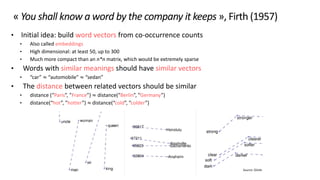
« You shall know a word by the company it keeps », Firth (1957)
• Initial idea: build word vectors from co-occurrence counts
• Also called embeddings
• High dimensional: at least 50, up to 300
• Much more compact than an n*n matrix, which would be extremely sparse
• Words with similar meanings should have similar vectors
• “car” ≈ “automobile” ≈ “sedan”
• The distance between related vectors should be similar
• distance (“Paris”, ”France”) ≈ distance(“Berlin”, ”Germany”)
• distance(“hot”, ”hotter”) ≈ distance(“cold”, ”colder”)
© 2019, Amazon Web Services, Inc. or its affiliates. All rights reserved.
High-level view
1. Start from a large text corpus (100s of millions of words, even billions)
2. Preprocess the corpus
• Tokenize: « hello, world! » → « <BOS>hello<SP>world<SP>!<EOS>»
• Multi-word entities: « Rio de Janeiro » → « rio_de_janeiro »
3. Build the vocabulary
4. Learn vector representations for all words
… or simply use (or fine-tune) pre-trained vectors (more on this later)
© 2019, Amazon Web Services, Inc. or its affiliates. All rights reserved.
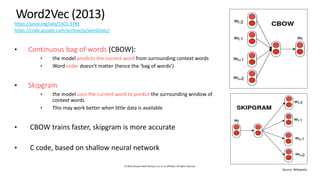
Word2Vec (2013)
https://arxiv.org/abs/1301.3781
https://code.google.com/archive/p/word2vec/
• Continuous bag of words (CBOW):
• the model predicts the current word from surrounding context words
• Word order doesn’t matter (hence the ‘bag of words’)
• Skipgram
• the model uses the current word to predict the surrounding window of
context words
• This may work better when little data is available
• CBOW trains faster, skipgram is more accurate
• C code, based on shallow neural network
© 2019, Amazon Web Services, Inc. or its affiliates. All rights reserved.
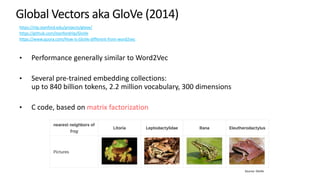
Global Vectors aka GloVe (2014)
https://nlp.stanford.edu/projects/glove/
https://github.com/stanfordnlp/GloVe
https://www.quora.com/How-is-GloVe-different-from-word2vec
• Performance generally similar to Word2Vec
• Several pre-trained embedding collections:
up to 840 billion tokens, 2.2 million vocabulary, 300 dimensions
• C code, based on matrix factorization
© 2019, Amazon Web Services, Inc. or its affiliates. All rights reserved.
FastText (2016)
https://arxiv.org/abs/1607.04606 + https://arxiv.org/abs/1802.06893
https://fasttext.cc/
https://www.quora.com/What-is-the-main-difference-between-word2vec-and-fastText
• Extension of Word2Vec: each word is a set of subwords, aka n-grams
• « Computer », n=5 : <START>Comp , compu, omput, mpute, puter, uter<END>
• A word vector is the average of its subword vectors
• Good for unknown/mispelled words, as they share subwords with known words
• « Computerized » and « Cmputer » should be close to « Computer »
• Three modes
• Unsupervised learning: compute embeddings (294 languages available)
• Supervised learning: use / fine-tune embeddings for multi-label, multi-class classification
• Also language detection for 170 languages
• Multithreaded C++ code, with Python API
© 2019, Amazon Web Services, Inc. or its affiliates. All rights reserved.
https://dl.acm.org/citation.cfm?id=3146354
https://aws.amazon.com/blogs/machine-learning/enhanced-text-classification-and-
word-vectors-using-amazon-sagemaker-blazingtext/
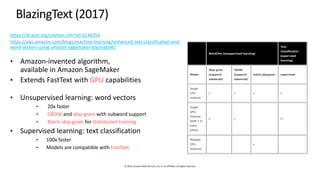
• Amazon-invented algorithm,
available in Amazon SageMaker
• Extends FastText with GPU capabilities
• Unsupervised learning: word vectors
• 20x faster
• CBOW and skip-gram with subword support
• Batch skip-gram for distributed training
• Supervised learning: text classification
• 100x faster
• Models are compatible with FastText
BlazingText (2017)
© 2019, Amazon Web Services, Inc. or its affiliates. All rights reserved.
Limitations of Word2Vec (and family)
• Some words have different meanings (aka polysemy)
• « Kevin, stop throwing rocks! » vs. « Machine Learning rocks »
• Word2Vec encodes the different meanings of a word into the same vector
• Bidirectional context is not taken into account
• Previous words (left-to-right) and next words (right-to-left)
© 2019, Amazon Web Services, Inc. or its affiliates. All rights reserved.
Embeddings from Language Models aka ELMo (02/2018)
https://arxiv.org/abs/1802.05365
https://allennlp.org/elmo
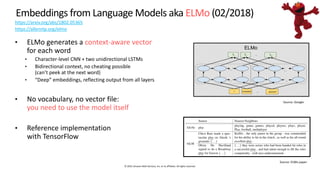
• ELMo generates a context-aware vector
for each word
• Character-level CNN + two unidirectional LSTMs
• Bidirectional context, no cheating possible
(can’t peek at the next word)
• “Deep” embeddings, reflecting output from all layers
• No vocabulary, no vector file:
you need to use the model itself
• Reference implementation
with TensorFlow
© 2019, Amazon Web Services, Inc. or its affiliates. All rights reserved.
Bidirectional EncoderRepresentationsfrom Transformers aka BERT (10/2018)
https://arxiv.org/abs/1810.04805
https://github.com/google-research/bert
https://www.quora.com/What-are-the-main-differences-between-the-word-embeddings-of-ELMo-BERT-Word2vec-and-GloVe
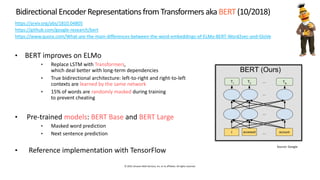
• BERT improves on ELMo
• Replace LSTM with Transformers,
which deal better with long-term dependencies
• True bidirectional architecture: left-to-right and right-to-left
contexts are learned by the same network
• 15% of words are randomly masked during training
to prevent cheating
• Pre-trained models: BERT Base and BERT Large
• Masked word prediction
• Next sentence prediction
• Reference implementation with TensorFlow
© 2019, Amazon Web Services, Inc. or its affiliates. All rights reserved.
Limitations of BERT
• BERT cannot handle more than 512 input tokens
• BERT masks words during training, but not during fine-tuning
(aka training/fine-tuning discrepancy)
• BERT isn’t trained to predict the next word, so it’s not great at text generation
• BERT doesn’t learn dependencies for masked words
• Train « I am going to <MASK> my <MASK> » on « walk » / « dog », « eat » / « breakfast », and « debug » / « code ».
• BERT could legitimately predict « I am going to eat my code » or « I am going to debug my dog » :-/
© 2019, Amazon Web Services, Inc. or its affiliates. All rights reserved.
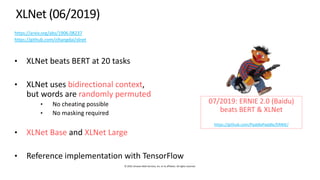
XLNet (06/2019)
https://arxiv.org/abs/1906.08237
https://github.com/zihangdai/xlnet
• XLNet beats BERT at 20 tasks
• XLNet uses bidirectional context,
but words are randomly permuted
• No cheating possible
• No masking required
• XLNet Base and XLNet Large
• Reference implementation with TensorFlow
07/2019: ERNIE 2.0 (Baidu)
beats BERT & XLNet
https://github.com/PaddlePaddle/ERNIE/
© 2019, Amazon Web Services, Inc. or its affiliates. All rights reserved.
Summing things up
• Word2Vec and friends
• Try pre-trained embeddings first
• Check that the training corpus is similar to your own data
• Same language, similar vocabulary
• Remember that subword models will help with unknown / mispelled words
• If you have exotic requirements AND lots of data, training is not expensive
• ElMo, BERT, XLNet
• Training is very expensive: several days using several GPUs
• Fine-tuning is cheap: just a few GPU hours for SOTA results
• Fine-tuning scripts and pre-trained models are available: start there!
• The ”best model” is the one that works best on your business problem
© 2019, Amazon Web Services, Inc. or its affiliates. All rights reserved.
Demo: finding similarities and analogies
with Gluon NLP and pre-trained GloVe embeddings
https://gitlab.com/juliensimon/dlnotebooks/gluonnlp/
© 2019, Amazon Web Services, Inc. or its affiliates. All rights reserved.
Demo: embeddings with ELMo on TensorFlow
https://gitlab.com/juliensimon/dlnotebooks/blob/master/nlp/ELMO%20TensorFlow.ipynb
© 2019, Amazon Web Services, Inc. or its affiliates. All rights reserved.
Getting started on AWS
https://ml.aws
https://aws.amazon.com/marketplace/solutions/machine-learning/natural-
language-processing → off the shelf algos and models that might just save you from
this madness ;)
https://aws.amazon.com/sagemaker
https://github.com/awslabs/amazon-sagemaker-examples
© 2019, Amazon Web Services, Inc. or its affiliates. All rights reserved.
Thank you!
© 2019, Amazon Web Services, Inc. or its affiliates. All rights reserved.
Julien Simon
Global Evangelist, AI & Machine Learning
@julsimon
https://medium.com/@julsimon

A pragmatic introduction to natural language processing models (October 2019)

  • 1.
    © 2019, AmazonWeb Services, Inc. or its affiliates. All rights reserved. A Pragmatic Introduction to Natural Language Processing models Julien Simon Global Evangelist, AI & Machine Learning @julsimon https://medium.com/@julsimon
  • 2.
    © 2019, AmazonWeb Services, Inc. or its affiliates. All rights reserved. Problem statement • Since the dawn of AI, NLP has been a major research field • Text classification, machine translation, text generation, chat bots, voice assistants, etc. • NLP apps require a language model in order to predict the next word • Given a sequence of words (w1, … , wn), predict wn+1 that has the highest probability • Vocabulary size can be hundreds of thousands of words … in millions of documents • Can we build a compact mathematical representation of language, that would help us with a variety of downstream NLP tasks?
  • 3.
    © 2019, AmazonWeb Services, Inc. or its affiliates. All rights reserved. « You shall know a word by the company it keeps », Firth (1957) • Initial idea: build word vectors from co-occurrence counts • Also called embeddings • High dimensional: at least 50, up to 300 • Much more compact than an n*n matrix, which would be extremely sparse • Words with similar meanings should have similar vectors • “car” ≈ “automobile” ≈ “sedan” • The distance between related vectors should be similar • distance (“Paris”, ”France”) ≈ distance(“Berlin”, ”Germany”) • distance(“hot”, ”hotter”) ≈ distance(“cold”, ”colder”)
  • 4.
    © 2019, AmazonWeb Services, Inc. or its affiliates. All rights reserved. High-level view 1. Start from a large text corpus (100s of millions of words, even billions) 2. Preprocess the corpus • Tokenize: « hello, world! » → « <BOS>hello<SP>world<SP>!<EOS>» • Multi-word entities: « Rio de Janeiro » → « rio_de_janeiro » 3. Build the vocabulary 4. Learn vector representations for all words … or simply use (or fine-tune) pre-trained vectors (more on this later)
  • 5.
    © 2019, AmazonWeb Services, Inc. or its affiliates. All rights reserved.
  • 6.
    © 2019, AmazonWeb Services, Inc. or its affiliates. All rights reserved. Word2Vec (2013) https://arxiv.org/abs/1301.3781 https://code.google.com/archive/p/word2vec/ • Continuous bag of words (CBOW): • the model predicts the current word from surrounding context words • Word order doesn’t matter (hence the ‘bag of words’) • Skipgram • the model uses the current word to predict the surrounding window of context words • This may work better when little data is available • CBOW trains faster, skipgram is more accurate • C code, based on shallow neural network
  • 7.
    © 2019, AmazonWeb Services, Inc. or its affiliates. All rights reserved. Global Vectors aka GloVe (2014) https://nlp.stanford.edu/projects/glove/ https://github.com/stanfordnlp/GloVe https://www.quora.com/How-is-GloVe-different-from-word2vec • Performance generally similar to Word2Vec • Several pre-trained embedding collections: up to 840 billion tokens, 2.2 million vocabulary, 300 dimensions • C code, based on matrix factorization
  • 8.
    © 2019, AmazonWeb Services, Inc. or its affiliates. All rights reserved. FastText (2016) https://arxiv.org/abs/1607.04606 + https://arxiv.org/abs/1802.06893 https://fasttext.cc/ https://www.quora.com/What-is-the-main-difference-between-word2vec-and-fastText • Extension of Word2Vec: each word is a set of subwords, aka n-grams • « Computer », n=5 : <START>Comp , compu, omput, mpute, puter, uter<END> • A word vector is the average of its subword vectors • Good for unknown/mispelled words, as they share subwords with known words • « Computerized » and « Cmputer » should be close to « Computer » • Three modes • Unsupervised learning: compute embeddings (294 languages available) • Supervised learning: use / fine-tune embeddings for multi-label, multi-class classification • Also language detection for 170 languages • Multithreaded C++ code, with Python API
  • 9.
    © 2019, AmazonWeb Services, Inc. or its affiliates. All rights reserved. https://dl.acm.org/citation.cfm?id=3146354 https://aws.amazon.com/blogs/machine-learning/enhanced-text-classification-and- word-vectors-using-amazon-sagemaker-blazingtext/ • Amazon-invented algorithm, available in Amazon SageMaker • Extends FastText with GPU capabilities • Unsupervised learning: word vectors • 20x faster • CBOW and skip-gram with subword support • Batch skip-gram for distributed training • Supervised learning: text classification • 100x faster • Models are compatible with FastText BlazingText (2017)
  • 10.
    © 2019, AmazonWeb Services, Inc. or its affiliates. All rights reserved. Limitations of Word2Vec (and family) • Some words have different meanings (aka polysemy) • « Kevin, stop throwing rocks! » vs. « Machine Learning rocks » • Word2Vec encodes the different meanings of a word into the same vector • Bidirectional context is not taken into account • Previous words (left-to-right) and next words (right-to-left)
  • 11.
    © 2019, AmazonWeb Services, Inc. or its affiliates. All rights reserved. Embeddings from Language Models aka ELMo (02/2018) https://arxiv.org/abs/1802.05365 https://allennlp.org/elmo • ELMo generates a context-aware vector for each word • Character-level CNN + two unidirectional LSTMs • Bidirectional context, no cheating possible (can’t peek at the next word) • “Deep” embeddings, reflecting output from all layers • No vocabulary, no vector file: you need to use the model itself • Reference implementation with TensorFlow
  • 12.
    © 2019, AmazonWeb Services, Inc. or its affiliates. All rights reserved. Bidirectional EncoderRepresentationsfrom Transformers aka BERT (10/2018) https://arxiv.org/abs/1810.04805 https://github.com/google-research/bert https://www.quora.com/What-are-the-main-differences-between-the-word-embeddings-of-ELMo-BERT-Word2vec-and-GloVe • BERT improves on ELMo • Replace LSTM with Transformers, which deal better with long-term dependencies • True bidirectional architecture: left-to-right and right-to-left contexts are learned by the same network • 15% of words are randomly masked during training to prevent cheating • Pre-trained models: BERT Base and BERT Large • Masked word prediction • Next sentence prediction • Reference implementation with TensorFlow
  • 13.
    © 2019, AmazonWeb Services, Inc. or its affiliates. All rights reserved. Limitations of BERT • BERT cannot handle more than 512 input tokens • BERT masks words during training, but not during fine-tuning (aka training/fine-tuning discrepancy) • BERT isn’t trained to predict the next word, so it’s not great at text generation • BERT doesn’t learn dependencies for masked words • Train « I am going to <MASK> my <MASK> » on « walk » / « dog », « eat » / « breakfast », and « debug » / « code ». • BERT could legitimately predict « I am going to eat my code » or « I am going to debug my dog » :-/
  • 14.
    © 2019, AmazonWeb Services, Inc. or its affiliates. All rights reserved. XLNet (06/2019) https://arxiv.org/abs/1906.08237 https://github.com/zihangdai/xlnet • XLNet beats BERT at 20 tasks • XLNet uses bidirectional context, but words are randomly permuted • No cheating possible • No masking required • XLNet Base and XLNet Large • Reference implementation with TensorFlow 07/2019: ERNIE 2.0 (Baidu) beats BERT & XLNet https://github.com/PaddlePaddle/ERNIE/
  • 15.
    © 2019, AmazonWeb Services, Inc. or its affiliates. All rights reserved. Summing things up • Word2Vec and friends • Try pre-trained embeddings first • Check that the training corpus is similar to your own data • Same language, similar vocabulary • Remember that subword models will help with unknown / mispelled words • If you have exotic requirements AND lots of data, training is not expensive • ElMo, BERT, XLNet • Training is very expensive: several days using several GPUs • Fine-tuning is cheap: just a few GPU hours for SOTA results • Fine-tuning scripts and pre-trained models are available: start there! • The ”best model” is the one that works best on your business problem
  • 16.
    © 2019, AmazonWeb Services, Inc. or its affiliates. All rights reserved.
  • 17.
    © 2019, AmazonWeb Services, Inc. or its affiliates. All rights reserved. Demo: finding similarities and analogies with Gluon NLP and pre-trained GloVe embeddings https://gitlab.com/juliensimon/dlnotebooks/gluonnlp/
  • 18.
    © 2019, AmazonWeb Services, Inc. or its affiliates. All rights reserved. Demo: embeddings with ELMo on TensorFlow https://gitlab.com/juliensimon/dlnotebooks/blob/master/nlp/ELMO%20TensorFlow.ipynb
  • 19.
    © 2019, AmazonWeb Services, Inc. or its affiliates. All rights reserved. Getting started on AWS https://ml.aws https://aws.amazon.com/marketplace/solutions/machine-learning/natural- language-processing → off the shelf algos and models that might just save you from this madness ;) https://aws.amazon.com/sagemaker https://github.com/awslabs/amazon-sagemaker-examples
  • 20.
    © 2019, AmazonWeb Services, Inc. or its affiliates. All rights reserved. Thank you! © 2019, Amazon Web Services, Inc. or its affiliates. All rights reserved. Julien Simon Global Evangelist, AI & Machine Learning @julsimon https://medium.com/@julsimon