COLLEGE OF NURSING SIR C.J
INSTITUTE OF PSCHIATRY HYDERBAD
ANATOMY &
PHYSIOLOGY
A s s i g n e d b y : M A ’ A M T A S L E E M L A G H A R I
R E P R O D U C T I O
N
SachaN
Raichand
Lal Chand
Amrat Kumar
Khalid
Presented by:
Reproductive System
OBJECTIVES
1. DEFINE REPRODUCTION
2. DEFINE REPRODUCTIVE SYSTEM
3. LIST THE FUNCTIONS OF MALE AND FEMALE REPRODUCTIVE SYSTEM
4. CATEGORISED THE FEMALE REPRODUCTIVE ORGANS INTO
• ESSENTIAL ORGANS
• ACCESSORY ORGANS
5. DISCUSS THE LOCATION AND STRUCTURE OF FEMALE EXTERNAL GENITALIA(VULVA)
6. DISCUSS THE LOCATION STRUCTURE AND FUNCTION OF FEMALE INTERNAL GENITALIA
7. DISCUSS THE FEMALE REPRODUCTIVE CYCLE (OVARIAN AND MENSTRUAL CYCLE)
8. CATEGORISED THE MALE REPRODUCTIVE ORGANS INTO
• ESSENTIAL ORGANS
• ACCESSORY ORGANS
9. LOCATION AND STRUCTURE INVOLVED IN THE MALE REPRODUCTIVE SYSTEM
10. DESCRIBE THE STRUCTURE AND FUNCTION OF TESTIS AND ACCESSORY ORGANS
Reproduction
The process of producing of a springs
that are biological are genetically
similar to the parent organism.
Act of producing a new individual from
at least one parent.
Production of new one species are
organism.
It has two types sexual reproduction
Reproductive
System
It is also known as genital system.
Biologically it is made up of all
anatomical tissues glands and organs
involved in sexual reproduction.
Many nonliving substances such as
fluids, hormones and pheromones are
also important accessories to the
reproductive system.
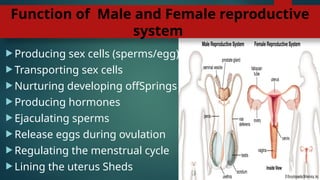
Function of Male and Female reproductive
system
 Producing sex cells (sperms/egg)
 Transporting sex cells
 Nurturing developing offSprings
 Producing hormones
 Ejaculating sperms
 Release eggs during ovulation
 Regulating the menstrual cycle
 Lining the uterus Sheds
Female reproductive
organs
There are two types of female
reproductive organs
Distinction is besed on their
primary function in reproduction
Essential organs
Accessory organs
Essential
Organs
Uterus (Womb)
Fallopian tube
(Oviducts)
Vagina

Accessory
organs
Ovaries
Memory glands (Breasts)
These are also
considered as accessory
organs due to their role in
External Genitalia
(VULVA)
 It is an essential organ
 It is located outside the pelvis
 It includes
 Mons pubis, labia(majora/minora), clitoris, urethral meatus,
vestibule and glands
 Functions
 Allows sperms to enter in the body
 Protection, lubrication, sexual pleasure and urination
Internal
Genitalia
It is located in pelvic
cavity
It includes
Ovaries
Fallopian tubes
Ovaries
 ShapeandLocation
 Two oval shaped glands situated on either side of the uterus
 Structure
 It contains follicles which are sacs holding immature ova
 It has three layers 1. Outer capsule 2. Cortex 3.
Medulla
 Function
 It is the primary female reproductive organs it produce ova and
hormones like estrogen and progesterone
 Also regulate menstruation cycle
Follicle tubules
(Oviducts)
 Shape and Location
 Two “J” like muscular tubes extending from ovaries to the uterus
 Structure
 It is further divided into three parts
1. Infundibulum 2. Ampulla 3. Isthmus
 Function
 It transports eggs from the ovary to the uterus and also provide the site for
fertilization by the sperms
Uterus
 Shape and Location
 Pear shaped hollow muscular organ located in the pelvic cavity situated between the bllader and
rectum
 Structure
 It is further divided into three parts
1. Fundus 2. Body 3. Cervix
 Function
 Provide a suitable environment to a fertilized egg to implant and develop into uterus during pregnancy
 Shades its lining(endometrium) during the menstruation if fertilization does not occur
 It is considered as a house of fetus during pregnancy
Female
Reproductive
cycle
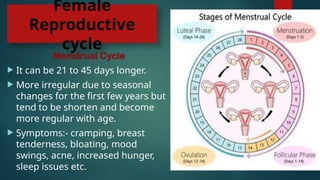
Menstrual Cycle
 It can be 21 to 45 days longer.
 More irregular due to seasonal
changes for the first few years but
tend to be shorten and become
more regular with age.
 Symptoms:- cramping, breast
tenderness, bloating, mood
swings, acne, increased hunger,
sleep issues etc.
Male reproductive
organs
Essential organs
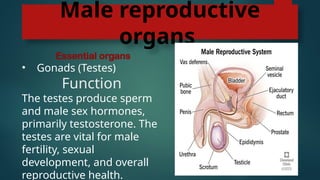
• Gonads (Testes)
Function
The testes produce sperm
and male sex hormones,
primarily testosterone. The
testes are vital for male
fertility, sexual
development, and overall
reproductive health.
Essential Organs
Location
 A pair aap testisis placed in a structure called as scrotum which is located outside
the abdominal cavity
Structure
Tunica albuginea: A tough, white fibrous capsule that surrounds the testis
Lobules: The testis is divided into lobules that contain seminiferous tubules
Seminiferous tubules: Tiny U-shaped tubes that contain germ cells and Sertoli cells
 Rete testis: A network of uncoiled, interconnected channels that receive sperm
from the seminiferous tubules
 Lyding cells: Produce testosterone and other androgens
Accessory organs
Epididymis
 Located at the back of the testicle and covered by the
visceral tunica vaginalis
 It is divided into three parts: the head, body, and cauda
 The head is round and located at the upper end of the
testis
 The body is thinner than the head and located at the back
of the testis
 The epididymis stores and carries sperm
 It also ensures that spermatozoa are properly matured
Vas deferens
 The vas deferens, also known as the ductus
deferens.
 Long muscular tube runs from the epididymis into
the pelvic cavity behind your bladder and connects
to your urethra through a structure called the
ejaculatory duct.
 The vas deferens transports sperm from the
epididymis to the urethra
 During ejaculation, the vas deferens contracts to
propel sperm forward
Seminal Vesicle
 Located in the pelvis, behind the bladder and above the prostate
gland
 Each seminal vesicle is a coiled, blind-ending tube that gives off
several irregular pouches
 They are normally around 3 to 5 cm in length and 1 cm in diameter
 They are composed of three layers: an inner mucosal layer, a
muscular layer, and an outer adventitial layer
 During ejaculation, the muscular tissue inside of the seminal vesicles
pushes fluid out of the glands and into the forming semen
 The seminal vesicles join with the vas deferens to become the
ejaculatory duct
Prostate gland
 Located in the male body, below the bladder and in front of the
rectum
 The prostate is usually about the size of a walnut, but can enlarge
with age, covered by a stretchy connective tissue called prostatic
fascia
 Made up of muscular and glandular tissue, it has 5 lobes anterior,
posterior, two lateral, and one median
 The prostate produces fluid that mixes with sperm and other fluids to
form semen
 The prostate’s muscles contract during ejaculation to help expel
semen
Bulbourethral Gland
 Also known as Cowper’s glands, are located in the deep perineal
pouch, in the urogenital diaphragm, and near the membranous
urethra
 Made up of small mucinous glands and surrounded by the
bulbocavernosus muscle
 Each gland has multiple lobules that are made up of acini
 The acini open into a central canal
 The glands drain into the urethra through ducts
 The bulbourethral glands produce a mucus-like fluid that lubricates
the urethra during sexual intercourse. This fluid is also known as pre-
ejaculate

A.P presentation_1.pptx reproduction system

  • 1.
    COLLEGE OF NURSINGSIR C.J INSTITUTE OF PSCHIATRY HYDERBAD ANATOMY & PHYSIOLOGY A s s i g n e d b y : M A ’ A M T A S L E E M L A G H A R I R E P R O D U C T I O N SachaN Raichand Lal Chand Amrat Kumar Khalid Presented by:
  • 2.
    Reproductive System OBJECTIVES 1. DEFINEREPRODUCTION 2. DEFINE REPRODUCTIVE SYSTEM 3. LIST THE FUNCTIONS OF MALE AND FEMALE REPRODUCTIVE SYSTEM 4. CATEGORISED THE FEMALE REPRODUCTIVE ORGANS INTO • ESSENTIAL ORGANS • ACCESSORY ORGANS 5. DISCUSS THE LOCATION AND STRUCTURE OF FEMALE EXTERNAL GENITALIA(VULVA) 6. DISCUSS THE LOCATION STRUCTURE AND FUNCTION OF FEMALE INTERNAL GENITALIA 7. DISCUSS THE FEMALE REPRODUCTIVE CYCLE (OVARIAN AND MENSTRUAL CYCLE) 8. CATEGORISED THE MALE REPRODUCTIVE ORGANS INTO • ESSENTIAL ORGANS • ACCESSORY ORGANS 9. LOCATION AND STRUCTURE INVOLVED IN THE MALE REPRODUCTIVE SYSTEM 10. DESCRIBE THE STRUCTURE AND FUNCTION OF TESTIS AND ACCESSORY ORGANS
  • 3.
    Reproduction The process ofproducing of a springs that are biological are genetically similar to the parent organism. Act of producing a new individual from at least one parent. Production of new one species are organism. It has two types sexual reproduction
  • 4.
    Reproductive System It is alsoknown as genital system. Biologically it is made up of all anatomical tissues glands and organs involved in sexual reproduction. Many nonliving substances such as fluids, hormones and pheromones are also important accessories to the reproductive system.
  • 5.
    Function of Maleand Female reproductive system  Producing sex cells (sperms/egg)  Transporting sex cells  Nurturing developing offSprings  Producing hormones  Ejaculating sperms  Release eggs during ovulation  Regulating the menstrual cycle  Lining the uterus Sheds
  • 6.
    Female reproductive organs There aretwo types of female reproductive organs Distinction is besed on their primary function in reproduction Essential organs Accessory organs
  • 7.
  • 8.
    Accessory organs Ovaries Memory glands (Breasts) Theseare also considered as accessory organs due to their role in
  • 10.
    External Genitalia (VULVA)  Itis an essential organ  It is located outside the pelvis  It includes  Mons pubis, labia(majora/minora), clitoris, urethral meatus, vestibule and glands  Functions  Allows sperms to enter in the body  Protection, lubrication, sexual pleasure and urination
  • 11.
    Internal Genitalia It is locatedin pelvic cavity It includes Ovaries Fallopian tubes
  • 12.
    Ovaries  ShapeandLocation  Twooval shaped glands situated on either side of the uterus  Structure  It contains follicles which are sacs holding immature ova  It has three layers 1. Outer capsule 2. Cortex 3. Medulla  Function  It is the primary female reproductive organs it produce ova and hormones like estrogen and progesterone  Also regulate menstruation cycle
  • 13.
    Follicle tubules (Oviducts)  Shapeand Location  Two “J” like muscular tubes extending from ovaries to the uterus  Structure  It is further divided into three parts 1. Infundibulum 2. Ampulla 3. Isthmus  Function  It transports eggs from the ovary to the uterus and also provide the site for fertilization by the sperms
  • 14.
    Uterus  Shape andLocation  Pear shaped hollow muscular organ located in the pelvic cavity situated between the bllader and rectum  Structure  It is further divided into three parts 1. Fundus 2. Body 3. Cervix  Function  Provide a suitable environment to a fertilized egg to implant and develop into uterus during pregnancy  Shades its lining(endometrium) during the menstruation if fertilization does not occur  It is considered as a house of fetus during pregnancy
  • 15.
    Female Reproductive cycle Menstrual Cycle  Itcan be 21 to 45 days longer.  More irregular due to seasonal changes for the first few years but tend to be shorten and become more regular with age.  Symptoms:- cramping, breast tenderness, bloating, mood swings, acne, increased hunger, sleep issues etc.
  • 16.
    Male reproductive organs Essential organs •Gonads (Testes) Function The testes produce sperm and male sex hormones, primarily testosterone. The testes are vital for male fertility, sexual development, and overall reproductive health.
  • 17.
    Essential Organs Location  Apair aap testisis placed in a structure called as scrotum which is located outside the abdominal cavity Structure Tunica albuginea: A tough, white fibrous capsule that surrounds the testis Lobules: The testis is divided into lobules that contain seminiferous tubules Seminiferous tubules: Tiny U-shaped tubes that contain germ cells and Sertoli cells  Rete testis: A network of uncoiled, interconnected channels that receive sperm from the seminiferous tubules  Lyding cells: Produce testosterone and other androgens
  • 18.
    Accessory organs Epididymis  Locatedat the back of the testicle and covered by the visceral tunica vaginalis  It is divided into three parts: the head, body, and cauda  The head is round and located at the upper end of the testis  The body is thinner than the head and located at the back of the testis  The epididymis stores and carries sperm  It also ensures that spermatozoa are properly matured
  • 19.
    Vas deferens  Thevas deferens, also known as the ductus deferens.  Long muscular tube runs from the epididymis into the pelvic cavity behind your bladder and connects to your urethra through a structure called the ejaculatory duct.  The vas deferens transports sperm from the epididymis to the urethra  During ejaculation, the vas deferens contracts to propel sperm forward
  • 20.
    Seminal Vesicle  Locatedin the pelvis, behind the bladder and above the prostate gland  Each seminal vesicle is a coiled, blind-ending tube that gives off several irregular pouches  They are normally around 3 to 5 cm in length and 1 cm in diameter  They are composed of three layers: an inner mucosal layer, a muscular layer, and an outer adventitial layer  During ejaculation, the muscular tissue inside of the seminal vesicles pushes fluid out of the glands and into the forming semen  The seminal vesicles join with the vas deferens to become the ejaculatory duct
  • 21.
    Prostate gland  Locatedin the male body, below the bladder and in front of the rectum  The prostate is usually about the size of a walnut, but can enlarge with age, covered by a stretchy connective tissue called prostatic fascia  Made up of muscular and glandular tissue, it has 5 lobes anterior, posterior, two lateral, and one median  The prostate produces fluid that mixes with sperm and other fluids to form semen  The prostate’s muscles contract during ejaculation to help expel semen
  • 22.
    Bulbourethral Gland  Alsoknown as Cowper’s glands, are located in the deep perineal pouch, in the urogenital diaphragm, and near the membranous urethra  Made up of small mucinous glands and surrounded by the bulbocavernosus muscle  Each gland has multiple lobules that are made up of acini  The acini open into a central canal  The glands drain into the urethra through ducts  The bulbourethral glands produce a mucus-like fluid that lubricates the urethra during sexual intercourse. This fluid is also known as pre- ejaculate
Editor's Notes

  • #22 Made by CJIANS batch 2k24