Dr. Shamanthakamani Narendran
MD (Pead), Ph.D. (Yoga Science)
INTRODUCTION
 Reproduction is essential for the continuation of
the species.
 If any species lost the ability to reproduce, it
would become extinct very soon.
 All mammals, including Man reproduce by
sexual means.
 This involves the fusion of two gametes or
germ cells.
 The male produces sperm, while the egg or
ovum is produced by the female.
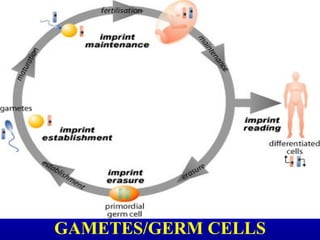
GAMETES/GERM CELLS
 The germ cells of the testis in the male and of
the ovary in the female appears early in
embryonic life.
 Sex therefore is determined from the very
earliest days but sex characters cannot be
recognized.
 At adolescence these germ cells develop along
with the changes which determine the sex
qualities and characters of the male and female.
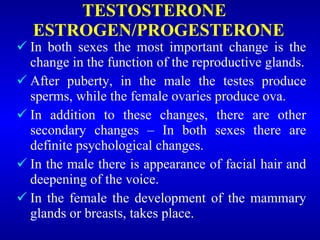
TESTOSTERONE
ESTROGEN/PROGESTERONE
 In both sexes the most important change is the
change in the function of the reproductive glands.
 After puberty, in the male the testes produce
sperms, while the female ovaries produce ova.
 In addition to these changes, there are other
secondary changes – In both sexes there are
definite psychological changes.
 In the male there is appearance of facial hair and
deepening of the voice.
 In the female the development of the mammary
glands or breasts, takes place.
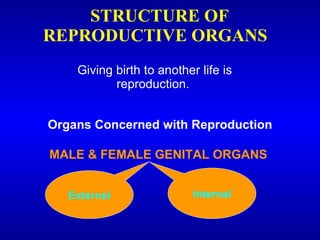
STRUCTURE OF
REPRODUCTIVE ORGANS
Giving birth to another life is
reproduction.
Organs Concerned with Reproduction
MALE & FEMALE GENITAL ORGANS
External Internal
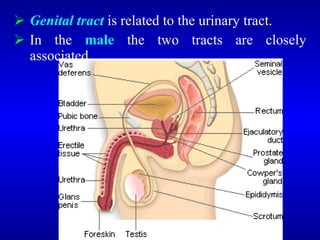
 Genital tract is related to the urinary tract.
 In the male the two tracts are closely
associated.
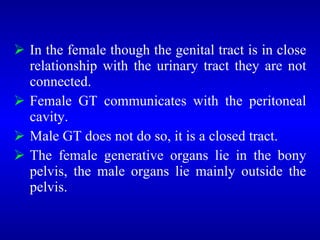
 In the female though the genital tract is in close
relationship with the urinary tract they are not
connected.
 Female GT communicates with the peritoneal
cavity.
 Male GT does not do so, it is a closed tract.
 The female generative organs lie in the bony
pelvis, the male organs lie mainly outside the
pelvis.
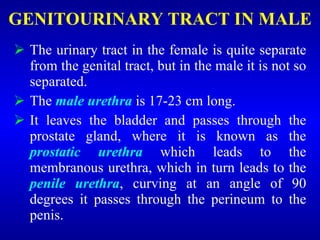
GENITOURINARY TRACT IN MALE
 The urinary tract in the female is quite separate
from the genital tract, but in the male it is not so
separated.
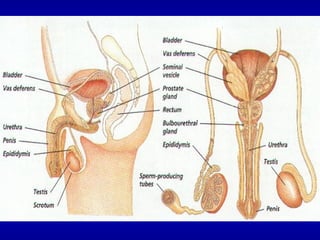
 The male urethra is 17-23 cm long.
 It leaves the bladder and passes through the
prostate gland, where it is known as the
prostatic urethra which leads to the
membranous urethra, which in turn leads to the
penile urethra, curving at an angle of 90
degrees it passes through the perineum to the
penis.
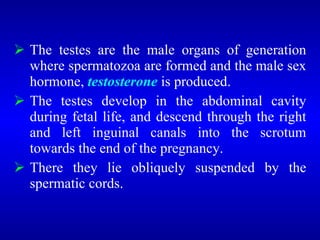
 The testes are the male organs of generation
where spermatozoa are formed and the male sex
hormone, testosterone is produced.
 The testes develop in the abdominal cavity
during fetal life, and descend through the right
and left inguinal canals into the scrotum
towards the end of the pregnancy.
 There they lie obliquely suspended by the
spermatic cords.
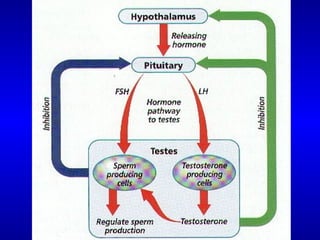
 Testosterone, the male sex hormone, is secreted
by the interstitial cells, which lie in the
interspaces between the seminiferous tubules of
the testis under the stimulation of the luteinizing
hormone (LH) of the pituitary.
 The secretion of testosterone increases
markedly at puberty and is responsible for the
development of the secondary sexual
characteristics; growth of the beard; deepening
of the voice; enlargement of the genitalia.
 The seminal vesicles are paired tubular glands
situated behind the neck of the bladder.
 Its duct joins with the vas deferentia to form the
common ejaculatory duct.
 The secretion of the seminal vesicle is an
essential component of seminal fluid.
 The epididymis is a small organ lying behind
the testis and attached to it.
 It consists of a very long narrow tube which is
extensively coiled up behind the testis.
 Through this tube the sperms pass from the
testis into the vas deferens.
 The vas deferens is a duct passing from the lower
aspect of the epididymis.
 It ascends behind the testis, enters the spermatic
cord and reaches the abdominal cavity through the
inguinal canal, and finally passes into the pelvis.
 The prostate gland is about the size of a large
walnut; it lies below the bladder, surrounding the
urethra, and is composed of glands, ducts, and
involuntary muscle.
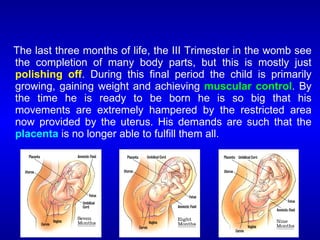
 The prostate secrets a fluid which mingles with the
secretion of the testes.
 Enlargement of the prostate obstructs the urethra
and causes retention of urine.
 The scrotum is a pouch-like structure composed
of skin devoid of subcutaneous fat; it contains a
little muscular tissue.
 The testes lie in the scrotum, each testis lying in a
covering called the tunica vaginalis, derived
from the peritoneum.
 The penis is composed of spongy tissue and is
expanded to form the glans penis at the part
where the urethra opens.
 The skin covering the penis is the prepuce or
foreskin.
 Circumcision is the removal entirely or in part of
the prepuce.
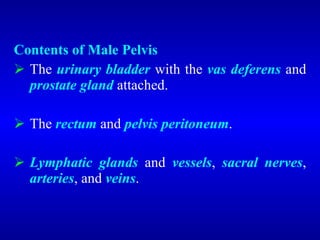
Contents of Male Pelvis
 The urinary bladder with the vas deferens and
prostate gland attached.
 The rectum and pelvis peritoneum.
 Lymphatic glands and vessels, sacral nerves,
arteries, and veins.
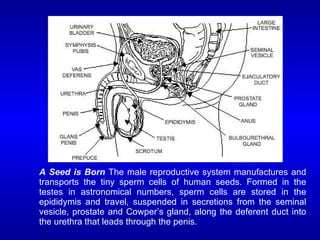
A Seed is Born The male reproductive system manufactures and
transports the tiny sperm cells of human seeds. Formed in the
testes in astronomical numbers, sperm cells are stored in the
epididymis and travel, suspended in secretions from the seminal
vesicle, prostate and Cowper’s gland, along the deferent duct into
the urethra that leads through the penis.
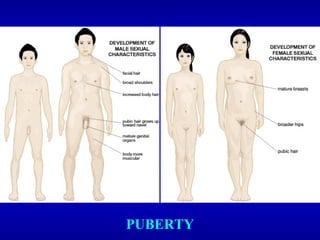
PUBERTY
 Usually appears at 10-14 years and in girls is
marked by the onset of menstruation
(menarche).
 The uterus and vagina enlarge, the breast
enlarge, with increase of fat, connective tissue
and blood vessels.
 Later the secondary sexual characteristics
appear, the curves of the body develop and
adipose tissue rounds off the contours of her
limbs, with the appearance of hair in the axilla
and pubic region.
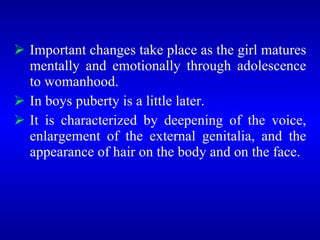
 Important changes take place as the girl matures
mentally and emotionally through adolescence
to womanhood.
 In boys puberty is a little later.
 It is characterized by deepening of the voice,
enlargement of the external genitalia, and the
appearance of hair on the body and on the face.
PUBERTY
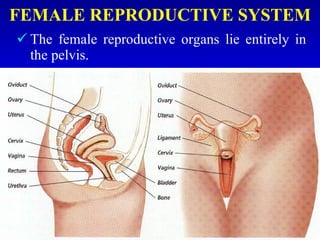
FEMALE REPRODUCTIVE SYSTEM
 The female reproductive organs lie entirely in
the pelvis.
THE FEMALE ORGANS OF
GENERATION
 The organs of generation or the reproductive
organs may be divided into the external organs
and the internal organs.
 The External Organs are collectively known
as the vulva and comprise the following parts;
 The mons veneris, a pad of fat lying in front of
the symphysis pubis. This area becomes
covered with hair at puberty.
 The labia majora are two thick folds which
form the sides of the vulva. They are composed
of skin and fat and unstriped muscular tissue,
blood vessels, and nerves. The labia majora are
about 7.5 cm (3 inch) long.
 The nymphae or labia minora are two small
folds of skin situated between the upper parts of
the labia majora. The labia contain erectile
tissue.
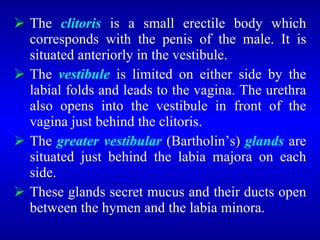
 The clitoris is a small erectile body which
corresponds with the penis of the male. It is
situated anteriorly in the vestibule.
 The vestibule is limited on either side by the
labial folds and leads to the vagina. The urethra
also opens into the vestibule in front of the
vagina just behind the clitoris.
 The greater vestibular (Bartholin’s) glands are
situated just behind the labia majora on each
side.
 These glands secret mucus and their ducts open
between the hymen and the labia minora.
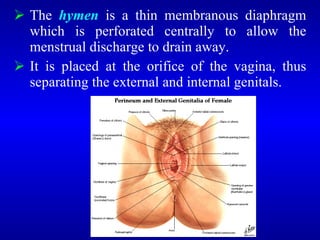
 The hymen is a thin membranous diaphragm
which is perforated centrally to allow the
menstrual discharge to drain away.
 It is placed at the orifice of the vagina, thus
separating the external and internal genitals.
VAGINA
 It is a muscular tube lined with membrane
comprised of a special type of stratified
epithelium, well supplied with blood vessels
and nerves.
 The vagina extends from the vestibule to the
uterus.
 Its walls are normally in contact.
 It surrounds the lower part of the cervix of the
uterus and rises higher behind than in front.
 The small recess in front of and at the sides of
the cervix are called the anterior and lateral
fornices and the one behind the cervix is the
posterior fornix of the vagina.
 The anterior surface of the vagina is in relation
with the base of the bladder and urethra, its
posterior wall with the rectum and the
rectovaginal pouch (of Douglas).
 The lower fourth of vagina is in contact with the
perineal body.
 Structure: The vagina consists of 3 layers –
the inner layer of mucous membrane
characterized by ridges of rugae which give it
the appearance of being covered with papillae
(the mucous membrane of the vagina is of
squamous stratified epithelial cells); the outer
layer a muscular coat of longitudinal and
circular fibres; and between these coats is
situated a layer of erectile tissue composed of
areolar tissue, blood vessels and some unstriped
muscular fibres.
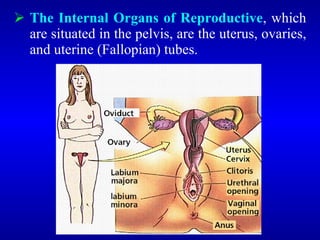
 The Internal Organs of Reproductive, which
are situated in the pelvis, are the uterus, ovaries,
and uterine (Fallopian) tubes.
PELVIC CAVITY
 Lies below and communicates with the
abdominal cavity. The true pelvis is the body
basin formed by the ischium and pubis which
make up the sides and front, and the sacrum and
coccyx which form the posterior boundary.
 The brim of the pelvis is formed by the
promontory of the sacrum at the back, the
iliopectineal lines at the sides, and the crest of
the pubis in front.
 The outlet of the pelvis is bounded by the
coccyx in the median plane behind, by the
symphysis pubis in front, and the pubic arch,
the ischium, and ligaments passing from the
ischium to the sacrum on each side.
 This outlet is filled in by the structures forming
the floor of the pelvis.
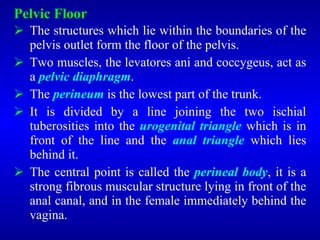
Pelvic Floor
 The structures which lie within the boundaries of the
pelvis outlet form the floor of the pelvis.
 Two muscles, the levatores ani and coccygeus, act as
a pelvic diaphragm.
 The perineum is the lowest part of the trunk.
 It is divided by a line joining the two ischial
tuberosities into the urogenital triangle which is in
front of the line and the anal triangle which lies
behind it.
 The central point is called the perineal body, it is a
strong fibrous muscular structure lying in front of the
anal canal, and in the female immediately behind the
vagina.
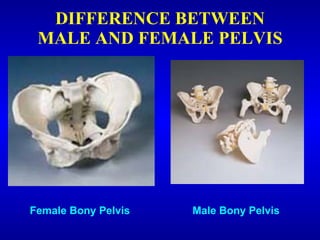
Male Bony Pelvis
Female Bony Pelvis
DIFFERENCE BETWEEN
MALE AND FEMALE PELVIS
Contents of the Pelvis
 The urinary bladder and the ureters lie behind
the symphysis pubis.
 The pelvic colon lies in the left iliac fossa; the
lowest or last part of the large intestine, lies in
the pelvic cavity.
 Rectum, lying at the back of the cavity, follows
the curve of the sacrum.
 Lymphatic vessels and glands, nerves from the
lumbosacral plexus branches of vessels from
the internal iliac artery, and numerous veins and
the pelvic peritoneum completes the contents of
the pelvic cavity in the male.
 The female pelvis also contains the uterus and
its ligaments, the uterine tubes and the ovaries.
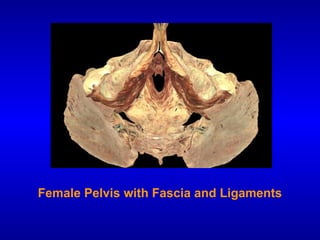
Female Pelvis with Fascia and Ligaments
THE UTERUS
 Structure: The uterus is thick, muscular, pear-
shaped organ situated in the pelvis, between the
rectum behind and the bladder in front.
 The muscle is called the myometrium, and the
mucous membrane which lines it inside is
called the endometrium.
 Peritoneum covers most of the surface of the
uterus.
 It lies slightly anteflexed at the cervix and
anteverted with the fundus lying towards the
bladder.
 It communicates below with the vagina and
above the uterine tubes open into it.
 The broad ligaments are formed by two layers
of peritoneum; ovaries and uterine tubes lie at
the sides of the uterus.
 The blood supply is from the uterine and
ovarian arteries.
 The uterus is 5-8 cm long and weighs 30-60
grams.
 It is divided into 3 parts.
 The fundus, a convex part above the openings
of the uterine tubes.
 The body of the uterus which extends from the
fundus to the cervix, from which it is separated
by the isthmus.
 The lower narrow part of the uterus is called the
cervix.
 The lumen of the cervix communicates with the
cavity of the body of the uterus, via the internal
os an with that of the vagina via the external os.
 Ligaments of the Uterus: The round
ligaments are 2 bundles, one on each side, of
connective and muscular tissue, containing
blood vessels and covered by peritoneum,
which pass from the upper angle of the uterus,
forwards and outwards through the internal ring
to the inguinal canal.
 Each round ligament is from 10-13 cm long.
 Peritoneum dips down between the body of the
uterus and the bladder in front, forming the
utero-vesicular pouch, while behind it covers
the body and cervix of the uterus and reaches
down as far as the posterior fornix of the vagina
before it passes on the the front of the rectum
forming the rectovaginal pouch (of Douglas).
 Broad Ligaments: The peritoneum which
covers the uterus in the midline of the body
extends laterally on each side of the uterus as
far as the side wall of the pelvis forming the
broad ligaments.
 In the free edge of this broad ligament are the
uterine tubes.
 The ovaries are attached to the posterior layer
of the broad ligaments which is really the
mesentery of the uterus and uterine tubes, and
for this reason it contains the uterine blood and
lymph vessels as well as those of the ovary.
 Functions of the Uterus: To retain the
fertilized ovum during development.
 An ovum, when it is released from an ovary, is
conveyed along a uterine tube to the uterus.
 The endometrium has been prepared for the
reception of the fertilized ovum, which becomes
embedded in it.
 During pregnancy, which normally lasts about
40 weeks, the uterus increases in size, its walls
become thinner but stronger and it rises out of
the pelvis into the abdominal cavity as the fetus
grows.
 When term has been reached and labor
commences, the uterus contracts rhythmically
and expels the baby and placenta, and then
returns to approximately its normal size by a
process known as involution.
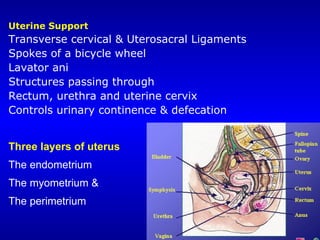
Uterine Support
Transverse cervical & Uterosacral Ligaments
Spokes of a bicycle wheel
Lavator ani
Structures passing through
Rectum, urethra and uterine cervix
Controls urinary continence & defecation
Three layers of uterus
The endometrium
The myometrium &
The perimetrium
THE OVARIES
 Structure: The ovaries are two almond-shaped
glands placed one on each side of the uterus,
below the uterine tubes, attached to the back of
the broad ligament of the uterus.
 They contain a large number of immature ova,
called primary oocytes, each one of which is
surrounded by a cluster of nutritive follicle
cells.
 At each menstrual cycle, one of these primitive
ova begins to mature and quickly develops into
a vesicular ovarian follicle (Graafian follicle).
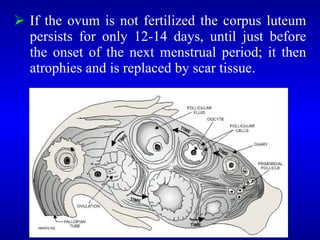
 As development of Graafian follicle proceeds,
changes take place in these cells, and fluid – the
liquor folliculi separates the cells of the membrane
granulosa into layers.
 As the Graafian follicle approaches full
development, or ripening as it is called, it lies near
the surface of the vary, gradually becoming more
and more distended with fluid, until it projects as a
cyst-like swelling from the surface of the ovary.
 Tension within the follicle causes it to rupture and
the fluid and ovum escape via the peritoneal cavity
into the funnel-shaped opening of the uterine tube.
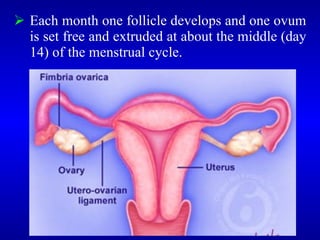
 Each month one follicle develops and one ovum
is set free and extruded at about the middle (day
14) of the menstrual cycle.
 Ovulation: Maturation of Graafian follicle and
liberation of the ovum is termed ovulation.
 When the Graafian follicle ruptures a little
bleeding occurs, a clot is formed in the cavity of
the follicle, and cells which have a yellow
appearance grow into this clot from the wall of
this follicle and form the corpus luteum or
yellow body.
 Should the escaped ovum be fertilized the
corpus luteum continues to grow for several
months, becomes quite large and begins to
atrophy at about 5-6 months.
 If the ovum is not fertilized the corpus luteum
persists for only 12-14 days, until just before
the onset of the next menstrual period; it then
atrophies and is replaced by scar tissue.
The ovary has 3 functions
2. The production of ova
3. The production of estrogens
4. The production of progesterone
}Control of
menstruation
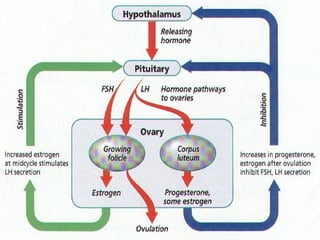
 The gonadotrophic hormones of the anterior
pituitary control the production of hormones by
the ovary itself.
 Follicle stimulating hormone [FSH] is essential
for the early development of the Graafian
follicle; and the pituitary also controls this
growth by the luteinizing hormone [LH] and the
secretion of the corpus luteum.
 Estrogens are secreted by the ovary from
childhood until after the menopause.
 They are described as follicular hormones as
they are constantly produced by numerous
ovarian follicles and like all hormones circulate
in the blood stream.
 They provide for the development of the female
sex organs and for the secondary sex
characteristics which bring about the changes in
a girl at puberty.
 Progesterone is secreted by the corpus luteum.
 It continues the work begun by the estrogens on
the endometrium and causes it to become thick,
soft, and velvety, ready for the reception of a
fertilized ovum.
 Progesterone inhibits menstruation.
 The onset of menstruation is preceded by the
degeneration of the corpus luteum which leads
to a fall in the progesterone in the blood, but
during pregnancy menstruation does not occur.
 This is because the outermost cells of the
conceptus, as they burrow down into the
endometrium, liberate a hormone which acts on
the corpus luteum and ensures the continuation
of progesterone secretion.
 The ovarian secretions are thus regulated, not
only by the pituitary but also by the chorion of
the placenta which develops from the chorion
latera on in pregnancy (8-12 wks)
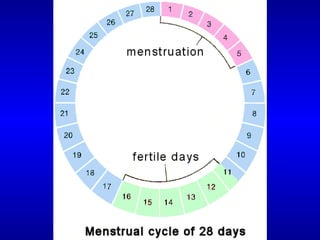
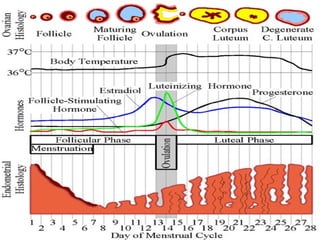
 The menstrual cycle consists of changes in
ovary and uterus.
 The menstrual period lasts about five days;
during this period the surface epithelium is
stripped off the lining of the uterus and
bleeding occurs.
 The postmenstrual period is a stage of repair
and proliferation lasting about nine days, when
the lining membrane is renewed.
 This stage is controlled by the estrogens
secreted by the ovaries, which in their turn are
regulated by the FSH from the pituitary.
 Ovulation occurs at fourteen days and thereafter
follows a further fourteen days known as the
secondary phase which is under the control of
progesterone secreted by the corpus luteum.
 The endometrium becomes thick and soft ready
for the implanting of a fertilized ovum, but if no
ovum is fertilized congestion occurs in the
capillaries ready for the menstrual period to
follow.
 The periodicity of the menstrual cycle averages
28 days, that is, 14 days in preparation for
ovulation and a further 14 days.
 The endometrium is prepared for the arrival of a
fertilized ovum, at about day 21.
 If only a non-fertilized ovum arrives in the
uterus, then by day 28 the endometrium breaks
down and menstruation occurs, and the cycle is
repeated once more.
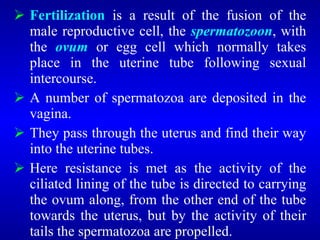
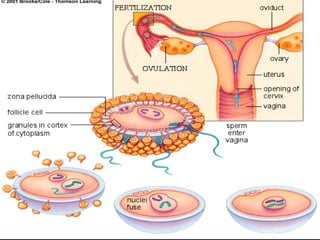
 Fertilization is a result of the fusion of the
male reproductive cell, the spermatozoon, with
the ovum or egg cell which normally takes
place in the uterine tube following sexual
intercourse.
 A number of spermatozoa are deposited in the
vagina.
 They pass through the uterus and find their way
into the uterine tubes.
 Here resistance is met as the activity of the
ciliated lining of the tube is directed to carrying
the ovum along, from the other end of the tube
towards the uterus, but by the activity of their
tails the spermatozoa are propelled.
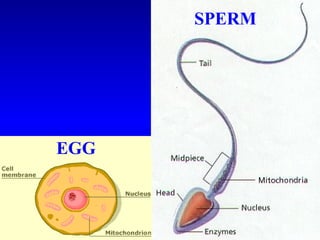
EGG
SPERM
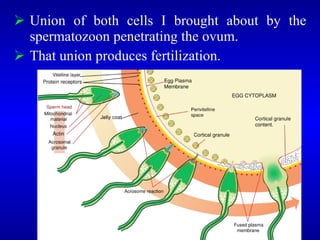
 Union of both cells I brought about by the
spermatozoon penetrating the ovum.
 That union produces fertilization.
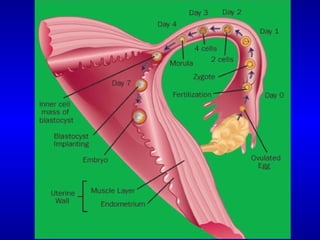
 The fertilized ovum continues its journey down
the tube towards the uterus and this takes about
a week.
 As it progresses, it is subdivided by cell
cleavage into a number of small cells but the
overall size remains constant.
 Arriving in the uterus, the outer cells of
conceptus digest away part of the endometrium,
the ovum sinks beneath the surface and
implantation is said to have occurred.
 This normally takes place on the upper part of
the body of the uterus near the opening of a
uterine tube.
 But the conceptus may implant on any part of
the endometrium and should it implant near the
cervix the placenta will lie in front of the fetus.
 It then becomes embedded in the wall of the
uterus and development, which is given rise to
formation of an entirely development, which is
giving rise to the formation of an entirely new
complete human being, continues.
 Pregnancy has occurred.
UTERINE [FALLOPIAN] TUBES
 Pass one on each side from the upper angles of the
uterus outwards, in the upper margin of the broad
ligament towards the sides of the pelvis.
 They are about 10 cm long, and at their uterine ends
are narrow.
 They then enlarge, forming the ampulla, and finally
bend downwards to end in a fimbriated margin.
 One of the fimbriae is attacked to the ovary.
 In structure the uterine tubes are covered by
peritoneum; beneath this lies the muscular coat of
longitudinal and circular fibers.
 The tubes are lined by ciliated epithelial cells.
 The uterine tubes open into the peritoneum, and
thus a passage from the vagina, through the
uterus and tubes into the peritoneal cavity, is
formed, so that in the female the peritoneum is
an open, not a closed, sac.
 The ovaries and uterine tubes are supplied with
blood by the ovarian arteries, and the nerve
supply is derived from the hypogastric and
ovarian plexuses.
 The normal function of the uterine tubes is to
convey the ovum from the ovary to the uterus.
 It also provides the sites where fertilization
occurs.
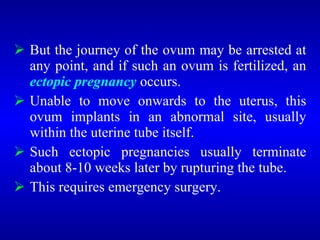
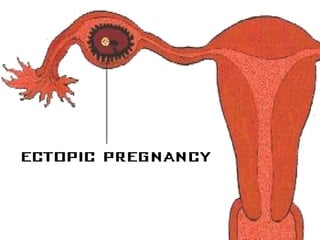
 But the journey of the ovum may be arrested at
any point, and if such an ovum is fertilized, an
ectopic pregnancy occurs.
 Unable to move onwards to the uterus, this
ovum implants in an abnormal site, usually
within the uterine tube itself.
 Such ectopic pregnancies usually terminate
about 8-10 weeks later by rupturing the tube.
 This requires emergency surgery.
THE MAMMARY GLANDS
 Are accessory to the female reproductive organs
and secret the mild.
 The breasts lie in the superficial fascia on the
pectoral region between the sternum and axilla,
and extend from about the second or third, to
the sixth or seventh ribs.
 The weight and size of the breasts vary; they
enlarge at puberty and increase in size during
pregnancy and after delivery, they atrophy in
old age.
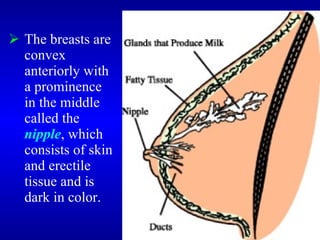
 The breasts are
convex
anteriorly with
a prominence
in the middle
called the
nipple, which
consists of skin
and erectile
tissue and is
dark in color.
 The nipple is encircled by a tinted area called
the areola.
 Near the base of the nipple are sebaceous
glands, the glands of Montgomery, which
secrete a fatty substance for keeping the nipple
supple.
 The nipple is perforated by 15-20 orifices which
are the milk ducts of the gland.
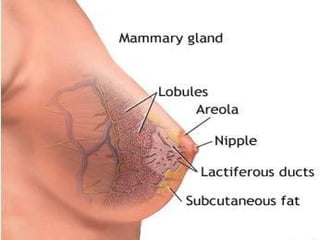
 Structure: The breast consists of mammary
gland substance or alveolar tissue arranged in
lobes separated by fibrous, connective and fatty
tissue.
 Each lobule consists of a cluster of alveoli
opening into tubules or lactiferous ducts which
unite with other ducts to form the larger ducts
and terminate in the excretory ducts.
 As the ducts approach the nipple they expand to
form reservoirs for the milk, these are called the
lactiferous sinuses; the ducts then narrow to
pass through the nipple and open on to its
surface.
 A considerable quantity of fat lies in the tissue on
the surface of the breast and also in between the
lobes.
 Lymphatics are numerous. The lymph vessels
commence as minute plexuses in the interlobular
spaces of the gland tissue, unite and form larger
vessels, which pass to the pectoral group of the
axillary glands, the internal mammary and the
supraclavicular glands
 The blood supply is derived from branches of the
axillary, intercostal and internal mammary
arteries and the nerve supply from the cutaneous
nerves of the chest.
 The Function Activity of the Breasts: At
birth the breasts often secrete milk, ‘witches
milk,’ in the male as well as in the female.
 In the female development changes occur at
puberty when there is increase in the gland
tissue.
 At the commencement of the menstrual life of a
girl slight enlargement of the breasts takes
place.
 This enlargement is due to the action of estrogens
and progesterone secreted by the ovaries, and for a
few days before each menstrual period the blood
supply is increased; in some subjects this is more
noticeable than in others and gives rise to a sense
of weight and slight congestion.
 Gradually the breasts become fully developed and
the deposit of fat in the structure results in
permanent enlargement, varying with the
individual.
 At the menopause, that is at the other end of the
menstrual life of a woman, when the ovaries
gradually cease to function the breast tissue
shrinks.
 Lactation or the secretion of milk and its
discharge from the breasts in suckling is the
function of the breast.
 This may be considered in 2 phases: (a) The
secretion of milk; (b) Its discharge from the
breast.
 There is a little secretion in the breasts from the
16 week of pregnancy which keeps the ducts
open and ready to function.
 After the birth of a baby a thin fluid, called
colostrum, which is rich in protein, is secreted
during the first 2-3 days; then free flow of milk is
established, gradually becoming mature milk.
 A hormone of the anterior lobe of the pituitary
gland prolactin is important in stimulating the
secretion of milk.
 The maintenance of this secretion is controlled by
hormones from the anterior pituitary and the
thyroid glands.
 A nursing mother needs encouragement,
especially with a first baby, to establish normal
lactation.
 This does not depend only on the suckling efforts
of the infant but also on a mechanism in the
breast which by contraction expels milk from the
alveoli into the ducts.
 Nervousness and other factors, such as doubts
about breast feeding, can influence lactation,
but with knowledge, practice and relaxation,
this relationship between mother and baby can
be happily established.
 Disorders of the Breast: during lactation a
milk duct may become obstructed when a cyst
which is called a galactocele may form.
 Infection may occur in any part of the breast,
more usually during lactation.
 The breast tissue may be the site of either
simple or malignant tumor.
 The latter is fairly common in the breast and
therefore any irregularity, swelling, or
contraction of the breast should at once be seen
by a surgeon.
 In any infection or tumor of the breast the
axillary lymphatic glands may be affected.
 Both infection and carcinoma are spread by
permeation of the surrounding structures and by
infiltration of the lymphatics.
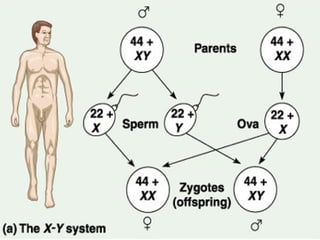
 Sex Determination depends on sex
chromosomes.
 The normal number of chromosomes in man is
44 and in addition 2 sex chromosomes, making
46; a child receives 23 chromosomes from each
parent.
 He receives 22 pairs of autosomes, which are
the ordinary chromosome as distinguished from
sex chromosomes.
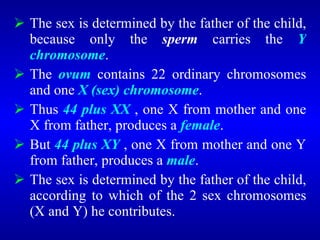
 There are 2 sex chromosomes X or Y.
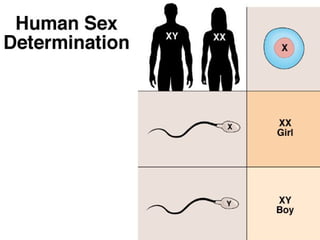
 The sex is determined by the father of the child,
because only the sperm carries the Y
chromosome.
 The ovum contains 22 ordinary chromosomes
and one X (sex) chromosome.
 Thus 44 plus XX , one X from mother and one
X from father, produces a female.
 But 44 plus XY , one X from mother and one Y
from father, produces a male.
 The sex is determined by the father of the child,
according to which of the 2 sex chromosomes
(X and Y) he contributes.
 Development of the Fetus: The term
conceptus may be employed to described
development at any stage.
 After implantation, the conceptus become
embedded in the uterine endometrium, deriving
nutrition from the maternal blood.
 It is during the first 10 weeks of this period,
when the organs are actually being
differentiated, that the embryo is more likely to
suffer injury from outside effects, such as drugs
(eg, thalidomide) or infective agents, eg, rubella
(German measles), and the child be born later
with an abnormality.
NORMAL PREGNANCY
 The first sign of pregnancy is missing a
menstrual period.
 Sexually active, missing a period for more than
1 week is presumptive evidence.
 Breast engorgement and nausea
 Engorgement is caused by increased levels of
estrogen (primarily) and progesterone
 Nausea and vomiting caused by human
chorionic gonadotropin (hCG)
 Corpus luteum in the ovary is stimulated by
hCG to continue secreting high levels of
estrogen and progesterone to maintain the
pregnancy.
 Pregnancies are usually dated in weeks, starting
from the 1st
day of the menstrual period.
 Ovulation occurred on day 14 of the cycle,
obstetric dates are about 2 weeks longer than
embryologic dates.
 Pelvic exam detects uterine enlargement.
Cervix is softer
 Bluish to purple
 Blood or urine tests are positive
 Enzyme-linked immunosorbent assay (ELISA)
for hCG
 Detects even small quantities of this hormone in
urine
 ICON, TestPack provides positive results in
about ½ hour with hCG levels as low as 50
mIU/mL of urine
 Pregnancy can be diagnosed a few days after
conception
 At 6 wks of pregnancy, the uterus can be flexed.
 12 wks, the uterus is larger than the pelvic
cavity and rises out of the true pelvis into the
abdomen and palpated above the symphysis
pubis
 20 wks, the upper pole of the uterus is at the
level of the umbilicus
 36 wks, the upper pole is near the xiphoid
process
 Fetal heart sounds – 18-20 wks
 8-10 wks with a Doppler
 Fetal movements felt after 16 wks
 280 days from the first day of the last menstrual
period, if periods are regular at 28 days
 Pregnant woman is described as a gravid
 Two confirmed pregnancies is a gravid 2
 Parity describes outcome
 Para refers to deliveries after 20 wks
 Abortus refers to losses before 20 wks
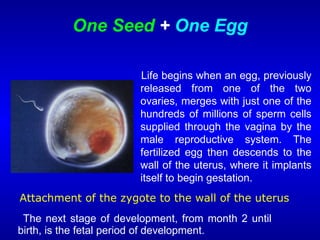
One Seed + One Egg
The next stage of development, from month 2 until
birth, is the fetal period of development.
Life begins when an egg, previously
released from one of the two
ovaries, merges with just one of the
hundreds of millions of sperm cells
supplied through the vagina by the
male reproductive system. The
fertilized egg then descends to the
wall of the uterus, where it implants
itself to begin gestation.
Attachment of the zygote to the wall of the uterus
 The embryo is enclosed within two
membranes, the inner amnion and an outer
chorion which constitute a bag of membranes
or the amniotic sac.
 This is filled with a fluid, liquor amnii, which
by exerting equal pressure in every direction,
serves to protect the fetus and also allows for
the free movement and uniform growth of the
fetus.
EMBRYO
Embryonic period of development (2 to 8 weeks post-
conception), where the zygote is now referred to as the
embryo.
As the zygote implants and becomes the embryo, the
blastocyst begins to form 2 layers:
• The inner layer of cells is called the endoderm and
eventually develops into the digestive and respiratory
systems.
• The outer layer is divided into 2 parts: the ectoderm
(outermost layer of cells) and mesoderm (middle layer;
between the endoderm and ectoderm). The ectoderm will
develop into the nervous system, sensory receptors (eyes,
ears, nose, etc.) and skin (including nails and hair), while
the mesoderm will become the bones, muscles, excretory,
circulatory and reproductive systems.
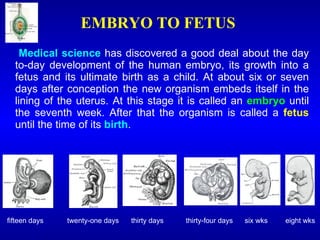
EMBRYO TO FETUS
Medical science has discovered a good deal about the day
to-day development of the human embryo, its growth into a
fetus and its ultimate birth as a child. At about six or seven
days after conception the new organism embeds itself in the
lining of the uterus. At this stage it is called an embryo until
the seventh week. After that the organism is called a fetus
until the time of its birth.
fifteen days twenty-one days thirty days thirty-four days six wks eight wks
The limbs appear as tiny buds on the
embryo when it is less than a month
old. At that time, the embryo is
completely formed, although it is less
than half an inch in length. The heart
is usually beating a few days before
the end of the first month of life. At this
time the baby is enclosed in a sort of
bag called the amniotic sac, in a
completely liquid environment. He will
remain in the sac until it breaks at
birth, or a little before, exposing the
child to the external environment.
file:///C:/Documents%20and%20Settings/shama/Desktop/Figures/06week-large.gif
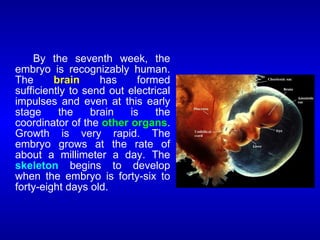
By the seventh week, the
embryo is recognizably human.
The brain has formed
sufficiently to send out electrical
impulses and even at this early
stage the brain is the
coordinator of the other organs.
Growth is very rapid. The
embryo grows at the rate of
about a millimeter a day. The
skeleton begins to develop
when the embryo is forty-six to
forty-eight days old.
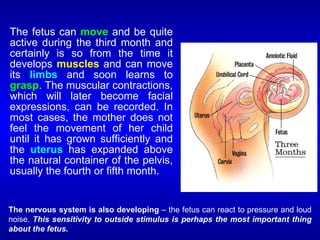
The fetus can move and be quite
active during the third month and
certainly is so from the time it
develops muscles and can move
its limbs and soon learns to
grasp. The muscular contractions,
which will later become facial
expressions, can be recorded. In
most cases, the mother does not
feel the movement of her child
until it has grown sufficiently and
the uterus has expanded above
the natural container of the pelvis,
usually the fourth or fifth month.
The nervous system is also developing – the fetus can react to pressure and loud
noise. This sensitivity to outside stimulus is perhaps the most important thing
about the fetus.
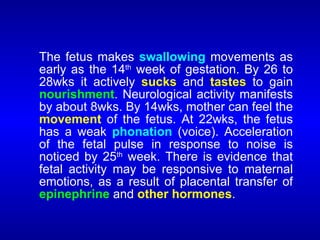
The fetus makes swallowing movements as
early as the 14th
week of gestation. By 26 to
28wks it actively sucks and tastes to gain
nourishment. Neurological activity manifests
by about 8wks. By 14wks, mother can feel the
movement of the fetus. At 22wks, the fetus
has a weak phonation (voice). Acceleration
of the fetal pulse in response to noise is
noticed by 25th
week. There is evidence that
fetal activity may be responsive to maternal
emotions, as a result of placental transfer of
epinephrine and other hormones.
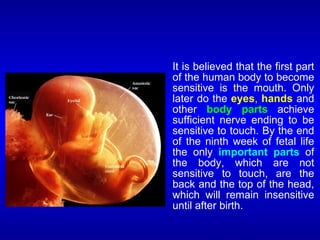
It is believed that the first part
of the human body to become
sensitive is the mouth. Only
later do the eyes, hands and
other body parts achieve
sufficient nerve ending to be
sensitive to touch. By the end
of the ninth week of fetal life
the only important parts of
the body, which are not
sensitive to touch, are the
back and the top of the head,
which will remain insensitive
until after birth.
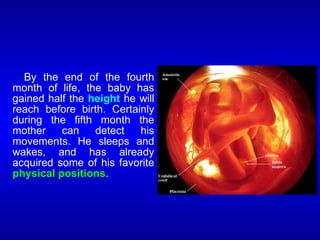
By the end of the fourth
month of life, the baby has
gained half the height he will
reach before birth. Certainly
during the fifth month the
mother can detect his
movements. He sleeps and
wakes, and has already
acquired some of his favorite
physical positions.
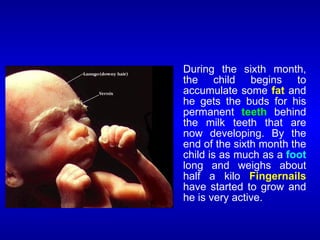
During the sixth month,
the child begins to
accumulate some fat and
he gets the buds for his
permanent teeth behind
the milk teeth that are
now developing. By the
end of the sixth month the
child is as much as a foot
long and weighs about
half a kilo Fingernails
have started to grow and
he is very active.
The last three months of life, the III Trimester in the womb see
the completion of many body parts, but this is mostly just
polishing off. During this final period the child is primarily
growing, gaining weight and achieving muscular control. By
the time he is ready to be born he is so big that his
movements are extremely hampered by the restricted area
now provided by the uterus. His demands are such that the
placenta is no longer able to fulfill them all.
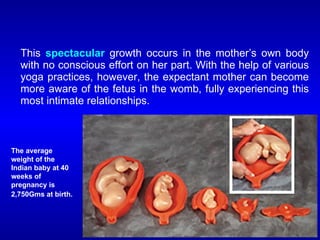
This spectacular growth occurs in the mother’s own body
with no conscious effort on her part. With the help of various
yoga practices, however, the expectant mother can become
more aware of the fetus in the womb, fully experiencing this
most intimate relationships.
The average
weight of the
Indian baby at 40
weeks of
pregnancy is
2,750Gms at birth.
organs-of-the-reproductive-systemeditedppt4000.pdf

organs-of-the-reproductive-systemeditedppt4000.pdf

  • 1.
    Dr. Shamanthakamani Narendran MD(Pead), Ph.D. (Yoga Science)
  • 2.
    INTRODUCTION  Reproduction isessential for the continuation of the species.  If any species lost the ability to reproduce, it would become extinct very soon.  All mammals, including Man reproduce by sexual means.  This involves the fusion of two gametes or germ cells.  The male produces sperm, while the egg or ovum is produced by the female.
  • 3.
  • 4.
     The germcells of the testis in the male and of the ovary in the female appears early in embryonic life.  Sex therefore is determined from the very earliest days but sex characters cannot be recognized.  At adolescence these germ cells develop along with the changes which determine the sex qualities and characters of the male and female.
  • 5.
    TESTOSTERONE ESTROGEN/PROGESTERONE  In bothsexes the most important change is the change in the function of the reproductive glands.  After puberty, in the male the testes produce sperms, while the female ovaries produce ova.  In addition to these changes, there are other secondary changes – In both sexes there are definite psychological changes.  In the male there is appearance of facial hair and deepening of the voice.  In the female the development of the mammary glands or breasts, takes place.
  • 8.
    STRUCTURE OF REPRODUCTIVE ORGANS Givingbirth to another life is reproduction. Organs Concerned with Reproduction MALE & FEMALE GENITAL ORGANS External Internal
  • 9.
     Genital tractis related to the urinary tract.  In the male the two tracts are closely associated.
  • 10.
     In thefemale though the genital tract is in close relationship with the urinary tract they are not connected.  Female GT communicates with the peritoneal cavity.  Male GT does not do so, it is a closed tract.  The female generative organs lie in the bony pelvis, the male organs lie mainly outside the pelvis.
  • 11.
    GENITOURINARY TRACT INMALE  The urinary tract in the female is quite separate from the genital tract, but in the male it is not so separated.  The male urethra is 17-23 cm long.  It leaves the bladder and passes through the prostate gland, where it is known as the prostatic urethra which leads to the membranous urethra, which in turn leads to the penile urethra, curving at an angle of 90 degrees it passes through the perineum to the penis.
  • 12.
     The testesare the male organs of generation where spermatozoa are formed and the male sex hormone, testosterone is produced.  The testes develop in the abdominal cavity during fetal life, and descend through the right and left inguinal canals into the scrotum towards the end of the pregnancy.  There they lie obliquely suspended by the spermatic cords.
  • 13.
     Testosterone, themale sex hormone, is secreted by the interstitial cells, which lie in the interspaces between the seminiferous tubules of the testis under the stimulation of the luteinizing hormone (LH) of the pituitary.  The secretion of testosterone increases markedly at puberty and is responsible for the development of the secondary sexual characteristics; growth of the beard; deepening of the voice; enlargement of the genitalia.
  • 14.
     The seminalvesicles are paired tubular glands situated behind the neck of the bladder.  Its duct joins with the vas deferentia to form the common ejaculatory duct.  The secretion of the seminal vesicle is an essential component of seminal fluid.  The epididymis is a small organ lying behind the testis and attached to it.  It consists of a very long narrow tube which is extensively coiled up behind the testis.  Through this tube the sperms pass from the testis into the vas deferens.
  • 15.
     The vasdeferens is a duct passing from the lower aspect of the epididymis.  It ascends behind the testis, enters the spermatic cord and reaches the abdominal cavity through the inguinal canal, and finally passes into the pelvis.  The prostate gland is about the size of a large walnut; it lies below the bladder, surrounding the urethra, and is composed of glands, ducts, and involuntary muscle.  The prostate secrets a fluid which mingles with the secretion of the testes.  Enlargement of the prostate obstructs the urethra and causes retention of urine.
  • 16.
     The scrotumis a pouch-like structure composed of skin devoid of subcutaneous fat; it contains a little muscular tissue.  The testes lie in the scrotum, each testis lying in a covering called the tunica vaginalis, derived from the peritoneum.  The penis is composed of spongy tissue and is expanded to form the glans penis at the part where the urethra opens.  The skin covering the penis is the prepuce or foreskin.  Circumcision is the removal entirely or in part of the prepuce.
  • 18.
    Contents of MalePelvis  The urinary bladder with the vas deferens and prostate gland attached.  The rectum and pelvis peritoneum.  Lymphatic glands and vessels, sacral nerves, arteries, and veins.
  • 19.
    A Seed isBorn The male reproductive system manufactures and transports the tiny sperm cells of human seeds. Formed in the testes in astronomical numbers, sperm cells are stored in the epididymis and travel, suspended in secretions from the seminal vesicle, prostate and Cowper’s gland, along the deferent duct into the urethra that leads through the penis.
  • 20.
    PUBERTY  Usually appearsat 10-14 years and in girls is marked by the onset of menstruation (menarche).  The uterus and vagina enlarge, the breast enlarge, with increase of fat, connective tissue and blood vessels.  Later the secondary sexual characteristics appear, the curves of the body develop and adipose tissue rounds off the contours of her limbs, with the appearance of hair in the axilla and pubic region.
  • 21.
     Important changestake place as the girl matures mentally and emotionally through adolescence to womanhood.  In boys puberty is a little later.  It is characterized by deepening of the voice, enlargement of the external genitalia, and the appearance of hair on the body and on the face.
  • 22.
  • 23.
    FEMALE REPRODUCTIVE SYSTEM The female reproductive organs lie entirely in the pelvis.
  • 24.
    THE FEMALE ORGANSOF GENERATION  The organs of generation or the reproductive organs may be divided into the external organs and the internal organs.  The External Organs are collectively known as the vulva and comprise the following parts;  The mons veneris, a pad of fat lying in front of the symphysis pubis. This area becomes covered with hair at puberty.
  • 25.
     The labiamajora are two thick folds which form the sides of the vulva. They are composed of skin and fat and unstriped muscular tissue, blood vessels, and nerves. The labia majora are about 7.5 cm (3 inch) long.  The nymphae or labia minora are two small folds of skin situated between the upper parts of the labia majora. The labia contain erectile tissue.
  • 26.
     The clitorisis a small erectile body which corresponds with the penis of the male. It is situated anteriorly in the vestibule.  The vestibule is limited on either side by the labial folds and leads to the vagina. The urethra also opens into the vestibule in front of the vagina just behind the clitoris.  The greater vestibular (Bartholin’s) glands are situated just behind the labia majora on each side.  These glands secret mucus and their ducts open between the hymen and the labia minora.
  • 27.
     The hymenis a thin membranous diaphragm which is perforated centrally to allow the menstrual discharge to drain away.  It is placed at the orifice of the vagina, thus separating the external and internal genitals.
  • 28.
    VAGINA  It isa muscular tube lined with membrane comprised of a special type of stratified epithelium, well supplied with blood vessels and nerves.  The vagina extends from the vestibule to the uterus.  Its walls are normally in contact.  It surrounds the lower part of the cervix of the uterus and rises higher behind than in front.
  • 29.
     The smallrecess in front of and at the sides of the cervix are called the anterior and lateral fornices and the one behind the cervix is the posterior fornix of the vagina.  The anterior surface of the vagina is in relation with the base of the bladder and urethra, its posterior wall with the rectum and the rectovaginal pouch (of Douglas).  The lower fourth of vagina is in contact with the perineal body.
  • 30.
     Structure: Thevagina consists of 3 layers – the inner layer of mucous membrane characterized by ridges of rugae which give it the appearance of being covered with papillae (the mucous membrane of the vagina is of squamous stratified epithelial cells); the outer layer a muscular coat of longitudinal and circular fibres; and between these coats is situated a layer of erectile tissue composed of areolar tissue, blood vessels and some unstriped muscular fibres.
  • 31.
     The InternalOrgans of Reproductive, which are situated in the pelvis, are the uterus, ovaries, and uterine (Fallopian) tubes.
  • 32.
    PELVIC CAVITY  Liesbelow and communicates with the abdominal cavity. The true pelvis is the body basin formed by the ischium and pubis which make up the sides and front, and the sacrum and coccyx which form the posterior boundary.  The brim of the pelvis is formed by the promontory of the sacrum at the back, the iliopectineal lines at the sides, and the crest of the pubis in front.
  • 33.
     The outletof the pelvis is bounded by the coccyx in the median plane behind, by the symphysis pubis in front, and the pubic arch, the ischium, and ligaments passing from the ischium to the sacrum on each side.  This outlet is filled in by the structures forming the floor of the pelvis.
  • 34.
    Pelvic Floor  Thestructures which lie within the boundaries of the pelvis outlet form the floor of the pelvis.  Two muscles, the levatores ani and coccygeus, act as a pelvic diaphragm.  The perineum is the lowest part of the trunk.  It is divided by a line joining the two ischial tuberosities into the urogenital triangle which is in front of the line and the anal triangle which lies behind it.  The central point is called the perineal body, it is a strong fibrous muscular structure lying in front of the anal canal, and in the female immediately behind the vagina.
  • 35.
    Male Bony Pelvis FemaleBony Pelvis DIFFERENCE BETWEEN MALE AND FEMALE PELVIS
  • 36.
    Contents of thePelvis  The urinary bladder and the ureters lie behind the symphysis pubis.  The pelvic colon lies in the left iliac fossa; the lowest or last part of the large intestine, lies in the pelvic cavity.  Rectum, lying at the back of the cavity, follows the curve of the sacrum.
  • 37.
     Lymphatic vesselsand glands, nerves from the lumbosacral plexus branches of vessels from the internal iliac artery, and numerous veins and the pelvic peritoneum completes the contents of the pelvic cavity in the male.  The female pelvis also contains the uterus and its ligaments, the uterine tubes and the ovaries.
  • 38.
    Female Pelvis withFascia and Ligaments
  • 39.
    THE UTERUS  Structure:The uterus is thick, muscular, pear- shaped organ situated in the pelvis, between the rectum behind and the bladder in front.  The muscle is called the myometrium, and the mucous membrane which lines it inside is called the endometrium.  Peritoneum covers most of the surface of the uterus.  It lies slightly anteflexed at the cervix and anteverted with the fundus lying towards the bladder.
  • 40.
     It communicatesbelow with the vagina and above the uterine tubes open into it.  The broad ligaments are formed by two layers of peritoneum; ovaries and uterine tubes lie at the sides of the uterus.  The blood supply is from the uterine and ovarian arteries.  The uterus is 5-8 cm long and weighs 30-60 grams.  It is divided into 3 parts.
  • 41.
     The fundus,a convex part above the openings of the uterine tubes.  The body of the uterus which extends from the fundus to the cervix, from which it is separated by the isthmus.  The lower narrow part of the uterus is called the cervix.  The lumen of the cervix communicates with the cavity of the body of the uterus, via the internal os an with that of the vagina via the external os.
  • 42.
     Ligaments ofthe Uterus: The round ligaments are 2 bundles, one on each side, of connective and muscular tissue, containing blood vessels and covered by peritoneum, which pass from the upper angle of the uterus, forwards and outwards through the internal ring to the inguinal canal.  Each round ligament is from 10-13 cm long.
  • 43.
     Peritoneum dipsdown between the body of the uterus and the bladder in front, forming the utero-vesicular pouch, while behind it covers the body and cervix of the uterus and reaches down as far as the posterior fornix of the vagina before it passes on the the front of the rectum forming the rectovaginal pouch (of Douglas).
  • 44.
     Broad Ligaments:The peritoneum which covers the uterus in the midline of the body extends laterally on each side of the uterus as far as the side wall of the pelvis forming the broad ligaments.  In the free edge of this broad ligament are the uterine tubes.  The ovaries are attached to the posterior layer of the broad ligaments which is really the mesentery of the uterus and uterine tubes, and for this reason it contains the uterine blood and lymph vessels as well as those of the ovary.
  • 45.
     Functions ofthe Uterus: To retain the fertilized ovum during development.  An ovum, when it is released from an ovary, is conveyed along a uterine tube to the uterus.  The endometrium has been prepared for the reception of the fertilized ovum, which becomes embedded in it.  During pregnancy, which normally lasts about 40 weeks, the uterus increases in size, its walls become thinner but stronger and it rises out of the pelvis into the abdominal cavity as the fetus grows.
  • 46.
     When termhas been reached and labor commences, the uterus contracts rhythmically and expels the baby and placenta, and then returns to approximately its normal size by a process known as involution.
  • 47.
    Uterine Support Transverse cervical& Uterosacral Ligaments Spokes of a bicycle wheel Lavator ani Structures passing through Rectum, urethra and uterine cervix Controls urinary continence & defecation Three layers of uterus The endometrium The myometrium & The perimetrium
  • 48.
    THE OVARIES  Structure:The ovaries are two almond-shaped glands placed one on each side of the uterus, below the uterine tubes, attached to the back of the broad ligament of the uterus.  They contain a large number of immature ova, called primary oocytes, each one of which is surrounded by a cluster of nutritive follicle cells.  At each menstrual cycle, one of these primitive ova begins to mature and quickly develops into a vesicular ovarian follicle (Graafian follicle).
  • 49.
     As developmentof Graafian follicle proceeds, changes take place in these cells, and fluid – the liquor folliculi separates the cells of the membrane granulosa into layers.  As the Graafian follicle approaches full development, or ripening as it is called, it lies near the surface of the vary, gradually becoming more and more distended with fluid, until it projects as a cyst-like swelling from the surface of the ovary.  Tension within the follicle causes it to rupture and the fluid and ovum escape via the peritoneal cavity into the funnel-shaped opening of the uterine tube.
  • 50.
     Each monthone follicle develops and one ovum is set free and extruded at about the middle (day 14) of the menstrual cycle.
  • 51.
     Ovulation: Maturationof Graafian follicle and liberation of the ovum is termed ovulation.  When the Graafian follicle ruptures a little bleeding occurs, a clot is formed in the cavity of the follicle, and cells which have a yellow appearance grow into this clot from the wall of this follicle and form the corpus luteum or yellow body.  Should the escaped ovum be fertilized the corpus luteum continues to grow for several months, becomes quite large and begins to atrophy at about 5-6 months.
  • 52.
     If theovum is not fertilized the corpus luteum persists for only 12-14 days, until just before the onset of the next menstrual period; it then atrophies and is replaced by scar tissue.
  • 53.
    The ovary has3 functions 2. The production of ova 3. The production of estrogens 4. The production of progesterone }Control of menstruation  The gonadotrophic hormones of the anterior pituitary control the production of hormones by the ovary itself.  Follicle stimulating hormone [FSH] is essential for the early development of the Graafian follicle; and the pituitary also controls this growth by the luteinizing hormone [LH] and the secretion of the corpus luteum.
  • 54.
     Estrogens aresecreted by the ovary from childhood until after the menopause.  They are described as follicular hormones as they are constantly produced by numerous ovarian follicles and like all hormones circulate in the blood stream.  They provide for the development of the female sex organs and for the secondary sex characteristics which bring about the changes in a girl at puberty.
  • 55.
     Progesterone issecreted by the corpus luteum.  It continues the work begun by the estrogens on the endometrium and causes it to become thick, soft, and velvety, ready for the reception of a fertilized ovum.  Progesterone inhibits menstruation.
  • 56.
     The onsetof menstruation is preceded by the degeneration of the corpus luteum which leads to a fall in the progesterone in the blood, but during pregnancy menstruation does not occur.  This is because the outermost cells of the conceptus, as they burrow down into the endometrium, liberate a hormone which acts on the corpus luteum and ensures the continuation of progesterone secretion.  The ovarian secretions are thus regulated, not only by the pituitary but also by the chorion of the placenta which develops from the chorion latera on in pregnancy (8-12 wks)
  • 57.
     The menstrualcycle consists of changes in ovary and uterus.  The menstrual period lasts about five days; during this period the surface epithelium is stripped off the lining of the uterus and bleeding occurs.  The postmenstrual period is a stage of repair and proliferation lasting about nine days, when the lining membrane is renewed.  This stage is controlled by the estrogens secreted by the ovaries, which in their turn are regulated by the FSH from the pituitary.
  • 59.
     Ovulation occursat fourteen days and thereafter follows a further fourteen days known as the secondary phase which is under the control of progesterone secreted by the corpus luteum.  The endometrium becomes thick and soft ready for the implanting of a fertilized ovum, but if no ovum is fertilized congestion occurs in the capillaries ready for the menstrual period to follow.
  • 60.
     The periodicityof the menstrual cycle averages 28 days, that is, 14 days in preparation for ovulation and a further 14 days.  The endometrium is prepared for the arrival of a fertilized ovum, at about day 21.  If only a non-fertilized ovum arrives in the uterus, then by day 28 the endometrium breaks down and menstruation occurs, and the cycle is repeated once more.
  • 62.
     Fertilization isa result of the fusion of the male reproductive cell, the spermatozoon, with the ovum or egg cell which normally takes place in the uterine tube following sexual intercourse.  A number of spermatozoa are deposited in the vagina.  They pass through the uterus and find their way into the uterine tubes.  Here resistance is met as the activity of the ciliated lining of the tube is directed to carrying the ovum along, from the other end of the tube towards the uterus, but by the activity of their tails the spermatozoa are propelled.
  • 63.
  • 64.
     Union ofboth cells I brought about by the spermatozoon penetrating the ovum.  That union produces fertilization.
  • 66.
     The fertilizedovum continues its journey down the tube towards the uterus and this takes about a week.  As it progresses, it is subdivided by cell cleavage into a number of small cells but the overall size remains constant.  Arriving in the uterus, the outer cells of conceptus digest away part of the endometrium, the ovum sinks beneath the surface and implantation is said to have occurred.  This normally takes place on the upper part of the body of the uterus near the opening of a uterine tube.
  • 67.
     But theconceptus may implant on any part of the endometrium and should it implant near the cervix the placenta will lie in front of the fetus.  It then becomes embedded in the wall of the uterus and development, which is given rise to formation of an entirely development, which is giving rise to the formation of an entirely new complete human being, continues.  Pregnancy has occurred.
  • 68.
    UTERINE [FALLOPIAN] TUBES Pass one on each side from the upper angles of the uterus outwards, in the upper margin of the broad ligament towards the sides of the pelvis.  They are about 10 cm long, and at their uterine ends are narrow.  They then enlarge, forming the ampulla, and finally bend downwards to end in a fimbriated margin.  One of the fimbriae is attacked to the ovary.  In structure the uterine tubes are covered by peritoneum; beneath this lies the muscular coat of longitudinal and circular fibers.  The tubes are lined by ciliated epithelial cells.
  • 70.
     The uterinetubes open into the peritoneum, and thus a passage from the vagina, through the uterus and tubes into the peritoneal cavity, is formed, so that in the female the peritoneum is an open, not a closed, sac.  The ovaries and uterine tubes are supplied with blood by the ovarian arteries, and the nerve supply is derived from the hypogastric and ovarian plexuses.  The normal function of the uterine tubes is to convey the ovum from the ovary to the uterus.  It also provides the sites where fertilization occurs.
  • 71.
     But thejourney of the ovum may be arrested at any point, and if such an ovum is fertilized, an ectopic pregnancy occurs.  Unable to move onwards to the uterus, this ovum implants in an abnormal site, usually within the uterine tube itself.  Such ectopic pregnancies usually terminate about 8-10 weeks later by rupturing the tube.  This requires emergency surgery.
  • 73.
    THE MAMMARY GLANDS Are accessory to the female reproductive organs and secret the mild.  The breasts lie in the superficial fascia on the pectoral region between the sternum and axilla, and extend from about the second or third, to the sixth or seventh ribs.  The weight and size of the breasts vary; they enlarge at puberty and increase in size during pregnancy and after delivery, they atrophy in old age.
  • 74.
     The breastsare convex anteriorly with a prominence in the middle called the nipple, which consists of skin and erectile tissue and is dark in color.
  • 75.
     The nippleis encircled by a tinted area called the areola.  Near the base of the nipple are sebaceous glands, the glands of Montgomery, which secrete a fatty substance for keeping the nipple supple.  The nipple is perforated by 15-20 orifices which are the milk ducts of the gland.
  • 76.
     Structure: Thebreast consists of mammary gland substance or alveolar tissue arranged in lobes separated by fibrous, connective and fatty tissue.  Each lobule consists of a cluster of alveoli opening into tubules or lactiferous ducts which unite with other ducts to form the larger ducts and terminate in the excretory ducts.  As the ducts approach the nipple they expand to form reservoirs for the milk, these are called the lactiferous sinuses; the ducts then narrow to pass through the nipple and open on to its surface.
  • 77.
     A considerablequantity of fat lies in the tissue on the surface of the breast and also in between the lobes.  Lymphatics are numerous. The lymph vessels commence as minute plexuses in the interlobular spaces of the gland tissue, unite and form larger vessels, which pass to the pectoral group of the axillary glands, the internal mammary and the supraclavicular glands  The blood supply is derived from branches of the axillary, intercostal and internal mammary arteries and the nerve supply from the cutaneous nerves of the chest.
  • 78.
     The FunctionActivity of the Breasts: At birth the breasts often secrete milk, ‘witches milk,’ in the male as well as in the female.  In the female development changes occur at puberty when there is increase in the gland tissue.  At the commencement of the menstrual life of a girl slight enlargement of the breasts takes place.
  • 79.
     This enlargementis due to the action of estrogens and progesterone secreted by the ovaries, and for a few days before each menstrual period the blood supply is increased; in some subjects this is more noticeable than in others and gives rise to a sense of weight and slight congestion.  Gradually the breasts become fully developed and the deposit of fat in the structure results in permanent enlargement, varying with the individual.  At the menopause, that is at the other end of the menstrual life of a woman, when the ovaries gradually cease to function the breast tissue shrinks.
  • 80.
     Lactation orthe secretion of milk and its discharge from the breasts in suckling is the function of the breast.  This may be considered in 2 phases: (a) The secretion of milk; (b) Its discharge from the breast.  There is a little secretion in the breasts from the 16 week of pregnancy which keeps the ducts open and ready to function.  After the birth of a baby a thin fluid, called colostrum, which is rich in protein, is secreted during the first 2-3 days; then free flow of milk is established, gradually becoming mature milk.
  • 81.
     A hormoneof the anterior lobe of the pituitary gland prolactin is important in stimulating the secretion of milk.  The maintenance of this secretion is controlled by hormones from the anterior pituitary and the thyroid glands.  A nursing mother needs encouragement, especially with a first baby, to establish normal lactation.  This does not depend only on the suckling efforts of the infant but also on a mechanism in the breast which by contraction expels milk from the alveoli into the ducts.
  • 82.
     Nervousness andother factors, such as doubts about breast feeding, can influence lactation, but with knowledge, practice and relaxation, this relationship between mother and baby can be happily established.  Disorders of the Breast: during lactation a milk duct may become obstructed when a cyst which is called a galactocele may form.  Infection may occur in any part of the breast, more usually during lactation.
  • 83.
     The breasttissue may be the site of either simple or malignant tumor.  The latter is fairly common in the breast and therefore any irregularity, swelling, or contraction of the breast should at once be seen by a surgeon.  In any infection or tumor of the breast the axillary lymphatic glands may be affected.  Both infection and carcinoma are spread by permeation of the surrounding structures and by infiltration of the lymphatics.
  • 85.
     Sex Determinationdepends on sex chromosomes.  The normal number of chromosomes in man is 44 and in addition 2 sex chromosomes, making 46; a child receives 23 chromosomes from each parent.  He receives 22 pairs of autosomes, which are the ordinary chromosome as distinguished from sex chromosomes.  There are 2 sex chromosomes X or Y.
  • 87.
     The sexis determined by the father of the child, because only the sperm carries the Y chromosome.  The ovum contains 22 ordinary chromosomes and one X (sex) chromosome.  Thus 44 plus XX , one X from mother and one X from father, produces a female.  But 44 plus XY , one X from mother and one Y from father, produces a male.  The sex is determined by the father of the child, according to which of the 2 sex chromosomes (X and Y) he contributes.
  • 89.
     Development ofthe Fetus: The term conceptus may be employed to described development at any stage.  After implantation, the conceptus become embedded in the uterine endometrium, deriving nutrition from the maternal blood.  It is during the first 10 weeks of this period, when the organs are actually being differentiated, that the embryo is more likely to suffer injury from outside effects, such as drugs (eg, thalidomide) or infective agents, eg, rubella (German measles), and the child be born later with an abnormality.
  • 90.
    NORMAL PREGNANCY  Thefirst sign of pregnancy is missing a menstrual period.  Sexually active, missing a period for more than 1 week is presumptive evidence.  Breast engorgement and nausea  Engorgement is caused by increased levels of estrogen (primarily) and progesterone  Nausea and vomiting caused by human chorionic gonadotropin (hCG)
  • 91.
     Corpus luteumin the ovary is stimulated by hCG to continue secreting high levels of estrogen and progesterone to maintain the pregnancy.  Pregnancies are usually dated in weeks, starting from the 1st day of the menstrual period.  Ovulation occurred on day 14 of the cycle, obstetric dates are about 2 weeks longer than embryologic dates.  Pelvic exam detects uterine enlargement. Cervix is softer
  • 92.
     Bluish topurple  Blood or urine tests are positive  Enzyme-linked immunosorbent assay (ELISA) for hCG  Detects even small quantities of this hormone in urine  ICON, TestPack provides positive results in about ½ hour with hCG levels as low as 50 mIU/mL of urine  Pregnancy can be diagnosed a few days after conception
  • 93.
     At 6wks of pregnancy, the uterus can be flexed.  12 wks, the uterus is larger than the pelvic cavity and rises out of the true pelvis into the abdomen and palpated above the symphysis pubis  20 wks, the upper pole of the uterus is at the level of the umbilicus  36 wks, the upper pole is near the xiphoid process
  • 94.
     Fetal heartsounds – 18-20 wks  8-10 wks with a Doppler  Fetal movements felt after 16 wks  280 days from the first day of the last menstrual period, if periods are regular at 28 days
  • 95.
     Pregnant womanis described as a gravid  Two confirmed pregnancies is a gravid 2  Parity describes outcome  Para refers to deliveries after 20 wks  Abortus refers to losses before 20 wks
  • 96.
    One Seed +One Egg The next stage of development, from month 2 until birth, is the fetal period of development. Life begins when an egg, previously released from one of the two ovaries, merges with just one of the hundreds of millions of sperm cells supplied through the vagina by the male reproductive system. The fertilized egg then descends to the wall of the uterus, where it implants itself to begin gestation. Attachment of the zygote to the wall of the uterus
  • 97.
     The embryois enclosed within two membranes, the inner amnion and an outer chorion which constitute a bag of membranes or the amniotic sac.  This is filled with a fluid, liquor amnii, which by exerting equal pressure in every direction, serves to protect the fetus and also allows for the free movement and uniform growth of the fetus.
  • 98.
    EMBRYO Embryonic period ofdevelopment (2 to 8 weeks post- conception), where the zygote is now referred to as the embryo. As the zygote implants and becomes the embryo, the blastocyst begins to form 2 layers: • The inner layer of cells is called the endoderm and eventually develops into the digestive and respiratory systems. • The outer layer is divided into 2 parts: the ectoderm (outermost layer of cells) and mesoderm (middle layer; between the endoderm and ectoderm). The ectoderm will develop into the nervous system, sensory receptors (eyes, ears, nose, etc.) and skin (including nails and hair), while the mesoderm will become the bones, muscles, excretory, circulatory and reproductive systems.
  • 99.
    EMBRYO TO FETUS Medicalscience has discovered a good deal about the day to-day development of the human embryo, its growth into a fetus and its ultimate birth as a child. At about six or seven days after conception the new organism embeds itself in the lining of the uterus. At this stage it is called an embryo until the seventh week. After that the organism is called a fetus until the time of its birth. fifteen days twenty-one days thirty days thirty-four days six wks eight wks
  • 100.
    The limbs appearas tiny buds on the embryo when it is less than a month old. At that time, the embryo is completely formed, although it is less than half an inch in length. The heart is usually beating a few days before the end of the first month of life. At this time the baby is enclosed in a sort of bag called the amniotic sac, in a completely liquid environment. He will remain in the sac until it breaks at birth, or a little before, exposing the child to the external environment. file:///C:/Documents%20and%20Settings/shama/Desktop/Figures/06week-large.gif
  • 101.
    By the seventhweek, the embryo is recognizably human. The brain has formed sufficiently to send out electrical impulses and even at this early stage the brain is the coordinator of the other organs. Growth is very rapid. The embryo grows at the rate of about a millimeter a day. The skeleton begins to develop when the embryo is forty-six to forty-eight days old.
  • 102.
    The fetus canmove and be quite active during the third month and certainly is so from the time it develops muscles and can move its limbs and soon learns to grasp. The muscular contractions, which will later become facial expressions, can be recorded. In most cases, the mother does not feel the movement of her child until it has grown sufficiently and the uterus has expanded above the natural container of the pelvis, usually the fourth or fifth month. The nervous system is also developing – the fetus can react to pressure and loud noise. This sensitivity to outside stimulus is perhaps the most important thing about the fetus.
  • 103.
    The fetus makesswallowing movements as early as the 14th week of gestation. By 26 to 28wks it actively sucks and tastes to gain nourishment. Neurological activity manifests by about 8wks. By 14wks, mother can feel the movement of the fetus. At 22wks, the fetus has a weak phonation (voice). Acceleration of the fetal pulse in response to noise is noticed by 25th week. There is evidence that fetal activity may be responsive to maternal emotions, as a result of placental transfer of epinephrine and other hormones.
  • 104.
    It is believedthat the first part of the human body to become sensitive is the mouth. Only later do the eyes, hands and other body parts achieve sufficient nerve ending to be sensitive to touch. By the end of the ninth week of fetal life the only important parts of the body, which are not sensitive to touch, are the back and the top of the head, which will remain insensitive until after birth.
  • 105.
    By the endof the fourth month of life, the baby has gained half the height he will reach before birth. Certainly during the fifth month the mother can detect his movements. He sleeps and wakes, and has already acquired some of his favorite physical positions.
  • 106.
    During the sixthmonth, the child begins to accumulate some fat and he gets the buds for his permanent teeth behind the milk teeth that are now developing. By the end of the sixth month the child is as much as a foot long and weighs about half a kilo Fingernails have started to grow and he is very active.
  • 107.
    The last threemonths of life, the III Trimester in the womb see the completion of many body parts, but this is mostly just polishing off. During this final period the child is primarily growing, gaining weight and achieving muscular control. By the time he is ready to be born he is so big that his movements are extremely hampered by the restricted area now provided by the uterus. His demands are such that the placenta is no longer able to fulfill them all.
  • 108.
    This spectacular growthoccurs in the mother’s own body with no conscious effort on her part. With the help of various yoga practices, however, the expectant mother can become more aware of the fetus in the womb, fully experiencing this most intimate relationships. The average weight of the Indian baby at 40 weeks of pregnancy is 2,750Gms at birth.