1
Franck Michel
A Mapping-based Method to Query
MongoDB Documents with SPARQL
F. Michel, C. Faron-Zucker, J. Montagnat
Université Côte d’Azur, CNRS, Inria, I3S, France
2
Franck Michel
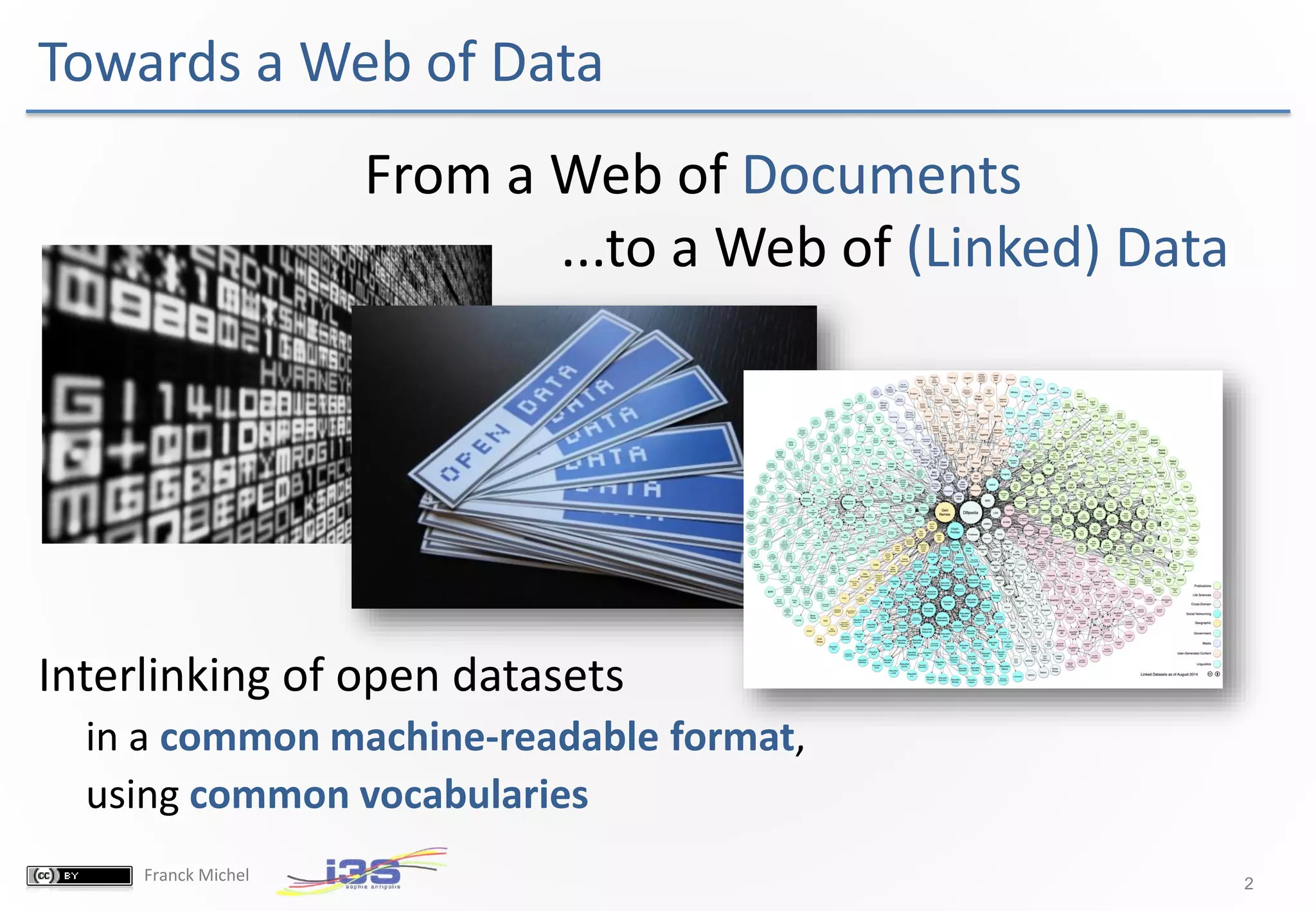
Towards a Web of Data
From a Web of Documents
...to a Web of (Linked) Data
Interlinking of open datasets
in a common machine-readable format,
using common vocabularies
3
Franck Michel
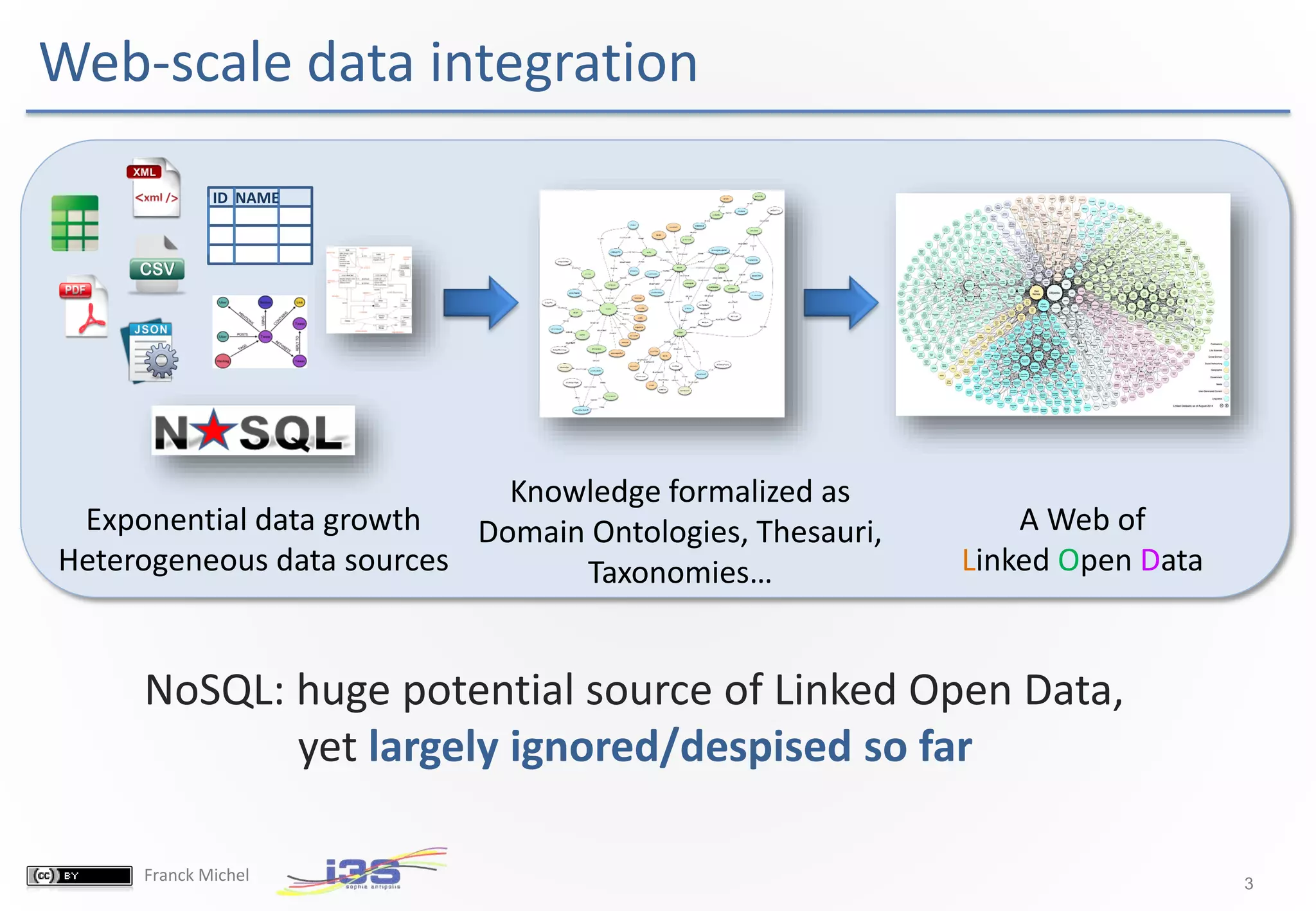
Web-scale data integration
Exponential data growth
Heterogeneous data sources
Knowledge formalized as
Domain Ontologies, Thesauri,
Taxonomies…
A Web of
Linked Open Data
NoSQL: huge potential source of Linked Open Data,
yet largely ignored/despised so far
ID NAME
4
Franck Michel
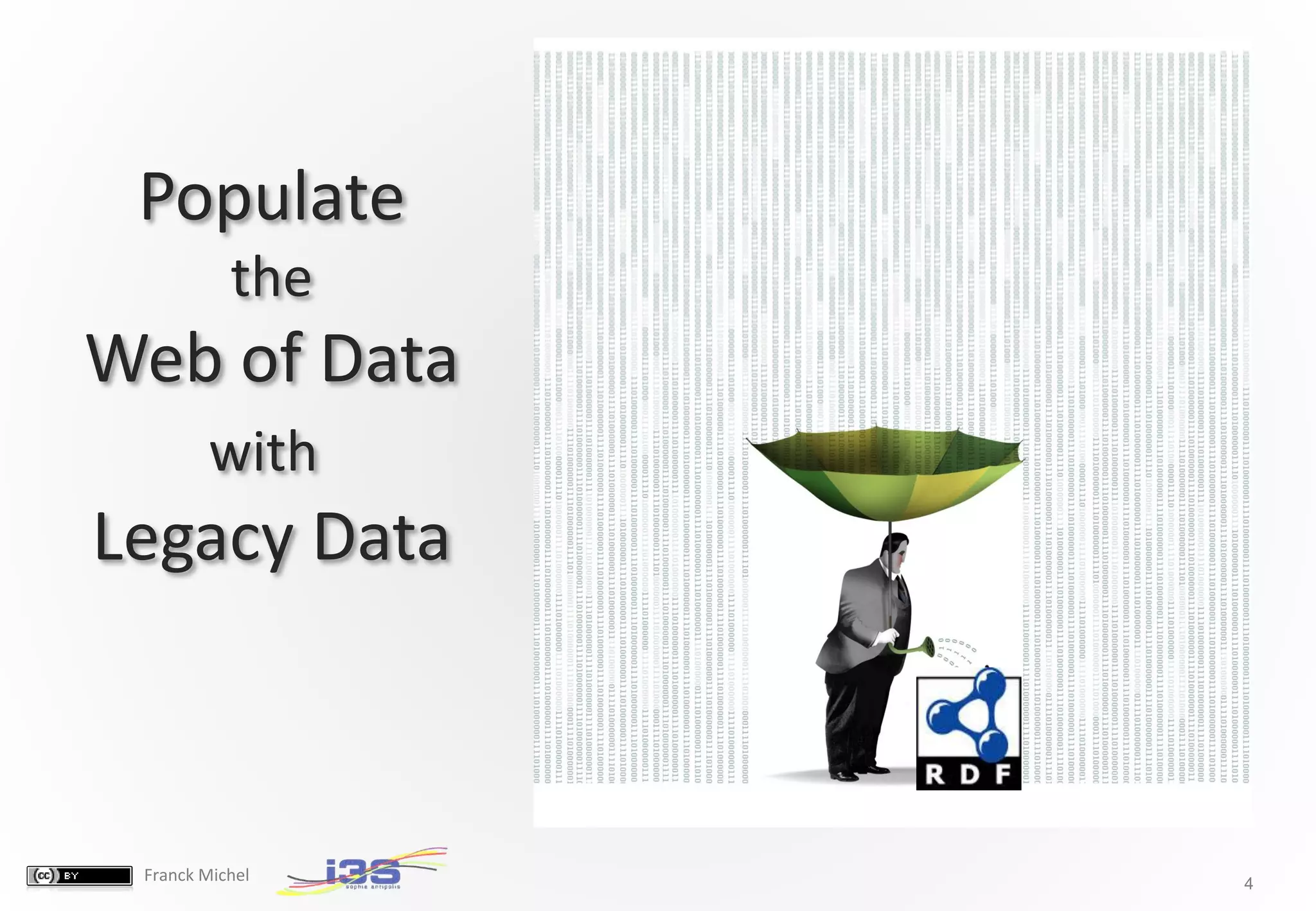
Populate
the
Web of Data
with
Legacy Data
5
Franck Michel
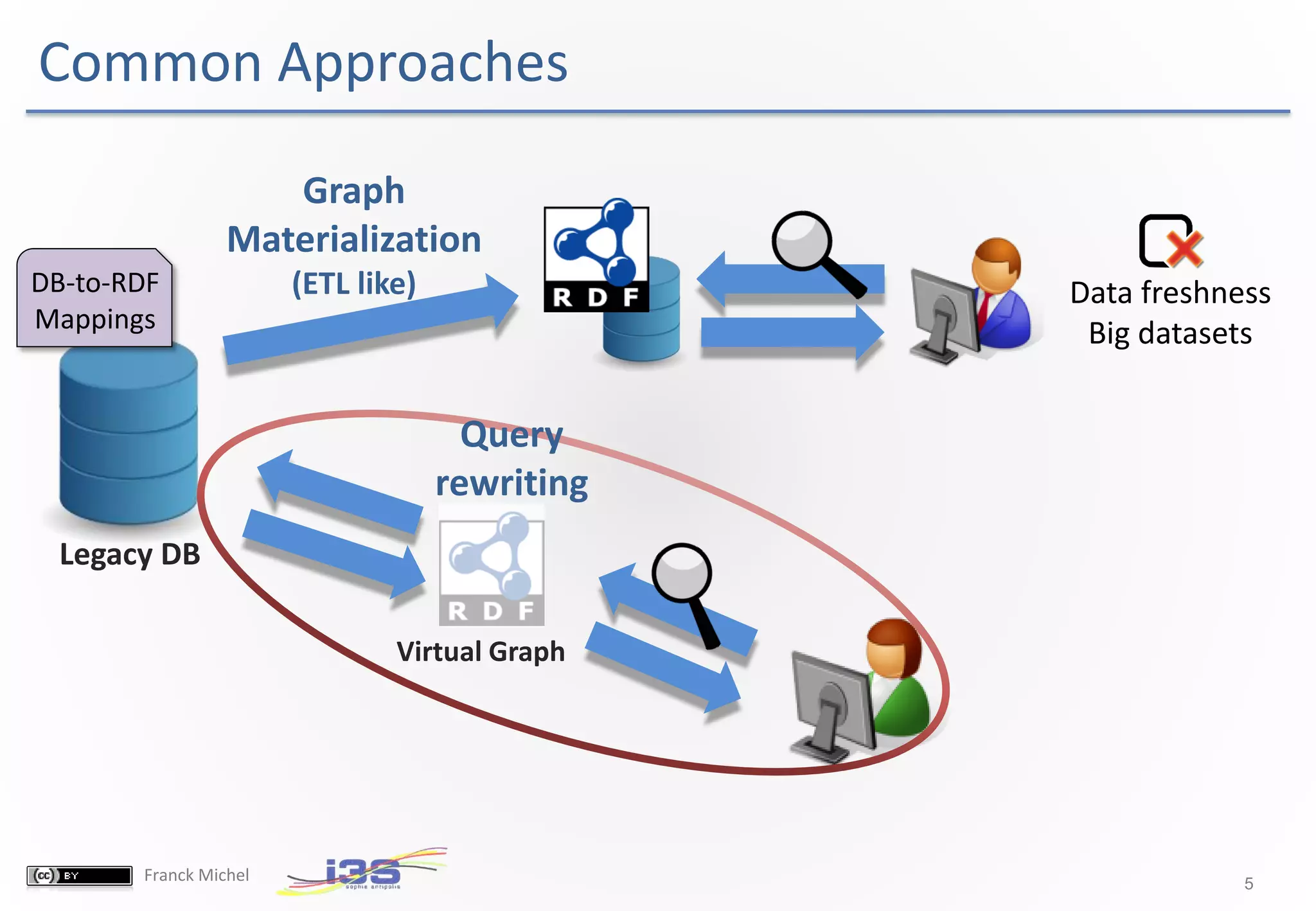
Common Approaches
Legacy DB
Graph
Materialization
(ETL like)
Virtual Graph
Data freshness
Big datasets
DB-to-RDF
Mappings
Query
rewriting
6
Franck Michel
SPARQL Access to Heterogeneous DBs
Previous SPARQL rewritings closely coupled with the
target QL expressiveness (SQL, XQuery):
• Support of joins, unions, nested queries, filtering, string fctn, etc.
• Semantics-preserving 1-to-1 rewriting
How not to define yet another
rewriting method for each DB?
Two-step approach to deal with the general case [3]:
1. Translate SPARQL into a pivot Abstract Query Language (AQL)
under DB-to-RDF mappings, with no assumption on the target DB capabilities
2. Translate from the AQL to the QL of the target database
7
Franck Michel
Agenda
Previous episodes
Generalized mapping language: xR2RML
SPARQL-to-AQL Rewriting
AQL-to-MongoDB Rewriting
Conclusions & Perspectives
8
Franck Michel
Agenda
Previous episodes
Generalized mapping language: xR2RML
SPARQL-to-AQL Rewriting
AQL-to-MongoDB Rewriting
Conclusions & Perspectives
9
Franck Michel
The xR2RML mapping language [1]
 Extends W3C R2RML and RML
 Describe mappings from various types of DB to RDF
• Query the target database
• Pick data elements from query results
• Translate them to (subject, predicate, object) using arbitrary ontologies
 Independent of any target database
• Allow any query language
• Allow any syntax to reference data elements within query results
(column name, JSONPath, XPath, attribute name...)
10
Franck Michel
The xR2RML mapping language: example
<http://example.org/member/106> foaf:mbox "john@foo.com".
<http://example.org/member/106> foaf:mbox "john@example.org".
<#Mbox> a rr:TriplesMap;
xrr:logicalSource [ xrr:query "db.people.find({'emails':{$ne: null}})" ];
rr:subjectMap [ rr:template "http://example.org/member/{$.id}" ];
rr:predicateObjectMap [
rr:predicate foaf:mbox;
rr:objectMap [ xrr:reference "$.emails.*" ].
xR2RML
{
"id": 106, "firstname": "John",
"emails": ["john@foo.com", "john@example.org"]
}
11
Franck Michel
Graph Pattern
SPARQL-to-AQL rewriting [3]
Basic Graph Pattern
SELECT ?mbox WHERE {
?x foaf:mbox "john@foo.com".
?x foaf:mbox ?mbox.
FILTER { ?mbox != "john@foo.com"}
}
Triple Pattern
Rewrite a well-designed SPARQL graph pattern
into an optimized Abstract Query, under a set of
xR2RML mappings.
In turn, it should be possible to translate the
Abstract Query into “any” target database QL.
12
Franck Michel
SPARQL-to-AQL rewriting in one slide!
SELECT ?mbox WHERE {
?x foaf:mbox "john@foo.com".
?x foaf:mbox ?mbox.
FILTER { ?mbox != "john@foo.com" }
}
{ From: { "db.people.find({'emails':{$ne:null}})" },
Project: { $.id AS ?x },
Where: { isNotNull($.id), equals($.emails.*, "john@foo.com")}}
INNER JOIN
{ From: { "db.people.find({'emails':{$ne: null}})" },
Project: { $.id AS ?x , $.emails.* AS ?mbox },
Where: { isNotNull($.id), isNotNull($.emails.*), sparqlFilter(?mbox != "john@foo.com")}}
ON { ?x } Abstract Query
<#Mbox> a rr:TriplesMap;
xrr:logicalSource [ xrr:query "db.people.find({'emails':{$ne: null}})" ];
rr:subjectMap [ rr:template "http://example.org/member/{$.id}" ];
rr:predicateObjectMap [
rr:predicate foaf:mbox;
rr:objectMap [ xrr:reference "$.emails.*" ].
xR2RML mapping
Self-join
13
Franck Michel
Agenda
Previous episodes
Generalized mapping language: xR2RML
SPARQL-to-AQL Rewriting
AQL-to-MongoDB Rewriting
Conclusions & Perspectives
14
Franck Michel
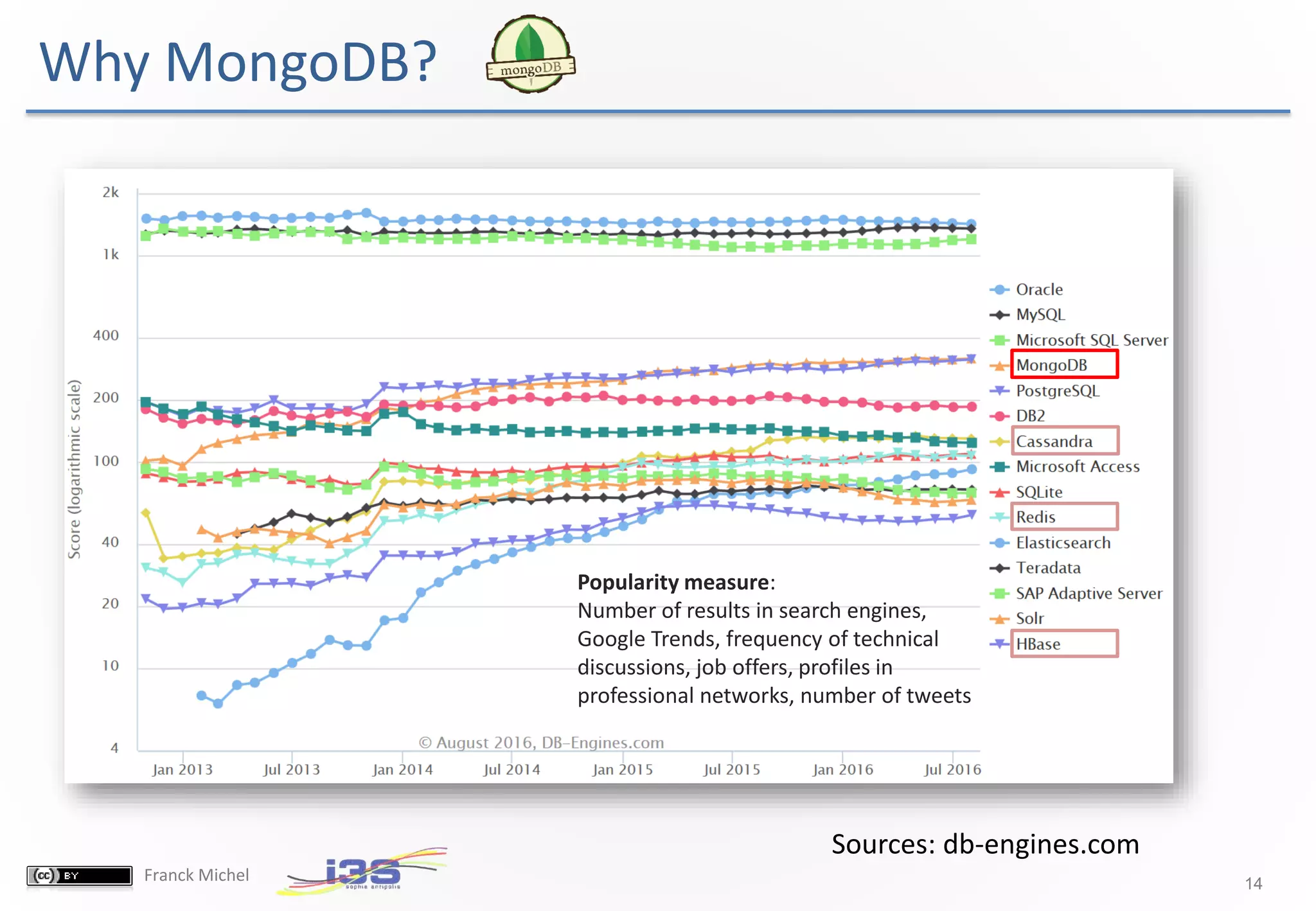
Why MongoDB?
Sources: db-engines.com
Popularity measure:
Number of results in search engines,
Google Trends, frequency of technical
discussions, job offers, profiles in
professional networks, number of tweets
15
Franck Michel
Why MongoDB?
 MongoDB: very popular NoSQL database today
 (Probably) increasingly adopted as a general-purpose DB
• Long tail of scientific data?
 Non-tabular format
• E.g. with Cassandra, a regular SQL-to-RDF would “almost” do the job
A good candidate to experiment what
it takes to publish NoSQL data into
the Web of Linked Open Data
16
Franck Michel
MongoDB Query Language
 Find queries
Declarative retrieval of doc. matching criteria
db.people.find({"age":{$gt: 30}}, {"code":1})
Limitations:
no join, restrictions on union and nested queries, limited comparisons
 Aggregate queries
• Definition of processing pipelines:
• project, match, lookup, unwind, …
• Richer than find queries
• But more difficult to anticipate performance
 We consider find queries in a first approach
17
Franck Michel
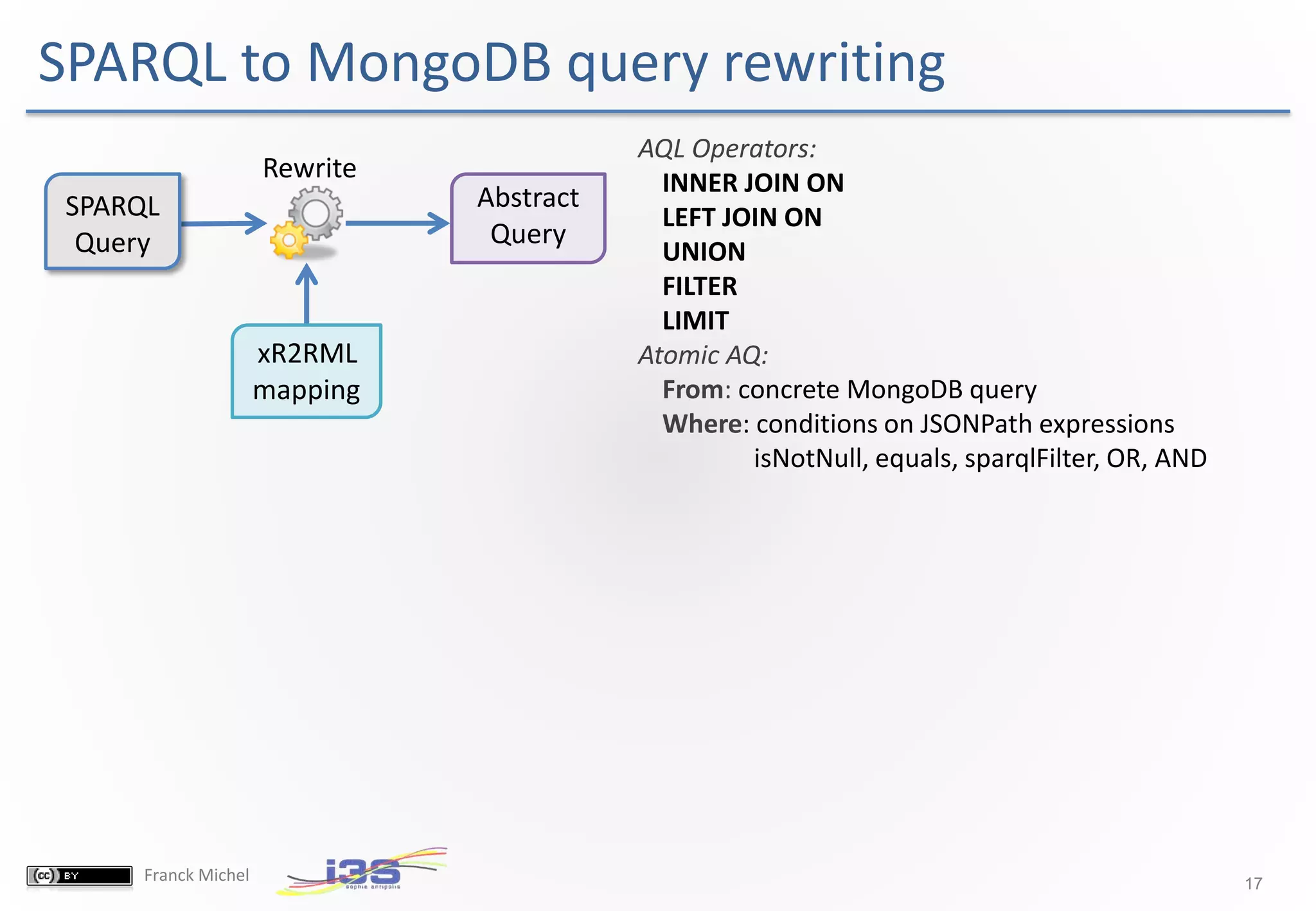
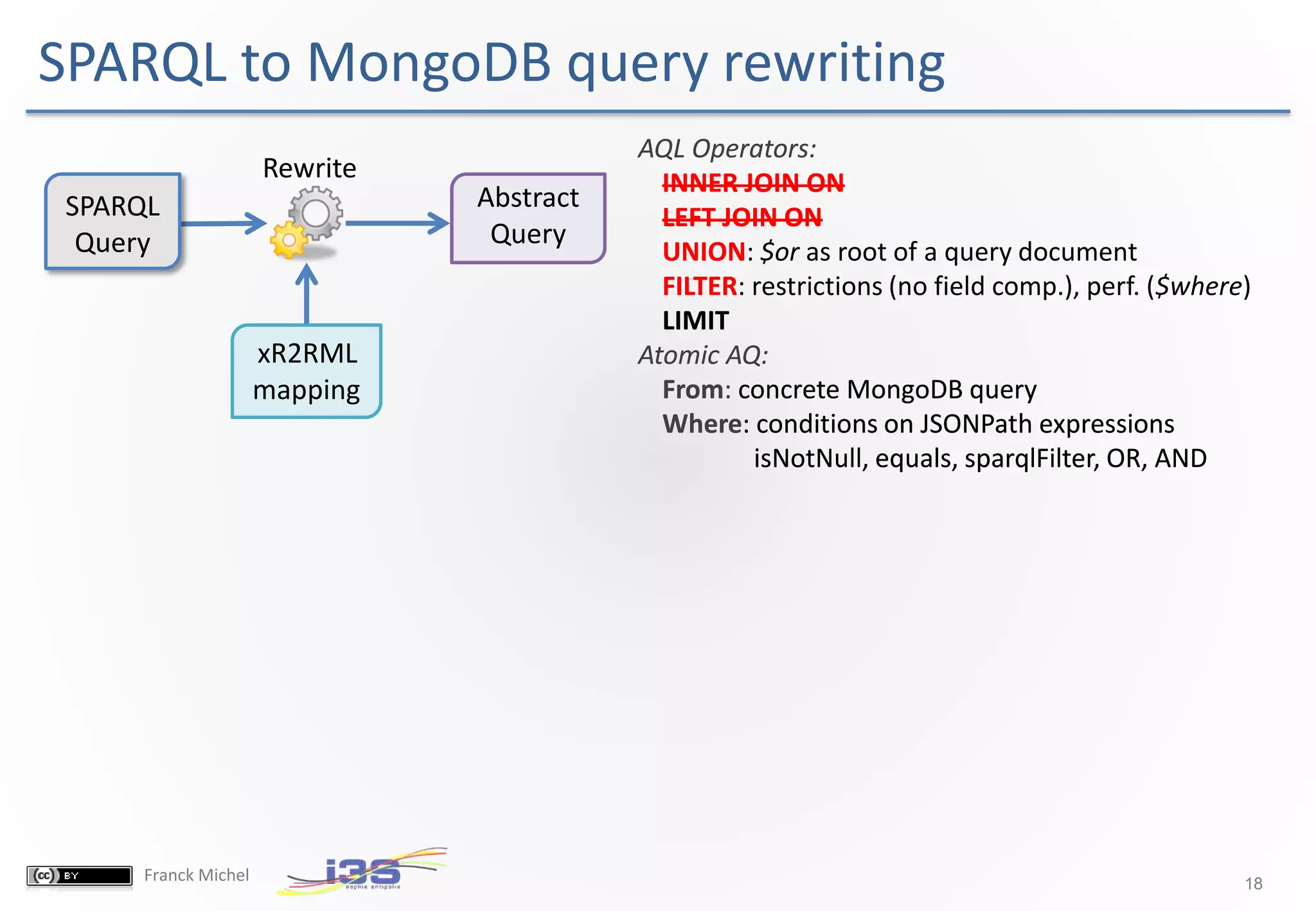
SPARQL to MongoDB query rewriting
Rewrite
SPARQL
Query
Abstract
Query
xR2RML
mapping
AQL Operators:
INNER JOIN ON
LEFT JOIN ON
UNION
FILTER
LIMIT
Atomic AQ:
From: concrete MongoDB query
Where: conditions on JSONPath expressions
isNotNull, equals, sparqlFilter, OR, AND
18
Franck Michel
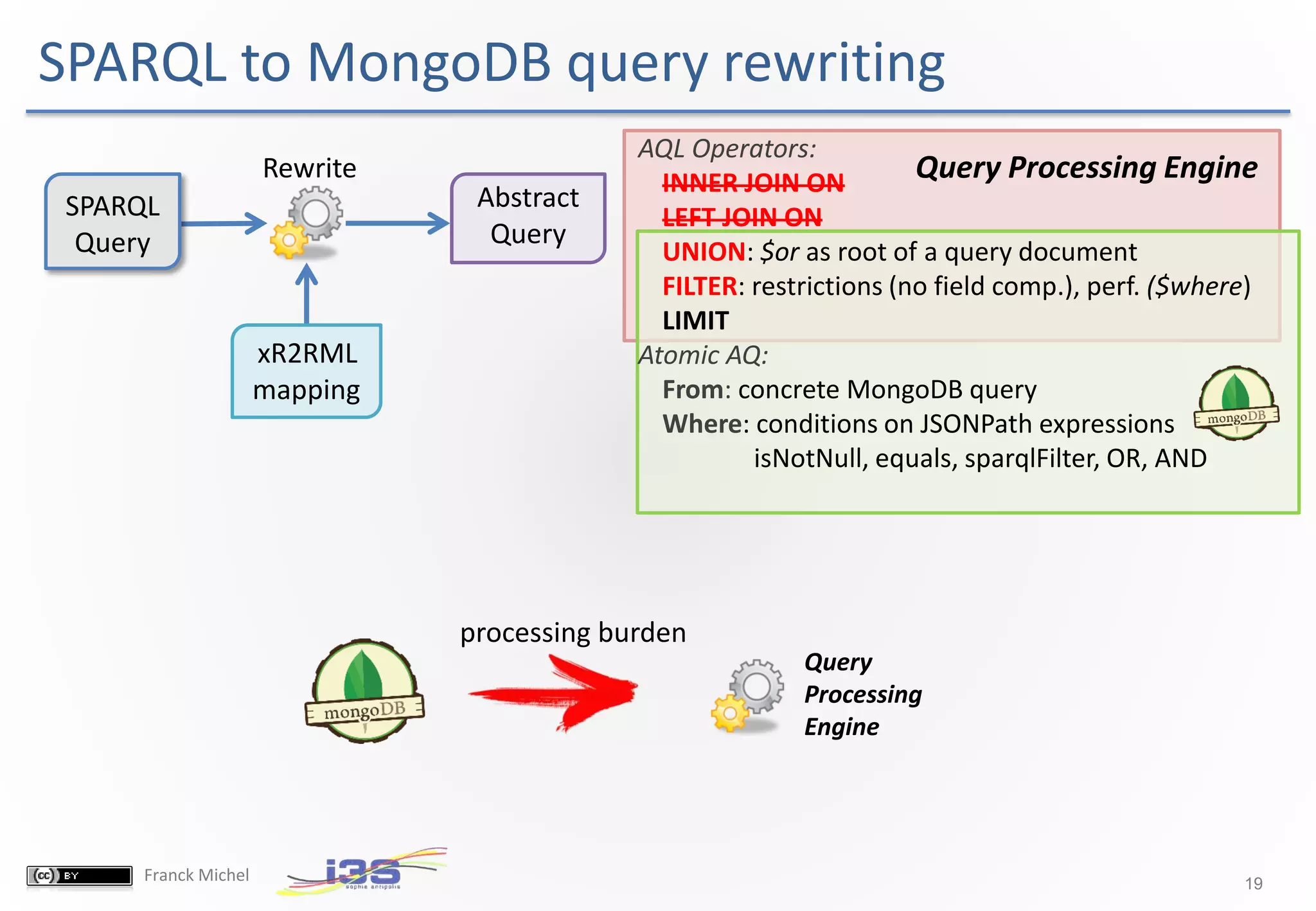
AQL Operators:
INNER JOIN ON
LEFT JOIN ON
UNION
FILTER
LIMIT
Atomic AQ:
From: concrete MongoDB query
Where: conditions on JSONPath expressions
isNotNull, equals, sparqlFilter, OR, AND
SPARQL to MongoDB query rewriting
Rewrite
SPARQL
Query
Abstract
Query
xR2RML
mapping
AQL Operators:
INNER JOIN ON
LEFT JOIN ON
UNION: $or as root of a query document
FILTER: restrictions (no field comp.), perf. ($where)
LIMIT
Atomic AQ:
From: concrete MongoDB query
Where: conditions on JSONPath expressions
isNotNull, equals, sparqlFilter, OR, AND
19
Franck Michel
SPARQL to MongoDB query rewriting
Rewrite
SPARQL
Query
Abstract
Query
xR2RML
mapping
AQL Operators:
INNER JOIN ON
LEFT JOIN ON
UNION: $or as root of a query document
FILTER: restrictions (no field comp.), perf. ($where)
LIMIT
Atomic AQ:
From: concrete MongoDB query
Where: conditions on JSONPath expressions
isNotNull, equals, sparqlFilter, OR, AND
Query Processing Engine
Query
Processing
Engine
processing burden
20
Franck Michel
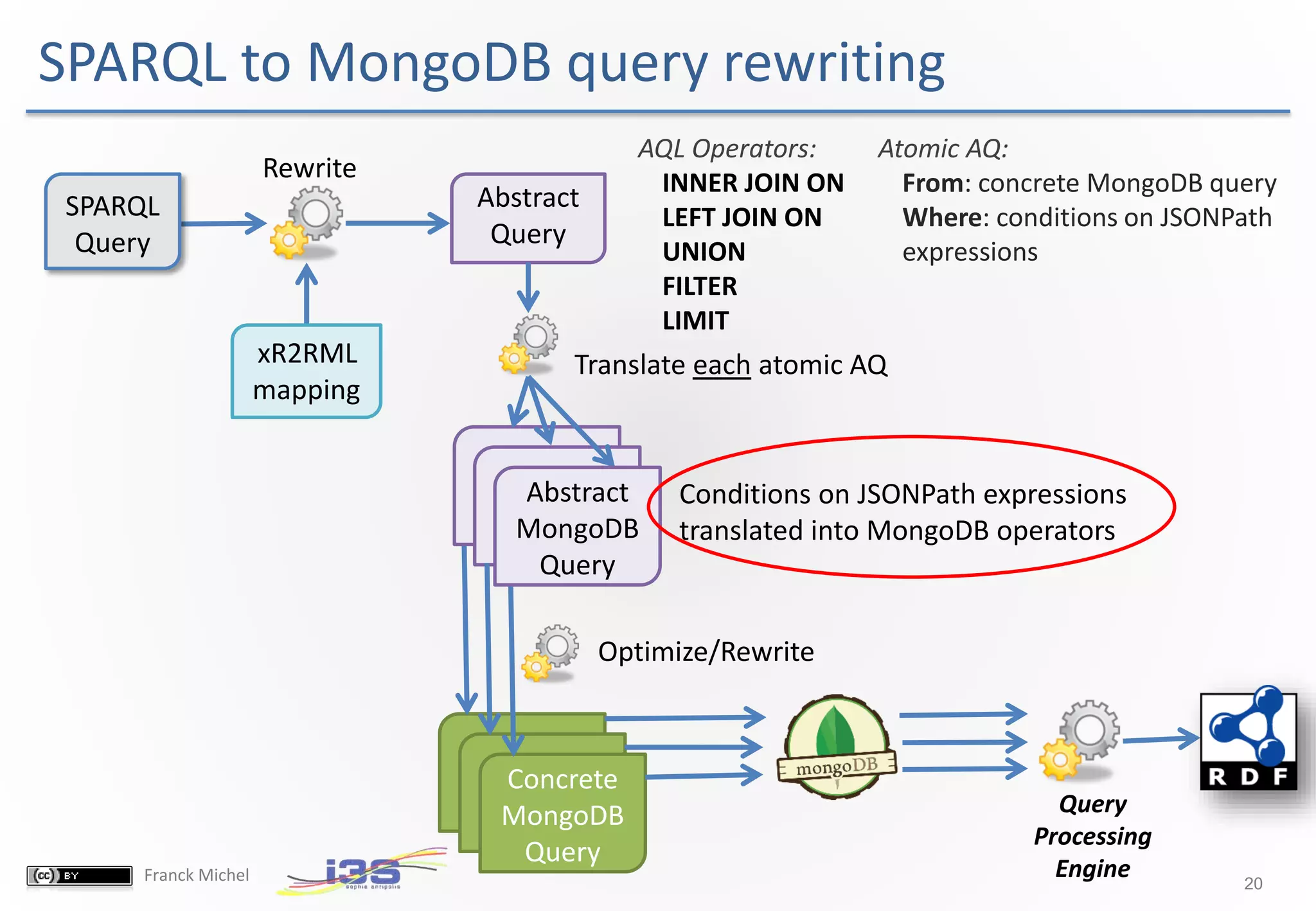
SPARQL to MongoDB query rewriting
Rewrite
SPARQL
Query
Abstract
Query
xR2RML
mapping
Translate each atomic AQ
Optimize/Rewrite
AQL Operators:
INNER JOIN ON
LEFT JOIN ON
UNION
FILTER
LIMIT
Conditions on JSONPath expressions
translated into MongoDB operators
Atomic AQ:
From: concrete MongoDB query
Where: conditions on JSONPath
expressions
Concrete
MongoDB
Query
Abstract
MongoDB
Query
Query
Processing
Engine
21
Franck Michel
Condition on JSONPath expression - to - MongoDB QL
 Example query
isNotNull($.id)
→ "id": {$exists:true, $ne:null}
equals($.emails.*, "john@foo.com")
→ "emails": {$elemMatch: {$eq:"john@foo.com"}}
 Field alternative
equals($.p.["q", "r"], 10)
→ $or: [ {"p.q":{$eq: 10}}, {"p.r":{$eq: 10}} ]
 JavaScript calculated array index
equals($.staff[(@.length - 1)].name, "John")
→ $and:[
{"staff":{$exists: true}},
{$where:"this.staff[this.staff.length - 1].name == 'John'"} ]
22
Franck Michel
Condition on JSONPath expression - to - MongoDB QL
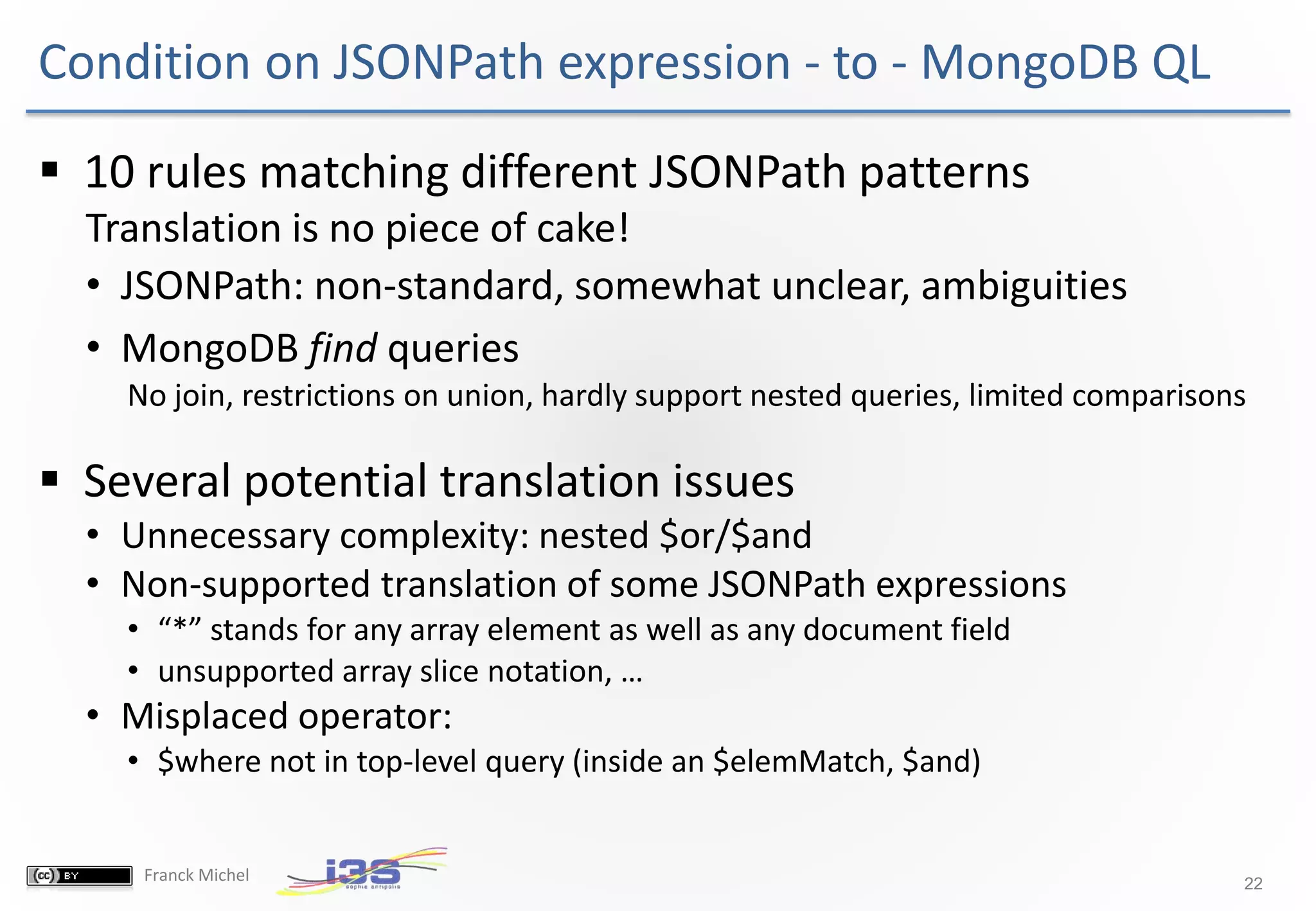
 10 rules matching different JSONPath patterns
Translation is no piece of cake!
• JSONPath: non-standard, somewhat unclear, ambiguities
• MongoDB find queries
No join, restrictions on union, hardly support nested queries, limited comparisons
 Several potential translation issues
• Unnecessary complexity: nested $or/$and
• Non-supported translation of some JSONPath expressions
• “*” stands for any array element as well as any document field
• unsupported array slice notation, …
• Misplaced operator:
• $where not in top-level query (inside an $elemMatch, $and)
23
Franck Michel
Come up with a concrete MongoDB query
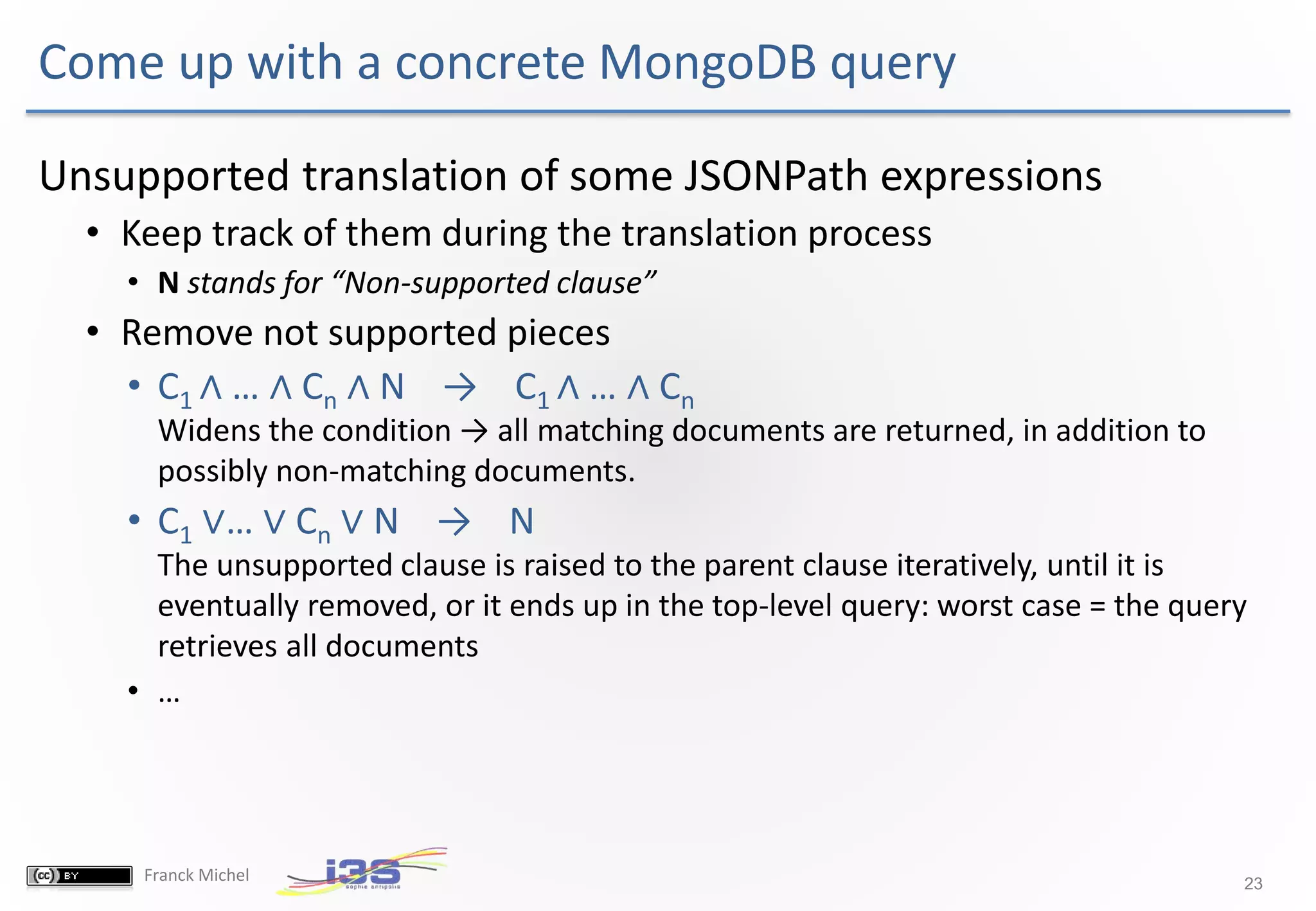
Unsupported translation of some JSONPath expressions
• Keep track of them during the translation process
• N stands for “Non-supported clause”
• Remove not supported pieces
• C1 ∧ … ∧ Cn ∧ N → C1 ∧ … ∧ Cn
Widens the condition → all matching documents are returned, in addition to
possibly non-matching documents.
• C1 ∨… ∨ Cn ∨ N → N
The unsupported clause is raised to the parent clause iteratively, until it is
eventually removed, or it ends up in the top-level query: worst case = the query
retrieves all documents
• …
24
Franck Michel
Come up with a concrete MongoDB query
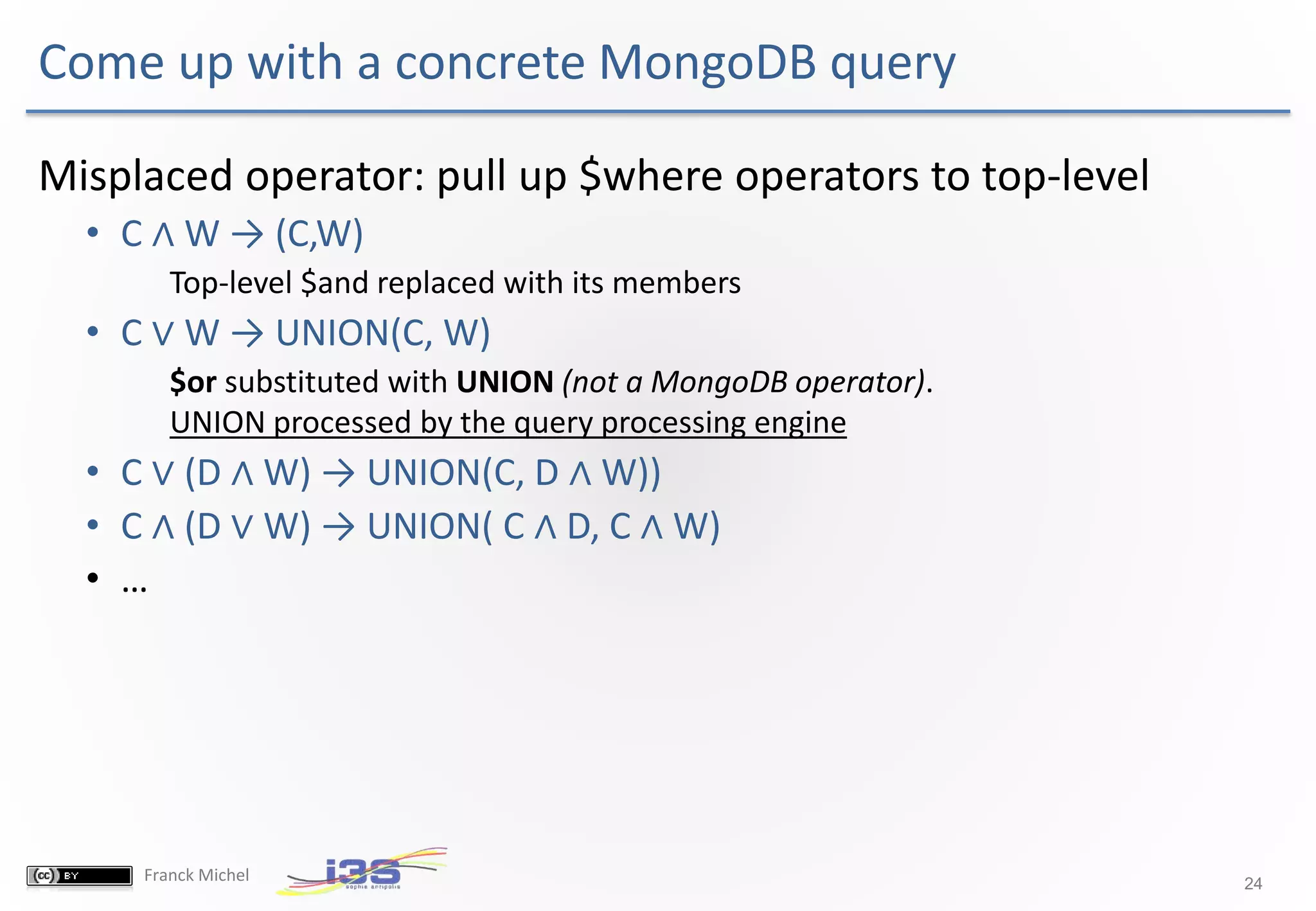
Misplaced operator: pull up $where operators to top-level
• C ∧ W → (C,W)
Top-level $and replaced with its members
• C ∨ W → UNION(C, W)
$or substituted with UNION (not a MongoDB operator).
UNION processed by the query processing engine
• C ∨ (D ∧ W) → UNION(C, D ∧ W))
• C ∧ (D ∨ W) → UNION( C ∧ D, C ∧ W)
• …
25
Franck Michel
Come up with a concrete MongoDB query
Theorem.
Let C be an equality or not-null condition on a JSONPath expression.
Let Q = (Q1, …Qn) be the abstract MongoDB query produced by trans(C).
Rewritability: It is always possible to rewrite Q into a query Q’ = UNION(Q’
1,…
Q’
m) such that ∀i ∈ [1, m] Q’
i is a valid MongoDB query, i.e. Q’
i does not contain
any unsupported clause, and a $where clause only shows at
the top-level of Q’
i.
Completeness: Q’ retrieves all the certain answers, i.e. all the documents
matching condition C. If Q contains at least one unsupported clause, then Q’
may retrieve additional documents that do not match condition C.
26
Franck Michel
Agenda
Previous episodes
Generalized mapping language: xR2RML
SPARQL-to-AQL Rewriting
AQL-to-MongoDB Rewriting
Conclusions & Perspectives
27
Franck Michel
Conclusions & perspectives
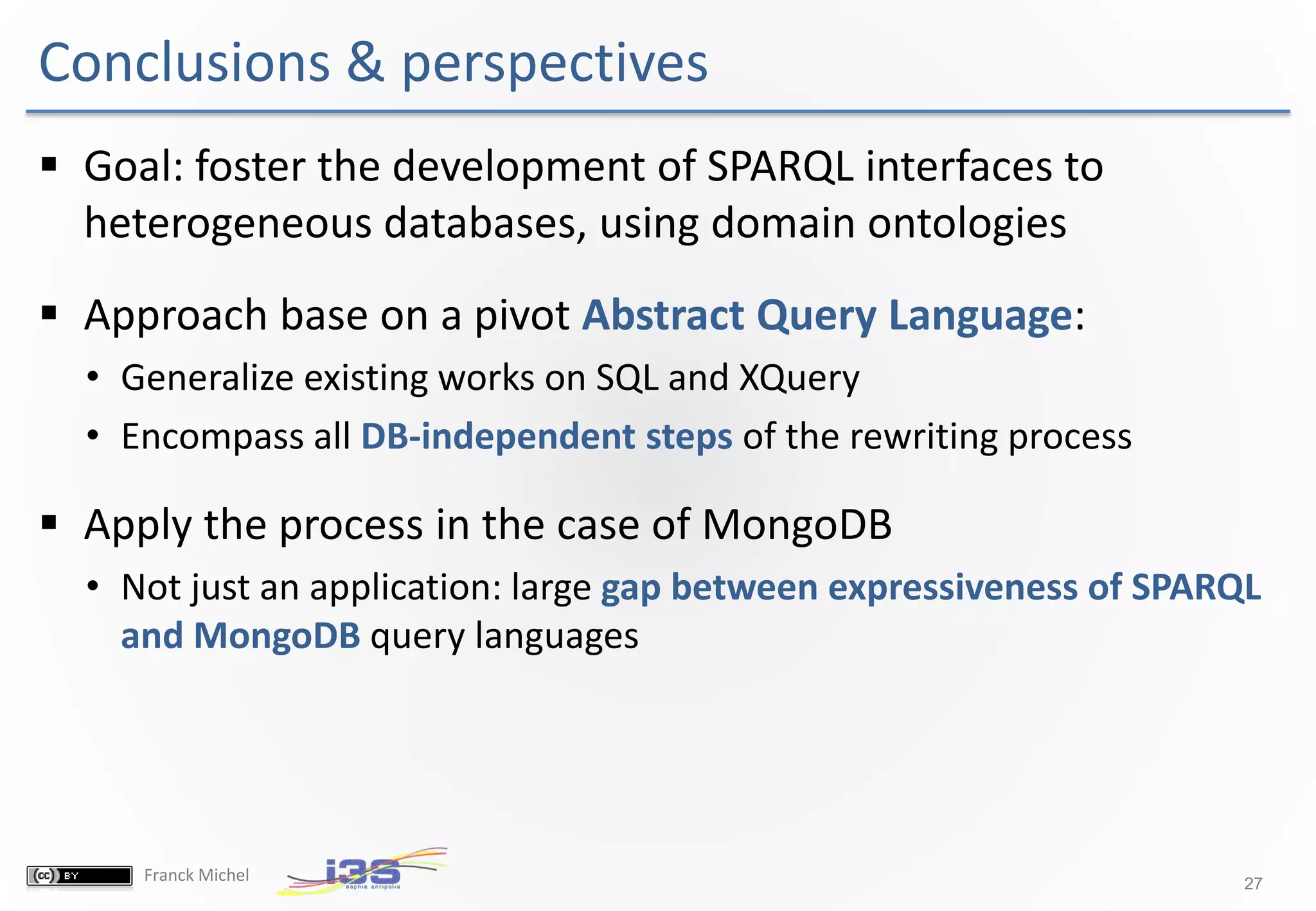
 Goal: foster the development of SPARQL interfaces to
heterogeneous databases, using domain ontologies
 Approach base on a pivot Abstract Query Language:
• Generalize existing works on SQL and XQuery
• Encompass all DB-independent steps of the rewriting process
 Apply the process in the case of MongoDB
• Not just an application: large gap between expressiveness of SPARQL
and MongoDB query languages
28
Franck Michel
Conclusions & perspectives
 SW vs. NoSQL: two un-reconciliable worlds?
Different paradigms:
• SW manages highly connected graphs,
• NoSQL’s manage isolated documents, joins hardly supported
NoSQL DBs
• pragmatically gave up on consistency and rich query features
• trade-off to high throughput/availability, horizontal elasticity
 Filling the gap between the two worlds is not straightforward
The experience of MongoDB shows challenges.
 Huge potential source of LOD, can’t be ignored anymore
29
Franck Michel
Conclusions & perspectives
 Working prototype Morph-xR2RML
• Use case in Digital Humanities [2]
• https://github.com/frmichel/morph-xr2rml/
 Perspectives
• Perform benchmarking
• Evaluate usability of MongoDB aggregate query [Botoeva et al. 2016],
characterize mappings wrt. find/aggregate query
[Botoeva et al. 2016] Botoeva Elena, Diego Calvanese, Benjamin Cogrel, Martin Rezk, and Guohui Xiao.
“OBDA beyond Relational DBs: A Study for MongoDB.” In 29th Int. Workshop on Description Logics (DL 2016)
30
Franck Michel
Contacts:
Franck Michel
Catherine Faron-Zucker
Johan Montagnat
[1] F. Michel, L. Djimenou, C. Faron-Zucker, and J. Montagnat. Translation of Relational and Non-Relational
Databases into RDF with xR2RML. In proc. of WebIST 2015.
[2] C. Callou, F. Michel, C. Faron-Zucker, C. Martin, J. Montagnat. Towards a Shared Reference Thesaurus for
Studies on History of Zoology, Archaeozoology and Conservation Biology. In SW4SH workshop, ESWC’15.
[3] F. Michel, C. Faron-Zucker, and J. Montagnat. A Generic Mapping-Based Query Translation from SPARQL to
Various Target Database Query Languages. In proc. of WebIST 2016.
https://github.com/frmichel/morph-xr2rml/

A Mapping-based Method to Query MongoDB Documents with SPARQL

  • 1.
    1 Franck Michel A Mapping-basedMethod to Query MongoDB Documents with SPARQL F. Michel, C. Faron-Zucker, J. Montagnat Université Côte d’Azur, CNRS, Inria, I3S, France
  • 2.
    2 Franck Michel Towards aWeb of Data From a Web of Documents ...to a Web of (Linked) Data Interlinking of open datasets in a common machine-readable format, using common vocabularies
  • 3.
    3 Franck Michel Web-scale dataintegration Exponential data growth Heterogeneous data sources Knowledge formalized as Domain Ontologies, Thesauri, Taxonomies… A Web of Linked Open Data NoSQL: huge potential source of Linked Open Data, yet largely ignored/despised so far ID NAME
  • 4.
  • 5.
    5 Franck Michel Common Approaches LegacyDB Graph Materialization (ETL like) Virtual Graph Data freshness Big datasets DB-to-RDF Mappings Query rewriting
  • 6.
    6 Franck Michel SPARQL Accessto Heterogeneous DBs Previous SPARQL rewritings closely coupled with the target QL expressiveness (SQL, XQuery): • Support of joins, unions, nested queries, filtering, string fctn, etc. • Semantics-preserving 1-to-1 rewriting How not to define yet another rewriting method for each DB? Two-step approach to deal with the general case [3]: 1. Translate SPARQL into a pivot Abstract Query Language (AQL) under DB-to-RDF mappings, with no assumption on the target DB capabilities 2. Translate from the AQL to the QL of the target database
  • 7.
    7 Franck Michel Agenda Previous episodes Generalizedmapping language: xR2RML SPARQL-to-AQL Rewriting AQL-to-MongoDB Rewriting Conclusions & Perspectives
  • 8.
    8 Franck Michel Agenda Previous episodes Generalizedmapping language: xR2RML SPARQL-to-AQL Rewriting AQL-to-MongoDB Rewriting Conclusions & Perspectives
  • 9.
    9 Franck Michel The xR2RMLmapping language [1]  Extends W3C R2RML and RML  Describe mappings from various types of DB to RDF • Query the target database • Pick data elements from query results • Translate them to (subject, predicate, object) using arbitrary ontologies  Independent of any target database • Allow any query language • Allow any syntax to reference data elements within query results (column name, JSONPath, XPath, attribute name...)
  • 10.
    10 Franck Michel The xR2RMLmapping language: example <http://example.org/member/106> foaf:mbox "john@foo.com". <http://example.org/member/106> foaf:mbox "john@example.org". <#Mbox> a rr:TriplesMap; xrr:logicalSource [ xrr:query "db.people.find({'emails':{$ne: null}})" ]; rr:subjectMap [ rr:template "http://example.org/member/{$.id}" ]; rr:predicateObjectMap [ rr:predicate foaf:mbox; rr:objectMap [ xrr:reference "$.emails.*" ]. xR2RML { "id": 106, "firstname": "John", "emails": ["john@foo.com", "john@example.org"] }
  • 11.
    11 Franck Michel Graph Pattern SPARQL-to-AQLrewriting [3] Basic Graph Pattern SELECT ?mbox WHERE { ?x foaf:mbox "john@foo.com". ?x foaf:mbox ?mbox. FILTER { ?mbox != "john@foo.com"} } Triple Pattern Rewrite a well-designed SPARQL graph pattern into an optimized Abstract Query, under a set of xR2RML mappings. In turn, it should be possible to translate the Abstract Query into “any” target database QL.
  • 12.
    12 Franck Michel SPARQL-to-AQL rewritingin one slide! SELECT ?mbox WHERE { ?x foaf:mbox "john@foo.com". ?x foaf:mbox ?mbox. FILTER { ?mbox != "john@foo.com" } } { From: { "db.people.find({'emails':{$ne:null}})" }, Project: { $.id AS ?x }, Where: { isNotNull($.id), equals($.emails.*, "john@foo.com")}} INNER JOIN { From: { "db.people.find({'emails':{$ne: null}})" }, Project: { $.id AS ?x , $.emails.* AS ?mbox }, Where: { isNotNull($.id), isNotNull($.emails.*), sparqlFilter(?mbox != "john@foo.com")}} ON { ?x } Abstract Query <#Mbox> a rr:TriplesMap; xrr:logicalSource [ xrr:query "db.people.find({'emails':{$ne: null}})" ]; rr:subjectMap [ rr:template "http://example.org/member/{$.id}" ]; rr:predicateObjectMap [ rr:predicate foaf:mbox; rr:objectMap [ xrr:reference "$.emails.*" ]. xR2RML mapping Self-join
  • 13.
    13 Franck Michel Agenda Previous episodes Generalizedmapping language: xR2RML SPARQL-to-AQL Rewriting AQL-to-MongoDB Rewriting Conclusions & Perspectives
  • 14.
    14 Franck Michel Why MongoDB? Sources:db-engines.com Popularity measure: Number of results in search engines, Google Trends, frequency of technical discussions, job offers, profiles in professional networks, number of tweets
  • 15.
    15 Franck Michel Why MongoDB? MongoDB: very popular NoSQL database today  (Probably) increasingly adopted as a general-purpose DB • Long tail of scientific data?  Non-tabular format • E.g. with Cassandra, a regular SQL-to-RDF would “almost” do the job A good candidate to experiment what it takes to publish NoSQL data into the Web of Linked Open Data
  • 16.
    16 Franck Michel MongoDB QueryLanguage  Find queries Declarative retrieval of doc. matching criteria db.people.find({"age":{$gt: 30}}, {"code":1}) Limitations: no join, restrictions on union and nested queries, limited comparisons  Aggregate queries • Definition of processing pipelines: • project, match, lookup, unwind, … • Richer than find queries • But more difficult to anticipate performance  We consider find queries in a first approach
  • 17.
    17 Franck Michel SPARQL toMongoDB query rewriting Rewrite SPARQL Query Abstract Query xR2RML mapping AQL Operators: INNER JOIN ON LEFT JOIN ON UNION FILTER LIMIT Atomic AQ: From: concrete MongoDB query Where: conditions on JSONPath expressions isNotNull, equals, sparqlFilter, OR, AND
  • 18.
    18 Franck Michel AQL Operators: INNERJOIN ON LEFT JOIN ON UNION FILTER LIMIT Atomic AQ: From: concrete MongoDB query Where: conditions on JSONPath expressions isNotNull, equals, sparqlFilter, OR, AND SPARQL to MongoDB query rewriting Rewrite SPARQL Query Abstract Query xR2RML mapping AQL Operators: INNER JOIN ON LEFT JOIN ON UNION: $or as root of a query document FILTER: restrictions (no field comp.), perf. ($where) LIMIT Atomic AQ: From: concrete MongoDB query Where: conditions on JSONPath expressions isNotNull, equals, sparqlFilter, OR, AND
  • 19.
    19 Franck Michel SPARQL toMongoDB query rewriting Rewrite SPARQL Query Abstract Query xR2RML mapping AQL Operators: INNER JOIN ON LEFT JOIN ON UNION: $or as root of a query document FILTER: restrictions (no field comp.), perf. ($where) LIMIT Atomic AQ: From: concrete MongoDB query Where: conditions on JSONPath expressions isNotNull, equals, sparqlFilter, OR, AND Query Processing Engine Query Processing Engine processing burden
  • 20.
    20 Franck Michel SPARQL toMongoDB query rewriting Rewrite SPARQL Query Abstract Query xR2RML mapping Translate each atomic AQ Optimize/Rewrite AQL Operators: INNER JOIN ON LEFT JOIN ON UNION FILTER LIMIT Conditions on JSONPath expressions translated into MongoDB operators Atomic AQ: From: concrete MongoDB query Where: conditions on JSONPath expressions Concrete MongoDB Query Abstract MongoDB Query Query Processing Engine
  • 21.
    21 Franck Michel Condition onJSONPath expression - to - MongoDB QL  Example query isNotNull($.id) → "id": {$exists:true, $ne:null} equals($.emails.*, "john@foo.com") → "emails": {$elemMatch: {$eq:"john@foo.com"}}  Field alternative equals($.p.["q", "r"], 10) → $or: [ {"p.q":{$eq: 10}}, {"p.r":{$eq: 10}} ]  JavaScript calculated array index equals($.staff[(@.length - 1)].name, "John") → $and:[ {"staff":{$exists: true}}, {$where:"this.staff[this.staff.length - 1].name == 'John'"} ]
  • 22.
    22 Franck Michel Condition onJSONPath expression - to - MongoDB QL  10 rules matching different JSONPath patterns Translation is no piece of cake! • JSONPath: non-standard, somewhat unclear, ambiguities • MongoDB find queries No join, restrictions on union, hardly support nested queries, limited comparisons  Several potential translation issues • Unnecessary complexity: nested $or/$and • Non-supported translation of some JSONPath expressions • “*” stands for any array element as well as any document field • unsupported array slice notation, … • Misplaced operator: • $where not in top-level query (inside an $elemMatch, $and)
  • 23.
    23 Franck Michel Come upwith a concrete MongoDB query Unsupported translation of some JSONPath expressions • Keep track of them during the translation process • N stands for “Non-supported clause” • Remove not supported pieces • C1 ∧ … ∧ Cn ∧ N → C1 ∧ … ∧ Cn Widens the condition → all matching documents are returned, in addition to possibly non-matching documents. • C1 ∨… ∨ Cn ∨ N → N The unsupported clause is raised to the parent clause iteratively, until it is eventually removed, or it ends up in the top-level query: worst case = the query retrieves all documents • …
  • 24.
    24 Franck Michel Come upwith a concrete MongoDB query Misplaced operator: pull up $where operators to top-level • C ∧ W → (C,W) Top-level $and replaced with its members • C ∨ W → UNION(C, W) $or substituted with UNION (not a MongoDB operator). UNION processed by the query processing engine • C ∨ (D ∧ W) → UNION(C, D ∧ W)) • C ∧ (D ∨ W) → UNION( C ∧ D, C ∧ W) • …
  • 25.
    25 Franck Michel Come upwith a concrete MongoDB query Theorem. Let C be an equality or not-null condition on a JSONPath expression. Let Q = (Q1, …Qn) be the abstract MongoDB query produced by trans(C). Rewritability: It is always possible to rewrite Q into a query Q’ = UNION(Q’ 1,… Q’ m) such that ∀i ∈ [1, m] Q’ i is a valid MongoDB query, i.e. Q’ i does not contain any unsupported clause, and a $where clause only shows at the top-level of Q’ i. Completeness: Q’ retrieves all the certain answers, i.e. all the documents matching condition C. If Q contains at least one unsupported clause, then Q’ may retrieve additional documents that do not match condition C.
  • 26.
    26 Franck Michel Agenda Previous episodes Generalizedmapping language: xR2RML SPARQL-to-AQL Rewriting AQL-to-MongoDB Rewriting Conclusions & Perspectives
  • 27.
    27 Franck Michel Conclusions &perspectives  Goal: foster the development of SPARQL interfaces to heterogeneous databases, using domain ontologies  Approach base on a pivot Abstract Query Language: • Generalize existing works on SQL and XQuery • Encompass all DB-independent steps of the rewriting process  Apply the process in the case of MongoDB • Not just an application: large gap between expressiveness of SPARQL and MongoDB query languages
  • 28.
    28 Franck Michel Conclusions &perspectives  SW vs. NoSQL: two un-reconciliable worlds? Different paradigms: • SW manages highly connected graphs, • NoSQL’s manage isolated documents, joins hardly supported NoSQL DBs • pragmatically gave up on consistency and rich query features • trade-off to high throughput/availability, horizontal elasticity  Filling the gap between the two worlds is not straightforward The experience of MongoDB shows challenges.  Huge potential source of LOD, can’t be ignored anymore
  • 29.
    29 Franck Michel Conclusions &perspectives  Working prototype Morph-xR2RML • Use case in Digital Humanities [2] • https://github.com/frmichel/morph-xr2rml/  Perspectives • Perform benchmarking • Evaluate usability of MongoDB aggregate query [Botoeva et al. 2016], characterize mappings wrt. find/aggregate query [Botoeva et al. 2016] Botoeva Elena, Diego Calvanese, Benjamin Cogrel, Martin Rezk, and Guohui Xiao. “OBDA beyond Relational DBs: A Study for MongoDB.” In 29th Int. Workshop on Description Logics (DL 2016)
  • 30.
    30 Franck Michel Contacts: Franck Michel CatherineFaron-Zucker Johan Montagnat [1] F. Michel, L. Djimenou, C. Faron-Zucker, and J. Montagnat. Translation of Relational and Non-Relational Databases into RDF with xR2RML. In proc. of WebIST 2015. [2] C. Callou, F. Michel, C. Faron-Zucker, C. Martin, J. Montagnat. Towards a Shared Reference Thesaurus for Studies on History of Zoology, Archaeozoology and Conservation Biology. In SW4SH workshop, ESWC’15. [3] F. Michel, C. Faron-Zucker, and J. Montagnat. A Generic Mapping-Based Query Translation from SPARQL to Various Target Database Query Languages. In proc. of WebIST 2016. https://github.com/frmichel/morph-xr2rml/