The document describes 3 hierarchical LSTM models for generating coherent multi-sentence text:
1) Standard LSTM encodes/decodes a document as a single sequence.
2) Hierarchical LSTM encodes sentences then the document.
3) Hierarchical LSTM with attention encodes sentences then decodes with attention over encoded sentences.
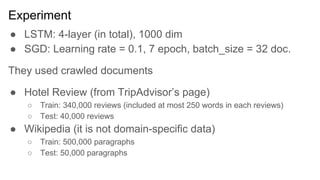
The models were evaluated on hotel reviews and Wikipedia using ROUGE, BLEU, and a coherence metric called L-value. The hierarchical LSTMs outperformed the standard LSTM, and hotel reviews were easier to generate than Wikipedia text.




![[246]QANet: Towards Efficient and Human-Level Reading Comprehension on SQuAD](https://cdn.slidesharecdn.com/ss_thumbnails/246qanetdeview2018-181012000849-thumbnail.jpg?width=640&height=640&fit=bounds)


![[PR12] PR-036 Learning to Remember Rare Events](https://cdn.slidesharecdn.com/ss_thumbnails/pr12pr-036learningtoremeberrareevents-170917140144-thumbnail.jpg?width=640&height=640&fit=bounds)


![[PACLING2019] Improving Context-aware Neural Machine Translation with Target-...](https://cdn.slidesharecdn.com/ss_thumbnails/paclingpresen-191012011632-thumbnail.jpg?width=640&height=640&fit=bounds)
![[修論発表会資料] 目的言語の文書文脈を用いたニューラル機械翻訳](https://cdn.slidesharecdn.com/ss_thumbnails/shuronpresen-191012004831-thumbnail.jpg?width=640&height=640&fit=bounds)
![[論文読み会資料] Beyond Error Propagation in Neural Machine Translation: Characteris...](https://cdn.slidesharecdn.com/ss_thumbnails/paperreading2018later-181107050738-thumbnail.jpg?width=640&height=640&fit=bounds)
![[ACL2018読み会資料] Sharp Nearby, Fuzzy Far Away: How Neural Language Models Use C...](https://cdn.slidesharecdn.com/ss_thumbnails/acl2018reading-181029052106-thumbnail.jpg?width=640&height=640&fit=bounds)
![[NAACL2018読み会] Deep Communicating Agents for Abstractive Summarization](https://cdn.slidesharecdn.com/ss_thumbnails/naacl2018reading-180801082628-thumbnail.jpg?width=640&height=640&fit=bounds)
![[論文読み会資料] Asynchronous Bidirectional Decoding for Neural Machine Translation](https://cdn.slidesharecdn.com/ss_thumbnails/reading0510-180511063343-thumbnail.jpg?width=640&height=640&fit=bounds)
![[ML論文読み会資料] Teaching Machines to Read and Comprehend](https://cdn.slidesharecdn.com/ss_thumbnails/ml2-171222014201-thumbnail.jpg?width=640&height=640&fit=bounds)
![[EMNLP2017読み会] Efficient Attention using a Fixed-Size Memory Representation](https://cdn.slidesharecdn.com/ss_thumbnails/emnlp2017-171122025333-thumbnail.jpg?width=640&height=640&fit=bounds)
![[ML論文読み会資料] Training RNNs as Fast as CNNs](https://cdn.slidesharecdn.com/ss_thumbnails/ml-171110024905-thumbnail.jpg?width=640&height=640&fit=bounds)

![[ACL2017読み会] What do Neural Machine Translation Models Learn about Morphology?](https://cdn.slidesharecdn.com/ss_thumbnails/acl2017-171011024754-thumbnail.jpg?width=640&height=640&fit=bounds)


![[EMNLP2016読み会] Memory-enhanced Decoder for Neural Machine Translation](https://cdn.slidesharecdn.com/ss_thumbnails/emnlp-170228052941-thumbnail.jpg?width=640&height=640&fit=bounds)
![[ACL2016] Achieving Open Vocabulary Neural Machine Translation with Hybrid Wo...](https://cdn.slidesharecdn.com/ss_thumbnails/acl-161026074300-thumbnail.jpg?width=640&height=640&fit=bounds)


