Grammar and the CEFR
• Grammar points are not listed in the CEFR because it
focuses in what people can do with language
(functions)
• We can often identify grammar forms that pupils might
use for some functions (e.g. Can it fly? asks about
ability)
• This is also true in the Learning Standards in the new
curriculum
Grammar and the CEFR
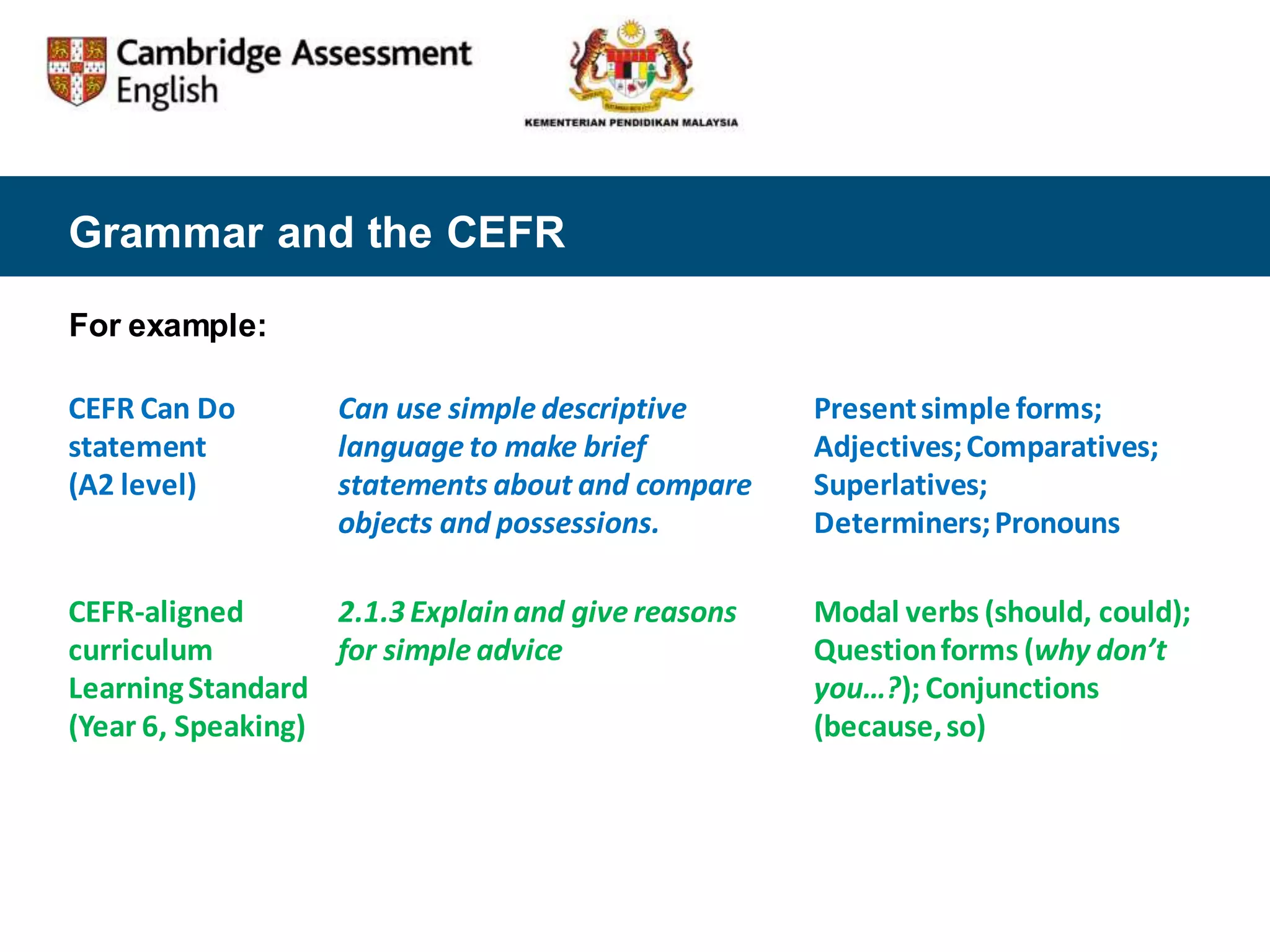
CEFR Can Do
statement
(A2 level)
Can use simple descriptive
language to make brief
statements about and compare
objects and possessions.
Presentsimple forms;
Adjectives;Comparatives;
Superlatives;
Determiners;Pronouns
CEFR-aligned
curriculum
LearningStandard
(Year 6, Speaking)
2.1.3Explainand give reasons
for simple advice
Modal verbs (should, could);
Questionforms (why don’t
you…?); Conjunctions
(because,so)
For example:
Grammar in language learning
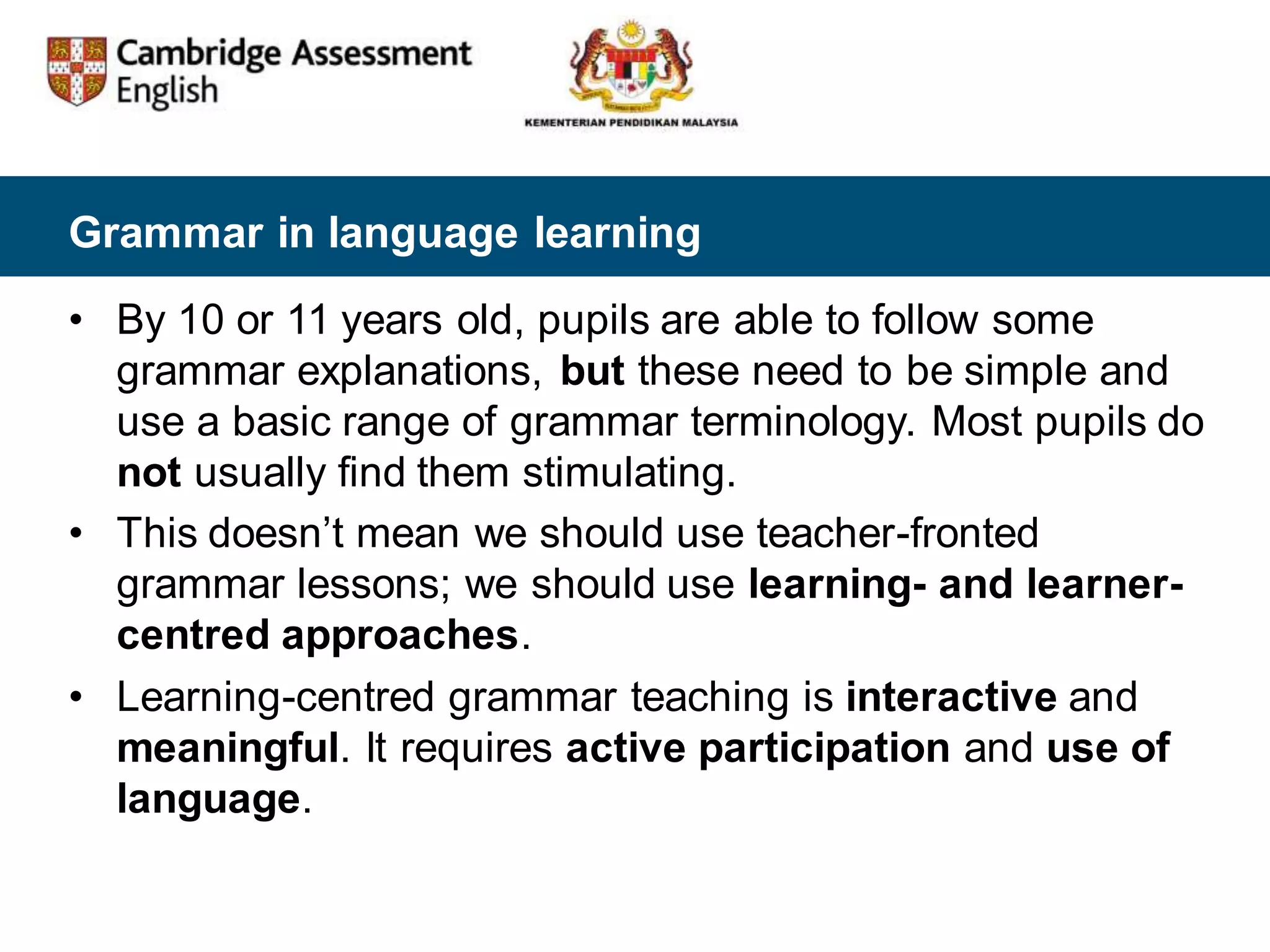
• By 10 or 11 years old, pupils are able to follow some
grammar explanations, but these need to be simple and
use a basic range of grammar terminology. Most pupils do
not usually find them stimulating.
• This doesn’t mean we should use teacher-fronted
grammar lessons; we should use learning- and learner-
centred approaches.
• Learning-centred grammar teaching is interactive and
meaningful. It requires active participation and use of
language.
Grammar in language learning
• Grammar-focussed activities should have pupils work with
both form and meaning.
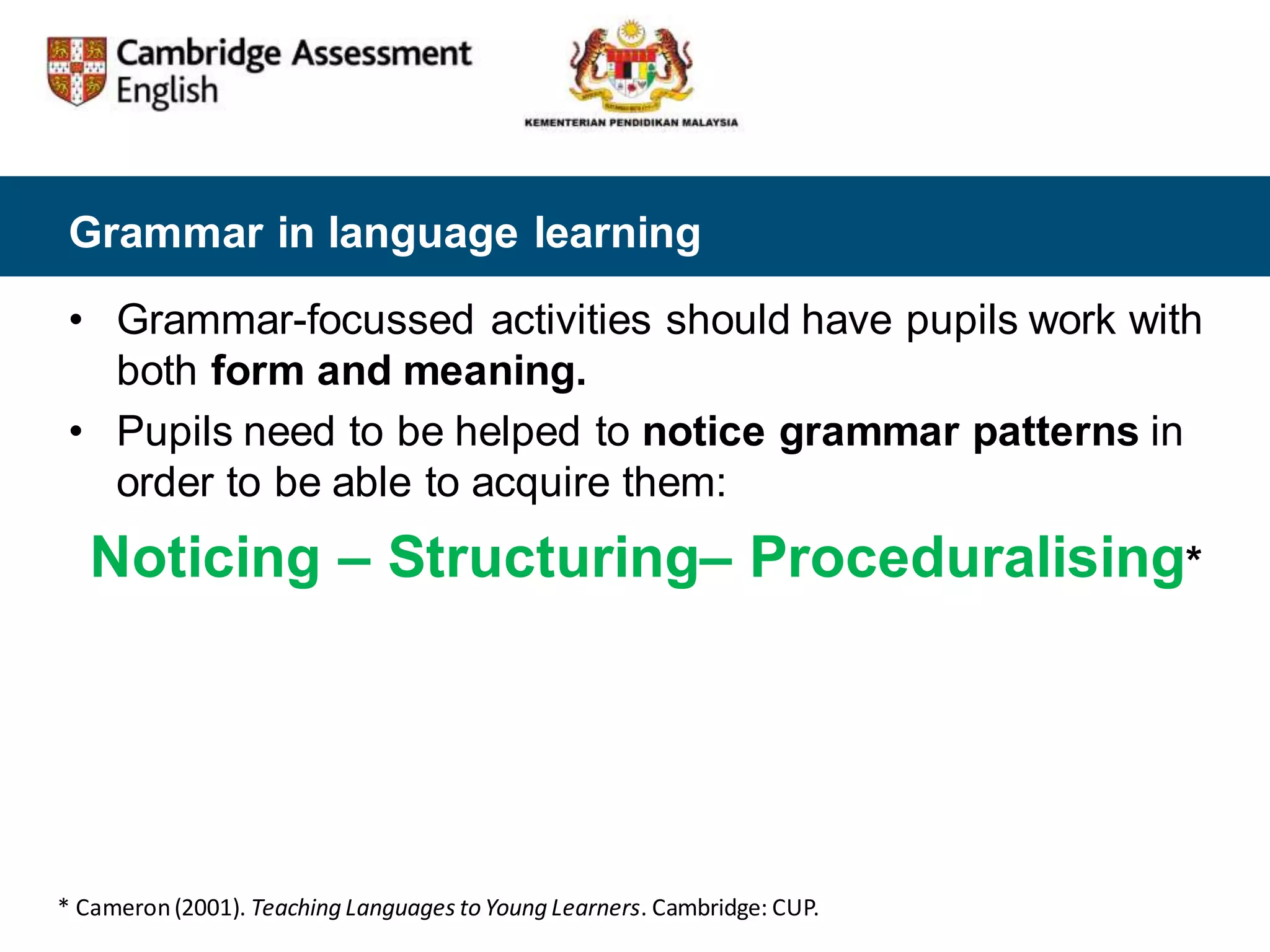
• Pupils need to be helped to notice grammar patterns in
order to be able to acquire them:
Noticing – Structuring– Proceduralising*
* Cameron(2001). Teaching Languages toYoung Learners. Cambridge: CUP.
Stage 1: Noticing
• Pupils become aware of the structure, notice
connections between form and meaning
• Noticing activities support meaning as well as form
• Form should be presented in context, e.g. in a Reading
or Listening text, and on its own
• It requires active participation of pupils
• Pupils don’t manipulate language at this stage
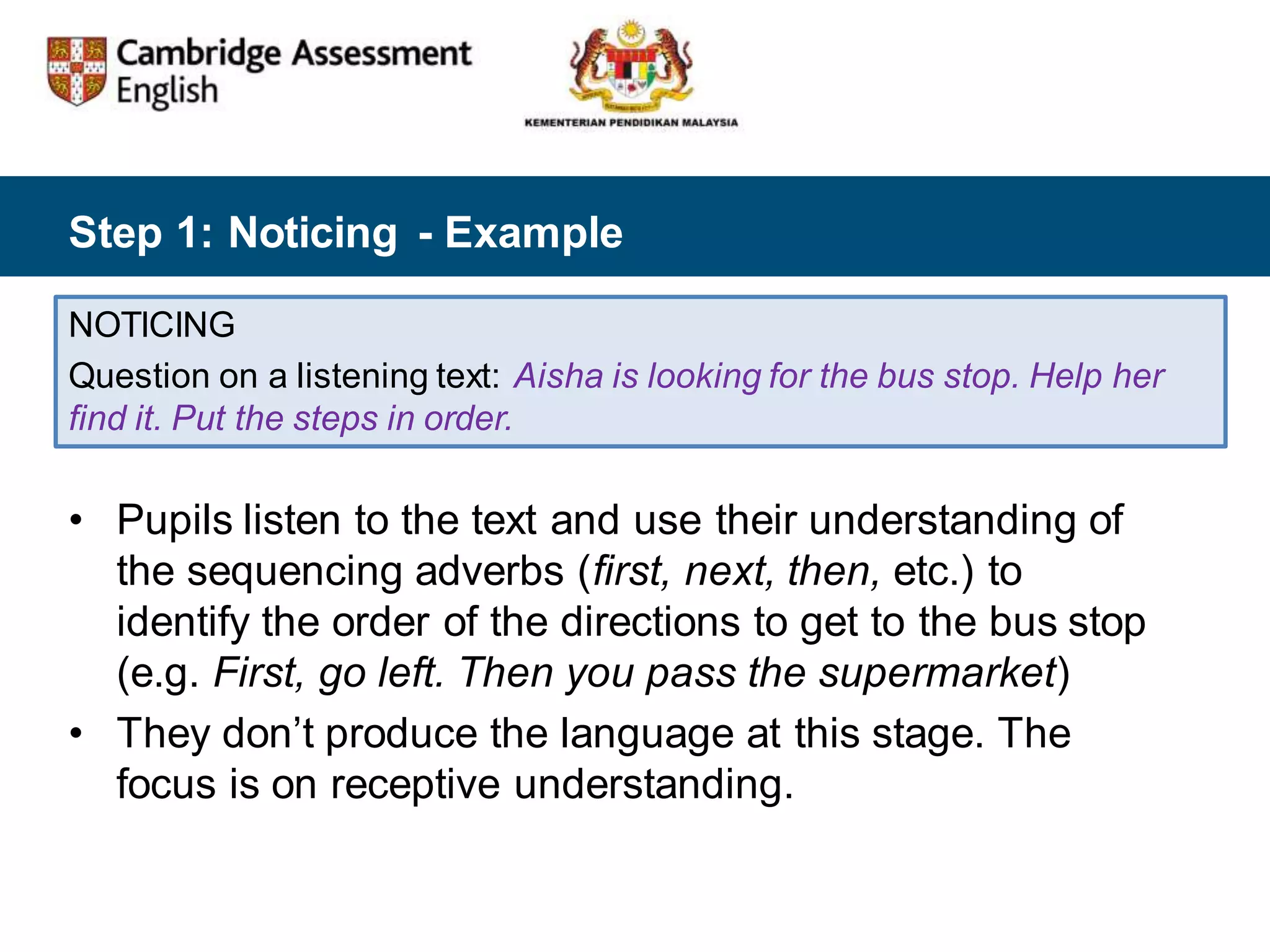
Step 1: Noticing - Example
• Pupils listen to the text and use their understanding of
the sequencing adverbs (first, next, then, etc.) to
identify the order of the directions to get to the bus stop
(e.g. First, go left. Then you pass the supermarket)
• They don’t produce the language at this stage. The
focus is on receptive understanding.
NOTICING
Question on a listening text: Aisha is looking for the bus stop. Help her
find it. Put the steps in order.
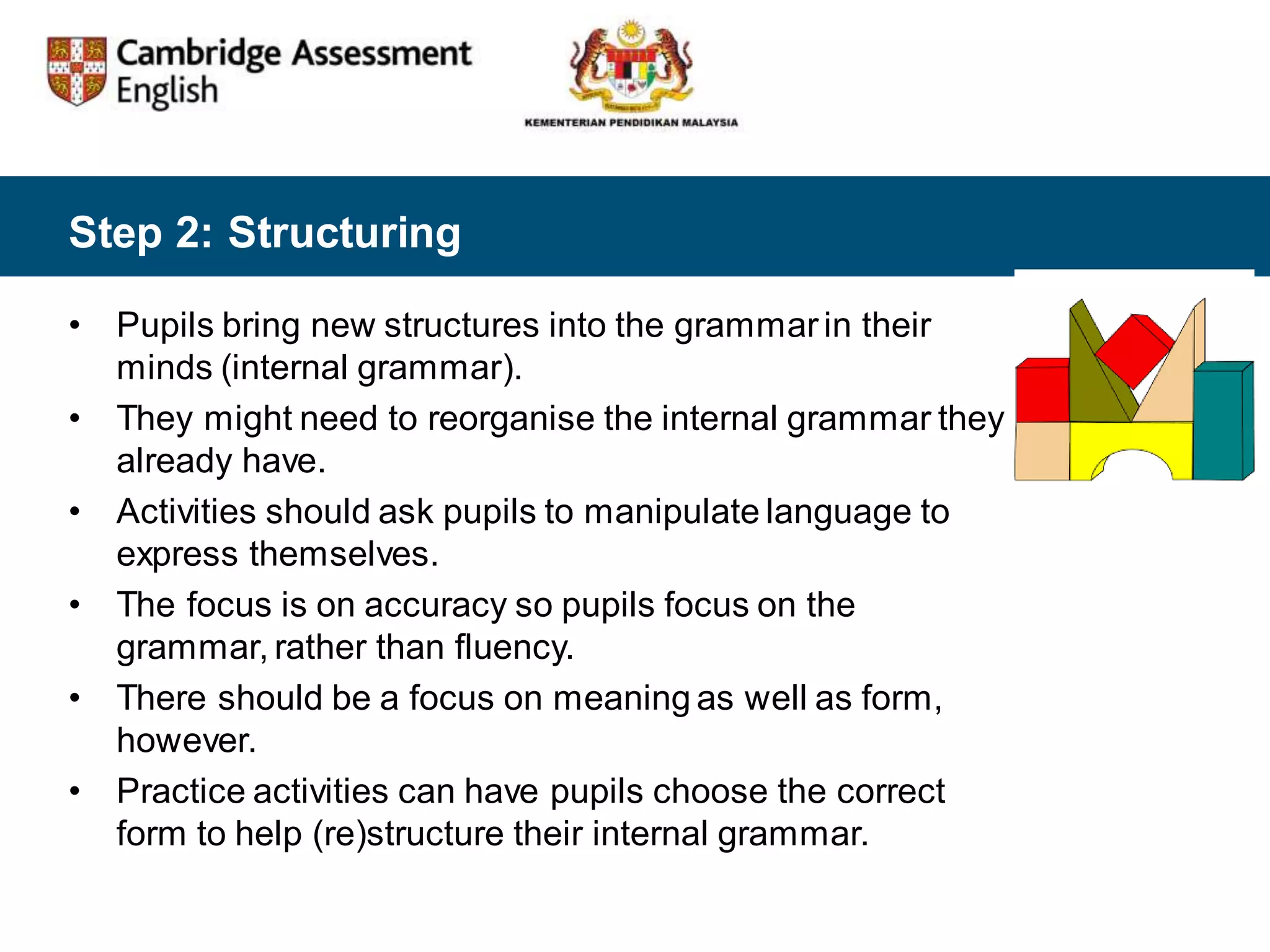
Step 2: Structuring
• Pupils bring new structures into the grammarin their
minds (internal grammar).
• They might need to reorganise the internal grammar they
already have.
• Activities should ask pupils to manipulate language to
express themselves.
• The focus is on accuracy so pupils focus on the
grammar, rather than fluency.
• There should be a focus on meaning as well as form,
however.
• Practice activities can have pupils choose the correct
form to help (re)structure their internal grammar.
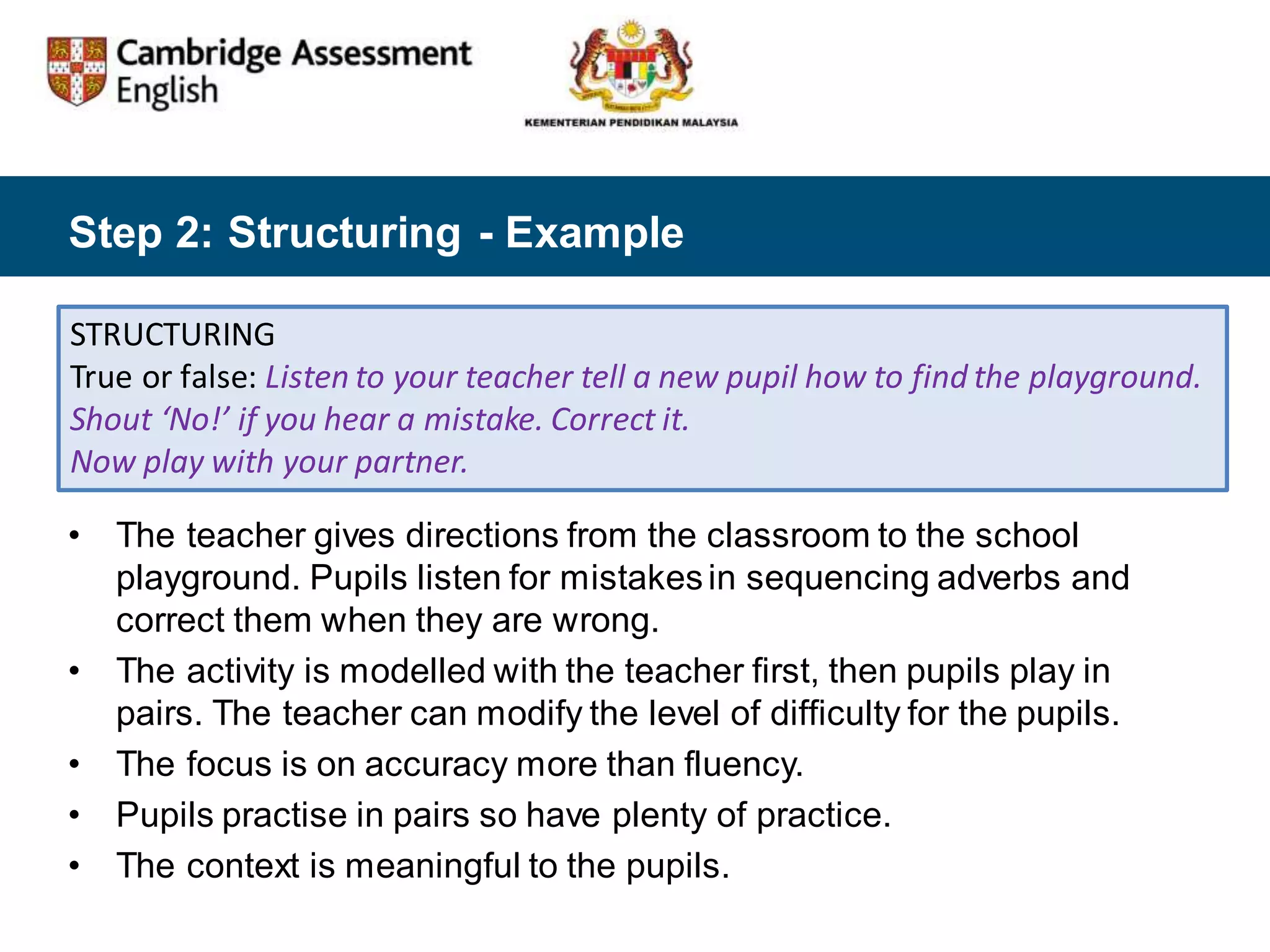
Step 2: Structuring - Example
• The teacher gives directions from the classroom to the school
playground. Pupils listen for mistakesin sequencing adverbs and
correct them when they are wrong.
• The activity is modelled with the teacher first, then pupils play in
pairs. The teacher can modify the level of difficulty for the pupils.
• The focus is on accuracy more than fluency.
• Pupils practise in pairs so have plenty of practice.
• The context is meaningful to the pupils.
STRUCTURING
True or false: Listen to your teacher tell a new pupil how to find the playground.
Shout ‘No!’ if you hear a mistake. Correct it.
Now play with your partner.
Step 3: Proceduralising
• This is where pupils work to make the new language more
automatic.
• The focus is more balanced between accuracy and fluency.
• The focus needs to be on communication through use of the
structure.
• The context should be clear and meaningful and have pupils
use the language in a realistic situation.
Note:
• The three stages may spread across several lessons.
• More than one activity may be used at each stage.
Step 3: Proceduralising - Example
PROCEDURALISING
Post-reading task: Complete the places on the map. Help your friend get where
(s)he wants to go.
• Pupils name places on a map. They need to explain to
their partner how to find a place on the map.
• Pupils need to use the sequencing adverbs correctly to
achieve the task, but the specific focus on accuracy
becomes less.
• Pupils can interact more naturally and freely, and have
more control over the task and language.

A framework for teaching grammar y6

  • 1.
    Grammar and theCEFR • Grammar points are not listed in the CEFR because it focuses in what people can do with language (functions) • We can often identify grammar forms that pupils might use for some functions (e.g. Can it fly? asks about ability) • This is also true in the Learning Standards in the new curriculum
  • 2.
    Grammar and theCEFR CEFR Can Do statement (A2 level) Can use simple descriptive language to make brief statements about and compare objects and possessions. Presentsimple forms; Adjectives;Comparatives; Superlatives; Determiners;Pronouns CEFR-aligned curriculum LearningStandard (Year 6, Speaking) 2.1.3Explainand give reasons for simple advice Modal verbs (should, could); Questionforms (why don’t you…?); Conjunctions (because,so) For example:
  • 3.
    Grammar in languagelearning • By 10 or 11 years old, pupils are able to follow some grammar explanations, but these need to be simple and use a basic range of grammar terminology. Most pupils do not usually find them stimulating. • This doesn’t mean we should use teacher-fronted grammar lessons; we should use learning- and learner- centred approaches. • Learning-centred grammar teaching is interactive and meaningful. It requires active participation and use of language.
  • 4.
    Grammar in languagelearning • Grammar-focussed activities should have pupils work with both form and meaning. • Pupils need to be helped to notice grammar patterns in order to be able to acquire them: Noticing – Structuring– Proceduralising* * Cameron(2001). Teaching Languages toYoung Learners. Cambridge: CUP.
  • 5.
    Stage 1: Noticing •Pupils become aware of the structure, notice connections between form and meaning • Noticing activities support meaning as well as form • Form should be presented in context, e.g. in a Reading or Listening text, and on its own • It requires active participation of pupils • Pupils don’t manipulate language at this stage
  • 6.
    Step 1: Noticing- Example • Pupils listen to the text and use their understanding of the sequencing adverbs (first, next, then, etc.) to identify the order of the directions to get to the bus stop (e.g. First, go left. Then you pass the supermarket) • They don’t produce the language at this stage. The focus is on receptive understanding. NOTICING Question on a listening text: Aisha is looking for the bus stop. Help her find it. Put the steps in order.
  • 7.
    Step 2: Structuring •Pupils bring new structures into the grammarin their minds (internal grammar). • They might need to reorganise the internal grammar they already have. • Activities should ask pupils to manipulate language to express themselves. • The focus is on accuracy so pupils focus on the grammar, rather than fluency. • There should be a focus on meaning as well as form, however. • Practice activities can have pupils choose the correct form to help (re)structure their internal grammar.
  • 8.
    Step 2: Structuring- Example • The teacher gives directions from the classroom to the school playground. Pupils listen for mistakesin sequencing adverbs and correct them when they are wrong. • The activity is modelled with the teacher first, then pupils play in pairs. The teacher can modify the level of difficulty for the pupils. • The focus is on accuracy more than fluency. • Pupils practise in pairs so have plenty of practice. • The context is meaningful to the pupils. STRUCTURING True or false: Listen to your teacher tell a new pupil how to find the playground. Shout ‘No!’ if you hear a mistake. Correct it. Now play with your partner.
  • 9.
    Step 3: Proceduralising •This is where pupils work to make the new language more automatic. • The focus is more balanced between accuracy and fluency. • The focus needs to be on communication through use of the structure. • The context should be clear and meaningful and have pupils use the language in a realistic situation. Note: • The three stages may spread across several lessons. • More than one activity may be used at each stage.
  • 10.
    Step 3: Proceduralising- Example PROCEDURALISING Post-reading task: Complete the places on the map. Help your friend get where (s)he wants to go. • Pupils name places on a map. They need to explain to their partner how to find a place on the map. • Pupils need to use the sequencing adverbs correctly to achieve the task, but the specific focus on accuracy becomes less. • Pupils can interact more naturally and freely, and have more control over the task and language.