
Best Practice Guideline
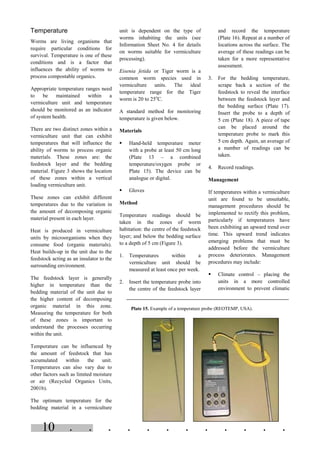
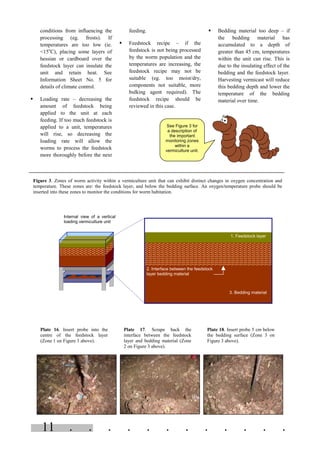
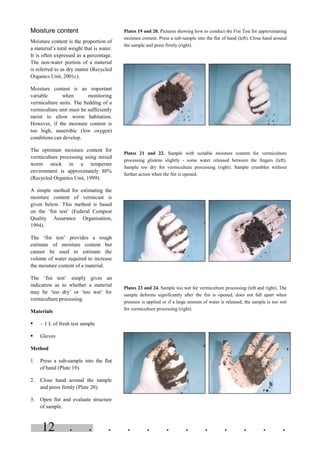
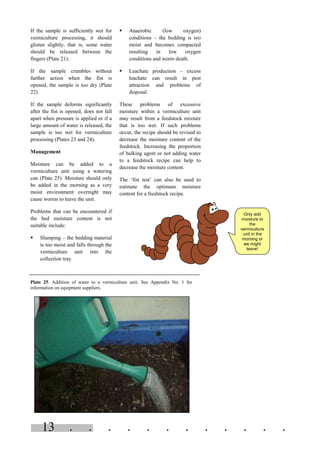
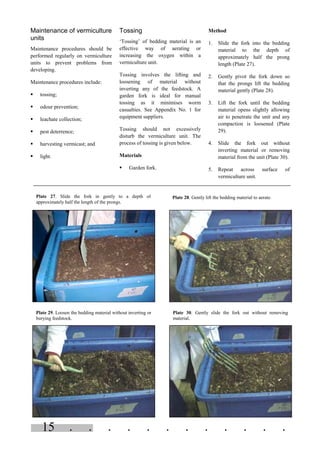
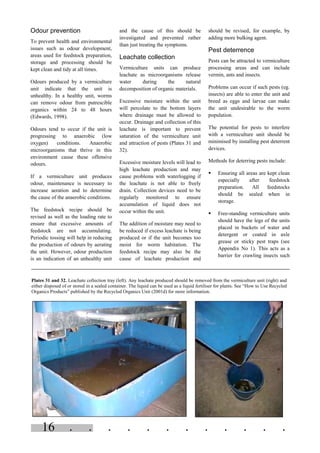
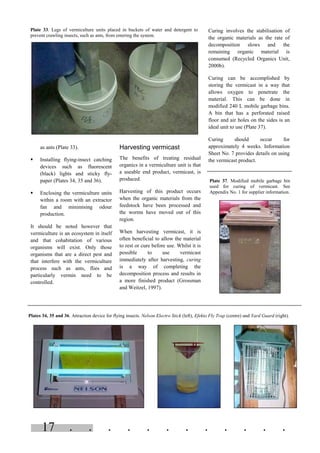
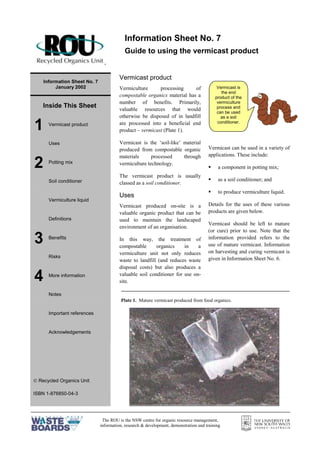
to Managing On-site
Vermiculture Technologies
=
January 2002
Recycled Organics Unit
Building B11b
The University of New South Wales
UNSW Sydney NSW 2052
Australia
Internet: http://www.recycledorganics.com
Copyright  Recycled Organics Unit 2002.
First Published 2002.
The Recycled Organics Unit (ROU) has been
established as an independent technical unit at The
University of New South Wales to provide a NSW
centre for organic resource management, information,
research and development, development and training.
This document is and shall remain the property of
ROU, The University of New South Wales. The
information contained in this document is provided by
ROU in good faith but users should be aware that
ROU is not responsible or liable for its use or
application. The content is for information only. It
should not be considered as any advice, warranty, or
recommendation to any individual person or situation.
Authors: Amanda Ferris, Dr Mark Jackson and Angus
Campbell
National Library of Australia
Cataloguing-in-Publication entry:
Printed by Recycled Organics Unit, The University of
New South Wales.
Quality assurance : Document history
Revision number Revised by Date
1 AF 13/09/01
2 MJ 18/09/01
3 AC 08/11/01
4 AF 21/11/01
6 SSWB 10/12/01
7 Peer review (1) (Vermitech) 14/12/01
8 Peer review (2) (David Murphy) 03/12/01
9 Peer review (3) (AWGAVI) 12/12/01
FINAL AF/MJ 09/01/02
The ROU is the NSW centre for organic resource management,
information, research & development, demonstration and training
Preface to the Best Practice Guideline to Managing On-Site
Vermiculture Technologies Information Sheets
The Best Practice Guideline to Managing On-Site Vermiculture Technologies series of Information
Sheets have been produced to support the continuing development of the Recycled Organics industry in
New South Wales and to provide best practice guidelines for the on-site treatment of compostable
organic materials produced by the commercial and industrial (C&I) sector.
Treatment of compostable organics produced on-site by the C&I sector using vermiculture technology
represents a potentially viable way of managing these materials. The production of vermicast also
provides a product that may be used to maintain the landscaped environment.
The establishment and management of an on-site vermiculture unit can result in some uncertainties in
terms of the performance capabilities of such units and the management practices required to sustain
these capabilities. Failure can occur within vermiculture units due to a number of reasons that usually
relate to an absence of information and management within the organisation.
Efficient management and monitoring of vermiculture units is necessary to maintain an effective
processing system and to ensure adequate system performance without any adverse affects on the
environment.
To ensure a vermiculture unit is efficient and effective, it must be installed at an adequate scale to meet
the requirements of the organisation. The development of an on-site organics management system
should also result in realistic expectations as to the performance capabilities of the system. A level of
commitment from both management and staff is required to ensure operational success.
This guide to best practice management will support the appropriate and sustainable application of
on-site vermiculture technology in the C&I sector. Information has been provided that will inform the
vermiculture industry, the waste management industry and relevant C&I sector enterprises and
institutions on the capabilities, management requirements and appropriate application of on-site
vermiculture technology.
These Information Sheets have been developed to complement existing information resources and to
provide an easy-to-read account of how to establish and manage an on-site, mid-scale vermiculture unit
for the C&I sector. On-site, mid scale organics management systems are capable of processing between
20 and 250 kg of compostable organics per day. The guide gives practical information as to the
development of such a system including feedstock preparation, monitoring and maintenance procedures
and use of the vermicast end product.
Amanda Ferris, Mark Jackson and Angus Campbell
Recycled Organics Unit
The University of New South Wales.
Sydney, January 2002.
The ROU is the NSW centre for organic resource management,
information, research & development, demonstration and training
1. Information Sheets in “Best Practice Guideline to Managing On-Site Vermiculture
Technology”
This package contains a collection of seven Information Sheets and four Appendices:
• Information Sheet No. 1:
Introduction to establishing and managing an on-site vermiculture
unit.
• Information Sheet No. 2: How much compostable material is produced?
• Information Sheet No. 3: Can vermiculture work for you?
• Information Sheet No. 4:
Guide to feedstock preparation and determining what size
vermiculture unit is required.
• Information Sheet No. 5: Guide to installing a vermiculture unit.
• Information Sheet No. 6: Management and maintenance of a vermiculture unit.
• Information Sheet No. 7: Guide to using the vermicast product.
• Appendix No. 1: Ancillary equipment requirements.
• Appendix No. 2: Vermicast product standard.
• Appendix No. 3: Signage.
• Appendix No. 4:
Research Case Studies – Vermiculture processing of compostable
organics.
The ROU is the NSW centre for organic resource management,
information, research & development, demonstration and training
2. Who should read the Information Sheets?
The package of Information Sheets has been developed to meet the needs of the developing
vermiculture industry. It is suitable for stakeholders in the RO sector who wish to gain a better
knowledge of the vermiculture industry, key points for establishing an on-site vermiculture unit,
industry best practices, and product standards that significantly influence product quality.
More specifically, the package of Information Sheets have been developed for:
• commercial and industrial sector organisations;
• vermiculture industry consultants;
• commercial and industrial sector consultants;
• waste educators;
• waste managers;
• prospective RO processors; and
• local council waste management officers.
3. Terminology
Terms used throughout this package of Information Sheets have been officially adopted by the NSW
Waste Boards in July 2000 in the form of the RO Dictionary and Thesaurus: Standard terminology for
the New South Wales recycled organics industry, produced by the Recycled Organics Unit. This
document is freely downloadable from http://www.rolibrary.com
4. How to cite this publication
This publication consists of a series of Information Sheets that are compiled into a set. When citing
information from this publication, the set of Information Sheets must be cited (not individual
Information Sheets), as shown below:
Recycled Organics Unit (2002) Best Practice Guideline to Managing On-Site Vermiculture
Technologies. Printed by the Recycled Organics Unit, The University of New South Wales, Sydney,
Australia.
5. Acknowledgements
The authors would like to extend a special thank you to all members of the peer review committee who
have invested their valuable time in reading and providing feedback on this package of Information
Sheets. The following reviewers are graciously thanked for their contributions:
§ Mr. Karsten Eisenaecher, Quality Assurance Manager and Process Control Coordinator, Vermitech
Pty. Ltd.
§ Mr. Mike Daniels, President, Australian Worm Growers Association Vermiculture Inc.
§ Mr. David Murphy, Author (Earthworms in Australia: A blueprint for a better environment).
The ROU is the NSW centre for organic resource management,
information, research & development, demonstration and training
=
Information Sheet No. 1
January 2002
Inside This Sheet
1 What is vermiculture?
2 What is an organics
management system?
3 Components of a
vermiculture unit
Basic science of
vermiculture
Definitions
4 Types of vermiculture units
5 Materials that can be
processed
6 Materials that cannot be
processed
7 Management of
vermiculture units
Overview of best practice
guidelines for on-site
vermiculture technology
8 Notes
Important references
Acknowledgement
 Recycled Organics Unit
ISBN 1-876850-04-3
What is vermiculture?
Vermiculture involves the
stabilisation of compostable organics
under controlled conditions by
particular worm species.
Compostable organic materials, such
as residual food organics and garden
organics, are loaded into the
vermiculture unit where they are
‘eaten’ by the worm population.
Worms convert the fresh materials
into vermicast, a brown soil-like
material that is produced after
organic materials have passed
through the digestive system of a
worm. Vermicast is high in nutrients
and can be used as a valuable soil
conditioner.
A limited range of enterprise types in
the commercial and industrial (C&I)
sector have the potential to utilise
vermiculture for on-site treatment of
compostable organics.
The implementation of vermiculture
technology requires careful planning
and management to ensure it will be
able to continually process organic
materials with minimal impact on the
surrounding environment.
This series of information sheets
details best practice requirements for
implementing and managing such
technology.
Information Sheet No. 1
Introduction to installing and managing an
on-site vermiculture unit
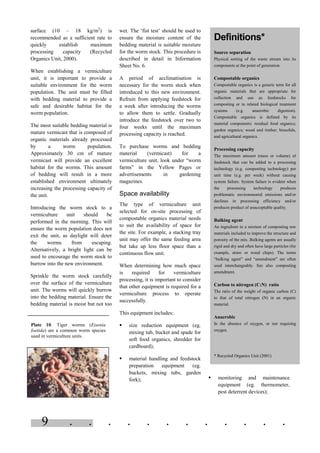
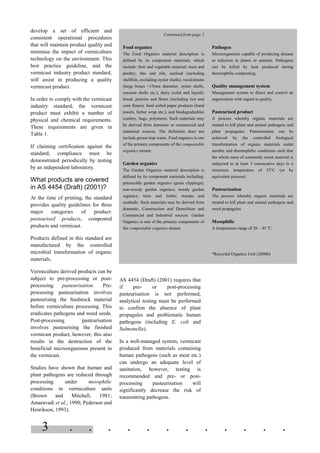
Plate 1. Components of an organics management system for processing
compostable organic materials in a vermiculture unit.
Worms convert
compostable
organic
materials into a
valuable end
product –
vermicast!
2 . . . . . . . . . . . .
What is an organics
management system?
An organics management system is
the system that involves the
processing of a compostable organic
material into an end product.
An organics management system
involves people, machinery,
infrastructure, utilities and
coordination. A variety of different
technologies for organics processing
exist. Two common types of organic
processing technologies include
vermiculture and composting to
produce an end product of vermicast
or compost.
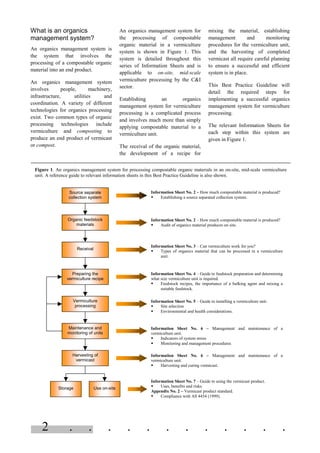
An organics management system for
the processing of compostable
organic material in a vermiculture
system is shown in Figure 1. This
system is detailed throughout this
series of Information Sheets and is
applicable to on-site, mid-scale
vermiculture processing by the C&I
sector.
Establishing an organics
management system for vermiculture
processing is a complicated process
and involves much more than simply
applying compostable material to a
vermiculture unit.
The receival of the organic material,
the development of a recipe for
mixing the material, establishing
management and monitoring
procedures for the vermiculture unit,
and the harvesting of completed
vermicast all require careful planning
to ensure a successful and efficient
system is in place.
This Best Practice Guideline will
detail the required steps for
implementing a successful organics
management system for vermiculture
processing.
The relevant Information Sheets for
each step within this system are
given in Figure 1.
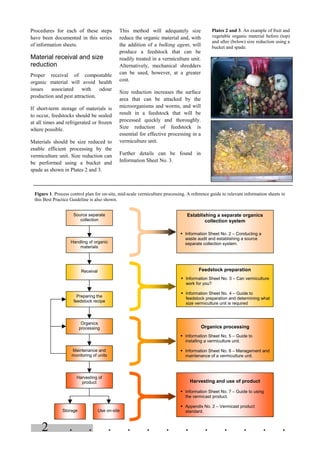
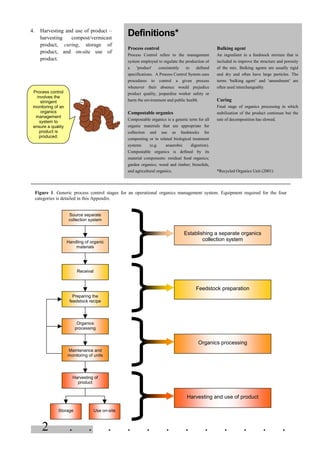
Figure 1. An organics management system for processing compostable organic materials in an on-site, mid-scale vermiculture
unit. A reference guide to relevant information sheets in this Best Practice Guideline is also shown.
Information Sheet No. 2 – How much compostable material is produced?
§ Audit of organics material produces on site.
Information Sheet No. 2 – How much compostable material is produced?
§ Establishing a source separated collection system.
Information Sheet No. 3 – Can vermiculture work for you?
§ Types of organics material that can be processed in a vermiculture
unit.
Information Sheet No. 4 – Guide to feedstock preparation and determining
what size vermiculture unit is required.
§ Feedstock recipes, the importance of a bulking agent and mixing a
suitable feedstock.
Information Sheet No. 5 – Guide to installing a vermiculture unit.
§ Site selection
§ Environmental and health considerations.
Information Sheet No. 6 – Management and maintenance of a
vermiculture unit.
§ Indicators of system stress
§ Monitoring and management procedures
Information Sheet No. 6 – Management and maintenance of a
vermiculture unit.
§ Harvesting and curing vermicast.
Information Sheet No. 7 – Guide to using the vermicast product.
§ Uses, benefits and risks.
Appendix No. 2 – Vermicast product standard.
§ Compliance with AS 4454 (1999).
Source separate
collection system
Organic feedstock
materials
Receival
Preparing the
vermiculture recipe
Vermiculture
processing
Harvesting of
vermicast
Storage Use on-site
Maintenance and
monitoring of units
3 . . . . . . . . . . . .
Look after us
and we will
look after your
compostable
organics!
Components of a
vermiculture unit
A vermiculture unit consists of four
main components:
1. Container – houses the bedding
and worm population so they can
consume organic materials
loaded into the unit. The
container also excludes pests and
protects worms from both the
elements and predators.
2. Worm population – necessary to
convert the compostable organic
materials into vermicast that can
be used as a soil conditioner.
3. Bedding – a deep layer of
mature vermicast is
recommended as a medium for
worms to live in. A greater mass
of bedding reduces the variation
in bedding temperature and
moisture.
4. Source of food and moisture for
the worms – this is applied to the
surface of the bedding.
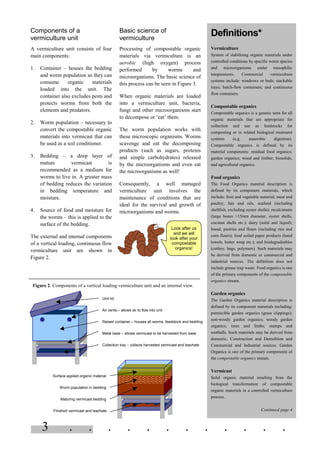
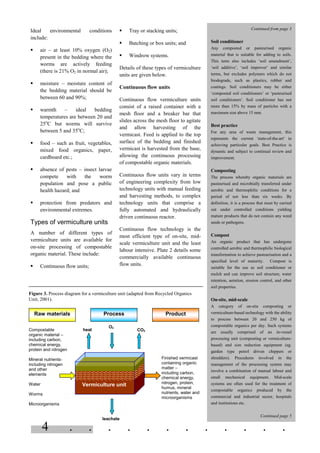
The external and internal components
of a vertical loading, continuous flow
vermiculture unit are shown in
Figure 2.
Basic science of
vermiculture
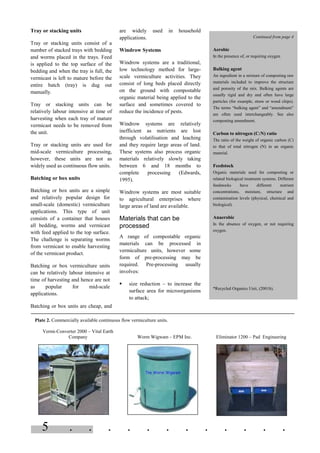
Processing of compostable organic
materials via vermiculture is an
aerobic (high oxygen) process
performed by worms and
microorganisms. The basic science of
this process can be seen in Figure 3.
When organic materials are loaded
into a vermiculture unit, bacteria,
fungi and other microorganisms start
to decompose or ‘eat’ them.
The worm population works with
these microscopic organisms. Worms
scavenge and eat the decomposing
products (such as sugars, proteins
and simple carbohydrates) released
by the microorganisms and even eat
the microorganisms as well!
Consequently, a well managed
vermiculture unit involves the
maintenance of conditions that are
ideal for the survival and growth of
microorganisms and worms.
Definitions*
Vermiculture
System of stabilising organic materials under
controlled conditions by specific worm species
and microorganisms under mesophilic
temperatures. Commercial vermiculture
systems include: windrows or beds; stackable
trays; batch-flow containers; and continuous
flow containers.
Compostable organics
Compostable organics is a generic term for all
organic materials that are appropriate for
collection and use as feedstocks for
composting or in related biological treatment
systems (e.g. anaerobic digestion).
Compostable organics is defined by its
material components: residual food organics;
garden organics; wood and timber; biosolids,
and agricultural organics.
Food organics
The Food Organics material description is
defined by its component materials, which
include: fruit and vegetable material; meat and
poultry; fats and oils, seafood (including
shellfish, excluding oyster shells); recalcitrants
(large bones >15mm diameter, oyster shells,
coconut shells etc.); dairy (solid and liquid);
bread, pastries and flours (including rice and
corn flours); food soiled paper products (hand
towels, butter wrap etc.); and biodegradeables
(cutlery, bags, polymers). Such materials may
be derived from domestic or commercial and
industrial sources. The definition does not
include grease trap waste. Food organics is one
of the primary components of the compostable
organics stream.
Garden organics
The Garden Organics material description is
defined by its component materials including:
putrescible garden organics (grass clippings);
non-woody garden organics; woody garden
organics; trees and limbs; stumps and
rootballs. Such materials may be derived from
domestic, Construction and Demolition and
Commercial and Industrial sources. Garden
Organics is one of the primary components of
the compostable organics stream.
Vermicast
Solid organic material resulting from the
biological transformation of compostable
organic materials in a controlled vermiculture
process.
Continued page 4
Figure 2. Components of a vertical loading vermiculture unit and an internal view.
Unit lid
Raised container – houses all worms, feedstock and bedding
Metal base – allows vermicast to be harvested from base
Collection tray – collects harvested vermicast and leachate
Surface applied organic material
Worm population in bedding
Maturing vermicast bedding
Finished vermicast and leachate
Air vents – allows air to flow into unit
4 . . . . . . . . . . . .
Figure 3. Process diagram for a vermiculture unit (adapted from Recycled Organics
Unit, 2001).
Continued from page 3
Soil conditioner
Any composted or pasteurised organic
material that is suitable for adding to soils.
This term also includes ‘soil amendment’,
‘soil additive’, ‘soil improver’ and similar
terms, but excludes polymers which do not
biodegrade, such as plastics, rubber and
coatings. Soil conditioners may be either
‘composted soil conditioners’ or ‘pasteurised
soil conditioners’. Soil conditioner has not
more than 15% by mass of particles with a
maximum size above 15 mm.
Best practice
For any area of waste management, this
represents the current 'state-of-the-art' in
achieving particular goals. Best Practice is
dynamic and subject to continual review and
improvement.
Composting
The process whereby organic materials are
pasteurised and microbially transferred under
aerobic and thermophilic conditions for a
period of not less than six weeks. By
definition, it is a process that must by carried
out under controlled conditions yielding
mature products that do not contain any weed
seeds or pathogens.
Compost
An organic product that has undergone
controlled aerobic and thermophilic biological
transformation to achieve pasteurisation and a
specified level of maturity. Compost is
suitable for the use as soil conditioner or
mulch and can improve soil structure, water
retention, aeration, erosion control, and other
soil properties.
On-site, mid-scale
A category of on-site composting or
vermiculture-based technology with the ability
to process between 20 and 250 kg of
compostable organics per day. Such systems
are usually comprised of an in-vessel
processing unit (composting or vermiculture-
based) and size reduction equipment (eg.
garden type petrol driven chippers or
shredders). Procedures involved in the
management of the processing system may
involve a combination of manual labour and
small mechanical equipment. Mid-scale
systems are often used for the treatment of
compostable organics produced by the
commercial and industrial sector, hospitals
and institutions etc.
Continued page 5
Ideal environmental conditions
include:
§ air – at least 10% oxygen (O2)
present in the bedding where the
worms are actively feeding
(there is 21% O2 in normal air);
§ moisture – moisture content of
the bedding material should be
between 60 and 90%;
§ warmth – ideal bedding
temperatures are between 20 and
25o
C but worms will survive
between 5 and 35o
C;
§ food – such as fruit, vegetables,
mixed food organics, paper,
cardboard etc.;
§ absence of pests – insect larvae
compete with the worm
population and pose a public
health hazard; and
§ protection from predators and
environmental extremes.
Types of vermiculture units
A number of different types of
vermiculture units are available for
on-site processing of compostable
organic material. These include:
§ Continuous flow units;
§ Tray or stacking units;
§ Batching or box units; and
§ Windrow systems.
Details of these types of vermiculture
units are given below.
Continuous flow units
Continuous flow vermiculture units
consist of a raised container with a
mesh floor and a breaker bar that
slides across the mesh floor to agitate
and allow harvesting of the
vermicast. Feed is applied to the top
surface of the bedding and finished
vermicast is harvested from the base,
allowing the continuous processing
of compostable organic materials.
Continuous flow units vary in terms
of engineering complexity from low
technology units with manual feeding
and harvesting methods, to complex
technology units that comprise a
fully automated and hydraulically
driven continuous reactor.
Continuous flow technology is the
most efficient type of on-site, mid-
scale vermiculture unit and the least
labour intensive. Plate 2 details some
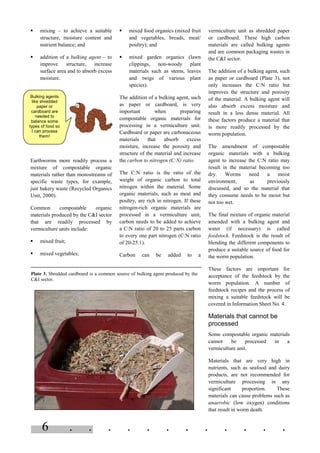
commercially available continuous
flow units.
Finished vermicast
containing organic
matter –
including carbon,
chemical energy,
nitrogen, protein,
humus, mineral
nutrients, water and
microorganisms
Compostable
organic material –
including carbon,
chemical energy,
protein and nitrogen
Mineral nutrients-
including nitrogen
and other
elements
Water
Worms
Microorganisms
Process
leachate
heat CO2
O2
Vermiculture unit
Raw materials Product
5 . . . . . . . . . . . .
Tray or stacking units
Tray or stacking units consist of a
number of stacked trays with bedding
and worms placed in the trays. Feed
is applied to the top surface of the
bedding and when the tray is full, the
vermicast is left to mature before the
entire batch (tray) is dug out
manually.
Tray or stacking units can be
relatively labour intensive at time of
harvesting when each tray of mature
vermicast needs to be removed from
the unit.
Tray or stacking units are used for
mid-scale vermiculture processing,
however, these units are not as
widely used as continuous flow units.
Batching or box units
Batching or box units are a simple
and relatively popular design for
small-scale (domestic) vermiculture
applications. This type of unit
consists of a container that houses
all bedding, worms and vermicast
with feed applied to the top surface.
The challenge is separating worms
from vermicast to enable harvesting
of the vermicast product.
Batching or box vermiculture units
can be relatively labour intensive at
time of harvesting and hence are not
as popular for mid-scale
applications.
Batching or box units are cheap, and
are widely used in household
applications.
Windrow Systems
Windrow systems are a traditional,
low technology method for large-
scale vermiculture activities. They
consist of long beds placed directly
on the ground with compostable
organic material being applied to the
surface and sometimes covered to
reduce the incidence of pests.
Windrow systems are relatively
inefficient as nutrients are lost
through volatilisation and leaching
and they require large areas of land.
These systems also process organic
materials relatively slowly taking
between 6 and 18 months to
complete processing (Edwards,
1995).
Windrow systems are most suitable
to agricultural enterprises where
large areas of land are available.
Materials that can be
processed
A range of compostable organic
materials can be processed in
vermiculture units, however some
form of pre-processing may be
required. Pre-processing usually
involves:
§ size reduction – to increase the
surface area for microorganisms
to attack;
Plate 2. Commercially available continuous flow vermiculture units.
Vermi-Converter 2000 – Vital Earth
Company Worm Wigwam – EPM Inc. Eliminator 1200 – Pad Engineering
Continued from page 4
Aerobic
In the presence of, or requiring oxygen.
Bulking agent
An ingredient in a mixture of composting raw
materials included to improve the structure
and porosity of the mix. Bulking agents are
usually rigid and dry and often have large
particles (for example, straw or wood chips).
The terms “bulking agent” and “amendment”
are often used interchangeably. See also
composting amendment.
Carbon to nitrogen (C:N) ratio
The ratio of the weight of organic carbon (C)
to that of total nitrogen (N) in an organic
material.
Feedstock
Organic materials used for composting or
related biological treatment systems. Different
feedstocks have different nutrient
concentrations, moisture, structure and
contamination levels (physical, chemical and
biological).
Anaerobic
In the absence of oxygen, or not requiring
oxygen.
*Recycled Organics Unit, (2001b).
6 . . . . . . . . . . . .
Bulking agents
like shredded
paper or
cardboard are
needed to
balance some
types of food so
I can process
them!
§ mixing – to achieve a suitable
structure, moisture content and
nutrient balance; and
§ addition of a bulking agent – to
improve structure, increase
surface area and to absorb excess
moisture.
Earthworms more readily process a
mixture of compostable organic
materials rather than monostreams of
specific waste types, for example,
just bakery waste (Recycled Organics
Unit, 2000).
Common compostable organic
materials produced by the C&I sector
that are readily processed by
vermiculture units include:
§ mixed fruit;
§ mixed vegetables;
§ mixed food organics (mixed fruit
and vegetables, breads, meat/
poultry); and
§ mixed garden organics (lawn
clippings, non-woody plant
materials such as stems, leaves
and twigs of various plant
species).
The addition of a bulking agent, such
as paper or cardboard, is very
important when preparing
compostable organic materials for
processing in a vermiculture unit.
Cardboard or paper are carbonaceous
materials that absorb excess
moisture, increase the porosity and
structure of the material and increase
the carbon to nitrogen (C:N) ratio.
The C:N ratio is the ratio of the
weight of organic carbon to total
nitrogen within the material. Some
organic materials, such as meat and
poultry, are rich in nitrogen. If these
nitrogen-rich organic materials are
processed in a vermiculture unit,
carbon needs to be added to achieve
a C:N ratio of 20 to 25 parts carbon
to every one part nitrogen (C:N ratio
of 20-25:1).
Carbon can be added to a
vermiculture unit as shredded paper
or cardboard. These high carbon
materials are called bulking agents
and are common packaging wastes in
the C&I sector.
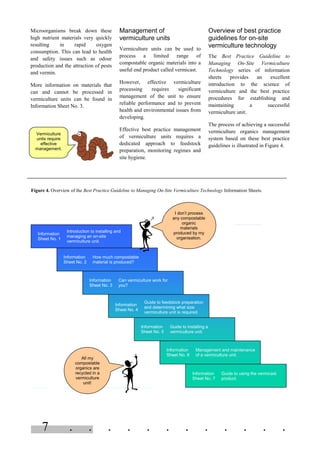
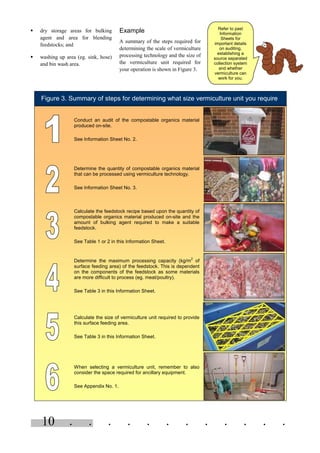
The addition of a bulking agent, such
as paper or cardboard (Plate 3), not
only increases the C:N ratio but
improves the structure and porosity
of the material. A bulking agent will
also absorb excess moisture and
result in a less dense material. All
these factors produce a material that
is more readily processed by the
worm population.
The amendment of compostable
organic materials with a bulking
agent to increase the C:N ratio may
result in the material becoming too
dry. Worms need a moist
environment, as previously
discussed, and so the material that
they consume needs to be moist but
not too wet.
The final mixture of organic material
amended with a bulking agent and
water (if necessary) is called
feedstock. Feedstock is the result of
blending the different components to
produce a suitable source of food for
the worm population.
These factors are important for
acceptance of the feedstock by the
worm population. A number of
feedstock recipes and the process of
mixing a suitable feedstock will be
covered in Information Sheet No. 4.
Materials that cannot be
processed
Some compostable organic materials
cannot be processed in a
vermiculture unit.
Materials that are very high in
nutrients, such as seafood and dairy
products, are not recommended for
vermiculture processing in any
significant proportion. These
materials can cause problems such as
anaerobic (low oxygen) conditions
that result in worm death.
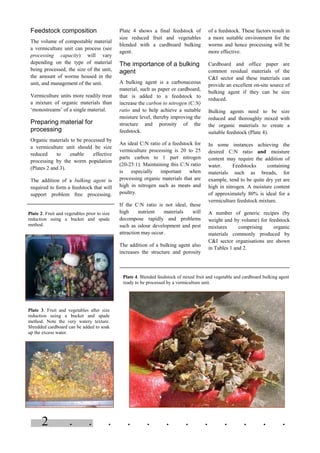
Plate 3. Shredded cardboard is a common source of bulking agent produced by the
C&I sector.
7 . . . . . . . . . . . .
Microorganisms break down these
high nutrient materials very quickly
resulting in rapid oxygen
consumption. This can lead to health
and safety issues such as odour
production and the attraction of pests
and vermin.
More information on materials that
can and cannot be processed in
vermiculture units can be found in
Information Sheet No. 3.
Management of
vermiculture units
Vermiculture units can be used to
process a limited range of
compostable organic materials into a
useful end product called vermicast.
However, effective vermiculture
processing requires significant
management of the unit to ensure
reliable performance and to prevent
health and environmental issues from
developing.
Effective best practice management
of vermiculture units requires a
dedicated approach to feedstock
preparation, monitoring regimes and
site hygiene.
Overview of best practice
guidelines for on-site
vermiculture technology
The Best Practice Guideline to
Managing On-Site Vermiculture
Technology series of information
sheets provides an excellent
introduction to the science of
vermiculture and the best practice
procedures for establishing and
maintaining a successful
vermiculture unit.
The process of achieving a successful
vermiculture organics management
system based on these best practice
guidelines is illustrated in Figure 4.
Figure 4. Overview of the Best Practice Guideline to Managing On-Site Vermiculture Technology Information Sheets.
Vermiculture
units require
effective
management.
Information
Sheet No. 7
Guide to using the vermicast
product.
Information
Sheet No. 6
Management and maintenance
of a vermiculture unit.
Information
Sheet No. 5
Guide to installing a
vermiculture unit.
Information
Sheet No. 4
Guide to feedstock preparation
and determining what size
vermiculture unit is required.
Information
Sheet No. 3
Can vermiculture work for
you?
Information
Sheet No. 2
How much compostable
material is produced?
Information
Sheet No. 1
Introduction to installing and
managing an on-site
vermiculture unit.
All my
compostable
organics are
recycled in a
vermiculture
unit!
I don’t process
any compostable
organic
materials
produced by my
organisation.
8 . . . . . . . . . . . .
Important references
§ Edwards, C.A. (1995). Historical overview of composting. BioCycle, 36(6): 56-58.
§ Recycled Organics Unit (2000). Processing of Commercial and Industrial Organics in
Vermiculture Systems. Report for Southern Sydney Waste Board, October 2000.
§ Recycled Organics Unit (2001a). Composting Science for Industry: An overview of the
scientific principles of composting processes. Printed by the Recycled Organics Unit, The
University of New South Wales, Sydney, Australia.
§ Recycled Organics Unit (2001b). Recycled Organics Industry Dictionary & Thesaurus:
standard terminology for the NSW recycled organics industry. 2nd
Edition. Internet
publication: http://www.rolibrary.com
Acknowledgement
The Recycled Organics Unit would like to thank Southern Sydney Waste Board for funding the
development of this Best Practice Guideline.
Produced by
Amanda Ferris, Dr Mark Jackson & Angus
Campbell
Recycled Organics Unit
Building B11b
The University of New South Wales
UNSW Sydney 2052
Internet: http://www.recycledorganics.com
Whilst all care is taken in the preparation of
information for this Information Sheet, the Recycled
Organics Unit, UNSW, disclaims all liability for any
error loss or other consequence which may arise from
its use.
Notes:
The ROU is the NSW centre for organic resource management,
information, research & development, demonstration and training
=
Information Sheet No. 2
January 2002
Inside This Sheet
1 Simplified waste audit
Implementation
2 What materials are you
looking for?
Definitions
3 The assessment
process
Food organics
6 Identifying your food
organics materials
8 Garden organics
Wood and timber
Paper and cardboard
Estimating variation
across the annual
cycle
Selecting an
appropriate organics
management system
Notes
Important references
Acknowledgement
ã Recycled Organics Unit
ISBN 1-876850-04-3
Simplified waste audit
Quantifying the compostable
organics material in your
organisation’s waste stream is
essential to determining the size and
type of technology required to
collect, handle and process this
material.
Knowledge of the volume,
composition and variation of the
compostable organics stream across
your annual “business” cycle will
also help you identify an appropriate
processing technology.
Understanding this variation
throughout the year is important to
determine peak periods and to design
a system that is capable of managing
peak volume.
Quantifying the volume and
composition of materials is achieved
by conducting an “audit”. A solid
waste audit involves the physical
sorting of compostable organic
materials from mixed waste. This is
an unnecessary task that often
involves unacceptable occupational
health and safety risks for staff (Plate
1).
This Information Sheet provides
simplified methods that are more
effective for quantifying the amount
of organic material produced by your
organisation.
Rather than conducting an unpleasant
and unsafe “waste audit”, simply
collect compostable organic materials
(eg. food) separately in dedicated
bins. The quantity of this
compostable material can then be
determined. The challenge is to keep
general waste out of the “organics
only” collection bins (and vice
versa), but this is simpler than sorting
through mixed garbage.
Unnecessary risks are identified and
removed, allowing for simpler and
more accurate estimations than
typical waste auditing practices.
Implementation
When implementing a source
separated collection system, the
needs of operations staff must be
Information Sheet No. 2
How much compostable material is produced?
10
11
12
13
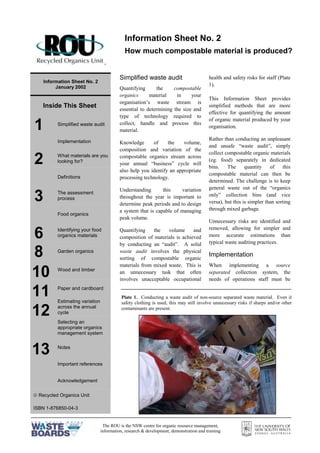
Plate 1. Conducting a waste audit of non-source separated waste material. Even if
safety clothing is used, this may still involve unnecessary risks if sharps and/or other
contaminants are present.
. . . . . . . . . . . .2
addressed. If a new operational
system is designed without adequate
consultation, opportunities to create
simpler and more efficient systems
may be lost, contributing to problems
that prejudice staff against the
system.
Staff support is mandatory to
maximise the diversion of organics
from the waste stream and to
minimise contamination levels in
source separated material. Don’t be
discouraged by the terminology – it’s
simply encouraging colleagues to put
their waste in the right bin, and
making it convenient to do so.
Dissatisfaction with current practices
and opportunities for reducing effort,
can provide significant motivation
for staff to support change. Aim to
establish a system that better meets
their expressed needs (eg. with
respect to bin size, placement, ease of
use etc.).
Generate awareness that discarding
of waste in the correct bin contributes
to environmental improvement and
that putting waste in the wrong bin
creates unnecessary waste and safety
risks for colleagues.
When presenting a new waste
management system to staff, confirm
that the new system is a result of
their expressed needs.
What materials are you
looking for?
Prior to selecting an appropriate
organics management system, it is
important to identify the compostable
materials generated by your
organisation. Compostable organics
may include (Plate 2):
§ Food organics
§ Garden organics
§ Wood and timber
§ Paper and cardboard
Definitions*
Compostable organics
Compostable organics is a generic term for all
organic materials that are appropriate for
collection and use as feedstocks for
composting or in related biological treatment
systems (e.g. anaerobic digestion).
Compostable organics is defined by its
material components: residual food organics;
garden organics; wood and timber; biosolids,
and agricultural organics.
Waste Audit
Determination of the quantities and qualities
of individual components present in a waste
stream.
Source separation
Physical sorting of the waste stream into its
components at the point of generation.
Bulking agents
An ingredient in a mixture of composting raw
materials included to improve the structure
and porosity of the mix. Bulking agents are
usually rigid and dry and often have large
particles (for example, straw or wood chips).
The terms “bulking agent” and “amendment”
are often used interchangeably. See also
composting amendment.
Carbon to nitrogen ratio
The ratio of the weight of organic carbon (C)
to that of total nitrogen (N) in an organic
material.
Continued page 5
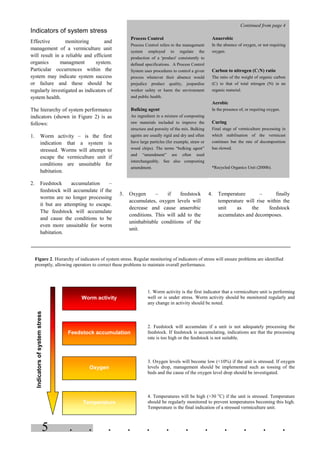
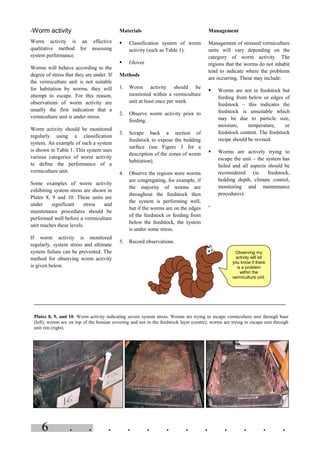
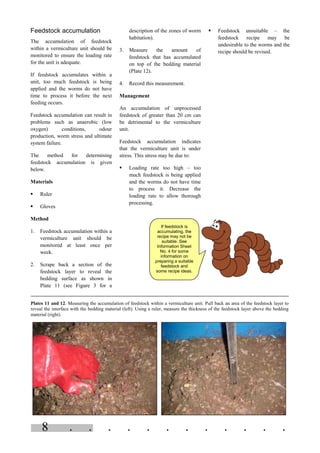
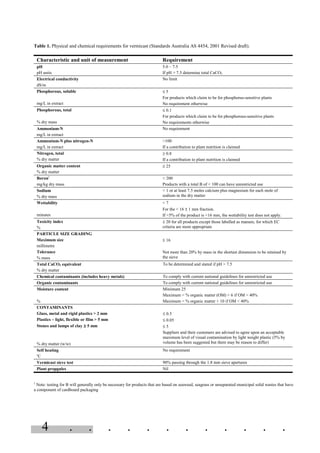
Plate 2. Materials you can use in your organics management system.
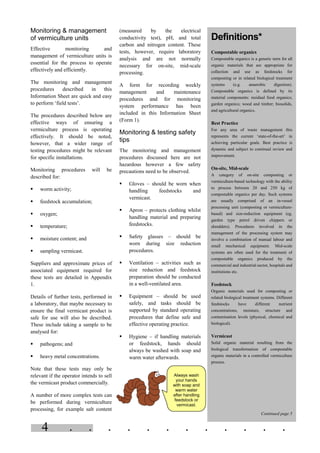
Food organics need bulking agents
when used in organics management
systems. They cannot be processed
alone! Bulking agents include garden
organics, wood and timber and paper
and cardboard. Avoid using food
organics high in oils and fats, as these
may contribute to significant odour
problems in your system.
Wood and timber can be used as
bulking agents with food or garden
organics. However, if these materials
have been chemically treated, they
should not be used in your organics
management system. It is therefore
important for you to know the
composition (history) of your wood and
timber and any associated health
issues.
Garden organics can be processed on
their own or used as bulking agents
with food organics. These materials
have a relatively high carbon to
nitrogen ratio, complementing the low
carbon to nitrogen ratio of food
organics.
Paper and cardboard can be used as
a bulking agent with food organics
and/or garden organics. Due to the
high carbon content and very low
nitrogen content of paper and
cardboard, these feedstock materials
cannot be processed alone.
. . . . . . . . . . . .3
The assessment process
Food organics
The identification of food organics
generated by your business will be
simpler, safer and more effective if
the food organics are collected
separately for a period of 2 weeks.
This also provides an excellent
opportunity for a short-term trial of a
separate collection system.
Food organics include the following
subcategories. These categories are
useful in identifying suitable
handling and processing
technologies:
Use the following steps to identify
the quantity and nature of your food
organics:
1. Identify primary locations/
sources of generation of the
food;
2. Consult with staff to identify
current practice – what they
like/dislike and existing
inefficiencies;
3. Design separate organics
collection system in consultation
with staff employed at operation
level to ensure that the system
design meets their needs
A source separated organics
collection system must meet the
needs of operational staff within your
organisation. If the new system is
designed without adequate
consultation, problems may arise that
may discourage staff from disposing
of materials correctly into “food
only” bins.
With staff support, the diversion of
organics from the waste stream will
be maximised (maximising
environmental benefits and cost
savings), and contamination rates of
the organics stream minimised
(minimising unnecessary effort and
safety risks).
Aim to establish a system that meets
the expressed needs of staff (eg. with
respect to bin size, placement, ease of
use etc.)
Confirm with operational staff that
the new system will meet their needs.
4. Install source separate collection
bins with appropriate signage etc
Install the new source separate
collection bins. Make sure that all
bins are placed at the same time to
avoid confusion, organics ‘leakage’
to the waste stream or contamination
of organics collected. Where
possible, ensure that “organics only”
bins are:
§ a standard size and distinct
colour with consistent clear
signage;
§ readily recognisable from
garbage bins;
§ obviously marked/labelled;
§ appropriate size, location and
number;
§ placed next to each garbage/
waste bin; and
§ located so that the same amount
of effort is required to place
material in the “food only” bin
or the garbage bin (if one
requires a lid to be removed, or
is a little further away the other
may receive both waste streams).
Promote the commencement of the
trial period. Have someone from
kitchen management or elsewhere
communicate to all staff the purpose,
timeframe and process of quantifying
the amount of compostable materials
produced.
Let staff know they will play a
valuable role in ensuring the success
of the project. Also engage them in
the process to identify improvements
in the system and to make it more
consistent and efficient for use.
5. Collect organics generated over
a two-week period
The waste audit results will inform
selection of a processing technology
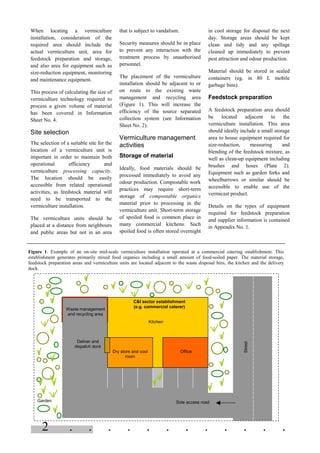
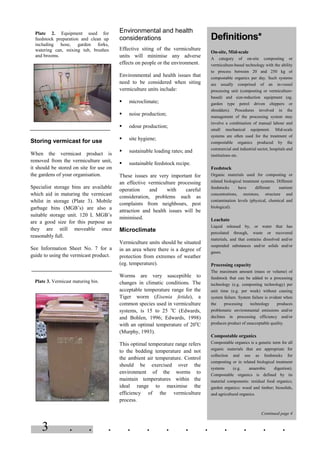
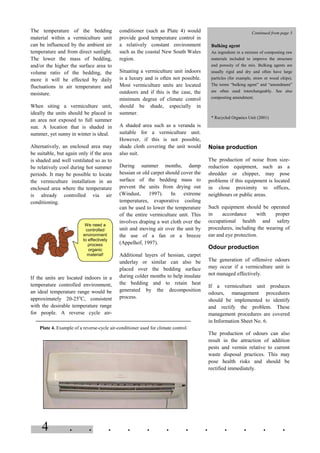
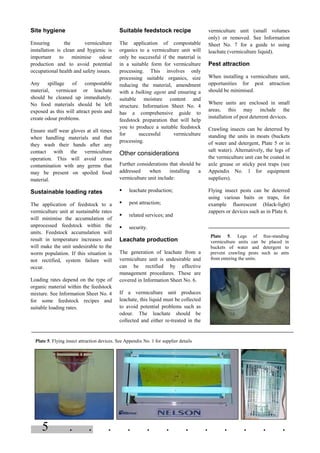
that is capable of meeting your
organisations needs.
In order to obtain reliable and
accurate estimates of the volume and
composition of your organisation’s
organics stream, it is important to
sample organics over a period of at
least two weeks. In addition, it may
be necessary to spend one week
preparing for the audit – ironing out
any bugs in the process. You should
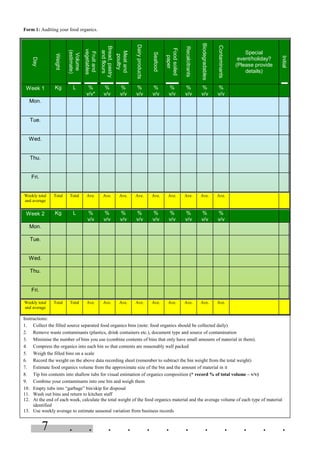
record audit information on Form 1
(attached to this Information Sheet).
Material Detail
Fruit and vegetable
material
Bread, pastries and
flours
Including rice and
corn flours
Meat and poultry
Fats and oils
Seafood Including shellfish,
excluding oyster
shells
Food soiled paper
products
Hand towels, butter
wrap etc.
Biodegradeables Cutlery, bags,
polymers
Dairy Solid and liquid
Recalcitrants Large bones, oyster
shell, coconut shells
etc.
A source-separated food
organics collection system
should be developed to meet the
expressed needs of operational
staff. Staff input gained in
previous consultation should be
directly incorporated.
. . . . . . . . . . . .4
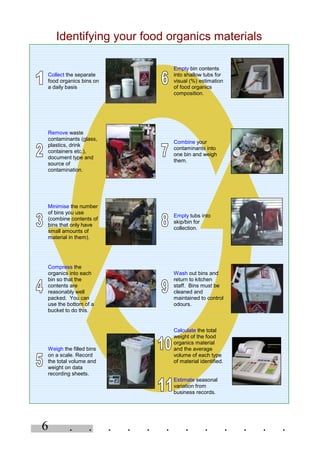
The steps involved are summarised
below:
§ Collect the filled separated “food
organics only” bins on a daily
basis);
§ Remove waste contaminants
(plastics, drink containers etc.) –
document type and source of
contamination;
§ Tip contents of bins containing
only small amounts of material
together to minimise the number
of bins being weighed;
§ Weigh the filled bins on a
platform scale;
§ Record the weight on the data
recording sheet supplied,
attached to this Information
Sheet;
§ Use the bottom of a bucket to
compress the food organics
firmly into each bin so that the
contents are reasonably well
packed;
§ Estimate total food organics
volume from the size of the bin
and the amount of material in it
(compressing material avoids
counting low density materials
(eg. cabbage/lettuce leaves) as a
full bin);
§ Tip bin contents into shallow
tubs for visual (percentage)
estimates of organics
composition;
§ Combine your contaminants into
one bin and weigh them;
§ Empty tubs into a garbage skip
or bin for collection;
§ Wash out “food organics only”
bins and return to kitchen staff;
§ At the end of each week,
calculate the total weight of the
food organics material and the
average volume of each type of
material identified;
§ Estimate seasonal variation from
business records, staff numbers
etc. to establish peak volumes of
material that would be expected
during busy periods.
Data on seasonal fluctuations in
catering, generation of garden
organics etc. can be obtained from
business records and consultation
with operational staff.
6. Tools and materials required
The materials required to determine
the amount and composition of the
food organics are listed below:
§ Platform scales
§ Data recording sheets (attached)
§ Tubs for estimating composition
§ Food waste collection bins
§ Stickers for identifying bins
§ Tongs for removing
contaminants
§ Gloves (heavy duty kitchen
gloves)
§ Scrubbing brush and access to
water for cleaning out bins
§ Educational posters for staff
room
§ Presentation materials for staff
meeting
Supplier information and prices for
this equipment is contained in
Appendix No. 1.
7. Contamination
Contaminants in food organics
comprise anything not compostable,
including:
§ individual portion wrappers
(plastic or foil);
§ plastic bags, cling wrap films
and plastic cutlery;
§ glass;
§ stainless steel cutlery, foil and
other metals;
§ ceramics, and
§ drink containers.
Contamination increases the
workload and labour costs of an
organics management system. In
addition, contaminants make work
very unpleasant (removal of
contaminants) and create safety
hazards for staff (glass and metals,
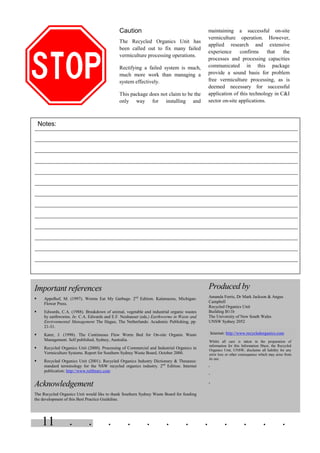
see Plate 3).
8. Monitor solid waste stream to
identify any organics ‘leakage’;
Improve organics diversion success
through education. Remember to
address any problems in system
implementation immediately. All
staff working at operational level
should understand clearly how the
separation system works, and should
have had the opportunity to
contribute to system design to ensure
it is convenient and efficient for their
use.
There should be no general waste
contamination of the collected food
Contamination of the
organics stream, or leakage
of organics into the waste
stream should be rectified
immediately! Communicate
the importance of achieving
system operational success,
and let staff know that their
contribution really matters.
. . . . . . . . . . . .5
organics and no leakage of food
organics into the general waste. If
this does occur, rectify the problem
by communicating directly with
those responsible and encouraging
them to help achieve successful
outcomes.
9. Improve organics diversion rate
and maintain through
consultation and education.
10. Bin hygiene
Bins must be cleaned and maintained
to control odours. Water and a long
handled scrubbing brush can be used
to achieve this. In some instances, a
small amount of detergent may also
be required.
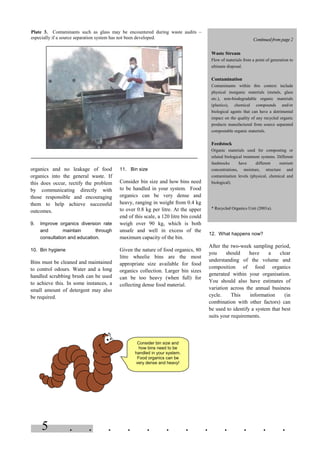
11. Bin size
Consider bin size and how bins need
to be handled in your system. Food
organics can be very dense and
heavy, ranging in weight from 0.4 kg
to over 0.8 kg per litre. At the upper
end of this scale, a 120 litre bin could
weigh over 90 kg, which is both
unsafe and well in excess of the
maximum capacity of the bin.
Given the nature of food organics, 80
litre wheelie bins are the most
appropriate size available for food
organics collection. Larger bin sizes
can be too heavy (when full) for
collecting dense food material.
12. What happens now?
After the two-week sampling period,
you should have a clear
understanding of the volume and
composition of food organics
generated within your organisation.
You should also have estimates of
variation across the annual business
cycle. This information (in
combination with other factors) can
be used to identify a system that best
suits your requirements.
Plate 3. Contaminants such as glass may be encountered during waste audits –
especially if a source separation system has not been developed. Continued frompage2
Waste Stream
Flow of materials from a point of generation to
ultimate disposal.
Contamination
Contaminants within this context include
physical inorganic materials (metals, glass
etc.), non-biodegradable organic materials
(plastics), chemical compounds and/or
biological agents that can have a detrimental
impact on the quality of any recycled organic
products manufactured from source separated
compostable organic materials.
Feedstock
Organic materials used for composting or
related biological treatment systems. Different
feedstocks have different nutrient
concentrations, moisture, structure and
contamination levels (physical, chemical and
biological).
* Recycled Organics Unit (2001a).
Consider bin size and
how bins need to be
handled in your system.
Food organics can be
very dense and heavy!
. . . . . . . . . . . .6
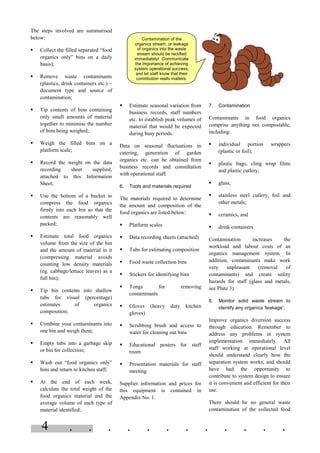
Collect the separate
food organics bins on
a daily basis
Empty bin contents
into shallow tubs for
visual (%) estimation
of food organics
composition.
Remove waste
contaminants (glass,
plastics, drink
containers etc.),
document type and
source of
contamination.
Combine your
contaminants into
one bin and weigh
them.
Minimise the number
of bins you use
(combine contents of
bins that only have
small amounts of
material in them).
Empty tubs into
skip/bin for
collection.
Compress the
organics into each
bin so that the
contents are
reasonably well
packed. You can
use the bottom of a
bucket to do this.
Wash out bins and
return to kitchen
staff. Bins must be
cleaned and
maintained to control
odours.
Weigh the filled bins
on a scale. Record
the total volume and
weight on data
recording sheets.
Calculate the total
weight of the food
organics material
and the average
volume of each type
of material identified.
Estimate seasonal
variation from
business records.
Identifying your food organics materials
. . . . . . . . . . . .7
Form 1: Auditing your food organics.Day
Weight
Volume
(estimate)
Fruitand
vegetables
Bread,pastry
andflours
Meatand
poultry
Dairyproducts
Seafood
Foodsoiled
paper
Recalcitrants
Biodegradables
Contaminants
Special
event/holiday?
(Please provide
details)
Initial
Week 1 Kg L %
v/v*
%
v/v
%
v/v
%
v/v
%
v/v
%
v/v
%
v/v
%
v/v
%
v/v
Mon.
Tue.
Wed.
Thu.
Fri.
Weekly total
and average
Total Total Ave. Ave. Ave. Ave. Ave. Ave. Ave. Ave. Ave.
Week 2 Kg L %
v/v
%
v/v
%
v/v
%
v/v
%
v/v
%
v/v
%
v/v
%
v/v
%
v/v
Mon.
Tue.
Wed.
Thu.
Fri.
Weekly total
and average
Total Total Ave. Ave. Ave. Ave. Ave. Ave. Ave. Ave. Ave.
Instructions:
1. Collect the filled source separated food organics bins (note: food organics should be collected daily)
2. Remove waste contaminants (plastics, drink containers etc.), document type and source of contamination
3. Minimise the number of bins you use (combine contents of bins that only have small amounts of material in them).
4. Compress the organics into each bin so that contents are reasonably well packed
5. Weigh the filled bins on a scale
6. Record the weight on the above data recording sheet (remember to subtract the bin weight from the total weight)
7. Estimate food organics volume from the approximate size of the bin and the amount of material in it
8. Tip bin contents into shallow tubs for visual estimation of organics composition (* record % of total volume – v/v)
9. Combine your contaminants into one bin and weigh them
10. Empty tubs into “garbage” bin/skip for disposal
11. Wash out bins and return to kitchen staff
12. At the end of each week, calculate the total weight of the food organics material and the average volume of each type of material
identified
13. Use weekly average to estimate seasonal variation from business records
. . . . . . . . . . . .8
Garden organics
Garden organics material can form a
substantial proportion of the solid
waste stream, particularly during
summer and after storm events.
In some instances quantifying the
garden organics produced by your
organisation may be difficult.
Nevertheless, you should try to
characterise this component of your
waste stream.
Garden organics materials include
the following subcategories, which
are useful in identifying suitable
handling and processing technology:
Use the following steps to quantify
and identify the nature of your
garden organics (Plate 4):
1. Consult with relevant staff
Consultation with relevant staff
members is essential to determine the
amount of garden organics material
produced. Identify materials present
and the quantities of materials
generated. If possible, ask gardening
staff to fill out Form 2 for a two week
period to characterise the garden
organics generated.
If gardening staff cannot give you
accurate estimations of garden
organics generated, it will still be
useful to have garden staff provide a
guesstimate of the amount of each
material produced.
2. The audit process
Over a two week period, encourage
gardening staff to record the volume
and composition of the garden
organics generated. In addition,
identify current practices with your
garden organics – are they stock
piled, mulched, burnt, dumped in a
skip etc.?
Use the following steps to determine
the amount and type of garden
organics produced by your
organisation:
§ Have gardening staff count the
number of grass catchers,
trailers, trucks, and/or skips
filled with garden organics each
day.
§ Determine the volume of each
type of storage medium.
§ To determine the overall volume
of materials generated on a daily
basis, multiply the number of
times a container is filled by its
volume.
§ Estimate the total volume of
material generated on a weekly
basis by adding the daily totals
together.
§ Try to characterise the
proportion of different garden
organics generated on a
daily/weekly basis.
§ Make notes of any storm events
etc. that may have influenced the
amount of material
generated/collected during the
audit period.
Note: If your garden organics have
been size reduced/shredded prior to
auditing, the volume of material will
be significantly reduced.
3. Exclude materials from the audit
If materials such as lawn clippings
are usually left uncollected on lawn
areas, then do not count this material
in the audit. Leaving this material on
the ground is the optimal choice – not
requiring further effort or
management. The goal of the
organics management system is to
improve poor practice, not to change
best practice where it already occurs.
4. Check the audit results
After the two week period, it will be
useful to feed data back to gardening
staff and confirm the audit results.
Determine if the results are typical or
atypical of what is usually produced.
Identify the effects of season or the
impact of other events such as storms
on the amount and type of material
produced.
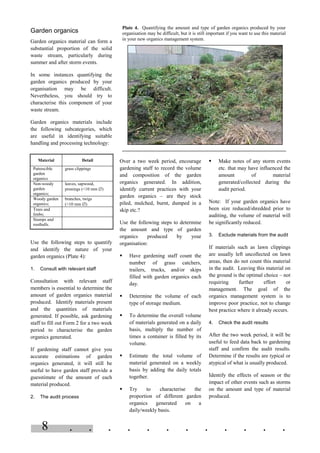
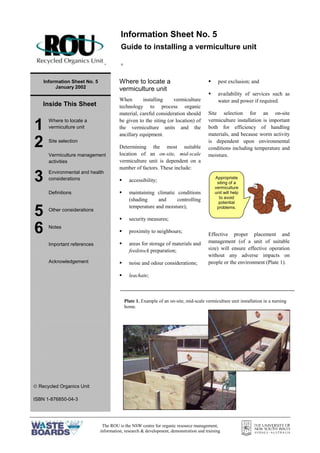
Plate 4. Quantifying the amount and type of garden organics produced by your
organisation may be difficult, but it is still important if you want to use this material
in your new organics management system.
Material Detail
Putrescible
garden
organics
grass clippings
Non-woody
garden
organics;
leaves, sapwood,
prunings (<10 mm ∅)
Woody garden
organics;
branches, twigs
(>10 mm ∅)
Trees and
limbs;
Stumps and
rootballs.
. . . . . . . . . . . .9
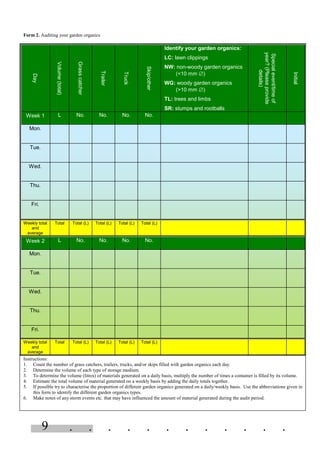
Form 2. Auditing your garden organics
Day
Volume(total)
Grasscatcher
Trailer
Truck
Skip/other
Identify your garden organics:
LC: lawn clippings
NW: non-woody garden organics
(<10 mm ∅)
WG: woody garden organics
(>10 mm ∅)
TL: trees and limbs
SR: stumps and rootballs
Specialevent/timeof
year?(Pleaseprovide
details)
Initial
Week 1 L No. No. No. No.
Mon.
Tue.
Wed.
Thu.
Fri.
Weekly total
and
average
Total Total (L) Total (L) Total (L) Total (L)
Week 2 L No. No. No. No.
Mon.
Tue.
Wed.
Thu.
Fri.
Weekly total
and
average
Total Total (L) Total (L) Total (L) Total (L)
Instructions:
1. Count the number of grass catchers, trailers, trucks, and/or skips filled with garden organics each day.
2. Determine the volume of each type of storage medium.
3. To determine the volume (litres) of materials generated on a daily basis, multiply the number of times a container is filled by its volume.
4. Estimate the total volume of material generated on a weekly basis by adding the daily totals together.
5. If possible try to characterise the proportion of different garden organics generated on a daily/weekly basis. Use the abbreviations given in
this form to identify the different garden organics types.
6. Make notes of any storm events etc. that may have influenced the amount of material generated during the audit period.
. . . . . . . . . . . .10
Wood and timber
Wood and timber materials can be a
substantial proportion of the solid
waste stream for some types of
enterprises. These materials have a
very high carbon to nitrogen ratio,
complementing the low carbon to
nitrogen ratio of food organics.
Wood and timber organics include
the following subcategories, which
are useful in identifying suitable
handling and processing
technologies:
Material
off-cuts
crates
pallets and packaging
saw dust
timber shavings
For use in your organics management
system, you should consider only
saw dust and/or timber shavings, and
only if the material is from wood that
is not painted or treated. The use of
other wood and timber materials may
create more problems than benefits.
Avoid chemically treated or composite
wood products
Avoid using chemically treated wood
and composite wood materials, as
they contain dangerous chemical
compounds (eg. formaldehyde,
creosote, etc.) that may pose potential
health risks to your staff.
Use wood materials that are already
in a form to be processed
For OH&S reasons and also for ease
of management, it is best to use wood
and timber materials that are already
in a form to be processed (saw dust
and shavings).
Size reduction of materials adds
considerable time to the processing
of the wood and timber, requires
expensive equipment and also
exposes staff to unnecessary risks.
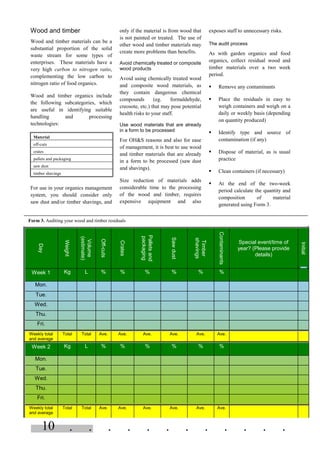
The audit process
As with garden organics and food
organics, collect residual wood and
timber materials over a two week
period.
§ Remove any contaminants
§ Place the residuals in easy to
weigh containers and weigh on a
daily or weekly basis (depending
on quantity produced)
§ Identify type and source of
contamination (if any)
§ Dispose of material, as is usual
practice
§ Clean containers (if necessary)
§ At the end of the two-week
period calculate the quantity and
composition of material
generated using Form 3.
Day
Weight
Volume
(estimate)
Off-cuts
Crates
Palletsand
packaging
Sawdust
Timber
shavings
Contaminants
Special event/time of
year? (Please provide
details)
Initial
Week 1 Kg L % % % % % %
Mon.
Tue.
Wed.
Thu.
Fri.
Weekly total
and average
Total Total Ave. Ave. Ave. Ave. Ave. Ave.
Week 2 Kg L % % % % % %
Mon.
Tue.
Wed.
Thu.
Fri.
Weekly total
and average
Total Total Ave. Ave. Ave. Ave. Ave. Ave.
Form 3. Auditing your wood and timber residuals
. . . . . . . . . . . .11
Paper and cardboard
Paper and cardboard materials can be
a substantial portion of the solid
waste stream for many enterprises.
Whilst not wanting to impact on
effective paper recycling, some of
this material may be useful to the
organics management system. Paper
and cardboard has a very high carbon
to nitrogen ratio – complementing the
very low carbon to nitrogen ratio of
food organics.
If you have not established a paper
recycling system, the guidelines are
provided in “Office Paper, Recycle
it” NSW EPA (1990).
Use pre-shredded paper/cardboard
For ease of management and to
facilitate the organics management
system, only use non-waxed paper
and cardboard. The size reduction of
paper and cardboard can be difficult
and time consuming without
expensive equipment. So be sure to
identify shredded paper and
cardboard. It will be much easier to
use in your organics processing
system.
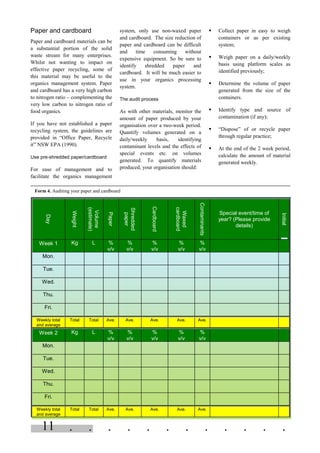
The audit process
As with other materials, monitor the
amount of paper produced by your
organisation over a two-week period.
Quantify volumes generated on a
daily/weekly basis, identifying
contaminant levels and the effects of
special events etc. on volumes
generated. To quantify materials
produced, your organisation should:
§ Collect paper in easy to weigh
containers or as per existing
system;
§ Weigh paper on a daily/weekly
basis using platform scales as
identified previously;
§ Determine the volume of paper
generated from the size of the
containers.
§ Identify type and source of
contamination (if any);
§ “Dispose” of or recycle paper
through regular practice;
§ At the end of the 2 week period,
calculate the amount of material
generated weekly.
Day
Weight
Volume
(estimate)
Paper
Shredded
paper
Cardboard
Waxed
cardboard
Contaminants
Special event/time of
year? (Please provide
details)
Initial
Week 1 Kg L %
v/v
%
v/v
%
v/v
%
v/v
%
v/v
Mon.
Tue.
Wed.
Thu.
Fri.
Weekly total
and average
Total Total Ave. Ave. Ave. Ave. Ave.
Week 2 Kg L %
v/v
%
v/v
%
v/v
%
v/v
%
v/v
Mon.
Tue.
Wed.
Thu.
Fri.
Weekly total
and average
Total Total Ave. Ave. Ave. Ave. Ave.
Form 4. Auditing your paper and cardboard
. . . . . . . . . . . .12
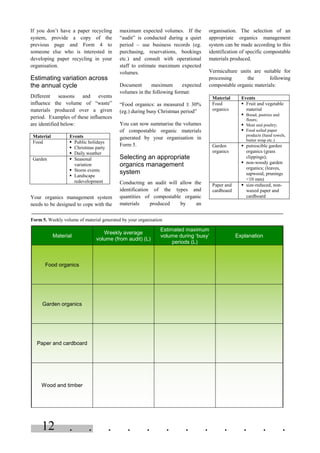
If you don’t have a paper recycling
system, provide a copy of the
previous page and Form 4 to
someone else who is interested in
developing paper recycling in your
organisation.
Estimating variation across
the annual cycle
Different seasons and events
influence the volume of “waste”
materials produced over a given
period. Examples of these influences
are identified below:
Your organics management system
needs to be designed to cope with the
maximum expected volumes. If the
“audit” is conducted during a quiet
period – use business records (eg.
purchasing, reservations, bookings
etc.) and consult with operational
staff to estimate maximum expected
volumes.
Document maximum expected
volumes in the following format:
“Food organics: as measured ± 30%
(eg.) during busy Christmas period”
You can now summarise the volumes
of compostable organic materials
generated by your organisation in
Form 5.
Selecting an appropriate
organics management
system
Conducting an audit will allow the
identification of the types and
quantities of compostable organic
materials produced by an
organisation. The selection of an
appropriate organics management
system can be made according to this
identification of specific compostable
materials produced.
Vermiculture units are suitable for
processing the following
compostable organic materials:
Material Events
Food § Public holidays
§ Christmas party
§ Daily weather
Garden § Seasonal
variation
§ Storm events
§ Landscape
redevelopment
Material
Weekly average
volume (from audit) (L)
Estimated maximum
volume during ‘busy’
periods (L)
Explanation
Food organics
Garden organics
Paper and cardboard
Wood and timber
Form 5. Weekly volume of material generated by your organisation
Material Events
Food
organics
§ Fruit and vegetable
material
§ Bread, pastries and
flours;
§ Meat and poultry;
§ Food soiled paper
products (hand towels,
butter wrap etc.)
Garden
organics
§ putrescible garden
organics (grass
clippings);
§ non-woody garden
organics; (leaves,
sapwood, prunings
<10 mm)
Paper and
cardboard
§ size-reduced, non-
waxed paper and
cardboard
. . . . . . . . . . . .13
If large quantities of compostable
materials that do not fall into these
categories are produced by your
organisation, an alternative organics
management system, for example
composting, should be implemented
that more readily processes these
types of materials.
More information on alternative
organics management systems, such
as composting, can be found in On-
Site Composting: Technology
Options and Process Control
Strategies (Recycled Organics Unit,
2001b) or visit
http://www.recyledorganics.com.
Produced by
Amanda Ferris, Dr Frank Valzano, Dr Mark
Jackson & Angus Campbell
Recycled Organics Unit
Building B11b
The University of New South Wales
UNSW Sydney 2052
Internet: http://www.recycledorganics.com
Whilst all care is taken in the preparation of
information for this Information Sheet, the Recycled
Organics Unit, UNSW, disclaims all liability for any
error loss or other consequence which may arise from
its use.
Important references
§ NSW EPA, (1990) “Office Paper – Recycle it” New South Wales Environment
Protection Authority. http://www.epa.nsw.gov.au/publications/pubslist.htm
§ Recycled Organics Unit (2001a). Recycled Organics Industry Dictionary & Thesaurus:
standard terminology for the NSW recycled organics industry. 2nd
Edition. Internet
publication: http://www.rolibrary.com
§ Recycled Organics Unit (2001b). On-Site System Organics Management Systems: A
planning and implementation workbook. Printed by the Recycled Organics Unit, The
University of New South Wales, Sydney Australia.
Acknowledgement
The Recycled Organics Unit would like to thank Southern Sydney Waste Board for funding
the development of this Best Practice Guideline.
Notes:
The ROU is the NSW centre for organic resource management,
information, research & development, demonstration and training
=
Information Sheet No. 3
January 2002
Inside This Sheet
1 Vermiculture processing
Food organics suitable for
vermiculture processing
2 Choosing a suitable
processing technology
Definitions
3 Notes
Important references
Acknowledgements
 Recycled Organics Unit
ISBN 1-876850-04-3
Vermiculture processing
The use of vermiculture for
processing compostable organics
material is often promoted as a
suitable means of recycling materials
to produce valuable horticultural
products.
However, even well managed
vermiculture units can fail if they are
fed with unsuitable materials.
Vermiculture technology cannot
process all categories of compostable
organics with the same efficiency.
Only a limited range of organic
materials can be effectively managed
via on-site vermiculture technology.
The audit of ‘waste’ material
produced on site (Information Sheet
No. 2), is an essential step in
identifying the type of compostable
materials that you produce. This will
enable you to decide whether or not
vermiculture technology is suitable
for your organisation.
Food organics suitable for
vermiculture processing
The Recycled Organics Unit has
performed a number of trials that
examined the ability of vermiculture
technology to process a range of
common compostable organic
materials (see Appendix No. 4).
These trials established that
vermiculture is most effective for
processing fruit and vegetables
however a certain amount of
feedstock preparation is required, as
shown in Plate 1 (Recycled Organics
Unit, 2000).
Information Sheet No. 3
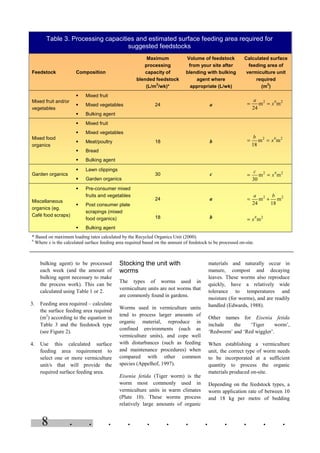
Can vermiculture work for you?
See Appendix No.
4 for research
conducted by the
Recycled
Organics Unit
regarding suitable
materials for
vermiculture
processing.
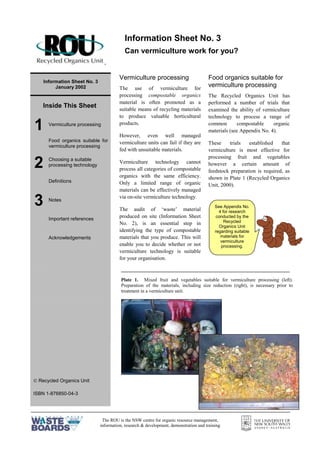
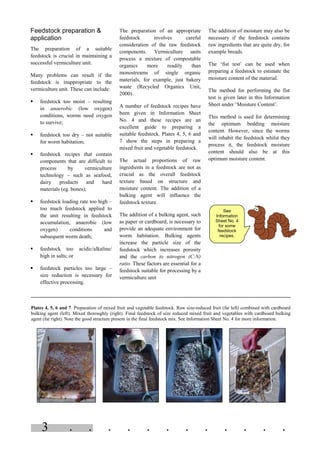
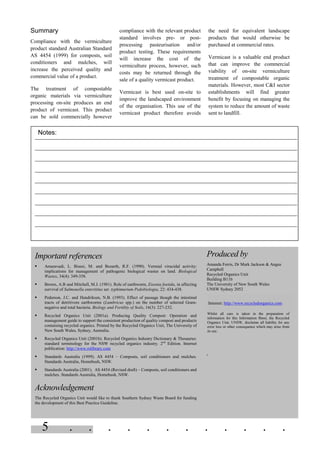
Plate 1. Mixed fruit and vegetables suitable for vermiculture processing (left).
Preparation of the materials, including size reduction (right), is necessary prior to
treatment in a vermiculture unit.
2 . . . . . . . . . . . .
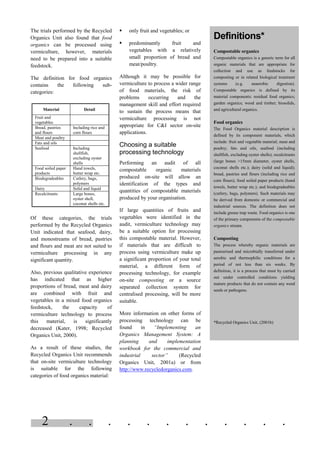
The trials performed by the Recycled
Organics Unit also found that food
organics can be processed using
vermiculture, however, materials
need to be prepared into a suitable
feedstock.
The definition for food organics
contains the following sub-
categories:
Of these categories, the trials
performed by the Recycled Organics
Unit indicated that seafood, dairy,
and monostreams of bread, pastries
and flours and meat are not suited to
vermiculture processing in any
significant quantity.
Also, previous qualitative experience
has indicated that as higher
proportions of bread, meat and dairy
are combined with fruit and
vegetables in a mixed food organics
feedstock, the capacity of
vermiculture technology to process
this material, is significantly
decreased (Kater, 1998; Recycled
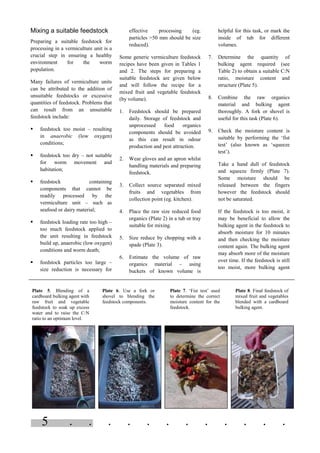
Organics Unit, 2000).
As a result of these studies, the
Recycled Organics Unit recommends
that on-site vermiculture technology
is suitable for the following
categories of food organics material:
§ only fruit and vegetables; or
§ predominantly fruit and
vegetables with a relatively
small proportion of bread and
meat/poultry.
Although it may be possible for
vermiculture to process a wider range
of food materials, the risk of
problems occurring and the
management skill and effort required
to sustain the process means that
vermiculture processing is not
appropriate for C&I sector on-site
applications.
Choosing a suitable
processing technology
Performing an audit of all
compostable organic materials
produced on-site will allow an
identification of the types and
quantities of compostable materials
produced by your organisation.
If large quantities of fruits and
vegetables were identified in the
audit, vermiculture technology may
be a suitable option for processing
this compostable material. However,
if materials that are difficult to
process using vermiculture make up
a significant proportion of your total
material, a different form of
processing technology, for example
on-site composting or a source
separated collection system for
centralised processing, will be more
suitable.
More information on other forms of
processing technology can be
found in “Implementing an
Organics Management System: A
planning and implementation
workbook for the commercial and
industrial sector” (Recycled
Organics Unit, 2001a) or from
http://www.recycledorganics.com.
Material Detail
Fruit and
vegetables
Bread, pastries
and flours
Including rice and
corn flours
Meat and poultry
Fats and oils
Seafood Including
shellfish,
excluding oyster
shells
Food soiled paper
products
Hand towels,
butter wrap etc.
Biodegradeables Cutlery, bags,
polymers
Dairy Solid and liquid
Recalcitrants Large bones,
oyster shell,
coconut shells etc.
Definitions*
Compostable organics
Compostable organics is a generic term for all
organic materials that are appropriate for
collection and use as feedstocks for
composting or in related biological treatment
systems (e.g. anaerobic digestion).
Compostable organics is defined by its
material components: residual food organics;
garden organics; wood and timber; biosolids,
and agricultural organics.
Food organics
The Food Organics material description is
defined by its component materials, which
include: fruit and vegetable material; meat and
poultry; fats and oils, seafood (including
shellfish, excluding oyster shells); recalcitrants
(large bones >15mm diameter, oyster shells,
coconut shells etc.); dairy (solid and liquid);
bread, pastries and flours (including rice and
corn flours); food soiled paper products (hand
towels, butter wrap etc.); and biodegradeables
(cutlery, bags, polymers). Such materials may
be derived from domestic or commercial and
industrial sources. The definition does not
include grease trap waste. Food organics is one
of the primary components of the compostable
organics stream.
Composting
The process whereby organic materials are
pasteurised and microbially transferred under
aerobic and thermophilic conditions for a
period of not less than six weeks. By
definition, it is a process that must by carried
out under controlled conditions yielding
mature products that do not contain any weed
seeds or pathogens.
*Recycled Organics Unit, (2001b)
3 . . . . . . . . . . . .
Notes:
Important references
§ Kater, J. (1998) The Continuous Flow Worm Bed for On-site Organic Waste
Management. Self published, Sydney, Australia.
§ Recycled Organics Unit (2000). Processing of Commercial and Industrial Organics in
Vermiculture Systems. Report for Southern Sydney Waste Board, October 2000.
§ Recycled Organics Unit (2001a). Recycled Organics Industry Dictionary & Thesaurus:
standard terminology for the NSW recycled organics industry. Internet publication:
http://www.rolibrary.com
§ Recycled Organics Unit (2001b). Implementing an Organics Management System: A
planning and implementation workbook for the Commercial and Industrial sector.
Printed by the Recycled Organics Unit, The University of New South Wales, Sydney,
Australia.
Acknowledgements
The Recycled Organics Unit would like to thank Southern Sydney Waste Board for funding
the development of this Best Practice Guideline.
Produced by
Amanda Ferris, Dr Mark Jackson & Angus
Campbell
Recycled Organics Unit
Building B11b
The University of New South Wales
UNSW Sydney 2052
Internet: http://www.recycledorganics.com
Whilst all care is taken in the preparation of information
for this Information Sheet, the Recycled Organics Unit,
UNSW disclaims all liability for any error, loss or other
consequence which may arise from its use.=
The ROU is the NSW centre for organic resource management,
information, research & development, demonstration and training
=
Information Sheet No. 4
January 2002
Inside This Sheet
1 Selection of a vermiculture
unit
2 Feedstock composition
Preparing material for
processing
The importance of a
bulking agent
5 Mixing a suitable feedstock
6 Maximum processing
capacity
7 What size vermiculture unit
do I require?
8 Stocking the unit with
worms
9 Space availability
Definitions
Example
Caution
Notes
Important references
Acknowledgements
 Recycled Organics Unit
ISBN 1-876850-04-3
Selection of a vermiculture
unit
Selection of the type and size of
vermiculture unit required will vary
from site to site depending on a
number of factors. These factors
include:
§ type of materials to be
processed;
§ cost;
§ purpose of the vermiculture unit;
§ availability of complementary
materials;
§ vermiculture processing capacity
for the organic material; and
§ availability of space and other
site specific constraints.
In order to determine what size
vermiculture unit is required a
‘waste’ audit needs to be conducted
to determine the quantity and type of
materials you produce. This auditing
process has been detailed in
Information Sheet No. 2.
Establishing a source separated
collection system is essential for the
collection of compostable organic
material for processing in a
vermiculture unit. This process is
also detailed in Information Sheet
No. 2.
Following this, you need to evaluate
whether vermiculture technology is
suited to processing the materials that
are produced by your organisation.
This process is detailed in
Information No. 3.
Information Sheet No. 4
Guide to feedstock preparation and
determining what size vermiculture unit is
required
Refer to
Information
Sheet No. 2 for
the process of
auditing your
waste and
establishing a
source separated
collection system
Plate 1. Feedstock for successful vermiculture processing requires a combination of
size reduced organic materials and a carbonaceous bulking agent.
10
11
. . . . . . . . . . . .2
Feedstock composition
The volume of compostable material
a vermiculture unit can process (see
processing capacity) will vary
depending on the type of material
being processed, the size of the unit,
the amount of worms housed in the
unit, and management of the unit.
Vermiculture units more readily treat
a mixture of organic materials than
‘monostreams’ of a single material.
Preparing material for
processing
Organic materials to be processed by
a vermiculture unit should be size
reduced to enable effective
processing by the worm population
(Plates 2 and 3).
The addition of a bulking agent is
required to form a feedstock that will
support problem free processing.
Plate 4 shows a final feedstock of
size reduced fruit and vegetables
blended with a cardboard bulking
agent.
The importance of a bulking
agent
A bulking agent is a carbonaceous
material, such as paper or cardboard,
that is added to a feedstock to
increase the carbon to nitrogen (C:N)
ratio and to help achieve a suitable
moisture level, thereby improving the
structure and porosity of the
feedstock.
An ideal C:N ratio of a feedstock for
vermiculture processing is 20 to 25
parts carbon to 1 part nitrogen
(20-25:1). Maintaining this C:N ratio
is especially important when
processing organic materials that are
high in nitrogen such as meats and
poultry.
If the C:N ratio is not ideal, these
high nutrient materials will
decompose rapidly and problems
such as odour development and pest
attraction may occur.
The addition of a bulking agent also
increases the structure and porosity
of a feedstock. These factors result in
a more suitable environment for the
worms and hence processing will be
more effective.
Cardboard and office paper are
common residual materials of the
C&I sector and these materials can
provide an excellent on-site source of
bulking agent if they can be size
reduced.
Bulking agents need to be size
reduced and thoroughly mixed with
the organic materials to create a
suitable feedstock (Plate 4).
In some instances achieving the
desired C:N ratio and moisture
content may require the addition of
water. Feedstocks containing
materials such as breads, for
example, tend to be quite dry yet are
high in nitrogen. A moisture content
of approximately 80% is ideal for a
vermiculture feedstock mixture.
A number of generic recipes (by
weight and by volume) for feedstock
mixtures comprising organic
materials commonly produced by
C&I sector organisations are shown
in Tables 1 and 2.
Plate 4. Blended feedstock of mixed fruit and vegetable and cardboard bulking agent
ready to be processed by a vermiculture unit.
Plate 2. Fruit and vegetables prior to size
reduction using a bucket and spade
method.
Plate 3. Fruit and vegetables after size
reduction using a bucket and spade
method. Note the very watery texture.
Shredded cardboard can be added to soak
up the excess water.
. . . . . . . . . . . .3
Table 1. Feedstock recipe guide (by weight) for compostable organics material
and cardboard bulking agent.
Feedstock
type
1
Maximum
sustainable
processing
capacity
(kg/m
2
/wk)
Components
3
Composition
by weight
(%)
Composition
by weight
(kg)
Ratio of
organics to
bulking
agent
Fruit 41.0 6.8
Vegetables 41.0 6.8
Cardboard 18.0 2.9
Fruit and/or
vegetables +
cardboard
16.5
Total: 100.0 16.5
4.7:1
Fruit 22.0 2.2
Vegetables 20.0 2.0
Bread 3.0 0.3
Meat/poultry 9.0 0.9
Cardboard 21.0 2.1
Water 25.0 2.5
Mixed food
organics +
cardboard
10.0
Total: 100.0 10.0
2.6:1
Lawn clippings and non-woody
plant materials
70.0 4.0
Water 30.0 1.8
Garden
organics
5.8
Total 100.0 5.8
No bulking
agent required
Pre-consumer fruits and vegetables 51.0 6.8
Post-consumer plate scrapings
(mixed food organics)
30.0 4.0
Cardboard 19.0 2.5
Miscellaneous
food organics
+ cardboard
(eg. Café food
scraps)
13.3
Total: 100.0 13.3
4.3:1
1
Note that this data is a result of extensive applied trials that have shown such feedstock mixtures can support sustained vermiculture processing
without resulting in negative environmental impacts or system failure (Recycled Organics Unit, 2000).
2
Processing capacity is the maximum amount (kg) of compostable organics that can be added to a vermiculture unit per week without causing system
failure. System failure is evident when the processing technology produces problematic environmental emissions and/or declines in processing
efficiency and/or produces a product of unacceptable quality (Recycled Organics Unit, 2000b). Overfeeding of a vermiculture unit will exceed the
maximum processing capacity resulting in problems and management requirements.
3
Shredded paper is a common C&I sector waste material that can be used as a bulking agent when combined with compostable organics material.
However, no data is available at present on appropriate mixing rations to enable processing in vermiculture units. Experimentation with blending
ratios is recommended in order to use shredded paper as a bulking agent.
. . . . . . . . . . . .4
Table 2. Feedstock recipe guide (by volume) for compostable organics material
and cardboard bulking agent.
Feedstock
type
1
Maximum
sustainable
processing
capacity
2
(L/m
2
/wk)
Components
3
Composition
by volume
4
(%)
Composition
by volume
4
(L)
Ratio of
organics to
bulking
agent
Fruit 34.0 8.0
Vegetables 35.0 8.5
Cardboard 31.0 7.5
Fruit and/or
vegetables +
cardboard
24.0
Total: 100.0 24.0
2.2:1
Fruit 14.0 2.5
Vegetables 14.0 2.5
Bread 5.0 1.0
Meat/poultry 5.0 0.9
Cardboard 48.0 8.6
Water 14.0 2.5
Mixed food
organics +
cardboard
18.0
Total: 100.0 18.0
0.8:1
Lawn clippings and non-woody
plant materials
94.0 28.3
Water 6.0 1.7
Garden
organics
30.0
Total 100.0 30.0
No bulking
agent required
Pre-consumer fruits and vegetables 38.0 8.3
Post-consumer plate scrapings
(mixed food organics)
16.0 3.4
Cardboard 46.0 9.9
Miscellaneous
food organics
+ cardboard
(eg. Café food
scraps)
21.6
Total: 100.0 21.6
1.2:1
1
Note that this data is a result of extensive applied trials that have shown such feedstock mixtures can support sustained vermiculture processing
without resulting in negative environmental impacts or system failure (Recycled Organics Unit, 2000).
2
Processing capacity is the maximum amount (kg) of compostable organics that can be added to a vermiculture unit per week without causing system
failure. System failure is evident when the processing technology produces problematic environmental emissions and/or declines in processing
efficiency and/or produces a product of unacceptable quality. (Recycled Organics Unit, 2000b). Overfeeding of a vermiculture unit will exceed the
maximum processing capacity resulting in problems and management requirements.
3
Shredded paper is a common C&I sector waste material that can be used as a bulking agent when combined with compostable organics material.
However, no data is available at present on appropriate mixing rations to enable processing in vermiculture units. Experimentation with blending
ratios is recommended in order to use shredded paper as a bulking agent.
4
Note that all volumes are for size reduced feedstock components.
. . . . . . . . . . . .5
Mixing a suitable feedstock
Preparing a suitable feedstock for
processing in a vermiculture unit is a
crucial step in ensuring a healthy
environment for the worm
population.
Many failures of vermiculture units
can be attributed to the addition of
unsuitable feedstocks or excessive
quantities of feedstock. Problems that
can result from an unsuitable
feedstock include:
§ feedstock too moist – resulting
in anaerobic (low oxygen)
conditions;
§ feedstock too dry – not suitable
for worm movement and
habitation;
§ feedstock containing
components that cannot be
readily processed by the
vermiculture unit – such as
seafood or dairy material;
§ feedstock loading rate too high –
too much feedstock applied to
the unit resulting in feedstock
build up, anaerobic (low oxygen)
conditions and worm death;
§ feedstock particles too large –
size reduction is necessary for
effective processing (eg.
particles >50 mm should be size
reduced).
Some generic vermiculture feedstock
recipes have been given in Tables 1
and 2. The steps for preparing a
suitable feedstock are given below
and will follow the recipe for a
mixed fruit and vegetable feedstock
(by volume).
1. Feedstock should be prepared
daily. Storage of feedstock and
unprocessed food organics
components should be avoided
as this can result in odour
production and pest attraction.
2. Wear gloves and an apron whilst
handling materials and preparing
feedstock.
3. Collect source separated mixed
fruits and vegetables from
collection point (eg. kitchen).
4. Place the raw size reduced food
organics (Plate 2) in a tub or tray
suitable for mixing.
5. Size reduce by chopping with a
spade (Plate 3).
6. Estimate the volume of raw
organics material – using
buckets of known volume is
helpful for this task, or mark the
inside of tub for different
volumes.
7. Determine the quantity of
bulking agent required (see
Table 2) to obtain a suitable C:N
ratio, moisture content and
structure (Plate 5).
8. Combine the raw organics
material and bulking agent
thoroughly. A fork or shovel is
useful for this task (Plate 6).
9. Check the moisture content is
suitable by performing the ‘fist
test’ (also known as ‘squeeze
test’).
Take a hand dull of feedstock
and squeeze firmly (Plate 7).
Some moisture should be
released between the fingers
however the feedstock should
not be saturated.
If the feedstock is too moist, it
may be beneficial to allow the
bulking agent in the feedstock to
absorb moisture for 10 minutes
and then checking the moisture
content again. The bulking agent
may absorb more of the moisture
over time. If the feedstock is still
too moist, more bulking agent
Plate 5. Blending of a
cardboard bulking agent with
raw fruit and vegetable
feedstock to soak up excess
water and to raise the C:N
ratio to an optimum level.
Plate 6. Use a fork or
shovel to blending the
feedstock components.
Plate 7. ‘Fist test’ used
to determine the correct
moisture content for the
feedstock.
Plate 8. Final feedstock of
mixed fruit and vegetables
blended with a cardboard
bulking agent.
. . . . . . . . . . . .6
should be added. This will
increase the C:N ratio, which is
not ideal, but may be the balance
of variables possible.
If the feedstock is too dry (which
may be the case for feedstocks
made from dry materials such as
bread), water should be added
and the moisture content
checked using the ‘fist test’.
10. The final feedstock should have
a suitable moisture content, a
good structure and a C:N ratio of
between 20-25:1 (Plate 8).
Feedstocks should be applied
immediately to a vermiculture unit,
and then the tools used and site
should be cleaned, ensuring no food
material is left exposed to the
environment as this can result in
odour generation and pest attraction.
Maximum processing
capacity
The processing capacity of
vermiculture technology refers to the
maximum amount of organic
material that can be added to a
vermiculture unit per unit time (eg.
week) without causing system
failure.
Vermiculture units have a limit to the
amount of organic materials that can
be processed over time.
If the maximum processing capacity
is exceeded, problems can arise such
as anaerobic (low oxygen)
conditions, worm death, odour
production, pest attraction and
ultimate system failure.
The maximum processing capacity of
a vermiculture unit is dependent on
the type of materials being fed to it
(feedstock composition) as worms
process different organic materials at
different rates.
As discussed in Information Sheet
No. 3, the installation of a
vermiculture unit will only be
successful if the appropriate
compostable material is processed in
the unit at an appropriate loading
rate.
Trials performed by the Recycled
Organics Unit found that fruit and
vegetables are the most appropriate
organic materials for vermiculture
processing
Seafood, dairy, and monostreams of
bread and meat are not suited to on-
site vermiculture processing in any
significant quantity.
Also, previous qualitative experience
has indicated that as higher
proportions of bread, meat and dairy
are combined with fruit and
vegetables in a mixed food organics
feedstock, the capacity of
vermiculture technology to process
this material, is significantly
decreased (Kater, 1998; Recycled
Organics Unit, 2000).
As a result of these studies, the
Recycled Organics Unit recommends
that on-site vermiculture technology
is suitable for the following
categories of food organics material
(Plate 9):
§ only fruit and vegetables; or
§ predominantly fruit and
vegetables with a relatively
small proportion of bread and
meat/poultry.
Although it may be possible for a
vermiculture unit to process a wider
range of food materials, the risk of
problems occurring and the
management skill and effort required
to sustain the process means that
vermiculture processing is not
appropriate for C&I sector on-site
applications.
The maximum processing capacity of
a vermiculture unit in relation to two
feedstocks with varying
compositions is shown in Figure 1,
based on research performed by the
Recycled Organics Unit (see
Appendix No. 4).
Note that a mixed food organics and
cardboard feedstock, containing meat
and bread material, requires a higher
proportion of bulking agent (due to
the higher nitrogen content in meat
and bread) and can be processed by a
vermiculture unit at a lower
application rate than the fruit and
vegetable and cardboard feedstock.
The maximum processing capacity is
expressed as the volume of feedstock
applied per square metre of bedding
surface per week (given appropriate
siting, worm population and
management).
Plate 9. Food organics suitable for processing in vermiculture units include only fruit
and vegetables or predominantly fruit and vegetables with relatively small
proportions of bread and meat/poultry.
. . . . . . . . . . . .7
What size vermiculture unit
do I require?
The size of the vermiculture unit
required for on-site processing of
compostable organic materials will
be calculated from the results of an
audit of waste produced on-site as
previously discussed. The size
calculated is actually the number of
square metres (m2
) of surface feeding
area that is required (Figure 2).
The size/number of vermiculture
units selected must be large enough
to effectively process the volumes of
organic materials produced on-site. If
your vermiculture unit is too small,
the process is likely to fail.
The processing capacity of a number
of example feedstocks is shown in
Table 3. This table will aid in
calculating the surface area (m2
) that
is required to process the volumes of
organic materials produced on-site.
This can be done by following these
steps:
1. The type and volume of food
organic material is found by the
audit (Information Sheet No. 2).
2. Volume of feedstock – calculate
the volume of feedstock (raw
size reduced food material +
Figure 1. Maximum processing capacity of a mid-scale on-site vermiculture unit for a mixed fruit and vegetable + bulking agent
feedstock and a mixed food organics + bulking agent feedstock.
Fruit and
vegetable
feedstock
24L
fruit
(8 L)
vegetables
(8.5 L)
bulking agent
(7.5 L)
Vermiculture
unit
Minimum feeding area (1 m2
)
Maximum processing capacity
= 24 L/m2
/week
Mixed food
organics
feedstock
18 L
Vermiculture
unit
Minimum feeding area (1 m2
)
Maximum processing capacity
= 18 L/m2
/week
mixed food
organics
(6.9 L)
water
(2.5L)
bulking agent
(8.6 L)
Fruit and vegetable material Mixed food organics material
Optimum worm mass
per m2
of surface
feeding area
= 10 – 18 kg/m2
Figure 2. The size of a vermiculture
unit required to adequately process the
amount of organic material produced
onsite is dependent on the size of the
surface feeding area. The surface
feeding area for an example
vermiculture unit is shown below. This
unit has a surface feeding area of
0.53 m2
.
. . . . . . . . . . . .8
bulking agent) to be processed
each week (and the amount of
bulking agent necessary to make
the process work). This can be
calculated using Table 1 or 2.
3. Feeding area required – calculate
the surface feeding area required
(m2
) according to the equation in
Table 3 and the feedstock type
(see Figure 2).
4. Use this calculated surface
feeding area requirement to
select one or more vermiculture
unit/s that will provide the
required surface feeding area.
Stocking the unit with
worms
The types of worms used in
vermiculture units are not worms that
are commonly found in gardens.
Worms used in vermiculture units
tend to process larger amounts of
organic material, reproduce in
confined environments (such as
vermiculture units), and cope well
with disturbances (such as feeding
and maintenance procedures) when
compared with other common
species (Appelhof, 1997).
Eisenia fetida (Tiger worm) is the
worm most commonly used in
vermiculture units in warm climates
(Plate 10). These worms process
relatively large amounts of organic
materials and naturally occur in
manure, compost and decaying
leaves. These worms also reproduce
quickly, have a relatively wide
tolerance to temperatures and
moisture (for worms), and are readily
handled (Edwards, 1988).
Other names for Eisenia fetida
include the ‘Tiger worm’,
‘Redworm’ and ‘Red wiggler’.
When establishing a vermiculture
unit, the correct type of worm needs
to be incorporated at a sufficient
quantity to process the organic
materials produced on-site.
Depending on the feedstock types, a
worm application rate of between 10
and 18 kg per metre of bedding
Table 3. Processing capacities and estimated surface feeding area required for
suggested feedstocks
Feedstock Composition
Maximum
processing
capacity of
blended feedstock
(L/m
2
/wk)*
Volume of feedstock
from your site after
blending with bulking
agent where
appropriate (L/wk)
Calculated surface
feeding area of
vermiculture unit
required
(m
2
)
Mixed fruit and/or
vegetables
§ Mixed fruit
§ Mixed vegetables
§ Bulking agent
24 a
Mixed food
organics
§ Mixed fruit
§ Mixed vegetables
§ Meat/poultry
§ Bread
§ Bulking agent
18 b
Garden organics
§ Lawn clippings
§ Garden organics
30 c
Miscellaneous
organics (eg.
Café food scraps)
§ Pre-consumer mixed
fruits and vegetables
§ Post consumer plate
scrapings (mixed
food organics)
§ Bulking agent
24
18
a
b
* Based on maximum loading rates calculated by the Recycled Organics Unit (2000).
#
Where x is the calculated surface feeding area required based on the amount of feedstock to be processed on-site.
2#2
mm
24
x
a
==
2#2
mm
30
x
c
==
2#2
mm
18
x
b
==
2#
22
m
m
18
m
24
x
ba
=
+=
. . . . . . . . . . . .9
surface (10 – 18 kg/m2
) is
recommended as a sufficient rate to
quickly establish maximum
processing capacity (Recycled
Organics Unit, 2000).
When establishing a vermiculture
unit, it is important to provide a
suitable environment for the worm
population. The unit must be filled
with bedding material to provide a
safe and desirable habitat for the
worm population.
The most suitable bedding material is
mature vermicast that is composed of
organic materials already processed
by a worm population.
Approximately 30 cm of mature
vermicast will provide an excellent
habitat for the worms. This amount
of bedding will result in a more
established environment ultimately
increasing the processing capacity of
the unit.
Introducing the worm stock to a
vermiculture unit should be
performed in the morning. This will
ensure the worm population does not
exit the unit, as daylight will deter
the worms from escaping.
Alternatively, a bright light can be
used to encourage the worm stock to
burrow into the new environment.
Sprinkle the worm stock carefully
over the surface of the vermiculture
unit. The worms will quickly burrow
into the bedding material. Ensure the
bedding material is moist but not too
wet. The ‘fist test’ should be used to
ensure the moisture content of the
bedding material is suitable moisture
for the worm stock. This procedure is
described in detail in Information
Sheet No. 6.
A period of acclimatisation is
necessary for the worm stock when
introduced to this new environment.
Refrain from applying feedstock for
a week after introducing the worms
to allow them to settle. Gradually
introduce the feedstock over two to
four weeks until the maximum
processing capacity is reached.
To purchase worms and bedding
material (vermicast) for a
vermiculture unit, look under “worm
farms” in the Yellow Pages or
advertisements in gardening
magazines.
Space availability
The type of vermiculture unit
selected for on-site processing of
compostable organics material needs
to suit the availability of space for
the site. For example, a stacking tray
unit may offer the same feeding area
but take up less floor space than a
continuous flow unit.
When determining how much space
is required for vermiculture
processing, it is important to consider
that other equipment is required for a
vermiculture process to operate
successfully.
This equipment includes:
§ size reduction equipment (eg.
mixing tub, bucket and spade for
soft food organics, shredder for
cardboard);
§ material handling and feedstock
preparation equipment (eg.
buckets, mixing tubs, garden
fork); § monitoring and maintenance
equipment (eg. thermometer,
pest deterrent devices);
Plate 10. Tiger worms (Eisenia
foetida) are a common worm species
used in vermiculture units.
Definitions*
Source separation
Physical sorting of the waste stream into its
components at the point of generation.
Compostable organics
Compostable organics is a generic term for all
organic materials that are appropriate for
collection and use as feedstocks for
composting or in related biological treatment
systems (e.g. anaerobic digestion).
Compostable organics is defined by its
material components: residual food organics;
garden organics; wood and timber; biosolids,
and agricultural organics.
Processing capacity
The maximum amount (mass or volume) of
feedstock that can be added to a processing
technology (e.g. composting technology) per
unit time (e.g. per week) without causing
system failure. System failure is evident when
the processing technology produces
problematic environmental emissions and/or
declines in processing efficiency and/or
produces product of unacceptable quality.
Bulking agent
An ingredient in a mixture of composting raw
materials included to improve the structure and
porosity of the mix. Bulking agents are usually
rigid and dry and often have large particles (for
example, straw or wood chips). The terms
“bulking agent” and “amendment” are often
used interchangeably. See also composting
amendment.
Carbon to nitrogen (C:N) ratio
The ratio of the weight of organic carbon (C)
to that of total nitrogen (N) in an organic
material.
Anaerobic
In the absence of oxygen, or not requiring
oxygen.
* Recycled Organics Unit (2001)
. . . . . . . . . . . .10
§ dry storage areas for bulking
agent and area for blending
feedstocks; and
§ washing up area (eg. sink, hose)
and bin wash area.
Example
A summary of the steps required for
determining the scale of vermiculture
processing technology and the size of
the vermiculture unit required for
your operation is shown in Figure 3.
Figure 3. Summary of steps for determining what size vermiculture unit you require
Conduct an audit of the compostable organics material
produced on-site.
See Information Sheet No. 2.
Determine the quantity of compostable organics material
that can be processed using vermiculture technology.
See Information Sheet No. 3.
Calculate the feedstock recipe based upon the quantity of
compostable organics material produced on-site and the
amount of bulking agent required to make a suitable
feedstock.
See Table 1 or 2 in this Information Sheet.
Determine the maximum processing capacity (kg/m
2
of
surface feeding area) of the feedstock. This is dependent
on the components of the feedstock as some materials
are more difficult to process (eg. meat/poultry).
See Table 3 in this Information Sheet.
Calculate the size of vermiculture unit required to provide
this surface feeding area.
See Table 3 in this Information Sheet.
When selecting a vermiculture unit, remember to also
consider the space required for ancillary equipment.
See Appendix No. 1.
Refer to past
Information
Sheets for
important details
on auditing,
establishing a
source separated
collection system
and whether
vermiculture can
work for you.
. . . . . . . . . . . .11
Caution
The Recycled Organics Unit has
been called out to fix many failed
vermiculture processing operations.
Rectifying a failed system is much,
much more work than managing a
system effectively.
This package does not claim to be the
only way for installing and
maintaining a successful on-site
vermiculture operation. However,
applied research and extensive
experience confirms that the
processes and processing capacities
communicated in this package
provide a sound basis for problem
free vermiculture processing, as is
deemed necessary for successful
application of this technology in C&I
sector on-site applications.
Important references
§ Appelhof, M. (1997). Worms Eat My Garbage. 2nd
Edition. Kalamazoo, Michigan:
Flower Press.
§ Edwards, C.A. (1988). Breakdown of animal, vegetable and industrial organic wastes
by earthworms. In: C.A. Edwards and E.F. Neuhauser (eds.) Earthworms in Waste and
Environmental Management The Hague, The Netherlands: Academic Publishing, pp.
21-31.
§ Kater, J. (1998). The Continuous Flow Worm Bed for On-site Organic Waste
Management. Self published, Sydney, Australia.
§ Recycled Organics Unit (2000). Processing of Commercial and Industrial Organics in
Vermiculture Systems. Report for Southern Sydney Waste Board, October 2000.
§ Recycled Organics Unit (2001). Recycled Organics Industry Dictionary & Thesauus:
standard terminology for the NSW recycled organics industry. 2nd
Edition. Internet
publication: http://www.rolibrary.com
Acknowledgement
The Recycled Organics Unit would like to thank Southern Sydney Waste Board for funding
the development of this Best Practice Guideline.
Produced by
Amanda Ferris, Dr Mark Jackson & Angus
Campbell
Recycled Organics Unit
Building B11b
The University of New South Wales
UNSW Sydney 2052
Internet: http://www.recycledorganics.com
Whilst all care is taken in the preparation of
information for this Information Sheet, the Recycled
Organics Unit, UNSW, disclaims all liability for any
error loss or other consequence which may arise from
its use.
=
=
=
Notes:
The ROU is the NSW centre for organic resource management,
information, research & development, demonstration and training
=
Information Sheet No. 5
January 2002
Inside This Sheet
1 Where to locate a
vermiculture unit
2 Site selection
Vermiculture management
activities
3 Environmental and health
considerations
Definitions
5 Other considerations
6 Notes
Important references
Acknowledgement
 Recycled Organics Unit
ISBN 1-876850-04-3
Where to locate a
vermiculture unit
When installing vermiculture
technology to process organic
material, careful consideration should
be given to the siting (or location) of
the vermiculture units and the
ancillary equipment.
Determining the most suitable
location of an on-site, mid-scale
vermiculture unit is dependent on a
number of factors. These include:
§ accessibility;
§ maintaining climatic conditions
(shading and controlling
temperature and moisture);
§ security measures;
§ proximity to neighbours;
§ areas for storage of materials and
feedstock preparation;
§ noise and odour considerations;
§ leachate;
§ pest exclusion; and
§ availability of services such as
water and power if required.
Site selection for an on-site
vermiculture installation is important
both for efficiency of handling
materials, and because worm activity
is dependent upon environmental
conditions including temperature and
moisture.
Effective proper placement and
management (of a unit of suitable
size) will ensure effective operation
without any adverse impacts on
people or the environment (Plate 1).
Information Sheet No. 5
Guide to installing a vermiculture unit
=
Appropriate
siting of a
vermiculture
unit will help
to avoid
potential
problems.
Plate 1. Example of an on-site, mid-scale vermiculture unit installation in a nursing
home.
2 . . . . . . . . . . . .
When locating a vermiculture
installation, consideration of the
required area should include the
actual vermiculture unit, area for
feedstock preparation and storage,
and also area for equipment such as
size-reduction equipment, monitoring
and maintenance equipment.
This process of calculating the size of
vermiculture technology required to
process a given volume of material
has been covered in Information
Sheet No. 4.
Site selection
The selection of a suitable site for the
location of a vermiculture unit is
important in order to maintain both
operational efficiency and
vermiculture processing capacity.
The location should be easily
accessible from related operational
activities, as feedstock material will
need to be transported to the
vermiculture installation.
The vermiculture units should be
placed at a distance from neighbours
and public areas but not in an area
that is subject to vandalism.
Security measures should be in place
to prevent any interaction with the
treatment process by unauthorised
personnel.
The placement of the vermiculture
installation should be adjacent to or
on route to the existing waste
management and recycling area
(Figure 1). This will increase the
efficiency of the source separated
collection system (see Information
Sheet No. 2).
Vermiculture management
activities
Storage of material
Ideally, food materials should be
processed immediately to avoid any
odour production. Compostable work
practices may require short-term
storage of compostable organics
material prior to processing in the
vermiculture unit. Short-term storage
of spoiled food is common place in
many commercial kitchens. Such
spoiled food is often stored overnight
in cool storage for disposal the next
day. Storage areas should be kept
clean and tidy and any spillage
cleaned up immediately to prevent
pest attraction and odour production.
Material should be stored in sealed
containers (eg. in 80 L mobile
garbage bins).
Feedstock preparation
A feedstock preparation area should
be located adjacent to the
vermiculture installation. This area
should ideally include a small storage
area to house equipment required for
size-reduction, measuring and
blending of the feedstock mixture, as
well as clean-up equipment including
brushes and hoses (Plate 2).
Equipment such as garden forks and
wheelbarrows or similar should be
accessible to enable use of the
vermicast product.
Details on the types of equipment
required for feedstock preparation
and supplier information is contained
in Appendix No. 1.
Figure 1. Example of an on-site mid-scale vermiculture installation operated at a commercial catering establishment. This
establishment generates primarily mixed food organics including a small amount of food-soiled paper. The material storage,
feedstock preparation areas and vermiculture units are located adjacent to the waste disposal bins, the kitchen and the delivery
dock.
Street
Garden Side access road
Street
C&I sector establishment
(e.g. commercial caterer)
Dry store and cool
room
Office
Kitchen
Waste management
and recycling area
Deliver and
dispatch dock
3 . . . . . . . . . . . .
Storing vermicast for use
When the vermicast product is
removed from the vermiculture unit,
it should be stored on site for use on
the gardens of your organisation.
Specialist storage bins are available
which aid in maturing the vermicast
whilst in storage (Plate 3). Mobile
garbage bins (MGB’s) are also a
suitable storage unit. 120 L MGB’s
are a good size for this purpose as
they are still moveable once
reasonably full.
See Information Sheet No. 7 for a
guide to using the vermicast product.
Environmental and health
considerations
Effective siting of the vermiculture
units will minimise any adverse
effects on people or the environment.
Environmental and health issues that
need to be considered when siting
vermiculture units include:
§ microclimate;
§ noise production;
§ odour production;
§ site hygiene;
§ sustainable loading rates; and
§ sustainable feedstock recipe.
These issues are very important for
an effective vermiculture processing
operation and with careful
consideration, problems such as
complaints from neighbours, pest
attraction and health issues will be
minimised.
Microclimate
Vermiculture units should be situated
in an area where there is a degree of
protection from extremes of weather
(eg. temperature).
Worms are very susceptible to
changes in climatic conditions. The
acceptable temperature range for the
Tiger worm (Eisenia fetida), a
common species used in vermiculture
systems, is 15 to 25 o
C (Edwards,
and Bohlen, 1996; Edwards, 1998)
with an optimal temperature of 20o
C
(Murphy, 1993).
This optimal temperature range refers
to the bedding temperature and not
the ambient air temperature. Control
should be exercised over the
environment of the worms to
maintain temperatures within the
ideal range to maximise the
efficiency of the vermiculture
process.
Plate 2. Equipment used for
feedstock preparation and clean up
including hose, garden forks,
watering can, mixing tub, brushes
and brooms.
Definitions*
On-site, Mid-scale
A category of on-site composting or
vermiculture-based technology with the ability
to process between 20 and 250 kg of
compostable organics per day. Such systems
are usually comprised of an in-vessel
processing unit (composting or vermiculture-
based) and size-reduction equipment (eg.
garden type petrol driven chippers or
shredders). Procedures involved in the
management of the processing system may
involve a combination of manual labour and
small mechanical equipment. Mid-scale
systems are often used for the treatment of
compostable organics produced by the
commercial and industrial sector, hospitals and
institutions etc.
Feedstock
Organic materials used for composting or
related biological treatment systems. Different
feedstocks have different nutrient
concentrations, moisture, structure and
contamination levels (physical, chemical and
biological).
Leachate
Liquid released by, or water that has
percolated through, waste or recovered
materials, and that contains dissolved and/or
suspended substances and/or solids and/or
gases.
Processing capacity
The maximum amount (mass or volume) of
feedstock that can be added to a processing
technology (e.g. composting technology) per
unit time (e.g. per week) without causing
system failure. System failure is evident when
the processing technology produces
problematic environmental emissions and/or
declines in processing efficiency and/or
produces product of unacceptable quality.
Compostable organics
Compostable organics is a generic term for all
organic materials that are appropriate for
collection and use as feedstocks for
composting or in related biological treatment
systems (e.g. anaerobic digestion).
Compostable organics is defined by its
material components: residual food organics;
garden organics; wood and timber; biosolids,
and agricultural organics.
Continued page 4
Plate 3. Vermicast maturing bin.
4 . . . . . . . . . . . .
The temperature of the bedding
material within a vermiculture unit
can be influenced by the ambient air
temperature and from direct sunlight.
The lower the mass of bedding,
and/or the higher the surface area to
volume ratio of the bedding, the
more it will be effected by daily
fluctuations in air temperature and
moisture.
When siting a vermiculture unit,
ideally the units should be placed in
an area not exposed to full summer
sun. A location that is shaded in
summer, yet sunny in winter is ideal.
Alternatively, an enclosed area may
be suitable, but again only if the area
is shaded and well ventilated so as to
be relatively cool during hot summer
periods. It may be possible to locate
the vermiculture installation in an
enclosed area where the temperature
is already controlled via air
conditioning.
If the units are located indoors in a
temperature controlled environment,
an ideal temperature range would be
approximately 20-25o
C, consistent
with the desirable temperature range
for people. A reverse cycle air-
conditioner (such as Plate 4) would
provide good temperature control in
a relatively constant environment
such as the coastal New South Wales
region.
Situating a vermiculture unit indoors
is a luxury and is often not possible.
Most vermiculture units are located
outdoors and if this is the case, the
minimum degree of climate control
should be shade, especially in
summer.
A shaded area such as a veranda is
suitable for a vermiculture unit.
However, if this is not possible,
shade cloth covering the unit would
also suit.
During summer months, damp
hessian or old carpet should cover the
surface of the bedding mass to
prevent the units from drying out
(Windust, 1997). In extreme
temperatures, evaporative cooling
can be used to lower the temperature
of the entire vermiculture unit. This
involves draping a wet cloth over the
unit and moving air over the unit by
the use of a fan or a breeze
(Appelhof, 1997).
Additional layers of hessian, carpet
underlay or similar can also be
placed over the bedding surface
during colder months to help insulate
the bedding and to retain heat
generated by the decomposition
process.
Noise production
The production of noise from size-
reduction equipment, such as a
shredder or chipper, may pose
problems if this equipment is located
in close proximity to offices,
neighbours or public areas.
Such equipment should be operated
in accordance with proper
occupational health and safety
procedures, including the wearing of
ear and eye protection.
Odour production
The generation of offensive odours
may occur if a vermiculture unit is
not managed effectively.
If a vermiculture unit produces
odours, management procedures
should be implemented to identify
and rectify the problem. These
management procedures are covered
in Information Sheet No. 6.
The production of odours can also
result in the attraction of addition
pests and vermin relative to current
waste disposal practices. This may
pose health risks and should be
rectified immediately.
Plate 4. Example of a reverse-cycle air-conditioner used for climate control.
We need a
controlled
environment
to effectively
process
organic
material!
Continued from page 3
Bulking agent
An ingredient in a mixture of composting raw
materials included to improve the structure
and porosity of the mix. Bulking agents are
usually rigid and dry and often have large
particles (for example, straw or wood chips).
The terms “bulking agent” and “amendment”
are often used interchangeably. See also
composting amendment.
* Recycled Organics Unit (2001)
5 . . . . . . . . . . . .
Site hygiene
Ensuring the vermiculture
installation is clean and hygienic is
important to minimise odour
production and to avoid potential
occupational health and safety issues.
Any spillage of compostable
material, vermicast or leachate
should be cleaned up immediately.
No food materials should be left
exposed as this will attract pests and
create odour problems.
Ensure staff wear gloves at all times
when handling materials and that
they wash their hands after any
contact with the vermiculture
operation. This will avoid cross
contamination with any germs that
may be present on spoiled food
material.
Sustainable loading rates
The application of feedstock to a
vermiculture unit at sustainable rates
will minimise the accumulation of
unprocessed feedstock within the
units. Feedstock accumulation will
result in temperature increases and
will make the unit undesirable to the
worm population. If this situation is
not rectified, system failure will
occur.
Loading rates depend on the type of
organic material within the feedstock
mixture. See Information Sheet No. 4
for some feedstock recipes and
suitable loading rates.
Suitable feedstock recipe
The application of compostable
organics to a vermiculture unit will
only be successful if the material is
in a suitable form for vermiculture
processing. This involves only
processing suitable organics, size
reducing the material, amendment
with a bulking agent and ensuring a
suitable moisture content and
structure. Information Sheet No. 4
has a comprehensive guide to
feedstock preparation that will help
you to produce a suitable feedstock
for successful vermiculture
processing.
Other considerations
Further considerations that should be
addressed when installing a
vermiculture unit include:
§ leachate production;
§ pest attraction;
§ related services; and
§ security.
Leachate production
The generation of leachate from a
vermiculture unit is undesirable and
can be rectified by effective
management procedures. These are
covered in Information Sheet No. 6.
If a vermiculture unit produces
leachate, this liquid must be collected
to avoid potential problems such as
odour. The leachate should be
collected and either re-treated in the
vermiculture unit (small volumes
only) or removed. See Information
Sheet No. 7 for a guide to using
leachate (vermiculture liquid).
Pest attraction
When installing a vermiculture unit,
opportunities for pest attraction
should be minimised.
Where units are enclosed in small
areas, this may include the
installation of pest deterrent devices.
Crawling insects can be deterred by
standing the units in moats (buckets
of water and detergent, Plate 5 or in
salt water). Alternatively, the legs of
the vermiculture unit can be coated in
axle grease or sticky pest traps (see
Appendix No. 1 for equipment
suppliers).
Flying insect pests can be deterred
using various baits or traps, for
example fluorescent (black-light)
zappers or devices such as in Plate 6.
Plate 5. Flying insect attraction devices. See Appendix No. 1 for supplier details
Plate 5. Legs of free-standing
vermiculture units can be placed in
buckets of water and detergent to
prevent crawling pests such as ants
from entering the units.
6 . . . . . . . . . . . .
Ensuring the area is thoroughly clean
after any feedstock preparation, and
storing all materials in sealed
containers, will minimise pest
attraction and probably represents a
significant improvement over current
practice.
Related services
Services such as water, and in some
instances power, are required for
effective vermiculture operations.
The availability of these services
should be considered when installing
vermiculture units and locating
storage areas.
Water supply will be required for
adding water to units during summer
months, and for washing containers.
Wash water from cleaning containers
should be disposed of in gardens or
the sewer.
Electricity may also be required for
the operation of specific vermiculture
technologies, but is generally not
necessary.
Security
Security concerns (eg. vandalism) are
often over stated. Be aware that the
units contain decomposing material,
which in itself usually provides
necessary deterrent for potential
vandals. The only serious instances
of vandalism, in the authors
experience, have resulted from
locating units in areas already known
to be subject to vandalism and/or are
secluded out of hours congregation
areas.
Some common sense is required
when installing your vermiculture
unit. For example, do not install units
where they will disrupt existing
popular activities and therefore give
rise to antagonistic attitudes.
Notes:
Important references
§ Appelhof, M. (1997). Worms Eat My Garbage. 2nd
Edition. Kalamazoo, Michigan:
Flower Press.
§ Edwards, C.A. and Bohlen, P.J. (1996). Biology and Ecology of Earthworms. 3rd
edition. London: Chapman and Hall.
§ Edwards, C.A (1998). The use of earthworms in the breakdown and management of
organic wastes. In: C.A. Edwards ed. Earthworm Ecology Boca Raton: St Lucie Press.
pp. 327-354.
§ Murphy, D. (1993). Earthworms in Australia. Melbourne: Hyland House Publishing P/l.
§ Recycled Organics Unit (2001). Recycled Organics Industry Dictionary & Thesaurus:
standard terminology for the NSW recycled organics industry. 2nd
Edition. Internet
publication: http://www.rolibrary.com
§ Windust, A. (1997). Worm Farming Made Simple. Mandurang, Victoria: Allscape.
Acknowledgement
The Recycled Organics Unit would like to thank Southern Sydney Waste Board for funding
the development of this Best Practice Guideline.
Produced by
Amanda Ferris, Dr Mark Jackson & Angus
Campbell
Recycled Organics Unit
Building B11b
The University of New South Wales
UNSW Sydney 2052
Internet: http://www.recycledorganics.com
Whilst all care is taken in the preparation of
information for this Information Sheet, the Recycled
Organics Unit, UNSW, disclaims all liability for any
error loss or other consequence which may arise from
its use.
=
The ROU is the NSW centre for organic resource management,
information, research & development, demonstration and training
=
Information Sheet No. 6
January 2002
Inside This Sheet
Best practice
management and
maintenance
Process control
Material receival and size
reduction
Feedstock preparation
and application
Monitoring and
management of
vermiculture units
Monitoring and testing
safety tips
Definitions
Indicators of system
stress
Worm activity; feedstock
accumulation; oxygen;
temperature; moisture
content; sampling
Maintenance of
vermiculture units
Tossing; odour
prevention; leachate
collection; pest
deterrence; harvesting
vermicast; light.
Timetable of
management and
maintenance procedures
Notes
Important references
Acknowledgement
 Recycled Organics Unit
ISBN 1-876850-04-3
Best practice management
& maintenance
Effective processing of compostable
organics material in vermiculture
technology requires proper
management and maintenance.
This information sheet details best
practice management procedures for
on-site, mid-scale vermiculture
technology and associated
maintenance procedures that may
also be required.
When establishing a vermiculture
unit, the following issues need to be
considered:
§ collection – separate collection
system for compostable organic
materials;
§ feedstock preparation – size
reduction of material,
preparation of feedstock mix and
application to vermiculture
technology;
§ monitoring and management –
observations of worm activity,
feedstock accumulation, oxygen,
temperature, moisture content,
and sampling vermicast; and
§ maintenance – tossing beds,
odour, leachate production,
deterring pests, and harvesting
vermicast.
Ensuring these issues are dealt with
throughout the operation of the
organics management system will
result in a well-managed process.
This process can therefore continue
to operate effectively without
producing negative environmental
impacts.
Process control
Process control involves the
management and monitoring of the
vermiculture process. This
management and monitoring ensures
that the process operates effectively
to produce quality vermicast.
The process control plan for on-site
vermiculture processing (Figure 1)
documents the steps involved in
establishing and maintaining a
successful vermiculture unit.
Information Sheet No. 6
Management and maintenance of a
vermiculture unit
=
15
19
5
4
3
2
1
Plate 1. Monitoring temperature and oxygen within a vermiculture unit. Management and
maintenance will enable a vermiculture unit to operate effectively.
18
. . . . . . . . . . . .2
Procedures for each of these steps
have been documented in this series
of information sheets.
Material receival and size
reduction
Proper receival of compostable
organic material will avoid health
issues associated with odour
production and pest attraction.
If short-term storage of materials is
to occur, feedstocks should be sealed
at all times and refrigerated or frozen
where possible.
Materials should be size reduced to
enable efficient processing by the
vermiculture unit. Size reduction can
be performed using a bucket and
spade as shown in Plates 2 and 3.
This method will adequately size
reduce the organic material and, with
the addition of a bulking agent, will
produce a feedstock that can be
readily treated in a vermiculture unit.
Alternatively, mechanical shredders
can be used, however, at a greater
cost.
Size reduction increases the surface
area that can be attacked by the
microorganisms and worms, and will
result in a feedstock that will be
processed quickly and thoroughly.
Size reduction of feedstock is
essential for effective processing in a
vermiculture unit.
Further details can be found in
Information Sheet No. 3.
Plates 2 and 3. An example of fruit and
vegetable organic material before (top)
and after (below) size reduction using a
bucket and spade.
Figure 1. Process control plan for on-site, mid-scale vermiculture processing. A reference guide to relevant information sheets in
this Best Practice Guideline is also shown.
Source separate
collection
Handling of organic
materials
Receival
Preparing the
feedstock recipe
Organics
processing
Harvesting of
product
Storage Use on-site
Maintenance and
monitoring of units
Establishing a separate organics
collection system
Feedstock preparation
Organics processing
Harvesting and use of product
§ Information Sheet No. 2 – Conducting a
waste audit and establishing a source
separate collection system.
§ Information Sheet No. 3 – Can vermiculture
work for you?
§ Information Sheet No. 4 – Guide to
feedstock preparation and determining what
size vermiculture unit is required
§ Information Sheet No. 5 – Guide to
installing a vermiculture unit.
§ Information Sheet No. 6 – Management and
maintenance of a vermiculture unit.
§ Information Sheet No. 7 – Guide to using
the vermicast product.
§ Appendix No. 2 – Vermicast product
standard.
. . . . . . . . . . . .3
Feedstock preparation &
application
The preparation of a suitable
feedstock is crucial in maintaining a
successful vermiculture unit.
Many problems can result if the
feedstock is inappropriate to the
vermiculture unit. These can include:
§ feedstock too moist – resulting
in anaerobic (low oxygen)
conditions, worms need oxygen
to survive;
§ feedstock too dry – not suitable
for worm habitation;
§ feedstock recipes that contain
components that are difficult to
process by vermiculture
technology – such as seafood,
dairy products and hard
materials (eg. bones);
§ feedstock loading rate too high –
too much feedstock applied to
the unit resulting in feedstock
accumulation, anaerobic (low
oxygen) conditions and
subsequent worm death;
§ feedstock too acidic/alkaline/
high in salts; or
§ feedstock particles too large –
size reduction is necessary for
effective processing.
The preparation of an appropriate
feedstock involves careful
consideration of the raw feedstock
components. Vermiculture units
process a mixture of compostable
organics more readily than
monostreams of single organic
materials, for example, just bakery
waste (Recycled Organics Unit,
2000).
A number of feedstock recipes have
been given in Information Sheet
No. 4 and these recipes are an
excellent guide to preparing a
suitable feedstock. Plates 4, 5, 6 and
7 show the steps in preparing a
mixed fruit and vegetable feedstock.
The actual proportions of raw
ingredients in a feedstock are not as
crucial as the overall feedstock
texture based on structure and
moisture content. The addition of a
bulking agent will influence the
feedstock texture.
The addition of a bulking agent, such
as paper or cardboard, is necessary to
provide an adequate environment for
worm habitation. Bulking agents
increase the particle size of the
feedstock which increases porosity
and the carbon to nitrogen (C:N)
ratio. These factors are essential for a
feedstock suitable for processing by a
vermiculture unit
The addition of moisture may also be
necessary if the feedstock contains
raw ingredients that are quite dry, for
example breads.
The ‘fist test’ can be used when
preparing a feedstock to estimate the
moisture content of the material.
The method for performing the fist
test is given later in this Information
Sheet under ‘Moisture Content’.
This method is used for determining
the optimum bedding moisture
content. However, since the worms
will inhabit the feedstock whilst they
process it, the feedstock moisture
content should also be at this
optimum moisture content.
Plates 4, 5, 6 and 7. Preparation of mixed fruit and vegetable feedstock. Raw size-reduced fruit (far left) combined with cardboard
bulking agent (left). Mixed thoroughly (right). Final feedstock of size reduced mixed fruit and vegetables with cardboard bulking
agent (far right). Note the good structure present in the final feedstock mix. See Information Sheet No. 4 for more information.
See
Information
Sheet No. 4
for some
feedstock
recipes.
. . . . . . . . . . . .4
Monitoring & management
of vermiculture units
Effective monitoring and
management of vermiculture units is
essential for the process to operate
effectively and efficiently.
The monitoring and management
procedures described in this
Information Sheet are quick and easy
to perform ‘field tests’.
The procedures described below are
effective ways of ensuring a
vermiculture process is operating
effectively. It should be noted,
however, that a wider range of
testing procedures might be relevant
for specific installations.
Monitoring procedures will be
described for:
§ worm activity;
§ feedstock accumulation;
§ oxygen;
§ temperature;
§ moisture content; and
§ sampling vermicast.
Suppliers and approximate prices of
associated equipment required for
these tests are detailed in Appendix
1.
Details of further tests, performed in
a laboratory, that maybe necessary to
ensure the final vermicast product is
safe for use will also be described.
These include taking a sample to be
analysed for:
§ pathogens; and
§ heavy metal concentrations.
Note that these tests may only be
relevant if the operator intends to sell
the vermicast product commercially.
A number of more complex tests can
be performed during vermiculture
processing, for example salt content
(measured by the electrical
conductivity test), pH, and total
carbon and nitrogen content. These
tests, however, require laboratory
analysis and are not normally
necessary for on-site, mid-scale
processing.
A form for recording weekly
management and maintenance
procedures and for monitoring
system performance has been
included in this Information Sheet
(Form 1).
Monitoring & testing safety
tips
The monitoring and management
procedures discussed here are not
hazardous however a few safety
precautions need to be observed.
§ Gloves – should be worn when
handling feedstocks and
vermicast.
§ Apron – protects clothing whilst
handling material and preparing
feedstocks.
§ Safety glasses – should be
worn during size reduction
procedures.
§ Ventilation – activities such as
size reduction and feedstock
preparation should be conducted
in a well-ventilated area.
§ Equipment – should be used
safely, and tasks should be
supported by standard operating
procedures that define safe and
effective operating practice.
§ Hygiene – if handling materials
or feedstock, hands should
always be washed with soap and
warm water afterwards.
Always wash
your hands
with soap and
warm water
after handling
feedstock or
vermicast.
Definitions*
Compostable organics
Compostable organics is a generic term for all
organic materials that are appropriate for
collection and use as feedstocks for
composting or in related biological treatment
systems (e.g. anaerobic digestion).
Compostable organics is defined by its
material components: residual food organics;
garden organics; wood and timber; biosolids,
and agricultural organics.
Best Practice
For any area of waste management this
represents the current ‘state-of-the-art’ in
achieving particular goals. Best practice is
dynamic and subject to continual review and
improvement.
On-site, Mid-scale
A category of on-site composting or
vermiculture-based technology with the ability
to process between 20 and 250 kg of
compostable organics per day. Such systems
are usually comprised of an in-vessel
processing unit (composting or vermiculture-
based) and size-reduction equipment (eg.
garden type petrol driven chippers or
shredders). Procedures involved in the
management of the processing system may
involve a combination of manual labour and
small mechanical equipment. Mid-scale
systems are often used for the treatment of
compostable organics produced by the
commercial and industrial sector, hospitals and
institutions etc.
Feedstock
Organic materials used for composting or
related biological treatment systems. Different
feedstocks have different nutrient
concentrations, moisture, structure and
contamination levels (physical, chemical and
biological).
Vermicast
Solid organic material resulting from the
biological transformation of compostable
organic materials in a controlled vermiculture
process.
Continued page 5
. . . . . . . . . . . .5
Indicators of system stress
Effective monitoring and
management of a vermiculture unit
will result in a reliable and efficient
organics managment system.
Particular occurrences within the
system may indicate system success
or failure and these should be
regularly investigated as indicators of
system health.
The hierarchy of system performance
indicators (shown in Figure 2) is as
follows:
1. Worm activity – is the first
indication that a system is
stressed. Worms will attempt to
escape the vermiculture unit if
conditions are unsuitable for
habitation.
2. Feedstock accumulation –
feedstock will accumulate if the
worms are no longer processing
it but are attempting to escape.
The feedstock will accumulate
and cause the conditions to be
even more unsuitable for worm
habitation.
3. Oxygen – if feedstock
accumulates, oxygen levels will
decrease and cause anaerobic
conditions. This will add to the
uninhabitable conditions of the
unit.
4. Temperature – finally
temperature will rise within the
unit as the feedstock
accumulates and decomposes.
Figure 2. Hierarchy of indicators of system stress. Regular monitoring of indicators of stress will ensure problems are identified
promptly, allowing operators to correct these problems to maintain overall performance.
Worm activity
Feedstock accumulation
Oxygen
Temperature
Indicatorsofsystemstress
4. Temperatures will be high (>30 o
C) if the unit is stressed. Temperature
should be regularly monitored to prevent temperatures becoming this high.
Temperature is the final indication of a stressed vermiculture unit.
3. Oxygen levels will become low (<10%) if the unit is stressed. If oxygen
levels drop, management should be implemented such as tossing of the
beds and the cause of the oxygen level drop should be investigated.
2. Feedstock will accumulate if a unit is not adequately processing the
feedstock. If feedstock is accumulating, indications are that the processing
rate is too high or the feedstock is not suitable.
1. Worm activity is the first indicator that a vermiculture unit is performing
well or is under stress. Worm activity should be monitored regularly and
any change in activity should be noted.
Process Control
Process Control refers to the management
system employed to regulate the
production of a 'product' consistently to
defined specifications. A Process Control
System uses procedures to control a given
process whenever their absence would
prejudice product quality, jeopardise
worker safety or harm the environment
and public health.
Bulking agent
An ingredient in a mixture of composting
raw materials included to improve the
structure and porosity of the mix. Bulking
agents are usually rigid and dry and often
have large particles (for example, straw or
wood chips). The terms “bulking agent”
and “amendment” are often used
interchangeably. See also composting
amendment.
Continued from page 4
Anaerobic
In the absence of oxygen, or not requiring
oxygen.
Carbon to nitrogen (C:N) ratio
The ratio of the weight of organic carbon
(C) to that of total nitrogen (N) in an
organic material.
Aerobic
In the presence of, or requiring oxygen.
Curing
Final stage of vermiculture processing in
which stabilisation of the vermicast
continues but the rate of decomposition
has slowed.
*Recycled Organics Unit (2000b).
. . . . . . . . . . . .6
Observing my
activity will let
you know if there
is a problem
within the
vermiculture unit.
=Worm activity
Worm activity is an effective
qualitative method for assessing
system performance.
Worms will behave according to the
degree of stress that they are under. If
the vermiculture unit is not suitable
for habitation by worms, they will
attempt to escape. For this reason,
observations of worm activity are
usually the first indication that a
vermiculture unit is under stress.
Worm activity should be monitored
regularly using a classification
system. An example of such a system
is shown in Table 1. This system uses
various categories of worm activity
to define the performance of a
vermiculture unit.
Some examples of worm activity
exhibiting system stress are shown in
Plates 8, 9 and 10. These units are
under significant stress and
maintenance procedures should be
performed well before a vermiculture
unit reaches these levels.
If worm activity is monitored
regularly, system stress and ultimate
system failure can be prevented. The
method for observing worm activity
is given below.
Materials
§ Classification system of worm
activity (such as Table 1).
§ Gloves
Methods
1. Worm activity should be
monitored within a vermiculture
unit at least once per week.
2. Observe worm activity prior to
feeding.
3. Scrape back a section of
feedstock to expose the bedding
surface (see Figure 3 for a
description of the zones of worm
habitation).
4. Observe the regions were worms
are congregating, for example, if
the majority of worms are
throughout the feedstock then
the system is performing well,
but if the worms are on the edges
of the feedstock or feeding from
below the feedstock, the system
is under some stress.
5. Record observations.
Management
Management of stressed vermiculture
units will vary depending on the
category of worm activity. The
regions that the worms do not inhabit
tend to indicate where the problems
are occurring. These may include:
§ Worms are not in feedstock but
feeding from below or edges of
feedstock – this indicates the
feedstock is unsuitable which
may be due to particle size,
moisture, temperature, or
feedstock content. The feedstock
recipe should be revised.
§ Worms are actively trying to
escape the unit – the system has
failed and all aspects should be
reconsidered (ie. feedstock,
bedding depth, climate control,
monitoring and maintenance
procedures).
=
Plates 8, 9, and 10. Worm activity indicating severe system stress. Worms are trying to escape vermiculture unit through base
(left), worms are on top of the hessian covering and not in the feedstock layer (centre), worms are trying to escape unit through
unit rim (right).
. . . . . . . . . . . .7
Table 1. Observations of worm activity and indicators of vermiculture unit performance.
Category System Performance Diagnostic Indicator
A
No system stress –
optimal/good performance
§ Worm population mostly located in feeding layer. No detrimental temperature
increase (<30 o
C).
B
Some system stress –
moderate system
performance
§ Worm population largely in feeding layer. Some below feeding layer and some
trying to escape unit indicated by worms massing around unit rim. Some
detrimental temperature increase in feeding layer (>30 o
C).
C1
Moderate/high system
stress – sub-optimal
performance
§ Population largely around sides of unit and trying to escape through unit lid or
accumulating on surface of hessian. Significant detrimental temperature
increase in feeding layer (30 – 35 o
C).
C2
Moderate/high system
stress – sub-optimal
performance
§ Little worm population in feeding layer. Most worms feeding from underneath
feeding layer. No substantial detrimental temperature increase (<30 o
C).
D System failure
§ No worms in feedstock. Worm population extensively swarming in corners of
unit or around unit lid and escaping unit.
Form 1. Weekly management and maintenance form for an on-site vermiculture unit. Management and maintenance procedures
should be performed at least once per week to ensure the unit is operating efficiently.
Weekly Management and Maintenance Form
Monitoring
% Oxygen concentration Temperature (
o
C)
Date Worm activity
(see criteria above)
Feedstock
accumulation
(cm)
Centre of
feedstock
Below bedding
surface
Centre of
feedstock
Below bedding
surface
Maintenance
Date Add water (L) Tossed beds Removed leachate (L)
General comments
Date Comment or description of weekly performance Staff initial
. . . . . . . . . . . .8
Feedstock accumulation
The accumulation of feedstock
within a vermiculture unit should be
monitored to ensure the loading rate
for the unit is adequate.
If feedstock accumulates within a
unit, too much feedstock is being
applied and the worms do not have
time to process it before the next
feeding occurs.
Feedstock accumulation can result in
problems such as anaerobic (low
oxygen) conditions, odour
production, worm stress and ultimate
system failure.
The method for determining
feedstock accumulation is given
below.
Materials
§ Ruler
§ Gloves
Method
1. Feedstock accumulation within a
vermiculture unit should be
monitored at least once per
week.
2. Scrape back a section of the
feedstock layer to reveal the
bedding surface as shown in
Plate 11 (see Figure 3 for a
description of the zones of worm
habitation).
3. Measure the amount of
feedstock that has accumulated
on top of the bedding material
(Plate 12).
4. Record this measurement.
Management
An accumulation of unprocessed
feedstock of greater than 20 cm can
be detrimental to the vermiculture
unit.
Feedstock accumulation indicates
that the vermiculture unit is under
stress. This stress may be due to:
§ Loading rate too high – too
much feedstock is being applied
and the worms do not have time
to process it. Decrease the
loading rate to allow thorough
processing.
§ Feedstock unsuitable – the
feedstock recipe may be
undesirable to the worms and the
recipe should be revised.
Plates 11 and 12. Measuring the accumulation of feedstock within a vermiculture unit. Pull back an area of the feedstock layer to
reveal the interface with the bedding material (left). Using a ruler, measure the thickness of the feedstock layer above the bedding
material (right).
If feedstock is
accumulating, the
recipe may not be
suitable. See
Information Sheet
No. 4 for some
information on
preparing a suitable
feedstock and
some recipe ideas.
. . . . . . . . . . . .9
Oxygen
Oxygen is essential for vermiculture
processing. Worms and aerobic
microorganisms require oxygen to
live.
Oxygen in a vermiculture unit has an
effect on the rate of decomposition
and on the production of odour.
Consequently, maintaining an
aerobic (high oxygen) vermiculture
environment is the key to
maximising the rate of organic
decomposition and minimising
odours.
The concentration of oxygen in air is
approximately 21%. To minimise
odour generation and to maximise
the rate of vermiculture processing,
the concentration of oxygen within a
vermiculture unit should be kept
above 10% (Recycled Organics Unit,
2000).
The method for monitoring the
oxygen concentration of a
vermiculture unit is given below.
Note that an oxygen meter can be
expensive – approximately $2,400.
Although a vermiculture unit can be
managed without one, it can be
useful for quickly diagnosing system
problems. The meter shown in Plate
13 is a combined temperature and
oxygen meter. Thus, a separate
temperature meter (eg. in Plate 15,
see next section), is not necessary.
Materials
§ Hand-held oxygen meter with a
probe at least 50 cm long (Plate
13).
§ Gloves
Method
1. Oxygen concentrations within a
vermiculture unit should be
measured at least once per week.
2. Turn the meter on and check
battery status. Depending on the
type of meter, a warm-up period
of up to 5 minutes may be
required.
3. If needed, calibrate the
instrument by aspirating the cell
(squeezing and releasing the
rubber bulb to draw fresh air into
the unit). Check the display to
ensure it is reading 21% (most
meters round the result to the
nearest whole number). Adjust
calibration screw if required.
4. Oxygen readings should be
taken in the zones of worm
habitation – the centre of the
feedstock layer and below the
bedding surface to a depth of 5
cm (see Figure 3). Insert the
probe into these regions and
aspirate the bulb until the
reading becomes steady (Plate
14).
5. Record readings. The average of
a number of readings for each
zone can be taken for a more
representative reading.
Management
If the oxygen probe indicates the
concentration of oxygen within the
system is insufficient (ie. <10%),
management procedures should be
implemented. These may include:
§ Tossing – this aerates the system
by lifting (with a garden fork)
and loosening the material
without burying feedstock. See
the section on ‘Tossing’ in this
Information Sheet.
§ Loading rate – if the feedstock is
building up, the lower regions
may become anaerobic (low in
oxygen) due to compaction. The
loading rate may need to be
decreased to allow the worms
time to process the feedstock.
§ Feedstock recipe – if the
feedstock is too moist or has a
structure with particles that are
too small, oxygen will be unable
to penetrate this layer and it will
be unsuitable for processing by
the worms. The feedstock recipe
should be revised.
§ Bedding thickness – the overall
thickness of the vermiculture
unit bedding should not exceed
45 cm as compaction can result.
Harvesting of the vermicast may
be required to decrease the
bedding thickness. See the
section on ‘Harvesting
Vermicast’ in this Information
Sheet.
Plate 14. Insert oxygen probe into the desired zone and aspirate the bulb until the
reading becomes steady.
Plate 13. Example of a combined
Temperature/Oxygen meter (Demista,
USA).
. . . . . . . . . . . .10
Temperature
Worms are living organisms that
require particular conditions for
survival. Temperature is one of these
conditions and is a factor that
influences the ability of worms to
process compostable organics.
Appropriate temperature ranges need
to be maintained within a
vermiculture unit and temperature
should be monitored as an indicator
of system health.
There are two distinct zones within a
vermiculture unit that can exhibit
temperatures that will influence the
ability of worms to process organic
materials. These zones are: the
feedstock layer and the bedding
material. Figure 3 shows the location
of these zones within a vertical
loading vermiculture unit.
These zones can exhibit different
temperatures due to the variation in
the amount of decomposing organic
material present in each layer.
Heat is produced in vermiculture
units by microorganisms when they
consume food (organic materials).
Heat builds-up in the unit due to the
feedstock acting as an insulator to the
surrounding environment.
The feedstock layer is generally
higher in temperature than the
bedding material of the unit due to
the higher content of decomposing
organic material in this zone.
Measuring the temperature for both
of these zones is important to
understand the processes occurring
within the unit.
Temperature can be influenced by
the amount of feedstock that has
accumulated within the unit.
Temperatures can also vary due to
other factors such as limited moisture
or air (Recycled Organics Units,
2001b).
The optimum temperature for the
bedding material in a vermiculture
unit is dependent on the type of
worms inhabiting the units (see
Information Sheet No. 4 for details
on worms suitable for vermiculture
processing).
Eisenia fetida or Tiger worm is a
common worm species used in
vermiculture units. The ideal
temperature range for the Tiger
worm is 20 to 25o
C.
A standard method for monitoring
temperature is given below.
Materials
§ Hand-held temperature meter
with a probe at least 50 cm long
(Plate 13 – a combined
temperature/oxygen probe or
Plate 15). The device can be
analogue or digital.
§ Gloves
Method
Temperature readings should be
taken in the zones of worm
habitation: the centre of the feedstock
layer; and below the bedding surface
to a depth of 5 cm (Figure 3).
1. Temperatures within a
vermiculture unit should be
measured at least once per week.
2. Insert the temperature probe into
the centre of the feedstock layer
and record the temperature
(Plate 16). Repeat at a number of
locations across the surface. The
average of these readings can be
taken for a more representative
assessment.
3. For the bedding temperature,
scrape back a section of the
feedstock to reveal the interface
between the feedstock layer and
the bedding surface (Plate 17).
Insert the probe to a depth of
5 cm (Plate 18). A piece of tape
can be placed around the
temperature probe to mark this
5 cm depth. Again, an average of
a number of readings can be
taken.
4. Record readings.
Management
If temperatures within a vermiculture
unit are found to be unsuitable,
management procedures should be
implemented to rectify this problem,
particularly if temperatures have
been exhibiting an upward trend over
time. This upward trend indicates
emerging problems that must be
addressed before the vermiculture
process deteriorates. Management
procedures may include:
§ Climate control – placing the
units in a more controlled
environment to prevent climatic
Plate 15. Example of a temperature probe (REOTEMP, USA).
. . . . . . . . . . . .11
conditions from influencing the
processing (eg. frosts). If
temperatures are too low (ie.
<15o
C), placing some layers of
hessian or cardboard over the
feedstock layer can insulate the
unit and retain heat. See
Information Sheet No. 5 for
details of climate control.
§ Loading rate – decreasing the
amount of feedstock being
applied to the unit at each
feeding. If too much feedstock is
applied to a unit, temperatures
will rise, so decreasing the
loading rate will allow the
worms to process the feedstock
more thoroughly before the next
feeding.
§ Feedstock recipe – if the
feedstock is not being processed
by the worm population and the
temperatures are increasing, the
feedstock recipe may not be
suitable (eg. too moist/dry,
components not suitable, more
bulking agent required). The
feedstock recipe should be
reviewed in this case.
§ Bedding material too deep – if
the bedding material has
accumulated to a depth of
greater than 45 cm, temperatures
within the unit can rise. This is
due to the insulating effect of the
bedding and the feedstock layer.
Harvesting vermicast will reduce
this bedding depth and lower the
temperature of the bedding
material over time.
See Figure 3 for
a description of
the important
monitoring zones
within a
vermiculture unit.
Figure 3. Zones of worm activity within a vermiculture unit that can exhibit distinct changes in oxygen concentration and
temperature. These zones are: the feedstock layer, and below the bedding surface. An oxygen/temperature probe should be
inserted into these zones to monitor the conditions for worm habitation.
3. Bedding material
1. Feedstock layer
2. Interface between the feedstock
layer bedding material
Plate 16. Insert probe into the
centre of the feedstock layer
(Zone 1 on Figure 3 above).
Plate 17. Scrape back the
interface between the feedstock
layer and bedding material (Zone
2 on Figure 3 above).
Plate 18. Insert probe 5 cm below
the bedding surface (Zone 3 on
Figure 3 above).
Internal view of a vertical
loading vermiculture unit
. . . . . . . . . . . .12
Moisture content
Moisture content is the proportion of
a material’s total weight that is water.
It is often expressed as a percentage.
The non-water portion of a material
is referred to as dry matter (Recycled
Organics Unit, 2001c).
Moisture content is an important
variable when monitoring
vermiculture units. The bedding of a
vermiculture unit must be sufficiently
moist to allow worm habitation.
However, if the moisture content is
too high, anaerobic (low oxygen)
conditions can develop.
The optimum moisture content for
vermiculture processing using mixed
worm stock in a temperate
environment is approximately 80%
(Recycled Organics Unit, 1999).
A simple method for estimating the
moisture content of vermicast is
given below. This method is based
on the ‘fist test’ (Federal Compost
Quality Assurance Organisation,
1994).
The ‘fist test’ provides a rough
estimate of moisture content but
cannot be used to estimate the
volume of water required to increase
the moisture content of a material.
The ‘fist test’ simply gives an
indication as to whether a material
may be ‘too dry’ or ‘too wet’ for
vermiculture processing.
Materials
§ ~ 1 L of fresh test sample
§ Gloves
Method
1. Press a sub-sample into the flat
of hand (Plate 19).
2. Close hand around the sample
and press firmly (Plate 20).
3. Open fist and evaluate structure
of sample.
Plates 19 and 20. Pictures showing how to conduct the Fist Test for approximating
moisture content. Press a sub-sample into the flat of hand (left). Close hand around
the sample and press firmly (right).
Plates 21 and 22. Sample with suitable moisture content for vermiculture
processing glistens slightly - some water released between the fingers (left).
Sample too dry for vermiculture processing (right). Sample crumbles without
further action when the fist is opened.
Plates 23 and 24. Sample too wet for vermiculture processing (left and right). The
sample deforms significantly after the fist is opened, does not fall apart when
pressure is applied or if a large amount of water is released, the sample is too wet
for vermiculture processing (right).
. . . . . . . . . . . .13
Only add
moisture to
the
vermiculture
unit in the
morning or
we might
leave!
If the sample is sufficiently wet for
vermiculture processing, it should
glisten slightly, that is, some water
should be released between the
fingers (Plate 21).
If the sample crumbles without
further action when the fist is
opened, the sample is too dry (Plate
22).
If the sample deforms significantly
after the fist is opened, does not fall
apart when pressure is applied or if a
large amount of water is released, the
sample is too wet for vermiculture
processing (Plates 23 and 24).
Management
Moisture can be added to a
vermiculture unit using a watering
can (Plate 25). Moisture should only
be added in the morning as a very
moist environment overnight may
cause worms to leave the unit.
Problems that can be encountered if
the bed moisture content is not
suitable include:
§ Slumping – the bedding material
is too moist and falls through the
vermiculture unit into the
collection tray.
§ Anaerobic (low oxygen)
conditions – the bedding is too
moist and becomes compacted
resulting in low oxygen
conditions and worm death.
§ Leachate production – excess
leachate can result in pest
attraction and problems of
disposal.
These problems of excessive
moisture within a vermiculture unit
may result from a feedstock mixture
that is too wet. If such problems
occur, the recipe should be revised to
decrease the moisture content of the
feedstock. Increasing the proportion
of bulking agent or not adding water
to a feedstock recipe can help to
decrease the moisture content.
The ‘fist test’ can also be used to
estimate the optimum moisture
content for a feedstock recipe.
Plate 25. Addition of water to a vermiculture unit. See Appendix No. 1 for
information on equipment suppliers.
. . . . . . . . . . . .14
Laboratory
testing of the
vermicast
product is only
necessary if it
is to be sold
commercially.
Sampling
Samples of the final vermicast
product should be analysed if the
product is to be sold in a commercial
context, or in instances where the
feedstock is likely to contain high
concentrations of microbial
pathogens. This however is not
practical for most C&I sector
organisations.
If microbial analysis is to be
performed, samples should be taken
and analysed in a commercial
laboratory. Laboratories accredited
by the National Association of
Testing Authorities (NATA) are
recommended as they are assessed
for testing proficiency on a regular
basis (Recycled Organics Unit,
2001d).
The method for sampling of a
vermiculture unit is given below.
Materials
§ Tough polythene bag (Plate 26)
§ Waterproof marker
§ ~ 1 L of fresh test sample
§ Gloves
§ Cool pack with ice brick
Method
1. Take a sample of vermicast
(approximately 1 L) that
represents the overall vermicast
product. This can be done by
sampling from a number of
representative locations and
combining the materials into one
sample.
2. Seal the sample in a polythene
bag and clearly label (eg. type of
sample, date of sampling and
client name) with a waterproof
marker.
3. Tape or tie the bag securely and
place in a cool pack (eg. esky)
with an ice brick. Samples must
be kept at approximately 4o
C.
4. Send to the laboratory by courier
on the same day of sampling.
Human Microbial Pathogens
Analysis for pathogens such as E.
coli and Salmonella spp. is important
particularly for vermicast produced
from feedstocks containing
decomposing meat, as contamination
by these human pathogens is likely
(Recycled Organics Unit, 2000).
Testing for human microbial
pathogens should be performed by a
NATA accredited laboratory
according to methods reported in the
NSW EPA Biosolids Guidelines
(1997).
If human microbial pathogens such
as E. coli and Salmonella spp. were
detected in the final vermicast
product above a certain level,
restrictions on the use of the product
would be applied.
Further information
For more information on producing a
quality vermicast product, obtain a
copy of “Producing Quality
Compost: Operation and
management guide to support the
consistent production of quality
compost and products containing
recycled organics” produced by the
Recycled Organics Unit or visit
http://www.recycledorganics.com.
Alternatively, Appendix No. 2 in this
Best Practise Guideline contains a
brief informative on the vermicast
product standard.
Plate 26. Materials required to sample vermicast for commercial laboratory
analysis.
. . . . . . . . . . . .15
Maintenance of vermiculture
units
Maintenance procedures should be
performed regularly on vermiculture
units to prevent problems from
developing.
Maintenance procedures include:
§ tossing;
§ odour prevention;
§ leachate collection;
§ pest deterrence;
§ harvesting vermicast; and
§ light.
Tossing
‘Tossing’ of bedding material is an
effective way of aerating or
increasing the oxygen within a
vermiculture unit.
Tossing involves the lifting and
loosening of material without
inverting any of the feedstock. A
garden fork is ideal for manual
tossing as it minimises worm
casualties. See Appendix No. 1 for
equipment suppliers.
Tossing should not excessively
disturb the vermiculture unit. The
process of tossing is given below.
Materials
§ Garden fork.
Method
1. Slide the fork into the bedding
material to the depth of
approximately half the prong
length (Plate 27).
2. Gently pivot the fork down so
that the prongs lift the bedding
material gently (Plate 28).
3. Lift the fork until the bedding
material opens slightly allowing
air to penetrate the unit and any
compaction is loosened (Plate
29).
4. Slide the fork out without
inverting material or removing
material from the unit (Plate 30).
5. Repeat across surface of
vermiculture unit.
Plate 27. Slide the fork in gently to a depth of
approximately half the length of the prongs.
Plate 28. Gently lift the bedding material to aerate.
Plate 29. Loosen the bedding material without inverting or
burying feedstock.
Plate 30. Gently slide the fork out without removing
material.
. . . . . . . . . . . .16
Odour prevention
To prevent health and environmental
issues such as odour development,
areas used for feedstock preparation,
storage and processing should be
kept clean and tidy at all times.
Odours produced by a vermiculture
unit indicate that the unit is
unhealthy. In a healthy unit, worms
can remove odour from putrescible
organics within 24 to 48 hours
(Edwards, 1998).
Odours tend to occur if the unit is
progressing to anaerobic (low
oxygen) conditions. Anaerobic
microorganisms that thrive in this
environment cause these offensive
odours.
If a vermiculture unit produces
odour, maintenance is necessary to
increase aeration and to determine
the cause of the anaerobic conditions.
The feedstock recipe should be
revised as well as the loading rate to
ensure that excessive amounts of
feedstock are not accumulating.
Periodic tossing will help in reducing
the production of odours by aerating
the unit. However, odour production
is an indication of an unhealthy unit
and the cause of this should be
investigated and prevented rather
than just treating the symptoms.
Leachate collection
Vermiculture units can produce
leachate as microorganisms release
water during the natural
decomposition of organic materials.
Excessive moisture within the unit
will percolate to the bottom layers
where drainage must be allowed to
occur. Drainage and collection of this
leachate is important to prevent
saturation of the vermiculture unit
and attraction of pests (Plates 31 and
32).
Excessive moisture levels will lead to
high leachate production and may
cause problems with waterlogging if
the leachate is not able to freely
drain. Collection devices need to be
regularly monitored to ensure
accumulation of liquid does not
occur within the unit.
The addition of moisture may need to
be reduced if excess leachate is being
produced or if the unit becomes too
moist for worm habitation. The
feedstock recipe may also be the
cause of leachate production and
should be revised, for example, by
adding more bulking agent.
Pest deterrence
Pests can be attracted to vermiculture
processing areas and can include
vermin, ants and insects.
Problems can occur if such pests (eg.
insects) are able to enter the unit and
breed as eggs and larvae can make
the unit undesirable to the worm
population.
The potential for pests to interfere
with a vermiculture unit should be
minimised by installing pest deterrent
devices.
Methods for deterring pests include:
§ Ensuring all areas are kept clean
especially after feedstock
preparation. All feedstocks
should be sealed when in
storage.
§ Free-standing vermiculture units
should have the legs of the units
placed in buckets of water and
detergent or coated in axle
grease or sticky pest traps (see
Appendix No 1). This acts as a
barrier for crawling insects such
Plates 31 and 32. Leachate collection tray (left). Any leachate produced should be removed from the vermiculture unit (right) and
either disposed of or stored in a sealed container. The liquid can be used as a liquid fertiliser for plants. See “How to Use Recycled
Organics Products” published by the Recycled Organics Unit (2001d) for more information.
. . . . . . . . . . . .17
as ants (Plate 33).
§ Installing flying-insect catching
devices such as fluorescent
(black) lights and sticky fly-
paper (Plates 34, 35 and 36).
§ Enclosing the vermiculture units
within a room with an extractor
fan and minimising odour
production.
It should be noted however that
vermiculture is an ecosystem in itself
and that cohabitation of various
organisms will exist. Only those
organisms that are a direct pest and
that interfere with the vermiculture
process such as ants, flies and
particularly vermin need to be
controlled.
Harvesting vermicast
The benefits of treating residual
organics in a vermiculture unit is that
a useable end product, vermicast, is
produced.
Harvesting of this product occurs
when the organic materials from the
feedstock have been processed and
the worms have moved out of this
region.
When harvesting vermicast, it is
often beneficial to allow the material
to rest or cure before use. Whilst it is
possible to use vermicast
immediately after harvesting, curing
is a way of completing the
decomposition process and results in
a more finished product (Grossman
and Weitzel, 1997).
Curing involves the stabilisation of
the organic materials as the rate of
decomposition slows and the
remaining organic material is
consumed (Recycled Organics Unit,
2000b).
Curing can be accomplished by
storing the vermicast in a way that
allows oxygen to penetrate the
material. This can be done in
modified 240 L mobile garbage bins.
A bin that has a perforated raised
floor and air holes on the sides is an
ideal unit to use (Plate 37).
Curing should occur for
approximately 4 weeks. Information
Sheet No. 7 provides details on using
the vermicast product.
Plate 33. Legs of vermiculture units placed in buckets of water and detergent to
prevent crawling insects, such as ants, from entering the system.
Plates 34, 35 and 36. Attraction device for flying insects. Nelson Electro Stick (left), Efekto Fly Trap (centre) and Yard Guard (right).
Plate 37. Modified mobile garbage bin
used for curing of vermicast. See
Appendix No. 1 for supplier information.
. . . . . . . . . . . .18
Table 2 shows
an example
timetable for
monitoring and
maintenance of
vermiculture
units by a small
restaurant.
Light
Light can be used to ensure the worm
population remain within the
vermiculture unit. Worms can
migrate out of the units under
particular conditions of cool air
temperatures and 100% humidity
(Wilson, 1999).
To prevent migration of a worm
population a light shining on to the
vermiculture unit can be used.
Worms will only migrate at night and
therefore a continual light source will
prevent this situation from occurring.
Timetable of management
and maintenance
procedures
An example of an effective
monitoring and maintenance regime
is shown in Table 2.
This timetable shows the monitoring
and maintenance regime for a small
restaurant using a top loading
continuous flow vermiculture unit to
process mixed food organics.
The timetable details how often these
procedures should be undertaken and
gives the approximate time required
for the procedures.
Table 2. Timetable of monitoring and maintenance for a small restaurant processing mixed food organics. The vermiculture
units used in this scenario are top loading continuous flow systems with 3 m2
of processing surface area. The feedstock consists
of pre-consumer fruits and vegetables and post-consumer plate scrapings (mixed food organics). The restaurant is open 6 days
per week and feeding occurs after closing each day so the compostable organics need not be stored prior to feeding.
Time required (hours)
Activity
Monday Tuesday Wednesday Thursday Friday Saturday Sunday
Feedstock
Feedstock preparation 0.5 0.5 0.5 0.5 0.5 0.5
Feeding of vermiculture
units
closed
0.5 0.5 0.5 0.5 0.5 0.5
Monitoring
Oxygen 0.25
Temperature 0.25
Moisture content As required
Worm activity 0.25
Feedstock accumulation
closed
0.25
Maintenance
Tossing 0.5
Leachate collection As required
Pest deterrence 0.5
Harvesting vermicast
closed
As required
Clean-up
Washing up, site
hygiene etc.
0.5 0.5 0.5 0.5 0.5 0.5
Total time (hours) 0 3.0 1.5 2 1.5 1.5 1.5
. . . . . . . . . . . .19
=
Important references
§ Edwards, C.A. (1998) BioCycle. Report of the BioCycle West Coast Conference.
March, 1998, Seattle, Washington.
§ Federal Compost Quality Assurance Organisation (1994) Methods Book for the
Analysis of Compost. BGK-NR 230, Bundasgutegemelnschaft Kompost e. V.,
Germany.
§ Grossman, S.C. and Weitzel, M. (1997) Recycle with Earthworms: The Red Wiggler
Connection. Shields Publications, Eagle River, Wisconsin.
§ Recycled Organics Unit (1999) A Literature Review of Worms in Waste Management.
Report for Southern Sydney Waste Board, November, 1999.
§ Recycled Organics Unit (2000) Processing of Commercial and Industrial Organics in
Vermiculture Systems. Report for Southern Sydney Waste Board, October 2000.
§ Recycled Organics Unit (2001a) Recycled Organics Industry Dictionary & Thesaurus:
standard terminology for the NSW recycled organics industry. 2nd
Edition. Internet
publication: http://www.rolibrary.com
§ Recycled Organics Unit (2001b) Composting Science for Industry: An overview of the
scientific principles of composting processes. Printed by the Recycled Organics Unit,
The University of New South Wales, Sydney, Australia.
§ Recycled Organics Unit (2001c) Producing Quality Compost: Operation and
management guide to support the consistent production of quality compost and products
containing recycled organics. Printed by the Recycled Organics Unit, The University of
New South Wales, Sydney, Australia.
§ Recycled Organics Unit (2001d) How to Use Recycled Organics Products - A guide on
the proper use of recycled organics products. Printed by the Recycled Organics Unit,
The University of New South Wales, Sydney, Australia.
§ Wilson, E. (1999). Worm Farm Management. Kangaroo Press, Australia.
Acknowledgement
The Recycled Organics Unit would like to thank Southern Sydney Waste Board for funding
the development of this Best Practice Guideline.
Produced by
Amanda Ferris, Dr Mark Jackson & Angus
Campbell
Recycled Organics Unit
Building B11b
The University of New South Wales
UNSW Sydney 2052
http://www.recycledorganics.com
Whilst all care is taken in the preparation of
information for this Information Sheet, the Recycled
Organics Unit, UNSW, disclaims all liability for any
error loss or other consequence which may arise from
its use.
=
Notes:
The ROU is the NSW centre for organic resource management,
information, research & development, demonstration and training
=
Information Sheet No. 7
January 2002
Inside This Sheet
1 Vermicast product
Uses
2 Potting mix
Soil conditioner
Vermiculture liquid
Definitions
3 Benefits
Risks
4 More information
Notes
Important references
Acknowledgements
 Recycled Organics Unit
ISBN 1-876850-04-3
Vermicast product
Vermiculture processing of
compostable organics material has a
number of benefits. Primarily,
valuable resources that would
otherwise be disposed of in landfill
are processed into a beneficial end
product – vermicast (Plate 1).
Vermicast is the ‘soil-like’ material
produced from compostable organic
materials processed through
vermiculture technology.
The vermicast product is usually
classed as a soil conditioner.
Uses
Vermicast produced on-site is a
valuable organic product that can be
used to maintain the landscaped
environment of an organisation.
In this way, the treatment of
compostable organics in a
vermiculture unit not only reduces
waste to landfill (and reduces waste
disposal costs) but also produces a
valuable soil conditioner for use on-
site.
Vermicast can be used in a variety of
applications. These include:
§ a component in potting mix;
§ as a soil conditioner; and
§ to produce vermiculture liquid.
Details for the uses of these various
products are given below.
Vermicast should be left to mature
(or cure) prior to use. Note that the
information provided refers to the
use of mature vermicast. Information
on harvesting and curing vermicast is
given in Information Sheet No. 6.
Information Sheet No. 7
Guide to using the vermicast product
Vermicast is
the end
product of the
vermiculture
process and
can be used
as a soil
conditioner.
Plate 1. Mature vermicast produced from food organics.
2 . . . . . . . . . . . .
Potting mix
A potting mix is a growing medium
suitable for the establishment and
development of plants in containers
(Plate 2).
A potting mix is produced by
blending a range of materials
together to achieve the desired
balance of drainage, moisture
retention, aeration and nutrients.
Vermicast can be used as a minor
component in potting mixes. The
addition rate to potting mixes should
not exceed 30% (by volume), as this
will reduce the level of air-filled
porosity in the mix.
The addition of vermicast to potting
mixes can help to retain water and
can supply plant nutrients and
improve plant growth (Atiyeh et al.,
1999).
A suggested potting mix blend (by
volume) is given below:
§ 25 % vermicast – for nutrients;
§ 75% coarse sand – for drainage.
Soil conditioner
Vermicast can be used as a soil
conditioner by mixing the product
into soils to improve soil condition
and plant growth.
Soil conditioners, such as vermicast,
are usually incorporated into bare
soil containing no plants. Seeds,
seedlings, or established plants are
usually planted after the soil
conditioner has been applied
(Recycled Organics Unit, 2001a).
In small areas, such as domestic
gardens, soil conditioners can be dug
into soil with a garden fork or spade.
The rate of vermicast application
depends on maturity.
For fresh (immature) vermicast that
has not been cured, the rate of
application to soil depends upon the
length of time to planting. If seeds,
seedlings or established plants are to
be planted within a couple of days
from the incorporation of the
vermicast, rates should not exceed
20 L/m2
(layer not exceeding 20 mm
depth).
If planting is to proceed at least two
weeks after application, the
application rate can be up to 50 L/m2
(layer not exceeding 50 mm depth)
though this will depend on
application. At greater application
rates, oxygen availability to plants
will be reduced and may impair plant
growth or result in plant death.
For mature vermicast, the rate of
application can be up to 150 L/m2
(150 mm in depth). At greater rates,
oxygen availability to plants will
reduce and may impair plant growth.
Planting can proceed directly after
incorporation of mature vermicast.
Vermiculture liquid
Vermiculture liquid is a water based
liquid extracted from vermicast that
can contain varying levels of plant
nutrients.
This liquid is suitable for adding to
soil surfaces and/or onto plants as a
foliar spray.
Definitions*
Compostable organics
Compostable organics is a generic term for all
organic materials that are appropriate for
collection and use as feedstocks for
composting or in related biological treatment
systems (e.g. anaerobic digestion).
Compostable organics is defined by its
material components: residual food organics;
garden organics; wood and timber; biosolids,
and agricultural organics.
Vermicast
Solid organic material resulting from the
biological transformation of compostable
organic materials in a controlled vermiculture
process.
Soil conditioner
Any composted or pasteurised organic
material that is suitable for addition to soils.
This term also includes ‘soil amendment’, ‘soil
additive’, ‘soil improver’ and similar terms,
but excludes polymers which do not
biodegrade, such as plastics, rubber and
coatings. Soil conditioners may be either
‘composted soil conditioners’ or ‘pasteurised
soil conditioners’. Soil conditioner has not
more than 15% by mass of particles with a
maximum size above 15 mm.
Leachate
Liquid released by, or water that has
percolated through, waste or recovered
materials, and that contains dissolved and/or
suspended substances and/or solids and/or
gases.
Pasteurisation
The process whereby organic materials are
treated to kill plant and animal pathogens and
weed propagules.
Pathogens
Microorganisms capable of producing disease
or infection in plants or animals. Pathogens
can be killed by heat produced during
thermophilic composting.
*Recycled Organics Unit (2001c)
Plate 2. Example of a general potting
mix.
3 . . . . . . . . . . . .
Vermiculture liquids can be produced
in two ways:
§ worm-bed leachate; and
§ aqueous vermicast extracts.
Worm-bed leachate is the leachate
produced from the base of a
vermiculture unit. The leachate is
collected and can be applied to plants
or soil as a fertiliser, however, it
should be noted that pathogens could
be present in this vermiculture liquid.
The production of worm-bed leachate
is not recommended by the Recycled
Organics Unit as it tends to be a
result of unsuitable moisture contents
within the feedstock or bedding
material. If excessive volumes of
worm-bed leachate are produced,
management procedures should be
implemented to rectify the problem
(Information Sheet No. 6).
Aqueous vermicast extracts are
matured vermicast products that have
been soaked/steeped in water and
have had their solids strained off to
produce a liquid product.
A suggested method for making
aqueous vermicast extracts is given
below (Murphy, 1993):
1. Mix pure vermicast with water at
a ratio of 1:20 (by weight).
2. Shake/stir thoroughly and allow
to soak for twenty four hours.
3. Allow the solids to settle and
drain off liquid.
4. Depending upon application
method, it may be desirable to
strain the liquid prior to use.
Application rates are difficult to
specify due to variability in
vermiculture liquid product quality
and due to the absence of product
standards. However, in most cases,
these products need to be diluted
with water before they are applied to
soils and/or plants.
Vermiculture liquids usually contain
a solution of organic and inorganic
nutrients and a large number of
organisms including bacteria and
fungi.
Vermiculture liquids are also known
as vermi-liquids, vermiculture liquid
extracts, liquid vermicasts, liquefied
vermicast, vermicast liquid teas and a
number of other commercial brand
names.
Benefits
Vermicast has beneficial properties
when incorporated into soil. These
include:
§ Reduced soil erosion,
particularly in areas with
exposed soils;
§ Increased water retention in the
upper soil profile, thereby
reducing the frequency of
watering to maintain plant
growth;
§ Release of nutrients for plant
growth, thus reducing the need
for chemical fertilisers (Vasanthi
and Kumaraswamy, 1999);
§ Improved plant growth (Atiyeh
et al., 2000); and
§ Suppression of soil borne plant
diseases (Kannangara et al.
2000), thereby reducing
fungicide and/or bacteriocide
requirements.
It has also been suggested that
vermicast have disease suppression
qualities. The extent to which these
products provide such benefits,
however, vary with different methods
of production and feedstock mixtures
used (Kannangara et al., 2000).
Risks
A number of problems can occur
with the use of vermicast. This is
because vermicast, unlike other soil
conditioners such as composts, do
not undergo pasteurisation.
Effective pasteurisation results from
the aerobic (high oxygen) and
thermophilic (high temperatures of
>55 ºC) processing of organic
materials. This process destroys
weeds, seeds and plant/animal
pathogens that may have been
present in the original organic
materials.
However, the risks associated with
materials that have not undergone
pasteurisation can be avoided of the
product complies with the Australian
Standard AS 4454 (Draft) (2001).
More information
More details on using vermicast and
other recycled organics products can
be found in “How to Use Recycled
Organics Products – A guide on the
proper use of recycled organics
products” (Recycled Organics Unit,
2001a).
For more information on the benefits
and avoiding risks associated with
inappropriate use of vermicast, see
the “Buyers Guide for Recycled
Organics Products” (Recycled
Organics Unit, 2001c).
Plate 3. Collecting worm-bed leachate.
4 . . . . . . . . . . . .
Important references
§ Appelhof, M. (1997) Worms Eat My Garbage. 2nd
Edition. Kalamazoo, Michigan:
Flower Press.
§ Atiyeh, R.M., Subler, S., Edwards and Metzger, J. (1999). Growth of tomato plants in
horticultural potting media amended with vermicompost. Pedobiologia. 44, 579-590.
§ Atiyeh, R.M., Subler, S., Edwards, C.A., Bachman, G., Metzger, J.D. and Shuster, W.
(2000). Effects of vermicomposts and composts on plant growth in horticultural
container media and soil. Pedobiologia. 44, 579-590.
§ Kannangara, T., Utkhede, R.S., Paul, J.W. and Punja, Z.K. (2000). Effects of
mesophilic and thermophilic composts on suppression of fusarium root and stem rot of
greenhouse cucumber. Canadian Journal of Microbiology. 46, 1021-1028.
§ Recycled Organics Unit (2001a) How to Use Recycled Organics Products - A guide on
the proper use of recycled organics products. Printed by the Recycled Organics Unit,
The University of New South Wales, Sydney, Australia.
§ Recycled Organics Unit (2001b). Recycled Organics Industry Dictionary & Thesaurus:
standard terminology for the NSW recycled organics industry. 2nd
Edition. Internet
publication: http://www.rolibrary.com
§ Recycled Organics Unit (2001c) Buyers Guide for Recycled Organics Products –
Supporting consumers to differentiate between high and low quality recycled organics
products and to identify the best product for their needs. Printed by the Recycled
Organics Unit, The University of New South Wales, Sydney, Australia.
§ Standards Australia (2001). AS 4454 (Revised draft) – Composts, soil conditioners and
mulches. Standards Australia, Homebush, NSW.
§ Murphy, D. (1993) Earthworms in Australia. Victoria: Hyland House Publishing.
§ Vasanthi, D. and Kumaraswamy, K. (1999). Efficacy of vermicompost to improve soil
fertility and rice yield. Journal of the Indian Society of Soil Science. 47, 268-272.
Acknowledgements
The Recycled Organics Unit would like to thank Southern Sydney Waste Board for funding
the development of this Best Practice Guideline.
Produced by
Amanda Ferris, Dr Frank Valzano, Dr Mark
Jackson & Angus Campbell
Recycled Organics Unit
Building B11b
The University of New South Wales
UNSW Sydney 2052
Internet: http://www.recycledorganics.com
Whilst all care is taken in the preparation of information
for this Information Sheet, the Recycled Organics Unit,
UNSW disclaims all liability for any error, loss or other
consequence which may arise from its use.=
Notes:
The ROU is the NSW centre for organic resource management,
information, research & development, demonstration and training
=
Appendix No. 1
January 2002
Inside This Appendix
1 Equipment requirements
Process control plan
2 Definitions
3
Equipment required for
establishing a separate
organics collection system
4 Equipment required for
feedstock preparation
5 Equipment required for
organics processing
7
Equipment required for
harvesting and use of
product
8 Supplier details
9 Notes
Important references
Acknowledgements
 Recycled Organics Unit
ISBN 1-876850-04-3
Equipment requirements
Reliable management of compostable
materials requires effective
monitoring and management
procedures.
This Appendix identifies a range of
equipment that may be useful for
your organics management system.
Such equipment may be required for
establishing and implementing a
system, for preparing feedstock,
monitoring system performance,
maintaining a healthy system, and for
safe and efficient handling of
materials.
The use of each item of equipment is
listed as well as potential suppliers.
Contact details for the suppliers are
also given.
Process control plan
The equipment required is listed
according to the generic process
control stages in an organic
management system (Figure 1).
These steps can be grouped into a
number of categories:
1. Establishing a separate organics
collection system – handling and
collection of compostable
organic material produced on-
site.
2. Feedstock preparation – receival
of compostable materials, size-
reduction, mixing of materials
into feedstocks, and storage of
bulking agents.
3. Organics processing – loading/
applying feedstock into
processing unit, management
and monitoring procedures of
the unit.
Appendix No. 1
Ancillary equipment requirements
Plate 1. Example of some maintenance equipment required for a successful on-site
vermiculture system.
Correct
equipment is
essential for
operating a safe
and effective
organics
management
system.
2 . . . . . . . . . . . .
4. Harvesting and use of product –
harvesting compost/vermicast
product, curing, storage of
product, and on-site use of
product.
Figure 1. Generic process control stages for an operational organics management system. Equipment required for the four
categories is detailed in this Appendix.
Bulking agent
An ingredient in a feedstock mixture that is
included to improve the structure and porosity
of the mix. Bulking agents are usually rigid
and dry and often have large particles. The
terms ‘bulking agent’ and ‘amendment’ are
often used interchangeably.
Curing
Final stage of organics processing in which
stabilisation of the product continues but the
rate of decomposition has slowed.
*Recycled Organics Unit (2001)
Definitions*
Process control
Process Control refers to the management
system employed to regulate the production of
a 'product' consistently to defined
specifications. A Process Control System uses
procedures to control a given process
whenever their absence would prejudice
product quality, jeopardise worker safety or
harm the environment and public health.
Compostable organics
Compostable organics is a generic term for all
organic materials that are appropriate for
collection and use as feedstocks for
composting or in related biological treatment
systems (e.g. anaerobic digestion).
Compostable organics is defined by its
material components: residual food organics;
garden organics; wood and timber; biosolids,
and agricultural organics.
Source separate
collection system
Handling of organic
materials
Receival
Preparing the
feedstock recipe
Organics
processing
Harvesting of
product
Storage Use on-site
Maintenance and
monitoring of units
Establishing a separate organics
collection system
Feedstock preparation
Organics processing
Harvesting and use of product
Process control
involves the
stringent
monitoring of an
organics
management
system to
ensure a quality
product is
produced.
3 . . . . . . . . . . . .
Equipment required for establishing a separate
organics collection system
This category includes establishing a source separate organics collection system, auditing to quantify the amount of
compostable organic material produced on-site, and handling and collection of compostable organic materials.
See the section on ‘Supplier details’ in this Appendix for locations and contact details of appropriate suppliers.
Appendix No. 3 contains example signs and stickers that may be useful for labelling this equipment.
Buckets
Use: Collection of materials. Buckets
with lids are useful for transporting
compostable materials and feedstock
mixtures.
Supplier: Hardware stores (eg.
Hardwarehouse, Blackwoods or similar)
Price: $12.00 (25 L white bucket)
$4.00 (10 L blue bucket)
Gloves
Use: Handling compostable materials
feedstock mixtures and product.
Supplier: Hardware stores (eg.
Hardwarehouse, Blackwoods or similar)
Price: $15.00
Apron
Use: Protecting clothes during
feedstock preparation and application of
feedstock to the processing units.
Supplier: Hardware stores (eg.
Hardwarehouse, Blackwoods or similar)
Price: $10.00
Scoops
Use: Handling raw materials and
mixing feedstocks.
Supplier: Reflex and other plastics
suppliers or Hardware stores
Price: $15.00 for two
Collection bins
Use: Mobile garbage bins (80 L) are
suitable for collecting and transporting
source separated organic materials.
Supplier: Reflex, Sulo and other plastics
suppliers
Price: $80.00 (80 L)
Platform scale
Use: Weighing organic materials
collected during an audit and when
mixing feedstocks on a weight basis.
Supplier: Wedderburn and other
electronics suppliers
Price: $990.00
4 . . . . . . . . . . . .
Equipment required for feedstock preparation
This category includes size reduction of organic materials and mixing of materials to make a suitable feedstock for
composting/vermiculture processing.
See the section on ‘Supplier details’ in this Appendix for locations and contact details of appropriate suppliers.
Buckets, gloves, apron, scoops
See previous section
Mixing/size reduction tub and spade
Use: Large tub (320 L, model no.
M322) and spade are suitable for size
reduction of most categories of food
organics and for mixing materials to
form feedstock.
Supplier: Reflex and other plastics
suppliers or Hardware stores
Price: $211.20 (320 L) tub
$25.00 spade
Size reduction equipment
Use: Rotary-shear shredder used for
size-reduction of high volume raw
feedstock components and bulking
agents. For many C&I sector
applications, a large tub and spade may
be most suitable (see above).
Supplier: Brentwood Shredders and
Recycling Systems or other machinery
suppliers
Price: Depends on size of shredder
Storage bins
Use: Mobile garbage bins (240 L) are
suitable for storing size-reduced
cardboard or paper bulking agents.
Supplier: Reflex, Sulo and other
plastics suppliers
Price: $88.00 (240 L)
Plastic shovel
Use: Food grade, “deep bucket” spade
for mixing raw components and bulking
agent to achieve a suitable feedstock for
vermiculture processing. Mouth width
of shovel fits into 25 L buckets.
Supplier: Hardware stores (eg.
Hardwarehouse, Blackwoods or similar)
Price: $25.00
Hose and trolley
Use: Site clean-up after preparation of
feedstock including rinsing down work
area, buckets and tubs.
Supplier: Hardware stores (eg.
Hardwarehouse, Blackwoods or similar)
Price: $30.00 hose
$50.00 trolley
Brooms and dustpan
Use: Site clean-up after preparation of
feedstock.
Supplier: Hardware stores (eg.
Hardwarehouse, Blackwoods or similar)
Price: $10.00 broom
$5.00 dustpan
5 . . . . . . . . . . . .
Equipment required for organics processing
This category includes monitoring and maintenance of the processing units to ensure the system is operating
efficiently and effectively.
See the section on ‘Supplier details’ in this Appendix for locations and contact details of appropriate suppliers.
Gloves, apron, broom and dustpan
See previous section
Buckets
Use: Applying feedstock mix to the
organics processing system
Supplier: Hardware stores (eg.
Hardwarehouse, Blackwoods or similar)
Cost: Approximately $4.00
depending on size
Ladies garden fork
Use: Used for ‘tossing’ of vermiculture
units and/or manually turning small
compost heaps. A Ladies garden fork
has shorter prongs that are better suited
to this activity.
Supplier: Hardware stores (eg.
Hardwarehouse, Blackwoods or similar)
Price: $40.00
Watering can
Use: Used for adding water to a
processing system.
Supplier: Hardware stores (eg.
Hardwarehouse, Blackwoods or similar)
Price: $10.00
Thermometer
Use: Used for monitoring
maximum/minimum, day/night ambient
temperatures.
Supplier: Hardware stores (eg.
Hardwarehouse, Blackwoods or similar)
Price: $10.00
Temperature and oxygen meter
Use: Hand-held temperature/oxygen
meter with a probe at least 50 cm long
to measure temperature and oxygen
concentrations within vermiculture
units or compost piles.
Supplier: Recycled Organics Unit
Price: ~ $2,400.00
Ruler
Use: 50 cm metal ruler used for
measuring feedstock accumulation in
vermiculture units.
Supplier: Hardware stores (eg.
Hardwarehouse, Blackwoods or similar)
Price: $10.00
6 . . . . . . . . . . . .
Equipment required for organics processing
Continued from previous list
Pest control devices
Nelson Electro Stick
Supplier: Nelson Lamps (Aust) Pty.
Ltd. or other supplier for similar product
Price: $245.00
Use: Deterring or killing pests that may
interfere with or be associated with
composting/vermiculture units.
These devices can feature fluorescent
(black-light) bulbs, sticky paper, liquid
attractants, or electrocution devices.
Yard Guard
Supplier: Hardware stores (eg.
Hardwarehouse, Blackwoods or similar)
Price: $138.00
Efekto Fly Trap
Supplier: Green Harvest Organic
Gardening Supplies
Price: $33.00
Yellow Tape Trap
Supplier: Green Harvest Organic
Gardening Supplies or other supplier for
similar product
Price: $44.00
Bin lift
Use: Loading feedstock from mobile
garbage bins (MGBs) into vermiculture
units. Bin lifts can be used to empty 80
to 240 L MGBs. Note that this
equipment may only be relevant to
large-scale processing operations.
Supplier: Reflex or other supplier for
similar product
Price: $4,268.00
7 . . . . . . . . . . . .
Equipment required for
harvesting and use of product
This category includes harvesting compost/vermicast from the unit, storage of the product for curing and use of the
product on-site for landscaping purposes.
See the section on ‘Supplier details’ in this Appendix for locations and contact details of appropriate suppliers.
Gloves
See previous section
Shovel/spade
Use: Removing compost/vermicast from
the processing system.
Supplier: Hardware stores (eg.
Hardwarehouse, Blackwoods or similar)
Price: $25.00
Vermicast curing bin
Use: Modified mobile garbage bin used
for storing harvested vermicast over time
to allow curing or maturing. This bin has
a perforated, raised floor and air holes.
Supplier: Shaefer Systems International
Pty. Ltd. or other supplier for similar
product
Price: $181.50 (120 L)
$220.00 (240 L)
Landscaping/gardening tools
Use: Applying the compost/vermicast
product for on-site landscaping as mulch
and/or soil conditioner (depending on
product).
Supplier: Hardware stores (eg.
Hardwarehouse, Blackwoods or similar)
Price: variable
8 . . . . . . . . . . . .
Supplier details
The supplier information given in this Appendix is for suggested suppliers only. The equipment required and
listed above can be acquired from a number of sources not limited to those listed below. This information is a
guide only.
Blackwoods Stores across NSW http://www.blackwoods.com.au
Brentwood Shredders and
Recycling Systems
238 Berkeley Rd
Unanderra, NSW,
2526
Ph: (02) 4271 7511
Fax: (02) 4272 9339
brent@brentwood.com.au
http://www.brentwood.com.au
Green Harvest Organic
Gardening Supplies
52 Crystal Waters
Maleny, Qld,
4552
Ph: (07) 5494 4676
Fax: (07) 5494 4674
Freecall: 1800 68 10 14
inquiries@greenharvest.com.au
http://www.greenharvest.com.au
Hardwarehouse Stores across NSW http://www.hardwarehouse.com.au
Nelson Lamps (Aust) Pty. Ltd.
Unit 2, 5 Stanton Road
Seven Hills, NSW,
2147
Ph: (02) 9624 2200
Fax: (02) 9624 7213
http://www.nelsonlamps.com.au
Recycled Organics Unit
Building B11b
The University of New South
Wales, UNSW,
2052
http://www.recycledorganics.com
Reflex Handling and Storage
Equipment
Cnr Kareena Road and The
Boulevarde
Caringbah, NSW
2229
Ph: (02) 9525 9644
Fax: (02) 9525 3891
http://www.reflexequip.com.au
Shaefer Systems International
Pty. Ltd.
17/30 Heathcote Road
Morebank, NSW
2170
Ph: (02) 9824 3844
Fax: (02) 9824 3855
Schaeferssi@schaeferssi.com.au
Sulo MGB Australia
123 Wisemans Ferry Road
Morebank, NSW
2250
Ph: (02) 4348 8188
Fax: (02) 4348 8123
http://www.sulo.com.au
Wedderburn
90 Parramatta Road
Summer Hill, NSW
2130
Ph: (02) 9797 0111
Fax: (02) 9799 2013
http://www.wedderburn.com.au
9 . . . . . . . . . . . .
Important references
§ Recycled Organics Unit (2001) Recycled Organics Industry Dictionary & Thesaurus:
standard terminology for the NSW recycled organics industry. 2nd
Edition. Internet
publication: http://www.rolibrary.com
Acknowledgement
The Recycled Organics Unit would like to thank Southern Sydney Waste Board for funding
the development of this Best Practice Guideline.
Produced by
Amanda Ferris, Dr Frank Valzano, Dr Mark
Jackson & Angus Campbell
Recycled Organics Unit
Building B11b
The University of New South Wales
UNSW Sydney 2052
Internet: http://www.recycledorganics.com
Whilst all care is taken in the preparation of
information for this Information Sheet, the Recycled
Organics Unit, UNSW, disclaims all liability for any
error loss or other consequence which may arise from
its use.
Notes:
The ROU is the NSW centre for organic resource management,
information, research & development, demonstration and training
=
Appendix No. 2
January 2002
Inside This Appendix
1 Vermicast product standard
= Australian Standard AS
4454 (1999)
2 Why is an industry
standard needed?
Benefits of compliance with
an Australian Standard
How to comply with the
vermicast standard
Definitions
3 What products are covered
in AS 4454 (Draft) (2001)?
Summary
5 Notes
Important references
Acknowledgements
 Recycled Organics Unit
ISBN 1-876850-04-3
Vermicast product standard
The processing of compostable
organics material in vermiculture
technology minimises waste to
landfill and produces vermicast as a
beneficial end product.
Vermicast is a valuable soil
conditioner and is useful for
landscaping and improving gardens.
It is recommended by this Best
Practice Guideline to use the
vermicast product on-site.
However, if vermicast was to be sold
commercially, it is useful to be
aware of the relevant vermicast
product standards. Managing the
vermiculture process will support the
production of vermicast that
complies with the standard, and
therefore valued by the market.
Compliance with this standard will
also minimise risks of a poor quality
product being sold to buyers.
An industry standard for vermicast
exists and at time of printing, this
vermicast industry standard has been
included in the 2001 draft update of
the Australian Standard AS 4454 for
composts, soil conditioners and
mulches.
Until this standard is released,
however, as vermicast can be
considered to be a soil conditioner,
manufacturers should aim for
compliance against the current
standard, AS 4454 (1999).
It should be noted that most C&I
sector establishments will use
vermiculture as an on-site waste
management tool for recycling
organics on-site and not as a tool to
produce vermicast commercially. As
such, compliance with AS 4454
(1999) is only recommended if the
vermicast is to be sold commercially.
Australian Standard AS
4454 (1999)
The Australian Standard AS 4454
(1999) contains guidelines to provide
manufacturers, local government
bodies, consumers and growers with:
§ Minimum requirements for the
physical, chemical and
Appendix No. 2
Vermicast product standard
Plate 1. A soil conditioner certified under AS 4454 (1999) for composts, soil
conditioners and mulches. This product is suitable for incorporating into soil to
improve soil conditions and plant growth.
2 . . . . . . . . . . . .
biological properties of
composts, soil conditioners and
mulches; and
§ Labelling and marketing
requirements, in order to
facilitate beneficial processing
and use of organic materials with
minimal adverse impact on the
environment and public health.
The standard also sets out best
practice guidelines to enable
producers to consistently produce
quality composts, soil conditioners
and mulches (Recycled Organics
Unit, 2001a).
Why is an industry standard
needed?
The production of vermicast from
vermiculture processing of food
organics and garden organics
requires best practice guidelines to
ensure the vermicast product is not
contaminated with animal pathogens
(including human), plant pathogens
and plant propagules (weeds). An
industry standard provides generic
best practice guidelines that apply to
all vermiculture units and provide the
basis for market confidence in
vermicast quality.
Some products made from recycled
organics that are commercially
available do not live up to
consumer’s expectations. These
products can be variable in quality
and damaging to plants when applied
as a compost, soil conditioner or
mulch.
Benefits of compliance with
an Australian Standard
When purchasing a recycled organic
product, consumers can be assured
the product is of a high quality if it is
certified against the Australian
standard. Also, manufacturers can
ensure consumers are receiving a
quality product by testing the product
according to this standard prior to
sale.
Australian standard certification
allows the manufacturer to label the
product with the recognised
Australian standard ‘five ticks’ logo
(Figure 1). To achieve this
certification, the manufacturer must
comply with criteria defined by the
relevant standard.
Products certified against an
Australian standard are easily
recognisable in the market place and
provide assurance of quality.
Consequently, consumers can buy a
certified product with confidence.
How to comply with the
vermicast standard
Quality vermicast is best achieved by
effectively controlling the
manufacture of the vermicast
product. Implementing a
management system based on quality
management system principles, and
best practice vermiculture
management principles, will provide
an optimum outcome.
A quality management system is the
implementation of operational
procedures that support the
manufacture and supply of a
consistently high quality product.
Best practice principles are used to
Definitions*
Compostable organics
Compostable organics is a generic term for all
organic materials that are appropriate for
collection and use as feedstocks for
composting or in related biological treatment
systems (e.g. anaerobic digestion).
Compostable organics is defined by its
material components: residual food organics;
garden organics; wood and timber; biosolids,
and agricultural organics.
Vermicast
Solid organic material resulting from the
biological transformation of compostable
organic materials in a controlled vermiculture
process.
Soil conditioner
Any composted or pasteurised organic
material that is suitable for adding to soils.
This term also includes ‘soil amendment’, ‘soil
additive’, ‘soil improver’ and similar terms,
but excludes polymers which do not
biodegrade, such as plastics, rubber and
coatings. Soil conditioners may be either
‘composted soil conditioners’ or ‘pasteurised
soil conditioners’. Soil conditioner has not
more than 15% by mass of particles with a
maximum size above 15 mm.
Compost
An organic product that has undergone
controlled aerobic and thermophilic biological
transformation to achieve pasteurisation and a
specified level of maturity. Compost is
suitable for the use as soil conditioner or
mulch and can improve soil structure, water
retention, aeration, erosion control, and other
soil properties.
Mulch
Any pasteurised organic product (excluding
polymers which do not degrade such as
plastics, rubber and coatings) that is suitable
for placing on soil surfaces. Mulch has at least
70% by mass of its particles with a maximum
size of greater than 15 mm.
Best practice
For any area of waste management, this
represents the current 'state-of-the-art' in
achieving particular goals. Best Practice is
dynamic and subject to continual review and
improvement.
Continued page 3
Products
certified against
recognised
product
standards
assure
consumers of
product quality.
Figure 1. Certified product logo
demonstrating compliance to a
recognised product standard.
3 . . . . . . . . . . . .
develop a set of efficient and
consistent operational procedures
that will maintain product quality and
minimise the impact of vermiculture
technology on the environment. This
best practice guideline, and the
vermicast industry product standard,
will assist in producing a quality
vermicast product.
In order to comply with the vermicast
industry standard, the vermicast
product must exhibit a number of
physical and chemical requirements.
These requirements are given in
Table 1.
If claiming certification against the
standard, compliance must be
demonstrated periodically by testing
by an independent laboratory.
What products are covered
in AS 4454 (Draft) (2001)?
At the time of printing, the standard
provides quality guidelines for three
major categories of product:
pasteurised products, composted
products and vermicast.
Products defined in this standard are
manufactured by the controlled
microbial transformation of organic
materials.
Vermiculture derived products can be
subject to pre-processing or post-
processing pasteurisation. Pre-
processing pasteurisation involves
pasteurising the feedstock material
before vermiculture processing. This
eradicates pathogens and weed seeds.
Post-processing pasteurisation
involves pasteurising the finished
vermicast product, however, this also
results in the destruction of the
beneficial microorganisms present in
the vermicast.
Studies have shown that human and
plant pathogens are reduced through
processing under mesophilic
conditions in vermiculture units
(Brown and Mitchell, 1981;
Amaravadi et al., 1990; Pederson and
Henrikson, 1993).
AS 4454 (Draft) (2001) requires that
if pre- or post-processing
pasteurisation is not performed,
analytical testing must be performed
to confirm the absence of plant
propagules and problematic human
pathogens (including E. coli and
Salmonella).
In a well-managed system, vermicast
produced from materials containing
human pathogens (such as meat etc.)
can undergo an adequate level of
sanitation, however, testing is
recommended and pre- or post-
processing pasteurisation will
significantly decrease the risk of
transmitting pathogens.
Continued from page 2
Food organics
The Food Organics material description is
defined by its component materials, which
include: fruit and vegetable material; meat and
poultry; fats and oils, seafood (including
shellfish, excluding oyster shells); recalcitrants
(large bones >15mm diameter, oyster shells,
coconut shells etc.); dairy (solid and liquid);
bread, pastries and flours (including rice and
corn flours); food soiled paper products (hand
towels, butter wrap etc.); and biodegradeables
(cutlery, bags, polymers). Such materials may
be derived from domestic or commercial and
industrial sources. The definition does not
include grease trap waste. Food organics is one
of the primary components of the compostable
organics stream.
Garden organics
The Garden Organics material description is
defined by its component materials including:
putrescible garden organics (grass clippings);
non-woody garden organics; woody garden
organics; trees and limbs; stumps and
rootballs. Such materials may be derived from
domestic, Construction and Demolition and
Commercial and Industrial sources. Garden
Organics is one of the primary components of
the compostable organics stream.
Pathogen
Microorganisms capable of producing disease
or infection in plants or animals. Pathogens
can be killed by heat produced during
thermophilic composting.
Quality management system
Management system to direct and control an
organisation with regard to quality.
Pasteurised product
A process whereby organic materials are
treated to kill plant and animal pathogens and
plant propagules. Pasteurisation can be
achieved by the controlled biological
transformation of organic materials under
aerobic and thermophilic conditions such that
the whole mass of constantly moist material is
subjected to at least 3 consecutive days to a
minimum temperature of 55°C (or by
equivalent process).
Pasteurisation
The process whereby organic materials are
treated to kill plant and animal pathogens and
weed propagules.
Mesophilic
A temperature range of 20 – 45 o
C.
*Recycled Organics Unit (2000b)
4 . . . . . . . . . . . .
Table 1. Physical and chemical requirements for vermicast (Standards Australia AS 4454, 2001 Revised draft).
Characteristic and unit of measurement Requirement
pH
pH units
5.0 – 7.5
If pH > 7.5 determine total CaCO3
Electrical conductivity
dS/m
No limit
Phosphorous, soluble
mg/L in extract
≤ 5
For products which claim to be for phosphorus-sensitive plants
No requirement otherwise
Phosphorous, total
% dry mass
≤ 0.1
For products which claim to be for phosphorous-sensitive plants
No requirements otherwise
Ammonium-N
mg/L in extract
No requirement
Ammonium-N plus nitrogen-N
mg/L in extract
>100
If a contribution to plant nutrition is claimed
Nitrogen, total
% dry matter
≥ 0.8
If a contribution to plant nutrition is claimed
Organic matter content
% dry matter
≥ 25
Boron1
mg/kg dry mass
< 200
Products with a total B of < 100 can have unrestricted use
Sodium
% dry mass
< 1 or at least 7.5 moles calcium plus magnesium for each mole of
sodium in the dry matter
Wettability
minutes
< 7
For the < 16 ± 1 mm fraction.
If <5% of the product is <16 mm, the wettability test does not apply.
Toxicity index
%
≥ 20 for all products except those labelled as manure, for which EC
criteria are more appropriate
PARTICLE SIZE GRADING
Maximum size
millimetre
Tolerance
% mass
≤ 16
Not more than 20% by mass in the shortest dimension to be retained by
the sieve
Total CaCO3 equivalent
% dry matter
To be determined and stated if pH > 7.5
Chemical contaminants (includes heavy metals) To comply with current national guidelines for unrestricted use
Organic contaminants To comply with current national guidelines for unrestricted use
Moisture content
%
Minimum 25
Maximum = % organic matter (OM) + 6 if OM > 40%
Maximum = % organic matter + 10 if OM < 40%
CONTAMINANTS
Glass, metal and rigid plastics > 2 mm
Plastics – light, flexible or film > 5 mm
Stones and lumps of clay ≥≥≥≥ 5 mm
% dry matter (w/w)
≤ 0.5
≤ 0.05
≤ 5
Suppliers and their customers are advised to agree upon an acceptable
maximum level of visual contamination by light weight plastic (5% by
volume has been suggested but there may be reason to differ)
Self heating
o
C
No requirement
Vermicast sieve test 90% passing through the 1.8 mm sieve apertures
Plant propgules Nil
1
Note: testing for B will generally only be necessary for products that are based on seaweed, seagrass or unseparated municipal solid wastes that have
a component of cardboard packaging
5 . . . . . . . . . . . .
Summary
Compliance with the vermiculture
product standard Australian Standard
AS 4454 (1999) for composts, soil
conditioners and mulches, will
increase the perceived quality and
commercial value of a product.
The treatment of compostable
organic materials via vermiculture
processing on-site produces an end
product of vermicast. This product
can be sold commercially however
compliance with the relevant product
standard involves pre- or post-
processing pasteurisation and/or
product testing. These requirements
will increase the cost of the
vermiculture process, however, such
costs may be returned through the
sale of a quality vermicast product.
Vermicast is best used on-site to
improve the landscaped environment
of the organisation. This use of the
vermicast product therefore avoids
the need for equivalent landscape
products that would otherwise be
purchased at commercial rates.
Vermicast is a valuable end product
that can improve the commercial
viability of on-site vermiculture
treatment of compostable organic
materials. However, most C&I sector
establishments will find greater
benefit by focusing on managing the
system to reduce the amount of waste
sent to landfill.
Important references
§ Amaravadi, L. Bisesi, M. and Bozarth, R.F. (1990). Vermial virucidal activity:
implications for management of pathogenic biological wastes on land. Biological
Wastes, 34(4): 349-358.
§ Brown, A.B and Mitchell, M.J. (1981). Role of earthworm, Eisenia foetida, in affecting
survival of Salmonella enterititus ser. typhimurium Pedobiologia, 22: 434-438.
§ Pederson, J.C. and Hendriksen, N.B. (1993). Effect of passage though the intestinal
tracts of detritivore earthworms (Lumbricus spp.) on the number of selected Gram-
negative and total bacteria. Biology and Fertility of Soils, 16(3): 227-232.
§ Recycled Organics Unit (2001a). Producing Quality Compost: Operation and
management guide to support the consistent production of quality compost and products
containing recycled organics. Printed by the Recycled Organics Unit, The University of
New South Wales, Sydney, Australia.
§ Recycled Organics Unit (2001b). Recycled Organics Industry Dictionary & Thesaurus:
standard terminology for the NSW recycled organics industry. 2nd
Edition. Internet
publication: http://www.rolibrary.com
§ Standards Australia (1999). AS 4454 – Composts, soil conditioners and mulches.
Standards Australia, Homebush, NSW.
§ Standards Australia (2001). AS 4454 (Revised draft) – Composts, soil conditioners and
mulches. Standards Australia, Homebush, NSW.
Acknowledgement
The Recycled Organics Unit would like to thank Southern Sydney Waste Board for funding
the development of this Best Practice Guideline.
Produced by
Amanda Ferris, Dr Mark Jackson & Angus
Campbell
Recycled Organics Unit
Building B11b
The University of New South Wales
UNSW Sydney 2052
Internet: http://www.recycledorganics.com
Whilst all care is taken in the preparation of
information for this Information Sheet, the Recycled
Organics Unit, UNSW, disclaims all liability for any
error loss or other consequence which may arise from
its use.
=
Notes:
The ROU is the NSW centre for organic resource management,
information, research & development, demonstration and training
=
Appendix No. 3
January 2002
Inside This Appendix
1 Standard signage
2= Example
3 How to use signage
effectively
4 Generic signs
Definitions
Notes
Important references
Acknowledgements
 Recycled Organics Unit
ISBN 1-876850-04-3
Standard signage
This Appendix contains example
signage for use in Commercial
and Industrial (C&I) sector
organisations where source separate,
compostable organics collection
systems have been installed.
The signage can be used in areas
where compostable organic material
is to be collected – for example, food
preparation and consumption areas
(Plate 1).
Signage clearly informs people of
what materials should be placed in
each type of bin, and what should
not.
All collection containers should be
labelled with the same markings (and
ideally all be the one colour) so they
are readily distinguished from bins
that are used for other purposes.
Materials that are not compostable
(eg. metal, plastic, glass) are
considered as contaminants and can
cause a range of inefficiencies and
problems later on.
A standard range of bin labels have
been developed that comprise
consistent colours and symbols
to represent waste, recyclables
and compostable organic materials
(Plate 2).
These colours and symbols are often
seen on mobile garbage bins used in
public places.
Appendix No. 3
Signage
14
Information
signage should
be specific to
the types of
materials
produced by
your
organisation.
Plate 1. Compostable organics bin and
site specific sign in a commercial
kitchen
Plate 2. Standard colour collection bin
and label
2 . . . . . . . . . . .
Easy identification and clearly
distinguishable containers are key
elements in a successful recycling
system.
Examples of standard bin labels are
contained at the end of this Appendix
and details of suppliers are also
provided.
It may be more useful, however, to
develop signage that is relevant to the
specific types of materials produced
from your organisation (see Plate 1).
Example
As mentioned, information signage
tends to be more effective if it is
directly relevant to your organisation.
Generic information sign examples
are shown below, however, particular
attention should be given to
distinguish compostable (eg. paper)
from non-compostable (eg. plastic)
single portion items like sugar or
jam.
A small hotel that provides meals of
breakfast, lunch and dinner has
implemented a source separate
collection system for compostable
organic materials. The material could
be processed on-site via composting
or vermiculture, or could be collected
for composting at a centralised
facility. In this example, the material
is being processed on-site in a
vermiculture unit.
Food is prepared on-site and plate
scrapings are cleared by kitchen staff.
“Compostable organic material only”
bins are placed in the kitchen area
and are emptied regularly. A
previous audit identified the
following range of organic materials
produced on-site:
§ pre-consumer fruit, vegetables,
bread and meat from food
preparation activities;
§ post-consumer plate scrapings of
fruit, vegetables, meat, bread and
soiled paper serviettes;
§ paper packaging materials from
single serve items such as
condiments, sugar and tea bags;
§ coffee grinds;
§ newspapers and packaging boxes
such as cereal boxes; and
§ flowers from table displays.
General rubbish signs for this hotel
should directly compliment “organics
only” information signs by targeting
the key materials so that staff can
clearly identify which items go into
which bin.
Figure 1. Example signage for a small hotel based on an audit of organics produced on-site. Identifying key organic fractions
for vermiculture processing will educate staff and minimise contamination levels.
Compostable organic
materials only
for the worm farm
fruit and vegetables
meat (no large bones)
bread
coffee grinds
tea bags
flowers
paper serviettes and
other soiled paper
Compostable paper and
cardboard only
for the worm farm
newspapers
single serve sugar
packages
unwaxed packaging
boxes
(eg. cereal boxes)
∅∅∅∅ NO plastics, foil, glass, metal ∅∅∅∅ NO plastics, foil, glass, metal
3 . . . . . . . . . . .
Example signs are shown in Figures
1 and 2 for compostable organic
materials and general garbage
respectively.
How to use signage
effectively
Effective signage for separate
collection of compostable organic
materials and bulking agents will
reduce contamination, avoiding risks
associated with post collection
sorting.
For example, contamination of
organic material with broken glass
will pose a safety risk to staff
handling the material and preparing
the feedstock, and harvesting and
using the compost/vermicast product.
The potential for contamination, and
the difficulties associated with
sorting through contaminated organic
material, leads to the necessity of
having clear and effective signage.
Some suggestions on using signage
effectively are given below:
§ Consistent bin colour – using a
consistent colour and bin shape
will increase the effectiveness of
collection bins.
§ Consistent bin labels – bin labels
must also be consistent. Use
standard designs as staff will
recognise the bin colours and
label combination to
differentiate between “organics
only” bins, paper bins, general
recyclables and also garbage
bins. Details for suppliers of
durable stickers are given at the
end of this section.
§ Combining words, colour and
pictures – a combination of
words, colour and pictures
should be used to differentiate
between different types of bins.
§ Accessibility – place the bins in
areas that are easily accessible
and are efficient to use. Make
garbage bins and “organics
only” bins equally accessible so
as not to increase the amount of
work staff need to do in order to
place materials in the correct
bin.
§ Inform clearly – use information
signs to clearly communicate
which items go in which bins.
§ Location – try to locate the
“organics only” bins adjacent to
a general garbage bin, other wise
mixed materials are likely to go
into both.
§ Ensure the different bins are
equally user friendly/efficient –
if the garbage bin has a lid that
needs to be removed and the
adjacent organics bin does not,
you can guarantee that more
general rubbish (contamination)
will be disposed of in the
organics bin.
Effective
signage will
reduce the
contamination
of my
feedstock.
Figure 2. Example signage for a small hotel based on an audit of organics produced
on-site. Identifying key general waste items for landfill disposal will educate staff
and minimise contamination levels for collection of residual organics.
Garbage
large bones
(> 10-15 mm)
disposable styrofoam
cups and lids
plastic packaging
material
plastic teaspoons
cling wrap
food soiled aluminium foil
general waste items
4 . . . . . . . . . . .
Some generic
signs have
been provided
below
however site
specific
signage tends
to be more
effective.
Generic signs
A number of generic bin labels that
can be photocopied are included at
the end of this Appendix.
It is recommended, however, that site
specific information signs be
produced such as those given in the
example above. If this is not possible,
these generic signs may help.
The signs provided are applicable to:
§ compostable organics
§ food organics;
§ cardboard;
§ paper and cardboard; and
§ garbage.
Generic signs for bins are available
from “Associate Labels” in Sydney.
Ph: (02) 9905 6522
PO Box 238, Brookvale,
Sydney, 2100
For other suppliers look under
“labels” in the Yellow Pages.
Definitions*
Source separation
Physical sorting of the waste stream into its
components at the point of generation.
Compostable organics
Compostable organics is a generic term for all
organic materials that are appropriate for
collection and use as feedstocks for
composting or in related biological treatment
systems (e.g. anaerobic digestion).
Compostable organics is defined by its
material components: residual food organics;
garden organics; wood and timber; biosolids,
and agricultural organics.
Composting
The process whereby organic materials are
pasteurised and microbially transferred under
aerobic and thermophilic conditions for a
period of not less than six weeks. By
definition, it is a process that must by carried
out under controlled conditions yielding
mature products that do not contain any weed
seeds or pathogens.
Vermiculture
System of stabilising organic materials under
controlled conditions by specific worm species
and microorganisms under mesophilic
temperatures. Commercial vermiculture
systems include: windrows or beds; stackable
trays; batch-flow containers, and continuous
flow containers.
Compost
An organic product that has undergone
controlled aerobic and thermophilic biological
transformation to achieve pasteurisation and a
specified level of maturity. Compost is
suitable for the use as soil conditioner or
mulch and can improve soil structure, water
retention, aeration, erosion control, and other
soil properties.
Vermicast
Solid organic material resulting from the
biological transformation of compostable
organic materials in a controlled vermiculture
process.
Food organics
The Food Organics material description is
defined by its component materials, which
include: fruit and vegetable material; meat and
poultry; fats and oils, seafood (including
shellfish, excluding oyster shells); recalcitrants
(large bones >15mm diameter, oyster shells,
coconut shells etc.); dairy (solid and liquid);
bread, pastries and flours (including rice and
corn flours); food soiled paper products (hand
towels, butter wrap etc.); and biodegradeables
(cutlery, bags, polymers). Such materials may
be derived from domestic or commercial and
industrial sources. The definition does not
include grease trap waste. Food organics is one
of the primary components of the compostable
organics stream.
*Recycled Organics Unit (2001)
Contamination (composting)
Contaminants within this context include
physical inorganic materials (metals, glass
etc.), non-biodegradable organic materials
(plastics), chemical compounds and/or
biological agents that can have a detrimental
impact on the quality of any recycled organic
products manufactured from source separated
compostable organic materials.
Bulking agent
An ingredient in a mixture of composting raw
materials included to improve the structure and
porosity of the mix. Bulking agents are usually
rigid and dry and often have large particles
(for example, straw or wood chips). The terms
“bulking agent” and “amendment” are often
used interchangeably. See also composting
amendment.
Feedstock
Organic materials used for composting or
related biological treatment systems. Different
feedstocks have different nutrient
concentrations, moisture, structure and
contamination levels (physical, chemical and
biological).
=
14 . . . . . . . . . . .
Important references
§ Recycled Organics Unit (2001). Recycled Organics Industry Dictionary & Thesaurus:
standard terminology for the NSW recycled organics industry. 2nd
Edition. Internet
publication: http://www.rolibrary.com
Acknowledgement
The Recycled Organics Unit would like to thank Southern Sydney Waste Board for funding
the development of this Best Practice Guideline.
Produced by
Amanda Ferris, Dr Mark Jackson & Angus
Campbell
Recycled Organics Unit
Building B11b
The University of New South Wales
UNSW Sydney 2052
Internet: http://www.recycledorganics.com
Whilst all care is taken in the preparation of
information for this Information Sheet, the Recycled
Organics Unit, UNSW, disclaims all liability for any
error loss or other consequence which may arise from
its use.
Notes:
The ROU is the NSW centre for organic resource management,
information, research & development, demonstration and training
=
Appendix No. 4
January 2002
Inside This Appendix
1 Vermiculture processing of
compostable organics
2 Research case study 1 –
Feedstock acceptance trial
5
Research case study 2 –
Bench-scale vermiculture
trial
9 Definitions
Important References
Acknowledgements
 Recycled Organics Unit
ISBN 1-876850-04-3
Vermiculture processing of
compostable organics
The Recycled Organics Unit has
conducted a series of research
projects on the processing of organic
materials using vermiculture
technology.
The purpose of the research was to
determine what categories of organic
materials are capable of being
processed via in-vessel vermiculture
technology, and to quantify the
sustainable processing capacity of
vermiculture technology for these
materials (Recycled Organics Unit,
2000).
This research program involved a
literature review that provided
information for the subsequent
analytical trials. The vermiculture
units used in the trials were
designed to closely simulate
conditions experienced in vertical
loading, continuous-flow in-vessel
vermiculture units.
A number of reports have
documented the feasibility of using
vermiculture technology for the
treatment of compostable organics
material. However, extremely limited
quantitative information has been
available on the processing of food
organics.
The research performed by the
Recycled Organics Unit primarily
focussed on the vermiculture
processing of food organics, and to a
lesser extent, on complementary
materials including cardboard, lawn
clippings and non-woody garden
organics.
Food organics is defined by its
component materials as detailed in
the following table:
These types of materials tend to
dominate the metropolitan solid
waste stream. Food organics in
particular tend to dominate the
commercial and industrial sector
waste stream, and the diversion of
this material to processing for
beneficial land applications offers a
range of environmental benefits.
The case studies of trials performed
by the Recycled Organics Unit
detailed in this Appendix include:
1. Feedstock acceptance trial
2. Bench-scale vermiculture trial
Appendix No. 4
Research Case Studies – Vermiculture
processing of compostable organics
These Research
Case Studies
provide valuable
information on
the types and
quantities of
material that can
be processed by
vermiculture
technology.
Material Detail
Fruit and vegetable
material
Bread, pastries and
flours
Including rice and
corn flours
Meat and poultry
Fats and oils
Seafood Including
shellfish,
excluding oyster
shells
Food soiled paper
products
Hand towels,
butter wrap etc.
Biodegradeables Cutlery, bags,
polymers
Dairy Solid and liquid
Recalcitrants Large bones,
oyster shell,
coconut shells etc.
2 . . . . . . . . . . . .
“Fruit, vegetables and lawn
clippings, when mixed with
a cardboard bulking agent,
can be successfully treated
in vermiculture units”
Feedstocks
Fruit, vegetables, lawn clippings,
garden organics, mixed food
organics, pastry, bread, meat/poultry,
seafood and dairy products.
Vermiculture unit size
3 L plastic vessels with lid. 12 mm
mesh (square holes) separated unit
into bedding layer, intermediate
feeding layer and surface applied
feedstock layer.
Internal view:
Worm stock
Approximately 40 mature Tiger
worms (Eisenia spp.) per unit.
Time period
15 days.
Successful feedstocks
Mixed fruit + cardboard, mixed
vegetables + cardboard, lawn
clippings + cardboard, garden
organics.
Introduction
The potential for in-vessel
vermiculture units to process organic
materials produced by the C&I sector
(eg. food organics) has received little
attention in comparison to treatment
of agricultural organics and
biosolids.
A number of studies have
documented the processing of mixed
streams of organic materials
comprising vegetables, fruit, manure
and garden organics however no
credible quantitative data has been
available on the treatment of food
organics using vermiculture
technology.
Examples of compostable organic
materials produced by the C&I sector
include bread/pastry from bakeries;
vegetables/fruit from supermarkets;
garden organics from landscaping
and gardening businesses; and
meat/poultry, seafood and dairy
products from specialised retail
outlets or food processing operations.
The processing of organic materials
from the C&I sector represents a
significant challenge to vermiculture
technologies as unamended, these
materials tend to have an
inappropriate moisture and nutrient
content for vermiculture processing.
Excess nutrients, water and a lack of
air filled porosity can result in rapid
microbial growth and the
development of anaerobic
conditions. This can lead to problems
such as odour production, worm
death and even total system failure.
The addition of a carbonaceous
bulking agent that is readily available
to most C&I sector businesses – such
as cardboard – to these organic
materials results in a more suitable
feedstock for vermiculture
processing. This cardboard
amendment improves the porosity,
absorbs excess moisture and
moderates the nutrient content of the
organic materials so that they are
more effectively processed using
vermiculture technology.
Objective
The objective of this trial was to
evaluate the ability of vermiculture to
process a range of monostream
organic materials that are typically
produced by C&I sector enterprises
over a fifteen day period.
The addition of a shredded cardboard
bulking agent to problematic
materials containing excess nutrients
and moisture was also evaluated.
Materials and methods
A total of thirteen monostreams of
organic materials were evaluated for
acceptability by a worm population.
Nine of these materials were also
blended with a cardboard bulking
agent giving a total of twenty two
Research Case Study 1
Feedstock acceptance trial
Plate 1. Small-scale vermiculture vessels used in the feedstock acceptance trial
(left) and garden organics treatment (right).
Perforated lid
Feedstock layer
Intermediate layer
Bedding layer
3 . . . . . . . . . . . .
feedstocks (Table 1).
A control feedstock consisting of
vermicast was also used for
comparative purposes. Shredded
paper and cardboard were evaluated
for their suitability as bulking agents.
All feedstocks shown in Table 1 were
size-reduced using a 6.5 hp garden-
type shredder to a particle size of
20 mm with the exception of dairy
products and lawn clippings.
Three litres of mature and stable
vermicast were loaded into clean 3 L
plastic vessels used to simulate the
vermiculture process (Plate 1). A
layer of bedding on the bottom of the
vessel was employed to simulate the
bedding layer present in all in-vessel
vermiculture units. The bedding layer
provided a habitat for the worm
population when conditions in the
feedstock were unsuitable for
habitation.
Approximately 40 mature Tiger
worms (Eisenia spp.) were
subsequently inoculated into each
vessel. Wire mesh, with holes large
enough to support worm movement,
divided each unit into three distinct
layers. This partitioning was
performed to aid in determining the
spatial distribution of worm stock
after the fifteen day period.
The location of the worms was
assessed four times over the fifteen
day period.
Each feedstock treatment was
replicated three times and vessels
were randomly ordered and
positioned on benches under constant
lighting and temperature conditions
(20 o
C).
Results
The feedstocks that were found to be
readily processed using vermiculture
are shown in Table 2. These
successful treatments include: mixed
fruit + cardboard; mixed vegetables +
cardboard; lawn clippings +
cardboard; and garden organics.
The organic material to cardboard
mixing ratio is also shown in Table 2.
Note that due to the high nitrogen
content of seafood, meat/poultry and
dairy, a significant quantity of
Table 1. Feedstocks used in feedstock acceptance trial and the major components
of each.
Feedstock Component
Mixed fruit* Watermelon, honeydew, rockmelon, orange, pineapple,
plum, peach, banana and apple.
Mixed
vegetables*
Pumpkin, parsnip, shallot, bean sprout, tomato, onion,
capsicum, lettuce, cabbage, carrot, corn, celery and
avocado.
Mixed food
organics*
Mixed vegetables, mixed fruit, bread, pastry and
meat/poultry.
Meat/poultry* Blood, bone, mice, fat, beef, lamb and chicken.
Seafood* Assorted whole fish and carcasses.
Pastry* Croissants, danishes, baklava and biscuits.
Bread* Multi-grain bread, whole-grain bread and white rolls.
Lawn clippings* Lawn clippings.
Mulched garden
organics
Various non-woody plant species.
Dairy products* Yoghurt, shredded cheese, butter and cream.
Paper Shredded office paper.
Cardboard Plain corrugated cardboard.
* These feedstocks were also blended with a shredded cardboard bulking agent (to achieve a
C:N ratio of ~20:1) to form an additional nine feedstocks.
Table 2. Monostream organics that can and cannot be readily processed in vermiculture units, as determined by the
feedstock acceptance trial.
Treatable in vermiculture unitFeedstock
Without cardboard With cardboard
Organics to cardboard
mixing ratio (w/w)
Fruit no yes 21:1
Vegetables marginal yes 21:1
Lawn clippings no yes 21:1
Garden organics1
- yes -
Mixed food organics2
no no 22:1
Pastry no no 3:1
Bread no no 3:1
Meat/poultry no no 0.9:1
Seafood no no 1:1
Dairy organics no no 2:1
1
Garden organic feedstock was not blended with a bulking agent. 2
Mixed food organics comprised a mixture of meat, poultry, pastry,
bread, vegetables and fruit. 3
The ability of vermiculture units to treat feedstocks was determined by assessing the spatial distribution of
the worm stock in the bedding, feeding layer and in the surface applied feedstock over a period of 15 days.
4 . . . . . . . . . . . .
cardboard was required for blending
with these raw feedstocks.
The cardboard bulking agent is
important as excessive nitrogen
levels in feedstock can result in
considerable ammonia production
during microbial decomposition.
Ammonia is highly toxic to worms
and hence a bulking agent is required
to dilute the nitrogen component to
form a feedstock suitable for
habitation by the worm population.
The spatial distribution of the worm
population was determined and used
as an indication of the suitability of
the feedstock for treatment in a
vermiculture unit (Figure 1).
If a significant proportion of worms
were found to migrate out of the
bedding layer and into the
intermediate feeding zone or the
feedstock layer over the fifteen day
period, the feedstock was considered
to be acceptable. In addition to this
spatial distribution of worms, if
significant worm mortality did not
occur, the feedstock was considered
to be acceptable.
Feedstocks that were found to be
unsuitable for worm consumption
included food organics + cardboard;
meat/poultry; meat/poultry +
cardboard; seafood; seafood +
cardboard; dairy; dairy + cardboard;
pastry; pastry + cardboard; bread;
and bread + cardboard.
These conclusions were drawn by
observing that significant worm
mortality occurred in these
unacceptable feedstocks that did not
occur in the acceptable feedstocks or
in the vermicast control. Also, that
considerable proportion of the worm
population in these treatments
remained in the bedding layer.
Conclusions
This study found that fruit,
vegetables and lawn clippings, when
mixed with a cardboard bulking
agent, could be successfully applied
as feedstocks in vermiculture units.
Garden organics without a bulking
agent amendment are also suitable
for processing in vermiculture units.
Source
Recycled Organics Unit (2000)
Contact details
Recycled Organics Unit
Building B11b,
The University of New South Wales,
UNSW Sydney 2052
Internet:
http://www.recycledorganics.com
(report available on-line)
Days after inoculation
0 2 4 6 8 10 12 14 16
Meannumberofworms
(%ofinitialnumberatinoculation)
0
20
40
60
80
100
120
Mixed fruit/cardboard
Days after inoculation
0 2 4 6 8 10 12 14 16
Meannumberofworms
(%ofinitialatinoculation)
0
20
40
60
80
100
120
Lawn clippings/cardboard
Days after inoculation
0 2 4 6 8 10 12 14 16
Meannumberofworms
(%ofinitialnumberatinoculation)
0
20
40
60
80
100
120
Garden organics
Days after inoculation
0 2 4 6 8 10 12 14 16
Meannumberofworms
(%ofinitialnumberatinoculation)
0
20
40
60
80
100
120
Mixed vegetables/cardboard
Figure 1. Spatial distribution of worm stock in the small-scale vermiculture units that were found to be suitable
for worm consumption over a period of 15 days.
Bedding layer: Intermediate feeding zone: Surface applied feedstock:
5 . . . . . . . . . . . .
“Monitoring of worm activity,
feedstock accumulation,
oxygen concentration and
unit temperature is needed
to ensure the continuous
successful operation of a
vermiculture unit”
Feedstocks
Fruit + cardboard, vegetables +
cardboard, mixed food organics +
cardboard, pastry/bread + cardboard,
lawn clippings/garden organics,
meat/poultry + cardboard.
Vermiculture unit size
84 L plastic rectangular containers
(0.35 × 0.53 × 0.45 m). Surface
feeding area of 0.19 m
2
and
maximum depth of 0.45 m.
Perforated floor with sliding grate to
allow harvesting of vermicast.
Internal view:
Worm stock
1.9 kg of Tiger worms (Eisenia spp.)
per unit.
Time period
10 weeks.
Successful treatments
Fruit + cardboard, vegetables +
cardboard, food organics +
cardboard, pastry/ bread +
cardboard, lawn clippings/garden
organics.
Introduction
The bench-scale vermiculture trial
assessed the feasibility of treating a
range of monostream organics
produced by the C&I sector in
bench-scale, vertical loading
vermiculture units.
This trial was designed to simulate
conditions likely to be experienced
in mid-scale vermiculture processing
by C&I sector organisations.
The feedstock acceptance trial
(Research case study 1) examined
the organic materials that are
suitable for processing in
vermiculture units and this trial
continued by determining the
maximum loading rate for these
suitable feedstocks.
The maximum loading rate was
determined by monitoring a number
of environmental variables that
impact on system performance, such
as bed temperature, pH, electrical
conductivity and oxygen
concentration.
The feedstocks examined in this trial
included those that were considered
successful in the feedstock
acceptance trial. Mixed food
organics, pastry, bread and
meat/poultry, although considered
difficult to process in the feedstock
acceptance trial, were also evaluated
by the bench-scale trial.
Objective
The objective of this trial was to
determine the rate at which the
organic feedstocks, determined as
suitable feedstocks (Case study 1),
can be added to vermiculture units
for processing.
This rate is termed the maximum
loading rate and is expressed as the
amount of material that can be
applied per square metre of bedding
surface per week (kg/m2
/wk).
The quality of the final vermicast
product was also assessed.
Materials and methods
A total of six feedstocks were
investigated in this trial (shown in
Table 3). The trial occurred over a
period of ten weeks.
Feedstocks were size reduced to a
particle size of less than 20 mm and
blended, with the exception of the
lawn clippings/garden organics
feedstock, with shredded cardboard
to achieve a C:N ratio of
approximately 20:1.
Moisture was also added to some
feedstocks to achieve a suitable
moisture content (80-90% w/w) as
determined by the ‘fist test’.
Vertical-loading, continuous-flow
Research Case Study 2
Bench-scale vermiculture trial
Plate 2. Bench-scale vermiculture units used in the trial (left) showing the
perforated bottom and sliding mechanism (right).
Feedstock layer
Worm population
Bedding material
Perforated floor
Sliding
mechanism
6 . . . . . . . . . . . .
vermiculture units (Plate 2) were
used in this trial that were
considerably larger than the small-
scale units used in the feedstock
acceptance trial (Research case study
1). The bench-scale units consisted of
a loading volume of 84 L. The units
were rectangular with a surface
feeding area of 0.19 m2
and a
maximum depth of 0.45 m.
The vermiculture units also featured
a perforated floor with a sliding grate
mechanism to assist in the harvesting
of the vermicast product.
Feedstocks were applied three times
per week (Monday, Wednesday and
Friday) at three loading rates: light,
moderate and high.
For feedstocks that were found to be
readily treatable in the feedstock
acceptance trial (Research case study
1), materials not containing meat,
dairy or yeast-based products, these
loading rates were 10, 17.5 and
25 L/m2
(per application) for light,
moderate and heavy rates
respectively.
Feedstocks that were found to be
difficult to treat, meat/poultry,
pastry/bread and food organics, were
applied at 5, 10 and 15 Lm2
(per
application) for light, moderate and
heavy rates respectively.
Each feedstock treatment was
replicated three times, randomised
and incubated under standard
laboratory conditions.
A comprehensive monitoring regime
was employed to assess the
performance of the vermiculture
units under the various feedstock
rates.
The following parameters were
monitored: ambient room
temperature; bed temperature; bed
oxygen concentration; worm activity;
accumulation of feedstock; bed pH
and electrical conductivity.
At the completion of the trial, the
final vermicast product was assessed
for quality and the worm biomass
was removed and weighed (Plate 3).
Results
The maximum processing capacities
(kgm2
/wk) for the successful
feedstocks, shown in Table 4, were
found to be at the lower end of the
range of loading rates applied.
The successful treatments included
fruit + cardboard, vegetables +
cardboard, mixed food organics +
cardboard, and bread/pastry +
cardboard at the light application rate
for each. The lawn clippings/garden
organics treatments survived at all
application rates.
Although the mixed food organics
feedstock was found to be
unsuccessful as a feedstock in the
feedstock acceptance trial (Research
case study 1), this feedstock could be
processed in this trial at a much
lower rate. Mixed food organics is an
important feedstock for treatment by
vermiculture units as it represents a
residual organic stream that would be
common to C&I sector organisations.
Unsuccessful treatments included the
meat/poultry + cardboard treatment
at all application rates and the
moderate and heavy rates for fruit +
cardboard, vegetables + cardboard,
mixed food organics + cardboard and
bread/pastry + cardboard.
Treatment failure was indicated by
observing and monitoring a number
of parameters. The hierarchy for this
determination of treatment failure
was: worm activity; quantity of
Table 3. Feedstocks used in the bench-scale vermiculture trial, including the major components of each and the addition of a
bulking agent and moisture.
Feedstock Component
Bulking agent
added
Moisture
added
Organics to
cardboard mixing
ratio (w/w)
Mixed fruit
Apple, watermelon, rockmelon, orange, grape,
pear, nashi, persimmon, nectarine, plum,
pineapple, peach, paw paw, banana, mandarine.
yes no 21:1
Mixed vegetables
Cabbage, lettuce, tomato, carrot, corn, pumpkin,
capsicum, shallot, bean sprout, celery, onion,
endive, bok choy.
yes no 21:1
Mixed food
organics
Mixed vegetables, mixed fruit, bread/pastry and
meat/poultry.
yes no 22:1
Bread/pastry
Croissants, muffin, danish, baklava, sweet buns,
white/multigrain/wholemeal/rye/sourdough
loaves and rolls.
yes yes 3.4:1
Meat/poultry Blood, bone, mice, fat, beef, lamb and chicken. yes yes 0.9:1
Lawn clippings
and mulched
garden organics
Non-woody plant materials (leaves, stems and
twigs of various plant species), lawn clippings.
no yes -
7 . . . . . . . . . . . .
unprocessed feedstock and
chemical/environmental monitoring
data.
Observations of worm activity were
found to be very important for
determining when a vermiculture unit
was approaching failure.
The nutrient content of the final
vermicast product from the various
treatments was high indicating that
the vermicast product could be used
to improve soil conditions and
increase plant growth.
Microbiological tests, however,
indicated that all vermicast contained
high levels of the faecal organism
E. coli, even in units that were loaded
with feedstocks not containing this
organism (eg. garden organics/lawn
clippings). This presence may have
occurred as the initial vermicast
bedding was produced using pig
manure as the primary food source.
The high presence of E. coli within
the final vermicast product would
result in the product failing the
Australian Standard for composts,
soils conditioners and mulches (AS
4454, 1999). Restrictions would
consequently apply on the use of this
end product.
The worm biomass for each
treatment was determined at the
Plate 3. Separation of worms and vermicast using a trommel screen to determine the worm biomass at the completion of the trial.
The worms and vermicast are fed into the trommel screen (left) which rotates (centre) and separates the worms from the
vermicast (right).
Table 4. Loading rates for feedstocks used in the bench-scale vermiculture trial and the survival of each feedstock based on
performance indicators.
Loading rate
Feedstock
Class
Per application
(L/m2
)
Per week
(kg/m2
/wk)
Surviving treatment
Light 10 24.79 yes
Moderate 17.5 43.37 noFruit + cardboard
Heavy 25 61.97 no
Light 10 24.07 yes
Moderate 17.5 42.11 noVegetables + cardboard
Heavy 25 60.16 no
Light 5 9.95 yes
Moderate 10 19.89 no
Mixed food organics +
cardboard
Heavy 15 29.84 no
Light 5 4.74 yes
Moderate 10 9.47 noBread/pastry + cardboard
Heavy 15 14.21 no
Light 5 4.09 no
Moderate 10 8.18 noMeat/poultry + cardboard
Heavy 15 12.27 no
Light 10 5.75 yes
Moderate 17.5 10.06 yes
Lawn clippings and mulched
garden organics
Heavy 25 14.37 yes
8 . . . . . . . . . . . .
completion of the trial and indicated
whether an increase or decrease in
the worm population had occurred.
All treatments exhibited an increase
in worm biomass with the exception
of the lawn clippings/garden organics
treatment (all loading rates) and the
meat/poultry + cardboard treatment
(light loading rate).
Processing capacity was determined
for each treatment that represented
the maximum gross mass of a
feedstock (kg) that can be applied per
unit area (m2
) per unit time to a
vermiculture unit under managed
environmental conditions.
Processing capacity usually varies
with environmental conditions,
loading rates (including feedstock
variables) and carrying capacity
(including worm species employed).
The maximum processing capacity
for the C&I sector organics that were
found to be treatable in vermiculture
units from this trial are summarised
in Table 5. Note that these successful
loading rates are much lower than
expected.
The maximum processing capacities
for the feedstocks are supported by
extensive chemical and
environmental data in the form of
bed temperatures, oxygen
concentrations, pH and electrical
conductivity measurements.
The processing capacity is also
highly dependent on the size and
activity of the worm population. The
worm biomass required at
inoculation for a successful unit is
also shown in Table 5.
Conclusions
The bench-scale vermiculture trial
examined the feasibility of treating
six monostream organic materials at
various loading rates with Tiger
worms (Eisenia spp.) in bench-scale
vermiculture units under controlled
laboratory conditions. The maximum
processing capacities (kg/m2
/wk)
were determined by monitoring
worm biomass and key
environmental variables.
Five of the six feedstocks were
successfully treated in vermiculture
units. Each of these were the light
loading rates for fruit + cardboard,
vegetables + cardboard, mixed food
organics + cardboard, pastry/bread +
cardboard and lawn clippings/garden
organics.
Processing capacities and worm
biomass carrying capacities were
determined for each of these
treatments. Maximum processing
capacities ranged from
4.7 kg/m2
/wk for pastry/bread +
cardboard mixes to 24.8 kg/m2
/wk
for fruit + cardboard mixes.
Oxygen, temperature, pH, and
electrical conductivity levels present
in the bedding material were all
monitored, in conjunction with worm
activity and the depth of unprocessed
feedstock, to determine the on-going
performance of vermiculture units
fed with specific quantities of
feedstock.
A monitoring hierarchy was
developed that proved valuable for
assessing system performance. This
hierarchy was: observing worm
activity; feedstock accumulation;
oxygen concentration and unit
temperature.
The microbiological quality of the
vermicast produced by the successful
treatments was not high, possibly
because the vermicast was not
allowed the opportunity to undergo
further stabilisation after harvesting.
Source
Recycled Organics Unit (2000)
Contact details
Recycled Organics Unit
Building B11b,
The University of New South Wales,
UNSW Sydney 2052
Internet:
http://www.recycledorganics.com
(report available on-line)
Table 5. Maximum recorded processing capacities for the five successful feedstocks in the bench-scale vermiculture trial,
detailing the processing capacity of blended feedstock material, the proportion of raw feedstock material and the quantity of
worm biomass required to inoculate a vermiculture unit to treat these feedstocks.
Successful feedstock
Worm biomass required
at inoculation to
maximise processing
capacity (kg/m2
)
Maximum processing
capacity including
cardboard (kg blended
material /m2
/wk)
Maximum processing
capacity (kg raw
feedstock material
/m2
/wk)
Fruit + cardboard 18.5 24.79 23.66
Vegetables + cardboard 12.3 24.07 22.98
Mixed food organics + cardboard 16.3 9.95 9.52
Pastry/bread + cardboard 13.0 4.74 2.24
Lawn clippings/garden organics 6.2 5.75 5.75
9 . . . . . . . . . . . .
Important references
§ Recycled Organics Unit (2000) Processing of Commercial and Industrial Organics in
Vermiculture Systems. Report for Southern Sydney Waste Board, October 2000.
§ Recycled Organics Unit (2001) Recycled Organics Industry Dictionary & Thesaurus:
standard terminology for the NSW recycled organics industry. 2nd
Edition. Internet
publication: http://www.rolibrary.com
§ Standards Australia (1999) AS 4454 – Composts, soil conditioners and mulches.
Standards Australia, Homebush, NSW.
Acknowledgement
The Recycled Organics Unit would like to thank Southern Sydney Waste Board for funding
the development of this Best Practice Guideline.
Produced by
Amanda Ferris, Dr Mark Jackson & Angus
Campbell
Recycled Organics Unit
Building B11b
The University of New South Wales
UNSW Sydney 2052
Internet: www.recycledorganics.com
Whilst all care is taken in the preparation of
information for this Information Sheet, the Recycled
Organics Unit, UNSW, disclaims all liability for any
error loss or other consequence which may arise from
its use.
Garden organics
The Garden Organics material description is
defined by its component materials including:
putrescible garden organics (grass clippings);
non-woody garden organics; woody garden
organics; trees and limbs; stumps and
rootballs. Such materials may be derived from
domestic, Construction and Demolition and
Commercial and Industrial sources. Garden
Organics is one of the primary components of
the compostable organics stream.
Anaerobic
In the absence of oxygen, or not requiring
oxygen.
Bulking agent
An ingredient in a mixture of composting raw
materials included to improve the structure and
porosity of the mix. Bulking agents are usually
rigid and dry and often have large particles
(for example, straw or wood chips). The terms
“bulking agent” and “amendment” are often
used interchangeably. See also composting
amendment.
Feedstock
Organic materials used for composting or
related biological treatment systems. Different
feedstocks have different nutrient
concentrations, moisture, structure and
contamination levels (physical, chemical and
biological).
Carbon to nitrogen (C:N) ratio
The ratio of the weight of organic carbon (C)
to that of total nitrogen (N) in an organic
material.
*Recycled Organics Unit (2001)
Food organics
The Food Organics material description is
defined by its component materials, which
include: fruit and vegetable material; meat and
poultry; fats and oils, seafood (including
shellfish, excluding oyster shells); recalcitrants
(large bones >15mm diameter, oyster shells,
coconut shells etc.); dairy (solid and liquid);
bread, pastries and flours (including rice and
corn flours); food soiled paper products (hand
towels, butter wrap etc.); and biodegradeables
(cutlery, bags, polymers). Such materials may
be derived from domestic or commercial and
industrial sources. The definition does not
include grease trap waste. Food organics is one
of the primary components of the compostable
organics stream.
Agricultural organics
Any residual organic materials produced as
by-products of agricultural and forestry
operations, including: weeds (woody and non-
woody); animals (processing residuals, stock
mortalities, pests), crop residuals (woody and
non-woody), and manures.
Biosolids
Organic solids or semi-solids produced by
municipal sewage treatment processes. Solids
become biosolids when they come out of an
anaerobic digester or other treatment process
and can be beneficially used. Until such solids
are suitable for beneficial use they are defined
as waste-water solids. The solids content in
biosolids should be equal to or greater than
0.5% weight by volume (w/v). Biosolids are
commonly co-composted with garden organics
and/or residual wood and timber to produce a
range of recycled organics products.
Definitions*
Processing capacity
The maximum amount (mass or volume) of
feedstock that can be added to a processing
technology (e.g. composting technology) per
unit time (e.g. per week) without causing
system failure. System failure is evident when
the processing technology produces
problematic environmental emissions and/or
declines in processing efficiency and/or
produces product of unacceptable quality.
In-vessel
A containerised unit in which vermiculture,
compost or anaerobic digestion-based
processes are performed. Containers vary in
size, configuration, degree of automation and
level of process control. In-vessel systems are
often used for treatment of putrescible
organics in populated areas as they have
minimal or no significant impact on the
environment (eg. through the generation of
odour, leachate or attraction of pests or
vermin).
Compostable organics
Compostable organics is a generic term for all
organic materials that are appropriate for
collection and use as feedstocks for
composting or in related biological treatment
systems (e.g. anaerobic digestion).
Compostable organics is defined by its
material components: residual food organics;
garden organics; wood and timber; biosolids,
and agricultural organics.

Best Practice Guideline to Managing On-site Vermiculture Technologies

  • 1.
    Best Practice Guideline toManaging On-site Vermiculture Technologies = January 2002
  • 2.
    Recycled Organics Unit BuildingB11b The University of New South Wales UNSW Sydney NSW 2052 Australia Internet: http://www.recycledorganics.com Copyright  Recycled Organics Unit 2002. First Published 2002. The Recycled Organics Unit (ROU) has been established as an independent technical unit at The University of New South Wales to provide a NSW centre for organic resource management, information, research and development, development and training. This document is and shall remain the property of ROU, The University of New South Wales. The information contained in this document is provided by ROU in good faith but users should be aware that ROU is not responsible or liable for its use or application. The content is for information only. It should not be considered as any advice, warranty, or recommendation to any individual person or situation. Authors: Amanda Ferris, Dr Mark Jackson and Angus Campbell National Library of Australia Cataloguing-in-Publication entry: Printed by Recycled Organics Unit, The University of New South Wales. Quality assurance : Document history Revision number Revised by Date 1 AF 13/09/01 2 MJ 18/09/01 3 AC 08/11/01 4 AF 21/11/01 6 SSWB 10/12/01 7 Peer review (1) (Vermitech) 14/12/01 8 Peer review (2) (David Murphy) 03/12/01 9 Peer review (3) (AWGAVI) 12/12/01 FINAL AF/MJ 09/01/02
  • 3.
    The ROU isthe NSW centre for organic resource management, information, research & development, demonstration and training Preface to the Best Practice Guideline to Managing On-Site Vermiculture Technologies Information Sheets The Best Practice Guideline to Managing On-Site Vermiculture Technologies series of Information Sheets have been produced to support the continuing development of the Recycled Organics industry in New South Wales and to provide best practice guidelines for the on-site treatment of compostable organic materials produced by the commercial and industrial (C&I) sector. Treatment of compostable organics produced on-site by the C&I sector using vermiculture technology represents a potentially viable way of managing these materials. The production of vermicast also provides a product that may be used to maintain the landscaped environment. The establishment and management of an on-site vermiculture unit can result in some uncertainties in terms of the performance capabilities of such units and the management practices required to sustain these capabilities. Failure can occur within vermiculture units due to a number of reasons that usually relate to an absence of information and management within the organisation. Efficient management and monitoring of vermiculture units is necessary to maintain an effective processing system and to ensure adequate system performance without any adverse affects on the environment. To ensure a vermiculture unit is efficient and effective, it must be installed at an adequate scale to meet the requirements of the organisation. The development of an on-site organics management system should also result in realistic expectations as to the performance capabilities of the system. A level of commitment from both management and staff is required to ensure operational success. This guide to best practice management will support the appropriate and sustainable application of on-site vermiculture technology in the C&I sector. Information has been provided that will inform the vermiculture industry, the waste management industry and relevant C&I sector enterprises and institutions on the capabilities, management requirements and appropriate application of on-site vermiculture technology. These Information Sheets have been developed to complement existing information resources and to provide an easy-to-read account of how to establish and manage an on-site, mid-scale vermiculture unit for the C&I sector. On-site, mid scale organics management systems are capable of processing between 20 and 250 kg of compostable organics per day. The guide gives practical information as to the development of such a system including feedstock preparation, monitoring and maintenance procedures and use of the vermicast end product. Amanda Ferris, Mark Jackson and Angus Campbell Recycled Organics Unit The University of New South Wales. Sydney, January 2002.
  • 4.
    The ROU isthe NSW centre for organic resource management, information, research & development, demonstration and training 1. Information Sheets in “Best Practice Guideline to Managing On-Site Vermiculture Technology” This package contains a collection of seven Information Sheets and four Appendices: • Information Sheet No. 1: Introduction to establishing and managing an on-site vermiculture unit. • Information Sheet No. 2: How much compostable material is produced? • Information Sheet No. 3: Can vermiculture work for you? • Information Sheet No. 4: Guide to feedstock preparation and determining what size vermiculture unit is required. • Information Sheet No. 5: Guide to installing a vermiculture unit. • Information Sheet No. 6: Management and maintenance of a vermiculture unit. • Information Sheet No. 7: Guide to using the vermicast product. • Appendix No. 1: Ancillary equipment requirements. • Appendix No. 2: Vermicast product standard. • Appendix No. 3: Signage. • Appendix No. 4: Research Case Studies – Vermiculture processing of compostable organics.
  • 5.
    The ROU isthe NSW centre for organic resource management, information, research & development, demonstration and training 2. Who should read the Information Sheets? The package of Information Sheets has been developed to meet the needs of the developing vermiculture industry. It is suitable for stakeholders in the RO sector who wish to gain a better knowledge of the vermiculture industry, key points for establishing an on-site vermiculture unit, industry best practices, and product standards that significantly influence product quality. More specifically, the package of Information Sheets have been developed for: • commercial and industrial sector organisations; • vermiculture industry consultants; • commercial and industrial sector consultants; • waste educators; • waste managers; • prospective RO processors; and • local council waste management officers. 3. Terminology Terms used throughout this package of Information Sheets have been officially adopted by the NSW Waste Boards in July 2000 in the form of the RO Dictionary and Thesaurus: Standard terminology for the New South Wales recycled organics industry, produced by the Recycled Organics Unit. This document is freely downloadable from http://www.rolibrary.com 4. How to cite this publication This publication consists of a series of Information Sheets that are compiled into a set. When citing information from this publication, the set of Information Sheets must be cited (not individual Information Sheets), as shown below: Recycled Organics Unit (2002) Best Practice Guideline to Managing On-Site Vermiculture Technologies. Printed by the Recycled Organics Unit, The University of New South Wales, Sydney, Australia. 5. Acknowledgements The authors would like to extend a special thank you to all members of the peer review committee who have invested their valuable time in reading and providing feedback on this package of Information Sheets. The following reviewers are graciously thanked for their contributions: § Mr. Karsten Eisenaecher, Quality Assurance Manager and Process Control Coordinator, Vermitech Pty. Ltd. § Mr. Mike Daniels, President, Australian Worm Growers Association Vermiculture Inc. § Mr. David Murphy, Author (Earthworms in Australia: A blueprint for a better environment).
  • 6.
    The ROU isthe NSW centre for organic resource management, information, research & development, demonstration and training = Information Sheet No. 1 January 2002 Inside This Sheet 1 What is vermiculture? 2 What is an organics management system? 3 Components of a vermiculture unit Basic science of vermiculture Definitions 4 Types of vermiculture units 5 Materials that can be processed 6 Materials that cannot be processed 7 Management of vermiculture units Overview of best practice guidelines for on-site vermiculture technology 8 Notes Important references Acknowledgement  Recycled Organics Unit ISBN 1-876850-04-3 What is vermiculture? Vermiculture involves the stabilisation of compostable organics under controlled conditions by particular worm species. Compostable organic materials, such as residual food organics and garden organics, are loaded into the vermiculture unit where they are ‘eaten’ by the worm population. Worms convert the fresh materials into vermicast, a brown soil-like material that is produced after organic materials have passed through the digestive system of a worm. Vermicast is high in nutrients and can be used as a valuable soil conditioner. A limited range of enterprise types in the commercial and industrial (C&I) sector have the potential to utilise vermiculture for on-site treatment of compostable organics. The implementation of vermiculture technology requires careful planning and management to ensure it will be able to continually process organic materials with minimal impact on the surrounding environment. This series of information sheets details best practice requirements for implementing and managing such technology. Information Sheet No. 1 Introduction to installing and managing an on-site vermiculture unit Plate 1. Components of an organics management system for processing compostable organic materials in a vermiculture unit. Worms convert compostable organic materials into a valuable end product – vermicast!
  • 7.
    2 . .. . . . . . . . . . What is an organics management system? An organics management system is the system that involves the processing of a compostable organic material into an end product. An organics management system involves people, machinery, infrastructure, utilities and coordination. A variety of different technologies for organics processing exist. Two common types of organic processing technologies include vermiculture and composting to produce an end product of vermicast or compost. An organics management system for the processing of compostable organic material in a vermiculture system is shown in Figure 1. This system is detailed throughout this series of Information Sheets and is applicable to on-site, mid-scale vermiculture processing by the C&I sector. Establishing an organics management system for vermiculture processing is a complicated process and involves much more than simply applying compostable material to a vermiculture unit. The receival of the organic material, the development of a recipe for mixing the material, establishing management and monitoring procedures for the vermiculture unit, and the harvesting of completed vermicast all require careful planning to ensure a successful and efficient system is in place. This Best Practice Guideline will detail the required steps for implementing a successful organics management system for vermiculture processing. The relevant Information Sheets for each step within this system are given in Figure 1. Figure 1. An organics management system for processing compostable organic materials in an on-site, mid-scale vermiculture unit. A reference guide to relevant information sheets in this Best Practice Guideline is also shown. Information Sheet No. 2 – How much compostable material is produced? § Audit of organics material produces on site. Information Sheet No. 2 – How much compostable material is produced? § Establishing a source separated collection system. Information Sheet No. 3 – Can vermiculture work for you? § Types of organics material that can be processed in a vermiculture unit. Information Sheet No. 4 – Guide to feedstock preparation and determining what size vermiculture unit is required. § Feedstock recipes, the importance of a bulking agent and mixing a suitable feedstock. Information Sheet No. 5 – Guide to installing a vermiculture unit. § Site selection § Environmental and health considerations. Information Sheet No. 6 – Management and maintenance of a vermiculture unit. § Indicators of system stress § Monitoring and management procedures Information Sheet No. 6 – Management and maintenance of a vermiculture unit. § Harvesting and curing vermicast. Information Sheet No. 7 – Guide to using the vermicast product. § Uses, benefits and risks. Appendix No. 2 – Vermicast product standard. § Compliance with AS 4454 (1999). Source separate collection system Organic feedstock materials Receival Preparing the vermiculture recipe Vermiculture processing Harvesting of vermicast Storage Use on-site Maintenance and monitoring of units
  • 8.
    3 . .. . . . . . . . . . Look after us and we will look after your compostable organics! Components of a vermiculture unit A vermiculture unit consists of four main components: 1. Container – houses the bedding and worm population so they can consume organic materials loaded into the unit. The container also excludes pests and protects worms from both the elements and predators. 2. Worm population – necessary to convert the compostable organic materials into vermicast that can be used as a soil conditioner. 3. Bedding – a deep layer of mature vermicast is recommended as a medium for worms to live in. A greater mass of bedding reduces the variation in bedding temperature and moisture. 4. Source of food and moisture for the worms – this is applied to the surface of the bedding. The external and internal components of a vertical loading, continuous flow vermiculture unit are shown in Figure 2. Basic science of vermiculture Processing of compostable organic materials via vermiculture is an aerobic (high oxygen) process performed by worms and microorganisms. The basic science of this process can be seen in Figure 3. When organic materials are loaded into a vermiculture unit, bacteria, fungi and other microorganisms start to decompose or ‘eat’ them. The worm population works with these microscopic organisms. Worms scavenge and eat the decomposing products (such as sugars, proteins and simple carbohydrates) released by the microorganisms and even eat the microorganisms as well! Consequently, a well managed vermiculture unit involves the maintenance of conditions that are ideal for the survival and growth of microorganisms and worms. Definitions* Vermiculture System of stabilising organic materials under controlled conditions by specific worm species and microorganisms under mesophilic temperatures. Commercial vermiculture systems include: windrows or beds; stackable trays; batch-flow containers; and continuous flow containers. Compostable organics Compostable organics is a generic term for all organic materials that are appropriate for collection and use as feedstocks for composting or in related biological treatment systems (e.g. anaerobic digestion). Compostable organics is defined by its material components: residual food organics; garden organics; wood and timber; biosolids, and agricultural organics. Food organics The Food Organics material description is defined by its component materials, which include: fruit and vegetable material; meat and poultry; fats and oils, seafood (including shellfish, excluding oyster shells); recalcitrants (large bones >15mm diameter, oyster shells, coconut shells etc.); dairy (solid and liquid); bread, pastries and flours (including rice and corn flours); food soiled paper products (hand towels, butter wrap etc.); and biodegradeables (cutlery, bags, polymers). Such materials may be derived from domestic or commercial and industrial sources. The definition does not include grease trap waste. Food organics is one of the primary components of the compostable organics stream. Garden organics The Garden Organics material description is defined by its component materials including: putrescible garden organics (grass clippings); non-woody garden organics; woody garden organics; trees and limbs; stumps and rootballs. Such materials may be derived from domestic, Construction and Demolition and Commercial and Industrial sources. Garden Organics is one of the primary components of the compostable organics stream. Vermicast Solid organic material resulting from the biological transformation of compostable organic materials in a controlled vermiculture process. Continued page 4 Figure 2. Components of a vertical loading vermiculture unit and an internal view. Unit lid Raised container – houses all worms, feedstock and bedding Metal base – allows vermicast to be harvested from base Collection tray – collects harvested vermicast and leachate Surface applied organic material Worm population in bedding Maturing vermicast bedding Finished vermicast and leachate Air vents – allows air to flow into unit
  • 9.
    4 . .. . . . . . . . . . Figure 3. Process diagram for a vermiculture unit (adapted from Recycled Organics Unit, 2001). Continued from page 3 Soil conditioner Any composted or pasteurised organic material that is suitable for adding to soils. This term also includes ‘soil amendment’, ‘soil additive’, ‘soil improver’ and similar terms, but excludes polymers which do not biodegrade, such as plastics, rubber and coatings. Soil conditioners may be either ‘composted soil conditioners’ or ‘pasteurised soil conditioners’. Soil conditioner has not more than 15% by mass of particles with a maximum size above 15 mm. Best practice For any area of waste management, this represents the current 'state-of-the-art' in achieving particular goals. Best Practice is dynamic and subject to continual review and improvement. Composting The process whereby organic materials are pasteurised and microbially transferred under aerobic and thermophilic conditions for a period of not less than six weeks. By definition, it is a process that must by carried out under controlled conditions yielding mature products that do not contain any weed seeds or pathogens. Compost An organic product that has undergone controlled aerobic and thermophilic biological transformation to achieve pasteurisation and a specified level of maturity. Compost is suitable for the use as soil conditioner or mulch and can improve soil structure, water retention, aeration, erosion control, and other soil properties. On-site, mid-scale A category of on-site composting or vermiculture-based technology with the ability to process between 20 and 250 kg of compostable organics per day. Such systems are usually comprised of an in-vessel processing unit (composting or vermiculture- based) and size reduction equipment (eg. garden type petrol driven chippers or shredders). Procedures involved in the management of the processing system may involve a combination of manual labour and small mechanical equipment. Mid-scale systems are often used for the treatment of compostable organics produced by the commercial and industrial sector, hospitals and institutions etc. Continued page 5 Ideal environmental conditions include: § air – at least 10% oxygen (O2) present in the bedding where the worms are actively feeding (there is 21% O2 in normal air); § moisture – moisture content of the bedding material should be between 60 and 90%; § warmth – ideal bedding temperatures are between 20 and 25o C but worms will survive between 5 and 35o C; § food – such as fruit, vegetables, mixed food organics, paper, cardboard etc.; § absence of pests – insect larvae compete with the worm population and pose a public health hazard; and § protection from predators and environmental extremes. Types of vermiculture units A number of different types of vermiculture units are available for on-site processing of compostable organic material. These include: § Continuous flow units; § Tray or stacking units; § Batching or box units; and § Windrow systems. Details of these types of vermiculture units are given below. Continuous flow units Continuous flow vermiculture units consist of a raised container with a mesh floor and a breaker bar that slides across the mesh floor to agitate and allow harvesting of the vermicast. Feed is applied to the top surface of the bedding and finished vermicast is harvested from the base, allowing the continuous processing of compostable organic materials. Continuous flow units vary in terms of engineering complexity from low technology units with manual feeding and harvesting methods, to complex technology units that comprise a fully automated and hydraulically driven continuous reactor. Continuous flow technology is the most efficient type of on-site, mid- scale vermiculture unit and the least labour intensive. Plate 2 details some commercially available continuous flow units. Finished vermicast containing organic matter – including carbon, chemical energy, nitrogen, protein, humus, mineral nutrients, water and microorganisms Compostable organic material – including carbon, chemical energy, protein and nitrogen Mineral nutrients- including nitrogen and other elements Water Worms Microorganisms Process leachate heat CO2 O2 Vermiculture unit Raw materials Product
  • 10.
    5 . .. . . . . . . . . . Tray or stacking units Tray or stacking units consist of a number of stacked trays with bedding and worms placed in the trays. Feed is applied to the top surface of the bedding and when the tray is full, the vermicast is left to mature before the entire batch (tray) is dug out manually. Tray or stacking units can be relatively labour intensive at time of harvesting when each tray of mature vermicast needs to be removed from the unit. Tray or stacking units are used for mid-scale vermiculture processing, however, these units are not as widely used as continuous flow units. Batching or box units Batching or box units are a simple and relatively popular design for small-scale (domestic) vermiculture applications. This type of unit consists of a container that houses all bedding, worms and vermicast with feed applied to the top surface. The challenge is separating worms from vermicast to enable harvesting of the vermicast product. Batching or box vermiculture units can be relatively labour intensive at time of harvesting and hence are not as popular for mid-scale applications. Batching or box units are cheap, and are widely used in household applications. Windrow Systems Windrow systems are a traditional, low technology method for large- scale vermiculture activities. They consist of long beds placed directly on the ground with compostable organic material being applied to the surface and sometimes covered to reduce the incidence of pests. Windrow systems are relatively inefficient as nutrients are lost through volatilisation and leaching and they require large areas of land. These systems also process organic materials relatively slowly taking between 6 and 18 months to complete processing (Edwards, 1995). Windrow systems are most suitable to agricultural enterprises where large areas of land are available. Materials that can be processed A range of compostable organic materials can be processed in vermiculture units, however some form of pre-processing may be required. Pre-processing usually involves: § size reduction – to increase the surface area for microorganisms to attack; Plate 2. Commercially available continuous flow vermiculture units. Vermi-Converter 2000 – Vital Earth Company Worm Wigwam – EPM Inc. Eliminator 1200 – Pad Engineering Continued from page 4 Aerobic In the presence of, or requiring oxygen. Bulking agent An ingredient in a mixture of composting raw materials included to improve the structure and porosity of the mix. Bulking agents are usually rigid and dry and often have large particles (for example, straw or wood chips). The terms “bulking agent” and “amendment” are often used interchangeably. See also composting amendment. Carbon to nitrogen (C:N) ratio The ratio of the weight of organic carbon (C) to that of total nitrogen (N) in an organic material. Feedstock Organic materials used for composting or related biological treatment systems. Different feedstocks have different nutrient concentrations, moisture, structure and contamination levels (physical, chemical and biological). Anaerobic In the absence of oxygen, or not requiring oxygen. *Recycled Organics Unit, (2001b).
  • 11.
    6 . .. . . . . . . . . . Bulking agents like shredded paper or cardboard are needed to balance some types of food so I can process them! § mixing – to achieve a suitable structure, moisture content and nutrient balance; and § addition of a bulking agent – to improve structure, increase surface area and to absorb excess moisture. Earthworms more readily process a mixture of compostable organic materials rather than monostreams of specific waste types, for example, just bakery waste (Recycled Organics Unit, 2000). Common compostable organic materials produced by the C&I sector that are readily processed by vermiculture units include: § mixed fruit; § mixed vegetables; § mixed food organics (mixed fruit and vegetables, breads, meat/ poultry); and § mixed garden organics (lawn clippings, non-woody plant materials such as stems, leaves and twigs of various plant species). The addition of a bulking agent, such as paper or cardboard, is very important when preparing compostable organic materials for processing in a vermiculture unit. Cardboard or paper are carbonaceous materials that absorb excess moisture, increase the porosity and structure of the material and increase the carbon to nitrogen (C:N) ratio. The C:N ratio is the ratio of the weight of organic carbon to total nitrogen within the material. Some organic materials, such as meat and poultry, are rich in nitrogen. If these nitrogen-rich organic materials are processed in a vermiculture unit, carbon needs to be added to achieve a C:N ratio of 20 to 25 parts carbon to every one part nitrogen (C:N ratio of 20-25:1). Carbon can be added to a vermiculture unit as shredded paper or cardboard. These high carbon materials are called bulking agents and are common packaging wastes in the C&I sector. The addition of a bulking agent, such as paper or cardboard (Plate 3), not only increases the C:N ratio but improves the structure and porosity of the material. A bulking agent will also absorb excess moisture and result in a less dense material. All these factors produce a material that is more readily processed by the worm population. The amendment of compostable organic materials with a bulking agent to increase the C:N ratio may result in the material becoming too dry. Worms need a moist environment, as previously discussed, and so the material that they consume needs to be moist but not too wet. The final mixture of organic material amended with a bulking agent and water (if necessary) is called feedstock. Feedstock is the result of blending the different components to produce a suitable source of food for the worm population. These factors are important for acceptance of the feedstock by the worm population. A number of feedstock recipes and the process of mixing a suitable feedstock will be covered in Information Sheet No. 4. Materials that cannot be processed Some compostable organic materials cannot be processed in a vermiculture unit. Materials that are very high in nutrients, such as seafood and dairy products, are not recommended for vermiculture processing in any significant proportion. These materials can cause problems such as anaerobic (low oxygen) conditions that result in worm death. Plate 3. Shredded cardboard is a common source of bulking agent produced by the C&I sector.
  • 12.
    7 . .. . . . . . . . . . Microorganisms break down these high nutrient materials very quickly resulting in rapid oxygen consumption. This can lead to health and safety issues such as odour production and the attraction of pests and vermin. More information on materials that can and cannot be processed in vermiculture units can be found in Information Sheet No. 3. Management of vermiculture units Vermiculture units can be used to process a limited range of compostable organic materials into a useful end product called vermicast. However, effective vermiculture processing requires significant management of the unit to ensure reliable performance and to prevent health and environmental issues from developing. Effective best practice management of vermiculture units requires a dedicated approach to feedstock preparation, monitoring regimes and site hygiene. Overview of best practice guidelines for on-site vermiculture technology The Best Practice Guideline to Managing On-Site Vermiculture Technology series of information sheets provides an excellent introduction to the science of vermiculture and the best practice procedures for establishing and maintaining a successful vermiculture unit. The process of achieving a successful vermiculture organics management system based on these best practice guidelines is illustrated in Figure 4. Figure 4. Overview of the Best Practice Guideline to Managing On-Site Vermiculture Technology Information Sheets. Vermiculture units require effective management. Information Sheet No. 7 Guide to using the vermicast product. Information Sheet No. 6 Management and maintenance of a vermiculture unit. Information Sheet No. 5 Guide to installing a vermiculture unit. Information Sheet No. 4 Guide to feedstock preparation and determining what size vermiculture unit is required. Information Sheet No. 3 Can vermiculture work for you? Information Sheet No. 2 How much compostable material is produced? Information Sheet No. 1 Introduction to installing and managing an on-site vermiculture unit. All my compostable organics are recycled in a vermiculture unit! I don’t process any compostable organic materials produced by my organisation.
  • 13.
    8 . .. . . . . . . . . . Important references § Edwards, C.A. (1995). Historical overview of composting. BioCycle, 36(6): 56-58. § Recycled Organics Unit (2000). Processing of Commercial and Industrial Organics in Vermiculture Systems. Report for Southern Sydney Waste Board, October 2000. § Recycled Organics Unit (2001a). Composting Science for Industry: An overview of the scientific principles of composting processes. Printed by the Recycled Organics Unit, The University of New South Wales, Sydney, Australia. § Recycled Organics Unit (2001b). Recycled Organics Industry Dictionary & Thesaurus: standard terminology for the NSW recycled organics industry. 2nd Edition. Internet publication: http://www.rolibrary.com Acknowledgement The Recycled Organics Unit would like to thank Southern Sydney Waste Board for funding the development of this Best Practice Guideline. Produced by Amanda Ferris, Dr Mark Jackson & Angus Campbell Recycled Organics Unit Building B11b The University of New South Wales UNSW Sydney 2052 Internet: http://www.recycledorganics.com Whilst all care is taken in the preparation of information for this Information Sheet, the Recycled Organics Unit, UNSW, disclaims all liability for any error loss or other consequence which may arise from its use. Notes:
  • 14.
    The ROU isthe NSW centre for organic resource management, information, research & development, demonstration and training = Information Sheet No. 2 January 2002 Inside This Sheet 1 Simplified waste audit Implementation 2 What materials are you looking for? Definitions 3 The assessment process Food organics 6 Identifying your food organics materials 8 Garden organics Wood and timber Paper and cardboard Estimating variation across the annual cycle Selecting an appropriate organics management system Notes Important references Acknowledgement ã Recycled Organics Unit ISBN 1-876850-04-3 Simplified waste audit Quantifying the compostable organics material in your organisation’s waste stream is essential to determining the size and type of technology required to collect, handle and process this material. Knowledge of the volume, composition and variation of the compostable organics stream across your annual “business” cycle will also help you identify an appropriate processing technology. Understanding this variation throughout the year is important to determine peak periods and to design a system that is capable of managing peak volume. Quantifying the volume and composition of materials is achieved by conducting an “audit”. A solid waste audit involves the physical sorting of compostable organic materials from mixed waste. This is an unnecessary task that often involves unacceptable occupational health and safety risks for staff (Plate 1). This Information Sheet provides simplified methods that are more effective for quantifying the amount of organic material produced by your organisation. Rather than conducting an unpleasant and unsafe “waste audit”, simply collect compostable organic materials (eg. food) separately in dedicated bins. The quantity of this compostable material can then be determined. The challenge is to keep general waste out of the “organics only” collection bins (and vice versa), but this is simpler than sorting through mixed garbage. Unnecessary risks are identified and removed, allowing for simpler and more accurate estimations than typical waste auditing practices. Implementation When implementing a source separated collection system, the needs of operations staff must be Information Sheet No. 2 How much compostable material is produced? 10 11 12 13 Plate 1. Conducting a waste audit of non-source separated waste material. Even if safety clothing is used, this may still involve unnecessary risks if sharps and/or other contaminants are present.
  • 15.
    . . .. . . . . . . . .2 addressed. If a new operational system is designed without adequate consultation, opportunities to create simpler and more efficient systems may be lost, contributing to problems that prejudice staff against the system. Staff support is mandatory to maximise the diversion of organics from the waste stream and to minimise contamination levels in source separated material. Don’t be discouraged by the terminology – it’s simply encouraging colleagues to put their waste in the right bin, and making it convenient to do so. Dissatisfaction with current practices and opportunities for reducing effort, can provide significant motivation for staff to support change. Aim to establish a system that better meets their expressed needs (eg. with respect to bin size, placement, ease of use etc.). Generate awareness that discarding of waste in the correct bin contributes to environmental improvement and that putting waste in the wrong bin creates unnecessary waste and safety risks for colleagues. When presenting a new waste management system to staff, confirm that the new system is a result of their expressed needs. What materials are you looking for? Prior to selecting an appropriate organics management system, it is important to identify the compostable materials generated by your organisation. Compostable organics may include (Plate 2): § Food organics § Garden organics § Wood and timber § Paper and cardboard Definitions* Compostable organics Compostable organics is a generic term for all organic materials that are appropriate for collection and use as feedstocks for composting or in related biological treatment systems (e.g. anaerobic digestion). Compostable organics is defined by its material components: residual food organics; garden organics; wood and timber; biosolids, and agricultural organics. Waste Audit Determination of the quantities and qualities of individual components present in a waste stream. Source separation Physical sorting of the waste stream into its components at the point of generation. Bulking agents An ingredient in a mixture of composting raw materials included to improve the structure and porosity of the mix. Bulking agents are usually rigid and dry and often have large particles (for example, straw or wood chips). The terms “bulking agent” and “amendment” are often used interchangeably. See also composting amendment. Carbon to nitrogen ratio The ratio of the weight of organic carbon (C) to that of total nitrogen (N) in an organic material. Continued page 5 Plate 2. Materials you can use in your organics management system. Food organics need bulking agents when used in organics management systems. They cannot be processed alone! Bulking agents include garden organics, wood and timber and paper and cardboard. Avoid using food organics high in oils and fats, as these may contribute to significant odour problems in your system. Wood and timber can be used as bulking agents with food or garden organics. However, if these materials have been chemically treated, they should not be used in your organics management system. It is therefore important for you to know the composition (history) of your wood and timber and any associated health issues. Garden organics can be processed on their own or used as bulking agents with food organics. These materials have a relatively high carbon to nitrogen ratio, complementing the low carbon to nitrogen ratio of food organics. Paper and cardboard can be used as a bulking agent with food organics and/or garden organics. Due to the high carbon content and very low nitrogen content of paper and cardboard, these feedstock materials cannot be processed alone.
  • 16.
    . . .. . . . . . . . .3 The assessment process Food organics The identification of food organics generated by your business will be simpler, safer and more effective if the food organics are collected separately for a period of 2 weeks. This also provides an excellent opportunity for a short-term trial of a separate collection system. Food organics include the following subcategories. These categories are useful in identifying suitable handling and processing technologies: Use the following steps to identify the quantity and nature of your food organics: 1. Identify primary locations/ sources of generation of the food; 2. Consult with staff to identify current practice – what they like/dislike and existing inefficiencies; 3. Design separate organics collection system in consultation with staff employed at operation level to ensure that the system design meets their needs A source separated organics collection system must meet the needs of operational staff within your organisation. If the new system is designed without adequate consultation, problems may arise that may discourage staff from disposing of materials correctly into “food only” bins. With staff support, the diversion of organics from the waste stream will be maximised (maximising environmental benefits and cost savings), and contamination rates of the organics stream minimised (minimising unnecessary effort and safety risks). Aim to establish a system that meets the expressed needs of staff (eg. with respect to bin size, placement, ease of use etc.) Confirm with operational staff that the new system will meet their needs. 4. Install source separate collection bins with appropriate signage etc Install the new source separate collection bins. Make sure that all bins are placed at the same time to avoid confusion, organics ‘leakage’ to the waste stream or contamination of organics collected. Where possible, ensure that “organics only” bins are: § a standard size and distinct colour with consistent clear signage; § readily recognisable from garbage bins; § obviously marked/labelled; § appropriate size, location and number; § placed next to each garbage/ waste bin; and § located so that the same amount of effort is required to place material in the “food only” bin or the garbage bin (if one requires a lid to be removed, or is a little further away the other may receive both waste streams). Promote the commencement of the trial period. Have someone from kitchen management or elsewhere communicate to all staff the purpose, timeframe and process of quantifying the amount of compostable materials produced. Let staff know they will play a valuable role in ensuring the success of the project. Also engage them in the process to identify improvements in the system and to make it more consistent and efficient for use. 5. Collect organics generated over a two-week period The waste audit results will inform selection of a processing technology that is capable of meeting your organisations needs. In order to obtain reliable and accurate estimates of the volume and composition of your organisation’s organics stream, it is important to sample organics over a period of at least two weeks. In addition, it may be necessary to spend one week preparing for the audit – ironing out any bugs in the process. You should record audit information on Form 1 (attached to this Information Sheet). Material Detail Fruit and vegetable material Bread, pastries and flours Including rice and corn flours Meat and poultry Fats and oils Seafood Including shellfish, excluding oyster shells Food soiled paper products Hand towels, butter wrap etc. Biodegradeables Cutlery, bags, polymers Dairy Solid and liquid Recalcitrants Large bones, oyster shell, coconut shells etc. A source-separated food organics collection system should be developed to meet the expressed needs of operational staff. Staff input gained in previous consultation should be directly incorporated.
  • 17.
    . . .. . . . . . . . .4 The steps involved are summarised below: § Collect the filled separated “food organics only” bins on a daily basis); § Remove waste contaminants (plastics, drink containers etc.) – document type and source of contamination; § Tip contents of bins containing only small amounts of material together to minimise the number of bins being weighed; § Weigh the filled bins on a platform scale; § Record the weight on the data recording sheet supplied, attached to this Information Sheet; § Use the bottom of a bucket to compress the food organics firmly into each bin so that the contents are reasonably well packed; § Estimate total food organics volume from the size of the bin and the amount of material in it (compressing material avoids counting low density materials (eg. cabbage/lettuce leaves) as a full bin); § Tip bin contents into shallow tubs for visual (percentage) estimates of organics composition; § Combine your contaminants into one bin and weigh them; § Empty tubs into a garbage skip or bin for collection; § Wash out “food organics only” bins and return to kitchen staff; § At the end of each week, calculate the total weight of the food organics material and the average volume of each type of material identified; § Estimate seasonal variation from business records, staff numbers etc. to establish peak volumes of material that would be expected during busy periods. Data on seasonal fluctuations in catering, generation of garden organics etc. can be obtained from business records and consultation with operational staff. 6. Tools and materials required The materials required to determine the amount and composition of the food organics are listed below: § Platform scales § Data recording sheets (attached) § Tubs for estimating composition § Food waste collection bins § Stickers for identifying bins § Tongs for removing contaminants § Gloves (heavy duty kitchen gloves) § Scrubbing brush and access to water for cleaning out bins § Educational posters for staff room § Presentation materials for staff meeting Supplier information and prices for this equipment is contained in Appendix No. 1. 7. Contamination Contaminants in food organics comprise anything not compostable, including: § individual portion wrappers (plastic or foil); § plastic bags, cling wrap films and plastic cutlery; § glass; § stainless steel cutlery, foil and other metals; § ceramics, and § drink containers. Contamination increases the workload and labour costs of an organics management system. In addition, contaminants make work very unpleasant (removal of contaminants) and create safety hazards for staff (glass and metals, see Plate 3). 8. Monitor solid waste stream to identify any organics ‘leakage’; Improve organics diversion success through education. Remember to address any problems in system implementation immediately. All staff working at operational level should understand clearly how the separation system works, and should have had the opportunity to contribute to system design to ensure it is convenient and efficient for their use. There should be no general waste contamination of the collected food Contamination of the organics stream, or leakage of organics into the waste stream should be rectified immediately! Communicate the importance of achieving system operational success, and let staff know that their contribution really matters.
  • 18.
    . . .. . . . . . . . .5 organics and no leakage of food organics into the general waste. If this does occur, rectify the problem by communicating directly with those responsible and encouraging them to help achieve successful outcomes. 9. Improve organics diversion rate and maintain through consultation and education. 10. Bin hygiene Bins must be cleaned and maintained to control odours. Water and a long handled scrubbing brush can be used to achieve this. In some instances, a small amount of detergent may also be required. 11. Bin size Consider bin size and how bins need to be handled in your system. Food organics can be very dense and heavy, ranging in weight from 0.4 kg to over 0.8 kg per litre. At the upper end of this scale, a 120 litre bin could weigh over 90 kg, which is both unsafe and well in excess of the maximum capacity of the bin. Given the nature of food organics, 80 litre wheelie bins are the most appropriate size available for food organics collection. Larger bin sizes can be too heavy (when full) for collecting dense food material. 12. What happens now? After the two-week sampling period, you should have a clear understanding of the volume and composition of food organics generated within your organisation. You should also have estimates of variation across the annual business cycle. This information (in combination with other factors) can be used to identify a system that best suits your requirements. Plate 3. Contaminants such as glass may be encountered during waste audits – especially if a source separation system has not been developed. Continued frompage2 Waste Stream Flow of materials from a point of generation to ultimate disposal. Contamination Contaminants within this context include physical inorganic materials (metals, glass etc.), non-biodegradable organic materials (plastics), chemical compounds and/or biological agents that can have a detrimental impact on the quality of any recycled organic products manufactured from source separated compostable organic materials. Feedstock Organic materials used for composting or related biological treatment systems. Different feedstocks have different nutrient concentrations, moisture, structure and contamination levels (physical, chemical and biological). * Recycled Organics Unit (2001a). Consider bin size and how bins need to be handled in your system. Food organics can be very dense and heavy!
  • 19.
    . . .. . . . . . . . .6 Collect the separate food organics bins on a daily basis Empty bin contents into shallow tubs for visual (%) estimation of food organics composition. Remove waste contaminants (glass, plastics, drink containers etc.), document type and source of contamination. Combine your contaminants into one bin and weigh them. Minimise the number of bins you use (combine contents of bins that only have small amounts of material in them). Empty tubs into skip/bin for collection. Compress the organics into each bin so that the contents are reasonably well packed. You can use the bottom of a bucket to do this. Wash out bins and return to kitchen staff. Bins must be cleaned and maintained to control odours. Weigh the filled bins on a scale. Record the total volume and weight on data recording sheets. Calculate the total weight of the food organics material and the average volume of each type of material identified. Estimate seasonal variation from business records. Identifying your food organics materials
  • 20.
    . . .. . . . . . . . .7 Form 1: Auditing your food organics.Day Weight Volume (estimate) Fruitand vegetables Bread,pastry andflours Meatand poultry Dairyproducts Seafood Foodsoiled paper Recalcitrants Biodegradables Contaminants Special event/holiday? (Please provide details) Initial Week 1 Kg L % v/v* % v/v % v/v % v/v % v/v % v/v % v/v % v/v % v/v Mon. Tue. Wed. Thu. Fri. Weekly total and average Total Total Ave. Ave. Ave. Ave. Ave. Ave. Ave. Ave. Ave. Week 2 Kg L % v/v % v/v % v/v % v/v % v/v % v/v % v/v % v/v % v/v Mon. Tue. Wed. Thu. Fri. Weekly total and average Total Total Ave. Ave. Ave. Ave. Ave. Ave. Ave. Ave. Ave. Instructions: 1. Collect the filled source separated food organics bins (note: food organics should be collected daily) 2. Remove waste contaminants (plastics, drink containers etc.), document type and source of contamination 3. Minimise the number of bins you use (combine contents of bins that only have small amounts of material in them). 4. Compress the organics into each bin so that contents are reasonably well packed 5. Weigh the filled bins on a scale 6. Record the weight on the above data recording sheet (remember to subtract the bin weight from the total weight) 7. Estimate food organics volume from the approximate size of the bin and the amount of material in it 8. Tip bin contents into shallow tubs for visual estimation of organics composition (* record % of total volume – v/v) 9. Combine your contaminants into one bin and weigh them 10. Empty tubs into “garbage” bin/skip for disposal 11. Wash out bins and return to kitchen staff 12. At the end of each week, calculate the total weight of the food organics material and the average volume of each type of material identified 13. Use weekly average to estimate seasonal variation from business records
  • 21.
    . . .. . . . . . . . .8 Garden organics Garden organics material can form a substantial proportion of the solid waste stream, particularly during summer and after storm events. In some instances quantifying the garden organics produced by your organisation may be difficult. Nevertheless, you should try to characterise this component of your waste stream. Garden organics materials include the following subcategories, which are useful in identifying suitable handling and processing technology: Use the following steps to quantify and identify the nature of your garden organics (Plate 4): 1. Consult with relevant staff Consultation with relevant staff members is essential to determine the amount of garden organics material produced. Identify materials present and the quantities of materials generated. If possible, ask gardening staff to fill out Form 2 for a two week period to characterise the garden organics generated. If gardening staff cannot give you accurate estimations of garden organics generated, it will still be useful to have garden staff provide a guesstimate of the amount of each material produced. 2. The audit process Over a two week period, encourage gardening staff to record the volume and composition of the garden organics generated. In addition, identify current practices with your garden organics – are they stock piled, mulched, burnt, dumped in a skip etc.? Use the following steps to determine the amount and type of garden organics produced by your organisation: § Have gardening staff count the number of grass catchers, trailers, trucks, and/or skips filled with garden organics each day. § Determine the volume of each type of storage medium. § To determine the overall volume of materials generated on a daily basis, multiply the number of times a container is filled by its volume. § Estimate the total volume of material generated on a weekly basis by adding the daily totals together. § Try to characterise the proportion of different garden organics generated on a daily/weekly basis. § Make notes of any storm events etc. that may have influenced the amount of material generated/collected during the audit period. Note: If your garden organics have been size reduced/shredded prior to auditing, the volume of material will be significantly reduced. 3. Exclude materials from the audit If materials such as lawn clippings are usually left uncollected on lawn areas, then do not count this material in the audit. Leaving this material on the ground is the optimal choice – not requiring further effort or management. The goal of the organics management system is to improve poor practice, not to change best practice where it already occurs. 4. Check the audit results After the two week period, it will be useful to feed data back to gardening staff and confirm the audit results. Determine if the results are typical or atypical of what is usually produced. Identify the effects of season or the impact of other events such as storms on the amount and type of material produced. Plate 4. Quantifying the amount and type of garden organics produced by your organisation may be difficult, but it is still important if you want to use this material in your new organics management system. Material Detail Putrescible garden organics grass clippings Non-woody garden organics; leaves, sapwood, prunings (<10 mm ∅) Woody garden organics; branches, twigs (>10 mm ∅) Trees and limbs; Stumps and rootballs.
  • 22.
    . . .. . . . . . . . .9 Form 2. Auditing your garden organics Day Volume(total) Grasscatcher Trailer Truck Skip/other Identify your garden organics: LC: lawn clippings NW: non-woody garden organics (<10 mm ∅) WG: woody garden organics (>10 mm ∅) TL: trees and limbs SR: stumps and rootballs Specialevent/timeof year?(Pleaseprovide details) Initial Week 1 L No. No. No. No. Mon. Tue. Wed. Thu. Fri. Weekly total and average Total Total (L) Total (L) Total (L) Total (L) Week 2 L No. No. No. No. Mon. Tue. Wed. Thu. Fri. Weekly total and average Total Total (L) Total (L) Total (L) Total (L) Instructions: 1. Count the number of grass catchers, trailers, trucks, and/or skips filled with garden organics each day. 2. Determine the volume of each type of storage medium. 3. To determine the volume (litres) of materials generated on a daily basis, multiply the number of times a container is filled by its volume. 4. Estimate the total volume of material generated on a weekly basis by adding the daily totals together. 5. If possible try to characterise the proportion of different garden organics generated on a daily/weekly basis. Use the abbreviations given in this form to identify the different garden organics types. 6. Make notes of any storm events etc. that may have influenced the amount of material generated during the audit period.
  • 23.
    . . .. . . . . . . . .10 Wood and timber Wood and timber materials can be a substantial proportion of the solid waste stream for some types of enterprises. These materials have a very high carbon to nitrogen ratio, complementing the low carbon to nitrogen ratio of food organics. Wood and timber organics include the following subcategories, which are useful in identifying suitable handling and processing technologies: Material off-cuts crates pallets and packaging saw dust timber shavings For use in your organics management system, you should consider only saw dust and/or timber shavings, and only if the material is from wood that is not painted or treated. The use of other wood and timber materials may create more problems than benefits. Avoid chemically treated or composite wood products Avoid using chemically treated wood and composite wood materials, as they contain dangerous chemical compounds (eg. formaldehyde, creosote, etc.) that may pose potential health risks to your staff. Use wood materials that are already in a form to be processed For OH&S reasons and also for ease of management, it is best to use wood and timber materials that are already in a form to be processed (saw dust and shavings). Size reduction of materials adds considerable time to the processing of the wood and timber, requires expensive equipment and also exposes staff to unnecessary risks. The audit process As with garden organics and food organics, collect residual wood and timber materials over a two week period. § Remove any contaminants § Place the residuals in easy to weigh containers and weigh on a daily or weekly basis (depending on quantity produced) § Identify type and source of contamination (if any) § Dispose of material, as is usual practice § Clean containers (if necessary) § At the end of the two-week period calculate the quantity and composition of material generated using Form 3. Day Weight Volume (estimate) Off-cuts Crates Palletsand packaging Sawdust Timber shavings Contaminants Special event/time of year? (Please provide details) Initial Week 1 Kg L % % % % % % Mon. Tue. Wed. Thu. Fri. Weekly total and average Total Total Ave. Ave. Ave. Ave. Ave. Ave. Week 2 Kg L % % % % % % Mon. Tue. Wed. Thu. Fri. Weekly total and average Total Total Ave. Ave. Ave. Ave. Ave. Ave. Form 3. Auditing your wood and timber residuals
  • 24.
    . . .. . . . . . . . .11 Paper and cardboard Paper and cardboard materials can be a substantial portion of the solid waste stream for many enterprises. Whilst not wanting to impact on effective paper recycling, some of this material may be useful to the organics management system. Paper and cardboard has a very high carbon to nitrogen ratio – complementing the very low carbon to nitrogen ratio of food organics. If you have not established a paper recycling system, the guidelines are provided in “Office Paper, Recycle it” NSW EPA (1990). Use pre-shredded paper/cardboard For ease of management and to facilitate the organics management system, only use non-waxed paper and cardboard. The size reduction of paper and cardboard can be difficult and time consuming without expensive equipment. So be sure to identify shredded paper and cardboard. It will be much easier to use in your organics processing system. The audit process As with other materials, monitor the amount of paper produced by your organisation over a two-week period. Quantify volumes generated on a daily/weekly basis, identifying contaminant levels and the effects of special events etc. on volumes generated. To quantify materials produced, your organisation should: § Collect paper in easy to weigh containers or as per existing system; § Weigh paper on a daily/weekly basis using platform scales as identified previously; § Determine the volume of paper generated from the size of the containers. § Identify type and source of contamination (if any); § “Dispose” of or recycle paper through regular practice; § At the end of the 2 week period, calculate the amount of material generated weekly. Day Weight Volume (estimate) Paper Shredded paper Cardboard Waxed cardboard Contaminants Special event/time of year? (Please provide details) Initial Week 1 Kg L % v/v % v/v % v/v % v/v % v/v Mon. Tue. Wed. Thu. Fri. Weekly total and average Total Total Ave. Ave. Ave. Ave. Ave. Week 2 Kg L % v/v % v/v % v/v % v/v % v/v Mon. Tue. Wed. Thu. Fri. Weekly total and average Total Total Ave. Ave. Ave. Ave. Ave. Form 4. Auditing your paper and cardboard
  • 25.
    . . .. . . . . . . . .12 If you don’t have a paper recycling system, provide a copy of the previous page and Form 4 to someone else who is interested in developing paper recycling in your organisation. Estimating variation across the annual cycle Different seasons and events influence the volume of “waste” materials produced over a given period. Examples of these influences are identified below: Your organics management system needs to be designed to cope with the maximum expected volumes. If the “audit” is conducted during a quiet period – use business records (eg. purchasing, reservations, bookings etc.) and consult with operational staff to estimate maximum expected volumes. Document maximum expected volumes in the following format: “Food organics: as measured ± 30% (eg.) during busy Christmas period” You can now summarise the volumes of compostable organic materials generated by your organisation in Form 5. Selecting an appropriate organics management system Conducting an audit will allow the identification of the types and quantities of compostable organic materials produced by an organisation. The selection of an appropriate organics management system can be made according to this identification of specific compostable materials produced. Vermiculture units are suitable for processing the following compostable organic materials: Material Events Food § Public holidays § Christmas party § Daily weather Garden § Seasonal variation § Storm events § Landscape redevelopment Material Weekly average volume (from audit) (L) Estimated maximum volume during ‘busy’ periods (L) Explanation Food organics Garden organics Paper and cardboard Wood and timber Form 5. Weekly volume of material generated by your organisation Material Events Food organics § Fruit and vegetable material § Bread, pastries and flours; § Meat and poultry; § Food soiled paper products (hand towels, butter wrap etc.) Garden organics § putrescible garden organics (grass clippings); § non-woody garden organics; (leaves, sapwood, prunings <10 mm) Paper and cardboard § size-reduced, non- waxed paper and cardboard
  • 26.
    . . .. . . . . . . . .13 If large quantities of compostable materials that do not fall into these categories are produced by your organisation, an alternative organics management system, for example composting, should be implemented that more readily processes these types of materials. More information on alternative organics management systems, such as composting, can be found in On- Site Composting: Technology Options and Process Control Strategies (Recycled Organics Unit, 2001b) or visit http://www.recyledorganics.com. Produced by Amanda Ferris, Dr Frank Valzano, Dr Mark Jackson & Angus Campbell Recycled Organics Unit Building B11b The University of New South Wales UNSW Sydney 2052 Internet: http://www.recycledorganics.com Whilst all care is taken in the preparation of information for this Information Sheet, the Recycled Organics Unit, UNSW, disclaims all liability for any error loss or other consequence which may arise from its use. Important references § NSW EPA, (1990) “Office Paper – Recycle it” New South Wales Environment Protection Authority. http://www.epa.nsw.gov.au/publications/pubslist.htm § Recycled Organics Unit (2001a). Recycled Organics Industry Dictionary & Thesaurus: standard terminology for the NSW recycled organics industry. 2nd Edition. Internet publication: http://www.rolibrary.com § Recycled Organics Unit (2001b). On-Site System Organics Management Systems: A planning and implementation workbook. Printed by the Recycled Organics Unit, The University of New South Wales, Sydney Australia. Acknowledgement The Recycled Organics Unit would like to thank Southern Sydney Waste Board for funding the development of this Best Practice Guideline. Notes:
  • 27.
    The ROU isthe NSW centre for organic resource management, information, research & development, demonstration and training = Information Sheet No. 3 January 2002 Inside This Sheet 1 Vermiculture processing Food organics suitable for vermiculture processing 2 Choosing a suitable processing technology Definitions 3 Notes Important references Acknowledgements  Recycled Organics Unit ISBN 1-876850-04-3 Vermiculture processing The use of vermiculture for processing compostable organics material is often promoted as a suitable means of recycling materials to produce valuable horticultural products. However, even well managed vermiculture units can fail if they are fed with unsuitable materials. Vermiculture technology cannot process all categories of compostable organics with the same efficiency. Only a limited range of organic materials can be effectively managed via on-site vermiculture technology. The audit of ‘waste’ material produced on site (Information Sheet No. 2), is an essential step in identifying the type of compostable materials that you produce. This will enable you to decide whether or not vermiculture technology is suitable for your organisation. Food organics suitable for vermiculture processing The Recycled Organics Unit has performed a number of trials that examined the ability of vermiculture technology to process a range of common compostable organic materials (see Appendix No. 4). These trials established that vermiculture is most effective for processing fruit and vegetables however a certain amount of feedstock preparation is required, as shown in Plate 1 (Recycled Organics Unit, 2000). Information Sheet No. 3 Can vermiculture work for you? See Appendix No. 4 for research conducted by the Recycled Organics Unit regarding suitable materials for vermiculture processing. Plate 1. Mixed fruit and vegetables suitable for vermiculture processing (left). Preparation of the materials, including size reduction (right), is necessary prior to treatment in a vermiculture unit.
  • 28.
    2 . .. . . . . . . . . . The trials performed by the Recycled Organics Unit also found that food organics can be processed using vermiculture, however, materials need to be prepared into a suitable feedstock. The definition for food organics contains the following sub- categories: Of these categories, the trials performed by the Recycled Organics Unit indicated that seafood, dairy, and monostreams of bread, pastries and flours and meat are not suited to vermiculture processing in any significant quantity. Also, previous qualitative experience has indicated that as higher proportions of bread, meat and dairy are combined with fruit and vegetables in a mixed food organics feedstock, the capacity of vermiculture technology to process this material, is significantly decreased (Kater, 1998; Recycled Organics Unit, 2000). As a result of these studies, the Recycled Organics Unit recommends that on-site vermiculture technology is suitable for the following categories of food organics material: § only fruit and vegetables; or § predominantly fruit and vegetables with a relatively small proportion of bread and meat/poultry. Although it may be possible for vermiculture to process a wider range of food materials, the risk of problems occurring and the management skill and effort required to sustain the process means that vermiculture processing is not appropriate for C&I sector on-site applications. Choosing a suitable processing technology Performing an audit of all compostable organic materials produced on-site will allow an identification of the types and quantities of compostable materials produced by your organisation. If large quantities of fruits and vegetables were identified in the audit, vermiculture technology may be a suitable option for processing this compostable material. However, if materials that are difficult to process using vermiculture make up a significant proportion of your total material, a different form of processing technology, for example on-site composting or a source separated collection system for centralised processing, will be more suitable. More information on other forms of processing technology can be found in “Implementing an Organics Management System: A planning and implementation workbook for the commercial and industrial sector” (Recycled Organics Unit, 2001a) or from http://www.recycledorganics.com. Material Detail Fruit and vegetables Bread, pastries and flours Including rice and corn flours Meat and poultry Fats and oils Seafood Including shellfish, excluding oyster shells Food soiled paper products Hand towels, butter wrap etc. Biodegradeables Cutlery, bags, polymers Dairy Solid and liquid Recalcitrants Large bones, oyster shell, coconut shells etc. Definitions* Compostable organics Compostable organics is a generic term for all organic materials that are appropriate for collection and use as feedstocks for composting or in related biological treatment systems (e.g. anaerobic digestion). Compostable organics is defined by its material components: residual food organics; garden organics; wood and timber; biosolids, and agricultural organics. Food organics The Food Organics material description is defined by its component materials, which include: fruit and vegetable material; meat and poultry; fats and oils, seafood (including shellfish, excluding oyster shells); recalcitrants (large bones >15mm diameter, oyster shells, coconut shells etc.); dairy (solid and liquid); bread, pastries and flours (including rice and corn flours); food soiled paper products (hand towels, butter wrap etc.); and biodegradeables (cutlery, bags, polymers). Such materials may be derived from domestic or commercial and industrial sources. The definition does not include grease trap waste. Food organics is one of the primary components of the compostable organics stream. Composting The process whereby organic materials are pasteurised and microbially transferred under aerobic and thermophilic conditions for a period of not less than six weeks. By definition, it is a process that must by carried out under controlled conditions yielding mature products that do not contain any weed seeds or pathogens. *Recycled Organics Unit, (2001b)
  • 29.
    3 . .. . . . . . . . . . Notes: Important references § Kater, J. (1998) The Continuous Flow Worm Bed for On-site Organic Waste Management. Self published, Sydney, Australia. § Recycled Organics Unit (2000). Processing of Commercial and Industrial Organics in Vermiculture Systems. Report for Southern Sydney Waste Board, October 2000. § Recycled Organics Unit (2001a). Recycled Organics Industry Dictionary & Thesaurus: standard terminology for the NSW recycled organics industry. Internet publication: http://www.rolibrary.com § Recycled Organics Unit (2001b). Implementing an Organics Management System: A planning and implementation workbook for the Commercial and Industrial sector. Printed by the Recycled Organics Unit, The University of New South Wales, Sydney, Australia. Acknowledgements The Recycled Organics Unit would like to thank Southern Sydney Waste Board for funding the development of this Best Practice Guideline. Produced by Amanda Ferris, Dr Mark Jackson & Angus Campbell Recycled Organics Unit Building B11b The University of New South Wales UNSW Sydney 2052 Internet: http://www.recycledorganics.com Whilst all care is taken in the preparation of information for this Information Sheet, the Recycled Organics Unit, UNSW disclaims all liability for any error, loss or other consequence which may arise from its use.=
  • 30.
    The ROU isthe NSW centre for organic resource management, information, research & development, demonstration and training = Information Sheet No. 4 January 2002 Inside This Sheet 1 Selection of a vermiculture unit 2 Feedstock composition Preparing material for processing The importance of a bulking agent 5 Mixing a suitable feedstock 6 Maximum processing capacity 7 What size vermiculture unit do I require? 8 Stocking the unit with worms 9 Space availability Definitions Example Caution Notes Important references Acknowledgements  Recycled Organics Unit ISBN 1-876850-04-3 Selection of a vermiculture unit Selection of the type and size of vermiculture unit required will vary from site to site depending on a number of factors. These factors include: § type of materials to be processed; § cost; § purpose of the vermiculture unit; § availability of complementary materials; § vermiculture processing capacity for the organic material; and § availability of space and other site specific constraints. In order to determine what size vermiculture unit is required a ‘waste’ audit needs to be conducted to determine the quantity and type of materials you produce. This auditing process has been detailed in Information Sheet No. 2. Establishing a source separated collection system is essential for the collection of compostable organic material for processing in a vermiculture unit. This process is also detailed in Information Sheet No. 2. Following this, you need to evaluate whether vermiculture technology is suited to processing the materials that are produced by your organisation. This process is detailed in Information No. 3. Information Sheet No. 4 Guide to feedstock preparation and determining what size vermiculture unit is required Refer to Information Sheet No. 2 for the process of auditing your waste and establishing a source separated collection system Plate 1. Feedstock for successful vermiculture processing requires a combination of size reduced organic materials and a carbonaceous bulking agent. 10 11
  • 31.
    . . .. . . . . . . . .2 Feedstock composition The volume of compostable material a vermiculture unit can process (see processing capacity) will vary depending on the type of material being processed, the size of the unit, the amount of worms housed in the unit, and management of the unit. Vermiculture units more readily treat a mixture of organic materials than ‘monostreams’ of a single material. Preparing material for processing Organic materials to be processed by a vermiculture unit should be size reduced to enable effective processing by the worm population (Plates 2 and 3). The addition of a bulking agent is required to form a feedstock that will support problem free processing. Plate 4 shows a final feedstock of size reduced fruit and vegetables blended with a cardboard bulking agent. The importance of a bulking agent A bulking agent is a carbonaceous material, such as paper or cardboard, that is added to a feedstock to increase the carbon to nitrogen (C:N) ratio and to help achieve a suitable moisture level, thereby improving the structure and porosity of the feedstock. An ideal C:N ratio of a feedstock for vermiculture processing is 20 to 25 parts carbon to 1 part nitrogen (20-25:1). Maintaining this C:N ratio is especially important when processing organic materials that are high in nitrogen such as meats and poultry. If the C:N ratio is not ideal, these high nutrient materials will decompose rapidly and problems such as odour development and pest attraction may occur. The addition of a bulking agent also increases the structure and porosity of a feedstock. These factors result in a more suitable environment for the worms and hence processing will be more effective. Cardboard and office paper are common residual materials of the C&I sector and these materials can provide an excellent on-site source of bulking agent if they can be size reduced. Bulking agents need to be size reduced and thoroughly mixed with the organic materials to create a suitable feedstock (Plate 4). In some instances achieving the desired C:N ratio and moisture content may require the addition of water. Feedstocks containing materials such as breads, for example, tend to be quite dry yet are high in nitrogen. A moisture content of approximately 80% is ideal for a vermiculture feedstock mixture. A number of generic recipes (by weight and by volume) for feedstock mixtures comprising organic materials commonly produced by C&I sector organisations are shown in Tables 1 and 2. Plate 4. Blended feedstock of mixed fruit and vegetable and cardboard bulking agent ready to be processed by a vermiculture unit. Plate 2. Fruit and vegetables prior to size reduction using a bucket and spade method. Plate 3. Fruit and vegetables after size reduction using a bucket and spade method. Note the very watery texture. Shredded cardboard can be added to soak up the excess water.
  • 32.
    . . .. . . . . . . . .3 Table 1. Feedstock recipe guide (by weight) for compostable organics material and cardboard bulking agent. Feedstock type 1 Maximum sustainable processing capacity (kg/m 2 /wk) Components 3 Composition by weight (%) Composition by weight (kg) Ratio of organics to bulking agent Fruit 41.0 6.8 Vegetables 41.0 6.8 Cardboard 18.0 2.9 Fruit and/or vegetables + cardboard 16.5 Total: 100.0 16.5 4.7:1 Fruit 22.0 2.2 Vegetables 20.0 2.0 Bread 3.0 0.3 Meat/poultry 9.0 0.9 Cardboard 21.0 2.1 Water 25.0 2.5 Mixed food organics + cardboard 10.0 Total: 100.0 10.0 2.6:1 Lawn clippings and non-woody plant materials 70.0 4.0 Water 30.0 1.8 Garden organics 5.8 Total 100.0 5.8 No bulking agent required Pre-consumer fruits and vegetables 51.0 6.8 Post-consumer plate scrapings (mixed food organics) 30.0 4.0 Cardboard 19.0 2.5 Miscellaneous food organics + cardboard (eg. Café food scraps) 13.3 Total: 100.0 13.3 4.3:1 1 Note that this data is a result of extensive applied trials that have shown such feedstock mixtures can support sustained vermiculture processing without resulting in negative environmental impacts or system failure (Recycled Organics Unit, 2000). 2 Processing capacity is the maximum amount (kg) of compostable organics that can be added to a vermiculture unit per week without causing system failure. System failure is evident when the processing technology produces problematic environmental emissions and/or declines in processing efficiency and/or produces a product of unacceptable quality (Recycled Organics Unit, 2000b). Overfeeding of a vermiculture unit will exceed the maximum processing capacity resulting in problems and management requirements. 3 Shredded paper is a common C&I sector waste material that can be used as a bulking agent when combined with compostable organics material. However, no data is available at present on appropriate mixing rations to enable processing in vermiculture units. Experimentation with blending ratios is recommended in order to use shredded paper as a bulking agent.
  • 33.
    . . .. . . . . . . . .4 Table 2. Feedstock recipe guide (by volume) for compostable organics material and cardboard bulking agent. Feedstock type 1 Maximum sustainable processing capacity 2 (L/m 2 /wk) Components 3 Composition by volume 4 (%) Composition by volume 4 (L) Ratio of organics to bulking agent Fruit 34.0 8.0 Vegetables 35.0 8.5 Cardboard 31.0 7.5 Fruit and/or vegetables + cardboard 24.0 Total: 100.0 24.0 2.2:1 Fruit 14.0 2.5 Vegetables 14.0 2.5 Bread 5.0 1.0 Meat/poultry 5.0 0.9 Cardboard 48.0 8.6 Water 14.0 2.5 Mixed food organics + cardboard 18.0 Total: 100.0 18.0 0.8:1 Lawn clippings and non-woody plant materials 94.0 28.3 Water 6.0 1.7 Garden organics 30.0 Total 100.0 30.0 No bulking agent required Pre-consumer fruits and vegetables 38.0 8.3 Post-consumer plate scrapings (mixed food organics) 16.0 3.4 Cardboard 46.0 9.9 Miscellaneous food organics + cardboard (eg. Café food scraps) 21.6 Total: 100.0 21.6 1.2:1 1 Note that this data is a result of extensive applied trials that have shown such feedstock mixtures can support sustained vermiculture processing without resulting in negative environmental impacts or system failure (Recycled Organics Unit, 2000). 2 Processing capacity is the maximum amount (kg) of compostable organics that can be added to a vermiculture unit per week without causing system failure. System failure is evident when the processing technology produces problematic environmental emissions and/or declines in processing efficiency and/or produces a product of unacceptable quality. (Recycled Organics Unit, 2000b). Overfeeding of a vermiculture unit will exceed the maximum processing capacity resulting in problems and management requirements. 3 Shredded paper is a common C&I sector waste material that can be used as a bulking agent when combined with compostable organics material. However, no data is available at present on appropriate mixing rations to enable processing in vermiculture units. Experimentation with blending ratios is recommended in order to use shredded paper as a bulking agent. 4 Note that all volumes are for size reduced feedstock components.
  • 34.
    . . .. . . . . . . . .5 Mixing a suitable feedstock Preparing a suitable feedstock for processing in a vermiculture unit is a crucial step in ensuring a healthy environment for the worm population. Many failures of vermiculture units can be attributed to the addition of unsuitable feedstocks or excessive quantities of feedstock. Problems that can result from an unsuitable feedstock include: § feedstock too moist – resulting in anaerobic (low oxygen) conditions; § feedstock too dry – not suitable for worm movement and habitation; § feedstock containing components that cannot be readily processed by the vermiculture unit – such as seafood or dairy material; § feedstock loading rate too high – too much feedstock applied to the unit resulting in feedstock build up, anaerobic (low oxygen) conditions and worm death; § feedstock particles too large – size reduction is necessary for effective processing (eg. particles >50 mm should be size reduced). Some generic vermiculture feedstock recipes have been given in Tables 1 and 2. The steps for preparing a suitable feedstock are given below and will follow the recipe for a mixed fruit and vegetable feedstock (by volume). 1. Feedstock should be prepared daily. Storage of feedstock and unprocessed food organics components should be avoided as this can result in odour production and pest attraction. 2. Wear gloves and an apron whilst handling materials and preparing feedstock. 3. Collect source separated mixed fruits and vegetables from collection point (eg. kitchen). 4. Place the raw size reduced food organics (Plate 2) in a tub or tray suitable for mixing. 5. Size reduce by chopping with a spade (Plate 3). 6. Estimate the volume of raw organics material – using buckets of known volume is helpful for this task, or mark the inside of tub for different volumes. 7. Determine the quantity of bulking agent required (see Table 2) to obtain a suitable C:N ratio, moisture content and structure (Plate 5). 8. Combine the raw organics material and bulking agent thoroughly. A fork or shovel is useful for this task (Plate 6). 9. Check the moisture content is suitable by performing the ‘fist test’ (also known as ‘squeeze test’). Take a hand dull of feedstock and squeeze firmly (Plate 7). Some moisture should be released between the fingers however the feedstock should not be saturated. If the feedstock is too moist, it may be beneficial to allow the bulking agent in the feedstock to absorb moisture for 10 minutes and then checking the moisture content again. The bulking agent may absorb more of the moisture over time. If the feedstock is still too moist, more bulking agent Plate 5. Blending of a cardboard bulking agent with raw fruit and vegetable feedstock to soak up excess water and to raise the C:N ratio to an optimum level. Plate 6. Use a fork or shovel to blending the feedstock components. Plate 7. ‘Fist test’ used to determine the correct moisture content for the feedstock. Plate 8. Final feedstock of mixed fruit and vegetables blended with a cardboard bulking agent.
  • 35.
    . . .. . . . . . . . .6 should be added. This will increase the C:N ratio, which is not ideal, but may be the balance of variables possible. If the feedstock is too dry (which may be the case for feedstocks made from dry materials such as bread), water should be added and the moisture content checked using the ‘fist test’. 10. The final feedstock should have a suitable moisture content, a good structure and a C:N ratio of between 20-25:1 (Plate 8). Feedstocks should be applied immediately to a vermiculture unit, and then the tools used and site should be cleaned, ensuring no food material is left exposed to the environment as this can result in odour generation and pest attraction. Maximum processing capacity The processing capacity of vermiculture technology refers to the maximum amount of organic material that can be added to a vermiculture unit per unit time (eg. week) without causing system failure. Vermiculture units have a limit to the amount of organic materials that can be processed over time. If the maximum processing capacity is exceeded, problems can arise such as anaerobic (low oxygen) conditions, worm death, odour production, pest attraction and ultimate system failure. The maximum processing capacity of a vermiculture unit is dependent on the type of materials being fed to it (feedstock composition) as worms process different organic materials at different rates. As discussed in Information Sheet No. 3, the installation of a vermiculture unit will only be successful if the appropriate compostable material is processed in the unit at an appropriate loading rate. Trials performed by the Recycled Organics Unit found that fruit and vegetables are the most appropriate organic materials for vermiculture processing Seafood, dairy, and monostreams of bread and meat are not suited to on- site vermiculture processing in any significant quantity. Also, previous qualitative experience has indicated that as higher proportions of bread, meat and dairy are combined with fruit and vegetables in a mixed food organics feedstock, the capacity of vermiculture technology to process this material, is significantly decreased (Kater, 1998; Recycled Organics Unit, 2000). As a result of these studies, the Recycled Organics Unit recommends that on-site vermiculture technology is suitable for the following categories of food organics material (Plate 9): § only fruit and vegetables; or § predominantly fruit and vegetables with a relatively small proportion of bread and meat/poultry. Although it may be possible for a vermiculture unit to process a wider range of food materials, the risk of problems occurring and the management skill and effort required to sustain the process means that vermiculture processing is not appropriate for C&I sector on-site applications. The maximum processing capacity of a vermiculture unit in relation to two feedstocks with varying compositions is shown in Figure 1, based on research performed by the Recycled Organics Unit (see Appendix No. 4). Note that a mixed food organics and cardboard feedstock, containing meat and bread material, requires a higher proportion of bulking agent (due to the higher nitrogen content in meat and bread) and can be processed by a vermiculture unit at a lower application rate than the fruit and vegetable and cardboard feedstock. The maximum processing capacity is expressed as the volume of feedstock applied per square metre of bedding surface per week (given appropriate siting, worm population and management). Plate 9. Food organics suitable for processing in vermiculture units include only fruit and vegetables or predominantly fruit and vegetables with relatively small proportions of bread and meat/poultry.
  • 36.
    . . .. . . . . . . . .7 What size vermiculture unit do I require? The size of the vermiculture unit required for on-site processing of compostable organic materials will be calculated from the results of an audit of waste produced on-site as previously discussed. The size calculated is actually the number of square metres (m2 ) of surface feeding area that is required (Figure 2). The size/number of vermiculture units selected must be large enough to effectively process the volumes of organic materials produced on-site. If your vermiculture unit is too small, the process is likely to fail. The processing capacity of a number of example feedstocks is shown in Table 3. This table will aid in calculating the surface area (m2 ) that is required to process the volumes of organic materials produced on-site. This can be done by following these steps: 1. The type and volume of food organic material is found by the audit (Information Sheet No. 2). 2. Volume of feedstock – calculate the volume of feedstock (raw size reduced food material + Figure 1. Maximum processing capacity of a mid-scale on-site vermiculture unit for a mixed fruit and vegetable + bulking agent feedstock and a mixed food organics + bulking agent feedstock. Fruit and vegetable feedstock 24L fruit (8 L) vegetables (8.5 L) bulking agent (7.5 L) Vermiculture unit Minimum feeding area (1 m2 ) Maximum processing capacity = 24 L/m2 /week Mixed food organics feedstock 18 L Vermiculture unit Minimum feeding area (1 m2 ) Maximum processing capacity = 18 L/m2 /week mixed food organics (6.9 L) water (2.5L) bulking agent (8.6 L) Fruit and vegetable material Mixed food organics material Optimum worm mass per m2 of surface feeding area = 10 – 18 kg/m2 Figure 2. The size of a vermiculture unit required to adequately process the amount of organic material produced onsite is dependent on the size of the surface feeding area. The surface feeding area for an example vermiculture unit is shown below. This unit has a surface feeding area of 0.53 m2 .
  • 37.
    . . .. . . . . . . . .8 bulking agent) to be processed each week (and the amount of bulking agent necessary to make the process work). This can be calculated using Table 1 or 2. 3. Feeding area required – calculate the surface feeding area required (m2 ) according to the equation in Table 3 and the feedstock type (see Figure 2). 4. Use this calculated surface feeding area requirement to select one or more vermiculture unit/s that will provide the required surface feeding area. Stocking the unit with worms The types of worms used in vermiculture units are not worms that are commonly found in gardens. Worms used in vermiculture units tend to process larger amounts of organic material, reproduce in confined environments (such as vermiculture units), and cope well with disturbances (such as feeding and maintenance procedures) when compared with other common species (Appelhof, 1997). Eisenia fetida (Tiger worm) is the worm most commonly used in vermiculture units in warm climates (Plate 10). These worms process relatively large amounts of organic materials and naturally occur in manure, compost and decaying leaves. These worms also reproduce quickly, have a relatively wide tolerance to temperatures and moisture (for worms), and are readily handled (Edwards, 1988). Other names for Eisenia fetida include the ‘Tiger worm’, ‘Redworm’ and ‘Red wiggler’. When establishing a vermiculture unit, the correct type of worm needs to be incorporated at a sufficient quantity to process the organic materials produced on-site. Depending on the feedstock types, a worm application rate of between 10 and 18 kg per metre of bedding Table 3. Processing capacities and estimated surface feeding area required for suggested feedstocks Feedstock Composition Maximum processing capacity of blended feedstock (L/m 2 /wk)* Volume of feedstock from your site after blending with bulking agent where appropriate (L/wk) Calculated surface feeding area of vermiculture unit required (m 2 ) Mixed fruit and/or vegetables § Mixed fruit § Mixed vegetables § Bulking agent 24 a Mixed food organics § Mixed fruit § Mixed vegetables § Meat/poultry § Bread § Bulking agent 18 b Garden organics § Lawn clippings § Garden organics 30 c Miscellaneous organics (eg. Café food scraps) § Pre-consumer mixed fruits and vegetables § Post consumer plate scrapings (mixed food organics) § Bulking agent 24 18 a b * Based on maximum loading rates calculated by the Recycled Organics Unit (2000). # Where x is the calculated surface feeding area required based on the amount of feedstock to be processed on-site. 2#2 mm 24 x a == 2#2 mm 30 x c == 2#2 mm 18 x b == 2# 22 m m 18 m 24 x ba = +=
  • 38.
    . . .. . . . . . . . .9 surface (10 – 18 kg/m2 ) is recommended as a sufficient rate to quickly establish maximum processing capacity (Recycled Organics Unit, 2000). When establishing a vermiculture unit, it is important to provide a suitable environment for the worm population. The unit must be filled with bedding material to provide a safe and desirable habitat for the worm population. The most suitable bedding material is mature vermicast that is composed of organic materials already processed by a worm population. Approximately 30 cm of mature vermicast will provide an excellent habitat for the worms. This amount of bedding will result in a more established environment ultimately increasing the processing capacity of the unit. Introducing the worm stock to a vermiculture unit should be performed in the morning. This will ensure the worm population does not exit the unit, as daylight will deter the worms from escaping. Alternatively, a bright light can be used to encourage the worm stock to burrow into the new environment. Sprinkle the worm stock carefully over the surface of the vermiculture unit. The worms will quickly burrow into the bedding material. Ensure the bedding material is moist but not too wet. The ‘fist test’ should be used to ensure the moisture content of the bedding material is suitable moisture for the worm stock. This procedure is described in detail in Information Sheet No. 6. A period of acclimatisation is necessary for the worm stock when introduced to this new environment. Refrain from applying feedstock for a week after introducing the worms to allow them to settle. Gradually introduce the feedstock over two to four weeks until the maximum processing capacity is reached. To purchase worms and bedding material (vermicast) for a vermiculture unit, look under “worm farms” in the Yellow Pages or advertisements in gardening magazines. Space availability The type of vermiculture unit selected for on-site processing of compostable organics material needs to suit the availability of space for the site. For example, a stacking tray unit may offer the same feeding area but take up less floor space than a continuous flow unit. When determining how much space is required for vermiculture processing, it is important to consider that other equipment is required for a vermiculture process to operate successfully. This equipment includes: § size reduction equipment (eg. mixing tub, bucket and spade for soft food organics, shredder for cardboard); § material handling and feedstock preparation equipment (eg. buckets, mixing tubs, garden fork); § monitoring and maintenance equipment (eg. thermometer, pest deterrent devices); Plate 10. Tiger worms (Eisenia foetida) are a common worm species used in vermiculture units. Definitions* Source separation Physical sorting of the waste stream into its components at the point of generation. Compostable organics Compostable organics is a generic term for all organic materials that are appropriate for collection and use as feedstocks for composting or in related biological treatment systems (e.g. anaerobic digestion). Compostable organics is defined by its material components: residual food organics; garden organics; wood and timber; biosolids, and agricultural organics. Processing capacity The maximum amount (mass or volume) of feedstock that can be added to a processing technology (e.g. composting technology) per unit time (e.g. per week) without causing system failure. System failure is evident when the processing technology produces problematic environmental emissions and/or declines in processing efficiency and/or produces product of unacceptable quality. Bulking agent An ingredient in a mixture of composting raw materials included to improve the structure and porosity of the mix. Bulking agents are usually rigid and dry and often have large particles (for example, straw or wood chips). The terms “bulking agent” and “amendment” are often used interchangeably. See also composting amendment. Carbon to nitrogen (C:N) ratio The ratio of the weight of organic carbon (C) to that of total nitrogen (N) in an organic material. Anaerobic In the absence of oxygen, or not requiring oxygen. * Recycled Organics Unit (2001)
  • 39.
    . . .. . . . . . . . .10 § dry storage areas for bulking agent and area for blending feedstocks; and § washing up area (eg. sink, hose) and bin wash area. Example A summary of the steps required for determining the scale of vermiculture processing technology and the size of the vermiculture unit required for your operation is shown in Figure 3. Figure 3. Summary of steps for determining what size vermiculture unit you require Conduct an audit of the compostable organics material produced on-site. See Information Sheet No. 2. Determine the quantity of compostable organics material that can be processed using vermiculture technology. See Information Sheet No. 3. Calculate the feedstock recipe based upon the quantity of compostable organics material produced on-site and the amount of bulking agent required to make a suitable feedstock. See Table 1 or 2 in this Information Sheet. Determine the maximum processing capacity (kg/m 2 of surface feeding area) of the feedstock. This is dependent on the components of the feedstock as some materials are more difficult to process (eg. meat/poultry). See Table 3 in this Information Sheet. Calculate the size of vermiculture unit required to provide this surface feeding area. See Table 3 in this Information Sheet. When selecting a vermiculture unit, remember to also consider the space required for ancillary equipment. See Appendix No. 1. Refer to past Information Sheets for important details on auditing, establishing a source separated collection system and whether vermiculture can work for you.
  • 40.
    . . .. . . . . . . . .11 Caution The Recycled Organics Unit has been called out to fix many failed vermiculture processing operations. Rectifying a failed system is much, much more work than managing a system effectively. This package does not claim to be the only way for installing and maintaining a successful on-site vermiculture operation. However, applied research and extensive experience confirms that the processes and processing capacities communicated in this package provide a sound basis for problem free vermiculture processing, as is deemed necessary for successful application of this technology in C&I sector on-site applications. Important references § Appelhof, M. (1997). Worms Eat My Garbage. 2nd Edition. Kalamazoo, Michigan: Flower Press. § Edwards, C.A. (1988). Breakdown of animal, vegetable and industrial organic wastes by earthworms. In: C.A. Edwards and E.F. Neuhauser (eds.) Earthworms in Waste and Environmental Management The Hague, The Netherlands: Academic Publishing, pp. 21-31. § Kater, J. (1998). The Continuous Flow Worm Bed for On-site Organic Waste Management. Self published, Sydney, Australia. § Recycled Organics Unit (2000). Processing of Commercial and Industrial Organics in Vermiculture Systems. Report for Southern Sydney Waste Board, October 2000. § Recycled Organics Unit (2001). Recycled Organics Industry Dictionary & Thesauus: standard terminology for the NSW recycled organics industry. 2nd Edition. Internet publication: http://www.rolibrary.com Acknowledgement The Recycled Organics Unit would like to thank Southern Sydney Waste Board for funding the development of this Best Practice Guideline. Produced by Amanda Ferris, Dr Mark Jackson & Angus Campbell Recycled Organics Unit Building B11b The University of New South Wales UNSW Sydney 2052 Internet: http://www.recycledorganics.com Whilst all care is taken in the preparation of information for this Information Sheet, the Recycled Organics Unit, UNSW, disclaims all liability for any error loss or other consequence which may arise from its use. = = = Notes:
  • 41.
    The ROU isthe NSW centre for organic resource management, information, research & development, demonstration and training = Information Sheet No. 5 January 2002 Inside This Sheet 1 Where to locate a vermiculture unit 2 Site selection Vermiculture management activities 3 Environmental and health considerations Definitions 5 Other considerations 6 Notes Important references Acknowledgement  Recycled Organics Unit ISBN 1-876850-04-3 Where to locate a vermiculture unit When installing vermiculture technology to process organic material, careful consideration should be given to the siting (or location) of the vermiculture units and the ancillary equipment. Determining the most suitable location of an on-site, mid-scale vermiculture unit is dependent on a number of factors. These include: § accessibility; § maintaining climatic conditions (shading and controlling temperature and moisture); § security measures; § proximity to neighbours; § areas for storage of materials and feedstock preparation; § noise and odour considerations; § leachate; § pest exclusion; and § availability of services such as water and power if required. Site selection for an on-site vermiculture installation is important both for efficiency of handling materials, and because worm activity is dependent upon environmental conditions including temperature and moisture. Effective proper placement and management (of a unit of suitable size) will ensure effective operation without any adverse impacts on people or the environment (Plate 1). Information Sheet No. 5 Guide to installing a vermiculture unit = Appropriate siting of a vermiculture unit will help to avoid potential problems. Plate 1. Example of an on-site, mid-scale vermiculture unit installation in a nursing home.
  • 42.
    2 . .. . . . . . . . . . When locating a vermiculture installation, consideration of the required area should include the actual vermiculture unit, area for feedstock preparation and storage, and also area for equipment such as size-reduction equipment, monitoring and maintenance equipment. This process of calculating the size of vermiculture technology required to process a given volume of material has been covered in Information Sheet No. 4. Site selection The selection of a suitable site for the location of a vermiculture unit is important in order to maintain both operational efficiency and vermiculture processing capacity. The location should be easily accessible from related operational activities, as feedstock material will need to be transported to the vermiculture installation. The vermiculture units should be placed at a distance from neighbours and public areas but not in an area that is subject to vandalism. Security measures should be in place to prevent any interaction with the treatment process by unauthorised personnel. The placement of the vermiculture installation should be adjacent to or on route to the existing waste management and recycling area (Figure 1). This will increase the efficiency of the source separated collection system (see Information Sheet No. 2). Vermiculture management activities Storage of material Ideally, food materials should be processed immediately to avoid any odour production. Compostable work practices may require short-term storage of compostable organics material prior to processing in the vermiculture unit. Short-term storage of spoiled food is common place in many commercial kitchens. Such spoiled food is often stored overnight in cool storage for disposal the next day. Storage areas should be kept clean and tidy and any spillage cleaned up immediately to prevent pest attraction and odour production. Material should be stored in sealed containers (eg. in 80 L mobile garbage bins). Feedstock preparation A feedstock preparation area should be located adjacent to the vermiculture installation. This area should ideally include a small storage area to house equipment required for size-reduction, measuring and blending of the feedstock mixture, as well as clean-up equipment including brushes and hoses (Plate 2). Equipment such as garden forks and wheelbarrows or similar should be accessible to enable use of the vermicast product. Details on the types of equipment required for feedstock preparation and supplier information is contained in Appendix No. 1. Figure 1. Example of an on-site mid-scale vermiculture installation operated at a commercial catering establishment. This establishment generates primarily mixed food organics including a small amount of food-soiled paper. The material storage, feedstock preparation areas and vermiculture units are located adjacent to the waste disposal bins, the kitchen and the delivery dock. Street Garden Side access road Street C&I sector establishment (e.g. commercial caterer) Dry store and cool room Office Kitchen Waste management and recycling area Deliver and dispatch dock
  • 43.
    3 . .. . . . . . . . . . Storing vermicast for use When the vermicast product is removed from the vermiculture unit, it should be stored on site for use on the gardens of your organisation. Specialist storage bins are available which aid in maturing the vermicast whilst in storage (Plate 3). Mobile garbage bins (MGB’s) are also a suitable storage unit. 120 L MGB’s are a good size for this purpose as they are still moveable once reasonably full. See Information Sheet No. 7 for a guide to using the vermicast product. Environmental and health considerations Effective siting of the vermiculture units will minimise any adverse effects on people or the environment. Environmental and health issues that need to be considered when siting vermiculture units include: § microclimate; § noise production; § odour production; § site hygiene; § sustainable loading rates; and § sustainable feedstock recipe. These issues are very important for an effective vermiculture processing operation and with careful consideration, problems such as complaints from neighbours, pest attraction and health issues will be minimised. Microclimate Vermiculture units should be situated in an area where there is a degree of protection from extremes of weather (eg. temperature). Worms are very susceptible to changes in climatic conditions. The acceptable temperature range for the Tiger worm (Eisenia fetida), a common species used in vermiculture systems, is 15 to 25 o C (Edwards, and Bohlen, 1996; Edwards, 1998) with an optimal temperature of 20o C (Murphy, 1993). This optimal temperature range refers to the bedding temperature and not the ambient air temperature. Control should be exercised over the environment of the worms to maintain temperatures within the ideal range to maximise the efficiency of the vermiculture process. Plate 2. Equipment used for feedstock preparation and clean up including hose, garden forks, watering can, mixing tub, brushes and brooms. Definitions* On-site, Mid-scale A category of on-site composting or vermiculture-based technology with the ability to process between 20 and 250 kg of compostable organics per day. Such systems are usually comprised of an in-vessel processing unit (composting or vermiculture- based) and size-reduction equipment (eg. garden type petrol driven chippers or shredders). Procedures involved in the management of the processing system may involve a combination of manual labour and small mechanical equipment. Mid-scale systems are often used for the treatment of compostable organics produced by the commercial and industrial sector, hospitals and institutions etc. Feedstock Organic materials used for composting or related biological treatment systems. Different feedstocks have different nutrient concentrations, moisture, structure and contamination levels (physical, chemical and biological). Leachate Liquid released by, or water that has percolated through, waste or recovered materials, and that contains dissolved and/or suspended substances and/or solids and/or gases. Processing capacity The maximum amount (mass or volume) of feedstock that can be added to a processing technology (e.g. composting technology) per unit time (e.g. per week) without causing system failure. System failure is evident when the processing technology produces problematic environmental emissions and/or declines in processing efficiency and/or produces product of unacceptable quality. Compostable organics Compostable organics is a generic term for all organic materials that are appropriate for collection and use as feedstocks for composting or in related biological treatment systems (e.g. anaerobic digestion). Compostable organics is defined by its material components: residual food organics; garden organics; wood and timber; biosolids, and agricultural organics. Continued page 4 Plate 3. Vermicast maturing bin.
  • 44.
    4 . .. . . . . . . . . . The temperature of the bedding material within a vermiculture unit can be influenced by the ambient air temperature and from direct sunlight. The lower the mass of bedding, and/or the higher the surface area to volume ratio of the bedding, the more it will be effected by daily fluctuations in air temperature and moisture. When siting a vermiculture unit, ideally the units should be placed in an area not exposed to full summer sun. A location that is shaded in summer, yet sunny in winter is ideal. Alternatively, an enclosed area may be suitable, but again only if the area is shaded and well ventilated so as to be relatively cool during hot summer periods. It may be possible to locate the vermiculture installation in an enclosed area where the temperature is already controlled via air conditioning. If the units are located indoors in a temperature controlled environment, an ideal temperature range would be approximately 20-25o C, consistent with the desirable temperature range for people. A reverse cycle air- conditioner (such as Plate 4) would provide good temperature control in a relatively constant environment such as the coastal New South Wales region. Situating a vermiculture unit indoors is a luxury and is often not possible. Most vermiculture units are located outdoors and if this is the case, the minimum degree of climate control should be shade, especially in summer. A shaded area such as a veranda is suitable for a vermiculture unit. However, if this is not possible, shade cloth covering the unit would also suit. During summer months, damp hessian or old carpet should cover the surface of the bedding mass to prevent the units from drying out (Windust, 1997). In extreme temperatures, evaporative cooling can be used to lower the temperature of the entire vermiculture unit. This involves draping a wet cloth over the unit and moving air over the unit by the use of a fan or a breeze (Appelhof, 1997). Additional layers of hessian, carpet underlay or similar can also be placed over the bedding surface during colder months to help insulate the bedding and to retain heat generated by the decomposition process. Noise production The production of noise from size- reduction equipment, such as a shredder or chipper, may pose problems if this equipment is located in close proximity to offices, neighbours or public areas. Such equipment should be operated in accordance with proper occupational health and safety procedures, including the wearing of ear and eye protection. Odour production The generation of offensive odours may occur if a vermiculture unit is not managed effectively. If a vermiculture unit produces odours, management procedures should be implemented to identify and rectify the problem. These management procedures are covered in Information Sheet No. 6. The production of odours can also result in the attraction of addition pests and vermin relative to current waste disposal practices. This may pose health risks and should be rectified immediately. Plate 4. Example of a reverse-cycle air-conditioner used for climate control. We need a controlled environment to effectively process organic material! Continued from page 3 Bulking agent An ingredient in a mixture of composting raw materials included to improve the structure and porosity of the mix. Bulking agents are usually rigid and dry and often have large particles (for example, straw or wood chips). The terms “bulking agent” and “amendment” are often used interchangeably. See also composting amendment. * Recycled Organics Unit (2001)
  • 45.
    5 . .. . . . . . . . . . Site hygiene Ensuring the vermiculture installation is clean and hygienic is important to minimise odour production and to avoid potential occupational health and safety issues. Any spillage of compostable material, vermicast or leachate should be cleaned up immediately. No food materials should be left exposed as this will attract pests and create odour problems. Ensure staff wear gloves at all times when handling materials and that they wash their hands after any contact with the vermiculture operation. This will avoid cross contamination with any germs that may be present on spoiled food material. Sustainable loading rates The application of feedstock to a vermiculture unit at sustainable rates will minimise the accumulation of unprocessed feedstock within the units. Feedstock accumulation will result in temperature increases and will make the unit undesirable to the worm population. If this situation is not rectified, system failure will occur. Loading rates depend on the type of organic material within the feedstock mixture. See Information Sheet No. 4 for some feedstock recipes and suitable loading rates. Suitable feedstock recipe The application of compostable organics to a vermiculture unit will only be successful if the material is in a suitable form for vermiculture processing. This involves only processing suitable organics, size reducing the material, amendment with a bulking agent and ensuring a suitable moisture content and structure. Information Sheet No. 4 has a comprehensive guide to feedstock preparation that will help you to produce a suitable feedstock for successful vermiculture processing. Other considerations Further considerations that should be addressed when installing a vermiculture unit include: § leachate production; § pest attraction; § related services; and § security. Leachate production The generation of leachate from a vermiculture unit is undesirable and can be rectified by effective management procedures. These are covered in Information Sheet No. 6. If a vermiculture unit produces leachate, this liquid must be collected to avoid potential problems such as odour. The leachate should be collected and either re-treated in the vermiculture unit (small volumes only) or removed. See Information Sheet No. 7 for a guide to using leachate (vermiculture liquid). Pest attraction When installing a vermiculture unit, opportunities for pest attraction should be minimised. Where units are enclosed in small areas, this may include the installation of pest deterrent devices. Crawling insects can be deterred by standing the units in moats (buckets of water and detergent, Plate 5 or in salt water). Alternatively, the legs of the vermiculture unit can be coated in axle grease or sticky pest traps (see Appendix No. 1 for equipment suppliers). Flying insect pests can be deterred using various baits or traps, for example fluorescent (black-light) zappers or devices such as in Plate 6. Plate 5. Flying insect attraction devices. See Appendix No. 1 for supplier details Plate 5. Legs of free-standing vermiculture units can be placed in buckets of water and detergent to prevent crawling pests such as ants from entering the units.
  • 46.
    6 . .. . . . . . . . . . Ensuring the area is thoroughly clean after any feedstock preparation, and storing all materials in sealed containers, will minimise pest attraction and probably represents a significant improvement over current practice. Related services Services such as water, and in some instances power, are required for effective vermiculture operations. The availability of these services should be considered when installing vermiculture units and locating storage areas. Water supply will be required for adding water to units during summer months, and for washing containers. Wash water from cleaning containers should be disposed of in gardens or the sewer. Electricity may also be required for the operation of specific vermiculture technologies, but is generally not necessary. Security Security concerns (eg. vandalism) are often over stated. Be aware that the units contain decomposing material, which in itself usually provides necessary deterrent for potential vandals. The only serious instances of vandalism, in the authors experience, have resulted from locating units in areas already known to be subject to vandalism and/or are secluded out of hours congregation areas. Some common sense is required when installing your vermiculture unit. For example, do not install units where they will disrupt existing popular activities and therefore give rise to antagonistic attitudes. Notes: Important references § Appelhof, M. (1997). Worms Eat My Garbage. 2nd Edition. Kalamazoo, Michigan: Flower Press. § Edwards, C.A. and Bohlen, P.J. (1996). Biology and Ecology of Earthworms. 3rd edition. London: Chapman and Hall. § Edwards, C.A (1998). The use of earthworms in the breakdown and management of organic wastes. In: C.A. Edwards ed. Earthworm Ecology Boca Raton: St Lucie Press. pp. 327-354. § Murphy, D. (1993). Earthworms in Australia. Melbourne: Hyland House Publishing P/l. § Recycled Organics Unit (2001). Recycled Organics Industry Dictionary & Thesaurus: standard terminology for the NSW recycled organics industry. 2nd Edition. Internet publication: http://www.rolibrary.com § Windust, A. (1997). Worm Farming Made Simple. Mandurang, Victoria: Allscape. Acknowledgement The Recycled Organics Unit would like to thank Southern Sydney Waste Board for funding the development of this Best Practice Guideline. Produced by Amanda Ferris, Dr Mark Jackson & Angus Campbell Recycled Organics Unit Building B11b The University of New South Wales UNSW Sydney 2052 Internet: http://www.recycledorganics.com Whilst all care is taken in the preparation of information for this Information Sheet, the Recycled Organics Unit, UNSW, disclaims all liability for any error loss or other consequence which may arise from its use. =
  • 47.
    The ROU isthe NSW centre for organic resource management, information, research & development, demonstration and training = Information Sheet No. 6 January 2002 Inside This Sheet Best practice management and maintenance Process control Material receival and size reduction Feedstock preparation and application Monitoring and management of vermiculture units Monitoring and testing safety tips Definitions Indicators of system stress Worm activity; feedstock accumulation; oxygen; temperature; moisture content; sampling Maintenance of vermiculture units Tossing; odour prevention; leachate collection; pest deterrence; harvesting vermicast; light. Timetable of management and maintenance procedures Notes Important references Acknowledgement  Recycled Organics Unit ISBN 1-876850-04-3 Best practice management & maintenance Effective processing of compostable organics material in vermiculture technology requires proper management and maintenance. This information sheet details best practice management procedures for on-site, mid-scale vermiculture technology and associated maintenance procedures that may also be required. When establishing a vermiculture unit, the following issues need to be considered: § collection – separate collection system for compostable organic materials; § feedstock preparation – size reduction of material, preparation of feedstock mix and application to vermiculture technology; § monitoring and management – observations of worm activity, feedstock accumulation, oxygen, temperature, moisture content, and sampling vermicast; and § maintenance – tossing beds, odour, leachate production, deterring pests, and harvesting vermicast. Ensuring these issues are dealt with throughout the operation of the organics management system will result in a well-managed process. This process can therefore continue to operate effectively without producing negative environmental impacts. Process control Process control involves the management and monitoring of the vermiculture process. This management and monitoring ensures that the process operates effectively to produce quality vermicast. The process control plan for on-site vermiculture processing (Figure 1) documents the steps involved in establishing and maintaining a successful vermiculture unit. Information Sheet No. 6 Management and maintenance of a vermiculture unit = 15 19 5 4 3 2 1 Plate 1. Monitoring temperature and oxygen within a vermiculture unit. Management and maintenance will enable a vermiculture unit to operate effectively. 18
  • 48.
    . . .. . . . . . . . .2 Procedures for each of these steps have been documented in this series of information sheets. Material receival and size reduction Proper receival of compostable organic material will avoid health issues associated with odour production and pest attraction. If short-term storage of materials is to occur, feedstocks should be sealed at all times and refrigerated or frozen where possible. Materials should be size reduced to enable efficient processing by the vermiculture unit. Size reduction can be performed using a bucket and spade as shown in Plates 2 and 3. This method will adequately size reduce the organic material and, with the addition of a bulking agent, will produce a feedstock that can be readily treated in a vermiculture unit. Alternatively, mechanical shredders can be used, however, at a greater cost. Size reduction increases the surface area that can be attacked by the microorganisms and worms, and will result in a feedstock that will be processed quickly and thoroughly. Size reduction of feedstock is essential for effective processing in a vermiculture unit. Further details can be found in Information Sheet No. 3. Plates 2 and 3. An example of fruit and vegetable organic material before (top) and after (below) size reduction using a bucket and spade. Figure 1. Process control plan for on-site, mid-scale vermiculture processing. A reference guide to relevant information sheets in this Best Practice Guideline is also shown. Source separate collection Handling of organic materials Receival Preparing the feedstock recipe Organics processing Harvesting of product Storage Use on-site Maintenance and monitoring of units Establishing a separate organics collection system Feedstock preparation Organics processing Harvesting and use of product § Information Sheet No. 2 – Conducting a waste audit and establishing a source separate collection system. § Information Sheet No. 3 – Can vermiculture work for you? § Information Sheet No. 4 – Guide to feedstock preparation and determining what size vermiculture unit is required § Information Sheet No. 5 – Guide to installing a vermiculture unit. § Information Sheet No. 6 – Management and maintenance of a vermiculture unit. § Information Sheet No. 7 – Guide to using the vermicast product. § Appendix No. 2 – Vermicast product standard.
  • 49.
    . . .. . . . . . . . .3 Feedstock preparation & application The preparation of a suitable feedstock is crucial in maintaining a successful vermiculture unit. Many problems can result if the feedstock is inappropriate to the vermiculture unit. These can include: § feedstock too moist – resulting in anaerobic (low oxygen) conditions, worms need oxygen to survive; § feedstock too dry – not suitable for worm habitation; § feedstock recipes that contain components that are difficult to process by vermiculture technology – such as seafood, dairy products and hard materials (eg. bones); § feedstock loading rate too high – too much feedstock applied to the unit resulting in feedstock accumulation, anaerobic (low oxygen) conditions and subsequent worm death; § feedstock too acidic/alkaline/ high in salts; or § feedstock particles too large – size reduction is necessary for effective processing. The preparation of an appropriate feedstock involves careful consideration of the raw feedstock components. Vermiculture units process a mixture of compostable organics more readily than monostreams of single organic materials, for example, just bakery waste (Recycled Organics Unit, 2000). A number of feedstock recipes have been given in Information Sheet No. 4 and these recipes are an excellent guide to preparing a suitable feedstock. Plates 4, 5, 6 and 7 show the steps in preparing a mixed fruit and vegetable feedstock. The actual proportions of raw ingredients in a feedstock are not as crucial as the overall feedstock texture based on structure and moisture content. The addition of a bulking agent will influence the feedstock texture. The addition of a bulking agent, such as paper or cardboard, is necessary to provide an adequate environment for worm habitation. Bulking agents increase the particle size of the feedstock which increases porosity and the carbon to nitrogen (C:N) ratio. These factors are essential for a feedstock suitable for processing by a vermiculture unit The addition of moisture may also be necessary if the feedstock contains raw ingredients that are quite dry, for example breads. The ‘fist test’ can be used when preparing a feedstock to estimate the moisture content of the material. The method for performing the fist test is given later in this Information Sheet under ‘Moisture Content’. This method is used for determining the optimum bedding moisture content. However, since the worms will inhabit the feedstock whilst they process it, the feedstock moisture content should also be at this optimum moisture content. Plates 4, 5, 6 and 7. Preparation of mixed fruit and vegetable feedstock. Raw size-reduced fruit (far left) combined with cardboard bulking agent (left). Mixed thoroughly (right). Final feedstock of size reduced mixed fruit and vegetables with cardboard bulking agent (far right). Note the good structure present in the final feedstock mix. See Information Sheet No. 4 for more information. See Information Sheet No. 4 for some feedstock recipes.
  • 50.
    . . .. . . . . . . . .4 Monitoring & management of vermiculture units Effective monitoring and management of vermiculture units is essential for the process to operate effectively and efficiently. The monitoring and management procedures described in this Information Sheet are quick and easy to perform ‘field tests’. The procedures described below are effective ways of ensuring a vermiculture process is operating effectively. It should be noted, however, that a wider range of testing procedures might be relevant for specific installations. Monitoring procedures will be described for: § worm activity; § feedstock accumulation; § oxygen; § temperature; § moisture content; and § sampling vermicast. Suppliers and approximate prices of associated equipment required for these tests are detailed in Appendix 1. Details of further tests, performed in a laboratory, that maybe necessary to ensure the final vermicast product is safe for use will also be described. These include taking a sample to be analysed for: § pathogens; and § heavy metal concentrations. Note that these tests may only be relevant if the operator intends to sell the vermicast product commercially. A number of more complex tests can be performed during vermiculture processing, for example salt content (measured by the electrical conductivity test), pH, and total carbon and nitrogen content. These tests, however, require laboratory analysis and are not normally necessary for on-site, mid-scale processing. A form for recording weekly management and maintenance procedures and for monitoring system performance has been included in this Information Sheet (Form 1). Monitoring & testing safety tips The monitoring and management procedures discussed here are not hazardous however a few safety precautions need to be observed. § Gloves – should be worn when handling feedstocks and vermicast. § Apron – protects clothing whilst handling material and preparing feedstocks. § Safety glasses – should be worn during size reduction procedures. § Ventilation – activities such as size reduction and feedstock preparation should be conducted in a well-ventilated area. § Equipment – should be used safely, and tasks should be supported by standard operating procedures that define safe and effective operating practice. § Hygiene – if handling materials or feedstock, hands should always be washed with soap and warm water afterwards. Always wash your hands with soap and warm water after handling feedstock or vermicast. Definitions* Compostable organics Compostable organics is a generic term for all organic materials that are appropriate for collection and use as feedstocks for composting or in related biological treatment systems (e.g. anaerobic digestion). Compostable organics is defined by its material components: residual food organics; garden organics; wood and timber; biosolids, and agricultural organics. Best Practice For any area of waste management this represents the current ‘state-of-the-art’ in achieving particular goals. Best practice is dynamic and subject to continual review and improvement. On-site, Mid-scale A category of on-site composting or vermiculture-based technology with the ability to process between 20 and 250 kg of compostable organics per day. Such systems are usually comprised of an in-vessel processing unit (composting or vermiculture- based) and size-reduction equipment (eg. garden type petrol driven chippers or shredders). Procedures involved in the management of the processing system may involve a combination of manual labour and small mechanical equipment. Mid-scale systems are often used for the treatment of compostable organics produced by the commercial and industrial sector, hospitals and institutions etc. Feedstock Organic materials used for composting or related biological treatment systems. Different feedstocks have different nutrient concentrations, moisture, structure and contamination levels (physical, chemical and biological). Vermicast Solid organic material resulting from the biological transformation of compostable organic materials in a controlled vermiculture process. Continued page 5
  • 51.
    . . .. . . . . . . . .5 Indicators of system stress Effective monitoring and management of a vermiculture unit will result in a reliable and efficient organics managment system. Particular occurrences within the system may indicate system success or failure and these should be regularly investigated as indicators of system health. The hierarchy of system performance indicators (shown in Figure 2) is as follows: 1. Worm activity – is the first indication that a system is stressed. Worms will attempt to escape the vermiculture unit if conditions are unsuitable for habitation. 2. Feedstock accumulation – feedstock will accumulate if the worms are no longer processing it but are attempting to escape. The feedstock will accumulate and cause the conditions to be even more unsuitable for worm habitation. 3. Oxygen – if feedstock accumulates, oxygen levels will decrease and cause anaerobic conditions. This will add to the uninhabitable conditions of the unit. 4. Temperature – finally temperature will rise within the unit as the feedstock accumulates and decomposes. Figure 2. Hierarchy of indicators of system stress. Regular monitoring of indicators of stress will ensure problems are identified promptly, allowing operators to correct these problems to maintain overall performance. Worm activity Feedstock accumulation Oxygen Temperature Indicatorsofsystemstress 4. Temperatures will be high (>30 o C) if the unit is stressed. Temperature should be regularly monitored to prevent temperatures becoming this high. Temperature is the final indication of a stressed vermiculture unit. 3. Oxygen levels will become low (<10%) if the unit is stressed. If oxygen levels drop, management should be implemented such as tossing of the beds and the cause of the oxygen level drop should be investigated. 2. Feedstock will accumulate if a unit is not adequately processing the feedstock. If feedstock is accumulating, indications are that the processing rate is too high or the feedstock is not suitable. 1. Worm activity is the first indicator that a vermiculture unit is performing well or is under stress. Worm activity should be monitored regularly and any change in activity should be noted. Process Control Process Control refers to the management system employed to regulate the production of a 'product' consistently to defined specifications. A Process Control System uses procedures to control a given process whenever their absence would prejudice product quality, jeopardise worker safety or harm the environment and public health. Bulking agent An ingredient in a mixture of composting raw materials included to improve the structure and porosity of the mix. Bulking agents are usually rigid and dry and often have large particles (for example, straw or wood chips). The terms “bulking agent” and “amendment” are often used interchangeably. See also composting amendment. Continued from page 4 Anaerobic In the absence of oxygen, or not requiring oxygen. Carbon to nitrogen (C:N) ratio The ratio of the weight of organic carbon (C) to that of total nitrogen (N) in an organic material. Aerobic In the presence of, or requiring oxygen. Curing Final stage of vermiculture processing in which stabilisation of the vermicast continues but the rate of decomposition has slowed. *Recycled Organics Unit (2000b).
  • 52.
    . . .. . . . . . . . .6 Observing my activity will let you know if there is a problem within the vermiculture unit. =Worm activity Worm activity is an effective qualitative method for assessing system performance. Worms will behave according to the degree of stress that they are under. If the vermiculture unit is not suitable for habitation by worms, they will attempt to escape. For this reason, observations of worm activity are usually the first indication that a vermiculture unit is under stress. Worm activity should be monitored regularly using a classification system. An example of such a system is shown in Table 1. This system uses various categories of worm activity to define the performance of a vermiculture unit. Some examples of worm activity exhibiting system stress are shown in Plates 8, 9 and 10. These units are under significant stress and maintenance procedures should be performed well before a vermiculture unit reaches these levels. If worm activity is monitored regularly, system stress and ultimate system failure can be prevented. The method for observing worm activity is given below. Materials § Classification system of worm activity (such as Table 1). § Gloves Methods 1. Worm activity should be monitored within a vermiculture unit at least once per week. 2. Observe worm activity prior to feeding. 3. Scrape back a section of feedstock to expose the bedding surface (see Figure 3 for a description of the zones of worm habitation). 4. Observe the regions were worms are congregating, for example, if the majority of worms are throughout the feedstock then the system is performing well, but if the worms are on the edges of the feedstock or feeding from below the feedstock, the system is under some stress. 5. Record observations. Management Management of stressed vermiculture units will vary depending on the category of worm activity. The regions that the worms do not inhabit tend to indicate where the problems are occurring. These may include: § Worms are not in feedstock but feeding from below or edges of feedstock – this indicates the feedstock is unsuitable which may be due to particle size, moisture, temperature, or feedstock content. The feedstock recipe should be revised. § Worms are actively trying to escape the unit – the system has failed and all aspects should be reconsidered (ie. feedstock, bedding depth, climate control, monitoring and maintenance procedures). = Plates 8, 9, and 10. Worm activity indicating severe system stress. Worms are trying to escape vermiculture unit through base (left), worms are on top of the hessian covering and not in the feedstock layer (centre), worms are trying to escape unit through unit rim (right).
  • 53.
    . . .. . . . . . . . .7 Table 1. Observations of worm activity and indicators of vermiculture unit performance. Category System Performance Diagnostic Indicator A No system stress – optimal/good performance § Worm population mostly located in feeding layer. No detrimental temperature increase (<30 o C). B Some system stress – moderate system performance § Worm population largely in feeding layer. Some below feeding layer and some trying to escape unit indicated by worms massing around unit rim. Some detrimental temperature increase in feeding layer (>30 o C). C1 Moderate/high system stress – sub-optimal performance § Population largely around sides of unit and trying to escape through unit lid or accumulating on surface of hessian. Significant detrimental temperature increase in feeding layer (30 – 35 o C). C2 Moderate/high system stress – sub-optimal performance § Little worm population in feeding layer. Most worms feeding from underneath feeding layer. No substantial detrimental temperature increase (<30 o C). D System failure § No worms in feedstock. Worm population extensively swarming in corners of unit or around unit lid and escaping unit. Form 1. Weekly management and maintenance form for an on-site vermiculture unit. Management and maintenance procedures should be performed at least once per week to ensure the unit is operating efficiently. Weekly Management and Maintenance Form Monitoring % Oxygen concentration Temperature ( o C) Date Worm activity (see criteria above) Feedstock accumulation (cm) Centre of feedstock Below bedding surface Centre of feedstock Below bedding surface Maintenance Date Add water (L) Tossed beds Removed leachate (L) General comments Date Comment or description of weekly performance Staff initial
  • 54.
    . . .. . . . . . . . .8 Feedstock accumulation The accumulation of feedstock within a vermiculture unit should be monitored to ensure the loading rate for the unit is adequate. If feedstock accumulates within a unit, too much feedstock is being applied and the worms do not have time to process it before the next feeding occurs. Feedstock accumulation can result in problems such as anaerobic (low oxygen) conditions, odour production, worm stress and ultimate system failure. The method for determining feedstock accumulation is given below. Materials § Ruler § Gloves Method 1. Feedstock accumulation within a vermiculture unit should be monitored at least once per week. 2. Scrape back a section of the feedstock layer to reveal the bedding surface as shown in Plate 11 (see Figure 3 for a description of the zones of worm habitation). 3. Measure the amount of feedstock that has accumulated on top of the bedding material (Plate 12). 4. Record this measurement. Management An accumulation of unprocessed feedstock of greater than 20 cm can be detrimental to the vermiculture unit. Feedstock accumulation indicates that the vermiculture unit is under stress. This stress may be due to: § Loading rate too high – too much feedstock is being applied and the worms do not have time to process it. Decrease the loading rate to allow thorough processing. § Feedstock unsuitable – the feedstock recipe may be undesirable to the worms and the recipe should be revised. Plates 11 and 12. Measuring the accumulation of feedstock within a vermiculture unit. Pull back an area of the feedstock layer to reveal the interface with the bedding material (left). Using a ruler, measure the thickness of the feedstock layer above the bedding material (right). If feedstock is accumulating, the recipe may not be suitable. See Information Sheet No. 4 for some information on preparing a suitable feedstock and some recipe ideas.
  • 55.
    . . .. . . . . . . . .9 Oxygen Oxygen is essential for vermiculture processing. Worms and aerobic microorganisms require oxygen to live. Oxygen in a vermiculture unit has an effect on the rate of decomposition and on the production of odour. Consequently, maintaining an aerobic (high oxygen) vermiculture environment is the key to maximising the rate of organic decomposition and minimising odours. The concentration of oxygen in air is approximately 21%. To minimise odour generation and to maximise the rate of vermiculture processing, the concentration of oxygen within a vermiculture unit should be kept above 10% (Recycled Organics Unit, 2000). The method for monitoring the oxygen concentration of a vermiculture unit is given below. Note that an oxygen meter can be expensive – approximately $2,400. Although a vermiculture unit can be managed without one, it can be useful for quickly diagnosing system problems. The meter shown in Plate 13 is a combined temperature and oxygen meter. Thus, a separate temperature meter (eg. in Plate 15, see next section), is not necessary. Materials § Hand-held oxygen meter with a probe at least 50 cm long (Plate 13). § Gloves Method 1. Oxygen concentrations within a vermiculture unit should be measured at least once per week. 2. Turn the meter on and check battery status. Depending on the type of meter, a warm-up period of up to 5 minutes may be required. 3. If needed, calibrate the instrument by aspirating the cell (squeezing and releasing the rubber bulb to draw fresh air into the unit). Check the display to ensure it is reading 21% (most meters round the result to the nearest whole number). Adjust calibration screw if required. 4. Oxygen readings should be taken in the zones of worm habitation – the centre of the feedstock layer and below the bedding surface to a depth of 5 cm (see Figure 3). Insert the probe into these regions and aspirate the bulb until the reading becomes steady (Plate 14). 5. Record readings. The average of a number of readings for each zone can be taken for a more representative reading. Management If the oxygen probe indicates the concentration of oxygen within the system is insufficient (ie. <10%), management procedures should be implemented. These may include: § Tossing – this aerates the system by lifting (with a garden fork) and loosening the material without burying feedstock. See the section on ‘Tossing’ in this Information Sheet. § Loading rate – if the feedstock is building up, the lower regions may become anaerobic (low in oxygen) due to compaction. The loading rate may need to be decreased to allow the worms time to process the feedstock. § Feedstock recipe – if the feedstock is too moist or has a structure with particles that are too small, oxygen will be unable to penetrate this layer and it will be unsuitable for processing by the worms. The feedstock recipe should be revised. § Bedding thickness – the overall thickness of the vermiculture unit bedding should not exceed 45 cm as compaction can result. Harvesting of the vermicast may be required to decrease the bedding thickness. See the section on ‘Harvesting Vermicast’ in this Information Sheet. Plate 14. Insert oxygen probe into the desired zone and aspirate the bulb until the reading becomes steady. Plate 13. Example of a combined Temperature/Oxygen meter (Demista, USA).
  • 56.
    . . .. . . . . . . . .10 Temperature Worms are living organisms that require particular conditions for survival. Temperature is one of these conditions and is a factor that influences the ability of worms to process compostable organics. Appropriate temperature ranges need to be maintained within a vermiculture unit and temperature should be monitored as an indicator of system health. There are two distinct zones within a vermiculture unit that can exhibit temperatures that will influence the ability of worms to process organic materials. These zones are: the feedstock layer and the bedding material. Figure 3 shows the location of these zones within a vertical loading vermiculture unit. These zones can exhibit different temperatures due to the variation in the amount of decomposing organic material present in each layer. Heat is produced in vermiculture units by microorganisms when they consume food (organic materials). Heat builds-up in the unit due to the feedstock acting as an insulator to the surrounding environment. The feedstock layer is generally higher in temperature than the bedding material of the unit due to the higher content of decomposing organic material in this zone. Measuring the temperature for both of these zones is important to understand the processes occurring within the unit. Temperature can be influenced by the amount of feedstock that has accumulated within the unit. Temperatures can also vary due to other factors such as limited moisture or air (Recycled Organics Units, 2001b). The optimum temperature for the bedding material in a vermiculture unit is dependent on the type of worms inhabiting the units (see Information Sheet No. 4 for details on worms suitable for vermiculture processing). Eisenia fetida or Tiger worm is a common worm species used in vermiculture units. The ideal temperature range for the Tiger worm is 20 to 25o C. A standard method for monitoring temperature is given below. Materials § Hand-held temperature meter with a probe at least 50 cm long (Plate 13 – a combined temperature/oxygen probe or Plate 15). The device can be analogue or digital. § Gloves Method Temperature readings should be taken in the zones of worm habitation: the centre of the feedstock layer; and below the bedding surface to a depth of 5 cm (Figure 3). 1. Temperatures within a vermiculture unit should be measured at least once per week. 2. Insert the temperature probe into the centre of the feedstock layer and record the temperature (Plate 16). Repeat at a number of locations across the surface. The average of these readings can be taken for a more representative assessment. 3. For the bedding temperature, scrape back a section of the feedstock to reveal the interface between the feedstock layer and the bedding surface (Plate 17). Insert the probe to a depth of 5 cm (Plate 18). A piece of tape can be placed around the temperature probe to mark this 5 cm depth. Again, an average of a number of readings can be taken. 4. Record readings. Management If temperatures within a vermiculture unit are found to be unsuitable, management procedures should be implemented to rectify this problem, particularly if temperatures have been exhibiting an upward trend over time. This upward trend indicates emerging problems that must be addressed before the vermiculture process deteriorates. Management procedures may include: § Climate control – placing the units in a more controlled environment to prevent climatic Plate 15. Example of a temperature probe (REOTEMP, USA).
  • 57.
    . . .. . . . . . . . .11 conditions from influencing the processing (eg. frosts). If temperatures are too low (ie. <15o C), placing some layers of hessian or cardboard over the feedstock layer can insulate the unit and retain heat. See Information Sheet No. 5 for details of climate control. § Loading rate – decreasing the amount of feedstock being applied to the unit at each feeding. If too much feedstock is applied to a unit, temperatures will rise, so decreasing the loading rate will allow the worms to process the feedstock more thoroughly before the next feeding. § Feedstock recipe – if the feedstock is not being processed by the worm population and the temperatures are increasing, the feedstock recipe may not be suitable (eg. too moist/dry, components not suitable, more bulking agent required). The feedstock recipe should be reviewed in this case. § Bedding material too deep – if the bedding material has accumulated to a depth of greater than 45 cm, temperatures within the unit can rise. This is due to the insulating effect of the bedding and the feedstock layer. Harvesting vermicast will reduce this bedding depth and lower the temperature of the bedding material over time. See Figure 3 for a description of the important monitoring zones within a vermiculture unit. Figure 3. Zones of worm activity within a vermiculture unit that can exhibit distinct changes in oxygen concentration and temperature. These zones are: the feedstock layer, and below the bedding surface. An oxygen/temperature probe should be inserted into these zones to monitor the conditions for worm habitation. 3. Bedding material 1. Feedstock layer 2. Interface between the feedstock layer bedding material Plate 16. Insert probe into the centre of the feedstock layer (Zone 1 on Figure 3 above). Plate 17. Scrape back the interface between the feedstock layer and bedding material (Zone 2 on Figure 3 above). Plate 18. Insert probe 5 cm below the bedding surface (Zone 3 on Figure 3 above). Internal view of a vertical loading vermiculture unit
  • 58.
    . . .. . . . . . . . .12 Moisture content Moisture content is the proportion of a material’s total weight that is water. It is often expressed as a percentage. The non-water portion of a material is referred to as dry matter (Recycled Organics Unit, 2001c). Moisture content is an important variable when monitoring vermiculture units. The bedding of a vermiculture unit must be sufficiently moist to allow worm habitation. However, if the moisture content is too high, anaerobic (low oxygen) conditions can develop. The optimum moisture content for vermiculture processing using mixed worm stock in a temperate environment is approximately 80% (Recycled Organics Unit, 1999). A simple method for estimating the moisture content of vermicast is given below. This method is based on the ‘fist test’ (Federal Compost Quality Assurance Organisation, 1994). The ‘fist test’ provides a rough estimate of moisture content but cannot be used to estimate the volume of water required to increase the moisture content of a material. The ‘fist test’ simply gives an indication as to whether a material may be ‘too dry’ or ‘too wet’ for vermiculture processing. Materials § ~ 1 L of fresh test sample § Gloves Method 1. Press a sub-sample into the flat of hand (Plate 19). 2. Close hand around the sample and press firmly (Plate 20). 3. Open fist and evaluate structure of sample. Plates 19 and 20. Pictures showing how to conduct the Fist Test for approximating moisture content. Press a sub-sample into the flat of hand (left). Close hand around the sample and press firmly (right). Plates 21 and 22. Sample with suitable moisture content for vermiculture processing glistens slightly - some water released between the fingers (left). Sample too dry for vermiculture processing (right). Sample crumbles without further action when the fist is opened. Plates 23 and 24. Sample too wet for vermiculture processing (left and right). The sample deforms significantly after the fist is opened, does not fall apart when pressure is applied or if a large amount of water is released, the sample is too wet for vermiculture processing (right).
  • 59.
    . . .. . . . . . . . .13 Only add moisture to the vermiculture unit in the morning or we might leave! If the sample is sufficiently wet for vermiculture processing, it should glisten slightly, that is, some water should be released between the fingers (Plate 21). If the sample crumbles without further action when the fist is opened, the sample is too dry (Plate 22). If the sample deforms significantly after the fist is opened, does not fall apart when pressure is applied or if a large amount of water is released, the sample is too wet for vermiculture processing (Plates 23 and 24). Management Moisture can be added to a vermiculture unit using a watering can (Plate 25). Moisture should only be added in the morning as a very moist environment overnight may cause worms to leave the unit. Problems that can be encountered if the bed moisture content is not suitable include: § Slumping – the bedding material is too moist and falls through the vermiculture unit into the collection tray. § Anaerobic (low oxygen) conditions – the bedding is too moist and becomes compacted resulting in low oxygen conditions and worm death. § Leachate production – excess leachate can result in pest attraction and problems of disposal. These problems of excessive moisture within a vermiculture unit may result from a feedstock mixture that is too wet. If such problems occur, the recipe should be revised to decrease the moisture content of the feedstock. Increasing the proportion of bulking agent or not adding water to a feedstock recipe can help to decrease the moisture content. The ‘fist test’ can also be used to estimate the optimum moisture content for a feedstock recipe. Plate 25. Addition of water to a vermiculture unit. See Appendix No. 1 for information on equipment suppliers.
  • 60.
    . . .. . . . . . . . .14 Laboratory testing of the vermicast product is only necessary if it is to be sold commercially. Sampling Samples of the final vermicast product should be analysed if the product is to be sold in a commercial context, or in instances where the feedstock is likely to contain high concentrations of microbial pathogens. This however is not practical for most C&I sector organisations. If microbial analysis is to be performed, samples should be taken and analysed in a commercial laboratory. Laboratories accredited by the National Association of Testing Authorities (NATA) are recommended as they are assessed for testing proficiency on a regular basis (Recycled Organics Unit, 2001d). The method for sampling of a vermiculture unit is given below. Materials § Tough polythene bag (Plate 26) § Waterproof marker § ~ 1 L of fresh test sample § Gloves § Cool pack with ice brick Method 1. Take a sample of vermicast (approximately 1 L) that represents the overall vermicast product. This can be done by sampling from a number of representative locations and combining the materials into one sample. 2. Seal the sample in a polythene bag and clearly label (eg. type of sample, date of sampling and client name) with a waterproof marker. 3. Tape or tie the bag securely and place in a cool pack (eg. esky) with an ice brick. Samples must be kept at approximately 4o C. 4. Send to the laboratory by courier on the same day of sampling. Human Microbial Pathogens Analysis for pathogens such as E. coli and Salmonella spp. is important particularly for vermicast produced from feedstocks containing decomposing meat, as contamination by these human pathogens is likely (Recycled Organics Unit, 2000). Testing for human microbial pathogens should be performed by a NATA accredited laboratory according to methods reported in the NSW EPA Biosolids Guidelines (1997). If human microbial pathogens such as E. coli and Salmonella spp. were detected in the final vermicast product above a certain level, restrictions on the use of the product would be applied. Further information For more information on producing a quality vermicast product, obtain a copy of “Producing Quality Compost: Operation and management guide to support the consistent production of quality compost and products containing recycled organics” produced by the Recycled Organics Unit or visit http://www.recycledorganics.com. Alternatively, Appendix No. 2 in this Best Practise Guideline contains a brief informative on the vermicast product standard. Plate 26. Materials required to sample vermicast for commercial laboratory analysis.
  • 61.
    . . .. . . . . . . . .15 Maintenance of vermiculture units Maintenance procedures should be performed regularly on vermiculture units to prevent problems from developing. Maintenance procedures include: § tossing; § odour prevention; § leachate collection; § pest deterrence; § harvesting vermicast; and § light. Tossing ‘Tossing’ of bedding material is an effective way of aerating or increasing the oxygen within a vermiculture unit. Tossing involves the lifting and loosening of material without inverting any of the feedstock. A garden fork is ideal for manual tossing as it minimises worm casualties. See Appendix No. 1 for equipment suppliers. Tossing should not excessively disturb the vermiculture unit. The process of tossing is given below. Materials § Garden fork. Method 1. Slide the fork into the bedding material to the depth of approximately half the prong length (Plate 27). 2. Gently pivot the fork down so that the prongs lift the bedding material gently (Plate 28). 3. Lift the fork until the bedding material opens slightly allowing air to penetrate the unit and any compaction is loosened (Plate 29). 4. Slide the fork out without inverting material or removing material from the unit (Plate 30). 5. Repeat across surface of vermiculture unit. Plate 27. Slide the fork in gently to a depth of approximately half the length of the prongs. Plate 28. Gently lift the bedding material to aerate. Plate 29. Loosen the bedding material without inverting or burying feedstock. Plate 30. Gently slide the fork out without removing material.
  • 62.
    . . .. . . . . . . . .16 Odour prevention To prevent health and environmental issues such as odour development, areas used for feedstock preparation, storage and processing should be kept clean and tidy at all times. Odours produced by a vermiculture unit indicate that the unit is unhealthy. In a healthy unit, worms can remove odour from putrescible organics within 24 to 48 hours (Edwards, 1998). Odours tend to occur if the unit is progressing to anaerobic (low oxygen) conditions. Anaerobic microorganisms that thrive in this environment cause these offensive odours. If a vermiculture unit produces odour, maintenance is necessary to increase aeration and to determine the cause of the anaerobic conditions. The feedstock recipe should be revised as well as the loading rate to ensure that excessive amounts of feedstock are not accumulating. Periodic tossing will help in reducing the production of odours by aerating the unit. However, odour production is an indication of an unhealthy unit and the cause of this should be investigated and prevented rather than just treating the symptoms. Leachate collection Vermiculture units can produce leachate as microorganisms release water during the natural decomposition of organic materials. Excessive moisture within the unit will percolate to the bottom layers where drainage must be allowed to occur. Drainage and collection of this leachate is important to prevent saturation of the vermiculture unit and attraction of pests (Plates 31 and 32). Excessive moisture levels will lead to high leachate production and may cause problems with waterlogging if the leachate is not able to freely drain. Collection devices need to be regularly monitored to ensure accumulation of liquid does not occur within the unit. The addition of moisture may need to be reduced if excess leachate is being produced or if the unit becomes too moist for worm habitation. The feedstock recipe may also be the cause of leachate production and should be revised, for example, by adding more bulking agent. Pest deterrence Pests can be attracted to vermiculture processing areas and can include vermin, ants and insects. Problems can occur if such pests (eg. insects) are able to enter the unit and breed as eggs and larvae can make the unit undesirable to the worm population. The potential for pests to interfere with a vermiculture unit should be minimised by installing pest deterrent devices. Methods for deterring pests include: § Ensuring all areas are kept clean especially after feedstock preparation. All feedstocks should be sealed when in storage. § Free-standing vermiculture units should have the legs of the units placed in buckets of water and detergent or coated in axle grease or sticky pest traps (see Appendix No 1). This acts as a barrier for crawling insects such Plates 31 and 32. Leachate collection tray (left). Any leachate produced should be removed from the vermiculture unit (right) and either disposed of or stored in a sealed container. The liquid can be used as a liquid fertiliser for plants. See “How to Use Recycled Organics Products” published by the Recycled Organics Unit (2001d) for more information.
  • 63.
    . . .. . . . . . . . .17 as ants (Plate 33). § Installing flying-insect catching devices such as fluorescent (black) lights and sticky fly- paper (Plates 34, 35 and 36). § Enclosing the vermiculture units within a room with an extractor fan and minimising odour production. It should be noted however that vermiculture is an ecosystem in itself and that cohabitation of various organisms will exist. Only those organisms that are a direct pest and that interfere with the vermiculture process such as ants, flies and particularly vermin need to be controlled. Harvesting vermicast The benefits of treating residual organics in a vermiculture unit is that a useable end product, vermicast, is produced. Harvesting of this product occurs when the organic materials from the feedstock have been processed and the worms have moved out of this region. When harvesting vermicast, it is often beneficial to allow the material to rest or cure before use. Whilst it is possible to use vermicast immediately after harvesting, curing is a way of completing the decomposition process and results in a more finished product (Grossman and Weitzel, 1997). Curing involves the stabilisation of the organic materials as the rate of decomposition slows and the remaining organic material is consumed (Recycled Organics Unit, 2000b). Curing can be accomplished by storing the vermicast in a way that allows oxygen to penetrate the material. This can be done in modified 240 L mobile garbage bins. A bin that has a perforated raised floor and air holes on the sides is an ideal unit to use (Plate 37). Curing should occur for approximately 4 weeks. Information Sheet No. 7 provides details on using the vermicast product. Plate 33. Legs of vermiculture units placed in buckets of water and detergent to prevent crawling insects, such as ants, from entering the system. Plates 34, 35 and 36. Attraction device for flying insects. Nelson Electro Stick (left), Efekto Fly Trap (centre) and Yard Guard (right). Plate 37. Modified mobile garbage bin used for curing of vermicast. See Appendix No. 1 for supplier information.
  • 64.
    . . .. . . . . . . . .18 Table 2 shows an example timetable for monitoring and maintenance of vermiculture units by a small restaurant. Light Light can be used to ensure the worm population remain within the vermiculture unit. Worms can migrate out of the units under particular conditions of cool air temperatures and 100% humidity (Wilson, 1999). To prevent migration of a worm population a light shining on to the vermiculture unit can be used. Worms will only migrate at night and therefore a continual light source will prevent this situation from occurring. Timetable of management and maintenance procedures An example of an effective monitoring and maintenance regime is shown in Table 2. This timetable shows the monitoring and maintenance regime for a small restaurant using a top loading continuous flow vermiculture unit to process mixed food organics. The timetable details how often these procedures should be undertaken and gives the approximate time required for the procedures. Table 2. Timetable of monitoring and maintenance for a small restaurant processing mixed food organics. The vermiculture units used in this scenario are top loading continuous flow systems with 3 m2 of processing surface area. The feedstock consists of pre-consumer fruits and vegetables and post-consumer plate scrapings (mixed food organics). The restaurant is open 6 days per week and feeding occurs after closing each day so the compostable organics need not be stored prior to feeding. Time required (hours) Activity Monday Tuesday Wednesday Thursday Friday Saturday Sunday Feedstock Feedstock preparation 0.5 0.5 0.5 0.5 0.5 0.5 Feeding of vermiculture units closed 0.5 0.5 0.5 0.5 0.5 0.5 Monitoring Oxygen 0.25 Temperature 0.25 Moisture content As required Worm activity 0.25 Feedstock accumulation closed 0.25 Maintenance Tossing 0.5 Leachate collection As required Pest deterrence 0.5 Harvesting vermicast closed As required Clean-up Washing up, site hygiene etc. 0.5 0.5 0.5 0.5 0.5 0.5 Total time (hours) 0 3.0 1.5 2 1.5 1.5 1.5
  • 65.
    . . .. . . . . . . . .19 = Important references § Edwards, C.A. (1998) BioCycle. Report of the BioCycle West Coast Conference. March, 1998, Seattle, Washington. § Federal Compost Quality Assurance Organisation (1994) Methods Book for the Analysis of Compost. BGK-NR 230, Bundasgutegemelnschaft Kompost e. V., Germany. § Grossman, S.C. and Weitzel, M. (1997) Recycle with Earthworms: The Red Wiggler Connection. Shields Publications, Eagle River, Wisconsin. § Recycled Organics Unit (1999) A Literature Review of Worms in Waste Management. Report for Southern Sydney Waste Board, November, 1999. § Recycled Organics Unit (2000) Processing of Commercial and Industrial Organics in Vermiculture Systems. Report for Southern Sydney Waste Board, October 2000. § Recycled Organics Unit (2001a) Recycled Organics Industry Dictionary & Thesaurus: standard terminology for the NSW recycled organics industry. 2nd Edition. Internet publication: http://www.rolibrary.com § Recycled Organics Unit (2001b) Composting Science for Industry: An overview of the scientific principles of composting processes. Printed by the Recycled Organics Unit, The University of New South Wales, Sydney, Australia. § Recycled Organics Unit (2001c) Producing Quality Compost: Operation and management guide to support the consistent production of quality compost and products containing recycled organics. Printed by the Recycled Organics Unit, The University of New South Wales, Sydney, Australia. § Recycled Organics Unit (2001d) How to Use Recycled Organics Products - A guide on the proper use of recycled organics products. Printed by the Recycled Organics Unit, The University of New South Wales, Sydney, Australia. § Wilson, E. (1999). Worm Farm Management. Kangaroo Press, Australia. Acknowledgement The Recycled Organics Unit would like to thank Southern Sydney Waste Board for funding the development of this Best Practice Guideline. Produced by Amanda Ferris, Dr Mark Jackson & Angus Campbell Recycled Organics Unit Building B11b The University of New South Wales UNSW Sydney 2052 http://www.recycledorganics.com Whilst all care is taken in the preparation of information for this Information Sheet, the Recycled Organics Unit, UNSW, disclaims all liability for any error loss or other consequence which may arise from its use. = Notes:
  • 66.
    The ROU isthe NSW centre for organic resource management, information, research & development, demonstration and training = Information Sheet No. 7 January 2002 Inside This Sheet 1 Vermicast product Uses 2 Potting mix Soil conditioner Vermiculture liquid Definitions 3 Benefits Risks 4 More information Notes Important references Acknowledgements  Recycled Organics Unit ISBN 1-876850-04-3 Vermicast product Vermiculture processing of compostable organics material has a number of benefits. Primarily, valuable resources that would otherwise be disposed of in landfill are processed into a beneficial end product – vermicast (Plate 1). Vermicast is the ‘soil-like’ material produced from compostable organic materials processed through vermiculture technology. The vermicast product is usually classed as a soil conditioner. Uses Vermicast produced on-site is a valuable organic product that can be used to maintain the landscaped environment of an organisation. In this way, the treatment of compostable organics in a vermiculture unit not only reduces waste to landfill (and reduces waste disposal costs) but also produces a valuable soil conditioner for use on- site. Vermicast can be used in a variety of applications. These include: § a component in potting mix; § as a soil conditioner; and § to produce vermiculture liquid. Details for the uses of these various products are given below. Vermicast should be left to mature (or cure) prior to use. Note that the information provided refers to the use of mature vermicast. Information on harvesting and curing vermicast is given in Information Sheet No. 6. Information Sheet No. 7 Guide to using the vermicast product Vermicast is the end product of the vermiculture process and can be used as a soil conditioner. Plate 1. Mature vermicast produced from food organics.
  • 67.
    2 . .. . . . . . . . . . Potting mix A potting mix is a growing medium suitable for the establishment and development of plants in containers (Plate 2). A potting mix is produced by blending a range of materials together to achieve the desired balance of drainage, moisture retention, aeration and nutrients. Vermicast can be used as a minor component in potting mixes. The addition rate to potting mixes should not exceed 30% (by volume), as this will reduce the level of air-filled porosity in the mix. The addition of vermicast to potting mixes can help to retain water and can supply plant nutrients and improve plant growth (Atiyeh et al., 1999). A suggested potting mix blend (by volume) is given below: § 25 % vermicast – for nutrients; § 75% coarse sand – for drainage. Soil conditioner Vermicast can be used as a soil conditioner by mixing the product into soils to improve soil condition and plant growth. Soil conditioners, such as vermicast, are usually incorporated into bare soil containing no plants. Seeds, seedlings, or established plants are usually planted after the soil conditioner has been applied (Recycled Organics Unit, 2001a). In small areas, such as domestic gardens, soil conditioners can be dug into soil with a garden fork or spade. The rate of vermicast application depends on maturity. For fresh (immature) vermicast that has not been cured, the rate of application to soil depends upon the length of time to planting. If seeds, seedlings or established plants are to be planted within a couple of days from the incorporation of the vermicast, rates should not exceed 20 L/m2 (layer not exceeding 20 mm depth). If planting is to proceed at least two weeks after application, the application rate can be up to 50 L/m2 (layer not exceeding 50 mm depth) though this will depend on application. At greater application rates, oxygen availability to plants will be reduced and may impair plant growth or result in plant death. For mature vermicast, the rate of application can be up to 150 L/m2 (150 mm in depth). At greater rates, oxygen availability to plants will reduce and may impair plant growth. Planting can proceed directly after incorporation of mature vermicast. Vermiculture liquid Vermiculture liquid is a water based liquid extracted from vermicast that can contain varying levels of plant nutrients. This liquid is suitable for adding to soil surfaces and/or onto plants as a foliar spray. Definitions* Compostable organics Compostable organics is a generic term for all organic materials that are appropriate for collection and use as feedstocks for composting or in related biological treatment systems (e.g. anaerobic digestion). Compostable organics is defined by its material components: residual food organics; garden organics; wood and timber; biosolids, and agricultural organics. Vermicast Solid organic material resulting from the biological transformation of compostable organic materials in a controlled vermiculture process. Soil conditioner Any composted or pasteurised organic material that is suitable for addition to soils. This term also includes ‘soil amendment’, ‘soil additive’, ‘soil improver’ and similar terms, but excludes polymers which do not biodegrade, such as plastics, rubber and coatings. Soil conditioners may be either ‘composted soil conditioners’ or ‘pasteurised soil conditioners’. Soil conditioner has not more than 15% by mass of particles with a maximum size above 15 mm. Leachate Liquid released by, or water that has percolated through, waste or recovered materials, and that contains dissolved and/or suspended substances and/or solids and/or gases. Pasteurisation The process whereby organic materials are treated to kill plant and animal pathogens and weed propagules. Pathogens Microorganisms capable of producing disease or infection in plants or animals. Pathogens can be killed by heat produced during thermophilic composting. *Recycled Organics Unit (2001c) Plate 2. Example of a general potting mix.
  • 68.
    3 . .. . . . . . . . . . Vermiculture liquids can be produced in two ways: § worm-bed leachate; and § aqueous vermicast extracts. Worm-bed leachate is the leachate produced from the base of a vermiculture unit. The leachate is collected and can be applied to plants or soil as a fertiliser, however, it should be noted that pathogens could be present in this vermiculture liquid. The production of worm-bed leachate is not recommended by the Recycled Organics Unit as it tends to be a result of unsuitable moisture contents within the feedstock or bedding material. If excessive volumes of worm-bed leachate are produced, management procedures should be implemented to rectify the problem (Information Sheet No. 6). Aqueous vermicast extracts are matured vermicast products that have been soaked/steeped in water and have had their solids strained off to produce a liquid product. A suggested method for making aqueous vermicast extracts is given below (Murphy, 1993): 1. Mix pure vermicast with water at a ratio of 1:20 (by weight). 2. Shake/stir thoroughly and allow to soak for twenty four hours. 3. Allow the solids to settle and drain off liquid. 4. Depending upon application method, it may be desirable to strain the liquid prior to use. Application rates are difficult to specify due to variability in vermiculture liquid product quality and due to the absence of product standards. However, in most cases, these products need to be diluted with water before they are applied to soils and/or plants. Vermiculture liquids usually contain a solution of organic and inorganic nutrients and a large number of organisms including bacteria and fungi. Vermiculture liquids are also known as vermi-liquids, vermiculture liquid extracts, liquid vermicasts, liquefied vermicast, vermicast liquid teas and a number of other commercial brand names. Benefits Vermicast has beneficial properties when incorporated into soil. These include: § Reduced soil erosion, particularly in areas with exposed soils; § Increased water retention in the upper soil profile, thereby reducing the frequency of watering to maintain plant growth; § Release of nutrients for plant growth, thus reducing the need for chemical fertilisers (Vasanthi and Kumaraswamy, 1999); § Improved plant growth (Atiyeh et al., 2000); and § Suppression of soil borne plant diseases (Kannangara et al. 2000), thereby reducing fungicide and/or bacteriocide requirements. It has also been suggested that vermicast have disease suppression qualities. The extent to which these products provide such benefits, however, vary with different methods of production and feedstock mixtures used (Kannangara et al., 2000). Risks A number of problems can occur with the use of vermicast. This is because vermicast, unlike other soil conditioners such as composts, do not undergo pasteurisation. Effective pasteurisation results from the aerobic (high oxygen) and thermophilic (high temperatures of >55 ºC) processing of organic materials. This process destroys weeds, seeds and plant/animal pathogens that may have been present in the original organic materials. However, the risks associated with materials that have not undergone pasteurisation can be avoided of the product complies with the Australian Standard AS 4454 (Draft) (2001). More information More details on using vermicast and other recycled organics products can be found in “How to Use Recycled Organics Products – A guide on the proper use of recycled organics products” (Recycled Organics Unit, 2001a). For more information on the benefits and avoiding risks associated with inappropriate use of vermicast, see the “Buyers Guide for Recycled Organics Products” (Recycled Organics Unit, 2001c). Plate 3. Collecting worm-bed leachate.
  • 69.
    4 . .. . . . . . . . . . Important references § Appelhof, M. (1997) Worms Eat My Garbage. 2nd Edition. Kalamazoo, Michigan: Flower Press. § Atiyeh, R.M., Subler, S., Edwards and Metzger, J. (1999). Growth of tomato plants in horticultural potting media amended with vermicompost. Pedobiologia. 44, 579-590. § Atiyeh, R.M., Subler, S., Edwards, C.A., Bachman, G., Metzger, J.D. and Shuster, W. (2000). Effects of vermicomposts and composts on plant growth in horticultural container media and soil. Pedobiologia. 44, 579-590. § Kannangara, T., Utkhede, R.S., Paul, J.W. and Punja, Z.K. (2000). Effects of mesophilic and thermophilic composts on suppression of fusarium root and stem rot of greenhouse cucumber. Canadian Journal of Microbiology. 46, 1021-1028. § Recycled Organics Unit (2001a) How to Use Recycled Organics Products - A guide on the proper use of recycled organics products. Printed by the Recycled Organics Unit, The University of New South Wales, Sydney, Australia. § Recycled Organics Unit (2001b). Recycled Organics Industry Dictionary & Thesaurus: standard terminology for the NSW recycled organics industry. 2nd Edition. Internet publication: http://www.rolibrary.com § Recycled Organics Unit (2001c) Buyers Guide for Recycled Organics Products – Supporting consumers to differentiate between high and low quality recycled organics products and to identify the best product for their needs. Printed by the Recycled Organics Unit, The University of New South Wales, Sydney, Australia. § Standards Australia (2001). AS 4454 (Revised draft) – Composts, soil conditioners and mulches. Standards Australia, Homebush, NSW. § Murphy, D. (1993) Earthworms in Australia. Victoria: Hyland House Publishing. § Vasanthi, D. and Kumaraswamy, K. (1999). Efficacy of vermicompost to improve soil fertility and rice yield. Journal of the Indian Society of Soil Science. 47, 268-272. Acknowledgements The Recycled Organics Unit would like to thank Southern Sydney Waste Board for funding the development of this Best Practice Guideline. Produced by Amanda Ferris, Dr Frank Valzano, Dr Mark Jackson & Angus Campbell Recycled Organics Unit Building B11b The University of New South Wales UNSW Sydney 2052 Internet: http://www.recycledorganics.com Whilst all care is taken in the preparation of information for this Information Sheet, the Recycled Organics Unit, UNSW disclaims all liability for any error, loss or other consequence which may arise from its use.= Notes:
  • 70.
    The ROU isthe NSW centre for organic resource management, information, research & development, demonstration and training = Appendix No. 1 January 2002 Inside This Appendix 1 Equipment requirements Process control plan 2 Definitions 3 Equipment required for establishing a separate organics collection system 4 Equipment required for feedstock preparation 5 Equipment required for organics processing 7 Equipment required for harvesting and use of product 8 Supplier details 9 Notes Important references Acknowledgements  Recycled Organics Unit ISBN 1-876850-04-3 Equipment requirements Reliable management of compostable materials requires effective monitoring and management procedures. This Appendix identifies a range of equipment that may be useful for your organics management system. Such equipment may be required for establishing and implementing a system, for preparing feedstock, monitoring system performance, maintaining a healthy system, and for safe and efficient handling of materials. The use of each item of equipment is listed as well as potential suppliers. Contact details for the suppliers are also given. Process control plan The equipment required is listed according to the generic process control stages in an organic management system (Figure 1). These steps can be grouped into a number of categories: 1. Establishing a separate organics collection system – handling and collection of compostable organic material produced on- site. 2. Feedstock preparation – receival of compostable materials, size- reduction, mixing of materials into feedstocks, and storage of bulking agents. 3. Organics processing – loading/ applying feedstock into processing unit, management and monitoring procedures of the unit. Appendix No. 1 Ancillary equipment requirements Plate 1. Example of some maintenance equipment required for a successful on-site vermiculture system. Correct equipment is essential for operating a safe and effective organics management system.
  • 71.
    2 . .. . . . . . . . . . 4. Harvesting and use of product – harvesting compost/vermicast product, curing, storage of product, and on-site use of product. Figure 1. Generic process control stages for an operational organics management system. Equipment required for the four categories is detailed in this Appendix. Bulking agent An ingredient in a feedstock mixture that is included to improve the structure and porosity of the mix. Bulking agents are usually rigid and dry and often have large particles. The terms ‘bulking agent’ and ‘amendment’ are often used interchangeably. Curing Final stage of organics processing in which stabilisation of the product continues but the rate of decomposition has slowed. *Recycled Organics Unit (2001) Definitions* Process control Process Control refers to the management system employed to regulate the production of a 'product' consistently to defined specifications. A Process Control System uses procedures to control a given process whenever their absence would prejudice product quality, jeopardise worker safety or harm the environment and public health. Compostable organics Compostable organics is a generic term for all organic materials that are appropriate for collection and use as feedstocks for composting or in related biological treatment systems (e.g. anaerobic digestion). Compostable organics is defined by its material components: residual food organics; garden organics; wood and timber; biosolids, and agricultural organics. Source separate collection system Handling of organic materials Receival Preparing the feedstock recipe Organics processing Harvesting of product Storage Use on-site Maintenance and monitoring of units Establishing a separate organics collection system Feedstock preparation Organics processing Harvesting and use of product Process control involves the stringent monitoring of an organics management system to ensure a quality product is produced.
  • 72.
    3 . .. . . . . . . . . . Equipment required for establishing a separate organics collection system This category includes establishing a source separate organics collection system, auditing to quantify the amount of compostable organic material produced on-site, and handling and collection of compostable organic materials. See the section on ‘Supplier details’ in this Appendix for locations and contact details of appropriate suppliers. Appendix No. 3 contains example signs and stickers that may be useful for labelling this equipment. Buckets Use: Collection of materials. Buckets with lids are useful for transporting compostable materials and feedstock mixtures. Supplier: Hardware stores (eg. Hardwarehouse, Blackwoods or similar) Price: $12.00 (25 L white bucket) $4.00 (10 L blue bucket) Gloves Use: Handling compostable materials feedstock mixtures and product. Supplier: Hardware stores (eg. Hardwarehouse, Blackwoods or similar) Price: $15.00 Apron Use: Protecting clothes during feedstock preparation and application of feedstock to the processing units. Supplier: Hardware stores (eg. Hardwarehouse, Blackwoods or similar) Price: $10.00 Scoops Use: Handling raw materials and mixing feedstocks. Supplier: Reflex and other plastics suppliers or Hardware stores Price: $15.00 for two Collection bins Use: Mobile garbage bins (80 L) are suitable for collecting and transporting source separated organic materials. Supplier: Reflex, Sulo and other plastics suppliers Price: $80.00 (80 L) Platform scale Use: Weighing organic materials collected during an audit and when mixing feedstocks on a weight basis. Supplier: Wedderburn and other electronics suppliers Price: $990.00
  • 73.
    4 . .. . . . . . . . . . Equipment required for feedstock preparation This category includes size reduction of organic materials and mixing of materials to make a suitable feedstock for composting/vermiculture processing. See the section on ‘Supplier details’ in this Appendix for locations and contact details of appropriate suppliers. Buckets, gloves, apron, scoops See previous section Mixing/size reduction tub and spade Use: Large tub (320 L, model no. M322) and spade are suitable for size reduction of most categories of food organics and for mixing materials to form feedstock. Supplier: Reflex and other plastics suppliers or Hardware stores Price: $211.20 (320 L) tub $25.00 spade Size reduction equipment Use: Rotary-shear shredder used for size-reduction of high volume raw feedstock components and bulking agents. For many C&I sector applications, a large tub and spade may be most suitable (see above). Supplier: Brentwood Shredders and Recycling Systems or other machinery suppliers Price: Depends on size of shredder Storage bins Use: Mobile garbage bins (240 L) are suitable for storing size-reduced cardboard or paper bulking agents. Supplier: Reflex, Sulo and other plastics suppliers Price: $88.00 (240 L) Plastic shovel Use: Food grade, “deep bucket” spade for mixing raw components and bulking agent to achieve a suitable feedstock for vermiculture processing. Mouth width of shovel fits into 25 L buckets. Supplier: Hardware stores (eg. Hardwarehouse, Blackwoods or similar) Price: $25.00 Hose and trolley Use: Site clean-up after preparation of feedstock including rinsing down work area, buckets and tubs. Supplier: Hardware stores (eg. Hardwarehouse, Blackwoods or similar) Price: $30.00 hose $50.00 trolley Brooms and dustpan Use: Site clean-up after preparation of feedstock. Supplier: Hardware stores (eg. Hardwarehouse, Blackwoods or similar) Price: $10.00 broom $5.00 dustpan
  • 74.
    5 . .. . . . . . . . . . Equipment required for organics processing This category includes monitoring and maintenance of the processing units to ensure the system is operating efficiently and effectively. See the section on ‘Supplier details’ in this Appendix for locations and contact details of appropriate suppliers. Gloves, apron, broom and dustpan See previous section Buckets Use: Applying feedstock mix to the organics processing system Supplier: Hardware stores (eg. Hardwarehouse, Blackwoods or similar) Cost: Approximately $4.00 depending on size Ladies garden fork Use: Used for ‘tossing’ of vermiculture units and/or manually turning small compost heaps. A Ladies garden fork has shorter prongs that are better suited to this activity. Supplier: Hardware stores (eg. Hardwarehouse, Blackwoods or similar) Price: $40.00 Watering can Use: Used for adding water to a processing system. Supplier: Hardware stores (eg. Hardwarehouse, Blackwoods or similar) Price: $10.00 Thermometer Use: Used for monitoring maximum/minimum, day/night ambient temperatures. Supplier: Hardware stores (eg. Hardwarehouse, Blackwoods or similar) Price: $10.00 Temperature and oxygen meter Use: Hand-held temperature/oxygen meter with a probe at least 50 cm long to measure temperature and oxygen concentrations within vermiculture units or compost piles. Supplier: Recycled Organics Unit Price: ~ $2,400.00 Ruler Use: 50 cm metal ruler used for measuring feedstock accumulation in vermiculture units. Supplier: Hardware stores (eg. Hardwarehouse, Blackwoods or similar) Price: $10.00
  • 75.
    6 . .. . . . . . . . . . Equipment required for organics processing Continued from previous list Pest control devices Nelson Electro Stick Supplier: Nelson Lamps (Aust) Pty. Ltd. or other supplier for similar product Price: $245.00 Use: Deterring or killing pests that may interfere with or be associated with composting/vermiculture units. These devices can feature fluorescent (black-light) bulbs, sticky paper, liquid attractants, or electrocution devices. Yard Guard Supplier: Hardware stores (eg. Hardwarehouse, Blackwoods or similar) Price: $138.00 Efekto Fly Trap Supplier: Green Harvest Organic Gardening Supplies Price: $33.00 Yellow Tape Trap Supplier: Green Harvest Organic Gardening Supplies or other supplier for similar product Price: $44.00 Bin lift Use: Loading feedstock from mobile garbage bins (MGBs) into vermiculture units. Bin lifts can be used to empty 80 to 240 L MGBs. Note that this equipment may only be relevant to large-scale processing operations. Supplier: Reflex or other supplier for similar product Price: $4,268.00
  • 76.
    7 . .. . . . . . . . . . Equipment required for harvesting and use of product This category includes harvesting compost/vermicast from the unit, storage of the product for curing and use of the product on-site for landscaping purposes. See the section on ‘Supplier details’ in this Appendix for locations and contact details of appropriate suppliers. Gloves See previous section Shovel/spade Use: Removing compost/vermicast from the processing system. Supplier: Hardware stores (eg. Hardwarehouse, Blackwoods or similar) Price: $25.00 Vermicast curing bin Use: Modified mobile garbage bin used for storing harvested vermicast over time to allow curing or maturing. This bin has a perforated, raised floor and air holes. Supplier: Shaefer Systems International Pty. Ltd. or other supplier for similar product Price: $181.50 (120 L) $220.00 (240 L) Landscaping/gardening tools Use: Applying the compost/vermicast product for on-site landscaping as mulch and/or soil conditioner (depending on product). Supplier: Hardware stores (eg. Hardwarehouse, Blackwoods or similar) Price: variable
  • 77.
    8 . .. . . . . . . . . . Supplier details The supplier information given in this Appendix is for suggested suppliers only. The equipment required and listed above can be acquired from a number of sources not limited to those listed below. This information is a guide only. Blackwoods Stores across NSW http://www.blackwoods.com.au Brentwood Shredders and Recycling Systems 238 Berkeley Rd Unanderra, NSW, 2526 Ph: (02) 4271 7511 Fax: (02) 4272 9339 brent@brentwood.com.au http://www.brentwood.com.au Green Harvest Organic Gardening Supplies 52 Crystal Waters Maleny, Qld, 4552 Ph: (07) 5494 4676 Fax: (07) 5494 4674 Freecall: 1800 68 10 14 inquiries@greenharvest.com.au http://www.greenharvest.com.au Hardwarehouse Stores across NSW http://www.hardwarehouse.com.au Nelson Lamps (Aust) Pty. Ltd. Unit 2, 5 Stanton Road Seven Hills, NSW, 2147 Ph: (02) 9624 2200 Fax: (02) 9624 7213 http://www.nelsonlamps.com.au Recycled Organics Unit Building B11b The University of New South Wales, UNSW, 2052 http://www.recycledorganics.com Reflex Handling and Storage Equipment Cnr Kareena Road and The Boulevarde Caringbah, NSW 2229 Ph: (02) 9525 9644 Fax: (02) 9525 3891 http://www.reflexequip.com.au Shaefer Systems International Pty. Ltd. 17/30 Heathcote Road Morebank, NSW 2170 Ph: (02) 9824 3844 Fax: (02) 9824 3855 Schaeferssi@schaeferssi.com.au Sulo MGB Australia 123 Wisemans Ferry Road Morebank, NSW 2250 Ph: (02) 4348 8188 Fax: (02) 4348 8123 http://www.sulo.com.au Wedderburn 90 Parramatta Road Summer Hill, NSW 2130 Ph: (02) 9797 0111 Fax: (02) 9799 2013 http://www.wedderburn.com.au
  • 78.
    9 . .. . . . . . . . . . Important references § Recycled Organics Unit (2001) Recycled Organics Industry Dictionary & Thesaurus: standard terminology for the NSW recycled organics industry. 2nd Edition. Internet publication: http://www.rolibrary.com Acknowledgement The Recycled Organics Unit would like to thank Southern Sydney Waste Board for funding the development of this Best Practice Guideline. Produced by Amanda Ferris, Dr Frank Valzano, Dr Mark Jackson & Angus Campbell Recycled Organics Unit Building B11b The University of New South Wales UNSW Sydney 2052 Internet: http://www.recycledorganics.com Whilst all care is taken in the preparation of information for this Information Sheet, the Recycled Organics Unit, UNSW, disclaims all liability for any error loss or other consequence which may arise from its use. Notes:
  • 79.
    The ROU isthe NSW centre for organic resource management, information, research & development, demonstration and training = Appendix No. 2 January 2002 Inside This Appendix 1 Vermicast product standard = Australian Standard AS 4454 (1999) 2 Why is an industry standard needed? Benefits of compliance with an Australian Standard How to comply with the vermicast standard Definitions 3 What products are covered in AS 4454 (Draft) (2001)? Summary 5 Notes Important references Acknowledgements  Recycled Organics Unit ISBN 1-876850-04-3 Vermicast product standard The processing of compostable organics material in vermiculture technology minimises waste to landfill and produces vermicast as a beneficial end product. Vermicast is a valuable soil conditioner and is useful for landscaping and improving gardens. It is recommended by this Best Practice Guideline to use the vermicast product on-site. However, if vermicast was to be sold commercially, it is useful to be aware of the relevant vermicast product standards. Managing the vermiculture process will support the production of vermicast that complies with the standard, and therefore valued by the market. Compliance with this standard will also minimise risks of a poor quality product being sold to buyers. An industry standard for vermicast exists and at time of printing, this vermicast industry standard has been included in the 2001 draft update of the Australian Standard AS 4454 for composts, soil conditioners and mulches. Until this standard is released, however, as vermicast can be considered to be a soil conditioner, manufacturers should aim for compliance against the current standard, AS 4454 (1999). It should be noted that most C&I sector establishments will use vermiculture as an on-site waste management tool for recycling organics on-site and not as a tool to produce vermicast commercially. As such, compliance with AS 4454 (1999) is only recommended if the vermicast is to be sold commercially. Australian Standard AS 4454 (1999) The Australian Standard AS 4454 (1999) contains guidelines to provide manufacturers, local government bodies, consumers and growers with: § Minimum requirements for the physical, chemical and Appendix No. 2 Vermicast product standard Plate 1. A soil conditioner certified under AS 4454 (1999) for composts, soil conditioners and mulches. This product is suitable for incorporating into soil to improve soil conditions and plant growth.
  • 80.
    2 . .. . . . . . . . . . biological properties of composts, soil conditioners and mulches; and § Labelling and marketing requirements, in order to facilitate beneficial processing and use of organic materials with minimal adverse impact on the environment and public health. The standard also sets out best practice guidelines to enable producers to consistently produce quality composts, soil conditioners and mulches (Recycled Organics Unit, 2001a). Why is an industry standard needed? The production of vermicast from vermiculture processing of food organics and garden organics requires best practice guidelines to ensure the vermicast product is not contaminated with animal pathogens (including human), plant pathogens and plant propagules (weeds). An industry standard provides generic best practice guidelines that apply to all vermiculture units and provide the basis for market confidence in vermicast quality. Some products made from recycled organics that are commercially available do not live up to consumer’s expectations. These products can be variable in quality and damaging to plants when applied as a compost, soil conditioner or mulch. Benefits of compliance with an Australian Standard When purchasing a recycled organic product, consumers can be assured the product is of a high quality if it is certified against the Australian standard. Also, manufacturers can ensure consumers are receiving a quality product by testing the product according to this standard prior to sale. Australian standard certification allows the manufacturer to label the product with the recognised Australian standard ‘five ticks’ logo (Figure 1). To achieve this certification, the manufacturer must comply with criteria defined by the relevant standard. Products certified against an Australian standard are easily recognisable in the market place and provide assurance of quality. Consequently, consumers can buy a certified product with confidence. How to comply with the vermicast standard Quality vermicast is best achieved by effectively controlling the manufacture of the vermicast product. Implementing a management system based on quality management system principles, and best practice vermiculture management principles, will provide an optimum outcome. A quality management system is the implementation of operational procedures that support the manufacture and supply of a consistently high quality product. Best practice principles are used to Definitions* Compostable organics Compostable organics is a generic term for all organic materials that are appropriate for collection and use as feedstocks for composting or in related biological treatment systems (e.g. anaerobic digestion). Compostable organics is defined by its material components: residual food organics; garden organics; wood and timber; biosolids, and agricultural organics. Vermicast Solid organic material resulting from the biological transformation of compostable organic materials in a controlled vermiculture process. Soil conditioner Any composted or pasteurised organic material that is suitable for adding to soils. This term also includes ‘soil amendment’, ‘soil additive’, ‘soil improver’ and similar terms, but excludes polymers which do not biodegrade, such as plastics, rubber and coatings. Soil conditioners may be either ‘composted soil conditioners’ or ‘pasteurised soil conditioners’. Soil conditioner has not more than 15% by mass of particles with a maximum size above 15 mm. Compost An organic product that has undergone controlled aerobic and thermophilic biological transformation to achieve pasteurisation and a specified level of maturity. Compost is suitable for the use as soil conditioner or mulch and can improve soil structure, water retention, aeration, erosion control, and other soil properties. Mulch Any pasteurised organic product (excluding polymers which do not degrade such as plastics, rubber and coatings) that is suitable for placing on soil surfaces. Mulch has at least 70% by mass of its particles with a maximum size of greater than 15 mm. Best practice For any area of waste management, this represents the current 'state-of-the-art' in achieving particular goals. Best Practice is dynamic and subject to continual review and improvement. Continued page 3 Products certified against recognised product standards assure consumers of product quality. Figure 1. Certified product logo demonstrating compliance to a recognised product standard.
  • 81.
    3 . .. . . . . . . . . . develop a set of efficient and consistent operational procedures that will maintain product quality and minimise the impact of vermiculture technology on the environment. This best practice guideline, and the vermicast industry product standard, will assist in producing a quality vermicast product. In order to comply with the vermicast industry standard, the vermicast product must exhibit a number of physical and chemical requirements. These requirements are given in Table 1. If claiming certification against the standard, compliance must be demonstrated periodically by testing by an independent laboratory. What products are covered in AS 4454 (Draft) (2001)? At the time of printing, the standard provides quality guidelines for three major categories of product: pasteurised products, composted products and vermicast. Products defined in this standard are manufactured by the controlled microbial transformation of organic materials. Vermiculture derived products can be subject to pre-processing or post- processing pasteurisation. Pre- processing pasteurisation involves pasteurising the feedstock material before vermiculture processing. This eradicates pathogens and weed seeds. Post-processing pasteurisation involves pasteurising the finished vermicast product, however, this also results in the destruction of the beneficial microorganisms present in the vermicast. Studies have shown that human and plant pathogens are reduced through processing under mesophilic conditions in vermiculture units (Brown and Mitchell, 1981; Amaravadi et al., 1990; Pederson and Henrikson, 1993). AS 4454 (Draft) (2001) requires that if pre- or post-processing pasteurisation is not performed, analytical testing must be performed to confirm the absence of plant propagules and problematic human pathogens (including E. coli and Salmonella). In a well-managed system, vermicast produced from materials containing human pathogens (such as meat etc.) can undergo an adequate level of sanitation, however, testing is recommended and pre- or post- processing pasteurisation will significantly decrease the risk of transmitting pathogens. Continued from page 2 Food organics The Food Organics material description is defined by its component materials, which include: fruit and vegetable material; meat and poultry; fats and oils, seafood (including shellfish, excluding oyster shells); recalcitrants (large bones >15mm diameter, oyster shells, coconut shells etc.); dairy (solid and liquid); bread, pastries and flours (including rice and corn flours); food soiled paper products (hand towels, butter wrap etc.); and biodegradeables (cutlery, bags, polymers). Such materials may be derived from domestic or commercial and industrial sources. The definition does not include grease trap waste. Food organics is one of the primary components of the compostable organics stream. Garden organics The Garden Organics material description is defined by its component materials including: putrescible garden organics (grass clippings); non-woody garden organics; woody garden organics; trees and limbs; stumps and rootballs. Such materials may be derived from domestic, Construction and Demolition and Commercial and Industrial sources. Garden Organics is one of the primary components of the compostable organics stream. Pathogen Microorganisms capable of producing disease or infection in plants or animals. Pathogens can be killed by heat produced during thermophilic composting. Quality management system Management system to direct and control an organisation with regard to quality. Pasteurised product A process whereby organic materials are treated to kill plant and animal pathogens and plant propagules. Pasteurisation can be achieved by the controlled biological transformation of organic materials under aerobic and thermophilic conditions such that the whole mass of constantly moist material is subjected to at least 3 consecutive days to a minimum temperature of 55°C (or by equivalent process). Pasteurisation The process whereby organic materials are treated to kill plant and animal pathogens and weed propagules. Mesophilic A temperature range of 20 – 45 o C. *Recycled Organics Unit (2000b)
  • 82.
    4 . .. . . . . . . . . . Table 1. Physical and chemical requirements for vermicast (Standards Australia AS 4454, 2001 Revised draft). Characteristic and unit of measurement Requirement pH pH units 5.0 – 7.5 If pH > 7.5 determine total CaCO3 Electrical conductivity dS/m No limit Phosphorous, soluble mg/L in extract ≤ 5 For products which claim to be for phosphorus-sensitive plants No requirement otherwise Phosphorous, total % dry mass ≤ 0.1 For products which claim to be for phosphorous-sensitive plants No requirements otherwise Ammonium-N mg/L in extract No requirement Ammonium-N plus nitrogen-N mg/L in extract >100 If a contribution to plant nutrition is claimed Nitrogen, total % dry matter ≥ 0.8 If a contribution to plant nutrition is claimed Organic matter content % dry matter ≥ 25 Boron1 mg/kg dry mass < 200 Products with a total B of < 100 can have unrestricted use Sodium % dry mass < 1 or at least 7.5 moles calcium plus magnesium for each mole of sodium in the dry matter Wettability minutes < 7 For the < 16 ± 1 mm fraction. If <5% of the product is <16 mm, the wettability test does not apply. Toxicity index % ≥ 20 for all products except those labelled as manure, for which EC criteria are more appropriate PARTICLE SIZE GRADING Maximum size millimetre Tolerance % mass ≤ 16 Not more than 20% by mass in the shortest dimension to be retained by the sieve Total CaCO3 equivalent % dry matter To be determined and stated if pH > 7.5 Chemical contaminants (includes heavy metals) To comply with current national guidelines for unrestricted use Organic contaminants To comply with current national guidelines for unrestricted use Moisture content % Minimum 25 Maximum = % organic matter (OM) + 6 if OM > 40% Maximum = % organic matter + 10 if OM < 40% CONTAMINANTS Glass, metal and rigid plastics > 2 mm Plastics – light, flexible or film > 5 mm Stones and lumps of clay ≥≥≥≥ 5 mm % dry matter (w/w) ≤ 0.5 ≤ 0.05 ≤ 5 Suppliers and their customers are advised to agree upon an acceptable maximum level of visual contamination by light weight plastic (5% by volume has been suggested but there may be reason to differ) Self heating o C No requirement Vermicast sieve test 90% passing through the 1.8 mm sieve apertures Plant propgules Nil 1 Note: testing for B will generally only be necessary for products that are based on seaweed, seagrass or unseparated municipal solid wastes that have a component of cardboard packaging
  • 83.
    5 . .. . . . . . . . . . Summary Compliance with the vermiculture product standard Australian Standard AS 4454 (1999) for composts, soil conditioners and mulches, will increase the perceived quality and commercial value of a product. The treatment of compostable organic materials via vermiculture processing on-site produces an end product of vermicast. This product can be sold commercially however compliance with the relevant product standard involves pre- or post- processing pasteurisation and/or product testing. These requirements will increase the cost of the vermiculture process, however, such costs may be returned through the sale of a quality vermicast product. Vermicast is best used on-site to improve the landscaped environment of the organisation. This use of the vermicast product therefore avoids the need for equivalent landscape products that would otherwise be purchased at commercial rates. Vermicast is a valuable end product that can improve the commercial viability of on-site vermiculture treatment of compostable organic materials. However, most C&I sector establishments will find greater benefit by focusing on managing the system to reduce the amount of waste sent to landfill. Important references § Amaravadi, L. Bisesi, M. and Bozarth, R.F. (1990). Vermial virucidal activity: implications for management of pathogenic biological wastes on land. Biological Wastes, 34(4): 349-358. § Brown, A.B and Mitchell, M.J. (1981). Role of earthworm, Eisenia foetida, in affecting survival of Salmonella enterititus ser. typhimurium Pedobiologia, 22: 434-438. § Pederson, J.C. and Hendriksen, N.B. (1993). Effect of passage though the intestinal tracts of detritivore earthworms (Lumbricus spp.) on the number of selected Gram- negative and total bacteria. Biology and Fertility of Soils, 16(3): 227-232. § Recycled Organics Unit (2001a). Producing Quality Compost: Operation and management guide to support the consistent production of quality compost and products containing recycled organics. Printed by the Recycled Organics Unit, The University of New South Wales, Sydney, Australia. § Recycled Organics Unit (2001b). Recycled Organics Industry Dictionary & Thesaurus: standard terminology for the NSW recycled organics industry. 2nd Edition. Internet publication: http://www.rolibrary.com § Standards Australia (1999). AS 4454 – Composts, soil conditioners and mulches. Standards Australia, Homebush, NSW. § Standards Australia (2001). AS 4454 (Revised draft) – Composts, soil conditioners and mulches. Standards Australia, Homebush, NSW. Acknowledgement The Recycled Organics Unit would like to thank Southern Sydney Waste Board for funding the development of this Best Practice Guideline. Produced by Amanda Ferris, Dr Mark Jackson & Angus Campbell Recycled Organics Unit Building B11b The University of New South Wales UNSW Sydney 2052 Internet: http://www.recycledorganics.com Whilst all care is taken in the preparation of information for this Information Sheet, the Recycled Organics Unit, UNSW, disclaims all liability for any error loss or other consequence which may arise from its use. = Notes:
  • 84.
    The ROU isthe NSW centre for organic resource management, information, research & development, demonstration and training = Appendix No. 3 January 2002 Inside This Appendix 1 Standard signage 2= Example 3 How to use signage effectively 4 Generic signs Definitions Notes Important references Acknowledgements  Recycled Organics Unit ISBN 1-876850-04-3 Standard signage This Appendix contains example signage for use in Commercial and Industrial (C&I) sector organisations where source separate, compostable organics collection systems have been installed. The signage can be used in areas where compostable organic material is to be collected – for example, food preparation and consumption areas (Plate 1). Signage clearly informs people of what materials should be placed in each type of bin, and what should not. All collection containers should be labelled with the same markings (and ideally all be the one colour) so they are readily distinguished from bins that are used for other purposes. Materials that are not compostable (eg. metal, plastic, glass) are considered as contaminants and can cause a range of inefficiencies and problems later on. A standard range of bin labels have been developed that comprise consistent colours and symbols to represent waste, recyclables and compostable organic materials (Plate 2). These colours and symbols are often seen on mobile garbage bins used in public places. Appendix No. 3 Signage 14 Information signage should be specific to the types of materials produced by your organisation. Plate 1. Compostable organics bin and site specific sign in a commercial kitchen Plate 2. Standard colour collection bin and label
  • 85.
    2 . .. . . . . . . . . Easy identification and clearly distinguishable containers are key elements in a successful recycling system. Examples of standard bin labels are contained at the end of this Appendix and details of suppliers are also provided. It may be more useful, however, to develop signage that is relevant to the specific types of materials produced from your organisation (see Plate 1). Example As mentioned, information signage tends to be more effective if it is directly relevant to your organisation. Generic information sign examples are shown below, however, particular attention should be given to distinguish compostable (eg. paper) from non-compostable (eg. plastic) single portion items like sugar or jam. A small hotel that provides meals of breakfast, lunch and dinner has implemented a source separate collection system for compostable organic materials. The material could be processed on-site via composting or vermiculture, or could be collected for composting at a centralised facility. In this example, the material is being processed on-site in a vermiculture unit. Food is prepared on-site and plate scrapings are cleared by kitchen staff. “Compostable organic material only” bins are placed in the kitchen area and are emptied regularly. A previous audit identified the following range of organic materials produced on-site: § pre-consumer fruit, vegetables, bread and meat from food preparation activities; § post-consumer plate scrapings of fruit, vegetables, meat, bread and soiled paper serviettes; § paper packaging materials from single serve items such as condiments, sugar and tea bags; § coffee grinds; § newspapers and packaging boxes such as cereal boxes; and § flowers from table displays. General rubbish signs for this hotel should directly compliment “organics only” information signs by targeting the key materials so that staff can clearly identify which items go into which bin. Figure 1. Example signage for a small hotel based on an audit of organics produced on-site. Identifying key organic fractions for vermiculture processing will educate staff and minimise contamination levels. Compostable organic materials only for the worm farm fruit and vegetables meat (no large bones) bread coffee grinds tea bags flowers paper serviettes and other soiled paper Compostable paper and cardboard only for the worm farm newspapers single serve sugar packages unwaxed packaging boxes (eg. cereal boxes) ∅∅∅∅ NO plastics, foil, glass, metal ∅∅∅∅ NO plastics, foil, glass, metal
  • 86.
    3 . .. . . . . . . . . Example signs are shown in Figures 1 and 2 for compostable organic materials and general garbage respectively. How to use signage effectively Effective signage for separate collection of compostable organic materials and bulking agents will reduce contamination, avoiding risks associated with post collection sorting. For example, contamination of organic material with broken glass will pose a safety risk to staff handling the material and preparing the feedstock, and harvesting and using the compost/vermicast product. The potential for contamination, and the difficulties associated with sorting through contaminated organic material, leads to the necessity of having clear and effective signage. Some suggestions on using signage effectively are given below: § Consistent bin colour – using a consistent colour and bin shape will increase the effectiveness of collection bins. § Consistent bin labels – bin labels must also be consistent. Use standard designs as staff will recognise the bin colours and label combination to differentiate between “organics only” bins, paper bins, general recyclables and also garbage bins. Details for suppliers of durable stickers are given at the end of this section. § Combining words, colour and pictures – a combination of words, colour and pictures should be used to differentiate between different types of bins. § Accessibility – place the bins in areas that are easily accessible and are efficient to use. Make garbage bins and “organics only” bins equally accessible so as not to increase the amount of work staff need to do in order to place materials in the correct bin. § Inform clearly – use information signs to clearly communicate which items go in which bins. § Location – try to locate the “organics only” bins adjacent to a general garbage bin, other wise mixed materials are likely to go into both. § Ensure the different bins are equally user friendly/efficient – if the garbage bin has a lid that needs to be removed and the adjacent organics bin does not, you can guarantee that more general rubbish (contamination) will be disposed of in the organics bin. Effective signage will reduce the contamination of my feedstock. Figure 2. Example signage for a small hotel based on an audit of organics produced on-site. Identifying key general waste items for landfill disposal will educate staff and minimise contamination levels for collection of residual organics. Garbage large bones (> 10-15 mm) disposable styrofoam cups and lids plastic packaging material plastic teaspoons cling wrap food soiled aluminium foil general waste items
  • 87.
    4 . .. . . . . . . . . Some generic signs have been provided below however site specific signage tends to be more effective. Generic signs A number of generic bin labels that can be photocopied are included at the end of this Appendix. It is recommended, however, that site specific information signs be produced such as those given in the example above. If this is not possible, these generic signs may help. The signs provided are applicable to: § compostable organics § food organics; § cardboard; § paper and cardboard; and § garbage. Generic signs for bins are available from “Associate Labels” in Sydney. Ph: (02) 9905 6522 PO Box 238, Brookvale, Sydney, 2100 For other suppliers look under “labels” in the Yellow Pages. Definitions* Source separation Physical sorting of the waste stream into its components at the point of generation. Compostable organics Compostable organics is a generic term for all organic materials that are appropriate for collection and use as feedstocks for composting or in related biological treatment systems (e.g. anaerobic digestion). Compostable organics is defined by its material components: residual food organics; garden organics; wood and timber; biosolids, and agricultural organics. Composting The process whereby organic materials are pasteurised and microbially transferred under aerobic and thermophilic conditions for a period of not less than six weeks. By definition, it is a process that must by carried out under controlled conditions yielding mature products that do not contain any weed seeds or pathogens. Vermiculture System of stabilising organic materials under controlled conditions by specific worm species and microorganisms under mesophilic temperatures. Commercial vermiculture systems include: windrows or beds; stackable trays; batch-flow containers, and continuous flow containers. Compost An organic product that has undergone controlled aerobic and thermophilic biological transformation to achieve pasteurisation and a specified level of maturity. Compost is suitable for the use as soil conditioner or mulch and can improve soil structure, water retention, aeration, erosion control, and other soil properties. Vermicast Solid organic material resulting from the biological transformation of compostable organic materials in a controlled vermiculture process. Food organics The Food Organics material description is defined by its component materials, which include: fruit and vegetable material; meat and poultry; fats and oils, seafood (including shellfish, excluding oyster shells); recalcitrants (large bones >15mm diameter, oyster shells, coconut shells etc.); dairy (solid and liquid); bread, pastries and flours (including rice and corn flours); food soiled paper products (hand towels, butter wrap etc.); and biodegradeables (cutlery, bags, polymers). Such materials may be derived from domestic or commercial and industrial sources. The definition does not include grease trap waste. Food organics is one of the primary components of the compostable organics stream. *Recycled Organics Unit (2001) Contamination (composting) Contaminants within this context include physical inorganic materials (metals, glass etc.), non-biodegradable organic materials (plastics), chemical compounds and/or biological agents that can have a detrimental impact on the quality of any recycled organic products manufactured from source separated compostable organic materials. Bulking agent An ingredient in a mixture of composting raw materials included to improve the structure and porosity of the mix. Bulking agents are usually rigid and dry and often have large particles (for example, straw or wood chips). The terms “bulking agent” and “amendment” are often used interchangeably. See also composting amendment. Feedstock Organic materials used for composting or related biological treatment systems. Different feedstocks have different nutrient concentrations, moisture, structure and contamination levels (physical, chemical and biological).
  • 89.
  • 97.
    14 . .. . . . . . . . . Important references § Recycled Organics Unit (2001). Recycled Organics Industry Dictionary & Thesaurus: standard terminology for the NSW recycled organics industry. 2nd Edition. Internet publication: http://www.rolibrary.com Acknowledgement The Recycled Organics Unit would like to thank Southern Sydney Waste Board for funding the development of this Best Practice Guideline. Produced by Amanda Ferris, Dr Mark Jackson & Angus Campbell Recycled Organics Unit Building B11b The University of New South Wales UNSW Sydney 2052 Internet: http://www.recycledorganics.com Whilst all care is taken in the preparation of information for this Information Sheet, the Recycled Organics Unit, UNSW, disclaims all liability for any error loss or other consequence which may arise from its use. Notes:
  • 98.
    The ROU isthe NSW centre for organic resource management, information, research & development, demonstration and training = Appendix No. 4 January 2002 Inside This Appendix 1 Vermiculture processing of compostable organics 2 Research case study 1 – Feedstock acceptance trial 5 Research case study 2 – Bench-scale vermiculture trial 9 Definitions Important References Acknowledgements  Recycled Organics Unit ISBN 1-876850-04-3 Vermiculture processing of compostable organics The Recycled Organics Unit has conducted a series of research projects on the processing of organic materials using vermiculture technology. The purpose of the research was to determine what categories of organic materials are capable of being processed via in-vessel vermiculture technology, and to quantify the sustainable processing capacity of vermiculture technology for these materials (Recycled Organics Unit, 2000). This research program involved a literature review that provided information for the subsequent analytical trials. The vermiculture units used in the trials were designed to closely simulate conditions experienced in vertical loading, continuous-flow in-vessel vermiculture units. A number of reports have documented the feasibility of using vermiculture technology for the treatment of compostable organics material. However, extremely limited quantitative information has been available on the processing of food organics. The research performed by the Recycled Organics Unit primarily focussed on the vermiculture processing of food organics, and to a lesser extent, on complementary materials including cardboard, lawn clippings and non-woody garden organics. Food organics is defined by its component materials as detailed in the following table: These types of materials tend to dominate the metropolitan solid waste stream. Food organics in particular tend to dominate the commercial and industrial sector waste stream, and the diversion of this material to processing for beneficial land applications offers a range of environmental benefits. The case studies of trials performed by the Recycled Organics Unit detailed in this Appendix include: 1. Feedstock acceptance trial 2. Bench-scale vermiculture trial Appendix No. 4 Research Case Studies – Vermiculture processing of compostable organics These Research Case Studies provide valuable information on the types and quantities of material that can be processed by vermiculture technology. Material Detail Fruit and vegetable material Bread, pastries and flours Including rice and corn flours Meat and poultry Fats and oils Seafood Including shellfish, excluding oyster shells Food soiled paper products Hand towels, butter wrap etc. Biodegradeables Cutlery, bags, polymers Dairy Solid and liquid Recalcitrants Large bones, oyster shell, coconut shells etc.
  • 99.
    2 . .. . . . . . . . . . “Fruit, vegetables and lawn clippings, when mixed with a cardboard bulking agent, can be successfully treated in vermiculture units” Feedstocks Fruit, vegetables, lawn clippings, garden organics, mixed food organics, pastry, bread, meat/poultry, seafood and dairy products. Vermiculture unit size 3 L plastic vessels with lid. 12 mm mesh (square holes) separated unit into bedding layer, intermediate feeding layer and surface applied feedstock layer. Internal view: Worm stock Approximately 40 mature Tiger worms (Eisenia spp.) per unit. Time period 15 days. Successful feedstocks Mixed fruit + cardboard, mixed vegetables + cardboard, lawn clippings + cardboard, garden organics. Introduction The potential for in-vessel vermiculture units to process organic materials produced by the C&I sector (eg. food organics) has received little attention in comparison to treatment of agricultural organics and biosolids. A number of studies have documented the processing of mixed streams of organic materials comprising vegetables, fruit, manure and garden organics however no credible quantitative data has been available on the treatment of food organics using vermiculture technology. Examples of compostable organic materials produced by the C&I sector include bread/pastry from bakeries; vegetables/fruit from supermarkets; garden organics from landscaping and gardening businesses; and meat/poultry, seafood and dairy products from specialised retail outlets or food processing operations. The processing of organic materials from the C&I sector represents a significant challenge to vermiculture technologies as unamended, these materials tend to have an inappropriate moisture and nutrient content for vermiculture processing. Excess nutrients, water and a lack of air filled porosity can result in rapid microbial growth and the development of anaerobic conditions. This can lead to problems such as odour production, worm death and even total system failure. The addition of a carbonaceous bulking agent that is readily available to most C&I sector businesses – such as cardboard – to these organic materials results in a more suitable feedstock for vermiculture processing. This cardboard amendment improves the porosity, absorbs excess moisture and moderates the nutrient content of the organic materials so that they are more effectively processed using vermiculture technology. Objective The objective of this trial was to evaluate the ability of vermiculture to process a range of monostream organic materials that are typically produced by C&I sector enterprises over a fifteen day period. The addition of a shredded cardboard bulking agent to problematic materials containing excess nutrients and moisture was also evaluated. Materials and methods A total of thirteen monostreams of organic materials were evaluated for acceptability by a worm population. Nine of these materials were also blended with a cardboard bulking agent giving a total of twenty two Research Case Study 1 Feedstock acceptance trial Plate 1. Small-scale vermiculture vessels used in the feedstock acceptance trial (left) and garden organics treatment (right). Perforated lid Feedstock layer Intermediate layer Bedding layer
  • 100.
    3 . .. . . . . . . . . . feedstocks (Table 1). A control feedstock consisting of vermicast was also used for comparative purposes. Shredded paper and cardboard were evaluated for their suitability as bulking agents. All feedstocks shown in Table 1 were size-reduced using a 6.5 hp garden- type shredder to a particle size of 20 mm with the exception of dairy products and lawn clippings. Three litres of mature and stable vermicast were loaded into clean 3 L plastic vessels used to simulate the vermiculture process (Plate 1). A layer of bedding on the bottom of the vessel was employed to simulate the bedding layer present in all in-vessel vermiculture units. The bedding layer provided a habitat for the worm population when conditions in the feedstock were unsuitable for habitation. Approximately 40 mature Tiger worms (Eisenia spp.) were subsequently inoculated into each vessel. Wire mesh, with holes large enough to support worm movement, divided each unit into three distinct layers. This partitioning was performed to aid in determining the spatial distribution of worm stock after the fifteen day period. The location of the worms was assessed four times over the fifteen day period. Each feedstock treatment was replicated three times and vessels were randomly ordered and positioned on benches under constant lighting and temperature conditions (20 o C). Results The feedstocks that were found to be readily processed using vermiculture are shown in Table 2. These successful treatments include: mixed fruit + cardboard; mixed vegetables + cardboard; lawn clippings + cardboard; and garden organics. The organic material to cardboard mixing ratio is also shown in Table 2. Note that due to the high nitrogen content of seafood, meat/poultry and dairy, a significant quantity of Table 1. Feedstocks used in feedstock acceptance trial and the major components of each. Feedstock Component Mixed fruit* Watermelon, honeydew, rockmelon, orange, pineapple, plum, peach, banana and apple. Mixed vegetables* Pumpkin, parsnip, shallot, bean sprout, tomato, onion, capsicum, lettuce, cabbage, carrot, corn, celery and avocado. Mixed food organics* Mixed vegetables, mixed fruit, bread, pastry and meat/poultry. Meat/poultry* Blood, bone, mice, fat, beef, lamb and chicken. Seafood* Assorted whole fish and carcasses. Pastry* Croissants, danishes, baklava and biscuits. Bread* Multi-grain bread, whole-grain bread and white rolls. Lawn clippings* Lawn clippings. Mulched garden organics Various non-woody plant species. Dairy products* Yoghurt, shredded cheese, butter and cream. Paper Shredded office paper. Cardboard Plain corrugated cardboard. * These feedstocks were also blended with a shredded cardboard bulking agent (to achieve a C:N ratio of ~20:1) to form an additional nine feedstocks. Table 2. Monostream organics that can and cannot be readily processed in vermiculture units, as determined by the feedstock acceptance trial. Treatable in vermiculture unitFeedstock Without cardboard With cardboard Organics to cardboard mixing ratio (w/w) Fruit no yes 21:1 Vegetables marginal yes 21:1 Lawn clippings no yes 21:1 Garden organics1 - yes - Mixed food organics2 no no 22:1 Pastry no no 3:1 Bread no no 3:1 Meat/poultry no no 0.9:1 Seafood no no 1:1 Dairy organics no no 2:1 1 Garden organic feedstock was not blended with a bulking agent. 2 Mixed food organics comprised a mixture of meat, poultry, pastry, bread, vegetables and fruit. 3 The ability of vermiculture units to treat feedstocks was determined by assessing the spatial distribution of the worm stock in the bedding, feeding layer and in the surface applied feedstock over a period of 15 days.
  • 101.
    4 . .. . . . . . . . . . cardboard was required for blending with these raw feedstocks. The cardboard bulking agent is important as excessive nitrogen levels in feedstock can result in considerable ammonia production during microbial decomposition. Ammonia is highly toxic to worms and hence a bulking agent is required to dilute the nitrogen component to form a feedstock suitable for habitation by the worm population. The spatial distribution of the worm population was determined and used as an indication of the suitability of the feedstock for treatment in a vermiculture unit (Figure 1). If a significant proportion of worms were found to migrate out of the bedding layer and into the intermediate feeding zone or the feedstock layer over the fifteen day period, the feedstock was considered to be acceptable. In addition to this spatial distribution of worms, if significant worm mortality did not occur, the feedstock was considered to be acceptable. Feedstocks that were found to be unsuitable for worm consumption included food organics + cardboard; meat/poultry; meat/poultry + cardboard; seafood; seafood + cardboard; dairy; dairy + cardboard; pastry; pastry + cardboard; bread; and bread + cardboard. These conclusions were drawn by observing that significant worm mortality occurred in these unacceptable feedstocks that did not occur in the acceptable feedstocks or in the vermicast control. Also, that considerable proportion of the worm population in these treatments remained in the bedding layer. Conclusions This study found that fruit, vegetables and lawn clippings, when mixed with a cardboard bulking agent, could be successfully applied as feedstocks in vermiculture units. Garden organics without a bulking agent amendment are also suitable for processing in vermiculture units. Source Recycled Organics Unit (2000) Contact details Recycled Organics Unit Building B11b, The University of New South Wales, UNSW Sydney 2052 Internet: http://www.recycledorganics.com (report available on-line) Days after inoculation 0 2 4 6 8 10 12 14 16 Meannumberofworms (%ofinitialnumberatinoculation) 0 20 40 60 80 100 120 Mixed fruit/cardboard Days after inoculation 0 2 4 6 8 10 12 14 16 Meannumberofworms (%ofinitialatinoculation) 0 20 40 60 80 100 120 Lawn clippings/cardboard Days after inoculation 0 2 4 6 8 10 12 14 16 Meannumberofworms (%ofinitialnumberatinoculation) 0 20 40 60 80 100 120 Garden organics Days after inoculation 0 2 4 6 8 10 12 14 16 Meannumberofworms (%ofinitialnumberatinoculation) 0 20 40 60 80 100 120 Mixed vegetables/cardboard Figure 1. Spatial distribution of worm stock in the small-scale vermiculture units that were found to be suitable for worm consumption over a period of 15 days. Bedding layer: Intermediate feeding zone: Surface applied feedstock:
  • 102.
    5 . .. . . . . . . . . . “Monitoring of worm activity, feedstock accumulation, oxygen concentration and unit temperature is needed to ensure the continuous successful operation of a vermiculture unit” Feedstocks Fruit + cardboard, vegetables + cardboard, mixed food organics + cardboard, pastry/bread + cardboard, lawn clippings/garden organics, meat/poultry + cardboard. Vermiculture unit size 84 L plastic rectangular containers (0.35 × 0.53 × 0.45 m). Surface feeding area of 0.19 m 2 and maximum depth of 0.45 m. Perforated floor with sliding grate to allow harvesting of vermicast. Internal view: Worm stock 1.9 kg of Tiger worms (Eisenia spp.) per unit. Time period 10 weeks. Successful treatments Fruit + cardboard, vegetables + cardboard, food organics + cardboard, pastry/ bread + cardboard, lawn clippings/garden organics. Introduction The bench-scale vermiculture trial assessed the feasibility of treating a range of monostream organics produced by the C&I sector in bench-scale, vertical loading vermiculture units. This trial was designed to simulate conditions likely to be experienced in mid-scale vermiculture processing by C&I sector organisations. The feedstock acceptance trial (Research case study 1) examined the organic materials that are suitable for processing in vermiculture units and this trial continued by determining the maximum loading rate for these suitable feedstocks. The maximum loading rate was determined by monitoring a number of environmental variables that impact on system performance, such as bed temperature, pH, electrical conductivity and oxygen concentration. The feedstocks examined in this trial included those that were considered successful in the feedstock acceptance trial. Mixed food organics, pastry, bread and meat/poultry, although considered difficult to process in the feedstock acceptance trial, were also evaluated by the bench-scale trial. Objective The objective of this trial was to determine the rate at which the organic feedstocks, determined as suitable feedstocks (Case study 1), can be added to vermiculture units for processing. This rate is termed the maximum loading rate and is expressed as the amount of material that can be applied per square metre of bedding surface per week (kg/m2 /wk). The quality of the final vermicast product was also assessed. Materials and methods A total of six feedstocks were investigated in this trial (shown in Table 3). The trial occurred over a period of ten weeks. Feedstocks were size reduced to a particle size of less than 20 mm and blended, with the exception of the lawn clippings/garden organics feedstock, with shredded cardboard to achieve a C:N ratio of approximately 20:1. Moisture was also added to some feedstocks to achieve a suitable moisture content (80-90% w/w) as determined by the ‘fist test’. Vertical-loading, continuous-flow Research Case Study 2 Bench-scale vermiculture trial Plate 2. Bench-scale vermiculture units used in the trial (left) showing the perforated bottom and sliding mechanism (right). Feedstock layer Worm population Bedding material Perforated floor Sliding mechanism
  • 103.
    6 . .. . . . . . . . . . vermiculture units (Plate 2) were used in this trial that were considerably larger than the small- scale units used in the feedstock acceptance trial (Research case study 1). The bench-scale units consisted of a loading volume of 84 L. The units were rectangular with a surface feeding area of 0.19 m2 and a maximum depth of 0.45 m. The vermiculture units also featured a perforated floor with a sliding grate mechanism to assist in the harvesting of the vermicast product. Feedstocks were applied three times per week (Monday, Wednesday and Friday) at three loading rates: light, moderate and high. For feedstocks that were found to be readily treatable in the feedstock acceptance trial (Research case study 1), materials not containing meat, dairy or yeast-based products, these loading rates were 10, 17.5 and 25 L/m2 (per application) for light, moderate and heavy rates respectively. Feedstocks that were found to be difficult to treat, meat/poultry, pastry/bread and food organics, were applied at 5, 10 and 15 Lm2 (per application) for light, moderate and heavy rates respectively. Each feedstock treatment was replicated three times, randomised and incubated under standard laboratory conditions. A comprehensive monitoring regime was employed to assess the performance of the vermiculture units under the various feedstock rates. The following parameters were monitored: ambient room temperature; bed temperature; bed oxygen concentration; worm activity; accumulation of feedstock; bed pH and electrical conductivity. At the completion of the trial, the final vermicast product was assessed for quality and the worm biomass was removed and weighed (Plate 3). Results The maximum processing capacities (kgm2 /wk) for the successful feedstocks, shown in Table 4, were found to be at the lower end of the range of loading rates applied. The successful treatments included fruit + cardboard, vegetables + cardboard, mixed food organics + cardboard, and bread/pastry + cardboard at the light application rate for each. The lawn clippings/garden organics treatments survived at all application rates. Although the mixed food organics feedstock was found to be unsuccessful as a feedstock in the feedstock acceptance trial (Research case study 1), this feedstock could be processed in this trial at a much lower rate. Mixed food organics is an important feedstock for treatment by vermiculture units as it represents a residual organic stream that would be common to C&I sector organisations. Unsuccessful treatments included the meat/poultry + cardboard treatment at all application rates and the moderate and heavy rates for fruit + cardboard, vegetables + cardboard, mixed food organics + cardboard and bread/pastry + cardboard. Treatment failure was indicated by observing and monitoring a number of parameters. The hierarchy for this determination of treatment failure was: worm activity; quantity of Table 3. Feedstocks used in the bench-scale vermiculture trial, including the major components of each and the addition of a bulking agent and moisture. Feedstock Component Bulking agent added Moisture added Organics to cardboard mixing ratio (w/w) Mixed fruit Apple, watermelon, rockmelon, orange, grape, pear, nashi, persimmon, nectarine, plum, pineapple, peach, paw paw, banana, mandarine. yes no 21:1 Mixed vegetables Cabbage, lettuce, tomato, carrot, corn, pumpkin, capsicum, shallot, bean sprout, celery, onion, endive, bok choy. yes no 21:1 Mixed food organics Mixed vegetables, mixed fruit, bread/pastry and meat/poultry. yes no 22:1 Bread/pastry Croissants, muffin, danish, baklava, sweet buns, white/multigrain/wholemeal/rye/sourdough loaves and rolls. yes yes 3.4:1 Meat/poultry Blood, bone, mice, fat, beef, lamb and chicken. yes yes 0.9:1 Lawn clippings and mulched garden organics Non-woody plant materials (leaves, stems and twigs of various plant species), lawn clippings. no yes -
  • 104.
    7 . .. . . . . . . . . . unprocessed feedstock and chemical/environmental monitoring data. Observations of worm activity were found to be very important for determining when a vermiculture unit was approaching failure. The nutrient content of the final vermicast product from the various treatments was high indicating that the vermicast product could be used to improve soil conditions and increase plant growth. Microbiological tests, however, indicated that all vermicast contained high levels of the faecal organism E. coli, even in units that were loaded with feedstocks not containing this organism (eg. garden organics/lawn clippings). This presence may have occurred as the initial vermicast bedding was produced using pig manure as the primary food source. The high presence of E. coli within the final vermicast product would result in the product failing the Australian Standard for composts, soils conditioners and mulches (AS 4454, 1999). Restrictions would consequently apply on the use of this end product. The worm biomass for each treatment was determined at the Plate 3. Separation of worms and vermicast using a trommel screen to determine the worm biomass at the completion of the trial. The worms and vermicast are fed into the trommel screen (left) which rotates (centre) and separates the worms from the vermicast (right). Table 4. Loading rates for feedstocks used in the bench-scale vermiculture trial and the survival of each feedstock based on performance indicators. Loading rate Feedstock Class Per application (L/m2 ) Per week (kg/m2 /wk) Surviving treatment Light 10 24.79 yes Moderate 17.5 43.37 noFruit + cardboard Heavy 25 61.97 no Light 10 24.07 yes Moderate 17.5 42.11 noVegetables + cardboard Heavy 25 60.16 no Light 5 9.95 yes Moderate 10 19.89 no Mixed food organics + cardboard Heavy 15 29.84 no Light 5 4.74 yes Moderate 10 9.47 noBread/pastry + cardboard Heavy 15 14.21 no Light 5 4.09 no Moderate 10 8.18 noMeat/poultry + cardboard Heavy 15 12.27 no Light 10 5.75 yes Moderate 17.5 10.06 yes Lawn clippings and mulched garden organics Heavy 25 14.37 yes
  • 105.
    8 . .. . . . . . . . . . completion of the trial and indicated whether an increase or decrease in the worm population had occurred. All treatments exhibited an increase in worm biomass with the exception of the lawn clippings/garden organics treatment (all loading rates) and the meat/poultry + cardboard treatment (light loading rate). Processing capacity was determined for each treatment that represented the maximum gross mass of a feedstock (kg) that can be applied per unit area (m2 ) per unit time to a vermiculture unit under managed environmental conditions. Processing capacity usually varies with environmental conditions, loading rates (including feedstock variables) and carrying capacity (including worm species employed). The maximum processing capacity for the C&I sector organics that were found to be treatable in vermiculture units from this trial are summarised in Table 5. Note that these successful loading rates are much lower than expected. The maximum processing capacities for the feedstocks are supported by extensive chemical and environmental data in the form of bed temperatures, oxygen concentrations, pH and electrical conductivity measurements. The processing capacity is also highly dependent on the size and activity of the worm population. The worm biomass required at inoculation for a successful unit is also shown in Table 5. Conclusions The bench-scale vermiculture trial examined the feasibility of treating six monostream organic materials at various loading rates with Tiger worms (Eisenia spp.) in bench-scale vermiculture units under controlled laboratory conditions. The maximum processing capacities (kg/m2 /wk) were determined by monitoring worm biomass and key environmental variables. Five of the six feedstocks were successfully treated in vermiculture units. Each of these were the light loading rates for fruit + cardboard, vegetables + cardboard, mixed food organics + cardboard, pastry/bread + cardboard and lawn clippings/garden organics. Processing capacities and worm biomass carrying capacities were determined for each of these treatments. Maximum processing capacities ranged from 4.7 kg/m2 /wk for pastry/bread + cardboard mixes to 24.8 kg/m2 /wk for fruit + cardboard mixes. Oxygen, temperature, pH, and electrical conductivity levels present in the bedding material were all monitored, in conjunction with worm activity and the depth of unprocessed feedstock, to determine the on-going performance of vermiculture units fed with specific quantities of feedstock. A monitoring hierarchy was developed that proved valuable for assessing system performance. This hierarchy was: observing worm activity; feedstock accumulation; oxygen concentration and unit temperature. The microbiological quality of the vermicast produced by the successful treatments was not high, possibly because the vermicast was not allowed the opportunity to undergo further stabilisation after harvesting. Source Recycled Organics Unit (2000) Contact details Recycled Organics Unit Building B11b, The University of New South Wales, UNSW Sydney 2052 Internet: http://www.recycledorganics.com (report available on-line) Table 5. Maximum recorded processing capacities for the five successful feedstocks in the bench-scale vermiculture trial, detailing the processing capacity of blended feedstock material, the proportion of raw feedstock material and the quantity of worm biomass required to inoculate a vermiculture unit to treat these feedstocks. Successful feedstock Worm biomass required at inoculation to maximise processing capacity (kg/m2 ) Maximum processing capacity including cardboard (kg blended material /m2 /wk) Maximum processing capacity (kg raw feedstock material /m2 /wk) Fruit + cardboard 18.5 24.79 23.66 Vegetables + cardboard 12.3 24.07 22.98 Mixed food organics + cardboard 16.3 9.95 9.52 Pastry/bread + cardboard 13.0 4.74 2.24 Lawn clippings/garden organics 6.2 5.75 5.75
  • 106.
    9 . .. . . . . . . . . . Important references § Recycled Organics Unit (2000) Processing of Commercial and Industrial Organics in Vermiculture Systems. Report for Southern Sydney Waste Board, October 2000. § Recycled Organics Unit (2001) Recycled Organics Industry Dictionary & Thesaurus: standard terminology for the NSW recycled organics industry. 2nd Edition. Internet publication: http://www.rolibrary.com § Standards Australia (1999) AS 4454 – Composts, soil conditioners and mulches. Standards Australia, Homebush, NSW. Acknowledgement The Recycled Organics Unit would like to thank Southern Sydney Waste Board for funding the development of this Best Practice Guideline. Produced by Amanda Ferris, Dr Mark Jackson & Angus Campbell Recycled Organics Unit Building B11b The University of New South Wales UNSW Sydney 2052 Internet: www.recycledorganics.com Whilst all care is taken in the preparation of information for this Information Sheet, the Recycled Organics Unit, UNSW, disclaims all liability for any error loss or other consequence which may arise from its use. Garden organics The Garden Organics material description is defined by its component materials including: putrescible garden organics (grass clippings); non-woody garden organics; woody garden organics; trees and limbs; stumps and rootballs. Such materials may be derived from domestic, Construction and Demolition and Commercial and Industrial sources. Garden Organics is one of the primary components of the compostable organics stream. Anaerobic In the absence of oxygen, or not requiring oxygen. Bulking agent An ingredient in a mixture of composting raw materials included to improve the structure and porosity of the mix. Bulking agents are usually rigid and dry and often have large particles (for example, straw or wood chips). The terms “bulking agent” and “amendment” are often used interchangeably. See also composting amendment. Feedstock Organic materials used for composting or related biological treatment systems. Different feedstocks have different nutrient concentrations, moisture, structure and contamination levels (physical, chemical and biological). Carbon to nitrogen (C:N) ratio The ratio of the weight of organic carbon (C) to that of total nitrogen (N) in an organic material. *Recycled Organics Unit (2001) Food organics The Food Organics material description is defined by its component materials, which include: fruit and vegetable material; meat and poultry; fats and oils, seafood (including shellfish, excluding oyster shells); recalcitrants (large bones >15mm diameter, oyster shells, coconut shells etc.); dairy (solid and liquid); bread, pastries and flours (including rice and corn flours); food soiled paper products (hand towels, butter wrap etc.); and biodegradeables (cutlery, bags, polymers). Such materials may be derived from domestic or commercial and industrial sources. The definition does not include grease trap waste. Food organics is one of the primary components of the compostable organics stream. Agricultural organics Any residual organic materials produced as by-products of agricultural and forestry operations, including: weeds (woody and non- woody); animals (processing residuals, stock mortalities, pests), crop residuals (woody and non-woody), and manures. Biosolids Organic solids or semi-solids produced by municipal sewage treatment processes. Solids become biosolids when they come out of an anaerobic digester or other treatment process and can be beneficially used. Until such solids are suitable for beneficial use they are defined as waste-water solids. The solids content in biosolids should be equal to or greater than 0.5% weight by volume (w/v). Biosolids are commonly co-composted with garden organics and/or residual wood and timber to produce a range of recycled organics products. Definitions* Processing capacity The maximum amount (mass or volume) of feedstock that can be added to a processing technology (e.g. composting technology) per unit time (e.g. per week) without causing system failure. System failure is evident when the processing technology produces problematic environmental emissions and/or declines in processing efficiency and/or produces product of unacceptable quality. In-vessel A containerised unit in which vermiculture, compost or anaerobic digestion-based processes are performed. Containers vary in size, configuration, degree of automation and level of process control. In-vessel systems are often used for treatment of putrescible organics in populated areas as they have minimal or no significant impact on the environment (eg. through the generation of odour, leachate or attraction of pests or vermin). Compostable organics Compostable organics is a generic term for all organic materials that are appropriate for collection and use as feedstocks for composting or in related biological treatment systems (e.g. anaerobic digestion). Compostable organics is defined by its material components: residual food organics; garden organics; wood and timber; biosolids, and agricultural organics.