JAMES W. BILBRO*&KYLE  Y. YANG**NDIA 12TH ANNUAL SYSTEMS ENGINEERING CONFERENCEOCT. 26-29, 2009*JB CONSULTING INTERNATIONAL  **MIT LINCOLN LABORATORYA comprehensive overview of techniques for measuring system readiness
Technology Assessment vs. System AssessmentAdvanced, complex Missions cannot meet their goals and objectives without having to rely on advancements in technology.
Even “heritage” systems can require technology development when they are incorporated into a new architecture with different operational environments or goals.
Consequently, all “system” assessments must have a technology assessment as a component.2
Technology Assessment vs. System AssessmentWhat does Technology Impact?All aspects of the Systems Engineering Process!Stakeholder Expectation:Requirements Definition:Design Solution: Risk Management:Technical Assessment:Trade Studies:Verification/Validation: Lessons Learned:3
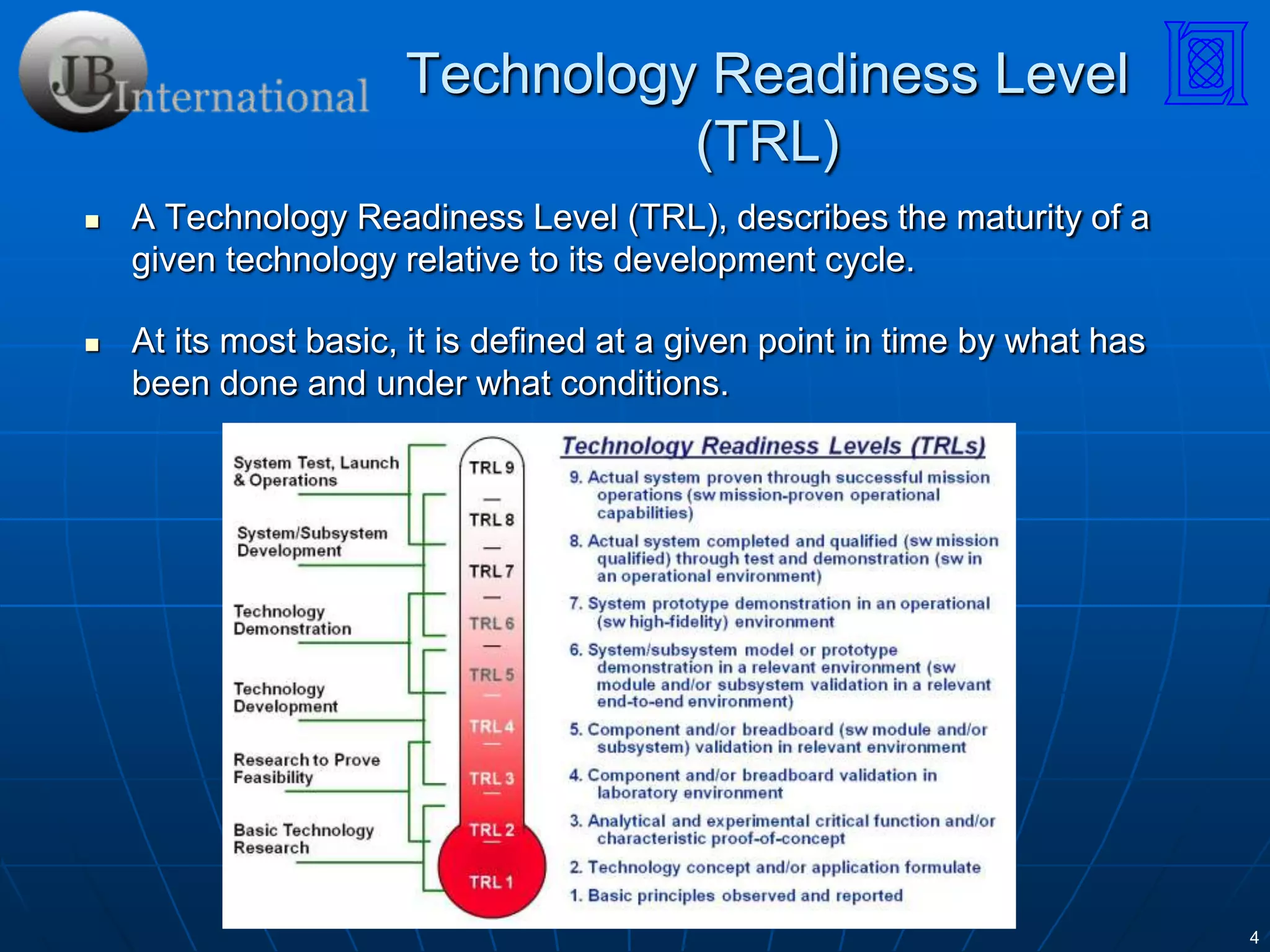
Technology Readiness Level (TRL)A Technology Readiness Level (TRL), describes the maturity of a given technology relative to its development cycle. At its most basic, it is defined at a given point in time by what has been done and under what conditions. 4
Technology Assessment vs. System AssessmentBut – Technology Assessment alone is not sufficient to determine the maturity of a system under development.
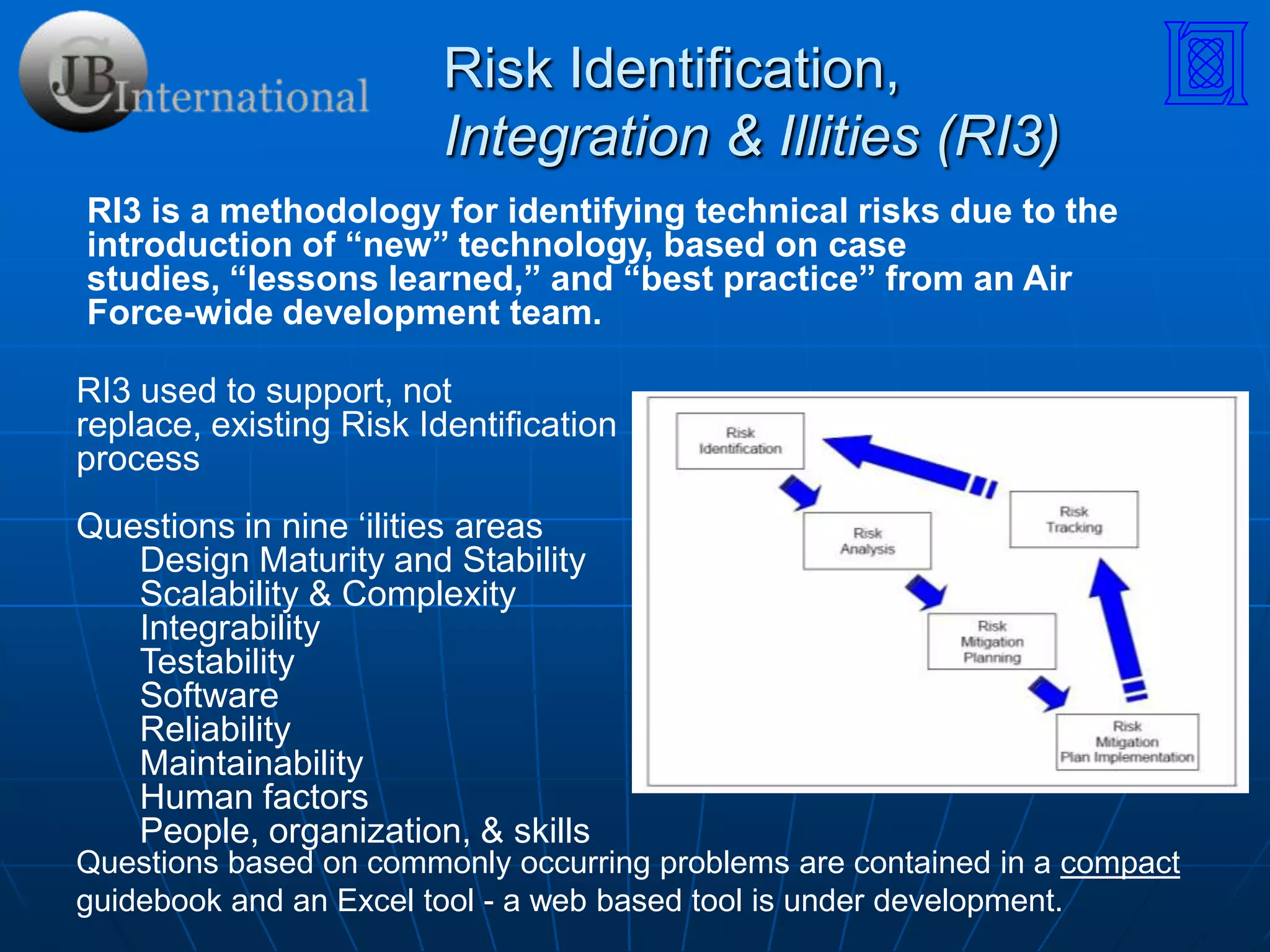
Risk Identification, Integration & Illities (RI3)RI3 is a methodology for identifying technical risks due to the introduction of “new” technology, based on case studies, “lessons learned,” and “best practice” from an Air Force-wide development team.RI3 used to support, not replace, existing Risk Identification processQuestions in nine ‘ilities areasDesign Maturity and StabilityScalability & ComplexityIntegrabilityTestabilitySoftwareReliability MaintainabilityHuman factorsPeople, organization, & skillsQuestions based on commonly occurring problems are contained in a compact guidebook and an Excel tool - a web based tool is under development.
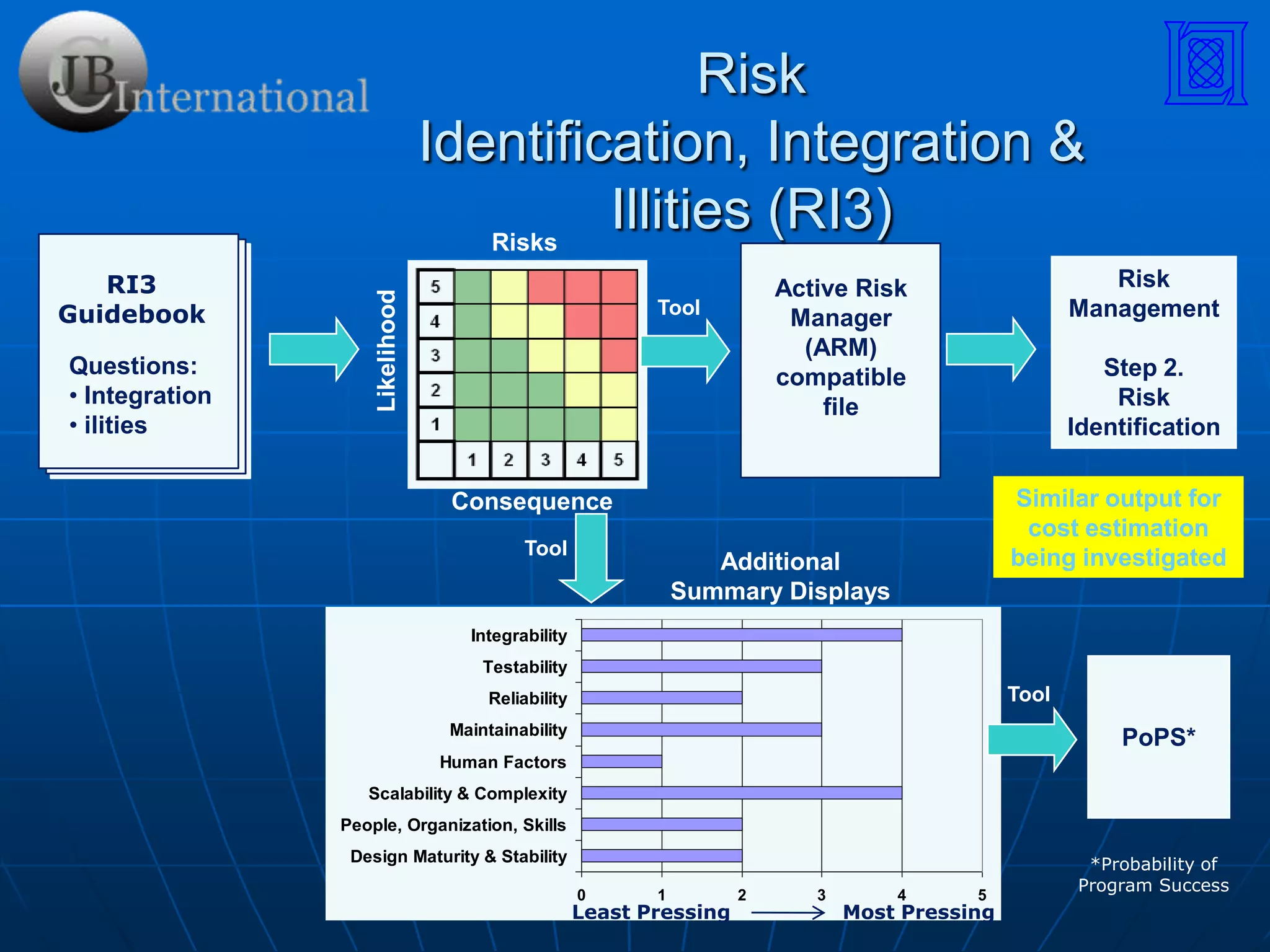
Risk Identification, Integration & Illities (RI3)RisksRI3GuidebookLikelihoodRisk ManagementStep 2.Risk IdentificationActive Risk Manager (ARM) compatible fileToolQuestions: Integration
 ilitiesSimilar output for cost estimation being investigatedConsequenceToolAdditional Summary DisplaysPoPS*Tool*Probability of Program SuccessLeast Pressing                 Most Pressing
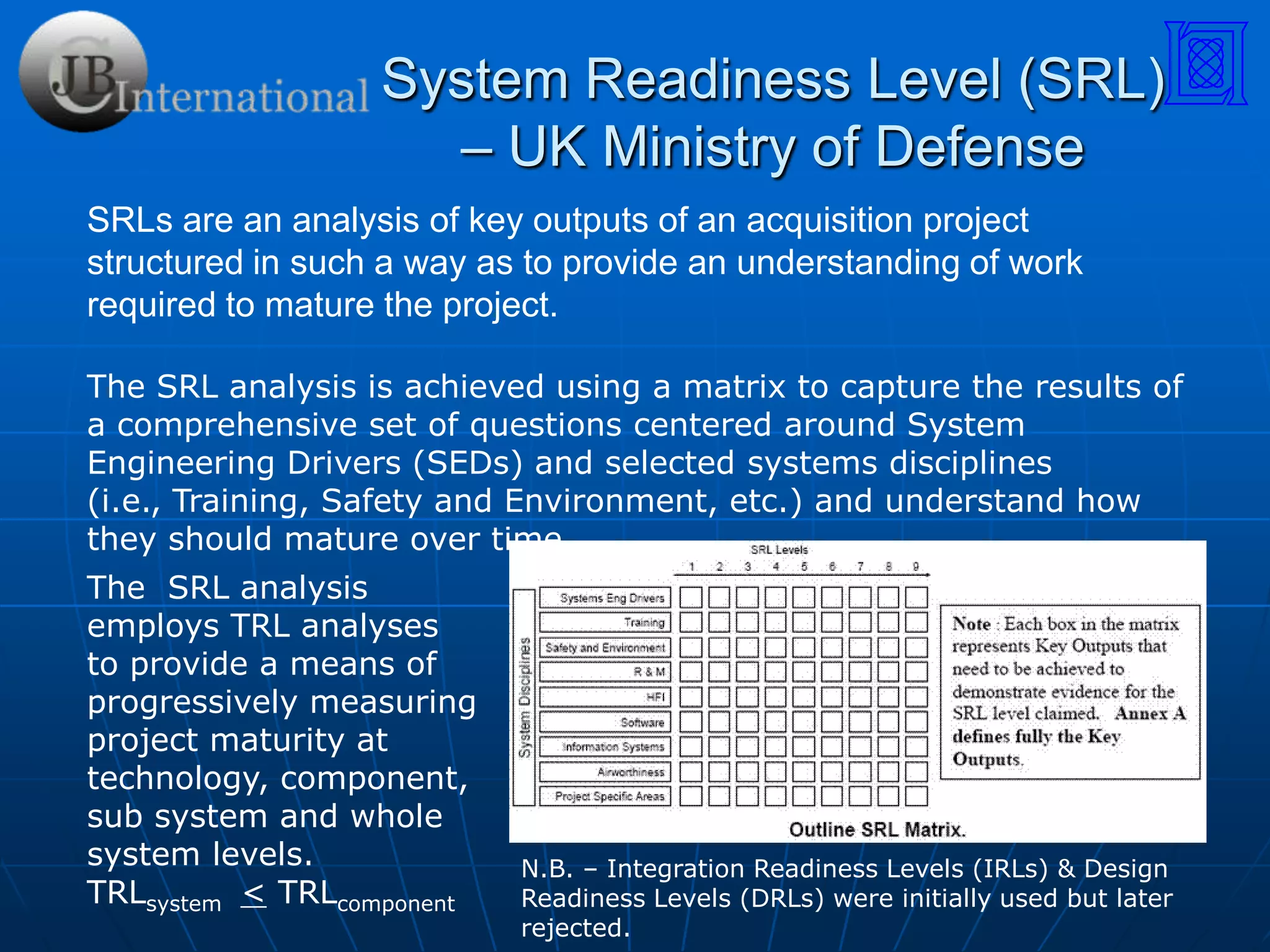
System Readiness Level (SRL) – UK Ministry of DefenseSRLs are an analysis of key outputs of an acquisition project structured in such a way as to provide an understanding of work required to mature the project.The SRL analysis is achieved using a matrix to capture the results of a comprehensive set of questions centered around System Engineering Drivers (SEDs) and selected systems disciplines (i.e., Training, Safety and Environment, etc.) and understand how they should mature over time. The  SRL analysis employs TRL analyses  to provide a means of progressively measuring project maturity at technology, component, sub system and whole system levels.TRLsystem < TRLcomponentN.B. – Integration Readiness Levels (IRLs) & Design Readiness Levels (DRLs) were initially used but later rejected.
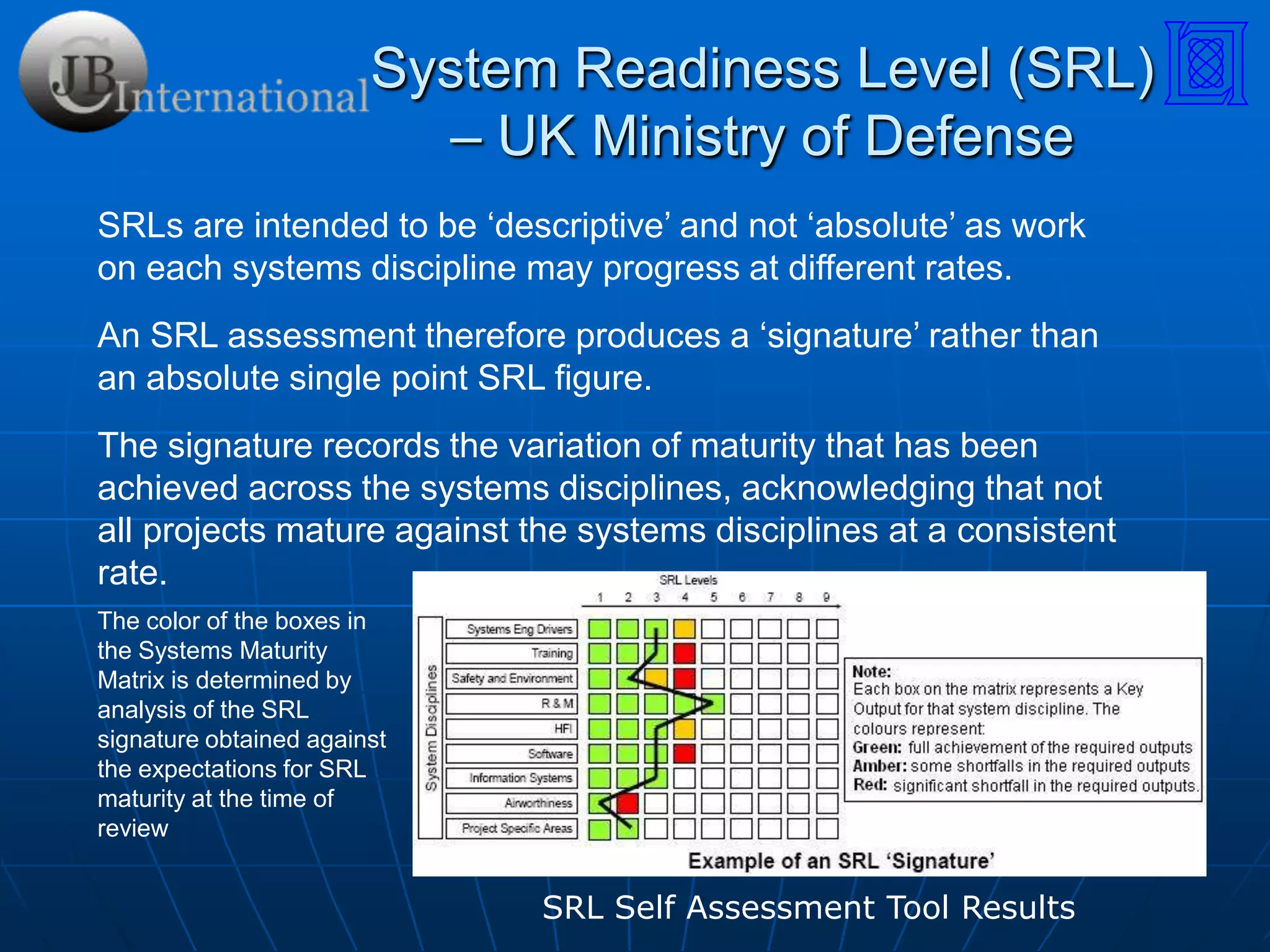
System Readiness Level (SRL) – UK Ministry of DefenseSRLs are intended to be ‘descriptive’ and not ‘absolute’ as work on each systems discipline may progress at different rates. An SRL assessment therefore produces a ‘signature’ rather than an absolute single point SRL figure. The signature records the variation of maturity that has been achieved across the systems disciplines, acknowledging that not all projects mature against the systems disciplines at a consistent rate. The color of the boxes in the Systems Maturity Matrix is determined by analysis of the SRL signature obtained against the expectations for SRL maturity at the time of reviewSRL Self Assessment Tool Results
Advancement Degree of Difficulty (AD2)Advancement Degree of Difficulty (AD2) is a method of systematically dealing with aspects beyond TRL.It is a “predictive” description of what is required to move a system, subsystem or component from one TRL to another.It provides information in the form of:Likelihood of occurrence of an adverse event.         Risk
Cost to ensure that such an event does not occur.
The time required to implement the necessary action.AD2 consists of a set of questions in 5 specific areas:Design and Analysis
Manufacturing
Software Development
Test

A Comprehensive Overview Of Techniquess For Measuring System Readiness Final 2009 Sept21

  • 1.
    JAMES W. BILBRO*&KYLE Y. YANG**NDIA 12TH ANNUAL SYSTEMS ENGINEERING CONFERENCEOCT. 26-29, 2009*JB CONSULTING INTERNATIONAL **MIT LINCOLN LABORATORYA comprehensive overview of techniques for measuring system readiness
  • 2.
    Technology Assessment vs.System AssessmentAdvanced, complex Missions cannot meet their goals and objectives without having to rely on advancements in technology.
  • 3.
    Even “heritage” systemscan require technology development when they are incorporated into a new architecture with different operational environments or goals.
  • 4.
    Consequently, all “system”assessments must have a technology assessment as a component.2
  • 5.
    Technology Assessment vs.System AssessmentWhat does Technology Impact?All aspects of the Systems Engineering Process!Stakeholder Expectation:Requirements Definition:Design Solution: Risk Management:Technical Assessment:Trade Studies:Verification/Validation: Lessons Learned:3
  • 6.
    Technology Readiness Level(TRL)A Technology Readiness Level (TRL), describes the maturity of a given technology relative to its development cycle. At its most basic, it is defined at a given point in time by what has been done and under what conditions. 4
  • 7.
    Technology Assessment vs.System AssessmentBut – Technology Assessment alone is not sufficient to determine the maturity of a system under development.
  • 8.
    Risk Identification, Integration& Illities (RI3)RI3 is a methodology for identifying technical risks due to the introduction of “new” technology, based on case studies, “lessons learned,” and “best practice” from an Air Force-wide development team.RI3 used to support, not replace, existing Risk Identification processQuestions in nine ‘ilities areasDesign Maturity and StabilityScalability & ComplexityIntegrabilityTestabilitySoftwareReliability MaintainabilityHuman factorsPeople, organization, & skillsQuestions based on commonly occurring problems are contained in a compact guidebook and an Excel tool - a web based tool is under development.
  • 9.
    Risk Identification, Integration& Illities (RI3)RisksRI3GuidebookLikelihoodRisk ManagementStep 2.Risk IdentificationActive Risk Manager (ARM) compatible fileToolQuestions: Integration
  • 10.
    ilitiesSimilar outputfor cost estimation being investigatedConsequenceToolAdditional Summary DisplaysPoPS*Tool*Probability of Program SuccessLeast Pressing Most Pressing
  • 11.
    System Readiness Level(SRL) – UK Ministry of DefenseSRLs are an analysis of key outputs of an acquisition project structured in such a way as to provide an understanding of work required to mature the project.The SRL analysis is achieved using a matrix to capture the results of a comprehensive set of questions centered around System Engineering Drivers (SEDs) and selected systems disciplines (i.e., Training, Safety and Environment, etc.) and understand how they should mature over time. The SRL analysis employs TRL analyses to provide a means of progressively measuring project maturity at technology, component, sub system and whole system levels.TRLsystem < TRLcomponentN.B. – Integration Readiness Levels (IRLs) & Design Readiness Levels (DRLs) were initially used but later rejected.
  • 12.
    System Readiness Level(SRL) – UK Ministry of DefenseSRLs are intended to be ‘descriptive’ and not ‘absolute’ as work on each systems discipline may progress at different rates. An SRL assessment therefore produces a ‘signature’ rather than an absolute single point SRL figure. The signature records the variation of maturity that has been achieved across the systems disciplines, acknowledging that not all projects mature against the systems disciplines at a consistent rate. The color of the boxes in the Systems Maturity Matrix is determined by analysis of the SRL signature obtained against the expectations for SRL maturity at the time of reviewSRL Self Assessment Tool Results
  • 13.
    Advancement Degree ofDifficulty (AD2)Advancement Degree of Difficulty (AD2) is a method of systematically dealing with aspects beyond TRL.It is a “predictive” description of what is required to move a system, subsystem or component from one TRL to another.It provides information in the form of:Likelihood of occurrence of an adverse event. Risk
  • 14.
    Cost to ensurethat such an event does not occur.
  • 15.
    The time requiredto implement the necessary action.AD2 consists of a set of questions in 5 specific areas:Design and Analysis
  • 16.
  • 17.
  • 18.
  • 19.
  • 20.
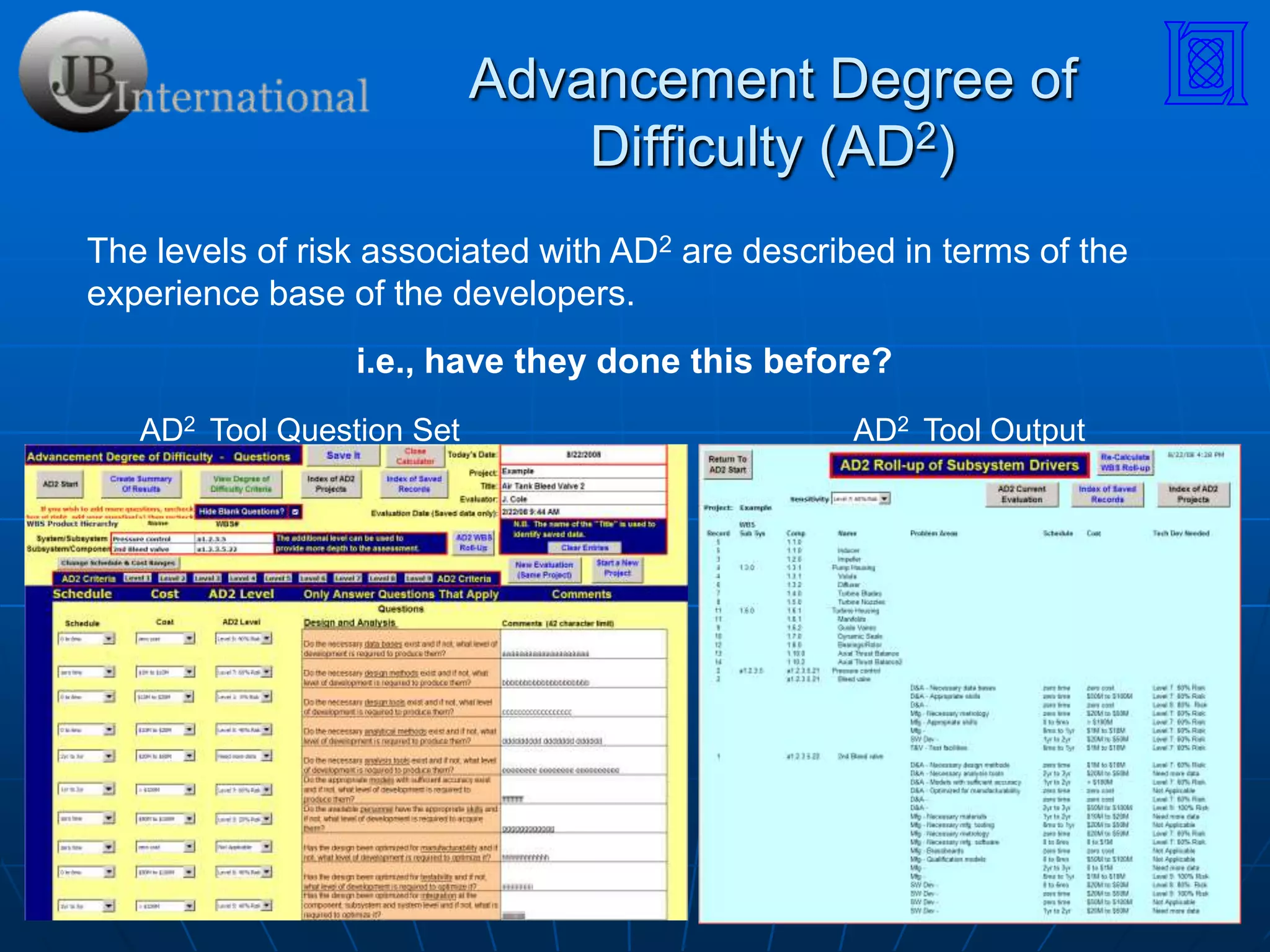
    Advancement Degree ofDifficulty (AD2)The levels of risk associated with AD2 are described in terms of the experience base of the developers.i.e., have they done this before? AD2 Tool Question SetAD2 Tool Output
  • 21.
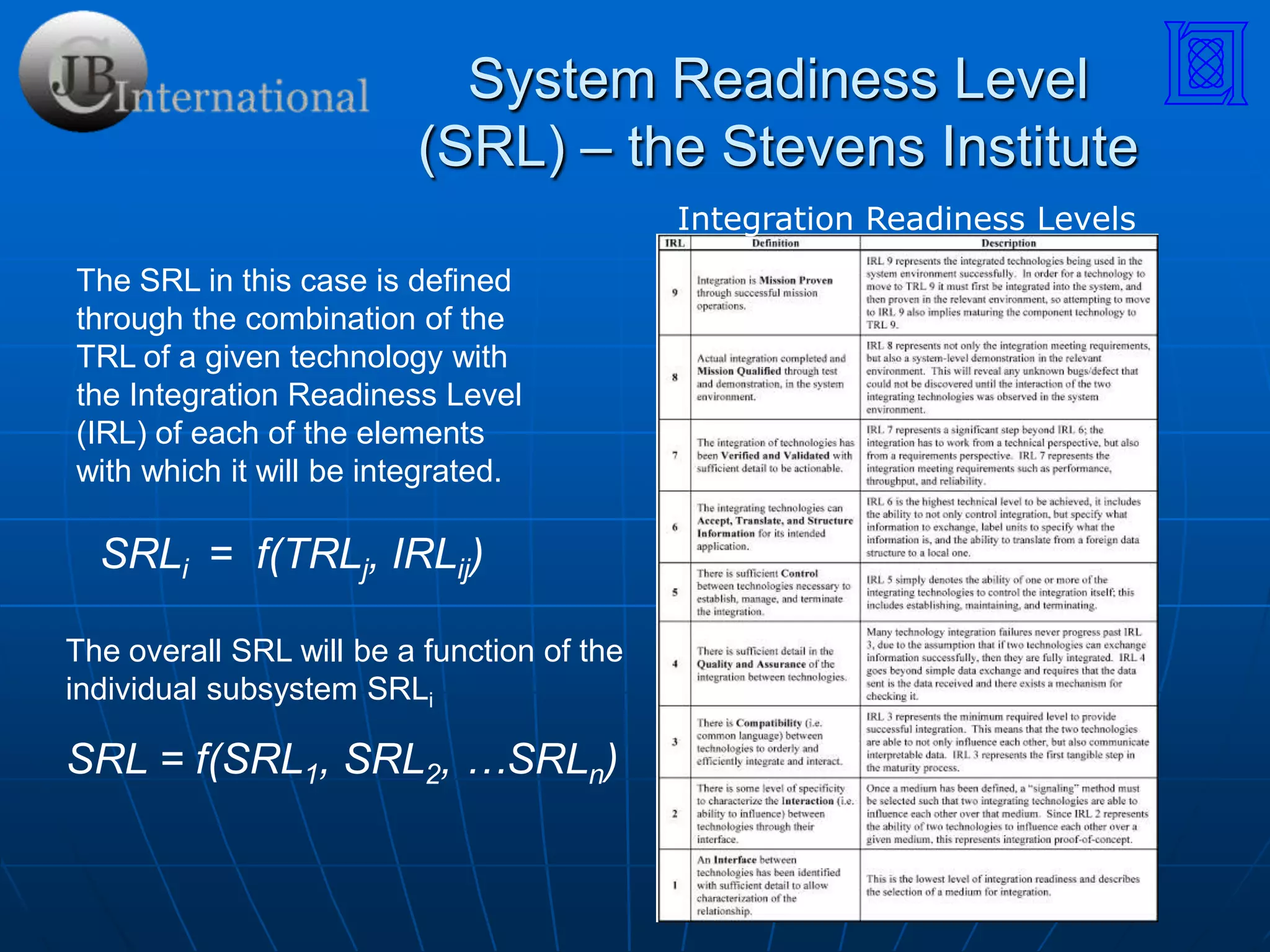
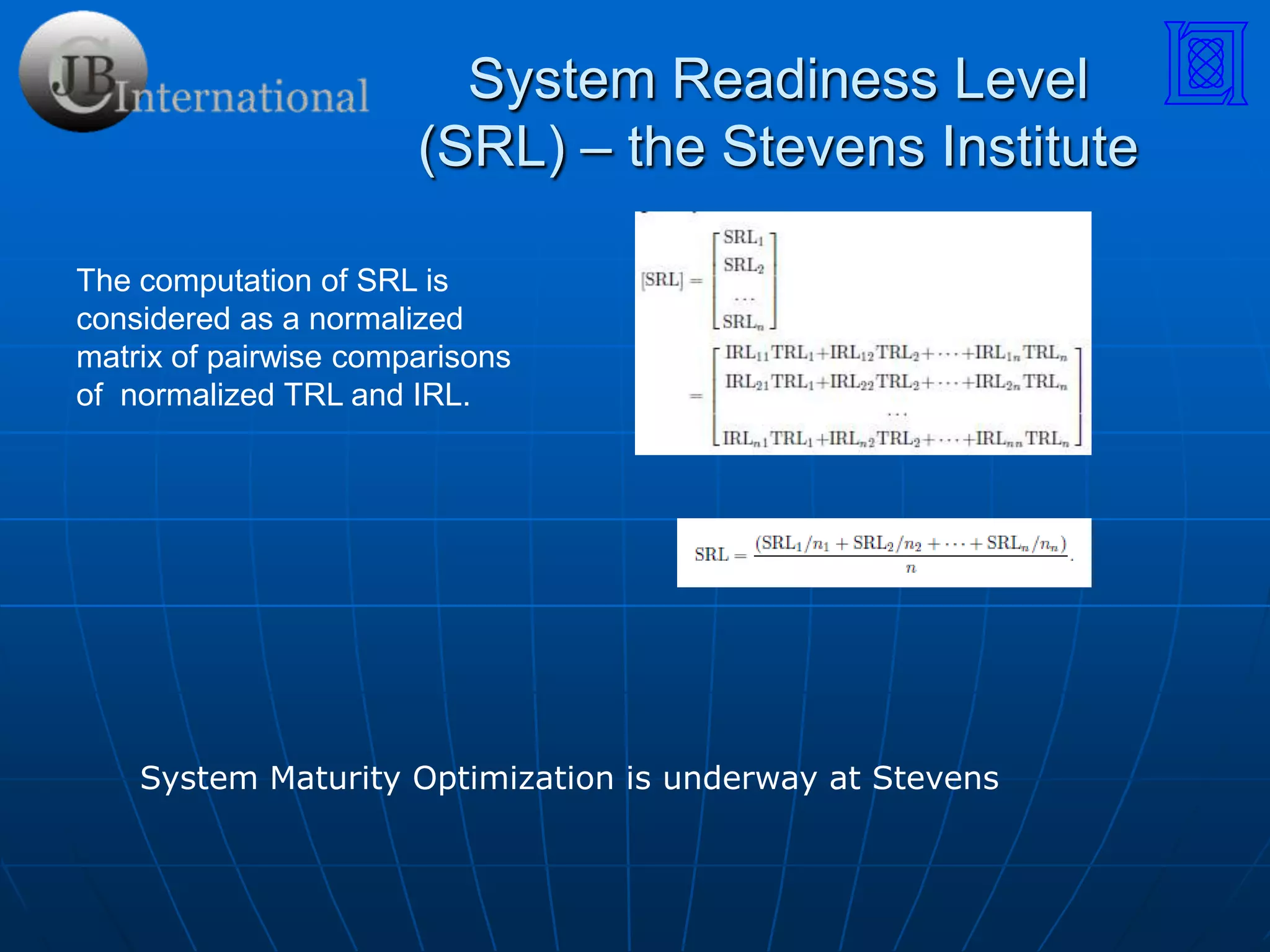
    System Readiness Level(SRL) – the Stevens InstituteIntegration Readiness LevelsThe SRL in this case is defined through the combination of the TRL of a given technology with the Integration Readiness Level (IRL) of each of the elements with which it will be integrated.SRLi = f(TRLj, IRLij)The overall SRL will be a function of the individual subsystem SRLiSRL = f(SRL1, SRL2, …SRLn)
  • 22.
    System Readiness Level(SRL) – the Stevens InstituteThe computation of SRL is considered as a normalized matrix of pairwise comparisons of normalized TRL and IRL. System Maturity Optimization is underway at Stevens
  • 23.
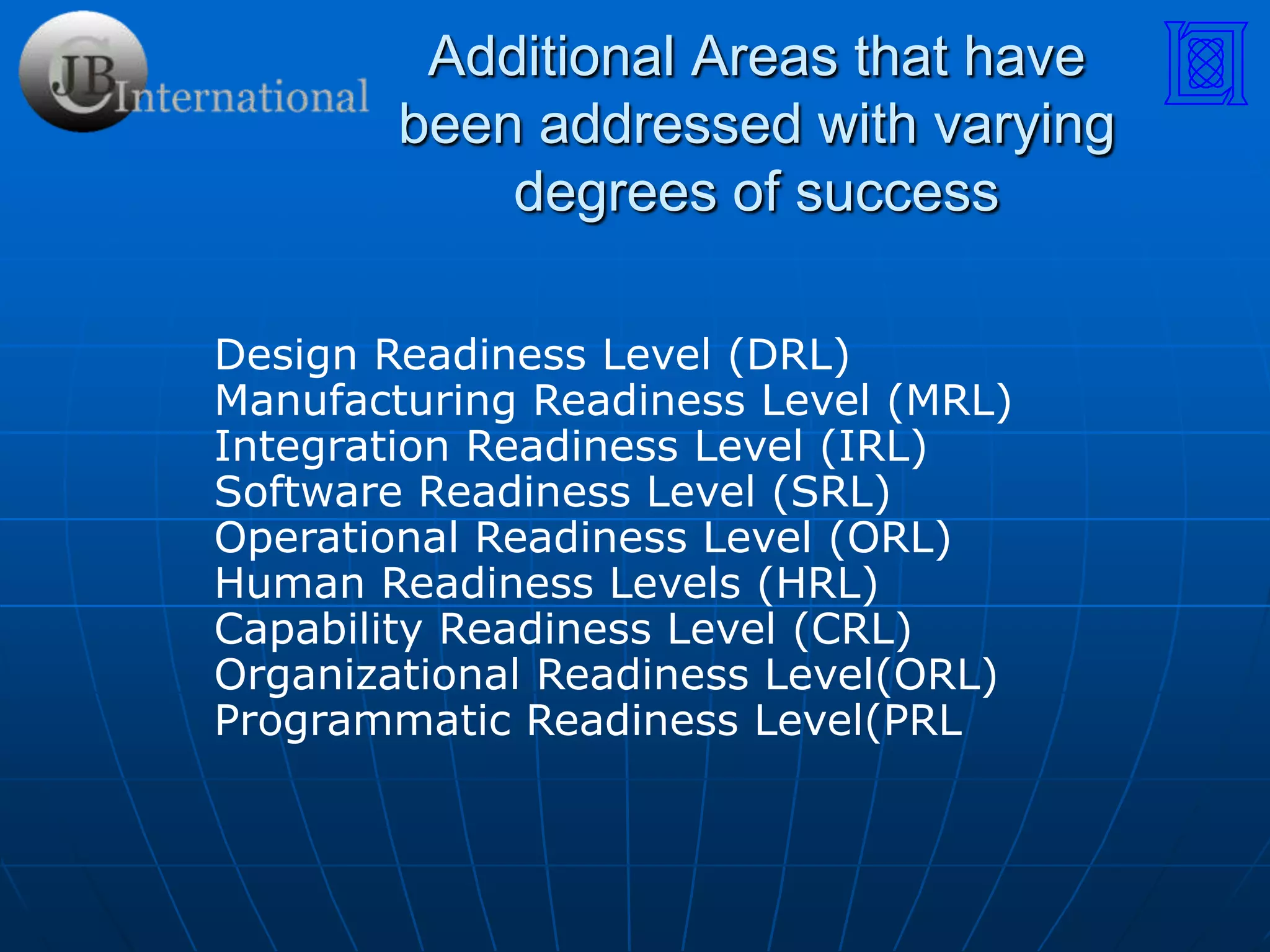
    Additional Areas thathave been addressed with varying degrees of successDesign Readiness Level (DRL)Manufacturing Readiness Level (MRL)Integration Readiness Level (IRL)Software Readiness Level (SRL)Operational Readiness Level (ORL)Human Readiness Levels (HRL)Capability Readiness Level (CRL)Organizational Readiness Level(ORL)Programmatic Readiness Level(PRL
  • 24.
    SummaryTechnology Assessment isa vital part of any overall system maturity assessment.There are many approaches to overall system assessment.Any successful approach for system maturity assessment must balance the need for data against the resources required to obtain that data.15
  • 25.
    BibliographySadin, Stanley T.;Povinelli, Frederick P.; Rosen, Robert, “NASA technology push towards future space mission systems,” Space and Humanity Conference Bangalore, India, Selected Proceedings of the 39th International Astronautical Federation Congress, ActaAstronautica, pp 73-77, V 20, 1989Mankins, John C. “Technology Readiness Levels” a White Paper, April 6, 1995.Nolte, William, “Technology Readiness Level Calculator, “Technology Readiness and Development Seminar, Space System Engineering and Acquisition Excellence Forum, The Aerospace Corporation, April 28, 2005.Mankins, John C. , “Research & Development Degree of Difficulty (RD3)” A White Paper, March 10, 1998.16
  • 26.
    BibliographyRamirez-Marquez, J.E.   Sauser,B.J.   “System Development Planning via System Maturity Optimization,” Accepted for future publication in IEEE Transactions on Engineering Management, IEEExplore.Bilbro, James W. “Systematic Assessment of the Program/Project Impacts of Technological Advancement and Insertion Revision A,” http://www.jbconsultinginternational.com17
  • 27.
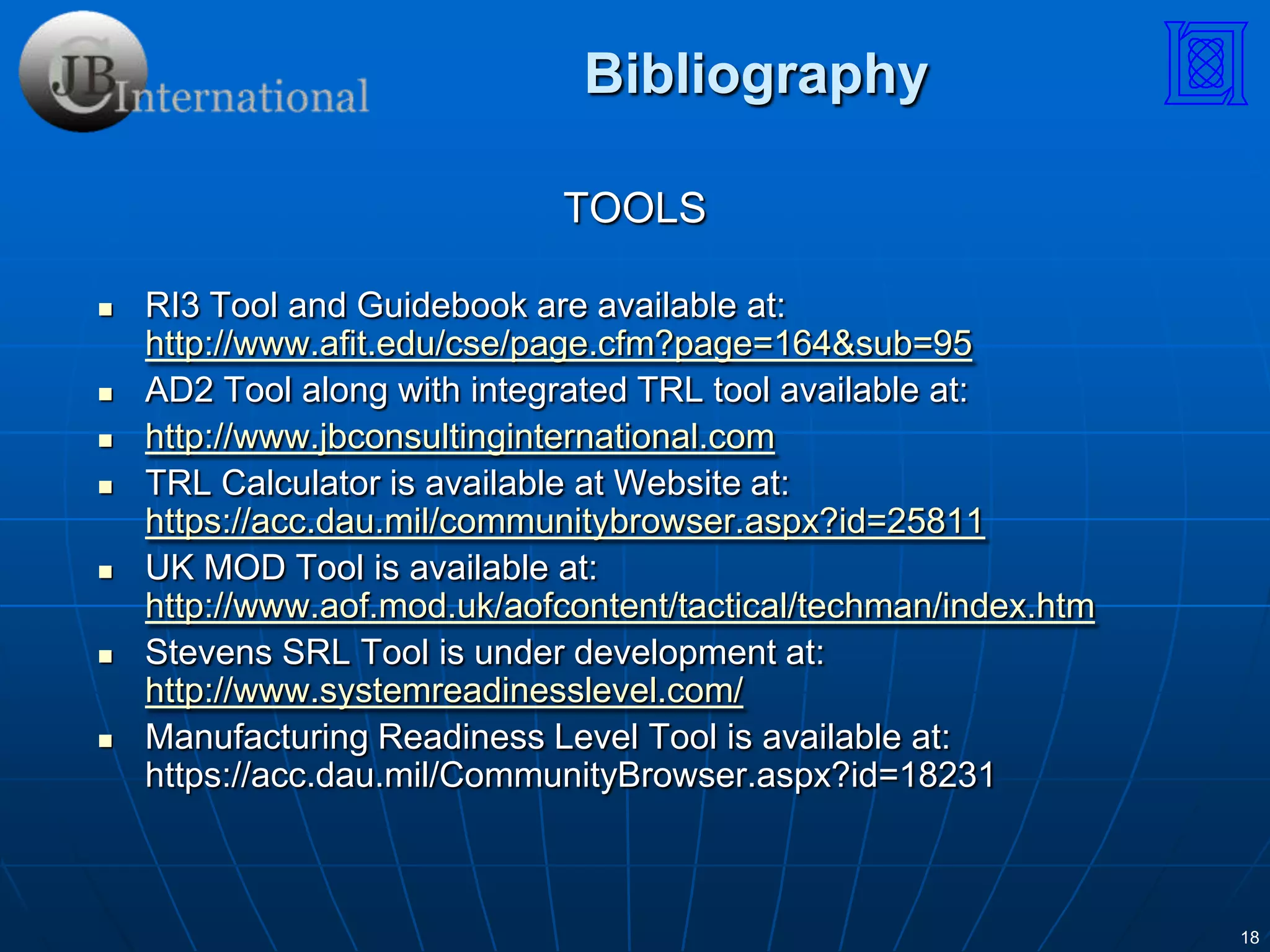
    BibliographyTOOLSRI3 Tool andGuidebook are available at: http://www.afit.edu/cse/page.cfm?page=164&sub=95AD2 Tool along with integrated TRL tool available at: http://www.jbconsultinginternational.comTRL Calculator is available at Website at: https://acc.dau.mil/communitybrowser.aspx?id=25811UK MOD Tool is available at: http://www.aof.mod.uk/aofcontent/tactical/techman/index.htmStevens SRL Tool is under development at: http://www.systemreadinesslevel.com/Manufacturing Readiness Level Tool is available at: https://acc.dau.mil/CommunityBrowser.aspx?id=1823118

Editor's Notes

  • #2 Title page self explanatory
  • #6 Issues not addressed by TRL scale include: integration, sustainment, requirements stability, etc.
  • #7 RI3 is a best practice being implemented at the four Air Force product centers. It is geared toward the usage of new technologies and their integration into a system. It is designed to help a unit engineer identify risks “outward” from the unit of interest. It is applicable whether the unit is a component or a system – one man’s system is another’s component.Software is its own section, even though naturally software issues arise in all other areas, because (1) software people often speak a vernacular that is different than hardware folks, (2) software is a key problem in many programs today so it highlights risk in these areas.Other risk areas exist that are not covered by RI3, of course.
  • #8 The RI3 guidebook and Excel document is openly available on the web today (see appendix). AFRL is working to put it into a tool that will interface with the standard AF risk code (ARM), due Fall 2010.
  • #9 SRL is effectively a risk assessment in the areas shown on the chart.It should be noted that SRLs were developed after the Brits tried 2 different flavors of integration readiness levels and rejected these after finding not enough utility was gained for the effort involved.Rest of text is self explanatory.
  • #10 Text is self explanatory.
  • #11 AD^2 was the genesis for the Air Force RI3 effort. It differs in that it goes further in trying to quantify impacts, particularly in the cost areas. Elements of NASA are using or considering its usage.
  • #12 Screenshots from the AD^2 excel tool.
  • #13 Prof Brian Sauser and his team have published papers in this area and are testing the methodology at the Naval Postgraduate School.
  • #14 Computation of the SRL is defined above. It will be interesting to see what users find the utility of the scale is, based on pilot runs.Rest of text is self explanatory.
  • #15 For instance, an IRL was defined by the UK MoD, as well as part of NASA – neither gained acceptance.Rest of text is self explanatory.