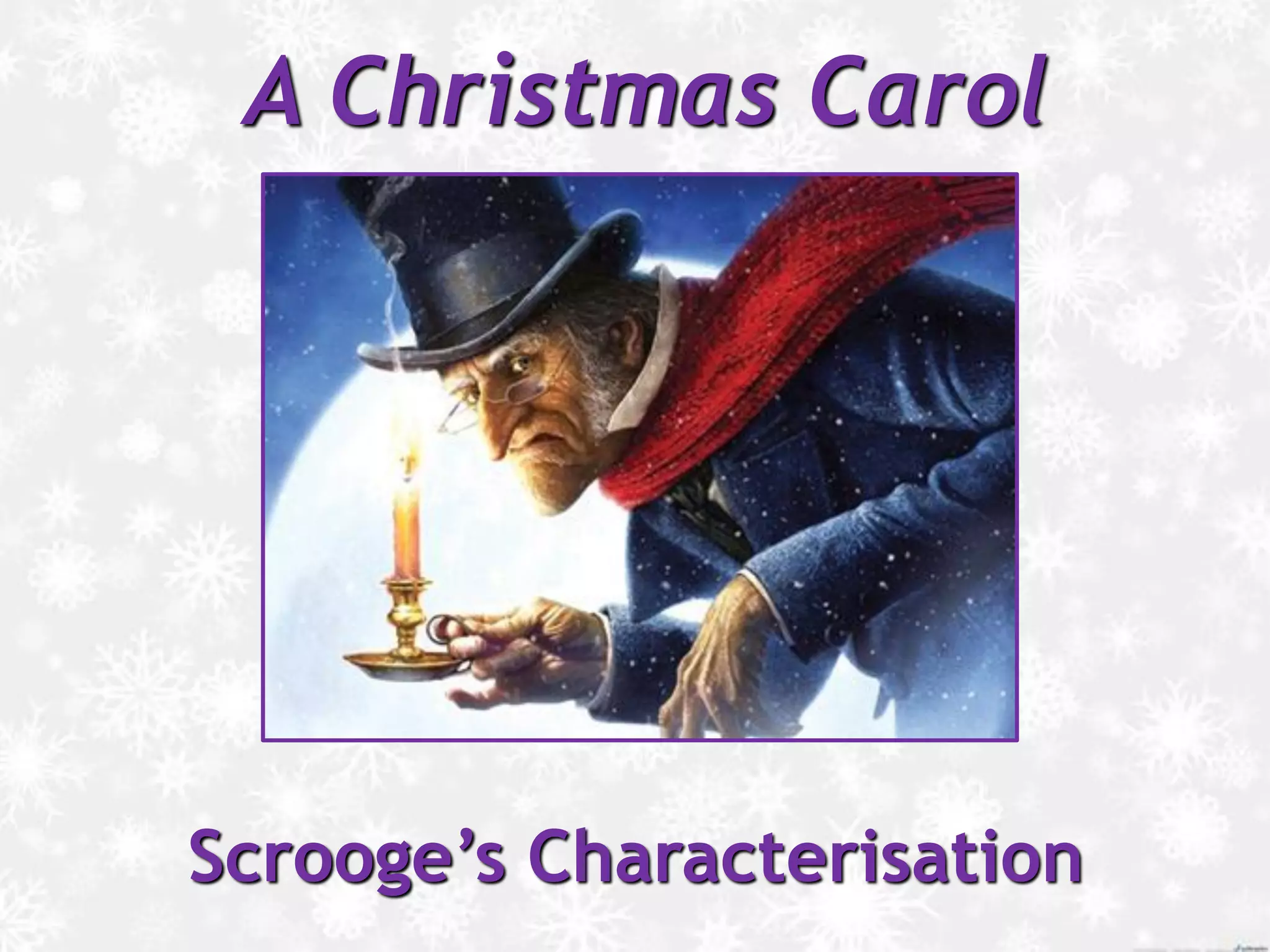
A Christmas Carol
Scrooge’s Characterisation
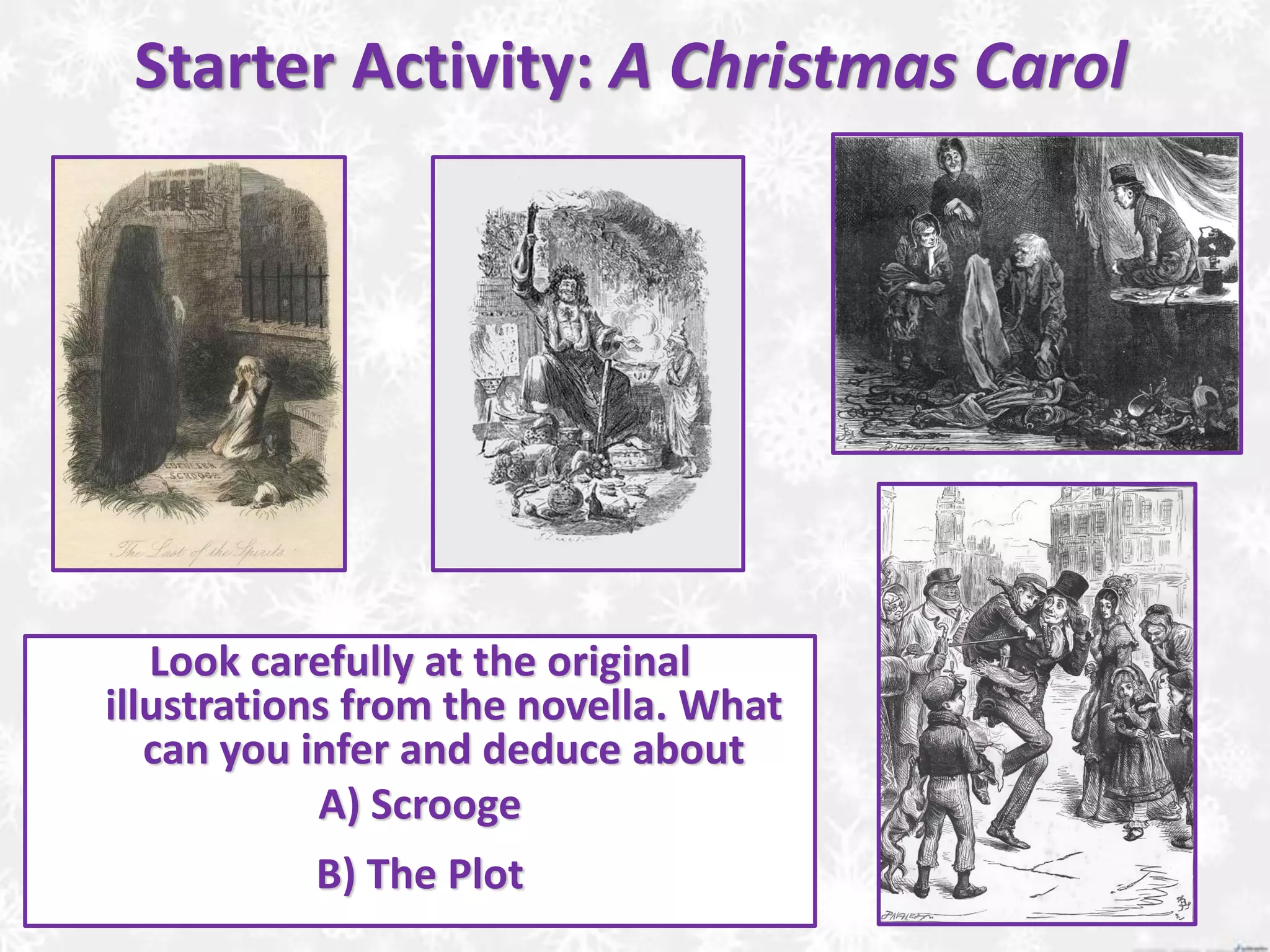
Starter Activity: A Christmas Carol
Look carefully at the original
illustrations from the novella. What
can you infer and deduce about
A) Scrooge
B) The Plot
Learning Objectives
By the end of the lesson…
 You will explore language and
explain how Dickens creates
Scrooge’s identity
 You will gain knowledge of the
assessment criteria and understand
how to structure a written
response
First Impressions
Dickens uses adjectives to describe Scrooge. What do we
learn about him?
“Oh! But he was a tight-fisted hand at the grindstone.
Scrooge! A squeezing, wrenching, grasping, scraping,
clutching, covetous, old sinner!”
Glossary:
Gait - way of walking
Frosty rime - white hair
Covetous - envious of other people’s possessions
Is it considered skilful writing to use many adjectives in a single
sentence? Why has Dickens made this choice?
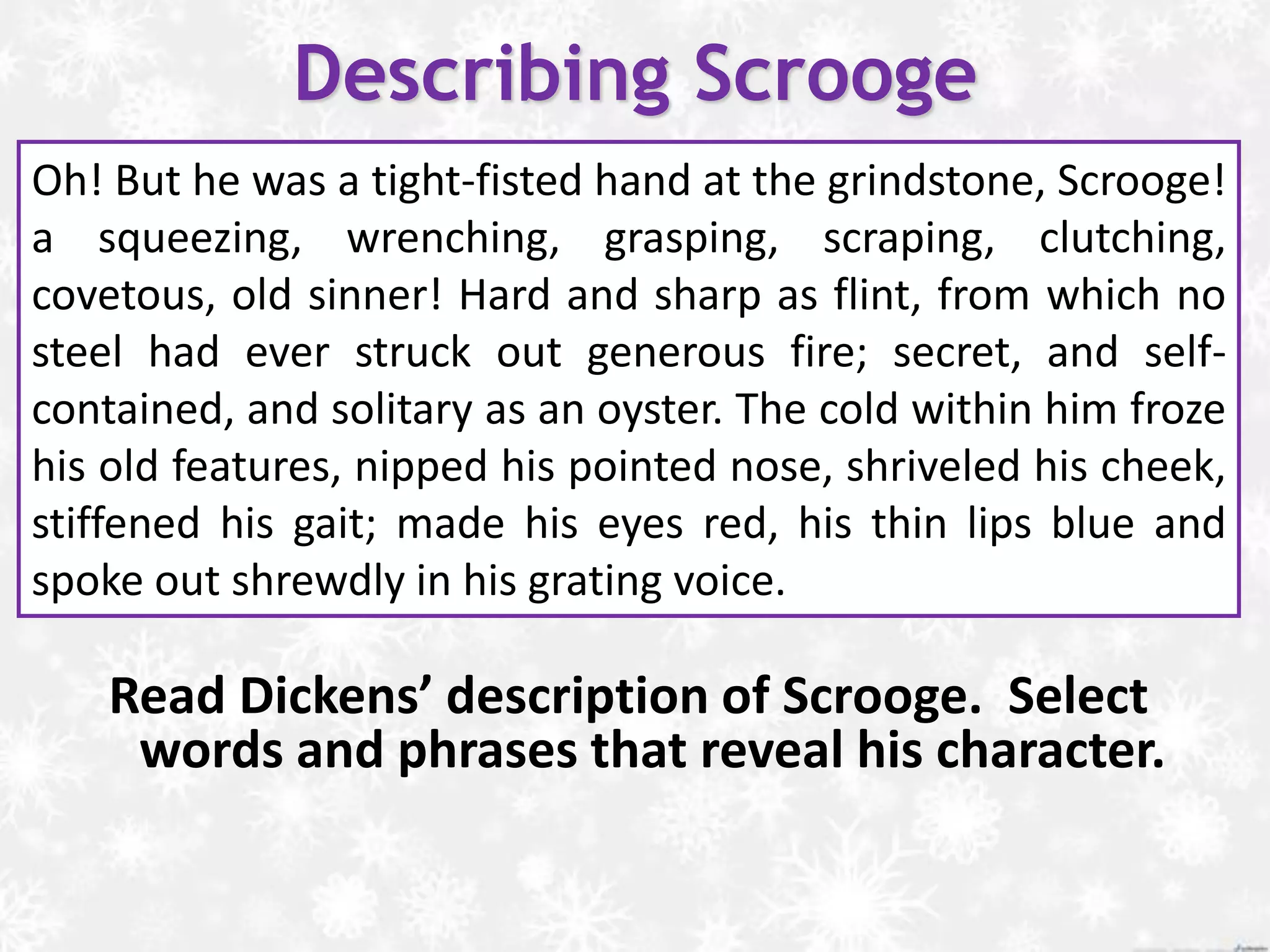
Describing Scrooge
Read Dickens’ description of Scrooge. Select
words and phrases that reveal his character.
Oh! But he was a tight-fisted hand at the grindstone, Scrooge!
a squeezing, wrenching, grasping, scraping, clutching,
covetous, old sinner! Hard and sharp as flint, from which no
steel had ever struck out generous fire; secret, and self-
contained, and solitary as an oyster. The cold within him froze
his old features, nipped his pointed nose, shriveled his cheek,
stiffened his gait; made his eyes red, his thin lips blue and
spoke out shrewdly in his grating voice.
Ebenezer Scrooge
What are your first
impressions of Ebenezer
Scrooge?
Write down 5 adjectives that
describe Scrooge, then find an
example of something that
Scrooge says or does which
reinforces that idea.
Adjective Evidence
Unsympathetic “If they would rather
die… they had better do
it, and decrease the
surplus population.”
Jealous “A covetous old sinner “
antisocial “I wished to be left
alone”
Judgemental “I can’t afford to make
idle people merry.”
bitter “No wind that blew was
bitterer than he.”
Scrooge: possible answers
• Envious - “a covetous old sinner”
• Miserly - “he was tight-fisted”
• Unkind/mean spirited - “hard and sharp as flint”
• Unsociable - “self- contained, and solitary as an oyster”, “sole”
• Selfish - “I” , “My”
• Unsympathetic - “warning all human sympathy to keep its distance”
• Obsessed with work - “old Scrooge sat busy in the counting house”
• Uncaring/indifferent - “the cold within him froze his features”
• Short-tempered - “Scrooge walked out with a growl”
• Cynical -“Bah! Humbug!”
• Disliked/menacing - “nobody ever stopped him in the street”
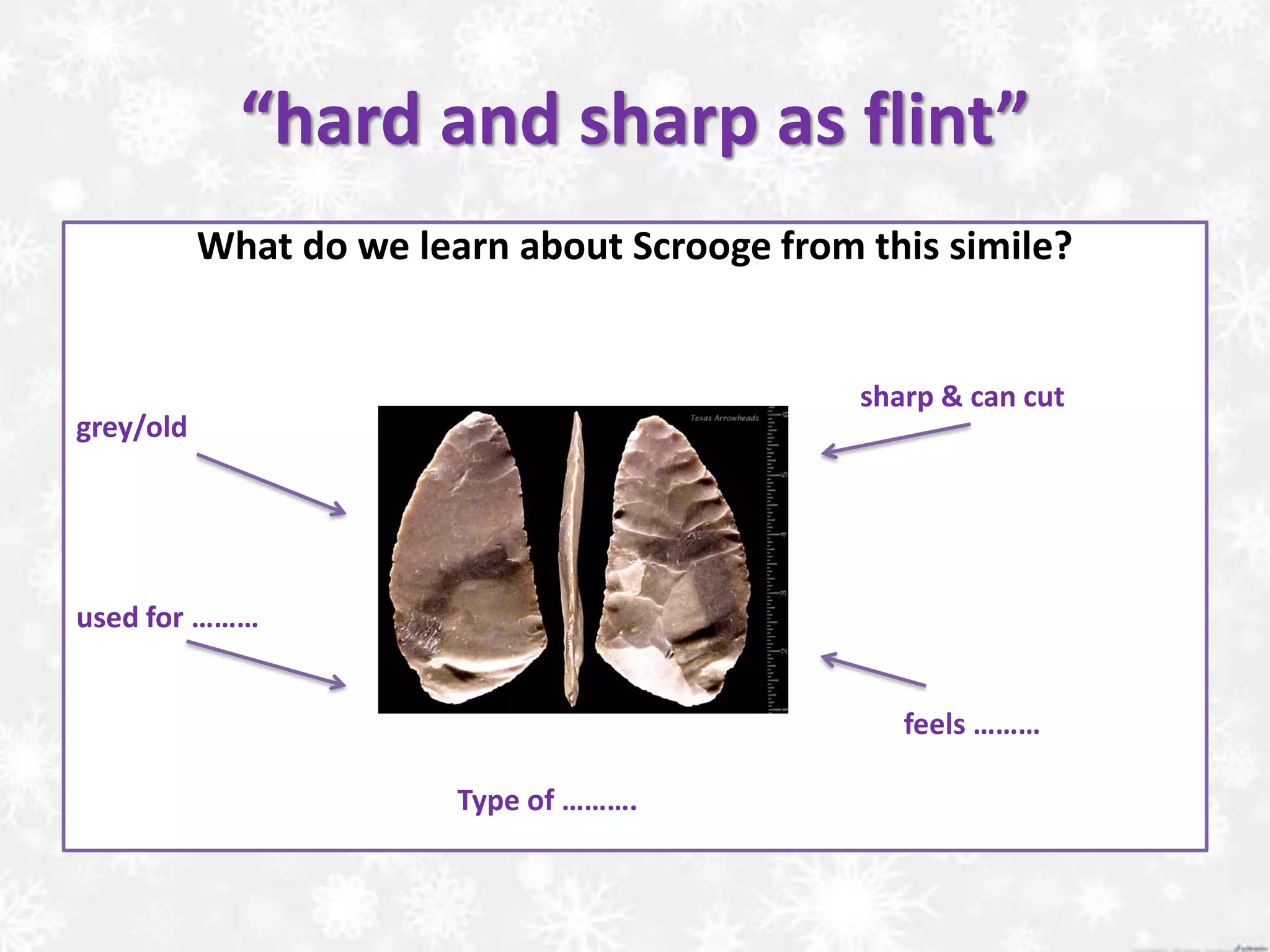
“hard and sharp as flint”
What do we learn about Scrooge from this simile?
sharp & can cut
grey/old
used for ………
feels ………
Type of ……….
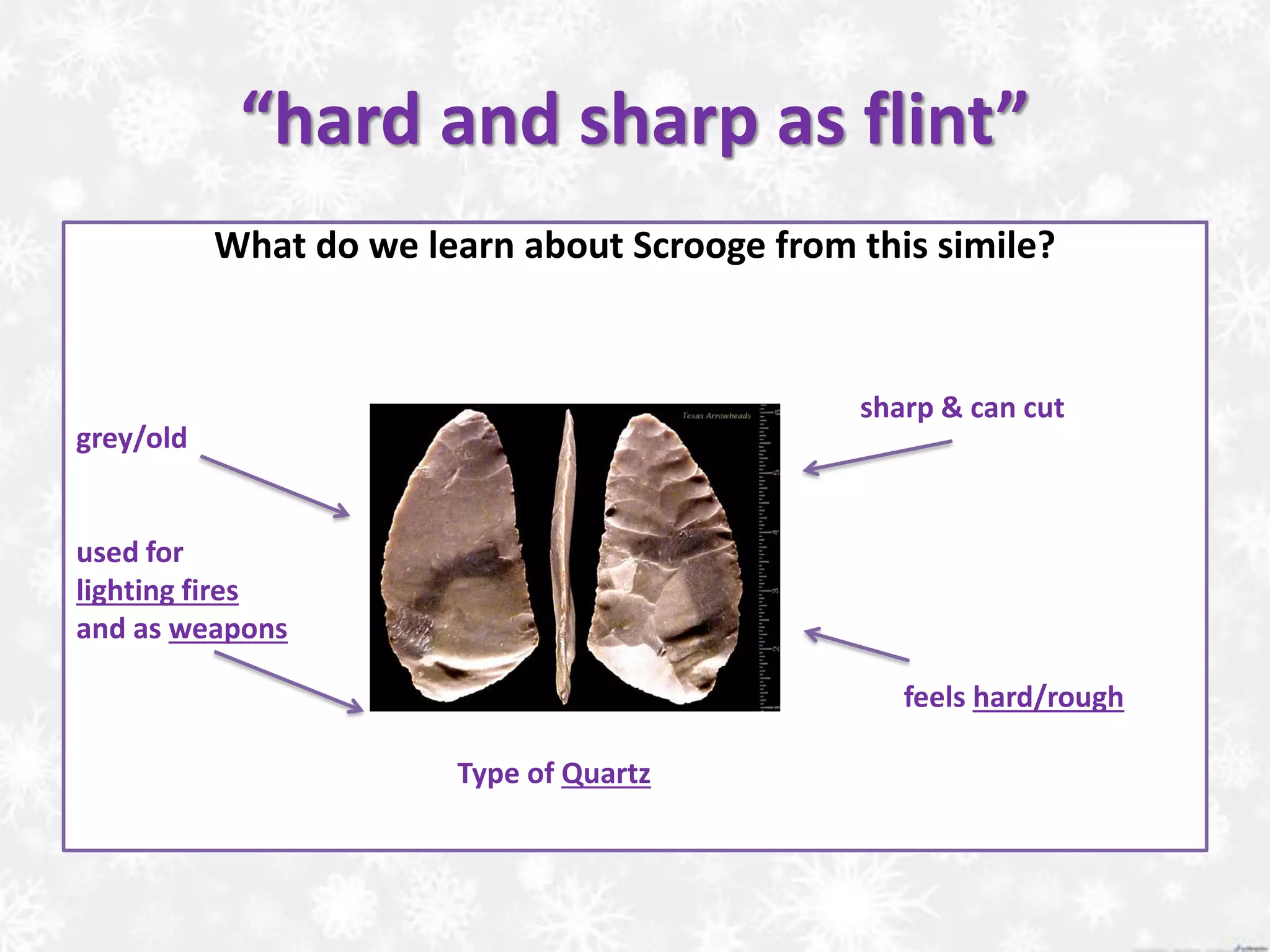
“hard and sharp as flint”
What do we learn about Scrooge from this simile?
sharp & can cut
grey/old
used for
lighting fires
and as weapons
feels hard/rough
Type of Quartz
How do I write about Scrooge in the exam?
Scrooge is a miser, who sinfully takes advantage of
the poor. He is described as “Hard and sharp as
flint” at the beginning of stave one. The simile is
used to suggest that he is both intelligent and
dangerous as he is “sharp”. His job as a creditor
means he possesses both qualities and uses them
to take advantage of the poor. The “hard” quality
of the flint links to Scrooge’s unrelenting and
harsh attitude to other people as he enjoys being
alone. “Flint” can creates sparks that will produce
a fire. In the novella, fire is symbolic of the
Christmas spirit and although Scrooge is currently
evil, he will change as the ghosts intervene to save
his soul.
Point
Evidence
Explanation
Historical
Context
“solitary as an oyster”
What do we learn about Scrooge from this simile?
Doesn’t have anything to do with anything else
Can be worth
a lot of ……… hard shell
Found in …….. Considered a ……..
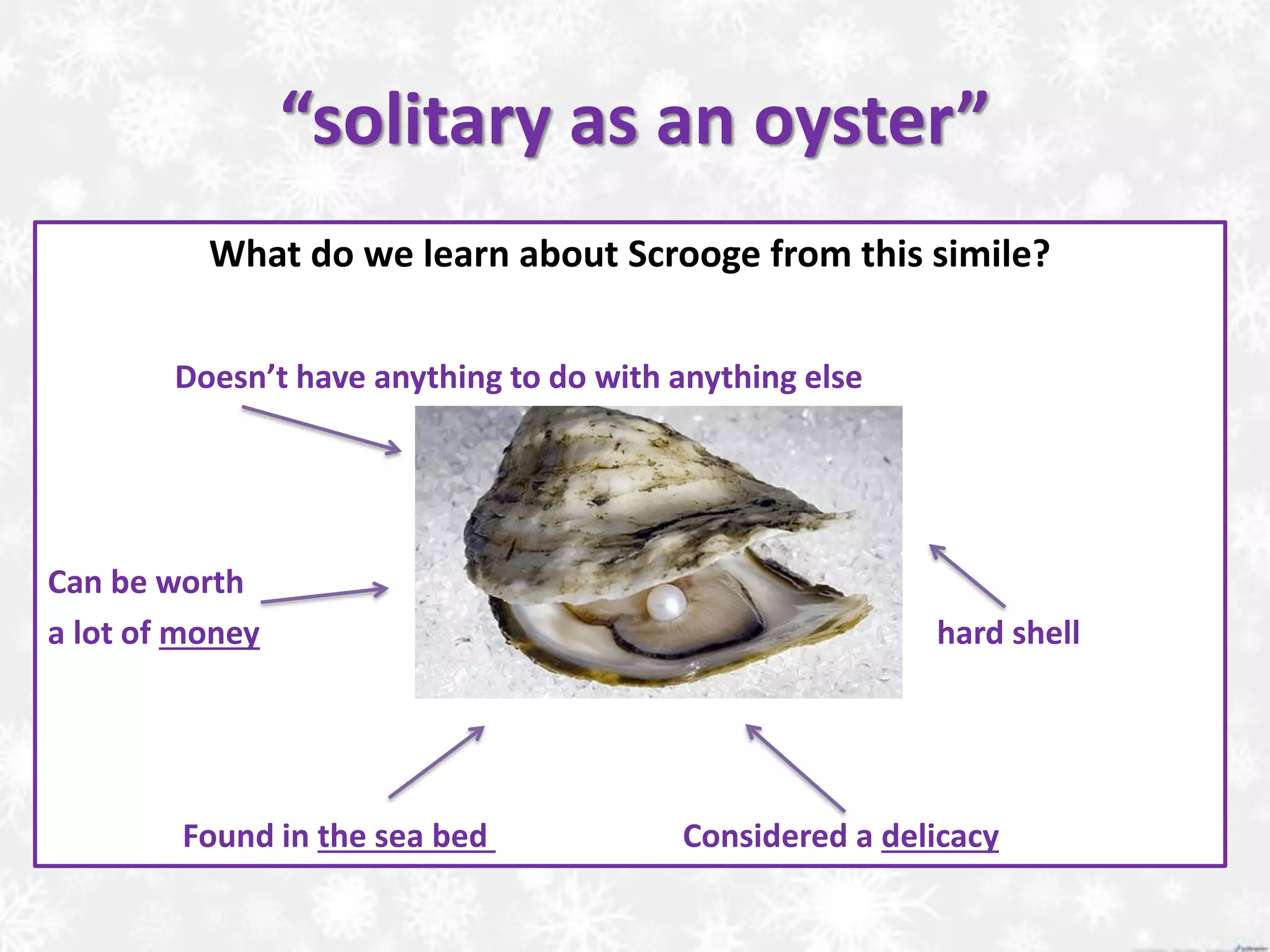
“solitary as an oyster”
What do we learn about Scrooge from this simile?
Doesn’t have anything to do with anything else
Can be worth
a lot of money hard shell
Found in the sea bed Considered a delicacy
Plenary Activity: “solitary as an oyster”
In your exercise books, write a paragraph that explores the
above quotation.
Structure your response as follows:
• Point: one sentence; a clear idea about Scrooge’s
personality.
• Evidence: one sentence; embed the quotation.
• Explanation: a detailed analysis that explores individual
words (add layers of meaning).
• Historical context: add information that shows you
understand the relationship between the novella and the
Victorian era.
Starter Activity: Textual Analysis
“The door of Scrooge's counting-house was open that he might
keep his eye upon his clerk, who in a dismal little cell beyond, a
sort of tank, was copying letters. Scrooge had a very small fire,
but the clerk's fire was so very much smaller that it looked like
one coal. But he couldn't replenish it, for Scrooge kept the coal-
box in his own room…”
1. What do we learn about the relationship between
Scrooge and his clerk (Bob Cratchit)?
2. What do we learn about their social positions?
3. Why make reference to fire?
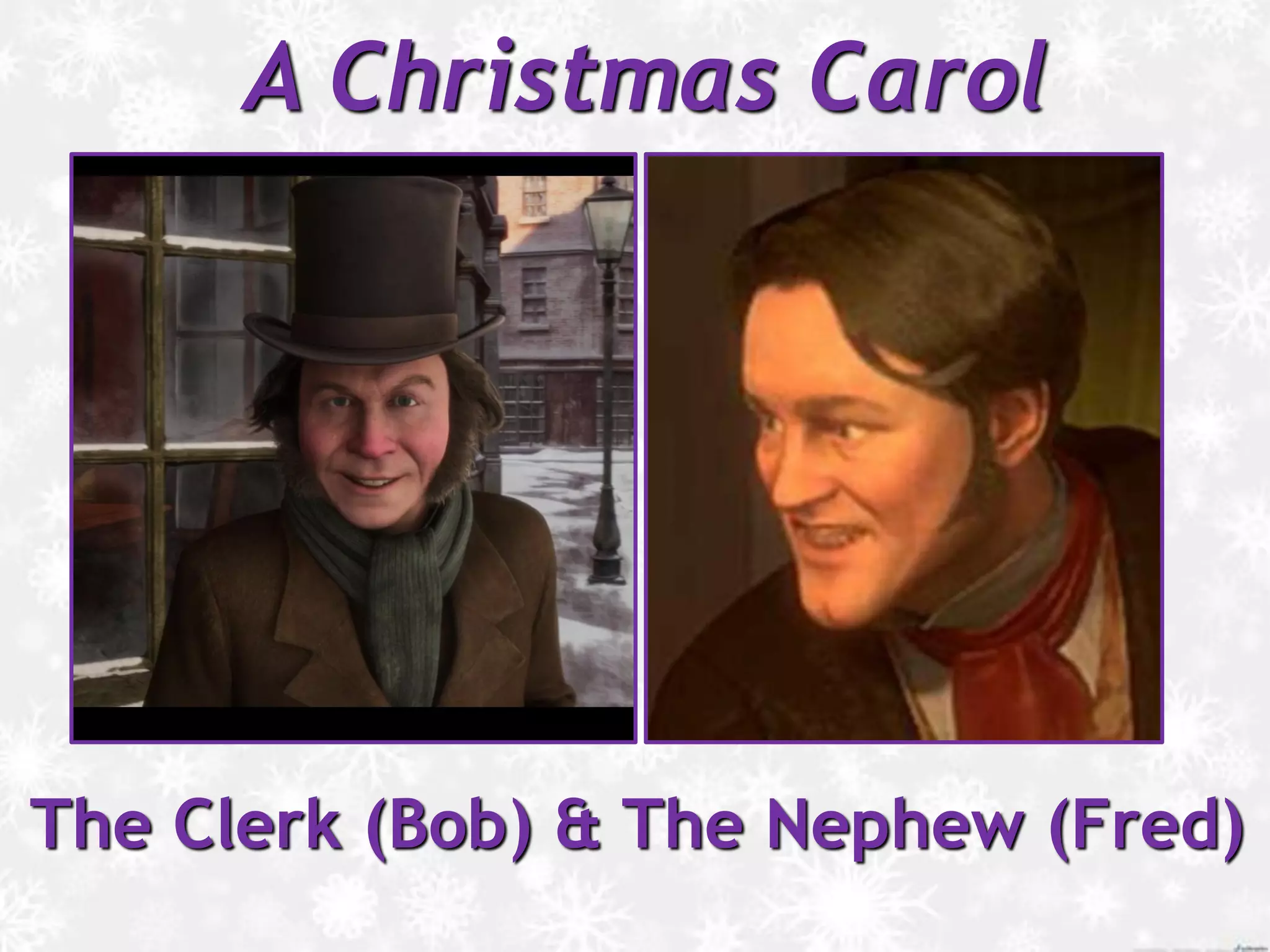
A Christmas Carol
The Clerk (Bob) & The Nephew (Fred)
Learning Objectives
By the end of the lesson…
 You will explore language and
explain how Dickens contrasts
Scrooge with Fred/Bob
 You will gain some insight into
Dickens’ background (Historical
Context)
Task: Comparative Table
As we read the chapter, complete a comparative table
in your exercise book, in which you compare Scrooge,
Fred and Bob.
Scrooge Bob Fred
Scrooge is cynical about
Christmas and other
people: “Bah Humbug!”
Bob is similar to Fred in his
Christmas spirit, and
refuses to be completely
oppressed by Scrooge:
“The clerk in the tank
involuntarily applauded.”
Fred contrasts Scrooge as
he loves Christmas, God
and even his uncle: “A
merry Christmas, uncle!
God save you!”
http://www.youtube.com/watch?v=3AB9poWDeDs
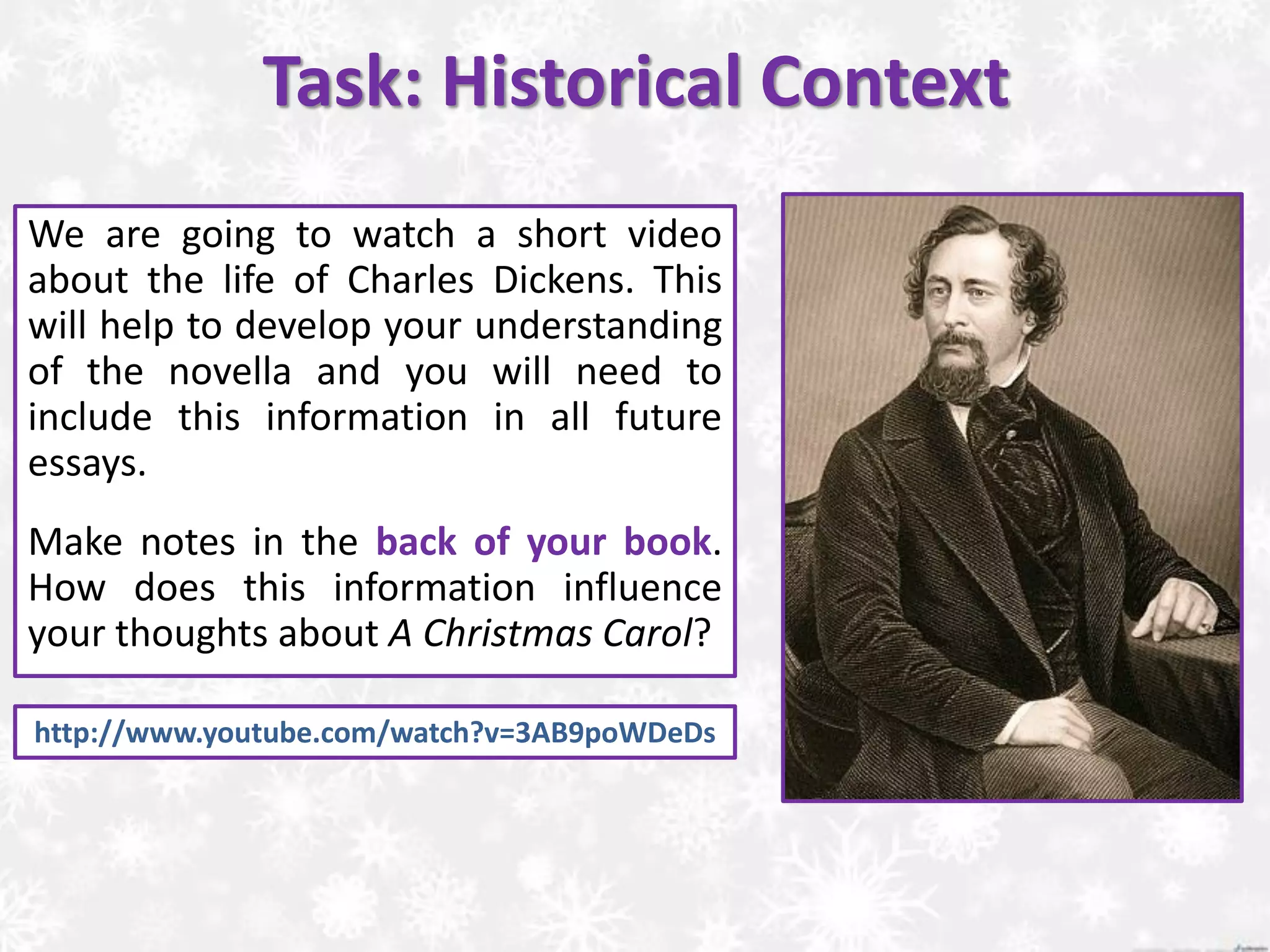
Task: Historical Context
We are going to watch a short video
about the life of Charles Dickens. This
will help to develop your understanding
of the novella and you will need to
include this information in all future
essays.
Make notes in the back of your book.
How does this information influence
your thoughts about A Christmas Carol?
Historical Context Information
• Although initially wealthy, John Dickens fell into
debt and was sent to Marshalsea Prison
• The Dickens family then moved to a poor area
of London
• He worked labelling blacking-bottles to help his
family
• He trained as a law clerk and then a journalist
• His novels have social messages and attempt to
reform society
• Early in 1843, as a response to a government
report on the abuse of child labourers in mines
and factories, Dickens vowed he would strike a
"sledge-hammer blow ... on behalf of the Poor
Man's Child."
How can we relate each of these
bullet points to the novella?
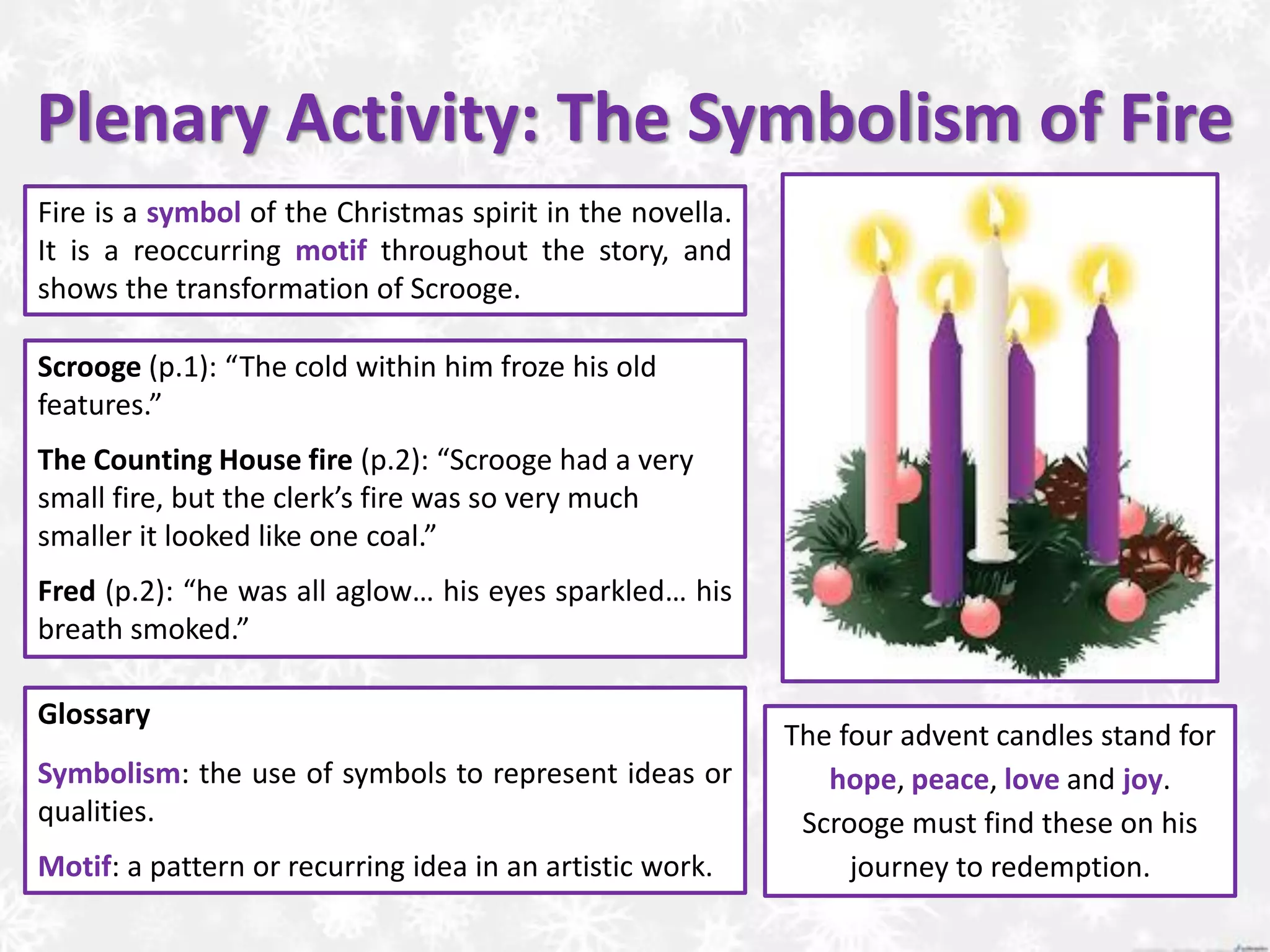
Plenary Activity: The Symbolism of Fire
The four advent candles stand for
hope, peace, love and joy.
Scrooge must find these on his
journey to redemption.
Fire is a symbol of the Christmas spirit in the novella.
It is a reoccurring motif throughout the story, and
shows the transformation of Scrooge.
Glossary
Symbolism: the use of symbols to represent ideas or
qualities.
Motif: a pattern or recurring idea in an artistic work.
Scrooge (p.1): “The cold within him froze his old
features.”
The Counting House fire (p.2): “Scrooge had a very
small fire, but the clerk’s fire was so very much
smaller it looked like one coal.”
Fred (p.2): “he was all aglow… his eyes sparkled… his
breath smoked.”
Starter Activity: Payday Loans
Think about the following:
• What is a payday loan?
• What group of people are
they aimed at?
• What problems are
associated with them?
• How do they relate to A
Christmas Carol?
A Christmas Carol
The Suffering of the Victorian Poor
Learning Objectives
By the end of the lesson…
 You will explore Scrooge’s attitude
to the poor
 You will gain some insight into
Victorian society (Historical
Context)
The Prisons and The Treadmill
Victorians were worried about the rising crime
rate: offences went up from about 5,000 per year
in 1800 to about 20,000 per year in 1840.
They were firm believers in punishment for
criminals, but faced a problem: what should the
punishment be? The answer was prison: lots of
new prisons were built and old ones extended.
The Victorians also had clear ideas about what
these prisons should be like. They should be
unpleasant places, to deter people from
committing crimes.
Once inside, prisoners were made to do hard,
boring work. Walking a treadwheel or picking
oakum (separating strands of rope) were the most
common forms of hard labour.
The Poor Law & The Workhouses
The Poor Law was the way that the poor were
helped in 1815. The law said that each parish
had to look after its own poor. If you were
unable to work then you were given some
money to help you survive. However, the cost of
the Poor Law was increasing every year. By 1830
it cost about £7 million and criticism of the law
was mounting.
In 1834 the Poor Law Amendment Act was
passed by Parliament. This was designed to
reduce the cost of looking after the poor as it
stopped money going to poor people except in
exceptional circumstances. Now if people
wanted help they had to go into a workhouse to
get it.
What problems in society do you think occurred
because of this?
1. Which character represents the poor in A
Christmas Carol?
2. Can he be considered idle and useless?
3. What is Dickens’ point of view?
Task: Scrooge’s attitude to the poor
“decrease the surplus population”
Cold, economical language: the poor
are numbers on a ledger to Scrooge.
As the poor don’t add wealth into
society, they are of no use.
Scrooge dehumanises the poor
and separates them from the rich.
Using the above quotation, incidents in Stave One and your
knowledge of the Victorian era, write a PEE chain that answers
the following question: What is Scrooge’s attitude to the poor?
Plenary Activity: Atmosphere Context
Meanwhile the fog and darkness
thickened so, that people ran about with
flaring links, proffering their services to
go before horses in carriages, and
conduct them on their way. The ancient
tower of a church, whose gruff old bell
was always peeping slyly down at
Scrooge out of a Gothic window in the
wall, became invisible, and struck the
hours and quarters in the clouds, with
tremulous vibrations afterwards as if its
teeth were chattering in its frozen head
up there. The cold became intense. In
the main street at the corner of the
court, some labourers were repairing
the gas-pipes, and had lighted a great
fire in a brazier, round which a party of
ragged men and boys were gathered:
warming their hands and winking their
eyes before the blaze in rapture.
How does Dickens create mood and
atmosphere in the following extract?
Tips for success:
 Look for 5-6 ideas
 Keep highlighted evidence short
 Analyse language closely (always
look for layers of meaning)
 Ask yourself: how does this add
to/change the atmosphere?
 Track through and find points
across the entire extract
Starter Activity: Peer Assessment
Assessment Criteria:
 Look for 5-6 ideas
 Keep highlighted evidence short
 Analyse language closely (always
look for layers of meaning)
 Ask yourself: how does this add
to/change the atmosphere?
 Track through and find points across
the entire extract
Complete two stars and a wish on your
partner’s work – set them a clear target!
Possible answers:
• Scrooge’s evil attitude is linked to the
weather: “fog and darkness thickened
so” (pathetic fallacy)
• The poor desperately hold on to their
Christmas spirit: “ran about with flaring
links” (symbolism)
• God is watching, disapproving of Scrooge:
“old bell was peeping slyly down at
Scrooge” (personification)
• The negative atmosphere grows: “The
cold became intense.” (short sentence for
effect)
• The poor suffer yet support each other
through their difficulties: “before the
blaze in rapture.” (religious connotations)
A Christmas Carol
Marley and his chains
Learning Objectives
By the end of the lesson…
 You will explore Marley’s arrival
and purpose in the novella
 You will practise using PEE &
analysing extracts
Task: PEE analysis
What does Marley attempt to teach Scrooge?
The chain was made “of cash-boxes, keys, padlocks, ledgers,
deeds, and heavy purses wrought in steel.” (p. 8)
“I wear the chain I forged in life […] I made it link by link” (p. 10)
“Or would you know […] the weight and length of the strong coil
you bear yourself?” (p. 10)
“In life my spirit never roved beyond the narrow limits of our
money-changing hole” (p. 10)
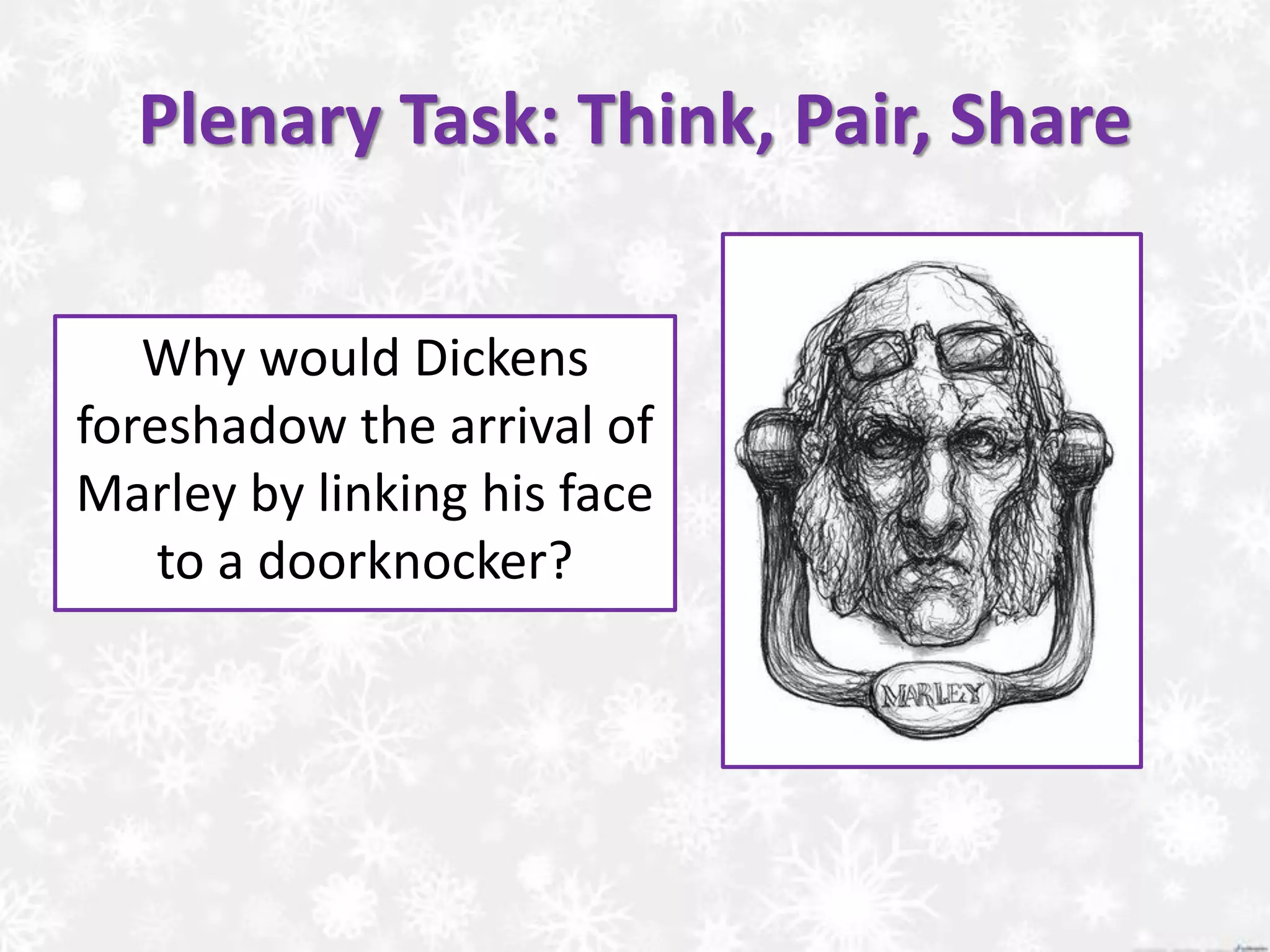
Plenary Task: Think, Pair, Share
Why would Dickens
foreshadow the arrival of
Marley by linking his face
to a doorknocker?
Starter Activity: SPaG Worksheet
Complete the SPaG sheet on your
table.
Be ready to offer answers and
mark your own work!
A Christmas Carol
Marley’s warning
Learning Objectives
By the end of the lesson…
 You will understand Marley’s
warning
 You will consolidate your
knowledge of Stave One
Mini-essay One: Scrooge’s Characterisation
You are going to write a short
essay for homework on the
following question:
How does Dickens present
Scrooge’s character in Stave
One?
Assessment Criteria:
 Show you understand the
character and his
relationships
 Use evidence to support
your ideas
 Analyse the language
closely (layers of meaning)
 Make references to the
historical context
Essay Structure:
Introduction (short overview);
Three PEE paragraphs (in chronological order);
Conclusion (summarise your main ideas).
Essay Length:
1.5-2 pages in your exercise book
Plenary Activity: Quotation Hunt
You must spend the rest of the
lesson selecting evidence from
Stave One to include in your
homework essay.
Be sure to:
• Choose short quotations
• Choose quotations that lead
you to different ideas about
Scrooge’s character

Scrooge's Characterisation

  • 1.
  • 2.
    Starter Activity: AChristmas Carol Look carefully at the original illustrations from the novella. What can you infer and deduce about A) Scrooge B) The Plot
  • 3.
    Learning Objectives By theend of the lesson…  You will explore language and explain how Dickens creates Scrooge’s identity  You will gain knowledge of the assessment criteria and understand how to structure a written response
  • 4.
    First Impressions Dickens usesadjectives to describe Scrooge. What do we learn about him? “Oh! But he was a tight-fisted hand at the grindstone. Scrooge! A squeezing, wrenching, grasping, scraping, clutching, covetous, old sinner!” Glossary: Gait - way of walking Frosty rime - white hair Covetous - envious of other people’s possessions Is it considered skilful writing to use many adjectives in a single sentence? Why has Dickens made this choice?
  • 5.
    Describing Scrooge Read Dickens’description of Scrooge. Select words and phrases that reveal his character. Oh! But he was a tight-fisted hand at the grindstone, Scrooge! a squeezing, wrenching, grasping, scraping, clutching, covetous, old sinner! Hard and sharp as flint, from which no steel had ever struck out generous fire; secret, and self- contained, and solitary as an oyster. The cold within him froze his old features, nipped his pointed nose, shriveled his cheek, stiffened his gait; made his eyes red, his thin lips blue and spoke out shrewdly in his grating voice.
  • 6.
    Ebenezer Scrooge What areyour first impressions of Ebenezer Scrooge? Write down 5 adjectives that describe Scrooge, then find an example of something that Scrooge says or does which reinforces that idea. Adjective Evidence Unsympathetic “If they would rather die… they had better do it, and decrease the surplus population.” Jealous “A covetous old sinner “ antisocial “I wished to be left alone” Judgemental “I can’t afford to make idle people merry.” bitter “No wind that blew was bitterer than he.”
  • 7.
    Scrooge: possible answers •Envious - “a covetous old sinner” • Miserly - “he was tight-fisted” • Unkind/mean spirited - “hard and sharp as flint” • Unsociable - “self- contained, and solitary as an oyster”, “sole” • Selfish - “I” , “My” • Unsympathetic - “warning all human sympathy to keep its distance” • Obsessed with work - “old Scrooge sat busy in the counting house” • Uncaring/indifferent - “the cold within him froze his features” • Short-tempered - “Scrooge walked out with a growl” • Cynical -“Bah! Humbug!” • Disliked/menacing - “nobody ever stopped him in the street”
  • 8.
    “hard and sharpas flint” What do we learn about Scrooge from this simile? sharp & can cut grey/old used for ……… feels ……… Type of ……….
  • 9.
    “hard and sharpas flint” What do we learn about Scrooge from this simile? sharp & can cut grey/old used for lighting fires and as weapons feels hard/rough Type of Quartz
  • 10.
    How do Iwrite about Scrooge in the exam? Scrooge is a miser, who sinfully takes advantage of the poor. He is described as “Hard and sharp as flint” at the beginning of stave one. The simile is used to suggest that he is both intelligent and dangerous as he is “sharp”. His job as a creditor means he possesses both qualities and uses them to take advantage of the poor. The “hard” quality of the flint links to Scrooge’s unrelenting and harsh attitude to other people as he enjoys being alone. “Flint” can creates sparks that will produce a fire. In the novella, fire is symbolic of the Christmas spirit and although Scrooge is currently evil, he will change as the ghosts intervene to save his soul. Point Evidence Explanation Historical Context
  • 11.
    “solitary as anoyster” What do we learn about Scrooge from this simile? Doesn’t have anything to do with anything else Can be worth a lot of ……… hard shell Found in …….. Considered a ……..
  • 12.
    “solitary as anoyster” What do we learn about Scrooge from this simile? Doesn’t have anything to do with anything else Can be worth a lot of money hard shell Found in the sea bed Considered a delicacy
  • 13.
    Plenary Activity: “solitaryas an oyster” In your exercise books, write a paragraph that explores the above quotation. Structure your response as follows: • Point: one sentence; a clear idea about Scrooge’s personality. • Evidence: one sentence; embed the quotation. • Explanation: a detailed analysis that explores individual words (add layers of meaning). • Historical context: add information that shows you understand the relationship between the novella and the Victorian era.
  • 14.
    Starter Activity: TextualAnalysis “The door of Scrooge's counting-house was open that he might keep his eye upon his clerk, who in a dismal little cell beyond, a sort of tank, was copying letters. Scrooge had a very small fire, but the clerk's fire was so very much smaller that it looked like one coal. But he couldn't replenish it, for Scrooge kept the coal- box in his own room…” 1. What do we learn about the relationship between Scrooge and his clerk (Bob Cratchit)? 2. What do we learn about their social positions? 3. Why make reference to fire?
  • 15.
    A Christmas Carol TheClerk (Bob) & The Nephew (Fred)
  • 16.
    Learning Objectives By theend of the lesson…  You will explore language and explain how Dickens contrasts Scrooge with Fred/Bob  You will gain some insight into Dickens’ background (Historical Context)
  • 17.
    Task: Comparative Table Aswe read the chapter, complete a comparative table in your exercise book, in which you compare Scrooge, Fred and Bob. Scrooge Bob Fred Scrooge is cynical about Christmas and other people: “Bah Humbug!” Bob is similar to Fred in his Christmas spirit, and refuses to be completely oppressed by Scrooge: “The clerk in the tank involuntarily applauded.” Fred contrasts Scrooge as he loves Christmas, God and even his uncle: “A merry Christmas, uncle! God save you!”
  • 18.
    http://www.youtube.com/watch?v=3AB9poWDeDs Task: Historical Context Weare going to watch a short video about the life of Charles Dickens. This will help to develop your understanding of the novella and you will need to include this information in all future essays. Make notes in the back of your book. How does this information influence your thoughts about A Christmas Carol?
  • 19.
    Historical Context Information •Although initially wealthy, John Dickens fell into debt and was sent to Marshalsea Prison • The Dickens family then moved to a poor area of London • He worked labelling blacking-bottles to help his family • He trained as a law clerk and then a journalist • His novels have social messages and attempt to reform society • Early in 1843, as a response to a government report on the abuse of child labourers in mines and factories, Dickens vowed he would strike a "sledge-hammer blow ... on behalf of the Poor Man's Child." How can we relate each of these bullet points to the novella?
  • 20.
    Plenary Activity: TheSymbolism of Fire The four advent candles stand for hope, peace, love and joy. Scrooge must find these on his journey to redemption. Fire is a symbol of the Christmas spirit in the novella. It is a reoccurring motif throughout the story, and shows the transformation of Scrooge. Glossary Symbolism: the use of symbols to represent ideas or qualities. Motif: a pattern or recurring idea in an artistic work. Scrooge (p.1): “The cold within him froze his old features.” The Counting House fire (p.2): “Scrooge had a very small fire, but the clerk’s fire was so very much smaller it looked like one coal.” Fred (p.2): “he was all aglow… his eyes sparkled… his breath smoked.”
  • 21.
    Starter Activity: PaydayLoans Think about the following: • What is a payday loan? • What group of people are they aimed at? • What problems are associated with them? • How do they relate to A Christmas Carol?
  • 22.
    A Christmas Carol TheSuffering of the Victorian Poor
  • 23.
    Learning Objectives By theend of the lesson…  You will explore Scrooge’s attitude to the poor  You will gain some insight into Victorian society (Historical Context)
  • 24.
    The Prisons andThe Treadmill Victorians were worried about the rising crime rate: offences went up from about 5,000 per year in 1800 to about 20,000 per year in 1840. They were firm believers in punishment for criminals, but faced a problem: what should the punishment be? The answer was prison: lots of new prisons were built and old ones extended. The Victorians also had clear ideas about what these prisons should be like. They should be unpleasant places, to deter people from committing crimes. Once inside, prisoners were made to do hard, boring work. Walking a treadwheel or picking oakum (separating strands of rope) were the most common forms of hard labour.
  • 25.
    The Poor Law& The Workhouses The Poor Law was the way that the poor were helped in 1815. The law said that each parish had to look after its own poor. If you were unable to work then you were given some money to help you survive. However, the cost of the Poor Law was increasing every year. By 1830 it cost about £7 million and criticism of the law was mounting. In 1834 the Poor Law Amendment Act was passed by Parliament. This was designed to reduce the cost of looking after the poor as it stopped money going to poor people except in exceptional circumstances. Now if people wanted help they had to go into a workhouse to get it. What problems in society do you think occurred because of this? 1. Which character represents the poor in A Christmas Carol? 2. Can he be considered idle and useless? 3. What is Dickens’ point of view?
  • 26.
    Task: Scrooge’s attitudeto the poor “decrease the surplus population” Cold, economical language: the poor are numbers on a ledger to Scrooge. As the poor don’t add wealth into society, they are of no use. Scrooge dehumanises the poor and separates them from the rich. Using the above quotation, incidents in Stave One and your knowledge of the Victorian era, write a PEE chain that answers the following question: What is Scrooge’s attitude to the poor?
  • 27.
    Plenary Activity: AtmosphereContext Meanwhile the fog and darkness thickened so, that people ran about with flaring links, proffering their services to go before horses in carriages, and conduct them on their way. The ancient tower of a church, whose gruff old bell was always peeping slyly down at Scrooge out of a Gothic window in the wall, became invisible, and struck the hours and quarters in the clouds, with tremulous vibrations afterwards as if its teeth were chattering in its frozen head up there. The cold became intense. In the main street at the corner of the court, some labourers were repairing the gas-pipes, and had lighted a great fire in a brazier, round which a party of ragged men and boys were gathered: warming their hands and winking their eyes before the blaze in rapture. How does Dickens create mood and atmosphere in the following extract? Tips for success:  Look for 5-6 ideas  Keep highlighted evidence short  Analyse language closely (always look for layers of meaning)  Ask yourself: how does this add to/change the atmosphere?  Track through and find points across the entire extract
  • 28.
    Starter Activity: PeerAssessment Assessment Criteria:  Look for 5-6 ideas  Keep highlighted evidence short  Analyse language closely (always look for layers of meaning)  Ask yourself: how does this add to/change the atmosphere?  Track through and find points across the entire extract Complete two stars and a wish on your partner’s work – set them a clear target! Possible answers: • Scrooge’s evil attitude is linked to the weather: “fog and darkness thickened so” (pathetic fallacy) • The poor desperately hold on to their Christmas spirit: “ran about with flaring links” (symbolism) • God is watching, disapproving of Scrooge: “old bell was peeping slyly down at Scrooge” (personification) • The negative atmosphere grows: “The cold became intense.” (short sentence for effect) • The poor suffer yet support each other through their difficulties: “before the blaze in rapture.” (religious connotations)
  • 29.
  • 30.
    Learning Objectives By theend of the lesson…  You will explore Marley’s arrival and purpose in the novella  You will practise using PEE & analysing extracts
  • 31.
    Task: PEE analysis Whatdoes Marley attempt to teach Scrooge? The chain was made “of cash-boxes, keys, padlocks, ledgers, deeds, and heavy purses wrought in steel.” (p. 8) “I wear the chain I forged in life […] I made it link by link” (p. 10) “Or would you know […] the weight and length of the strong coil you bear yourself?” (p. 10) “In life my spirit never roved beyond the narrow limits of our money-changing hole” (p. 10)
  • 32.
    Plenary Task: Think,Pair, Share Why would Dickens foreshadow the arrival of Marley by linking his face to a doorknocker?
  • 33.
    Starter Activity: SPaGWorksheet Complete the SPaG sheet on your table. Be ready to offer answers and mark your own work!
  • 34.
  • 35.
    Learning Objectives By theend of the lesson…  You will understand Marley’s warning  You will consolidate your knowledge of Stave One
  • 36.
    Mini-essay One: Scrooge’sCharacterisation You are going to write a short essay for homework on the following question: How does Dickens present Scrooge’s character in Stave One? Assessment Criteria:  Show you understand the character and his relationships  Use evidence to support your ideas  Analyse the language closely (layers of meaning)  Make references to the historical context Essay Structure: Introduction (short overview); Three PEE paragraphs (in chronological order); Conclusion (summarise your main ideas). Essay Length: 1.5-2 pages in your exercise book
  • 37.
    Plenary Activity: QuotationHunt You must spend the rest of the lesson selecting evidence from Stave One to include in your homework essay. Be sure to: • Choose short quotations • Choose quotations that lead you to different ideas about Scrooge’s character