A Christmas Carol
    Charles Dickens

 Menu
Introduction
Background
Discussion Starters
A Christmas Carol
            Charles Dickens
Images provided by Jupiter Images and
Shutterstock.
A Christmas Carol
  Charles Dickens
A Christmas Carol: Introduction


• a familiar, timeless character


• ghosts and apparitions


• time travel


                This classic holiday tale has it all.
A Christmas Carol: Introduction


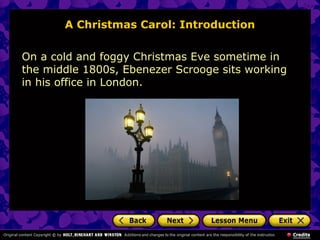
On a cold and foggy Christmas Eve sometime in
the middle 1800s, Ebenezer Scrooge sits working
in his office in London.
A Christmas Carol: Introduction


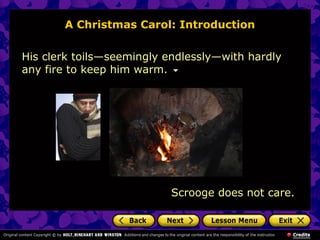
His clerk toils—seemingly endlessly—with hardly
any fire to keep him warm.


                           Scrooge does not care.
A Christmas Carol: Introduction


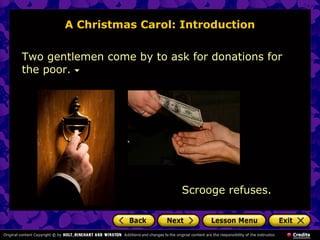
Two gentlemen come by to ask for donations for
the poor.


                            Scrooge refuses.
A Christmas Carol: Introduction


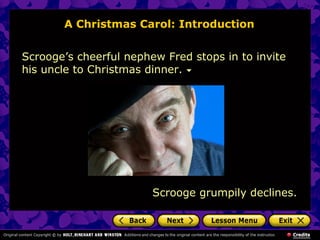
Scrooge’s cheerful nephew Fred stops in to invite
his uncle to Christmas dinner.


                        Scrooge grumpily declines.
A Christmas Carol: Introduction


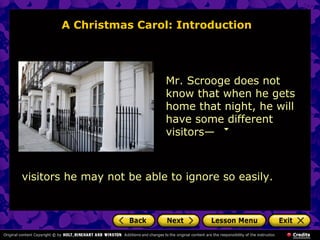
                           Mr. Scrooge does not
                           know that when he gets
                           home that night, he will
                           have some different
                           visitors—


visitors he may not be able to ignore so easily.
A Christmas Carol: Introduction

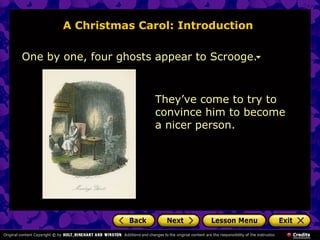
One by one, four ghosts appear to Scrooge.


                       They’ve come to try to
                       convince him to become
                       a nicer person.
A Christmas Carol: Introduction

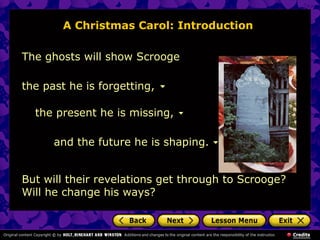
The ghosts will show Scrooge

the past he is forgetting,

  the present he is missing,

      and the future he is shaping.


But will their revelations get through to Scrooge?
Will he change his ways?
A Christmas Carol: Background


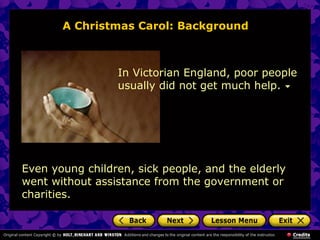
                 In Victorian England, poor people
                 usually did not get much help.


Even young children, sick people, and the elderly
went without assistance from the government or
charities.
A Christmas Carol: Background


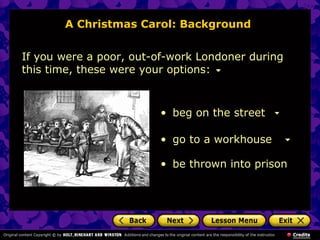
If you were a poor, out-of-work Londoner during
this time, these were your options:


                        • beg on the street

                        • go to a workhouse

                        • be thrown into prison
A Christmas Carol: Background


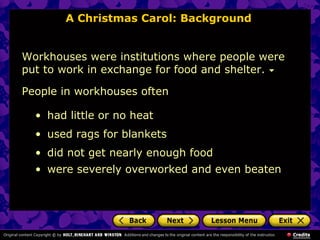
Workhouses were institutions where people were
put to work in exchange for food and shelter.

People in workhouses often

  • had little or no heat
  • used rags for blankets
  • did not get nearly enough food
  • were severely overworked and even beaten
A Christmas Carol: Background


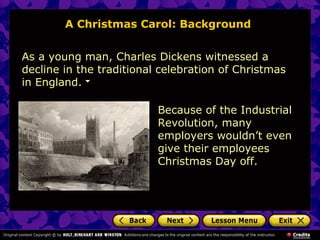
As a young man, Charles Dickens witnessed a
decline in the traditional celebration of Christmas
in England.

                          Because of the Industrial
                          Revolution, many
                          employers wouldn’t even
                          give their employees
                          Christmas Day off.
A Christmas Carol: Background


The Industrial Revolution was a time of change in
Europe marked by

  • the introduction of power-driven machinery
  • the growth of factories
  • a huge increase in the production of goods
  • a shift from a rural, agricultural society to a
    more urban one
A Christmas Carol: Background


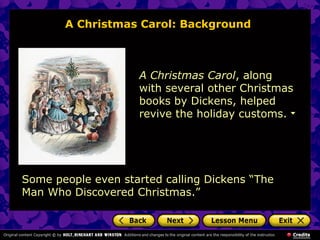
                    A Christmas Carol, along
                    with several other Christmas
                    books by Dickens, helped
                    revive the holiday customs.


Some people even started calling Dickens “The
Man Who Discovered Christmas.”
A Christmas Carol: Background


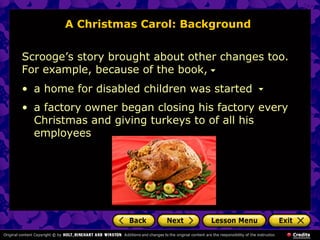
Scrooge’s story brought about other changes too.
For example, because of the book,
• a home for disabled children was started
• a factory owner began closing his factory every
  Christmas and giving turkeys to of all his
  employees
A Christmas Carol: Background


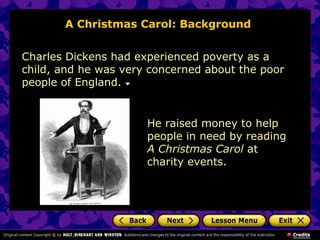
Charles Dickens had experienced poverty as a
child, and he was very concerned about the poor
people of England.


                      He raised money to help
                      people in need by reading
                      A Christmas Carol at
                      charity events.
A Christmas Carol: Discussion Starters

Discuss (1)
Dickens believed that human beings were largely
responsible for society’s ills, such as poverty,
hunger, and suffering.
• How much responsibility does each individual
  have to help others in need?
• How can one person help make the world a
  better place?
A Christmas Carol: Discussion Starters

Discuss (2)

• Do you believe that any given person can
  significantly change the way that he or she sees
  the world and treats others?
• What does it take to make people change their
  ways?
• If you were shown your past, present, and
  future in one night, how do you think you would
  change?

A chrismas carol. ppt

  • 1.
    A Christmas Carol Charles Dickens Menu Introduction Background Discussion Starters
  • 2.
    A Christmas Carol Charles Dickens Images provided by Jupiter Images and Shutterstock.
  • 3.
    A Christmas Carol Charles Dickens
  • 4.
    A Christmas Carol:Introduction • a familiar, timeless character • ghosts and apparitions • time travel This classic holiday tale has it all.
  • 5.
    A Christmas Carol:Introduction On a cold and foggy Christmas Eve sometime in the middle 1800s, Ebenezer Scrooge sits working in his office in London.
  • 6.
    A Christmas Carol:Introduction His clerk toils—seemingly endlessly—with hardly any fire to keep him warm. Scrooge does not care.
  • 7.
    A Christmas Carol:Introduction Two gentlemen come by to ask for donations for the poor. Scrooge refuses.
  • 8.
    A Christmas Carol:Introduction Scrooge’s cheerful nephew Fred stops in to invite his uncle to Christmas dinner. Scrooge grumpily declines.
  • 9.
    A Christmas Carol:Introduction Mr. Scrooge does not know that when he gets home that night, he will have some different visitors— visitors he may not be able to ignore so easily.
  • 10.
    A Christmas Carol:Introduction One by one, four ghosts appear to Scrooge. They’ve come to try to convince him to become a nicer person.
  • 11.
    A Christmas Carol:Introduction The ghosts will show Scrooge the past he is forgetting, the present he is missing, and the future he is shaping. But will their revelations get through to Scrooge? Will he change his ways?
  • 12.
    A Christmas Carol:Background In Victorian England, poor people usually did not get much help. Even young children, sick people, and the elderly went without assistance from the government or charities.
  • 13.
    A Christmas Carol:Background If you were a poor, out-of-work Londoner during this time, these were your options: • beg on the street • go to a workhouse • be thrown into prison
  • 14.
    A Christmas Carol:Background Workhouses were institutions where people were put to work in exchange for food and shelter. People in workhouses often • had little or no heat • used rags for blankets • did not get nearly enough food • were severely overworked and even beaten
  • 15.
    A Christmas Carol:Background As a young man, Charles Dickens witnessed a decline in the traditional celebration of Christmas in England. Because of the Industrial Revolution, many employers wouldn’t even give their employees Christmas Day off.
  • 16.
    A Christmas Carol:Background The Industrial Revolution was a time of change in Europe marked by • the introduction of power-driven machinery • the growth of factories • a huge increase in the production of goods • a shift from a rural, agricultural society to a more urban one
  • 17.
    A Christmas Carol:Background A Christmas Carol, along with several other Christmas books by Dickens, helped revive the holiday customs. Some people even started calling Dickens “The Man Who Discovered Christmas.”
  • 18.
    A Christmas Carol:Background Scrooge’s story brought about other changes too. For example, because of the book, • a home for disabled children was started • a factory owner began closing his factory every Christmas and giving turkeys to of all his employees
  • 19.
    A Christmas Carol:Background Charles Dickens had experienced poverty as a child, and he was very concerned about the poor people of England. He raised money to help people in need by reading A Christmas Carol at charity events.
  • 20.
    A Christmas Carol:Discussion Starters Discuss (1) Dickens believed that human beings were largely responsible for society’s ills, such as poverty, hunger, and suffering. • How much responsibility does each individual have to help others in need? • How can one person help make the world a better place?
  • 21.
    A Christmas Carol:Discussion Starters Discuss (2) • Do you believe that any given person can significantly change the way that he or she sees the world and treats others? • What does it take to make people change their ways? • If you were shown your past, present, and future in one night, how do you think you would change?