ENTER 2017 Research Track
A Chat-based Group Recommender
System for Tourism
Thuy Ngoc Nguyen and Francesco Ricci
Free University of Bozen-Bolzano, Italy
{ngoc.nguyen, fricci}@unibz.it
Slide Number 2ENTER 2017 Research Track
Agenda
• Introduction
• Related Work
• Application Scenario
• Recommendation Logic
• Experimental Evaluation and Results
• Conclusions
Slide Number 3ENTER 2017 Research Track
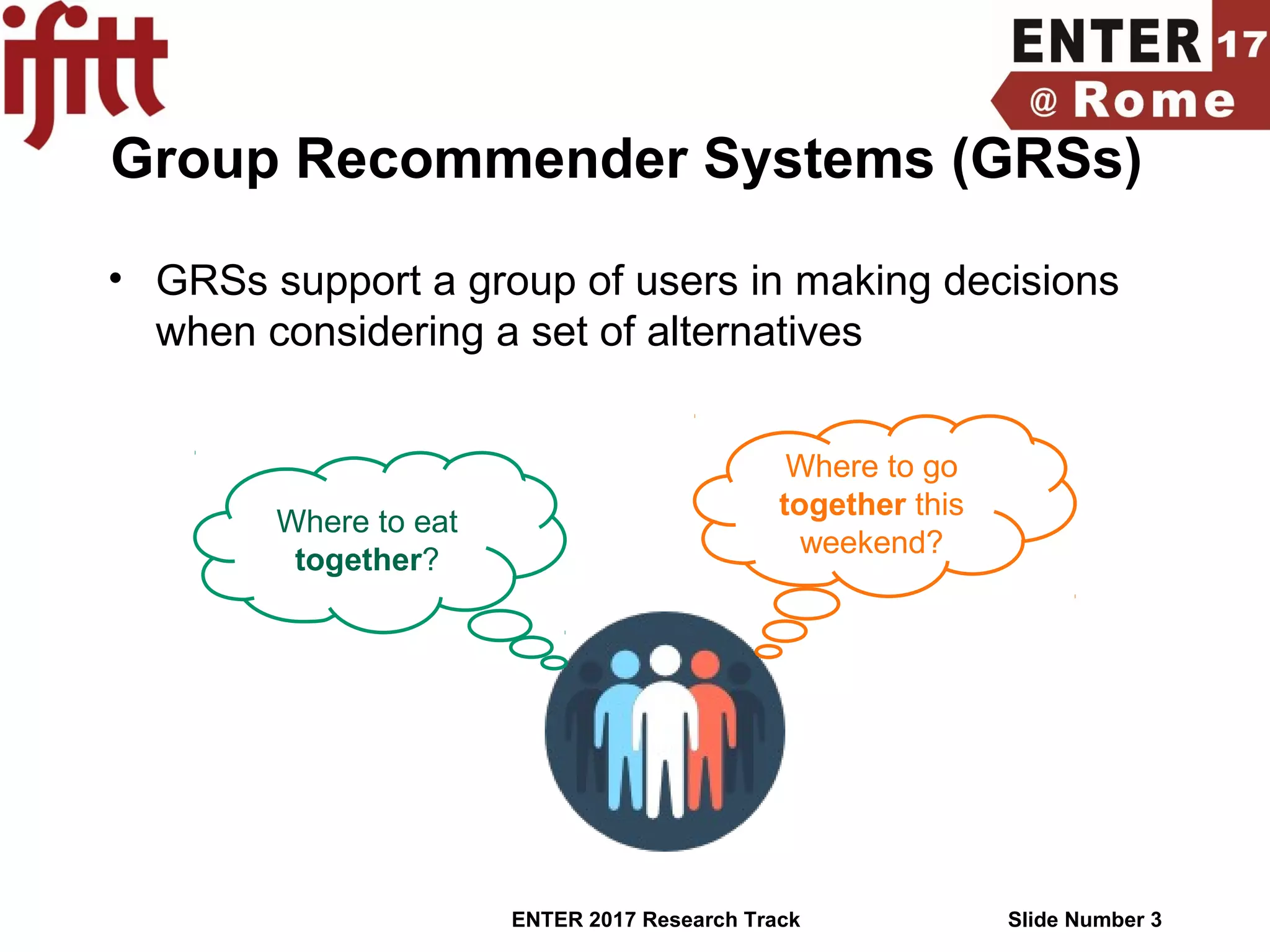
Group Recommender Systems (GRSs)
• GRSs support a group of users in making decisions
when considering a set of alternatives
Where to eat
together?
Where to go
together this
weekend?
Slide Number 4ENTER 2017 Research Track
Problem of GRSs
• Most of GRSs use only users’ preferences acquired
before the actual decision making process
• But, …
– Users’ preferences are dynamic (Masthoff, 2015)
– The decision process adopted by a group determines
the quality of the decision output (Forsyth, 2014)
– Group preferences are constructed during the
decision making process (Delic et al., 2016)
How to acquire and identify the true users’ preferences
when they are a part of a group?
Slide Number 5ENTER 2017 Research Track
Agenda
• Introduction
• Related Work
• Application Scenario
• Recommendation Logic
• Experimental Evaluation and Results
• Conclusions
Slide Number 6ENTER 2017 Research Track
GRSs in Tourism (1)
Intrigue
(Ardissono, L., Goy, A., Petrone, G., Segnan, M. and Torasso, P., 2003)
Slide Number 7ENTER 2017 Research Track
GRSs in Tourism (2)
Travel Decision Forum
(Jameson, 2004)
Slide Number 8ENTER 2017 Research Track
GRSs in Tourism (3)
Where2eat
(Guzzi, F., Ricci, F. and Burke, R., 2011)
Slide Number 9ENTER 2017 Research Track
GRSs in Tourism (4)
Choicla
(Stettinger, M. and Felfernig, A., 2014)
Slide Number 10ENTER 2017 Research Track
Agenda
• Introduction
• Related Work
• Application Scenario
• Recommendation Logic
• Experimental Evaluation and Results
• Conclusions
Slide Number 11ENTER 2017 Research Track
STSGroup
South Tyrol Suggests
(Braunhofer et al., 2014)
South Tyrol Suggests for Group
- STSGroup
Slide Number 12ENTER 2017 Research Track
STSGroup (1)
Companion Management
• Search by user name
• Send connection requests
• Tag companions
Slide Number 13ENTER 2017 Research Track
STSGroup (2)
Group discussion
• Exchange messages
• Propose items that are
thought to be suitable
for the group
Slide Number 14ENTER 2017 Research Track
STSGroup (3)
• Best, like, or dislike
• Notify users when other
members change their
preferences
• Tag proposals with
comments and emoji
Proposal Evaluations
Slide Number 15ENTER 2017 Research Track
STSGroup (4)
• Instruct how to better use
system functions
• Show recommendations
for the group
• Suggest one item, among
the proposed ones, the
group should choose
Recommendations &
Suggestions
Slide Number 16ENTER 2017 Research Track
Agenda
• Introduction
• Related Work
• Application Scenario
• Recommendation Logic
• Experimental Evaluation and Results
• Conclusions
Slide Number 17ENTER 2017 Research Track
f (u,i) = wk
(u)
xk
(i)
k=1
n
∑
Group Recommendations
• Main idea: infer user’s preferences by observing
their evaluations during the group discussion
• Define a user utility function and assume users prefer
items with larger utility
1 if item i has feature k-th,
otherwise 0
The importance user u assigns to the k-th feature
Slide Number 18ENTER 2017 Research Track
Phase 1: Before joining a group
• Identify the importance that user u assigns to the item
features based on ratings
– give more weights to features representing items that
have received high ratings from the user u
Slide Number 19ENTER 2017 Research Track
Phase 2: During a group discussion
• If user u prefers item i and dislikes item i’, then infer
the constraint f(u, i) > f (u, i’)
– u likes a POI described by the features “castle” and
“fortress”, and dislikes one having the feature
“swimming” 
• Find the utility vectors that
– satisfy the inferred constraints
– align as closely as possible to the aggregated utility
vector of the group
( )( ) ( ) ( )u u u
castle fortress swimmingw w w+ >
Slide Number 20ENTER 2017 Research Track
Phase 3: Update
• Linearly combine original user utility vector (Phase 1)
with the user utility vector reflecting the preferences
acquired in the group discussion (Phase 2)
the updated utility vector
• Identify the group utility vector
w(G)
= α(u,G)w(u)
u∈G
∑
• a non-negative coefficient associated to user u in group G
• the more feedback u provides, the higher coefficient
Slide Number 21ENTER 2017 Research Track
Agenda
• Introduction
• Related Work
• Application Scenario
• Recommendation Logic
• Experimental Evaluation and Results
• Conclusions
Slide Number 22ENTER 2017 Research Track
Evaluation
• A controlled live user study: 15 participants (3 groups
of two and 3 groups of three)
– System Usability Scale (SUS), compared with a
benchmark (Bangor et al., 2008)
– Perceived recommendation quality (Knijnenburg et al., 2012)
– Perceived choice satisfaction (Knijnenburg et al., 2012)
Slide Number 23ENTER 2017 Research Track
Results (1)
Use one-sample t-test as suggested in (Sauro & Lewis, 2012)
•SUS average score of STSGroup: 76, 𝜎 = 7.89
•One sample t-test: t = 4.42 and p = 0.001, more than 99% confidence:
STSGroup’s score > benchmark = 67
Slide Number 24ENTER 2017 Research Track
Results (2)
Statement
Strongly
agree
Agree
Neither disagree
nor agree
Disagree
Strongly
disagree
RecQual1 26.7% 60.0% 13.3% 0.0% 0.0%
RecQual2 33.3% 53.4% 13.3% 0.0% 0.0%
RecQual3 0.0% 0.0% 6.7% 53.3% 40.0%
RecQual4 0.0% 73.3% 20.0% 6.7% 0.0%
RecQual5 0.0% 0.0% 6.7% 60.0% 33.3%
RecQual1: “I liked the final choice suggested by the system”
RecQual2: “The final choice recommended by the system was well-chosen”
RecQual3: “I didn’t like the suggested final choice”
RecQual4: “The new item recommendations for a group,
excluding the proposed items were relevant”
RecQual5: “I didn't like any of the recommended new items”
Slide Number 25ENTER 2017 Research Track
Results (3)
Statement
Strongly
agree
Agree
Neither disagree
nor agree
Disagree
Strongly
disagree
ChoiceSat1 6.7% 80.0% 13.3% 0.0% 0.0%
ChoiceSat2 6.7% 53.3% 20.0% 20.0% 0.0%
ChoiceSat3 0.0 6.7% 46.6% 40.0% 6.7%
ChoiceSat1: “I was excited about the place that we have chosen”
ChoiceSat2: “The chosen place fits my preference”
ChoiceSat3: “I didn’t prefer the chosen place, but it was fair”
Slide Number 26ENTER 2017 Research Track
Agenda
• Introduction
• Related Work
• Application Scenario
• Recommendation Logic
• Experimental Evaluation and Results
• Conclusions
Slide Number 27ENTER 2017 Research Track
Conclusions
• Support the group decision making process with a
group chat environment
• The proposed algorithm exploits user’s feedback to
during the discussion  update users’ preferences
• In the future
– Investigate the behavior of the proposed model by
conducting offline experiments on simulated data
– Enhance the usability of system
ENTER 2017 Research Track
Question ?
Thank you.

A Chat-based Group Recommender System for Tourism

  • 1.
    ENTER 2017 ResearchTrack A Chat-based Group Recommender System for Tourism Thuy Ngoc Nguyen and Francesco Ricci Free University of Bozen-Bolzano, Italy {ngoc.nguyen, fricci}@unibz.it
  • 2.
    Slide Number 2ENTER2017 Research Track Agenda • Introduction • Related Work • Application Scenario • Recommendation Logic • Experimental Evaluation and Results • Conclusions
  • 3.
    Slide Number 3ENTER2017 Research Track Group Recommender Systems (GRSs) • GRSs support a group of users in making decisions when considering a set of alternatives Where to eat together? Where to go together this weekend?
  • 4.
    Slide Number 4ENTER2017 Research Track Problem of GRSs • Most of GRSs use only users’ preferences acquired before the actual decision making process • But, … – Users’ preferences are dynamic (Masthoff, 2015) – The decision process adopted by a group determines the quality of the decision output (Forsyth, 2014) – Group preferences are constructed during the decision making process (Delic et al., 2016) How to acquire and identify the true users’ preferences when they are a part of a group?
  • 5.
    Slide Number 5ENTER2017 Research Track Agenda • Introduction • Related Work • Application Scenario • Recommendation Logic • Experimental Evaluation and Results • Conclusions
  • 6.
    Slide Number 6ENTER2017 Research Track GRSs in Tourism (1) Intrigue (Ardissono, L., Goy, A., Petrone, G., Segnan, M. and Torasso, P., 2003)
  • 7.
    Slide Number 7ENTER2017 Research Track GRSs in Tourism (2) Travel Decision Forum (Jameson, 2004)
  • 8.
    Slide Number 8ENTER2017 Research Track GRSs in Tourism (3) Where2eat (Guzzi, F., Ricci, F. and Burke, R., 2011)
  • 9.
    Slide Number 9ENTER2017 Research Track GRSs in Tourism (4) Choicla (Stettinger, M. and Felfernig, A., 2014)
  • 10.
    Slide Number 10ENTER2017 Research Track Agenda • Introduction • Related Work • Application Scenario • Recommendation Logic • Experimental Evaluation and Results • Conclusions
  • 11.
    Slide Number 11ENTER2017 Research Track STSGroup South Tyrol Suggests (Braunhofer et al., 2014) South Tyrol Suggests for Group - STSGroup
  • 12.
    Slide Number 12ENTER2017 Research Track STSGroup (1) Companion Management • Search by user name • Send connection requests • Tag companions
  • 13.
    Slide Number 13ENTER2017 Research Track STSGroup (2) Group discussion • Exchange messages • Propose items that are thought to be suitable for the group
  • 14.
    Slide Number 14ENTER2017 Research Track STSGroup (3) • Best, like, or dislike • Notify users when other members change their preferences • Tag proposals with comments and emoji Proposal Evaluations
  • 15.
    Slide Number 15ENTER2017 Research Track STSGroup (4) • Instruct how to better use system functions • Show recommendations for the group • Suggest one item, among the proposed ones, the group should choose Recommendations & Suggestions
  • 16.
    Slide Number 16ENTER2017 Research Track Agenda • Introduction • Related Work • Application Scenario • Recommendation Logic • Experimental Evaluation and Results • Conclusions
  • 17.
    Slide Number 17ENTER2017 Research Track f (u,i) = wk (u) xk (i) k=1 n ∑ Group Recommendations • Main idea: infer user’s preferences by observing their evaluations during the group discussion • Define a user utility function and assume users prefer items with larger utility 1 if item i has feature k-th, otherwise 0 The importance user u assigns to the k-th feature
  • 18.
    Slide Number 18ENTER2017 Research Track Phase 1: Before joining a group • Identify the importance that user u assigns to the item features based on ratings – give more weights to features representing items that have received high ratings from the user u
  • 19.
    Slide Number 19ENTER2017 Research Track Phase 2: During a group discussion • If user u prefers item i and dislikes item i’, then infer the constraint f(u, i) > f (u, i’) – u likes a POI described by the features “castle” and “fortress”, and dislikes one having the feature “swimming”  • Find the utility vectors that – satisfy the inferred constraints – align as closely as possible to the aggregated utility vector of the group ( )( ) ( ) ( )u u u castle fortress swimmingw w w+ >
  • 20.
    Slide Number 20ENTER2017 Research Track Phase 3: Update • Linearly combine original user utility vector (Phase 1) with the user utility vector reflecting the preferences acquired in the group discussion (Phase 2) the updated utility vector • Identify the group utility vector w(G) = α(u,G)w(u) u∈G ∑ • a non-negative coefficient associated to user u in group G • the more feedback u provides, the higher coefficient
  • 21.
    Slide Number 21ENTER2017 Research Track Agenda • Introduction • Related Work • Application Scenario • Recommendation Logic • Experimental Evaluation and Results • Conclusions
  • 22.
    Slide Number 22ENTER2017 Research Track Evaluation • A controlled live user study: 15 participants (3 groups of two and 3 groups of three) – System Usability Scale (SUS), compared with a benchmark (Bangor et al., 2008) – Perceived recommendation quality (Knijnenburg et al., 2012) – Perceived choice satisfaction (Knijnenburg et al., 2012)
  • 23.
    Slide Number 23ENTER2017 Research Track Results (1) Use one-sample t-test as suggested in (Sauro & Lewis, 2012) •SUS average score of STSGroup: 76, 𝜎 = 7.89 •One sample t-test: t = 4.42 and p = 0.001, more than 99% confidence: STSGroup’s score > benchmark = 67
  • 24.
    Slide Number 24ENTER2017 Research Track Results (2) Statement Strongly agree Agree Neither disagree nor agree Disagree Strongly disagree RecQual1 26.7% 60.0% 13.3% 0.0% 0.0% RecQual2 33.3% 53.4% 13.3% 0.0% 0.0% RecQual3 0.0% 0.0% 6.7% 53.3% 40.0% RecQual4 0.0% 73.3% 20.0% 6.7% 0.0% RecQual5 0.0% 0.0% 6.7% 60.0% 33.3% RecQual1: “I liked the final choice suggested by the system” RecQual2: “The final choice recommended by the system was well-chosen” RecQual3: “I didn’t like the suggested final choice” RecQual4: “The new item recommendations for a group, excluding the proposed items were relevant” RecQual5: “I didn't like any of the recommended new items”
  • 25.
    Slide Number 25ENTER2017 Research Track Results (3) Statement Strongly agree Agree Neither disagree nor agree Disagree Strongly disagree ChoiceSat1 6.7% 80.0% 13.3% 0.0% 0.0% ChoiceSat2 6.7% 53.3% 20.0% 20.0% 0.0% ChoiceSat3 0.0 6.7% 46.6% 40.0% 6.7% ChoiceSat1: “I was excited about the place that we have chosen” ChoiceSat2: “The chosen place fits my preference” ChoiceSat3: “I didn’t prefer the chosen place, but it was fair”
  • 26.
    Slide Number 26ENTER2017 Research Track Agenda • Introduction • Related Work • Application Scenario • Recommendation Logic • Experimental Evaluation and Results • Conclusions
  • 27.
    Slide Number 27ENTER2017 Research Track Conclusions • Support the group decision making process with a group chat environment • The proposed algorithm exploits user’s feedback to during the discussion  update users’ preferences • In the future – Investigate the behavior of the proposed model by conducting offline experiments on simulated data – Enhance the usability of system
  • 28.
    ENTER 2017 ResearchTrack Question ? Thank you.

Editor's Notes

  • #2 Full papers, 20 min + 5 to 10 min Q&A