Co-author:
Associate Professor Pierre Benckendorff
1
Background
WHY?
Relevant
literature
WHAT?
Methodology
–HOW?
Results
SO WHAT?
The broader
study (PhD)
2
Growth of international student mobility
Growth of the Chinese market
Increasing competition
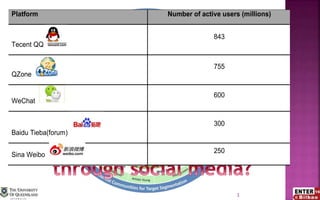
Chinese social media landscape
Platform Number of active users (millions)
Tecent QQ
843
QZone
755
WeChat
600
Baidu Tieba(forum)
300
Sina Weibo
250
3
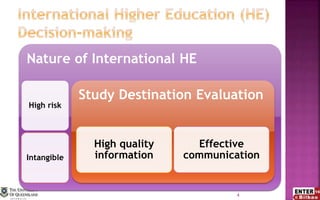
Nature of International HE
High risk
Intangible
Study Destination Evaluation
High quality
information
Effective
communication
4
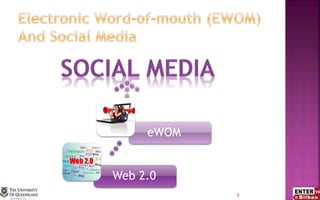
Web 2.0
eWOM
5
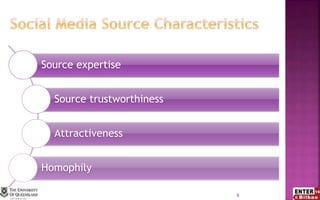
Source expertise
Source trustworthiness
Attractiveness
Homophily
6
 To investigate how social media source
characteristics - expertise, trustworthiness,
attractiveness and homophily influence the
usefulness of information used to evaluate
study destinations.
7
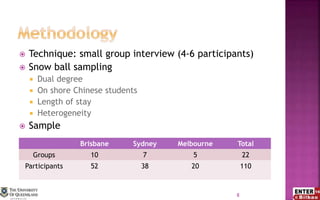
 Technique: small group interview (4-6 participants)
 Snow ball sampling
 Dual degree
 On shore Chinese students
 Length of stay
 Heterogeneity
 Sample
Brisbane Sydney Melbourne Total
Groups 10 7 5 22
Participants 52 38 20 110
8
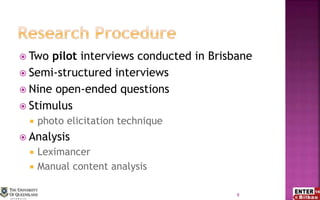
 Two pilot interviews conducted in Brisbane
 Semi-structured interviews
 Nine open-ended questions
 Stimulus
 photo elicitation technique
 Analysis
 Leximancer
 Manual content analysis
9
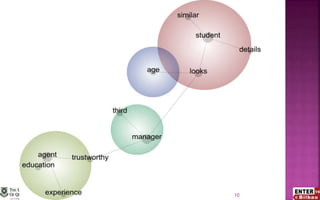
Concept Frequency Degree of importance
Student 110 100%
Manager 82 75%
Agent 76 69%
Appearance (Looks) 44 40%
Experience 28 25%
Similar 26 24%
Trustworthy 20 18%
Education 18 16%
Age 16 15%
Details 12 11%
10
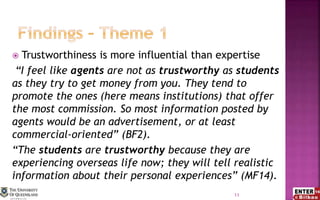
 Trustworthiness is more influential than expertise
“I feel like agents are not as trustworthy as students
as they try to get money from you. They tend to
promote the ones (here means institutions) that offer
the most commission. So most information posted by
agents would be an advertisement, or at least
commercial-oriented” (BF2).
“The students are trustworthy because they are
experiencing overseas life now; they will tell realistic
information about their personal experiences” (MF14).
11
 Credibility is important
“students post their personal experience
online to share with others, with no intended
purposes” (MF4).
“there is no motive for students to share false
information; it was all about sharing their real
overseas life” (SF11).
12
 Appearance matters
“I rank the male students first; he looks very
kind” (BM25).
“I rank them based on their appearance…the
female student looks nice and friendly; she
looks like a considerate and thoughtful
person…The last is the manager… just because
he looks like a profiteer” (MF9).
13
 Similarity makes a difference
“I trust the female students more because
females have similar problems and it’s easier
for us to communicate” (SF9).
“I rank the male student first; he wears
sporting clothes which might indicate that he
loves sports. This is very similar to me. I feel
people who love sports would be quite open
and straightforward, easy to communicate
with, and also, we have a similar age”
(MM10).
14
 One of the first attempts to identify the
social media communication cues that
influence student’s perceptions of study
destinations.
 Findings suggest organisations to pay
attention to online source cues that trigger
higher perceived information usefulness and
develop effective social media marketing
strategies
15
 Used choice-modeling techniques to further
investigate the relative importance of social
media communication attributes, such as
message, and receiver characteristics
 Identified and profiled Chinese student
segments based on preferences of social
media attributes
16
Lavender Shu (UQ):
mengya.shu@uqconnect.edu.au
17

Student Preferences for Social Media Source Characteristics

  • 1.
  • 2.
  • 3.
    Growth of internationalstudent mobility Growth of the Chinese market Increasing competition Chinese social media landscape Platform Number of active users (millions) Tecent QQ 843 QZone 755 WeChat 600 Baidu Tieba(forum) 300 Sina Weibo 250 3
  • 4.
    Nature of InternationalHE High risk Intangible Study Destination Evaluation High quality information Effective communication 4
  • 5.
  • 6.
  • 7.
     To investigatehow social media source characteristics - expertise, trustworthiness, attractiveness and homophily influence the usefulness of information used to evaluate study destinations. 7
  • 8.
     Technique: smallgroup interview (4-6 participants)  Snow ball sampling  Dual degree  On shore Chinese students  Length of stay  Heterogeneity  Sample Brisbane Sydney Melbourne Total Groups 10 7 5 22 Participants 52 38 20 110 8
  • 9.
     Two pilotinterviews conducted in Brisbane  Semi-structured interviews  Nine open-ended questions  Stimulus  photo elicitation technique  Analysis  Leximancer  Manual content analysis 9
  • 10.
    Concept Frequency Degreeof importance Student 110 100% Manager 82 75% Agent 76 69% Appearance (Looks) 44 40% Experience 28 25% Similar 26 24% Trustworthy 20 18% Education 18 16% Age 16 15% Details 12 11% 10
  • 11.
     Trustworthiness ismore influential than expertise “I feel like agents are not as trustworthy as students as they try to get money from you. They tend to promote the ones (here means institutions) that offer the most commission. So most information posted by agents would be an advertisement, or at least commercial-oriented” (BF2). “The students are trustworthy because they are experiencing overseas life now; they will tell realistic information about their personal experiences” (MF14). 11
  • 12.
     Credibility isimportant “students post their personal experience online to share with others, with no intended purposes” (MF4). “there is no motive for students to share false information; it was all about sharing their real overseas life” (SF11). 12
  • 13.
     Appearance matters “Irank the male students first; he looks very kind” (BM25). “I rank them based on their appearance…the female student looks nice and friendly; she looks like a considerate and thoughtful person…The last is the manager… just because he looks like a profiteer” (MF9). 13
  • 14.
     Similarity makesa difference “I trust the female students more because females have similar problems and it’s easier for us to communicate” (SF9). “I rank the male student first; he wears sporting clothes which might indicate that he loves sports. This is very similar to me. I feel people who love sports would be quite open and straightforward, easy to communicate with, and also, we have a similar age” (MM10). 14
  • 15.
     One ofthe first attempts to identify the social media communication cues that influence student’s perceptions of study destinations.  Findings suggest organisations to pay attention to online source cues that trigger higher perceived information usefulness and develop effective social media marketing strategies 15
  • 16.
     Used choice-modelingtechniques to further investigate the relative importance of social media communication attributes, such as message, and receiver characteristics  Identified and profiled Chinese student segments based on preferences of social media attributes 16
  • 17.

Editor's Notes

  • #2  ----- Meeting Notes (2/12/2015 10:07) ----- 1.19
  • #3  ----- Meeting Notes (2/12/2015 10:07) ----- 41
  • #4 The growth of Australian international HE has been spectacular. Australia was ranked as the world’s third largest provider, hosting 7% of all tertiary students . Nationally, the number of international student enrolments has doubled since 2002. While there are declines in Vocational Education and ELICOS, HE seems to remain relatively robust. In recent years, China has been the largest nation contributor to the international student population in Australia . In 2010-11, one fifth (20%) of all student visa applications were for China. Economically, China is now Australia’s largest source market worth $5.4 billion. The burgeoning international student market has resulted in the emergence of new competitors. It has become increasingly important for education destinations to maintain their competitive advantage. Chinese outbound students are chosen as the focus and context for this study. Restrictions in using western social media platforms have resulted in thriving home-grown Chinese equivalents. For example …. The number of users in these home-grown sites have increased dramatically, with Sina Weibo, wechat, Tecent QQ, Youku and Renren all exceeding 200 million active users in 2015. ----- Meeting Notes (2/12/2015 10:07) ----- 2.57
  • #5 In order to address this objective, literature on international HE decision-making was looked at. The nature of international HE – expensive, high risk and intangible makes it a complex decision that requires high levels of scrutiny of choices. Due to the intangibility of international education, high quality information and effective communication become crucial when international students are evaluating potential study destinations. ----- Meeting Notes (2/12/2015 10:07) ----- 36
  • #6 Communication in CMEs has become much more powerful with the development of Web 2.0 technologies. It represents the second phase in the Web’s evolution. It leverages the Web in a more interactive manner. As a result, interpersonal influence brought by eWOM has been important information source when consumers make purchasing decisions. However, no substantial literature has been found in the area of international HE marketing. Social media is one of the most popular types of Web 2.0 services. In this new era of social communication, consumers no longer passively receive one-way information from senders, but become proactive in co-creating the online content. ----- Meeting Notes (2/12/2015 10:07) ----- 46
  • #7 Here, four source characteristics are identified from previous literature. First, the source perceived to possess good knowledge and awareness about the discussed objective – expertise, then motivated to provide accurate information – trustworthiness, third, the attractiveness of the source. In addition, homophily refers to the extent to which individuals share similarities in attributes like age, gender and lifestyle. ----- Meeting Notes (2/12/2015 10:07) ----- 2.11
  • #9 Focus on group dynamics and enable the researcher to obtain insights and various ideas ----- Meeting Notes (2/12/2015 10:07) ----- 55
  • #10  ----- Meeting Notes (2/12/2015 10:07) ----- 1.39
  • #17  ----- Meeting Notes (2/12/2015 10:07) ----- 1.19