© Cardiovascular Diagnosis and Therapy. All rights reserved. Cardiovasc Diagn Ther 2014;4(3):267-269www.thecdt.org
Introduction
Rheumatoid arthritis is well known as an important risk
factor for heart valve disease, but we experienced a rare case
of aortic insufficiency that was detected in the very acute
phase.
Case report
A 74-year-old woman with a history of myocardial infarction
and severe rheumatoid arthritis on immunosuppressants
(5 mg prednisolone, 100 mg mizoribine, and 80 mg
tocilizumab) was referred to our hospital because of nausea
and tooth pain. Her blood test, electrocardiogram, and chest
radiogram showed no abnormalities. The echocardiogram
showed an akinetic left ventricular anterior wall, which was
thought to be the result of an old myocardial infarction, and
normally functioning valves.
Two weeks after the first assessment, she was referred
to our hospital again because of tooth pain and dyspnea.
Her blood test results showed a white blood cell count
of 4,600/m3
, C-reactive protein level of 0.02 mg/dL,
procalcitonin level of <0.05 ng/mL, and brain natriuretic
peptide level of 294 pg/mL. Her chest radiograph showed
congestive heart failure, and the echocardiogram showed
severe aortic insufficiency, which was not identified in the
previous examination (Figures 1,2). She was diagnosed with
congestive heart failure caused by acute aortic insufficiency
and was put on diuretics and inotropic agents. She
continued therapy with 5 mg prednisolone and 100 mg
mizoribine and discontinued therapy with the monoclonal
antibody agent 80 mg tocilizumab, which causes poor
wound healing. Ten days after the therapy, the patient
underwent an aortic valve replacement with a bioprosthetic
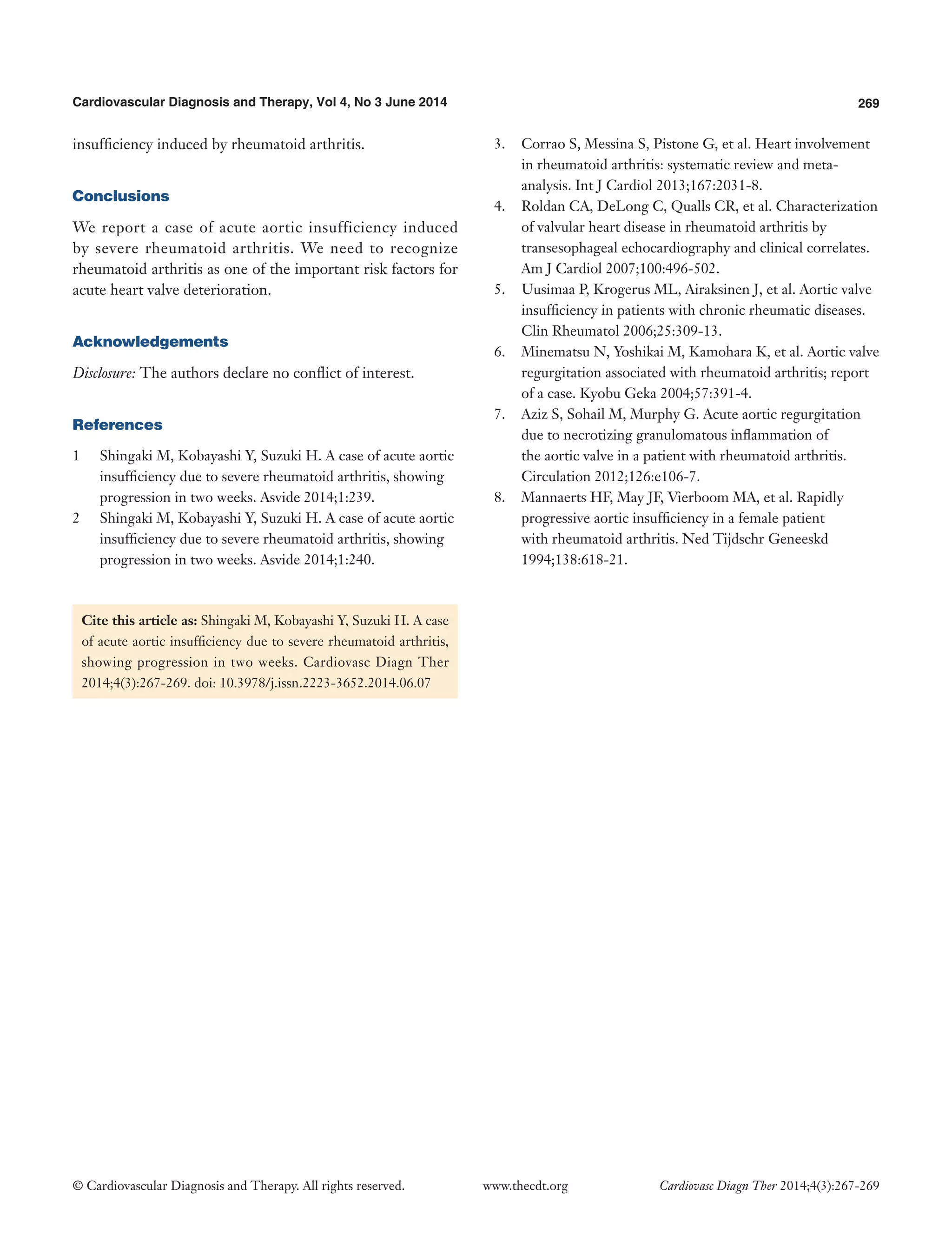
valve. All three aortic valve leaflets were severely shrunken
and thickened, with no coaptation (Figure 3). There was
no evidence of infective endocarditis in the aortic valve
leaflets, such as perforation, avulsion, or vegetation. On
pathological examination of the valve leaflets, fibrosis and
inflammatory changes with infiltration of inflammatory cells
were observed (Figure 4). There were no specific changes in
the pathology of the aortic wall other than atherosclerosis,
and we did not find any granulomatous changes (1,2).
She was discharged on postoperative day 16 without any
complications.
Case Report
A case of acute aortic insufficiency due to severe rheumatoid
arthritis, showing progression in two weeks
Masami Shingaki, Yutaka Kobayashi, Haruo Suzuki
Department of Cardiovascular Surgery, Uji Tokushukai Medical Center, Uji City, Kyoto, Japan
Correspondence to: Masami Shingaki, MD. 86 Ogura-cho Kasugamori, Uji City, Kyoto Prefecture 611-0042, Japan. Email: singaky@hotmail.com.
Abstract: A 74-year-old woman with a history of myocardial infarction and severe rheumatoid arthritis on
immunosuppressants was referred to our hospital because of nausea and tooth pain, but no abnormalities
were detected on physical or laboratory examination. Two weeks after the first assessment, she was referred
to our hospital again because of tooth pain and dyspnea. Her echocardiogram showed severe aortic
regurgitation, which was not detected at the assessment 2 weeks previously. After the patient’s congestive
heart failure showed improvement, she underwent aortic valve replacement; the aortic valve leaflets were
severely shrunken and thickened, without any evidence of endocarditis. Pathological examination of the
leaflets showed infiltration of inflammatory cells into the valve leaflets. Therefore, rheumatoid arthritis needs
to be considered as an important risk factor for acute valvular disease.
Keywords: Aortic valve insufficiency; heart failure; rheumatoid arthritis; immunosuppressive agents
Submitted Apr 04, 2014. Accepted for publication May 27, 2014.
doi: 10.3978/j.issn.2223-3652.2014.06.07
View this article at: http://dx.doi.org/10.3978/j.issn.2223-3652.2014.06.07
268 Shingaki et al. Acute aortic insufficiency caused by rheumatoid arthritis
© Cardiovascular Diagnosis and Therapy. All rights reserved. Cardiovasc Diagn Ther 2014;4(3):267-269www.thecdt.org
Discussion
Rheumatoid arthritis is known to be one of the causes of
heart valve destruction, leading to both valve stenosis and
valve insufficiency (3). There are several case reports on
aortic insufficiency caused by rheumatoid arthritis (4-6), but in
almost all cases, aortic insufficiency progressed chronically,
not acutely.
In this case, it was difficult to confirm the relationship
between rheumatoid arthritis activity and acute aortic
insufficiency because three kinds of immunosuppressants
were prescribed that might suppress the anti-inflammatory
response. The C-reactive protein, white blood cell count,
and antinuclear antibody values were normal throughout
her hospital stay, and her joint pain was controlled.
Therefore, we could not use a clinical scoring system such
as the 28-joint disease activity score (DAS28) or health
assessment questionnaire (HAQ) to evaluate the severity
of the rheumatoid arthritis. However, the thickening and
shrunken heart valve was one of the well-known features of
this disease and she had no other evidence which induced
valve was a well-known feature of this disease, and she
had no evidence of other factors that would induce valve
malfunction; therefore, we considered this condition to be
acute aortic insufficiency induced by rheumatoid arthritis.
With regard to acute aortic insufficiency, Aziz et al. (7)
reported a case that showed disease progression within
1 month and Mannaerts et al. (8) reported a case that
showed disease progression within 2 years. We report
here a rare case in which inflammation of the cardiac
valves progressed to the acute phase within just 2 weeks,
appearing as valvular shrinkage, which induced acute aortic
insufficiency. In general, inflammatory changes occurring in
collagen diseases show chronic progression, but not in our
case. We need to be aware of the possibility of acute aortic
Figure 1 Echocardiography showing severe aortic regurgitation.
Figure 4 Pathological specimen of aortic valve leaflet, showing
fibrosis and infiltration of segmented neutrophils into the valve
leaflets (magnification ×40).
Figure 3 Shrunken and thickened aortic valve leaflets.
Figure 2 Echocardiography showing no coaptation among valve
leaflets.
▲▲
269Cardiovascular Diagnosis and Therapy, Vol 4, No 3 June 2014
© Cardiovascular Diagnosis and Therapy. All rights reserved. Cardiovasc Diagn Ther 2014;4(3):267-269www.thecdt.org
insufficiency induced by rheumatoid arthritis.
Conclusions
We report a case of acute aortic insufficiency induced
by severe rheumatoid arthritis. We need to recognize
rheumatoid arthritis as one of the important risk factors for
acute heart valve deterioration.
Acknowledgements
Disclosure: The authors declare no conflict of interest.
References
1	 Shingaki M, Kobayashi Y, Suzuki H. A case of acute aortic
insufficiency due to severe rheumatoid arthritis, showing
progression in two weeks. Asvide 2014;1:239.
2	 Shingaki M, Kobayashi Y, Suzuki H. A case of acute aortic
insufficiency due to severe rheumatoid arthritis, showing
progression in two weeks. Asvide 2014;1:240.
3.	 Corrao S, Messina S, Pistone G, et al. Heart involvement
in rheumatoid arthritis: systematic review and meta-
analysis. Int J Cardiol 2013;167:2031-8.
4.	 Roldan CA, DeLong C, Qualls CR, et al. Characterization
of valvular heart disease in rheumatoid arthritis by
transesophageal echocardiography and clinical correlates.
Am J Cardiol 2007;100:496-502.
5.	 Uusimaa P, Krogerus ML, Airaksinen J, et al. Aortic valve
insufficiency in patients with chronic rheumatic diseases.
Clin Rheumatol 2006;25:309-13.
6.	 Minematsu N, Yoshikai M, Kamohara K, et al. Aortic valve
regurgitation associated with rheumatoid arthritis; report
of a case. Kyobu Geka 2004;57:391-4.
7.	 Aziz S, Sohail M, Murphy G. Acute aortic regurgitation
due to necrotizing granulomatous inflammation of
the aortic valve in a patient with rheumatoid arthritis.
Circulation 2012;126:e106-7.
8.	 Mannaerts HF, May JF, Vierboom MA, et al. Rapidly
progressive aortic insufficiency in a female patient
with rheumatoid arthritis. Ned Tijdschr Geneeskd
1994;138:618-21.
Cite this article as: Shingaki M, Kobayashi Y, Suzuki H. A case
of acute aortic insufficiency due to severe rheumatoid arthritis,
showing progression in two weeks. Cardiovasc Diagn Ther
2014;4(3):267-269. doi: 10.3978/j.issn.2223-3652.2014.06.07

A case of acute aortic insufficiency due to severe rheumatoid arthritis, showing progression in two weeks

  • 1.
    © Cardiovascular Diagnosisand Therapy. All rights reserved. Cardiovasc Diagn Ther 2014;4(3):267-269www.thecdt.org Introduction Rheumatoid arthritis is well known as an important risk factor for heart valve disease, but we experienced a rare case of aortic insufficiency that was detected in the very acute phase. Case report A 74-year-old woman with a history of myocardial infarction and severe rheumatoid arthritis on immunosuppressants (5 mg prednisolone, 100 mg mizoribine, and 80 mg tocilizumab) was referred to our hospital because of nausea and tooth pain. Her blood test, electrocardiogram, and chest radiogram showed no abnormalities. The echocardiogram showed an akinetic left ventricular anterior wall, which was thought to be the result of an old myocardial infarction, and normally functioning valves. Two weeks after the first assessment, she was referred to our hospital again because of tooth pain and dyspnea. Her blood test results showed a white blood cell count of 4,600/m3 , C-reactive protein level of 0.02 mg/dL, procalcitonin level of <0.05 ng/mL, and brain natriuretic peptide level of 294 pg/mL. Her chest radiograph showed congestive heart failure, and the echocardiogram showed severe aortic insufficiency, which was not identified in the previous examination (Figures 1,2). She was diagnosed with congestive heart failure caused by acute aortic insufficiency and was put on diuretics and inotropic agents. She continued therapy with 5 mg prednisolone and 100 mg mizoribine and discontinued therapy with the monoclonal antibody agent 80 mg tocilizumab, which causes poor wound healing. Ten days after the therapy, the patient underwent an aortic valve replacement with a bioprosthetic valve. All three aortic valve leaflets were severely shrunken and thickened, with no coaptation (Figure 3). There was no evidence of infective endocarditis in the aortic valve leaflets, such as perforation, avulsion, or vegetation. On pathological examination of the valve leaflets, fibrosis and inflammatory changes with infiltration of inflammatory cells were observed (Figure 4). There were no specific changes in the pathology of the aortic wall other than atherosclerosis, and we did not find any granulomatous changes (1,2). She was discharged on postoperative day 16 without any complications. Case Report A case of acute aortic insufficiency due to severe rheumatoid arthritis, showing progression in two weeks Masami Shingaki, Yutaka Kobayashi, Haruo Suzuki Department of Cardiovascular Surgery, Uji Tokushukai Medical Center, Uji City, Kyoto, Japan Correspondence to: Masami Shingaki, MD. 86 Ogura-cho Kasugamori, Uji City, Kyoto Prefecture 611-0042, Japan. Email: singaky@hotmail.com. Abstract: A 74-year-old woman with a history of myocardial infarction and severe rheumatoid arthritis on immunosuppressants was referred to our hospital because of nausea and tooth pain, but no abnormalities were detected on physical or laboratory examination. Two weeks after the first assessment, she was referred to our hospital again because of tooth pain and dyspnea. Her echocardiogram showed severe aortic regurgitation, which was not detected at the assessment 2 weeks previously. After the patient’s congestive heart failure showed improvement, she underwent aortic valve replacement; the aortic valve leaflets were severely shrunken and thickened, without any evidence of endocarditis. Pathological examination of the leaflets showed infiltration of inflammatory cells into the valve leaflets. Therefore, rheumatoid arthritis needs to be considered as an important risk factor for acute valvular disease. Keywords: Aortic valve insufficiency; heart failure; rheumatoid arthritis; immunosuppressive agents Submitted Apr 04, 2014. Accepted for publication May 27, 2014. doi: 10.3978/j.issn.2223-3652.2014.06.07 View this article at: http://dx.doi.org/10.3978/j.issn.2223-3652.2014.06.07
  • 2.
    268 Shingaki etal. Acute aortic insufficiency caused by rheumatoid arthritis © Cardiovascular Diagnosis and Therapy. All rights reserved. Cardiovasc Diagn Ther 2014;4(3):267-269www.thecdt.org Discussion Rheumatoid arthritis is known to be one of the causes of heart valve destruction, leading to both valve stenosis and valve insufficiency (3). There are several case reports on aortic insufficiency caused by rheumatoid arthritis (4-6), but in almost all cases, aortic insufficiency progressed chronically, not acutely. In this case, it was difficult to confirm the relationship between rheumatoid arthritis activity and acute aortic insufficiency because three kinds of immunosuppressants were prescribed that might suppress the anti-inflammatory response. The C-reactive protein, white blood cell count, and antinuclear antibody values were normal throughout her hospital stay, and her joint pain was controlled. Therefore, we could not use a clinical scoring system such as the 28-joint disease activity score (DAS28) or health assessment questionnaire (HAQ) to evaluate the severity of the rheumatoid arthritis. However, the thickening and shrunken heart valve was one of the well-known features of this disease and she had no other evidence which induced valve was a well-known feature of this disease, and she had no evidence of other factors that would induce valve malfunction; therefore, we considered this condition to be acute aortic insufficiency induced by rheumatoid arthritis. With regard to acute aortic insufficiency, Aziz et al. (7) reported a case that showed disease progression within 1 month and Mannaerts et al. (8) reported a case that showed disease progression within 2 years. We report here a rare case in which inflammation of the cardiac valves progressed to the acute phase within just 2 weeks, appearing as valvular shrinkage, which induced acute aortic insufficiency. In general, inflammatory changes occurring in collagen diseases show chronic progression, but not in our case. We need to be aware of the possibility of acute aortic Figure 1 Echocardiography showing severe aortic regurgitation. Figure 4 Pathological specimen of aortic valve leaflet, showing fibrosis and infiltration of segmented neutrophils into the valve leaflets (magnification ×40). Figure 3 Shrunken and thickened aortic valve leaflets. Figure 2 Echocardiography showing no coaptation among valve leaflets. ▲▲
  • 3.
    269Cardiovascular Diagnosis andTherapy, Vol 4, No 3 June 2014 © Cardiovascular Diagnosis and Therapy. All rights reserved. Cardiovasc Diagn Ther 2014;4(3):267-269www.thecdt.org insufficiency induced by rheumatoid arthritis. Conclusions We report a case of acute aortic insufficiency induced by severe rheumatoid arthritis. We need to recognize rheumatoid arthritis as one of the important risk factors for acute heart valve deterioration. Acknowledgements Disclosure: The authors declare no conflict of interest. References 1 Shingaki M, Kobayashi Y, Suzuki H. A case of acute aortic insufficiency due to severe rheumatoid arthritis, showing progression in two weeks. Asvide 2014;1:239. 2 Shingaki M, Kobayashi Y, Suzuki H. A case of acute aortic insufficiency due to severe rheumatoid arthritis, showing progression in two weeks. Asvide 2014;1:240. 3. Corrao S, Messina S, Pistone G, et al. Heart involvement in rheumatoid arthritis: systematic review and meta- analysis. Int J Cardiol 2013;167:2031-8. 4. Roldan CA, DeLong C, Qualls CR, et al. Characterization of valvular heart disease in rheumatoid arthritis by transesophageal echocardiography and clinical correlates. Am J Cardiol 2007;100:496-502. 5. Uusimaa P, Krogerus ML, Airaksinen J, et al. Aortic valve insufficiency in patients with chronic rheumatic diseases. Clin Rheumatol 2006;25:309-13. 6. Minematsu N, Yoshikai M, Kamohara K, et al. Aortic valve regurgitation associated with rheumatoid arthritis; report of a case. Kyobu Geka 2004;57:391-4. 7. Aziz S, Sohail M, Murphy G. Acute aortic regurgitation due to necrotizing granulomatous inflammation of the aortic valve in a patient with rheumatoid arthritis. Circulation 2012;126:e106-7. 8. Mannaerts HF, May JF, Vierboom MA, et al. Rapidly progressive aortic insufficiency in a female patient with rheumatoid arthritis. Ned Tijdschr Geneeskd 1994;138:618-21. Cite this article as: Shingaki M, Kobayashi Y, Suzuki H. A case of acute aortic insufficiency due to severe rheumatoid arthritis, showing progression in two weeks. Cardiovasc Diagn Ther 2014;4(3):267-269. doi: 10.3978/j.issn.2223-3652.2014.06.07