Rheumatic Heart Disease
Objectives:
• To understand the basis of rheumatic fever as an immunologically
mediated late complication of Streptococcal infection
• To know that autoimmunity results from production of cross reacting
antibodies against Streptococcal antigens
• To describe Rheumatic heart disease as one of the several
manifestations of rheumatic fever
• To know the signs, symptoms, pathogenesis, treatment and
prophylaxis of rheumatic heart disease
Red: important
Grey: Extra explanation
 An inflammatory disease that can involve
the heart, joints, skin, and brain.
 All cases associated with recent infection
by Group A β-haemolytic streptococcus.
e.g. Strep. throat infection (Pharyngitis) or
scarlet fever.
 Commonly appears in children ages 5-15,
However it can arise in adulthood
 The onset of the clinical features is delayed
about 3-4 weeks after the infection
(Latent period)
 3% of persons with untreated
group A streptococcal pharyngitis
develop rheumatic fever
 15-20 million new cases a year in
developing countries
Risk factors:
1)Crowding in developing countries
2)Low standard of living due to
immunodeficiency
3)Individual (HLA) susceptibility
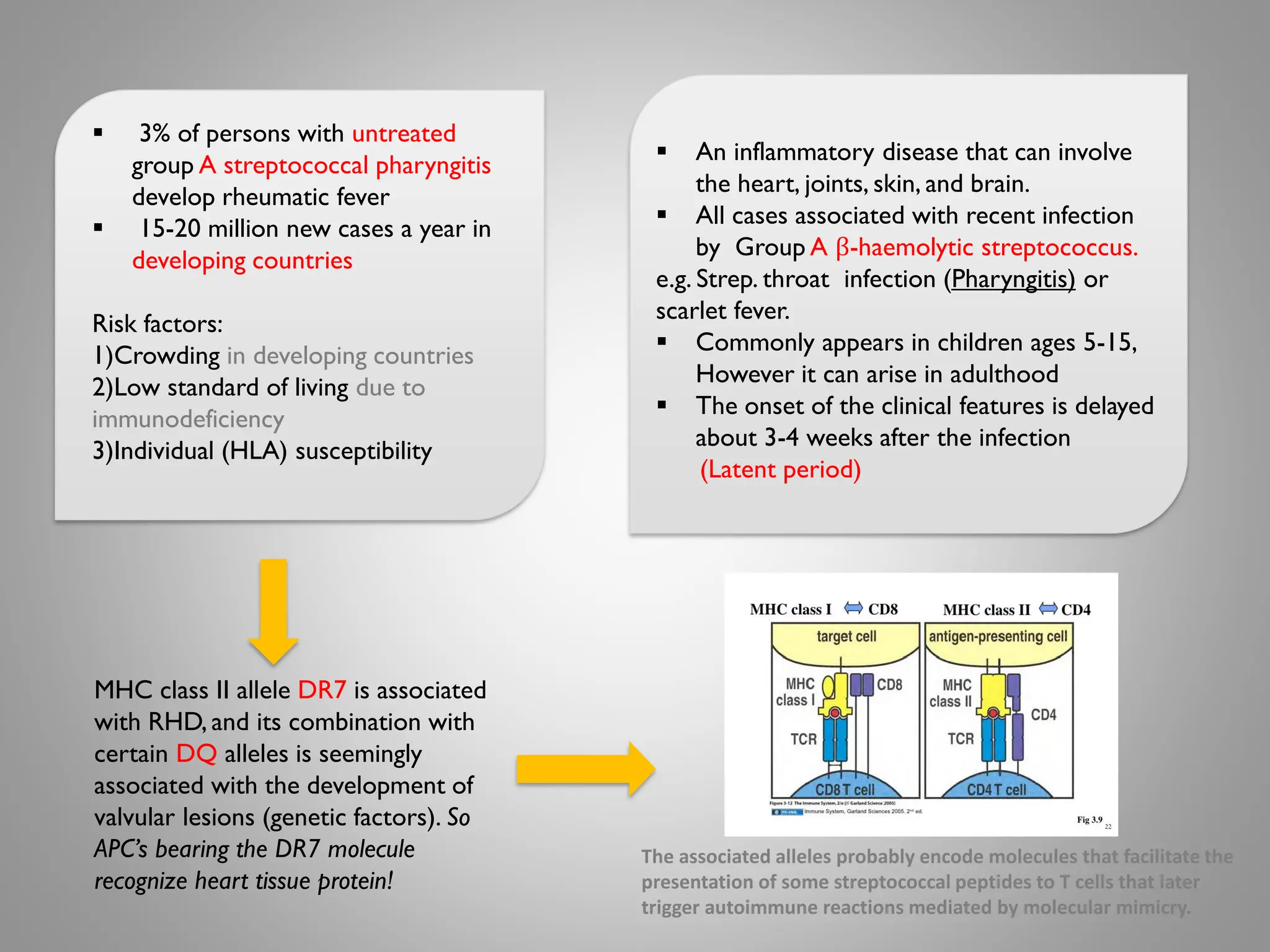
MHC class II allele DR7 is associated
with RHD, and its combination with
certain DQ alleles is seemingly
associated with the development of
valvular lesions (genetic factors). So
APC’s bearing the DR7 molecule
recognize heart tissue protein!
The associated alleles probably encode molecules that facilitate the
presentation of some streptococcal peptides to T cells that later
trigger autoimmune reactions mediated by molecular mimicry.
Group A β-haemolytic streptococcus
 The antibodies generated by the immune system generates against the M proteins
may cross-react with
- Connective tissue (peri-areteriolar connective tissue)
- Cardiac myofiber protein myosin
- Smooth muscle cells of arteries
 This organism can also cause “Post streptococcal glomerulonephritis”. It is auto-
immune disease affects kidney (Type III hypersensitivity reaction)
Type II hypersensitivity reaction
(molecular mimicry) :
The antibodies bind to antigen on
the patient’s own cell surface
Virulence Factors :
Molecule Function
M proteins
“ Most important molecule in
group A strept. , without it we
won’t have RF! ”
Adherence of Streptococcus pyogenes to
host cells & inhibiting the host
immune response.
“ Highly antigenic ”
Hyaluronic acid
capsule
Camouflages the bacterium.
“ it means that your body won’t recognize it as a foreign body”
Streptokinases Dissolve blood clots.
Peptidases
Degrades proteins involved in immune
response.
Pyrogenic toxins Stimulate fever, rash & shock
Streptolysins
Lyse erythrocytes, leukocytes and
platelets.
Pathogenesis :
1. Group A streptococcus cell wall composed
of M proteins that are highly antigenic
2. Activated antigen presenting cells present the
bacterial antigen to helperT cells
3. HelperT cells activate self reactive B cells and
produce antibodies against the cell wall of
streptococcus (anti-group A carbohydrate antibody )
IgE antibodies ,Also it activates cross-reactive T-
cells which releaseTNF , IFN-y , IL-2 and other
cytokines
4. Antibodies may cross react with Myocardium ,
valvular tissue and joints producing the symptoms
of Rheumtic fever.This inflammation occurs
through direct attachment of complement and Fc
receptor-mediated recruitment of neutrophils and
macrophages.
5. Up-regulates the vascular cell adhesion
molecule-1 (VCAM-1) on the valve andT-cells
adhere to theVCAM-1 on the valve endothelium
and extravasate into the valve
6. Tissue destruction (endothelium) making
the inner structure exposed "laminar basment
membrane"
The inflammatory hypersensitivity reaction type II response causes :
1. Breakdown of valve proteins
2. Epitope spreading (T-cells respond to other valve proteins such as
Vimentin and collagen)
3. Avascular valve become neovascularized "the healthy valves which
don't have blood supply are now having blood going through them"
7. Granuloma formation, gamma
interferon production and scarring in
the valve
Anti-streptococcal antibodies cause :
1- Antigen-antibody complex
(Type III hypersensitivity reaction)
2- Antibody attached to tissues
(Type II hypersensitivity reaction)
VCAM-1 on the valve endothelium and not
found on the myocardium
Clinical presentation
1. Joints (Arthritis)
- Usually polyarthritis
- Sometimes flitting from joint to joint
(migratory)
- Affecting the larger joints more than
the smaller ones.
Findings:
- Swelling, Redness & Tenderness
(common)
- Joint effusions (occasionally)
4. Skin (Erythema Marginatum)
Skin lesions: The classical erythema marginatum
Lesions with prominent margins slightly raised
5. Central nervous system (Sydenham's
chorea)
- The choreiform movements affect
particularly the head and the upper limbs.
- They may be generalized or restricted to
one side of the body (hemi-chorea)
- Chorea eventually resolves completely,
usually within 6 weeks
3. Subcutaneous Nodules
- These are painless, round, firm lumps
overlaid by normal looking skin.
- They range from a few millimeters to 1.5 cm
in diameter, and are localized over bony
prominences like the elbow, shin and spine.
- They sometimes last longer than a month.
JONES criteria
2. Heart
-Up to 60% of patients with RF progress to
Rheumatic Heart Disease
- The endocardium (including valves and
chordae tendineae) , pericardium (fibrinous or
serofibrinous deposition between visceral and
parietal pericardium) and myocrdium (can
cause sudden death) may be affected
(pandcarditis)
-Valvular damage is the hallmark of
rheumatic carditis (mitral valve is almost
affected)
1. Anti-streptolysinO (ASO) titer: blood test to measure antibodies against
streptolysinO (produced by the bacteria)
- At least 80% of patients with ARF have an elevated anti-streptolysin O titer at
presentation
- Rising titer is more convincing
2. Anti-DNAse B and Anti-hyaluronidase test: to determine previous infection
4. Throat culture for group A streptococci (obtain 2 or 3 cultures)
Occurs at the beginning, Severe and Reversible
Occurs at the beginning, Severe and Irreversible
Occurs at the beginning and Reversible
Occurs after the development of Rheumatic
fever , Reversible and Long
Investigation of RF
Treatment of Rheumatic Fever
- Treat first strep throat infection with penicillin
(patients with rheumatic fever long term administration of penicillin is
recommended for prevention of future infections by group A
Streptococcus)
- Treat other manifestations symptomatically
- Prophylactic long term anti-strep therapy given to anyone who has
had rheumatic fever
- Treatment involves surgical replacement of the damaged heart
valves
Subsequent attacks:
- Increased vulnerability to
reactivation of disease with
subsequent strep. Infections.
- Same symptoms with each attack.
- Carditis worsens with each attack.
- Heart valves are frequently
deformed (mitral)
- Heart failure develops after
decades. Because of damaged
valves
Rheumatic Fever is divided into :
1.Acute 2.Recurring 3. Chronic
- Symptoms prone to recur with
subsequent Strep. Infections
- Repeated attacks of Streptococcal
throat infection over the years
damage heart valves resulting in
either stenotic or incompetent heart
valves.
- Chronic disease leads to fibrosis
(chordae of heart valves + valve
cusps)
MCQ's
Q1: What is the Antigen-presenting molecule from
RHD patients that recognizes heart-tissue proteins
?
A- CYT p450. B- HLA-DR7. C- CD40L . D- CD28.
Q2: Rheumatic fever is an inflammatory disease
which may develop after a ………….. infection?
A- Staphylococcus Aureus . B- Group A
Streptococcal C- Group B Streptococcal. D- Yeast.
Q3:Which of the following is not effected by
Rheumatic fever ?
A- heart. B-Skin. C- Brain. D- Liver.
Q4: Rheumatic fever commonly appears in
children that are 5 to 15 years old ?
A- True. B- False.
Q5: All cases are associated with recent infection
like Laryngitis ?
A- True. B- False.
Q6: Which proteins help in the Adherence of
Streptococcus pyogenes to host cells and inhibit
the host’s immune response ?
A- M proteins. B- IgE. C- IgM. D- Monoclonal
antibodies.
Q7: The function of Streptokinases is to ?
A- Degrades proteins. B- Camouflage the bacterium.
C- Dissolve blood clots.
Q8: The cross-reactivity is a Type ………..
hypersensitivity reaction.
A- Molecular Mimicry. B- Type I hypersensitivity.
C- type III hypersensitivity .
Q9: During a Strep. infection activated antigen
presenting cells such as macrophages present the
bacterial antigen to helper T cells ?
A- True. B- False.
Q10: Up to 20% of patients with ARF progress to
Rheumatic Heart Disease ?
1-
B
2-
B
3-
D
4-
A
5-
B
6-
A
7-
C
8-
A
9-
A
10-
B
Thank you for checking our work,
Good luck! If you have any suggestions
or alterations contact us!
Email Immunology435@gmail.com
‫الحربي‬ ‫جواهر‬
‫النشوان‬ ‫أثير‬
‫القهان‬ ‫لمياء‬
‫البيشي‬ ‫إبراهيم‬

Rheumatic Heart Disease - Pathophysiology

  • 1.
    Rheumatic Heart Disease Objectives: •To understand the basis of rheumatic fever as an immunologically mediated late complication of Streptococcal infection • To know that autoimmunity results from production of cross reacting antibodies against Streptococcal antigens • To describe Rheumatic heart disease as one of the several manifestations of rheumatic fever • To know the signs, symptoms, pathogenesis, treatment and prophylaxis of rheumatic heart disease Red: important Grey: Extra explanation
  • 2.
     An inflammatorydisease that can involve the heart, joints, skin, and brain.  All cases associated with recent infection by Group A β-haemolytic streptococcus. e.g. Strep. throat infection (Pharyngitis) or scarlet fever.  Commonly appears in children ages 5-15, However it can arise in adulthood  The onset of the clinical features is delayed about 3-4 weeks after the infection (Latent period)  3% of persons with untreated group A streptococcal pharyngitis develop rheumatic fever  15-20 million new cases a year in developing countries Risk factors: 1)Crowding in developing countries 2)Low standard of living due to immunodeficiency 3)Individual (HLA) susceptibility MHC class II allele DR7 is associated with RHD, and its combination with certain DQ alleles is seemingly associated with the development of valvular lesions (genetic factors). So APC’s bearing the DR7 molecule recognize heart tissue protein! The associated alleles probably encode molecules that facilitate the presentation of some streptococcal peptides to T cells that later trigger autoimmune reactions mediated by molecular mimicry.
  • 3.
    Group A β-haemolyticstreptococcus  The antibodies generated by the immune system generates against the M proteins may cross-react with - Connective tissue (peri-areteriolar connective tissue) - Cardiac myofiber protein myosin - Smooth muscle cells of arteries  This organism can also cause “Post streptococcal glomerulonephritis”. It is auto- immune disease affects kidney (Type III hypersensitivity reaction) Type II hypersensitivity reaction (molecular mimicry) : The antibodies bind to antigen on the patient’s own cell surface
  • 4.
    Virulence Factors : MoleculeFunction M proteins “ Most important molecule in group A strept. , without it we won’t have RF! ” Adherence of Streptococcus pyogenes to host cells & inhibiting the host immune response. “ Highly antigenic ” Hyaluronic acid capsule Camouflages the bacterium. “ it means that your body won’t recognize it as a foreign body” Streptokinases Dissolve blood clots. Peptidases Degrades proteins involved in immune response. Pyrogenic toxins Stimulate fever, rash & shock Streptolysins Lyse erythrocytes, leukocytes and platelets.
  • 5.
    Pathogenesis : 1. GroupA streptococcus cell wall composed of M proteins that are highly antigenic 2. Activated antigen presenting cells present the bacterial antigen to helperT cells 3. HelperT cells activate self reactive B cells and produce antibodies against the cell wall of streptococcus (anti-group A carbohydrate antibody ) IgE antibodies ,Also it activates cross-reactive T- cells which releaseTNF , IFN-y , IL-2 and other cytokines 4. Antibodies may cross react with Myocardium , valvular tissue and joints producing the symptoms of Rheumtic fever.This inflammation occurs through direct attachment of complement and Fc receptor-mediated recruitment of neutrophils and macrophages. 5. Up-regulates the vascular cell adhesion molecule-1 (VCAM-1) on the valve andT-cells adhere to theVCAM-1 on the valve endothelium and extravasate into the valve 6. Tissue destruction (endothelium) making the inner structure exposed "laminar basment membrane" The inflammatory hypersensitivity reaction type II response causes : 1. Breakdown of valve proteins 2. Epitope spreading (T-cells respond to other valve proteins such as Vimentin and collagen) 3. Avascular valve become neovascularized "the healthy valves which don't have blood supply are now having blood going through them" 7. Granuloma formation, gamma interferon production and scarring in the valve
  • 6.
    Anti-streptococcal antibodies cause: 1- Antigen-antibody complex (Type III hypersensitivity reaction) 2- Antibody attached to tissues (Type II hypersensitivity reaction) VCAM-1 on the valve endothelium and not found on the myocardium
  • 7.
    Clinical presentation 1. Joints(Arthritis) - Usually polyarthritis - Sometimes flitting from joint to joint (migratory) - Affecting the larger joints more than the smaller ones. Findings: - Swelling, Redness & Tenderness (common) - Joint effusions (occasionally) 4. Skin (Erythema Marginatum) Skin lesions: The classical erythema marginatum Lesions with prominent margins slightly raised 5. Central nervous system (Sydenham's chorea) - The choreiform movements affect particularly the head and the upper limbs. - They may be generalized or restricted to one side of the body (hemi-chorea) - Chorea eventually resolves completely, usually within 6 weeks 3. Subcutaneous Nodules - These are painless, round, firm lumps overlaid by normal looking skin. - They range from a few millimeters to 1.5 cm in diameter, and are localized over bony prominences like the elbow, shin and spine. - They sometimes last longer than a month. JONES criteria 2. Heart -Up to 60% of patients with RF progress to Rheumatic Heart Disease - The endocardium (including valves and chordae tendineae) , pericardium (fibrinous or serofibrinous deposition between visceral and parietal pericardium) and myocrdium (can cause sudden death) may be affected (pandcarditis) -Valvular damage is the hallmark of rheumatic carditis (mitral valve is almost affected)
  • 8.
    1. Anti-streptolysinO (ASO)titer: blood test to measure antibodies against streptolysinO (produced by the bacteria) - At least 80% of patients with ARF have an elevated anti-streptolysin O titer at presentation - Rising titer is more convincing 2. Anti-DNAse B and Anti-hyaluronidase test: to determine previous infection 4. Throat culture for group A streptococci (obtain 2 or 3 cultures) Occurs at the beginning, Severe and Reversible Occurs at the beginning, Severe and Irreversible Occurs at the beginning and Reversible Occurs after the development of Rheumatic fever , Reversible and Long Investigation of RF
  • 9.
    Treatment of RheumaticFever - Treat first strep throat infection with penicillin (patients with rheumatic fever long term administration of penicillin is recommended for prevention of future infections by group A Streptococcus) - Treat other manifestations symptomatically - Prophylactic long term anti-strep therapy given to anyone who has had rheumatic fever - Treatment involves surgical replacement of the damaged heart valves Subsequent attacks: - Increased vulnerability to reactivation of disease with subsequent strep. Infections. - Same symptoms with each attack. - Carditis worsens with each attack. - Heart valves are frequently deformed (mitral) - Heart failure develops after decades. Because of damaged valves Rheumatic Fever is divided into : 1.Acute 2.Recurring 3. Chronic - Symptoms prone to recur with subsequent Strep. Infections - Repeated attacks of Streptococcal throat infection over the years damage heart valves resulting in either stenotic or incompetent heart valves. - Chronic disease leads to fibrosis (chordae of heart valves + valve cusps)
  • 10.
    MCQ's Q1: What isthe Antigen-presenting molecule from RHD patients that recognizes heart-tissue proteins ? A- CYT p450. B- HLA-DR7. C- CD40L . D- CD28. Q2: Rheumatic fever is an inflammatory disease which may develop after a ………….. infection? A- Staphylococcus Aureus . B- Group A Streptococcal C- Group B Streptococcal. D- Yeast. Q3:Which of the following is not effected by Rheumatic fever ? A- heart. B-Skin. C- Brain. D- Liver. Q4: Rheumatic fever commonly appears in children that are 5 to 15 years old ? A- True. B- False. Q5: All cases are associated with recent infection like Laryngitis ? A- True. B- False. Q6: Which proteins help in the Adherence of Streptococcus pyogenes to host cells and inhibit the host’s immune response ? A- M proteins. B- IgE. C- IgM. D- Monoclonal antibodies. Q7: The function of Streptokinases is to ? A- Degrades proteins. B- Camouflage the bacterium. C- Dissolve blood clots. Q8: The cross-reactivity is a Type ……….. hypersensitivity reaction. A- Molecular Mimicry. B- Type I hypersensitivity. C- type III hypersensitivity . Q9: During a Strep. infection activated antigen presenting cells such as macrophages present the bacterial antigen to helper T cells ? A- True. B- False. Q10: Up to 20% of patients with ARF progress to Rheumatic Heart Disease ? 1- B 2- B 3- D 4- A 5- B 6- A 7- C 8- A 9- A 10- B
  • 11.
    Thank you forchecking our work, Good luck! If you have any suggestions or alterations contact us! Email Immunology435@gmail.com ‫الحربي‬ ‫جواهر‬ ‫النشوان‬ ‫أثير‬ ‫القهان‬ ‫لمياء‬ ‫البيشي‬ ‫إبراهيم‬