Marine Lenhart syndrome in the 76
year- old patient- case report.
Tomasz Z. Zuzak1, Michał Filip1, Anita Wdowiak1,
Monika Hałgas1, Jan S. Witowski2, Justyna Kocór3
1Students’ Scientific Society at Diagnostic Techniques Laboratory,
Medical University of Lublin, Poland
2Students’ Scientific Society at 2nd Department of General Surgery,
Jagiellonian University, Kraków, Poland
3Student's Scientific Society, Department of Anesthesiology , Intensive
Treatment and Emergency Medicine, Medical University of Silesia,
Katowice, Poland
Backgrounds
 Hyperthyroidism:
1. Graves’ disease (60%)
2. Toxic adenoma (=Plummer disease) (30%)
3. Toxic multinodular goiter (=MNG/ Goetsch
disease) (ca 5%)
 Graves' disease is often accompanied by nodular
changes in the thyroid gland (15- 30%):
 Hypoactive nodules (95%)
 Hyperactive nodules (1-3%)
 Other lesions: pseudo-nodules, nodular goiter,
hyperplastic nodules, differentiated thyroid cancer
Backgrounds (2)
 In 1911 American surgeons David Marine and Carl
H. Lenhart (Cleveland, Ohio) encountered eight
cases of synchronous goiter and adenoma on
histopathological and iodine content studies of
goiter (Marine D., Lenhart CH.: Patological anatomy of
exophthalmic goiter. Arch Intern Med Chicago 8, 1911)
 The coexistance of Graves’ disease and
hyperactive nodule(AFTN) is known as
Marine- Lenhart syndrome
Backgrounds (3)
 Prevalance: 0.8–2.7 % among patients with
Graves’ disease
 The sizes of these AFTN ranged from 2.5 to 50 mm
(N.D. Charkes et al. 1997)
 The therapy of choice is based on the radioiodine
therapy (I-131) – RAI
 Treatment might be more difficult due to the higher
dose of RAI treatment needed compared with
patients having Graves’ disease alone
Case report
 76- year old male patient treated with antithyroid agents for 5
months due to Graves’ disease was qualified for PCI due to
prolonged history of stable coronary artery disease
 Preliminary studies shown the reduced levels of TSH
TSH= 0.0041 mU/L; N= 0.27- 5 mU/L (17.01.2017)
 Unstabilized hyperthyroidism was suspected
 The patient was disqualified from Percutaneus Coronary
Intervention (PCI) and directed to Clinical Department of
Endocinology with Laboratory for Nuclear Medicine
Case report (2)
 Patient’s retrospective blood tests results:
 17.09.2016
 TSH= 0.0049 mU/L (N=0.27- 5 mU/L)
 fT3= 6.8 pmol/L (N=2.25– 6 pmol/L)
 fT4= 21 pmol/L (N=10- 25 pmol/L)
 13.12.2016
 TSH= 0.0043 mU/L (N=0.27- 5 mU/L)
 fT3=8.9 pmol/L (N=2.25– 6 pmol/L)
 fT4= 35 pmol/L (N=10- 25 pmol/L)
 TRAK ab = 48 U/L GRAVES’ DISEASE
Case report (3)
 In Clinical Department of Endocinology with
Laboratory for Nuclear Medicine Graves’ disease
was confirmed by further examinations
 USG Neck examination and scintigraphy with
24-hour iodine uptake were administrated
Case report (4)
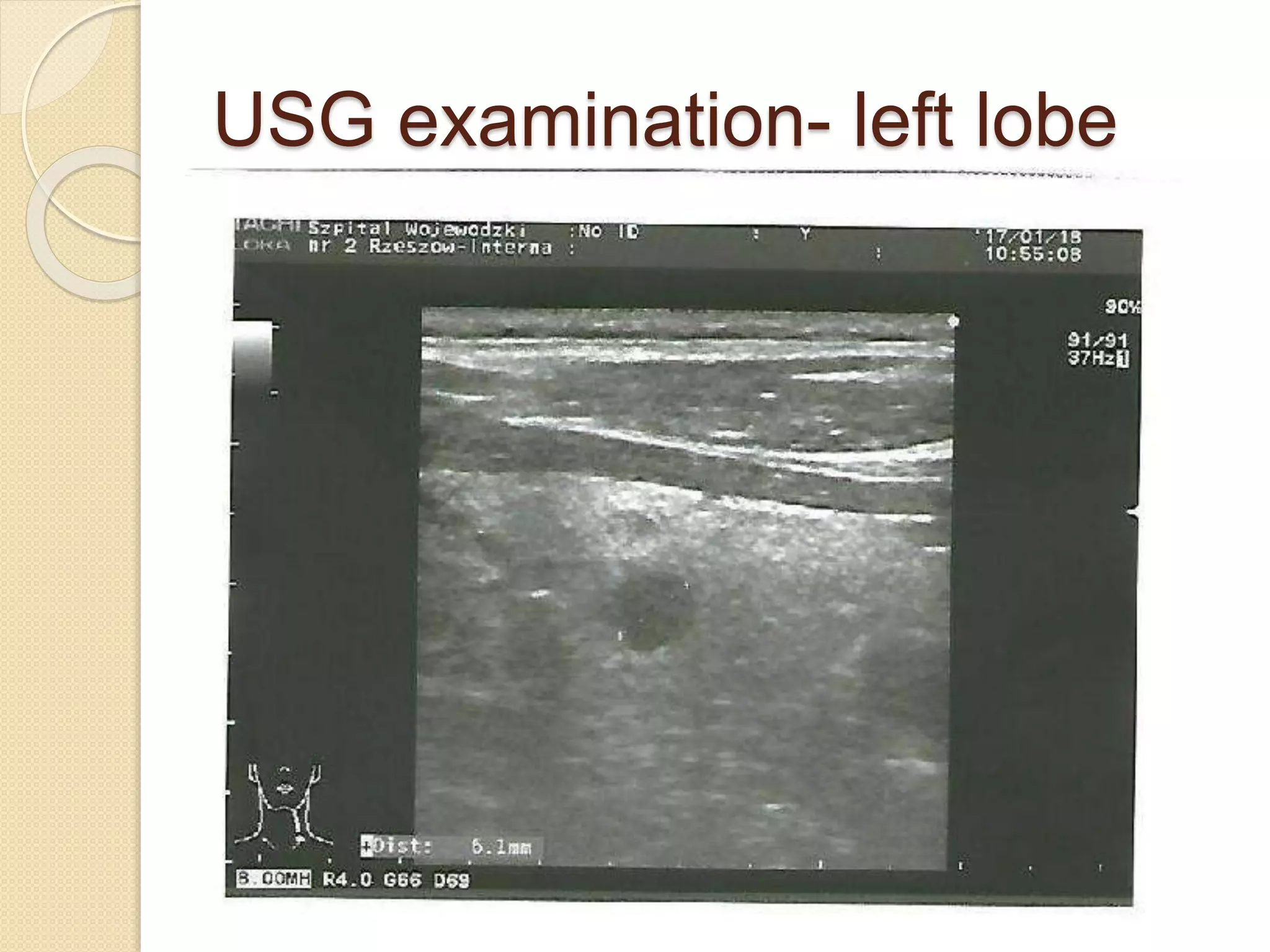
 USG examination of thyroid gland (17.01.2017):
 The thyroid gland is not enlarged, the shape and
echogenicity- normal, heterogeneous parenchymal structure
with numerous focal lesions of 2-5 mm diameter were found.
Cystic degeneration and two normo-genic nodules 5 mm in
the left lobe. Dimensions - right lobe 18x17x56 mm; left lobe
18x16x53mm. Neck free from nodal changes.
 Due to founded lesions, patient was directed to Laborartory
for Nuclear Medicine to perform thyroid scintigraphy and
thyroid 24-hour iodine uptake
USG examination- left lobe
USG examination (2)- right lobe
Case report (5)
 Scintigraphy & thyroid 24-hour iodine uptake
examination (18.01.2017):
 In the scintigraphic examination, a bipolar thyroid gland was
labeled, which is typically located, not enlarged, with the
lower right lobe ranging slightly below the yoke of the
sternum. Radiomarkers accumulate in the form of a hot tumor
in the lower pole of the right lobe. The remaining thyroid
parenchyme catches the radioisotope traces.
 Conclusion: The scintigraphic image may correspond to
an incompletely compensated autopsy in the right lobe.
 Due to founded lesions and retrospective history of
Graves’ disease patient was diagnosed with
Marine- Lenhart syndrome
Scintigraphy & thyroid
24-hour iodine uptake
Case report (6)
 Patient was qualified for the treatment:
1. Thiamazol (Metizol®) dose: 15mg/ day –
for two weeks before causative treatment
2. Radioiodine therapy (16.02.2017)
 Administration an individualy calculated
dose of radioiodine (I-131) = 5.5 mCi
 The patient was released home with recommended
admission of: Encorton®, Kalipoz®, Polprazol®,
Vitrum Calcium®
Case report (7)
 First check- up visit in Nuclear Medicine Doctor
Clinic (23.03.2017):
 Blood test results:
o TSH= 0.018 mU/L (N=0.27- 5 mU/L)
o fT3= 2.74 pmol/L (N=2.25– 6 pmol/L)
o fT4= 13.45 pmol/L (N=10- 25 pmol/L)
 Next check- up visit: 3 months after RAI therapy-
May 2017
 Clinical and laboratory markers of hyperthyroidism
subsided and patient was directed to Cardiology
Department for PCI qualification
Conclusions
1. Marine- Lenhart syndrome is the rare cause of
hyperthyroidism.
2. It afects only 0.8- 2.7% patients diagnosed with
Graves’ disease.
3. Therapy of choice is based on radioiodine therapy
(I-131).
4. RAI is known as far safer therapy.
5. Thyroid gland surgery is recognized as the
second choice therapy.
6. Hyperthyroidism can affect and complicate many
other diseases e.g. coronary artery disease.
 Case and images courtesy of Clinical
Department of Internal Medicine, Nephrology,
Endocrinology with Laboratory for Nuclear
Medicine; Clinical Voivodeship Hospital nr 2 in
the Name of The Saint Queen Jadwiga in
Rzeszów, Poland
References
 Avci E, Narci H.; Coexistence Of Graves' Disease And Toxic Adenoma: A Rare Presentation Of Marine-
Lenhart Syndrome.; J Ayub Med Coll Abbottabad. 2015 Jan-Mar;27(1):248-50.
 Braga-Basaria M, Basaria S.; Marine-Lenhart syndrome.; Thyroid. 2004 Dec;14(12):1107.
 Brahma A, Beadsmoore C, Dhatariya K.; The oldest case of Marine-Lenhart syndrome?; JRSM Short Rep. 2012
Apr;3(4):21. doi: 10.1258/shorts.2011.011164. Epub 2012 Apr 10.
 Biersack HJ, Biermann K.; The Marine-Lenhart syndrome revisited.; Wien Klin Wochenschr. 2011 Aug;123(15-
16):459-62. doi: 10.1007/s00508-011-0029-5. Epub 2011 Jul 27. Review.
 Cakir M.; Diagnosis of Marine-Lenhart syndrome.; Thyroid. 2004 Jul;14(7):555.
 Carnell NE, Valente WA.; Thyroid nodules in Graves' disease: classification, characterization, and response to
treatment.; Thyroid. 1998 Aug;8(8):647-52. Erratum in: Thyroid 1998 Nov;8(11):1079.
 Chatzopoulos D, Iakovou I, Moralidis E.; Marine-Lenhart syndrome and radioiodine-131 treatment.; Thyroid.
2007 Apr;17(4):373-4.
 Damle NA, Mishra R.; Identifying Marine-Lenhart syndrome on a (99m)Tc-pertechnetate thyroid scan.;Indian J
Endocrinol Metab. 2013 Mar;17(2):366. doi: 10.4103/2230-8210.109698.
 Giuffrida G, Giovinazzo S, Certo R, Vicchio TM, Baldari S, Campennì A, Ruggeri RM.; An uncommon case
of Marine-Lenhart syndrome.; Arq Bras Endocrinol Metabol. 2014 Jun;58(4):398-401.
 Joven MH, Anderson RJ.; Marine-Lenhart syndrome.; Endocrine. 2015 Jun;49(2):570-1. doi: 10.1007/s12020-
014-0412-x. Epub 2014 Sep 10.
 Marine D., Lenhart CH.; Patological anatomy of exophthalmic goiter.; Arch Intern Med Chicago 8, 1911.
 Mohan JR, Santhosh S, Sood A, Bhattacharya A, Mittall BR.; Pertechnetate thyroid scan in Marine-
Lenhart syndrome.; Indian J Nucl Med. 2013 Apr;28(2):125-6. doi: 10.4103/0972-3919.118261.
 Şen Y, Cimbek EA, Yuca SA, Gedik GK, Sarı O.; Marine-Lenhart syndrome in a young girl.; J Pediatr
Endocrinol Metab. 2014 Jan;27(1-2):189-91. doi: 10.1515/jpem-2013-0302.
Thank You for Your attention!

Tomasz zuzak2

  • 1.
    Marine Lenhart syndromein the 76 year- old patient- case report. Tomasz Z. Zuzak1, Michał Filip1, Anita Wdowiak1, Monika Hałgas1, Jan S. Witowski2, Justyna Kocór3 1Students’ Scientific Society at Diagnostic Techniques Laboratory, Medical University of Lublin, Poland 2Students’ Scientific Society at 2nd Department of General Surgery, Jagiellonian University, Kraków, Poland 3Student's Scientific Society, Department of Anesthesiology , Intensive Treatment and Emergency Medicine, Medical University of Silesia, Katowice, Poland
  • 2.
    Backgrounds  Hyperthyroidism: 1. Graves’disease (60%) 2. Toxic adenoma (=Plummer disease) (30%) 3. Toxic multinodular goiter (=MNG/ Goetsch disease) (ca 5%)  Graves' disease is often accompanied by nodular changes in the thyroid gland (15- 30%):  Hypoactive nodules (95%)  Hyperactive nodules (1-3%)  Other lesions: pseudo-nodules, nodular goiter, hyperplastic nodules, differentiated thyroid cancer
  • 3.
    Backgrounds (2)  In1911 American surgeons David Marine and Carl H. Lenhart (Cleveland, Ohio) encountered eight cases of synchronous goiter and adenoma on histopathological and iodine content studies of goiter (Marine D., Lenhart CH.: Patological anatomy of exophthalmic goiter. Arch Intern Med Chicago 8, 1911)  The coexistance of Graves’ disease and hyperactive nodule(AFTN) is known as Marine- Lenhart syndrome
  • 4.
    Backgrounds (3)  Prevalance:0.8–2.7 % among patients with Graves’ disease  The sizes of these AFTN ranged from 2.5 to 50 mm (N.D. Charkes et al. 1997)  The therapy of choice is based on the radioiodine therapy (I-131) – RAI  Treatment might be more difficult due to the higher dose of RAI treatment needed compared with patients having Graves’ disease alone
  • 5.
    Case report  76-year old male patient treated with antithyroid agents for 5 months due to Graves’ disease was qualified for PCI due to prolonged history of stable coronary artery disease  Preliminary studies shown the reduced levels of TSH TSH= 0.0041 mU/L; N= 0.27- 5 mU/L (17.01.2017)  Unstabilized hyperthyroidism was suspected  The patient was disqualified from Percutaneus Coronary Intervention (PCI) and directed to Clinical Department of Endocinology with Laboratory for Nuclear Medicine
  • 6.
    Case report (2) Patient’s retrospective blood tests results:  17.09.2016  TSH= 0.0049 mU/L (N=0.27- 5 mU/L)  fT3= 6.8 pmol/L (N=2.25– 6 pmol/L)  fT4= 21 pmol/L (N=10- 25 pmol/L)  13.12.2016  TSH= 0.0043 mU/L (N=0.27- 5 mU/L)  fT3=8.9 pmol/L (N=2.25– 6 pmol/L)  fT4= 35 pmol/L (N=10- 25 pmol/L)  TRAK ab = 48 U/L GRAVES’ DISEASE
  • 7.
    Case report (3) In Clinical Department of Endocinology with Laboratory for Nuclear Medicine Graves’ disease was confirmed by further examinations  USG Neck examination and scintigraphy with 24-hour iodine uptake were administrated
  • 8.
    Case report (4) USG examination of thyroid gland (17.01.2017):  The thyroid gland is not enlarged, the shape and echogenicity- normal, heterogeneous parenchymal structure with numerous focal lesions of 2-5 mm diameter were found. Cystic degeneration and two normo-genic nodules 5 mm in the left lobe. Dimensions - right lobe 18x17x56 mm; left lobe 18x16x53mm. Neck free from nodal changes.  Due to founded lesions, patient was directed to Laborartory for Nuclear Medicine to perform thyroid scintigraphy and thyroid 24-hour iodine uptake
  • 9.
  • 10.
  • 11.
    Case report (5) Scintigraphy & thyroid 24-hour iodine uptake examination (18.01.2017):  In the scintigraphic examination, a bipolar thyroid gland was labeled, which is typically located, not enlarged, with the lower right lobe ranging slightly below the yoke of the sternum. Radiomarkers accumulate in the form of a hot tumor in the lower pole of the right lobe. The remaining thyroid parenchyme catches the radioisotope traces.  Conclusion: The scintigraphic image may correspond to an incompletely compensated autopsy in the right lobe.  Due to founded lesions and retrospective history of Graves’ disease patient was diagnosed with Marine- Lenhart syndrome
  • 12.
  • 13.
    Case report (6) Patient was qualified for the treatment: 1. Thiamazol (Metizol®) dose: 15mg/ day – for two weeks before causative treatment 2. Radioiodine therapy (16.02.2017)  Administration an individualy calculated dose of radioiodine (I-131) = 5.5 mCi  The patient was released home with recommended admission of: Encorton®, Kalipoz®, Polprazol®, Vitrum Calcium®
  • 14.
    Case report (7) First check- up visit in Nuclear Medicine Doctor Clinic (23.03.2017):  Blood test results: o TSH= 0.018 mU/L (N=0.27- 5 mU/L) o fT3= 2.74 pmol/L (N=2.25– 6 pmol/L) o fT4= 13.45 pmol/L (N=10- 25 pmol/L)  Next check- up visit: 3 months after RAI therapy- May 2017  Clinical and laboratory markers of hyperthyroidism subsided and patient was directed to Cardiology Department for PCI qualification
  • 15.
    Conclusions 1. Marine- Lenhartsyndrome is the rare cause of hyperthyroidism. 2. It afects only 0.8- 2.7% patients diagnosed with Graves’ disease. 3. Therapy of choice is based on radioiodine therapy (I-131). 4. RAI is known as far safer therapy. 5. Thyroid gland surgery is recognized as the second choice therapy. 6. Hyperthyroidism can affect and complicate many other diseases e.g. coronary artery disease.
  • 16.
     Case andimages courtesy of Clinical Department of Internal Medicine, Nephrology, Endocrinology with Laboratory for Nuclear Medicine; Clinical Voivodeship Hospital nr 2 in the Name of The Saint Queen Jadwiga in Rzeszów, Poland
  • 17.
    References  Avci E,Narci H.; Coexistence Of Graves' Disease And Toxic Adenoma: A Rare Presentation Of Marine- Lenhart Syndrome.; J Ayub Med Coll Abbottabad. 2015 Jan-Mar;27(1):248-50.  Braga-Basaria M, Basaria S.; Marine-Lenhart syndrome.; Thyroid. 2004 Dec;14(12):1107.  Brahma A, Beadsmoore C, Dhatariya K.; The oldest case of Marine-Lenhart syndrome?; JRSM Short Rep. 2012 Apr;3(4):21. doi: 10.1258/shorts.2011.011164. Epub 2012 Apr 10.  Biersack HJ, Biermann K.; The Marine-Lenhart syndrome revisited.; Wien Klin Wochenschr. 2011 Aug;123(15- 16):459-62. doi: 10.1007/s00508-011-0029-5. Epub 2011 Jul 27. Review.  Cakir M.; Diagnosis of Marine-Lenhart syndrome.; Thyroid. 2004 Jul;14(7):555.  Carnell NE, Valente WA.; Thyroid nodules in Graves' disease: classification, characterization, and response to treatment.; Thyroid. 1998 Aug;8(8):647-52. Erratum in: Thyroid 1998 Nov;8(11):1079.  Chatzopoulos D, Iakovou I, Moralidis E.; Marine-Lenhart syndrome and radioiodine-131 treatment.; Thyroid. 2007 Apr;17(4):373-4.  Damle NA, Mishra R.; Identifying Marine-Lenhart syndrome on a (99m)Tc-pertechnetate thyroid scan.;Indian J Endocrinol Metab. 2013 Mar;17(2):366. doi: 10.4103/2230-8210.109698.  Giuffrida G, Giovinazzo S, Certo R, Vicchio TM, Baldari S, Campennì A, Ruggeri RM.; An uncommon case of Marine-Lenhart syndrome.; Arq Bras Endocrinol Metabol. 2014 Jun;58(4):398-401.  Joven MH, Anderson RJ.; Marine-Lenhart syndrome.; Endocrine. 2015 Jun;49(2):570-1. doi: 10.1007/s12020- 014-0412-x. Epub 2014 Sep 10.  Marine D., Lenhart CH.; Patological anatomy of exophthalmic goiter.; Arch Intern Med Chicago 8, 1911.  Mohan JR, Santhosh S, Sood A, Bhattacharya A, Mittall BR.; Pertechnetate thyroid scan in Marine- Lenhart syndrome.; Indian J Nucl Med. 2013 Apr;28(2):125-6. doi: 10.4103/0972-3919.118261.  Şen Y, Cimbek EA, Yuca SA, Gedik GK, Sarı O.; Marine-Lenhart syndrome in a young girl.; J Pediatr Endocrinol Metab. 2014 Jan;27(1-2):189-91. doi: 10.1515/jpem-2013-0302.
  • 18.
    Thank You forYour attention!

Editor's Notes

  • #3 Thyroid nodules acoompany Graves’ disease in changing rates 25% to 30% of patients according to reports. Graves' disease is accompanied by nodular changes in the thyroid gland. A high percentage of these nodules are hypoactive according to thyroid scans (radioiodine scintigraphy). Small percentage of this subjects has hyperactive nodules (1-3%)
  • #4 Thyroid nodules acoompany Graves’ disease in changing rates 25% to 30% of patients according to reports. Graves' disease is accompanied by nodular changes in the thyroid gland. A high percentage of these nodules are hypoactive according to thyroid scans (radioiodine scintigraphy). Small percentage of this subjects has hyperactive nodules (1-3%)
  • #5 Thyroid nodules acoompany Graves’ disease in changing rates 25% to 30% of patients according to reports. Graves' disease is accompanied by nodular changes in the thyroid gland. A high percentage of these nodules are hypoactive according to thyroid scans (radioiodine scintigraphy). Small percentage of this subjects has hyperactive nodules (1-3%)
  • #9 Opis USG: Tarczyca jest niepowiększona, kształtu i echogenności prawidłowej, niejednorodnej struktury miąższu z licznymi zmianami ogniskowymi średnicy 2-5 mm.Drobne zwyrodnienia torbielowate i dwa guzki normoechogenne po 5 mm w lewym płacie. Hipowaskulatura. Wymiary- prawy płat 18x17x56 mm; lewy płat 18x16x53mm. Szyja wolna od zmian węzłowych.
  • #12 Opis scyntygrafii: W badaniu scyntygraficznym uzyskano wyznakowanie dwupłatowego gruczołu tarczowego, który jest położony typowo, niepowiększony, dolnym biegunem płata prawego sięga nieco poniżej wcięcia jarzmowego mostka. Radioznacznik gromadzi się w postaci guza gorącego w dolnym biegunie płata prawego. Pozostały miąższ tarczycy wychwytuje radioizotop śladowo. Wniosek: Obraz scyntygraficzny może odpowiadać niecałkowicie zdekompensowanemu guzkowi autonomicznemu w płacie prawym.