A Case for PLC’s
Why change is sometimes good!
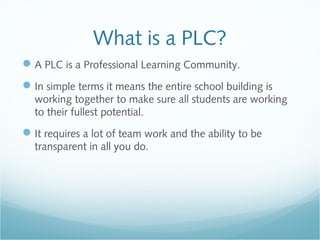
What is a PLC?
A PLC is a Professional Learning Community.
In simple terms it means the entire school building is
working together to make sure all students are working
to their fullest potential.
It requires a lot of team work and the ability to be
transparent in all you do.
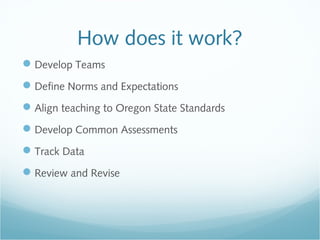
How does it work?
Develop Teams
Define Norms and Expectations
Align teaching to Oregon State Standards
Develop Common Assessments
Track Data
Review and Revise
Who has time for that?
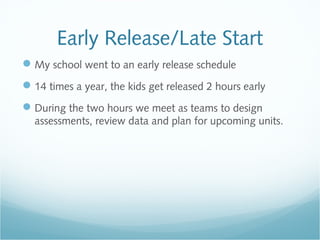
Early Release/Late Start
My school went to an early release schedule
14 times a year, the kids get released 2 hours early
During the two hours we meet as teams to design
assessments, review data and plan for upcoming units.
Is that really enough time?
 No it isn’t.
 We also meet once per month
in kid focused meetings to
look at individual students.
What do you really think?
Pros
 Aligns teaching with
standards.
 Kids in different classrooms
get same materials.
 Team work allows for shared
ideas and feedback
 Common assessment help
determine student learning.
Cons
 More meetings than ever.
 Never enough time to get it
all in.
 Not everyone is on board yet.
 Takes a shift in mindset from
“my” kids to “our” kids.
What resources exist?
Great conferences and professional development.
Technology, technology, technology. We use it in our
team all the time. Team Blogs, Google Docs, Wikis.
Books, podcasts and You Tube videos.
What about the kids?
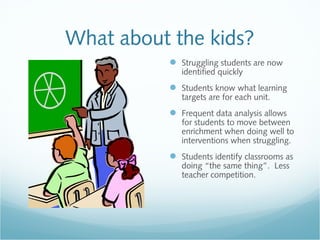
 Struggling students are now
identified quickly
 Students know what learning
targets are for each unit.
 Frequent data analysis allows
for students to move between
enrichment when doing well to
interventions when struggling.
 Students identify classrooms as
doing “the same thing”. Less
teacher competition.
Final Thoughts…….
A PLC offers more of a team approach to each student.
There is no longer a “close your door and teach”
approach in my building. I love that.
We always talk about students needing to become
problem solvers and being able to work effectively in
teams. This model is one in which we ourselves practice
what we preach.

A case for plc's

  • 1.
    A Case forPLC’s Why change is sometimes good!
  • 2.
    What is aPLC? A PLC is a Professional Learning Community. In simple terms it means the entire school building is working together to make sure all students are working to their fullest potential. It requires a lot of team work and the ability to be transparent in all you do.
  • 3.
    How does itwork? Develop Teams Define Norms and Expectations Align teaching to Oregon State Standards Develop Common Assessments Track Data Review and Revise
  • 4.
    Who has timefor that?
  • 5.
    Early Release/Late Start Myschool went to an early release schedule 14 times a year, the kids get released 2 hours early During the two hours we meet as teams to design assessments, review data and plan for upcoming units.
  • 6.
    Is that reallyenough time?  No it isn’t.  We also meet once per month in kid focused meetings to look at individual students.
  • 7.
    What do youreally think? Pros  Aligns teaching with standards.  Kids in different classrooms get same materials.  Team work allows for shared ideas and feedback  Common assessment help determine student learning. Cons  More meetings than ever.  Never enough time to get it all in.  Not everyone is on board yet.  Takes a shift in mindset from “my” kids to “our” kids.
  • 8.
    What resources exist? Greatconferences and professional development. Technology, technology, technology. We use it in our team all the time. Team Blogs, Google Docs, Wikis. Books, podcasts and You Tube videos.
  • 9.
    What about thekids?  Struggling students are now identified quickly  Students know what learning targets are for each unit.  Frequent data analysis allows for students to move between enrichment when doing well to interventions when struggling.  Students identify classrooms as doing “the same thing”. Less teacher competition.
  • 10.
    Final Thoughts……. A PLCoffers more of a team approach to each student. There is no longer a “close your door and teach” approach in my building. I love that. We always talk about students needing to become problem solvers and being able to work effectively in teams. This model is one in which we ourselves practice what we preach.