Daily Visual Management
Visibility Wall Training
June 18, 2014
Kaizen Promotion Office
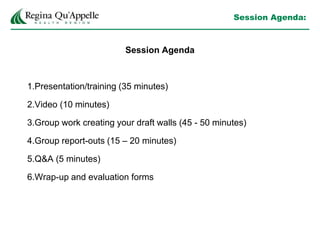
Session Agenda:
Session Agenda
1.Presentation/training (35 minutes)
2.Video (10 minutes)
3.Group work creating your draft walls (45 - 50 minutes)
4.Group report-outs (15 – 20 minutes)
5.Q&A (5 minutes)
6.Wrap-up and evaluation forms
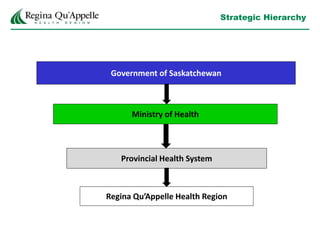
Strategic Hierarchy
Government of Saskatchewan
Ministry of Health
Regina Qu’Appelle Health Region
Provincial Health System
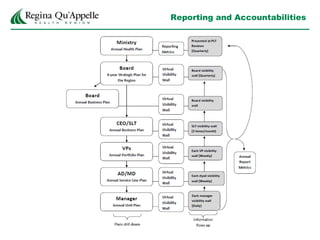
Reporting and Accountabilities
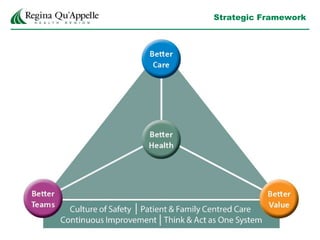
Strategic Framework
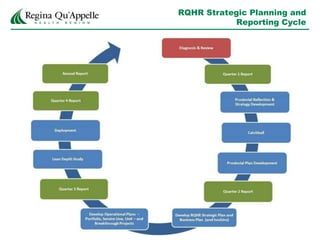
RQHR Strategic Planning and
Reporting Cycle
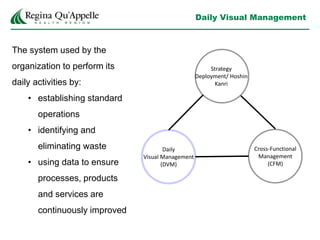
Daily Visual Management
Strategy
Deployment/ Hoshin
Kanri
Daily
Visual Management
(DVM)
Cross-Functional
Management
(CFM)
The system used by the
organization to perform its
daily activities by:
• establishing standard
operations
• identifying and
eliminating waste
• using data to ensure
processes, products
and services are
continuously improved
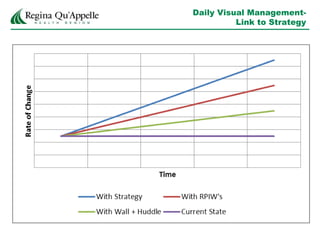
Daily Visual Management-
Link to Strategy
Daily Visual Management
Consists of:
1. A Visual Workplace where abnormalities are seen
2. An environment where staff test their own ideas
3. Transparency of objectives and metrics
4. Managing by measures that change regularly
5. Connects accountability throughout the organization
What you cannot see, you cannot manage!
- Visual Management
Respect for People
Staff are the problem-solvers:
Staff are a valued source for improvement ideas.
Staff help test and determine whether a new process works.
When errors occur, the process is wrong, not the person.
No blame, no shame!
Quality must be built into every step.
Anyone can, and is expected to, stop the process to prevent a
defect from continuing downstream.
“Before cars, make people.”
—Eiji Toyoda, former chairman of Toyota
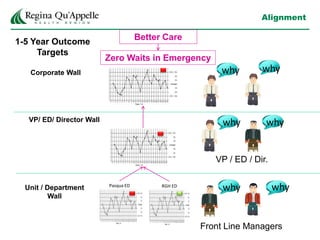
Alignment
Better Care
Zero Waits in Emergency
VP / ED / Dir.
Front Line Managers
why why
why
why
why
why
Pasqua ED RGH ED
1-5 Year Outcome
Targets
VP/ ED/ Director Wall
Unit / Department
Wall
Corporate Wall
You Don’t Need to know Lean to get
started on Daily Visual Management!
• It is critical to understand the current situation first,
before applying Lean techniques and tools to make
improvements
• Use 5 “whys” to get to the root causes and make
improvements
• Use Plan, Do, Study, Act (PDSA) to do improvements
• As you learn Lean, you will make faster progress to
achieving your targets
Elements of the Daily Visual
Management System
• Understand your business and daily improvement
activities
• Create daily actions when issue/challenges occur.
• Data is classified into common categories on your
unit’s visibility wall – Quality, Cost, Delivery, Safety,
Morale (QCDSM)
• Data and information is key:
– Choice of data
– Visual display and charts used
– Method and frequency of collection determined
– Method and frequency of reporting determined
– Only measure something you can action
What Should I Do?
1. Go and see – learn from the workplace
2. Make the workplace visual
3. Spend significant time developing people
4. Teach staff to see, create solutions and improve
5. Provide standard work that staff can use as a basis for
improvement, and develop your own standard work
6. Never stop improving
7. Be accountable and hold others accountable
Setting Up a Daily Visual Management
Visibility Wall: Step-By-Step
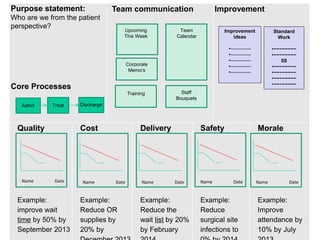
Purpose statement:
Who are we from the patient
perspective?
Core Processes
Team communication Improvement
Quality
Example:
improve wait
time by 50% by
September 2013
Cost
Example:
Reduce OR
supplies by
20% by
Delivery
Example:
Reduce the
wait list by 20%
by February
Safety
Example:
Reduce
surgical site
infections to
Morale
Example:
Improve
attendance by
10% by July
Team
Calendar
Upcoming
This Week
Improvement
ideas
•~~~~~~~~
•~~~~~~~~
•~~~~~~~~
•~~~~~~~~
•~~~~~~~~
Standard
Work
•~~~~~~~~
•~~~~~~~~
5S
•~~~~~~~~
•~~~~~~~~
•~~~~~~~~
•~~~~~~~~
Name Date Name Date Name Date Name Date Name Date
Corporate
Memo’s
Training Staff
Bouquets
Admit Treat Discharge
Steps to Creating a Daily Visual
Management Visibility Wall
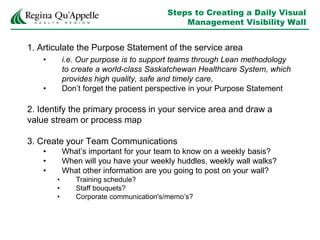
1. Articulate the Purpose Statement of the service area
• i.e. Our purpose is to support teams through Lean methodology
to create a world-class Saskatchewan Healthcare System, which
provides high quality, safe and timely care.
• Don’t forget the patient perspective in your Purpose Statement
2. Identify the primary process in your service area and draw a
value stream or process map
3. Create your Team Communications
• What’s important for your team to know on a weekly basis?
• When will you have your weekly huddles, weekly wall walks?
• What other information are you going to post on your wall?
• Training schedule?
• Staff bouquets?
• Corporate communication's/memo’s?
Steps to Creating a Daily Visual
Management Visibility Wall
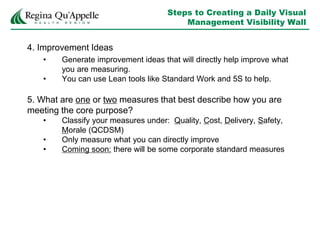
4. Improvement Ideas
• Generate improvement ideas that will directly help improve what
you are measuring.
• You can use Lean tools like Standard Work and 5S to help.
5. What are one or two measures that best describe how you are
meeting the core purpose?
• Classify your measures under: Quality, Cost, Delivery, Safety,
Morale (QCDSM)
• Only measure what you can directly improve
• Coming soon: there will be some corporate standard measures
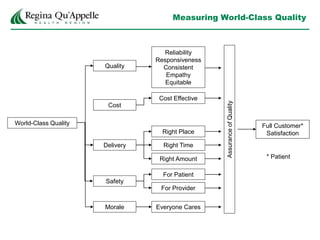
Measuring World-Class Quality
World-Class Quality
Quality
Cost
Delivery
Safety
Morale
Full Customer*
Satisfaction
Everyone Cares
For Provider
For Patient
Right Amount
Right Time
Right Place
Cost Effective
Reliability
Responsiveness
Consistent
Empathy
Equitable
Assurance
of
Quality
* Patient
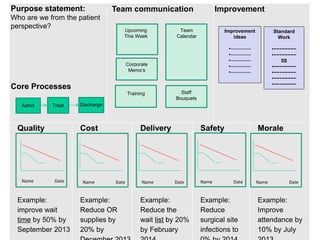
Purpose statement:
Who are we from the patient
perspective?
Core Processes
Team communication Improvement
Quality
Example:
improve wait
time by 50% by
September 2013
Cost
Example:
Reduce OR
supplies by
20% by
Delivery
Example:
Reduce the
wait list by 20%
by February
Safety
Example:
Reduce
surgical site
infections to
Morale
Example:
Improve
attendance by
10% by July
Team
Calendar
Upcoming
This Week
Improvement
ideas
•~~~~~~~~
•~~~~~~~~
•~~~~~~~~
•~~~~~~~~
•~~~~~~~~
Standard
Work
•~~~~~~~~
•~~~~~~~~
5S
•~~~~~~~~
•~~~~~~~~
•~~~~~~~~
•~~~~~~~~
Name Date Name Date Name Date Name Date Name Date
Corporate
Memo’s
Training Staff
Bouquets
Admit Treat Discharge
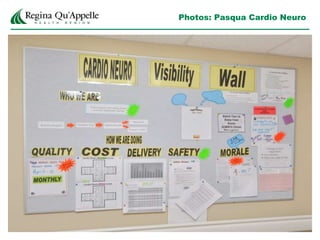
Photos: Pasqua Cardio Neuro
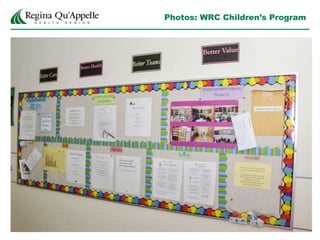
Photos: WRC Children’s Program
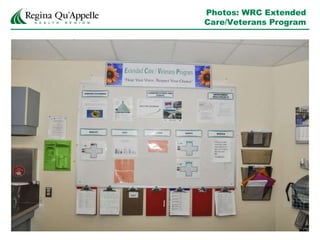
Photos: WRC Extended
Care/Veterans Program
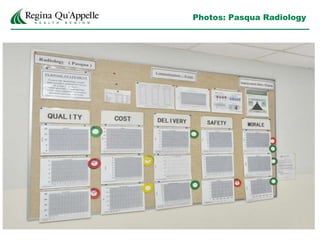
Photos: Pasqua Radiology
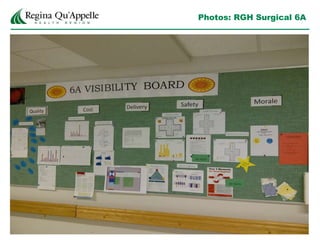
Photos: RGH Surgical 6A
15 Minute Daily Huddle
• Select a consistent time of day for wall walks
• Start on time
• Designate a time keeper so that you can end on time
• All staff stand up in front of the visibility wall
• Manager leads or designated leader
– Consider having other staff be reasonable for some pieces
of the data and have them report-out out on the data
15 Minute Daily Huddle: Agenda
• Ask 4 questions:
– have any patients/residents fallen,
– were any employees injured,
– is there anyone off sick today,
– is there anyone here on overtime today (1 minute)
• Review communications/events (2 minutes)
• Update on projects (2 minutes)
• Review improvement ideas (2 minutes)
• Report out on your QCDSM measures- are they green or red
(meeting or not meeting your targets) ( 1 minute each)
• Update and review actions (3 minutes)
Keep In Mind…
• The Visibility Wall is not in itself the goal – the discussions,
actions and accountability are what is important
• PDSA (Plan, Do, Study, Act) – keep pressure on your team to
get out and try implementing improvement ideas
• The more people informed and trained in changes made, the
better chance that changes will be sustained
• If the team is stuck, go back to the purpose statement and
process steps for direction
More Information
If you have any questions or want more information, contact:
-Sandra Lynn at sandra.lynn@rqhealth.ca
or 306-766-6421
More information can also be found on the Intranet at:
http://rhdintranet/qi/public/VisibilityWallsKit/VisibilityWallsKit.htm
(Departments > Kaizen Promotion Office > Visibility Wall
Kits)
Or at www.RQHRLean.com

Daily Visual Management Visibility Wall Training.ppt

  • 1.
    Daily Visual Management VisibilityWall Training June 18, 2014 Kaizen Promotion Office
  • 2.
    Session Agenda: Session Agenda 1.Presentation/training(35 minutes) 2.Video (10 minutes) 3.Group work creating your draft walls (45 - 50 minutes) 4.Group report-outs (15 – 20 minutes) 5.Q&A (5 minutes) 6.Wrap-up and evaluation forms
  • 3.
    Strategic Hierarchy Government ofSaskatchewan Ministry of Health Regina Qu’Appelle Health Region Provincial Health System
  • 4.
  • 5.
  • 6.
    RQHR Strategic Planningand Reporting Cycle
  • 7.
    Daily Visual Management Strategy Deployment/Hoshin Kanri Daily Visual Management (DVM) Cross-Functional Management (CFM) The system used by the organization to perform its daily activities by: • establishing standard operations • identifying and eliminating waste • using data to ensure processes, products and services are continuously improved
  • 8.
  • 9.
    Daily Visual Management Consistsof: 1. A Visual Workplace where abnormalities are seen 2. An environment where staff test their own ideas 3. Transparency of objectives and metrics 4. Managing by measures that change regularly 5. Connects accountability throughout the organization What you cannot see, you cannot manage! - Visual Management
  • 10.
    Respect for People Staffare the problem-solvers: Staff are a valued source for improvement ideas. Staff help test and determine whether a new process works. When errors occur, the process is wrong, not the person. No blame, no shame! Quality must be built into every step. Anyone can, and is expected to, stop the process to prevent a defect from continuing downstream. “Before cars, make people.” —Eiji Toyoda, former chairman of Toyota
  • 11.
    Alignment Better Care Zero Waitsin Emergency VP / ED / Dir. Front Line Managers why why why why why why Pasqua ED RGH ED 1-5 Year Outcome Targets VP/ ED/ Director Wall Unit / Department Wall Corporate Wall
  • 12.
    You Don’t Needto know Lean to get started on Daily Visual Management! • It is critical to understand the current situation first, before applying Lean techniques and tools to make improvements • Use 5 “whys” to get to the root causes and make improvements • Use Plan, Do, Study, Act (PDSA) to do improvements • As you learn Lean, you will make faster progress to achieving your targets
  • 13.
    Elements of theDaily Visual Management System • Understand your business and daily improvement activities • Create daily actions when issue/challenges occur. • Data is classified into common categories on your unit’s visibility wall – Quality, Cost, Delivery, Safety, Morale (QCDSM) • Data and information is key: – Choice of data – Visual display and charts used – Method and frequency of collection determined – Method and frequency of reporting determined – Only measure something you can action
  • 14.
    What Should IDo? 1. Go and see – learn from the workplace 2. Make the workplace visual 3. Spend significant time developing people 4. Teach staff to see, create solutions and improve 5. Provide standard work that staff can use as a basis for improvement, and develop your own standard work 6. Never stop improving 7. Be accountable and hold others accountable
  • 15.
    Setting Up aDaily Visual Management Visibility Wall: Step-By-Step
  • 16.
    Purpose statement: Who arewe from the patient perspective? Core Processes Team communication Improvement Quality Example: improve wait time by 50% by September 2013 Cost Example: Reduce OR supplies by 20% by Delivery Example: Reduce the wait list by 20% by February Safety Example: Reduce surgical site infections to Morale Example: Improve attendance by 10% by July Team Calendar Upcoming This Week Improvement ideas •~~~~~~~~ •~~~~~~~~ •~~~~~~~~ •~~~~~~~~ •~~~~~~~~ Standard Work •~~~~~~~~ •~~~~~~~~ 5S •~~~~~~~~ •~~~~~~~~ •~~~~~~~~ •~~~~~~~~ Name Date Name Date Name Date Name Date Name Date Corporate Memo’s Training Staff Bouquets Admit Treat Discharge
  • 17.
    Steps to Creatinga Daily Visual Management Visibility Wall 1. Articulate the Purpose Statement of the service area • i.e. Our purpose is to support teams through Lean methodology to create a world-class Saskatchewan Healthcare System, which provides high quality, safe and timely care. • Don’t forget the patient perspective in your Purpose Statement 2. Identify the primary process in your service area and draw a value stream or process map 3. Create your Team Communications • What’s important for your team to know on a weekly basis? • When will you have your weekly huddles, weekly wall walks? • What other information are you going to post on your wall? • Training schedule? • Staff bouquets? • Corporate communication's/memo’s?
  • 18.
    Steps to Creatinga Daily Visual Management Visibility Wall 4. Improvement Ideas • Generate improvement ideas that will directly help improve what you are measuring. • You can use Lean tools like Standard Work and 5S to help. 5. What are one or two measures that best describe how you are meeting the core purpose? • Classify your measures under: Quality, Cost, Delivery, Safety, Morale (QCDSM) • Only measure what you can directly improve • Coming soon: there will be some corporate standard measures
  • 19.
    Measuring World-Class Quality World-ClassQuality Quality Cost Delivery Safety Morale Full Customer* Satisfaction Everyone Cares For Provider For Patient Right Amount Right Time Right Place Cost Effective Reliability Responsiveness Consistent Empathy Equitable Assurance of Quality * Patient
  • 20.
    Purpose statement: Who arewe from the patient perspective? Core Processes Team communication Improvement Quality Example: improve wait time by 50% by September 2013 Cost Example: Reduce OR supplies by 20% by Delivery Example: Reduce the wait list by 20% by February Safety Example: Reduce surgical site infections to Morale Example: Improve attendance by 10% by July Team Calendar Upcoming This Week Improvement ideas •~~~~~~~~ •~~~~~~~~ •~~~~~~~~ •~~~~~~~~ •~~~~~~~~ Standard Work •~~~~~~~~ •~~~~~~~~ 5S •~~~~~~~~ •~~~~~~~~ •~~~~~~~~ •~~~~~~~~ Name Date Name Date Name Date Name Date Name Date Corporate Memo’s Training Staff Bouquets Admit Treat Discharge
  • 21.
  • 22.
  • 23.
  • 24.
  • 25.
  • 26.
    15 Minute DailyHuddle • Select a consistent time of day for wall walks • Start on time • Designate a time keeper so that you can end on time • All staff stand up in front of the visibility wall • Manager leads or designated leader – Consider having other staff be reasonable for some pieces of the data and have them report-out out on the data
  • 27.
    15 Minute DailyHuddle: Agenda • Ask 4 questions: – have any patients/residents fallen, – were any employees injured, – is there anyone off sick today, – is there anyone here on overtime today (1 minute) • Review communications/events (2 minutes) • Update on projects (2 minutes) • Review improvement ideas (2 minutes) • Report out on your QCDSM measures- are they green or red (meeting or not meeting your targets) ( 1 minute each) • Update and review actions (3 minutes)
  • 28.
    Keep In Mind… •The Visibility Wall is not in itself the goal – the discussions, actions and accountability are what is important • PDSA (Plan, Do, Study, Act) – keep pressure on your team to get out and try implementing improvement ideas • The more people informed and trained in changes made, the better chance that changes will be sustained • If the team is stuck, go back to the purpose statement and process steps for direction
  • 29.
    More Information If youhave any questions or want more information, contact: -Sandra Lynn at sandra.lynn@rqhealth.ca or 306-766-6421 More information can also be found on the Intranet at: http://rhdintranet/qi/public/VisibilityWallsKit/VisibilityWallsKit.htm (Departments > Kaizen Promotion Office > Visibility Wall Kits) Or at www.RQHRLean.com