WORD HUNT
N AT U R E P A T Y G R
A W O F R A H D F V H E
F R O R I G I N U I O A
Y U L V R C L A Q N A S
S A S A F V O W U O S O
N W A S A U S R E I F N
O R O E A I O T S T H I
I Y I H W P P Y T C U N
T U R C D O H G I E I G
C D A N G H Y B O L O C
N G W A Y T C B N F P V
U H P R O C E S S E S Y
F S S B G B U J D R A E
3.
N A TU R E P A T Y G R
A W O F R A H D F V H E
F R O R I G I N U I O A
Y U L V R C L A Q N A S
S A S A F V O W U O S O
N W A S A U S R E I F N
O R O E A I O T S T H I
I Y I H W P P Y T C U N
T U R C D O H G I E I G
C D A N G H Y B O L O C
N G W A Y T C B N F P V
U H P R O C E S S E S Y
F S S B G B U J D R A E
WORD HUNT
4.
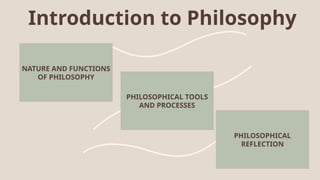
NATURE AND FUNCTIONS
OFPHILOSOPHY
PHILOSOPHICAL TOOLS
AND PROCESSES
PHILOSOPHICAL
REFLECTION
Introduction to Philosophy
5.
Objectives
1. explain thebeginnings of
philosophy;
2. practice engaging in
philosophical thought;
3. determine how to gain a
more holistic perspective
via argumentation; and
4. recognize the value of
philosophy in thinking
about the nature of
reality.
At the end of the lesson, the
learners should be able to:
• Where doesphilosophy begin?
• How did philosophy begin?
• How do people do philosophy?
• How we can apply philosophy
in our daily lives?
• Why do we need to
philosophize?
8.
PHILOSOPHY
• It isdefined as LOVE OF WISDOM.
• It came from the Greek words PHILOS
(Love) and SOPHIA (Wisdom)
• The Mother of Sciences
• People who engage in philosophy are
philosophers (Lovers of Wisdom).
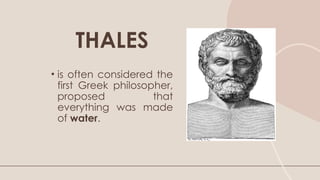
• is oftenconsidered the
first Greek philosopher,
proposed that
everything was made
of water.
THALES
16.
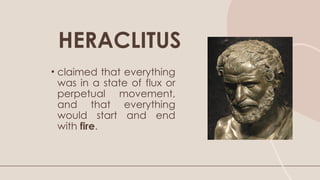
• claimed thateverything
was in a state of flux or
perpetual movement,
and that everything
would start and end
with fire.
HERACLITUS
17.
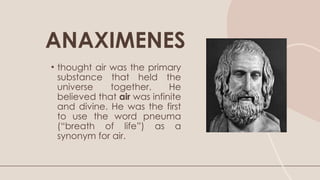
• thought airwas the primary
substance that held the
universe together. He
believed that air was infinite
and divine. He was the first
to use the word pneuma
(“breath of life”) as a
synonym for air.
ANAXIMENES
18.
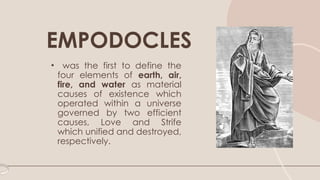
• was thefirst to define the
four elements of earth, air,
fire, and water as material
causes of existence which
operated within a universe
governed by two efficient
causes, Love and Strife
which unified and destroyed,
respectively.
EMPODOCLES
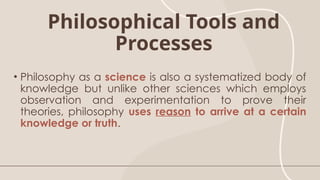
Philosophical Tools and
Processes
•Philosophy as a science is also a systematized body of
knowledge but unlike other sciences which employs
observation and experimentation to prove their
theories, philosophy uses reason to arrive at a certain
knowledge or truth.
24.
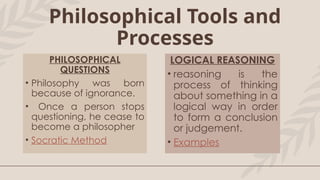
PHILOSOPHICAL
QUESTIONS
• Philosophy wasborn
because of ignorance.
• Once a person stops
questioning, he cease to
become a philosopher
• Socratic Method
LOGICAL REASONING
• reasoning is the
process of thinking
about something in a
logical way in order
to form a conclusion
or judgement.
• Examples
Philosophical Tools and
Processes
25.
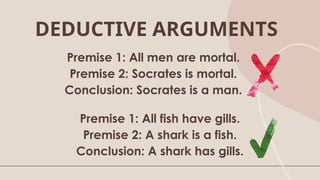
Premise 1: Allmen are mortal.
Premise 2: Socrates is mortal.
Conclusion: Socrates is a man.
Premise 1: All fish have gills.
Premise 2: A shark is a fish.
Conclusion: A shark has gills.
DEDUCTIVE ARGUMENTS
26.
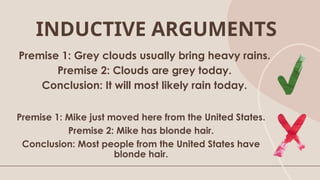
Premise 1: Greyclouds usually bring heavy rains.
Premise 2: Clouds are grey today.
Conclusion: It will most likely rain today.
Premise 1: Mike just moved here from the United States.
Premise 2: Mike has blonde hair.
Conclusion: Most people from the United States have
blonde hair.
INDUCTIVE ARGUMENTS
Philosophical Reflection
• Itis the careful examination of life situations.
• Unsettling description of the world we live in today
was laid out by Plato in his Republic
29.
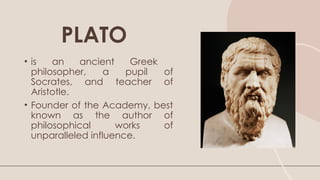
• is anancient Greek
philosopher, a pupil of
Socrates, and teacher of
Aristotle.
• Founder of the Academy, best
known as the author of
philosophical works of
unparalleled influence.
PLATO
SUMMARY
Philosophy, the loveof wisdom, is more concerned with asking the right
questions than searching for answers. In this regard, to engage in
philosophy is to sharpen one’s ability to think.
There are three general branches of philosophy—namely, Metaphysics,
Epistemology, and Value Theory, of which Ethics and Aesthetics are a part.
Logic is the philosopher’s “toolbox” in the sense that to do philosophy is to
enter into a discourse. The goal of this discourse is to know the truth, and
this is attained via a series of arguments, which can be deductive or
inductive.
Philosophy can also lead to disturbances in the sense that it challenges
individuals to think and consider what is beyond their current
understanding.
35.
REFERENCES
Bloom, Allan. 1991.The Republic of Plato , 2 nd ed. New York,
New York: Basic Books.
Dy Jr., Manuel B. 2001. Philosophy of Man, Selected Readings , 2
nd ed. Quezon City, Philippines: Goodwill Trading Co. Inc.
Hurley, Patrick J. 2010. A Concise Introduction to Logic , 11 th
ed. Boston, Massachusetts: Wadsworth Cengage
Learning.
Nagel, Thomas. 1987. What Does It All Mean?: A Very Short
Introduction To Philosophy . New York: Oxford University
Press, Inc.
Janicaud, Dominique. 2003. Philosophy in 30 Days . London,
United Kingdom: Granta Publications
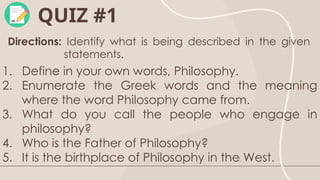
QUIZ #1
Directions: Identifywhat is being described in the given
statements.
1. Define in your own words, Philosophy.
2. Enumerate the Greek words and the meaning
where the word Philosophy came from.
3. What do you call the people who engage in
philosophy?
4. Who is the Father of Philosophy?
5. It is the birthplace of Philosophy in the West.
39.
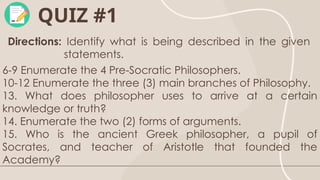
QUIZ #1
Directions: Identifywhat is being described in the given
statements.
6-9 Enumerate the 4 Pre-Socratic Philosophers.
10-12 Enumerate the three (3) main branches of Philosophy.
13. What does philosopher uses to arrive at a certain
knowledge or truth?
14. Enumerate the two (2) forms of arguments.
15. Who is the ancient Greek philosopher, a pupil of
Socrates, and teacher of Aristotle that founded the
Academy?
40.
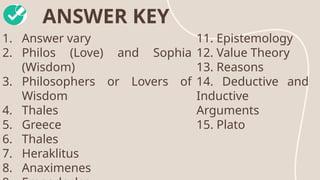
ANSWER KEY
1. Answervary
2. Philos (Love) and Sophia
(Wisdom)
3. Philosophers or Lovers of
Wisdom
4. Thales
5. Greece
6. Thales
7. Heraklitus
8. Anaximenes
11. Epistemology
12. Value Theory
13. Reasons
14. Deductive and
Inductive
Arguments
15. Plato
ACTIVITY #1
Task: Finda partner (whether a classmate, a schoolmate,
or even a sibling). Talk about your interests, your likes and
dislikes. Once you find something that you disagree with—
say, for example, your preference for favorite breakfast
food or the best Marvel movie—write a persuasive
paragraph addressed to your partner. Using the principles
of Logic, use valid deductive arguments and strong
inductive arguments to persuade your partner to side with
you and acknowledge that your preference is, indeed,
the better one. (60 pts.)
43.
Additional Instructions:
• Youcould do the persuasive paragraph electronically
(just provide a printed copy) or in a piece of paper.
• Include your Name, Section, Date, and the Title of the
Activity.
• Observe the rubric given in creating a persuasive
paragraph.
ACTIVITY #1
44.
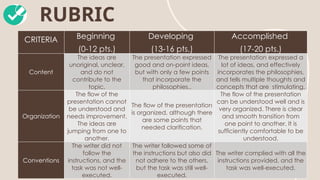
RUBRIC
CRITERIA Beginning
(0-12 pts.)
Developing
(13-16pts.)
Accomplished
(17-20 pts.)
Content
The ideas are
unoriginal, unclear,
and do not
contribute to the
topic.
The presentation expressed
good and on-point ideas,
but with only a few points
that incorporate the
philosophies..
The presentation expressed a
lot of ideas, and effectively
incorporates the philosophies,
and tells multiple thoughts and
concepts that are stimulating.
Organization
The flow of the
presentation cannot
be understood and
needs improvement.
The ideas are
jumping from one to
another.
The flow of the presentation
is organized, although there
are some points that
needed clarification.
The flow of the presentation
can be understood well and is
very organized. There is clear
and smooth transition from
one point to another. It is
sufficiently comfortable to be
understood.
Conventions
The writer did not
follow the
instructions, and the
task was not well-
executed.
The writer followed some of
the instructions but also did
not adhere to the others,
but the task was still well-
executed.
The writer complied with all the
instructions provided, and the
task was well-executed.
Editor's Notes
#1 If it is indeed true that, according to some, man is made of stardust, then we’ve fallen quite a long way from our heavenly origins. Nowadays, it isn’t uncommon to live life seemingly on autopilot, spending our waking moments following a worn-out routine: wake up, eat, study or work, sleep, rinse and repeat. As sobering as this may sound, we need not live this way. Many of the greatest thinkers in the past grappled with questions and ideas that still concern us today. In the simplest sense, this is what philosophy is about—an inquiry into the nature of the world we live in and our place in it (the study of the fundamental nature of knowledge, reality, and existence, especially when considered as an academic discipline – thinking, reasoning, wisdom, knowledge). All of this, of course, starts with a little bit of wonder.
Believe it or not, you’ve actually been philosophizing for quite some time now. In fact, you probably did some philosophizing earlier today. As much as the word itself may seem intimidating, philosophy doesn’t have to be this complicated and mysterious discipline practiced only by professors in universities. When you persuade your parents to allow you to watch a movie with your friends, you are actually doing philosophy. The same goes for the last time you had to decide what to eat for lunch—whether it was chicken inasal with unlimited rice or the slightly healthier lumpiang ubod . You are, in effect, trying to understand your values, where they came from, and what to do next. Whenever you think about the world and your place in it, you participate in the philosophical journey which so many have embarked on the past. Of course, there’s more to philosophy than can be said in a few paragraphs, and now’s as good a time as any to dive deeper.
You could live the entirety of your life without once thinking about philosophy or even realizing that you philosophize every once in a while. Still, there are many things to gain from doing as the many great philosophers did.
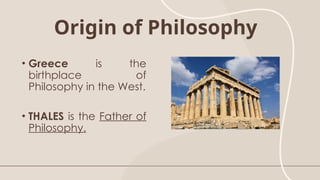
#7 How does one begin to talk about philosophy? For a start, it’s important to note than philosophy is not unique to the Western world. In fact, regions such as India, East Asia, and the Middle East boast philosophical traditions which are just as rich and insightful. We have to start somewhere though, and Ancient Greece , at around 600 BCE , is as a good a place as any.
#8 For the very first time in history, man was free to think leisurely and ask so-called “deep” questions about the world and his place in it. Man started to wonder about the world he is into, he now had the time to stop for a while and ask questions such as: ● What are the things of the world made of?; ● Where did the world come from?; ● Who am I?; ● Is there a God?; ● Is there life after death?
This newfound time gave man the opportunity to learn more about the world and his place in it. In effect, man was able to obtain knowledge who he was and the nature of his surroundings. That said, it is rightful to acknowledge that ‘philosophy’ is derived from the Greek words- philos ( love ) and Sophia (wisdom ) . Literally, the word philosophy means the love of/for wisdom .
There’s a reason philosophy has been called “The Mother of Sciences” and that’s because the earliest philosophers began to study anything and everything. True enough, back then, there weren’t really distinctions between the different fields of science as we would know them today. The very first biologists, physicians, mathematicians, and physicists would call themselves philosophers, due in large part to the fact that they simply loved wisdom and learning.
#9 For the very first time in history, man was free to think leisurely and ask so-called “deep” questions about the world and his place in it. Man started to wonder about the world he is into, he now had the time to stop for a while and ask questions such as: ● What are the things of the world made of?; ● Where did the world come from?; ● Who am I?; ● Is there a God?; ● Is there life after death?
This newfound time gave man the opportunity to learn more about the world and his place in it. In effect, man was able to obtain knowledge who he was and the nature of his surroundings. That said, it is rightful to acknowledge that ‘philosophy’ is derived from the Greek words- philos ( love ) and Sophia (wisdom ) . Literally, the word philosophy means the love of/for wisdom .
There’s a reason philosophy has been called “The Mother of Sciences” and that’s because the earliest philosophers began to study anything and everything. True enough, back then, there weren’t really distinctions between the different fields of science as we would know them today. The very first biologists, physicians, mathematicians, and physicists would call themselves philosophers, due in large part to the fact that they simply loved wisdom and learning.
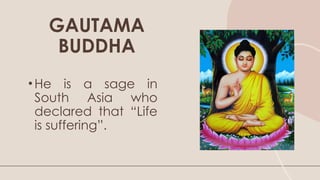
#11 Sage wise through reflection and experience. Maaaring during his time habang nkikita nya ang mga bagay s paligid niya ay nasaksihan niya na hndi Madali ang pagdadala ng buhay that is why he declared “life is suffering”ano ang mga possible niyang nasaksihan..un pagkamatay, pagkakasakit na wala png lunas noon kc ndi p uso ang medication, un tears and disappointment na nagging bahagi cya kya nya un nasabi.
#12 How does one begin to talk about philosophy? For a start, it’s important to note than philosophy is not unique to the Western world. In fact, regions such as India, East Asia, and the Middle East boast philosophical traditions which are just as rich and insightful. We have to start somewhere though, and Ancient Greece , at around 600 BCE , is as a good a place as any.
#13 All in all, if there’s one thing to remember about philosophy, it’s that you don’t necessarily “study philosophy.” Rather, you do philosophy . Success as a student of philosophy is not based on how much you know about a certain topic, but by how well you can think .
Broad area of knowledge that is why it is divided into branches depending on the aspect of life and phenomena.
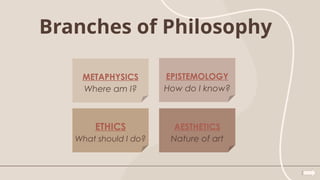
#14 Seeks comprehensive answer pertaining to
Nature of existence
Categories of space and time
Existence of God
Immortality of the human soul
#16 Flux - the action or process of flowing or flowing out: rushing, moving in and out, continuous flowing.
#18 The elements were bound together by attraction (Love) and separated by opposition or conflict (Strife) but were themselves changeless in nature.
#19 In studying knowledge, the philosopher concerns himself with questions about truth, about whether it is even possible to know what is true. For that matter, is it possible to know any object at all given that one’s senses can be deceptive or faulty?
Ano ang mga bagay n alam mo na totoo? At ano ang mga patunay na mgasasabi na ito ay totoo?ano ang justification.
How do we know what we know?
How do we find out what we wish to know?
How can we differentiate truth from opinion?
#22 Philosophy is about engaging ideas and other individuals in a discourse aimed at knowing the truth. With this in mind, knowing how to argue correctly—whether deductively or inductively—can only help in your journey for the truth.
#23 It was Aristotle (384-322 BCE) who once said that man is a rational (able to give reasons, explanation, logical) animal . Though many present-day philosophers refute (rebut, disagree, etc.) this claim, there is a little grain of truth in such an assertion. The simplest way of understanding this claim is that man, armed with intelligence and the capacity to think about all sorts of ideas, is not a mere animal or beast. We are different from all the rest of creation because we can think rationally.
However, you need not look far to realize that sometimes, man isn’t always rational. Yes, we have the capacity to be rational, but that isn’t always the case. When we argue with a friend about our favorite athlete or movie, it is not unheard of to resort to insults, shouting, and referring to unfair criteria in order to “win.” In these instances, we seem to be very irrational. As students of philosophy, being irrational is exactly what we want to avoid. But how so?
#24 In essence, the philosopher uses Logic as his toolbox. He deals with arguments and all sorts of statements and uses careful rational thought to arrive at the truth. Note that when we talk about arguments, we don’t necessarily refer to a battle of wits. Rather, we’re talking about statements in a discourse or discussion. In effect, to excel as a philosopher, one must sharpen his tools of reasoning. More importantly, he must keep in mind that the goal of argumentation or discourse is not to win but to know the truth.
#26 The goal of philosophical discourse, therefore, is to provide arguments logically and avoid thinking fallaciously.
Fallacious (based on mistaken belief)
*Deductive (valid and invalid) and *Inductive (strong and weak)
#27 1. In the example above, it is impossible for the conclusion to be false if all of the premises are true. In this case, we call such a deductive argument as valid . Simply put, if the conclusion drawn from the premises makes sense, then the argument can be considered valid. If the conclusion doesn’t make sense, it can be classified as invalid , as in the example below.
2. The argument as a whole is invalid because the flow of reasoning didn’t necessarily follow the flow of general to specific. Premise 2 is almost as broad or as general as Premise 1, and so no clear conclusion about the nature of Dumbo can be made. However, you must remember that not all valid arguments are necessarily true. Yes, they may make sense argumentatively, but you’ll notice that something’s just not right.
#28 The argument in itself is valid but that doesn’t make it true. There is no known record of an ostrich ever taking flight. The error in reasoning stems from the false premise—specifically, that all birds can fly. That said, one very important thing to remember about deductive arguments: If all of your premises are true and factual and the flow of your argumentation is valid, then your argument will always be true.
*Premises (True) Conclusion (True)
*Factual (True)
*Deductive manner (general to specific)
#30 1. In the example above, it is very likely that Pedro has black hair based on the premises. Note that it is possible that Pedro has brown or maybe even blonde hair, and so the conclusion doesn’t rule that possibility out. Still, since the conclusion is very likely, this inductive argument is strong . In other words, the “proofs” presented in the premises are strong enough to lead us to believe that the conclusion is likely.
2. In contrast to the first inductive argument, this example can be considered weak since the likelihood that Pedro is Filipino based solely on his hair color is very small. We know this because black hair is abundant and prevalent in the make-up of many other nationalities. Chinese and Indians alone (more than 2 billion people) are predominantly black-haired.
#31 Invalid – Humans are mortal; Socrates is human; Socrates is mortal
Valid
The problem isn't that the conclusion is false (the conclusion that Socrates is human is true in this case), the problem is that the argument is invalid because the conclusion doesn't follow from the premises. In this example, to show that the conclusion follows from the premises you'd have to show that everything that is mortal is also human, which doesn't follow from the premises (and is, incidentally, also false). Note that even if all mortal beings were human, the argument would still be invalid because this doesn't follow from the premises.
#33 Apart from learning how to think critically, one of the biggest benefits of philosophizing is the apparent wisdom that comes with understanding the world in which one lives. Far from simply coasting from one day to the next, the philosopher is concerned with the very nature of reality and what that means for his earthly life.
#34 Reflection - serious thought or consideration: thought · thinking · consideration · contemplation · study · deliberation ·
Probably the most stirring, thought-provoking, and, to an extent, unsettling description of the world we live in today was laid out by Plato (428-348 BCE) in his Republic .
#35 Plato also founded the Academy, an academic program that many consider to be the first Western university, where he stressed the importance of science and mathematics. Because of this, he became known as the “maker of mathematicians.”
The Greek political thought was greatly enriched by the fertile philosophical literature of Plato. He wrote a number of works, but the most important are Apology, Crito, Phaedo, Symposium, The Republic, Statesmen and The Laws.
Apology was written after the death of Socrates in 399 BC. It is related to the circumstances that eventually led to the death of his teacher.
2. Crito, another work, was a kind of dialogue related to the trial and death of Socrates. Crito, in fact, was a friend of Socrates.
3. Phaedo, the third work of Plato is a description of Socrates in his last days in a cell all alone. It was a beautiful blend of high drama and high philosophy relating to the immortality of the human soul.
4. Symposium, the fifth major work, was also a platonic philosophy of love.
5. The Republic was the masterpiece of Plato that made him immortal in the field of philosophy. According to Gettel, Plato attempted to establish the philosophic conceptions of justice, and in doing so, he set forth his conception of ideal state in which justice prevails. The point of view is primarily ethical and idealistic. It was described as a matchless introduction to the basic issues that confront human beings as citizens.
The Republic was universally acclaimed as one of the greatest works of all times. It was written when Plato was around 40 years. The Republic comprised of nearly 10 books that dealt with certain moral and philosophical principles. It encompasses a variety of problems related to morality, metaphysics, sociology, education and so on.
The book begins with a proposition; what a good man is? And how can one become so? Eventually, it leads to the question, what is a good state?
6. Finally, Statesmen and The Laws were the later works of Plato, which reflect the problems of the city- states. The two works belong to the last days of Plato at a time when his Academy failed to meet his expectations. This made him realize that his schemes were Utopian and visionary in nature. Thus, the last two works of Plato clearly reflect his disillusionment.
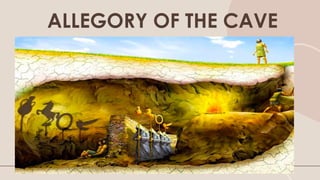
#36 Allegory (a story, poem, or picture that can be interpreted to reveal a hidden meaning, typically a moral or political one)
In what is widely known as the Allegory of the Cave , Plato paints a picture of man as a prisoner inside a cave. He is chained and unable to move, trapped as it were with other prisoners. Behind them is large fire and in front of this fire is a parade of objects. The shadows of these objects are projected onto the wall in front of the prisoners. One very important detail: these prisoners have been chained inside the cave their entire lives. They have never seen the world outside the cave, and so all they know to be true and real are the shadows displayed on the cave walls. This, Plato contends, is how man knows the world. For Plato, there is a World of Pure Forms above and beyond man’s knowledge. In the allegory, this is represented by the world outside the cave. One prisoner eventually makes it out of the cave and sees this outside world. Having known nothing but shadows and darkness, he is blinded by the light outside - just like how we tend to be disoriented when we see a sudden bright light in the pitch black night. The prisoner sees the true forms of the shadows he saw inside the cave. He can’t believe it and rushes to tell his fellow prisoners of what he just saw. It is at this point that Plato reminds us of the cruel truth of life. The other prisoners don’t believe him, and why would they when they’ve never experienced or known anything but shadows? So the one prisoner who experienced truth and beauty and reality is left alone with no one to relate to.
This allegory has stood the test of time due to the truth it imparts. On the one hand, it seems impossible to think of things greater or “more real” than the objects we can see and touch and feel. On the other hand, entertaining the possibility that what we once believed to be true is actually false is not such a pleasant activity. This, perhaps, is what makes the allegory so memorable—because it’s been proven time and again throughout history. Many things which were once thought to be true were eventually proved to be false. For example,
● The belief that the Earth was at the center of the Solar System (Geocentric)
● The belief that the Earth was flat
● The belief that sickness and demons could be cured by drilling a hole into a person’s skull
And if this is the case historically, what more of our current truths could actually turn out to be false?
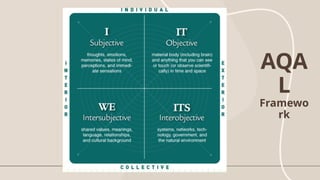
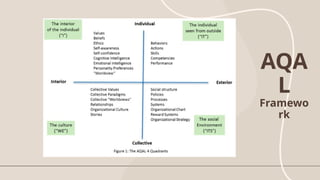
#37 The AQAL Model is the basic framework of Ken Wilber’s Integral Theory. AQAL stands for All Quadrants, All Levels. It considers that any occasion has four perspectives: the inside and the outside of the individual and the collective.
Subjective based on or influenced by personal feelings, tastes, or opinions.
Objective not influenced by personal feelings or opinions in considering and representing facts.
#38 1. The Upper-left quadrant contains the individual’s interior experiences: thoughts, emotions, memories from past experiences, states of mind, perceptions, and immediate sensations. It is called the ‘I’ space, and covers the interior individual aspects of experience. It relates to the subjective aspects of the consciousness, or individual perception.
2. The Upper-right quadrant covers what an individual looks like from the outside. In this dimension we have the actions, language, skills, competencies, body language. This quadrant is called the “IT” space. In Wilber’s theory it also includes the physical aspects of the individual: brain, body – but we will focus on the behavioral part in this work.
3. The Lower-left quadrant represents the group or collective consciousness. It describes the cultural world space where the individual is inserted, and includes the shared values, shared feelings, shared beliefs, and worldviews. It is called “WE” space.
4. The Lower-right quadrant represents the social dimension where the individual lives, which includes how people are organized, the policies and procedures, conduct code, economic and social context. It is called “ITS” space.
According to Wilber, an issue in any quadrant will affect all four quadrants, because every human being context has these four facets inter-related. Thus, an integral view needs to take all of those dimensions into account, to get to a more effective approach to sustainable development.
If we always look at an issue or challenge from one perspective, this might limit the understanding of the issue, and therefore the solution opportunities.