Lesson 1
Pursuing
Wisdom and
Facing
Challenges in
the Twenty-
First Century Gerlie Jane M. Labrador, LPT
1.
Introduction:
Doing Philosophy
objectives
> Distinguish a holistic perspective from a
partial point of view;
> Recognize human activities that
emanate from deliberate reflection;
> Realize the value of doing philosophy in
obtaining a broad perspective on life;
> Do a philosophical reflection on a
concrete situation from a holistic
perspective; and;
> Appreciate indigenous thoughts.
3
Teacher : John, what would you like to
be when you grow up?
> John : Ma’am, I want to be
happy!
Teacher : John, you don’t understand
my question.
John : Ma’am, you do not understand
what life is all about!
4
5
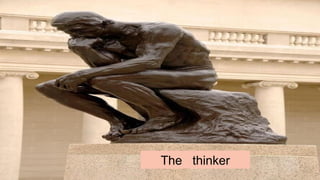
The thinker
It refers to a
perspective
that considers
large-scale
patterns in
system.
Holistic thinking
This often
described as
looking at the “big
picture” when
describing and
analyzing a
situation or
problem. The word
holistic comes
from the Greek
6
7
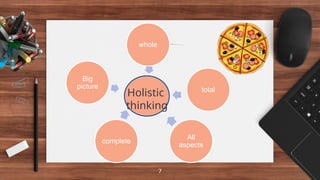
whole
total
All
aspects
complete
Big
picture
Holistic
thinking
It focus on specific aspects
of situation
Partial thinking
8
9
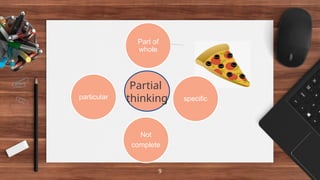
Part of
whole
specific
Not
complete
particular
Partial
thinking
Key elements in many
educational reforms:
> Diversity – makes each
person unique
> Difference
> Choice
10
The meaning of
philosophy
11
Etymological Definition:
Greek words
Philo (to love)
Sophia (wisdom)
The meaning of
philosophy
12
Real Definition:
The science that by natural
light of reason studies the first
causes or highest principles of all
The meaning of
philosophy
> Four thing to considered:
A.Science
B.Natural light of Reasons
C.Study of All Things
D.First Cause or Highest
Principle
13
Philosophy as a
SCIENCE
> The investigation is
systematic
> It follows certain steps
> Employs certain behavior
14
Philosophy as a
NATURAL LIGHT OF
REASONS
> Investigate by not using
any other laboratory
instrument or
investigative tools.
15
Study of all things
> Does not concern with a
particular object of
investigation
> Not one dimensional or
partial; multidimensional
or holistic 16
First Cause or Highest
Principle
> A principle is the form
which something
proceeds in any manner.
17
First Cause or Highest
Principle
> Principle of Identity
> Principle of Non-
Contradiction
> Principle of Excluded
Middle
18
Principle of Identity
> Whatever is is; and
whatever is not is not;
everything is what it is.
> Everything is its own being,
and not being is not being.
> Example: A chair. It is a piece of wood
19
Principle of Non-
contradiction
> It is impossible for a thing
to be and not to be at the
same time, and at the same
respect.
> Example: It is impossible that you are alive
and dead at the same time.
20
Principle of Excluded
Middle
> A thing is either is or is not
> Everything must either be
or not be
> Between being and not-
being
> There is no middle ground
21
Principle of Sufficient
Reason
> Nothing exists without a
sufficient reason for its being
and existence
> Example: You are alive for a
reason. The birds are there for
a reason. This pandemic has a
reason why this happened.
22
Emptying
The way to attain wisdom
* Intellectual – simplicity and
humility
* Spiritual – compassion
* Physical – misuse of the
senses
23
reflection
It requires a person to be
willing to examine one’s
thoughts, feelings and action
to learn more about one’s life
and experience. One can
reflect on utmost any subjects
24
WHAT DO YOU CONSIDER BEFORE DOING
THESE THINGS?
1. Buying things
2. Choosing friends
3. Picking foods
25
Why is Philosophy important?
> Ideas Matter
> We all have a worldview
> Philosophy examines assumptions,
asks questions, seeks to clarify and
analyze concepts, and seeks to
organize fact into a rational system for
all disciplines
> philosophy makes us more humans
26
Activity
> Let’s Remember
> Lets apply
27
28
Branches of Philosophy
> Metaphysics
> Ethics
> Epistemology
> Logic
> Aesthetics
29
Metaphysics
> An extension of a fundamental
and necessary drive in every
human being to know what is
real
> The question is how to account
for this unreal things in terms of
what you can accept as real
> Eg. Thales (everything is water) water=reality, everything
else is appearance 30
Metaphysics
> The tendency to explain the
observable in terms of the
unobservable
> Plato: nothing we experience in
the physical world with our five
senses is real. Reality is just the
opposite: it is unchanging,
eternal, immaterial, and can be
31
ETHICS
> The branch of philosophy that
explores the nature of moral
virtue and evaluates human
actions
> A study of the nature of moral
judgments
32
ETHICS
> Socrates: to be happy, a person
has to live a virtuous life.
> Virtue is not something to be
taught or acquired through
education, rather, it is merely a
awakening of the seeds of
good deeds that lay dormant in
the mind and heart of a
33
ETHICS
> Knowledge does not mean only
theoretical or speculative, but a
practical one. Practical
knowledge means that one
does not only know the rules of
right living, but one lives them.
34
EPISTEMOLOGY
> Deals with nature, sources,
limitations, and validity of
knowledge
35
EPISTEMOLOGY
> Deals with nature, sources,
limitations, and validity of
knowledge
36
EPISTEMOLOGY
> How do we acquire reliable
knowledge?
- Induction - the belief that
general ideas are formed
from the examination of
particular facts.
37
EPISTEMOLOGY
> How do we acquire reliable
knowledge?
*Empiricism - the view that
knowledge can be attained only
through sense experience.
38
EPISTEMOLOGY
> How do we acquire reliable
knowledge?
> Deduction - thinks that it is
more important to find a
general law according to which
particular facts can be
understood or judged.
39
Group activity:
> Divide the students in five group.
> Each group
40
LOGIC
> Came from the Greek word logike
coined by Zeno, the Stoic.
> Etymologically it means a treatise
on matters pertaining to the human
thought.
> Not interested in what we know,
rather, it is the truth or the validity
of our arguments regarding such
objects. 41
LOGIC
> Aristotle: the first to devise a logical
method. He understood truth to
mean the agreement of knowledge
with reality; truth exists when the
mind’s mental representations
(ideas), correspond with things in
the objective world.
> Zeno of Citium: founder of the
movement Stoicism
42
LOGIC
> Aristotle: the first to devise a logical
method. He understood truth to
mean the agreement of knowledge
with reality; truth exists when the
mind’s mental representations
(ideas), correspond with things in
the objective world.
> Zeno of Citium: founder of the
movement Stoicism
43
AESTHETICS
> The science of the beautiful in its
various manifestations including the
sublime, comic, tragic, pathetic, and
ugly. To experience aesthetics,
therefore, means whatever
experience has relevance ti art,
whether the experience be that of the
creative artist or of the appreciation.
44
AESTHETICS
> As a branch of Philosophy, students
should consider the importance of
aesthetics because of the following:
> It vitalizes our knowledge
> It helps us to live more deeply and
richly
> It brings us in touch with our culture
45
AESTHETICS
Aesthetics vitalizes our knowledge.
It makes our knowledge of the world
alive and useful
46
AESTHETICS
Aesthetics vitalizes our knowledge.
Aesthetics helps us to live more
deeply and richly.
It helps us rise from purely physical
existence into the realm of intellect
and the spirit
47
AESTHETICS
Aesthetics vitalizes our knowledge.
Aesthetics brings us in touch with
our culture.
the answers of great minds in the
past to various problems are part of
our culture.
48
AESTHETICS
Aesthetics vitalizes our knowledge.
Aesthetics brings us in touch with
our culture.
the answers of great minds in the
past to various problems are part of
our culture.
49

introduction philosophy-Lesson- (1).pptx

  • 1.
    Lesson 1 Pursuing Wisdom and Facing Challengesin the Twenty- First Century Gerlie Jane M. Labrador, LPT
  • 2.
  • 3.
    objectives > Distinguish aholistic perspective from a partial point of view; > Recognize human activities that emanate from deliberate reflection; > Realize the value of doing philosophy in obtaining a broad perspective on life; > Do a philosophical reflection on a concrete situation from a holistic perspective; and; > Appreciate indigenous thoughts. 3
  • 4.
    Teacher : John,what would you like to be when you grow up? > John : Ma’am, I want to be happy! Teacher : John, you don’t understand my question. John : Ma’am, you do not understand what life is all about! 4
  • 5.
  • 6.
    It refers toa perspective that considers large-scale patterns in system. Holistic thinking This often described as looking at the “big picture” when describing and analyzing a situation or problem. The word holistic comes from the Greek 6
  • 7.
  • 8.
    It focus onspecific aspects of situation Partial thinking 8
  • 9.
  • 10.
    Key elements inmany educational reforms: > Diversity – makes each person unique > Difference > Choice 10
  • 11.
    The meaning of philosophy 11 EtymologicalDefinition: Greek words Philo (to love) Sophia (wisdom)
  • 12.
    The meaning of philosophy 12 RealDefinition: The science that by natural light of reason studies the first causes or highest principles of all
  • 13.
    The meaning of philosophy >Four thing to considered: A.Science B.Natural light of Reasons C.Study of All Things D.First Cause or Highest Principle 13
  • 14.
    Philosophy as a SCIENCE >The investigation is systematic > It follows certain steps > Employs certain behavior 14
  • 15.
    Philosophy as a NATURALLIGHT OF REASONS > Investigate by not using any other laboratory instrument or investigative tools. 15
  • 16.
    Study of allthings > Does not concern with a particular object of investigation > Not one dimensional or partial; multidimensional or holistic 16
  • 17.
    First Cause orHighest Principle > A principle is the form which something proceeds in any manner. 17
  • 18.
    First Cause orHighest Principle > Principle of Identity > Principle of Non- Contradiction > Principle of Excluded Middle 18
  • 19.
    Principle of Identity >Whatever is is; and whatever is not is not; everything is what it is. > Everything is its own being, and not being is not being. > Example: A chair. It is a piece of wood 19
  • 20.
    Principle of Non- contradiction >It is impossible for a thing to be and not to be at the same time, and at the same respect. > Example: It is impossible that you are alive and dead at the same time. 20
  • 21.
    Principle of Excluded Middle >A thing is either is or is not > Everything must either be or not be > Between being and not- being > There is no middle ground 21
  • 22.
    Principle of Sufficient Reason >Nothing exists without a sufficient reason for its being and existence > Example: You are alive for a reason. The birds are there for a reason. This pandemic has a reason why this happened. 22
  • 23.
    Emptying The way toattain wisdom * Intellectual – simplicity and humility * Spiritual – compassion * Physical – misuse of the senses 23
  • 24.
    reflection It requires aperson to be willing to examine one’s thoughts, feelings and action to learn more about one’s life and experience. One can reflect on utmost any subjects 24
  • 25.
    WHAT DO YOUCONSIDER BEFORE DOING THESE THINGS? 1. Buying things 2. Choosing friends 3. Picking foods 25
  • 26.
    Why is Philosophyimportant? > Ideas Matter > We all have a worldview > Philosophy examines assumptions, asks questions, seeks to clarify and analyze concepts, and seeks to organize fact into a rational system for all disciplines > philosophy makes us more humans 26
  • 27.
  • 28.
  • 29.
    Branches of Philosophy >Metaphysics > Ethics > Epistemology > Logic > Aesthetics 29
  • 30.
    Metaphysics > An extensionof a fundamental and necessary drive in every human being to know what is real > The question is how to account for this unreal things in terms of what you can accept as real > Eg. Thales (everything is water) water=reality, everything else is appearance 30
  • 31.
    Metaphysics > The tendencyto explain the observable in terms of the unobservable > Plato: nothing we experience in the physical world with our five senses is real. Reality is just the opposite: it is unchanging, eternal, immaterial, and can be 31
  • 32.
    ETHICS > The branchof philosophy that explores the nature of moral virtue and evaluates human actions > A study of the nature of moral judgments 32
  • 33.
    ETHICS > Socrates: tobe happy, a person has to live a virtuous life. > Virtue is not something to be taught or acquired through education, rather, it is merely a awakening of the seeds of good deeds that lay dormant in the mind and heart of a 33
  • 34.
    ETHICS > Knowledge doesnot mean only theoretical or speculative, but a practical one. Practical knowledge means that one does not only know the rules of right living, but one lives them. 34
  • 35.
    EPISTEMOLOGY > Deals withnature, sources, limitations, and validity of knowledge 35
  • 36.
    EPISTEMOLOGY > Deals withnature, sources, limitations, and validity of knowledge 36
  • 37.
    EPISTEMOLOGY > How dowe acquire reliable knowledge? - Induction - the belief that general ideas are formed from the examination of particular facts. 37
  • 38.
    EPISTEMOLOGY > How dowe acquire reliable knowledge? *Empiricism - the view that knowledge can be attained only through sense experience. 38
  • 39.
    EPISTEMOLOGY > How dowe acquire reliable knowledge? > Deduction - thinks that it is more important to find a general law according to which particular facts can be understood or judged. 39
  • 40.
    Group activity: > Dividethe students in five group. > Each group 40
  • 41.
    LOGIC > Came fromthe Greek word logike coined by Zeno, the Stoic. > Etymologically it means a treatise on matters pertaining to the human thought. > Not interested in what we know, rather, it is the truth or the validity of our arguments regarding such objects. 41
  • 42.
    LOGIC > Aristotle: thefirst to devise a logical method. He understood truth to mean the agreement of knowledge with reality; truth exists when the mind’s mental representations (ideas), correspond with things in the objective world. > Zeno of Citium: founder of the movement Stoicism 42
  • 43.
    LOGIC > Aristotle: thefirst to devise a logical method. He understood truth to mean the agreement of knowledge with reality; truth exists when the mind’s mental representations (ideas), correspond with things in the objective world. > Zeno of Citium: founder of the movement Stoicism 43
  • 44.
    AESTHETICS > The scienceof the beautiful in its various manifestations including the sublime, comic, tragic, pathetic, and ugly. To experience aesthetics, therefore, means whatever experience has relevance ti art, whether the experience be that of the creative artist or of the appreciation. 44
  • 45.
    AESTHETICS > As abranch of Philosophy, students should consider the importance of aesthetics because of the following: > It vitalizes our knowledge > It helps us to live more deeply and richly > It brings us in touch with our culture 45
  • 46.
    AESTHETICS Aesthetics vitalizes ourknowledge. It makes our knowledge of the world alive and useful 46
  • 47.
    AESTHETICS Aesthetics vitalizes ourknowledge. Aesthetics helps us to live more deeply and richly. It helps us rise from purely physical existence into the realm of intellect and the spirit 47
  • 48.
    AESTHETICS Aesthetics vitalizes ourknowledge. Aesthetics brings us in touch with our culture. the answers of great minds in the past to various problems are part of our culture. 48
  • 49.
    AESTHETICS Aesthetics vitalizes ourknowledge. Aesthetics brings us in touch with our culture. the answers of great minds in the past to various problems are part of our culture. 49