MID POA 2007 Review of leadership article: “ What Makes A Leader?” By Daniel Goleman  Harvard Business Review Nov-Dec 1998
What makes a good leader?
Objectives Participants will be able to describe emotional intelligence and state if emotional intelligence can be learned Participants will be able to define and give examples of the hallmarks of the five components of emotional intelligence Participants will be able to evaluate and synthesize how emotional intelligence can enhance personal leadership development.
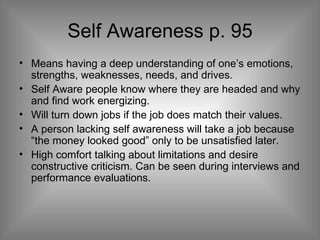
Self Awareness p. 95 Means having a deep understanding of one’s emotions, strengths, weaknesses, needs, and drives. Self Aware people know where they are headed and why and find work energizing. Will turn down jobs if the job does match their values. A person lacking self awareness will take a job because “the money looked good” only to be unsatisfied later. High comfort talking about limitations and desire constructive criticism. Can be seen during interviews and performance evaluations.
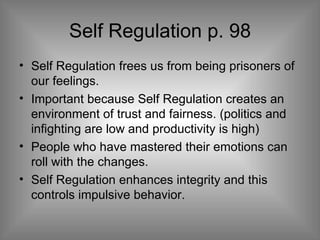
Self Regulation p. 98 Self Regulation frees us from being prisoners of our feelings.  Important because Self Regulation creates an environment of trust and fairness. (politics and infighting are low and productivity is high) People who have mastered their emotions can roll with the changes. Self Regulation enhances integrity and this controls impulsive behavior.
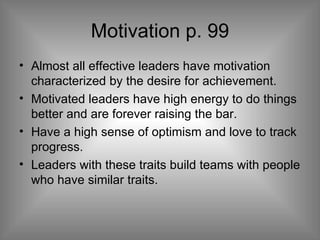
Motivation p. 99 Almost all effective leaders have motivation characterized by the desire for achievement. Motivated leaders have high energy to do things better and are forever raising the bar. Have a high sense of optimism and love to track progress. Leaders with these traits build teams with people who have similar traits.
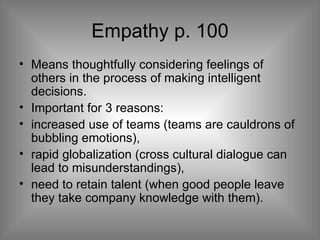
Empathy p. 100 Means thoughtfully considering feelings of others in the process of making intelligent decisions. Important for 3 reasons: increased use of teams (teams are cauldrons of bubbling emotions), rapid globalization (cross cultural dialogue can lead to misunderstandings),  need to retain talent (when good people leave they take company knowledge with them).
Social Skill p. 101 Friendliness with a purpose moving people in the direction you desire. Wide circle of acquaintances and know how to find common ground with people of all kinds. Have a network in place for when the time comes. A leaders task is to get work done through other people and social skill makes this possible
Can Emotional Intelligence be learned? YES!
Group Activity Write a name on each card. (one card per person including yourself) For each team member, list two areas of Emotional Intelligence for development (refer to page 95) Hand in all cards except yours to leader Each member will state to the group the two areas for development. (discussion) Collectively the team will state two strong areas of emotional intelligence per person  You will get the cards with your name on them filled out by other members for review. (look for a pattern) Leader will collect at the end.
Objectives Participants will be able to describe emotional intelligence and state if emotional intelligence can be learned Participants will be able to define and give examples of the hallmarks of the five components of emotional intelligence Participants will be able to evaluate and synthesize how emotional intelligence can enhance personal leadership development.

What Makes A Leader 2007

  • 1.
    MID POA 2007Review of leadership article: “ What Makes A Leader?” By Daniel Goleman Harvard Business Review Nov-Dec 1998
  • 2.
    What makes agood leader?
  • 3.
    Objectives Participants willbe able to describe emotional intelligence and state if emotional intelligence can be learned Participants will be able to define and give examples of the hallmarks of the five components of emotional intelligence Participants will be able to evaluate and synthesize how emotional intelligence can enhance personal leadership development.
  • 4.
    Self Awareness p.95 Means having a deep understanding of one’s emotions, strengths, weaknesses, needs, and drives. Self Aware people know where they are headed and why and find work energizing. Will turn down jobs if the job does match their values. A person lacking self awareness will take a job because “the money looked good” only to be unsatisfied later. High comfort talking about limitations and desire constructive criticism. Can be seen during interviews and performance evaluations.
  • 5.
    Self Regulation p.98 Self Regulation frees us from being prisoners of our feelings. Important because Self Regulation creates an environment of trust and fairness. (politics and infighting are low and productivity is high) People who have mastered their emotions can roll with the changes. Self Regulation enhances integrity and this controls impulsive behavior.
  • 6.
    Motivation p. 99Almost all effective leaders have motivation characterized by the desire for achievement. Motivated leaders have high energy to do things better and are forever raising the bar. Have a high sense of optimism and love to track progress. Leaders with these traits build teams with people who have similar traits.
  • 7.
    Empathy p. 100Means thoughtfully considering feelings of others in the process of making intelligent decisions. Important for 3 reasons: increased use of teams (teams are cauldrons of bubbling emotions), rapid globalization (cross cultural dialogue can lead to misunderstandings), need to retain talent (when good people leave they take company knowledge with them).
  • 8.
    Social Skill p.101 Friendliness with a purpose moving people in the direction you desire. Wide circle of acquaintances and know how to find common ground with people of all kinds. Have a network in place for when the time comes. A leaders task is to get work done through other people and social skill makes this possible
  • 9.
  • 10.
    Group Activity Writea name on each card. (one card per person including yourself) For each team member, list two areas of Emotional Intelligence for development (refer to page 95) Hand in all cards except yours to leader Each member will state to the group the two areas for development. (discussion) Collectively the team will state two strong areas of emotional intelligence per person You will get the cards with your name on them filled out by other members for review. (look for a pattern) Leader will collect at the end.
  • 11.
    Objectives Participants willbe able to describe emotional intelligence and state if emotional intelligence can be learned Participants will be able to define and give examples of the hallmarks of the five components of emotional intelligence Participants will be able to evaluate and synthesize how emotional intelligence can enhance personal leadership development.