Research Proposal  Research Area B1 Mobile Web Services for Distributed In-Network Computations in Wireless Sensor Networks Prof. Dr.-Ing Bernhard Walke,  Fahad Aijaz Communication Networks April 20, 2007
Presentation Agenda Wireless Sensor Networks (WSN) Problem Statement The Scientific Framework Role of Mobile Web Services Research Approach Value for UMIC Summary
Wireless Sensor Networks (WSN)  (General Introduction) A WSN is a wireless network consists of spatially distributed devices using sensors. Sensors monitor the physical or environmental conditions at different locations, e.g. Temperature Sound  Vibration Pressure  Motion etc. Such networks are the key for gathering information in smart environments. Some application areas are; Monitoring and Control Systems Health care Traffic control Security Home automation etc.
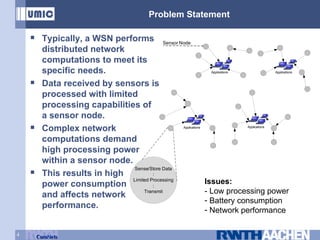
Problem Statement Typically, a WSN performs distributed network computations to meet its specific needs. Data received by sensors is processed with limited processing capabilities of  a sensor node. Complex network  computations demand high processing power within a sensor node. This results in high power consumption  and affects network  performance. Issues: - Low processing power Battery consumption Network performance
The Scientific Framework – 1/2 Collector nodes are  introduced in [1]. These nodes are better equipped in terms of processing power and battery consumption  than ordinary sensors. High-valued distributed in-network computations can be achieved by collector nodes‘ collaboration. Collector nodes represent local neighborhood of sensors to higher hierarchy of WSN. Sensor  and  Collector  nodes could be mobile terminals [1]   Giridhar, A. Kumar, P.R.,  Toward a theory of in-network    computation in wireless sensor networks ,  Communications    Magazine, IEEE , Volume 44, Issue 4, p. 98- 107, ISSN: 0163-    6804, 2006
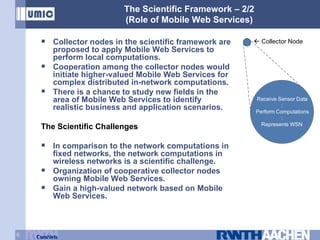
The Scientific Framework – 2/2 (Role of Mobile Web Services) Collector nodes in the scientific framework are proposed to apply Mobile Web Services to perform local computations. Cooperation among the collector nodes would initiate higher-valued Mobile Web Services for complex distributed in-network computations. There is a chance to study new fields in the area of Mobile Web Services to identify realistic business and application scenarios. The Scientific Challenges In comparison to the network computations in fixed networks, the network computations in wireless networks is a scientific challenge. Organization of cooperative collector nodes owning Mobile Web Services. Gain a high-valued network based on Mobile Web Services.    Collector Node
Research Approach Study a real world background to identify actual needs and problems. Focus on applications specified in RA B1 dealing with wireless communication in infrastructure-less environments. Continued cooperation among the research assistants. Longer lasting research goal shall be identified for the project. Aim at contributing to network computation theory in WSNs in the long term. Outcome of Research Develop a solution for  a real world problem e.g. Afghanistan project. Contribution to the state-of-the-art distributed network computation theory of WSNs.
Value for UMIC Mobile multi-hop ad-hoc networks operate without pre-established    infrastructure. They are well suited for environments without communication    infrastructure (RA B1 project). How does it fit into UMIC? The scientific goal is to study and develop generic mechanisms for      complex distributed in-network computations based on Mobile    Web Services involving; Mobile Web Services enabled collector nodes for WSN Single service based computation Cooperative services based computation (collector node cooperation) Outcome is expected in terms of: Optimized high-valued network performance and representation. Low cost of battery consumption within sensor nodes. Information access support in infrastructure-less environments. Contribution to the scientific education and goals of UMIC. Tight cooperation within UMIC researchers. Contribution to the state-of-the-art network computation theory of WSNs.
Summary The scientific framework  is proposed that introduces the  Mobile Web Services based collector  nodes to perform  distributed in-network computation  for WSNs. In comparison to the network computations in fixed networks, the network computation in wireless networks is a  scientific challenge . The collector node  collaboration  will produce  higher-valued mobile web services . Such services will represent the local neighborhood of sensors to some higher entity. The scientific work will  contribute to the state-of-the-art  network computation theory of WSN in the long run. Research focus shall aim a real world problem. UMIC RA B1 project concerning  wireless communication in infrastructure-less environments  could be a good starting point. Solutions for real world shall be developed, e.g.  Afghanistan .  Longer lasting project goals and business/application areas shall be identified.
Mobile Web Services for Distributed In-Network  Computations in Wireless Sensor Networks Thank you for your attention!

Mobile Web Services for Distributed In-Network Communications and Computations

  • 1.
    Research Proposal Research Area B1 Mobile Web Services for Distributed In-Network Computations in Wireless Sensor Networks Prof. Dr.-Ing Bernhard Walke, Fahad Aijaz Communication Networks April 20, 2007
  • 2.
    Presentation Agenda WirelessSensor Networks (WSN) Problem Statement The Scientific Framework Role of Mobile Web Services Research Approach Value for UMIC Summary
  • 3.
    Wireless Sensor Networks(WSN) (General Introduction) A WSN is a wireless network consists of spatially distributed devices using sensors. Sensors monitor the physical or environmental conditions at different locations, e.g. Temperature Sound Vibration Pressure Motion etc. Such networks are the key for gathering information in smart environments. Some application areas are; Monitoring and Control Systems Health care Traffic control Security Home automation etc.
  • 4.
    Problem Statement Typically,a WSN performs distributed network computations to meet its specific needs. Data received by sensors is processed with limited processing capabilities of a sensor node. Complex network computations demand high processing power within a sensor node. This results in high power consumption and affects network performance. Issues: - Low processing power Battery consumption Network performance
  • 5.
    The Scientific Framework– 1/2 Collector nodes are introduced in [1]. These nodes are better equipped in terms of processing power and battery consumption than ordinary sensors. High-valued distributed in-network computations can be achieved by collector nodes‘ collaboration. Collector nodes represent local neighborhood of sensors to higher hierarchy of WSN. Sensor and Collector nodes could be mobile terminals [1] Giridhar, A. Kumar, P.R., Toward a theory of in-network computation in wireless sensor networks , Communications Magazine, IEEE , Volume 44, Issue 4, p. 98- 107, ISSN: 0163- 6804, 2006
  • 6.
    The Scientific Framework– 2/2 (Role of Mobile Web Services) Collector nodes in the scientific framework are proposed to apply Mobile Web Services to perform local computations. Cooperation among the collector nodes would initiate higher-valued Mobile Web Services for complex distributed in-network computations. There is a chance to study new fields in the area of Mobile Web Services to identify realistic business and application scenarios. The Scientific Challenges In comparison to the network computations in fixed networks, the network computations in wireless networks is a scientific challenge. Organization of cooperative collector nodes owning Mobile Web Services. Gain a high-valued network based on Mobile Web Services.  Collector Node
  • 7.
    Research Approach Studya real world background to identify actual needs and problems. Focus on applications specified in RA B1 dealing with wireless communication in infrastructure-less environments. Continued cooperation among the research assistants. Longer lasting research goal shall be identified for the project. Aim at contributing to network computation theory in WSNs in the long term. Outcome of Research Develop a solution for a real world problem e.g. Afghanistan project. Contribution to the state-of-the-art distributed network computation theory of WSNs.
  • 8.
    Value for UMICMobile multi-hop ad-hoc networks operate without pre-established infrastructure. They are well suited for environments without communication infrastructure (RA B1 project). How does it fit into UMIC? The scientific goal is to study and develop generic mechanisms for complex distributed in-network computations based on Mobile Web Services involving; Mobile Web Services enabled collector nodes for WSN Single service based computation Cooperative services based computation (collector node cooperation) Outcome is expected in terms of: Optimized high-valued network performance and representation. Low cost of battery consumption within sensor nodes. Information access support in infrastructure-less environments. Contribution to the scientific education and goals of UMIC. Tight cooperation within UMIC researchers. Contribution to the state-of-the-art network computation theory of WSNs.
  • 9.
    Summary The scientificframework is proposed that introduces the Mobile Web Services based collector nodes to perform distributed in-network computation for WSNs. In comparison to the network computations in fixed networks, the network computation in wireless networks is a scientific challenge . The collector node collaboration will produce higher-valued mobile web services . Such services will represent the local neighborhood of sensors to some higher entity. The scientific work will contribute to the state-of-the-art network computation theory of WSN in the long run. Research focus shall aim a real world problem. UMIC RA B1 project concerning wireless communication in infrastructure-less environments could be a good starting point. Solutions for real world shall be developed, e.g. Afghanistan . Longer lasting project goals and business/application areas shall be identified.
  • 10.
    Mobile Web Servicesfor Distributed In-Network Computations in Wireless Sensor Networks Thank you for your attention!