
Eliminating  Racial Discrimination  in Health Care A Model for  State Civil Rights Law Vernellia R. Randall Professor of Law The University of Dayton School of Law
Inequality  is Killing Us.
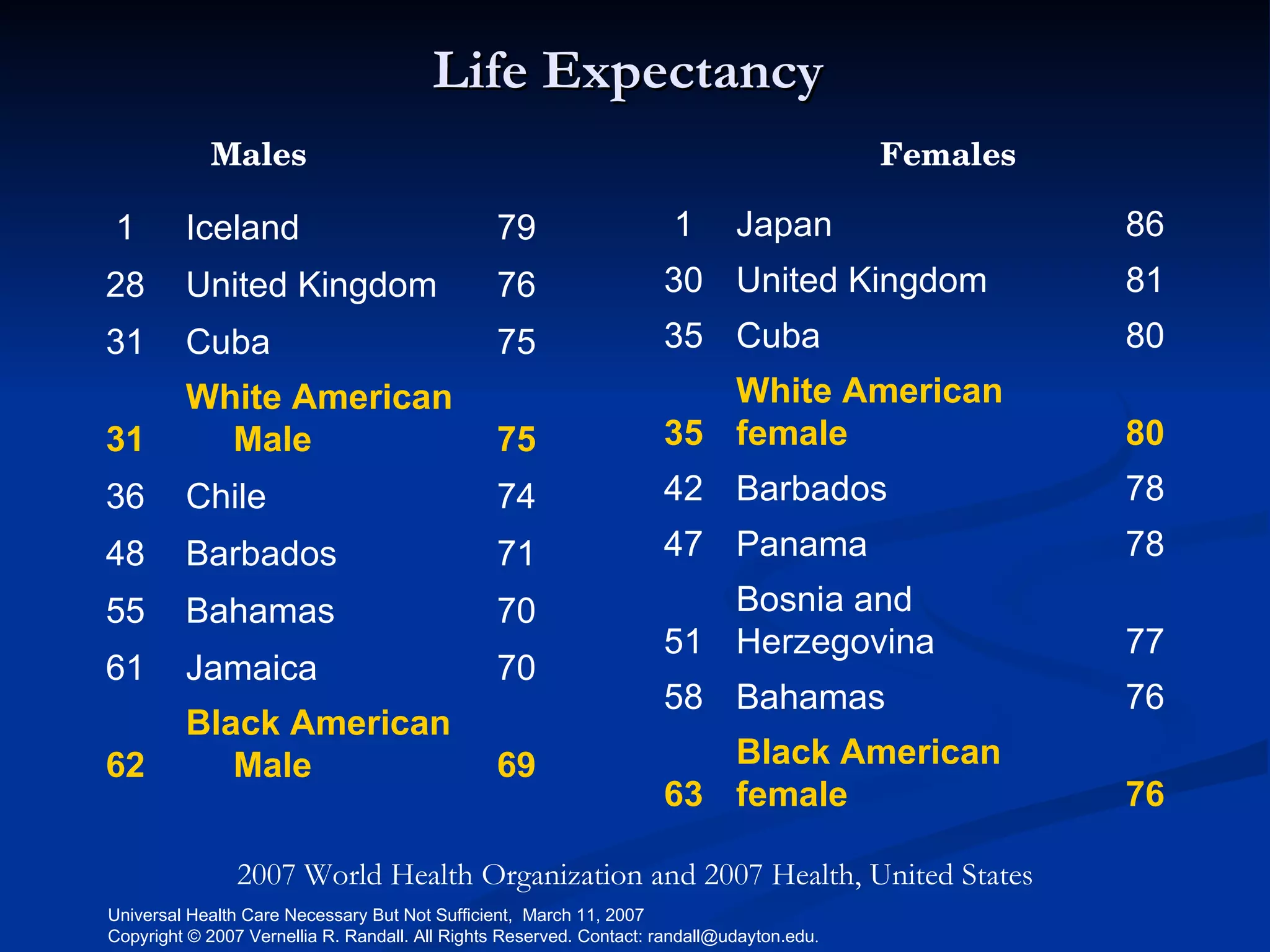
Life Expectancy  2007 World Health Organization and 2007 Health, United States Males  Females 1 Iceland 79 28 United Kingdom 76 31 Cuba 75 31 White American Male 75 36 Chile 74 48 Barbados 71 55 Bahamas 70 61 Jamaica 70 62 Black American Male 69 1 Japan 86 30 United Kingdom 81 35 Cuba 80 35 White American female 80 42 Barbados 78 47 Panama 78 51 Bosnia and Herzegovina 77 58 Bahamas 76 63 Black American female 76
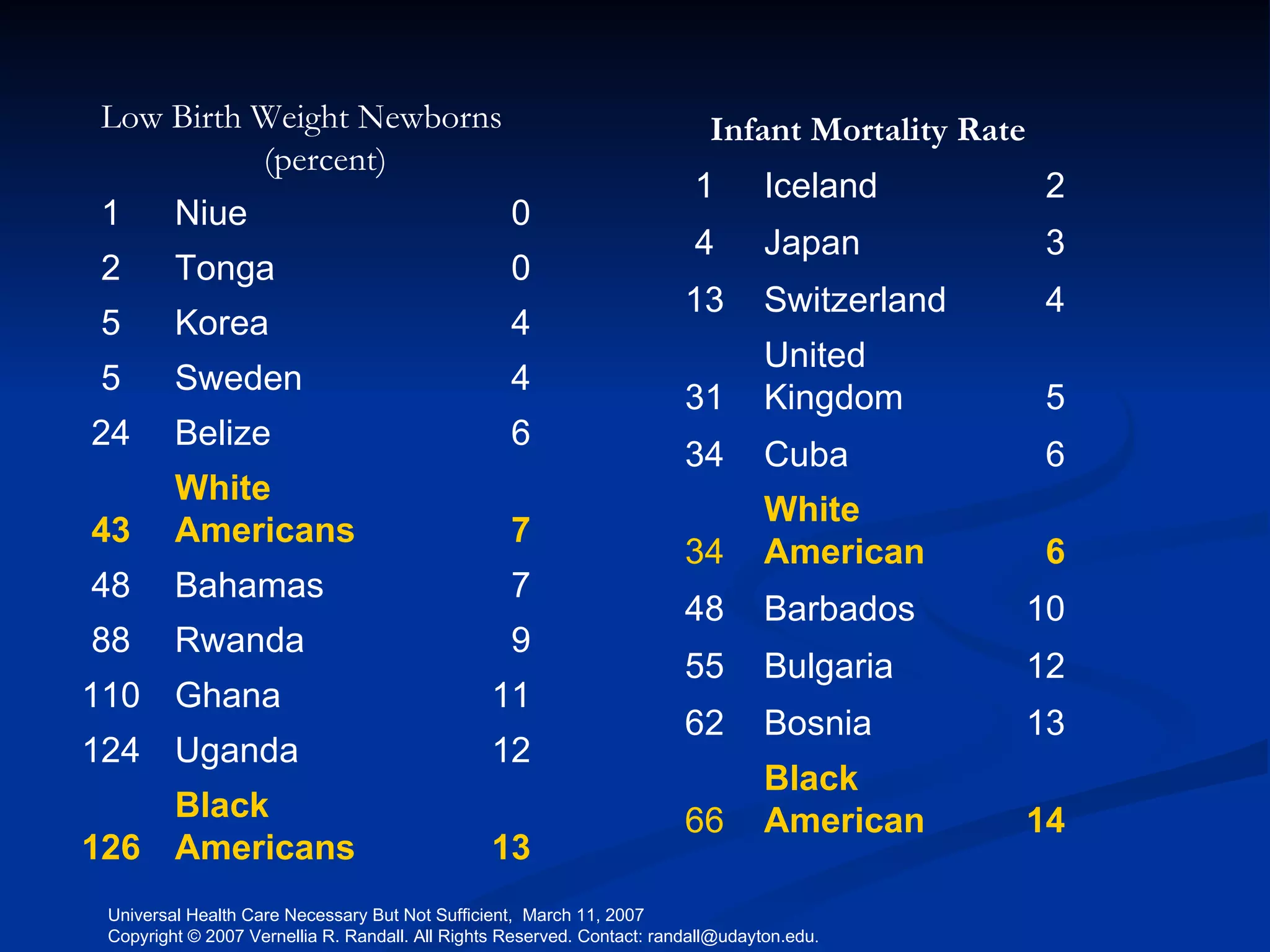
Low Birth Weight Newborns (percent) 1 Niue 0 2 Tonga 0 5 Korea 4 5 Sweden 4 24 Belize 6 43 White Americans 7 48 Bahamas 7 88 Rwanda 9 110 Ghana 11 124 Uganda 12 126 Black Americans 13 Infant Mortality Rate 1 Iceland 2 4 Japan 3 13 Switzerland 4 31 United Kingdom 5 34 Cuba 6 34 White American 6 48 Barbados 10 55 Bulgaria 12 62 Bosnia  13 66 Black American 14
Social Determinants of Health and Health Care
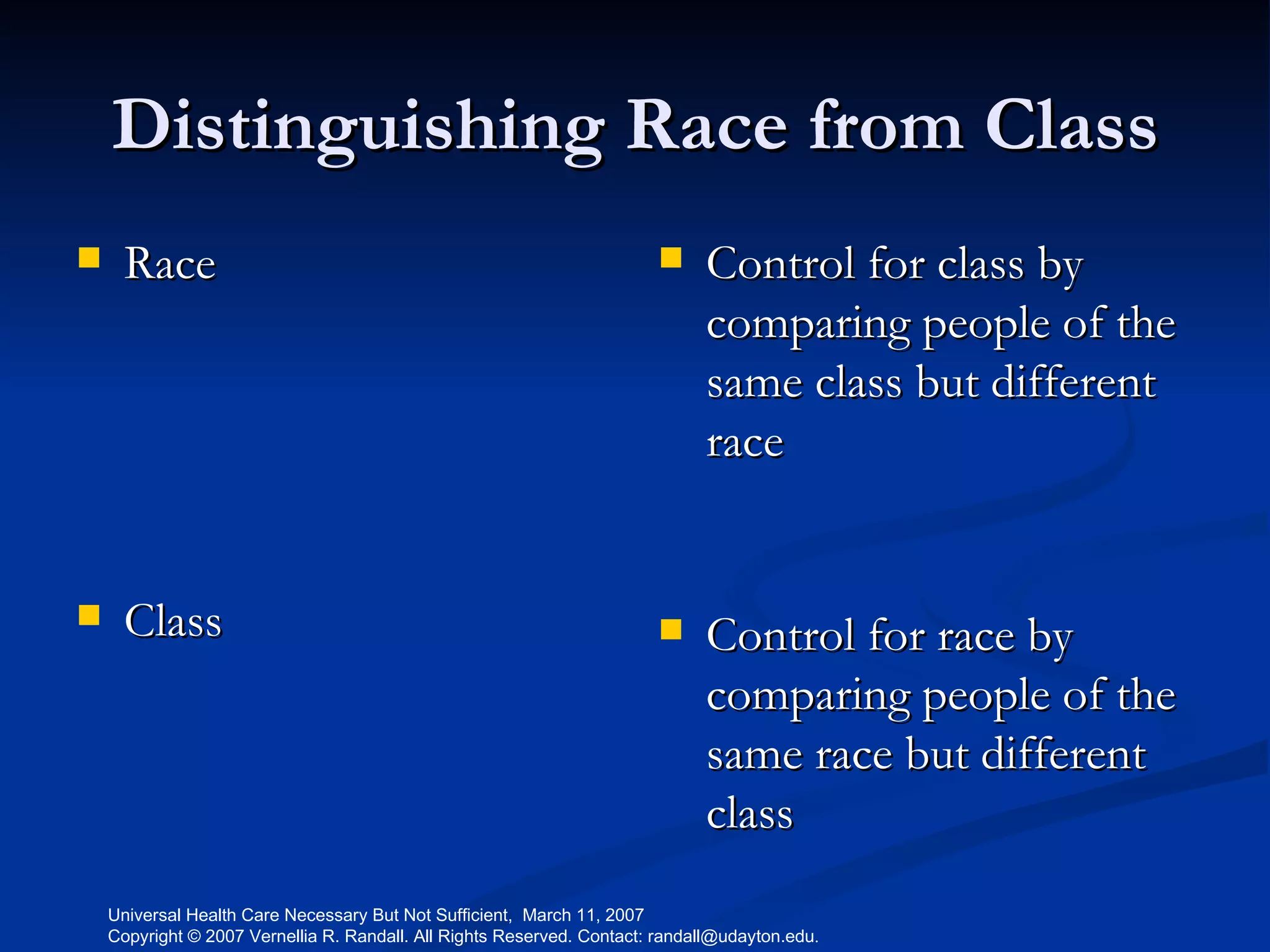
Distinguishing Race from Class Race Class Control for class by comparing people of the same class but different race Control for race by comparing people of the same race but different class
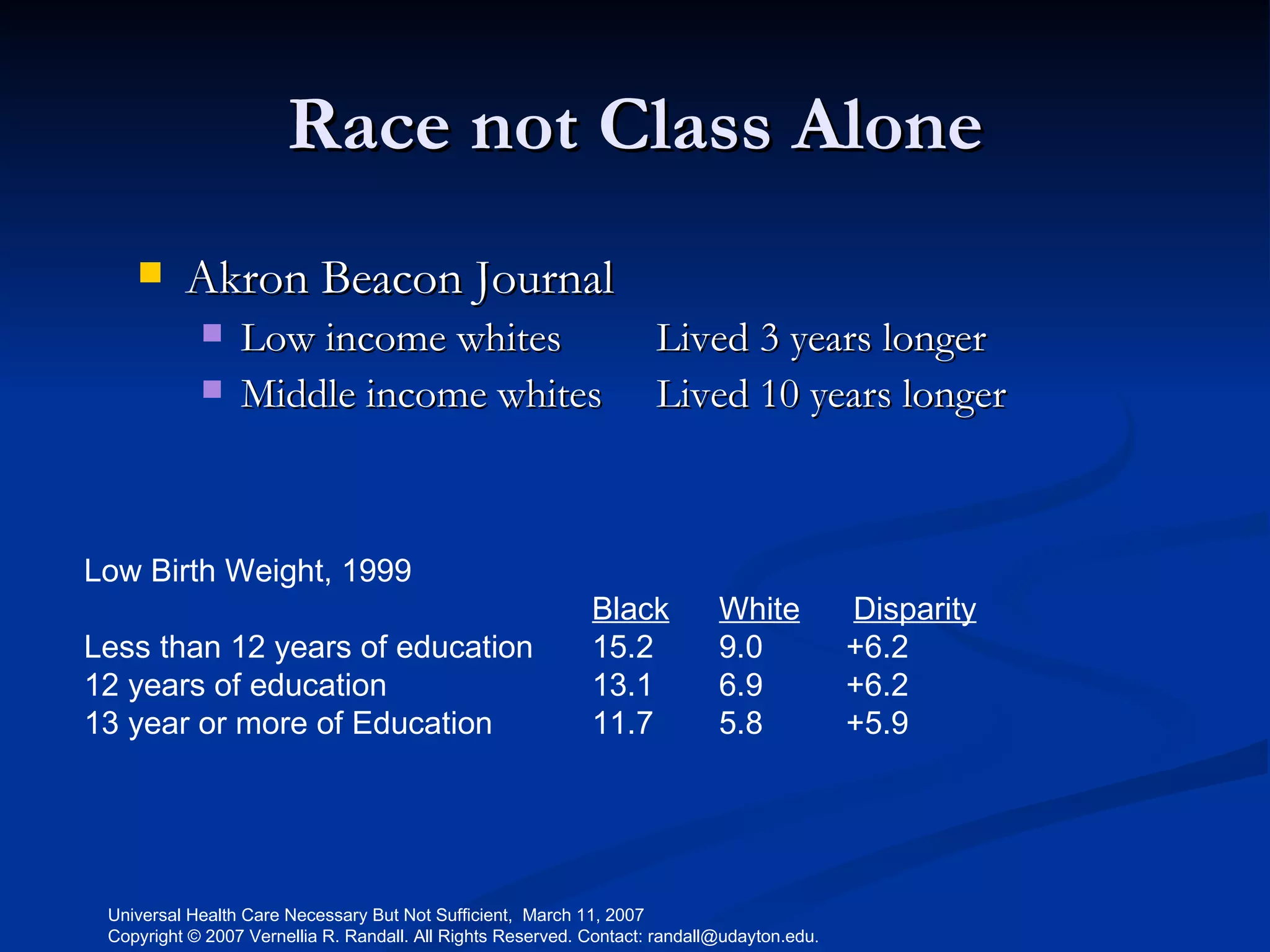
Race not Class Alone Akron Beacon Journal Low income whites  Lived 3 years longer Middle income whites   Lived 10 years longer Low Birth Weight, 1999 Black White   Disparity Less than 12 years of education 15.2 9.0 +6.2 12 years of education 13.1 6.9 +6.2 13 year or more of Education 11.7 5.8 +5.9
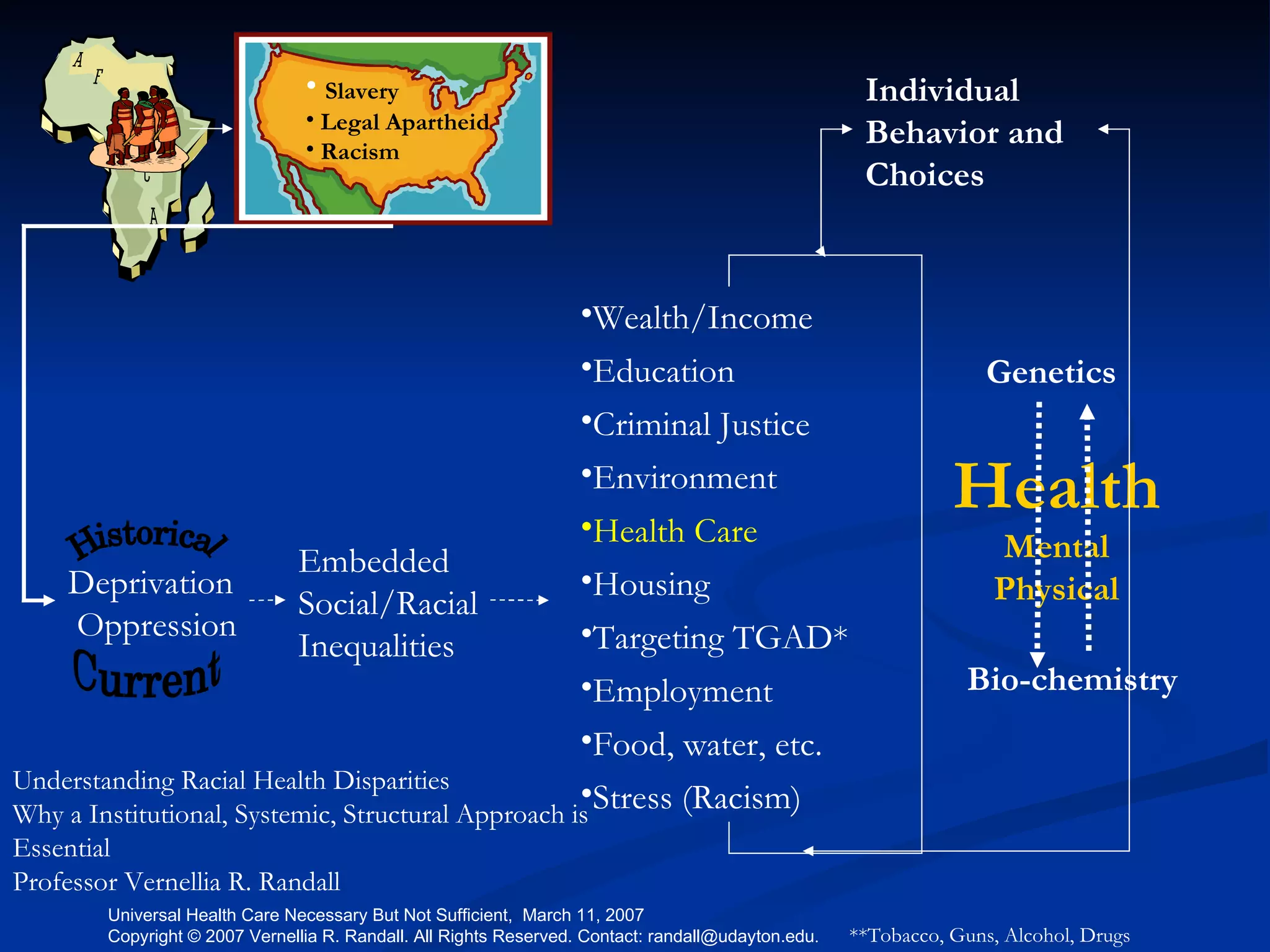
Historical Current Health Mental Physical Bio-chemistry Genetics Deprivation  Oppression Wealth/Income Education Criminal Justice Environment Health Care Housing Targeting TGAD* Employment Food, water, etc. Stress (Racism) Embedded Social/Racial Inequalities Individual Behavior and Choices Understanding Racial Health Disparities Why a Institutional, Systemic, Structural Approach is Essential Professor Vernellia R. Randall Slavery Legal Apartheid Racism **Tobacco, Guns, Alcohol, Drugs
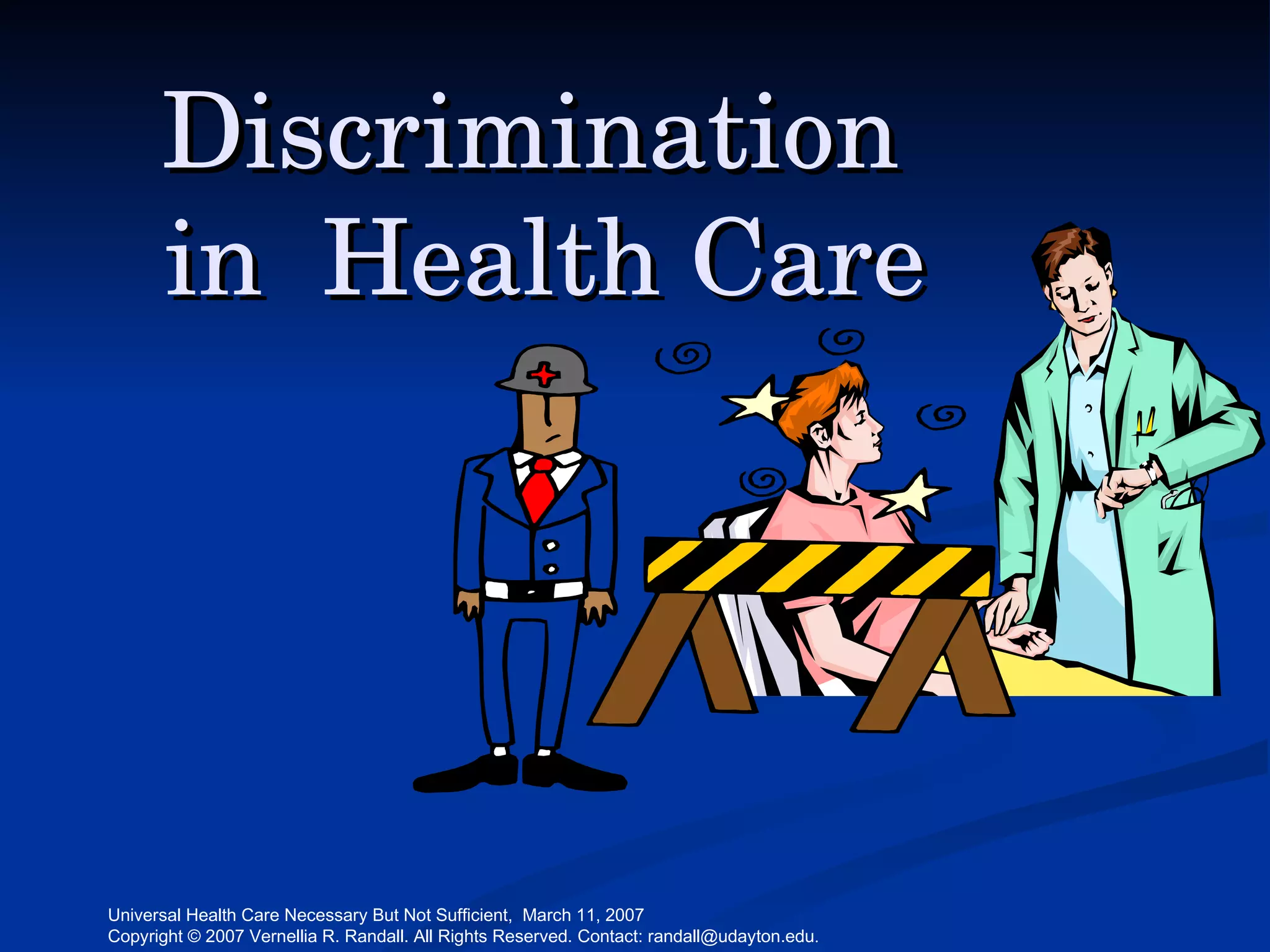
Discrimination  in  Health Care
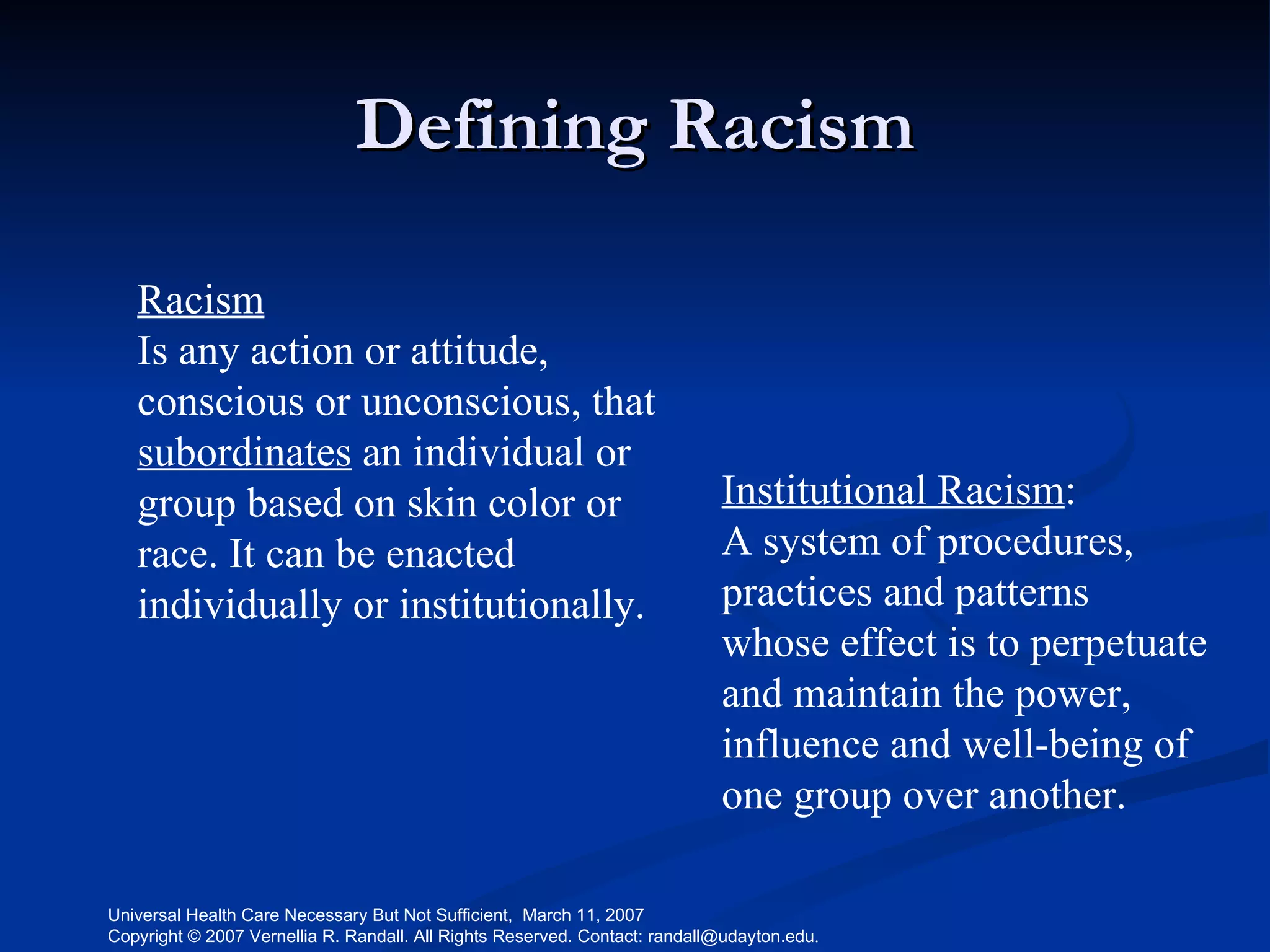
Defining Racism Racism Is any action or attitude, conscious or unconscious, that  subordinates  an individual or group based on skin color or race. It can be enacted individually or institutionally.   Institutional Racism : A system of procedures, practices and patterns  whose effect is to perpetuate and maintain the power, influence and well-being of one group over another.
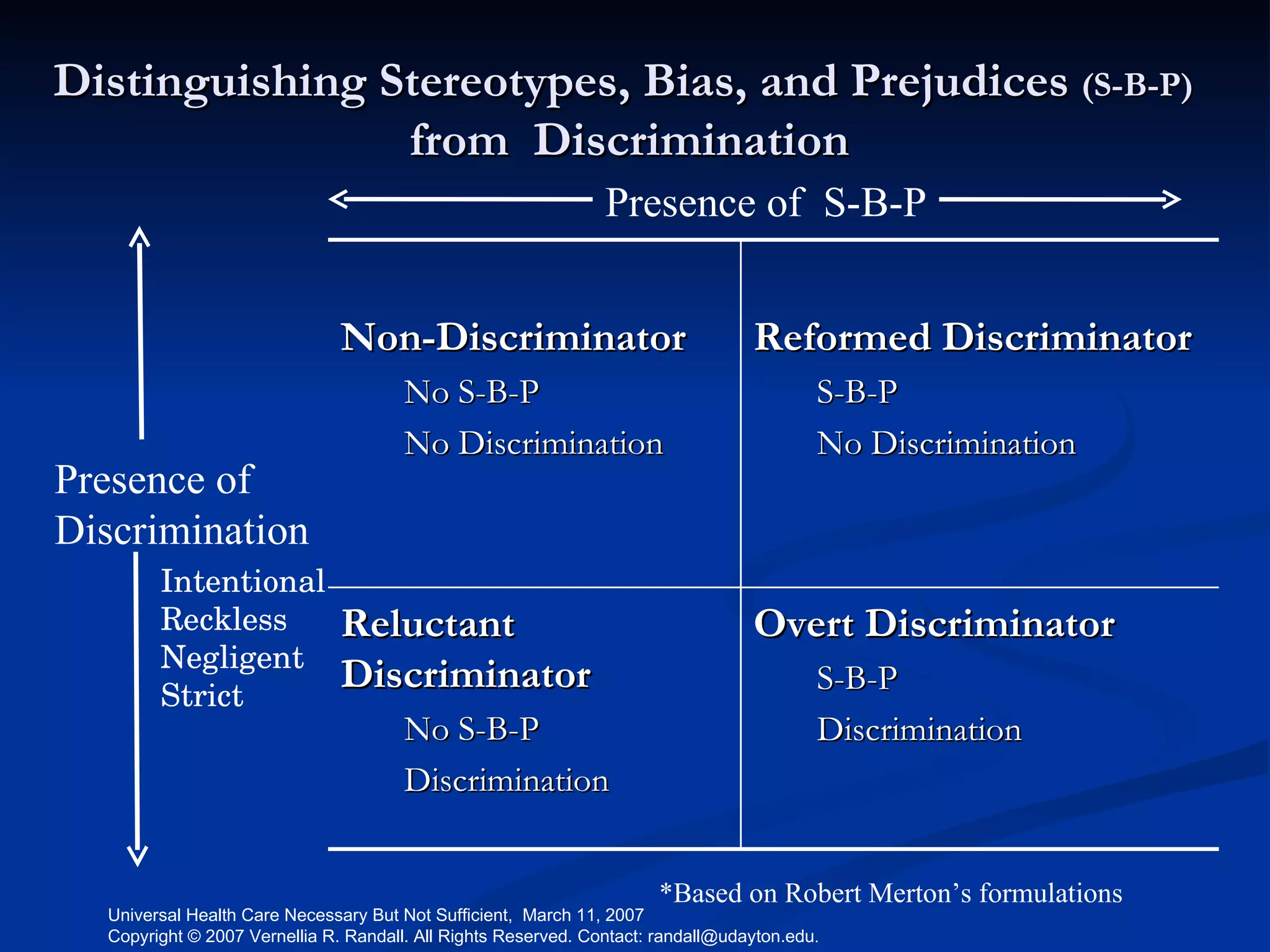
Distinguishing Stereotypes, Bias, and Prejudices  (S-B-P)  from  Discrimination Presence of Discrimination Presence of  S-B-P *Based on Robert Merton’s formulations Intentional Reckless Negligent Strict Non-Discriminator No S-B-P No Discrimination Reformed Discriminator S-B-P No Discrimination Reluctant Discriminator No S-B-P Discrimination Overt Discriminator S-B-P Discrimination
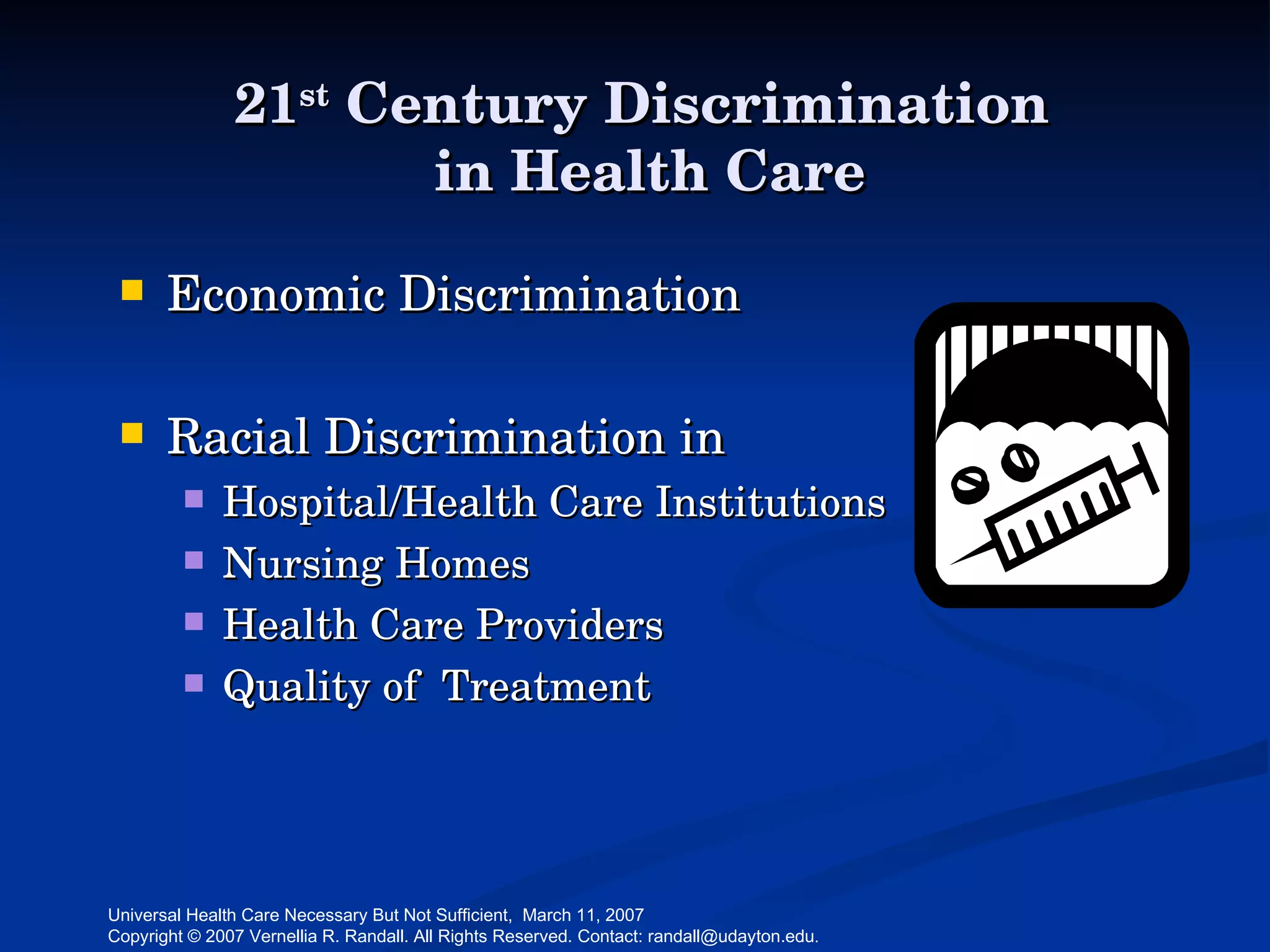
21 st  Century Discrimination  in Health Care Economic Discrimination Racial Discrimination in  Hospital/Health Care Institutions Nursing Homes Health Care Providers Quality of  Treatment
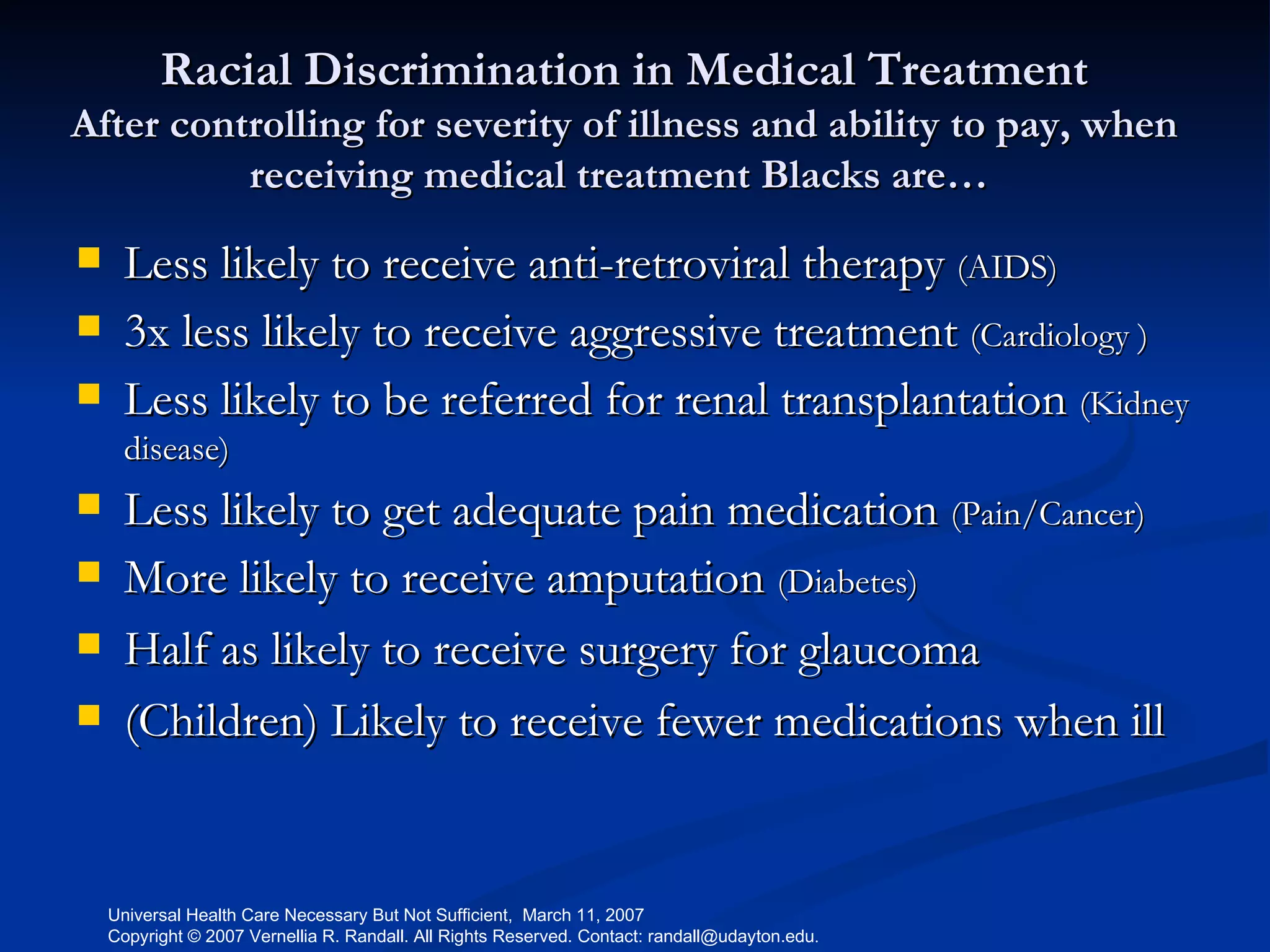
Racial Discrimination in Medical Treatment After controlling for severity of illness and ability to pay, when receiving medical treatment Blacks are…  Less likely to receive anti-retroviral therapy  (AIDS) 3x less likely to receive aggressive treatment  (Cardiology ) Less likely to be referred for renal transplantation  (Kidney disease) Less likely to get adequate pain medication  (Pain/Cancer) More likely to receive amputation  (Diabetes) Half as likely to receive surgery for glaucoma  (Children) Likely to receive fewer medications when ill
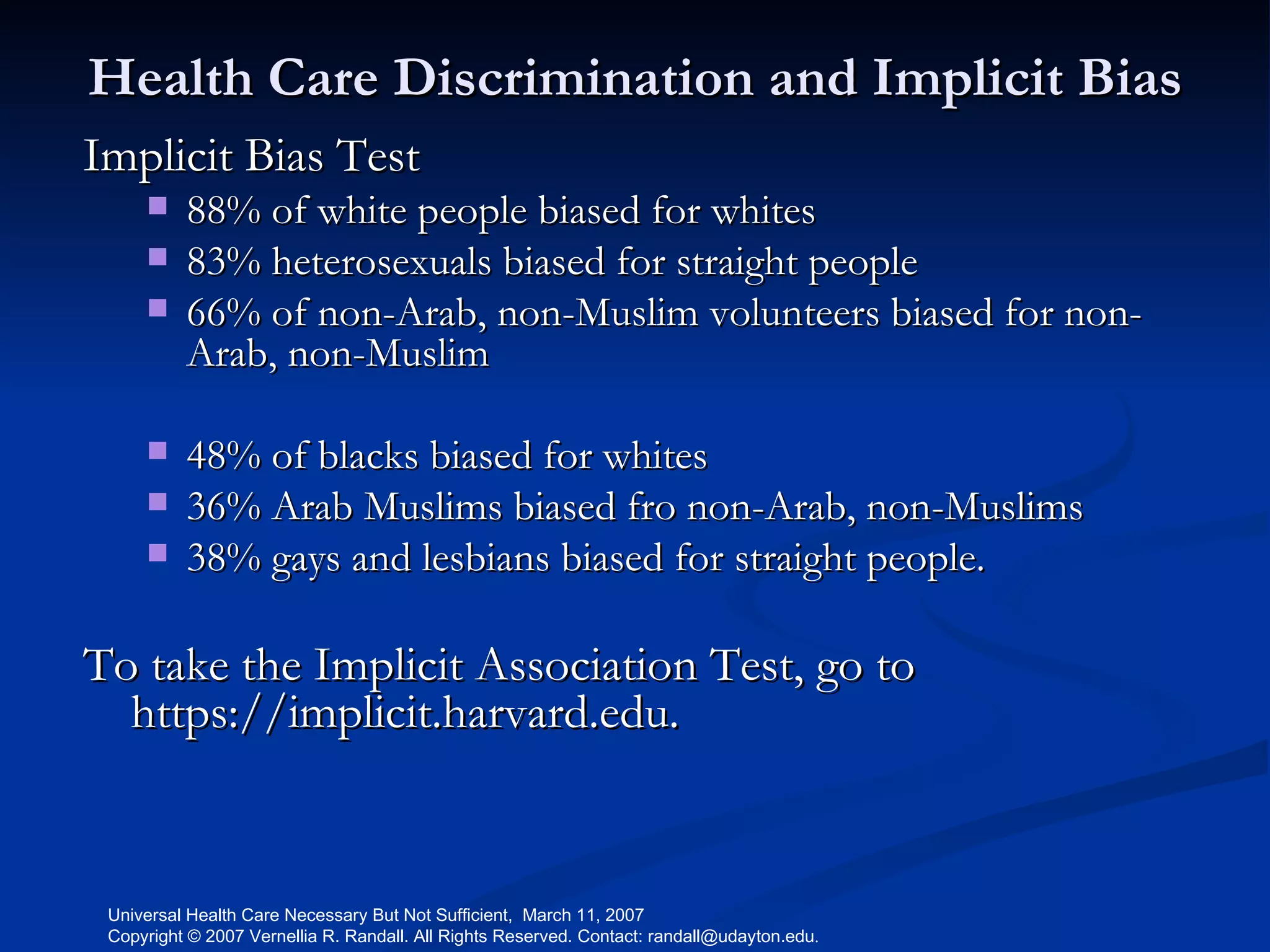
Health Care Discrimination and Implicit Bias Implicit Bias Test 88% of white people biased for whites 83% heterosexuals biased for straight people 66% of non-Arab, non-Muslim volunteers biased for non-Arab, non-Muslim 48% of blacks biased for whites  36% Arab Muslims biased fro non-Arab, non-Muslims  38% gays and lesbians biased for straight people. To take the Implicit Association Test, go to https://implicit.harvard.edu.
Essential Elements of an  Effective 21 st   Anti-discrimination Law
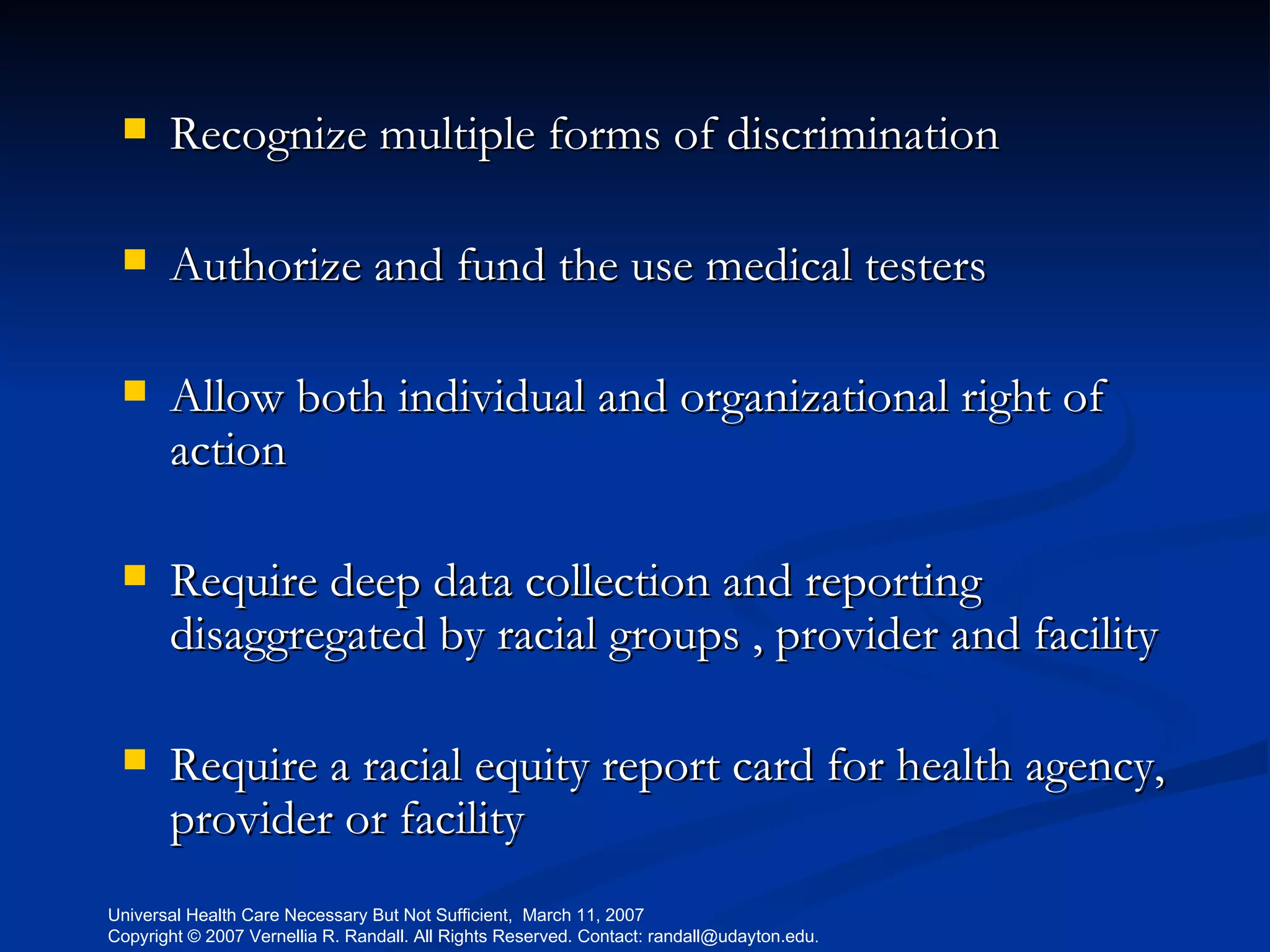
Recognize multiple forms of discrimination Authorize and fund the use medical testers Allow both individual and organizational right of action Require deep data collection and reporting disaggregated by racial groups , provider and facility Require a racial equity report card for health agency, provider or facility
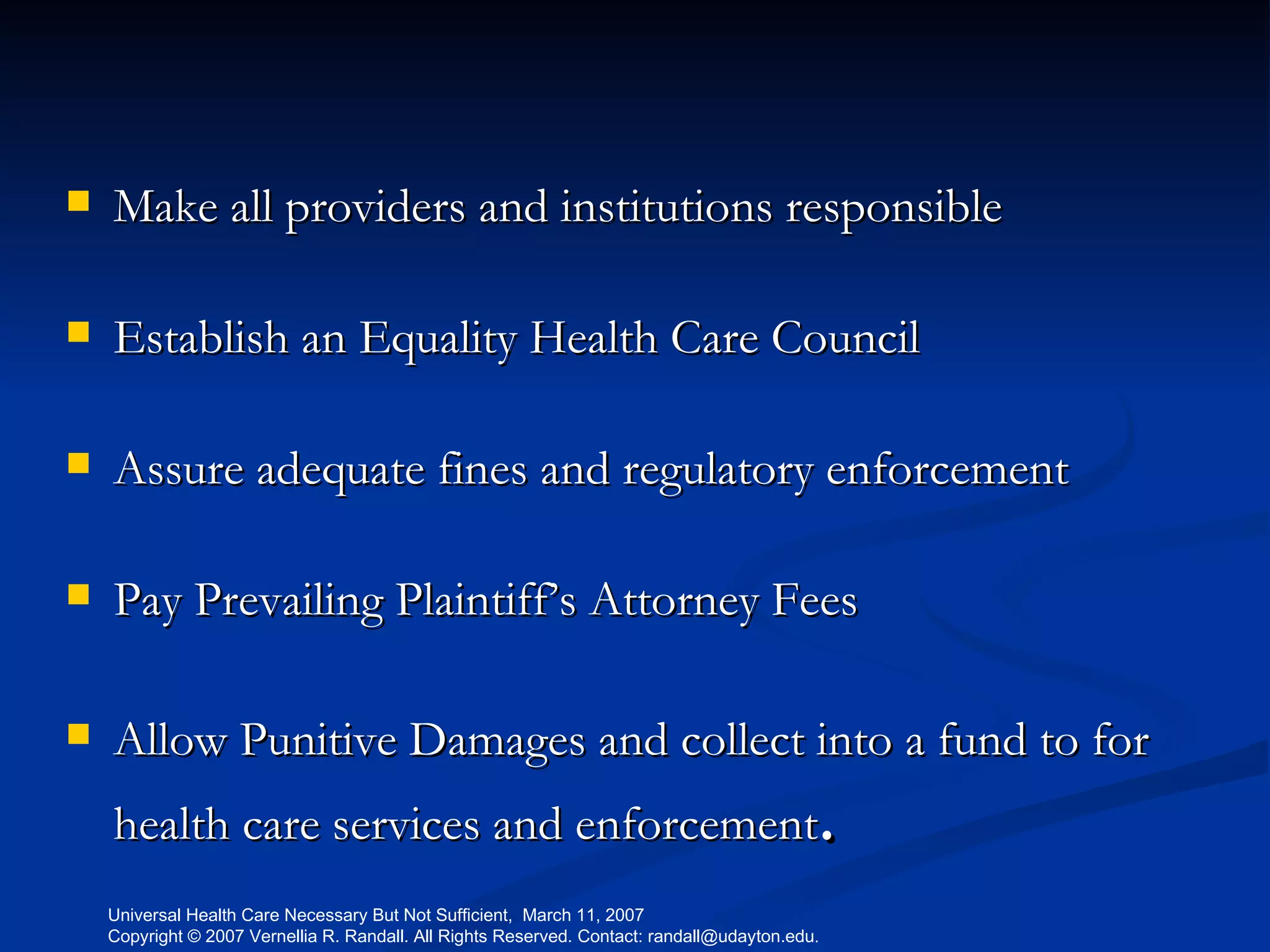
Make all providers and institutions responsible Establish an Equality Health Care Council Assure adequate fines and regulatory enforcement Pay Prevailing Plaintiff’s Attorney Fees Allow Punitive Damages and collect into a fund to for health care services and enforcement .
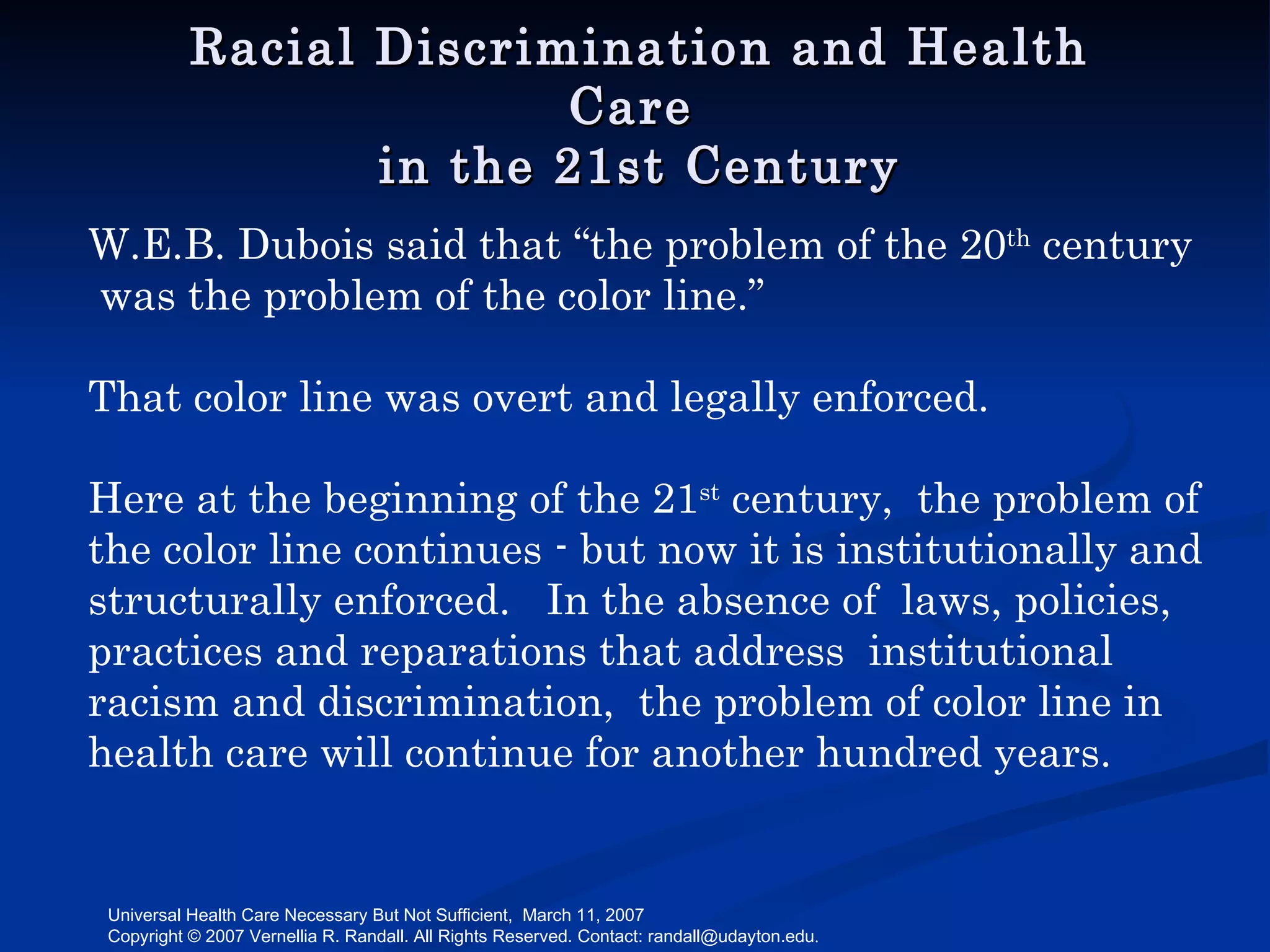
Racial Discrimination and Health Care  in the 21st Century W.E.B. Dubois said that “the problem of the 20 th  century  was the problem of the color line.” That color line was overt and legally enforced.  Here at the beginning of the 21 st  century,  the problem of the color line continues - but now it is institutionally and structurally enforced.  In the absence of  laws, policies, practices and reparations that address  institutional racism and discrimination,  the problem of color line in health care will continue for another hundred years.
Contact Information Vernellia R. Randall The University of Dayton  School of Law 300 College Park Dayton, OH 45469-2772 Email: randall@udayton.edu
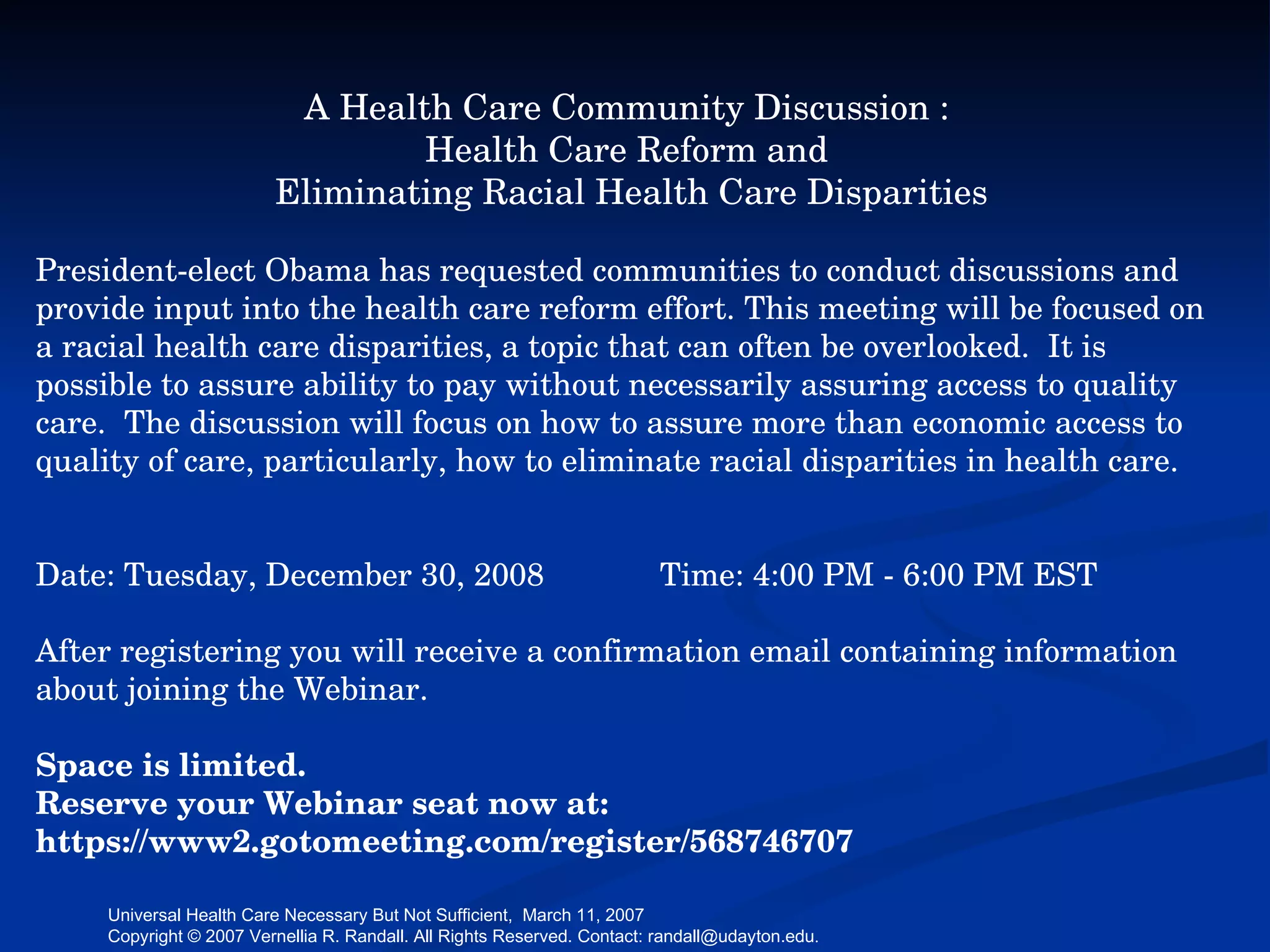
A Health Care Community Discussion :  Health Care Reform and  Eliminating Racial Health Care Disparities President-elect Obama has requested communities to conduct discussions and provide input into the health care reform effort. This meeting will be focused on a racial health care disparities, a topic that can often be overlooked.  It is possible to assure ability to pay without necessarily assuring access to quality care.  The discussion will focus on how to assure more than economic access to quality of care, particularly, how to eliminate racial disparities in health care. Date: Tuesday, December 30, 2008  Time: 4:00 PM - 6:00 PM EST After registering you will receive a confirmation email containing information about joining the Webinar. Space is limited. Reserve your Webinar seat now at: https://www2.gotomeeting.com/register/568746707

Case For Model State Anti Discrimination Act

  • 1.
    Eliminating RacialDiscrimination in Health Care A Model for State Civil Rights Law Vernellia R. Randall Professor of Law The University of Dayton School of Law
  • 2.
    Inequality isKilling Us.
  • 3.
    Life Expectancy 2007 World Health Organization and 2007 Health, United States Males Females 1 Iceland 79 28 United Kingdom 76 31 Cuba 75 31 White American Male 75 36 Chile 74 48 Barbados 71 55 Bahamas 70 61 Jamaica 70 62 Black American Male 69 1 Japan 86 30 United Kingdom 81 35 Cuba 80 35 White American female 80 42 Barbados 78 47 Panama 78 51 Bosnia and Herzegovina 77 58 Bahamas 76 63 Black American female 76
  • 4.
    Low Birth WeightNewborns (percent) 1 Niue 0 2 Tonga 0 5 Korea 4 5 Sweden 4 24 Belize 6 43 White Americans 7 48 Bahamas 7 88 Rwanda 9 110 Ghana 11 124 Uganda 12 126 Black Americans 13 Infant Mortality Rate 1 Iceland 2 4 Japan 3 13 Switzerland 4 31 United Kingdom 5 34 Cuba 6 34 White American 6 48 Barbados 10 55 Bulgaria 12 62 Bosnia 13 66 Black American 14
  • 5.
    Social Determinants ofHealth and Health Care
  • 6.
    Distinguishing Race fromClass Race Class Control for class by comparing people of the same class but different race Control for race by comparing people of the same race but different class
  • 7.
    Race not ClassAlone Akron Beacon Journal Low income whites Lived 3 years longer Middle income whites Lived 10 years longer Low Birth Weight, 1999 Black White Disparity Less than 12 years of education 15.2 9.0 +6.2 12 years of education 13.1 6.9 +6.2 13 year or more of Education 11.7 5.8 +5.9
  • 8.
    Historical Current HealthMental Physical Bio-chemistry Genetics Deprivation Oppression Wealth/Income Education Criminal Justice Environment Health Care Housing Targeting TGAD* Employment Food, water, etc. Stress (Racism) Embedded Social/Racial Inequalities Individual Behavior and Choices Understanding Racial Health Disparities Why a Institutional, Systemic, Structural Approach is Essential Professor Vernellia R. Randall Slavery Legal Apartheid Racism **Tobacco, Guns, Alcohol, Drugs
  • 9.
    Discrimination in Health Care
  • 10.
    Defining Racism RacismIs any action or attitude, conscious or unconscious, that subordinates an individual or group based on skin color or race. It can be enacted individually or institutionally. Institutional Racism : A system of procedures, practices and patterns whose effect is to perpetuate and maintain the power, influence and well-being of one group over another.
  • 11.
    Distinguishing Stereotypes, Bias,and Prejudices (S-B-P) from Discrimination Presence of Discrimination Presence of S-B-P *Based on Robert Merton’s formulations Intentional Reckless Negligent Strict Non-Discriminator No S-B-P No Discrimination Reformed Discriminator S-B-P No Discrimination Reluctant Discriminator No S-B-P Discrimination Overt Discriminator S-B-P Discrimination
  • 12.
    21 st Century Discrimination in Health Care Economic Discrimination Racial Discrimination in Hospital/Health Care Institutions Nursing Homes Health Care Providers Quality of Treatment
  • 13.
    Racial Discrimination inMedical Treatment After controlling for severity of illness and ability to pay, when receiving medical treatment Blacks are… Less likely to receive anti-retroviral therapy (AIDS) 3x less likely to receive aggressive treatment (Cardiology ) Less likely to be referred for renal transplantation (Kidney disease) Less likely to get adequate pain medication (Pain/Cancer) More likely to receive amputation (Diabetes) Half as likely to receive surgery for glaucoma (Children) Likely to receive fewer medications when ill
  • 14.
    Health Care Discriminationand Implicit Bias Implicit Bias Test 88% of white people biased for whites 83% heterosexuals biased for straight people 66% of non-Arab, non-Muslim volunteers biased for non-Arab, non-Muslim 48% of blacks biased for whites 36% Arab Muslims biased fro non-Arab, non-Muslims 38% gays and lesbians biased for straight people. To take the Implicit Association Test, go to https://implicit.harvard.edu.
  • 15.
    Essential Elements ofan Effective 21 st Anti-discrimination Law
  • 16.
    Recognize multiple formsof discrimination Authorize and fund the use medical testers Allow both individual and organizational right of action Require deep data collection and reporting disaggregated by racial groups , provider and facility Require a racial equity report card for health agency, provider or facility
  • 17.
    Make all providersand institutions responsible Establish an Equality Health Care Council Assure adequate fines and regulatory enforcement Pay Prevailing Plaintiff’s Attorney Fees Allow Punitive Damages and collect into a fund to for health care services and enforcement .
  • 18.
    Racial Discrimination andHealth Care in the 21st Century W.E.B. Dubois said that “the problem of the 20 th century was the problem of the color line.” That color line was overt and legally enforced. Here at the beginning of the 21 st century, the problem of the color line continues - but now it is institutionally and structurally enforced. In the absence of laws, policies, practices and reparations that address institutional racism and discrimination, the problem of color line in health care will continue for another hundred years.
  • 19.
    Contact Information VernelliaR. Randall The University of Dayton School of Law 300 College Park Dayton, OH 45469-2772 Email: randall@udayton.edu
  • 20.
    A Health CareCommunity Discussion : Health Care Reform and Eliminating Racial Health Care Disparities President-elect Obama has requested communities to conduct discussions and provide input into the health care reform effort. This meeting will be focused on a racial health care disparities, a topic that can often be overlooked. It is possible to assure ability to pay without necessarily assuring access to quality care. The discussion will focus on how to assure more than economic access to quality of care, particularly, how to eliminate racial disparities in health care. Date: Tuesday, December 30, 2008 Time: 4:00 PM - 6:00 PM EST After registering you will receive a confirmation email containing information about joining the Webinar. Space is limited. Reserve your Webinar seat now at: https://www2.gotomeeting.com/register/568746707