By Glen Poole, Development Officer, AMHF
The Social Factors that Shape Men’s
Health
2
The peak body for male
health in Australia focusing
on the social issues that
shape men and boys’ health
and wellbeing.
What is the Australian Men’s Health Forum?
3
“Those most at risk of premature death and illness include Indigenous
males, males from rural and remote areas; those with blue collar
backgrounds; males with mental illness; war veterans; gay,
transgender and intersex people; males with disabilities; socially
isolated and non-English speaking males.”
Male health in Australia, a call to action (AMHF position paper 2016)
We care about men in all their diversity
4
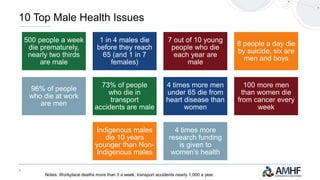
500 people a week
die prematurely,
nearly two thirds
are male
1 in 4 males die
before they reach
65 (and 1 in 7
females)
7 out of 10 young
people who die
each year are
male
8 people a day die
by suicide, six are
men and boys
96% of people
who die at work
are men
73% of people
who die in
transport
accidents are male
4 times more men
under 65 die from
heart disease than
women
100 more men
than women die
from cancer every
week
Indigenous males
die 10 years
younger than Non-
Indigenous males
4 times more
research funding
is given to
women’s health
10 Top Male Health Issues
Notes: Workplace deaths more than 3 a week; transport accidents nearly 1,000 a year.
5
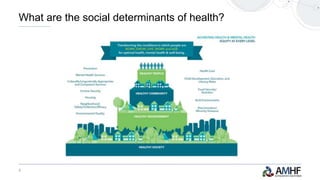
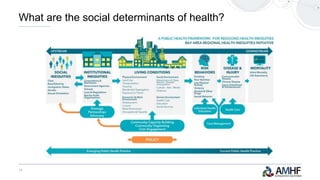
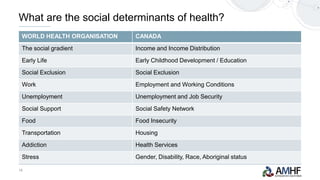
What are the social determinants of health?
6
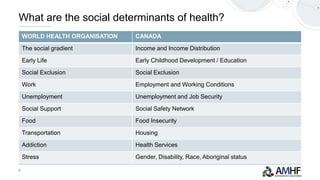
WORLD HEALTH ORGANISATION CANADA
The social gradient Income and Income Distribution
Early Life Early Childhood Development / Education
Social Exclusion Social Exclusion
Work Employment and Working Conditions
Unemployment Unemployment and Job Security
Social Support Social Safety Network
Food Food Insecurity
Transportation Housing
Addiction Health Services
Stress Gender, Disability, Race, Aboriginal status
What are the social determinants of health?
7
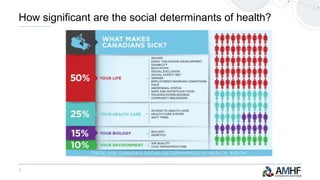
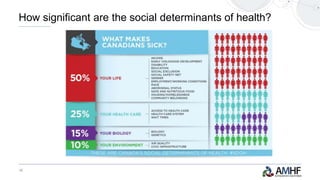
How significant are the social determinants of health?
ABS 4102.0: Australian Social Trends , Mar 20118
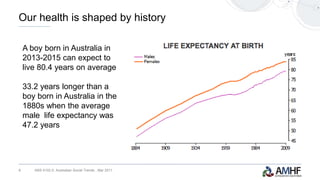
Our health is shaped by history
A boy born in Australia in
2013-2015 can expect to
live 80.4 years on average
33.2 years longer than a
boy born in Australia in the
1880s when the average
male life expectancy was
47.2 years
"World Health Statistics 2016: Monitoring health for the SDGs Annex B: tables of health statistics by country, WHO region and globally"9
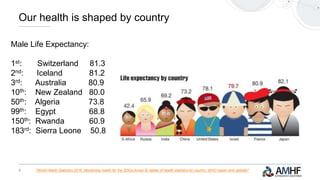
Our health is shaped by country
Male Life Expectancy:
1st: Switzerland 81.3
2nd: Iceland 81.2
3rd: Australia 80.9
10th: New Zealand 80.0
50th: Algeria 73.8
99th: Egypt 68.8
150th: Rwanda 60.9
183rd: Sierra Leone 50.8
OECD Regional Statistics (database) in Regions at a Glance 2016; ABS 3302.0.55.003 - Life Tables for Aboriginal and Torres Strait Islander
Australians, 2010-2012; ABS 1370.0 - Measures of Australia's Progress, 2010; AIHW The Health of Australian Males 2017
10
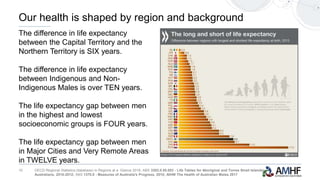
Our health is shaped by region and background
The difference in life expectancy
between the Capital Territory and the
Northern Territory is SIX years.
The difference in life expectancy
between Indigenous and Non-
Indigenous Males is over TEN years.
The life expectancy gap between men
in the highest and lowest
socioeconomic groups is FOUR years.
The life expectancy gap between men
in Major Cities and Very Remote Areas
in TWELVE years.
11
What are the social determinants of health?
12
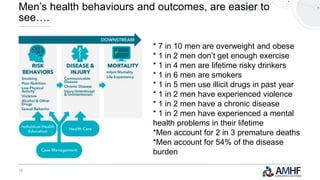
Men’s health behaviours and outcomes, are easier to
see….
* 7 in 10 men are overweight and obese
* 1 in 2 men don’t get enough exercise
* 1 in 4 men are lifetime risky drinkers
* 1 in 6 men are smokers
* 1 in 5 men use illicit drugs in past year
* 1 in 2 men have experienced violence
* 1 in 2 men have a chronic disease
* 1 in 2 men have experienced a mental
health problems in their lifetime
*Men account for 2 in 3 premature deaths
*Men account for 54% of the disease
burden
13
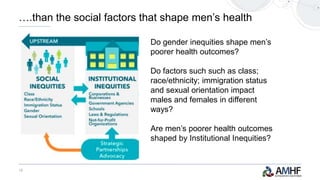
….than the social factors that shape men’s health
Do gender inequities shape men’s
poorer health outcomes?
Do factors such such as class;
race/ethnicity; immigration status
and sexual orientation impact
males and females in different
ways?
Are men’s poorer health outcomes
shaped by Institutional Inequities?
14
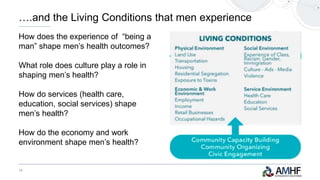
….and the Living Conditions that men experience
How does the experience of “being a
man” shape men’s health outcomes?
What role does culture play a role in
shaping men’s health?
How do services (health care,
education, social services) shape
men’s health?
How do the economy and work
environment shape men’s health?
15
WORLD HEALTH ORGANISATION CANADA
The social gradient Income and Income Distribution
Early Life Early Childhood Development / Education
Social Exclusion Social Exclusion
Work Employment and Working Conditions
Unemployment Unemployment and Job Security
Social Support Social Safety Network
Food Food Insecurity
Transportation Housing
Addiction Health Services
Stress Gender, Disability, Race, Aboriginal status
What are the social determinants of health?
16
How significant are the social determinants of health?
17
Boys'
Education Fatherhood
Work
Social
Isolation
Access to
services
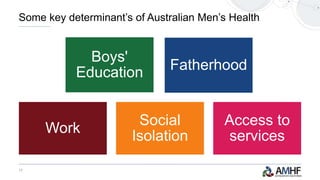
Some key determinant’s of Australian Men’s Health
18
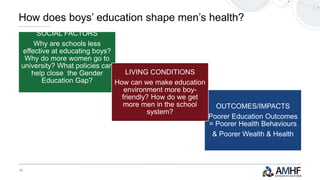
SOCIAL FACTORS
Why are schools less
effective at educating boys?
Why do more women go to
university? What policies can
help close the Gender
Education Gap?
OUTCOMES/IMPACTS
Poorer Education Outcomes
= Poorer Health Behaviours
& Poorer Wealth & Health
LIVING CONDITIONS
How can we make education
environment more boy-
friendly? How do we get
more men in the school
system?
How does boys’ education shape men’s health?
19
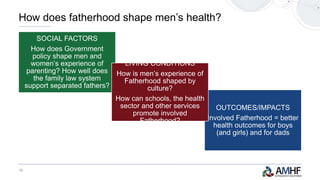
SOCIAL FACTORS
How does Government
policy shape men and
women’s experience of
parenting? How well does
the family law system
support separated fathers?
OUTCOMES/IMPACTS
Involved Fatherhood = better
health outcomes for boys
(and girls) and for dads
LIVING CONDITIONS
How is men’s experience of
Fatherhood shaped by
culture?
How can schools, the health
sector and other services
promote involved
Fatherhood?
How does fatherhood shape men’s health?
20
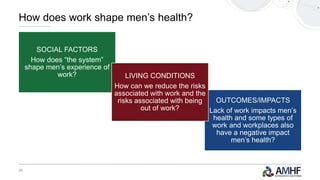
SOCIAL FACTORS
How does “the system”
shape men’s experience of
work?
OUTCOMES/IMPACTS
Lack of work impacts men’s
health and some types of
work and workplaces also
have a negative impact
men’s health?
LIVING CONDITIONS
How can we reduce the risks
associated with work and the
risks associated with being
out of work?
How does work shape men’s health?
21
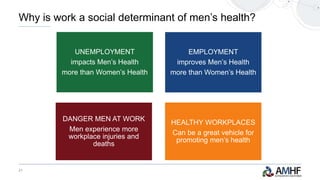
UNEMPLOYMENT
impacts Men’s Health
more than Women’s Health
EMPLOYMENT
improves Men’s Health
more than Women’s Health
DANGER MEN AT WORK
Men experience more
workplace injuries and
deaths
HEALTHY WORKPLACES
Can be a great vehicle for
promoting men’s health
Why is work a social determinant of men’s health?
22
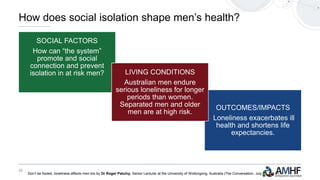
SOCIAL FACTORS
How can “the system”
promote and social
connection and prevent
isolation in at risk men?
OUTCOMES/IMPACTS
Loneliness exacerbates ill
health and shortens life
expectancies.
LIVING CONDITIONS
Australian men endure
serious loneliness for longer
periods than women.
Separated men and older
men are at high risk.
How does social isolation shape men’s health?
Don’t be fooled, loneliness affects men too by Dr Roger Patulny, Senior Lecturer at the University of Wollongong, Australia (The Conversation, July 11, 2013 )
23
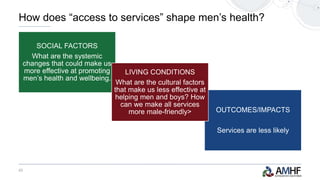
SOCIAL FACTORS
What are the systemic
changes that could make us
more effective at promoting
men’s health and wellbeing.
OUTCOMES/IMPACTS
Services are less likely
LIVING CONDITIONS
What are the cultural factors
that make us less effective at
helping men and boys? How
can we make all services
more male-friendly>
How does “access to services” shape men’s health?
24
•Developing our resources and information
about the social factors that shape men’s
health.
•Raising awareness, knowledge and
understanding of men and boys’ health issues
among politicians, the health sector, the
media and the general public.
•Building our national network of people
concerned about and committed to improving
Some key things AMHF is doing…..
25
•Develop your understanding of the key issues
affecting men and boys and the social factors
that shape those issues
•Be an advocate for men and boys in you
organisation, local area and/or state
•Sign up for the AMHF newsletter, read it and
pass it on to others
Some things you can do……
Any questions?
Who
What
When
Where
Why
How
27
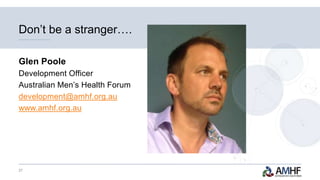
Don’t be a stranger….
Glen Poole
Development Officer
Australian Men’s Health Forum
development@amhf.org.au
www.amhf.org.au

Men's Resources Tasmania AGM

  • 1.
    By Glen Poole,Development Officer, AMHF The Social Factors that Shape Men’s Health
  • 2.
    2 The peak bodyfor male health in Australia focusing on the social issues that shape men and boys’ health and wellbeing. What is the Australian Men’s Health Forum?
  • 3.
    3 “Those most atrisk of premature death and illness include Indigenous males, males from rural and remote areas; those with blue collar backgrounds; males with mental illness; war veterans; gay, transgender and intersex people; males with disabilities; socially isolated and non-English speaking males.” Male health in Australia, a call to action (AMHF position paper 2016) We care about men in all their diversity
  • 4.
    4 500 people aweek die prematurely, nearly two thirds are male 1 in 4 males die before they reach 65 (and 1 in 7 females) 7 out of 10 young people who die each year are male 8 people a day die by suicide, six are men and boys 96% of people who die at work are men 73% of people who die in transport accidents are male 4 times more men under 65 die from heart disease than women 100 more men than women die from cancer every week Indigenous males die 10 years younger than Non- Indigenous males 4 times more research funding is given to women’s health 10 Top Male Health Issues Notes: Workplace deaths more than 3 a week; transport accidents nearly 1,000 a year.
  • 5.
    5 What are thesocial determinants of health?
  • 6.
    6 WORLD HEALTH ORGANISATIONCANADA The social gradient Income and Income Distribution Early Life Early Childhood Development / Education Social Exclusion Social Exclusion Work Employment and Working Conditions Unemployment Unemployment and Job Security Social Support Social Safety Network Food Food Insecurity Transportation Housing Addiction Health Services Stress Gender, Disability, Race, Aboriginal status What are the social determinants of health?
  • 7.
    7 How significant arethe social determinants of health?
  • 8.
    ABS 4102.0: AustralianSocial Trends , Mar 20118 Our health is shaped by history A boy born in Australia in 2013-2015 can expect to live 80.4 years on average 33.2 years longer than a boy born in Australia in the 1880s when the average male life expectancy was 47.2 years
  • 9.
    "World Health Statistics2016: Monitoring health for the SDGs Annex B: tables of health statistics by country, WHO region and globally"9 Our health is shaped by country Male Life Expectancy: 1st: Switzerland 81.3 2nd: Iceland 81.2 3rd: Australia 80.9 10th: New Zealand 80.0 50th: Algeria 73.8 99th: Egypt 68.8 150th: Rwanda 60.9 183rd: Sierra Leone 50.8
  • 10.
    OECD Regional Statistics(database) in Regions at a Glance 2016; ABS 3302.0.55.003 - Life Tables for Aboriginal and Torres Strait Islander Australians, 2010-2012; ABS 1370.0 - Measures of Australia's Progress, 2010; AIHW The Health of Australian Males 2017 10 Our health is shaped by region and background The difference in life expectancy between the Capital Territory and the Northern Territory is SIX years. The difference in life expectancy between Indigenous and Non- Indigenous Males is over TEN years. The life expectancy gap between men in the highest and lowest socioeconomic groups is FOUR years. The life expectancy gap between men in Major Cities and Very Remote Areas in TWELVE years.
  • 11.
    11 What are thesocial determinants of health?
  • 12.
    12 Men’s health behavioursand outcomes, are easier to see…. * 7 in 10 men are overweight and obese * 1 in 2 men don’t get enough exercise * 1 in 4 men are lifetime risky drinkers * 1 in 6 men are smokers * 1 in 5 men use illicit drugs in past year * 1 in 2 men have experienced violence * 1 in 2 men have a chronic disease * 1 in 2 men have experienced a mental health problems in their lifetime *Men account for 2 in 3 premature deaths *Men account for 54% of the disease burden
  • 13.
    13 ….than the socialfactors that shape men’s health Do gender inequities shape men’s poorer health outcomes? Do factors such such as class; race/ethnicity; immigration status and sexual orientation impact males and females in different ways? Are men’s poorer health outcomes shaped by Institutional Inequities?
  • 14.
    14 ….and the LivingConditions that men experience How does the experience of “being a man” shape men’s health outcomes? What role does culture play a role in shaping men’s health? How do services (health care, education, social services) shape men’s health? How do the economy and work environment shape men’s health?
  • 15.
    15 WORLD HEALTH ORGANISATIONCANADA The social gradient Income and Income Distribution Early Life Early Childhood Development / Education Social Exclusion Social Exclusion Work Employment and Working Conditions Unemployment Unemployment and Job Security Social Support Social Safety Network Food Food Insecurity Transportation Housing Addiction Health Services Stress Gender, Disability, Race, Aboriginal status What are the social determinants of health?
  • 16.
    16 How significant arethe social determinants of health?
  • 17.
  • 18.
    18 SOCIAL FACTORS Why areschools less effective at educating boys? Why do more women go to university? What policies can help close the Gender Education Gap? OUTCOMES/IMPACTS Poorer Education Outcomes = Poorer Health Behaviours & Poorer Wealth & Health LIVING CONDITIONS How can we make education environment more boy- friendly? How do we get more men in the school system? How does boys’ education shape men’s health?
  • 19.
    19 SOCIAL FACTORS How doesGovernment policy shape men and women’s experience of parenting? How well does the family law system support separated fathers? OUTCOMES/IMPACTS Involved Fatherhood = better health outcomes for boys (and girls) and for dads LIVING CONDITIONS How is men’s experience of Fatherhood shaped by culture? How can schools, the health sector and other services promote involved Fatherhood? How does fatherhood shape men’s health?
  • 20.
    20 SOCIAL FACTORS How does“the system” shape men’s experience of work? OUTCOMES/IMPACTS Lack of work impacts men’s health and some types of work and workplaces also have a negative impact men’s health? LIVING CONDITIONS How can we reduce the risks associated with work and the risks associated with being out of work? How does work shape men’s health?
  • 21.
    21 UNEMPLOYMENT impacts Men’s Health morethan Women’s Health EMPLOYMENT improves Men’s Health more than Women’s Health DANGER MEN AT WORK Men experience more workplace injuries and deaths HEALTHY WORKPLACES Can be a great vehicle for promoting men’s health Why is work a social determinant of men’s health?
  • 22.
    22 SOCIAL FACTORS How can“the system” promote and social connection and prevent isolation in at risk men? OUTCOMES/IMPACTS Loneliness exacerbates ill health and shortens life expectancies. LIVING CONDITIONS Australian men endure serious loneliness for longer periods than women. Separated men and older men are at high risk. How does social isolation shape men’s health? Don’t be fooled, loneliness affects men too by Dr Roger Patulny, Senior Lecturer at the University of Wollongong, Australia (The Conversation, July 11, 2013 )
  • 23.
    23 SOCIAL FACTORS What arethe systemic changes that could make us more effective at promoting men’s health and wellbeing. OUTCOMES/IMPACTS Services are less likely LIVING CONDITIONS What are the cultural factors that make us less effective at helping men and boys? How can we make all services more male-friendly> How does “access to services” shape men’s health?
  • 24.
    24 •Developing our resourcesand information about the social factors that shape men’s health. •Raising awareness, knowledge and understanding of men and boys’ health issues among politicians, the health sector, the media and the general public. •Building our national network of people concerned about and committed to improving Some key things AMHF is doing…..
  • 25.
    25 •Develop your understandingof the key issues affecting men and boys and the social factors that shape those issues •Be an advocate for men and boys in you organisation, local area and/or state •Sign up for the AMHF newsletter, read it and pass it on to others Some things you can do……
  • 26.
  • 27.
    27 Don’t be astranger…. Glen Poole Development Officer Australian Men’s Health Forum development@amhf.org.au www.amhf.org.au