Disabled Victims and
Offenders
Dr. Susie Balderston
Policy and Training Director
Barriers to justice for disabled people..
1) As children experiencing violence..
2) As victims trying to gain safety and justice..
3) As offenders and people in forensic services or
prisons
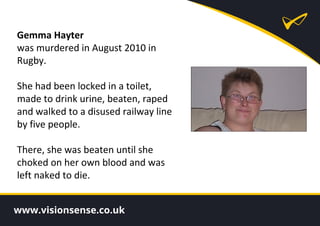
Gemma Hayter
was murdered in August 2010 in
Rugby.
She had been locked in a toilet,
made to drink urine, beaten, raped
and walked to a disused railway line
by five people.
There, she was beaten until she
choked on her own blood and was
left naked to die.
Disabled women are:
2-4 times more likely to experience serious sexual violence
than non-disabled women or disabled men internationally.
2.5 times more likely to experience lifetime prevalence of domestic violence
than non-disabled women.
Shown as higher prevalence in family violence victims (6.9% v. 2.7% for non-
disabled women - CSEW,2012-2013 capped figures). Subjects of 6 / 10 disability
safeguarding alerts (c.80,000) in England & Wales. Only 2.5% safeguarding cases
had an IMCA to support and represent the victim.
Segregated institution (state, charity, private) and familial rape - 20%
more occurrence, more frequent, severe and higher death rate than
partner violence.
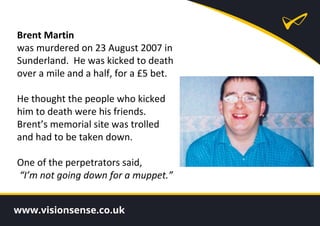
Brent Martin
was murdered on 23 August 2007 in
Sunderland. He was kicked to death
over a mile and a half, for a £5 bet.
He thought the people who kicked
him to death were his friends.
Brent’s memorial site was trolled
and had to be taken down.
One of the perpetrators said,
“I’m not going down for a muppet.”
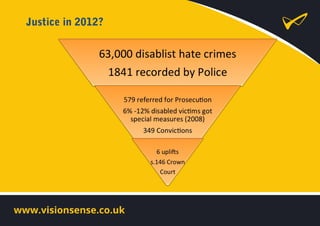
Justice in 2012?
Disabled People in Custody:
Lessons from Nottinghamshire Police Inspection
16 year old girl detained under the Mental Health Act
No food or water for 44 hours.
Report found significant delays in child protection and chlidren
being unnecessarily detained overnight.
HM Inspectorate of Constabulary "Significant concern for children
in custody for their own protection.
Home Affairs Committee found "Clear Failure" of NHS clinical
commissioning groups to provide for children with Mental Health
service need.
In 2014, 236 children and 6000 adults were detained under s.136
of the Mental Health Act because of a shortage of NHS beds.
Prison Reform Trust (2012)
32% of adult offenders have an IQ under 80 (label of
learning difficulty).
60% of children who offend have a communication
difficulty.
39% of adult offenders under supervision in one
probation area had a current mental illness.
75% of adult prisoners have a dual diagnosis.
Disabled children, violence and abuse
Disabled children 3.4 times more likely to be violently
abused and 3.5 times more likely to be neglected than non-
disabled children internationally.
Of 147 OFSTED Reviews in 2010, nine of the disabled
looked-after children, died. Of these, three took their own
lives, four died of abuse or neglect.
Disabled sexual offenders reported a higher rate of sexual
abuse in childhood (33%) than non-sexual male offenders
(18%) or non-accidental injury (16.0%). Female disabled
offenders reported the highest rates of sexual abuse in
childhood (59.3%) (Lindsay et al, 2012).
Tackling Deaths in Custody..
In 2012, 88 reports were issued by Coroners (Rule 43) to
prevent future deaths:
•27 reports related to lessons to be learned from mental
health related deaths
•14 related to care home deaths / 13 related to deaths in
custody
•19 related to private providers
These deaths are mostly either disabled victims or
offenders..
Criminalised disabled people
More likely to be subjects of surveillance and labelling,
therefore behaviour is scrutinised as criminal?
Can be in forensics (with no hope of release) without conviction for
much longer than if they had received justice and been sentenced...
Miscarriages of justice…
•Judith Ward conviction quashed in 1992 after 18 years in prison.
•Barry George freed in 2008 after 8 years in jail (after wrongfully
being convicted for the murder of Jill Dando).
•Sean Hodgson freed in 2009 after 27 years in jail.
Can the CRCC work for disabled people?
Criminal Justice for Disabled Offenders?
Home Office, 1990 - Healthcare &Treatment rather than
prosecution and detention
Reed report, 1992 - ‘Closer working between the Police, Health and Social
Services to avoid unnecessary prosecution’,
Joint Committee on Human Rights, 2008 - lack of appropriate treatment
Prison Reform Trust - Appropriate Adult provision is inconsistent
Bradley report, 2009 clear referral protocols, appropriate training and
statutory safeguards needed to prevent significant disadvantage and
potential miscarriage of justice.
Royal College of Psychiatrists, 2014 - Detention without trial may be
indefinite (under the Mental Health Act) and lack of community treatment
persists.
Home Affairs Committee, 2015 - Police Cells should no longer be a place
of safety - unsuitable for people with mental health service need.
What can you do?
“Nothing about us, without us.” - Involving disabled people
in your services, e.g. Care Quality Commission Experts By Experience.
Improve trust and confidence by working with disabled or Deaf people.
User-Led Equality and Justice training for front-line custody, prosecution
and prison staff to recognise disabled people and put appropriate adults,
advocates or intermediaries in place.
Joint-work with criminal justice, forensic, nursing and social care staff -
urgently.
Provide Intermediaries, Appropriate Adults and Advocates where
necessary.
Avoid Deprivation of Liberty, Miscarriages of Justice or Preventable Deaths.
Any questions? Thank you!
susie@visionsense.co.uk

Disabled Suspects and Offenders - Susie Balderston Vision Sense

  • 1.
    Disabled Victims and Offenders Dr.Susie Balderston Policy and Training Director
  • 2.
    Barriers to justicefor disabled people.. 1) As children experiencing violence.. 2) As victims trying to gain safety and justice.. 3) As offenders and people in forensic services or prisons
  • 3.
    Gemma Hayter was murderedin August 2010 in Rugby. She had been locked in a toilet, made to drink urine, beaten, raped and walked to a disused railway line by five people. There, she was beaten until she choked on her own blood and was left naked to die.
  • 4.
    Disabled women are: 2-4times more likely to experience serious sexual violence than non-disabled women or disabled men internationally. 2.5 times more likely to experience lifetime prevalence of domestic violence than non-disabled women. Shown as higher prevalence in family violence victims (6.9% v. 2.7% for non- disabled women - CSEW,2012-2013 capped figures). Subjects of 6 / 10 disability safeguarding alerts (c.80,000) in England & Wales. Only 2.5% safeguarding cases had an IMCA to support and represent the victim. Segregated institution (state, charity, private) and familial rape - 20% more occurrence, more frequent, severe and higher death rate than partner violence.
  • 5.
    Brent Martin was murderedon 23 August 2007 in Sunderland. He was kicked to death over a mile and a half, for a £5 bet. He thought the people who kicked him to death were his friends. Brent’s memorial site was trolled and had to be taken down. One of the perpetrators said, “I’m not going down for a muppet.”
  • 6.
  • 7.
    Disabled People inCustody: Lessons from Nottinghamshire Police Inspection 16 year old girl detained under the Mental Health Act No food or water for 44 hours. Report found significant delays in child protection and chlidren being unnecessarily detained overnight. HM Inspectorate of Constabulary "Significant concern for children in custody for their own protection. Home Affairs Committee found "Clear Failure" of NHS clinical commissioning groups to provide for children with Mental Health service need. In 2014, 236 children and 6000 adults were detained under s.136 of the Mental Health Act because of a shortage of NHS beds.
  • 8.
    Prison Reform Trust(2012) 32% of adult offenders have an IQ under 80 (label of learning difficulty). 60% of children who offend have a communication difficulty. 39% of adult offenders under supervision in one probation area had a current mental illness. 75% of adult prisoners have a dual diagnosis.
  • 9.
    Disabled children, violenceand abuse Disabled children 3.4 times more likely to be violently abused and 3.5 times more likely to be neglected than non- disabled children internationally. Of 147 OFSTED Reviews in 2010, nine of the disabled looked-after children, died. Of these, three took their own lives, four died of abuse or neglect. Disabled sexual offenders reported a higher rate of sexual abuse in childhood (33%) than non-sexual male offenders (18%) or non-accidental injury (16.0%). Female disabled offenders reported the highest rates of sexual abuse in childhood (59.3%) (Lindsay et al, 2012).
  • 10.
    Tackling Deaths inCustody.. In 2012, 88 reports were issued by Coroners (Rule 43) to prevent future deaths: •27 reports related to lessons to be learned from mental health related deaths •14 related to care home deaths / 13 related to deaths in custody •19 related to private providers These deaths are mostly either disabled victims or offenders..
  • 11.
    Criminalised disabled people Morelikely to be subjects of surveillance and labelling, therefore behaviour is scrutinised as criminal? Can be in forensics (with no hope of release) without conviction for much longer than if they had received justice and been sentenced... Miscarriages of justice… •Judith Ward conviction quashed in 1992 after 18 years in prison. •Barry George freed in 2008 after 8 years in jail (after wrongfully being convicted for the murder of Jill Dando). •Sean Hodgson freed in 2009 after 27 years in jail. Can the CRCC work for disabled people?
  • 12.
    Criminal Justice forDisabled Offenders? Home Office, 1990 - Healthcare &Treatment rather than prosecution and detention Reed report, 1992 - ‘Closer working between the Police, Health and Social Services to avoid unnecessary prosecution’, Joint Committee on Human Rights, 2008 - lack of appropriate treatment Prison Reform Trust - Appropriate Adult provision is inconsistent Bradley report, 2009 clear referral protocols, appropriate training and statutory safeguards needed to prevent significant disadvantage and potential miscarriage of justice. Royal College of Psychiatrists, 2014 - Detention without trial may be indefinite (under the Mental Health Act) and lack of community treatment persists. Home Affairs Committee, 2015 - Police Cells should no longer be a place of safety - unsuitable for people with mental health service need.
  • 13.
    What can youdo? “Nothing about us, without us.” - Involving disabled people in your services, e.g. Care Quality Commission Experts By Experience. Improve trust and confidence by working with disabled or Deaf people. User-Led Equality and Justice training for front-line custody, prosecution and prison staff to recognise disabled people and put appropriate adults, advocates or intermediaries in place. Joint-work with criminal justice, forensic, nursing and social care staff - urgently. Provide Intermediaries, Appropriate Adults and Advocates where necessary. Avoid Deprivation of Liberty, Miscarriages of Justice or Preventable Deaths.
  • 14.
    Any questions? Thankyou! susie@visionsense.co.uk