Contents 
Before driving 
Introduction 2 
Instrumentation 4 
Controls and features 14 
Seating and safety restraints 44 
Starting and driving 
Starting 76 
Driving 84 
Roadside emergencies 107 
Servicing 
Maintenance and care 125 
Capacities and specifications 183 
Reporting safety defects (U. S. only) 189 
Index 190 
1
Introduction 
ICONS 
Indicates a warning. Read the 
following section on Warnings for 
a full explanation. 
Indicates that vehicle information 
related to recycling and other 
environmental concerns will follow. 
We must all play our part in 
protecting the environment. 
Correct vehicle usage and the 
authorized disposal of waste 
cleaning and lubrication materials 
are significant steps toward this 
aim. 
WARNINGS 
How can you reduce the risk of 
personal injury and prevent 
possible damage to others, your 
vehicle and its equipment? 
In this owner’s guide, answers to 
such questions are contained in 
comments highlighted by the 
warning triangle symbol. 
BREAKING IN YOUR VEHICLE 
There are no particular breaking-in 
rules for your vehicle. Simply avoid 
driving too fast during the first 
1 600 km (1 000 miles). Vary 
speeds frequently. This is 
necessary to give the moving parts 
a chance to break in. 
2
Introduction 
3 
If possible, you should avoid hard 
braking for the first 1 600 km 
(1 000 miles). 
From 1 600 km (1 000 miles) 
onwards you can gradually increase 
the performance of your vehicle up 
to the permitted maximum speeds. 
INFORMATION ABOUT THIS 
GUIDE 
The information found in this guide 
was in effect at the time of 
printing. Ford may change the 
contents without notice and 
without incurring obligation.
4 
Instrumentation 
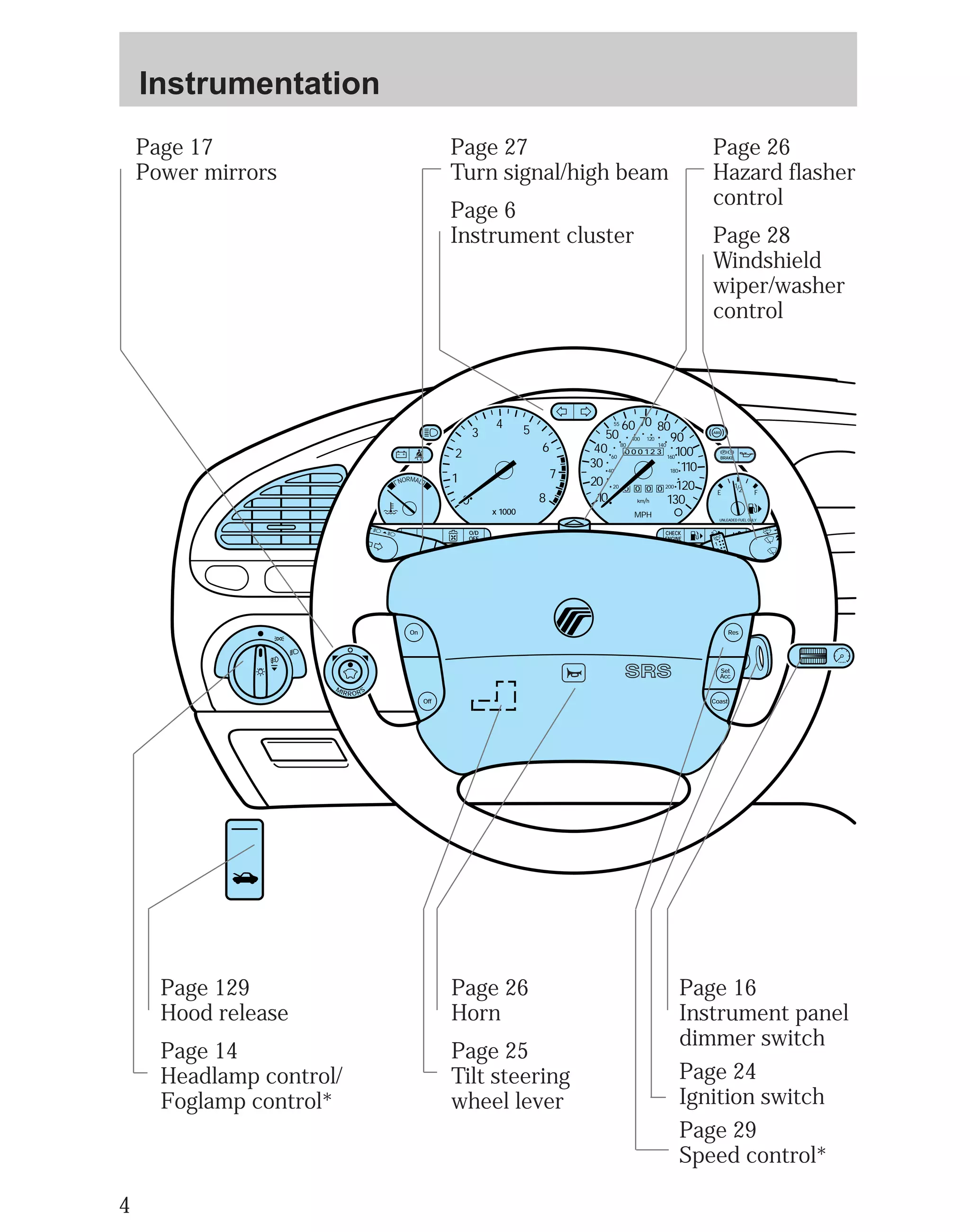
Page 27 
Turn signal/high beam 
Page 6 
Instrument cluster 
Page 26 
Hazard flasher 
control 
Page 28 
Windshield 
wiper/washer 
control 
Page 129 
Hood release 
Page 14 
Headlamp control/ 
Foglamp control* 
2 
4 5 
Page 26 
Horn 
Page 25 
Tilt steering 
wheel lever 
1/2 
BRAKE 
Page 16 
Instrument panel 
dimmer switch 
Page 24 
Ignition switch 
Page 29 
Speed control* 
Page 17 
Power mirrors 
CHECK 
ENGINE 
O/D 
OFF 
Off 
Res 
Set 
Acc 
Coast 
On 
MIRRORS 
NORMAL 
1 
0 
3 
x 1000 
6 
7 
8 
000123 
0 0 0 0 
55 
50 
40 
30 
20 
10 
60 70 80 
90 
100 
110 
120 
130 
MPH 
60 
40 
20 
80 
100 120 
140 
160 
180 
200 
E F 
UNLEADED FUEL ONLY
5 
Instrumentation 
Page 42 
Anti-theft system status 
indicator* 
Page 18 
Clock 
Page 16 
Rear window 
defroster control* 
On various models the 
appearance and location of 
some items may differ from 
those shown here. However, 
the page references given 
still apply. 
POWER AUDIO AM/FM SCAN 
SEEK 
1 2 3 
4 5 6 
ANS 
SIDE 1-2 
EJECT 
VOLUME 
DEF 
LO 
HI 
OFF PNL/FLR 
PANEL 
A/C 
FLOOR 
FLR 
DEF 
MAX 
A/C 
I0 :20 
Page 19 
Climate control system 
Electronic sound system; 
refer to “Audio Guide” 
* if equipped
Instrumentation 
2 
4 5 
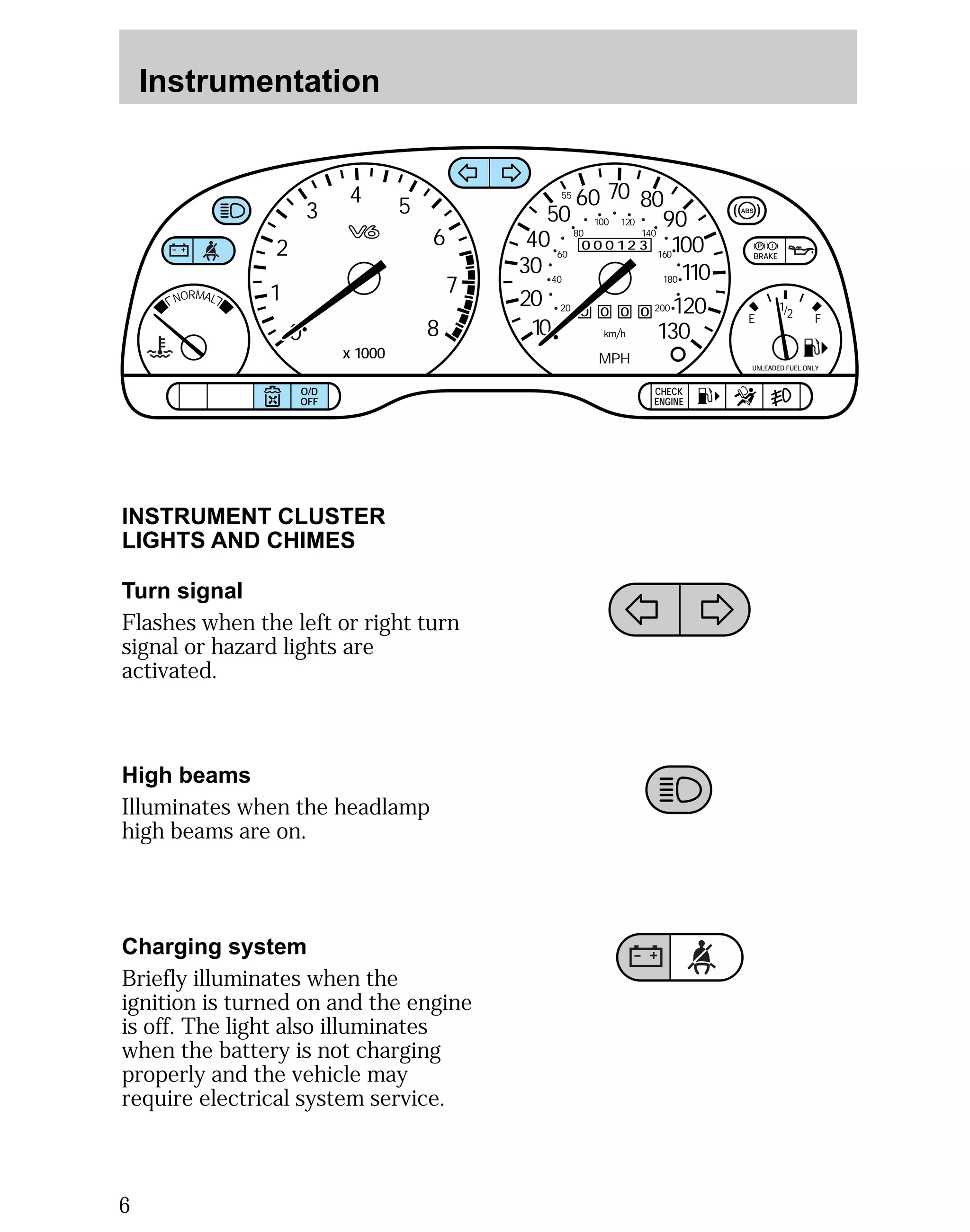
Turn signal 
Flashes when the left or right turn 
signal or hazard lights are 
activated. 
High beams 
Illuminates when the headlamp 
high beams are on. 
Charging system 
Briefly illuminates when the 
ignition is turned on and the engine 
is off. The light also illuminates 
when the battery is not charging 
properly and the vehicle may 
require electrical system service. 
6 
000123 
0 0 0 0 
55 
50 
40 
30 
20 
10 
60 70 80 
90 
110 
120 
130 
MPH 
60 
40 
20 
80 
100 120 
140 
160 
180 
200 
100 
1/2 
E F 
UNLEADED FUEL ONLY 
1 
0 
3 
x 1000 
6 
7 
8 
NORMAL 
BRAKE 
CHECK 
ENGINE 
TRACTION 
CONTROL 
O/D 
OFF 
INSTRUMENT CLUSTER 
LIGHTS AND CHIMES
Instrumentation 
7 
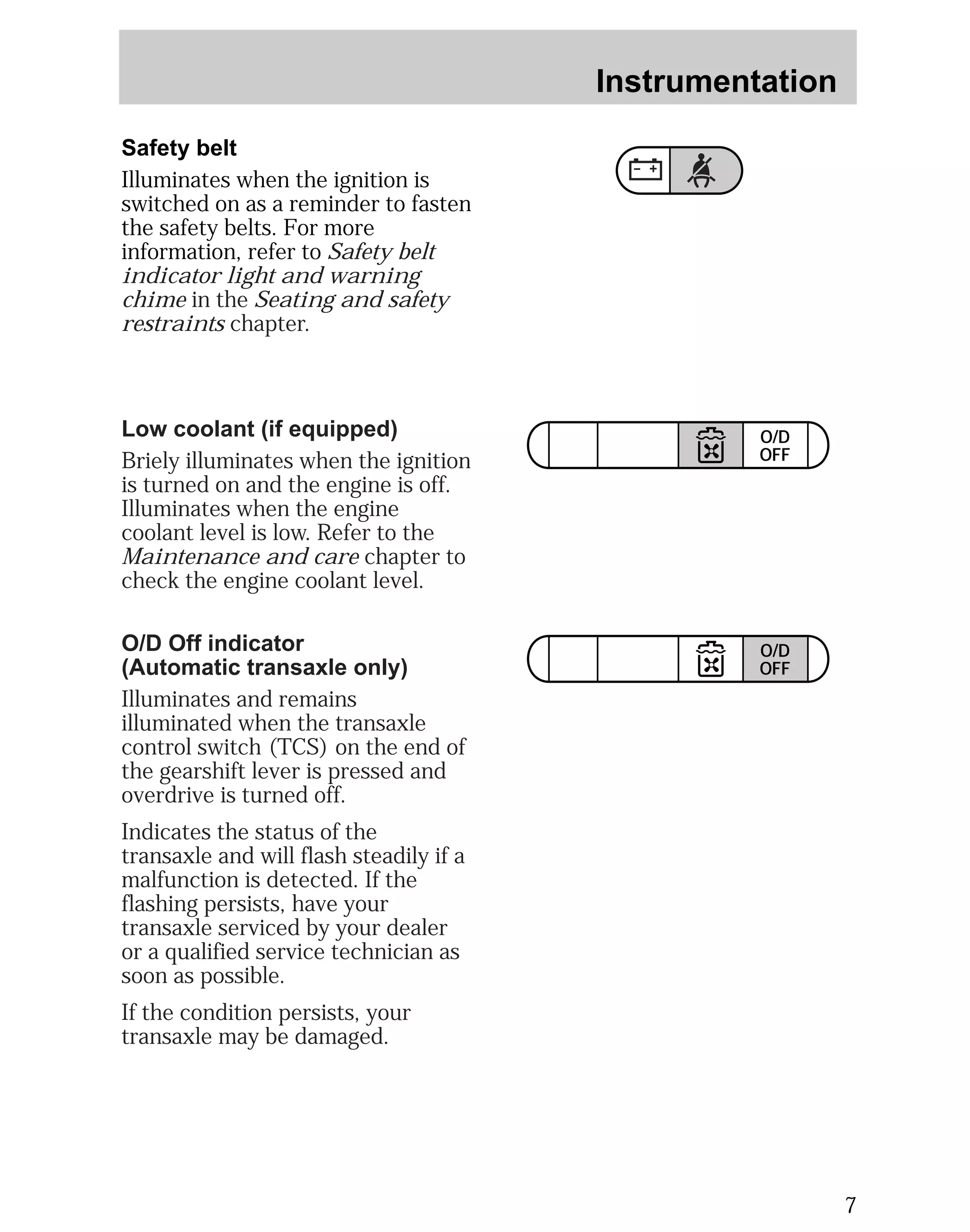
Safety belt 
Illuminates when the ignition is 
switched on as a reminder to fasten 
the safety belts. For more 
information, refer to Safety belt 
indicator light and warning 
chime in the Seating and safety 
restraints chapter. 
O/D Off indicator 
(Automatic transaxle only) 
Illuminates and remains 
illuminated when the transaxle 
control switch (TCS) on the end of 
the gearshift lever is pressed and 
overdrive is turned off. 
Indicates the status of the 
transaxle and will flash steadily if a 
malfunction is detected. If the 
flashing persists, have your 
transaxle serviced by your dealer 
or a qualified service technician as 
soon as possible. 
If the condition persists, your 
transaxle may be damaged. 
TRACTION 
CONTROL 
O/D 
OFF 
TRACTION 
CONTROL 
O/D 
OFF 
Low coolant (if equipped) 
Briely illuminates when the ignition 
is turned on and the engine is off. 
Illuminates when the engine 
coolant level is low. Refer to the 
Maintenance and care chapter to 
check the engine coolant level.
Instrumentation 
2 
4 5 
Check engine 
Illuminates when the ignition is 
turned on and the engine is off. 
Also illuminates when the engine’s 
emission control system requires 
service or if the fuel filler cap is 
not fitted correctly. 
8 
55 
50 
60 
40 
CHECK 
ENGINE 
CHECK 
ENGINE 
Air bag readiness 
Briefly illuminates when the 
ignition is turned on. If the light 
fails to illuminate, continues to 
flash or remains on, have the 
system serviced immediately. 
000123 
0 0 0 0 
40 
30 
20 
10 
60 70 80 
90 
110 
120 
130 
MPH 
20 
80 
100 120 
140 
160 
180 
200 
100 
1/2 
E F 
UNLEADED FUEL ONLY 
1 
0 
3 
x 1000 
6 
7 
8 
NORMAL 
BRAKE 
CHECK 
ENGINE 
TRACTION 
CONTROL 
O/D 
OFF 
Low fuel 
Illuminates when the fuel level is 
low. 
CHECK 
ENGINE
Instrumentation 
9 
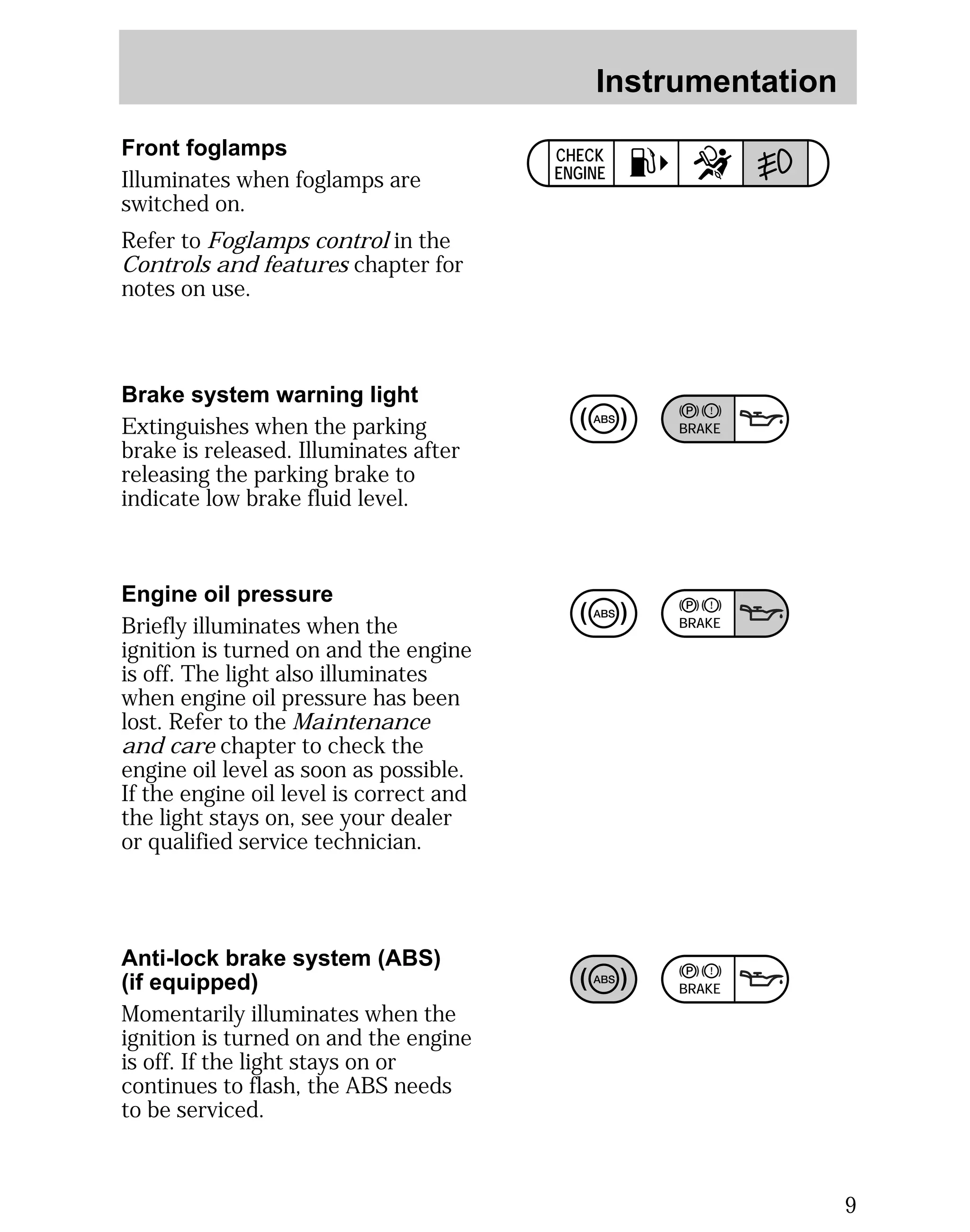
Front foglamps 
Illuminates when foglamps are 
switched on. 
Refer to Foglamps control in the 
Controls and features chapter for 
notes on use. 
CHECK 
ENGINE 
Brake system warning light 
Extinguishes when the parking 
brake is released. Illuminates after 
releasing the parking brake to 
indicate low brake fluid level. 
Engine oil pressure 
Briefly illuminates when the 
ignition is turned on and the engine 
is off. The light also illuminates 
when engine oil pressure has been 
lost. Refer to the Maintenance 
and care chapter to check the 
engine oil level as soon as possible. 
If the engine oil level is correct and 
the light stays on, see your dealer 
or qualified service technician. 
Anti-lock brake system (ABS) 
(if equipped) 
Momentarily illuminates when the 
ignition is turned on and the engine 
is off. If the light stays on or 
continues to flash, the ABS needs 
to be serviced. 
BRAKE 
BRAKE 
BRAKE
Instrumentation 
2 
4 5 
Testing the warning and 
indicator lights and chimes 
Turn the ignition key to the on 
position without starting the 
engine. The following warning and 
indicator lights will illuminate 
briefly: charging system, safety belt 
(does not illuminate, if the driver’s 
safety belt is fastened), low 
coolant, low fuel, engine oil 
pressure, check engine and air bag 
readiness. 
If any of these lights do not 
illuminate, see your dealer or 
qualified service technician. 
10 
000123 
0 0 0 0 
55 
50 
40 
30 
20 
10 
60 70 80 
90 
110 
120 
130 
MPH 
60 
40 
20 
80 
100 120 
140 
160 
180 
200 
100 
1/2 
E F 
UNLEADED FUEL ONLY 
1 
0 
3 
x 1000 
6 
7 
8 
NORMAL 
BRAKE 
CHECK 
ENGINE 
TRACTION 
CONTROL 
O/D 
OFF
Instrumentation 
11 
Headlamps on warning chime 
Sounds when the headlamps are 
on, the ignition is off (and the key 
is not in the ignition) and the 
driver’s door is open. 
Key-in-ignition warning chime 
Sounds when the key is left in the 
off/lock or accessory position and 
the driver’s door is open. 
Safety belt warning chime 
For information on the safety belt 
warning chime, refer to the 
Seating and safety restraints 
chapter. 
Air bag supplemental restraint 
system (SRS) warning chime 
For information on the SRS 
warning chime, refer to the 
Seating and safety restraints 
chapter.
Instrumentation 
12 
NORMAL 
2 
4 5 
Engine coolant temperature 
gauge 
Indicates the temperature of the 
engine coolant. At normal 
operating temperature, the needle 
remains within the NORMAL area. 
If it enters the red section, the 
engine is overheating. Switch off 
the ignition and determine the 
source of the problem. Refer to 
Checking and adding engine 
coolant in the Maintenance and 
care chapter. 
000123 
0 0 0 0 
55 
50 
40 
30 
20 
10 
60 70 80 
90 
110 
120 
130 
MPH 
60 
40 
20 
80 
100 120 
140 
160 
180 
200 
100 
1/2 
E F 
UNLEADED FUEL ONLY 
1 
0 
3 
x 1000 
6 
7 
8 
NORMAL 
BRAKE 
CHECK 
ENGINE 
TRACTION 
CONTROL 
O/D 
OFF 
INSTRUMENT CLUSTER 
GAUGES
Instrumentation 
13 
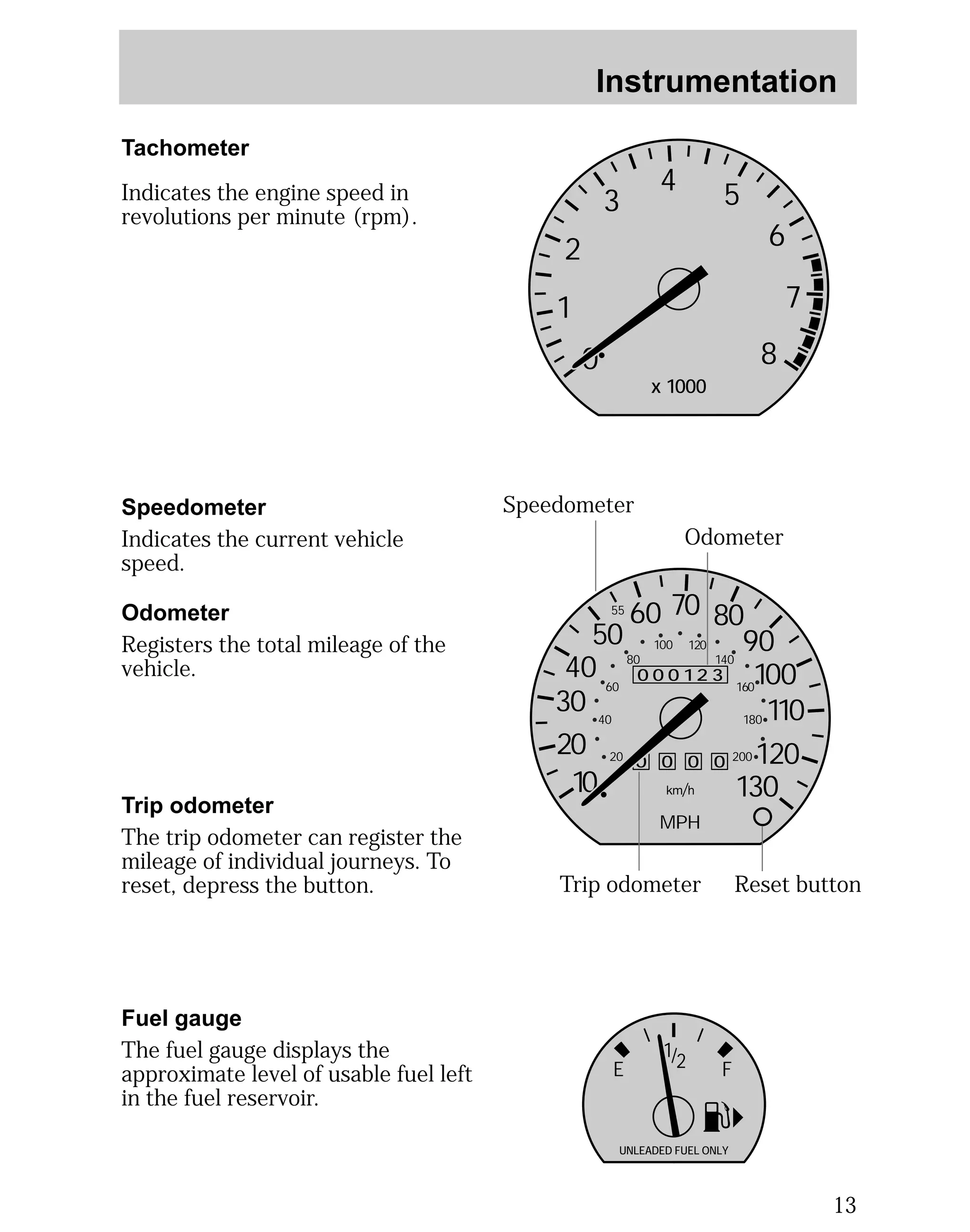
Tachometer 
Indicates the engine speed in 
revolutions per minute (rpm). 
Trip odometer 
The trip odometer can register the 
mileage of individual journeys. To 
reset, depress the button. 
4 5 
000123 
0 0 0 0 
55 
50 
2 
40 
30 
20 
10 
60 70 80 
90 
110 
120 
130 
MPH 
60 
40 
20 
80 
100 120 
140 
160 
180 
200 
100 
Speedometer 
Odometer 
Trip odometer Reset button 
1/2 
E F 
UNLEADED FUEL ONLY 
Fuel gauge 
The fuel gauge displays the 
approximate level of usable fuel left 
in the fuel reservoir. 
1 
0 
3 
x 1000 
6 
7 
8 
Speedometer 
Indicates the current vehicle 
speed. 
Odometer 
Registers the total mileage of the 
vehicle.
Controls and features 
14 
POWER AUDIO AM/FM SCAN 
SEEK 
1 2 3 
4 5 6 
ANS 
SIDE 1-2 
EJECT 
VOLUME 
MIRRORS 
DEF 
LO 
HI 
OFF PNL/FLR 
PANEL 
A/C 
FLOOR 
FLR 
DEF 
MAX 
A/C 
T/C OFF 
000123 
0 0 0 0 
55 
50 
40 
30 
20 
10 
60 70 80 
90 
100 
110 
120 
130 
MPH 
60 
40 
20 
80 
100 120 
140 
160 
180 
200 
1/2 
E F 
UNLEADED FUEL ONLY 
2 
1 
0 
3 
4 5 
x 1000 
6 
7 
8 
NORMAL 
BRAKE 
CHECK 
ENGINE 
TRACTION 
CONTROL 
O/D 
OFF 
I0 :20 
Off 
Res 
Set 
Acc 
Coast 
On 
INSTRUMENT PANEL 
CONTROLS 
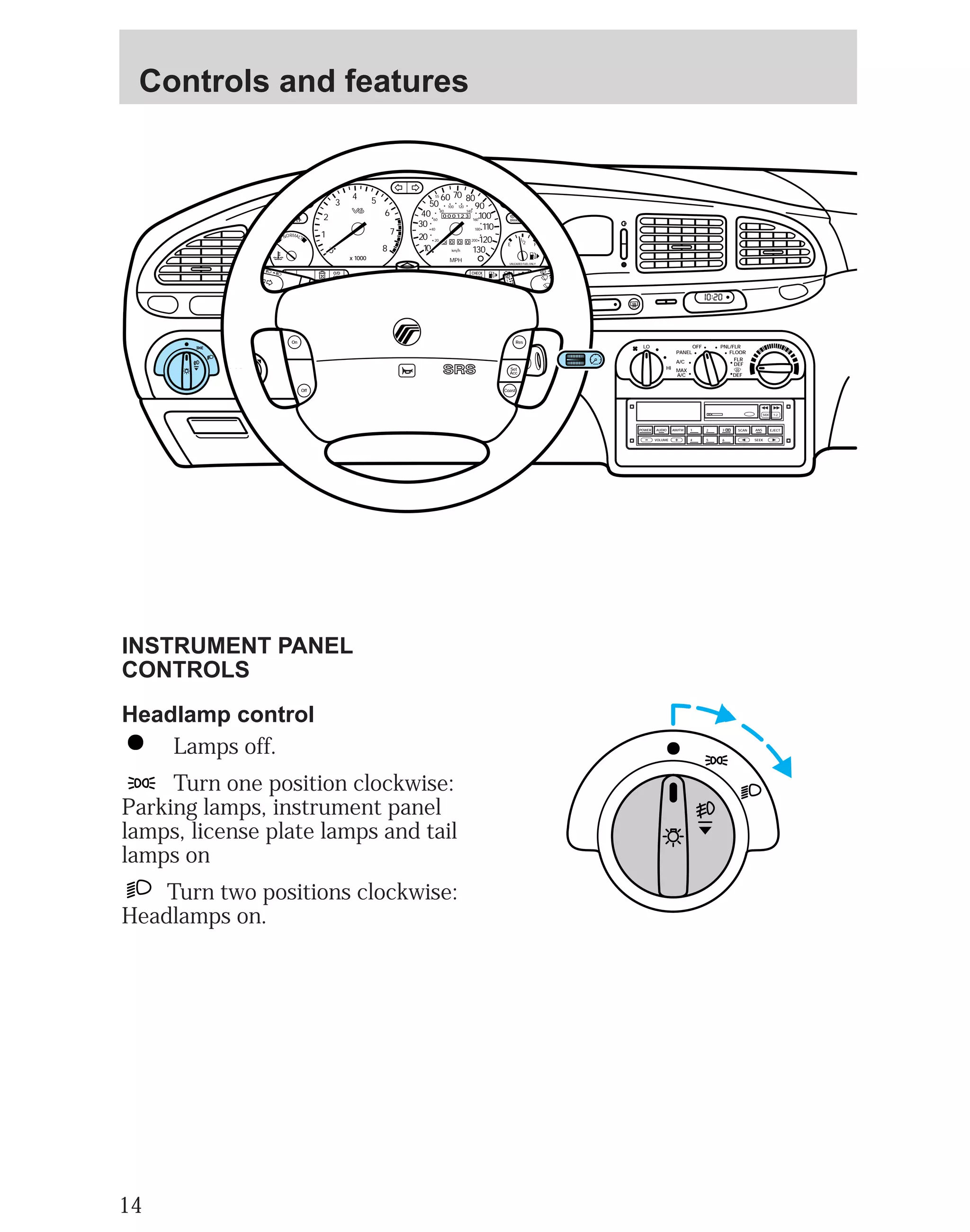
Headlamp control 
Lamps off. 
Turn one position clockwise: 
Parking lamps, instrument panel 
lamps, license plate lamps and tail 
lamps on 
Turn two positions clockwise: 
Headlamps on.
Controls and features 
15 
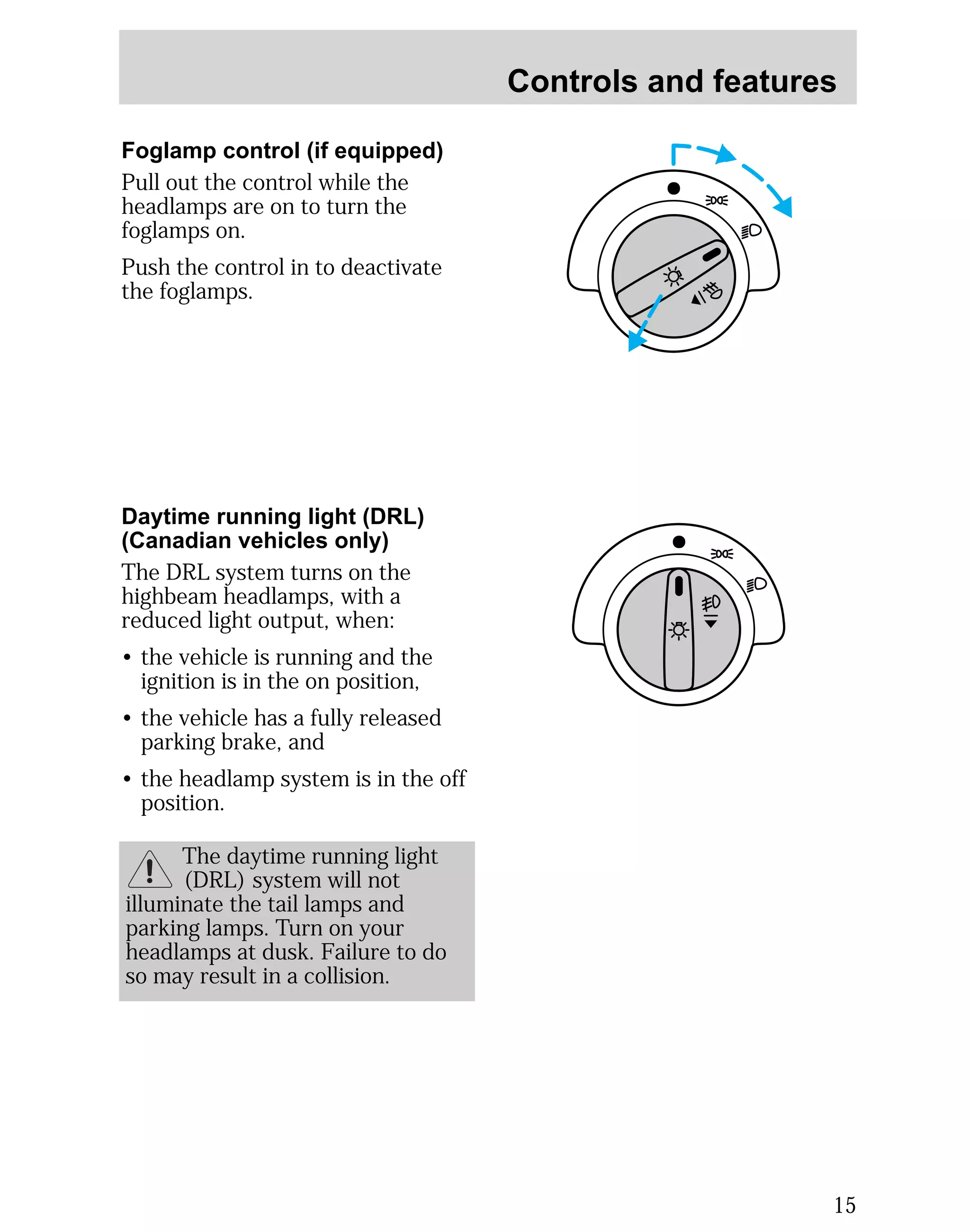
Foglamp control (if equipped) 
Pull out the control while the 
headlamps are on to turn the 
foglamps on. 
Push the control in to deactivate 
the foglamps. 
Daytime running light (DRL) 
(Canadian vehicles only) 
The DRL system turns on the 
highbeam headlamps, with a 
reduced light output, when: 
• the vehicle is running and the 
ignition is in the on position, 
• the vehicle has a fully released 
parking brake, and 
• the headlamp system is in the off 
position. 
The daytime running light 
(DRL) system will not 
illuminate the tail lamps and 
parking lamps. Turn on your 
headlamps at dusk. Failure to do 
so may result in a collision.
Controls and features 
Rear window defroster 
(if equipped) 
Press the defroster control to clear 
the rear window of thin ice and fog. 
The ignition must be in the on 
position to operate the rear 
window defroster. 
The defroster turns off 
automatically after 10 minutes or 
when the ignition is turned to the 
off position. To manually turn off 
the defroster, push the control 
again. 
Panel dimmer control 
Adjust the control to vary the 
intensity of the panel lighting. 
Operates only when the exterior 
lights are switched on. 
16
Controls and features 
17 
55 
50 
40 
30 
20 
60 
40 
2 
4 5 
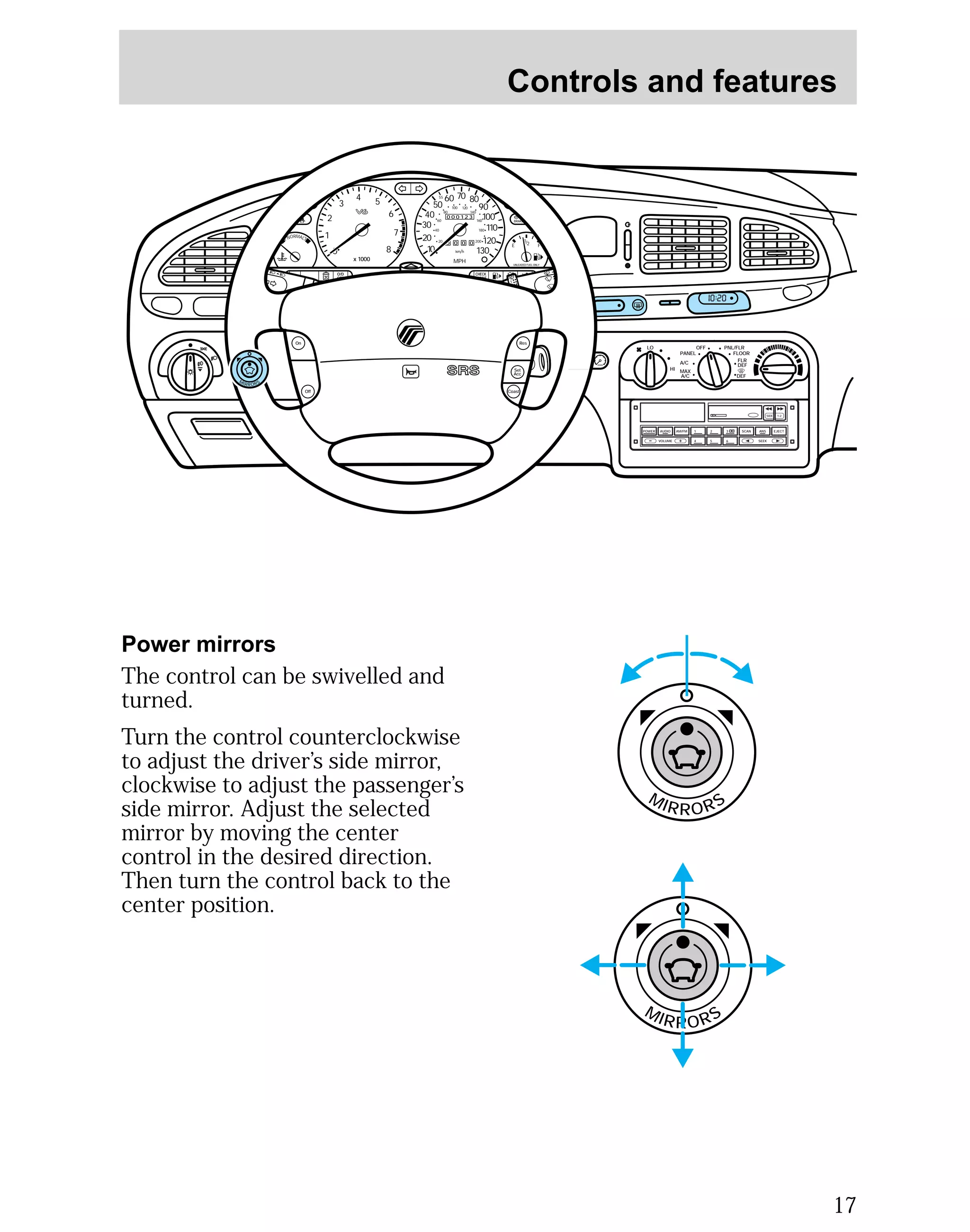
Power mirrors 
The control can be swivelled and 
turned. 
Turn the control counterclockwise 
to adjust the driver’s side mirror, 
clockwise to adjust the passenger’s 
side mirror. Adjust the selected 
mirror by moving the center 
control in the desired direction. 
Then turn the control back to the 
center position. 
POWER AUDIO AM/FM SCAN 
MIRRORS 
MIRRORS 
SEEK 
1 2 3 
4 5 6 
ANS 
SIDE 1-2 
EJECT 
VOLUME 
DEF 
LO 
HI 
OFF PNL/FLR 
PANEL 
A/C 
FLOOR 
FLR 
DEF 
MAX 
A/C 
000123 
0 0 0 0 
10 
60 70 80 
90 
100 
110 
120 
130 
MPH 
20 
80 
100 120 
140 
160 
180 
200 
1/2 
E F 
UNLEADED FUEL ONLY 
1 
0 
3 
x 1000 
6 
7 
8 
NORMAL 
BRAKE 
CHECK 
ENGINE 
TRACTION 
CONTROL 
O/D 
OFF 
I0 :20 
Off 
Res 
Set 
Acc 
Coast 
On 
MIRRORS
Controls and features 
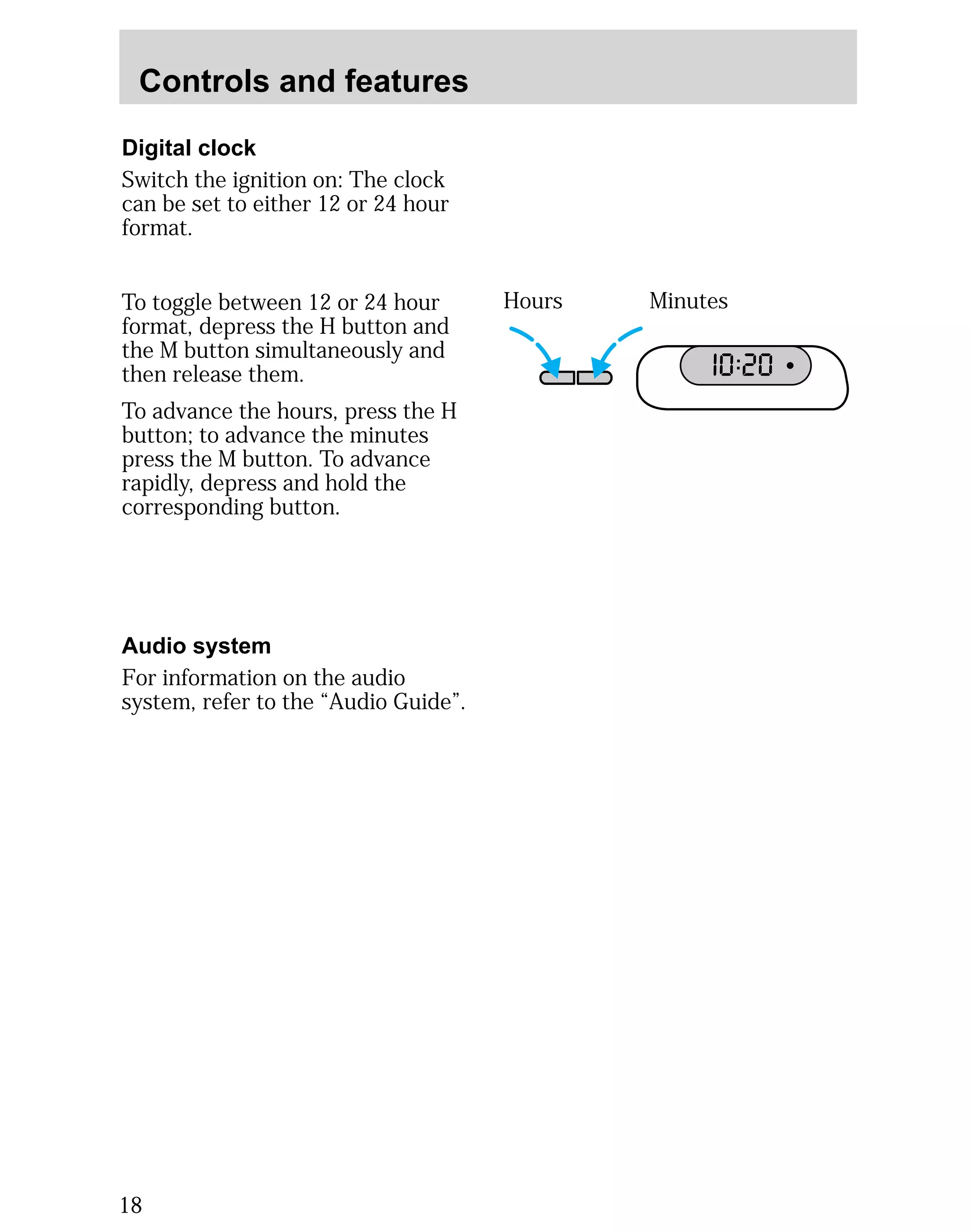
Digital clock 
Switch the ignition on: The clock 
can be set to either 12 or 24 hour 
format. 
To toggle between 12 or 24 hour 
format, depress the H button and 
the M button simultaneously and 
then release them. 
To advance the hours, press the H 
button; to advance the minutes 
press the M button. To advance 
rapidly, depress and hold the 
corresponding button. 
Hours Minutes 
I0 :20 
Audio system 
For information on the audio 
system, refer to the “Audio Guide”. 
18
Controls and features 
19 
POWER AUDIO AM/FM SCAN 
SEEK 
1 2 3 
4 5 6 
ANS 
SIDE 1-2 
EJECT 
VOLUME 
MIRRORS 
DEF 
LO 
HI 
OFF PNL/FLR 
PANEL 
A/C 
FLOOR 
FLR 
DEF 
MAX 
A/C 
000123 
0 0 0 0 
55 
50 
40 
30 
20 
10 
60 70 80 
90 
100 
110 
120 
130 
MPH 
60 
40 
20 
80 
100 120 
140 
160 
180 
200 
1/2 
E F 
UNLEADED FUEL ONLY 
2 
1 
0 
3 
4 5 
x 1000 
6 
7 
8 
NORMAL 
BRAKE 
CHECK 
ENGINE 
TRACTION 
CONTROL 
O/D 
OFF 
I0 :20 
Off 
Res 
Set 
Acc 
Coast 
On 
Climate controls 
Your vehicle has one of the 
following climate control systems: 
• Manual heating system 
• Manual heating and air 
conditioning system 
In some modes, the two systems 
function similarly. In modes where 
the systems do not function 
similarly, the different functions 
are noted. 
Vents 
Airflow from the vents may be 
adjusted by moving the horizontal 
control or vertically adjusting the 
vent according to your airflow 
preference.
Controls and features 
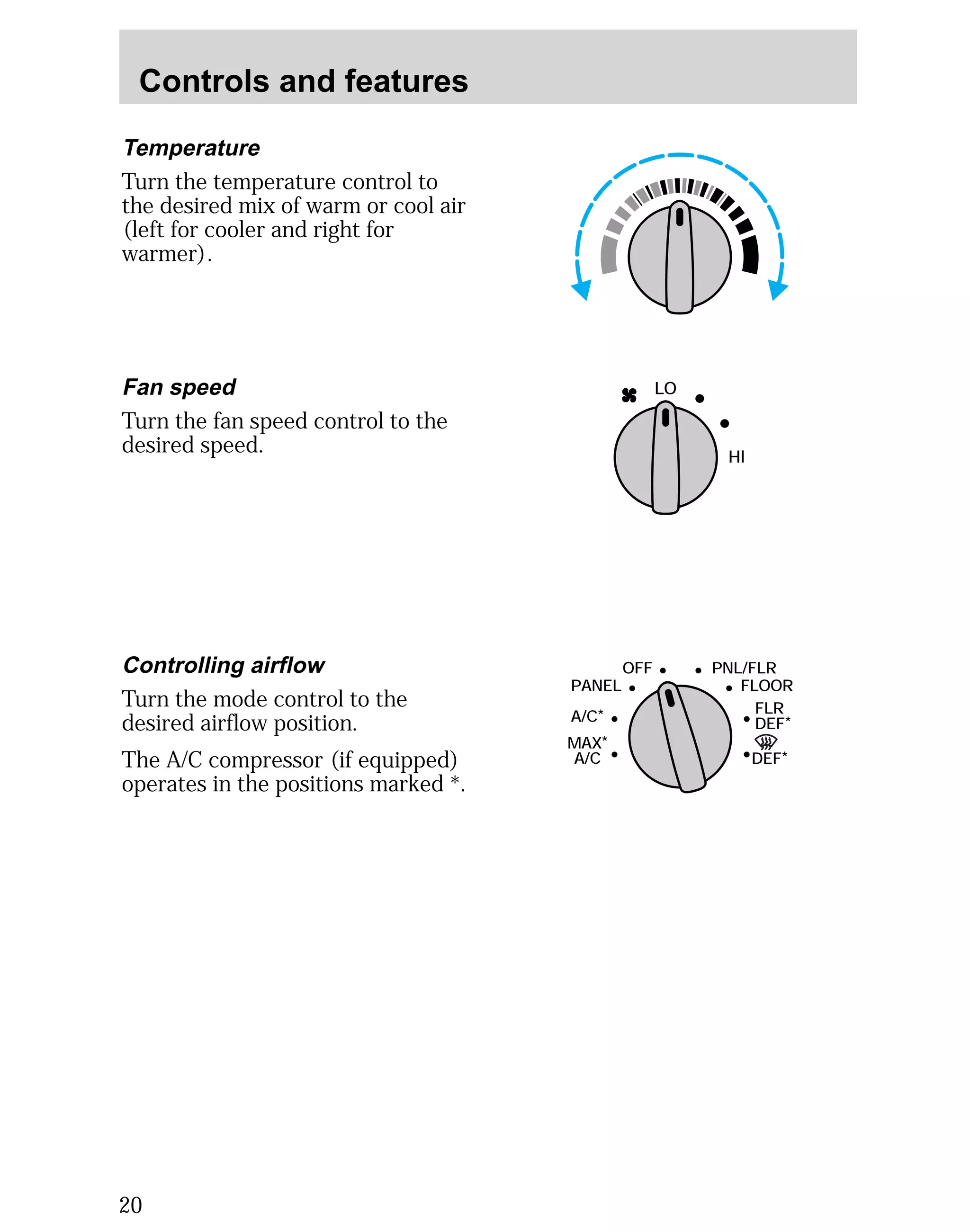
Controlling airflow 
Turn the mode control to the 
desired airflow position. 
The A/C compressor (if equipped) 
operates in the positions marked *. 
20 
OFF PNL/FLR 
PANEL 
A/C* 
FLOOR 
FLR 
DEF* 
DEF* 
MAX* 
A/C 
Fan speed 
Turn the fan speed control to the 
desired speed. 
LO 
HI 
Temperature 
Turn the temperature control to 
the desired mix of warm or cool air 
(left for cooler and right for 
warmer).
Controls and features 
21 
Using MAX A/C mode 
(if equipped) 
The MAX A/C mode recirculates 
the air and directs it to flow 
through the instrument panel 
vents. 
This mode is noisier, but provides 
quicker cooling than the A/C mode. 
The A/C compressor only functions 
if the outside temperature is above 
10°C (50°F). 
LO 
HI 
OFF PNL/FLR 
PANEL 
A/C 
FLOOR 
FLR 
DEF 
DEF 
MAX 
A/C 
Using A/C mode (if equipped) 
The A/C mode directs outside 
conditioned air to flow through the 
instrument panel vents. The A/C 
mode can be used for heating, 
ventilating and air conditioning. 
The A/C compressor only functions 
in the A/C mode if the outside 
temperature is above 10°C (50°F). 
LO 
HI 
OFF PNL/FLR 
PANEL 
A/C 
FLOOR 
FLR 
DEF 
DEF 
MAX 
A/C
Controls and features 
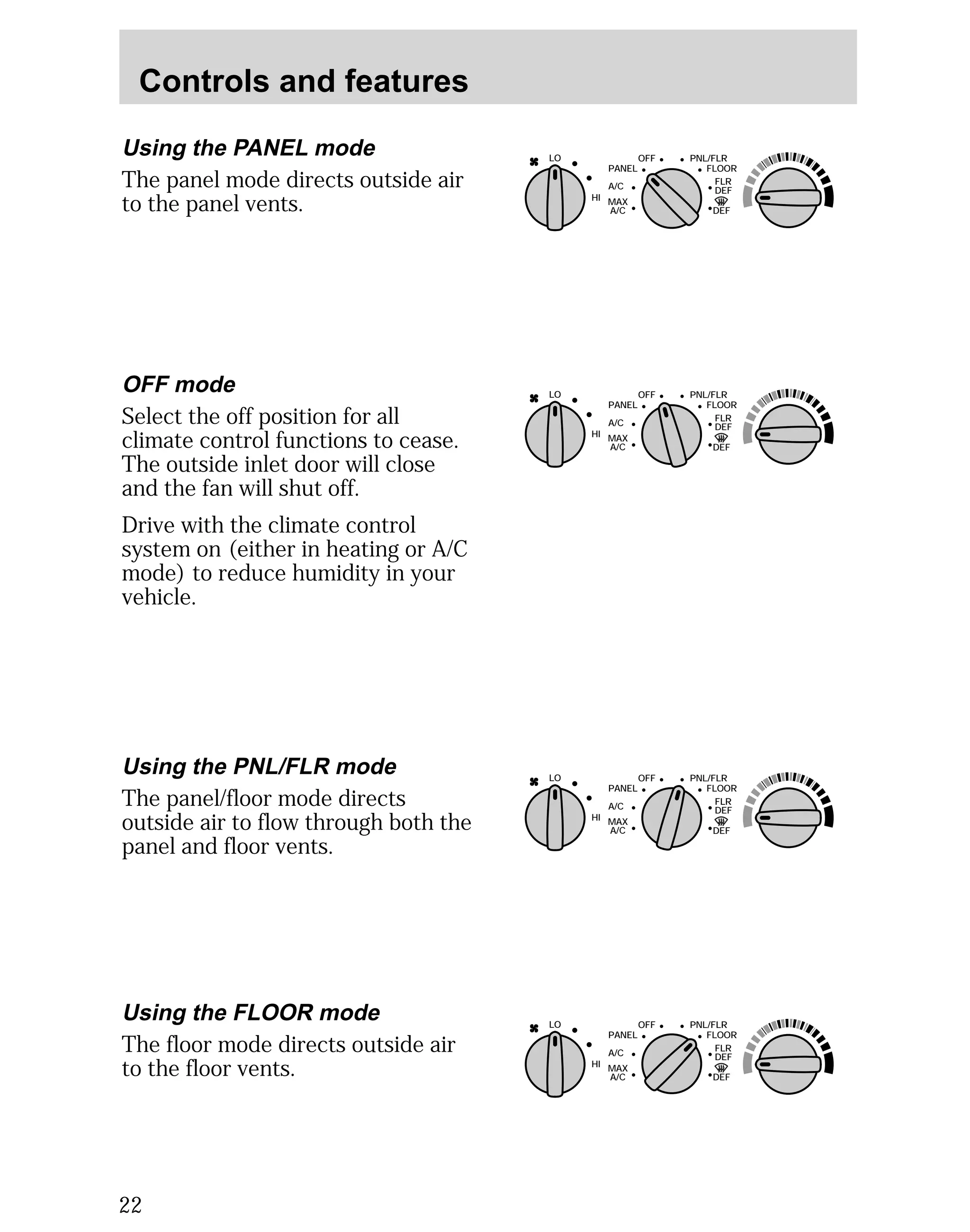
Using the PANEL mode 
The panel mode directs outside air 
to the panel vents. 
22 
LO 
HI 
OFF PNL/FLR 
PANEL 
A/C 
FLOOR 
FLR 
DEF 
DEF 
MAX 
A/C 
OFF mode 
Select the off position for all 
climate control functions to cease. 
The outside inlet door will close 
and the fan will shut off. 
Drive with the climate control 
system on (either in heating or A/C 
mode) to reduce humidity in your 
vehicle. 
Using the PNL/FLR mode 
The panel/floor mode directs 
outside air to flow through both the 
panel and floor vents. 
LO 
HI 
OFF PNL/FLR 
PANEL 
A/C 
FLOOR 
FLR 
DEF 
DEF 
MAX 
A/C 
LO 
HI 
OFF PNL/FLR 
PANEL 
A/C 
FLOOR 
FLR 
DEF 
DEF 
MAX 
A/C 
Using the FLOOR mode 
The floor mode directs outside air 
to the floor vents. 
LO 
HI 
OFF PNL/FLR 
PANEL 
A/C 
FLOOR 
FLR 
DEF 
DEF 
MAX 
A/C
Controls and features 
23 
Using the FLR/DEF mode 
The floor/defrost mode directs 
outside air to flow through the floor 
vents and windshield defroster 
vents. The A/C compressor (if 
equipped) will function to 
dehumidify the windows provided 
the outside temperature is above 
10°C (50°F). 
LO 
HI 
OFF PNL/FLR 
PANEL 
A/C 
FLOOR 
FLR 
DEF 
DEF 
MAX 
A/C 
Using the DEF mode 
In addition to defogging and 
demisting the front windshield, the 
defrost mode of your vehicle also 
has the capability to demist the 
front side windows. The A/C 
compressor (if equipped) will 
function to dehumidify the 
windows provided the outside 
temperature is above 10°C (50°F). 
LO 
HI 
OFF PNL/FLR 
PANEL 
A/C 
FLOOR 
FLR 
DEF 
DEF 
MAX 
A/C 
Passenger compartment air 
filter 
Your vehicle is equipped with an air 
filter that removes pollen and road 
dust from outside air before it is 
directed to the interior of the 
vehicle. Refer to the Maintenance 
and care chapter for maintenance 
of this filter.
Controls and features 
STEERING COLUMN 
CONTROLS 
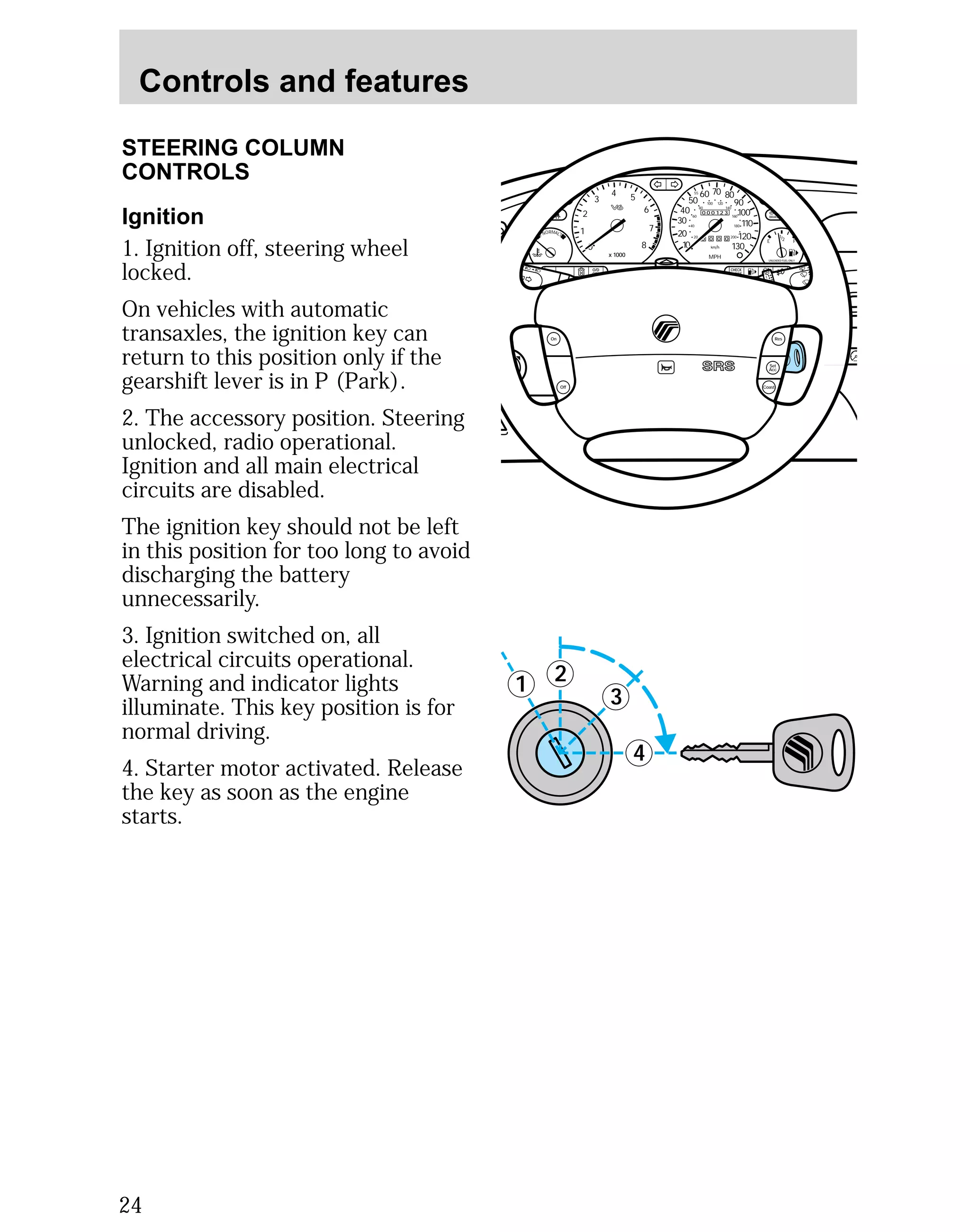
Ignition 
1. Ignition off, steering wheel 
locked. 
On vehicles with automatic 
transaxles, the ignition key can 
return to this position only if the 
gearshift lever is in P (Park). 
2. The accessory position. Steering 
unlocked, radio operational. 
Ignition and all main electrical 
circuits are disabled. 
The ignition key should not be left 
in this position for too long to avoid 
discharging the battery 
unnecessarily. 
3. Ignition switched on, all 
electrical circuits operational. 
Warning and indicator lights 
illuminate. This key position is for 
normal driving. 
4. Starter motor activated. Release 
the key as soon as the engine 
starts. 
24 
4 5 
3 
4 
MIRRORS 
1 2 
000123 
0 0 0 0 
55 
50 
40 
30 
20 
10 
60 70 80 
90 
100 
110 
120 
130 
MPH 
60 
40 
20 
80 
100 120 
140 
160 
180 
200 
1/2 
E F 
UNLEADED FUEL ONLY 
2 
1 
0 
3 
x 1000 
6 
7 
8 
NORMAL 
BRAKE 
CHECK 
ENGINE 
TRACTION 
CONTROL 
O/D 
OFF 
Off 
Res 
Set 
Acc 
Coast 
On
Controls and features 
25 
POWER AUDIO AM/FM SCAN 
SEEK 
1 2 3 
4 5 6 
ANS 
SIDE 1-2 
EJECT 
VOLUME 
MIRRORS 
DEF 
LO 
HI 
OFF PNL/FLR 
PANEL 
A/C 
FLOOR 
FLR 
DEF 
MAX 
A/C 
000123 
0 0 0 0 
55 
50 
40 
30 
20 
10 
60 70 80 
90 
100 
110 
120 
130 
MPH 
60 
40 
20 
80 
100 120 
140 
160 
180 
200 
1/2 
E F 
UNLEADED FUEL ONLY 
2 
1 
0 
3 
4 5 
x 1000 
6 
7 
8 
NORMAL 
BRAKE 
CHECK 
ENGINE 
TRACTION 
CONTROL 
O/D 
OFF 
I0 :20 
Off 
Res 
Set 
Acc 
Coast 
On 
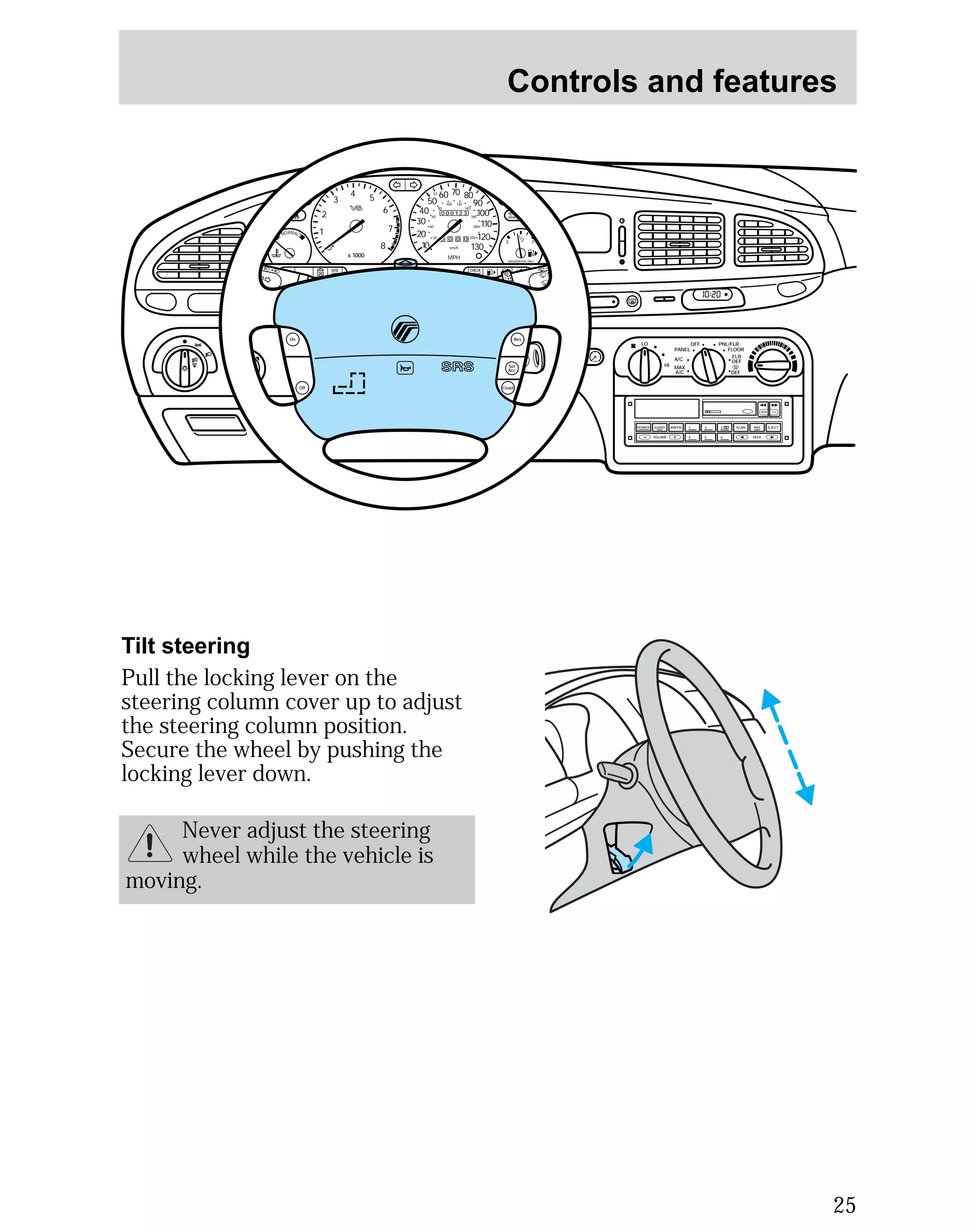
Tilt steering 
Pull the locking lever on the 
steering column cover up to adjust 
the steering column position. 
Secure the wheel by pushing the 
locking lever down. 
Never adjust the steering 
wheel while the vehicle is 
moving.
Controls and features 
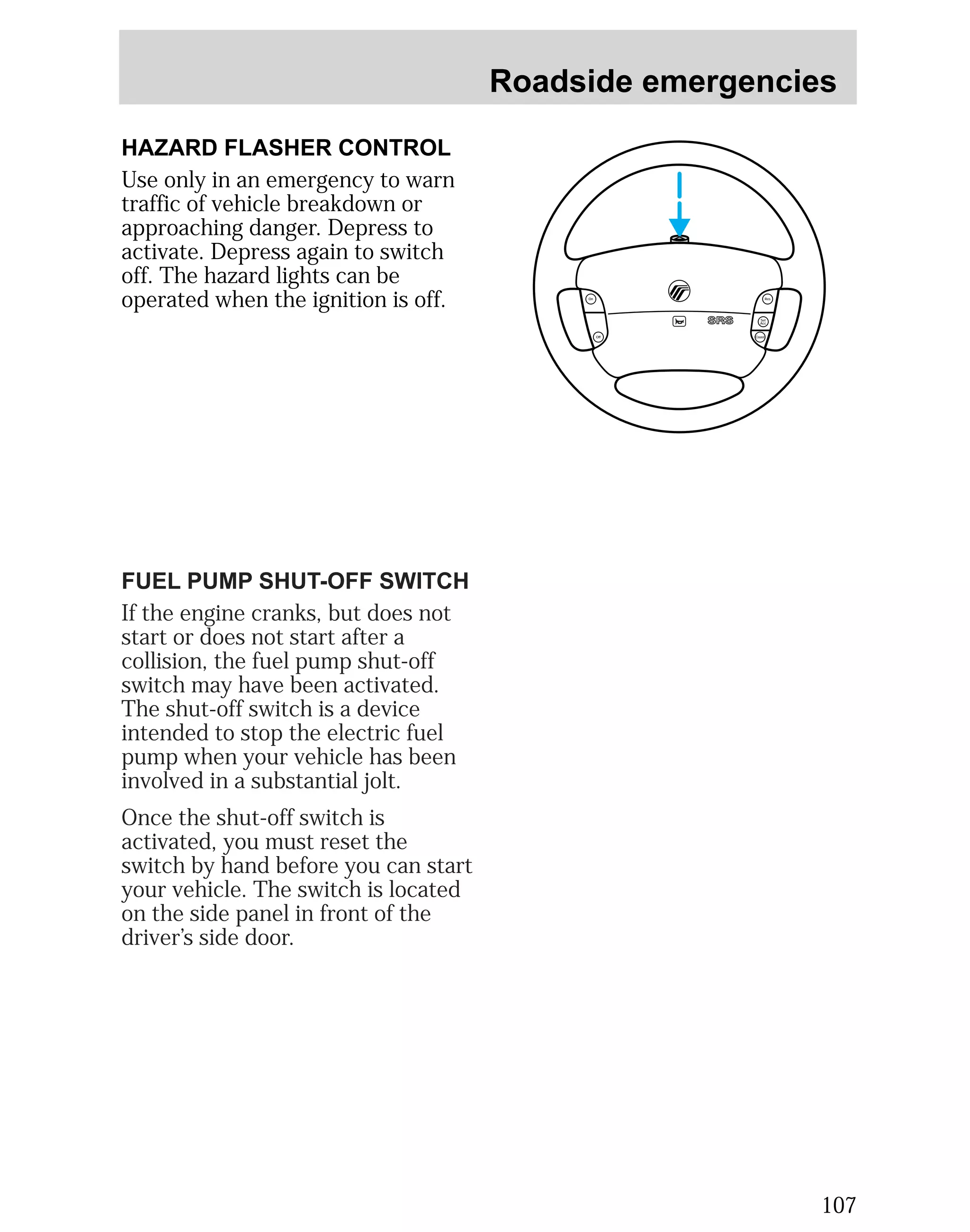
Hazard flasher control 
Use only in an emergency to warn 
traffic of vehicle breakdown or 
approaching danger. Depress to 
activate. Depress again to switch 
off. The hazard lights can be 
operated when the ignition is off. 
26 
Off 
Res 
Set 
Acc 
Coast 
On 
Off 
Res 
Set 
Acc 
Coast 
On 
Horn 
Press the pad. The horn can be 
operated when the ignition is off.
Controls and features 
27 
POWER AUDIO AM/FM SCAN 
SEEK 
1 2 3 
4 5 6 
ANS 
SIDE 1-2 
EJECT 
VOLUME 
MIRRORS 
DEF 
LO 
HI 
OFF PNL/FLR 
PANEL 
A/C 
FLOOR 
FLR 
DEF 
MAX 
A/C 
000123 
0 0 0 0 
55 
50 
40 
30 
20 
10 
60 70 80 
90 
100 
110 
120 
130 
MPH 
60 
40 
20 
80 
100 120 
140 
160 
180 
200 
1/2 
E F 
UNLEADED FUEL ONLY 
2 
1 
0 
3 
4 5 
x 1000 
6 
7 
8 
NORMAL 
BRAKE 
CHECK 
ENGINE 
TRACTION 
CONTROL 
O/D 
OFF 
I0 :20 
Off 
Res 
Set 
Acc 
Coast 
On 
Multi-function switch 
The turn signal functions are 
available only with the ignition 
switch on. 
Right turn signal 
Move the lever up. 
Left turn signal 
Move the lever down. 
Flash-to-pass 
Pull the lever toward you and 
release quickly for “flash-to-pass” 
operation. 
High beam Headlamps 
Push the lever toward the 
instrument panel.
Controls and features 
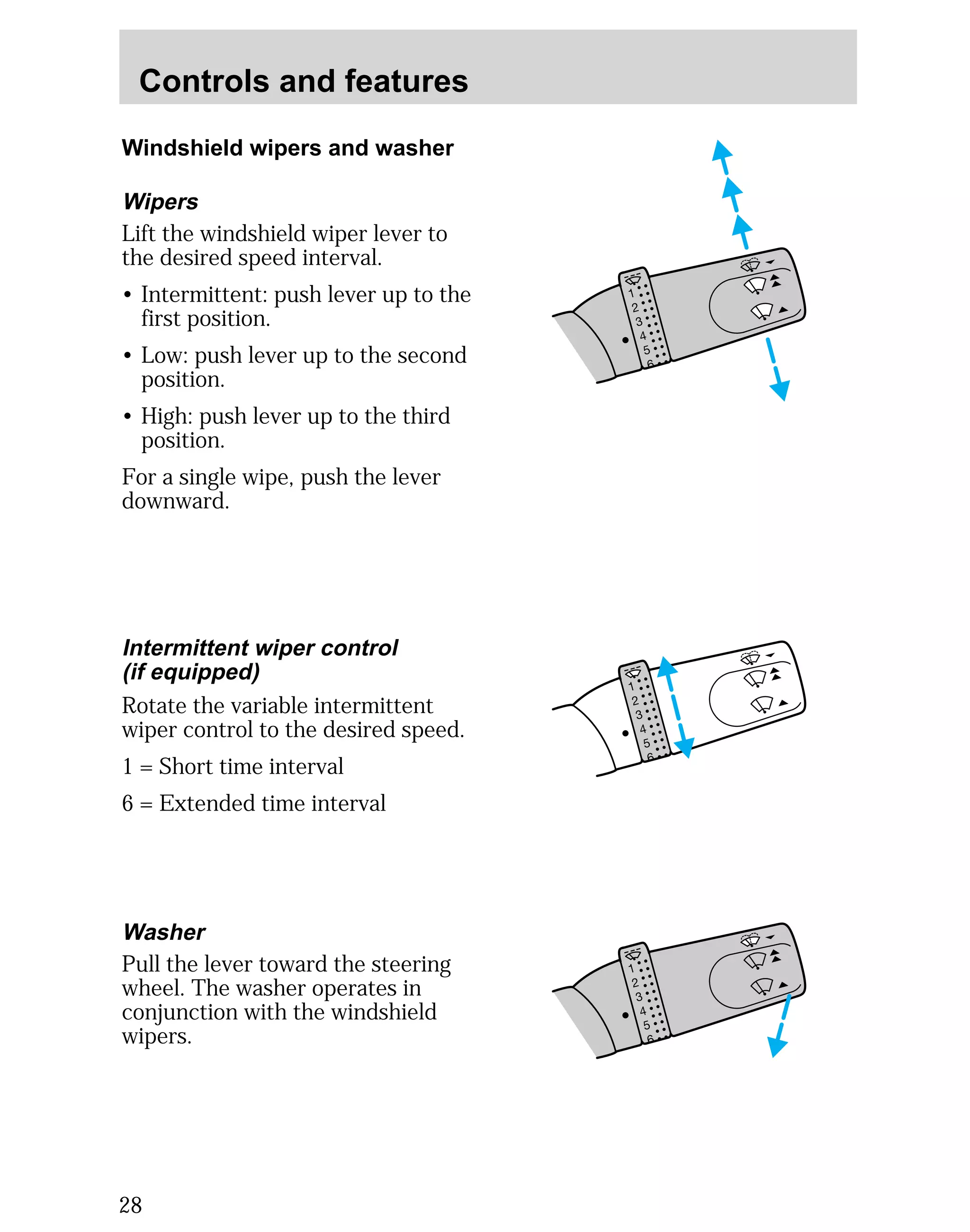
Windshield wipers and washer 
Wipers 
Lift the windshield wiper lever to 
the desired speed interval. 
• Intermittent: push lever up to the 
first position. 
• Low: push lever up to the second 
position. 
• High: push lever up to the third 
position. 
For a single wipe, push the lever 
downward. 
Intermittent wiper control 
(if equipped) 
Rotate the variable intermittent 
wiper control to the desired speed. 
1 = Short time interval 
6 = Extended time interval 
Washer 
Pull the lever toward the steering 
wheel. The washer operates in 
conjunction with the windshield 
wipers. 
28
Controls and features 
29 
55 
50 
40 
30 
20 
60 
40 
2 
4 5 
Do not use the speed control 
in heavy traffic or on roads 
that are winding, slippery, or 
unpaved. 
Off 
On 
Speed control (if equipped) 
To turn speed control off 
• Press Off or 
• turn off the vehicle ignition. 
Once speed control is switched off, 
the previously programmed set 
speed will be erased. 
To turn speed control on 
• Press On. 
POWER AUDIO AM/FM SCAN 
SEEK 
1 2 3 
4 5 6 
ANS 
SIDE 1-2 
EJECT 
VOLUME 
MIRRORS 
DEF 
LO 
HI 
OFF PNL/FLR 
PANEL 
A/C 
FLOOR 
FLR 
DEF 
MAX 
A/C 
000123 
0 0 0 0 
10 
60 70 80 
90 
100 
110 
120 
130 
MPH 
20 
80 
100 120 
140 
160 
180 
200 
1/2 
E F 
UNLEADED FUEL ONLY 
1 
0 
3 
x 1000 
6 
7 
8 
NORMAL 
BRAKE 
CHECK 
ENGINE 
TRACTION 
CONTROL 
O/D 
OFF 
I0 :20 
Off 
Res 
Set 
Acc 
Coast 
On
Controls and features 
To set a speed 
Press Set Acc. For speed control to 
operate, the speed control must be 
on and the vehicle speed must be 
greater than 48 km/h (30 mph). 
If you drive up or down a steep hill, 
your vehicle speed may vary 
momentarily slower or faster than 
the set speed. This is normal. 
Speed control cannot reduce the 
vehicle speed if it increases above 
the set speed on a downhill. If your 
vehicle speed is faster than the set 
speed while driving on a downhill 
in overdrive, you may want to shift 
to the next lower gear to reduce 
your vehicle speed. 
30 
Res 
Set 
Acc 
Coast 
Res 
Set 
Acc 
Coast 
If your vehicle slows down more 
than 16 km/h (10 mph) below your 
set speed on an uphill, your speed 
control will disengage. This is 
normal. Press Res to re-engage it.
Controls and features 
31 
Res 
Set 
Acc 
Coast 
To set a higher speed 
• Press and hold Set Acc. Release 
when the desired set speed is 
reached, or 
• press and release Set Acc. Each 
press will increase the set speed 
by 1.6 km/h (1 mph) or 
• accelerate with your accelerator 
pedal, then press Set Acc. 
You may accelerate with the 
accelerator pedal at any time 
during speed control usage. 
Releasing the accelerator pedal will 
return your vehicle speed to the 
previously set speed. 
To set a lower speed 
• Press and hold Coast. Release the 
control when the desired vehicle 
speed is reached, or 
• press and release Coast. Each 
press will decrease the set speed 
by 1.6 km/h (1 mph), or 
• depress the brake pedal. When 
the desired vehicle speed is 
reached, press Set Acc. 
Res 
Set 
Acc 
Coast
Controls and features 
32 
Res 
Set 
Acc 
Coast 
To return to a set speed 
• Press Res. For Res to operate, 
the vehicle speed must be faster 
than 48 km/h (30 mph). 
To disengage speed control 
• Depress the brake pedal. 
Disengaging the speed control will 
not erase the previously 
programmed set speed.
Controls and features 
33 
Door delay 
Off 
On 
12 
SEC 
On Off 12 SEC 
OVERHEAD CONTROLS 
Interior lamps 
The interior lamps have three 
switch positions: door delay, off 
and on. 
When the control is switched to 
door delay (12 SEC), the interior 
light stays on for 12 seconds after 
the doors are closed with the 
ignition off. 
Reading lamps (if equipped) 
The reading lamps are operated by 
separate on/off switches and can be 
adjusted to point in the desired 
direction. 
Open/Lift 
Close 
Sunroof (if equipped) 
The electric sunroof can be 
operated only when the ignition is 
switched on. 
To open and close the sunroof 
Press the rear part of the control 
on the rocker switch in the roof 
console to open the sunroof. Press 
the front control to close it. 
To lift the rear of the sunroof 
Close the sunroof and press the 
front part of the control again. 
Press the rear control to lower the 
sunroof.
Controls and features 
DOOR MOUNTED CONTROLS 
Power door locks (if equipped) 
Push to lock or unlock all doors. 
34 
AUTO 
Power windows (if equipped) 
The windows will only operate 
when the ignition is switched on. 
Press the appropriate control to 
operate the power windows at each 
door position. All of the windows 
can be controlled from the control 
on the driver’s door. The 
passenger’s door window and the 
rear windows can be operated 
individually with separate door 
controls on the respective door. 
AUTO 
One-touch down feature 
(driver only) 
Briefly press the control to the 
second action point: the window 
opens automatically. 
Press again to stop the window 
while it is in motion. 
DOOR LOCK 
U 
L 
LOCK
Controls and features 
35 
Safety switch 
Move the switch to the right to 
prevent passengers from operating 
the windows. 
Move the switch to the left to allow 
passengers to operate the windows. 
WHEN LOCKED, 
DOOR WON`T 
OPEN FROM INSIDE. 
CHILD LOCK BELOW 
SECURITE E´NFANTS CI-DESSOUS 
VERROULE´E AINSI, LA PORTE 
NE PEUT S´OUVRIR DE 
L´INTERIEUR. 
LOCKED, 
VERROUILLEE 
WHEN LOCKED, 
DOOR WON`T 
OPEN FROM INSIDE. 
CHILD LOCK BELOW 
SECURITE E´NFANTS CI-DESSOUS 
VERROULE´E AINSI, LA PORTE 
NE PEUT S´OUVRIR DE 
L´INTERIEUR. 
LOCKED, 
VERROUILLEE 
Rear door childproof safety 
locks 
When the lever in the rear door 
lock is pushed inwards, the door 
can be opened only from the 
outside of the vehicle.
Controls and features 
FLOOR MOUNTED CONTROLS 
Parking brake 
For information on the parking 
brake, refer to Preparing to start 
the vehicle in the Starting 
chapter. 
36 
PULL 
Remote luggage compartment 
control 
Pull the control located on the left 
of the driver’s seat to open the 
luggage compartment. 
To disable the remote luggage 
compartment release, depress the 
control on the luggage 
compartment latch that is marked 
in orange before closing the 
luggage compartment.
Controls and features 
37 
Fuel pump shut-off switch 
For information on the fuel pump 
shut-off switch, refer to Fuel 
pump shut-off switch in the 
Roadside emergencies chapter. 
Positive retention floor mat 
(if equipped) 
(Standard in Canada) 
Position the floor mat in the 
footwell. Place the mat eyelet over 
the pointed end of the retention 
post from the rear and rotate 
forward to install. Adjust the floor 
mat position to allow proper 
operation of accelerator pedal, 
brake pedal and clutch pedal (if 
equipped). 
To remove, lift the floor mat just 
forward of the retention post and 
rotate it rearward to disengage it 
from the retention post.
Controls and features 
38 
TRUNK 
UN 
LOCK 
PANIC 
LOCK 
REMOTE KEYLESS ENTRY 
SYSTEM 
(if equipped) 
If your vehicle has a remote entry 
system, you can lock and unlock 
the vehicle doors and open the 
luggage compartment without 
using a key. The remote also has a 
personal alarm feature. 
The remote entry feature only 
operates with the ignition in the off 
position. 
Locking the doors 
Press the LOCK control. 
To signal that the doors are locked, 
press the LOCK control again 
within five seconds. The doors will 
lock again and the horn will sound. 
Unlocking the doors 
Press the UNLOCK control to open 
the driver’s door. 
To unlock the other doors, press 
the UNLOCK control a second time 
within five seconds. 
LOCK 
TRUNK 
PANIC 
UN 
LOCK
Controls and features 
39 
Opening the luggage 
compartment 
Press the TRUNK control. 
Sounding the panic alarm 
Press the PANIC control. The horn 
will sound and the headlamps and 
tail lamps will flash for 
approximately two minutes and 
forty-five seconds. 
To deactivate the alarm, press the 
PANIC control again or turn the 
ignition key to the on position. 
LOCK 
UN 
LOCK 
PANIC 
TRUNK 
LOCK 
TRUNK 
UN 
LOCK 
PANIC 
Replacing the batteries 
The transmitter is powered by two 
coin-type, three-volt lithium 
batteries. A decrease in operating 
range can be caused by: 
• battery failure, 
• weather conditions, or 
• structures around the vehicle. 
Replacement batteries for the 
remote entry system transmitters 
may be purchased at pharmacies, 
watch stores or at authorized 
dealers.
Controls and features 
To replace the batteries: 
1. Twist a thin coin between the 
two halves of the transmitter. Do 
not take the front part of the 
transmitter apart. 
2. Remove the old batteries. 
3. Place the positive (+) side of the 
new batteries down. 
4. Snap the two halves of the 
transmitter back together. 
Replacing lost transmitters 
Take your transmitters to the 
dealer for reprogramming if: 
• a transmitter is lost or 
• you want to purchase additional 
transmitters. 
This device complies with part 15 
of the FCC rules. Operation is 
subject to the two following 
conditions: (1) The device may not 
cause harmful interference, and 
(2) This device must accept any 
interference received, including 
interference that may cause 
undesired operation. 
40
Controls and features 
41 
PASSIVE ANTI-THEFT SYSTEM 
(if equipped) 
The Passive Anti-Theft system 
(PATS) is an engine immobilization 
system. It is an additional theft 
protection feature which prevents 
the engine from being started 
unless a coded key is used.. 
This system is only available with 
2.5 l engines. 
POWER AUDIO AM/FM SCAN 
SEEK 
1 2 3 
4 5 6 
ANS 
SIDE 1-2 
EJECT 
VOLUME 
DEF 
LO 
HI 
OFF PNL/FLR 
PANEL 
A/C 
FLOOR 
FLR 
DEF 
MAX 
A/C 
1/2 
BRAKE 
E F 
UNLEADED FUEL ONLY 
I0 :20 
Res 
Set 
Acc 
Coast 
Automatic arming 
The system is armed five seconds 
after switching off the ignition. 
The armed status is indicated when 
the control light flashes every 
two seconds. 
Automatic disarming 
Switching on the ignition disarms 
the system if the correct code is 
recognized. 
Keys 
Your vehicle is supplied with two 
coded keys. 
Only these keys can be used to 
start your vehicle.
Controls and features 
42 
I0 :20 
Functional check 
When the ignition is switched on, 
the control light in the digital clock 
will illuminate for approximately 
three seconds to indicate that the 
system is operating correctly. 
If the control light flashes rapidly 
for approximately one minute and 
then repeatedly at irregular 
intervals, the system did not 
recognize the key code. Remove 
the key and try again. 
If the control light illuminates 
continuously for approximately 
one minute and then flashes 
repeatedly at irregular intervals, a 
system malfunction has occurred. 
Have the malfunction repaired by 
your dealer or a qualified 
technician as soon as possible. 
To ensure a trouble-free exchange 
between vehicle and key, do not 
shield the keys with any metal 
objects.
Controls and features 
43 
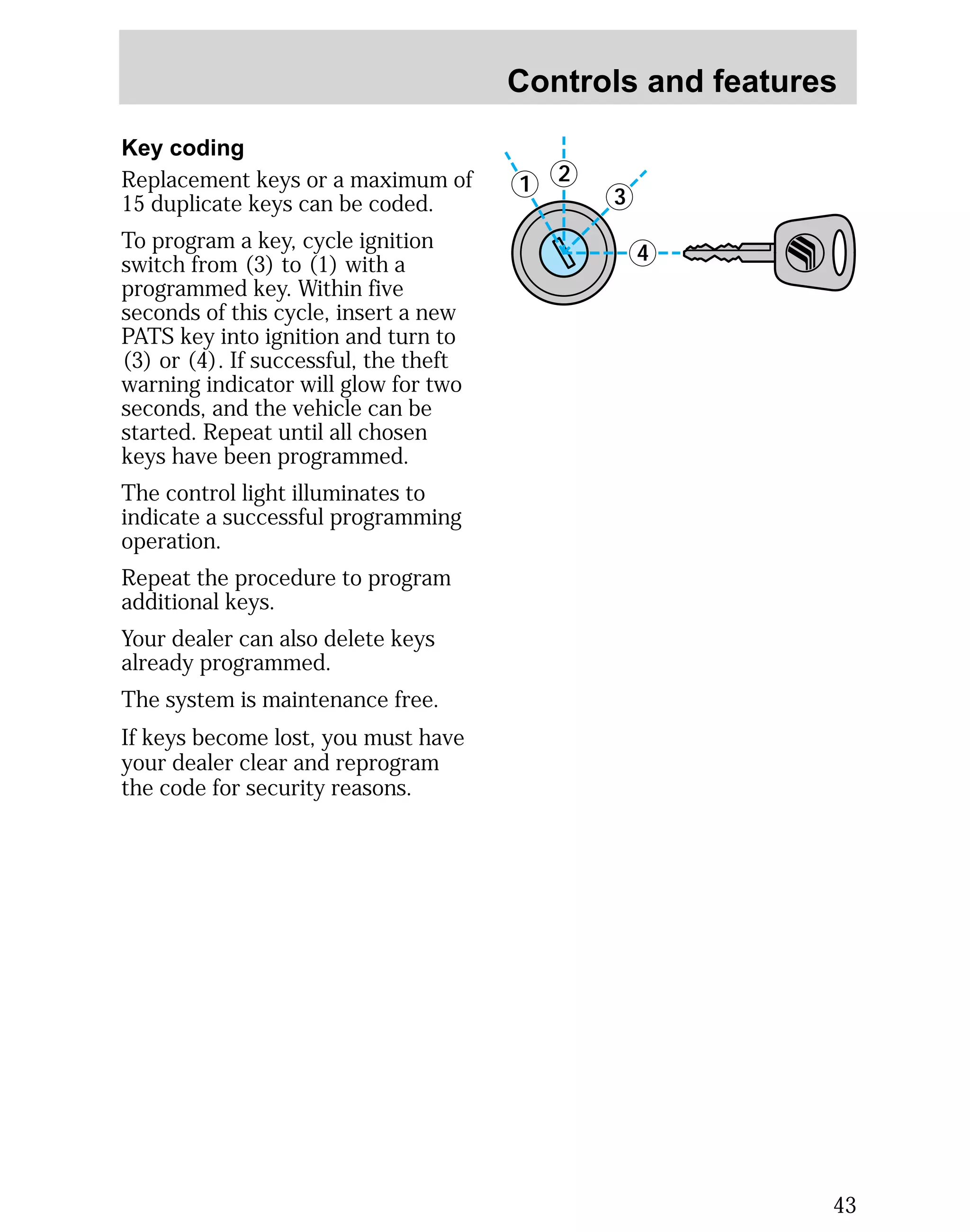
Key coding 
Replacement keys or a maximum of 
15 duplicate keys can be coded. 
To program a key, cycle ignition 
switch from (3) to (1) with a 
programmed key. Within five 
seconds of this cycle, insert a new 
PATS key into ignition and turn to 
(3) or (4). If successful, the theft 
warning indicator will glow for two 
seconds, and the vehicle can be 
started. Repeat until all chosen 
keys have been programmed. 
The control light illuminates to 
indicate a successful programming 
operation. 
Repeat the procedure to program 
additional keys. 
Your dealer can also delete keys 
already programmed. 
The system is maintenance free. 
If keys become lost, you must have 
your dealer clear and reprogram 
the code for security reasons. 
3 
4 
1 2
Seating and safety restraints 
HEAD RESTRAINTS 
Adjusting the head restraints 
Push or pull the head restraint to 
the desired height. 
Swivel the head restraint forward 
or backward to the desired angle. 
SEATING 
Manually adjusting the seats 
Pull the lever located inside the 
front edge of the seat to move the 
seat forward or backward. 
Pull the lever on the outside of the 
seat to recline the seat. 
44 
Never adjust the driver’s 
seat or seatback when the 
vehicle is moving.
Seating and safety restraints 
45 
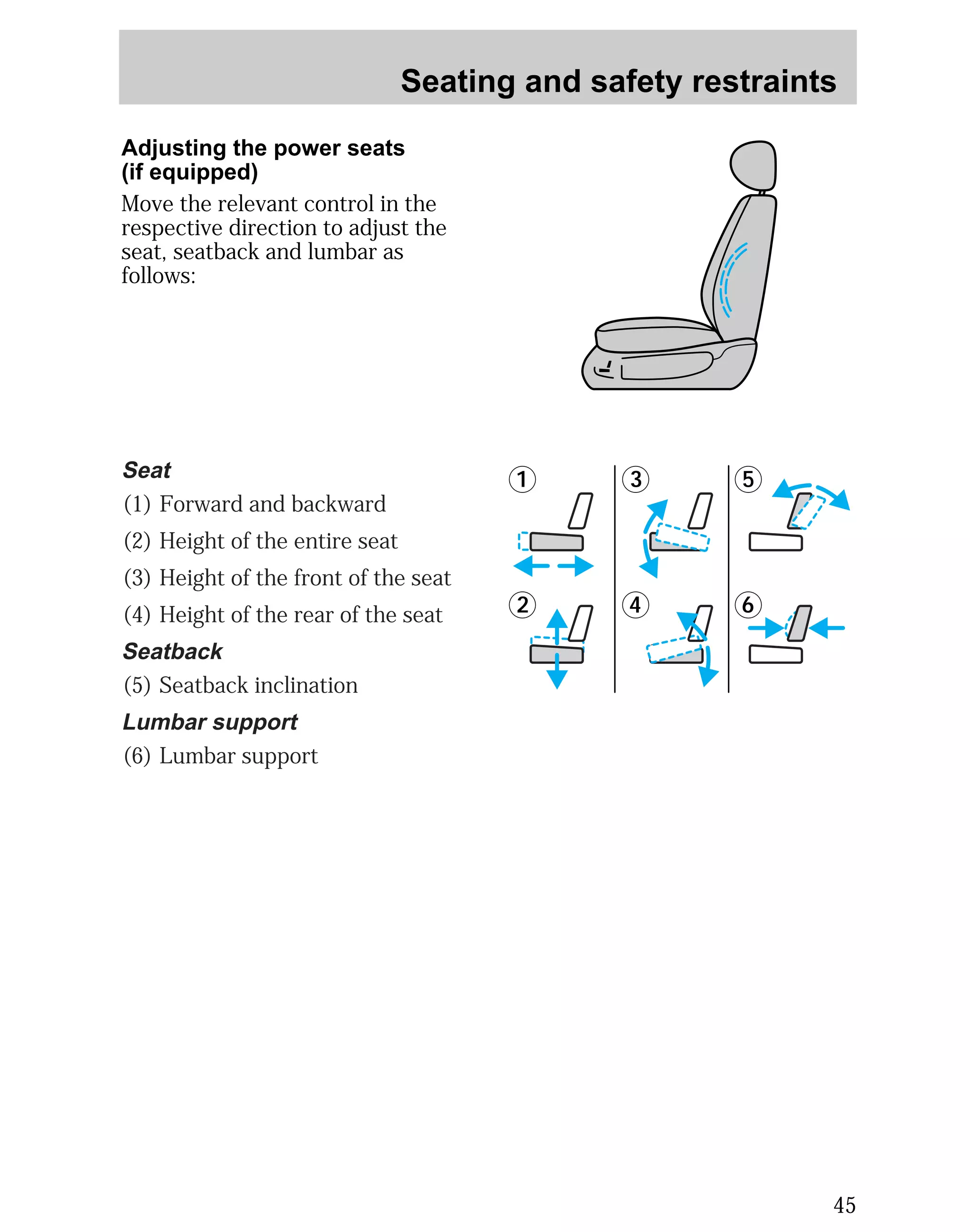
Adjusting the power seats 
(if equipped) 
Move the relevant control in the 
respective direction to adjust the 
seat, seatback and lumbar as 
follows: 
Seat 1 
3 
5 
(1) Forward and backward 
(2) Height of the entire seat 
(3) Height of the front of the seat 
(4) Height of the rear of the seat 
2 
4 6 
Seatback 
(5) Seatback inclination 
Lumbar support 
(6) Lumbar support
Seating and safety restraints 
Folding rear seats (if equipped) 
Pull the release knob located in the 
luggage compartment. Fold down 
the seat. The seatback cannot be 
released while the built-in childseat 
(if equipped) is open. 
If you are carrying objects that 
might damage the center rear 
three-point safety belt, you can 
unbuckle the end of the belt from 
the small buckle on the seat 
cushion and let the retractor reel it 
up. Reconnect the belt tongue to 
the buckle when you fold the seat 
back up. 
To raise the rear seatback, push the 
seatback upward until it locks in 
place. Make sure it is firmly latched 
by pushing forward and back on it. 
46 
Check to see that the seat 
and seatback are latched 
securely in position. Keep luggage 
area free of objects that would 
prevent proper engagement.
Seating and safety restraints 
47 
SAFETY RESTRAINTS 
Important safety restraints 
precautions 
The use of safety belts helps to 
restrain both driver and passenger 
in case of a collision. In most states 
and Canada, the law requires the 
use of safety belts. 
Front and rear seat 
occupants including 
pregnant women, should wear 
safety belts for optimum 
protection in an accident. 
Always drive and ride with 
your seatback upright and 
the lap belt snug and low across 
the hips. 
Lock the doors of your 
vehicle before driving to 
lessen the risk of the door coming 
open in a collision. 
Cargo should always be 
secured to prevent it from 
shifting and causing damage to the 
vehicle or harm to passengers. 
To prevent the risk of injury, 
make sure children sit where 
they can be properly restrained.
Seating and safety restraints 
Using safety restraints properly 
Combination lap and shoulder 
belt 
Insert the tongue into the slot in 
the buckle to fasten. 
Push the red release button and 
remove the tongue from the slot to 
unfasten. 
The passenger safety restraints in 
the vehicle are combination lap and 
shoulder belts. The front and rear 
seat passenger safety belts have 
two types of locking modes. 
48 
Each seating position in your 
vehicle has a specific safety 
belt assembly which is made up of 
one buckle and one tongue that 
are designed to be used as a pair. 
Use the shoulder belt on the 
outside shoulder only. Never wear 
the shoulder belt under the arm. 
Never swing it around your neck 
over the inside shoulder. 
Never use a single belt for more 
than one person.
Seating and safety restraints 
49 
Vehicle sensitive (emergency) 
locking mode 
The vehicle sensitive mode is the 
normal retractor mode which locks 
the belts in response to vehicle 
movement. For example, if the 
driver brakes suddenly, turns a 
corner sharply or your vehicle 
receives an impact of 8 km/h 
(5 mph) or more the combination 
safety belts will lock to help reduce 
the forward movement of the 
driver and passengers. 
The retractor can be made to lock 
by pulling sharply on the belt. 
Automatic locking mode 
In this mode, the shoulder belt is 
automatically prelocked; however, 
the belt will react to remove any 
slack in the shoulder belt. 
The automatic locking mode is not 
available on the driver’s safety belt. 
When to use the automatic 
locking mode 
• When a tight lap and shoulder 
belt fit is desired. 
• Any time a child safety seat is 
installed in the vehicle. For 
information on the proper use of 
a child safety seat, refer to Child 
safety seats later in this chapter.
Seating and safety restraints 
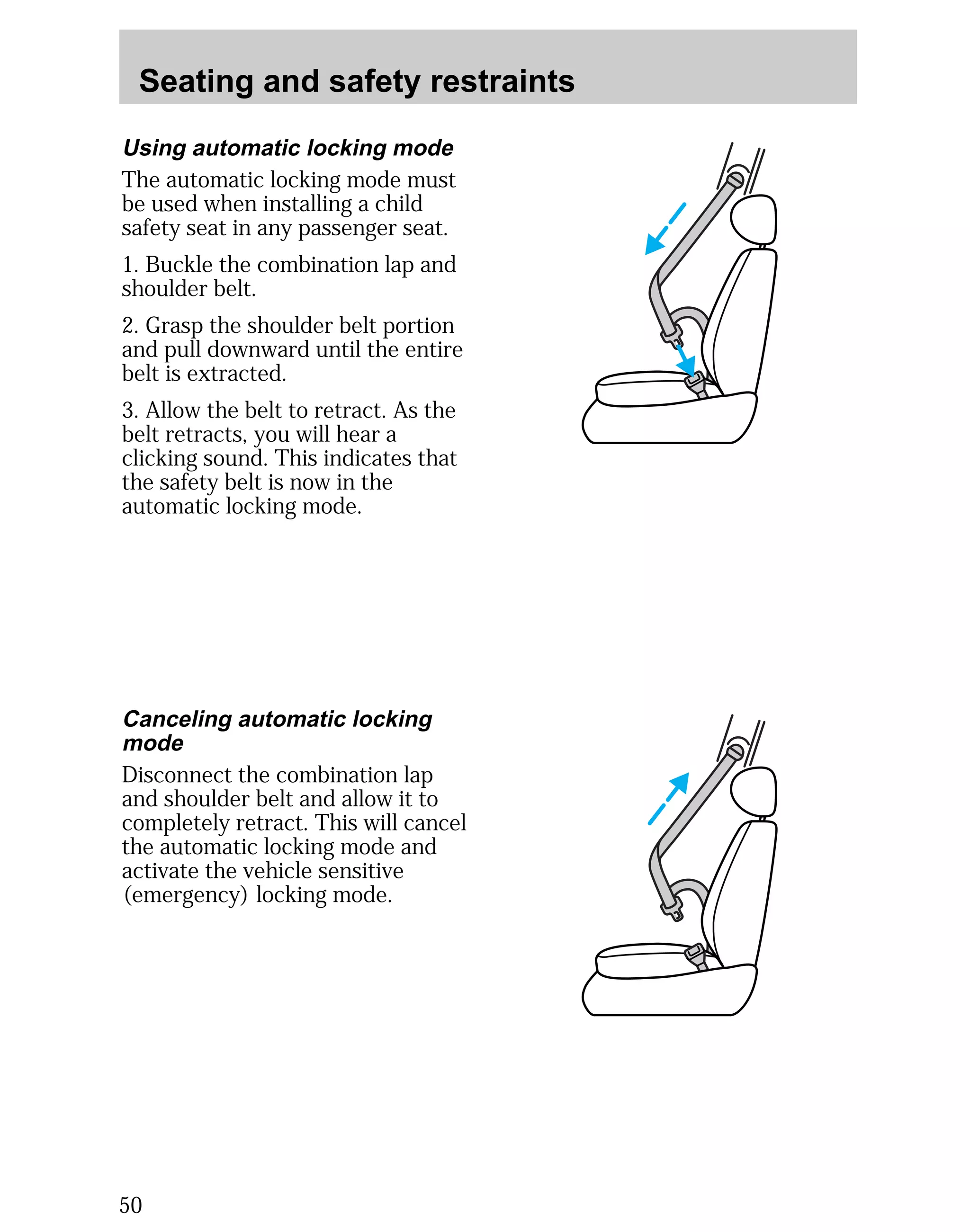
Using automatic locking mode 
The automatic locking mode must 
be used when installing a child 
safety seat in any passenger seat. 
1. Buckle the combination lap and 
shoulder belt. 
2. Grasp the shoulder belt portion 
and pull downward until the entire 
belt is extracted. 
3. Allow the belt to retract. As the 
belt retracts, you will hear a 
clicking sound. This indicates that 
the safety belt is now in the 
automatic locking mode. 
Canceling automatic locking 
mode 
Disconnect the combination lap 
and shoulder belt and allow it to 
completely retract. This will cancel 
the automatic locking mode and 
activate the vehicle sensitive 
(emergency) locking mode. 
50
Seating and safety restraints 
51 
Front seat safety belt height 
adjustment 
Position the shoulder belt 
height adjuster so that the 
belt rests across the middle of 
your shoulder. Be sure the 
shoulder belt is properly 
positioned on your shoulder each 
time you use the belt. If the 
shoulder belt is off your shoulder, 
on your upper arm or neck, there 
is a greater risk of severe injury in 
a collision. 
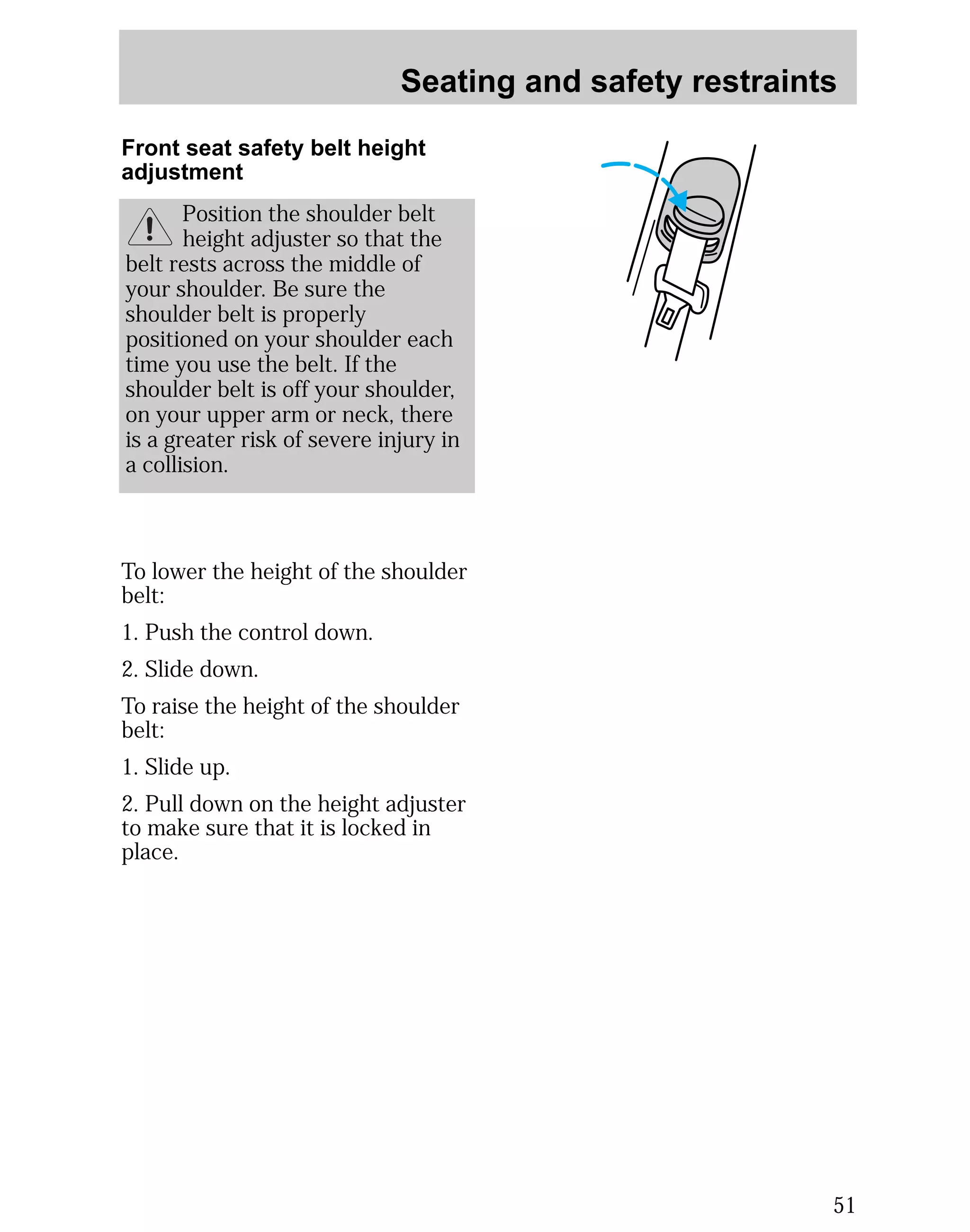
To lower the height of the shoulder 
belt: 
1. Push the control down. 
2. Slide down. 
To raise the height of the shoulder 
belt: 
1. Slide up. 
2. Pull down on the height adjuster 
to make sure that it is locked in 
place.
Seating and safety restraints 
Center position three-point 
safety belts 
If the lower end of the belt has 
been unbuckled, pull the belt 
steadily from the reel and insert 
the small tongue into the small 
buckle until a distinct “click” is 
heard. 
This buckle should be left buckled 
except when the seatback is folded 
down and cargo that might damage 
the seatbelt or get it dirty is being 
hauled. 
Pull the seat belt across the hips 
and insert the big (sliding) tongue 
into the appropriate buckle until a 
distinct “click” is heard. 
Should the center rear belt need to 
be unlatched from its anchorage, a 
thin probe is required to be 
inserted into the hole located on 
the underside of the floor mounted 
buckle. If the buckle and tongue 
are not reconnected, then the belt 
is not save to be used. 
Safety belt indicator light and 
warning chime 
Illuminates in the instrument 
cluster and a chime sounds to 
remind the occupants to fasten 
their safety belts. 
52
Seating and safety restraints 
53 
Conditions of operation 
If the driver’s safety belt is not 
buckled before the ignition key is 
turned to on, the safety belt 
indicator illuminates for 
1-2 minutes and the warning chime 
sounds for 4-8 seconds. 
If the driver’s safety belt is buckled 
while the indicator light is 
illuminated and the reminder 
chime is sounding, the safety belt 
indicator light and reminder turn 
off. 
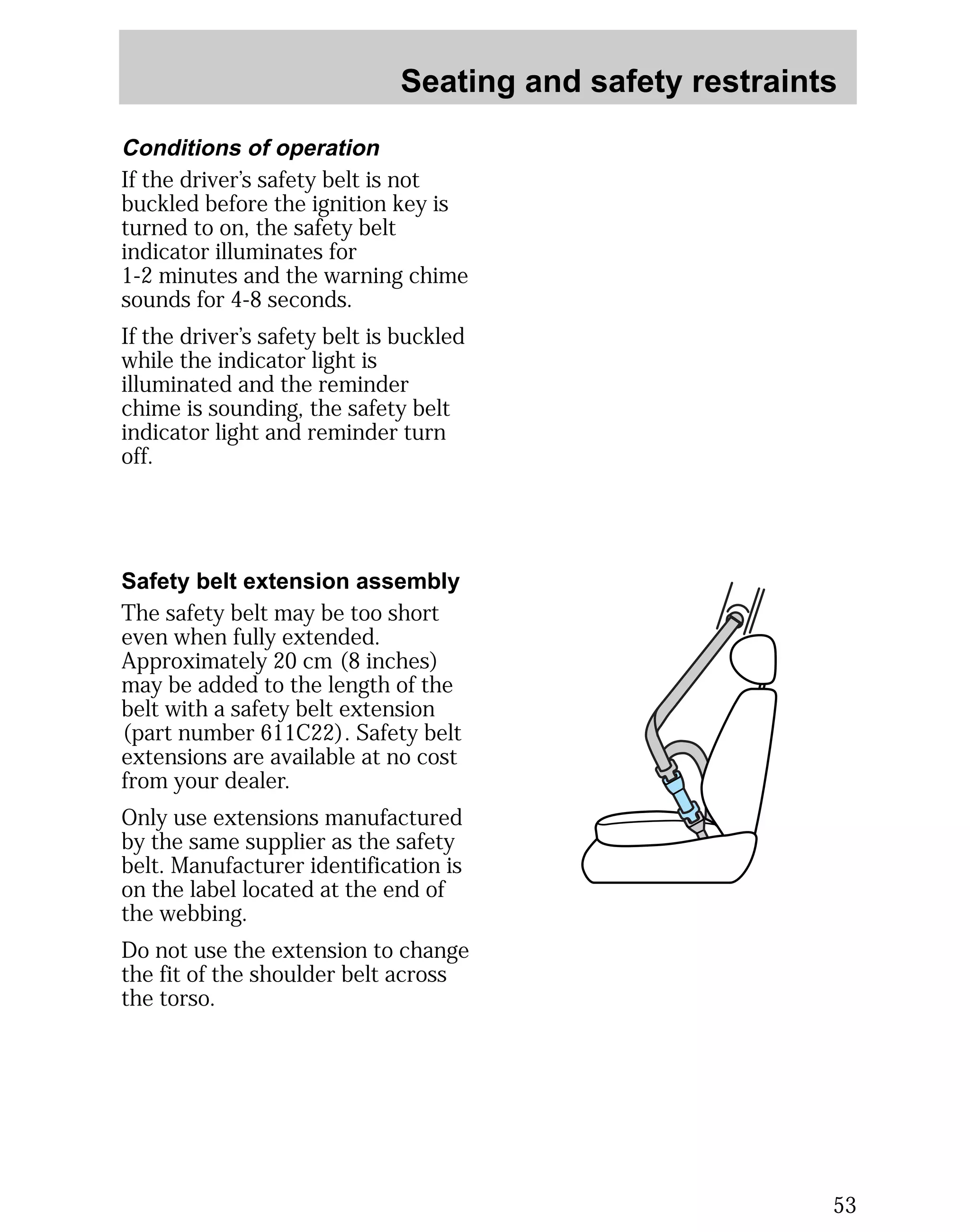
Safety belt extension assembly 
The safety belt may be too short 
even when fully extended. 
Approximately 20 cm (8 inches) 
may be added to the length of the 
belt with a safety belt extension 
(part number 611C22). Safety belt 
extensions are available at no cost 
from your dealer. 
Only use extensions manufactured 
by the same supplier as the safety 
belt. Manufacturer identification is 
on the label located at the end of 
the webbing. 
Do not use the extension to change 
the fit of the shoulder belt across 
the torso.
Seating and safety restraints 
Care of safety belts 
Periodically check the belts for 
damage or fraying. Check the 
security of the anchorage points 
and the locking action of the inertia 
reels by giving each belt a sharp 
tug. 
Belts subjected to strain, as in the 
result of an accident, should be 
replaced and the anchorages 
checked by your dealer or a 
qualified technician. 
54 
Failure to follow these 
instructions will affect the 
performance of the safety belts 
and increase the risk of personal 
injury. 
Safety belt warning label 
A warning label has been placed on 
the buckle of each of your vehicle’s 
front seat safety belts. 
In a collision of sufficient severity 
while the safety belt is in use, the 
safety belt buckle will pull out of 
the sleeve so that all or part of the 
orange portion of the lavel is 
visible. 
Whenever the orange 
portion of the label is visible, 
the safety belt must be replaced. 
WARNING Replace buckle 
assembly if this vehicle is in a collision 
or if any orange portion of this label 
is visible. (See Owner Guide). Failure 
to replace this buckle assembly under 
the above conditions could result in 
severe personal injuries in the event 
of collision. 
AVERTISSEMENT Remplacer 
l'ensemble de boucle de ceinture en 
cas de collision avec ce véhicule, ou si 
la partie orange de cette étiquette 
est visible (Voir le Guide du 
proprietare). Faute de remplacer cet 
ensemble de boucle, des blessures 
graves pourraient être encourues en 
cas de collision. 
REPLACE BUCKLE/REMPLACER BOUCLE
Seating and safety restraints 
55 
55 
50 
40 
30 
20 
60 
40 
1/2 
2 
4 5 
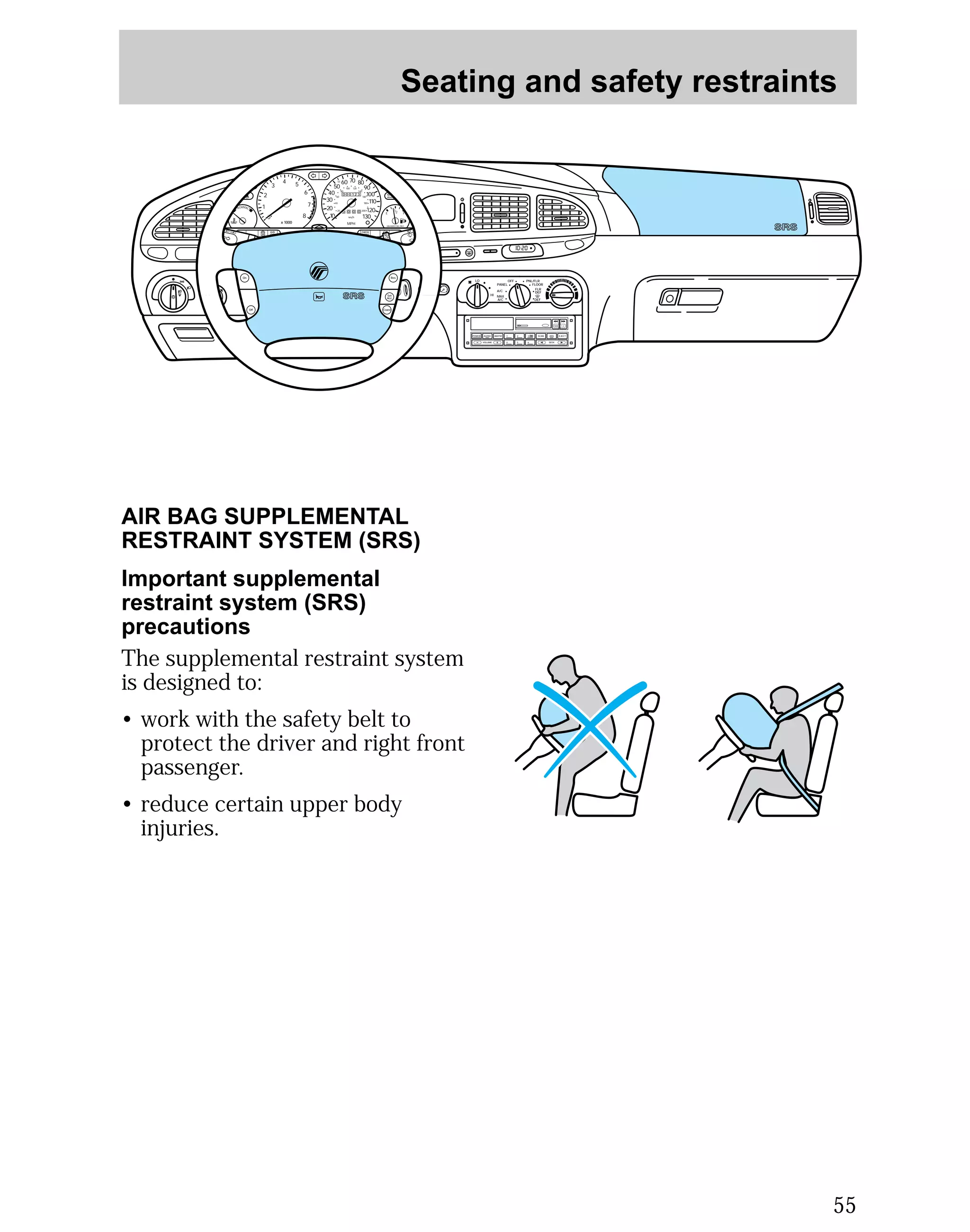
AIR BAG SUPPLEMENTAL 
RESTRAINT SYSTEM (SRS) 
Important supplemental 
restraint system (SRS) 
precautions 
The supplemental restraint system 
is designed to: 
• work with the safety belt to 
protect the driver and right front 
passenger. 
• reduce certain upper body 
injuries. 
POWER AUDIO AM/FM SCAN 
SEEK 
1 2 3 
4 5 6 
ANS 
SIDE 1-2 
EJECT 
VOLUME 
MIRRORS 
DEF 
LO 
HI 
OFF PNL/FLR 
PANEL 
A/C 
FLOOR 
FLR 
DEF 
MAX 
A/C 
T/C OFF 
000123 
0 0 0 0 
10 
60 70 80 
90 
100 
110 
120 
130 
MPH 
20 
80 
100 120 
140 
160 
180 
200 
E F 
UNLEADED FUEL ONLY 
1 
0 
3 
x 1000 
6 
7 
8 
NORMAL 
BRAKE 
CHECK 
ENGINE 
TRACTION 
CONTROL 
O/D 
OFF 
Off 
Res 
Set 
Acc 
Coast 
On 
I0 :20
Seating and safety restraints 
Do not place objects or 
mount equipment on or near 
the air bag covers that may come 
into contact with an inflating air 
bag. 
Do not attempt to service, 
repair, or modify the air bag 
Supplemental Restraint System or 
its fuses. See your Ford or 
Lincoln-Mercury dealer. 
Children and air bags 
For additional important safety 
information, read all information on 
safety restraints in this guide. 
Children should always wear safety 
belts. Failure to follow these 
instructions may increase the risk 
of injury in a collision. 
56 
AIRBAG 
When installing forward-facing 
child seats in the 
front seat always move the 
passenger seat as far back from 
the instrument panel as possible. 
Never install rear-facing child 
seats or rear-facing infant seats in 
the front seat.
Seating and safety restraints 
57 
How does the air bag 
supplemental restraint system 
(SRS) work? 
The SRS is designed to activate 
when the vehicle is in a collision, 
similar to hitting a fixed barrier 
head on at 12-24 km/h (8-14 mph). 
The fact that the air bags did not 
inflate in a collision does not mean 
that something is wrong with the 
system. Rather, it means the forces 
were not of the type sufficient to 
cause activation. 
The air bags inflate and deflate 
rapidly upon activation. 
After air bag deployment, it is 
normal to notice a smoke-like, 
powdery residue or smell the 
burned propellant. This may 
consist of cornstarch, talcum 
powder (to lubricate the bag) or 
sodium compounds (e.g., baking 
soda) that result from the 
combustion process that inflates 
the air bag. Small amounts of 
sodium hydroxide may be present 
which may irritate the skin and 
eyes, but none of the residue is 
toxic.
Seating and safety restraints 
Several air bag system 
components get hot after 
inflation. Do not touch them after 
inflation. 
The SRS consists of the following: 
• driver and passenger air bag 
modules (which include the 
inflators and air bags), 
• one or more impact and safing 
sensors, 
• a readiness light and tone, 
• and the electrical wiring and 
components. 
The diagnostic module monitors its 
own internal circuits and the 
supplemental air bag electrical 
system readiness (including the 
impact sensors), the system wiring, 
the air bag system readiness light, 
the air bag back up power and the 
air bag ignitors. 
58 
If the air bag is inflated, the 
air bag will not function 
again and must be replaced 
immediately. If the air bag is not 
replaced, the unrepaired area will 
increase the risk of injury in a 
collision.
Seating and safety restraints 
59 
Determining if the system is 
operational 
The SRS uses a readiness light in 
the instrument cluster or a chime 
to indicate the condition of the 
system. Refer to the Air bag 
readiness section in the 
Instrumentation chapter. Routine 
maintenance of the air bag is not 
required. 
A difficulty with the system is 
indicated by one or more of the 
following: 
• The readiness light will either 
flash or stay lit. 
• The readiness light will not 
illuminate after ignition is turned 
on. 
• A group of five beeps will be 
heard. The tone pattern will 
repeat periodically until the 
problem and light are repaired. 
If any of these things happen, even 
intermittently, have the SRS 
serviced at your dealership or by a 
qualified technician immediately. 
Unless serviced, the system may 
not function properly in the event 
of a collision. 
000123 
0 0 0 0 
55 
50 
40 
30 
20 
10 
60 70 80 
90 
110 
120 
130 
MPH 
60 
40 
20 
80 
100 120 
140 
160 
180 
200 
100 
1/2 
BRAKE 
E F 
UNLEADED FUEL ONLY 
CHECK 
ENGINE
Seating and safety restraints 
Disposal of air bags and air bag 
equipped vehicles 
For disposal of air bags or air bag 
equipped vehicles, see your local 
dealership or a qualified technician. 
Air bags MUST BE disposed of by 
qualified personnel. Res 
60 
Set 
Acc 
Coast 
Off 
On
Seating and safety restraints 
61 
CHILDREN AND SAFETY 
RESTRAINTS 
To prevent the risk of injury, 
make sure children sit where 
they can be properly restrained. 
Whenever possible, put 
children in one of the rear 
seats in your vehicle. Accident 
statistics indicate that children are 
safer when properly restrained in 
the rear seats than in the front 
seats. 
Do not leave children, 
unreliable adults, or pets 
unattended in your vehicle. 
Safety belts and seats can 
become hot in a vehicle that 
has been closed up in sunny 
weather; they could burn a small 
child. Check seat covers and 
buckles before you place a child 
anywhere near them. 
It is extremely dangerous to 
ride in a cargo area, inside or 
outside of a vehicle. In a collision, 
people riding in these areas are 
more likely to be seriously injured 
or killed. Do not allow people to 
ride in any area of your vehicle 
that is not equipped with seats 
and safety belts. Be sure everyone 
in your vehicle is in a seat and 
using a safety belt properly.
Seating and safety restraints 
Important child restraint 
precautions 
You are required by law to use 
safety restraints for children in the 
U.S. and Canada. If small children 
ride in your vehicle (generally 
children who are four years old or 
younger and who weigh 18 kg 
[40 lbs] or less), you must put them 
in safety seats made especially for 
children. Check your local and 
state or provincial laws for specific 
requirements regarding the safety 
of children in your vehicle. 
62 
Never let a passenger hold a 
child on his or her lap while 
the vehicle is moving. The 
passenger cannot protect the child 
from injury in a collision. 
Always follow the instructions and 
warnings that come with any infant 
or child restraint you might use. 
When possible, place children in 
the rear seat of your vehicle. 
Accident statistics suggest that 
children are safer when properly 
restrained in the rear seating 
positions than in the front seating 
position.
Seating and safety restraints 
63 
Children and safety belts 
Children who are too large for child 
safety seats (as specified by the 
child safety seat manufacturer) 
should always wear safety belts. 
Follow all the important safety 
restraints and air bag precautions 
that apply to adult passengers in 
your vehicle. 
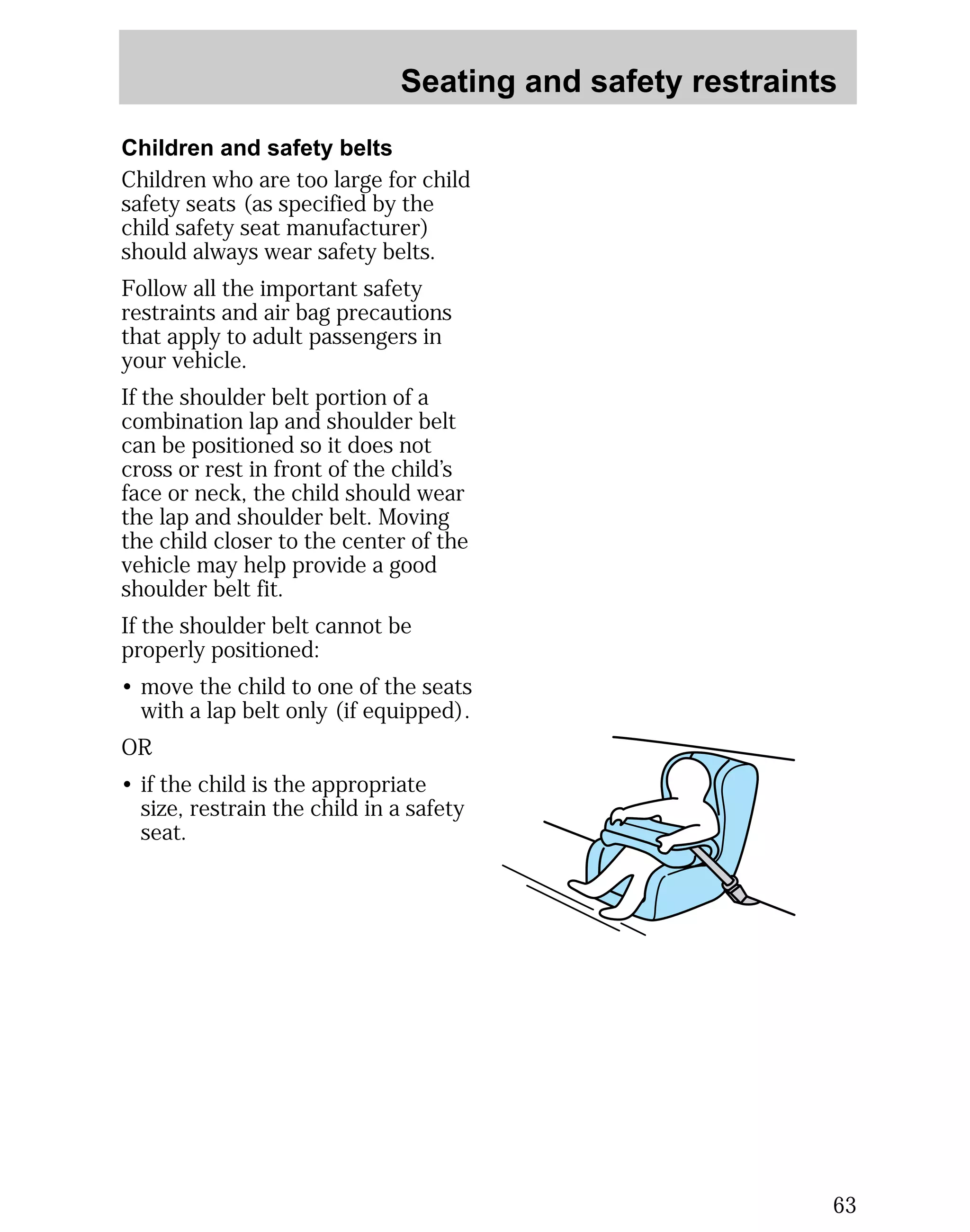
If the shoulder belt portion of a 
combination lap and shoulder belt 
can be positioned so it does not 
cross or rest in front of the child’s 
face or neck, the child should wear 
the lap and shoulder belt. Moving 
the child closer to the center of the 
vehicle may help provide a good 
shoulder belt fit. 
If the shoulder belt cannot be 
properly positioned: 
• move the child to one of the seats 
with a lap belt only (if equipped). 
OR 
• if the child is the appropriate 
size, restrain the child in a safety 
seat.
Seating and safety restraints 
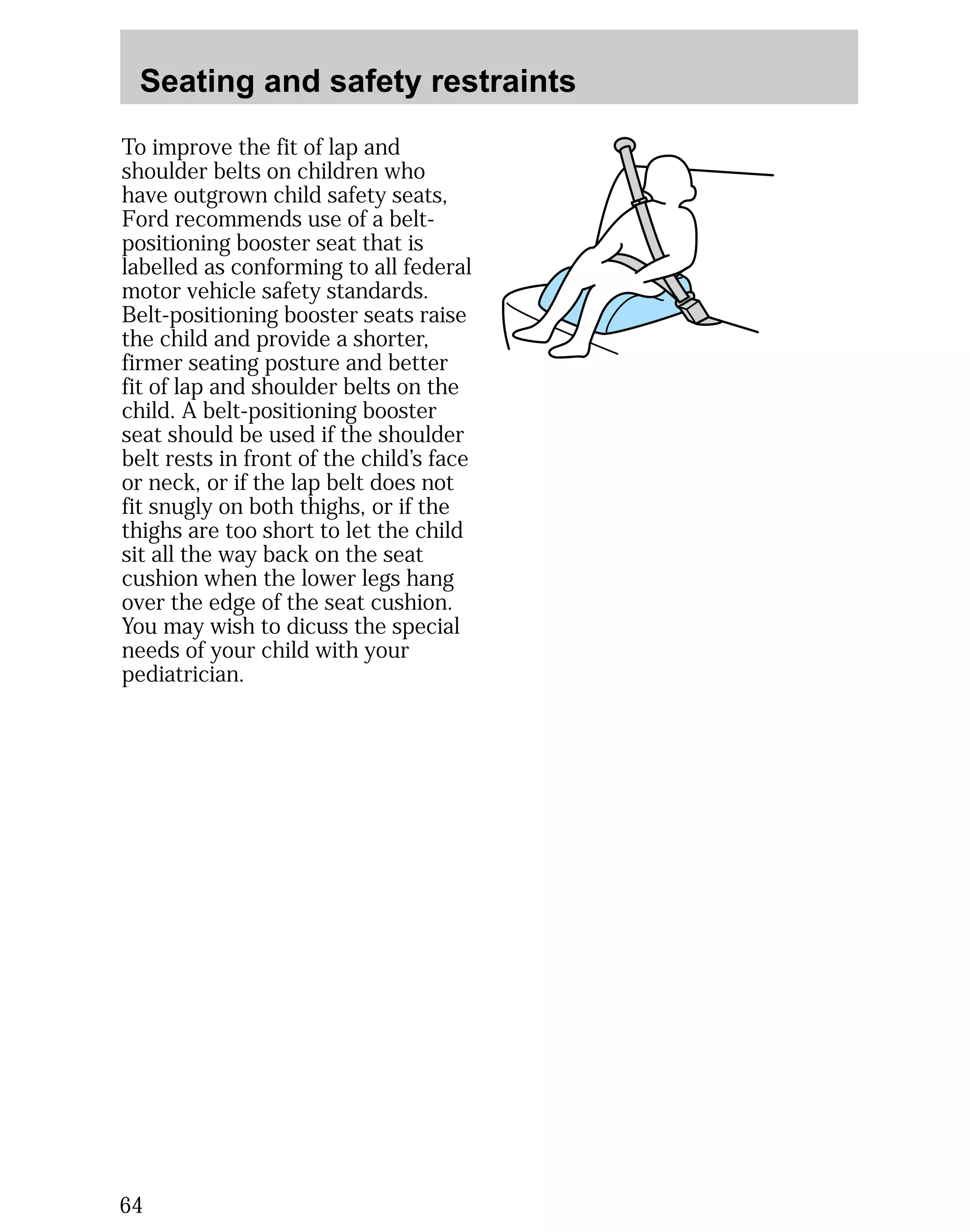
To improve the fit of lap and 
shoulder belts on children who 
have outgrown child safety seats, 
Ford recommends use of a belt-positioning 
64 
booster seat that is 
labelled as conforming to all federal 
motor vehicle safety standards. 
Belt-positioning booster seats raise 
the child and provide a shorter, 
firmer seating posture and better 
fit of lap and shoulder belts on the 
child. A belt-positioning booster 
seat should be used if the shoulder 
belt rests in front of the child’s face 
or neck, or if the lap belt does not 
fit snugly on both thighs, or if the 
thighs are too short to let the child 
sit all the way back on the seat 
cushion when the lower legs hang 
over the edge of the seat cushion. 
You may wish to dicuss the special 
needs of your child with your 
pediatrician.
Seating and safety restraints 
65 
Built-in child seat 
Built-in child safety seat 
(if equipped) 
The rear seat may include a built-in 
child seat. This child seat conforms 
to all Federal and local motor 
vehicle safety standards. Read the 
labels located on the child seat 
cushion and shoulder belt for 
information on the built-in child 
seat. 
Use the built-in child seat only if 
the child is at least one year old, 
weighs 10-27 kg (22-60 lbs) and 
the child’s shoulders fit below the 
shoulder harness slots on the built-in 
child seat. 
Children not meeting these 
requirements should be secured in 
an aftermarket seat. Refer to Child 
safety seats in this chapter. 
All built-in child restraints, 
including seats, buckles, 
retractors, seat latches, interlocks, 
and attaching hardware should be 
inspected by a qualified dealer 
technician after any collision.
Seating and safety restraints 
Child seat interlock safety 
feature 
The interlock ensures that a child 
is not placed in the integrated child 
seat when the folding seatback is 
not securely latched. 
It prevents the seatback from being 
unlatched while the child seat is in 
use. When the child seat is 
deployed, the seatback cannot be 
released. 
Built-in child seat retractors 
The belts on built-in child seats are 
equipped with a retractor. The 
retractor will automatically snug 
the belts around the child. If the 
belts do not remain snug, take the 
vehicle to your dealer or a qualified 
technician for child seat repair. The 
belts will not remain snug during a 
collision if the retractor is not 
functioning properly. 
66
Seating and safety restraints 
67 
Placing your child in the built-in 
child seat 
Failure to follow all of the 
instructions on the use of 
this child restraint system can 
result in your child striking the 
vehicle’s interior during a sudden 
stop or crash. 
Never use the built-in child 
seat as a booster cushion 
with the adult safety belts. A child 
using the adult belts could slide 
forward and out from under the 
safety belts. 
The rear seatback must be 
fully locked before operating 
the child safety restraint system. 
1. Make sure that the seatback is 
securely latched in place. 
2. Grasp the child seat cushion and 
pull the top forward to release the 
latch. Continue to unfold the child 
seat until it rests on the seat in the 
fully open position.
Seating and safety restraints 
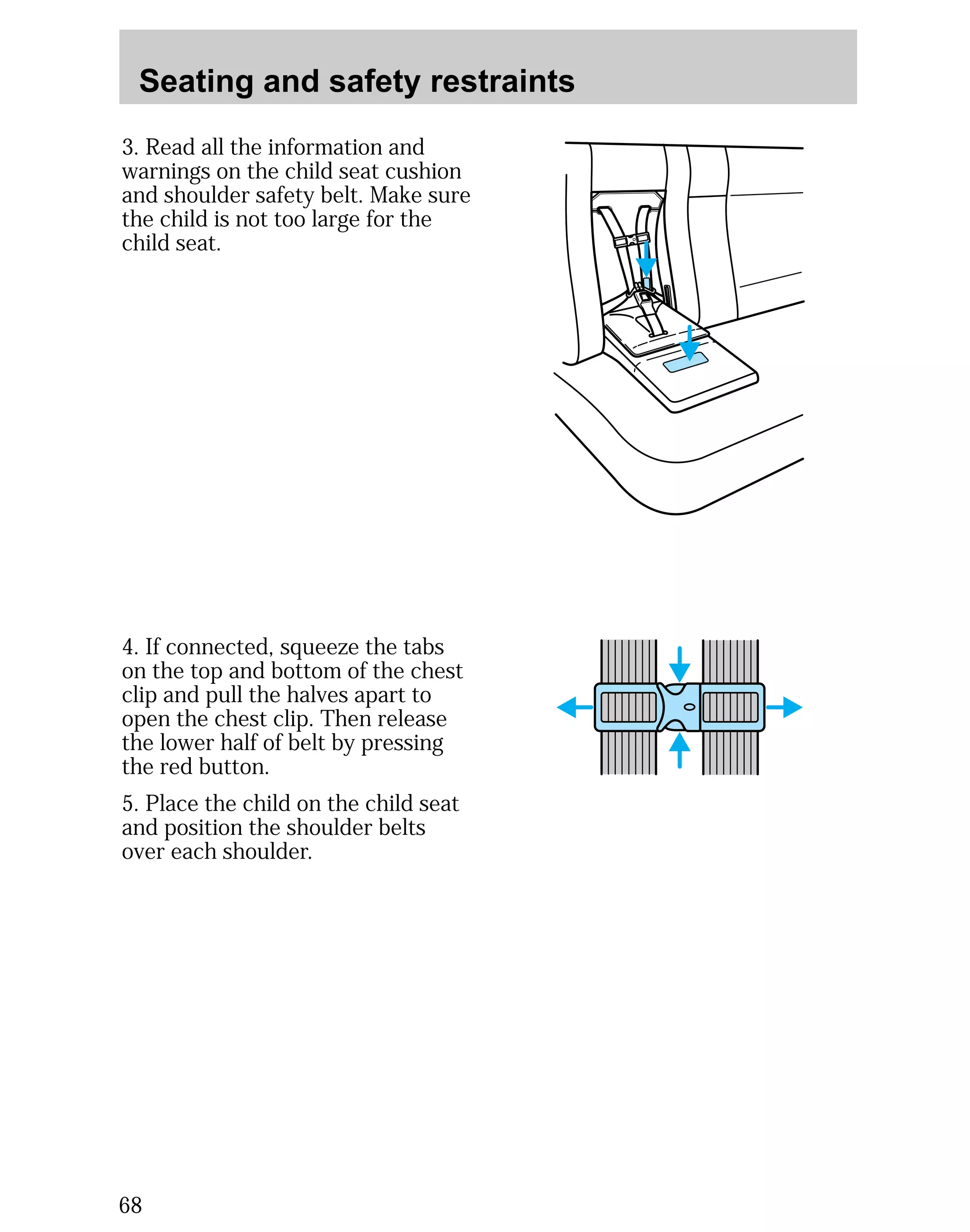
3. Read all the information and 
warnings on the child seat cushion 
and shoulder safety belt. Make sure 
the child is not too large for the 
child seat. 
4. If connected, squeeze the tabs 
on the top and bottom of the chest 
clip and pull the halves apart to 
open the chest clip. Then release 
the lower half of belt by pressing 
the red button. 
5. Place the child on the child seat 
and position the shoulder belts 
over each shoulder. 
68
Seating and safety restraints 
69 
6. Insert either the left or the right 
safety belt tongue into the single 
opening of the crotch safety belt 
buckle (it doesn’t matter which 
tongue is inserted first). Insert the 
other tongue. The color green must 
appear in the indicator window on 
each tongue when buckled. Allow 
belts to retract and fit snugly. 
If both tongues do not latch 
in the buckle, do not use the 
child seat. See your dealer for 
repairs. 
7. Fasten both halves of the chest 
clip below the child’s shoulders and 
adjust it to comfortably hold the 
shoulder belts in place on the 
child’s chest. The color green must 
appear in the indicator window 
when fastened. 
8. Pull the lap portion of the belts 
toward you to make sure the crotch 
safety belt buckle is properly 
fastened and the retractor is 
locked. 
9. If the belts become too tight, 
unbuckle the crotch safety belt 
buckle to unlock the retractors, 
then reinsert both belt tongues.
Seating and safety restraints 
Removing your child from the 
built-in child seat 
1. Squeeze the tabs on the top and 
the bottom of the chest clip and 
pull the halves apart to open the 
chest clip. 
2. Press the release button on the 
crotch safety belt buckle. 
3. Slide the shoulder belts off the 
child’s shoulders and remove the 
child. 
To stow the built-in child seat 
Return the child seat cushion to 
the upright position, then press 
firmly in the center and top of the 
child seat. 
Inspecting the built-in child seat 
after a collision 
All built-in child restraints, 
including seats, buckles, retractors, 
seat latches, interlocks and 
attaching hardware should be 
inspected by your dealer or a 
qualified technician after any 
collision. If the child seat was in 
use during a collision, Ford 
recommends replacing it. Built-in 
child restraints not in use during a 
collision should be inspected and 
replaced if either damage or 
improper operation is noted. 
70
Seating and safety restraints 
71 
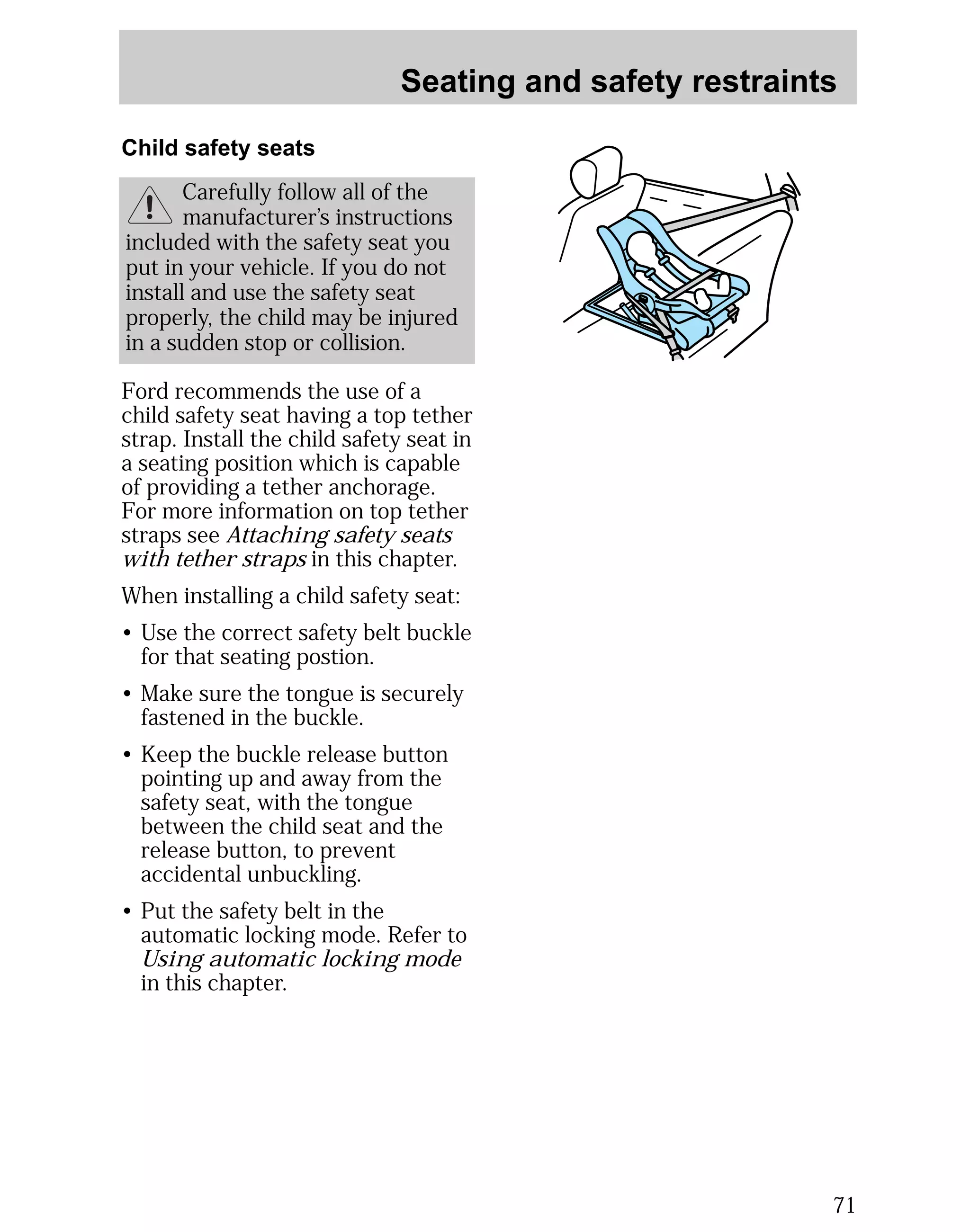
Child safety seats 
Carefully follow all of the 
manufacturer’s instructions 
included with the safety seat you 
put in your vehicle. If you do not 
install and use the safety seat 
properly, the child may be injured 
in a sudden stop or collision. 
Ford recommends the use of a 
child safety seat having a top tether 
strap. Install the child safety seat in 
a seating position which is capable 
of providing a tether anchorage. 
For more information on top tether 
straps see Attaching safety seats 
with tether straps in this chapter. 
When installing a child safety seat: 
• Use the correct safety belt buckle 
for that seating postion. 
• Make sure the tongue is securely 
fastened in the buckle. 
• Keep the buckle release button 
pointing up and away from the 
safety seat, with the tongue 
between the child seat and the 
release button, to prevent 
accidental unbuckling. 
• Put the safety belt in the 
automatic locking mode. Refer to 
Using automatic locking mode 
in this chapter.
Seating and safety restraints 
passenger seat as far back from 
the instrument panel as possible. 
Never secure rear-facing infant 
seats in the front seat. 
72 
AIRBAG 
Installing child safety seats in 
combination lap and shoulder 
belt seat positions 
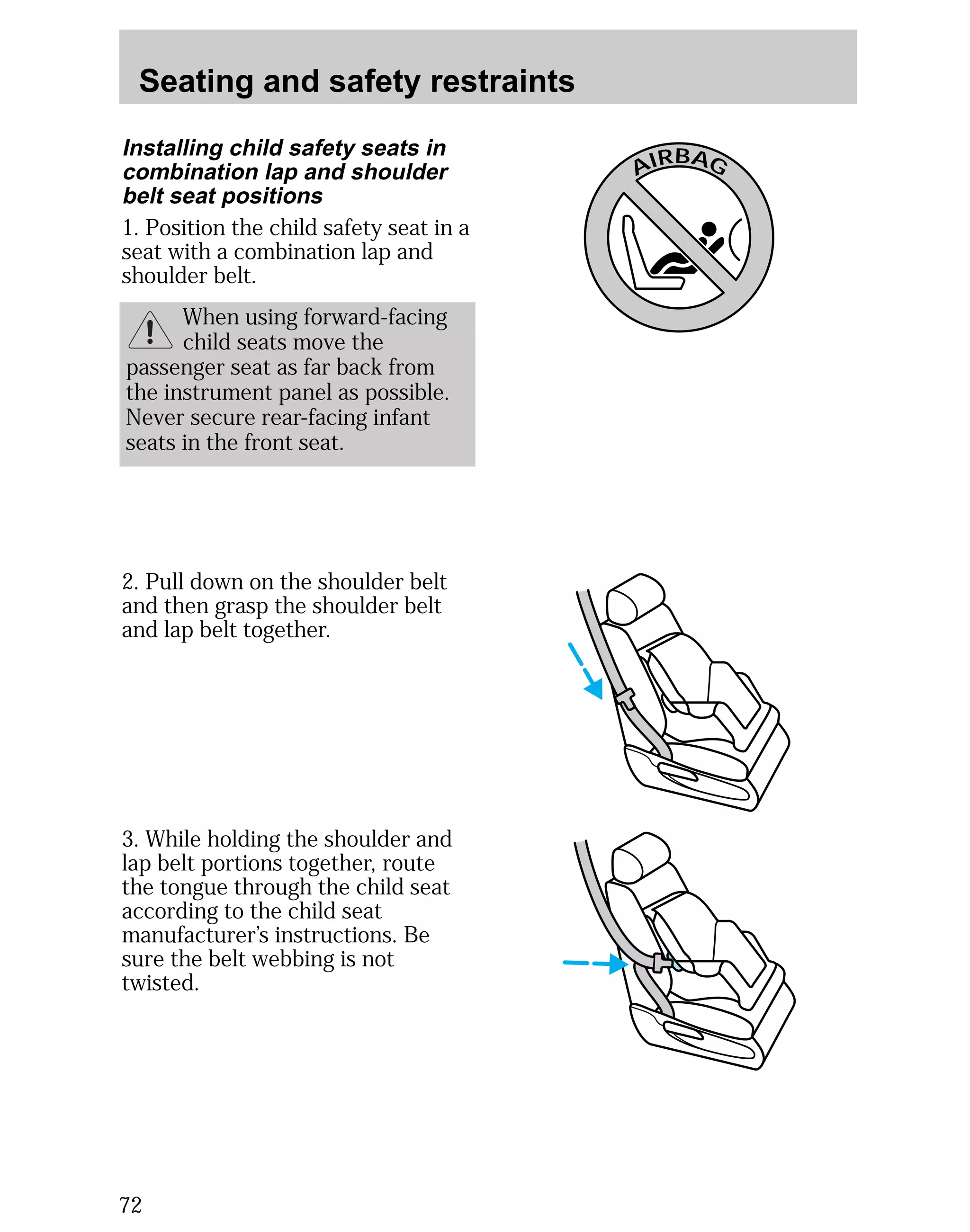
1. Position the child safety seat in a 
seat with a combination lap and 
shoulder belt. 
When using forward-facing 
child seats move the 
2. Pull down on the shoulder belt 
and then grasp the shoulder belt 
and lap belt together. 
3. While holding the shoulder and 
lap belt portions together, route 
the tongue through the child seat 
according to the child seat 
manufacturer’s instructions. Be 
sure the belt webbing is not 
twisted.
Seating and safety restraints 
73 
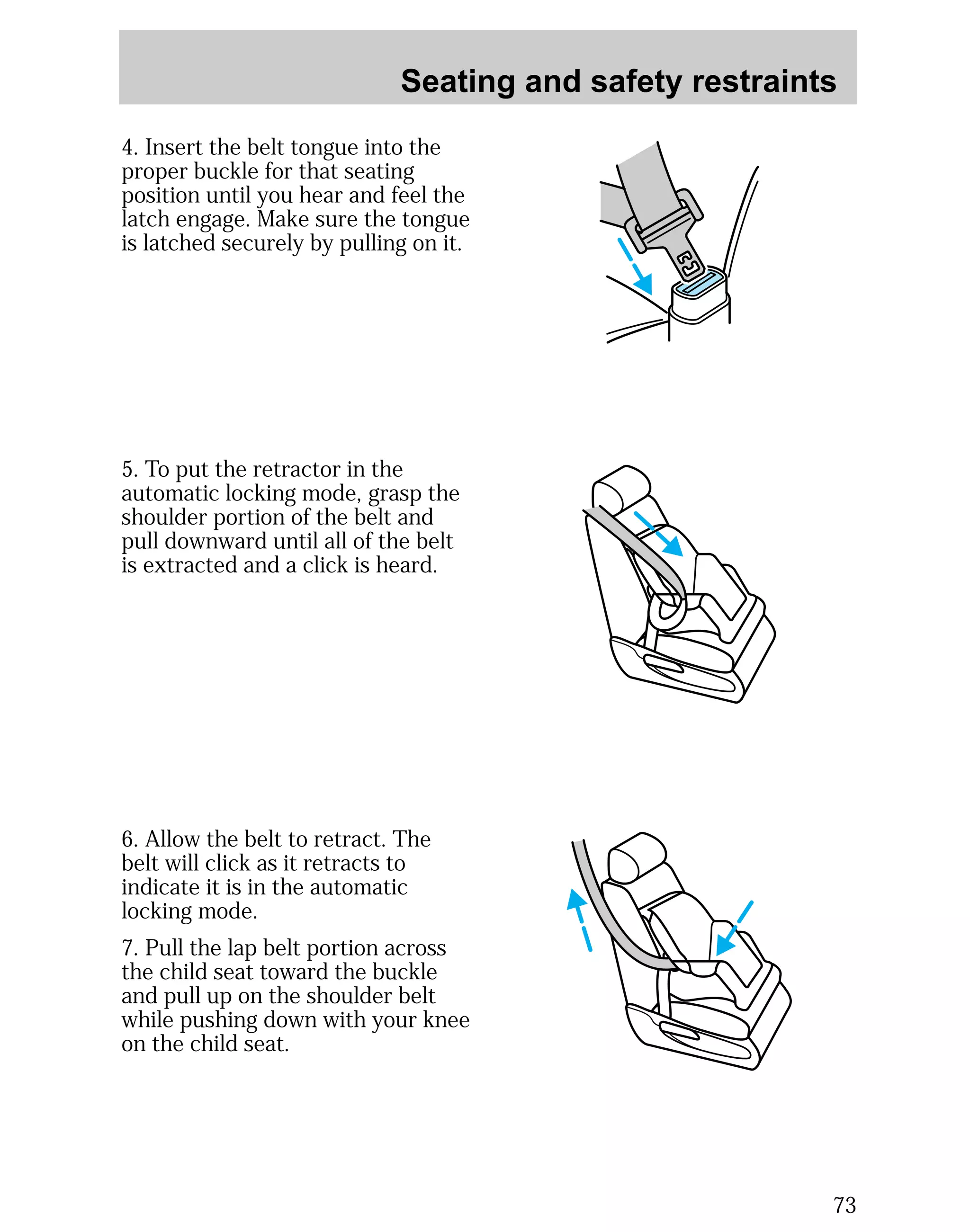
4. Insert the belt tongue into the 
proper buckle for that seating 
position until you hear and feel the 
latch engage. Make sure the tongue 
is latched securely by pulling on it. 
5. To put the retractor in the 
automatic locking mode, grasp the 
shoulder portion of the belt and 
pull downward until all of the belt 
is extracted and a click is heard. 
6. Allow the belt to retract. The 
belt will click as it retracts to 
indicate it is in the automatic 
locking mode. 
7. Pull the lap belt portion across 
the child seat toward the buckle 
and pull up on the shoulder belt 
while pushing down with your knee 
on the child seat.
Seating and safety restraints 
8. Allow the safety belt to retract to 
remove any slack in the belt. 
9. Before placing the child in the 
seat, forcibly tilt the seat forward 
and back to make sure the seat is 
securely held in place. 
10. Try to pull the belt out of the 
retractor to make sure the 
retractor is in automatic locking 
mode (you should not be able to 
pull more belt out). If the retractor 
is not locked, unbuckle the belt and 
repeat steps two through nine. 
Check to make sure the child seat 
is properly secured before each 
use. 
Attaching safety seats with 
tether straps 
Some manufacturers make safety 
seats that include a tether strap 
that goes over the back of the 
vehicle seat and attaches to an 
anchoring point. Other 
manufacturers offer their tether 
strap as an accessory. Contact the 
manufacturer of your child safety 
seat for information about ordering 
a tether strap. 
74
Seating and safety restraints 
75 
To install a tether from a child 
safety seat in the front seat, route 
the tether strap under the vehicle 
seat head restraint and hook the 
tether hook into the hole in the 
tongue of the center rear lap belt. 
After the hook is in the hole, pull 
on the loose end of the lap belt 
webbing to shorten the belt and 
tighten the tether strap. 
To install a tethered child safety 
seat in the rear seat, you will need 
tether anchor hardware. 
Tighten the anchor 
according to specifications. 
Otherwise, the safety seat may not 
be properly secured and the child 
may be injured in a sudden stop or 
collision. 
Tether anchor hardware 
Tether anchor hardware kits (part 
number 613D74), including 
instructions, may be obtained at no 
charge from any Ford or Lincoln- 
Mercury dealer. All vehicles built 
for sale in Canada include a tether 
anchor hardware kit.
Starting 
IMPORTANT SAFETY 
PRECAUTIONS 
A computer system controls the 
engine’s idle revolutions per minute 
(rpm). When the engine starts, the 
idle rpm runs faster to warm the 
engine. If the engine idle speed 
does not slow down automatically, 
have the vehicle checked by your 
dealer or a qualified servcie 
technician. Do not allow the vehicle 
to idle for more than ten minutes. 
76 
Extended idling at high 
engine speeds can produce 
very high temperatures in the 
engine and exhaust system, 
creating the risk of fire or other 
damage. 
Do not park, idle, or drive 
your vehicle in dry grass or 
other dry ground cover. The 
emission system heats up the 
engine compartment and exhaust 
system, which can start a fire.
Starting 
77 
Do not start your vehicle in a 
closed garage or in other 
enclosed areas. Exhaust fumes 
can be toxic. Always open the 
garage door before you start the 
engine. See Guarding against 
exhaust fumes in this chapter for 
more instructions. 
IMPORTANT VENTILATION 
INFORMATION 
If the engine is idling while the 
vehicle is stopped in an open area 
for long periods of time, open the 
windows at least 2.5 cm (1 inch). 
AUTO 
OFF PLN/FLR 
PANEL 
A/C 
FLOOR 
FLR 
DEF 
DEF 
MAX 
A/C 
Adjust the heating or air 
conditioning to bring in fresh air.
Starting 
Improve vehicle ventilation by 
keeping all air inlet vents clear of 
snow, leaves and other debris. 
Guarding against exhaust 
fumes 
Although odorless and colorless, 
carbon monoxide is present in 
exhaust fumes. Take precautions to 
avoid its dangerous effects. 
Have the exhaust and body 
ventilation system checked 
whenever: 
• the vehicle is raised for service. 
• the sound of the exhaust system 
changes. 
• the vehicle has been damaged in 
a collision. 
78 
If you ever smell exhaust 
fumes of any kind inside 
your vehicle, have your dealer 
inspect and fix your vehicle 
immediately. Do not drive if you 
smell exhaust fumes. These fumes 
are harmful and could kill you.
Starting 
79 
PREPARING TO START THE 
VEHICLE 
Engine starting is controlled by the 
spark ignition system. This system 
meets all Canadian Interference- 
Causing Equipment standard 
requirements regulating the 
impulse electrical field strength of 
radio noise. 
When starting a fuel-injected 
engine, avoid pressing the 
accelerator pedal before or during 
starting. Only use the accelerator 
pedal when you have difficulty 
starting the engine. For more 
information on starting the vehicle, 
refer to Starting the engine in this 
chapter. 
Before starting the vehicle: 
1. Make sure all vehicle occupants 
have buckled their safety belts. For 
more information on safety belts 
and their proper usage, refer to the 
Seating and safety restraints 
chapter. 
2. Make sure the headlamps and 
vehicle accessories are off.
Starting 
If starting a vehicle with an 
automatic transaxle: 
• Make sure the parking brake is 
set. 
• Make sure the gearshift is in P 
(Park). 
If starting a vehicle with a manual 
transaxle: 
• Make sure the parking brake is 
set. 
• Push the clutch pedal to the 
floor. Otherwise, the engine will 
not crank (turn over). 
• Put the gearshift into neutral. 
80
Starting 
81 
3. Turn the key to the on position 
(without turning the key to start). 
Make sure the following lights 
illuminate briefly. If a light fails to 
illuminate, have the vehicle 
serviced by your dealer or a 
qualified service technician. 
• If the driver’s safety belt is 
fastened the warning light does 
not illuminate. 
BRAKE 
CHECK 
ENGINE
Starting 
STARTING THE ENGINE 
1. Turn the key to the start 
position (4) without pressing the 
accelerator pedal and release as 
soon as the engine starts. The key 
will return to the on (3) position. 
82 
3 
4 
1 2 
2. If the engine does not start 
within five seconds, wait ten 
seconds and try again. 
3. If the engine does not start in 
two attempts OR the temperature 
is below -12°C (10°F), depress the 
accelerator pedal and start the 
engine while holding the 
accelerator pedal down. Release 
accelerator pedal when the engine 
starts. 
Vehicles equipped with the 2.0 l 
engine: If the engine fails to start, 
continue to crank with the 
accelerator depressed about 1/4 of 
the way down and hold that 
position until the engine starts. 
DO NOT crank for more than 
30 seconds or you could damage 
the starter. 
4. After idling the engine for a few 
seconds, apply the brake and 
release the parking brake
Starting 
83 
USING THE ENGINE BLOCK 
HEATER (if equipped) 
An engine block heater warms the 
engine coolant, which improves 
starting, warms up the engine 
faster and allows the heater-defroster 
system to respond 
quickly. It is strongly recommended 
if you live in a region where 
temperatures reach –23°C (–10°F) 
or below. 
For best results, plug the heater in 
at least three hours before starting 
the vehicle. Using the heater for 
more than three hours will not 
harm the engine, so the heater can 
be plugged in the night before 
starting the vehicle. 
To prevent electrical shock, 
do not use your heater with 
ungrounded electrical systems or 
two-pronged (cheater) adapters.
Driving 
BRAKES 
Your brakes are self-adjusting. 
Refer to the “Service Guide” for 
maintenance intervals. 
Anti-lock braking system (ABS) 
(if equipped) 
The ABS operates by detecting the 
onset of wheel lock up during 
brake applications and 
compensating for this tendency. 
The wheels are prevented from 
locking even when the brakes are 
firmly applied, helping to ensure 
that the vehicle can be steered and 
the driver can avoid obstacles. 
Operation of the anti-lock 
braking system 
The anti-lock braking system is not 
employed during normal braking. It 
becomes operational only when it 
senses differences in the rotational 
speed of the road wheels, 
indicating that they are about to 
lock up. Its operation is indicated 
by a pulsing of the brake pedal. 
84
Driving 
Two important 
rules when 
braking in 
emergencies with 
ABS: 
85 
1. 
Apply full force 
on both brake 
and clutch pedal 
(if equipped). 
Braking with ABS 
• In an emergency, apply full force 
on the brake pedal. In vehicles 
with manual transaxles, you must 
also depress the clutch pedal. 
The anti-lock braking system will 
be activated immediately, 
allowing you to retain full 
steering control of your vehicle 
and, providing there is sufficient 
space, will enable you to avoid 
obstacles. 
• We recommend that you 
familiarize yourself with this 
braking technique. However, 
avoid taking any unnecessary 
risks. 
2. 
Steer around the 
obstacle. No matter 
how hard you brake, 
steering control is 
maintained.
Driving 
Parking brake 
To engage the parking brake: 
Pull the handle upward. 
To release the parking brake: 
1. Press and hold the release 
button. 
2. Pull the handle upward to 
disengage the brake. 
3. Push handle downward to the off 
position. 
86 
Always set the parking brake 
fully and make sure that the 
gearshift is securely latched in P 
(Park) (automatic transaxle) or in 
1 (first) (manual transaxle). 
To prevent personal injury, 
do not release the parking 
brake while outside the vehicle.
Driving 
87 
TRANSAXLE OPERATION 
Automatic transaxle 
(if equipped) 
Vehicles equipped with an 
automatic transaxle are equipped 
with a brake-shift interlock feature 
that prevents the gearshift lever 
from being moved from the P 
(Park) position unless the brake 
pedal is depressed. 
Putting your vehicle in gear 
You must push the thumb button to 
move the gearshift to the position 
you choose. 
To operate: 
1. Start the engine. 
2. Depress and hold the brake 
pedal. 
3. Move the gearshift lever out of P 
(Park).
Driving 
Overriding the brake-shift 
interlock feature 
If it is necessary to use this 
procedure to move the gearshift 
lever, it is possible that a fuse has 
blown and the vehicle’s brakelamps 
may not be working. Refer to Fuses 
and relays in the Roadside 
emergencies chapter. 
If you cannot move the gearshift 
lever from P (Park) with the brake 
pedal depressed: 
1. Turn the ignition off and remove 
the ignition key. 
2. Apply the parking brake and the 
brake pedal. 
3. Insert a screwdriver or similar 
item about 5 cm (2 inches) into the 
square opening to the right of the 
gearshift at the base of the console. 
4. Rotate the screwdriver point 
rearward. 
5. Push and hold the thumb button 
and move the gearshift. 
6. Remove the screwdriver when 
the gearshift moves from the P 
(Park) position. 
88
Driving 
89 
The console-mounted gearshift will 
lock when you turn the key to the 
lock position. When the gearshift is 
in any position except P (Park), 
the ignition key cannot be turned 
to lock or removed from the 
steering column. To remove the 
key, the gearshift lever must be in 
P (Park). 
Once the gearshift is secure in the 
desired position, release the brake 
pedal and use the accelerator as 
necessary. 
Driving 
Never leave a vehicle 
unattended while it is 
running. 
• P (Park) 
Always come to a complete stop 
before shifting into P (Park). This 
locks the transaxle and prevents 
the front wheels from rotating. 
• R (Reverse) 
The vehicle only moves backward. 
Always come to a complete stop 
before shifting in or out of R 
(Reverse). 
P = Park . . . . . . . . . . . . . . 
R = Reverse . . . . . . . . . . . 
N = Neutral. . . . . . . . . . . . 
D = Drive: Gear 1 to 4 
with overdrive . . . . . . 
Gear 1 to 3 
with overdrive 
cancelled . . . . . . . . . . 
2 = Gear 2 . . . . . . . . . . . . 
1 = Gear 1 . . . . . . . . . . . .
Driving 
• N (Neutral) 
The wheels of the transaxle are not 
locked. Your vehicle will roll freely, 
even on the slightest incline, unless 
the parking brake or brakes are on. 
• D (Overdrive) 
Note that the vehicle’s gearshift is 
console-mounted on the floor. The 
transaxle control switch (TCS) is 
located on the gearshift handle. 
The transaxle control indicator 
light (O/D light) is located on the 
instrument panel. 
Overdrive is not shown on the 
display, but is the default mode for 
the D gearshift position. This is the 
normal driving mode for the best 
fuel economy. The transaxle 
operates in gears one through four. 
The O/D light is off (not 
illuminated) during normal vehicle 
operation. 
Overdrive can be deactivated by 
pressing the transaxle control 
switch (TCS) located on the 
gearshift handle. The O/D OFF 
indicator light will illuminate in the 
instrument cluster. 
90
Driving 
91 
TRACTION 
CONTROL 
O/D 
OFF 
• D (Drive) 
D (Drive) provides more engine 
braking than overdrive and is 
useful when driving through hilly 
terrain or if your vehicle requires 
additional power for climbing hills. 
Activate by pressing the transaxle 
control switch (TCS) located on 
the gearshift handle. The O/D OFF 
indicator light will illuminate in the 
instrument cluster. Transaxle 
operates in gears one through 
three. 
To return to overdrive mode, press 
the transaxle control switch.The 
O/D OFF indicator light will 
extinguish. 
When starting your vehicle, the 
transaxle will automatically return 
to normal overdrive mode when the 
D (Drive) gearshift position is 
selected.
Driving 
• 2 (Second) 
Use the 2 (Second) position to 
start up on slippery roads or to 
provide additional braking on 
downgrades. When your vehicle is 
in 2 (Second), it automatically 
starts off in second gear. Do not go 
faster than 90 km/h (55 mph) in 
this gear. 
• 1 (First) 
Use the 1 (First) position to 
provide maximum engine braking 
on steep downgrades. Upshifts will 
not occur while the gearshift lever 
remains in the 1 (First) position. 
Upshifts may be made by shifting 
to the 2 (second) position or to D 
(Drive). Selecting the 1 (First) 
position at high speeds causes the 
transaxle to downshift through the 
gears and will shift to 1 (First) 
after the vehicle decelerates to the 
transaxle first gear designed speed. 
Do not go faster then 60 km/h 
(38 mph) in this gear. 
92
Driving 
93 
Manual transaxle (if equipped) 
Vehicles equipped with a manual 
transaxle have a starter interlock 
that prevents cranking the engine 
unless the clutch pedal is fully 
depressed. 
Using the clutch 
When starting a vehicle with a 
manual transaxle: 
1. Hold down the brake pedal. 
2. Depress the clutch pedal. 
3. Put the gearshift lever in neutral. 
4. Start the vehicle. 
5. Put the gearshift in 1 (First) or R 
(Reverse). 
6. Release the clutch slowly while 
pressing gradually down on the 
accelerator pedal. 
Do not drive with your foot resting 
on the clutch pedal. Do not use the 
clutch to hold your vehicle at a 
standstill while waiting on a hill. 
These actions may reduce the 
clutch life.
Driving 
Recommended shift speeds 
2.0 litre engine 5-speed transaxle 
shift speed schedules 
Recommended 
upshifts: During acceleration: During cruise*: 
*The vehicle can be shifted at lower speeds to improve fuel economy. 
94 
22 
Recommended 
upshifts: 
Shift from km/h mph 
14 
25 
33 
48 
40 
53 
77 
mph 
12 
20 
29 
40 
km/h 
19 
32 
64 
First to second 
Second to third 
Third to fourth 
Fourth to fifth 
During acceleration: During cruise*: 
46 
2.5 litre engine 5-speed transaxle 
shift speed schedules 
km/h mph km/h mph 
10 
20 
31 
40 
16 
32 
50 
64 
14 
25 
33 
45 
22 
40 
53 
73 
Shift from 
First to second 
Second to third 
Third to fourth 
Fourth to fifth
Driving 
95 
Parking 
1. Apply the brake and the clutch 
and shift into neutral. 
2. Engage the parking brake. 
3. Shift into 1 (First) or R 
(Reverse). 
4. Turn the ignition off. 
Do not park your vehicle in 
Neutral, it may move 
unexpectedly and injure someone. 
Use 1 (first) gear and set the 
parking brake. 
Reverse 
To shift into R (Reverse): 
1. Completely stop your vehicle. 
2. Depress the clutch pedal to the 
floor and place the gearshift lever 
in the neutral position. Do not 
release the clutch pedal. 
3. If the following direction is not 
followed, a grinding noise may 
occur. 
Wait a miminum of three seconds 
before attempting to shift into R 
(Reverse) gear. 
4. Push the gearshift lever 
completely to the right, pull up the 
ring on the stalk of the gearshift 
lever, and then pull rearward on 
the gearshift lever to engage the R 
(Reverse) gear. 
5. If the R (Reverse) gear is 
engaged, slowly release the clutch 
pedal from the floor. 
1 
2
Driving 
LOADING YOUR VEHICLE 
Before loading your vehicle, 
familiarize yourself with these 
terms. 
Base curb weight 
Weight of the vehicle including any 
standard equipment, fluids and 
lubricants. It does not include 
passengers or aftermarket 
equipment. 
Payload 
Combined maximum allowable 
weight of passengers, cargo and 
optional equipment. 
GVW (Gross Vehicle Weight) 
Base curb weight plus the payload 
weight. The GVW is not a limit or a 
specification. 
96
Driving 
97 
GVWR (Gross Vehicle Weight 
Rating) 
Maximum total weight of the base 
vehicle, passengers, optional 
equipment and cargo. The GVWR is 
specific to each vehicle and is listed 
on the Safety Compliance 
Certification Label on the driver’s 
door pilar. 
GAWR (Gross Axle Weight 
Rating) 
Carrying capacity for each axle 
system (front and rear). The 
GAWR is specific to each vehicle 
and is listed on the Safety 
Compliance Certification Label on 
the driver’s door pillar. 
GCW (Gross Combined Weight) 
The GCW is the maximum 
combined weight of the towing 
vehicle (including passengers and 
cargo) and the loaded trailer. The 
GCW is specified by the 
manufacturer to indicate the 
combined maximum loaded weight 
that the vehicle is designed to tow.
Driving 
98 
-9% 
-6% 
-3% 
900 m 
(3000 ft) 
600 m 
(2000 ft) 
300 m 
(1000 ft) 
0 
Payload = GVWR minus Base 
curb weight 
To obtain the correct weight for 
your vehicle, try taking your 
vehicle to a shipping company or 
an inspection station for trucks. 
Do not use replacement tires with 
lower weight capacities than the 
originals because they might lower 
the vehicle’s GVWR and GAWR. 
(Replacement tires with a higher 
weight limit than the originals do 
not increase the GVWR and GAWR 
limitations.) 
In high altitudes, engines will lose 
power at a rate of 3% power per 
300 m (1 000 ft) increase in 
elevation. A reduction in GVW and 
GCW is recommended for 
maximum vehicle performance. 
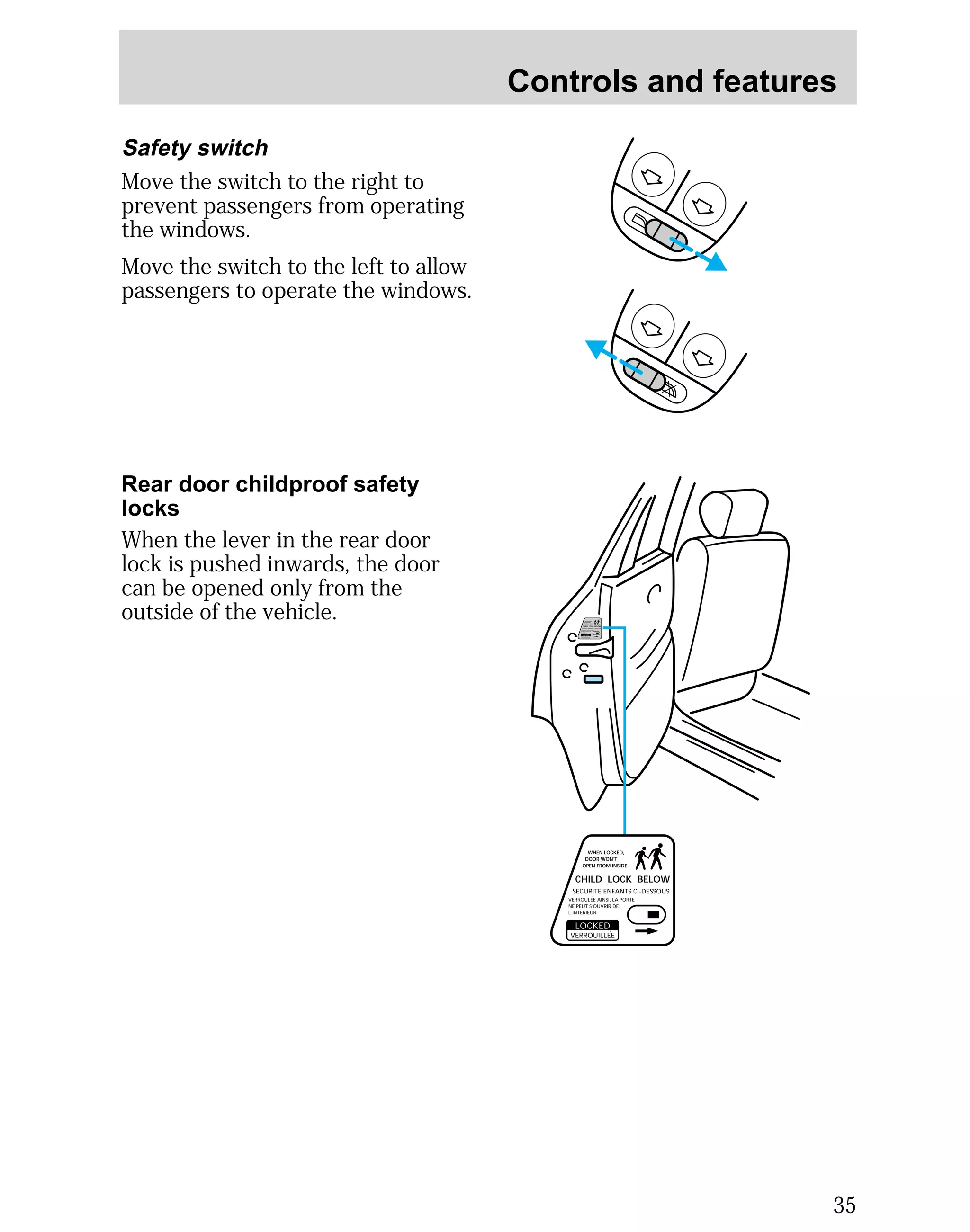
Do not exceed the GVWR or 
the GAWR specified on the 
Safety Compliance Certification 
Label.
Driving 
99 
It is extremly dangerous to 
ride in a cargo area, inside or 
outside of a vehicle. In a collision, 
people riding in these areas are 
more likely to be seriously injured 
or killed. Do not allow people to 
ride in any area of your vehicle 
that is not equipped with seats 
and safety belts. Be sure everyone 
in your vehicle is in a seat and 
using a safety belt properly. 
Driving with a heavy load 
The total weight of the vehicle plus 
the total weight of passengers and 
cargo should never exceed the 
GVWR. 
The weight that the vehicle carries 
over the front and rear axles 
should never exceed the GAWR for 
the respective axle. 
The weight limits of your vehicle’s 
tires affect the GVWR and GAWR 
limitations. Using tires with higher 
weight limits than the original tires 
will not increase the GVWR or 
GAWR of your vehicle; using tires 
with lower weight limits may lower 
the GVWR or GAWR of your 
vehicle.
Driving 
TRAILER TOWING 
Your vehicle is capable of towing a 
trailer of up to a maximum of 
454 kg (1 000 lbs) gross trailer 
weight with a maximum tongue 
load of 45 kg (100 lbs). It should 
also have 2.3 sq. meters (25 sq. 
feet) or less frontal area. Do not 
drive faster than 72 km/h (45 mph) 
while towing a 454 kg (1 000 lb) 
trailer. 
Your vehicle does not come from 
the factory fully equipped to tow. 
No towing packages are available 
through Ford or Lincoln/Mercury 
dealers. 
Trailer towing puts additional loads 
on your vehicle’s engine, transaxle, 
axle, brakes, tires, and suspension. 
For your safety and to maximize 
vehicle performance, be sure to use 
the proper equipment while 
towing. 
100
Driving 
101 
Follow these guidelines to ensure 
safe towing procedure: 
• Stay within your vehicle’s load 
limits. 
• Thoroughly prepare your vehicle 
for towing. Refer to Preparing to 
tow in this chapter. 
• Use extra caution when driving 
while trailer towing. Refer to 
Driving while towing a trailer 
in this chapter. 
• Service your vehicle more 
frequently if you tow a trailer. 
Refer to the severe duty schedule 
in the ”Service Guide”. 
• Do not tow a trailer until your 
vehicle has been driven at least 
800 km (500 miles). 
• Refer to the instructions included 
with towing accessories for the 
proper installation and 
adjustment specifications.
Driving 
Do not exceed the maximum loads 
listed on the Safety Compliance 
Certification Label. For load 
specification terms found on the 
label, refer to Loading your 
vehicle in this chapter. Remember 
to figure in the tongue load of your 
loaded vehicle when figuring the 
total weight. 
Preparing to tow 
Use the proper equipment for 
towing a trailer and make sure that 
it is properly attached to your 
vehicle. See your dealer or a 
reliable trailer retailer if you 
require assistance. 
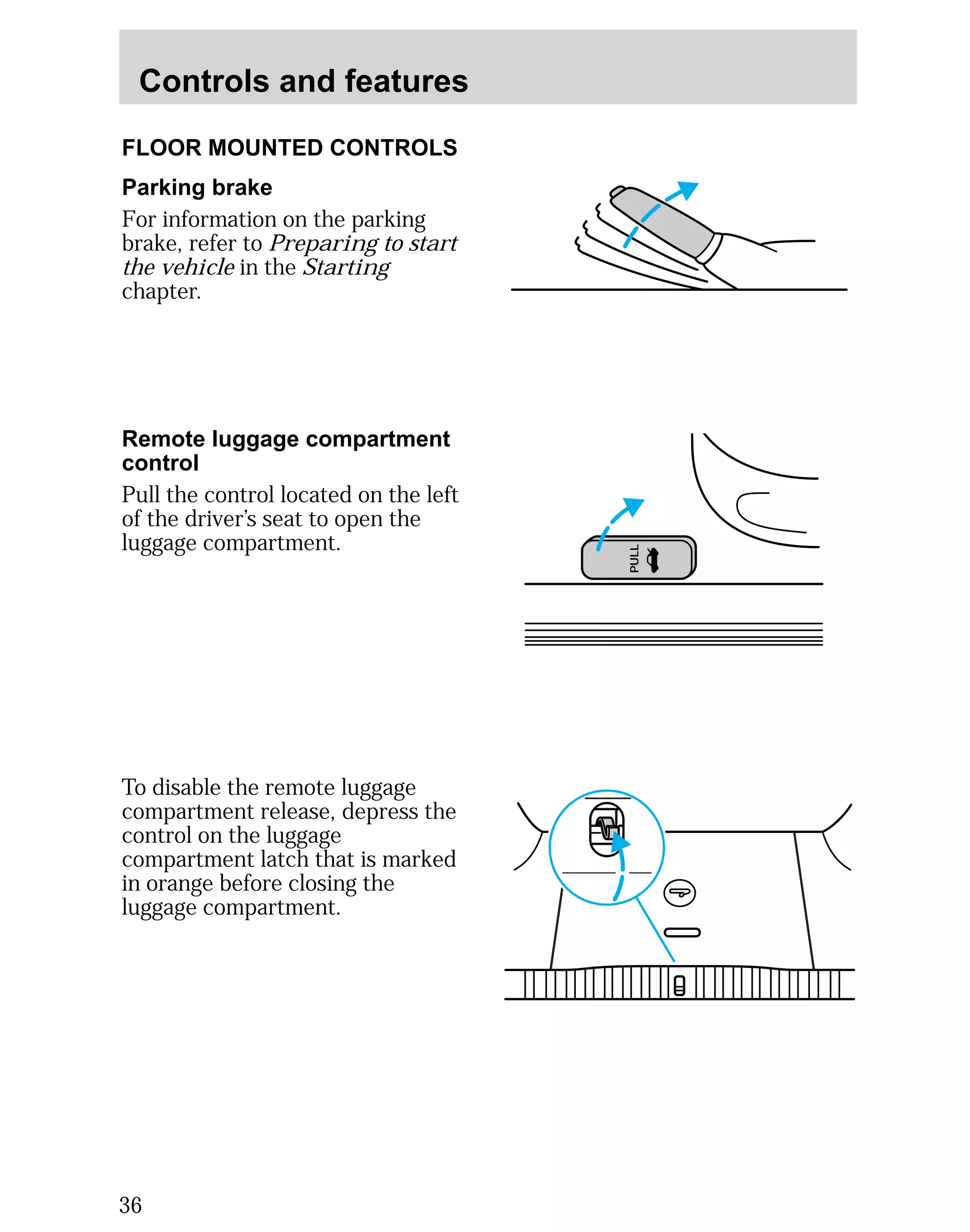
Auxiliary coolers are recommended 
for the power steering system and 
automatic transaxle system if you 
are planning on: 
• Traveling farther than 80 km 
(50 miles). 
• Towing in hilly terrain. 
• Towing frequently. 
102 
Towing trailers beyond the 
maximum recommended 
gross trailer weight exceeds the 
limit of the vehicle and could 
result in engine damage, transaxle 
damage, structural damage, loss of 
control, and personal injury.
Driving 
103 
Using a hitch 
Do not use hitches that: 
• Clamp onto the vehicle bumper. 
• Attach to the axle. 
Distribute the load so that only 10 
to 15% of the total weight of the 
trailer is on the tongue. Tie down 
the load so that it does not shift 
and change weight on the hitch. 
Follow the instructions of a 
reputable rental agency. 
Using trailer lamps 
See your local trailer retailer or 
rental agency for proper 
instructions and equipment for 
hooking up trailer lamps. 
Do not hook the trailer lamps 
directly into the vehicle’s wiring 
system. If the trailer lamps are not 
working properly, the warning 
lights in the instrument cluster may 
not work properly.
Driving 
Using trailer brakes 
Use electric brakes or manual, 
automatic or surge type hydraulic 
brakes that meet Federal and local 
regulations. Install and adjust 
brakes according to the 
manufacturer’s instructions. 
Using safety chains 
Always connect the trailer’s safety 
chains to the vehicle. To connect 
the chains, cross the chains under 
the trailer tongue and attach to the 
vehicle frame or hook retainers 
(not the bumper). Make sure there 
is enough slack to allow the vehicle 
to turn corners. 
104 
Do not connect a trailer’s 
hydraulic brake system 
directly to your vehicle’s brake 
system. Your vehicle may not have 
enough braking power and your 
chances of having a collision 
greatly increase.
Driving 
105 
Driving while towing a trailer 
Do not drive faster than 72 km/h 
(45 mph) while towing a 454 kg 
(1 000 lb) trailer. Do not drive 
faster than 72 km/h (45 mph) with 
any weight trailer while towing in 
hilly terrain or on hot days. 
Speed control (if equipped) may 
not work properly while towing on 
long, steep grades. 
If driving with an automatic 
transaxle: 
• Use D (Drive) or a low gear 
rather than D (Overdrive) while 
towing up or down steep inclines. 
• Anticipate stops and brake 
gradually. 
If driving with a manual transaxle: 
• Select a gear that avoids jerking 
or excessive engine speed. 
• Avoid driving excessively in first 
or second gear. If you need to 
drive excessively in first or 
second gear, the trailer may be 
too big or too heavily loaded for 
the vehicle drivetrain. 
• Shift to a lower gear while towing 
up or down steep hills. 
• Anticipate stops and brake 
gradually.
Driving 
FUEL CONSUMPTION 
Fuel economy can be improved by 
avoiding: 
• lack of regular, scheduled 
maintenance, 
• excessive speed, 
• rapid acceleration, 
• driving with the brake pedal 
depressed, 
• sudden stops, 
• extended engine idling, 
• use of speed control in hilly 
terrain, 
• extended use of the air 
conditioner, defroster, rear 
window defroster and other 
accessories, 
• underinflated tires, 
• heavy loads, 
• aftermarked add-ons such as 
bike, ski or luggage racks, bug 
deflectors, etc. 
106
Roadside emergencies 
107 
HAZARD FLASHER CONTROL 
Use only in an emergency to warn 
traffic of vehicle breakdown or 
approaching danger. Depress to 
activate. Depress again to switch 
off. The hazard lights can be 
operated when the ignition is off. 
Off 
Res 
Set 
Acc 
Coast 
On 
FUEL PUMP SHUT-OFF SWITCH 
If the engine cranks, but does not 
start or does not start after a 
collision, the fuel pump shut-off 
switch may have been activated. 
The shut-off switch is a device 
intended to stop the electric fuel 
pump when your vehicle has been 
involved in a substantial jolt. 
Once the shut-off switch is 
activated, you must reset the 
switch by hand before you can start 
your vehicle. The switch is located 
on the side panel in front of the 
driver’s side door.
Roadside emergencies 
If your engine cranks but does not 
start after a collision or substantial 
jolt: 
1. Turn the ignition key to the off 
position. 
2. Check under the vehicle for 
leaking fuel. 
3. If you do not see or smell fuel, 
push the red reset button down. If 
the button is already set, you may 
have a different mechanical 
problem. 
4. Turn the ignition key to the on 
position for a few seconds, then 
turn it to the off position. 
5. Check under the vehicle again 
for leaking fuel. If you see or smell 
fuel, do not start your vehicle 
again. If you do not see or smell 
fuel, you can try to start your 
vehicle again. 
108 
If you see or smell fuel, do 
not reset the switch or try to 
start your vehicle. Have all the 
passengers get out of the vehicle 
and call the local fire department 
or a towing service.
Roadside emergencies 
109 
FUSES AND RELAYS 
If electrical components in the 
vehicle are not working, a fuse may 
have blown. Blown fuses are 
identified by a broken wire. Check 
the appropriate fuses before 
replacing any electrical 
components. 
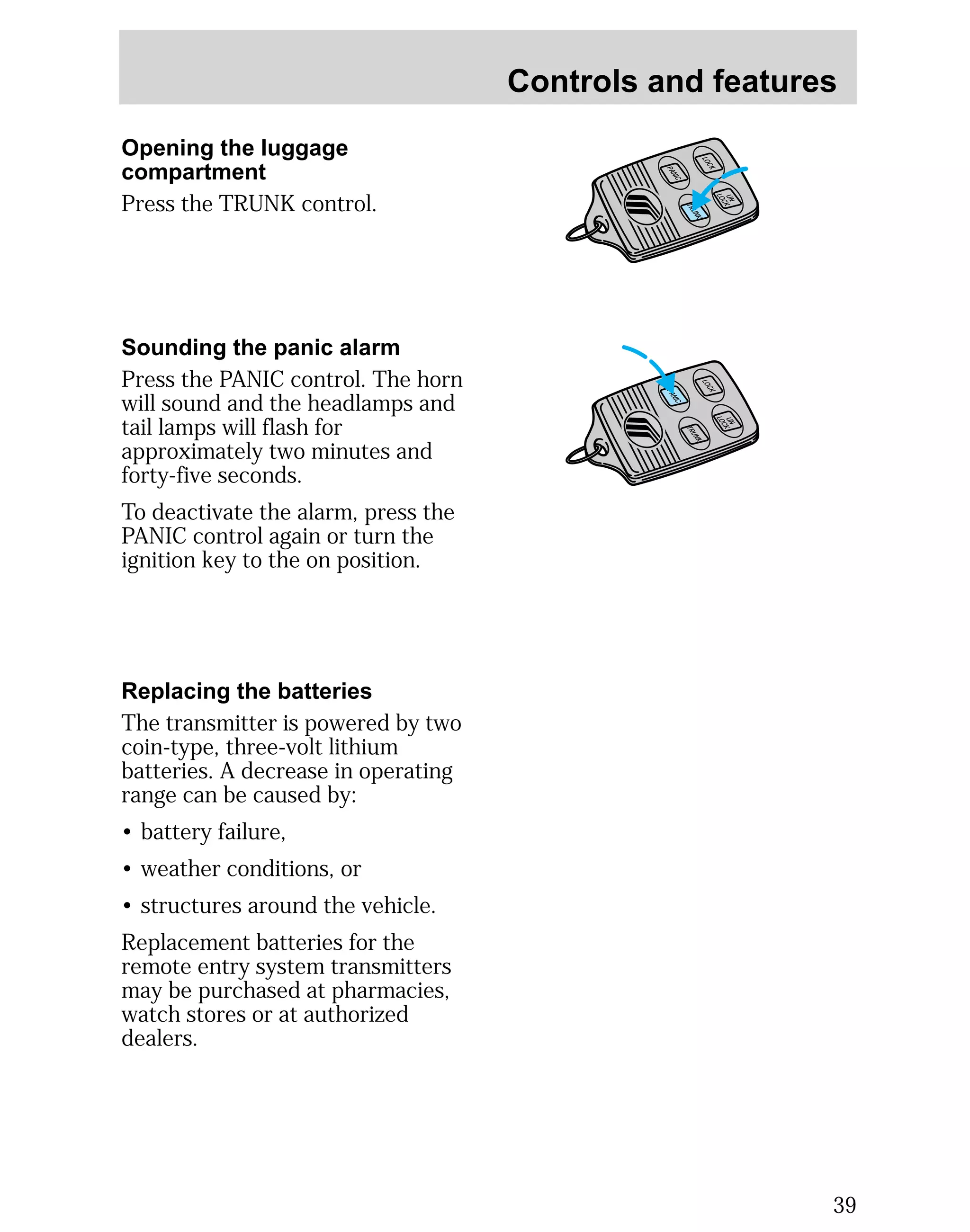
Always replace a fuse with 
one that has the specified 
amperage rating. Using a fuse with 
higher amperage rating can cause 
severe wire damage and could 
start a fire. 
Even after a fuse is replaced, it will 
continue to blow if the cause of the 
overload is not identified and 
corrected. If the fuse continues to 
blow, have the vehicle’s electrical 
system checked by your dealer or a 
qualified service technician. 
The passenger compartment fuse 
panel is located on the driver’s side 
under the instrument panel. The 
power distribution box is located 
on the driver’s side of the engine 
compartment. 
They contain the main fuses and 
the main relays. The circuits 
protected are identified by 
numbers on the passenger 
compartment fuse panel and inside 
the cover on the power distribution 
box.
Roadside emergencies 
Always replace the cover to 
the Power Distribution Box 
before reconnecting the battery or 
refilling fluid reservoirs. 
9 Blown fuse 
110 
1 
2 
Power distribution box 
To check or replace a fuse or a 
relay, remove the cover of the fuse 
box in the engine compartment by 
releasing the latch (1) and lifting 
up. 
A blown fuse can be identified by a 
break in the wire. Use the fuse 
puller (2) attached to the cover of 
the power distribution box to 
change a fuse. 
All fuses are a push fit. 
Five reserve fuses with different 
current ratings are attached to the 
inside cover of the power 
distribution box in case of 
emergency fuse replacement. 
2 
R10 
R7 R8 
R9 15 16 
18 
17 
R11 
10 
11 12 13 14 R6 
R3 R4 
3 
2 
1 
R1 R2 
R5 
D1 
4 5 6 7 8
Roadside emergencies 
111 
Power distribution box (engine compartment) 
Ampere 
rating 
Color Circuits protected 
Fuse 
1* 
2* 
3* 
456789 
10 
11 
12 
13 
14 
15 
16 
17 
18 
80 
60 
60 
20 
15 
— 
20 
— 
20 
20 
3 
15 
20 
15 
10 
10 
10 
10 
black 
yellow 
yellow 
yellow 
light blue 
— 
yellow 
— 
light blue 
light blue 
violet 
light blue 
yellow 
light blue 
red 
red 
red 
red 
Main power supply to vehicle 
electrical system 
Engine cooling fan 
ABS braking system, heater 
blower 
Ignition and EEC module 
Foglamp 
Not used 
ABS system 
not used 
Electronic Engine Control (EEC) 
Ignition switch 
EEC ignition module (memory) 
Horn and hazard flasher warning 
system 
HEGO sensor 
Electrically operated fuel pump 
Low beam headlamp – 
(passenger’s side) 
Low beam headlamp – 
(driver’s side) 
High beam headlamp – 
(passenger’s side) 
High beam headlamp – 
(driver’s side) 
* Have these fuses replaced by your dealer or qualified technician.
Roadside emergencies 
Passenger compartment fuse 
panel 
To check or change a fuse or a 
relay, open the fuse box by pulling 
down the lock release lever (1). 
112 
1 
Power distribution box (engine compartment) 
Relay Circuits switched 
R 1 
Daytime running lights 
R 2 
Radiator fan relay (high speed) 
R 3 
Air conditioning 
R 4 
Air conditioning clutch relay 
R 5 
Radiator fan relay (low speed) 
R 6 
Starter solenoid 
R 7 
Horn 
R 8 
Electrically operated fuel pump 
R 9 
Low beam headlamps 
R 10 
High beam headlamps 
R 11 
EEC module 
D1 
Reverse voltage protection
Roadside emergencies 
113 
A blown fuse can be identified by a 
break in the wire. Use the fuse 
puller (2) attached to the cover of 
the power distribution box to 
change a fuse. 
All fuses are a push fit. 
Five reserve fuses with different 
current ratings are attached to the 
inside cover of the power 
distribution box in case of 
emergency fuse replacement. 
R13 
R14 
R15 
R16 
R12 
D2 
19 20 21 
22 23 24 25 26 27 28 
29 30 31 32 33 34 35 36 37 38 
Passenger compartment fuse panel (below instrument panel) 
Relay Circuit switched 
R 12 
Interior lighting 
R 13 
Rear window defrost 
R 14 
Heater blower motor 
R 15 
Wiper motor 
R 16 
Ignition 
D 2 
Reverse voltage protection
Roadside emergencies 
Passenger compartment fuse panel (below instrument panel) 
Fuse 
114 
Ampere 
rating Color Circuits protected 
19 
20 
21 
22 
23 
24 
25 
26 
27 
28 
29 
30 
31 
32 
33 
34 
35 
36 
37 
38 
— 
C10 
40 
7.5 
15 
15 
20 
7.5 
15 
30 
30 
7.5 
7.5 
7.5 
7.5 
7.5 
7.5 
10 
30 
— 
— 
black 
orange 
brown 
light blue 
light blue 
yellow 
brown 
light blue 
light green 
light green 
brown 
brown 
brown 
brown 
brown 
brown 
red 
light green 
– 
Not used 
Wiper motors (circuit breaker) 
Power windows 
ABS module 
Backup lamps 
Brake lamps 
Door locks 
Main light 
Cigar lighter 
Electric seats 
Rear window defrost 
Engine management system 
Instrument panel illumination 
Radio 
Parking lamps - driver’s side 
Interior lighting/electric mirror 
adjustment/clock 
Parking lamps - passenger’s side 
Air bag 
Heater blower motor 
Not used
Roadside emergencies 
115 
Fuse rating 
7.5 amp 
10 amp 
15 amp 
20 amp 
30 amp 
30 amp fuse link 
40 amp 
60 amp fuse link 
80 amp fuse link 
100 amp fuse link 
Color 
brown 
red 
blue 
yellow 
light green 
pink 
green 
yellow 
black 
blue 
Relay 
R 18 
R 20 
R 21 
R 22 
R 23 
R 24 
R 25 
R 26 
Circuits switched Location 
“One touch” switch 
(driver’s window) 
Not used 
Not used 
Foglamps 
Turn signals 
Panic alarm – 
driver’s side 
Panic alarm – 
right-hand side 
Not used 
Driver’s door 
—— 
Module bracket 
Steering column 
Door lock module bracket 
— 
Standard fuse amperage ratings 
and colors 
3 amp violet 
Auxiliary relays (outside of fuse boxes)
Roadside emergencies 
CHANGING TIRES 
Park your vehicle in such a position 
that neither the traffic nor you are 
hindered or endangered when 
changing the tire. Ensure that the 
vehicle is on firm, level ground. If 
necessary, secure your vehicle 
further by blocking the wheels with 
chocks. 
Activate the hazard lights. 
Apply the parking brake and 
engage first or reverse gear or, if 
the vehicle has an automatic 
transaxle, select the P (Park) 
position. 
If parking on a slope is unavoidable, 
secure the wheels with suitable 
chocks. 
116
Roadside emergencies 
117 
When driving with a temporary 
spare tire: 
• Do not exceed the maximum 
speed of 80 km/h (50 mph) and 
MAX 
only drive the shortest possible 
distance. 
80 
• Do not exceed the permissible 
gross weight of the vehicle. 
km/h 
• Do not install more than one 
spare wheel on your vehicle at 
any one time. 
• Do not use snow chains on this 
MAX 
type of wheel. 
• Do not drive through an 
50 
automatic car wash. mph 
The temporary spare tire 
The vehicle may have a high 
pressure temporary spare tire. This 
spare is smaller than a regular tire 
and is designed for emergency use 
only. This tire should be replaced 
as soon as possible. 
If you use the temporary 
spare tire continuously or do 
not follow these precautions, the 
tire could fail, causing you to lose 
control of the vehicle, possibly 
injuring yourself or others.
Roadside emergencies 
Spare tire location 
The spare tire and tools are located 
under the floor cover in the 
luggage compartment. 
Removing the spare tire and 
tools 
1. Raise the rear of the floor cover 
in the luggage compartment and 
fold it forward. 
2. Completely unscrew the bolt and 
remove the wheel cover panel with 
the holder. 
3. Remove the wheel cover panel. 
4. Lift out the spare wheel. 
5. Remove the jack which is located 
in the tool pack. 
118
Roadside emergencies 
119 
Tire changing procedure 
Removing a tire 
1. Apply the parking brake and 1 
(first) gear (manual transaxle) or 
the P (Park) position (automatic 
transaxle). 
2. Activate the hazard flashers. 
3. The driver and all passengers 
must leave the vehicle. 
4. Secure the vehicle against rolling 
or sliding. 
5. Insert the tapered end of the 
jack handle between the rim and 
hub cover and push in. Twist off to 
remove the cover. 
6. Loosen the wheel nuts slightly. 
7. Place jack with complete support 
surface on the ground. 
8. The jack must be applied exactly 
vertical to the jacking point of the 
vehicle. 
9. Jack up the vehicle until the tire 
is clear of the ground. Unscrew and 
remove the wheel nuts and remove 
the wheel.
Roadside emergencies 
Replacing a tire 
1. Push the spare tire onto the 
wheel studs. 
2. Screw on the wheel nuts, 
ensuring the tapered end of the 
wheel nuts are facing the wheel, 
and secure in a clockwise direction. 
3. Lower the vehicle and remove 
the jack by turning the handle 
counterclockwise. 
4. Fully tighten the wheel nuts in a 
crosswise pattern. 
5. Align the hub cap with the valve 
and push firmly into position with 
the ball of the hand. 
6. Stow the jack and damaged tire 
in the luggage compartment by 
reversing the spare tire removal 
instructions. 
120 
3 
1 2 
4
Roadside emergencies 
121 
JUMP STARTING YOUR 
VEHICLE 
The gases around the 
battery can explode if 
exposed to flames, sparks, or lit 
cigarettes. An explosion could 
result in injury or vehicle damage. 
Do not push start your 
vehicle. You could damage 
the catalytic converter. For 
further information, see Jumper 
cables in the index. 
Batteries contain sulfuric 
acid which burns skin, eyes, 
and clothing.
Roadside emergencies 
Connecting jumper cables 
1. Position the vehicles so that they 
do not touch one another. 
2. Switch off the engine. Switch off 
any unnecessary electrical 
equipment. 
3. Connect the positive (+) 
terminal of the discharged battery 
to the positive (+) terminal of the 
booster battery (1). 
4. Connect one end of the second 
lead to the negative (–) terminal of 
the booster battery and the other 
end to a metal part of the engine to 
be started (2). 
5. Make sure that the jumper 
cables are clear of moving parts of 
the engine. 
122 
1 2 
Do not connect the end of 
the second cable to the 
negative (-) terminal of the 
battery to be jumped. A spark may 
cause an explosion of the gases 
that surround the battery.
Roadside emergencies 
123 
Jump starting 
1. Start the booster vehicle and run 
the engine at moderately increased 
speed. 
2. Start the engine of the vehicle 
with the discharged battery. 
3. Once the engine has been 
started, run both vehicles for an 
additional three minutes before 
disconnecting the cable leads. 
Removing jumper cables 
1. Remove the jumper cables in 
reverse order. Take the cable off 
the metallic surface first (1), then 
the cable on the negative (-) 
booster battery terminal (2). 
2. Remove the cable from the 
positive (+) terminal of the booster 
battery (3) and then the 
discharged battery (4). 
3. After the disabled vehicle has 
been started, allow it to idle for a 
while so the engine can “relearn” 
its idle conditions. 
1 
2 
3 
4
Roadside emergencies 
WRECKER TOWING 
If towing is necessary, it is 
recommended that your vehicle be 
towed with a wheel lift or flatbed 
equipment. Do not tow with 
slingbelt equipment. Ford Motor 
Company has not developed or 
approved a T-hook or slingbelt 
towing procedure. 
TOWING YOUR VEHICLE 
BEHIND ANOTHER VEHICLE 
Before you have your vehicle 
towed: 
• release the parking brake, 
• move the gearshift to N 
(Neutral), 
• turn the ignition to the off 
position and 
• unlock the steering wheel. 
Do not tow your vehicle at a speed 
faster than 55 km/h (35 mph) or 
for a distance greater than 80 km 
(55 miles) unless the drive wheels 
are placed on dollies. 
124
Maintenance and care 
125 
SERVICE RECOMMENDATIONS 
• We highlight do-it-yourself items 
in the engine compartment for 
easy location. 
• As possible, we design parts that 
can be replaced without tools. 
• We provide you with a “Service 
Guide” which makes tracking 
routine service for your vehicle 
easy. 
If your vehicle requires 
professional service, your Ford 
dealership can provide necessary 
parts and service. Check your 
“Warranty Guide” to find out which 
parts and services are covered. 
Use only recommended fuels, 
lubricants, fluids and service parts 
conforming to specifications. 
Motorcraft parts are designed and 
built to provide the best 
performance in your vehicle.
Maintenance and care 
Precautions when servicing 
your vehicle 
Be especially careful when 
inspecting or servicing your 
vehicle. Here are some general 
precautions for your safety: 
• Do not work on a hot engine. 
126 
The cooling fan is automatic 
and may come on at any 
time. Always disconnect the 
negative terminal of the battery 
before working near the fan. 
• If you must work with the engine 
running, avoid wearing loose 
clothing or jewelry that could get 
caught in moving parts. Take 
precautions with long hair. 
• Do not work on a vehicle with the 
engine running in an enclosed 
space, unless you are sure you 
have enough ventilation. 
• Keep all lit cigarettes, open 
flames and other lit material 
away from the battery and all fuel 
related parts. 
If you disconnect the battery, the 
engine must “relearn” its idle 
conditions before your vehicle will 
drive properly, as explained under 
Battery in this chapter.
Maintenance and care 
127 
Working with engine off 
(automatic transaxle) 
1. Set the parking brake fully and 
ensure the gearshift is securely 
latched in P (Park). 
2. Turn off the engine and remove 
the key. 
3. Block the wheels to prevent the 
vehicle from moving unexpectedly. 
Working with engine off 
(manual transaxle) 
1. Set the parking brake, depress 
the clutch and place the gearshift 
in 1 (first) or R (Reverse). 
2. Turn off the engine and remove 
the key. 
3. Block the wheels to prevent the 
vehicle from moving unexpectedly.
Maintenance and care 
Working with engine on 
(automatic transaxle) 
1. Set the parking brake fully and 
ensure the gearshift is securely 
latched in P (Park). 
2. Block the wheels to prevent the 
vehicle from moving unexpectedly. 
128 
Do not start your engine with 
the air cleaner removed and 
do not remove it while the engine is 
running. 
Working with engine on 
(manual transaxle) 
1. Set the parking brake, depress 
the clutch and place the gearshift 
in neutral. 
2. Block the wheels to prevent the 
vehicle from moving unexpectedly.
Maintenance and care 
129 
Opening the hood 
• Pull the handle (1) located under 
the instrument panel. 
MIRRORS 
000123 
0 0 0 0 
55 
50 
40 
30 
20 
10 
60 70 80 
90 
100 
110 
120 
130 
MPH 
60 
40 
20 
80 
100 120 
140 
160 
180 
200 
1/2 
E F 
UNLEADED FUEL ONLY 
2 
1 
0 
3 
4 5 
x 1000 
6 
7 
8 
NORMAL 
BRAKE 
CHECK 
ENGINE 
TRACTION 
CONTROL 
O/D 
OFF 
1 
Off 
Res 
Set 
Acc 
Coast 
On 
• Release the safety catch by 
reaching under the hood (2) 
(adjacent to the Mercury 
emblem) and pushing it up. 
2 
3 
• Raise the hood and support it 
with the strut (3) in the yellow 
colored retainer, ensuring it is 
secure. Hold the support at the 
yellow colored insulation section. 
To close, replace the support strut 
in its retaining clip, lower the hood 
and allow it to drop into the catch 
for the last 20 – 30 cm 
(8 – 12 inches). 
Always check to ensure that the 
hood lock is fully engaged.
Maintenance and care 
2.0 litre EFI-engine compartment 
Air 
cleaner 
For ease of identification, all filler caps and the engine oil dipstick are 
marked yellow/black. 
130 
Power 
steering 
reservoir 
Engine 
coolant 
reservoir 
Automatic 
transaxle 
dipstick 
(if equipped) 
Brake fluid 
reservoir 
Windshield Engine oil 
Battery 
washer fluid 
dipstick 
reservoir 
Power 
distribution 
box 
Engine oil 
filler cap
Maintenance and care 
131 
2.5 litre EFI-engine compartment 
Power 
steering 
reservoir 
Engine 
coolant 
reservoir 
Air 
cleaner 
Brake fluid 
reservoir 
Automatic 
transaxle 
dipstick 
(if equipped) 
Windshield Engine oil 
Battery 
washer fluid 
dipstick 
reservoir 
Power 
distribution 
box 
Engine oil 
filler cap 
For ease of identification, all filler caps and the engine oil dipstick are 
marked yellow/black.
Maintenance and care 
Engine oil 
Use SAE 5W-30 motor oil 
CERTIFIED FOR GASOLINE 
ENGINES by the American 
Petroleum Institute. 
Do not use supplemental engine oil 
additives, oil treatments or engine 
treatments. They are unnecessary 
and could, under certain 
conditions, lead to engine damage 
which is not covered by Ford 
Warranty. 
Checking the engine oil 
Check the engine oil each time you 
fuel your vehicle. 
To check the oil: 
1. Make sure the vehicle is on level 
ground. If the engine is warm, turn 
the engine off and wait a few 
minutes for the oil to drain into the 
oil pan. 
2. Set the parking brake and ensure 
the gearshift is securely latched in 
P (Park). 
3. Open the hood. Protect yourself 
from engine heat. 
4. Locate and carefully remove the 
engine oil dipstick. 
5. Wipe the dipstick clean. Insert 
the dipstick fully, then remove it 
again. The oil level should be in the 
range shown on the dipstick. 
132 
PETROLEUM MERICAN FOR 
INSTITUTAE 
GASOLINE 
ENGINES 
CERTIFIED 
2.0 l DOHC 
2.5 l DOHC 
Motorcraft 
PETROMERICAN FOR 
LEUMINSTITUTGASOLINE 
AE 
ENGINES 
CERTIFIED 
Do not exceed MAX! 
Do not exceed MAX!
Maintenance and care 
133 
6. If the oil level is below the 
minimum line, add engine oil as 
necessary. If the oil level is beyond 
the maximum line, engine damage 
or high oil consumption may occur 
and some oil must be removed 
from the engine by a service 
technician. 
7. Put the dipstick back in and 
ensure it is fully seated. 
Continuous contact with 
used motor oil has caused 
cancer in laboratory mice. 
Adding engine oil 
1. Check the engine oil. For 
instructions, refer to Checking the 
engine oil in this chapter. 
2. If the fluid level is not within the 
normal range, add only certified 
engine oil of the preferred 
viscosity. Add engine oil through 
the oil filler cap. Remove the filler 
cap and use a funnel to pour oil in 
the opening. 
3. Recheck the oil level. Make 
sure the oil level is not above 
the MAX mark on the dipstick. 
Change your engine oil and oil filter 
according to these mileage and 
time requirements, whichever 
occurs first. 
5 000 miles (8 000 km) 
or 6 months 
Normal schedule 
3 000 miles (5 000 km) 
or 3 months 
Severe duty schedule: 
• Extensive idling 
• Trailer towing 
• Driving in severe dust 
• Police, taxi, or delivery service
Maintenance and care 
Refer to the ”Maintenance 
Schedule” booklet for additional 
information. 
It is recommended you use the 
appropriate Motorcraft oil filter (or 
another brand meeting Ford 
specifications) for your engine 
application. 
Always dispose of used 
automotive fluids in a 
responsible manner. Follow your 
community’s standards for 
disposing of these types of fluids. 
Call your local recycling center to 
find out more about recycling 
automotive fluids. 
Engine oil filler cap 
The design of the filler cap varies 
by engine. To open, turn in the 
direction of the arrow and pull. Do 
not open the cap while the engine 
is running. 
134 
Empty and used oil 
containers must be disposed 
of at an authorized waste disposal 
facility.
Maintenance and care 
135 
Brake/clutch fluid reservoir 
Brake and clutch fluid systems are 
supplied from the same reservoir. 
The level of the fluid must lie 
between the MIN and MAX marks 
on the side of the reservoir. If the 
level falls below the MIN mark, the 
brake fluid level warning light on 
the instrument panel will 
illuminate. Add only brake fluid 
that meets the Ford specification 
(see the chapter Capacities and 
specifications). 
MAX 
MIN 
Brake fluid is toxic. 
BRAKE 
If you use a brake fluid that 
is not DOT 3, you will cause 
permanent damage to your brakes. 
Do not let the reservoir for 
the master cylinder run dry. 
This may cause the brakes to fail. 
Windshield washer system 
If necessary, add enough washer 
fluid to fill the reservoir. Follow the 
instructions on the washer fluid 
label. 
Do not put engine coolant in 
the container for the 
windshield washer fluid.
Maintenance and care 
Engine coolant maintenance 
136 
MAX 
MIN 
Checking and adding engine 
coolant 
Check the level of the coolant in 
the reservoir at least once a month. 
Be sure to read and understand 
Precautions when servicing your 
vehicle in this chapter. 
If the engine coolant has not been 
checked for a long period of time, 
the engine coolant reservoir may 
eventually empty. If this occurs, 
add engine coolant to the coolant 
reservoir. For more information 
refer to Adding engine coolant in 
this chapter. 
Automotive fluids are not 
interchangeable; do not use engine 
coolant, antifreeze or windshield 
washer fluid outside its specified 
function and vehicle location. 
Do not put windshield 
washer fluid in the container 
for engine coolant.
Maintenance and care 
137 
When adding engine coolant 
Ford recommends Ford Premium 
Cooling System Fluid, which is an 
optimized formula that will protect 
all metals and rubber elastomers 
used in Ford engines for four years 
or 80 000 km (50 000 miles). 
It is neither necessary nor 
recommended to use supplemental 
coolant additives in your gasoline-powered 
vehicle. These additives 
may harm your engine coolant 
system. 
When you change or add engine 
coolant, it is important to maintain 
engine coolant concentration 
between 40% (-24°C [-11°F]) and 
60% (-52°C [-62°F]), depending on 
your local climate conditions. 
A coolant concentration below 40% 
will result in a loss of freeze 
protection. A concentration above 
60% may cause the engine to 
overheat on a warm day. 
Refer to Lubricant specifications 
in the Capacities and 
specifications chapter. Use only a 
premium nationally-recognized 
brand name engine coolant or 
equivalent.
Maintenance and care 
Recycled engine coolant 
Ford Motor Company recommends 
that Ford and Lincoln-Mercury 
dealers use recycled engine coolant 
produced by Ford-approved 
processes. Not all coolant recycling 
processes produce coolant which 
meets Ford specifications ESE-M97B44- 
may harm engine and cooling 
system components. 
138 
A, and use of such coolant 
Always dispose of used 
automotive fluids in a 
responsible manner. Follow your 
community’s standards for 
recycling and disposing of 
automotive fluids.
Maintenance and care 
139 
MAX 
MIN 
Adding engine coolant 
1. Before removing the engine 
coolant recovery cap, turn the 
engine off and allow it to cool. 
2. When the engine is cool, turn 
and remove the cap. 
Never remove the coolant 
recovery cap while the 
engine is running or hot. 
• Step back for a moment while the 
pressure in the reservoir is 
released. 
• Stand away from the reservoir 
opening. Hot steam or coolant 
spray may be released. 
3. Add engine coolant until the 
fluid level in the reservoir is 
between the MAX and MIN lines on 
the reservoir. 
Follow the recommended service 
interval for changing engine 
coolant as outlined in the “Service 
Guide”. Refer to Capacities and 
specifications for more 
information on engine coolant 
specifications. 
Have your dealer or a qualified 
service technician check the engine 
coolant system for leaks if you have 
to add more than a litre (quart) of 
engine coolant per month.
Maintenance and care 
Severe winter climate 
If you drive in extremely cold 
climates (less than -36°C [-34°F]), 
it may be necessary to increase the 
coolant concentration above 50%. 
Refer to the chart on the coolant 
container to ensure the coolant 
concentration in your vehicle is 
such that the coolant will not 
freeze at the temperature level in 
which you drive during the winter 
months. Never increase the engine 
coolant concentration above 60%. 
Leave a 50/50 mixture of engine 
coolant and water in your vehicle 
year-round in non-extreme 
climates. 
Checking and adding power 
steering fluid 
Switch off the engine. With the 
steering system at normal 
operating temperature, the fluid 
level should come up to the MAX 
mark. 
If the fluid level drops below the 
MIN mark, add the specified fluid. 
Refer to the Capacities and 
specifications chapter. 
140 
MAX 
MIN
Maintenance and care 
141 
Automatic transaxle fluid 
Check the automatic transaxle fluid 
according to the scheduled 
intervals in the “Service Guide”. 
However, if the transaxle is not 
working properly (slipping, shifting 
slowly or fluid leakage) the fluid 
level should be checked. 
Adding automatic transaxle 
fluid 
Before adding any fluid, make sure 
the correct type will be used. This 
information is stamped on the 
dipstick. 
Check the fluid after your vehicle 
has reached normal operating 
temperature, which is reached 
after driving approximately 32 km 
(20 miles). 
Add fluid in 0.25 litre (0.5 pint) 
increments through the filler tube 
until the fluid is at the correct level 
on the dipstick. If an overfill 
occurs, excess fluid should be 
removed by your dealer or a 
qualified service technician.
Maintenance and care 
Checking the automatic 
transaxle fluid 
With the vehicle on a level surface 
and the brake fully applied, start 
the engine and move the gearshift 
lever through all of the gears. 
Securely latch the lever in P 
(Park). Set parking brake and leave 
the engine running. 
Wipe off the dipstick cap and pull 
the dipstick out. Wipe indicator 
clean. Put dipstick back into filler 
tube and make sure it is fully 
seated. Pull the dipstick out and 
read the fluid level. 
Note that your vehicle should not 
be driven until some fluid has been 
added if the fluid level is below the 
bottom dimple on the dipstick and 
the outside temperature is above 
10°C (50°F). Add only enough fluid 
to bring the level above the bottom 
hole. 
If the vehicle has not been driven 
and the fluid level is above the 
bottom dimple on the dipstick, 
don’t add fluid. Recheck the level 
after driving your vehicle 
approximately 30 km (20 miles) 
when the engine has reached 
normal operating temperature. The 
fluid level should be within the 
crosshatched area on the dipstick. 
142
Maintenance and care 
143 
Motorcraft 
SUPERSTART 
Pb 
Battery 
Your vehicle may be equipped with 
a Motorcraft maintenance-free 
battery. The Motorcraft 
maintenance-free battery normally 
does not require additional water 
during its life of service. However, 
for severe service usage or in high 
temperature climates, check your 
battery electrolyte level, at least 
every 24 months or 40 000 km 
(24 000 miles). Keep the 
electrolyte in each cell up to the 
“level” indicator. Do not overfill the 
battery cell. 
For longer, trouble-free operation, 
keep the top of the battery clean 
and dry. Also, make certain the 
battery cables are always tightly 
fastened to the battery terminals. 
If you see any corrosion on the 
battery cables or terminals, remove 
the cables from the terminal(s) and 
clean with a wire brush. You can 
neutralize the acid with a solution 
of baking soda and water. Reinstall 
the cables when you are done 
cleaning them, and apply a small 
quantity of grease to the top of 
each battery terminal to help 
prevent corrosion.
Maintenance and care 
Battery replacement 
If your original equipment battery 
requires replacement while under 
warranty, it will be replaced with a 
Motorcraft service battery, 
identical in design technology. Like 
the original equipment battery, it 
should not require water addition 
during its normal life of service; 
however, for severe service usage 
or in high temperature climates, 
check your battery electrolyte 
level, at least every 24 months or 
40 000 km (24 000 miles). Do not 
overfill the battery cell. 
If the electrolyte level in your 
battery gets low, you can add plain 
tap water to the battery, as long as 
you do not use hard water (water 
with a high mineral or alkali 
content). If possible, however, try 
to only fill the battery cell with 
distilled water. If the battery needs 
water often, have the charging 
system checked. 
144
Maintenance and care 
145 
Applying too much pressure 
on the ends when lifting a 
battery could cause acid to spill. 
Lift the battery with a carrier or 
with your hands on the opposite 
corners. 
Batteries normally produce 
explosive gases which can 
cause personal injury. Do not allow 
flames, sparks or lit tobacco to 
come near the battery. Always 
cover your face and protect your 
eyes and also provide ventilation. 
Follow these steps to 
minimize risk of personal 
injury. 
Always dispose of automotive 
batteries in a responsible 
manner. Follow your community’s 
local standards for disposal. Call 
your local recycling center to find 
out more about recycling 
automotive batteries.
Maintenance and care 
Relearning the idle function 
Because your vehicle’s engine is 
electronically controlled, some 
control conditions are maintained 
by power from the battery. When 
the battery is disconnected or a 
new battery is installed, the 
computer must “relearn” its idle 
conditions before your vehicle can 
drive properly. To begin this 
process: 
1. Put the automatic transaxle 
gearshift in P (Park). Put the 
manual transaxle gearshift in 
neutral. 
2. Turn off all accessories and start 
the vehicle. 
3. Let the engine idle for at least 
one minute. 
4. The “relearning” process will 
automatically complete as you 
drive the vehicle. 
• If you do not allow the engine to 
“relearn” its idle, the idle quality 
of your vehicle may be adversely 
affected until the idle is 
eventually “relearned”. 
• If the battery has been 
disconnected or if a new battery 
has been installed, the clock and 
preset radio stations must be 
reset once the battery is 
reconnected. 
146
Maintenance and care 
147 
Checking wiper blades 
Check the wiper blades on your 
vehicle for roughness by running 
the tips of your fingers over the 
edge of the blade. 
Traces of grease, silicone and fuel 
prevent wiper blades from 
functioning properly. We 
recommend Ford cleaning 
solutions or equivalent to clean 
wiper blades. 
Change the wiper blades on your 
vehicle at least once a year. 
Cabin air filter replacement 
In your climate control system, you 
have a filter that cleans the air 
before it enters the interior of the 
vehicle. This filter should be 
replaced at the intervals in the 
”Maintenance Schedule” booklet. 
To replace the cabin air filter: 
1. Remove both windshield wiper 
arms. With the wiper arm in the 
horizontal position, lift the arm 
away from the windshield while 
pulling the retaining clip at the 
base toward the windshield. 
Release the wiper arm, then lift it 
off the base.
Maintenance and care 
2. Remove the plastic caps from 
the screws on the grille. Remove 
the screws. 
3. Open the hood. Pull off the 
rubber weatherstrip at the back of 
the engine compartment. Remove 
the screws that hold the grille, 
separate the two halves and 
remove the grille. 
4. The filter is in a housing at the 
back of the engine compartment, 
on the left side. Pull off the two 
clips on the sides of the housing. 
Slide out the housing and filter. 
5. Slide the filter out of the 
housing, replace with the new filter 
and slide the housing and cabin air 
filter back into place. Reinstall the 
clips on the housing. 
6. Replace the grille and wiper 
arms. 
148
Maintenance and care 
149 
IMPORTANT TIRE 
MAINTENANCE INFORMATION 
Information about tire quality 
grades 
New vehicles are fitted with tires 
that have their Tire Quality Grade 
(described below) molded into the 
tire’s sidewall. These Tire Quality 
Grades are determined by 
standards that the United States 
Department of Transportation has 
set. 
Tire Quality Grades apply to new 
pneumatic tires for use on 
passenger cars. They do not apply 
to deep tread, winter-type snow 
tires, space-saver or temporary use 
spare tires, tires with nominal rim 
diameters of 25 to 30 cm (10 to 12 
inches) or limited production tires 
as defined in Title 49 Code of 
Federal Regulation Part 
575.104(c)(2). 
U.S. Department of 
Transportation – Tire quality 
grades: 
The U.S. Department of 
Transportation requires Ford to 
give you the following information 
about tire grades exactly as the 
government has written it.
Maintenance and care 
Treadwear 
The treadwear grade is a 
comparative rating based on the 
wear rate of the tire when tested 
under controlled conditions on a 
specified government test course. 
For example, a tire grade of 150 
would wear one and one-half 
(1 1/2) times as well on the 
government course as a tire grade 
100. The relative performance of 
tires depends upon the actual 
conditions of their use, however, 
and may depart significantly from 
the norm due to variations in 
driving habits, service practices, 
and differences in road 
characteristics and climate. 
Traction A B C 
The traction grades, from highest 
to lowest are A, B, and C, and they 
represent the tire’s ability to stop 
on wet pavement as measured 
under test surfaces of asphalt and 
concrete. A tire marked C may 
have poor traction performance. 
Warning: The traction grade 
assigned to this tire is based on 
braking (straightahead) traction 
tests and does not include 
cornering (turning) traction. 
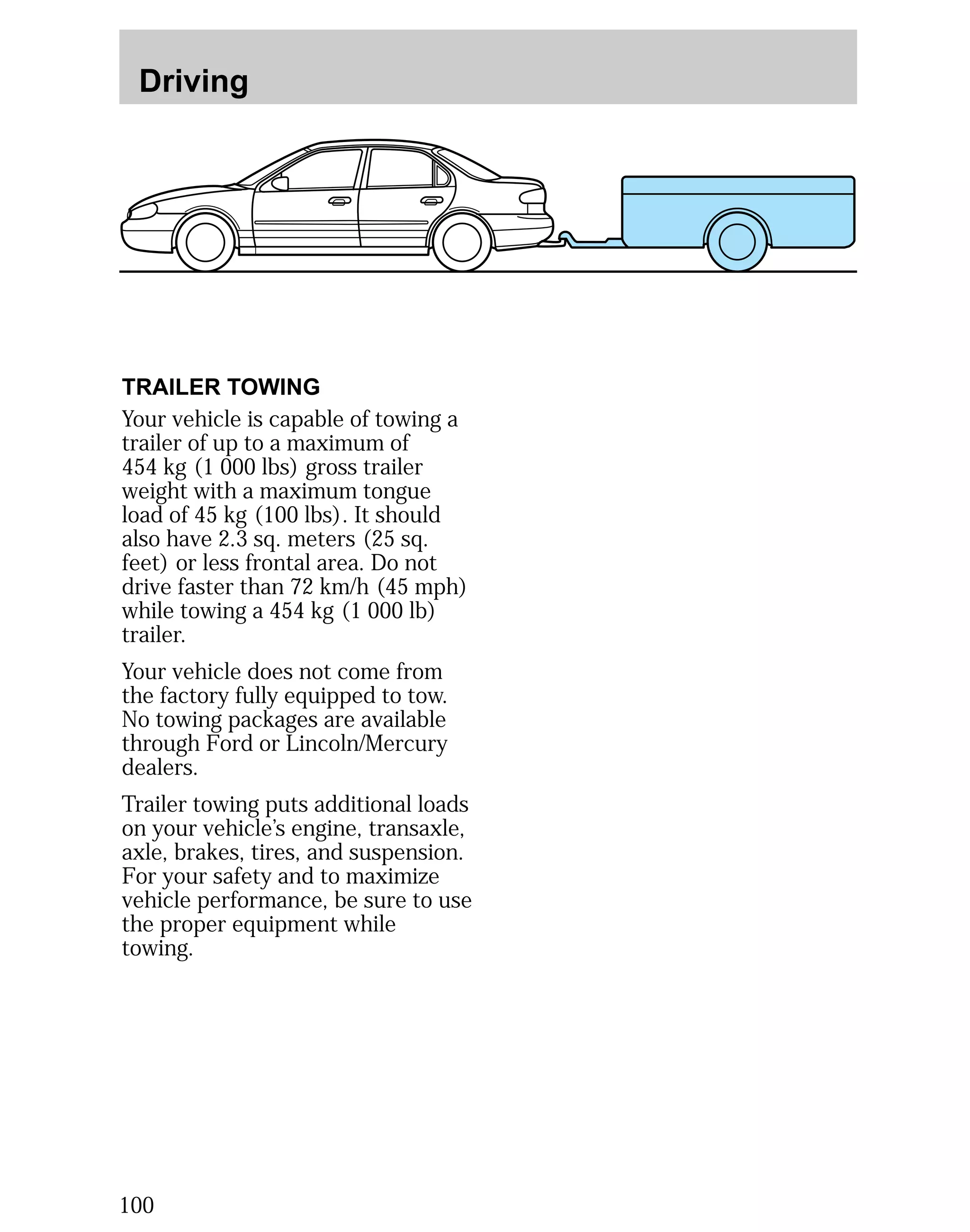
150
Maintenance and care 
151 
Temperature A B C 
The temperature grades are A (the 
highest), B, and C, representing 
the tire’s resistance to the 
generation of heat when tested 
under controlled conditions on a 
specified indoor laboratory test 
wheel. Sustained high temperature 
can cause the material of the tire to 
degenerate and reduce tire life, and 
excess temperature can lead to 
sudden tire failure. The grade C 
corresponds to a level of 
performance which all passenger 
cars tires must meet under the 
Federal Motor Vehicle Safety 
Standard No. 109. Grades B and A 
represent higher levels of 
performance on the laboratory test 
wheel than the minimum required 
by law. 
The temperature grade for 
this tire is established for a 
tire that is properly inflated and 
not overloaded. 
Excessive speed, 
underinflation, or excessive 
loading can cause heat buildup 
and possible tire failure.
Maintenance and care 
Checking tire pressure 
Check the tire pressure 
periodically and inflate the tires as 
necessary. To check the tire 
pressure, insert the tire pressure 
gauge into the valve. 
The cold pressure amount is listed 
on the Safety Compliance 
Certification label. 
152 
Improperly inflated tires can 
affect vehicle handling and 
can fail suddenly, possibly 
resulting in loss of vehicle control. 
Rotating tires 
Rotate your tires at regular 
intervals for even wear. Rotation 
intervals are listed in the “Service 
Guide”.
Maintenance and care 
153 
Replacing tires 
Replace tires when the wear band 
is visible through the tire treads. 
When replacing full size 
tires, never mix radial, bias-belted, 
or bias-type tires. Use only 
the tire sizes that are listed on the 
tire pressure decal. Make sure that 
all tires are the same size, speed 
rating, and load-carrying capacity. 
Use only the tire combinations 
recommended on the decal. If you 
do not follow these precautions, 
your vehicle may not drive 
properly and safely. 
Do not replace your tires 
with “high performance” 
tires or larger size tires. 
Failure to follow these 
precautions may adversely 
affect the handling of the vehicle 
and make it easier to lose control 
and roll over.
Maintenance and care 
154 
Dispose of worn tires in 
accordance with local 
environmental regulations. 
Refer to the Safety Compliance 
Certification label to determine the 
specific size tire and wheel Ford 
Motor Company recommends for 
use on this vehicle. 
When purchasing replacement tires 
for your vehicle, consult your 
dealer or a qualified service 
technician to ensure that the 
correct tire type is used.
Maintenance and care 
155 
Using snow tires and chains 
Snow tires must be the same 
size and grade as the tires 
you currently have on your 
vehicle. 
The tires on your vehicle have all-weather 
treads to provide traction 
in rain and snow. However, in some 
climates, using snow tires and 
chains may be necessary. Ford 
offers snow chains as a Ford 
approved accessory and 
recommends use of these or their 
equivalents on approved tires. See 
your dealer or a qualified service 
technician for more information on 
tire chains for your vehicle. Follow 
these guidelines when using snow 
tires and chains: 
• Install chains securely, verifying 
that the chains do not touch any 
wiring, brake lines or fuel lines. 
• Install the chains on the front 
tires only. 
• Do not use tire chains 205/60 
tires and 205/55R16 Z rated tires. 
Steering, suspension and body 
components may be damaged by 
use of chains.
Maintenance and care 
• Drive cautiously. If you hear the 
chains rub or bang against the 
vehicle, stop and retighten them. 
If this does not work, remove the 
chains to prevent vehicle 
damage. 
• Local regulations may prohibit or 
restrict the use of tire chains. 
Investigate the laws and 
regulations in your area before 
installing chains. 
• Avoid overloading your vehicle. 
• Do not use tire chains on 
temporary spare tires. 
• Remove the tire chains when 
they are no longer needed. Do 
not use chains on dry roads. 
• The suspension insulation and 
bumpers will help prevent 
vehicle damage. Do not remove 
these components from the 
vehicle when using snow tires 
and chains. 
156 
Change over from winter to 
summer tires as soon as road 
conditions allow, this will reduce 
fuel consumption and noise in the 
vehicle’s interior.
Maintenance and care 
157 
IMPORTANT FUEL 
INFORMATON 
Important safety precautions 
Do not overfill the fuel tank. 
The pressure in an overfilled 
tank may cause leakage and lead 
to fuel spray and fire. 
If you do not use the proper 
fuel cap, the pressure in the 
fuel tank can damage the fuel 
system or cause it to work 
improperly in a collision. 
The fuel system may be 
under pressure. If the fuel 
cap is venting vapor or if you hear 
a hissing sound, wait until it stops 
before completely removing the 
cap. 
Automotive fuels can cause 
serious injury or death if 
misused or mishandled.
Maintenance and care 
Observe the following guidelines 
when handling automotive fuel: 
• Extinguish all smoking materials 
and any open flames before 
fueling your vehicle. 
• Always turn off the vehicle 
before fueling. 
• Make sure the fuel cap is 
correctly fitted after fueling. 
Failure to do so may cause the on 
board diagnostic system to 
illuminate the CHECK ENGINE 
light. 
• Automotive fuels can be harmful 
or fatal if swallowed. If fuel is 
swallowed, call a physician 
immediately, even if no 
symptoms are immediately 
apparent. The toxic effects of 
fuel may not be visible for hours. 
• Fuels can also be harmful if 
absorbed through the skin. If fuel 
is splashed on the skin, promptly 
remove contaminated clothing 
and wash skin thoroughly with 
soap and water. 
• If fuel is splashed in the eyes, 
remove contact lenses (if worn), 
flush with water for 15 minutes 
and seek medical attention. 
• Be particularly careful if you are 
taking “Antabuse” or other forms 
of disulfiram for the treatment of 
alcoholism. Breathing gasoline 
vapors or skin contact could 
cause an adverse reaction. 
Consult a physician immediately. 
158
Maintenance and care 
159 
Choosing the right fuel 
Use only UNLEADED FUEL. The 
use of leaded fuel is prohibited by 
law and could damage your vehicle. 
The damage may not be covered by 
your warranty. 
Your vehicle was not designed to 
use fuel containing manganese-based 
additives such as MMT. 
Additionally, vehicles certified to 
California emission standards 
(indicated on the underhood 
Vehicle Emission Control 
Information label) are designed to 
operate on California reformulated 
gasolines. If California reformulated 
gasoline is not available when you 
refuel, your vehicle can be 
operated on non-California fuels. 
However, even though your engine 
will perform adequately on other 
gasolines, the performance of the 
emission control devices and 
systems may be adversely affected. 
Repair of damage caused by a fuel 
that your vehicle was not designed 
for may not be covered by your 
warranty.
Maintenance and care 
Octane recommendations 
Your vehicle is designed to use 
regular gasoline with an (R+M)/2 
octane rating of 87. We do not 
recommend gasolines labeled as 
“regular” in high altitude areas that 
are sold with octane ratings of 86 
or even less. 
Do not be concerned if your vehicle 
sometimes knocks lightly. However, 
if it knocks heavily under most 
driving conditions on the 
recommended octane, see your 
dealer or a qualified service 
technician to prevent any engine 
damage. 
160 
MINIMUM OCTANE RATING 
(R+M)/2 Method 
87
Maintenance and care 
161 
Fuel quality 
If you are experiencing starting, 
rough idle or hesitation problems 
try a different brand of fuel. If the 
condition persists, see your dealer 
or qualified service technician. 
The American Automobile 
Manufacturers Association 
(AAMA) issued a gasoline 
specification to provide information 
on high quality fuels that optimize 
the performance of your vehicle. 
We recommend the use of gasolines 
that meet the AAMA specification 
if they are available. 
It should not be necessary to add 
any aftermarket products to your 
fuel tank if you continue to use a 
high-quality fuel. 
Cleaner air 
Ford approves the use of gasolines 
to improve air quality, including 
reformulated gasolines that contain 
oxygenates such as a maximum of 
10% ethanol or 15% MTBE. There 
should be no more than 5% 
methanol with cosolvents and 
additives to protect the fuel 
system.
Maintenance and care 
Calculating fuel economy 
To accurately calculate your 
vehicle’s fuel economy: 
1. Fill the tank completely and 
record the initial odometer reading. 
2. Each time you fill the tank, 
record the amount of fuel added 
(in litres or gallons) 
3. After at least three to five fill-ups, 
162 
fill the fuel tank and record 
the current mileage reading. 
4. Use one of the following 
equations to calculate fuel 
economy. 
Litres used x 100 / Total kilometres 
traveled 
Total miles traveled / Total gallons 
used 
Keep a record for at least one 
month. This will provide an 
accurate estimate of the vehicle’s 
fuel economy.
Maintenance and care 
163 
WHAT YOU SHOULD KNOW 
ABOUT THE EMISSION 
CONTROL SYSTEM 
For more information about your 
vehicle’s emission control system, 
refer to the Vehicle Emission 
Control Information Decal located 
on the inside, left of the engine 
compartment. 
The catalytic converter enables the 
vehicle’s emission control system to 
operate properly. 
Follow these guidelines to ensure 
proper emission system operation: 
• Use unleaded fuel only. 
• Avoid running out of fuel. 
1/2 
E F 
UNLEADED FUEL ONLY 
• Do not turn off the ignition while 
your vehicle is in motion. 
• Have maintenance performed 
according to intervals in the 
“Service Guide”. 
Exhaust leaks may result in 
the entry of harmful and 
potentially lethal fumes into the 
passenger compartment. Under 
extreme conditions excessive 
exhaust temperatures could 
damage the fuel system, the 
interior floor covering, or other 
vehicle components, possibly 
causing a fire.
Maintenance and care 
164 
BRAKE 
TRACTION 
CONTROL 
O/D 
OFF 
If you notice one or more of the 
following, the emission system may 
not be functioning properly; have 
the vehicle serviced as soon as 
possible: 
• Fluid leaks. 
• The charging system, engine oil 
pressure or low coolant warning 
lights illuminate in the 
instrument cluster and remain lit. 
• Strange odors. 
• Engine runs for more than five 
seconds after shut off or engine 
misfires, surges, stalls or 
backfires. 
• Loss of oil pressure.
Maintenance and care 
165 
Important emission control 
imformation 
By law, anyone who manufactures, 
repairs, services, leases, trades 
vehicles or supervises a fleet of 
vehicles is not permitted to 
intentionally remove an emission 
control device or prevent it from 
working. Do not make any 
unauthorized changes to the 
vehicle or engine. Changes that 
cause more unburned fuel to reach 
the exhaust system can increase 
the temperature of the engine or 
exhaust system. 
When your vehicle is serviced, 
never use a metal exhaust 
collector. The use of a metal 
collector may melt or deform 
plastic parts. 
Do not park, idle or drive 
your vehicle in dry grass or 
other dry ground cover. The 
emission system heats up the 
engine compartment and exhaust 
system, which can start a fire.
Maintenance and care 
Preparing your vehicle for 
inspection/maintenance (I/M) 
testing 
In some localities it may be a legal 
requirement to pass an I/M test of 
the on-board diagnostic(OBD) II 
system. If your vehicle’s powertrain 
system or battery has just been 
serviced, the OBD II system is reset 
to a condition unready for I/M 
testing. To ready the OBD II system 
for I/M testing, the law specifies 
that additional city and highway 
driving is necessary to complete 
the check of the OBD II system. 
The driving mode required to reach 
the ready condition consists of a 
minimum of 30 minutes of city and 
highway driving: 
• At least 20 minutes driving in 
stop and go city-type traffic with 
at least four idle periods. 
• At least 10 minutes of driving on 
an expressway or highway. 
Before completing the above 
driving modes, the engine must be 
warmed up and at operating 
temperature. Once started, the 
vehicle must not be turned off 
during these modes. 
166
Maintenance and care 
167 
1 
2 
1 
BULB REPLACEMENT 
Removing the headlamps 
assembly 
Handle a halogen headlamp 
bulb carefully and keep out 
of children’s reach.Grasp the bulb 
only by its plastic base and do not 
touch the glass. The oil from your 
hand could cause the bulb to 
break the next time the 
headlamps are operated. 
The bulbs for the low beam, high 
beam, turn signals and side lamps 
are housed in the lamp assembly. 
To replace a bulb, the complete 
lamp assembly has to be removed 
as follows: 
1. Switch off the lamps. 
2. Open the hood. 
3. Remove the lower screw (2) 
from the headlamp housing. 
4. Remove the two upper screws 
(1) from the headlamp housing. 
5. Gently pull the headlamp 
housing outward. 
6. Replace the headlamp bulbs.
Maintenance and care 
Reinstalling the headlamp 
assembly 
The gasket lining must be seated 
properly around the lamp assembly 
when reinstalling. 
All bulb connectors must be 
correctly connected. 
Install in the reverse order. 
Headlamp – low beam 
Pull off the connector, release the 
wire clip and replace the bulb. 
Pay attention to the tab guides 
when replacing. 
Headlamps – high beam 
Replacement instructions are the 
same as for the low beam 
headlamp. 
Headlamp alignment 
Check the headlamp alignment 
after each replacement of a bulb. 
Refer to Aiming the headlamps. 
168
Maintenance and care 
169 
Front turn signal/side lamps 
Pull the socket out. Pull the bulb 
out and replace it. 
Foglamps (if equipped) 
1. Detach the cover (access at 
bottom of front bumper). 
2. Turn the bulb counterclockwise 
and pull it out of the light assembly. 
3. Remove the electrical connector. 
4. Fit the new bulb in reverse order 
(do not touch the glass part of the 
bulb).
Maintenance and care 
Brake/turn signal/tail lamps 
1. Disconnect the electrical 
conector. 
2. Turn the socket 
counterclockwise and pull it out. 
3. Turn the bulb counterclockwise 
and pull it out. 
4. To install, fit the new bulb in 
reverse order. 
Backup lamps 
The backup lamps are located in 
the trunk lid. Replacement 
instructions are the same as for the 
brake/turn signal/tail lamps. 
License plate lamp 
Unscrew the bulb holder with a 
screwdriver. Remove the bulb from 
the clip holder. 
Replace the new bulb in reverse 
sequence. 
170
Maintenance and care 
171 
High-mounted brake lamp 
Enter the rear seat compartment. 
Unscrew both screws and remove 
the complete lamp assembly. Bend 
the housing outwards to unclip the 
lamp module. Press the reflector 
fitting from the four locking points 
and pull it off. Pull out the wedge 
base bulb and replace. 
To install, fit the new bulb in 
reverse sequence. 
On vehicles equipped with a rear 
spoiler, the high-mounted brake 
lamp is included in the spoiler. 
Luggage compartment lamp 
Pry out the light assembly from the 
holder with a flat screwdriver. Turn 
the spherical bulb under slight 
pressure counterclockwise and 
remove.
Maintenance and care 
Interior lamps 
Switch off the interior lamps 
(middle switch position). Pry out 
the lamp assembly with a flat 
screwdriver, release the reflector at 
the side and replace the festoon 
bulb. 
To install, fit the new bulb in 
reverse sequence. 
Reading lamps (if equipped) 
Open the lamp assembly. 
The bulbs can be replaced after the 
contact plate has been hinged 
back. 
Bulb specifications 
Function Trade number 
172 
3457 NA 
9005 
9006 
893 
1157 
1156 
Front /turn lamp 
Headlamp (high) 
Headlamp (low) 
Fog lamp 
Rear tail/turn/brake lamp 
Backup lamp 
2723 
C5W 
High-mounted brake lamp 
License plate lamp
Maintenance and care 
173 
AIMING THE HEADLAMPS 
The alignment of your headlamps 
should be checked if: 
• Oncoming motorists frequently 
signal you to deactivate your high 
beams, and your high beams are 
not activated. 
• The headlamps do not seem to 
provide enough light for clear 
night vision. 
• The headlamp beams are pointed 
substantially away from a slightly 
down and to the right position. 
Aiming the headlamps 
Your vehicle is equipped with a 
Vehicle Headlamp Aim Device 
(VHAD) on each headlamp body. 
Each headlamp may be properly 
aimed in the horizontal direction 
(left/right) and the vertical position 
(up/down). 
A non-zero bubble reading does not 
necessarily indicate out-of-aim 
headlamps. If your vehicle is not 
positioned on a level surface, the 
slope will be included in the level 
indicator. Therefore, vertical 
headlamp adjustment should be 
performed only when beam 
direction appears to be incorrect 
and a level surface can be verified.
Maintenance and care 
The horizontal aim must be 
adjusted first. You will need one 7 
mm box wrench, open end wrench 
or T-15 Torx drive. 
The following procedures assumes 
that the vehicle’s front structure is 
properly aligned. If the vehicle has 
been in an accident requiring the 
front end of the vehicle to be 
repaired, the horizontal indicator 
should be recalibrated by your 
dealer or a qualified service 
technician. 
Adjusting the horizontal aim 
1. Make sure the vehicle is on a 
level surface. 
2.With the hood open, locate the 
horizontal indicator and adjusting 
screw. 
3. Turn the horizontal adjusting 
screw until the reference mark on 
the reflector extension aligns with 
the “0” reference mark on the 
horizontal indicator when viewed 
directly from above. 
4. When the horizontal aim has 
been adjusted, close the headlamp 
access panel. 
174
Maintenance and care 
175 
Adjusting the vertical aim 
The numbers shown on the vial 
indicate beam direction in degrees 
up or down. 
1. Do not adjust the vertical aim 
until after adjusting the horizontal 
aim. 
2. With the hood open, locate the 
bubble level vertical aim indicator. 
It is visible when viewed from the 
above rear of the headlamp. 
3. Turn the vertical adjusting screw 
until the reference mark on the 
reflector extension aligns with the 
“0” reference mark on the vertical 
indicator when viewed from 
directly above. 
4. Close the hood.
Maintenance and care 
VEHICLE CARE 
Washing your vehicle 
176 
Only use car washing areas 
that have environmentally 
friendly drainage systems. 
Wash your vehicle regularly with 
cold or lukewarm water. Never use 
strong detergents or soap. If your 
vehicle is particularly dirty, use a 
quality car wash detergent. Always 
use a clean sponge, washing glove 
or similar device and plenty of 
water for best results. To avoid 
spots, avoid washing when the 
hood is still warm, immediately 
after or during exposure to strong 
sunlight.
Maintenance and care 
177 
During winter months, it is 
especially important to wash the 
vehicle on a regular basis. Large 
quantities of dirt and road salt are 
difficult to remove, and they also 
cause damage to the vehicle. 
Remove or lower any exterior 
accessories, such as antennas, 
before entering a car wash. 
Remove particles such as bird 
droppings, tree sap, insect remains, 
tar spots, road salt and industrial 
fallout immediately. 
After washing, apply the brakes 
several times to dry them. 
Waxing your vehicle 
The best way to determine when 
the paintwork needs waxing is by 
noting when water stops beading 
on the surface. This could be every 
three or four months depending on 
operating conditions. 
Use only carnauba or synthetic-based 
waxes. Remove any bugs and 
tar before waxing the vehicle. Use 
cleaning fluid or alcohol with a 
clean cloth to remove bugs. Use tar 
remover to remove any tar spots.
Maintenance and care 
Repairing paint chips 
Minor scratches or paint damage 
from road debris may be repaired 
with touch-up paint, paint repair 
foil or aerosol spray from the Ford 
accessories line. Observe the 
application instructions on the 
products. 
Cleaning the wheels 
Wash the wheels with the same 
detergent you use to clean the 
body of your vehicle. Do not use 
acid-based wheel cleaners, steel 
wool, fuel or strong detergents. 
Never use abrasives that will 
damage the finish of special wheel 
surfaces. Use a tar remover to 
remove grease and tar. 
178
Maintenance and care 
179 
Cleaning the engine 
Engines are more efficient when 
they are clean because grease and 
dirt buildup act as insulators and 
keep the engine warmer than 
normal. Follow these guidelines to 
clean your engine: 
• Take care when using a power 
washer to clean the engine. The 
high pressure fluid could 
penetrate the sealed parts and 
cause damage. 
• Do not spray with cold water, to 
avoid cracking the engine block. 
• Cover the alternator to prevent 
water damage when cleaning the 
engine. 
• Never wash or rinse the engine 
while it is running; water in the 
running engine may cause 
internal damage.
Maintenance and care 
Cleaning plastic exterior parts 
Use a vinyl cleaner for routine 
cleaning of plastic. Clean with a tar 
remover if necessary. Do not clean 
plastic parts with thinners, solvents 
or petroleum-based cleaners. 
Cleaning the exterior lamps 
Wash the exterior lamps with the 
same detergent you use to wash 
the exterior of your vehicle. Use 
glass cleaner or tar remover if 
necessary. 
To avoid scratching the lamps, do 
not use a dry paper towel, chemical 
solvents or abrasive cleaners to 
clean the lamps. 
Cleaning the wiper blades 
If the wiper blades do not wipe 
properly, clean both the windshield 
and wiper blades using undiluted 
windshield wiper solution or a mild 
detergent. Rinse thoroughly with 
clean water. To avoid damaging the 
blades, do not use fuel, kerosene, 
paint thinner or other solvents. 
180
Maintenance and care 
181 
Cleaning the instrument panel 
Cleaning the interior fabric 
Remove dust and loose dirt with a 
whisk broom or a vacuum cleaner. 
Remove fresh spots immediately. 
Follow the directions that come 
with the cleaner. 
Cleaning leather seats 
(if equipped) 
For routine cleaning, wipe the 
surface with a soft, damp cloth. For 
more thorough cleaning, wipe the 
surface with a leather and vinyl 
cleaner or a mild soap. 
POWER AUDIO AM/FM SCAN 
SEEK 
1 2 3 
4 5 6 
ANS 
SIDE 1-2 
EJECT 
VOLUME 
MIRRORS 
DEF 
LO 
HI 
OFF PNL/FLR 
PANEL 
A/C 
FLOOR 
FLR 
DEF 
MAX 
A/C 
000123 
0 0 0 0 
55 
50 
40 
30 
20 
10 
60 70 80 
90 
100 
110 
120 
130 
MPH 
60 
40 
20 
80 
100 120 
140 
160 
180 
200 
1/2 
E F 
UNLEADED FUEL ONLY 
2 
1 
0 
3 
4 5 
x 1000 
6 
7 
8 
NORMAL 
BRAKE 
CHECK 
ENGINE 
TRACTION 
CONTROL 
O/D 
OFF 
I0 :20 
Off 
Res 
Set 
Acc 
Coast 
On 
Clean the instrument panel with a 
damp cloth, then dry with a dry 
cloth. 
Any cleaner or polish that 
increases the gloss of the upper 
portion of the instrument panel 
should be avoided. The dull finish 
in this area is to help protect the 
driver from undesirable windshield 
reflection.
Maintenance and care 
Cleaning and maintaining the 
safety belts 
Clean the safety belts with a mild 
soap solution recommended for 
cleaning upholstery or carpets and 
warm water. Do not bleach or dye 
the belts, because these actions 
may weaken the belt webbing. 
Check the safety belt system 
periodically to make sure there are 
no nicks, wear or cuts. 
Cleaning and caring for your 
vehicle 
Refer to the “Customer Assistance 
Guide” for a list of Ford-approved 
cleaners, polishes and waxes. 
182 
Ford recommends that all 
safety belt assemblies and 
attaching hardware should be 
inspected by a qualified technician 
after any collision. Safety belt 
assemblies not in use during a 
collision should also be inspected 
and replaced if either damage or 
improper operation is noted.
Capacities and specifications 
2.5 litre engine 
183 
Motorcraft parts 
Component 
Spark plug* 
Air filter 
Passenger compartment 
air filter 
Fuel filter 
Oil filter 
Battery 
PCV valve 
Crankcase ventilation 
filter 
2.0 litre engine 
AZFS-22F # 1+2** 
AZFS-22FE# 3+4 
FA-1612 
FP4 
FG-800A 
FL-2005 
BXT-40R 
EV-224 
FA-1621 
*Refer to Vehicle Emission Control Information (VECI) decal for spark plug 
and gap specifications. 
**If a spark plug is removed for examination, it must be reinstalled in the same 
cylinder. If a spark plug needs to be replaced, use only spark plugs with the 
service part number suffix letter “FE” as shown on the engine decal. 
AWSF-32F 
FA-1613 
FP4 
FG-800A 
FL-820 
BXT-40R 
EV-152 
— 
Part number
Capacities 2.0 litre 
Engine oil 
- with filter 
- without 
Manual transaxle 2.6 l (2.7 qts) 
Automatic transaxle 
with oil cooler 
Power steering 
Cooling system with heating 
Windshield washer fluid 
Fuel tank 
Braking system 
4.25 l (4.5 qts) 
3.75 l (4.0 qts) 
8.5 l (9.0 qts.) 
5.5 l (5.8 qts) 
5.0 l (5.3 qts) 
9.6 l (10.2 qts) 
Fill to MAX mark 
6.6 l (7.0 qts)* 
7.1 l (7.5 qts)** 
9.5 l (10.0 qts)* 
9.7 l (10.2 qts)** 
Fill to top of reservoir 
61.5 l (16.2 gallons) 
Fill to MAX mark 
* Total capacity 
** with automatic transaxle 
engine 
2.5 litre 
engine 
Capacities and specifications 
184
Capacities and specifications 
185 
Lubricant Specifications 
Item Ford part name 
or equivalent 
High performance 
DOT 3 brake fluid 
Premium engine 
coolant 
Motorcraft motor 
oil 5W-30 super 
premium 
MERCON® 
power steering 
fluid 
Motorcraft 
MERCON® ATF 
Ultra-clear 
windshield washer 
concentrate 
Ford 
part number 
C6AZ-19542-AB 
E2FZ-19549-AA 
CXC-8-B* 
XO-5W30-QSP 
E6AZ-19582-AA 
XT-2-QDX 
C9AZ-19550-AA 
or 
C9AZ-19550-BA 
Ford 
specification 
ESA-M6C25-A 
WSE-97B44-A 
American Petroleum 
Institute Certification 
Mark and 
WSS-M2C153-G 
MERCON® 
MERCON® 
ESR-M17P5-A 
Brake fluid 
Engine coolant 
Engine oil 
Power steering 
fluid 
Transaxle fluid 
automatic/ 
5-speed manual 
Windshield 
washer 
fluid
Capacities and specifications 
Engine 
Capacity cm3 
186 
2.0 litre 
Engine 
2.5 litre 
Engine 
1988 2544 
96 (125) 
5500 
125 (170) 
6250 
176 (130) 
4000 
220 (162) 
4250 
6150 6700 
6375 6925 
800±50 
(880±50) 
725±50 
(725±50) 
1-3-4-2 1-4-2-5-3-6 
1.3 
Electronically controlled 
Idle speed 
(manual transaxle) 
kW (HP) 
Power output at rpm 
Nm (lb-ft) 
Max. torque at rpm 
Fuel required 87 Octane 
Continuous engine rpm 
speed 
Max. intermittent rpm 
engine speed 
rpm 
Mixture preparation Injection system 
Firing order 
Spark plug gap mm 
Ignition system 
0.14 mm 
0.30 mm 
Valve Inlet 
clearances Exhaust 
Hydraulic valve 
adjusters 
0.11-0.18* 
0.27-0.34* 
Engine data 
* Mechanical valve adjuster
Capacities and specifications 
187 
D 
A 
E 
B 
C 
Dimensions mm (inches) 
4556 (179.4) 
1751 (68.9) 
1380 - 1427 (54.3 - 56.2) 
2704 (106.5) 
1499 - 1518* (59.0 - 59.8) 
1483 - 1502* (58.4 - 59.1) 
A = Maximum length 
B = Overall width (without mirrors) 
C = Overall height (curb weight) 
D = Wheelbase 
E = Track Front 
Rear 
* Dependent on tyre size
Capacities and specifications 
VEHICLE IDENTIFICATION 
NUMBER 
The vehicle identification number 
(VIN) is attached to a metal tag 
and is located on the front driver’s 
side of the instrument panel. The 
VIN tag may be seen by looking 
through the windshield from the 
outside of the vehicle. 
188
Reporting safety defects 
189 
REPORTING SAFETY DEFECTS 
(U.S. ONLY) 
If you believe that your vehicle has 
a defect that could cause a crash, 
or could cause injury or death, you 
should immediately inform the 
National Highway Traffic Safety 
Administration (NHTSA) in 
addition to Ford Motor Company. 
If NHTSA receives similar 
complaints, it may open an 
investigation, and if it finds that a 
safety defect exists in a group of 
vehicles, it may order a recall and 
remedy campaign. However, 
NHTSA cannot become involved in 
individual problems between you, 
your dealer or Ford Motor 
Company. 
To contact NHTSA, you may either 
call the Auto Safety Hotline 
toll–free at 1-800-424-9393 
(202-366-0123 in the Washington 
D.C. area) or write to 
NHTSA 
U.S.Department of Transportation 
400 Seventh Street 
Washington D.C. 20590 
You can also obtain other 
information about motor vehicle 
safety from the hotline.
Index 
A Page 
Accessory position on 
the ignition . . . . . . . . . . . . . . . . . .24 
Additives, engine oil . . . . . . . . .132 
Air bag supplemental 
restraint system 
and child safety seats . . . . . . . .56 
description . . . . . . . . . . . . . . . . .55 
disposal . . . . . . . . . . . . . . . . . . .60 
indicator light . . . . . . . . . . . .8, 59 
operation . . . . . . . . . . . . . . . . . .57 
wearing safety belts . . . . . . . . .55 
Air conditioning 
(see Climate control system) 
Alarm, activating panic . . . . . . . .39 
Antenna, radio 
(see Audio sytem) . . . . . . . . . . . .18 
Anti-lock brake system (ABS) . .84 
Anti-theft system (see Passive 
Anti-Theft System) . . . . . . . . . . .41 
Antifreeze (see Engine coolant) 
Audio system . . . . . . . . . . . . . . . .18 
Automatic transaxle 
driving with . . . . . . . . . . . . . . . .89 
fluid, adding . . . . . . . . . . . . . . .141 
fluid, checking . . . . . . . . . . . . .142 
fluid, refill capacities . . . . . . . .184 
fluid, specification . . . . . . . . . .185 
B 
Backing up . . . . . . . . . . . . . . .89, 95 
Battery 
charging system warning light . .6 
jumping a disabled battery . . .121 
proper disposal, recycling . . . .145 
replacement, specifications . .183 
servicing . . . . . . . . . . . . . . . . . .143 
190 
B Page 
Brake fluid 
checking and adding . . . . . . . .135 
specifications . . . . . . . . . . . . . .185 
Brake-shift interlock . . . . . . . . . .88 
Brakelamps 
(see Bulb replacement) 
Brakes 
anti-lock brake system (ABS) .84 
brake warning light . . . . . . . . . . .9 
fluid, checking and adding . . .135 
fluid, refill capacities . . . . . . . .184 
fluid, specification . . . . . . . . . .185 
parking . . . . . . . . . . . . . . . . . . . .86 
Built-in child seat 
folding up the seat . . . . . . . . . .70 
inspection after a collision . . . .70 
interlock safety feature . . . . . . .66 
operation . . . . . . . . . . . . . . . . . .65 
retractors . . . . . . . . . . . . . . . . . .69 
Break-in period . . . . . . . . . . . . . . .2 
Bulbs, replacing 
foglamps . . . . . . . . . . . . . . . . .169 
headlamps . . . . . . . . . . . . . . . .168 
high-mounted brake lamp . . . .171 
license plate lamp . . . . . . . . . .170 
rear lamps . . . . . . . . . . . . . . . .170 
specifications . . . . . . . . . . . . . .172 
C 
Cabin air filter . . . . . . . . . . . . . .147 
Capacities for refilling fluids . . .184 
Carbon monoxyde in exhaust . .163 
Catalytic converter . . . . . . . . . .163 
Chains, tires . . . . . . . . . . . . . . . .155 
Changing a tire . . . . . . . . . . . . .116 
Charging system warning light . . .6
Index 
191 
C Page 
Child safety restraints 
built-in child seat . . . . . . . . . . .65 
child safety seats . . . . . . . . . . . .71 
children and safety belts . . .61, 63 
Child safety seats 
and air bags . . . . . . . . . . . . . . . .56 
attaching with tether straps . . .74 
automatic locking mode . . . . . .49 
Childproof safety locks . . . . . . . .35 
Chimes . . . . . . . . . . . . . . . . . . . . .10 
Circuit breakers . . . . . . . . . . . . .109 
Cleaning your vehicle 
engine compartment . . . . . . . .179 
exterior lamps . . . . . . . . . . . . .180 
fabric . . . . . . . . . . . . . . . . . . . .181 
instrument panel . . . . . . . . . . .181 
plastic exterior parts . . . . . . . .180 
safety belts . . . . . . . . . . . . . . .182 
wheels . . . . . . . . . . . . . . . . . . .178 
wiper blades . . . . . . . . . . . . . .180 
Climate control system 
air conditioning . . . . . . . . . . . . .21 
controlling airflow . . . . . . . . . . .20 
defrosting . . . . . . . . . . . . . . . . . .23 
temperature . . . . . . . . . . . . . . . .20 
vents . . . . . . . . . . . . . . . . . . . . . .19 
Clock . . . . . . . . . . . . . . . . . . . . . .18 
Clutch 
operation . . . . . . . . . . . . . . . . . .93 
recommended shift speeds . . . .94 
Cold engine starting . . . . . . . . . .82 
Controls 
instrument panel . . . . . . . . . . . .14 
mirrors . . . . . . . . . . . . . . . . . . . .17 
power seats . . . . . . . . . . . . . . . .45 
steering column . . . . . . . . . . . . .24 
D Page 
Daytime running lights . . . . . . . .15 
Defects, reporting . . . . . . . . . . .189 
Defrost 
rear window . . . . . . . . . . . . . . . .16 
windshield . . . . . . . . . . . . . . . . .23 
Dipstick, engine oil . . . . . . . . . .130 
Door mounted controls . . . . . . . .34 
Driving under special conditions 
heavy load . . . . . . . . . . . . . . . . .99 
towing a trailer . . . . . . . . . . . .100 
E 
Electrical system 
fuses . . . . . . . . . . . . . . . . . . . . .109 
Emergencies, roadside 
fuel pump shut-off switch . . . .107 
jump starting . . . . . . . . . . . . . .121 
towing . . . . . . . . . . . . . . . . . . .124 
Emergency brake (see Parking 
brake) 
Emission control system . . . . . .163 
Engine 
check engine warning light . . . . .8 
fuel pump shut-off switch . . . .107 
lubricant specifications . . . . . .185 
preparing to start . . . . . . . . . . .79 
refill capacities . . . . . . . . . . . .184 
starting . . . . . . . . . . . . . . . . . . . .82 
Engine block heater . . . . . . . . . .83 
Engine coolant 
checking and adding . . . . . . . .136 
disposal . . . . . . . . . . . . . . . . . .138 
low coolant warning light . . . . . .7 
refilll capacities . . . . . . . . . . . .184 
specifications . . . . . . . . . . . . . .185 
Engine fan . . . . . . . . . . . . . . . . .126
Index 
E Page 
Engine oil 
changing oil and filter . . . . . . .133 
checking and adding . . . . . . . .132 
dipstick . . . . . . . . . . . . . . . . . .130 
disposal . . . . . . . . . . . . . . . . . .134 
engine oil pressure 
warning light . . . . . . . . . . . . . . . .9 
filter specifications . . . . . . . . .183 
refill capacities . . . . . . . . . . . .184 
specifications . . . . . . . . . . . . . .185 
Exhaust fumes . . . . . . . . . . .78, 163 
F 
Fan (see Engine fan) 
Flasher, hazard . . . . . . . . . .26, 107 
Flashing the lights . . . . . . . . . . . .27 
Floor mats . . . . . . . . . . . . . . . . . .37 
Fluid refill capacities . . . . . . . . .184 
Foglamps . . . . . . . . . . . . . . .15, 169 
Fuel 
calculating fuel economy . . . .162 
capacity . . . . . . . . . . . . . . . . . .184 
choosing the right fuel . . . . . .159 
consumption . . . . . . . . . . . . . .106 
fuel gauge . . . . . . . . . . . . . . . . .13 
low fuel warning light . . . . . . . . .8 
octane rating . . . . . . . . . . . . . .160 
quality . . . . . . . . . . . . . . . . . . .161 
running out of fuel . . . . . . . . .163 
safety information relating 
to automotive fuels . . . . . . . . .157 
Fuel pump shut-off switch . . . .107 
Fuse panels 
engine compartment . . . . . . . .110 
instrument panel . . . . . . . . . . .113 
192 
F Page 
Fuses 
charts . . . . . . . . . . . . . . . .111, 114 
checking and replacing . . . . . .109 
G 
Gas mileage (see Fuel economy) 
Gauges 
engine coolant temperature . . .12 
fuel . . . . . . . . . . . . . . . . . . . . . . .13 
odometer . . . . . . . . . . . . . . . . . .13 
speedometer . . . . . . . . . . . . . . .13 
trip odometer . . . . . . . . . . . . . .13 
GAWR 
(Gross Axle Weight Rating) . . . .97 
Gearshift . . . . . . . . . . . . . . . .87, 93 
GVWR 
(Gross Vehicle Weight Rating) . .97 
H 
Hazard flashers . . . . . . . . . .26, 107 
Head restraints . . . . . . . . . . . . . .44 
Headlamps 
aiming . . . . . . . . . . . . . . . . . . .173 
bulb specifications . . . . . . . . .172 
daytime running light . . . . . . . .15 
flashing . . . . . . . . . . . . . . . . . . .27 
high beam . . . . . . . . . . . . . . . . .27 
replacing bulbs . . . . . . . . . . . .167 
turning on and off . . . . . . . . . . .14 
warning chime . . . . . . . . . . . . . .11 
High beams 
indicator light . . . . . . . . . . . . . . .6 
operation . . . . . . . . . . . . . . . . . .27
Index 
193 
H Page 
High-mount brakelamp . . . . . . .171 
Hood 
latch location . . . . . . . . . . . . . .129 
release lever . . . . . . . . . . . . . .129 
Horn . . . . . . . . . . . . . . . . . . . . . . .26 
I 
Identification Number, Vehicle 
(VIN) . . . . . . . . . . . . . . . . . . . . .188 
Idle, relearning . . . . . . . . . . . . .146 
Idle, speed . . . . . . . . . . . . .146, 186 
Ignition 
chime . . . . . . . . . . . . . . . . . . . . .11 
positions on the ignition . . . . . .24 
Instrument cluster . . . . . . . . . . . . .6 
Instrument panel 
cleaning . . . . . . . . . . . . . . . . . .181 
lighting up the panel . . . . . . . . .16 
Integrated child seat (see Built-in 
child seat) 
Intermittent wipers . . . . . . . . . . .28 
Introduction . . . . . . . . . . . . . . . . . .2 
J 
Jack 
positioning . . . . . . . . . . . . . . . .119 
storage . . . . . . . . . . . . . . . . . . .118 
Jump starting your vehicle 
attaching cables . . . . . . . . . . . .122 
disconnecting cables . . . . . . . .123 
K 
Keys 
key in ignition warning chime .11 
positions of the ignition . . . . . .24 
L Page 
Lamps 
bulb replacement specification 
chart . . . . . . . . . . . . . . . . . . . . .172 
daytime running light system . .15 
flashing the lamps . . . . . . . . . . .27 
foglamps . . . . . . . . . . . . . .15, 169 
hazard flashers . . . . . . . . .26, 107 
headlamps . . . . . . . . . . . . . . . . .14 
high beams . . . . . . . . . . . . . . . . .27 
high-mounted brake lamp . . . .171 
instrument panel, dimming . . .16 
interior lamps . . . . . . . . . . . . . .33 
reading lamps . . . . . . . . . . . . . .33 
replacing bulbs . . . . . . . . . . . .167 
rear lamps . . . . . . . . . . . . . . . .170 
Lights, warning and indicator 
air bag . . . . . . . . . . . . . . . . . . . . .8 
anti-lock brakes (ABS) . . . . . . . .9 
brake . . . . . . . . . . . . . . . . . . . . . .9 
charging system . . . . . . . . . . . . .6 
check engine . . . . . . . . . . . . . . . .8 
engine oil pressure . . . . . . . . . . .9 
high beam . . . . . . . . . . . . . . . . . .6 
low coolant . . . . . . . . . . . . . . . . .7 
low fuel . . . . . . . . . . . . . . . . . . . .8 
overdrive off . . . . . . . . . . . . . . . .7 
safety belt . . . . . . . . . . . . . . . . . .7 
testing the warning lights . . . . .10 
turn signal indicator . . . . . . . . . .6 
Load limits . . . . . . . . . . . . . . . . . .96 
Lubricant specifications . . . . . .187 
Luggage compartment . . . . . . . .36
Index 
M Page 
Maintenance (see Servicing) 
Manual transaxle 
backing up (reverse) . . . . . . . . .95 
clutch . . . . . . . . . . . . . . . . . . . . .93 
fluid, capacity . . . . . . . . . . . . .184 
fluid, checking and adding . . .141 
shift speeds . . . . . . . . . . . . . . . .94 
Mileage, calculating fuel 
economy . . . . . . . . . . . . . . . . . . .162 
Mirrors 
side view mirrors (power) . . . .17 
Motorcraft parts . . . . . . . . . . . .183 
N 
National Highway Traffic Safety 
Administration . . . . . . . . . . . . . .189 
O 
Octane rating . . . . . . . . . . . . . . .160 
Odometer . . . . . . . . . . . . . . . . . . .13 
Oil (see Engine oil) 
Oil filter . . . . . . . . . . . . . . .133, 183 
On-board diagnostic (OBD II) 
system . . . . . . . . . . . . . . . . . . . .166 
Overdrive . . . . . . . . . . . . . . . . .7, 90 
Overhead controls . . . . . . . . . . . .33 
P 
Panel dimmer control . . . . . . . . .16 
Panic alarm, remote entry sytem 39 
Parking brake . . . . . . . . . . . . . . .86 
Parts (see Motorcraft parts) . . .138 
Passenger compartment 
air filter (see Cabin air filter) . .147 
Passive Anti-Theft 
System (PATS) . . . . . . . . . . . . . .41 
194 
P Page 
Power distribution box 
(see Fuses) 
Power door locks . . . . . . . . . . . . .34 
Power features 
mirrors . . . . . . . . . . . . . . . . . . . .17 
seats . . . . . . . . . . . . . . . . . . . . . .45 
sunroof . . . . . . . . . . . . . . . . . . . .33 
windows . . . . . . . . . . . . . . . . . . .34 
Power steering 
fluid, checking and adding . . .140 
fluid, refill capacity . . . . . . . . .184 
fluid, specification . . . . . . . . . .185 
R 
Radio (see Audio system) . . . . . .18 
Rear window defroster . . . . . . . .16 
Refill capacities for fluids . . . . .184 
Relays . . . . . . . . . . . . . . . . . . . . .109 
Remote control 
luggage compartment . . . . . . . .36 
Remote entry system 
locking/unlocking doors . . . . . .38 
opening the trunk . . . . . . . . . . .39 
panic alarm . . . . . . . . . . . . . . . .39 
replacing the batteries . . . . . . .39 
replacement/additional 
transmitters . . . . . . . . . . . . . . . .40 
Repairing paint chips . . . . . . . .178 
Reporting safety defects . . . . . .189 
Restraints, safety . . . . . . . . . . . . .47 
Rotating the tires . . . . . . . . . . . .152
Index 
195 
S Page 
Safety belts 
(see Safety restraints) 
Safety chains, when towing 
a trailer . . . . . . . . . . . . . . . . . . . .104 
Safety Compliance Certification 
Label . . . . . . . . . . . . . . . . . . . . . .102 
Safety defects, reporting . . . . . .189 
Safety restraints 
adjusting the safety belts . .47, 51 
automatic locking mode 
(retractors) . . . . . . . . . . . . . . . .49 
cleaning the safety belts . . . . .182 
extention assembly . . . . . . . . . .53 
for children . . . . . . . . . . . . . . . .61 
head restraints . . . . . . . . . . . . .44 
lap and shoulder belts . . . . . . . .48 
maintenance . . . . . . . . . . .54, 182 
vehicle sensitive locking mode .49 
warning light and chime . . . .7, 11 
Safety seats for children 
and air bags . . . . . . . . . . . . .56, 72 
attaching with tether straps . . .74 
automatic locking mode 
(retractors) . . . . . . . . . . . . .49, 71 
built-in child seat . . . . . . . . . . .65 
in front seat . . . . . . . . . . . . .56, 72 
tether anchorage hardware . . .75 
Seats 
adjusting the seats, manual . . .44 
adjusting the seats, power . . . .45 
folding rear seats . . . . . . . . . . . .46 
head restraints . . . . . . . . . . . . .44 
Servicing your vehicle . . . . . . . .125 
Shift-lock system . . . . . . . . . . . . .88 
Shift positions (see Gearshift) 
Snow tires and chains . . . . . . . .155 
S Page 
Spare tire 
changing the tire . . . . . . . . . . .116 
removing the spare tire . . . . . .118 
temporary spare tire . . . . . . . .117 
Spark plugs, certifications . . . .183 
Specification charts, lubricants 185 
Speed control 
disengaging speed control . . . .32 
return to a set speed . . . . . . . . .32 
set a speed . . . . . . . . . . . . . . . . .30 
set a higher speed . . . . . . . . . . .31 
set a lower speed . . . . . . . . . . . .31 
turn speed control off . . . . . . . .29 
turn speed control on . . . . . . . .29 
Speedometer . . . . . . . . . . . . . . . .13 
Starting your vehicle 
preparing to start the vehicle . .79 
starting the engine . . . . . . . . . .82 
Steering column controls . . . . . .24 
Steering wheel 
horn . . . . . . . . . . . . . . . . . . . . . .26 
speed control . . . . . . . . . . . . . . .29 
tilting . . . . . . . . . . . . . . . . . . . . .25 
Sunroof . . . . . . . . . . . . . . . . . . . .33 
Supplemental restraint 
system . . . . . . . . . . . . . . . . . .11, 53 
T 
Tachometer . . . . . . . . . . . . . . . . .13 
Tail lamps (see Rear lamps) 
Temperature control 
(see Climate control) 
Testing the warning lights . . . . . .10 
Tether anchor installation 
(see Child safety restraints) 
Tilt steering wheel . . . . . . . . . . . .25
Index 
T Page 
Tires 
changing . . . . . . . . . . . . . . . . .116 
checking tire pressure . . . . . .152 
cleaning . . . . . . . . . . . . . . . . . .178 
inspection and maintenance . .152 
replacing . . . . . . . . . . . . . . . . .120 
rotating . . . . . . . . . . . . . . . . . .152 
snow tires and chains . . . . . . .155 
spare tire . . . . . . . . . . . . . . . . .117 
tire grades . . . . . . . . . . . . . . . .149 
treadwear . . . . . . . . . . . . .150, 153 
wearbands . . . . . . . . . . . . . . . .153 
Towing your vehicle . . . . . . . . .124 
Trailer towing . . . . . . . . . . . . . .100 
Transaxle 
automatic, operation . . . . . . . . .87 
fluid, checking and adding 
(automatic) . . . . . . . . . . . . . . .141 
fluid, refill capacities . . . . . . . .184 
lubricant specifications . . . . . .185 
manual, operation . . . . . . . . . . .93 
Transmitter (see Remote entry) 
Trip odometer . . . . . . . . . . . . . . .13 
Trunk (see Luggage compartment) 
remote release lever . . . . . . . . .36 
using the remote entry system .39 
Turn signal 
indicator lights . . . . . . . . . . . . . .6 
lever . . . . . . . . . . . . . . . . . . . . . .27 
U 
Used engine oil, disposal . . . . . .134 
196 
V Page 
Variable interval wipers . . . . . . . .28 
Vehicle care . . . . . . . . . . . . . . . .176 
Vehicle Identification Number 
(VIN) . . . . . . . . . . . . . . . . . . . . .188 
Vehicle Emission Control 
Information(VECI) . . . . . . . . . .163 
Vehicle loading . . . . . . . . . . . . . .96 
Ventilating your vehicle . . . . . . .77 
Viscosity (see Engne oil) 
W 
Warning chimes 
headlamps on . . . . . . . . . . . . . .11 
key in ignition . . . . . . . . . . . . . .11 
safety belt . . . . . . . . . . . . . . . . .11 
Warning lights (see Lights) 
Washer fluid reservoir . . . . . . . .130 
Weight limits (GAWR, GVWR) . .96 
Wheels 
cleaning . . . . . . . . . . . . . . . . . .178 
inspection and maintenance . .152 
Windows 
one-touch down . . . . . . . . . . . .34 
power windows, operating . . . .34 
rear, defrosting . . . . . . . . . . . . .16 
Windshield washer fluid and wipers 
checking and adding fluid . . . .135 
checking and replacing 
wiper blades . . . . . . . . . . . . . .147 
operation . . . . . . . . . . . . . . . . . .28 
fluid, specification . . . . . . . . . .185 
variable interval wipers . . . . . . .28 
Wrecker towing . . . . . . . . . . . . .124

98 mystique

  • 1.
    Contents Before driving Introduction 2 Instrumentation 4 Controls and features 14 Seating and safety restraints 44 Starting and driving Starting 76 Driving 84 Roadside emergencies 107 Servicing Maintenance and care 125 Capacities and specifications 183 Reporting safety defects (U. S. only) 189 Index 190 1
  • 2.
    Introduction ICONS Indicatesa warning. Read the following section on Warnings for a full explanation. Indicates that vehicle information related to recycling and other environmental concerns will follow. We must all play our part in protecting the environment. Correct vehicle usage and the authorized disposal of waste cleaning and lubrication materials are significant steps toward this aim. WARNINGS How can you reduce the risk of personal injury and prevent possible damage to others, your vehicle and its equipment? In this owner’s guide, answers to such questions are contained in comments highlighted by the warning triangle symbol. BREAKING IN YOUR VEHICLE There are no particular breaking-in rules for your vehicle. Simply avoid driving too fast during the first 1 600 km (1 000 miles). Vary speeds frequently. This is necessary to give the moving parts a chance to break in. 2
  • 3.
    Introduction 3 Ifpossible, you should avoid hard braking for the first 1 600 km (1 000 miles). From 1 600 km (1 000 miles) onwards you can gradually increase the performance of your vehicle up to the permitted maximum speeds. INFORMATION ABOUT THIS GUIDE The information found in this guide was in effect at the time of printing. Ford may change the contents without notice and without incurring obligation.
  • 4.
    4 Instrumentation Page27 Turn signal/high beam Page 6 Instrument cluster Page 26 Hazard flasher control Page 28 Windshield wiper/washer control Page 129 Hood release Page 14 Headlamp control/ Foglamp control* 2 4 5 Page 26 Horn Page 25 Tilt steering wheel lever 1/2 BRAKE Page 16 Instrument panel dimmer switch Page 24 Ignition switch Page 29 Speed control* Page 17 Power mirrors CHECK ENGINE O/D OFF Off Res Set Acc Coast On MIRRORS NORMAL 1 0 3 x 1000 6 7 8 000123 0 0 0 0 55 50 40 30 20 10 60 70 80 90 100 110 120 130 MPH 60 40 20 80 100 120 140 160 180 200 E F UNLEADED FUEL ONLY
  • 5.
    5 Instrumentation Page42 Anti-theft system status indicator* Page 18 Clock Page 16 Rear window defroster control* On various models the appearance and location of some items may differ from those shown here. However, the page references given still apply. POWER AUDIO AM/FM SCAN SEEK 1 2 3 4 5 6 ANS SIDE 1-2 EJECT VOLUME DEF LO HI OFF PNL/FLR PANEL A/C FLOOR FLR DEF MAX A/C I0 :20 Page 19 Climate control system Electronic sound system; refer to “Audio Guide” * if equipped
  • 6.
    Instrumentation 2 45 Turn signal Flashes when the left or right turn signal or hazard lights are activated. High beams Illuminates when the headlamp high beams are on. Charging system Briefly illuminates when the ignition is turned on and the engine is off. The light also illuminates when the battery is not charging properly and the vehicle may require electrical system service. 6 000123 0 0 0 0 55 50 40 30 20 10 60 70 80 90 110 120 130 MPH 60 40 20 80 100 120 140 160 180 200 100 1/2 E F UNLEADED FUEL ONLY 1 0 3 x 1000 6 7 8 NORMAL BRAKE CHECK ENGINE TRACTION CONTROL O/D OFF INSTRUMENT CLUSTER LIGHTS AND CHIMES
  • 7.
    Instrumentation 7 Safetybelt Illuminates when the ignition is switched on as a reminder to fasten the safety belts. For more information, refer to Safety belt indicator light and warning chime in the Seating and safety restraints chapter. O/D Off indicator (Automatic transaxle only) Illuminates and remains illuminated when the transaxle control switch (TCS) on the end of the gearshift lever is pressed and overdrive is turned off. Indicates the status of the transaxle and will flash steadily if a malfunction is detected. If the flashing persists, have your transaxle serviced by your dealer or a qualified service technician as soon as possible. If the condition persists, your transaxle may be damaged. TRACTION CONTROL O/D OFF TRACTION CONTROL O/D OFF Low coolant (if equipped) Briely illuminates when the ignition is turned on and the engine is off. Illuminates when the engine coolant level is low. Refer to the Maintenance and care chapter to check the engine coolant level.
  • 8.
    Instrumentation 2 45 Check engine Illuminates when the ignition is turned on and the engine is off. Also illuminates when the engine’s emission control system requires service or if the fuel filler cap is not fitted correctly. 8 55 50 60 40 CHECK ENGINE CHECK ENGINE Air bag readiness Briefly illuminates when the ignition is turned on. If the light fails to illuminate, continues to flash or remains on, have the system serviced immediately. 000123 0 0 0 0 40 30 20 10 60 70 80 90 110 120 130 MPH 20 80 100 120 140 160 180 200 100 1/2 E F UNLEADED FUEL ONLY 1 0 3 x 1000 6 7 8 NORMAL BRAKE CHECK ENGINE TRACTION CONTROL O/D OFF Low fuel Illuminates when the fuel level is low. CHECK ENGINE
  • 9.
    Instrumentation 9 Frontfoglamps Illuminates when foglamps are switched on. Refer to Foglamps control in the Controls and features chapter for notes on use. CHECK ENGINE Brake system warning light Extinguishes when the parking brake is released. Illuminates after releasing the parking brake to indicate low brake fluid level. Engine oil pressure Briefly illuminates when the ignition is turned on and the engine is off. The light also illuminates when engine oil pressure has been lost. Refer to the Maintenance and care chapter to check the engine oil level as soon as possible. If the engine oil level is correct and the light stays on, see your dealer or qualified service technician. Anti-lock brake system (ABS) (if equipped) Momentarily illuminates when the ignition is turned on and the engine is off. If the light stays on or continues to flash, the ABS needs to be serviced. BRAKE BRAKE BRAKE
  • 10.
    Instrumentation 2 45 Testing the warning and indicator lights and chimes Turn the ignition key to the on position without starting the engine. The following warning and indicator lights will illuminate briefly: charging system, safety belt (does not illuminate, if the driver’s safety belt is fastened), low coolant, low fuel, engine oil pressure, check engine and air bag readiness. If any of these lights do not illuminate, see your dealer or qualified service technician. 10 000123 0 0 0 0 55 50 40 30 20 10 60 70 80 90 110 120 130 MPH 60 40 20 80 100 120 140 160 180 200 100 1/2 E F UNLEADED FUEL ONLY 1 0 3 x 1000 6 7 8 NORMAL BRAKE CHECK ENGINE TRACTION CONTROL O/D OFF
  • 11.
    Instrumentation 11 Headlampson warning chime Sounds when the headlamps are on, the ignition is off (and the key is not in the ignition) and the driver’s door is open. Key-in-ignition warning chime Sounds when the key is left in the off/lock or accessory position and the driver’s door is open. Safety belt warning chime For information on the safety belt warning chime, refer to the Seating and safety restraints chapter. Air bag supplemental restraint system (SRS) warning chime For information on the SRS warning chime, refer to the Seating and safety restraints chapter.
  • 12.
    Instrumentation 12 NORMAL 2 4 5 Engine coolant temperature gauge Indicates the temperature of the engine coolant. At normal operating temperature, the needle remains within the NORMAL area. If it enters the red section, the engine is overheating. Switch off the ignition and determine the source of the problem. Refer to Checking and adding engine coolant in the Maintenance and care chapter. 000123 0 0 0 0 55 50 40 30 20 10 60 70 80 90 110 120 130 MPH 60 40 20 80 100 120 140 160 180 200 100 1/2 E F UNLEADED FUEL ONLY 1 0 3 x 1000 6 7 8 NORMAL BRAKE CHECK ENGINE TRACTION CONTROL O/D OFF INSTRUMENT CLUSTER GAUGES
  • 13.
    Instrumentation 13 Tachometer Indicates the engine speed in revolutions per minute (rpm). Trip odometer The trip odometer can register the mileage of individual journeys. To reset, depress the button. 4 5 000123 0 0 0 0 55 50 2 40 30 20 10 60 70 80 90 110 120 130 MPH 60 40 20 80 100 120 140 160 180 200 100 Speedometer Odometer Trip odometer Reset button 1/2 E F UNLEADED FUEL ONLY Fuel gauge The fuel gauge displays the approximate level of usable fuel left in the fuel reservoir. 1 0 3 x 1000 6 7 8 Speedometer Indicates the current vehicle speed. Odometer Registers the total mileage of the vehicle.
  • 14.
    Controls and features 14 POWER AUDIO AM/FM SCAN SEEK 1 2 3 4 5 6 ANS SIDE 1-2 EJECT VOLUME MIRRORS DEF LO HI OFF PNL/FLR PANEL A/C FLOOR FLR DEF MAX A/C T/C OFF 000123 0 0 0 0 55 50 40 30 20 10 60 70 80 90 100 110 120 130 MPH 60 40 20 80 100 120 140 160 180 200 1/2 E F UNLEADED FUEL ONLY 2 1 0 3 4 5 x 1000 6 7 8 NORMAL BRAKE CHECK ENGINE TRACTION CONTROL O/D OFF I0 :20 Off Res Set Acc Coast On INSTRUMENT PANEL CONTROLS Headlamp control Lamps off. Turn one position clockwise: Parking lamps, instrument panel lamps, license plate lamps and tail lamps on Turn two positions clockwise: Headlamps on.
  • 15.
    Controls and features 15 Foglamp control (if equipped) Pull out the control while the headlamps are on to turn the foglamps on. Push the control in to deactivate the foglamps. Daytime running light (DRL) (Canadian vehicles only) The DRL system turns on the highbeam headlamps, with a reduced light output, when: • the vehicle is running and the ignition is in the on position, • the vehicle has a fully released parking brake, and • the headlamp system is in the off position. The daytime running light (DRL) system will not illuminate the tail lamps and parking lamps. Turn on your headlamps at dusk. Failure to do so may result in a collision.
  • 16.
    Controls and features Rear window defroster (if equipped) Press the defroster control to clear the rear window of thin ice and fog. The ignition must be in the on position to operate the rear window defroster. The defroster turns off automatically after 10 minutes or when the ignition is turned to the off position. To manually turn off the defroster, push the control again. Panel dimmer control Adjust the control to vary the intensity of the panel lighting. Operates only when the exterior lights are switched on. 16
  • 17.
    Controls and features 17 55 50 40 30 20 60 40 2 4 5 Power mirrors The control can be swivelled and turned. Turn the control counterclockwise to adjust the driver’s side mirror, clockwise to adjust the passenger’s side mirror. Adjust the selected mirror by moving the center control in the desired direction. Then turn the control back to the center position. POWER AUDIO AM/FM SCAN MIRRORS MIRRORS SEEK 1 2 3 4 5 6 ANS SIDE 1-2 EJECT VOLUME DEF LO HI OFF PNL/FLR PANEL A/C FLOOR FLR DEF MAX A/C 000123 0 0 0 0 10 60 70 80 90 100 110 120 130 MPH 20 80 100 120 140 160 180 200 1/2 E F UNLEADED FUEL ONLY 1 0 3 x 1000 6 7 8 NORMAL BRAKE CHECK ENGINE TRACTION CONTROL O/D OFF I0 :20 Off Res Set Acc Coast On MIRRORS
  • 18.
    Controls and features Digital clock Switch the ignition on: The clock can be set to either 12 or 24 hour format. To toggle between 12 or 24 hour format, depress the H button and the M button simultaneously and then release them. To advance the hours, press the H button; to advance the minutes press the M button. To advance rapidly, depress and hold the corresponding button. Hours Minutes I0 :20 Audio system For information on the audio system, refer to the “Audio Guide”. 18
  • 19.
    Controls and features 19 POWER AUDIO AM/FM SCAN SEEK 1 2 3 4 5 6 ANS SIDE 1-2 EJECT VOLUME MIRRORS DEF LO HI OFF PNL/FLR PANEL A/C FLOOR FLR DEF MAX A/C 000123 0 0 0 0 55 50 40 30 20 10 60 70 80 90 100 110 120 130 MPH 60 40 20 80 100 120 140 160 180 200 1/2 E F UNLEADED FUEL ONLY 2 1 0 3 4 5 x 1000 6 7 8 NORMAL BRAKE CHECK ENGINE TRACTION CONTROL O/D OFF I0 :20 Off Res Set Acc Coast On Climate controls Your vehicle has one of the following climate control systems: • Manual heating system • Manual heating and air conditioning system In some modes, the two systems function similarly. In modes where the systems do not function similarly, the different functions are noted. Vents Airflow from the vents may be adjusted by moving the horizontal control or vertically adjusting the vent according to your airflow preference.
  • 20.
    Controls and features Controlling airflow Turn the mode control to the desired airflow position. The A/C compressor (if equipped) operates in the positions marked *. 20 OFF PNL/FLR PANEL A/C* FLOOR FLR DEF* DEF* MAX* A/C Fan speed Turn the fan speed control to the desired speed. LO HI Temperature Turn the temperature control to the desired mix of warm or cool air (left for cooler and right for warmer).
  • 21.
    Controls and features 21 Using MAX A/C mode (if equipped) The MAX A/C mode recirculates the air and directs it to flow through the instrument panel vents. This mode is noisier, but provides quicker cooling than the A/C mode. The A/C compressor only functions if the outside temperature is above 10°C (50°F). LO HI OFF PNL/FLR PANEL A/C FLOOR FLR DEF DEF MAX A/C Using A/C mode (if equipped) The A/C mode directs outside conditioned air to flow through the instrument panel vents. The A/C mode can be used for heating, ventilating and air conditioning. The A/C compressor only functions in the A/C mode if the outside temperature is above 10°C (50°F). LO HI OFF PNL/FLR PANEL A/C FLOOR FLR DEF DEF MAX A/C
  • 22.
    Controls and features Using the PANEL mode The panel mode directs outside air to the panel vents. 22 LO HI OFF PNL/FLR PANEL A/C FLOOR FLR DEF DEF MAX A/C OFF mode Select the off position for all climate control functions to cease. The outside inlet door will close and the fan will shut off. Drive with the climate control system on (either in heating or A/C mode) to reduce humidity in your vehicle. Using the PNL/FLR mode The panel/floor mode directs outside air to flow through both the panel and floor vents. LO HI OFF PNL/FLR PANEL A/C FLOOR FLR DEF DEF MAX A/C LO HI OFF PNL/FLR PANEL A/C FLOOR FLR DEF DEF MAX A/C Using the FLOOR mode The floor mode directs outside air to the floor vents. LO HI OFF PNL/FLR PANEL A/C FLOOR FLR DEF DEF MAX A/C
  • 23.
    Controls and features 23 Using the FLR/DEF mode The floor/defrost mode directs outside air to flow through the floor vents and windshield defroster vents. The A/C compressor (if equipped) will function to dehumidify the windows provided the outside temperature is above 10°C (50°F). LO HI OFF PNL/FLR PANEL A/C FLOOR FLR DEF DEF MAX A/C Using the DEF mode In addition to defogging and demisting the front windshield, the defrost mode of your vehicle also has the capability to demist the front side windows. The A/C compressor (if equipped) will function to dehumidify the windows provided the outside temperature is above 10°C (50°F). LO HI OFF PNL/FLR PANEL A/C FLOOR FLR DEF DEF MAX A/C Passenger compartment air filter Your vehicle is equipped with an air filter that removes pollen and road dust from outside air before it is directed to the interior of the vehicle. Refer to the Maintenance and care chapter for maintenance of this filter.
  • 24.
    Controls and features STEERING COLUMN CONTROLS Ignition 1. Ignition off, steering wheel locked. On vehicles with automatic transaxles, the ignition key can return to this position only if the gearshift lever is in P (Park). 2. The accessory position. Steering unlocked, radio operational. Ignition and all main electrical circuits are disabled. The ignition key should not be left in this position for too long to avoid discharging the battery unnecessarily. 3. Ignition switched on, all electrical circuits operational. Warning and indicator lights illuminate. This key position is for normal driving. 4. Starter motor activated. Release the key as soon as the engine starts. 24 4 5 3 4 MIRRORS 1 2 000123 0 0 0 0 55 50 40 30 20 10 60 70 80 90 100 110 120 130 MPH 60 40 20 80 100 120 140 160 180 200 1/2 E F UNLEADED FUEL ONLY 2 1 0 3 x 1000 6 7 8 NORMAL BRAKE CHECK ENGINE TRACTION CONTROL O/D OFF Off Res Set Acc Coast On
  • 25.
    Controls and features 25 POWER AUDIO AM/FM SCAN SEEK 1 2 3 4 5 6 ANS SIDE 1-2 EJECT VOLUME MIRRORS DEF LO HI OFF PNL/FLR PANEL A/C FLOOR FLR DEF MAX A/C 000123 0 0 0 0 55 50 40 30 20 10 60 70 80 90 100 110 120 130 MPH 60 40 20 80 100 120 140 160 180 200 1/2 E F UNLEADED FUEL ONLY 2 1 0 3 4 5 x 1000 6 7 8 NORMAL BRAKE CHECK ENGINE TRACTION CONTROL O/D OFF I0 :20 Off Res Set Acc Coast On Tilt steering Pull the locking lever on the steering column cover up to adjust the steering column position. Secure the wheel by pushing the locking lever down. Never adjust the steering wheel while the vehicle is moving.
  • 26.
    Controls and features Hazard flasher control Use only in an emergency to warn traffic of vehicle breakdown or approaching danger. Depress to activate. Depress again to switch off. The hazard lights can be operated when the ignition is off. 26 Off Res Set Acc Coast On Off Res Set Acc Coast On Horn Press the pad. The horn can be operated when the ignition is off.
  • 27.
    Controls and features 27 POWER AUDIO AM/FM SCAN SEEK 1 2 3 4 5 6 ANS SIDE 1-2 EJECT VOLUME MIRRORS DEF LO HI OFF PNL/FLR PANEL A/C FLOOR FLR DEF MAX A/C 000123 0 0 0 0 55 50 40 30 20 10 60 70 80 90 100 110 120 130 MPH 60 40 20 80 100 120 140 160 180 200 1/2 E F UNLEADED FUEL ONLY 2 1 0 3 4 5 x 1000 6 7 8 NORMAL BRAKE CHECK ENGINE TRACTION CONTROL O/D OFF I0 :20 Off Res Set Acc Coast On Multi-function switch The turn signal functions are available only with the ignition switch on. Right turn signal Move the lever up. Left turn signal Move the lever down. Flash-to-pass Pull the lever toward you and release quickly for “flash-to-pass” operation. High beam Headlamps Push the lever toward the instrument panel.
  • 28.
    Controls and features Windshield wipers and washer Wipers Lift the windshield wiper lever to the desired speed interval. • Intermittent: push lever up to the first position. • Low: push lever up to the second position. • High: push lever up to the third position. For a single wipe, push the lever downward. Intermittent wiper control (if equipped) Rotate the variable intermittent wiper control to the desired speed. 1 = Short time interval 6 = Extended time interval Washer Pull the lever toward the steering wheel. The washer operates in conjunction with the windshield wipers. 28
  • 29.
    Controls and features 29 55 50 40 30 20 60 40 2 4 5 Do not use the speed control in heavy traffic or on roads that are winding, slippery, or unpaved. Off On Speed control (if equipped) To turn speed control off • Press Off or • turn off the vehicle ignition. Once speed control is switched off, the previously programmed set speed will be erased. To turn speed control on • Press On. POWER AUDIO AM/FM SCAN SEEK 1 2 3 4 5 6 ANS SIDE 1-2 EJECT VOLUME MIRRORS DEF LO HI OFF PNL/FLR PANEL A/C FLOOR FLR DEF MAX A/C 000123 0 0 0 0 10 60 70 80 90 100 110 120 130 MPH 20 80 100 120 140 160 180 200 1/2 E F UNLEADED FUEL ONLY 1 0 3 x 1000 6 7 8 NORMAL BRAKE CHECK ENGINE TRACTION CONTROL O/D OFF I0 :20 Off Res Set Acc Coast On
  • 30.
    Controls and features To set a speed Press Set Acc. For speed control to operate, the speed control must be on and the vehicle speed must be greater than 48 km/h (30 mph). If you drive up or down a steep hill, your vehicle speed may vary momentarily slower or faster than the set speed. This is normal. Speed control cannot reduce the vehicle speed if it increases above the set speed on a downhill. If your vehicle speed is faster than the set speed while driving on a downhill in overdrive, you may want to shift to the next lower gear to reduce your vehicle speed. 30 Res Set Acc Coast Res Set Acc Coast If your vehicle slows down more than 16 km/h (10 mph) below your set speed on an uphill, your speed control will disengage. This is normal. Press Res to re-engage it.
  • 31.
    Controls and features 31 Res Set Acc Coast To set a higher speed • Press and hold Set Acc. Release when the desired set speed is reached, or • press and release Set Acc. Each press will increase the set speed by 1.6 km/h (1 mph) or • accelerate with your accelerator pedal, then press Set Acc. You may accelerate with the accelerator pedal at any time during speed control usage. Releasing the accelerator pedal will return your vehicle speed to the previously set speed. To set a lower speed • Press and hold Coast. Release the control when the desired vehicle speed is reached, or • press and release Coast. Each press will decrease the set speed by 1.6 km/h (1 mph), or • depress the brake pedal. When the desired vehicle speed is reached, press Set Acc. Res Set Acc Coast
  • 32.
    Controls and features 32 Res Set Acc Coast To return to a set speed • Press Res. For Res to operate, the vehicle speed must be faster than 48 km/h (30 mph). To disengage speed control • Depress the brake pedal. Disengaging the speed control will not erase the previously programmed set speed.
  • 33.
    Controls and features 33 Door delay Off On 12 SEC On Off 12 SEC OVERHEAD CONTROLS Interior lamps The interior lamps have three switch positions: door delay, off and on. When the control is switched to door delay (12 SEC), the interior light stays on for 12 seconds after the doors are closed with the ignition off. Reading lamps (if equipped) The reading lamps are operated by separate on/off switches and can be adjusted to point in the desired direction. Open/Lift Close Sunroof (if equipped) The electric sunroof can be operated only when the ignition is switched on. To open and close the sunroof Press the rear part of the control on the rocker switch in the roof console to open the sunroof. Press the front control to close it. To lift the rear of the sunroof Close the sunroof and press the front part of the control again. Press the rear control to lower the sunroof.
  • 34.
    Controls and features DOOR MOUNTED CONTROLS Power door locks (if equipped) Push to lock or unlock all doors. 34 AUTO Power windows (if equipped) The windows will only operate when the ignition is switched on. Press the appropriate control to operate the power windows at each door position. All of the windows can be controlled from the control on the driver’s door. The passenger’s door window and the rear windows can be operated individually with separate door controls on the respective door. AUTO One-touch down feature (driver only) Briefly press the control to the second action point: the window opens automatically. Press again to stop the window while it is in motion. DOOR LOCK U L LOCK
  • 35.
    Controls and features 35 Safety switch Move the switch to the right to prevent passengers from operating the windows. Move the switch to the left to allow passengers to operate the windows. WHEN LOCKED, DOOR WON`T OPEN FROM INSIDE. CHILD LOCK BELOW SECURITE E´NFANTS CI-DESSOUS VERROULE´E AINSI, LA PORTE NE PEUT S´OUVRIR DE L´INTERIEUR. LOCKED, VERROUILLEE WHEN LOCKED, DOOR WON`T OPEN FROM INSIDE. CHILD LOCK BELOW SECURITE E´NFANTS CI-DESSOUS VERROULE´E AINSI, LA PORTE NE PEUT S´OUVRIR DE L´INTERIEUR. LOCKED, VERROUILLEE Rear door childproof safety locks When the lever in the rear door lock is pushed inwards, the door can be opened only from the outside of the vehicle.
  • 36.
    Controls and features FLOOR MOUNTED CONTROLS Parking brake For information on the parking brake, refer to Preparing to start the vehicle in the Starting chapter. 36 PULL Remote luggage compartment control Pull the control located on the left of the driver’s seat to open the luggage compartment. To disable the remote luggage compartment release, depress the control on the luggage compartment latch that is marked in orange before closing the luggage compartment.
  • 37.
    Controls and features 37 Fuel pump shut-off switch For information on the fuel pump shut-off switch, refer to Fuel pump shut-off switch in the Roadside emergencies chapter. Positive retention floor mat (if equipped) (Standard in Canada) Position the floor mat in the footwell. Place the mat eyelet over the pointed end of the retention post from the rear and rotate forward to install. Adjust the floor mat position to allow proper operation of accelerator pedal, brake pedal and clutch pedal (if equipped). To remove, lift the floor mat just forward of the retention post and rotate it rearward to disengage it from the retention post.
  • 38.
    Controls and features 38 TRUNK UN LOCK PANIC LOCK REMOTE KEYLESS ENTRY SYSTEM (if equipped) If your vehicle has a remote entry system, you can lock and unlock the vehicle doors and open the luggage compartment without using a key. The remote also has a personal alarm feature. The remote entry feature only operates with the ignition in the off position. Locking the doors Press the LOCK control. To signal that the doors are locked, press the LOCK control again within five seconds. The doors will lock again and the horn will sound. Unlocking the doors Press the UNLOCK control to open the driver’s door. To unlock the other doors, press the UNLOCK control a second time within five seconds. LOCK TRUNK PANIC UN LOCK
  • 39.
    Controls and features 39 Opening the luggage compartment Press the TRUNK control. Sounding the panic alarm Press the PANIC control. The horn will sound and the headlamps and tail lamps will flash for approximately two minutes and forty-five seconds. To deactivate the alarm, press the PANIC control again or turn the ignition key to the on position. LOCK UN LOCK PANIC TRUNK LOCK TRUNK UN LOCK PANIC Replacing the batteries The transmitter is powered by two coin-type, three-volt lithium batteries. A decrease in operating range can be caused by: • battery failure, • weather conditions, or • structures around the vehicle. Replacement batteries for the remote entry system transmitters may be purchased at pharmacies, watch stores or at authorized dealers.
  • 40.
    Controls and features To replace the batteries: 1. Twist a thin coin between the two halves of the transmitter. Do not take the front part of the transmitter apart. 2. Remove the old batteries. 3. Place the positive (+) side of the new batteries down. 4. Snap the two halves of the transmitter back together. Replacing lost transmitters Take your transmitters to the dealer for reprogramming if: • a transmitter is lost or • you want to purchase additional transmitters. This device complies with part 15 of the FCC rules. Operation is subject to the two following conditions: (1) The device may not cause harmful interference, and (2) This device must accept any interference received, including interference that may cause undesired operation. 40
  • 41.
    Controls and features 41 PASSIVE ANTI-THEFT SYSTEM (if equipped) The Passive Anti-Theft system (PATS) is an engine immobilization system. It is an additional theft protection feature which prevents the engine from being started unless a coded key is used.. This system is only available with 2.5 l engines. POWER AUDIO AM/FM SCAN SEEK 1 2 3 4 5 6 ANS SIDE 1-2 EJECT VOLUME DEF LO HI OFF PNL/FLR PANEL A/C FLOOR FLR DEF MAX A/C 1/2 BRAKE E F UNLEADED FUEL ONLY I0 :20 Res Set Acc Coast Automatic arming The system is armed five seconds after switching off the ignition. The armed status is indicated when the control light flashes every two seconds. Automatic disarming Switching on the ignition disarms the system if the correct code is recognized. Keys Your vehicle is supplied with two coded keys. Only these keys can be used to start your vehicle.
  • 42.
    Controls and features 42 I0 :20 Functional check When the ignition is switched on, the control light in the digital clock will illuminate for approximately three seconds to indicate that the system is operating correctly. If the control light flashes rapidly for approximately one minute and then repeatedly at irregular intervals, the system did not recognize the key code. Remove the key and try again. If the control light illuminates continuously for approximately one minute and then flashes repeatedly at irregular intervals, a system malfunction has occurred. Have the malfunction repaired by your dealer or a qualified technician as soon as possible. To ensure a trouble-free exchange between vehicle and key, do not shield the keys with any metal objects.
  • 43.
    Controls and features 43 Key coding Replacement keys or a maximum of 15 duplicate keys can be coded. To program a key, cycle ignition switch from (3) to (1) with a programmed key. Within five seconds of this cycle, insert a new PATS key into ignition and turn to (3) or (4). If successful, the theft warning indicator will glow for two seconds, and the vehicle can be started. Repeat until all chosen keys have been programmed. The control light illuminates to indicate a successful programming operation. Repeat the procedure to program additional keys. Your dealer can also delete keys already programmed. The system is maintenance free. If keys become lost, you must have your dealer clear and reprogram the code for security reasons. 3 4 1 2
  • 44.
    Seating and safetyrestraints HEAD RESTRAINTS Adjusting the head restraints Push or pull the head restraint to the desired height. Swivel the head restraint forward or backward to the desired angle. SEATING Manually adjusting the seats Pull the lever located inside the front edge of the seat to move the seat forward or backward. Pull the lever on the outside of the seat to recline the seat. 44 Never adjust the driver’s seat or seatback when the vehicle is moving.
  • 45.
    Seating and safetyrestraints 45 Adjusting the power seats (if equipped) Move the relevant control in the respective direction to adjust the seat, seatback and lumbar as follows: Seat 1 3 5 (1) Forward and backward (2) Height of the entire seat (3) Height of the front of the seat (4) Height of the rear of the seat 2 4 6 Seatback (5) Seatback inclination Lumbar support (6) Lumbar support
  • 46.
    Seating and safetyrestraints Folding rear seats (if equipped) Pull the release knob located in the luggage compartment. Fold down the seat. The seatback cannot be released while the built-in childseat (if equipped) is open. If you are carrying objects that might damage the center rear three-point safety belt, you can unbuckle the end of the belt from the small buckle on the seat cushion and let the retractor reel it up. Reconnect the belt tongue to the buckle when you fold the seat back up. To raise the rear seatback, push the seatback upward until it locks in place. Make sure it is firmly latched by pushing forward and back on it. 46 Check to see that the seat and seatback are latched securely in position. Keep luggage area free of objects that would prevent proper engagement.
  • 47.
    Seating and safetyrestraints 47 SAFETY RESTRAINTS Important safety restraints precautions The use of safety belts helps to restrain both driver and passenger in case of a collision. In most states and Canada, the law requires the use of safety belts. Front and rear seat occupants including pregnant women, should wear safety belts for optimum protection in an accident. Always drive and ride with your seatback upright and the lap belt snug and low across the hips. Lock the doors of your vehicle before driving to lessen the risk of the door coming open in a collision. Cargo should always be secured to prevent it from shifting and causing damage to the vehicle or harm to passengers. To prevent the risk of injury, make sure children sit where they can be properly restrained.
  • 48.
    Seating and safetyrestraints Using safety restraints properly Combination lap and shoulder belt Insert the tongue into the slot in the buckle to fasten. Push the red release button and remove the tongue from the slot to unfasten. The passenger safety restraints in the vehicle are combination lap and shoulder belts. The front and rear seat passenger safety belts have two types of locking modes. 48 Each seating position in your vehicle has a specific safety belt assembly which is made up of one buckle and one tongue that are designed to be used as a pair. Use the shoulder belt on the outside shoulder only. Never wear the shoulder belt under the arm. Never swing it around your neck over the inside shoulder. Never use a single belt for more than one person.
  • 49.
    Seating and safetyrestraints 49 Vehicle sensitive (emergency) locking mode The vehicle sensitive mode is the normal retractor mode which locks the belts in response to vehicle movement. For example, if the driver brakes suddenly, turns a corner sharply or your vehicle receives an impact of 8 km/h (5 mph) or more the combination safety belts will lock to help reduce the forward movement of the driver and passengers. The retractor can be made to lock by pulling sharply on the belt. Automatic locking mode In this mode, the shoulder belt is automatically prelocked; however, the belt will react to remove any slack in the shoulder belt. The automatic locking mode is not available on the driver’s safety belt. When to use the automatic locking mode • When a tight lap and shoulder belt fit is desired. • Any time a child safety seat is installed in the vehicle. For information on the proper use of a child safety seat, refer to Child safety seats later in this chapter.
  • 50.
    Seating and safetyrestraints Using automatic locking mode The automatic locking mode must be used when installing a child safety seat in any passenger seat. 1. Buckle the combination lap and shoulder belt. 2. Grasp the shoulder belt portion and pull downward until the entire belt is extracted. 3. Allow the belt to retract. As the belt retracts, you will hear a clicking sound. This indicates that the safety belt is now in the automatic locking mode. Canceling automatic locking mode Disconnect the combination lap and shoulder belt and allow it to completely retract. This will cancel the automatic locking mode and activate the vehicle sensitive (emergency) locking mode. 50
  • 51.
    Seating and safetyrestraints 51 Front seat safety belt height adjustment Position the shoulder belt height adjuster so that the belt rests across the middle of your shoulder. Be sure the shoulder belt is properly positioned on your shoulder each time you use the belt. If the shoulder belt is off your shoulder, on your upper arm or neck, there is a greater risk of severe injury in a collision. To lower the height of the shoulder belt: 1. Push the control down. 2. Slide down. To raise the height of the shoulder belt: 1. Slide up. 2. Pull down on the height adjuster to make sure that it is locked in place.
  • 52.
    Seating and safetyrestraints Center position three-point safety belts If the lower end of the belt has been unbuckled, pull the belt steadily from the reel and insert the small tongue into the small buckle until a distinct “click” is heard. This buckle should be left buckled except when the seatback is folded down and cargo that might damage the seatbelt or get it dirty is being hauled. Pull the seat belt across the hips and insert the big (sliding) tongue into the appropriate buckle until a distinct “click” is heard. Should the center rear belt need to be unlatched from its anchorage, a thin probe is required to be inserted into the hole located on the underside of the floor mounted buckle. If the buckle and tongue are not reconnected, then the belt is not save to be used. Safety belt indicator light and warning chime Illuminates in the instrument cluster and a chime sounds to remind the occupants to fasten their safety belts. 52
  • 53.
    Seating and safetyrestraints 53 Conditions of operation If the driver’s safety belt is not buckled before the ignition key is turned to on, the safety belt indicator illuminates for 1-2 minutes and the warning chime sounds for 4-8 seconds. If the driver’s safety belt is buckled while the indicator light is illuminated and the reminder chime is sounding, the safety belt indicator light and reminder turn off. Safety belt extension assembly The safety belt may be too short even when fully extended. Approximately 20 cm (8 inches) may be added to the length of the belt with a safety belt extension (part number 611C22). Safety belt extensions are available at no cost from your dealer. Only use extensions manufactured by the same supplier as the safety belt. Manufacturer identification is on the label located at the end of the webbing. Do not use the extension to change the fit of the shoulder belt across the torso.
  • 54.
    Seating and safetyrestraints Care of safety belts Periodically check the belts for damage or fraying. Check the security of the anchorage points and the locking action of the inertia reels by giving each belt a sharp tug. Belts subjected to strain, as in the result of an accident, should be replaced and the anchorages checked by your dealer or a qualified technician. 54 Failure to follow these instructions will affect the performance of the safety belts and increase the risk of personal injury. Safety belt warning label A warning label has been placed on the buckle of each of your vehicle’s front seat safety belts. In a collision of sufficient severity while the safety belt is in use, the safety belt buckle will pull out of the sleeve so that all or part of the orange portion of the lavel is visible. Whenever the orange portion of the label is visible, the safety belt must be replaced. WARNING Replace buckle assembly if this vehicle is in a collision or if any orange portion of this label is visible. (See Owner Guide). Failure to replace this buckle assembly under the above conditions could result in severe personal injuries in the event of collision. AVERTISSEMENT Remplacer l'ensemble de boucle de ceinture en cas de collision avec ce véhicule, ou si la partie orange de cette étiquette est visible (Voir le Guide du proprietare). Faute de remplacer cet ensemble de boucle, des blessures graves pourraient être encourues en cas de collision. REPLACE BUCKLE/REMPLACER BOUCLE
  • 55.
    Seating and safetyrestraints 55 55 50 40 30 20 60 40 1/2 2 4 5 AIR BAG SUPPLEMENTAL RESTRAINT SYSTEM (SRS) Important supplemental restraint system (SRS) precautions The supplemental restraint system is designed to: • work with the safety belt to protect the driver and right front passenger. • reduce certain upper body injuries. POWER AUDIO AM/FM SCAN SEEK 1 2 3 4 5 6 ANS SIDE 1-2 EJECT VOLUME MIRRORS DEF LO HI OFF PNL/FLR PANEL A/C FLOOR FLR DEF MAX A/C T/C OFF 000123 0 0 0 0 10 60 70 80 90 100 110 120 130 MPH 20 80 100 120 140 160 180 200 E F UNLEADED FUEL ONLY 1 0 3 x 1000 6 7 8 NORMAL BRAKE CHECK ENGINE TRACTION CONTROL O/D OFF Off Res Set Acc Coast On I0 :20
  • 56.
    Seating and safetyrestraints Do not place objects or mount equipment on or near the air bag covers that may come into contact with an inflating air bag. Do not attempt to service, repair, or modify the air bag Supplemental Restraint System or its fuses. See your Ford or Lincoln-Mercury dealer. Children and air bags For additional important safety information, read all information on safety restraints in this guide. Children should always wear safety belts. Failure to follow these instructions may increase the risk of injury in a collision. 56 AIRBAG When installing forward-facing child seats in the front seat always move the passenger seat as far back from the instrument panel as possible. Never install rear-facing child seats or rear-facing infant seats in the front seat.
  • 57.
    Seating and safetyrestraints 57 How does the air bag supplemental restraint system (SRS) work? The SRS is designed to activate when the vehicle is in a collision, similar to hitting a fixed barrier head on at 12-24 km/h (8-14 mph). The fact that the air bags did not inflate in a collision does not mean that something is wrong with the system. Rather, it means the forces were not of the type sufficient to cause activation. The air bags inflate and deflate rapidly upon activation. After air bag deployment, it is normal to notice a smoke-like, powdery residue or smell the burned propellant. This may consist of cornstarch, talcum powder (to lubricate the bag) or sodium compounds (e.g., baking soda) that result from the combustion process that inflates the air bag. Small amounts of sodium hydroxide may be present which may irritate the skin and eyes, but none of the residue is toxic.
  • 58.
    Seating and safetyrestraints Several air bag system components get hot after inflation. Do not touch them after inflation. The SRS consists of the following: • driver and passenger air bag modules (which include the inflators and air bags), • one or more impact and safing sensors, • a readiness light and tone, • and the electrical wiring and components. The diagnostic module monitors its own internal circuits and the supplemental air bag electrical system readiness (including the impact sensors), the system wiring, the air bag system readiness light, the air bag back up power and the air bag ignitors. 58 If the air bag is inflated, the air bag will not function again and must be replaced immediately. If the air bag is not replaced, the unrepaired area will increase the risk of injury in a collision.
  • 59.
    Seating and safetyrestraints 59 Determining if the system is operational The SRS uses a readiness light in the instrument cluster or a chime to indicate the condition of the system. Refer to the Air bag readiness section in the Instrumentation chapter. Routine maintenance of the air bag is not required. A difficulty with the system is indicated by one or more of the following: • The readiness light will either flash or stay lit. • The readiness light will not illuminate after ignition is turned on. • A group of five beeps will be heard. The tone pattern will repeat periodically until the problem and light are repaired. If any of these things happen, even intermittently, have the SRS serviced at your dealership or by a qualified technician immediately. Unless serviced, the system may not function properly in the event of a collision. 000123 0 0 0 0 55 50 40 30 20 10 60 70 80 90 110 120 130 MPH 60 40 20 80 100 120 140 160 180 200 100 1/2 BRAKE E F UNLEADED FUEL ONLY CHECK ENGINE
  • 60.
    Seating and safetyrestraints Disposal of air bags and air bag equipped vehicles For disposal of air bags or air bag equipped vehicles, see your local dealership or a qualified technician. Air bags MUST BE disposed of by qualified personnel. Res 60 Set Acc Coast Off On
  • 61.
    Seating and safetyrestraints 61 CHILDREN AND SAFETY RESTRAINTS To prevent the risk of injury, make sure children sit where they can be properly restrained. Whenever possible, put children in one of the rear seats in your vehicle. Accident statistics indicate that children are safer when properly restrained in the rear seats than in the front seats. Do not leave children, unreliable adults, or pets unattended in your vehicle. Safety belts and seats can become hot in a vehicle that has been closed up in sunny weather; they could burn a small child. Check seat covers and buckles before you place a child anywhere near them. It is extremely dangerous to ride in a cargo area, inside or outside of a vehicle. In a collision, people riding in these areas are more likely to be seriously injured or killed. Do not allow people to ride in any area of your vehicle that is not equipped with seats and safety belts. Be sure everyone in your vehicle is in a seat and using a safety belt properly.
  • 62.
    Seating and safetyrestraints Important child restraint precautions You are required by law to use safety restraints for children in the U.S. and Canada. If small children ride in your vehicle (generally children who are four years old or younger and who weigh 18 kg [40 lbs] or less), you must put them in safety seats made especially for children. Check your local and state or provincial laws for specific requirements regarding the safety of children in your vehicle. 62 Never let a passenger hold a child on his or her lap while the vehicle is moving. The passenger cannot protect the child from injury in a collision. Always follow the instructions and warnings that come with any infant or child restraint you might use. When possible, place children in the rear seat of your vehicle. Accident statistics suggest that children are safer when properly restrained in the rear seating positions than in the front seating position.
  • 63.
    Seating and safetyrestraints 63 Children and safety belts Children who are too large for child safety seats (as specified by the child safety seat manufacturer) should always wear safety belts. Follow all the important safety restraints and air bag precautions that apply to adult passengers in your vehicle. If the shoulder belt portion of a combination lap and shoulder belt can be positioned so it does not cross or rest in front of the child’s face or neck, the child should wear the lap and shoulder belt. Moving the child closer to the center of the vehicle may help provide a good shoulder belt fit. If the shoulder belt cannot be properly positioned: • move the child to one of the seats with a lap belt only (if equipped). OR • if the child is the appropriate size, restrain the child in a safety seat.
  • 64.
    Seating and safetyrestraints To improve the fit of lap and shoulder belts on children who have outgrown child safety seats, Ford recommends use of a belt-positioning 64 booster seat that is labelled as conforming to all federal motor vehicle safety standards. Belt-positioning booster seats raise the child and provide a shorter, firmer seating posture and better fit of lap and shoulder belts on the child. A belt-positioning booster seat should be used if the shoulder belt rests in front of the child’s face or neck, or if the lap belt does not fit snugly on both thighs, or if the thighs are too short to let the child sit all the way back on the seat cushion when the lower legs hang over the edge of the seat cushion. You may wish to dicuss the special needs of your child with your pediatrician.
  • 65.
    Seating and safetyrestraints 65 Built-in child seat Built-in child safety seat (if equipped) The rear seat may include a built-in child seat. This child seat conforms to all Federal and local motor vehicle safety standards. Read the labels located on the child seat cushion and shoulder belt for information on the built-in child seat. Use the built-in child seat only if the child is at least one year old, weighs 10-27 kg (22-60 lbs) and the child’s shoulders fit below the shoulder harness slots on the built-in child seat. Children not meeting these requirements should be secured in an aftermarket seat. Refer to Child safety seats in this chapter. All built-in child restraints, including seats, buckles, retractors, seat latches, interlocks, and attaching hardware should be inspected by a qualified dealer technician after any collision.
  • 66.
    Seating and safetyrestraints Child seat interlock safety feature The interlock ensures that a child is not placed in the integrated child seat when the folding seatback is not securely latched. It prevents the seatback from being unlatched while the child seat is in use. When the child seat is deployed, the seatback cannot be released. Built-in child seat retractors The belts on built-in child seats are equipped with a retractor. The retractor will automatically snug the belts around the child. If the belts do not remain snug, take the vehicle to your dealer or a qualified technician for child seat repair. The belts will not remain snug during a collision if the retractor is not functioning properly. 66
  • 67.
    Seating and safetyrestraints 67 Placing your child in the built-in child seat Failure to follow all of the instructions on the use of this child restraint system can result in your child striking the vehicle’s interior during a sudden stop or crash. Never use the built-in child seat as a booster cushion with the adult safety belts. A child using the adult belts could slide forward and out from under the safety belts. The rear seatback must be fully locked before operating the child safety restraint system. 1. Make sure that the seatback is securely latched in place. 2. Grasp the child seat cushion and pull the top forward to release the latch. Continue to unfold the child seat until it rests on the seat in the fully open position.
  • 68.
    Seating and safetyrestraints 3. Read all the information and warnings on the child seat cushion and shoulder safety belt. Make sure the child is not too large for the child seat. 4. If connected, squeeze the tabs on the top and bottom of the chest clip and pull the halves apart to open the chest clip. Then release the lower half of belt by pressing the red button. 5. Place the child on the child seat and position the shoulder belts over each shoulder. 68
  • 69.
    Seating and safetyrestraints 69 6. Insert either the left or the right safety belt tongue into the single opening of the crotch safety belt buckle (it doesn’t matter which tongue is inserted first). Insert the other tongue. The color green must appear in the indicator window on each tongue when buckled. Allow belts to retract and fit snugly. If both tongues do not latch in the buckle, do not use the child seat. See your dealer for repairs. 7. Fasten both halves of the chest clip below the child’s shoulders and adjust it to comfortably hold the shoulder belts in place on the child’s chest. The color green must appear in the indicator window when fastened. 8. Pull the lap portion of the belts toward you to make sure the crotch safety belt buckle is properly fastened and the retractor is locked. 9. If the belts become too tight, unbuckle the crotch safety belt buckle to unlock the retractors, then reinsert both belt tongues.
  • 70.
    Seating and safetyrestraints Removing your child from the built-in child seat 1. Squeeze the tabs on the top and the bottom of the chest clip and pull the halves apart to open the chest clip. 2. Press the release button on the crotch safety belt buckle. 3. Slide the shoulder belts off the child’s shoulders and remove the child. To stow the built-in child seat Return the child seat cushion to the upright position, then press firmly in the center and top of the child seat. Inspecting the built-in child seat after a collision All built-in child restraints, including seats, buckles, retractors, seat latches, interlocks and attaching hardware should be inspected by your dealer or a qualified technician after any collision. If the child seat was in use during a collision, Ford recommends replacing it. Built-in child restraints not in use during a collision should be inspected and replaced if either damage or improper operation is noted. 70
  • 71.
    Seating and safetyrestraints 71 Child safety seats Carefully follow all of the manufacturer’s instructions included with the safety seat you put in your vehicle. If you do not install and use the safety seat properly, the child may be injured in a sudden stop or collision. Ford recommends the use of a child safety seat having a top tether strap. Install the child safety seat in a seating position which is capable of providing a tether anchorage. For more information on top tether straps see Attaching safety seats with tether straps in this chapter. When installing a child safety seat: • Use the correct safety belt buckle for that seating postion. • Make sure the tongue is securely fastened in the buckle. • Keep the buckle release button pointing up and away from the safety seat, with the tongue between the child seat and the release button, to prevent accidental unbuckling. • Put the safety belt in the automatic locking mode. Refer to Using automatic locking mode in this chapter.
  • 72.
    Seating and safetyrestraints passenger seat as far back from the instrument panel as possible. Never secure rear-facing infant seats in the front seat. 72 AIRBAG Installing child safety seats in combination lap and shoulder belt seat positions 1. Position the child safety seat in a seat with a combination lap and shoulder belt. When using forward-facing child seats move the 2. Pull down on the shoulder belt and then grasp the shoulder belt and lap belt together. 3. While holding the shoulder and lap belt portions together, route the tongue through the child seat according to the child seat manufacturer’s instructions. Be sure the belt webbing is not twisted.
  • 73.
    Seating and safetyrestraints 73 4. Insert the belt tongue into the proper buckle for that seating position until you hear and feel the latch engage. Make sure the tongue is latched securely by pulling on it. 5. To put the retractor in the automatic locking mode, grasp the shoulder portion of the belt and pull downward until all of the belt is extracted and a click is heard. 6. Allow the belt to retract. The belt will click as it retracts to indicate it is in the automatic locking mode. 7. Pull the lap belt portion across the child seat toward the buckle and pull up on the shoulder belt while pushing down with your knee on the child seat.
  • 74.
    Seating and safetyrestraints 8. Allow the safety belt to retract to remove any slack in the belt. 9. Before placing the child in the seat, forcibly tilt the seat forward and back to make sure the seat is securely held in place. 10. Try to pull the belt out of the retractor to make sure the retractor is in automatic locking mode (you should not be able to pull more belt out). If the retractor is not locked, unbuckle the belt and repeat steps two through nine. Check to make sure the child seat is properly secured before each use. Attaching safety seats with tether straps Some manufacturers make safety seats that include a tether strap that goes over the back of the vehicle seat and attaches to an anchoring point. Other manufacturers offer their tether strap as an accessory. Contact the manufacturer of your child safety seat for information about ordering a tether strap. 74
  • 75.
    Seating and safetyrestraints 75 To install a tether from a child safety seat in the front seat, route the tether strap under the vehicle seat head restraint and hook the tether hook into the hole in the tongue of the center rear lap belt. After the hook is in the hole, pull on the loose end of the lap belt webbing to shorten the belt and tighten the tether strap. To install a tethered child safety seat in the rear seat, you will need tether anchor hardware. Tighten the anchor according to specifications. Otherwise, the safety seat may not be properly secured and the child may be injured in a sudden stop or collision. Tether anchor hardware Tether anchor hardware kits (part number 613D74), including instructions, may be obtained at no charge from any Ford or Lincoln- Mercury dealer. All vehicles built for sale in Canada include a tether anchor hardware kit.
  • 76.
    Starting IMPORTANT SAFETY PRECAUTIONS A computer system controls the engine’s idle revolutions per minute (rpm). When the engine starts, the idle rpm runs faster to warm the engine. If the engine idle speed does not slow down automatically, have the vehicle checked by your dealer or a qualified servcie technician. Do not allow the vehicle to idle for more than ten minutes. 76 Extended idling at high engine speeds can produce very high temperatures in the engine and exhaust system, creating the risk of fire or other damage. Do not park, idle, or drive your vehicle in dry grass or other dry ground cover. The emission system heats up the engine compartment and exhaust system, which can start a fire.
  • 77.
    Starting 77 Donot start your vehicle in a closed garage or in other enclosed areas. Exhaust fumes can be toxic. Always open the garage door before you start the engine. See Guarding against exhaust fumes in this chapter for more instructions. IMPORTANT VENTILATION INFORMATION If the engine is idling while the vehicle is stopped in an open area for long periods of time, open the windows at least 2.5 cm (1 inch). AUTO OFF PLN/FLR PANEL A/C FLOOR FLR DEF DEF MAX A/C Adjust the heating or air conditioning to bring in fresh air.
  • 78.
    Starting Improve vehicleventilation by keeping all air inlet vents clear of snow, leaves and other debris. Guarding against exhaust fumes Although odorless and colorless, carbon monoxide is present in exhaust fumes. Take precautions to avoid its dangerous effects. Have the exhaust and body ventilation system checked whenever: • the vehicle is raised for service. • the sound of the exhaust system changes. • the vehicle has been damaged in a collision. 78 If you ever smell exhaust fumes of any kind inside your vehicle, have your dealer inspect and fix your vehicle immediately. Do not drive if you smell exhaust fumes. These fumes are harmful and could kill you.
  • 79.
    Starting 79 PREPARINGTO START THE VEHICLE Engine starting is controlled by the spark ignition system. This system meets all Canadian Interference- Causing Equipment standard requirements regulating the impulse electrical field strength of radio noise. When starting a fuel-injected engine, avoid pressing the accelerator pedal before or during starting. Only use the accelerator pedal when you have difficulty starting the engine. For more information on starting the vehicle, refer to Starting the engine in this chapter. Before starting the vehicle: 1. Make sure all vehicle occupants have buckled their safety belts. For more information on safety belts and their proper usage, refer to the Seating and safety restraints chapter. 2. Make sure the headlamps and vehicle accessories are off.
  • 80.
    Starting If startinga vehicle with an automatic transaxle: • Make sure the parking brake is set. • Make sure the gearshift is in P (Park). If starting a vehicle with a manual transaxle: • Make sure the parking brake is set. • Push the clutch pedal to the floor. Otherwise, the engine will not crank (turn over). • Put the gearshift into neutral. 80
  • 81.
    Starting 81 3.Turn the key to the on position (without turning the key to start). Make sure the following lights illuminate briefly. If a light fails to illuminate, have the vehicle serviced by your dealer or a qualified service technician. • If the driver’s safety belt is fastened the warning light does not illuminate. BRAKE CHECK ENGINE
  • 82.
    Starting STARTING THEENGINE 1. Turn the key to the start position (4) without pressing the accelerator pedal and release as soon as the engine starts. The key will return to the on (3) position. 82 3 4 1 2 2. If the engine does not start within five seconds, wait ten seconds and try again. 3. If the engine does not start in two attempts OR the temperature is below -12°C (10°F), depress the accelerator pedal and start the engine while holding the accelerator pedal down. Release accelerator pedal when the engine starts. Vehicles equipped with the 2.0 l engine: If the engine fails to start, continue to crank with the accelerator depressed about 1/4 of the way down and hold that position until the engine starts. DO NOT crank for more than 30 seconds or you could damage the starter. 4. After idling the engine for a few seconds, apply the brake and release the parking brake
  • 83.
    Starting 83 USINGTHE ENGINE BLOCK HEATER (if equipped) An engine block heater warms the engine coolant, which improves starting, warms up the engine faster and allows the heater-defroster system to respond quickly. It is strongly recommended if you live in a region where temperatures reach –23°C (–10°F) or below. For best results, plug the heater in at least three hours before starting the vehicle. Using the heater for more than three hours will not harm the engine, so the heater can be plugged in the night before starting the vehicle. To prevent electrical shock, do not use your heater with ungrounded electrical systems or two-pronged (cheater) adapters.
  • 84.
    Driving BRAKES Yourbrakes are self-adjusting. Refer to the “Service Guide” for maintenance intervals. Anti-lock braking system (ABS) (if equipped) The ABS operates by detecting the onset of wheel lock up during brake applications and compensating for this tendency. The wheels are prevented from locking even when the brakes are firmly applied, helping to ensure that the vehicle can be steered and the driver can avoid obstacles. Operation of the anti-lock braking system The anti-lock braking system is not employed during normal braking. It becomes operational only when it senses differences in the rotational speed of the road wheels, indicating that they are about to lock up. Its operation is indicated by a pulsing of the brake pedal. 84
  • 85.
    Driving Two important rules when braking in emergencies with ABS: 85 1. Apply full force on both brake and clutch pedal (if equipped). Braking with ABS • In an emergency, apply full force on the brake pedal. In vehicles with manual transaxles, you must also depress the clutch pedal. The anti-lock braking system will be activated immediately, allowing you to retain full steering control of your vehicle and, providing there is sufficient space, will enable you to avoid obstacles. • We recommend that you familiarize yourself with this braking technique. However, avoid taking any unnecessary risks. 2. Steer around the obstacle. No matter how hard you brake, steering control is maintained.
  • 86.
    Driving Parking brake To engage the parking brake: Pull the handle upward. To release the parking brake: 1. Press and hold the release button. 2. Pull the handle upward to disengage the brake. 3. Push handle downward to the off position. 86 Always set the parking brake fully and make sure that the gearshift is securely latched in P (Park) (automatic transaxle) or in 1 (first) (manual transaxle). To prevent personal injury, do not release the parking brake while outside the vehicle.
  • 87.
    Driving 87 TRANSAXLEOPERATION Automatic transaxle (if equipped) Vehicles equipped with an automatic transaxle are equipped with a brake-shift interlock feature that prevents the gearshift lever from being moved from the P (Park) position unless the brake pedal is depressed. Putting your vehicle in gear You must push the thumb button to move the gearshift to the position you choose. To operate: 1. Start the engine. 2. Depress and hold the brake pedal. 3. Move the gearshift lever out of P (Park).
  • 88.
    Driving Overriding thebrake-shift interlock feature If it is necessary to use this procedure to move the gearshift lever, it is possible that a fuse has blown and the vehicle’s brakelamps may not be working. Refer to Fuses and relays in the Roadside emergencies chapter. If you cannot move the gearshift lever from P (Park) with the brake pedal depressed: 1. Turn the ignition off and remove the ignition key. 2. Apply the parking brake and the brake pedal. 3. Insert a screwdriver or similar item about 5 cm (2 inches) into the square opening to the right of the gearshift at the base of the console. 4. Rotate the screwdriver point rearward. 5. Push and hold the thumb button and move the gearshift. 6. Remove the screwdriver when the gearshift moves from the P (Park) position. 88
  • 89.
    Driving 89 Theconsole-mounted gearshift will lock when you turn the key to the lock position. When the gearshift is in any position except P (Park), the ignition key cannot be turned to lock or removed from the steering column. To remove the key, the gearshift lever must be in P (Park). Once the gearshift is secure in the desired position, release the brake pedal and use the accelerator as necessary. Driving Never leave a vehicle unattended while it is running. • P (Park) Always come to a complete stop before shifting into P (Park). This locks the transaxle and prevents the front wheels from rotating. • R (Reverse) The vehicle only moves backward. Always come to a complete stop before shifting in or out of R (Reverse). P = Park . . . . . . . . . . . . . . R = Reverse . . . . . . . . . . . N = Neutral. . . . . . . . . . . . D = Drive: Gear 1 to 4 with overdrive . . . . . . Gear 1 to 3 with overdrive cancelled . . . . . . . . . . 2 = Gear 2 . . . . . . . . . . . . 1 = Gear 1 . . . . . . . . . . . .
  • 90.
    Driving • N(Neutral) The wheels of the transaxle are not locked. Your vehicle will roll freely, even on the slightest incline, unless the parking brake or brakes are on. • D (Overdrive) Note that the vehicle’s gearshift is console-mounted on the floor. The transaxle control switch (TCS) is located on the gearshift handle. The transaxle control indicator light (O/D light) is located on the instrument panel. Overdrive is not shown on the display, but is the default mode for the D gearshift position. This is the normal driving mode for the best fuel economy. The transaxle operates in gears one through four. The O/D light is off (not illuminated) during normal vehicle operation. Overdrive can be deactivated by pressing the transaxle control switch (TCS) located on the gearshift handle. The O/D OFF indicator light will illuminate in the instrument cluster. 90
  • 91.
    Driving 91 TRACTION CONTROL O/D OFF • D (Drive) D (Drive) provides more engine braking than overdrive and is useful when driving through hilly terrain or if your vehicle requires additional power for climbing hills. Activate by pressing the transaxle control switch (TCS) located on the gearshift handle. The O/D OFF indicator light will illuminate in the instrument cluster. Transaxle operates in gears one through three. To return to overdrive mode, press the transaxle control switch.The O/D OFF indicator light will extinguish. When starting your vehicle, the transaxle will automatically return to normal overdrive mode when the D (Drive) gearshift position is selected.
  • 92.
    Driving • 2(Second) Use the 2 (Second) position to start up on slippery roads or to provide additional braking on downgrades. When your vehicle is in 2 (Second), it automatically starts off in second gear. Do not go faster than 90 km/h (55 mph) in this gear. • 1 (First) Use the 1 (First) position to provide maximum engine braking on steep downgrades. Upshifts will not occur while the gearshift lever remains in the 1 (First) position. Upshifts may be made by shifting to the 2 (second) position or to D (Drive). Selecting the 1 (First) position at high speeds causes the transaxle to downshift through the gears and will shift to 1 (First) after the vehicle decelerates to the transaxle first gear designed speed. Do not go faster then 60 km/h (38 mph) in this gear. 92
  • 93.
    Driving 93 Manualtransaxle (if equipped) Vehicles equipped with a manual transaxle have a starter interlock that prevents cranking the engine unless the clutch pedal is fully depressed. Using the clutch When starting a vehicle with a manual transaxle: 1. Hold down the brake pedal. 2. Depress the clutch pedal. 3. Put the gearshift lever in neutral. 4. Start the vehicle. 5. Put the gearshift in 1 (First) or R (Reverse). 6. Release the clutch slowly while pressing gradually down on the accelerator pedal. Do not drive with your foot resting on the clutch pedal. Do not use the clutch to hold your vehicle at a standstill while waiting on a hill. These actions may reduce the clutch life.
  • 94.
    Driving Recommended shiftspeeds 2.0 litre engine 5-speed transaxle shift speed schedules Recommended upshifts: During acceleration: During cruise*: *The vehicle can be shifted at lower speeds to improve fuel economy. 94 22 Recommended upshifts: Shift from km/h mph 14 25 33 48 40 53 77 mph 12 20 29 40 km/h 19 32 64 First to second Second to third Third to fourth Fourth to fifth During acceleration: During cruise*: 46 2.5 litre engine 5-speed transaxle shift speed schedules km/h mph km/h mph 10 20 31 40 16 32 50 64 14 25 33 45 22 40 53 73 Shift from First to second Second to third Third to fourth Fourth to fifth
  • 95.
    Driving 95 Parking 1. Apply the brake and the clutch and shift into neutral. 2. Engage the parking brake. 3. Shift into 1 (First) or R (Reverse). 4. Turn the ignition off. Do not park your vehicle in Neutral, it may move unexpectedly and injure someone. Use 1 (first) gear and set the parking brake. Reverse To shift into R (Reverse): 1. Completely stop your vehicle. 2. Depress the clutch pedal to the floor and place the gearshift lever in the neutral position. Do not release the clutch pedal. 3. If the following direction is not followed, a grinding noise may occur. Wait a miminum of three seconds before attempting to shift into R (Reverse) gear. 4. Push the gearshift lever completely to the right, pull up the ring on the stalk of the gearshift lever, and then pull rearward on the gearshift lever to engage the R (Reverse) gear. 5. If the R (Reverse) gear is engaged, slowly release the clutch pedal from the floor. 1 2
  • 96.
    Driving LOADING YOURVEHICLE Before loading your vehicle, familiarize yourself with these terms. Base curb weight Weight of the vehicle including any standard equipment, fluids and lubricants. It does not include passengers or aftermarket equipment. Payload Combined maximum allowable weight of passengers, cargo and optional equipment. GVW (Gross Vehicle Weight) Base curb weight plus the payload weight. The GVW is not a limit or a specification. 96
  • 97.
    Driving 97 GVWR(Gross Vehicle Weight Rating) Maximum total weight of the base vehicle, passengers, optional equipment and cargo. The GVWR is specific to each vehicle and is listed on the Safety Compliance Certification Label on the driver’s door pilar. GAWR (Gross Axle Weight Rating) Carrying capacity for each axle system (front and rear). The GAWR is specific to each vehicle and is listed on the Safety Compliance Certification Label on the driver’s door pillar. GCW (Gross Combined Weight) The GCW is the maximum combined weight of the towing vehicle (including passengers and cargo) and the loaded trailer. The GCW is specified by the manufacturer to indicate the combined maximum loaded weight that the vehicle is designed to tow.
  • 98.
    Driving 98 -9% -6% -3% 900 m (3000 ft) 600 m (2000 ft) 300 m (1000 ft) 0 Payload = GVWR minus Base curb weight To obtain the correct weight for your vehicle, try taking your vehicle to a shipping company or an inspection station for trucks. Do not use replacement tires with lower weight capacities than the originals because they might lower the vehicle’s GVWR and GAWR. (Replacement tires with a higher weight limit than the originals do not increase the GVWR and GAWR limitations.) In high altitudes, engines will lose power at a rate of 3% power per 300 m (1 000 ft) increase in elevation. A reduction in GVW and GCW is recommended for maximum vehicle performance. Do not exceed the GVWR or the GAWR specified on the Safety Compliance Certification Label.
  • 99.
    Driving 99 Itis extremly dangerous to ride in a cargo area, inside or outside of a vehicle. In a collision, people riding in these areas are more likely to be seriously injured or killed. Do not allow people to ride in any area of your vehicle that is not equipped with seats and safety belts. Be sure everyone in your vehicle is in a seat and using a safety belt properly. Driving with a heavy load The total weight of the vehicle plus the total weight of passengers and cargo should never exceed the GVWR. The weight that the vehicle carries over the front and rear axles should never exceed the GAWR for the respective axle. The weight limits of your vehicle’s tires affect the GVWR and GAWR limitations. Using tires with higher weight limits than the original tires will not increase the GVWR or GAWR of your vehicle; using tires with lower weight limits may lower the GVWR or GAWR of your vehicle.
  • 100.
    Driving TRAILER TOWING Your vehicle is capable of towing a trailer of up to a maximum of 454 kg (1 000 lbs) gross trailer weight with a maximum tongue load of 45 kg (100 lbs). It should also have 2.3 sq. meters (25 sq. feet) or less frontal area. Do not drive faster than 72 km/h (45 mph) while towing a 454 kg (1 000 lb) trailer. Your vehicle does not come from the factory fully equipped to tow. No towing packages are available through Ford or Lincoln/Mercury dealers. Trailer towing puts additional loads on your vehicle’s engine, transaxle, axle, brakes, tires, and suspension. For your safety and to maximize vehicle performance, be sure to use the proper equipment while towing. 100
  • 101.
    Driving 101 Followthese guidelines to ensure safe towing procedure: • Stay within your vehicle’s load limits. • Thoroughly prepare your vehicle for towing. Refer to Preparing to tow in this chapter. • Use extra caution when driving while trailer towing. Refer to Driving while towing a trailer in this chapter. • Service your vehicle more frequently if you tow a trailer. Refer to the severe duty schedule in the ”Service Guide”. • Do not tow a trailer until your vehicle has been driven at least 800 km (500 miles). • Refer to the instructions included with towing accessories for the proper installation and adjustment specifications.
  • 102.
    Driving Do notexceed the maximum loads listed on the Safety Compliance Certification Label. For load specification terms found on the label, refer to Loading your vehicle in this chapter. Remember to figure in the tongue load of your loaded vehicle when figuring the total weight. Preparing to tow Use the proper equipment for towing a trailer and make sure that it is properly attached to your vehicle. See your dealer or a reliable trailer retailer if you require assistance. Auxiliary coolers are recommended for the power steering system and automatic transaxle system if you are planning on: • Traveling farther than 80 km (50 miles). • Towing in hilly terrain. • Towing frequently. 102 Towing trailers beyond the maximum recommended gross trailer weight exceeds the limit of the vehicle and could result in engine damage, transaxle damage, structural damage, loss of control, and personal injury.
  • 103.
    Driving 103 Usinga hitch Do not use hitches that: • Clamp onto the vehicle bumper. • Attach to the axle. Distribute the load so that only 10 to 15% of the total weight of the trailer is on the tongue. Tie down the load so that it does not shift and change weight on the hitch. Follow the instructions of a reputable rental agency. Using trailer lamps See your local trailer retailer or rental agency for proper instructions and equipment for hooking up trailer lamps. Do not hook the trailer lamps directly into the vehicle’s wiring system. If the trailer lamps are not working properly, the warning lights in the instrument cluster may not work properly.
  • 104.
    Driving Using trailerbrakes Use electric brakes or manual, automatic or surge type hydraulic brakes that meet Federal and local regulations. Install and adjust brakes according to the manufacturer’s instructions. Using safety chains Always connect the trailer’s safety chains to the vehicle. To connect the chains, cross the chains under the trailer tongue and attach to the vehicle frame or hook retainers (not the bumper). Make sure there is enough slack to allow the vehicle to turn corners. 104 Do not connect a trailer’s hydraulic brake system directly to your vehicle’s brake system. Your vehicle may not have enough braking power and your chances of having a collision greatly increase.
  • 105.
    Driving 105 Drivingwhile towing a trailer Do not drive faster than 72 km/h (45 mph) while towing a 454 kg (1 000 lb) trailer. Do not drive faster than 72 km/h (45 mph) with any weight trailer while towing in hilly terrain or on hot days. Speed control (if equipped) may not work properly while towing on long, steep grades. If driving with an automatic transaxle: • Use D (Drive) or a low gear rather than D (Overdrive) while towing up or down steep inclines. • Anticipate stops and brake gradually. If driving with a manual transaxle: • Select a gear that avoids jerking or excessive engine speed. • Avoid driving excessively in first or second gear. If you need to drive excessively in first or second gear, the trailer may be too big or too heavily loaded for the vehicle drivetrain. • Shift to a lower gear while towing up or down steep hills. • Anticipate stops and brake gradually.
  • 106.
    Driving FUEL CONSUMPTION Fuel economy can be improved by avoiding: • lack of regular, scheduled maintenance, • excessive speed, • rapid acceleration, • driving with the brake pedal depressed, • sudden stops, • extended engine idling, • use of speed control in hilly terrain, • extended use of the air conditioner, defroster, rear window defroster and other accessories, • underinflated tires, • heavy loads, • aftermarked add-ons such as bike, ski or luggage racks, bug deflectors, etc. 106
  • 107.
    Roadside emergencies 107 HAZARD FLASHER CONTROL Use only in an emergency to warn traffic of vehicle breakdown or approaching danger. Depress to activate. Depress again to switch off. The hazard lights can be operated when the ignition is off. Off Res Set Acc Coast On FUEL PUMP SHUT-OFF SWITCH If the engine cranks, but does not start or does not start after a collision, the fuel pump shut-off switch may have been activated. The shut-off switch is a device intended to stop the electric fuel pump when your vehicle has been involved in a substantial jolt. Once the shut-off switch is activated, you must reset the switch by hand before you can start your vehicle. The switch is located on the side panel in front of the driver’s side door.
  • 108.
    Roadside emergencies Ifyour engine cranks but does not start after a collision or substantial jolt: 1. Turn the ignition key to the off position. 2. Check under the vehicle for leaking fuel. 3. If you do not see or smell fuel, push the red reset button down. If the button is already set, you may have a different mechanical problem. 4. Turn the ignition key to the on position for a few seconds, then turn it to the off position. 5. Check under the vehicle again for leaking fuel. If you see or smell fuel, do not start your vehicle again. If you do not see or smell fuel, you can try to start your vehicle again. 108 If you see or smell fuel, do not reset the switch or try to start your vehicle. Have all the passengers get out of the vehicle and call the local fire department or a towing service.
  • 109.
    Roadside emergencies 109 FUSES AND RELAYS If electrical components in the vehicle are not working, a fuse may have blown. Blown fuses are identified by a broken wire. Check the appropriate fuses before replacing any electrical components. Always replace a fuse with one that has the specified amperage rating. Using a fuse with higher amperage rating can cause severe wire damage and could start a fire. Even after a fuse is replaced, it will continue to blow if the cause of the overload is not identified and corrected. If the fuse continues to blow, have the vehicle’s electrical system checked by your dealer or a qualified service technician. The passenger compartment fuse panel is located on the driver’s side under the instrument panel. The power distribution box is located on the driver’s side of the engine compartment. They contain the main fuses and the main relays. The circuits protected are identified by numbers on the passenger compartment fuse panel and inside the cover on the power distribution box.
  • 110.
    Roadside emergencies Alwaysreplace the cover to the Power Distribution Box before reconnecting the battery or refilling fluid reservoirs. 9 Blown fuse 110 1 2 Power distribution box To check or replace a fuse or a relay, remove the cover of the fuse box in the engine compartment by releasing the latch (1) and lifting up. A blown fuse can be identified by a break in the wire. Use the fuse puller (2) attached to the cover of the power distribution box to change a fuse. All fuses are a push fit. Five reserve fuses with different current ratings are attached to the inside cover of the power distribution box in case of emergency fuse replacement. 2 R10 R7 R8 R9 15 16 18 17 R11 10 11 12 13 14 R6 R3 R4 3 2 1 R1 R2 R5 D1 4 5 6 7 8
  • 111.
    Roadside emergencies 111 Power distribution box (engine compartment) Ampere rating Color Circuits protected Fuse 1* 2* 3* 456789 10 11 12 13 14 15 16 17 18 80 60 60 20 15 — 20 — 20 20 3 15 20 15 10 10 10 10 black yellow yellow yellow light blue — yellow — light blue light blue violet light blue yellow light blue red red red red Main power supply to vehicle electrical system Engine cooling fan ABS braking system, heater blower Ignition and EEC module Foglamp Not used ABS system not used Electronic Engine Control (EEC) Ignition switch EEC ignition module (memory) Horn and hazard flasher warning system HEGO sensor Electrically operated fuel pump Low beam headlamp – (passenger’s side) Low beam headlamp – (driver’s side) High beam headlamp – (passenger’s side) High beam headlamp – (driver’s side) * Have these fuses replaced by your dealer or qualified technician.
  • 112.
    Roadside emergencies Passengercompartment fuse panel To check or change a fuse or a relay, open the fuse box by pulling down the lock release lever (1). 112 1 Power distribution box (engine compartment) Relay Circuits switched R 1 Daytime running lights R 2 Radiator fan relay (high speed) R 3 Air conditioning R 4 Air conditioning clutch relay R 5 Radiator fan relay (low speed) R 6 Starter solenoid R 7 Horn R 8 Electrically operated fuel pump R 9 Low beam headlamps R 10 High beam headlamps R 11 EEC module D1 Reverse voltage protection
  • 113.
    Roadside emergencies 113 A blown fuse can be identified by a break in the wire. Use the fuse puller (2) attached to the cover of the power distribution box to change a fuse. All fuses are a push fit. Five reserve fuses with different current ratings are attached to the inside cover of the power distribution box in case of emergency fuse replacement. R13 R14 R15 R16 R12 D2 19 20 21 22 23 24 25 26 27 28 29 30 31 32 33 34 35 36 37 38 Passenger compartment fuse panel (below instrument panel) Relay Circuit switched R 12 Interior lighting R 13 Rear window defrost R 14 Heater blower motor R 15 Wiper motor R 16 Ignition D 2 Reverse voltage protection
  • 114.
    Roadside emergencies Passengercompartment fuse panel (below instrument panel) Fuse 114 Ampere rating Color Circuits protected 19 20 21 22 23 24 25 26 27 28 29 30 31 32 33 34 35 36 37 38 — C10 40 7.5 15 15 20 7.5 15 30 30 7.5 7.5 7.5 7.5 7.5 7.5 10 30 — — black orange brown light blue light blue yellow brown light blue light green light green brown brown brown brown brown brown red light green – Not used Wiper motors (circuit breaker) Power windows ABS module Backup lamps Brake lamps Door locks Main light Cigar lighter Electric seats Rear window defrost Engine management system Instrument panel illumination Radio Parking lamps - driver’s side Interior lighting/electric mirror adjustment/clock Parking lamps - passenger’s side Air bag Heater blower motor Not used
  • 115.
    Roadside emergencies 115 Fuse rating 7.5 amp 10 amp 15 amp 20 amp 30 amp 30 amp fuse link 40 amp 60 amp fuse link 80 amp fuse link 100 amp fuse link Color brown red blue yellow light green pink green yellow black blue Relay R 18 R 20 R 21 R 22 R 23 R 24 R 25 R 26 Circuits switched Location “One touch” switch (driver’s window) Not used Not used Foglamps Turn signals Panic alarm – driver’s side Panic alarm – right-hand side Not used Driver’s door —— Module bracket Steering column Door lock module bracket Door lock module bracket — Standard fuse amperage ratings and colors 3 amp violet Auxiliary relays (outside of fuse boxes)
  • 116.
    Roadside emergencies CHANGINGTIRES Park your vehicle in such a position that neither the traffic nor you are hindered or endangered when changing the tire. Ensure that the vehicle is on firm, level ground. If necessary, secure your vehicle further by blocking the wheels with chocks. Activate the hazard lights. Apply the parking brake and engage first or reverse gear or, if the vehicle has an automatic transaxle, select the P (Park) position. If parking on a slope is unavoidable, secure the wheels with suitable chocks. 116
  • 117.
    Roadside emergencies 117 When driving with a temporary spare tire: • Do not exceed the maximum speed of 80 km/h (50 mph) and MAX only drive the shortest possible distance. 80 • Do not exceed the permissible gross weight of the vehicle. km/h • Do not install more than one spare wheel on your vehicle at any one time. • Do not use snow chains on this MAX type of wheel. • Do not drive through an 50 automatic car wash. mph The temporary spare tire The vehicle may have a high pressure temporary spare tire. This spare is smaller than a regular tire and is designed for emergency use only. This tire should be replaced as soon as possible. If you use the temporary spare tire continuously or do not follow these precautions, the tire could fail, causing you to lose control of the vehicle, possibly injuring yourself or others.
  • 118.
    Roadside emergencies Sparetire location The spare tire and tools are located under the floor cover in the luggage compartment. Removing the spare tire and tools 1. Raise the rear of the floor cover in the luggage compartment and fold it forward. 2. Completely unscrew the bolt and remove the wheel cover panel with the holder. 3. Remove the wheel cover panel. 4. Lift out the spare wheel. 5. Remove the jack which is located in the tool pack. 118
  • 119.
    Roadside emergencies 119 Tire changing procedure Removing a tire 1. Apply the parking brake and 1 (first) gear (manual transaxle) or the P (Park) position (automatic transaxle). 2. Activate the hazard flashers. 3. The driver and all passengers must leave the vehicle. 4. Secure the vehicle against rolling or sliding. 5. Insert the tapered end of the jack handle between the rim and hub cover and push in. Twist off to remove the cover. 6. Loosen the wheel nuts slightly. 7. Place jack with complete support surface on the ground. 8. The jack must be applied exactly vertical to the jacking point of the vehicle. 9. Jack up the vehicle until the tire is clear of the ground. Unscrew and remove the wheel nuts and remove the wheel.
  • 120.
    Roadside emergencies Replacinga tire 1. Push the spare tire onto the wheel studs. 2. Screw on the wheel nuts, ensuring the tapered end of the wheel nuts are facing the wheel, and secure in a clockwise direction. 3. Lower the vehicle and remove the jack by turning the handle counterclockwise. 4. Fully tighten the wheel nuts in a crosswise pattern. 5. Align the hub cap with the valve and push firmly into position with the ball of the hand. 6. Stow the jack and damaged tire in the luggage compartment by reversing the spare tire removal instructions. 120 3 1 2 4
  • 121.
    Roadside emergencies 121 JUMP STARTING YOUR VEHICLE The gases around the battery can explode if exposed to flames, sparks, or lit cigarettes. An explosion could result in injury or vehicle damage. Do not push start your vehicle. You could damage the catalytic converter. For further information, see Jumper cables in the index. Batteries contain sulfuric acid which burns skin, eyes, and clothing.
  • 122.
    Roadside emergencies Connectingjumper cables 1. Position the vehicles so that they do not touch one another. 2. Switch off the engine. Switch off any unnecessary electrical equipment. 3. Connect the positive (+) terminal of the discharged battery to the positive (+) terminal of the booster battery (1). 4. Connect one end of the second lead to the negative (–) terminal of the booster battery and the other end to a metal part of the engine to be started (2). 5. Make sure that the jumper cables are clear of moving parts of the engine. 122 1 2 Do not connect the end of the second cable to the negative (-) terminal of the battery to be jumped. A spark may cause an explosion of the gases that surround the battery.
  • 123.
    Roadside emergencies 123 Jump starting 1. Start the booster vehicle and run the engine at moderately increased speed. 2. Start the engine of the vehicle with the discharged battery. 3. Once the engine has been started, run both vehicles for an additional three minutes before disconnecting the cable leads. Removing jumper cables 1. Remove the jumper cables in reverse order. Take the cable off the metallic surface first (1), then the cable on the negative (-) booster battery terminal (2). 2. Remove the cable from the positive (+) terminal of the booster battery (3) and then the discharged battery (4). 3. After the disabled vehicle has been started, allow it to idle for a while so the engine can “relearn” its idle conditions. 1 2 3 4
  • 124.
    Roadside emergencies WRECKERTOWING If towing is necessary, it is recommended that your vehicle be towed with a wheel lift or flatbed equipment. Do not tow with slingbelt equipment. Ford Motor Company has not developed or approved a T-hook or slingbelt towing procedure. TOWING YOUR VEHICLE BEHIND ANOTHER VEHICLE Before you have your vehicle towed: • release the parking brake, • move the gearshift to N (Neutral), • turn the ignition to the off position and • unlock the steering wheel. Do not tow your vehicle at a speed faster than 55 km/h (35 mph) or for a distance greater than 80 km (55 miles) unless the drive wheels are placed on dollies. 124
  • 125.
    Maintenance and care 125 SERVICE RECOMMENDATIONS • We highlight do-it-yourself items in the engine compartment for easy location. • As possible, we design parts that can be replaced without tools. • We provide you with a “Service Guide” which makes tracking routine service for your vehicle easy. If your vehicle requires professional service, your Ford dealership can provide necessary parts and service. Check your “Warranty Guide” to find out which parts and services are covered. Use only recommended fuels, lubricants, fluids and service parts conforming to specifications. Motorcraft parts are designed and built to provide the best performance in your vehicle.
  • 126.
    Maintenance and care Precautions when servicing your vehicle Be especially careful when inspecting or servicing your vehicle. Here are some general precautions for your safety: • Do not work on a hot engine. 126 The cooling fan is automatic and may come on at any time. Always disconnect the negative terminal of the battery before working near the fan. • If you must work with the engine running, avoid wearing loose clothing or jewelry that could get caught in moving parts. Take precautions with long hair. • Do not work on a vehicle with the engine running in an enclosed space, unless you are sure you have enough ventilation. • Keep all lit cigarettes, open flames and other lit material away from the battery and all fuel related parts. If you disconnect the battery, the engine must “relearn” its idle conditions before your vehicle will drive properly, as explained under Battery in this chapter.
  • 127.
    Maintenance and care 127 Working with engine off (automatic transaxle) 1. Set the parking brake fully and ensure the gearshift is securely latched in P (Park). 2. Turn off the engine and remove the key. 3. Block the wheels to prevent the vehicle from moving unexpectedly. Working with engine off (manual transaxle) 1. Set the parking brake, depress the clutch and place the gearshift in 1 (first) or R (Reverse). 2. Turn off the engine and remove the key. 3. Block the wheels to prevent the vehicle from moving unexpectedly.
  • 128.
    Maintenance and care Working with engine on (automatic transaxle) 1. Set the parking brake fully and ensure the gearshift is securely latched in P (Park). 2. Block the wheels to prevent the vehicle from moving unexpectedly. 128 Do not start your engine with the air cleaner removed and do not remove it while the engine is running. Working with engine on (manual transaxle) 1. Set the parking brake, depress the clutch and place the gearshift in neutral. 2. Block the wheels to prevent the vehicle from moving unexpectedly.
  • 129.
    Maintenance and care 129 Opening the hood • Pull the handle (1) located under the instrument panel. MIRRORS 000123 0 0 0 0 55 50 40 30 20 10 60 70 80 90 100 110 120 130 MPH 60 40 20 80 100 120 140 160 180 200 1/2 E F UNLEADED FUEL ONLY 2 1 0 3 4 5 x 1000 6 7 8 NORMAL BRAKE CHECK ENGINE TRACTION CONTROL O/D OFF 1 Off Res Set Acc Coast On • Release the safety catch by reaching under the hood (2) (adjacent to the Mercury emblem) and pushing it up. 2 3 • Raise the hood and support it with the strut (3) in the yellow colored retainer, ensuring it is secure. Hold the support at the yellow colored insulation section. To close, replace the support strut in its retaining clip, lower the hood and allow it to drop into the catch for the last 20 – 30 cm (8 – 12 inches). Always check to ensure that the hood lock is fully engaged.
  • 130.
    Maintenance and care 2.0 litre EFI-engine compartment Air cleaner For ease of identification, all filler caps and the engine oil dipstick are marked yellow/black. 130 Power steering reservoir Engine coolant reservoir Automatic transaxle dipstick (if equipped) Brake fluid reservoir Windshield Engine oil Battery washer fluid dipstick reservoir Power distribution box Engine oil filler cap
  • 131.
    Maintenance and care 131 2.5 litre EFI-engine compartment Power steering reservoir Engine coolant reservoir Air cleaner Brake fluid reservoir Automatic transaxle dipstick (if equipped) Windshield Engine oil Battery washer fluid dipstick reservoir Power distribution box Engine oil filler cap For ease of identification, all filler caps and the engine oil dipstick are marked yellow/black.
  • 132.
    Maintenance and care Engine oil Use SAE 5W-30 motor oil CERTIFIED FOR GASOLINE ENGINES by the American Petroleum Institute. Do not use supplemental engine oil additives, oil treatments or engine treatments. They are unnecessary and could, under certain conditions, lead to engine damage which is not covered by Ford Warranty. Checking the engine oil Check the engine oil each time you fuel your vehicle. To check the oil: 1. Make sure the vehicle is on level ground. If the engine is warm, turn the engine off and wait a few minutes for the oil to drain into the oil pan. 2. Set the parking brake and ensure the gearshift is securely latched in P (Park). 3. Open the hood. Protect yourself from engine heat. 4. Locate and carefully remove the engine oil dipstick. 5. Wipe the dipstick clean. Insert the dipstick fully, then remove it again. The oil level should be in the range shown on the dipstick. 132 PETROLEUM MERICAN FOR INSTITUTAE GASOLINE ENGINES CERTIFIED 2.0 l DOHC 2.5 l DOHC Motorcraft PETROMERICAN FOR LEUMINSTITUTGASOLINE AE ENGINES CERTIFIED Do not exceed MAX! Do not exceed MAX!
  • 133.
    Maintenance and care 133 6. If the oil level is below the minimum line, add engine oil as necessary. If the oil level is beyond the maximum line, engine damage or high oil consumption may occur and some oil must be removed from the engine by a service technician. 7. Put the dipstick back in and ensure it is fully seated. Continuous contact with used motor oil has caused cancer in laboratory mice. Adding engine oil 1. Check the engine oil. For instructions, refer to Checking the engine oil in this chapter. 2. If the fluid level is not within the normal range, add only certified engine oil of the preferred viscosity. Add engine oil through the oil filler cap. Remove the filler cap and use a funnel to pour oil in the opening. 3. Recheck the oil level. Make sure the oil level is not above the MAX mark on the dipstick. Change your engine oil and oil filter according to these mileage and time requirements, whichever occurs first. 5 000 miles (8 000 km) or 6 months Normal schedule 3 000 miles (5 000 km) or 3 months Severe duty schedule: • Extensive idling • Trailer towing • Driving in severe dust • Police, taxi, or delivery service
  • 134.
    Maintenance and care Refer to the ”Maintenance Schedule” booklet for additional information. It is recommended you use the appropriate Motorcraft oil filter (or another brand meeting Ford specifications) for your engine application. Always dispose of used automotive fluids in a responsible manner. Follow your community’s standards for disposing of these types of fluids. Call your local recycling center to find out more about recycling automotive fluids. Engine oil filler cap The design of the filler cap varies by engine. To open, turn in the direction of the arrow and pull. Do not open the cap while the engine is running. 134 Empty and used oil containers must be disposed of at an authorized waste disposal facility.
  • 135.
    Maintenance and care 135 Brake/clutch fluid reservoir Brake and clutch fluid systems are supplied from the same reservoir. The level of the fluid must lie between the MIN and MAX marks on the side of the reservoir. If the level falls below the MIN mark, the brake fluid level warning light on the instrument panel will illuminate. Add only brake fluid that meets the Ford specification (see the chapter Capacities and specifications). MAX MIN Brake fluid is toxic. BRAKE If you use a brake fluid that is not DOT 3, you will cause permanent damage to your brakes. Do not let the reservoir for the master cylinder run dry. This may cause the brakes to fail. Windshield washer system If necessary, add enough washer fluid to fill the reservoir. Follow the instructions on the washer fluid label. Do not put engine coolant in the container for the windshield washer fluid.
  • 136.
    Maintenance and care Engine coolant maintenance 136 MAX MIN Checking and adding engine coolant Check the level of the coolant in the reservoir at least once a month. Be sure to read and understand Precautions when servicing your vehicle in this chapter. If the engine coolant has not been checked for a long period of time, the engine coolant reservoir may eventually empty. If this occurs, add engine coolant to the coolant reservoir. For more information refer to Adding engine coolant in this chapter. Automotive fluids are not interchangeable; do not use engine coolant, antifreeze or windshield washer fluid outside its specified function and vehicle location. Do not put windshield washer fluid in the container for engine coolant.
  • 137.
    Maintenance and care 137 When adding engine coolant Ford recommends Ford Premium Cooling System Fluid, which is an optimized formula that will protect all metals and rubber elastomers used in Ford engines for four years or 80 000 km (50 000 miles). It is neither necessary nor recommended to use supplemental coolant additives in your gasoline-powered vehicle. These additives may harm your engine coolant system. When you change or add engine coolant, it is important to maintain engine coolant concentration between 40% (-24°C [-11°F]) and 60% (-52°C [-62°F]), depending on your local climate conditions. A coolant concentration below 40% will result in a loss of freeze protection. A concentration above 60% may cause the engine to overheat on a warm day. Refer to Lubricant specifications in the Capacities and specifications chapter. Use only a premium nationally-recognized brand name engine coolant or equivalent.
  • 138.
    Maintenance and care Recycled engine coolant Ford Motor Company recommends that Ford and Lincoln-Mercury dealers use recycled engine coolant produced by Ford-approved processes. Not all coolant recycling processes produce coolant which meets Ford specifications ESE-M97B44- may harm engine and cooling system components. 138 A, and use of such coolant Always dispose of used automotive fluids in a responsible manner. Follow your community’s standards for recycling and disposing of automotive fluids.
  • 139.
    Maintenance and care 139 MAX MIN Adding engine coolant 1. Before removing the engine coolant recovery cap, turn the engine off and allow it to cool. 2. When the engine is cool, turn and remove the cap. Never remove the coolant recovery cap while the engine is running or hot. • Step back for a moment while the pressure in the reservoir is released. • Stand away from the reservoir opening. Hot steam or coolant spray may be released. 3. Add engine coolant until the fluid level in the reservoir is between the MAX and MIN lines on the reservoir. Follow the recommended service interval for changing engine coolant as outlined in the “Service Guide”. Refer to Capacities and specifications for more information on engine coolant specifications. Have your dealer or a qualified service technician check the engine coolant system for leaks if you have to add more than a litre (quart) of engine coolant per month.
  • 140.
    Maintenance and care Severe winter climate If you drive in extremely cold climates (less than -36°C [-34°F]), it may be necessary to increase the coolant concentration above 50%. Refer to the chart on the coolant container to ensure the coolant concentration in your vehicle is such that the coolant will not freeze at the temperature level in which you drive during the winter months. Never increase the engine coolant concentration above 60%. Leave a 50/50 mixture of engine coolant and water in your vehicle year-round in non-extreme climates. Checking and adding power steering fluid Switch off the engine. With the steering system at normal operating temperature, the fluid level should come up to the MAX mark. If the fluid level drops below the MIN mark, add the specified fluid. Refer to the Capacities and specifications chapter. 140 MAX MIN
  • 141.
    Maintenance and care 141 Automatic transaxle fluid Check the automatic transaxle fluid according to the scheduled intervals in the “Service Guide”. However, if the transaxle is not working properly (slipping, shifting slowly or fluid leakage) the fluid level should be checked. Adding automatic transaxle fluid Before adding any fluid, make sure the correct type will be used. This information is stamped on the dipstick. Check the fluid after your vehicle has reached normal operating temperature, which is reached after driving approximately 32 km (20 miles). Add fluid in 0.25 litre (0.5 pint) increments through the filler tube until the fluid is at the correct level on the dipstick. If an overfill occurs, excess fluid should be removed by your dealer or a qualified service technician.
  • 142.
    Maintenance and care Checking the automatic transaxle fluid With the vehicle on a level surface and the brake fully applied, start the engine and move the gearshift lever through all of the gears. Securely latch the lever in P (Park). Set parking brake and leave the engine running. Wipe off the dipstick cap and pull the dipstick out. Wipe indicator clean. Put dipstick back into filler tube and make sure it is fully seated. Pull the dipstick out and read the fluid level. Note that your vehicle should not be driven until some fluid has been added if the fluid level is below the bottom dimple on the dipstick and the outside temperature is above 10°C (50°F). Add only enough fluid to bring the level above the bottom hole. If the vehicle has not been driven and the fluid level is above the bottom dimple on the dipstick, don’t add fluid. Recheck the level after driving your vehicle approximately 30 km (20 miles) when the engine has reached normal operating temperature. The fluid level should be within the crosshatched area on the dipstick. 142
  • 143.
    Maintenance and care 143 Motorcraft SUPERSTART Pb Battery Your vehicle may be equipped with a Motorcraft maintenance-free battery. The Motorcraft maintenance-free battery normally does not require additional water during its life of service. However, for severe service usage or in high temperature climates, check your battery electrolyte level, at least every 24 months or 40 000 km (24 000 miles). Keep the electrolyte in each cell up to the “level” indicator. Do not overfill the battery cell. For longer, trouble-free operation, keep the top of the battery clean and dry. Also, make certain the battery cables are always tightly fastened to the battery terminals. If you see any corrosion on the battery cables or terminals, remove the cables from the terminal(s) and clean with a wire brush. You can neutralize the acid with a solution of baking soda and water. Reinstall the cables when you are done cleaning them, and apply a small quantity of grease to the top of each battery terminal to help prevent corrosion.
  • 144.
    Maintenance and care Battery replacement If your original equipment battery requires replacement while under warranty, it will be replaced with a Motorcraft service battery, identical in design technology. Like the original equipment battery, it should not require water addition during its normal life of service; however, for severe service usage or in high temperature climates, check your battery electrolyte level, at least every 24 months or 40 000 km (24 000 miles). Do not overfill the battery cell. If the electrolyte level in your battery gets low, you can add plain tap water to the battery, as long as you do not use hard water (water with a high mineral or alkali content). If possible, however, try to only fill the battery cell with distilled water. If the battery needs water often, have the charging system checked. 144
  • 145.
    Maintenance and care 145 Applying too much pressure on the ends when lifting a battery could cause acid to spill. Lift the battery with a carrier or with your hands on the opposite corners. Batteries normally produce explosive gases which can cause personal injury. Do not allow flames, sparks or lit tobacco to come near the battery. Always cover your face and protect your eyes and also provide ventilation. Follow these steps to minimize risk of personal injury. Always dispose of automotive batteries in a responsible manner. Follow your community’s local standards for disposal. Call your local recycling center to find out more about recycling automotive batteries.
  • 146.
    Maintenance and care Relearning the idle function Because your vehicle’s engine is electronically controlled, some control conditions are maintained by power from the battery. When the battery is disconnected or a new battery is installed, the computer must “relearn” its idle conditions before your vehicle can drive properly. To begin this process: 1. Put the automatic transaxle gearshift in P (Park). Put the manual transaxle gearshift in neutral. 2. Turn off all accessories and start the vehicle. 3. Let the engine idle for at least one minute. 4. The “relearning” process will automatically complete as you drive the vehicle. • If you do not allow the engine to “relearn” its idle, the idle quality of your vehicle may be adversely affected until the idle is eventually “relearned”. • If the battery has been disconnected or if a new battery has been installed, the clock and preset radio stations must be reset once the battery is reconnected. 146
  • 147.
    Maintenance and care 147 Checking wiper blades Check the wiper blades on your vehicle for roughness by running the tips of your fingers over the edge of the blade. Traces of grease, silicone and fuel prevent wiper blades from functioning properly. We recommend Ford cleaning solutions or equivalent to clean wiper blades. Change the wiper blades on your vehicle at least once a year. Cabin air filter replacement In your climate control system, you have a filter that cleans the air before it enters the interior of the vehicle. This filter should be replaced at the intervals in the ”Maintenance Schedule” booklet. To replace the cabin air filter: 1. Remove both windshield wiper arms. With the wiper arm in the horizontal position, lift the arm away from the windshield while pulling the retaining clip at the base toward the windshield. Release the wiper arm, then lift it off the base.
  • 148.
    Maintenance and care 2. Remove the plastic caps from the screws on the grille. Remove the screws. 3. Open the hood. Pull off the rubber weatherstrip at the back of the engine compartment. Remove the screws that hold the grille, separate the two halves and remove the grille. 4. The filter is in a housing at the back of the engine compartment, on the left side. Pull off the two clips on the sides of the housing. Slide out the housing and filter. 5. Slide the filter out of the housing, replace with the new filter and slide the housing and cabin air filter back into place. Reinstall the clips on the housing. 6. Replace the grille and wiper arms. 148
  • 149.
    Maintenance and care 149 IMPORTANT TIRE MAINTENANCE INFORMATION Information about tire quality grades New vehicles are fitted with tires that have their Tire Quality Grade (described below) molded into the tire’s sidewall. These Tire Quality Grades are determined by standards that the United States Department of Transportation has set. Tire Quality Grades apply to new pneumatic tires for use on passenger cars. They do not apply to deep tread, winter-type snow tires, space-saver or temporary use spare tires, tires with nominal rim diameters of 25 to 30 cm (10 to 12 inches) or limited production tires as defined in Title 49 Code of Federal Regulation Part 575.104(c)(2). U.S. Department of Transportation – Tire quality grades: The U.S. Department of Transportation requires Ford to give you the following information about tire grades exactly as the government has written it.
  • 150.
    Maintenance and care Treadwear The treadwear grade is a comparative rating based on the wear rate of the tire when tested under controlled conditions on a specified government test course. For example, a tire grade of 150 would wear one and one-half (1 1/2) times as well on the government course as a tire grade 100. The relative performance of tires depends upon the actual conditions of their use, however, and may depart significantly from the norm due to variations in driving habits, service practices, and differences in road characteristics and climate. Traction A B C The traction grades, from highest to lowest are A, B, and C, and they represent the tire’s ability to stop on wet pavement as measured under test surfaces of asphalt and concrete. A tire marked C may have poor traction performance. Warning: The traction grade assigned to this tire is based on braking (straightahead) traction tests and does not include cornering (turning) traction. 150
  • 151.
    Maintenance and care 151 Temperature A B C The temperature grades are A (the highest), B, and C, representing the tire’s resistance to the generation of heat when tested under controlled conditions on a specified indoor laboratory test wheel. Sustained high temperature can cause the material of the tire to degenerate and reduce tire life, and excess temperature can lead to sudden tire failure. The grade C corresponds to a level of performance which all passenger cars tires must meet under the Federal Motor Vehicle Safety Standard No. 109. Grades B and A represent higher levels of performance on the laboratory test wheel than the minimum required by law. The temperature grade for this tire is established for a tire that is properly inflated and not overloaded. Excessive speed, underinflation, or excessive loading can cause heat buildup and possible tire failure.
  • 152.
    Maintenance and care Checking tire pressure Check the tire pressure periodically and inflate the tires as necessary. To check the tire pressure, insert the tire pressure gauge into the valve. The cold pressure amount is listed on the Safety Compliance Certification label. 152 Improperly inflated tires can affect vehicle handling and can fail suddenly, possibly resulting in loss of vehicle control. Rotating tires Rotate your tires at regular intervals for even wear. Rotation intervals are listed in the “Service Guide”.
  • 153.
    Maintenance and care 153 Replacing tires Replace tires when the wear band is visible through the tire treads. When replacing full size tires, never mix radial, bias-belted, or bias-type tires. Use only the tire sizes that are listed on the tire pressure decal. Make sure that all tires are the same size, speed rating, and load-carrying capacity. Use only the tire combinations recommended on the decal. If you do not follow these precautions, your vehicle may not drive properly and safely. Do not replace your tires with “high performance” tires or larger size tires. Failure to follow these precautions may adversely affect the handling of the vehicle and make it easier to lose control and roll over.
  • 154.
    Maintenance and care 154 Dispose of worn tires in accordance with local environmental regulations. Refer to the Safety Compliance Certification label to determine the specific size tire and wheel Ford Motor Company recommends for use on this vehicle. When purchasing replacement tires for your vehicle, consult your dealer or a qualified service technician to ensure that the correct tire type is used.
  • 155.
    Maintenance and care 155 Using snow tires and chains Snow tires must be the same size and grade as the tires you currently have on your vehicle. The tires on your vehicle have all-weather treads to provide traction in rain and snow. However, in some climates, using snow tires and chains may be necessary. Ford offers snow chains as a Ford approved accessory and recommends use of these or their equivalents on approved tires. See your dealer or a qualified service technician for more information on tire chains for your vehicle. Follow these guidelines when using snow tires and chains: • Install chains securely, verifying that the chains do not touch any wiring, brake lines or fuel lines. • Install the chains on the front tires only. • Do not use tire chains 205/60 tires and 205/55R16 Z rated tires. Steering, suspension and body components may be damaged by use of chains.
  • 156.
    Maintenance and care • Drive cautiously. If you hear the chains rub or bang against the vehicle, stop and retighten them. If this does not work, remove the chains to prevent vehicle damage. • Local regulations may prohibit or restrict the use of tire chains. Investigate the laws and regulations in your area before installing chains. • Avoid overloading your vehicle. • Do not use tire chains on temporary spare tires. • Remove the tire chains when they are no longer needed. Do not use chains on dry roads. • The suspension insulation and bumpers will help prevent vehicle damage. Do not remove these components from the vehicle when using snow tires and chains. 156 Change over from winter to summer tires as soon as road conditions allow, this will reduce fuel consumption and noise in the vehicle’s interior.
  • 157.
    Maintenance and care 157 IMPORTANT FUEL INFORMATON Important safety precautions Do not overfill the fuel tank. The pressure in an overfilled tank may cause leakage and lead to fuel spray and fire. If you do not use the proper fuel cap, the pressure in the fuel tank can damage the fuel system or cause it to work improperly in a collision. The fuel system may be under pressure. If the fuel cap is venting vapor or if you hear a hissing sound, wait until it stops before completely removing the cap. Automotive fuels can cause serious injury or death if misused or mishandled.
  • 158.
    Maintenance and care Observe the following guidelines when handling automotive fuel: • Extinguish all smoking materials and any open flames before fueling your vehicle. • Always turn off the vehicle before fueling. • Make sure the fuel cap is correctly fitted after fueling. Failure to do so may cause the on board diagnostic system to illuminate the CHECK ENGINE light. • Automotive fuels can be harmful or fatal if swallowed. If fuel is swallowed, call a physician immediately, even if no symptoms are immediately apparent. The toxic effects of fuel may not be visible for hours. • Fuels can also be harmful if absorbed through the skin. If fuel is splashed on the skin, promptly remove contaminated clothing and wash skin thoroughly with soap and water. • If fuel is splashed in the eyes, remove contact lenses (if worn), flush with water for 15 minutes and seek medical attention. • Be particularly careful if you are taking “Antabuse” or other forms of disulfiram for the treatment of alcoholism. Breathing gasoline vapors or skin contact could cause an adverse reaction. Consult a physician immediately. 158
  • 159.
    Maintenance and care 159 Choosing the right fuel Use only UNLEADED FUEL. The use of leaded fuel is prohibited by law and could damage your vehicle. The damage may not be covered by your warranty. Your vehicle was not designed to use fuel containing manganese-based additives such as MMT. Additionally, vehicles certified to California emission standards (indicated on the underhood Vehicle Emission Control Information label) are designed to operate on California reformulated gasolines. If California reformulated gasoline is not available when you refuel, your vehicle can be operated on non-California fuels. However, even though your engine will perform adequately on other gasolines, the performance of the emission control devices and systems may be adversely affected. Repair of damage caused by a fuel that your vehicle was not designed for may not be covered by your warranty.
  • 160.
    Maintenance and care Octane recommendations Your vehicle is designed to use regular gasoline with an (R+M)/2 octane rating of 87. We do not recommend gasolines labeled as “regular” in high altitude areas that are sold with octane ratings of 86 or even less. Do not be concerned if your vehicle sometimes knocks lightly. However, if it knocks heavily under most driving conditions on the recommended octane, see your dealer or a qualified service technician to prevent any engine damage. 160 MINIMUM OCTANE RATING (R+M)/2 Method 87
  • 161.
    Maintenance and care 161 Fuel quality If you are experiencing starting, rough idle or hesitation problems try a different brand of fuel. If the condition persists, see your dealer or qualified service technician. The American Automobile Manufacturers Association (AAMA) issued a gasoline specification to provide information on high quality fuels that optimize the performance of your vehicle. We recommend the use of gasolines that meet the AAMA specification if they are available. It should not be necessary to add any aftermarket products to your fuel tank if you continue to use a high-quality fuel. Cleaner air Ford approves the use of gasolines to improve air quality, including reformulated gasolines that contain oxygenates such as a maximum of 10% ethanol or 15% MTBE. There should be no more than 5% methanol with cosolvents and additives to protect the fuel system.
  • 162.
    Maintenance and care Calculating fuel economy To accurately calculate your vehicle’s fuel economy: 1. Fill the tank completely and record the initial odometer reading. 2. Each time you fill the tank, record the amount of fuel added (in litres or gallons) 3. After at least three to five fill-ups, 162 fill the fuel tank and record the current mileage reading. 4. Use one of the following equations to calculate fuel economy. Litres used x 100 / Total kilometres traveled Total miles traveled / Total gallons used Keep a record for at least one month. This will provide an accurate estimate of the vehicle’s fuel economy.
  • 163.
    Maintenance and care 163 WHAT YOU SHOULD KNOW ABOUT THE EMISSION CONTROL SYSTEM For more information about your vehicle’s emission control system, refer to the Vehicle Emission Control Information Decal located on the inside, left of the engine compartment. The catalytic converter enables the vehicle’s emission control system to operate properly. Follow these guidelines to ensure proper emission system operation: • Use unleaded fuel only. • Avoid running out of fuel. 1/2 E F UNLEADED FUEL ONLY • Do not turn off the ignition while your vehicle is in motion. • Have maintenance performed according to intervals in the “Service Guide”. Exhaust leaks may result in the entry of harmful and potentially lethal fumes into the passenger compartment. Under extreme conditions excessive exhaust temperatures could damage the fuel system, the interior floor covering, or other vehicle components, possibly causing a fire.
  • 164.
    Maintenance and care 164 BRAKE TRACTION CONTROL O/D OFF If you notice one or more of the following, the emission system may not be functioning properly; have the vehicle serviced as soon as possible: • Fluid leaks. • The charging system, engine oil pressure or low coolant warning lights illuminate in the instrument cluster and remain lit. • Strange odors. • Engine runs for more than five seconds after shut off or engine misfires, surges, stalls or backfires. • Loss of oil pressure.
  • 165.
    Maintenance and care 165 Important emission control imformation By law, anyone who manufactures, repairs, services, leases, trades vehicles or supervises a fleet of vehicles is not permitted to intentionally remove an emission control device or prevent it from working. Do not make any unauthorized changes to the vehicle or engine. Changes that cause more unburned fuel to reach the exhaust system can increase the temperature of the engine or exhaust system. When your vehicle is serviced, never use a metal exhaust collector. The use of a metal collector may melt or deform plastic parts. Do not park, idle or drive your vehicle in dry grass or other dry ground cover. The emission system heats up the engine compartment and exhaust system, which can start a fire.
  • 166.
    Maintenance and care Preparing your vehicle for inspection/maintenance (I/M) testing In some localities it may be a legal requirement to pass an I/M test of the on-board diagnostic(OBD) II system. If your vehicle’s powertrain system or battery has just been serviced, the OBD II system is reset to a condition unready for I/M testing. To ready the OBD II system for I/M testing, the law specifies that additional city and highway driving is necessary to complete the check of the OBD II system. The driving mode required to reach the ready condition consists of a minimum of 30 minutes of city and highway driving: • At least 20 minutes driving in stop and go city-type traffic with at least four idle periods. • At least 10 minutes of driving on an expressway or highway. Before completing the above driving modes, the engine must be warmed up and at operating temperature. Once started, the vehicle must not be turned off during these modes. 166
  • 167.
    Maintenance and care 167 1 2 1 BULB REPLACEMENT Removing the headlamps assembly Handle a halogen headlamp bulb carefully and keep out of children’s reach.Grasp the bulb only by its plastic base and do not touch the glass. The oil from your hand could cause the bulb to break the next time the headlamps are operated. The bulbs for the low beam, high beam, turn signals and side lamps are housed in the lamp assembly. To replace a bulb, the complete lamp assembly has to be removed as follows: 1. Switch off the lamps. 2. Open the hood. 3. Remove the lower screw (2) from the headlamp housing. 4. Remove the two upper screws (1) from the headlamp housing. 5. Gently pull the headlamp housing outward. 6. Replace the headlamp bulbs.
  • 168.
    Maintenance and care Reinstalling the headlamp assembly The gasket lining must be seated properly around the lamp assembly when reinstalling. All bulb connectors must be correctly connected. Install in the reverse order. Headlamp – low beam Pull off the connector, release the wire clip and replace the bulb. Pay attention to the tab guides when replacing. Headlamps – high beam Replacement instructions are the same as for the low beam headlamp. Headlamp alignment Check the headlamp alignment after each replacement of a bulb. Refer to Aiming the headlamps. 168
  • 169.
    Maintenance and care 169 Front turn signal/side lamps Pull the socket out. Pull the bulb out and replace it. Foglamps (if equipped) 1. Detach the cover (access at bottom of front bumper). 2. Turn the bulb counterclockwise and pull it out of the light assembly. 3. Remove the electrical connector. 4. Fit the new bulb in reverse order (do not touch the glass part of the bulb).
  • 170.
    Maintenance and care Brake/turn signal/tail lamps 1. Disconnect the electrical conector. 2. Turn the socket counterclockwise and pull it out. 3. Turn the bulb counterclockwise and pull it out. 4. To install, fit the new bulb in reverse order. Backup lamps The backup lamps are located in the trunk lid. Replacement instructions are the same as for the brake/turn signal/tail lamps. License plate lamp Unscrew the bulb holder with a screwdriver. Remove the bulb from the clip holder. Replace the new bulb in reverse sequence. 170
  • 171.
    Maintenance and care 171 High-mounted brake lamp Enter the rear seat compartment. Unscrew both screws and remove the complete lamp assembly. Bend the housing outwards to unclip the lamp module. Press the reflector fitting from the four locking points and pull it off. Pull out the wedge base bulb and replace. To install, fit the new bulb in reverse sequence. On vehicles equipped with a rear spoiler, the high-mounted brake lamp is included in the spoiler. Luggage compartment lamp Pry out the light assembly from the holder with a flat screwdriver. Turn the spherical bulb under slight pressure counterclockwise and remove.
  • 172.
    Maintenance and care Interior lamps Switch off the interior lamps (middle switch position). Pry out the lamp assembly with a flat screwdriver, release the reflector at the side and replace the festoon bulb. To install, fit the new bulb in reverse sequence. Reading lamps (if equipped) Open the lamp assembly. The bulbs can be replaced after the contact plate has been hinged back. Bulb specifications Function Trade number 172 3457 NA 9005 9006 893 1157 1156 Front /turn lamp Headlamp (high) Headlamp (low) Fog lamp Rear tail/turn/brake lamp Backup lamp 2723 C5W High-mounted brake lamp License plate lamp
  • 173.
    Maintenance and care 173 AIMING THE HEADLAMPS The alignment of your headlamps should be checked if: • Oncoming motorists frequently signal you to deactivate your high beams, and your high beams are not activated. • The headlamps do not seem to provide enough light for clear night vision. • The headlamp beams are pointed substantially away from a slightly down and to the right position. Aiming the headlamps Your vehicle is equipped with a Vehicle Headlamp Aim Device (VHAD) on each headlamp body. Each headlamp may be properly aimed in the horizontal direction (left/right) and the vertical position (up/down). A non-zero bubble reading does not necessarily indicate out-of-aim headlamps. If your vehicle is not positioned on a level surface, the slope will be included in the level indicator. Therefore, vertical headlamp adjustment should be performed only when beam direction appears to be incorrect and a level surface can be verified.
  • 174.
    Maintenance and care The horizontal aim must be adjusted first. You will need one 7 mm box wrench, open end wrench or T-15 Torx drive. The following procedures assumes that the vehicle’s front structure is properly aligned. If the vehicle has been in an accident requiring the front end of the vehicle to be repaired, the horizontal indicator should be recalibrated by your dealer or a qualified service technician. Adjusting the horizontal aim 1. Make sure the vehicle is on a level surface. 2.With the hood open, locate the horizontal indicator and adjusting screw. 3. Turn the horizontal adjusting screw until the reference mark on the reflector extension aligns with the “0” reference mark on the horizontal indicator when viewed directly from above. 4. When the horizontal aim has been adjusted, close the headlamp access panel. 174
  • 175.
    Maintenance and care 175 Adjusting the vertical aim The numbers shown on the vial indicate beam direction in degrees up or down. 1. Do not adjust the vertical aim until after adjusting the horizontal aim. 2. With the hood open, locate the bubble level vertical aim indicator. It is visible when viewed from the above rear of the headlamp. 3. Turn the vertical adjusting screw until the reference mark on the reflector extension aligns with the “0” reference mark on the vertical indicator when viewed from directly above. 4. Close the hood.
  • 176.
    Maintenance and care VEHICLE CARE Washing your vehicle 176 Only use car washing areas that have environmentally friendly drainage systems. Wash your vehicle regularly with cold or lukewarm water. Never use strong detergents or soap. If your vehicle is particularly dirty, use a quality car wash detergent. Always use a clean sponge, washing glove or similar device and plenty of water for best results. To avoid spots, avoid washing when the hood is still warm, immediately after or during exposure to strong sunlight.
  • 177.
    Maintenance and care 177 During winter months, it is especially important to wash the vehicle on a regular basis. Large quantities of dirt and road salt are difficult to remove, and they also cause damage to the vehicle. Remove or lower any exterior accessories, such as antennas, before entering a car wash. Remove particles such as bird droppings, tree sap, insect remains, tar spots, road salt and industrial fallout immediately. After washing, apply the brakes several times to dry them. Waxing your vehicle The best way to determine when the paintwork needs waxing is by noting when water stops beading on the surface. This could be every three or four months depending on operating conditions. Use only carnauba or synthetic-based waxes. Remove any bugs and tar before waxing the vehicle. Use cleaning fluid or alcohol with a clean cloth to remove bugs. Use tar remover to remove any tar spots.
  • 178.
    Maintenance and care Repairing paint chips Minor scratches or paint damage from road debris may be repaired with touch-up paint, paint repair foil or aerosol spray from the Ford accessories line. Observe the application instructions on the products. Cleaning the wheels Wash the wheels with the same detergent you use to clean the body of your vehicle. Do not use acid-based wheel cleaners, steel wool, fuel or strong detergents. Never use abrasives that will damage the finish of special wheel surfaces. Use a tar remover to remove grease and tar. 178
  • 179.
    Maintenance and care 179 Cleaning the engine Engines are more efficient when they are clean because grease and dirt buildup act as insulators and keep the engine warmer than normal. Follow these guidelines to clean your engine: • Take care when using a power washer to clean the engine. The high pressure fluid could penetrate the sealed parts and cause damage. • Do not spray with cold water, to avoid cracking the engine block. • Cover the alternator to prevent water damage when cleaning the engine. • Never wash or rinse the engine while it is running; water in the running engine may cause internal damage.
  • 180.
    Maintenance and care Cleaning plastic exterior parts Use a vinyl cleaner for routine cleaning of plastic. Clean with a tar remover if necessary. Do not clean plastic parts with thinners, solvents or petroleum-based cleaners. Cleaning the exterior lamps Wash the exterior lamps with the same detergent you use to wash the exterior of your vehicle. Use glass cleaner or tar remover if necessary. To avoid scratching the lamps, do not use a dry paper towel, chemical solvents or abrasive cleaners to clean the lamps. Cleaning the wiper blades If the wiper blades do not wipe properly, clean both the windshield and wiper blades using undiluted windshield wiper solution or a mild detergent. Rinse thoroughly with clean water. To avoid damaging the blades, do not use fuel, kerosene, paint thinner or other solvents. 180
  • 181.
    Maintenance and care 181 Cleaning the instrument panel Cleaning the interior fabric Remove dust and loose dirt with a whisk broom or a vacuum cleaner. Remove fresh spots immediately. Follow the directions that come with the cleaner. Cleaning leather seats (if equipped) For routine cleaning, wipe the surface with a soft, damp cloth. For more thorough cleaning, wipe the surface with a leather and vinyl cleaner or a mild soap. POWER AUDIO AM/FM SCAN SEEK 1 2 3 4 5 6 ANS SIDE 1-2 EJECT VOLUME MIRRORS DEF LO HI OFF PNL/FLR PANEL A/C FLOOR FLR DEF MAX A/C 000123 0 0 0 0 55 50 40 30 20 10 60 70 80 90 100 110 120 130 MPH 60 40 20 80 100 120 140 160 180 200 1/2 E F UNLEADED FUEL ONLY 2 1 0 3 4 5 x 1000 6 7 8 NORMAL BRAKE CHECK ENGINE TRACTION CONTROL O/D OFF I0 :20 Off Res Set Acc Coast On Clean the instrument panel with a damp cloth, then dry with a dry cloth. Any cleaner or polish that increases the gloss of the upper portion of the instrument panel should be avoided. The dull finish in this area is to help protect the driver from undesirable windshield reflection.
  • 182.
    Maintenance and care Cleaning and maintaining the safety belts Clean the safety belts with a mild soap solution recommended for cleaning upholstery or carpets and warm water. Do not bleach or dye the belts, because these actions may weaken the belt webbing. Check the safety belt system periodically to make sure there are no nicks, wear or cuts. Cleaning and caring for your vehicle Refer to the “Customer Assistance Guide” for a list of Ford-approved cleaners, polishes and waxes. 182 Ford recommends that all safety belt assemblies and attaching hardware should be inspected by a qualified technician after any collision. Safety belt assemblies not in use during a collision should also be inspected and replaced if either damage or improper operation is noted.
  • 183.
    Capacities and specifications 2.5 litre engine 183 Motorcraft parts Component Spark plug* Air filter Passenger compartment air filter Fuel filter Oil filter Battery PCV valve Crankcase ventilation filter 2.0 litre engine AZFS-22F # 1+2** AZFS-22FE# 3+4 FA-1612 FP4 FG-800A FL-2005 BXT-40R EV-224 FA-1621 *Refer to Vehicle Emission Control Information (VECI) decal for spark plug and gap specifications. **If a spark plug is removed for examination, it must be reinstalled in the same cylinder. If a spark plug needs to be replaced, use only spark plugs with the service part number suffix letter “FE” as shown on the engine decal. AWSF-32F FA-1613 FP4 FG-800A FL-820 BXT-40R EV-152 — Part number
  • 184.
    Capacities 2.0 litre Engine oil - with filter - without Manual transaxle 2.6 l (2.7 qts) Automatic transaxle with oil cooler Power steering Cooling system with heating Windshield washer fluid Fuel tank Braking system 4.25 l (4.5 qts) 3.75 l (4.0 qts) 8.5 l (9.0 qts.) 5.5 l (5.8 qts) 5.0 l (5.3 qts) 9.6 l (10.2 qts) Fill to MAX mark 6.6 l (7.0 qts)* 7.1 l (7.5 qts)** 9.5 l (10.0 qts)* 9.7 l (10.2 qts)** Fill to top of reservoir 61.5 l (16.2 gallons) Fill to MAX mark * Total capacity ** with automatic transaxle engine 2.5 litre engine Capacities and specifications 184
  • 185.
    Capacities and specifications 185 Lubricant Specifications Item Ford part name or equivalent High performance DOT 3 brake fluid Premium engine coolant Motorcraft motor oil 5W-30 super premium MERCON® power steering fluid Motorcraft MERCON® ATF Ultra-clear windshield washer concentrate Ford part number C6AZ-19542-AB E2FZ-19549-AA CXC-8-B* XO-5W30-QSP E6AZ-19582-AA XT-2-QDX C9AZ-19550-AA or C9AZ-19550-BA Ford specification ESA-M6C25-A WSE-97B44-A American Petroleum Institute Certification Mark and WSS-M2C153-G MERCON® MERCON® ESR-M17P5-A Brake fluid Engine coolant Engine oil Power steering fluid Transaxle fluid automatic/ 5-speed manual Windshield washer fluid
  • 186.
    Capacities and specifications Engine Capacity cm3 186 2.0 litre Engine 2.5 litre Engine 1988 2544 96 (125) 5500 125 (170) 6250 176 (130) 4000 220 (162) 4250 6150 6700 6375 6925 800±50 (880±50) 725±50 (725±50) 1-3-4-2 1-4-2-5-3-6 1.3 Electronically controlled Idle speed (manual transaxle) kW (HP) Power output at rpm Nm (lb-ft) Max. torque at rpm Fuel required 87 Octane Continuous engine rpm speed Max. intermittent rpm engine speed rpm Mixture preparation Injection system Firing order Spark plug gap mm Ignition system 0.14 mm 0.30 mm Valve Inlet clearances Exhaust Hydraulic valve adjusters 0.11-0.18* 0.27-0.34* Engine data * Mechanical valve adjuster
  • 187.
    Capacities and specifications 187 D A E B C Dimensions mm (inches) 4556 (179.4) 1751 (68.9) 1380 - 1427 (54.3 - 56.2) 2704 (106.5) 1499 - 1518* (59.0 - 59.8) 1483 - 1502* (58.4 - 59.1) A = Maximum length B = Overall width (without mirrors) C = Overall height (curb weight) D = Wheelbase E = Track Front Rear * Dependent on tyre size
  • 188.
    Capacities and specifications VEHICLE IDENTIFICATION NUMBER The vehicle identification number (VIN) is attached to a metal tag and is located on the front driver’s side of the instrument panel. The VIN tag may be seen by looking through the windshield from the outside of the vehicle. 188
  • 189.
    Reporting safety defects 189 REPORTING SAFETY DEFECTS (U.S. ONLY) If you believe that your vehicle has a defect that could cause a crash, or could cause injury or death, you should immediately inform the National Highway Traffic Safety Administration (NHTSA) in addition to Ford Motor Company. If NHTSA receives similar complaints, it may open an investigation, and if it finds that a safety defect exists in a group of vehicles, it may order a recall and remedy campaign. However, NHTSA cannot become involved in individual problems between you, your dealer or Ford Motor Company. To contact NHTSA, you may either call the Auto Safety Hotline toll–free at 1-800-424-9393 (202-366-0123 in the Washington D.C. area) or write to NHTSA U.S.Department of Transportation 400 Seventh Street Washington D.C. 20590 You can also obtain other information about motor vehicle safety from the hotline.
  • 190.
    Index A Page Accessory position on the ignition . . . . . . . . . . . . . . . . . .24 Additives, engine oil . . . . . . . . .132 Air bag supplemental restraint system and child safety seats . . . . . . . .56 description . . . . . . . . . . . . . . . . .55 disposal . . . . . . . . . . . . . . . . . . .60 indicator light . . . . . . . . . . . .8, 59 operation . . . . . . . . . . . . . . . . . .57 wearing safety belts . . . . . . . . .55 Air conditioning (see Climate control system) Alarm, activating panic . . . . . . . .39 Antenna, radio (see Audio sytem) . . . . . . . . . . . .18 Anti-lock brake system (ABS) . .84 Anti-theft system (see Passive Anti-Theft System) . . . . . . . . . . .41 Antifreeze (see Engine coolant) Audio system . . . . . . . . . . . . . . . .18 Automatic transaxle driving with . . . . . . . . . . . . . . . .89 fluid, adding . . . . . . . . . . . . . . .141 fluid, checking . . . . . . . . . . . . .142 fluid, refill capacities . . . . . . . .184 fluid, specification . . . . . . . . . .185 B Backing up . . . . . . . . . . . . . . .89, 95 Battery charging system warning light . .6 jumping a disabled battery . . .121 proper disposal, recycling . . . .145 replacement, specifications . .183 servicing . . . . . . . . . . . . . . . . . .143 190 B Page Brake fluid checking and adding . . . . . . . .135 specifications . . . . . . . . . . . . . .185 Brake-shift interlock . . . . . . . . . .88 Brakelamps (see Bulb replacement) Brakes anti-lock brake system (ABS) .84 brake warning light . . . . . . . . . . .9 fluid, checking and adding . . .135 fluid, refill capacities . . . . . . . .184 fluid, specification . . . . . . . . . .185 parking . . . . . . . . . . . . . . . . . . . .86 Built-in child seat folding up the seat . . . . . . . . . .70 inspection after a collision . . . .70 interlock safety feature . . . . . . .66 operation . . . . . . . . . . . . . . . . . .65 retractors . . . . . . . . . . . . . . . . . .69 Break-in period . . . . . . . . . . . . . . .2 Bulbs, replacing foglamps . . . . . . . . . . . . . . . . .169 headlamps . . . . . . . . . . . . . . . .168 high-mounted brake lamp . . . .171 license plate lamp . . . . . . . . . .170 rear lamps . . . . . . . . . . . . . . . .170 specifications . . . . . . . . . . . . . .172 C Cabin air filter . . . . . . . . . . . . . .147 Capacities for refilling fluids . . .184 Carbon monoxyde in exhaust . .163 Catalytic converter . . . . . . . . . .163 Chains, tires . . . . . . . . . . . . . . . .155 Changing a tire . . . . . . . . . . . . .116 Charging system warning light . . .6
  • 191.
    Index 191 CPage Child safety restraints built-in child seat . . . . . . . . . . .65 child safety seats . . . . . . . . . . . .71 children and safety belts . . .61, 63 Child safety seats and air bags . . . . . . . . . . . . . . . .56 attaching with tether straps . . .74 automatic locking mode . . . . . .49 Childproof safety locks . . . . . . . .35 Chimes . . . . . . . . . . . . . . . . . . . . .10 Circuit breakers . . . . . . . . . . . . .109 Cleaning your vehicle engine compartment . . . . . . . .179 exterior lamps . . . . . . . . . . . . .180 fabric . . . . . . . . . . . . . . . . . . . .181 instrument panel . . . . . . . . . . .181 plastic exterior parts . . . . . . . .180 safety belts . . . . . . . . . . . . . . .182 wheels . . . . . . . . . . . . . . . . . . .178 wiper blades . . . . . . . . . . . . . .180 Climate control system air conditioning . . . . . . . . . . . . .21 controlling airflow . . . . . . . . . . .20 defrosting . . . . . . . . . . . . . . . . . .23 temperature . . . . . . . . . . . . . . . .20 vents . . . . . . . . . . . . . . . . . . . . . .19 Clock . . . . . . . . . . . . . . . . . . . . . .18 Clutch operation . . . . . . . . . . . . . . . . . .93 recommended shift speeds . . . .94 Cold engine starting . . . . . . . . . .82 Controls instrument panel . . . . . . . . . . . .14 mirrors . . . . . . . . . . . . . . . . . . . .17 power seats . . . . . . . . . . . . . . . .45 steering column . . . . . . . . . . . . .24 D Page Daytime running lights . . . . . . . .15 Defects, reporting . . . . . . . . . . .189 Defrost rear window . . . . . . . . . . . . . . . .16 windshield . . . . . . . . . . . . . . . . .23 Dipstick, engine oil . . . . . . . . . .130 Door mounted controls . . . . . . . .34 Driving under special conditions heavy load . . . . . . . . . . . . . . . . .99 towing a trailer . . . . . . . . . . . .100 E Electrical system fuses . . . . . . . . . . . . . . . . . . . . .109 Emergencies, roadside fuel pump shut-off switch . . . .107 jump starting . . . . . . . . . . . . . .121 towing . . . . . . . . . . . . . . . . . . .124 Emergency brake (see Parking brake) Emission control system . . . . . .163 Engine check engine warning light . . . . .8 fuel pump shut-off switch . . . .107 lubricant specifications . . . . . .185 preparing to start . . . . . . . . . . .79 refill capacities . . . . . . . . . . . .184 starting . . . . . . . . . . . . . . . . . . . .82 Engine block heater . . . . . . . . . .83 Engine coolant checking and adding . . . . . . . .136 disposal . . . . . . . . . . . . . . . . . .138 low coolant warning light . . . . . .7 refilll capacities . . . . . . . . . . . .184 specifications . . . . . . . . . . . . . .185 Engine fan . . . . . . . . . . . . . . . . .126
  • 192.
    Index E Page Engine oil changing oil and filter . . . . . . .133 checking and adding . . . . . . . .132 dipstick . . . . . . . . . . . . . . . . . .130 disposal . . . . . . . . . . . . . . . . . .134 engine oil pressure warning light . . . . . . . . . . . . . . . .9 filter specifications . . . . . . . . .183 refill capacities . . . . . . . . . . . .184 specifications . . . . . . . . . . . . . .185 Exhaust fumes . . . . . . . . . . .78, 163 F Fan (see Engine fan) Flasher, hazard . . . . . . . . . .26, 107 Flashing the lights . . . . . . . . . . . .27 Floor mats . . . . . . . . . . . . . . . . . .37 Fluid refill capacities . . . . . . . . .184 Foglamps . . . . . . . . . . . . . . .15, 169 Fuel calculating fuel economy . . . .162 capacity . . . . . . . . . . . . . . . . . .184 choosing the right fuel . . . . . .159 consumption . . . . . . . . . . . . . .106 fuel gauge . . . . . . . . . . . . . . . . .13 low fuel warning light . . . . . . . . .8 octane rating . . . . . . . . . . . . . .160 quality . . . . . . . . . . . . . . . . . . .161 running out of fuel . . . . . . . . .163 safety information relating to automotive fuels . . . . . . . . .157 Fuel pump shut-off switch . . . .107 Fuse panels engine compartment . . . . . . . .110 instrument panel . . . . . . . . . . .113 192 F Page Fuses charts . . . . . . . . . . . . . . . .111, 114 checking and replacing . . . . . .109 G Gas mileage (see Fuel economy) Gauges engine coolant temperature . . .12 fuel . . . . . . . . . . . . . . . . . . . . . . .13 odometer . . . . . . . . . . . . . . . . . .13 speedometer . . . . . . . . . . . . . . .13 trip odometer . . . . . . . . . . . . . .13 GAWR (Gross Axle Weight Rating) . . . .97 Gearshift . . . . . . . . . . . . . . . .87, 93 GVWR (Gross Vehicle Weight Rating) . .97 H Hazard flashers . . . . . . . . . .26, 107 Head restraints . . . . . . . . . . . . . .44 Headlamps aiming . . . . . . . . . . . . . . . . . . .173 bulb specifications . . . . . . . . .172 daytime running light . . . . . . . .15 flashing . . . . . . . . . . . . . . . . . . .27 high beam . . . . . . . . . . . . . . . . .27 replacing bulbs . . . . . . . . . . . .167 turning on and off . . . . . . . . . . .14 warning chime . . . . . . . . . . . . . .11 High beams indicator light . . . . . . . . . . . . . . .6 operation . . . . . . . . . . . . . . . . . .27
  • 193.
    Index 193 HPage High-mount brakelamp . . . . . . .171 Hood latch location . . . . . . . . . . . . . .129 release lever . . . . . . . . . . . . . .129 Horn . . . . . . . . . . . . . . . . . . . . . . .26 I Identification Number, Vehicle (VIN) . . . . . . . . . . . . . . . . . . . . .188 Idle, relearning . . . . . . . . . . . . .146 Idle, speed . . . . . . . . . . . . .146, 186 Ignition chime . . . . . . . . . . . . . . . . . . . . .11 positions on the ignition . . . . . .24 Instrument cluster . . . . . . . . . . . . .6 Instrument panel cleaning . . . . . . . . . . . . . . . . . .181 lighting up the panel . . . . . . . . .16 Integrated child seat (see Built-in child seat) Intermittent wipers . . . . . . . . . . .28 Introduction . . . . . . . . . . . . . . . . . .2 J Jack positioning . . . . . . . . . . . . . . . .119 storage . . . . . . . . . . . . . . . . . . .118 Jump starting your vehicle attaching cables . . . . . . . . . . . .122 disconnecting cables . . . . . . . .123 K Keys key in ignition warning chime .11 positions of the ignition . . . . . .24 L Page Lamps bulb replacement specification chart . . . . . . . . . . . . . . . . . . . . .172 daytime running light system . .15 flashing the lamps . . . . . . . . . . .27 foglamps . . . . . . . . . . . . . .15, 169 hazard flashers . . . . . . . . .26, 107 headlamps . . . . . . . . . . . . . . . . .14 high beams . . . . . . . . . . . . . . . . .27 high-mounted brake lamp . . . .171 instrument panel, dimming . . .16 interior lamps . . . . . . . . . . . . . .33 reading lamps . . . . . . . . . . . . . .33 replacing bulbs . . . . . . . . . . . .167 rear lamps . . . . . . . . . . . . . . . .170 Lights, warning and indicator air bag . . . . . . . . . . . . . . . . . . . . .8 anti-lock brakes (ABS) . . . . . . . .9 brake . . . . . . . . . . . . . . . . . . . . . .9 charging system . . . . . . . . . . . . .6 check engine . . . . . . . . . . . . . . . .8 engine oil pressure . . . . . . . . . . .9 high beam . . . . . . . . . . . . . . . . . .6 low coolant . . . . . . . . . . . . . . . . .7 low fuel . . . . . . . . . . . . . . . . . . . .8 overdrive off . . . . . . . . . . . . . . . .7 safety belt . . . . . . . . . . . . . . . . . .7 testing the warning lights . . . . .10 turn signal indicator . . . . . . . . . .6 Load limits . . . . . . . . . . . . . . . . . .96 Lubricant specifications . . . . . .187 Luggage compartment . . . . . . . .36
  • 194.
    Index M Page Maintenance (see Servicing) Manual transaxle backing up (reverse) . . . . . . . . .95 clutch . . . . . . . . . . . . . . . . . . . . .93 fluid, capacity . . . . . . . . . . . . .184 fluid, checking and adding . . .141 shift speeds . . . . . . . . . . . . . . . .94 Mileage, calculating fuel economy . . . . . . . . . . . . . . . . . . .162 Mirrors side view mirrors (power) . . . .17 Motorcraft parts . . . . . . . . . . . .183 N National Highway Traffic Safety Administration . . . . . . . . . . . . . .189 O Octane rating . . . . . . . . . . . . . . .160 Odometer . . . . . . . . . . . . . . . . . . .13 Oil (see Engine oil) Oil filter . . . . . . . . . . . . . . .133, 183 On-board diagnostic (OBD II) system . . . . . . . . . . . . . . . . . . . .166 Overdrive . . . . . . . . . . . . . . . . .7, 90 Overhead controls . . . . . . . . . . . .33 P Panel dimmer control . . . . . . . . .16 Panic alarm, remote entry sytem 39 Parking brake . . . . . . . . . . . . . . .86 Parts (see Motorcraft parts) . . .138 Passenger compartment air filter (see Cabin air filter) . .147 Passive Anti-Theft System (PATS) . . . . . . . . . . . . . .41 194 P Page Power distribution box (see Fuses) Power door locks . . . . . . . . . . . . .34 Power features mirrors . . . . . . . . . . . . . . . . . . . .17 seats . . . . . . . . . . . . . . . . . . . . . .45 sunroof . . . . . . . . . . . . . . . . . . . .33 windows . . . . . . . . . . . . . . . . . . .34 Power steering fluid, checking and adding . . .140 fluid, refill capacity . . . . . . . . .184 fluid, specification . . . . . . . . . .185 R Radio (see Audio system) . . . . . .18 Rear window defroster . . . . . . . .16 Refill capacities for fluids . . . . .184 Relays . . . . . . . . . . . . . . . . . . . . .109 Remote control luggage compartment . . . . . . . .36 Remote entry system locking/unlocking doors . . . . . .38 opening the trunk . . . . . . . . . . .39 panic alarm . . . . . . . . . . . . . . . .39 replacing the batteries . . . . . . .39 replacement/additional transmitters . . . . . . . . . . . . . . . .40 Repairing paint chips . . . . . . . .178 Reporting safety defects . . . . . .189 Restraints, safety . . . . . . . . . . . . .47 Rotating the tires . . . . . . . . . . . .152
  • 195.
    Index 195 SPage Safety belts (see Safety restraints) Safety chains, when towing a trailer . . . . . . . . . . . . . . . . . . . .104 Safety Compliance Certification Label . . . . . . . . . . . . . . . . . . . . . .102 Safety defects, reporting . . . . . .189 Safety restraints adjusting the safety belts . .47, 51 automatic locking mode (retractors) . . . . . . . . . . . . . . . .49 cleaning the safety belts . . . . .182 extention assembly . . . . . . . . . .53 for children . . . . . . . . . . . . . . . .61 head restraints . . . . . . . . . . . . .44 lap and shoulder belts . . . . . . . .48 maintenance . . . . . . . . . . .54, 182 vehicle sensitive locking mode .49 warning light and chime . . . .7, 11 Safety seats for children and air bags . . . . . . . . . . . . .56, 72 attaching with tether straps . . .74 automatic locking mode (retractors) . . . . . . . . . . . . .49, 71 built-in child seat . . . . . . . . . . .65 in front seat . . . . . . . . . . . . .56, 72 tether anchorage hardware . . .75 Seats adjusting the seats, manual . . .44 adjusting the seats, power . . . .45 folding rear seats . . . . . . . . . . . .46 head restraints . . . . . . . . . . . . .44 Servicing your vehicle . . . . . . . .125 Shift-lock system . . . . . . . . . . . . .88 Shift positions (see Gearshift) Snow tires and chains . . . . . . . .155 S Page Spare tire changing the tire . . . . . . . . . . .116 removing the spare tire . . . . . .118 temporary spare tire . . . . . . . .117 Spark plugs, certifications . . . .183 Specification charts, lubricants 185 Speed control disengaging speed control . . . .32 return to a set speed . . . . . . . . .32 set a speed . . . . . . . . . . . . . . . . .30 set a higher speed . . . . . . . . . . .31 set a lower speed . . . . . . . . . . . .31 turn speed control off . . . . . . . .29 turn speed control on . . . . . . . .29 Speedometer . . . . . . . . . . . . . . . .13 Starting your vehicle preparing to start the vehicle . .79 starting the engine . . . . . . . . . .82 Steering column controls . . . . . .24 Steering wheel horn . . . . . . . . . . . . . . . . . . . . . .26 speed control . . . . . . . . . . . . . . .29 tilting . . . . . . . . . . . . . . . . . . . . .25 Sunroof . . . . . . . . . . . . . . . . . . . .33 Supplemental restraint system . . . . . . . . . . . . . . . . . .11, 53 T Tachometer . . . . . . . . . . . . . . . . .13 Tail lamps (see Rear lamps) Temperature control (see Climate control) Testing the warning lights . . . . . .10 Tether anchor installation (see Child safety restraints) Tilt steering wheel . . . . . . . . . . . .25
  • 196.
    Index T Page Tires changing . . . . . . . . . . . . . . . . .116 checking tire pressure . . . . . .152 cleaning . . . . . . . . . . . . . . . . . .178 inspection and maintenance . .152 replacing . . . . . . . . . . . . . . . . .120 rotating . . . . . . . . . . . . . . . . . .152 snow tires and chains . . . . . . .155 spare tire . . . . . . . . . . . . . . . . .117 tire grades . . . . . . . . . . . . . . . .149 treadwear . . . . . . . . . . . . .150, 153 wearbands . . . . . . . . . . . . . . . .153 Towing your vehicle . . . . . . . . .124 Trailer towing . . . . . . . . . . . . . .100 Transaxle automatic, operation . . . . . . . . .87 fluid, checking and adding (automatic) . . . . . . . . . . . . . . .141 fluid, refill capacities . . . . . . . .184 lubricant specifications . . . . . .185 manual, operation . . . . . . . . . . .93 Transmitter (see Remote entry) Trip odometer . . . . . . . . . . . . . . .13 Trunk (see Luggage compartment) remote release lever . . . . . . . . .36 using the remote entry system .39 Turn signal indicator lights . . . . . . . . . . . . . .6 lever . . . . . . . . . . . . . . . . . . . . . .27 U Used engine oil, disposal . . . . . .134 196 V Page Variable interval wipers . . . . . . . .28 Vehicle care . . . . . . . . . . . . . . . .176 Vehicle Identification Number (VIN) . . . . . . . . . . . . . . . . . . . . .188 Vehicle Emission Control Information(VECI) . . . . . . . . . .163 Vehicle loading . . . . . . . . . . . . . .96 Ventilating your vehicle . . . . . . .77 Viscosity (see Engne oil) W Warning chimes headlamps on . . . . . . . . . . . . . .11 key in ignition . . . . . . . . . . . . . .11 safety belt . . . . . . . . . . . . . . . . .11 Warning lights (see Lights) Washer fluid reservoir . . . . . . . .130 Weight limits (GAWR, GVWR) . .96 Wheels cleaning . . . . . . . . . . . . . . . . . .178 inspection and maintenance . .152 Windows one-touch down . . . . . . . . . . . .34 power windows, operating . . . .34 rear, defrosting . . . . . . . . . . . . .16 Windshield washer fluid and wipers checking and adding fluid . . . .135 checking and replacing wiper blades . . . . . . . . . . . . . .147 operation . . . . . . . . . . . . . . . . . .28 fluid, specification . . . . . . . . . .185 variable interval wipers . . . . . . .28 Wrecker towing . . . . . . . . . . . . .124