Copyright © 2020, 2015 Michael P. Todaro and Stephen C. Smith
Economic Development
Thirteenth Edition
Chapter 3
Classic Theories of
Economic Growth and
Development
Copyright © 2020, 2015 Michael P. Todaro and Stephen C. Smith
3.1 Classic Theories of Economic Development:
Four Approaches
• Linear stages of growth model
• Theories and patterns of structural change
• International-dependence “revolution”
• Neoclassical, free market “counterrevolution”
Copyright © 2020, 2015 Michael P. Todaro and Stephen C. Smith
3.2 Development as Growth and Linear-
Stages Theories
• A Classic Statement: Rostow’s Stages of Growth
• Harrod-Domar Growth Model
• (Also referred to as the AK model, because the
capital stock is multiplied by a constant factor,
sometimes called “A”)
Copyright © 2020, 2015 Michael P. Todaro and Stephen C. Smith
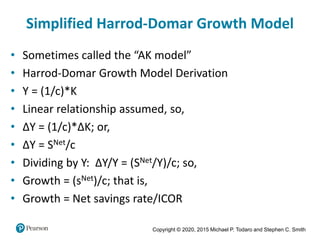
Simplified Harrod-Domar Growth Model
• Sometimes called the “AK model”
• Harrod-Domar Growth Model Derivation
• Y = (1/c)*K
• Linear relationship assumed, so,
• ΔY = (1/c)*ΔK; or,
• ΔY = SNet/c
• Dividing by Y: ΔY/Y = (SNet/Y)/c; so,
• Growth = (sNet)/c; that is,
• Growth = Net savings rate/ICOR
Copyright © 2020, 2015 Michael P. Todaro and Stephen C. Smith
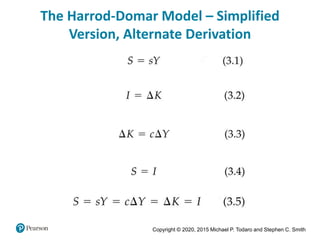
The Harrod-Domar Model – Simplified
Version, Alternate Derivation
Copyright © 2020, 2015 Michael P. Todaro and Stephen C. Smith
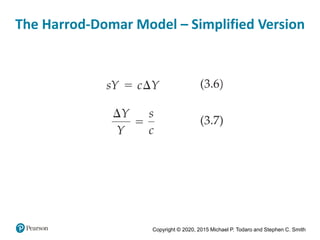
The Harrod-Domar Model – Simplified Version
Copyright © 2020, 2015 Michael P. Todaro and Stephen C. Smith
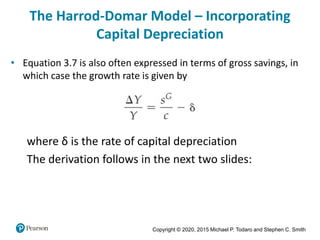
• Equation 3.7 is also often expressed in terms of gross savings, in
which case the growth rate is given by
(3.7’)
where δ is the rate of capital depreciation
The derivation follows in the next two slides:
The Harrod-Domar Model – Incorporating
Capital Depreciation
Copyright © 2020, 2015 Michael P. Todaro and Stephen C. Smith
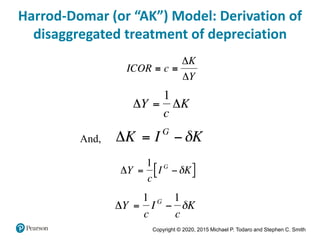
And,
Harrod-Domar (or “AK”) Model: Derivation of
disaggregated treatment of depreciation
Copyright © 2020, 2015 Michael P. Todaro and Stephen C. Smith
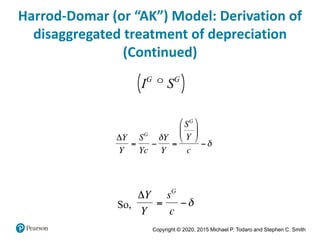
IG
º SG
( )
So,
Harrod-Domar (or “AK”) Model: Derivation of
disaggregated treatment of depreciation
(Continued)
Copyright © 2020, 2015 Michael P. Todaro and Stephen C. Smith
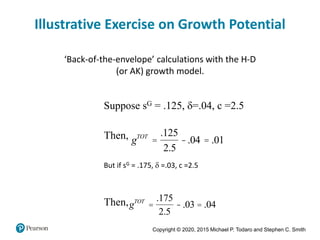
Illustrative Exercise on Growth Potential
‘Back-of-the-envelope’ calculations with the H-D
(or AK) growth model.
Suppose sG = .125, =.04, c =2.5
gTOT
=
.125
2.5
-.04 = .01
Then,
But if sG = .175,  =.03, c =2.5
gTOT
=
.175
2.5
-.03 = .04
Then,
Copyright © 2020, 2015 Michael P. Todaro and Stephen C. Smith
Illustrative Exercise: Growth Targets
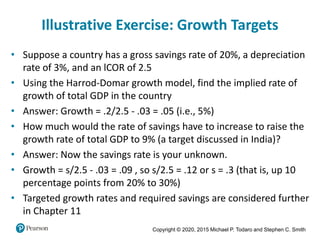
• Suppose a country has a gross savings rate of 20%, a depreciation
rate of 3%, and an lCOR of 2.5
• Using the Harrod-Domar growth model, find the implied rate of
growth of total GDP in the country
• Answer: Growth = .2/2.5 - .03 = .05 (i.e., 5%)
• How much would the rate of savings have to increase to raise the
growth rate of total GDP to 9% (a target discussed in India)?
• Answer: Now the savings rate is your unknown.
• Growth = s/2.5 - .03 = .09 , so s/2.5 = .12 or s = .3 (that is, up 10
percentage points from 20% to 30%)
• Targeted growth rates and required savings are considered further
in Chapter 11
Copyright © 2020, 2015 Michael P. Todaro and Stephen C. Smith
Criticisms of the Stages Model
• Necessary versus sufficient conditions
Copyright © 2020, 2015 Michael P. Todaro and Stephen C. Smith
3.3 Structural-Change Models
• The Lewis two-sector model
Copyright © 2020, 2015 Michael P. Todaro and Stephen C. Smith
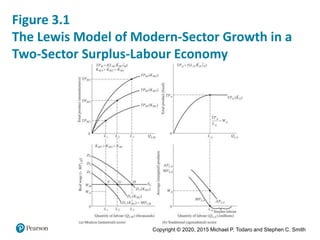
Figure 3.1
The Lewis Model of Modern-Sector Growth in a
Two-Sector Surplus-Labour Economy
Copyright © 2020, 2015 Michael P. Todaro and Stephen C. Smith
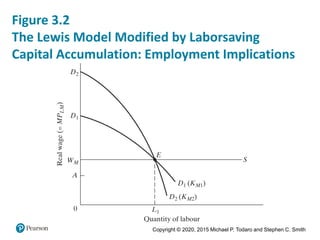
Criticisms of the Lewis Model
• Rate of labor transfer and employment creation may
not be proportional to rate of modern-sector capital
accumulation
• Questionable assumption of surplus labor in rural
areas and full employment in urban
• Questionable assumption of diminishing returns in
modern industrial sector, at least in some cases
• Institutional factors have a small (if any) role in this
approach
Copyright © 2020, 2015 Michael P. Todaro and Stephen C. Smith
Figure 3.2
The Lewis Model Modified by Laborsaving
Capital Accumulation: Employment Implications
Copyright © 2020, 2015 Michael P. Todaro and Stephen C. Smith
Empirical Patterns of Development -
Examples
• Some processes are very typical but not universal; so
these are often referred to as “stylized facts”:
‒ Switch from agriculture to industry (and services)
‒ Rural-urban migration and urbanization
‒ Steady accumulation of physical and human
capital
‒ Population growth first increasing and then
decreasing with decline in family size
Copyright © 2020, 2015 Michael P. Todaro and Stephen C. Smith
3.4 The International-Dependence “Revolution”
• The neocolonial dependence model
– Legacy of colonialism, Unequal power, Core-periphery
• The false-paradigm model
– Pitfalls of using “expert” foreign advisors who misapply
developed-country models
• The dualistic-development thesis
– Superior and inferior elements can coexist; Prebisch-Singer
Hypothesis
• Criticisms and limitations
– Accumulating counterexamples; the framework does little
to show how to achieve development in a positive sense
Copyright © 2020, 2015 Michael P. Todaro and Stephen C. Smith
3.5 The Neoclassical Counterrevolution, or
“Market Fundamentalism”
• Challenging the Statist Model: Free Markets, Public Choice, and
Market-Friendly Approaches
– Free market approach
– Public choice approach
– Market-friendly approach
• Main Arguments
– Denies efficiency of intervention
– Points up state owned enterprise failures
– Stresses government failures
– Urges reliance upon the “magic of the marketplace”
– Associated with a different (Solow) formal model of growth:
Copyright © 2020, 2015 Michael P. Todaro and Stephen C. Smith
3.5 The Neoclassical Counterrevolution, or
“Market Fundamentalism”
• Associated with a different (Solow) formal model of
growth
‒ Traditional neoclassical growth theory (Solow model)
‒ Includes labor as a separate input
‒ Shows that with diminishing returns, growth cannot be
sustained by capital accumulation alone
‒ Adds separate, explicit accounting of the role of
technological change
‒ The model details are presented in Appendix 3.2
Copyright © 2020, 2015 Michael P. Todaro and Stephen C. Smith
From the Appendix:
Interpreting the Solow equilibrium equation
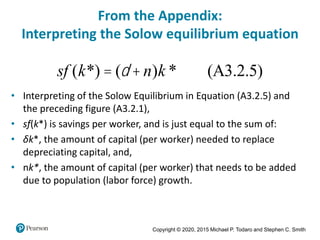
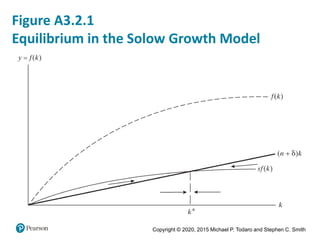
• Interpreting of the Solow Equilibrium in Equation (A3.2.5) and
the preceding figure (A3.2.1),
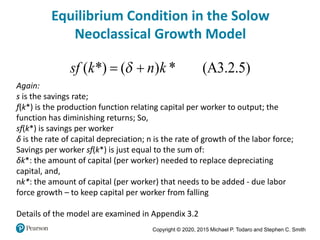
• sf(k*) is savings per worker, and is just equal to the sum of:
• δk*, the amount of capital (per worker) needed to replace
depreciating capital, and,
• nk*, the amount of capital (per worker) that needs to be added
due to population (labor force) growth.
sf (k*) = (d +n)k * (A3.2.5)
Copyright © 2020, 2015 Michael P. Todaro and Stephen C. Smith
Contributions and Limitations of the
Four Schools
• Capital Fundamentalism
– Points up importance of investment, and of efficiency of capital allocation
– Investment may be necessary but is not sufficient. Broader context matters
• Structural/Empirical Patterns of Development
– Careful empirical evidence can remove theories from contention
– But, still need theory to interpret data, avoid cart-before-horse policies
• Dependency
– Existing international relations/ trade/ investment can place constraints on pattern
of development
– But, growing number of counter-examples of stronger versions of dependency
theory; good performance of “globally” integrated countries
• Market Fundamentalism
– Governments fail (e.g. in SOEs, planning) and we must account for this
– But, markets also fail in developing countries; the East Asia experience shows that
government role can be constructive
Copyright © 2020, 2015 Michael P. Todaro and Stephen C. Smith
3.6 Classic Theories of Development:
Reconciling the Differences
• Governments do fail, but so do markets; a balance is
needed
• Must attend to institutional and political realities in
developing world
• Development economics has no universally accepted
paradigm
• Insights and understandings are continually evolving
• Each theory has some strengths and some
weaknesses
Copyright © 2020, 2015 Michael P. Todaro and Stephen C. Smith
Appendix 3.1: Components of Economic
Growth
• Capital Accumulation, investments in physical and
human capital
– Increase capital stock
• Growth in population and labor force
• Technological progress
– Neutral, labor/capital-saving, labor/capital augmenting
Copyright © 2020, 2015 Michael P. Todaro and Stephen C. Smith
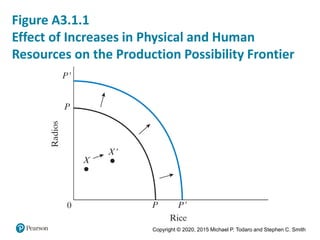
Figure A3.1.1
Effect of Increases in Physical and Human
Resources on the Production Possibility Frontier
Copyright © 2020, 2015 Michael P. Todaro and Stephen C. Smith
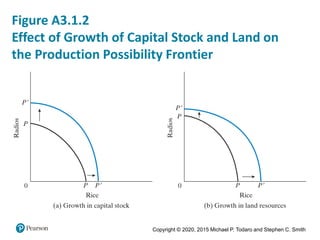
Figure A3.1.2
Effect of Growth of Capital Stock and Land on
the Production Possibility Frontier
Copyright © 2020, 2015 Michael P. Todaro and Stephen C. Smith
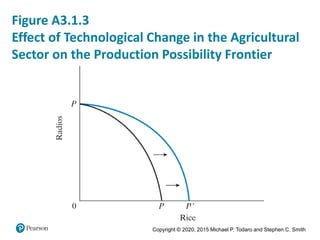
Figure A3.1.3
Effect of Technological Change in the Agricultural
Sector on the Production Possibility Frontier
Copyright © 2020, 2015 Michael P. Todaro and Stephen C. Smith
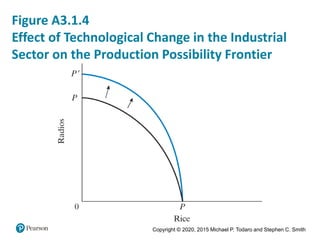
Figure A3.1.4
Effect of Technological Change in the Industrial
Sector on the Production Possibility Frontier
Copyright © 2020, 2015 Michael P. Todaro and Stephen C. Smith
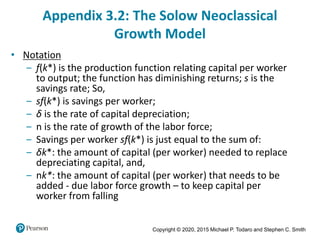
Appendix 3.2: The Solow Neoclassical
Growth Model
• Notation
‒ f(k*) is the production function relating capital per worker
to output; the function has diminishing returns; s is the
savings rate; So,
‒ sf(k*) is savings per worker;
‒ δ is the rate of capital depreciation;
‒ n is the rate of growth of the labor force;
‒ Savings per worker sf(k*) is just equal to the sum of:
‒ δk*: the amount of capital (per worker) needed to replace
depreciating capital, and,
‒ nk*: the amount of capital (per worker) that needs to be
added - due labor force growth – to keep capital per
worker from falling
Copyright © 2020, 2015 Michael P. Todaro and Stephen C. Smith
Appendix 3.2 The Solow Neoclassical
Growth Model: The Solow Equation
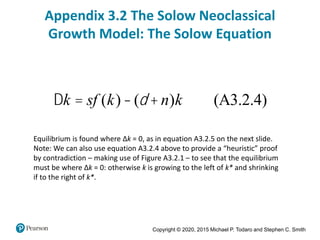
Dk = sf (k)-(d +n)k (A3.2.4)
Equilibrium is found where Δk = 0, as in equation A3.2.5 on the next slide.
Note: We can also use equation A3.2.4 above to provide a “heuristic” proof
by contradiction – making use of Figure A3.2.1 – to see that the equilibrium
must be where Δk = 0: otherwise k is growing to the left of k* and shrinking
if to the right of k*.
Copyright © 2020, 2015 Michael P. Todaro and Stephen C. Smith
Equilibrium Condition in the Solow
Neoclassical Growth Model
Again:
s is the savings rate;
f(k*) is the production function relating capital per worker to output; the
function has diminishing returns; So,
sf(k*) is savings per worker
δ is the rate of capital depreciation; n is the rate of growth of the labor force;
Savings per worker sf(k*) is just equal to the sum of:
δk*: the amount of capital (per worker) needed to replace depreciating
capital, and,
nk*: the amount of capital (per worker) that needs to be added - due labor
force growth – to keep capital per worker from falling
Details of the model are examined in Appendix 3.2
Copyright © 2020, 2015 Michael P. Todaro and Stephen C. Smith
Figure A3.2.1
Equilibrium in the Solow Growth Model
Copyright © 2020, 2015 Michael P. Todaro and Stephen C. Smith
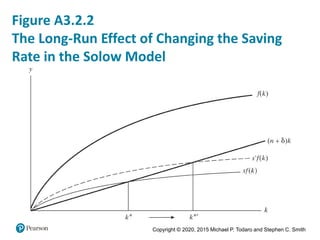
Figure A3.2.2
The Long-Run Effect of Changing the Saving
Rate in the Solow Model
Copyright © 2020, 2015 Michael P. Todaro and Stephen C. Smith
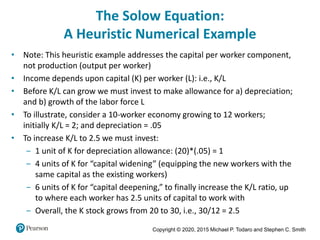
The Solow Equation:
A Heuristic Numerical Example
• Note: This heuristic example addresses the capital per worker component,
not production (output per worker)
• Income depends upon capital (K) per worker (L): i.e., K/L
• Before K/L can grow we must invest to make allowance for a) depreciation;
and b) growth of the labor force L
• To illustrate, consider a 10-worker economy growing to 12 workers;
initially K/L = 2; and depreciation = .05
• To increase K/L to 2.5 we must invest:
‒ 1 unit of K for depreciation allowance: (20)*(.05) = 1
‒ 4 units of K for “capital widening” (equipping the new workers with the
same capital as the existing workers)
‒ 6 units of K for “capital deepening,” to finally increase the K/L ratio, up
to where each worker has 2.5 units of capital to work with
‒ Overall, the K stock grows from 20 to 30, i.e., 30/12 = 2.5
Copyright © 2020, 2015 Michael P. Todaro and Stephen C. Smith
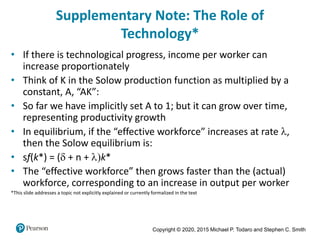
Supplementary Note: The Role of
Technology*
• If there is technological progress, income per worker can
increase proportionately
• Think of K in the Solow production function as multiplied by a
constant, A, “AK”:
• So far we have implicitly set A to 1; but it can grow over time,
representing productivity growth
• In equilibrium, if the “effective workforce” increases at rate l,
then the Solow equilibrium is:
• sf(k*) = ( + n + l)k*
• The “effective workforce” then grows faster than the (actual)
workforce, corresponding to an increase in output per worker
*This slide addresses a topic not explicitly explained or currently formalized in the text
Copyright © 2020, 2015 Michael P. Todaro and Stephen C. Smith
Concepts for Review
• Autarky
• Average product
• Capital-labor ratio
• Capital-output ratio
• Center
• Closed economy
• Comprador groups
• Dependence
• Dominance
• Dualism
• False-paradigm model
• Free market
• Free-market analysis
• Harrod-Domar growth
model
• Lewis two-sector model
• Marginal product
• Market failure
Copyright © 2020, 2015 Michael P. Todaro and Stephen C. Smith
Concepts for Review (Continued)
• Market-friendly approach
• Necessary condition
• Neoclassical counterrevolution
• Neocolonial dependence
model
• Net savings ratio
• New political economy
approach
• Open economy
• Patterns-of-development
analysis
• Periphery
• Production function
• Public-choice theory
• Self-sustaining growth
• Solow neoclassical growth model
• Stages-of-growth model of
development
• Structural-change theory
• Structural transformation
• Sufficient condition
• Surplus labor
• Underdevelopment

978129.PPT

  • 1.
    Copyright © 2020,2015 Michael P. Todaro and Stephen C. Smith Economic Development Thirteenth Edition Chapter 3 Classic Theories of Economic Growth and Development
  • 2.
    Copyright © 2020,2015 Michael P. Todaro and Stephen C. Smith 3.1 Classic Theories of Economic Development: Four Approaches • Linear stages of growth model • Theories and patterns of structural change • International-dependence “revolution” • Neoclassical, free market “counterrevolution”
  • 3.
    Copyright © 2020,2015 Michael P. Todaro and Stephen C. Smith 3.2 Development as Growth and Linear- Stages Theories • A Classic Statement: Rostow’s Stages of Growth • Harrod-Domar Growth Model • (Also referred to as the AK model, because the capital stock is multiplied by a constant factor, sometimes called “A”)
  • 4.
    Copyright © 2020,2015 Michael P. Todaro and Stephen C. Smith Simplified Harrod-Domar Growth Model • Sometimes called the “AK model” • Harrod-Domar Growth Model Derivation • Y = (1/c)*K • Linear relationship assumed, so, • ΔY = (1/c)*ΔK; or, • ΔY = SNet/c • Dividing by Y: ΔY/Y = (SNet/Y)/c; so, • Growth = (sNet)/c; that is, • Growth = Net savings rate/ICOR
  • 5.
    Copyright © 2020,2015 Michael P. Todaro and Stephen C. Smith The Harrod-Domar Model – Simplified Version, Alternate Derivation
  • 6.
    Copyright © 2020,2015 Michael P. Todaro and Stephen C. Smith The Harrod-Domar Model – Simplified Version
  • 7.
    Copyright © 2020,2015 Michael P. Todaro and Stephen C. Smith • Equation 3.7 is also often expressed in terms of gross savings, in which case the growth rate is given by (3.7’) where δ is the rate of capital depreciation The derivation follows in the next two slides: The Harrod-Domar Model – Incorporating Capital Depreciation
  • 8.
    Copyright © 2020,2015 Michael P. Todaro and Stephen C. Smith And, Harrod-Domar (or “AK”) Model: Derivation of disaggregated treatment of depreciation
  • 9.
    Copyright © 2020,2015 Michael P. Todaro and Stephen C. Smith IG º SG ( ) So, Harrod-Domar (or “AK”) Model: Derivation of disaggregated treatment of depreciation (Continued)
  • 10.
    Copyright © 2020,2015 Michael P. Todaro and Stephen C. Smith Illustrative Exercise on Growth Potential ‘Back-of-the-envelope’ calculations with the H-D (or AK) growth model. Suppose sG = .125, =.04, c =2.5 gTOT = .125 2.5 -.04 = .01 Then, But if sG = .175,  =.03, c =2.5 gTOT = .175 2.5 -.03 = .04 Then,
  • 11.
    Copyright © 2020,2015 Michael P. Todaro and Stephen C. Smith Illustrative Exercise: Growth Targets • Suppose a country has a gross savings rate of 20%, a depreciation rate of 3%, and an lCOR of 2.5 • Using the Harrod-Domar growth model, find the implied rate of growth of total GDP in the country • Answer: Growth = .2/2.5 - .03 = .05 (i.e., 5%) • How much would the rate of savings have to increase to raise the growth rate of total GDP to 9% (a target discussed in India)? • Answer: Now the savings rate is your unknown. • Growth = s/2.5 - .03 = .09 , so s/2.5 = .12 or s = .3 (that is, up 10 percentage points from 20% to 30%) • Targeted growth rates and required savings are considered further in Chapter 11
  • 12.
    Copyright © 2020,2015 Michael P. Todaro and Stephen C. Smith Criticisms of the Stages Model • Necessary versus sufficient conditions
  • 13.
    Copyright © 2020,2015 Michael P. Todaro and Stephen C. Smith 3.3 Structural-Change Models • The Lewis two-sector model
  • 14.
    Copyright © 2020,2015 Michael P. Todaro and Stephen C. Smith Figure 3.1 The Lewis Model of Modern-Sector Growth in a Two-Sector Surplus-Labour Economy
  • 15.
    Copyright © 2020,2015 Michael P. Todaro and Stephen C. Smith Criticisms of the Lewis Model • Rate of labor transfer and employment creation may not be proportional to rate of modern-sector capital accumulation • Questionable assumption of surplus labor in rural areas and full employment in urban • Questionable assumption of diminishing returns in modern industrial sector, at least in some cases • Institutional factors have a small (if any) role in this approach
  • 16.
    Copyright © 2020,2015 Michael P. Todaro and Stephen C. Smith Figure 3.2 The Lewis Model Modified by Laborsaving Capital Accumulation: Employment Implications
  • 17.
    Copyright © 2020,2015 Michael P. Todaro and Stephen C. Smith Empirical Patterns of Development - Examples • Some processes are very typical but not universal; so these are often referred to as “stylized facts”: ‒ Switch from agriculture to industry (and services) ‒ Rural-urban migration and urbanization ‒ Steady accumulation of physical and human capital ‒ Population growth first increasing and then decreasing with decline in family size
  • 18.
    Copyright © 2020,2015 Michael P. Todaro and Stephen C. Smith 3.4 The International-Dependence “Revolution” • The neocolonial dependence model – Legacy of colonialism, Unequal power, Core-periphery • The false-paradigm model – Pitfalls of using “expert” foreign advisors who misapply developed-country models • The dualistic-development thesis – Superior and inferior elements can coexist; Prebisch-Singer Hypothesis • Criticisms and limitations – Accumulating counterexamples; the framework does little to show how to achieve development in a positive sense
  • 19.
    Copyright © 2020,2015 Michael P. Todaro and Stephen C. Smith 3.5 The Neoclassical Counterrevolution, or “Market Fundamentalism” • Challenging the Statist Model: Free Markets, Public Choice, and Market-Friendly Approaches – Free market approach – Public choice approach – Market-friendly approach • Main Arguments – Denies efficiency of intervention – Points up state owned enterprise failures – Stresses government failures – Urges reliance upon the “magic of the marketplace” – Associated with a different (Solow) formal model of growth:
  • 20.
    Copyright © 2020,2015 Michael P. Todaro and Stephen C. Smith 3.5 The Neoclassical Counterrevolution, or “Market Fundamentalism” • Associated with a different (Solow) formal model of growth ‒ Traditional neoclassical growth theory (Solow model) ‒ Includes labor as a separate input ‒ Shows that with diminishing returns, growth cannot be sustained by capital accumulation alone ‒ Adds separate, explicit accounting of the role of technological change ‒ The model details are presented in Appendix 3.2
  • 21.
    Copyright © 2020,2015 Michael P. Todaro and Stephen C. Smith From the Appendix: Interpreting the Solow equilibrium equation • Interpreting of the Solow Equilibrium in Equation (A3.2.5) and the preceding figure (A3.2.1), • sf(k*) is savings per worker, and is just equal to the sum of: • δk*, the amount of capital (per worker) needed to replace depreciating capital, and, • nk*, the amount of capital (per worker) that needs to be added due to population (labor force) growth. sf (k*) = (d +n)k * (A3.2.5)
  • 22.
    Copyright © 2020,2015 Michael P. Todaro and Stephen C. Smith Contributions and Limitations of the Four Schools • Capital Fundamentalism – Points up importance of investment, and of efficiency of capital allocation – Investment may be necessary but is not sufficient. Broader context matters • Structural/Empirical Patterns of Development – Careful empirical evidence can remove theories from contention – But, still need theory to interpret data, avoid cart-before-horse policies • Dependency – Existing international relations/ trade/ investment can place constraints on pattern of development – But, growing number of counter-examples of stronger versions of dependency theory; good performance of “globally” integrated countries • Market Fundamentalism – Governments fail (e.g. in SOEs, planning) and we must account for this – But, markets also fail in developing countries; the East Asia experience shows that government role can be constructive
  • 23.
    Copyright © 2020,2015 Michael P. Todaro and Stephen C. Smith 3.6 Classic Theories of Development: Reconciling the Differences • Governments do fail, but so do markets; a balance is needed • Must attend to institutional and political realities in developing world • Development economics has no universally accepted paradigm • Insights and understandings are continually evolving • Each theory has some strengths and some weaknesses
  • 24.
    Copyright © 2020,2015 Michael P. Todaro and Stephen C. Smith Appendix 3.1: Components of Economic Growth • Capital Accumulation, investments in physical and human capital – Increase capital stock • Growth in population and labor force • Technological progress – Neutral, labor/capital-saving, labor/capital augmenting
  • 25.
    Copyright © 2020,2015 Michael P. Todaro and Stephen C. Smith Figure A3.1.1 Effect of Increases in Physical and Human Resources on the Production Possibility Frontier
  • 26.
    Copyright © 2020,2015 Michael P. Todaro and Stephen C. Smith Figure A3.1.2 Effect of Growth of Capital Stock and Land on the Production Possibility Frontier
  • 27.
    Copyright © 2020,2015 Michael P. Todaro and Stephen C. Smith Figure A3.1.3 Effect of Technological Change in the Agricultural Sector on the Production Possibility Frontier
  • 28.
    Copyright © 2020,2015 Michael P. Todaro and Stephen C. Smith Figure A3.1.4 Effect of Technological Change in the Industrial Sector on the Production Possibility Frontier
  • 29.
    Copyright © 2020,2015 Michael P. Todaro and Stephen C. Smith Appendix 3.2: The Solow Neoclassical Growth Model • Notation ‒ f(k*) is the production function relating capital per worker to output; the function has diminishing returns; s is the savings rate; So, ‒ sf(k*) is savings per worker; ‒ δ is the rate of capital depreciation; ‒ n is the rate of growth of the labor force; ‒ Savings per worker sf(k*) is just equal to the sum of: ‒ δk*: the amount of capital (per worker) needed to replace depreciating capital, and, ‒ nk*: the amount of capital (per worker) that needs to be added - due labor force growth – to keep capital per worker from falling
  • 30.
    Copyright © 2020,2015 Michael P. Todaro and Stephen C. Smith Appendix 3.2 The Solow Neoclassical Growth Model: The Solow Equation Dk = sf (k)-(d +n)k (A3.2.4) Equilibrium is found where Δk = 0, as in equation A3.2.5 on the next slide. Note: We can also use equation A3.2.4 above to provide a “heuristic” proof by contradiction – making use of Figure A3.2.1 – to see that the equilibrium must be where Δk = 0: otherwise k is growing to the left of k* and shrinking if to the right of k*.
  • 31.
    Copyright © 2020,2015 Michael P. Todaro and Stephen C. Smith Equilibrium Condition in the Solow Neoclassical Growth Model Again: s is the savings rate; f(k*) is the production function relating capital per worker to output; the function has diminishing returns; So, sf(k*) is savings per worker δ is the rate of capital depreciation; n is the rate of growth of the labor force; Savings per worker sf(k*) is just equal to the sum of: δk*: the amount of capital (per worker) needed to replace depreciating capital, and, nk*: the amount of capital (per worker) that needs to be added - due labor force growth – to keep capital per worker from falling Details of the model are examined in Appendix 3.2
  • 32.
    Copyright © 2020,2015 Michael P. Todaro and Stephen C. Smith Figure A3.2.1 Equilibrium in the Solow Growth Model
  • 33.
    Copyright © 2020,2015 Michael P. Todaro and Stephen C. Smith Figure A3.2.2 The Long-Run Effect of Changing the Saving Rate in the Solow Model
  • 34.
    Copyright © 2020,2015 Michael P. Todaro and Stephen C. Smith The Solow Equation: A Heuristic Numerical Example • Note: This heuristic example addresses the capital per worker component, not production (output per worker) • Income depends upon capital (K) per worker (L): i.e., K/L • Before K/L can grow we must invest to make allowance for a) depreciation; and b) growth of the labor force L • To illustrate, consider a 10-worker economy growing to 12 workers; initially K/L = 2; and depreciation = .05 • To increase K/L to 2.5 we must invest: ‒ 1 unit of K for depreciation allowance: (20)*(.05) = 1 ‒ 4 units of K for “capital widening” (equipping the new workers with the same capital as the existing workers) ‒ 6 units of K for “capital deepening,” to finally increase the K/L ratio, up to where each worker has 2.5 units of capital to work with ‒ Overall, the K stock grows from 20 to 30, i.e., 30/12 = 2.5
  • 35.
    Copyright © 2020,2015 Michael P. Todaro and Stephen C. Smith Supplementary Note: The Role of Technology* • If there is technological progress, income per worker can increase proportionately • Think of K in the Solow production function as multiplied by a constant, A, “AK”: • So far we have implicitly set A to 1; but it can grow over time, representing productivity growth • In equilibrium, if the “effective workforce” increases at rate l, then the Solow equilibrium is: • sf(k*) = ( + n + l)k* • The “effective workforce” then grows faster than the (actual) workforce, corresponding to an increase in output per worker *This slide addresses a topic not explicitly explained or currently formalized in the text
  • 36.
    Copyright © 2020,2015 Michael P. Todaro and Stephen C. Smith Concepts for Review • Autarky • Average product • Capital-labor ratio • Capital-output ratio • Center • Closed economy • Comprador groups • Dependence • Dominance • Dualism • False-paradigm model • Free market • Free-market analysis • Harrod-Domar growth model • Lewis two-sector model • Marginal product • Market failure
  • 37.
    Copyright © 2020,2015 Michael P. Todaro and Stephen C. Smith Concepts for Review (Continued) • Market-friendly approach • Necessary condition • Neoclassical counterrevolution • Neocolonial dependence model • Net savings ratio • New political economy approach • Open economy • Patterns-of-development analysis • Periphery • Production function • Public-choice theory • Self-sustaining growth • Solow neoclassical growth model • Stages-of-growth model of development • Structural-change theory • Structural transformation • Sufficient condition • Surplus labor • Underdevelopment