House of Commons
Defence Committee

Operations in Libya
Ninth Report of Session 2010–12

Volume II
Additional written evidence

Ordered by the House of Commons
to be published 12 & 26 October, and 15 November 2011


                                     Published on 8 February 2012
                            by authority of the House of Commons
                             London: The Stationery Office Limited
Defence Committee

The Defence Committee is appointed by the House of Commons to examine the
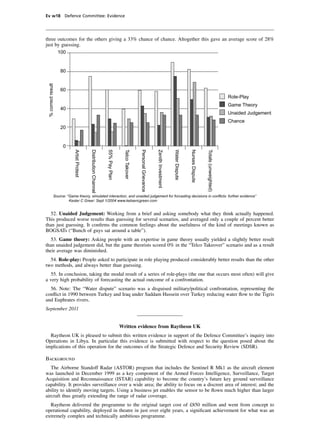
expenditure, administration, and policy of the Ministry of Defence and its
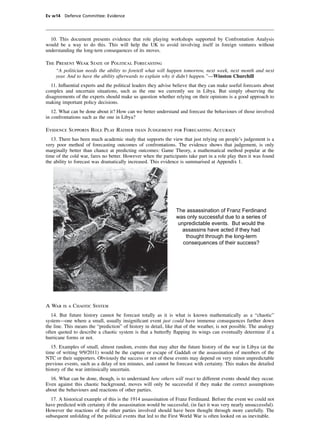
associated public bodies.

Current membership
Rt Hon James Arbuthnot MP (Conservative, North East Hampshire) (Chair)
Mr Julian Brazier MP (Conservative, Canterbury)
Thomas Docherty MP (Labour, Dunfermline and West Fife)
Rt Hon Jeffrey M. Donaldson MP (Democratic Unionist, Lagan Valley)
John Glen MP (Conservative, Salisbury)
Mr Dai Havard MP (Labour, Merthyr Tydfil and Rhymney)
Mrs Madeleine Moon MP (Labour, Bridgend)
Penny Mordaunt MP (Conservative, Portsmouth North)
Sandra Osborne MP (Labour, Ayr, Carrick and Cumnock)
Sir Bob Russell MP (Liberal Democrat, Colchester)
Bob Stewart MP (Conservative, Beckenham)
Ms Gisela Stuart MP (Labour, Birmingham, Edgbaston)

The following were also Members of the Committee during the Parliament:
Mr David Hamilton MP (Labour, Midlothian)
Mr Mike Hancock MP (Liberal Democrat, Portsmouth South)
Mr Adam Holloway MP (Conservative, Gravesham)
Alison Seabeck MP (Labour, Moor View)
John Woodcock MP (Lab/Co-op, Barrow and Furness)

Powers
The Committee is one of the departmental select committees, the powers of
which are set out in House of Commons Standing Orders, principally in SO No
152. These are available on the Internet via www.parliament.uk.

Publications
The Reports and evidence of the Committee are published by The Stationery
Office by Order of the House. All publications of the Committee (including press
notices) are on the internet at www.parliament.uk/parliament.uk/defcom.

The Reports of the Committee, the formal minutes relating to that report, oral
evidence taken and some or all written evidence are available in a printed
volume.

Committee staff

The current staff of the Committee are Alda Barry (Clerk), Judith Boyce (Second
Clerk), Karen Jackson (Audit Adviser), Ian Thomson (Inquiry Manager), Christine
Randall (Senior Committee Assistant), Miguel Boo Fraga (Committee Assistant),
Sumati Sowamber (Committee Support Assistant), and Clayton McClesky (Intern).

Contacts
All correspondence should be addressed to the Clerk of the Defence Committee,
House of Commons, London SW1A 0AA. The telephone number for general
enquiries is 020 7219 5745; the Committee’s email address is
defcom@parliament.uk. Media inquiries should be addressed to Alex Paterson
on 020 7219 1589.
List of additional written evidence
(published in Volume II on the Committee’s website www.parliament.uk/defcom)

                                                                                  Page
1    Commodore Steven Jeremy RN                                                 Ev w1
2    Professor M J Williams                                                     Ev w4
3    CJA Cope, Political Editor, Warship World Magazine                         Ev w7
4    Keep Our Future Afloat Campaign (KOFAC)                                   Ev w10
5    Mike Young, Decision Workshops Ltd                                        Ev w13
6    Raytheon UK                                                               Ev w18
7    Patrick M Lavender, former United Nations FAO Legal Adviser               Ev w20
8    Admiral Sir John Woodward GBE KCB and colleagues                          Ev w21
9    Chris Coverdale, on behalf of the Campaign to Make Wars History & Stop the War
     Coalition                                                                  Ev w69
10   Squadron Leader R T Snare, RAF (retd) FRAes                               Ev w70
Defence Committee: Evidence Ev w1


Written evidence
                            Written evidence from Commodore Steven Jermy RN
Summary
  Events, and Her Majesty’s Government’s actions in Libya suggest that the UK has still not recovered its
ability to think and act strategically in pursuit of the national interest. Although, at the time of writing, the
campaign appears to have taken a more positive turn, this may be temporary, and very possibly more to do
with good luck than with good strategy. Luck—good and bad—very often plays an important role in operations
and war, and we should naturally be prepared to ride good luck. But equally, we should also work to understand
how to improve our strategy-making and, thus, our overall strategic performance.

Background
  1. I, Commodore Steven Jermy RN, am a recently retired naval officer, with a particular interest in strategy.
My service career spanned carrier aviation, ship command and high level staff appointments and I served: at
the operational level in carrier aviation, including flying from HMS INVINCIBLE in the Falklands War and
commanding the Fleet Air Arm; at the strategic level, including as Principal Staff Officer to the Chief of
Defence Staff and as Strategy Director in the British Embassy in Afghanistan.
  2. Since retiring, I have published the book Strategy for Action: Using Force wisely in the 21st Century,
which seeks to improve the way in which strategy is made and, thus, the way force is used in pursuit of the
national interest.
  3. I judge that, whilst recent progress in Libya seems positive, there are likely to be difficult months ahead
and, more importantly for the Select Committee, key lessons to be learned, based on our experience to date.
   4. The lessons are apparent in six inter-related areas: first, our ability to analyse the political context; second,
our ability to identify and pursue a coherent political objective, calculated in relation to the national interest;
third, our ability to create and execute strategy to deliver an identified political objective; fourth, our
understanding of the advantages and disadvantages of air, rather than land, support to indigenous forces; fifth,
the costs and consequences of being unable to deploy fast jets from British aircraft carriers; sixth, the
consequences of the lack of a higher level British foreign policy or grand strategy and institutional competency
in Whitehall in strategic-thinking and strategy-making. The campaign’s strategic narrative provides a useful
backdrop for the analysis.

Narrative
   5. Following peaceful protests on 15 February 2011, the Libyan Army and Police were forced from Benghazi
by 18 February, and the National Transitional Council formed on 27 February. At around this time, the British
Prime Minister proposed the imposition of a no-fly zone, to prevent the use of Gaddafi’s forces against Libyan
civilians. On 17 March, the UN Security Council authorised UNSCR 1973, the two key elements of which
were the imposition of a no-fly zone and the authorisation of “all necessary means”, other than a “foreign
occupation force”, to protect civilian and civilian-populated areas.
  6. On 19 March, French forces, later joined by aircraft of most coalition partners, began operations against
Libyan ground forces in the Benghazi areas and, more broadly, against the Libyan air-defence system. Although
operating under the authority of UNSCR 1973, the coalition’s air targeting policy suggested an intent that went
beyond the mandate, with regime change appearing to be the tacit but unstated political objective. Indeed, the
Foreign Secretary made clear in public statements that the British would wish to see Gaddafi gone. This
aggressive interpretation of the UNSCR 1973 inevitably put pressure on the coalition, with public concerns
voiced by a number of key coalition members and other important international powers, not least China
and Russia.
  7. Meanwhile, the progress of the campaign in May and June 2011 was to-and-fro, unsurprisingly given that,
despite the advantage of air power, the rebels were, initially, not armed and organized as a fighting force. With
the assistance of “advisors” including, according to some sources, coalition Special Forces, rebel forces were
able to operate more effectively, and in particular more consistently secure their gains. The rebels’ successful
invasion of Tripoli, and critically, the rising up of local people, in August led to Gaddafi’s withdrawal, and the
rump of the regime forces fighting a rearguard campaign in the remaining regime strongholds.

Understanding the Political Context
   8. It is not clear, based on the evidence of the Government’s actions, that the political analysis of the situation
in Libya, prior to the West’s intervention, was not sufficiently comprehensive, nor contained the insights, to
support the planning of a properly scoped operation.
   9. What such an analysis ought first to have shown was that the situation in Libya was quite different to, for
example, that in the early days of the Afghanistan intervention; and that this would, in turn, have implications
for the utility of air power.
Ev w2 Defence Committee: Evidence


   10. In Afghanistan, there was a simmering civil war, prior to the intervention, between two reasonably
evenly-matched opponents—the Taliban and the Northern Alliance. And thus, when air power, properly
directed by Western Special Forces, was used to support the Northern Alliance, the results were quick and
decisive.
   11. Whereas in Libya, the uprising was at its very earliest stage, with a significant imbalance between the
opponents—Gaddafi’s security forces and the rebels—in military capability. Given the lack of an obvious
military entity to give the uprising early power, it was reasonably foreseeable that the uprising would take time
to gain military capability and, thus, success. And, by deduction, it was similarly foreseeable that the
intervention was likely to be of extended duration. And yet the Government in particular and the Coalition in
general, on the evidence of both statements and actions, appeared surprised, and then concerned, by the length
of time needed to defeat Gaddafi’s forces.
   12. This weakness in political analysis appears to being playing into the Government’s understanding of the
current context, post the defeat of Gaddafi’s security forces. The Government’s statements and actions give the
strong impression of the National Transitional Council (NTC) as a coherent regime in waiting—as evidenced
by Britain’s, and other’s, international recognition of the NTC as Libya’s legitimate government.
   13. Whereas informal reporting and, latterly, the unwillingness of rebel forces and local defenders to give
up arms suggests that the NTC has, as yet, uncertain legitimacy and fragmentary power, as demonstrated by
its inability, at the time of writing, to extend its writ into Tripoli.
    14. Furthermore, the second significant difference, between the Afghanistan and Libyan campaigns, is the
absence of Western troops on the ground. The consequence of this, and the NTC’s limited ability to impose its
will, is that, notwithstanding a very significant investment of Western military resource, we have precious
little—if indeed any—control over how events will now pan out.
   15. In the long view, this is probably not a bad thing, in that responsibility for Libya’s future will rest
ultimately with Libyans. But in the short term, there needs to be some government recognition—and
explanation to the British public—of this lack of control. And there also probably needs to be some thought
given to government policy, based on the different scenarios that could play out in Libya.
   16. An optimistic scenario is of a general increase in stability, widespread acceptance of the NTC as it gains
legitimacy, and measured progress toward some form of political system that results in representative
government, acceptable to the general population. But two pessimistic scenarios are equally plausible.
   17. In the first, the weakness of the NTC’s power and an unwillingness for armed groups to accede to its
writ, leads to a sustained period of insecurity which could include, for example, significant revenge killings of:
former Gaddafi forces; Gaddafi-aligned tribes; Sub-Saharan Africans. The British Government would need to
consider its position in the event of a request, by people attacked under such a scenario, for the use of British
air power, against rebel forces, to “stop slaughter.”
   18. In the second, Islamic extremists gain an upper hand. This could because they are able, in the same way
as the Taliban, to deliver local security when the NTC cannot. Or it could be as a result of a democratic process.
  19. In either scenario, the victory would look pyrrhic, at best, but might also lead to increasing threat to
British interests, at least in the short term.

Identifying the Political Objective
   20. The British Government, and the French, appears to have fallen into the same trap as the Blair
administration did in Iraq, in that its military actions suggest that it has pursued a political objective of regime
change, which is rather different to UN authorised objective of protecting civilians (or, as routinely stated by
the Prime Minister, “stopping slaughter”). The remarks of the Foreign Secretary have, at times, come perilously
close to admitting this point.
   21. Of course, the apparent success of the rebels against Gaddafi’s forces allows for some post hoc
justification of this approach. Be that as it may, long time political and strategic costs may result.
   22. First, key non-Western countries—particularly China and Russia—who are uncomfortable with the idea
of interference by the international community in internal activities of sovereign states may, in the future, be
less willing to sanction UNSCRs argued for genuine humanitarian reasons.
  23. Second, the West in general, and Britain and France in particular, are now open to the charge of political
hypocrisy, should we choose not to intervene to “stop slaughter” in the future. We have been saved from this
prospect in Syria, so far, thanks to the Syrian people’s desire for no external assistance. But were, for example,
Bahraini or Yemeni uprisings to seek our support, or the Syrian people change their minds, we could find
ourselves in a difficult political position.
  24. The much more fundamental problem, for Britain at least, is the lack of a compelling argument to
say why, and to what degree, the pursuit of either the stated or tacit political objectives are in the British
national interest.
Defence Committee: Evidence Ev w3


   25. This is important because, without an understanding of how the political objective contributes to the
national interest, it is difficult to decide what price we should be prepared to pay—in blood and treasure—in
its pursuit. And without an understanding of the blood and treasure—ie the resources—we are prepared to
deploy and expend, it is difficult, if not impossible, to shape the right strategy to offer the best chances of
delivering success.

Lack of a Coherent Strategy
   26. An early lack of military strategy was evident from an examination of Government and Coalition
statements, all of which focused on the creation of a no-fly zone—note that a no-fly zone is a term of military
doctrine, not a strategy.
   27. The imposition of such a zone requires that just two things be achieved: first, a condition of Coalition
air superiority over opposing air forces; second, the neutralisation of enemy air defences, so as to enable one’s
own aircraft to fly over the zone without interference. A no-fly zone does not, however, require the destruction
of enemy ground forces.
   28. Of course, UNSCR 1973 also authorises the use of “all necessary means”—ie armed force—to protect
civilians. In the case of Libya, this provides a reasonable, albeit not wholly watertight, argument to support the
use of force to protect civilians from the impact of offensive operations by Gaddafi’s forces against, for
example, rebel-held areas.
  29. However, the use of NATO air power to support offensive operations by rebel forces against those of
Gaddafi falls outside UNSCR 1973’s authority, and thus do not appear to comply with international law. This,
too, is further evidence of a lack of strategy in that had a coherent strategy been shaped early, then a key
consideration in that shaping would have been that force be used within the framework of authority provided
by UNSCR.
   30. The lack of strategy in military operations reduces the likelihood of success and increases the chances
of error.
  31. There are a number of related risks, of which three are germane. First, political and military decisions
must be made on the hoof ie “muddling through”—with a heightened chance that they will be wrong. Second,
there will be no strategic framework against which to measure progress. Third, military personnel will
necessarily be strategically rudderless, which increases the pressure on commanders and may also undermine
morale, as personnel sense the lack of overall strategic direction.

Air Support to Indigenous Forces
  32. It is classically the case that air power is an important, but nevertheless supporting, arm in civil wars
such as that in Libya. This is simply because air power cannot be used to seize and hold ground. Success in
such operations will, rather, depend critically on the capacities of the opposing ground forces.
   33. Furthermore, the successful use of air power to support land forces in turn depends critically on effective
air-land integration, classically and contemporarily provided by Forward Air Controllers (FACs) working for
land force commanders. The skill sets of FACs will not be available within a rebel army. It follows that, if air
power is to be used successfully to support indigenous forces, then as a minimum professional FACs, with
adequate force protection, will need to be on the ground, and provision needs to be made for this within
UNSCRs.
  34. Furthermore, whilst air power has significant utility during war-fighting operations, this utility drops
sharply in post-conflict operations. So far, the International Coalition’s main contribution to, investment in, and
opportunity to exert control over, the campaign has been through the use of air power, and this thus reinforces
the point that, with the end of war-fighting operations, then so too ends the Coalition’s opportunity to
substantively shape the course of events.
   35. The key lesson is that this consideration needs to be borne in mind at the outset of any campaign where
air forces, rather than land forces, are used as the primary instrument of intervention of British or Western
power. If we choose this approach, we should do so in the knowledge that, once operations are complete, then
whatever military and civil investment we may have made, we will have little if any strategic control over, but
may nevertheless bear substantial responsibility for, the eventual outcome, whether good or bad.

Carrier versus Land Based Air
   36. Of the major NATO nations engaged in the operation—the US, Britain, France, and Italy—only Britain
did not deploy aircraft carriers. Britain’s inability so to do was a direct and immediate consequence of the
SDSR decision to pay off HMS ARK ROYAL and the GR9 Harriers. This, in turn, constrained our freedom
of action in three ways.
   37. First, unlike the US, France and Italy, Britain had, necessarily, to ask for permission to use local
airfields—in this case, Italian—in order to participate, sustainably, in the campaign. It is often stated, by over
enthusiastic air power advocates, that the UK has Access, Basing and Overflight (ABO) rights around the
Ev w4 Defence Committee: Evidence


world and that, for this reason, aircraft carriers are not essential for the deployment of air power. Whereas the
legal reality is that there are only two generic locations in the world from where Britain has the right to operate
military aircraft: first, British sovereign territory; second, Royal Navy warships operating in international
waters.
   38. In all other locations in the world, we must seek the permission of the base nation and our ability, thus,
to operate British military aircraft from non-sovereign land bases is always subject to the political agreement,
decision and, ultimately, whim of the basing nation, acting in its national interests.
  39. The Libyan experience thus underlines the good sense of the Government’s decision to continue with
the purchase of the two new aircraft carriers. But it also unequivocally exposes the risk that we will bear
between now and the recovery of the aircraft carrier capability, which, under current plans, will not be
meaningful until 2023, and very possibly later.
   40. These strategic risks are not trivial. For example, for the first time in over 100 years, Britain will be
unable to mount operations of the scale and nature of the Falklands War of 1982 or the Sierra Leone
intervention of 1998. And we will remain in this position for well over a decade.
  41. Second, even where ABO agreement has been secured, if the air bases are at distance from the area of
operations, then costs of maintaining aircraft on station, for example to enforce a no-fly zone or maintain a
combat air patrol, can increase very significantly. The increased costs are multi-faceted, but include airframe
hours, which are a major cost driver as well as transit fuel and the additional costs of supporting tanker aircraft.
   42. There is also an operational price in that more aircraft will be needed to provide airpower at distance,
the corollary being that the same amount of aircraft operating from distance will be unable to provide the same
effective combat power as those operating close by.
  43. Third, distance may also mean that it is impossible to deploy some key capabilities. Combat Search and
Rescue (CSAR) is a case in point in that the CSAR cover for British aircrew operating over Libya was—and
could only have been—provided from NATO carriers operating in international waters in the Gulf of Sirte.

Foreign Policy and Grand Strategy
   44. The final—and perhaps most important—lesson is to do with the absence of an overarching foreign
policy or, in its harder-edged form, grand strategy, with which to address the Arab Spring and the broader issue
of extremist Islam in the Maghreb and Middle East.
   45. This lack manifests itself in the Libyan operation, most obviously in our continuing inability to
distinguish between those crises that, because they occur in key strategic areas, bear critically on the British
national interest, and those that do not. It seems clear, for example, that events in the Maghreb, whether or not
they may be morally reprehensible, will bear less critically on Britain’s national interest than those in the Gulf
or Suez.
   46. And yet, whilst already heavily engaged in Afghanistan, Britain elected to engage in Libya and use most
of its remaining military contingency, thus loosing its ability, at a time of unusual historical volatility, to act in
these critical strategic areas.
  47. This is perhaps because of the lack any coherent regional policy or grand strategy against which to
balance the advantages of intervening in Libya against the disadvantages of critically prejudicing our ability to
act elsewhere, in more important strategic areas. This looks to be further evidence of a worry, already explored
by the Public Administration Select Committee (PASC) in 2010, of the inability of Westminster and
Whitehall—especially Whitehall—to think and act strategically, and suggests the PASC’s recommendations
have yet to be acted upon. This is the most serious of all the concerns illustrated during the Libyan operation,
and merits the closest scrutiny by the House of Commons Defence Committee.
9 September 2011


                                Written evidence from Professor M J Williams
Implications for British Defense Dependency on Foreign and Security Policy
M J Williams is Visiting Professor of Government at Wesleyan University in the United States and is Lecturer
in International Relations at Royal Holloway, University of London. Previously he was a Visiting Fellow at the
University of Oxford, a lecturer at the University of London and the Head of the Transatlantic Programme at
the Royal United Services Institute for Defense Studies. Dr. Williams is the author of “The Good War: NATO
and the Liberal Conscience in Afghanistan” (2011) and “NATO, Security and Risk Management: From Kosovo
to Kandahar” (2009). He has consulted extensively for several NATO allies.
 1. The NATO-led intervention in Libya over the past six months highlights some areas of concern for the
UK. The operations, whilst seemingly successful at this point in time, offers several lessons.
  2. First, and most importantly the strikes against Libya highlight the increasing and critical dependency of
the UK (and other European allies) on the resources of the United States. The UK risks becoming a vassal
Defence Committee: Evidence Ev w5


state of the US, unable to act independently unless it rethinks some aspects of defense reorganization and
investment in the military. Second, the role of the US will remain omnipresent, but the approach of Washington
to the wider world is changing. The Americans ostensibly “handed off” the Libya mission to Europe, but they
remained deeply involved. Given the current internal debates in the US about American foreign policy, the
public pushback on foreign intervention and budget constraints that the US must recognize and address in the
near term, there is a strong possibility that the US may sit out on issues of importance to Britain but only of
tertiary importance to Washington. Given the British and European dependency on US military assets this
raises a major problem for British foreign policy. Third, NATO is at the very least a two-tiered alliance. Any
pretense that the Alliance is based on mutual solidarity is rubbish. Libya reinforced a division evident since
the late 1990s. The UK must consider the impact of a multi-tiered NATO on future policy. Fourth, the UK got
lucky that this intervention ended when it did. The UK was stretched to conduct the mission of this length and
intensity. Had the conflict not ended the UK would have found it increasingly difficult to keep up the pace of
operations. Furthermore, the PR fall out from a protracted conflict would have been disastrous for HMG and
for Britain’s global image. The Prime Minister gambled and his bet paid off, but it was a gamble given the
current defense climate. The focus of this briefing will be on the defense dependency of the UK and Europe
on the US.

The Strategic Defense and Security Review and Libya
   Some of the assumptions made in HMG’s Strategic Defense and Security Review were inherently flawed as
a result of groupthink focused on fighting the last war as opposed to a range of future conflicts. The document
supposedly address the UK’s role in an uncertain world, but in some key areas it seems policy-makers failed
to build in enough full-spectrum capacity to ensure a truly independent British foreign policy.
  In 2010 the UK invested roughly 2.7% of GDP on defense. Over the next four years that percentage will
decrease to 2%. The implications of this are cuts to the Army total around 7,000 soldiers. Roughly 40% of the
Army’s artillery and tanks will be liquidated. The Royal Navy and the Royal Air Force will also come under
the hammer. Both will face cuts in personnel of 5,000 apiece. The RAF Harrier aircraft have already been cut
and HMG’s only aircraft carrier HMS Ark Royal was decommissioned in March of 2011. It will be a decade
before a new carrier strike force is in place and although the Government commissioned two carriers it now
looks as if only one will be put into service. Defense spending will supposedly stay at 2% over the next
four years.
   The result of these cuts is quite simply that Britain will have a less able military. Some of these cuts make
sense others do not. The decision for example to pull forces out of Germany to save on basing costs and to
also eliminate heavy armour and artillery intended for a major land war in Europe is a good one. Some residual
capacity is of course warranted as heavy armor is not obsolete, merely limited, but the bulk of the cuts are in
order. Other cuts are more problematic such as the decision to strike the HMS Ark Royal from service
immediately. These decisions had a direct impact on the UK’s ability to easily and effectively wage an air
assault against Libya. The decision to create a new carrier strike group is laudable, but the lack of a carrier in
the medium-term is lamentable and was based more on budget slashing than sound strategic rationale. In the
end, there is no problem with having diminished Armed Forces so long as the Government is willing to accept
it must do less globally. The Libya intervention does not reflect an appreciation for the implications of the cuts
on UK Armed Forces. Asking the military to do more with less is reckless and the public should be concerned
about the Government’s seeming desire to not properly resource soldiers they ask to go in harms way.
   There are a number of implications from these defense cuts aside from the military’s reduced ability to work
as an effective policy tool. The cuts will reduce Britain’s ability to lead when it comes to European security
and defense. Given the already morbid rates of defense investment in Europe, Britain’s abdication of a
leadership role will do little to prod other European nations to invest adequately in defense. A lack of defense
investment will also see a reduction in British led research and development. This means that British firms will
be less innovative and will therefore contribute less to the British economy over time. The domestic societal
benefits of defense investment and research will also be reduced. Historically the defense sector has lead to
major scientific and technological benefits that have benefited wider society and the economy.
   Finally and perhaps most importantly, reduced defense investment will only make Britain more, rather than
less dependent on the United States. For a Government that advocated a foreign policy more independent
(although still allied with) the United States, the defense cuts are an interesting way of achieving this goal.
The UK will rely ever more heavily on the US particularly when it comes to C4ISTR technologies and logistics.
As Nicholas Burns remarked to the FT in April 2011 “There’s a concern in the US that the European allies
will not be able to match the intensity of air and sea operations that the Americans had in the first two weeks
of operations ... The potential challenge is can they deliver an effective military response that will push Gaddafi
back and can they avoid the political disunion in a fractious NATO alliance over air strikes going forward?”
Indeed, as the war dragged on and the contributing nations began to flag this concern grew evermore
omnipresent.

Defence Dependency Culture in the UK and Europe
  The little war against Libya illustrated a new approach of the US to international affairs. The public story is
that the US took an initial leadership role (at the prodding of France and Britain). After leading the first phase
Ev w6 Defence Committee: Evidence


of the NATO attack against Libya flying approximately 1,600 sorties before the US withdrew to a support
function. On the surface it looked as if the US was largely not engaged in the operation, the reality is quite
different. The plan was to pursue a “covert intervention” strategy rather than an overt one. The US was involved
in all planning and deliberations regarding the campaign for the duration of the operation. This reflects a new
US approach to international affairs, one that will remain the de facto course under the Obama Administration
and may reflect a wider change due to mounting domestic pressure from the US electorate to save money buy
cutting back on foreign adventures. The public wants a focus on the domestic woes of the country and on job
creation, rather than spending billions on wars overseas.
   On the surface it would appear that the operation against Libya then was the hour of Europe, but in reality
it revealed a fractured and divided continent. There were 15 European states working alongside the US and
three Arab states to oust Gaddafi. The campaign utilized 29 airbases in six different countries, but only six
European states actually participated in the air strikes alongside the US and Canada. Germany refused to
support the operation. This further reinforces a serious problem within NATO regarding solidarity and
capability. Meanwhile the US contributed the bulk of the support for the operation, as I noted it would in a
piece for The Guardian on 17 March at the start of operations.
  Over the course of the campaign the US contributions included the following:
     —    The United States contributed a dozen warships to the Libya campaign that played a critical role in
          the opening attack. The USS Florida launched 100 cruise missiles against Libyan air-defenses.
     —    US C4ISTR technology was used to track and target opposition forces. US JSTARS surveillance
          airplanes were used to provide offshore intelligence on enemy positions, while US Predator drones
          provided relays of specific target areas.
     —    The targeting packages for the European strikes against targets in Libya were prepared by American
          specialists operating out of NATO’s operation HQ in Naples, Italy.
     —    Refueling of the combat aircraft was undertaken by US tanker aircraft. The US Air Force flew 30
          out of the 40 tankers used to support combat operations. Without US assistance Europe could not
          have maintained the 24 hours a day, campaign days a week campaign.
     —    The US re-supplied European attack aircraft when European countries ran out of precision-attack
          munitions.
     —    The US flew over 5,000 missions; over 1,200 were military strikes against Libyan targets.
     —    While the US avoided putting a large number of US forces on the ground, but Washington did
          contribute CIA agents to the operation.
     —    The US operated the satellite communications channel utilized by British and French Special Forces
          as well Arab Special Forces from Qatar and Jordan. The US also supplied high-tech gear, previously
          unavailable even to allied nations.
     —    The US Navy conducted counter-scud missile operations.
   This list, composed and cross-verified from multiple sources available to the public and private sources most
likely does not reveal to the fullest extent the reality of European and British dependence on the United States.
The reality is that this war, just like the wars in Iraq, Afghanistan and Kosovo, was largely an American
operation. Many in Britain and Europe will try to put a brave face on it, but the fact of the matter is that this
operation would never have been possible without US support.
   The lack of munitions highlights for example, perhaps most embarrassingly, Europe’s lack of capabilities.
When European nations ran low on munitions it was surprisingly the Norwegians, Danish and Belgians who
carried out the most sorties early on. This was not because any of these countries were particularly well
equipped. It was because they fly F-16s meaning that American munitions could be utilized immediately, where
as the French and British European strike aircraft had to be modified before they could use US munitions and
thus had to take a backseat for a period of time. Europe is near entirely dependent on the US for any sort of
serious military operation of a sustained duration and this will only increasingly become the case as British
defense cuts take hold and a lack of defense investment across the continue continues.
   There is certainly nothing wrong with decreasing the defence budget, but this will come the expense of
Britain’s ability to conduct an independent foreign and defense policy. Perhaps cost and equipment sharing can
mitigate some of the overwhelming dependence on the US, but over time the capabilities gap between US
forces and European forces will only worsen. HMG must seriously assess what sort of country Britain wants
to be in a more globalized world and depending on US interests to always match British ones is dangerous.
The US public is approaching near all time high levels of reluctance regarding international intervention. The
rise of more conservative parties may bode for an increasingly isolationist and withdrawn foreign policy.
Alternatively should a more hawkish wing of the Republican Party take power the world may see a return to
extremely assertive interventionism. Such future adventures may drag the UK into American escapades if
deemed necessary to maintain access to American equipment and favour with the US Government. At this
point in time British ambitions do not match British resources, it is a situation that must be reconciled to
protect both British national interest, but perhaps more importantly to protect the lives of those who put
themselves in harms way for Her Majesty’s Government.
Defence Committee: Evidence Ev w7


A Multi-Tiered NATO
   There is no question that NATO has been one of the most successful military alliances of all time. NATO
helped to root democracy in Western and later Eastern Europe. It protected a fragile Western Europe from
Soviet advances during the Cold War and it has served an effective risk management organization since the
early 1990s. Unfortunately, since the end of the Cold War the alliance has suffered from the lack of a firm and
mutually agreed upon raison d’être. Some of the allies believe that using the Alliance to manage global risks
and humanitarian crises (a la the Balkans, Kosovo, Afghanistan) is a worthwhile pursuit, while others are far
less convinced for a variety of reasons. The absence of a concrete overwhelming and clearly identifiable threat
has allowed NATO to fracture. A lack of interest (and serious participation) in on-going operations and a
failure to adequately invest in defense illustrates this gap. Libya only reinforces this worrying trend, with
certain allies carrying the lion’s share of the burden (Britain, France, Denmark, Belgium, Norway) while some
refused to participate at all (Germany for example). Unless NATO leaders can figure out a new grand bargain
that makes NATO relevant to ALL of the members, the Alliance will continue to decay.
September 2011


             Written evidence from C J A Cope, Political Editor, Warship World Magazine
  Towards the end of June, the Defence Secretary, Dr Liam Fox, gave a speech to the Royal United Services
Institute. In that speech, he made a number of claims which, on examination, do not appear to be accurate.
This is what he said:
      “Let me take head-on the persistent claim that the nature of our operations in Libya, and the cost of them,
      would be different had we an aircraft carrier and the Harrier in service.”
      “The truth is that we still would have based RAF Tornadoes and Typhoons in Italy for the air-to-air role
      and to carry the precision weaponry such as Stormshadow or Brimstone that Harrier cannot carry.”
      “So it would not have been cheaper—in fact, it would have been much more expensive.”

Costs
  According to a parliamentary reply by Peter Luff dated 14 September 2010, the cost per flight hour of
operating the Tornado GR4 was £35,000, the Harrier GR9 £37,000 and the Typhoon FGR4 £70,000.
  Nevertheless, as to why the GR9 should cost more to operate per flight hour than the Tornado has not been
explained and should be questioned. These figures must be independently verified by the National Audit Office.
  Elsewhere in his speech, Dr Fox said that Labour had already reduced the Harrier fleet in 2009, leaving the
remaining aircraft being unable to sustain operations in Afghanistan, let alone undertake contingencies such as
Libya. He also said that only Tornado had the capacity to do both.
   Nevertheless, in a parliamentary reply dating from this spring, the MoD stated that the number of Harrier
GR9s withdrawn in December 2010 was 62. This is far in excess of the numbers of Tornadoes and Typhoons
operated by the RAF either in Afghanistan or Libya. 40 of these Harriers were fully fitted for and capable of
frontline combat or ground support operations. In spite of the Tornado fleet numbering 107 aircraft, only 28
were fully fitted for and capable of conducting the Afghanistan close air support task. In other words, there
was much more capacity within the Harrier GR9 fleet to support Afghanistan and Libyan operations. The
Tornado Force Elements at Readiness (FE@R) was therefore significantly less than that of the Harrier.
   A further parliamentary reply indicated that savings from the withdrawal from service of Ark Royal in
December 2010 are estimated at £105 million between 2011–12 and 2014–15. Prior to SDSR, the MoD had
disclosed that Ark Royal would be taken out of service in the third quarter of 2014.
   Accordingly, the average annual savings following the withdrawal from service of Ark Royal during that
three-year period are £35 million. That equates with the savings from the withdrawal from service of Illustrious
which have also been estimated by the MoD at £35 million per annum.
   It must follow, therefore, that to have maintained Ark Royal in service throughout 2011, enabling the ship
to operate in the Mediterranean during Operation Ellamy would have cost the MoD about £35 million.
  Dr Fox appears to be suggesting that it is cheaper to be operating RAF Tornadoes and Typhoons from Gioia
del Colle in Italy than GR9s operating from Ark Royal in the Mediterranean.
   It does not take a mathematical genius to realise that operating GR9s from a carrier lying just outside Libyan
territorial waters has simply got to be substantially cheaper than flying Tornadoes and Typhoons from their
base in Italy the 600 or so nautical miles to Libya and then back again, with VC10/ Tristar refuelling en
route—not to mention the massive logistical support train by air and overland.
   It is high time that the MoD disclosed the actual cost of basing Tornadoes and Typhoons in Italy, particularly
following the report in the Sunday Times in June that the RAF was spending an estimated £40,000 a night for
pilots and support staff to stay at 4* hotels in southern Italy.
Ev w8 Defence Committee: Evidence


   There have been reports that land-based operations in Libya over a six months period are likely to be costing
£900 million, compared with £150 million (just 17%) for sea-based operations. Moreover, if one includes
infrastructure costs, the RAF figure could rise to £1.35 billion.
  In any event, independent verification is essential and again I would urge you to invite the NAO to conduct
an inquiry.
   Launched from a carrier, a GR9 can be on task delivering weapons within 30 minutes of, for example, a call
for urgent support from ground forces. In contrast, a Tornado/Typhoon operating from Gioia del Colle has a
transit time of 1.5 hours to reach its target and, of course, requires air-to-air refuelling. In addition, the RAF
insists on having 24 hours’ notice of close air support missions in order to support ground forces.
  And finally, on the cost of operating aircraft, it has been disclosed that the Army Apache (of which four
have been deployed with Ocean) are costing some £15,000 an hour—less than half that of Tornado.

Weaponry
1. ALARM (air-to-ground missile)
  Is used to take out hostile radar systems. Can be operated by Tornado, but not by the GR9. However, not
deployed in Libya/Afghanistan.

2. AMRAAM/ASRAAM/AIM9 Sidewinder (air-to-air missiles)
   AMRAAM is a BVR (Beyond Visual Range) missile and carried by Typhoon. ASRAAM can be carried by
some, but not all, Tornado aircraft. The GR9 is fully configured/fitted for the carriage and use of the well-
proven Sidewinder missile. Accordingly, all three aircraft types have an air-to-air capability. However, the
Tornado is notoriously deficient when conducting air combat within visual range. In contrast, the Harrier is
highly agile and has a proven track record in aerial combat. Nevertheless, it has to be conceded that, without
radar or a BVR system, the GR9 simply cannot fulfil an area interceptor role. But the GR9 armed with the
latest Sidewinder missile and controlled in-flight by carrier-borne radar controllers/ direction officers, could
defend itself in close combat against any third world fighter threat. I need hardly remind you of the astonishing
success rate of the Sea Harrier during the Falklands War, when operating within visual range and with superior
pilot expertise. And, of course, with the new Type-45 destroyers equipped with Aster missiles and the Sampson
radar system, hostile aircraft BVR would be eliminated using Sea Viper. The Aster 30 has a range of 50 miles.

3. Paveway
  There are three separate marks in service, namely Mark II (simple laser-guided bomb), Mark III (GPS
precision guided “bunker-busting” 2000lb bomb), Mark IV (GPS precision guided bomb).
  Tornado GR4 and Harrier GR9 have the capability to deliver all three variants accurately. Typhoon can only
deliver the Mk II variant and then only when it has independent targeted help.

4. Brimstone/Hellfire
  Both are anti-tank missiles. Whereas the RAF aircraft can deploy Brimstone, the GR9 cannot. However,
Hellfire is as good as Brimstone (and cheaper) and is carried by Apache. Nevertheless, Apache can deliver
Hellfire much more responsively and from shorter range, making it a better and much more cost-effective
operational weapons system.

5. Stormshadow/Tomahawk (TLAM)
  Whereas the RAF aircraft can carry Stormshadow, the GR9 cannot. Furthermore, the RAF has no
Tomahawk capability.
  Stormshadow has a history of misfires, not guiding to target and warhead failures on hitting a target. The
RAF has substantial stocks of Stormshadow missiles (900 were ordered). Each cost $1.3 million, having a
range of 400 miles.
   On the other hand, Tomahawk, operated from Britain’s modified T-boats, together with the new Astute class
SSN, has a range of up to 1,500 miles, can be re-programmed in flight (unlike Stormshadow) and is extremely
reliable with a high probability of kill (unlike Stormshadow). Furthermore, Tomahawk is less than half the
price of Stormshadow.
  The only advantage of Stormshadow over Tomahawk is that it has a warhead specifically designed to
penetrate and destroy hardened targets, which Tomahawk cannot do. Nevertheless, an operational commander
would undoubtedly be using the Mark III Paveway with the Tornado or GR9, instead of calling up a Tomahawk
cruise missile if needing to destroy a hardened target.
   We know that on her first deployment, HMS Triumph (SSN) fired six Tomahawk cruise missiles. The number
fired on the second deployment has yet to be disclosed (thought to be eight). Equally, the Navy has limited
stocks of Tomahawk missiles. During the early stages of the campaign, the US Navy deployed USS Florida,
Defence Committee: Evidence Ev w9


an SSGN, which fired some 90 Tomahawk cruise missiles against Libyan targets. There was, of course, no
guarantee that the USN would participate in Operation Ellamy. Please also note that no European navy apart
from the RN can fire cruise missiles.
  The new Astute class can carry up to 38 weapons and would be perfectly capable of deploying 24 Tomahawk
cruise missiles in any deployment.
  An SSN has strategic mobility whereas airfields are static and vulnerable.

6. Other systems
   The GR9 can also operate Maverick, which is a close-air-support anti-tank weapon, having an excellent
track record and the CRV7 rocket, a close-air-support weapon which also has a good track record. Neither is
carried by Tornado.
  In addition to being equipped with the Hellfire missile, the Apache helicopter has a highly accurate cannon
with 500 rounds available (far more effective and flexible than the Tornado cannon which carries half the
number of rounds).

Military Conclusion
   Four Astute-class SSNs armed with Tomahawk would be capable of eliminating no less than 96 targets,
thereby avoiding any need to use Tornado/Typhoons armed with Stormshadow missiles. One Astute is in
service. The next three boats should be in service by 2016. Today, we have four TLAM-equipped T-boats,
albeit with a reduced payload.
  HMS Ocean, equipped with Apache helicopters, with support from Sea King AEW helicopters, has been
deployed. Apache with Hellfire missiles and cannon is being utilised for anti-tank/anti-armour purposes. A full
complement of 20 Apaches is feasible, bearing in mind that over 60 were delivered to the Army Air Corps.
  In addition, the Navy could have been operating HMS Ark Royal equipped with GR9s and supported by
Sea King AEWs. GR9s equipped with Sidewinder missiles would have been used in air-to-air combat if the
Libyan air force had managed to operate.
   The GR9 equipped with Paveway could have carried out bunker-busting operations and close-air-support
(this is what it was designed to do) using also the Maverick close-air-support anti-tank weapon, together with
the CRV7 rocket.
  This naval combination would have been more effective and considerably cheaper than involving RAF
Tornadoes and Typhoons and highly expensive air-to-air refuelling and logistics backup.
  During Ellamy, the RAF has managed only one Tornado mission every two days, compared with the USMC
flying two missions per Harrier every day.
   In any event, the French aircraft carrier Charles de Gaulle (CDG) has achieved no less than 40% of daily
strike missions in Libya, compared with NATO aircraft and RN/USN SSNs/SSGNs making up the remaining
60%.
   SDSR made it clear that in future, we would be increasingly dependent upon allies. Consider, therefore, the
following situation in relation to Operation Ellamy:
      1. USN—Carriers not involved.
      2. French Navy—CDG returned to Toulon with a refit due at year-end.
      3. Spanish Navy—Carrier not involved.
      4. Italian Navy—Carrier withdrawn for economic reasons. Government contemplating withdrawal of
          air base facilities, with profound implications for future RAF operations.
      5. RN—No fixed-wing carriers in service.

Political Conclusion
  Contrary to what Dr Fox told the RUSI:
    (a) The nature of our Libyan operations would have been greatly improved using a carrier/Harrier
         combination, together with Apache helicopters and TLAM-equipped SSNs.
    (b) We could have dispensed with all land-based air operations from Italy.
    (c) There is an effective naval alternative to Brimstone/Stormshadow.
    (d) The Navy could have carried out the UK’s entire contribution to Operation Ellamy at a fraction of
         the cost incurred by the RAF.
19 July 2011
Ev w10 Defence Committee: Evidence


                     Written evidence from the “Keep Our Future Afloat Campaign”
1. Executive Summary
   1.1 This paper by the Keep Our Future Afloat Campaign, a trade union lobby group, offers our views on the
following issues identified by the Committee:
      — the contribution of allies and partner nations in delivering a successful military intervention;
      — the effectiveness of the operation in Libya and the UK forces’ role with particular regard to the
           submarine element of maritime forces;
      — the implications of this operation for the outcomes of the SDSR; and
      — new capability decisions taken in the SDSR have affected our contribution in Libya.
   We focus primarily upon the important roles Royal Navy nuclear powered submarines have played being
“on station, first” delivering a range of defence precision attack, intelligence gathering, and sea denial capability
and effect in the Libyan campaign. Where relevant we allude to US Navy submarine operations in the same
theatre.
   1.2 Events in Libya have shown that the Royal Navy continues to be called upon to deliver a multi-faceted
role ranging from covert intelligence gathering through to delivery of precision military effect, enforcing an
arms embargo, delivering humanitarian aid and mine clearance. These complemented the often higher public
profile operations delivered by the RAF and its partner NATO air-forces.
   1.3 Publically available evidence points to UK’s Operation Ellamy and USA’s Operation Odyssey Dawn(1)
in Libya demonstrating the strategic defence importance of both nations nuclear-powered attack and SSGN
submarines in monitoring emerging situations early, and when required to delivering capability and effect
designed to rapidly erode the air defence, command and radar abilities of the Libyan regime’s forces.
  1.4 The Strategic Defence and Security Review’s (SDSR) commitment to submarines reinforces Peter Luff
MP’s views, expressed in a letter to the Chairman of KOFAC dated 11 August 2011 that “the Strategic Defence
and Security Review was relatively positive for you”.
  1.5 If the events had unrolled some weeks later the Royal Navy may have had less capability available,
HMS Cumberland for example was on its way back to UK to be decommissioned when it was tasked to stay
on station and enter the new theatre of operations performing valuable humanitarian evacuation roles when air
evacuation was not practical.
   1.6 KOFAC feels that the operations in Libya reinforce the need for UK to have the fleet, air and other
resources ready to respond against further unanticipated scenarios and missions.
   1.7 It is understood that stocks of ammunition to support a number of weapon systems became challenged,(2)
for example cruise missiles, for future campaigns and to ensure flexibility there will need to be a timely
replacement supply of munitions including Tomahawk Cruise Missiles.
  1.8 We also note that the American Marine Corps forces welcomed the flexibility offered by their AV 8B
Harrier STOVL aircraft in being able to operate from a variety of naval platforms to support ground forces.(3)
  1.9 As the Secretary of State for Defence—Liam Fox MP has stated, “... operations in Libya are showing
how capable we are post SDSR as a leading military power.”

2. The Keep Our Future Afloat Campaign—An Introduction
  2.1 This evidence is offered by the “Keep Our Future Afloat Campaign” (KOFAC).KOFAC was launched
in April 2004, it is led by UNITE, GMB and CSEU with support from Furness Enterprise and the local
community. Its aims are to:
     — sustain and grow jobs in naval shipbuilding in northwest England;
     — secure full utilisation of the unique naval shipbuilding industrial base—the shipyard at Barrow in
          Furness and a supply chain of 1,200 companies; and
     — sustain the naval ship/nuclear powered submarine power design capability, which is located in
          Barrow in Furness—600 designers comprising 60% of UK total capability.
  2.2 The Campaign’s strategy is set out within the Strategy and Action Plan 2010–12 available at
www.navalshipbuilding.co.uk. The Campaign believes that investment in maintaining a strong Royal Navy is
crucially important as UK depends on the sea lanes for its trade. KOFAC is widely recognised as being
influential.(4),(5),(6),(7),(8)

3. Submarines
   3.1 Royal Navy and US Navy nuclear powered submarines had a dominant early involvement in
implementation of UN Security Council Resolution 1973 through Joint Task Force “Operation Odyssey Dawn”,
also known in the UK as “Operation Ellamy”. Over the past six months they have played a significant, valuable
and by their nature stealthy and sometimes secretive, role in maritime Operation Unified Protector off Libya
Defence Committee: Evidence Ev w11


demonstrating the enduring value of nuclear powered submarines that were originally designed and built to
counter anti-submarine warfare threats in the cold war age. These boats have highly relevant, highly flexible
capabilities (see Annex 1) in today’s joint operations namely first on station—independent and enduring—
covert—intelligence gathering, support operations and precision strike. This complemented the delivery of
capability and effect by the coalition air forces and surface warships.
   3.2 A Royal Navy Trafalgar Class submarine had been off Libya, on stand-by, undetected in the
Mediterranean for several days(9) operating independently well before it was announced the Royal Navy had
launched cruise missiles. This showed the value of submarines stealthy, persistent presence compared to other
ships.
  3.3 The Royal Navy used Tomahawk cruise missiles on 19 March 2011(10) to attack targets inside Libya
which included neutralising air and missile defence system radars, anti-aircraft sites, key communications’
nodes in the areas around Tripoli and along the country’s Mediterranean coast.(1),(10) These operations were
designed both to de-risk subsequent missions flown by NATO aircraft, degrade its capability re resist a no-fly
zone and to prevent further attacks on Libya’s citizens and opposition groups by the Libyan regime.
   3.4 The media on 23 March 2011 reported that HMS Triumph had fired Tomahawk missiles at Libyan air
defence targets during the opening two nights of Operation Ellamy’s coordinated action with some media
reports suggesting as many as 12 had been fired from Triumph over the previous four days.(11) Triumph was
at sea until 4 April 2011 and returned in June.(12)
  3.5 Submarines also showed their strategic roles to “collect intelligence where other intelligence systems
would not work.” According to the Lexington Institute’s Loren Thompson (Providence Journal, 5 September
2011).
  3.6 Subsequently HMS Turbulent patrolled in June off Libya.(13)
  3.7 For the first time a modified US Navy Ohio Class guided missile submarine, USS Florida fired cruise
missiles in combat.(14),(15)
  3.8 It is anticipated that our submarine presence off Libya will have also contributed to sea control, sea
denial and monitoring Libyan naval assets and merchant vessels approaching the coast.
   3.9 Evidence is now emerging in the public domain of the effectiveness of submarines. Vice Admiral John
Richardson, US Navy is reported as saying operations off Libya “highlight the value of a multi-mission platform
like an attack submarine or a guided missile submarine”,(15) adding “there were other things submarines did,
beyond first strike to exercise the multi-mission capability”.(15) Submarines are becoming the preferred way of
controlling sea-lanes and attacking targets onshore.(14) which is why KOFAC believes that they are an essential
part of UK’s post SDSR defence posture.
  3.10 The Committee may wish to consider asked MoD about the effectiveness of submarine operations and
whether there may be a case post Operation Ellamy and post SDSR for increasing UK’s stock of Tomahawk
cruise missiles rather than having to rely on the US fleet to provide emergency replacement stocks of the
weapon.

4. Surface Warship Operations
   4.1 In addition to using Trafalgar Class submarines, the Royal Navy’s destroyer, HMS Cumberland, which
was due to be decommissioned under the SDSR, was initially diverted to undertake humanitarian evacuation
from Libya on 24, 27 February and 4 March 2011 and later given an extended life so it could operate off the
coast of Libya along with HMS Westminster to enforce an arms embargo and used surveillance to verify
shipping activity(16) as part of a fleet of NATO ships.
   4.2 HMS Liverpool (destroyer) then in late July HMS Iron Duke and HMS Sutherland and HMS Ocean
engaged in Sea King Helicopter led area control and surveillance operations, interception of small high speed
craft boarding undertaking mine laying, returning fire, from regime shore batteries, acting as a floating base
for first maritime operational use of Apache strike helicopters to attack shore facilities, intercept and destroy
small boats, and take out armoured vehicles. Protecting humanitarian shipping movements into Tripoli and at
sea rescue of damaged shipping. They also helped prevent Libyan warships shelling shore positions and
prevented arms being delivered.
  4.3 HMS Brocklesby and HMS Bangor, Sandown Class, Mine Counter Measures’ vessels helped ensure
maritime security and clear mines from the port of Misrata which threatened delivery of humanitarian aid into
Libya. RFA Orange Leaf provided logistics support.
   4.4 It is also worth noting that the American US Marine Corps used AV-8B Harrier(17) aircraft flying off
assault ships to attack ground forces and air defences in Libya, because they did not have “in theatre” an
aircraft carrier. Britain was unable to use its own Harrier aircraft because they had been withdrawn from
operational service earlier, following October 2010’s Strategic Defence and Security Review.
Ev w12 Defence Committee: Evidence


  4.5 The American armed forces have concluded that use of the AV-8B “shows why the Marine Corps needs
the F35-B STOVL joint strike fighter because it can offer an immediate ability to start impacting on a wide
range of things... the need for a STOVL jet sells itself”.(17)

5. Conclusions
  5.1 Operations in Libya have shown the “Strategic Utility of the Royal Navy”(18) and that the “Adaptable
Britain” security posture is “able to operate and be maintained at range”.(18) Submarines have played a unique
and vital role in our NATO operations. They are “the most sophisticated and flexible weapons that we have to
exercise sea control.” The Libyan theatre highlighted our submarines:
      — Stealth, mobility, firepower and advanced sensors which make them the weapon of choice across the
           full spectrum of military operations;
      — Operability in open ocean and littoral seas delivery force protection for other maritime assets;
      — Intelligence gathering so critical to irregular war effort using advanced intelligence, surveillance and
           reconnaissance capability; and
      — Land attack through precision strike capacity using Tomahawk cruise missiles.
  5.2 It therefore follows that there is “an enduring need for Britain to retain the capability to design, build,
operate, maintain and dispose of nuclear powered submarines.”
      5.3 The surface fleet has also demonstrated “the value of persistent presence in regions of interest”.(18)
   5.4 It is, as the Minister for Defence Equipment, Support and Technology said on 7 June 2011, that “the
Royal Navy’s submarines, destroyers, mine-hunters and support ships have been invaluable in protecting
civilians from Gaddafi’s war machine.”(19)

                                                                                                          Annex A
                    ATTRIBUTES OF A ROYAL NAVY NUCLEAR POWERED SUBMARINE
   The most basic and important attribute of a submarine is based on its ability to submerge beneath the surface
of the sea and become virtually invisible from threat sensors. This covert nature offers a number of advantages:
      — It allows the submarine to conduct operations without any indication that a UK force is present.
      — It provides the element of surprise—an aspect of warfare in which any military force can attempt to
           capitalise on. This in turn creates uncertainty in the mind of the adversary.
      — Freedom of movement to operate in waters that may be denied to other forces.
      — Finally, it provides survivability—the submarine cannot be readily attacked because it cannot be
           readily detected.
  The SSN has the ability to deploy at high speed independently and operate in forward positions for prolonged
periods without logistic support. The limits of endurance are only food and weapon expenditure. A UK SSN
has a standard endurance of in excess of 70 days.
   Source: http://www.royalnavy.mod.uk/operations-and-support/submarine-service/fleet-submarines-ssn/
trafalgar-class/hms-triumph/introduction/index.htm
8 September 2011

References
(1)
      www.globalsecurity.org/military/ops/odyssey-dawn.htm.
(2)
  Navy running short of Tomahawk missiles, T Harding Defence correspondent, Daily Telegraph, 23 March
2011.
(3)
      Harrier ops making case for F35B, Tom Kington, Defense News, 28 March 2011.
(4)
   September 2004 Secretary of State for Defence, the Rt Hon Geoff Hoon MP described KOFAC as “one of
the most effective defence lobbies he had come across.”
(5)
  The Rt Hon Alun Michael MP, Minister for Industry and the Regions 13 December 2005 indicated “This
(KOFAC) type of approach by management, trade unions and the local authority is very powerful.”
(6)
   27 September 2006 Lord Drayson, the Ministry of Defence Under-Secretary of State and Minister for
Defence Procurement, said “you do realise you are effective”, adding “no-one else is doing this type of thing”.
(7)
   “KOFAC has made valuable contributions to the Defence and Maritime Strategies in the past, it would be
useful to hear their thoughts as we move forward ... my predecessors Lord Drayson and Baroness Taylor always
found their input both useful and information.”—Minister for Defence Equipment, Support and Technology, 24
June 2009.
Defence Committee: Evidence Ev w13


(8)
  KOFAC has made an extremely powerful effective case for a smooth transition between the ASTUTE and
Successor programme. Peter Luff MP, Minister for Defence Equipment, Support and Technology 20
September 2010.
(9)
      Source: www.ft.com/cms/s/0/736b0c00–95E3–11E0-ba20–00144feab490/html#ix221XHOUF5Bt
(10)
       Royal Navy fires cruise missiles at key Libyan targets, MoD 20 March 2011.
(11)
       Royal Navy submarine home from Libyan operations, MoD 4 April 2011.
(12)
       Triumph home from striking another blow, MoD Press Release 20 June 2011.
(13)
       Turbulent knuckles down to her extended tour of duty—MoD Press Release, 20 June 2011.
(14)
   Navy running short of Tomahawk missiles, T Harding Defence correspondent, Daily Telegraph, 23 March
2011.
(15)
       US Sub Force Sharpens it sense of self—page 6, Defense News—Christopher Cavas 29 August 2011.
(16)
       www.globalsecurity.org/military/ops/odyssey-dawn.htm.
(17)
       Harrier ops making case for F35B www.defensenews.com 28 March 2011.
(18)
       7 June 2011 speech by First Sea Lord at RUSI Future Maritime Operations Conference.
(19)
       7 June 2011 speech by Peter Luff MP at RUSI Future Maritime Operations Conference.


                        Written evidence from Mike Young, Decision Workshops Ltd
                  HOW TO UNDERSTAND, PLAN, AND FORECAST FUTURE POLITICS:
               EVIDENCE TO SUPPORT THE USE OF ROLE PLAYING WORKSHOPS USING
                                 CONFRONTATION ANALYSIS
Summary
  1. Workshops using role-play supported by Confrontation Analysis can be invaluable in understanding
planning and forecasting complex political situations, such as that in Libya.
  2. We submit as evidence to support this in the form of the results of a workshop that was held at Cranfield
University on 19 July.
   3. The workshop participants found that they could get a good understanding of the behaviours and reactions
of the other parties involved in the conflict by using this method.
  4. The use of role play to produce accurate forecasts of the outcome of conflicts is a fully disclosed evidence
based procedure. A summary of the academic evidence supporting this is included.
   5. Because history is genuinely chaotic the workshop cannot be expected to totally mirror future history, but
it will produce output that will seem a plausible alternative in the light of subsequent events, and will be an
excellent guide to decide on the effectiveness of policy and look at unforeseen consequences.
  6. We recommend the use of such workshops to test out and develop political strategies against a realistically
behaving opposition, to help understand the potential future history and long-term consequences of political
actions.

Introduction
   7. This submission has been made by the company “Decision Workshops”. The company has been working
with Cranfield University; the Defence Academy of the UK and DSTL on workshops to understand, plan and
forecast the future history of Libya. The workshop reported on here was held a Cranfield University on 19
July. A follow up workshop will be held at DSTL on 6 October.
   8. This document will support the final four of the points requested by the enquiry: those relating to the
future of Libya.
      — The “end game”: what would a successful outcome look like and how do current operations
           contribute to achieving this?
      — The extent to which the UK and NATO are interacting with and supporting the opposition forces
           in Libya;
      — Whether the necessary planning is being done to ensure the long-term stability of Libya when the
           military effort is complete; and
      — What is our exit strategy?
  9. These are interesting questions because they require an understanding of and ability to forecast the future
political situation in Libya, and knowing how to “play the politics” correctly.
Ev w14 Defence Committee: Evidence


  10. This document presents evidence that role playing workshops supported by Confrontation Analysis
would be a way to do this. This will help the UK to avoid involving itself in foreign ventures without
understanding the long-tern consequences of its moves.

The Present Weak State of Political Forecasting
    “A politician needs the ability to foretell what will happen tomorrow, next week, next month and next
    year. And to have the ability afterwards to explain why it didn’t happen.”—Winston Churchill
   11. Influential experts and the political leaders they advise believe that they can make useful forecasts about
complex and uncertain situations, such as the one we currently see in Libya. But simply observing the
disagreements of the experts should make us question whether relying on their opinions is a good approach to
making important policy decisions.
   12. What can be done about it? How can we better understand and forecast the behaviours of those involved
in confrontations such as the one in Libya?

Evidence Supports Role Play Rather than Judgement for Forecasting Accuracy
   13. There has been much academic study that supports the view that just relying on people’s judgement is a
very poor method of forecasting outcomes of confrontations. The evidence shows that judgement, is only
marginally better than chance at predicting outcomes: Game Theory, a mathematical method popular at the
time of the cold war, fares no better. However when the participants take part in a role play then it was found
the ability to forecast was dramatically increased. This evidence is summarised at Appendix 1.


                                                                 The assassination of Franz Ferdinand
                                                                 was only successful due to a series of
                                                                  unpredictable events. But would the
                                                                    assassins have acted if they had
                                                                     thought through the long-term
                                                                    consequences of their success?


A War is a Chaotic System
   14. But future history cannot be forecast totally as it is what is known mathematically as a “chaotic”
system—one where a small, usually insignificant event just could have immense consequences further down
the line. This means the “prediction” of history in detail, like that of the weather, is not possible. The analogy
often quoted to describe a chaotic system is that a butterfly flapping its wings can eventually determine if a
hurricane forms or not.
   15. Examples of small, almost random, events that may alter the future history of the war in Libya (at the
time of writing 9/9/2011) would be the capture or escape of Gaddafi or the assassination of members of the
NTC or their supporters. Obviously the success or not of these events may depend on very minor unpredictable
previous events, such as a delay of ten minutes, and cannot be forecast with certainty. This makes the detailed
history of the war intrinsically uncertain.
  16. What can be done, though, is to understand how others will react to different events should they occur.
Even against this chaotic background, moves will only be successful if they make the correct assumptions
about the behaviours and reactions of other parties.
  17. A historical example of this is the 1914 assassination of Franz Ferdinand. Before the event we could not
have predicted with certainty if the assassination would be successful, (in fact it was very nearly unsuccessful).
However the reactions of the other parties involved should have been thought through more carefully. The
subsequent unfolding of the political events that led to the First World War is often looked on as inevitable.
Defence Committee: Evidence Ev w15


Confrontation Analysis
  18. A method known as Confrontation Analysis,1 when integrated into a role playing workshop can be a
very powerful tool to structure, test and refine a political strategy.
   19. Confrontation Analysis acts to keep the workshop participants focused on the important issues and acting
in role. The role play is not “free-form”, but rather structured by this process.
  20. Developing a scenario for a Confrontational Analysis workshop is an inherently useful exercise as it
helps quantify the factors involved in decision making. It is an excellent vehicle to incorporate the opinions of
subject matter experts.
   21. The behaviour of somebody like Gaddafi may be irrational in our eyes, but it is not random, in the way
throwing a dice would be. It can be forecast provided that you understand his constraints, his values, and
nature of the dilemmas he is under. Confrontation Analysis is a tool that specifically helps to help build
this understanding.
   22. The major benefit is in understanding how and why others will react in the way they do. Unlike some
other methods such as game theory a “rational actor” is not assumed, but rather the emotions and irrationalities
are seen by Confrontation Analysis as a product of the particular dilemmas the character is under.
   23. Participation in interactive activities such as role-play workshops or war-games is recognized by the
American government as a useful educational exercise to help prepare decision makers for the different
scenarios.2 The use of roleplaying command level exercises is widely used in the emergency services and
for emergency planning in the Health Service.3

Cranfield University Role-Playing Workshop
   24. Cranfield University hosted a workshop on 19 July at the Defence Academy of the United Kingdom at
Shrivenham. This workshop used Confrontation Analysis supported by role play to investigate the possible
future of Libya over next couple of months. In it a selection of military, ex-military and civilian subject matter
experts role-played the political and military moves of the different parties that were involved in the Libyan
Civil War.
  25. We find this form of workshop to be potentially a very powerful tool for the Ministry of Defence, the
FCO and the diplomatic service to develop and rehearse political strategies.
  26. To support this claim we submit as evidence the output of the workshop, which can be compared with
the actual unfolding of events.

Output from Confrontation Analysis Role-Play Workshop on 19 July
  27. At the workshop we developed a forecast of the future history of Libya, in terms of decisions and actions
made by the different parties involved. This has been compared with actual events as they unfolded, to see
how accurate it was, and if the parties behaved in ways we had expected or foreseen.

What was different?
Cease fire and evacuation of Tripoli
   28. The main difference between the workshop and reality was that in the workshop Gaddafi was able to get
the UN and the NTC to agree to a cease fire early on. He did this by offering to evacuate Tripoli as a
precondition for that cease fire. The deal was that in exchange for a cease fire Gaddafi would withdraw his
forces from Tripoli to his heartland in Sirte and Fezzan (the southern desert of Libya). This is almost exactly
the areas he still controls at the time of writing, (9 September).
  29. The ceasefire was accepted because the prize offered (Tripoli, which was at the time still in Gaddafi’s
control) was large enough to be “worth” the cost of the cease fire to the NTC. Although Gaddafi has always
been willing to accept a cease fire, at no time has he offered a large enough additional incentive alongside to
actually get it.
  30. A couple of days after the workshop William Hague started hinting that a cease fire and internal exile
may be an acceptable solution for the UK.
  31. With the benefit of hindsight, it can be seen that if Gaddafi had done that, then he would be in a much
better position politically than he is now. With a cease fire Gaddafi would still be in de facto control of his
heartland and able to negotiate from a position of much greater strength than he has now.
1
    For details on the theory of confrontation analysis see http://www.decisionworkshops.com/#/i-structure/4548609042 or
    http://www.decisionworkshops.com/#/understanding-the-cards/4553637296. Or see the book “Confrontation Analysis, How to
    win operations other than war” by Professor Nigel Howard available online at www.dodccrp.org/files/Howard_Confrontation.pdf
2
    The Art of Wargaming, A guide for professionals and hobbyists (2011) Peter Perla ISBN 978–0-4467–3124–6.
3
    Emergency Planning Review, the Journal of the Emergency Planning Society.
Ev w16 Defence Committee: Evidence


  32. An interesting point is that the man playing Gaddafi had actually taken part in a rehearsal workshop a
week or so before (and played Gaddafi), and so it is reasonable to assume he had learnt from that rehearsal
what the best political moves would be. Perhaps this illustrates the way lessons from this process could alter
political policy. Interestingly, the workshop inadvertently found the best solution for Gaddafi, rather than the
best solution for the western powers!

Some of the names were different
  33. Sometimes some the names were different. In particular the workshop predicted in fighting within the
NTC with clear winners and losers, but got the names of those winners and losers wrong. In the workshop
general Abdul Fatah Younis managed to survive, and indeed increased his power, it was other members of the
NTC that lost power to him. In real life he was assassinated a couple of days after the workshop. Without
wanting to stretch a point too much, the analyst who played Abdul Fatah Younis also happened to be the only
other participant at the workshop who had also took taken part in the rehearsal!
  34. Similarly in the workshop the Berbers attacked and took the town of Zuwarah, rather than the almost
identically named town of Zawiya, a few km down the road, which was actually taken on 13 August. Both of
these moves had exactly the same strategic effect, cutting off Gaddafi’s supply line to Tripoli from Tunisia.


What was similar?
  35. Many of the news stories of the few weeks after the symposium resonated as paraphrases of things that
happened both in workshop and in real life. In particular all the following events happened in both the workshop
and in real life:

Military Similarities
   36. Successful Berber military offensive northwards towards the coast. In both the workshop and real
life the Berbers struck north from the Nafusa mountains to capture a town on the coast, cutting off Gaddafi’s
supply line from Tunisia.
  37. Tripoli falls with little bloodshed. Unlike other times when cities were involved in civil wars (such as
Beirut or Sarajevo) the capture of Tripoli was achieved without major bloodshed, and relatively swiftly. In the
workshop it was evacuated, in real life it fell relatively easily. In both the workshop and real life most of
Gaddafi’s forces melted away.
   38. Tripoli falls to Berber/Misrata forces rather than rebel forces from Benghazi. In both the workshop
and in real life, Tripoli fell to rebel forces from Misrata and Berbers from the Nafusa mountains. The army
from the major rebel held area, Cyrenaica, was not able to reach Tripoli as Gaddafi still held the town of Sirte.
  39. Hard core of Gaddafi forces retreat to heartland. In both the workshop and real life, Gaddafi’s forces
abandoned Tripoli and fled to his hinterland, (Sirte and the Fezzan desert in the south) where he still maintains
considerable popular support.
  40. Forces from Benghazi that do arrive in Tripoli come by boat. In both the workshop and real life a
small force came from Benghazi to Tripoli by boat.
   41. Some armed citizens of Tripoli join liberation of Tripoli, but no large massed unarmed protests. The
citizens on Tripoli knew that Gaddafi will not tolerate even unarmed protest, therefore their only option was
armed rebellion, but until rebel forces entered the city, there were a large number of Gaddafi paramilitary to
deter open rebellion.
  42. Power vacuum in Tripolitania. The workshop ended with a power vacuum in Tripolitania, identical to
the one that has formed in the last couple of days.

Political Similarities
  43. Internal exile by Gaddafi seen as acceptable to the UK. Gaddafi put forwards the concept of himself
going into internal exile. A couple of days after the symposium this was suggested as acceptable by William
Hague.
Defence Committee: Evidence Ev w17


  44. Clear winners and losers in the NTC. The symposium predicted the power struggle within the NTC
and its supporters with some members sacrificed at the expense of others. This has also come true with a
vengeance. The assassination of General Abdul Fatah Youanis, and the subsequent reshuffling of the council
indicates this has happened.
  45. Increase in numbers in the NTC, but this is not matched by devolution of power, which continues to
be at the top. The NTC is continuing to increase in numbers, believed to be about 40 at the moment, with
plans according to the economist, to expand to 95.4
  46. NTC members supported by the West in exchange for oil and mineral contracts. The NTC has said
that it will honor these western contracts even though they were set up under Gaddafi.

Pie Chart of Results
  Every individual decision made in the workshop was recorded and the success of the predictions (as of 9
Sept 2011) are shown below. Full details are available at http://www.decisionworkshops.com/#/forecasts/
4553769632.
                                                                FALSE
                                                                 7%
                                                                            FALSE (so far)
                  N/A                                                           7%
                  35%


                                                                                            PARTIAL
                                                                                              18%


                                                                              TRUE
                                                                              33%

                                                     APPENDIX 1
       EVIDENCE THAT ROLE PLAY IS THE BEST WAY OF FORECASTING OUTCOMES FROM
                                CONFLICT SITUATIONS.
    47. The evidence for this is outlined below:5
   48. The experiment was based on people trying to estimate the results from a set of eight obscure real life
historical confrontations where the actual outcome was known.
  49. To see how good a prediction method was, the researcher mixed the actual outcome with other plausible
outcomes that could have occurred, to see how good the prediction method was at selecting the actual outcome.
Names were changed to further prevent recognition.
    50. Four methods were used:
  51. Chance (guessing): As there are six possible outcomes for the “Artist’s protest” there is a one in six
(17%) chance of getting the right answer just by chance: as there were four outcomes for “55% Pay Plan”,
“Telco Takeover” and “Personal Grievance” there is a 25% chance of getting the right answer by chance, and
4
    http://www.economist.com/node/21528671
5
    What follows is a summary of two papers by Keston C Green: Forecasting decisions in conflict situations: a comparison of
    game theory, role-playing, and unaided judgement at
    http://www.forecastingprinciples.com/paperpdf/Greenforecastinginconflict.pdf and Game theory, simulated interaction, and
    unaided judgement for forecasting decisions in conflicts: Further evidence at http://www.kestencgreen.com/gt_update_in_
    IJF21.pdf Other books support this such as:
    Tetlock P “Expert political judgement” Princetown University Press 2005 ISBN 0–691–12302–1
    Wilson A “War Gaming” (1970) ISBN 14021207–8.
Ev w18 Defence Committee: Evidence


three outcomes for the others giving a 33% chance of chance. Altogether this gave an average score of 28%
just by guessing.
      100


                    80
 % correct result


                    60
                                                                                                                                                                                                   Role-Play
                                                                                                                                                                                                   Game Theory
                    40
                                                                                                                                                                                                   Unaided Judgement
                                                                                                                                                                                                   Chance
                    20


                     0
                          Artist Protest


                                           Distribution Channel


                                                                  55% Pay Plan


                                                                                   Telco Takover


                                                                                                   Personal Grievance


                                                                                                                        Zenith Investment


                                                                                                                                            Water Dispute


                                                                                                                                                            Nurses Dispute


                                                                                                                                                                             Totals (unweighted)
              Source: “Game theory, simulated interaction, and unaided judgement for forcasting decisions in conflicts: further evidence”
                       Kesler C Greer: Sept 1/2004 www.ketsencgreen.com


   52. Unaided Judgement: Working from a brief and asking somebody what they think actually happened.
This produced worse results than guessing for several scenarios, and averaged only a couple of percent better
than just guessing. It confirms the common feelings about the usefulness of the kind of meetings known as
BOGSATs (“Bunch of guys sat around a table”).
  53. Game theory: Asking people with an expertise in game theory usually yielded a slightly better result
than unaided judgement did, but the game theorists scored 0% in the “Telco Takeover” scenario and as a result
their average was diminished.
  54. Role-play: People asked to participate in role playing produced considerably better results than the other
two methods, and always better than guessing.
  55. In conclusion, taking the modal result of a series of role-plays (the one that occurs most often) will give
a very high probability of forecasting the actual outcome of a confrontation.
  56. Note: The “Water dispute” scenario was a disguised military/political confrontation, representing the
conflict in 1990 between Turkey and Iraq under Saddam Hussein over Turkey reducing water flow to the Tigris
and Euphrates rivers.
September 2011


                                                                                 Written evidence from Raytheon UK
  Raytheon UK is pleased to submit this written evidence in support of the Defence Committee’s inquiry into
Operations in Libya. In particular this evidence is submitted with respect to the question posed about the
implications of this operation for the outcomes of the Strategic Defence and Security Review (SDSR).

Background
   The Airborne Standoff Radar (ASTOR) program that includes the Sentinel R Mk1 as the aircraft element
was launched in December 1999 as a key component of the Armed Forces Intelligence, Surveillance, Target
Acquisition and Reconnaissance (ISTAR) capability to become the country’s future key ground surveillance
capability. It provides surveillance over a wide area; the ability to focus on a discreet area of interest; and the
ability to identify moving targets. Using a business jet enables the sensor to be flown much higher than larger
aircraft thus greatly extending the range of radar coverage.
  Raytheon delivered the programme to the original target cost of £850 million and went from concept to
operational capability, deployed in theatre in just over eight years, a significant achievement for what was an
extremely complex and technically ambitious programme.
Defence Committee: Evidence Ev w19


 The Strategic Defence and Security Review announced the retirement of the RAF’s fleet of five Sentinel R
Mk 1 aircraft on completion of the support to ongoing operations in Afghanistan circa April 2015.

Support to Operation Ellamy
   The Sentinel R Mk1 has been providing strategic ISTAR support to the UK and NATO since the beginning
of operations in Libya. It has achieved a greater than 97% level of availability. The Sentinel capability has
been critical in delivering data to support the general intelligence picture and also to identify specific targets
for the strike force. The platform has been at times the only strategic ISTAR platform available and hence has
been pivotal to the execution of tasking in support of the objectives of the coalition. The performance of both
the platform and the support provided by Raytheon to the operations has been formally acknowledged and
praised by the front line command.
   The Sentinel R Mk1 has proven its critical role in support of both Operation Ellamy and Operation Herrick
providing a wide area surveillance capability that currently can only be delivered by a few assets. It has been
relied upon by the collation forces on a number of occasions, and is one of the few capabilities that the UK
can deploy that can demonstrably add immediate value to the operation.

SDSR Capability Gaps
 The Strategic Defence and Security Review announced the retirement of the RAF’s fleet of five Sentinel R
Mk 1 aircraft on completion of the support to ongoing operations in Afghanistan circa April 2015.
  This decision leaves the UK without a viable wide area ground surveillance capability. Raytheon’s
understanding is that the MoD believes that wide area surveillance can be provided by a combination of the
Scavenger* capability, the procurement of which has not yet commenced, and the Joint Strike Fighter (JSF).
   However, whilst these programmes may provide a ground surveillance capability, they are intended to
provide coverage complementary to Sentinel’s wide area capability. JSF and Scavenger will be optimised for
local area surveillance provided by smaller sensors and less powerful processing capability. Unmanned assets
like Scavenger need cueing from very wide area pattern of life based product libraries and without Sentinel,
another means will be needed to update these databases in near real time. We are not aware of MoD plans to
provide this capability.
   With the JSF not due to enter into service until between 2017 and 2020 and Scavenger not planned to deliver
an operational capability until sometime after 2018, there remains a risk of no capability in this area for a
significant period of time.
  The Sentinel system also has a valuable role in communications. The Ground Station currently provides the
coalition forces with the only means of interoperation with JSTARS which will be lost when Sentinel is retired.
  Furthermore this loss will have an effect on potential plans for the long range deployment of UAVs, for
which radio relay of data may be required, especially if SATCOM bandwidth is limited or not available.
Sentinel’s high altitude ceiling has been utilised in this way by the USAF using the original ASTOR
demonstrator GEX 9001 as a trials aircraft operating out of Afghanistan.

The Battle Against IEDs
  In addition to its pattern of life picture that Sentinel currently provides, the system could assist further in
the battle against IEDs due to the inherent quality of the raw data provided. Offboard post processing trials
have proven that there is the capability to identify disturbed earth and cue the identification of IED locations.
The Sentinel aircraft does not require any modifications in order to deliver this near real-time IED detection
capability. Therefore, with minimal additional outlay, further trials could be undertaken with in theatre data to
refine this capability, and potentially help to reduce the casualty figures in theatre.
   Such a capability is considered essential given the latest trend in warfighting scenarios, and would be
valuable, not just for current operations in Afghanistan, but wherever the next theatre of interest lies.
Afghanistan has proven that terrorism will likely continue to revolve around insurgency and IED based threats,
a scenario that the current platforms have difficulty in addressing over wide areas.

Future Potential
   The ASTOR System has untapped capability that with incremental investment could deliver significantly
enhanced capabilities. This spiral capability development would be a more cost effective and lower risk way
of delivering new capability, rather than investing in the development and entry into service of new platforms.
  The SDSR decision to cancel the Nimrod MRA4 leaves the UK with maritime capability gaps that the
Sentinel R Mk 1 capability could address, including:
     — deep sea search and rescue maritime target detection;
     — Scene of Action presence for maritime emergencies beyond the range of current Sea King
          helicopters;
Ev w20 Defence Committee: Evidence


     —    overhead naval force protection; and
     —    wide area submarine threat detection.
  The Sentinel Dual Mode Radar Sensor (DMRS) could be modified to accept a high sea state target detection
capability that would match and possibly even surpass that lost by the cancellation of the Nimrod MRA4. This
capability is already in service in the US.
  In addition the ASTOR Ground Station could be upgraded, with relatively little investment, to provide a multi
ISTAR hub for the reception of information feeds from Watchkeeper, Reaper and, in the future, Scavenger. This
would fit well into the future plans for the Solomon programme, as we understand them, maximising reuse of
existing assets, saving valuable resource and costs.

Conclusion
  Sentinel R Mk 1 has proven invaluable to operational success in Libya and Afghanistan.
   The SDSR decision to retire Sentinel leaves the UK with capability gaps covering significant wide area
pattern of life surveillance, long range target detection and coalition force interoperability. Retirement of
Sentinel leaves the UK with vital capability gaps some of which may be filled by new platforms in the 2020–24
timeframe, but not all.
   In addition spiral development of the proven Sentinel capability could deliver solutions to capability gaps
left by other SDSR decisions, such as maritime search and rescue, and deep sea threat detection, at significantly
lower cost and risk, than developing and deploying new platforms.
September 2011


         Written evidence from Patrick M Lavender, Former United Nations FAO Legal Adviser
Summary
  The use of North Atlantic Treaty Organization (NATO) to implement United Nations’ Resolution 1973
(2011), adopted by the Security Council at its 6498th meeting, is ultra vires the North Atlantic Treaty
Organization, ergo, neither the participation of the United Kingdom’s Armed Forces in NATO operations in
Libya has been properly approved by Parliament, nor has the financing of those operations.
  Whilst prima facie a matter for consideration by the Attorney General’s Office and the Foreign and
Commonwealth Office the implications necessarily require the Defence Committee to be appraised of the
ramifications both as to present and future operations.
  1. The North Atlantic Treaty was signed on 4 April 1949 and provides for a system of collective defence by
which NATO members agree to a collective response to an armed attack upon any one or more member(s).
     (a) Article 5 provides:
         The Parties agree that an armed attack against one or more of them in Europe or North America
         shall be considered an attack against them all and consequently they agree that, if such an armed
         attack occurs, each of them, in exercise of the right of individual or collective self-defence recognised
         by Article 51 of the Charter of the United Nations, will assist the Party or Parties so attacked by
         taking forthwith, individually and in concert with the other Parties, such action as it deems necessary,
         including the use of armed force, to restore and maintain the security of the North Atlantic area.
         Any such armed attack and all measures taken as a result thereof shall immediately be reported to
         the Security Council. Such measures shall be terminated when the Security Council has taken the
         measures necessary to restore and maintain international peace and security.
     (b) Article 6 (1) provides:
         For the purpose of Article 5, an armed attack on one or more of the Parties is deemed to include
         an armed attack:
               — on the territory of any of the Parties in Europe or North America, on the Algerian
                    Departments of France (2), on the territory of or on the Islands under the jurisdiction of
                    any of the Parties in the North Atlantic area north of the Tropic of Cancer
               — on the forces, vessels, or aircraft of any of the Parties, when in or over these territories
                    or any other area in Europe in which occupation forces of any of the Parties were stationed
                    on the date when the Treaty entered into force or the Mediterranean Sea or the North
                    Atlantic area north of the Tropic of Cancer.
  2. NATO and its Protocols only provide for the use of armed force by NATO members in the exercise of
the right of self-defence where a NATO member(s) has been the subject of an armed attack within the North
Atlantic area.
  3. Libya is not a member of NATO, it had not made an armed attacked upon any NATO member prior to
the commencement of NATO’s operations in Libya, nor is it within the North Atlantic area.
Defence Committee: Evidence Ev w21


  4. The implementation by NATO of UN Resolution 1973 (2011) adopted by the Security Council at its
6498th meeting is ultra vires the North Atlantic Treaty Organization and the participation of the United
Kingdom’s Armed Forces in operations in Libya under the auspices of the North Atlantic Treaty Organization
has consequently not been properly approved by Parliament nor has the financing of those operations.
  The inappropriate use of the United Kingdom’s defence resources has numerous significant implications not
only in terms of limiting the use of those resources for other operations but also in improperly exposing the
United Kingdom’s service personnel to death and injury.
9 September 2011


             Written evidence from Admiral Sir John Woodward GBE KCB and colleagues
Executive Summary
   (i) The Defence Committee remit to “inquire into the effectiveness of the operation and the UK Forces’ role
in Libya” is understood to embrace cost as well as operational effectiveness. This submission will provide an
objective assessment of each measure of effectiveness responding to the specific questions that the Committee
ask and will propose “Changes in The Way We Do Things” in order to increase capabilities, effectiveness
and efficiency.
   (ii) Given that Libya has been the first new challenge to UK’s Armed Forces since the SDSR, it is inevitable
that the answers to the Committee’s specific question must also express wider arguments concerning the state
of UK’s Armed Services consequent upon the SDSR.
  (iii) It will:
            (a) Examine the cost effectiveness of the current Operation in Libya and the significance to future
                 Defence assumptions, indicating any penalties of cost to the nation and or of declining
                 Defence capabilities.
            (b) Examine the utility and effectiveness of air power when deployed as a force separate from a
                 maritime or land strategy.

Introduction to the Submitters
  (iv) This Submission has been prepared by Members of the Phoenix Think Tank:
     — Admiral Sir John Woodward GBE KCB—Commander Carrier Battle Group, Falklands, 1982.
     — Commander N D MacCartan-Ward DSC AFC—Air Warfare Instructor.
     — Captain Michael Clapp CB—Commander Amphibious Task Group, Falklands 1982.
     — Commander Laon S G Hulme OBE—MiD Falklands War—Two Sea Commands.
     — Dr Paul Arnison-Newgass—Royal Dragoons, Army Air Corps, CMP RAF, RAMC (TA), Royal
          Fleet Auxiliary.
  And is   supported by:
    —      Admiral Sir Ian Garnett KCB—formerly Chief of Joint Operations and Chief of Staff, SHAPE.
    —      Admiral Sir John Devereux Treacher KCB—formerly CINC Fleet and Vice CNS.
    —      Major General Julian H A Thompson CB OBE Royal Marines.
    —      Rear Admiral Terry Loughran CB FRAeS—Command of HMS Ark Royal (Bosnia) and Flag Officer
           Naval Aviation.
     —     Dr Harry Bennett—Associate Professor History, University of Plymouth.
     —     Alexander Clarke—MSc, BA, PhD Candidate Kings College London (War Studies).
     —     C J A COPE—Political Editor, Warship World magazine.
     —     Lieutenant-Commander Lester May RN.

Subject
  (v) This submission will address the following areas of interest iterated by the Committee:
      A. The effectiveness of the on-going mission to protect civilians in Libya—the extent and success of
          coordination of efforts with French and US forces in particular.
      B. The costs of the operation and its implications for other UK operations.
      C. How capability decisions taken in the SDSR and subsequent policy documents have affected our
          contribution in Libya.
      D. The implications of this operation for the outcomes of the SDSR.
      E. The effectiveness of NATO command structures in the preparation and conduct of operations in
          Libya.
Ev w22 Defence Committee: Evidence


     F. The “end game”: what would a successful outcome look like and how do current operations
        contribute to achieving this?
     G. The broader implications of the intervention in Libya in the context of reacting to instability in the
        wider region.
  And then propose:
    Any changes required to the “Way We Do Things”.

Introduction
  1. The Committee is wise to undertake this review of the response of UK’s Armed Forces to Libya but also,
crucially, to heed the wider implications for the nation’s defence forces and priorities unmasked by this
particular deployment—and the consequences of the SDSR.
   2. Libya represents precisely the kind of unpredictable, untidy mix of a humanitarian/combat mission to
which British Armed Services have been hitherto supremely well able to commit. They have had robust
resources to deploy flexibly, adapting to the special circumstances and above all they have had the capabilities
and attitudes generic to British service personnel. It is now questionable whether the UK has retained such
capabilities.
   3. Libya fits well into Donald Rumsfeld’s category of known unknowns: that is “predictably unpredictable,
but entirely certain to happen”. That neither Libya nor the so-called “Arab Spring” (instability across the
Middle East) was predicted as Strategic Assumptions by the SDSR must ask grave questions of the National
Security Strategy (NSS) planners who apparently chose to ignore such hidden risks. It calls into question
therefore the very basis of the SDSR and most crucially its decision to place the Armed Forces effectively in
limbo until 2020.
   4. It is therefore, respectfully submitted that in addition to the specified areas of enquiry the Committee will
wish to note the relevance of relating the UK’s response to Libya to future defence capabilities and also the
resultant risks taken/accepted together with any degraded national defence capabilities and expectations. A
further question that over-arches the specific areas of review is: “How can we ensure a more cost-effective and
operationally effective capability for our Armed Forces in the future?”

The Areas of Interest
A. The effectiveness of the on-going mission to protect civilians in Libya—the extent and success of
coordination of efforts with French and US forces in particular
The Protection of Civilians/Rebel Forces
  1. It may be noted that Resolution 1973 specifically authorised the protection of civilians and the imposition
of a no-fly zone. It excluded direct materiel support for the “rebels” and the contribution of land forces. Any
advantages to the rebel cause resultant upon allied actions were purely co-incidental. A wider definition of
“civilians” might have included the rebel fighters who were after all not a part of an established army.
   2. Until the Libyan conflict is resolved, any final judgement on the effectiveness of the mission to protect
civilians/rebel forces might be considered premature. However, the civilian population and rebel forces under
siege by Colonel Gaddafi’s military offensive have regularly stated that the NATO offensive air support effort
has been insufficient and less than effective in those areas where they are under most pressure.
   3. The “disconnect” between those planning the air strike missions and the “rebel forces on the ground” has
doubtless resulted from the obfuscation in the UN Resolution and unspecified political objectives and intentions.
Closer integration with the rebel forces and “real time” kinetic responses would have greatly improved the
allied ability to protect civilians—particularly after the first stage of bombardment. This lack of tactical
cohesiveness has arguably resulted from the deliberate lack of integration between the two parties and this
forms the basis of a major strategic lesson to be learned from Operation Ellamy/Unified Protector.
  4. It demonstrates clearly that, when operating in isolation, air power lacks that dynamic effectiveness
necessary for the rapid projection of power and fulfilment of a military mission in the national interest—
compared to air power that is cohesively integrated with and operationally controlled by the combat forces on
the ground (Army) or from the sea (Navy).

Coordination of Effort
  Initial Phase of Operation
   5. The UK Government deserves credit for its prompt and successful influence in galvanising the Security
Council into Resolution 1973—accepted by 34 nations of whom 16 promised material support eg aircraft,
ships, use of facilities. This was an achievement notwithstanding the military variability of delivery. Reversion
of command and control to remote Naples may have been inevitable given the complexity of assets and
resources but seems to have diluted and blunted the response. The unanswered question that may emerge is
“had the right mix of assets been available from fewer nations from the outset would tighter and more
Defence Committee: Evidence Ev w23


responsive operational control have resulted?” While the dramatic entry of RAF fast jets and their huge
logistical train may have been unnecessary (See “B”, below), the political benefits of wider participation,
especially of Arab nations cannot be overlooked—although it is not clear whether they needed to be swept up
into a NATO operation or if as in the Indian Ocean alliance they could not have been more simply established
under definable “in theatre” command.
   6. Immediately following the declaration of United Nations Security Council Resolution 1973 it was clear
that the United States, France and Britain had already made appropriate preparations for the enforcement of
the desired No-Fly Zone. The United States Navy and the Royal Navy had prepositioned appropriate warships
within weapons’ range of Libyan air defence targets but President Obama decided not to commit the strike
carrier that was available in the Red Sea to the Operation; ostensibly because he did not wish the United States
to be seen to be the primary enforcer of the No-Fly Zone. However, he did commit three important elements of
the United States Navy and these played a most important part in gaining and maintaining military momentum:
            (a) Carrier borne United States Marine Corps Harrier AV-8B+ aircraft from the Assault ship
                USS Kearsarge conducted more than two strike missions per aircraft per day from the very
                moment that United Nations Security Council Resolution 1973 was approved.
           (b) United States Navy F-18 Growler aircraft had been transferred from the Iraq Theatre and
                successfully jammed all Libyan air defence radar and surface-to-air missile systems.
            (c) United States Navy Tomahawk-fitted warships acting in concert with the F-18 Growler
                aircraft and the Royal Navy submarine, HMS Triumph, destroyed the majority of the Libyan
                air defence network within some 35 minutes of the commencement of the operation and by
                doing so made possible unhindered subsequent air strikes.
  7. This was a textbook example of excellent coordination and extremely rapid response with command and
control of integrated air power projected from the sea by two major NATO navies acting in concert while then
under national command and control in theatre. (This command and control was subsequently transferred to
NATO and executed from a remote headquarters in Italy).
   8. Shortly after the destruction of the Libyan air defences, the French were able to launch land-based combat
strike missions against the Libyan mainland thanks to their geographical proximity to that country. They also
mobilised their aircraft carrier Charles de Gaulle which remained offshore and dedicated to projecting airpower
from the sea.
  Sustained Phase of Operations
   9. After the initial and successful destruction of Libya’s air defence capability by maritime air and surface
units, land-based fighter aircraft with supporting tankers and AEW/EW aircraft were deployed by various
nations to airfields in the Mediterranean. Control of Operation Unified Protector (including the British element
under Operation Ellamy) was transferred from the United States Navy to NATO—and principally to NATO’s
land-based air representatives.
   10. De facto, this transfer of control removed operational decision-making from the in-theatre naval
commander with full command, control and integrated intelligence facilities to an isolated “committee” far
removed from the scene of action and without the benefit of “real-time appreciation of” or “the ability to
respond sufficiently rapidly to” any on-going combat situation. This command and control weakness was
further exacerbated by the withdrawal of the USS Kearsarge and its Harriers from the combat theatre. Without
the Harriers and prior to Charles de Gaulle and its Rafale fighters being available (and later HMS Ocean with
embarked Army Air Corps Apache attack helicopters), the ability to attack and destroy mobile Libyan military
threats before they had inflicted significant damage on the Libyan population and rebel fighters was greatly
diminished. Distant land based airpower was proving less responsive and less effective than sea-based from
the outset.
   11. After the successful first phase destruction of major Libyan military targets requiring maximal target
penetration, the operational requirement quickly changed to real-time kinetic tactical targeting in response to
recce identification—particularly when smaller moving targets were actually in contact with the rebels. Distant
land based airpower which often required a 24 hour delay to respond, quickly proved far less effective than
sea-based organic air power in dynamically changing battle situations. While the UK’s fast jets undoubtedly
contributed to maintaining total air supremacy, they were not best suited to this kind of engagement (see
“E”, Para 8 & 9, below) for which US Harriers were purpose-built (as were UK’s) and as later were UK’s
embarked Apaches.
  Discussion
  12. The maritime forces of the United States, France and Britain (including integrated surface and sub-
surface units and sea-based airpower) were co-ordinated successfully to destroy the majority of Libyan air
defence capability within hours of United Nations Security Council Resolution 1973 being agreed.
   13. However, although the coordination of prepositioned naval assets was exemplary during the initial phase
of operations, more than 95% of the effective strike power was provided by the United States Navy. Britain’s
contribution, in isolation, would have had little effect on Libya’s air defence infrastructure. The visible
demonstration of this successful sea-based power projection that resulted in the destruction of the Libyan air
Ev w24 Defence Committee: Evidence


defences calls into question the rationale of SDSR 2010 which has a clear bias in favour of land-based aircraft
versus sea-based aircraft.
   14. While late in theatre, the UK found it necessary to deploy major logistical support and infrastructure
resources to Gioia del Colle, Akrotiri and other air bases “relatively” close to Libya to demonstrate land-based
air capabilities. This, together with the necessary over-land resupply convoys, resulted in significant expense
to the UK taxpayer at a time when severe austerity measures were being put in place by the Government.
These major logistics support costs could have been significantly reduced through sea-based airpower. It is
apposite to note the Italian viewpoint on this point: Vice Admiral Giuseppe de Giorgi (Inspector of the Italian
Navy Schools, formerly Chief of Staff of the Commander in Chief Fleet, Italian Navy) said at RUSI recently
that the Italians had deployed their carrier because flying a Harrier from a carrier was 1/8 cost of Tornado and
1/10 cost of Typhoon.
   15. With land-based air units operating from different airfields throughout the Mediterranean (fighters from
Gioia del Colle; air-to-air refuelling tankers, AWACS and ISTAR aircraft from Sicily and Akrotiri), the planning
and execution of coordinated combat strike missions was a much slower and less effective process than that
clearly demonstrated by sea-based air: where all command, control and replenishment functions are
immediately available on site/within the carrier group thereby enhancing the effectiveness of power projection
missions against mobile Libyan armour targets.
   16. As a clear demonstration of constant readiness to act in accordance with the UK’s foreign policy and
national interests, it should be noted that all maritime forces involved in the Libya mission were standing naval
forces that had already been deployed for their normal tasks of defending trade routes and overseas interests
and other peacekeeping operations. As such, the additional maritime cost to the taxpayer resulting from their
deployment off Libya was largely related to weapons expenditure.
  17. It is said that:
           “The benefit of experience is to be able to recognise when one is making the same mistake for a
           second time”.
   It is worthy of note that a similar situation occurred in 1956 during the politically ill-fated Suez campaign.
While the French Air Force did manage to operate aircraft from Israel and were relatively close to the target
areas the RAF had to fly long distances from Cyprus. The most effective sorties were therefore those made by
carrier-borne aircraft. (See Phoenix Think Tank paper, “History of the Fleet Air Arm”.)
   18. In summary: coordination, command and control and intelligence integration whilst tight and effective
during the initial combat phase of the Libyan operation (as a result of 95% of air effort being provided by the
US) this became significantly less effective during the second phase when under NATO control from Naples
at the very time that the Libyan people’s humanitarian and combat requirements were for closer more
responsive and much more timely support.

B. The costs of the operation and its implications for other UK operations
Costs of the operation
  Official costs
  1. Statements by Government Ministers, the MoD and the Treasury have yet to give a realistic empirical
cost to the taxpayer of Operation Ellamy. Parliament has been told that the costs of this Operation are being
covered by the Treasury Contingency Reserve Fund (CRV) but, to date, the National Audit Office (NAO) has
not been provided full details on this matter.
  2. When the NAO is able to address this issue, it would be prudent for that office to look at the “full
picture” including:
           (a) Administrative Support Costs of all elements involved in Operation Ellamy including UK
                base support costings.
           (b) Deployed Air Units Airframe costs per hours flown; fuel usage costs including air-to-air
                refuelling of combat aircraft and the logistic support of deployed land-based air units; weapons
                transport and storage costs; hotel costs, allowances and subsistence costs of deployed units;
                rental costs associated with the use of foreign sovereign bases such as Gioia del Colle; etc.
           (c) Sea. Additional costs incurred by involvement in Operation Ellamy over and above those that
                would be attributable to the normal operation of such platforms when conducting standing
                operational commitments.
  3. Only with such complete costings available will the true cost of Britain’s land-based air initiative over
Libya be known and the relative costs of sea-based air determined to conclude the additional costs being borne
by the UK taxpayer.
  Estimated costs
  4. Some official cost figures have been made available through various answers given in the House of
Commons and House of Lords. In depth aviation expertise is able to provide realistic figures for fuel
Defence Committee: Evidence Ev w25


consumption of various aircraft types whether sea-based or land-based. The number of missions flown by
attack aircraft can be deduced from various MoD Updates as well as a reasonable estimate of the number of
supporting missions flown by air-to-air refuelling tankers, AEW and EW aircraft and logistic support flights.
   5. A reasoned compilation of these estimated figures for six months duration of Operation Ellamy has
therefore been conducted to arrive at a suggested overall cost of the land-based air initiative.6 A further cost
has been estimated to show what might have been achieved cost-wise if sea-based air had been available
instead. These figures are given at Annex A and B to this Area of Interest for ease of reference and, although
certain details may be questioned by official MoD sources, they demonstrate a major disparity:
           (a) A land-based air cost for Operation Ellamy of approximately £900 million.
           (b) An equivalent sea-based air cost of approximately £150 million.
  6. If administrative support costs7 are added to these figures as suggested at paragraph 2 above, the resultant
overall costs would be as follows:
           (a) Land-based air cost for Operation Ellamy of approximately £1.35 billion.
          (b) An equivalent sea-based air cost of approximately £0.245 billion.

Implications for other UK operations
   7. The major disparity in cost between contingency operations overseas conducted by land-based air and
sea-based air as given at paragraphs 4 to 6, above, calls into question the way ahead determined by SDSR
2010. The figures clearly show that sea-based air operations offshore are significantly more cost-effective than
land-based air operations—even for operations such as Ellamy where Allied sovereign air bases relatively close
to the theatre of action can be relied upon.
  8. It is of significant relevance and importance that Operation Ellamy has demonstrated that we in Britain
can no longer rely upon the air defence and offensive air support “umbrella” of the United States Navy carrier
fleet. Should the UK be required to protect our national overseas interests beyond the Mediterranean theatre:
           (a) United States Navy air support must not be assumed,
           (b) There may be no Commonwealth or Allied sovereign or “friendly” air bases available to support
                 the deployment of UK Land-Based Air assets and overland resupply may not be possible,
           (c) If available, any such foreign sovereign base might be at risk of attack by those that would
                 wish to do the UK harm (making the deployment of land-based air assets a major risk), or
           (d) Such a base is likely to be at extended range from the UK and the combat theatre thereby
                 incurring logarithmically increased costs of deployment, logistic and combat support.8 See
                 Figure 1 and 2, below.
  9. In Figure 1, below, the mission costs for land-based air at 600 miles (Libya) are four times that of sea-
based air. The mission costs from Akrotiri, Cyprus to the Strait of Hormuz (1,500 miles) would be 40 times
that of sea-based air.


6
    See attached paper, “1. The Comparative Costs of Land-Based Air Operations over Libya”.
7
    See paper attached, “3. UK Airfield Costs and Sea-Based Air ‘Mobile Airfield’ Costs in support of Task Force Operations.”
8
    August 2011. The Commons Public Accounts Committee chairman, Margaret Hodge MP: “The Ministry of Defence has a duty
    to make sure that our troops serving on the front line get the supplies they need, when they need them and in the most cost-
    effective way.”
    Defence Equipment Minister, Peter Luff MP: “The complexity of supplying a conflict zone should not be underestimated …,
    overcoming major challenges like the Icelandic ash cloud and disruption to overland supply routes in Afghanistan.” Transporting
    supplies overseas is costly for the MoD, with the bill for 2010–11 totalling £347 million. This figure does not include the amount
    spent on military supply flights.
Ev w26 Defence Committee: Evidence


                                                    Figure 1

                LAND-BASED AIR VERSUS SEA-BASED AIR COSTS AT 1,500 MILES
£250,000


£200,000


£150,000
                                                                                         Sea-Based Air Cost

                                                                                         Land-Based Air Cost
£100,000


 £50,000


       £0
                    200 nm                 600 nm               1500 nm


   10. Figure 2, below, demonstrates that land-based air strike missions flown from Ascension Island to the
Falklands would be more than 100 times the cost of equivalent sea-based air support assuming the massive
air-to-air refuelling effort became available.


                                                    Figure 2

                LAND-BASED AIR VERSUS SEA-BASED AIR COSTS AT 4,000 MILES
£700,000


£600,000


£500,000


£400,000
                                                                                         Sea-based Air cost
£300,000                                                                                 Land Based Air cost


£200,000


£100,000


        £0
                 200 nm          600 nm          1500 nm          4000 nm


  Deterrence

   11. The ability to project effective and balanced military power worldwide is a very cost-effective tool for
deterring those that would harm our interests and for preventing escalation of any “disagreement” into “full-
blown combat operations”. Sea-based airpower is an important element of any power projection capability,
along with attack submarines, amphibious naval units and mobile ground forces (eg the Royal Marines). And
it becomes the vital element of power projection capability when there is no other cost/operationally effective
ability to deploy land-based air power.
Defence Committee: Evidence Ev w27


  12. Prior to United Nations Security Council Resolution 1973 being declared, the land-based air assets of
the UK and other nations arguably presented Colonel Gaddafi with no immediate threat and did not deter his
actions in any way at all. The presence of a full British carrier air group (and the transfer of the US strike
carrier air group from the Red Sea) in Libyan waters would have provided a much clearer declaration of intent
and a clear visible deterrence.
   13. SDSR 2010 removed Britain’s ability to demonstrate such intent and deterrence. Soon after the start of
the Libyan campaign, President Obama demonstrated a reluctance to become too involved in the leadership of
Operation Unified Protector and, by failing to move the Red Sea carrier group into Libyan waters, failed to
demonstrate US intent and thereby failed to deter. His lack of understanding of the value of deterrence through
visible military presence is apparently mirrored by SDSR actions.
  Discussion
   14. The Defence Internal Brief, SERIAL: 2011DIB/72 DATE: 3 August 2011, “Publication of the House of
Commons Defence Committee Report on the Strategic Defence and Security Review and the National Security
Strategy” circulated by the Secretary of State appears to take no account whatsoever of such implications. At
the top of page 3, second paragraph, Dr Fox states:
           “As we are proving in Libya, our Armed Forces have the capability to project power across the
           globe—demonstrating the SDSR’s emphasis on taking an adaptive posture in the uncertain world we
           live in was right.”
   15. In the light of the facts stated above and the Committee’s own report on the SDSR 2010
recommendations, this statement is strange. The short paper, “2. Avoiding an Exaggerated Appreciation of
Land-Based Air in the Libyan Operation”, attached, questions the validity of this statement (which was mirrored
earlier by the Minister for the Armed Forces). It suggests that without sea-based air, we cannot guarantee to
be able “to project power across the globe”.
   16. In the context of our maritime heritage and our need to protect the U.K.’s trade routes and overseas
interests, the Committee might wish to acknowledge that Britain can no longer be classified as a major military
world power. Perhaps, if Britain maintains in service adequate sea-based air power in the form of carrier air
groups, it would be more pertinent and accurate now to describe Britain as “a significant maritime power with
the ability to protect its overseas interests and dependencies”.

                                                                                                     Annex A
    “THE COSTS OF THE OPERATION AND ITS IMPLICATIONS FOR OTHER UK OPERATIONS”
  Cost of Land-Based Air Operations—Libya—Includes the following:

                CLOSE AIR SUPPORT AIRCRAFT MISSIONS PER WEEK (ESTIMATE)
                No.        Fuel Cost    Airframe cost*     Weapons Cost**         Sub Total          6 months
Tornado          56         £960,000        £6,860,000           £4,000,000    £11,820,000       £307,320,000
Typhoon          28         £480,000        £7,350,000           £2,000,000     £9,830,000       £255,580,000
* See Note 2, below, for calculation basis.
** MoD statement gives the cost of weapons delivered per week to be £6 million.

               AIR TO AIR REFUELLING TANKER MISSIONS PER WEEK (ESTIMATE)
                No.        Fuel Cost     Airframe cost        Weapons Cost        Sub Total          6 months
                 20         £300,000        £1,800,000                   £0      £2,100,000       £54,600,000

                      SENTINEL R1 AIRCRAFT MISSIONS PER WEEK (ESTIMATE)*
                No.        Fuel Cost     Airframe cost        Weapons Cost        Sub Total          6 months
                  8         £120,000        £1,200,000                   £0      £1,320,000       £34,320,000

                        AWACS AIRCRAFT MISSIONS PER WEEK (ESTIMATE)
                No.        Fuel Cost     Airframe cost        Weapons Cost        Sub Total          6 months
                  8         £120,000        £1,600,000                   £0      £1,720,000       £44,720,000

                                                     Sub-Total for 6 months                          £696.540
                                                                                                      million
Ev w28 Defence Committee: Evidence


                ACCOMMODATION AND ALLOWANCES PER WEEK (ESTIMATE ***)
                         No. Personnel                        Accommodation       Sub Total          6 Months
Gioia Dell Colle *          550+                                    £250,000      £250,000         £6,500,000
Trapani                      150                                     £75,000       £75,000         £1,950,000
Naples                        50                                     £15,000       £15,000          £390,000
Poggia Renatico               50                                     £35,000       £35,000          £910,000
Akrotiri **                  400                                     £40,000       £40,000         £1,040,000
Longer Separation Allowance                                                       £150,000         £3,900,000
Local Overseas Allowance                                                           £12,000          £312,000
* MOD, MA, 15 June 11: “The average monthly cost of all UK personnel at Gioia dell Colle is around
£1 million.”
** Akrotiri already has an RAF personnel establishment in excess of 1,500 to support aircraft operating through
there or from there (AAR tankers, Sentinel, AWACS and logistic support aircraft). A further 100 personnel have
been deployed for Operation Ellamy (MA, 14 June 11)—Ellamy costs should therefore include a proportion of
standing personnel. Only this will give a reliable overall cost estimate.
*** Minister for Armed Forces costs in Parliamentary answer to Jim Murphy, MP. (Hansard/Commons/bydate/
20110614/writtenanswers/part007).
                                                       Sub-Total for 6 months                     £15,002,000


         LOGISTIC SUPPLY AIR FROM UK—MATERIALS, SPARES, ORDNANCE (ESTIMATE)
                  No.
               Return
               Flights         Fuel Cost    Airframe cost                        Sub Total           6 months
                   14          £350,000        £2,400,000                       £2,750,000        £71,500,000


                              LOGISTIC SUPPLY LAND FROM UK (ESTIMATE)
                                                                                 Per Week            6 months
                                                                                   £50,000         £1,300,000

                                                      Sub-Total for 6 months                      £72,800,000


PERSONNEL TRANSPORT AND CHANGE-OVER—SIX MONTHS (ESTIMATE)
                   No.
                Return
                Flights         Fuel Cost     Airframe cost                      Sub Total           6 months
                    80         £2,000,000      £19,200,000                                        £21,200,000

                                                      Sub-Total for 6 months                      £21,200,000


 ADDITIONAL COSTS EG BASING RENTAL, ROTATION OF FIGHTERS FOR MAINTENANCE, ETC
                                                      Sub-Total for 6 months                  £100.000 million
            Estimated Total Bill for 6 months Land-Based Air Deployment                       £905.542 million
Notes:
1. Aviation Fuel cost estimated to be £4.00 per gallon—as for civil airlines.
2. Airframe cost given = Government Figures per hour (eg Tornado: £35,000, Typhoon: £70,000 per hour)
multiplied by length of mission multiplied by the number of missions.
3. Weapons cost per week taken from MoD news release: £6 million.
4. The estimated number of missions flown by 12 Tornado per week (56) equates to 1.3 missions per aircraft
every two days. United States Marine Corps Harriers were flying two missions per aircraft per day (three times
as many as the Tornado). MoD reports would appear to indicate a higher flying rate (and therefore, greater
expense): Tornado and Typhoon flew numerous patrols over Libya during the past two days. (MoD, 18 June 11.)
5. Various MoD statements/statistics as given by Defence News Analysis.
Defence Committee: Evidence Ev w29


                                                                                                        Annex B
    “THE COSTS OF THE OPERATION AND ITS IMPLICATIONS FOR OTHER UK OPERATIONS”
  Equivalent Cost of Sea-Based Air Operations—Libya—includes the following:

                 CLOSE AIR SUPPORT AIRCRAFT MISSIONS PER WEEK (ESTIMATE)
                         No.                    Airframe        Weapons
                  Sorties***    Fuel Cost           cost*        Cost**         Sub Total              6 months
 Harrier                 28     £161,000      £1,036,000      £3,000,000       £4,197,000         £109,122,000
 Apache                  14      £28,000       £210,000       £1,400,000       £1,638,000          £42,588,000
* See Note 2, below, for calculation basis.
** Weapons cost per week less than land based. No Storm Shadow. Hellfire less expensive than Brimstone.
*** More than half Tornado/Typhoon sorties did not result in target attack

                    AEW SEA KING AIRCRAFT MISSIONS PER WEEK (ESTIMATE)
                        No.                                     Weapons
                     Sorties    Fuel Cost Airframe cost            Cost         Sub Total              6 months
 Sea King                14      £28,000         £70,000               £0         £98,000            £2,548,000

                                                      Sub-Total for 6 months                      £154,258,000
            Estimated Total Bill for 6 months Sea-Based Air Deployment                        £154.258 million
Notes:
1. Aviation Fuel cost estimated to be £4.00 per gallon—as for civil airlines.
2. Airframe cost given = Government Figures per hour where available (eg Harrier: £37,000) multiplied by
length of mission multiplied by the number of missions.

C. How capability decisions taken in the SDSR and subsequent policy documents have affected our
contribution in Libya
Introduction
   1. The attached paper, “4. Air Power Projection Options—The Logical Choice is Clear”, summarises the
capability and associated mission fuel costs of the Close Air Support capable aircraft in the UK inventory prior
to SDSR 2010. The Review team had to decide whether to retain a sea-based air power projection capability
or a purely land-based one. Their considered opinion and recommendation was to retain sea-based air power
in the form of HMS Ark Royal and the Harrier GR9. At the last minute, this recommendation was reversed
following pressure from the RAF Chief of the Defence Staff who arguably had single service interest at heart
rather than the national interest. The lessons of Suez appear to have been forgotten and the benefit of military
experience lost.
   2. In consideration of UK’s overall defence capabilities (as invited by this question), it emerges that defence
planners had indeed concluded that, for fully enabled combat, defence, projection and deterrent forces, strategic
assumption required both RAF fast jets primarily for defence of UK air space and a powerful (well tried) sea-
air component of the Royal Navy, clearly envisaged for the new Queen Elizabeth class carriers (and historically
an invariable component of the Fleet). It follows that both RAF fast jets—in apparently substantial numbers
albeit originally developed for the cold war—in combination with RN sea-air would provide the necessary
flexibility and timeliness of response to best serve the UK’s national interests and defence. Such a combination
would certainly have provided the Government with significantly more political and military options while
achieving the flexibility of an immediate rapid response and deterrence of readily available sea-based air and
an expeditionary potential later of RAF fast jets (along with the unavoidable heavy logistical tail and the
necessary political/diplomatic enablements of over-flight and overseas bases). Such a combination would have
achieved the kind of adaptability and flexibility for UK’s Defence Forces that had been accepted as a core
principle—ref. Defence Green Paper.
  3. The abandonment of defence planning of such a vital component of national defence along with accepted
core principles surely requires reversal or a comprehensible explanation. The Libyan operation has
demonstrated the consequences of the inexplicable bias in SDSR and the Government’s placing all its eggs in
the land-based air basket.

Cost-Effectiveness
  4. The decision to withdraw HMS Ark Royal and the sea-based Harrier GR9 force from service and to retain
the land-based Tornado GR4 force instead has unnecessarily cost the UK taxpayer upwards of £750 million
Ev w30 Defence Committee: Evidence


for the Libyan operation alone.9 This is in addition to the £6.1 billion of taxpayers’ money (forecast lifetime
cost differential)10 that could have been saved if this decision had been reversed—as originally planned.

Operational Effectiveness
   5. Within a few short hours of the launch of Operation United Protector (that coincided with the signing of
the United Nations Security Council Resolution 1973), sea-based platforms and aircraft from the United States
Navy, Royal Navy and the French Navy destroyed Libya’s air defence system with a barrage of missile and
air strikes. The majority of the strikes were carried out by the U.S. Navy.
   6. The SDSR decision to withdraw HMS Ark Royal and the Harrier GR9 from service prevented Britain
from playing a more effective and immediately responsive role from the outset.
  7. This decision further prevented Britain from playing a more meaningful part in sustained operations in
support of rebel forces. As submitted in section A of this submission, sea-based airpower in the form of
Harriers launched from the USS Kearsarge and Rafale Fighters launched from the Charles de Gaulle provided
the bulk of close air support missions in support of rebel forces until the USS Kearsarge was withdrawn for
political reasons. Even then, Reuters reports that approximately 40% of all strike missions were flown by
Charles de Gaulle fighters. The availability of HMS Ark Royal and the Harrier GR9 would have significantly
increased the percentage of missions flown by sea-based air and more effectively and responsively than the
more costly Tornado/Typhoon combination.
  8. The operational effectiveness of land-based aircraft operating from ranges of at least 600 miles has been
widely criticised. As given at paragraph 11 of Area of Interest A, above, the planning and execution of
coordinated land-based combat strike missions was a much slower process than that achievable and already
demonstrated by sea-based air (where all supporting functions are available on site/within the carrier group)—
thereby limiting the effectiveness of such missions against mobile Libyan armour targets.

Discussion
  9. It must be beyond any reasonable doubt that SDSR 2010 failed to acknowledge the possibility of Britain
becoming engaged in contingency operations such as Unified Protector.
   10. It is also not unreasonable to suggest that the SDSR team were beguiled into total reliance upon the
perceived capabilities of the RAF’s fast jets to the exclusion of complementary Fleet Harriers; unwarranted
reliance was assumed concerning United States Navy carrier air power being readily available for the U.K.’s
political purposes and an unreliable dependence upon allies for the support of all British Expeditionary Force
operations.
     11. These two errors of judgement have resulted in:
             (a) The taxpayer having to fund an exorbitantly expensive land-based air operation over Libya that
                 is far less cost effective than an equivalent sea-based air operation.
            (b) A need for the Coalition Government to re-examine its decision “to gap the British sea-based
                 air capability until at least 2020”.

D. The implications of this Operation [Libya—Operation Ellamy] for the outcomes of the SDSR
Introduction
   1. Libya operations may well be proclaimed a successful vindication of the SDSR Defence cuts—already
claimed to demonstrate UK’s continuing ability deploy with flexibility and agility and make a difference on
the world stage. The truth is the very opposite. It is essential that this Committee recognises the degraded
capabilities of the Defence Forces directly due to the SDSR that have in effect put the Defence of the Realm
at unnecessarily increased risk. It is no reassurance that all will be reversed by 2020.
     2. The SDSR seems to have two over-riding considerations
             (a) to sustain Afghanistan at all costs and then to inflict a further swathe of Defence cuts; and
             (b) to justify the reduction of all non-Afghanistan essential forces by skewing Defence Assumptions
                 to the least likely—so as to allow ministers to claim that the nation has retained armed forces
                 sufficient to respond to all reasonable risks—until 2020.
   3. Libya has quickly and embarrassingly demonstrated the false premise of the SDSR that UK could safely
reduce its Armed Services to a bare minimum (until 2020) and that the risks were acceptable. Libya has further
demonstrated that the UK does not have the capacity to act unilaterally or even effectively in the Nation’s
interests—albeit where these are shared—nor can reliance be placed upon allies. A main plank of Defence
Strategy appears to have been the acceptance not so much of allied assistance as a force multiplier but of near
total reliance upon allied military assets. The altogether unreliable response of NATO partners in Afghanistan
9
     See Areas of Interest A and B for more details.
10
     MoD DOC Audit, 2010:
     Cost of retaining Tornado GR4 in service: £7.5 billion.
     Cost of retaining Harrier GR9 in service: £1.4 billion.
Defence Committee: Evidence Ev w31


ought to have forewarned Defence Planners of this delusion; further proof of this unjustifiable reliance is the
brief participation off Libya of the French carrier Charles de Gaulle for over five months before having to
withdraw temporarily in adverse weather and now for essential maintenance. Yet, notwithstanding these
limitations, Defence planning has claimed that the French carrier will be a credible alternative to UK in the
absence of RN sea-air capabilities (until 2020).
   4. The SDSR has created significant and serious gaps in the national defence structure of the armed forces
(on top of 13 years of persistent cuts and reductions already suffered). It would have been surprising if such
deficiencies had not restricted political and military options in Libya, degrading UK’s response and resulting
in very significant increases in cost implications.
   5. Given that the Libya operations are on-going with likely changing objectives it must be accepted that
UK’s options are severely restricted by the reduced state of our Armed Forces and particularly the severely
restricted ability to project power from the sea. The Government has for example stressed rightly from the start
that operations are only sanctioned by 1973 to protect civilians—that is to exclude “boots on the ground” in
direct or even air support of the rebels. However, now that the “rebels” have been recognised by the UK as
the legitimate representatives of the people of Libya there is arguably no reason why (out-with the UN) they
should not request direct military support from the UK or any other ally.
  6. The SDSR has very materially restricted UK’s military options to pursue national interests.
  7. Operation Ellamy/Unified Protector has demonstrated that land-based air power:
         (a) Is vastly more expensive to deploy overseas in support of military operations than sea-based
               air—even within the NATO area. This Operation will have cost the British taxpayer
               approximately £1 billion over a six-month period.
         (b) Is not as responsive as sea-based air for initial (First Echelon) Expeditionary Force/
               Peacekeeping combat operations.
         (c) Is not as flexible or as effective as sea-based air for the continued support of Ground Force
               operations because of its distance from the active combat zone and the difficulties it faces in
               coordinating diverse land-based air assets for the efficient conduct of tactical strike missions.
   8. As a result of the SDSR, UK is rapidly becoming a different nation by default and one less likely to be
respected by friends and foes alike. Our strategic reach has been severely curtailed because we will no longer
be able to support the United States militarily in the key way which the UK has done for decades. This might
put in doubt our position as a Permanent Member of the UN Security Council if we become unable even to
protect our own dependent territories.

The Role and Configuration of UK’s Land-Based Air Power
  9. It is for consideration therefore that the role and configuration of UK’s land-based air power within
Britain’s National Defence Strategy should be urgently reviewed.

Physical Constraints
  10. The physical constraints of UK’s land-based air power as configured today make it non-cost-effective
and inappropriate for overseas operations. It relies entirely upon:
          (a) The availability of land bases close to the theatre of action—and such availability is
               questionable with Britain’s diverse overseas interests (including the British South Atlantic
               Islands).
          (b) Over-flight and overland transit rights for its logistics support—such rights being controlled by
               other nations who can therefore have considerable influence upon the sovereign will and
               intentions of the British government (vide Pakistan and Russia controlling logistic support
               routes into Afghanistan).
          (c) Major air to air refuelling support en route to the target area and direct support of combat strike
               missions over the target area.
          (d) Air superiority and airspace denial within the combat zone in order to ensure the safe operation
               of refuelling tankers and supporting ISTAR assets.
          (e) The safety and security of the overseas air bases to which it deploys.
  11. These constraints place strict limits upon the ability of the British Government to project military and
political influence overseas with land based air in support of the national interest.

Adaptability
   12. It is difficult to understand why the government of the UK, aware of our proud history as an Island
Nation whose prosperity will always depend upon global maritime trade, continues to procure fighter aircraft
for the Royal Air Force that cannot deploy to or be operated from aircraft carriers.
Ev w32 Defence Committee: Evidence


   13. The SDSR 2010 team might well have taken into account such compelling logic. Their initial
recommendation to retain the Harrier in service rather than the non-carrier capable Tornado bears testament to
this. But the final decision to withdraw Harrier from service was illogical and wrong.

The National Interest
   14. The Committee might wish to address the root cause for this misguided SDSR 2010 final
recommendation. In doing so, the Committee might also wish to investigate why the Royal Air Force continues
to insist on the procurement of a non-carrier capable Joint Strike Fighter for the limited role of the air defence
of the United Kingdom (against which there is no threat in any case).
   15. In the light of Britain’s global maritime interests, logic and common sense would appear to dictate that
all fighter and fighter ground attack aircraft procured for the Armed Services should be capable of embarkation
in and operation from the new Queen Elizabeth class aircraft carriers. This would allow the cost-effective and
operationally effective deployment of under-utilised land-based squadrons in a time of need. (Please see
attached paper, “5. Expeditionary Force”.)

E. The effectiveness of NATO command structures in the preparation and conduct of operations in Libya
Introduction
  1. It has become apparent that the decision by Britain and France to promote a No-Fly Zone over Libya was
not part of a cohesive maritime or land strategy. There appears to have been inadequate planning for Operation
Ellamy/Unified Protector either by the UK or by NATO. It appears that the assumption was made by the British
and French governments that a simple offensive air campaign would provide the intended result:
          (a) Protection of the Libyan civilians and rebel forces from Colonel Gaddafi’s forces.
          (b) The removal of Colonel Gaddafi and his regime from power.
   2. The “need to do better in the future” has already been addressed by Vladimir Socor, a contributing editor
for the Atlantic Council, who has presented “An Interim Assessment of the Mission In Libya”. In his assessment,
he remarks that:
          (a) France and Britain are mainly in charge of this war, operating as a tandem but basically in their
              respective national capacities. President Nicolas Sarkozy and Prime Minister David Cameron
              each embarked on this intervention as a short-term political project, only to see it turn into
              stalemate and the expected political rewards turn into liabilities.
          (b) This intervention’s political objectives remain undefined notwithstanding the show of force:
              almost 7,000 air-bombing sorties thus far, a naval blockade, and underwriting operations by
              rebel forces on the ground. Any “responsibility to protect” populations from violence is a
              humanitarian not a political objective; and cannot in any case become a NATO goal in its own
              right, divorced from larger political and strategic objectives.
          (c) Western belligerents hobbled their operation from the outset by ruling out the use of ground
              troops.
          (d) NATO had expected to fight for a few weeks; it set a three-month deadline for the combat and
              post-combat phases; it had to prolong the combat operation by three more months; and is now
              facing the distinct possibility of a further prolongation of combat operations by September.
          (e) Along with the costly failure in Afghanistan, another failure in Libya would make NATO look
              irrelevant to American and West-European publics.
           (f) If NATO fails again, not in a distant expeditionary operation as in Afghanistan, but this time in
               its own immediate neighbourhood, then proposals to dilute NATO into some “common
               European security architecture” with Russia would gain traction.
          (g) Who is going to treat NATO seriously after that?
  3. Effective Planning Procedures would have assessed:
          (a) Which of Colonel Gaddafi’s military assets should be targeted.
          (b) How they should be targeted (with what assets).
          (c) What weapons platforms were available for the efficient conduct of offensive air operations.
          (d) Which of these weapons platforms would provide optimum operational results against the
              desired targets.
   4. It appears that such a detailed assessment was not satisfactorily completed and this led to the command
and control of Operation Unified Protector being vested in a predominantly land-based air oriented NATO
team. Close Air Support missions in support of Libyan rebels were therefore planned and conducted from a
location far removed from the target combat area. This arguably led to a slow and cumbersome response to
targeting requests/intelligence.
Defence Committee: Evidence Ev w33


Planning Procedures

Which of Colonel Gaddafi’s military assets should be targeted?

Mobile Armour/Artillery Targets

  5. An in depth review of the offensive air campaign over Bosnia/Kosovo has indicated the following:
          (a) The claims of mobile armour/artillery targets destroyed by interdiction and Close Air Support
              missions were considerably exaggerated;
          (b) This was a result of extensive camouflage and deception by the Serb ground forces.

   6. Libyan forces appear to have been aware of these offensive air deficiencies and have certainly employed
extensive camouflage and deception in order to attract a wasteful delivery of expensive weaponry by NATO
forces.


Fixed and Hardened Targets

  7. A balanced assessment should have been made concerning the level of strike action to be devoted to fixed
and hardened targets such as headquarter buildings used for intelligence and other military purposes. This
assessment should have taken into full account the initial aim of Operation Unified Protector which arguably
was “the close air support of Libyan rebel forces under direct fire from the Libyan military”.

  8. From the official MoD Libya updates, it would appear that a disproportionate amount of effort has been
expended upon attacking structures that may or may not have contained Libyan military planning/intelligence
units. The operational effect of such missions appears to have been marginal at best because it does not
appear to have diminished Colonel Gaddafi’s onslaught against the rebels. The following MoD updates support
these remarks:
    27 July
    Major General Nick Pope, the Chief of the Defence Staff’s Communications Officer, said:
    “Royal Air Force aircraft, under the auspices of NATO’s Operation Unified Protector, have during recent
    days inflicted numerous losses on those of Colonel Qadhafi’s forces who continue to threaten the Libyan
    people.”
    “Overnight Sunday through to Monday, RAF Tornado and Typhoon aircraft maintained a close watch on
    regime forces mustered near Gharyan and Zlitan. A tank and another military vehicle were spotted near
    Gharyan; both were destroyed. At Zlitan, NATO surveillance assets had identified seven buildings in use
    by the regime as military command and logistics facilities, including two being used to maintain Qadhafi’s
    tank force, and all were successfully attacked by our aircraft. One armed truck was also destroyed.
    Meanwhile, patrols also continued over Brega in the east, where RAF jets destroyed another of Qadhafi’s
    storage facilities, as well as an additional five armed trucks.”
    “On Tuesday, RAF aircraft successfully targeted five military facilities in and around Al Khums. In the
    early hours of this morning, Tornado GR4s conducted a further precision strike on a large regime
    barracks and command centre in Tripoli.”

  One should question how many of the eight “armed trucks” and “other military vehicles” were actually
engaging rebel forces and rebel held positions. The 15 non-dynamic buildings and facilities that were attacked
were well away from the fighting between Gaddafi’s forces and the rebels.
    11 August
    “And last night, [6] Tornado GR4s launched from RAF Marham in Norfolk. Supported by VC10 and Tri-
    Star tankers, they flew south across Europe and the Mediterranean to launch a large salvo of Storm
    Shadow precision guided missiles at command bunkers near Sebha, 700 kilometres south of Tripoli,
    out in the Sahara. They landed at Gioia del Colle after a mission lasting seven hours, and will in due
    course recover back to Marham.”

  Six Storm Shadow (Approximately £5.4 million): Aviation Fuel (Approximately £1 million): Airframe
Cost—Tornado (£2.1 million)—Refuelling Tankers (Estimated £1 million). Total: £9.5 million for attacking
non-dynamic targets hundreds of miles away from rebel force positions.


How they should be targeted (with what assets)?

   9. The deployed UK fast jets Tornado and Typhoon do not have any substantial advantage in weapon delivery
capability over a combination of Harrier and Apache. The necessity to task a Tornado and Typhoon pair so as
to achieve accurate weapon delivery for the latter seems wasteful of expensive resources. It smacks of using a
sledge hammer to crack a nut—and at significant cost penalty.
Ev w34 Defence Committee: Evidence


  10. Table 1, below, demonstrates the firepower available from the sea-based/carrier capable aircraft and from
the land-based aircraft (Tornado):

                                                    Table 1

                  COMPARATIVE WEAPON LOADS—SEA VERSUS LAND-BASED AIR
                           GPS
                 GPS      Bunker                        2.75"/        20mm/
                Guided    Buster             Brimstone/ CRV            30mm   Storm
                Bomb      Bomb      Maverick Hellfire Rockets          Cannon Shadow ALARM Tomahawk
Sea-Based          √         √          √          √           √         √         ×         ×           √
Air
Land-              √         √          ×          √           ×         √         √         √           ×
Based Air

  The two weapons that are not carried by either Harrier or Apache are the Storm Shadow missile and the
ALARM anti-radar missile. However, ALARM has not been deployed to either Libya or Afghanistan and the
Storm Shadow capability can be adequately covered by the GPS Bunker Busting Bomb carried by the Harrier
(now being used by Tornado in Libya for precisely this purpose instead of Storm Shadow).

   11. The advice given to Secretary of State, Dr Liam Fox, on this subject and presented by him in evidence
to the Defence Committee (April 2011) needs to be challenged:
    Q64. Thomas Docherty: Secretary of State, I am sure that you are learning valuable lessons from the
    current air operations, both for the on-going Libyan events and for contingency planning—following on
    from Mr Glen’s question—perhaps elsewhere in the region or for other parts of the world. Have any of
    those lessons caused you to regret or reconsider the scrapping of the Harriers and the carrier-based
    capability of either Ark Royal or Illustrious?
    Dr Fox: No, Tornado gives us capability that Harrier could not [How so, when Tornado is not carrier
    capable?]. In addition to the Paveway IV laser or GPS-guided bombs that both Harrier and Tornado can
    carry, Tornado gives us the stand-off, deep-penetration capability with the Storm Shadow missile
    [questionable results in Libya and not deployed at all to Afghanistan] and the Brimstone missile [the
    equivalent, Hellfire, is being successfully used in Libya], which is a low-collateral weapon for use in
    urban areas, such as Misurata.
    In addition, Tornado has a gun, which Harrier did not [the Apache has a better gun]; Tornado has a
    longer range than Harrier [not enough to justify 600 nautical mile missions from Italy requiring air to
    air refuelling]; it needs to be refuelled less frequently [the Harriers off Libya did not need air to air
    refuelling]; and it has a two-man crew, which helps with better mission control from the air [Harrier
    professionals would question that remark]. I remind the Committee of the logistics legacy: there would
    not have been enough Harriers for Afghanistan [absolutely not the case. The Harrier has a far greater
    Force Elements at Readiness than Tornado] and for what we have been asked to do in Libya had we taken
    the alternative decision and kept Harrier but not Tornado. If Mr Docherty is asking whether, had we had
    another £3 billion, we would have liked to have kept even more aircraft, the answer is obviously yes. But
    he will also remember that we are trying to deal with the Government’s primary objective of a £158
    billion deficit.

   12. If indeed the principal aim of Operation Unified Protector was to provide the close air support of Libyan
rebel forces under direct fire from the Libyan military, the planning process for NATO missions should have
taken into account the following:
            (a) The armour/artillery units bombarding rebel-held towns and positions enjoy considerable
                mobility. Attacking such units therefore requires rapid response from NATO air units.
          (b) Close Air Support aircraft stationed 600 miles away from the Theatre of action do not have the
              ability to provide the required rapid response (particularly if the bureaucratic planning process
              for such missions can take up to 24 hours). Just the flight time to the target area is of the order
              of 1.5 hours—in which time the targeted units could be many miles away.
            (c) Although sophisticated targeting intelligence can be gathered by AWACS, A/E-18 Growler and
                other ISTAR aircraft particularly for armoured formations in the open desert, the same is not
                necessarily true for targets in the urban environment. The latter requires “boots on the ground”
                even if just limited to Special Forces. UN Resolution 1973 did not authorise this and, as such,
                the urban targeting problem should have been one of the prime considerations affecting the
                decision to enter into this Operation.

   13. The “planners” should have remembered the lessons of Suez and recognised from 12.a and 12.b, above,
that sea-based air operating in close proximity to the Libyan mainland would provide the most operationally
effective (and cost-effective) offensive air support.
Defence Committee: Evidence Ev w35


What weapons platforms were available for the efficient conduct of Offensive Air Operations?

   14. It is arguable that the two main protagonists supporting the idea of a No-Fly Zone over Libya, Britain
and France, did not conduct a thorough assessment of the most suitable weapons platforms available for such
a task. Instead of “proper planning”, “crisis management” appears to have been the order of the day. (From a
purely British perspective, it would appear that MoD/RAF told Ministers, “Yes, we can do that!” and little
more attention was paid to the matter.)

Proper Planning

  15. The first initiative taken by participating nations did indeed reflect proper planning. That was the early
deployment of maritime forces including sea-based air to Libyan waters.

   16. However, with regards to the NATO Organisation as a whole there appears to have been an unfortunate
lack of coordination. An emergency meeting of the NATO Security Council should have been convened well
before the UN Resolution 1973 was declared. Such a meeting would/should have come to the following
conclusions:
          (a) Rapid and responsive offensive air support for the Libyan rebels was required.
          (b) The Libyan air defence capability needs to be destroyed/thoroughly incapacitated immediately.
              This would best be achieved by Tomahawk capable warships and submarines in conjunction
              with sea-based air platforms.
          (c) The most responsive and flexible weapons platforms for providing the necessary Close Air
              Support of the rebels were those associated with sea-based air: whether strike carrier (United
              States and France), Harrier carrier (Italy, Spain and Britain—if the latter was willing to reverse
              its SDSR 2010 Harrier withdrawal decision) or Attack Helicopter Platforms such as HMS
              Ocean which is also deploying the AEW Sea King helicopter.
          (d) A NATO Expeditionary Task Force consisting of sea-based air platforms as given at paragraph
              16.b and 16.c, above, needs to be established under naval command and control.
          (e) Land-based ISTAR support aircraft should be deployed to appropriate airfields close to the
              theatre of action.

  17. Such a coordinated planning effort by NATO might well have persuaded the United States to commit
more for longer provided that European Member Nations were seen to be pulling their weight. Britain’s
excessive and expensive individual contribution in the form of deployed land-based air assets would then have
been unnecessary.

Crisis Management

   18. The manner in which Britain took a firm lead in pressing for UN Resolution 1973 might, from a
humanitarian point of view, be viewed as laudatory but militarily the operation appears to have become an
embarrassment for the British government and a massive expense for the UK taxpayer who is struggling with
personal finances in “Austerity Britain”. As covered under “Proper Planning” above, this Operation has suffered
from a sustained inadequacy of operational management by NATO’s land-based air commanders.

   19. Britain’s decision to gap its aircraft carrier capability for 10 years has been criticised by military
organisations and other nations as being seriously misguided. Spending our limited resources on a questionably
effective and very expensive land-based air initiative over Libya cannot be a good example of Britain’s
aspirations to global military and political influence.

  20. The rebel forces have complained about the lack of real close air support of their fighters where it is
most needed. Such complaints have considerable validity in the light of the length of time it takes for land-
based aircraft to respond to urgent situations on the ground in Libya.

Which of these weapons platforms would provide optimum operational results against the desired targets?

  21. This question has been answered at paragraph 16, above.

Summary

  22. On the evidence to date, the NATO command structure adopted for the preparation and conduct of
operations in Libya was inadequate.

  23. There was a lack of proper planning by individual nations and by NATO itself with no objective
assessment of the most cost and operationally effective way to enforce the Libyan No-Fly Zone and to protect
Libyan civilians and rebels from Colonel Gaddafi’s armour and artillery.
Ev w36 Defence Committee: Evidence


F. The “end game”: What would a successful outcome look like and how do current operations contribute to
achieving this?

     1. A successful outcome from a NATO point of view might be signified by:
             (a) The guaranteed end of Colonel Gaddafi’s military operations against his own people.
             (b) The complete desertion of Colonel Gaddafi’s forces to the rebel cause.
             (c) The abdication of all power within Libya by Colonel Gaddafi, his family and his inner circle.

  Whether such an outcome is possible in the light of the entrenched and partisan tribal interests within Libya
and the thirst for revenge on all sides must be in some doubt.11

   2. Current offensive air support operations need to be concentrated upon the interdiction and destruction of
those military units that continue to bombard rebel positions and rebel held towns. Bringing more intensive
fire to bear on these active combat units of the Libyan army would signal to the latter that they are on the
losing side and would encourage the necessary mass desertion of Gaddafi’s forces to the newly recognised
interim Libyan government. Rebel forces could then advance upon Tripoli with immunity from attack and
Gaddafi would be finished.


G. The broader implications of the intervention in Libya in the context of reacting to instability in the wider
region

Introduction

   1. The implications of the intervention in Libya and the lessons learned from that intervention are far-
reaching particularly in the context of reacting to instability in the “wider region”. (Hopefully, the Committee
is referring to the global stage and to those key areas that could have a damaging effect upon the British
economy if threatened by instability, military confrontation and/or militant terrorist action.)

   2. The Defence planners did not envisage either the so-called “Arab Spring” or the Libya uprising. This may
not be a failing but what has been undoubtedly a failure of strategic planning has been to base UK’s defence
planning upon the presumed absence in the foreseeable future of any such risks to national interests—having
admitted that such turmoil has always been unpredictable. In any case there had been plenty of indications of
instability across the Middle East—with persistent threats from Iran in the region to the Persian Gulf, failed or
failing states in Yemen and Somalia, piracy across the Indian Ocean and the Falklands—before beginning to
assess direct risks of terrorism to UK and coastal waters. To which may be added now serious instability
in Syria.

  3. It is incomprehensible how in the face of such evidence of global instability and threat UK’s Defence
planners took what they claim to have been a “justifiable risk” to downgrade UK’s Defence Forces, their
flexible capabilities (already stretched) and deterrent credibility. This was a conscious choice that has
misdirected national priorities.

   4. UK’s national interests are very much served by stability in the Middle East and across the Arab world—
hence the Middle East is a prime concern. Failure in Libya will seriously undermine UK’s credibility and
deterrent potential—it is vital both diplomatically and militarily that UK succeeds in ridding the region of such
a malign influence as Gaddafi—not so as to impose upon Libya a western democracy nor indeed perfect
governance but to ensure a regime at least closer to the precepts of enlightened values and a nation that can
re-join the community of nations.

   5. Primarily, it is diplomatic effort that achieves political, commercial and trading stability; indeed this may
also be the only means of later coercion in the form of sanctions. Diplomatic choices are reduced especially in
circumstances where there are no military options. UK has committed itself to global influence—and that, with
our Commonwealth and Overseas Territories, rightly is a national expectation. Confusion will persist for a
while about the degree of national interests served in Afghanistan but it will be important that UK does not
revert into isolationism as did post-Vietnam USA. UK has taken the decision that national interests as well as
defence are best served by not “opting out”. It is dishonest and a false reassurance therefore to so degrade the
nation’s Defence Forces whilst claiming global potential. This has clearly been noted in the world press and
has done little for the UK’s standing. It must be plainly stated that impotent Armed Services dramatically
reduce diplomatic choices—such that we have been deprived of both “a loud voice” and a “big stick”.

   6. The SDSR has rendered the armed services unbalanced. Politicians have failed to convince the nation that
just because UK no longer faces the potential annihilation of all-out nuclear war, the lesser defence risks can
be discounted—even if more likely and apparent. It is vital that Defence Planning should be shielded from
such short term subjectivity and should serve national defence interests more honestly.
11
     “Tribal Rifts Threaten to Undermine Libya Uprising.” David D Kirkpatrick reported from Tripoli, and C J Chivers from Zintan,
     Libya. The New York Times, 13 August 2011
Defence Committee: Evidence Ev w37


Discussion
  7. Discussion of these implications/lessons should be placed in the context of:
          (a) Unilateral action by Britain in defence of Britain’s overseas interests.
          (b) Action as part of a coalition of forces, whether under the auspices of NATO or other
               international bodies.
  8. Such discussion demands an answer to the question, “How much more costly will the projection of air
power be using land-based resources rather than sea-based resources if required to be deployed at much
greater range from the UK than Libya/Italy?”

Lessons Learned
   9. The earlier part of this Submission has highlighted various lessons that need to be learned prior to Britain
reacting to and becoming involved in further overseas interventions in pursuit of our nation’s national interest:
           (a) Airpower in its own right and in isolation is not a panacea for the resolution of armed conflicts.
           (b) The deployment of land-based air power independent of any cohesive maritime or land strategy
                 is non-cost-effective and can suffer from severe operational limitations associated with that
                 “independence”. As occurred in the Suez campaign, the principal limitation is an inability to
                 react rapidly and responsively to the real-time needs of ground forces resulting from long transit
                 distances to the target area and bureaucratic planning procedures.
           (c) Sea-based air power is fully integrated within the cohesive structure of Carrier Battle Groups
                 and of Amphibious Battle Groups. Its efficient command and control within the fleet
                 organisation provides for rapid and effective reaction to the needs of ground forces ashore
                 without reliance on third party organisations.
           (d) NATO has been described today as an alliance of the willing. It is now evident that in the
                 absence of overwhelming common threat (eg the Cold War) NATO members are influenced by
                 their own (changing) political agenda and imperatives. Hence dependence upon allied support
                 or assets as the means of projecting UK’s own national interests is delusional.
           (e) The unwillingness of the United States to take the active lead in Operation Unified Protector
                 or to provide one of its strike carriers to support the Operation has signalled the end to the
                 automatic reliance placed by Britain and other nations on the U.S. Navy “air defence umbrella”.
                 This ought to sound a stark warning of US opposition to such vital UK interests as the defence
                 of the Falklands, if that is perceived to run counter to US interests in S America.
            (f) Operation Ellamy/Operation Unified Protector was launched without proper planning by NATO
                 or individual nations, including Britain, and without a balanced assessment of which military
                 resources were best suited to achieving the aims of the Operation in the most efficient manner.

Unilateral Action by Britain in Defence of Britain’s Overseas Interests
    “Whereas any European power has to support a vast army first of all, we in this fortunate, happy island,
    relieved by our insular position of a double burden, may turn our undivided efforts and attention to the
    Fleet. Why should we sacrifice a game in which we are sure to win to play a game in which we are bound
    to lose?”
                                                                                         Winston Churchill.
   10. The Island State of Britain depends upon its global sea lines of communication and trade for its very
existence. In turn, the protection of its trade routes and access to foreign markets depends upon the mobility
and flexibility of its maritime forces and those of its allies. The Centre for Economics and Business Research
(CEBR) predict that, over the next 20 years, the U.K.’s imports delivered by sea will grow 287% by volume
and exports by sea 119% by volume. Furthermore they show that Britain’s trade will shift from “short haul”
origins and destinations across the Channel to “long haul” origins and destinations in the Middle East, Asia
and elsewhere around the world.
  11. The increasingly troubled world economic and political scene has resulted in our principal ally, the
United States of America, being overstretched and under resourced and it is now impractical to suggest that
the world’s trade routes can be adequately protected by the United States alone. We cannot and should not
therefore rely entirely upon our NATO allies for providing a sustainable umbrella of protection for our Global
National Interests but should strengthen our Forces and enhance our Commonwealth co-operations.
   12. Operation Ellamy has taught us that, following the implementation of SDSR 2010 recommendations,
Britain’s armed forces are not adequately configured or equipped for independent Expeditionary Task Force or
truly global operations—primarily because we have gapped our aircraft carrier/sea-based air capability.
   13. Without the part played by the United States Navy during initial operations, the Libyan air defence
infrastructure and weapon systems could not have been destroyed and made impotent. Without such destruction
and airspace denial/air supremacy being achieved by the U.S., the U.K.’s land-based offensive air support
Ev w38 Defence Committee: Evidence


aircraft, AWACS and ISTAR aircraft would have been vulnerable to attack and would have had great difficulty
in providing adequate support for Libyan civilians and rebel forces on the ground.
  14. For operations further afield than the Mediterranean, the availability and security of air bases needed for
the deployment of land-based air is questionable. The Arabian Gulf is a case in point.
   15. For the foreseeable future, the Arabian Gulf will remain a significant source of oil and gas. In terms of
modern anti-ship weapons systems that are now proliferating throughout the developing world, the waters of
the Gulf have become highly vulnerable to surprise attack. A key issue here is the significant and unpredictable
threat posed by Iran and the arguable inability of other Gulf States to counter that threat effectively. The
withdrawal of United States forces from Iraq only compounds the long-term problem (for decades now, Gulf
States have lived in fear of Iran’s fundamental Shia desire for aggrandisement and control of the Gulf).
   16. As briefly discussed in the paper, “6. Defending the UK’s Interests Worldwide—The Libyan Experience”
(attached), a properly equipped Carrier Battle Group stationed in the Indian Ocean could provide a long range
surveillance and air strike/attack capability that would deter Iran from precipitous aggression against
neighbouring states and against international shipping within the Gulf. Such deterrence cannot be provided by
land-based air assets sitting in the United Kingdom.
   17. If Iran decided to blockade the Strait of Hormuz through military action, the deployment of land-based
air to static airfields within the Gulf region would carry considerable risk of the missile attack—and sovereign
base rights and over-flight rights might not even be granted by Arab states that have been accommodating in
the past. Without a robust sea-based air capability, Britain would be unable to counter or deter the aspirations
of Iran.
   18. Similarly, Britain would be largely impotent if the Argentine chose to invade the Falklands. Without sea-
based air, deterrence is severely weakened: we could not muster an effective Expeditionary Task Force capable
of retaking the Islands.

Action as Part of a Coalition of Forces, whether Under the Auspices of NATO or other
International Bodies
  19. The Libyan operation should have taught us to be less enthusiastic and naïve when it comes to relying
upon our NATO or other allies to support British led initiatives. We should be particularly aware that we can
no longer fully rely upon the United States Navy Strike Fleet to provide an air umbrella for British
Expeditionary Task Force operations.
  20. Following SDSR 2010 and the Draconian cuts to the Royal Navy fleet and naval air power, we no longer
have the ability to project significant military and political power upon the high seas. We should therefore be
more conservative in our willingness to engage in military actions such as Libya that require us to “punch
above our weight” and should restrain our moralistic desire to be one of the World’s Policemen.

Changing the Way We Do Things
  1. It is for consideration that the Government should now be more objective in its prime duty of defending
Britain and its overseas interests from harm. It needs to develop a cohesive Armed Forces Strategy that reflects
the opinions stated by Winston Churchill as quoted within this Submission—which are as true today as when
they were first uttered. The priorities of national defence interests need to be presented to the electorate honestly
and openly and to be reflected in acceptance of the imperative of adequate funding of the Armed Services and
not as “an optional, competing extra”. The first duty of government etc. has been stated conveniently but not
with sufficient conviction or evidence.
  2. Defence procurement priorities should be aligned to:
           (a) The long-term operational commitments of our Armed Forces.
          (b) A reasoned understanding of global unrest and the areas in which the latter might demand the
              projection of British military power and political influence in the future.
           (c) Maintaining a technological advantage over our likely opponents.
  3. Paying “lip-service” to these priorities but ignoring our fundamental military needs as an Island Nation
can only diminish our ability to project such power and influence. SDSR 2010 was a prime example of this
and, in very short order, has led to a non-cost-effective land-based air campaign in support of the Libya No
Fly Zone that is not producing/has not produced the desired operational effectiveness.

Long-Term Operational Commitments
   4. The attached paper, “7. Armed Services—Active Operational Commitments and Personnel”, reveals that
the personnel strength of Individual Services is disproportionate to the standing active operational commitments
of each service. Figure 3, below, demonstrates this.
Defence Committee: Evidence Ev w39


                                                            Figure 3
         120,000


         100,000


          80,000


          60,000
                                                                                                      Total Personnel

                                                                                                      On Active Duty
          40,000


          20,000


                 0
                         Naval Service              Army 5%                RAF 6%
                             25%


  5. The Naval Service has the lowest number of personnel but has the highest level of standing operational
commitments. If properly manned and equipped, it would be able to satisfy the majority of our nation’s defence
needs at home and abroad in a thoroughly flexible, responsive and operationally effective manner.12 It should
therefore have the highest priority for defence procurement and expenditure and this should include measured
and early investment in sea-based airpower.

A Reasoned Understanding of Global Unrest
   6. This Submission has revealed the folly of relying upon in the distant support of land-based air for
Expeditionary Task Force Operations such as Operation Ellamy/Unified Protector. This Operation has cost the
taxpayer dear, has been questionable in its operational effectiveness and should have taught us that land-based
air alone is unsuited to the support of Task Force operations further afield, whether in the Strait of Hormuz, in
the South Atlantic or elsewhere.

Recommendation
   7. If, as our Island Nation, our Overseas Territories and Commonwealth status and responsibilities suggest
that we should, we wish to regain the ability to project significant military and political power in defence of
our overseas interests, a major U-turn on the findings of SDSR 2010 will be necessary and the Queen Elizabeth
class carriers and their air groups will need to be brought forward rather than delayed. In order to finance this,
the continued unjustifiable expenditure on the Typhoon programme and certain other land-based air programs
(including Tornado and any land-based Joint Strike Fighter Option) should be curtailed.
  8. It is urged that, notwithstanding a reluctance to revisit the SDSR, the lessons learned from the Libya
experience will now be acknowledged and will generate the political will to act upon them, for the sake of
the nation.

                        The Comparative Costs of Land-Based Air Operations over Libya
Executive Summary/Introduction
  (i) This paper analyses various recent figures and statements given by MoD/Parliamentary agencies
concerning Land-Based Air operations over Libya. These figures which compare well with those presented in
the PTT paper, “Air Power Projection Options” are then used to update earlier estimates by the author.
  (ii) The paper then provides a comparison between overall Land-Based Air costs of Operation Ellamy with
those costs that would be realised if Sea-Based Air had been deployed instead.
     (iii) Figure 1, below, reveals demonstrative cost differentials.
12
     A critical examination and revision of the Harmony Rules governing the manning standards of the three Services is necessary.
     All Service Personnel should be subject to the same rules—not special rules for individual Services.
Ev w40 Defence Committee: Evidence


                                                   Figure 1


                  15


                  10
       Millions


                  5


                                                                                         Land Based Air
                  0
                                                                                    Sea Based Air
                       sorties
                                          Fuel Cost
                                                               Airframe
                                                                cost*


The Relevant Briefs/Updates
NATO Rolling Script Libya Brief 27 June, as at 17:30hrs
   1. “Since the beginning of the NATO operation (31 March 2011) a total of 12,745 sorties, including 4,804
strike sorties have been conducted. We have damaged or destroyed more than 2,400 legitimate military targets.
This includes around one hundred command and control sites—which Qadhafi used to organize attacks on
civilians, several hundred ammunition stores, tanks, armoured personnel carriers and rocket launchers which
were used indiscriminately against his own people.”
  2. This indicates that:
          (a) Damage or destruction of legitimate military targets has been achieved only once for every five
               sorties flown.
          (b) Only 50% of the strike sorties flown have resulted in the successful release of weapons
               against targets.
          (c) Two thirds of missions flown (7,941) have been non-strike sorties.

Op Ellamy media Updates DMC-Ops PR—25–28 June
  3. “Throughout all these operations, NATO tanker and surveillance assets, including RAF VC10, Sentry and
Sentinel aircraft, as ever provided essential support.”
     “UK forces currently deployed on this operation include:
           (a) RAF Tornado and Typhoon aircraft based at Gioia del Colle in Italy.
           (b) RAF Sentry and Sentinel surveillance aircraft, based in Sicily and Cyprus.
           (c) RAF VC10 and Tristar tankers, based in Sicily, Cyprus and the UK.
     RAF air transport aircraft provide extensive logistic support to the deployed bases in Italy, Sicily and the
     Sovereign Base Areas in Cyprus.”
   4. These statements would appear to suggest that the 7,941 non-strike sorties were principally air to air
tanking and logistic support sorties, indicating the huge reliance placed on these resources in order to enable
land-based fighter attack missions. The costs in terms of fuel and airframe hours for this “supporting cast”,
none of which is essential for sea-based air operations, has not been revealed by Ministry of Defence sources
and expectedly will not have been disclosed to Ministers or the Treasury. (Hence, the apparent under-estimates
in cost that the Secretary of State and others have publicized.)

Libya update 24 June
   5. “Typhoon has performed extremely well, complementing the Tornado in what is a very effective ground
attack partnership. The Typhoons alone have flown the equivalent of 24 times around the world* in this
operation so far.”
Defence Committee: Evidence Ev w41


   6. *This equates to a distance of 576,000 miles or 1,152 hours flight time at 500 miles an hour. At a fuel
consumption of 1250 gallons per hour, this equates to 1,440,000 gallons at a cost of £5,760,000. Over three
months, this equates to £1,920,000 per month for Typhoon alone which calls into question the MoD/RAF
figure given for aviation fuel consumption per month for ALL land-based RAF aircraft supporting Libya (£1.2
million per month).13 This amount of fuel would have provided for more than 1,100 carrier-borne Harrier
attack missions—which is more than twice the number of effective attack missions flown by Tornado and
Typhoon to date.14
  7. 1,152 hours flight time equates to 330 aircraft missions of 3 hours 30 minutes, indicating that, on average,
the Typhoon has flown 110 aircraft missions per month over Libya—or 28 missions per week. Please see
Annex A for the modified listing of the overall “Cost Of Land-Based Air Operations over Libya”.

Discussion
  8. According to NATO/MoD UK releases, attack aircraft flying ground attack missions from land bases have
only released weapons against prescribed targets on less than 50% of those missions. It is assumed that UK
Land-Based Air attack aircraft are no exception.

Attributable Typhoon Costs
  9. The cost per flying hour of the Typhoon aircraft has been stated in parliament as £70,000 per hour.15
With 1152 hours flown over Libya, this equates to £80,640,000 for three months. (If aviation fuel cost is not
included in this figure given to Parliament, the total figure for Typhoon hours flown over Libya would be nearly
£86,400,000—and this does not take into account significant air to air refuelling and logistic support costs.)
   10. Contrary to what one would expect when looking at such costs, the Typhoon’s role in Libya is very
limited. There is no air threat, the aircraft has no air to ground surveillance or targeting capability and is only
capable of delivering Paveway Mk II laser guided bombs which do not have GPS precision guided capability
(thereby restricting target options to those that do not have a risk of collateral damage).

Question
   11. Why is the limited capability Typhoon being operated over Libya at all and at such huge expense (more
than £80 million in three months) when we are told by MoD/RAF that the Tornado GR4 is such a capable and
reliable Close Air Support vehicle—with a much lower cost per airframe hour?

Suspected Answer
     12. There is probably more than one answer:
            (a) There are not enough serviceable Tornado aircraft to do the job properly.
            (b) The presence of Typhoon in the Libyan Theatre is a Public Relations exercise by the Royal
                  Air Force to attempt to provide some justification for the existence of this very expensive
                  fighter aircraft.

Question
  13. Why do at least 50% of Typhoon (and Tornado) attack sorties result in no weapons being deployed
against the target?

Answer
   14. This is probably the direct result of the 24 hour delay in responding to Close Air Support requests
(atrocious tasking procedures) as well as the long transit time from take-off to being over the desired target area.

If Sea-Based Air had been Programmed Against the Same Number of Targets
Attributable Apache costs
  16. For each mission sortie, the Apache will fly for one hour as opposed to 3.5 hours for Typhoon/Tornado.
The cost per flying hour of the Apache aircraft is estimated at £15,000 per hour. Being close to the scene of
action and much more responsive to urgent close air support requests, it is likely that the Apache attack
13
     Parliamentary Question—Libya—Armed Conflict. Mr Jim Murphy MP: To ask the Secretary of State for Defence how many
     RAF personnel are active as part of Operation Ellamy; where each unit is based; and what the average (a) daily and (b) monthly
     cost of operating each such unit has been. [57703]
     Nick Harvey MP: Fuel Aviation fuel costs average around £1.2 million per month or £43,000 per day, although the costs vary
     week by week.
14
     MOD op update from Monday 27 June
     “Since the start of military operations, Royal Navy, Royal Air Force and Army Air Corps strikes have destroyed some 520
     regime targets that were threatening the civilian population.”
15
     Stated by Peter Luff MP, 24 Nov 2010: Column 319W in response to a question by Penny Mordaunt MP.
Ev w42 Defence Committee: Evidence


helicopter would be able to strike its chosen target more effectively on each mission16 as in Afghanistan. That
is to say, 50% of Apache attack sorties would not be wasted as with Tornado/Typhoon.

   17. Attributable Apache airframe costs for three months are estimated to be £2.73 million plus £0.364 million
in fuel costs. See Annex B for more details.


Attributable Harrier costs

   18. For each mission sortie the Harrier will fly for one hour as opposed to 3.5 hours for Land-Based Air.
The cost per flying hour of the Harrier aircraft has been stated in parliament as £37,000 per hour (this figure
is strongly contested by operators as being far too high17—according to US Naval Air Systems Command,
the Harrier costs no more than US$22,000 per hour—that is, £13,750 per hour. Where did Peter Luff MP get
his figures from?). Being close to the scene of action and much more responsive to urgent close air support
requests, it is likely that the Harrier would be able to strike the chosen target more effectively on each mission.

   19. Attributable Harrier airframe costs for three months are calculated as £13.47 million plus £2.09 million
in fuel costs. See Annex B for more details.


Comparison: Overall Land-Based Air Costs versus Overall Sea-Based Air Costs

     20. The revised overall cost of both options as given at Annex A and Annex B is given in figure 2 below:


                                                           Figure 2
     £1,000

       £900

       £800

       £700

       £600

       £500

       £400

       £300

       £200

       £100

          £0
                              Sea-Based Air Costs                                   Land-Based Air Costs


Conclusions

  21. The Land-Based Air Support of No Fly Zone operations over Libya is approximately six times more
expensive than the equivalent Sea Based Air Support would have been—for the same weapons effect.

   22. For offshore operations where Land-Based Air is positioned even more than 600 miles from the target
area, the differential in cost will logically increase exponentially.

  23. In this financially constrained climate, our political masters should recognise this fact and ensure that
Sea Based Air is properly funded in the future—at direct cost to Land-Based Air funding, if necessary.

     24. Dr Fox’s suggestion that support for the Harrier is based on sentiment is demonstrably wrong.
16
     Being close to the target when briefed and consequently over target much more quickly, it is likely that the Harrier/Apache
     would substantially reduce the present expensive 50% mission wastage rate.
17
     Combat Aircraft, Stephen Trimble, Washington DC: May 2011. “Sweeping review into a cost of F-35.”
     A key target is reducing the $442 billion estimate at fiscal year 2002 inflation values, which was calculated by the US Naval
     Air Systems Command in late 2009. This estimated that the F 35 will cost US$30,700.00 an hour to fly: 40% more than the
     legacy Boeing F/A-18A-D and the McDonnell Douglas AV-8B [Harrier].
Defence Committee: Evidence Ev w43


                                                                                                     Annex A
                               COST OF LAND-BASED AIR OPERATIONS
  Cost of Land-Based Air Operations—Libya—Includes the following:

                CLOSE AIR SUPPORT AIRCRAFT MISSIONS PER WEEK (ESTIMATE)
                  No.    Fuel Cost      Airframe cost*       Weapons Cost**      Sub Total           6 months
Tornado            56     £960,000           £6,860,000          £4,000,000   £11,820,000        £307,320,000
Typhoon            28     £480,000           £7,350,000          £2,000,000    £9,830,000        £255,580,000
* See Note 2, below, for calculation basis.
** MoD statement gives the cost of weapons delivered per week to be £6 million.

               AIR TO AIR REFUELLING TANKER MISSIONS PER WEEK (ESTIMATE)
                  No.    Fuel Cost         Airframe cost       Weapons Cost      Sub Total           6 months
                   20     £300,000           £1,800,000                 £0     £2,100,000         £54,600,000

                    SENTINEL R1 AIRCRAFT MISSIONS PER WEEK (ESTIMATE)*
                  No.    Fuel Cost         Airframe cost       Weapons Cost      Sub Total           6 months
                    8     £120,000           £1,200,000                 £0     £1,320,000         £34,320,000

                        AWACS AIRCRAFT MISSIONS PER WEEK (ESTIMATE)
                  No.    Fuel Cost         Airframe cost       Weapons Cost      Sub Total           6 months
                    8     £120,000           £1,600,000                 £0     £1,720,000         £44,720,000

                                                    Sub-Total for 6 months                   £696.540 million

                ACCOMMODATION AND ALLOWANCES PER WEEK (ESTIMATE ***)
                              No.                            Accommodation       Sub Total           6 Months
                        Personnel
Gioia Dell Colle *         550+                                   £250,000       £250,000          £6,500,000
Trapani                     150                                    £75,000        £75,000          £1,950,000
Naples                       50                                    £15,000        £15,000           £390,000
Poggia Renatico              50                                    £35,000        £35,000           £910,000
Akrotiri **                 400                                    £40,000        £40,000          £1,040,000
Longer Separation Allowance                                                      £150,000          £3,900,000
Local Overseas Allowance                                                          £12,000           £312,000
* MOD, MA, 15 June 11: “The average monthly cost of all UK personnel at Gioia dell Colle is around
£1 million.”
** Akrotiri already has an RAF personnel establishment in excess of 1,500 to support aircraft operating through
there or from there (AAR tankers, Sentinel, AWACS and logistic support aircraft). A further 100 personnel have
been deployed for Operation Ellamy (MA, 14 June 11)—Ellamy costs should therefore include a proportion of
standing personnel. Only this will give a reliable overall cost estimate.
*** Minister for Armed Forces costs in Parliamentary answer to Jim Murphy, MP. (Hansard/Commons/bydate/
20110614/writtenanswers/part007).
                                                   Sub-Total for 6 months                         £15,002,000

        LOGISTIC SUPPLY AIR FROM UK—MATERIALS, SPARES, ORDNANCE (ESTIMATE)
                      No.
                   Return                        Airframe
                   Flights     Fuel Cost              cost                       Sub Total           6 months
                        14      £350,000       £2,400,000                      £2,750,000         £71,500,000
Ev w44 Defence Committee: Evidence


                              LOGISTIC SUPPLY LAND FROM UK (ESTIMATE)
                                                                                 Per Week             6 months
                                                                                   £50,000          £1,300,000

                                                         Sub-Total for 6 months                    £72,800,000

            PERSONNEL TRANSPORT AND CHANGE-OVER—SIX MONTHS (ESTIMATE)
                       No.
                    Return                       Airframe
                    Flights      Fuel Cost            cost                        Sub Total           6 months
                        80      £2,000,000    £19,200,000                                          £21,200,000

                                                       Sub-Total for 6 months                      £21,200,000

 ADDITIONAL COSTS EG BASING RENTAL, ROTATION OF FIGHTERS FOR MAINTENANCE, ETC
                                                       Sub-Total for 6 months                     £100 million
           Estimated Total Bill for 6 months Land-Based Air Deployment                         £905.542 million
Notes:
1. Aviation Fuel cost estimated to be £4.00 per gallon—as for civil airlines.
2. Airframe cost given = Government Figures per hour (eg Tornado: £35,000, Typhoon: £70,000 per hour)
multiplied by length of mission multiplied by the number of missions.
3. Weapons cost per week taken from MoD news release: £6 million.
4. The estimated number of missions flown by Tornado per week (40) equates to one mission per aircraft every
two days. United States Marine Corps Harriers were flying two missions per aircraft per day (four times as
many as the Tornado). MoD reports would appear to indicate a higher flying rate (and therefore, greater
expense): Tornado and Typhoon flew numerous patrols over Libya during the past two days. (MoD, 18 June 11.)
5. Various MoD statements/statistics as given by Defence News Analysis.

                                                                                                      Annex B
                        EQUIVALENT COST OF SEA-BASED AIR OPERATIONS
  Equivalent Cost of Sea-Based Air Operations—Libya—Includes the following:

                 CLOSE AIR SUPPORT AIRCRAFT MISSIONS PER WEEK (ESTIMATE)
                         No.         Fuel          Airframe          Weapons
                 Sorties ***         Cost              cost*          Cost**       Sub Total          6 months
Harrier                   28     £161,000       £1,036,000        £3,000,000      £4,197,000      £109,122,000
Apache                    14      £28,000        £210,000         £1,400,000      £1,638,000       £42,588,000
* See Note 2, below, for calculation basis.
** Weapons cost per week less than land based. No Storm Shadow. Hellfire less expensive than Brimstone.
*** More than half Tornado/Typhoon sorties did not result in target attack.

                    AEW SEA KING AIRCRAFT MISSIONS PER WEEK (ESTIMATE)
                  No. Sorties
                         ***     Fuel Cost    Airframe cost    Weapons Cost        Sub Total          6 months
Sea King                  14      £28,000          £70,000                 £0        £98,000        £2,548,000

                                                        Sub-Total for 6 months                    £154,258,000
             Estimated Total Bill for 6 months Sea-Based Air Deployment                        £154.258 million
Notes:
1. Aviation Fuel cost estimated to be £4.00 per gallon—as for civil airlines.
2. Airframe cost given = Government Figures per hour where available (eg Harrier: £37,000) multiplied by
length of mission multiplied by the number of missions.
Defence Committee: Evidence Ev w45


              Avoiding an Exaggerated Appreciation of Land-Based Air in the Libyan Operation
Reference
Letter from Nick Harvey MP, Minister of State for the Armed Forces to Sarah Wollaston MP, dated 15 June
2011, covering correspondence from Dr Paul Arnison-Newgass
   1. In this world of the Internet and real-time communication, it is for consideration that the MoD scriptwriters
who provide our Minister of State with information (for his responses to enquiries from the public) are prone
to misleading error. I refer to the following sentence from the second paragraph:
      “And as events in Libya show the agile and flexible force that we concluded we needed in last year’s
      Strategic Defence and Security Review (SDSR) make a profound influence on the world stage.”
   2. Prior to the advent of real-time news being available through the Internet, the scriptwriters could say
almost anything they wished without fear of substantial rebuttal. This is no longer the case and some of the
information emanating from MoD does that organisation a considerable disservice and arguably lays Ministers
open to public questioning. The statement referred to above can most kindly be described as “A Generous
Interpretation of Libyan Events”. Less kindly, it might be thought a “Gross Exaggeration”.
 3. Where and how is this Agility and Flexibility being demonstrated in the Libyan Theatre? Contrary to the
MoD-provided statement:
     1. Land-based air power is proving “less responsive” and “cumbersome” and this has been remarked
        upon at all levels within the international community. The only “profound influence” being generated
        on the world stage is a negative one: European NATO nations are:
             (a) unable to hold up their corner,
             (b) short of weapons, and
             (c) un-responsive to the needs on the ground.
   2. The majority of effective strike power has been provided by the aircraft carrier Charles de Gaulle,18 the
United States Marine Corps Harriers (until withdrawn for political reasons by President Obama—too visible
involvement for the American public to stomach) and, quietly and with no fanfare, by United States naval and
air force aircraft (3,475 sorties—approximately 1/3rd of the total).19
   4. SDSR gapped the United Kingdom’s Sea-Based Airpower and in doing so prevented the UK from
responding to the Libyan crisis in a truly agile and flexible manner (as with Charles de Gaulle).
   5. Significantly, the Minister remarked upon the overriding need for fiscal constraint but, equally
significantly, failed to mention the large and unnecessary cost of Britain’s Land-Based Air contribution to
Operation Ellamy compared with what it would have cost utilising the Sea-Based Air assets that were removed
by SDSR 2010.
   6. If the future constitution of our armed services is going to be based in part upon the Libyan experience,
we must assess the true costs of that experience. Over a six-month period direct Land-Based Air Costs are
realistically estimated to be approximately £900 million.20 The more responsive, agile and flexible Sea-Based
Air Costs would have been approximately £150 million. If the costs of the UK infrastructure supporting Libyan
air operations (RAF airfields and Naval air stations and carrier) are taken into account, the Land-Based Air
costs would rise to £1.35 billion compared with £0.245 billion for the same period utilising Sea-Based Air.
  7. The SDSR recommendations will therefore have caused Britain to spend approximately £1 billion more
than it would have needed to in just a six-month period—if the right decisions had been made in SDSR. This
extravagant and wasteful expenditure will only be increased for any operations further afield than Libya if we
continue to rely on Land-Based Air.

     UK Airfield Costs and Sea-Based Air “Mobile Airfield” Costs in support of Task Force Operations
Introduction
   1. When comparing Land-Based Air costs against Sea-Based Air costs for task force operations offshore, it
is not unreasonable to take into account the cost of running the air bases in the UK (and, for example, Akrotiri,
Cyprus) from which the RAF and the Royal Navy Fleet Air Arm deploy their aircraft.
  2. This paper addresses these costs and draws appropriate comparisons. Official Government figures are
used/extrapolated as given (unless otherwise stated): for example, by Nick Harvey MP (Minister of State
(Armed Forces), Defence; North Devon, Liberal Democrat) in Parliamentary Written answers and statements,
2 December 2010 in response to a question by Sir Menzies Campbell CBE QC (North East Fife, Liberal
Democrat) on the subject.
18
     David Brunnstrom—BRUSSELS (Reuters), Thu Jun 30, 2011 5:25pm GMT. “The Charles de Gaulle… has launched an average
     of 40% of the daily strike missions in Libya.” It would appear that one medium-sized aircraft carrier can provide as much a
     daily firepower in the target area as the combined efforts of Land-Based Air from UK, Denmark and Norway.
19
     AFRICOM spokeswoman Nicole Dalrymple, 4 July 2011.
20
     Updated figures are presented in more detail in Phoenix Think Tank Air Power Projection papers and in the paper, “The
     Compelling Cost of the Land-Based Air over Libya”.
Ev w46 Defence Committee: Evidence


Airfields Supporting Operation Ellamy: Land-Based Air
   3. Annual running costs for the principal airfields providing Land-Based Air support for Operation Ellamy
are as follows:

                                                   Table 1
                 ANNUAL AIRFIELD RUNNING COSTS 2010–11—LAND-BASED AIR
                                                                                     Total £
                                                    Aircraft                        millions
                 RAF   Akrotiri                     Support Base                      £100*
                 RAF   Brize Norton                 Logistics                          £220
                 RAF   Coningsby                    Typhoon                            £101
                 RAF   Kinloss                      Nimrod                              £76
                 RAF   Lossiemouth                  Tornado GR4                        £115
                 RAF   Lyneham                      Logistics                          £121
                 RAF   Marham                       Tornado GR4                        £144
                 RAF   Waddington                   E-3 Sentry AWACS                   £113
                                                    Total                              £991

                 * Estimate.
  All of these airfields except Akrotiri are dedicated to supporting a particular type of aircraft deployed for
Operation Ellamy: Akrotiri is continuously manned and maintained as a contingent capability for the support
of offshore operations, eg Afghanistan, Libya. (Aircraft carriers also provide contingent capability but with
greater flexibility, mobility and deterrence).

Airfields/Platforms that could have Supported Operation Ellamy: Sea-Based Air
  4. Annual running costs for the principal airfields and/or operating platforms that could provide Sea-Based
Air support for Operation Ellamy are as follows:

                                                   Table 2
                  ANNUAL AIRFIELD RUNNING COSTS 2010–11—SEA-BASED AIR
                                                                                       Total £
                                                  Aircraft                            millions
               RAF Cottesmore/Culdrose            Harrier GR9/AEW Helo                  £107*
               Army Air Corps                     Apache                                £30**
               Royal Fleet Auxiliary                                                      £10
               Illustrious class carrier                                                  £25
               Amphibious Assault Ship            HMS Ocean Air Group                   £15**
                                                  Total                                  £187

               * It is likely that RAF Cottesmore would not be the home base for Royal Navy
               Harrier aircraft; but rather, Royal Naval Air Station Culdrose which would also
               be the base for the AEW Sea King Mk7 helicopter.
               ** These figures are estimates.

Discussion
  5. The above assets are directly concerned with providing air support for offshore contingency operations.
Other Royal Naval surface warships and submarines are not included in the equation because:
          (a) They are not directly concerned with the physical provision of Close Air Support missions.
         (b) They are in place and providing operational services irrespective of whether Land-Based Air
              or Sea-Based Air is used.
  6. Figure 1, below, provides a graphical presentation of the comparison in cost terms between “the airfield
requirements for the permanent basing of air assets that are deployed in support of offshore operations”.
Defence Committee: Evidence Ev w47


                                                   Figure 1
                                    COST OF SUPPORTING AIRFIELDS
                                                      £187

                                                                        Sea-based air


                             £991                       land-sea based


Conclusions
  7. There is an extremely large and expensive infrastructure of RAF airfields and aircraft supporting Britain’s
ability to deploy Land-Based Air for offshore contingency task force operations.
  8. The infrastructure for supporting the deployment of Sea-Based Air is very much smaller and less
expensive—yet delivers the same or better effect.

Recommendation
  9. Bearing in mind the fact that Sea-Based Air contingency operational deployments are better tactically,
cheaper and once the carrier is deployed, faster (achieving at least as good combat effectiveness), Whitehall
should now reconsider the wisdom of reliance upon Land-Based Air and concentrate future resources on the
Sea-Based Air option.

                        Air Power Projection Options. The Logical Choice Is Clear
Introduction
   1. 90% of the world’s population lives within 100 nautical miles of the ocean shore. It follows that 90% of
the possible trouble spots in the world also lie in littoral areas. It should be noted that for target areas well
inland, Sea-Based Air support still has an extremely good range capability but the advantages in cost-
effectiveness start to diminish as the range increases. Nevertheless, for example, in Afghanistan approximately
35% of all Close Air Support missions are flown by F-18 aircraft launched from United States aircraft carriers.
It should be further noted that in Iraq 80% of all strike missions flown were conducted by carrier borne aircraft.
  2. Prior to SDSR 2010 Britain had available four main aircraft types that have an ability to deliver weapons
independently of other aircraft in support of own ground forces within an overseas theatre of combat:
           (a) Harrier GR9. A specialist Close Air Support aircraft (Royal Navy/Royal Air Force). Carrier
               capable.
           (b) Apache attack helicopter. A specialist Close Air Support aircraft (Army Air Corps). Carrier
               capable.
           (c) The battlefield Lynx. A specialist Close Air Support aircraft (Army Air Corps). Carrier capable.
           (d) Tornado GR4 (RAF). A low-level interdiction bomber. Non-carrier capable.
  (The Typhoon not yet fully modified for the ground attack role.)
  3. The first three types above are fully capable of operating from aircraft carriers and amphibious assault
ships and can therefore normally be positioned close to the scene of required action as in Libya. The Tornado
(and the Typhoon) can only be operated from airfields on land and require significant logistical support to do
so away from their home base. The logical option for air power projection (Sea-Based Air versus Land-Based
Air) should therefore be defined by:
          (a) operational effectiveness,
          (b) cost effectiveness, and
Ev w48 Defence Committee: Evidence


            (c) the risk factor associated with the presumption that secure land-based airfields will be available
                for UK aircraft deployment close to the Theatre of action.


Capability and Cost

   4. Table 1, below, demonstrates the firepower available from the Sea-Based/Carrier Capable Aircraft and
from the Land-Based Aircraft (Tornado):


                                                     Table 1

                  COMPARATIVE WEAPON LOADS—SEA VERSUS LAND-BASED AIR
                           GPS
                 GPS      Bunker                        2.75"/         20mm/
                Guided    Buster             Brimstone/ CRV             30mm   Storm
                Bomb      Bomb      Maverick Hellfire Rockets           Cannon Shadow ALARM Tomahawk
Sea-Based          √            √       √           √           √        √          ×         ×           √
Air
Land-              √            √       ×           √           ×        √          √         √           ×
Based Air

   The two weapons that are not carried by either Harrier or Apache are the Storm Shadow missile and the
ALARM anti-radar missile. However, the Storm Shadow capability can be adequately covered by the GPS
Bunker Busting Bomb carried by the Harrier (now being used by Tornado in Libya for precisely this purpose
instead of Storm Shadow).

   5. The fuel cost per mission is markedly higher for the Land-Based Aircraft because of the long transit
distances to the target area and the resultant need for Air-To-Air Refuelling. Figure 1, below, demonstrates that
Land-Based missions from airfields 600 nautical miles away (which achieve just the same weapons effect) cost
more than four times as much as Sea-Based Air missions. If Land-Based Air has to operate from a range
of 1,500 nautical miles, each mission costs approximately 40 times as much as the equivalent Sea-Based
Air mission.


                                                     Figure 1

                       FUEL COSTS PER MISSION—SEA VERSUS LAND-BASED AIR
£250,000


£200,000


£150,000

                                                                                           Sea-Based Air Cost
                                                                                           Land-Based Air Cost
£100,000


 £50,000


       £0
                       200 nm               600 nm                  1500 nm


  6. 300 weapon delivery missions flown by Sea-Based Air costs £1,450,000 in aviation fuel (Harrier: £5,750
per mission—200 missions. Apache: £3,000 per mission—100 missions).

  7. The same 300 weapon delivery missions flown by Land-Based Air from 1500 miles costs £60 million in
aviation fuel (Tornado and Typhoon: £200,000 per mission).
Defence Committee: Evidence Ev w49


Discussion
   8. Based on fuel costs alone, Sea-Based Air is the logical cost-effective choice for the delivery of weapons
in support of ground force operations overseas.
  9. On the face of it, there is little difference in weapon carrying capability between Sea-Based Air and Land-
Based Air. The only real option that current Sea-Based aircraft do not presently deliver is the ALARM anti-
radar missile (which some, but not all, Tornado aircraft can carry—this weapon has not been deployed in
Operation Ellamy and should not therefore be considered a decisive priority).
   10. However, it is important to note that the Harrier is a specialist Close Air Support aircraft (as is the
Apache helicopter) and is more flexible and capable in that role than the Tornado. (Tornado shortfalls in this
role have become apparent in Afghanistan with the Apache helicopter taking on more of the Close Air Support
missions.) Reasons for this include:
           (a) The time delays involved in long transits to targets using Tornadoes rather than locally sea-
               based aircraft—making tactical response against mobile, transient targets markedly less
               effective.
          (b) Relatively poor downward visibility from the Tornado twin cockpit configuration.
           (c) The reliance of Tornado on extremely long runways due to the aircraft’s power deficiency on
               take-off.
   11. Contrary to the advice given by the Royal Air Force to Ministers, therefore, the Tornado has no significant
weapons delivery advantage over the Harrier for Close Air Support and it costs much more to place the Tornado
over the target than it does with Harrier or other Sea-Based Air vehicles. Fuel costs are markedly higher but
these pale into insignificance when the logistics air support costs of deployed Land-Based Air are also taken
into account.

Immediate Way Ahead
   12. In the light of the above, it would have been financially and operationally advantageous for the Royal
Navy Harrier GR9 squadrons to have been immediately re-commissioned and embarked in HMS Illustrious
for service in the Mediterranean. This is still possible. The military and fiscal benefits of this would be matched
by political gain—satisfying Sec Gates’ call for more capability and commitment to be demonstrated by
European NATO nations.

The Future
   13. Whilst the F35C is the aircraft presently planned for use on our new carriers, there remain some doubts
as to its timely availability, cost and suitability. Indeed, with the fiscal crisis and debt problems now facing the
United States, it is possible that the F 35 program as a whole might be cancelled or considerably reduced in
scope. If the latter, the procurement cost per unit could “skyrocket”; putting it beyond the reach of the limited
UK defence budget. It would be prudent, therefore, for military and government planners to take serious note
of this possibility and consider alternatives.
  14. A cost-effective, interim and possibly permanent option is readily available for the choice of aircraft.
This is the 4.5 generation F-18 Super Hornet swing role fighter aircraft. It carries a greater variety of state-of-
the-art weapons than either the Harrier or the Tornado and is the aircraft of choice for United States aircraft
carriers up until at least 2035. Demonstrative Close Air Support weapon loads for this aircraft are given at
Annex A. It should be noted that on all missions the F-18 also carries state of the art air-to-air missiles, thereby
providing a continuous level of long range Expeditionary Task Force air defence and airspace denial (obviating
the need for any form of Typhoon support).
Ev w50 Defence Committee: Evidence


                                                                                                        Annex A
                                 F-18 SUPER HORNET WEAPONS LOADS
Sea-based-Based Air—Global Capability
F-18 Close Air support War loads
  Always carrying at least two Sidewinder and AMRAAM air-to-air missiles.
   Mk 82      AGM88 CBU87 CBU89 GBU10                  GBU12     GBU24     JDAM      AIM 9 AIM120        20mm
     6                                                                                 2         2         500
                  2                                                                    2         2         500
                            4                                                          2         2         500
                                      4                                                2         2         500
                                               2                                       2         2         500
                                                          6                            2         2         500
                                                                    2                  2         2         500
                                                                              2        2         2         500
                                                                                       2         6         500
                                                                                                 8         500

Mk 82 500lb Bomb
AGM 88 HARM—anti-radar missile
CBU87
  A cluster of 202 anti-armour, anti-personnel and incendiary bomblets that disperse over a discrete area and
explode upon impact.

CBU 89 (78/B) GATOR
  The Navy CBU-78/B is a 500-pound class cluster weapon that uses the Mk7 Rockeye dispenser. Rockeye
has been in high-rate production for many years; the Mk7 dispenser is also a low-cost item.

GBU 10 2000lb Paveway
  The GBU-10 consists of an MK-84 2,000 pound bomb with an added laser guidance package.

GBU 12 LGB Paveway
   The Guided Bomb Unit-12 (GBU-12) utilizes a Mk82 500-pound general purpose warhead. The operator
illuminates a target with a laser designator and then the munition guides to a spot of laser energy reflected
from the target.

GBU 24 LLLGB Paveway
  The Guided Bomb Unit-24 (GBU-24) Low Level Laser Guided Bomb [LLLGB] consists of either a 2,000-
pound MK-84 general purpose or BLU-109 penetrator bomb modified with a Paveway III low-level laser-
guided bomb kit to add the proportional guidance in place of the bang-bang type used in the Paveway II.

GBU 38 JDAM 2000lb
   JDAM provides accurate delivery of general purpose bombs in adverse weather conditions. JDAM can be
launched from approximately 15 miles from the target and each is independently targeted.

20 mm Cannon—500 Rounds
AIM 9 Sidewinder
AIM 120 AMRAAM
                      “Expeditionary Force”—Sea-Based versus Land-Based Air Power
  1. Government [Labour and Coalition] policy on Defence since 1998 requires the capability to deploy
military force globally, often called “Expeditionary Force”.
  2. If this is to be done on anything but the lightest scales, sea control and transport is a prerequisite, along
with the maintenance of an “adequate” air situation overhead.
  3. This last may be obtained by land-based aircraft but land-based airpower rapidly becomes extremely
expensive and slow to react to events on the ground or sea as soon as the scene of action is more than three
Defence Committee: Evidence Ev w51


or four hundred miles from its main base. Seaborne airpower does not become more expensive because its
floating base and accompanying logistic support can be rapidly placed close to the scene of action.
  4. Figure 1, below illustrates the disparity in fighter costs for the Libya operation—using data provided by
the government21 and using Harrier as the sea-based fighter aircraft.

                                                           Figure 1
                                ATTACK AIRCRAFT COST PER WEEK £ MILLIONS


                    15


                    10
         Millions


                    5


                                                                                                     Land Based Air
                    0
                                                                                               Sea Based Air
                            sorties
                                                 Fuel Cost
                                                                        Airframe
                                                                         cost*


  5. Figure 2, below provides estimates for the total cost of six months’ operations over Libya—again using
data provided by the government and using Harrier as the sea-based fighter aircraft.

                                                           Figure 2
                                                  COST IN £ MILLIONS
     £1,000

       £900

       £800

       £700

       £600

       £500

       £400

       £300

       £200

       £100

          £0
                              Sea-Based Air Costs                                   Land-Based Air Costs


   6. It follows that, where at all possible and in the interest of flexibility, cost and operational efficiency, all
of the U.K.’s future fixed wing fighter aircraft should have full seaborne capability.
21
     As discussed in detail in Phoenix Think Tank papers on “Air Power Projection Options”, June 2011.
Ev w52 Defence Committee: Evidence


  7. The tasks of both the RAF’s Tornado and Typhoon could be performed effectively in the future by the
carrier capable F-35C. However, there continue to be development and funding problems for the F 35 family
of aircraft and, indeed, as a result of the pressing United States debt management crisis it is possible that the
program may be significantly curtailed—or even cut. Government/MoD planners should therefore consider
an interim buy of an alternative, cheaper and readily available carrier capable aircraft such as the F18 E/F
Super Hornet.
   8. It is for consideration that an interim buy of this aircraft should be made before more cash is wasted on
refurbishing old Tornado airframes and further Typhoons are bought. The main advantages of the F18 for the
UK are:
             (a) that it is available now
             (b) that it is both land-based and carrier-based capable
             (c) that it is one-third the price of a Typhoon or the F-35
             (d) that it has more swing-role capability than Tornado and Typhoon combined
             (e) that its performance as an interceptor is comparable to the Typhoon
              (f) that it has tanker, EW/ELINT and Defence Suppression versions [F18G] that are not available
                  elsewhere
             (g) that it would allow for savings by having a Joint Headquarters and Training Squadron
             (h) that either service operating the aircraft could support the other if required, and
              (i) that savings would accrue in maintenance, training and spares which are plentiful as variants
                  of the aircraft are operated by the USN, USMC, Canada, Australia, Spain, Finland, Kuwait,
                  Malaysia and Switzerland.

                    Defending the UK’s Interests Worldwide: The Libyan Experience
Executive Summary
  1. The re-emergence of asymmetric swarm attack within modern military tactical philosophy has significant
implications for our need to protect our Sea Lines of Communication (SLOCs) and trade routes. This paper
examines the role to be played by the Queen Elizabeth class carriers and their air groups in anticipating,
deterring and overcoming asymmetric swarm attacks at commercial shipping chokepoints around the world,
using the Strait of Hormuz as an example. The paper also highlights how the effectiveness of the carrier groups
could be greatly enhanced by fixed and rotary wing Unmanned Carrier Air Vehicles (UCAV).

Introduction
   2. One of the prime threats facing our Sea LOC and trade routes is the ability of rogue states and, to a lesser
extent, terrorist organisations to launch “asymmetric swarm attacks” against merchant vessels and warships.
The obvious points at which to launch such attacks are the chokepoints on important international shipping
routes, a topical example of which is the Hormuz Strait at the entrance to the Arabian Gulf. Other choke points
are the Bab el Mandeb near Aden, and the Sunda, Malacca, Lombok and Sumba straits around the Indonesian
archipelago. All can be dominated by land based or small craft based anti-ship missiles (ASM).
   3. Asymmetric Swarm Attack can be by soldiers or aircraft, warships or smaller craft, or any combination
of these. The Soviets planned to use it for attacking NATO fleets in the North Atlantic and the Chinese Navy
plans to conduct any combat operations against the U.S. Navy using swarm attacks. Swarm attacks can only
be successfully opposed by providing own forces with the right equipment and weapon systems on-site/in
theatre to deal with the threat.
Defence Committee: Evidence Ev w53


The Hormuz Strait


   4. The most prominent expression of Iran’s naval warfare doctrine was a series of limited naval skirmishes
with the U.S. Navy in April 1988 during the final phases of the Iran-Iraq War, when hopelessly outclassed
Iranian forces battled U.S. naval units in the Persian Gulf. The experience taught Iran that large naval vessels
are vulnerable to small boat operations and spurred interest in missile-armed fast-attack craft.

  5. Iran has amassed a fleet of fast patrol boats in the Hormuz Strait under the control of the Islamic
Revolutionary Guard Corps. Armed with cruise missiles, mines and torpedoes, they can reach a speed of 100
kph/62 mph. They can cross the straits in 30 minutes and attack shipping with very much less warning.

   6. During hostilities, Iranian naval forces would seek to close the Strait of Hormuz and destroy enemy forces
in the Persian Gulf; speed and surprise would be key. Iranian naval forces would seek to identify and attack
the enemy’s centres of gravity as quickly as possible and inflict maximum damage before enemy counter-
attacks degrade their capability. Because of the proximity of major shipping routes to the country’s mountainous
2,000-km coastline, Iranian naval elements can sortie with little chance of early detection. Meanwhile, shore-
based anti-ship missiles can engage targets almost anywhere in the Persian Gulf and the Gulf of Oman.


                               IRANIAN MOBILE LAND-LAUNCHED ASM


   7. To achieve the latter capability, and to improve the flexibility of its shore-based missile force, Iran has
devoted significant efforts to extending the range of locally produced variants of a number of Chinese shore-
based anti-ship missiles (ASM) such as the HY-2 Silkworm and the C-802 (from 50 to 300 kms and from 120
to 170 kms, respectively). It has also introduced the use of helicopter-borne long-range anti-ship missiles.
Ev w54 Defence Committee: Evidence


Does the United Kingdom need a Unilateral Capability against Asymmetric Swarm Attack?
  8. There are at least three scenarios in which a blockade of the Hormuz Strait (or other strategic choke
points) could directly affect British interests:
          (a) A total blockade against all international shipping.
          (b) A blockade to prevent oil and gas from Iraq or Kuwait from getting to their markets.
          (c) A blockade specifically targeted against British shipping.
  In the light of the strategic oil and gas supplies situated within the Arabian Gulf, the first would generate a
major international response led by the U.S. Navy. The second would also most probably invite a response by
the USA to prevent another war between Iraq and Iran.
   9. The last, however, would be a specifically targeted blockade against British shipping enforced by the Iran
government or threatened by terrorist organisations supported by Iran. It is clearly in the interest of Britain
to be able to respond independently to the threat of such blockades in the Strait of Hormuz and at other
chokepoints worldwide.

How should The United Kingdom plan to Deter or React to such a Blockade?
  10. Deterrence is born from strength and visible/recognised capability. Carrier Battle Groups have the integral
capability to bring overwhelming power to bear against those that wish to threaten us. Such deterrence has
been very successful at preventing the need for escalation of UK combat operations in the past—and the Queen
Elizabeth class carrier and air group will provide the same deterrence in the future.
  11. The only alternative would be to maintain sovereign bases in foreign lands close to the chokepoints from
which appropriate air and surface operations could be launched. This was the premise behind the 1967 carrier
withdrawal decision, based on the Royal Air Force claim that it could protect the fleet from air attack anywhere
on the high seas of the world. That claim was proved fallacious in the 1982 Falklands conflict.
  12. We can no longer afford the luxury of building, supporting and protecting military air bases throughout
the world, use of which may be limited by the political will of other nations, particularly if those bases are
specifically for a single local purpose and do not contribute to our general national security interests.

Mobility
   13. Carrier battle groups have the ability to deploy rapidly to any scene of rising tension. Their movement
on the high seas is not constrained by the sovereign rights of other nations and their extraction does not leave
a military footprint, and they are not obliged to remain in any position where they could easily be attacked.
Whether reacting to littoral conflicts or threatened blockades, their very presence in theatre acts as a very
strong deterrent, which often leads to de-escalation in tension and prevents the need for full military action.
Air to air refuelling may allow land based aircraft to reach a combat theatre, but it cannot create the intensity
of flying operations that a carrier close to the combat zone can provide.

Projection of Offensive Air Power by a Carrier Battle Group
   14. The long radii of action of the Joint Strike Fighter (eg F-35C—700 nm) will ensure the capability to
reconnoitre and attack threat positions without placing the carrier group itself in danger.
   15. Significant as this capability is, an even more impressive capability is now available for deployment
from carrier group decks; that is, the use of fixed and rotary wing Unmanned Carrier Air Vehicles (UCAVs).


  16. The rotary wing A160 Hummingbird UAV is already proving its worth in combat operations in
Afghanistan and can be operated from any small ship that is helicopter capable. The fixed wing X-47B UCAV,
now in pre-production for the U.S. Navy (and specifically planned for integrated carrier operations with the F-
35C), will have a combat radius for reconnaissance and surface/ground attack missions of approximately
3,000 nm.
Defence Committee: Evidence Ev w55


   17. Embarking a mix of F-35Cs and X-47Bs in the Queen Elizabeth class carriers would further contain the
cost of the F-35C procurement and, at the same time, would endow the carrier air group with an almost
strategic level of reconnaissance and attack, providing the capability to attack targets anywhere in Iran from a
launch position in the middle of the Indian Ocean. The embarkation of the versatile Hummingbird in
accompanying warships would provide for a significant increase in the battle group’s reconnaissance and
attack capability.
   18. In the context of the Hormuz Strait and deterring/combating asymmetric swarm attack, such capability
would be invaluable. For example, if reacting to swarm attacks that have already taken place against merchant
shipping, the carrier group could launch a continuous stream of stealthy and precise interdiction missions/
attacks whilst in transit to and well before it arrived in the combat theatre.

The New Age of Unmanned Air Vehicles
  19. Combat operations in Afghanistan have already demonstrated the extraordinary effectiveness of rotary
wing UAVs on the battlefield. The A160 Hummingbird, controlled by the army on the ground, has proven its
worth time and again in the tactical support of frontline combat operations, conducting some missions that
might not have been possible with manned aircraft, at far lower cost.
   20. These UAVs are fully integrated within the local ground force command structure and complement the
tactical air support expertise and capability already demonstrated by Royal Navy Lynx helicopters and Army
Apaches. Further to their hitting power and flexibility, they have the distinct advantage of not requiring
expensive aircrew officers to operate them. Indeed experience has shown that a Weapons Operator with an
affinity for computer games is the ideal candidate for controlling these vehicles in the air and on task.
   21. With UAVs having such extended combat ranges and endurance time, other factors come into play.
These include the distance to reload and the capacity of the home base to maintain and repair the units when
they come back damaged. Future unmanned systems will be stealthy and maintenance of the skin and ECM
gear will be crucial to their mission success. In the Royal Navy, embarked facilities would make it unnecessary
to rely on third party land-based support, which would require expensive facilities to be created close to each
new theatre of action.

Typical Reconnaissance Equipment for UCAVs/UAVs
  22. The UCAV/UAV with the “Gorgon Stare” is a good example of available modern systems. It has
approximately 300 lenses using sophisticated infrared and ultraviolet technologies to detect, record and identify
even very small (human) targets by day or night at ranges of more than 10 miles. It can cover a four-kilometre
radius beneath the UAV from 12 angles, permitting a combat controller on the ground, a commander at HQ
and an intelligence officer back in the U.S. all to choose a different angle from the same UAV.
  23. The A160 Hummingbird appears to enjoy even more “specialist” capabilities. Fitted for AEW with its
Forester Radar it is purported to be able to:
          (a) “See through” three to four layers of forest canopy and detect ground targets;
          (b) Detect air targets at a reasonable distance; and
          (c) Detect submerged submarines when they are close enough to the surface (within 100m or so).

Offensive Attack Power of UCAVs/UAVs
   24. The Hummingbird can carry a greater ground attack load than the Apache gunship. It can also carry a
sono-buoy package and torpedoes, making it a prime system for the interdiction of swarm attack by surface
craft.
  25. The X-47B can carry all ordnance destined for F-35, making it a very powerful, very long range attack
vehicle.

Preparing for the Contingency of a Blockade of the Hormuz Strait
   26. It is of course inherent in all warfare doctrine to be prepared when there is a likelihood of attack against
own interests, and to reconnoitre the threat in detail. This could be best achieved by having stealthy “eyes in
the sky” patrolling the threat zone on a daily basis and gathering detailed information on the position and
disposition of threat forces, to mitigate the possibility of mistakenly engaging non-combatant targets.
   27. The F-35C could carry out this task from moderately long range, but the longer range X-47B is even
less vulnerable to detection or interdiction than the F-35. It would be more logical and cost-effective to use the
UCAV capability with its extensive loiter time over the target area and its impressive array of visual and
electronic intelligence gathering equipment. The rotary wing UAVs are also extremely stealthy and capable in
their own right.
Ev w56 Defence Committee: Evidence


Countering an Attack against our Shipping in the Hormuz Strait
   28. Given full prior reconnaissance of Qeshm Island, adjacent coastlines and other smaller islands, accurate
action can be taken against any land or sea attack on a British merchantman. Missile air defence and radar
installations would be high priority first strike targets. Iran might initiate attacks on merchant shipping with
massive swarm attacks or begin with smaller scale actions. Britain must be prepared first, to deter such attacks
with a robust military presence in theatre and second, to provide a graduated and effective response to any
level of attack. The Carrier Battle Group would not enter the “killing ground” of the Arabian Gulf if there
were any possibility of an Iranian attack, but would stand off and use its long range attack capability to destroy
Iran’s inventory of swarm attack associated weapons systems.

Summary
  29. There are several commercial shipping chokepoints around the world through which Britain’s vital trade
must pass, which may be threatened by rogue nations or terrorist organisations with the ability to launch mass
asymmetric swarm attacks against shipping. Examination of this threat in the Hormuz Strait indicates that it
can be countered by deterrence, and by graduated response leading to overwhelming force.
  30. In the light of Britain’s diverse global interests, she must be prepared to deal with this threat both
unilaterally and in conjunction with Allies. This will require a detailed reconnaissance picture of the threat
zone, an ability to distinguish between threat platforms and normal shipping, and an ability to interdict those
platforms and associated land installations with overwhelming air attack power from long range.
  31. The Queen Elizabeth class carriers and their air groups with their long range reconnaissance capability,
their firepower, their inherent mobility and their rapid response time represent the most cost-effective and
operationally effective options for dealing with this threat. Balanced investment in Unmanned Carrier Air
Vehicles (UCAVs) and rotary wing Unmanned Air Vehicles (UAVs) would significantly enhance this capability.

                    Armed Services—Active Operational Commitments and Personnel
Executive Summary
  (i) This paper provides the reader with an understanding of the level of Active Operational Commitment
and Responsibility enjoyed by each of the three Services.
  (ii) It compares the Personnel Strength of each Service with associated Active Operational Commitments
and draws conclusions.

Introduction
  1. In the light of the on-going Defence Select Committee, Public Accounts Committee and Defence Reform
Unit deliberations concerning the way ahead for our Armed Forces, it is considered necessary that such
deliberations
           (a) Should be able to take into account the Active Operational Commitments and Responsibilities
                of each of the three Services; and
           (b) Should be able to assess properly the direct contribution being made by each Service to Active
                Front Line Operations.
  2. For the purpose of this paper, “Active Operational Commitments” are those Commitments that require
the deployment of military assets to deter or oppose a tangible or perceived threat. Standing Forces that
continue to be maintained on the basis of the Cold War Strategy cannot be considered “actively committed” to
operational activity. For example, the resources still maintained.
           (a) to provide defence of UK air space against military attack; or
          (b) to oppose a Soviet invasion of Europe
  are not considered Active Operational Commitments—because in neither instance is there any perceived or
imminent threat. (Please see Annex D for expanded comment/definition.) However, this paper is not suggesting
and would not suggest that Britain can do without a well-equipped standing Army as a deterrent to those who
might wish us harm. Such a standing Army would of course have to relate to current defence strategy and
perceived threats.
  3. The first three Annexes to this paper provide a breakdown of Active Operational Commitments and the
numbers of Personnel directly associated with those Commitments.
   4. Information from these Annexes is discussed and summarised below with a view to highlighting those
areas that merit an increase in defence funding and other areas in which a revision in force levels and funding
would be apposite.
  5. The Commitments and Personnel figures may not be precise in all instances due to the lack of availability
of certain statistics from MoD. However, they do provide a fairly accurate broad picture of how each service
contributes to the frontline requirements facing the United Kingdom. Further input would be welcomed.
Defence Committee: Evidence Ev w57


Discussion
                                                            Annex A
                                         ROYAL NAVY AND ROYAL MARINES
  6. Based on the data available to date, approximately 25% of Royal Navy and Royal Marines personnel
and the majority of our fleet warships are deployed in the front line, whether in Afghanistan, the South
Atlantic, off Libya, in the Indian Ocean, in the Arabian Gulf or, indeed, in home waters. This global maritime
military presence provides Britain with valuable political influence and is a visible deterrence to those who
might wish to do us harm.
   7. Other important Naval Commitments such as the Anti-Drug Patrols in the Caribbean have been
discontinued as a result of the shortages of platforms and personnel inflicted by SDSR 2010.

                                                            Annex B
                                                              ARMY
   8. Based on the data available to date, approximately 5% of Army personnel are deployed in the front
line at the present time. As stated at paragraph 2, above, the value and the need for a robust, well-equipped
standing British Expeditionary Force is not in question. However, the size and structure of this Service is
considered to merit review.

                                                            Annex C
                                                     ROYAL AIR FORCE
  9. Based on the data available to date, approximately 6% of Royal Air Force personnel are deployed on
Active Front Line Duty at the present time. Logistic support for active land-based air operations offshore
requires a further 7.5% of total manpower.22
   10. Figures presented relating to Afghanistan and to Libya clearly demonstrate that the logistic supply of
land-based air resources offshore costs more in terms of personnel and equipment than the frontline forces
themselves. There are also undeclared logistics costs such as the permanent basing of RAF and Army personnel
in Cyprus (2,800 personnel) and RAF Movements Personnel based in Bahrain, Oman, Qatar, Ascension Island
and the United Arab Emirates (totalling at least 1,000).
   11. At a time of fiscal constraint, this is clearly not an efficient way to conduct our military business. For
instance, it is possible that air power delivered from aircraft carriers or air transport provided by civil airlines
may be less expensive.

Comparisons Drawn
  12. The Annexes show that the Royal Navy and Royal Marines have far more Active Operational
Commitments than the other two Services and yet have significantly lower numbers of personnel available for
these important tasks.

                                                             Table 1
                            PERSONNEL ON ACTIVE OPERATIONAL COMMITMENTS
                                                                 Personnel Numbers
              Service                         At 1 April 2011             On Active Duty                 Percentage
              RN & RM                                   35,430                          8,677                24.49%
              Army                                     101,300                          5,300                 5.23%
              RAF                                       40,090                          2,350                 5.86%


22
     “Strange as it may seem, the Air Force, except in the air, is the least mobile of all the Services. A squadron can reach its
     destination in a few hours, but its establishments, depots, fuel, spare parts, and workshops take many weeks, and even months,
     to develop.”
                                                                            W Churchill. “The Second World War.” Vol. 11, page 384.
Ev w58 Defence Committee: Evidence


                                                 Figure 1

            GRAPHIC REPRESENTATION OF ACTIVE OPERATIONAL COMMITMENTS
      120,000


      100,000


       80,000


       60,000
                                                                                    Total Personnel

                                                                                    On Active Duty
       40,000


       20,000


              0
                    Naval Service         Army 5%             RAF 6%
                        25%


Libya—Operation Ellamy

   13. If we look specifically at the Libya campaign, Operation Ellamy, the comparison in personnel required
to do the same job (with RAF Land-Based Air or with RN Carrier-Based Air) is given in Figure 2, below.


                                                 Figure 2

                    LIBYA—CARRIER VERSUS LAND-BASED AIR: PERSONNEL


     RN


    RAF


          0           500         1000        1500      2000            2500         3000        3500
                                                 Personnel


  14. Indeed, the Navy carrier option endows on-site operational advantages that are not available from the
RAF option (including the ability to provide Command and Control and to deploy AEW Sea Kings, ASW
Helicopters, Apache Attack Helicopters, Combat Search and Rescue, Hospital Care, Disaster Relief, etc). It
would also save the taxpayer a lot of money as demonstrated in Figure 3, below.
Defence Committee: Evidence Ev w59


                                                           Figure 3
                              LIBYA—CARRIER VERSUS LAND-BASED AIR: COST
     £1,000

       £900

       £800

       £700

       £600

       £500

       £400

       £300

       £200

       £100

          £0
                               Sea-Based Air Costs                                  Land-Based Air Costs


Conclusion
     15. The message is clear. In comparison with sister Services:
             (a) The Royal Navy is undermanned and overcommitted.
            (b) The Royal Air Force and the Army have far fewer commitments but relatively large manpower
                 in relation to those commitments.
             (c) Based on the figures so far obtained, offshore deterrence and intervention would be more cost
                 effective and more operationally effective23 using maritime-based air power rather than land-
                 based air power for any tasks beyond un-refuelled range of the UK.

Recommendations
     16. It is recommended that:
              (a) The Defence Select Committee,
              (b) The Public Accounts Committee,
              (c) Defence Reform Unit, and
              (d) The Cabinet,
take note of the data provided within this paper and its Annexes and of the Conclusions at paragraph 14 above.


23
     Nicholas Watt, Guardian, 24 May 2011 reported: ‘But [Nick] Harvey said deploying Apache helicopters [and or Harriers from
     warships] would have major advantages. “The principal advantage it would give us over what we are doing at the moment
     would be the ability to strike moving targets with greater precision than we are able to, using the air assets [Tornado and
     Typhoon] we are currently deploying,” he said.’
Ev w60 Defence Committee: Evidence


                                                                                         Annex A
                               THE ROYAL NAVY AND ROYAL MARINES
                 The Armed Services—Active Operational Commitments and Personnel
The Royal Navy and Royal Marines
Total Personnel (1 April 11)                              Royal Navy & Royal Marines       35,430
                                                                 [Royal Marines circa]      7,000

                    STANDING AND CONTINGENCY COMMITMENTS—WARSHIPS
Standing Commitments Aircraft Carriers
                                                                                         Personnel
Task                                 Platforms Involved                                   Involved
Refit—returns to Fleet July 2011      One Invincible Class—HMS Illustrious                      685
                                     Air Group                                                 366
                                                                            Sub-Total        1,051

Contingency Commitments Aircraft Carriers
                                                                                         Personnel
Task                                 Platforms Involved                                   Involved


Standing Commitments Frigates and Destroyers
                                                                                         Personnel
Task                                 Platforms Involved                                   Involved
UK maritime security                 One Type 45 destroyer                                    195
UK maritime security                 One Type 42 destroyer                                    287
UK maritime security                 Two Type 23 frigates                                     370

Atlantic patrol tasking (South)1     Two Type 42 destroyers                                   574
Pre-deployment leave                 One Type 42 destroyer                                    287
OP CALASH Counter Piracy             One Type 23 frigate                                      185
OP ELLAMY—Libya                      One Type 23 frigate                                      185
OP ELLAMY—Libya                      One Type 22 frigate                                      250
OP CALASH Counter Piracy             One Type 22 frigate                                      250

Towed array patrol ship              One Type 23 frigate                                      185
Fleet Ready Escort                   One Type 23 frigate                                      185

Sea Training                         One Type 45 destroyer                                    195
Sea Training                         One Type 22 frigate                                      250
Sea training                         Two Type 23 frigates                                     185

Refit                                 Three Type 23 frigates                                    555
Assisted maintenance                 One Type 23 frigate                                       185
                                                                            Sub-Total        2,666

Contingency Commitments Frigates and Destroyers
                                                                                         Personnel
Task                                 Platforms Involved                                   Involved
OP TELIC—Iraq                        One Type 23 frigate                                      185
                                                                            Sub-Total         185
Defence Committee: Evidence Ev w61


Standing Commitments Amphibious Forces
                                                                                       Personnel
Task                                Platforms Involved                                  Involved


Contingency Commitments Amphibious Forces
                                                                                       Personnel
Task                                Platforms Involved                                  Involved
OP ELLAMY—Libya                     Amphibious Assault Ship                                 285
                                                                      Air Group             180
                                    Albion—class LPD (2)                                    650
                                                                      Sub-Total             465

Standing Commitments Submarines
                                                                                       Personnel
Task                                Platforms Involved                                  Involved
Hunter Killers (SSN)
Tactical support of Fleet           Trafalgar Class (6)                                     780
Tactical support of Fleet           Astute Class (1)                                         98
                                                                      Sub-Total             878

Trident (SSBN)
Strategic Deterrent                 Vanguard Class (4)                                      540
                                                                      Sub-Total             540

Contingency Commitments Submarines
                                                                                       Personnel
Task                                Platforms Involved                                  Involved


Standing Commitments Mine Warfare
                                                                                       Personnel
Task                                Platforms Involved                                  Involved
OP ELLAMY—Libya
OP TELIC—Iraq

Contingency Commitments Mine Warfare
                                                                                       Personnel
Task                                Platforms Involved                                  Involved
                                    Hunt Class (8)                                          344
                                    Sandown Class (7)                                       238
                                                                      Sub-Total             582

Standing Commitments Patrol Vessels
                                                                                       Personnel
Task                                Platforms Involved                                  Involved
South Atlantic Fishery Protection   River Class (4)                                         120
                                                                      Sub-Total             120
Ev w62 Defence Committee: Evidence


Contingency Commitments Patrol Vessels
                                                                               Personnel
Task                                 Platforms Involved                         Involved


Standing Commitments Fast Patrol Boats
                                                                               Personnel
Task                                 Platforms Involved                         Involved
Gibraltar                            Scimitar Class (2)                              14
UK Fishery Protection                Archer Class (2)                                12
                                                                   Sub-Total         26

Standing Commitments Survey Vessels
                                                                               Personnel
Task                                 Platforms Involved                         Involved
Ocean Survey                         HMS Scott                                       63
Inshore Surveys                      HMS Gleaner                                      8
                                                                   Sub-Total         71

Contingency Commitments Survey Vessels
                                                                               Personnel
Task                                 Platforms Involved                         Involved
Submarine & Amphibious Support       Multi Purpose Survey (2)                       144
                                                                   Sub-Total        144

                  STANDING AND CONTINGENCY COMMITMENTS—PERSONNEL
Standing Commitments Royal Marines & RN Personnel
                                                                               Personnel
Task                                 Platforms Involved                         Involved
Afghanistan                                                                        3,000
                                                                   Sub-Total       3,000

Contingency Commitments Royal Marines
                                                                               Personnel
Task                                 Platforms Involved                         Involved
Special Operations                                                                  200
                                                                   Sub-Total        200

                     STANDING AND CONTINGENCY COMMITMENTS—AIRCRAFT
Standing Commitments Aircraft
                                                                               Personnel
Task                                 Platforms Involved                         Involved
OP ATALANTA EU Counter Piracy        Lynx
OP TELIC—Iraq                        Lynx
OP CALASH Counter Piracy             Lynx, Merlin
Afghanistan                          Sea King Mk 4, Sea King Mk7
South Atlantic                       2 Sea King
Defence Committee: Evidence Ev w63


Contingency Commitments—Aircraft
                                                                                               Personnel
Task                                  Platforms Involved                                        Involved
OP ELLAMY—Libya

                                            Grand Total Active Operational Personnel               8,677

                                                        Percentage of Total Manpower             24.79%

Notes
South Atlantic                        A standing naval commitment to the South Atlantic and West Africa.
OP ATALANTA EU Counter Piracy         EU counter-piracy
OP ELLAMY—Libya                       In support of UNSCR 1973 (Libya).
OP TELIC—Iraq                         Security of Iraqi territorial seas.
OP CALASH Counter Piracy              Counter-piracy
Personnel attached to platforms/warships in refit, on pre-deployment leave or Sea Training not included in
Active Operational Personnel figures.

                                                                                                Annex B
                                              THE ARMY
                     Armed Services—Active Operational Commitments and Personnel
The Army
Total Personnel (1 April 2011)                                                                   101300

                           STANDING AND CONTINGENCY COMMITMENTS
Standing Commitments
                                                                                               Personnel
Task                                  Platforms Involved                                        Involved
Afghanistan                           Ground Forces                                                3,000
South Atlantic                        Ground Forces                                                  800
UN Support                            Ground Forces                                                  500
                                                                             Sub-Total              4300

Contingency Commitments
                                                                                               Personnel
Task                                  Platforms Involved                                        Involved
Special Operations                                                                                   300
                                                                             Sub-Total               300

                                          ARMY AIR CORPS
Standing Commitments Apache
                                                                                               Personnel
Task                                  Platforms Involved                                        Involved
Afghanistan                                                                                            0
South Atlantic
                                                                             Sub-Total                 0

Contingency Commitments Apache
                                                                                               Personnel
Task                                  Platforms Involved                                        Involved
OP ELLAMY—Libya                       7 Apache helicopter                                            350
                                                                             Sub-Total               350
Ev w64 Defence Committee: Evidence


Standing Commitments Lynx
                                                                                               Personnel
Task                                  Platforms Involved                                        Involved
Afghanistan                           Lynx                                                           350
                                                                             Sub-Total               350

Contingency Commitments Lynx
                                                                                               Personnel
Task                                  Platforms Involved                                        Involved

                                                                             Sub-Total                   0

                                             Grand Total Active Operational Personnel              5,300

                                                         Percentage of Total Manpower             5.23%
Notes
South Atlantic                        A standing naval commitment to the South Atlantic and West Africa.
OP ATALANTA EU Counter Piracy         EU counter-piracy
OP ELLAMY—Libya                       In support of UNSCR 1973 (Libya).
OP TELIC—Iraq                         Security of Iraqi territorial seas.
OP CALASH Counter Piracy              Counter-piracy

Personnel and families deployed to Europe/Germany/Canada facing no perceived military threat cannot be
considered to be on Active Operations.

                                                                                               Annex C
                                       THE ROYAL AIR FORCE
                The Armed Services—Active Operational Commitments and Personnel
The Royal Air Force
Total Personnel (1 April 2011)                                                                    40,090

                  STANDING AND CONTINGENCY COMMITMENTS—AIRCRAFT
Standing Commitments Typhoon (60 Aircraft)
                                                                                               Personnel
Task                                         Platforms Involved                                 Involved
Policing of UK Airspace                      46 Typhoon aircraft                                   2,000
Falklands Air Defence                        4 Typhoon aircraft                                      200
                                                                             Sub-Total               200

Contingency Commitments Typhoon
                                                                                               Personnel
Task                                         Platforms Involved                                 Involved
OP ELLAMY—Libya                              10 Typhoon aircraft                                     300
                                                                             Sub-Total               300

Standing Commitments Tornado (107 Aircraft)
                                                                                               Personnel
Task                                         Platforms Involved                                 Involved
Afghanistan                                  8 Tornado aircraft                                      150
                                                                             Sub-Total               150
Defence Committee: Evidence Ev w65


Contingency Commitments Tornado
                                                                                     Personnel
Task                                  Platforms Involved                              Involved
OP ELLAMY—Libya                       10 Tornado aircraft                                 300
                                                                    Sub-Total             300

Standing Commitments Sentry AEW1 (7 Aircraft)
                                                                                     Personnel
Task                                  Platforms Involved                              Involved
Afghanistan                                                                               200
                                                                    Sub-Total             200

Contingency Commitments Sentry AEW1
                                                                                     Personnel
Task                                  Platforms Involved                              Involved
OP ELLAMY—Libya                       1 AEW1                                              200
                                                                    Sub-Total             200

Standing Commitments Sentinel R1 (5 Aircraft)
                                                                                     Personnel
Task                                  Platforms Involved                              Involved
Afghanistan                           2                                                   200
                                                                    Sub-Total             200

Contingency Commitments Sentinel R1
                                                                                     Personnel
Task                                  Platforms Involved                              Involved
OP ELLAMY—Libya                       1                                                   200
                                                                    Sub-Total             200

Standing Commitments Merlin HC3 (28 Aircraft)
                                                                                     Personnel
Task                                  Platforms Involved                              Involved
Afghanistan                           5                                                   200
                                                                    Sub-Total             200

Contingency Commitments Merlin HC3
                                                                                     Personnel
Task                                  Platforms Involved                              Involved
Nil
                                                                    Sub-Total               0

Standing Commitments Chinook HC (46 Aircraft)
                                                                                     Personnel
Task                                  Platforms Involved                              Involved
Afghanistan                           Chinook                                             400
                                                                    Sub-Total             400
Ev w66 Defence Committee: Evidence


Contingency Commitments Chinook HC
                                                                         Personnel
Task                                  Platforms Involved                  Involved
Nil
                                                             Sub-Total          0

Standing Commitments Puma HC1 (48? Aircraft)
                                                                         Personnel
Task                                  Platforms Involved                  Involved

                                                             Sub-Total          0

Contingency Commitments Puma
                                                                         Personnel
Task                                  Platforms Involved                  Involved
Nil
                                                             Sub-Total          0

                              COMMITMENTS LOGISTIC SUPPORT
Standing Commitments Globemaster III (7 Aircraft)
                                                                         Personnel
Task                                  Platforms Involved                  Involved
Afghanistan                           ?                                       400
South Atlantic                        ?                                       200
                                                             Sub-Total        400

Contingency Commitments Globemaster III
                                                                         Personnel
Task                                  Platforms Involved                  Involved
OP ELLAMY—Libya                                                               200
                                                             Sub-Total        200

Standing Commitments Hercules C-130 (24 Aircraft)
                                                                         Personnel
Task                                  Platforms Involved                  Involved
Afghanistan                           ?                                       800
South Atlantic                        ?                                       800
                                                             Sub-Total        800

Contingency Commitments Hercules C-130
                                                                         Personnel
Task                                  Platforms Involved                  Involved
OP ELLAMY—Libya                                                               200
                                                             Sub-Total        200

Standing Commitments TriStar KC1 (9 Aircraft)
                                                                         Personnel
Task                                  Platforms Involved                  Involved
Afghanistan                           ?                                       600
                                                             Sub-Total        600
Defence Committee: Evidence Ev w67


Contingency Commitments TriStar KC1
                                                                                        Personnel
Task                                  Platforms Involved                                 Involved
OP ELLAMY—Libya
                                                                       Sub-Total               0

Standing Commitments VC10 (6? Aircraft)
                                                                                        Personnel
Task                                  Platforms Involved                                 Involved
South Atlantic                        1?                                                     200
                                                                       Sub-Total             200

Contingency Commitments VC10
                                                                                        Personnel
Task                                  Platforms Involved                                 Involved
OP ELLAMY—Libya                       1?                                                     200
                                                                       Sub-Total             200

Standing Commitments Airbus Voyager (1 Aircraft)
                                                                                        Personnel
Task                                  Platforms Involved                                 Involved

                                                                       Sub-Total               0

Contingency Commitments Airbus Voyager
                                                                                        Personnel
Task                                  Platforms Involved                                 Involved

                                                                       Sub-Total               0

                             COMMITMENTS RAF PERSONNEL
Active Front Line Duty
                                                                                        Personnel
Task                                  Platforms Involved                                 Involved
Afghanistan                                                                                1,150
South Atlantic                                                                               200
OP ELLAMY—Libya                                                                            1,000
Policing UK Airspace                                                                       2,000
                                                                        Sub-Total          2,350
                                                   Percentage of Total Manpower           5.86%
Ev w68 Defence Committee: Evidence


Logistic Support of Front Line
                                                                                                     Personnel
Task                                           Platforms Involved                                     Involved
Afghanistan                                                                                               1,800
South Atlantic                                                                                            1.200
OP ELLAMY—Libya                                                                                             600
                                                                                Sub-Total                 3,000
                                                            Percentage of Total Manpower                 7.48%

Notes
South Atlantic                                 A standing naval commitment to the South Atlantic and West
                                               Africa.
OP   ATALANTA EU Counter Piracy                EU counter-piracy
OP   ELLAMY—Libya                              In support of UNSCR 1973 (Libya).
OP   TELIC—Iraq                                Security of Iraqi territorial seas.
OP   CALASH Counter Piracy                     Counter-piracy

Personnel working from home and on standby for UK Airspace Policing are not included in Active
Operational Personnel figures.

Logistics Support activities cannot be considered Active Operations in the front line—any more than the
Logistic supply of the Fleet at Sea.


                                                                                                      Annex D

                               “ACTIVE OPERATIONAL COMMITMENTS”

Frontline Forces

   1. In this new world post-SDSR 2010 and with the Prime Minister arguing with Defence Chiefs over whether
Britain still maintains a “full spectrum” of military capability, it is considered important to recognize the
distinction between “standing forces” and “those forces deployed in the front line”.

   2. There will be those who will whimsically claim that all our personnel in uniform are in the front line.
That, of course, is not so! One would be justified in saying that all our personnel in uniform should be prepared
for and capable of operating in the frontline—but that is very different from saying they are already there.
Personnel living with their families on a day-to-day basis within the UK or in Germany or in Cyprus cannot
be considered as being in the front line. Conversely, personnel deployed to Afghanistan for combat operations
are most certainly in the front line.


Discussion

   3. Individual Service Chiefs will undoubtedly wish to provide their own definition of what can be classified
as “frontline” and what can be classified as “Active Operational Commitments”. In the same breath, we should
be reminded that each Service operates under different harmony rules, the most demanding of which are those
affecting Royal Navy and Royal Marines personnel. It is invidious that Army personnel should have better and
more relaxed conditions of service than Royal Marines personnel—especially when conducting exactly the
same type of combat operations (vis Afghanistan). It is also unconscionable that Royal Air Force personnel
should have better and more relaxed conditions of service than Royal Navy and Fleet Air Arm personnel.

  4. It would appear to be no coincidence that the Royal Navy has many more continuing active operational
commitments offshore than either the Army or the Royal Air Force.


Definition

  5. For the purposes of this paper, it is the commitments to formal tasks offshore/away from the family that
define “Active Operational Commitments”—particularly when the personnel involved face the possibility of
military action and/or are placed in harm’s way.

   6. Some of these Commitments are standing ones such as Afghanistan, Antipiracy Patrols, Hunter Killer
Submarine Operations and the Protection of the Falkland Islands and surrounding waters. Contingency
Commitments are those that the government has not anticipated but feels compelled to react to; eg the Libya
affair.
Defence Committee: Evidence Ev w69


 Written evidence from Chris Coverdale, on behalf of the Campaign to Make Wars History and Stop
                                        the War Coalition

  On 21 March the Government issued a note purporting to explain the legal basis for the use of armed force
against Libya. The last paragraph of the note stated:
          The Attorney General has been consulted and Her Majesty’s Government is satisfied that this Chapter
          VII authorisation to use all necessary measures provides a clear and unequivocal legal basis for
          deployment of UK forces and military assets to achieve the resolution’s objectives.

   The claim that the use of armed force in Libya is authorised by the Security Council operating under Chapter
VII of the UN Charter is false. The UN is a peacekeeping organisation and it is prohibited from using armed
force. Article 41 of Chapter VII of the UN Charter states unequivocally:
          The Security Council may decide what measures not involving the use of armed force are to be
          employed to give effect to its decisions…

   The phrase not involving the use of armed force is the single most important phrase in the UN Charter and
its meaning is crystal clear. Would you please ask Government witnesses to explain how the use by HM Forces
of high-explosive weapons such as cruise missiles, rockets, bombs and depleted uranium tipped munitions
accords with the UN Charter and the prohibition on the use of armed force.

  In 1970 the UN General Assembly issued a statement of the principles of international law that underpin
the UN Charter. Two of its most important stipulations are:
          Every State has the duty to refrain in its international relations from the threat or use of force against
          the territorial integrity or political independence of any State, or in any other manner inconsistent
          with the purposes of the United Nations. Such a threat or use of force constitutes a violation of
          international law and the Charter of the United Nations and shall never be employed as a means of
          settling international issues.
          No State or group of States has the right to intervene, directly or indirectly, for any reason whatever,
          in the internal or external affairs of any other State. Consequently, armed intervention and all other
          forms of interference or attempted threats against the personality of the State or against its political,
          economic and cultural elements are in violation of international law.

  Would you please ask your witnesses to explain why the Government is ignoring these prohibitions and
violating international law in both Afghanistan and Libya.

   As at 7 October, NATO forces have made 9,335 unlawful armed attacks from the air against targets in Libya
in violation of the no-fly zone and the total ban on all flights. Libyan sources confirm that between 30,000 and
50,000 Libyan men women and children have been killed as a result of the conflict. Not one of our victims
was allowed to defend themselves in court before being summarily killed by order of Parliament, the Prime
Minister and NATO Governments.

   Every political, civil and military leader in NATO knows that every human being has a right to life, that
killing children is a crime against humanity, that killing people because of their nationality is genocide, that
using weapons of mass destruction such as cruise missiles and depleted uranium munitions are war crimes,
that a No Fly zone means that flying is prohibited and that civilians cannot be protected by attacking them
with high-explosive weapons of mass destruction. Would you please ask witnesses and the Government to
explain why they are undertaking, authorising, supporting or condoning actions which they know to be
unlawful.

  For more than 50 years UK Government lawyers have deceived Parliament, HM Armed Forces and the
public over the illegal nature of warfare and armed conflict. It is time to identify and tell the truth about the
laws of war and to expose the deep-seated corruption within Britain’s political and legal systems that has
caused warfare and the use of overwhelming military force against innocent civilians to become a central and
accepted part of the British way of life.

  I ask you to initiate an immediate halt to Britain’s involvement in the wars with Libya and Afghanistan so
that the legality of UK, NATO and ISAF armed interventions and the killings of innocent Afghan and Libyan
men women and children can be considered in court.

  Finally I ask that you establish a truly independent inquiry into the legality of warfare and the use of force
so that arrangements can be made to ensure that Britain never again violates the UN Charter or the laws of war.
Ev w70 Defence Committee: Evidence


       Extracts from UN GENERAL ASSEMBLY RESOLUTION 2625 (XXV). 24 October 1970

DECLARATION ON PRINCIPLES OF INTERNATIONAL LAW CONCERNING FRIENDLY RELATIONS
AND CO-OPERATION AMONG STATES IN ACCORDANCE WITH THE CHARTER OF THE UNITED
                                   NATIONS

   Every State has the duty to refrain in its international relations from the threat or use of force against the
territorial integrity or political independence of any State, or in any other manner inconsistent with the purposes
of the United Nations. Such a threat or use of force constitutes a violation of international law and the Charter
of the United Nations and shall never be employed as a means of settling international issues.

   States shall accordingly seek early and just settlement of their international disputes by negotiation, inquiry,
mediation, conciliation, arbitration, judicial settlement, resort to regional agencies or arrangements or other
peaceful means of their choice. In seeking such a settlement the parties shall agree upon such peaceful means
as may be appropriate to the circumstances and nature of the dispute.

  The parties to a dispute have the duty, in the event of failure to reach a solution by any one of the above
peaceful means, to continue to seek a settlement of the dispute by other peaceful means agreed upon by them.

  States parties to an international dispute, as well as other States shall refrain from any action which may
aggravate the Situation so as to endanger the maintenance of international peace and security, and shall act in
accordance with the purposes and principles of the United Nations.

   No State or group of States has the right to intervene, directly or indirectly, for any reason whatever, in the
internal or external affairs of any other State. Consequently, armed intervention and all other forms of
interference or attempted threats against the personality of the State or against its political, economic and
cultural elements, are in violation of international law.

   Every State has the duty to refrain from any forcible action which deprives peoples referred to above in the
elaboration of the present principle of their right to self-determination and freedom and independence. In their
actions against, and resistance to, such forcible action in pursuit of the exercise of their right to self-
determination, such peoples are entitled to seek and to receive support in accordance with the purposes and
principles of the Charter.

   The principles of the Charter which are embodied in this Declaration constitute basic principles of
international law, and consequently appeals to all States to be guided by these principles in their international
conduct and to develop their mutual relations on the basis of the strict observance of these principles.
7 October 2011


                 Written evidence from Squadron Leader R T Snare RAF (Retd) FRAeS

  I switched on the BBC Parliament Channel recording of your Select Committee meeting of 26 October 2011,
managing to catch most of the last part. I wish to express my deep concern at the disingenuous obfuscation of
Armed Forces Minister Mr Harvey, especially in relation to the costs involved in the NATO led operation. I
am appalled my Chief of the Air Staff did not amplify the concerns of the Royal Air Force.

  In his answer, Mr Harvey chose to state the net costs of the British contribution over and above the normal
running costs. I therefore submit the enclosed answer I received from HM Treasury. This resulted from my
meeting Anne Milton on 6 May 2010. I attach my letter to her at Appendix 1 and at Appendix 2 the
Treasury response.

  It will be noted the true cost is in line with my estimates and those of the Guardian’s Mr Tusa.

  In discussing the capabilities of British and NATO forces, scant regard was given to the fact that, were it
not for the initial overwhelming onslaught by the United States Tomahawk missiles which suppressed the
Libyan Air Defences and prevented their aircraft from taking off, this battle would have had a much longer,
and more costly attrition scenario. At an average cost of £1 million per Tomahawk, 120 missiles cost £120
million to start with. If the costs of the other Brimstone, Storm Shadow and Paveway missiles are added it is
fundamental the true cost is well in excess of the Minister’s figure.

  In a written answer, the Treasury stated the cost of maintaining the Ark Royal and the Harriers on station
would cost approximately £208 million per annum.

  The Minister attempted to play down the effect of the hours flown by the Tornados and the Typhoons which
Mr Glen started to explore. I believe the figure of 4,400 hours was mentioned which at an average cost of
£50,000 per hour is a further £220 million exclusive of the tanker flight refuelling costs.

  The impact of these hours on the remaining life of the Tornados needs to be examined.
Defence Committee: Evidence Ev w71


  As I understand it, the initial less capable Tranche 1 Typhoons are due to be replaced by the later version
over the next few years.
   There is an excellent article, UK Air Power post-SDSR in the RAeS Aerospace International April 2011 for
further reading.
  You were about to discuss future capabilities when the meeting had to be terminated due to other
commitments. I have therefore taken the liberty of submitting my concerned questions as Appendix 3.
30 October 2011

                                                 APPENDIX 1
Dear Anne,
  I have booked an appointment to meet you on Friday 6 May at 3.30 pm.
  Mr Cameron wants us to tell him what makes us happy as part of his social experiment. I want him to know
what makes me unhappy, and that is the continued ignorance displayed by his office in failing to answer
pertinent and relevant questions concerning the conduct of this Coalition Government, of which you are a
senior member.
   This attitude pervades from the office of the Defence Secretary through to Gerald Howarth. How three
totally unqualified people can assume the office of Ministers of Defence with no operational background
beggars belief in this day and age. No doubt you will think I am being too direct and unreasonable in my
comment, but when I hear Mr Howarth extolling his experience as a Chipmunk pilot (a light training aircraft)
at Southampton University Air Squadron to establish his credentials to hold a Ministerial Defence post, I cringe.
   The problem is further compounded by promoting compliant officers within the MoD. One of the reasons I
resigned my Permanent Commission in the Royal Air Force was that I realised that in a peace time air force,
promotion would not be forthcoming for those officers who tried to put the interests of the Service before their
careers. Indeed one very senior officer told me that flying was not important if I wanted a successful career in
the RAF, which was in direct contradiction to the ethos and the reasons Lord Trenchard started the Royal Air
Force College Cranwell as a centre of excellence. I accept that it is an equally important requirement to have
a good administrative background if one is destined for the most senior posts, but that training must be based
on a firm and clear understanding of the whole spectrum of having extensive operational flying experience.
   To get to the point of the matter, we arrive at a situation where the Chief of the Defence Staff is seemingly
unaware, or does not wish to know, how the UK budget is distributed. I questioned Sir David Richards at the
RUSI Christmas address when he gave his talk on the Strategic Defence and Spending Review. I started by
itemising the gross waste of money in the European Union of over £20 billion, which amounted to over half
the Defence Budget when we could have retained the Ark Royal and Harrier capability for some £200 million
a year. He seemed to have no idea of these figures and his answer was totally unsatisfactory.
  It is an adverse reflection that the most senior officers of today could ever subscribe or condone a policy
based on the concept that there was no foreseeable threat to Britain for the next 10 years. Liam Fox extols the
new reduced Services as providing an agile response to the conflict in Libya.
  The facts are that basing a few Typhoons and Tornados in Italy, plus the in-flight refuelling costs is costing
the country double that which would have occurred if we had deployed the Ark Royal and the Harriers in
the Mediterranean.
   It is even more disconcerting that presumably Mr Cameron accepted the advice he received from the MoD
staffs that it was feasible to mount an Air Exclusion zone. Any junior officer with operational experience of
Air Exclusion Zones (such as those established over Iraq and Bosnia) could have told him that it was unrealistic
to mount a 24/7 operation with the small number of aircraft remaining available after the Afghanistan, Falkland
Islands, and our National air defence requirements are taken into account.
  I realise Mr Cameron wanted to do something to try and stop Gadddafi’s onslaught on Benghazi as being a
charitable objective. Those of us who are less charitable might see it as a means of diverting attention to the
rapidly worsening and precarious position of the UK economy.
   What really disturbs me is that the House committed itself to taking action against Libya with no knowledge
of the strength of the Libyan forces. Not a single MP produced any figures, which if they had, would probably
have stopped the motion to attack Libya in its tracks.
   I will give you just a few examples. The army outnumbers the British Army with approximately 120,000
men. Gaddafi has 650 tanks and 2,300 artillery pieces according to the latest Israeli intelligence assessment.
We have taken out no more than 100 tanks at a cost of £800,000 to £1 million per missile cost only. Add in
the amortisation of the aircraft flying hours, the fuel and operating costs of several thousand pounds an hour,
and you can work out for yourself an assumed cost of £2 million per tank or artillery piece. To reduce his
forces by half is going to cost Britain at least £1 billion. He also has 260 aircraft which are probably largely
immobilised by the strikes on the airfields. Even so, they represent a potent threat if they get airborne.
Ev w72 Defence Committee: Evidence


   If consideration is given to the political mess associated with the UN Resolution 1973, and the countries
which supported it, it emerges that the main members of the Arab League are the ones committing the worst
atrocities. No one has charged the Saudis for invading Bahrain to support a corrupt Sunni monarchy. We have
no remaining capacity to take on Syria, Yemen and Iran, and so the remaining mainly Sunni monarchies from
Morocco to Saudi Arabia, Qatar and the UAE constitute our so called allies.
  The Government has no right to embroil this country in yet another war. Surely it should be in the Italian
and French interests to have taken positive action given their geographical location to North Africa. We can
no longer afford to police the world and the Government is getting on to dangerous ground.
  I am therefore demanding that you set up a meeting with Liam Fox, Nick Harvey, Gerald Howarth and even
the CDS to justify to me where my figures are wrong: to state where all this additional money is suddenly
becoming available from to conduct a war with no foreseeable exit strategy, having destroyed our carrier and
Harrier forces.
  Gaddafi can hang on for months to come, and there will come a point where our servicemen who are being
maimed in Afghanistan and return home in time to receive their redundancy notices will join ranks with other
redundant servicemen to throw out a deceitful specious Government staffed by politicians whose reckless
expenses cost our troops several hundred suits of body armour at £350 per set, and probably even a couple of
urgently needed Chinook helicopters.
   If Churchill could see the long line of incompetent British Ministers of Defence over the past 60 years he
would shudder in his grave. More recently, from Robertson, through buffoon Hoon, to Hutton, Ainsworth and
now Fox and Howarth, our servicemen have been repeatedly betrayed by an intellectual elite whose first duty
is to further their own careers.
  Therefore, I will continue to demand answers to such crass stupidity as is exhibited by ignorant and uncaring
politicians. I pray to God, for a Winston Churchill to emerge and save our country from extinction.

                                                    APPENDIX 2
                  REPLY FROM HOUSE OF COMMONS LIBRARY TO ANNE MILTON MP
  You asked for information on Libya’s military assets, in response to the following observations by one of
your constituents:
          The army outnumbers the British Army with approximately 120,000 men. Gaddafi has 650 tanks
          and 2300 artillery pieces according to the latest Israeli intelligence assessment. We have taken out
          no more than 100 tanks at a cost of £800,000 to £1 million per missile cost only. Add in the
          amortisation of the aircraft flying hours, the fuel and operating costs of several thousand £’s an hour,
          and you can work out for yourself an assumed cost of £2 MILLION per tank or artillery piece. To
          reduce his forces by half is going to cost Britain at least £1 billion. He also has 260 aircraft which
          are probably largely immobilised by the strikes on the airfields. Even so, they represent a potent
          threat if they get airborne.

Libyan Manpower and Assets
  There are many statistical sources for military forces around the world. However, The Military Balance,
which is compiled annually by the International Institute for Strategic Studies, is considered one of the most
authoritative independent sources on this issue.
     According to the IISS, the Libyan military has the following:
            — Manpower: 50,000 Army personnel comprising 25,000 Regular personnel and 25,000
                 conscripts. A further 8,000 Navy personnel and 18,000 Air Force personnel make a total force
                 composition of 76,000 personnel.
            — Reserves: approximately 40,000 People’s Militia.
            — Tanks and Artillery: 800 main battle tanks and approximately 2,400 artillery pieces.
            — Aircraft: 394 combat capable aircraft.
   In comparison, the British Army currently has 101,300 Army personnel; 35,430 naval personnel; 40,090 air
force personnel24 and approximately 39,420 reserves, of which 28,960 are Territorial Army. On that basis, the
Libyan Army, in terms of manpower, does not outnumber of the UK Armed Forces.

UK Costs
  The UK has Typhoon and Tornado GR4 aircraft operating in Libya. The operational cost per hour of each
of those aircraft is £70,000 and £35,000 respectively. Those costs include forward and depth servicing fuel
costs, crew costs, training costs, costs of capital charge, depreciation and amortisation.25
24
     Defence Analytical Services Agency, UK Armed Forces—Monthly Manning Report, April 2011
25
     HC Deb 14 September 2010, c928W
Defence Committee: Evidence Ev w73


   The UK has expended Storm Shadow and Brimstone air-to-surface missiles over Libya, along with Block
III and Block IV Tomahawk Land Attack Missiles, and Enhanced Paveway II and IV guided bombs. The unit
costs of those missiles are as follows:
           — Storm Shadow—£790,000.
           — Brimstone—£175,000.
           — Tomahawk Block III—£1.1 million.
           — Tomahawk Block IV—£870,000.
  A unit cost for the Enhanced Paveway has not been released by the MOD on the basis of commercial
sensitivity.26
  Only the Storm Shadow, Brimstone and Enhanced Paveway are used by the RAF to destroy Libyan tanks
and artillery on the ground. Both Tornado and Typhoon aircraft carry the Brimstone air-to-surface missile;
while only the Tornado carries the Storm Shadow air-to-surface missile.
  On that basis, and discounting the use of the Enhanced Paveway, if one assumes that one missile was
expended to destroy a Libyan tank or artillery piece during a one hour flight by each aircraft, the cost to the
UK would be either £210,000,27 £245,00028 or £825,00029 per Libyan tank, depending on which aircraft
was being flown and which missile was used.
  Assuming that Colonel Gaddafi has 800 tanks and 2,400 artillery pieces, the cost to the UK of destroying
half of his assets (1,600), at a minimum would be £336 million and at a maximum would be £1.32 billion.
  It is worth noting, however, that the operation in Libya is a NATO-led operation, and therefore the Coalition
has far more assets available to it, than those currently provided by the UK. The following chart sets out the
number of countries and assets that have been assigned to Operation Unified Protector:
                               Operation Contributing Nations (as of 5 April)


            Belgium                                           Qatar

            Bulgaria                                          Romania

            Canada                                            Spain

            Denmark                                           Sweden

            France                                            Turkey

            Greece                                            United Arab Emirates

            Italy                                             United Kingdom

            Netherlands                                       United States

            Norway                                            NATO AWACS


                                                                                      Total     195      18


Source: NATO, 5 April 2011

                                                 APPENDIX 3
                                FUTURE OPERATIONS CAPABILITY QUESTIONS.
Preamble
   Our Armed Forces have no aircraft carrier or carrier capable aircraft for the next nine to 10 years. We
are currently dependent on the French Charles de Gaulle carrier which has an uncompromising history of
unserviceabilities due to its nuclear powered engine and propulsion systems.
26
     HC Deb 17 May 2011, c111–2W
27
     Tornado aircraft and a Brimstone missile
28
     Typhoon aircraft and a Brimstone missile
29
     Tornado aircraft and Storm Shadow missile
Ev w74 Defence Committee: Evidence


  We no longer have fixed wing carrier deployable aircraft. The JSF is behind schedule.

Operational Questions
In the event of an attack on the Falkland Islands how is it intended to deploy additional forces to theatre?
What contingency plan is proposed should the Port Stanley runway be blocked or destroyed?
Does the Anglo-French treaty permit the deployment of French assets to the Falklands?
How will Britain be able to help to defend Commonwealth Countries? What forces can be deployed to stop
Somali pirate attacks?
What aircraft launch system is going to fitted to the first British carrier, now that the JSF STOL version has
been cancelled?
What maritime surveillance capability is planned?
What will replace the Sentinel R1 ASTOR ground surveillance aircraft?
Should the purchase of 22 Airbus A400M and 14 A330 tanker/transports be reviewed?

Financial Questions—Preamble
   The UK is currently £1.5 trillion in debt, yet spends up to £12 billion on the European Union, and a further
£12 billion on International Aid some of which goes to nuclear armed countries such as India and Pakistan.
The European Defence Agency costs £5 million. There are contingent liabilities to the IMF of £3.2 billion, the
Irish Banks £3.2 billion. A further major IMF liability of £24 billion is pending following the recent Eurozone
bail out.
  A recent paper by Professor Chalmers of RUSI estimated the maximum “black hole” cost including Trident
was £74 billion spread over 10 years. This equates to £7.4 billion a year.

Questions
Should consideration be given to diverting part or, all of these sums to restore Britain’s defences?
The Libyan operation is being paid from the General Reserves, which is also being used to pay the costs of
the London and other city riots, and to compensate citizens. Given the country’s indebtedness, what is the size
of the Reserve Fund?
Should Britain’s costs be repaid by Libya from its oil revenue, or recovered from Gaddaffi capital held in
Britain?
November 2012


             Further written evidence from Squadron Leader Rt Snare RAF (Retd) FRAeS
  German abstention from supporting UN Resolution goes some way to underline the unsatisfactory nature of
the coalition of forces cobbled together to establish and enforce the no fly zone over Libya. Everything was
dependent on having the Arab League to sign up to the Resolution.
  So far no one seems to have questioned whom the Arab League is representing, or questioned its
membership. It does not present a very wholesome picture when you become aware that Libya itself was a
member and that among the other states are Saudi Arabia, Syria and Yemen.
   Saudi Arabia has sent its troops over the causeway to help suppress the Shia uprising in Bahrain. Iran, which
is predominantly (65%) Shia majority has already caused this act an “invasion”.
  Syria is currently suppressing uprisings in Deraa and Yemen is now in a state of flux as the President
desperately tries to cling on to power.
  It would appear that the Monarchies ranging from Morocco, through Saudi Arabia to Bahrain (Al Khalifah)
and Qatar (Al Thani) are the principle supporters. So where will the will to make Saudi Arabia withdraw from
Bahrain come from? There is so much hypocrisy around, it is not impossible that support for the Resolution
will simply mean a quid pro quo for not enforcing redress of the Bahrain situation.
   It was a very difficult decision to make to try and stop the complete conquest of Benghazi, the humanitarian
situation was desperate, but this really should have been left to the Arab nations to resolve. It is also arguable
that Italy, with its oil Company ENI a major player and subject to massive migration from the north African
States should have assumed the leadership on this issue. Britain in particular has now become embroiled in a
bleak situation for which there is no easy solution.
Defence Committee: Evidence Ev w75


  The real flash point will be Bahrain if steps are not taken urgently to stop the killing immediately. Iran has
long held claim to Bahrain, and its Shi'ite majority will take action against the Sunni Al Khalifah monarchy,
probably supplying weapons in the first instance.
October 2011


                               Printed in the United Kingdom by The Stationery Office Limited
                                               02/2012     018129      19585

950vw

  • 1.
    House of Commons DefenceCommittee Operations in Libya Ninth Report of Session 2010–12 Volume II Additional written evidence Ordered by the House of Commons to be published 12 & 26 October, and 15 November 2011 Published on 8 February 2012 by authority of the House of Commons London: The Stationery Office Limited
  • 2.
    Defence Committee The DefenceCommittee is appointed by the House of Commons to examine the expenditure, administration, and policy of the Ministry of Defence and its associated public bodies. Current membership Rt Hon James Arbuthnot MP (Conservative, North East Hampshire) (Chair) Mr Julian Brazier MP (Conservative, Canterbury) Thomas Docherty MP (Labour, Dunfermline and West Fife) Rt Hon Jeffrey M. Donaldson MP (Democratic Unionist, Lagan Valley) John Glen MP (Conservative, Salisbury) Mr Dai Havard MP (Labour, Merthyr Tydfil and Rhymney) Mrs Madeleine Moon MP (Labour, Bridgend) Penny Mordaunt MP (Conservative, Portsmouth North) Sandra Osborne MP (Labour, Ayr, Carrick and Cumnock) Sir Bob Russell MP (Liberal Democrat, Colchester) Bob Stewart MP (Conservative, Beckenham) Ms Gisela Stuart MP (Labour, Birmingham, Edgbaston) The following were also Members of the Committee during the Parliament: Mr David Hamilton MP (Labour, Midlothian) Mr Mike Hancock MP (Liberal Democrat, Portsmouth South) Mr Adam Holloway MP (Conservative, Gravesham) Alison Seabeck MP (Labour, Moor View) John Woodcock MP (Lab/Co-op, Barrow and Furness) Powers The Committee is one of the departmental select committees, the powers of which are set out in House of Commons Standing Orders, principally in SO No 152. These are available on the Internet via www.parliament.uk. Publications The Reports and evidence of the Committee are published by The Stationery Office by Order of the House. All publications of the Committee (including press notices) are on the internet at www.parliament.uk/parliament.uk/defcom. The Reports of the Committee, the formal minutes relating to that report, oral evidence taken and some or all written evidence are available in a printed volume. Committee staff The current staff of the Committee are Alda Barry (Clerk), Judith Boyce (Second Clerk), Karen Jackson (Audit Adviser), Ian Thomson (Inquiry Manager), Christine Randall (Senior Committee Assistant), Miguel Boo Fraga (Committee Assistant), Sumati Sowamber (Committee Support Assistant), and Clayton McClesky (Intern). Contacts All correspondence should be addressed to the Clerk of the Defence Committee, House of Commons, London SW1A 0AA. The telephone number for general enquiries is 020 7219 5745; the Committee’s email address is defcom@parliament.uk. Media inquiries should be addressed to Alex Paterson on 020 7219 1589.
  • 3.
    List of additionalwritten evidence (published in Volume II on the Committee’s website www.parliament.uk/defcom) Page 1 Commodore Steven Jeremy RN Ev w1 2 Professor M J Williams Ev w4 3 CJA Cope, Political Editor, Warship World Magazine Ev w7 4 Keep Our Future Afloat Campaign (KOFAC) Ev w10 5 Mike Young, Decision Workshops Ltd Ev w13 6 Raytheon UK Ev w18 7 Patrick M Lavender, former United Nations FAO Legal Adviser Ev w20 8 Admiral Sir John Woodward GBE KCB and colleagues Ev w21 9 Chris Coverdale, on behalf of the Campaign to Make Wars History & Stop the War Coalition Ev w69 10 Squadron Leader R T Snare, RAF (retd) FRAes Ev w70
  • 4.
    Defence Committee: EvidenceEv w1 Written evidence Written evidence from Commodore Steven Jermy RN Summary Events, and Her Majesty’s Government’s actions in Libya suggest that the UK has still not recovered its ability to think and act strategically in pursuit of the national interest. Although, at the time of writing, the campaign appears to have taken a more positive turn, this may be temporary, and very possibly more to do with good luck than with good strategy. Luck—good and bad—very often plays an important role in operations and war, and we should naturally be prepared to ride good luck. But equally, we should also work to understand how to improve our strategy-making and, thus, our overall strategic performance. Background 1. I, Commodore Steven Jermy RN, am a recently retired naval officer, with a particular interest in strategy. My service career spanned carrier aviation, ship command and high level staff appointments and I served: at the operational level in carrier aviation, including flying from HMS INVINCIBLE in the Falklands War and commanding the Fleet Air Arm; at the strategic level, including as Principal Staff Officer to the Chief of Defence Staff and as Strategy Director in the British Embassy in Afghanistan. 2. Since retiring, I have published the book Strategy for Action: Using Force wisely in the 21st Century, which seeks to improve the way in which strategy is made and, thus, the way force is used in pursuit of the national interest. 3. I judge that, whilst recent progress in Libya seems positive, there are likely to be difficult months ahead and, more importantly for the Select Committee, key lessons to be learned, based on our experience to date. 4. The lessons are apparent in six inter-related areas: first, our ability to analyse the political context; second, our ability to identify and pursue a coherent political objective, calculated in relation to the national interest; third, our ability to create and execute strategy to deliver an identified political objective; fourth, our understanding of the advantages and disadvantages of air, rather than land, support to indigenous forces; fifth, the costs and consequences of being unable to deploy fast jets from British aircraft carriers; sixth, the consequences of the lack of a higher level British foreign policy or grand strategy and institutional competency in Whitehall in strategic-thinking and strategy-making. The campaign’s strategic narrative provides a useful backdrop for the analysis. Narrative 5. Following peaceful protests on 15 February 2011, the Libyan Army and Police were forced from Benghazi by 18 February, and the National Transitional Council formed on 27 February. At around this time, the British Prime Minister proposed the imposition of a no-fly zone, to prevent the use of Gaddafi’s forces against Libyan civilians. On 17 March, the UN Security Council authorised UNSCR 1973, the two key elements of which were the imposition of a no-fly zone and the authorisation of “all necessary means”, other than a “foreign occupation force”, to protect civilian and civilian-populated areas. 6. On 19 March, French forces, later joined by aircraft of most coalition partners, began operations against Libyan ground forces in the Benghazi areas and, more broadly, against the Libyan air-defence system. Although operating under the authority of UNSCR 1973, the coalition’s air targeting policy suggested an intent that went beyond the mandate, with regime change appearing to be the tacit but unstated political objective. Indeed, the Foreign Secretary made clear in public statements that the British would wish to see Gaddafi gone. This aggressive interpretation of the UNSCR 1973 inevitably put pressure on the coalition, with public concerns voiced by a number of key coalition members and other important international powers, not least China and Russia. 7. Meanwhile, the progress of the campaign in May and June 2011 was to-and-fro, unsurprisingly given that, despite the advantage of air power, the rebels were, initially, not armed and organized as a fighting force. With the assistance of “advisors” including, according to some sources, coalition Special Forces, rebel forces were able to operate more effectively, and in particular more consistently secure their gains. The rebels’ successful invasion of Tripoli, and critically, the rising up of local people, in August led to Gaddafi’s withdrawal, and the rump of the regime forces fighting a rearguard campaign in the remaining regime strongholds. Understanding the Political Context 8. It is not clear, based on the evidence of the Government’s actions, that the political analysis of the situation in Libya, prior to the West’s intervention, was not sufficiently comprehensive, nor contained the insights, to support the planning of a properly scoped operation. 9. What such an analysis ought first to have shown was that the situation in Libya was quite different to, for example, that in the early days of the Afghanistan intervention; and that this would, in turn, have implications for the utility of air power.
  • 5.
    Ev w2 DefenceCommittee: Evidence 10. In Afghanistan, there was a simmering civil war, prior to the intervention, between two reasonably evenly-matched opponents—the Taliban and the Northern Alliance. And thus, when air power, properly directed by Western Special Forces, was used to support the Northern Alliance, the results were quick and decisive. 11. Whereas in Libya, the uprising was at its very earliest stage, with a significant imbalance between the opponents—Gaddafi’s security forces and the rebels—in military capability. Given the lack of an obvious military entity to give the uprising early power, it was reasonably foreseeable that the uprising would take time to gain military capability and, thus, success. And, by deduction, it was similarly foreseeable that the intervention was likely to be of extended duration. And yet the Government in particular and the Coalition in general, on the evidence of both statements and actions, appeared surprised, and then concerned, by the length of time needed to defeat Gaddafi’s forces. 12. This weakness in political analysis appears to being playing into the Government’s understanding of the current context, post the defeat of Gaddafi’s security forces. The Government’s statements and actions give the strong impression of the National Transitional Council (NTC) as a coherent regime in waiting—as evidenced by Britain’s, and other’s, international recognition of the NTC as Libya’s legitimate government. 13. Whereas informal reporting and, latterly, the unwillingness of rebel forces and local defenders to give up arms suggests that the NTC has, as yet, uncertain legitimacy and fragmentary power, as demonstrated by its inability, at the time of writing, to extend its writ into Tripoli. 14. Furthermore, the second significant difference, between the Afghanistan and Libyan campaigns, is the absence of Western troops on the ground. The consequence of this, and the NTC’s limited ability to impose its will, is that, notwithstanding a very significant investment of Western military resource, we have precious little—if indeed any—control over how events will now pan out. 15. In the long view, this is probably not a bad thing, in that responsibility for Libya’s future will rest ultimately with Libyans. But in the short term, there needs to be some government recognition—and explanation to the British public—of this lack of control. And there also probably needs to be some thought given to government policy, based on the different scenarios that could play out in Libya. 16. An optimistic scenario is of a general increase in stability, widespread acceptance of the NTC as it gains legitimacy, and measured progress toward some form of political system that results in representative government, acceptable to the general population. But two pessimistic scenarios are equally plausible. 17. In the first, the weakness of the NTC’s power and an unwillingness for armed groups to accede to its writ, leads to a sustained period of insecurity which could include, for example, significant revenge killings of: former Gaddafi forces; Gaddafi-aligned tribes; Sub-Saharan Africans. The British Government would need to consider its position in the event of a request, by people attacked under such a scenario, for the use of British air power, against rebel forces, to “stop slaughter.” 18. In the second, Islamic extremists gain an upper hand. This could because they are able, in the same way as the Taliban, to deliver local security when the NTC cannot. Or it could be as a result of a democratic process. 19. In either scenario, the victory would look pyrrhic, at best, but might also lead to increasing threat to British interests, at least in the short term. Identifying the Political Objective 20. The British Government, and the French, appears to have fallen into the same trap as the Blair administration did in Iraq, in that its military actions suggest that it has pursued a political objective of regime change, which is rather different to UN authorised objective of protecting civilians (or, as routinely stated by the Prime Minister, “stopping slaughter”). The remarks of the Foreign Secretary have, at times, come perilously close to admitting this point. 21. Of course, the apparent success of the rebels against Gaddafi’s forces allows for some post hoc justification of this approach. Be that as it may, long time political and strategic costs may result. 22. First, key non-Western countries—particularly China and Russia—who are uncomfortable with the idea of interference by the international community in internal activities of sovereign states may, in the future, be less willing to sanction UNSCRs argued for genuine humanitarian reasons. 23. Second, the West in general, and Britain and France in particular, are now open to the charge of political hypocrisy, should we choose not to intervene to “stop slaughter” in the future. We have been saved from this prospect in Syria, so far, thanks to the Syrian people’s desire for no external assistance. But were, for example, Bahraini or Yemeni uprisings to seek our support, or the Syrian people change their minds, we could find ourselves in a difficult political position. 24. The much more fundamental problem, for Britain at least, is the lack of a compelling argument to say why, and to what degree, the pursuit of either the stated or tacit political objectives are in the British national interest.
  • 6.
    Defence Committee: EvidenceEv w3 25. This is important because, without an understanding of how the political objective contributes to the national interest, it is difficult to decide what price we should be prepared to pay—in blood and treasure—in its pursuit. And without an understanding of the blood and treasure—ie the resources—we are prepared to deploy and expend, it is difficult, if not impossible, to shape the right strategy to offer the best chances of delivering success. Lack of a Coherent Strategy 26. An early lack of military strategy was evident from an examination of Government and Coalition statements, all of which focused on the creation of a no-fly zone—note that a no-fly zone is a term of military doctrine, not a strategy. 27. The imposition of such a zone requires that just two things be achieved: first, a condition of Coalition air superiority over opposing air forces; second, the neutralisation of enemy air defences, so as to enable one’s own aircraft to fly over the zone without interference. A no-fly zone does not, however, require the destruction of enemy ground forces. 28. Of course, UNSCR 1973 also authorises the use of “all necessary means”—ie armed force—to protect civilians. In the case of Libya, this provides a reasonable, albeit not wholly watertight, argument to support the use of force to protect civilians from the impact of offensive operations by Gaddafi’s forces against, for example, rebel-held areas. 29. However, the use of NATO air power to support offensive operations by rebel forces against those of Gaddafi falls outside UNSCR 1973’s authority, and thus do not appear to comply with international law. This, too, is further evidence of a lack of strategy in that had a coherent strategy been shaped early, then a key consideration in that shaping would have been that force be used within the framework of authority provided by UNSCR. 30. The lack of strategy in military operations reduces the likelihood of success and increases the chances of error. 31. There are a number of related risks, of which three are germane. First, political and military decisions must be made on the hoof ie “muddling through”—with a heightened chance that they will be wrong. Second, there will be no strategic framework against which to measure progress. Third, military personnel will necessarily be strategically rudderless, which increases the pressure on commanders and may also undermine morale, as personnel sense the lack of overall strategic direction. Air Support to Indigenous Forces 32. It is classically the case that air power is an important, but nevertheless supporting, arm in civil wars such as that in Libya. This is simply because air power cannot be used to seize and hold ground. Success in such operations will, rather, depend critically on the capacities of the opposing ground forces. 33. Furthermore, the successful use of air power to support land forces in turn depends critically on effective air-land integration, classically and contemporarily provided by Forward Air Controllers (FACs) working for land force commanders. The skill sets of FACs will not be available within a rebel army. It follows that, if air power is to be used successfully to support indigenous forces, then as a minimum professional FACs, with adequate force protection, will need to be on the ground, and provision needs to be made for this within UNSCRs. 34. Furthermore, whilst air power has significant utility during war-fighting operations, this utility drops sharply in post-conflict operations. So far, the International Coalition’s main contribution to, investment in, and opportunity to exert control over, the campaign has been through the use of air power, and this thus reinforces the point that, with the end of war-fighting operations, then so too ends the Coalition’s opportunity to substantively shape the course of events. 35. The key lesson is that this consideration needs to be borne in mind at the outset of any campaign where air forces, rather than land forces, are used as the primary instrument of intervention of British or Western power. If we choose this approach, we should do so in the knowledge that, once operations are complete, then whatever military and civil investment we may have made, we will have little if any strategic control over, but may nevertheless bear substantial responsibility for, the eventual outcome, whether good or bad. Carrier versus Land Based Air 36. Of the major NATO nations engaged in the operation—the US, Britain, France, and Italy—only Britain did not deploy aircraft carriers. Britain’s inability so to do was a direct and immediate consequence of the SDSR decision to pay off HMS ARK ROYAL and the GR9 Harriers. This, in turn, constrained our freedom of action in three ways. 37. First, unlike the US, France and Italy, Britain had, necessarily, to ask for permission to use local airfields—in this case, Italian—in order to participate, sustainably, in the campaign. It is often stated, by over enthusiastic air power advocates, that the UK has Access, Basing and Overflight (ABO) rights around the
  • 7.
    Ev w4 DefenceCommittee: Evidence world and that, for this reason, aircraft carriers are not essential for the deployment of air power. Whereas the legal reality is that there are only two generic locations in the world from where Britain has the right to operate military aircraft: first, British sovereign territory; second, Royal Navy warships operating in international waters. 38. In all other locations in the world, we must seek the permission of the base nation and our ability, thus, to operate British military aircraft from non-sovereign land bases is always subject to the political agreement, decision and, ultimately, whim of the basing nation, acting in its national interests. 39. The Libyan experience thus underlines the good sense of the Government’s decision to continue with the purchase of the two new aircraft carriers. But it also unequivocally exposes the risk that we will bear between now and the recovery of the aircraft carrier capability, which, under current plans, will not be meaningful until 2023, and very possibly later. 40. These strategic risks are not trivial. For example, for the first time in over 100 years, Britain will be unable to mount operations of the scale and nature of the Falklands War of 1982 or the Sierra Leone intervention of 1998. And we will remain in this position for well over a decade. 41. Second, even where ABO agreement has been secured, if the air bases are at distance from the area of operations, then costs of maintaining aircraft on station, for example to enforce a no-fly zone or maintain a combat air patrol, can increase very significantly. The increased costs are multi-faceted, but include airframe hours, which are a major cost driver as well as transit fuel and the additional costs of supporting tanker aircraft. 42. There is also an operational price in that more aircraft will be needed to provide airpower at distance, the corollary being that the same amount of aircraft operating from distance will be unable to provide the same effective combat power as those operating close by. 43. Third, distance may also mean that it is impossible to deploy some key capabilities. Combat Search and Rescue (CSAR) is a case in point in that the CSAR cover for British aircrew operating over Libya was—and could only have been—provided from NATO carriers operating in international waters in the Gulf of Sirte. Foreign Policy and Grand Strategy 44. The final—and perhaps most important—lesson is to do with the absence of an overarching foreign policy or, in its harder-edged form, grand strategy, with which to address the Arab Spring and the broader issue of extremist Islam in the Maghreb and Middle East. 45. This lack manifests itself in the Libyan operation, most obviously in our continuing inability to distinguish between those crises that, because they occur in key strategic areas, bear critically on the British national interest, and those that do not. It seems clear, for example, that events in the Maghreb, whether or not they may be morally reprehensible, will bear less critically on Britain’s national interest than those in the Gulf or Suez. 46. And yet, whilst already heavily engaged in Afghanistan, Britain elected to engage in Libya and use most of its remaining military contingency, thus loosing its ability, at a time of unusual historical volatility, to act in these critical strategic areas. 47. This is perhaps because of the lack any coherent regional policy or grand strategy against which to balance the advantages of intervening in Libya against the disadvantages of critically prejudicing our ability to act elsewhere, in more important strategic areas. This looks to be further evidence of a worry, already explored by the Public Administration Select Committee (PASC) in 2010, of the inability of Westminster and Whitehall—especially Whitehall—to think and act strategically, and suggests the PASC’s recommendations have yet to be acted upon. This is the most serious of all the concerns illustrated during the Libyan operation, and merits the closest scrutiny by the House of Commons Defence Committee. 9 September 2011 Written evidence from Professor M J Williams Implications for British Defense Dependency on Foreign and Security Policy M J Williams is Visiting Professor of Government at Wesleyan University in the United States and is Lecturer in International Relations at Royal Holloway, University of London. Previously he was a Visiting Fellow at the University of Oxford, a lecturer at the University of London and the Head of the Transatlantic Programme at the Royal United Services Institute for Defense Studies. Dr. Williams is the author of “The Good War: NATO and the Liberal Conscience in Afghanistan” (2011) and “NATO, Security and Risk Management: From Kosovo to Kandahar” (2009). He has consulted extensively for several NATO allies. 1. The NATO-led intervention in Libya over the past six months highlights some areas of concern for the UK. The operations, whilst seemingly successful at this point in time, offers several lessons. 2. First, and most importantly the strikes against Libya highlight the increasing and critical dependency of the UK (and other European allies) on the resources of the United States. The UK risks becoming a vassal
  • 8.
    Defence Committee: EvidenceEv w5 state of the US, unable to act independently unless it rethinks some aspects of defense reorganization and investment in the military. Second, the role of the US will remain omnipresent, but the approach of Washington to the wider world is changing. The Americans ostensibly “handed off” the Libya mission to Europe, but they remained deeply involved. Given the current internal debates in the US about American foreign policy, the public pushback on foreign intervention and budget constraints that the US must recognize and address in the near term, there is a strong possibility that the US may sit out on issues of importance to Britain but only of tertiary importance to Washington. Given the British and European dependency on US military assets this raises a major problem for British foreign policy. Third, NATO is at the very least a two-tiered alliance. Any pretense that the Alliance is based on mutual solidarity is rubbish. Libya reinforced a division evident since the late 1990s. The UK must consider the impact of a multi-tiered NATO on future policy. Fourth, the UK got lucky that this intervention ended when it did. The UK was stretched to conduct the mission of this length and intensity. Had the conflict not ended the UK would have found it increasingly difficult to keep up the pace of operations. Furthermore, the PR fall out from a protracted conflict would have been disastrous for HMG and for Britain’s global image. The Prime Minister gambled and his bet paid off, but it was a gamble given the current defense climate. The focus of this briefing will be on the defense dependency of the UK and Europe on the US. The Strategic Defense and Security Review and Libya Some of the assumptions made in HMG’s Strategic Defense and Security Review were inherently flawed as a result of groupthink focused on fighting the last war as opposed to a range of future conflicts. The document supposedly address the UK’s role in an uncertain world, but in some key areas it seems policy-makers failed to build in enough full-spectrum capacity to ensure a truly independent British foreign policy. In 2010 the UK invested roughly 2.7% of GDP on defense. Over the next four years that percentage will decrease to 2%. The implications of this are cuts to the Army total around 7,000 soldiers. Roughly 40% of the Army’s artillery and tanks will be liquidated. The Royal Navy and the Royal Air Force will also come under the hammer. Both will face cuts in personnel of 5,000 apiece. The RAF Harrier aircraft have already been cut and HMG’s only aircraft carrier HMS Ark Royal was decommissioned in March of 2011. It will be a decade before a new carrier strike force is in place and although the Government commissioned two carriers it now looks as if only one will be put into service. Defense spending will supposedly stay at 2% over the next four years. The result of these cuts is quite simply that Britain will have a less able military. Some of these cuts make sense others do not. The decision for example to pull forces out of Germany to save on basing costs and to also eliminate heavy armour and artillery intended for a major land war in Europe is a good one. Some residual capacity is of course warranted as heavy armor is not obsolete, merely limited, but the bulk of the cuts are in order. Other cuts are more problematic such as the decision to strike the HMS Ark Royal from service immediately. These decisions had a direct impact on the UK’s ability to easily and effectively wage an air assault against Libya. The decision to create a new carrier strike group is laudable, but the lack of a carrier in the medium-term is lamentable and was based more on budget slashing than sound strategic rationale. In the end, there is no problem with having diminished Armed Forces so long as the Government is willing to accept it must do less globally. The Libya intervention does not reflect an appreciation for the implications of the cuts on UK Armed Forces. Asking the military to do more with less is reckless and the public should be concerned about the Government’s seeming desire to not properly resource soldiers they ask to go in harms way. There are a number of implications from these defense cuts aside from the military’s reduced ability to work as an effective policy tool. The cuts will reduce Britain’s ability to lead when it comes to European security and defense. Given the already morbid rates of defense investment in Europe, Britain’s abdication of a leadership role will do little to prod other European nations to invest adequately in defense. A lack of defense investment will also see a reduction in British led research and development. This means that British firms will be less innovative and will therefore contribute less to the British economy over time. The domestic societal benefits of defense investment and research will also be reduced. Historically the defense sector has lead to major scientific and technological benefits that have benefited wider society and the economy. Finally and perhaps most importantly, reduced defense investment will only make Britain more, rather than less dependent on the United States. For a Government that advocated a foreign policy more independent (although still allied with) the United States, the defense cuts are an interesting way of achieving this goal. The UK will rely ever more heavily on the US particularly when it comes to C4ISTR technologies and logistics. As Nicholas Burns remarked to the FT in April 2011 “There’s a concern in the US that the European allies will not be able to match the intensity of air and sea operations that the Americans had in the first two weeks of operations ... The potential challenge is can they deliver an effective military response that will push Gaddafi back and can they avoid the political disunion in a fractious NATO alliance over air strikes going forward?” Indeed, as the war dragged on and the contributing nations began to flag this concern grew evermore omnipresent. Defence Dependency Culture in the UK and Europe The little war against Libya illustrated a new approach of the US to international affairs. The public story is that the US took an initial leadership role (at the prodding of France and Britain). After leading the first phase
  • 9.
    Ev w6 DefenceCommittee: Evidence of the NATO attack against Libya flying approximately 1,600 sorties before the US withdrew to a support function. On the surface it looked as if the US was largely not engaged in the operation, the reality is quite different. The plan was to pursue a “covert intervention” strategy rather than an overt one. The US was involved in all planning and deliberations regarding the campaign for the duration of the operation. This reflects a new US approach to international affairs, one that will remain the de facto course under the Obama Administration and may reflect a wider change due to mounting domestic pressure from the US electorate to save money buy cutting back on foreign adventures. The public wants a focus on the domestic woes of the country and on job creation, rather than spending billions on wars overseas. On the surface it would appear that the operation against Libya then was the hour of Europe, but in reality it revealed a fractured and divided continent. There were 15 European states working alongside the US and three Arab states to oust Gaddafi. The campaign utilized 29 airbases in six different countries, but only six European states actually participated in the air strikes alongside the US and Canada. Germany refused to support the operation. This further reinforces a serious problem within NATO regarding solidarity and capability. Meanwhile the US contributed the bulk of the support for the operation, as I noted it would in a piece for The Guardian on 17 March at the start of operations. Over the course of the campaign the US contributions included the following: — The United States contributed a dozen warships to the Libya campaign that played a critical role in the opening attack. The USS Florida launched 100 cruise missiles against Libyan air-defenses. — US C4ISTR technology was used to track and target opposition forces. US JSTARS surveillance airplanes were used to provide offshore intelligence on enemy positions, while US Predator drones provided relays of specific target areas. — The targeting packages for the European strikes against targets in Libya were prepared by American specialists operating out of NATO’s operation HQ in Naples, Italy. — Refueling of the combat aircraft was undertaken by US tanker aircraft. The US Air Force flew 30 out of the 40 tankers used to support combat operations. Without US assistance Europe could not have maintained the 24 hours a day, campaign days a week campaign. — The US re-supplied European attack aircraft when European countries ran out of precision-attack munitions. — The US flew over 5,000 missions; over 1,200 were military strikes against Libyan targets. — While the US avoided putting a large number of US forces on the ground, but Washington did contribute CIA agents to the operation. — The US operated the satellite communications channel utilized by British and French Special Forces as well Arab Special Forces from Qatar and Jordan. The US also supplied high-tech gear, previously unavailable even to allied nations. — The US Navy conducted counter-scud missile operations. This list, composed and cross-verified from multiple sources available to the public and private sources most likely does not reveal to the fullest extent the reality of European and British dependence on the United States. The reality is that this war, just like the wars in Iraq, Afghanistan and Kosovo, was largely an American operation. Many in Britain and Europe will try to put a brave face on it, but the fact of the matter is that this operation would never have been possible without US support. The lack of munitions highlights for example, perhaps most embarrassingly, Europe’s lack of capabilities. When European nations ran low on munitions it was surprisingly the Norwegians, Danish and Belgians who carried out the most sorties early on. This was not because any of these countries were particularly well equipped. It was because they fly F-16s meaning that American munitions could be utilized immediately, where as the French and British European strike aircraft had to be modified before they could use US munitions and thus had to take a backseat for a period of time. Europe is near entirely dependent on the US for any sort of serious military operation of a sustained duration and this will only increasingly become the case as British defense cuts take hold and a lack of defense investment across the continue continues. There is certainly nothing wrong with decreasing the defence budget, but this will come the expense of Britain’s ability to conduct an independent foreign and defense policy. Perhaps cost and equipment sharing can mitigate some of the overwhelming dependence on the US, but over time the capabilities gap between US forces and European forces will only worsen. HMG must seriously assess what sort of country Britain wants to be in a more globalized world and depending on US interests to always match British ones is dangerous. The US public is approaching near all time high levels of reluctance regarding international intervention. The rise of more conservative parties may bode for an increasingly isolationist and withdrawn foreign policy. Alternatively should a more hawkish wing of the Republican Party take power the world may see a return to extremely assertive interventionism. Such future adventures may drag the UK into American escapades if deemed necessary to maintain access to American equipment and favour with the US Government. At this point in time British ambitions do not match British resources, it is a situation that must be reconciled to protect both British national interest, but perhaps more importantly to protect the lives of those who put themselves in harms way for Her Majesty’s Government.
  • 10.
    Defence Committee: EvidenceEv w7 A Multi-Tiered NATO There is no question that NATO has been one of the most successful military alliances of all time. NATO helped to root democracy in Western and later Eastern Europe. It protected a fragile Western Europe from Soviet advances during the Cold War and it has served an effective risk management organization since the early 1990s. Unfortunately, since the end of the Cold War the alliance has suffered from the lack of a firm and mutually agreed upon raison d’être. Some of the allies believe that using the Alliance to manage global risks and humanitarian crises (a la the Balkans, Kosovo, Afghanistan) is a worthwhile pursuit, while others are far less convinced for a variety of reasons. The absence of a concrete overwhelming and clearly identifiable threat has allowed NATO to fracture. A lack of interest (and serious participation) in on-going operations and a failure to adequately invest in defense illustrates this gap. Libya only reinforces this worrying trend, with certain allies carrying the lion’s share of the burden (Britain, France, Denmark, Belgium, Norway) while some refused to participate at all (Germany for example). Unless NATO leaders can figure out a new grand bargain that makes NATO relevant to ALL of the members, the Alliance will continue to decay. September 2011 Written evidence from C J A Cope, Political Editor, Warship World Magazine Towards the end of June, the Defence Secretary, Dr Liam Fox, gave a speech to the Royal United Services Institute. In that speech, he made a number of claims which, on examination, do not appear to be accurate. This is what he said: “Let me take head-on the persistent claim that the nature of our operations in Libya, and the cost of them, would be different had we an aircraft carrier and the Harrier in service.” “The truth is that we still would have based RAF Tornadoes and Typhoons in Italy for the air-to-air role and to carry the precision weaponry such as Stormshadow or Brimstone that Harrier cannot carry.” “So it would not have been cheaper—in fact, it would have been much more expensive.” Costs According to a parliamentary reply by Peter Luff dated 14 September 2010, the cost per flight hour of operating the Tornado GR4 was £35,000, the Harrier GR9 £37,000 and the Typhoon FGR4 £70,000. Nevertheless, as to why the GR9 should cost more to operate per flight hour than the Tornado has not been explained and should be questioned. These figures must be independently verified by the National Audit Office. Elsewhere in his speech, Dr Fox said that Labour had already reduced the Harrier fleet in 2009, leaving the remaining aircraft being unable to sustain operations in Afghanistan, let alone undertake contingencies such as Libya. He also said that only Tornado had the capacity to do both. Nevertheless, in a parliamentary reply dating from this spring, the MoD stated that the number of Harrier GR9s withdrawn in December 2010 was 62. This is far in excess of the numbers of Tornadoes and Typhoons operated by the RAF either in Afghanistan or Libya. 40 of these Harriers were fully fitted for and capable of frontline combat or ground support operations. In spite of the Tornado fleet numbering 107 aircraft, only 28 were fully fitted for and capable of conducting the Afghanistan close air support task. In other words, there was much more capacity within the Harrier GR9 fleet to support Afghanistan and Libyan operations. The Tornado Force Elements at Readiness (FE@R) was therefore significantly less than that of the Harrier. A further parliamentary reply indicated that savings from the withdrawal from service of Ark Royal in December 2010 are estimated at £105 million between 2011–12 and 2014–15. Prior to SDSR, the MoD had disclosed that Ark Royal would be taken out of service in the third quarter of 2014. Accordingly, the average annual savings following the withdrawal from service of Ark Royal during that three-year period are £35 million. That equates with the savings from the withdrawal from service of Illustrious which have also been estimated by the MoD at £35 million per annum. It must follow, therefore, that to have maintained Ark Royal in service throughout 2011, enabling the ship to operate in the Mediterranean during Operation Ellamy would have cost the MoD about £35 million. Dr Fox appears to be suggesting that it is cheaper to be operating RAF Tornadoes and Typhoons from Gioia del Colle in Italy than GR9s operating from Ark Royal in the Mediterranean. It does not take a mathematical genius to realise that operating GR9s from a carrier lying just outside Libyan territorial waters has simply got to be substantially cheaper than flying Tornadoes and Typhoons from their base in Italy the 600 or so nautical miles to Libya and then back again, with VC10/ Tristar refuelling en route—not to mention the massive logistical support train by air and overland. It is high time that the MoD disclosed the actual cost of basing Tornadoes and Typhoons in Italy, particularly following the report in the Sunday Times in June that the RAF was spending an estimated £40,000 a night for pilots and support staff to stay at 4* hotels in southern Italy.
  • 11.
    Ev w8 DefenceCommittee: Evidence There have been reports that land-based operations in Libya over a six months period are likely to be costing £900 million, compared with £150 million (just 17%) for sea-based operations. Moreover, if one includes infrastructure costs, the RAF figure could rise to £1.35 billion. In any event, independent verification is essential and again I would urge you to invite the NAO to conduct an inquiry. Launched from a carrier, a GR9 can be on task delivering weapons within 30 minutes of, for example, a call for urgent support from ground forces. In contrast, a Tornado/Typhoon operating from Gioia del Colle has a transit time of 1.5 hours to reach its target and, of course, requires air-to-air refuelling. In addition, the RAF insists on having 24 hours’ notice of close air support missions in order to support ground forces. And finally, on the cost of operating aircraft, it has been disclosed that the Army Apache (of which four have been deployed with Ocean) are costing some £15,000 an hour—less than half that of Tornado. Weaponry 1. ALARM (air-to-ground missile) Is used to take out hostile radar systems. Can be operated by Tornado, but not by the GR9. However, not deployed in Libya/Afghanistan. 2. AMRAAM/ASRAAM/AIM9 Sidewinder (air-to-air missiles) AMRAAM is a BVR (Beyond Visual Range) missile and carried by Typhoon. ASRAAM can be carried by some, but not all, Tornado aircraft. The GR9 is fully configured/fitted for the carriage and use of the well- proven Sidewinder missile. Accordingly, all three aircraft types have an air-to-air capability. However, the Tornado is notoriously deficient when conducting air combat within visual range. In contrast, the Harrier is highly agile and has a proven track record in aerial combat. Nevertheless, it has to be conceded that, without radar or a BVR system, the GR9 simply cannot fulfil an area interceptor role. But the GR9 armed with the latest Sidewinder missile and controlled in-flight by carrier-borne radar controllers/ direction officers, could defend itself in close combat against any third world fighter threat. I need hardly remind you of the astonishing success rate of the Sea Harrier during the Falklands War, when operating within visual range and with superior pilot expertise. And, of course, with the new Type-45 destroyers equipped with Aster missiles and the Sampson radar system, hostile aircraft BVR would be eliminated using Sea Viper. The Aster 30 has a range of 50 miles. 3. Paveway There are three separate marks in service, namely Mark II (simple laser-guided bomb), Mark III (GPS precision guided “bunker-busting” 2000lb bomb), Mark IV (GPS precision guided bomb). Tornado GR4 and Harrier GR9 have the capability to deliver all three variants accurately. Typhoon can only deliver the Mk II variant and then only when it has independent targeted help. 4. Brimstone/Hellfire Both are anti-tank missiles. Whereas the RAF aircraft can deploy Brimstone, the GR9 cannot. However, Hellfire is as good as Brimstone (and cheaper) and is carried by Apache. Nevertheless, Apache can deliver Hellfire much more responsively and from shorter range, making it a better and much more cost-effective operational weapons system. 5. Stormshadow/Tomahawk (TLAM) Whereas the RAF aircraft can carry Stormshadow, the GR9 cannot. Furthermore, the RAF has no Tomahawk capability. Stormshadow has a history of misfires, not guiding to target and warhead failures on hitting a target. The RAF has substantial stocks of Stormshadow missiles (900 were ordered). Each cost $1.3 million, having a range of 400 miles. On the other hand, Tomahawk, operated from Britain’s modified T-boats, together with the new Astute class SSN, has a range of up to 1,500 miles, can be re-programmed in flight (unlike Stormshadow) and is extremely reliable with a high probability of kill (unlike Stormshadow). Furthermore, Tomahawk is less than half the price of Stormshadow. The only advantage of Stormshadow over Tomahawk is that it has a warhead specifically designed to penetrate and destroy hardened targets, which Tomahawk cannot do. Nevertheless, an operational commander would undoubtedly be using the Mark III Paveway with the Tornado or GR9, instead of calling up a Tomahawk cruise missile if needing to destroy a hardened target. We know that on her first deployment, HMS Triumph (SSN) fired six Tomahawk cruise missiles. The number fired on the second deployment has yet to be disclosed (thought to be eight). Equally, the Navy has limited stocks of Tomahawk missiles. During the early stages of the campaign, the US Navy deployed USS Florida,
  • 12.
    Defence Committee: EvidenceEv w9 an SSGN, which fired some 90 Tomahawk cruise missiles against Libyan targets. There was, of course, no guarantee that the USN would participate in Operation Ellamy. Please also note that no European navy apart from the RN can fire cruise missiles. The new Astute class can carry up to 38 weapons and would be perfectly capable of deploying 24 Tomahawk cruise missiles in any deployment. An SSN has strategic mobility whereas airfields are static and vulnerable. 6. Other systems The GR9 can also operate Maverick, which is a close-air-support anti-tank weapon, having an excellent track record and the CRV7 rocket, a close-air-support weapon which also has a good track record. Neither is carried by Tornado. In addition to being equipped with the Hellfire missile, the Apache helicopter has a highly accurate cannon with 500 rounds available (far more effective and flexible than the Tornado cannon which carries half the number of rounds). Military Conclusion Four Astute-class SSNs armed with Tomahawk would be capable of eliminating no less than 96 targets, thereby avoiding any need to use Tornado/Typhoons armed with Stormshadow missiles. One Astute is in service. The next three boats should be in service by 2016. Today, we have four TLAM-equipped T-boats, albeit with a reduced payload. HMS Ocean, equipped with Apache helicopters, with support from Sea King AEW helicopters, has been deployed. Apache with Hellfire missiles and cannon is being utilised for anti-tank/anti-armour purposes. A full complement of 20 Apaches is feasible, bearing in mind that over 60 were delivered to the Army Air Corps. In addition, the Navy could have been operating HMS Ark Royal equipped with GR9s and supported by Sea King AEWs. GR9s equipped with Sidewinder missiles would have been used in air-to-air combat if the Libyan air force had managed to operate. The GR9 equipped with Paveway could have carried out bunker-busting operations and close-air-support (this is what it was designed to do) using also the Maverick close-air-support anti-tank weapon, together with the CRV7 rocket. This naval combination would have been more effective and considerably cheaper than involving RAF Tornadoes and Typhoons and highly expensive air-to-air refuelling and logistics backup. During Ellamy, the RAF has managed only one Tornado mission every two days, compared with the USMC flying two missions per Harrier every day. In any event, the French aircraft carrier Charles de Gaulle (CDG) has achieved no less than 40% of daily strike missions in Libya, compared with NATO aircraft and RN/USN SSNs/SSGNs making up the remaining 60%. SDSR made it clear that in future, we would be increasingly dependent upon allies. Consider, therefore, the following situation in relation to Operation Ellamy: 1. USN—Carriers not involved. 2. French Navy—CDG returned to Toulon with a refit due at year-end. 3. Spanish Navy—Carrier not involved. 4. Italian Navy—Carrier withdrawn for economic reasons. Government contemplating withdrawal of air base facilities, with profound implications for future RAF operations. 5. RN—No fixed-wing carriers in service. Political Conclusion Contrary to what Dr Fox told the RUSI: (a) The nature of our Libyan operations would have been greatly improved using a carrier/Harrier combination, together with Apache helicopters and TLAM-equipped SSNs. (b) We could have dispensed with all land-based air operations from Italy. (c) There is an effective naval alternative to Brimstone/Stormshadow. (d) The Navy could have carried out the UK’s entire contribution to Operation Ellamy at a fraction of the cost incurred by the RAF. 19 July 2011
  • 13.
    Ev w10 DefenceCommittee: Evidence Written evidence from the “Keep Our Future Afloat Campaign” 1. Executive Summary 1.1 This paper by the Keep Our Future Afloat Campaign, a trade union lobby group, offers our views on the following issues identified by the Committee: — the contribution of allies and partner nations in delivering a successful military intervention; — the effectiveness of the operation in Libya and the UK forces’ role with particular regard to the submarine element of maritime forces; — the implications of this operation for the outcomes of the SDSR; and — new capability decisions taken in the SDSR have affected our contribution in Libya. We focus primarily upon the important roles Royal Navy nuclear powered submarines have played being “on station, first” delivering a range of defence precision attack, intelligence gathering, and sea denial capability and effect in the Libyan campaign. Where relevant we allude to US Navy submarine operations in the same theatre. 1.2 Events in Libya have shown that the Royal Navy continues to be called upon to deliver a multi-faceted role ranging from covert intelligence gathering through to delivery of precision military effect, enforcing an arms embargo, delivering humanitarian aid and mine clearance. These complemented the often higher public profile operations delivered by the RAF and its partner NATO air-forces. 1.3 Publically available evidence points to UK’s Operation Ellamy and USA’s Operation Odyssey Dawn(1) in Libya demonstrating the strategic defence importance of both nations nuclear-powered attack and SSGN submarines in monitoring emerging situations early, and when required to delivering capability and effect designed to rapidly erode the air defence, command and radar abilities of the Libyan regime’s forces. 1.4 The Strategic Defence and Security Review’s (SDSR) commitment to submarines reinforces Peter Luff MP’s views, expressed in a letter to the Chairman of KOFAC dated 11 August 2011 that “the Strategic Defence and Security Review was relatively positive for you”. 1.5 If the events had unrolled some weeks later the Royal Navy may have had less capability available, HMS Cumberland for example was on its way back to UK to be decommissioned when it was tasked to stay on station and enter the new theatre of operations performing valuable humanitarian evacuation roles when air evacuation was not practical. 1.6 KOFAC feels that the operations in Libya reinforce the need for UK to have the fleet, air and other resources ready to respond against further unanticipated scenarios and missions. 1.7 It is understood that stocks of ammunition to support a number of weapon systems became challenged,(2) for example cruise missiles, for future campaigns and to ensure flexibility there will need to be a timely replacement supply of munitions including Tomahawk Cruise Missiles. 1.8 We also note that the American Marine Corps forces welcomed the flexibility offered by their AV 8B Harrier STOVL aircraft in being able to operate from a variety of naval platforms to support ground forces.(3) 1.9 As the Secretary of State for Defence—Liam Fox MP has stated, “... operations in Libya are showing how capable we are post SDSR as a leading military power.” 2. The Keep Our Future Afloat Campaign—An Introduction 2.1 This evidence is offered by the “Keep Our Future Afloat Campaign” (KOFAC).KOFAC was launched in April 2004, it is led by UNITE, GMB and CSEU with support from Furness Enterprise and the local community. Its aims are to: — sustain and grow jobs in naval shipbuilding in northwest England; — secure full utilisation of the unique naval shipbuilding industrial base—the shipyard at Barrow in Furness and a supply chain of 1,200 companies; and — sustain the naval ship/nuclear powered submarine power design capability, which is located in Barrow in Furness—600 designers comprising 60% of UK total capability. 2.2 The Campaign’s strategy is set out within the Strategy and Action Plan 2010–12 available at www.navalshipbuilding.co.uk. The Campaign believes that investment in maintaining a strong Royal Navy is crucially important as UK depends on the sea lanes for its trade. KOFAC is widely recognised as being influential.(4),(5),(6),(7),(8) 3. Submarines 3.1 Royal Navy and US Navy nuclear powered submarines had a dominant early involvement in implementation of UN Security Council Resolution 1973 through Joint Task Force “Operation Odyssey Dawn”, also known in the UK as “Operation Ellamy”. Over the past six months they have played a significant, valuable and by their nature stealthy and sometimes secretive, role in maritime Operation Unified Protector off Libya
  • 14.
    Defence Committee: EvidenceEv w11 demonstrating the enduring value of nuclear powered submarines that were originally designed and built to counter anti-submarine warfare threats in the cold war age. These boats have highly relevant, highly flexible capabilities (see Annex 1) in today’s joint operations namely first on station—independent and enduring— covert—intelligence gathering, support operations and precision strike. This complemented the delivery of capability and effect by the coalition air forces and surface warships. 3.2 A Royal Navy Trafalgar Class submarine had been off Libya, on stand-by, undetected in the Mediterranean for several days(9) operating independently well before it was announced the Royal Navy had launched cruise missiles. This showed the value of submarines stealthy, persistent presence compared to other ships. 3.3 The Royal Navy used Tomahawk cruise missiles on 19 March 2011(10) to attack targets inside Libya which included neutralising air and missile defence system radars, anti-aircraft sites, key communications’ nodes in the areas around Tripoli and along the country’s Mediterranean coast.(1),(10) These operations were designed both to de-risk subsequent missions flown by NATO aircraft, degrade its capability re resist a no-fly zone and to prevent further attacks on Libya’s citizens and opposition groups by the Libyan regime. 3.4 The media on 23 March 2011 reported that HMS Triumph had fired Tomahawk missiles at Libyan air defence targets during the opening two nights of Operation Ellamy’s coordinated action with some media reports suggesting as many as 12 had been fired from Triumph over the previous four days.(11) Triumph was at sea until 4 April 2011 and returned in June.(12) 3.5 Submarines also showed their strategic roles to “collect intelligence where other intelligence systems would not work.” According to the Lexington Institute’s Loren Thompson (Providence Journal, 5 September 2011). 3.6 Subsequently HMS Turbulent patrolled in June off Libya.(13) 3.7 For the first time a modified US Navy Ohio Class guided missile submarine, USS Florida fired cruise missiles in combat.(14),(15) 3.8 It is anticipated that our submarine presence off Libya will have also contributed to sea control, sea denial and monitoring Libyan naval assets and merchant vessels approaching the coast. 3.9 Evidence is now emerging in the public domain of the effectiveness of submarines. Vice Admiral John Richardson, US Navy is reported as saying operations off Libya “highlight the value of a multi-mission platform like an attack submarine or a guided missile submarine”,(15) adding “there were other things submarines did, beyond first strike to exercise the multi-mission capability”.(15) Submarines are becoming the preferred way of controlling sea-lanes and attacking targets onshore.(14) which is why KOFAC believes that they are an essential part of UK’s post SDSR defence posture. 3.10 The Committee may wish to consider asked MoD about the effectiveness of submarine operations and whether there may be a case post Operation Ellamy and post SDSR for increasing UK’s stock of Tomahawk cruise missiles rather than having to rely on the US fleet to provide emergency replacement stocks of the weapon. 4. Surface Warship Operations 4.1 In addition to using Trafalgar Class submarines, the Royal Navy’s destroyer, HMS Cumberland, which was due to be decommissioned under the SDSR, was initially diverted to undertake humanitarian evacuation from Libya on 24, 27 February and 4 March 2011 and later given an extended life so it could operate off the coast of Libya along with HMS Westminster to enforce an arms embargo and used surveillance to verify shipping activity(16) as part of a fleet of NATO ships. 4.2 HMS Liverpool (destroyer) then in late July HMS Iron Duke and HMS Sutherland and HMS Ocean engaged in Sea King Helicopter led area control and surveillance operations, interception of small high speed craft boarding undertaking mine laying, returning fire, from regime shore batteries, acting as a floating base for first maritime operational use of Apache strike helicopters to attack shore facilities, intercept and destroy small boats, and take out armoured vehicles. Protecting humanitarian shipping movements into Tripoli and at sea rescue of damaged shipping. They also helped prevent Libyan warships shelling shore positions and prevented arms being delivered. 4.3 HMS Brocklesby and HMS Bangor, Sandown Class, Mine Counter Measures’ vessels helped ensure maritime security and clear mines from the port of Misrata which threatened delivery of humanitarian aid into Libya. RFA Orange Leaf provided logistics support. 4.4 It is also worth noting that the American US Marine Corps used AV-8B Harrier(17) aircraft flying off assault ships to attack ground forces and air defences in Libya, because they did not have “in theatre” an aircraft carrier. Britain was unable to use its own Harrier aircraft because they had been withdrawn from operational service earlier, following October 2010’s Strategic Defence and Security Review.
  • 15.
    Ev w12 DefenceCommittee: Evidence 4.5 The American armed forces have concluded that use of the AV-8B “shows why the Marine Corps needs the F35-B STOVL joint strike fighter because it can offer an immediate ability to start impacting on a wide range of things... the need for a STOVL jet sells itself”.(17) 5. Conclusions 5.1 Operations in Libya have shown the “Strategic Utility of the Royal Navy”(18) and that the “Adaptable Britain” security posture is “able to operate and be maintained at range”.(18) Submarines have played a unique and vital role in our NATO operations. They are “the most sophisticated and flexible weapons that we have to exercise sea control.” The Libyan theatre highlighted our submarines: — Stealth, mobility, firepower and advanced sensors which make them the weapon of choice across the full spectrum of military operations; — Operability in open ocean and littoral seas delivery force protection for other maritime assets; — Intelligence gathering so critical to irregular war effort using advanced intelligence, surveillance and reconnaissance capability; and — Land attack through precision strike capacity using Tomahawk cruise missiles. 5.2 It therefore follows that there is “an enduring need for Britain to retain the capability to design, build, operate, maintain and dispose of nuclear powered submarines.” 5.3 The surface fleet has also demonstrated “the value of persistent presence in regions of interest”.(18) 5.4 It is, as the Minister for Defence Equipment, Support and Technology said on 7 June 2011, that “the Royal Navy’s submarines, destroyers, mine-hunters and support ships have been invaluable in protecting civilians from Gaddafi’s war machine.”(19) Annex A ATTRIBUTES OF A ROYAL NAVY NUCLEAR POWERED SUBMARINE The most basic and important attribute of a submarine is based on its ability to submerge beneath the surface of the sea and become virtually invisible from threat sensors. This covert nature offers a number of advantages: — It allows the submarine to conduct operations without any indication that a UK force is present. — It provides the element of surprise—an aspect of warfare in which any military force can attempt to capitalise on. This in turn creates uncertainty in the mind of the adversary. — Freedom of movement to operate in waters that may be denied to other forces. — Finally, it provides survivability—the submarine cannot be readily attacked because it cannot be readily detected. The SSN has the ability to deploy at high speed independently and operate in forward positions for prolonged periods without logistic support. The limits of endurance are only food and weapon expenditure. A UK SSN has a standard endurance of in excess of 70 days. Source: http://www.royalnavy.mod.uk/operations-and-support/submarine-service/fleet-submarines-ssn/ trafalgar-class/hms-triumph/introduction/index.htm 8 September 2011 References (1) www.globalsecurity.org/military/ops/odyssey-dawn.htm. (2) Navy running short of Tomahawk missiles, T Harding Defence correspondent, Daily Telegraph, 23 March 2011. (3) Harrier ops making case for F35B, Tom Kington, Defense News, 28 March 2011. (4) September 2004 Secretary of State for Defence, the Rt Hon Geoff Hoon MP described KOFAC as “one of the most effective defence lobbies he had come across.” (5) The Rt Hon Alun Michael MP, Minister for Industry and the Regions 13 December 2005 indicated “This (KOFAC) type of approach by management, trade unions and the local authority is very powerful.” (6) 27 September 2006 Lord Drayson, the Ministry of Defence Under-Secretary of State and Minister for Defence Procurement, said “you do realise you are effective”, adding “no-one else is doing this type of thing”. (7) “KOFAC has made valuable contributions to the Defence and Maritime Strategies in the past, it would be useful to hear their thoughts as we move forward ... my predecessors Lord Drayson and Baroness Taylor always found their input both useful and information.”—Minister for Defence Equipment, Support and Technology, 24 June 2009.
  • 16.
    Defence Committee: EvidenceEv w13 (8) KOFAC has made an extremely powerful effective case for a smooth transition between the ASTUTE and Successor programme. Peter Luff MP, Minister for Defence Equipment, Support and Technology 20 September 2010. (9) Source: www.ft.com/cms/s/0/736b0c00–95E3–11E0-ba20–00144feab490/html#ix221XHOUF5Bt (10) Royal Navy fires cruise missiles at key Libyan targets, MoD 20 March 2011. (11) Royal Navy submarine home from Libyan operations, MoD 4 April 2011. (12) Triumph home from striking another blow, MoD Press Release 20 June 2011. (13) Turbulent knuckles down to her extended tour of duty—MoD Press Release, 20 June 2011. (14) Navy running short of Tomahawk missiles, T Harding Defence correspondent, Daily Telegraph, 23 March 2011. (15) US Sub Force Sharpens it sense of self—page 6, Defense News—Christopher Cavas 29 August 2011. (16) www.globalsecurity.org/military/ops/odyssey-dawn.htm. (17) Harrier ops making case for F35B www.defensenews.com 28 March 2011. (18) 7 June 2011 speech by First Sea Lord at RUSI Future Maritime Operations Conference. (19) 7 June 2011 speech by Peter Luff MP at RUSI Future Maritime Operations Conference. Written evidence from Mike Young, Decision Workshops Ltd HOW TO UNDERSTAND, PLAN, AND FORECAST FUTURE POLITICS: EVIDENCE TO SUPPORT THE USE OF ROLE PLAYING WORKSHOPS USING CONFRONTATION ANALYSIS Summary 1. Workshops using role-play supported by Confrontation Analysis can be invaluable in understanding planning and forecasting complex political situations, such as that in Libya. 2. We submit as evidence to support this in the form of the results of a workshop that was held at Cranfield University on 19 July. 3. The workshop participants found that they could get a good understanding of the behaviours and reactions of the other parties involved in the conflict by using this method. 4. The use of role play to produce accurate forecasts of the outcome of conflicts is a fully disclosed evidence based procedure. A summary of the academic evidence supporting this is included. 5. Because history is genuinely chaotic the workshop cannot be expected to totally mirror future history, but it will produce output that will seem a plausible alternative in the light of subsequent events, and will be an excellent guide to decide on the effectiveness of policy and look at unforeseen consequences. 6. We recommend the use of such workshops to test out and develop political strategies against a realistically behaving opposition, to help understand the potential future history and long-term consequences of political actions. Introduction 7. This submission has been made by the company “Decision Workshops”. The company has been working with Cranfield University; the Defence Academy of the UK and DSTL on workshops to understand, plan and forecast the future history of Libya. The workshop reported on here was held a Cranfield University on 19 July. A follow up workshop will be held at DSTL on 6 October. 8. This document will support the final four of the points requested by the enquiry: those relating to the future of Libya. — The “end game”: what would a successful outcome look like and how do current operations contribute to achieving this? — The extent to which the UK and NATO are interacting with and supporting the opposition forces in Libya; — Whether the necessary planning is being done to ensure the long-term stability of Libya when the military effort is complete; and — What is our exit strategy? 9. These are interesting questions because they require an understanding of and ability to forecast the future political situation in Libya, and knowing how to “play the politics” correctly.
  • 17.
    Ev w14 DefenceCommittee: Evidence 10. This document presents evidence that role playing workshops supported by Confrontation Analysis would be a way to do this. This will help the UK to avoid involving itself in foreign ventures without understanding the long-tern consequences of its moves. The Present Weak State of Political Forecasting “A politician needs the ability to foretell what will happen tomorrow, next week, next month and next year. And to have the ability afterwards to explain why it didn’t happen.”—Winston Churchill 11. Influential experts and the political leaders they advise believe that they can make useful forecasts about complex and uncertain situations, such as the one we currently see in Libya. But simply observing the disagreements of the experts should make us question whether relying on their opinions is a good approach to making important policy decisions. 12. What can be done about it? How can we better understand and forecast the behaviours of those involved in confrontations such as the one in Libya? Evidence Supports Role Play Rather than Judgement for Forecasting Accuracy 13. There has been much academic study that supports the view that just relying on people’s judgement is a very poor method of forecasting outcomes of confrontations. The evidence shows that judgement, is only marginally better than chance at predicting outcomes: Game Theory, a mathematical method popular at the time of the cold war, fares no better. However when the participants take part in a role play then it was found the ability to forecast was dramatically increased. This evidence is summarised at Appendix 1. The assassination of Franz Ferdinand was only successful due to a series of unpredictable events. But would the assassins have acted if they had thought through the long-term consequences of their success? A War is a Chaotic System 14. But future history cannot be forecast totally as it is what is known mathematically as a “chaotic” system—one where a small, usually insignificant event just could have immense consequences further down the line. This means the “prediction” of history in detail, like that of the weather, is not possible. The analogy often quoted to describe a chaotic system is that a butterfly flapping its wings can eventually determine if a hurricane forms or not. 15. Examples of small, almost random, events that may alter the future history of the war in Libya (at the time of writing 9/9/2011) would be the capture or escape of Gaddafi or the assassination of members of the NTC or their supporters. Obviously the success or not of these events may depend on very minor unpredictable previous events, such as a delay of ten minutes, and cannot be forecast with certainty. This makes the detailed history of the war intrinsically uncertain. 16. What can be done, though, is to understand how others will react to different events should they occur. Even against this chaotic background, moves will only be successful if they make the correct assumptions about the behaviours and reactions of other parties. 17. A historical example of this is the 1914 assassination of Franz Ferdinand. Before the event we could not have predicted with certainty if the assassination would be successful, (in fact it was very nearly unsuccessful). However the reactions of the other parties involved should have been thought through more carefully. The subsequent unfolding of the political events that led to the First World War is often looked on as inevitable.
  • 18.
    Defence Committee: EvidenceEv w15 Confrontation Analysis 18. A method known as Confrontation Analysis,1 when integrated into a role playing workshop can be a very powerful tool to structure, test and refine a political strategy. 19. Confrontation Analysis acts to keep the workshop participants focused on the important issues and acting in role. The role play is not “free-form”, but rather structured by this process. 20. Developing a scenario for a Confrontational Analysis workshop is an inherently useful exercise as it helps quantify the factors involved in decision making. It is an excellent vehicle to incorporate the opinions of subject matter experts. 21. The behaviour of somebody like Gaddafi may be irrational in our eyes, but it is not random, in the way throwing a dice would be. It can be forecast provided that you understand his constraints, his values, and nature of the dilemmas he is under. Confrontation Analysis is a tool that specifically helps to help build this understanding. 22. The major benefit is in understanding how and why others will react in the way they do. Unlike some other methods such as game theory a “rational actor” is not assumed, but rather the emotions and irrationalities are seen by Confrontation Analysis as a product of the particular dilemmas the character is under. 23. Participation in interactive activities such as role-play workshops or war-games is recognized by the American government as a useful educational exercise to help prepare decision makers for the different scenarios.2 The use of roleplaying command level exercises is widely used in the emergency services and for emergency planning in the Health Service.3 Cranfield University Role-Playing Workshop 24. Cranfield University hosted a workshop on 19 July at the Defence Academy of the United Kingdom at Shrivenham. This workshop used Confrontation Analysis supported by role play to investigate the possible future of Libya over next couple of months. In it a selection of military, ex-military and civilian subject matter experts role-played the political and military moves of the different parties that were involved in the Libyan Civil War. 25. We find this form of workshop to be potentially a very powerful tool for the Ministry of Defence, the FCO and the diplomatic service to develop and rehearse political strategies. 26. To support this claim we submit as evidence the output of the workshop, which can be compared with the actual unfolding of events. Output from Confrontation Analysis Role-Play Workshop on 19 July 27. At the workshop we developed a forecast of the future history of Libya, in terms of decisions and actions made by the different parties involved. This has been compared with actual events as they unfolded, to see how accurate it was, and if the parties behaved in ways we had expected or foreseen. What was different? Cease fire and evacuation of Tripoli 28. The main difference between the workshop and reality was that in the workshop Gaddafi was able to get the UN and the NTC to agree to a cease fire early on. He did this by offering to evacuate Tripoli as a precondition for that cease fire. The deal was that in exchange for a cease fire Gaddafi would withdraw his forces from Tripoli to his heartland in Sirte and Fezzan (the southern desert of Libya). This is almost exactly the areas he still controls at the time of writing, (9 September). 29. The ceasefire was accepted because the prize offered (Tripoli, which was at the time still in Gaddafi’s control) was large enough to be “worth” the cost of the cease fire to the NTC. Although Gaddafi has always been willing to accept a cease fire, at no time has he offered a large enough additional incentive alongside to actually get it. 30. A couple of days after the workshop William Hague started hinting that a cease fire and internal exile may be an acceptable solution for the UK. 31. With the benefit of hindsight, it can be seen that if Gaddafi had done that, then he would be in a much better position politically than he is now. With a cease fire Gaddafi would still be in de facto control of his heartland and able to negotiate from a position of much greater strength than he has now. 1 For details on the theory of confrontation analysis see http://www.decisionworkshops.com/#/i-structure/4548609042 or http://www.decisionworkshops.com/#/understanding-the-cards/4553637296. Or see the book “Confrontation Analysis, How to win operations other than war” by Professor Nigel Howard available online at www.dodccrp.org/files/Howard_Confrontation.pdf 2 The Art of Wargaming, A guide for professionals and hobbyists (2011) Peter Perla ISBN 978–0-4467–3124–6. 3 Emergency Planning Review, the Journal of the Emergency Planning Society.
  • 19.
    Ev w16 DefenceCommittee: Evidence 32. An interesting point is that the man playing Gaddafi had actually taken part in a rehearsal workshop a week or so before (and played Gaddafi), and so it is reasonable to assume he had learnt from that rehearsal what the best political moves would be. Perhaps this illustrates the way lessons from this process could alter political policy. Interestingly, the workshop inadvertently found the best solution for Gaddafi, rather than the best solution for the western powers! Some of the names were different 33. Sometimes some the names were different. In particular the workshop predicted in fighting within the NTC with clear winners and losers, but got the names of those winners and losers wrong. In the workshop general Abdul Fatah Younis managed to survive, and indeed increased his power, it was other members of the NTC that lost power to him. In real life he was assassinated a couple of days after the workshop. Without wanting to stretch a point too much, the analyst who played Abdul Fatah Younis also happened to be the only other participant at the workshop who had also took taken part in the rehearsal! 34. Similarly in the workshop the Berbers attacked and took the town of Zuwarah, rather than the almost identically named town of Zawiya, a few km down the road, which was actually taken on 13 August. Both of these moves had exactly the same strategic effect, cutting off Gaddafi’s supply line to Tripoli from Tunisia. What was similar? 35. Many of the news stories of the few weeks after the symposium resonated as paraphrases of things that happened both in workshop and in real life. In particular all the following events happened in both the workshop and in real life: Military Similarities 36. Successful Berber military offensive northwards towards the coast. In both the workshop and real life the Berbers struck north from the Nafusa mountains to capture a town on the coast, cutting off Gaddafi’s supply line from Tunisia. 37. Tripoli falls with little bloodshed. Unlike other times when cities were involved in civil wars (such as Beirut or Sarajevo) the capture of Tripoli was achieved without major bloodshed, and relatively swiftly. In the workshop it was evacuated, in real life it fell relatively easily. In both the workshop and real life most of Gaddafi’s forces melted away. 38. Tripoli falls to Berber/Misrata forces rather than rebel forces from Benghazi. In both the workshop and in real life, Tripoli fell to rebel forces from Misrata and Berbers from the Nafusa mountains. The army from the major rebel held area, Cyrenaica, was not able to reach Tripoli as Gaddafi still held the town of Sirte. 39. Hard core of Gaddafi forces retreat to heartland. In both the workshop and real life, Gaddafi’s forces abandoned Tripoli and fled to his hinterland, (Sirte and the Fezzan desert in the south) where he still maintains considerable popular support. 40. Forces from Benghazi that do arrive in Tripoli come by boat. In both the workshop and real life a small force came from Benghazi to Tripoli by boat. 41. Some armed citizens of Tripoli join liberation of Tripoli, but no large massed unarmed protests. The citizens on Tripoli knew that Gaddafi will not tolerate even unarmed protest, therefore their only option was armed rebellion, but until rebel forces entered the city, there were a large number of Gaddafi paramilitary to deter open rebellion. 42. Power vacuum in Tripolitania. The workshop ended with a power vacuum in Tripolitania, identical to the one that has formed in the last couple of days. Political Similarities 43. Internal exile by Gaddafi seen as acceptable to the UK. Gaddafi put forwards the concept of himself going into internal exile. A couple of days after the symposium this was suggested as acceptable by William Hague.
  • 20.
    Defence Committee: EvidenceEv w17 44. Clear winners and losers in the NTC. The symposium predicted the power struggle within the NTC and its supporters with some members sacrificed at the expense of others. This has also come true with a vengeance. The assassination of General Abdul Fatah Youanis, and the subsequent reshuffling of the council indicates this has happened. 45. Increase in numbers in the NTC, but this is not matched by devolution of power, which continues to be at the top. The NTC is continuing to increase in numbers, believed to be about 40 at the moment, with plans according to the economist, to expand to 95.4 46. NTC members supported by the West in exchange for oil and mineral contracts. The NTC has said that it will honor these western contracts even though they were set up under Gaddafi. Pie Chart of Results Every individual decision made in the workshop was recorded and the success of the predictions (as of 9 Sept 2011) are shown below. Full details are available at http://www.decisionworkshops.com/#/forecasts/ 4553769632. FALSE 7% FALSE (so far) N/A 7% 35% PARTIAL 18% TRUE 33% APPENDIX 1 EVIDENCE THAT ROLE PLAY IS THE BEST WAY OF FORECASTING OUTCOMES FROM CONFLICT SITUATIONS. 47. The evidence for this is outlined below:5 48. The experiment was based on people trying to estimate the results from a set of eight obscure real life historical confrontations where the actual outcome was known. 49. To see how good a prediction method was, the researcher mixed the actual outcome with other plausible outcomes that could have occurred, to see how good the prediction method was at selecting the actual outcome. Names were changed to further prevent recognition. 50. Four methods were used: 51. Chance (guessing): As there are six possible outcomes for the “Artist’s protest” there is a one in six (17%) chance of getting the right answer just by chance: as there were four outcomes for “55% Pay Plan”, “Telco Takeover” and “Personal Grievance” there is a 25% chance of getting the right answer by chance, and 4 http://www.economist.com/node/21528671 5 What follows is a summary of two papers by Keston C Green: Forecasting decisions in conflict situations: a comparison of game theory, role-playing, and unaided judgement at http://www.forecastingprinciples.com/paperpdf/Greenforecastinginconflict.pdf and Game theory, simulated interaction, and unaided judgement for forecasting decisions in conflicts: Further evidence at http://www.kestencgreen.com/gt_update_in_ IJF21.pdf Other books support this such as: Tetlock P “Expert political judgement” Princetown University Press 2005 ISBN 0–691–12302–1 Wilson A “War Gaming” (1970) ISBN 14021207–8.
  • 21.
    Ev w18 DefenceCommittee: Evidence three outcomes for the others giving a 33% chance of chance. Altogether this gave an average score of 28% just by guessing. 100 80 % correct result 60 Role-Play Game Theory 40 Unaided Judgement Chance 20 0 Artist Protest Distribution Channel 55% Pay Plan Telco Takover Personal Grievance Zenith Investment Water Dispute Nurses Dispute Totals (unweighted) Source: “Game theory, simulated interaction, and unaided judgement for forcasting decisions in conflicts: further evidence” Kesler C Greer: Sept 1/2004 www.ketsencgreen.com 52. Unaided Judgement: Working from a brief and asking somebody what they think actually happened. This produced worse results than guessing for several scenarios, and averaged only a couple of percent better than just guessing. It confirms the common feelings about the usefulness of the kind of meetings known as BOGSATs (“Bunch of guys sat around a table”). 53. Game theory: Asking people with an expertise in game theory usually yielded a slightly better result than unaided judgement did, but the game theorists scored 0% in the “Telco Takeover” scenario and as a result their average was diminished. 54. Role-play: People asked to participate in role playing produced considerably better results than the other two methods, and always better than guessing. 55. In conclusion, taking the modal result of a series of role-plays (the one that occurs most often) will give a very high probability of forecasting the actual outcome of a confrontation. 56. Note: The “Water dispute” scenario was a disguised military/political confrontation, representing the conflict in 1990 between Turkey and Iraq under Saddam Hussein over Turkey reducing water flow to the Tigris and Euphrates rivers. September 2011 Written evidence from Raytheon UK Raytheon UK is pleased to submit this written evidence in support of the Defence Committee’s inquiry into Operations in Libya. In particular this evidence is submitted with respect to the question posed about the implications of this operation for the outcomes of the Strategic Defence and Security Review (SDSR). Background The Airborne Standoff Radar (ASTOR) program that includes the Sentinel R Mk1 as the aircraft element was launched in December 1999 as a key component of the Armed Forces Intelligence, Surveillance, Target Acquisition and Reconnaissance (ISTAR) capability to become the country’s future key ground surveillance capability. It provides surveillance over a wide area; the ability to focus on a discreet area of interest; and the ability to identify moving targets. Using a business jet enables the sensor to be flown much higher than larger aircraft thus greatly extending the range of radar coverage. Raytheon delivered the programme to the original target cost of £850 million and went from concept to operational capability, deployed in theatre in just over eight years, a significant achievement for what was an extremely complex and technically ambitious programme.
  • 22.
    Defence Committee: EvidenceEv w19 The Strategic Defence and Security Review announced the retirement of the RAF’s fleet of five Sentinel R Mk 1 aircraft on completion of the support to ongoing operations in Afghanistan circa April 2015. Support to Operation Ellamy The Sentinel R Mk1 has been providing strategic ISTAR support to the UK and NATO since the beginning of operations in Libya. It has achieved a greater than 97% level of availability. The Sentinel capability has been critical in delivering data to support the general intelligence picture and also to identify specific targets for the strike force. The platform has been at times the only strategic ISTAR platform available and hence has been pivotal to the execution of tasking in support of the objectives of the coalition. The performance of both the platform and the support provided by Raytheon to the operations has been formally acknowledged and praised by the front line command. The Sentinel R Mk1 has proven its critical role in support of both Operation Ellamy and Operation Herrick providing a wide area surveillance capability that currently can only be delivered by a few assets. It has been relied upon by the collation forces on a number of occasions, and is one of the few capabilities that the UK can deploy that can demonstrably add immediate value to the operation. SDSR Capability Gaps The Strategic Defence and Security Review announced the retirement of the RAF’s fleet of five Sentinel R Mk 1 aircraft on completion of the support to ongoing operations in Afghanistan circa April 2015. This decision leaves the UK without a viable wide area ground surveillance capability. Raytheon’s understanding is that the MoD believes that wide area surveillance can be provided by a combination of the Scavenger* capability, the procurement of which has not yet commenced, and the Joint Strike Fighter (JSF). However, whilst these programmes may provide a ground surveillance capability, they are intended to provide coverage complementary to Sentinel’s wide area capability. JSF and Scavenger will be optimised for local area surveillance provided by smaller sensors and less powerful processing capability. Unmanned assets like Scavenger need cueing from very wide area pattern of life based product libraries and without Sentinel, another means will be needed to update these databases in near real time. We are not aware of MoD plans to provide this capability. With the JSF not due to enter into service until between 2017 and 2020 and Scavenger not planned to deliver an operational capability until sometime after 2018, there remains a risk of no capability in this area for a significant period of time. The Sentinel system also has a valuable role in communications. The Ground Station currently provides the coalition forces with the only means of interoperation with JSTARS which will be lost when Sentinel is retired. Furthermore this loss will have an effect on potential plans for the long range deployment of UAVs, for which radio relay of data may be required, especially if SATCOM bandwidth is limited or not available. Sentinel’s high altitude ceiling has been utilised in this way by the USAF using the original ASTOR demonstrator GEX 9001 as a trials aircraft operating out of Afghanistan. The Battle Against IEDs In addition to its pattern of life picture that Sentinel currently provides, the system could assist further in the battle against IEDs due to the inherent quality of the raw data provided. Offboard post processing trials have proven that there is the capability to identify disturbed earth and cue the identification of IED locations. The Sentinel aircraft does not require any modifications in order to deliver this near real-time IED detection capability. Therefore, with minimal additional outlay, further trials could be undertaken with in theatre data to refine this capability, and potentially help to reduce the casualty figures in theatre. Such a capability is considered essential given the latest trend in warfighting scenarios, and would be valuable, not just for current operations in Afghanistan, but wherever the next theatre of interest lies. Afghanistan has proven that terrorism will likely continue to revolve around insurgency and IED based threats, a scenario that the current platforms have difficulty in addressing over wide areas. Future Potential The ASTOR System has untapped capability that with incremental investment could deliver significantly enhanced capabilities. This spiral capability development would be a more cost effective and lower risk way of delivering new capability, rather than investing in the development and entry into service of new platforms. The SDSR decision to cancel the Nimrod MRA4 leaves the UK with maritime capability gaps that the Sentinel R Mk 1 capability could address, including: — deep sea search and rescue maritime target detection; — Scene of Action presence for maritime emergencies beyond the range of current Sea King helicopters;
  • 23.
    Ev w20 DefenceCommittee: Evidence — overhead naval force protection; and — wide area submarine threat detection. The Sentinel Dual Mode Radar Sensor (DMRS) could be modified to accept a high sea state target detection capability that would match and possibly even surpass that lost by the cancellation of the Nimrod MRA4. This capability is already in service in the US. In addition the ASTOR Ground Station could be upgraded, with relatively little investment, to provide a multi ISTAR hub for the reception of information feeds from Watchkeeper, Reaper and, in the future, Scavenger. This would fit well into the future plans for the Solomon programme, as we understand them, maximising reuse of existing assets, saving valuable resource and costs. Conclusion Sentinel R Mk 1 has proven invaluable to operational success in Libya and Afghanistan. The SDSR decision to retire Sentinel leaves the UK with capability gaps covering significant wide area pattern of life surveillance, long range target detection and coalition force interoperability. Retirement of Sentinel leaves the UK with vital capability gaps some of which may be filled by new platforms in the 2020–24 timeframe, but not all. In addition spiral development of the proven Sentinel capability could deliver solutions to capability gaps left by other SDSR decisions, such as maritime search and rescue, and deep sea threat detection, at significantly lower cost and risk, than developing and deploying new platforms. September 2011 Written evidence from Patrick M Lavender, Former United Nations FAO Legal Adviser Summary The use of North Atlantic Treaty Organization (NATO) to implement United Nations’ Resolution 1973 (2011), adopted by the Security Council at its 6498th meeting, is ultra vires the North Atlantic Treaty Organization, ergo, neither the participation of the United Kingdom’s Armed Forces in NATO operations in Libya has been properly approved by Parliament, nor has the financing of those operations. Whilst prima facie a matter for consideration by the Attorney General’s Office and the Foreign and Commonwealth Office the implications necessarily require the Defence Committee to be appraised of the ramifications both as to present and future operations. 1. The North Atlantic Treaty was signed on 4 April 1949 and provides for a system of collective defence by which NATO members agree to a collective response to an armed attack upon any one or more member(s). (a) Article 5 provides: The Parties agree that an armed attack against one or more of them in Europe or North America shall be considered an attack against them all and consequently they agree that, if such an armed attack occurs, each of them, in exercise of the right of individual or collective self-defence recognised by Article 51 of the Charter of the United Nations, will assist the Party or Parties so attacked by taking forthwith, individually and in concert with the other Parties, such action as it deems necessary, including the use of armed force, to restore and maintain the security of the North Atlantic area. Any such armed attack and all measures taken as a result thereof shall immediately be reported to the Security Council. Such measures shall be terminated when the Security Council has taken the measures necessary to restore and maintain international peace and security. (b) Article 6 (1) provides: For the purpose of Article 5, an armed attack on one or more of the Parties is deemed to include an armed attack: — on the territory of any of the Parties in Europe or North America, on the Algerian Departments of France (2), on the territory of or on the Islands under the jurisdiction of any of the Parties in the North Atlantic area north of the Tropic of Cancer — on the forces, vessels, or aircraft of any of the Parties, when in or over these territories or any other area in Europe in which occupation forces of any of the Parties were stationed on the date when the Treaty entered into force or the Mediterranean Sea or the North Atlantic area north of the Tropic of Cancer. 2. NATO and its Protocols only provide for the use of armed force by NATO members in the exercise of the right of self-defence where a NATO member(s) has been the subject of an armed attack within the North Atlantic area. 3. Libya is not a member of NATO, it had not made an armed attacked upon any NATO member prior to the commencement of NATO’s operations in Libya, nor is it within the North Atlantic area.
  • 24.
    Defence Committee: EvidenceEv w21 4. The implementation by NATO of UN Resolution 1973 (2011) adopted by the Security Council at its 6498th meeting is ultra vires the North Atlantic Treaty Organization and the participation of the United Kingdom’s Armed Forces in operations in Libya under the auspices of the North Atlantic Treaty Organization has consequently not been properly approved by Parliament nor has the financing of those operations. The inappropriate use of the United Kingdom’s defence resources has numerous significant implications not only in terms of limiting the use of those resources for other operations but also in improperly exposing the United Kingdom’s service personnel to death and injury. 9 September 2011 Written evidence from Admiral Sir John Woodward GBE KCB and colleagues Executive Summary (i) The Defence Committee remit to “inquire into the effectiveness of the operation and the UK Forces’ role in Libya” is understood to embrace cost as well as operational effectiveness. This submission will provide an objective assessment of each measure of effectiveness responding to the specific questions that the Committee ask and will propose “Changes in The Way We Do Things” in order to increase capabilities, effectiveness and efficiency. (ii) Given that Libya has been the first new challenge to UK’s Armed Forces since the SDSR, it is inevitable that the answers to the Committee’s specific question must also express wider arguments concerning the state of UK’s Armed Services consequent upon the SDSR. (iii) It will: (a) Examine the cost effectiveness of the current Operation in Libya and the significance to future Defence assumptions, indicating any penalties of cost to the nation and or of declining Defence capabilities. (b) Examine the utility and effectiveness of air power when deployed as a force separate from a maritime or land strategy. Introduction to the Submitters (iv) This Submission has been prepared by Members of the Phoenix Think Tank: — Admiral Sir John Woodward GBE KCB—Commander Carrier Battle Group, Falklands, 1982. — Commander N D MacCartan-Ward DSC AFC—Air Warfare Instructor. — Captain Michael Clapp CB—Commander Amphibious Task Group, Falklands 1982. — Commander Laon S G Hulme OBE—MiD Falklands War—Two Sea Commands. — Dr Paul Arnison-Newgass—Royal Dragoons, Army Air Corps, CMP RAF, RAMC (TA), Royal Fleet Auxiliary. And is supported by: — Admiral Sir Ian Garnett KCB—formerly Chief of Joint Operations and Chief of Staff, SHAPE. — Admiral Sir John Devereux Treacher KCB—formerly CINC Fleet and Vice CNS. — Major General Julian H A Thompson CB OBE Royal Marines. — Rear Admiral Terry Loughran CB FRAeS—Command of HMS Ark Royal (Bosnia) and Flag Officer Naval Aviation. — Dr Harry Bennett—Associate Professor History, University of Plymouth. — Alexander Clarke—MSc, BA, PhD Candidate Kings College London (War Studies). — C J A COPE—Political Editor, Warship World magazine. — Lieutenant-Commander Lester May RN. Subject (v) This submission will address the following areas of interest iterated by the Committee: A. The effectiveness of the on-going mission to protect civilians in Libya—the extent and success of coordination of efforts with French and US forces in particular. B. The costs of the operation and its implications for other UK operations. C. How capability decisions taken in the SDSR and subsequent policy documents have affected our contribution in Libya. D. The implications of this operation for the outcomes of the SDSR. E. The effectiveness of NATO command structures in the preparation and conduct of operations in Libya.
  • 25.
    Ev w22 DefenceCommittee: Evidence F. The “end game”: what would a successful outcome look like and how do current operations contribute to achieving this? G. The broader implications of the intervention in Libya in the context of reacting to instability in the wider region. And then propose: Any changes required to the “Way We Do Things”. Introduction 1. The Committee is wise to undertake this review of the response of UK’s Armed Forces to Libya but also, crucially, to heed the wider implications for the nation’s defence forces and priorities unmasked by this particular deployment—and the consequences of the SDSR. 2. Libya represents precisely the kind of unpredictable, untidy mix of a humanitarian/combat mission to which British Armed Services have been hitherto supremely well able to commit. They have had robust resources to deploy flexibly, adapting to the special circumstances and above all they have had the capabilities and attitudes generic to British service personnel. It is now questionable whether the UK has retained such capabilities. 3. Libya fits well into Donald Rumsfeld’s category of known unknowns: that is “predictably unpredictable, but entirely certain to happen”. That neither Libya nor the so-called “Arab Spring” (instability across the Middle East) was predicted as Strategic Assumptions by the SDSR must ask grave questions of the National Security Strategy (NSS) planners who apparently chose to ignore such hidden risks. It calls into question therefore the very basis of the SDSR and most crucially its decision to place the Armed Forces effectively in limbo until 2020. 4. It is therefore, respectfully submitted that in addition to the specified areas of enquiry the Committee will wish to note the relevance of relating the UK’s response to Libya to future defence capabilities and also the resultant risks taken/accepted together with any degraded national defence capabilities and expectations. A further question that over-arches the specific areas of review is: “How can we ensure a more cost-effective and operationally effective capability for our Armed Forces in the future?” The Areas of Interest A. The effectiveness of the on-going mission to protect civilians in Libya—the extent and success of coordination of efforts with French and US forces in particular The Protection of Civilians/Rebel Forces 1. It may be noted that Resolution 1973 specifically authorised the protection of civilians and the imposition of a no-fly zone. It excluded direct materiel support for the “rebels” and the contribution of land forces. Any advantages to the rebel cause resultant upon allied actions were purely co-incidental. A wider definition of “civilians” might have included the rebel fighters who were after all not a part of an established army. 2. Until the Libyan conflict is resolved, any final judgement on the effectiveness of the mission to protect civilians/rebel forces might be considered premature. However, the civilian population and rebel forces under siege by Colonel Gaddafi’s military offensive have regularly stated that the NATO offensive air support effort has been insufficient and less than effective in those areas where they are under most pressure. 3. The “disconnect” between those planning the air strike missions and the “rebel forces on the ground” has doubtless resulted from the obfuscation in the UN Resolution and unspecified political objectives and intentions. Closer integration with the rebel forces and “real time” kinetic responses would have greatly improved the allied ability to protect civilians—particularly after the first stage of bombardment. This lack of tactical cohesiveness has arguably resulted from the deliberate lack of integration between the two parties and this forms the basis of a major strategic lesson to be learned from Operation Ellamy/Unified Protector. 4. It demonstrates clearly that, when operating in isolation, air power lacks that dynamic effectiveness necessary for the rapid projection of power and fulfilment of a military mission in the national interest— compared to air power that is cohesively integrated with and operationally controlled by the combat forces on the ground (Army) or from the sea (Navy). Coordination of Effort Initial Phase of Operation 5. The UK Government deserves credit for its prompt and successful influence in galvanising the Security Council into Resolution 1973—accepted by 34 nations of whom 16 promised material support eg aircraft, ships, use of facilities. This was an achievement notwithstanding the military variability of delivery. Reversion of command and control to remote Naples may have been inevitable given the complexity of assets and resources but seems to have diluted and blunted the response. The unanswered question that may emerge is “had the right mix of assets been available from fewer nations from the outset would tighter and more
  • 26.
    Defence Committee: EvidenceEv w23 responsive operational control have resulted?” While the dramatic entry of RAF fast jets and their huge logistical train may have been unnecessary (See “B”, below), the political benefits of wider participation, especially of Arab nations cannot be overlooked—although it is not clear whether they needed to be swept up into a NATO operation or if as in the Indian Ocean alliance they could not have been more simply established under definable “in theatre” command. 6. Immediately following the declaration of United Nations Security Council Resolution 1973 it was clear that the United States, France and Britain had already made appropriate preparations for the enforcement of the desired No-Fly Zone. The United States Navy and the Royal Navy had prepositioned appropriate warships within weapons’ range of Libyan air defence targets but President Obama decided not to commit the strike carrier that was available in the Red Sea to the Operation; ostensibly because he did not wish the United States to be seen to be the primary enforcer of the No-Fly Zone. However, he did commit three important elements of the United States Navy and these played a most important part in gaining and maintaining military momentum: (a) Carrier borne United States Marine Corps Harrier AV-8B+ aircraft from the Assault ship USS Kearsarge conducted more than two strike missions per aircraft per day from the very moment that United Nations Security Council Resolution 1973 was approved. (b) United States Navy F-18 Growler aircraft had been transferred from the Iraq Theatre and successfully jammed all Libyan air defence radar and surface-to-air missile systems. (c) United States Navy Tomahawk-fitted warships acting in concert with the F-18 Growler aircraft and the Royal Navy submarine, HMS Triumph, destroyed the majority of the Libyan air defence network within some 35 minutes of the commencement of the operation and by doing so made possible unhindered subsequent air strikes. 7. This was a textbook example of excellent coordination and extremely rapid response with command and control of integrated air power projected from the sea by two major NATO navies acting in concert while then under national command and control in theatre. (This command and control was subsequently transferred to NATO and executed from a remote headquarters in Italy). 8. Shortly after the destruction of the Libyan air defences, the French were able to launch land-based combat strike missions against the Libyan mainland thanks to their geographical proximity to that country. They also mobilised their aircraft carrier Charles de Gaulle which remained offshore and dedicated to projecting airpower from the sea. Sustained Phase of Operations 9. After the initial and successful destruction of Libya’s air defence capability by maritime air and surface units, land-based fighter aircraft with supporting tankers and AEW/EW aircraft were deployed by various nations to airfields in the Mediterranean. Control of Operation Unified Protector (including the British element under Operation Ellamy) was transferred from the United States Navy to NATO—and principally to NATO’s land-based air representatives. 10. De facto, this transfer of control removed operational decision-making from the in-theatre naval commander with full command, control and integrated intelligence facilities to an isolated “committee” far removed from the scene of action and without the benefit of “real-time appreciation of” or “the ability to respond sufficiently rapidly to” any on-going combat situation. This command and control weakness was further exacerbated by the withdrawal of the USS Kearsarge and its Harriers from the combat theatre. Without the Harriers and prior to Charles de Gaulle and its Rafale fighters being available (and later HMS Ocean with embarked Army Air Corps Apache attack helicopters), the ability to attack and destroy mobile Libyan military threats before they had inflicted significant damage on the Libyan population and rebel fighters was greatly diminished. Distant land based airpower was proving less responsive and less effective than sea-based from the outset. 11. After the successful first phase destruction of major Libyan military targets requiring maximal target penetration, the operational requirement quickly changed to real-time kinetic tactical targeting in response to recce identification—particularly when smaller moving targets were actually in contact with the rebels. Distant land based airpower which often required a 24 hour delay to respond, quickly proved far less effective than sea-based organic air power in dynamically changing battle situations. While the UK’s fast jets undoubtedly contributed to maintaining total air supremacy, they were not best suited to this kind of engagement (see “E”, Para 8 & 9, below) for which US Harriers were purpose-built (as were UK’s) and as later were UK’s embarked Apaches. Discussion 12. The maritime forces of the United States, France and Britain (including integrated surface and sub- surface units and sea-based airpower) were co-ordinated successfully to destroy the majority of Libyan air defence capability within hours of United Nations Security Council Resolution 1973 being agreed. 13. However, although the coordination of prepositioned naval assets was exemplary during the initial phase of operations, more than 95% of the effective strike power was provided by the United States Navy. Britain’s contribution, in isolation, would have had little effect on Libya’s air defence infrastructure. The visible demonstration of this successful sea-based power projection that resulted in the destruction of the Libyan air
  • 27.
    Ev w24 DefenceCommittee: Evidence defences calls into question the rationale of SDSR 2010 which has a clear bias in favour of land-based aircraft versus sea-based aircraft. 14. While late in theatre, the UK found it necessary to deploy major logistical support and infrastructure resources to Gioia del Colle, Akrotiri and other air bases “relatively” close to Libya to demonstrate land-based air capabilities. This, together with the necessary over-land resupply convoys, resulted in significant expense to the UK taxpayer at a time when severe austerity measures were being put in place by the Government. These major logistics support costs could have been significantly reduced through sea-based airpower. It is apposite to note the Italian viewpoint on this point: Vice Admiral Giuseppe de Giorgi (Inspector of the Italian Navy Schools, formerly Chief of Staff of the Commander in Chief Fleet, Italian Navy) said at RUSI recently that the Italians had deployed their carrier because flying a Harrier from a carrier was 1/8 cost of Tornado and 1/10 cost of Typhoon. 15. With land-based air units operating from different airfields throughout the Mediterranean (fighters from Gioia del Colle; air-to-air refuelling tankers, AWACS and ISTAR aircraft from Sicily and Akrotiri), the planning and execution of coordinated combat strike missions was a much slower and less effective process than that clearly demonstrated by sea-based air: where all command, control and replenishment functions are immediately available on site/within the carrier group thereby enhancing the effectiveness of power projection missions against mobile Libyan armour targets. 16. As a clear demonstration of constant readiness to act in accordance with the UK’s foreign policy and national interests, it should be noted that all maritime forces involved in the Libya mission were standing naval forces that had already been deployed for their normal tasks of defending trade routes and overseas interests and other peacekeeping operations. As such, the additional maritime cost to the taxpayer resulting from their deployment off Libya was largely related to weapons expenditure. 17. It is said that: “The benefit of experience is to be able to recognise when one is making the same mistake for a second time”. It is worthy of note that a similar situation occurred in 1956 during the politically ill-fated Suez campaign. While the French Air Force did manage to operate aircraft from Israel and were relatively close to the target areas the RAF had to fly long distances from Cyprus. The most effective sorties were therefore those made by carrier-borne aircraft. (See Phoenix Think Tank paper, “History of the Fleet Air Arm”.) 18. In summary: coordination, command and control and intelligence integration whilst tight and effective during the initial combat phase of the Libyan operation (as a result of 95% of air effort being provided by the US) this became significantly less effective during the second phase when under NATO control from Naples at the very time that the Libyan people’s humanitarian and combat requirements were for closer more responsive and much more timely support. B. The costs of the operation and its implications for other UK operations Costs of the operation Official costs 1. Statements by Government Ministers, the MoD and the Treasury have yet to give a realistic empirical cost to the taxpayer of Operation Ellamy. Parliament has been told that the costs of this Operation are being covered by the Treasury Contingency Reserve Fund (CRV) but, to date, the National Audit Office (NAO) has not been provided full details on this matter. 2. When the NAO is able to address this issue, it would be prudent for that office to look at the “full picture” including: (a) Administrative Support Costs of all elements involved in Operation Ellamy including UK base support costings. (b) Deployed Air Units Airframe costs per hours flown; fuel usage costs including air-to-air refuelling of combat aircraft and the logistic support of deployed land-based air units; weapons transport and storage costs; hotel costs, allowances and subsistence costs of deployed units; rental costs associated with the use of foreign sovereign bases such as Gioia del Colle; etc. (c) Sea. Additional costs incurred by involvement in Operation Ellamy over and above those that would be attributable to the normal operation of such platforms when conducting standing operational commitments. 3. Only with such complete costings available will the true cost of Britain’s land-based air initiative over Libya be known and the relative costs of sea-based air determined to conclude the additional costs being borne by the UK taxpayer. Estimated costs 4. Some official cost figures have been made available through various answers given in the House of Commons and House of Lords. In depth aviation expertise is able to provide realistic figures for fuel
  • 28.
    Defence Committee: EvidenceEv w25 consumption of various aircraft types whether sea-based or land-based. The number of missions flown by attack aircraft can be deduced from various MoD Updates as well as a reasonable estimate of the number of supporting missions flown by air-to-air refuelling tankers, AEW and EW aircraft and logistic support flights. 5. A reasoned compilation of these estimated figures for six months duration of Operation Ellamy has therefore been conducted to arrive at a suggested overall cost of the land-based air initiative.6 A further cost has been estimated to show what might have been achieved cost-wise if sea-based air had been available instead. These figures are given at Annex A and B to this Area of Interest for ease of reference and, although certain details may be questioned by official MoD sources, they demonstrate a major disparity: (a) A land-based air cost for Operation Ellamy of approximately £900 million. (b) An equivalent sea-based air cost of approximately £150 million. 6. If administrative support costs7 are added to these figures as suggested at paragraph 2 above, the resultant overall costs would be as follows: (a) Land-based air cost for Operation Ellamy of approximately £1.35 billion. (b) An equivalent sea-based air cost of approximately £0.245 billion. Implications for other UK operations 7. The major disparity in cost between contingency operations overseas conducted by land-based air and sea-based air as given at paragraphs 4 to 6, above, calls into question the way ahead determined by SDSR 2010. The figures clearly show that sea-based air operations offshore are significantly more cost-effective than land-based air operations—even for operations such as Ellamy where Allied sovereign air bases relatively close to the theatre of action can be relied upon. 8. It is of significant relevance and importance that Operation Ellamy has demonstrated that we in Britain can no longer rely upon the air defence and offensive air support “umbrella” of the United States Navy carrier fleet. Should the UK be required to protect our national overseas interests beyond the Mediterranean theatre: (a) United States Navy air support must not be assumed, (b) There may be no Commonwealth or Allied sovereign or “friendly” air bases available to support the deployment of UK Land-Based Air assets and overland resupply may not be possible, (c) If available, any such foreign sovereign base might be at risk of attack by those that would wish to do the UK harm (making the deployment of land-based air assets a major risk), or (d) Such a base is likely to be at extended range from the UK and the combat theatre thereby incurring logarithmically increased costs of deployment, logistic and combat support.8 See Figure 1 and 2, below. 9. In Figure 1, below, the mission costs for land-based air at 600 miles (Libya) are four times that of sea- based air. The mission costs from Akrotiri, Cyprus to the Strait of Hormuz (1,500 miles) would be 40 times that of sea-based air. 6 See attached paper, “1. The Comparative Costs of Land-Based Air Operations over Libya”. 7 See paper attached, “3. UK Airfield Costs and Sea-Based Air ‘Mobile Airfield’ Costs in support of Task Force Operations.” 8 August 2011. The Commons Public Accounts Committee chairman, Margaret Hodge MP: “The Ministry of Defence has a duty to make sure that our troops serving on the front line get the supplies they need, when they need them and in the most cost- effective way.” Defence Equipment Minister, Peter Luff MP: “The complexity of supplying a conflict zone should not be underestimated …, overcoming major challenges like the Icelandic ash cloud and disruption to overland supply routes in Afghanistan.” Transporting supplies overseas is costly for the MoD, with the bill for 2010–11 totalling £347 million. This figure does not include the amount spent on military supply flights.
  • 29.
    Ev w26 DefenceCommittee: Evidence Figure 1 LAND-BASED AIR VERSUS SEA-BASED AIR COSTS AT 1,500 MILES £250,000 £200,000 £150,000 Sea-Based Air Cost Land-Based Air Cost £100,000 £50,000 £0 200 nm 600 nm 1500 nm 10. Figure 2, below, demonstrates that land-based air strike missions flown from Ascension Island to the Falklands would be more than 100 times the cost of equivalent sea-based air support assuming the massive air-to-air refuelling effort became available. Figure 2 LAND-BASED AIR VERSUS SEA-BASED AIR COSTS AT 4,000 MILES £700,000 £600,000 £500,000 £400,000 Sea-based Air cost £300,000 Land Based Air cost £200,000 £100,000 £0 200 nm 600 nm 1500 nm 4000 nm Deterrence 11. The ability to project effective and balanced military power worldwide is a very cost-effective tool for deterring those that would harm our interests and for preventing escalation of any “disagreement” into “full- blown combat operations”. Sea-based airpower is an important element of any power projection capability, along with attack submarines, amphibious naval units and mobile ground forces (eg the Royal Marines). And it becomes the vital element of power projection capability when there is no other cost/operationally effective ability to deploy land-based air power.
  • 30.
    Defence Committee: EvidenceEv w27 12. Prior to United Nations Security Council Resolution 1973 being declared, the land-based air assets of the UK and other nations arguably presented Colonel Gaddafi with no immediate threat and did not deter his actions in any way at all. The presence of a full British carrier air group (and the transfer of the US strike carrier air group from the Red Sea) in Libyan waters would have provided a much clearer declaration of intent and a clear visible deterrence. 13. SDSR 2010 removed Britain’s ability to demonstrate such intent and deterrence. Soon after the start of the Libyan campaign, President Obama demonstrated a reluctance to become too involved in the leadership of Operation Unified Protector and, by failing to move the Red Sea carrier group into Libyan waters, failed to demonstrate US intent and thereby failed to deter. His lack of understanding of the value of deterrence through visible military presence is apparently mirrored by SDSR actions. Discussion 14. The Defence Internal Brief, SERIAL: 2011DIB/72 DATE: 3 August 2011, “Publication of the House of Commons Defence Committee Report on the Strategic Defence and Security Review and the National Security Strategy” circulated by the Secretary of State appears to take no account whatsoever of such implications. At the top of page 3, second paragraph, Dr Fox states: “As we are proving in Libya, our Armed Forces have the capability to project power across the globe—demonstrating the SDSR’s emphasis on taking an adaptive posture in the uncertain world we live in was right.” 15. In the light of the facts stated above and the Committee’s own report on the SDSR 2010 recommendations, this statement is strange. The short paper, “2. Avoiding an Exaggerated Appreciation of Land-Based Air in the Libyan Operation”, attached, questions the validity of this statement (which was mirrored earlier by the Minister for the Armed Forces). It suggests that without sea-based air, we cannot guarantee to be able “to project power across the globe”. 16. In the context of our maritime heritage and our need to protect the U.K.’s trade routes and overseas interests, the Committee might wish to acknowledge that Britain can no longer be classified as a major military world power. Perhaps, if Britain maintains in service adequate sea-based air power in the form of carrier air groups, it would be more pertinent and accurate now to describe Britain as “a significant maritime power with the ability to protect its overseas interests and dependencies”. Annex A “THE COSTS OF THE OPERATION AND ITS IMPLICATIONS FOR OTHER UK OPERATIONS” Cost of Land-Based Air Operations—Libya—Includes the following: CLOSE AIR SUPPORT AIRCRAFT MISSIONS PER WEEK (ESTIMATE) No. Fuel Cost Airframe cost* Weapons Cost** Sub Total 6 months Tornado 56 £960,000 £6,860,000 £4,000,000 £11,820,000 £307,320,000 Typhoon 28 £480,000 £7,350,000 £2,000,000 £9,830,000 £255,580,000 * See Note 2, below, for calculation basis. ** MoD statement gives the cost of weapons delivered per week to be £6 million. AIR TO AIR REFUELLING TANKER MISSIONS PER WEEK (ESTIMATE) No. Fuel Cost Airframe cost Weapons Cost Sub Total 6 months 20 £300,000 £1,800,000 £0 £2,100,000 £54,600,000 SENTINEL R1 AIRCRAFT MISSIONS PER WEEK (ESTIMATE)* No. Fuel Cost Airframe cost Weapons Cost Sub Total 6 months 8 £120,000 £1,200,000 £0 £1,320,000 £34,320,000 AWACS AIRCRAFT MISSIONS PER WEEK (ESTIMATE) No. Fuel Cost Airframe cost Weapons Cost Sub Total 6 months 8 £120,000 £1,600,000 £0 £1,720,000 £44,720,000 Sub-Total for 6 months £696.540 million
  • 31.
    Ev w28 DefenceCommittee: Evidence ACCOMMODATION AND ALLOWANCES PER WEEK (ESTIMATE ***) No. Personnel Accommodation Sub Total 6 Months Gioia Dell Colle * 550+ £250,000 £250,000 £6,500,000 Trapani 150 £75,000 £75,000 £1,950,000 Naples 50 £15,000 £15,000 £390,000 Poggia Renatico 50 £35,000 £35,000 £910,000 Akrotiri ** 400 £40,000 £40,000 £1,040,000 Longer Separation Allowance £150,000 £3,900,000 Local Overseas Allowance £12,000 £312,000 * MOD, MA, 15 June 11: “The average monthly cost of all UK personnel at Gioia dell Colle is around £1 million.” ** Akrotiri already has an RAF personnel establishment in excess of 1,500 to support aircraft operating through there or from there (AAR tankers, Sentinel, AWACS and logistic support aircraft). A further 100 personnel have been deployed for Operation Ellamy (MA, 14 June 11)—Ellamy costs should therefore include a proportion of standing personnel. Only this will give a reliable overall cost estimate. *** Minister for Armed Forces costs in Parliamentary answer to Jim Murphy, MP. (Hansard/Commons/bydate/ 20110614/writtenanswers/part007). Sub-Total for 6 months £15,002,000 LOGISTIC SUPPLY AIR FROM UK—MATERIALS, SPARES, ORDNANCE (ESTIMATE) No. Return Flights Fuel Cost Airframe cost Sub Total 6 months 14 £350,000 £2,400,000 £2,750,000 £71,500,000 LOGISTIC SUPPLY LAND FROM UK (ESTIMATE) Per Week 6 months £50,000 £1,300,000 Sub-Total for 6 months £72,800,000 PERSONNEL TRANSPORT AND CHANGE-OVER—SIX MONTHS (ESTIMATE) No. Return Flights Fuel Cost Airframe cost Sub Total 6 months 80 £2,000,000 £19,200,000 £21,200,000 Sub-Total for 6 months £21,200,000 ADDITIONAL COSTS EG BASING RENTAL, ROTATION OF FIGHTERS FOR MAINTENANCE, ETC Sub-Total for 6 months £100.000 million Estimated Total Bill for 6 months Land-Based Air Deployment £905.542 million Notes: 1. Aviation Fuel cost estimated to be £4.00 per gallon—as for civil airlines. 2. Airframe cost given = Government Figures per hour (eg Tornado: £35,000, Typhoon: £70,000 per hour) multiplied by length of mission multiplied by the number of missions. 3. Weapons cost per week taken from MoD news release: £6 million. 4. The estimated number of missions flown by 12 Tornado per week (56) equates to 1.3 missions per aircraft every two days. United States Marine Corps Harriers were flying two missions per aircraft per day (three times as many as the Tornado). MoD reports would appear to indicate a higher flying rate (and therefore, greater expense): Tornado and Typhoon flew numerous patrols over Libya during the past two days. (MoD, 18 June 11.) 5. Various MoD statements/statistics as given by Defence News Analysis.
  • 32.
    Defence Committee: EvidenceEv w29 Annex B “THE COSTS OF THE OPERATION AND ITS IMPLICATIONS FOR OTHER UK OPERATIONS” Equivalent Cost of Sea-Based Air Operations—Libya—includes the following: CLOSE AIR SUPPORT AIRCRAFT MISSIONS PER WEEK (ESTIMATE) No. Airframe Weapons Sorties*** Fuel Cost cost* Cost** Sub Total 6 months Harrier 28 £161,000 £1,036,000 £3,000,000 £4,197,000 £109,122,000 Apache 14 £28,000 £210,000 £1,400,000 £1,638,000 £42,588,000 * See Note 2, below, for calculation basis. ** Weapons cost per week less than land based. No Storm Shadow. Hellfire less expensive than Brimstone. *** More than half Tornado/Typhoon sorties did not result in target attack AEW SEA KING AIRCRAFT MISSIONS PER WEEK (ESTIMATE) No. Weapons Sorties Fuel Cost Airframe cost Cost Sub Total 6 months Sea King 14 £28,000 £70,000 £0 £98,000 £2,548,000 Sub-Total for 6 months £154,258,000 Estimated Total Bill for 6 months Sea-Based Air Deployment £154.258 million Notes: 1. Aviation Fuel cost estimated to be £4.00 per gallon—as for civil airlines. 2. Airframe cost given = Government Figures per hour where available (eg Harrier: £37,000) multiplied by length of mission multiplied by the number of missions. C. How capability decisions taken in the SDSR and subsequent policy documents have affected our contribution in Libya Introduction 1. The attached paper, “4. Air Power Projection Options—The Logical Choice is Clear”, summarises the capability and associated mission fuel costs of the Close Air Support capable aircraft in the UK inventory prior to SDSR 2010. The Review team had to decide whether to retain a sea-based air power projection capability or a purely land-based one. Their considered opinion and recommendation was to retain sea-based air power in the form of HMS Ark Royal and the Harrier GR9. At the last minute, this recommendation was reversed following pressure from the RAF Chief of the Defence Staff who arguably had single service interest at heart rather than the national interest. The lessons of Suez appear to have been forgotten and the benefit of military experience lost. 2. In consideration of UK’s overall defence capabilities (as invited by this question), it emerges that defence planners had indeed concluded that, for fully enabled combat, defence, projection and deterrent forces, strategic assumption required both RAF fast jets primarily for defence of UK air space and a powerful (well tried) sea- air component of the Royal Navy, clearly envisaged for the new Queen Elizabeth class carriers (and historically an invariable component of the Fleet). It follows that both RAF fast jets—in apparently substantial numbers albeit originally developed for the cold war—in combination with RN sea-air would provide the necessary flexibility and timeliness of response to best serve the UK’s national interests and defence. Such a combination would certainly have provided the Government with significantly more political and military options while achieving the flexibility of an immediate rapid response and deterrence of readily available sea-based air and an expeditionary potential later of RAF fast jets (along with the unavoidable heavy logistical tail and the necessary political/diplomatic enablements of over-flight and overseas bases). Such a combination would have achieved the kind of adaptability and flexibility for UK’s Defence Forces that had been accepted as a core principle—ref. Defence Green Paper. 3. The abandonment of defence planning of such a vital component of national defence along with accepted core principles surely requires reversal or a comprehensible explanation. The Libyan operation has demonstrated the consequences of the inexplicable bias in SDSR and the Government’s placing all its eggs in the land-based air basket. Cost-Effectiveness 4. The decision to withdraw HMS Ark Royal and the sea-based Harrier GR9 force from service and to retain the land-based Tornado GR4 force instead has unnecessarily cost the UK taxpayer upwards of £750 million
  • 33.
    Ev w30 DefenceCommittee: Evidence for the Libyan operation alone.9 This is in addition to the £6.1 billion of taxpayers’ money (forecast lifetime cost differential)10 that could have been saved if this decision had been reversed—as originally planned. Operational Effectiveness 5. Within a few short hours of the launch of Operation United Protector (that coincided with the signing of the United Nations Security Council Resolution 1973), sea-based platforms and aircraft from the United States Navy, Royal Navy and the French Navy destroyed Libya’s air defence system with a barrage of missile and air strikes. The majority of the strikes were carried out by the U.S. Navy. 6. The SDSR decision to withdraw HMS Ark Royal and the Harrier GR9 from service prevented Britain from playing a more effective and immediately responsive role from the outset. 7. This decision further prevented Britain from playing a more meaningful part in sustained operations in support of rebel forces. As submitted in section A of this submission, sea-based airpower in the form of Harriers launched from the USS Kearsarge and Rafale Fighters launched from the Charles de Gaulle provided the bulk of close air support missions in support of rebel forces until the USS Kearsarge was withdrawn for political reasons. Even then, Reuters reports that approximately 40% of all strike missions were flown by Charles de Gaulle fighters. The availability of HMS Ark Royal and the Harrier GR9 would have significantly increased the percentage of missions flown by sea-based air and more effectively and responsively than the more costly Tornado/Typhoon combination. 8. The operational effectiveness of land-based aircraft operating from ranges of at least 600 miles has been widely criticised. As given at paragraph 11 of Area of Interest A, above, the planning and execution of coordinated land-based combat strike missions was a much slower process than that achievable and already demonstrated by sea-based air (where all supporting functions are available on site/within the carrier group)— thereby limiting the effectiveness of such missions against mobile Libyan armour targets. Discussion 9. It must be beyond any reasonable doubt that SDSR 2010 failed to acknowledge the possibility of Britain becoming engaged in contingency operations such as Unified Protector. 10. It is also not unreasonable to suggest that the SDSR team were beguiled into total reliance upon the perceived capabilities of the RAF’s fast jets to the exclusion of complementary Fleet Harriers; unwarranted reliance was assumed concerning United States Navy carrier air power being readily available for the U.K.’s political purposes and an unreliable dependence upon allies for the support of all British Expeditionary Force operations. 11. These two errors of judgement have resulted in: (a) The taxpayer having to fund an exorbitantly expensive land-based air operation over Libya that is far less cost effective than an equivalent sea-based air operation. (b) A need for the Coalition Government to re-examine its decision “to gap the British sea-based air capability until at least 2020”. D. The implications of this Operation [Libya—Operation Ellamy] for the outcomes of the SDSR Introduction 1. Libya operations may well be proclaimed a successful vindication of the SDSR Defence cuts—already claimed to demonstrate UK’s continuing ability deploy with flexibility and agility and make a difference on the world stage. The truth is the very opposite. It is essential that this Committee recognises the degraded capabilities of the Defence Forces directly due to the SDSR that have in effect put the Defence of the Realm at unnecessarily increased risk. It is no reassurance that all will be reversed by 2020. 2. The SDSR seems to have two over-riding considerations (a) to sustain Afghanistan at all costs and then to inflict a further swathe of Defence cuts; and (b) to justify the reduction of all non-Afghanistan essential forces by skewing Defence Assumptions to the least likely—so as to allow ministers to claim that the nation has retained armed forces sufficient to respond to all reasonable risks—until 2020. 3. Libya has quickly and embarrassingly demonstrated the false premise of the SDSR that UK could safely reduce its Armed Services to a bare minimum (until 2020) and that the risks were acceptable. Libya has further demonstrated that the UK does not have the capacity to act unilaterally or even effectively in the Nation’s interests—albeit where these are shared—nor can reliance be placed upon allies. A main plank of Defence Strategy appears to have been the acceptance not so much of allied assistance as a force multiplier but of near total reliance upon allied military assets. The altogether unreliable response of NATO partners in Afghanistan 9 See Areas of Interest A and B for more details. 10 MoD DOC Audit, 2010: Cost of retaining Tornado GR4 in service: £7.5 billion. Cost of retaining Harrier GR9 in service: £1.4 billion.
  • 34.
    Defence Committee: EvidenceEv w31 ought to have forewarned Defence Planners of this delusion; further proof of this unjustifiable reliance is the brief participation off Libya of the French carrier Charles de Gaulle for over five months before having to withdraw temporarily in adverse weather and now for essential maintenance. Yet, notwithstanding these limitations, Defence planning has claimed that the French carrier will be a credible alternative to UK in the absence of RN sea-air capabilities (until 2020). 4. The SDSR has created significant and serious gaps in the national defence structure of the armed forces (on top of 13 years of persistent cuts and reductions already suffered). It would have been surprising if such deficiencies had not restricted political and military options in Libya, degrading UK’s response and resulting in very significant increases in cost implications. 5. Given that the Libya operations are on-going with likely changing objectives it must be accepted that UK’s options are severely restricted by the reduced state of our Armed Forces and particularly the severely restricted ability to project power from the sea. The Government has for example stressed rightly from the start that operations are only sanctioned by 1973 to protect civilians—that is to exclude “boots on the ground” in direct or even air support of the rebels. However, now that the “rebels” have been recognised by the UK as the legitimate representatives of the people of Libya there is arguably no reason why (out-with the UN) they should not request direct military support from the UK or any other ally. 6. The SDSR has very materially restricted UK’s military options to pursue national interests. 7. Operation Ellamy/Unified Protector has demonstrated that land-based air power: (a) Is vastly more expensive to deploy overseas in support of military operations than sea-based air—even within the NATO area. This Operation will have cost the British taxpayer approximately £1 billion over a six-month period. (b) Is not as responsive as sea-based air for initial (First Echelon) Expeditionary Force/ Peacekeeping combat operations. (c) Is not as flexible or as effective as sea-based air for the continued support of Ground Force operations because of its distance from the active combat zone and the difficulties it faces in coordinating diverse land-based air assets for the efficient conduct of tactical strike missions. 8. As a result of the SDSR, UK is rapidly becoming a different nation by default and one less likely to be respected by friends and foes alike. Our strategic reach has been severely curtailed because we will no longer be able to support the United States militarily in the key way which the UK has done for decades. This might put in doubt our position as a Permanent Member of the UN Security Council if we become unable even to protect our own dependent territories. The Role and Configuration of UK’s Land-Based Air Power 9. It is for consideration therefore that the role and configuration of UK’s land-based air power within Britain’s National Defence Strategy should be urgently reviewed. Physical Constraints 10. The physical constraints of UK’s land-based air power as configured today make it non-cost-effective and inappropriate for overseas operations. It relies entirely upon: (a) The availability of land bases close to the theatre of action—and such availability is questionable with Britain’s diverse overseas interests (including the British South Atlantic Islands). (b) Over-flight and overland transit rights for its logistics support—such rights being controlled by other nations who can therefore have considerable influence upon the sovereign will and intentions of the British government (vide Pakistan and Russia controlling logistic support routes into Afghanistan). (c) Major air to air refuelling support en route to the target area and direct support of combat strike missions over the target area. (d) Air superiority and airspace denial within the combat zone in order to ensure the safe operation of refuelling tankers and supporting ISTAR assets. (e) The safety and security of the overseas air bases to which it deploys. 11. These constraints place strict limits upon the ability of the British Government to project military and political influence overseas with land based air in support of the national interest. Adaptability 12. It is difficult to understand why the government of the UK, aware of our proud history as an Island Nation whose prosperity will always depend upon global maritime trade, continues to procure fighter aircraft for the Royal Air Force that cannot deploy to or be operated from aircraft carriers.
  • 35.
    Ev w32 DefenceCommittee: Evidence 13. The SDSR 2010 team might well have taken into account such compelling logic. Their initial recommendation to retain the Harrier in service rather than the non-carrier capable Tornado bears testament to this. But the final decision to withdraw Harrier from service was illogical and wrong. The National Interest 14. The Committee might wish to address the root cause for this misguided SDSR 2010 final recommendation. In doing so, the Committee might also wish to investigate why the Royal Air Force continues to insist on the procurement of a non-carrier capable Joint Strike Fighter for the limited role of the air defence of the United Kingdom (against which there is no threat in any case). 15. In the light of Britain’s global maritime interests, logic and common sense would appear to dictate that all fighter and fighter ground attack aircraft procured for the Armed Services should be capable of embarkation in and operation from the new Queen Elizabeth class aircraft carriers. This would allow the cost-effective and operationally effective deployment of under-utilised land-based squadrons in a time of need. (Please see attached paper, “5. Expeditionary Force”.) E. The effectiveness of NATO command structures in the preparation and conduct of operations in Libya Introduction 1. It has become apparent that the decision by Britain and France to promote a No-Fly Zone over Libya was not part of a cohesive maritime or land strategy. There appears to have been inadequate planning for Operation Ellamy/Unified Protector either by the UK or by NATO. It appears that the assumption was made by the British and French governments that a simple offensive air campaign would provide the intended result: (a) Protection of the Libyan civilians and rebel forces from Colonel Gaddafi’s forces. (b) The removal of Colonel Gaddafi and his regime from power. 2. The “need to do better in the future” has already been addressed by Vladimir Socor, a contributing editor for the Atlantic Council, who has presented “An Interim Assessment of the Mission In Libya”. In his assessment, he remarks that: (a) France and Britain are mainly in charge of this war, operating as a tandem but basically in their respective national capacities. President Nicolas Sarkozy and Prime Minister David Cameron each embarked on this intervention as a short-term political project, only to see it turn into stalemate and the expected political rewards turn into liabilities. (b) This intervention’s political objectives remain undefined notwithstanding the show of force: almost 7,000 air-bombing sorties thus far, a naval blockade, and underwriting operations by rebel forces on the ground. Any “responsibility to protect” populations from violence is a humanitarian not a political objective; and cannot in any case become a NATO goal in its own right, divorced from larger political and strategic objectives. (c) Western belligerents hobbled their operation from the outset by ruling out the use of ground troops. (d) NATO had expected to fight for a few weeks; it set a three-month deadline for the combat and post-combat phases; it had to prolong the combat operation by three more months; and is now facing the distinct possibility of a further prolongation of combat operations by September. (e) Along with the costly failure in Afghanistan, another failure in Libya would make NATO look irrelevant to American and West-European publics. (f) If NATO fails again, not in a distant expeditionary operation as in Afghanistan, but this time in its own immediate neighbourhood, then proposals to dilute NATO into some “common European security architecture” with Russia would gain traction. (g) Who is going to treat NATO seriously after that? 3. Effective Planning Procedures would have assessed: (a) Which of Colonel Gaddafi’s military assets should be targeted. (b) How they should be targeted (with what assets). (c) What weapons platforms were available for the efficient conduct of offensive air operations. (d) Which of these weapons platforms would provide optimum operational results against the desired targets. 4. It appears that such a detailed assessment was not satisfactorily completed and this led to the command and control of Operation Unified Protector being vested in a predominantly land-based air oriented NATO team. Close Air Support missions in support of Libyan rebels were therefore planned and conducted from a location far removed from the target combat area. This arguably led to a slow and cumbersome response to targeting requests/intelligence.
  • 36.
    Defence Committee: EvidenceEv w33 Planning Procedures Which of Colonel Gaddafi’s military assets should be targeted? Mobile Armour/Artillery Targets 5. An in depth review of the offensive air campaign over Bosnia/Kosovo has indicated the following: (a) The claims of mobile armour/artillery targets destroyed by interdiction and Close Air Support missions were considerably exaggerated; (b) This was a result of extensive camouflage and deception by the Serb ground forces. 6. Libyan forces appear to have been aware of these offensive air deficiencies and have certainly employed extensive camouflage and deception in order to attract a wasteful delivery of expensive weaponry by NATO forces. Fixed and Hardened Targets 7. A balanced assessment should have been made concerning the level of strike action to be devoted to fixed and hardened targets such as headquarter buildings used for intelligence and other military purposes. This assessment should have taken into full account the initial aim of Operation Unified Protector which arguably was “the close air support of Libyan rebel forces under direct fire from the Libyan military”. 8. From the official MoD Libya updates, it would appear that a disproportionate amount of effort has been expended upon attacking structures that may or may not have contained Libyan military planning/intelligence units. The operational effect of such missions appears to have been marginal at best because it does not appear to have diminished Colonel Gaddafi’s onslaught against the rebels. The following MoD updates support these remarks: 27 July Major General Nick Pope, the Chief of the Defence Staff’s Communications Officer, said: “Royal Air Force aircraft, under the auspices of NATO’s Operation Unified Protector, have during recent days inflicted numerous losses on those of Colonel Qadhafi’s forces who continue to threaten the Libyan people.” “Overnight Sunday through to Monday, RAF Tornado and Typhoon aircraft maintained a close watch on regime forces mustered near Gharyan and Zlitan. A tank and another military vehicle were spotted near Gharyan; both were destroyed. At Zlitan, NATO surveillance assets had identified seven buildings in use by the regime as military command and logistics facilities, including two being used to maintain Qadhafi’s tank force, and all were successfully attacked by our aircraft. One armed truck was also destroyed. Meanwhile, patrols also continued over Brega in the east, where RAF jets destroyed another of Qadhafi’s storage facilities, as well as an additional five armed trucks.” “On Tuesday, RAF aircraft successfully targeted five military facilities in and around Al Khums. In the early hours of this morning, Tornado GR4s conducted a further precision strike on a large regime barracks and command centre in Tripoli.” One should question how many of the eight “armed trucks” and “other military vehicles” were actually engaging rebel forces and rebel held positions. The 15 non-dynamic buildings and facilities that were attacked were well away from the fighting between Gaddafi’s forces and the rebels. 11 August “And last night, [6] Tornado GR4s launched from RAF Marham in Norfolk. Supported by VC10 and Tri- Star tankers, they flew south across Europe and the Mediterranean to launch a large salvo of Storm Shadow precision guided missiles at command bunkers near Sebha, 700 kilometres south of Tripoli, out in the Sahara. They landed at Gioia del Colle after a mission lasting seven hours, and will in due course recover back to Marham.” Six Storm Shadow (Approximately £5.4 million): Aviation Fuel (Approximately £1 million): Airframe Cost—Tornado (£2.1 million)—Refuelling Tankers (Estimated £1 million). Total: £9.5 million for attacking non-dynamic targets hundreds of miles away from rebel force positions. How they should be targeted (with what assets)? 9. The deployed UK fast jets Tornado and Typhoon do not have any substantial advantage in weapon delivery capability over a combination of Harrier and Apache. The necessity to task a Tornado and Typhoon pair so as to achieve accurate weapon delivery for the latter seems wasteful of expensive resources. It smacks of using a sledge hammer to crack a nut—and at significant cost penalty.
  • 37.
    Ev w34 DefenceCommittee: Evidence 10. Table 1, below, demonstrates the firepower available from the sea-based/carrier capable aircraft and from the land-based aircraft (Tornado): Table 1 COMPARATIVE WEAPON LOADS—SEA VERSUS LAND-BASED AIR GPS GPS Bunker 2.75"/ 20mm/ Guided Buster Brimstone/ CRV 30mm Storm Bomb Bomb Maverick Hellfire Rockets Cannon Shadow ALARM Tomahawk Sea-Based √ √ √ √ √ √ × × √ Air Land- √ √ × √ × √ √ √ × Based Air The two weapons that are not carried by either Harrier or Apache are the Storm Shadow missile and the ALARM anti-radar missile. However, ALARM has not been deployed to either Libya or Afghanistan and the Storm Shadow capability can be adequately covered by the GPS Bunker Busting Bomb carried by the Harrier (now being used by Tornado in Libya for precisely this purpose instead of Storm Shadow). 11. The advice given to Secretary of State, Dr Liam Fox, on this subject and presented by him in evidence to the Defence Committee (April 2011) needs to be challenged: Q64. Thomas Docherty: Secretary of State, I am sure that you are learning valuable lessons from the current air operations, both for the on-going Libyan events and for contingency planning—following on from Mr Glen’s question—perhaps elsewhere in the region or for other parts of the world. Have any of those lessons caused you to regret or reconsider the scrapping of the Harriers and the carrier-based capability of either Ark Royal or Illustrious? Dr Fox: No, Tornado gives us capability that Harrier could not [How so, when Tornado is not carrier capable?]. In addition to the Paveway IV laser or GPS-guided bombs that both Harrier and Tornado can carry, Tornado gives us the stand-off, deep-penetration capability with the Storm Shadow missile [questionable results in Libya and not deployed at all to Afghanistan] and the Brimstone missile [the equivalent, Hellfire, is being successfully used in Libya], which is a low-collateral weapon for use in urban areas, such as Misurata. In addition, Tornado has a gun, which Harrier did not [the Apache has a better gun]; Tornado has a longer range than Harrier [not enough to justify 600 nautical mile missions from Italy requiring air to air refuelling]; it needs to be refuelled less frequently [the Harriers off Libya did not need air to air refuelling]; and it has a two-man crew, which helps with better mission control from the air [Harrier professionals would question that remark]. I remind the Committee of the logistics legacy: there would not have been enough Harriers for Afghanistan [absolutely not the case. The Harrier has a far greater Force Elements at Readiness than Tornado] and for what we have been asked to do in Libya had we taken the alternative decision and kept Harrier but not Tornado. If Mr Docherty is asking whether, had we had another £3 billion, we would have liked to have kept even more aircraft, the answer is obviously yes. But he will also remember that we are trying to deal with the Government’s primary objective of a £158 billion deficit. 12. If indeed the principal aim of Operation Unified Protector was to provide the close air support of Libyan rebel forces under direct fire from the Libyan military, the planning process for NATO missions should have taken into account the following: (a) The armour/artillery units bombarding rebel-held towns and positions enjoy considerable mobility. Attacking such units therefore requires rapid response from NATO air units. (b) Close Air Support aircraft stationed 600 miles away from the Theatre of action do not have the ability to provide the required rapid response (particularly if the bureaucratic planning process for such missions can take up to 24 hours). Just the flight time to the target area is of the order of 1.5 hours—in which time the targeted units could be many miles away. (c) Although sophisticated targeting intelligence can be gathered by AWACS, A/E-18 Growler and other ISTAR aircraft particularly for armoured formations in the open desert, the same is not necessarily true for targets in the urban environment. The latter requires “boots on the ground” even if just limited to Special Forces. UN Resolution 1973 did not authorise this and, as such, the urban targeting problem should have been one of the prime considerations affecting the decision to enter into this Operation. 13. The “planners” should have remembered the lessons of Suez and recognised from 12.a and 12.b, above, that sea-based air operating in close proximity to the Libyan mainland would provide the most operationally effective (and cost-effective) offensive air support.
  • 38.
    Defence Committee: EvidenceEv w35 What weapons platforms were available for the efficient conduct of Offensive Air Operations? 14. It is arguable that the two main protagonists supporting the idea of a No-Fly Zone over Libya, Britain and France, did not conduct a thorough assessment of the most suitable weapons platforms available for such a task. Instead of “proper planning”, “crisis management” appears to have been the order of the day. (From a purely British perspective, it would appear that MoD/RAF told Ministers, “Yes, we can do that!” and little more attention was paid to the matter.) Proper Planning 15. The first initiative taken by participating nations did indeed reflect proper planning. That was the early deployment of maritime forces including sea-based air to Libyan waters. 16. However, with regards to the NATO Organisation as a whole there appears to have been an unfortunate lack of coordination. An emergency meeting of the NATO Security Council should have been convened well before the UN Resolution 1973 was declared. Such a meeting would/should have come to the following conclusions: (a) Rapid and responsive offensive air support for the Libyan rebels was required. (b) The Libyan air defence capability needs to be destroyed/thoroughly incapacitated immediately. This would best be achieved by Tomahawk capable warships and submarines in conjunction with sea-based air platforms. (c) The most responsive and flexible weapons platforms for providing the necessary Close Air Support of the rebels were those associated with sea-based air: whether strike carrier (United States and France), Harrier carrier (Italy, Spain and Britain—if the latter was willing to reverse its SDSR 2010 Harrier withdrawal decision) or Attack Helicopter Platforms such as HMS Ocean which is also deploying the AEW Sea King helicopter. (d) A NATO Expeditionary Task Force consisting of sea-based air platforms as given at paragraph 16.b and 16.c, above, needs to be established under naval command and control. (e) Land-based ISTAR support aircraft should be deployed to appropriate airfields close to the theatre of action. 17. Such a coordinated planning effort by NATO might well have persuaded the United States to commit more for longer provided that European Member Nations were seen to be pulling their weight. Britain’s excessive and expensive individual contribution in the form of deployed land-based air assets would then have been unnecessary. Crisis Management 18. The manner in which Britain took a firm lead in pressing for UN Resolution 1973 might, from a humanitarian point of view, be viewed as laudatory but militarily the operation appears to have become an embarrassment for the British government and a massive expense for the UK taxpayer who is struggling with personal finances in “Austerity Britain”. As covered under “Proper Planning” above, this Operation has suffered from a sustained inadequacy of operational management by NATO’s land-based air commanders. 19. Britain’s decision to gap its aircraft carrier capability for 10 years has been criticised by military organisations and other nations as being seriously misguided. Spending our limited resources on a questionably effective and very expensive land-based air initiative over Libya cannot be a good example of Britain’s aspirations to global military and political influence. 20. The rebel forces have complained about the lack of real close air support of their fighters where it is most needed. Such complaints have considerable validity in the light of the length of time it takes for land- based aircraft to respond to urgent situations on the ground in Libya. Which of these weapons platforms would provide optimum operational results against the desired targets? 21. This question has been answered at paragraph 16, above. Summary 22. On the evidence to date, the NATO command structure adopted for the preparation and conduct of operations in Libya was inadequate. 23. There was a lack of proper planning by individual nations and by NATO itself with no objective assessment of the most cost and operationally effective way to enforce the Libyan No-Fly Zone and to protect Libyan civilians and rebels from Colonel Gaddafi’s armour and artillery.
  • 39.
    Ev w36 DefenceCommittee: Evidence F. The “end game”: What would a successful outcome look like and how do current operations contribute to achieving this? 1. A successful outcome from a NATO point of view might be signified by: (a) The guaranteed end of Colonel Gaddafi’s military operations against his own people. (b) The complete desertion of Colonel Gaddafi’s forces to the rebel cause. (c) The abdication of all power within Libya by Colonel Gaddafi, his family and his inner circle. Whether such an outcome is possible in the light of the entrenched and partisan tribal interests within Libya and the thirst for revenge on all sides must be in some doubt.11 2. Current offensive air support operations need to be concentrated upon the interdiction and destruction of those military units that continue to bombard rebel positions and rebel held towns. Bringing more intensive fire to bear on these active combat units of the Libyan army would signal to the latter that they are on the losing side and would encourage the necessary mass desertion of Gaddafi’s forces to the newly recognised interim Libyan government. Rebel forces could then advance upon Tripoli with immunity from attack and Gaddafi would be finished. G. The broader implications of the intervention in Libya in the context of reacting to instability in the wider region Introduction 1. The implications of the intervention in Libya and the lessons learned from that intervention are far- reaching particularly in the context of reacting to instability in the “wider region”. (Hopefully, the Committee is referring to the global stage and to those key areas that could have a damaging effect upon the British economy if threatened by instability, military confrontation and/or militant terrorist action.) 2. The Defence planners did not envisage either the so-called “Arab Spring” or the Libya uprising. This may not be a failing but what has been undoubtedly a failure of strategic planning has been to base UK’s defence planning upon the presumed absence in the foreseeable future of any such risks to national interests—having admitted that such turmoil has always been unpredictable. In any case there had been plenty of indications of instability across the Middle East—with persistent threats from Iran in the region to the Persian Gulf, failed or failing states in Yemen and Somalia, piracy across the Indian Ocean and the Falklands—before beginning to assess direct risks of terrorism to UK and coastal waters. To which may be added now serious instability in Syria. 3. It is incomprehensible how in the face of such evidence of global instability and threat UK’s Defence planners took what they claim to have been a “justifiable risk” to downgrade UK’s Defence Forces, their flexible capabilities (already stretched) and deterrent credibility. This was a conscious choice that has misdirected national priorities. 4. UK’s national interests are very much served by stability in the Middle East and across the Arab world— hence the Middle East is a prime concern. Failure in Libya will seriously undermine UK’s credibility and deterrent potential—it is vital both diplomatically and militarily that UK succeeds in ridding the region of such a malign influence as Gaddafi—not so as to impose upon Libya a western democracy nor indeed perfect governance but to ensure a regime at least closer to the precepts of enlightened values and a nation that can re-join the community of nations. 5. Primarily, it is diplomatic effort that achieves political, commercial and trading stability; indeed this may also be the only means of later coercion in the form of sanctions. Diplomatic choices are reduced especially in circumstances where there are no military options. UK has committed itself to global influence—and that, with our Commonwealth and Overseas Territories, rightly is a national expectation. Confusion will persist for a while about the degree of national interests served in Afghanistan but it will be important that UK does not revert into isolationism as did post-Vietnam USA. UK has taken the decision that national interests as well as defence are best served by not “opting out”. It is dishonest and a false reassurance therefore to so degrade the nation’s Defence Forces whilst claiming global potential. This has clearly been noted in the world press and has done little for the UK’s standing. It must be plainly stated that impotent Armed Services dramatically reduce diplomatic choices—such that we have been deprived of both “a loud voice” and a “big stick”. 6. The SDSR has rendered the armed services unbalanced. Politicians have failed to convince the nation that just because UK no longer faces the potential annihilation of all-out nuclear war, the lesser defence risks can be discounted—even if more likely and apparent. It is vital that Defence Planning should be shielded from such short term subjectivity and should serve national defence interests more honestly. 11 “Tribal Rifts Threaten to Undermine Libya Uprising.” David D Kirkpatrick reported from Tripoli, and C J Chivers from Zintan, Libya. The New York Times, 13 August 2011
  • 40.
    Defence Committee: EvidenceEv w37 Discussion 7. Discussion of these implications/lessons should be placed in the context of: (a) Unilateral action by Britain in defence of Britain’s overseas interests. (b) Action as part of a coalition of forces, whether under the auspices of NATO or other international bodies. 8. Such discussion demands an answer to the question, “How much more costly will the projection of air power be using land-based resources rather than sea-based resources if required to be deployed at much greater range from the UK than Libya/Italy?” Lessons Learned 9. The earlier part of this Submission has highlighted various lessons that need to be learned prior to Britain reacting to and becoming involved in further overseas interventions in pursuit of our nation’s national interest: (a) Airpower in its own right and in isolation is not a panacea for the resolution of armed conflicts. (b) The deployment of land-based air power independent of any cohesive maritime or land strategy is non-cost-effective and can suffer from severe operational limitations associated with that “independence”. As occurred in the Suez campaign, the principal limitation is an inability to react rapidly and responsively to the real-time needs of ground forces resulting from long transit distances to the target area and bureaucratic planning procedures. (c) Sea-based air power is fully integrated within the cohesive structure of Carrier Battle Groups and of Amphibious Battle Groups. Its efficient command and control within the fleet organisation provides for rapid and effective reaction to the needs of ground forces ashore without reliance on third party organisations. (d) NATO has been described today as an alliance of the willing. It is now evident that in the absence of overwhelming common threat (eg the Cold War) NATO members are influenced by their own (changing) political agenda and imperatives. Hence dependence upon allied support or assets as the means of projecting UK’s own national interests is delusional. (e) The unwillingness of the United States to take the active lead in Operation Unified Protector or to provide one of its strike carriers to support the Operation has signalled the end to the automatic reliance placed by Britain and other nations on the U.S. Navy “air defence umbrella”. This ought to sound a stark warning of US opposition to such vital UK interests as the defence of the Falklands, if that is perceived to run counter to US interests in S America. (f) Operation Ellamy/Operation Unified Protector was launched without proper planning by NATO or individual nations, including Britain, and without a balanced assessment of which military resources were best suited to achieving the aims of the Operation in the most efficient manner. Unilateral Action by Britain in Defence of Britain’s Overseas Interests “Whereas any European power has to support a vast army first of all, we in this fortunate, happy island, relieved by our insular position of a double burden, may turn our undivided efforts and attention to the Fleet. Why should we sacrifice a game in which we are sure to win to play a game in which we are bound to lose?” Winston Churchill. 10. The Island State of Britain depends upon its global sea lines of communication and trade for its very existence. In turn, the protection of its trade routes and access to foreign markets depends upon the mobility and flexibility of its maritime forces and those of its allies. The Centre for Economics and Business Research (CEBR) predict that, over the next 20 years, the U.K.’s imports delivered by sea will grow 287% by volume and exports by sea 119% by volume. Furthermore they show that Britain’s trade will shift from “short haul” origins and destinations across the Channel to “long haul” origins and destinations in the Middle East, Asia and elsewhere around the world. 11. The increasingly troubled world economic and political scene has resulted in our principal ally, the United States of America, being overstretched and under resourced and it is now impractical to suggest that the world’s trade routes can be adequately protected by the United States alone. We cannot and should not therefore rely entirely upon our NATO allies for providing a sustainable umbrella of protection for our Global National Interests but should strengthen our Forces and enhance our Commonwealth co-operations. 12. Operation Ellamy has taught us that, following the implementation of SDSR 2010 recommendations, Britain’s armed forces are not adequately configured or equipped for independent Expeditionary Task Force or truly global operations—primarily because we have gapped our aircraft carrier/sea-based air capability. 13. Without the part played by the United States Navy during initial operations, the Libyan air defence infrastructure and weapon systems could not have been destroyed and made impotent. Without such destruction and airspace denial/air supremacy being achieved by the U.S., the U.K.’s land-based offensive air support
  • 41.
    Ev w38 DefenceCommittee: Evidence aircraft, AWACS and ISTAR aircraft would have been vulnerable to attack and would have had great difficulty in providing adequate support for Libyan civilians and rebel forces on the ground. 14. For operations further afield than the Mediterranean, the availability and security of air bases needed for the deployment of land-based air is questionable. The Arabian Gulf is a case in point. 15. For the foreseeable future, the Arabian Gulf will remain a significant source of oil and gas. In terms of modern anti-ship weapons systems that are now proliferating throughout the developing world, the waters of the Gulf have become highly vulnerable to surprise attack. A key issue here is the significant and unpredictable threat posed by Iran and the arguable inability of other Gulf States to counter that threat effectively. The withdrawal of United States forces from Iraq only compounds the long-term problem (for decades now, Gulf States have lived in fear of Iran’s fundamental Shia desire for aggrandisement and control of the Gulf). 16. As briefly discussed in the paper, “6. Defending the UK’s Interests Worldwide—The Libyan Experience” (attached), a properly equipped Carrier Battle Group stationed in the Indian Ocean could provide a long range surveillance and air strike/attack capability that would deter Iran from precipitous aggression against neighbouring states and against international shipping within the Gulf. Such deterrence cannot be provided by land-based air assets sitting in the United Kingdom. 17. If Iran decided to blockade the Strait of Hormuz through military action, the deployment of land-based air to static airfields within the Gulf region would carry considerable risk of the missile attack—and sovereign base rights and over-flight rights might not even be granted by Arab states that have been accommodating in the past. Without a robust sea-based air capability, Britain would be unable to counter or deter the aspirations of Iran. 18. Similarly, Britain would be largely impotent if the Argentine chose to invade the Falklands. Without sea- based air, deterrence is severely weakened: we could not muster an effective Expeditionary Task Force capable of retaking the Islands. Action as Part of a Coalition of Forces, whether Under the Auspices of NATO or other International Bodies 19. The Libyan operation should have taught us to be less enthusiastic and naïve when it comes to relying upon our NATO or other allies to support British led initiatives. We should be particularly aware that we can no longer fully rely upon the United States Navy Strike Fleet to provide an air umbrella for British Expeditionary Task Force operations. 20. Following SDSR 2010 and the Draconian cuts to the Royal Navy fleet and naval air power, we no longer have the ability to project significant military and political power upon the high seas. We should therefore be more conservative in our willingness to engage in military actions such as Libya that require us to “punch above our weight” and should restrain our moralistic desire to be one of the World’s Policemen. Changing the Way We Do Things 1. It is for consideration that the Government should now be more objective in its prime duty of defending Britain and its overseas interests from harm. It needs to develop a cohesive Armed Forces Strategy that reflects the opinions stated by Winston Churchill as quoted within this Submission—which are as true today as when they were first uttered. The priorities of national defence interests need to be presented to the electorate honestly and openly and to be reflected in acceptance of the imperative of adequate funding of the Armed Services and not as “an optional, competing extra”. The first duty of government etc. has been stated conveniently but not with sufficient conviction or evidence. 2. Defence procurement priorities should be aligned to: (a) The long-term operational commitments of our Armed Forces. (b) A reasoned understanding of global unrest and the areas in which the latter might demand the projection of British military power and political influence in the future. (c) Maintaining a technological advantage over our likely opponents. 3. Paying “lip-service” to these priorities but ignoring our fundamental military needs as an Island Nation can only diminish our ability to project such power and influence. SDSR 2010 was a prime example of this and, in very short order, has led to a non-cost-effective land-based air campaign in support of the Libya No Fly Zone that is not producing/has not produced the desired operational effectiveness. Long-Term Operational Commitments 4. The attached paper, “7. Armed Services—Active Operational Commitments and Personnel”, reveals that the personnel strength of Individual Services is disproportionate to the standing active operational commitments of each service. Figure 3, below, demonstrates this.
  • 42.
    Defence Committee: EvidenceEv w39 Figure 3 120,000 100,000 80,000 60,000 Total Personnel On Active Duty 40,000 20,000 0 Naval Service Army 5% RAF 6% 25% 5. The Naval Service has the lowest number of personnel but has the highest level of standing operational commitments. If properly manned and equipped, it would be able to satisfy the majority of our nation’s defence needs at home and abroad in a thoroughly flexible, responsive and operationally effective manner.12 It should therefore have the highest priority for defence procurement and expenditure and this should include measured and early investment in sea-based airpower. A Reasoned Understanding of Global Unrest 6. This Submission has revealed the folly of relying upon in the distant support of land-based air for Expeditionary Task Force Operations such as Operation Ellamy/Unified Protector. This Operation has cost the taxpayer dear, has been questionable in its operational effectiveness and should have taught us that land-based air alone is unsuited to the support of Task Force operations further afield, whether in the Strait of Hormuz, in the South Atlantic or elsewhere. Recommendation 7. If, as our Island Nation, our Overseas Territories and Commonwealth status and responsibilities suggest that we should, we wish to regain the ability to project significant military and political power in defence of our overseas interests, a major U-turn on the findings of SDSR 2010 will be necessary and the Queen Elizabeth class carriers and their air groups will need to be brought forward rather than delayed. In order to finance this, the continued unjustifiable expenditure on the Typhoon programme and certain other land-based air programs (including Tornado and any land-based Joint Strike Fighter Option) should be curtailed. 8. It is urged that, notwithstanding a reluctance to revisit the SDSR, the lessons learned from the Libya experience will now be acknowledged and will generate the political will to act upon them, for the sake of the nation. The Comparative Costs of Land-Based Air Operations over Libya Executive Summary/Introduction (i) This paper analyses various recent figures and statements given by MoD/Parliamentary agencies concerning Land-Based Air operations over Libya. These figures which compare well with those presented in the PTT paper, “Air Power Projection Options” are then used to update earlier estimates by the author. (ii) The paper then provides a comparison between overall Land-Based Air costs of Operation Ellamy with those costs that would be realised if Sea-Based Air had been deployed instead. (iii) Figure 1, below, reveals demonstrative cost differentials. 12 A critical examination and revision of the Harmony Rules governing the manning standards of the three Services is necessary. All Service Personnel should be subject to the same rules—not special rules for individual Services.
  • 43.
    Ev w40 DefenceCommittee: Evidence Figure 1 15 10 Millions 5 Land Based Air 0 Sea Based Air sorties Fuel Cost Airframe cost* The Relevant Briefs/Updates NATO Rolling Script Libya Brief 27 June, as at 17:30hrs 1. “Since the beginning of the NATO operation (31 March 2011) a total of 12,745 sorties, including 4,804 strike sorties have been conducted. We have damaged or destroyed more than 2,400 legitimate military targets. This includes around one hundred command and control sites—which Qadhafi used to organize attacks on civilians, several hundred ammunition stores, tanks, armoured personnel carriers and rocket launchers which were used indiscriminately against his own people.” 2. This indicates that: (a) Damage or destruction of legitimate military targets has been achieved only once for every five sorties flown. (b) Only 50% of the strike sorties flown have resulted in the successful release of weapons against targets. (c) Two thirds of missions flown (7,941) have been non-strike sorties. Op Ellamy media Updates DMC-Ops PR—25–28 June 3. “Throughout all these operations, NATO tanker and surveillance assets, including RAF VC10, Sentry and Sentinel aircraft, as ever provided essential support.” “UK forces currently deployed on this operation include: (a) RAF Tornado and Typhoon aircraft based at Gioia del Colle in Italy. (b) RAF Sentry and Sentinel surveillance aircraft, based in Sicily and Cyprus. (c) RAF VC10 and Tristar tankers, based in Sicily, Cyprus and the UK. RAF air transport aircraft provide extensive logistic support to the deployed bases in Italy, Sicily and the Sovereign Base Areas in Cyprus.” 4. These statements would appear to suggest that the 7,941 non-strike sorties were principally air to air tanking and logistic support sorties, indicating the huge reliance placed on these resources in order to enable land-based fighter attack missions. The costs in terms of fuel and airframe hours for this “supporting cast”, none of which is essential for sea-based air operations, has not been revealed by Ministry of Defence sources and expectedly will not have been disclosed to Ministers or the Treasury. (Hence, the apparent under-estimates in cost that the Secretary of State and others have publicized.) Libya update 24 June 5. “Typhoon has performed extremely well, complementing the Tornado in what is a very effective ground attack partnership. The Typhoons alone have flown the equivalent of 24 times around the world* in this operation so far.”
  • 44.
    Defence Committee: EvidenceEv w41 6. *This equates to a distance of 576,000 miles or 1,152 hours flight time at 500 miles an hour. At a fuel consumption of 1250 gallons per hour, this equates to 1,440,000 gallons at a cost of £5,760,000. Over three months, this equates to £1,920,000 per month for Typhoon alone which calls into question the MoD/RAF figure given for aviation fuel consumption per month for ALL land-based RAF aircraft supporting Libya (£1.2 million per month).13 This amount of fuel would have provided for more than 1,100 carrier-borne Harrier attack missions—which is more than twice the number of effective attack missions flown by Tornado and Typhoon to date.14 7. 1,152 hours flight time equates to 330 aircraft missions of 3 hours 30 minutes, indicating that, on average, the Typhoon has flown 110 aircraft missions per month over Libya—or 28 missions per week. Please see Annex A for the modified listing of the overall “Cost Of Land-Based Air Operations over Libya”. Discussion 8. According to NATO/MoD UK releases, attack aircraft flying ground attack missions from land bases have only released weapons against prescribed targets on less than 50% of those missions. It is assumed that UK Land-Based Air attack aircraft are no exception. Attributable Typhoon Costs 9. The cost per flying hour of the Typhoon aircraft has been stated in parliament as £70,000 per hour.15 With 1152 hours flown over Libya, this equates to £80,640,000 for three months. (If aviation fuel cost is not included in this figure given to Parliament, the total figure for Typhoon hours flown over Libya would be nearly £86,400,000—and this does not take into account significant air to air refuelling and logistic support costs.) 10. Contrary to what one would expect when looking at such costs, the Typhoon’s role in Libya is very limited. There is no air threat, the aircraft has no air to ground surveillance or targeting capability and is only capable of delivering Paveway Mk II laser guided bombs which do not have GPS precision guided capability (thereby restricting target options to those that do not have a risk of collateral damage). Question 11. Why is the limited capability Typhoon being operated over Libya at all and at such huge expense (more than £80 million in three months) when we are told by MoD/RAF that the Tornado GR4 is such a capable and reliable Close Air Support vehicle—with a much lower cost per airframe hour? Suspected Answer 12. There is probably more than one answer: (a) There are not enough serviceable Tornado aircraft to do the job properly. (b) The presence of Typhoon in the Libyan Theatre is a Public Relations exercise by the Royal Air Force to attempt to provide some justification for the existence of this very expensive fighter aircraft. Question 13. Why do at least 50% of Typhoon (and Tornado) attack sorties result in no weapons being deployed against the target? Answer 14. This is probably the direct result of the 24 hour delay in responding to Close Air Support requests (atrocious tasking procedures) as well as the long transit time from take-off to being over the desired target area. If Sea-Based Air had been Programmed Against the Same Number of Targets Attributable Apache costs 16. For each mission sortie, the Apache will fly for one hour as opposed to 3.5 hours for Typhoon/Tornado. The cost per flying hour of the Apache aircraft is estimated at £15,000 per hour. Being close to the scene of action and much more responsive to urgent close air support requests, it is likely that the Apache attack 13 Parliamentary Question—Libya—Armed Conflict. Mr Jim Murphy MP: To ask the Secretary of State for Defence how many RAF personnel are active as part of Operation Ellamy; where each unit is based; and what the average (a) daily and (b) monthly cost of operating each such unit has been. [57703] Nick Harvey MP: Fuel Aviation fuel costs average around £1.2 million per month or £43,000 per day, although the costs vary week by week. 14 MOD op update from Monday 27 June “Since the start of military operations, Royal Navy, Royal Air Force and Army Air Corps strikes have destroyed some 520 regime targets that were threatening the civilian population.” 15 Stated by Peter Luff MP, 24 Nov 2010: Column 319W in response to a question by Penny Mordaunt MP.
  • 45.
    Ev w42 DefenceCommittee: Evidence helicopter would be able to strike its chosen target more effectively on each mission16 as in Afghanistan. That is to say, 50% of Apache attack sorties would not be wasted as with Tornado/Typhoon. 17. Attributable Apache airframe costs for three months are estimated to be £2.73 million plus £0.364 million in fuel costs. See Annex B for more details. Attributable Harrier costs 18. For each mission sortie the Harrier will fly for one hour as opposed to 3.5 hours for Land-Based Air. The cost per flying hour of the Harrier aircraft has been stated in parliament as £37,000 per hour (this figure is strongly contested by operators as being far too high17—according to US Naval Air Systems Command, the Harrier costs no more than US$22,000 per hour—that is, £13,750 per hour. Where did Peter Luff MP get his figures from?). Being close to the scene of action and much more responsive to urgent close air support requests, it is likely that the Harrier would be able to strike the chosen target more effectively on each mission. 19. Attributable Harrier airframe costs for three months are calculated as £13.47 million plus £2.09 million in fuel costs. See Annex B for more details. Comparison: Overall Land-Based Air Costs versus Overall Sea-Based Air Costs 20. The revised overall cost of both options as given at Annex A and Annex B is given in figure 2 below: Figure 2 £1,000 £900 £800 £700 £600 £500 £400 £300 £200 £100 £0 Sea-Based Air Costs Land-Based Air Costs Conclusions 21. The Land-Based Air Support of No Fly Zone operations over Libya is approximately six times more expensive than the equivalent Sea Based Air Support would have been—for the same weapons effect. 22. For offshore operations where Land-Based Air is positioned even more than 600 miles from the target area, the differential in cost will logically increase exponentially. 23. In this financially constrained climate, our political masters should recognise this fact and ensure that Sea Based Air is properly funded in the future—at direct cost to Land-Based Air funding, if necessary. 24. Dr Fox’s suggestion that support for the Harrier is based on sentiment is demonstrably wrong. 16 Being close to the target when briefed and consequently over target much more quickly, it is likely that the Harrier/Apache would substantially reduce the present expensive 50% mission wastage rate. 17 Combat Aircraft, Stephen Trimble, Washington DC: May 2011. “Sweeping review into a cost of F-35.” A key target is reducing the $442 billion estimate at fiscal year 2002 inflation values, which was calculated by the US Naval Air Systems Command in late 2009. This estimated that the F 35 will cost US$30,700.00 an hour to fly: 40% more than the legacy Boeing F/A-18A-D and the McDonnell Douglas AV-8B [Harrier].
  • 46.
    Defence Committee: EvidenceEv w43 Annex A COST OF LAND-BASED AIR OPERATIONS Cost of Land-Based Air Operations—Libya—Includes the following: CLOSE AIR SUPPORT AIRCRAFT MISSIONS PER WEEK (ESTIMATE) No. Fuel Cost Airframe cost* Weapons Cost** Sub Total 6 months Tornado 56 £960,000 £6,860,000 £4,000,000 £11,820,000 £307,320,000 Typhoon 28 £480,000 £7,350,000 £2,000,000 £9,830,000 £255,580,000 * See Note 2, below, for calculation basis. ** MoD statement gives the cost of weapons delivered per week to be £6 million. AIR TO AIR REFUELLING TANKER MISSIONS PER WEEK (ESTIMATE) No. Fuel Cost Airframe cost Weapons Cost Sub Total 6 months 20 £300,000 £1,800,000 £0 £2,100,000 £54,600,000 SENTINEL R1 AIRCRAFT MISSIONS PER WEEK (ESTIMATE)* No. Fuel Cost Airframe cost Weapons Cost Sub Total 6 months 8 £120,000 £1,200,000 £0 £1,320,000 £34,320,000 AWACS AIRCRAFT MISSIONS PER WEEK (ESTIMATE) No. Fuel Cost Airframe cost Weapons Cost Sub Total 6 months 8 £120,000 £1,600,000 £0 £1,720,000 £44,720,000 Sub-Total for 6 months £696.540 million ACCOMMODATION AND ALLOWANCES PER WEEK (ESTIMATE ***) No. Accommodation Sub Total 6 Months Personnel Gioia Dell Colle * 550+ £250,000 £250,000 £6,500,000 Trapani 150 £75,000 £75,000 £1,950,000 Naples 50 £15,000 £15,000 £390,000 Poggia Renatico 50 £35,000 £35,000 £910,000 Akrotiri ** 400 £40,000 £40,000 £1,040,000 Longer Separation Allowance £150,000 £3,900,000 Local Overseas Allowance £12,000 £312,000 * MOD, MA, 15 June 11: “The average monthly cost of all UK personnel at Gioia dell Colle is around £1 million.” ** Akrotiri already has an RAF personnel establishment in excess of 1,500 to support aircraft operating through there or from there (AAR tankers, Sentinel, AWACS and logistic support aircraft). A further 100 personnel have been deployed for Operation Ellamy (MA, 14 June 11)—Ellamy costs should therefore include a proportion of standing personnel. Only this will give a reliable overall cost estimate. *** Minister for Armed Forces costs in Parliamentary answer to Jim Murphy, MP. (Hansard/Commons/bydate/ 20110614/writtenanswers/part007). Sub-Total for 6 months £15,002,000 LOGISTIC SUPPLY AIR FROM UK—MATERIALS, SPARES, ORDNANCE (ESTIMATE) No. Return Airframe Flights Fuel Cost cost Sub Total 6 months 14 £350,000 £2,400,000 £2,750,000 £71,500,000
  • 47.
    Ev w44 DefenceCommittee: Evidence LOGISTIC SUPPLY LAND FROM UK (ESTIMATE) Per Week 6 months £50,000 £1,300,000 Sub-Total for 6 months £72,800,000 PERSONNEL TRANSPORT AND CHANGE-OVER—SIX MONTHS (ESTIMATE) No. Return Airframe Flights Fuel Cost cost Sub Total 6 months 80 £2,000,000 £19,200,000 £21,200,000 Sub-Total for 6 months £21,200,000 ADDITIONAL COSTS EG BASING RENTAL, ROTATION OF FIGHTERS FOR MAINTENANCE, ETC Sub-Total for 6 months £100 million Estimated Total Bill for 6 months Land-Based Air Deployment £905.542 million Notes: 1. Aviation Fuel cost estimated to be £4.00 per gallon—as for civil airlines. 2. Airframe cost given = Government Figures per hour (eg Tornado: £35,000, Typhoon: £70,000 per hour) multiplied by length of mission multiplied by the number of missions. 3. Weapons cost per week taken from MoD news release: £6 million. 4. The estimated number of missions flown by Tornado per week (40) equates to one mission per aircraft every two days. United States Marine Corps Harriers were flying two missions per aircraft per day (four times as many as the Tornado). MoD reports would appear to indicate a higher flying rate (and therefore, greater expense): Tornado and Typhoon flew numerous patrols over Libya during the past two days. (MoD, 18 June 11.) 5. Various MoD statements/statistics as given by Defence News Analysis. Annex B EQUIVALENT COST OF SEA-BASED AIR OPERATIONS Equivalent Cost of Sea-Based Air Operations—Libya—Includes the following: CLOSE AIR SUPPORT AIRCRAFT MISSIONS PER WEEK (ESTIMATE) No. Fuel Airframe Weapons Sorties *** Cost cost* Cost** Sub Total 6 months Harrier 28 £161,000 £1,036,000 £3,000,000 £4,197,000 £109,122,000 Apache 14 £28,000 £210,000 £1,400,000 £1,638,000 £42,588,000 * See Note 2, below, for calculation basis. ** Weapons cost per week less than land based. No Storm Shadow. Hellfire less expensive than Brimstone. *** More than half Tornado/Typhoon sorties did not result in target attack. AEW SEA KING AIRCRAFT MISSIONS PER WEEK (ESTIMATE) No. Sorties *** Fuel Cost Airframe cost Weapons Cost Sub Total 6 months Sea King 14 £28,000 £70,000 £0 £98,000 £2,548,000 Sub-Total for 6 months £154,258,000 Estimated Total Bill for 6 months Sea-Based Air Deployment £154.258 million Notes: 1. Aviation Fuel cost estimated to be £4.00 per gallon—as for civil airlines. 2. Airframe cost given = Government Figures per hour where available (eg Harrier: £37,000) multiplied by length of mission multiplied by the number of missions.
  • 48.
    Defence Committee: EvidenceEv w45 Avoiding an Exaggerated Appreciation of Land-Based Air in the Libyan Operation Reference Letter from Nick Harvey MP, Minister of State for the Armed Forces to Sarah Wollaston MP, dated 15 June 2011, covering correspondence from Dr Paul Arnison-Newgass 1. In this world of the Internet and real-time communication, it is for consideration that the MoD scriptwriters who provide our Minister of State with information (for his responses to enquiries from the public) are prone to misleading error. I refer to the following sentence from the second paragraph: “And as events in Libya show the agile and flexible force that we concluded we needed in last year’s Strategic Defence and Security Review (SDSR) make a profound influence on the world stage.” 2. Prior to the advent of real-time news being available through the Internet, the scriptwriters could say almost anything they wished without fear of substantial rebuttal. This is no longer the case and some of the information emanating from MoD does that organisation a considerable disservice and arguably lays Ministers open to public questioning. The statement referred to above can most kindly be described as “A Generous Interpretation of Libyan Events”. Less kindly, it might be thought a “Gross Exaggeration”. 3. Where and how is this Agility and Flexibility being demonstrated in the Libyan Theatre? Contrary to the MoD-provided statement: 1. Land-based air power is proving “less responsive” and “cumbersome” and this has been remarked upon at all levels within the international community. The only “profound influence” being generated on the world stage is a negative one: European NATO nations are: (a) unable to hold up their corner, (b) short of weapons, and (c) un-responsive to the needs on the ground. 2. The majority of effective strike power has been provided by the aircraft carrier Charles de Gaulle,18 the United States Marine Corps Harriers (until withdrawn for political reasons by President Obama—too visible involvement for the American public to stomach) and, quietly and with no fanfare, by United States naval and air force aircraft (3,475 sorties—approximately 1/3rd of the total).19 4. SDSR gapped the United Kingdom’s Sea-Based Airpower and in doing so prevented the UK from responding to the Libyan crisis in a truly agile and flexible manner (as with Charles de Gaulle). 5. Significantly, the Minister remarked upon the overriding need for fiscal constraint but, equally significantly, failed to mention the large and unnecessary cost of Britain’s Land-Based Air contribution to Operation Ellamy compared with what it would have cost utilising the Sea-Based Air assets that were removed by SDSR 2010. 6. If the future constitution of our armed services is going to be based in part upon the Libyan experience, we must assess the true costs of that experience. Over a six-month period direct Land-Based Air Costs are realistically estimated to be approximately £900 million.20 The more responsive, agile and flexible Sea-Based Air Costs would have been approximately £150 million. If the costs of the UK infrastructure supporting Libyan air operations (RAF airfields and Naval air stations and carrier) are taken into account, the Land-Based Air costs would rise to £1.35 billion compared with £0.245 billion for the same period utilising Sea-Based Air. 7. The SDSR recommendations will therefore have caused Britain to spend approximately £1 billion more than it would have needed to in just a six-month period—if the right decisions had been made in SDSR. This extravagant and wasteful expenditure will only be increased for any operations further afield than Libya if we continue to rely on Land-Based Air. UK Airfield Costs and Sea-Based Air “Mobile Airfield” Costs in support of Task Force Operations Introduction 1. When comparing Land-Based Air costs against Sea-Based Air costs for task force operations offshore, it is not unreasonable to take into account the cost of running the air bases in the UK (and, for example, Akrotiri, Cyprus) from which the RAF and the Royal Navy Fleet Air Arm deploy their aircraft. 2. This paper addresses these costs and draws appropriate comparisons. Official Government figures are used/extrapolated as given (unless otherwise stated): for example, by Nick Harvey MP (Minister of State (Armed Forces), Defence; North Devon, Liberal Democrat) in Parliamentary Written answers and statements, 2 December 2010 in response to a question by Sir Menzies Campbell CBE QC (North East Fife, Liberal Democrat) on the subject. 18 David Brunnstrom—BRUSSELS (Reuters), Thu Jun 30, 2011 5:25pm GMT. “The Charles de Gaulle… has launched an average of 40% of the daily strike missions in Libya.” It would appear that one medium-sized aircraft carrier can provide as much a daily firepower in the target area as the combined efforts of Land-Based Air from UK, Denmark and Norway. 19 AFRICOM spokeswoman Nicole Dalrymple, 4 July 2011. 20 Updated figures are presented in more detail in Phoenix Think Tank Air Power Projection papers and in the paper, “The Compelling Cost of the Land-Based Air over Libya”.
  • 49.
    Ev w46 DefenceCommittee: Evidence Airfields Supporting Operation Ellamy: Land-Based Air 3. Annual running costs for the principal airfields providing Land-Based Air support for Operation Ellamy are as follows: Table 1 ANNUAL AIRFIELD RUNNING COSTS 2010–11—LAND-BASED AIR Total £ Aircraft millions RAF Akrotiri Support Base £100* RAF Brize Norton Logistics £220 RAF Coningsby Typhoon £101 RAF Kinloss Nimrod £76 RAF Lossiemouth Tornado GR4 £115 RAF Lyneham Logistics £121 RAF Marham Tornado GR4 £144 RAF Waddington E-3 Sentry AWACS £113 Total £991 * Estimate. All of these airfields except Akrotiri are dedicated to supporting a particular type of aircraft deployed for Operation Ellamy: Akrotiri is continuously manned and maintained as a contingent capability for the support of offshore operations, eg Afghanistan, Libya. (Aircraft carriers also provide contingent capability but with greater flexibility, mobility and deterrence). Airfields/Platforms that could have Supported Operation Ellamy: Sea-Based Air 4. Annual running costs for the principal airfields and/or operating platforms that could provide Sea-Based Air support for Operation Ellamy are as follows: Table 2 ANNUAL AIRFIELD RUNNING COSTS 2010–11—SEA-BASED AIR Total £ Aircraft millions RAF Cottesmore/Culdrose Harrier GR9/AEW Helo £107* Army Air Corps Apache £30** Royal Fleet Auxiliary £10 Illustrious class carrier £25 Amphibious Assault Ship HMS Ocean Air Group £15** Total £187 * It is likely that RAF Cottesmore would not be the home base for Royal Navy Harrier aircraft; but rather, Royal Naval Air Station Culdrose which would also be the base for the AEW Sea King Mk7 helicopter. ** These figures are estimates. Discussion 5. The above assets are directly concerned with providing air support for offshore contingency operations. Other Royal Naval surface warships and submarines are not included in the equation because: (a) They are not directly concerned with the physical provision of Close Air Support missions. (b) They are in place and providing operational services irrespective of whether Land-Based Air or Sea-Based Air is used. 6. Figure 1, below, provides a graphical presentation of the comparison in cost terms between “the airfield requirements for the permanent basing of air assets that are deployed in support of offshore operations”.
  • 50.
    Defence Committee: EvidenceEv w47 Figure 1 COST OF SUPPORTING AIRFIELDS £187 Sea-based air £991 land-sea based Conclusions 7. There is an extremely large and expensive infrastructure of RAF airfields and aircraft supporting Britain’s ability to deploy Land-Based Air for offshore contingency task force operations. 8. The infrastructure for supporting the deployment of Sea-Based Air is very much smaller and less expensive—yet delivers the same or better effect. Recommendation 9. Bearing in mind the fact that Sea-Based Air contingency operational deployments are better tactically, cheaper and once the carrier is deployed, faster (achieving at least as good combat effectiveness), Whitehall should now reconsider the wisdom of reliance upon Land-Based Air and concentrate future resources on the Sea-Based Air option. Air Power Projection Options. The Logical Choice Is Clear Introduction 1. 90% of the world’s population lives within 100 nautical miles of the ocean shore. It follows that 90% of the possible trouble spots in the world also lie in littoral areas. It should be noted that for target areas well inland, Sea-Based Air support still has an extremely good range capability but the advantages in cost- effectiveness start to diminish as the range increases. Nevertheless, for example, in Afghanistan approximately 35% of all Close Air Support missions are flown by F-18 aircraft launched from United States aircraft carriers. It should be further noted that in Iraq 80% of all strike missions flown were conducted by carrier borne aircraft. 2. Prior to SDSR 2010 Britain had available four main aircraft types that have an ability to deliver weapons independently of other aircraft in support of own ground forces within an overseas theatre of combat: (a) Harrier GR9. A specialist Close Air Support aircraft (Royal Navy/Royal Air Force). Carrier capable. (b) Apache attack helicopter. A specialist Close Air Support aircraft (Army Air Corps). Carrier capable. (c) The battlefield Lynx. A specialist Close Air Support aircraft (Army Air Corps). Carrier capable. (d) Tornado GR4 (RAF). A low-level interdiction bomber. Non-carrier capable. (The Typhoon not yet fully modified for the ground attack role.) 3. The first three types above are fully capable of operating from aircraft carriers and amphibious assault ships and can therefore normally be positioned close to the scene of required action as in Libya. The Tornado (and the Typhoon) can only be operated from airfields on land and require significant logistical support to do so away from their home base. The logical option for air power projection (Sea-Based Air versus Land-Based Air) should therefore be defined by: (a) operational effectiveness, (b) cost effectiveness, and
  • 51.
    Ev w48 DefenceCommittee: Evidence (c) the risk factor associated with the presumption that secure land-based airfields will be available for UK aircraft deployment close to the Theatre of action. Capability and Cost 4. Table 1, below, demonstrates the firepower available from the Sea-Based/Carrier Capable Aircraft and from the Land-Based Aircraft (Tornado): Table 1 COMPARATIVE WEAPON LOADS—SEA VERSUS LAND-BASED AIR GPS GPS Bunker 2.75"/ 20mm/ Guided Buster Brimstone/ CRV 30mm Storm Bomb Bomb Maverick Hellfire Rockets Cannon Shadow ALARM Tomahawk Sea-Based √ √ √ √ √ √ × × √ Air Land- √ √ × √ × √ √ √ × Based Air The two weapons that are not carried by either Harrier or Apache are the Storm Shadow missile and the ALARM anti-radar missile. However, the Storm Shadow capability can be adequately covered by the GPS Bunker Busting Bomb carried by the Harrier (now being used by Tornado in Libya for precisely this purpose instead of Storm Shadow). 5. The fuel cost per mission is markedly higher for the Land-Based Aircraft because of the long transit distances to the target area and the resultant need for Air-To-Air Refuelling. Figure 1, below, demonstrates that Land-Based missions from airfields 600 nautical miles away (which achieve just the same weapons effect) cost more than four times as much as Sea-Based Air missions. If Land-Based Air has to operate from a range of 1,500 nautical miles, each mission costs approximately 40 times as much as the equivalent Sea-Based Air mission. Figure 1 FUEL COSTS PER MISSION—SEA VERSUS LAND-BASED AIR £250,000 £200,000 £150,000 Sea-Based Air Cost Land-Based Air Cost £100,000 £50,000 £0 200 nm 600 nm 1500 nm 6. 300 weapon delivery missions flown by Sea-Based Air costs £1,450,000 in aviation fuel (Harrier: £5,750 per mission—200 missions. Apache: £3,000 per mission—100 missions). 7. The same 300 weapon delivery missions flown by Land-Based Air from 1500 miles costs £60 million in aviation fuel (Tornado and Typhoon: £200,000 per mission).
  • 52.
    Defence Committee: EvidenceEv w49 Discussion 8. Based on fuel costs alone, Sea-Based Air is the logical cost-effective choice for the delivery of weapons in support of ground force operations overseas. 9. On the face of it, there is little difference in weapon carrying capability between Sea-Based Air and Land- Based Air. The only real option that current Sea-Based aircraft do not presently deliver is the ALARM anti- radar missile (which some, but not all, Tornado aircraft can carry—this weapon has not been deployed in Operation Ellamy and should not therefore be considered a decisive priority). 10. However, it is important to note that the Harrier is a specialist Close Air Support aircraft (as is the Apache helicopter) and is more flexible and capable in that role than the Tornado. (Tornado shortfalls in this role have become apparent in Afghanistan with the Apache helicopter taking on more of the Close Air Support missions.) Reasons for this include: (a) The time delays involved in long transits to targets using Tornadoes rather than locally sea- based aircraft—making tactical response against mobile, transient targets markedly less effective. (b) Relatively poor downward visibility from the Tornado twin cockpit configuration. (c) The reliance of Tornado on extremely long runways due to the aircraft’s power deficiency on take-off. 11. Contrary to the advice given by the Royal Air Force to Ministers, therefore, the Tornado has no significant weapons delivery advantage over the Harrier for Close Air Support and it costs much more to place the Tornado over the target than it does with Harrier or other Sea-Based Air vehicles. Fuel costs are markedly higher but these pale into insignificance when the logistics air support costs of deployed Land-Based Air are also taken into account. Immediate Way Ahead 12. In the light of the above, it would have been financially and operationally advantageous for the Royal Navy Harrier GR9 squadrons to have been immediately re-commissioned and embarked in HMS Illustrious for service in the Mediterranean. This is still possible. The military and fiscal benefits of this would be matched by political gain—satisfying Sec Gates’ call for more capability and commitment to be demonstrated by European NATO nations. The Future 13. Whilst the F35C is the aircraft presently planned for use on our new carriers, there remain some doubts as to its timely availability, cost and suitability. Indeed, with the fiscal crisis and debt problems now facing the United States, it is possible that the F 35 program as a whole might be cancelled or considerably reduced in scope. If the latter, the procurement cost per unit could “skyrocket”; putting it beyond the reach of the limited UK defence budget. It would be prudent, therefore, for military and government planners to take serious note of this possibility and consider alternatives. 14. A cost-effective, interim and possibly permanent option is readily available for the choice of aircraft. This is the 4.5 generation F-18 Super Hornet swing role fighter aircraft. It carries a greater variety of state-of- the-art weapons than either the Harrier or the Tornado and is the aircraft of choice for United States aircraft carriers up until at least 2035. Demonstrative Close Air Support weapon loads for this aircraft are given at Annex A. It should be noted that on all missions the F-18 also carries state of the art air-to-air missiles, thereby providing a continuous level of long range Expeditionary Task Force air defence and airspace denial (obviating the need for any form of Typhoon support).
  • 53.
    Ev w50 DefenceCommittee: Evidence Annex A F-18 SUPER HORNET WEAPONS LOADS Sea-based-Based Air—Global Capability F-18 Close Air support War loads Always carrying at least two Sidewinder and AMRAAM air-to-air missiles. Mk 82 AGM88 CBU87 CBU89 GBU10 GBU12 GBU24 JDAM AIM 9 AIM120 20mm 6 2 2 500 2 2 2 500 4 2 2 500 4 2 2 500 2 2 2 500 6 2 2 500 2 2 2 500 2 2 2 500 2 6 500 8 500 Mk 82 500lb Bomb AGM 88 HARM—anti-radar missile CBU87 A cluster of 202 anti-armour, anti-personnel and incendiary bomblets that disperse over a discrete area and explode upon impact. CBU 89 (78/B) GATOR The Navy CBU-78/B is a 500-pound class cluster weapon that uses the Mk7 Rockeye dispenser. Rockeye has been in high-rate production for many years; the Mk7 dispenser is also a low-cost item. GBU 10 2000lb Paveway The GBU-10 consists of an MK-84 2,000 pound bomb with an added laser guidance package. GBU 12 LGB Paveway The Guided Bomb Unit-12 (GBU-12) utilizes a Mk82 500-pound general purpose warhead. The operator illuminates a target with a laser designator and then the munition guides to a spot of laser energy reflected from the target. GBU 24 LLLGB Paveway The Guided Bomb Unit-24 (GBU-24) Low Level Laser Guided Bomb [LLLGB] consists of either a 2,000- pound MK-84 general purpose or BLU-109 penetrator bomb modified with a Paveway III low-level laser- guided bomb kit to add the proportional guidance in place of the bang-bang type used in the Paveway II. GBU 38 JDAM 2000lb JDAM provides accurate delivery of general purpose bombs in adverse weather conditions. JDAM can be launched from approximately 15 miles from the target and each is independently targeted. 20 mm Cannon—500 Rounds AIM 9 Sidewinder AIM 120 AMRAAM “Expeditionary Force”—Sea-Based versus Land-Based Air Power 1. Government [Labour and Coalition] policy on Defence since 1998 requires the capability to deploy military force globally, often called “Expeditionary Force”. 2. If this is to be done on anything but the lightest scales, sea control and transport is a prerequisite, along with the maintenance of an “adequate” air situation overhead. 3. This last may be obtained by land-based aircraft but land-based airpower rapidly becomes extremely expensive and slow to react to events on the ground or sea as soon as the scene of action is more than three
  • 54.
    Defence Committee: EvidenceEv w51 or four hundred miles from its main base. Seaborne airpower does not become more expensive because its floating base and accompanying logistic support can be rapidly placed close to the scene of action. 4. Figure 1, below illustrates the disparity in fighter costs for the Libya operation—using data provided by the government21 and using Harrier as the sea-based fighter aircraft. Figure 1 ATTACK AIRCRAFT COST PER WEEK £ MILLIONS 15 10 Millions 5 Land Based Air 0 Sea Based Air sorties Fuel Cost Airframe cost* 5. Figure 2, below provides estimates for the total cost of six months’ operations over Libya—again using data provided by the government and using Harrier as the sea-based fighter aircraft. Figure 2 COST IN £ MILLIONS £1,000 £900 £800 £700 £600 £500 £400 £300 £200 £100 £0 Sea-Based Air Costs Land-Based Air Costs 6. It follows that, where at all possible and in the interest of flexibility, cost and operational efficiency, all of the U.K.’s future fixed wing fighter aircraft should have full seaborne capability. 21 As discussed in detail in Phoenix Think Tank papers on “Air Power Projection Options”, June 2011.
  • 55.
    Ev w52 DefenceCommittee: Evidence 7. The tasks of both the RAF’s Tornado and Typhoon could be performed effectively in the future by the carrier capable F-35C. However, there continue to be development and funding problems for the F 35 family of aircraft and, indeed, as a result of the pressing United States debt management crisis it is possible that the program may be significantly curtailed—or even cut. Government/MoD planners should therefore consider an interim buy of an alternative, cheaper and readily available carrier capable aircraft such as the F18 E/F Super Hornet. 8. It is for consideration that an interim buy of this aircraft should be made before more cash is wasted on refurbishing old Tornado airframes and further Typhoons are bought. The main advantages of the F18 for the UK are: (a) that it is available now (b) that it is both land-based and carrier-based capable (c) that it is one-third the price of a Typhoon or the F-35 (d) that it has more swing-role capability than Tornado and Typhoon combined (e) that its performance as an interceptor is comparable to the Typhoon (f) that it has tanker, EW/ELINT and Defence Suppression versions [F18G] that are not available elsewhere (g) that it would allow for savings by having a Joint Headquarters and Training Squadron (h) that either service operating the aircraft could support the other if required, and (i) that savings would accrue in maintenance, training and spares which are plentiful as variants of the aircraft are operated by the USN, USMC, Canada, Australia, Spain, Finland, Kuwait, Malaysia and Switzerland. Defending the UK’s Interests Worldwide: The Libyan Experience Executive Summary 1. The re-emergence of asymmetric swarm attack within modern military tactical philosophy has significant implications for our need to protect our Sea Lines of Communication (SLOCs) and trade routes. This paper examines the role to be played by the Queen Elizabeth class carriers and their air groups in anticipating, deterring and overcoming asymmetric swarm attacks at commercial shipping chokepoints around the world, using the Strait of Hormuz as an example. The paper also highlights how the effectiveness of the carrier groups could be greatly enhanced by fixed and rotary wing Unmanned Carrier Air Vehicles (UCAV). Introduction 2. One of the prime threats facing our Sea LOC and trade routes is the ability of rogue states and, to a lesser extent, terrorist organisations to launch “asymmetric swarm attacks” against merchant vessels and warships. The obvious points at which to launch such attacks are the chokepoints on important international shipping routes, a topical example of which is the Hormuz Strait at the entrance to the Arabian Gulf. Other choke points are the Bab el Mandeb near Aden, and the Sunda, Malacca, Lombok and Sumba straits around the Indonesian archipelago. All can be dominated by land based or small craft based anti-ship missiles (ASM). 3. Asymmetric Swarm Attack can be by soldiers or aircraft, warships or smaller craft, or any combination of these. The Soviets planned to use it for attacking NATO fleets in the North Atlantic and the Chinese Navy plans to conduct any combat operations against the U.S. Navy using swarm attacks. Swarm attacks can only be successfully opposed by providing own forces with the right equipment and weapon systems on-site/in theatre to deal with the threat.
  • 56.
    Defence Committee: EvidenceEv w53 The Hormuz Strait 4. The most prominent expression of Iran’s naval warfare doctrine was a series of limited naval skirmishes with the U.S. Navy in April 1988 during the final phases of the Iran-Iraq War, when hopelessly outclassed Iranian forces battled U.S. naval units in the Persian Gulf. The experience taught Iran that large naval vessels are vulnerable to small boat operations and spurred interest in missile-armed fast-attack craft. 5. Iran has amassed a fleet of fast patrol boats in the Hormuz Strait under the control of the Islamic Revolutionary Guard Corps. Armed with cruise missiles, mines and torpedoes, they can reach a speed of 100 kph/62 mph. They can cross the straits in 30 minutes and attack shipping with very much less warning. 6. During hostilities, Iranian naval forces would seek to close the Strait of Hormuz and destroy enemy forces in the Persian Gulf; speed and surprise would be key. Iranian naval forces would seek to identify and attack the enemy’s centres of gravity as quickly as possible and inflict maximum damage before enemy counter- attacks degrade their capability. Because of the proximity of major shipping routes to the country’s mountainous 2,000-km coastline, Iranian naval elements can sortie with little chance of early detection. Meanwhile, shore- based anti-ship missiles can engage targets almost anywhere in the Persian Gulf and the Gulf of Oman. IRANIAN MOBILE LAND-LAUNCHED ASM 7. To achieve the latter capability, and to improve the flexibility of its shore-based missile force, Iran has devoted significant efforts to extending the range of locally produced variants of a number of Chinese shore- based anti-ship missiles (ASM) such as the HY-2 Silkworm and the C-802 (from 50 to 300 kms and from 120 to 170 kms, respectively). It has also introduced the use of helicopter-borne long-range anti-ship missiles.
  • 57.
    Ev w54 DefenceCommittee: Evidence Does the United Kingdom need a Unilateral Capability against Asymmetric Swarm Attack? 8. There are at least three scenarios in which a blockade of the Hormuz Strait (or other strategic choke points) could directly affect British interests: (a) A total blockade against all international shipping. (b) A blockade to prevent oil and gas from Iraq or Kuwait from getting to their markets. (c) A blockade specifically targeted against British shipping. In the light of the strategic oil and gas supplies situated within the Arabian Gulf, the first would generate a major international response led by the U.S. Navy. The second would also most probably invite a response by the USA to prevent another war between Iraq and Iran. 9. The last, however, would be a specifically targeted blockade against British shipping enforced by the Iran government or threatened by terrorist organisations supported by Iran. It is clearly in the interest of Britain to be able to respond independently to the threat of such blockades in the Strait of Hormuz and at other chokepoints worldwide. How should The United Kingdom plan to Deter or React to such a Blockade? 10. Deterrence is born from strength and visible/recognised capability. Carrier Battle Groups have the integral capability to bring overwhelming power to bear against those that wish to threaten us. Such deterrence has been very successful at preventing the need for escalation of UK combat operations in the past—and the Queen Elizabeth class carrier and air group will provide the same deterrence in the future. 11. The only alternative would be to maintain sovereign bases in foreign lands close to the chokepoints from which appropriate air and surface operations could be launched. This was the premise behind the 1967 carrier withdrawal decision, based on the Royal Air Force claim that it could protect the fleet from air attack anywhere on the high seas of the world. That claim was proved fallacious in the 1982 Falklands conflict. 12. We can no longer afford the luxury of building, supporting and protecting military air bases throughout the world, use of which may be limited by the political will of other nations, particularly if those bases are specifically for a single local purpose and do not contribute to our general national security interests. Mobility 13. Carrier battle groups have the ability to deploy rapidly to any scene of rising tension. Their movement on the high seas is not constrained by the sovereign rights of other nations and their extraction does not leave a military footprint, and they are not obliged to remain in any position where they could easily be attacked. Whether reacting to littoral conflicts or threatened blockades, their very presence in theatre acts as a very strong deterrent, which often leads to de-escalation in tension and prevents the need for full military action. Air to air refuelling may allow land based aircraft to reach a combat theatre, but it cannot create the intensity of flying operations that a carrier close to the combat zone can provide. Projection of Offensive Air Power by a Carrier Battle Group 14. The long radii of action of the Joint Strike Fighter (eg F-35C—700 nm) will ensure the capability to reconnoitre and attack threat positions without placing the carrier group itself in danger. 15. Significant as this capability is, an even more impressive capability is now available for deployment from carrier group decks; that is, the use of fixed and rotary wing Unmanned Carrier Air Vehicles (UCAVs). 16. The rotary wing A160 Hummingbird UAV is already proving its worth in combat operations in Afghanistan and can be operated from any small ship that is helicopter capable. The fixed wing X-47B UCAV, now in pre-production for the U.S. Navy (and specifically planned for integrated carrier operations with the F- 35C), will have a combat radius for reconnaissance and surface/ground attack missions of approximately 3,000 nm.
  • 58.
    Defence Committee: EvidenceEv w55 17. Embarking a mix of F-35Cs and X-47Bs in the Queen Elizabeth class carriers would further contain the cost of the F-35C procurement and, at the same time, would endow the carrier air group with an almost strategic level of reconnaissance and attack, providing the capability to attack targets anywhere in Iran from a launch position in the middle of the Indian Ocean. The embarkation of the versatile Hummingbird in accompanying warships would provide for a significant increase in the battle group’s reconnaissance and attack capability. 18. In the context of the Hormuz Strait and deterring/combating asymmetric swarm attack, such capability would be invaluable. For example, if reacting to swarm attacks that have already taken place against merchant shipping, the carrier group could launch a continuous stream of stealthy and precise interdiction missions/ attacks whilst in transit to and well before it arrived in the combat theatre. The New Age of Unmanned Air Vehicles 19. Combat operations in Afghanistan have already demonstrated the extraordinary effectiveness of rotary wing UAVs on the battlefield. The A160 Hummingbird, controlled by the army on the ground, has proven its worth time and again in the tactical support of frontline combat operations, conducting some missions that might not have been possible with manned aircraft, at far lower cost. 20. These UAVs are fully integrated within the local ground force command structure and complement the tactical air support expertise and capability already demonstrated by Royal Navy Lynx helicopters and Army Apaches. Further to their hitting power and flexibility, they have the distinct advantage of not requiring expensive aircrew officers to operate them. Indeed experience has shown that a Weapons Operator with an affinity for computer games is the ideal candidate for controlling these vehicles in the air and on task. 21. With UAVs having such extended combat ranges and endurance time, other factors come into play. These include the distance to reload and the capacity of the home base to maintain and repair the units when they come back damaged. Future unmanned systems will be stealthy and maintenance of the skin and ECM gear will be crucial to their mission success. In the Royal Navy, embarked facilities would make it unnecessary to rely on third party land-based support, which would require expensive facilities to be created close to each new theatre of action. Typical Reconnaissance Equipment for UCAVs/UAVs 22. The UCAV/UAV with the “Gorgon Stare” is a good example of available modern systems. It has approximately 300 lenses using sophisticated infrared and ultraviolet technologies to detect, record and identify even very small (human) targets by day or night at ranges of more than 10 miles. It can cover a four-kilometre radius beneath the UAV from 12 angles, permitting a combat controller on the ground, a commander at HQ and an intelligence officer back in the U.S. all to choose a different angle from the same UAV. 23. The A160 Hummingbird appears to enjoy even more “specialist” capabilities. Fitted for AEW with its Forester Radar it is purported to be able to: (a) “See through” three to four layers of forest canopy and detect ground targets; (b) Detect air targets at a reasonable distance; and (c) Detect submerged submarines when they are close enough to the surface (within 100m or so). Offensive Attack Power of UCAVs/UAVs 24. The Hummingbird can carry a greater ground attack load than the Apache gunship. It can also carry a sono-buoy package and torpedoes, making it a prime system for the interdiction of swarm attack by surface craft. 25. The X-47B can carry all ordnance destined for F-35, making it a very powerful, very long range attack vehicle. Preparing for the Contingency of a Blockade of the Hormuz Strait 26. It is of course inherent in all warfare doctrine to be prepared when there is a likelihood of attack against own interests, and to reconnoitre the threat in detail. This could be best achieved by having stealthy “eyes in the sky” patrolling the threat zone on a daily basis and gathering detailed information on the position and disposition of threat forces, to mitigate the possibility of mistakenly engaging non-combatant targets. 27. The F-35C could carry out this task from moderately long range, but the longer range X-47B is even less vulnerable to detection or interdiction than the F-35. It would be more logical and cost-effective to use the UCAV capability with its extensive loiter time over the target area and its impressive array of visual and electronic intelligence gathering equipment. The rotary wing UAVs are also extremely stealthy and capable in their own right.
  • 59.
    Ev w56 DefenceCommittee: Evidence Countering an Attack against our Shipping in the Hormuz Strait 28. Given full prior reconnaissance of Qeshm Island, adjacent coastlines and other smaller islands, accurate action can be taken against any land or sea attack on a British merchantman. Missile air defence and radar installations would be high priority first strike targets. Iran might initiate attacks on merchant shipping with massive swarm attacks or begin with smaller scale actions. Britain must be prepared first, to deter such attacks with a robust military presence in theatre and second, to provide a graduated and effective response to any level of attack. The Carrier Battle Group would not enter the “killing ground” of the Arabian Gulf if there were any possibility of an Iranian attack, but would stand off and use its long range attack capability to destroy Iran’s inventory of swarm attack associated weapons systems. Summary 29. There are several commercial shipping chokepoints around the world through which Britain’s vital trade must pass, which may be threatened by rogue nations or terrorist organisations with the ability to launch mass asymmetric swarm attacks against shipping. Examination of this threat in the Hormuz Strait indicates that it can be countered by deterrence, and by graduated response leading to overwhelming force. 30. In the light of Britain’s diverse global interests, she must be prepared to deal with this threat both unilaterally and in conjunction with Allies. This will require a detailed reconnaissance picture of the threat zone, an ability to distinguish between threat platforms and normal shipping, and an ability to interdict those platforms and associated land installations with overwhelming air attack power from long range. 31. The Queen Elizabeth class carriers and their air groups with their long range reconnaissance capability, their firepower, their inherent mobility and their rapid response time represent the most cost-effective and operationally effective options for dealing with this threat. Balanced investment in Unmanned Carrier Air Vehicles (UCAVs) and rotary wing Unmanned Air Vehicles (UAVs) would significantly enhance this capability. Armed Services—Active Operational Commitments and Personnel Executive Summary (i) This paper provides the reader with an understanding of the level of Active Operational Commitment and Responsibility enjoyed by each of the three Services. (ii) It compares the Personnel Strength of each Service with associated Active Operational Commitments and draws conclusions. Introduction 1. In the light of the on-going Defence Select Committee, Public Accounts Committee and Defence Reform Unit deliberations concerning the way ahead for our Armed Forces, it is considered necessary that such deliberations (a) Should be able to take into account the Active Operational Commitments and Responsibilities of each of the three Services; and (b) Should be able to assess properly the direct contribution being made by each Service to Active Front Line Operations. 2. For the purpose of this paper, “Active Operational Commitments” are those Commitments that require the deployment of military assets to deter or oppose a tangible or perceived threat. Standing Forces that continue to be maintained on the basis of the Cold War Strategy cannot be considered “actively committed” to operational activity. For example, the resources still maintained. (a) to provide defence of UK air space against military attack; or (b) to oppose a Soviet invasion of Europe are not considered Active Operational Commitments—because in neither instance is there any perceived or imminent threat. (Please see Annex D for expanded comment/definition.) However, this paper is not suggesting and would not suggest that Britain can do without a well-equipped standing Army as a deterrent to those who might wish us harm. Such a standing Army would of course have to relate to current defence strategy and perceived threats. 3. The first three Annexes to this paper provide a breakdown of Active Operational Commitments and the numbers of Personnel directly associated with those Commitments. 4. Information from these Annexes is discussed and summarised below with a view to highlighting those areas that merit an increase in defence funding and other areas in which a revision in force levels and funding would be apposite. 5. The Commitments and Personnel figures may not be precise in all instances due to the lack of availability of certain statistics from MoD. However, they do provide a fairly accurate broad picture of how each service contributes to the frontline requirements facing the United Kingdom. Further input would be welcomed.
  • 60.
    Defence Committee: EvidenceEv w57 Discussion Annex A ROYAL NAVY AND ROYAL MARINES 6. Based on the data available to date, approximately 25% of Royal Navy and Royal Marines personnel and the majority of our fleet warships are deployed in the front line, whether in Afghanistan, the South Atlantic, off Libya, in the Indian Ocean, in the Arabian Gulf or, indeed, in home waters. This global maritime military presence provides Britain with valuable political influence and is a visible deterrence to those who might wish to do us harm. 7. Other important Naval Commitments such as the Anti-Drug Patrols in the Caribbean have been discontinued as a result of the shortages of platforms and personnel inflicted by SDSR 2010. Annex B ARMY 8. Based on the data available to date, approximately 5% of Army personnel are deployed in the front line at the present time. As stated at paragraph 2, above, the value and the need for a robust, well-equipped standing British Expeditionary Force is not in question. However, the size and structure of this Service is considered to merit review. Annex C ROYAL AIR FORCE 9. Based on the data available to date, approximately 6% of Royal Air Force personnel are deployed on Active Front Line Duty at the present time. Logistic support for active land-based air operations offshore requires a further 7.5% of total manpower.22 10. Figures presented relating to Afghanistan and to Libya clearly demonstrate that the logistic supply of land-based air resources offshore costs more in terms of personnel and equipment than the frontline forces themselves. There are also undeclared logistics costs such as the permanent basing of RAF and Army personnel in Cyprus (2,800 personnel) and RAF Movements Personnel based in Bahrain, Oman, Qatar, Ascension Island and the United Arab Emirates (totalling at least 1,000). 11. At a time of fiscal constraint, this is clearly not an efficient way to conduct our military business. For instance, it is possible that air power delivered from aircraft carriers or air transport provided by civil airlines may be less expensive. Comparisons Drawn 12. The Annexes show that the Royal Navy and Royal Marines have far more Active Operational Commitments than the other two Services and yet have significantly lower numbers of personnel available for these important tasks. Table 1 PERSONNEL ON ACTIVE OPERATIONAL COMMITMENTS Personnel Numbers Service At 1 April 2011 On Active Duty Percentage RN & RM 35,430 8,677 24.49% Army 101,300 5,300 5.23% RAF 40,090 2,350 5.86% 22 “Strange as it may seem, the Air Force, except in the air, is the least mobile of all the Services. A squadron can reach its destination in a few hours, but its establishments, depots, fuel, spare parts, and workshops take many weeks, and even months, to develop.” W Churchill. “The Second World War.” Vol. 11, page 384.
  • 61.
    Ev w58 DefenceCommittee: Evidence Figure 1 GRAPHIC REPRESENTATION OF ACTIVE OPERATIONAL COMMITMENTS 120,000 100,000 80,000 60,000 Total Personnel On Active Duty 40,000 20,000 0 Naval Service Army 5% RAF 6% 25% Libya—Operation Ellamy 13. If we look specifically at the Libya campaign, Operation Ellamy, the comparison in personnel required to do the same job (with RAF Land-Based Air or with RN Carrier-Based Air) is given in Figure 2, below. Figure 2 LIBYA—CARRIER VERSUS LAND-BASED AIR: PERSONNEL RN RAF 0 500 1000 1500 2000 2500 3000 3500 Personnel 14. Indeed, the Navy carrier option endows on-site operational advantages that are not available from the RAF option (including the ability to provide Command and Control and to deploy AEW Sea Kings, ASW Helicopters, Apache Attack Helicopters, Combat Search and Rescue, Hospital Care, Disaster Relief, etc). It would also save the taxpayer a lot of money as demonstrated in Figure 3, below.
  • 62.
    Defence Committee: EvidenceEv w59 Figure 3 LIBYA—CARRIER VERSUS LAND-BASED AIR: COST £1,000 £900 £800 £700 £600 £500 £400 £300 £200 £100 £0 Sea-Based Air Costs Land-Based Air Costs Conclusion 15. The message is clear. In comparison with sister Services: (a) The Royal Navy is undermanned and overcommitted. (b) The Royal Air Force and the Army have far fewer commitments but relatively large manpower in relation to those commitments. (c) Based on the figures so far obtained, offshore deterrence and intervention would be more cost effective and more operationally effective23 using maritime-based air power rather than land- based air power for any tasks beyond un-refuelled range of the UK. Recommendations 16. It is recommended that: (a) The Defence Select Committee, (b) The Public Accounts Committee, (c) Defence Reform Unit, and (d) The Cabinet, take note of the data provided within this paper and its Annexes and of the Conclusions at paragraph 14 above. 23 Nicholas Watt, Guardian, 24 May 2011 reported: ‘But [Nick] Harvey said deploying Apache helicopters [and or Harriers from warships] would have major advantages. “The principal advantage it would give us over what we are doing at the moment would be the ability to strike moving targets with greater precision than we are able to, using the air assets [Tornado and Typhoon] we are currently deploying,” he said.’
  • 63.
    Ev w60 DefenceCommittee: Evidence Annex A THE ROYAL NAVY AND ROYAL MARINES The Armed Services—Active Operational Commitments and Personnel The Royal Navy and Royal Marines Total Personnel (1 April 11) Royal Navy & Royal Marines 35,430 [Royal Marines circa] 7,000 STANDING AND CONTINGENCY COMMITMENTS—WARSHIPS Standing Commitments Aircraft Carriers Personnel Task Platforms Involved Involved Refit—returns to Fleet July 2011 One Invincible Class—HMS Illustrious 685 Air Group 366 Sub-Total 1,051 Contingency Commitments Aircraft Carriers Personnel Task Platforms Involved Involved Standing Commitments Frigates and Destroyers Personnel Task Platforms Involved Involved UK maritime security One Type 45 destroyer 195 UK maritime security One Type 42 destroyer 287 UK maritime security Two Type 23 frigates 370 Atlantic patrol tasking (South)1 Two Type 42 destroyers 574 Pre-deployment leave One Type 42 destroyer 287 OP CALASH Counter Piracy One Type 23 frigate 185 OP ELLAMY—Libya One Type 23 frigate 185 OP ELLAMY—Libya One Type 22 frigate 250 OP CALASH Counter Piracy One Type 22 frigate 250 Towed array patrol ship One Type 23 frigate 185 Fleet Ready Escort One Type 23 frigate 185 Sea Training One Type 45 destroyer 195 Sea Training One Type 22 frigate 250 Sea training Two Type 23 frigates 185 Refit Three Type 23 frigates 555 Assisted maintenance One Type 23 frigate 185 Sub-Total 2,666 Contingency Commitments Frigates and Destroyers Personnel Task Platforms Involved Involved OP TELIC—Iraq One Type 23 frigate 185 Sub-Total 185
  • 64.
    Defence Committee: EvidenceEv w61 Standing Commitments Amphibious Forces Personnel Task Platforms Involved Involved Contingency Commitments Amphibious Forces Personnel Task Platforms Involved Involved OP ELLAMY—Libya Amphibious Assault Ship 285 Air Group 180 Albion—class LPD (2) 650 Sub-Total 465 Standing Commitments Submarines Personnel Task Platforms Involved Involved Hunter Killers (SSN) Tactical support of Fleet Trafalgar Class (6) 780 Tactical support of Fleet Astute Class (1) 98 Sub-Total 878 Trident (SSBN) Strategic Deterrent Vanguard Class (4) 540 Sub-Total 540 Contingency Commitments Submarines Personnel Task Platforms Involved Involved Standing Commitments Mine Warfare Personnel Task Platforms Involved Involved OP ELLAMY—Libya OP TELIC—Iraq Contingency Commitments Mine Warfare Personnel Task Platforms Involved Involved Hunt Class (8) 344 Sandown Class (7) 238 Sub-Total 582 Standing Commitments Patrol Vessels Personnel Task Platforms Involved Involved South Atlantic Fishery Protection River Class (4) 120 Sub-Total 120
  • 65.
    Ev w62 DefenceCommittee: Evidence Contingency Commitments Patrol Vessels Personnel Task Platforms Involved Involved Standing Commitments Fast Patrol Boats Personnel Task Platforms Involved Involved Gibraltar Scimitar Class (2) 14 UK Fishery Protection Archer Class (2) 12 Sub-Total 26 Standing Commitments Survey Vessels Personnel Task Platforms Involved Involved Ocean Survey HMS Scott 63 Inshore Surveys HMS Gleaner 8 Sub-Total 71 Contingency Commitments Survey Vessels Personnel Task Platforms Involved Involved Submarine & Amphibious Support Multi Purpose Survey (2) 144 Sub-Total 144 STANDING AND CONTINGENCY COMMITMENTS—PERSONNEL Standing Commitments Royal Marines & RN Personnel Personnel Task Platforms Involved Involved Afghanistan 3,000 Sub-Total 3,000 Contingency Commitments Royal Marines Personnel Task Platforms Involved Involved Special Operations 200 Sub-Total 200 STANDING AND CONTINGENCY COMMITMENTS—AIRCRAFT Standing Commitments Aircraft Personnel Task Platforms Involved Involved OP ATALANTA EU Counter Piracy Lynx OP TELIC—Iraq Lynx OP CALASH Counter Piracy Lynx, Merlin Afghanistan Sea King Mk 4, Sea King Mk7 South Atlantic 2 Sea King
  • 66.
    Defence Committee: EvidenceEv w63 Contingency Commitments—Aircraft Personnel Task Platforms Involved Involved OP ELLAMY—Libya Grand Total Active Operational Personnel 8,677 Percentage of Total Manpower 24.79% Notes South Atlantic A standing naval commitment to the South Atlantic and West Africa. OP ATALANTA EU Counter Piracy EU counter-piracy OP ELLAMY—Libya In support of UNSCR 1973 (Libya). OP TELIC—Iraq Security of Iraqi territorial seas. OP CALASH Counter Piracy Counter-piracy Personnel attached to platforms/warships in refit, on pre-deployment leave or Sea Training not included in Active Operational Personnel figures. Annex B THE ARMY Armed Services—Active Operational Commitments and Personnel The Army Total Personnel (1 April 2011) 101300 STANDING AND CONTINGENCY COMMITMENTS Standing Commitments Personnel Task Platforms Involved Involved Afghanistan Ground Forces 3,000 South Atlantic Ground Forces 800 UN Support Ground Forces 500 Sub-Total 4300 Contingency Commitments Personnel Task Platforms Involved Involved Special Operations 300 Sub-Total 300 ARMY AIR CORPS Standing Commitments Apache Personnel Task Platforms Involved Involved Afghanistan 0 South Atlantic Sub-Total 0 Contingency Commitments Apache Personnel Task Platforms Involved Involved OP ELLAMY—Libya 7 Apache helicopter 350 Sub-Total 350
  • 67.
    Ev w64 DefenceCommittee: Evidence Standing Commitments Lynx Personnel Task Platforms Involved Involved Afghanistan Lynx 350 Sub-Total 350 Contingency Commitments Lynx Personnel Task Platforms Involved Involved Sub-Total 0 Grand Total Active Operational Personnel 5,300 Percentage of Total Manpower 5.23% Notes South Atlantic A standing naval commitment to the South Atlantic and West Africa. OP ATALANTA EU Counter Piracy EU counter-piracy OP ELLAMY—Libya In support of UNSCR 1973 (Libya). OP TELIC—Iraq Security of Iraqi territorial seas. OP CALASH Counter Piracy Counter-piracy Personnel and families deployed to Europe/Germany/Canada facing no perceived military threat cannot be considered to be on Active Operations. Annex C THE ROYAL AIR FORCE The Armed Services—Active Operational Commitments and Personnel The Royal Air Force Total Personnel (1 April 2011) 40,090 STANDING AND CONTINGENCY COMMITMENTS—AIRCRAFT Standing Commitments Typhoon (60 Aircraft) Personnel Task Platforms Involved Involved Policing of UK Airspace 46 Typhoon aircraft 2,000 Falklands Air Defence 4 Typhoon aircraft 200 Sub-Total 200 Contingency Commitments Typhoon Personnel Task Platforms Involved Involved OP ELLAMY—Libya 10 Typhoon aircraft 300 Sub-Total 300 Standing Commitments Tornado (107 Aircraft) Personnel Task Platforms Involved Involved Afghanistan 8 Tornado aircraft 150 Sub-Total 150
  • 68.
    Defence Committee: EvidenceEv w65 Contingency Commitments Tornado Personnel Task Platforms Involved Involved OP ELLAMY—Libya 10 Tornado aircraft 300 Sub-Total 300 Standing Commitments Sentry AEW1 (7 Aircraft) Personnel Task Platforms Involved Involved Afghanistan 200 Sub-Total 200 Contingency Commitments Sentry AEW1 Personnel Task Platforms Involved Involved OP ELLAMY—Libya 1 AEW1 200 Sub-Total 200 Standing Commitments Sentinel R1 (5 Aircraft) Personnel Task Platforms Involved Involved Afghanistan 2 200 Sub-Total 200 Contingency Commitments Sentinel R1 Personnel Task Platforms Involved Involved OP ELLAMY—Libya 1 200 Sub-Total 200 Standing Commitments Merlin HC3 (28 Aircraft) Personnel Task Platforms Involved Involved Afghanistan 5 200 Sub-Total 200 Contingency Commitments Merlin HC3 Personnel Task Platforms Involved Involved Nil Sub-Total 0 Standing Commitments Chinook HC (46 Aircraft) Personnel Task Platforms Involved Involved Afghanistan Chinook 400 Sub-Total 400
  • 69.
    Ev w66 DefenceCommittee: Evidence Contingency Commitments Chinook HC Personnel Task Platforms Involved Involved Nil Sub-Total 0 Standing Commitments Puma HC1 (48? Aircraft) Personnel Task Platforms Involved Involved Sub-Total 0 Contingency Commitments Puma Personnel Task Platforms Involved Involved Nil Sub-Total 0 COMMITMENTS LOGISTIC SUPPORT Standing Commitments Globemaster III (7 Aircraft) Personnel Task Platforms Involved Involved Afghanistan ? 400 South Atlantic ? 200 Sub-Total 400 Contingency Commitments Globemaster III Personnel Task Platforms Involved Involved OP ELLAMY—Libya 200 Sub-Total 200 Standing Commitments Hercules C-130 (24 Aircraft) Personnel Task Platforms Involved Involved Afghanistan ? 800 South Atlantic ? 800 Sub-Total 800 Contingency Commitments Hercules C-130 Personnel Task Platforms Involved Involved OP ELLAMY—Libya 200 Sub-Total 200 Standing Commitments TriStar KC1 (9 Aircraft) Personnel Task Platforms Involved Involved Afghanistan ? 600 Sub-Total 600
  • 70.
    Defence Committee: EvidenceEv w67 Contingency Commitments TriStar KC1 Personnel Task Platforms Involved Involved OP ELLAMY—Libya Sub-Total 0 Standing Commitments VC10 (6? Aircraft) Personnel Task Platforms Involved Involved South Atlantic 1? 200 Sub-Total 200 Contingency Commitments VC10 Personnel Task Platforms Involved Involved OP ELLAMY—Libya 1? 200 Sub-Total 200 Standing Commitments Airbus Voyager (1 Aircraft) Personnel Task Platforms Involved Involved Sub-Total 0 Contingency Commitments Airbus Voyager Personnel Task Platforms Involved Involved Sub-Total 0 COMMITMENTS RAF PERSONNEL Active Front Line Duty Personnel Task Platforms Involved Involved Afghanistan 1,150 South Atlantic 200 OP ELLAMY—Libya 1,000 Policing UK Airspace 2,000 Sub-Total 2,350 Percentage of Total Manpower 5.86%
  • 71.
    Ev w68 DefenceCommittee: Evidence Logistic Support of Front Line Personnel Task Platforms Involved Involved Afghanistan 1,800 South Atlantic 1.200 OP ELLAMY—Libya 600 Sub-Total 3,000 Percentage of Total Manpower 7.48% Notes South Atlantic A standing naval commitment to the South Atlantic and West Africa. OP ATALANTA EU Counter Piracy EU counter-piracy OP ELLAMY—Libya In support of UNSCR 1973 (Libya). OP TELIC—Iraq Security of Iraqi territorial seas. OP CALASH Counter Piracy Counter-piracy Personnel working from home and on standby for UK Airspace Policing are not included in Active Operational Personnel figures. Logistics Support activities cannot be considered Active Operations in the front line—any more than the Logistic supply of the Fleet at Sea. Annex D “ACTIVE OPERATIONAL COMMITMENTS” Frontline Forces 1. In this new world post-SDSR 2010 and with the Prime Minister arguing with Defence Chiefs over whether Britain still maintains a “full spectrum” of military capability, it is considered important to recognize the distinction between “standing forces” and “those forces deployed in the front line”. 2. There will be those who will whimsically claim that all our personnel in uniform are in the front line. That, of course, is not so! One would be justified in saying that all our personnel in uniform should be prepared for and capable of operating in the frontline—but that is very different from saying they are already there. Personnel living with their families on a day-to-day basis within the UK or in Germany or in Cyprus cannot be considered as being in the front line. Conversely, personnel deployed to Afghanistan for combat operations are most certainly in the front line. Discussion 3. Individual Service Chiefs will undoubtedly wish to provide their own definition of what can be classified as “frontline” and what can be classified as “Active Operational Commitments”. In the same breath, we should be reminded that each Service operates under different harmony rules, the most demanding of which are those affecting Royal Navy and Royal Marines personnel. It is invidious that Army personnel should have better and more relaxed conditions of service than Royal Marines personnel—especially when conducting exactly the same type of combat operations (vis Afghanistan). It is also unconscionable that Royal Air Force personnel should have better and more relaxed conditions of service than Royal Navy and Fleet Air Arm personnel. 4. It would appear to be no coincidence that the Royal Navy has many more continuing active operational commitments offshore than either the Army or the Royal Air Force. Definition 5. For the purposes of this paper, it is the commitments to formal tasks offshore/away from the family that define “Active Operational Commitments”—particularly when the personnel involved face the possibility of military action and/or are placed in harm’s way. 6. Some of these Commitments are standing ones such as Afghanistan, Antipiracy Patrols, Hunter Killer Submarine Operations and the Protection of the Falkland Islands and surrounding waters. Contingency Commitments are those that the government has not anticipated but feels compelled to react to; eg the Libya affair.
  • 72.
    Defence Committee: EvidenceEv w69 Written evidence from Chris Coverdale, on behalf of the Campaign to Make Wars History and Stop the War Coalition On 21 March the Government issued a note purporting to explain the legal basis for the use of armed force against Libya. The last paragraph of the note stated: The Attorney General has been consulted and Her Majesty’s Government is satisfied that this Chapter VII authorisation to use all necessary measures provides a clear and unequivocal legal basis for deployment of UK forces and military assets to achieve the resolution’s objectives. The claim that the use of armed force in Libya is authorised by the Security Council operating under Chapter VII of the UN Charter is false. The UN is a peacekeeping organisation and it is prohibited from using armed force. Article 41 of Chapter VII of the UN Charter states unequivocally: The Security Council may decide what measures not involving the use of armed force are to be employed to give effect to its decisions… The phrase not involving the use of armed force is the single most important phrase in the UN Charter and its meaning is crystal clear. Would you please ask Government witnesses to explain how the use by HM Forces of high-explosive weapons such as cruise missiles, rockets, bombs and depleted uranium tipped munitions accords with the UN Charter and the prohibition on the use of armed force. In 1970 the UN General Assembly issued a statement of the principles of international law that underpin the UN Charter. Two of its most important stipulations are: Every State has the duty to refrain in its international relations from the threat or use of force against the territorial integrity or political independence of any State, or in any other manner inconsistent with the purposes of the United Nations. Such a threat or use of force constitutes a violation of international law and the Charter of the United Nations and shall never be employed as a means of settling international issues. No State or group of States has the right to intervene, directly or indirectly, for any reason whatever, in the internal or external affairs of any other State. Consequently, armed intervention and all other forms of interference or attempted threats against the personality of the State or against its political, economic and cultural elements are in violation of international law. Would you please ask your witnesses to explain why the Government is ignoring these prohibitions and violating international law in both Afghanistan and Libya. As at 7 October, NATO forces have made 9,335 unlawful armed attacks from the air against targets in Libya in violation of the no-fly zone and the total ban on all flights. Libyan sources confirm that between 30,000 and 50,000 Libyan men women and children have been killed as a result of the conflict. Not one of our victims was allowed to defend themselves in court before being summarily killed by order of Parliament, the Prime Minister and NATO Governments. Every political, civil and military leader in NATO knows that every human being has a right to life, that killing children is a crime against humanity, that killing people because of their nationality is genocide, that using weapons of mass destruction such as cruise missiles and depleted uranium munitions are war crimes, that a No Fly zone means that flying is prohibited and that civilians cannot be protected by attacking them with high-explosive weapons of mass destruction. Would you please ask witnesses and the Government to explain why they are undertaking, authorising, supporting or condoning actions which they know to be unlawful. For more than 50 years UK Government lawyers have deceived Parliament, HM Armed Forces and the public over the illegal nature of warfare and armed conflict. It is time to identify and tell the truth about the laws of war and to expose the deep-seated corruption within Britain’s political and legal systems that has caused warfare and the use of overwhelming military force against innocent civilians to become a central and accepted part of the British way of life. I ask you to initiate an immediate halt to Britain’s involvement in the wars with Libya and Afghanistan so that the legality of UK, NATO and ISAF armed interventions and the killings of innocent Afghan and Libyan men women and children can be considered in court. Finally I ask that you establish a truly independent inquiry into the legality of warfare and the use of force so that arrangements can be made to ensure that Britain never again violates the UN Charter or the laws of war.
  • 73.
    Ev w70 DefenceCommittee: Evidence Extracts from UN GENERAL ASSEMBLY RESOLUTION 2625 (XXV). 24 October 1970 DECLARATION ON PRINCIPLES OF INTERNATIONAL LAW CONCERNING FRIENDLY RELATIONS AND CO-OPERATION AMONG STATES IN ACCORDANCE WITH THE CHARTER OF THE UNITED NATIONS Every State has the duty to refrain in its international relations from the threat or use of force against the territorial integrity or political independence of any State, or in any other manner inconsistent with the purposes of the United Nations. Such a threat or use of force constitutes a violation of international law and the Charter of the United Nations and shall never be employed as a means of settling international issues. States shall accordingly seek early and just settlement of their international disputes by negotiation, inquiry, mediation, conciliation, arbitration, judicial settlement, resort to regional agencies or arrangements or other peaceful means of their choice. In seeking such a settlement the parties shall agree upon such peaceful means as may be appropriate to the circumstances and nature of the dispute. The parties to a dispute have the duty, in the event of failure to reach a solution by any one of the above peaceful means, to continue to seek a settlement of the dispute by other peaceful means agreed upon by them. States parties to an international dispute, as well as other States shall refrain from any action which may aggravate the Situation so as to endanger the maintenance of international peace and security, and shall act in accordance with the purposes and principles of the United Nations. No State or group of States has the right to intervene, directly or indirectly, for any reason whatever, in the internal or external affairs of any other State. Consequently, armed intervention and all other forms of interference or attempted threats against the personality of the State or against its political, economic and cultural elements, are in violation of international law. Every State has the duty to refrain from any forcible action which deprives peoples referred to above in the elaboration of the present principle of their right to self-determination and freedom and independence. In their actions against, and resistance to, such forcible action in pursuit of the exercise of their right to self- determination, such peoples are entitled to seek and to receive support in accordance with the purposes and principles of the Charter. The principles of the Charter which are embodied in this Declaration constitute basic principles of international law, and consequently appeals to all States to be guided by these principles in their international conduct and to develop their mutual relations on the basis of the strict observance of these principles. 7 October 2011 Written evidence from Squadron Leader R T Snare RAF (Retd) FRAeS I switched on the BBC Parliament Channel recording of your Select Committee meeting of 26 October 2011, managing to catch most of the last part. I wish to express my deep concern at the disingenuous obfuscation of Armed Forces Minister Mr Harvey, especially in relation to the costs involved in the NATO led operation. I am appalled my Chief of the Air Staff did not amplify the concerns of the Royal Air Force. In his answer, Mr Harvey chose to state the net costs of the British contribution over and above the normal running costs. I therefore submit the enclosed answer I received from HM Treasury. This resulted from my meeting Anne Milton on 6 May 2010. I attach my letter to her at Appendix 1 and at Appendix 2 the Treasury response. It will be noted the true cost is in line with my estimates and those of the Guardian’s Mr Tusa. In discussing the capabilities of British and NATO forces, scant regard was given to the fact that, were it not for the initial overwhelming onslaught by the United States Tomahawk missiles which suppressed the Libyan Air Defences and prevented their aircraft from taking off, this battle would have had a much longer, and more costly attrition scenario. At an average cost of £1 million per Tomahawk, 120 missiles cost £120 million to start with. If the costs of the other Brimstone, Storm Shadow and Paveway missiles are added it is fundamental the true cost is well in excess of the Minister’s figure. In a written answer, the Treasury stated the cost of maintaining the Ark Royal and the Harriers on station would cost approximately £208 million per annum. The Minister attempted to play down the effect of the hours flown by the Tornados and the Typhoons which Mr Glen started to explore. I believe the figure of 4,400 hours was mentioned which at an average cost of £50,000 per hour is a further £220 million exclusive of the tanker flight refuelling costs. The impact of these hours on the remaining life of the Tornados needs to be examined.
  • 74.
    Defence Committee: EvidenceEv w71 As I understand it, the initial less capable Tranche 1 Typhoons are due to be replaced by the later version over the next few years. There is an excellent article, UK Air Power post-SDSR in the RAeS Aerospace International April 2011 for further reading. You were about to discuss future capabilities when the meeting had to be terminated due to other commitments. I have therefore taken the liberty of submitting my concerned questions as Appendix 3. 30 October 2011 APPENDIX 1 Dear Anne, I have booked an appointment to meet you on Friday 6 May at 3.30 pm. Mr Cameron wants us to tell him what makes us happy as part of his social experiment. I want him to know what makes me unhappy, and that is the continued ignorance displayed by his office in failing to answer pertinent and relevant questions concerning the conduct of this Coalition Government, of which you are a senior member. This attitude pervades from the office of the Defence Secretary through to Gerald Howarth. How three totally unqualified people can assume the office of Ministers of Defence with no operational background beggars belief in this day and age. No doubt you will think I am being too direct and unreasonable in my comment, but when I hear Mr Howarth extolling his experience as a Chipmunk pilot (a light training aircraft) at Southampton University Air Squadron to establish his credentials to hold a Ministerial Defence post, I cringe. The problem is further compounded by promoting compliant officers within the MoD. One of the reasons I resigned my Permanent Commission in the Royal Air Force was that I realised that in a peace time air force, promotion would not be forthcoming for those officers who tried to put the interests of the Service before their careers. Indeed one very senior officer told me that flying was not important if I wanted a successful career in the RAF, which was in direct contradiction to the ethos and the reasons Lord Trenchard started the Royal Air Force College Cranwell as a centre of excellence. I accept that it is an equally important requirement to have a good administrative background if one is destined for the most senior posts, but that training must be based on a firm and clear understanding of the whole spectrum of having extensive operational flying experience. To get to the point of the matter, we arrive at a situation where the Chief of the Defence Staff is seemingly unaware, or does not wish to know, how the UK budget is distributed. I questioned Sir David Richards at the RUSI Christmas address when he gave his talk on the Strategic Defence and Spending Review. I started by itemising the gross waste of money in the European Union of over £20 billion, which amounted to over half the Defence Budget when we could have retained the Ark Royal and Harrier capability for some £200 million a year. He seemed to have no idea of these figures and his answer was totally unsatisfactory. It is an adverse reflection that the most senior officers of today could ever subscribe or condone a policy based on the concept that there was no foreseeable threat to Britain for the next 10 years. Liam Fox extols the new reduced Services as providing an agile response to the conflict in Libya. The facts are that basing a few Typhoons and Tornados in Italy, plus the in-flight refuelling costs is costing the country double that which would have occurred if we had deployed the Ark Royal and the Harriers in the Mediterranean. It is even more disconcerting that presumably Mr Cameron accepted the advice he received from the MoD staffs that it was feasible to mount an Air Exclusion zone. Any junior officer with operational experience of Air Exclusion Zones (such as those established over Iraq and Bosnia) could have told him that it was unrealistic to mount a 24/7 operation with the small number of aircraft remaining available after the Afghanistan, Falkland Islands, and our National air defence requirements are taken into account. I realise Mr Cameron wanted to do something to try and stop Gadddafi’s onslaught on Benghazi as being a charitable objective. Those of us who are less charitable might see it as a means of diverting attention to the rapidly worsening and precarious position of the UK economy. What really disturbs me is that the House committed itself to taking action against Libya with no knowledge of the strength of the Libyan forces. Not a single MP produced any figures, which if they had, would probably have stopped the motion to attack Libya in its tracks. I will give you just a few examples. The army outnumbers the British Army with approximately 120,000 men. Gaddafi has 650 tanks and 2,300 artillery pieces according to the latest Israeli intelligence assessment. We have taken out no more than 100 tanks at a cost of £800,000 to £1 million per missile cost only. Add in the amortisation of the aircraft flying hours, the fuel and operating costs of several thousand pounds an hour, and you can work out for yourself an assumed cost of £2 million per tank or artillery piece. To reduce his forces by half is going to cost Britain at least £1 billion. He also has 260 aircraft which are probably largely immobilised by the strikes on the airfields. Even so, they represent a potent threat if they get airborne.
  • 75.
    Ev w72 DefenceCommittee: Evidence If consideration is given to the political mess associated with the UN Resolution 1973, and the countries which supported it, it emerges that the main members of the Arab League are the ones committing the worst atrocities. No one has charged the Saudis for invading Bahrain to support a corrupt Sunni monarchy. We have no remaining capacity to take on Syria, Yemen and Iran, and so the remaining mainly Sunni monarchies from Morocco to Saudi Arabia, Qatar and the UAE constitute our so called allies. The Government has no right to embroil this country in yet another war. Surely it should be in the Italian and French interests to have taken positive action given their geographical location to North Africa. We can no longer afford to police the world and the Government is getting on to dangerous ground. I am therefore demanding that you set up a meeting with Liam Fox, Nick Harvey, Gerald Howarth and even the CDS to justify to me where my figures are wrong: to state where all this additional money is suddenly becoming available from to conduct a war with no foreseeable exit strategy, having destroyed our carrier and Harrier forces. Gaddafi can hang on for months to come, and there will come a point where our servicemen who are being maimed in Afghanistan and return home in time to receive their redundancy notices will join ranks with other redundant servicemen to throw out a deceitful specious Government staffed by politicians whose reckless expenses cost our troops several hundred suits of body armour at £350 per set, and probably even a couple of urgently needed Chinook helicopters. If Churchill could see the long line of incompetent British Ministers of Defence over the past 60 years he would shudder in his grave. More recently, from Robertson, through buffoon Hoon, to Hutton, Ainsworth and now Fox and Howarth, our servicemen have been repeatedly betrayed by an intellectual elite whose first duty is to further their own careers. Therefore, I will continue to demand answers to such crass stupidity as is exhibited by ignorant and uncaring politicians. I pray to God, for a Winston Churchill to emerge and save our country from extinction. APPENDIX 2 REPLY FROM HOUSE OF COMMONS LIBRARY TO ANNE MILTON MP You asked for information on Libya’s military assets, in response to the following observations by one of your constituents: The army outnumbers the British Army with approximately 120,000 men. Gaddafi has 650 tanks and 2300 artillery pieces according to the latest Israeli intelligence assessment. We have taken out no more than 100 tanks at a cost of £800,000 to £1 million per missile cost only. Add in the amortisation of the aircraft flying hours, the fuel and operating costs of several thousand £’s an hour, and you can work out for yourself an assumed cost of £2 MILLION per tank or artillery piece. To reduce his forces by half is going to cost Britain at least £1 billion. He also has 260 aircraft which are probably largely immobilised by the strikes on the airfields. Even so, they represent a potent threat if they get airborne. Libyan Manpower and Assets There are many statistical sources for military forces around the world. However, The Military Balance, which is compiled annually by the International Institute for Strategic Studies, is considered one of the most authoritative independent sources on this issue. According to the IISS, the Libyan military has the following: — Manpower: 50,000 Army personnel comprising 25,000 Regular personnel and 25,000 conscripts. A further 8,000 Navy personnel and 18,000 Air Force personnel make a total force composition of 76,000 personnel. — Reserves: approximately 40,000 People’s Militia. — Tanks and Artillery: 800 main battle tanks and approximately 2,400 artillery pieces. — Aircraft: 394 combat capable aircraft. In comparison, the British Army currently has 101,300 Army personnel; 35,430 naval personnel; 40,090 air force personnel24 and approximately 39,420 reserves, of which 28,960 are Territorial Army. On that basis, the Libyan Army, in terms of manpower, does not outnumber of the UK Armed Forces. UK Costs The UK has Typhoon and Tornado GR4 aircraft operating in Libya. The operational cost per hour of each of those aircraft is £70,000 and £35,000 respectively. Those costs include forward and depth servicing fuel costs, crew costs, training costs, costs of capital charge, depreciation and amortisation.25 24 Defence Analytical Services Agency, UK Armed Forces—Monthly Manning Report, April 2011 25 HC Deb 14 September 2010, c928W
  • 76.
    Defence Committee: EvidenceEv w73 The UK has expended Storm Shadow and Brimstone air-to-surface missiles over Libya, along with Block III and Block IV Tomahawk Land Attack Missiles, and Enhanced Paveway II and IV guided bombs. The unit costs of those missiles are as follows: — Storm Shadow—£790,000. — Brimstone—£175,000. — Tomahawk Block III—£1.1 million. — Tomahawk Block IV—£870,000. A unit cost for the Enhanced Paveway has not been released by the MOD on the basis of commercial sensitivity.26 Only the Storm Shadow, Brimstone and Enhanced Paveway are used by the RAF to destroy Libyan tanks and artillery on the ground. Both Tornado and Typhoon aircraft carry the Brimstone air-to-surface missile; while only the Tornado carries the Storm Shadow air-to-surface missile. On that basis, and discounting the use of the Enhanced Paveway, if one assumes that one missile was expended to destroy a Libyan tank or artillery piece during a one hour flight by each aircraft, the cost to the UK would be either £210,000,27 £245,00028 or £825,00029 per Libyan tank, depending on which aircraft was being flown and which missile was used. Assuming that Colonel Gaddafi has 800 tanks and 2,400 artillery pieces, the cost to the UK of destroying half of his assets (1,600), at a minimum would be £336 million and at a maximum would be £1.32 billion. It is worth noting, however, that the operation in Libya is a NATO-led operation, and therefore the Coalition has far more assets available to it, than those currently provided by the UK. The following chart sets out the number of countries and assets that have been assigned to Operation Unified Protector: Operation Contributing Nations (as of 5 April) Belgium Qatar Bulgaria Romania Canada Spain Denmark Sweden France Turkey Greece United Arab Emirates Italy United Kingdom Netherlands United States Norway NATO AWACS Total 195 18 Source: NATO, 5 April 2011 APPENDIX 3 FUTURE OPERATIONS CAPABILITY QUESTIONS. Preamble Our Armed Forces have no aircraft carrier or carrier capable aircraft for the next nine to 10 years. We are currently dependent on the French Charles de Gaulle carrier which has an uncompromising history of unserviceabilities due to its nuclear powered engine and propulsion systems. 26 HC Deb 17 May 2011, c111–2W 27 Tornado aircraft and a Brimstone missile 28 Typhoon aircraft and a Brimstone missile 29 Tornado aircraft and Storm Shadow missile
  • 77.
    Ev w74 DefenceCommittee: Evidence We no longer have fixed wing carrier deployable aircraft. The JSF is behind schedule. Operational Questions In the event of an attack on the Falkland Islands how is it intended to deploy additional forces to theatre? What contingency plan is proposed should the Port Stanley runway be blocked or destroyed? Does the Anglo-French treaty permit the deployment of French assets to the Falklands? How will Britain be able to help to defend Commonwealth Countries? What forces can be deployed to stop Somali pirate attacks? What aircraft launch system is going to fitted to the first British carrier, now that the JSF STOL version has been cancelled? What maritime surveillance capability is planned? What will replace the Sentinel R1 ASTOR ground surveillance aircraft? Should the purchase of 22 Airbus A400M and 14 A330 tanker/transports be reviewed? Financial Questions—Preamble The UK is currently £1.5 trillion in debt, yet spends up to £12 billion on the European Union, and a further £12 billion on International Aid some of which goes to nuclear armed countries such as India and Pakistan. The European Defence Agency costs £5 million. There are contingent liabilities to the IMF of £3.2 billion, the Irish Banks £3.2 billion. A further major IMF liability of £24 billion is pending following the recent Eurozone bail out. A recent paper by Professor Chalmers of RUSI estimated the maximum “black hole” cost including Trident was £74 billion spread over 10 years. This equates to £7.4 billion a year. Questions Should consideration be given to diverting part or, all of these sums to restore Britain’s defences? The Libyan operation is being paid from the General Reserves, which is also being used to pay the costs of the London and other city riots, and to compensate citizens. Given the country’s indebtedness, what is the size of the Reserve Fund? Should Britain’s costs be repaid by Libya from its oil revenue, or recovered from Gaddaffi capital held in Britain? November 2012 Further written evidence from Squadron Leader Rt Snare RAF (Retd) FRAeS German abstention from supporting UN Resolution goes some way to underline the unsatisfactory nature of the coalition of forces cobbled together to establish and enforce the no fly zone over Libya. Everything was dependent on having the Arab League to sign up to the Resolution. So far no one seems to have questioned whom the Arab League is representing, or questioned its membership. It does not present a very wholesome picture when you become aware that Libya itself was a member and that among the other states are Saudi Arabia, Syria and Yemen. Saudi Arabia has sent its troops over the causeway to help suppress the Shia uprising in Bahrain. Iran, which is predominantly (65%) Shia majority has already caused this act an “invasion”. Syria is currently suppressing uprisings in Deraa and Yemen is now in a state of flux as the President desperately tries to cling on to power. It would appear that the Monarchies ranging from Morocco, through Saudi Arabia to Bahrain (Al Khalifah) and Qatar (Al Thani) are the principle supporters. So where will the will to make Saudi Arabia withdraw from Bahrain come from? There is so much hypocrisy around, it is not impossible that support for the Resolution will simply mean a quid pro quo for not enforcing redress of the Bahrain situation. It was a very difficult decision to make to try and stop the complete conquest of Benghazi, the humanitarian situation was desperate, but this really should have been left to the Arab nations to resolve. It is also arguable that Italy, with its oil Company ENI a major player and subject to massive migration from the north African States should have assumed the leadership on this issue. Britain in particular has now become embroiled in a bleak situation for which there is no easy solution.
  • 78.
    Defence Committee: EvidenceEv w75 The real flash point will be Bahrain if steps are not taken urgently to stop the killing immediately. Iran has long held claim to Bahrain, and its Shi'ite majority will take action against the Sunni Al Khalifah monarchy, probably supplying weapons in the first instance. October 2011 Printed in the United Kingdom by The Stationery Office Limited 02/2012 018129 19585