1
9
Mathematics
Quarter 1 – Module:
Week 1 to Week 4
2
Math – Grade 9
Alternative Delivery Mode
Quarter 1 – Module 1: Week 1 to Week 4
First Edition, 2020
Republic Act 8293, section 176 states that: No copyright shall subsist in any work of the
Government of the Philippines. However, prior approval of the government agency or office
wherein the work is created shall be necessary for exploitation of such work for profit. Such
agency or office may, among other things, impose as a condition the payment of royalties.
Borrowed materials (i.e., songs, stories, poems, pictures, photos, brand names,
trademarks, etc.) included in this book are owned by their respective copyright holders. Every
effort has been exerted to locate and seek permission to use these materials from their respective
copyright owners. The publisher and authors do not represent nor claim ownership over them.
Published by the Department of Education
Secretary:
Undersecretary:
Assistant Secretary:
Printed in the Philippines by ________________________
Department of Education – Bureau of Learning Resources (DepEd-BLR)
Office Address: ____________________________________________
____________________________________________
Telefax: ____________________________________________
E-mail Address: ____________________________________________
Development Team of the Module
Authors: Maria Teresa E. Antenor; Jerome Basijan; Ruby Joy B. Torres;
Marcia Cristina A. Lopez; Bayani P. Marquez Jr.
Editor: Marlon C. De Mesa
Reviewer: Digna P. Orden
Illustrator: Authors
Layout Artist: Authors
Management Team: Division Grade 9 Intervention Material (IM)
3
9
Mathematics
Quarter 1 – Module 1:
Week 1 to Week 4
This instructional material was collaboratively developed and reviewed by
educators from public and private schools, colleges, and/or universities. We
encourage teachers and other education stakeholders to email their feedback,
comments, and recommendations to the Department of Education at
action@deped.gov.ph.
We value your feedback and recommendations.
4
Introductory Message
To the facilitator.
Familiarize yourself on how to use this module. There are key words
that may help you with the module structure. See to it that you demonstrate
mastery of the competencies and be prepared for the thoughts and ideas that
students may ask. Always assess your students as to how you will support
them to finish this module with clear understanding of the lesson.
To the students
Take good care of this module. This contains discussion, exercises,
and activities that you need to accomplish and submit to your teacher in-
charge. You must have a pen and a notebook with you to take down notes as
your class and teacher go along with the module process. Always show
enthusiasm, determination, and willingness to learn in each class and feel free
to ask questions to your teacher during the discussion in this module.
To the parents.
This module aims to help your children learn at their own pace. It uses
language that can be easily understood by whoever is using it and as a
parent, it is our duty to show love and support to our child. Give them time
for learning and help them in any way possible so that they will achieve the
learning they deserve. If you have questions and clarifications regarding any
parts of this module, you may ask the teacher in charge to your child.
5
What I Need to Know
CONTENT STANDARDS: The learner demonstrates an understanding of key concepts of
quadratic equations, inequalities, functions and rational algebraic equations.
PERFORMANCE STANDARDS: The learner is able to investigate thoroughly
mathematical relationships in various situations, formulate real-life problems
involving quadratic equations, inequalities and functions, and rational algebraic
equations and solve them using a variety of strategies.
This module is divided into six lessons, namely:
• Lesson 1: Illustrating quadratic equations.
• Lesson 2: Solve quadratic equation using (a) extracting the square root,
(b) factoring, (c) completing the square, and (d) quadratic formula.
• Lesson 3: Discriminant and nature of the roots.
• Lesson 4: Sum and product of the roots.
• Lesson 5: Solve equations transformable to quadratic equation.
• Lesson 6: Solve word problem that involve quadratic equation.
After going through this module, you are expected to:
• illustrate quadratic equations.
• Solve quadratic equation using (a) extracting the square root, (b) factoring,
(c) completing the square, and (d) quadratic formula.
• characterizes the roots of a quadratic equation using the discriminant.
• describes the relationship between the coefficients and the roots of a quadratic
equation.
• solves equations transformable to quadratic equations (including rational
algebraic equations).
• solves problems involving quadratic equations and rational algebraic
equations.
6
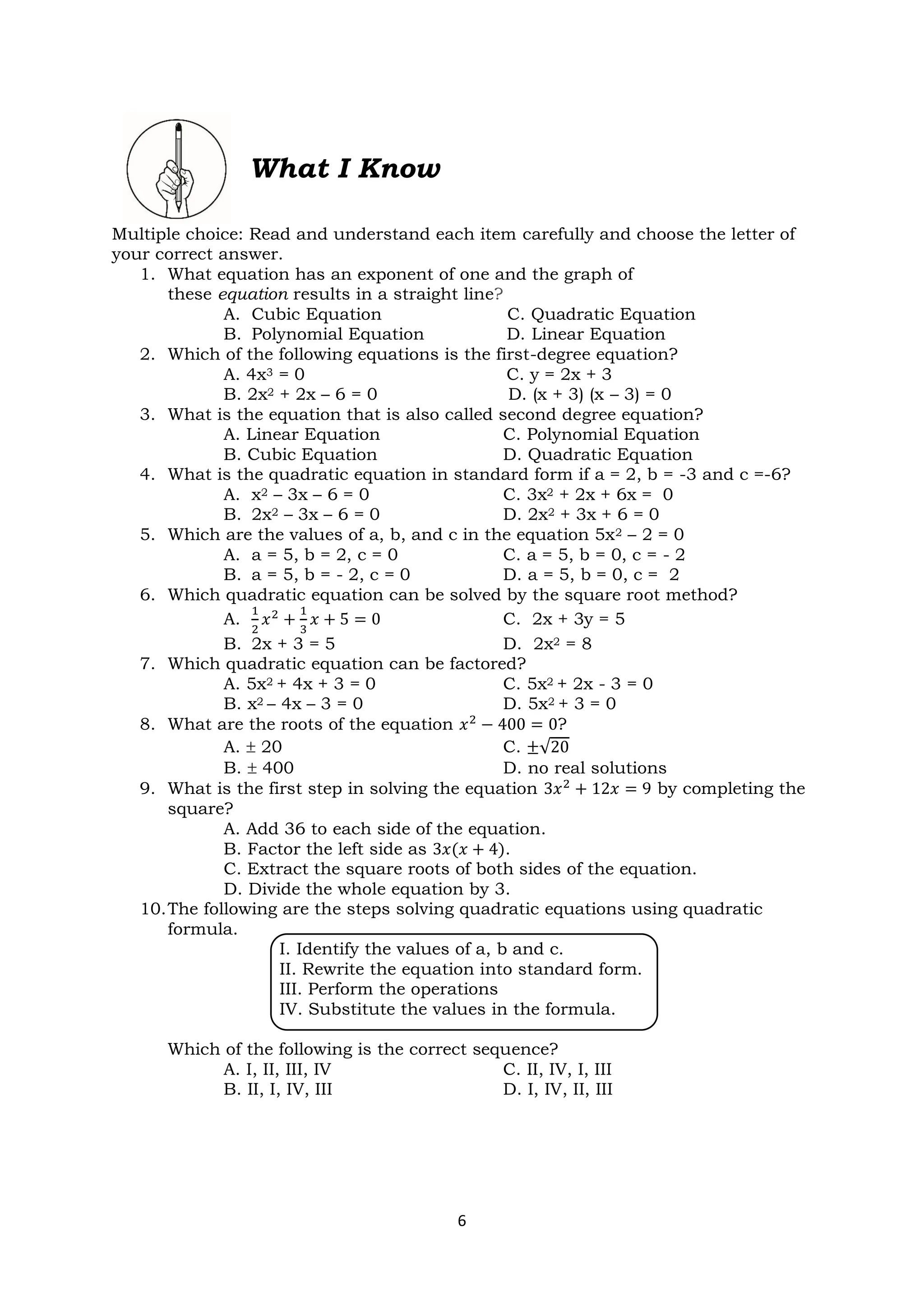
What I Know
Multiple choice: Read and understand each item carefully and choose the letter of
your correct answer.
1. What equation has an exponent of one and the graph of
these equation results in a straight line?
A. Cubic Equation C. Quadratic Equation
B. Polynomial Equation D. Linear Equation
2. Which of the following equations is the first-degree equation?
A. 4x3 = 0 C. y = 2x + 3
B. 2x2 + 2x – 6 = 0 D. (x + 3) (x – 3) = 0
3. What is the equation that is also called second degree equation?
A. Linear Equation C. Polynomial Equation
B. Cubic Equation D. Quadratic Equation
4. What is the quadratic equation in standard form if a = 2, b = -3 and c =-6?
A. x2 – 3x – 6 = 0 C. 3x2 + 2x + 6x = 0
B. 2x2 – 3x – 6 = 0 D. 2x2 + 3x + 6 = 0
5. Which are the values of a, b, and c in the equation 5x2 – 2 = 0
A. a = 5, b = 2, c = 0 C. a = 5, b = 0, c = - 2
B. a = 5, b = - 2, c = 0 D. a = 5, b = 0, c = 2
6. Which quadratic equation can be solved by the square root method?
A.
1
2
𝑥2
+
1
3
𝑥 + 5 = 0 C. 2x + 3y = 5
B. 2x + 3 = 5 D. 2x2 = 8
7. Which quadratic equation can be factored?
A. 5x2 + 4x + 3 = 0 C. 5x2 + 2x - 3 = 0
B. x2 – 4x – 3 = 0 D. 5x2 + 3 = 0
8. What are the roots of the equation 𝑥2
− 400 = 0?
A.  20 C. ±√20
B.  400 D. no real solutions
9. What is the first step in solving the equation 3𝑥2
+ 12𝑥 = 9 by completing the
square?
A. Add 36 to each side of the equation.
B. Factor the left side as 3𝑥(𝑥 + 4).
C. Extract the square roots of both sides of the equation.
D. Divide the whole equation by 3.
10.The following are the steps solving quadratic equations using quadratic
formula.
I. Identify the values of a, b and c.
II. Rewrite the equation into standard form.
III. Perform the operations
IV. Substitute the values in the formula.
Which of the following is the correct sequence?
A. I, II, III, IV C. II, IV, I, III
B. II, I, IV, III D. I, IV, II, III
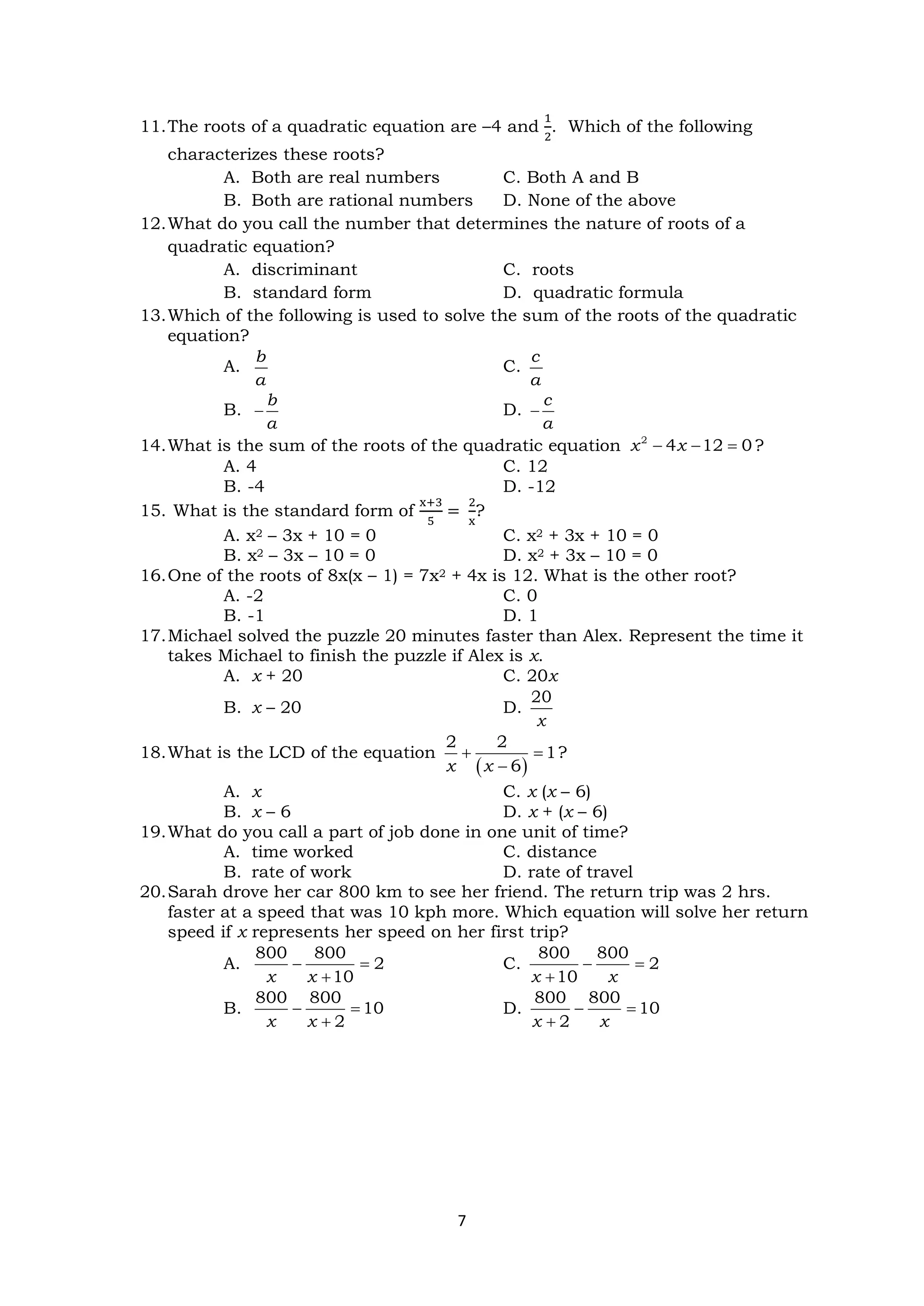
7
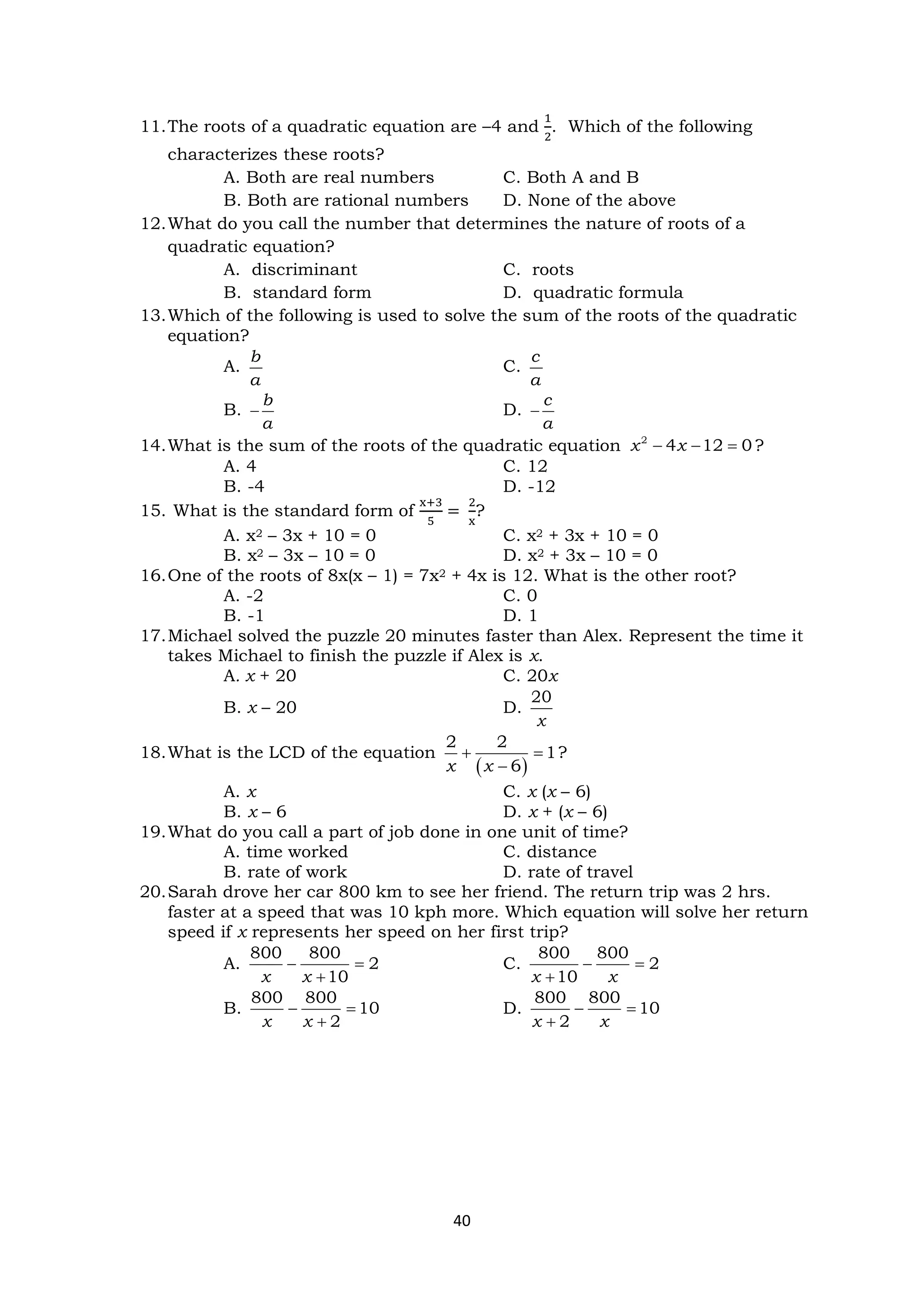
11.The roots of a quadratic equation are –4 and
1
2
. Which of the following
characterizes these roots?
A. Both are real numbers C. Both A and B
B. Both are rational numbers D. None of the above
12.What do you call the number that determines the nature of roots of a
quadratic equation?
A. discriminant C. roots
B. standard form D. quadratic formula
13.Which of the following is used to solve the sum of the roots of the quadratic
equation?
A.
b
a
C.
c
a
B.
b
a
− D.
c
a
−
14.What is the sum of the roots of the quadratic equation 2
4 12 0
x x
− − = ?
A. 4 C. 12
B. -4 D. -12
15. What is the standard form of
x+3
5
=
2
x
?
A. x2 – 3x + 10 = 0 C. x2 + 3x + 10 = 0
B. x2 – 3x – 10 = 0 D. x2 + 3x – 10 = 0
16.One of the roots of 8x(x – 1) = 7x2 + 4x is 12. What is the other root?
A. -2 C. 0
B. -1 D. 1
17.Michael solved the puzzle 20 minutes faster than Alex. Represent the time it
takes Michael to finish the puzzle if Alex is x.
A. x + 20 C. 20x
B. x – 20 D.
20
x
18.What is the LCD of the equation
( )
2 2
1
6
x x
+ =
−
?
A. x C. x (x – 6)
B. x – 6 D. x + (x – 6)
19.What do you call a part of job done in one unit of time?
A. time worked C. distance
B. rate of work D. rate of travel
20.Sarah drove her car 800 km to see her friend. The return trip was 2 hrs.
faster at a speed that was 10 kph more. Which equation will solve her return
speed if x represents her speed on her first trip?
A.
800 800
2
10
x x
− =
+
C.
800 800
2
10
x x
− =
+
B.
800 800
10
2
x x
− =
+
D.
800 800
10
2
x x
− =
+
8
WEEK 1
Lesson1
Illustrating Quadratic Equation
What’s In
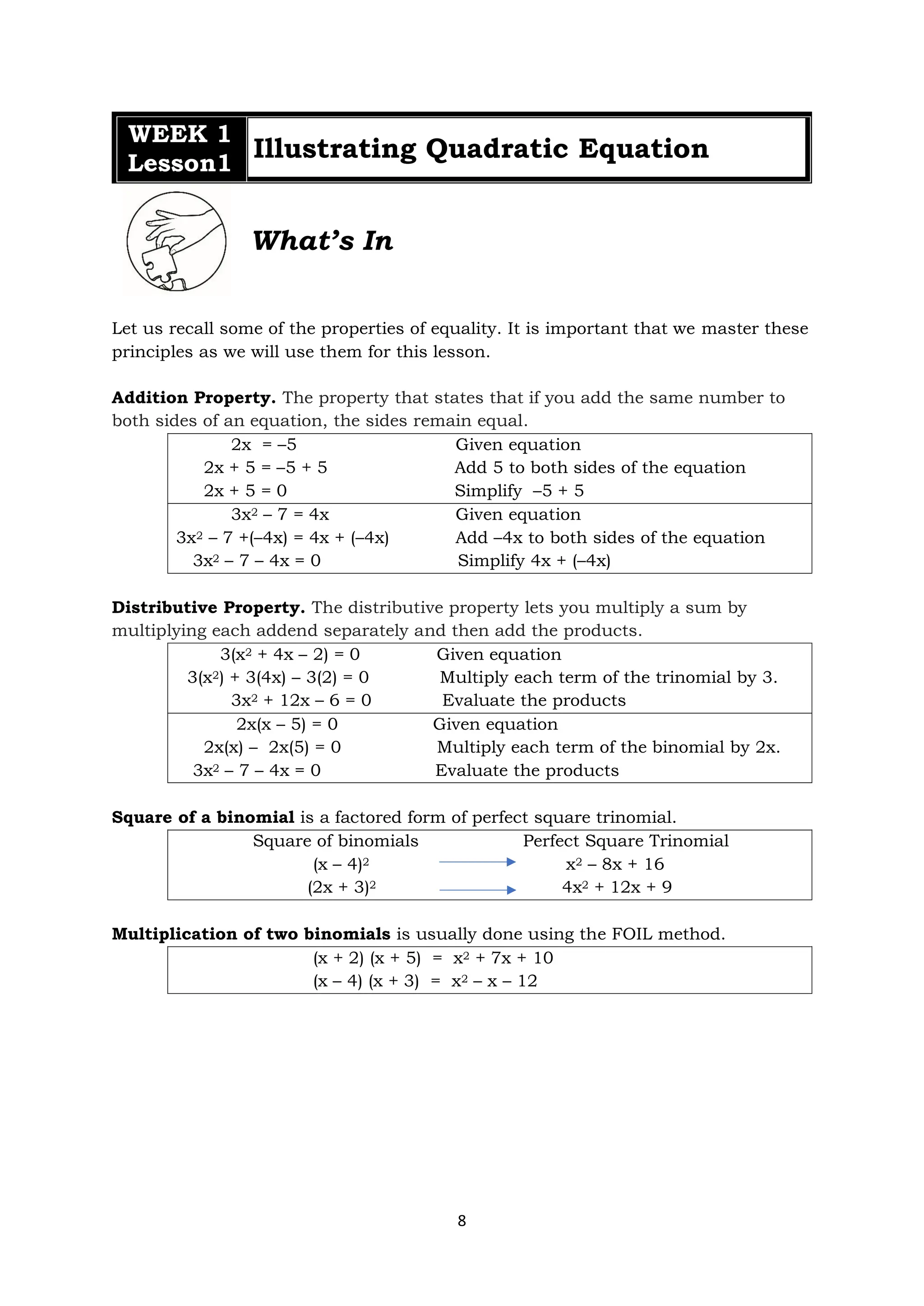
Let us recall some of the properties of equality. It is important that we master these
principles as we will use them for this lesson.
Addition Property. The property that states that if you add the same number to
both sides of an equation, the sides remain equal.
2x = –5 Given equation
2x + 5 = –5 + 5 Add 5 to both sides of the equation
2x + 5 = 0 Simplify –5 + 5
3x2 – 7 = 4x Given equation
3x2 – 7 +(–4x) = 4x + (–4x) Add –4x to both sides of the equation
3x2 – 7 – 4x = 0 Simplify 4x + (–4x)
Distributive Property. The distributive property lets you multiply a sum by
multiplying each addend separately and then add the products.
3(x2 + 4x – 2) = 0 Given equation
3(x2) + 3(4x) – 3(2) = 0 Multiply each term of the trinomial by 3.
3x2 + 12x – 6 = 0 Evaluate the products
2x(x – 5) = 0 Given equation
2x(x) – 2x(5) = 0 Multiply each term of the binomial by 2x.
3x2 – 7 – 4x = 0 Evaluate the products
Square of a binomial is a factored form of perfect square trinomial.
Square of binomials Perfect Square Trinomial
(x – 4)2 x2 – 8x + 16
(2x + 3)2 4x2 + 12x + 9
Multiplication of two binomials is usually done using the FOIL method.
(x + 2) (x + 5) = x2 + 7x + 10
(x – 4) (x + 3) = x2 – x – 12
9
What’s New
Let us take a look at the pictures of some the attractions in our country.
Before we dig deeper about these shapes which are some of the real life
applications of quadratic equation, let us first define what quadratic equation is.
The Arch of the Centuries
Arko ng mga Siglo , is a triumphal
arch at the Plaza Intramuros of
the University of Santo Tomas (UST)
in Manila.
Morong Beach
(Nakabuang Arch) located in Sabtang,
Batanes
The Las Piñas Bamboo Organ in St.
Joseph Parish Church in Las Piñas
City, Philippines, is a 19th-
century church organ with unique
organ pipes.
10
What is It
A quadratic equation is a polynomial equation whose highest exponent is 2.
It is also called second degree equation.
Examples of Quadratic equations:
x2 – 3 = 4x
13x = 8 – 5x2
x2 = 49
(x + 2)(x + 3) = 9 (When multiplied results to quadratic equation)
Following examples are NOT quadratic equation and their reasons.
x2 – 8x + 7 Not an equation (no equal sign)
2x2 – x3 + 1 = 0 Highest exponent is 3
3x + 4y = 5 Highest exponent is 1
4x2 + 4x + > 1 This is an inequality.
The Standard Form of quadratic equation is denoted by the equation
𝒂𝒙𝟐
+ 𝒃𝒙 + 𝒄 = 𝟎, where a, b, and c are elements of real number, a must be greater
than zero (a > 0). ax2 is called the quadratic term, bx is called the linear term and
c is the constant term.
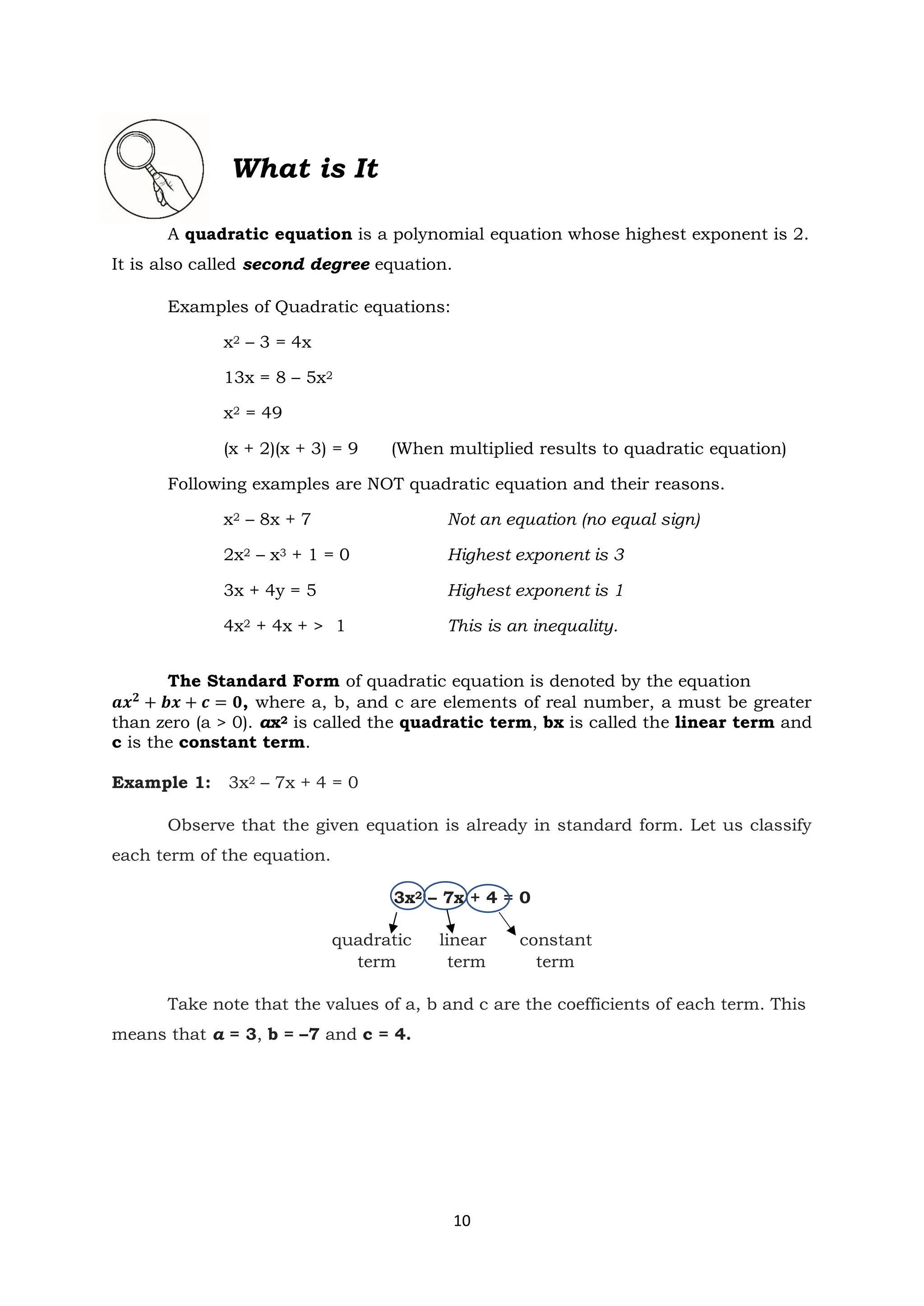
Example 1: 3x2 – 7x + 4 = 0
Observe that the given equation is already in standard form. Let us classify
each term of the equation.
3x2 – 7x + 4 = 0
quadratic linear constant
term term term
Take note that the values of a, b and c are the coefficients of each term. This
means that a = 3, b = –7 and c = 4.
11
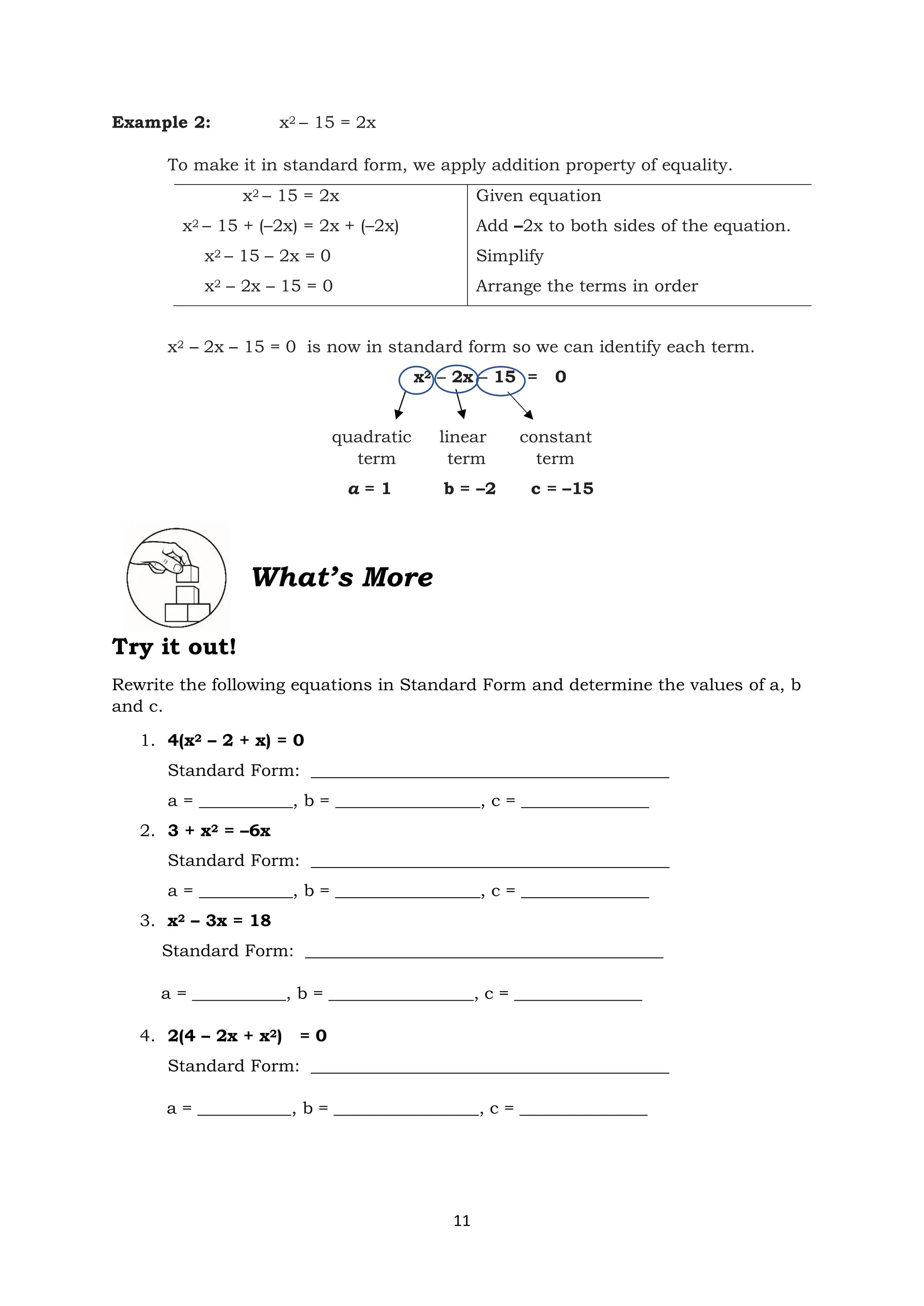
Example 2: x2 – 15 = 2x
To make it in standard form, we apply addition property of equality.
x2 – 15 = 2x
x2 – 15 + (–2x) = 2x + (–2x)
x2 – 15 – 2x = 0
x2 – 2x – 15 = 0
Given equation
Add –2x to both sides of the equation.
Simplify
Arrange the terms in order
x2 – 2x – 15 = 0 is now in standard form so we can identify each term.
x2 – 2x – 15 = 0
quadratic linear constant
term term term
a = 1 b = –2 c = –15
What’s More
Try it out!
Rewrite the following equations in Standard Form and determine the values of a, b
and c.
1. 4(x2 – 2 + x) = 0
Standard Form: __________________________________________
a = ___________, b = _________________, c = _______________
2. 3 + x2 = –6x
Standard Form: __________________________________________
a = ___________, b = _________________, c = _______________
3. x2 – 3x = 18
Standard Form: __________________________________________
a = ___________, b = _________________, c = _______________
4. 2(4 – 2x + x2) = 0
Standard Form: __________________________________________
a = ___________, b = _________________, c = _______________
12
What I Have Learned
Quadratic equation is a second-degree equation.
Standard Form of Quadratic Equation is a form denoted by 𝒂𝒙𝟐
+ 𝒃𝒙 + 𝒄 = 𝟎, where
a, b, and c are elements of real number, a must be greater than zero (a > 0). ax2 is
called the quadratic term, bx is called the linear term and c is the constant term.
WEEK 1
Lesson2
Solve quadratic equation using
(a) extracting the square root,
(b) factoring,
(c) completing the square, and
(d) quadratic formula.
What’s In
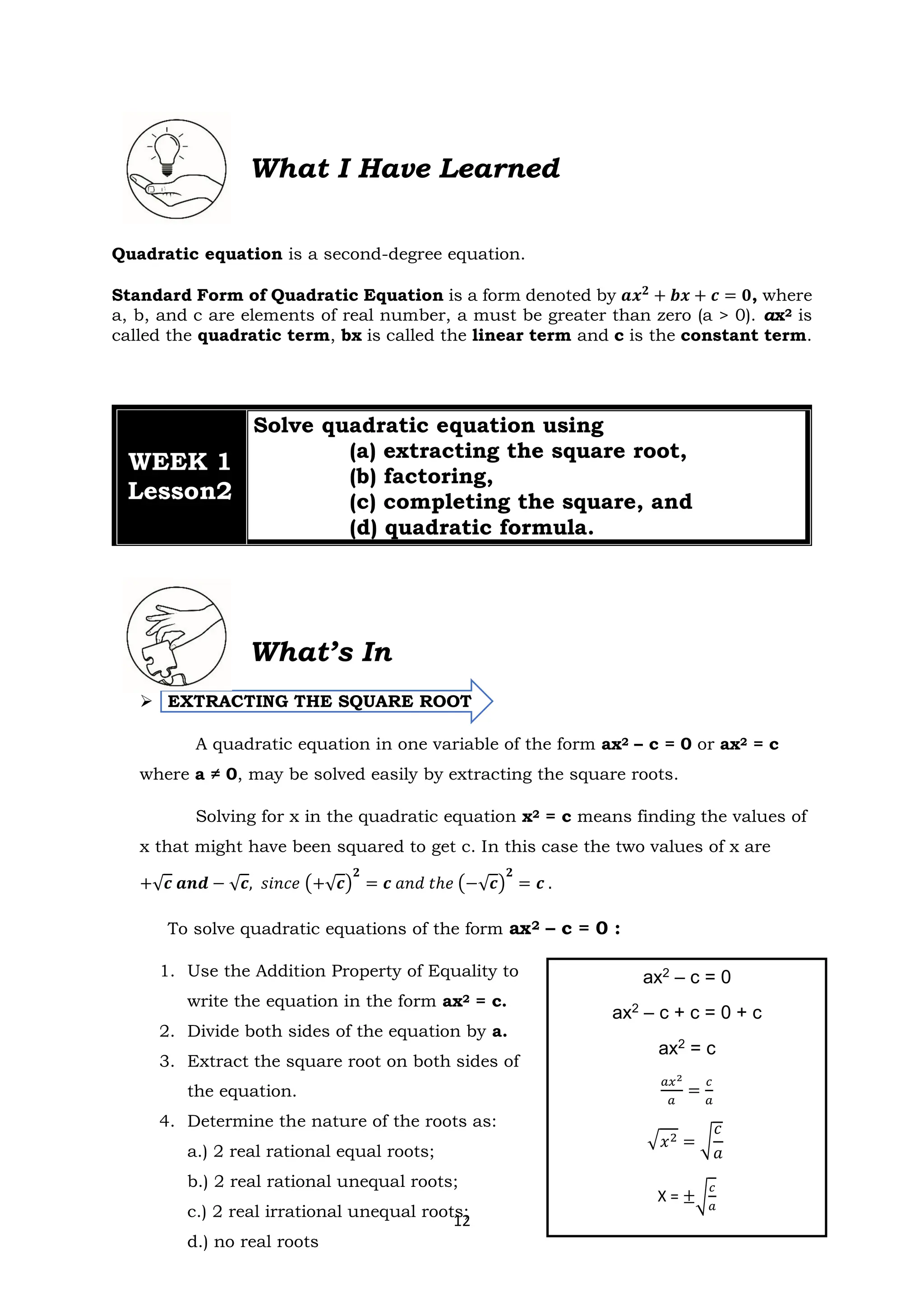
➢ EXTRACTING THE SQUARE ROOT
A quadratic equation in one variable of the form ax2 – c = 0 or ax2 = c
where a ≠ 0, may be solved easily by extracting the square roots.
Solving for x in the quadratic equation x2 = c means finding the values of
x that might have been squared to get c. In this case the two values of x are
+√𝒄 𝒂𝒏𝒅 − √𝒄, 𝑠𝑖𝑛𝑐𝑒 (+√𝒄)
𝟐
= 𝒄 𝑎𝑛𝑑 𝑡ℎ𝑒 (−√𝒄)
𝟐
= 𝒄 .
To solve quadratic equations of the form ax2 – c = 0 :
ax2
– c = 0
ax2
– c + c = 0 + c
ax2
= c
𝑎𝑥2
𝑎
=
𝑐
𝑎
√𝑥2 = √
𝑐
𝑎
X = ±√
𝑐
𝑎
1. Use the Addition Property of Equality to
write the equation in the form ax2 = c.
2. Divide both sides of the equation by a.
3. Extract the square root on both sides of
the equation.
4. Determine the nature of the roots as:
a.) 2 real rational equal roots;
b.) 2 real rational unequal roots;
c.) 2 real irrational unequal roots;
d.) no real roots
13
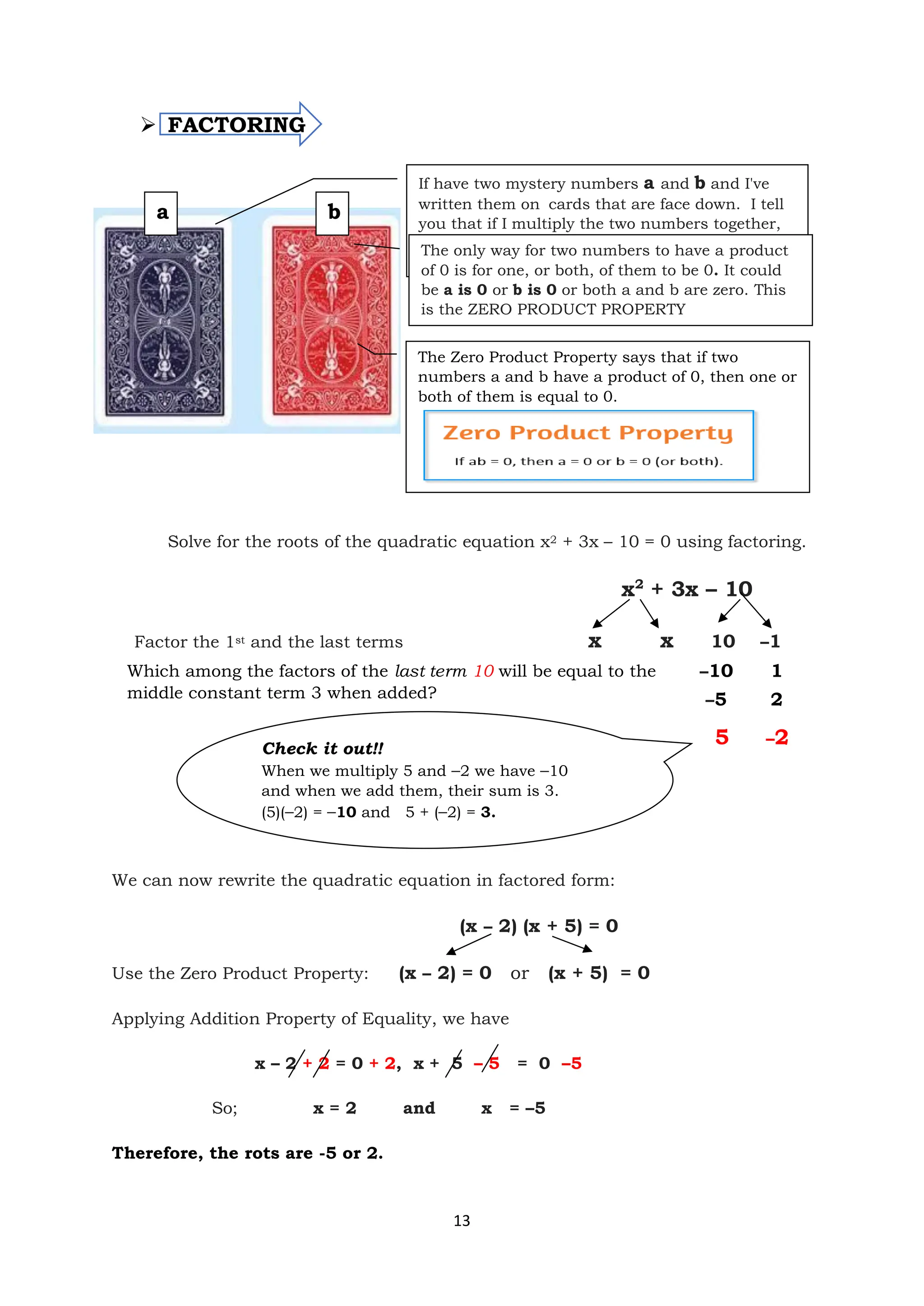
➢ FACTORING
Solve for the roots of the quadratic equation x2 + 3x – 10 = 0 using factoring.
x2
+ 3x – 10
Factor the 1st and the last terms x x 10 –1
We can now rewrite the quadratic equation in factored form:
(x – 2) (x + 5) = 0
Use the Zero Product Property: (x – 2) = 0 or (x + 5) = 0
Applying Addition Property of Equality, we have
x – 2 + 2 = 0 + 2, x + 5 – 5 = 0 –5
So; x = 2 and x = –5
Therefore, the rots are -5 or 2.
a b
If have two mystery numbers a and b and I've
written them on cards that are face down. I tell
you that if I multiply the two numbers together,
the answer I get is 0. What does this tell you
about the numbers I wrote down?
The only way for two numbers to have a product
of 0 is for one, or both, of them to be 0. It could
be a is 0 or b is 0 or both a and b are zero. This
is the ZERO PRODUCT PROPERTY
The Zero Product Property says that if two
numbers a and b have a product of 0, then one or
both of them is equal to 0.
–5 2
5 –2
–10 1
Which among the factors of the last term 10 will be equal to the
middle constant term 3 when added?
Check it out!!
When we multiply 5 and –2 we have –10
and when we add them, their sum is 3.
(5)(–2) = –10 and 5 + (–2) = 3.
14
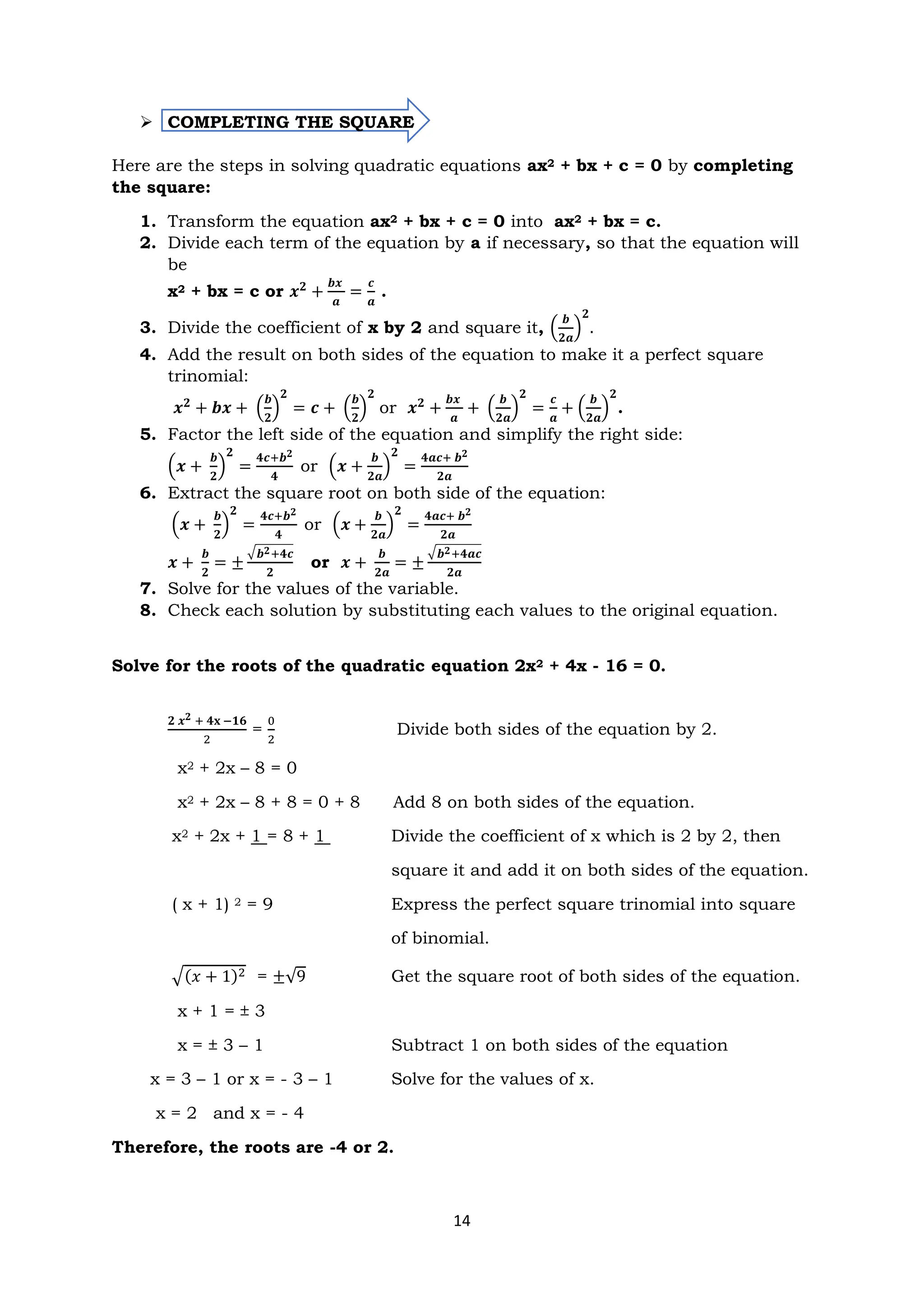
➢ COMPLETING THE SQUARE
Here are the steps in solving quadratic equations ax2 + bx + c = 0 by completing
the square:
1. Transform the equation ax2 + bx + c = 0 into ax2 + bx = c.
2. Divide each term of the equation by a if necessary, so that the equation will
be
x2 + bx = c or 𝒙𝟐
+
𝒃𝒙
𝒂
=
𝒄
𝒂
.
3. Divide the coefficient of x by 2 and square it, (
𝒃
𝟐𝒂
)
𝟐
.
4. Add the result on both sides of the equation to make it a perfect square
trinomial:
𝒙𝟐
+ 𝒃𝒙 + (
𝒃
𝟐
)
𝟐
= 𝒄 + (
𝒃
𝟐
)
𝟐
or 𝒙𝟐
+
𝒃𝒙
𝒂
+ (
𝒃
𝟐𝒂
)
𝟐
=
𝒄
𝒂
+ (
𝒃
𝟐𝒂
)
𝟐
.
5. Factor the left side of the equation and simplify the right side:
(𝒙 +
𝒃
𝟐
)
𝟐
=
𝟒𝒄+𝒃𝟐
𝟒
or (𝒙 +
𝒃
𝟐𝒂
)
𝟐
=
𝟒𝒂𝒄+ 𝒃𝟐
𝟐𝒂
6. Extract the square root on both side of the equation:
(𝒙 +
𝒃
𝟐
)
𝟐
=
𝟒𝒄+𝒃𝟐
𝟒
or (𝒙 +
𝒃
𝟐𝒂
)
𝟐
=
𝟒𝒂𝒄+ 𝒃𝟐
𝟐𝒂
𝒙 +
𝒃
𝟐
= ±
√𝒃𝟐+𝟒𝒄
𝟐
or 𝒙 +
𝒃
𝟐𝒂
= ±
√𝒃𝟐+𝟒𝒂𝒄
𝟐𝒂
7. Solve for the values of the variable.
8. Check each solution by substituting each values to the original equation.
Solve for the roots of the quadratic equation 2x2 + 4x - 16 = 0.
𝟐 𝒙𝟐 + 𝟒𝐱 −𝟏𝟔
2
=
0
2
Divide both sides of the equation by 2.
x2 + 2x – 8 = 0
x2 + 2x – 8 + 8 = 0 + 8 Add 8 on both sides of the equation.
x2 + 2x + 1 = 8 + 1 Divide the coefficient of x which is 2 by 2, then
square it and add it on both sides of the equation.
( x + 1) 2 = 9 Express the perfect square trinomial into square
of binomial.
√(𝑥 + 1)2 = ±√9 Get the square root of both sides of the equation.
x + 1 = ± 3
x = ± 3 – 1 Subtract 1 on both sides of the equation
x = 3 – 1 or x = - 3 – 1 Solve for the values of x.
x = 2 and x = - 4
Therefore, the roots are -4 or 2.
15
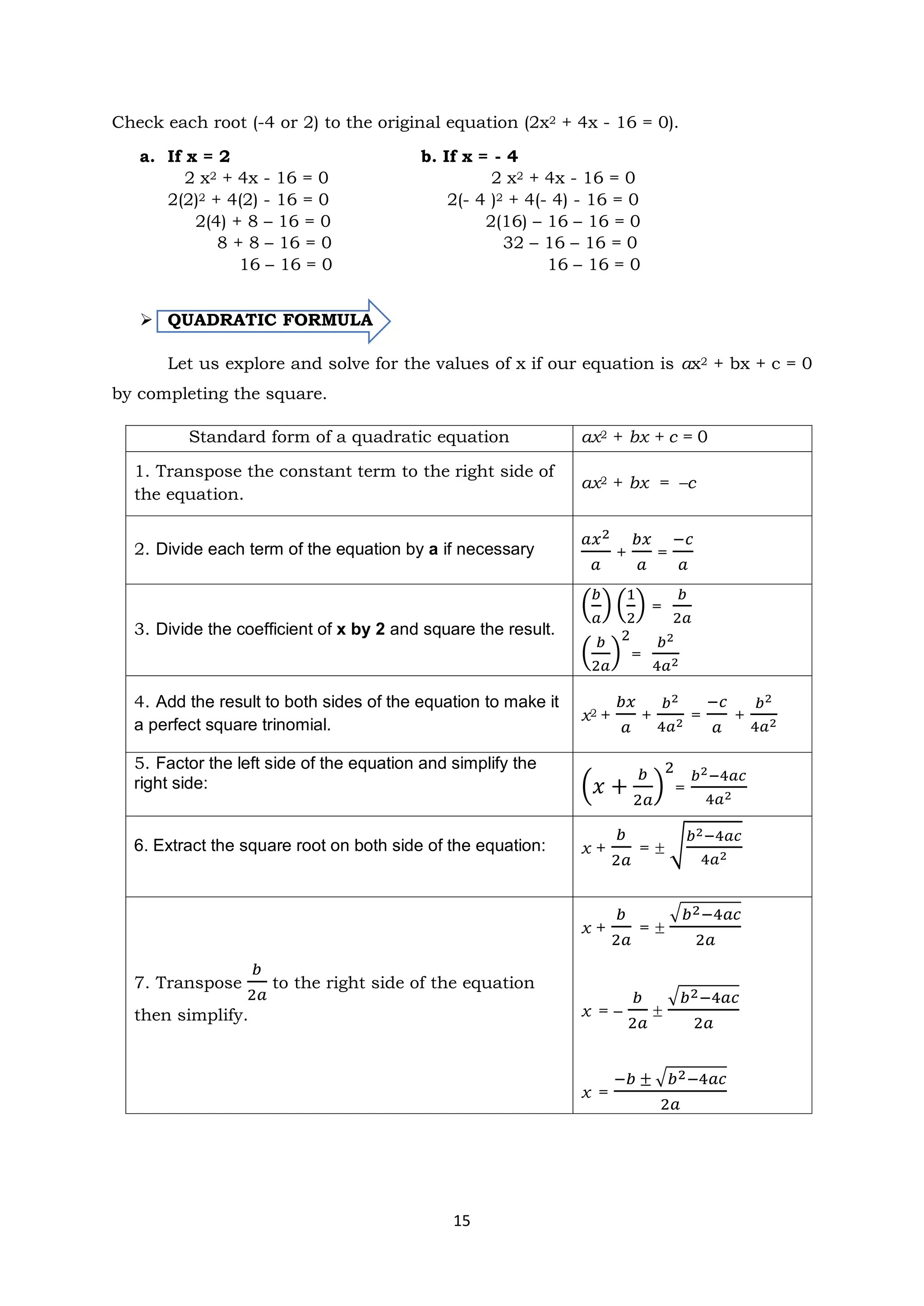
Check each root (-4 or 2) to the original equation (2x2 + 4x - 16 = 0).
a. If x = 2 b. If x = - 4
2 x2 + 4x - 16 = 0 2 x2 + 4x - 16 = 0
2(2)2 + 4(2) - 16 = 0 2(- 4 )2 + 4(- 4) - 16 = 0
2(4) + 8 – 16 = 0 2(16) – 16 – 16 = 0
8 + 8 – 16 = 0 32 – 16 – 16 = 0
16 – 16 = 0 16 – 16 = 0
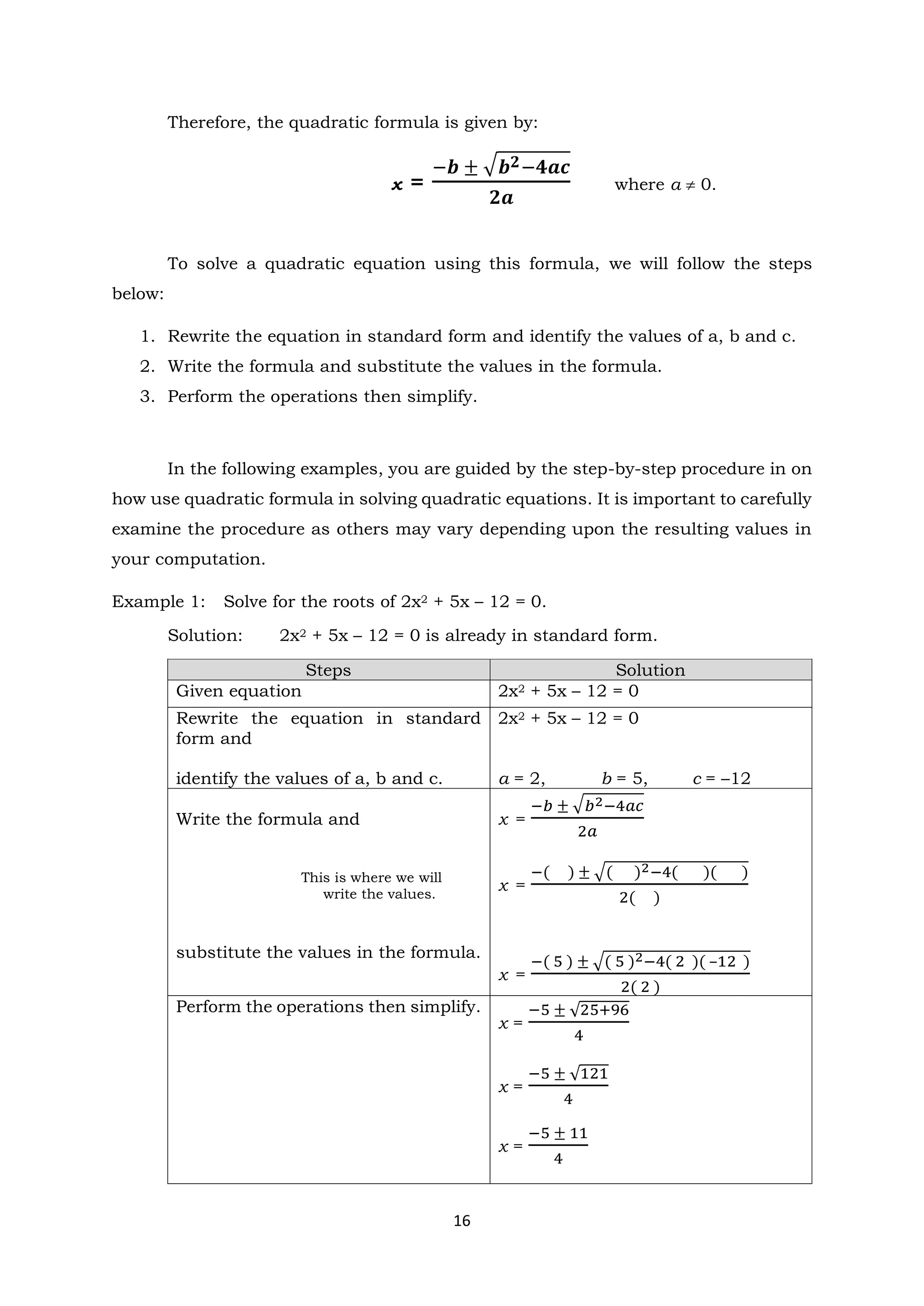
➢ QUADRATIC FORMULA
Let us explore and solve for the values of x if our equation is ax2 + bx + c = 0
by completing the square.
Standard form of a quadratic equation ax2 + bx + c = 0
1. Transpose the constant term to the right side of
the equation.
ax2 + bx = –c
2. Divide each term of the equation by a if necessary
𝑎𝑥2
𝑎
+
𝑏𝑥
𝑎
=
−𝑐
𝑎
3. Divide the coefficient of x by 2 and square the result.
(
𝑏
𝑎
) (
1
2
) =
𝑏
2𝑎
(
𝑏
2𝑎
)
2
=
𝑏2
4𝑎2
4. Add the result to both sides of the equation to make it
a perfect square trinomial.
x2 +
𝑏𝑥
𝑎
+
𝑏2
4𝑎2
=
−𝑐
𝑎
+
𝑏2
4𝑎2
5. Factor the left side of the equation and simplify the
right side: (𝑥 +
𝑏
2𝑎
)
2
=
𝑏2−4𝑎𝑐
4𝑎2
6. Extract the square root on both side of the equation: x +
𝑏
2𝑎
=  √
𝑏2−4𝑎𝑐
4𝑎2
7. Transpose
𝑏
2𝑎
to the right side of the equation
then simplify.
x +
𝑏
2𝑎
= 
√𝑏2−4𝑎𝑐
2𝑎
x = –
𝑏
2𝑎

√𝑏2−4𝑎𝑐
2𝑎
x =
−𝑏 ± √𝑏2−4𝑎𝑐
2𝑎
16
Therefore, the quadratic formula is given by:
x =
−𝒃 ± √𝒃𝟐−𝟒𝒂𝒄
𝟐𝒂
where a  0.
To solve a quadratic equation using this formula, we will follow the steps
below:
1. Rewrite the equation in standard form and identify the values of a, b and c.
2. Write the formula and substitute the values in the formula.
3. Perform the operations then simplify.
In the following examples, you are guided by the step-by-step procedure in on
how use quadratic formula in solving quadratic equations. It is important to carefully
examine the procedure as others may vary depending upon the resulting values in
your computation.
Example 1: Solve for the roots of 2x2 + 5x – 12 = 0.
Solution: 2x2 + 5x – 12 = 0 is already in standard form.
Steps Solution
Given equation 2x2 + 5x – 12 = 0
Rewrite the equation in standard
form and
identify the values of a, b and c.
2x2 + 5x – 12 = 0
a = 2, b = 5, c = –12
Write the formula and
This is where we will
write the values.
substitute the values in the formula.
x =
−𝑏 ± √𝑏2−4𝑎𝑐
2𝑎
x =
−( ) ± √( )2−4( )( )
2( )
x =
−( 5 ) ± √( 5 )2−4( 2 )( –12 )
2( 2 )
Perform the operations then simplify.
x =
−5 ± √25+96
4
x =
−5 ± √121
4
x =
−5 ± 11
4
17
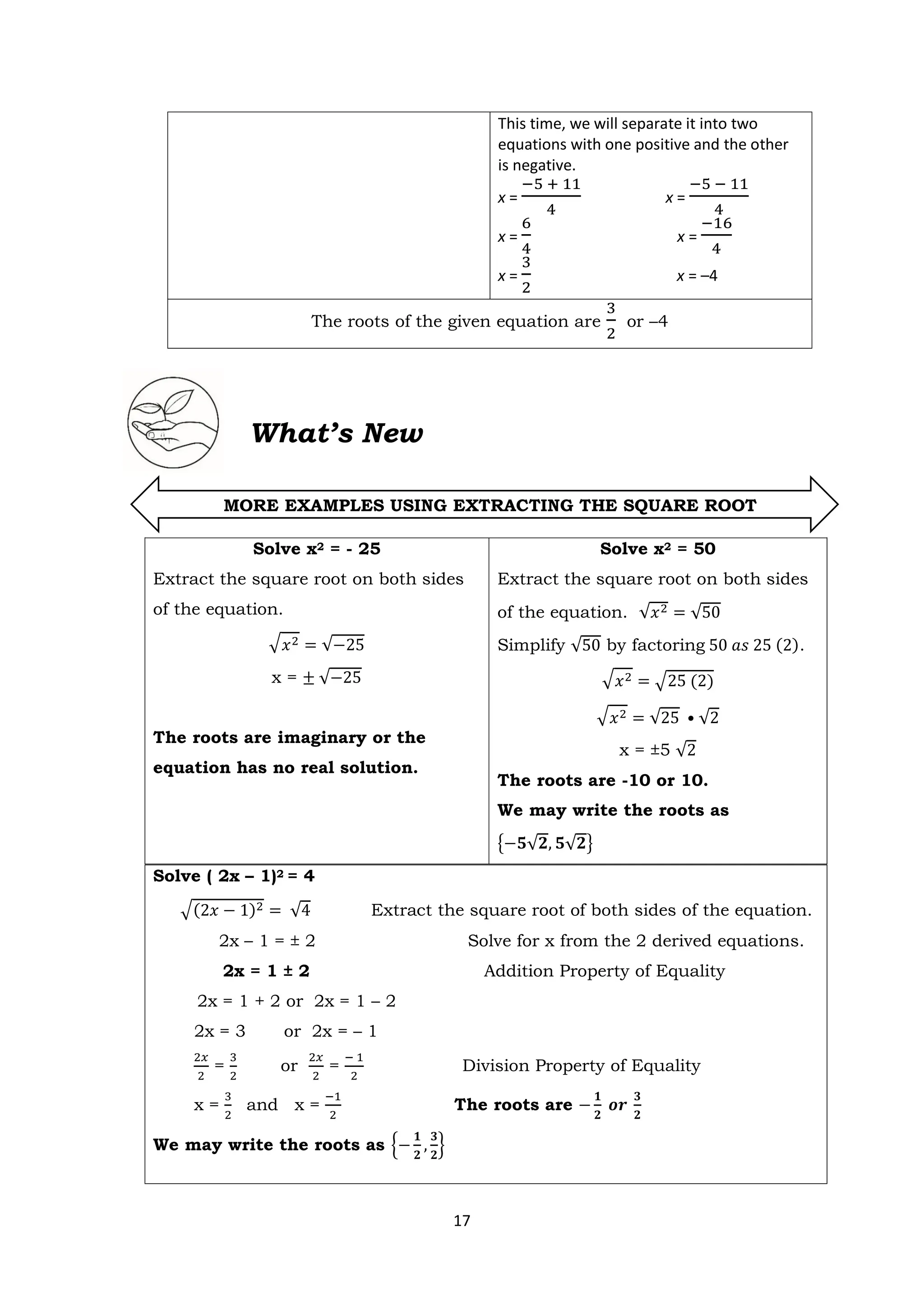
This time, we will separate it into two
equations with one positive and the other
is negative.
x =
−5 + 11
4
x =
−5 − 11
4
x =
6
4
x =
−16
4
x =
3
2
x = –4
The roots of the given equation are
3
2
or –4
What’s New
MORE EXAMPLES USING EXTRACTING THE SQUARE ROOT
Solve x2 = - 25
Extract the square root on both sides
of the equation.
√𝑥2 = √−25
x = ± √−25
The roots are imaginary or the
equation has no real solution.
Solve x2 = 50
Extract the square root on both sides
of the equation. √𝑥2 = √50
Simplify √50 by factoring 50 𝑎𝑠 25 (2).
√𝑥2 = √25 (2)
√𝑥2 = √25 • √2
x = ±5 √2
The roots are -10 or 10.
We may write the roots as
{−𝟓√𝟐, 𝟓√𝟐}
Solve ( 2x – 1)2 = 4
√(2𝑥 − 1)2 = √4 Extract the square root of both sides of the equation.
2x – 1 = ± 2 Solve for x from the 2 derived equations.
2x = 1 ± 2 Addition Property of Equality
2x = 1 + 2 or 2x = 1 – 2
2x = 3 or 2x = – 1
2𝑥
2
=
3
2
or
2𝑥
2
=
− 1
2
Division Property of Equality
x =
3
2
and x =
−1
2
The roots are −
𝟏
𝟐
𝒐𝒓
𝟑
𝟐
We may write the roots as {−
𝟏
𝟐
,
𝟑
𝟐
}
18
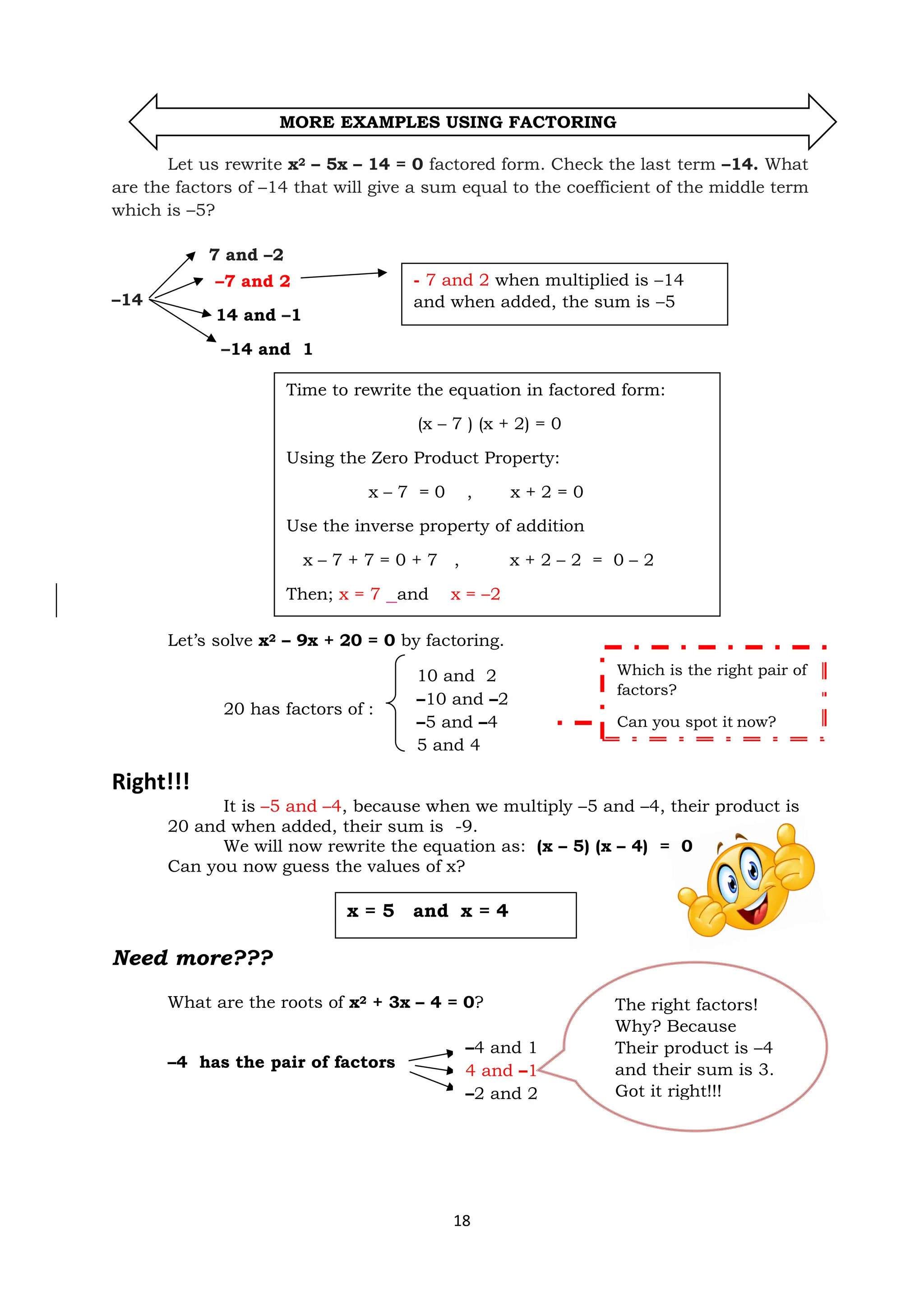
MORE EXAMPLES USING FACTORING
Let us rewrite x2 – 5x – 14 = 0 factored form. Check the last term –14. What
are the factors of –14 that will give a sum equal to the coefficient of the middle term
which is –5?
7 and –2
–14 14
Let’s solve x2 – 9x + 20 = 0 by factoring.
20 has factors of :
Right!!!
It is –5 and –4, because when we multiply –5 and –4, their product is
20 and when added, their sum is -9.
We will now rewrite the equation as: (x – 5) (x – 4) = 0
Can you now guess the values of x?
Need more???
What are the roots of x2 + 3x – 4 = 0?
–4 has the pair of factors
–4 and 1
4 and –1
–2 and 2
–7 and 2
14 and –1
–14 and 1
- 7 and 2 when multiplied is –14
and when added, the sum is –5
Time to rewrite the equation in factored form:
(x – 7 ) (x + 2) = 0
Using the Zero Product Property:
x – 7 = 0 , x + 2 = 0
Use the inverse property of addition
x – 7 + 7 = 0 + 7 , x + 2 – 2 = 0 – 2
Then; x = 7 and x = –2
Which is the right pair of
factors?
Can you spot it now?
x = 5 and x = 4
The right factors!
Why? Because
Their product is –4
and their sum is 3.
Got it right!!!
10 and 2
–10 and –2
–5 and –4
5 and 4
19
x2 + 3x – 4 = 0 Given equation
(x + 4) (x – 1) = 0 Factored form
x + 4 = 0 or x – 1 = 0 Zero-product property
x + 4 – 4 = 0 – 4 or x – 1 + 1 = 0 + 1 Inverse property.
x = –4 or x = 1
The roots of x2 + 3x – 4 = 0 or –4 and 1.
MORE EXAMPLES USING COMPLETING THE SQUARE
Solve for the roots of the quadratic equation 5x2
– 20x = 5 using completing the
square.
𝟓 𝒙𝟐−𝟐𝟎 𝐱
5
=
5
5
Divide both sides of the equation by 5.
x2
– 4x = 1
x2
– 4x + 4 = 1 + 4 Divide the coefficient of x which is 4 by 2, then square it
and add it on both sides of the equation.
( x – 2) 2
= 5 Express the perfect square trinomial into square of binomial.
√(𝑥 − 2)2 = ±√5 Get the square root of both sides of the equation.
x – 2 = ±√5
x = ±√5 + 2 Add 2 on both sides of the equation
x = √5 + 2 or x = - √5 + 2 Solve for the values of x.
Check each root to the original equation.
a. If x = √5 + 2 b. If x = - √5 + 2
5 x2
– 20 x = 5 5x2
– 20x = 5
5 (√5 + 2) 2
– 20 (√5 + 2) = 5 5 (−√5 + 2) 2
– 20 (−√5 + 2) = 5
5 [5 + 5 (4√5 )+ 4] – 20 √5 - 40 = 5 5 [5 + 5 ( - 4√5 )+ 4] + 20 √5 - 40 = 5
25 + 20√5 + 20 – 20 √5 - 40 = 5 25 – 20√5 + 20 + 20 √5 - 40 = 5-
45 – 40 = 5 45 – 40 = 5
5 = 5 5 = 5
The values of x satisfied the equation.
Therefore, the roots of the equation 5 x2
– 20 x = 5 are √5 + 2 and - √5 + 2 .
20
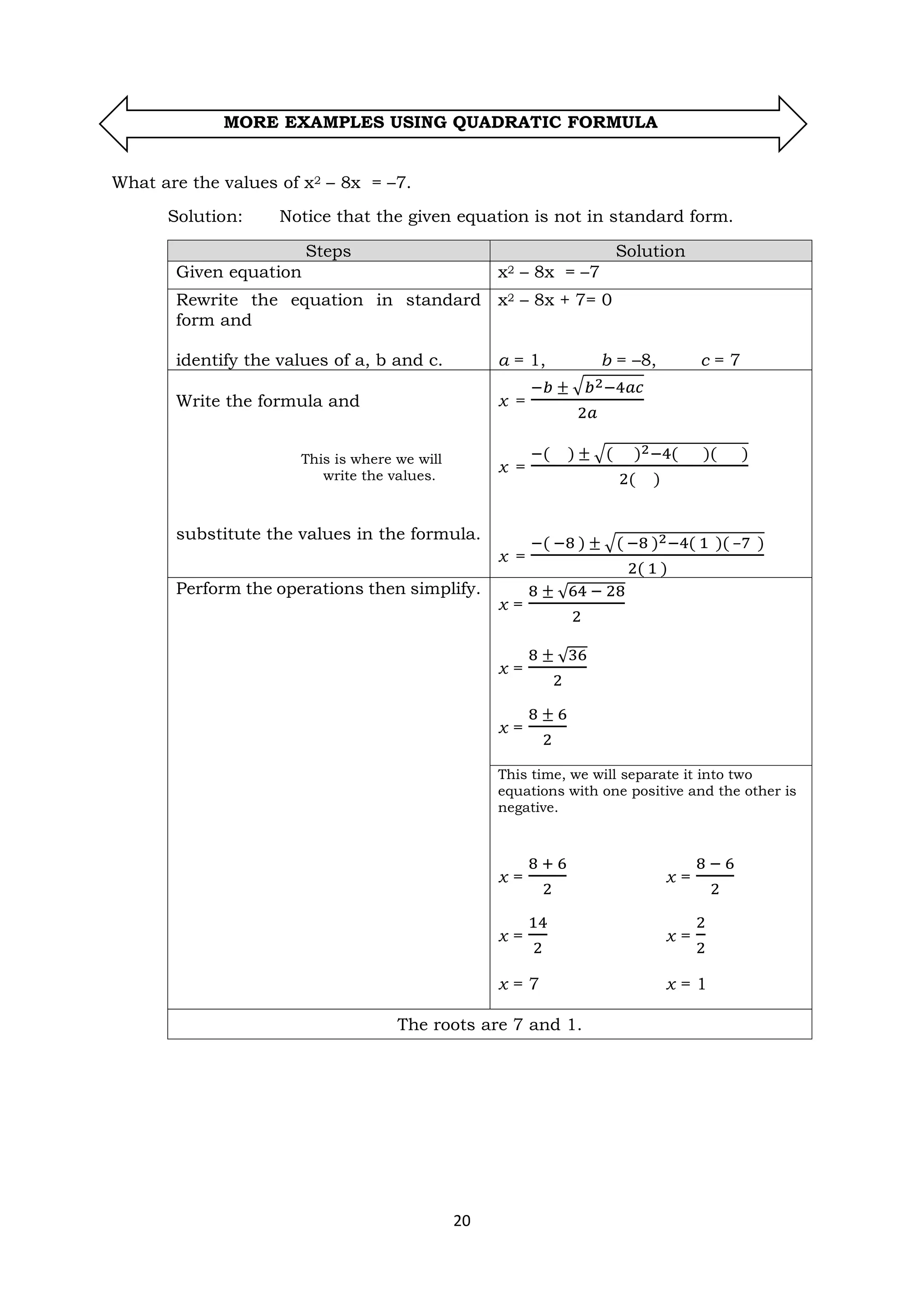
MORE EXAMPLES USING QUADRATIC FORMULA
What are the values of x2 – 8x = –7.
Solution: Notice that the given equation is not in standard form.
Steps Solution
Given equation x2 – 8x = –7
Rewrite the equation in standard
form and
identify the values of a, b and c.
x2 – 8x + 7= 0
a = 1, b = –8, c = 7
Write the formula and
This is where we will
write the values.
substitute the values in the formula.
x =
−𝑏 ± √𝑏2−4𝑎𝑐
2𝑎
x =
−( ) ± √( )2−4( )( )
2( )
x =
−( −8 ) ± √( −8 )2−4( 1 )( –7 )
2( 1 )
Perform the operations then simplify.
x =
8 ± √64 − 28
2
x =
8 ± √36
2
x =
8 ± 6
2
This time, we will separate it into two
equations with one positive and the other is
negative.
x =
8 + 6
2
x =
8 − 6
2
x =
14
2
x =
2
2
x = 7 x = 1
The roots are 7 and 1.
21
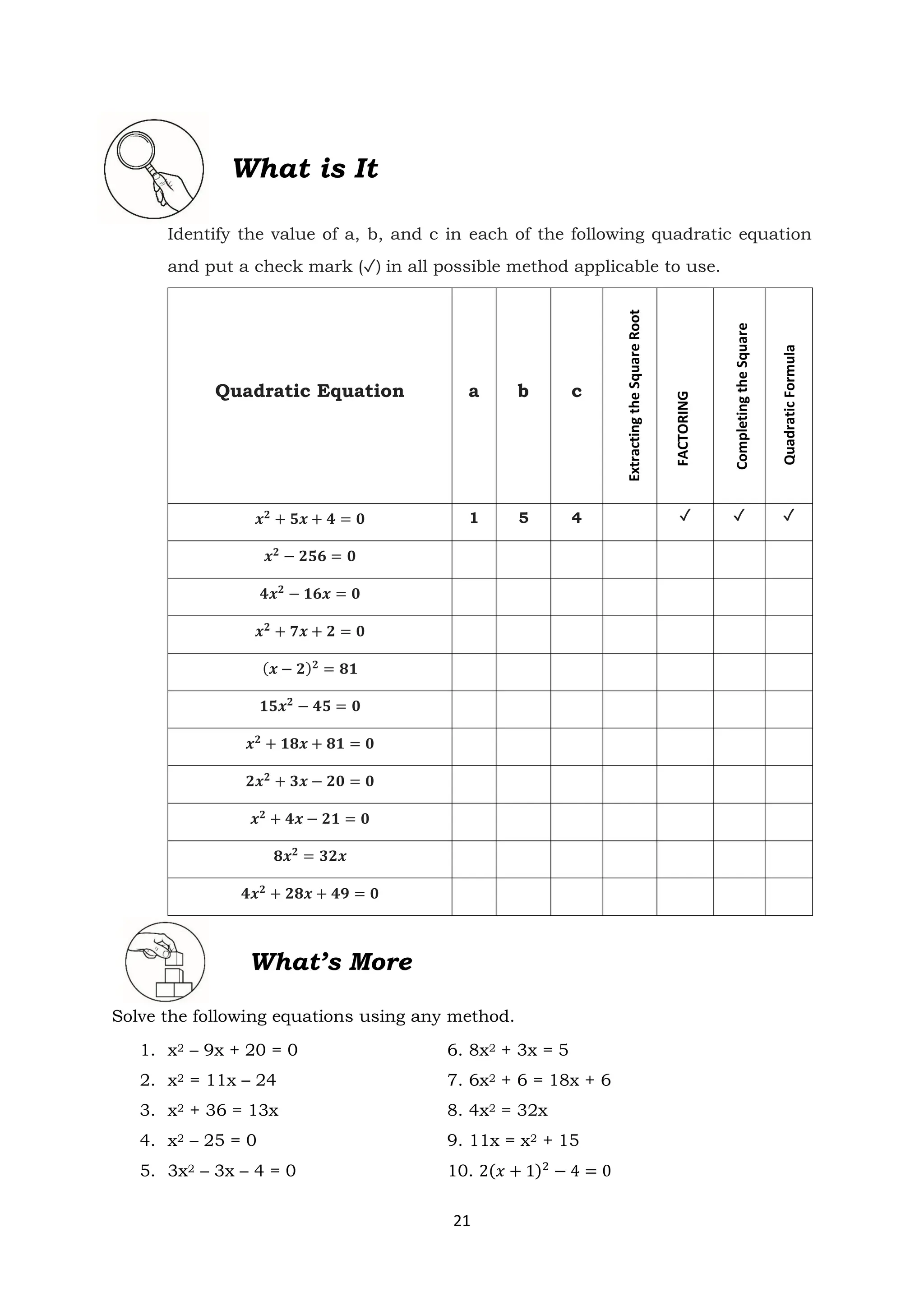
What is It
Identify the value of a, b, and c in each of the following quadratic equation
and put a check mark (✓) in all possible method applicable to use.
Quadratic Equation a b c
𝒙𝟐
+ 𝟓𝒙 + 𝟒 = 𝟎 1 5 4 ✓ ✓ ✓
𝒙𝟐
− 𝟐𝟓𝟔 = 𝟎
𝟒𝒙𝟐
− 𝟏𝟔𝒙 = 𝟎
𝒙𝟐
+ 𝟕𝒙 + 𝟐 = 𝟎
(𝒙 − 𝟐)𝟐
= 𝟖𝟏
𝟏𝟓𝒙𝟐
− 𝟒𝟓 = 𝟎
𝒙𝟐
+ 𝟏𝟖𝒙 + 𝟖𝟏 = 𝟎
𝟐𝒙𝟐
+ 𝟑𝒙 − 𝟐𝟎 = 𝟎
𝒙𝟐
+ 𝟒𝒙 − 𝟐𝟏 = 𝟎
𝟖𝒙𝟐
= 𝟑𝟐𝒙
𝟒𝒙𝟐
+ 𝟐𝟖𝒙 + 𝟒𝟗 = 𝟎
What’s More
Solve the following equations using any method.
1. x2 – 9x + 20 = 0 6. 8x2 + 3x = 5
2. x2 = 11x – 24 7. 6x2 + 6 = 18x + 6
3. x2 + 36 = 13x 8. 4x2 = 32x
4. x2 – 25 = 0 9. 11x = x2 + 15
5. 3x2 – 3x – 4 = 0 10. 2(𝑥 + 1)2
− 4 = 0
Extracting
the
Square
Root
FACTORING
Completing
the
Square
Quadratic
Formula
22
What I Have Learned
Quadratic equation may be solved suing extracting the square root, factoring,
completing the square, or quadratic formula. The following may help you decide on
which method to use.
➢ Use extracting the square root method whenever the value of b is zero or the
quadratic equation is in the form x2 = k.
➢ Use factoring method whenever the given quadratic equation is factorable.
➢ Use completing the square method or quadratic formula method in any given
quadratic equation.
WEEK 2
Lesson3
Discriminant and Nature of the
Roots
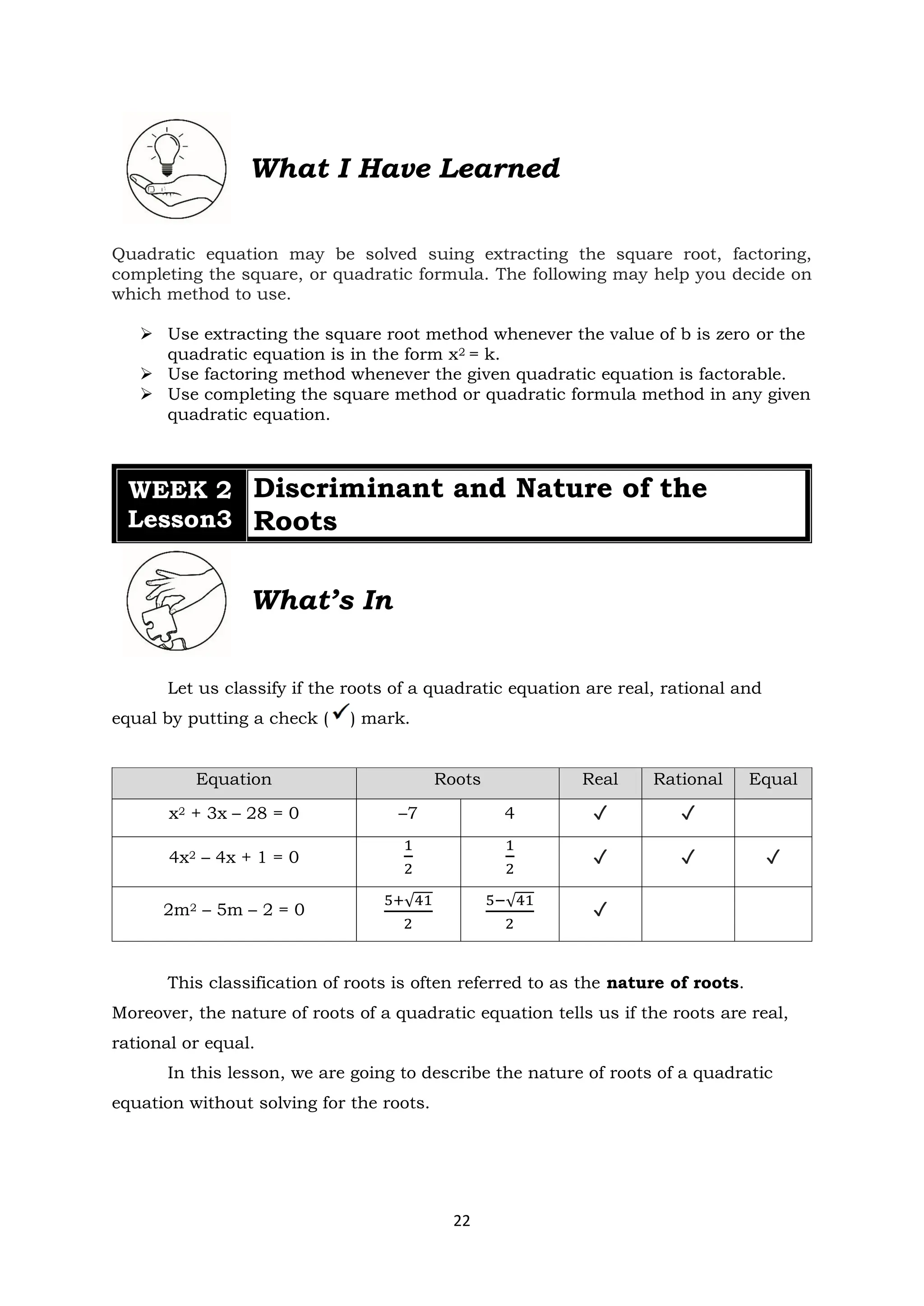
What’s In
Let us classify if the roots of a quadratic equation are real, rational and
equal by putting a check ( ) mark.
Equation Roots Real Rational Equal
x2 + 3x – 28 = 0 –7 4 ✓ ✓
4x2 – 4x + 1 = 0
1
2
1
2
✓ ✓ ✓
2m2 – 5m – 2 = 0
5+√41
2
5−√41
2
✓
This classification of roots is often referred to as the nature of roots.
Moreover, the nature of roots of a quadratic equation tells us if the roots are real,
rational or equal.
In this lesson, we are going to describe the nature of roots of a quadratic
equation without solving for the roots.
23
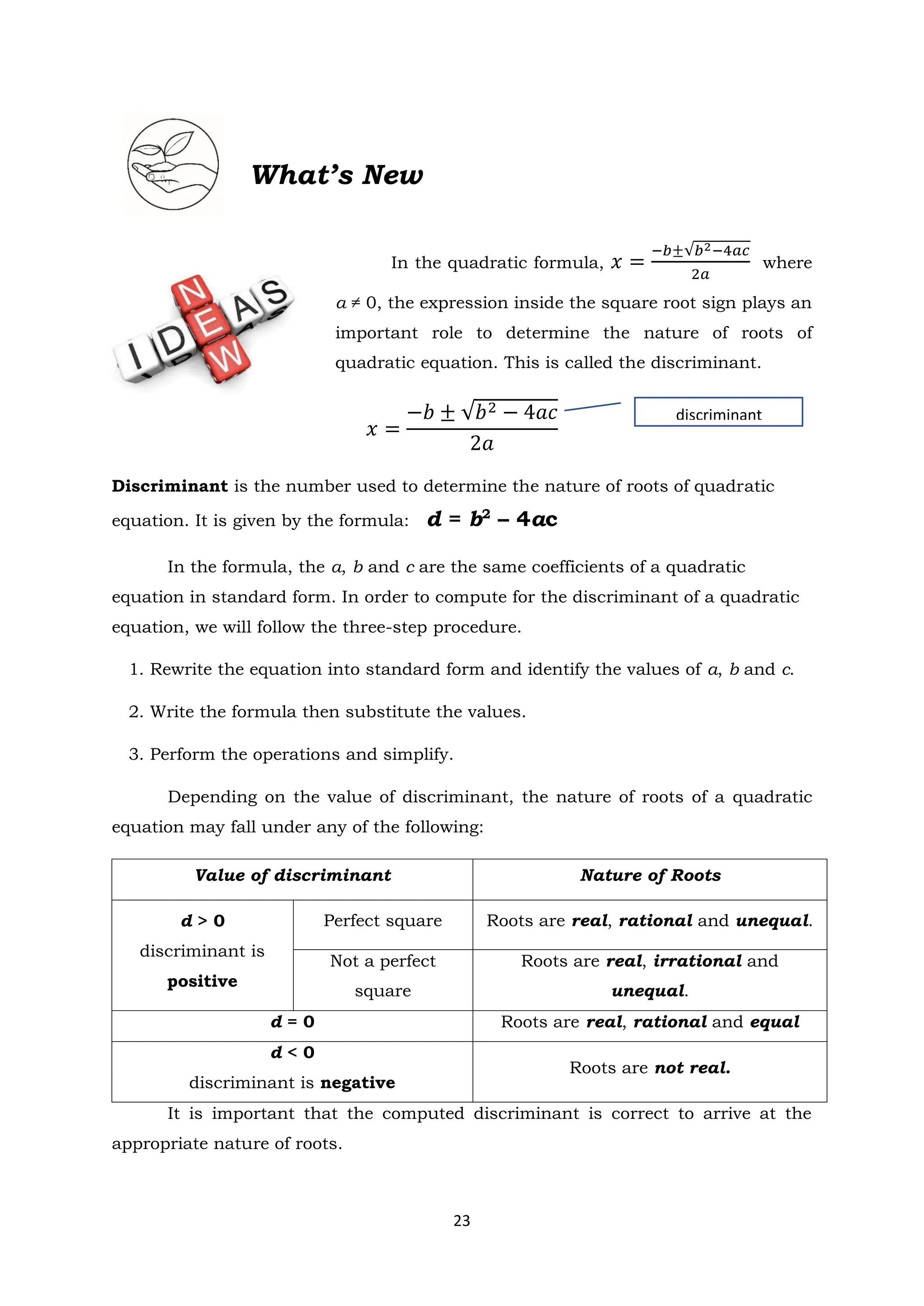
What’s New
In the quadratic formula, 𝑥 =
−𝑏±√𝑏2−4𝑎𝑐
2𝑎
where
a ≠ 0, the expression inside the square root sign plays an
important role to determine the nature of roots of
quadratic equation. This is called the discriminant.
𝑥 =
−𝑏 ± √𝑏2 − 4𝑎𝑐
2𝑎
Discriminant is the number used to determine the nature of roots of quadratic
equation. It is given by the formula: d = b2
– 4ac
In the formula, the a, b and c are the same coefficients of a quadratic
equation in standard form. In order to compute for the discriminant of a quadratic
equation, we will follow the three-step procedure.
1. Rewrite the equation into standard form and identify the values of a, b and c.
2. Write the formula then substitute the values.
3. Perform the operations and simplify.
Depending on the value of discriminant, the nature of roots of a quadratic
equation may fall under any of the following:
Value of discriminant Nature of Roots
d > 0
discriminant is
positive
Perfect square Roots are real, rational and unequal.
Not a perfect
square
Roots are real, irrational and
unequal.
d = 0 Roots are real, rational and equal
d < 0
discriminant is negative
Roots are not real.
It is important that the computed discriminant is correct to arrive at the
appropriate nature of roots.
discriminant
24
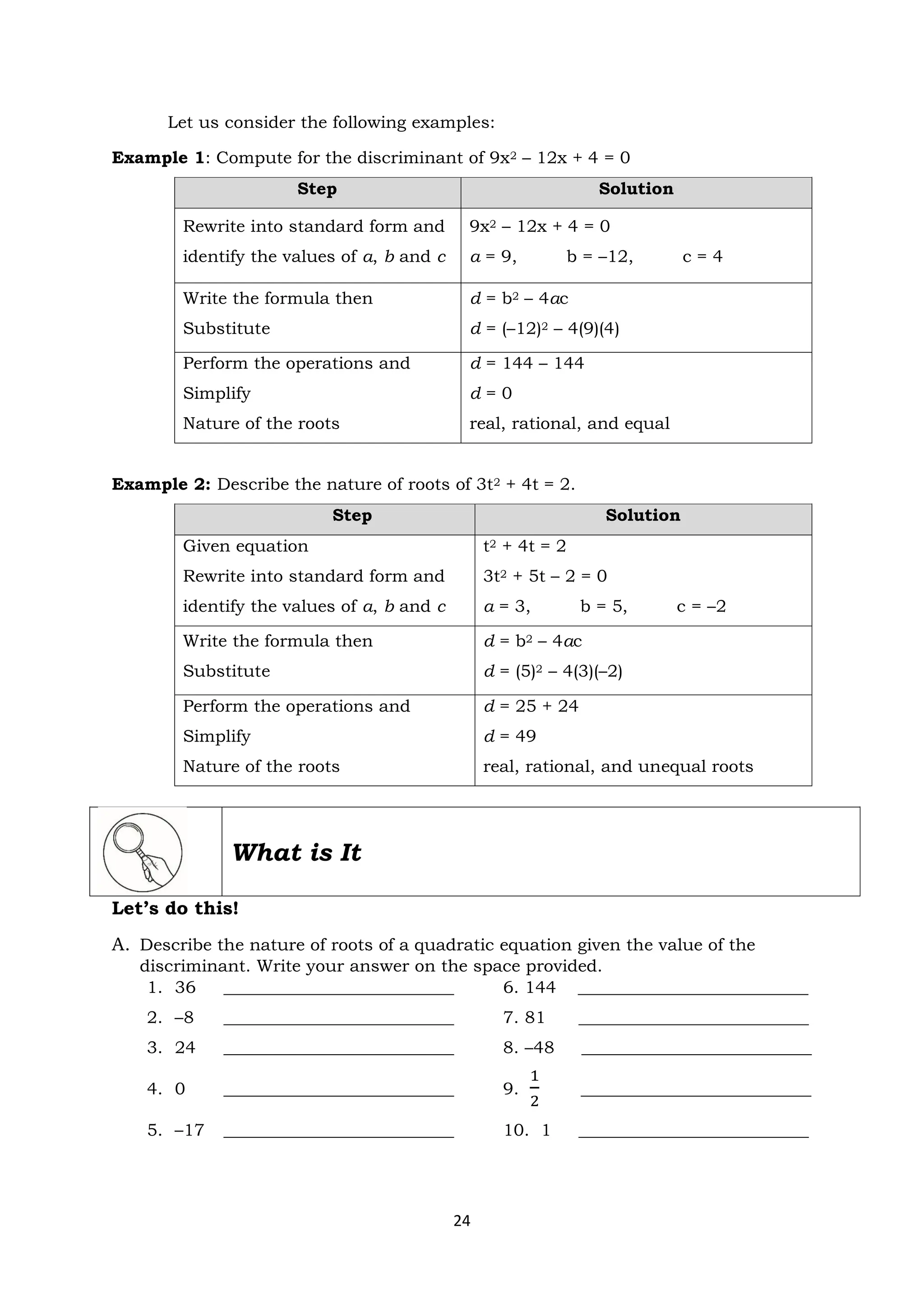
Let us consider the following examples:
Example 1: Compute for the discriminant of 9x2 – 12x + 4 = 0
Step Solution
Rewrite into standard form and
identify the values of a, b and c
9x2 – 12x + 4 = 0
a = 9, b = –12, c = 4
Write the formula then
Substitute
d = b2 – 4ac
d = (–12)2 – 4(9)(4)
Perform the operations and
Simplify
Nature of the roots
d = 144 – 144
d = 0
real, rational, and equal
Example 2: Describe the nature of roots of 3t2 + 4t = 2.
Step Solution
Given equation
Rewrite into standard form and
identify the values of a, b and c
t2 + 4t = 2
3t2 + 5t – 2 = 0
a = 3, b = 5, c = –2
Write the formula then
Substitute
d = b2 – 4ac
d = (5)2 – 4(3)(–2)
Perform the operations and
Simplify
Nature of the roots
d = 25 + 24
d = 49
real, rational, and unequal roots
What is It
Let’s do this!
A. Describe the nature of roots of a quadratic equation given the value of the
discriminant. Write your answer on the space provided.
1. 36 ___________________________ 6. 144 ___________________________
2. –8 ___________________________ 7. 81 ___________________________
3. 24 ___________________________ 8. –48 ___________________________
4. 0 ___________________________ 9.
1
2
___________________________
5. –17 ___________________________ 10. 1 ___________________________
25
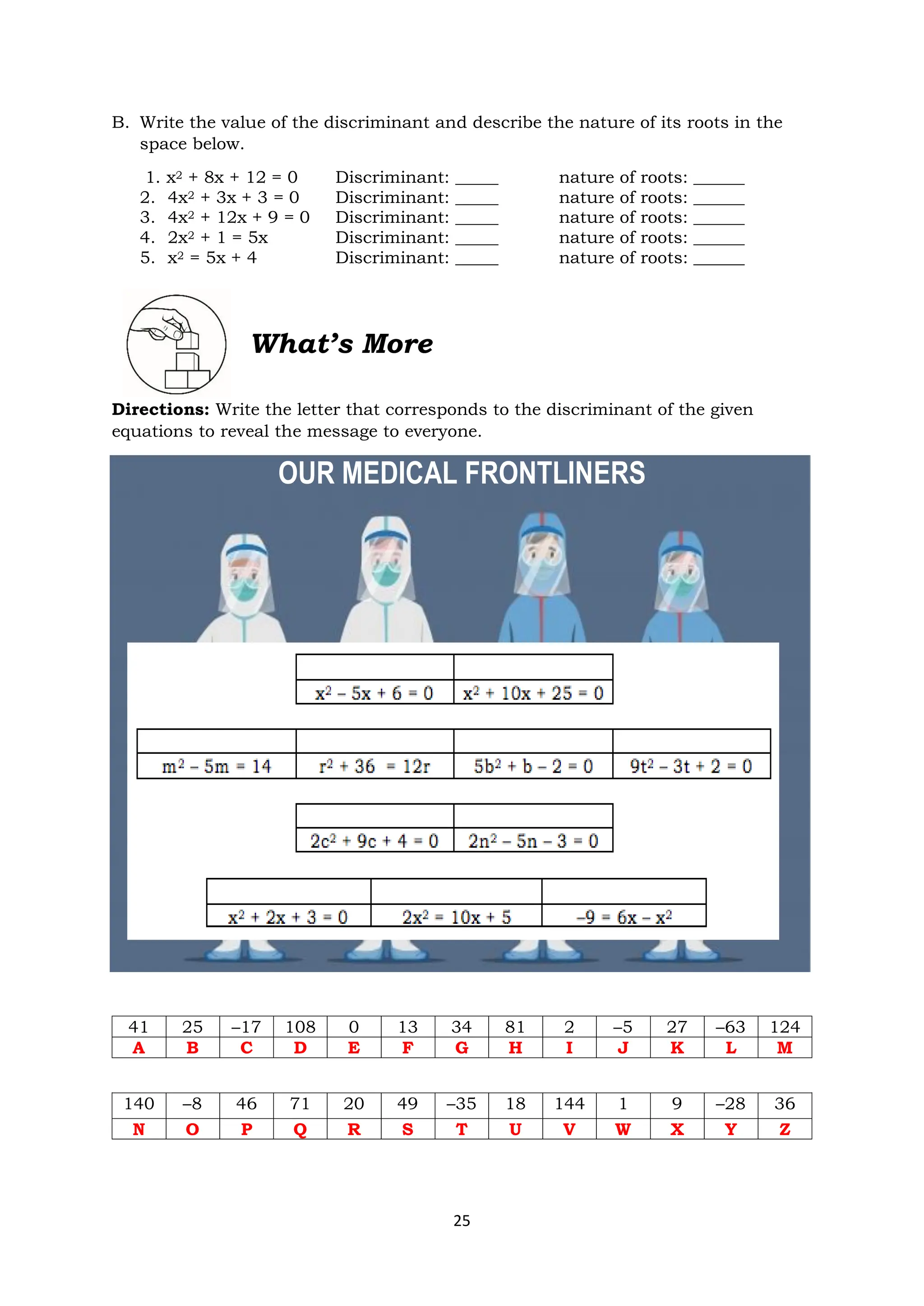
B. Write the value of the discriminant and describe the nature of its roots in the
space below.
1. x2 + 8x + 12 = 0 Discriminant: _____ nature of roots: ______
2. 4x2 + 3x + 3 = 0 Discriminant: _____ nature of roots: ______
3. 4x2 + 12x + 9 = 0 Discriminant: _____ nature of roots: ______
4. 2x2 + 1 = 5x Discriminant: _____ nature of roots: ______
5. x2 = 5x + 4 Discriminant: _____ nature of roots: ______
What’s More
Directions: Write the letter that corresponds to the discriminant of the given
equations to reveal the message to everyone.
OUR MEDICAL FRONTLINERS
41 25 –17 108 0 13 34 81 2 –5 27 –63 124
A B C D E F G H I J K L M
140 –8 46 71 20 49 –35 18 144 1 9 –28 36
N O P Q R S T U V W X Y Z
26
What I Have Learned
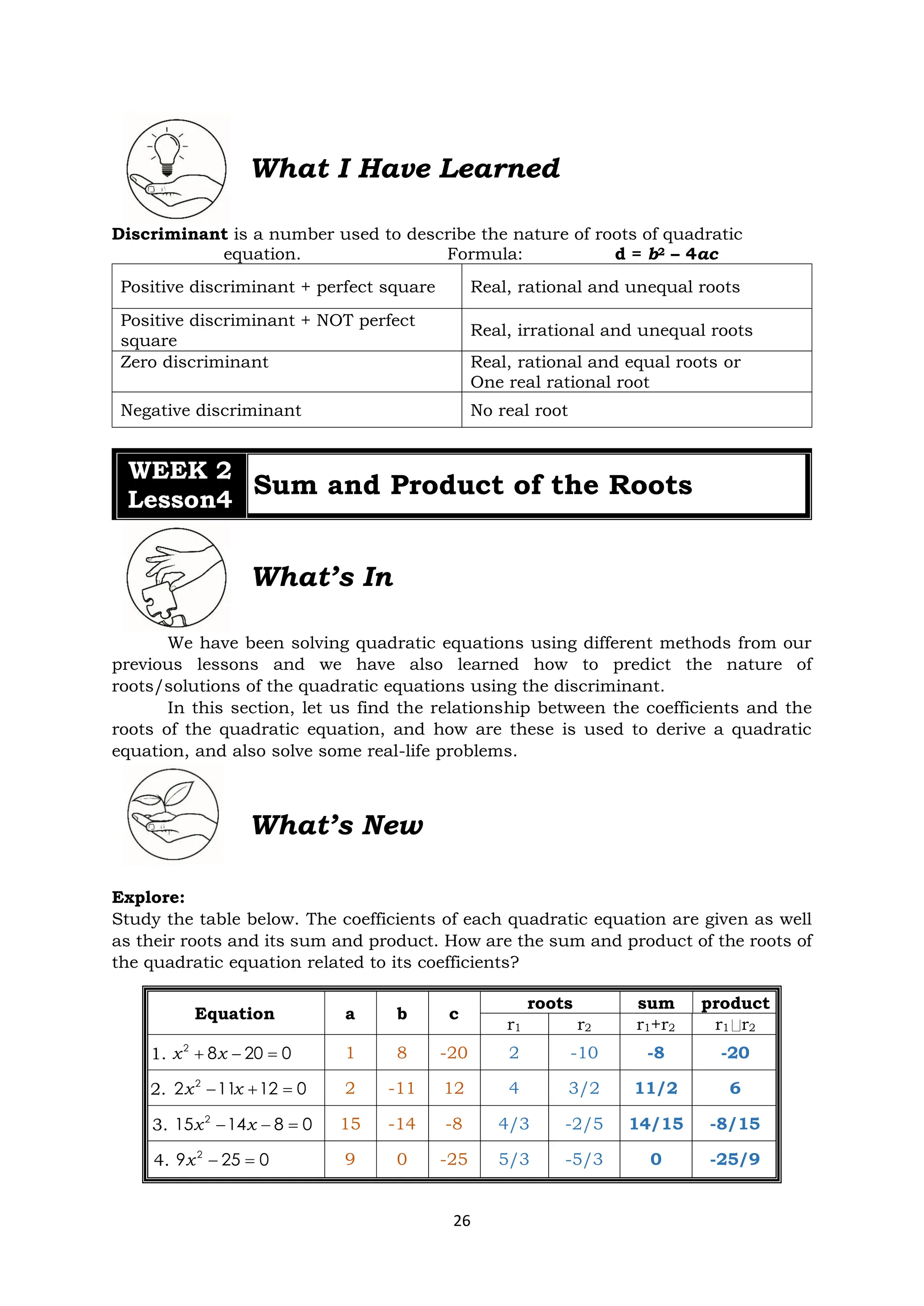
Discriminant is a number used to describe the nature of roots of quadratic
equation. Formula: d = b2 – 4ac
Positive discriminant + perfect square Real, rational and unequal roots
Positive discriminant + NOT perfect
square
Real, irrational and unequal roots
Zero discriminant Real, rational and equal roots or
One real rational root
Negative discriminant No real root
WEEK 2
Lesson4
Sum and Product of the Roots
What’s In
We have been solving quadratic equations using different methods from our
previous lessons and we have also learned how to predict the nature of
roots/solutions of the quadratic equations using the discriminant.
In this section, let us find the relationship between the coefficients and the
roots of the quadratic equation, and how are these is used to derive a quadratic
equation, and also solve some real-life problems.
What’s New
Explore:
Study the table below. The coefficients of each quadratic equation are given as well
as their roots and its sum and product. How are the sum and product of the roots of
the quadratic equation related to its coefficients?
Equation a b c
roots sum product
r1 r2 r1+r2 r1 r2
1. 2
8 20 0
+ − =
x x 1 8 -20 2 -10 -8 -20
2. 2
2 11 12 0
− + =
x x 2 -11 12 4 3/2 11/2 6
3. 2
15 14 8 0
− − =
x x 15 -14 -8 4/3 -2/5 14/15 -8/15
4. 2
9 25 0
− =
x 9 0 -25 5/3 -5/3 0 -25/9
27
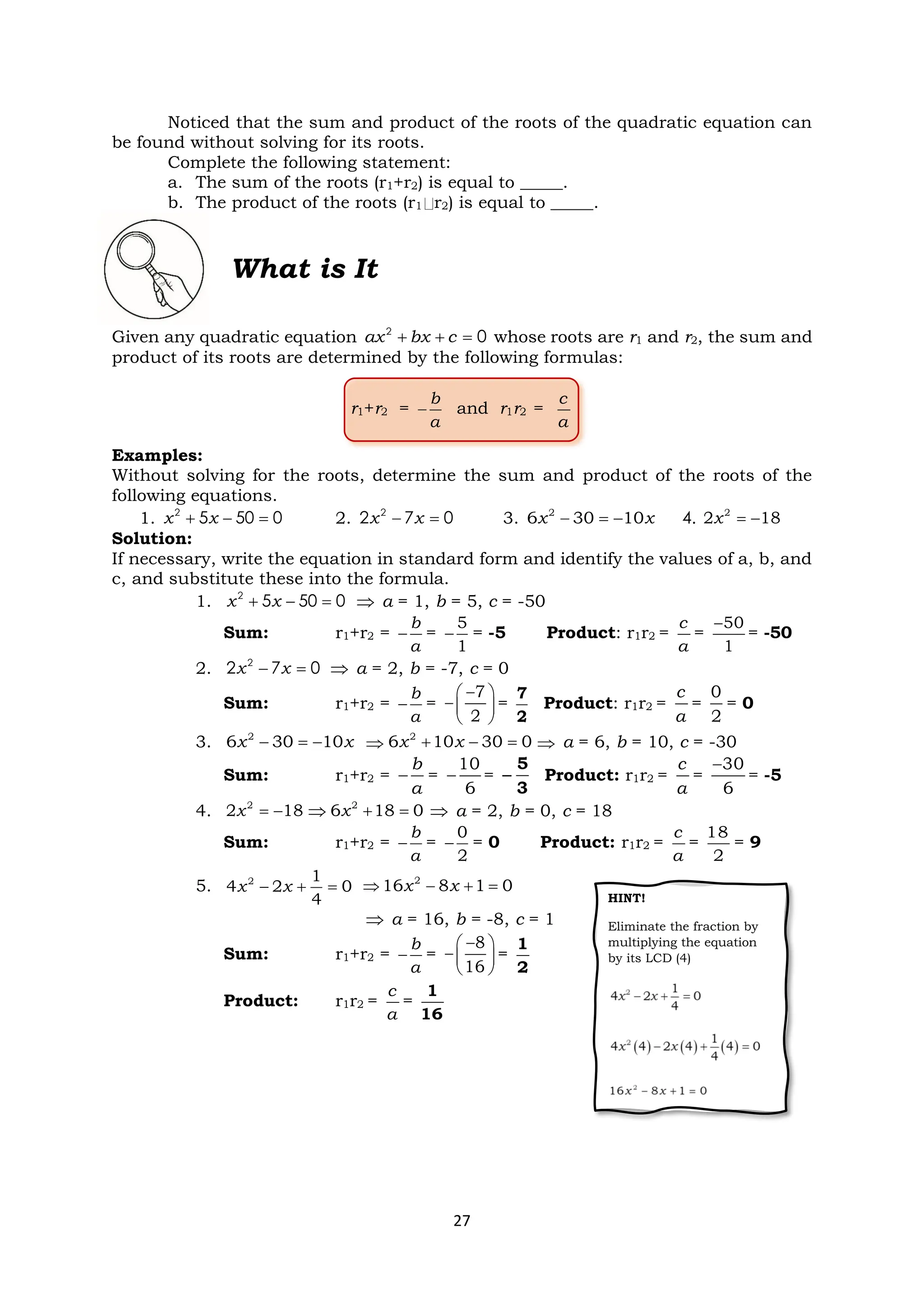
Noticed that the sum and product of the roots of the quadratic equation can
be found without solving for its roots.
Complete the following statement:
a. The sum of the roots (r1+r2) is equal to _____.
b. The product of the roots (r1 r2) is equal to _____.
What is It
Given any quadratic equation 2
0
+ + =
ax bx c whose roots are r1 and r2, the sum and
product of its roots are determined by the following formulas:
r1+r2 = −
b
a
and r1r2 =
c
a
Examples:
Without solving for the roots, determine the sum and product of the roots of the
following equations.
1. 2
5 50 0
+ − =
x x 2. 2
2 7 0
− =
x x 3. − = −
2
6 30 10
x x 4. = −
2
2 18
x
Solution:
If necessary, write the equation in standard form and identify the values of a, b, and
c, and substitute these into the formula.
1. 2
5 50 0
+ − =
x x  a = 1, b = 5, c = -50
Sum: r1+r2 = −
b
a
= −
5
1
= -5 Product: r1r2 =
c
a
=
−50
1
= -50
2. 2
2 7 0
− =
x x  a = 2, b = -7, c = 0
Sum: r1+r2 = −
b
a
=
−
 
− 
 
7
2
=
7
2
Product: r1r2 =
c
a
=
0
2
= 0
3. − = −
2
6 30 10
x x  + − =
2
6 10 30 0
x x  a = 6, b = 10, c = -30
Sum: r1+r2 = −
b
a
= −
10
6
=
5
3
− Product: r1r2 =
c
a
=
−30
6
= -5
4. = −
2
2 18
x  + =
2
6 18 0
x  a = 2, b = 0, c = 18
Sum: r1+r2 = −
b
a
= −
0
2
= 0 Product: r1r2 =
c
a
=
18
2
= 9
5. − + =
2 1
4 2 0
4
x x  − + =
2
16 8 1 0
x x
 a = 16, b = -8, c = 1
Sum: r1+r2 = −
b
a
=
−
 
− 
 
8
16
=
1
2
Product: r1r2 =
c
a
=
1
16
HINT!
Eliminate the fraction by
multiplying the equation
by its LCD (4)
28
What’s More
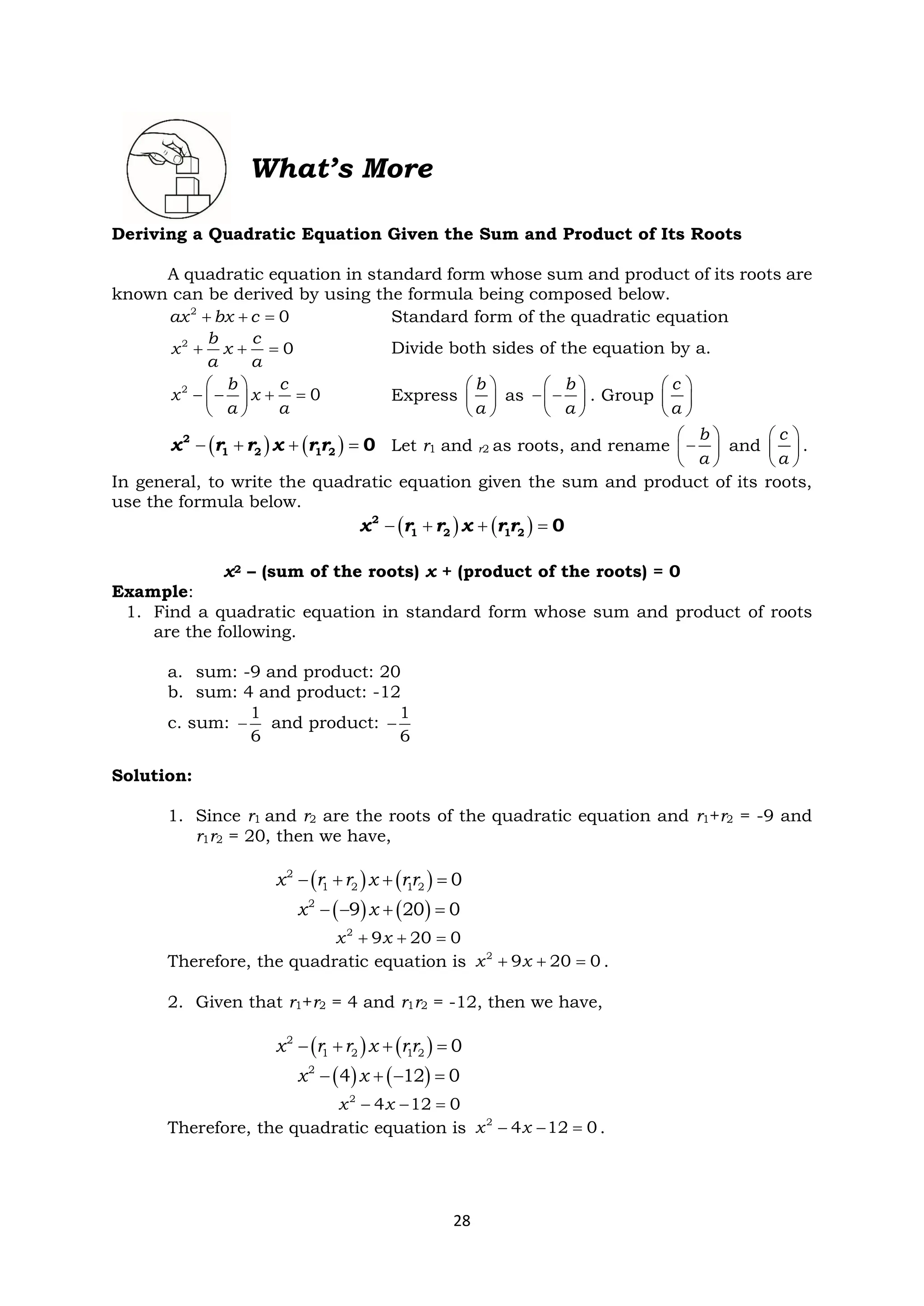
Deriving a Quadratic Equation Given the Sum and Product of Its Roots
A quadratic equation in standard form whose sum and product of its roots are
known can be derived by using the formula being composed below.
+ + =
2
0
ax bx c Standard form of the quadratic equation
+ + =
2
0
b c
x x
a a
Divide both sides of the equation by a.
 
− − + =
 
 
2
0
b c
x x
a a
Express
 
 
 
b
a
as
 
− −
 
 
b
a
. Group
 
 
 
c
a
( ) ( )
− + + =
2
1 2 1 2 0
x r r x r r Let r1 and r2 as roots, and rename
 
−
 
 
b
a
and
 
 
 
c
a
.
In general, to write the quadratic equation given the sum and product of its roots,
use the formula below.
( ) ( )
− + + =
2
1 2 1 2 0
x r r x r r
x2 – (sum of the roots) x + (product of the roots) = 0
Example:
1. Find a quadratic equation in standard form whose sum and product of roots
are the following.
a. sum: -9 and product: 20
b. sum: 4 and product: -12
c. sum: −
1
6
and product: −
1
6
Solution:
1. Since r1 and r2 are the roots of the quadratic equation and r1+r2 = -9 and
r1r2 = 20, then we have,
( ) ( )
− + + =
2
1 2 1 2 0
x r r x r r
( ) ( )
− − + =
2
9 20 0
x x
+ + =
2
9 20 0
x x
Therefore, the quadratic equation is + + =
2
9 20 0
x x .
2. Given that r1+r2 = 4 and r1r2 = -12, then we have,
( ) ( )
− + + =
2
1 2 1 2 0
x r r x r r
( ) ( )
− + − =
2
4 12 0
x x
− − =
2
4 12 0
x x
Therefore, the quadratic equation is − − =
2
4 12 0
x x .
29
What I Have Learned
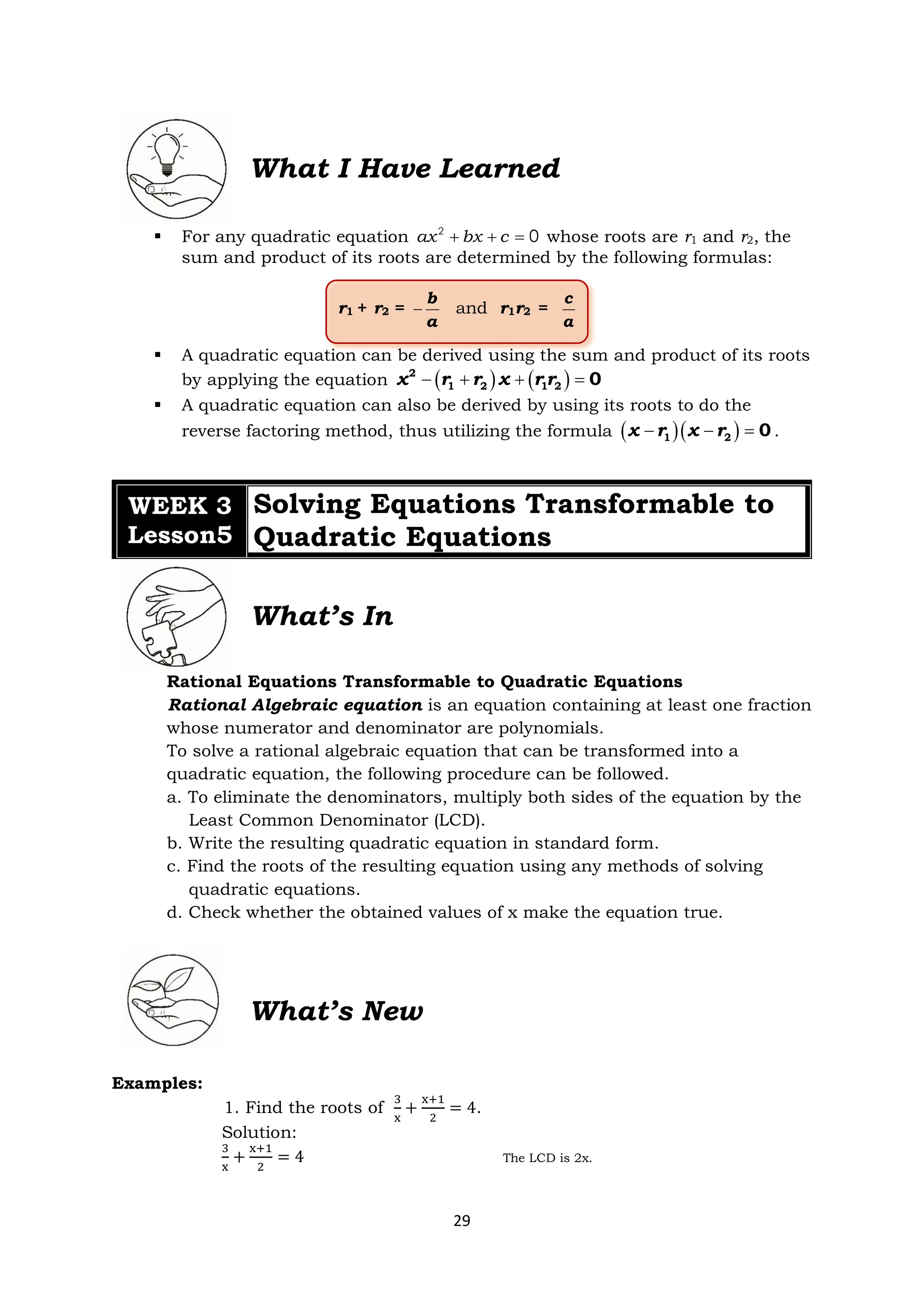
▪ For any quadratic equation 2
0
+ + =
ax bx c whose roots are r1 and r2, the
sum and product of its roots are determined by the following formulas:
r1 + r2 = −
b
a
and r1r2 =
c
a
▪ A quadratic equation can be derived using the sum and product of its roots
by applying the equation ( ) ( )
− + + =
2
1 2 1 2 0
x r r x r r
▪ A quadratic equation can also be derived by using its roots to do the
reverse factoring method, thus utilizing the formula ( )( )
− − =
1 2 0
x r x r .
WEEK 3
Lesson5
Solving Equations Transformable to
Quadratic Equations
What’s In
Rational Equations Transformable to Quadratic Equations
Rational Algebraic equation is an equation containing at least one fraction
whose numerator and denominator are polynomials.
To solve a rational algebraic equation that can be transformed into a
quadratic equation, the following procedure can be followed.
a. To eliminate the denominators, multiply both sides of the equation by the
Least Common Denominator (LCD).
b. Write the resulting quadratic equation in standard form.
c. Find the roots of the resulting equation using any methods of solving
quadratic equations.
d. Check whether the obtained values of x make the equation true.
What’s New
Examples:
1. Find the roots of
3
x
+
x+1
2
= 4.
Solution:
3
x
+
x+1
2
= 4 The LCD is 2x.
30
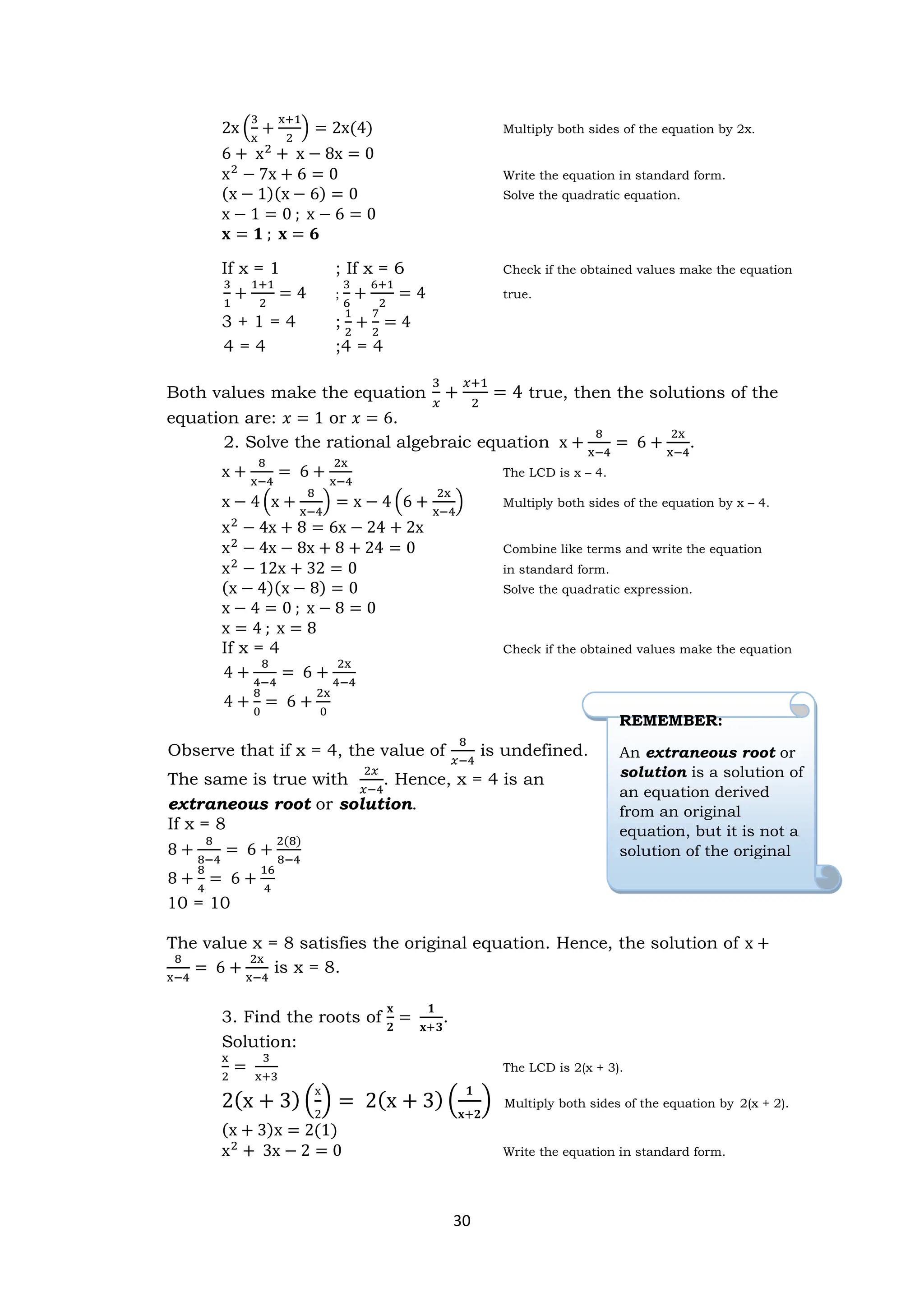
2x (
3
x
+
x+1
2
) = 2x(4) Multiply both sides of the equation by 2x.
6 + x2
+ x − 8x = 0
x2
− 7x + 6 = 0 Write the equation in standard form.
(x − 1)(x − 6) = 0 Solve the quadratic equation.
x − 1 = 0 ; x − 6 = 0
𝐱 = 𝟏 ; 𝐱 = 𝟔
If x = 1 ; If x = 6 Check if the obtained values make the equation
3
1
+
1+1
2
= 4 ;
3
6
+
6+1
2
= 4 true.
3 + 1 = 4 ;
1
2
+
7
2
= 4
4 = 4 ;4 = 4
Both values make the equation
3
𝑥
+
𝑥+1
2
= 4 true, then the solutions of the
equation are: 𝑥 = 1 or 𝑥 = 6.
2. Solve the rational algebraic equation x +
8
x−4
= 6 +
2x
x−4
.
x +
8
x−4
= 6 +
2x
x−4
The LCD is x – 4.
x − 4 (x +
8
x−4
) = x − 4 (6 +
2x
x−4
) Multiply both sides of the equation by x – 4.
x2
− 4x + 8 = 6x − 24 + 2x
x2
− 4x − 8x + 8 + 24 = 0 Combine like terms and write the equation
x2
− 12x + 32 = 0 in standard form.
(x − 4)(x − 8) = 0 Solve the quadratic expression.
x − 4 = 0 ; x − 8 = 0
x = 4 ; x = 8
If x = 4 Check if the obtained values make the equation
4 +
8
4−4
= 6 +
2x
4−4
4 +
8
0
= 6 +
2x
0
Observe that if x = 4, the value of
8
𝑥−4
is undefined.
The same is true with
2𝑥
𝑥−4
. Hence, x = 4 is an
extraneous root or solution.
If x = 8
8 +
8
8−4
= 6 +
2(8)
8−4
8 +
8
4
= 6 +
16
4
10 = 10
The value x = 8 satisfies the original equation. Hence, the solution of x +
8
x−4
= 6 +
2x
x−4
is x = 8.
3. Find the roots of
𝐱
𝟐
=
𝟏
𝐱+𝟑
.
Solution:
x
2
=
3
x+3
The LCD is 2(x + 3).
2(x + 3) (
x
2
) = 2(x + 3) (
𝟏
𝐱+𝟐
) Multiply both sides of the equation by 2(x + 2).
(x + 3)x = 2(1)
x2 + 3x − 2 = 0 Write the equation in standard form.
REMEMBER:
An extraneous root or
solution is a solution of
an equation derived
from an original
equation, but it is not a
solution of the original
equation.
31
Since the resulting equation is not factorable, we can use completing the
square or quadratic formula.
a = 1; b = 3; c = -2 Substitute the values of a, b and c
x =
−3±√32− 4(1)(−2)
2(1)
on the formula.
x =
−3±√9+8
2
Simplify the result.
x =
−3±√17
2
𝐱 =
−𝟑+√𝟏𝟕
𝟐
or 𝐱 =
−𝟑−√𝟏𝟕
𝟐
Separate the two values.
Note: You may solve the equation using any method in solving quadratic
equations you deemed appropriate.
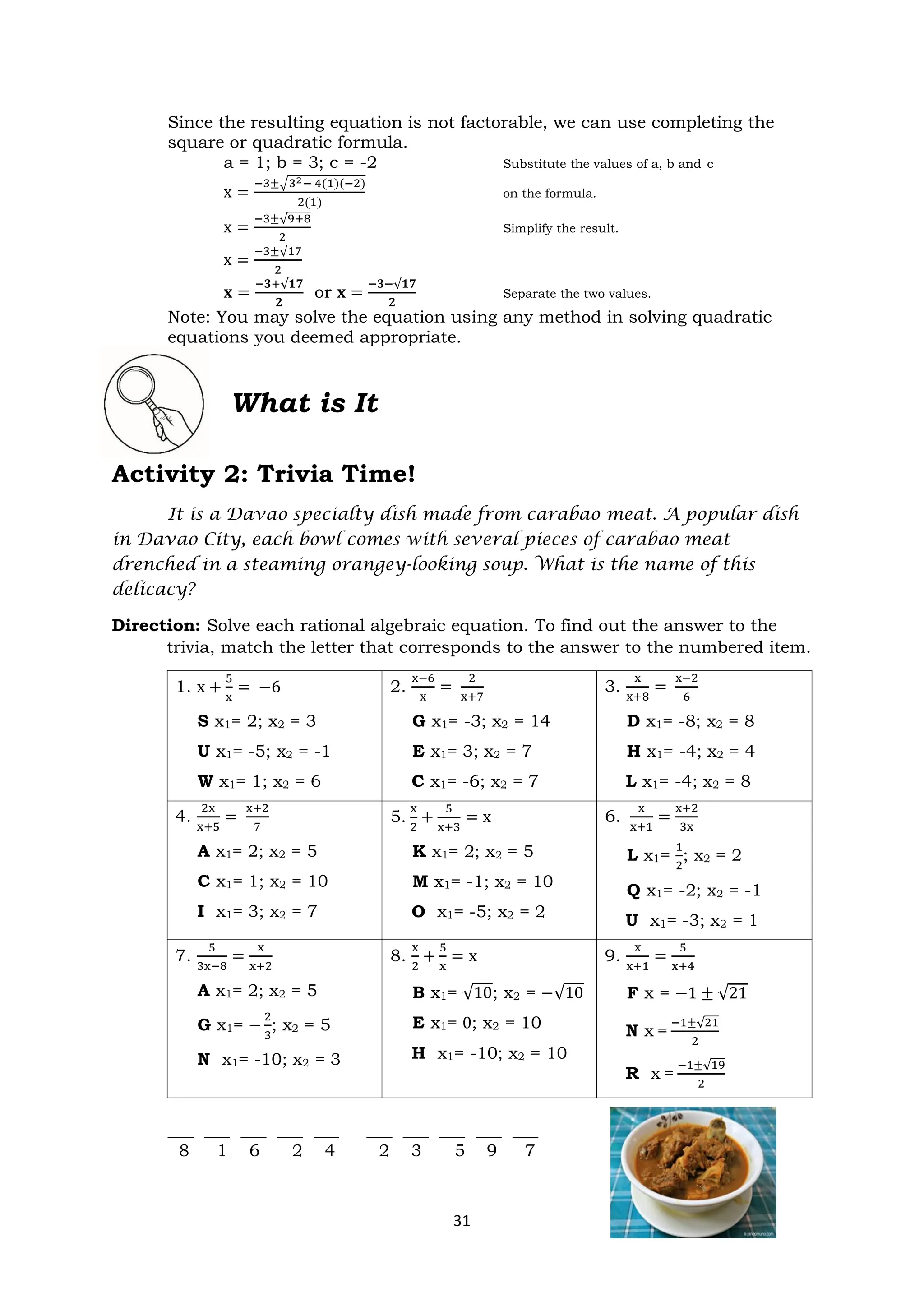
What is It
Activity 2: Trivia Time!
It is a Davao specialty dish made from carabao meat. A popular dish
in Davao City, each bowl comes with several pieces of carabao meat
drenched in a steaming orangey-looking soup. What is the name of this
delicacy?
Direction: Solve each rational algebraic equation. To find out the answer to the
trivia, match the letter that corresponds to the answer to the numbered item.
1. x +
5
x
= −6
S x1= 2; x2 = 3
U x1= -5; x2 = -1
W x1= 1; x2 = 6
2.
x−6
x
=
2
x+7
G x1= -3; x2 = 14
E x1= 3; x2 = 7
C x1= -6; x2 = 7
3.
x
x+8
=
x−2
6
D x1= -8; x2 = 8
H x1= -4; x2 = 4
L x1= -4; x2 = 8
4.
2x
x+5
=
x+2
7
A x1= 2; x2 = 5
C x1= 1; x2 = 10
I x1= 3; x2 = 7
5.
x
2
+
5
x+3
= x
K x1= 2; x2 = 5
M x1= -1; x2 = 10
O x1= -5; x2 = 2
6.
x
x+1
=
x+2
3x
L x1=
1
2
; x2 = 2
Q x1= -2; x2 = -1
U x1= -3; x2 = 1
7.
5
3x−8
=
x
x+2
A x1= 2; x2 = 5
G x1= −
2
3
; x2 = 5
N x1= -10; x2 = 3
8.
x
2
+
5
x
= x
B x1= √10; x2 = −√10
E x1= 0; x2 = 10
H x1= -10; x2 = 10
9.
x
x+1
=
5
x+4
F x = −1 ± √21
N x =
−1±√21
2
R x =
−1±√19
2
___ ___ ___ ___ ___ ___ ___ ___ ___ ___
8 1 6 2 4 2 3 5 9 7
32
What’s More
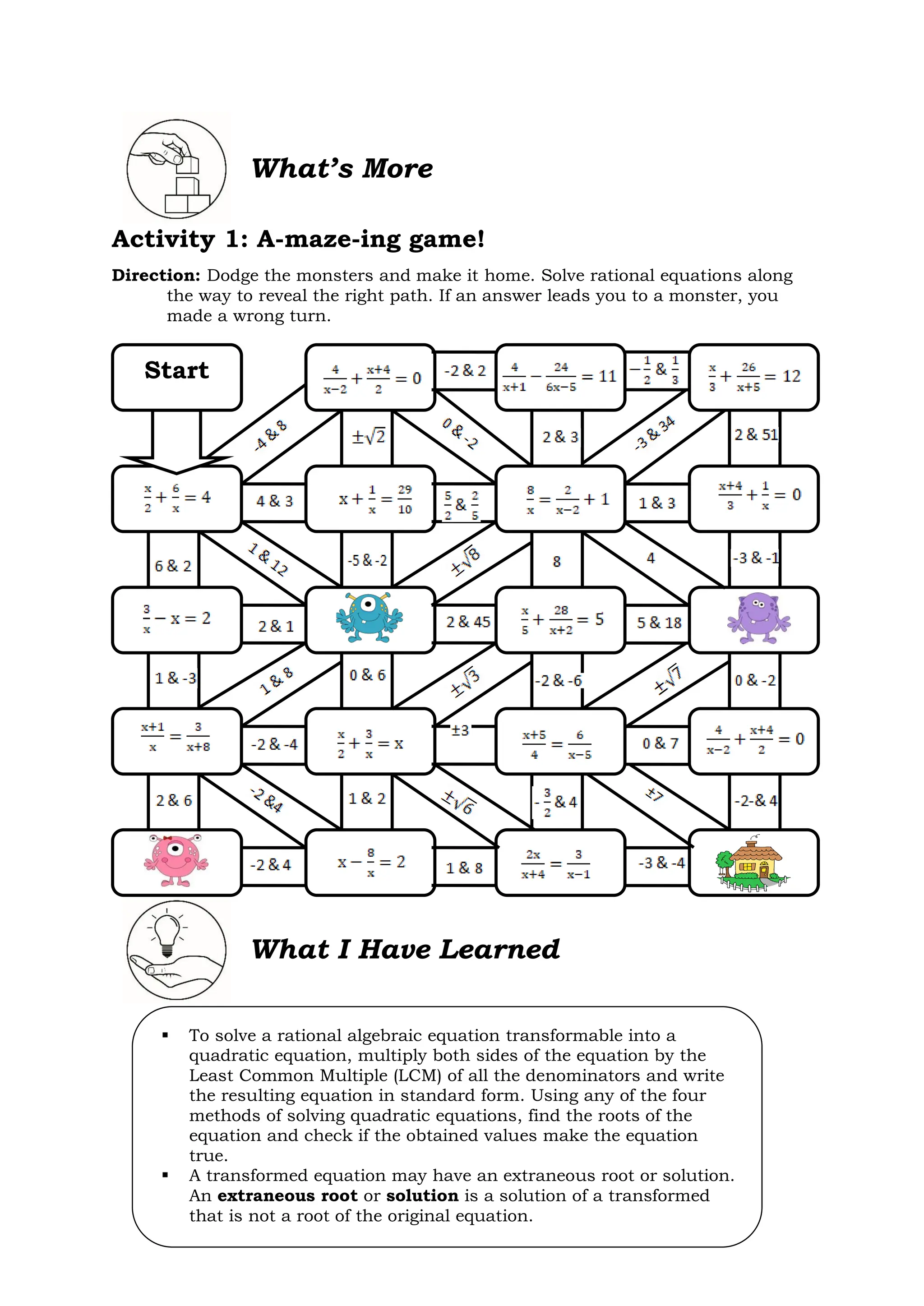
Activity 1: A-maze-ing game!
Direction: Dodge the monsters and make it home. Solve rational equations along
the way to reveal the right path. If an answer leads you to a monster, you
made a wrong turn.
What I Have Learned
Start
▪ To solve a rational algebraic equation transformable into a
quadratic equation, multiply both sides of the equation by the
Least Common Multiple (LCM) of all the denominators and write
the resulting equation in standard form. Using any of the four
methods of solving quadratic equations, find the roots of the
equation and check if the obtained values make the equation
true.
▪ A transformed equation may have an extraneous root or solution.
An extraneous root or solution is a solution of a transformed
that is not a root of the original equation.
33
WEEK 4
Lesson6
Solve Problems Involving Quadratic
Equations
What’s In
There are applications in algebra that involve rational algebraic equations which are
transformable to quadratic equations. Like in our previous lesson on problem
solving, skills in translating verbal phrases or sentences into an expression or
equation are necessary.
RECALL
Vocabulary
rational algebraic expression – is an algebraic expression of the form
n
d
, where n
and d are polynomials and d ≠ 0.
rational algebraic equation – is an equation that contain one or more rational
algebraic expressions.
rate - the speed at which one measured quantity happens in relation to another
measured amount such as time
LCD (least common denominator) - the lowest common multiple of
the denominators of a set of fractions
LCM (least common multiple) - the smallest common multiple of two or more
numbers the smallest positive integer that is divisible to the given set of numbers
B. Steps for Solving Word Problems
Step 1: Read and understand the problem. Identify what is/are being asked to find.
Step 2: Choose a variable to represent an unknown quantity. If there are any other
unknowns, define them in terms of the variable.
Step 3: Translate the problem into an equation.
Step 4: Solve the equation.
Step 5: INTERPRET the results. Be sure your answer makes sense in the context of
the problem: Check the proposed solution in the stated problem and state
your conclusion.
What’s New
NUMBER PROBLEM
In number problems, clues about one or more numbers are given, and you
use these clues to make an equation. Number problems don’t usually arise on an
everyday basis, but they provide a good introduction to practicing the problem-
solving strategy.
34
Example 1:
The square of the sum of a number and 3 is 25. Find the number.
Step 1: Read and understand the problem. Find what is being asked.
Must find the number
Step 2: Choose a variable to represent an unknown quantity. If there areany
otherunknowns, define them in terms of the variable.
Let x = the unknown number
x +3 = the sum of the number and 3
Step 3: Translate the problem into an equation.
(x + 3)2 = 25 The square of the sum of a number
and 3 is 25.
Step 4: Solve the equation.
Since the equation is in the form (ax + b)2 = c, we can easily solve it by
extracting square roots.
(x + 3)2 = 25
√(x + 3)2 = ±√25 Extract the square root of both sides.
x + 3 = ±5
x = −3 ±5 Simplify the resulting equation.
x = −3 +5 or x = −3 − 5
x = 2 or x -8
Step 5: INTERPRET the results. Be sure your answer makes sense in the
context of the problem: Check the proposed solution in the stated
problem and state your conclusion.
Interpret: x can be a positive or a negative number.
Check:
The number = x = 2, and The number = x = -8, and
sum of the number and 3 sum of the number and 3
= x + 3 = 2 + 3 = 5 = x + 3 = -8 + 3 = 5
(x + 3)2 = 25 (x + 3)2 = 25
(2 + 3)2 = 25 (-8 + 3)2 = 25
52 = 25 52 = 25
25 = 25 25 = 25
State: The unknown number is either 2 or -8.
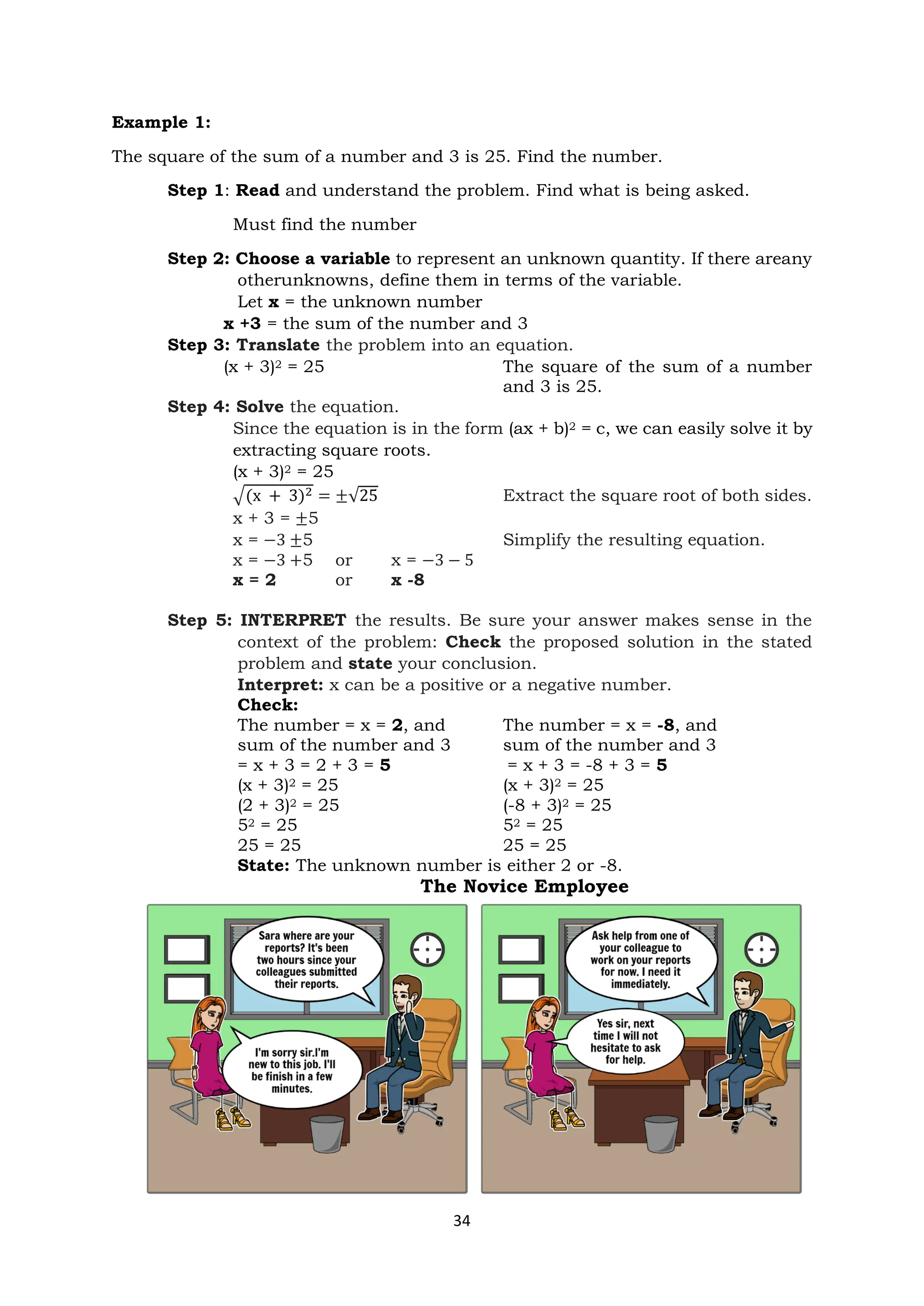
The Novice Employee
35
How long can Sara finish her reports if she had asked help from her colleague
from the start?
The situation given previously is an example of a work problem. Work
problem, and Distance/Motion problem are problems that translate into rational
equation but can be simplified into quadratic equations.
WORK PROBLEM
It is a word problem that involves two or more people or machines working a
particular job/task together but at different rates. When solving a work problem,
the goal is to determine the time it takes to complete a job/task.
The equation that is used to solve work problem is
Rate of work  time worked = part of job/task completed
Rate of work is that part of a job that is completed in one unit of time. In
general, if a job can be accomplished in t units of time, then the rate of work is
1
t
job per unit of time.
Example 1:
A small pipe takes 16 minutes longer to empty a tank than does a larger pipe.
Working together, the pipes can empty the tank in 6 min. How long would it take
each pipe working alone to empty the tank?
Step 1: Read and understand the problem. Find what is being asked.
Must determine how long it would take each pipe to empty the tank
if they work alone.
Step 2: Choose a variable to represent an unknown quantity. If there are any
other unknowns, define them in terms of the variable.
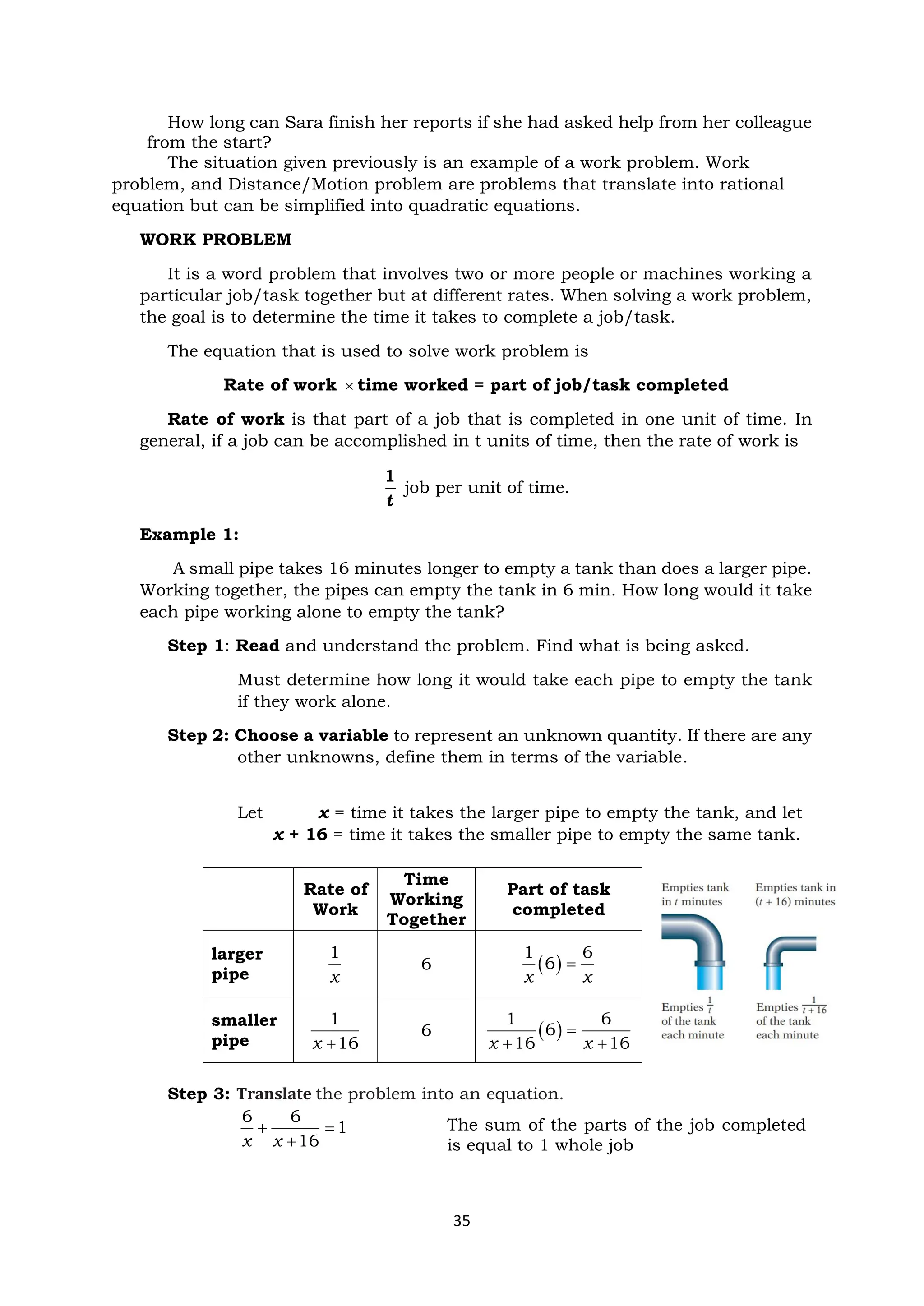
Let x = time it takes the larger pipe to empty the tank, and let
x + 16 = time it takes the smaller pipe to empty the same tank.
Step 3: Translate the problem into an equation.
6 6
1
16
x x
+ =
+
Rate of
Work
Time
Working
Together
Part of task
completed
larger
pipe
1
x
6 ( )
1 6
6
x x
=
smaller
pipe
1
16
x +
6 ( )
1 6
6
16 16
x x
=
+ +
The sum of the parts of the job completed
is equal to 1 whole job
36
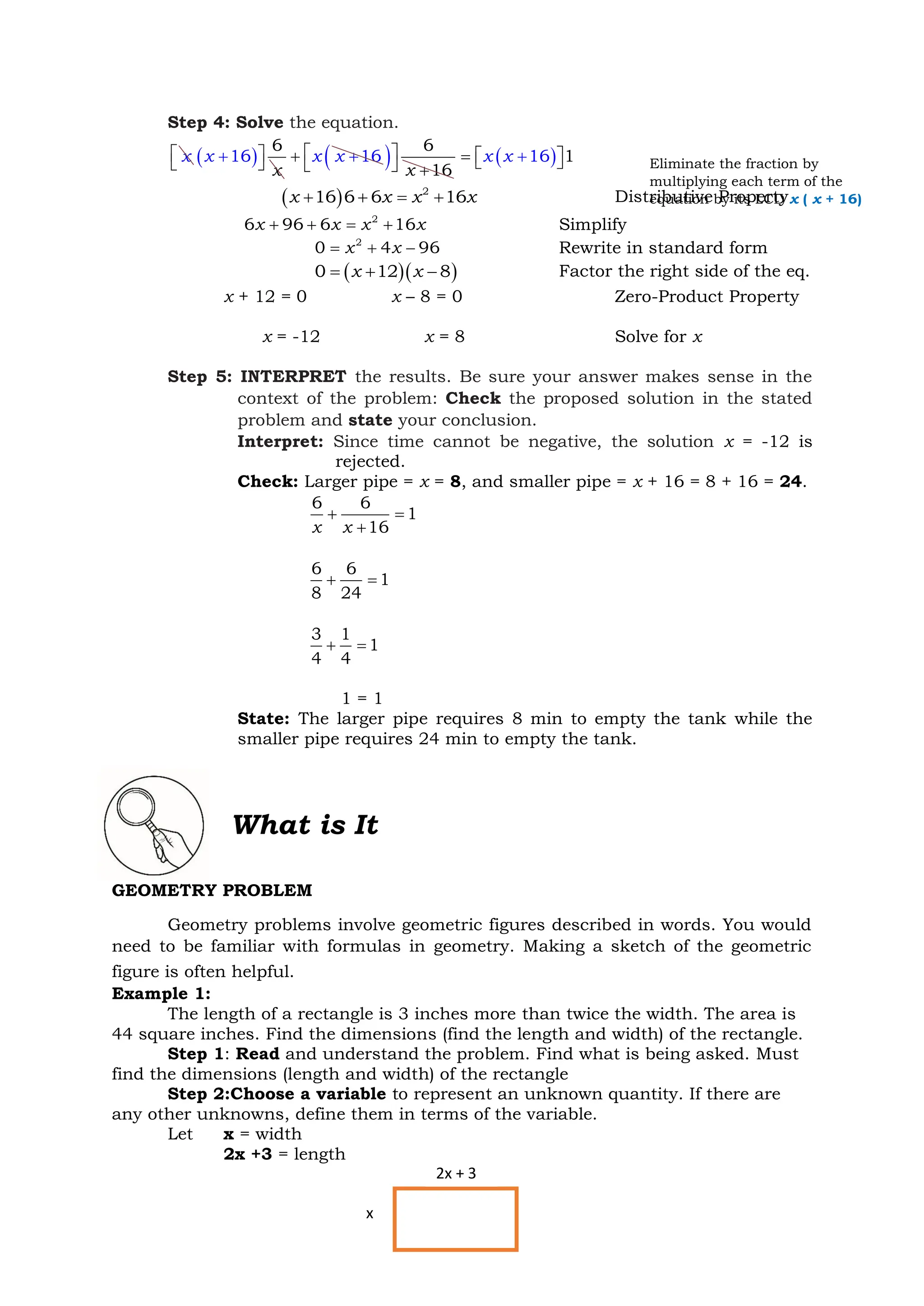
Step 4: Solve the equation.
x ( )
6
6
1
x
x
 

+
 16
x x
+ +
( ) 6
16
x
 
  +
( ) 1
16
x x +
=  
 
( ) 2
16 6 6 16
x x x x
+ + = + Distributive Property
2
6 96 6 16
x x x x
+ + = + Simplify
2
0 4 96
x x
= + − Rewrite in standard form
( )( )
0 12 8
x x
= + − Factor the right side of the eq.
x + 12 = 0 x – 8 = 0 Zero-Product Property
x = -12 x = 8 Solve for x
Step 5: INTERPRET the results. Be sure your answer makes sense in the
context of the problem: Check the proposed solution in the stated
problem and state your conclusion.
Interpret: Since time cannot be negative, the solution x = -12 is
rejected.
Check: Larger pipe = x = 8, and smaller pipe = x + 16 = 8 + 16 = 24.
6 6
1
16
x x
+ =
+
6 6
1
8 24
+ =
3 1
1
4 4
+ =
1 = 1
State: The larger pipe requires 8 min to empty the tank while the
smaller pipe requires 24 min to empty the tank.
What is It
GEOMETRY PROBLEM
Geometry problems involve geometric figures described in words. You would
need to be familiar with formulas in geometry. Making a sketch of the geometric
figure is often helpful.
Example 1:
The length of a rectangle is 3 inches more than twice the width. The area is
44 square inches. Find the dimensions (find the length and width) of the rectangle.
Step 1: Read and understand the problem. Find what is being asked. Must
find the dimensions (length and width) of the rectangle
Step 2:Choose a variable to represent an unknown quantity. If there are
any other unknowns, define them in terms of the variable.
Let x = width
2x +3 = length
Eliminate the fraction by
multiplying each term of the
equation by its LCD x ( x + 16)
x
2x + 3
37
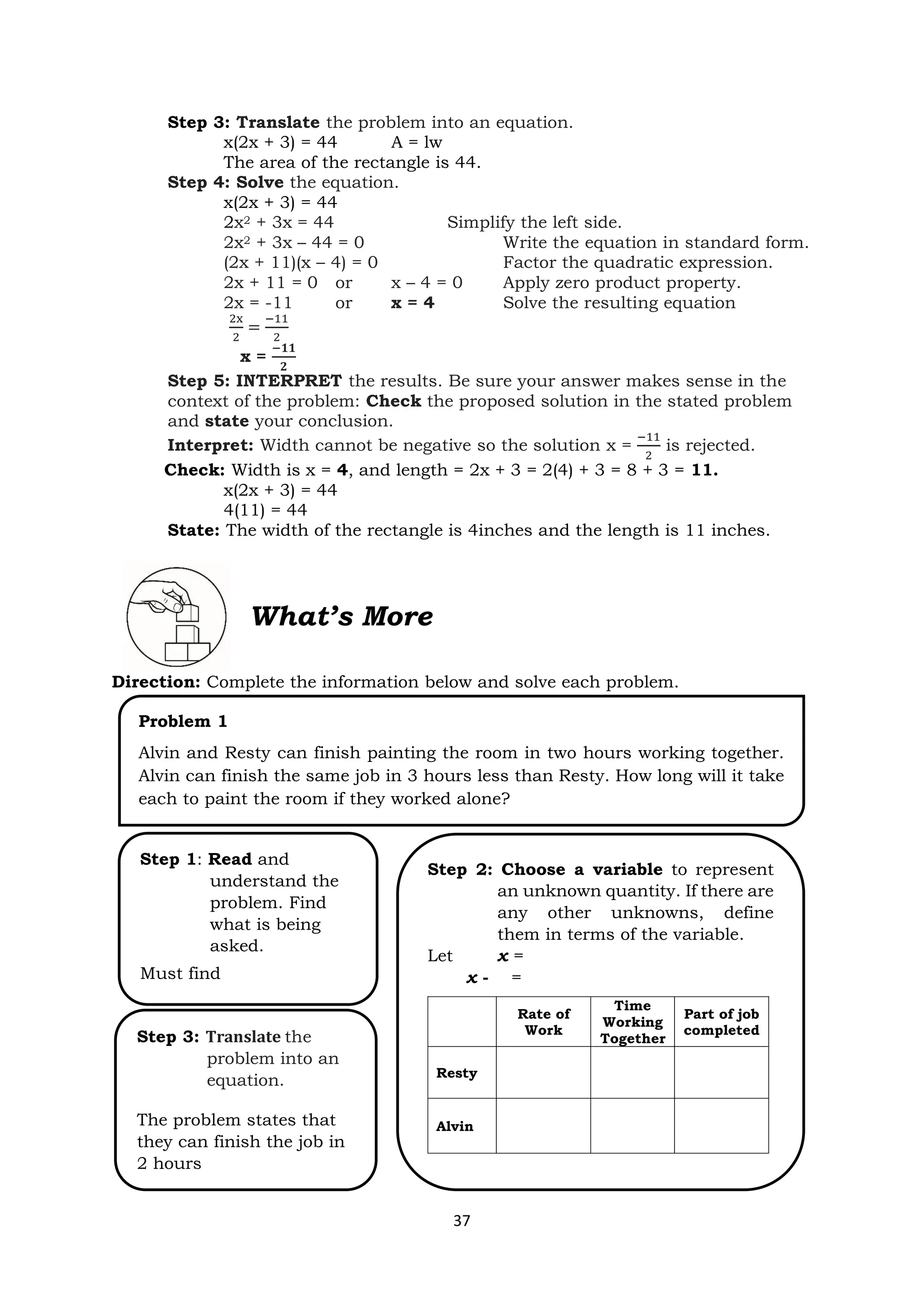
Step 3: Translate the problem into an equation.
x(2x + 3) = 44 A = lw
The area of the rectangle is 44.
Step 4: Solve the equation.
x(2x + 3) = 44
2x2 + 3x = 44 Simplify the left side.
2x2 + 3x – 44 = 0 Write the equation in standard form.
(2x + 11)(x – 4) = 0 Factor the quadratic expression.
2x + 11 = 0 or x – 4 = 0 Apply zero product property.
2x = -11 or x = 4 Solve the resulting equation
2x
2
=
−11
2
x =
−𝟏𝟏
𝟐
Step 5: INTERPRET the results. Be sure your answer makes sense in the
context of the problem: Check the proposed solution in the stated problem
and state your conclusion.
Interpret: Width cannot be negative so the solution x =
−11
2
is rejected.
Check: Width is x = 4, and length = 2x + 3 = 2(4) + 3 = 8 + 3 = 11.
x(2x + 3) = 44
4(11) = 44
State: The width of the rectangle is 4inches and the length is 11 inches.
What’s More
Direction: Complete the information below and solve each problem.
Problem 1
Alvin and Resty can finish painting the room in two hours working together.
Alvin can finish the same job in 3 hours less than Resty. How long will it take
each to paint the room if they worked alone?
Step 1: Read and
understand the
problem. Find
what is being
asked.
Must find
Step 3: Translate the
problem into an
equation.
The problem states that
they can finish the job in
2 hours
Step 2: Choose a variable to represent
an unknown quantity. If there are
any other unknowns, define
them in terms of the variable.
Let x =
x - =
Rate of
Work
Time
Working
Together
Part of job
completed
Resty
Alvin
38
What I Have Learned
There are problems that can be modeled into rational equations, and some of
it can be rewritten into quadratic equation. Any method that is more convenient or
more comfortable to use can be utilized when solving the resulting quadratic
equations.
Remember!
Steps for Solving Word Problems
Step 1: Read and understand the problem. Identify what is/are being asked to find.
Step 2: Choose a variable to represent an unknown quantity. If there are any other
unknowns, define them in terms of the variable.
Step 3: Translate the problem into an equation.
Step 4: Solve the equation.
Step 5: INTERPRET the results. Be sure your answer makes sense in the context of
the problem: Check the proposed solution in the stated problem and state
your conclusion.
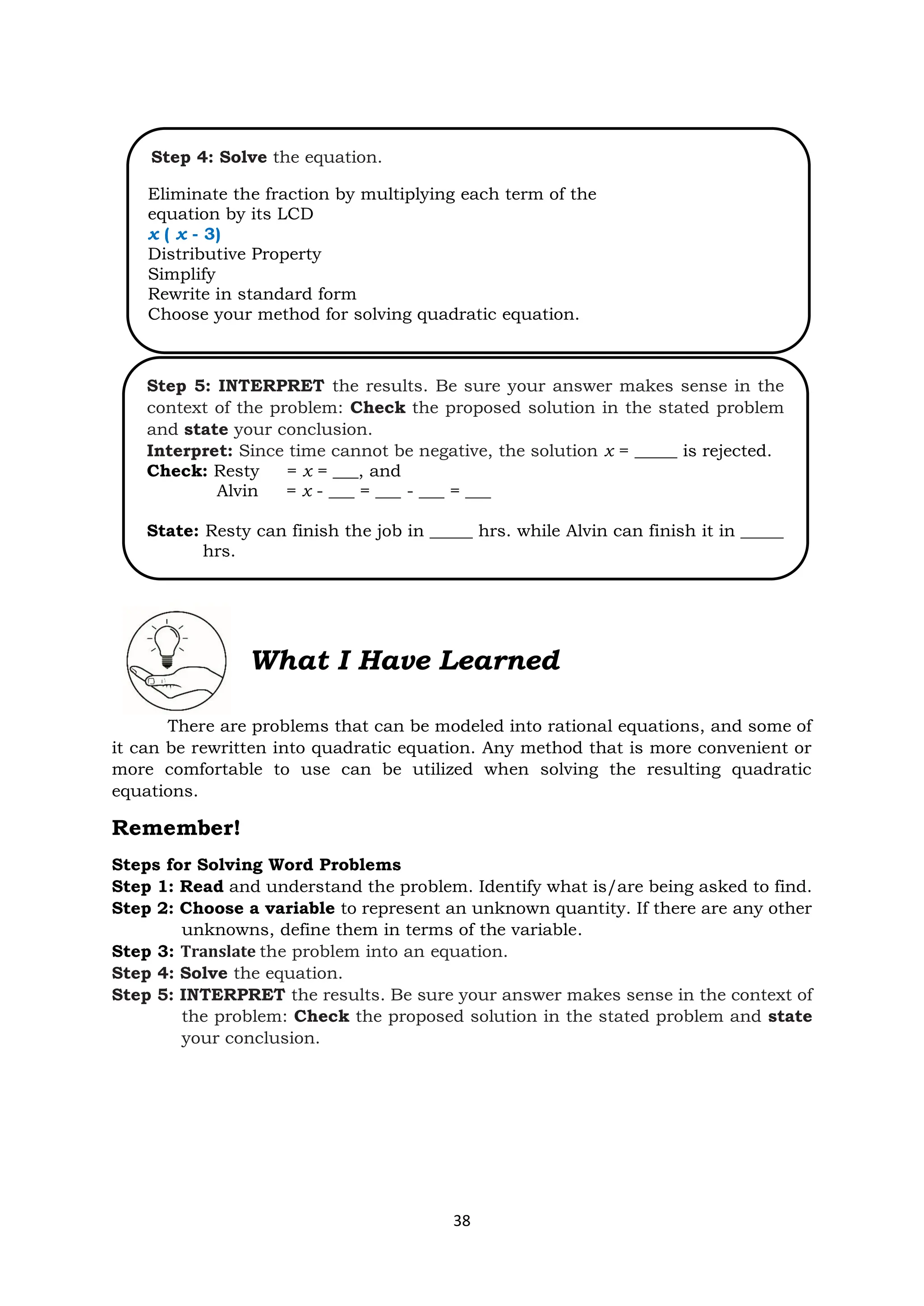
Step 4: Solve the equation.
Eliminate the fraction by multiplying each term of the
equation by its LCD
x ( x - 3)
Distributive Property
Simplify
Rewrite in standard form
Choose your method for solving quadratic equation.
Step 5: INTERPRET the results. Be sure your answer makes sense in the
context of the problem: Check the proposed solution in the stated problem
and state your conclusion.
Interpret: Since time cannot be negative, the solution x = _____ is rejected.
Check: Resty = x = ___, and
Alvin = x - ___ = ___ - ___ = ___
State: Resty can finish the job in _____ hrs. while Alvin can finish it in _____
hrs.
39
Assessment
Multiple choice: Read and understand each item carefully and choose the letter of
your correct answer.
1. What equation has an exponent of one and the graph of
these equation results in a straight line?
A. Cubic Equation C. Quadratic Equation
B. Polynomial Equation D. Linear Equation
2. Which of the following equations is the first-degree equation?
A. 4x3 = 0 C. y = 2x + 3
B. 2x2 + 2x – 6 = 0 D. (x + 3) (x – 3) = 0
3. What is the equation that is also called second degree equation?
A. Linear Equation C. Polynomial Equation
B. Cubic Equation D. Quadratic Equation
4. What is the quadratic equation in standard form if a = 2, b = -3 and c =-6?
A. x2 – 3x – 6 = 0 C. 3x2 + 2x + 6x = 0
B. 2x2 – 3x – 6 = 0 D. 2x2 + 3x + 6 = 0
5. Which are the values of a, b, and c in the equation 5x2 – 2 = 0
A. a = 5, b = 2, c = 0 C. a = 5, b = 0, c = - 2
B. a = 5, b = - 2, c = 0 D. a = 5, b = 0, c = 2
6. Which quadratic equation can be solved by the square root method?
A.
1
2
𝑥2
+
1
3
𝑥 + 5 = 0 C. 2x + 3y = 5
B. 2x + 3 = 5 D. 2x2 = 8
7. Which quadratic equation can be factored?
A. 5x2 + 4x + 3 = 0 C. 5x2 + 2x - 3 = 0
B. x2 – 4x – 3 = 0 D. 5x2 + 3 = 0
8. What are the roots of the equation 𝑥2
− 400 = 0?
A.  20 C. ±√20
B.  400 D. no real solutions
9. What is the first step in solving the equation 3𝑥2 + 12𝑥 = 9 by completing the
square?
A. Add 36 to each side of the equation.
B. Factor the left side as 3𝑥(𝑥 + 4).
C. Extract the square roots of both sides of the equation.
D. Divide the whole equation by 3.
10.The following are the steps solving quadratic equations using quadratic
formula.
I. Identify the values of a, b and c.
II. Rewrite the equation into standard form.
III. Perform the operations
IV. Substitute the values in the formula.
Which of the following is the correct sequence?
A. I, II, III, IV C. II, IV, I, III
B. II, I, IV, III D. I, IV, II, III
40
11.The roots of a quadratic equation are –4 and
1
2
. Which of the following
characterizes these roots?
A. Both are real numbers C. Both A and B
B. Both are rational numbers D. None of the above
12.What do you call the number that determines the nature of roots of a
quadratic equation?
A. discriminant C. roots
B. standard form D. quadratic formula
13.Which of the following is used to solve the sum of the roots of the quadratic
equation?
A.
b
a
C.
c
a
B.
b
a
− D.
c
a
−
14.What is the sum of the roots of the quadratic equation 2
4 12 0
x x
− − = ?
A. 4 C. 12
B. -4 D. -12
15. What is the standard form of
x+3
5
=
2
x
?
A. x2 – 3x + 10 = 0 C. x2 + 3x + 10 = 0
B. x2 – 3x – 10 = 0 D. x2 + 3x – 10 = 0
16.One of the roots of 8x(x – 1) = 7x2 + 4x is 12. What is the other root?
A. -2 C. 0
B. -1 D. 1
17.Michael solved the puzzle 20 minutes faster than Alex. Represent the time it
takes Michael to finish the puzzle if Alex is x.
A. x + 20 C. 20x
B. x – 20 D.
20
x
18.What is the LCD of the equation
( )
2 2
1
6
x x
+ =
−
?
A. x C. x (x – 6)
B. x – 6 D. x + (x – 6)
19.What do you call a part of job done in one unit of time?
A. time worked C. distance
B. rate of work D. rate of travel
20.Sarah drove her car 800 km to see her friend. The return trip was 2 hrs.
faster at a speed that was 10 kph more. Which equation will solve her return
speed if x represents her speed on her first trip?
A.
800 800
2
10
x x
− =
+
C.
800 800
2
10
x x
− =
+
B.
800 800
10
2
x x
− =
+
D.
800 800
10
2
x x
− =
+
41
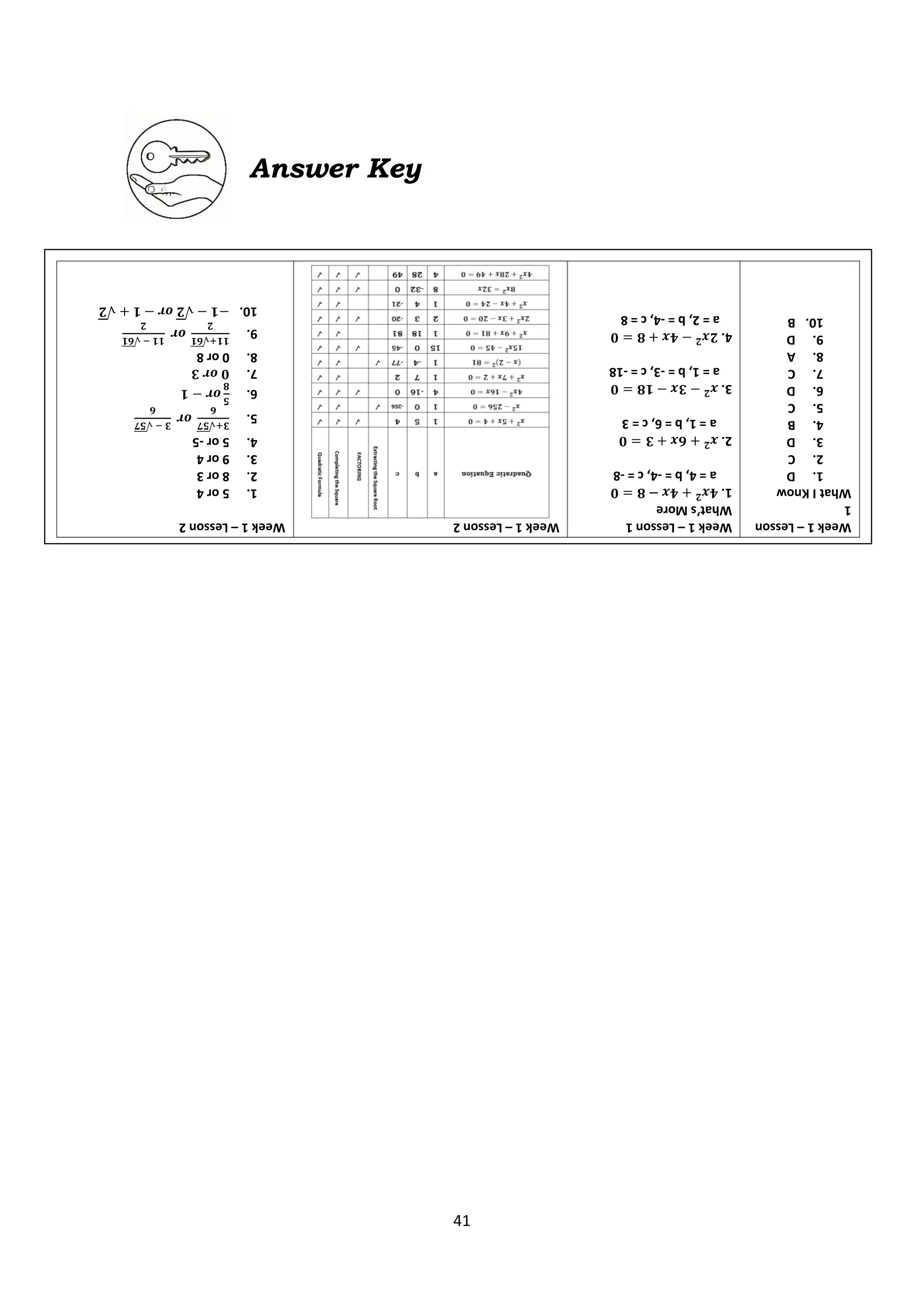
Answer Key
Week
1
–
Lesson
1
What
I
Know
1.
D
2.
C
3.
D
4.
B
5.
C
6.
D
7.
C
8.
A
9.
D
10.
B
Week
1
–
Lesson
1
What’s
More
1.
𝟒𝒙
𝟐
+
𝟒𝒙
−
𝟖
=
𝟎
a
=
4,
b
=
-4,
c
=
-8
2.
𝒙
𝟐
+
𝟔𝒙
+
𝟑
=
𝟎
a
=
1,
b
=
6,
c
=
3
3.
𝒙
𝟐
−
𝟑𝒙
−
𝟏𝟖
=
𝟎
a
=
1,
b
=
-3,
c
=
-18
4.
𝟐𝒙
𝟐
−
𝟒𝒙
+
𝟖
=
𝟎
a
=
2,
b
=
-4,
c
=
8
Week
1
–
Lesson
2
Week
1
–
Lesson
2
1.
5
or
4
2.
8
or
3
3.
9
or
4
4.
5
or
-5
5.
𝟑+√𝟓𝟕
𝟔
𝒐𝒓
𝟑
−
√𝟓𝟕
𝟔
6.
𝟓
𝟖
𝒐𝒓
−
𝟏
7.
𝟎
𝒐𝒓
𝟑
8.
0
or
8
9.
𝟏𝟏+√𝟔𝟏
𝟐
𝒐𝒓
𝟏𝟏
−
√𝟔𝟏
𝟐
10.
−𝟏
−
√𝟐
𝒐𝒓
−
𝟏
+
√𝟐

Q1 A-D-M Grade 9 - Mathematics week 1-4

  • 1.
    1 9 Mathematics Quarter 1 –Module: Week 1 to Week 4
  • 2.
    2 Math – Grade9 Alternative Delivery Mode Quarter 1 – Module 1: Week 1 to Week 4 First Edition, 2020 Republic Act 8293, section 176 states that: No copyright shall subsist in any work of the Government of the Philippines. However, prior approval of the government agency or office wherein the work is created shall be necessary for exploitation of such work for profit. Such agency or office may, among other things, impose as a condition the payment of royalties. Borrowed materials (i.e., songs, stories, poems, pictures, photos, brand names, trademarks, etc.) included in this book are owned by their respective copyright holders. Every effort has been exerted to locate and seek permission to use these materials from their respective copyright owners. The publisher and authors do not represent nor claim ownership over them. Published by the Department of Education Secretary: Undersecretary: Assistant Secretary: Printed in the Philippines by ________________________ Department of Education – Bureau of Learning Resources (DepEd-BLR) Office Address: ____________________________________________ ____________________________________________ Telefax: ____________________________________________ E-mail Address: ____________________________________________ Development Team of the Module Authors: Maria Teresa E. Antenor; Jerome Basijan; Ruby Joy B. Torres; Marcia Cristina A. Lopez; Bayani P. Marquez Jr. Editor: Marlon C. De Mesa Reviewer: Digna P. Orden Illustrator: Authors Layout Artist: Authors Management Team: Division Grade 9 Intervention Material (IM)
  • 3.
    3 9 Mathematics Quarter 1 –Module 1: Week 1 to Week 4 This instructional material was collaboratively developed and reviewed by educators from public and private schools, colleges, and/or universities. We encourage teachers and other education stakeholders to email their feedback, comments, and recommendations to the Department of Education at action@deped.gov.ph. We value your feedback and recommendations.
  • 4.
    4 Introductory Message To thefacilitator. Familiarize yourself on how to use this module. There are key words that may help you with the module structure. See to it that you demonstrate mastery of the competencies and be prepared for the thoughts and ideas that students may ask. Always assess your students as to how you will support them to finish this module with clear understanding of the lesson. To the students Take good care of this module. This contains discussion, exercises, and activities that you need to accomplish and submit to your teacher in- charge. You must have a pen and a notebook with you to take down notes as your class and teacher go along with the module process. Always show enthusiasm, determination, and willingness to learn in each class and feel free to ask questions to your teacher during the discussion in this module. To the parents. This module aims to help your children learn at their own pace. It uses language that can be easily understood by whoever is using it and as a parent, it is our duty to show love and support to our child. Give them time for learning and help them in any way possible so that they will achieve the learning they deserve. If you have questions and clarifications regarding any parts of this module, you may ask the teacher in charge to your child.
  • 5.
    5 What I Needto Know CONTENT STANDARDS: The learner demonstrates an understanding of key concepts of quadratic equations, inequalities, functions and rational algebraic equations. PERFORMANCE STANDARDS: The learner is able to investigate thoroughly mathematical relationships in various situations, formulate real-life problems involving quadratic equations, inequalities and functions, and rational algebraic equations and solve them using a variety of strategies. This module is divided into six lessons, namely: • Lesson 1: Illustrating quadratic equations. • Lesson 2: Solve quadratic equation using (a) extracting the square root, (b) factoring, (c) completing the square, and (d) quadratic formula. • Lesson 3: Discriminant and nature of the roots. • Lesson 4: Sum and product of the roots. • Lesson 5: Solve equations transformable to quadratic equation. • Lesson 6: Solve word problem that involve quadratic equation. After going through this module, you are expected to: • illustrate quadratic equations. • Solve quadratic equation using (a) extracting the square root, (b) factoring, (c) completing the square, and (d) quadratic formula. • characterizes the roots of a quadratic equation using the discriminant. • describes the relationship between the coefficients and the roots of a quadratic equation. • solves equations transformable to quadratic equations (including rational algebraic equations). • solves problems involving quadratic equations and rational algebraic equations.
  • 6.
    6 What I Know Multiplechoice: Read and understand each item carefully and choose the letter of your correct answer. 1. What equation has an exponent of one and the graph of these equation results in a straight line? A. Cubic Equation C. Quadratic Equation B. Polynomial Equation D. Linear Equation 2. Which of the following equations is the first-degree equation? A. 4x3 = 0 C. y = 2x + 3 B. 2x2 + 2x – 6 = 0 D. (x + 3) (x – 3) = 0 3. What is the equation that is also called second degree equation? A. Linear Equation C. Polynomial Equation B. Cubic Equation D. Quadratic Equation 4. What is the quadratic equation in standard form if a = 2, b = -3 and c =-6? A. x2 – 3x – 6 = 0 C. 3x2 + 2x + 6x = 0 B. 2x2 – 3x – 6 = 0 D. 2x2 + 3x + 6 = 0 5. Which are the values of a, b, and c in the equation 5x2 – 2 = 0 A. a = 5, b = 2, c = 0 C. a = 5, b = 0, c = - 2 B. a = 5, b = - 2, c = 0 D. a = 5, b = 0, c = 2 6. Which quadratic equation can be solved by the square root method? A. 1 2 𝑥2 + 1 3 𝑥 + 5 = 0 C. 2x + 3y = 5 B. 2x + 3 = 5 D. 2x2 = 8 7. Which quadratic equation can be factored? A. 5x2 + 4x + 3 = 0 C. 5x2 + 2x - 3 = 0 B. x2 – 4x – 3 = 0 D. 5x2 + 3 = 0 8. What are the roots of the equation 𝑥2 − 400 = 0? A.  20 C. ±√20 B.  400 D. no real solutions 9. What is the first step in solving the equation 3𝑥2 + 12𝑥 = 9 by completing the square? A. Add 36 to each side of the equation. B. Factor the left side as 3𝑥(𝑥 + 4). C. Extract the square roots of both sides of the equation. D. Divide the whole equation by 3. 10.The following are the steps solving quadratic equations using quadratic formula. I. Identify the values of a, b and c. II. Rewrite the equation into standard form. III. Perform the operations IV. Substitute the values in the formula. Which of the following is the correct sequence? A. I, II, III, IV C. II, IV, I, III B. II, I, IV, III D. I, IV, II, III
  • 7.
    7 11.The roots ofa quadratic equation are –4 and 1 2 . Which of the following characterizes these roots? A. Both are real numbers C. Both A and B B. Both are rational numbers D. None of the above 12.What do you call the number that determines the nature of roots of a quadratic equation? A. discriminant C. roots B. standard form D. quadratic formula 13.Which of the following is used to solve the sum of the roots of the quadratic equation? A. b a C. c a B. b a − D. c a − 14.What is the sum of the roots of the quadratic equation 2 4 12 0 x x − − = ? A. 4 C. 12 B. -4 D. -12 15. What is the standard form of x+3 5 = 2 x ? A. x2 – 3x + 10 = 0 C. x2 + 3x + 10 = 0 B. x2 – 3x – 10 = 0 D. x2 + 3x – 10 = 0 16.One of the roots of 8x(x – 1) = 7x2 + 4x is 12. What is the other root? A. -2 C. 0 B. -1 D. 1 17.Michael solved the puzzle 20 minutes faster than Alex. Represent the time it takes Michael to finish the puzzle if Alex is x. A. x + 20 C. 20x B. x – 20 D. 20 x 18.What is the LCD of the equation ( ) 2 2 1 6 x x + = − ? A. x C. x (x – 6) B. x – 6 D. x + (x – 6) 19.What do you call a part of job done in one unit of time? A. time worked C. distance B. rate of work D. rate of travel 20.Sarah drove her car 800 km to see her friend. The return trip was 2 hrs. faster at a speed that was 10 kph more. Which equation will solve her return speed if x represents her speed on her first trip? A. 800 800 2 10 x x − = + C. 800 800 2 10 x x − = + B. 800 800 10 2 x x − = + D. 800 800 10 2 x x − = +
  • 8.
    8 WEEK 1 Lesson1 Illustrating QuadraticEquation What’s In Let us recall some of the properties of equality. It is important that we master these principles as we will use them for this lesson. Addition Property. The property that states that if you add the same number to both sides of an equation, the sides remain equal. 2x = –5 Given equation 2x + 5 = –5 + 5 Add 5 to both sides of the equation 2x + 5 = 0 Simplify –5 + 5 3x2 – 7 = 4x Given equation 3x2 – 7 +(–4x) = 4x + (–4x) Add –4x to both sides of the equation 3x2 – 7 – 4x = 0 Simplify 4x + (–4x) Distributive Property. The distributive property lets you multiply a sum by multiplying each addend separately and then add the products. 3(x2 + 4x – 2) = 0 Given equation 3(x2) + 3(4x) – 3(2) = 0 Multiply each term of the trinomial by 3. 3x2 + 12x – 6 = 0 Evaluate the products 2x(x – 5) = 0 Given equation 2x(x) – 2x(5) = 0 Multiply each term of the binomial by 2x. 3x2 – 7 – 4x = 0 Evaluate the products Square of a binomial is a factored form of perfect square trinomial. Square of binomials Perfect Square Trinomial (x – 4)2 x2 – 8x + 16 (2x + 3)2 4x2 + 12x + 9 Multiplication of two binomials is usually done using the FOIL method. (x + 2) (x + 5) = x2 + 7x + 10 (x – 4) (x + 3) = x2 – x – 12
  • 9.
    9 What’s New Let ustake a look at the pictures of some the attractions in our country. Before we dig deeper about these shapes which are some of the real life applications of quadratic equation, let us first define what quadratic equation is. The Arch of the Centuries Arko ng mga Siglo , is a triumphal arch at the Plaza Intramuros of the University of Santo Tomas (UST) in Manila. Morong Beach (Nakabuang Arch) located in Sabtang, Batanes The Las Piñas Bamboo Organ in St. Joseph Parish Church in Las Piñas City, Philippines, is a 19th- century church organ with unique organ pipes.
  • 10.
    10 What is It Aquadratic equation is a polynomial equation whose highest exponent is 2. It is also called second degree equation. Examples of Quadratic equations: x2 – 3 = 4x 13x = 8 – 5x2 x2 = 49 (x + 2)(x + 3) = 9 (When multiplied results to quadratic equation) Following examples are NOT quadratic equation and their reasons. x2 – 8x + 7 Not an equation (no equal sign) 2x2 – x3 + 1 = 0 Highest exponent is 3 3x + 4y = 5 Highest exponent is 1 4x2 + 4x + > 1 This is an inequality. The Standard Form of quadratic equation is denoted by the equation 𝒂𝒙𝟐 + 𝒃𝒙 + 𝒄 = 𝟎, where a, b, and c are elements of real number, a must be greater than zero (a > 0). ax2 is called the quadratic term, bx is called the linear term and c is the constant term. Example 1: 3x2 – 7x + 4 = 0 Observe that the given equation is already in standard form. Let us classify each term of the equation. 3x2 – 7x + 4 = 0 quadratic linear constant term term term Take note that the values of a, b and c are the coefficients of each term. This means that a = 3, b = –7 and c = 4.
  • 11.
    11 Example 2: x2– 15 = 2x To make it in standard form, we apply addition property of equality. x2 – 15 = 2x x2 – 15 + (–2x) = 2x + (–2x) x2 – 15 – 2x = 0 x2 – 2x – 15 = 0 Given equation Add –2x to both sides of the equation. Simplify Arrange the terms in order x2 – 2x – 15 = 0 is now in standard form so we can identify each term. x2 – 2x – 15 = 0 quadratic linear constant term term term a = 1 b = –2 c = –15 What’s More Try it out! Rewrite the following equations in Standard Form and determine the values of a, b and c. 1. 4(x2 – 2 + x) = 0 Standard Form: __________________________________________ a = ___________, b = _________________, c = _______________ 2. 3 + x2 = –6x Standard Form: __________________________________________ a = ___________, b = _________________, c = _______________ 3. x2 – 3x = 18 Standard Form: __________________________________________ a = ___________, b = _________________, c = _______________ 4. 2(4 – 2x + x2) = 0 Standard Form: __________________________________________ a = ___________, b = _________________, c = _______________
  • 12.
    12 What I HaveLearned Quadratic equation is a second-degree equation. Standard Form of Quadratic Equation is a form denoted by 𝒂𝒙𝟐 + 𝒃𝒙 + 𝒄 = 𝟎, where a, b, and c are elements of real number, a must be greater than zero (a > 0). ax2 is called the quadratic term, bx is called the linear term and c is the constant term. WEEK 1 Lesson2 Solve quadratic equation using (a) extracting the square root, (b) factoring, (c) completing the square, and (d) quadratic formula. What’s In ➢ EXTRACTING THE SQUARE ROOT A quadratic equation in one variable of the form ax2 – c = 0 or ax2 = c where a ≠ 0, may be solved easily by extracting the square roots. Solving for x in the quadratic equation x2 = c means finding the values of x that might have been squared to get c. In this case the two values of x are +√𝒄 𝒂𝒏𝒅 − √𝒄, 𝑠𝑖𝑛𝑐𝑒 (+√𝒄) 𝟐 = 𝒄 𝑎𝑛𝑑 𝑡ℎ𝑒 (−√𝒄) 𝟐 = 𝒄 . To solve quadratic equations of the form ax2 – c = 0 : ax2 – c = 0 ax2 – c + c = 0 + c ax2 = c 𝑎𝑥2 𝑎 = 𝑐 𝑎 √𝑥2 = √ 𝑐 𝑎 X = ±√ 𝑐 𝑎 1. Use the Addition Property of Equality to write the equation in the form ax2 = c. 2. Divide both sides of the equation by a. 3. Extract the square root on both sides of the equation. 4. Determine the nature of the roots as: a.) 2 real rational equal roots; b.) 2 real rational unequal roots; c.) 2 real irrational unequal roots; d.) no real roots
  • 13.
    13 ➢ FACTORING Solve forthe roots of the quadratic equation x2 + 3x – 10 = 0 using factoring. x2 + 3x – 10 Factor the 1st and the last terms x x 10 –1 We can now rewrite the quadratic equation in factored form: (x – 2) (x + 5) = 0 Use the Zero Product Property: (x – 2) = 0 or (x + 5) = 0 Applying Addition Property of Equality, we have x – 2 + 2 = 0 + 2, x + 5 – 5 = 0 –5 So; x = 2 and x = –5 Therefore, the rots are -5 or 2. a b If have two mystery numbers a and b and I've written them on cards that are face down. I tell you that if I multiply the two numbers together, the answer I get is 0. What does this tell you about the numbers I wrote down? The only way for two numbers to have a product of 0 is for one, or both, of them to be 0. It could be a is 0 or b is 0 or both a and b are zero. This is the ZERO PRODUCT PROPERTY The Zero Product Property says that if two numbers a and b have a product of 0, then one or both of them is equal to 0. –5 2 5 –2 –10 1 Which among the factors of the last term 10 will be equal to the middle constant term 3 when added? Check it out!! When we multiply 5 and –2 we have –10 and when we add them, their sum is 3. (5)(–2) = –10 and 5 + (–2) = 3.
  • 14.
    14 ➢ COMPLETING THESQUARE Here are the steps in solving quadratic equations ax2 + bx + c = 0 by completing the square: 1. Transform the equation ax2 + bx + c = 0 into ax2 + bx = c. 2. Divide each term of the equation by a if necessary, so that the equation will be x2 + bx = c or 𝒙𝟐 + 𝒃𝒙 𝒂 = 𝒄 𝒂 . 3. Divide the coefficient of x by 2 and square it, ( 𝒃 𝟐𝒂 ) 𝟐 . 4. Add the result on both sides of the equation to make it a perfect square trinomial: 𝒙𝟐 + 𝒃𝒙 + ( 𝒃 𝟐 ) 𝟐 = 𝒄 + ( 𝒃 𝟐 ) 𝟐 or 𝒙𝟐 + 𝒃𝒙 𝒂 + ( 𝒃 𝟐𝒂 ) 𝟐 = 𝒄 𝒂 + ( 𝒃 𝟐𝒂 ) 𝟐 . 5. Factor the left side of the equation and simplify the right side: (𝒙 + 𝒃 𝟐 ) 𝟐 = 𝟒𝒄+𝒃𝟐 𝟒 or (𝒙 + 𝒃 𝟐𝒂 ) 𝟐 = 𝟒𝒂𝒄+ 𝒃𝟐 𝟐𝒂 6. Extract the square root on both side of the equation: (𝒙 + 𝒃 𝟐 ) 𝟐 = 𝟒𝒄+𝒃𝟐 𝟒 or (𝒙 + 𝒃 𝟐𝒂 ) 𝟐 = 𝟒𝒂𝒄+ 𝒃𝟐 𝟐𝒂 𝒙 + 𝒃 𝟐 = ± √𝒃𝟐+𝟒𝒄 𝟐 or 𝒙 + 𝒃 𝟐𝒂 = ± √𝒃𝟐+𝟒𝒂𝒄 𝟐𝒂 7. Solve for the values of the variable. 8. Check each solution by substituting each values to the original equation. Solve for the roots of the quadratic equation 2x2 + 4x - 16 = 0. 𝟐 𝒙𝟐 + 𝟒𝐱 −𝟏𝟔 2 = 0 2 Divide both sides of the equation by 2. x2 + 2x – 8 = 0 x2 + 2x – 8 + 8 = 0 + 8 Add 8 on both sides of the equation. x2 + 2x + 1 = 8 + 1 Divide the coefficient of x which is 2 by 2, then square it and add it on both sides of the equation. ( x + 1) 2 = 9 Express the perfect square trinomial into square of binomial. √(𝑥 + 1)2 = ±√9 Get the square root of both sides of the equation. x + 1 = ± 3 x = ± 3 – 1 Subtract 1 on both sides of the equation x = 3 – 1 or x = - 3 – 1 Solve for the values of x. x = 2 and x = - 4 Therefore, the roots are -4 or 2.
  • 15.
    15 Check each root(-4 or 2) to the original equation (2x2 + 4x - 16 = 0). a. If x = 2 b. If x = - 4 2 x2 + 4x - 16 = 0 2 x2 + 4x - 16 = 0 2(2)2 + 4(2) - 16 = 0 2(- 4 )2 + 4(- 4) - 16 = 0 2(4) + 8 – 16 = 0 2(16) – 16 – 16 = 0 8 + 8 – 16 = 0 32 – 16 – 16 = 0 16 – 16 = 0 16 – 16 = 0 ➢ QUADRATIC FORMULA Let us explore and solve for the values of x if our equation is ax2 + bx + c = 0 by completing the square. Standard form of a quadratic equation ax2 + bx + c = 0 1. Transpose the constant term to the right side of the equation. ax2 + bx = –c 2. Divide each term of the equation by a if necessary 𝑎𝑥2 𝑎 + 𝑏𝑥 𝑎 = −𝑐 𝑎 3. Divide the coefficient of x by 2 and square the result. ( 𝑏 𝑎 ) ( 1 2 ) = 𝑏 2𝑎 ( 𝑏 2𝑎 ) 2 = 𝑏2 4𝑎2 4. Add the result to both sides of the equation to make it a perfect square trinomial. x2 + 𝑏𝑥 𝑎 + 𝑏2 4𝑎2 = −𝑐 𝑎 + 𝑏2 4𝑎2 5. Factor the left side of the equation and simplify the right side: (𝑥 + 𝑏 2𝑎 ) 2 = 𝑏2−4𝑎𝑐 4𝑎2 6. Extract the square root on both side of the equation: x + 𝑏 2𝑎 =  √ 𝑏2−4𝑎𝑐 4𝑎2 7. Transpose 𝑏 2𝑎 to the right side of the equation then simplify. x + 𝑏 2𝑎 =  √𝑏2−4𝑎𝑐 2𝑎 x = – 𝑏 2𝑎  √𝑏2−4𝑎𝑐 2𝑎 x = −𝑏 ± √𝑏2−4𝑎𝑐 2𝑎
  • 16.
    16 Therefore, the quadraticformula is given by: x = −𝒃 ± √𝒃𝟐−𝟒𝒂𝒄 𝟐𝒂 where a  0. To solve a quadratic equation using this formula, we will follow the steps below: 1. Rewrite the equation in standard form and identify the values of a, b and c. 2. Write the formula and substitute the values in the formula. 3. Perform the operations then simplify. In the following examples, you are guided by the step-by-step procedure in on how use quadratic formula in solving quadratic equations. It is important to carefully examine the procedure as others may vary depending upon the resulting values in your computation. Example 1: Solve for the roots of 2x2 + 5x – 12 = 0. Solution: 2x2 + 5x – 12 = 0 is already in standard form. Steps Solution Given equation 2x2 + 5x – 12 = 0 Rewrite the equation in standard form and identify the values of a, b and c. 2x2 + 5x – 12 = 0 a = 2, b = 5, c = –12 Write the formula and This is where we will write the values. substitute the values in the formula. x = −𝑏 ± √𝑏2−4𝑎𝑐 2𝑎 x = −( ) ± √( )2−4( )( ) 2( ) x = −( 5 ) ± √( 5 )2−4( 2 )( –12 ) 2( 2 ) Perform the operations then simplify. x = −5 ± √25+96 4 x = −5 ± √121 4 x = −5 ± 11 4
  • 17.
    17 This time, wewill separate it into two equations with one positive and the other is negative. x = −5 + 11 4 x = −5 − 11 4 x = 6 4 x = −16 4 x = 3 2 x = –4 The roots of the given equation are 3 2 or –4 What’s New MORE EXAMPLES USING EXTRACTING THE SQUARE ROOT Solve x2 = - 25 Extract the square root on both sides of the equation. √𝑥2 = √−25 x = ± √−25 The roots are imaginary or the equation has no real solution. Solve x2 = 50 Extract the square root on both sides of the equation. √𝑥2 = √50 Simplify √50 by factoring 50 𝑎𝑠 25 (2). √𝑥2 = √25 (2) √𝑥2 = √25 • √2 x = ±5 √2 The roots are -10 or 10. We may write the roots as {−𝟓√𝟐, 𝟓√𝟐} Solve ( 2x – 1)2 = 4 √(2𝑥 − 1)2 = √4 Extract the square root of both sides of the equation. 2x – 1 = ± 2 Solve for x from the 2 derived equations. 2x = 1 ± 2 Addition Property of Equality 2x = 1 + 2 or 2x = 1 – 2 2x = 3 or 2x = – 1 2𝑥 2 = 3 2 or 2𝑥 2 = − 1 2 Division Property of Equality x = 3 2 and x = −1 2 The roots are − 𝟏 𝟐 𝒐𝒓 𝟑 𝟐 We may write the roots as {− 𝟏 𝟐 , 𝟑 𝟐 }
  • 18.
    18 MORE EXAMPLES USINGFACTORING Let us rewrite x2 – 5x – 14 = 0 factored form. Check the last term –14. What are the factors of –14 that will give a sum equal to the coefficient of the middle term which is –5? 7 and –2 –14 14 Let’s solve x2 – 9x + 20 = 0 by factoring. 20 has factors of : Right!!! It is –5 and –4, because when we multiply –5 and –4, their product is 20 and when added, their sum is -9. We will now rewrite the equation as: (x – 5) (x – 4) = 0 Can you now guess the values of x? Need more??? What are the roots of x2 + 3x – 4 = 0? –4 has the pair of factors –4 and 1 4 and –1 –2 and 2 –7 and 2 14 and –1 –14 and 1 - 7 and 2 when multiplied is –14 and when added, the sum is –5 Time to rewrite the equation in factored form: (x – 7 ) (x + 2) = 0 Using the Zero Product Property: x – 7 = 0 , x + 2 = 0 Use the inverse property of addition x – 7 + 7 = 0 + 7 , x + 2 – 2 = 0 – 2 Then; x = 7 and x = –2 Which is the right pair of factors? Can you spot it now? x = 5 and x = 4 The right factors! Why? Because Their product is –4 and their sum is 3. Got it right!!! 10 and 2 –10 and –2 –5 and –4 5 and 4
  • 19.
    19 x2 + 3x– 4 = 0 Given equation (x + 4) (x – 1) = 0 Factored form x + 4 = 0 or x – 1 = 0 Zero-product property x + 4 – 4 = 0 – 4 or x – 1 + 1 = 0 + 1 Inverse property. x = –4 or x = 1 The roots of x2 + 3x – 4 = 0 or –4 and 1. MORE EXAMPLES USING COMPLETING THE SQUARE Solve for the roots of the quadratic equation 5x2 – 20x = 5 using completing the square. 𝟓 𝒙𝟐−𝟐𝟎 𝐱 5 = 5 5 Divide both sides of the equation by 5. x2 – 4x = 1 x2 – 4x + 4 = 1 + 4 Divide the coefficient of x which is 4 by 2, then square it and add it on both sides of the equation. ( x – 2) 2 = 5 Express the perfect square trinomial into square of binomial. √(𝑥 − 2)2 = ±√5 Get the square root of both sides of the equation. x – 2 = ±√5 x = ±√5 + 2 Add 2 on both sides of the equation x = √5 + 2 or x = - √5 + 2 Solve for the values of x. Check each root to the original equation. a. If x = √5 + 2 b. If x = - √5 + 2 5 x2 – 20 x = 5 5x2 – 20x = 5 5 (√5 + 2) 2 – 20 (√5 + 2) = 5 5 (−√5 + 2) 2 – 20 (−√5 + 2) = 5 5 [5 + 5 (4√5 )+ 4] – 20 √5 - 40 = 5 5 [5 + 5 ( - 4√5 )+ 4] + 20 √5 - 40 = 5 25 + 20√5 + 20 – 20 √5 - 40 = 5 25 – 20√5 + 20 + 20 √5 - 40 = 5- 45 – 40 = 5 45 – 40 = 5 5 = 5 5 = 5 The values of x satisfied the equation. Therefore, the roots of the equation 5 x2 – 20 x = 5 are √5 + 2 and - √5 + 2 .
  • 20.
    20 MORE EXAMPLES USINGQUADRATIC FORMULA What are the values of x2 – 8x = –7. Solution: Notice that the given equation is not in standard form. Steps Solution Given equation x2 – 8x = –7 Rewrite the equation in standard form and identify the values of a, b and c. x2 – 8x + 7= 0 a = 1, b = –8, c = 7 Write the formula and This is where we will write the values. substitute the values in the formula. x = −𝑏 ± √𝑏2−4𝑎𝑐 2𝑎 x = −( ) ± √( )2−4( )( ) 2( ) x = −( −8 ) ± √( −8 )2−4( 1 )( –7 ) 2( 1 ) Perform the operations then simplify. x = 8 ± √64 − 28 2 x = 8 ± √36 2 x = 8 ± 6 2 This time, we will separate it into two equations with one positive and the other is negative. x = 8 + 6 2 x = 8 − 6 2 x = 14 2 x = 2 2 x = 7 x = 1 The roots are 7 and 1.
  • 21.
    21 What is It Identifythe value of a, b, and c in each of the following quadratic equation and put a check mark (✓) in all possible method applicable to use. Quadratic Equation a b c 𝒙𝟐 + 𝟓𝒙 + 𝟒 = 𝟎 1 5 4 ✓ ✓ ✓ 𝒙𝟐 − 𝟐𝟓𝟔 = 𝟎 𝟒𝒙𝟐 − 𝟏𝟔𝒙 = 𝟎 𝒙𝟐 + 𝟕𝒙 + 𝟐 = 𝟎 (𝒙 − 𝟐)𝟐 = 𝟖𝟏 𝟏𝟓𝒙𝟐 − 𝟒𝟓 = 𝟎 𝒙𝟐 + 𝟏𝟖𝒙 + 𝟖𝟏 = 𝟎 𝟐𝒙𝟐 + 𝟑𝒙 − 𝟐𝟎 = 𝟎 𝒙𝟐 + 𝟒𝒙 − 𝟐𝟏 = 𝟎 𝟖𝒙𝟐 = 𝟑𝟐𝒙 𝟒𝒙𝟐 + 𝟐𝟖𝒙 + 𝟒𝟗 = 𝟎 What’s More Solve the following equations using any method. 1. x2 – 9x + 20 = 0 6. 8x2 + 3x = 5 2. x2 = 11x – 24 7. 6x2 + 6 = 18x + 6 3. x2 + 36 = 13x 8. 4x2 = 32x 4. x2 – 25 = 0 9. 11x = x2 + 15 5. 3x2 – 3x – 4 = 0 10. 2(𝑥 + 1)2 − 4 = 0 Extracting the Square Root FACTORING Completing the Square Quadratic Formula
  • 22.
    22 What I HaveLearned Quadratic equation may be solved suing extracting the square root, factoring, completing the square, or quadratic formula. The following may help you decide on which method to use. ➢ Use extracting the square root method whenever the value of b is zero or the quadratic equation is in the form x2 = k. ➢ Use factoring method whenever the given quadratic equation is factorable. ➢ Use completing the square method or quadratic formula method in any given quadratic equation. WEEK 2 Lesson3 Discriminant and Nature of the Roots What’s In Let us classify if the roots of a quadratic equation are real, rational and equal by putting a check ( ) mark. Equation Roots Real Rational Equal x2 + 3x – 28 = 0 –7 4 ✓ ✓ 4x2 – 4x + 1 = 0 1 2 1 2 ✓ ✓ ✓ 2m2 – 5m – 2 = 0 5+√41 2 5−√41 2 ✓ This classification of roots is often referred to as the nature of roots. Moreover, the nature of roots of a quadratic equation tells us if the roots are real, rational or equal. In this lesson, we are going to describe the nature of roots of a quadratic equation without solving for the roots.
  • 23.
    23 What’s New In thequadratic formula, 𝑥 = −𝑏±√𝑏2−4𝑎𝑐 2𝑎 where a ≠ 0, the expression inside the square root sign plays an important role to determine the nature of roots of quadratic equation. This is called the discriminant. 𝑥 = −𝑏 ± √𝑏2 − 4𝑎𝑐 2𝑎 Discriminant is the number used to determine the nature of roots of quadratic equation. It is given by the formula: d = b2 – 4ac In the formula, the a, b and c are the same coefficients of a quadratic equation in standard form. In order to compute for the discriminant of a quadratic equation, we will follow the three-step procedure. 1. Rewrite the equation into standard form and identify the values of a, b and c. 2. Write the formula then substitute the values. 3. Perform the operations and simplify. Depending on the value of discriminant, the nature of roots of a quadratic equation may fall under any of the following: Value of discriminant Nature of Roots d > 0 discriminant is positive Perfect square Roots are real, rational and unequal. Not a perfect square Roots are real, irrational and unequal. d = 0 Roots are real, rational and equal d < 0 discriminant is negative Roots are not real. It is important that the computed discriminant is correct to arrive at the appropriate nature of roots. discriminant
  • 24.
    24 Let us considerthe following examples: Example 1: Compute for the discriminant of 9x2 – 12x + 4 = 0 Step Solution Rewrite into standard form and identify the values of a, b and c 9x2 – 12x + 4 = 0 a = 9, b = –12, c = 4 Write the formula then Substitute d = b2 – 4ac d = (–12)2 – 4(9)(4) Perform the operations and Simplify Nature of the roots d = 144 – 144 d = 0 real, rational, and equal Example 2: Describe the nature of roots of 3t2 + 4t = 2. Step Solution Given equation Rewrite into standard form and identify the values of a, b and c t2 + 4t = 2 3t2 + 5t – 2 = 0 a = 3, b = 5, c = –2 Write the formula then Substitute d = b2 – 4ac d = (5)2 – 4(3)(–2) Perform the operations and Simplify Nature of the roots d = 25 + 24 d = 49 real, rational, and unequal roots What is It Let’s do this! A. Describe the nature of roots of a quadratic equation given the value of the discriminant. Write your answer on the space provided. 1. 36 ___________________________ 6. 144 ___________________________ 2. –8 ___________________________ 7. 81 ___________________________ 3. 24 ___________________________ 8. –48 ___________________________ 4. 0 ___________________________ 9. 1 2 ___________________________ 5. –17 ___________________________ 10. 1 ___________________________
  • 25.
    25 B. Write thevalue of the discriminant and describe the nature of its roots in the space below. 1. x2 + 8x + 12 = 0 Discriminant: _____ nature of roots: ______ 2. 4x2 + 3x + 3 = 0 Discriminant: _____ nature of roots: ______ 3. 4x2 + 12x + 9 = 0 Discriminant: _____ nature of roots: ______ 4. 2x2 + 1 = 5x Discriminant: _____ nature of roots: ______ 5. x2 = 5x + 4 Discriminant: _____ nature of roots: ______ What’s More Directions: Write the letter that corresponds to the discriminant of the given equations to reveal the message to everyone. OUR MEDICAL FRONTLINERS 41 25 –17 108 0 13 34 81 2 –5 27 –63 124 A B C D E F G H I J K L M 140 –8 46 71 20 49 –35 18 144 1 9 –28 36 N O P Q R S T U V W X Y Z
  • 26.
    26 What I HaveLearned Discriminant is a number used to describe the nature of roots of quadratic equation. Formula: d = b2 – 4ac Positive discriminant + perfect square Real, rational and unequal roots Positive discriminant + NOT perfect square Real, irrational and unequal roots Zero discriminant Real, rational and equal roots or One real rational root Negative discriminant No real root WEEK 2 Lesson4 Sum and Product of the Roots What’s In We have been solving quadratic equations using different methods from our previous lessons and we have also learned how to predict the nature of roots/solutions of the quadratic equations using the discriminant. In this section, let us find the relationship between the coefficients and the roots of the quadratic equation, and how are these is used to derive a quadratic equation, and also solve some real-life problems. What’s New Explore: Study the table below. The coefficients of each quadratic equation are given as well as their roots and its sum and product. How are the sum and product of the roots of the quadratic equation related to its coefficients? Equation a b c roots sum product r1 r2 r1+r2 r1 r2 1. 2 8 20 0 + − = x x 1 8 -20 2 -10 -8 -20 2. 2 2 11 12 0 − + = x x 2 -11 12 4 3/2 11/2 6 3. 2 15 14 8 0 − − = x x 15 -14 -8 4/3 -2/5 14/15 -8/15 4. 2 9 25 0 − = x 9 0 -25 5/3 -5/3 0 -25/9
  • 27.
    27 Noticed that thesum and product of the roots of the quadratic equation can be found without solving for its roots. Complete the following statement: a. The sum of the roots (r1+r2) is equal to _____. b. The product of the roots (r1 r2) is equal to _____. What is It Given any quadratic equation 2 0 + + = ax bx c whose roots are r1 and r2, the sum and product of its roots are determined by the following formulas: r1+r2 = − b a and r1r2 = c a Examples: Without solving for the roots, determine the sum and product of the roots of the following equations. 1. 2 5 50 0 + − = x x 2. 2 2 7 0 − = x x 3. − = − 2 6 30 10 x x 4. = − 2 2 18 x Solution: If necessary, write the equation in standard form and identify the values of a, b, and c, and substitute these into the formula. 1. 2 5 50 0 + − = x x  a = 1, b = 5, c = -50 Sum: r1+r2 = − b a = − 5 1 = -5 Product: r1r2 = c a = −50 1 = -50 2. 2 2 7 0 − = x x  a = 2, b = -7, c = 0 Sum: r1+r2 = − b a = −   −    7 2 = 7 2 Product: r1r2 = c a = 0 2 = 0 3. − = − 2 6 30 10 x x  + − = 2 6 10 30 0 x x  a = 6, b = 10, c = -30 Sum: r1+r2 = − b a = − 10 6 = 5 3 − Product: r1r2 = c a = −30 6 = -5 4. = − 2 2 18 x  + = 2 6 18 0 x  a = 2, b = 0, c = 18 Sum: r1+r2 = − b a = − 0 2 = 0 Product: r1r2 = c a = 18 2 = 9 5. − + = 2 1 4 2 0 4 x x  − + = 2 16 8 1 0 x x  a = 16, b = -8, c = 1 Sum: r1+r2 = − b a = −   −    8 16 = 1 2 Product: r1r2 = c a = 1 16 HINT! Eliminate the fraction by multiplying the equation by its LCD (4)
  • 28.
    28 What’s More Deriving aQuadratic Equation Given the Sum and Product of Its Roots A quadratic equation in standard form whose sum and product of its roots are known can be derived by using the formula being composed below. + + = 2 0 ax bx c Standard form of the quadratic equation + + = 2 0 b c x x a a Divide both sides of the equation by a.   − − + =     2 0 b c x x a a Express       b a as   − −     b a . Group       c a ( ) ( ) − + + = 2 1 2 1 2 0 x r r x r r Let r1 and r2 as roots, and rename   −     b a and       c a . In general, to write the quadratic equation given the sum and product of its roots, use the formula below. ( ) ( ) − + + = 2 1 2 1 2 0 x r r x r r x2 – (sum of the roots) x + (product of the roots) = 0 Example: 1. Find a quadratic equation in standard form whose sum and product of roots are the following. a. sum: -9 and product: 20 b. sum: 4 and product: -12 c. sum: − 1 6 and product: − 1 6 Solution: 1. Since r1 and r2 are the roots of the quadratic equation and r1+r2 = -9 and r1r2 = 20, then we have, ( ) ( ) − + + = 2 1 2 1 2 0 x r r x r r ( ) ( ) − − + = 2 9 20 0 x x + + = 2 9 20 0 x x Therefore, the quadratic equation is + + = 2 9 20 0 x x . 2. Given that r1+r2 = 4 and r1r2 = -12, then we have, ( ) ( ) − + + = 2 1 2 1 2 0 x r r x r r ( ) ( ) − + − = 2 4 12 0 x x − − = 2 4 12 0 x x Therefore, the quadratic equation is − − = 2 4 12 0 x x .
  • 29.
    29 What I HaveLearned ▪ For any quadratic equation 2 0 + + = ax bx c whose roots are r1 and r2, the sum and product of its roots are determined by the following formulas: r1 + r2 = − b a and r1r2 = c a ▪ A quadratic equation can be derived using the sum and product of its roots by applying the equation ( ) ( ) − + + = 2 1 2 1 2 0 x r r x r r ▪ A quadratic equation can also be derived by using its roots to do the reverse factoring method, thus utilizing the formula ( )( ) − − = 1 2 0 x r x r . WEEK 3 Lesson5 Solving Equations Transformable to Quadratic Equations What’s In Rational Equations Transformable to Quadratic Equations Rational Algebraic equation is an equation containing at least one fraction whose numerator and denominator are polynomials. To solve a rational algebraic equation that can be transformed into a quadratic equation, the following procedure can be followed. a. To eliminate the denominators, multiply both sides of the equation by the Least Common Denominator (LCD). b. Write the resulting quadratic equation in standard form. c. Find the roots of the resulting equation using any methods of solving quadratic equations. d. Check whether the obtained values of x make the equation true. What’s New Examples: 1. Find the roots of 3 x + x+1 2 = 4. Solution: 3 x + x+1 2 = 4 The LCD is 2x.
  • 30.
    30 2x ( 3 x + x+1 2 ) =2x(4) Multiply both sides of the equation by 2x. 6 + x2 + x − 8x = 0 x2 − 7x + 6 = 0 Write the equation in standard form. (x − 1)(x − 6) = 0 Solve the quadratic equation. x − 1 = 0 ; x − 6 = 0 𝐱 = 𝟏 ; 𝐱 = 𝟔 If x = 1 ; If x = 6 Check if the obtained values make the equation 3 1 + 1+1 2 = 4 ; 3 6 + 6+1 2 = 4 true. 3 + 1 = 4 ; 1 2 + 7 2 = 4 4 = 4 ;4 = 4 Both values make the equation 3 𝑥 + 𝑥+1 2 = 4 true, then the solutions of the equation are: 𝑥 = 1 or 𝑥 = 6. 2. Solve the rational algebraic equation x + 8 x−4 = 6 + 2x x−4 . x + 8 x−4 = 6 + 2x x−4 The LCD is x – 4. x − 4 (x + 8 x−4 ) = x − 4 (6 + 2x x−4 ) Multiply both sides of the equation by x – 4. x2 − 4x + 8 = 6x − 24 + 2x x2 − 4x − 8x + 8 + 24 = 0 Combine like terms and write the equation x2 − 12x + 32 = 0 in standard form. (x − 4)(x − 8) = 0 Solve the quadratic expression. x − 4 = 0 ; x − 8 = 0 x = 4 ; x = 8 If x = 4 Check if the obtained values make the equation 4 + 8 4−4 = 6 + 2x 4−4 4 + 8 0 = 6 + 2x 0 Observe that if x = 4, the value of 8 𝑥−4 is undefined. The same is true with 2𝑥 𝑥−4 . Hence, x = 4 is an extraneous root or solution. If x = 8 8 + 8 8−4 = 6 + 2(8) 8−4 8 + 8 4 = 6 + 16 4 10 = 10 The value x = 8 satisfies the original equation. Hence, the solution of x + 8 x−4 = 6 + 2x x−4 is x = 8. 3. Find the roots of 𝐱 𝟐 = 𝟏 𝐱+𝟑 . Solution: x 2 = 3 x+3 The LCD is 2(x + 3). 2(x + 3) ( x 2 ) = 2(x + 3) ( 𝟏 𝐱+𝟐 ) Multiply both sides of the equation by 2(x + 2). (x + 3)x = 2(1) x2 + 3x − 2 = 0 Write the equation in standard form. REMEMBER: An extraneous root or solution is a solution of an equation derived from an original equation, but it is not a solution of the original equation.
  • 31.
    31 Since the resultingequation is not factorable, we can use completing the square or quadratic formula. a = 1; b = 3; c = -2 Substitute the values of a, b and c x = −3±√32− 4(1)(−2) 2(1) on the formula. x = −3±√9+8 2 Simplify the result. x = −3±√17 2 𝐱 = −𝟑+√𝟏𝟕 𝟐 or 𝐱 = −𝟑−√𝟏𝟕 𝟐 Separate the two values. Note: You may solve the equation using any method in solving quadratic equations you deemed appropriate. What is It Activity 2: Trivia Time! It is a Davao specialty dish made from carabao meat. A popular dish in Davao City, each bowl comes with several pieces of carabao meat drenched in a steaming orangey-looking soup. What is the name of this delicacy? Direction: Solve each rational algebraic equation. To find out the answer to the trivia, match the letter that corresponds to the answer to the numbered item. 1. x + 5 x = −6 S x1= 2; x2 = 3 U x1= -5; x2 = -1 W x1= 1; x2 = 6 2. x−6 x = 2 x+7 G x1= -3; x2 = 14 E x1= 3; x2 = 7 C x1= -6; x2 = 7 3. x x+8 = x−2 6 D x1= -8; x2 = 8 H x1= -4; x2 = 4 L x1= -4; x2 = 8 4. 2x x+5 = x+2 7 A x1= 2; x2 = 5 C x1= 1; x2 = 10 I x1= 3; x2 = 7 5. x 2 + 5 x+3 = x K x1= 2; x2 = 5 M x1= -1; x2 = 10 O x1= -5; x2 = 2 6. x x+1 = x+2 3x L x1= 1 2 ; x2 = 2 Q x1= -2; x2 = -1 U x1= -3; x2 = 1 7. 5 3x−8 = x x+2 A x1= 2; x2 = 5 G x1= − 2 3 ; x2 = 5 N x1= -10; x2 = 3 8. x 2 + 5 x = x B x1= √10; x2 = −√10 E x1= 0; x2 = 10 H x1= -10; x2 = 10 9. x x+1 = 5 x+4 F x = −1 ± √21 N x = −1±√21 2 R x = −1±√19 2 ___ ___ ___ ___ ___ ___ ___ ___ ___ ___ 8 1 6 2 4 2 3 5 9 7
  • 32.
    32 What’s More Activity 1:A-maze-ing game! Direction: Dodge the monsters and make it home. Solve rational equations along the way to reveal the right path. If an answer leads you to a monster, you made a wrong turn. What I Have Learned Start ▪ To solve a rational algebraic equation transformable into a quadratic equation, multiply both sides of the equation by the Least Common Multiple (LCM) of all the denominators and write the resulting equation in standard form. Using any of the four methods of solving quadratic equations, find the roots of the equation and check if the obtained values make the equation true. ▪ A transformed equation may have an extraneous root or solution. An extraneous root or solution is a solution of a transformed that is not a root of the original equation.
  • 33.
    33 WEEK 4 Lesson6 Solve ProblemsInvolving Quadratic Equations What’s In There are applications in algebra that involve rational algebraic equations which are transformable to quadratic equations. Like in our previous lesson on problem solving, skills in translating verbal phrases or sentences into an expression or equation are necessary. RECALL Vocabulary rational algebraic expression – is an algebraic expression of the form n d , where n and d are polynomials and d ≠ 0. rational algebraic equation – is an equation that contain one or more rational algebraic expressions. rate - the speed at which one measured quantity happens in relation to another measured amount such as time LCD (least common denominator) - the lowest common multiple of the denominators of a set of fractions LCM (least common multiple) - the smallest common multiple of two or more numbers the smallest positive integer that is divisible to the given set of numbers B. Steps for Solving Word Problems Step 1: Read and understand the problem. Identify what is/are being asked to find. Step 2: Choose a variable to represent an unknown quantity. If there are any other unknowns, define them in terms of the variable. Step 3: Translate the problem into an equation. Step 4: Solve the equation. Step 5: INTERPRET the results. Be sure your answer makes sense in the context of the problem: Check the proposed solution in the stated problem and state your conclusion. What’s New NUMBER PROBLEM In number problems, clues about one or more numbers are given, and you use these clues to make an equation. Number problems don’t usually arise on an everyday basis, but they provide a good introduction to practicing the problem- solving strategy.
  • 34.
    34 Example 1: The squareof the sum of a number and 3 is 25. Find the number. Step 1: Read and understand the problem. Find what is being asked. Must find the number Step 2: Choose a variable to represent an unknown quantity. If there areany otherunknowns, define them in terms of the variable. Let x = the unknown number x +3 = the sum of the number and 3 Step 3: Translate the problem into an equation. (x + 3)2 = 25 The square of the sum of a number and 3 is 25. Step 4: Solve the equation. Since the equation is in the form (ax + b)2 = c, we can easily solve it by extracting square roots. (x + 3)2 = 25 √(x + 3)2 = ±√25 Extract the square root of both sides. x + 3 = ±5 x = −3 ±5 Simplify the resulting equation. x = −3 +5 or x = −3 − 5 x = 2 or x -8 Step 5: INTERPRET the results. Be sure your answer makes sense in the context of the problem: Check the proposed solution in the stated problem and state your conclusion. Interpret: x can be a positive or a negative number. Check: The number = x = 2, and The number = x = -8, and sum of the number and 3 sum of the number and 3 = x + 3 = 2 + 3 = 5 = x + 3 = -8 + 3 = 5 (x + 3)2 = 25 (x + 3)2 = 25 (2 + 3)2 = 25 (-8 + 3)2 = 25 52 = 25 52 = 25 25 = 25 25 = 25 State: The unknown number is either 2 or -8. The Novice Employee
  • 35.
    35 How long canSara finish her reports if she had asked help from her colleague from the start? The situation given previously is an example of a work problem. Work problem, and Distance/Motion problem are problems that translate into rational equation but can be simplified into quadratic equations. WORK PROBLEM It is a word problem that involves two or more people or machines working a particular job/task together but at different rates. When solving a work problem, the goal is to determine the time it takes to complete a job/task. The equation that is used to solve work problem is Rate of work  time worked = part of job/task completed Rate of work is that part of a job that is completed in one unit of time. In general, if a job can be accomplished in t units of time, then the rate of work is 1 t job per unit of time. Example 1: A small pipe takes 16 minutes longer to empty a tank than does a larger pipe. Working together, the pipes can empty the tank in 6 min. How long would it take each pipe working alone to empty the tank? Step 1: Read and understand the problem. Find what is being asked. Must determine how long it would take each pipe to empty the tank if they work alone. Step 2: Choose a variable to represent an unknown quantity. If there are any other unknowns, define them in terms of the variable. Let x = time it takes the larger pipe to empty the tank, and let x + 16 = time it takes the smaller pipe to empty the same tank. Step 3: Translate the problem into an equation. 6 6 1 16 x x + = + Rate of Work Time Working Together Part of task completed larger pipe 1 x 6 ( ) 1 6 6 x x = smaller pipe 1 16 x + 6 ( ) 1 6 6 16 16 x x = + + The sum of the parts of the job completed is equal to 1 whole job
  • 36.
    36 Step 4: Solvethe equation. x ( ) 6 6 1 x x    +  16 x x + + ( ) 6 16 x     + ( ) 1 16 x x + =     ( ) 2 16 6 6 16 x x x x + + = + Distributive Property 2 6 96 6 16 x x x x + + = + Simplify 2 0 4 96 x x = + − Rewrite in standard form ( )( ) 0 12 8 x x = + − Factor the right side of the eq. x + 12 = 0 x – 8 = 0 Zero-Product Property x = -12 x = 8 Solve for x Step 5: INTERPRET the results. Be sure your answer makes sense in the context of the problem: Check the proposed solution in the stated problem and state your conclusion. Interpret: Since time cannot be negative, the solution x = -12 is rejected. Check: Larger pipe = x = 8, and smaller pipe = x + 16 = 8 + 16 = 24. 6 6 1 16 x x + = + 6 6 1 8 24 + = 3 1 1 4 4 + = 1 = 1 State: The larger pipe requires 8 min to empty the tank while the smaller pipe requires 24 min to empty the tank. What is It GEOMETRY PROBLEM Geometry problems involve geometric figures described in words. You would need to be familiar with formulas in geometry. Making a sketch of the geometric figure is often helpful. Example 1: The length of a rectangle is 3 inches more than twice the width. The area is 44 square inches. Find the dimensions (find the length and width) of the rectangle. Step 1: Read and understand the problem. Find what is being asked. Must find the dimensions (length and width) of the rectangle Step 2:Choose a variable to represent an unknown quantity. If there are any other unknowns, define them in terms of the variable. Let x = width 2x +3 = length Eliminate the fraction by multiplying each term of the equation by its LCD x ( x + 16) x 2x + 3
  • 37.
    37 Step 3: Translatethe problem into an equation. x(2x + 3) = 44 A = lw The area of the rectangle is 44. Step 4: Solve the equation. x(2x + 3) = 44 2x2 + 3x = 44 Simplify the left side. 2x2 + 3x – 44 = 0 Write the equation in standard form. (2x + 11)(x – 4) = 0 Factor the quadratic expression. 2x + 11 = 0 or x – 4 = 0 Apply zero product property. 2x = -11 or x = 4 Solve the resulting equation 2x 2 = −11 2 x = −𝟏𝟏 𝟐 Step 5: INTERPRET the results. Be sure your answer makes sense in the context of the problem: Check the proposed solution in the stated problem and state your conclusion. Interpret: Width cannot be negative so the solution x = −11 2 is rejected. Check: Width is x = 4, and length = 2x + 3 = 2(4) + 3 = 8 + 3 = 11. x(2x + 3) = 44 4(11) = 44 State: The width of the rectangle is 4inches and the length is 11 inches. What’s More Direction: Complete the information below and solve each problem. Problem 1 Alvin and Resty can finish painting the room in two hours working together. Alvin can finish the same job in 3 hours less than Resty. How long will it take each to paint the room if they worked alone? Step 1: Read and understand the problem. Find what is being asked. Must find Step 3: Translate the problem into an equation. The problem states that they can finish the job in 2 hours Step 2: Choose a variable to represent an unknown quantity. If there are any other unknowns, define them in terms of the variable. Let x = x - = Rate of Work Time Working Together Part of job completed Resty Alvin
  • 38.
    38 What I HaveLearned There are problems that can be modeled into rational equations, and some of it can be rewritten into quadratic equation. Any method that is more convenient or more comfortable to use can be utilized when solving the resulting quadratic equations. Remember! Steps for Solving Word Problems Step 1: Read and understand the problem. Identify what is/are being asked to find. Step 2: Choose a variable to represent an unknown quantity. If there are any other unknowns, define them in terms of the variable. Step 3: Translate the problem into an equation. Step 4: Solve the equation. Step 5: INTERPRET the results. Be sure your answer makes sense in the context of the problem: Check the proposed solution in the stated problem and state your conclusion. Step 4: Solve the equation. Eliminate the fraction by multiplying each term of the equation by its LCD x ( x - 3) Distributive Property Simplify Rewrite in standard form Choose your method for solving quadratic equation. Step 5: INTERPRET the results. Be sure your answer makes sense in the context of the problem: Check the proposed solution in the stated problem and state your conclusion. Interpret: Since time cannot be negative, the solution x = _____ is rejected. Check: Resty = x = ___, and Alvin = x - ___ = ___ - ___ = ___ State: Resty can finish the job in _____ hrs. while Alvin can finish it in _____ hrs.
  • 39.
    39 Assessment Multiple choice: Readand understand each item carefully and choose the letter of your correct answer. 1. What equation has an exponent of one and the graph of these equation results in a straight line? A. Cubic Equation C. Quadratic Equation B. Polynomial Equation D. Linear Equation 2. Which of the following equations is the first-degree equation? A. 4x3 = 0 C. y = 2x + 3 B. 2x2 + 2x – 6 = 0 D. (x + 3) (x – 3) = 0 3. What is the equation that is also called second degree equation? A. Linear Equation C. Polynomial Equation B. Cubic Equation D. Quadratic Equation 4. What is the quadratic equation in standard form if a = 2, b = -3 and c =-6? A. x2 – 3x – 6 = 0 C. 3x2 + 2x + 6x = 0 B. 2x2 – 3x – 6 = 0 D. 2x2 + 3x + 6 = 0 5. Which are the values of a, b, and c in the equation 5x2 – 2 = 0 A. a = 5, b = 2, c = 0 C. a = 5, b = 0, c = - 2 B. a = 5, b = - 2, c = 0 D. a = 5, b = 0, c = 2 6. Which quadratic equation can be solved by the square root method? A. 1 2 𝑥2 + 1 3 𝑥 + 5 = 0 C. 2x + 3y = 5 B. 2x + 3 = 5 D. 2x2 = 8 7. Which quadratic equation can be factored? A. 5x2 + 4x + 3 = 0 C. 5x2 + 2x - 3 = 0 B. x2 – 4x – 3 = 0 D. 5x2 + 3 = 0 8. What are the roots of the equation 𝑥2 − 400 = 0? A.  20 C. ±√20 B.  400 D. no real solutions 9. What is the first step in solving the equation 3𝑥2 + 12𝑥 = 9 by completing the square? A. Add 36 to each side of the equation. B. Factor the left side as 3𝑥(𝑥 + 4). C. Extract the square roots of both sides of the equation. D. Divide the whole equation by 3. 10.The following are the steps solving quadratic equations using quadratic formula. I. Identify the values of a, b and c. II. Rewrite the equation into standard form. III. Perform the operations IV. Substitute the values in the formula. Which of the following is the correct sequence? A. I, II, III, IV C. II, IV, I, III B. II, I, IV, III D. I, IV, II, III
  • 40.
    40 11.The roots ofa quadratic equation are –4 and 1 2 . Which of the following characterizes these roots? A. Both are real numbers C. Both A and B B. Both are rational numbers D. None of the above 12.What do you call the number that determines the nature of roots of a quadratic equation? A. discriminant C. roots B. standard form D. quadratic formula 13.Which of the following is used to solve the sum of the roots of the quadratic equation? A. b a C. c a B. b a − D. c a − 14.What is the sum of the roots of the quadratic equation 2 4 12 0 x x − − = ? A. 4 C. 12 B. -4 D. -12 15. What is the standard form of x+3 5 = 2 x ? A. x2 – 3x + 10 = 0 C. x2 + 3x + 10 = 0 B. x2 – 3x – 10 = 0 D. x2 + 3x – 10 = 0 16.One of the roots of 8x(x – 1) = 7x2 + 4x is 12. What is the other root? A. -2 C. 0 B. -1 D. 1 17.Michael solved the puzzle 20 minutes faster than Alex. Represent the time it takes Michael to finish the puzzle if Alex is x. A. x + 20 C. 20x B. x – 20 D. 20 x 18.What is the LCD of the equation ( ) 2 2 1 6 x x + = − ? A. x C. x (x – 6) B. x – 6 D. x + (x – 6) 19.What do you call a part of job done in one unit of time? A. time worked C. distance B. rate of work D. rate of travel 20.Sarah drove her car 800 km to see her friend. The return trip was 2 hrs. faster at a speed that was 10 kph more. Which equation will solve her return speed if x represents her speed on her first trip? A. 800 800 2 10 x x − = + C. 800 800 2 10 x x − = + B. 800 800 10 2 x x − = + D. 800 800 10 2 x x − = +
  • 41.