Mathematics 9
RULES AND REMINDERS
• When I count 1-2-3, you need to open your
camera or else you wil considered as
absent.
• You must be mute unless i let you speak.
• You can ask a question by raising your
hands to noticed.
• Listen and cooperate.
demonstrates understanding of key concepts of quadratic
equations, inequalities and functions, and rational algebraic
equations.
You will be able to investigate thoroughly mathematical relationships in
various situations, formulate real-life problems involving quadratic equations,
inequalities and functions, and rational algebraic equations and solve them
using a variety of strategies.
Solving Quadratic Equations
by Factoring
Solving Quadratic Equations
by Extracting the Square Roots
 illustrates quadratic equations; and
 solve quadratic equations by extracting
square roots and factoring.
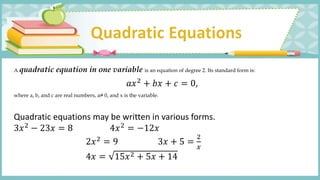
A quadratic equation in one variable is an equation of degree 2. Its standard form is:
𝑎𝑥2 + 𝑏𝑥 + 𝑐 = 0,
where a, b, and c are real numbers, a≠ 0, and x is the variable.
Quadratic equations may be written in various forms.
3𝑥2
− 23𝑥 = 8 4𝑥2
= −12𝑥
2𝑥2 = 9 3𝑥 + 5 =
2
𝑥
4𝑥 = 15𝑥2 + 5𝑥 + 14
A linear equation doesn't involve any power higher
than one for either variable.
A quadratic equation, on the other hand, involves one
of the variables raised to the second power.
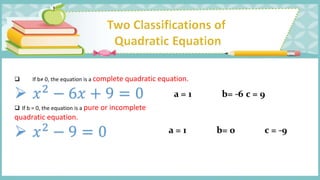
 If b≠ 0, the equation is a complete quadratic equation.
 𝑥2 − 6𝑥 + 9 = 0
 If b = 0, the equation is a pure or incomplete
quadratic equation.
 𝑥2 − 9 = 0
a = 1 b= -6 c = 9
a = 1 b= 0 c = -9
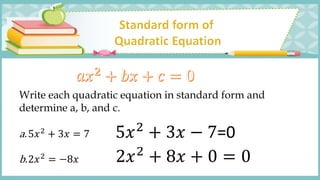
Write each quadratic equation in standard form and
determine a, b, and c.
a.5𝑥2
+ 3𝑥 = 7
b.2𝑥2
= −8𝑥
5𝑥2
+ 3𝑥 − 7=0
2𝑥2
+ 8𝑥 + 0 = 0
𝑥2
= 25
𝑥2
= 64
Rule
The Square Root Principle
If 𝑥2 = 0 and a≥ 0, then
x= √a or x = -√a
𝑥2
= 49
x = ± 49
x = 7, 𝑥 = −7
Write each quadratic
equation in standard form.
a.
6
𝑥
= 7 − 2𝑥
b.
4
𝑥
=
4
𝑥2−3
c. 3x2= 5
d. 5x= -x2 – 6x -3
e.
𝑥+3
5
=
2
𝑥
RECITATIO
N
a. 2𝑥2 − 7𝑥 + 6 = 0 𝑜𝑟 −2𝑥2 +7𝑥 −
6 = 0
b. 4𝑥2
− 4𝑥 − 12 = 0
c. 3x2 – 5 =0
d. −𝑥2 − 11𝑥 − 3 = 0 𝑜𝑟 𝑥2 + 11𝑥 +
3 = 0
e. 𝑥2 + 3𝑥 = 10
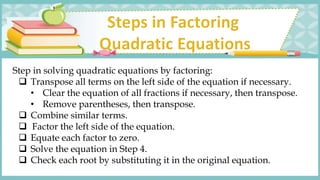
Step in solving quadratic equations by factoring:
 Transpose all terms on the left side of the equation if necessary.
• Clear the equation of all fractions if necessary, then transpose.
• Remove parentheses, then transpose.
 Combine similar terms.
 Factor the left side of the equation.
 Equate each factor to zero.
 Solve the equation in Step 4.
 Check each root by substituting it in the original equation.
Solve each quadratic
equation.
1) 9x2 = 16
2) x2 + 12x + 36
3) x2 – 15x = 0
Try
It
Solve each quadratic
equation.
1) 𝑥 =
4
3
, 𝑥 = −
4
3
2) 𝑥 = 6
3) 𝑥 = 0, 𝑥 = 15

Qudratic Equation.pptx

  • 1.
  • 2.
    RULES AND REMINDERS •When I count 1-2-3, you need to open your camera or else you wil considered as absent. • You must be mute unless i let you speak. • You can ask a question by raising your hands to noticed. • Listen and cooperate.
  • 3.
    demonstrates understanding ofkey concepts of quadratic equations, inequalities and functions, and rational algebraic equations. You will be able to investigate thoroughly mathematical relationships in various situations, formulate real-life problems involving quadratic equations, inequalities and functions, and rational algebraic equations and solve them using a variety of strategies.
  • 4.
    Solving Quadratic Equations byFactoring Solving Quadratic Equations by Extracting the Square Roots
  • 5.
     illustrates quadraticequations; and  solve quadratic equations by extracting square roots and factoring.
  • 8.
    A quadratic equationin one variable is an equation of degree 2. Its standard form is: 𝑎𝑥2 + 𝑏𝑥 + 𝑐 = 0, where a, b, and c are real numbers, a≠ 0, and x is the variable. Quadratic equations may be written in various forms. 3𝑥2 − 23𝑥 = 8 4𝑥2 = −12𝑥 2𝑥2 = 9 3𝑥 + 5 = 2 𝑥 4𝑥 = 15𝑥2 + 5𝑥 + 14
  • 9.
    A linear equationdoesn't involve any power higher than one for either variable. A quadratic equation, on the other hand, involves one of the variables raised to the second power.
  • 10.
     If b≠0, the equation is a complete quadratic equation.  𝑥2 − 6𝑥 + 9 = 0  If b = 0, the equation is a pure or incomplete quadratic equation.  𝑥2 − 9 = 0 a = 1 b= -6 c = 9 a = 1 b= 0 c = -9
  • 11.
    Write each quadraticequation in standard form and determine a, b, and c. a.5𝑥2 + 3𝑥 = 7 b.2𝑥2 = −8𝑥 5𝑥2 + 3𝑥 − 7=0 2𝑥2 + 8𝑥 + 0 = 0
  • 13.
    𝑥2 = 25 𝑥2 = 64 Rule TheSquare Root Principle If 𝑥2 = 0 and a≥ 0, then x= √a or x = -√a
  • 14.
    𝑥2 = 49 x =± 49 x = 7, 𝑥 = −7
  • 16.
    Write each quadratic equationin standard form. a. 6 𝑥 = 7 − 2𝑥 b. 4 𝑥 = 4 𝑥2−3 c. 3x2= 5 d. 5x= -x2 – 6x -3 e. 𝑥+3 5 = 2 𝑥 RECITATIO N a. 2𝑥2 − 7𝑥 + 6 = 0 𝑜𝑟 −2𝑥2 +7𝑥 − 6 = 0 b. 4𝑥2 − 4𝑥 − 12 = 0 c. 3x2 – 5 =0 d. −𝑥2 − 11𝑥 − 3 = 0 𝑜𝑟 𝑥2 + 11𝑥 + 3 = 0 e. 𝑥2 + 3𝑥 = 10
  • 18.
    Step in solvingquadratic equations by factoring:  Transpose all terms on the left side of the equation if necessary. • Clear the equation of all fractions if necessary, then transpose. • Remove parentheses, then transpose.  Combine similar terms.  Factor the left side of the equation.  Equate each factor to zero.  Solve the equation in Step 4.  Check each root by substituting it in the original equation.
  • 23.
    Solve each quadratic equation. 1)9x2 = 16 2) x2 + 12x + 36 3) x2 – 15x = 0 Try It Solve each quadratic equation. 1) 𝑥 = 4 3 , 𝑥 = − 4 3 2) 𝑥 = 6 3) 𝑥 = 0, 𝑥 = 15