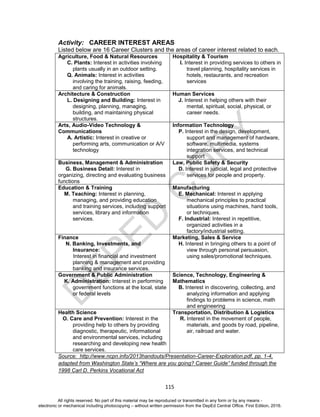
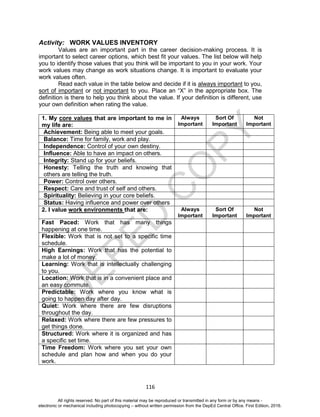
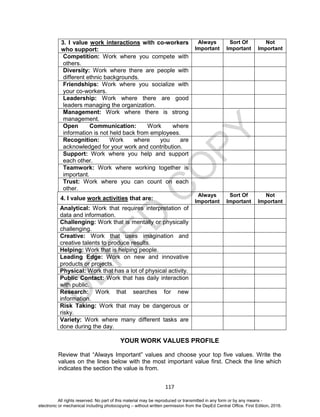
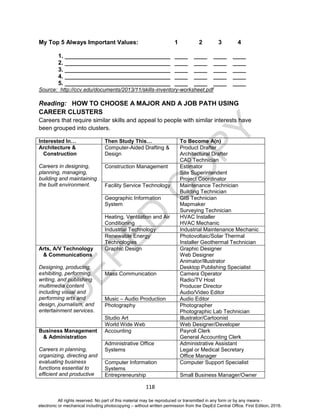
D
EPED
C
O
PY
Personal
Development
Reader
Department of Education
Republic of the Philippines
This learning resource was collaboratively developed and
reviewed by educators from public and private schools, colleges, and/or
universities. We encourage teachers and other education stakeholders
to email their feedback, comments, and recommendations to the
Department of Education at action@deped.gov.ph.
We value your feedback and recommendations.
All rights reserved. No part of this material may be reproduced or transmitted in any form or by any means -
electronic or mechanical including photocopying – without written permission from the DepEd Central Office. First Edition, 2016.
D
EPED
C
O
PY
ii
Personal Development
Reader
First Edition 2016
Republic Act 8293. Section 176 states that: No copyright shall subsist in any work
of the Government of the Philippines. However, prior approval of the government agency or
office wherein the work is created shall be necessary for exploitation of such work for profit.
Such agency or office may, among other things, impose as a condition the payment of
royalties.
Borrowed materials (i.e., songs, stories, poems, pictures, photos, brand names,
trademarks, etc.) included in this learning resource are owned by their respective copyright
holders. DepEd is represented by the Filipinas Copyright Licensing Society (FILCOLS), Inc.
in seeking permission to use these materials from their respective copyright owners. All
means have been exhausted in seeking permission to use these materials. The publisher
and authors do not represent nor claim ownership over them
Only institutions and companies which have entered an agreement with FILCOLS
and only within the agreed framework may copy from this Reader. Those who have not
entered in an agreement with FILCOLS must, if they wish to copy, contact the publishers and
authors directly.
Authors and publishers may email or contact FILCOLS at filcols@gmail.com or (02)
435-5258, respectively.
Published by the Department of Education
Secretary: Br. Armin A. Luistro FSC
Undersecretary: Dina S. Ocampo, PhD
Printed in the Philippines by Sunshine Interlinks Publishing House, Inc.
3F Maine City Tower, 236 Tomas Morato Avenue,
Brgy. South Triangle, Quezon City
Department of Education-Bureau of Learning Resources (DepEd-BLR)
Office Address: Ground Floor Bonifacio Building, DepEd Complex
Meralco Avenue, Pasig City, Philippines 1600
Telefax: (02) 634-1054 or 634-1072
E-mail Address: depedblr@gmail.com
Development Team of the Personal Development Reader
Dr. Barbara Wong-Fernandez, RGC Estesa Xaris Que-Legaspi, RGC
Carolyn C. Quiba, RGC Mae R. Rafanan, RGC
Zisa Velasquez-Garcia, RGC
Cover Artist: Sharlyn Sanclaria
Layout Artist: Jay L. Mabuti
Management Team of the Personal Development Reader
Bureau of Curriculum Development
Bureau of Learning Resources
All rights reserved. No part of this material may be reproduced or transmitted in any form or by any means -
electronic or mechanical including photocopying – without written permission from the DepEd Central Office. First Edition, 2016.
D
EPED
C
O
PY
iii
TABLE OF CONTENTS
TABLE OF CONTENTS.......................................................................................................iii
ORIENTATION to PERSONAL DEVELOPMENT ........................................................................v
Unit 1: Self-Development.................................................................................................1
MODULE 1: Knowing and Understanding Oneself during Middle and Late Adolescence.... 1
Reading: SELF-CONCEPT.................................................................................................... 2
Reading: PERSONAL EFFECTIVENESS................................................................................. 3
Reading: BUILD ON YOUR STRENGTHS AND WORK ON YOUR WEAKNESSES................... 5
Reading: Story: YOU NEED TO TAKE CHARGE OF YOUR FUTURE.................................... 6
Reading: THE POWER OF JOURNAL WRITING .................................................................. 7
MODULE 2: Developing the Whole Person........................................................................... 8
Reading: ASPECTS OF THE SELF........................................................................................ 9
Reading: THE STORY OF THE TWO WOLVES................................................................... 15
Reading: THE POWER TRIAD: THOUGHTS, FEELINGS AND ACTIONS ............................. 16
MODULE 3: Developmental Stages in Middle and Late Adolescence ................................ 17
Reading: DEVELOPMENTAL STAGES............................................................................... 18
Reading: HAVIGHURST`S DEVELOPMENTAL TASKS DURING THE LIFE SPAN ................. 19
Reading: LIVING MINDFULLY.......................................................................................... 22
Reading: THE PASSAGE TO ADULTHOOD: CHALLENGES OF LATE ADOLESCENCE......... 24
MODULE 4: The Challenges of Middle and Late Adolescence............................................ 24
Reading: ENCOURAGEMENT 101: The Courage to Be Imperfect................................... 25
Reading: THE POWER OF PERSONAL DECLARATIONS.................................................... 26
Reading: BEING HAPPY.................................................................................................. 27
Unit 2: Aspects of Personal Development .......................................................................29
MODULE 5: Coping with Stress in Middle and Late Adolescence....................................... 29
Reading: STRESS MANAGEMENT.................................................................................... 29
Reading: STRESS RESPONSE ........................................................................................... 33
Reading: KEEP STRESS UNDER CONTROL ....................................................................... 33
Reading: BRAINPOWER: COMPLEX ORGAN CONTROLS YOUR
EVERY THOUGHT AND MOVE......................................................................... 36
MODULE 6: The Powers of the Mind.................................................................................. 36
Reading: THE DOMINANT SIDE OF THE BRAIN............................................................... 39
Reading: RESEARCH STUDY “The Brain’s Left And Right Sides Seem To Work Together
Better In Mathematically Gifted Middle-School Youth”................................ 39
Reading: YOU CAN GROW YOUR INTELLIGENCE............................................................ 42
Reading: THE MYTH OF MICHAEL JORDAN .................................................................... 44
Reading: CHANGE YOUR MIND ABOUT MENTAL HEALTH ............................................. 45
MODULE 7: Mental Health and Well-Being in Middle and Late Adolescence................... 45
Reading: SELF ESTEEM AND BODY ESTEEM ................................................................... 47
Reading: SUPPORT STRATEGIES/COMMUNITY MENTAL HEALTH RESOURCES.............. 49
Reading: HELP HOW-TO’S............................................................................................... 50
Reading: HEALTHY EATING AND MENTAL HEALTH ........................................................ 51
Reading: EMOTIONAL INTELLIGENCE............................................................................. 54
All rights reserved. No part of this material may be reproduced or transmitted in any form or by any means -
electronic or mechanical including photocopying – without written permission from the DepEd Central Office. First Edition, 2016.
D
EPED
C
O
PY
iv
MODULE 8: Emotional Intelligence..................................................................................... 54
Reading: TYPES OF RESPONSES....................................................................................... 57
Unit III: Building and Maintaining Relationships..............................................................60
MODULE 9: Personal Relationships.................................................................................... 60
Reading: WHAT DO WE MEAN BY PERSONAL RELATIONSHIPS?................................... 61
Reading: A RESEARCH STUDY ON RELATIONSHIPS........................................................ 61
Reading: WHY PERSONAL RELATIONSHIPS ARE IMPORTANT ....................................... 62
Reading: 25 MOST COMMON RELATIONSHIP PROBLEMS ............................................ 63
Reading: NURTURE YOUR RELATIONSHIPS.................................................................... 67
Reading: TEN RULES FOR FINDING LOVE AND CREATING LONG-LASTING,
AUTHENTIC RELATIONSHIPS........................................................................... 69
Reading: HEALTHY RELATIONSHIPS ITEMS TEST…………………………………………………………70
Reading: BASIC RIGHTS IN A RELATIONSHIP.................................................................. 76
Reading: HOW CULTURE SHAPES MANY ASPECTS OF ADOLESCENT DEVELOPMENT... 77
MODULE 10: Social Relationships in Middle and Late Adolescence .................................. 77
Reading: TEENAGERS WHO JOIN YOUTH GROUPS AND OTHER CLUBS ARE HAPPIER
AND LESS LIKELY TO DRINK............................................................................. 78
Reading: COMMUNITY ACTIVITY: GET INVOLVED......................................................... 79
Reading: LESSONS ON LEADERSHIP AND MEMBERSHIP FROM FABLES........................ 81
Reading: SERVANT LEADERSHIP .................................................................................... 83
MODULE 11: Family Structures and Legacies..................................................................... 85
Reading: FAMILY STRUCTURE........................................................................................ 87
Reading: INSPIRING STORIES OF FAMILIES.................................................................... 89
Reading: FAMILY LEGACIES............................................................................................ 93
Unit IV: Career Development..........................................................................................99
MODULE 12: Persons and Careers...................................................................................... 99
Reading: TEN MYTHS ABOUT CAREER PLANNING BUSTED!........................................... 99
Reading: CAREER CONCEPTS ........................................................................................ 103
Reading: WHAT INFLUENCES YOUR CAREER CHOICE?................................................. 104
Reading: SUPER’S CAREER DEVELOPMENT THEORY .................................................... 106
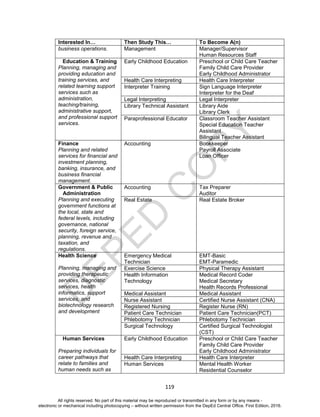
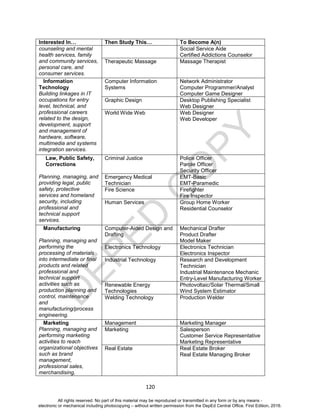
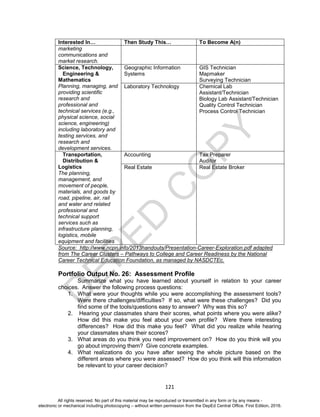
Reading: HOW TO CHOOSE A MAJOR AND A JOB PATH USING CAREER CLUSTERS .... 118
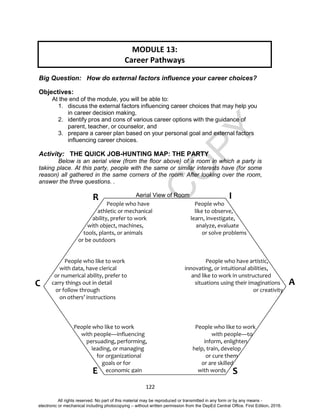
MODULE 13: Career Pathways ......................................................................................... 122
Reading: WORK/OCCUPATIONAL ENVIRONMENTS AND INTERESTS.......................... 123
Reading: YOUR PERSONAL MISSION STATEMENT: YOU’RE NEVER TOO YOUNG TO
CLARIFY YOUR LIFE GOALS AND ASPIRATIONS............................................. 130
REFERENCES ................................................................................................................132
All rights reserved. No part of this material may be reproduced or transmitted in any form or by any means -
electronic or mechanical including photocopying – without written permission from the DepEd Central Office. First Edition, 2016.
D
EPED
C
O
PY
v
To the Student of Personal Development:
Welcome to this course, PERSONAL DEVELOPMENT, or PERDEV for short.
This is a very interesting course, and can become the most personally rewarding for
you, because the subject matter for this course is YOU!
As a new senior high school student, you have now entered a new
educational level, as well as a new psychological and social level, called the middle
and late adolescence. You may feel that you are no longer the rapidly growing and
awkward teenager, but you also feel you are not quite ready to call yourself a mature
adult either.
This course shall make you take a deeper look at yourself and analyze your
developmental changes, your skills and traits which can help you meet the various
tasks that you must undertake at this point in your life. It shall provide you with some
techniques to meet stress and other mental health issues with one’s strengths and
coping powers. The course shall also give you the chance to analyze your
relationships with your family, friends and significant others. Finally, the PERDEV
course shall help you take stock of where you are in your career development and
how to get to where you want to be.
COURSE CONTENT:
There are 4 units in PERDEV, as follows:
Unit 1 – Self-Development
Unit 2 – Aspects of Personal Development
Unit 3 – Building and Maintaining Relationships
Unit 4 – Career Development
There will be several modules under each unit, to be taken up in several
class sessions, each of which addresses a key concern in personal development.
COURSE METHOD:
PERDEV uses the experiential learning approach, wherein you as a student
will participate in activities in class to explore specific themes in your development.
You will interact with your classmates, do projects with them, discuss various topics,
and share your own thoughts, feelings and experiences. You will also make
personal reflections and write them down. In this manner of self-refection and
sharing, you shall help reveal and articulate relevant concepts, theories, and tools in
different areas of your life.
YOUR TEACHER:
Your teacher is the guide and facilitator of this course. He/she shall lead the
activities by giving instructions and supervising the procedures. However, since the
subject matter is yourself, the success of the modules depends on the participation
and cooperation of you and your classmates.
ORIENTATION to PERSONAL DEVELOPMENT
All rights reserved. No part of this material may be reproduced or transmitted in any form or by any means -
electronic or mechanical including photocopying – without written permission from the DepEd Central Office. First Edition, 2016.
D
EPED
C
O
PY
vi
MATERIALS FOR PERDEV:
This Reader for Students contains the Activity Sheets that you will be using
for the various modules. Bring this Reader during every session since this will be
needed in most activities. The Reader also has Readings which provide relevant,
valuable, and appropriate additional information for the topic at hand. These are only
samples of informational material. You are encouraged to look for more information
in your Library or by surfing the Internet.
REQUIREMENTS FOR PERDEV:
You should have a journal or notebook for PERDEV, in which you will write
your reflections, insights, comments and opinions. You should also have a portfolio
for PERDEV, which may be a large brown or plastic envelope, a clear book, or an
envelope bag. This is where you will store all the reflections, research outputs,
journal entries, survey questionnaires, and other written materials and artwork which
you do as class work, seatwork, or homework for PERDEV.
At the end of each unit, your teacher shall collect your portfolio and give you
a grade based on the completeness and quality of your work, your class attendance
and participation, and other special requirements that you agree on in the beginning
of the semester.
ASSESSMENT AND GRADING SYSTEM:
Assessment of PERDEV shall be through the use of rubrics. A rubric refers
to a scoring guide used to evaluate the quality of your outputs, whether done
individually or in a group. There are 8 portfolio output requirements for every unit of
the course, with a maximum of 16 points per output, and a maximum of 16 points for
attendance per unit. The maximum number of points you can obtain for the unit (or
the quarter) is 144 points, and the number of points shall be converted to grade
equivalents as follows:
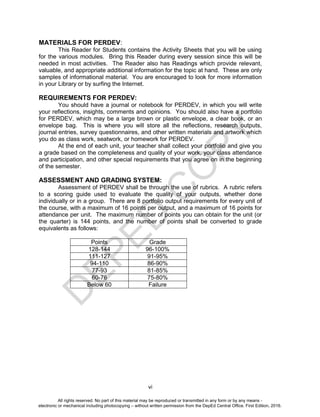
Points Grade
128-144 96-100%
111-127 91-95%
94-110 86-90%
77-93 81-85%
60-76 75-80%
Below 60 Failure
All rights reserved. No part of this material may be reproduced or transmitted in any form or by any means -
electronic or mechanical including photocopying – without written permission from the DepEd Central Office. First Edition, 2016.
D
EPED
C
O
PY
1
Unit 1: Self-Development
Big Question: How can understanding yourself pave the way to self-
acceptance and better relationship with others?
Objectives:
At the end of this module, you will be able to:
1. explain that knowing yourself can make you accept your strengths and
limitations and dealing with others better;
2. share your unique characteristics, habits and experiences; and,
3. start and maintain a journal.
Activity: SELF-CONCEPT INVENTORY
Take a look at your own self-concept and answer the following self-concept
inventory in your journal. Give yourself a rating using the scale: 0 = very weak;
1 = weak; 2 = somewhat weak or somewhat strong; 3 = strong; 4 = very strong
___1. I have strong sex appeal.
___2. I am proud of my physical figure.
___3. I am physically attractive and beautiful/handsome.
___4. I exude with charm and poise.
___5. I am easy to get along with.
___6. I can adjust to different people and different situations.
___7. I am approachable; other people are at ease and comfortable with me.
___8. I am lovable and easy to love.
___9. I am a fast learner, can understand with one instruction.
___10. I am intelligent.
___11. I have special talents and abilities.
___12. I can easily analyze situations and make right judgments.
___13. I can be trusted in any transaction.
___14. I have a clean conscience and carry no guilty feeling.
___15. I have integrity and good reputation.
___16. My friends and classmates can look up to me as a model worth emulating.
___17. I can express my ideas without difficulty.
___18. I talk in a persuasive manner that I can easily get people to accept what I
say.
___19. I can express my ideas in writing without difficulty.
___20. I am a good listener.
___21. I am emotionally stable and not easily rattled when faced with trouble.
___22. I am logical and rational in my outlook and decisions.
___23. I feel and act with confidence.
___24. I am a mature person.
MODULE 1:
Knowing and Understanding Oneself during Middle
and Late Adolescence
All rights reserved. No part of this material may be reproduced or transmitted in any form or by any means -
electronic or mechanical including photocopying – without written permission from the DepEd Central Office. First Edition, 2016.
D
EPED
C
O
PY
2
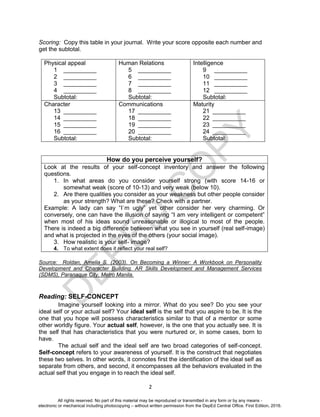
Scoring: Copy this table in your journal. Write your score opposite each number and
get the subtotal.
Physical appeal
1 __________
2 __________
3 __________
4 __________
Subtotal:
Human Relations
5 __________
6 __________
7 __________
8 __________
Subtotal:
Intelligence
9 __________
10 __________
11 __________
12 __________
Subtotal:
Character
13 __________
14 __________
15 __________
16 __________
Subtotal:
Communications
17 __________
18 __________
19 __________
20 __________
Subtotal:
Maturity
21 __________
22 __________
23 __________
24 __________
Subtotal:
How do you perceive yourself?
Look at the results of your self-concept inventory and answer the following
questions.
1. In what areas do you consider yourself strong (with score 14-16 or
somewhat weak (score of 10-13) and very weak (below 10).
2. Are there qualities you consider as your weakness but other people consider
as your strength? What are these? Check with a partner.
Example: A lady can say “I`m ugly” yet other consider her very charming. Or
conversely, one can have the illusion of saying “I am very intelligent or competent”
when most of his ideas sound unreasonable or illogical to most of the people.
There is indeed a big difference between what you see in yourself (real self-image)
and what is projected in the eyes of the others (your social image).
3. How realistic is your self- image?
4. To what extent does it reflect your real self?
Source: Roldan, Amelia S. (2003). On Becoming a Winner: A Workbook on Personality
Development and Character Building. AR Skills Development and Management Services
(SDMS), Paranaque City, Metro Manila.
Reading: SELF-CONCEPT
Imagine yourself looking into a mirror. What do you see? Do you see your
ideal self or your actual self? Your ideal self is the self that you aspire to be. It is the
one that you hope will possess characteristics similar to that of a mentor or some
other worldly figure. Your actual self, however, is the one that you actually see. It is
the self that has characteristics that you were nurtured or, in some cases, born to
have.
The actual self and the ideal self are two broad categories of self-concept.
Self-concept refers to your awareness of yourself. It is the construct that negotiates
these two selves. In other words, it connotes first the identification of the ideal self as
separate from others, and second, it encompasses all the behaviors evaluated in the
actual self that you engage in to reach the ideal self.
All rights reserved. No part of this material may be reproduced or transmitted in any form or by any means -
electronic or mechanical including photocopying – without written permission from the DepEd Central Office. First Edition, 2016.
D
EPED
C
O
PY
3
The actual self is built on self-knowledge. Self-knowledge is derived from
social interactions that provide insight into how others react to you. The actual self is
who we actually are. It is how we think, how we feel, look, and act. The actual self
can be seen by others, but because we have no way of truly knowing how others
view us, the actual self is our self-image.
The ideal self, on the other hand, is how we want to be. It is an idealized
image that we have developed over time, based on what we have learned and
experienced. The ideal self could include components of what our parents have
taught us, what we admire in others, what our society promotes, and what we think is
in our best interest.
There is negotiation that exists between the two selves which is complex
because there are numerous exchanges between the ideal and actual self. These
exchanges are exemplified in social roles that are adjusted and re-adjusted, and are
derived from outcomes of social interactions from infant to adult development.
Alignment is important. If the way that I am (the actual self) is aligned with the way
that I want to be (the ideal self), then I will feel a sense of mental well-being or peace
of mind. If the way that I am is not aligned with how I want to be, the incongruence,
or lack of alignment, will result in mental distress or anxiety. The greater the level of
incongruence between the ideal self and real self, the greater the level of resulting
distress. Personal development modules ultimate aim is greater self-knowledge that
will lead to higher alignment between these two personality domains.
Source: http://study.com/academy/lesson/what-is-self-concept-in-psychology-definition-
lesson-quiz.html
http://study.com/academy/lesson/ideal-self-vs-real-self-definition-lesson-quiz.html
Portfolio Output No. 1 – Talent/Variety Show Presentation
Your group shall have a presentation in front of the class. The leaders of
each group (including yours) shall rate your group based on the following criteria:
originality (4 points), creativity/resourcefulness (4 points), teamwork (4 points), and
audience impact (4 points), for a maximum of 16 points. Compute the average of
ratings for your group and write this average rating for your presentation in your
journal. Write about your experience as a group leader/member in this activity.
Reading: PERSONAL EFFECTIVENESS
Personal effectiveness means making use of all the personal resources –
talents, skills, energy and time, to enable you to achieve life goals.
Your knowledge of yourself and how you manage yourself impacts directly on
your personal effectiveness. Being self-aware, making the most of your strengths,
learning new skills and techniques and behavioral flexibility are all keys to improving
your personal performance.
Our personal effectiveness depends on our innate characteristics – talent and
experience accumulated in the process of personal development. Talents first are
needed to be identified and then developed to be used in a particular subject area
(science, literature, sports, politics, etc.).
Experience includes knowledge and skills that we acquire in the process of
cognitive and practical activities.
All rights reserved. No part of this material may be reproduced or transmitted in any form or by any means -
electronic or mechanical including photocopying – without written permission from the DepEd Central Office. First Edition, 2016.
D
EPED
C
O
PY
4
Knowledge is required for setting goals, defining an action plan to achieve
them and risk assessment.
Skills also determine whether real actions are performed in accordance with
the plan. If the same ability is used many times in the same situation, then it
becomes a habit that runs automatically, subconsciously. Here are some skills that
will greatly increase the efficiency of any person who owns them:
1. Determination. It allows you to focus only on achieving a specific goal
without being distracted by less important things or spontaneous desires. It
may be developed with the help of self-discipline exercise.
2. Self-confidence. It appears in the process of personal development, as a
result of getting aware of yourself, your actions and their consequences. Self-
confidence is manifested in speech, appearance, dressing, gait, and physical
condition. To develop it, you need to learn yourself and your capabilities, gain
positive attitude and believe that by performing right actions and achieving
right goals you will certainly reach success.
3. Persistence. It makes you keep moving forward regardless of emerging
obstacles – problems, laziness, bad emotional state, etc. It reduces the costs
of overcoming obstacles. It can also be developed with the help of self-
discipline exercise.
4. Managing stress. It helps combat stress that arises in daily life from the
environment and other people. Stress arises from the uncertainty in an
unknown situation when a lack of information creates the risk of negative
consequences of your actions. It increases efficiency in the actively changing
environment.
5. Problem-solving skills. They help cope with the problems encountered with
a lack of experience. It increases efficiency by adopting new ways of
achieving goals when obtaining a new experience.
6. Creativity. It allows you to find extraordinary ways to carry out a specific
action that no one has tried to use. It can lead to a decrease or an increase of
costs, but usually the speed of action is greatly increased when using
creative tools.
7. Generating ideas. It helps you achieve goals using new, original,
unconventional ideas. Idea is a mental image of an object formed by the
human mind, which can be changed before being implemented in the real
world. For generating ideas you can use a method of mental maps, which
allows you to materialize, visualize and scrutinize all your ideas, which in turn
contributes to the emergence of new ideas. These are just some, but the
most important personal effectiveness skills which make the achievement of
any goal easier and less costly.
Source: http://www.chrysalisdevelopment.com/page6/page4/page4.html
http://www.learning-mind.com/7-basic-personal-effectiveness-skills/
All rights reserved. No part of this material may be reproduced or transmitted in any form or by any means -
electronic or mechanical including photocopying – without written permission from the DepEd Central Office. First Edition, 2016.
D
EPED
C
O
PY
5
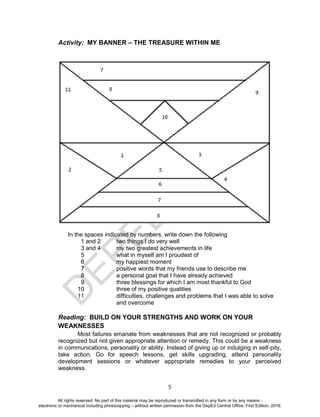
Activity: MY BANNER – THE TREASURE WITHIN ME
In the spaces indicated by numbers, write down the following
1 and 2 two things I do very well
3 and 4 my two greatest achievements in life
5 what in myself am I proudest of
6 my happiest moment
7 positive words that my friends use to describe me
8 a personal goal that I have already achieved
9 three blessings for which I am most thankful to God
10 three of my positive qualities
11 difficulties, challenges and problems that I was able to solve
and overcome
Reading: BUILD ON YOUR STRENGTHS AND WORK ON YOUR
WEAKNESSES
Most failures emanate from weaknesses that are not recognized or probably
recognized but not given appropriate attention or remedy. This could be a weakness
in communications, personality or ability. Instead of giving up or indulging in self-pity,
take action. Go for speech lessons, get skills upgrading, attend personality
development sessions or whatever appropriate remedies to your perceived
weakness.
All rights reserved. No part of this material may be reproduced or transmitted in any form or by any means -
electronic or mechanical including photocopying – without written permission from the DepEd Central Office. First Edition, 2016.
D
EPED
C
O
PY
6
Instead of simply focusing on your weaknesses, recognize your own talents
and abilities, build on them, utilize them to your greatest advantage. This is where
you can build your name and popularity. Handicapped people like Jose Feliciano
and other blind singers did not brood over their physical handicap. They recognized
that they have a golden voice so they search for ways to enrich that talent and now
they have won international fame in the field of music.
Source: Roldan, Amelia S. 2003. On Becoming a Winner: A Workbook on Personality
Development and Character Building. AR Skills Development and Management Services
(SDMS), Paranaque City, Metro Manila.
Portfolio Output No. 2: Journal Reflection from My Banner
Write about your banner.
1. What do you consider as your weaknesses, abilities and talents?
2. What are the remedies you will take to improve or compensate for your
weakness?
3. How can you further enrich your assets and strengths?
4. Where and how do you use it to your best advantage?
Reading: Story: YOU NEED TO TAKE CHARGE OF YOUR FUTURE
There are three kinds of people in this world:
The first is the Moviegoer. This person watches the movie of their lives,
admires some parts and criticizes others. Aside from that, they do nothing else. All
she says the whole day is, “I like this thing and but I don’t like that thing.” The
Moviegoer feels she has absolutely no control of their lives --- except to comment
about it. Moviegoers are the most pathetic, miserable people in the world.
The second is the Actor. This person does not only watch the movie of her
life. She actually realizes she’s the Actor – and can control a big part of her life. She
can actually make or break the movie – by how well she delivers her lines and how
she portrays her character. Actors are a happy bunch, realizing they’re the start of
the show and enjoy some level of control. But many times, they wish the movie
would end in another way – but realize that they have no say in such things.
The third is the Scriptwriter. This person does not only watch, and she
doesn’t only act, but she actually creates the entire movie from her mind. She
determines what she will say, what she will do, and how the movie will end. She
realizes she has enormous control over her life, and sees to it that the movie of her
life will turn out beautiful.
Who are you among these three people?
Do you merely watch your life go y?
Or do you act out a script that you feel has been handed to you?
Or do you write the script and make your life beautiful?
By the way, the Producer of the movie is God. He tells you, “Make the movie
beautiful, and I will give you all that you need for success.”
Source: Sanchez, Bo. (2006). Life Dreams Success Journal: Your Powerful Tool to Achieve
and Surpass Your Dreams One Step at a Time. Shepherd’s Voice Publishing.
All rights reserved. No part of this material may be reproduced or transmitted in any form or by any means -
electronic or mechanical including photocopying – without written permission from the DepEd Central Office. First Edition, 2016.
D
EPED
C
O
PY
7
Reading: THE POWER OF JOURNAL WRITING: UNFOLDING YOUR
PERSONAL JOURNEY
The purpose of journal writing is to help you become the Scriptwriter of your
life. There are four (4) practical reasons to maintain a journal:
1. It is cost-efficient and available. Emotional stress can be dealt in many ways
like talking to a friend over a cup of coffee, eating, travelling, shopping,
painting and many more but writing is the most inexpensive. Notebook and
pens are easy to find, available and do not cost so much.
2. It is preventive and pro-active. Writing yields self-awareness. When you write,
you can discover your strengths and limitations. You will know what your
reactions are in different situations and what better ways to prevent, avoid, or
face your fears.
3. It is creative and productive. Journal writing expounds your imagination. You
can see various dimensions of your problem, different points of view and
better solutions.
4. Lastly, it is personal and private. Unless you want to share your stories, you
have the choice to keep them to yourself. Writing is your time alone. It is your
way of loving yourself. You will not be judged by your writing.
You just need one (1) notebook to maintain a personal journal. You may use
these questions as you write in your journal:
1. How do you find this day? What are the positive things that happened? What
are those things that made you irritated or upset?
2. As you reflect the ups and downs of your day, what may be the greatest
lesson you can learn from them? What actions have you done well and what
actions you can do better?
3. What do you really want in life? What do you want to achieve for yourself,
your family, your community, and your country?
4. As you close the day, what are the small and big things you are thankful of?
Who are the people that made your day extra special?
Processing: Write your answers in your personal journal.
1. What have you discovered in yourself?
2. What are your core strengths?
3. What are the qualities you want to hone and improve on?
“A pen is certainly is certainly an excellent instrument to fix a man’s attention
and inflame his ambition” – John Adams
All rights reserved. No part of this material may be reproduced or transmitted in any form or by any means -
electronic or mechanical including photocopying – without written permission from the DepEd Central Office. First Edition, 2016.
D
EPED
C
O
PY
8
Big Question: What is the relationship of the different aspects of
development with your thoughts, feelings and actions in dealing
with life situations?
Objectives:
At the end of this module, you will be able to:
1. discuss the relationship among physiological, cognitive, psychological,
spiritual and social aspects of development, to understand your thoughts,
feelings, and behaviors,
2. evaluate your own thoughts, feelings and actions, and
3. show the connection of your thoughts, feelings and actions to actual life
situations.
Activity: ASSESS ASPECTS OF YOUR DEVELOPMENT
Draw a large circle on a blank sheet of paper. Divide the circle into 8
segments. In each segment, write some descriptions of the different aspects of
yourself as follows:
1. Physical Self. Describe yourself. Try not to censor any thoughts which come
to your mind. Include descriptions of your height, weight, facial appearance,
and quality of skin, hair and descriptions of body areas such as your neck,
chest, waist, legs.
2. Intellectual Self. Include here an assessment of how well you reason and
solve problems, your capacity to learn and create, your general amount of
knowledge, your specific areas of knowledge, wisdom you have acquired,
and insights you have.
3. Emotional Self. Write as many words or phrase about typical feelings you
have, feelings you seldom have, feelings you try to avoid, feelings you
especially enjoy, feelings from your past and present, and feelings which are
associated with each other.
4. Sensual Self. Write how you feel as a sensual person. What sense do you
use most – sight, hearing, speaking, smelling, touching? How do you feel
about the different ways you take in information - through the eyes, ears,
mouth, nose, pores, and skin. In what ways do you let information in and out
of your body?
5. Interactional Self. Include descriptions of your strengths and weaknesses in
intimate relationships and relationships to friends, family, co-students and
strangers in social settings. Describe the strengths and weaknesses which
your friends and family have noticed. Describe what kind of son or daughter,
brother or sister you are.
6. Nutritional Self. How do you nourish yourself? What foods do you like and
dislike? What do you like and dislike about these?
MODULE 2:
Developing the Whole Person
All rights reserved. No part of this material may be reproduced or transmitted in any form or by any means -
electronic or mechanical including photocopying – without written permission from the DepEd Central Office. First Edition, 2016.
D
EPED
C
O
PY
9
7. Contextual Self. Descriptors could be in the areas of maintenance of your
living environment: reaction to light, temperature, space, weather, colors,
sound and seasons and your impact on the environment.
8. Spiritual Self or Life Force. Write words or phrases which tell about how you
feel in this area. This could include your feelings about yourself and
organized religion, reactions about your spiritual connections to others,
feelings about your spiritual development and history, and thought about your
metaphysical self. Think about your inner peace and joy. Think about your
spiritual regimen or routine.
Portfolio Output No. 3: Personal Assessment of Aspects of
Development with Plan of Action
Write about the eight segments of your development. What are the words or
phrases which represent aspects about yourself which you like? What are the items
which you consider to be weaknesses or areas for improvement? What words which
are neutral or factual, such as “5 feet 4 inches tall, 120 pounds”? Do some
categories have more minus than plus areas? The larger proportion of minus to plus
areas you have, the more effort will be needed to achieve positive self-esteem. If the
vast majority of your minus responses are in one or two areas, your self-esteem is
likely to be good but has a few self-estimates which need to be improved. Name
some ways in which you can improve the minus areas and further enhance the
positive aspects.
Reading: ASPECTS OF THE SELF
The self-concept is represented by several aspects of the self. It is conceived
as collection of multiple, context-dependent selves. This construct believes that
context activates particular regions of self-knowledge and self-relevant feedback
affects self-evaluations and affect. A deeper look on the different aspects of self can
identify specific areas for self-regulation, stability and improvement.
In a nutshell, an individual is composed of three basic but very different
aspects of the self. They are the physical or tangible aspects as they relate to the
body, the intellectual and conscious aspects as they relate to the mind, and the
emotional and intuitive aspects as they relate to the spirit. All three aspects of the
self work together in perfect harmony when attention is paid to all three
simultaneously.
Many individuals put a strong emphasis on the physical aspect of the self.
The body is tangible, obvious, and we respond to it easily. More time and money is
spent on enhancing the physical component than either of the other two aspects.
This does not mean, however, that the body is healthy or strong. The body provides
a place to house the spirit (often experienced as feelings) and the mind (often
experienced as thought).
It may be important to some that their mind be prominent and well educated.
The mind is important, as it is the part of the self that directs the other two aspects.
The mind learns what to do and communicates the information to the body and the
feelings. What the mind believes, the body manifests or acts on, and the emotions
feel, or respond with. People store both healthy and destructive thoughts and beliefs
and responds to life's circumstances in the most prominent manner. The mind
provides access creativity and serenity which are necessary for such processes as
prayer, forgiveness, acceptance, and passion.
All rights reserved. No part of this material may be reproduced or transmitted in any form or by any means -
electronic or mechanical including photocopying – without written permission from the DepEd Central Office. First Edition, 2016.
D
EPED
C
O
PY
10
The human emotions are the most feared aspect of the self, as individuals
are reluctant and unprepared to manage them. Managing feelings is like trying to
hold water in the palm of your hand. They are illusive and deceptive. A decision
made under emotional stress and strain usually impacts emotions negatively.
Negative emotions that are not managed are stored and repressed. Repression is
destructive to a content self since all feelings, not only negative ones are stored
away. Accessing feelings when they are needed now becomes difficult, leaving the
individual numb and hopeless.
For instance, a girl realizes that she is giving much attention on the physical
aspects and less attention on her intellectual self. In this way, she can discover how
much money and time spent maintaining her physique and its consequences in her
grades. By this honest evaluation of herself, she can plan effective actions to
improve her study habits. She can start seeking for help and for related books to
read or browse articles to help her improve her study habits.
Source: http://www.innerwisdom.com/aspect-of-the-self.htm
Activity: Analyze this … THREE SUCCESS STORIES
1. Manny Pacquiao’s Unbelievable Success Story Will Inspire You
It’s 1990 in the province of General Santos in the Philippines. Manny
Pacquiao is 12 years old.
Pacquiao often speaks of his debt to his maternal uncle, Sardo Mejia, who
introduced him to boxing after he dropped out of school. It was this moment that
would spark an unforeseen passion and drive in Pacquiao to be one of the best
boxers in the entire world. According to his autobiography, he describes watching
Mike Tyson’s shocking defeat to James “Buster” Douglas in 1990 on television with
his uncle as an experience that “changed [his] life forever.” In his hometown, he set
up an open-for-all boxing match and beat every opponent who came. He was well on
the road of transforming himself from a lanky school dropout to a junior boxing
champion.
Despite his success, his family was still living in extreme poverty and hunger.
They became so desperate to the point that his father had to kill his pet dog for
dinner. Pacquiao couldn’t forgive his father for what he did so he left home, slept on
cardboard boxes, and sold bread on the streets just to make a meager living. At that
point, he also used boxing and won matches for $2 each, as a means of escaping
poverty.
He soon moved to Manila and continued winning several boxing matches, but
given the increased standards of living, he wasn’t making enough to survive. He
soon got a job at a local gym doing gardening, cleaning and construction while
boxing on the side. He trained crazily all day and all night when possible, waking up
the earliest and leaving the gym at the latest possible time. Early on, his
perseverance and determination to be a part of the boxing world swayed him
to cheat and add on some weights to meet the featherweight class requirements.
As the fights got more serious, Pacquiao started getting more famous as well.
He would beat fighters from South Korea, Japan and Thailand and at the very young
age of 19, he won his first World Champion title by beating Chatchai Sasakul, the
reigning World Boxing Council (WBC) World Flyweight Champion at that time. The
turning point for Pacquiao came when he won against world-class featherweight
All rights reserved. No part of this material may be reproduced or transmitted in any form or by any means -
electronic or mechanical including photocopying – without written permission from the DepEd Central Office. First Edition, 2016.
D
EPED
C
O
PY
11
boxer Marco Antonio Barrera at the Alamodome in Texas with a TKO. After that fight,
he was recognized internationally as a force to be reckoned with.
Today, at 37, he is one of the most respected boxers. Despite his loss during
the Mayweather match, he still has won the hearts of many boxing fans both in the
Philippines and worldwide. His one-of-a-kind story will continue to inspire and it will
always portray the journey of what millions of Filipinos continue to aspire for.
Source: https://www.kalibrr.com/advice/2015/05/manny-pacquiao-success-story-willl-inspire-
you/
2. The Pia Wurtzbach Success Story
Pia Alonzo Wurtzbach was crowned “Miss Universe” at the 64th
Miss
Universe 2015 pageant held at Las Vegas, Nevada, USA. Pia is an actress and
model of German-Philippine origin. She is Miss Philippines 2015. She symbolizes the
deadly combination of beauty with brains. Pia is a beauty-writer, chef and make-up
artist.
Pia Wurtzbach was born on 24 September 1989 in Stuttgart, Baden-
Württemberg. Her father is a German and her mother is a Filipino. Pia has a younger
sister. Pia was named in keeping with the Philippines' tradition. Her middle name
'Alonzo' is her mother's maiden name. Pia did her secondary education from ABS-
CBN Distance Learning School in Quezon City. She studied Culinary Arts from the
Centre for Asian Culinary Studies, San Juan, Metro Manila.
Pia ventured into the world of glitz and glamour at the tender age of fourteen.
She joined an acting and modelling agency for children, 'Star Magic Talent'. Pia got a
break in television when she featured in K2BU, a series for teenagers, the romance
collection, 'Your Song' and the concert programme, 'ASAP'. Pia has acted in films;
'All My Life', 'All About Love' and 'Kung Ako Na Lang Sana'. Pia was the brand
ambassador for 'Avon Teen' for a period of five years. She has graced the cover of
several prestigious fashion magazines. Pia writes for the 2bU column of 'Inquirer
Lifestyle'. She is popular as Pia Romero, her screen name.
Pia is a pageant title-holder. Her first beauty contest was the 'Binibining
Pilipinas 2013'. She was the 'first runner-up'. She participated in the 'Binibining
Pilipinas 2015' as a representative of Cagayan de Oro and won the title, paving the
path for bigger victories.
Pia Alonzo walked away with the “Miss Universe” title at the Miss Universe
Pageant 2015 held on December 20 at The Axis, Las Vegas, Nevada, USA. The 26-
year old beauty set the stage ablaze with her poise, incredible class and talent in her
exotically gorgeous ball gown and costumes. Pia was crowned by her predecessor,
Paulina Vega. As Miss Universe, Pia aspires to lead the youth and spread
awareness about HIV, especially in Philippines.
Source: http://successstory.com/people/pia-alonzo-wurtzbac
3. A Love Affair that Got Me Close to a Great Doctor
I am blissfully married and a proud mother to three young men. My husband
Leo knows that I am also engaged in another love affair, a sweet and enduring one.
And he approves, so do my sons.
This love affair is with research, and it started during my pediatric residency
training. I can still remember vividly the excitement and the long nights, the discovery
All rights reserved. No part of this material may be reproduced or transmitted in any form or by any means -
electronic or mechanical including photocopying – without written permission from the DepEd Central Office. First Edition, 2016.
D
EPED
C
O
PY
12
of meaningful developments, the joy of reading medical journals, the eagerness to
prepare something thorough and relevant. The excitement I felt continued up to my
postgraduate internship, my fellowship in infectious diseases and it has lasted till
now. My husband was never jealous and my relationship with my sons never soured
despite this other ongoing and never-ending love affair. I could not ask for more. This
is the best life.
So last May 23, the family accompanied me to Vigan, Ilocos Sur, to attend
the 107th annual convention hosted by the Philippine Medical Association (PMA).
Being included as one of the 15 finalists for the coveted Dr. Jose P. Rizal Memorial
Awards is a proud moment for my family. With them around, I was the proudest wife,
mom and doctor.
While individual citations were being read on stage for the top awardees for
Community Leadership (Dr. Purisima A. Bueno), Government Service (Dr. Maria
Victoria M. Abesamis), Clinical Practice (Dr. Bonaleth M. De Vera) and Academe (Dr.
Estrella B. Paje-Villar), I never expected that the final citation was all about the fruits
of my other love affair, with research.
“Lead investigator for the much-awaited clinical trials on the multivalent
dengue vaccine…” “repeatedly cited by researchers here and abroad…” “served as
the springboard for the Expanded Program of Immunization (EPI) of the Department
of Health…” “provided the evidence and the science…” “extended her work to the
communities…” “greater things to come that will benefit science, medicine and the
Filipino people…” “epitomizes the virtues of Dr. Jose P. Rizal…” “…love of country
and service to our countrymen…” All these brought me back to the past 30 years of
my medical, family and community life.
My love affair with research did not happen overnight. It was a journey that
began with a case presentation as a first-year pediatric resident, and a prospective
study on how to prevent early jaundice in newborns. My recommendation that a
nursery should always be facing the direction the sun rises so that a newborn can
benefit from exposure to morning sunlight won the top prize for the hospital’s annual
research competition. This did not happen once. It was a back-to-back win for three
straight years. I got hooked. Who would not be? Year 1991 was my first immersion in
dengue research. Twenty-three years later, I am now the lead investigator of the
country’s clinical trials for dengue vaccine, in the countries where dengue is a major
public health problem. It’s a vaccine the medical community worldwide is waiting for.
In Vigan, the Philippine Medical Association (PMA) bore witness to the
conferment of the award. The title comes with a specially designed trophy in the
image of Dr. Jose P. Rizal by National Artist Napoleon V. Abueva, a gold medallion,
free trip to the United States to attend the convention of the American Academy of
Family Physicians and P150, 000 worth of medicines that I can share with a civic
organization of my choice.
Was it just a coincidence or pure fate that it is also the 23rd year of the
presentation of the prestigious Dr. Jose P. Rizal Memorial Awards? If the number
“23” is a coincidence, what a joyful one. If this is destiny, let me accept it with
gratitude.
This award is a fitting tribute to those who have encouraged and inspired me
to continue my love affair with research — participants and their families as well as
my teams in clinical trials, officials of the local health, school and government units,
the Research Institute for Tropical Medicine, collaborators/ partners and sponsors of
my researches, Basaynon Katiguban, Inc. and my town mates in Basey, Samar, who
All rights reserved. No part of this material may be reproduced or transmitted in any form or by any means -
electronic or mechanical including photocopying – without written permission from the DepEd Central Office. First Edition, 2016.
D
EPED
C
O
PY
13
continue to show resiliency despite the tragedy during the super typhoon Yolanda,
the Philippine Pediatric Society and Manila Medical Society for the recognition of my
works and the nomination.
For more than three decades, I have never felt happier and accomplished
than when doing medical research. It is tiring but exciting, demanding yet humbling,
intimidating but empowering, exacting yet fulfilling. My work is my loving tribute to a
great Filipino and a fellow doctor, Jose P. Rizal, MD.
(Dr. Rose Zeta Capeding is the 23rd Dr. Jose P. Rizal Memorial Awardee for
Research. She is currently the head of the Microbiology Department of the Research Institute
for Tropical Medicine (RITM) and head of the Dengue Research Group. She is the head,
Section of Infectious Diseases, Department of Pediatrics, Asian Hospital and Medical
Center.)
Source: http://www.philstar.com/business-life/2014/06/30/1340085/love-affair-got-me-close-
great-doctor
Processing Questions:
1. Can you identify with any of the characters mentioned – Manny, Pia and Dr.
Rose? In what way?
2. What lessons can you learn from the character you have chosen?
3. How would you like your life story to be told?
Source: Roldan, Amelia S. (2003). On Becoming a Winner: A Workbook on Personality
Development and Character Building. AR Skills Development and Management Services
(SDMS), Paranaque City, Metro Manila.
A REAL WINNER is one who is able to:
 win over his/her battles and difficulties in life and turns
them into a learning and glorifying experience;
 find meaning in pleasant and unpleasant events in his
life;
 live in peace with difficult people and difficult situations;
 win the goodwill of others, their respect and admiration;
 get what he wants using win-win strategies; never at the
expense of others;
 discover and use opportunities to his best advantage;
 develop and use his talents and abilities to the best
advantage and in so doing, make meaningful
contribution in making this world a better place to live in.
All rights reserved. No part of this material may be reproduced or transmitted in any form or by any means -
electronic or mechanical including photocopying – without written permission from the DepEd Central Office. First Edition, 2016.
D
EPED
C
O
PY
14
Portfolio Output No. 4: Personal Recipe for Success with Reflection
Review the success stories of Manny Pacquiao, Pia Alonzo and Dr.
Rose Zeta-Capeding. What do you think was the recipe for the success of
these well-featured individuals?
Now make your personal recipe for achieving personal goals. Identify
your goal (you may refer to the previous activity of aspects of self inspired by
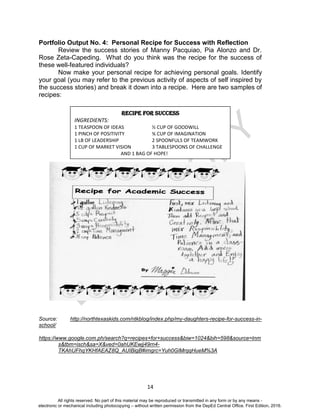
the success stories) and break it down into a recipe. Here are two samples of
recipes:
Source: http://northtexaskids.com/ntkblog/index.php/my-daughters-recipe-for-success-in-
school/
https://www.google.com.ph/search?q=recipes+for+success&biw=1024&bih=598&source=lnm
s&tbm=isch&sa=X&ved=0ahUKEwjj49rn4-
TKAhUFhqYKHfAEAZ8Q_AUIBigB#imgrc=Yuh0GlMrqqHueM%3A
RECIPE FOR SUCCESS
INGREDIENTS:
1 TEASPOON OF IDEAS ½ CUP OF GOODWILL
1 PINCH OF POSITIVITY ¾ CUP OF IMAGINATION
1 LB OF LEADERSHIP 2 SPOONFULS OF TEAMWORK
1 CUP OF MARKET VISION 3 TABLESPOONS OF CHALLENGE
AND 1 BAG OF HOPE!
All rights reserved. No part of this material may be reproduced or transmitted in any form or by any means -
electronic or mechanical including photocopying – without written permission from the DepEd Central Office. First Edition, 2016.
D
EPED
C
O
PY
15
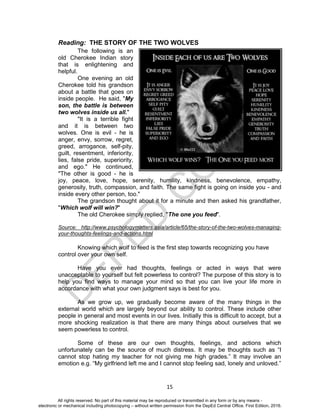
Reading: THE STORY OF THE TWO WOLVES
The following is an
old Cherokee Indian story
that is enlightening and
helpful.
One evening an old
Cherokee told his grandson
about a battle that goes on
inside people. He said, "My
son, the battle is between
two wolves inside us all."
"It is a terrible fight
and it is between two
wolves. One is evil - he is
anger, envy, sorrow, regret,
greed, arrogance, self-pity,
guilt, resentment, inferiority,
lies, false pride, superiority,
and ego." He continued,
"The other is good - he is
joy, peace, love, hope, serenity, humility, kindness, benevolence, empathy,
generosity, truth, compassion, and faith. The same fight is going on inside you - and
inside every other person, too."
The grandson thought about it for a minute and then asked his grandfather,
"Which wolf will win?"
The old Cherokee simply replied, "The one you feed".
Source: http://www.psychologymatters.asia/article/65/the-story-of-the-two-wolves-managing-
your-thoughts-feelings-and-actions.html
Knowing which wolf to feed is the first step towards recognizing you have
control over your own self.
Have you ever had thoughts, feelings or acted in ways that were
unacceptable to yourself but felt powerless to control? The purpose of this story is to
help you find ways to manage your mind so that you can live your life more in
accordance with what your own judgment says is best for you.
As we grow up, we gradually become aware of the many things in the
external world which are largely beyond our ability to control. These include other
people in general and most events in our lives. Initially this is difficult to accept, but a
more shocking realization is that there are many things about ourselves that we
seem powerless to control.
Some of these are our own thoughts, feelings, and actions which
unfortunately can be the source of much distress. It may be thoughts such as “I
cannot stop hating my teacher for not giving me high grades.” It may involve an
emotion e.g. “My girlfriend left me and I cannot stop feeling sad, lonely and unloved.”
All rights reserved. No part of this material may be reproduced or transmitted in any form or by any means -
electronic or mechanical including photocopying – without written permission from the DepEd Central Office. First Edition, 2016.
D
EPED
C
O
PY
16
It can also be in the form of a behavior such as the inability to control one's craving
for food such as cakes and chocolates.”
But are we indeed really powerless to control our own maladaptive thoughts,
feelings and actions? The grandfather’s answer "The one you feed" is deceivingly
simple. The results of psychological research indicate that there are at least four
important concepts or ideas implied by the answer:
1. The mind is not the unitary entity it seems to us but consists of different parts.
For example in the story there are the two wolves and the “you” that chooses
between them.
2. These parts of the mind/brain can interact and be in conflict with each other
i.e. the two wolves fight for dominance over our mind and behavior.
3. The “you” has the ability to decide which wolf it will feed.
4. Having made a choice, “you” can decide specifically how to “feed” or nurture
the selected wolf.
Source: http://www.psychologymatters.asia/article/65/the-story-of-the-two-wolves-
managing-your-thoughts-feelings-and-actions.html
Reading: THE POWER TRIAD: THOUGHTS, FEELINGS AND ACTIONS
The STORY OF THE TWO WOLVES gives rise to a number of questions.
Let us share our thoughts, feelings and opinions on the following questions. By
taking time to do this, you will learn to better manage your mind, feelings, and
actions and consciously feeding the good wolf in you.
 How aware are you of the two different opposing “wolves” operating within
your mind, one of which leads to pain and a diminished sense of life and the
other to a joyous, meaningful, and fulfilling life?
 When was the time you feel disappointed by the choice of behavior because
you knew that there was a more positive option but you just didn’t choose it?
 What ways or techniques or exercises do you use to strengthen yourself so
as to increase its potency to choose and hence control your life?
 In what specific ways do you feed the negative wolf?
 What specific ways do you use to feed the positive wolf?
Source: http://www.psychologymatters.asia/article/65/the-story-of-the-two-wolves-
managing-your-thoughts-feelings-and-actions.html
All rights reserved. No part of this material may be reproduced or transmitted in any form or by any means -
electronic or mechanical including photocopying – without written permission from the DepEd Central Office. First Edition, 2016.
D
EPED
C
O
PY
17
Big Question: How can you as an adolescent be prepared for adult life
by accomplishing various developmental tasks according to
developmental stages?
Objectives:
At the end of this module, you will be able to:
1. Classify various developmental tasks according to developmental stage,
2. Evaluate your development in comparison with persons of the same age
group, and
3. List ways to become a responsible adolescent prepared for adult life.
“Maturity is achieved
when a person postpones immediate pleasures for long-term values.”
Joshua L. Liebman
Activity: MY PERSONAL TIMELINE
A personal timeline portrays the influential events and happenings of a
person’s life so that he can understand where he has gone wrong and right in the
past. It helps to plan the future in a better constructive way.
Using a bond paper, write the major events in your life and the significant
people in your life. You may add your age, specific dates and places. You may draw
the timeline horizontally, vertically, diagonally or even using ups and down
depending on your imagination. Be creative in your representations. You may also
use symbols, figures and drawings. Think of a title for your personal timeline.
You may use crayons or art materials depending on the available resources
or just a simple paper and pen may be fine. You can also go for the personal timeline
website template samples available online. The link is
https://www.template.net/business/timeline-templates/personal-timeline-template/
Source: http://blogs.psychcentral.com/relationships/2012/08/the-timeline-of-your-life-story-
probing-to-create-shift-to-life-liberating-meanings-2-of-2/
Portfolio Output No. 5: My Personal Timeline with Reflection
Write about your Personal Timeline which you made in class. Answer the
following questions:
1. Is there a ‘center’ or a central theme in your timeline and life? If you will give a
title for your timeline what would it be and why?
2. Identify the turning points in your timeline. What were the thoughts, feelings and
actions that you experienced?
3. Who are/were the most significant people in your life? How did they influence
you?
4. What would you change or add, if you could? How would each of these
changes or additions affect your life, or even change its present course?
MODULE 3:
Developmental Stages in Middle and Late Adolescence
All rights reserved. No part of this material may be reproduced or transmitted in any form or by any means -
electronic or mechanical including photocopying – without written permission from the DepEd Central Office. First Edition, 2016.
D
EPED
C
O
PY
18
5. Where do you want to be in a year, 5 years, and 10 years? What do you expect
your future timeline will be?
Source: http://blogs.psychcentral.com/relationships/2012/08/the-timeline-of-your-life-story-
probing-to-create-shift-to-life-liberating-meanings-2-of-2/
Reading: DEVELOPMENTAL STAGES
Human Development focuses on human growth and changes across the
lifespan, including physical, cognitive, social, intellectual, perceptual, personality and
emotional growth.
The study of human developmental stages is essential to understanding how
humans learn, mature and adapt. Throughout their lives, humans go through various
stages of development.
The human being is either in a state of growth or decline, but either condition
imparts change. Some aspects of our life change very little over time, are
consistent. Other aspects change dramatically. By understanding these changes, we
can better respond and plan ahead effectively.
Developmental Stage Characteristics
1. Pre-natal
(Conception to birth)
Age when hereditary endowments and sex
are fixed and all body features, both
external and internal are developed.
2. Infancy
(Birth to 2 years)
Foundation age when basic behavior are
organized and many ontogenetic maturation
skills are developed.
3. Early Childhood
(2 to 6 years)
Pre-gang age, exploratory, and questioning.
Language and Elementary reasoning are
acquired and initial socialization is
experienced.
4. Late Childhood
(6 to 12 years)
Gang and creativity age when self-help
skills, social skills, school skills, and play are
developed.
5. Adolescence
(puberty to 18 years)
Transition age from childhood to adulthood
when sex maturation and rapid physical
development occur resulting to changes in
ways of feeling, thinking and acting.
6. Early Adulthood
(18 to 40 years)
Age of adjustment to new patterns of life
and roles such as spouse, parent and bread
winner.
7. Middle Age
(40 years to retirement)
Transition age when adjustments to initial
physical and mental decline are
experienced.
8. Old Age
(Retirement to death)
Retirement age when increasingly rapid
physical and mental decline are
experienced.
All rights reserved. No part of this material may be reproduced or transmitted in any form or by any means -
electronic or mechanical including photocopying – without written permission from the DepEd Central Office. First Edition, 2016.
D
EPED
C
O
PY
19
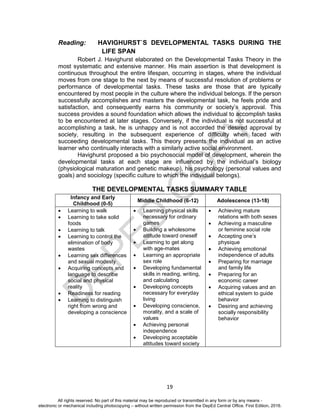
Reading: HAVIGHURST`S DEVELOPMENTAL TASKS DURING THE
LIFE SPAN
Robert J. Havighurst elaborated on the Developmental Tasks Theory in the
most systematic and extensive manner. His main assertion is that development is
continuous throughout the entire lifespan, occurring in stages, where the individual
moves from one stage to the next by means of successful resolution of problems or
performance of developmental tasks. These tasks are those that are typically
encountered by most people in the culture where the individual belongs. If the person
successfully accomplishes and masters the developmental task, he feels pride and
satisfaction, and consequently earns his community or society’s approval. This
success provides a sound foundation which allows the individual to accomplish tasks
to be encountered at later stages. Conversely, if the individual is not successful at
accomplishing a task, he is unhappy and is not accorded the desired approval by
society, resulting in the subsequent experience of difficulty when faced with
succeeding developmental tasks. This theory presents the individual as an active
learner who continually interacts with a similarly active social environment.
Havighurst proposed a bio psychosocial model of development, wherein the
developmental tasks at each stage are influenced by the individual’s biology
(physiological maturation and genetic makeup), his psychology (personal values and
goals) and sociology (specific culture to which the individual belongs).
THE DEVELOPMENTAL TASKS SUMMARY TABLE
Infancy and Early
Childhood (0-5)
Middle Childhood (6-12) Adolescence (13-18)
 Learning to walk
 Learning to take solid
foods
 Learning to talk
 Learning to control the
elimination of body
wastes
 Learning sex differences
and sexual modesty
 Acquiring concepts and
language to describe
social and physical
reality
 Readiness for reading
 Learning to distinguish
right from wrong and
developing a conscience
 Learning physical skills
necessary for ordinary
games
 Building a wholesome
attitude toward oneself
 Learning to get along
with age-mates
 Learning an appropriate
sex role
 Developing fundamental
skills in reading, writing,
and calculating
 Developing concepts
necessary for everyday
living
 Developing conscience,
morality, and a scale of
values
 Achieving personal
independence
 Developing acceptable
attitudes toward society
 Achieving mature
relations with both sexes
 Achieving a masculine
or feminine social role
 Accepting one’s
physique
 Achieving emotional
independence of adults
 Preparing for marriage
and family life
 Preparing for an
economic career
 Acquiring values and an
ethical system to guide
behavior
 Desiring and achieving
socially responsibility
behavior
All rights reserved. No part of this material may be reproduced or transmitted in any form or by any means -
electronic or mechanical including photocopying – without written permission from the DepEd Central Office. First Edition, 2016.
D
EPED
C
O
PY
20
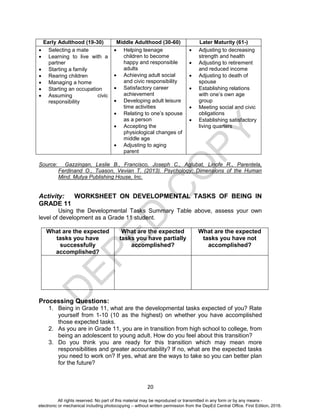
Early Adulthood (19-30) Middle Adulthood (30-60) Later Maturity (61-)
 Selecting a mate
 Learning to live with a
partner
 Starting a family
 Rearing children
 Managing a home
 Starting an occupation
 Assuming civic
responsibility
 Helping teenage
children to become
happy and responsible
adults
 Achieving adult social
and civic responsibility
 Satisfactory career
achievement
 Developing adult leisure
time activities
 Relating to one’s spouse
as a person
 Accepting the
physiological changes of
middle age
 Adjusting to aging
parent
 Adjusting to decreasing
strength and health
 Adjusting to retirement
and reduced income
 Adjusting to death of
spouse
 Establishing relations
with one’s own age
group
 Meeting social and civic
obligations
 Establishing satisfactory
living quarters
Source: Gazzingan, Leslie B., Francisco, Joseph C., Aglubat, Linofe R., Parentela,
Ferdinand O., Tuason, Vevian T. (2013). Psychology: Dimensions of the Human
Mind. Mutya Publishing House, Inc.
Activity: WORKSHEET ON DEVELOPMENTAL TASKS OF BEING IN
GRADE 11
Using the Developmental Tasks Summary Table above, assess your own
level of development as a Grade 11 student.
What are the expected
tasks you have
successfully
accomplished?
What are the expected
tasks you have partially
accomplished?
What are the expected
tasks you have not
accomplished?
Processing Questions:
1. Being in Grade 11, what are the developmental tasks expected of you? Rate
yourself from 1-10 (10 as the highest) on whether you have accomplished
those expected tasks.
2. As you are in Grade 11, you are in transition from high school to college, from
being an adolescent to young adult. How do you feel about this transition?
3. Do you think you are ready for this transition which may mean more
responsibilities and greater accountability? If no, what are the expected tasks
you need to work on? If yes, what are the ways to take so you can better plan
for the future?
All rights reserved. No part of this material may be reproduced or transmitted in any form or by any means -
electronic or mechanical including photocopying – without written permission from the DepEd Central Office. First Edition, 2016.
D
EPED
C
O
PY
21
Activity: HOW MINDFUL AM I?
For each of the following situations, decide whether the person followed
these guidelines for mindful speech:
Is what I want to say True?
Is what I want to say Helpful?
Am I the best one to say it?
Is it necessary to say it Now?
Is it Kind to this person and others?
[THINK definition from Mindfulness for Teen Anxiety by Dr. Christopher Willard]
In your journal, for each number, mark √ for yes, X for no, or ? if you’re not
sure. There could be more than one 'correct' answer. The purpose of this activity is
to reflect on the situations and whether you've witnessed or experienced something
similar in your own life.
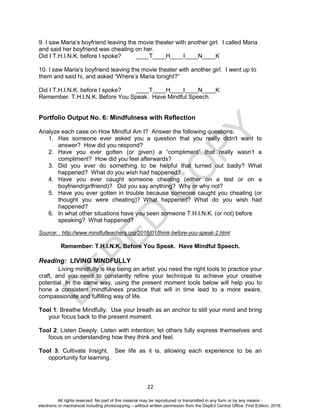
1. I did really well on an exam. I said to my friends, “I got the top score. What did
you get?”
Did I T.H.I.N.K. before I spoke? ____T____H____I____N____K
2. One of my friends was bragging about getting a good score on a test, and I didn't
want to tell him I failed. I said, "Congratulations!" then started talking about
something else.
Did I T.H.I.N.K. before I spoke? ____T____H____I____N____K
3. People kept telling me about this strange color Mrs. Jenkins dyed her hair. When I
saw her, I didn't think it looked that bad, so I told her, “Your hair’s not as weird as
everyone says it is.”
Did I T.H.I.N.K. before I spoke? ____T____H____I____N____K
4. A woman with a big belly was about to enter the building. I told my friend, “We
need to go open the door for that lady. She’s pregnant.”
Did I T.H.I.N.K. before I spoke? ____T____H____I____N____K
5. A boy told his friend to hold the door open for me because I’m pregnant. I said,
“Hey, I’m not pregnant! You sayin’ I’m fat?”
Did I T.H.I.N.K. before I spoke? ____T____H____I____N____K
6. A boy told his friend to hold the door open for me because I’m pregnant. I said,
“Thank you for holding the door, but I’m actually not pregnant.”
Did I T.H.I.N.K. before I spoke? ____T____H____I____N____K
7. I saw a couple of kids cheating on a test. I went up to the teacher after class and
told him what I’d seen.
Did I T.H.I.N.K. before I spoke? ____T____H____I____N____K
8. I saw a girl looking at her phone during a test. I went up to the teacher after class
and told him she was cheating.
Did I T.H.I.N.K. before I spoke? ____T____H____I____N____K
All rights reserved. No part of this material may be reproduced or transmitted in any form or by any means -
electronic or mechanical including photocopying – without written permission from the DepEd Central Office. First Edition, 2016.
D
EPED
C
O
PY
22
9. I saw Maria’s boyfriend leaving the movie theater with another girl. I called Maria
and said her boyfriend was cheating on her.
Did I T.H.I.N.K. before I spoke? ____T____H____I____N____K
10. I saw Maria’s boyfriend leaving the movie theater with another girl. I went up to
them and said hi, and asked “Where’s Maria tonight?”
Did I T.H.I.N.K. before I spoke? ____T____H____I____N____K
Remember: T.H.I.N.K. Before You Speak. Have Mindful Speech.
Portfolio Output No. 6: Mindfulness with Reflection
Analyze each case on How Mindful Am I? Answer the following questions:
1. Has someone ever asked you a question that you really didn't want to
answer? How did you respond?
2. Have you ever gotten (or given) a “compliment” that really wasn’t a
compliment? How did you feel afterwards?
3. Did you ever do something to be helpful that turned out badly? What
happened? What do you wish had happened?
4. Have you ever caught someone cheating (either on a test or on a
boyfriend/girlfriend)? Did you say anything? Why or why not?
5. Have you ever gotten in trouble because someone caught you cheating (or
thought you were cheating)? What happened? What do you wish had
happened?
6. In what other situations have you seen someone T.H.I.N.K. (or not) before
speaking? What happened?
Source: http://www.mindfulteachers.org/2016/01/think-before-you-speak-2.html
Remember: T.H.I.N.K. Before You Speak. Have Mindful Speech.
Reading: LIVING MINDFULLY
Living mindfully is like being an artist: you need the right tools to practice your
craft, and you need to constantly refine your technique to achieve your creative
potential. In the same way, using the present moment tools below will help you to
hone a consistent mindfulness practice that will in time lead to a more aware,
compassionate and fulfilling way of life.
Tool 1: Breathe Mindfully. Use your breath as an anchor to still your mind and bring
your focus back to the present moment.
Tool 2: Listen Deeply. Listen with intention; let others fully express themselves and
focus on understanding how they think and feel.
Tool 3: Cultivate Insight. See life as it is, allowing each experience to be an
opportunity for learning.
All rights reserved. No part of this material may be reproduced or transmitted in any form or by any means -
electronic or mechanical including photocopying – without written permission from the DepEd Central Office. First Edition, 2016.
D
EPED
C
O
PY
23
Tool 4: Practice Compassion. Consider the thoughts and feelings of others and let
tenderness, kindness and empathy be your guides.
Tool 5: Limit Reactivity. Observe rather than be controlled by your emotions. Pause,
breathe, and choose a skillful response based on thoughtful speech and non-
violence under every condition.
Tool 6: Express Gratitude. Practice gratitude daily and expand it outward,
appreciating everyone and everything you encounter.
Tool 7: Nurture Mutual Respect. Appreciate our common humanity and value
different perspectives as well as your own.
Tool 8: Build Integrity. Cultivate constructive values and consistently act from
respect, honesty and kindness.
Tool 9: Foster Leadership. Engage fully in life and in community. Share your unique
talents and generosity so that others can also be inspired.
Tool 10: Be Peace. Cultivate your own inner peace, becoming an agent for
compassionate action and social good.
Which tools do you use most often? Which tools do you use least often?
Can you think of ways to incorporate those tools into your life? Which one could you
try today?
Source: info@mwithoutborders.org http://www.mindfulteachers.org/2015/04/how-mindful-
am-i-quiz.html
All rights reserved. No part of this material may be reproduced or transmitted in any form or by any means -
electronic or mechanical including photocopying – without written permission from the DepEd Central Office. First Edition, 2016.
D
EPED
C
O
PY
24
Big Question: How can you, as an adolescent, balance the expectations
of significant people in your life and your personal aspirations?
Objectives:
At the end of this module, you will be able to:
1. discuss how facing the challenges during adolescence, you may able
to clarify and manage the demands of teen years,
2. express your feelings on the expectations of the significant people
around you, such as your parents, siblings, friends, teachers,
community leaders, and
3. make affirmations that help you become more lovable and capable as
an adolescent.
“Successful people are always looking for opportunities to help others.
Unsuccessful people are always asking: “What’s in it for me?” – Brian Tracy
Portfolio Output No. 7: Role Play on Challenges of Middle Adolescence
1. Plan a role play on a specific situation in which a developmental
challenge of middle adolescence is seen in your everyday living.
2. Practice your role play with your group mates.
3. Perform your role play in class.
4. Make a report on your group’s brainstorming and performance. Include
this report and the script.
Reading: THE PASSAGE TO ADULTHOOD: CHALLENGES OF LATE
ADOLESCENCE
Physical Development
 Most girls have completed the physical changes related to puberty by age 15.
 Boys are still maturing and gaining strength, muscle mass, and height and
are completing the development of sexual traits.
Emotional Development
 May stress over school and test scores.
 Is self-involved (may have high expectations and low self-concept).
 Seeks privacy and time alone.
 Is concerned about physical and sexual attractiveness.
 May complain that parents prevent him or her from doing things
independently.
 Starts to want both physical and emotional intimacy in relationships.
 The experience of intimate partnerships
MODULE 4:
The Challenges of Middle and Late Adolescence
All rights reserved. No part of this material may be reproduced or transmitted in any form or by any means -
electronic or mechanical including photocopying – without written permission from the DepEd Central Office. First Edition, 2016.
D
EPED
C
O
PY
25
Social Development
 shifts in relationship with parents from dependency and subordination to one
that reflects the adolescent’s increasing maturity and responsibilities in the
family and the community,
 Is more and more aware of social behaviors of friends.
 Seeks friends that share the same beliefs, values, and interests.
 Friends become more important.
 Starts to have more intellectual interests.
 Explores romantic and sexual behaviors with others.
 May be influenced by peers to try risky behaviors (alcohol, tobacco, sex).
Mental Development
 Becomes better able to set goals and think in terms of the future.
 Has a better understanding of complex problems and issues.
 Starts to develop moral ideals and to select role models.
Source: http://deepblue.lib.umich.edu/bitstream/handle/2027.42/49326/179_ftp.pdf
Reading: ENCOURAGEMENT 101: The Courage to Be Imperfect
by Timothy D. Evans, Ph.D.
Encouragement is the key ingredient for improving your relationships with
others. It is the single most important skill necessary for getting along with others –
so important that the lack of it could be considered the primary cause of conflict and
misbehavior. Encouragement develops a person’s psychological hardiness and
social interest. Encouragement is the lifeblood of a relationship. And yet, this simple
concept is often very hard to put into practice.
Encouragement is not a new idea. Its spiritual connotation dates back to the
Bible in Hebrews 3:11 which states “Encourage one another daily.” Encouragement,
as a psychological idea, was developed by psychiatrist Alfred Adler in the early
20th
century and continued to evolve through the work of Adler’s follower Rudolph
Dreikurs. However, even today, relatively few educators, parents, psychologists,
leaders or couples have utilized this valuable concept. Most of the time, people
mistakenly use a technique like praise in an effort to “encourage” others.
Half the job of encouragement lies in avoiding discouraging words and
actions. When children or adults misbehave, it is usually because they are
discouraged. Instead of building them up, we tear them down; instead of recognizing
their efforts and improvements, we point out mistakes; instead of allowing them to
belong through shared decision-making and meaningful contributions, we isolate and
label them.
Most of us are skilled discouragers. We have learned how to bribe, reward
and, when that fails, to punish, criticize, nag, threaten, interrogate and emotionally
withdraw. We do this as an attempt to control those we love, bolstered by the
mistaken belief that we are responsible for the behavior of everyone around us,
especially our spouses and children. These attempts to control behavior create
atmospheres of tension and conflict in many houses.
Most commonly, we discourage in five general ways:
 We set standards that are too high for others to meet because we are overly
ambitious.
 We focus on mistakes as a way to motivate change or improved behavior.
All rights reserved. No part of this material may be reproduced or transmitted in any form or by any means -
electronic or mechanical including photocopying – without written permission from the DepEd Central Office. First Edition, 2016.
D
EPED
C
O
PY
26
 We make constant comparisons (self to others, siblings to one another).
 We automatically give a negative spin to the actions of others.
 We dominate others by being overly helpful, implying that they are unable to
do it as well.
Encouragement is not a technique nor is it a special language used to gain
compliance. Encouragement conveys the idea that all human beings are worthwhile,
simply because they exist. In one sentence, Mr. Rogers does more for a child’s
sense of adequacy than a hundred instances of praise when he says, “I like you just
the way you are.” Not I like you when you do it well enough, fast enough and get it
all correct. Encouragement develops children’s psychological hardiness -- their
ability to function and recover when things aren’t going their way.
Encouragement enhances a feeling of belonging which leads to greater social
interest. Social interest is the tendency for people to unite themselves with other
human beings and to accomplish their tasks in cooperation with others. The Junior
League mission of “developing the potential of women and improving communities
through the effective action and leadership of trained volunteers” is rooted in the idea
of social interest.
The first step to becoming an encouraging person is to learn to distinguish
encouragement from discouragement. As a rule, ask yourself: Whatever I say or
do, will it bring me closer together or farther apart from this person?
We all have the power to be more encouraging people. The choice, as
always, is yours.
Source: http://carterandevans.com/portal/index.php/adlerian-theory/84-encouragement-101-
the-courage-to-be-imperfect
Reading: THE POWER OF PERSONAL DECLARATIONS
by Dr. Emily De Carlo
So often we accept the declarations that others have made concerning our
own lives, well-being or fate. It is imperative that we recognize that in order to
achieve what we want in life, we must not give our power away to others by
accepting their declarations concerning our affairs. When one decides that he or she
will boldly declare good fortune, wellness, joy, etc. relative to his or her life, all of
heaven will break loose! Goodness and mercy shall surely follow.
From birth, we are often told what we are going to be. Sometimes, this is a
good thing, but suppose you have been told time and time again that "you will not
amount to anything just like your mother or father"? This is a dangerous declaration
because it sets into motion the actualization of an unwanted occurrence. All of us
want to amount to something! In order to counteract this and all of the negative
declarations with their destructive potential, one must consciously replace them with
one's own declarations. In so doing, you are now in control of setting into action what
you really want to occur. You can declare that goodness and mercy shall surely
follow you all the days of your life!
The following are some declarations that you may want to make concerning
your life:
I declare:
that I am totally free of all addictions.
that I will survive any attempts of others to control my life.
that I am free in my mind, body, and emotions.
All rights reserved. No part of this material may be reproduced or transmitted in any form or by any means -
electronic or mechanical including photocopying – without written permission from the DepEd Central Office. First Edition, 2016.
D
EPED
C
O
PY
27
that I am free to set goals and reach them.
that I am a loving individual with the capacity to give love.
that I am a child of God with all rights and privileges thereof.
that I will contribute to the welfare of others.
that I will be an ambassador of goodwill to all I meet on the journey.
that I will be a good example for others to follow.
that I will help all that I can to reach their goals.
that I will speak words of encouragement to others.
that I will find the goodness in life and focus on it.
that I will not succumb to the negative influences of others.
that I will read the information that will encourage my personal,
and spiritual growth.
that I will commit to being the best I can be.
These declarations are meant to encourage you to take control of the
influences in your life. They are suggestions as to what positive things you can speak
about your own life instead of accepting whatever has been said about you in the
past. You now have the authority to plant the seeds of love, encouragement and
victory in your garden, thereby crowding out the weeds of negativity that may already
have taken root! Just as in a garden, you may have to pull and pull until you get
some weeds out. Sometimes, the negative comments and declarations of others
have taken such a stronghold in our lives, that we must persist until we see the
bough not only fall, but break into pieces. Don't be discouraged if you don't reach
your goals overnight. Just remember that even a small stream of water will crack
concrete eventually!!
Source: http://www.selfgrowth.com/articles/the_power_of_personal_declarations
Portfolio Output No. 8: Slogan or Personal Declaration on Being Happy
1. Read the essay on “Being Happy”.
2. Choose a phrase, sentence, or paragraph that strikes you.
3. Make a slogan or personal declaration on how you can be committed to your
self-development.
4. Explain your thoughts and feelings about it. Include specific ways in which
you will develop yourself further.
Reading: BEING HAPPY
You may have defects, be anxious and sometimes live irritated, but do not
forget that your life is the greatest enterprise in the world. Only you can prevent it
from going into decadence. There are many that need you, admire you and love you.
I would like to remind you that being happy is not having a sky without
storms, or roads without accidents, or work without fatigue, or relationships without
disappointments.
Being happy is finding strength in forgiveness, hope in one’s battles, security
at the stage of fear, love in disagreements.
Being happy is not only to treasure the smile, but that you also reflect on the
sadness. It is not just commemorating the event, but also learning lessons in failures.
It is not just having joy with the applause, but also having joy in anonymity.
Being happy is to recognize that it is worthwhile to live, despite all the
challenges, misunderstandings and times of crises.
All rights reserved. No part of this material may be reproduced or transmitted in any form or by any means -
electronic or mechanical including photocopying – without written permission from the DepEd Central Office. First Edition, 2016.
D
EPED
C
O
PY
28
Being happy is not inevitable fate, but a victory for those who can travel
towards it with your own being.
Being happy is to stop being a victim of problems but become an actor in
history itself. It is not only to cross the deserts outside of ourselves, but still more, to
be able to find an oasis in the recesses of our soul. It is to thank God every morning
for the miracle of life.
Being happy is not being afraid of one's feelings. It is to know how to talk
about ourselves. It is to bear with courage when hearing a "no". It is to have the
security to receive criticism, even if is unfair. It is to kiss the children, pamper the
parents, have poetic moments with friends, even if they have hurt us.
Being happy means allowing the free, happy and simple child inside each of
us to live; having the maturity to say, "I was wrong"; having the audacity to say,
"forgive me". It is to have sensitivity in expressing, "I need you"; to have the ability of
saying, "I love you." So that your life becomes a garden full of opportunities for being
happy...
In your spring-time, may you become a lover of joy. In your winter, may you
become a friend of wisdom. And when you go wrong along the way, you start all over
again. Thus you will be more passionate about life. And you will find that happiness
is not about having a perfect life but about using tears to water tolerance, losses to
refine patience, failures to carve serenity, pain to lapidate pleasure, obstacles to
open the windows of intelligence.
Never give up ... Never give up on the people you love. Never give up from
being happy because life is an incredible show. And you are a special human being!
Source: https://www.facebook.com/mcspa/posts/10153625162832490
End of Unit 1 Assessment
Unit 1: Self-Development
List of Outputs for Portfolio:
Module 1
1. Talent / Variety Show Presentation (Group work)
2. Journal Reflection from My Banner (Individual work)
Module 2
3. Personal Assessment of Aspects of Development with Plan of Action
(Individual work)
4. Personal Recipe for Success with reflection (Individual work)
Module 3
5. My Personal Timeline with Reflection (Individual work)
6. Mindfulness with Reflection (Individual work)
Module 4
7. Role Play on Challenges of Middle Adolescence (Group work)
8. Slogan or Personal Declaration on Being Happy (Individual work)
All rights reserved. No part of this material may be reproduced or transmitted in any form or by any means -
electronic or mechanical including photocopying – without written permission from the DepEd Central Office. First Edition, 2016.
D
EPED
C
O
PY
29
Unit 2: Aspects of Personal Development
Big Question: What is Stress and how does it affect you?
Objectives:
At the end of this module you will be able to:
1. discuss that understanding stress and its sources during adolescence
may help in identifying ways to cope and have a healthful life,
2. identify sources of your stress and illustrate the effect of stress on your
system, and
3. demonstrate personal ways of coping with stress for healthful living.
Activity: STRESS BINGO
Copy the bingo card in your journal. Find someone who regularly participates
in one of these activities. Ask him/her to sign his/her name in the appropriate box.
Find a different person for each box. Wait for your teacher to call out the type of
BINGO activity.
Listens to
music
Keeps a
journal or a
diary
Plays a
musical
instrument
Makes “to
do” lists
Has hiked to
the top of a
mountain
Eats
Breakfast
Enjoys
baking
cookies
Plays with an
electronic
device
Likes to laugh
and does so a
lot
Has a fish
tank /
aquarium
Plays outside
after school
Talks to
family about
problems
Your favorite
activity
Enjoys nature Sleeps 9-11
hours a night
Goes for
walks / bike
riding
Volunteers Practices a
martial art
Daydreams Does yoga or
pilates
Enjoys going
for a drive
Goes window
shopping
Works out at
a gym/ at
home
Skis,
Skateboards
Rented a
movie on the
weekend
Reading: STRESS MANAGEMENT
Dictionary definitions do not quite capture the meaning of stress as it is seen
and experienced in the world of work. One of the Webster’s definitions describes it
as an “…emotional factor that causes bodily or mental tension.”
A practical way of defining stress is the feeling one gets from prolonged,
pent-up emotions. If the emotions you experience are pleasant and desirable – joy,
elation, ecstasy, delight – you usually feel free to let them show. They are not
MODULE 5:
Coping with Stress in Middle and Late Adolescence
All rights reserved. No part of this material may be reproduced or transmitted in any form or by any means -
electronic or mechanical including photocopying – without written permission from the DepEd Central Office. First Edition, 2016.
D
EPED
C
O
PY
30
suppressed. Therefore; positive emotions do not usually cause stress. Negative
emotions, on the other hand, are more often held inside. They are hidden. You suffer
quietly and you experience stress. Do not confuse positive situations with positive
emotions. A wedding, for example, is a positive situation that often brings about the
negative emotions of anxiety and tension. So stress can exist in great situations.
Causes and Effects of Stress
Just as there is great variety in the range of emotions you might experience,
there are many possible manifestations of stress – in your private life and in your
working life. Here are some words that describe the emotions associated (as cause
and effect) with stress.
 Anxiety
 Pressure
 Misery
 Strain
 Desperation
 Tension
 Anger
 Panic
 Dejection
Prolonged stress can be devastating; burnout, breakdown, and depression
are some of the potential results of long-term, unmanaged stress. By wearing a
mask, you may expect to hide stress caused by problems in your personal life and
not let them influence your performance on the job. This will probably not work. The
more you try to hold your emotions in, the greater the pressure build-up will be.
Everyday frustrations cause stress build-up
From the time you wake up until you go to sleep, you may be confronted with
a succession of stressful situations. Managing to get yourself (and possibly a spouse
and children) out of bed and ready to face the day can be a challenge to your
patience and ingenuity. Driving to school or work can be harrowing – especially if
you’re running late. You may experience frustration in arranging to get the car
repaired. You may face conflicts in school or at work, such as coping with unrealistic
deadlines, equipment failures, or unexpected bad weather. If part of your job is
selling, you may experience feelings of rejection when most of your customers say
“no.”
A series of stressful and frustrating experiences throughout the day can
cause you to lie awake at night in an emotional turmoil – unable to get needed rest.
You face the next day with less emotional and physical stamina. After another
stressful day and another night without rest, you may have even less emotional
strength and stability. Therefore, stress build-up, if not resolved, continues day after
day.
Problems in our personal life can be devastating
Surviving the normal, everyday stress described above can be difficult. But
far more serious and painful circumstances can create long-term stress. More
serious stressful circumstances may include separation from loved ones, personal
illness, or illness of a loved one, death of someone you care about, or conflict with a
spouse or close friend. Other major causes of stress are problems with drug and
All rights reserved. No part of this material may be reproduced or transmitted in any form or by any means -
electronic or mechanical including photocopying – without written permission from the DepEd Central Office. First Edition, 2016.
D
EPED
C
O
PY
31
alcohol abuse, domestic violence, care of children and elderly relatives, chronic
mental illness, injury, physical handicaps, even moving to a new home, if you’ve lived
in the same place for more than 10 years. The list goes on and on.
Managing your personal finances can be another stressful experience. This
can be a problem no matter what your income level, but it is especially difficult if you
must support a family and do not earn enough to live comfortably. Unpaid bills,
unwise use of credit, and budget limitations can make life difficult.
A common cause of stress is dealing with life’s transitions
This is especially true when a person must cope with too many transitions all
at once. For example, Ellen has just completed a program in fashion merchandising.
She is eager to get started on her new job. Her mother is ill and requires care. Her
father died a few months ago. Ellen’s new job requires that she relocate to a town
100 miles from home. The move, a new career, and a change in family relationships
may cause excessive stress for her. Too many changes have arrived at the same
time.
Source: Personal Development for Life and Work, 8th Ed., by Wallace, H.R. & Masters, L.A.,
2001.
Activity: WHAT CAUSES YOU TO “LOSE YOUR COOL”?
We all have certain things, situations, or people that cause us to lose our
composure from time to time. Determine what causes YOU to “lose your cool” by
completing this activity. When you begin to identify your stressors, you can become
skilled at preventing negative consequences. Place an X next to each factor that
causes you stress. There are blank spaces provided so you can add your own.
______ being late
______ too much homework
______ speaking in public
______ babysitting
______ going to the dentist
______ arguments with friends
______ restrictions at home
______ chores
______ lack of sleep
______ no date for a dance
______ pimples
______ physical education class
______ math class
______ English class
______ other class
______ boredom
______ rude people
______ no money
______ no transportation
______ playing on a sports team
______ not being included in a sports team
______ losing something valuable
______ parents fighting
______ getting detention
______ your job
______ taking tests
______ video games
______ using a computer
______ closed-in spaces
______ commercials
______ interruptions while busy
______ getting an injection
______ arguments with parents
______ fight with boyfriend/girlfriend
______ losing
______ careless drivers
______ slow drivers
______ loud people
______ baby crying
______ disrespectful children
______ a friend betrays you
______
______
______
Source: Emotional Intelligence Activities for teens 13-18.
All rights reserved. No part of this material may be reproduced or transmitted in any form or by any means -
electronic or mechanical including photocopying – without written permission from the DepEd Central Office. First Edition, 2016.
D
EPED
C
O
PY
32
Activity: STRESS SIGNALS
Take a look at the warning signs of stress listed below. Write down in your
Journal all of the warning signs that apply to you.
When you have finished checking your warning signs, discuss your list with your
partner.
Source: Emotional Intelligence Activities for teens 13-18.
Portfolio Output No. 9: My Stress Signals
Write about your stress signals. Answer the following questions:
1. How do you know that you are stressed?
2. What stress signals do you have that your partner does not have?
3. How much stress do you think you are currently under?
4. How are your stress signals different for different types of stressors?
5. What are some ways that you usually remove or reduce the stress
that cause you physical, emotional or behavioral difficulties?
Physical
______ headaches
______ stomach aches
______ dizziness
______ back pain
______ neck stiffness
______ ulcer sores on
mouth
______ jaw pains
______ weight loss
______ weight gain
______ twitches
(eyelids,
face)
______ weakness
______ nausea
______ indigestion
______ excessive
sleeping
______ overeating
______ loss of appetite
______ inability to sleep
______ skin problems
______ constant fatigue
______ cold hands or
feet
______ excessive
sweating
______ chest pains
______ high blood
pressure
______ rapid or difficult
breathing
Emotional
______ mood changes
______ lack of
concentration
______ nightmares
______ panic attacks
______ anxiety
______ anger
______ irritability
______ crying
______ thoughts of
suicide
______ depression
______ confusion
______ feelings of
helplessness
______ restlessness
______ racing thoughts
______ aggressiveness
Behavioral
______ smoking
______ nail biting
______ tapping
______ pulling hair
______ grinding hair
______ use of alcohol
______ use of medication
______ compulsive
dieting
______ hair chewing
______ nervous laughter
______ pacing
______ lateness
______ putting things off
______ not caring about
physical
appearance
______ compulsive
overeating
All rights reserved. No part of this material may be reproduced or transmitted in any form or by any means -
electronic or mechanical including photocopying – without written permission from the DepEd Central Office. First Edition, 2016.
D
EPED
C
O
PY
33
Reading: STRESS RESPONSE
Your stress response is the collection of physiological changes that occur
when you face a perceived threat—when you face situations where you feel the
demands outweigh your resources to successfully cope. These situations are known
as stressors.
When your stress response is triggered, a series of changes occur within
your body. They include:
 Redirection of blood away from extremities and instead to major organs
 The release of cortisol and other hormones, which bring other short- and
long-term changes.
 The stress response is intended to give you a burst of energy so you’re able
to fight off attackers or run away from them effectively.
This helped our ancestors, who faced numerous physical threats, to stay safe.
However, now our threats tend to be less physical and more associated with our way
of life—a challenge to our status, a demand for performance, etc. In addition to
giving us a set of changes that may not match our needs as well (it might be more
effective for us to have a burst of mental clarity or wisdom than a burst of physical
strength, for example), the stress response can actually cause harm if it leads to a
state of chronic stress—that is, if our stress response is triggered, and then our body
doesn’t go back to its normal state via the relaxation response.
Source: “What is a stress response?” by Scott, E. (2016)
Reading: KEEP STRESS UNDER CONTROL
There are many effective ways to handle stress. Of course, you can’t avoid
stress—in fact, you wouldn’t want to avoid all stress, because you’d never grow.
However, you can manage your life so that you survive the emotional down times
without allowing stress to engulf you. Also, you can work to eliminate controllable
stress factors, such as running late or not getting enough sleep. But when stress is
constant or too great, your wisest option is to find ways to reduce or control it. You
need not, and should not, live your life in emotional stress and discomfort. Stress can
be successfully managed. Here are some suggestions that may help.
Understand the Causes of Stress
Understanding why you are under stress is important. This may seem
obvious, but it requires deliberate, conscious effort to pause and simply ponder your
situation. By now, you are familiar with the stress response, the emotional or
physical symptoms of uncontrolled stress. Now you need to try to discover the
stressors, the factors of which create the stress in your life.
Analyze your Stress Factors and Write Them Down
Write down your response to stress. For example, you may write down, “I feel
tired most of the time. My lower back seems to ache all through the day and night. I
miss deadlines and run behind schedule.” Analyze stress responses and
consequences, and consider each item, and ask why. “Why am I feeling tired? Why
does my back ache? Why do I run behind schedule? Carefully consider each
answer, because the answers will reveal stressors, such as deadlines, anxieties,
trying to do so much, managing time or money poorly, or poor health habits.
All rights reserved. No part of this material may be reproduced or transmitted in any form or by any means -
electronic or mechanical including photocopying – without written permission from the DepEd Central Office. First Edition, 2016.
D
EPED
C
O
PY
34
Deal with the Stressors
Develop techniques to deal with the causes of stress. The longer you avoid
dealing with the stress factors, the more the stress will build up. If tension comes
because you have put off an unfinished task, restructure your priorities so you can
get the task that you have been avoiding out of the way and off your mind.
Learn to Work under Pressure or Unusual Conditions
When you can’t reduce the stressors, you need to manage your stress
response. Almost everyone, at least at some point, has to meet deadlines, keep
several jobs going at once, resolve problems that come up, and do extra work when
necessary. However, when the pressure mounts, you can relieve it. Relaxation is
key—but most people must train themselves to relax when the pressure is on.
Some tips to relax when under pressure are the following:
 Stop for a moment (especially when you feel your muscles tightening up) and
take a few deep breaths.
 Do a relaxing exercise. Swing your hands at your sides and stretch.
 Take a “power nap.” Lie down and totally relax for a few minutes.
 Find time to do the things you enjoy.
 Leave your study area for a while to take a brisk walk.
 Find a quiet place to read a magazine or novel during break or at lunch.
 If possible, look at some peaceful images such as forests, beaches, etc.
These images can initiate a relaxation response.
 Look up.
 Keep something humorous on hand, such as a book of jokes.
Source: The Nemours Foundation, available from kidshealth.org
Activity: STRESS SURVIVAL KIT
1. Choose 3 objects or symbols that make you feel relaxed to include in your kit.
2. You can make the symbols.
3. You can use words or pictures.
4. You can bring an object from home.
5. Think about how the symbol helps you when you are dealing with stress and
stressful situations.
6. Write a paragraph for each symbol or object in your kit and how it helps you
cope with stress in your everyday life. You may add this to your Portfolio
Output No. 9.
7. Sharing a part of your kit with peers may be a follow up activity.
Source: Mental Health Kit, Junior High School, Alberta Health Services
Activity: PROJECT TO-DO-LIST
In senior high, you may become increasingly more responsible for your own
use of time. You may be given multiple tasks and expectations, for example
academic work, extracurricular activities, family, friends, and work. Learning how to
prioritize tasks and break them down into manageable steps is an important skill to
learn for managing stress. Here is an activity that will help you learn to do this.
All rights reserved. No part of this material may be reproduced or transmitted in any form or by any means -
electronic or mechanical including photocopying – without written permission from the DepEd Central Office. First Edition, 2016.
D
EPED
C
O
PY
35
Sample Project To-Do List Now you do it!
Project To-Do List
Project Overview: Psychology
Term Paper
Project Overview:
Step 1: Find a Topic
Tasks:
 Talk to the professor
 Check my textbook
 Peruse the available
books and journals at the
library
Step 1: _____________________________
Tasks:
 _______________________________
 _______________________________
 _______________________________
Step 2: Locate Research
Materials
Tasks:
 Use library databases to
locate articles
 Check online databases
 Get articles (download,
copy, order from
interlibrary loan)
Step 2:
Tasks:
 _______________________________
 _______________________________
 _______________________________
Step 3: Research Paper
Tasks:
 Read articles, taking
notes as I go
 Determine if I need
references
 Piece together an outline
of my paper based on
my notes
Step 3:
Tasks:
 _______________________________
 _______________________________
 _______________________________
Source: Mental Health Kit, Junior High School, Alberta Health Services
Portfolio Output No. 10: Project-To-Do
With your group mates, plan your Grade 11 year-end fun day following the
Project-To-Do Template. Write this plan down. Then write a reflection on how your
experience of planning changed with the use of the planning tool. What did you
notice about your group’s work? Was there a lot of stress in planning? How did your
group reduce their stress level? How can you apply this planning method to other
real-life projects?
All rights reserved. No part of this material may be reproduced or transmitted in any form or by any means -
electronic or mechanical including photocopying – without written permission from the DepEd Central Office. First Edition, 2016.
D
EPED
C
O
PY
36
Big Question: How do we develop the powers of our mind?
Objectives:
At the end of this module, you will be able to:
1. discuss that understanding the left and right brain functions may help in
improving one’s learning,
2. explore mind-mapping techniques suited to right brain- or left brain-dominant
thinking
styles, and
3. make a plan to improve learning using both left and right brain development.
Activity: LATERAL THINKING PUZZLES
1. You are driving down the road in your car on a wild, stormy night, when you pass
by a bus stop and you see three people waiting for the bus:
a. An old lady who looks as if she is about to die
b. An old friend who once saved your life
c. The perfect partner you have been dreaming about
Knowing that there can only be one passenger in your car, whom would you
choose?
2. Acting on an anonymous phone call, the police raid a house to arrest a
suspected murderer. They don't know what he looks like but they know his name
is John and that he is inside the house. The police bust in on a carpenter, a lorry
driver, a mechanic and a fireman all playing poker. Without hesitation or
communication of any kind, they immediately arrest the fireman. How do they
know they've got their man?
3. A man lives in the penthouse of an apartment building. Every morning he takes
the elevator down to the lobby and leaves the building. Upon his return, however,
he can only travel halfway up in the lift and has to walk the rest of the way -
unless it's raining. What is the explanation for this?
4. A man and his son are in a car crash. The father is killed and the child is taken to
hospital gravely injured. When he gets there, the surgeon says, 'I can't operate
on this boy - for he is my son!!!' How can this possibly be?
Reading: BRAINPOWER: COMPLEX ORGAN CONTROLS YOUR EVERY
THOUGHT AND MOVE
The answer involves thought, as in "I want to get on the Internet"; movement
— pressing the computer's power button and grasping a mouse; memory—like
How did you get here?
No, no, no! It's not a question about your conception or birth.
How did you get here? On this page. Reading this story.
The answer is a lot more complex than, "My teacher told me to read it" or "I
clicked on it by accident."
MODULE 6:
The Powers of the Mind
All rights reserved. No part of this material may be reproduced or transmitted in any form or by any means -
electronic or mechanical including photocopying – without written permission from the DepEd Central Office. First Edition, 2016.
D
EPED
C
O
PY
37
recalling how to use a browser or a search engine; and word recognition such as
"Brainpower" and an understanding of its meaning.
In short, the answer involves a wrinkled, pinkish-gray, three-pound organ that
is primarily composed of fat and water and goes by the name of brain.
You got to this article because that jelly-like mass topping off your spinal
cord fired electrical signals to your hand telling it how to move. You got to this article
because your brain stored information about using a computer and the definition of
words that you learned years ago. You got to this article because your brain is
working.
Keep reading to find out how it functions, if it repairs itself and if the effects of
drug use are permanent.
The power to act
The brain has three major parts -- the cerebrum, the cerebellum and the brain
stem. The brain stem connects the spinal cord and the brain. It controls functions
that keep people alive such as breathing, heart rate, blood pressure and food
digestion. Those activities occur without any thought. You aren't telling yourself,
"Inhale. Exhale. Inhale." You're just breathing.
Things are different in the cerebellum. That region controls voluntary
movement. When you want to lift your fork, wave your hand, brush your hair or wink
at a cutie, you form the thought and then an area in the cerebellum translates your
will into action. It happens so quickly. Think about how little time passes between
your desire to continue reading this sentence and the time it takes your eyes to move
to this word or this one. It seems automatic, but it isn't.
Neurons, the basic functional units of the nervous system, are three-part units
and are key to brain function. They are comprised of a nerve cell body, axon and
dendrite, and they power the rapid-fire process that turns thought into movement.
The thought moves as an electrical signal from the nerve cell down the axon
to a dendrite, which looks like branches at the end of nerve cells. The signal jumps
from the end of the dendrite on one cell across the space, called a synapse, to the
dendrite of another cell with the help of chemicals called neurotransmitters. That
signal continues jumping from cell to cell until it reaches the muscle you need to
wave, wink or walk.
The cerebrum is the largest of the three brain sections, accounts for about 85
percent of the brain's weight, and has four lobes. The lobes-frontal, parietal, temporal
and occipital -- each have different functions. They get their names from the sections
of the skull that are next to them.
The parietal lobe helps people understand what they see and feel, while the
frontal lobe determines personality and emotions. Vision functions are located in the
occipital lobe, and hearing and word recognition abilities are in the temporal lobe.
A critical age
Because the brain's healthy functioning is essential to living and determines
quality of life, doctors emphasize protecting the organ from injury and chemical
abuse.
There is a consensus among researchers that brain cells regenerate
throughout life, said Doug Postels, a pediatric neurosurgeon in New Orleans, but that
new growth happens very slowly after a certain age.
"The size of the brain doesn't increase much after 3," Postels explains.
All rights reserved. No part of this material may be reproduced or transmitted in any form or by any means -
electronic or mechanical including photocopying – without written permission from the DepEd Central Office. First Edition, 2016.
D
EPED
C
O
PY
38
During the first three years of life, the brain experiences most of its growth
and develops most of its potential for learning. That's the time frame in which
synaptogenesis, or the creation of pathways for brain cells to communicate, occurs.
Doctors generally accept that cut-off point for two reasons, Postels said. First,
in situations where doctors removed parts of the brains of patients younger than 3 to
correct disorders, the remaining brain sections developed to assume the role of the
portions those doctors removed. But when physicians performed the same surgery
on older patients, that adaptability function did not occur.
Second, "We know from experiments that if you deprive people of intellectual
stimulation and put them in a dark room, that it produces permanent changes in the
brain," Postels said. "That occurs most dramatically before age 3. After that age, it's
impossible to ethically do a study."
Previous research produced information about the effects of stimulation
deprivation, but modern ethical guidelines prohibit such research on people because
of the potentially harmful outcome.
Drug damage
Because so little recovery occurs to brains damaged after age 3, the effects
of drugs and alcohol on the brain might be lasting.
Doctors know what inhalants, steroids, marijuana, cocaine and alcohol do to
the brain when people use them. "The question scientists can't answer now is if the
damage is permanent," said Sue Rusche, co-author of "False Messengers," a book
on how addictive drugs change the brain.
Inhalants, such as glue, paint, gasoline and aerosols, destroy the outer lining
of nerve cells and make them unable to communicate with one another. In 1993,
more than 60 young people died from sniffing inhalants, according to National
Families in Action, a drug education center based in Atlanta.
Studies have found that marijuana use hinders memory, learning, judgment
and reaction times, while steroids cause aggression and violent mood swings.
Ecstasy use is rising among young people, Rusche said, and scientists have
found that drug destroys neurons that make serotonin, a chemical crucial in
controlling sleep, violence, mood swings and sexual urges.
While doctors and scientists know about some effects drugs have on the
brain, they don't have a full picture, Rusche said.
"When people start using a drug, the scientists know nothing about it. These
people are volunteering to be guinea pigs," said Rusche, who is co-founder and
executive director of National Families in Action. "Once enough people take it,
scientists apply for grants and start studying it. People are inventive. They find new
drugs or new ways to take old drugs-like crack from cocaine.
"There's a lot we won't know about until later," she said. "The classic example
is cigarettes. We allowed people to smoke for 100 years before we knew about all
the horrible things that nicotine will do.
Source: Christy Oglesby, CNNfyi Senior Writer, December 5, 2000 from
http://edition.cnn.com/fyi/interactive/news/brain/structure.function.html
All rights reserved. No part of this material may be reproduced or transmitted in any form or by any means -
electronic or mechanical including photocopying – without written permission from the DepEd Central Office. First Edition, 2016.
D
EPED
C
O
PY
39
Activity: BRAIN DOMINANCE
Which of these apply to you?
___ I am very organized.
___ I remember faces more than names.
___ I think things through before making a decision.
___ If someone’s mad at me, I can tell even without the person saying a word.
___ I work best in a quiet space.
___ I daydream a lot.
___ I hate taking risks.
___ I tend to get emotional.
___ I make a to-do-list.
___ I trust my “gut instinct”.
If you have more “yes” answers from the left column, you are probably left-brain
dominant, while if you have more “yes” answers from the right column, you are
probably right-brain dominant.
Reading: THE DOMINANT SIDE OF THE BRAIN
Researchers believed that brain dominance determines a person’s
preferences, problem-solving style, personality characteristics, and even career
choices. For example, a right-brain individual will quickly get a feeling for a situation,
while a left-brain person will usually ask a lot of questions first. The following chart
reflects additional difference between left and right-brain dominance.
PERSONAL PREFERENCE
LEFT DOMINANCE RIGHT DOMINANCE
Classical music Popular music
Being on time A good times
Careful planning To visualize the outcome
To consider alternative To go with the first idea
Being thoughtful Being active
Monopoly, scrabble, or chess Athletics, art, or music
There is nothing good or bad about either preference. Both orientations can
be equally successful in accomplishing a single task; however, one may be more
appropriate over the other depending on the situation.
Reading: RESEARCH STUDY “THE BRAIN’S LEFT AND RIGHT SIDES
SEEM TO WORK TOGETHER BETTER IN MATHEMATICALLY
GIFTED MIDDLE-SCHOOL YOUTH”
WASHINGTON- There really may be something different about the brains of
math-heads. Mathematically gifted teens did better than average-ability teens and
college students on tests that required the two halves of the brain to cooperate, as
reported in the April issue of Neuropsychology, published by the American
Psychological Association (APA).
In the study, a joint effort of psychologists at the U.S. Army Research Institute
for the Behavioral and Social Sciences at Fort Benning, Ga. and the University of
All rights reserved. No part of this material may be reproduced or transmitted in any form or by any means -
electronic or mechanical including photocopying – without written permission from the DepEd Central Office. First Edition, 2016.
D
EPED
C
O
PY
40
Melbourne, Australia, researchers studied 60 right-handed males: 18 mathematically
gifted (averaging nearly 14 years in age), 18 of average math ability (averaging just
over 13), and 24 college students (averaging about 20). Math giftedness seems to
favor boys over girls, appearing an estimated six to 13 times more often. It's not
known why but prenatal exposure to testosterone is suspected to be one influence
due to its selective benefit to the right half of the brain.
The gifted boys were recruited from a Challenges for Youth-Talented
program at Iowa State University. Whereas the average Scholastic Aptitude Test
(SAT) math score for college-bound high-school seniors is 500 (out of 800), the
mathematically gifted boys' average SAT math score in middle school was 620.
The boys viewed letter patterns flashed on the left or right sides of a
computer screen, and had to indicate whether two patterns matched or not - a simple
way of learning how the brain responds to data put before either the left or right
visual field, corresponding to processing in the right or left brain because the input
generally crosses over to the other side.
The letter patterns were presented in three conditions - one-sided, to the right
hemisphere (left eye); one-sided, to the left hemisphere (right eye); or bilaterally
(both eyes). There were two types of tasks -- "local," saying two letters matched or
mismatched on the small letters that went into making big letters (for example, a big
T whose two strokes were made of smaller T's), and "global," saying two big letters
matched or mismatched.
For the average teens and college students, the left brain hemisphere was
faster for local matches and the right brain hemisphere was faster for global
matches. This fit prior research, which has indicated that the left hemisphere is adept
at processing visual "parts," in this case the letter details, while the right hemisphere
is more adept at analyzing visual "wholes," in this case the global shapes of the big
letters.
However, the mathematically gifted boys showed no such hemispheric differences.
Those who were precocious in math were equally good at processing global and
local elements with either hemisphere, suggesting more interactive, cooperative left
and right brains.
In addition, whereas average-ability boys and college students were slower
on cooperative trials, which presented letter patterns on both sides of the screen, the
math-gifted showed the opposite pattern. They were slower on one-sided trials, but
when a task "asked" both sides of the brain to work together, they were considerably
faster than the other boys
The study supports the growing notion that the mathematically gifted are
better at relaying and integrating information between the cerebral hemispheres.
Says co-author Michael O'Boyle, PhD, "It's not that you have a special math module
somewhere in your brain, but rather that the brain's particular functional organization
- which allows right-hemisphere contributions to be better integrated into the overall
cognitive/behavioral equation -- predisposes it towards the use of high-level imagery
and spatial skills, which in turn just happen to be very useful when it comes to doing
math reasoning."
The research supports the broader notion that "the functional (though not
necessarily structural) organization of the brain may be an important contributor to
individual differences in cognitive abilities, talents and, at the very least, information-
processing styles," says O'Boyle.
All rights reserved. No part of this material may be reproduced or transmitted in any form or by any means -
electronic or mechanical including photocopying – without written permission from the DepEd Central Office. First Edition, 2016.
D
EPED
C
O
PY
41
He adds, "Various expressions of exceptionality, such as giftedness in math,
music or art, may be the by-product of a brain that has functionally organized itself in
a qualitatively different way than the usual left/right hemispheric asymmetry."
At the same time, O'Boyle is not sure whether the findings could apply to
math education in general. "Our work may perhaps have something to say about the
optimal timing of when a particular brain is most 'ready to learn' or acquire a given
skill, but I don't think we can 'create' a math genius without the innate talent already
there," he says.
Finally, given the rising use of testosterone by adult men, O'Boyle cautions
that, "Testosterone taken later in life will not help your math, as the window of
influence on brain development is pretty much prenatal. It may enhance muscle
mass, but it is unlikely to help you solve calculus problems."
Source: "Interhemispheric interaction during global-local processing in mathematically gifted
adolescents, average-ability youth, and college students," Harnam Singh, Ph.D., U.S.
Army Research Institute for the Behavioral and Social Sciences, and Michael W.
O'Boyle, PhD, University of Melbourne, Australia; Neuropsychology, Vol. 18, No. 2.
Reporters: Michael O'Boyle , from the American Psychological Association, available from
http://www.apa.org/news/press/releases/2004/04/interhemispheric.aspx
Activity: MIND MAPPING
Mind mapping is a powerful thinking tool. It is a graphical technique that
mirrors the way the brain works, and was invented by Tony Buzan. Mind mapping
helps to make thinking visible. Most people make notes using lined paper and blue or
black ink. Making notes more attractive to the brain by adding color and rhythm can
aid the learning process, and can help to make learning fun. The subject being
studied is crystallized in a central image and the main theme radiates out from the
central image on branches. Each branch holds a key image or a key word. Details
are then added to the main branches and radiate further out. Mind maps have a wide
variety of uses, for example, note taking, revision planning, planning for writing and
problem solving can all be successfully carried out using the technique. The colors
and the graphics used will help children to organize their ideas and thoughts. They
can be very simple or, quite detailed depending upon the age of the children and the
complexity of the subject. Because creating the mind map involves the use of the left
and right brain, remembering the information becomes easier!
Below is an example of a simple mind map linked to the information above.
All rights reserved. No part of this material may be reproduced or transmitted in any form or by any means -
electronic or mechanical including photocopying – without written permission from the DepEd Central Office. First Edition, 2016.
D
EPED
C
O
PY
42
How to draw a mind map:
1. Turn the page on its side (landscape). Use plain paper.
2. Draw the central image using different colors. The central image
should encapsulate the subject of the map.
3. Add the branches representing the subject’s main topics or
themes using key words or images.
4. Add detail with more key words and images. Use color.
5. Print the words clearly.
6. Use arrows to connect linked ideas.
Source: Dodd (2004). Learning to Think: Thinking to Learn,
http://aysinalp.edublogs.org/files/2013/09/TheBrainandLearning-1f6e16y.pdf
Reading: YOU CAN GROW YOUR INTELLIGENCE
New Research Shows the Brain Can Be Developed Like a Muscle
Many people think of the brain as a mystery. They don’t know much about
intelligence and how it works. When they do think about what intelligence is, many
people believe that a person is born either smart, average, or dumb—and stays that
way for life. But new research shows that the brain is more like a muscle—it changes
and gets stronger when you use it. And scientists have been able to show just how
the brain grows and gets stronger when you learn. Everyone knows that when you lift
weights, your muscles get bigger and you get stronger. A person who can’t lift 20
pounds when they start exercising can get strong enough to lift 100 pounds after
working out for a long time. That’s because the muscles become larger and stronger
with exercise. And when you stop exercising, the muscles shrink and you get
weaker. That’s why people say “Use it or lose it!” But most people don’t know that
when they practice and learn new things, parts of their brain change and get larger a
lot like muscles do when they exercise.
Inside the cortex of
the brain are billions of tiny
nerve cells, called neurons.
The nerve cells have branches
connecting them to other cells
in a complicated network.
Communication between
these brain cells is what allows
us to think and solve
problems.
When you learn new things, these tiny connections in the brain actually
multiply and get stronger. The more
that you challenge your mind to learn,
the more your brain cells grow. Then,
things that you once found very hard
or even impossible to do—like
speaking a foreign language or doing
algebra—seem to become easy. The
result is a stronger, smarter brain.
Figure 1: Section of the Cerebral Cortex
Figure 2: A typical nerve cell
All rights reserved. No part of this material may be reproduced or transmitted in any form or by any means -
electronic or mechanical including photocopying – without written permission from the DepEd Central Office. First Edition, 2016.
D
EPED
C
O
PY
43
How Do We Know the Brain Can Grow Stronger?
Scientists started thinking that the human brain could develop and change
when they studied animals’ brains. They found out that animals who lived in a
challenging environment, with other animals and toys to play with, were different
from animals who lived alone in bare cages. While the animals who lived alone just
ate and slept all the time, the ones who lived with different toys and other animals
were always active. They spent a lot of time figuring out how to use the toys and how
to get along with the other animals.
These animals had more
connections between the nerve cells in
their brains. The connections were bigger
and stronger, too. In fact, their whole
brains were about 10% heavier than the
brains of the animals who lived alone
without toys. The animals who were
exercising their brains by playing with
toys and each other were also
“smarter”—they were better at solving
problems and learning new things.
Even old animals got smarter and developed more connections in their
brains when they got the chance to play with new toys and other animals. When
scientists put very old animals in the cage with younger animals and new toys to
explore, their brains also grew by about 10%!
The Key to Growing the Brain: Practice!
From the first day they are born, babies are hearing people around them talk—all
day, every day, to the baby and to each other. They have to try to make sense of
these strange sounds and figure out what they mean. In a way, babies are exercising
their brains by listening hard. Later, when they need to tell their parents what they
want, they start practicing talking
themselves. At first, they just make goo-
goo sounds. Then, words start coming.
And by the time they are three years old,
most can say whole sentences almost
perfectly. Once children learn a
language, they don’t forget it. The child’s
brain has changed—it has actually gotten
smarter. This can happen because
learning causes permanent changes in
the brain. The babies’ brain cells get
larger and grow new connections
between them. These new, stronger connections make the child’s brain stronger and
smarter, just like a weightlifter’s big muscles make them strong.
The Real Truth About “Smart” and “Dumb”. No one thinks babies are stupid
because they can’t talk. They just haven’t learned how to yet. But some people will
call a person dumb if they can’t solve math problems, or spell a word right, or read
fast—even though all these things are learned with practice. At first, no one can read
or solve equations. But with practice, they can learn to do it. And the more a person
Figure 4: Growth of neuron connections in a child
from birth to 6 years old
At birth At age 6
© Mindset Works
Figure 3: Effect of an Enriched Environment
Nerves in brain of
animal living in bare
cage.
Brain of animal living with
other animals and toys
© Mindset Works
All rights reserved. No part of this material may be reproduced or transmitted in any form or by any means -
electronic or mechanical including photocopying – without written permission from the DepEd Central Office. First Edition, 2016.
D
EPED
C
O
PY
44
learns, the easier it gets to learn new things—because their brain “muscles” have
gotten stronger! The students everyone thinks as the “smartest” may not have been
born any different from anyone else. But before they started school, they may have
started to practice reading. They had already started to build up their “reading
muscles.” Then, in the classroom, everyone said, “That’s the smartest student in the
class.” They don’t realize that any of the other students could learn to do as well if
they exercised and practiced reading as much. Remember, all of those other
students learned to speak at least one whole language already—something that
grownups find very hard to do. They just need to build up their “reading muscles” too.
What Can You Do to Get Smarter? Just like a weightlifter or a basketball player, to
be a brain athlete, you have to exercise and practice. By practicing, you make your
brain stronger. You also learn skills that let you use your brain in a smarter way—just
like a basketball player learns new moves. But many people miss out on the chance
to grow a stronger brain because they think they can’t do it, or that it’s too hard. It
does take work, just like becoming stronger physically or becoming a better ball
player does. Sometimes it even hurts! But when you feel yourself get better and
stronger, all the work is worth it!
Source:http://schools.nyc.gov/NR/rdonlyres/C7BD7406-040C-42FA-B44C-
2FCF72EB819C/0/GrowYourIntelligenceArticleandActivity.pdf © 2010 Mindset Works
Portfolio Output No. 11: Make a Mind Map
1. Choose a subject or activity that you do well (for example, math, basketball,
playing the guitar, painting, cooking, or computer games).
2. Make a mind map of the chosen topic, following the procedure described
earlier.
3. Explain your mind map and how you worked on it.
Assignment: Bring some print ads of body beautifying products, clothes, or fashion.
Reading: THE MYTH OF MICHAEL JORDAN
Michael Jordan is one of the best basketball players of all time. His average
points per game is the highest in NBA history – 31.5. He is one of two players to
score more than 3000 points in a single season. And he has 11 MVP awards – five
for the regular season and six for the finals.
It was dazzling to watch Jordan play. People often spoke of his grace on the
court. They talked about his natural abilities. But the true story is different. When he
was a sophomore in high school, Michael Jordan didn’t even make the team. “It was
embarrassing not making the team,” he says. “They posted the roster [list of players]
and it was there for a long, long time without my name on it. I remember being really
mad, too, because there was a guy who made it that wasn’t as good as
me.”Someone else might have sulked, or quit. But this setback only fueled Jordan’s
desire to improve. “Whenever I was working out and got tired and figured I ought to
stop, I’d close my eyes and see that list in the locker room without my name on it,”
Jordan says, “and that usually got me going again.”
The physical education teacher at Jordan’s high school, Ruby Sutton,
describes Jordan’s commitment to the game in those days. “I would normally get to
school between 7 and 7:30. Michael would be at school before I would. Every time
All rights reserved. No part of this material may be reproduced or transmitted in any form or by any means -
electronic or mechanical including photocopying – without written permission from the DepEd Central Office. First Edition, 2016.
D
EPED
C
O
PY
45
I’d come in and open these doors, I’d hear the basketball. Fall, wintertime,
summertime. Most mornings I had to run Michael out of the gym.”
Adapted from “Michael Jordan transcends hoops” by Larry Schwartz.ESPN.com, 2007.
Big Question: How do you stay mentally healthy?
Objectives:
At the end of the module, you will be able to:
1. interpret the concepts of mental health and psychological well-being in
everyday observations about mental health problems during adolescence,
2. identify your own vulnerabilities, and
3. create a plan to stay mentally healthy during adolescence
Reading: CHANGE YOUR MIND ABOUT MENTAL HEALTH
Mental health. It’s the way your thoughts, feelings, and behaviors affect your
life. Good mental health leads to positive self-image and in-turn, satisfying
relationships with friends and others. Having good mental health helps you make
good decisions and deal with life’s challenges at home, work, or school.
It is not uncommon for teenagers to develop problems with their mental
health. Problems can range from mild to severe, and can include depression,
anxiety, body esteem issues, and suicide, among others.
Unfortunately, most young people with mental health problems don’t get any
treatment for them.
Research shows that effective treatments are available that can help
members of all racial, ethnic, and cultural groups.
If you broke your leg or came down with pneumonia, you wouldn’t let it go
untreated. Often however, young people ignore mental health problems thinking they
will “snap out of it,” or that they are something to be ashamed of. That kind of
thinking prevents people from getting the help they need. Sometimes getting help is
a matter of understanding mental health issues and changing your mind about them.
Source: American Psychological Association, available from:
http://www.apa.org/helpcenter/change.aspx
Activity: MEDIA MOTIVES
1. What type of product or service is featured in your ad?
2. What approach has the advertiser used to promote or sell this product or
service? Here are some of the methods that advertisers use to attract
consumer:
 Sex Appeal
 Join the Bandwagon: Everyone is getting one!
 Highest Quality Available
MODULE 7:
Mental Health and Well-Being in Middle
and Late Adolescence
All rights reserved. No part of this material may be reproduced or transmitted in any form or by any means -
electronic or mechanical including photocopying – without written permission from the DepEd Central Office. First Edition, 2016.
D
EPED
C
O
PY
46
 Financial Plans/Installment Incentives
 Negative Advertising
 Homestyle or Traditional
 We Try Harder
 Best Value
 New & Improved
 Name Brands & Logos
 Health & Safety
3. What message does this ad give the consumer?
4. How would you define or describe this approach to advertising?
5. Do you think that this approach is effective advertising for the product? Why
or why not?
6. In what ways, if any, could any part of this advertisement impact a person’s
body image? (e.g. you could take into consideration: the product itself, the
models selling it, the way it is being presented, etc.)
(adapted from Mental Health Kit (Junior High School)–Be Kind to Yourself and Others
http://www.albertahealthservices.ca/assets/programs/ps-7344-body-image-gr7.pdf)
Additional Information: Strategies for Becoming a Critical Viewer of the Media
Media messages about body shape and size will affect the way we feel about
ourselves and our bodies, only if we let them. One of the ways we can protect our
self-esteem and body image from the media’s narrow definitions of beauty is to
become a critical viewer of the media messages we are bombarded with each day.
When we effectively recognize and analyze the media messages that influence us,
we remember that the media’s definitions of beauty and success do not have to
define our self-image or potential. Remember:
• All media images and messages are constructions. They are NOT reflections of
reality. Advertisements and other media messages have been carefully
crafted with the intent to send a very specific message.
• Advertisements are created to do one thing: convince you to buy or support a
specific product or service.
• To convince you to buy a specific product or service, advertisers will often
construct an emotional experience that looks like reality. Remember that you
are only seeing what the advertisers want you to see.
• Advertisers create their message based on what they think you will want to see
and what they think will affect you and compel you to buy their product. Just
because they think their approach will work with people like you doesn’t mean
it has to work with you as an individual.
• As individuals, we decide how to experience the media messages we
encounter. We can choose to use a filter that helps us understand what the
advertiser wants us to think or believe and then choose whether we want to
think or believe that message. We can choose a filter that protects our self-
esteem and body image.
Through the use of magazine advertisements, we have discussed what
motivates the advertising industry and the effect that media has on body image. A
final conclusion is that each student is left with strategies about how to strengthen
themselves against these messages.
All rights reserved. No part of this material may be reproduced or transmitted in any form or by any means -
electronic or mechanical including photocopying – without written permission from the DepEd Central Office. First Edition, 2016.
D
EPED
C
O
PY
47
Portfolio Output No. 12: Media Influences
(How Ads Affected My Self-Esteem)
Name some ads that appear on TV, billboards, the internet.
1. What messages do these ads give to middle adolescents like you?
2. How have these ads affected your lifestyle, self-esteem, and values?
3. How has this lesson changed your perception about ads?
Reading: SELF ESTEEM AND BODY ESTEEM
Does any of this sound familiar? "I'm too tall." "I'm too short." "I'm too skinny."
"If only I were shorter/taller/had curly hair/straight hair/a smaller nose/longer legs, I'd
be happy."
Are you putting yourself down? If so, you're not alone. As a teen, you're going
through lots of changes in your body. And, as your body changes, so does your
image of yourself. It's not always easy to like every part of your looks, but when you
get stuck on the negatives it can really bring down your self-esteem.
Why Are Self-Esteem and Body Image Important?
Self-esteem is all about how much you feel you are worth — and how
much you feel other people value you. Self-esteem is important because feeling
good about yourself can affect your mental health and how you behave.
People with high self-esteem know themselves well. They're realistic and find
friends that like and appreciate them for who they are. People with high self-esteem
usually feel more in control of their lives and know their own strengths and
weaknesses.
Body image is how you view your physical self — including whether
you feel you are attractive and whether others like your looks. For many people,
especially people in their early teens, body image can be closely linked to self-
esteem.
What Influences a Person's Self-Esteem?
Puberty and Development
Some people struggle with their self-esteem and body image when they
begin puberty because it's a time when the body goes through many changes. These
changes, combined with wanting to feel accepted by our friends, means it can be
tempting to compare ourselves with others. The trouble with that is, not everyone
grows or develops at the same time or in the same way.
Media Images and Other Outside Influences
Our tweens and early teens are a time when we become more aware of
celebrities and media images — as well as how other kids look and how we fit in. We
might start to compare ourselves with other people or media images ("ideals" that
are frequently airbrushed). All of this can affect how we feel about ourselves and our
bodies even as we grow into our teens.
Families and School
Family life can sometimes influence our body image. Some parents or
coaches might be too focused on looking a certain way or "making weight" for a
sports team. Family members might struggle with their own body image or criticize
their kids' looks ("why do you wear your hair so long?" or "how come you can't wear
All rights reserved. No part of this material may be reproduced or transmitted in any form or by any means -
electronic or mechanical including photocopying – without written permission from the DepEd Central Office. First Edition, 2016.
D
EPED
C
O
PY
48
pants that fit you?"). This can all influence a person's self-esteem, especially if
they're sensitive to others peoples' comments.
People also may experience negative comments and hurtful teasing about the way
they look from classmates and peers. Although these often come from ignorance,
sometimes they can affect body image and self-esteem.
Common Eating Disorders
The most common eating disorders are anorexia nervosa and bulimia
nervosa (usually called simply "anorexia" and "bulimia"). But other food-related
disorders, like avoidant/restrictive food intake disorder, binge eating, body image
disorders, and food phobias, are becoming more and more commonly identified.
1. Anorexia
People with anorexia have a real fear of weight gain and a distorted view of
their body size and shape. As a result, they eat very little and can become
dangerously underweight. Many teens with anorexia restrict their food intake by
dieting, fasting, or excessive exercise. They hardly eat at all — and the small amount
of food they do eat becomes an obsession in terms of calorie counting or trying to
eat as little as possible. Others with anorexia may start binge eating and purging —
eating a lot of food and then trying to get rid of the calories by making themselves
throw up, using some type of medication or laxatives, or exercising excessively, or
some combination of these.
2. Bulimia
Bulimia is similar to anorexia. With bulimia, people might binge eat (eat to
excess) and then try to compensate in extreme ways, such as making themselves
throw up or exercising all the time, to prevent weight gain. Over time, these steps
can be dangerous — both physically and emotionally. They can also lead to
compulsive behaviors (ones that are hard to stop).
To have bulimia, a person must be binging and purging regularly, at least
once a week for a couple of months. Binge eating is different from going to a party
and "pigging out" on pizza, then deciding to go to the gym the next day and eat more
healthfully
People with bulimia eat a large amount of food (often junk food) at once,
usually in secret. Sometimes they eat food that is not cooked or might be still frozen,
or retrieve food from the trash. They typically feel powerless to stop the eating and
can only stop once they're too full to eat any more, or they may have to go to
extreme measures (like pouring salt all over a dessert to make it inedible) in order to
get themselves to stop eating. Most people with bulimia then purge by vomiting, but
also may use laxatives or excessive exercise.
Although anorexia and bulimia are very similar, people with anorexia are
usually very thin and underweight, but those with bulimia may be an average weight
or can be overweight.
Portfolio Output No. 13: Research on Anxiety Disorders/Depression
Among the mental health challenges discussed in class, two of the most
common among middle adolescents are anxiety disorders and depression. Go to the
Library or browse the internet and do a little research on either one of these.
All rights reserved. No part of this material may be reproduced or transmitted in any form or by any means -
electronic or mechanical including photocopying – without written permission from the DepEd Central Office. First Edition, 2016.
D
EPED
C
O
PY
49
Look for the answers to the following questions and put them in your portfolio:
1. What are anxiety disorders/depression?
2. Who gets anxiety disorders/depression and how common are they?
3. Describe some of the symptoms of anxiety disorders/depression.
4. List and briefly explain some of the main types of anxiety
disorders/depression.
5. What type of treatment is available for people experiencing anxiety
disorders/depression?
6. What other kinds of support can help a person with anxiety
disorders/depression recover?
Activity: SIGNS OF TROUBLE: DEPRESSION
Put a check mark under the Column Yes or No for each of the items below:
Test Your Mood Yes No
Do you feel sad, depressed or down most of the time?
Are you unable to enjoy the things that once gave you pleasure?
Do you feel tired and/or lack energy most of the time?
Do you have trouble sleeping or do you sleep too much?
Do you find it difficult to concentrate or make decisions?
Have you had an increase or decrease in appetite or weight?
Have you had feelings of worthlessness or guilt?
Have you felt frightened or panicky for no apparent reason at all?
Have you felt restless and found it difficult to sit still?
Have you been feeling anxious or worried?
Have you felt like you just cannot go on or had thoughts of death
or dying?
Reading: SUPPORT STRATEGIES/COMMUNITY MENTAL HEALTH
RESOURCES
Here are some strategies for supporting someone with mental health concerns:
• Encourage the person to seek help and support from an adult.
• Spend time with the person, listen to his/her concerns.
• Be hopeful; help them feel like their life will get better.
• Stand by them. Invite your friend to things that you are doing; keeping busy
and staying in touch with friends will help your friend feel better, when they
are ready.
• Learn as much as you can about mental illness so that you understand what
is going on for them.
• If you are a close friend or family member of someone with a mental health
problem, make sure that you get help as well. Talk to someone about what is
happening. This will help you be a better support person.
• Put the person’s life before your friendship. If the person mentions thoughts
of suicide, don’t keep it secret, even if the person has asked you to.
All rights reserved. No part of this material may be reproduced or transmitted in any form or by any means -
electronic or mechanical including photocopying – without written permission from the DepEd Central Office. First Edition, 2016.
D
EPED
C
O
PY
50
Reading: HELP HOW-TO’S
First Step, Reach Out To People You Trust
Sometimes people don’t get the help they need because they don’t know
where to turn. When you’re not feeling well, it can be a struggle to take the
necessary steps to help yourself get better.
When dealing with mental health or emotional problems, it’s important not to
go at it alone. Healing is a combination of helping yourself and letting others help
you. Comfort and support, information and advice, and professional treatment are all
forms of help.
Think of all the people you can turn to for support. These are people who are
concerned about you and can help comfort you, who will listen to you and encourage
you, and who can help arrange for treatment. In other words, find caring people in
your life who can help you.
These people might include:
 friends
 parents and other family members
 someone who seems “like a parent” to you
 other adults whose advice you would value—perhaps a favorite teacher
or coach, a member of your church or other place of worship, or a good
friend’s parent.
Research shows that males are more reluctant to look for help and receive it
than females are. While some people may have difficulty reaching out to others they
trust, taking the first step in getting help is important for everyone to do.
Second Step, Take Action
The more you know, the easier it is
Libraries are an excellent source of information about mental health.
Bookstores often have “self-help” or “psychology” sections.
For those with Internet access, there are many websites related to health and
mental health. Some are better in quality than others. It is important to know if the
information on a site comes from sources you can trust. Use caution whenever
you’re sharing or exchanging information online: there’s a chance that it will not be
kept private.
Nothing is worse than nothing
The consequences of not getting help for mental health problems can be
serious. Untreated problems often continue and become worse, and new problems
may occur. For example, someone with panic attacks might begin drinking too much
alcohol with the mistaken hope that it will help relieve his or her emotional pain.
It’s All in the Attitude
There are many reasons why people do not get help for mental health
problems. Fear, shame, and embarrassment often prevent individuals and their
families from doing anything.
Sometimes being able to get the help, support, and professional treatment
you need is a matter of changing your mind about mental health and changing the
way you react to mental health problems.
Here are some important reminders:
 Mental health is as important as physical health. In fact, the two are closely
linked.
All rights reserved. No part of this material may be reproduced or transmitted in any form or by any means -
electronic or mechanical including photocopying – without written permission from the DepEd Central Office. First Edition, 2016.
D
EPED
C
O
PY
51
 Mental health problems are real, and they deserve to be treated.
 It’s not a person’s fault if he or she has a mental health problem. No one is to
blame.
 Mental health problems are not a sign of weakness. They are not something
you can “just snap out of” even if you try.
 Whether you’re male or female, it’s ok to ask for help and get it.
 There’s hope. People improve and recover with the help of treatment, and
they are able to enjoy happier and healthier lives.
Source: APA Help Center, American Psychological Association, https://www.apa.or.talking -
teens
Reading: HEALTHY EATING AND MENTAL HEALTH
Healthy eating nourishes the body, including the brain, and supports mental
health through:
 Improved overall health and vitality
 Increased ability to concentrate
 Reduced irritability and mood swings
 Lowered risk of mental illness
There is some evidence that healthy eating may be a factor in lowered risk of
depression and improved ability to deal with stress and anxiety (Healthy U Alberta,
2009).
Physical Activity and Mental Health:
Physical activity can make you feel good physically and build confidence.
Evidence suggests that physical activity may contribute to improved mood and
increased self-esteem, self-confidence and sense of control (UK Dept of Health,
2004; Fox, 1999).
Some types of physical activity may provide an opportunity to connect with
others and develop supportive relationships. Getting physically active may (CSEP,
2011):
 Make you feel better physically and feel better about yourself.
 Improve your mood.
 Improve self-esteem
 Reduce physical reactions to stress.
 Help you sleep better.
 Give you more energy.
Physical activity may be effective in preventing or reducing symptoms
associated with anxiety and depression. How physical activity improves mood and
relieves anxiety is not yet clear. Some theories propose that physical activity (UK
Dept. of Health, 2004; Fox, 1999):
 Increases body temperature, thus relaxing muscle tension.
 Releases feel-good chemicals that improve mood.
 Offers a “time-out” from worries and depressing thoughts.
 Increases self-confidence, feeling of competence and a sense of
mastery.
 Provides a sense of belonging and mutual support when participating
with others.
All rights reserved. No part of this material may be reproduced or transmitted in any form or by any means -
electronic or mechanical including photocopying – without written permission from the DepEd Central Office. First Edition, 2016.
D
EPED
C
O
PY
52
Sleep and Mental Health
Most teens need 9-11 hours of sleep every night. Problems from not being
fully rested include:
 Irritability
 Difficulty concentrating and learning
 Don’t move information from short-term to long-term memory as well
 Falling asleep in class
 Mood swings and behavior problems
 More accident prone
 More prone to depression
Suggestions for getting a good night sleep:
 Stay away from stimulants like caffeine in the evening, including
chocolate, colas, and other caffeinated beverages. These delay sleep
and increase night waking.
 Do not go to bed hungry, have a light snack.
 Turn off any TV’s, computes, or cellphones, or just do not have
electronics in the bedroom.
 Disengage from any stimulating activities like exercise, computer
games or talking on the phone for at least 30 minutes prior to bedtime.
Reading is much more relaxing and may help you fall asleep.
 Taking a warm bath or shower helps prepare the body for sleep.
 If you are not feeling rested and functioning at your best most days,
talk to your parents. You may need to speak to a doctor if you are
having problems sleeping in spite of trying the above tips.
 Try a cup of hot milk.
Activity: DEAR ABBY
Dear Abby,
I fell asleep in class today – once again! When I go to bed at night, I
just can’t seem to fall asleep. I lie in bed for hours and it doesn’t seem
to make a difference. When I wake up in the morning, I feel like I don’t
want to get up and go to school. This is the time that I could really
sleep. I wish that school didn’t start until 10:00 a.m.
Please help me out! Give me some ideas on how I could get a better
sleep, so Mr. Gomez doesn’t get upset that I fall asleep in his class.
Tired at School
All rights reserved. No part of this material may be reproduced or transmitted in any form or by any means -
electronic or mechanical including photocopying – without written permission from the DepEd Central Office. First Edition, 2016.
D
EPED
C
O
PY
53
Portfolio Output No. 14: Response to “Tired at School”
Pretend that you are Abby. Write an answer to the letter writer “Tired at
School”.
Activity: SLEEP AND BEDTIME ACTIVITIES DIARY
Week (date):
Day: Write in the rows below your activities before you went to sleep, starting on the
day in the week that you begin with: Sunday, Monday, Tuesday, Wednesday,
Thursday, Friday, Saturday.
Day Time went
to sleep
What was I doing before I went to bed?
Examples:
 Playing a sport
 Playing a video game
 Reading a book
 Watching TV
 Talking on the phone
 Texting with friends
 Hanging out with friends
 Others
Did this affect
what time you
went to
sleep?
Yes No
1.
2.
3.
4.
5.
6.
7.
Source: http://www.albertahealthservices.ca/assets/programs/ps-7344-mhk-jhs-manual.pdf
All rights reserved. No part of this material may be reproduced or transmitted in any form or by any means -
electronic or mechanical including photocopying – without written permission from the DepEd Central Office. First Edition, 2016.
D
EPED
C
O
PY
54
Big Question: How can you manage your emotions?
Objectives:
At the end of the module, you will be able to:
1. discuss that understanding the intensity and differentiation of your
emotions may help in communicating emotional expressions;
2. explore your positive and negative emotions and how you express or hide
them, and
3. demonstrate and create ways to manage various emotions
Reading: EMOTIONAL INTELLIGENCE
More Than One Kind of Intelligence
You may have heard people mention "IQ" when talking about intellect and
how smart someone is. (For example, "My brother doesn't need to study as much as
I do because he has a really high IQ.") IQ stands for "intellectual quotient." It can
help predict how well someone may do academically. IQ is just one measure of our
abilities, though.
There are many other kinds of intelligence in addition to intellect. For
example, spatial intelligence is the ability to think in 3D. Musical intelligence is the
ability to recognize rhythm, cadence, and tone. Athletic, artistic, and mechanical
abilities are other types of intelligence.
One important type of intelligence is emotional intelligence.
What Is Emotional Intelligence?
Emotional intelligence is the ability to understand, use, and manage our
emotions.
Emotional intelligence is sometimes called EQ (or EI) for short. Just as a high
IQ can predict top test scores, a high EQ can predict success in social and emotional
situations. EQ helps us build strong relationships, make good decisions, and deal
with difficult situations.
One way to think about EQ is that it's part of being people-smart.
Understanding and getting along with people helps us be successful in almost any
area of life. In fact, some studies show that EQ is more important than IQ when it
comes to doing well in school or being successful at work.
Improving Your EQ
Emotional intelligence is a combination of several different skills:
Being Aware of Your Emotions
Most people feel many different emotions throughout the day. Some feelings
(like surprise) last just a few seconds. Others may stay longer, creating a mood like
happiness or sadness. Being able to notice and accurately label these everyday
feelings is the most basic of all the EQ skills. Being aware of emotions — simply
noticing them as we feel them — helps us manage our own emotions. It also helps
MODULE 8:
Emotional Intelligence
All rights reserved. No part of this material may be reproduced or transmitted in any form or by any means -
electronic or mechanical including photocopying – without written permission from the DepEd Central Office. First Edition, 2016.
D
EPED
C
O
PY
55
us understand how other people feel. But some people might go through the entire
day without really noticing their emotions. Practice recognizing emotions as you feel
them. Label them in your mind (for example, by saying to yourself "I feel grateful," "I
feel frustrated," etc.). Make it a daily habit to be aware of your emotions.
Understanding How Others Feel and Why
People are naturally designed to try to understand others. Part of EQ is being
able to imagine how other people might feel in certain situations. It is also about
understanding why they feel the way they do. Being able to imagine what emotions
a person is likely to be feeling (even when you don't actually know) is
called empathy. Empathy helps us care about others and build good friendships and
relationships. It guides us on what to say and how to behave around someone who is
feeling strong emotions.
Managing Emotional Reactions
We all get angry. We all have disappointments. Often it's important to
express how you feel. But managing your reaction means knowing when, where,
and how to express yourself. When you understand your emotions and know how to
manage them, you can use self-control to hold a reaction if now is not the right time
or place to express it. Someone who has good EQ knows it can damage
relationships to react to emotions in a way that's disrespectful, too intense, too
impulsive, or harmful.
Choosing Your Mood
Part of managing emotions is choosing our moods. Moods are emotional
states that last a bit. We have the power to decide what mood is right for a situation,
and then to get into that mood. Choosing the right mood can help someone get
motivated, concentrate on a task, or try again instead of giving up. People with good
EQ know that moods aren't just things that happen to us. We can control them by
knowing which mood is best for a particular situation and how to get into that mood.
EQ: Under Construction
Emotional intelligence is something that develops as we get older. If it didn't,
all adults would act like little kids, expressing their emotions physically through
stomping, crying, hitting, yelling, and losing control!
Some of the skills that make up emotional intelligence develop earlier. They
may seem easier: For example, recognizing emotions seems easy once we know
what to pay attention to. But the EQ skill of managing emotional reactions and
choosing a mood might seem harder to master. That's because the part of the brain
that's responsible for self-management continues to mature beyond our teen years.
But practice helps those brain pathways develop.
We can all work to build even stronger emotional intelligence skills just by
recognizing what we feel, understanding how we got there, understanding how
others feel and why, and putting our emotions into heartfelt words when we need to.
Source: http://kidshealth.org/en/teens/eq.html
All rights reserved. No part of this material may be reproduced or transmitted in any form or by any means -
electronic or mechanical including photocopying – without written permission from the DepEd Central Office. First Edition, 2016.
D
EPED
C
O
PY
56
Activity: INTRODUCTION TO EMOTIONS
Emotions are what you feel on the inside when things happen. Emotions are
also known as feelings.
1. Afraid: feeling fear and worry
2. Angry: feeling mad with a person, act, or idea
3. Ashamed: feeling bad after doing wrong
4. Confident: feeling able to do something
5. Confused: feeling unable to think clear
6. Depressed: feeling sad, blue, discouraged, and unhappy
7. Embarrassed: feeling worried about what others may think
8. Energetic: feeling full of energy
9. Excited: feeling happy and aroused
10. Glad: feeling joy and pleasure
11. Jealous: feeling upset when someone has something that you would like to
have or they get to do something you wanted
12. Lonely: feeling alone and that nobody cares
13. Proud: feeling pleased for doing well
14. Relaxed: feeling at ease and without worry, calm
15. Stressed: feeling tense, tired, uneasy, and overwhelmed
Source: www.DannyPettry.Com
Activity: EXPLORING EMOTIONS
Emotion What was happening when you felt this emotion?
Afraid
Angry
Ashamed
Confident
Confused
Depressed
Embarrassed
Energetic
Excited
Glad
Jealous
Lonely
Proud
Relaxed
Stressed
What are the top three feelings that you do not like to have most?
Activity: I AM…
Emotional self-awareness is the ability to recognize one’s own feelings. In
your journal, complete each statement based on how you feel. Use the blanks to add
your own feeling words.
All rights reserved. No part of this material may be reproduced or transmitted in any form or by any means -
electronic or mechanical including photocopying – without written permission from the DepEd Central Office. First Edition, 2016.
D
EPED
C
O
PY
57
Examples:
I am most happy when _________________.
I feel embarrassed when __________________.
I think negative thoughts about myself when ______________________________.
I am _________________ when ________________________________________.
I feel _______________________ when __________________________________.
I think ________________ about ________________ when ___________________.
I am _________________ when ________________________________________.
I feel ____________________ when __________________________________.
I think _______________ about _______________ when _____________________.
Dealing with Difficult Emotions
Shyness and anger are two emotions that can be difficult to manage in some
situations. Let us learn about them and how we can manage them to be able to be
more effective in dealing with others.
Portfolio Output No. 15: Reflection on “Exploring Emotions” and “I Am”
Write on:
1. The emotions you have felt recently and the circumstances in which you felt
them;
2. Your emotional self-awareness; and
3. What you learned through these exercises and how you can use these
learnings to improve your emotional development.
Reading: TYPES OF RESPONSES
Passive response: Behaving passively means not expressing your own needs and
feelings, or expressing them so weakly that they will not be addressed.
 If Geneva behaves passively, by standing in line and not saying anything, she
will probably feel angry with the girls and herself. If the ticket office runs out of
tickets before she gets to the head of the line, she will be furious and might
blow up at the girls after it's too late to change the situation.
 A passive response is not usually in your best interest, because it allows
other people to violate your rights. Yet there are times when being passive is
the most appropriate response. It is important to assess whether a situation is
dangerous and choose the response most likely to keep you safe.
Aggressive response: Behaving aggressively is asking for what you want or saying
how you feel in a threatening, sarcastic or humiliating way that may offend the other
person(s).
 If Geneva calls the girls names or threatens them, she may feel strong for a
moment, but there is no guarantee she will get the girls to leave. More
importantly, the girls and their friend may also respond aggressively, through
a verbal or physical attack on Geneva.
 An aggressive response is never in your best interest, because it almost
always leads to increased conflict
Assertive response: Behaving assertively means asking for what you want or
saying how you feel in an honest and respectful way that does not infringe on
another person's rights or put the individual down.
 If Geneva tells the girls they need to go to the end of the line because other
people have been waiting, she will not put the girls down, but merely state the
All rights reserved. No part of this material may be reproduced or transmitted in any form or by any means -
electronic or mechanical including photocopying – without written permission from the DepEd Central Office. First Edition, 2016.
D
EPED
C
O
PY
58
facts of the situation. She can feel proud for standing up for her rights. At the
same time, she will probably be supported in her statement by other people in
the line. While there is a good chance the girls will feel embarrassed and
move, there is also the chance that they will ignore Geneva and her needs
will not be met.
 An assertive response is almost always in your best interest, since it is your
best chance of getting what you want without offending the other person(s).
At times, however, being assertive can be inappropriate. If tempers are high,
if people have been using alcohol or other drugs, if people have weapons or if
you are in an unsafe place, being assertive may not be the safest choice.
Activity: AM I ASSERTIVE?
Assertiveness is the ability to express your wishes and beliefs in a positive
way. Too little assertiveness can make you a doormat. Too much, and you can be
bossy and aggressive.
1. Think of a time when you were a doormat.
What happened? ______________________.
What did you do? _____________________.
How did you feel? _____________________.
Now think of a better way to handle that situation in the future. Write a better
response and practice it.
2. Think of a time when you were too bossy.
What happened? ______________________.
What did you do? _____________________.
How did you feel? _____________________.
Now think of a better way to handle that situation in the future. Write a better
response and practice it.
Activity: GET A GRIP ON ANGER
Sometimes people use anger to get their way. Being assertive doesn’t mean
getting your way; it means that you can express your wishes and beliefs in a non-
destructive way. Some examples of how people deal with anger are listed below.
Brainstorm some ways that are used to deal with anger. Include both good and bad
methods. When you have finished with a list, decide on the methods that are healthy
ways to deal with anger.
 Throw things _________
 Scream_______________
 Count to 10 __________
 ____________________
 ____________________
Source: http://www.pbs.org/inthemix/educators/lessons/schoolviol3/
Activity: RESPONSIBLE ACTION SHEET
I am the BOSS of my feelings!
1. When I get angry, it helps me feel better if I
_________________________________________ .
All rights reserved. No part of this material may be reproduced or transmitted in any form or by any means -
electronic or mechanical including photocopying – without written permission from the DepEd Central Office. First Edition, 2016.
D
EPED
C
O
PY
59
2. When I feel sad, it helps me feel better if I
__________________________________________ .
3. When I feel anxious or nervous, it helps me feel better if I
______________________________.
4. When I feel grumpy, it helps me if I
________________________________________________.
5. When I feel lonely, it helps me if I
_________________________________________________.
6. When I feel embarrassed, it helps if I
______________________________________________.
7. When I feel sick, it helps me feel better if I
__________________________________________.
8. When I feel silly, I like to
________________________________________________________.
9. When I feel disappointed, it helps me if I
___________________________________________.
10. When I am honest, I feel
________________________________________________________.
11. When I feel ______________________, it helps me feel better if I
______________________.
Source: © 2011 by Education World®.
http://www.educationworld.com/sites/default/files/Responsible-Action-handout.pdf
Portfolio Output No. 16: Responsible Action
What have you learned in this Unit on Aspects of Personal Development?
Write down your plans to take responsible actions on your emotions.
End of Unit 2 Assessment
Unit 2: Aspects of Personal Development
List of Outputs for Portfolio:
Module 5:
9. My Stress Signals (Individual work
10. Project-To-Do (Group work)
Module 6:
11. Make a Mind Map (Individual work)
Module 7:
12. Media Influences (How Ads Affected My Self-Esteem) (Individual work)
13. Research on Anxiety or Depression (Individual work)
Module 8:
14. Response to “Tired at School” (Group work)
15. Reflection on “Exploring Emotions” and “I Am” (Individual work)
16. Responsible Action (Individual work)
All rights reserved. No part of this material may be reproduced or transmitted in any form or by any means -
electronic or mechanical including photocopying – without written permission from the DepEd Central Office. First Edition, 2016.
D
EPED
C
O
PY
60
Unit III: Building and Maintaining
Relationships
Big Question: How does knowing more about attraction, love, and
commitment help you become more responsible in a relationship?
Objectives:
At the end of this module, you will be able to:
1. discuss an understanding of teen-age relationships, including the
acceptable and unacceptable expressions of attractions,
2. express your ways of showing attraction, love, and commitment; and
3. identify ways to become responsible in a relationship.
Activity: STATEMENTS ON RELATIONSHIPS
State whether these statements are True or False.
1. It is important to work on communicating our feelings in relationships.
2. To love someone, we must love our self first.
3. Trying to understand where other people are coming from rather than judging
them helps us build and maintain relationships.
4. Having a good relationship does not contribute anything to us having good
health.
5. When people listen deeply and let us know that they recognize the feeling
behind our words, more likely than not, our relationship is doing good.
6. In our relationships, it is vital that we practice forgiveness when a loved one
has hurt us.
7. Our loved ones cannot help us when we deal with stress.
8. Using positive methods to resolve conflict will more likely help us maintain
good relationships.
9. Expressing gratitude to our friends and family help us maintain good
relationships.
10. Significant differences in core values and beliefs never create a problem in
relationships.
11. We are happy in our relationships when our loved ones stay connected by
spending time with us and letting us know that they love us.
12. Excessive reliance on social media can be a cause of tension in
relationships.
13. Relationships are static; they are unchangeable.
14. Being compassionate, forgiving and grateful contribute to healthy
relationships.
15. To fully enjoy and benefit from relationships we need skills, information,
inspiration, practice, and social support.
MODULE 9:
Personal Relationships
All rights reserved. No part of this material may be reproduced or transmitted in any form or by any means -
electronic or mechanical including photocopying – without written permission from the DepEd Central Office. First Edition, 2016.
D
EPED
C
O
PY
61
Reading: WHAT DO WE MEAN BY PERSONAL RELATIONSHIPS?
The concept of relationship is very broad and complex. In our model,
personal relationships refer to close connections between people, formed by
emotional bonds and interactions. These bonds often grow from and are
strengthened by mutual experiences.
Relationships are not static; they are continually evolving, and to fully enjoy
and benefit from them we need skills, information, inspiration, practice, and social
support. In our model there are three kinds of personal relationships:
Family
The concept of "family" is an essential component in any discussion of
relationships, but this varies greatly from person to person. The Bureau of the
Census defines family as "two or more persons who are related by birth, marriage, or
adoption and who live together as one household." But many people have family
they don't live with or to whom they are not bonded by love, and the roles of family
vary across cultures as well as throughout your own lifetime. Some typical
characteristics of a family are support, mutual trust, regular interactions, shared
beliefs and values, security, and a sense of community.
Although the concept of "family" is one of the oldest in human nature, its
definition has evolved considerably in the past three decades. Non-traditional family
structures and roles can provide as much comfort and support as traditional forms.
Friends
A friendship can be thought of as a close tie between two people that is often
built upon mutual experiences, shared interests, proximity, and emotional bonding.
Friends are able to turn to each other in times of need. Nicholas Christakis and
James Fowler, social-network researchers and authors of the book Connected, find
that the average person has about six close ties—though some have more, and
many have only one or none.
Note that online friends don’t count toward close ties—research indicates that
a large online network isn’t nearly as powerful as having a few close, real-life friends.
Partnerships
Romantic partnerships, including marriage, are close relationships formed
between two people that are built upon affection, trust, intimacy, and romantic love.
We usually experience this kind of relationship with only one person at a time.
Source: http://www.takingcharge.csh.umn.edu/enhance-your-wellbeing/relationships/what-
do-we-mean-personal-relationships
Reading: A RESEARCH STUDY ON RELATIONSHIPS
A sample of 1,110 adolescents assessed nine aspects of their relationships
with their mother, their father, their best same-sex friend, their most important sibling,
and their most important teacher. These aspects were admiration, affection,
companionship, conflict, instrumental aid, intimacy, nurturance, reliable alliance, and
satisfaction with the relationship. Early adolescents (11 through 13 years of age)
gave higher ratings than did middle (14 through 16years of age) and late (17 through
19 years of age) adolescents for all relationships on most attributes. Except for
intimacy and nurturance, middle adolescents' ratings were higher than those of late
All rights reserved. No part of this material may be reproduced or transmitted in any form or by any means -
electronic or mechanical including photocopying – without written permission from the DepEd Central Office. First Edition, 2016.
D
EPED
C
O
PY
62
adolescents but only for some relationships. The observed trends are interpreted
with respect to several social, social cognitive, and cognitive changes taking place
over the span of adolescence.
Source: Clark-Lempers, D., J.D. Lempers & C. Ho. (1991). Early, Middle, and Late
Adolescents' Perceptions of Their Relationships with Significant Others . Journal of
Adolescent Research. 6-3, 296-315.
Reading: WHY PERSONAL RELATIONSHIPS
ARE IMPORTANT
Healthy relationships are a vital component of
health and wellbeing. There is compelling evidence that
strong relationships contribute to a long, healthy, and
happy life. Conversely, the health risks from being
alone or isolated in one's life are comparable to the
risks associated with cigarette smoking, blood
pressure, and obesity.
Research shows that healthy relationships can help you:
• Live longer. A review of 148 studies found that people with strong social
relationships are 50% less likely to die prematurely. Similarly, Dan Buettner’s
Blue Zones research calculates that committing to a life partner can add 3
years to life expectancy (Researchers Nicholas Christakis and James Fowler
have found that men’s life expectancy benefits from marriage more than
women’s do.)
• Deal with stress. The support offered by a caring friend can provide a buffer
against the effects of stress. In a study of over 100 people, researchers found
that people who completed a stressful task experienced a faster recovery
when they were reminded of people with whom they had strong relationships.
(Those who were reminded of stressful relationships, on the other hand,
experienced even more stress and higher blood pressure.)
• Be healthier. According to research by psychologist Sheldon Cohen, college
students who reported having strong relationships were half as likely to catch
a common cold when exposed to the virus. In addition, 2012 international
Gallup poll found that people who feel they have friends and family to count
on are generally more satisfied with their personal health than people who
feel isolated. And hanging out with healthy people increases your own
likelihood of health—in their book Connected, Christakis and Fowler show
that non-obese people are more likely to have non-obese friends because
healthy habits spread through our social networks.
• Feel richer. A survey by the National Bureau of Economic Research of 5,000
people found that doubling your group of friends has the same effect on your
wellbeing as a 50% increase in income!
On the other hand, low social support is linked to a number of health consequences,
such as:
• Depression. Loneliness has long been commonly associated with depression,
and now research is backing this correlation up: a 2012 study of breast
cancer patients found that those with fewer satisfying social connections
experienced higher levels of depression, pain, and fatigue.
• Decreased immune function. The authors of the same study also found a
All rights reserved. No part of this material may be reproduced or transmitted in any form or by any means -
electronic or mechanical including photocopying – without written permission from the DepEd Central Office. First Edition, 2016.
D
EPED
C
O
PY
63
correlation between loneliness and immune system dysregulation, meaning
that a lack of social connections can increase your chances of becoming sick.
• Higher blood pressure. University of Chicago researchers who studied a group of
229 adults over five years found that loneliness could predict higher blood
pressure even years later, indicating that the effects of isolation have long-
lasting consequences.
According to psychiatrists Jacqueline Olds and Richard Schwartz, social
alienation is an inevitable result of contemporary society's preoccupation with
materialism and frantic "busy-ness." Their decades of research support the idea that
a lack of relationships can cause multiple problems with physical, emotional, and
spiritual health. The research is clear and devastating: isolation is fatal.
Source: http://www.takingcharge.csh.umn.edu/enhance-your-wellbeing/relationships/why-
personal-relationships-are-important
Reading: 25 MOST COMMON RELATIONSHIP PROBLEMS
Here is the list of the most common relationship problems most often encountered by
couples
1. Affairs / infidelity / cheating. This includes emotional infidelity, one-night
stands, internet relationships (including ‘sexting’), long- and short-term affairs
and financial infidelity
2. Sexual Issues, particularly loss of libido and including questions around
your gender, or your partner's gender
3. Significant differences in core values and beliefs
4. Life stages – you have ‘outgrown’ each other or have ‘changed’
significantly for whatever reason
5. Traumatic and/or Life-Changing Events
6. Responses to prolonged periods of Stress, such as Work-Related Stress,
long-term illness, mental health issues, Financial Problems, problems with
the children, infertility and many more
7. Bored in or with Your Relationship
8. Dealing with a jealous partner
9. Having 'blended' family issues
10. Domestic violence, which includes verbal as well as physical abuse:
THE most serious relationship problem.
11. Knowing you should not have got married in the first place!
12. Lack of responsibility regarding finances, children, health and many other
issues
13. Unrealistic Expectations- still thinking your partner / spouse is the princess /
knight and not seeing the 'real' human being
14. Addictions - substance abuse
15. Excessive reliance on social media, at the cost of the relationship
16. Lack of support during particularly difficult times from people that matter to
you
17. Manipulation or over-involvement in your relationships with family or
friends
18. Lack of communication about important matters
19. Poor division of and / or one-sided lack of responsibility for chores and tasks.
It is not always women who complain about this relationship problem!
All rights reserved. No part of this material may be reproduced or transmitted in any form or by any means -
electronic or mechanical including photocopying – without written permission from the DepEd Central Office. First Edition, 2016.
D
EPED
C
O
PY
64
20. Perceived lack of concern, care and consideration / attentiveness:
feeling the relationship is one-sided is a big one!
21. Significant personal disappointments and traumas that lead to a change in
relationship dynamics
22. Long term depression or other mental health issues suffered by one partner
or both
23. Significant differences in opinion on how to discipline / deal with the
children
24. Long-term stress, particularly when not taking responsibility for doing
something positive to address the cause, or about learning to handle it if it
cannot be changed
25. An unsupportive partner during pregnancy and/or significant problems after
the birth of your baby.
We wouldn’t be surprised if you have found that you are experiencing several
of these relationship problems, but you know what? However difficult this time is for
you we promise you that this too will pass. We are rooting for you and we know that
you will be happy again. You don’t have to wait and hope for better times – together
we can do something about it now!
The person you love (or used to love) was always bound to hurt you - it's
sadly a fact of life and we all do it to each other. However, we can become better at
solving our relationship problems by taking responsibility for ourselves.
Source: http://www.professional-counselling.com/common-relationship-problems.html
Portfolio Output No. 17: Reflections on Personal Relationships
Write a reflection paper on your relationships, why they are important, and
how you intend to keep the good relationships strong and healthy.
Activity: LETTER FROM MOM
Read the letter below.
Dear Shane,
P1. Right now you are upstairs in your room thinking that life is completely and totally
unfair.
P2. The whole world is against you because there is not a single person in it that
understands you. You would say that you love your friends, but the truth is that you
love them more on Facebook, Tweeter and Instagram than you do in real life. In real
life, you can only handle spending so much time with them before they start to annoy
you because, as I mentioned before, no one really understands who you are.
P3. Your room is a mess. The clothes that you beg for me to buy you are crumpled in
a heap in the corner. When asked to clean – when asked to do anything, really – you
roll your eyes (not to my face, because you are smart enough at this point to know
that will set me off) because you have a thousand more important things to do like
watch Pangako Sa ‘Yo or check your phone.
All rights reserved. No part of this material may be reproduced or transmitted in any form or by any means -
electronic or mechanical including photocopying – without written permission from the DepEd Central Office. First Edition, 2016.
D
EPED
C
O
PY
65
P4. You are both obsessed with and terrified by boys.
P5. Some days you think you are pretty. Some days you are certain you are the
ugliest person on earth. You are sure you are being left out of something. Some
party, some conversation, some sleepover is happening and you were deliberately
excluded because no one cares how you feel. You have every right in the world to be
moody because life is hard. Grade 11 is pointless. There isn’t a person alive who
hasn’t been able to get into the college they wanted to because they got poor grades
in Grade 10. Mostly though, life is just hard and complicated and difficult and
confusing. Despite this, you are never given the credit you deserve for always
knowing what’s what. You know what is best for you and there is nothing more
irritating than someone else (like me) presuming that they know.
P6. I realize that when I raise these topics with you, you will not hear me. Despite all
appearances, you are not a small adult. You cannot reason like an adult and so it is
impossible for you to understand that I am trying to help you and guide you and not,
ruin your life. This privilege I exert does not necessarily come from biology, it comes
from the fact that I have been exactly where you are and I have been navigating this
life for a lot longer than you. It is true that everyone has a story, and everyone’s story
is unique, but loss, pain, anger, confusion and sadness are universal. These feelings
don’t separate you from the world, but rather they bind you closer to it. Someone out
there is feeling the exact same way you do right now, including me, my dearest girl,
and I am only a few feet away. There will never be and can never be another you,
but you are part of a magnificent community of humans. Humanity at times can be
brutal and petty and mean-spirited, but that’s never an excuse for you to be that way.
You are so much more and so much better than a bad day.
P7. I am not your friend. I don’t care what you think about me. I am not aiming for
popularity in our house. Most importantly, we are not equals. Think about it: how can
we be equals if you depend on me for everything? If you’re going to ask for extra
money for whatever you want to buy, then you have to take my rules. Some people
call it parenting. Greedy me, I call it authority. When you don’t need me for things,
only advice and counsel, then we can explore a friendship.
P8. When I ask you to do something right now, I am trying to teach you something
about success. Procrastination is a dream killer. No one ever became a grand
success by doing it later. You’re right, your room is yours. I am less concerned with
the state of it than I am of your mind. Ever see a happy person on Hoarders? It
sounds ridiculous to you, but a clean space makes it easier to be creative and
productive. When you let your room slide, you are likely to let everything else slide
too, like homework.
P9. I am not a Tiger Mom. I am not interested in you getting straight A’s (though, of
course, that would be great), I am interested in you doing your absolute best.
Sometimes you do your best and you fail, and you need to learn to be okay with that,
too. You must learn to be good AT school, so it will be easier for you to be good AT
college and AT work. Yes, of course, it’s pandering to a system, but everyone,
regardless of status has to work within a system, unless you’re becoming a hermit
which let’s face it, is never going to happen. When you become overly concerned
All rights reserved. No part of this material may be reproduced or transmitted in any form or by any means -
electronic or mechanical including photocopying – without written permission from the DepEd Central Office. First Edition, 2016.
D
EPED
C
O
PY
66
with pleasing your friends and making them happy it takes away from your focus,
your job, which right now is school. The balance you learn to strike right now will
carry you through your entire life where friendships can be vital. But, you cannot rely
on a great friendship to buy you a house.
P10. I don’t tell you often enough how beautiful you are. Even though you are
stunning, I do guess I do this on purpose. Being beautiful should never be the most
interesting thing about you. A girl who relies on her looks is setting herself up to be a
woman lost at sea as she gets older. We live in a world where beauty can and will
open many doors, but how you choose to open them and what you do inside
becomes about character. Character, moral aptitude, empathy, grace- these are the
traits that will carry on your beauty far after your looks are gone. You aren’t
anywhere near understanding this right now, even though I am trying to lead this
change by example. When you look at me all you see is old, and mom.
P11. Unbelievably though, I was young (and not so long ago, I might add) once, and
nothing you can say will shock me. In point of fact, if I was to over share and talk
about some of the things I’ve done, or still do actually, on a pretty regular basis with
your step dad, it is you that would be shocked. Don’t worry, I would never, because
like I said, we are not friends. I promise you this, though: as long as you tell me the
truth, you will never get into trouble, though I can’t promise I won’t be disappointed.
P12. Until you have children of your own, you won’t realize the depth in which I love
you. I would do anything for you and it is the great irony of life that the person I love
most, I get treated the worst by. I am your greatest cheerleader and your biggest fan.
Sometimes you scream “Why do you hate me!” when I am doing my job as a mother.
You don’t understand that if I indeed hated you, or felt a far more heinous thing,
indifference, I simply wouldn’t bother. I would let you get on with it and shrug my
shoulders and not say a word. When I stand my ground and open myself up to your
vitriol and disregard and general railroading, that, my dear, is love.
P13. The most important thing for you to understand is though you may be
convinced otherwise, whatever happens in this crazy, upside down life, you will
never, ever be alone. So maybe, just once in a while, will you keep this in mind and
be a little kinder to me.
Your ever loving,
Mom
After reading the letter, be ready to answer the following questions in class:
1. What kind of relationship does the letter describe?
2. Who are involved in the relationship? Describe each character.
3. What roles does each character play in the relationship?
4. Are you satisfied with this type of relationship? Explain your answer.
5. Do you agree that this type of relationship can be improved? Explain your
answer.
6. In what ways can the characters show they are responsible to maintain a
good relationship?
All rights reserved. No part of this material may be reproduced or transmitted in any form or by any means -
electronic or mechanical including photocopying – without written permission from the DepEd Central Office. First Edition, 2016.
D
EPED
C
O
PY
67
Activity: GROUP DISCUSSION ON LETTER FROM MOM
1. Why would the Mom write that her daughter thinks life is unfair?
2. Why would the Mom write that nobody understands her daughter? Does this
mean the Mom also does not understand her daughter? Explain your answer.
3. How does the Mom describe her daughter’s behavior on paragraph 3?
4. What does the Mom mean when she wrote “you are both obsessed with and
terrified by boys”?
5. Refer to paragraphs 5 and 6, do you agree with what the Mom wrote about
the daughter not being a small adult? What does it mean to be a small adult?
6. What is the Mom trying to say on paragraph 6?
7. Refer to paragraph 7, why did the Mom say they are not friends or equals?
Do you agree with her? Explain your answer.
8. Refer to paragraph 8, do you agree with the Mom that she is teaching her
daughter a lesson on success each time she asks her daughter to do
something? Explain your answer.
9. Refer to paragraph 9, what does the Mom mean when she wrote “The
balance you learn to strike right now will carry you through your entire life
where friendships can be vital. But, you cannot rely on a great friendship to
buy you a house.”? Does the Mom mean friendship is not important? Explain
your answer.
10. What does the Mom mean when she wrote “… unless you’re becoming a
hermit which let’s face it, is never going to happen”?
11. Refer to paragraph 10, give one lesson the Mom wants her daughter to learn.
12. How does the Mom feel when she wrote “When you look at me all you see is
old, and mom.”? Explain your answer.
13. Refer to paragraph 11, why do you think did the Mom write such details?
14. Refer to paragraph 12, do you agree with the Mom when she wrote “When I
stand my ground and open myself up to your vitriol and disregard and general
railroading, that, my dear, is love.”? Explain your answer.
15. Give instances that would make the Mom write “…it is the great irony of life
that the person I love most, I get treated the worst by.”
16. Refer to paragraph 13, what did the Mom promise her daughter? What was
the Mom’s request from her daughter?
Adapted from: http://hellogiggles.com/a-letter-to-a-14-year-old-daughter/
Portfolio Output No. 18: Response to Mom’s Letter
Put yourself in the shoes of Shane and write a letter in response to Mom.
Explain your thoughts, feelings, and actions as a child who is now almost an adult.
Bring your letter during the next class session.
Reading: NURTURE YOUR RELATIONSHIPS
Connect with your family
One of the biggest challenges for families to stay connected is the busy pace
of life. But Blue Zones research states that the healthiest, longest-living people in the
world all have something in common: they put their families first. Family support can
provide comfort, support, and even influence better health outcomes while you are
sick. Relationships and family author Mimi Doe recommends connecting with family
All rights reserved. No part of this material may be reproduced or transmitted in any form or by any means -
electronic or mechanical including photocopying – without written permission from the DepEd Central Office. First Edition, 2016.
D
EPED
C
O
PY
68
by letting little grievances go, spending time together, and expressing love and
compassion to one another. Of course, the same practices apply to close friends as
well. This is especially important if you don’t have living family, or have experienced
difficult circumstances, such as abuse, that would make it difficult for you to connect
with your relatives.
Practice gratitude
Gratitude is one of the most accessible positive emotions, and its effects can
strengthen friendships and intimate relationships. One 2010 study found that
expressing gratitude toward a partner can strengthen the relationship, and this
positive boost is felt by both parties—the one who expresses gratitude and the one
who receives it. Remembering to say “thank you” when a friend listens or your
spouse brings you a cup of coffee can set off an upward spiral of trust, closeness,
and affection.
Learn to forgive
It’s normal for disagreements or betrayal to arise in relationships, but your
choice about how to handle the hurt can have a powerful effect on the healing
process. Choosing to forgive can bring about a variety of benefits, both physical and
emotional. Fred Luskin, head of the Stanford Forgiveness Project, says it’s easier to
let go of the anger or hurt feelings associated with a circumstance if you remind
yourself that much of your distress is really coming from the thoughts and feelings
you are having right now while remembering the event—not the event itself. Don’t be
afraid to clearly articulate why you are upset, but once the other party has listened,
be willing to lay down your anger and move on.
Be compassionate
Compassion is the willingness to be open to yourself and others, even in
painful times, with a gentle, nonjudgmental attitude. When you feel compassionate
toward another person—whether a romantic partner, friend, relative, or colleague—
you open the gates for better communication and a stronger bond. This doesn’t
mean taking on the suffering of others, or absorbing their emotions. Rather,
compassion is the practice of recognizing when someone else is unhappy or whose
needs aren’t being met and feeling motivated to help them. We are an imitative
species: when compassion is shown to us, we return it.
Accept others
It is also important to be accepting of the other person in the relationship.
Obviously, this does not apply in situations of abuse or unhealthy control, where you
need foremost to protect yourself. But otherwise, try to understand where the person
is coming from rather than judge them. As you do for yourself, have a realistic
acceptance of the other's strengths and weaknesses and remember that change
occurs over time.
Create rituals together
With busy schedules and the presence of online social media that offer the
façade of real contact, it’s very easy to drift from friends. In order to nurture the
closeness and support of friendships, you have to make an effort to connect. Gallup
researcher Tom Rath has found that people who deliberately make time for
gatherings or trips enjoy stronger relationships and more positive energy. An easy
way to do this is to create a standing ritual that you can share and that doesn’t create
more stress—talking on the telephone on Fridays, for example, or sharing a walk
during lunch breaks, are ways to keep in contact with the ones you care about the
most.
All rights reserved. No part of this material may be reproduced or transmitted in any form or by any means -
electronic or mechanical including photocopying – without written permission from the DepEd Central Office. First Edition, 2016.
D
EPED
C
O
PY
69
Spend the right amount of time together
Gallup researchers Jim Harter and Raksha Arora found that people who
spend 6-7 hours per day socializing (which could mean hanging out with friends,
sharing meals with family, or even emailing a colleague) tend to be the happiest. In
contrast, those who have zero interactions (or an exhausting overload of social time)
feel more stressed. Knowing when to give your time to others and when to take
some time for yourself can be crucial in maintaining balanced, healthy relationships
as well as emotional well being.
Source: http://www.takingcharge.csh.umn.edu/enhance-your-wellbeing/relationships/nurture-
your-relationships
Reading: TEN RULES FOR FINDING LOVE AND CREATING LONG-
LASTING AUTHENTIC RELATIONSHIPS
1. YOU MUST LOVE YOURSELF FIRST
Your relationship with yourself is the central template from which all others
are formed. Loving yourself is a prerequisite to creating a successful and
authentic union with another.
2. PARTNERING IS A CHOICE MUST NURTURE THE RELATIONSHIP FOR
IT TO THRIVE
The choice to be in a relationship is up to you. You have the ability to attract
your beloved and cause the relationship you desire to happen.
3. CREATING LOVE IS A PROCESS
Moving from “I” to “we” requires a shift in perspective and energy. Being an
authentic couple is an evolution.
4. RELATIONSHIPS PROVIDE OPPORTUNITIES TO GROW
Your relationship will serve as an unofficial “lifeshop” in which you will learn
about yourself and how you can grow on your personal path.
5. COMMUNICATION IS ESSENTIAL
The open exchange of thoughts and feelings is the lifeblood of your
relationship.
6. NEGOTIATION WILL BE REQUIRED
There will be times when you and your partner must work through impasses.
If you do this consciously and with respect, you will learn to create win-win
outcomes.
7. YOUR RELATIONSHIP WILL BE CHALLENGED BY CHANGE
Life will present turns in the road. How you maneuver those twists and turns
determines the success of your relationship.
8. YOU MUST NURTURE THE RELATIONSHIP FOR IT TO THRIVE
Treasure your beloved and your relationship will flourish.
9. RENEWAL IS THE KEY TO LONGEVITY
Happily ever after means the ability to keep the relationship fresh and vital.
10. YOU WILL FORGET ALL THIS THE MOMENT YOU FALL IN LOVE
You know all these rules inherently. The challenge is to remember them
when you fall under the enchanting spell of love.
Source: http://angellovecards.com/assets/luminaries/drcherrieLOVEposter.pdf
All rights reserved. No part of this material may be reproduced or transmitted in any form or by any means -
electronic or mechanical including photocopying – without written permission from the DepEd Central Office. First Edition, 2016.
D
EPED
C
O
PY
70
Activity: HEALTHY RELATIONSHIPS ITEMS SET
Answer the following in your journal.
1. What should you consider when making decisions around sex and
sexual limits?
a. Your values
b. Your friends
c. Your family
d. All of the above
2. What is the best style of communication to use when making
decisions about sexual limits and boundaries?
a. Assertive
b. Passive
c. Aggressive
3. Name three important qualities of a healthy relationship.
4. Which of the following is NOT an element of a healthy relationship?
a. Trust one another
b. One person makes all the decisions
c. Respect one another
d. Open and honest communication
5. Name a reason why you may not make healthy choices when it
comes to sex.
6. Name three resources you can turn to if you are worried about abuse
in your relationship.
7. Name three characteristics of an unhealthy relationship.
8. What skills do you need to make healthy decisions in a relationship?
a. Intelligence, memory, ability to do public speaking
b. Assertive communication, active listening, and negotiation skills
c. Ability to persuade others, love,
d. passive communication
e. None of the above
9. Why would you choose abstinence? Give 3 reasons.
10. Which of the following are signs that you may be in an abusive
relationship?
a. Bruises, scratches and other signs of injuries
b. Avoiding friends
c. Apologizing for your partner`s behavior
d. All of the above
Source:http://westernhealth.nl.ca/uploads/Addictions%20Prevention%20and%20Mental%20
Health%20Promotion/Healthy%20Relationships%20Resource%20Kit%20-%20Western.pdf
All rights reserved. No part of this material may be reproduced or transmitted in any form or by any means -
electronic or mechanical including photocopying – without written permission from the DepEd Central Office. First Edition, 2016.
D
EPED
C
O
PY
71
Processing Questions:
1. What were your thoughts and feelings while answering the activity?
2. What did you discover about yourself after doing the activity?
3. With previous activities, how would you describe your relationship with your
parents? Siblings? Possible or current romantic relationship? Friends?
4. Which relationship is most important to you? Why?
5. In what ways do you express your feelings, whether positive or negative?
6. If your relationship is not doing very well, what can you do about it?
Activity: I KNOW THE SIGNS OF A HEALTHY RELATIONSHIP
Put a HEART before each statement that you think is a sign of a healthy relationship;
put an X on each statement that you think is a sign of an unhealthy relationship.
1. You can express your opinion without fear or dread.
2. You and your partner can make decisions together and fairly.
3. Each person takes responsibility for their own actions.
4. Your partner respects your feelings about sex.
5. Your partner supports you and your choices—even when they disagree with
you.
6. You respect and encourage each other.
7. You give each other space to study or hang out with friends or family.
8. You are able to make your own decisions about spending your money without
worrying about your partner’s reaction.
9. You can discuss pregnancy and parenting decisions and your view is
respected.
10. You feel isolated from friends and family.
11. Your partner tries to control how you spend time and who you hang out with.
12. Your partner tries to control how you spend money.
13. Your partner doesn’t support your decisions.
14. You are sometimes forced to do something that you’re not comfortable with.
15. Your partner threatens, insults, or humiliates you.
16. Your partner hurts you physically or emotionally.
17. Your partner doesn’t keep your secrets safe.
18. Your partner undermines your decisions about pregnancy and parenting.
Source: http://washingteenhelp.org/your-relationships/your-love-life
All rights reserved. No part of this material may be reproduced or transmitted in any form or by any means -
electronic or mechanical including photocopying – without written permission from the DepEd Central Office. First Edition, 2016.
D
EPED
C
O
PY
72
Reading: KEEPING HEALTHY RELATIONSHIPS
Good relationships are fun and make you feel good about yourself. The
relationships that you make in your youth years will be a special part of your life and
will teach you some of the most important lessons about who you are. Truly good
relationships take time and energy to develop. All relationships should be based on
respect and honesty, and this is especially important when you decide to date
someone.
In a healthy relationship, both partners:
 Are treated with kindness and respect
 Are honest with each other
 Like to spend time together
 Take an interest in things that are important to each other
 Respect one another’s emotional, physical and sexual limits
 Can speak honestly about their feelings
Love should never hurt
Dating relationships can be wonderful! But while it’s important that dating
partners care for each other, it’s just as important that you take care of
yourself! About 10% of high school students say they have suffered violence from
someone they date. This includes physical abuse where someone causes physical
pain or injury to another person. This can involve hitting, slapping, or kicking.
Sexual abuse is also a type of violence, and involves any kind of unwanted
sexual advance. It can include everything from unwelcome sexual comments to
kissing to intercourse. But abuse doesn’t always mean that someone hits or hurts
your body. Emotional abuse is anything that harms your self-esteem or causes
shame. This includes saying things that hurt your feelings, make you feel that you
aren’t worthwhile, or trying to control who you see or where you go.
Remember, you deserve healthy, happy relationships. Abuse of any type is
never okay.
ABUSE AND ASSAULT
Love should never hurt. But sometimes it does:
 1 in 6 women and 1 in 33 men will be sexually assaulted in their lifetime
 1.5 million women are sexually assaulted or otherwise physically abused by
their partners each year.
 Over 800,000 males are sexually or physically abused by partners.
 Abuse can occur in any type of relationship--gay and straight, casual and
long-term, young and old.
 About 10% of high school students say that have suffered violence from
someone they date.
If you are – or have been – in a relationship where you were mistreated, it’s
very easy to blame yourself. The problem is with the abuser, though, not you. It’s
not your fault! Anyone can be abused – boys and girls, men and women, gay or
straight, young and old – and anyone can become an abuser.
All rights reserved. No part of this material may be reproduced or transmitted in any form or by any means -
electronic or mechanical including photocopying – without written permission from the DepEd Central Office. First Edition, 2016.
D
EPED
C
O
PY
73
Break the Silence: Stop the Violence
It may shock you to know that one out of every eleven teens reports being hit
or physically hurt by a boyfriend or girlfriend in the past twelve months. But why is
that, and how can we change it? In "Break The Silence: Stop the Violence," parents
talk with teens about developing healthy, respectful relationships before they start
dating.
HOW TO COMMUNICATE
Talking openly makes relationships more fun and satisfying; especially when
you both talk about each other’s needs for physical, emotional, mental and sexual
health. You can’t expect a partner to know what you want and need unless you tell
them. The simple fact is that none of us are a mind reader--so it's important to be
open about your needs and expectations.
In a romantic relationship, it is important to communicate openly on issues of
sex and sexual health. The decision to enter into a sexual relationship is entirely up
to you, and you always have the right to say "no" at any time to anything that you
don't feel comfortable with. Remember, there are many ways to express love without
sex. If you do decide to become sexually active, there are things about which you do
need to communicate.
Though talking about sex can feel a little scary, many people find that when
they get up the nerve to talk about sex, their partner really appreciates it. Most likely
they've been trying to work up the nerve, too! Many respect a partner even more
once they've brought up the topic of sex. It is ok to be nervous--that lets you know
that what you are doing is both important to you and also exciting.
Remember though: it is a good idea to talk about any sexual subject before
you get all hot and bothered, but this is especially important for topics which require
logical thinking skills, like safer sex expectations. Most of us don't act rationally in the
heat of the moment. Think about your boundaries ahead of time, and discuss them
with a partner when you are not currently in a sexual mood. If you are turned on, you
are less likely to make the decision to use a condom or another barrier if your partner
has a different agenda. Having the conversation before you are in a sexual situation
makes it more likely you will be able to act according to your own boundaries and
preferences.
So what's to talk about?
 Sexually Transmitted Infections (STIs): This is actually an issue that all
teenagers and adults must be aware of. Anybody who engages in sexual
activity is prone to have this one.
 Possibility of Pregnancy: Females who engage in sex have a high percentage
of putting themselves in this kind of situation.
 Right time for sex: You can consider your current status as a student if it is
really high time to be involved in this kind of activity. Will this make or break
your future?
 Boundaries: Making the decision to set your limits in a relationship shows
your maturity to assert your priorities and respecting yourself.
All rights reserved. No part of this material may be reproduced or transmitted in any form or by any means -
electronic or mechanical including photocopying – without written permission from the DepEd Central Office. First Edition, 2016.
D
EPED
C
O
PY
74
MAKING THE DECISION: DECIDING WHETHER OR NOT TO HAVE SEX
The decision of whether or not to have sex is up to you, and you
alone. Therefore don’t be afraid to say "no" if that’s how you feel.
Having sex for the first time can be a huge emotional event. There are many
questions and feelings that you may want to sort out before you actually get "in the
heat of the moment."
Ask yourself:
 Am I really ready to have sex?
 How am I going to feel after I have sex?
 Am I doing this for the right reasons?
 How do I plan to protect myself/my partner from sexually transmitted
infections or pregnancy?
 How am I going to feel about my partner afterwards?
The best way to prepare for the decision to have sex is to become
comfortable with communicating about your needs. If you don’t feel right about
something, say so! Anyone who challenges your choices about whether or not to
have sex is not giving you the respect that you deserve. Pay attention to your
feelings, and don’t let anyone make you feel guilty for making decisions that are right
for you.
There are countless nonsexual ways to show someone you love them. You
can show a person you care for them by spending time with them. Go to the movies.
Or just hang out and talk. If you are with someone you really like, then anything can
be fun.
There are also ways to feel physically close without having sex. These
include everything from kissing and hugging to touching each other. Just remember
that if you're not careful these activities can lead to sex. Plan beforehand just how far
you want to go, and stick to your limits. It can be difficult to say "No" and mean it
when things get hot and heavy.
TALKING TO YOUR PARENTS
You probably think that talking to your parents about sex is impossible.
You're not alone; 83 percent of kids your age are afraid to ask their parents about
sex. Yet 51 percent of teens actually do. So... kids are not only talking to their
parents about sex, they're also benefiting from conversations they were afraid to
have in the first place! Lucky them, right? The truth is that most parents want to help
their kids make smart decisions about sex. They know it's vital for teens to have
accurate information and sound advice to aid the decision-making process.
If you think your parents are really nervous about raising the issue, you're
probably right. Many parents think that if they acknowledge their child as a sexual
being, their son or daughter will think it's okay to go ahead and have sex. They might
also be afraid that if they don't have all the answers, they'll look foolish. Some
parents have said they're afraid kids will ask personal questions about their sex life,
questions they won't want to answer.
All rights reserved. No part of this material may be reproduced or transmitted in any form or by any means -
electronic or mechanical including photocopying – without written permission from the DepEd Central Office. First Edition, 2016.
D
EPED
C
O
PY
75
Think about all the adults in your life. Is there someone else's parent . . .a
teacher or guidance counselor, coach, aunt, uncle, neighbor or another adult you
instinctively trust? That's the person who will give you straight answers.
Your friends really don't know any more than you do, no matter what they say
about their sexual experience. The Internet, and other media, can't give you
everything you need. Only people who know you can do that.
Peer pressure is always tough to deal with, especially when it comes to sex.
Some teenagers decide to have sexual relationships because their friends think sex
is cool. Others feel pressured by the person they are dating. Still others find it easier
to give in and have sex than to try to explain why not. Some teenagers get caught up
in the romantic feelings and believe having sex is the best way they can prove their
love.
But remember: Not every person your age is having sex. Even if
sometimes it feels like everyone is "doing it," it is important to realize that this is not
true. People often talk about sex in a casual manner, but this doesn't mean they are
actually having sex.
Knowing how you feel about yourself is the first big step in handling peer
pressure. It's OK to want to enjoy your teen years and all the fun times that can be
had. It's OK to respect yourself enough to say, "No, I'm not ready to have sex."
How to avoid peer or date pressure
If you're worried about being pressured or you are currently experiencing it,
know that you are not alone and there is something you can do about it.
 Hang out with friends who also believe that it's OK to not be ready for sex yet.
 Go out with a group of friends rather than only your date.
 Introduce your friends to your parents.
 Invite your friends to your home.
 Stick up for your friends if they are being pressured to have sex.
 Think of what you would say in advance in case someone tries to pressure you.
 Always carry money for a telephone call or cab in case you feel uncomfortable.
 Be ready to call your mom, dad or a friend to pick you up if you need to leave a
date.
 Never feel obligated to "pay someone back" with sex in return for a date or gift.
 Say "no" and mean "no" if that's how you feel.
DRUGS AND ALCOHOL
In a survey of young people ages 15-24 by the Kaiser Family Foundation, 9
out of 10 people surveyed reported that their peers use alcohol or illegal drugs
before sex at least some of the time. Seven out of 10 also reported that condoms
are not always used when alcohol and drugs are involved. Twenty-nine percent of
those teens and young adults surveyed said that they've "done more" sexually while
under the influence of drugs or alcohol than they normally would have when sober.
The effects of drugs and alcohol can make it hard to think clearly, let alone
make the best possible decisions about sex. While you're under the influence of
drugs or alcohol it is easy to make a decision you'll regret later--decisions that can
All rights reserved. No part of this material may be reproduced or transmitted in any form or by any means -
electronic or mechanical including photocopying – without written permission from the DepEd Central Office. First Edition, 2016.
D
EPED
C
O
PY
76
lead to a sexually transmitted infection or an unwanted pregnancy. Even worse,
there are some people who will use the effects of alcohol and other drugs to force
you into having sex with them.
Source: http://www.iwannaknow.org/teens/relationships/healthyrelationship.html
Reading: BASIC RIGHTS IN A RELATIONSHIP
• The right to emotional support
• The right to be heard by the other and to respond
• The right to have your own point of view, even if this differs from your partner's
• The right to have your feelings and experiences acknowledged as real
• The right to live free from accusation and blame
• The right to live free from criticism and judgment
• The right to live free from emotional and physical threat
• The right to live free from angry outbursts and rage
• The right to be respectfully asked, rather than ordered
In addition to these basic relationships rights, consider how you can develop
patience, honesty, kindness, and respect.
Patience: Patience is essential to a healthy relationship. There are times when
others will respond to us in a way that is disappointing. When this occurs, it important
to communicate our disappointment, but also to give the other person space. Be
willing to give the person some time to reflect, indicating that you are ready to talk
when they are ready. If the person is never ready to discuss the situation, you may
need professional help to resolve the issue, or ask yourself whether or not you want
to continue the relationship.
Honesty: Honesty is another essential quality in healthy relationships. To build
honesty in a relationship, you should communicate your feelings openly, and expect
the other person to do the same. Over time, this builds trust.
Kindness: Kindness is extremely important to maintaining healthy relationships. You
need to be considerate of others' feelings and other people need to be considerate of
yours. Be kind when you communicate. Kindness will nurture your relationships.
Note that being kind does not necessarily mean being nice.
Respect: Respect is a cornerstone of all healthy relationships. If you don't have
respect for another person, it will have a negative impact on all of your interactions.
Think of a time when you encountered someone who didn't respect you. How did it
feel? What are some ways that you show respect to others?
Source: http://www.takingcharge.csh.umn.edu/activities/basic-rights-relationship
Portfolio Output No. 19: Poster on Basic Rights in Relationships
On a piece of ¼ illustration board, sketch, draw, or design a poster which
shows one’s basic rights in a relationship. Here’s a sample:
“There are some people who live in a dream world, and there
are some who face reality; and then there are those who turn
one into the other.” Daphne Emmett
All rights reserved. No part of this material may be reproduced or transmitted in any form or by any means -
electronic or mechanical including photocopying – without written permission from the DepEd Central Office. First Edition, 2016.
D
EPED
C
O
PY
77
Big Question: How does understanding group membership and
leadership improve your social relationships?
Objectives:
At the end of this module, you will be able to:
1. distinguish the various roles of different individuals in society and how
they can influence people through their leadership or followership,
2. compare your self-perception and how others see you, and
3. conduct a mini-survey on Filipino relationships (family, school, and
community).
Activity: MY ORGANIZATIONS
Name Of Organization Type Of Organization*
My Position/Role In The
Organization
*Neighborhood association, church group, singing/dance group, community
organization, youth group, club, school organization, volunteer group, etc.
Reading: HOW CULTURE SHAPES MANY ASPECTS OF ADOLESCENT
DEVELOPMENT
As you have known by now, the relationships adolescents have with their
peers, family, and members of their social sphere play a vital role in their
development. Adolescence is a crucial period in social development, as adolescents
can be easily swayed by their close relationships. Research shows there are four
main types of relationships that influence an adolescent: parents, peers, community,
and society.
In this part of the module, we will focus on Community, Society, and Culture.
There are certain characteristics of adolescent development that are more
rooted in culture than in human biology or cognitive structures. Culture is learned and
socially shared, and it affects all aspects of an individual's life. Social responsibilities,
sexual expression, and belief-system development, for instance, are all likely to vary
based on culture. Furthermore, many distinguishing characteristics of an individual
(such as dress, employment, recreation, and language) are all products of culture.
MODULE 10:
Social Relationships in Middle and Late Adolescence
All rights reserved. No part of this material may be reproduced or transmitted in any form or by any means -
electronic or mechanical including photocopying – without written permission from the DepEd Central Office. First Edition, 2016.
D
EPED
C
O
PY
78
Source:http://farm6.static.flickr.com/5084/5276534507_c7eb1f3599.jpg
Many factors that shape adolescent development vary by culture. For
instance, the degree to which adolescents are perceived as autonomous, or
independent, beings varies widely in different cultures, as do the behaviors that
represent this emerging autonomy. The lifestyle of an adolescent in a given culture is
also profoundly shaped by the roles and responsibilities he or she is expected to
assume. The extent to which an adolescent is expected to share family
responsibilities, for example, is one large determining factor in normative adolescent
behavior: adolescents in certain cultures are expected to contribute significantly to
household chores and responsibilities, while others are given more freedom or come
from families with more privilege where responsibilities are fewer. Differences
between families in the distribution of financial responsibilities or provision of
allowance may reflect various socioeconomic backgrounds, which are further
influenced by cultural norms and values.
Adolescents begin to develop unique belief systems through their interaction
with social, familial, and cultural environments. These belief systems encompass
everything from religion and spirituality to gender, sexuality, work ethics, and politics.
The range of attitudes that a culture embraces on a particular topic affects the
beliefs, lifestyles, and perceptions of its adolescents, and can have both positive and
negative impacts on their development. As an example, early-maturing girls may
suffer teasing or sexual harassment related to their developing bodies, contributing
to a higher risk of depression, substance abuse, and eating disorders
Source: Ge, Conger, & Elder, 2001; Graber, Lewinsohn, Seeley, & Brooks-Gunn, 1997;
Striegel-Moore & Cachelin, 1999. ;
https://www.boundless.com/psychology/textbooks/boundless-psychology-textbook/human-
development-14/adolescence-73/cultural-and-societal-influences-on-adolescent-
development-285-12820/
Reading: TEENAGERS WHO JOIN YOUTH GROUPS AND OTHER
CLUBS ARE HAPPIER AND LESS LIKELY TO DRINK
Teenagers who belong to youth groups and other clubs lead happier lives
and are less likely to drink or smoke, a research shows. Although they may be
exposed to more peer pressure, researchers found they were also more socially able
and likely to be physically active. And the benefits increased the more groups that
they joined, the findings show.
All rights reserved. No part of this material may be reproduced or transmitted in any form or by any means -
electronic or mechanical including photocopying – without written permission from the DepEd Central Office. First Edition, 2016.
D
EPED
C
O
PY
79
Teens should be encouraged to join clubs, international researchers,
including a group from the University of Hertfordshire, advise. The findings show
that they were a fifth less likely to smoke and to ever have been drunk than other
teenagers their age. They were also a fifth more likely to eat fruit and vegetables
regularly.
The study also found taking part in club activities increased the youngsters'
happiness levels. Those who rated their lives as highly satisfactory were 51 per cent
more likely to belong to a sports club than those who were less happy.
The study looked at 15-year-olds across six countries – England, Canada,
Belgium, Italy, Poland and Romania. However, the study suggests that not all clubs
for young people offered the same health benefits. Youngsters were two thirds more
likely to smoke if were members of political organisations or youth clubs than if they
joined no clubs at all.
“The present findings support the notion that encouraging participation in a
range of associations is a useful and beneficial policy goal especially for young
people, increasing their facility to access and become part of wide-ranging
networks,” the authors report in their findings, published in the Journal of
Epidemiology and Community Health.
Source: http://www.telegraph.co.uk/news/health/news/6810651/Teenagers-who-join-youth-
groups-and-other-clubs-are-happier-and-less-likely-to-drink.html
Reading: COMMUNITY ACTIVITY: GET INVOLVED
Getting involved in local community activities or volunteering can boost your
confidence and self-esteem and help you build new skills. You can get started by
finding activities that interest you.
Community activities and civic responsibility
Community activity is part of ‘civic responsibility’. It’s about doing things in our
community because we want to or feel we should, rather than because we have to
by law. You can take civic responsibility and be active in your community by:
 joining a Youth Club, a scouting group or a local environmental or clean-
up group
 helping with a primary school play, or coordinating or coaching junior sport
 setting up an arts space for the community or getting involved in youth
radio
 being part of a youth advisory group through the local council
 promoting causes – for example, clean environment, recycling, get active
in sports
You might be interested in online civic or community activities – for example,
an online campaign to save a local area of wildlife. Online community involvement
can motivate you to get involved in face-to-face community activities.
What you can get from being involved in community activities
It doesn’t matter what you do. Any involvement is good! When you get
involved in community activities, you get a lot of personal rewards and feelings of
achievement
All rights reserved. No part of this material may be reproduced or transmitted in any form or by any means -
electronic or mechanical including photocopying – without written permission from the DepEd Central Office. First Edition, 2016.
D
EPED
C
O
PY
80
Role models
By getting involved with community activities, you can come into contact with
like-minded peers and positive adult role models other than your parents. Interacting
and cooperating with other adults encourages you to see the world in different ways.
It puts your own family experiences and values into a wider context. For example,
your family might have certain religious or spiritual beliefs – or none at all – but when
you come into contact with others who believe different things, perhaps through
some charity work, you might see some new ways of putting beliefs into action for
the good of others.
Identity and connection
Young people are busy working out who they are and where they fit in the
world. They try out different identities, experiment with different styles of dress and
might try out a range of different activities and hobbies.
Being involved in community activities can give you a positive way of
understanding who you are. As a result, you might come to see yourself as helpful,
generous, political or just a ‘good’ person in general. Being involved in community
activities can also help create a sense of being connected to your local community
and the wider world.
Skills
Community activities give you the chance to apply the skills you already
have. For example, you could use the cooking skills you have learned at home at a
community feeding program or at a school fund-raising project. Voluntary work and
community activities are also great opportunities to show initiative and develop
skills to get a job. For example, the school fund-raising project could give you
experience in speaking to customers and handling cash. Volunteering for the
community feeding project might help you prepare for getting a part-time job as a
waiter. For those who are interested in being a vet, helping out at an animal shelter
or washing and walking local dogs is a good way to demonstrate commitment and
get a reference.
Being able to manage free time while balancing leisure, work and study is an
important life skill. Being part of community activities could motivate you to get more
organised and start to manage your own time.
Self-confidence, mental health and wellbeing
Community activities can boost one’s self-confidence. You can learn to deal
with challenges, communicate with different people and build up your life skills and
abilities in a supportive environment. This is also good for your self-esteem. It’s also
a great foundation for general and mental health and wellbeing. It can be very
positive psychologically for you to have something that gets you involved, where
others expect you to turn up and take part, and where you’re supported to achieve
something as part of a group. These positive feelings can help protect you from
sadness and depression. Being involved in some kind of community activity can also
reduce the likelihood of substance abuse, mental illness and criminal activity.
Source: http://raisingchildren.net.au/articles/community_activity_teenagers.html
All rights reserved. No part of this material may be reproduced or transmitted in any form or by any means -
electronic or mechanical including photocopying – without written permission from the DepEd Central Office. First Edition, 2016.
D
EPED
C
O
PY
81
Portfolio Output No. 20: Description of My Social Group
Write about one of your social groups, it’s nature, activities, and benefits.
Include a photo of yourself with the group.
Reading: LESSONS ON LEADERSHIP AND MEMBERSHIP FROM
FABLES
Can you identify the lesson being taught by each story?
1. The Farmer and the Stork
A Farmer placed nets on his newly sown plough lands, and caught a
quantity of Cranes, which came to pick up his seed. With them he trapped a
Stork also. The Stork having his leg fractured by the net, earnestly besought
the Farmer to spare his life. “Pray, save me, Master,” he said, “and let me go
free this once. My broken limb should excite your pity. Besides, I am no
Crane, I am a Stork, a bird of excellent character; and see how I love and
slave for my father and mother. Look too, at my feathers, they are not the
least like to those of a Crane.” The Farmer laughed aloud, and said, “It may
be all as you say; I only know this, I have taken you with these robbers, the
Cranes, and you must die in their company.”
Source: http://www.artofmanliness.com/2010/10/17/manvotional-aesops-fables/
2. The Hunter and the Woodsman
A hunter, not very bold, was searching for the tracks of a Lion. He
asked a man felling oaks in the forest if he had seen any marks of his
footsteps or knew where his lair was. “I will,” said the man, “at once show you
the Lion himself.” The Hunter, turning very pale and chattering with his teeth
from fear, replied, “No, thank you. I did not ask that; it is his track only I am in
search of, not the Lion himself.”
Source: http://ancienthistory.about.com/library/bl/bl_aesop_hunter_woodman.htm
3. Bear and man lying down
Two men were traveling together, when a bear suddenly met them on
their path. One of them climbed up quickly into a tree, and concealed himself
in the branches. The other, seeing that he must be attacked, fell flat on the
ground, and when the Bear came up and felt him with his snout, and smelt
him all over, he held his breath, and feigned the appearance of death as
much as he could. The Bear soon left him, for it is said he will not touch a
dead body. When he was quite gone, the other traveler descended from the
tree, and accosting his friend, jocularly inquired “what it was the Bear had
whispered in his ear?” he replied, “He gave me this advice: Never travel with
a friend who deserts you at the approach of danger.”
Source: http://www.moralstories.org/the-bear-and-the-two-friends/
4. Goatherd and the wild goats
A Goatherd, driving his flock from their pasture at eventide, found
some Wild Goats mingled among them, and shut them up together with his
own for the night. The next day it snowed very hard, so that he could not take
the herd to their usual feeding places, but was obliged to keep them in the
fold. He gave his own goats just sufficient food to keep them alive, but fed the
All rights reserved. No part of this material may be reproduced or transmitted in any form or by any means -
electronic or mechanical including photocopying – without written permission from the DepEd Central Office. First Edition, 2016.
D
EPED
C
O
PY
82
strangers more abundantly in the hope of enticing them to stay with him and
of making them his own. When the thaw set in, he led them all out to feed,
and the Wild Goats scampered away as fast as they could to the mountains.
The Goatherd scolded them for their ingratitude in leaving him, when during
the storm he had taken more care of them than of his own herd. One of them,
turning about, said to him: “That is the very reason why we are so cautious;
for if you yesterday treated us better than the Goats you have had so long, it
is plain also that if others came after us, you would in the same manner
prefer them to ourselves.”
Source: http://fablesofaesop.com/the-goatherd-and-the-wild-goats.html
5. The Gnat and the Bull
A Gnat settled on the horn of a Bull, and sat there a long time. Just as
he was about to fly off, he made a buzzing noise, and inquired of the Bull if he
would like him to go. The Bull replied, “I did not know you had come, and I
shall not miss you when you go away.”
Source: http://www.artofmanliness.com/2010/10/17/manvotional-aesops-fables/
6. The Man and the Little Cat
One day, an old man was having a stroll in the forest when he
suddenly saw a little cat stuck in a hole. The poor animal was struggling to
get out. So, he gave him his hand to get him out. But the cat scratched his
hand with fear. The man pulled his hand screaming with pain. But he did not
stop; he tried to give a hand to the cat again and again. Another man was
watching the scene, screamed with surprise, “Stop helping this cat! He’s
going to get himself out of there”. The other man did not care about him, he
just continued saving that animal until he finally succeeded, and then he
walked to that man and said, “Son, it is cat’s Instincts that makes him scratch
and to hurt, and it is my job to love and care”.
Source: http://www.moralstories.org/the-man-and-the-little-cat/
Activity: QUESTIONNAIRE ON ETHICAL AND SERVANT LEADERSHIP
Answer the following statements with a True or False.
1. Leaders can follow their whims and fancies.
2. Leaders are capable to do anything they like.
3. Leaders don’t need to mind their subjects.
4. Leaders should follow ethical principles.
5. Leaders are responsible.
6. Leaders are to serve others.
7. An Ethical Leader is someone who works for other people’s interests and not
for his own hidden agenda or ulterior motives as guided by sound principles.
8. Servant leadership is the type of leadership that puts others first before one’s
own self.
9. A servant leader listens deeply to others and empathizes with the people
around him/her.
10. A servant leader puts others’ concerns first and foremost above own self-
interests and motives.
All rights reserved. No part of this material may be reproduced or transmitted in any form or by any means -
electronic or mechanical including photocopying – without written permission from the DepEd Central Office. First Edition, 2016.
D
EPED
C
O
PY
83
Reading: SERVANT LEADERSHIP
While the idea of servant leadership goes back at least two thousand years,
the modern servant leadership movement was launched by Robert K. Greenleaf in
1970 with the publication of his classic essay, The Servant as Leader. It was in that
essay that he coined the words "servant-leader" and "servant leadership." Greenleaf
defined the servant-leader as follows:
"The servant-leader is servant first... It begins with the natural feeling that one
wants to serve, to serve first. Then conscious choice brings one to aspire to lead.
That person is sharply different from one who is leader first, perhaps because of the
need to assuage an unusual power drive or to acquire material possessions...The
leader-first and the servant-first are two extreme types. Between them there are
shadings and blends that are part of the infinite variety of human nature."
"The difference manifests itself in the care taken by the servant-first to make
sure that other people's highest priority needs are being served. The best test, and
difficult to administer, is: Do those served grow as persons? Do they, while being
served, become healthier, wiser, freer, more autonomous, more likely themselves to
become servants? And, what is the effect on the least privileged in society? Will they
benefit or at least not be further deprived?"
Robert Greenleaf's concept of the servant-leader was stimulated by his
reading of Journey to the East by Herman Hesse. It is the story of a group of
travelers who were served by Leo, who did their menial chores and lifted them with
his spirit and song. All went well until Leo disappeared one day. The travelers fell into
disarray and could go no farther. The journey was over. Years later, one of the
travelers saw Leo again—as the revered head of the Order that sponsored the
journey. Leo, who had been their servant, was the titular head of the Order, a great
and noble leader.
In The Servant as Leader, Greenleaf said: ...this story clearly says—the great
leader is seen as servant first, and that simple fact is the key to his greatness. Leo
was actually the leader all of the time, but he was servant first because that was
what he was, deep down inside. Leadership was bestowed upon a man who was by
nature a servant. It was something given, or assumed, that could be taken away. His
servant nature was the real man, not bestowed, not assumed, and not to be taken
away. He was servant first.
If there is a single characteristic of the servant-leader that stands out in
Greenleaf's essay, it is the desire to serve. A walk through The Servant as
Leader provides a fairly long list of additional characteristics that Greenleaf
considered important. They include listening and understanding; acceptance and
empathy; foresight; awareness and perception; persuasion; conceptualization; self-
healing; and rebuilding community. Greenleaf describes servant-leaders as people
who initiate action, are goal-oriented, are dreamers of great dreams, are good
communicators, are able to withdraw and re-orient themselves, and are dependable,
trusted, creative, intuitive, and situational.
Greenleaf described a philosophy, not a theory. However, based on the views
of a number of scholars, the elements that are most unique to servant leadership
compared with other theories are:
(1) the moral component, not only in terms of the personal morality and
integrity of the servant-leader, but also in terms of the way in which a servant-leader
encourages enhanced moral reasoning among his or her followers, who can
All rights reserved. No part of this material may be reproduced or transmitted in any form or by any means -
electronic or mechanical including photocopying – without written permission from the DepEd Central Office. First Edition, 2016.
D
EPED
C
O
PY
84
therefore test the moral basis of the servant-leader's visions and organizational
goals;
(2) the focus on serving followers for their own good, not just the good of the
organization, and forming long-term relationships with followers, encouraging their
growth and development so that over time they may reach their fullest potential;
(3) concern with the success of all stakeholders, broadly defined—
employees, customers, business partners, communities, and society as a whole—
including those who are the least privileged; and
(4) self-reflection, as a counter to the leader's hubris.
Source: http://toservefirst.com/definition-of-servant-leadership.html
Source:
http://thorstenconsulting.com/serendipity/uploads/servantleadershipthorstenconsulting.jpg
Portfolio Output No. 21: Reflections on Leadership and Membership
Write on any one or a combination of the following:
a. A leader that fits in the description ‘Servant leader.’
b. An organization that has a ‘servant leader.’
c. The key points of the article.
d. Your comments/reactions about the article.
e. The part of the article that has an impact to you.
f. A story that would support or negate the points of the article.
g. A poster or slogan on the things you learned from the article.
All rights reserved. No part of this material may be reproduced or transmitted in any form or by any means -
electronic or mechanical including photocopying – without written permission from the DepEd Central Office. First Edition, 2016.
D
EPED
C
O
PY
85
Big Question: How does your family affect you as a developing
individual?
Objectives:
At the end of this module, you will be able to:
1. appraise your family structure and the type of care you give and receive,
which may help in understanding yourself better ,
2. make a genogram and trace certain physical, personality, or behavioral
attributes through generations, and
3. prepare a plan on how to make your family members firmer and gentler
with each other.
Call it a clan, call it a network, call it a tribe, call it a family.
Whatever you call it, whoever you are, you need one.
Jane
Howard, "Families"
Activity: GENOGRAM
A genogram or family tree is a useful tool to gather information about a
person's family. This visual representation of a family can help us to identify patterns
or themes within families that may be influencing or driving a person's current
behavior.
Symbols for drawing the genogram or family tree:
Female symbol - name, age
Male symbol - name, age
Unknown gender
Married - add the year or ages
De facto relationship - commencement date or ages
Separation - date or ages
Divorce - date or ages
MODULE 11:
Family Structures and Legacies
All rights reserved. No part of this material may be reproduced or transmitted in any form or by any means -
electronic or mechanical including photocopying – without written permission from the DepEd Central Office. First Edition, 2016.
D
EPED
C
O
PY
86
List children in birth order and put names and ages either within the symbol or underneath.
Death - a small cross in the corner of the symbol (record date if
known)
Dotted circle - this can be used to enclose the members living
together currently, for example, who the young person is living with.
Conflictual relationship
Very close
Distant relationship
Source: http://www.strongbonds.jss.org.au/workers/families/genograms.html
Sample genogram 1:
All rights reserved. No part of this material may be reproduced or transmitted in any form or by any means -
electronic or mechanical including photocopying – without written permission from the DepEd Central Office. First Edition, 2016.
D
EPED
C
O
PY
87
Sample Genogram 2:
Portfolio Output No. 22: My Genogram
Make your own genogram using the symbols and samples given. Be sure to
write your name and the date on your paper. Enjoy!
Reading: FAMILY STRUCTURE
The traditional family structure is considered a family support system which
involves two married individuals providing care and stability for their biological
offspring. However, this two-parent, nuclear family has become less prevalent, and
alternative family forms have become more common. The family is created at birth
and establishes ties across generations. Those generations, the extended family of
aunts, uncles, grandparents, and cousins, can all hold significant emotional and
economic roles for the nuclear family.
Different kinds of family structures:
 Nuclear family: A family unit consisting of at most a father, mother and dependent
children. It is considered the “traditional” family.
 Extended family: A family consisting of parents and children, along with either
grandparents, grandchildren, aunts or uncles, cousins etc. In some circumstances,
the extended family comes to live either with or in place of a member of the nuclear
family.
 Step families: Two families brought together due to divorce, separation, and
remarriage.
 Single parent family: This can be either a father or a mother who is singly
responsible for the raising of a child. The child can be by birth or adoption. They may
be a single parent by choice or by life circumstances. The other parent may have
been part of the family at one time or not at all.
All rights reserved. No part of this material may be reproduced or transmitted in any form or by any means -
electronic or mechanical including photocopying – without written permission from the DepEd Central Office. First Edition, 2016.
D
EPED
C
O
PY
88
 Adoptive family: A family where one or more of the children has been adopted. Any
structure of family may also be an adoptive family.
 Bi-racial or multi-racial family: A family where the parents are members of different
racial identity groups.
 Trans-racial adoptive family: A family where the adopted child is of a different
racial identity group than the parents.
 Blended family: A family that consists of members from two (or more) previous
families.
 Conditionally separated families: A family member is separated from the rest of
the family. This may be due to employment far away; military service; incarceration;
hospitalization. They remain significant members of the family.
 Foster family: A family where one or more of the children is legally a temporary
member of the household. This “temporary” period may be as short as a few days or
as long as the child’s entire childhood.
 Gay or Lesbian family: A family where one or both of the parents’ sexual orientation
is gay or lesbian. This may be a two-parent family, an adoptive family, a
single
parent family or an extended family.
 Immigrant family: A family where the parents have immigrated to another country
as adults. Their children may or may not be immigrants. Some family members may
continue to live in the country of origin, but still be significant figures in the life of the
child.
 Migrant family: A family that moves regularly to places where they have
employment. The most common form of migrant family is farm workers who move
with the crop seasons. Children may have a relatively stable community of people
who move at the same time - or the family may know no one in each new setting.
Military families may also lead a migrant life, with frequent relocation, often on short
notice.
Sources: https://www.scoe.org/files/ccpc-family-structures.pdf;
https://www.boundless.com/sociology/textbooks/boundless-sociology-textbook/family-
12/family-91/family-structures-521-10352/
Activity: POEM WRITING
Make two five-line poems about your family. Follow this pattern:
First line is _____ family
Second line is two adjectives (joined by and) which describe the noun
Third line is a verb and an adverb to describe the noun in action
Fourth line begins with like and presents a comparison
Fifth line starts with if only and expresses a wish.
Example:
(___ family) Mine family
(adjective + adjective) Unique and chaotic
(verb + adverb) Changing constantly
(like) Like flaming hot Thai dishes, which are quite exotic
(if only) If only we could relive our family life, of jolly years gone
by
All rights reserved. No part of this material may be reproduced or transmitted in any form or by any means -
electronic or mechanical including photocopying – without written permission from the DepEd Central Office. First Edition, 2016.
D
EPED
C
O
PY
89
Reading: INSPIRING STORIES OF FAMILIES
What does it mean to put others’ first before ourselves?
A doctor entered the hospital in a hurry after being called in for an urgent
surgery. He answered the call ASAP, changed his clothes & went directly to the
surgery block.
He found the boy’s father pacing in the hall waiting for the doctor.
On seeing him, the dad yelled: “Why did you take all this time to come? Don’t
you know that my son’s life is in danger? Don’t you have any sense of
responsibility?”
The doctor smiled and said: “I am sorry, I wasn’t in the hospital and I came as
fast as I could after receiving the call… And now, I wish you’d calm down so that I
can do my work.”
“Calm down? What if your son was in this room right now, would you calm
down? If your own son dies now what will you do?” said the father angrily.
The doctor smiled again and replied: “… Doctors cannot prolong lives. Go
and intercede for your son, we will do our best by God’s grace”
“Giving advises when we’re not concerned is so easy,” murmured the father.
The surgery took some hours after which the doctor went out happy, “Your
son is saved!”. And without waiting for the father’s reply, he carried on his way
running. “If you have any questions, ask the nurse!!”
“Why is he so arrogant? He couldn’t wait some minutes so that I can ask
about my son’s state,” commented the father when seeing the nurse minutes after
the doctor left.
The nurse answered, tears coming down her face: “His son died yesterday in
a road accident, he was at the burial when we called him for your son’s surgery. And
now that he saved your son’s life, he left running to finish his son’s burial.”
Source: https://vk.com/topic-62771305_29403044?offset=0
The Wooden Bowl
A frail old man went to live with his son, daughter-in-law, and four-year old
grandson. The old man’s hands trembled, his eyesight was blurred, and his step
faltered. The family ate together at the table. But the elderly grandfather’s shaky
hands and failing sight made eating difficult. Peas rolled off his spoon onto the floor.
When he grasped the glass, milk spilled on the tablecloth.
The son and daughter-in-law became irritated with the mess. “We must do
something about father,” said the son. “I’ve had enough of his spilled milk, noisy
eating, and food on the floor.” So the husband and wife set a small table in the
corner. There, Grandfather ate alone while the rest of the family enjoyed dinner.
Since Grandfather had broken a dish or two, his food was served in a wooden bowl!
When the family glanced in Grandfather’s direction, sometime he had a tear in his
eye as he sat alone. Still, the only words the couple had for him were sharp
admonitions when he dropped a fork or spilled food.
The four-year-old watched it all in silence.
One evening before supper, the father noticed his son playing with wood
scraps on the floor. He asked the child sweetly, “What are you making?” Just as
sweetly, the boy responded, “Oh, I am making a little bowl for you and Mama to eat
your food in when I grow up.” The four-year-old smiled and went back to work.
The words so struck the parents so that they were speechless. Then tears
All rights reserved. No part of this material may be reproduced or transmitted in any form or by any means -
electronic or mechanical including photocopying – without written permission from the DepEd Central Office. First Edition, 2016.
D
EPED
C
O
PY
90
started to stream down their cheeks. Though no word was spoken, both knew what
must be done.
That evening the husband took Grandfather’s hand and gently led him back
to the family table. For the remainder of his days he ate every meal with the family.
And for some reason, neither husband nor wife seemed to care any longer when a
fork was dropped, milk spilled, or the tablecloth soiled.
Source: http://www.moralstories.org/the-wooden-bowl/
Give time to our family
After 21 years of marriage, my wife wanted me to take another woman out to
dinner and a movie. She said, “I love you, but I know this other woman loves you and
would love to spend some time with you.”
The other woman that my wife wanted me to visit was my MOTHER, who has
been a widow for 19 years, but the demands of my work and my three children had
made it possible to visit her only occasionally. That night I called to invite her to go
out for dinner and a movie. “What’s wrong, are you well?” she asked.
My mother is the type of woman who suspects that a late night call or a
surprise invitation is a sign of bad news. “I thought that it would be pleasant to spend
some time with you,” I responded. “Just the two of us.” She thought about it for a
moment, and then said, “I would like that very much.”
That Friday after work, as I drove over to pick her up I was a bit nervous.
When I arrived at her house, I noticed that she, too, seemed to be nervous about our
date. She waited in the door with her coat on. She had curled her hair and was
wearing the dress that she had worn to celebrate her last wedding anniversary. She
smiled from a face that was as radiant as an angel’s. “I told my friends that I was
going to go out with my son, and they were impressed, “she said, as she got into the
car. “They can’t wait to hear about our meeting.”
We went to a restaurant that, although not elegant, was very nice and cozy.
My mother took my arm as if she were the First Lady. After we sat down, I had to
read the menu. Her eyes could only read large print. Half way through the entries, I
lifted my eyes and saw Mom sitting there staring at me. A nostalgic smile was on her
lips. “It was I who used to have to read the menu when you were small,” she said.
“Then it’s time that you relax and let me return the favor,” I responded. During the
dinner, we had an agreeable conversation – nothing extraordinary but catching up on
recent events of each other’s life. We talked so much that we missed the movie. As
we arrived at her house later, she said, “I’ll go out with you again, but only if you let
me invite you.” I agreed.
“How was your dinner date?” asked my wife when I got home. “Very nice.
Much more so than I could have imagined,” I answered.
A few days later, my mother died of a massive heart attack. It happened so
suddenly that I didn’t have a chance to do anything for her. Sometime later, I
received an envelope with a copy of a restaurant receipt from the same place mother
and I had dined. An attached note said: “I paid this bill in advance. I wasn’t sure that I
could be there; but nevertheless, I paid for two plates – one for you and the other for
your wife. You will never know what that night meant for me. I love you, son.”
At that moment, I understood the importance of saying in time: “I LOVE YOU”
and to give our loved ones the time that they deserve. Nothing in life is more
important than your family. Give them the time they deserve, because these things
cannot be put off till “some other time.”
Source: http://academictips.org/blogs/give-time-to-our-family/
All rights reserved. No part of this material may be reproduced or transmitted in any form or by any means -
electronic or mechanical including photocopying – without written permission from the DepEd Central Office. First Edition, 2016.
D
EPED
C
O
PY
91
Activity: EMOTIONAL, SOCIAL AND SPIRITUAL LEGACY
Emotional Legacy Evaluation
Answer each question by writing in your journal the number that best reflects
the legacy you have received from your parents. Then add up your score.
1. When you walked into your house, what was your feeling?
1 Dread 4 Stability
2 Tension 5 Calm
3 Chaos 6 Warmth
2. Which word best describes the tone of your home?
1 Hateful 4 Serious
2 Angry 5 Relaxed
3 Sad 6 Fun
3. What was the message of your family life?
1 You are worthless. 4 You are respected.
2 You are a burden. 5 You are important.
3 You are okay. 6 You are the greatest.
4. Which word best describes the "fragrance" of your home life?
1 Repulsive 4 Sterile
2 Rotten 5 Fresh
3 Unpleasant 6 Sweet
5. Which was most frequent in your home?
1 An intense fight 4 A strong disagreement
2 The silent treatment 5 A kind word
3 Detached apathy 6 An affectionate hug
Results:
Above 24 = Strong emotional legacy
19 - 24 = Healthy legacy
14 - 18 = Mixed legacy - good and bad elements
10 - 13 = Weak emotional legacy
Below 10 = Damaged emotional legacy
Social Legacy Evaluation
Answer each question by writing in your journal the number that best reflects
the legacy you have received from your parents. Then add up your score.
1. Which words most closely resemble the social tone of your family?
1 Cruel and abusive 4 Non-communicative but stable
2 Cutting sarcasm 5 Secure with open communication
3 Chaotic and distant 6 Loving and fun
All rights reserved. No part of this material may be reproduced or transmitted in any form or by any means -
electronic or mechanical including photocopying – without written permission from the DepEd Central Office. First Edition, 2016.
D
EPED
C
O
PY
92
2. What was the message of your home life with regard to relationships?
1 "Step on others to get your way." 4 “Mind your own business.”
2 "Hurt them if they hurt you." 5 “Treat others with respect.”
3 "Demand your rights." 6 “Put others before yourself.”
3. How were rules set and enforced in your home?
1 Independent of relationship 4 Inconsistently
2 In reaction to parental stress 5 Out of concern for my well-being
3 Dictatorially 6 In the context of a loving relationship
4. Which word best characterizes the tone of communication in your home?
1 Shouting 4 Clear
2 Manipulation 5 Constructive
3 Confusing 6 Courteous
5. How did your family deal with wrong behavior?
1 Subtle reinforcement 4 Severe punishment
2 Accepted in the name of love 5 Discussion
3 Guilt trip 6 Loving, firm discipline
Results:
Above 24 = Strong social legacy
19 - 24 = Healthy legacy
14 - 18 = Mixed legacy — good and bad elements
10 - 13 = Weak social legacy
Below 10 = Damaged social legacy
Spiritual Legacy Evaluation
Answer each question by writing in your journal the number that best reflects
the legacy you have received from your parents. Then add up your score.
1. To what degree were spiritual principles incorporated into daily family life?
1 Never 4 Frequently
2 Rarely 5 Almost always
3 Sometimes 6 Consistently
2. Which word captures the tone of how you learned to view/relate to God?
1 Absent 4 Casual
2 Adversarial 5 Solemn
3 Fearful 6 Intimate
3. How would you summarize your family's level of participation in spiritual
activities?
1 Nonexistent 4 Regimental
2 Rare 5 Active
3 Occasional 6 Enthusiastic
All rights reserved. No part of this material may be reproduced or transmitted in any form or by any means -
electronic or mechanical including photocopying – without written permission from the DepEd Central Office. First Edition, 2016.
D
EPED
C
O
PY
93
4. How were spiritual discussions applied in your home?
1 They weren't 4 To teach
2 To control 5 To influence
3 To manipulate 6 To reinforce
5. What was the perspective in your home regarding moral absolutes?
1 If it feels good, do it! 4 Dogmatic legalism
2 There are no absolutes. 5 Moderate conservatism
3 Let your heart guide you. 6 Clear boundaries
Results:
Above 24 = Strong spiritual legacy
19 - 24 = Healthy legacy
14 - 18 = Mixed legacy — good and bad elements
10 - 13 = Weak spiritual legacy
Below 10 = Damaged spiritual legacy
Source: http://www.focusonthefamily.com/parenting/building-relationships/family-
legacies/the-legacy-you-want-to-give
Reading: FAMILY LEGACIES
No matter who we are, where we live, or what our goals may be, we all have
one thing in common: a heritage. That is, a social, emotional and spiritual legacy
passed on from parent to child. Every one of us is passed a heritage, lives out a
heritage, and gives a heritage to our family. It's not an option. Parents always pass to
their children a legacy … good, bad or some of both.
A spiritual, emotional and social legacy is like a three-stranded cord.
Individually, each strand cannot hold much weight. But wrapped together, they are
strong. That's why passing on a positive, affirming legacy is so important and why a
negative legacy can be so destructive. The good news is that you can decide to pass
a positive legacy on to your children whether you received one or not.
Today, if we don't intentionally pass a legacy consistent with our beliefs to our
children, our culture will pass along its own, often leading to a negative end. It is
important to remember that passing on a spiritual, emotional and social legacy is a
process, not an event. As parents, we are responsible for the process. God is
responsible for the product.
The Emotional Legacy
In order to prosper, our children need an enduring sense of security and
stability nurtured in an environment of safety and love.
The Social Legacy
To really succeed in life, our children need to learn more than management
techniques, accounting, reading, writing and geometry. They need to learn the fine
art of relating to people. If they learn how to relate well to others, they'll have an edge
in the game of life.
All rights reserved. No part of this material may be reproduced or transmitted in any form or by any means -
electronic or mechanical including photocopying – without written permission from the DepEd Central Office. First Edition, 2016.
D
EPED
C
O
PY
94
The Spiritual Legacy
The Spiritual Legacy is overlooked by many, but that's a mistake. As spiritual
beings, we adopt attitudes and beliefs about spiritual matters from one source or
another. As parents, we need to take the initiative and present our faith to our
children.
The Emotional Legacy
Sadly, many of us struggle to overcome a negative emotional legacy that
hinders our ability to cope with the inevitable struggles of life. But imagine yourself
giving warm family memories to your child. You can create an atmosphere that
provides a child's fragile spirit with the nourishment and support needed for healthy
emotional growth. It will require time and consistency to develop a sense of
emotional wholeness, but the rewards are great.
A strong emotional legacy:
• Provides a safe environment in which deep emotional roots can grow.
• Fosters confidence through stability.
• Conveys a tone of trusting support.
• Nurtures a strong sense of positive identity.
• Creates a “resting place” for the soul.
• Demonstrates unconditional love.
Which characteristics would you like to build into the legacy you pass along to
your children? Even if you don't hit the exact mark, setting up the right target is an
important first step.
The Social Legacy
In order to prosper, our children need to gain the insights and social skills
necessary to cultivate healthy, stable relationships. As children mature, they must
learn to relate to family members, teachers, peers and friends. Eventually they must
learn to relate to coworkers and many other types of people such as salespeople,
bankers, mechanics and bosses.
Nowhere can appropriate social interaction and relationships be
demonstrated more effectively than in the home. At home you learned — and your
children will learn — lessons about respect, courtesy, love and involvement. Our
modeling as parents plays a key role in passing on a strong social legacy.
Key building blocks of children's social legacy include:
• Respect, beginning with themselves and working out to other people.
• Responsibility, fostered by respect for themselves, that is cultivated by
assigning children duties within the family, making them accountable for their
actions, and giving them room to make wrong choices once in a while.
• Unconditional love and acceptance by their parents, combined with
conditional acceptance when the parents discipline for bad behavior or
actions.
• The setting of social boundaries concerning how to relate to God, authority,
peers, the environment and siblings.
• Rules that are given within a loving relationship
All rights reserved. No part of this material may be reproduced or transmitted in any form or by any means -
electronic or mechanical including photocopying – without written permission from the DepEd Central Office. First Edition, 2016.
D
EPED
C
O
PY
95
The Spiritual Legacy
Parents who successfully pass along a spiritual legacy to their children model
and reinforce the unseen realities of the godly life. We must recognize that passing a
spiritual legacy means more than encouraging our children to attend church, as
important as that is. The church is there to support parents in raising their children
but it cannot do the raising; only parents can.
The same principle applies to spiritual matters. Parents are primary in
spiritual upbringing, not secondary. This is especially true when considering that
children, particularly young children, perceive God the way they perceive their
parents. If their parents are loving, affirming, forgiving and yet strong in what they
believe, children will think of God that way. He is someone who cares, who is
principled and who loves them above all else.
The Legacy You Want to Give
We all have good and bad parts to the legacy we have inherited. The key is
to move forward from here. For some, taking a closer look at the legacy they've been
given helps them assess the legacy they want to pass on. After considering your
past, here are some practical tips for the future:
Decide what you'll keep:
You probably have things you received that are wonderful and need to be
kept and passed on. Other things may need to be thrown out. Or, perhaps you have
a weak legacy that needs strengthening.
Whatever you received, you can now intentionally pass along the good. This
isn't always easy. If you saw hypocrisy in your parents' lives, you may be tempted to
throw everything out even though much of what your parents modeled was good.
Don't. That would be like burning down the house to get rid of some bugs.
Realize that there is a being who can redeem even the "bad stuff" in
your legacy. Unfortunately many of us have parts of our legacy that are weak or
even awful. Maybe one of your parents was an alcoholic or abusive or didn't provide
the nurturing you needed. In today's society, the stories of such families are
common. You may be asking, "How do I give something I didn't receive? Nobody
modeled this stuff for me."
Hope is not lost. Consider the story of Josiah from the Old Testament in the
Bible. His father and grandfather were involved in many wicked things, including idol
worship that threatened the entire nation. But after 8-year-old Josiah became king of
Judah, he reversed that trend. He sought God and purged Judah of idols, repaired
the temple and saved a nation.
Like Josiah, you can choose which things in your legacy are no good and
throw them away. It's important to break the cycle of hurt by leaving bad things
behind and creating a new legacy. Legacies are not easily broken and always benefit
from His guidance.
Chart a new course as you begin a positive legacy for yourself and those you
love. Research suggests that most fathers will parent the way they were parented.
That means only a minority of fathers will change their parenting style — even if their
parenting is wrong! Today, you can take positive steps to design a new heritage for
yourself and your family.
Source: http://www.focusonthefamily.com/parenting/building-relationships/family-
legacies/family-legacies-passing-on-a-legacy
All rights reserved. No part of this material may be reproduced or transmitted in any form or by any means -
electronic or mechanical including photocopying – without written permission from the DepEd Central Office. First Edition, 2016.
D
EPED
C
O
PY
96
Portfolio Output No. 23: Reactions to the Emotional, Social and
Spiritual Legacy Evaluation
1. What were your scores in the emotional, social and spiritual legacy
evaluation?
2. How do these scores reflect you home atmosphere?
3. What is the legacy you have received from your parents and siblings?
4. How do you plan to give a legacy when you start your own family in the
future?
Activity: HOW DO YOU FEEL ABOUT YOUR RELATIONSHIPS?
How do you feel about your relationships? Where do you see your relationships
going? Are you happy with your relationships? Copy this questionnaire in your
Journal. Put a ✔ if your answer is YES and write Χ if your answer is NO.
Criteria/Relationship FAMILY FRIENDS PARTNER
ORGANI-
ZATIONS
I. Overall feelings about the relationship:
Are you getting your needs met?
Are you speaking up and asking for what you want?
Are you feeling heard?
Are you feeling encouraged and supported to grow?
II. The decision-making process:
Are decisions made to your satisfaction?
Is there sufficient time to discuss, assess, and
process?
Do you feel as though your thoughts and feelings are
taken seriously?
Is there a collaborative spirit about decisions?
III. Communication:
Do you feel safe to say whatever you feel?
Do you feel listened to when you communicate?
Do you feel encouraged to tell your truth?
Do you feel supported in all your dreams and goals?
IV. Roles and responsibilities:
Do you feel the division of tasks is working?
Do you feel that both of you are doing your parts?
Do you feel that task allocation is fair?
Is there anything that you want to change?
V. Activities:
Do you feel like you spend enough time together?
Do you feel like you need more alone time?
Do you want to try something new?
VI. Planning, schedules, and logistics:
Are you experiencing any schedule conflicts you want
to address?
Are there financial agreements that are fair?
Do each of you have enough time to accomplish
everything you want?
All rights reserved. No part of this material may be reproduced or transmitted in any form or by any means -
electronic or mechanical including photocopying – without written permission from the DepEd Central Office. First Edition, 2016.
D
EPED
C
O
PY
97
In which relationship do you have more checks? More Xs? What can you do to
improve your relationships?
Source: Carter-Scott, Cherie. (1999). If Love is a Game, These are the Rules. Broadway
Books, a division of Random House, Inc. pp. 151-152.
A TRIBUTE TO FAMILIES
I don't know when it started,
Or how it all began.
But God created families,
As only our Lord can.
He was teaching what it means,
To love, honor, and obey.
He wanted a strong bond,
That we don't see too much today.
He wanted someone to hold us,
And show respect for others.
He wanted someone who'd be gentle,
And so he created mothers.
He wanted someone strong,
A support filled with love.
And so he created fathers,
Sent from heaven up above.
Brothers and sisters came next,
With that, an instant friend.
Someone to look up to,
Someone on who to depend.
When he put them all together,
He was amazed at what he'd done.
He had created a family,
Mother, father, daughter, son.
But look at the family,
Created by only two.
How many we've become,
And all because of you.
We have a lot to be thankful for,
The memories through the years.
The many times together,
Full of laughter, full of tears.
I don't know where we'd be today,
If it weren't for the two of you.
To show us strength, support, and love,
Like only the two of you can do.
Source: http://www.familyfriendpoems.com/poem/tribute-to-family
All rights reserved. No part of this material may be reproduced or transmitted in any form or by any means -
electronic or mechanical including photocopying – without written permission from the DepEd Central Office. First Edition, 2016.
D
EPED
C
O
PY
98
Portfolio Output No. 24: Insights on Relationships and Tribute to My
Family
1. What have you learned in this unit about your personal relationships with family,
friends, partner, and organizations?
2. How do you assess the present state of your relationships?
3. What do you pal to do in order to improve and strengthen your relationships?
End of Unit 3 Assessment
Unit 3: Building and Maintaining Relationships
List of Outputs for Portfolio:
Module 9
17. Reflections on Personal Relationships (Individual work)
18. Response to Mom’s Letter (Individual work)
19. Poster on Basic Rights in Relationships (Individual work)
Module 10
20. Description of My Social Group (individual work)
21. Reflections on Leadership and Membership (Individual work)
Module 11
22. My Genogram (Individual work)
23. Reactions to the Emotional, Social and Spiritual Legacy
Evaluation (Individual work)
24. Insights on Relationships and Tribute to My Family (Individual
work)
All rights reserved. No part of this material may be reproduced or transmitted in any form or by any means -
electronic or mechanical including photocopying – without written permission from the DepEd Central Office. First Edition, 2016.
D
EPED
C
O
PY
99
Unit IV: Career Development
Big Question: How do personal/internal factors influence your career
choices?
Objectives:
At the end of the module, you will be able to:
1. explain that understanding of the concepts of career and life goals can
help in planning your career,
2. identify the personal factors influencing career choices, and
3. take a self-assessment tool to know your personality traits and other
personal factors in relation to your goals.
Reading: TEN MYTHS ABOUT CAREER PLANNING BUSTED!
From procrastinating to submitting oneself to inadequate information,
Suchitra Surve, Director, Growth Centre identifies the 10 common myths about
choosing a career and tells you why it will affect you in the long run.
Keep in mind that the road to career happiness is usually full of bumps,
curves and tangents rather than a straight, direct path from point A to point B. While
peer pressure and post-study placements could be major influences affecting your
decision at 16, there are those who end up regretting their decisions even when they
are 30.
So, what are the mistakes young people make while deciding their careers?
Where exactly are they going wrong? What can you do to avoid getting into a
situation like that? Read on to dispel some common career myths
Myth 1: Arts/humanities majors usually are unemployable after college
Fact: Skills matter in every stream
Humanities majors usually provide training in basic areas called transferable
skills such as interpersonal communication, writing, research, and critical thinking.
Transferable skills indicate those skills that are learned in one area can be readily
utilized in a wide range of other areas. These skills that one learns are sought after
by many employers. Arts majors are employed in a wide range of careers. Although
humanities graduates sometimes take more time finding a "niche" in the working
world, it's usually because they don't know what they can or want to do or they are
not aware of the options available to them .So, do not assume that a certain stream
will open up your opportunities for the future.
Myth 2: Selecting what's 'hot' at the moment is safe
Fact: What's hot today may not necessarily be 10/20 years later
Selecting a major or pursuing a career just because it's hot can be
dangerous. There are two things you must understand before opting for this
approach. First, what is 'hot' today may cool down, or disappear completely, in the
MODULE 12:
Persons and Careers
All rights reserved. No part of this material may be reproduced or transmitted in any form or by any means -
electronic or mechanical including photocopying – without written permission from the DepEd Central Office. First Edition, 2016.
D
EPED
C
O
PY
100
near future. Secondly, such a choice fails to take into account the interests and
abilities of the student, or the kind of environment in which they are most likely to
succeed. But career satisfaction involves far more than simply being able to do a
particular job -- it requires interest, commitment and passion. These are far better
indicators for career choice than any fad of the moment. New career fields and jobs
emerge every year as a result of changes in public policy, technology, and economic
trends. Therefore, you are on much firmer ground when you select a career goal that
genuinely interests you.
Myth 3: Career assessments / counselors will not be of any use for me
Fact: You must know what your aptitude is before choosing a career
Psychometric Assessments (Aptitude Test) can provide additional information
that may be helpful as a part of the career planning process. Assessments would
provide a clear idea as to ones aptitude, strengths and weakness and their mental
capabilities, which aids in selecting a career, but with thorough brainstorming with
the career counselor, who can chalk out various career options based on the match
between the student profile and the career. Of course, it’s up to you whether you
want to pursue what the counselor advises you to, but do not skip this step.
Myth 4: If X is happy in a particular field, I will be happy too
Fact: You are not X
Everyone is different and what works for one person won’t necessarily work
for another, even if that other person is someone with whom you have a lot in
common. If someone you know has a career that interests you try and get more
details about the career in terms of the job description, the skills required and market
demand of the career. Then match the description with your traits and then make a
choice. Be aware that what you like may not necessarily be a good fit for you.
Myth 5: If I wait long enough, luck will eventually bring me to the right
career
Fact: Procrastination is no substitute for laziness
It is unlikely that you will just “bump into” the occupation that will perfectly
match your skills and interests. The more information you gather about yourself and
the occupations you are considering, the more likely it is you will make a wise career
decision. It is true that some things beyond your control will influence your life, but
you must take an active role to determine your own fate. Look around you – those
people who are unhappy in their careers most likely just “fell into” something without
careful planning. Do you want the same thing to happen to your career graph? So
think wisely and plan the process.
Myth 6: Making a lot of money will make me happy
Fact: The ingredients of fulfilling career also includes passion and
commitment to growth
While salary is important, it isn’t the only factor you should look at when
choosing a career. Countless surveys have shown that money doesn’t necessarily
lead to job satisfaction. For many people enjoying what they do at work is much
more important.
All rights reserved. No part of this material may be reproduced or transmitted in any form or by any means -
electronic or mechanical including photocopying – without written permission from the DepEd Central Office. First Edition, 2016.
D
EPED
C
O
PY
101
Myth 7: Once I choose a career I’ll be stuck in it forever
Fact: You are never too old to switch careers
Not true. If you are unsatisfied in your career for any reason, you can always
change. Discussing your interests with knowledgeable people who could guide you
towards another career could land you in a satisfying job profile. Remember just
being in a job without a lack of interests would hamper your performance. So it would
be better if you make a wise choice later. Many people do change careers several
times over the course of their lifetimes.
Myth 8: If I change careers my skills will be wasted
Fact: Being multi-skilled allows you to learn and adapt accordingly
It is true that certain jobs require some specialized skill set. But note that
mostly jobs require a common type of skills which most of the individuals possess.
Your skills are yours to keep. You may not use them in the exactly same way, but
they won’t be wasted.
Myth 9: I will decide after the results are out
Fact: Impulsive decisions lack planning and direction
Though one can keep options, but having a sound academic background
always proves beneficial while making a career. The two years of Junior college
(class 11 and 12) are vey essential as they form a base for a particular career. One
cannot ignore the knowledge gained whilst studying. Deciding after graduation
sometimes leads to impulsive decisions as, the earlier educational qualification may
not be applicable to the area of work that you plan to pursue in later life. Planning in
advance prepares you better to deal with the If-and-Or situations better.
Myth 10: I love this hobby, but I don’t think I can make money out of it
Fact: If you love what you do, you will not feel like you are working
An oft repeated line, it explains why part-time hobbies like cooking,
photography and design that were once pursued during weekends are now being
pursued as full time careers. And most of these hobby-turned vocations pay really
well if pursued professionally. If your hobby becomes a career, then there’s nothing
stopping you from being satisfied in your job and life. So, go ahead and make a wise
choice!
Source: http://www.rediff.com/getahead/slide-show/slide-show-1-career-10-myths-
about-career-planning-busted/20120430.htm#1
All rights reserved. No part of this material may be reproduced or transmitted in any form or by any means -
electronic or mechanical including photocopying – without written permission from the DepEd Central Office. First Edition, 2016.
D
EPED
C
O
PY
102
Activity: THE CAREER WHEEL
Source:http://earlhaig.ca/departments/coop/1Documents/gr%2010%20careers/Career%20W
heel%20Assignment/building_careers.pdf
Me
My Career
Abilities/
Skills/
Personality
and
Interests
Social and
Economic
Conditions
Family
Childhood
Fantasies
Gender
Culture
All rights reserved. No part of this material may be reproduced or transmitted in any form or by any means -
electronic or mechanical including photocopying – without written permission from the DepEd Central Office. First Edition, 2016.
D
EPED
C
O
PY
103
Portfolio Output No. 25: Career Wheel
Write about your career wheel. Answer the following questions:
1. How did you go about naming events, situations, needs and facts about
yourself? Were there challenges in doing this? If so, what are these
challenges?
2. Looking at these many facets in your life, which among them do you think
are major considerations when deciding on future career options? Why
would you consider these as a source of great impact?
3. Which are the areas that will really work to your advantage in relation to the
career options that you are considering? How will these impact your
choices?
4. What are you realizations after this exercise?
Reading: CAREER CONCEPTS
A career is defined as the combination and sequence of roles played by a
person during the course of a lifetime (Super, 1980). Your career basically
dictates a lot of things in your life – it can determine the kind of lifestyle that you will
be leading, the quality of relationships that you have with people around you like your
family and friends, the kind of balance you will be able to keep with your life and your
responsibilities.
There are two other concepts that we often associate with the concept of
career. One is a job. A job is a position an individual holds doing specific duties.
For example, if you would look closely at the job of a lawyer, you can say that a
lawyer’s job is working as an associate in X Law Firm.
Another term is occupation. An occupation is defined as the similar work for
which people have similar responsibilities and for which they develop a common set
of skills and knowledge. For example, people who are in the mental health
occupation would include psychologists, clinical psychologists, counselors, and
psychiatrists.
A lot of things can influence one’s career choice. A popular career
development model, the Trait and Factor model, believes that skills and abilities
need to fit the demands of a particular career field. This being said, it is then
important that you take stock of the skills, knowledge and abilities that you currently
possess and those that you still need to develop as these greatly impacts that kind of
career that could be a good match for you.
Another factor that could influence your success in a particular career field
would be your personality and interests. John Holland, a popular career counselor
proposed a theory that strongly believe that certain careers require certain
personality traits and must also fit our interests.
Our life roles are yet strong factors that influences our career choices. Your
role as a child, a sister, a student, and eventually if you choose it, that of a parent
would have an impact in the decisions that you would have to make as an adult.
Donald Super, another career development theorist believes that since we play an
array of roles in our lives, these roles are likely to change over time thus
requirements, needs and other external forces would come into play when we are
trying to figure out or maintain a career.
One’s race and ethnicity could also impact our choices. The culture in which
we belong to shape our values and expectations. In the Philippines, our collectivist
All rights reserved. No part of this material may be reproduced or transmitted in any form or by any means -
electronic or mechanical including photocopying – without written permission from the DepEd Central Office. First Edition, 2016.
D
EPED
C
O
PY
104
orientation makes our family a strong influence in our career decisions. More often
than not, the choice of course to take in college, the location of our job, how strong-
willed we will be in achieving great heights in our career, would most likely be
influenced by our family roles, duties and obligations.
Our social identity, specifically our gender, also possess challenges and
opportunities for us when choosing a career. Although nowadays, the gender divide
in terms of careers have slowly narrowed, it is a known fact that men and women
experiences career-related stereotypes.
One of the strongest considerations in career decision making has a lot to do
with social and economic conditions. Our choice of career is contingent to our
capabilities to sustain the monetary demands of pursuing formal education to train
for it. Also, our financial obligations and roles likewise would determine the kind of
occupation we would be pursuing in order to fulfill these duties. Furthermore, certain
life events can also influence our career choices. The unpredictability of these
events may cause us to make certain concessions in order to meet the demands
brought about by these changes. Likewise, the volatile economic landscape and
how it impacts that supply and demand for people and jobs may also impact how our
careers would progress.
Lastly, we are so familiar with the question “What do you want to be when
you grow up?”. It is highly probable that these childhood fantasies may have
influenced how you view yourself and your career.
Reading: WHAT INFLUENCES YOUR CAREER CHOICE?
By Melissa Venable
When we think about career choice, several things immediately come to mind
- job description, training and education required, career outlook, and salary - but
there are a number of other factors that may influence your decisions. Let's explore
some of these factors as addressed by multiple career development theories.
Theories can help us frame why and how things happen. In this case, career
development theories help us explain why and how we choose to pursue specific
career fields.
There are a lot of theories to consider in the relatively new field of career
development. As you read through the factors below, you'll see that many of the
related theories address some of the same issues. No one theory explains
everything, so it's good to consider these factors from multiple perspectives.
Influence Factors
Skills and Abilities - Considering your skills and abilities and how they may
fit a particular occupation comes out of one of the earliest career development fields,
Trait-Factor theories, and is still used today. These theories recommend creating
occupational profiles for specific jobs as well as identifying individual differences,
matching individuals to occupations based on these differences. You can identify
activities you enjoy and those in which you have a level of competency though a
formal assessment.
Interest and Personality Type - Holland's Career Typology is a widely used
to connect personality types and career fields. This theory establishes a classification
system that matches personality characteristics and personal preferences to job
characteristics. The Holland Codes are six personality/career types that help
describe a wide range of occupations.
All rights reserved. No part of this material may be reproduced or transmitted in any form or by any means -
electronic or mechanical including photocopying – without written permission from the DepEd Central Office. First Edition, 2016.
D
EPED
C
O
PY
105
Life Roles - Being a worker is just one of your life roles, in addition to others
such as, student, parent, and child. Super's Lifespan theory directly addresses the
fact that we each play multiple roles in our lives and that these roles change over the
course of our lives. How we think about ourselves in these roles, their requirements
of them, and the external forces that affect them, may influence how we look at
careers in general and how we make choices for ourselves.
Previous Experiences - Krumboltz's Social Learning and Planned
Happenstance theories address factors related to our experiences with others and in
previous work situations. Having positive experiences and role models working in
specific careers may influence the set of careers we consider as options for
ourselves. One aspect of Social Cognitive Career Theory addresses the fact that we
are likely to consider continuing a particular task if we have had a positive
experience doing it. In this way, we focus on areas in which we have had proven
success and achieved positive self-esteem.
Culture- Racial and ethnic background, as well as the culture of an
individual's regional area, local community, and extended family, may impact career
decisions. Our culture often shapes our values and expectations as they relate to
many parts of our lives, including jobs and careers. Multicultural career counseling
has emerged as a specialized field to take these influences into consideration when
counseling clients and students. We can't attribute the predominant characteristics of
a culture to any one of its individuals, but having an awareness of the values and
expectations of our culture may help us understand how we make our career
choices.
Gender - Both men and women have experienced career-related
stereotypes. Gender is a factor included in multiple career development theories and
approaches including, Social Learning and multicultural career counseling. How we
view ourselves as individuals may influence both the opportunities and barriers we
perceive as we make career decisions. Studies of gender and career development
are ongoing as roles of men and women in the workforce, and in higher education,
evolve.
Social and Economic Conditions - All of our career choices take place
within the context of society and the economy. Several career theories, such as
Social Cognitive Career Theory and Social Learning, address this context in addition
to other factors. Events that take place in our lives may affect the choices available
to us and even dictate our choices to a certain degree. Changes in the economy and
resulting job market may also affect how our careers develop.
Childhood Fantasies - What do you want to be when you grow-up? You
may remember this question from your childhood, and it may have helped shape
how you thought about careers then, as well as later in life. Career counseling
theories are expanding as programs related to career choice are developed for all
ages, including the very young. Ginzberg proposed a theory that describes three life
stages related to career development. The first stage, fantasy, where early ideas
about careers are formed, takes place up to age 11.
Work with your career counselor!
It’s important to understand that career choice is not made based on any one
factor. Our choices are subject to many influences – individual, cultural, social, and
environmental. The combination and interaction of various influences on your
decision-making are unique to you and your situation. There may also be multiple
All rights reserved. No part of this material may be reproduced or transmitted in any form or by any means -
electronic or mechanical including photocopying – without written permission from the DepEd Central Office. First Edition, 2016.
D
EPED
C
O
PY
106
options, several “good-fits” for you, instead of a single, right choice. Keep in mind
that as you change, learning and experiencing new things, and external factors
change, such as the economy, you will continue to revise and fine-tune your career
choices.
There is a lot to consider, but you don’t have to figure it all out on your own.
Work with a career services counselor at your institution’s career center. These
professionals will be able to assist you with assessments and additional resources,
and discuss how different theories may be applied to your career development
process.
Source: Melissa Venable; http://www.onlinecollege.org/2011/05/17/what-influences-your-
career-choice/
Reading: SUPER’S CAREER DEVELOPMENT THEORY
Donald Super influenced the idea that developing a sense of self and realize
that you change over time is important when planning your career.
One of Donald Super's greatest contributions to career development has been his
emphasis on the importance of the development of self-concept. According to Super, self-
concept changes over time, and develops as a result of experience. As such, career
development is lifelong.
Super developed the theories and work of colleague Eli Ginzberg. Ginzberg’s theory
enumerated three stages in a person’s career development: Fantasy (from birth to 11 years
old), Tentative (from 11-17 years old), and Realistic (after age 17). Super thought that
Ginzberg’s work had weaknesses, which he wanted to address. Super extended Ginzberg’s
life and career development stages from three to five, and included different sub stages.
Super argues that occupational preferences and competencies, along with an
individual’s life situations, all change with time and experience. Super developed the concept
of vocational maturity, which may or may not correspond to chronological age: people cycle
through each of these stages when they go through career transitions.
Super’s five life and career development stages
Stage Age Characteristics
Growth birth-14 Development of self-concept, attitudes, needs and
general world of work
Exploration 15-24 "Trying out" through classes, work
hobbies. Tentative choice and skill development
Establishment 25-44 Entry-level skill building and stabilization through
work experience
Maintenance 45-64 Continual adjustment process to improve position
Decline 65+ Reduced output, prepare for retirement
All rights reserved. No part of this material may be reproduced or transmitted in any form or by any means -
electronic or mechanical including photocopying – without written permission from the DepEd Central Office. First Edition, 2016.
D
EPED
C
O
PY
107
Developmental tasks at these different stages
Life stage Adolescence
14-25
Earlyadulthood25-
45
Middleadulthood45-
65
Late adulthood
65+
Decline Giving less time
to hobbies
Reducing sports
participation
Focusing on
essentials
Reducing working
hours
Maintenance Verifying current
occupational
choice
Making
occupational
position secure
Holding one's own
against competition
Keeping what one
enjoys
Establishment Getting started
in a chosen field
Settling down in a
suitable position
Developing new
skills
Doing things one
has wanted to do
Exploration Learning more
about
opportunities
Finding desired
opportunity
Identifying new
tasks to work on
Finding a good
retirement place
Growth Developing a
realistic self-
concept
Learning to relate
to others
Accepting one's own
limitations
Developing and
valuing non-
occupational roles
Super states that in making a vocational choice individuals are expressing their self-concept, or
understanding of self, which evolves over time. People seek career satisfaction through work
roles in which they can express themselves and further implement and develop their self-
concept.
Source: http://www.careers.govt.nz/practitioners/career-practice/career-theory-models/supers-theory/
All rights reserved. No part of this material may be reproduced or transmitted in any form or by any means -
electronic or mechanical including photocopying – without written permission from the DepEd Central Office. First Edition, 2016.
D
EPED
C
O
PY
108
Activity: SKILLS ASSESSMENT WORKSHEET
Transferrable Skills generally are not associated with a particular job or
task. Transferable skills are usually broader and related to leadership,
communication, critical thinking, analysis, and organization. These are skills that can
be transferred and utilized in a variety of different kinds of jobs and career paths.
Copy the list of skills below and mark each column as described. You can
have the same skill marked more than once in each column.
1. What skills have you already acquired and feel competent doing? In the first
column, mark each skill in which you feel competent.
2. What skills do you enjoy, even if you are not proficient at them? In the second
column, mark those skills that you really enjoy.
3. What skills would you like to learn, acquire or develop further?
1. From the list above, referring to column 2, list your top five favorite skills that you
would most enjoy utilizing in your work (even if you are not proficient at them
yet). Include the main skill category.
2. Which of the favorite skills listed above do you consider strengths or things that
you are very good at (both column 1 and 2 would probably be marked). Include
the main skill category.
3. Which (top five) skills would you like to develop, improve and/or learn (refer to
skills marked in column 3)? Include the main skill category.
Skill
1. Feel
Competent
2. Enjoy /
Favorites
3. Would Like
to Develop
Communication Skills
Write, edit, translate, interpret or critique words
Speak in public, debate, advocate, present or demonstrate an
idea
Facilitate a meeting
Reading and following directions
Comparing or cross-checking two lists
Filling out forms
Writing reports, letters and memos correctly
Reading and understanding policies and memos
Comfortably speaking to others you do not know
Taking notes while someone speaks
Finding information
Using a map
Explaining things to other people
Know when to ask for help or more explanation
Counsel or advise others
Listening to others
Other(s):
Technical Skills
1. Feel
Competent
2. Enjoy /
Favorites
3. Would Like
to Develop
Be athletic or use physical coordination
Build or construct things or structures
Do skilled crafts or use hand coordination with tools
Operate vehicles, machines or electronic equipment
All rights reserved. No part of this material may be reproduced or transmitted in any form or by any means -
electronic or mechanical including photocopying – without written permission from the DepEd Central Office. First Edition, 2016.
D
EPED
C
O
PY
109
Technical Skills
1. Feel
Competent
2. Enjoy /
Favorites
3. Would Like
to Develop
Repair or set up machines or equipment
Installing things
Work with earth and nature
Gardening, landscaping and farming
Other(s):
Management and Self-Management Skills
1. Feel
Competent
2. Enjoy /
Favorites
3. Would Like
to Develop
Administer, set goals and priorities, plan or make decisions
Initiate, assess needs, anticipate or create change
Manage people, delegate tasks, direct, oversee or motivate
Sell, negotiate, convince, promote or persuade
Being a patient with others
Keeping a cheerful attitude
Getting interested/excited about the task at hand
Offering to help when it’s needed
Knowing how to take directions
Motivating myself to do what needs to get done
Helping motivate others to get the job done
Prioritizing tasks so that the larger goal is met on time
Following the rules
Presenting a neat and professional image
Checking your own work
Using courtesy when dealing with others
Seeking help when needed
Being eager to learn
Speaking up for yourself
Solving problems in a cooperative way
Other(s):
Number Skills
1. Feel
Competent
2. Enjoy /
Favorites
3. Would Like
to Develop
Compute, calculate, compare or record numbers
Forecast, appraise or estimate numerical information
Doing arithmetic correctly
Using percentages and decimals
Estimating costs and/or time needed to complete a job
Using a database program on a computer
Using a spreadsheet on a computer
Creating and managing a budget
Other(s):
Creative/Artistic Skills
1. Feel
Competent
2. Enjoy /
Favorites
3. Would
Like to
Develop
Perceive intuitively, sense, show insight or have foresight
Use artistic ability, photograph, decorate, paint or sculpt
Use creativity, visualize, imagine, brainstorm or design
Use musical ability, sing, compose or play instruments
Presenting artistic ideas
All rights reserved. No part of this material may be reproduced or transmitted in any form or by any means -
electronic or mechanical including photocopying – without written permission from the DepEd Central Office. First Edition, 2016.
D
EPED
C
O
PY
110
Visualizing shapes
Designing
Drawing, illustrating, sketching
Other(s):
People and Social Skills
1. Feel
Competent
2. Enjoy /
Favorites
3. Would
Like to
Develop
Care, treat, heal, nurse or rehabilitate others
Counsel, empower, coach, guide or listen to individuals
Host, comfort, please, make welcome or serve customers
Plan social, recreational or other group events
Problem-solve, mediate or network with people
Teach, train, instruct, inform or explain to groups
Caring for children responsibly
Caring for the sick and elderly
Calming people down
Helping people complete a task
Knowing how to get along with different people/personalities
Other(s):
Critical Thinking and Investigative Skills
1. Feel
Competent
2. Enjoy /
Favorites
3. Would
Like to
Develop
Analyze, use logic, problem solve, examine
Conceptualize, adapt, develop, hypothesize or discover
Evaluate, assess, test, appraise, diagnose
Observe, reflect, study or notice
Research, investigate, read or interview
Synthesize, integrate, unify or conceptualize ideas
Other(s):
Business Skills
1. Feel
Competent
2. Enjoy /
Favorites
3. Would
Like to
Develop
Working with computers
Using a business telephone
Working with budgets
Account, budget, program or systematize financial data
Attend to detail, copy, inspect or transcribe
Setting up and closing out a cash register
Managing money and bills
Organizing, filing, updating, categorizing or arranging information
Writing business documents
Coordinating events
Fund-raising
Other(s):
Source: http://ccv.edu/documents/2013/11/skills-inventory-worksheet.pdf
All rights reserved. No part of this material may be reproduced or transmitted in any form or by any means -
electronic or mechanical including photocopying – without written permission from the DepEd Central Office. First Edition, 2016.
D
EPED
C
O
PY
111
Activity: THE BIG FIVE PERSONALITY TEST
This is a personality test, it will help you understand why you act the way that
you do and how your personality is structured. In the table below, mark how much
you agree with the statement on the scale 1-5, where 1=disagree, 2=slightly
disagree, 3=neutral, 4=slightly agree and 5=agree, in the box to the left of it.
Rating I…. Rating I….
1. Am the life of the party. 26. Have little to say.
2. Feel little concern for others. 27. Have a soft heart.
3. Am always prepared. 28. Often forget to put things back in their
proper place.
4. Get stressed out easily. 29. Get upset easily.
5. Have a rich vocabulary. 30. Do not have a good imagination.
6. Don’t talk a lot. 31. Talk to a lot of different people at
parties.
7. Am interested in people. 32. Am not really interested in others.
8. Leave my belongings around. 33. Like order.
9. Am relaxed most of the time. 34. Change my mood a lot.
10. Have difficulty understanding
abstract ideas.
35. Am quick to understand things.
11. Feel comfortable around people. 36. Don’t like to draw attention to myself.
12. Insult people. 37. Take time out for others.
13. Pay attention to details. 38. Shirk my duties.
14. Worry about things. 39. Have frequent mood swings.
15. Have a vivid imagination. 40. Use difficult words.
16. Keep in the background. 41. Don’t mind being the center of
attention.
17. Sympathize with others’ feelings. 42. Feel others’ emotions.
18. Make a mess of things. 43. Follow a schedule.
19. Seldom feel blue. 44. Get irritated easily.
20. Am not interested in abstract ideas. 45. Spend time reflecting on things.
21. Start conversation. 46. Am quiet around strangers.
22. Am not interested in other people’s
problems.
47. Make people feel at ease.
23. Get chores done right away. 48. An exacting in my work.
24. Am easily disturbed. 49. Often feel blue.
25. Have excellent ideas. 50. Am full of ideas.
Scoring:
E = 20 + (1)___- (6)___ + (11)___- (16)___+(21)___-(26)___+(31)___-(36)___+(41)___-(46) =
_____
A = 14 – (2)___+ (7)___ - (12)___+ (17)___-(22)___+(27)___-(32)___+(37)___+(42)___+(47) =
_____
C = 14 + (3)___- (8)___+(13)___- (18)___+(23)___-(28)___+(33)___-(38)___+(43)___+(48) =
_____
N = 38 – (4)___+ (9)___ - (14)___+ (19)___-(24)___-(29)___-(34)___-(39)___-(44)___-(49) =
_____
O = 8 + (5)___- (10)___+(15)___-(20)___+(25)___-(30)___+(35)___+(40)___+(45)___+(50) =
_____
All rights reserved. No part of this material may be reproduced or transmitted in any form or by any means -
electronic or mechanical including photocopying – without written permission from the DepEd Central Office. First Edition, 2016.
D
EPED
C
O
PY
112
The scores you calculate should be between zero and forty. Below is a description of
each trait.
 Extroversion (E) is the personality trait of seeking fulfillment from
sources outside the self or in community. High scorers tend to be very
social while low scorers prefer to work on their projects alone.
 Agreeableness (A) reflects much individuals adjust their behavior to suit
others. High scorers are typically polite and like people. Low scorers tend
to ‘tell it like it is’.
 Conscientiousness © is the personality trait of being honest and
hardworking. High scorers tend to follow rules and prefer clean homes.
Low scorers may be messy and cheat others.
 Neuroticism (N) is the personality trait of being emotional.
 Openness to Experience (O) is the personality trait of seeking new
experience and intellectual pursuits. High scores may day dream a lot.
Low scorers may be very down to earth.
Source: http://personality-testing.info/printable/big-five-personality-test.pdf
Activity: CAREER INTERESTS
This activity helps you match your interests with types of careers. For each of
the 86 items below, choose the letter of the activity you would rather do and write
them down on a piece of paper. It doesn’t matter if you like both of them a lot or
dislike both of them a lot; just pick the one you would rather do, and circle that letter.
1
A. Operate a printing press
B. Study the causes of
earthquakes
15
A. Choreograph a dance
K. Lobby for a cause
29
B. Figure out why
someone is sick
R. Fly an airplane
2
C. Plant and harvest crops
R. Replace car window and
fender
16
H. Sell clothes
E. Work with hands
30
C. Learn how things
grow and stay
alive
H. Sell cars
3
E. Measure and grade logs
F. Run a machine
17
I. Work at an amusement
park
N. Broker Insurance
31
I. Work as a
restaurant host or
hostess
D. Fight fires
4
G. Work in an office
H. Answer customer
questions
18
I. Learn about ethnic
groups
P. Manage information
32
G. Keep payroll
records for a
company
J. Work in a nursing
home
5
D. Write reports
J. Help someone just out of
prison find a job
19
N. Appraise the value of a
house
M. File books at the
library
33
G. Hire new staff
O. Operate
ventilators – help
breathe
6
L. Design a freeway
(bridges)
M. Plan educational lessons
20
E. Make three-
dimensional items
D. Analyze handwriting
34
R. Drive a taxi
A. Be a news
broadcaster
7
N. Balance a checkbook
O. Take an x-ray
21
B. Design sprinkler
systems for new
building
F. Run a factory sewing
machine
35
K. Work for the IRS
B. Sort and date
dinosaur bones
All rights reserved. No part of this material may be reproduced or transmitted in any form or by any means -
electronic or mechanical including photocopying – without written permission from the DepEd Central Office. First Edition, 2016.
D
EPED
C
O
PY
113
8
P. Write a computer program
Q. Train animals
22
G. Develop personnel
policies
Q. Train racehorses
36
O. Give shots
C. Design
landscaping
9
C. Be in charge of replanting
forests
A. Act in television and
movies
23
D. Work as a security
guard
H. Work in a department
store
37
P. Provide technical
support for
computer users
D. Work in a
courtroom
10
D. Solve a burglary
F. Check products to make
sure they were made right
24
A. Write for a newspaper
G. Use a calculator
38
Q. Care for injured
animals
I. Serve meals to
customer
11
E. Build an airport
G. Keep business records
for a company
25
O. Help people at a
mental health clinic
L. Remodel old houses
39
L. Build kitchen
N. Refinance a
mortgage
12
F. Put small tools together
P. Design a website
26
M. Care for young
children
D. Locate a missing
person
40
A. Sing in a concert
R. Direct the take-off
and landing of
planes
13
M. Tutor students
Q. Work at a zoo
27
N. Plan estate
disbursement
P. Enter data
41
G. Operate a cash
register
B. Collect rocks
14
J. Take care of children
O. Plan special diets
28
A. Design a book cover
E. Assemble toys
following written
instruction
42
G. Start own
business
L. Draft a blueprint
Assessing Interests
43
M. Assess student progress
L. Design an airplane
58
M. Grade papers
R. Be a railroad
engineer
73
M. Teach Special
Education
P. Set up a tracking
system
44
O. Wrap a sprained ankle
I. Guide a tour group out of
the country
59
L. Order building
supplies
E. Paint motors
74
G. Manage a store
H. Advertise goods
45
P. Work on solving technical
problems
J. Be a minister
60
P. Develop new
computer games
H. Buy merchandise for
a store
75
R. Distribute supplies
to dentists
I. Compete in a
sports event
46
Q. Manage a veterinary
clinic
K. Lead others
61
K. Work to get someone
elected
C. Identify plants in a
fores
76
I. Check guests into a
hotel
M. Teach reading to
adults
47
E. Operate heavy equipment
Q. Manage a fish hatchery
62
D. Guard inmates in a
prison
L. Read blueprints
77
L. Follow step-by-
step instructions
N. Work at a
collection agency
48
F. Assemble cars
K. Protect our borders
63
H. Line up concerts for a
band
K. Ask people questions
78
O. Deliver babies
H. Persuade people
to buy
49
A. Play an instrument
J. Plan activities for adult
day care
64
E. Manage a factor
O. Work as a nurse in a
hospital
79
R. Inspect cargo
containers
F. Work in a cannery
All rights reserved. No part of this material may be reproduced or transmitted in any form or by any means -
electronic or mechanical including photocopying – without written permission from the DepEd Central Office. First Edition, 2016.
D
EPED
C
O
PY
114
50
C. Research soybean use in
paint
J. Provide consumer
information
65
A. Paint a portrait
K. Testify before
Congress
80
I. Coach a school
sports team
P. Set up a website
51
D. Guard money in an
armored car
B. Study why people do the
things they do
66
B. Work with a
microscope
I. Make tee times at a
golf course
81
Q. Hunt
K. Enlist in branch of
the service
52
E. Fix a television set
M. Be an instructor at a
school
67
C. Classify plants
O. Transcribe medical
records
82
H. Sell sporting
goods
J. Cut and style hair
53
F. Fix controls on a control
panel
J. Help a friend with a
personal problem
68
F. Install rivets
Q. Raise worms
83
B. Conduct
experiments to find
new metals
N. Be a bank teller
54
C. Oversee a logging crew
B. Study weather conditions
69
N. Balance accounts
M. Develop learning
games
84
G. Work with
computer
N. Loan money
55
R. Pack boxes at a
warehouse
A. Teach dancing
70
J. Read to sick people
P. Repair computers
85
L. Hang wallpaper
D. Make an arrest
56
O. Sterilize surgical
instruments
B. Study soil conditions
71
F. Compare sizes and
shapes
Q. Fish
86
H. Stock shelves
I. Serve drinks at a
concession stand
57
N. Play the stock market
C. Protect the environment
72
R. Repair bicycles
K. Deliver mail
Activity: CAREER EVALUATION
Step 1: Go back through Exercise 1 and look at the letters you circled. Count the
number of times you circled the letter “A” for your response. Write that number
next to the “A” in the table below.
Next count the number of times you circled the letter “B” for your response.
Write that number next to the “B” in the table. Continue counting and recording
your responses until you have completed the table.
A J
B K
C L
D M
E N
F O
G P
H Q
I R
Step 2: Now write down the two letters with the most responses. These are your
top areas of career interest. (If you have a tie, list three.)
Step 3: Read the description of your top area of career interest on the following
page. Record your interest and the Career Cluster it is listed under.
All rights reserved. No part of this material may be reproduced or transmitted in any form or by any means -
electronic or mechanical including photocopying – without written permission from the DepEd Central Office. First Edition, 2016.
D
EPED
C
O
PY
115
Activity: CAREER INTEREST AREAS
Listed below are 16 Career Clusters and the areas of career interest related to each.
Agriculture, Food & Natural Resources
C. Plants: Interest in activities involving
plants usually in an outdoor setting.
Q. Animals: Interest in activities
involving the training, raising, feeding,
and caring for animals.
Hospitality & Tourism
I. Interest in providing services to others in
travel planning, hospitality services in
hotels, restaurants, and recreation
services
Architecture & Construction
L. Designing and Building: Interest in
designing, planning, managing,
building, and maintaining physical
structures.
Human Services
J. Interest in helping others with their
mental, spiritual, social, physical, or
career needs.
Arts, Audio-Video Technology &
Communications
A. Artistic: Interest in creative or
performing arts, communication or A/V
technology
Information Technology
P. Interest in the design, development,
support and management of hardware,
software, multimedia, systems
integration services, and technical
support
Business, Management & Administration
G. Business Detail: Interest in
organizing, directing and evaluating business
functions
Law, Public Safety & Security
D. Interest in judicial, legal and protective
services for people and property.
Education & Training
M. Teaching: Interest in planning,
managing, and providing education
and training services, including support
services, library and information
services.
Manufacturing
E. Mechanical: Interest in applying
mechanical principles to practical
situations using machines, hand tools,
or techniques.
F. Industrial: Interest in repetitive,
organized activities in a
factory/industrial setting.
Finance
N. Banking, Investments, and
Insurance:
Interest in financial and investment
planning & management and providing
banking and insurance services.
Marketing, Sales & Service
H. Interest in bringing others to a point of
view through personal persuasion,
using sales/promotional techniques.
Government & Public Administration
K. Administration: Interest in performing
government functions at the local, state
or federal levels
Science, Technology, Engineering &
Mathematics
B. Interest in discovering, collecting, and
analyzing information and applying
findings to problems in science, math
and engineering
Health Science
O. Care and Prevention: Interest in the
providing help to others by providing
diagnostic, therapeutic, informational
and environmental services, including
researching and developing new health
care services.
Transportation, Distribution & Logistics
R. Interest in the movement of people,
materials, and goods by road, pipeline,
air, railroad and water.
Source: http://www.ncpn.info/2013handouts/Presentation-Career-Exploration.pdf, pp. 1-4,
adapted from Washington State’s “Where are you going? Career Guide” funded through the
1998 Carl D. Perkins Vocational Act
All rights reserved. No part of this material may be reproduced or transmitted in any form or by any means -
electronic or mechanical including photocopying – without written permission from the DepEd Central Office. First Edition, 2016.
D
EPED
C
O
PY
116
Activity: WORK VALUES INVENTORY
Values are an important part in the career decision-making process. It is
important to select career options, which best fit your values. The list below will help
you to identify those values that you think will be important to you in your work. Your
work values may change as work situations change. It is important to evaluate your
work values often.
Read each value in the table below and decide if it is always important to you,
sort of important or not important to you. Place an “X” in the appropriate box. The
definition is there to help you think about the value. If your definition is different, use
your own definition when rating the value.
1. My core values that are important to me in
my life are:
Always
Important
Sort Of
Important
Not
Important
Achievement: Being able to meet your goals.
Balance: Time for family, work and play.
Independence: Control of your own destiny.
Influence: Able to have an impact on others.
Integrity: Stand up for your beliefs.
Honesty: Telling the truth and knowing that
others are telling the truth.
Power: Control over others.
Respect: Care and trust of self and others.
Spirituality: Believing in your core beliefs.
Status: Having influence and power over others
2. I value work environments that are: Always
Important
Sort Of
Important
Not
Important
Fast Paced: Work that has many things
happening at one time.
Flexible: Work that is not set to a specific time
schedule.
High Earnings: Work that has the potential to
make a lot of money.
Learning: Work that is intellectually challenging
to you.
Location: Work that is in a convenient place and
an easy commute.
Predictable: Work where you know what is
going to happen day after day.
Quiet: Work where there are few disruptions
throughout the day.
Relaxed: Work where there are few pressures to
get things done.
Structured: Work where it is organized and has
a specific set time.
Time Freedom: Work where you set your own
schedule and plan how and when you do your
work.
All rights reserved. No part of this material may be reproduced or transmitted in any form or by any means -
electronic or mechanical including photocopying – without written permission from the DepEd Central Office. First Edition, 2016.
D
EPED
C
O
PY
117
3. I value work interactions with co-workers
who support:
Always
Important
Sort Of
Important
Not
Important
Competition: Work where you compete with
others.
Diversity: Work where there are people with
different ethnic backgrounds.
Friendships: Work where you socialize with
your co-workers.
Leadership: Work where there are good
leaders managing the organization.
Management: Work where there is strong
management.
Open Communication: Work where
information is not held back from employees.
Recognition: Work where you are
acknowledged for your work and contribution.
Support: Work where you help and support
each other.
Teamwork: Work where working together is
important.
Trust: Work where you can count on each
other.
4. I value work activities that are:
Always
Important
Sort Of
Important
Not
Important
Analytical: Work that requires interpretation of
data and information.
Challenging: Work that is mentally or physically
challenging.
Creative: Work that uses imagination and
creative talents to produce results.
Helping: Work that is helping people.
Leading Edge: Work on new and innovative
products or projects.
Physical: Work that has a lot of physical activity.
Public Contact: Work that has daily interaction
with public.
Research: Work that searches for new
information.
Risk Taking: Work that may be dangerous or
risky.
Variety: Work where many different tasks are
done during the day.
YOUR WORK VALUES PROFILE
Review that “Always Important” values and choose your top five values. Write the
values on the lines below with the most important value first. Check the line which
indicates the section the value is from.
All rights reserved. No part of this material may be reproduced or transmitted in any form or by any means -
electronic or mechanical including photocopying – without written permission from the DepEd Central Office. First Edition, 2016.
D
EPED
C
O
PY
118
My Top 5 Always Important Values: 1 2 3 4
1. ________________________________ ____ ____ ____ ____
2. ________________________________ ____ ____ ____ ____
3. ________________________________ ____ ____ ____ ____
4. ________________________________ ____ ____ ____ ____
5. ________________________________ ____ ____ ____ ____
Source: http://ccv.edu/documents/2013/11/skills-inventory-worksheet.pdf
Reading: HOW TO CHOOSE A MAJOR AND A JOB PATH USING
CAREER CLUSTERS
Careers that require similar skills and appeal to people with similar interests have
been grouped into clusters.
Interested In… Then Study This… To Become A(n)
Architecture &
Construction
Careers in designing,
planning, managing,
building and maintaining
the built environment.
Computer-Aided Drafting &
Design
Product Drafter
Architectural Drafter
CAD Technician
Construction Management Estimator
Site Superintendent
Project Coordinator
Facility Service Technology Maintenance Technician
Building Technician
Geographic Information
System
GIS Technician
Mapmaker
Surveying Technician
Heating, Ventilation and Air
Conditioning
HVAC Installer
HVAC Mechanic
Industrial Technology Industrial Maintenance Mechanic
Renewable Energy
Technologies
Photovoltaic/Solar Thermal
Installer Geothermal Technician
Arts, A/V Technology
& Communications
Designing, producing,
exhibiting, performing,
writing, and publishing
multimedia content
including visual and
performing arts and
design, journalism, and
entertainment services.
Graphic Design Graphic Designer
Web Designer
Animator/Illustrator
Desktop Publishing Specialist
Mass Communication Camera Operator
Radio/TV Host
Producer Director
Audio/Video Editor
Music – Audio Production Audio Editor
Photography Photographer
Photographic Lab Technician
Studio Art Illustrator/Cartoonist
World Wide Web Web Designer/Developer
Business Management
& Administration
Careers in planning,
organizing, directing and
evaluating business
functions essential to
efficient and productive
Accounting Payroll Clerk
General Accounting Clerk
Administrative Office
Systems
Administrative Assistant
Legal or Medical Secretary
Office Manager
Computer Information
Systems
Computer Support Specialist
Entrepreneurship Small Business Manager/Owner
All rights reserved. No part of this material may be reproduced or transmitted in any form or by any means -
electronic or mechanical including photocopying – without written permission from the DepEd Central Office. First Edition, 2016.
D
EPED
C
O
PY
119
Interested In… Then Study This… To Become A(n)
business operations. Management Manager/Supervisor
Human Resources Staff
Education & Training
Planning, managing and
providing education and
training services, and
related learning support
services such as
administration,
teaching/training,
administrative support,
and professional support
services.
Early Childhood Education Preschool or Child Care Teacher
Family Child Care Provider
Early Childhood Administrator
Health Care Interpreting Health Care Interpreter
Interpreter Training Sign Language Interpreter
Interpreter for the Deaf
Legal Interpreting Legal Interpreter
Library Technical Assistant Library Aide
Library Clerk
Paraprofessional Educator Classroom Teacher Assistant
Special Education Teacher
Assistant
Bilingual Teacher Assistant
Finance
Planning and related
services for financial and
investment planning,
banking, insurance, and
business financial
management.
Accounting Bookkeeper
Payroll Associate
Loan Officer
Government & Public
Administration
Planning and executing
government functions at
the local, state and
federal levels, including
governance, national
security, foreign service,
planning, revenue and
taxation, and
regulations.
Accounting Tax Preparer
Auditor
Real Estate Real Estate Broker
Health Science
Planning, managing and
providing therapeutic
services, diagnostic
services, health
informatics, support
services, and
biotechnology research
and development
Emergency Medical
Technician
EMT-Basic
EMT-Paramedic
Exercise Science Physical Therapy Assistant
Health Information
Technology
Medical Record Coder
Medical Secretary
Health Records Professional
Medical Assistant Medical Assistant
Nurse Assistant Certified Nurse Assistant (CNA)
Registered Nursing Register Nurse (RN)
Patient Care Technician Patient Care Technician(PCT)
Phlebotomy Technician Phlebotomy Technician
Surgical Technology Certified Surgical Technologist
(CST)
Human Services
Preparing individuals for
career pathways that
relate to families and
human needs such as
Early Childhood Education Preschool or Child Care Teacher
Family Child Care Provider
Early Childhood Administrator
Health Care Interpreting Health Care Interpreter
Human Services Mental Health Worker
Residential Counselor
All rights reserved. No part of this material may be reproduced or transmitted in any form or by any means -
electronic or mechanical including photocopying – without written permission from the DepEd Central Office. First Edition, 2016.
D
EPED
C
O
PY
120
Interested In… Then Study This… To Become A(n)
counseling and mental
health services, family
and community services,
personal care, and
consumer services.
Social Service Aide
Certified Addictions Counselor
Therapeutic Massage Massage Therapist
Information
Technology
Building linkages in IT
occupations for entry
level, technical, and
professional careers
related to the design,
development, support
and management of
hardware, software,
multimedia and systems
integration services.
Computer Information
Systems
Network Administrator
Computer Programmer/Analyst
Computer Game Designer
Graphic Design Desktop Publishing Specialist
Web Designer
World Wide Web Web Designer
Web Developer
Law, Public Safety,
Corrections
Planning, managing, and
providing legal, public
safety, protective
services and homeland
security, including
professional and
technical support
services.
Criminal Justice Police Officer
Parole Officer
Security Officer
Emergency Medical
Technician
EMT-Basic
EMT-Paramedic
Fire Science Firefighter
Fire Inspector
Human Services Group Home Worker
Residential Counselor
Manufacturing
Planning, managing and
performing the
processing of materials
into intermediate or final
products and related
professional and
technical support
activities such as
production planning and
control, maintenance
and
manufacturing/process
engineering.
Computer-Aided Design and
Drafting
Mechanical Drafter
Product Drafter
Model Maker
Electronics Technology Electronics Technician
Electronics Inspector
Industrial Technology Research and Development
Technician
Industrial Maintenance Mechanic
Entry-Level Manufacturing Worker
Renewable Energy
Technologies
Photovoltaic/Solar Thermal/Small
Wind System Estimator
Welding Technology Production Welder
Marketing
Planning, managing and
performing marketing
activities to reach
organizational objectives
such as brand
management,
professional sales,
merchandising,
Management Marketing Manager
Marketing Salesperson
Customer Service Representative
Marketing Representative
Real Estate Real Estate Broker
Real Estate Managing Broker
All rights reserved. No part of this material may be reproduced or transmitted in any form or by any means -
electronic or mechanical including photocopying – without written permission from the DepEd Central Office. First Edition, 2016.
D
EPED
C
O
PY
121
Interested In… Then Study This… To Become A(n)
marketing
communications and
market research.
Science, Technology,
Engineering &
Mathematics
Planning, managing, and
providing scientific
research and
professional and
technical services (e.g.,
physical science, social
science, engineering)
including laboratory and
testing services, and
research and
development services.
Geographic Information
Systems
GIS Technician
Mapmaker
Surveying Technician
Laboratory Technology Chemical Lab
Assistant/Technician
Biology Lab Assistant/Technician
Quality Control Technician
Process Control Technician
Transportation,
Distribution &
Logistics
The planning,
management, and
movement of people,
materials, and goods by
road, pipeline, air, rail
and water and related
professional and
technical support
services such as
infrastructure planning,
logistics, mobile
equipment and facilities
Accounting Tax Preparer
Auditor
Real Estate Real Estate Broker
Source: http://www.ncpn.info/2013handouts/Presentation-Career-Exploration.pdf adapted
from The Career Clusters – Pathways to College and Career Readiness by the National
Career Technical Education Foundation, as managed by NASDCTEc.
Portfolio Output No. 26: Assessment Profile
Summarize what you have learned about yourself in relation to your career
choices. Answer the following process questions:
1. What were your thoughts while you were accomplishing the assessment tools?
Were there challenges/difficulties? If so, what were these challenges? Did you
find some of the tools/questions easy to answer? Why was this so?
2. Hearing your classmates share their scores, what points where you were alike?
How did this make you feel about your own profile? Were there interesting
differences? How did this make you feel? What did you realize while hearing
your classmates share their scores?
3. What areas do you think you need improvement on? How do you think will you
go about improving them? Give concrete examples.
4. What realizations do you have after seeing the whole picture based on the
different areas where you were assessed? How do you think will this information
be relevant to your career decision?
All rights reserved. No part of this material may be reproduced or transmitted in any form or by any means -
electronic or mechanical including photocopying – without written permission from the DepEd Central Office. First Edition, 2016.
D
EPED
C
O
PY
122
Big Question: How do external factors influence your career choices?
Objectives:
At the end of the module, you will be able to:
1. discuss the external factors influencing career choices that may help you
in career decision making,
2. identify pros and cons of various career options with the guidance of
parent, teacher, or counselor, and
3. prepare a career plan based on your personal goal and external factors
influencing career choices.
Activity: THE QUICK JOB-HUNTING MAP: THE PARTY
Below is an aerial view (from the floor above) of a room in which a party is
taking place. At this party, people with the same or similar interests have (for some
reason) all gathered in the same corners of the room. After looking over the room,
answer the three questions. .
Aerial View of Room
People who have People who
athletic or mechanical like to observe,
ability, prefer to work learn, investigate,
with object, machines, analyze, evaluate
tools, plants, or animals or solve problems
or be outdoors
People who like to work People who have artistic,
with data, have clerical innovating, or intuitional abilities,
or numerical ability, prefer to and like to work in unstructured
carry things out in detail situations using their imaginations
or follow through or creativity
on others’ instructions
People who like to work People who like to work
with people—influencing with people—to
persuading, performing, inform, enlighten
leading, or managing help, train, develop
for organizational or cure them
goals or for or are skilled
economic gain with words
R I
AC
E S
MODULE 13:
Career Pathways
All rights reserved. No part of this material may be reproduced or transmitted in any form or by any means -
electronic or mechanical including photocopying – without written permission from the DepEd Central Office. First Edition, 2016.
D
EPED
C
O
PY
123
1. Which corner of the room would you instinctively be drawn to as the
group of people you would most enjoy being with for the longest time?
(Leave aside any shyness, or whether you would have to talk with them.)
2. After fifteen minutes, everyone in the corner you have chosen leaves for
another party across town except you. Of the groups that still remain
now, which corner or group would you be drawn to the most?
3. After fifteen minutes, this group too leaves for another party, except you.
Of the corners and groups which remain now, which one would you most
enjoy being with?
SCORING AND INTERPRETATION
Each of the groups of people in "The Party" represents one of the six
personality/interest themes. The first step in interpreting your selections is an
examination of the traits you have ranked one, two, and three, and how they define
(at least in a general fashion) the skills that you most enjoy using.
Reference: Richard N. Bolles and the National Career Development Project.
Portfolio Output No. 27: Personal Reflection Paper on The Party
Exercise
Write about the groups of people you chose to join in The Party Exercise.
1. Considering your answers in letter A, what drew you to this side of the
room? What is it about the people in this group that made you decide that
they are the group you would like to mingle with?
2. Why did you consider the group in letter B as your next best choice? What
made you not choose them first yet would choose them next once the first
group leaves?
3. Why did you consider the group in letter C as you next choice? Why was
your choice in letter D the least of your choices among the group of people in
the party? What is it about them that made you choose them last?
4. Looking back at your scores in the interest and personality assessment,
how would you relate this to your choices?
5. What were your realizations after the said activity?
Reading: WORK/OCCUPATIONAL ENVIRONMENTS AND INTERESTS
Psychologist John Holland classified jobs/careers/work environments into six:
Realistic, Investigative, Artistic, Social, Enterprising and Conventional. There are no
pure classifications, though. A person's job function may combine ESA (Enterprising,
Social and Artistic) or ISC (Investigative, Social and Conventional) or any two or
three other possible combinations.
Holland also classifies personalities or interests into the same six types:
Realistic, Investigative, Artistic, Social, Enterprising and Conventional. Again, there
are no pure interest types. A person may also be ESA (Enterprising-Social-Artistic)
or ISC (Investigative-Social-Conventional) or any two or three possible combinations.
All rights reserved. No part of this material may be reproduced or transmitted in any form or by any means -
electronic or mechanical including photocopying – without written permission from the DepEd Central Office. First Edition, 2016.
D
EPED
C
O
PY
124
Interests
Types
Work/Occupational
Environments
Realistic Realistic
Investigative Investigative
Artistic Artistic
Social Social
Enterprising Enterprising
Conventional Conventional
If our interest patterns are ESA (i.e., Enterprising, Social and Artistic) we will
be attracted to a job/career in which the work activities are ESA.
Look at the letters listed with each party group and their corresponding
descriptions below. Think about how much you would or would not enjoy working in
the types of situations discussed and how the characteristics mentioned relate to
your own personality and interests.
As a further note, these themes can be combined to produce several hundred
job personality types, each of which has something different to say about the match
between an individual and an occupation. For example, a person who is primarily
“realistic” (R) might also be “artistic” (A) and “enterprising” (E) and would probably
find a job doing public relations layouts for the Department of Environment and
Natural Resources satisfying. Consider your examination of these areas, here, as a
good first step in further career and self-understanding.
R = Realistic.
People high on the realistic theme tend to enjoy creating things with their
hands and working with tools and objects rather than working with people and ideas.
Realistic people tend to be rugged and practical, enjoying work outdoors.
Example of occupations that are primarily realistic in nature are: forester,
industrial arts teacher, radio operator, auto engineer, mechanical engineer, mining
engineer, vocational agriculture teacher, civil engineer, industrial engineering
technician, aircraft mechanic, mechanical engineer technician, fish and game
warden, surveyor, dental technician, architectural draftsman, electrician, jeweler,
powerhouse repairman, tool and die maker, machinist, mechanic, stone cutter,
locksmith, nuclear reactor technician, tree surgeon, piano tuner, typesetter, air
conditioning engineer, ship pilot, instrument mechanic, motion picture projectionist,
carpenter, tailor, machine repairer.
I = Investigative.
Occupations high in investigative characteristics tend to focus on scientific
activities. People high on this theme would often rather work alone than with other
people and are usually seen as idea-oriented and creative in scientific areas such as
research. They are analytical, abstract, intellectual and task-oriented.
Some specific investigative jobs are: economist, internist, physician,
anthropologist, astronomer, pathologist, physicist, chemist, production planner,
medical lab assistant, tv repairer, biologist, osteopath, chiropractor, math teacher,
natural science teacher, optometrist, psychiatrist, psychologist, medical technologist,
bacteriologist, physiologist, research analyst, computer analyst, programmer,
pharmacist, actuary, quality control technician, computer operator, geologist,
mathematician/statistician, surgeon, meteorologist, agronomist, animal scientist,
All rights reserved. No part of this material may be reproduced or transmitted in any form or by any means -
electronic or mechanical including photocopying – without written permission from the DepEd Central Office. First Edition, 2016.
D
EPED
C
O
PY
125
botanist, zoologist, horticulturist, natural scientist, oceanographer, biochemist,
veterinarian, geographer, x-ray technician, administrator, dentist, tool designer,
chemical lab technician, engineers such as aircraft, chemical, electrical,
metallurgical, radio/tv technician, engineering aide, weather observer.
A = Artistic.
People who score high on the artistic theme are artistically inclined, and
usually describe themselves as independent, imaginative, creative, and
unconventional, They enjoy situations that allow them freedom to be original, prefer
to work in an unstructured environment, and are usually dissatisfied if they are forced
to follow many rules and procedures. They enjoy activities related to language, art,
music, drama, writing, etc.
Some primarily artistic jobs include drama coach, language teacher,
journalist-reporter, drama teacher, foreign language interpreter, philosopher, art
teacher, literature teacher, music teacher, musician, orchestra conductor, advertising
manager, entertainer, public relations person, fashion model, writer, editor, radio
program writer, dramatist, actor/actress, designer, interior decorator, critic, fashion
illustrator, furniture designer, jewelry designer, furrier, garment designer, decorator,
architect, artist, photographer, photograph retoucher, photolithographer (printer),
music arranger, composer.
S = Social.
People high on the social theme are usually seen by others as sociable,
popular, and responsible. They prefer social interaction and social presence. They
are often interested in the problems and concerns of others, and like activities that
allow them to teach, inform, train, develop, cure and help others.
Jobs that involve these personality aspects include education, teaching,
social welfare, human development, counseling, health professions (medicine,
nursing, etc.), social service, compensation advising, etc. In addition, dorm director,
interviewer, employment representative, funeral director, chamber of commerce
executive, employee benefits approver, food service manager, claim adjuster,
production expediter, health and welfare coordinator, educational administrator,
training director, historian, environmental health engineer, home service rep.,
community recreation administrator, business agent, extension agent, physical
education teacher, building superintendent, therapist, political scientist, sociologist,
social and group worker, personnel director, food and drug inspector, teacher,
minister, librarian, foreign service officer, history teacher are in jobs in this interest
area.
E = Enterprising.
Occupations that are primarily enterprising in nature usually involve situations
where the person is in a position of leading or convincing others to achieve
team/organizational goals or economic gain. People high on this theme are often
seen as enthusiastic, dominant, impatient.
Some primarily enterprising jobs include those of sales and marketing field,
banker, insurance underwriter, real estate appraiser, florist, industrial engineer,
contractor, warehouse manager, salesperson-technical products, lawyer, judge,
attorney, tv/radio announcer, branch manager, director industrial relations,
government official, insurance manager, managers such as restaurant/ office/
All rights reserved. No part of this material may be reproduced or transmitted in any form or by any means -
electronic or mechanical including photocopying – without written permission from the DepEd Central Office. First Edition, 2016.
D
EPED
C
O
PY
126
traffic/human resource/production, etc., salary and wage administrator, labor
arbitrator, systems analyst, director of compensation and benefits, securities
salesperson, human resource recruiter.
C = Conventional. High conventional people tend to prefer jobs where they are
given firm structure and know exactly what is expected of them. People who rank
high on this theme often describe themselves as conscientious, efficient, and calm.
They enjoy activities that involve the precise, ordered use of data such as keeping
and filing records, organizing data, computing, printing, etc.
They enjoy words and numbers and systematic and structured jobs such as
clerical, administrative, time study analyst, business (commercial) teacher, finance
expert, accountant, credit manager, timekeeper, auto writing machine operator,
bookkeeping machine operator, estimator, foreign trade clerk, office worker, payroll
clerk, accounting machine operator, personnel clerk, sales correspondent,
reservations agent, bookkeeper, cashier, secretary, medical secretary, library
assistant, data processing worker, mail clerk, personnel secretary, proofreader, and
the like.
Source: Santamaria, Josefina O. (2006). Career planning workbook, 4thEd. Pp. 38-41
Reading: CHOOSE YOUR CAREER FIRST – NOT YOUR COLLEGE
Approximately 80 percent of college freshmen have not declared a college
major. Fifty percent of those who have declared a major will switch during college.
Seventy percent of all college students will change their major.
These numbers prove that students are not being turned into who they are
before making major decisions – a costly mistake. Most parents who have saved for
college plan on their child graduating in four years. What are the chances that a
student who changes majors over and over or transfers schools will graduate in four
years? Simply put: It’s not possible.
Your College Roadmap
The typical student embarks on the college search by first choosing the
college they love, then a major, and finally choosing a corresponding career path.
Students should instead embark on their journey with the end in mind -a future
career. Instead of focusing on the four years spent in college, turn your attention to
the 40+ years you will work after graduation.
The college roadmap should be tailored to the individual student. Students
should first ask themselves, “What am I wired to do?” While there’s not one simple
answer to this question, conscientiously dialing into one’s personality allows one to
easily identify what they are not wired to do. From there they can consult sites like
the Bureau of Labor and Statistics’ Occupational Outlook Handbook and O*Net
Online to categorize job prospects accordingly. Students should hone in on career
possibilities that satisfy their individual needs and interests. In that regard, the
Birkman Assessment tool can be helpful since it identifies 77 personality scores.
When personality data corresponds to a student’s academic profile, the results can
be profound.
All rights reserved. No part of this material may be reproduced or transmitted in any form or by any means -
electronic or mechanical including photocopying – without written permission from the DepEd Central Office. First Edition, 2016.
D
EPED
C
O
PY
127
The Back-Up Plan
Once potential careers are established, students should back up to the
majors that feed to these careers and research colleges that are respected in those
fields. Sometimes it’s one major-as is the case with teaching or engineering-but often
there are several options that feed into a given career. On the college-bound
journey, career needs to be at the forefront of each student’s choice of major.
Choosing career first is actually an investment in college savings, since knowing
upfront where your degree path will take you can save a lot of time and money.
Source: http://www.collegeview.com/articles/article/choose-your-career-first%E2%80%94not-
your-college
Portfolio Output No. 28: Documented Interview with Preferred Career
Practitioners
1. Name three (3) jobs/occupations that you feel so far you would want to
have in the future.
2. Do background research on this job by actually interviewing individuals
who hold such jobs. Find out the following information from the interview:
 Job Title/Position Title
 Needed academic preparation
 Skills, Knowledge, Abilities, expected competencies to succeed in
the job
 Demand for the Job
 Perks of the job
 Difficulties/Challenged
 Expected compensation/remuneration package of a person
occupying the position
3. Write up the results of the research.
Activity: COST OF LIVING IN MANILA, PHILIPPINES (Updated Prices Feb
2016)
What salary will you need in Manila? Currency: PHP – Php (Peso)
Food
Basic lunchtime menu (including a drink) in the business district Php295
Combo meal in fast food restaurant (Big Mac Meal or similar) Php164
½ Kg (1 lb.) of boneless chicken breast Php111
1 liter (1 qt.) of whole fat milk Php86
12 eggs, large Php95
1 kg (2 lb.) of tomatoes Php64
500 gr (16 oz.) of local cheese Php226
1 kg (2 lb.) of apples Php163
1 kg (2 lb.) of potatoes Php109
0.5 l (16 oz) domestic beer in the supermarket Php47
1 bottle of red table wine, good quality Php570
All rights reserved. No part of this material may be reproduced or transmitted in any form or by any means -
electronic or mechanical including photocopying – without written permission from the DepEd Central Office. First Edition, 2016.
D
EPED
C
O
PY
128
2 liters of Coca-Cola Php70
Bread for 2 people for 1 day Php54
Housing
Monthly rent for 85 m2 (900 Sqft) furnished accommodation in
EXPENSIVE area
Php56,561
Monthly rent for 85 m2 (900 Sqft) furnished accommodation in
NORMAL area
Php25,819
Utilities 1 month (heating, electricity, gas …) for 2 people in 85m2 flat Php4,318
Monthly rent for a 45 m2 (480 Sqft) furnished studio in EXPENSIVE
area
Php32,013
Monthly rent for a 45 m2 (480 Sqft) furnished studio in NORMAL area Php15,481
Utilities 1 month (heating, electricity, gas …) for 1 person in 45 m2
(480 Sqft) studio
Php3,088
Internet 8MB (1 month) Php2,709
40” flat screen TV Php30,505
Microwave 800/900 Watt (Bosch, Panasonic, LG, Sharp, or equivalent
brands)
Php4,659
Laundry detergent (3 l. ~ 100 oz.) Php297
Hourly rate for cleaning help Php229
Clothes
1 pair of jeans (Levis 501 or similar) Php2,572
1 summer dress in a High Street Store (Zara, H&M or similar retailers) Php1,656
1 pair of sport shoes (Nike, Adidas, or equivalent brands) Php4,077
1 pair of men’s leather business shoes Php3,533
Transportation
Volkswagen Golf 2.0 TDI 140 CV (or equivalent), with no extras, new Php1,287,390
1 liter (1/4 gallon) of gas Php43
Monthly ticket public transport Php1,320
Taxi trip on a business day, basic tariff, 8 Km. (5 miles) Php225
Personal Care
Cold medicine for 6 days (Tylenol, Frenadol, Coldrex, or equivalent
brands)
Php200
1 box of antibiotics (12 doses) Php491
Short visit to private Doctor (15 minutes) Php509
1 box of 32 tampons (Tampax, OB, …) Php386
Deodorant, roll-on (50ml ~ 1.5 oz.) Php150
Hair shampoo 2-in-1 (400 ml ~ 12 oz.) Php188
4 rolls of toilet paper Php73
Tube of toothpaste Php95
Standard men’s haircut in expat area of the city Php239
Entertainment
Basic dinner out for two in neighborhood pub Php953
All rights reserved. No part of this material may be reproduced or transmitted in any form or by any means -
electronic or mechanical including photocopying – without written permission from the DepEd Central Office. First Edition, 2016.
D
EPED
C
O
PY
129
2 tickets to the movies Php460
2 tickets to the theater (best available seats) Php2,137
Dinner for two at an Italian restaurant in the expat area including
appetisers, main course, wine and dessert
Php2,332
1 cocktail drink in downtown club Php274
Cappuccino in expat area of the city Php156
1 beer in neighbourhood pub (500ml or 1pt.) Php77
iPod nano 16GB Php10,425
1 min. of prepaid mobile tariff (no discounts or plans) Php7
1 month of gym membership in business district Php2,934
1 package of Marlboro cigarettes Php67
Source: https://www.expatistan.com/cost-of-living/manila
Portfolio Output No. 29: My Projected Cost of Living
Refine the first Cost of Living computations you made in class and answer
the following processing questions:
1. What was the process you employed in doing the tasks for this activity? How
did you go about determining your needs and wants?
2. After outlining your needs and wants and computing for the amount it takes to
be able to sustain them, did you have to make any additions/deletions to the
list? How did you go about determining these revisions to your list? Describe
the process you used to do so.
3. Considering the cost of living of you have computed and the kind of career
you are targeting, how realistic/doable would it be in supporting you
envisioned lifestyle? Are there any changes in your plans now that you have
matched your lifestyle expectations and your “dream job”? What are these
and what made you decide on it?
4. What are your thoughts/feelings and realizations after the activity?
Portfolio Output No. 30: My Creative Career Timeline
Improve on the first Career Timeline you made and answer the following
processing questions as a reflection of the class exercise:
1. How was the process of picking out significant life events done for you?
What were your considerations/criteria in choosing which event would be
included in your timeline? Who are the people that were significant to you on
the events that you have picked to include?
2. What were your thoughts and feelings while you were trying to determine
high and low points in connection to the events that you have chosen?
3. How did you go about placing your “future” highs in the timeline? How did
you go about plotting these future events? What were your present/past
references for it if any?
4. How do you feel about your time line?
5. What are your over-all realizations after the activity?
All rights reserved. No part of this material may be reproduced or transmitted in any form or by any means -
electronic or mechanical including photocopying – without written permission from the DepEd Central Office. First Edition, 2016.
D
EPED
C
O
PY
130
Big Question: Why is personal development an important component of
setting career and life goals?
Objectives:
At the end of the module, you will be able to:
1. explain the factors in personal development that may guide you in making
important career decisions as an adolescent,
2. share insights that make you realize the importance of personal
development in making a career decision as adolescent, and
3. construct a creative visualization of your personal development through of
the various stages you went through, stressors, influences, and decision-
making points, and a personal profile analysis.
Reading: YOUR PERSONAL MISSION STATEMENT: YOU’RE NEVER
TOO YOUNG TO CLARIFY YOUR LIFE GOALS AND ASPIRATIONS
What’s your life mission? It’s not an easy question to answer, but an
important one. You can talk about your aspirations and goals all day, but when you
write them down, they become, well, more real. It’s a starting point to living the life
you want. When you write a personal mission statement, you’re clarifying what you
want to accomplish and how, and committing to it. Businesses and nonprofit
organizations develop mission statements for the same reason.
What is a personal mission statement?
Most students, and adults, don’t realize the importance of writing their
personal mission statements. It’s more than just your goals. Your mission statement
will help you sort out your priorities and how you want to live your life. It may include
short-term and long-term goals, or life-long aspirations. It becomes a guide and
provides direction, which comes from you, not someone else.
There’s no right or wrong way to approach your personal mission statement,
or what it should include. Everyone’s is going to be different. What’s important is to
write it down. Topics your personal mission statement may include:
 Education
 Career
 Personal attributes, such as honesty, loyalty and dedication
 Family and personal relationships
 How you want to live your life
 Sports
 Faith and spirituality
 Community service
Source: Joe Villmow http://www.nextstepu.com/your-personal-
missionstatement.art#.Vrcv1kBQU3w
MODULE 14:
INSIGHTS INTO ONE’S PERSONAL DEVELOPMENT
All rights reserved. No part of this material may be reproduced or transmitted in any form or by any means -
electronic or mechanical including photocopying – without written permission from the DepEd Central Office. First Edition, 2016.
D
EPED
C
O
PY
131
Sample Personal Mission Statements:
 Benjamin Franklin opted for a list of concepts and then wrote his thoughts
about each to form his mission statement. “Temperance: Eat not to dullness;
drink not to elevation. Silence: Speak not but what may benefit others or
yourself; avoid trifling conversation. Order: Let all your things have their
places; let each part of your business have its time. Resolution: Resolve to
perform what you ought; perform without fail what you resolve...”
 Gandhi wrote his mission statement using active phrases such as “I will” or “I
shall. “...I shall not bear ill will toward anyone. I shall not submit to injustice
from anyone. I shall conquer untruth by truth...”
Portfolio Output No. 31: Personal Mission Statement
Finalize your personal mission statement. It may include the following
information:
 Your name.
 Your overall statement.
 Who inspires you and why.
 What qualities you want to obtain.
 What roles you play and how you want to be known in those roles.
 Specific goals you have.
 Beliefs that you hold.
 Anything else you might want to focus on.
Portfolio Output No. 32: Personal Development: Hindsight and
Foresight
Write an essay on your journey through this course on Personal
Development. How have you changed since the beginning of this semester? What
have you learned about yourself? What activities and reading were most useful to
you? What can you do in order to continue your personal development after this
course?
End of Unit 4 Assessment
Unit 4: Career Development
List of Outputs for Portfolio:
Module 12
19. Career Wheel (Individual work)
20. Assessment Profile (Individual work)
Module 13
21. Personal Reflection Paper on The Party Exercise (Individual work)
22. Documented Interview of Preferred Career Practitioners
(Individual work)
23. My Projected Cost of Living (Individual work)
24. My Creative Career Timeline (Individual work)
Module 14
25. My Personal Mission Statement (Individual work)
26. Personal Development: Hindsight and Foresight (Individual work)
All rights reserved. No part of this material may be reproduced or transmitted in any form or by any means -
electronic or mechanical including photocopying – without written permission from the DepEd Central Office. First Edition, 2016.
D
EPED
C
O
PY
132
REFERENCES
Books
Carter-Scott, Cherie. (1999). If Love is a Game, These are the Rules. Broadway Books, a
division of Random House, Inc. pp. 151-152.
Clark-Lempers, D., J.D. Lempers & C. Ho. (1991). Early, Middle, and Late Adolescents'
Perceptions of Their Relationships with Significant Others . Journal of Adolescent
Research. 6-3, 296-315.
Gazzingan, Leslie B., Francisco, Joseph C., Aglubat, Linofe R., Parentela, Ferdinand O.,
Tuason, Vevian T. (2013). Psychology: Dimensions of the Human Mind. Mutya
Publishing House, Inc.
Wallace, H., Masters, L. (2001). Personal Development for Life and Work, 8th Ed.
Southwestern Educational Publishing, Inc.
Roldan, Amelia S. (2003). On Becoming a Winner: A Workbook on Personality Development
and Character Building. AR Skills Development and Management Services (SDMS),
Paranaque City, Metro Manila.
Sanchez, Bo. (2006). Life Dreams Success Journal: Your Powerful Tool to Achieve and
Surpass Your Dreams One Step At A Time. Shepherd’s Voice Publishing. 60 Chicago
St., Quezon City Metro Manila 11
Santamaria, Josefina O. (2006). Career Planning Workbook, 4thEd. Makati City: Career
Systems. pp. 38-41
Websites
http://www.nextstepu.com/your-personal-missionstatement.art
http://academictips.org/blogs/give-time-to-our-family/
http://ancienthistory.about.com/library/bl/bl_aesop_hunter_woodman.htm
http://angellovecards.com/assets/luminaries/drcherrieLOVEposter.pdf
http://aysinalp.edublogs.org/files/2013/09/TheBrainandLearning-1f6e16y.pdf
http://blogs.psychcentral.com/relationships/2012/04/the-power-of-creating-a-timeline-of-your-
lifes-story/
http://blogs.psychcentral.com/relationships/2012/08/the-timeline-of-your-life-story-probing-to-
create-shift-to-life-liberating-meanings-2-of-2/
http://carterandevans.com/portal/index.php/adlerian-theory/84-encouragement-101-the-
courage-to-be-imperfect
http://ccv.edu/documents/2013/11/skills-inventory-worksheet.pdf
http://deepblue.lib.umich.edu/bitstream/handle/2027.42/49326/179_ftp.pdf
http://earlhaig.ca/departments/coop/1Documents/index.php?dir=gr+10+careers%2FCareer+
Wheel+Assignment%2F
http://edition.cnn.com/fyi/interactive/news/brain/structure.function.html
http://fablesofaesop.com/the-goatherd-and-the-wild-goats.html
http://hellogiggles.com/a-letter-to-a-14-year-old-daughter/
http://kidshealth.org/en/teens/eq.html
http://kidshealth.org/en/teens/stress.html#kha_31
http://kidshealth.org/MHBP/en/teens/body-image.html#
http://northtexaskids.com/ntkblog/index.php/my-daughters-recipe-for-success-in-school/
http://ong.ohio.gov/frg/FRGresources/emotional_intellegence_13-18.pdf
http://personality-testing.info/printable/big-five-personality-test.pdf
http://raisingchildren.net.au/articles/community_activity_teenagers.html
http://schools.nyc.gov/NR/rdonlyres/C7BD7406-040C-42FA-B44C-
2FCF72EB819C/0/GrowYourIntelligenceArticleandActivity.pdf
All rights reserved. No part of this material may be reproduced or transmitted in any form or by any means -
electronic or mechanical including photocopying – without written permission from the DepEd Central Office. First Edition, 2016.
D
EPED
C
O
PY
133
http://stress.about.com/od/stressmanagementglossary/g/stress_response.htm
http://study.com/academy/lesson/ideal-self-vs-real-self-definition-lesson-quiz.html
http://study.com/academy/lesson/what-is-self-concept-in-psychology-definition-lesson-
quiz.html
http://successstory.com/people/pia-alonzo-wurtzbac
http://teens.lovetoknow.com/teen-activities/youth-icebreakers-without-materials
http://thorstenconsulting.com/serendipity/uploads/servantleadershipthorstenconsulting.jpg
http://toservefirst.com/definition-of-servant-leadership.html
http://walkinourshoes.org/content/Classroom_Lesson_Plans.pdf
http://washingteenhelp.org/your-relationships/your-love-life
http://www.advocatesforyouth.org/publications/1190-lessons
http://www.albany.edu/ssw/efc/pdf/Module%205_1_Privilege%20Walk%20Activity.pdf
http://www.albertahealthservices.ca/info/Page13367.aspx.
http://www.apa.org/action/science/developmental/
http://www.apa.org/helpcenter/change.aspx
http://www.apa.org/news/press/releases/2004/04/interhemispheric.aspx
http://www.artofmanliness.com/2010/10/17/manvotional-aesops-fables/
http://www.camh.ca/en/education/Documents/www.camh.net/education/Resources_teachers
_schools/TAMI/tami_teachersall.pdf
http://www.careers.govt.nz/practitioners/career-practice/career-theory-models/supers-theory/
http://www.cdc.gov/healthyschools/shi/pdf/training-manual/wrightfamily.pdf
http://www.chrysalisdevelopment.com/page6/page4/page4.html; http://www.learning-
mind.com/7-basic-personal-effectiveness-skills/
http://www.collegeview.com/articles/article/choose-your-career-first%E2%80%94not-your-
college
http://www.educationworld.com/a_lesson/lesson-plan-managing-
feelings.shtml#sthash.qUEP980m.dpuf
http://www.educationworld.com/sites/default/files/Responsible-Action-handout.pdf
http://www.familyfriendpoems.com/poem/tribute-to-family
http://www.famousquotes123.com/teen-love-quotes.html
http://www.focusonthefamily.com/parenting/building-relationships/family-legacies/family-
legacies-passing-on-a-legacy
http://www.focusonthefamily.com/parenting/building-relationships/family-legacies/the-legacy-
you-want-to-give
http://www.folj.com/lateral/
http://www.healthiersf.org/resources/pubs/stressRed/StressReductionActivities.pdf
http://www.innerwisdom.com/aspect-of-the-self.htm; Email: info@innerwisdom.com
http://www.iwannaknow.org/teens/relationships/healthyrelationship.html
http://www.mindfulteachers.org/2016/01/think-before-you-speak-2.html
http://www.moralstories.org/the-bear-and-the-two-friends/
http://www.moralstories.org/the-man-and-the-little-cat/
http://www.moralstories.org/the-wooden-bowl/
http://www.ncpn.info/2013handouts/Presentation-Career-Exploration.pdf
http://www.nextstepu.com/your-personal-mission-statement.art
http://www.nwp.org/cs/public/download/nwp_file/13853/Gallery_Walk.pdf?x-r=pcfile_d
http://www.philstar.com/business-life/2014/06/30/1340085/love-affair-got-me-close-great-
doctor
http://www.professional-counselling.com/common-relationship-problems.html
http://www.psychologymatters.asia/article/65/the-story-of-the-two-wolves-managing-your-
thoughts-feelings-and-actions.html
http://www.rediff.com/getahead/slide-show/slide-show-1-career-10-myths-about-career-
planning-busted/20120430.htm#1
http://www.rop.santacruz.k12.ca.us/resources/career_planning/step1tool1.pdf
http://www.sanleandro.k12.ca.us/cms/lib07/CA01001252/Centricity/Domain/868/chap09.pdf
All rights reserved. No part of this material may be reproduced or transmitted in any form or by any means -
electronic or mechanical including photocopying – without written permission from the DepEd Central Office. First Edition, 2016.
D
EPED
C
O
PY
134
http://www.strongbonds.jss.org.au/workers/families/genograms.html
http://www.takingcharge.csh.umn.edu/activities/basic-rights-relationship
http://www.takingcharge.csh.umn.edu/enhance-your-wellbeing/relationships/nurture-your-
relationships
http://www.takingcharge.csh.umn.edu/enhance-your-wellbeing/relationships/what-do-we-
mean-personal-relationships
http://www.takingcharge.csh.umn.edu/enhance-your-wellbeing/relationships/why-personal-
relationships-are-important
http://www.telegraph.co.uk/news/health/news/6810651/Teenagers-who-join-youth-groups-
and-other-clubs-are-happier-and-less-likely-to-drink.html
http://www.wikihow.com/Write-a-Personal-Mission-Statement
https://books.google.com.ph/books?id=THgSBQAAQBAJ&pg=PA96&lpg=PA96&dq=personal
+recipe+activity&source=bl&ots=2Lit9Q8Int&sig=9hwMoIwYpLsdiQlcGPCkLTV4OLk&h
l=en&sa=X&ved=0ahUKEwjzi_W9mdPKAhUkKaYKHT1jCMIQ6AEIPTAI#v=onepage&
q=personal%20recipe%20activity&f=false
https://oca.org/the-hub/20-something/icebreakers-to-help-participants-get-to-know-each-
other-and-better-engage-i
https://vk.com/topic-62771305_29403044?offset=0
https://www.expatistan.com/cost-of-living/manila
https://www.facebook.com/mcspa/posts/10153625162832490
https://www.goodreads.com/author/quotes/64413.Jane_Howard
https://www.google.com.ph/search?q=recipes+for+success&biw=1024&bih=598&source=lnm
s&tbm=isch&sa=X&ved=0ahUKEwjj49rn4-
TKAhUFhqYKHfAEAZ8Q_AUIBigB#imgrc=vS9eus7saK9E1M%3A
https://www.google.com.ph/url?sa=i&rct=j&q=&esrc=s&source=images&cd=&cad=rja&uact=8
&ved=0ahUKEwis_JPH-NXLAhWFqaYKHbOLB-
AQjRwIBw&url=https%3A%2F%2Fshamanmysticsdreamingofapaganearth.wordpress.
com%2Ftag%2Fmemes%2F&psig=AFQjCNGZ6RQscQPmOavxfiplOIsij-
XwWw&ust=1458792723671236
https://www.google.com.ph/webhp?sourceid=chrome-instant&ion=1&espv=2&ie=UTF-
8#q=cost%20of%20living%20exercise
https://www.kalibrr.com/advice/2015/05/manny-pacquiao-success-story-willl-inspire-you/
https://www.mindsetkit.org/topics/teaching-growth-mindset/introducing-students-to-malleable-
brain
https://www.scoe.org/files/ccpc-family-structures.pdf;
https://www.boundless.com/sociology/textbooks/boundless-sociology-textbook/family-
12/family-91/family-structures-521-10352/
https://www.waytogori.org/images/ri/pdfs/rts/Facilitators_Guides/Grade_7/G7_Unit3_GYI.pdf
info@mwithoutborders.org http://www.mindfulteachers.org/2015/04/how-mindful-am-i-
quiz.html
lecjrotc.com/...site.../Foundations_U3_C2_L2_p042-052.258111644.pdf
ong.ohio.gov/frg/FRGresources/emotional_intellegence_13-18.pdf
www.DannyPettry.com
www.drcherrie.com, www.themms.com
www.onlinecollege.org/2011/05/17/what-influences-your-career-choice/
http://westernhealth.nl.ca/uploads/Addictions%20Prevention%20and%20Mental%20Health%
20Promotion/Healthy%20Relationships%20Resource%20Kit%20-%20Western.pdf
All rights reserved. No part of this material may be reproduced or transmitted in any form or by any means -
electronic or mechanical including photocopying – without written permission from the DepEd Central Office. First Edition, 2016.

Personal Development (Reader)

  • 1.
    D EPED C O PY Personal Development Reader Department of Education Republicof the Philippines This learning resource was collaboratively developed and reviewed by educators from public and private schools, colleges, and/or universities. We encourage teachers and other education stakeholders to email their feedback, comments, and recommendations to the Department of Education at action@deped.gov.ph. We value your feedback and recommendations. All rights reserved. No part of this material may be reproduced or transmitted in any form or by any means - electronic or mechanical including photocopying – without written permission from the DepEd Central Office. First Edition, 2016.
  • 2.
    D EPED C O PY ii Personal Development Reader First Edition2016 Republic Act 8293. Section 176 states that: No copyright shall subsist in any work of the Government of the Philippines. However, prior approval of the government agency or office wherein the work is created shall be necessary for exploitation of such work for profit. Such agency or office may, among other things, impose as a condition the payment of royalties. Borrowed materials (i.e., songs, stories, poems, pictures, photos, brand names, trademarks, etc.) included in this learning resource are owned by their respective copyright holders. DepEd is represented by the Filipinas Copyright Licensing Society (FILCOLS), Inc. in seeking permission to use these materials from their respective copyright owners. All means have been exhausted in seeking permission to use these materials. The publisher and authors do not represent nor claim ownership over them Only institutions and companies which have entered an agreement with FILCOLS and only within the agreed framework may copy from this Reader. Those who have not entered in an agreement with FILCOLS must, if they wish to copy, contact the publishers and authors directly. Authors and publishers may email or contact FILCOLS at filcols@gmail.com or (02) 435-5258, respectively. Published by the Department of Education Secretary: Br. Armin A. Luistro FSC Undersecretary: Dina S. Ocampo, PhD Printed in the Philippines by Sunshine Interlinks Publishing House, Inc. 3F Maine City Tower, 236 Tomas Morato Avenue, Brgy. South Triangle, Quezon City Department of Education-Bureau of Learning Resources (DepEd-BLR) Office Address: Ground Floor Bonifacio Building, DepEd Complex Meralco Avenue, Pasig City, Philippines 1600 Telefax: (02) 634-1054 or 634-1072 E-mail Address: depedblr@gmail.com Development Team of the Personal Development Reader Dr. Barbara Wong-Fernandez, RGC Estesa Xaris Que-Legaspi, RGC Carolyn C. Quiba, RGC Mae R. Rafanan, RGC Zisa Velasquez-Garcia, RGC Cover Artist: Sharlyn Sanclaria Layout Artist: Jay L. Mabuti Management Team of the Personal Development Reader Bureau of Curriculum Development Bureau of Learning Resources All rights reserved. No part of this material may be reproduced or transmitted in any form or by any means - electronic or mechanical including photocopying – without written permission from the DepEd Central Office. First Edition, 2016.
  • 3.
    D EPED C O PY iii TABLE OF CONTENTS TABLEOF CONTENTS.......................................................................................................iii ORIENTATION to PERSONAL DEVELOPMENT ........................................................................v Unit 1: Self-Development.................................................................................................1 MODULE 1: Knowing and Understanding Oneself during Middle and Late Adolescence.... 1 Reading: SELF-CONCEPT.................................................................................................... 2 Reading: PERSONAL EFFECTIVENESS................................................................................. 3 Reading: BUILD ON YOUR STRENGTHS AND WORK ON YOUR WEAKNESSES................... 5 Reading: Story: YOU NEED TO TAKE CHARGE OF YOUR FUTURE.................................... 6 Reading: THE POWER OF JOURNAL WRITING .................................................................. 7 MODULE 2: Developing the Whole Person........................................................................... 8 Reading: ASPECTS OF THE SELF........................................................................................ 9 Reading: THE STORY OF THE TWO WOLVES................................................................... 15 Reading: THE POWER TRIAD: THOUGHTS, FEELINGS AND ACTIONS ............................. 16 MODULE 3: Developmental Stages in Middle and Late Adolescence ................................ 17 Reading: DEVELOPMENTAL STAGES............................................................................... 18 Reading: HAVIGHURST`S DEVELOPMENTAL TASKS DURING THE LIFE SPAN ................. 19 Reading: LIVING MINDFULLY.......................................................................................... 22 Reading: THE PASSAGE TO ADULTHOOD: CHALLENGES OF LATE ADOLESCENCE......... 24 MODULE 4: The Challenges of Middle and Late Adolescence............................................ 24 Reading: ENCOURAGEMENT 101: The Courage to Be Imperfect................................... 25 Reading: THE POWER OF PERSONAL DECLARATIONS.................................................... 26 Reading: BEING HAPPY.................................................................................................. 27 Unit 2: Aspects of Personal Development .......................................................................29 MODULE 5: Coping with Stress in Middle and Late Adolescence....................................... 29 Reading: STRESS MANAGEMENT.................................................................................... 29 Reading: STRESS RESPONSE ........................................................................................... 33 Reading: KEEP STRESS UNDER CONTROL ....................................................................... 33 Reading: BRAINPOWER: COMPLEX ORGAN CONTROLS YOUR EVERY THOUGHT AND MOVE......................................................................... 36 MODULE 6: The Powers of the Mind.................................................................................. 36 Reading: THE DOMINANT SIDE OF THE BRAIN............................................................... 39 Reading: RESEARCH STUDY “The Brain’s Left And Right Sides Seem To Work Together Better In Mathematically Gifted Middle-School Youth”................................ 39 Reading: YOU CAN GROW YOUR INTELLIGENCE............................................................ 42 Reading: THE MYTH OF MICHAEL JORDAN .................................................................... 44 Reading: CHANGE YOUR MIND ABOUT MENTAL HEALTH ............................................. 45 MODULE 7: Mental Health and Well-Being in Middle and Late Adolescence................... 45 Reading: SELF ESTEEM AND BODY ESTEEM ................................................................... 47 Reading: SUPPORT STRATEGIES/COMMUNITY MENTAL HEALTH RESOURCES.............. 49 Reading: HELP HOW-TO’S............................................................................................... 50 Reading: HEALTHY EATING AND MENTAL HEALTH ........................................................ 51 Reading: EMOTIONAL INTELLIGENCE............................................................................. 54 All rights reserved. No part of this material may be reproduced or transmitted in any form or by any means - electronic or mechanical including photocopying – without written permission from the DepEd Central Office. First Edition, 2016.
  • 4.
    D EPED C O PY iv MODULE 8: EmotionalIntelligence..................................................................................... 54 Reading: TYPES OF RESPONSES....................................................................................... 57 Unit III: Building and Maintaining Relationships..............................................................60 MODULE 9: Personal Relationships.................................................................................... 60 Reading: WHAT DO WE MEAN BY PERSONAL RELATIONSHIPS?................................... 61 Reading: A RESEARCH STUDY ON RELATIONSHIPS........................................................ 61 Reading: WHY PERSONAL RELATIONSHIPS ARE IMPORTANT ....................................... 62 Reading: 25 MOST COMMON RELATIONSHIP PROBLEMS ............................................ 63 Reading: NURTURE YOUR RELATIONSHIPS.................................................................... 67 Reading: TEN RULES FOR FINDING LOVE AND CREATING LONG-LASTING, AUTHENTIC RELATIONSHIPS........................................................................... 69 Reading: HEALTHY RELATIONSHIPS ITEMS TEST…………………………………………………………70 Reading: BASIC RIGHTS IN A RELATIONSHIP.................................................................. 76 Reading: HOW CULTURE SHAPES MANY ASPECTS OF ADOLESCENT DEVELOPMENT... 77 MODULE 10: Social Relationships in Middle and Late Adolescence .................................. 77 Reading: TEENAGERS WHO JOIN YOUTH GROUPS AND OTHER CLUBS ARE HAPPIER AND LESS LIKELY TO DRINK............................................................................. 78 Reading: COMMUNITY ACTIVITY: GET INVOLVED......................................................... 79 Reading: LESSONS ON LEADERSHIP AND MEMBERSHIP FROM FABLES........................ 81 Reading: SERVANT LEADERSHIP .................................................................................... 83 MODULE 11: Family Structures and Legacies..................................................................... 85 Reading: FAMILY STRUCTURE........................................................................................ 87 Reading: INSPIRING STORIES OF FAMILIES.................................................................... 89 Reading: FAMILY LEGACIES............................................................................................ 93 Unit IV: Career Development..........................................................................................99 MODULE 12: Persons and Careers...................................................................................... 99 Reading: TEN MYTHS ABOUT CAREER PLANNING BUSTED!........................................... 99 Reading: CAREER CONCEPTS ........................................................................................ 103 Reading: WHAT INFLUENCES YOUR CAREER CHOICE?................................................. 104 Reading: SUPER’S CAREER DEVELOPMENT THEORY .................................................... 106 Reading: HOW TO CHOOSE A MAJOR AND A JOB PATH USING CAREER CLUSTERS .... 118 MODULE 13: Career Pathways ......................................................................................... 122 Reading: WORK/OCCUPATIONAL ENVIRONMENTS AND INTERESTS.......................... 123 Reading: YOUR PERSONAL MISSION STATEMENT: YOU’RE NEVER TOO YOUNG TO CLARIFY YOUR LIFE GOALS AND ASPIRATIONS............................................. 130 REFERENCES ................................................................................................................132 All rights reserved. No part of this material may be reproduced or transmitted in any form or by any means - electronic or mechanical including photocopying – without written permission from the DepEd Central Office. First Edition, 2016.
  • 5.
    D EPED C O PY v To the Studentof Personal Development: Welcome to this course, PERSONAL DEVELOPMENT, or PERDEV for short. This is a very interesting course, and can become the most personally rewarding for you, because the subject matter for this course is YOU! As a new senior high school student, you have now entered a new educational level, as well as a new psychological and social level, called the middle and late adolescence. You may feel that you are no longer the rapidly growing and awkward teenager, but you also feel you are not quite ready to call yourself a mature adult either. This course shall make you take a deeper look at yourself and analyze your developmental changes, your skills and traits which can help you meet the various tasks that you must undertake at this point in your life. It shall provide you with some techniques to meet stress and other mental health issues with one’s strengths and coping powers. The course shall also give you the chance to analyze your relationships with your family, friends and significant others. Finally, the PERDEV course shall help you take stock of where you are in your career development and how to get to where you want to be. COURSE CONTENT: There are 4 units in PERDEV, as follows: Unit 1 – Self-Development Unit 2 – Aspects of Personal Development Unit 3 – Building and Maintaining Relationships Unit 4 – Career Development There will be several modules under each unit, to be taken up in several class sessions, each of which addresses a key concern in personal development. COURSE METHOD: PERDEV uses the experiential learning approach, wherein you as a student will participate in activities in class to explore specific themes in your development. You will interact with your classmates, do projects with them, discuss various topics, and share your own thoughts, feelings and experiences. You will also make personal reflections and write them down. In this manner of self-refection and sharing, you shall help reveal and articulate relevant concepts, theories, and tools in different areas of your life. YOUR TEACHER: Your teacher is the guide and facilitator of this course. He/she shall lead the activities by giving instructions and supervising the procedures. However, since the subject matter is yourself, the success of the modules depends on the participation and cooperation of you and your classmates. ORIENTATION to PERSONAL DEVELOPMENT All rights reserved. No part of this material may be reproduced or transmitted in any form or by any means - electronic or mechanical including photocopying – without written permission from the DepEd Central Office. First Edition, 2016.
  • 6.
    D EPED C O PY vi MATERIALS FOR PERDEV: ThisReader for Students contains the Activity Sheets that you will be using for the various modules. Bring this Reader during every session since this will be needed in most activities. The Reader also has Readings which provide relevant, valuable, and appropriate additional information for the topic at hand. These are only samples of informational material. You are encouraged to look for more information in your Library or by surfing the Internet. REQUIREMENTS FOR PERDEV: You should have a journal or notebook for PERDEV, in which you will write your reflections, insights, comments and opinions. You should also have a portfolio for PERDEV, which may be a large brown or plastic envelope, a clear book, or an envelope bag. This is where you will store all the reflections, research outputs, journal entries, survey questionnaires, and other written materials and artwork which you do as class work, seatwork, or homework for PERDEV. At the end of each unit, your teacher shall collect your portfolio and give you a grade based on the completeness and quality of your work, your class attendance and participation, and other special requirements that you agree on in the beginning of the semester. ASSESSMENT AND GRADING SYSTEM: Assessment of PERDEV shall be through the use of rubrics. A rubric refers to a scoring guide used to evaluate the quality of your outputs, whether done individually or in a group. There are 8 portfolio output requirements for every unit of the course, with a maximum of 16 points per output, and a maximum of 16 points for attendance per unit. The maximum number of points you can obtain for the unit (or the quarter) is 144 points, and the number of points shall be converted to grade equivalents as follows: Points Grade 128-144 96-100% 111-127 91-95% 94-110 86-90% 77-93 81-85% 60-76 75-80% Below 60 Failure All rights reserved. No part of this material may be reproduced or transmitted in any form or by any means - electronic or mechanical including photocopying – without written permission from the DepEd Central Office. First Edition, 2016.
  • 7.
    D EPED C O PY 1 Unit 1: Self-Development BigQuestion: How can understanding yourself pave the way to self- acceptance and better relationship with others? Objectives: At the end of this module, you will be able to: 1. explain that knowing yourself can make you accept your strengths and limitations and dealing with others better; 2. share your unique characteristics, habits and experiences; and, 3. start and maintain a journal. Activity: SELF-CONCEPT INVENTORY Take a look at your own self-concept and answer the following self-concept inventory in your journal. Give yourself a rating using the scale: 0 = very weak; 1 = weak; 2 = somewhat weak or somewhat strong; 3 = strong; 4 = very strong ___1. I have strong sex appeal. ___2. I am proud of my physical figure. ___3. I am physically attractive and beautiful/handsome. ___4. I exude with charm and poise. ___5. I am easy to get along with. ___6. I can adjust to different people and different situations. ___7. I am approachable; other people are at ease and comfortable with me. ___8. I am lovable and easy to love. ___9. I am a fast learner, can understand with one instruction. ___10. I am intelligent. ___11. I have special talents and abilities. ___12. I can easily analyze situations and make right judgments. ___13. I can be trusted in any transaction. ___14. I have a clean conscience and carry no guilty feeling. ___15. I have integrity and good reputation. ___16. My friends and classmates can look up to me as a model worth emulating. ___17. I can express my ideas without difficulty. ___18. I talk in a persuasive manner that I can easily get people to accept what I say. ___19. I can express my ideas in writing without difficulty. ___20. I am a good listener. ___21. I am emotionally stable and not easily rattled when faced with trouble. ___22. I am logical and rational in my outlook and decisions. ___23. I feel and act with confidence. ___24. I am a mature person. MODULE 1: Knowing and Understanding Oneself during Middle and Late Adolescence All rights reserved. No part of this material may be reproduced or transmitted in any form or by any means - electronic or mechanical including photocopying – without written permission from the DepEd Central Office. First Edition, 2016.
  • 8.
    D EPED C O PY 2 Scoring: Copy thistable in your journal. Write your score opposite each number and get the subtotal. Physical appeal 1 __________ 2 __________ 3 __________ 4 __________ Subtotal: Human Relations 5 __________ 6 __________ 7 __________ 8 __________ Subtotal: Intelligence 9 __________ 10 __________ 11 __________ 12 __________ Subtotal: Character 13 __________ 14 __________ 15 __________ 16 __________ Subtotal: Communications 17 __________ 18 __________ 19 __________ 20 __________ Subtotal: Maturity 21 __________ 22 __________ 23 __________ 24 __________ Subtotal: How do you perceive yourself? Look at the results of your self-concept inventory and answer the following questions. 1. In what areas do you consider yourself strong (with score 14-16 or somewhat weak (score of 10-13) and very weak (below 10). 2. Are there qualities you consider as your weakness but other people consider as your strength? What are these? Check with a partner. Example: A lady can say “I`m ugly” yet other consider her very charming. Or conversely, one can have the illusion of saying “I am very intelligent or competent” when most of his ideas sound unreasonable or illogical to most of the people. There is indeed a big difference between what you see in yourself (real self-image) and what is projected in the eyes of the others (your social image). 3. How realistic is your self- image? 4. To what extent does it reflect your real self? Source: Roldan, Amelia S. (2003). On Becoming a Winner: A Workbook on Personality Development and Character Building. AR Skills Development and Management Services (SDMS), Paranaque City, Metro Manila. Reading: SELF-CONCEPT Imagine yourself looking into a mirror. What do you see? Do you see your ideal self or your actual self? Your ideal self is the self that you aspire to be. It is the one that you hope will possess characteristics similar to that of a mentor or some other worldly figure. Your actual self, however, is the one that you actually see. It is the self that has characteristics that you were nurtured or, in some cases, born to have. The actual self and the ideal self are two broad categories of self-concept. Self-concept refers to your awareness of yourself. It is the construct that negotiates these two selves. In other words, it connotes first the identification of the ideal self as separate from others, and second, it encompasses all the behaviors evaluated in the actual self that you engage in to reach the ideal self. All rights reserved. No part of this material may be reproduced or transmitted in any form or by any means - electronic or mechanical including photocopying – without written permission from the DepEd Central Office. First Edition, 2016.
  • 9.
    D EPED C O PY 3 The actual selfis built on self-knowledge. Self-knowledge is derived from social interactions that provide insight into how others react to you. The actual self is who we actually are. It is how we think, how we feel, look, and act. The actual self can be seen by others, but because we have no way of truly knowing how others view us, the actual self is our self-image. The ideal self, on the other hand, is how we want to be. It is an idealized image that we have developed over time, based on what we have learned and experienced. The ideal self could include components of what our parents have taught us, what we admire in others, what our society promotes, and what we think is in our best interest. There is negotiation that exists between the two selves which is complex because there are numerous exchanges between the ideal and actual self. These exchanges are exemplified in social roles that are adjusted and re-adjusted, and are derived from outcomes of social interactions from infant to adult development. Alignment is important. If the way that I am (the actual self) is aligned with the way that I want to be (the ideal self), then I will feel a sense of mental well-being or peace of mind. If the way that I am is not aligned with how I want to be, the incongruence, or lack of alignment, will result in mental distress or anxiety. The greater the level of incongruence between the ideal self and real self, the greater the level of resulting distress. Personal development modules ultimate aim is greater self-knowledge that will lead to higher alignment between these two personality domains. Source: http://study.com/academy/lesson/what-is-self-concept-in-psychology-definition- lesson-quiz.html http://study.com/academy/lesson/ideal-self-vs-real-self-definition-lesson-quiz.html Portfolio Output No. 1 – Talent/Variety Show Presentation Your group shall have a presentation in front of the class. The leaders of each group (including yours) shall rate your group based on the following criteria: originality (4 points), creativity/resourcefulness (4 points), teamwork (4 points), and audience impact (4 points), for a maximum of 16 points. Compute the average of ratings for your group and write this average rating for your presentation in your journal. Write about your experience as a group leader/member in this activity. Reading: PERSONAL EFFECTIVENESS Personal effectiveness means making use of all the personal resources – talents, skills, energy and time, to enable you to achieve life goals. Your knowledge of yourself and how you manage yourself impacts directly on your personal effectiveness. Being self-aware, making the most of your strengths, learning new skills and techniques and behavioral flexibility are all keys to improving your personal performance. Our personal effectiveness depends on our innate characteristics – talent and experience accumulated in the process of personal development. Talents first are needed to be identified and then developed to be used in a particular subject area (science, literature, sports, politics, etc.). Experience includes knowledge and skills that we acquire in the process of cognitive and practical activities. All rights reserved. No part of this material may be reproduced or transmitted in any form or by any means - electronic or mechanical including photocopying – without written permission from the DepEd Central Office. First Edition, 2016.
  • 10.
    D EPED C O PY 4 Knowledge is requiredfor setting goals, defining an action plan to achieve them and risk assessment. Skills also determine whether real actions are performed in accordance with the plan. If the same ability is used many times in the same situation, then it becomes a habit that runs automatically, subconsciously. Here are some skills that will greatly increase the efficiency of any person who owns them: 1. Determination. It allows you to focus only on achieving a specific goal without being distracted by less important things or spontaneous desires. It may be developed with the help of self-discipline exercise. 2. Self-confidence. It appears in the process of personal development, as a result of getting aware of yourself, your actions and their consequences. Self- confidence is manifested in speech, appearance, dressing, gait, and physical condition. To develop it, you need to learn yourself and your capabilities, gain positive attitude and believe that by performing right actions and achieving right goals you will certainly reach success. 3. Persistence. It makes you keep moving forward regardless of emerging obstacles – problems, laziness, bad emotional state, etc. It reduces the costs of overcoming obstacles. It can also be developed with the help of self- discipline exercise. 4. Managing stress. It helps combat stress that arises in daily life from the environment and other people. Stress arises from the uncertainty in an unknown situation when a lack of information creates the risk of negative consequences of your actions. It increases efficiency in the actively changing environment. 5. Problem-solving skills. They help cope with the problems encountered with a lack of experience. It increases efficiency by adopting new ways of achieving goals when obtaining a new experience. 6. Creativity. It allows you to find extraordinary ways to carry out a specific action that no one has tried to use. It can lead to a decrease or an increase of costs, but usually the speed of action is greatly increased when using creative tools. 7. Generating ideas. It helps you achieve goals using new, original, unconventional ideas. Idea is a mental image of an object formed by the human mind, which can be changed before being implemented in the real world. For generating ideas you can use a method of mental maps, which allows you to materialize, visualize and scrutinize all your ideas, which in turn contributes to the emergence of new ideas. These are just some, but the most important personal effectiveness skills which make the achievement of any goal easier and less costly. Source: http://www.chrysalisdevelopment.com/page6/page4/page4.html http://www.learning-mind.com/7-basic-personal-effectiveness-skills/ All rights reserved. No part of this material may be reproduced or transmitted in any form or by any means - electronic or mechanical including photocopying – without written permission from the DepEd Central Office. First Edition, 2016.
  • 11.
    D EPED C O PY 5 Activity: MY BANNER– THE TREASURE WITHIN ME In the spaces indicated by numbers, write down the following 1 and 2 two things I do very well 3 and 4 my two greatest achievements in life 5 what in myself am I proudest of 6 my happiest moment 7 positive words that my friends use to describe me 8 a personal goal that I have already achieved 9 three blessings for which I am most thankful to God 10 three of my positive qualities 11 difficulties, challenges and problems that I was able to solve and overcome Reading: BUILD ON YOUR STRENGTHS AND WORK ON YOUR WEAKNESSES Most failures emanate from weaknesses that are not recognized or probably recognized but not given appropriate attention or remedy. This could be a weakness in communications, personality or ability. Instead of giving up or indulging in self-pity, take action. Go for speech lessons, get skills upgrading, attend personality development sessions or whatever appropriate remedies to your perceived weakness. All rights reserved. No part of this material may be reproduced or transmitted in any form or by any means - electronic or mechanical including photocopying – without written permission from the DepEd Central Office. First Edition, 2016.
  • 12.
    D EPED C O PY 6 Instead of simplyfocusing on your weaknesses, recognize your own talents and abilities, build on them, utilize them to your greatest advantage. This is where you can build your name and popularity. Handicapped people like Jose Feliciano and other blind singers did not brood over their physical handicap. They recognized that they have a golden voice so they search for ways to enrich that talent and now they have won international fame in the field of music. Source: Roldan, Amelia S. 2003. On Becoming a Winner: A Workbook on Personality Development and Character Building. AR Skills Development and Management Services (SDMS), Paranaque City, Metro Manila. Portfolio Output No. 2: Journal Reflection from My Banner Write about your banner. 1. What do you consider as your weaknesses, abilities and talents? 2. What are the remedies you will take to improve or compensate for your weakness? 3. How can you further enrich your assets and strengths? 4. Where and how do you use it to your best advantage? Reading: Story: YOU NEED TO TAKE CHARGE OF YOUR FUTURE There are three kinds of people in this world: The first is the Moviegoer. This person watches the movie of their lives, admires some parts and criticizes others. Aside from that, they do nothing else. All she says the whole day is, “I like this thing and but I don’t like that thing.” The Moviegoer feels she has absolutely no control of their lives --- except to comment about it. Moviegoers are the most pathetic, miserable people in the world. The second is the Actor. This person does not only watch the movie of her life. She actually realizes she’s the Actor – and can control a big part of her life. She can actually make or break the movie – by how well she delivers her lines and how she portrays her character. Actors are a happy bunch, realizing they’re the start of the show and enjoy some level of control. But many times, they wish the movie would end in another way – but realize that they have no say in such things. The third is the Scriptwriter. This person does not only watch, and she doesn’t only act, but she actually creates the entire movie from her mind. She determines what she will say, what she will do, and how the movie will end. She realizes she has enormous control over her life, and sees to it that the movie of her life will turn out beautiful. Who are you among these three people? Do you merely watch your life go y? Or do you act out a script that you feel has been handed to you? Or do you write the script and make your life beautiful? By the way, the Producer of the movie is God. He tells you, “Make the movie beautiful, and I will give you all that you need for success.” Source: Sanchez, Bo. (2006). Life Dreams Success Journal: Your Powerful Tool to Achieve and Surpass Your Dreams One Step at a Time. Shepherd’s Voice Publishing. All rights reserved. No part of this material may be reproduced or transmitted in any form or by any means - electronic or mechanical including photocopying – without written permission from the DepEd Central Office. First Edition, 2016.
  • 13.
    D EPED C O PY 7 Reading: THE POWEROF JOURNAL WRITING: UNFOLDING YOUR PERSONAL JOURNEY The purpose of journal writing is to help you become the Scriptwriter of your life. There are four (4) practical reasons to maintain a journal: 1. It is cost-efficient and available. Emotional stress can be dealt in many ways like talking to a friend over a cup of coffee, eating, travelling, shopping, painting and many more but writing is the most inexpensive. Notebook and pens are easy to find, available and do not cost so much. 2. It is preventive and pro-active. Writing yields self-awareness. When you write, you can discover your strengths and limitations. You will know what your reactions are in different situations and what better ways to prevent, avoid, or face your fears. 3. It is creative and productive. Journal writing expounds your imagination. You can see various dimensions of your problem, different points of view and better solutions. 4. Lastly, it is personal and private. Unless you want to share your stories, you have the choice to keep them to yourself. Writing is your time alone. It is your way of loving yourself. You will not be judged by your writing. You just need one (1) notebook to maintain a personal journal. You may use these questions as you write in your journal: 1. How do you find this day? What are the positive things that happened? What are those things that made you irritated or upset? 2. As you reflect the ups and downs of your day, what may be the greatest lesson you can learn from them? What actions have you done well and what actions you can do better? 3. What do you really want in life? What do you want to achieve for yourself, your family, your community, and your country? 4. As you close the day, what are the small and big things you are thankful of? Who are the people that made your day extra special? Processing: Write your answers in your personal journal. 1. What have you discovered in yourself? 2. What are your core strengths? 3. What are the qualities you want to hone and improve on? “A pen is certainly is certainly an excellent instrument to fix a man’s attention and inflame his ambition” – John Adams All rights reserved. No part of this material may be reproduced or transmitted in any form or by any means - electronic or mechanical including photocopying – without written permission from the DepEd Central Office. First Edition, 2016.
  • 14.
    D EPED C O PY 8 Big Question: Whatis the relationship of the different aspects of development with your thoughts, feelings and actions in dealing with life situations? Objectives: At the end of this module, you will be able to: 1. discuss the relationship among physiological, cognitive, psychological, spiritual and social aspects of development, to understand your thoughts, feelings, and behaviors, 2. evaluate your own thoughts, feelings and actions, and 3. show the connection of your thoughts, feelings and actions to actual life situations. Activity: ASSESS ASPECTS OF YOUR DEVELOPMENT Draw a large circle on a blank sheet of paper. Divide the circle into 8 segments. In each segment, write some descriptions of the different aspects of yourself as follows: 1. Physical Self. Describe yourself. Try not to censor any thoughts which come to your mind. Include descriptions of your height, weight, facial appearance, and quality of skin, hair and descriptions of body areas such as your neck, chest, waist, legs. 2. Intellectual Self. Include here an assessment of how well you reason and solve problems, your capacity to learn and create, your general amount of knowledge, your specific areas of knowledge, wisdom you have acquired, and insights you have. 3. Emotional Self. Write as many words or phrase about typical feelings you have, feelings you seldom have, feelings you try to avoid, feelings you especially enjoy, feelings from your past and present, and feelings which are associated with each other. 4. Sensual Self. Write how you feel as a sensual person. What sense do you use most – sight, hearing, speaking, smelling, touching? How do you feel about the different ways you take in information - through the eyes, ears, mouth, nose, pores, and skin. In what ways do you let information in and out of your body? 5. Interactional Self. Include descriptions of your strengths and weaknesses in intimate relationships and relationships to friends, family, co-students and strangers in social settings. Describe the strengths and weaknesses which your friends and family have noticed. Describe what kind of son or daughter, brother or sister you are. 6. Nutritional Self. How do you nourish yourself? What foods do you like and dislike? What do you like and dislike about these? MODULE 2: Developing the Whole Person All rights reserved. No part of this material may be reproduced or transmitted in any form or by any means - electronic or mechanical including photocopying – without written permission from the DepEd Central Office. First Edition, 2016.
  • 15.
    D EPED C O PY 9 7. Contextual Self.Descriptors could be in the areas of maintenance of your living environment: reaction to light, temperature, space, weather, colors, sound and seasons and your impact on the environment. 8. Spiritual Self or Life Force. Write words or phrases which tell about how you feel in this area. This could include your feelings about yourself and organized religion, reactions about your spiritual connections to others, feelings about your spiritual development and history, and thought about your metaphysical self. Think about your inner peace and joy. Think about your spiritual regimen or routine. Portfolio Output No. 3: Personal Assessment of Aspects of Development with Plan of Action Write about the eight segments of your development. What are the words or phrases which represent aspects about yourself which you like? What are the items which you consider to be weaknesses or areas for improvement? What words which are neutral or factual, such as “5 feet 4 inches tall, 120 pounds”? Do some categories have more minus than plus areas? The larger proportion of minus to plus areas you have, the more effort will be needed to achieve positive self-esteem. If the vast majority of your minus responses are in one or two areas, your self-esteem is likely to be good but has a few self-estimates which need to be improved. Name some ways in which you can improve the minus areas and further enhance the positive aspects. Reading: ASPECTS OF THE SELF The self-concept is represented by several aspects of the self. It is conceived as collection of multiple, context-dependent selves. This construct believes that context activates particular regions of self-knowledge and self-relevant feedback affects self-evaluations and affect. A deeper look on the different aspects of self can identify specific areas for self-regulation, stability and improvement. In a nutshell, an individual is composed of three basic but very different aspects of the self. They are the physical or tangible aspects as they relate to the body, the intellectual and conscious aspects as they relate to the mind, and the emotional and intuitive aspects as they relate to the spirit. All three aspects of the self work together in perfect harmony when attention is paid to all three simultaneously. Many individuals put a strong emphasis on the physical aspect of the self. The body is tangible, obvious, and we respond to it easily. More time and money is spent on enhancing the physical component than either of the other two aspects. This does not mean, however, that the body is healthy or strong. The body provides a place to house the spirit (often experienced as feelings) and the mind (often experienced as thought). It may be important to some that their mind be prominent and well educated. The mind is important, as it is the part of the self that directs the other two aspects. The mind learns what to do and communicates the information to the body and the feelings. What the mind believes, the body manifests or acts on, and the emotions feel, or respond with. People store both healthy and destructive thoughts and beliefs and responds to life's circumstances in the most prominent manner. The mind provides access creativity and serenity which are necessary for such processes as prayer, forgiveness, acceptance, and passion. All rights reserved. No part of this material may be reproduced or transmitted in any form or by any means - electronic or mechanical including photocopying – without written permission from the DepEd Central Office. First Edition, 2016.
  • 16.
    D EPED C O PY 10 The human emotionsare the most feared aspect of the self, as individuals are reluctant and unprepared to manage them. Managing feelings is like trying to hold water in the palm of your hand. They are illusive and deceptive. A decision made under emotional stress and strain usually impacts emotions negatively. Negative emotions that are not managed are stored and repressed. Repression is destructive to a content self since all feelings, not only negative ones are stored away. Accessing feelings when they are needed now becomes difficult, leaving the individual numb and hopeless. For instance, a girl realizes that she is giving much attention on the physical aspects and less attention on her intellectual self. In this way, she can discover how much money and time spent maintaining her physique and its consequences in her grades. By this honest evaluation of herself, she can plan effective actions to improve her study habits. She can start seeking for help and for related books to read or browse articles to help her improve her study habits. Source: http://www.innerwisdom.com/aspect-of-the-self.htm Activity: Analyze this … THREE SUCCESS STORIES 1. Manny Pacquiao’s Unbelievable Success Story Will Inspire You It’s 1990 in the province of General Santos in the Philippines. Manny Pacquiao is 12 years old. Pacquiao often speaks of his debt to his maternal uncle, Sardo Mejia, who introduced him to boxing after he dropped out of school. It was this moment that would spark an unforeseen passion and drive in Pacquiao to be one of the best boxers in the entire world. According to his autobiography, he describes watching Mike Tyson’s shocking defeat to James “Buster” Douglas in 1990 on television with his uncle as an experience that “changed [his] life forever.” In his hometown, he set up an open-for-all boxing match and beat every opponent who came. He was well on the road of transforming himself from a lanky school dropout to a junior boxing champion. Despite his success, his family was still living in extreme poverty and hunger. They became so desperate to the point that his father had to kill his pet dog for dinner. Pacquiao couldn’t forgive his father for what he did so he left home, slept on cardboard boxes, and sold bread on the streets just to make a meager living. At that point, he also used boxing and won matches for $2 each, as a means of escaping poverty. He soon moved to Manila and continued winning several boxing matches, but given the increased standards of living, he wasn’t making enough to survive. He soon got a job at a local gym doing gardening, cleaning and construction while boxing on the side. He trained crazily all day and all night when possible, waking up the earliest and leaving the gym at the latest possible time. Early on, his perseverance and determination to be a part of the boxing world swayed him to cheat and add on some weights to meet the featherweight class requirements. As the fights got more serious, Pacquiao started getting more famous as well. He would beat fighters from South Korea, Japan and Thailand and at the very young age of 19, he won his first World Champion title by beating Chatchai Sasakul, the reigning World Boxing Council (WBC) World Flyweight Champion at that time. The turning point for Pacquiao came when he won against world-class featherweight All rights reserved. No part of this material may be reproduced or transmitted in any form or by any means - electronic or mechanical including photocopying – without written permission from the DepEd Central Office. First Edition, 2016.
  • 17.
    D EPED C O PY 11 boxer Marco AntonioBarrera at the Alamodome in Texas with a TKO. After that fight, he was recognized internationally as a force to be reckoned with. Today, at 37, he is one of the most respected boxers. Despite his loss during the Mayweather match, he still has won the hearts of many boxing fans both in the Philippines and worldwide. His one-of-a-kind story will continue to inspire and it will always portray the journey of what millions of Filipinos continue to aspire for. Source: https://www.kalibrr.com/advice/2015/05/manny-pacquiao-success-story-willl-inspire- you/ 2. The Pia Wurtzbach Success Story Pia Alonzo Wurtzbach was crowned “Miss Universe” at the 64th Miss Universe 2015 pageant held at Las Vegas, Nevada, USA. Pia is an actress and model of German-Philippine origin. She is Miss Philippines 2015. She symbolizes the deadly combination of beauty with brains. Pia is a beauty-writer, chef and make-up artist. Pia Wurtzbach was born on 24 September 1989 in Stuttgart, Baden- Württemberg. Her father is a German and her mother is a Filipino. Pia has a younger sister. Pia was named in keeping with the Philippines' tradition. Her middle name 'Alonzo' is her mother's maiden name. Pia did her secondary education from ABS- CBN Distance Learning School in Quezon City. She studied Culinary Arts from the Centre for Asian Culinary Studies, San Juan, Metro Manila. Pia ventured into the world of glitz and glamour at the tender age of fourteen. She joined an acting and modelling agency for children, 'Star Magic Talent'. Pia got a break in television when she featured in K2BU, a series for teenagers, the romance collection, 'Your Song' and the concert programme, 'ASAP'. Pia has acted in films; 'All My Life', 'All About Love' and 'Kung Ako Na Lang Sana'. Pia was the brand ambassador for 'Avon Teen' for a period of five years. She has graced the cover of several prestigious fashion magazines. Pia writes for the 2bU column of 'Inquirer Lifestyle'. She is popular as Pia Romero, her screen name. Pia is a pageant title-holder. Her first beauty contest was the 'Binibining Pilipinas 2013'. She was the 'first runner-up'. She participated in the 'Binibining Pilipinas 2015' as a representative of Cagayan de Oro and won the title, paving the path for bigger victories. Pia Alonzo walked away with the “Miss Universe” title at the Miss Universe Pageant 2015 held on December 20 at The Axis, Las Vegas, Nevada, USA. The 26- year old beauty set the stage ablaze with her poise, incredible class and talent in her exotically gorgeous ball gown and costumes. Pia was crowned by her predecessor, Paulina Vega. As Miss Universe, Pia aspires to lead the youth and spread awareness about HIV, especially in Philippines. Source: http://successstory.com/people/pia-alonzo-wurtzbac 3. A Love Affair that Got Me Close to a Great Doctor I am blissfully married and a proud mother to three young men. My husband Leo knows that I am also engaged in another love affair, a sweet and enduring one. And he approves, so do my sons. This love affair is with research, and it started during my pediatric residency training. I can still remember vividly the excitement and the long nights, the discovery All rights reserved. No part of this material may be reproduced or transmitted in any form or by any means - electronic or mechanical including photocopying – without written permission from the DepEd Central Office. First Edition, 2016.
  • 18.
    D EPED C O PY 12 of meaningful developments,the joy of reading medical journals, the eagerness to prepare something thorough and relevant. The excitement I felt continued up to my postgraduate internship, my fellowship in infectious diseases and it has lasted till now. My husband was never jealous and my relationship with my sons never soured despite this other ongoing and never-ending love affair. I could not ask for more. This is the best life. So last May 23, the family accompanied me to Vigan, Ilocos Sur, to attend the 107th annual convention hosted by the Philippine Medical Association (PMA). Being included as one of the 15 finalists for the coveted Dr. Jose P. Rizal Memorial Awards is a proud moment for my family. With them around, I was the proudest wife, mom and doctor. While individual citations were being read on stage for the top awardees for Community Leadership (Dr. Purisima A. Bueno), Government Service (Dr. Maria Victoria M. Abesamis), Clinical Practice (Dr. Bonaleth M. De Vera) and Academe (Dr. Estrella B. Paje-Villar), I never expected that the final citation was all about the fruits of my other love affair, with research. “Lead investigator for the much-awaited clinical trials on the multivalent dengue vaccine…” “repeatedly cited by researchers here and abroad…” “served as the springboard for the Expanded Program of Immunization (EPI) of the Department of Health…” “provided the evidence and the science…” “extended her work to the communities…” “greater things to come that will benefit science, medicine and the Filipino people…” “epitomizes the virtues of Dr. Jose P. Rizal…” “…love of country and service to our countrymen…” All these brought me back to the past 30 years of my medical, family and community life. My love affair with research did not happen overnight. It was a journey that began with a case presentation as a first-year pediatric resident, and a prospective study on how to prevent early jaundice in newborns. My recommendation that a nursery should always be facing the direction the sun rises so that a newborn can benefit from exposure to morning sunlight won the top prize for the hospital’s annual research competition. This did not happen once. It was a back-to-back win for three straight years. I got hooked. Who would not be? Year 1991 was my first immersion in dengue research. Twenty-three years later, I am now the lead investigator of the country’s clinical trials for dengue vaccine, in the countries where dengue is a major public health problem. It’s a vaccine the medical community worldwide is waiting for. In Vigan, the Philippine Medical Association (PMA) bore witness to the conferment of the award. The title comes with a specially designed trophy in the image of Dr. Jose P. Rizal by National Artist Napoleon V. Abueva, a gold medallion, free trip to the United States to attend the convention of the American Academy of Family Physicians and P150, 000 worth of medicines that I can share with a civic organization of my choice. Was it just a coincidence or pure fate that it is also the 23rd year of the presentation of the prestigious Dr. Jose P. Rizal Memorial Awards? If the number “23” is a coincidence, what a joyful one. If this is destiny, let me accept it with gratitude. This award is a fitting tribute to those who have encouraged and inspired me to continue my love affair with research — participants and their families as well as my teams in clinical trials, officials of the local health, school and government units, the Research Institute for Tropical Medicine, collaborators/ partners and sponsors of my researches, Basaynon Katiguban, Inc. and my town mates in Basey, Samar, who All rights reserved. No part of this material may be reproduced or transmitted in any form or by any means - electronic or mechanical including photocopying – without written permission from the DepEd Central Office. First Edition, 2016.
  • 19.
    D EPED C O PY 13 continue to showresiliency despite the tragedy during the super typhoon Yolanda, the Philippine Pediatric Society and Manila Medical Society for the recognition of my works and the nomination. For more than three decades, I have never felt happier and accomplished than when doing medical research. It is tiring but exciting, demanding yet humbling, intimidating but empowering, exacting yet fulfilling. My work is my loving tribute to a great Filipino and a fellow doctor, Jose P. Rizal, MD. (Dr. Rose Zeta Capeding is the 23rd Dr. Jose P. Rizal Memorial Awardee for Research. She is currently the head of the Microbiology Department of the Research Institute for Tropical Medicine (RITM) and head of the Dengue Research Group. She is the head, Section of Infectious Diseases, Department of Pediatrics, Asian Hospital and Medical Center.) Source: http://www.philstar.com/business-life/2014/06/30/1340085/love-affair-got-me-close- great-doctor Processing Questions: 1. Can you identify with any of the characters mentioned – Manny, Pia and Dr. Rose? In what way? 2. What lessons can you learn from the character you have chosen? 3. How would you like your life story to be told? Source: Roldan, Amelia S. (2003). On Becoming a Winner: A Workbook on Personality Development and Character Building. AR Skills Development and Management Services (SDMS), Paranaque City, Metro Manila. A REAL WINNER is one who is able to:  win over his/her battles and difficulties in life and turns them into a learning and glorifying experience;  find meaning in pleasant and unpleasant events in his life;  live in peace with difficult people and difficult situations;  win the goodwill of others, their respect and admiration;  get what he wants using win-win strategies; never at the expense of others;  discover and use opportunities to his best advantage;  develop and use his talents and abilities to the best advantage and in so doing, make meaningful contribution in making this world a better place to live in. All rights reserved. No part of this material may be reproduced or transmitted in any form or by any means - electronic or mechanical including photocopying – without written permission from the DepEd Central Office. First Edition, 2016.
  • 20.
    D EPED C O PY 14 Portfolio Output No.4: Personal Recipe for Success with Reflection Review the success stories of Manny Pacquiao, Pia Alonzo and Dr. Rose Zeta-Capeding. What do you think was the recipe for the success of these well-featured individuals? Now make your personal recipe for achieving personal goals. Identify your goal (you may refer to the previous activity of aspects of self inspired by the success stories) and break it down into a recipe. Here are two samples of recipes: Source: http://northtexaskids.com/ntkblog/index.php/my-daughters-recipe-for-success-in- school/ https://www.google.com.ph/search?q=recipes+for+success&biw=1024&bih=598&source=lnm s&tbm=isch&sa=X&ved=0ahUKEwjj49rn4- TKAhUFhqYKHfAEAZ8Q_AUIBigB#imgrc=Yuh0GlMrqqHueM%3A RECIPE FOR SUCCESS INGREDIENTS: 1 TEASPOON OF IDEAS ½ CUP OF GOODWILL 1 PINCH OF POSITIVITY ¾ CUP OF IMAGINATION 1 LB OF LEADERSHIP 2 SPOONFULS OF TEAMWORK 1 CUP OF MARKET VISION 3 TABLESPOONS OF CHALLENGE AND 1 BAG OF HOPE! All rights reserved. No part of this material may be reproduced or transmitted in any form or by any means - electronic or mechanical including photocopying – without written permission from the DepEd Central Office. First Edition, 2016.
  • 21.
    D EPED C O PY 15 Reading: THE STORYOF THE TWO WOLVES The following is an old Cherokee Indian story that is enlightening and helpful. One evening an old Cherokee told his grandson about a battle that goes on inside people. He said, "My son, the battle is between two wolves inside us all." "It is a terrible fight and it is between two wolves. One is evil - he is anger, envy, sorrow, regret, greed, arrogance, self-pity, guilt, resentment, inferiority, lies, false pride, superiority, and ego." He continued, "The other is good - he is joy, peace, love, hope, serenity, humility, kindness, benevolence, empathy, generosity, truth, compassion, and faith. The same fight is going on inside you - and inside every other person, too." The grandson thought about it for a minute and then asked his grandfather, "Which wolf will win?" The old Cherokee simply replied, "The one you feed". Source: http://www.psychologymatters.asia/article/65/the-story-of-the-two-wolves-managing- your-thoughts-feelings-and-actions.html Knowing which wolf to feed is the first step towards recognizing you have control over your own self. Have you ever had thoughts, feelings or acted in ways that were unacceptable to yourself but felt powerless to control? The purpose of this story is to help you find ways to manage your mind so that you can live your life more in accordance with what your own judgment says is best for you. As we grow up, we gradually become aware of the many things in the external world which are largely beyond our ability to control. These include other people in general and most events in our lives. Initially this is difficult to accept, but a more shocking realization is that there are many things about ourselves that we seem powerless to control. Some of these are our own thoughts, feelings, and actions which unfortunately can be the source of much distress. It may be thoughts such as “I cannot stop hating my teacher for not giving me high grades.” It may involve an emotion e.g. “My girlfriend left me and I cannot stop feeling sad, lonely and unloved.” All rights reserved. No part of this material may be reproduced or transmitted in any form or by any means - electronic or mechanical including photocopying – without written permission from the DepEd Central Office. First Edition, 2016.
  • 22.
    D EPED C O PY 16 It can alsobe in the form of a behavior such as the inability to control one's craving for food such as cakes and chocolates.” But are we indeed really powerless to control our own maladaptive thoughts, feelings and actions? The grandfather’s answer "The one you feed" is deceivingly simple. The results of psychological research indicate that there are at least four important concepts or ideas implied by the answer: 1. The mind is not the unitary entity it seems to us but consists of different parts. For example in the story there are the two wolves and the “you” that chooses between them. 2. These parts of the mind/brain can interact and be in conflict with each other i.e. the two wolves fight for dominance over our mind and behavior. 3. The “you” has the ability to decide which wolf it will feed. 4. Having made a choice, “you” can decide specifically how to “feed” or nurture the selected wolf. Source: http://www.psychologymatters.asia/article/65/the-story-of-the-two-wolves- managing-your-thoughts-feelings-and-actions.html Reading: THE POWER TRIAD: THOUGHTS, FEELINGS AND ACTIONS The STORY OF THE TWO WOLVES gives rise to a number of questions. Let us share our thoughts, feelings and opinions on the following questions. By taking time to do this, you will learn to better manage your mind, feelings, and actions and consciously feeding the good wolf in you.  How aware are you of the two different opposing “wolves” operating within your mind, one of which leads to pain and a diminished sense of life and the other to a joyous, meaningful, and fulfilling life?  When was the time you feel disappointed by the choice of behavior because you knew that there was a more positive option but you just didn’t choose it?  What ways or techniques or exercises do you use to strengthen yourself so as to increase its potency to choose and hence control your life?  In what specific ways do you feed the negative wolf?  What specific ways do you use to feed the positive wolf? Source: http://www.psychologymatters.asia/article/65/the-story-of-the-two-wolves- managing-your-thoughts-feelings-and-actions.html All rights reserved. No part of this material may be reproduced or transmitted in any form or by any means - electronic or mechanical including photocopying – without written permission from the DepEd Central Office. First Edition, 2016.
  • 23.
    D EPED C O PY 17 Big Question: Howcan you as an adolescent be prepared for adult life by accomplishing various developmental tasks according to developmental stages? Objectives: At the end of this module, you will be able to: 1. Classify various developmental tasks according to developmental stage, 2. Evaluate your development in comparison with persons of the same age group, and 3. List ways to become a responsible adolescent prepared for adult life. “Maturity is achieved when a person postpones immediate pleasures for long-term values.” Joshua L. Liebman Activity: MY PERSONAL TIMELINE A personal timeline portrays the influential events and happenings of a person’s life so that he can understand where he has gone wrong and right in the past. It helps to plan the future in a better constructive way. Using a bond paper, write the major events in your life and the significant people in your life. You may add your age, specific dates and places. You may draw the timeline horizontally, vertically, diagonally or even using ups and down depending on your imagination. Be creative in your representations. You may also use symbols, figures and drawings. Think of a title for your personal timeline. You may use crayons or art materials depending on the available resources or just a simple paper and pen may be fine. You can also go for the personal timeline website template samples available online. The link is https://www.template.net/business/timeline-templates/personal-timeline-template/ Source: http://blogs.psychcentral.com/relationships/2012/08/the-timeline-of-your-life-story- probing-to-create-shift-to-life-liberating-meanings-2-of-2/ Portfolio Output No. 5: My Personal Timeline with Reflection Write about your Personal Timeline which you made in class. Answer the following questions: 1. Is there a ‘center’ or a central theme in your timeline and life? If you will give a title for your timeline what would it be and why? 2. Identify the turning points in your timeline. What were the thoughts, feelings and actions that you experienced? 3. Who are/were the most significant people in your life? How did they influence you? 4. What would you change or add, if you could? How would each of these changes or additions affect your life, or even change its present course? MODULE 3: Developmental Stages in Middle and Late Adolescence All rights reserved. No part of this material may be reproduced or transmitted in any form or by any means - electronic or mechanical including photocopying – without written permission from the DepEd Central Office. First Edition, 2016.
  • 24.
    D EPED C O PY 18 5. Where doyou want to be in a year, 5 years, and 10 years? What do you expect your future timeline will be? Source: http://blogs.psychcentral.com/relationships/2012/08/the-timeline-of-your-life-story- probing-to-create-shift-to-life-liberating-meanings-2-of-2/ Reading: DEVELOPMENTAL STAGES Human Development focuses on human growth and changes across the lifespan, including physical, cognitive, social, intellectual, perceptual, personality and emotional growth. The study of human developmental stages is essential to understanding how humans learn, mature and adapt. Throughout their lives, humans go through various stages of development. The human being is either in a state of growth or decline, but either condition imparts change. Some aspects of our life change very little over time, are consistent. Other aspects change dramatically. By understanding these changes, we can better respond and plan ahead effectively. Developmental Stage Characteristics 1. Pre-natal (Conception to birth) Age when hereditary endowments and sex are fixed and all body features, both external and internal are developed. 2. Infancy (Birth to 2 years) Foundation age when basic behavior are organized and many ontogenetic maturation skills are developed. 3. Early Childhood (2 to 6 years) Pre-gang age, exploratory, and questioning. Language and Elementary reasoning are acquired and initial socialization is experienced. 4. Late Childhood (6 to 12 years) Gang and creativity age when self-help skills, social skills, school skills, and play are developed. 5. Adolescence (puberty to 18 years) Transition age from childhood to adulthood when sex maturation and rapid physical development occur resulting to changes in ways of feeling, thinking and acting. 6. Early Adulthood (18 to 40 years) Age of adjustment to new patterns of life and roles such as spouse, parent and bread winner. 7. Middle Age (40 years to retirement) Transition age when adjustments to initial physical and mental decline are experienced. 8. Old Age (Retirement to death) Retirement age when increasingly rapid physical and mental decline are experienced. All rights reserved. No part of this material may be reproduced or transmitted in any form or by any means - electronic or mechanical including photocopying – without written permission from the DepEd Central Office. First Edition, 2016.
  • 25.
    D EPED C O PY 19 Reading: HAVIGHURST`S DEVELOPMENTALTASKS DURING THE LIFE SPAN Robert J. Havighurst elaborated on the Developmental Tasks Theory in the most systematic and extensive manner. His main assertion is that development is continuous throughout the entire lifespan, occurring in stages, where the individual moves from one stage to the next by means of successful resolution of problems or performance of developmental tasks. These tasks are those that are typically encountered by most people in the culture where the individual belongs. If the person successfully accomplishes and masters the developmental task, he feels pride and satisfaction, and consequently earns his community or society’s approval. This success provides a sound foundation which allows the individual to accomplish tasks to be encountered at later stages. Conversely, if the individual is not successful at accomplishing a task, he is unhappy and is not accorded the desired approval by society, resulting in the subsequent experience of difficulty when faced with succeeding developmental tasks. This theory presents the individual as an active learner who continually interacts with a similarly active social environment. Havighurst proposed a bio psychosocial model of development, wherein the developmental tasks at each stage are influenced by the individual’s biology (physiological maturation and genetic makeup), his psychology (personal values and goals) and sociology (specific culture to which the individual belongs). THE DEVELOPMENTAL TASKS SUMMARY TABLE Infancy and Early Childhood (0-5) Middle Childhood (6-12) Adolescence (13-18)  Learning to walk  Learning to take solid foods  Learning to talk  Learning to control the elimination of body wastes  Learning sex differences and sexual modesty  Acquiring concepts and language to describe social and physical reality  Readiness for reading  Learning to distinguish right from wrong and developing a conscience  Learning physical skills necessary for ordinary games  Building a wholesome attitude toward oneself  Learning to get along with age-mates  Learning an appropriate sex role  Developing fundamental skills in reading, writing, and calculating  Developing concepts necessary for everyday living  Developing conscience, morality, and a scale of values  Achieving personal independence  Developing acceptable attitudes toward society  Achieving mature relations with both sexes  Achieving a masculine or feminine social role  Accepting one’s physique  Achieving emotional independence of adults  Preparing for marriage and family life  Preparing for an economic career  Acquiring values and an ethical system to guide behavior  Desiring and achieving socially responsibility behavior All rights reserved. No part of this material may be reproduced or transmitted in any form or by any means - electronic or mechanical including photocopying – without written permission from the DepEd Central Office. First Edition, 2016.
  • 26.
    D EPED C O PY 20 Early Adulthood (19-30)Middle Adulthood (30-60) Later Maturity (61-)  Selecting a mate  Learning to live with a partner  Starting a family  Rearing children  Managing a home  Starting an occupation  Assuming civic responsibility  Helping teenage children to become happy and responsible adults  Achieving adult social and civic responsibility  Satisfactory career achievement  Developing adult leisure time activities  Relating to one’s spouse as a person  Accepting the physiological changes of middle age  Adjusting to aging parent  Adjusting to decreasing strength and health  Adjusting to retirement and reduced income  Adjusting to death of spouse  Establishing relations with one’s own age group  Meeting social and civic obligations  Establishing satisfactory living quarters Source: Gazzingan, Leslie B., Francisco, Joseph C., Aglubat, Linofe R., Parentela, Ferdinand O., Tuason, Vevian T. (2013). Psychology: Dimensions of the Human Mind. Mutya Publishing House, Inc. Activity: WORKSHEET ON DEVELOPMENTAL TASKS OF BEING IN GRADE 11 Using the Developmental Tasks Summary Table above, assess your own level of development as a Grade 11 student. What are the expected tasks you have successfully accomplished? What are the expected tasks you have partially accomplished? What are the expected tasks you have not accomplished? Processing Questions: 1. Being in Grade 11, what are the developmental tasks expected of you? Rate yourself from 1-10 (10 as the highest) on whether you have accomplished those expected tasks. 2. As you are in Grade 11, you are in transition from high school to college, from being an adolescent to young adult. How do you feel about this transition? 3. Do you think you are ready for this transition which may mean more responsibilities and greater accountability? If no, what are the expected tasks you need to work on? If yes, what are the ways to take so you can better plan for the future? All rights reserved. No part of this material may be reproduced or transmitted in any form or by any means - electronic or mechanical including photocopying – without written permission from the DepEd Central Office. First Edition, 2016.
  • 27.
    D EPED C O PY 21 Activity: HOW MINDFULAM I? For each of the following situations, decide whether the person followed these guidelines for mindful speech: Is what I want to say True? Is what I want to say Helpful? Am I the best one to say it? Is it necessary to say it Now? Is it Kind to this person and others? [THINK definition from Mindfulness for Teen Anxiety by Dr. Christopher Willard] In your journal, for each number, mark √ for yes, X for no, or ? if you’re not sure. There could be more than one 'correct' answer. The purpose of this activity is to reflect on the situations and whether you've witnessed or experienced something similar in your own life. 1. I did really well on an exam. I said to my friends, “I got the top score. What did you get?” Did I T.H.I.N.K. before I spoke? ____T____H____I____N____K 2. One of my friends was bragging about getting a good score on a test, and I didn't want to tell him I failed. I said, "Congratulations!" then started talking about something else. Did I T.H.I.N.K. before I spoke? ____T____H____I____N____K 3. People kept telling me about this strange color Mrs. Jenkins dyed her hair. When I saw her, I didn't think it looked that bad, so I told her, “Your hair’s not as weird as everyone says it is.” Did I T.H.I.N.K. before I spoke? ____T____H____I____N____K 4. A woman with a big belly was about to enter the building. I told my friend, “We need to go open the door for that lady. She’s pregnant.” Did I T.H.I.N.K. before I spoke? ____T____H____I____N____K 5. A boy told his friend to hold the door open for me because I’m pregnant. I said, “Hey, I’m not pregnant! You sayin’ I’m fat?” Did I T.H.I.N.K. before I spoke? ____T____H____I____N____K 6. A boy told his friend to hold the door open for me because I’m pregnant. I said, “Thank you for holding the door, but I’m actually not pregnant.” Did I T.H.I.N.K. before I spoke? ____T____H____I____N____K 7. I saw a couple of kids cheating on a test. I went up to the teacher after class and told him what I’d seen. Did I T.H.I.N.K. before I spoke? ____T____H____I____N____K 8. I saw a girl looking at her phone during a test. I went up to the teacher after class and told him she was cheating. Did I T.H.I.N.K. before I spoke? ____T____H____I____N____K All rights reserved. No part of this material may be reproduced or transmitted in any form or by any means - electronic or mechanical including photocopying – without written permission from the DepEd Central Office. First Edition, 2016.
  • 28.
    D EPED C O PY 22 9. I sawMaria’s boyfriend leaving the movie theater with another girl. I called Maria and said her boyfriend was cheating on her. Did I T.H.I.N.K. before I spoke? ____T____H____I____N____K 10. I saw Maria’s boyfriend leaving the movie theater with another girl. I went up to them and said hi, and asked “Where’s Maria tonight?” Did I T.H.I.N.K. before I spoke? ____T____H____I____N____K Remember: T.H.I.N.K. Before You Speak. Have Mindful Speech. Portfolio Output No. 6: Mindfulness with Reflection Analyze each case on How Mindful Am I? Answer the following questions: 1. Has someone ever asked you a question that you really didn't want to answer? How did you respond? 2. Have you ever gotten (or given) a “compliment” that really wasn’t a compliment? How did you feel afterwards? 3. Did you ever do something to be helpful that turned out badly? What happened? What do you wish had happened? 4. Have you ever caught someone cheating (either on a test or on a boyfriend/girlfriend)? Did you say anything? Why or why not? 5. Have you ever gotten in trouble because someone caught you cheating (or thought you were cheating)? What happened? What do you wish had happened? 6. In what other situations have you seen someone T.H.I.N.K. (or not) before speaking? What happened? Source: http://www.mindfulteachers.org/2016/01/think-before-you-speak-2.html Remember: T.H.I.N.K. Before You Speak. Have Mindful Speech. Reading: LIVING MINDFULLY Living mindfully is like being an artist: you need the right tools to practice your craft, and you need to constantly refine your technique to achieve your creative potential. In the same way, using the present moment tools below will help you to hone a consistent mindfulness practice that will in time lead to a more aware, compassionate and fulfilling way of life. Tool 1: Breathe Mindfully. Use your breath as an anchor to still your mind and bring your focus back to the present moment. Tool 2: Listen Deeply. Listen with intention; let others fully express themselves and focus on understanding how they think and feel. Tool 3: Cultivate Insight. See life as it is, allowing each experience to be an opportunity for learning. All rights reserved. No part of this material may be reproduced or transmitted in any form or by any means - electronic or mechanical including photocopying – without written permission from the DepEd Central Office. First Edition, 2016.
  • 29.
    D EPED C O PY 23 Tool 4: PracticeCompassion. Consider the thoughts and feelings of others and let tenderness, kindness and empathy be your guides. Tool 5: Limit Reactivity. Observe rather than be controlled by your emotions. Pause, breathe, and choose a skillful response based on thoughtful speech and non- violence under every condition. Tool 6: Express Gratitude. Practice gratitude daily and expand it outward, appreciating everyone and everything you encounter. Tool 7: Nurture Mutual Respect. Appreciate our common humanity and value different perspectives as well as your own. Tool 8: Build Integrity. Cultivate constructive values and consistently act from respect, honesty and kindness. Tool 9: Foster Leadership. Engage fully in life and in community. Share your unique talents and generosity so that others can also be inspired. Tool 10: Be Peace. Cultivate your own inner peace, becoming an agent for compassionate action and social good. Which tools do you use most often? Which tools do you use least often? Can you think of ways to incorporate those tools into your life? Which one could you try today? Source: info@mwithoutborders.org http://www.mindfulteachers.org/2015/04/how-mindful- am-i-quiz.html All rights reserved. No part of this material may be reproduced or transmitted in any form or by any means - electronic or mechanical including photocopying – without written permission from the DepEd Central Office. First Edition, 2016.
  • 30.
    D EPED C O PY 24 Big Question: Howcan you, as an adolescent, balance the expectations of significant people in your life and your personal aspirations? Objectives: At the end of this module, you will be able to: 1. discuss how facing the challenges during adolescence, you may able to clarify and manage the demands of teen years, 2. express your feelings on the expectations of the significant people around you, such as your parents, siblings, friends, teachers, community leaders, and 3. make affirmations that help you become more lovable and capable as an adolescent. “Successful people are always looking for opportunities to help others. Unsuccessful people are always asking: “What’s in it for me?” – Brian Tracy Portfolio Output No. 7: Role Play on Challenges of Middle Adolescence 1. Plan a role play on a specific situation in which a developmental challenge of middle adolescence is seen in your everyday living. 2. Practice your role play with your group mates. 3. Perform your role play in class. 4. Make a report on your group’s brainstorming and performance. Include this report and the script. Reading: THE PASSAGE TO ADULTHOOD: CHALLENGES OF LATE ADOLESCENCE Physical Development  Most girls have completed the physical changes related to puberty by age 15.  Boys are still maturing and gaining strength, muscle mass, and height and are completing the development of sexual traits. Emotional Development  May stress over school and test scores.  Is self-involved (may have high expectations and low self-concept).  Seeks privacy and time alone.  Is concerned about physical and sexual attractiveness.  May complain that parents prevent him or her from doing things independently.  Starts to want both physical and emotional intimacy in relationships.  The experience of intimate partnerships MODULE 4: The Challenges of Middle and Late Adolescence All rights reserved. No part of this material may be reproduced or transmitted in any form or by any means - electronic or mechanical including photocopying – without written permission from the DepEd Central Office. First Edition, 2016.
  • 31.
    D EPED C O PY 25 Social Development  shiftsin relationship with parents from dependency and subordination to one that reflects the adolescent’s increasing maturity and responsibilities in the family and the community,  Is more and more aware of social behaviors of friends.  Seeks friends that share the same beliefs, values, and interests.  Friends become more important.  Starts to have more intellectual interests.  Explores romantic and sexual behaviors with others.  May be influenced by peers to try risky behaviors (alcohol, tobacco, sex). Mental Development  Becomes better able to set goals and think in terms of the future.  Has a better understanding of complex problems and issues.  Starts to develop moral ideals and to select role models. Source: http://deepblue.lib.umich.edu/bitstream/handle/2027.42/49326/179_ftp.pdf Reading: ENCOURAGEMENT 101: The Courage to Be Imperfect by Timothy D. Evans, Ph.D. Encouragement is the key ingredient for improving your relationships with others. It is the single most important skill necessary for getting along with others – so important that the lack of it could be considered the primary cause of conflict and misbehavior. Encouragement develops a person’s psychological hardiness and social interest. Encouragement is the lifeblood of a relationship. And yet, this simple concept is often very hard to put into practice. Encouragement is not a new idea. Its spiritual connotation dates back to the Bible in Hebrews 3:11 which states “Encourage one another daily.” Encouragement, as a psychological idea, was developed by psychiatrist Alfred Adler in the early 20th century and continued to evolve through the work of Adler’s follower Rudolph Dreikurs. However, even today, relatively few educators, parents, psychologists, leaders or couples have utilized this valuable concept. Most of the time, people mistakenly use a technique like praise in an effort to “encourage” others. Half the job of encouragement lies in avoiding discouraging words and actions. When children or adults misbehave, it is usually because they are discouraged. Instead of building them up, we tear them down; instead of recognizing their efforts and improvements, we point out mistakes; instead of allowing them to belong through shared decision-making and meaningful contributions, we isolate and label them. Most of us are skilled discouragers. We have learned how to bribe, reward and, when that fails, to punish, criticize, nag, threaten, interrogate and emotionally withdraw. We do this as an attempt to control those we love, bolstered by the mistaken belief that we are responsible for the behavior of everyone around us, especially our spouses and children. These attempts to control behavior create atmospheres of tension and conflict in many houses. Most commonly, we discourage in five general ways:  We set standards that are too high for others to meet because we are overly ambitious.  We focus on mistakes as a way to motivate change or improved behavior. All rights reserved. No part of this material may be reproduced or transmitted in any form or by any means - electronic or mechanical including photocopying – without written permission from the DepEd Central Office. First Edition, 2016.
  • 32.
    D EPED C O PY 26  We makeconstant comparisons (self to others, siblings to one another).  We automatically give a negative spin to the actions of others.  We dominate others by being overly helpful, implying that they are unable to do it as well. Encouragement is not a technique nor is it a special language used to gain compliance. Encouragement conveys the idea that all human beings are worthwhile, simply because they exist. In one sentence, Mr. Rogers does more for a child’s sense of adequacy than a hundred instances of praise when he says, “I like you just the way you are.” Not I like you when you do it well enough, fast enough and get it all correct. Encouragement develops children’s psychological hardiness -- their ability to function and recover when things aren’t going their way. Encouragement enhances a feeling of belonging which leads to greater social interest. Social interest is the tendency for people to unite themselves with other human beings and to accomplish their tasks in cooperation with others. The Junior League mission of “developing the potential of women and improving communities through the effective action and leadership of trained volunteers” is rooted in the idea of social interest. The first step to becoming an encouraging person is to learn to distinguish encouragement from discouragement. As a rule, ask yourself: Whatever I say or do, will it bring me closer together or farther apart from this person? We all have the power to be more encouraging people. The choice, as always, is yours. Source: http://carterandevans.com/portal/index.php/adlerian-theory/84-encouragement-101- the-courage-to-be-imperfect Reading: THE POWER OF PERSONAL DECLARATIONS by Dr. Emily De Carlo So often we accept the declarations that others have made concerning our own lives, well-being or fate. It is imperative that we recognize that in order to achieve what we want in life, we must not give our power away to others by accepting their declarations concerning our affairs. When one decides that he or she will boldly declare good fortune, wellness, joy, etc. relative to his or her life, all of heaven will break loose! Goodness and mercy shall surely follow. From birth, we are often told what we are going to be. Sometimes, this is a good thing, but suppose you have been told time and time again that "you will not amount to anything just like your mother or father"? This is a dangerous declaration because it sets into motion the actualization of an unwanted occurrence. All of us want to amount to something! In order to counteract this and all of the negative declarations with their destructive potential, one must consciously replace them with one's own declarations. In so doing, you are now in control of setting into action what you really want to occur. You can declare that goodness and mercy shall surely follow you all the days of your life! The following are some declarations that you may want to make concerning your life: I declare: that I am totally free of all addictions. that I will survive any attempts of others to control my life. that I am free in my mind, body, and emotions. All rights reserved. No part of this material may be reproduced or transmitted in any form or by any means - electronic or mechanical including photocopying – without written permission from the DepEd Central Office. First Edition, 2016.
  • 33.
    D EPED C O PY 27 that I amfree to set goals and reach them. that I am a loving individual with the capacity to give love. that I am a child of God with all rights and privileges thereof. that I will contribute to the welfare of others. that I will be an ambassador of goodwill to all I meet on the journey. that I will be a good example for others to follow. that I will help all that I can to reach their goals. that I will speak words of encouragement to others. that I will find the goodness in life and focus on it. that I will not succumb to the negative influences of others. that I will read the information that will encourage my personal, and spiritual growth. that I will commit to being the best I can be. These declarations are meant to encourage you to take control of the influences in your life. They are suggestions as to what positive things you can speak about your own life instead of accepting whatever has been said about you in the past. You now have the authority to plant the seeds of love, encouragement and victory in your garden, thereby crowding out the weeds of negativity that may already have taken root! Just as in a garden, you may have to pull and pull until you get some weeds out. Sometimes, the negative comments and declarations of others have taken such a stronghold in our lives, that we must persist until we see the bough not only fall, but break into pieces. Don't be discouraged if you don't reach your goals overnight. Just remember that even a small stream of water will crack concrete eventually!! Source: http://www.selfgrowth.com/articles/the_power_of_personal_declarations Portfolio Output No. 8: Slogan or Personal Declaration on Being Happy 1. Read the essay on “Being Happy”. 2. Choose a phrase, sentence, or paragraph that strikes you. 3. Make a slogan or personal declaration on how you can be committed to your self-development. 4. Explain your thoughts and feelings about it. Include specific ways in which you will develop yourself further. Reading: BEING HAPPY You may have defects, be anxious and sometimes live irritated, but do not forget that your life is the greatest enterprise in the world. Only you can prevent it from going into decadence. There are many that need you, admire you and love you. I would like to remind you that being happy is not having a sky without storms, or roads without accidents, or work without fatigue, or relationships without disappointments. Being happy is finding strength in forgiveness, hope in one’s battles, security at the stage of fear, love in disagreements. Being happy is not only to treasure the smile, but that you also reflect on the sadness. It is not just commemorating the event, but also learning lessons in failures. It is not just having joy with the applause, but also having joy in anonymity. Being happy is to recognize that it is worthwhile to live, despite all the challenges, misunderstandings and times of crises. All rights reserved. No part of this material may be reproduced or transmitted in any form or by any means - electronic or mechanical including photocopying – without written permission from the DepEd Central Office. First Edition, 2016.
  • 34.
    D EPED C O PY 28 Being happy isnot inevitable fate, but a victory for those who can travel towards it with your own being. Being happy is to stop being a victim of problems but become an actor in history itself. It is not only to cross the deserts outside of ourselves, but still more, to be able to find an oasis in the recesses of our soul. It is to thank God every morning for the miracle of life. Being happy is not being afraid of one's feelings. It is to know how to talk about ourselves. It is to bear with courage when hearing a "no". It is to have the security to receive criticism, even if is unfair. It is to kiss the children, pamper the parents, have poetic moments with friends, even if they have hurt us. Being happy means allowing the free, happy and simple child inside each of us to live; having the maturity to say, "I was wrong"; having the audacity to say, "forgive me". It is to have sensitivity in expressing, "I need you"; to have the ability of saying, "I love you." So that your life becomes a garden full of opportunities for being happy... In your spring-time, may you become a lover of joy. In your winter, may you become a friend of wisdom. And when you go wrong along the way, you start all over again. Thus you will be more passionate about life. And you will find that happiness is not about having a perfect life but about using tears to water tolerance, losses to refine patience, failures to carve serenity, pain to lapidate pleasure, obstacles to open the windows of intelligence. Never give up ... Never give up on the people you love. Never give up from being happy because life is an incredible show. And you are a special human being! Source: https://www.facebook.com/mcspa/posts/10153625162832490 End of Unit 1 Assessment Unit 1: Self-Development List of Outputs for Portfolio: Module 1 1. Talent / Variety Show Presentation (Group work) 2. Journal Reflection from My Banner (Individual work) Module 2 3. Personal Assessment of Aspects of Development with Plan of Action (Individual work) 4. Personal Recipe for Success with reflection (Individual work) Module 3 5. My Personal Timeline with Reflection (Individual work) 6. Mindfulness with Reflection (Individual work) Module 4 7. Role Play on Challenges of Middle Adolescence (Group work) 8. Slogan or Personal Declaration on Being Happy (Individual work) All rights reserved. No part of this material may be reproduced or transmitted in any form or by any means - electronic or mechanical including photocopying – without written permission from the DepEd Central Office. First Edition, 2016.
  • 35.
    D EPED C O PY 29 Unit 2: Aspectsof Personal Development Big Question: What is Stress and how does it affect you? Objectives: At the end of this module you will be able to: 1. discuss that understanding stress and its sources during adolescence may help in identifying ways to cope and have a healthful life, 2. identify sources of your stress and illustrate the effect of stress on your system, and 3. demonstrate personal ways of coping with stress for healthful living. Activity: STRESS BINGO Copy the bingo card in your journal. Find someone who regularly participates in one of these activities. Ask him/her to sign his/her name in the appropriate box. Find a different person for each box. Wait for your teacher to call out the type of BINGO activity. Listens to music Keeps a journal or a diary Plays a musical instrument Makes “to do” lists Has hiked to the top of a mountain Eats Breakfast Enjoys baking cookies Plays with an electronic device Likes to laugh and does so a lot Has a fish tank / aquarium Plays outside after school Talks to family about problems Your favorite activity Enjoys nature Sleeps 9-11 hours a night Goes for walks / bike riding Volunteers Practices a martial art Daydreams Does yoga or pilates Enjoys going for a drive Goes window shopping Works out at a gym/ at home Skis, Skateboards Rented a movie on the weekend Reading: STRESS MANAGEMENT Dictionary definitions do not quite capture the meaning of stress as it is seen and experienced in the world of work. One of the Webster’s definitions describes it as an “…emotional factor that causes bodily or mental tension.” A practical way of defining stress is the feeling one gets from prolonged, pent-up emotions. If the emotions you experience are pleasant and desirable – joy, elation, ecstasy, delight – you usually feel free to let them show. They are not MODULE 5: Coping with Stress in Middle and Late Adolescence All rights reserved. No part of this material may be reproduced or transmitted in any form or by any means - electronic or mechanical including photocopying – without written permission from the DepEd Central Office. First Edition, 2016.
  • 36.
    D EPED C O PY 30 suppressed. Therefore; positiveemotions do not usually cause stress. Negative emotions, on the other hand, are more often held inside. They are hidden. You suffer quietly and you experience stress. Do not confuse positive situations with positive emotions. A wedding, for example, is a positive situation that often brings about the negative emotions of anxiety and tension. So stress can exist in great situations. Causes and Effects of Stress Just as there is great variety in the range of emotions you might experience, there are many possible manifestations of stress – in your private life and in your working life. Here are some words that describe the emotions associated (as cause and effect) with stress.  Anxiety  Pressure  Misery  Strain  Desperation  Tension  Anger  Panic  Dejection Prolonged stress can be devastating; burnout, breakdown, and depression are some of the potential results of long-term, unmanaged stress. By wearing a mask, you may expect to hide stress caused by problems in your personal life and not let them influence your performance on the job. This will probably not work. The more you try to hold your emotions in, the greater the pressure build-up will be. Everyday frustrations cause stress build-up From the time you wake up until you go to sleep, you may be confronted with a succession of stressful situations. Managing to get yourself (and possibly a spouse and children) out of bed and ready to face the day can be a challenge to your patience and ingenuity. Driving to school or work can be harrowing – especially if you’re running late. You may experience frustration in arranging to get the car repaired. You may face conflicts in school or at work, such as coping with unrealistic deadlines, equipment failures, or unexpected bad weather. If part of your job is selling, you may experience feelings of rejection when most of your customers say “no.” A series of stressful and frustrating experiences throughout the day can cause you to lie awake at night in an emotional turmoil – unable to get needed rest. You face the next day with less emotional and physical stamina. After another stressful day and another night without rest, you may have even less emotional strength and stability. Therefore, stress build-up, if not resolved, continues day after day. Problems in our personal life can be devastating Surviving the normal, everyday stress described above can be difficult. But far more serious and painful circumstances can create long-term stress. More serious stressful circumstances may include separation from loved ones, personal illness, or illness of a loved one, death of someone you care about, or conflict with a spouse or close friend. Other major causes of stress are problems with drug and All rights reserved. No part of this material may be reproduced or transmitted in any form or by any means - electronic or mechanical including photocopying – without written permission from the DepEd Central Office. First Edition, 2016.
  • 37.
    D EPED C O PY 31 alcohol abuse, domesticviolence, care of children and elderly relatives, chronic mental illness, injury, physical handicaps, even moving to a new home, if you’ve lived in the same place for more than 10 years. The list goes on and on. Managing your personal finances can be another stressful experience. This can be a problem no matter what your income level, but it is especially difficult if you must support a family and do not earn enough to live comfortably. Unpaid bills, unwise use of credit, and budget limitations can make life difficult. A common cause of stress is dealing with life’s transitions This is especially true when a person must cope with too many transitions all at once. For example, Ellen has just completed a program in fashion merchandising. She is eager to get started on her new job. Her mother is ill and requires care. Her father died a few months ago. Ellen’s new job requires that she relocate to a town 100 miles from home. The move, a new career, and a change in family relationships may cause excessive stress for her. Too many changes have arrived at the same time. Source: Personal Development for Life and Work, 8th Ed., by Wallace, H.R. & Masters, L.A., 2001. Activity: WHAT CAUSES YOU TO “LOSE YOUR COOL”? We all have certain things, situations, or people that cause us to lose our composure from time to time. Determine what causes YOU to “lose your cool” by completing this activity. When you begin to identify your stressors, you can become skilled at preventing negative consequences. Place an X next to each factor that causes you stress. There are blank spaces provided so you can add your own. ______ being late ______ too much homework ______ speaking in public ______ babysitting ______ going to the dentist ______ arguments with friends ______ restrictions at home ______ chores ______ lack of sleep ______ no date for a dance ______ pimples ______ physical education class ______ math class ______ English class ______ other class ______ boredom ______ rude people ______ no money ______ no transportation ______ playing on a sports team ______ not being included in a sports team ______ losing something valuable ______ parents fighting ______ getting detention ______ your job ______ taking tests ______ video games ______ using a computer ______ closed-in spaces ______ commercials ______ interruptions while busy ______ getting an injection ______ arguments with parents ______ fight with boyfriend/girlfriend ______ losing ______ careless drivers ______ slow drivers ______ loud people ______ baby crying ______ disrespectful children ______ a friend betrays you ______ ______ ______ Source: Emotional Intelligence Activities for teens 13-18. All rights reserved. No part of this material may be reproduced or transmitted in any form or by any means - electronic or mechanical including photocopying – without written permission from the DepEd Central Office. First Edition, 2016.
  • 38.
    D EPED C O PY 32 Activity: STRESS SIGNALS Takea look at the warning signs of stress listed below. Write down in your Journal all of the warning signs that apply to you. When you have finished checking your warning signs, discuss your list with your partner. Source: Emotional Intelligence Activities for teens 13-18. Portfolio Output No. 9: My Stress Signals Write about your stress signals. Answer the following questions: 1. How do you know that you are stressed? 2. What stress signals do you have that your partner does not have? 3. How much stress do you think you are currently under? 4. How are your stress signals different for different types of stressors? 5. What are some ways that you usually remove or reduce the stress that cause you physical, emotional or behavioral difficulties? Physical ______ headaches ______ stomach aches ______ dizziness ______ back pain ______ neck stiffness ______ ulcer sores on mouth ______ jaw pains ______ weight loss ______ weight gain ______ twitches (eyelids, face) ______ weakness ______ nausea ______ indigestion ______ excessive sleeping ______ overeating ______ loss of appetite ______ inability to sleep ______ skin problems ______ constant fatigue ______ cold hands or feet ______ excessive sweating ______ chest pains ______ high blood pressure ______ rapid or difficult breathing Emotional ______ mood changes ______ lack of concentration ______ nightmares ______ panic attacks ______ anxiety ______ anger ______ irritability ______ crying ______ thoughts of suicide ______ depression ______ confusion ______ feelings of helplessness ______ restlessness ______ racing thoughts ______ aggressiveness Behavioral ______ smoking ______ nail biting ______ tapping ______ pulling hair ______ grinding hair ______ use of alcohol ______ use of medication ______ compulsive dieting ______ hair chewing ______ nervous laughter ______ pacing ______ lateness ______ putting things off ______ not caring about physical appearance ______ compulsive overeating All rights reserved. No part of this material may be reproduced or transmitted in any form or by any means - electronic or mechanical including photocopying – without written permission from the DepEd Central Office. First Edition, 2016.
  • 39.
    D EPED C O PY 33 Reading: STRESS RESPONSE Yourstress response is the collection of physiological changes that occur when you face a perceived threat—when you face situations where you feel the demands outweigh your resources to successfully cope. These situations are known as stressors. When your stress response is triggered, a series of changes occur within your body. They include:  Redirection of blood away from extremities and instead to major organs  The release of cortisol and other hormones, which bring other short- and long-term changes.  The stress response is intended to give you a burst of energy so you’re able to fight off attackers or run away from them effectively. This helped our ancestors, who faced numerous physical threats, to stay safe. However, now our threats tend to be less physical and more associated with our way of life—a challenge to our status, a demand for performance, etc. In addition to giving us a set of changes that may not match our needs as well (it might be more effective for us to have a burst of mental clarity or wisdom than a burst of physical strength, for example), the stress response can actually cause harm if it leads to a state of chronic stress—that is, if our stress response is triggered, and then our body doesn’t go back to its normal state via the relaxation response. Source: “What is a stress response?” by Scott, E. (2016) Reading: KEEP STRESS UNDER CONTROL There are many effective ways to handle stress. Of course, you can’t avoid stress—in fact, you wouldn’t want to avoid all stress, because you’d never grow. However, you can manage your life so that you survive the emotional down times without allowing stress to engulf you. Also, you can work to eliminate controllable stress factors, such as running late or not getting enough sleep. But when stress is constant or too great, your wisest option is to find ways to reduce or control it. You need not, and should not, live your life in emotional stress and discomfort. Stress can be successfully managed. Here are some suggestions that may help. Understand the Causes of Stress Understanding why you are under stress is important. This may seem obvious, but it requires deliberate, conscious effort to pause and simply ponder your situation. By now, you are familiar with the stress response, the emotional or physical symptoms of uncontrolled stress. Now you need to try to discover the stressors, the factors of which create the stress in your life. Analyze your Stress Factors and Write Them Down Write down your response to stress. For example, you may write down, “I feel tired most of the time. My lower back seems to ache all through the day and night. I miss deadlines and run behind schedule.” Analyze stress responses and consequences, and consider each item, and ask why. “Why am I feeling tired? Why does my back ache? Why do I run behind schedule? Carefully consider each answer, because the answers will reveal stressors, such as deadlines, anxieties, trying to do so much, managing time or money poorly, or poor health habits. All rights reserved. No part of this material may be reproduced or transmitted in any form or by any means - electronic or mechanical including photocopying – without written permission from the DepEd Central Office. First Edition, 2016.
  • 40.
    D EPED C O PY 34 Deal with theStressors Develop techniques to deal with the causes of stress. The longer you avoid dealing with the stress factors, the more the stress will build up. If tension comes because you have put off an unfinished task, restructure your priorities so you can get the task that you have been avoiding out of the way and off your mind. Learn to Work under Pressure or Unusual Conditions When you can’t reduce the stressors, you need to manage your stress response. Almost everyone, at least at some point, has to meet deadlines, keep several jobs going at once, resolve problems that come up, and do extra work when necessary. However, when the pressure mounts, you can relieve it. Relaxation is key—but most people must train themselves to relax when the pressure is on. Some tips to relax when under pressure are the following:  Stop for a moment (especially when you feel your muscles tightening up) and take a few deep breaths.  Do a relaxing exercise. Swing your hands at your sides and stretch.  Take a “power nap.” Lie down and totally relax for a few minutes.  Find time to do the things you enjoy.  Leave your study area for a while to take a brisk walk.  Find a quiet place to read a magazine or novel during break or at lunch.  If possible, look at some peaceful images such as forests, beaches, etc. These images can initiate a relaxation response.  Look up.  Keep something humorous on hand, such as a book of jokes. Source: The Nemours Foundation, available from kidshealth.org Activity: STRESS SURVIVAL KIT 1. Choose 3 objects or symbols that make you feel relaxed to include in your kit. 2. You can make the symbols. 3. You can use words or pictures. 4. You can bring an object from home. 5. Think about how the symbol helps you when you are dealing with stress and stressful situations. 6. Write a paragraph for each symbol or object in your kit and how it helps you cope with stress in your everyday life. You may add this to your Portfolio Output No. 9. 7. Sharing a part of your kit with peers may be a follow up activity. Source: Mental Health Kit, Junior High School, Alberta Health Services Activity: PROJECT TO-DO-LIST In senior high, you may become increasingly more responsible for your own use of time. You may be given multiple tasks and expectations, for example academic work, extracurricular activities, family, friends, and work. Learning how to prioritize tasks and break them down into manageable steps is an important skill to learn for managing stress. Here is an activity that will help you learn to do this. All rights reserved. No part of this material may be reproduced or transmitted in any form or by any means - electronic or mechanical including photocopying – without written permission from the DepEd Central Office. First Edition, 2016.
  • 41.
    D EPED C O PY 35 Sample Project To-DoList Now you do it! Project To-Do List Project Overview: Psychology Term Paper Project Overview: Step 1: Find a Topic Tasks:  Talk to the professor  Check my textbook  Peruse the available books and journals at the library Step 1: _____________________________ Tasks:  _______________________________  _______________________________  _______________________________ Step 2: Locate Research Materials Tasks:  Use library databases to locate articles  Check online databases  Get articles (download, copy, order from interlibrary loan) Step 2: Tasks:  _______________________________  _______________________________  _______________________________ Step 3: Research Paper Tasks:  Read articles, taking notes as I go  Determine if I need references  Piece together an outline of my paper based on my notes Step 3: Tasks:  _______________________________  _______________________________  _______________________________ Source: Mental Health Kit, Junior High School, Alberta Health Services Portfolio Output No. 10: Project-To-Do With your group mates, plan your Grade 11 year-end fun day following the Project-To-Do Template. Write this plan down. Then write a reflection on how your experience of planning changed with the use of the planning tool. What did you notice about your group’s work? Was there a lot of stress in planning? How did your group reduce their stress level? How can you apply this planning method to other real-life projects? All rights reserved. No part of this material may be reproduced or transmitted in any form or by any means - electronic or mechanical including photocopying – without written permission from the DepEd Central Office. First Edition, 2016.
  • 42.
    D EPED C O PY 36 Big Question: Howdo we develop the powers of our mind? Objectives: At the end of this module, you will be able to: 1. discuss that understanding the left and right brain functions may help in improving one’s learning, 2. explore mind-mapping techniques suited to right brain- or left brain-dominant thinking styles, and 3. make a plan to improve learning using both left and right brain development. Activity: LATERAL THINKING PUZZLES 1. You are driving down the road in your car on a wild, stormy night, when you pass by a bus stop and you see three people waiting for the bus: a. An old lady who looks as if she is about to die b. An old friend who once saved your life c. The perfect partner you have been dreaming about Knowing that there can only be one passenger in your car, whom would you choose? 2. Acting on an anonymous phone call, the police raid a house to arrest a suspected murderer. They don't know what he looks like but they know his name is John and that he is inside the house. The police bust in on a carpenter, a lorry driver, a mechanic and a fireman all playing poker. Without hesitation or communication of any kind, they immediately arrest the fireman. How do they know they've got their man? 3. A man lives in the penthouse of an apartment building. Every morning he takes the elevator down to the lobby and leaves the building. Upon his return, however, he can only travel halfway up in the lift and has to walk the rest of the way - unless it's raining. What is the explanation for this? 4. A man and his son are in a car crash. The father is killed and the child is taken to hospital gravely injured. When he gets there, the surgeon says, 'I can't operate on this boy - for he is my son!!!' How can this possibly be? Reading: BRAINPOWER: COMPLEX ORGAN CONTROLS YOUR EVERY THOUGHT AND MOVE The answer involves thought, as in "I want to get on the Internet"; movement — pressing the computer's power button and grasping a mouse; memory—like How did you get here? No, no, no! It's not a question about your conception or birth. How did you get here? On this page. Reading this story. The answer is a lot more complex than, "My teacher told me to read it" or "I clicked on it by accident." MODULE 6: The Powers of the Mind All rights reserved. No part of this material may be reproduced or transmitted in any form or by any means - electronic or mechanical including photocopying – without written permission from the DepEd Central Office. First Edition, 2016.
  • 43.
    D EPED C O PY 37 recalling how touse a browser or a search engine; and word recognition such as "Brainpower" and an understanding of its meaning. In short, the answer involves a wrinkled, pinkish-gray, three-pound organ that is primarily composed of fat and water and goes by the name of brain. You got to this article because that jelly-like mass topping off your spinal cord fired electrical signals to your hand telling it how to move. You got to this article because your brain stored information about using a computer and the definition of words that you learned years ago. You got to this article because your brain is working. Keep reading to find out how it functions, if it repairs itself and if the effects of drug use are permanent. The power to act The brain has three major parts -- the cerebrum, the cerebellum and the brain stem. The brain stem connects the spinal cord and the brain. It controls functions that keep people alive such as breathing, heart rate, blood pressure and food digestion. Those activities occur without any thought. You aren't telling yourself, "Inhale. Exhale. Inhale." You're just breathing. Things are different in the cerebellum. That region controls voluntary movement. When you want to lift your fork, wave your hand, brush your hair or wink at a cutie, you form the thought and then an area in the cerebellum translates your will into action. It happens so quickly. Think about how little time passes between your desire to continue reading this sentence and the time it takes your eyes to move to this word or this one. It seems automatic, but it isn't. Neurons, the basic functional units of the nervous system, are three-part units and are key to brain function. They are comprised of a nerve cell body, axon and dendrite, and they power the rapid-fire process that turns thought into movement. The thought moves as an electrical signal from the nerve cell down the axon to a dendrite, which looks like branches at the end of nerve cells. The signal jumps from the end of the dendrite on one cell across the space, called a synapse, to the dendrite of another cell with the help of chemicals called neurotransmitters. That signal continues jumping from cell to cell until it reaches the muscle you need to wave, wink or walk. The cerebrum is the largest of the three brain sections, accounts for about 85 percent of the brain's weight, and has four lobes. The lobes-frontal, parietal, temporal and occipital -- each have different functions. They get their names from the sections of the skull that are next to them. The parietal lobe helps people understand what they see and feel, while the frontal lobe determines personality and emotions. Vision functions are located in the occipital lobe, and hearing and word recognition abilities are in the temporal lobe. A critical age Because the brain's healthy functioning is essential to living and determines quality of life, doctors emphasize protecting the organ from injury and chemical abuse. There is a consensus among researchers that brain cells regenerate throughout life, said Doug Postels, a pediatric neurosurgeon in New Orleans, but that new growth happens very slowly after a certain age. "The size of the brain doesn't increase much after 3," Postels explains. All rights reserved. No part of this material may be reproduced or transmitted in any form or by any means - electronic or mechanical including photocopying – without written permission from the DepEd Central Office. First Edition, 2016.
  • 44.
    D EPED C O PY 38 During the firstthree years of life, the brain experiences most of its growth and develops most of its potential for learning. That's the time frame in which synaptogenesis, or the creation of pathways for brain cells to communicate, occurs. Doctors generally accept that cut-off point for two reasons, Postels said. First, in situations where doctors removed parts of the brains of patients younger than 3 to correct disorders, the remaining brain sections developed to assume the role of the portions those doctors removed. But when physicians performed the same surgery on older patients, that adaptability function did not occur. Second, "We know from experiments that if you deprive people of intellectual stimulation and put them in a dark room, that it produces permanent changes in the brain," Postels said. "That occurs most dramatically before age 3. After that age, it's impossible to ethically do a study." Previous research produced information about the effects of stimulation deprivation, but modern ethical guidelines prohibit such research on people because of the potentially harmful outcome. Drug damage Because so little recovery occurs to brains damaged after age 3, the effects of drugs and alcohol on the brain might be lasting. Doctors know what inhalants, steroids, marijuana, cocaine and alcohol do to the brain when people use them. "The question scientists can't answer now is if the damage is permanent," said Sue Rusche, co-author of "False Messengers," a book on how addictive drugs change the brain. Inhalants, such as glue, paint, gasoline and aerosols, destroy the outer lining of nerve cells and make them unable to communicate with one another. In 1993, more than 60 young people died from sniffing inhalants, according to National Families in Action, a drug education center based in Atlanta. Studies have found that marijuana use hinders memory, learning, judgment and reaction times, while steroids cause aggression and violent mood swings. Ecstasy use is rising among young people, Rusche said, and scientists have found that drug destroys neurons that make serotonin, a chemical crucial in controlling sleep, violence, mood swings and sexual urges. While doctors and scientists know about some effects drugs have on the brain, they don't have a full picture, Rusche said. "When people start using a drug, the scientists know nothing about it. These people are volunteering to be guinea pigs," said Rusche, who is co-founder and executive director of National Families in Action. "Once enough people take it, scientists apply for grants and start studying it. People are inventive. They find new drugs or new ways to take old drugs-like crack from cocaine. "There's a lot we won't know about until later," she said. "The classic example is cigarettes. We allowed people to smoke for 100 years before we knew about all the horrible things that nicotine will do. Source: Christy Oglesby, CNNfyi Senior Writer, December 5, 2000 from http://edition.cnn.com/fyi/interactive/news/brain/structure.function.html All rights reserved. No part of this material may be reproduced or transmitted in any form or by any means - electronic or mechanical including photocopying – without written permission from the DepEd Central Office. First Edition, 2016.
  • 45.
    D EPED C O PY 39 Activity: BRAIN DOMINANCE Whichof these apply to you? ___ I am very organized. ___ I remember faces more than names. ___ I think things through before making a decision. ___ If someone’s mad at me, I can tell even without the person saying a word. ___ I work best in a quiet space. ___ I daydream a lot. ___ I hate taking risks. ___ I tend to get emotional. ___ I make a to-do-list. ___ I trust my “gut instinct”. If you have more “yes” answers from the left column, you are probably left-brain dominant, while if you have more “yes” answers from the right column, you are probably right-brain dominant. Reading: THE DOMINANT SIDE OF THE BRAIN Researchers believed that brain dominance determines a person’s preferences, problem-solving style, personality characteristics, and even career choices. For example, a right-brain individual will quickly get a feeling for a situation, while a left-brain person will usually ask a lot of questions first. The following chart reflects additional difference between left and right-brain dominance. PERSONAL PREFERENCE LEFT DOMINANCE RIGHT DOMINANCE Classical music Popular music Being on time A good times Careful planning To visualize the outcome To consider alternative To go with the first idea Being thoughtful Being active Monopoly, scrabble, or chess Athletics, art, or music There is nothing good or bad about either preference. Both orientations can be equally successful in accomplishing a single task; however, one may be more appropriate over the other depending on the situation. Reading: RESEARCH STUDY “THE BRAIN’S LEFT AND RIGHT SIDES SEEM TO WORK TOGETHER BETTER IN MATHEMATICALLY GIFTED MIDDLE-SCHOOL YOUTH” WASHINGTON- There really may be something different about the brains of math-heads. Mathematically gifted teens did better than average-ability teens and college students on tests that required the two halves of the brain to cooperate, as reported in the April issue of Neuropsychology, published by the American Psychological Association (APA). In the study, a joint effort of psychologists at the U.S. Army Research Institute for the Behavioral and Social Sciences at Fort Benning, Ga. and the University of All rights reserved. No part of this material may be reproduced or transmitted in any form or by any means - electronic or mechanical including photocopying – without written permission from the DepEd Central Office. First Edition, 2016.
  • 46.
    D EPED C O PY 40 Melbourne, Australia, researchersstudied 60 right-handed males: 18 mathematically gifted (averaging nearly 14 years in age), 18 of average math ability (averaging just over 13), and 24 college students (averaging about 20). Math giftedness seems to favor boys over girls, appearing an estimated six to 13 times more often. It's not known why but prenatal exposure to testosterone is suspected to be one influence due to its selective benefit to the right half of the brain. The gifted boys were recruited from a Challenges for Youth-Talented program at Iowa State University. Whereas the average Scholastic Aptitude Test (SAT) math score for college-bound high-school seniors is 500 (out of 800), the mathematically gifted boys' average SAT math score in middle school was 620. The boys viewed letter patterns flashed on the left or right sides of a computer screen, and had to indicate whether two patterns matched or not - a simple way of learning how the brain responds to data put before either the left or right visual field, corresponding to processing in the right or left brain because the input generally crosses over to the other side. The letter patterns were presented in three conditions - one-sided, to the right hemisphere (left eye); one-sided, to the left hemisphere (right eye); or bilaterally (both eyes). There were two types of tasks -- "local," saying two letters matched or mismatched on the small letters that went into making big letters (for example, a big T whose two strokes were made of smaller T's), and "global," saying two big letters matched or mismatched. For the average teens and college students, the left brain hemisphere was faster for local matches and the right brain hemisphere was faster for global matches. This fit prior research, which has indicated that the left hemisphere is adept at processing visual "parts," in this case the letter details, while the right hemisphere is more adept at analyzing visual "wholes," in this case the global shapes of the big letters. However, the mathematically gifted boys showed no such hemispheric differences. Those who were precocious in math were equally good at processing global and local elements with either hemisphere, suggesting more interactive, cooperative left and right brains. In addition, whereas average-ability boys and college students were slower on cooperative trials, which presented letter patterns on both sides of the screen, the math-gifted showed the opposite pattern. They were slower on one-sided trials, but when a task "asked" both sides of the brain to work together, they were considerably faster than the other boys The study supports the growing notion that the mathematically gifted are better at relaying and integrating information between the cerebral hemispheres. Says co-author Michael O'Boyle, PhD, "It's not that you have a special math module somewhere in your brain, but rather that the brain's particular functional organization - which allows right-hemisphere contributions to be better integrated into the overall cognitive/behavioral equation -- predisposes it towards the use of high-level imagery and spatial skills, which in turn just happen to be very useful when it comes to doing math reasoning." The research supports the broader notion that "the functional (though not necessarily structural) organization of the brain may be an important contributor to individual differences in cognitive abilities, talents and, at the very least, information- processing styles," says O'Boyle. All rights reserved. No part of this material may be reproduced or transmitted in any form or by any means - electronic or mechanical including photocopying – without written permission from the DepEd Central Office. First Edition, 2016.
  • 47.
    D EPED C O PY 41 He adds, "Variousexpressions of exceptionality, such as giftedness in math, music or art, may be the by-product of a brain that has functionally organized itself in a qualitatively different way than the usual left/right hemispheric asymmetry." At the same time, O'Boyle is not sure whether the findings could apply to math education in general. "Our work may perhaps have something to say about the optimal timing of when a particular brain is most 'ready to learn' or acquire a given skill, but I don't think we can 'create' a math genius without the innate talent already there," he says. Finally, given the rising use of testosterone by adult men, O'Boyle cautions that, "Testosterone taken later in life will not help your math, as the window of influence on brain development is pretty much prenatal. It may enhance muscle mass, but it is unlikely to help you solve calculus problems." Source: "Interhemispheric interaction during global-local processing in mathematically gifted adolescents, average-ability youth, and college students," Harnam Singh, Ph.D., U.S. Army Research Institute for the Behavioral and Social Sciences, and Michael W. O'Boyle, PhD, University of Melbourne, Australia; Neuropsychology, Vol. 18, No. 2. Reporters: Michael O'Boyle , from the American Psychological Association, available from http://www.apa.org/news/press/releases/2004/04/interhemispheric.aspx Activity: MIND MAPPING Mind mapping is a powerful thinking tool. It is a graphical technique that mirrors the way the brain works, and was invented by Tony Buzan. Mind mapping helps to make thinking visible. Most people make notes using lined paper and blue or black ink. Making notes more attractive to the brain by adding color and rhythm can aid the learning process, and can help to make learning fun. The subject being studied is crystallized in a central image and the main theme radiates out from the central image on branches. Each branch holds a key image or a key word. Details are then added to the main branches and radiate further out. Mind maps have a wide variety of uses, for example, note taking, revision planning, planning for writing and problem solving can all be successfully carried out using the technique. The colors and the graphics used will help children to organize their ideas and thoughts. They can be very simple or, quite detailed depending upon the age of the children and the complexity of the subject. Because creating the mind map involves the use of the left and right brain, remembering the information becomes easier! Below is an example of a simple mind map linked to the information above. All rights reserved. No part of this material may be reproduced or transmitted in any form or by any means - electronic or mechanical including photocopying – without written permission from the DepEd Central Office. First Edition, 2016.
  • 48.
    D EPED C O PY 42 How to drawa mind map: 1. Turn the page on its side (landscape). Use plain paper. 2. Draw the central image using different colors. The central image should encapsulate the subject of the map. 3. Add the branches representing the subject’s main topics or themes using key words or images. 4. Add detail with more key words and images. Use color. 5. Print the words clearly. 6. Use arrows to connect linked ideas. Source: Dodd (2004). Learning to Think: Thinking to Learn, http://aysinalp.edublogs.org/files/2013/09/TheBrainandLearning-1f6e16y.pdf Reading: YOU CAN GROW YOUR INTELLIGENCE New Research Shows the Brain Can Be Developed Like a Muscle Many people think of the brain as a mystery. They don’t know much about intelligence and how it works. When they do think about what intelligence is, many people believe that a person is born either smart, average, or dumb—and stays that way for life. But new research shows that the brain is more like a muscle—it changes and gets stronger when you use it. And scientists have been able to show just how the brain grows and gets stronger when you learn. Everyone knows that when you lift weights, your muscles get bigger and you get stronger. A person who can’t lift 20 pounds when they start exercising can get strong enough to lift 100 pounds after working out for a long time. That’s because the muscles become larger and stronger with exercise. And when you stop exercising, the muscles shrink and you get weaker. That’s why people say “Use it or lose it!” But most people don’t know that when they practice and learn new things, parts of their brain change and get larger a lot like muscles do when they exercise. Inside the cortex of the brain are billions of tiny nerve cells, called neurons. The nerve cells have branches connecting them to other cells in a complicated network. Communication between these brain cells is what allows us to think and solve problems. When you learn new things, these tiny connections in the brain actually multiply and get stronger. The more that you challenge your mind to learn, the more your brain cells grow. Then, things that you once found very hard or even impossible to do—like speaking a foreign language or doing algebra—seem to become easy. The result is a stronger, smarter brain. Figure 1: Section of the Cerebral Cortex Figure 2: A typical nerve cell All rights reserved. No part of this material may be reproduced or transmitted in any form or by any means - electronic or mechanical including photocopying – without written permission from the DepEd Central Office. First Edition, 2016.
  • 49.
    D EPED C O PY 43 How Do WeKnow the Brain Can Grow Stronger? Scientists started thinking that the human brain could develop and change when they studied animals’ brains. They found out that animals who lived in a challenging environment, with other animals and toys to play with, were different from animals who lived alone in bare cages. While the animals who lived alone just ate and slept all the time, the ones who lived with different toys and other animals were always active. They spent a lot of time figuring out how to use the toys and how to get along with the other animals. These animals had more connections between the nerve cells in their brains. The connections were bigger and stronger, too. In fact, their whole brains were about 10% heavier than the brains of the animals who lived alone without toys. The animals who were exercising their brains by playing with toys and each other were also “smarter”—they were better at solving problems and learning new things. Even old animals got smarter and developed more connections in their brains when they got the chance to play with new toys and other animals. When scientists put very old animals in the cage with younger animals and new toys to explore, their brains also grew by about 10%! The Key to Growing the Brain: Practice! From the first day they are born, babies are hearing people around them talk—all day, every day, to the baby and to each other. They have to try to make sense of these strange sounds and figure out what they mean. In a way, babies are exercising their brains by listening hard. Later, when they need to tell their parents what they want, they start practicing talking themselves. At first, they just make goo- goo sounds. Then, words start coming. And by the time they are three years old, most can say whole sentences almost perfectly. Once children learn a language, they don’t forget it. The child’s brain has changed—it has actually gotten smarter. This can happen because learning causes permanent changes in the brain. The babies’ brain cells get larger and grow new connections between them. These new, stronger connections make the child’s brain stronger and smarter, just like a weightlifter’s big muscles make them strong. The Real Truth About “Smart” and “Dumb”. No one thinks babies are stupid because they can’t talk. They just haven’t learned how to yet. But some people will call a person dumb if they can’t solve math problems, or spell a word right, or read fast—even though all these things are learned with practice. At first, no one can read or solve equations. But with practice, they can learn to do it. And the more a person Figure 4: Growth of neuron connections in a child from birth to 6 years old At birth At age 6 © Mindset Works Figure 3: Effect of an Enriched Environment Nerves in brain of animal living in bare cage. Brain of animal living with other animals and toys © Mindset Works All rights reserved. No part of this material may be reproduced or transmitted in any form or by any means - electronic or mechanical including photocopying – without written permission from the DepEd Central Office. First Edition, 2016.
  • 50.
    D EPED C O PY 44 learns, the easierit gets to learn new things—because their brain “muscles” have gotten stronger! The students everyone thinks as the “smartest” may not have been born any different from anyone else. But before they started school, they may have started to practice reading. They had already started to build up their “reading muscles.” Then, in the classroom, everyone said, “That’s the smartest student in the class.” They don’t realize that any of the other students could learn to do as well if they exercised and practiced reading as much. Remember, all of those other students learned to speak at least one whole language already—something that grownups find very hard to do. They just need to build up their “reading muscles” too. What Can You Do to Get Smarter? Just like a weightlifter or a basketball player, to be a brain athlete, you have to exercise and practice. By practicing, you make your brain stronger. You also learn skills that let you use your brain in a smarter way—just like a basketball player learns new moves. But many people miss out on the chance to grow a stronger brain because they think they can’t do it, or that it’s too hard. It does take work, just like becoming stronger physically or becoming a better ball player does. Sometimes it even hurts! But when you feel yourself get better and stronger, all the work is worth it! Source:http://schools.nyc.gov/NR/rdonlyres/C7BD7406-040C-42FA-B44C- 2FCF72EB819C/0/GrowYourIntelligenceArticleandActivity.pdf © 2010 Mindset Works Portfolio Output No. 11: Make a Mind Map 1. Choose a subject or activity that you do well (for example, math, basketball, playing the guitar, painting, cooking, or computer games). 2. Make a mind map of the chosen topic, following the procedure described earlier. 3. Explain your mind map and how you worked on it. Assignment: Bring some print ads of body beautifying products, clothes, or fashion. Reading: THE MYTH OF MICHAEL JORDAN Michael Jordan is one of the best basketball players of all time. His average points per game is the highest in NBA history – 31.5. He is one of two players to score more than 3000 points in a single season. And he has 11 MVP awards – five for the regular season and six for the finals. It was dazzling to watch Jordan play. People often spoke of his grace on the court. They talked about his natural abilities. But the true story is different. When he was a sophomore in high school, Michael Jordan didn’t even make the team. “It was embarrassing not making the team,” he says. “They posted the roster [list of players] and it was there for a long, long time without my name on it. I remember being really mad, too, because there was a guy who made it that wasn’t as good as me.”Someone else might have sulked, or quit. But this setback only fueled Jordan’s desire to improve. “Whenever I was working out and got tired and figured I ought to stop, I’d close my eyes and see that list in the locker room without my name on it,” Jordan says, “and that usually got me going again.” The physical education teacher at Jordan’s high school, Ruby Sutton, describes Jordan’s commitment to the game in those days. “I would normally get to school between 7 and 7:30. Michael would be at school before I would. Every time All rights reserved. No part of this material may be reproduced or transmitted in any form or by any means - electronic or mechanical including photocopying – without written permission from the DepEd Central Office. First Edition, 2016.
  • 51.
    D EPED C O PY 45 I’d come inand open these doors, I’d hear the basketball. Fall, wintertime, summertime. Most mornings I had to run Michael out of the gym.” Adapted from “Michael Jordan transcends hoops” by Larry Schwartz.ESPN.com, 2007. Big Question: How do you stay mentally healthy? Objectives: At the end of the module, you will be able to: 1. interpret the concepts of mental health and psychological well-being in everyday observations about mental health problems during adolescence, 2. identify your own vulnerabilities, and 3. create a plan to stay mentally healthy during adolescence Reading: CHANGE YOUR MIND ABOUT MENTAL HEALTH Mental health. It’s the way your thoughts, feelings, and behaviors affect your life. Good mental health leads to positive self-image and in-turn, satisfying relationships with friends and others. Having good mental health helps you make good decisions and deal with life’s challenges at home, work, or school. It is not uncommon for teenagers to develop problems with their mental health. Problems can range from mild to severe, and can include depression, anxiety, body esteem issues, and suicide, among others. Unfortunately, most young people with mental health problems don’t get any treatment for them. Research shows that effective treatments are available that can help members of all racial, ethnic, and cultural groups. If you broke your leg or came down with pneumonia, you wouldn’t let it go untreated. Often however, young people ignore mental health problems thinking they will “snap out of it,” or that they are something to be ashamed of. That kind of thinking prevents people from getting the help they need. Sometimes getting help is a matter of understanding mental health issues and changing your mind about them. Source: American Psychological Association, available from: http://www.apa.org/helpcenter/change.aspx Activity: MEDIA MOTIVES 1. What type of product or service is featured in your ad? 2. What approach has the advertiser used to promote or sell this product or service? Here are some of the methods that advertisers use to attract consumer:  Sex Appeal  Join the Bandwagon: Everyone is getting one!  Highest Quality Available MODULE 7: Mental Health and Well-Being in Middle and Late Adolescence All rights reserved. No part of this material may be reproduced or transmitted in any form or by any means - electronic or mechanical including photocopying – without written permission from the DepEd Central Office. First Edition, 2016.
  • 52.
    D EPED C O PY 46  Financial Plans/InstallmentIncentives  Negative Advertising  Homestyle or Traditional  We Try Harder  Best Value  New & Improved  Name Brands & Logos  Health & Safety 3. What message does this ad give the consumer? 4. How would you define or describe this approach to advertising? 5. Do you think that this approach is effective advertising for the product? Why or why not? 6. In what ways, if any, could any part of this advertisement impact a person’s body image? (e.g. you could take into consideration: the product itself, the models selling it, the way it is being presented, etc.) (adapted from Mental Health Kit (Junior High School)–Be Kind to Yourself and Others http://www.albertahealthservices.ca/assets/programs/ps-7344-body-image-gr7.pdf) Additional Information: Strategies for Becoming a Critical Viewer of the Media Media messages about body shape and size will affect the way we feel about ourselves and our bodies, only if we let them. One of the ways we can protect our self-esteem and body image from the media’s narrow definitions of beauty is to become a critical viewer of the media messages we are bombarded with each day. When we effectively recognize and analyze the media messages that influence us, we remember that the media’s definitions of beauty and success do not have to define our self-image or potential. Remember: • All media images and messages are constructions. They are NOT reflections of reality. Advertisements and other media messages have been carefully crafted with the intent to send a very specific message. • Advertisements are created to do one thing: convince you to buy or support a specific product or service. • To convince you to buy a specific product or service, advertisers will often construct an emotional experience that looks like reality. Remember that you are only seeing what the advertisers want you to see. • Advertisers create their message based on what they think you will want to see and what they think will affect you and compel you to buy their product. Just because they think their approach will work with people like you doesn’t mean it has to work with you as an individual. • As individuals, we decide how to experience the media messages we encounter. We can choose to use a filter that helps us understand what the advertiser wants us to think or believe and then choose whether we want to think or believe that message. We can choose a filter that protects our self- esteem and body image. Through the use of magazine advertisements, we have discussed what motivates the advertising industry and the effect that media has on body image. A final conclusion is that each student is left with strategies about how to strengthen themselves against these messages. All rights reserved. No part of this material may be reproduced or transmitted in any form or by any means - electronic or mechanical including photocopying – without written permission from the DepEd Central Office. First Edition, 2016.
  • 53.
    D EPED C O PY 47 Portfolio Output No.12: Media Influences (How Ads Affected My Self-Esteem) Name some ads that appear on TV, billboards, the internet. 1. What messages do these ads give to middle adolescents like you? 2. How have these ads affected your lifestyle, self-esteem, and values? 3. How has this lesson changed your perception about ads? Reading: SELF ESTEEM AND BODY ESTEEM Does any of this sound familiar? "I'm too tall." "I'm too short." "I'm too skinny." "If only I were shorter/taller/had curly hair/straight hair/a smaller nose/longer legs, I'd be happy." Are you putting yourself down? If so, you're not alone. As a teen, you're going through lots of changes in your body. And, as your body changes, so does your image of yourself. It's not always easy to like every part of your looks, but when you get stuck on the negatives it can really bring down your self-esteem. Why Are Self-Esteem and Body Image Important? Self-esteem is all about how much you feel you are worth — and how much you feel other people value you. Self-esteem is important because feeling good about yourself can affect your mental health and how you behave. People with high self-esteem know themselves well. They're realistic and find friends that like and appreciate them for who they are. People with high self-esteem usually feel more in control of their lives and know their own strengths and weaknesses. Body image is how you view your physical self — including whether you feel you are attractive and whether others like your looks. For many people, especially people in their early teens, body image can be closely linked to self- esteem. What Influences a Person's Self-Esteem? Puberty and Development Some people struggle with their self-esteem and body image when they begin puberty because it's a time when the body goes through many changes. These changes, combined with wanting to feel accepted by our friends, means it can be tempting to compare ourselves with others. The trouble with that is, not everyone grows or develops at the same time or in the same way. Media Images and Other Outside Influences Our tweens and early teens are a time when we become more aware of celebrities and media images — as well as how other kids look and how we fit in. We might start to compare ourselves with other people or media images ("ideals" that are frequently airbrushed). All of this can affect how we feel about ourselves and our bodies even as we grow into our teens. Families and School Family life can sometimes influence our body image. Some parents or coaches might be too focused on looking a certain way or "making weight" for a sports team. Family members might struggle with their own body image or criticize their kids' looks ("why do you wear your hair so long?" or "how come you can't wear All rights reserved. No part of this material may be reproduced or transmitted in any form or by any means - electronic or mechanical including photocopying – without written permission from the DepEd Central Office. First Edition, 2016.
  • 54.
    D EPED C O PY 48 pants that fityou?"). This can all influence a person's self-esteem, especially if they're sensitive to others peoples' comments. People also may experience negative comments and hurtful teasing about the way they look from classmates and peers. Although these often come from ignorance, sometimes they can affect body image and self-esteem. Common Eating Disorders The most common eating disorders are anorexia nervosa and bulimia nervosa (usually called simply "anorexia" and "bulimia"). But other food-related disorders, like avoidant/restrictive food intake disorder, binge eating, body image disorders, and food phobias, are becoming more and more commonly identified. 1. Anorexia People with anorexia have a real fear of weight gain and a distorted view of their body size and shape. As a result, they eat very little and can become dangerously underweight. Many teens with anorexia restrict their food intake by dieting, fasting, or excessive exercise. They hardly eat at all — and the small amount of food they do eat becomes an obsession in terms of calorie counting or trying to eat as little as possible. Others with anorexia may start binge eating and purging — eating a lot of food and then trying to get rid of the calories by making themselves throw up, using some type of medication or laxatives, or exercising excessively, or some combination of these. 2. Bulimia Bulimia is similar to anorexia. With bulimia, people might binge eat (eat to excess) and then try to compensate in extreme ways, such as making themselves throw up or exercising all the time, to prevent weight gain. Over time, these steps can be dangerous — both physically and emotionally. They can also lead to compulsive behaviors (ones that are hard to stop). To have bulimia, a person must be binging and purging regularly, at least once a week for a couple of months. Binge eating is different from going to a party and "pigging out" on pizza, then deciding to go to the gym the next day and eat more healthfully People with bulimia eat a large amount of food (often junk food) at once, usually in secret. Sometimes they eat food that is not cooked or might be still frozen, or retrieve food from the trash. They typically feel powerless to stop the eating and can only stop once they're too full to eat any more, or they may have to go to extreme measures (like pouring salt all over a dessert to make it inedible) in order to get themselves to stop eating. Most people with bulimia then purge by vomiting, but also may use laxatives or excessive exercise. Although anorexia and bulimia are very similar, people with anorexia are usually very thin and underweight, but those with bulimia may be an average weight or can be overweight. Portfolio Output No. 13: Research on Anxiety Disorders/Depression Among the mental health challenges discussed in class, two of the most common among middle adolescents are anxiety disorders and depression. Go to the Library or browse the internet and do a little research on either one of these. All rights reserved. No part of this material may be reproduced or transmitted in any form or by any means - electronic or mechanical including photocopying – without written permission from the DepEd Central Office. First Edition, 2016.
  • 55.
    D EPED C O PY 49 Look for theanswers to the following questions and put them in your portfolio: 1. What are anxiety disorders/depression? 2. Who gets anxiety disorders/depression and how common are they? 3. Describe some of the symptoms of anxiety disorders/depression. 4. List and briefly explain some of the main types of anxiety disorders/depression. 5. What type of treatment is available for people experiencing anxiety disorders/depression? 6. What other kinds of support can help a person with anxiety disorders/depression recover? Activity: SIGNS OF TROUBLE: DEPRESSION Put a check mark under the Column Yes or No for each of the items below: Test Your Mood Yes No Do you feel sad, depressed or down most of the time? Are you unable to enjoy the things that once gave you pleasure? Do you feel tired and/or lack energy most of the time? Do you have trouble sleeping or do you sleep too much? Do you find it difficult to concentrate or make decisions? Have you had an increase or decrease in appetite or weight? Have you had feelings of worthlessness or guilt? Have you felt frightened or panicky for no apparent reason at all? Have you felt restless and found it difficult to sit still? Have you been feeling anxious or worried? Have you felt like you just cannot go on or had thoughts of death or dying? Reading: SUPPORT STRATEGIES/COMMUNITY MENTAL HEALTH RESOURCES Here are some strategies for supporting someone with mental health concerns: • Encourage the person to seek help and support from an adult. • Spend time with the person, listen to his/her concerns. • Be hopeful; help them feel like their life will get better. • Stand by them. Invite your friend to things that you are doing; keeping busy and staying in touch with friends will help your friend feel better, when they are ready. • Learn as much as you can about mental illness so that you understand what is going on for them. • If you are a close friend or family member of someone with a mental health problem, make sure that you get help as well. Talk to someone about what is happening. This will help you be a better support person. • Put the person’s life before your friendship. If the person mentions thoughts of suicide, don’t keep it secret, even if the person has asked you to. All rights reserved. No part of this material may be reproduced or transmitted in any form or by any means - electronic or mechanical including photocopying – without written permission from the DepEd Central Office. First Edition, 2016.
  • 56.
    D EPED C O PY 50 Reading: HELP HOW-TO’S FirstStep, Reach Out To People You Trust Sometimes people don’t get the help they need because they don’t know where to turn. When you’re not feeling well, it can be a struggle to take the necessary steps to help yourself get better. When dealing with mental health or emotional problems, it’s important not to go at it alone. Healing is a combination of helping yourself and letting others help you. Comfort and support, information and advice, and professional treatment are all forms of help. Think of all the people you can turn to for support. These are people who are concerned about you and can help comfort you, who will listen to you and encourage you, and who can help arrange for treatment. In other words, find caring people in your life who can help you. These people might include:  friends  parents and other family members  someone who seems “like a parent” to you  other adults whose advice you would value—perhaps a favorite teacher or coach, a member of your church or other place of worship, or a good friend’s parent. Research shows that males are more reluctant to look for help and receive it than females are. While some people may have difficulty reaching out to others they trust, taking the first step in getting help is important for everyone to do. Second Step, Take Action The more you know, the easier it is Libraries are an excellent source of information about mental health. Bookstores often have “self-help” or “psychology” sections. For those with Internet access, there are many websites related to health and mental health. Some are better in quality than others. It is important to know if the information on a site comes from sources you can trust. Use caution whenever you’re sharing or exchanging information online: there’s a chance that it will not be kept private. Nothing is worse than nothing The consequences of not getting help for mental health problems can be serious. Untreated problems often continue and become worse, and new problems may occur. For example, someone with panic attacks might begin drinking too much alcohol with the mistaken hope that it will help relieve his or her emotional pain. It’s All in the Attitude There are many reasons why people do not get help for mental health problems. Fear, shame, and embarrassment often prevent individuals and their families from doing anything. Sometimes being able to get the help, support, and professional treatment you need is a matter of changing your mind about mental health and changing the way you react to mental health problems. Here are some important reminders:  Mental health is as important as physical health. In fact, the two are closely linked. All rights reserved. No part of this material may be reproduced or transmitted in any form or by any means - electronic or mechanical including photocopying – without written permission from the DepEd Central Office. First Edition, 2016.
  • 57.
    D EPED C O PY 51  Mental healthproblems are real, and they deserve to be treated.  It’s not a person’s fault if he or she has a mental health problem. No one is to blame.  Mental health problems are not a sign of weakness. They are not something you can “just snap out of” even if you try.  Whether you’re male or female, it’s ok to ask for help and get it.  There’s hope. People improve and recover with the help of treatment, and they are able to enjoy happier and healthier lives. Source: APA Help Center, American Psychological Association, https://www.apa.or.talking - teens Reading: HEALTHY EATING AND MENTAL HEALTH Healthy eating nourishes the body, including the brain, and supports mental health through:  Improved overall health and vitality  Increased ability to concentrate  Reduced irritability and mood swings  Lowered risk of mental illness There is some evidence that healthy eating may be a factor in lowered risk of depression and improved ability to deal with stress and anxiety (Healthy U Alberta, 2009). Physical Activity and Mental Health: Physical activity can make you feel good physically and build confidence. Evidence suggests that physical activity may contribute to improved mood and increased self-esteem, self-confidence and sense of control (UK Dept of Health, 2004; Fox, 1999). Some types of physical activity may provide an opportunity to connect with others and develop supportive relationships. Getting physically active may (CSEP, 2011):  Make you feel better physically and feel better about yourself.  Improve your mood.  Improve self-esteem  Reduce physical reactions to stress.  Help you sleep better.  Give you more energy. Physical activity may be effective in preventing or reducing symptoms associated with anxiety and depression. How physical activity improves mood and relieves anxiety is not yet clear. Some theories propose that physical activity (UK Dept. of Health, 2004; Fox, 1999):  Increases body temperature, thus relaxing muscle tension.  Releases feel-good chemicals that improve mood.  Offers a “time-out” from worries and depressing thoughts.  Increases self-confidence, feeling of competence and a sense of mastery.  Provides a sense of belonging and mutual support when participating with others. All rights reserved. No part of this material may be reproduced or transmitted in any form or by any means - electronic or mechanical including photocopying – without written permission from the DepEd Central Office. First Edition, 2016.
  • 58.
    D EPED C O PY 52 Sleep and MentalHealth Most teens need 9-11 hours of sleep every night. Problems from not being fully rested include:  Irritability  Difficulty concentrating and learning  Don’t move information from short-term to long-term memory as well  Falling asleep in class  Mood swings and behavior problems  More accident prone  More prone to depression Suggestions for getting a good night sleep:  Stay away from stimulants like caffeine in the evening, including chocolate, colas, and other caffeinated beverages. These delay sleep and increase night waking.  Do not go to bed hungry, have a light snack.  Turn off any TV’s, computes, or cellphones, or just do not have electronics in the bedroom.  Disengage from any stimulating activities like exercise, computer games or talking on the phone for at least 30 minutes prior to bedtime. Reading is much more relaxing and may help you fall asleep.  Taking a warm bath or shower helps prepare the body for sleep.  If you are not feeling rested and functioning at your best most days, talk to your parents. You may need to speak to a doctor if you are having problems sleeping in spite of trying the above tips.  Try a cup of hot milk. Activity: DEAR ABBY Dear Abby, I fell asleep in class today – once again! When I go to bed at night, I just can’t seem to fall asleep. I lie in bed for hours and it doesn’t seem to make a difference. When I wake up in the morning, I feel like I don’t want to get up and go to school. This is the time that I could really sleep. I wish that school didn’t start until 10:00 a.m. Please help me out! Give me some ideas on how I could get a better sleep, so Mr. Gomez doesn’t get upset that I fall asleep in his class. Tired at School All rights reserved. No part of this material may be reproduced or transmitted in any form or by any means - electronic or mechanical including photocopying – without written permission from the DepEd Central Office. First Edition, 2016.
  • 59.
    D EPED C O PY 53 Portfolio Output No.14: Response to “Tired at School” Pretend that you are Abby. Write an answer to the letter writer “Tired at School”. Activity: SLEEP AND BEDTIME ACTIVITIES DIARY Week (date): Day: Write in the rows below your activities before you went to sleep, starting on the day in the week that you begin with: Sunday, Monday, Tuesday, Wednesday, Thursday, Friday, Saturday. Day Time went to sleep What was I doing before I went to bed? Examples:  Playing a sport  Playing a video game  Reading a book  Watching TV  Talking on the phone  Texting with friends  Hanging out with friends  Others Did this affect what time you went to sleep? Yes No 1. 2. 3. 4. 5. 6. 7. Source: http://www.albertahealthservices.ca/assets/programs/ps-7344-mhk-jhs-manual.pdf All rights reserved. No part of this material may be reproduced or transmitted in any form or by any means - electronic or mechanical including photocopying – without written permission from the DepEd Central Office. First Edition, 2016.
  • 60.
    D EPED C O PY 54 Big Question: Howcan you manage your emotions? Objectives: At the end of the module, you will be able to: 1. discuss that understanding the intensity and differentiation of your emotions may help in communicating emotional expressions; 2. explore your positive and negative emotions and how you express or hide them, and 3. demonstrate and create ways to manage various emotions Reading: EMOTIONAL INTELLIGENCE More Than One Kind of Intelligence You may have heard people mention "IQ" when talking about intellect and how smart someone is. (For example, "My brother doesn't need to study as much as I do because he has a really high IQ.") IQ stands for "intellectual quotient." It can help predict how well someone may do academically. IQ is just one measure of our abilities, though. There are many other kinds of intelligence in addition to intellect. For example, spatial intelligence is the ability to think in 3D. Musical intelligence is the ability to recognize rhythm, cadence, and tone. Athletic, artistic, and mechanical abilities are other types of intelligence. One important type of intelligence is emotional intelligence. What Is Emotional Intelligence? Emotional intelligence is the ability to understand, use, and manage our emotions. Emotional intelligence is sometimes called EQ (or EI) for short. Just as a high IQ can predict top test scores, a high EQ can predict success in social and emotional situations. EQ helps us build strong relationships, make good decisions, and deal with difficult situations. One way to think about EQ is that it's part of being people-smart. Understanding and getting along with people helps us be successful in almost any area of life. In fact, some studies show that EQ is more important than IQ when it comes to doing well in school or being successful at work. Improving Your EQ Emotional intelligence is a combination of several different skills: Being Aware of Your Emotions Most people feel many different emotions throughout the day. Some feelings (like surprise) last just a few seconds. Others may stay longer, creating a mood like happiness or sadness. Being able to notice and accurately label these everyday feelings is the most basic of all the EQ skills. Being aware of emotions — simply noticing them as we feel them — helps us manage our own emotions. It also helps MODULE 8: Emotional Intelligence All rights reserved. No part of this material may be reproduced or transmitted in any form or by any means - electronic or mechanical including photocopying – without written permission from the DepEd Central Office. First Edition, 2016.
  • 61.
    D EPED C O PY 55 us understand howother people feel. But some people might go through the entire day without really noticing their emotions. Practice recognizing emotions as you feel them. Label them in your mind (for example, by saying to yourself "I feel grateful," "I feel frustrated," etc.). Make it a daily habit to be aware of your emotions. Understanding How Others Feel and Why People are naturally designed to try to understand others. Part of EQ is being able to imagine how other people might feel in certain situations. It is also about understanding why they feel the way they do. Being able to imagine what emotions a person is likely to be feeling (even when you don't actually know) is called empathy. Empathy helps us care about others and build good friendships and relationships. It guides us on what to say and how to behave around someone who is feeling strong emotions. Managing Emotional Reactions We all get angry. We all have disappointments. Often it's important to express how you feel. But managing your reaction means knowing when, where, and how to express yourself. When you understand your emotions and know how to manage them, you can use self-control to hold a reaction if now is not the right time or place to express it. Someone who has good EQ knows it can damage relationships to react to emotions in a way that's disrespectful, too intense, too impulsive, or harmful. Choosing Your Mood Part of managing emotions is choosing our moods. Moods are emotional states that last a bit. We have the power to decide what mood is right for a situation, and then to get into that mood. Choosing the right mood can help someone get motivated, concentrate on a task, or try again instead of giving up. People with good EQ know that moods aren't just things that happen to us. We can control them by knowing which mood is best for a particular situation and how to get into that mood. EQ: Under Construction Emotional intelligence is something that develops as we get older. If it didn't, all adults would act like little kids, expressing their emotions physically through stomping, crying, hitting, yelling, and losing control! Some of the skills that make up emotional intelligence develop earlier. They may seem easier: For example, recognizing emotions seems easy once we know what to pay attention to. But the EQ skill of managing emotional reactions and choosing a mood might seem harder to master. That's because the part of the brain that's responsible for self-management continues to mature beyond our teen years. But practice helps those brain pathways develop. We can all work to build even stronger emotional intelligence skills just by recognizing what we feel, understanding how we got there, understanding how others feel and why, and putting our emotions into heartfelt words when we need to. Source: http://kidshealth.org/en/teens/eq.html All rights reserved. No part of this material may be reproduced or transmitted in any form or by any means - electronic or mechanical including photocopying – without written permission from the DepEd Central Office. First Edition, 2016.
  • 62.
    D EPED C O PY 56 Activity: INTRODUCTION TOEMOTIONS Emotions are what you feel on the inside when things happen. Emotions are also known as feelings. 1. Afraid: feeling fear and worry 2. Angry: feeling mad with a person, act, or idea 3. Ashamed: feeling bad after doing wrong 4. Confident: feeling able to do something 5. Confused: feeling unable to think clear 6. Depressed: feeling sad, blue, discouraged, and unhappy 7. Embarrassed: feeling worried about what others may think 8. Energetic: feeling full of energy 9. Excited: feeling happy and aroused 10. Glad: feeling joy and pleasure 11. Jealous: feeling upset when someone has something that you would like to have or they get to do something you wanted 12. Lonely: feeling alone and that nobody cares 13. Proud: feeling pleased for doing well 14. Relaxed: feeling at ease and without worry, calm 15. Stressed: feeling tense, tired, uneasy, and overwhelmed Source: www.DannyPettry.Com Activity: EXPLORING EMOTIONS Emotion What was happening when you felt this emotion? Afraid Angry Ashamed Confident Confused Depressed Embarrassed Energetic Excited Glad Jealous Lonely Proud Relaxed Stressed What are the top three feelings that you do not like to have most? Activity: I AM… Emotional self-awareness is the ability to recognize one’s own feelings. In your journal, complete each statement based on how you feel. Use the blanks to add your own feeling words. All rights reserved. No part of this material may be reproduced or transmitted in any form or by any means - electronic or mechanical including photocopying – without written permission from the DepEd Central Office. First Edition, 2016.
  • 63.
    D EPED C O PY 57 Examples: I am mosthappy when _________________. I feel embarrassed when __________________. I think negative thoughts about myself when ______________________________. I am _________________ when ________________________________________. I feel _______________________ when __________________________________. I think ________________ about ________________ when ___________________. I am _________________ when ________________________________________. I feel ____________________ when __________________________________. I think _______________ about _______________ when _____________________. Dealing with Difficult Emotions Shyness and anger are two emotions that can be difficult to manage in some situations. Let us learn about them and how we can manage them to be able to be more effective in dealing with others. Portfolio Output No. 15: Reflection on “Exploring Emotions” and “I Am” Write on: 1. The emotions you have felt recently and the circumstances in which you felt them; 2. Your emotional self-awareness; and 3. What you learned through these exercises and how you can use these learnings to improve your emotional development. Reading: TYPES OF RESPONSES Passive response: Behaving passively means not expressing your own needs and feelings, or expressing them so weakly that they will not be addressed.  If Geneva behaves passively, by standing in line and not saying anything, she will probably feel angry with the girls and herself. If the ticket office runs out of tickets before she gets to the head of the line, she will be furious and might blow up at the girls after it's too late to change the situation.  A passive response is not usually in your best interest, because it allows other people to violate your rights. Yet there are times when being passive is the most appropriate response. It is important to assess whether a situation is dangerous and choose the response most likely to keep you safe. Aggressive response: Behaving aggressively is asking for what you want or saying how you feel in a threatening, sarcastic or humiliating way that may offend the other person(s).  If Geneva calls the girls names or threatens them, she may feel strong for a moment, but there is no guarantee she will get the girls to leave. More importantly, the girls and their friend may also respond aggressively, through a verbal or physical attack on Geneva.  An aggressive response is never in your best interest, because it almost always leads to increased conflict Assertive response: Behaving assertively means asking for what you want or saying how you feel in an honest and respectful way that does not infringe on another person's rights or put the individual down.  If Geneva tells the girls they need to go to the end of the line because other people have been waiting, she will not put the girls down, but merely state the All rights reserved. No part of this material may be reproduced or transmitted in any form or by any means - electronic or mechanical including photocopying – without written permission from the DepEd Central Office. First Edition, 2016.
  • 64.
    D EPED C O PY 58 facts of thesituation. She can feel proud for standing up for her rights. At the same time, she will probably be supported in her statement by other people in the line. While there is a good chance the girls will feel embarrassed and move, there is also the chance that they will ignore Geneva and her needs will not be met.  An assertive response is almost always in your best interest, since it is your best chance of getting what you want without offending the other person(s). At times, however, being assertive can be inappropriate. If tempers are high, if people have been using alcohol or other drugs, if people have weapons or if you are in an unsafe place, being assertive may not be the safest choice. Activity: AM I ASSERTIVE? Assertiveness is the ability to express your wishes and beliefs in a positive way. Too little assertiveness can make you a doormat. Too much, and you can be bossy and aggressive. 1. Think of a time when you were a doormat. What happened? ______________________. What did you do? _____________________. How did you feel? _____________________. Now think of a better way to handle that situation in the future. Write a better response and practice it. 2. Think of a time when you were too bossy. What happened? ______________________. What did you do? _____________________. How did you feel? _____________________. Now think of a better way to handle that situation in the future. Write a better response and practice it. Activity: GET A GRIP ON ANGER Sometimes people use anger to get their way. Being assertive doesn’t mean getting your way; it means that you can express your wishes and beliefs in a non- destructive way. Some examples of how people deal with anger are listed below. Brainstorm some ways that are used to deal with anger. Include both good and bad methods. When you have finished with a list, decide on the methods that are healthy ways to deal with anger.  Throw things _________  Scream_______________  Count to 10 __________  ____________________  ____________________ Source: http://www.pbs.org/inthemix/educators/lessons/schoolviol3/ Activity: RESPONSIBLE ACTION SHEET I am the BOSS of my feelings! 1. When I get angry, it helps me feel better if I _________________________________________ . All rights reserved. No part of this material may be reproduced or transmitted in any form or by any means - electronic or mechanical including photocopying – without written permission from the DepEd Central Office. First Edition, 2016.
  • 65.
    D EPED C O PY 59 2. When Ifeel sad, it helps me feel better if I __________________________________________ . 3. When I feel anxious or nervous, it helps me feel better if I ______________________________. 4. When I feel grumpy, it helps me if I ________________________________________________. 5. When I feel lonely, it helps me if I _________________________________________________. 6. When I feel embarrassed, it helps if I ______________________________________________. 7. When I feel sick, it helps me feel better if I __________________________________________. 8. When I feel silly, I like to ________________________________________________________. 9. When I feel disappointed, it helps me if I ___________________________________________. 10. When I am honest, I feel ________________________________________________________. 11. When I feel ______________________, it helps me feel better if I ______________________. Source: © 2011 by Education World®. http://www.educationworld.com/sites/default/files/Responsible-Action-handout.pdf Portfolio Output No. 16: Responsible Action What have you learned in this Unit on Aspects of Personal Development? Write down your plans to take responsible actions on your emotions. End of Unit 2 Assessment Unit 2: Aspects of Personal Development List of Outputs for Portfolio: Module 5: 9. My Stress Signals (Individual work 10. Project-To-Do (Group work) Module 6: 11. Make a Mind Map (Individual work) Module 7: 12. Media Influences (How Ads Affected My Self-Esteem) (Individual work) 13. Research on Anxiety or Depression (Individual work) Module 8: 14. Response to “Tired at School” (Group work) 15. Reflection on “Exploring Emotions” and “I Am” (Individual work) 16. Responsible Action (Individual work) All rights reserved. No part of this material may be reproduced or transmitted in any form or by any means - electronic or mechanical including photocopying – without written permission from the DepEd Central Office. First Edition, 2016.
  • 66.
    D EPED C O PY 60 Unit III: Buildingand Maintaining Relationships Big Question: How does knowing more about attraction, love, and commitment help you become more responsible in a relationship? Objectives: At the end of this module, you will be able to: 1. discuss an understanding of teen-age relationships, including the acceptable and unacceptable expressions of attractions, 2. express your ways of showing attraction, love, and commitment; and 3. identify ways to become responsible in a relationship. Activity: STATEMENTS ON RELATIONSHIPS State whether these statements are True or False. 1. It is important to work on communicating our feelings in relationships. 2. To love someone, we must love our self first. 3. Trying to understand where other people are coming from rather than judging them helps us build and maintain relationships. 4. Having a good relationship does not contribute anything to us having good health. 5. When people listen deeply and let us know that they recognize the feeling behind our words, more likely than not, our relationship is doing good. 6. In our relationships, it is vital that we practice forgiveness when a loved one has hurt us. 7. Our loved ones cannot help us when we deal with stress. 8. Using positive methods to resolve conflict will more likely help us maintain good relationships. 9. Expressing gratitude to our friends and family help us maintain good relationships. 10. Significant differences in core values and beliefs never create a problem in relationships. 11. We are happy in our relationships when our loved ones stay connected by spending time with us and letting us know that they love us. 12. Excessive reliance on social media can be a cause of tension in relationships. 13. Relationships are static; they are unchangeable. 14. Being compassionate, forgiving and grateful contribute to healthy relationships. 15. To fully enjoy and benefit from relationships we need skills, information, inspiration, practice, and social support. MODULE 9: Personal Relationships All rights reserved. No part of this material may be reproduced or transmitted in any form or by any means - electronic or mechanical including photocopying – without written permission from the DepEd Central Office. First Edition, 2016.
  • 67.
    D EPED C O PY 61 Reading: WHAT DOWE MEAN BY PERSONAL RELATIONSHIPS? The concept of relationship is very broad and complex. In our model, personal relationships refer to close connections between people, formed by emotional bonds and interactions. These bonds often grow from and are strengthened by mutual experiences. Relationships are not static; they are continually evolving, and to fully enjoy and benefit from them we need skills, information, inspiration, practice, and social support. In our model there are three kinds of personal relationships: Family The concept of "family" is an essential component in any discussion of relationships, but this varies greatly from person to person. The Bureau of the Census defines family as "two or more persons who are related by birth, marriage, or adoption and who live together as one household." But many people have family they don't live with or to whom they are not bonded by love, and the roles of family vary across cultures as well as throughout your own lifetime. Some typical characteristics of a family are support, mutual trust, regular interactions, shared beliefs and values, security, and a sense of community. Although the concept of "family" is one of the oldest in human nature, its definition has evolved considerably in the past three decades. Non-traditional family structures and roles can provide as much comfort and support as traditional forms. Friends A friendship can be thought of as a close tie between two people that is often built upon mutual experiences, shared interests, proximity, and emotional bonding. Friends are able to turn to each other in times of need. Nicholas Christakis and James Fowler, social-network researchers and authors of the book Connected, find that the average person has about six close ties—though some have more, and many have only one or none. Note that online friends don’t count toward close ties—research indicates that a large online network isn’t nearly as powerful as having a few close, real-life friends. Partnerships Romantic partnerships, including marriage, are close relationships formed between two people that are built upon affection, trust, intimacy, and romantic love. We usually experience this kind of relationship with only one person at a time. Source: http://www.takingcharge.csh.umn.edu/enhance-your-wellbeing/relationships/what- do-we-mean-personal-relationships Reading: A RESEARCH STUDY ON RELATIONSHIPS A sample of 1,110 adolescents assessed nine aspects of their relationships with their mother, their father, their best same-sex friend, their most important sibling, and their most important teacher. These aspects were admiration, affection, companionship, conflict, instrumental aid, intimacy, nurturance, reliable alliance, and satisfaction with the relationship. Early adolescents (11 through 13 years of age) gave higher ratings than did middle (14 through 16years of age) and late (17 through 19 years of age) adolescents for all relationships on most attributes. Except for intimacy and nurturance, middle adolescents' ratings were higher than those of late All rights reserved. No part of this material may be reproduced or transmitted in any form or by any means - electronic or mechanical including photocopying – without written permission from the DepEd Central Office. First Edition, 2016.
  • 68.
    D EPED C O PY 62 adolescents but onlyfor some relationships. The observed trends are interpreted with respect to several social, social cognitive, and cognitive changes taking place over the span of adolescence. Source: Clark-Lempers, D., J.D. Lempers & C. Ho. (1991). Early, Middle, and Late Adolescents' Perceptions of Their Relationships with Significant Others . Journal of Adolescent Research. 6-3, 296-315. Reading: WHY PERSONAL RELATIONSHIPS ARE IMPORTANT Healthy relationships are a vital component of health and wellbeing. There is compelling evidence that strong relationships contribute to a long, healthy, and happy life. Conversely, the health risks from being alone or isolated in one's life are comparable to the risks associated with cigarette smoking, blood pressure, and obesity. Research shows that healthy relationships can help you: • Live longer. A review of 148 studies found that people with strong social relationships are 50% less likely to die prematurely. Similarly, Dan Buettner’s Blue Zones research calculates that committing to a life partner can add 3 years to life expectancy (Researchers Nicholas Christakis and James Fowler have found that men’s life expectancy benefits from marriage more than women’s do.) • Deal with stress. The support offered by a caring friend can provide a buffer against the effects of stress. In a study of over 100 people, researchers found that people who completed a stressful task experienced a faster recovery when they were reminded of people with whom they had strong relationships. (Those who were reminded of stressful relationships, on the other hand, experienced even more stress and higher blood pressure.) • Be healthier. According to research by psychologist Sheldon Cohen, college students who reported having strong relationships were half as likely to catch a common cold when exposed to the virus. In addition, 2012 international Gallup poll found that people who feel they have friends and family to count on are generally more satisfied with their personal health than people who feel isolated. And hanging out with healthy people increases your own likelihood of health—in their book Connected, Christakis and Fowler show that non-obese people are more likely to have non-obese friends because healthy habits spread through our social networks. • Feel richer. A survey by the National Bureau of Economic Research of 5,000 people found that doubling your group of friends has the same effect on your wellbeing as a 50% increase in income! On the other hand, low social support is linked to a number of health consequences, such as: • Depression. Loneliness has long been commonly associated with depression, and now research is backing this correlation up: a 2012 study of breast cancer patients found that those with fewer satisfying social connections experienced higher levels of depression, pain, and fatigue. • Decreased immune function. The authors of the same study also found a All rights reserved. No part of this material may be reproduced or transmitted in any form or by any means - electronic or mechanical including photocopying – without written permission from the DepEd Central Office. First Edition, 2016.
  • 69.
    D EPED C O PY 63 correlation between lonelinessand immune system dysregulation, meaning that a lack of social connections can increase your chances of becoming sick. • Higher blood pressure. University of Chicago researchers who studied a group of 229 adults over five years found that loneliness could predict higher blood pressure even years later, indicating that the effects of isolation have long- lasting consequences. According to psychiatrists Jacqueline Olds and Richard Schwartz, social alienation is an inevitable result of contemporary society's preoccupation with materialism and frantic "busy-ness." Their decades of research support the idea that a lack of relationships can cause multiple problems with physical, emotional, and spiritual health. The research is clear and devastating: isolation is fatal. Source: http://www.takingcharge.csh.umn.edu/enhance-your-wellbeing/relationships/why- personal-relationships-are-important Reading: 25 MOST COMMON RELATIONSHIP PROBLEMS Here is the list of the most common relationship problems most often encountered by couples 1. Affairs / infidelity / cheating. This includes emotional infidelity, one-night stands, internet relationships (including ‘sexting’), long- and short-term affairs and financial infidelity 2. Sexual Issues, particularly loss of libido and including questions around your gender, or your partner's gender 3. Significant differences in core values and beliefs 4. Life stages – you have ‘outgrown’ each other or have ‘changed’ significantly for whatever reason 5. Traumatic and/or Life-Changing Events 6. Responses to prolonged periods of Stress, such as Work-Related Stress, long-term illness, mental health issues, Financial Problems, problems with the children, infertility and many more 7. Bored in or with Your Relationship 8. Dealing with a jealous partner 9. Having 'blended' family issues 10. Domestic violence, which includes verbal as well as physical abuse: THE most serious relationship problem. 11. Knowing you should not have got married in the first place! 12. Lack of responsibility regarding finances, children, health and many other issues 13. Unrealistic Expectations- still thinking your partner / spouse is the princess / knight and not seeing the 'real' human being 14. Addictions - substance abuse 15. Excessive reliance on social media, at the cost of the relationship 16. Lack of support during particularly difficult times from people that matter to you 17. Manipulation or over-involvement in your relationships with family or friends 18. Lack of communication about important matters 19. Poor division of and / or one-sided lack of responsibility for chores and tasks. It is not always women who complain about this relationship problem! All rights reserved. No part of this material may be reproduced or transmitted in any form or by any means - electronic or mechanical including photocopying – without written permission from the DepEd Central Office. First Edition, 2016.
  • 70.
    D EPED C O PY 64 20. Perceived lackof concern, care and consideration / attentiveness: feeling the relationship is one-sided is a big one! 21. Significant personal disappointments and traumas that lead to a change in relationship dynamics 22. Long term depression or other mental health issues suffered by one partner or both 23. Significant differences in opinion on how to discipline / deal with the children 24. Long-term stress, particularly when not taking responsibility for doing something positive to address the cause, or about learning to handle it if it cannot be changed 25. An unsupportive partner during pregnancy and/or significant problems after the birth of your baby. We wouldn’t be surprised if you have found that you are experiencing several of these relationship problems, but you know what? However difficult this time is for you we promise you that this too will pass. We are rooting for you and we know that you will be happy again. You don’t have to wait and hope for better times – together we can do something about it now! The person you love (or used to love) was always bound to hurt you - it's sadly a fact of life and we all do it to each other. However, we can become better at solving our relationship problems by taking responsibility for ourselves. Source: http://www.professional-counselling.com/common-relationship-problems.html Portfolio Output No. 17: Reflections on Personal Relationships Write a reflection paper on your relationships, why they are important, and how you intend to keep the good relationships strong and healthy. Activity: LETTER FROM MOM Read the letter below. Dear Shane, P1. Right now you are upstairs in your room thinking that life is completely and totally unfair. P2. The whole world is against you because there is not a single person in it that understands you. You would say that you love your friends, but the truth is that you love them more on Facebook, Tweeter and Instagram than you do in real life. In real life, you can only handle spending so much time with them before they start to annoy you because, as I mentioned before, no one really understands who you are. P3. Your room is a mess. The clothes that you beg for me to buy you are crumpled in a heap in the corner. When asked to clean – when asked to do anything, really – you roll your eyes (not to my face, because you are smart enough at this point to know that will set me off) because you have a thousand more important things to do like watch Pangako Sa ‘Yo or check your phone. All rights reserved. No part of this material may be reproduced or transmitted in any form or by any means - electronic or mechanical including photocopying – without written permission from the DepEd Central Office. First Edition, 2016.
  • 71.
    D EPED C O PY 65 P4. You areboth obsessed with and terrified by boys. P5. Some days you think you are pretty. Some days you are certain you are the ugliest person on earth. You are sure you are being left out of something. Some party, some conversation, some sleepover is happening and you were deliberately excluded because no one cares how you feel. You have every right in the world to be moody because life is hard. Grade 11 is pointless. There isn’t a person alive who hasn’t been able to get into the college they wanted to because they got poor grades in Grade 10. Mostly though, life is just hard and complicated and difficult and confusing. Despite this, you are never given the credit you deserve for always knowing what’s what. You know what is best for you and there is nothing more irritating than someone else (like me) presuming that they know. P6. I realize that when I raise these topics with you, you will not hear me. Despite all appearances, you are not a small adult. You cannot reason like an adult and so it is impossible for you to understand that I am trying to help you and guide you and not, ruin your life. This privilege I exert does not necessarily come from biology, it comes from the fact that I have been exactly where you are and I have been navigating this life for a lot longer than you. It is true that everyone has a story, and everyone’s story is unique, but loss, pain, anger, confusion and sadness are universal. These feelings don’t separate you from the world, but rather they bind you closer to it. Someone out there is feeling the exact same way you do right now, including me, my dearest girl, and I am only a few feet away. There will never be and can never be another you, but you are part of a magnificent community of humans. Humanity at times can be brutal and petty and mean-spirited, but that’s never an excuse for you to be that way. You are so much more and so much better than a bad day. P7. I am not your friend. I don’t care what you think about me. I am not aiming for popularity in our house. Most importantly, we are not equals. Think about it: how can we be equals if you depend on me for everything? If you’re going to ask for extra money for whatever you want to buy, then you have to take my rules. Some people call it parenting. Greedy me, I call it authority. When you don’t need me for things, only advice and counsel, then we can explore a friendship. P8. When I ask you to do something right now, I am trying to teach you something about success. Procrastination is a dream killer. No one ever became a grand success by doing it later. You’re right, your room is yours. I am less concerned with the state of it than I am of your mind. Ever see a happy person on Hoarders? It sounds ridiculous to you, but a clean space makes it easier to be creative and productive. When you let your room slide, you are likely to let everything else slide too, like homework. P9. I am not a Tiger Mom. I am not interested in you getting straight A’s (though, of course, that would be great), I am interested in you doing your absolute best. Sometimes you do your best and you fail, and you need to learn to be okay with that, too. You must learn to be good AT school, so it will be easier for you to be good AT college and AT work. Yes, of course, it’s pandering to a system, but everyone, regardless of status has to work within a system, unless you’re becoming a hermit which let’s face it, is never going to happen. When you become overly concerned All rights reserved. No part of this material may be reproduced or transmitted in any form or by any means - electronic or mechanical including photocopying – without written permission from the DepEd Central Office. First Edition, 2016.
  • 72.
    D EPED C O PY 66 with pleasing yourfriends and making them happy it takes away from your focus, your job, which right now is school. The balance you learn to strike right now will carry you through your entire life where friendships can be vital. But, you cannot rely on a great friendship to buy you a house. P10. I don’t tell you often enough how beautiful you are. Even though you are stunning, I do guess I do this on purpose. Being beautiful should never be the most interesting thing about you. A girl who relies on her looks is setting herself up to be a woman lost at sea as she gets older. We live in a world where beauty can and will open many doors, but how you choose to open them and what you do inside becomes about character. Character, moral aptitude, empathy, grace- these are the traits that will carry on your beauty far after your looks are gone. You aren’t anywhere near understanding this right now, even though I am trying to lead this change by example. When you look at me all you see is old, and mom. P11. Unbelievably though, I was young (and not so long ago, I might add) once, and nothing you can say will shock me. In point of fact, if I was to over share and talk about some of the things I’ve done, or still do actually, on a pretty regular basis with your step dad, it is you that would be shocked. Don’t worry, I would never, because like I said, we are not friends. I promise you this, though: as long as you tell me the truth, you will never get into trouble, though I can’t promise I won’t be disappointed. P12. Until you have children of your own, you won’t realize the depth in which I love you. I would do anything for you and it is the great irony of life that the person I love most, I get treated the worst by. I am your greatest cheerleader and your biggest fan. Sometimes you scream “Why do you hate me!” when I am doing my job as a mother. You don’t understand that if I indeed hated you, or felt a far more heinous thing, indifference, I simply wouldn’t bother. I would let you get on with it and shrug my shoulders and not say a word. When I stand my ground and open myself up to your vitriol and disregard and general railroading, that, my dear, is love. P13. The most important thing for you to understand is though you may be convinced otherwise, whatever happens in this crazy, upside down life, you will never, ever be alone. So maybe, just once in a while, will you keep this in mind and be a little kinder to me. Your ever loving, Mom After reading the letter, be ready to answer the following questions in class: 1. What kind of relationship does the letter describe? 2. Who are involved in the relationship? Describe each character. 3. What roles does each character play in the relationship? 4. Are you satisfied with this type of relationship? Explain your answer. 5. Do you agree that this type of relationship can be improved? Explain your answer. 6. In what ways can the characters show they are responsible to maintain a good relationship? All rights reserved. No part of this material may be reproduced or transmitted in any form or by any means - electronic or mechanical including photocopying – without written permission from the DepEd Central Office. First Edition, 2016.
  • 73.
    D EPED C O PY 67 Activity: GROUP DISCUSSIONON LETTER FROM MOM 1. Why would the Mom write that her daughter thinks life is unfair? 2. Why would the Mom write that nobody understands her daughter? Does this mean the Mom also does not understand her daughter? Explain your answer. 3. How does the Mom describe her daughter’s behavior on paragraph 3? 4. What does the Mom mean when she wrote “you are both obsessed with and terrified by boys”? 5. Refer to paragraphs 5 and 6, do you agree with what the Mom wrote about the daughter not being a small adult? What does it mean to be a small adult? 6. What is the Mom trying to say on paragraph 6? 7. Refer to paragraph 7, why did the Mom say they are not friends or equals? Do you agree with her? Explain your answer. 8. Refer to paragraph 8, do you agree with the Mom that she is teaching her daughter a lesson on success each time she asks her daughter to do something? Explain your answer. 9. Refer to paragraph 9, what does the Mom mean when she wrote “The balance you learn to strike right now will carry you through your entire life where friendships can be vital. But, you cannot rely on a great friendship to buy you a house.”? Does the Mom mean friendship is not important? Explain your answer. 10. What does the Mom mean when she wrote “… unless you’re becoming a hermit which let’s face it, is never going to happen”? 11. Refer to paragraph 10, give one lesson the Mom wants her daughter to learn. 12. How does the Mom feel when she wrote “When you look at me all you see is old, and mom.”? Explain your answer. 13. Refer to paragraph 11, why do you think did the Mom write such details? 14. Refer to paragraph 12, do you agree with the Mom when she wrote “When I stand my ground and open myself up to your vitriol and disregard and general railroading, that, my dear, is love.”? Explain your answer. 15. Give instances that would make the Mom write “…it is the great irony of life that the person I love most, I get treated the worst by.” 16. Refer to paragraph 13, what did the Mom promise her daughter? What was the Mom’s request from her daughter? Adapted from: http://hellogiggles.com/a-letter-to-a-14-year-old-daughter/ Portfolio Output No. 18: Response to Mom’s Letter Put yourself in the shoes of Shane and write a letter in response to Mom. Explain your thoughts, feelings, and actions as a child who is now almost an adult. Bring your letter during the next class session. Reading: NURTURE YOUR RELATIONSHIPS Connect with your family One of the biggest challenges for families to stay connected is the busy pace of life. But Blue Zones research states that the healthiest, longest-living people in the world all have something in common: they put their families first. Family support can provide comfort, support, and even influence better health outcomes while you are sick. Relationships and family author Mimi Doe recommends connecting with family All rights reserved. No part of this material may be reproduced or transmitted in any form or by any means - electronic or mechanical including photocopying – without written permission from the DepEd Central Office. First Edition, 2016.
  • 74.
    D EPED C O PY 68 by letting littlegrievances go, spending time together, and expressing love and compassion to one another. Of course, the same practices apply to close friends as well. This is especially important if you don’t have living family, or have experienced difficult circumstances, such as abuse, that would make it difficult for you to connect with your relatives. Practice gratitude Gratitude is one of the most accessible positive emotions, and its effects can strengthen friendships and intimate relationships. One 2010 study found that expressing gratitude toward a partner can strengthen the relationship, and this positive boost is felt by both parties—the one who expresses gratitude and the one who receives it. Remembering to say “thank you” when a friend listens or your spouse brings you a cup of coffee can set off an upward spiral of trust, closeness, and affection. Learn to forgive It’s normal for disagreements or betrayal to arise in relationships, but your choice about how to handle the hurt can have a powerful effect on the healing process. Choosing to forgive can bring about a variety of benefits, both physical and emotional. Fred Luskin, head of the Stanford Forgiveness Project, says it’s easier to let go of the anger or hurt feelings associated with a circumstance if you remind yourself that much of your distress is really coming from the thoughts and feelings you are having right now while remembering the event—not the event itself. Don’t be afraid to clearly articulate why you are upset, but once the other party has listened, be willing to lay down your anger and move on. Be compassionate Compassion is the willingness to be open to yourself and others, even in painful times, with a gentle, nonjudgmental attitude. When you feel compassionate toward another person—whether a romantic partner, friend, relative, or colleague— you open the gates for better communication and a stronger bond. This doesn’t mean taking on the suffering of others, or absorbing their emotions. Rather, compassion is the practice of recognizing when someone else is unhappy or whose needs aren’t being met and feeling motivated to help them. We are an imitative species: when compassion is shown to us, we return it. Accept others It is also important to be accepting of the other person in the relationship. Obviously, this does not apply in situations of abuse or unhealthy control, where you need foremost to protect yourself. But otherwise, try to understand where the person is coming from rather than judge them. As you do for yourself, have a realistic acceptance of the other's strengths and weaknesses and remember that change occurs over time. Create rituals together With busy schedules and the presence of online social media that offer the façade of real contact, it’s very easy to drift from friends. In order to nurture the closeness and support of friendships, you have to make an effort to connect. Gallup researcher Tom Rath has found that people who deliberately make time for gatherings or trips enjoy stronger relationships and more positive energy. An easy way to do this is to create a standing ritual that you can share and that doesn’t create more stress—talking on the telephone on Fridays, for example, or sharing a walk during lunch breaks, are ways to keep in contact with the ones you care about the most. All rights reserved. No part of this material may be reproduced or transmitted in any form or by any means - electronic or mechanical including photocopying – without written permission from the DepEd Central Office. First Edition, 2016.
  • 75.
    D EPED C O PY 69 Spend the rightamount of time together Gallup researchers Jim Harter and Raksha Arora found that people who spend 6-7 hours per day socializing (which could mean hanging out with friends, sharing meals with family, or even emailing a colleague) tend to be the happiest. In contrast, those who have zero interactions (or an exhausting overload of social time) feel more stressed. Knowing when to give your time to others and when to take some time for yourself can be crucial in maintaining balanced, healthy relationships as well as emotional well being. Source: http://www.takingcharge.csh.umn.edu/enhance-your-wellbeing/relationships/nurture- your-relationships Reading: TEN RULES FOR FINDING LOVE AND CREATING LONG- LASTING AUTHENTIC RELATIONSHIPS 1. YOU MUST LOVE YOURSELF FIRST Your relationship with yourself is the central template from which all others are formed. Loving yourself is a prerequisite to creating a successful and authentic union with another. 2. PARTNERING IS A CHOICE MUST NURTURE THE RELATIONSHIP FOR IT TO THRIVE The choice to be in a relationship is up to you. You have the ability to attract your beloved and cause the relationship you desire to happen. 3. CREATING LOVE IS A PROCESS Moving from “I” to “we” requires a shift in perspective and energy. Being an authentic couple is an evolution. 4. RELATIONSHIPS PROVIDE OPPORTUNITIES TO GROW Your relationship will serve as an unofficial “lifeshop” in which you will learn about yourself and how you can grow on your personal path. 5. COMMUNICATION IS ESSENTIAL The open exchange of thoughts and feelings is the lifeblood of your relationship. 6. NEGOTIATION WILL BE REQUIRED There will be times when you and your partner must work through impasses. If you do this consciously and with respect, you will learn to create win-win outcomes. 7. YOUR RELATIONSHIP WILL BE CHALLENGED BY CHANGE Life will present turns in the road. How you maneuver those twists and turns determines the success of your relationship. 8. YOU MUST NURTURE THE RELATIONSHIP FOR IT TO THRIVE Treasure your beloved and your relationship will flourish. 9. RENEWAL IS THE KEY TO LONGEVITY Happily ever after means the ability to keep the relationship fresh and vital. 10. YOU WILL FORGET ALL THIS THE MOMENT YOU FALL IN LOVE You know all these rules inherently. The challenge is to remember them when you fall under the enchanting spell of love. Source: http://angellovecards.com/assets/luminaries/drcherrieLOVEposter.pdf All rights reserved. No part of this material may be reproduced or transmitted in any form or by any means - electronic or mechanical including photocopying – without written permission from the DepEd Central Office. First Edition, 2016.
  • 76.
    D EPED C O PY 70 Activity: HEALTHY RELATIONSHIPSITEMS SET Answer the following in your journal. 1. What should you consider when making decisions around sex and sexual limits? a. Your values b. Your friends c. Your family d. All of the above 2. What is the best style of communication to use when making decisions about sexual limits and boundaries? a. Assertive b. Passive c. Aggressive 3. Name three important qualities of a healthy relationship. 4. Which of the following is NOT an element of a healthy relationship? a. Trust one another b. One person makes all the decisions c. Respect one another d. Open and honest communication 5. Name a reason why you may not make healthy choices when it comes to sex. 6. Name three resources you can turn to if you are worried about abuse in your relationship. 7. Name three characteristics of an unhealthy relationship. 8. What skills do you need to make healthy decisions in a relationship? a. Intelligence, memory, ability to do public speaking b. Assertive communication, active listening, and negotiation skills c. Ability to persuade others, love, d. passive communication e. None of the above 9. Why would you choose abstinence? Give 3 reasons. 10. Which of the following are signs that you may be in an abusive relationship? a. Bruises, scratches and other signs of injuries b. Avoiding friends c. Apologizing for your partner`s behavior d. All of the above Source:http://westernhealth.nl.ca/uploads/Addictions%20Prevention%20and%20Mental%20 Health%20Promotion/Healthy%20Relationships%20Resource%20Kit%20-%20Western.pdf All rights reserved. No part of this material may be reproduced or transmitted in any form or by any means - electronic or mechanical including photocopying – without written permission from the DepEd Central Office. First Edition, 2016.
  • 77.
    D EPED C O PY 71 Processing Questions: 1. Whatwere your thoughts and feelings while answering the activity? 2. What did you discover about yourself after doing the activity? 3. With previous activities, how would you describe your relationship with your parents? Siblings? Possible or current romantic relationship? Friends? 4. Which relationship is most important to you? Why? 5. In what ways do you express your feelings, whether positive or negative? 6. If your relationship is not doing very well, what can you do about it? Activity: I KNOW THE SIGNS OF A HEALTHY RELATIONSHIP Put a HEART before each statement that you think is a sign of a healthy relationship; put an X on each statement that you think is a sign of an unhealthy relationship. 1. You can express your opinion without fear or dread. 2. You and your partner can make decisions together and fairly. 3. Each person takes responsibility for their own actions. 4. Your partner respects your feelings about sex. 5. Your partner supports you and your choices—even when they disagree with you. 6. You respect and encourage each other. 7. You give each other space to study or hang out with friends or family. 8. You are able to make your own decisions about spending your money without worrying about your partner’s reaction. 9. You can discuss pregnancy and parenting decisions and your view is respected. 10. You feel isolated from friends and family. 11. Your partner tries to control how you spend time and who you hang out with. 12. Your partner tries to control how you spend money. 13. Your partner doesn’t support your decisions. 14. You are sometimes forced to do something that you’re not comfortable with. 15. Your partner threatens, insults, or humiliates you. 16. Your partner hurts you physically or emotionally. 17. Your partner doesn’t keep your secrets safe. 18. Your partner undermines your decisions about pregnancy and parenting. Source: http://washingteenhelp.org/your-relationships/your-love-life All rights reserved. No part of this material may be reproduced or transmitted in any form or by any means - electronic or mechanical including photocopying – without written permission from the DepEd Central Office. First Edition, 2016.
  • 78.
    D EPED C O PY 72 Reading: KEEPING HEALTHYRELATIONSHIPS Good relationships are fun and make you feel good about yourself. The relationships that you make in your youth years will be a special part of your life and will teach you some of the most important lessons about who you are. Truly good relationships take time and energy to develop. All relationships should be based on respect and honesty, and this is especially important when you decide to date someone. In a healthy relationship, both partners:  Are treated with kindness and respect  Are honest with each other  Like to spend time together  Take an interest in things that are important to each other  Respect one another’s emotional, physical and sexual limits  Can speak honestly about their feelings Love should never hurt Dating relationships can be wonderful! But while it’s important that dating partners care for each other, it’s just as important that you take care of yourself! About 10% of high school students say they have suffered violence from someone they date. This includes physical abuse where someone causes physical pain or injury to another person. This can involve hitting, slapping, or kicking. Sexual abuse is also a type of violence, and involves any kind of unwanted sexual advance. It can include everything from unwelcome sexual comments to kissing to intercourse. But abuse doesn’t always mean that someone hits or hurts your body. Emotional abuse is anything that harms your self-esteem or causes shame. This includes saying things that hurt your feelings, make you feel that you aren’t worthwhile, or trying to control who you see or where you go. Remember, you deserve healthy, happy relationships. Abuse of any type is never okay. ABUSE AND ASSAULT Love should never hurt. But sometimes it does:  1 in 6 women and 1 in 33 men will be sexually assaulted in their lifetime  1.5 million women are sexually assaulted or otherwise physically abused by their partners each year.  Over 800,000 males are sexually or physically abused by partners.  Abuse can occur in any type of relationship--gay and straight, casual and long-term, young and old.  About 10% of high school students say that have suffered violence from someone they date. If you are – or have been – in a relationship where you were mistreated, it’s very easy to blame yourself. The problem is with the abuser, though, not you. It’s not your fault! Anyone can be abused – boys and girls, men and women, gay or straight, young and old – and anyone can become an abuser. All rights reserved. No part of this material may be reproduced or transmitted in any form or by any means - electronic or mechanical including photocopying – without written permission from the DepEd Central Office. First Edition, 2016.
  • 79.
    D EPED C O PY 73 Break the Silence:Stop the Violence It may shock you to know that one out of every eleven teens reports being hit or physically hurt by a boyfriend or girlfriend in the past twelve months. But why is that, and how can we change it? In "Break The Silence: Stop the Violence," parents talk with teens about developing healthy, respectful relationships before they start dating. HOW TO COMMUNICATE Talking openly makes relationships more fun and satisfying; especially when you both talk about each other’s needs for physical, emotional, mental and sexual health. You can’t expect a partner to know what you want and need unless you tell them. The simple fact is that none of us are a mind reader--so it's important to be open about your needs and expectations. In a romantic relationship, it is important to communicate openly on issues of sex and sexual health. The decision to enter into a sexual relationship is entirely up to you, and you always have the right to say "no" at any time to anything that you don't feel comfortable with. Remember, there are many ways to express love without sex. If you do decide to become sexually active, there are things about which you do need to communicate. Though talking about sex can feel a little scary, many people find that when they get up the nerve to talk about sex, their partner really appreciates it. Most likely they've been trying to work up the nerve, too! Many respect a partner even more once they've brought up the topic of sex. It is ok to be nervous--that lets you know that what you are doing is both important to you and also exciting. Remember though: it is a good idea to talk about any sexual subject before you get all hot and bothered, but this is especially important for topics which require logical thinking skills, like safer sex expectations. Most of us don't act rationally in the heat of the moment. Think about your boundaries ahead of time, and discuss them with a partner when you are not currently in a sexual mood. If you are turned on, you are less likely to make the decision to use a condom or another barrier if your partner has a different agenda. Having the conversation before you are in a sexual situation makes it more likely you will be able to act according to your own boundaries and preferences. So what's to talk about?  Sexually Transmitted Infections (STIs): This is actually an issue that all teenagers and adults must be aware of. Anybody who engages in sexual activity is prone to have this one.  Possibility of Pregnancy: Females who engage in sex have a high percentage of putting themselves in this kind of situation.  Right time for sex: You can consider your current status as a student if it is really high time to be involved in this kind of activity. Will this make or break your future?  Boundaries: Making the decision to set your limits in a relationship shows your maturity to assert your priorities and respecting yourself. All rights reserved. No part of this material may be reproduced or transmitted in any form or by any means - electronic or mechanical including photocopying – without written permission from the DepEd Central Office. First Edition, 2016.
  • 80.
    D EPED C O PY 74 MAKING THE DECISION:DECIDING WHETHER OR NOT TO HAVE SEX The decision of whether or not to have sex is up to you, and you alone. Therefore don’t be afraid to say "no" if that’s how you feel. Having sex for the first time can be a huge emotional event. There are many questions and feelings that you may want to sort out before you actually get "in the heat of the moment." Ask yourself:  Am I really ready to have sex?  How am I going to feel after I have sex?  Am I doing this for the right reasons?  How do I plan to protect myself/my partner from sexually transmitted infections or pregnancy?  How am I going to feel about my partner afterwards? The best way to prepare for the decision to have sex is to become comfortable with communicating about your needs. If you don’t feel right about something, say so! Anyone who challenges your choices about whether or not to have sex is not giving you the respect that you deserve. Pay attention to your feelings, and don’t let anyone make you feel guilty for making decisions that are right for you. There are countless nonsexual ways to show someone you love them. You can show a person you care for them by spending time with them. Go to the movies. Or just hang out and talk. If you are with someone you really like, then anything can be fun. There are also ways to feel physically close without having sex. These include everything from kissing and hugging to touching each other. Just remember that if you're not careful these activities can lead to sex. Plan beforehand just how far you want to go, and stick to your limits. It can be difficult to say "No" and mean it when things get hot and heavy. TALKING TO YOUR PARENTS You probably think that talking to your parents about sex is impossible. You're not alone; 83 percent of kids your age are afraid to ask their parents about sex. Yet 51 percent of teens actually do. So... kids are not only talking to their parents about sex, they're also benefiting from conversations they were afraid to have in the first place! Lucky them, right? The truth is that most parents want to help their kids make smart decisions about sex. They know it's vital for teens to have accurate information and sound advice to aid the decision-making process. If you think your parents are really nervous about raising the issue, you're probably right. Many parents think that if they acknowledge their child as a sexual being, their son or daughter will think it's okay to go ahead and have sex. They might also be afraid that if they don't have all the answers, they'll look foolish. Some parents have said they're afraid kids will ask personal questions about their sex life, questions they won't want to answer. All rights reserved. No part of this material may be reproduced or transmitted in any form or by any means - electronic or mechanical including photocopying – without written permission from the DepEd Central Office. First Edition, 2016.
  • 81.
    D EPED C O PY 75 Think about allthe adults in your life. Is there someone else's parent . . .a teacher or guidance counselor, coach, aunt, uncle, neighbor or another adult you instinctively trust? That's the person who will give you straight answers. Your friends really don't know any more than you do, no matter what they say about their sexual experience. The Internet, and other media, can't give you everything you need. Only people who know you can do that. Peer pressure is always tough to deal with, especially when it comes to sex. Some teenagers decide to have sexual relationships because their friends think sex is cool. Others feel pressured by the person they are dating. Still others find it easier to give in and have sex than to try to explain why not. Some teenagers get caught up in the romantic feelings and believe having sex is the best way they can prove their love. But remember: Not every person your age is having sex. Even if sometimes it feels like everyone is "doing it," it is important to realize that this is not true. People often talk about sex in a casual manner, but this doesn't mean they are actually having sex. Knowing how you feel about yourself is the first big step in handling peer pressure. It's OK to want to enjoy your teen years and all the fun times that can be had. It's OK to respect yourself enough to say, "No, I'm not ready to have sex." How to avoid peer or date pressure If you're worried about being pressured or you are currently experiencing it, know that you are not alone and there is something you can do about it.  Hang out with friends who also believe that it's OK to not be ready for sex yet.  Go out with a group of friends rather than only your date.  Introduce your friends to your parents.  Invite your friends to your home.  Stick up for your friends if they are being pressured to have sex.  Think of what you would say in advance in case someone tries to pressure you.  Always carry money for a telephone call or cab in case you feel uncomfortable.  Be ready to call your mom, dad or a friend to pick you up if you need to leave a date.  Never feel obligated to "pay someone back" with sex in return for a date or gift.  Say "no" and mean "no" if that's how you feel. DRUGS AND ALCOHOL In a survey of young people ages 15-24 by the Kaiser Family Foundation, 9 out of 10 people surveyed reported that their peers use alcohol or illegal drugs before sex at least some of the time. Seven out of 10 also reported that condoms are not always used when alcohol and drugs are involved. Twenty-nine percent of those teens and young adults surveyed said that they've "done more" sexually while under the influence of drugs or alcohol than they normally would have when sober. The effects of drugs and alcohol can make it hard to think clearly, let alone make the best possible decisions about sex. While you're under the influence of drugs or alcohol it is easy to make a decision you'll regret later--decisions that can All rights reserved. No part of this material may be reproduced or transmitted in any form or by any means - electronic or mechanical including photocopying – without written permission from the DepEd Central Office. First Edition, 2016.
  • 82.
    D EPED C O PY 76 lead to asexually transmitted infection or an unwanted pregnancy. Even worse, there are some people who will use the effects of alcohol and other drugs to force you into having sex with them. Source: http://www.iwannaknow.org/teens/relationships/healthyrelationship.html Reading: BASIC RIGHTS IN A RELATIONSHIP • The right to emotional support • The right to be heard by the other and to respond • The right to have your own point of view, even if this differs from your partner's • The right to have your feelings and experiences acknowledged as real • The right to live free from accusation and blame • The right to live free from criticism and judgment • The right to live free from emotional and physical threat • The right to live free from angry outbursts and rage • The right to be respectfully asked, rather than ordered In addition to these basic relationships rights, consider how you can develop patience, honesty, kindness, and respect. Patience: Patience is essential to a healthy relationship. There are times when others will respond to us in a way that is disappointing. When this occurs, it important to communicate our disappointment, but also to give the other person space. Be willing to give the person some time to reflect, indicating that you are ready to talk when they are ready. If the person is never ready to discuss the situation, you may need professional help to resolve the issue, or ask yourself whether or not you want to continue the relationship. Honesty: Honesty is another essential quality in healthy relationships. To build honesty in a relationship, you should communicate your feelings openly, and expect the other person to do the same. Over time, this builds trust. Kindness: Kindness is extremely important to maintaining healthy relationships. You need to be considerate of others' feelings and other people need to be considerate of yours. Be kind when you communicate. Kindness will nurture your relationships. Note that being kind does not necessarily mean being nice. Respect: Respect is a cornerstone of all healthy relationships. If you don't have respect for another person, it will have a negative impact on all of your interactions. Think of a time when you encountered someone who didn't respect you. How did it feel? What are some ways that you show respect to others? Source: http://www.takingcharge.csh.umn.edu/activities/basic-rights-relationship Portfolio Output No. 19: Poster on Basic Rights in Relationships On a piece of ¼ illustration board, sketch, draw, or design a poster which shows one’s basic rights in a relationship. Here’s a sample: “There are some people who live in a dream world, and there are some who face reality; and then there are those who turn one into the other.” Daphne Emmett All rights reserved. No part of this material may be reproduced or transmitted in any form or by any means - electronic or mechanical including photocopying – without written permission from the DepEd Central Office. First Edition, 2016.
  • 83.
    D EPED C O PY 77 Big Question: Howdoes understanding group membership and leadership improve your social relationships? Objectives: At the end of this module, you will be able to: 1. distinguish the various roles of different individuals in society and how they can influence people through their leadership or followership, 2. compare your self-perception and how others see you, and 3. conduct a mini-survey on Filipino relationships (family, school, and community). Activity: MY ORGANIZATIONS Name Of Organization Type Of Organization* My Position/Role In The Organization *Neighborhood association, church group, singing/dance group, community organization, youth group, club, school organization, volunteer group, etc. Reading: HOW CULTURE SHAPES MANY ASPECTS OF ADOLESCENT DEVELOPMENT As you have known by now, the relationships adolescents have with their peers, family, and members of their social sphere play a vital role in their development. Adolescence is a crucial period in social development, as adolescents can be easily swayed by their close relationships. Research shows there are four main types of relationships that influence an adolescent: parents, peers, community, and society. In this part of the module, we will focus on Community, Society, and Culture. There are certain characteristics of adolescent development that are more rooted in culture than in human biology or cognitive structures. Culture is learned and socially shared, and it affects all aspects of an individual's life. Social responsibilities, sexual expression, and belief-system development, for instance, are all likely to vary based on culture. Furthermore, many distinguishing characteristics of an individual (such as dress, employment, recreation, and language) are all products of culture. MODULE 10: Social Relationships in Middle and Late Adolescence All rights reserved. No part of this material may be reproduced or transmitted in any form or by any means - electronic or mechanical including photocopying – without written permission from the DepEd Central Office. First Edition, 2016.
  • 84.
    D EPED C O PY 78 Source:http://farm6.static.flickr.com/5084/5276534507_c7eb1f3599.jpg Many factors thatshape adolescent development vary by culture. For instance, the degree to which adolescents are perceived as autonomous, or independent, beings varies widely in different cultures, as do the behaviors that represent this emerging autonomy. The lifestyle of an adolescent in a given culture is also profoundly shaped by the roles and responsibilities he or she is expected to assume. The extent to which an adolescent is expected to share family responsibilities, for example, is one large determining factor in normative adolescent behavior: adolescents in certain cultures are expected to contribute significantly to household chores and responsibilities, while others are given more freedom or come from families with more privilege where responsibilities are fewer. Differences between families in the distribution of financial responsibilities or provision of allowance may reflect various socioeconomic backgrounds, which are further influenced by cultural norms and values. Adolescents begin to develop unique belief systems through their interaction with social, familial, and cultural environments. These belief systems encompass everything from religion and spirituality to gender, sexuality, work ethics, and politics. The range of attitudes that a culture embraces on a particular topic affects the beliefs, lifestyles, and perceptions of its adolescents, and can have both positive and negative impacts on their development. As an example, early-maturing girls may suffer teasing or sexual harassment related to their developing bodies, contributing to a higher risk of depression, substance abuse, and eating disorders Source: Ge, Conger, & Elder, 2001; Graber, Lewinsohn, Seeley, & Brooks-Gunn, 1997; Striegel-Moore & Cachelin, 1999. ; https://www.boundless.com/psychology/textbooks/boundless-psychology-textbook/human- development-14/adolescence-73/cultural-and-societal-influences-on-adolescent- development-285-12820/ Reading: TEENAGERS WHO JOIN YOUTH GROUPS AND OTHER CLUBS ARE HAPPIER AND LESS LIKELY TO DRINK Teenagers who belong to youth groups and other clubs lead happier lives and are less likely to drink or smoke, a research shows. Although they may be exposed to more peer pressure, researchers found they were also more socially able and likely to be physically active. And the benefits increased the more groups that they joined, the findings show. All rights reserved. No part of this material may be reproduced or transmitted in any form or by any means - electronic or mechanical including photocopying – without written permission from the DepEd Central Office. First Edition, 2016.
  • 85.
    D EPED C O PY 79 Teens should beencouraged to join clubs, international researchers, including a group from the University of Hertfordshire, advise. The findings show that they were a fifth less likely to smoke and to ever have been drunk than other teenagers their age. They were also a fifth more likely to eat fruit and vegetables regularly. The study also found taking part in club activities increased the youngsters' happiness levels. Those who rated their lives as highly satisfactory were 51 per cent more likely to belong to a sports club than those who were less happy. The study looked at 15-year-olds across six countries – England, Canada, Belgium, Italy, Poland and Romania. However, the study suggests that not all clubs for young people offered the same health benefits. Youngsters were two thirds more likely to smoke if were members of political organisations or youth clubs than if they joined no clubs at all. “The present findings support the notion that encouraging participation in a range of associations is a useful and beneficial policy goal especially for young people, increasing their facility to access and become part of wide-ranging networks,” the authors report in their findings, published in the Journal of Epidemiology and Community Health. Source: http://www.telegraph.co.uk/news/health/news/6810651/Teenagers-who-join-youth- groups-and-other-clubs-are-happier-and-less-likely-to-drink.html Reading: COMMUNITY ACTIVITY: GET INVOLVED Getting involved in local community activities or volunteering can boost your confidence and self-esteem and help you build new skills. You can get started by finding activities that interest you. Community activities and civic responsibility Community activity is part of ‘civic responsibility’. It’s about doing things in our community because we want to or feel we should, rather than because we have to by law. You can take civic responsibility and be active in your community by:  joining a Youth Club, a scouting group or a local environmental or clean- up group  helping with a primary school play, or coordinating or coaching junior sport  setting up an arts space for the community or getting involved in youth radio  being part of a youth advisory group through the local council  promoting causes – for example, clean environment, recycling, get active in sports You might be interested in online civic or community activities – for example, an online campaign to save a local area of wildlife. Online community involvement can motivate you to get involved in face-to-face community activities. What you can get from being involved in community activities It doesn’t matter what you do. Any involvement is good! When you get involved in community activities, you get a lot of personal rewards and feelings of achievement All rights reserved. No part of this material may be reproduced or transmitted in any form or by any means - electronic or mechanical including photocopying – without written permission from the DepEd Central Office. First Edition, 2016.
  • 86.
    D EPED C O PY 80 Role models By gettinginvolved with community activities, you can come into contact with like-minded peers and positive adult role models other than your parents. Interacting and cooperating with other adults encourages you to see the world in different ways. It puts your own family experiences and values into a wider context. For example, your family might have certain religious or spiritual beliefs – or none at all – but when you come into contact with others who believe different things, perhaps through some charity work, you might see some new ways of putting beliefs into action for the good of others. Identity and connection Young people are busy working out who they are and where they fit in the world. They try out different identities, experiment with different styles of dress and might try out a range of different activities and hobbies. Being involved in community activities can give you a positive way of understanding who you are. As a result, you might come to see yourself as helpful, generous, political or just a ‘good’ person in general. Being involved in community activities can also help create a sense of being connected to your local community and the wider world. Skills Community activities give you the chance to apply the skills you already have. For example, you could use the cooking skills you have learned at home at a community feeding program or at a school fund-raising project. Voluntary work and community activities are also great opportunities to show initiative and develop skills to get a job. For example, the school fund-raising project could give you experience in speaking to customers and handling cash. Volunteering for the community feeding project might help you prepare for getting a part-time job as a waiter. For those who are interested in being a vet, helping out at an animal shelter or washing and walking local dogs is a good way to demonstrate commitment and get a reference. Being able to manage free time while balancing leisure, work and study is an important life skill. Being part of community activities could motivate you to get more organised and start to manage your own time. Self-confidence, mental health and wellbeing Community activities can boost one’s self-confidence. You can learn to deal with challenges, communicate with different people and build up your life skills and abilities in a supportive environment. This is also good for your self-esteem. It’s also a great foundation for general and mental health and wellbeing. It can be very positive psychologically for you to have something that gets you involved, where others expect you to turn up and take part, and where you’re supported to achieve something as part of a group. These positive feelings can help protect you from sadness and depression. Being involved in some kind of community activity can also reduce the likelihood of substance abuse, mental illness and criminal activity. Source: http://raisingchildren.net.au/articles/community_activity_teenagers.html All rights reserved. No part of this material may be reproduced or transmitted in any form or by any means - electronic or mechanical including photocopying – without written permission from the DepEd Central Office. First Edition, 2016.
  • 87.
    D EPED C O PY 81 Portfolio Output No.20: Description of My Social Group Write about one of your social groups, it’s nature, activities, and benefits. Include a photo of yourself with the group. Reading: LESSONS ON LEADERSHIP AND MEMBERSHIP FROM FABLES Can you identify the lesson being taught by each story? 1. The Farmer and the Stork A Farmer placed nets on his newly sown plough lands, and caught a quantity of Cranes, which came to pick up his seed. With them he trapped a Stork also. The Stork having his leg fractured by the net, earnestly besought the Farmer to spare his life. “Pray, save me, Master,” he said, “and let me go free this once. My broken limb should excite your pity. Besides, I am no Crane, I am a Stork, a bird of excellent character; and see how I love and slave for my father and mother. Look too, at my feathers, they are not the least like to those of a Crane.” The Farmer laughed aloud, and said, “It may be all as you say; I only know this, I have taken you with these robbers, the Cranes, and you must die in their company.” Source: http://www.artofmanliness.com/2010/10/17/manvotional-aesops-fables/ 2. The Hunter and the Woodsman A hunter, not very bold, was searching for the tracks of a Lion. He asked a man felling oaks in the forest if he had seen any marks of his footsteps or knew where his lair was. “I will,” said the man, “at once show you the Lion himself.” The Hunter, turning very pale and chattering with his teeth from fear, replied, “No, thank you. I did not ask that; it is his track only I am in search of, not the Lion himself.” Source: http://ancienthistory.about.com/library/bl/bl_aesop_hunter_woodman.htm 3. Bear and man lying down Two men were traveling together, when a bear suddenly met them on their path. One of them climbed up quickly into a tree, and concealed himself in the branches. The other, seeing that he must be attacked, fell flat on the ground, and when the Bear came up and felt him with his snout, and smelt him all over, he held his breath, and feigned the appearance of death as much as he could. The Bear soon left him, for it is said he will not touch a dead body. When he was quite gone, the other traveler descended from the tree, and accosting his friend, jocularly inquired “what it was the Bear had whispered in his ear?” he replied, “He gave me this advice: Never travel with a friend who deserts you at the approach of danger.” Source: http://www.moralstories.org/the-bear-and-the-two-friends/ 4. Goatherd and the wild goats A Goatherd, driving his flock from their pasture at eventide, found some Wild Goats mingled among them, and shut them up together with his own for the night. The next day it snowed very hard, so that he could not take the herd to their usual feeding places, but was obliged to keep them in the fold. He gave his own goats just sufficient food to keep them alive, but fed the All rights reserved. No part of this material may be reproduced or transmitted in any form or by any means - electronic or mechanical including photocopying – without written permission from the DepEd Central Office. First Edition, 2016.
  • 88.
    D EPED C O PY 82 strangers more abundantlyin the hope of enticing them to stay with him and of making them his own. When the thaw set in, he led them all out to feed, and the Wild Goats scampered away as fast as they could to the mountains. The Goatherd scolded them for their ingratitude in leaving him, when during the storm he had taken more care of them than of his own herd. One of them, turning about, said to him: “That is the very reason why we are so cautious; for if you yesterday treated us better than the Goats you have had so long, it is plain also that if others came after us, you would in the same manner prefer them to ourselves.” Source: http://fablesofaesop.com/the-goatherd-and-the-wild-goats.html 5. The Gnat and the Bull A Gnat settled on the horn of a Bull, and sat there a long time. Just as he was about to fly off, he made a buzzing noise, and inquired of the Bull if he would like him to go. The Bull replied, “I did not know you had come, and I shall not miss you when you go away.” Source: http://www.artofmanliness.com/2010/10/17/manvotional-aesops-fables/ 6. The Man and the Little Cat One day, an old man was having a stroll in the forest when he suddenly saw a little cat stuck in a hole. The poor animal was struggling to get out. So, he gave him his hand to get him out. But the cat scratched his hand with fear. The man pulled his hand screaming with pain. But he did not stop; he tried to give a hand to the cat again and again. Another man was watching the scene, screamed with surprise, “Stop helping this cat! He’s going to get himself out of there”. The other man did not care about him, he just continued saving that animal until he finally succeeded, and then he walked to that man and said, “Son, it is cat’s Instincts that makes him scratch and to hurt, and it is my job to love and care”. Source: http://www.moralstories.org/the-man-and-the-little-cat/ Activity: QUESTIONNAIRE ON ETHICAL AND SERVANT LEADERSHIP Answer the following statements with a True or False. 1. Leaders can follow their whims and fancies. 2. Leaders are capable to do anything they like. 3. Leaders don’t need to mind their subjects. 4. Leaders should follow ethical principles. 5. Leaders are responsible. 6. Leaders are to serve others. 7. An Ethical Leader is someone who works for other people’s interests and not for his own hidden agenda or ulterior motives as guided by sound principles. 8. Servant leadership is the type of leadership that puts others first before one’s own self. 9. A servant leader listens deeply to others and empathizes with the people around him/her. 10. A servant leader puts others’ concerns first and foremost above own self- interests and motives. All rights reserved. No part of this material may be reproduced or transmitted in any form or by any means - electronic or mechanical including photocopying – without written permission from the DepEd Central Office. First Edition, 2016.
  • 89.
    D EPED C O PY 83 Reading: SERVANT LEADERSHIP Whilethe idea of servant leadership goes back at least two thousand years, the modern servant leadership movement was launched by Robert K. Greenleaf in 1970 with the publication of his classic essay, The Servant as Leader. It was in that essay that he coined the words "servant-leader" and "servant leadership." Greenleaf defined the servant-leader as follows: "The servant-leader is servant first... It begins with the natural feeling that one wants to serve, to serve first. Then conscious choice brings one to aspire to lead. That person is sharply different from one who is leader first, perhaps because of the need to assuage an unusual power drive or to acquire material possessions...The leader-first and the servant-first are two extreme types. Between them there are shadings and blends that are part of the infinite variety of human nature." "The difference manifests itself in the care taken by the servant-first to make sure that other people's highest priority needs are being served. The best test, and difficult to administer, is: Do those served grow as persons? Do they, while being served, become healthier, wiser, freer, more autonomous, more likely themselves to become servants? And, what is the effect on the least privileged in society? Will they benefit or at least not be further deprived?" Robert Greenleaf's concept of the servant-leader was stimulated by his reading of Journey to the East by Herman Hesse. It is the story of a group of travelers who were served by Leo, who did their menial chores and lifted them with his spirit and song. All went well until Leo disappeared one day. The travelers fell into disarray and could go no farther. The journey was over. Years later, one of the travelers saw Leo again—as the revered head of the Order that sponsored the journey. Leo, who had been their servant, was the titular head of the Order, a great and noble leader. In The Servant as Leader, Greenleaf said: ...this story clearly says—the great leader is seen as servant first, and that simple fact is the key to his greatness. Leo was actually the leader all of the time, but he was servant first because that was what he was, deep down inside. Leadership was bestowed upon a man who was by nature a servant. It was something given, or assumed, that could be taken away. His servant nature was the real man, not bestowed, not assumed, and not to be taken away. He was servant first. If there is a single characteristic of the servant-leader that stands out in Greenleaf's essay, it is the desire to serve. A walk through The Servant as Leader provides a fairly long list of additional characteristics that Greenleaf considered important. They include listening and understanding; acceptance and empathy; foresight; awareness and perception; persuasion; conceptualization; self- healing; and rebuilding community. Greenleaf describes servant-leaders as people who initiate action, are goal-oriented, are dreamers of great dreams, are good communicators, are able to withdraw and re-orient themselves, and are dependable, trusted, creative, intuitive, and situational. Greenleaf described a philosophy, not a theory. However, based on the views of a number of scholars, the elements that are most unique to servant leadership compared with other theories are: (1) the moral component, not only in terms of the personal morality and integrity of the servant-leader, but also in terms of the way in which a servant-leader encourages enhanced moral reasoning among his or her followers, who can All rights reserved. No part of this material may be reproduced or transmitted in any form or by any means - electronic or mechanical including photocopying – without written permission from the DepEd Central Office. First Edition, 2016.
  • 90.
    D EPED C O PY 84 therefore test themoral basis of the servant-leader's visions and organizational goals; (2) the focus on serving followers for their own good, not just the good of the organization, and forming long-term relationships with followers, encouraging their growth and development so that over time they may reach their fullest potential; (3) concern with the success of all stakeholders, broadly defined— employees, customers, business partners, communities, and society as a whole— including those who are the least privileged; and (4) self-reflection, as a counter to the leader's hubris. Source: http://toservefirst.com/definition-of-servant-leadership.html Source: http://thorstenconsulting.com/serendipity/uploads/servantleadershipthorstenconsulting.jpg Portfolio Output No. 21: Reflections on Leadership and Membership Write on any one or a combination of the following: a. A leader that fits in the description ‘Servant leader.’ b. An organization that has a ‘servant leader.’ c. The key points of the article. d. Your comments/reactions about the article. e. The part of the article that has an impact to you. f. A story that would support or negate the points of the article. g. A poster or slogan on the things you learned from the article. All rights reserved. No part of this material may be reproduced or transmitted in any form or by any means - electronic or mechanical including photocopying – without written permission from the DepEd Central Office. First Edition, 2016.
  • 91.
    D EPED C O PY 85 Big Question: Howdoes your family affect you as a developing individual? Objectives: At the end of this module, you will be able to: 1. appraise your family structure and the type of care you give and receive, which may help in understanding yourself better , 2. make a genogram and trace certain physical, personality, or behavioral attributes through generations, and 3. prepare a plan on how to make your family members firmer and gentler with each other. Call it a clan, call it a network, call it a tribe, call it a family. Whatever you call it, whoever you are, you need one. Jane Howard, "Families" Activity: GENOGRAM A genogram or family tree is a useful tool to gather information about a person's family. This visual representation of a family can help us to identify patterns or themes within families that may be influencing or driving a person's current behavior. Symbols for drawing the genogram or family tree: Female symbol - name, age Male symbol - name, age Unknown gender Married - add the year or ages De facto relationship - commencement date or ages Separation - date or ages Divorce - date or ages MODULE 11: Family Structures and Legacies All rights reserved. No part of this material may be reproduced or transmitted in any form or by any means - electronic or mechanical including photocopying – without written permission from the DepEd Central Office. First Edition, 2016.
  • 92.
    D EPED C O PY 86 List children inbirth order and put names and ages either within the symbol or underneath. Death - a small cross in the corner of the symbol (record date if known) Dotted circle - this can be used to enclose the members living together currently, for example, who the young person is living with. Conflictual relationship Very close Distant relationship Source: http://www.strongbonds.jss.org.au/workers/families/genograms.html Sample genogram 1: All rights reserved. No part of this material may be reproduced or transmitted in any form or by any means - electronic or mechanical including photocopying – without written permission from the DepEd Central Office. First Edition, 2016.
  • 93.
    D EPED C O PY 87 Sample Genogram 2: PortfolioOutput No. 22: My Genogram Make your own genogram using the symbols and samples given. Be sure to write your name and the date on your paper. Enjoy! Reading: FAMILY STRUCTURE The traditional family structure is considered a family support system which involves two married individuals providing care and stability for their biological offspring. However, this two-parent, nuclear family has become less prevalent, and alternative family forms have become more common. The family is created at birth and establishes ties across generations. Those generations, the extended family of aunts, uncles, grandparents, and cousins, can all hold significant emotional and economic roles for the nuclear family. Different kinds of family structures:  Nuclear family: A family unit consisting of at most a father, mother and dependent children. It is considered the “traditional” family.  Extended family: A family consisting of parents and children, along with either grandparents, grandchildren, aunts or uncles, cousins etc. In some circumstances, the extended family comes to live either with or in place of a member of the nuclear family.  Step families: Two families brought together due to divorce, separation, and remarriage.  Single parent family: This can be either a father or a mother who is singly responsible for the raising of a child. The child can be by birth or adoption. They may be a single parent by choice or by life circumstances. The other parent may have been part of the family at one time or not at all. All rights reserved. No part of this material may be reproduced or transmitted in any form or by any means - electronic or mechanical including photocopying – without written permission from the DepEd Central Office. First Edition, 2016.
  • 94.
    D EPED C O PY 88  Adoptive family:A family where one or more of the children has been adopted. Any structure of family may also be an adoptive family.  Bi-racial or multi-racial family: A family where the parents are members of different racial identity groups.  Trans-racial adoptive family: A family where the adopted child is of a different racial identity group than the parents.  Blended family: A family that consists of members from two (or more) previous families.  Conditionally separated families: A family member is separated from the rest of the family. This may be due to employment far away; military service; incarceration; hospitalization. They remain significant members of the family.  Foster family: A family where one or more of the children is legally a temporary member of the household. This “temporary” period may be as short as a few days or as long as the child’s entire childhood.  Gay or Lesbian family: A family where one or both of the parents’ sexual orientation is gay or lesbian. This may be a two-parent family, an adoptive family, a single
parent family or an extended family.  Immigrant family: A family where the parents have immigrated to another country as adults. Their children may or may not be immigrants. Some family members may continue to live in the country of origin, but still be significant figures in the life of the child.  Migrant family: A family that moves regularly to places where they have employment. The most common form of migrant family is farm workers who move with the crop seasons. Children may have a relatively stable community of people who move at the same time - or the family may know no one in each new setting. Military families may also lead a migrant life, with frequent relocation, often on short notice. Sources: https://www.scoe.org/files/ccpc-family-structures.pdf; https://www.boundless.com/sociology/textbooks/boundless-sociology-textbook/family- 12/family-91/family-structures-521-10352/ Activity: POEM WRITING Make two five-line poems about your family. Follow this pattern: First line is _____ family Second line is two adjectives (joined by and) which describe the noun Third line is a verb and an adverb to describe the noun in action Fourth line begins with like and presents a comparison Fifth line starts with if only and expresses a wish. Example: (___ family) Mine family (adjective + adjective) Unique and chaotic (verb + adverb) Changing constantly (like) Like flaming hot Thai dishes, which are quite exotic (if only) If only we could relive our family life, of jolly years gone by All rights reserved. No part of this material may be reproduced or transmitted in any form or by any means - electronic or mechanical including photocopying – without written permission from the DepEd Central Office. First Edition, 2016.
  • 95.
    D EPED C O PY 89 Reading: INSPIRING STORIESOF FAMILIES What does it mean to put others’ first before ourselves? A doctor entered the hospital in a hurry after being called in for an urgent surgery. He answered the call ASAP, changed his clothes & went directly to the surgery block. He found the boy’s father pacing in the hall waiting for the doctor. On seeing him, the dad yelled: “Why did you take all this time to come? Don’t you know that my son’s life is in danger? Don’t you have any sense of responsibility?” The doctor smiled and said: “I am sorry, I wasn’t in the hospital and I came as fast as I could after receiving the call… And now, I wish you’d calm down so that I can do my work.” “Calm down? What if your son was in this room right now, would you calm down? If your own son dies now what will you do?” said the father angrily. The doctor smiled again and replied: “… Doctors cannot prolong lives. Go and intercede for your son, we will do our best by God’s grace” “Giving advises when we’re not concerned is so easy,” murmured the father. The surgery took some hours after which the doctor went out happy, “Your son is saved!”. And without waiting for the father’s reply, he carried on his way running. “If you have any questions, ask the nurse!!” “Why is he so arrogant? He couldn’t wait some minutes so that I can ask about my son’s state,” commented the father when seeing the nurse minutes after the doctor left. The nurse answered, tears coming down her face: “His son died yesterday in a road accident, he was at the burial when we called him for your son’s surgery. And now that he saved your son’s life, he left running to finish his son’s burial.” Source: https://vk.com/topic-62771305_29403044?offset=0 The Wooden Bowl A frail old man went to live with his son, daughter-in-law, and four-year old grandson. The old man’s hands trembled, his eyesight was blurred, and his step faltered. The family ate together at the table. But the elderly grandfather’s shaky hands and failing sight made eating difficult. Peas rolled off his spoon onto the floor. When he grasped the glass, milk spilled on the tablecloth. The son and daughter-in-law became irritated with the mess. “We must do something about father,” said the son. “I’ve had enough of his spilled milk, noisy eating, and food on the floor.” So the husband and wife set a small table in the corner. There, Grandfather ate alone while the rest of the family enjoyed dinner. Since Grandfather had broken a dish or two, his food was served in a wooden bowl! When the family glanced in Grandfather’s direction, sometime he had a tear in his eye as he sat alone. Still, the only words the couple had for him were sharp admonitions when he dropped a fork or spilled food. The four-year-old watched it all in silence. One evening before supper, the father noticed his son playing with wood scraps on the floor. He asked the child sweetly, “What are you making?” Just as sweetly, the boy responded, “Oh, I am making a little bowl for you and Mama to eat your food in when I grow up.” The four-year-old smiled and went back to work. The words so struck the parents so that they were speechless. Then tears All rights reserved. No part of this material may be reproduced or transmitted in any form or by any means - electronic or mechanical including photocopying – without written permission from the DepEd Central Office. First Edition, 2016.
  • 96.
    D EPED C O PY 90 started to streamdown their cheeks. Though no word was spoken, both knew what must be done. That evening the husband took Grandfather’s hand and gently led him back to the family table. For the remainder of his days he ate every meal with the family. And for some reason, neither husband nor wife seemed to care any longer when a fork was dropped, milk spilled, or the tablecloth soiled. Source: http://www.moralstories.org/the-wooden-bowl/ Give time to our family After 21 years of marriage, my wife wanted me to take another woman out to dinner and a movie. She said, “I love you, but I know this other woman loves you and would love to spend some time with you.” The other woman that my wife wanted me to visit was my MOTHER, who has been a widow for 19 years, but the demands of my work and my three children had made it possible to visit her only occasionally. That night I called to invite her to go out for dinner and a movie. “What’s wrong, are you well?” she asked. My mother is the type of woman who suspects that a late night call or a surprise invitation is a sign of bad news. “I thought that it would be pleasant to spend some time with you,” I responded. “Just the two of us.” She thought about it for a moment, and then said, “I would like that very much.” That Friday after work, as I drove over to pick her up I was a bit nervous. When I arrived at her house, I noticed that she, too, seemed to be nervous about our date. She waited in the door with her coat on. She had curled her hair and was wearing the dress that she had worn to celebrate her last wedding anniversary. She smiled from a face that was as radiant as an angel’s. “I told my friends that I was going to go out with my son, and they were impressed, “she said, as she got into the car. “They can’t wait to hear about our meeting.” We went to a restaurant that, although not elegant, was very nice and cozy. My mother took my arm as if she were the First Lady. After we sat down, I had to read the menu. Her eyes could only read large print. Half way through the entries, I lifted my eyes and saw Mom sitting there staring at me. A nostalgic smile was on her lips. “It was I who used to have to read the menu when you were small,” she said. “Then it’s time that you relax and let me return the favor,” I responded. During the dinner, we had an agreeable conversation – nothing extraordinary but catching up on recent events of each other’s life. We talked so much that we missed the movie. As we arrived at her house later, she said, “I’ll go out with you again, but only if you let me invite you.” I agreed. “How was your dinner date?” asked my wife when I got home. “Very nice. Much more so than I could have imagined,” I answered. A few days later, my mother died of a massive heart attack. It happened so suddenly that I didn’t have a chance to do anything for her. Sometime later, I received an envelope with a copy of a restaurant receipt from the same place mother and I had dined. An attached note said: “I paid this bill in advance. I wasn’t sure that I could be there; but nevertheless, I paid for two plates – one for you and the other for your wife. You will never know what that night meant for me. I love you, son.” At that moment, I understood the importance of saying in time: “I LOVE YOU” and to give our loved ones the time that they deserve. Nothing in life is more important than your family. Give them the time they deserve, because these things cannot be put off till “some other time.” Source: http://academictips.org/blogs/give-time-to-our-family/ All rights reserved. No part of this material may be reproduced or transmitted in any form or by any means - electronic or mechanical including photocopying – without written permission from the DepEd Central Office. First Edition, 2016.
  • 97.
    D EPED C O PY 91 Activity: EMOTIONAL, SOCIALAND SPIRITUAL LEGACY Emotional Legacy Evaluation Answer each question by writing in your journal the number that best reflects the legacy you have received from your parents. Then add up your score. 1. When you walked into your house, what was your feeling? 1 Dread 4 Stability 2 Tension 5 Calm 3 Chaos 6 Warmth 2. Which word best describes the tone of your home? 1 Hateful 4 Serious 2 Angry 5 Relaxed 3 Sad 6 Fun 3. What was the message of your family life? 1 You are worthless. 4 You are respected. 2 You are a burden. 5 You are important. 3 You are okay. 6 You are the greatest. 4. Which word best describes the "fragrance" of your home life? 1 Repulsive 4 Sterile 2 Rotten 5 Fresh 3 Unpleasant 6 Sweet 5. Which was most frequent in your home? 1 An intense fight 4 A strong disagreement 2 The silent treatment 5 A kind word 3 Detached apathy 6 An affectionate hug Results: Above 24 = Strong emotional legacy 19 - 24 = Healthy legacy 14 - 18 = Mixed legacy - good and bad elements 10 - 13 = Weak emotional legacy Below 10 = Damaged emotional legacy Social Legacy Evaluation Answer each question by writing in your journal the number that best reflects the legacy you have received from your parents. Then add up your score. 1. Which words most closely resemble the social tone of your family? 1 Cruel and abusive 4 Non-communicative but stable 2 Cutting sarcasm 5 Secure with open communication 3 Chaotic and distant 6 Loving and fun All rights reserved. No part of this material may be reproduced or transmitted in any form or by any means - electronic or mechanical including photocopying – without written permission from the DepEd Central Office. First Edition, 2016.
  • 98.
    D EPED C O PY 92 2. What wasthe message of your home life with regard to relationships? 1 "Step on others to get your way." 4 “Mind your own business.” 2 "Hurt them if they hurt you." 5 “Treat others with respect.” 3 "Demand your rights." 6 “Put others before yourself.” 3. How were rules set and enforced in your home? 1 Independent of relationship 4 Inconsistently 2 In reaction to parental stress 5 Out of concern for my well-being 3 Dictatorially 6 In the context of a loving relationship 4. Which word best characterizes the tone of communication in your home? 1 Shouting 4 Clear 2 Manipulation 5 Constructive 3 Confusing 6 Courteous 5. How did your family deal with wrong behavior? 1 Subtle reinforcement 4 Severe punishment 2 Accepted in the name of love 5 Discussion 3 Guilt trip 6 Loving, firm discipline Results: Above 24 = Strong social legacy 19 - 24 = Healthy legacy 14 - 18 = Mixed legacy — good and bad elements 10 - 13 = Weak social legacy Below 10 = Damaged social legacy Spiritual Legacy Evaluation Answer each question by writing in your journal the number that best reflects the legacy you have received from your parents. Then add up your score. 1. To what degree were spiritual principles incorporated into daily family life? 1 Never 4 Frequently 2 Rarely 5 Almost always 3 Sometimes 6 Consistently 2. Which word captures the tone of how you learned to view/relate to God? 1 Absent 4 Casual 2 Adversarial 5 Solemn 3 Fearful 6 Intimate 3. How would you summarize your family's level of participation in spiritual activities? 1 Nonexistent 4 Regimental 2 Rare 5 Active 3 Occasional 6 Enthusiastic All rights reserved. No part of this material may be reproduced or transmitted in any form or by any means - electronic or mechanical including photocopying – without written permission from the DepEd Central Office. First Edition, 2016.
  • 99.
    D EPED C O PY 93 4. How werespiritual discussions applied in your home? 1 They weren't 4 To teach 2 To control 5 To influence 3 To manipulate 6 To reinforce 5. What was the perspective in your home regarding moral absolutes? 1 If it feels good, do it! 4 Dogmatic legalism 2 There are no absolutes. 5 Moderate conservatism 3 Let your heart guide you. 6 Clear boundaries Results: Above 24 = Strong spiritual legacy 19 - 24 = Healthy legacy 14 - 18 = Mixed legacy — good and bad elements 10 - 13 = Weak spiritual legacy Below 10 = Damaged spiritual legacy Source: http://www.focusonthefamily.com/parenting/building-relationships/family- legacies/the-legacy-you-want-to-give Reading: FAMILY LEGACIES No matter who we are, where we live, or what our goals may be, we all have one thing in common: a heritage. That is, a social, emotional and spiritual legacy passed on from parent to child. Every one of us is passed a heritage, lives out a heritage, and gives a heritage to our family. It's not an option. Parents always pass to their children a legacy … good, bad or some of both. A spiritual, emotional and social legacy is like a three-stranded cord. Individually, each strand cannot hold much weight. But wrapped together, they are strong. That's why passing on a positive, affirming legacy is so important and why a negative legacy can be so destructive. The good news is that you can decide to pass a positive legacy on to your children whether you received one or not. Today, if we don't intentionally pass a legacy consistent with our beliefs to our children, our culture will pass along its own, often leading to a negative end. It is important to remember that passing on a spiritual, emotional and social legacy is a process, not an event. As parents, we are responsible for the process. God is responsible for the product. The Emotional Legacy In order to prosper, our children need an enduring sense of security and stability nurtured in an environment of safety and love. The Social Legacy To really succeed in life, our children need to learn more than management techniques, accounting, reading, writing and geometry. They need to learn the fine art of relating to people. If they learn how to relate well to others, they'll have an edge in the game of life. All rights reserved. No part of this material may be reproduced or transmitted in any form or by any means - electronic or mechanical including photocopying – without written permission from the DepEd Central Office. First Edition, 2016.
  • 100.
    D EPED C O PY 94 The Spiritual Legacy TheSpiritual Legacy is overlooked by many, but that's a mistake. As spiritual beings, we adopt attitudes and beliefs about spiritual matters from one source or another. As parents, we need to take the initiative and present our faith to our children. The Emotional Legacy Sadly, many of us struggle to overcome a negative emotional legacy that hinders our ability to cope with the inevitable struggles of life. But imagine yourself giving warm family memories to your child. You can create an atmosphere that provides a child's fragile spirit with the nourishment and support needed for healthy emotional growth. It will require time and consistency to develop a sense of emotional wholeness, but the rewards are great. A strong emotional legacy: • Provides a safe environment in which deep emotional roots can grow. • Fosters confidence through stability. • Conveys a tone of trusting support. • Nurtures a strong sense of positive identity. • Creates a “resting place” for the soul. • Demonstrates unconditional love. Which characteristics would you like to build into the legacy you pass along to your children? Even if you don't hit the exact mark, setting up the right target is an important first step. The Social Legacy In order to prosper, our children need to gain the insights and social skills necessary to cultivate healthy, stable relationships. As children mature, they must learn to relate to family members, teachers, peers and friends. Eventually they must learn to relate to coworkers and many other types of people such as salespeople, bankers, mechanics and bosses. Nowhere can appropriate social interaction and relationships be demonstrated more effectively than in the home. At home you learned — and your children will learn — lessons about respect, courtesy, love and involvement. Our modeling as parents plays a key role in passing on a strong social legacy. Key building blocks of children's social legacy include: • Respect, beginning with themselves and working out to other people. • Responsibility, fostered by respect for themselves, that is cultivated by assigning children duties within the family, making them accountable for their actions, and giving them room to make wrong choices once in a while. • Unconditional love and acceptance by their parents, combined with conditional acceptance when the parents discipline for bad behavior or actions. • The setting of social boundaries concerning how to relate to God, authority, peers, the environment and siblings. • Rules that are given within a loving relationship All rights reserved. No part of this material may be reproduced or transmitted in any form or by any means - electronic or mechanical including photocopying – without written permission from the DepEd Central Office. First Edition, 2016.
  • 101.
    D EPED C O PY 95 The Spiritual Legacy Parentswho successfully pass along a spiritual legacy to their children model and reinforce the unseen realities of the godly life. We must recognize that passing a spiritual legacy means more than encouraging our children to attend church, as important as that is. The church is there to support parents in raising their children but it cannot do the raising; only parents can. The same principle applies to spiritual matters. Parents are primary in spiritual upbringing, not secondary. This is especially true when considering that children, particularly young children, perceive God the way they perceive their parents. If their parents are loving, affirming, forgiving and yet strong in what they believe, children will think of God that way. He is someone who cares, who is principled and who loves them above all else. The Legacy You Want to Give We all have good and bad parts to the legacy we have inherited. The key is to move forward from here. For some, taking a closer look at the legacy they've been given helps them assess the legacy they want to pass on. After considering your past, here are some practical tips for the future: Decide what you'll keep: You probably have things you received that are wonderful and need to be kept and passed on. Other things may need to be thrown out. Or, perhaps you have a weak legacy that needs strengthening. Whatever you received, you can now intentionally pass along the good. This isn't always easy. If you saw hypocrisy in your parents' lives, you may be tempted to throw everything out even though much of what your parents modeled was good. Don't. That would be like burning down the house to get rid of some bugs. Realize that there is a being who can redeem even the "bad stuff" in your legacy. Unfortunately many of us have parts of our legacy that are weak or even awful. Maybe one of your parents was an alcoholic or abusive or didn't provide the nurturing you needed. In today's society, the stories of such families are common. You may be asking, "How do I give something I didn't receive? Nobody modeled this stuff for me." Hope is not lost. Consider the story of Josiah from the Old Testament in the Bible. His father and grandfather were involved in many wicked things, including idol worship that threatened the entire nation. But after 8-year-old Josiah became king of Judah, he reversed that trend. He sought God and purged Judah of idols, repaired the temple and saved a nation. Like Josiah, you can choose which things in your legacy are no good and throw them away. It's important to break the cycle of hurt by leaving bad things behind and creating a new legacy. Legacies are not easily broken and always benefit from His guidance. Chart a new course as you begin a positive legacy for yourself and those you love. Research suggests that most fathers will parent the way they were parented. That means only a minority of fathers will change their parenting style — even if their parenting is wrong! Today, you can take positive steps to design a new heritage for yourself and your family. Source: http://www.focusonthefamily.com/parenting/building-relationships/family- legacies/family-legacies-passing-on-a-legacy All rights reserved. No part of this material may be reproduced or transmitted in any form or by any means - electronic or mechanical including photocopying – without written permission from the DepEd Central Office. First Edition, 2016.
  • 102.
    D EPED C O PY 96 Portfolio Output No.23: Reactions to the Emotional, Social and Spiritual Legacy Evaluation 1. What were your scores in the emotional, social and spiritual legacy evaluation? 2. How do these scores reflect you home atmosphere? 3. What is the legacy you have received from your parents and siblings? 4. How do you plan to give a legacy when you start your own family in the future? Activity: HOW DO YOU FEEL ABOUT YOUR RELATIONSHIPS? How do you feel about your relationships? Where do you see your relationships going? Are you happy with your relationships? Copy this questionnaire in your Journal. Put a ✔ if your answer is YES and write Χ if your answer is NO. Criteria/Relationship FAMILY FRIENDS PARTNER ORGANI- ZATIONS I. Overall feelings about the relationship: Are you getting your needs met? Are you speaking up and asking for what you want? Are you feeling heard? Are you feeling encouraged and supported to grow? II. The decision-making process: Are decisions made to your satisfaction? Is there sufficient time to discuss, assess, and process? Do you feel as though your thoughts and feelings are taken seriously? Is there a collaborative spirit about decisions? III. Communication: Do you feel safe to say whatever you feel? Do you feel listened to when you communicate? Do you feel encouraged to tell your truth? Do you feel supported in all your dreams and goals? IV. Roles and responsibilities: Do you feel the division of tasks is working? Do you feel that both of you are doing your parts? Do you feel that task allocation is fair? Is there anything that you want to change? V. Activities: Do you feel like you spend enough time together? Do you feel like you need more alone time? Do you want to try something new? VI. Planning, schedules, and logistics: Are you experiencing any schedule conflicts you want to address? Are there financial agreements that are fair? Do each of you have enough time to accomplish everything you want? All rights reserved. No part of this material may be reproduced or transmitted in any form or by any means - electronic or mechanical including photocopying – without written permission from the DepEd Central Office. First Edition, 2016.
  • 103.
    D EPED C O PY 97 In which relationshipdo you have more checks? More Xs? What can you do to improve your relationships? Source: Carter-Scott, Cherie. (1999). If Love is a Game, These are the Rules. Broadway Books, a division of Random House, Inc. pp. 151-152. A TRIBUTE TO FAMILIES I don't know when it started, Or how it all began. But God created families, As only our Lord can. He was teaching what it means, To love, honor, and obey. He wanted a strong bond, That we don't see too much today. He wanted someone to hold us, And show respect for others. He wanted someone who'd be gentle, And so he created mothers. He wanted someone strong, A support filled with love. And so he created fathers, Sent from heaven up above. Brothers and sisters came next, With that, an instant friend. Someone to look up to, Someone on who to depend. When he put them all together, He was amazed at what he'd done. He had created a family, Mother, father, daughter, son. But look at the family, Created by only two. How many we've become, And all because of you. We have a lot to be thankful for, The memories through the years. The many times together, Full of laughter, full of tears. I don't know where we'd be today, If it weren't for the two of you. To show us strength, support, and love, Like only the two of you can do. Source: http://www.familyfriendpoems.com/poem/tribute-to-family All rights reserved. No part of this material may be reproduced or transmitted in any form or by any means - electronic or mechanical including photocopying – without written permission from the DepEd Central Office. First Edition, 2016.
  • 104.
    D EPED C O PY 98 Portfolio Output No.24: Insights on Relationships and Tribute to My Family 1. What have you learned in this unit about your personal relationships with family, friends, partner, and organizations? 2. How do you assess the present state of your relationships? 3. What do you pal to do in order to improve and strengthen your relationships? End of Unit 3 Assessment Unit 3: Building and Maintaining Relationships List of Outputs for Portfolio: Module 9 17. Reflections on Personal Relationships (Individual work) 18. Response to Mom’s Letter (Individual work) 19. Poster on Basic Rights in Relationships (Individual work) Module 10 20. Description of My Social Group (individual work) 21. Reflections on Leadership and Membership (Individual work) Module 11 22. My Genogram (Individual work) 23. Reactions to the Emotional, Social and Spiritual Legacy Evaluation (Individual work) 24. Insights on Relationships and Tribute to My Family (Individual work) All rights reserved. No part of this material may be reproduced or transmitted in any form or by any means - electronic or mechanical including photocopying – without written permission from the DepEd Central Office. First Edition, 2016.
  • 105.
    D EPED C O PY 99 Unit IV: CareerDevelopment Big Question: How do personal/internal factors influence your career choices? Objectives: At the end of the module, you will be able to: 1. explain that understanding of the concepts of career and life goals can help in planning your career, 2. identify the personal factors influencing career choices, and 3. take a self-assessment tool to know your personality traits and other personal factors in relation to your goals. Reading: TEN MYTHS ABOUT CAREER PLANNING BUSTED! From procrastinating to submitting oneself to inadequate information, Suchitra Surve, Director, Growth Centre identifies the 10 common myths about choosing a career and tells you why it will affect you in the long run. Keep in mind that the road to career happiness is usually full of bumps, curves and tangents rather than a straight, direct path from point A to point B. While peer pressure and post-study placements could be major influences affecting your decision at 16, there are those who end up regretting their decisions even when they are 30. So, what are the mistakes young people make while deciding their careers? Where exactly are they going wrong? What can you do to avoid getting into a situation like that? Read on to dispel some common career myths Myth 1: Arts/humanities majors usually are unemployable after college Fact: Skills matter in every stream Humanities majors usually provide training in basic areas called transferable skills such as interpersonal communication, writing, research, and critical thinking. Transferable skills indicate those skills that are learned in one area can be readily utilized in a wide range of other areas. These skills that one learns are sought after by many employers. Arts majors are employed in a wide range of careers. Although humanities graduates sometimes take more time finding a "niche" in the working world, it's usually because they don't know what they can or want to do or they are not aware of the options available to them .So, do not assume that a certain stream will open up your opportunities for the future. Myth 2: Selecting what's 'hot' at the moment is safe Fact: What's hot today may not necessarily be 10/20 years later Selecting a major or pursuing a career just because it's hot can be dangerous. There are two things you must understand before opting for this approach. First, what is 'hot' today may cool down, or disappear completely, in the MODULE 12: Persons and Careers All rights reserved. No part of this material may be reproduced or transmitted in any form or by any means - electronic or mechanical including photocopying – without written permission from the DepEd Central Office. First Edition, 2016.
  • 106.
    D EPED C O PY 100 near future. Secondly,such a choice fails to take into account the interests and abilities of the student, or the kind of environment in which they are most likely to succeed. But career satisfaction involves far more than simply being able to do a particular job -- it requires interest, commitment and passion. These are far better indicators for career choice than any fad of the moment. New career fields and jobs emerge every year as a result of changes in public policy, technology, and economic trends. Therefore, you are on much firmer ground when you select a career goal that genuinely interests you. Myth 3: Career assessments / counselors will not be of any use for me Fact: You must know what your aptitude is before choosing a career Psychometric Assessments (Aptitude Test) can provide additional information that may be helpful as a part of the career planning process. Assessments would provide a clear idea as to ones aptitude, strengths and weakness and their mental capabilities, which aids in selecting a career, but with thorough brainstorming with the career counselor, who can chalk out various career options based on the match between the student profile and the career. Of course, it’s up to you whether you want to pursue what the counselor advises you to, but do not skip this step. Myth 4: If X is happy in a particular field, I will be happy too Fact: You are not X Everyone is different and what works for one person won’t necessarily work for another, even if that other person is someone with whom you have a lot in common. If someone you know has a career that interests you try and get more details about the career in terms of the job description, the skills required and market demand of the career. Then match the description with your traits and then make a choice. Be aware that what you like may not necessarily be a good fit for you. Myth 5: If I wait long enough, luck will eventually bring me to the right career Fact: Procrastination is no substitute for laziness It is unlikely that you will just “bump into” the occupation that will perfectly match your skills and interests. The more information you gather about yourself and the occupations you are considering, the more likely it is you will make a wise career decision. It is true that some things beyond your control will influence your life, but you must take an active role to determine your own fate. Look around you – those people who are unhappy in their careers most likely just “fell into” something without careful planning. Do you want the same thing to happen to your career graph? So think wisely and plan the process. Myth 6: Making a lot of money will make me happy Fact: The ingredients of fulfilling career also includes passion and commitment to growth While salary is important, it isn’t the only factor you should look at when choosing a career. Countless surveys have shown that money doesn’t necessarily lead to job satisfaction. For many people enjoying what they do at work is much more important. All rights reserved. No part of this material may be reproduced or transmitted in any form or by any means - electronic or mechanical including photocopying – without written permission from the DepEd Central Office. First Edition, 2016.
  • 107.
    D EPED C O PY 101 Myth 7: OnceI choose a career I’ll be stuck in it forever Fact: You are never too old to switch careers Not true. If you are unsatisfied in your career for any reason, you can always change. Discussing your interests with knowledgeable people who could guide you towards another career could land you in a satisfying job profile. Remember just being in a job without a lack of interests would hamper your performance. So it would be better if you make a wise choice later. Many people do change careers several times over the course of their lifetimes. Myth 8: If I change careers my skills will be wasted Fact: Being multi-skilled allows you to learn and adapt accordingly It is true that certain jobs require some specialized skill set. But note that mostly jobs require a common type of skills which most of the individuals possess. Your skills are yours to keep. You may not use them in the exactly same way, but they won’t be wasted. Myth 9: I will decide after the results are out Fact: Impulsive decisions lack planning and direction Though one can keep options, but having a sound academic background always proves beneficial while making a career. The two years of Junior college (class 11 and 12) are vey essential as they form a base for a particular career. One cannot ignore the knowledge gained whilst studying. Deciding after graduation sometimes leads to impulsive decisions as, the earlier educational qualification may not be applicable to the area of work that you plan to pursue in later life. Planning in advance prepares you better to deal with the If-and-Or situations better. Myth 10: I love this hobby, but I don’t think I can make money out of it Fact: If you love what you do, you will not feel like you are working An oft repeated line, it explains why part-time hobbies like cooking, photography and design that were once pursued during weekends are now being pursued as full time careers. And most of these hobby-turned vocations pay really well if pursued professionally. If your hobby becomes a career, then there’s nothing stopping you from being satisfied in your job and life. So, go ahead and make a wise choice! Source: http://www.rediff.com/getahead/slide-show/slide-show-1-career-10-myths- about-career-planning-busted/20120430.htm#1 All rights reserved. No part of this material may be reproduced or transmitted in any form or by any means - electronic or mechanical including photocopying – without written permission from the DepEd Central Office. First Edition, 2016.
  • 108.
    D EPED C O PY 102 Activity: THE CAREERWHEEL Source:http://earlhaig.ca/departments/coop/1Documents/gr%2010%20careers/Career%20W heel%20Assignment/building_careers.pdf Me My Career Abilities/ Skills/ Personality and Interests Social and Economic Conditions Family Childhood Fantasies Gender Culture All rights reserved. No part of this material may be reproduced or transmitted in any form or by any means - electronic or mechanical including photocopying – without written permission from the DepEd Central Office. First Edition, 2016.
  • 109.
    D EPED C O PY 103 Portfolio Output No.25: Career Wheel Write about your career wheel. Answer the following questions: 1. How did you go about naming events, situations, needs and facts about yourself? Were there challenges in doing this? If so, what are these challenges? 2. Looking at these many facets in your life, which among them do you think are major considerations when deciding on future career options? Why would you consider these as a source of great impact? 3. Which are the areas that will really work to your advantage in relation to the career options that you are considering? How will these impact your choices? 4. What are you realizations after this exercise? Reading: CAREER CONCEPTS A career is defined as the combination and sequence of roles played by a person during the course of a lifetime (Super, 1980). Your career basically dictates a lot of things in your life – it can determine the kind of lifestyle that you will be leading, the quality of relationships that you have with people around you like your family and friends, the kind of balance you will be able to keep with your life and your responsibilities. There are two other concepts that we often associate with the concept of career. One is a job. A job is a position an individual holds doing specific duties. For example, if you would look closely at the job of a lawyer, you can say that a lawyer’s job is working as an associate in X Law Firm. Another term is occupation. An occupation is defined as the similar work for which people have similar responsibilities and for which they develop a common set of skills and knowledge. For example, people who are in the mental health occupation would include psychologists, clinical psychologists, counselors, and psychiatrists. A lot of things can influence one’s career choice. A popular career development model, the Trait and Factor model, believes that skills and abilities need to fit the demands of a particular career field. This being said, it is then important that you take stock of the skills, knowledge and abilities that you currently possess and those that you still need to develop as these greatly impacts that kind of career that could be a good match for you. Another factor that could influence your success in a particular career field would be your personality and interests. John Holland, a popular career counselor proposed a theory that strongly believe that certain careers require certain personality traits and must also fit our interests. Our life roles are yet strong factors that influences our career choices. Your role as a child, a sister, a student, and eventually if you choose it, that of a parent would have an impact in the decisions that you would have to make as an adult. Donald Super, another career development theorist believes that since we play an array of roles in our lives, these roles are likely to change over time thus requirements, needs and other external forces would come into play when we are trying to figure out or maintain a career. One’s race and ethnicity could also impact our choices. The culture in which we belong to shape our values and expectations. In the Philippines, our collectivist All rights reserved. No part of this material may be reproduced or transmitted in any form or by any means - electronic or mechanical including photocopying – without written permission from the DepEd Central Office. First Edition, 2016.
  • 110.
    D EPED C O PY 104 orientation makes ourfamily a strong influence in our career decisions. More often than not, the choice of course to take in college, the location of our job, how strong- willed we will be in achieving great heights in our career, would most likely be influenced by our family roles, duties and obligations. Our social identity, specifically our gender, also possess challenges and opportunities for us when choosing a career. Although nowadays, the gender divide in terms of careers have slowly narrowed, it is a known fact that men and women experiences career-related stereotypes. One of the strongest considerations in career decision making has a lot to do with social and economic conditions. Our choice of career is contingent to our capabilities to sustain the monetary demands of pursuing formal education to train for it. Also, our financial obligations and roles likewise would determine the kind of occupation we would be pursuing in order to fulfill these duties. Furthermore, certain life events can also influence our career choices. The unpredictability of these events may cause us to make certain concessions in order to meet the demands brought about by these changes. Likewise, the volatile economic landscape and how it impacts that supply and demand for people and jobs may also impact how our careers would progress. Lastly, we are so familiar with the question “What do you want to be when you grow up?”. It is highly probable that these childhood fantasies may have influenced how you view yourself and your career. Reading: WHAT INFLUENCES YOUR CAREER CHOICE? By Melissa Venable When we think about career choice, several things immediately come to mind - job description, training and education required, career outlook, and salary - but there are a number of other factors that may influence your decisions. Let's explore some of these factors as addressed by multiple career development theories. Theories can help us frame why and how things happen. In this case, career development theories help us explain why and how we choose to pursue specific career fields. There are a lot of theories to consider in the relatively new field of career development. As you read through the factors below, you'll see that many of the related theories address some of the same issues. No one theory explains everything, so it's good to consider these factors from multiple perspectives. Influence Factors Skills and Abilities - Considering your skills and abilities and how they may fit a particular occupation comes out of one of the earliest career development fields, Trait-Factor theories, and is still used today. These theories recommend creating occupational profiles for specific jobs as well as identifying individual differences, matching individuals to occupations based on these differences. You can identify activities you enjoy and those in which you have a level of competency though a formal assessment. Interest and Personality Type - Holland's Career Typology is a widely used to connect personality types and career fields. This theory establishes a classification system that matches personality characteristics and personal preferences to job characteristics. The Holland Codes are six personality/career types that help describe a wide range of occupations. All rights reserved. No part of this material may be reproduced or transmitted in any form or by any means - electronic or mechanical including photocopying – without written permission from the DepEd Central Office. First Edition, 2016.
  • 111.
    D EPED C O PY 105 Life Roles -Being a worker is just one of your life roles, in addition to others such as, student, parent, and child. Super's Lifespan theory directly addresses the fact that we each play multiple roles in our lives and that these roles change over the course of our lives. How we think about ourselves in these roles, their requirements of them, and the external forces that affect them, may influence how we look at careers in general and how we make choices for ourselves. Previous Experiences - Krumboltz's Social Learning and Planned Happenstance theories address factors related to our experiences with others and in previous work situations. Having positive experiences and role models working in specific careers may influence the set of careers we consider as options for ourselves. One aspect of Social Cognitive Career Theory addresses the fact that we are likely to consider continuing a particular task if we have had a positive experience doing it. In this way, we focus on areas in which we have had proven success and achieved positive self-esteem. Culture- Racial and ethnic background, as well as the culture of an individual's regional area, local community, and extended family, may impact career decisions. Our culture often shapes our values and expectations as they relate to many parts of our lives, including jobs and careers. Multicultural career counseling has emerged as a specialized field to take these influences into consideration when counseling clients and students. We can't attribute the predominant characteristics of a culture to any one of its individuals, but having an awareness of the values and expectations of our culture may help us understand how we make our career choices. Gender - Both men and women have experienced career-related stereotypes. Gender is a factor included in multiple career development theories and approaches including, Social Learning and multicultural career counseling. How we view ourselves as individuals may influence both the opportunities and barriers we perceive as we make career decisions. Studies of gender and career development are ongoing as roles of men and women in the workforce, and in higher education, evolve. Social and Economic Conditions - All of our career choices take place within the context of society and the economy. Several career theories, such as Social Cognitive Career Theory and Social Learning, address this context in addition to other factors. Events that take place in our lives may affect the choices available to us and even dictate our choices to a certain degree. Changes in the economy and resulting job market may also affect how our careers develop. Childhood Fantasies - What do you want to be when you grow-up? You may remember this question from your childhood, and it may have helped shape how you thought about careers then, as well as later in life. Career counseling theories are expanding as programs related to career choice are developed for all ages, including the very young. Ginzberg proposed a theory that describes three life stages related to career development. The first stage, fantasy, where early ideas about careers are formed, takes place up to age 11. Work with your career counselor! It’s important to understand that career choice is not made based on any one factor. Our choices are subject to many influences – individual, cultural, social, and environmental. The combination and interaction of various influences on your decision-making are unique to you and your situation. There may also be multiple All rights reserved. No part of this material may be reproduced or transmitted in any form or by any means - electronic or mechanical including photocopying – without written permission from the DepEd Central Office. First Edition, 2016.
  • 112.
    D EPED C O PY 106 options, several “good-fits”for you, instead of a single, right choice. Keep in mind that as you change, learning and experiencing new things, and external factors change, such as the economy, you will continue to revise and fine-tune your career choices. There is a lot to consider, but you don’t have to figure it all out on your own. Work with a career services counselor at your institution’s career center. These professionals will be able to assist you with assessments and additional resources, and discuss how different theories may be applied to your career development process. Source: Melissa Venable; http://www.onlinecollege.org/2011/05/17/what-influences-your- career-choice/ Reading: SUPER’S CAREER DEVELOPMENT THEORY Donald Super influenced the idea that developing a sense of self and realize that you change over time is important when planning your career. One of Donald Super's greatest contributions to career development has been his emphasis on the importance of the development of self-concept. According to Super, self- concept changes over time, and develops as a result of experience. As such, career development is lifelong. Super developed the theories and work of colleague Eli Ginzberg. Ginzberg’s theory enumerated three stages in a person’s career development: Fantasy (from birth to 11 years old), Tentative (from 11-17 years old), and Realistic (after age 17). Super thought that Ginzberg’s work had weaknesses, which he wanted to address. Super extended Ginzberg’s life and career development stages from three to five, and included different sub stages. Super argues that occupational preferences and competencies, along with an individual’s life situations, all change with time and experience. Super developed the concept of vocational maturity, which may or may not correspond to chronological age: people cycle through each of these stages when they go through career transitions. Super’s five life and career development stages Stage Age Characteristics Growth birth-14 Development of self-concept, attitudes, needs and general world of work Exploration 15-24 "Trying out" through classes, work hobbies. Tentative choice and skill development Establishment 25-44 Entry-level skill building and stabilization through work experience Maintenance 45-64 Continual adjustment process to improve position Decline 65+ Reduced output, prepare for retirement All rights reserved. No part of this material may be reproduced or transmitted in any form or by any means - electronic or mechanical including photocopying – without written permission from the DepEd Central Office. First Edition, 2016.
  • 113.
    D EPED C O PY 107 Developmental tasks atthese different stages Life stage Adolescence 14-25 Earlyadulthood25- 45 Middleadulthood45- 65 Late adulthood 65+ Decline Giving less time to hobbies Reducing sports participation Focusing on essentials Reducing working hours Maintenance Verifying current occupational choice Making occupational position secure Holding one's own against competition Keeping what one enjoys Establishment Getting started in a chosen field Settling down in a suitable position Developing new skills Doing things one has wanted to do Exploration Learning more about opportunities Finding desired opportunity Identifying new tasks to work on Finding a good retirement place Growth Developing a realistic self- concept Learning to relate to others Accepting one's own limitations Developing and valuing non- occupational roles Super states that in making a vocational choice individuals are expressing their self-concept, or understanding of self, which evolves over time. People seek career satisfaction through work roles in which they can express themselves and further implement and develop their self- concept. Source: http://www.careers.govt.nz/practitioners/career-practice/career-theory-models/supers-theory/ All rights reserved. No part of this material may be reproduced or transmitted in any form or by any means - electronic or mechanical including photocopying – without written permission from the DepEd Central Office. First Edition, 2016.
  • 114.
    D EPED C O PY 108 Activity: SKILLS ASSESSMENTWORKSHEET Transferrable Skills generally are not associated with a particular job or task. Transferable skills are usually broader and related to leadership, communication, critical thinking, analysis, and organization. These are skills that can be transferred and utilized in a variety of different kinds of jobs and career paths. Copy the list of skills below and mark each column as described. You can have the same skill marked more than once in each column. 1. What skills have you already acquired and feel competent doing? In the first column, mark each skill in which you feel competent. 2. What skills do you enjoy, even if you are not proficient at them? In the second column, mark those skills that you really enjoy. 3. What skills would you like to learn, acquire or develop further? 1. From the list above, referring to column 2, list your top five favorite skills that you would most enjoy utilizing in your work (even if you are not proficient at them yet). Include the main skill category. 2. Which of the favorite skills listed above do you consider strengths or things that you are very good at (both column 1 and 2 would probably be marked). Include the main skill category. 3. Which (top five) skills would you like to develop, improve and/or learn (refer to skills marked in column 3)? Include the main skill category. Skill 1. Feel Competent 2. Enjoy / Favorites 3. Would Like to Develop Communication Skills Write, edit, translate, interpret or critique words Speak in public, debate, advocate, present or demonstrate an idea Facilitate a meeting Reading and following directions Comparing or cross-checking two lists Filling out forms Writing reports, letters and memos correctly Reading and understanding policies and memos Comfortably speaking to others you do not know Taking notes while someone speaks Finding information Using a map Explaining things to other people Know when to ask for help or more explanation Counsel or advise others Listening to others Other(s): Technical Skills 1. Feel Competent 2. Enjoy / Favorites 3. Would Like to Develop Be athletic or use physical coordination Build or construct things or structures Do skilled crafts or use hand coordination with tools Operate vehicles, machines or electronic equipment All rights reserved. No part of this material may be reproduced or transmitted in any form or by any means - electronic or mechanical including photocopying – without written permission from the DepEd Central Office. First Edition, 2016.
  • 115.
    D EPED C O PY 109 Technical Skills 1. Feel Competent 2.Enjoy / Favorites 3. Would Like to Develop Repair or set up machines or equipment Installing things Work with earth and nature Gardening, landscaping and farming Other(s): Management and Self-Management Skills 1. Feel Competent 2. Enjoy / Favorites 3. Would Like to Develop Administer, set goals and priorities, plan or make decisions Initiate, assess needs, anticipate or create change Manage people, delegate tasks, direct, oversee or motivate Sell, negotiate, convince, promote or persuade Being a patient with others Keeping a cheerful attitude Getting interested/excited about the task at hand Offering to help when it’s needed Knowing how to take directions Motivating myself to do what needs to get done Helping motivate others to get the job done Prioritizing tasks so that the larger goal is met on time Following the rules Presenting a neat and professional image Checking your own work Using courtesy when dealing with others Seeking help when needed Being eager to learn Speaking up for yourself Solving problems in a cooperative way Other(s): Number Skills 1. Feel Competent 2. Enjoy / Favorites 3. Would Like to Develop Compute, calculate, compare or record numbers Forecast, appraise or estimate numerical information Doing arithmetic correctly Using percentages and decimals Estimating costs and/or time needed to complete a job Using a database program on a computer Using a spreadsheet on a computer Creating and managing a budget Other(s): Creative/Artistic Skills 1. Feel Competent 2. Enjoy / Favorites 3. Would Like to Develop Perceive intuitively, sense, show insight or have foresight Use artistic ability, photograph, decorate, paint or sculpt Use creativity, visualize, imagine, brainstorm or design Use musical ability, sing, compose or play instruments Presenting artistic ideas All rights reserved. No part of this material may be reproduced or transmitted in any form or by any means - electronic or mechanical including photocopying – without written permission from the DepEd Central Office. First Edition, 2016.
  • 116.
    D EPED C O PY 110 Visualizing shapes Designing Drawing, illustrating,sketching Other(s): People and Social Skills 1. Feel Competent 2. Enjoy / Favorites 3. Would Like to Develop Care, treat, heal, nurse or rehabilitate others Counsel, empower, coach, guide or listen to individuals Host, comfort, please, make welcome or serve customers Plan social, recreational or other group events Problem-solve, mediate or network with people Teach, train, instruct, inform or explain to groups Caring for children responsibly Caring for the sick and elderly Calming people down Helping people complete a task Knowing how to get along with different people/personalities Other(s): Critical Thinking and Investigative Skills 1. Feel Competent 2. Enjoy / Favorites 3. Would Like to Develop Analyze, use logic, problem solve, examine Conceptualize, adapt, develop, hypothesize or discover Evaluate, assess, test, appraise, diagnose Observe, reflect, study or notice Research, investigate, read or interview Synthesize, integrate, unify or conceptualize ideas Other(s): Business Skills 1. Feel Competent 2. Enjoy / Favorites 3. Would Like to Develop Working with computers Using a business telephone Working with budgets Account, budget, program or systematize financial data Attend to detail, copy, inspect or transcribe Setting up and closing out a cash register Managing money and bills Organizing, filing, updating, categorizing or arranging information Writing business documents Coordinating events Fund-raising Other(s): Source: http://ccv.edu/documents/2013/11/skills-inventory-worksheet.pdf All rights reserved. No part of this material may be reproduced or transmitted in any form or by any means - electronic or mechanical including photocopying – without written permission from the DepEd Central Office. First Edition, 2016.
  • 117.
    D EPED C O PY 111 Activity: THE BIGFIVE PERSONALITY TEST This is a personality test, it will help you understand why you act the way that you do and how your personality is structured. In the table below, mark how much you agree with the statement on the scale 1-5, where 1=disagree, 2=slightly disagree, 3=neutral, 4=slightly agree and 5=agree, in the box to the left of it. Rating I…. Rating I…. 1. Am the life of the party. 26. Have little to say. 2. Feel little concern for others. 27. Have a soft heart. 3. Am always prepared. 28. Often forget to put things back in their proper place. 4. Get stressed out easily. 29. Get upset easily. 5. Have a rich vocabulary. 30. Do not have a good imagination. 6. Don’t talk a lot. 31. Talk to a lot of different people at parties. 7. Am interested in people. 32. Am not really interested in others. 8. Leave my belongings around. 33. Like order. 9. Am relaxed most of the time. 34. Change my mood a lot. 10. Have difficulty understanding abstract ideas. 35. Am quick to understand things. 11. Feel comfortable around people. 36. Don’t like to draw attention to myself. 12. Insult people. 37. Take time out for others. 13. Pay attention to details. 38. Shirk my duties. 14. Worry about things. 39. Have frequent mood swings. 15. Have a vivid imagination. 40. Use difficult words. 16. Keep in the background. 41. Don’t mind being the center of attention. 17. Sympathize with others’ feelings. 42. Feel others’ emotions. 18. Make a mess of things. 43. Follow a schedule. 19. Seldom feel blue. 44. Get irritated easily. 20. Am not interested in abstract ideas. 45. Spend time reflecting on things. 21. Start conversation. 46. Am quiet around strangers. 22. Am not interested in other people’s problems. 47. Make people feel at ease. 23. Get chores done right away. 48. An exacting in my work. 24. Am easily disturbed. 49. Often feel blue. 25. Have excellent ideas. 50. Am full of ideas. Scoring: E = 20 + (1)___- (6)___ + (11)___- (16)___+(21)___-(26)___+(31)___-(36)___+(41)___-(46) = _____ A = 14 – (2)___+ (7)___ - (12)___+ (17)___-(22)___+(27)___-(32)___+(37)___+(42)___+(47) = _____ C = 14 + (3)___- (8)___+(13)___- (18)___+(23)___-(28)___+(33)___-(38)___+(43)___+(48) = _____ N = 38 – (4)___+ (9)___ - (14)___+ (19)___-(24)___-(29)___-(34)___-(39)___-(44)___-(49) = _____ O = 8 + (5)___- (10)___+(15)___-(20)___+(25)___-(30)___+(35)___+(40)___+(45)___+(50) = _____ All rights reserved. No part of this material may be reproduced or transmitted in any form or by any means - electronic or mechanical including photocopying – without written permission from the DepEd Central Office. First Edition, 2016.
  • 118.
    D EPED C O PY 112 The scores youcalculate should be between zero and forty. Below is a description of each trait.  Extroversion (E) is the personality trait of seeking fulfillment from sources outside the self or in community. High scorers tend to be very social while low scorers prefer to work on their projects alone.  Agreeableness (A) reflects much individuals adjust their behavior to suit others. High scorers are typically polite and like people. Low scorers tend to ‘tell it like it is’.  Conscientiousness © is the personality trait of being honest and hardworking. High scorers tend to follow rules and prefer clean homes. Low scorers may be messy and cheat others.  Neuroticism (N) is the personality trait of being emotional.  Openness to Experience (O) is the personality trait of seeking new experience and intellectual pursuits. High scores may day dream a lot. Low scorers may be very down to earth. Source: http://personality-testing.info/printable/big-five-personality-test.pdf Activity: CAREER INTERESTS This activity helps you match your interests with types of careers. For each of the 86 items below, choose the letter of the activity you would rather do and write them down on a piece of paper. It doesn’t matter if you like both of them a lot or dislike both of them a lot; just pick the one you would rather do, and circle that letter. 1 A. Operate a printing press B. Study the causes of earthquakes 15 A. Choreograph a dance K. Lobby for a cause 29 B. Figure out why someone is sick R. Fly an airplane 2 C. Plant and harvest crops R. Replace car window and fender 16 H. Sell clothes E. Work with hands 30 C. Learn how things grow and stay alive H. Sell cars 3 E. Measure and grade logs F. Run a machine 17 I. Work at an amusement park N. Broker Insurance 31 I. Work as a restaurant host or hostess D. Fight fires 4 G. Work in an office H. Answer customer questions 18 I. Learn about ethnic groups P. Manage information 32 G. Keep payroll records for a company J. Work in a nursing home 5 D. Write reports J. Help someone just out of prison find a job 19 N. Appraise the value of a house M. File books at the library 33 G. Hire new staff O. Operate ventilators – help breathe 6 L. Design a freeway (bridges) M. Plan educational lessons 20 E. Make three- dimensional items D. Analyze handwriting 34 R. Drive a taxi A. Be a news broadcaster 7 N. Balance a checkbook O. Take an x-ray 21 B. Design sprinkler systems for new building F. Run a factory sewing machine 35 K. Work for the IRS B. Sort and date dinosaur bones All rights reserved. No part of this material may be reproduced or transmitted in any form or by any means - electronic or mechanical including photocopying – without written permission from the DepEd Central Office. First Edition, 2016.
  • 119.
    D EPED C O PY 113 8 P. Write acomputer program Q. Train animals 22 G. Develop personnel policies Q. Train racehorses 36 O. Give shots C. Design landscaping 9 C. Be in charge of replanting forests A. Act in television and movies 23 D. Work as a security guard H. Work in a department store 37 P. Provide technical support for computer users D. Work in a courtroom 10 D. Solve a burglary F. Check products to make sure they were made right 24 A. Write for a newspaper G. Use a calculator 38 Q. Care for injured animals I. Serve meals to customer 11 E. Build an airport G. Keep business records for a company 25 O. Help people at a mental health clinic L. Remodel old houses 39 L. Build kitchen N. Refinance a mortgage 12 F. Put small tools together P. Design a website 26 M. Care for young children D. Locate a missing person 40 A. Sing in a concert R. Direct the take-off and landing of planes 13 M. Tutor students Q. Work at a zoo 27 N. Plan estate disbursement P. Enter data 41 G. Operate a cash register B. Collect rocks 14 J. Take care of children O. Plan special diets 28 A. Design a book cover E. Assemble toys following written instruction 42 G. Start own business L. Draft a blueprint Assessing Interests 43 M. Assess student progress L. Design an airplane 58 M. Grade papers R. Be a railroad engineer 73 M. Teach Special Education P. Set up a tracking system 44 O. Wrap a sprained ankle I. Guide a tour group out of the country 59 L. Order building supplies E. Paint motors 74 G. Manage a store H. Advertise goods 45 P. Work on solving technical problems J. Be a minister 60 P. Develop new computer games H. Buy merchandise for a store 75 R. Distribute supplies to dentists I. Compete in a sports event 46 Q. Manage a veterinary clinic K. Lead others 61 K. Work to get someone elected C. Identify plants in a fores 76 I. Check guests into a hotel M. Teach reading to adults 47 E. Operate heavy equipment Q. Manage a fish hatchery 62 D. Guard inmates in a prison L. Read blueprints 77 L. Follow step-by- step instructions N. Work at a collection agency 48 F. Assemble cars K. Protect our borders 63 H. Line up concerts for a band K. Ask people questions 78 O. Deliver babies H. Persuade people to buy 49 A. Play an instrument J. Plan activities for adult day care 64 E. Manage a factor O. Work as a nurse in a hospital 79 R. Inspect cargo containers F. Work in a cannery All rights reserved. No part of this material may be reproduced or transmitted in any form or by any means - electronic or mechanical including photocopying – without written permission from the DepEd Central Office. First Edition, 2016.
  • 120.
    D EPED C O PY 114 50 C. Research soybeanuse in paint J. Provide consumer information 65 A. Paint a portrait K. Testify before Congress 80 I. Coach a school sports team P. Set up a website 51 D. Guard money in an armored car B. Study why people do the things they do 66 B. Work with a microscope I. Make tee times at a golf course 81 Q. Hunt K. Enlist in branch of the service 52 E. Fix a television set M. Be an instructor at a school 67 C. Classify plants O. Transcribe medical records 82 H. Sell sporting goods J. Cut and style hair 53 F. Fix controls on a control panel J. Help a friend with a personal problem 68 F. Install rivets Q. Raise worms 83 B. Conduct experiments to find new metals N. Be a bank teller 54 C. Oversee a logging crew B. Study weather conditions 69 N. Balance accounts M. Develop learning games 84 G. Work with computer N. Loan money 55 R. Pack boxes at a warehouse A. Teach dancing 70 J. Read to sick people P. Repair computers 85 L. Hang wallpaper D. Make an arrest 56 O. Sterilize surgical instruments B. Study soil conditions 71 F. Compare sizes and shapes Q. Fish 86 H. Stock shelves I. Serve drinks at a concession stand 57 N. Play the stock market C. Protect the environment 72 R. Repair bicycles K. Deliver mail Activity: CAREER EVALUATION Step 1: Go back through Exercise 1 and look at the letters you circled. Count the number of times you circled the letter “A” for your response. Write that number next to the “A” in the table below. Next count the number of times you circled the letter “B” for your response. Write that number next to the “B” in the table. Continue counting and recording your responses until you have completed the table. A J B K C L D M E N F O G P H Q I R Step 2: Now write down the two letters with the most responses. These are your top areas of career interest. (If you have a tie, list three.) Step 3: Read the description of your top area of career interest on the following page. Record your interest and the Career Cluster it is listed under. All rights reserved. No part of this material may be reproduced or transmitted in any form or by any means - electronic or mechanical including photocopying – without written permission from the DepEd Central Office. First Edition, 2016.
  • 121.
    D EPED C O PY 115 Activity: CAREER INTERESTAREAS Listed below are 16 Career Clusters and the areas of career interest related to each. Agriculture, Food & Natural Resources C. Plants: Interest in activities involving plants usually in an outdoor setting. Q. Animals: Interest in activities involving the training, raising, feeding, and caring for animals. Hospitality & Tourism I. Interest in providing services to others in travel planning, hospitality services in hotels, restaurants, and recreation services Architecture & Construction L. Designing and Building: Interest in designing, planning, managing, building, and maintaining physical structures. Human Services J. Interest in helping others with their mental, spiritual, social, physical, or career needs. Arts, Audio-Video Technology & Communications A. Artistic: Interest in creative or performing arts, communication or A/V technology Information Technology P. Interest in the design, development, support and management of hardware, software, multimedia, systems integration services, and technical support Business, Management & Administration G. Business Detail: Interest in organizing, directing and evaluating business functions Law, Public Safety & Security D. Interest in judicial, legal and protective services for people and property. Education & Training M. Teaching: Interest in planning, managing, and providing education and training services, including support services, library and information services. Manufacturing E. Mechanical: Interest in applying mechanical principles to practical situations using machines, hand tools, or techniques. F. Industrial: Interest in repetitive, organized activities in a factory/industrial setting. Finance N. Banking, Investments, and Insurance: Interest in financial and investment planning & management and providing banking and insurance services. Marketing, Sales & Service H. Interest in bringing others to a point of view through personal persuasion, using sales/promotional techniques. Government & Public Administration K. Administration: Interest in performing government functions at the local, state or federal levels Science, Technology, Engineering & Mathematics B. Interest in discovering, collecting, and analyzing information and applying findings to problems in science, math and engineering Health Science O. Care and Prevention: Interest in the providing help to others by providing diagnostic, therapeutic, informational and environmental services, including researching and developing new health care services. Transportation, Distribution & Logistics R. Interest in the movement of people, materials, and goods by road, pipeline, air, railroad and water. Source: http://www.ncpn.info/2013handouts/Presentation-Career-Exploration.pdf, pp. 1-4, adapted from Washington State’s “Where are you going? Career Guide” funded through the 1998 Carl D. Perkins Vocational Act All rights reserved. No part of this material may be reproduced or transmitted in any form or by any means - electronic or mechanical including photocopying – without written permission from the DepEd Central Office. First Edition, 2016.
  • 122.
    D EPED C O PY 116 Activity: WORK VALUESINVENTORY Values are an important part in the career decision-making process. It is important to select career options, which best fit your values. The list below will help you to identify those values that you think will be important to you in your work. Your work values may change as work situations change. It is important to evaluate your work values often. Read each value in the table below and decide if it is always important to you, sort of important or not important to you. Place an “X” in the appropriate box. The definition is there to help you think about the value. If your definition is different, use your own definition when rating the value. 1. My core values that are important to me in my life are: Always Important Sort Of Important Not Important Achievement: Being able to meet your goals. Balance: Time for family, work and play. Independence: Control of your own destiny. Influence: Able to have an impact on others. Integrity: Stand up for your beliefs. Honesty: Telling the truth and knowing that others are telling the truth. Power: Control over others. Respect: Care and trust of self and others. Spirituality: Believing in your core beliefs. Status: Having influence and power over others 2. I value work environments that are: Always Important Sort Of Important Not Important Fast Paced: Work that has many things happening at one time. Flexible: Work that is not set to a specific time schedule. High Earnings: Work that has the potential to make a lot of money. Learning: Work that is intellectually challenging to you. Location: Work that is in a convenient place and an easy commute. Predictable: Work where you know what is going to happen day after day. Quiet: Work where there are few disruptions throughout the day. Relaxed: Work where there are few pressures to get things done. Structured: Work where it is organized and has a specific set time. Time Freedom: Work where you set your own schedule and plan how and when you do your work. All rights reserved. No part of this material may be reproduced or transmitted in any form or by any means - electronic or mechanical including photocopying – without written permission from the DepEd Central Office. First Edition, 2016.
  • 123.
    D EPED C O PY 117 3. I valuework interactions with co-workers who support: Always Important Sort Of Important Not Important Competition: Work where you compete with others. Diversity: Work where there are people with different ethnic backgrounds. Friendships: Work where you socialize with your co-workers. Leadership: Work where there are good leaders managing the organization. Management: Work where there is strong management. Open Communication: Work where information is not held back from employees. Recognition: Work where you are acknowledged for your work and contribution. Support: Work where you help and support each other. Teamwork: Work where working together is important. Trust: Work where you can count on each other. 4. I value work activities that are: Always Important Sort Of Important Not Important Analytical: Work that requires interpretation of data and information. Challenging: Work that is mentally or physically challenging. Creative: Work that uses imagination and creative talents to produce results. Helping: Work that is helping people. Leading Edge: Work on new and innovative products or projects. Physical: Work that has a lot of physical activity. Public Contact: Work that has daily interaction with public. Research: Work that searches for new information. Risk Taking: Work that may be dangerous or risky. Variety: Work where many different tasks are done during the day. YOUR WORK VALUES PROFILE Review that “Always Important” values and choose your top five values. Write the values on the lines below with the most important value first. Check the line which indicates the section the value is from. All rights reserved. No part of this material may be reproduced or transmitted in any form or by any means - electronic or mechanical including photocopying – without written permission from the DepEd Central Office. First Edition, 2016.
  • 124.
    D EPED C O PY 118 My Top 5Always Important Values: 1 2 3 4 1. ________________________________ ____ ____ ____ ____ 2. ________________________________ ____ ____ ____ ____ 3. ________________________________ ____ ____ ____ ____ 4. ________________________________ ____ ____ ____ ____ 5. ________________________________ ____ ____ ____ ____ Source: http://ccv.edu/documents/2013/11/skills-inventory-worksheet.pdf Reading: HOW TO CHOOSE A MAJOR AND A JOB PATH USING CAREER CLUSTERS Careers that require similar skills and appeal to people with similar interests have been grouped into clusters. Interested In… Then Study This… To Become A(n) Architecture & Construction Careers in designing, planning, managing, building and maintaining the built environment. Computer-Aided Drafting & Design Product Drafter Architectural Drafter CAD Technician Construction Management Estimator Site Superintendent Project Coordinator Facility Service Technology Maintenance Technician Building Technician Geographic Information System GIS Technician Mapmaker Surveying Technician Heating, Ventilation and Air Conditioning HVAC Installer HVAC Mechanic Industrial Technology Industrial Maintenance Mechanic Renewable Energy Technologies Photovoltaic/Solar Thermal Installer Geothermal Technician Arts, A/V Technology & Communications Designing, producing, exhibiting, performing, writing, and publishing multimedia content including visual and performing arts and design, journalism, and entertainment services. Graphic Design Graphic Designer Web Designer Animator/Illustrator Desktop Publishing Specialist Mass Communication Camera Operator Radio/TV Host Producer Director Audio/Video Editor Music – Audio Production Audio Editor Photography Photographer Photographic Lab Technician Studio Art Illustrator/Cartoonist World Wide Web Web Designer/Developer Business Management & Administration Careers in planning, organizing, directing and evaluating business functions essential to efficient and productive Accounting Payroll Clerk General Accounting Clerk Administrative Office Systems Administrative Assistant Legal or Medical Secretary Office Manager Computer Information Systems Computer Support Specialist Entrepreneurship Small Business Manager/Owner All rights reserved. No part of this material may be reproduced or transmitted in any form or by any means - electronic or mechanical including photocopying – without written permission from the DepEd Central Office. First Edition, 2016.
  • 125.
    D EPED C O PY 119 Interested In… ThenStudy This… To Become A(n) business operations. Management Manager/Supervisor Human Resources Staff Education & Training Planning, managing and providing education and training services, and related learning support services such as administration, teaching/training, administrative support, and professional support services. Early Childhood Education Preschool or Child Care Teacher Family Child Care Provider Early Childhood Administrator Health Care Interpreting Health Care Interpreter Interpreter Training Sign Language Interpreter Interpreter for the Deaf Legal Interpreting Legal Interpreter Library Technical Assistant Library Aide Library Clerk Paraprofessional Educator Classroom Teacher Assistant Special Education Teacher Assistant Bilingual Teacher Assistant Finance Planning and related services for financial and investment planning, banking, insurance, and business financial management. Accounting Bookkeeper Payroll Associate Loan Officer Government & Public Administration Planning and executing government functions at the local, state and federal levels, including governance, national security, foreign service, planning, revenue and taxation, and regulations. Accounting Tax Preparer Auditor Real Estate Real Estate Broker Health Science Planning, managing and providing therapeutic services, diagnostic services, health informatics, support services, and biotechnology research and development Emergency Medical Technician EMT-Basic EMT-Paramedic Exercise Science Physical Therapy Assistant Health Information Technology Medical Record Coder Medical Secretary Health Records Professional Medical Assistant Medical Assistant Nurse Assistant Certified Nurse Assistant (CNA) Registered Nursing Register Nurse (RN) Patient Care Technician Patient Care Technician(PCT) Phlebotomy Technician Phlebotomy Technician Surgical Technology Certified Surgical Technologist (CST) Human Services Preparing individuals for career pathways that relate to families and human needs such as Early Childhood Education Preschool or Child Care Teacher Family Child Care Provider Early Childhood Administrator Health Care Interpreting Health Care Interpreter Human Services Mental Health Worker Residential Counselor All rights reserved. No part of this material may be reproduced or transmitted in any form or by any means - electronic or mechanical including photocopying – without written permission from the DepEd Central Office. First Edition, 2016.
  • 126.
    D EPED C O PY 120 Interested In… ThenStudy This… To Become A(n) counseling and mental health services, family and community services, personal care, and consumer services. Social Service Aide Certified Addictions Counselor Therapeutic Massage Massage Therapist Information Technology Building linkages in IT occupations for entry level, technical, and professional careers related to the design, development, support and management of hardware, software, multimedia and systems integration services. Computer Information Systems Network Administrator Computer Programmer/Analyst Computer Game Designer Graphic Design Desktop Publishing Specialist Web Designer World Wide Web Web Designer Web Developer Law, Public Safety, Corrections Planning, managing, and providing legal, public safety, protective services and homeland security, including professional and technical support services. Criminal Justice Police Officer Parole Officer Security Officer Emergency Medical Technician EMT-Basic EMT-Paramedic Fire Science Firefighter Fire Inspector Human Services Group Home Worker Residential Counselor Manufacturing Planning, managing and performing the processing of materials into intermediate or final products and related professional and technical support activities such as production planning and control, maintenance and manufacturing/process engineering. Computer-Aided Design and Drafting Mechanical Drafter Product Drafter Model Maker Electronics Technology Electronics Technician Electronics Inspector Industrial Technology Research and Development Technician Industrial Maintenance Mechanic Entry-Level Manufacturing Worker Renewable Energy Technologies Photovoltaic/Solar Thermal/Small Wind System Estimator Welding Technology Production Welder Marketing Planning, managing and performing marketing activities to reach organizational objectives such as brand management, professional sales, merchandising, Management Marketing Manager Marketing Salesperson Customer Service Representative Marketing Representative Real Estate Real Estate Broker Real Estate Managing Broker All rights reserved. No part of this material may be reproduced or transmitted in any form or by any means - electronic or mechanical including photocopying – without written permission from the DepEd Central Office. First Edition, 2016.
  • 127.
    D EPED C O PY 121 Interested In… ThenStudy This… To Become A(n) marketing communications and market research. Science, Technology, Engineering & Mathematics Planning, managing, and providing scientific research and professional and technical services (e.g., physical science, social science, engineering) including laboratory and testing services, and research and development services. Geographic Information Systems GIS Technician Mapmaker Surveying Technician Laboratory Technology Chemical Lab Assistant/Technician Biology Lab Assistant/Technician Quality Control Technician Process Control Technician Transportation, Distribution & Logistics The planning, management, and movement of people, materials, and goods by road, pipeline, air, rail and water and related professional and technical support services such as infrastructure planning, logistics, mobile equipment and facilities Accounting Tax Preparer Auditor Real Estate Real Estate Broker Source: http://www.ncpn.info/2013handouts/Presentation-Career-Exploration.pdf adapted from The Career Clusters – Pathways to College and Career Readiness by the National Career Technical Education Foundation, as managed by NASDCTEc. Portfolio Output No. 26: Assessment Profile Summarize what you have learned about yourself in relation to your career choices. Answer the following process questions: 1. What were your thoughts while you were accomplishing the assessment tools? Were there challenges/difficulties? If so, what were these challenges? Did you find some of the tools/questions easy to answer? Why was this so? 2. Hearing your classmates share their scores, what points where you were alike? How did this make you feel about your own profile? Were there interesting differences? How did this make you feel? What did you realize while hearing your classmates share their scores? 3. What areas do you think you need improvement on? How do you think will you go about improving them? Give concrete examples. 4. What realizations do you have after seeing the whole picture based on the different areas where you were assessed? How do you think will this information be relevant to your career decision? All rights reserved. No part of this material may be reproduced or transmitted in any form or by any means - electronic or mechanical including photocopying – without written permission from the DepEd Central Office. First Edition, 2016.
  • 128.
    D EPED C O PY 122 Big Question: Howdo external factors influence your career choices? Objectives: At the end of the module, you will be able to: 1. discuss the external factors influencing career choices that may help you in career decision making, 2. identify pros and cons of various career options with the guidance of parent, teacher, or counselor, and 3. prepare a career plan based on your personal goal and external factors influencing career choices. Activity: THE QUICK JOB-HUNTING MAP: THE PARTY Below is an aerial view (from the floor above) of a room in which a party is taking place. At this party, people with the same or similar interests have (for some reason) all gathered in the same corners of the room. After looking over the room, answer the three questions. . Aerial View of Room People who have People who athletic or mechanical like to observe, ability, prefer to work learn, investigate, with object, machines, analyze, evaluate tools, plants, or animals or solve problems or be outdoors People who like to work People who have artistic, with data, have clerical innovating, or intuitional abilities, or numerical ability, prefer to and like to work in unstructured carry things out in detail situations using their imaginations or follow through or creativity on others’ instructions People who like to work People who like to work with people—influencing with people—to persuading, performing, inform, enlighten leading, or managing help, train, develop for organizational or cure them goals or for or are skilled economic gain with words R I AC E S MODULE 13: Career Pathways All rights reserved. No part of this material may be reproduced or transmitted in any form or by any means - electronic or mechanical including photocopying – without written permission from the DepEd Central Office. First Edition, 2016.
  • 129.
    D EPED C O PY 123 1. Which cornerof the room would you instinctively be drawn to as the group of people you would most enjoy being with for the longest time? (Leave aside any shyness, or whether you would have to talk with them.) 2. After fifteen minutes, everyone in the corner you have chosen leaves for another party across town except you. Of the groups that still remain now, which corner or group would you be drawn to the most? 3. After fifteen minutes, this group too leaves for another party, except you. Of the corners and groups which remain now, which one would you most enjoy being with? SCORING AND INTERPRETATION Each of the groups of people in "The Party" represents one of the six personality/interest themes. The first step in interpreting your selections is an examination of the traits you have ranked one, two, and three, and how they define (at least in a general fashion) the skills that you most enjoy using. Reference: Richard N. Bolles and the National Career Development Project. Portfolio Output No. 27: Personal Reflection Paper on The Party Exercise Write about the groups of people you chose to join in The Party Exercise. 1. Considering your answers in letter A, what drew you to this side of the room? What is it about the people in this group that made you decide that they are the group you would like to mingle with? 2. Why did you consider the group in letter B as your next best choice? What made you not choose them first yet would choose them next once the first group leaves? 3. Why did you consider the group in letter C as you next choice? Why was your choice in letter D the least of your choices among the group of people in the party? What is it about them that made you choose them last? 4. Looking back at your scores in the interest and personality assessment, how would you relate this to your choices? 5. What were your realizations after the said activity? Reading: WORK/OCCUPATIONAL ENVIRONMENTS AND INTERESTS Psychologist John Holland classified jobs/careers/work environments into six: Realistic, Investigative, Artistic, Social, Enterprising and Conventional. There are no pure classifications, though. A person's job function may combine ESA (Enterprising, Social and Artistic) or ISC (Investigative, Social and Conventional) or any two or three other possible combinations. Holland also classifies personalities or interests into the same six types: Realistic, Investigative, Artistic, Social, Enterprising and Conventional. Again, there are no pure interest types. A person may also be ESA (Enterprising-Social-Artistic) or ISC (Investigative-Social-Conventional) or any two or three possible combinations. All rights reserved. No part of this material may be reproduced or transmitted in any form or by any means - electronic or mechanical including photocopying – without written permission from the DepEd Central Office. First Edition, 2016.
  • 130.
    D EPED C O PY 124 Interests Types Work/Occupational Environments Realistic Realistic Investigative Investigative ArtisticArtistic Social Social Enterprising Enterprising Conventional Conventional If our interest patterns are ESA (i.e., Enterprising, Social and Artistic) we will be attracted to a job/career in which the work activities are ESA. Look at the letters listed with each party group and their corresponding descriptions below. Think about how much you would or would not enjoy working in the types of situations discussed and how the characteristics mentioned relate to your own personality and interests. As a further note, these themes can be combined to produce several hundred job personality types, each of which has something different to say about the match between an individual and an occupation. For example, a person who is primarily “realistic” (R) might also be “artistic” (A) and “enterprising” (E) and would probably find a job doing public relations layouts for the Department of Environment and Natural Resources satisfying. Consider your examination of these areas, here, as a good first step in further career and self-understanding. R = Realistic. People high on the realistic theme tend to enjoy creating things with their hands and working with tools and objects rather than working with people and ideas. Realistic people tend to be rugged and practical, enjoying work outdoors. Example of occupations that are primarily realistic in nature are: forester, industrial arts teacher, radio operator, auto engineer, mechanical engineer, mining engineer, vocational agriculture teacher, civil engineer, industrial engineering technician, aircraft mechanic, mechanical engineer technician, fish and game warden, surveyor, dental technician, architectural draftsman, electrician, jeweler, powerhouse repairman, tool and die maker, machinist, mechanic, stone cutter, locksmith, nuclear reactor technician, tree surgeon, piano tuner, typesetter, air conditioning engineer, ship pilot, instrument mechanic, motion picture projectionist, carpenter, tailor, machine repairer. I = Investigative. Occupations high in investigative characteristics tend to focus on scientific activities. People high on this theme would often rather work alone than with other people and are usually seen as idea-oriented and creative in scientific areas such as research. They are analytical, abstract, intellectual and task-oriented. Some specific investigative jobs are: economist, internist, physician, anthropologist, astronomer, pathologist, physicist, chemist, production planner, medical lab assistant, tv repairer, biologist, osteopath, chiropractor, math teacher, natural science teacher, optometrist, psychiatrist, psychologist, medical technologist, bacteriologist, physiologist, research analyst, computer analyst, programmer, pharmacist, actuary, quality control technician, computer operator, geologist, mathematician/statistician, surgeon, meteorologist, agronomist, animal scientist, All rights reserved. No part of this material may be reproduced or transmitted in any form or by any means - electronic or mechanical including photocopying – without written permission from the DepEd Central Office. First Edition, 2016.
  • 131.
    D EPED C O PY 125 botanist, zoologist, horticulturist,natural scientist, oceanographer, biochemist, veterinarian, geographer, x-ray technician, administrator, dentist, tool designer, chemical lab technician, engineers such as aircraft, chemical, electrical, metallurgical, radio/tv technician, engineering aide, weather observer. A = Artistic. People who score high on the artistic theme are artistically inclined, and usually describe themselves as independent, imaginative, creative, and unconventional, They enjoy situations that allow them freedom to be original, prefer to work in an unstructured environment, and are usually dissatisfied if they are forced to follow many rules and procedures. They enjoy activities related to language, art, music, drama, writing, etc. Some primarily artistic jobs include drama coach, language teacher, journalist-reporter, drama teacher, foreign language interpreter, philosopher, art teacher, literature teacher, music teacher, musician, orchestra conductor, advertising manager, entertainer, public relations person, fashion model, writer, editor, radio program writer, dramatist, actor/actress, designer, interior decorator, critic, fashion illustrator, furniture designer, jewelry designer, furrier, garment designer, decorator, architect, artist, photographer, photograph retoucher, photolithographer (printer), music arranger, composer. S = Social. People high on the social theme are usually seen by others as sociable, popular, and responsible. They prefer social interaction and social presence. They are often interested in the problems and concerns of others, and like activities that allow them to teach, inform, train, develop, cure and help others. Jobs that involve these personality aspects include education, teaching, social welfare, human development, counseling, health professions (medicine, nursing, etc.), social service, compensation advising, etc. In addition, dorm director, interviewer, employment representative, funeral director, chamber of commerce executive, employee benefits approver, food service manager, claim adjuster, production expediter, health and welfare coordinator, educational administrator, training director, historian, environmental health engineer, home service rep., community recreation administrator, business agent, extension agent, physical education teacher, building superintendent, therapist, political scientist, sociologist, social and group worker, personnel director, food and drug inspector, teacher, minister, librarian, foreign service officer, history teacher are in jobs in this interest area. E = Enterprising. Occupations that are primarily enterprising in nature usually involve situations where the person is in a position of leading or convincing others to achieve team/organizational goals or economic gain. People high on this theme are often seen as enthusiastic, dominant, impatient. Some primarily enterprising jobs include those of sales and marketing field, banker, insurance underwriter, real estate appraiser, florist, industrial engineer, contractor, warehouse manager, salesperson-technical products, lawyer, judge, attorney, tv/radio announcer, branch manager, director industrial relations, government official, insurance manager, managers such as restaurant/ office/ All rights reserved. No part of this material may be reproduced or transmitted in any form or by any means - electronic or mechanical including photocopying – without written permission from the DepEd Central Office. First Edition, 2016.
  • 132.
    D EPED C O PY 126 traffic/human resource/production, etc.,salary and wage administrator, labor arbitrator, systems analyst, director of compensation and benefits, securities salesperson, human resource recruiter. C = Conventional. High conventional people tend to prefer jobs where they are given firm structure and know exactly what is expected of them. People who rank high on this theme often describe themselves as conscientious, efficient, and calm. They enjoy activities that involve the precise, ordered use of data such as keeping and filing records, organizing data, computing, printing, etc. They enjoy words and numbers and systematic and structured jobs such as clerical, administrative, time study analyst, business (commercial) teacher, finance expert, accountant, credit manager, timekeeper, auto writing machine operator, bookkeeping machine operator, estimator, foreign trade clerk, office worker, payroll clerk, accounting machine operator, personnel clerk, sales correspondent, reservations agent, bookkeeper, cashier, secretary, medical secretary, library assistant, data processing worker, mail clerk, personnel secretary, proofreader, and the like. Source: Santamaria, Josefina O. (2006). Career planning workbook, 4thEd. Pp. 38-41 Reading: CHOOSE YOUR CAREER FIRST – NOT YOUR COLLEGE Approximately 80 percent of college freshmen have not declared a college major. Fifty percent of those who have declared a major will switch during college. Seventy percent of all college students will change their major. These numbers prove that students are not being turned into who they are before making major decisions – a costly mistake. Most parents who have saved for college plan on their child graduating in four years. What are the chances that a student who changes majors over and over or transfers schools will graduate in four years? Simply put: It’s not possible. Your College Roadmap The typical student embarks on the college search by first choosing the college they love, then a major, and finally choosing a corresponding career path. Students should instead embark on their journey with the end in mind -a future career. Instead of focusing on the four years spent in college, turn your attention to the 40+ years you will work after graduation. The college roadmap should be tailored to the individual student. Students should first ask themselves, “What am I wired to do?” While there’s not one simple answer to this question, conscientiously dialing into one’s personality allows one to easily identify what they are not wired to do. From there they can consult sites like the Bureau of Labor and Statistics’ Occupational Outlook Handbook and O*Net Online to categorize job prospects accordingly. Students should hone in on career possibilities that satisfy their individual needs and interests. In that regard, the Birkman Assessment tool can be helpful since it identifies 77 personality scores. When personality data corresponds to a student’s academic profile, the results can be profound. All rights reserved. No part of this material may be reproduced or transmitted in any form or by any means - electronic or mechanical including photocopying – without written permission from the DepEd Central Office. First Edition, 2016.
  • 133.
    D EPED C O PY 127 The Back-Up Plan Oncepotential careers are established, students should back up to the majors that feed to these careers and research colleges that are respected in those fields. Sometimes it’s one major-as is the case with teaching or engineering-but often there are several options that feed into a given career. On the college-bound journey, career needs to be at the forefront of each student’s choice of major. Choosing career first is actually an investment in college savings, since knowing upfront where your degree path will take you can save a lot of time and money. Source: http://www.collegeview.com/articles/article/choose-your-career-first%E2%80%94not- your-college Portfolio Output No. 28: Documented Interview with Preferred Career Practitioners 1. Name three (3) jobs/occupations that you feel so far you would want to have in the future. 2. Do background research on this job by actually interviewing individuals who hold such jobs. Find out the following information from the interview:  Job Title/Position Title  Needed academic preparation  Skills, Knowledge, Abilities, expected competencies to succeed in the job  Demand for the Job  Perks of the job  Difficulties/Challenged  Expected compensation/remuneration package of a person occupying the position 3. Write up the results of the research. Activity: COST OF LIVING IN MANILA, PHILIPPINES (Updated Prices Feb 2016) What salary will you need in Manila? Currency: PHP – Php (Peso) Food Basic lunchtime menu (including a drink) in the business district Php295 Combo meal in fast food restaurant (Big Mac Meal or similar) Php164 ½ Kg (1 lb.) of boneless chicken breast Php111 1 liter (1 qt.) of whole fat milk Php86 12 eggs, large Php95 1 kg (2 lb.) of tomatoes Php64 500 gr (16 oz.) of local cheese Php226 1 kg (2 lb.) of apples Php163 1 kg (2 lb.) of potatoes Php109 0.5 l (16 oz) domestic beer in the supermarket Php47 1 bottle of red table wine, good quality Php570 All rights reserved. No part of this material may be reproduced or transmitted in any form or by any means - electronic or mechanical including photocopying – without written permission from the DepEd Central Office. First Edition, 2016.
  • 134.
    D EPED C O PY 128 2 liters ofCoca-Cola Php70 Bread for 2 people for 1 day Php54 Housing Monthly rent for 85 m2 (900 Sqft) furnished accommodation in EXPENSIVE area Php56,561 Monthly rent for 85 m2 (900 Sqft) furnished accommodation in NORMAL area Php25,819 Utilities 1 month (heating, electricity, gas …) for 2 people in 85m2 flat Php4,318 Monthly rent for a 45 m2 (480 Sqft) furnished studio in EXPENSIVE area Php32,013 Monthly rent for a 45 m2 (480 Sqft) furnished studio in NORMAL area Php15,481 Utilities 1 month (heating, electricity, gas …) for 1 person in 45 m2 (480 Sqft) studio Php3,088 Internet 8MB (1 month) Php2,709 40” flat screen TV Php30,505 Microwave 800/900 Watt (Bosch, Panasonic, LG, Sharp, or equivalent brands) Php4,659 Laundry detergent (3 l. ~ 100 oz.) Php297 Hourly rate for cleaning help Php229 Clothes 1 pair of jeans (Levis 501 or similar) Php2,572 1 summer dress in a High Street Store (Zara, H&M or similar retailers) Php1,656 1 pair of sport shoes (Nike, Adidas, or equivalent brands) Php4,077 1 pair of men’s leather business shoes Php3,533 Transportation Volkswagen Golf 2.0 TDI 140 CV (or equivalent), with no extras, new Php1,287,390 1 liter (1/4 gallon) of gas Php43 Monthly ticket public transport Php1,320 Taxi trip on a business day, basic tariff, 8 Km. (5 miles) Php225 Personal Care Cold medicine for 6 days (Tylenol, Frenadol, Coldrex, or equivalent brands) Php200 1 box of antibiotics (12 doses) Php491 Short visit to private Doctor (15 minutes) Php509 1 box of 32 tampons (Tampax, OB, …) Php386 Deodorant, roll-on (50ml ~ 1.5 oz.) Php150 Hair shampoo 2-in-1 (400 ml ~ 12 oz.) Php188 4 rolls of toilet paper Php73 Tube of toothpaste Php95 Standard men’s haircut in expat area of the city Php239 Entertainment Basic dinner out for two in neighborhood pub Php953 All rights reserved. No part of this material may be reproduced or transmitted in any form or by any means - electronic or mechanical including photocopying – without written permission from the DepEd Central Office. First Edition, 2016.
  • 135.
    D EPED C O PY 129 2 tickets tothe movies Php460 2 tickets to the theater (best available seats) Php2,137 Dinner for two at an Italian restaurant in the expat area including appetisers, main course, wine and dessert Php2,332 1 cocktail drink in downtown club Php274 Cappuccino in expat area of the city Php156 1 beer in neighbourhood pub (500ml or 1pt.) Php77 iPod nano 16GB Php10,425 1 min. of prepaid mobile tariff (no discounts or plans) Php7 1 month of gym membership in business district Php2,934 1 package of Marlboro cigarettes Php67 Source: https://www.expatistan.com/cost-of-living/manila Portfolio Output No. 29: My Projected Cost of Living Refine the first Cost of Living computations you made in class and answer the following processing questions: 1. What was the process you employed in doing the tasks for this activity? How did you go about determining your needs and wants? 2. After outlining your needs and wants and computing for the amount it takes to be able to sustain them, did you have to make any additions/deletions to the list? How did you go about determining these revisions to your list? Describe the process you used to do so. 3. Considering the cost of living of you have computed and the kind of career you are targeting, how realistic/doable would it be in supporting you envisioned lifestyle? Are there any changes in your plans now that you have matched your lifestyle expectations and your “dream job”? What are these and what made you decide on it? 4. What are your thoughts/feelings and realizations after the activity? Portfolio Output No. 30: My Creative Career Timeline Improve on the first Career Timeline you made and answer the following processing questions as a reflection of the class exercise: 1. How was the process of picking out significant life events done for you? What were your considerations/criteria in choosing which event would be included in your timeline? Who are the people that were significant to you on the events that you have picked to include? 2. What were your thoughts and feelings while you were trying to determine high and low points in connection to the events that you have chosen? 3. How did you go about placing your “future” highs in the timeline? How did you go about plotting these future events? What were your present/past references for it if any? 4. How do you feel about your time line? 5. What are your over-all realizations after the activity? All rights reserved. No part of this material may be reproduced or transmitted in any form or by any means - electronic or mechanical including photocopying – without written permission from the DepEd Central Office. First Edition, 2016.
  • 136.
    D EPED C O PY 130 Big Question: Whyis personal development an important component of setting career and life goals? Objectives: At the end of the module, you will be able to: 1. explain the factors in personal development that may guide you in making important career decisions as an adolescent, 2. share insights that make you realize the importance of personal development in making a career decision as adolescent, and 3. construct a creative visualization of your personal development through of the various stages you went through, stressors, influences, and decision- making points, and a personal profile analysis. Reading: YOUR PERSONAL MISSION STATEMENT: YOU’RE NEVER TOO YOUNG TO CLARIFY YOUR LIFE GOALS AND ASPIRATIONS What’s your life mission? It’s not an easy question to answer, but an important one. You can talk about your aspirations and goals all day, but when you write them down, they become, well, more real. It’s a starting point to living the life you want. When you write a personal mission statement, you’re clarifying what you want to accomplish and how, and committing to it. Businesses and nonprofit organizations develop mission statements for the same reason. What is a personal mission statement? Most students, and adults, don’t realize the importance of writing their personal mission statements. It’s more than just your goals. Your mission statement will help you sort out your priorities and how you want to live your life. It may include short-term and long-term goals, or life-long aspirations. It becomes a guide and provides direction, which comes from you, not someone else. There’s no right or wrong way to approach your personal mission statement, or what it should include. Everyone’s is going to be different. What’s important is to write it down. Topics your personal mission statement may include:  Education  Career  Personal attributes, such as honesty, loyalty and dedication  Family and personal relationships  How you want to live your life  Sports  Faith and spirituality  Community service Source: Joe Villmow http://www.nextstepu.com/your-personal- missionstatement.art#.Vrcv1kBQU3w MODULE 14: INSIGHTS INTO ONE’S PERSONAL DEVELOPMENT All rights reserved. No part of this material may be reproduced or transmitted in any form or by any means - electronic or mechanical including photocopying – without written permission from the DepEd Central Office. First Edition, 2016.
  • 137.
    D EPED C O PY 131 Sample Personal MissionStatements:  Benjamin Franklin opted for a list of concepts and then wrote his thoughts about each to form his mission statement. “Temperance: Eat not to dullness; drink not to elevation. Silence: Speak not but what may benefit others or yourself; avoid trifling conversation. Order: Let all your things have their places; let each part of your business have its time. Resolution: Resolve to perform what you ought; perform without fail what you resolve...”  Gandhi wrote his mission statement using active phrases such as “I will” or “I shall. “...I shall not bear ill will toward anyone. I shall not submit to injustice from anyone. I shall conquer untruth by truth...” Portfolio Output No. 31: Personal Mission Statement Finalize your personal mission statement. It may include the following information:  Your name.  Your overall statement.  Who inspires you and why.  What qualities you want to obtain.  What roles you play and how you want to be known in those roles.  Specific goals you have.  Beliefs that you hold.  Anything else you might want to focus on. Portfolio Output No. 32: Personal Development: Hindsight and Foresight Write an essay on your journey through this course on Personal Development. How have you changed since the beginning of this semester? What have you learned about yourself? What activities and reading were most useful to you? What can you do in order to continue your personal development after this course? End of Unit 4 Assessment Unit 4: Career Development List of Outputs for Portfolio: Module 12 19. Career Wheel (Individual work) 20. Assessment Profile (Individual work) Module 13 21. Personal Reflection Paper on The Party Exercise (Individual work) 22. Documented Interview of Preferred Career Practitioners (Individual work) 23. My Projected Cost of Living (Individual work) 24. My Creative Career Timeline (Individual work) Module 14 25. My Personal Mission Statement (Individual work) 26. Personal Development: Hindsight and Foresight (Individual work) All rights reserved. No part of this material may be reproduced or transmitted in any form or by any means - electronic or mechanical including photocopying – without written permission from the DepEd Central Office. First Edition, 2016.
  • 138.
    D EPED C O PY 132 REFERENCES Books Carter-Scott, Cherie. (1999).If Love is a Game, These are the Rules. Broadway Books, a division of Random House, Inc. pp. 151-152. Clark-Lempers, D., J.D. Lempers & C. Ho. (1991). Early, Middle, and Late Adolescents' Perceptions of Their Relationships with Significant Others . Journal of Adolescent Research. 6-3, 296-315. Gazzingan, Leslie B., Francisco, Joseph C., Aglubat, Linofe R., Parentela, Ferdinand O., Tuason, Vevian T. (2013). Psychology: Dimensions of the Human Mind. Mutya Publishing House, Inc. Wallace, H., Masters, L. (2001). Personal Development for Life and Work, 8th Ed. Southwestern Educational Publishing, Inc. Roldan, Amelia S. (2003). On Becoming a Winner: A Workbook on Personality Development and Character Building. AR Skills Development and Management Services (SDMS), Paranaque City, Metro Manila. Sanchez, Bo. (2006). Life Dreams Success Journal: Your Powerful Tool to Achieve and Surpass Your Dreams One Step At A Time. Shepherd’s Voice Publishing. 60 Chicago St., Quezon City Metro Manila 11 Santamaria, Josefina O. (2006). Career Planning Workbook, 4thEd. Makati City: Career Systems. pp. 38-41 Websites http://www.nextstepu.com/your-personal-missionstatement.art http://academictips.org/blogs/give-time-to-our-family/ http://ancienthistory.about.com/library/bl/bl_aesop_hunter_woodman.htm http://angellovecards.com/assets/luminaries/drcherrieLOVEposter.pdf http://aysinalp.edublogs.org/files/2013/09/TheBrainandLearning-1f6e16y.pdf http://blogs.psychcentral.com/relationships/2012/04/the-power-of-creating-a-timeline-of-your- lifes-story/ http://blogs.psychcentral.com/relationships/2012/08/the-timeline-of-your-life-story-probing-to- create-shift-to-life-liberating-meanings-2-of-2/ http://carterandevans.com/portal/index.php/adlerian-theory/84-encouragement-101-the- courage-to-be-imperfect http://ccv.edu/documents/2013/11/skills-inventory-worksheet.pdf http://deepblue.lib.umich.edu/bitstream/handle/2027.42/49326/179_ftp.pdf http://earlhaig.ca/departments/coop/1Documents/index.php?dir=gr+10+careers%2FCareer+ Wheel+Assignment%2F http://edition.cnn.com/fyi/interactive/news/brain/structure.function.html http://fablesofaesop.com/the-goatherd-and-the-wild-goats.html http://hellogiggles.com/a-letter-to-a-14-year-old-daughter/ http://kidshealth.org/en/teens/eq.html http://kidshealth.org/en/teens/stress.html#kha_31 http://kidshealth.org/MHBP/en/teens/body-image.html# http://northtexaskids.com/ntkblog/index.php/my-daughters-recipe-for-success-in-school/ http://ong.ohio.gov/frg/FRGresources/emotional_intellegence_13-18.pdf http://personality-testing.info/printable/big-five-personality-test.pdf http://raisingchildren.net.au/articles/community_activity_teenagers.html http://schools.nyc.gov/NR/rdonlyres/C7BD7406-040C-42FA-B44C- 2FCF72EB819C/0/GrowYourIntelligenceArticleandActivity.pdf All rights reserved. No part of this material may be reproduced or transmitted in any form or by any means - electronic or mechanical including photocopying – without written permission from the DepEd Central Office. First Edition, 2016.
  • 139.
    D EPED C O PY 133 http://stress.about.com/od/stressmanagementglossary/g/stress_response.htm http://study.com/academy/lesson/ideal-self-vs-real-self-definition-lesson-quiz.html http://study.com/academy/lesson/what-is-self-concept-in-psychology-definition-lesson- quiz.html http://successstory.com/people/pia-alonzo-wurtzbac http://teens.lovetoknow.com/teen-activities/youth-icebreakers-without-materials http://thorstenconsulting.com/serendipity/uploads/servantleadershipthorstenconsulting.jpg http://toservefirst.com/definition-of-servant-leadership.html http://walkinourshoes.org/content/Classroom_Lesson_Plans.pdf http://washingteenhelp.org/your-relationships/your-love-life http://www.advocatesforyouth.org/publications/1190-lessons http://www.albany.edu/ssw/efc/pdf/Module%205_1_Privilege%20Walk%20Activity.pdf http://www.albertahealthservices.ca/info/Page13367.aspx. http://www.apa.org/action/science/developmental/ http://www.apa.org/helpcenter/change.aspx http://www.apa.org/news/press/releases/2004/04/interhemispheric.aspx http://www.artofmanliness.com/2010/10/17/manvotional-aesops-fables/ http://www.camh.ca/en/education/Documents/www.camh.net/education/Resources_teachers _schools/TAMI/tami_teachersall.pdf http://www.careers.govt.nz/practitioners/career-practice/career-theory-models/supers-theory/ http://www.cdc.gov/healthyschools/shi/pdf/training-manual/wrightfamily.pdf http://www.chrysalisdevelopment.com/page6/page4/page4.html; http://www.learning- mind.com/7-basic-personal-effectiveness-skills/ http://www.collegeview.com/articles/article/choose-your-career-first%E2%80%94not-your- college http://www.educationworld.com/a_lesson/lesson-plan-managing- feelings.shtml#sthash.qUEP980m.dpuf http://www.educationworld.com/sites/default/files/Responsible-Action-handout.pdf http://www.familyfriendpoems.com/poem/tribute-to-family http://www.famousquotes123.com/teen-love-quotes.html http://www.focusonthefamily.com/parenting/building-relationships/family-legacies/family- legacies-passing-on-a-legacy http://www.focusonthefamily.com/parenting/building-relationships/family-legacies/the-legacy- you-want-to-give http://www.folj.com/lateral/ http://www.healthiersf.org/resources/pubs/stressRed/StressReductionActivities.pdf http://www.innerwisdom.com/aspect-of-the-self.htm; Email:info@innerwisdom.com http://www.iwannaknow.org/teens/relationships/healthyrelationship.html http://www.mindfulteachers.org/2016/01/think-before-you-speak-2.html http://www.moralstories.org/the-bear-and-the-two-friends/ http://www.moralstories.org/the-man-and-the-little-cat/ http://www.moralstories.org/the-wooden-bowl/ http://www.ncpn.info/2013handouts/Presentation-Career-Exploration.pdf http://www.nextstepu.com/your-personal-mission-statement.art http://www.nwp.org/cs/public/download/nwp_file/13853/Gallery_Walk.pdf?x-r=pcfile_d http://www.philstar.com/business-life/2014/06/30/1340085/love-affair-got-me-close-great- doctor http://www.professional-counselling.com/common-relationship-problems.html http://www.psychologymatters.asia/article/65/the-story-of-the-two-wolves-managing-your- thoughts-feelings-and-actions.html http://www.rediff.com/getahead/slide-show/slide-show-1-career-10-myths-about-career- planning-busted/20120430.htm#1 http://www.rop.santacruz.k12.ca.us/resources/career_planning/step1tool1.pdf http://www.sanleandro.k12.ca.us/cms/lib07/CA01001252/Centricity/Domain/868/chap09.pdf All rights reserved. No part of this material may be reproduced or transmitted in any form or by any means - electronic or mechanical including photocopying – without written permission from the DepEd Central Office. First Edition, 2016.
  • 140.
    D EPED C O PY 134 http://www.strongbonds.jss.org.au/workers/families/genograms.html http://www.takingcharge.csh.umn.edu/activities/basic-rights-relationship http://www.takingcharge.csh.umn.edu/enhance-your-wellbeing/relationships/nurture-your- relationships http://www.takingcharge.csh.umn.edu/enhance-your-wellbeing/relationships/what-do-we- mean-personal-relationships http://www.takingcharge.csh.umn.edu/enhance-your-wellbeing/relationships/why-personal- relationships-are-important http://www.telegraph.co.uk/news/health/news/6810651/Teenagers-who-join-youth-groups- and-other-clubs-are-happier-and-less-likely-to-drink.html http://www.wikihow.com/Write-a-Personal-Mission-Statement https://books.google.com.ph/books?id=THgSBQAAQBAJ&pg=PA96&lpg=PA96&dq=personal +recipe+activity&source=bl&ots=2Lit9Q8Int&sig=9hwMoIwYpLsdiQlcGPCkLTV4OLk&h l=en&sa=X&ved=0ahUKEwjzi_W9mdPKAhUkKaYKHT1jCMIQ6AEIPTAI#v=onepage& q=personal%20recipe%20activity&f=false https://oca.org/the-hub/20-something/icebreakers-to-help-participants-get-to-know-each- other-and-better-engage-i https://vk.com/topic-62771305_29403044?offset=0 https://www.expatistan.com/cost-of-living/manila https://www.facebook.com/mcspa/posts/10153625162832490 https://www.goodreads.com/author/quotes/64413.Jane_Howard https://www.google.com.ph/search?q=recipes+for+success&biw=1024&bih=598&source=lnm s&tbm=isch&sa=X&ved=0ahUKEwjj49rn4- TKAhUFhqYKHfAEAZ8Q_AUIBigB#imgrc=vS9eus7saK9E1M%3A https://www.google.com.ph/url?sa=i&rct=j&q=&esrc=s&source=images&cd=&cad=rja&uact=8 &ved=0ahUKEwis_JPH-NXLAhWFqaYKHbOLB- AQjRwIBw&url=https%3A%2F%2Fshamanmysticsdreamingofapaganearth.wordpress. com%2Ftag%2Fmemes%2F&psig=AFQjCNGZ6RQscQPmOavxfiplOIsij- XwWw&ust=1458792723671236 https://www.google.com.ph/webhp?sourceid=chrome-instant&ion=1&espv=2&ie=UTF- 8#q=cost%20of%20living%20exercise https://www.kalibrr.com/advice/2015/05/manny-pacquiao-success-story-willl-inspire-you/ https://www.mindsetkit.org/topics/teaching-growth-mindset/introducing-students-to-malleable- brain https://www.scoe.org/files/ccpc-family-structures.pdf; https://www.boundless.com/sociology/textbooks/boundless-sociology-textbook/family- 12/family-91/family-structures-521-10352/ https://www.waytogori.org/images/ri/pdfs/rts/Facilitators_Guides/Grade_7/G7_Unit3_GYI.pdf info@mwithoutborders.org http://www.mindfulteachers.org/2015/04/how-mindful-am-i- quiz.html lecjrotc.com/...site.../Foundations_U3_C2_L2_p042-052.258111644.pdf ong.ohio.gov/frg/FRGresources/emotional_intellegence_13-18.pdf www.DannyPettry.com www.drcherrie.com, www.themms.com www.onlinecollege.org/2011/05/17/what-influences-your-career-choice/ http://westernhealth.nl.ca/uploads/Addictions%20Prevention%20and%20Mental%20Health% 20Promotion/Healthy%20Relationships%20Resource%20Kit%20-%20Western.pdf Allrights reserved. No part of this material may be reproduced or transmitted in any form or by any means - electronic or mechanical including photocopying – without written permission from the DepEd Central Office. First Edition, 2016.