THE ROAD TO INDEPENDENCE
     Social Studies for 9th E.G.B.
     Teacher: Mauricio Torres
EUROPEAN COLONIZATION


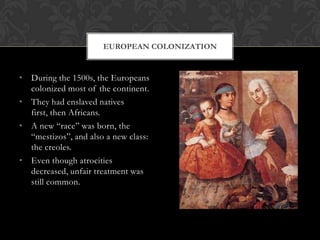
• During the 1500s, the Europeans
  colonized most of the continent.
• They had enslaved natives
  first, then Africans.
• A new “race” was born, the
  “mestizos”, and also a new class:
  the creoles.
• Even though atrocities
  decreased, unfair treatment was
  still common.
TREATY OF TORDESILLAS


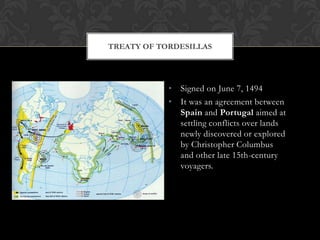
            • Signed on June 7, 1494
            • It was an agreement between
              Spain and Portugal aimed at
              settling conflicts over lands
              newly discovered or explored
              by Christopher Columbus
              and other late 15th-century
              voyagers.
WHAT DID IT DO?


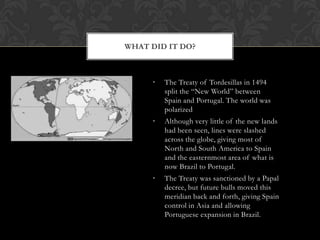
     •   The Treaty of Tordesillas in 1494
         split the “New World” between
         Spain and Portugal. The world was
         polarized
     •   Although very little of the new lands
         had been seen, lines were slashed
         across the globe, giving most of
         North and South America to Spain
         and the easternmost area of what is
         now Brazil to Portugal.
     •   The Treaty was sanctioned by a Papal
         decree, but future bulls moved this
         meridian back and forth, giving Spain
         control in Asia and allowing
         Portuguese expansion in Brazil.
BUILDING THE ROAD


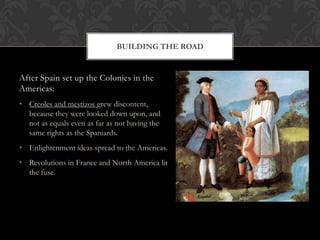
After Spain set up the Colonies in the
Americas:
• Creoles and mestizos grew discontent,
  because they were looked down upon, and
  not as equals even as far as not having the
  same rights as the Spaniards.
• Enlightenment ideas spread to the Americas.
• Revolutions in France and North America lit
  the fuse.
(PARENTHESIS)


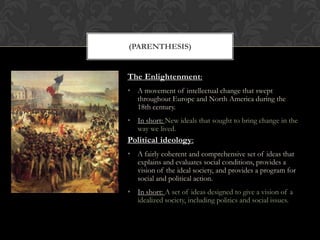
The Enlightenment:
• A movement of intellectual change that swept
  throughout Europe and North America during the
  18th century.
• In short: New ideals that sought to bring change in the
  way we lived.
Political ideology:
• A fairly coherent and comprehensive set of ideas that
  explains and evaluates social conditions, provides a
  vision of the ideal society, and provides a program for
  social and political action.
• In short: A set of ideas designed to give a vision of a
  idealized society, including politics and social issues.
SEVEN CORE IDEALS


•   1. Human autonomy is the means and end of Enlightenment
•   2. The importance of reason
    a. Freedom means being able to think rationally for yourself. b. Reason will lead us to the truth.
•   3. Enlightenment is universal
    All humans are equal by nature.
•   4. Progress
    Human history is the story of progress in the human condition.
•   5. Secularism
    Religion and politics should be separated. One’s method of worship should be a private matter.
•   6. The centrality of economics to politics
    A society’s well-being depends on how its economy is structured.
•   7. The ideal of popular government
    People are capable of ruling themselves. The aristocracy is not the only class that deserved to rule.
SPAIN WEAKENS


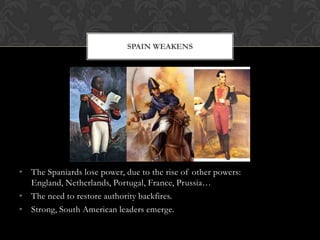
• The Spaniards lose power, due to the rise of other powers:
  England, Netherlands, Portugal, France, Prussia…
• The need to restore authority backfires.
• Strong, South American leaders emerge.
ASK YOURSELF


• Identify:
•   What were the consequences of the mixing of Spaniards and natives?
• Relate:
•   What were the consequences of the events in Europe that helped promote new ideals
    in the Americas?
• Analyze:
•   What was so important about the American and French Revolutions?
•   What were the effects of the treaty of Tordesillas?
VOCABULARY ASSIGNMENT


1.   Search the meaning of these terms in the dictionary and write it down.
2.   Write a sentence using those words, applying them to the context of this unit.
     Do not use sentences from other’s, create them on your own.

Terms:
• Polarize
• Creole
• Mestizo
• Enlightenment
• Secularism


Do it all in the computer and print it.
BIBLIOGRAPHY


•   Encyclopedia Britannica. (n.d.). Treaty of Tordesillas. Retrieved May 20, 2012,
    from Britannica:
    http://www.britannica.com/EBchecked/topic/599856/Treaty-of-Tordesillas.
•   Virtual Museum Canada. (n.d.). Treaty of Tordesillas. Retrieved May 20, 2012,
    from Beyond The Map:
    http://www.beyondthemap.ca/english/historical_divide_world.html.
•   Knowles, R. (n.d.). Latin American Independence Movements. Retrieved May 20,
    2012, from Slideshare: http://www.slideshare.net/rknowles/latin-american-
    independence-movements.
•   North Arizona University. (n.d.). Core Ideals of the Enlightenment. Retrieved May
    22, 2012, from Northern Arizona University's Web Server JAN:
    http://jan.ucc.nau.edu/~jo52/POS254/Enlideals.html.

The Road to Independence

  • 1.
    THE ROAD TOINDEPENDENCE Social Studies for 9th E.G.B. Teacher: Mauricio Torres
  • 2.
    EUROPEAN COLONIZATION • Duringthe 1500s, the Europeans colonized most of the continent. • They had enslaved natives first, then Africans. • A new “race” was born, the “mestizos”, and also a new class: the creoles. • Even though atrocities decreased, unfair treatment was still common.
  • 3.
    TREATY OF TORDESILLAS • Signed on June 7, 1494 • It was an agreement between Spain and Portugal aimed at settling conflicts over lands newly discovered or explored by Christopher Columbus and other late 15th-century voyagers.
  • 4.
    WHAT DID ITDO? • The Treaty of Tordesillas in 1494 split the “New World” between Spain and Portugal. The world was polarized • Although very little of the new lands had been seen, lines were slashed across the globe, giving most of North and South America to Spain and the easternmost area of what is now Brazil to Portugal. • The Treaty was sanctioned by a Papal decree, but future bulls moved this meridian back and forth, giving Spain control in Asia and allowing Portuguese expansion in Brazil.
  • 5.
    BUILDING THE ROAD AfterSpain set up the Colonies in the Americas: • Creoles and mestizos grew discontent, because they were looked down upon, and not as equals even as far as not having the same rights as the Spaniards. • Enlightenment ideas spread to the Americas. • Revolutions in France and North America lit the fuse.
  • 6.
    (PARENTHESIS) The Enlightenment: • Amovement of intellectual change that swept throughout Europe and North America during the 18th century. • In short: New ideals that sought to bring change in the way we lived. Political ideology: • A fairly coherent and comprehensive set of ideas that explains and evaluates social conditions, provides a vision of the ideal society, and provides a program for social and political action. • In short: A set of ideas designed to give a vision of a idealized society, including politics and social issues.
  • 7.
    SEVEN CORE IDEALS • 1. Human autonomy is the means and end of Enlightenment • 2. The importance of reason a. Freedom means being able to think rationally for yourself. b. Reason will lead us to the truth. • 3. Enlightenment is universal All humans are equal by nature. • 4. Progress Human history is the story of progress in the human condition. • 5. Secularism Religion and politics should be separated. One’s method of worship should be a private matter. • 6. The centrality of economics to politics A society’s well-being depends on how its economy is structured. • 7. The ideal of popular government People are capable of ruling themselves. The aristocracy is not the only class that deserved to rule.
  • 8.
    SPAIN WEAKENS • TheSpaniards lose power, due to the rise of other powers: England, Netherlands, Portugal, France, Prussia… • The need to restore authority backfires. • Strong, South American leaders emerge.
  • 9.
    ASK YOURSELF • Identify: • What were the consequences of the mixing of Spaniards and natives? • Relate: • What were the consequences of the events in Europe that helped promote new ideals in the Americas? • Analyze: • What was so important about the American and French Revolutions? • What were the effects of the treaty of Tordesillas?
  • 10.
    VOCABULARY ASSIGNMENT 1. Search the meaning of these terms in the dictionary and write it down. 2. Write a sentence using those words, applying them to the context of this unit. Do not use sentences from other’s, create them on your own. Terms: • Polarize • Creole • Mestizo • Enlightenment • Secularism Do it all in the computer and print it.
  • 11.
    BIBLIOGRAPHY • Encyclopedia Britannica. (n.d.). Treaty of Tordesillas. Retrieved May 20, 2012, from Britannica: http://www.britannica.com/EBchecked/topic/599856/Treaty-of-Tordesillas. • Virtual Museum Canada. (n.d.). Treaty of Tordesillas. Retrieved May 20, 2012, from Beyond The Map: http://www.beyondthemap.ca/english/historical_divide_world.html. • Knowles, R. (n.d.). Latin American Independence Movements. Retrieved May 20, 2012, from Slideshare: http://www.slideshare.net/rknowles/latin-american- independence-movements. • North Arizona University. (n.d.). Core Ideals of the Enlightenment. Retrieved May 22, 2012, from Northern Arizona University's Web Server JAN: http://jan.ucc.nau.edu/~jo52/POS254/Enlideals.html.