Applications of Ethical,
Moral, and Law
Principles to Patient
Education
I N N U R S I N G
Jens
Martensson
GUIDE TO
PRINCIPLES IN
NURSING,
ETHICS,
MORALITY,
AND THE LAW
THE NIGHTINGALE’S PLEDGE
Jens
Martensson
Law
► Is a system of rules created
and enforced through social or
governmental institutions to regulate
behavior.
► It has been variously described as
a science and the art of justice.
► The law shape the
politics, economics, history and society in
various ways and serves as a mediator of
relations between people.
► Legal systems vary between countries.
Jens
Martensson
► Law's scope can be divided into
two domains.
►
► 1. PUBLIC LAW concerns
government and society,
including constitutional
law, administrative law,
and criminal law.
► 2. PRIVATE LAW deals with
legal disputes between
individuals and/or organisations
in areas such
as contracts, property, torts/del
icts and commercial law.
Jens
Martensson
Relationship between LAW
and NURSING
► Law is now fundamental to the
study of nursing and underpins
your relationship with
the profession and with your
patients.
The law informs nursing at
every stage and it is essential
that you understand and are
able to critically reflect on
the legal issues relevant to
nursing practice.
Jens
Martensson
COMMON LAW IN
NURSING
► Common law results from
judicial decisions made in
courts when individual legal
cases are decided.
► Examples of common law:
► Informed consent
► Patient's right to refuse
treatment
► Negligence
► Malpractice.
Jens
Martensson
PATIENT’S BILL OF
RIGHTS
1. Right to Appropriate Medical
Care and Humane Treatment.
2. Right to Informed Consent.
3. Right to Privacy and
Confidentiality.
4. Right to Information.
5. The Right to
Choose Health Care
Provider and Facility.
6. Right to Self-Determination.
7. Right to Religious Belief.
Jens
Martensson
8. Right to Medical Records.
9. Right to Leave.
10. Right to Refuse Participation in
Medical Research.
11. Right to Correspondence and to
Receive Visitors.
12. Right to Express Grievances.
13. Right to be Informed of His
Rights and Obligations as a
Patient.
Jens
Martensson
►Ethical
Principles
Jens
Martensson
PRINCIPLE OF
NONMALEFICENCE
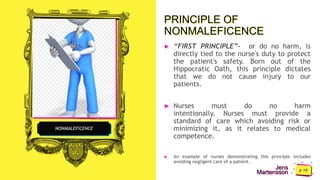
► “FIRST PRINCIPLE”- or do no harm, is
directly tied to the nurse's duty to protect
the patient's safety. Born out of the
Hippocratic Oath, this principle dictates
that we do not cause injury to our
patients.
► Nurses must do no harm
intentionally. Nurses must provide a
standard of care which avoiding risk or
minimizing it, as it relates to medical
competence.
► An example of nurses demonstrating this principle includes
avoiding negligent care of a patient.
NONMALEFICENCE
Jens
Martensson
JUSTICE
PRINCIPLE OF JUSTICE
► One that has been widely accepted since it
was first defined by Aristotle more than
two thousand years ago—is
the principle that "equals should be
treated equally and unequals unequally.“
► The principle of justice states that there
should be an element of fairness in
all medical decisions: fairness in decisions
that burden and benefit, as well as equal
distribution of scarce resources and new
treatments, and for medical practitioners
to uphold applicable laws and legislation
when making choices.
► Ex. offering the same treatment options to two patients, even where one may have a
condition through no fault of their own and the other through personal behaviour (e.g.
lung cancer and smoking), and allocating resources equally among members of the
population.
Jens
Martensson
PRINCIPLE OF
BENEFICENCE
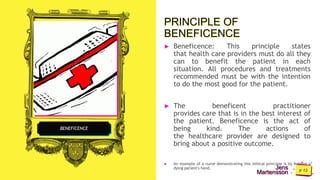
► Beneficence: This principle states
that health care providers must do all they
can to benefit the patient in each
situation. All procedures and treatments
recommended must be with the intention
to do the most good for the patient.
► The beneficent practitioner
provides care that is in the best interest of
the patient. Beneficence is the act of
being kind. The actions of
the healthcare provider are designed to
bring about a positive outcome.
► An example of a nurse demonstrating this ethical principle is by holding a
dying patient's hand.
BENEFICENCE
Jens
Martensson
PRINCIPLE OF
ACCOUNTABILITY
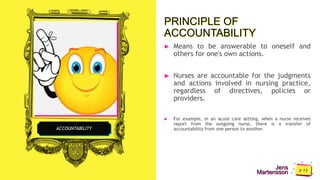
► Means to be answerable to oneself and
others for one's own actions.
► Nurses are accountable for the judgments
and actions involved in nursing practice,
regardless of directives, policies or
providers.
► For example, in an acute care setting, when a nurse receives
report from the outgoing nurse, there is a transfer of
accountability from one person to another.
ACCOUNTABILITY
Jens
Martensson
PRINCIPLE OF FIDELITY
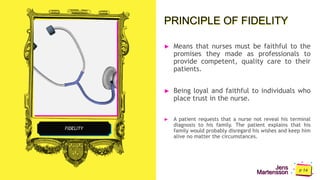
► Means that nurses must be faithful to the
promises they made as professionals to
provide competent, quality care to their
patients.
► Being loyal and faithful to individuals who
place trust in the nurse.
► A patient requests that a nurse not reveal his terminal
diagnosis to his family. The patient explains that his
family would probably disregard his wishes and keep him
alive no matter the circumstances.
FIDELITY
Jens
Martensson
PRINCIPLE OF AUTONOMY
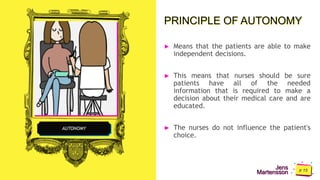
► Means that the patients are able to make
independent decisions.
► This means that nurses should be sure
patients have all of the needed
information that is required to make a
decision about their medical care and are
educated.
► The nurses do not influence the patient's
choice.
AUTONOMY
Jens
Martensson
PRINCIPLE OF VERACITY
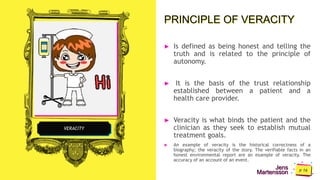
► Is defined as being honest and telling the
truth and is related to the principle of
autonomy.
► It is the basis of the trust relationship
established between a patient and a
health care provider.
► Veracity is what binds the patient and the
clinician as they seek to establish mutual
treatment goals.
► An example of veracity is the historical correctness of a
biography; the veracity of the story. The verifiable facts in an
honest environmental report are an example of veracity. The
accuracy of an account of an event.
VERACITY
Thank
You

8.-ETHICAL-PRINCIPLES-IN-NURSING.pptx

  • 1.
    Applications of Ethical, Moral,and Law Principles to Patient Education I N N U R S I N G
  • 2.
  • 3.
    Jens Martensson Law ► Is asystem of rules created and enforced through social or governmental institutions to regulate behavior. ► It has been variously described as a science and the art of justice. ► The law shape the politics, economics, history and society in various ways and serves as a mediator of relations between people. ► Legal systems vary between countries.
  • 4.
    Jens Martensson ► Law's scopecan be divided into two domains. ► ► 1. PUBLIC LAW concerns government and society, including constitutional law, administrative law, and criminal law. ► 2. PRIVATE LAW deals with legal disputes between individuals and/or organisations in areas such as contracts, property, torts/del icts and commercial law.
  • 5.
    Jens Martensson Relationship between LAW andNURSING ► Law is now fundamental to the study of nursing and underpins your relationship with the profession and with your patients. The law informs nursing at every stage and it is essential that you understand and are able to critically reflect on the legal issues relevant to nursing practice.
  • 6.
    Jens Martensson COMMON LAW IN NURSING ►Common law results from judicial decisions made in courts when individual legal cases are decided. ► Examples of common law: ► Informed consent ► Patient's right to refuse treatment ► Negligence ► Malpractice.
  • 7.
    Jens Martensson PATIENT’S BILL OF RIGHTS 1.Right to Appropriate Medical Care and Humane Treatment. 2. Right to Informed Consent. 3. Right to Privacy and Confidentiality. 4. Right to Information. 5. The Right to Choose Health Care Provider and Facility. 6. Right to Self-Determination. 7. Right to Religious Belief.
  • 8.
    Jens Martensson 8. Right toMedical Records. 9. Right to Leave. 10. Right to Refuse Participation in Medical Research. 11. Right to Correspondence and to Receive Visitors. 12. Right to Express Grievances. 13. Right to be Informed of His Rights and Obligations as a Patient.
  • 9.
  • 10.
    Jens Martensson PRINCIPLE OF NONMALEFICENCE ► “FIRSTPRINCIPLE”- or do no harm, is directly tied to the nurse's duty to protect the patient's safety. Born out of the Hippocratic Oath, this principle dictates that we do not cause injury to our patients. ► Nurses must do no harm intentionally. Nurses must provide a standard of care which avoiding risk or minimizing it, as it relates to medical competence. ► An example of nurses demonstrating this principle includes avoiding negligent care of a patient. NONMALEFICENCE
  • 11.
    Jens Martensson JUSTICE PRINCIPLE OF JUSTICE ►One that has been widely accepted since it was first defined by Aristotle more than two thousand years ago—is the principle that "equals should be treated equally and unequals unequally.“ ► The principle of justice states that there should be an element of fairness in all medical decisions: fairness in decisions that burden and benefit, as well as equal distribution of scarce resources and new treatments, and for medical practitioners to uphold applicable laws and legislation when making choices. ► Ex. offering the same treatment options to two patients, even where one may have a condition through no fault of their own and the other through personal behaviour (e.g. lung cancer and smoking), and allocating resources equally among members of the population.
  • 12.
    Jens Martensson PRINCIPLE OF BENEFICENCE ► Beneficence:This principle states that health care providers must do all they can to benefit the patient in each situation. All procedures and treatments recommended must be with the intention to do the most good for the patient. ► The beneficent practitioner provides care that is in the best interest of the patient. Beneficence is the act of being kind. The actions of the healthcare provider are designed to bring about a positive outcome. ► An example of a nurse demonstrating this ethical principle is by holding a dying patient's hand. BENEFICENCE
  • 13.
    Jens Martensson PRINCIPLE OF ACCOUNTABILITY ► Meansto be answerable to oneself and others for one's own actions. ► Nurses are accountable for the judgments and actions involved in nursing practice, regardless of directives, policies or providers. ► For example, in an acute care setting, when a nurse receives report from the outgoing nurse, there is a transfer of accountability from one person to another. ACCOUNTABILITY
  • 14.
    Jens Martensson PRINCIPLE OF FIDELITY ►Means that nurses must be faithful to the promises they made as professionals to provide competent, quality care to their patients. ► Being loyal and faithful to individuals who place trust in the nurse. ► A patient requests that a nurse not reveal his terminal diagnosis to his family. The patient explains that his family would probably disregard his wishes and keep him alive no matter the circumstances. FIDELITY
  • 15.
    Jens Martensson PRINCIPLE OF AUTONOMY ►Means that the patients are able to make independent decisions. ► This means that nurses should be sure patients have all of the needed information that is required to make a decision about their medical care and are educated. ► The nurses do not influence the patient's choice. AUTONOMY
  • 16.
    Jens Martensson PRINCIPLE OF VERACITY ►Is defined as being honest and telling the truth and is related to the principle of autonomy. ► It is the basis of the trust relationship established between a patient and a health care provider. ► Veracity is what binds the patient and the clinician as they seek to establish mutual treatment goals. ► An example of veracity is the historical correctness of a biography; the veracity of the story. The verifiable facts in an honest environmental report are an example of veracity. The accuracy of an account of an event. VERACITY
  • 17.