KEYBOARD/DISPLAY
CONTROLLER - INTEL 8279
Features of 8279
The important features of 8279 are,
• Simultaneous keyboard and display operations.
• Scanned keyboard mode.
• Scanned sensor mode.
• 8-character keyboard FIFO.
• 1 6-character display.
• Right or left entry 1 6-byte display RAM.
• Programmable scan timing.
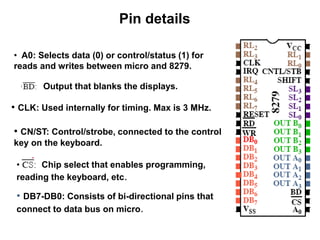
• A0: Selects data (0) or control/status (1) for
reads and writes between micro and 8279.
Output that blanks the displays.
• CLK: Used internally for timing. Max is 3 MHz.
• CN/ST: Control/strobe, connected to the control
key on the keyboard.
• Chip select that enables programming,
reading the keyboard, etc.
• DB7-DB0: Consists of bi-directional pins that
connect to data bus on micro.
Pin details
Pin details
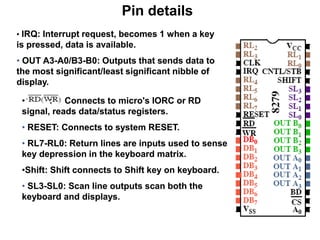
• IRQ: Interrupt request, becomes 1 when a key
is pressed, data is available.
• OUT A3-A0/B3-B0: Outputs that sends data to
the most significant/least significant nibble of
display.
• : Connects to micro's IORC or RD
signal, reads data/status registers.
• RESET: Connects to system RESET.
• RL7-RL0: Return lines are inputs used to sense
key depression in the keyboard matrix.
•Shift: Shift connects to Shift key on keyboard.
• SL3-SL0: Scan line outputs scan both the
keyboard and displays.
• IRQ: Interrupt request, becomes 1 when a key
is pressed, data is available.
• OUT A3-A0/B3-B0: Outputs that sends data to
the most significant/least significant nibble of
display.
• : Connects to micro's IORC or RD
signal, reads data/status registers.
• RESET: Connects to system RESET.
• RL7-RL0: Return lines are inputs used to sense
key depression in the keyboard matrix.
•Shift: Shift connects to Shift key on keyboard.
• SL3-SL0: Scan line outputs scan both the
keyboard and displays.
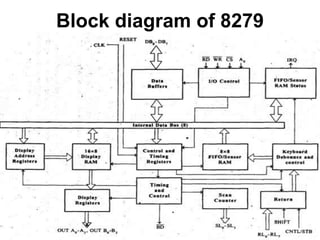
Block diagram of 8279
Sections
• Keyboard
• Display
• Scan
• CPU interface
Keyboard section
• The keyboard section consists of eight return lines RL0 - RL7
that can be used to form the columns of a keyboard matrix.
• It has two additional input : shift and control/strobe. The keys
are automatically debounced.
• The two operating modes of keyboard section are 2-key
lockout and N-key rollover.
• In the 2-key lockout mode, if two keys are pressed
simultaneously, only the first key is recognized.
• In the N-key rollover mode simultaneous keys are recognized
and their codes are stored in FIFO.
• The keyboard section also have an 8 x 8 FIFO (First In First
Out) RAM.
• The FIFO can store eight key codes in the scan keyboard
mode. The status of the shift key and control key are also
stored along with key code.
• The 8279 generate an interrupt signal when there is an entry
in FIFO.
Display section
• The display section has eight output lines divided into
two groups A0-A3 and B0-B3.
• The output lines can be used either as a single group of
eight lines or as two groups of four lines, in conjunction
with the scan lines for a multiplexed display.
• The output lines are connected to the anodes through
driver transistor in case of common cathode 7-segment
LEDs.
• The cathodes are connected to scan lines through driver
transistors.
• The display can be blanked by BD (low) line.
• The display section consists of 16 x 8 display RAM. The
CPU can read from or write into any location of the
display RAM.
Scan section
• The scan section has a scan counter and four
scan lines, SL0 to SL3.
• In decoded scan mode, the output of scan lines
will be similar to a 2-to-4 decoder.
• In encoded scan mode, the output of scan lines
will be binary count, and so an external decoder
should be used to convert the binary count to
decoded output.
• The scan lines are common for keyboard and
display.
• The scan lines are used to form the rows of a
matrix keyboard and also connected to digit
drivers of a multiplexed display, to turn ON/OFF.
CPU interface section
• The CPU interface section takes care of data transfer
between 8279 and the processor.
• This section has eight bidirectional data lines DB0 to
DB7 for data transfer between 8279 and CPU.
• It requires two internal address A =0 for selecting data
buffer and A = 1 for selecting control register of8279.
• The control signals WR (low), RD (low), CS (low) and A0
are used for read/write to 8279.
• It has an interrupt request line IRQ, for interrupt driven
data transfer with processor.
• The 8279 require an internal clock frequency of 100 kHz.
This can be obtained by dividing the input clock by an
internal prescaler.
• The RESET signal sets the 8279 in 16-character display
with two -key lockout keyboard modes.
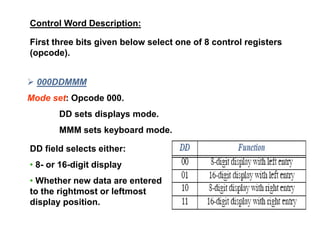
First three bits given below select one of 8 control registers
(opcode).
Control Word Description:
 000DDMMM
Mode set: Opcode 000.
DD sets displays mode.
MMM sets keyboard mode.
DD field selects either:
• 8- or 16-digit display
• Whether new data are entered
to the rightmost or leftmost
display position.
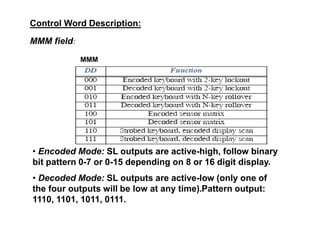
Control Word Description:
MMM field:
• Encoded Mode: SL outputs are active-high, follow binary
bit pattern 0-7 or 0-15 depending on 8 or 16 digit display.
• Decoded Mode: SL outputs are active-low (only one of
the four outputs will be low at any time).Pattern output:
1110, 1101, 1011, 0111.
MMM
I/O Interface
Control Word Description:
• Strobe : An active high pulse on the CN/ST input pin strobes
data from the RL pins into an internal FIFO for reading by micro
later.
• 2-key lockout/N-key rollover: Prevents 2 keys from being
recognized if pressed simultaneously/Accepts all keys pressed
from 1st to last.
Write display format
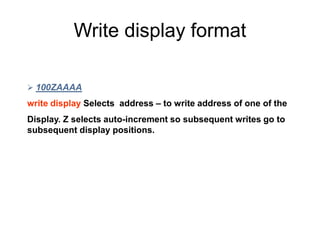
 100ZAAAA
write display Selects address – to write address of one of the
Display. Z selects auto-increment so subsequent writes go to
subsequent display positions.
Clear Display format
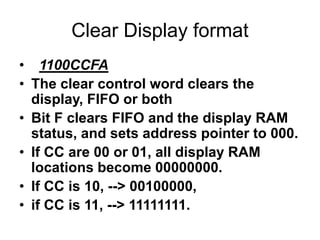
• 1100CCFA
• The clear control word clears the
display, FIFO or both
• Bit F clears FIFO and the display RAM
status, and sets address pointer to 000.
• If CC are 00 or 01, all display RAM
locations become 00000000.
• If CC is 10, --> 00100000,
• if CC is 11, --> 11111111.
8279_full.ppt

8279_full.ppt

  • 1.
  • 2.
    Features of 8279 Theimportant features of 8279 are, • Simultaneous keyboard and display operations. • Scanned keyboard mode. • Scanned sensor mode. • 8-character keyboard FIFO. • 1 6-character display. • Right or left entry 1 6-byte display RAM. • Programmable scan timing.
  • 3.
    • A0: Selectsdata (0) or control/status (1) for reads and writes between micro and 8279. Output that blanks the displays. • CLK: Used internally for timing. Max is 3 MHz. • CN/ST: Control/strobe, connected to the control key on the keyboard. • Chip select that enables programming, reading the keyboard, etc. • DB7-DB0: Consists of bi-directional pins that connect to data bus on micro. Pin details
  • 4.
    Pin details • IRQ:Interrupt request, becomes 1 when a key is pressed, data is available. • OUT A3-A0/B3-B0: Outputs that sends data to the most significant/least significant nibble of display. • : Connects to micro's IORC or RD signal, reads data/status registers. • RESET: Connects to system RESET. • RL7-RL0: Return lines are inputs used to sense key depression in the keyboard matrix. •Shift: Shift connects to Shift key on keyboard. • SL3-SL0: Scan line outputs scan both the keyboard and displays. • IRQ: Interrupt request, becomes 1 when a key is pressed, data is available. • OUT A3-A0/B3-B0: Outputs that sends data to the most significant/least significant nibble of display. • : Connects to micro's IORC or RD signal, reads data/status registers. • RESET: Connects to system RESET. • RL7-RL0: Return lines are inputs used to sense key depression in the keyboard matrix. •Shift: Shift connects to Shift key on keyboard. • SL3-SL0: Scan line outputs scan both the keyboard and displays.
  • 5.
  • 6.
  • 7.
    Keyboard section • Thekeyboard section consists of eight return lines RL0 - RL7 that can be used to form the columns of a keyboard matrix. • It has two additional input : shift and control/strobe. The keys are automatically debounced. • The two operating modes of keyboard section are 2-key lockout and N-key rollover. • In the 2-key lockout mode, if two keys are pressed simultaneously, only the first key is recognized. • In the N-key rollover mode simultaneous keys are recognized and their codes are stored in FIFO. • The keyboard section also have an 8 x 8 FIFO (First In First Out) RAM. • The FIFO can store eight key codes in the scan keyboard mode. The status of the shift key and control key are also stored along with key code. • The 8279 generate an interrupt signal when there is an entry in FIFO.
  • 8.
    Display section • Thedisplay section has eight output lines divided into two groups A0-A3 and B0-B3. • The output lines can be used either as a single group of eight lines or as two groups of four lines, in conjunction with the scan lines for a multiplexed display. • The output lines are connected to the anodes through driver transistor in case of common cathode 7-segment LEDs. • The cathodes are connected to scan lines through driver transistors. • The display can be blanked by BD (low) line. • The display section consists of 16 x 8 display RAM. The CPU can read from or write into any location of the display RAM.
  • 9.
    Scan section • Thescan section has a scan counter and four scan lines, SL0 to SL3. • In decoded scan mode, the output of scan lines will be similar to a 2-to-4 decoder. • In encoded scan mode, the output of scan lines will be binary count, and so an external decoder should be used to convert the binary count to decoded output. • The scan lines are common for keyboard and display. • The scan lines are used to form the rows of a matrix keyboard and also connected to digit drivers of a multiplexed display, to turn ON/OFF.
  • 10.
    CPU interface section •The CPU interface section takes care of data transfer between 8279 and the processor. • This section has eight bidirectional data lines DB0 to DB7 for data transfer between 8279 and CPU. • It requires two internal address A =0 for selecting data buffer and A = 1 for selecting control register of8279. • The control signals WR (low), RD (low), CS (low) and A0 are used for read/write to 8279. • It has an interrupt request line IRQ, for interrupt driven data transfer with processor. • The 8279 require an internal clock frequency of 100 kHz. This can be obtained by dividing the input clock by an internal prescaler. • The RESET signal sets the 8279 in 16-character display with two -key lockout keyboard modes.
  • 11.
    First three bitsgiven below select one of 8 control registers (opcode). Control Word Description:  000DDMMM Mode set: Opcode 000. DD sets displays mode. MMM sets keyboard mode. DD field selects either: • 8- or 16-digit display • Whether new data are entered to the rightmost or leftmost display position.
  • 12.
    Control Word Description: MMMfield: • Encoded Mode: SL outputs are active-high, follow binary bit pattern 0-7 or 0-15 depending on 8 or 16 digit display. • Decoded Mode: SL outputs are active-low (only one of the four outputs will be low at any time).Pattern output: 1110, 1101, 1011, 0111. MMM
  • 13.
    I/O Interface Control WordDescription: • Strobe : An active high pulse on the CN/ST input pin strobes data from the RL pins into an internal FIFO for reading by micro later. • 2-key lockout/N-key rollover: Prevents 2 keys from being recognized if pressed simultaneously/Accepts all keys pressed from 1st to last.
  • 14.
    Write display format 100ZAAAA write display Selects address – to write address of one of the Display. Z selects auto-increment so subsequent writes go to subsequent display positions.
  • 15.
    Clear Display format •1100CCFA • The clear control word clears the display, FIFO or both • Bit F clears FIFO and the display RAM status, and sets address pointer to 000. • If CC are 00 or 01, all display RAM locations become 00000000. • If CC is 10, --> 00100000, • if CC is 11, --> 11111111.