INTRODUCTION OF
MICROCONTROLLER 8051
THE 8051
MICROCONTR
OLLER
EMBEDDED SYSTEM
(8051 APPLICATION)
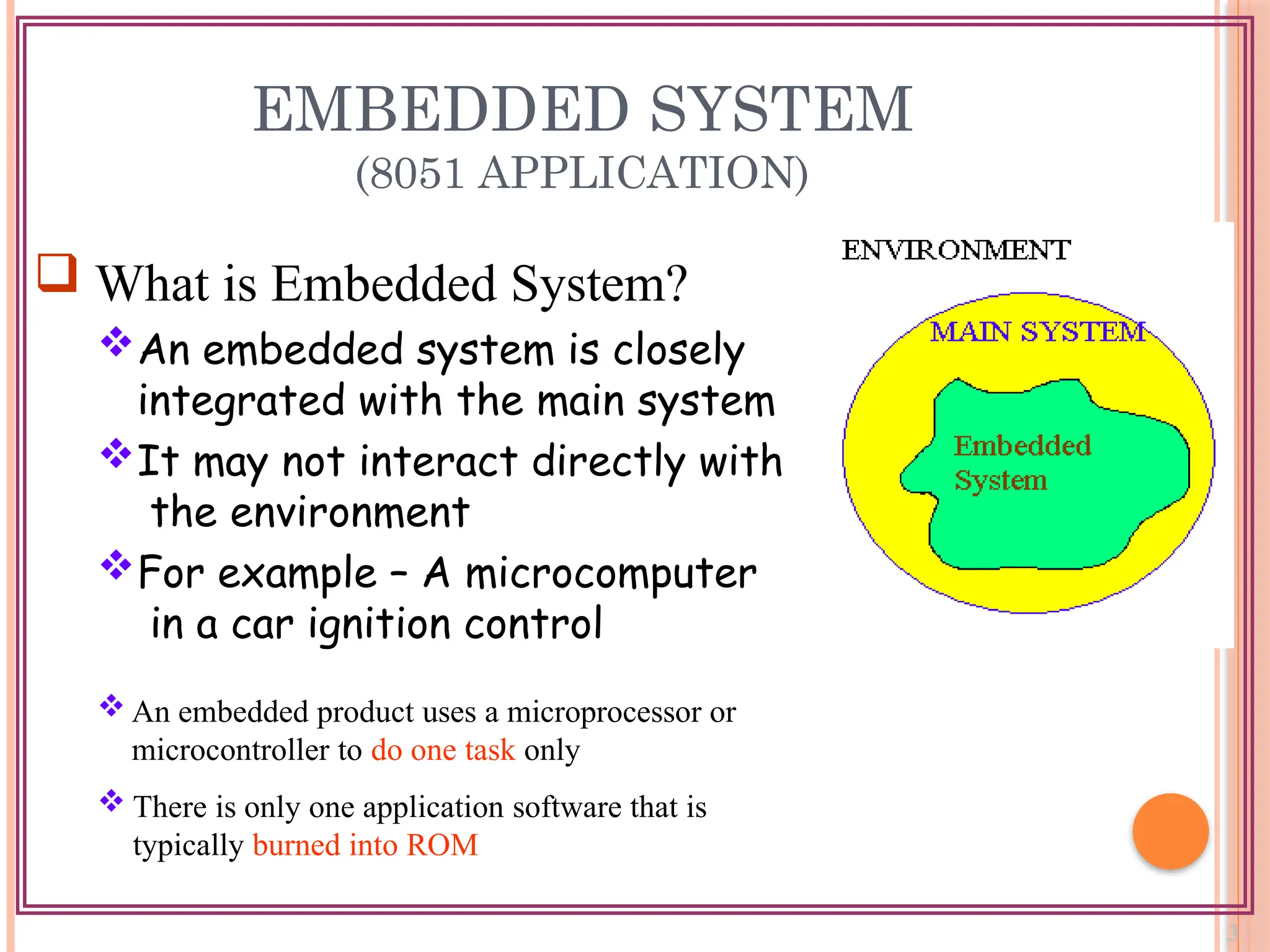
 What is Embedded System?
An embedded system is closely
integrated with the main system
It may not interact directly with
the environment
For example – A microcomputer
in a car ignition control
 An embedded product uses a microprocessor or
microcontroller to do one task only
 There is only one application software that is
typically burned into ROM
EXAMPLES OF EMBEDDED
SYSTEMS
Keyboard
Printer
video game player
MP3 music players
Embedded memories to keep configuration
information
Mobile phone units
Domestic (home) appliances
Data switches
Automotive controls
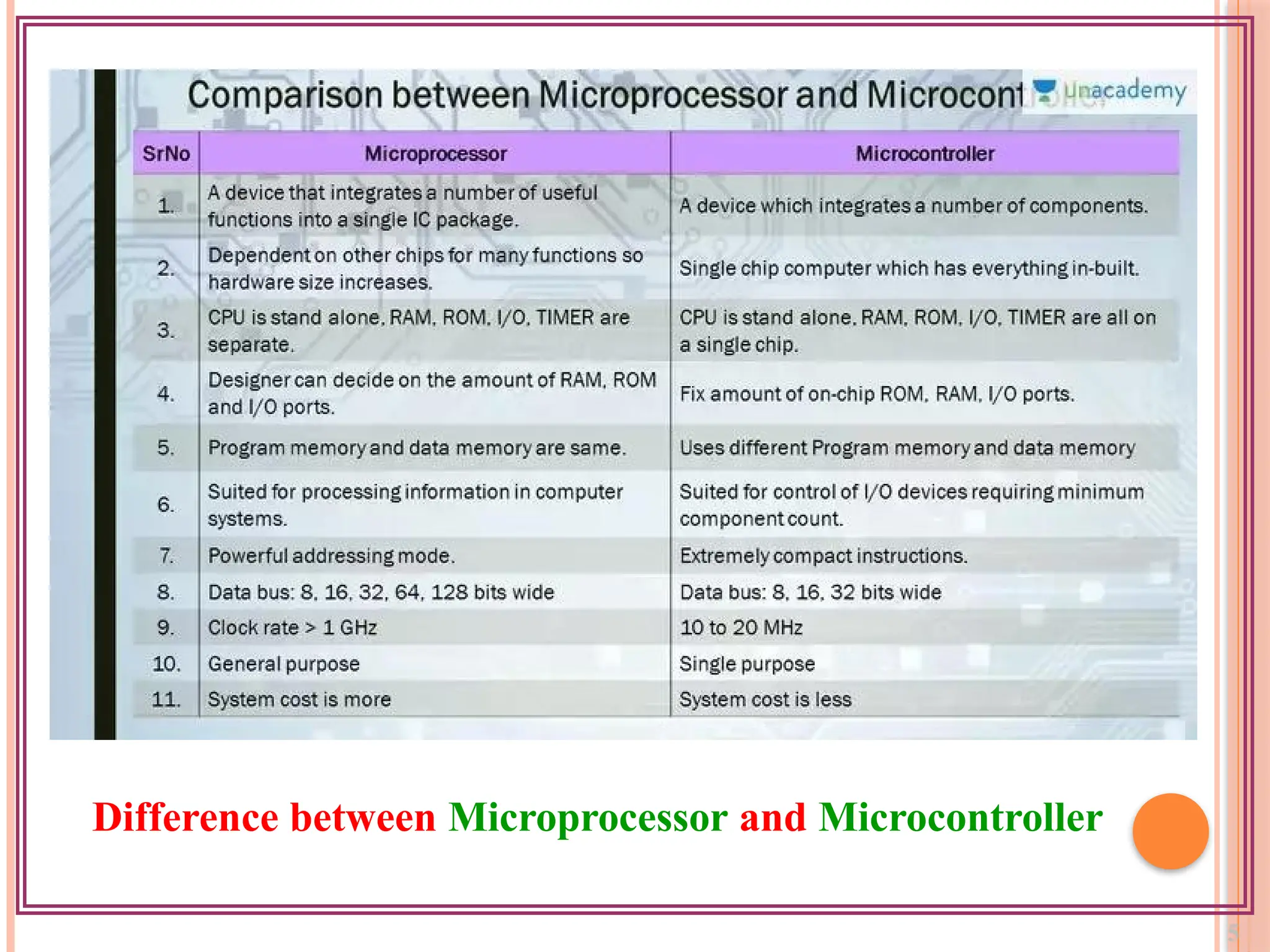
Difference between Microprocessor and Microcontroller
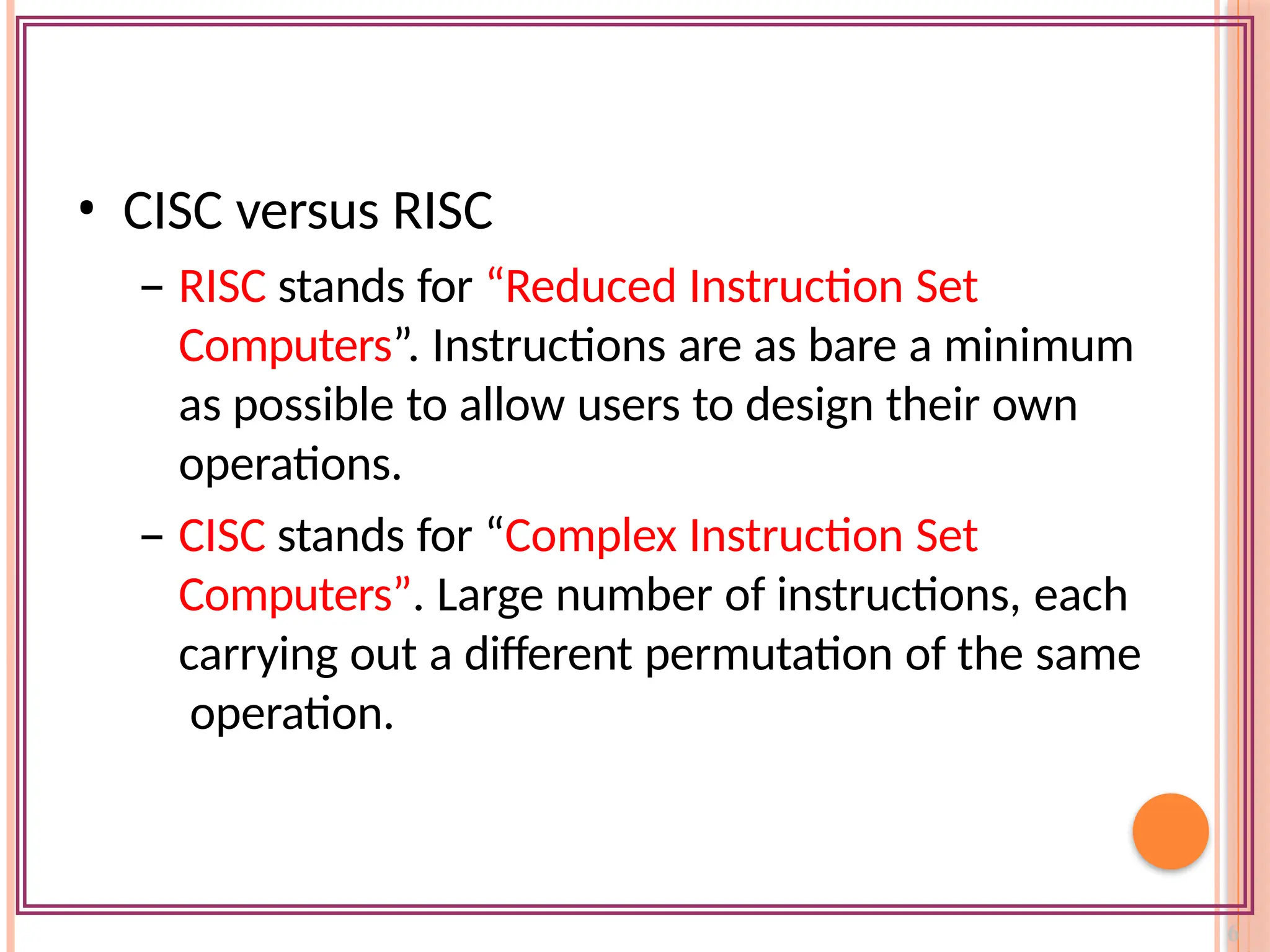
• CISC versus RISC
– RISC stands for “Reduced Instruction Set
Computers”. Instructions are as bare a minimum
as possible to allow users to design their own
operations.
– CISC stands for “Complex Instruction Set
Computers”. Large number of instructions, each
carrying out a different permutation of the same
operation.
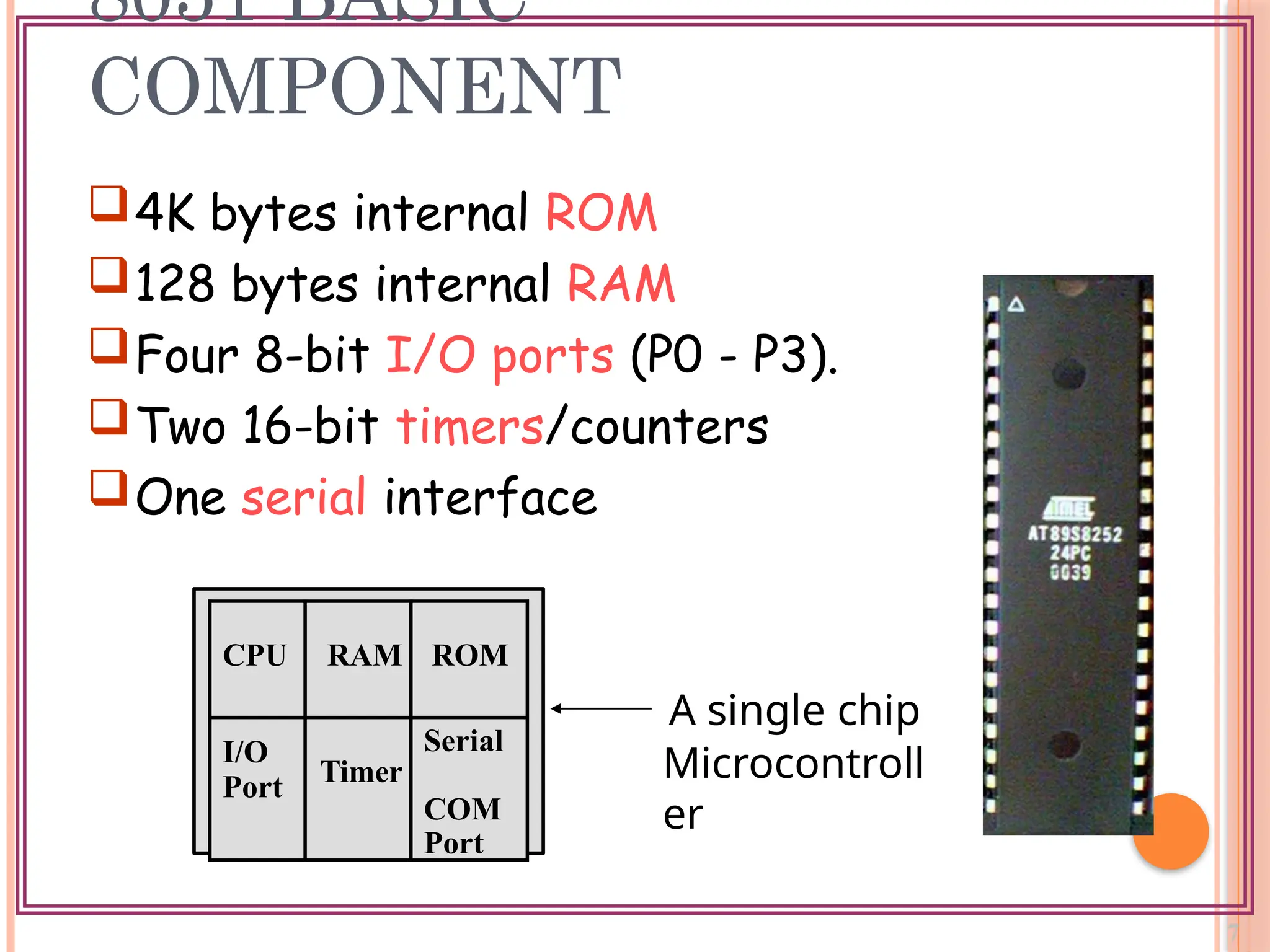
8051 BASIC
COMPONENT
4K bytes internal ROM
128 bytes internal RAM
Four 8-bit I/O ports (P0 - P3).
Two 16-bit timers/counters
One serial interface
A single chip
Microcontroll
er
CPU RAM ROM
I/O
Port Timer
Serial
COM
Port
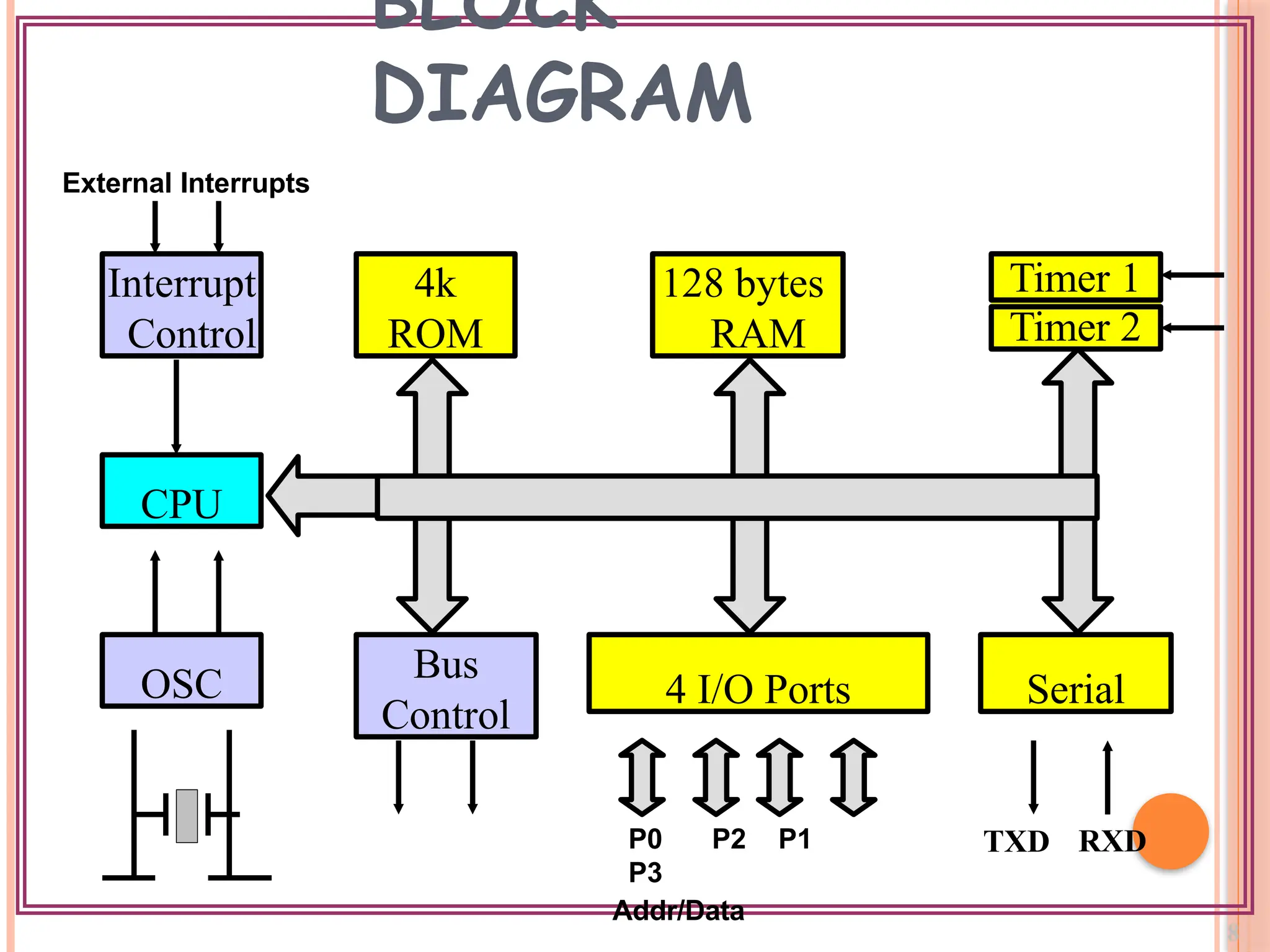
BLOCK
DIAGRAM
CPU
Interrupt
Control
OSC Bus
Control
4k
ROM
Timer 1
Timer 2
Serial
128 bytes
RAM
4 I/O Ports
TXD RXD
External Interrupts
P0 P2 P1
P3
Addr/Data
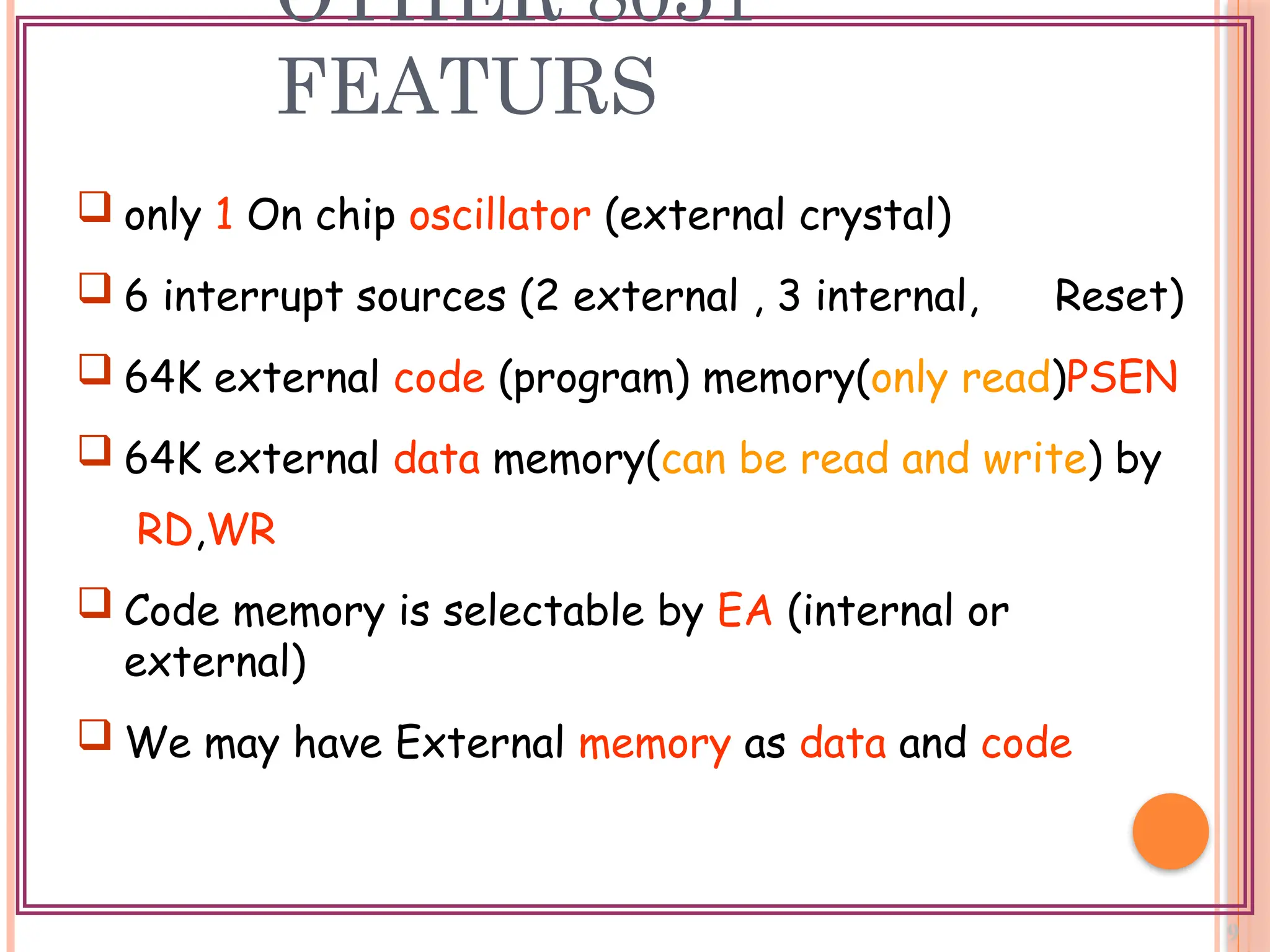
OTHER 8051
FEATURS
 only 1 On chip oscillator (external crystal)
 6 interrupt sources (2 external , 3 internal, Reset)
 64K external code (program) memory(only read)PSEN
 64K external data memory(can be read and write) by
RD,WR
 Code memory is selectable by EA (internal or
external)
 We may have External memory as data and code
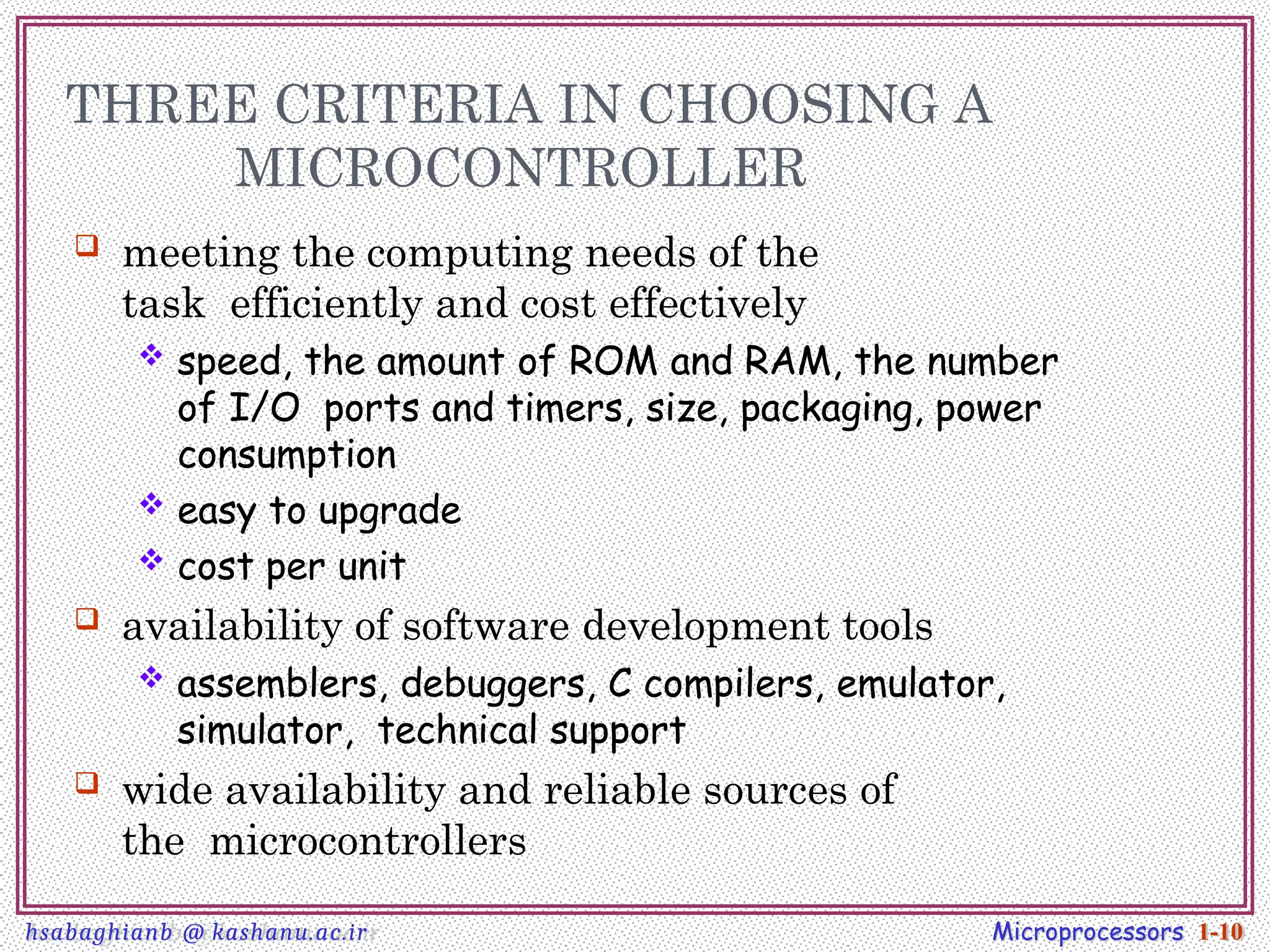
THREE CRITERIA IN CHOOSING A
MICROCONTROLLER
 meeting the computing needs of the
task efficiently and cost effectively
 speed, the amount of ROM and RAM, the number
of I/O ports and timers, size, packaging, power
consumption
 easy to upgrade
 cost per unit
 availability of software development tools
 assemblers, debuggers, C compilers, emulator,
simulator, technical support
 wide availability and reliable sources of
the microcontrollers
Microprocessors 1-10
hsabaghianb @ kashanu.ac.ir
hsabaghianb @ kashanu.ac.ir Microprocessors 1-11
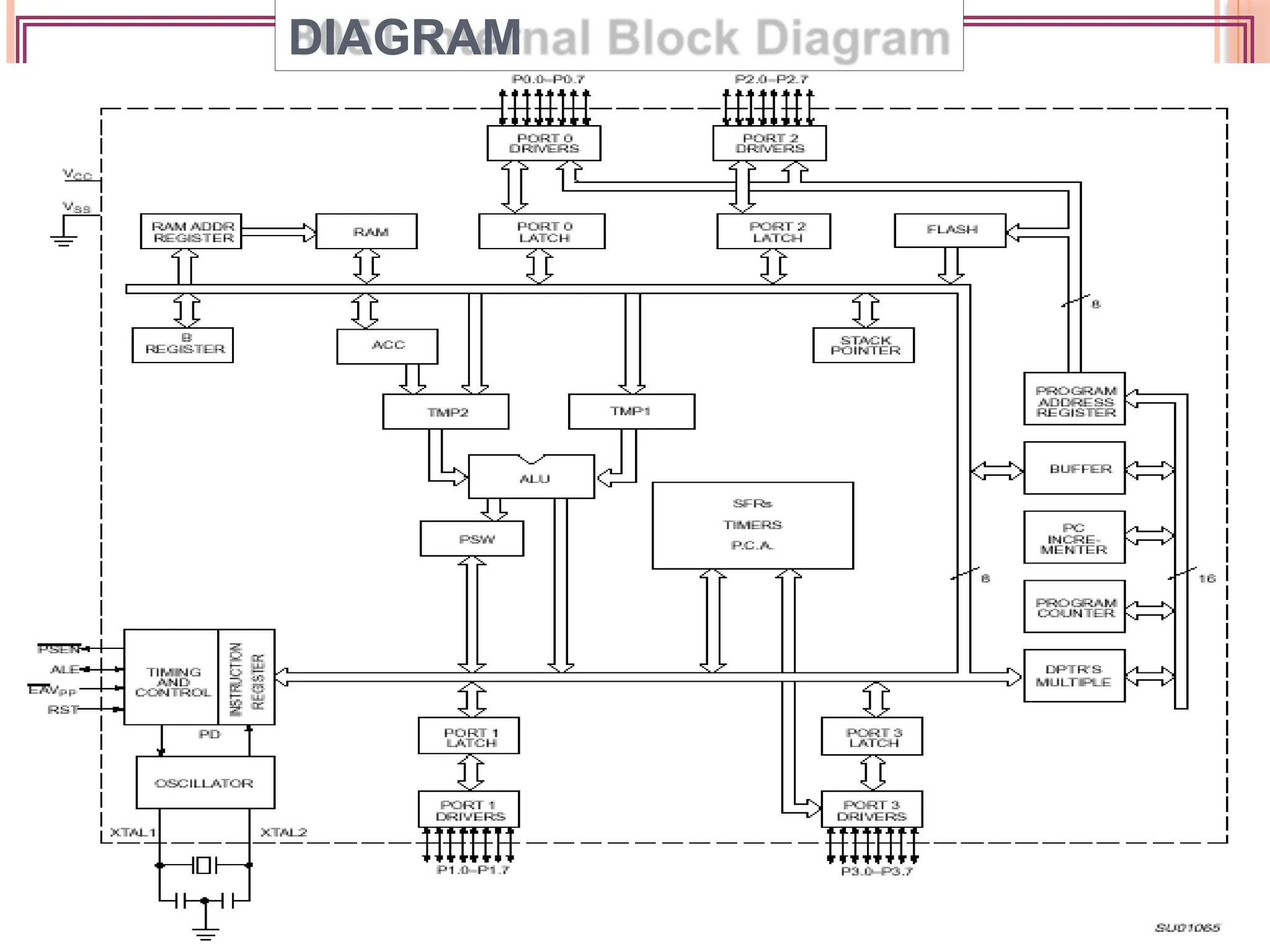
DIAGRAM
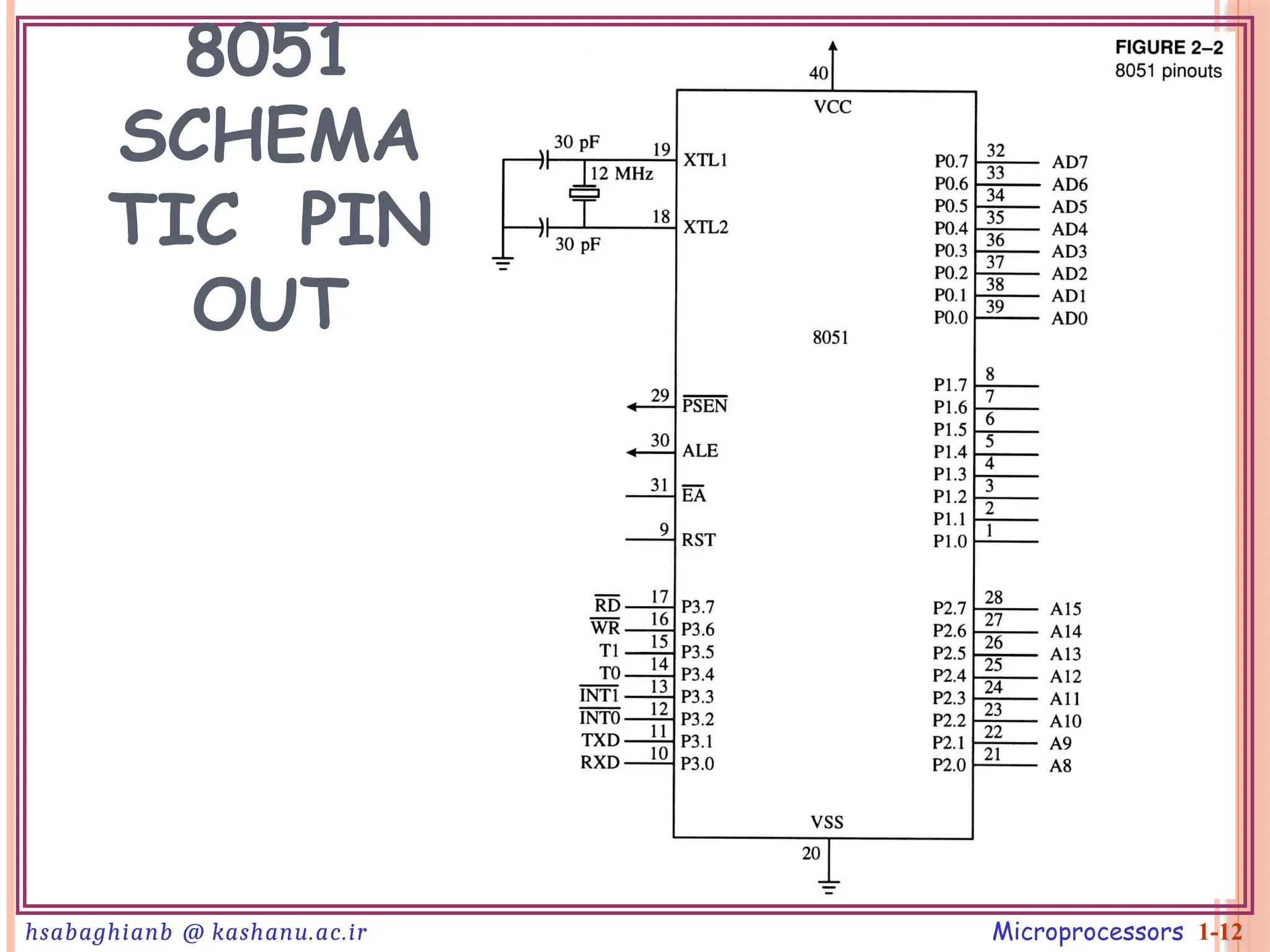
8051
SCHEMA
TIC PIN
OUT
Microprocessors 1-12
hsabaghianb @ kashanu.ac.ir
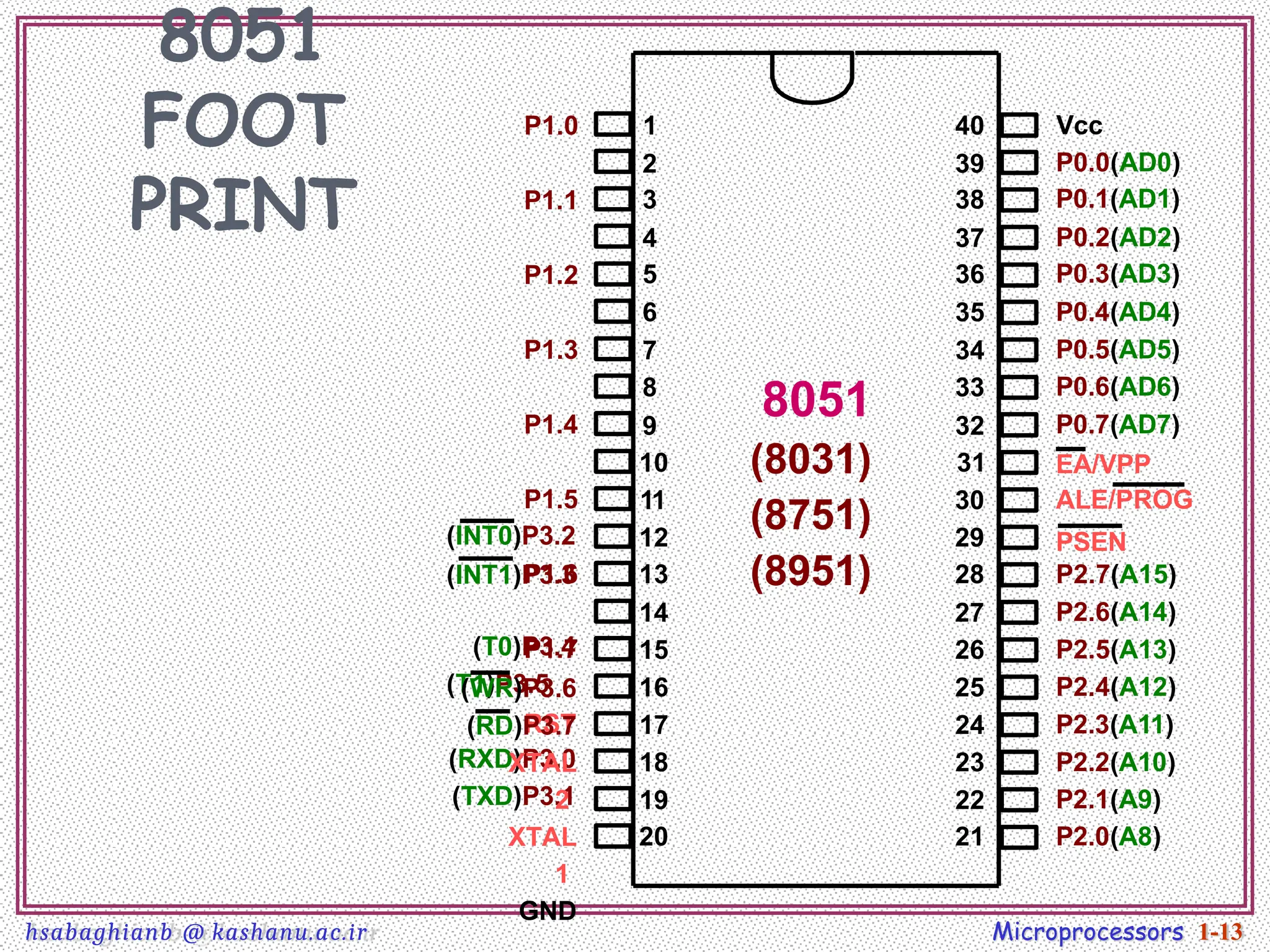
8051
FOOT
PRINT
1
2
3
4
5
6
7
8
9
10
11
12
13
14
15
16
17
18
19
20
40
39
38
37
36
35
34
33
32
31
30
29
28
27
26
25
24
23
22
21
P1.0
P1.1
P1.2
P1.3
P1.4
P1.5
P1.6
P1.7
RST
(RXD)P3.0
(TXD)P3.1
(INT0)P3.2
(INT1)P3.3
(T0)P3.4
(T1)P3.5
(WR)P3.6
(RD)P3.7
XTAL
2
XTAL
1
GND
Vcc
P0.0(AD0)
P0.1(AD1)
P0.2(AD2)
P0.3(AD3)
P0.4(AD4)
P0.5(AD5)
P0.6(AD6)
P0.7(AD7)
EA/VPP
ALE/PROG
PSEN
P2.7(A15)
P2.6(A14)
P2.5(A13)
P2.4(A12)
P2.3(A11)
P2.2(A10)
P2.1(A9)
P2.0(A8)
8051
(8031)
(8751)
(8951)
Microprocessors 1-13
hsabaghianb @ kashanu.ac.ir
Microprocessors 1-14
hsabaghianb @ kashanu.ac.ir

8051 chap 4 microcontroller for B.Tech third year std.pptx