www.danapardaz.net/en
DANA PARDAZ CO.
8 POWERSHELL COMMANDS EVERY
WINDOWS ADMINISTRATOR SHOULD
KNOW
www.danapardaz.net/en
1. GET-HELP
• It is perhaps the most important cmdlet an administrator
should know. The cmdlet provides help, details and examples
of other cmdlets if available. For example, the following
command shows the help of Get-Process cmdlet:
Get-Help -Name Get-Process
• Note that PowerShell is not case-sensitive, that is it doesn’t
matter whether you capitalize the cmdlet commands or not, but
people often capitalize the words to make it more readable.
www.danapardaz.net/en
2. GET-EXECUTIONPOLICY
• By default, PowerShell scripts are disabled to prevent malicious script
from harming your machine. Execution policy indicates whether it is
allowed to execute PowerShell scripts or not. It has 4 state as follows:
1. Restricted: default execution policy that locks PowerShell down so that
commands can be entered only interactively. PowerShell scripts cannot
run.
2. All Signed: execution policy in which scripts will be allowed to run, but
only if they are signed by a trusted publisher.
3. Remote Signed: execution policy that allows any PowerShell scripts that
have been locally created to run. Remotely created scripts are only allowed
to run if they are signed by a trusted publisher.
4. Unrestricted: policy that removes all restrictions from the execution policy.
Here, you are free to run scripts locally and remotely.
www.danapardaz.net/en
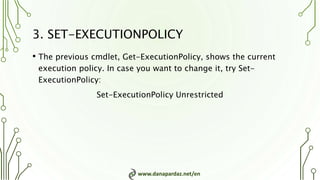
3. SET-EXECUTIONPOLICY
• The previous cmdlet, Get-ExecutionPolicy, shows the current
execution policy. In case you want to change it, try Set-
ExecutionPolicy:
Set-ExecutionPolicy Unrestricted
www.danapardaz.net/en
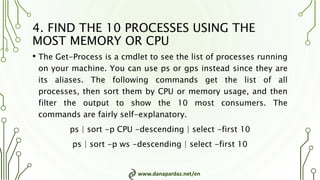
4. FIND THE 10 PROCESSES USING THE
MOST MEMORY OR CPU
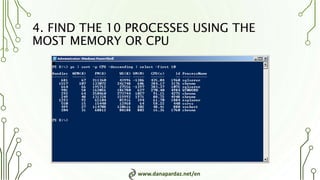
• The Get-Process is a cmdlet to see the list of processes running
on your machine. You can use ps or gps instead since they are
its aliases. The following commands get the list of all
processes, then sort them by CPU or memory usage, and then
filter the output to show the 10 most consumers. The
commands are fairly self-explanatory.
ps | sort -p CPU -descending | select -first 10
ps | sort -p ws -descending | select -first 10
www.danapardaz.net/en
4. FIND THE 10 PROCESSES USING THE
MOST MEMORY OR CPU
www.danapardaz.net/en
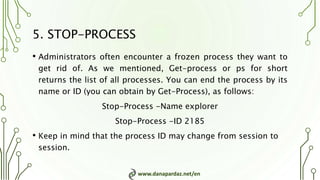
5. STOP-PROCESS
• Administrators often encounter a frozen process they want to
get rid of. As we mentioned, Get-process or ps for short
returns the list of all processes. You can end the process by its
name or ID (you can obtain by Get-Process), as follows:
Stop-Process -Name explorer
Stop-Process -ID 2185
• Keep in mind that the process ID may change from session to
session.
www.danapardaz.net/en
6. EXPORT-CSV
• The Export-CSV cmdlet simplifies saving data as a comma-separated
values (CSV) file. To use this cmdlet, first generate data you want by
any other cmdlet, and then pipe that with Export-CSV to save the
output into a CSV file. For example, the following command save all
processes into a csv file:
ps | Export-Csv c:exporttest.csv
• As another cool example, the following command export all Active
Directory users into ADExport.csv file:
Get-ADUser –filter * | Export-Csv c:exportADExport.csv
• Read this article (How to Export Users from Active Directory to CSV
file?) to learn more about Active Directory exporting.
www.danapardaz.net/en
7. GET-SERVICE, STOP-SERVICE AND
START-SERVICE
• As it can be easily guessed from their name, Get-Service lists
all services regardless of their status (stopped, running, etc).
You can stop or start the service by Stop-Service and Start-
Service cmdlet. Write this command following “-Name” and the
actual name of the service. For example, you can stop and start
Spooler service (printer spooler service which is usually
restarted by admins when printer service stop working) as
follows:
Stop-Service -Name Spooler
Start-Service -Name Spooler
www.danapardaz.net/en
8. SET-SCHEDULEDJOB
• Automatically running a job at specific time has becoming one
the most wanted feature of administration process. The Set-
ScheduledJob cmdlet was first introduced in PowerShell 3.0 that
allows administrators to run any PowerShell script at a specific
time or on periodic schedule.
www.danapardaz.net/en
FOLLOW US AT:
• linkedin:
https://www.linkedin.com/showcase/13308693/
• Facebook:
https://www.facebook.com/Dana-Pardaz-Co-1276798922374926/
• Twitter:
https://twitter.com/danapardazen
• WordPress
http://danapardaz.wordpress.com/
• Read our blog at Danapardaz.net:
http://www.danapardaz.net/site/en/blog

8 power shell commands every windows administrator should know

  • 1.
    www.danapardaz.net/en DANA PARDAZ CO. 8POWERSHELL COMMANDS EVERY WINDOWS ADMINISTRATOR SHOULD KNOW
  • 2.
    www.danapardaz.net/en 1. GET-HELP • Itis perhaps the most important cmdlet an administrator should know. The cmdlet provides help, details and examples of other cmdlets if available. For example, the following command shows the help of Get-Process cmdlet: Get-Help -Name Get-Process • Note that PowerShell is not case-sensitive, that is it doesn’t matter whether you capitalize the cmdlet commands or not, but people often capitalize the words to make it more readable.
  • 3.
    www.danapardaz.net/en 2. GET-EXECUTIONPOLICY • Bydefault, PowerShell scripts are disabled to prevent malicious script from harming your machine. Execution policy indicates whether it is allowed to execute PowerShell scripts or not. It has 4 state as follows: 1. Restricted: default execution policy that locks PowerShell down so that commands can be entered only interactively. PowerShell scripts cannot run. 2. All Signed: execution policy in which scripts will be allowed to run, but only if they are signed by a trusted publisher. 3. Remote Signed: execution policy that allows any PowerShell scripts that have been locally created to run. Remotely created scripts are only allowed to run if they are signed by a trusted publisher. 4. Unrestricted: policy that removes all restrictions from the execution policy. Here, you are free to run scripts locally and remotely.
  • 4.
    www.danapardaz.net/en 3. SET-EXECUTIONPOLICY • Theprevious cmdlet, Get-ExecutionPolicy, shows the current execution policy. In case you want to change it, try Set- ExecutionPolicy: Set-ExecutionPolicy Unrestricted
  • 5.
    www.danapardaz.net/en 4. FIND THE10 PROCESSES USING THE MOST MEMORY OR CPU • The Get-Process is a cmdlet to see the list of processes running on your machine. You can use ps or gps instead since they are its aliases. The following commands get the list of all processes, then sort them by CPU or memory usage, and then filter the output to show the 10 most consumers. The commands are fairly self-explanatory. ps | sort -p CPU -descending | select -first 10 ps | sort -p ws -descending | select -first 10
  • 6.
    www.danapardaz.net/en 4. FIND THE10 PROCESSES USING THE MOST MEMORY OR CPU
  • 7.
    www.danapardaz.net/en 5. STOP-PROCESS • Administratorsoften encounter a frozen process they want to get rid of. As we mentioned, Get-process or ps for short returns the list of all processes. You can end the process by its name or ID (you can obtain by Get-Process), as follows: Stop-Process -Name explorer Stop-Process -ID 2185 • Keep in mind that the process ID may change from session to session.
  • 8.
    www.danapardaz.net/en 6. EXPORT-CSV • TheExport-CSV cmdlet simplifies saving data as a comma-separated values (CSV) file. To use this cmdlet, first generate data you want by any other cmdlet, and then pipe that with Export-CSV to save the output into a CSV file. For example, the following command save all processes into a csv file: ps | Export-Csv c:exporttest.csv • As another cool example, the following command export all Active Directory users into ADExport.csv file: Get-ADUser –filter * | Export-Csv c:exportADExport.csv • Read this article (How to Export Users from Active Directory to CSV file?) to learn more about Active Directory exporting.
  • 9.
    www.danapardaz.net/en 7. GET-SERVICE, STOP-SERVICEAND START-SERVICE • As it can be easily guessed from their name, Get-Service lists all services regardless of their status (stopped, running, etc). You can stop or start the service by Stop-Service and Start- Service cmdlet. Write this command following “-Name” and the actual name of the service. For example, you can stop and start Spooler service (printer spooler service which is usually restarted by admins when printer service stop working) as follows: Stop-Service -Name Spooler Start-Service -Name Spooler
  • 10.
    www.danapardaz.net/en 8. SET-SCHEDULEDJOB • Automaticallyrunning a job at specific time has becoming one the most wanted feature of administration process. The Set- ScheduledJob cmdlet was first introduced in PowerShell 3.0 that allows administrators to run any PowerShell script at a specific time or on periodic schedule.
  • 11.
    www.danapardaz.net/en FOLLOW US AT: •linkedin: https://www.linkedin.com/showcase/13308693/ • Facebook: https://www.facebook.com/Dana-Pardaz-Co-1276798922374926/ • Twitter: https://twitter.com/danapardazen • WordPress http://danapardaz.wordpress.com/ • Read our blog at Danapardaz.net: http://www.danapardaz.net/site/en/blog