You Can’t Have One Without
         the Other
        Body Systems
TAKS Objective 2

The student will demonstrate an
understanding of living systems and the
environment – Interdependence occurs
among living systems
TEKS 8.6 A

The student knows that
interdependence occurs among
living systems. The student is
expected to describe interactions
among systems in the human
organism
Lesson Objectives
Describe connections between the immune
system and other body systems.

Design an experiment to demonstrate the
relationship between the circulatory and
respiratory systems.

Summarize the relationship between oxygen debt
and muscular contractions.

Create labeled drawings of the lungs and
diaphragm during inhalation and exhalation.
Student Prior Knowledge
• TEKS 6.10 (C) identify how structure
  complements function at different levels of
  organization including organ and organ
  systems.
• TEKS 7.9 (A) identify the systems of the
  human organism and describe their
  functions.
• TEKS 7.9 (B) describe how organisms
  maintain stable internal conditions while
  living in changing external environments.
Background
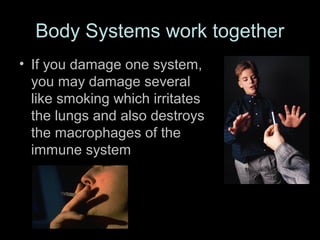
Body Systems work together
• If you damage one system,
  you may damage several
  like smoking which irritates
  the lungs and also destroys
  the macrophages of the
  immune system
Body Systems work together


• If you get excited, the nervous system
  increases the heart rate
Body Systems work together
• If you become ill with
  AIDS the immune system
  is destroyed, you may
  get pneumonia (lungs),
  yeast infection
  (reproduction), Candida
  affecting esophagus
  (digestive), or Kaposi’s
  sarcoma (integument).
Human Body Team


All the systems play a part. How do
            they interact?
Which one is the most important?
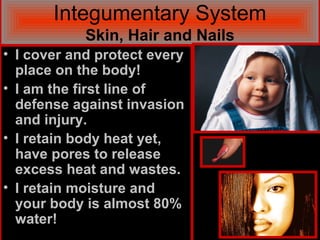
Integumentary System
            Skin, Hair and Nails
• I cover and protect every
  place on the body!
• I am the first line of
  defense against invasion
  and injury.
• I retain body heat yet,
  have pores to release
  excess heat and wastes.
• I retain moisture and
  your body is almost 80%
  water!
Skeletal System
          • Without me, you’d
            have no shape or
            structure…you’d be a
            blob.
          • I make you able to
            move!
          • I make your red blood
            cells that carry oxygen
            to all the cells.
          • I protect the precious
            brain, heart and spinal
            cord.
Muscular System
   • The heart is made
     of cardiac muscle.
   • The internal organs
     are made of
     smooth muscle.
   • Without the
     skeletal muscles
     the bones couldn’t
     move.
Respiratory System
• I bring in the oxygen that is carried on the
  red blood cells…without me you’d have no
  oxygen to carry!
• I carry the CO2 (waste gas) out of the body.
• The circulatory system needs me for gas
  exchange.
• The muscles need oxygen to move.
• The brain needs
  my oxygen to think.
Circulatory System
• I carry oxygen and nutrients to every
  cell in the body!
• I am the heart, the veins, the arteries,
  capillaries and blood.
• I transport the white blood cells to all
  the infections and injuries.
• Without me, the oxygen and the CO2
  in the body couldn’t reach the cells
  or lungs.
Nervous System
      I tell everything
      what to do. I tell
      the heart when to
      beat, the body
      when to move, the
      digestive system to
      add enzymes.
      I am the leader.
Digestive/Excretory System

           • Without my system, the
             body would not be able
             to obtain energy and
             nutrients.
           • I break down all the
             food stuffed in my
             mouth into usable
             nutrients and expel the
             wastes.
Reproduction System

• Without me, there
  would be not be
  any systems.
• I am how the
  species continues.
Body Systems
ENGAGE

Show the movie clip from Ebola:
The Plague Fighters
EXPLORE
EXPLAIN

1. How is Ebola virus transmitted?
2. How does Ebola affect
   humans?
ELABORATE

Repeat the experiment and offer
 the option to abstain. Change
 the infectious agent to HIV.
EVALUATE

Explain the connection between
  the immune system with other
  body systems.
ENGAGE

Play the song, “Turn the Beat
Around” by Gloria Estefan.
EXPLORE
1. How many times does you
   heart beat per hour? Per day?
   Per year?
2. Jog in place for one minute.
   Create a data table to colelct
   information about heart rate
   before and after jogging.
   Include multiple trials.
EXPLAIN

1. How much faster is your pulse
   after jogging?
2. Why did the heart rate
   increase?
3. How did the circulatory and
   respiratory system interact?
ELABORATE

Record the number of times you
 can squeeze a tennis ball for 2
 minutes.
Questions

1. How did you hand feel at the
   end of the activity?
2. What is happening to the
   muscles in your hand?
3. How do swimmers overcome
   lactate buildup as they near the
   end of a race?
4. Which body systems are
   interacting together in this
   activity?
EVALUATE

Explain the connection between
  the circulatory and respiratory
  systems.
ENGAGE
What is the difference in these
two liquids? Can you make them
the same?
EXPLORE

Complete the learning experience.
EXPLAIN
1. Why did the BTB solution turn
   yellow in the presence of
   carbon dioxide?

2.Why does the need for oxygen
  increase during exercise?
ELABORATE

Suggest an experiment to change
 the solution back to blue. Hint:
 The amount of oxygen and
 carbon dioxide in the solution
 must be changed.
EVALUATE

Explain how the muscular, skeletal,
  and circulatory systems work
  together during digestion.
ENGAGE
Everyday about 1/5 of the tip of
each villus is lost during digestion.
Guess what is in 1/3 of daily
excrement?
EXPLORE

Complete the learning experience
  on page 42-43.
EXPLAIN
1. Which cloth is similar to the villi?
2. How would this help in
   absorption of food?
3. What do the villi, alveoli, and
   nephrons have in common?
ELABORATE

Demonstrate diffusion across a
 cell membrane using raw eggs
 with no shell
EVALUATE

Explain how the muscular, skeletal,
  circulatory, and respiratory
  systems work together during
  breathing.
Summative Assessment

Pair with a partner and describe how
 the two systems interact.

Form a triad and describe how the
  three systems interact.

8 6 a_bodysystems

  • 1.
    You Can’t HaveOne Without the Other Body Systems
  • 2.
    TAKS Objective 2 Thestudent will demonstrate an understanding of living systems and the environment – Interdependence occurs among living systems
  • 3.
    TEKS 8.6 A Thestudent knows that interdependence occurs among living systems. The student is expected to describe interactions among systems in the human organism
  • 4.
    Lesson Objectives Describe connectionsbetween the immune system and other body systems. Design an experiment to demonstrate the relationship between the circulatory and respiratory systems. Summarize the relationship between oxygen debt and muscular contractions. Create labeled drawings of the lungs and diaphragm during inhalation and exhalation.
  • 5.
    Student Prior Knowledge •TEKS 6.10 (C) identify how structure complements function at different levels of organization including organ and organ systems. • TEKS 7.9 (A) identify the systems of the human organism and describe their functions. • TEKS 7.9 (B) describe how organisms maintain stable internal conditions while living in changing external environments.
  • 6.
  • 7.
    Body Systems worktogether • If you damage one system, you may damage several like smoking which irritates the lungs and also destroys the macrophages of the immune system
  • 8.
    Body Systems worktogether • If you get excited, the nervous system increases the heart rate
  • 9.
    Body Systems worktogether • If you become ill with AIDS the immune system is destroyed, you may get pneumonia (lungs), yeast infection (reproduction), Candida affecting esophagus (digestive), or Kaposi’s sarcoma (integument).
  • 10.
    Human Body Team Allthe systems play a part. How do they interact? Which one is the most important?
  • 11.
    Integumentary System Skin, Hair and Nails • I cover and protect every place on the body! • I am the first line of defense against invasion and injury. • I retain body heat yet, have pores to release excess heat and wastes. • I retain moisture and your body is almost 80% water!
  • 12.
    Skeletal System • Without me, you’d have no shape or structure…you’d be a blob. • I make you able to move! • I make your red blood cells that carry oxygen to all the cells. • I protect the precious brain, heart and spinal cord.
  • 13.
    Muscular System • The heart is made of cardiac muscle. • The internal organs are made of smooth muscle. • Without the skeletal muscles the bones couldn’t move.
  • 14.
    Respiratory System • Ibring in the oxygen that is carried on the red blood cells…without me you’d have no oxygen to carry! • I carry the CO2 (waste gas) out of the body. • The circulatory system needs me for gas exchange. • The muscles need oxygen to move. • The brain needs my oxygen to think.
  • 15.
    Circulatory System • Icarry oxygen and nutrients to every cell in the body! • I am the heart, the veins, the arteries, capillaries and blood. • I transport the white blood cells to all the infections and injuries. • Without me, the oxygen and the CO2 in the body couldn’t reach the cells or lungs.
  • 16.
    Nervous System I tell everything what to do. I tell the heart when to beat, the body when to move, the digestive system to add enzymes. I am the leader.
  • 17.
    Digestive/Excretory System • Without my system, the body would not be able to obtain energy and nutrients. • I break down all the food stuffed in my mouth into usable nutrients and expel the wastes.
  • 18.
    Reproduction System • Withoutme, there would be not be any systems. • I am how the species continues.
  • 19.
  • 20.
    ENGAGE Show the movieclip from Ebola: The Plague Fighters
  • 21.
  • 22.
    EXPLAIN 1. How isEbola virus transmitted? 2. How does Ebola affect humans?
  • 23.
    ELABORATE Repeat the experimentand offer the option to abstain. Change the infectious agent to HIV.
  • 24.
    EVALUATE Explain the connectionbetween the immune system with other body systems.

  • 26.
    ENGAGE Play the song,“Turn the Beat Around” by Gloria Estefan.
  • 27.
    EXPLORE 1. How manytimes does you heart beat per hour? Per day? Per year? 2. Jog in place for one minute. Create a data table to colelct information about heart rate before and after jogging. Include multiple trials.
  • 28.
    EXPLAIN 1. How muchfaster is your pulse after jogging? 2. Why did the heart rate increase? 3. How did the circulatory and respiratory system interact?
  • 29.
    ELABORATE Record the numberof times you can squeeze a tennis ball for 2 minutes.
  • 30.
    Questions 1. How didyou hand feel at the end of the activity? 2. What is happening to the muscles in your hand? 3. How do swimmers overcome lactate buildup as they near the end of a race? 4. Which body systems are interacting together in this activity?
  • 31.
    EVALUATE Explain the connectionbetween the circulatory and respiratory systems.
  • 32.
    ENGAGE What is thedifference in these two liquids? Can you make them the same?
  • 33.
  • 34.
    EXPLAIN 1. Why didthe BTB solution turn yellow in the presence of carbon dioxide? 2.Why does the need for oxygen increase during exercise?
  • 35.
    ELABORATE Suggest an experimentto change the solution back to blue. Hint: The amount of oxygen and carbon dioxide in the solution must be changed.
  • 36.
    EVALUATE Explain how themuscular, skeletal, and circulatory systems work together during digestion.
  • 37.
    ENGAGE Everyday about 1/5of the tip of each villus is lost during digestion. Guess what is in 1/3 of daily excrement?
  • 38.
    EXPLORE Complete the learningexperience on page 42-43.
  • 39.
    EXPLAIN 1. Which clothis similar to the villi? 2. How would this help in absorption of food? 3. What do the villi, alveoli, and nephrons have in common?
  • 40.
    ELABORATE Demonstrate diffusion acrossa cell membrane using raw eggs with no shell
  • 41.
    EVALUATE Explain how themuscular, skeletal, circulatory, and respiratory systems work together during breathing.
  • 42.
    Summative Assessment Pair witha partner and describe how the two systems interact. Form a triad and describe how the three systems interact.

Editor's Notes

  • #11 As the you use the slides, discuss the system functions.
  • #12 Protection Excess wastes especially urea Regulates body temperature
  • #13 Makes red blood cells for circulatory system Provides bones for skeletal system to attach to that enables movement Provides calcium, phosphorus, etc. Protection of major organs by hard, bony plates Malleable during birth and the first few years
  • #14 The heart muscles pump blood to carry oxygen brought in by the respiratory system Stomach muscles break down food so it can be digested Allow movement by pulling on bones
  • #15 Without this system gas could (0 2 primarily) would not enter our systems Without this system CO 2 could not exit the body after being expelled as a waste in cellular respiration Circulatory system carries these gases to the alveoli to be expelled Diaphragm ( a muscle) is what forces lungs to inhale and exhale
  • #16 Provides a platform for oxygen and nutrients to flow to all cells of the body. The heart (a muscle) gives the blood the power to push these things to the cells Without the veins, arteries and capillaries
  • #17 All the systems require monitoring and instructions
  • #18 All the body systems require various nutrients to function. The human body obtains these nutrients from the food we eat. The digestive system then breaks down these foodstuffs into usable nutrients for the body to use
  • #19 Individuals need not reproduce, but the species must have a way to reproduce in order to continue the species. Sexual reproduction provides diverse offspring a positive thing for a species The more genetically diverse a population, the more likelihood there is for it to survive