1
7 QC TOOLS
2
Quality
A subjective term for which each person has his or her own
definition. In technical usage, quality can have two
meanings:
1. The characteristics of a product or service that bear on its
ability to satisfy stated or implied needs.
2. A product or service free from deficiencies.
3
Can also be termed as
‘A measure of
excellence’
Quality
4
 Quality - an essential and distinguishing attribute of something.
 Attribute - an abstraction belonging to or characteristic of an entity
 Appearance, visual aspect - outward or visible aspect of a thing
 Attractiveness, attraction - the quality of arousing interest; being attractive or something
that attracts;
 Uncloudedness, clarity, clearness - the quality of clear water;
 Ease, easiness, simplicity - freedom from difficulty or hardship or effort.
 Suitability, suitableness - the quality of having the properties that are right for a specific
purpose.
 Excellence - the quality of excelling.
 Characteristic - a distinguishing quality
 Simpleness, simplicity - the quality of being simple or uncompounded
Meaning of “Quality”
5
Meaning of “Quality”
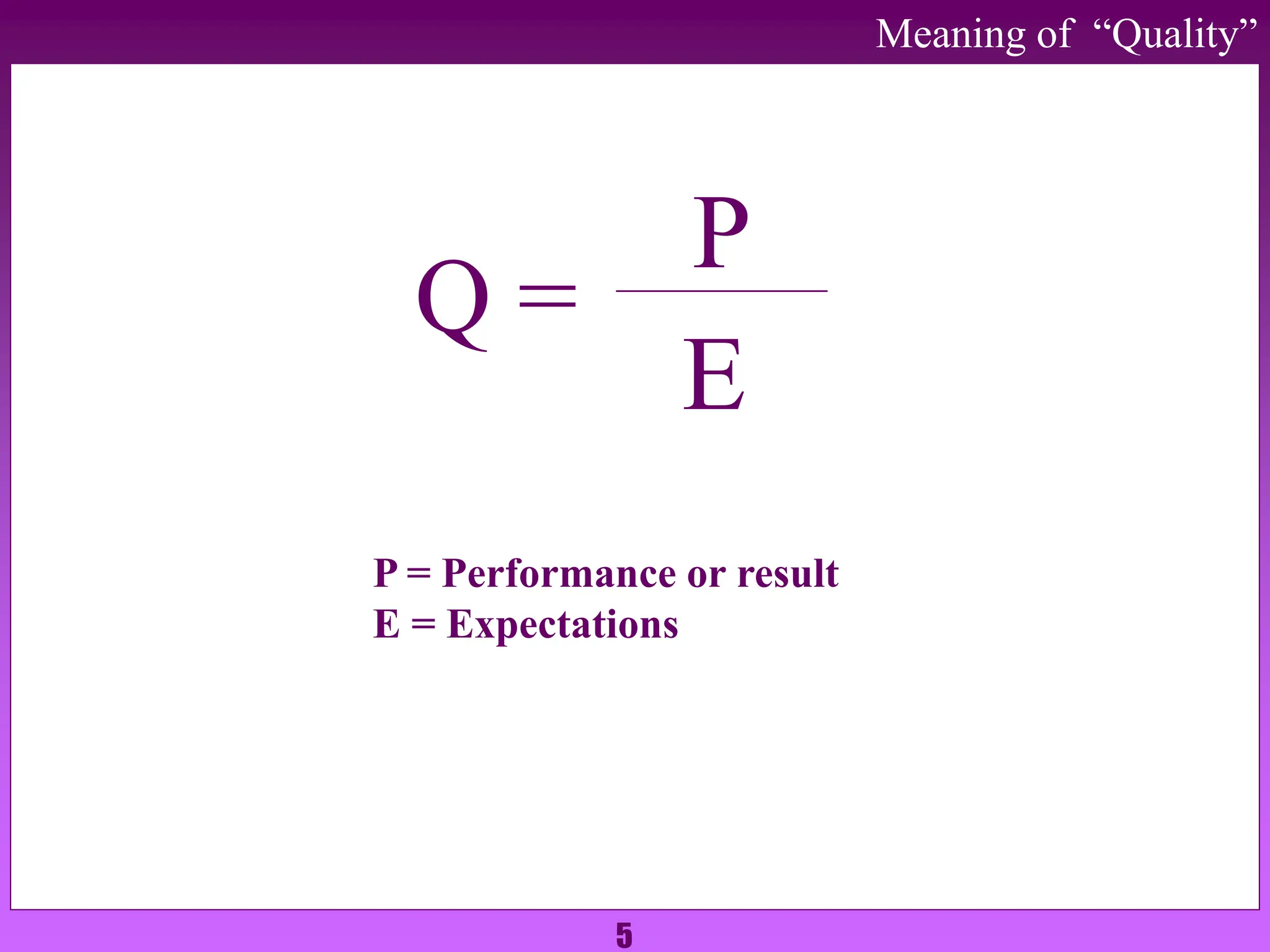
Q =
P
E
P = Performance or result
E = Expectations
6
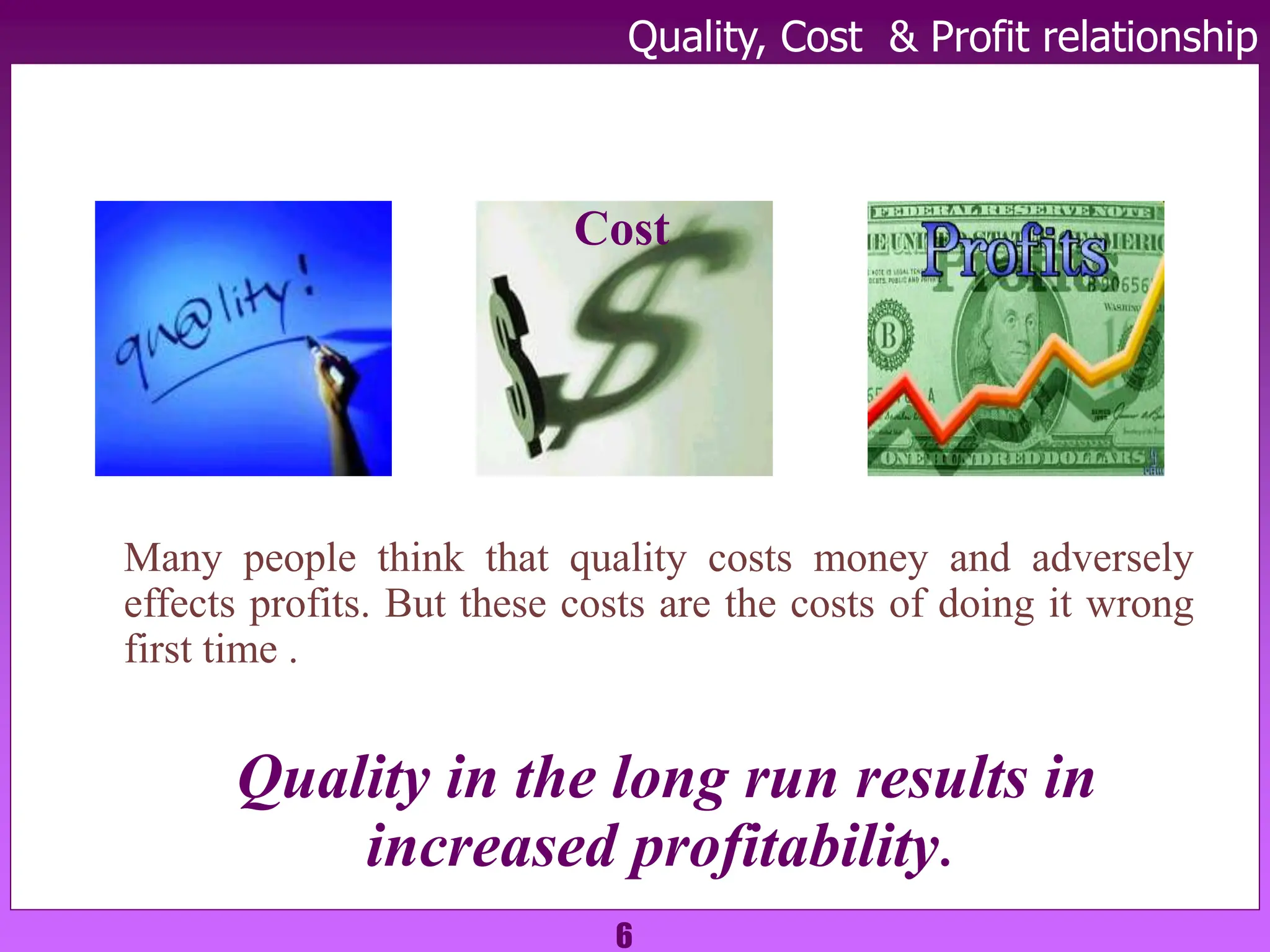
Many people think that quality costs money and adversely
effects profits. But these costs are the costs of doing it wrong
first time .
Quality in the long run results in
increased profitability.
Quality, Cost & Profit relationship
Cost
7
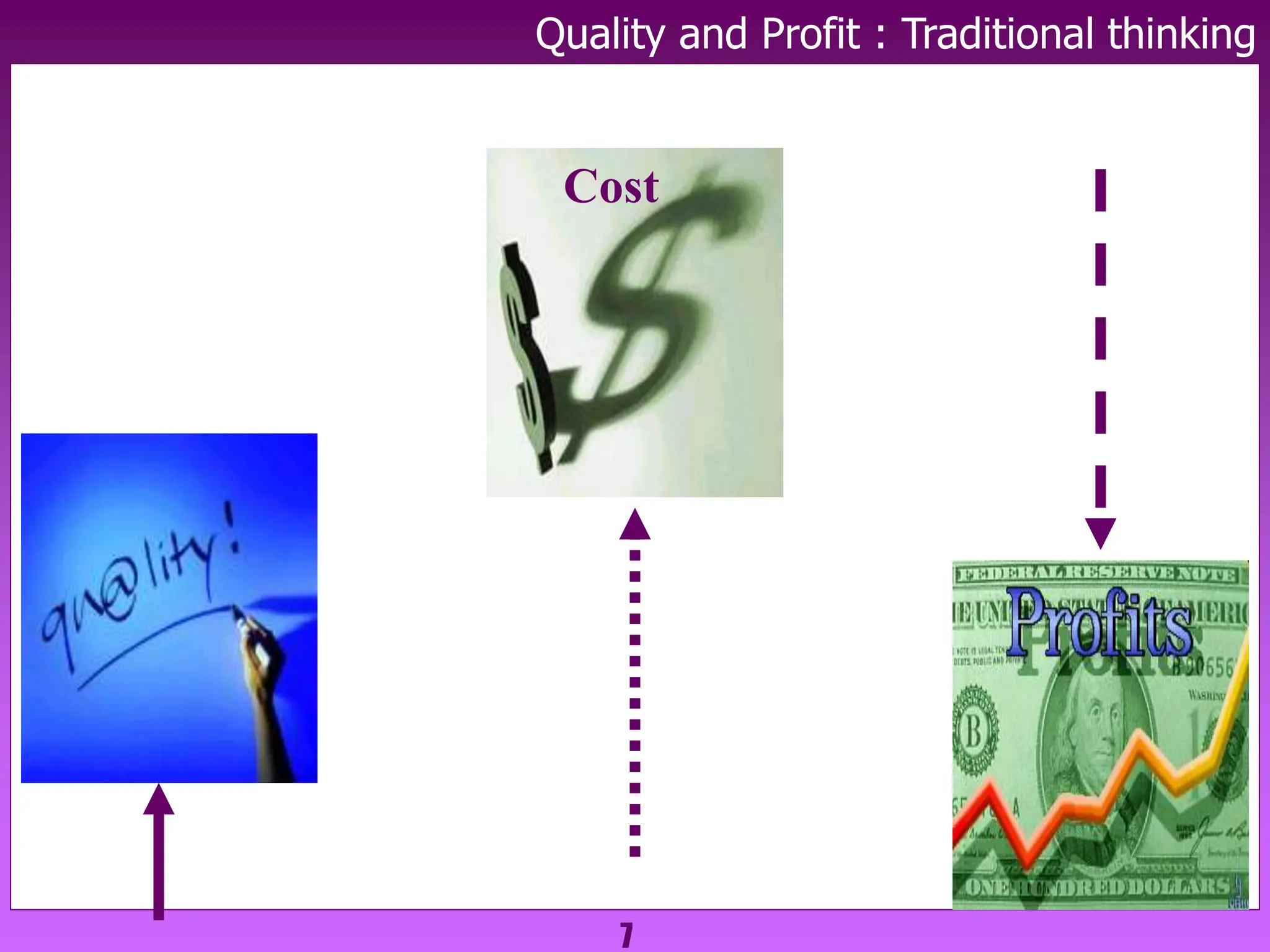
Cost
Quality and Profit : Traditional thinking
8
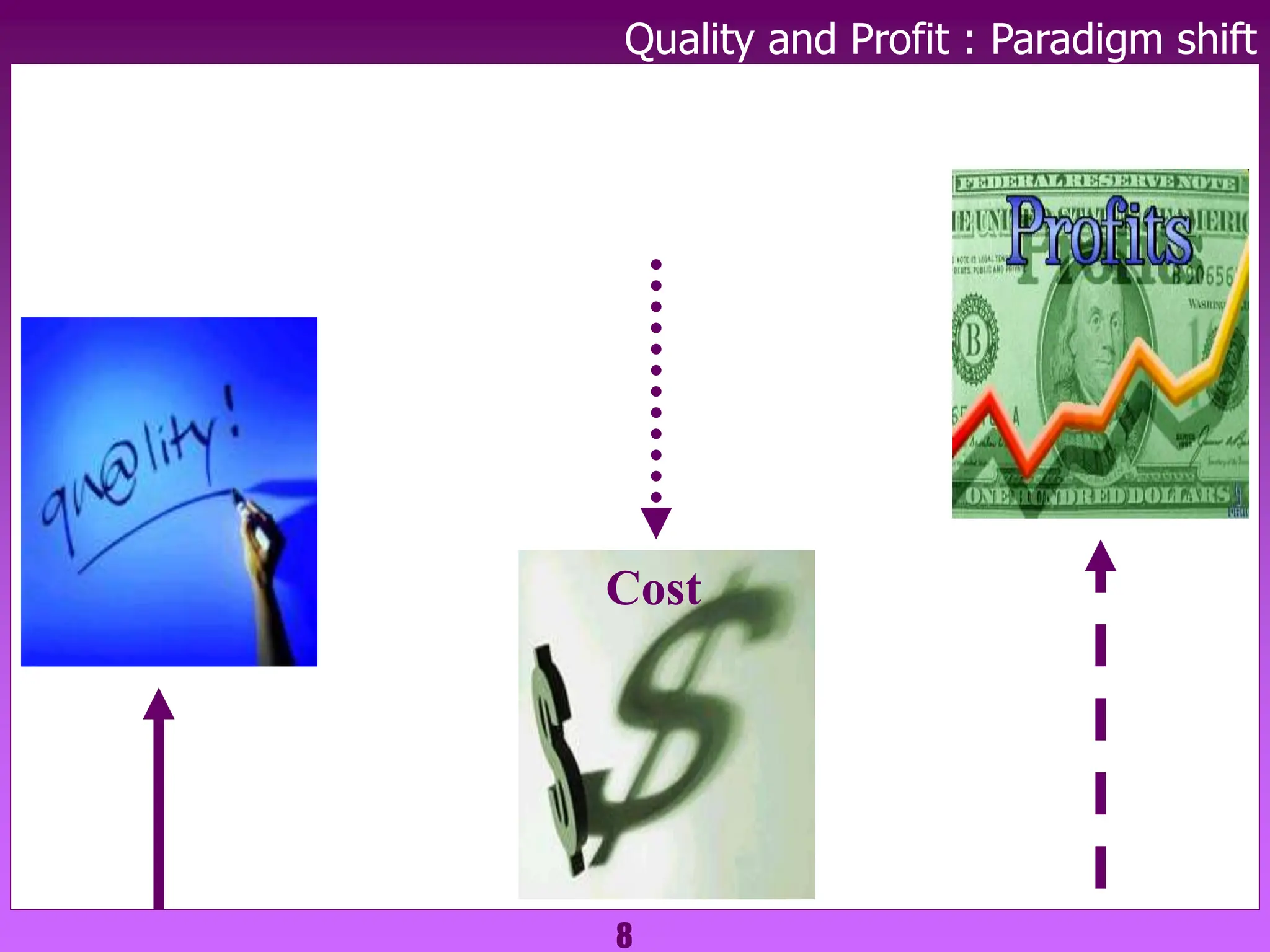
Quality and Profit : Paradigm shift
Cost
9
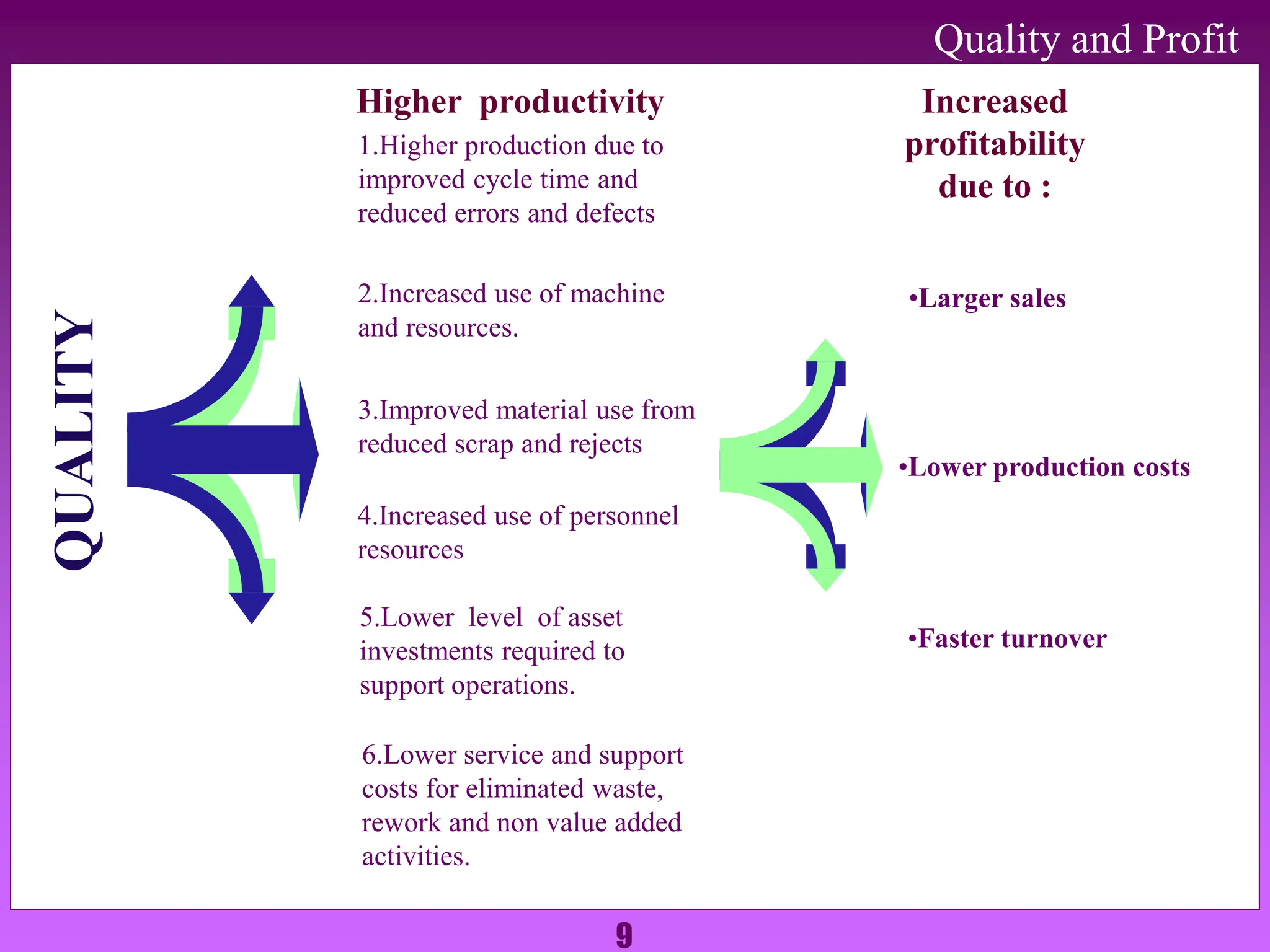
1.Higher production due to
improved cycle time and
reduced errors and defects
2.Increased use of machine
and resources.
3.Improved material use from
reduced scrap and rejects
4.Increased use of personnel
resources
5.Lower level of asset
investments required to
support operations.
6.Lower service and support
costs for eliminated waste,
rework and non value added
activities.
QUALITY Higher productivity Increased
profitability
due to :
•Larger sales
•Lower production costs
•Faster turnover
Quality and Profit
10
Quality and Profit
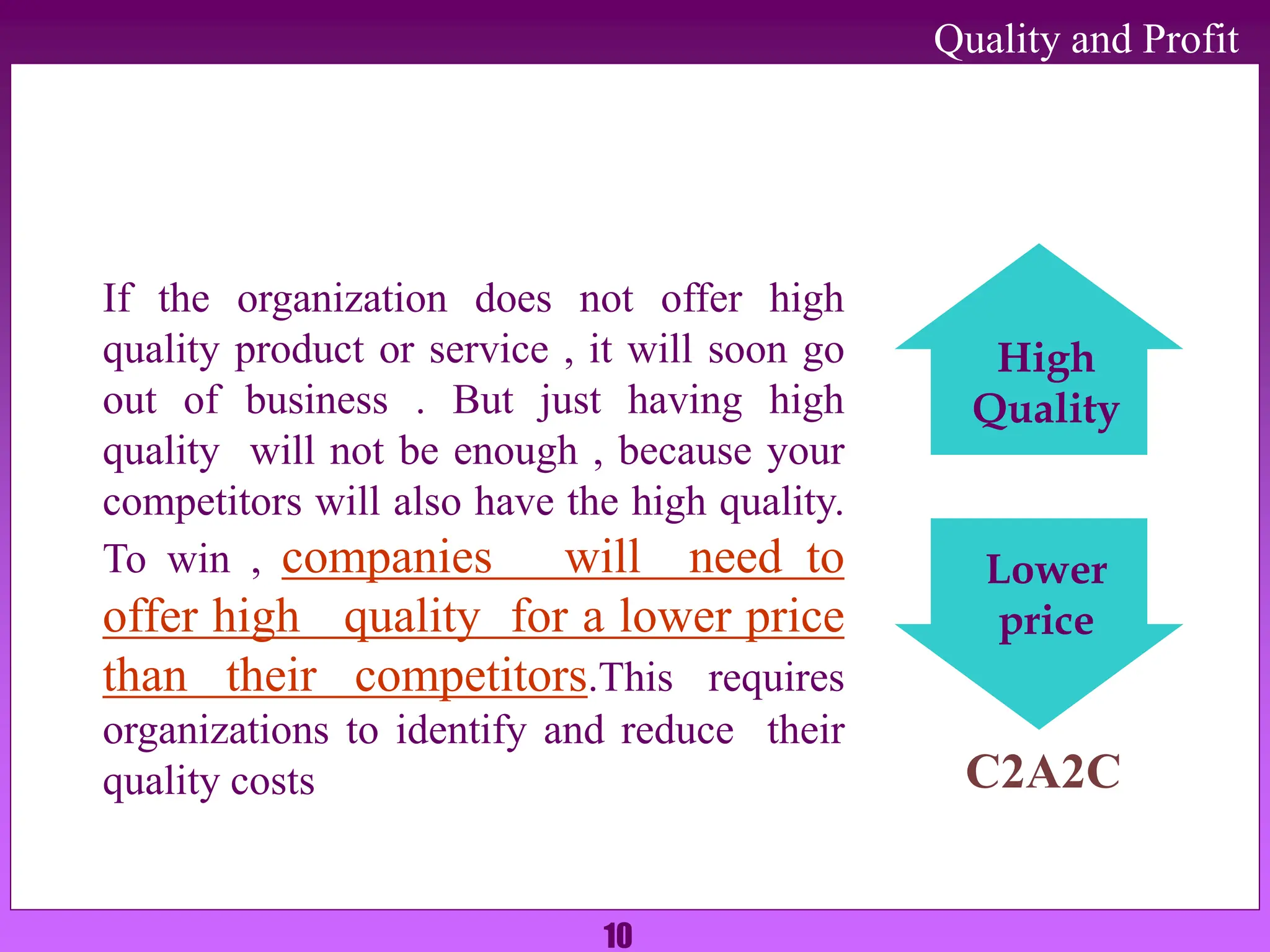
If the organization does not offer high
quality product or service , it will soon go
out of business . But just having high
quality will not be enough , because your
competitors will also have the high quality.
To win , companies will need to
offer high quality for a lower price
than their competitors.This requires
organizations to identify and reduce their
quality costs
High
Quality
Lower
price
C2A2C
11
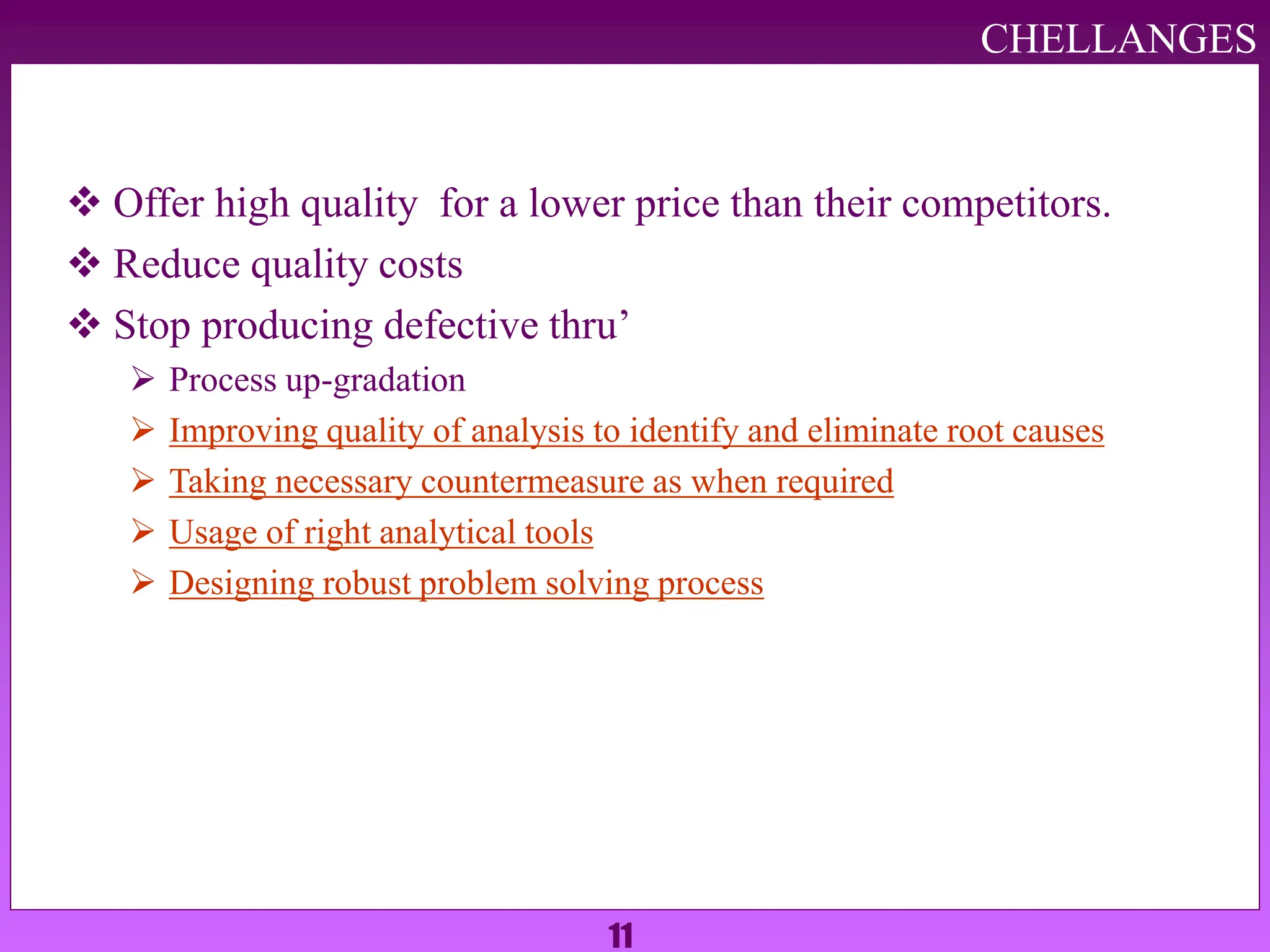
 Offer high quality for a lower price than their competitors.
 Reduce quality costs
 Stop producing defective thru’
 Process up-gradation
 Improving quality of analysis to identify and eliminate root causes
 Taking necessary countermeasure as when required
 Usage of right analytical tools
 Designing robust problem solving process
CHELLANGES
12
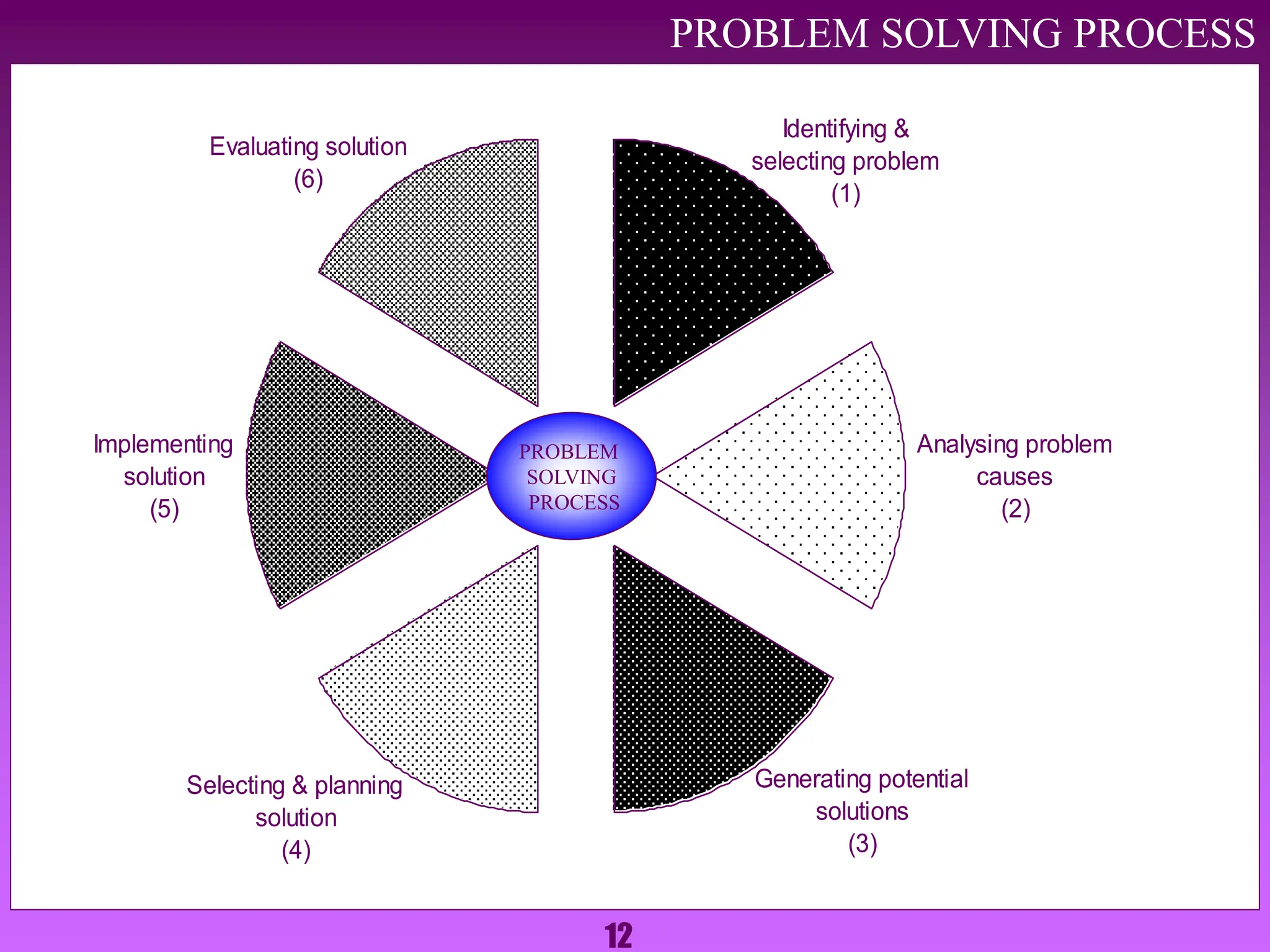
PROBLEM SOLVING PROCESS
Evaluating solution
(6)
Implementing
solution
(5)
Selecting & planning
solution
(4)
Generating potential
solutions
(3)
Analysing problem
causes
(2)
Identifying &
selecting problem
(1)
PROBLEM
SOLVING
PROCESS
13
IDENTIFYING AND SELCTING PROBLEM
 Write Statement of the problem(s)
 Define Gap Between Actual & target
 Prioritize
14
ANALYSIS PROBLEM AND CAUSES
 Collect Data
 Sort symptoms & Causes (effects)
 Brain Storm
 Fishbone - cause & effect analysis
 Prioritize
15
GENERATING POTENTIAL SOLUTIONS
 Brainstorm
 Build on each other’s ideas
 Analysis potential helps & hinders
16
SELECTING AND PLANNING SOLUTION
 Prioritize solutions
 Clarify tasks / Action plan
 Resource / Costs
 Present proposals
17
IMPLEMENTING SOLUTION
 Establish controls
 Maintain Commitments
 Plan Contingencies
18
EVALUATING SOLUTION
 Monitor results
 Restart Process if necessary
19
7 QC TOOLS
Used to identify,analyze and resolve problems
Simple but very powerful tools to solve day to
day work related problems
Find solutions in a systematic manner
Widely used by Quality Circle members world
over
20
Check sheets
 Histograms
 Pareto charts
 Cause & effect diagram (Ishikawa diagram)
 Scatter plot
 Defect concentration diagram
 Control charts
7 QC TOOLS
21
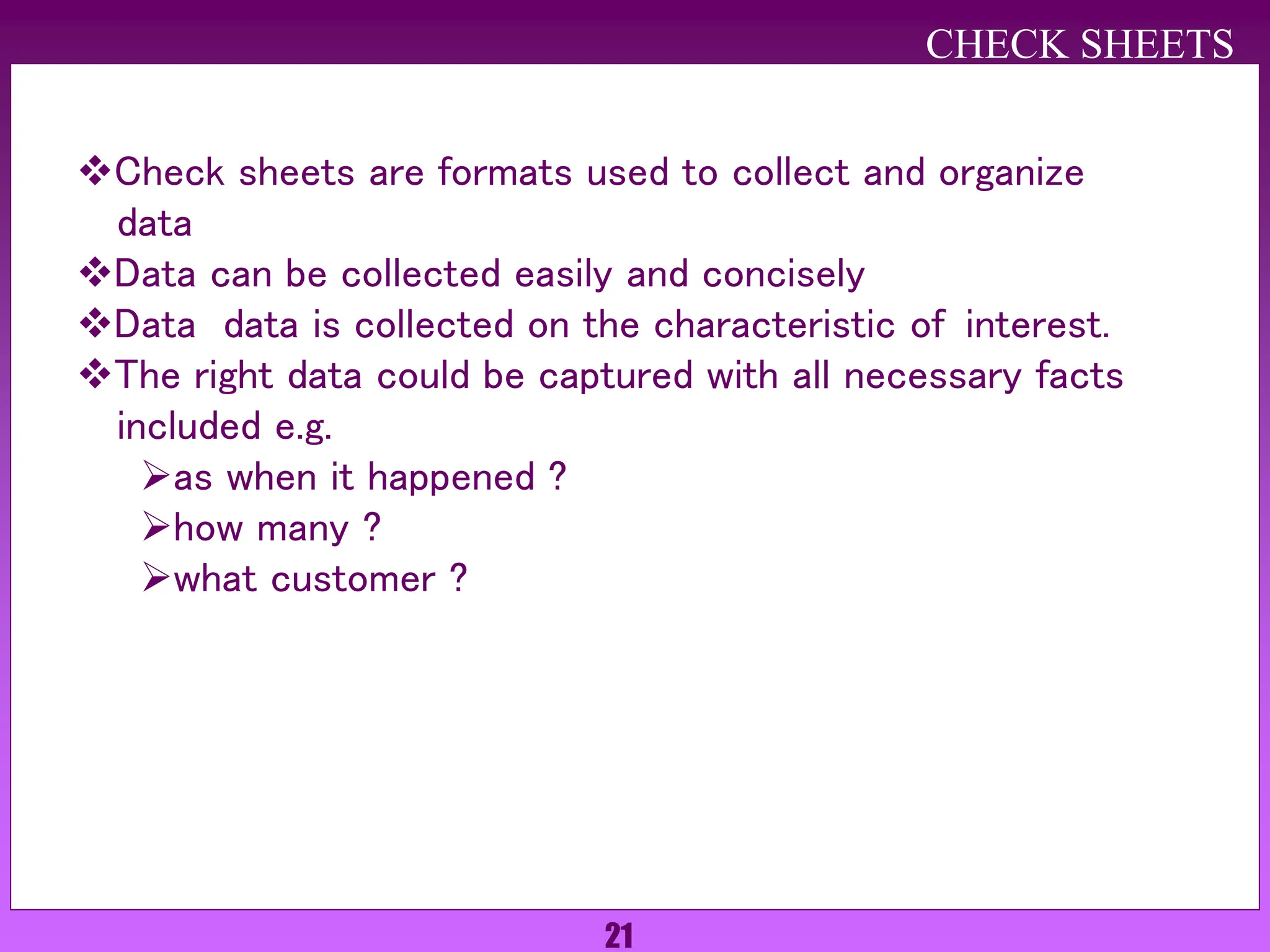
Check sheets are formats used to collect and organize
data
Data can be collected easily and concisely
Data data is collected on the characteristic of interest.
The right data could be captured with all necessary facts
included e.g.
as when it happened ?
how many ?
what customer ?
CHECK SHEETS
22
Check sheets for production process distribution
Defective item check sheet
Defect cause check sheet
Check sheet for work station evaluation
Check sheet for design information accuracy
Check sheet for vendor reliability
TYPES CHECK SHEETS
23
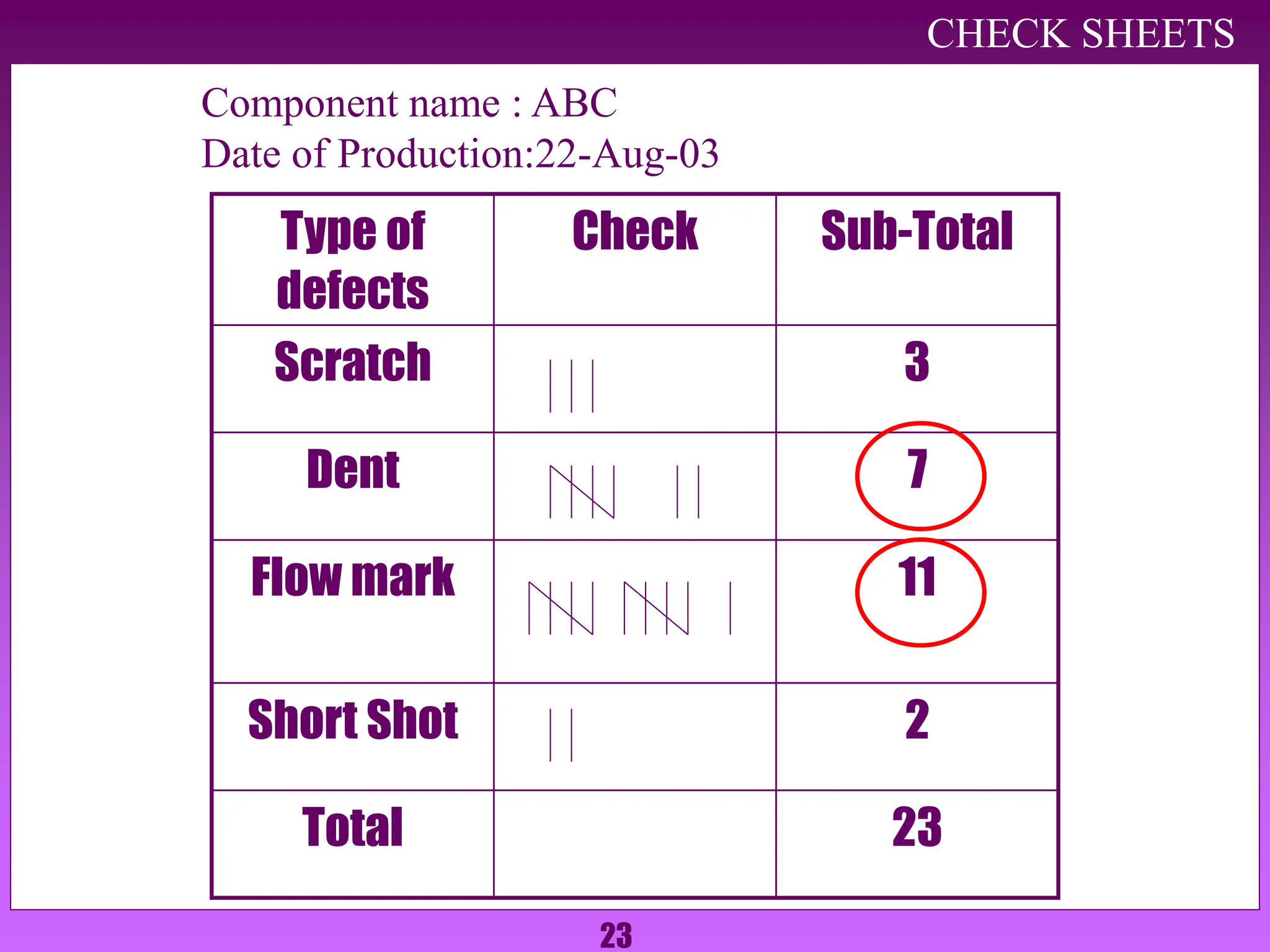
CHECK SHEETS
Type of
defects
Check Sub-Total
Scratch 3
Dent 7
Flow mark 11
Short Shot 2
Total 23
Component name : ABC
Date of Production:22-Aug-03
24
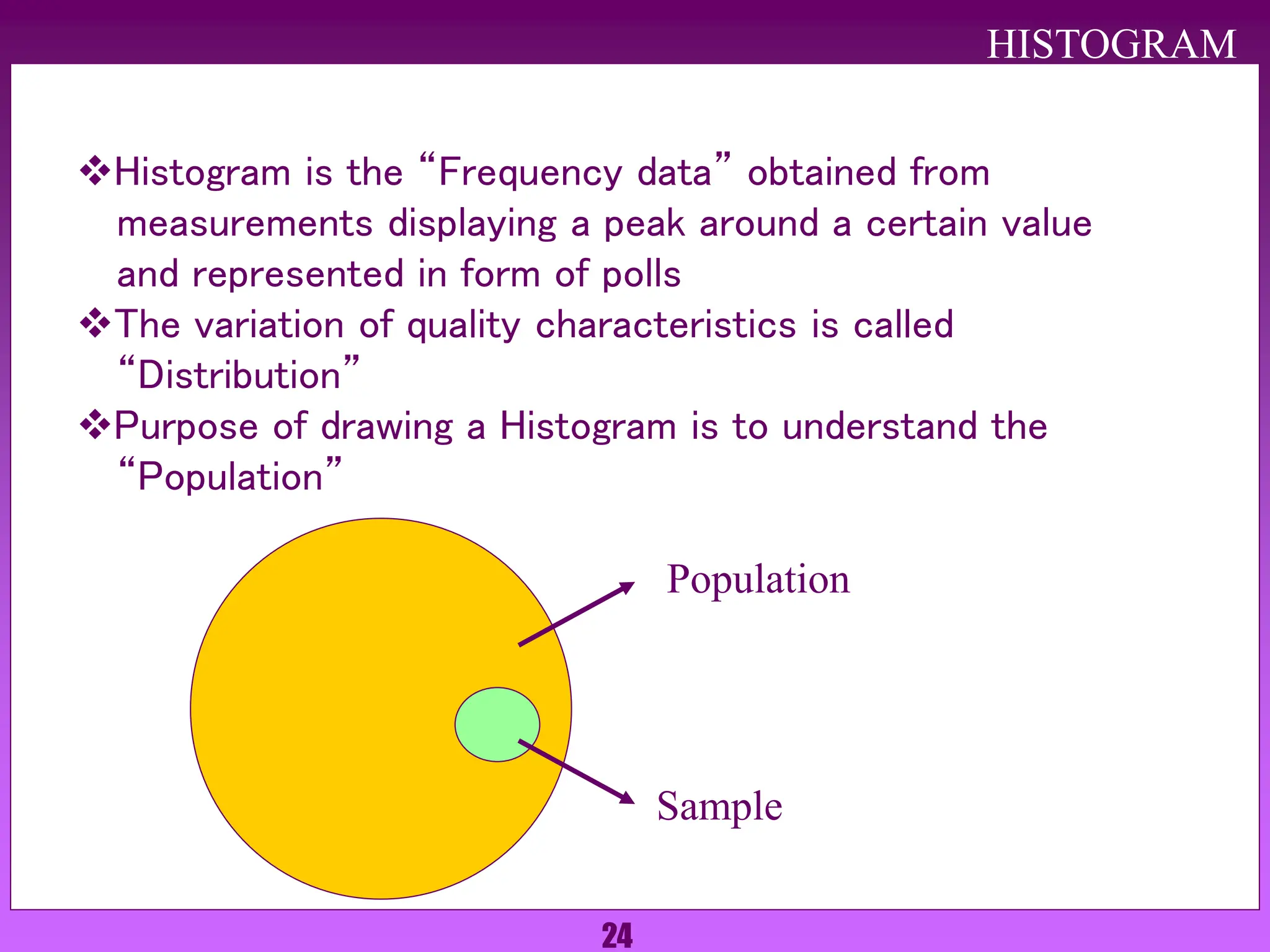
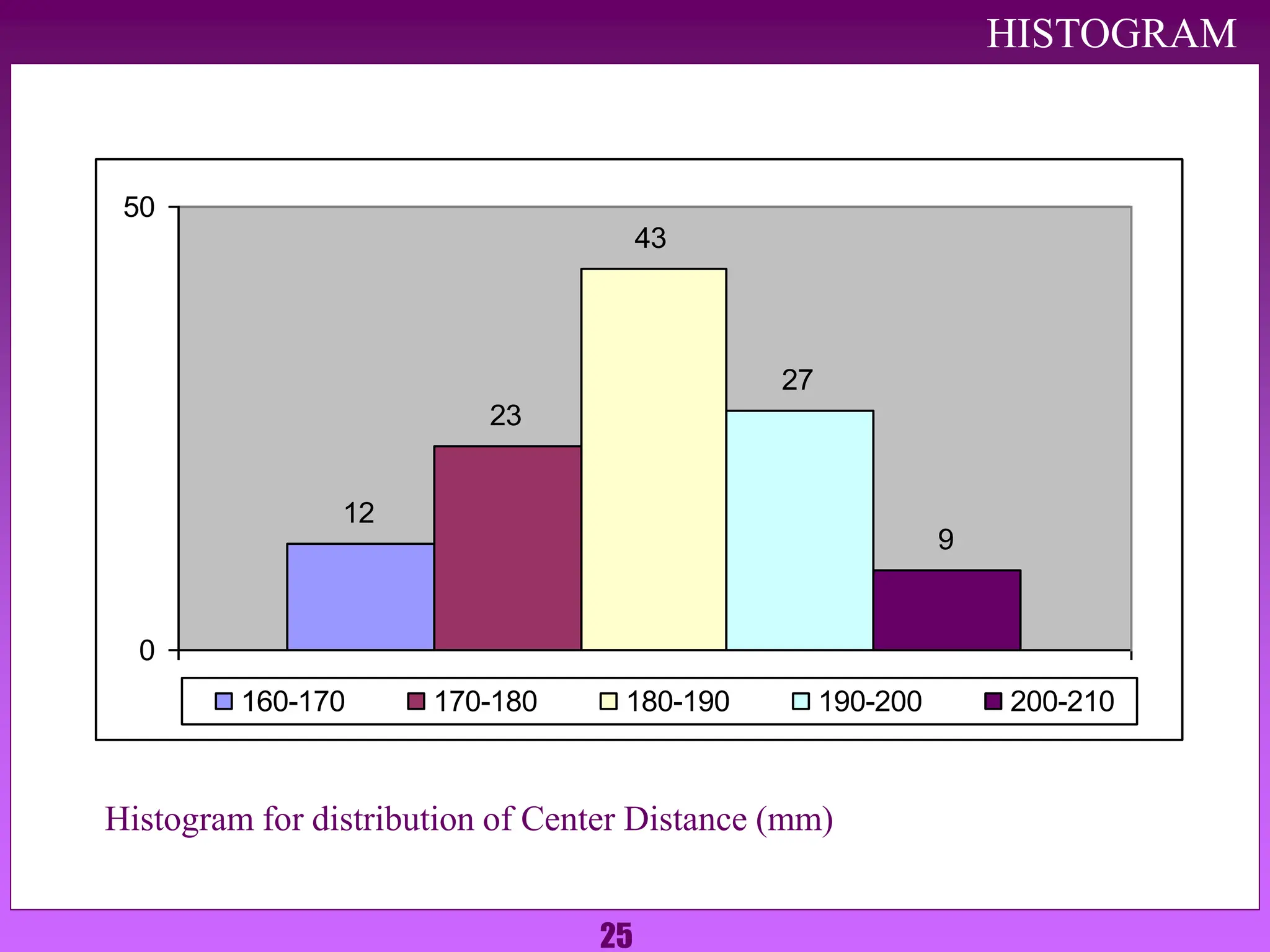
Histogram is the “Frequency data” obtained from
measurements displaying a peak around a certain value
and represented in form of polls
The variation of quality characteristics is called
“Distribution”
Purpose of drawing a Histogram is to understand the
“Population”
HISTOGRAM
Population
Sample
25
12
23
43
27
9
0
50
1
160-170 170-180 180-190 190-200 200-210
Histogram for distribution of Center Distance (mm)
HISTOGRAM
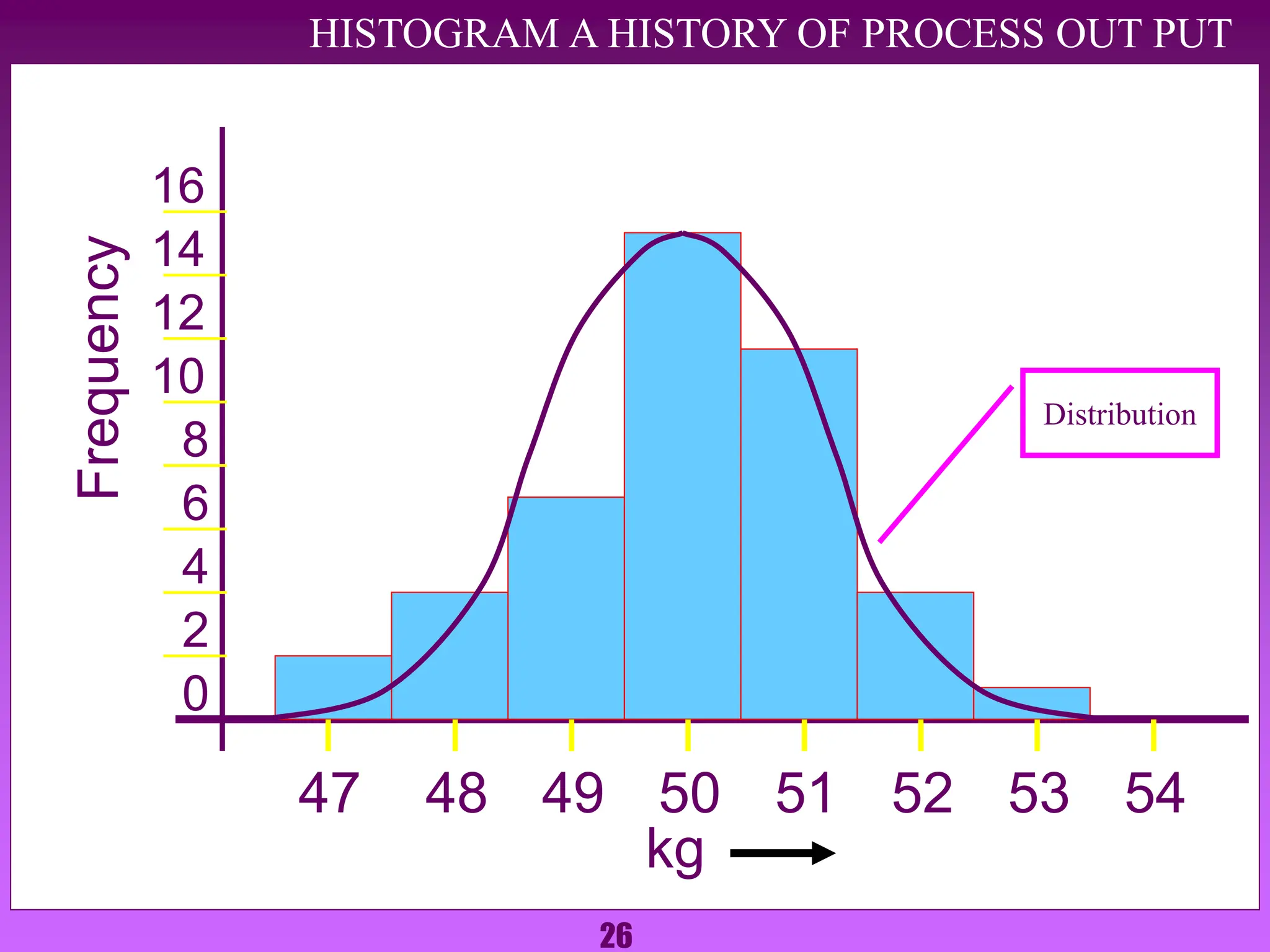
26
HISTOGRAM A HISTORY OF PROCESS OUT PUT
0
2
4
8
10
12
14
16
6
Frequency
47 48 49 50 51 52 53 54
kg
Distribution
27
Based on “80/20” rule (or ABC analysis)
Pareto(V.Pareto,an Italian economist) discovered this universal
law-80% of anything is attributed to 20% of its causes 80% of the
wealth is held by 20% of the population.
• 80% of our income goes into 20% of our needs.
• 80% of road accidents occur on 20% of the road.
• 80% of the absenteeism in a company is due to 20% of
workmen
“Significant few & in-significant many”
PARETO CHART
28
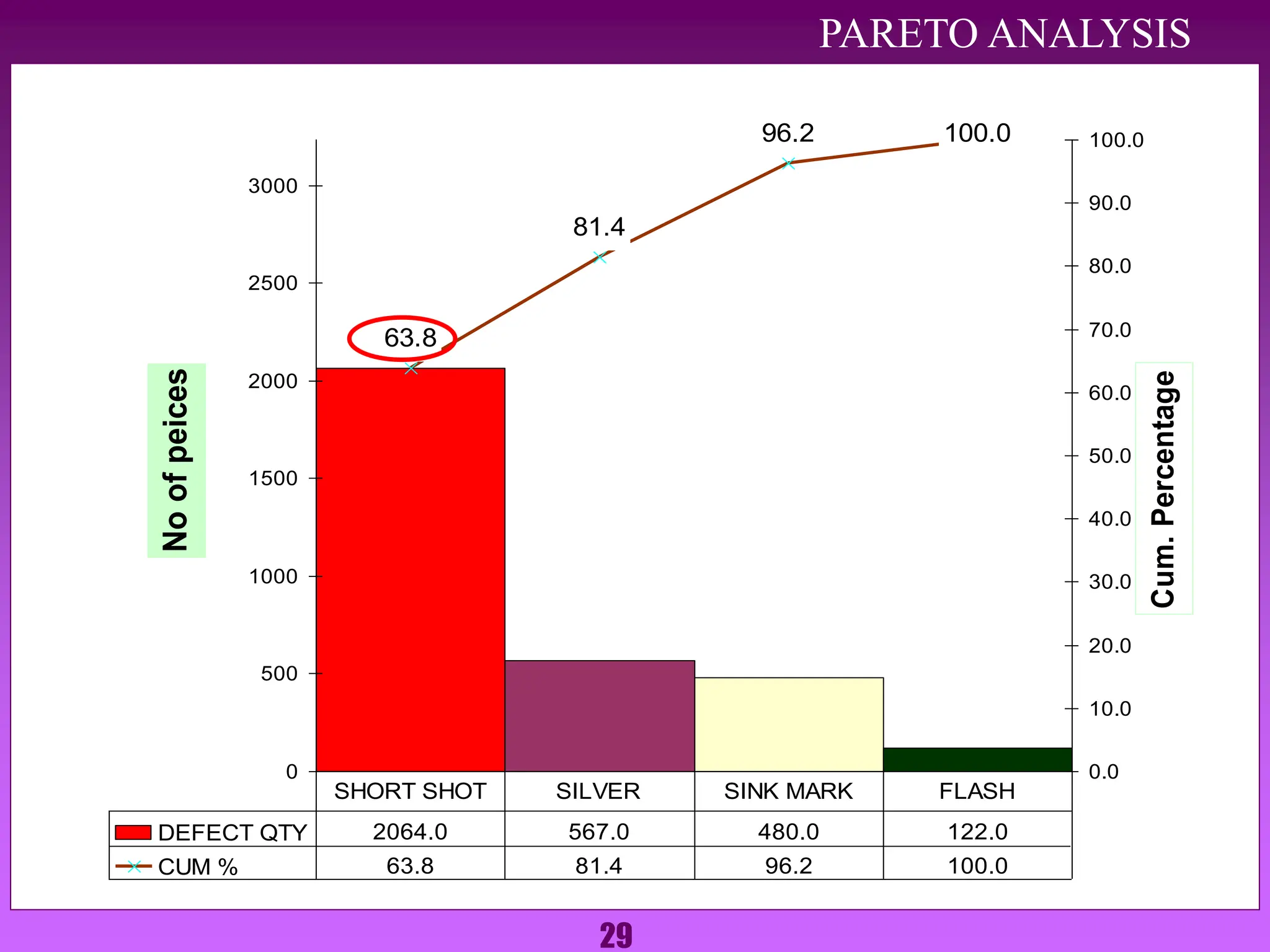
PARETO CHART
Pareto analysis begins by ranking problems from highest to
lowest in order to fix priority
 The cumulative number of problems is plotted on the vertical
axis of the graph against the cause/phenomenon
Pareto by Causes e.g. Man,Machine,Method etc
Pareto by Phenomenon e.g.Quality,Cost,Delivery
Tells about the relative sizes of problems indicates an
important message about biggest few problems, if corrected,
a large % of total problems will be solved
29
63.8
81.4
96.2 100.0
0
500
1000
1500
2000
2500
3000
No
of
peices
0.0
10.0
20.0
30.0
40.0
50.0
60.0
70.0
80.0
90.0
100.0
Cum.
Percentage
DEFECT QTY 2064.0 567.0 480.0 122.0
CUM % 63.8 81.4 96.2 100.0
SHORT SHOT SILVER SINK MARK FLASH
PARETO ANALYSIS
30
CAUSE n EFFECT (FISH BONE) DIAGRAM
This diagram (resembles skeleton of a fish) helps to separate out
causes from effects and to see problem in its totality
It’s a systematic arrangement of all possible causes,generated
thru’ brain storming
This can be used to :
Assist individual / group to see full picture.
 Serve as a recording device for ideas generated.
 Reveal undetected relationships between causes.
 Discover the origin/root cause of a problem
 Create a document or a map of a problem which can be posted in the work
area.
31
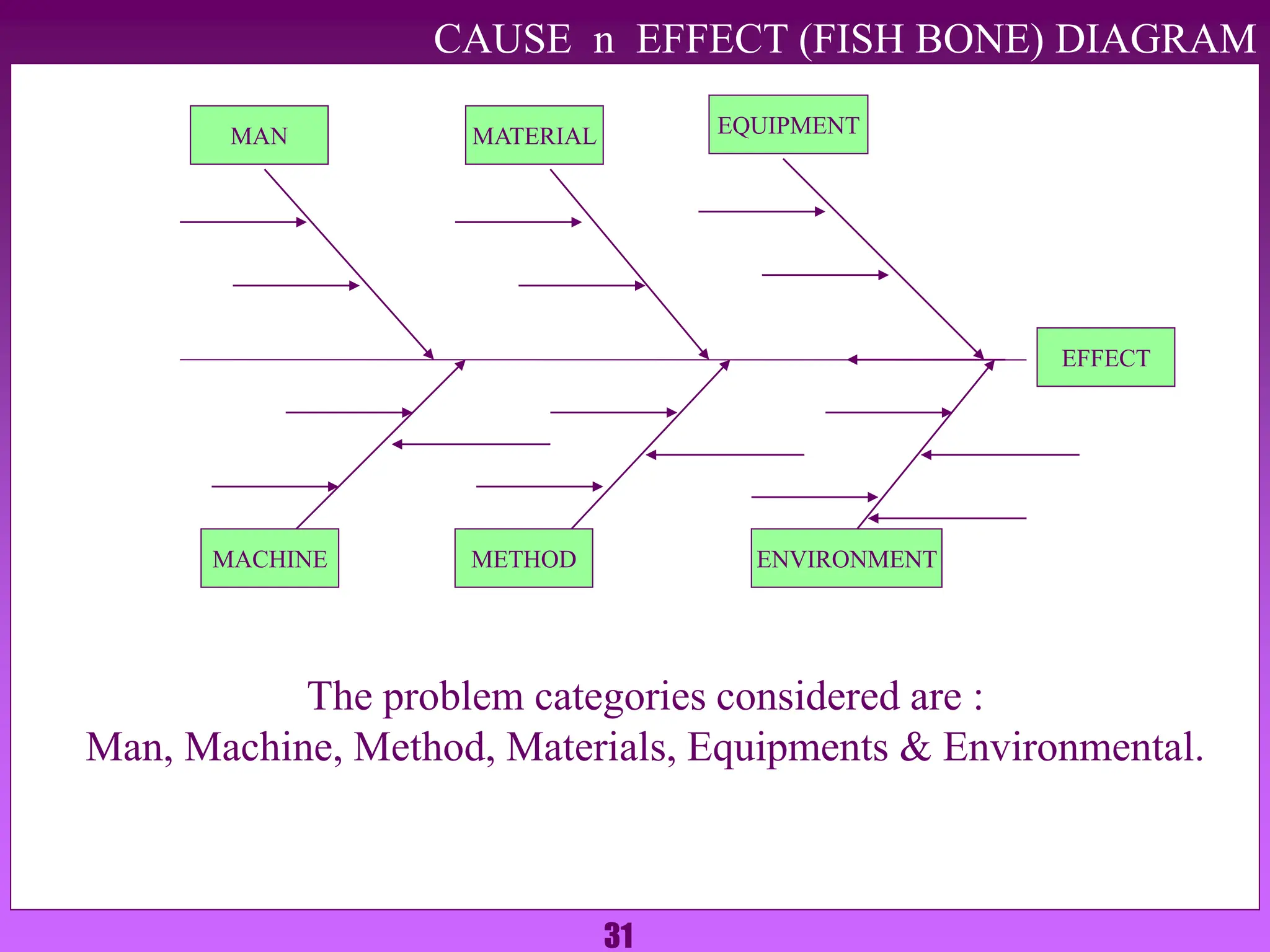
The problem categories considered are :
Man, Machine, Method, Materials, Equipments & Environmental.
EFFECT
MACHINE METHOD ENVIRONMENT
MAN MATERIAL EQUIPMENT
CAUSE n EFFECT (FISH BONE) DIAGRAM
32
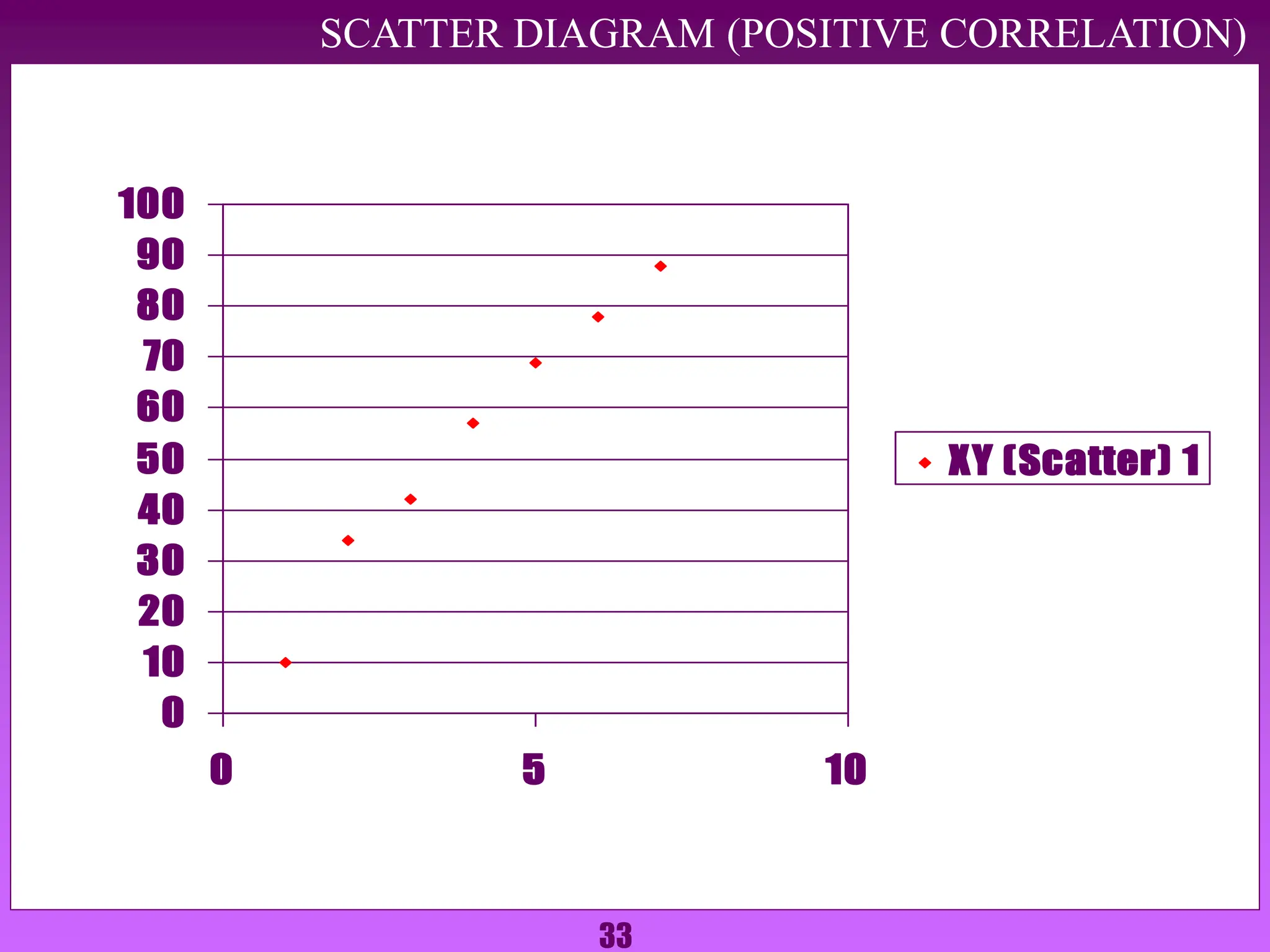
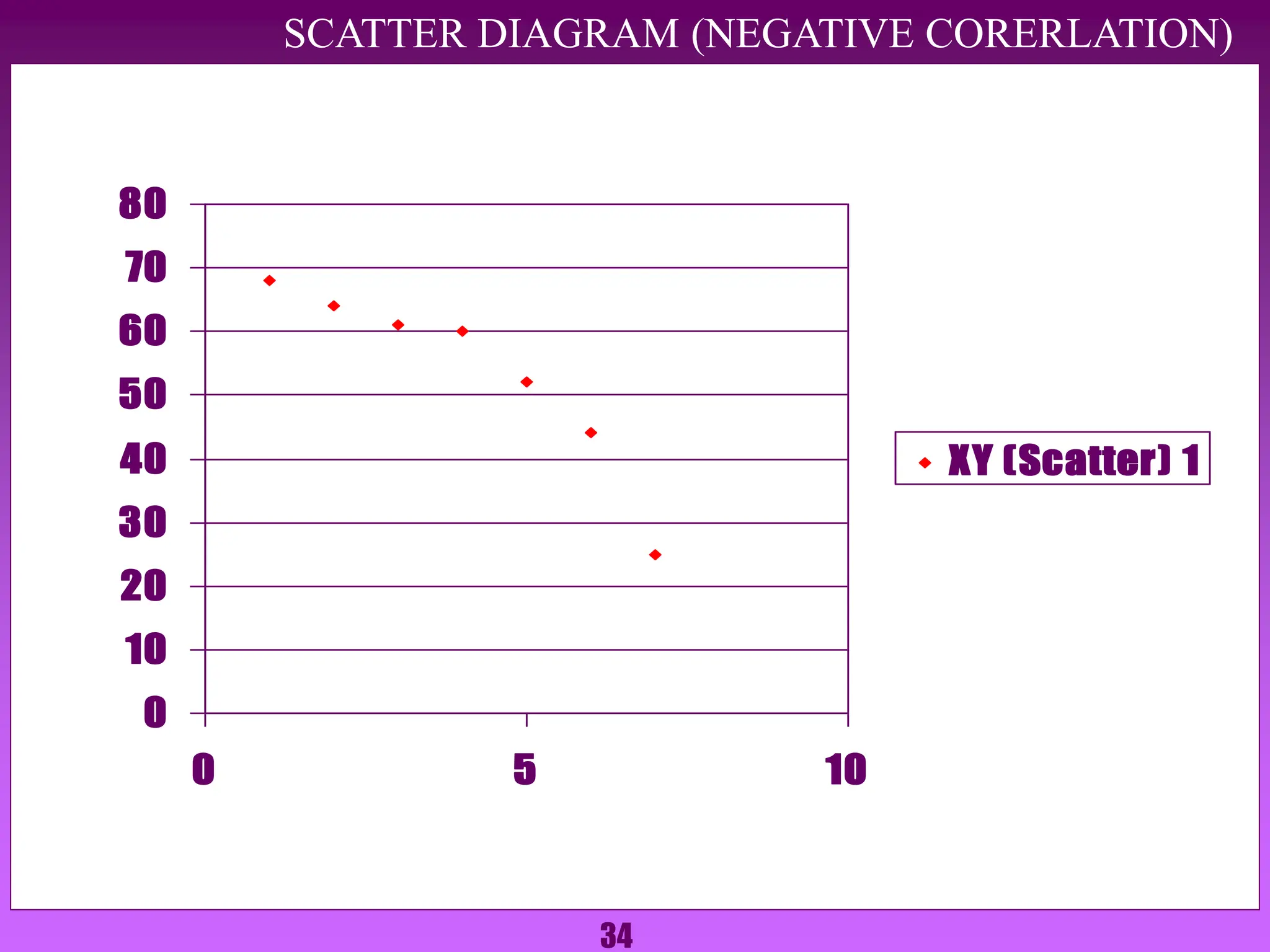
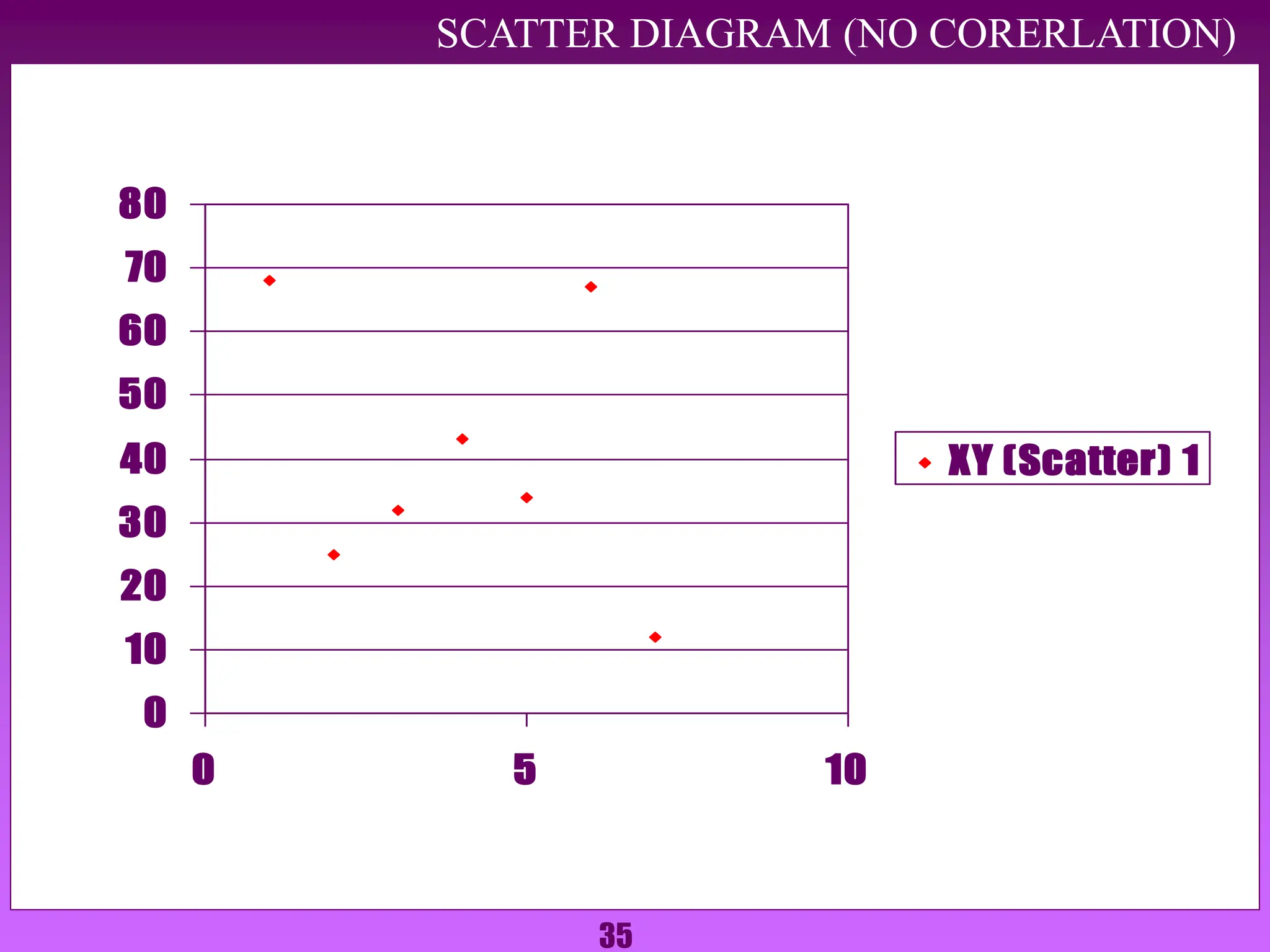
SCATTER DIAGRAM
The scatter diagram is used for identifying the relationships and
performing preliminary analysis of relationship between any two
quality characteristics.
Clustering of points indicate that the two characteristics may be
related e.g.
Increasing in component weight with increase in hold time
during plastic injection molding ( + ve co-relation)
Increase in toughness components with decreasing injection
pressure (-ve co-relation) during molding
33
SCATTER DIAGRAM (POSITIVE CORRELATION)
0
10
20
30
40
50
60
70
80
90
100
0 5 10
XY (Scatter) 1
34
SCATTER DIAGRAM (NEGATIVE CORERLATION)
0
10
20
30
40
50
60
70
80
0 5 10
XY (Scatter) 1
35
SCATTER DIAGRAM (NO CORERLATION)
0
10
20
30
40
50
60
70
80
0 5 10
XY (Scatter) 1
36
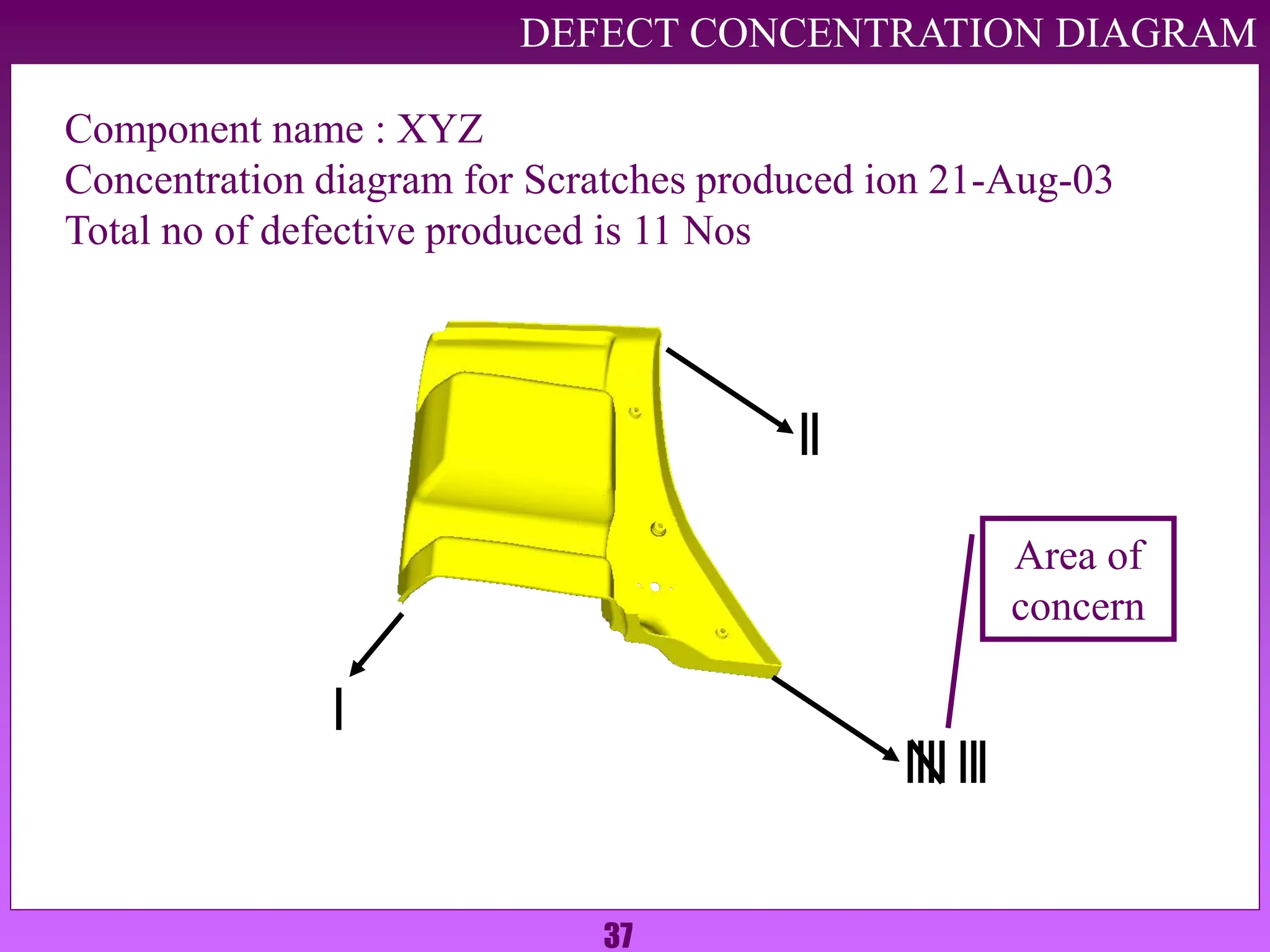
DEFECT CONCENTRATION DIAGRAM
 This is used to understand the potential defect prone area of
the parts produced
 The “Concentration Diagram” check sheet carries the diagram
of the problematic part,defects whenever observed to be
updated in the same using tally marks
 Based on the distribution of defects countermeasures are taken
at process/system level
 This tool is very useful to solve problems like Scratch,
Dent,Breakage thru’ handling improvement
 For plastic molded parts this tool is used to identify stress
points,weak joints,effect of gate shape/position on the quality
of parts etc.
37
DEFECT CONCENTRATION DIAGRAM
Component name : XYZ
Concentration diagram for Scratches produced ion 21-Aug-03
Total no of defective produced is 11 Nos
Area of
concern
38
Control Chart
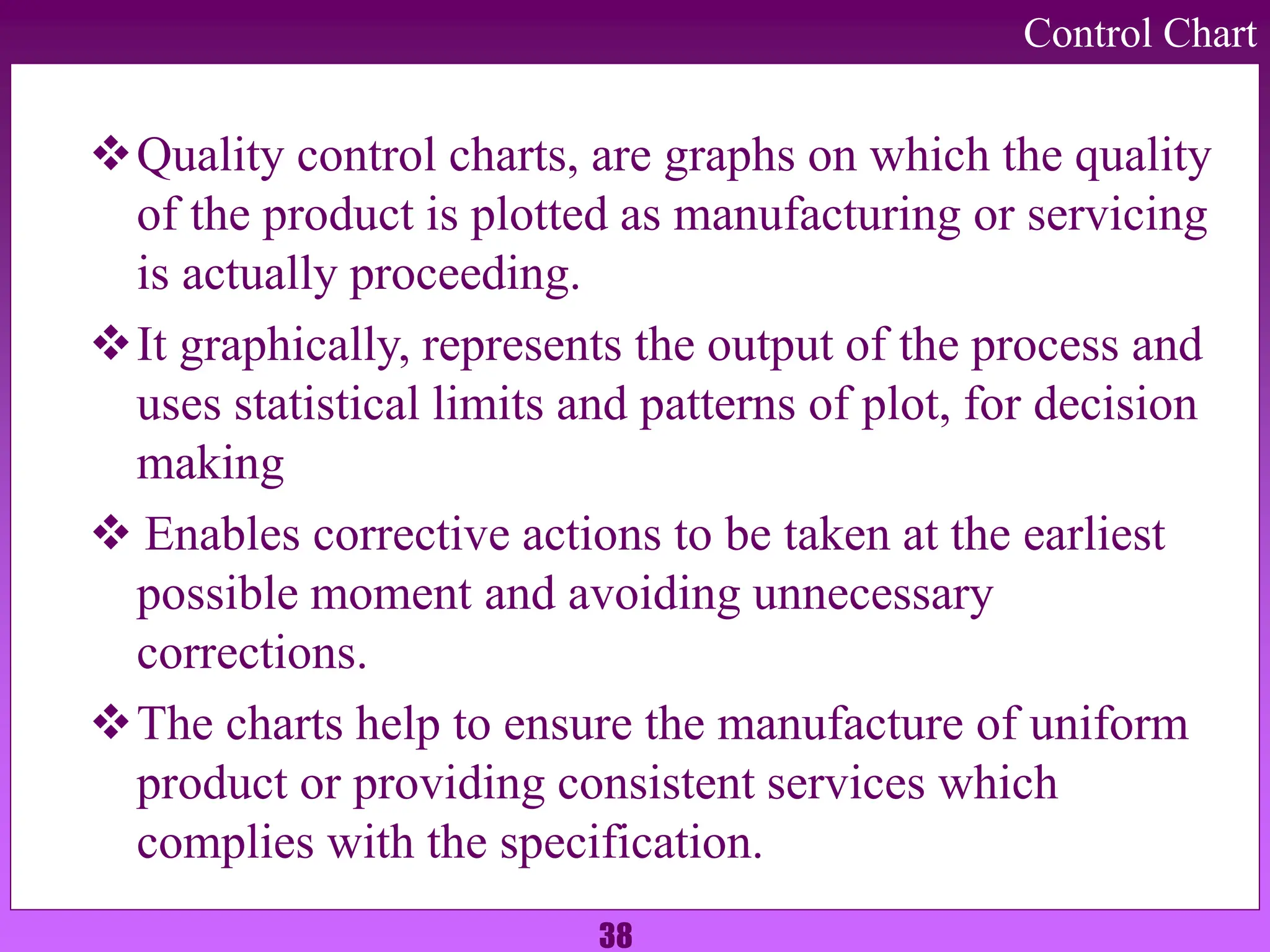
Quality control charts, are graphs on which the quality
of the product is plotted as manufacturing or servicing
is actually proceeding.
It graphically, represents the output of the process and
uses statistical limits and patterns of plot, for decision
making
 Enables corrective actions to be taken at the earliest
possible moment and avoiding unnecessary
corrections.
The charts help to ensure the manufacture of uniform
product or providing consistent services which
complies with the specification.
39
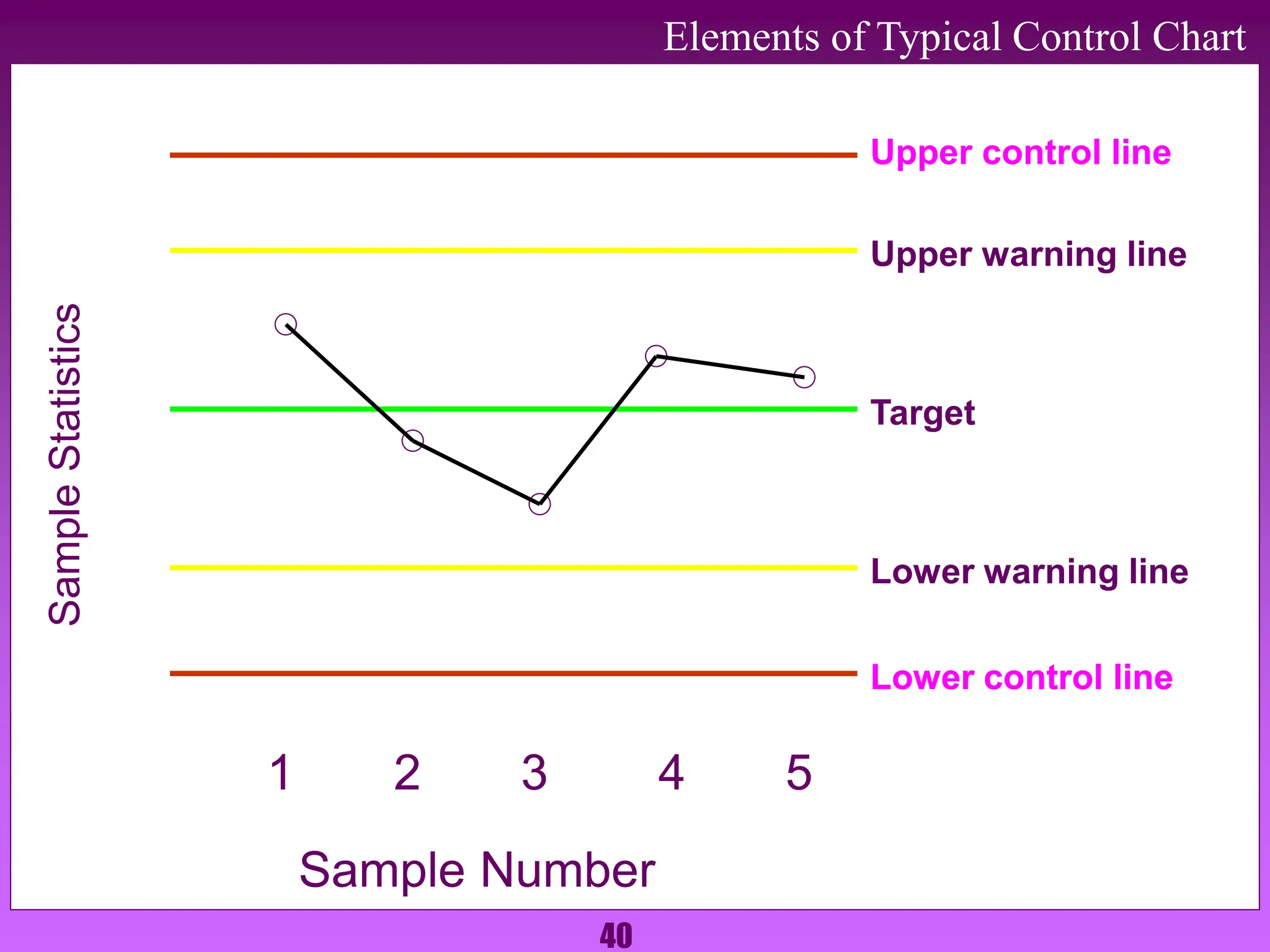
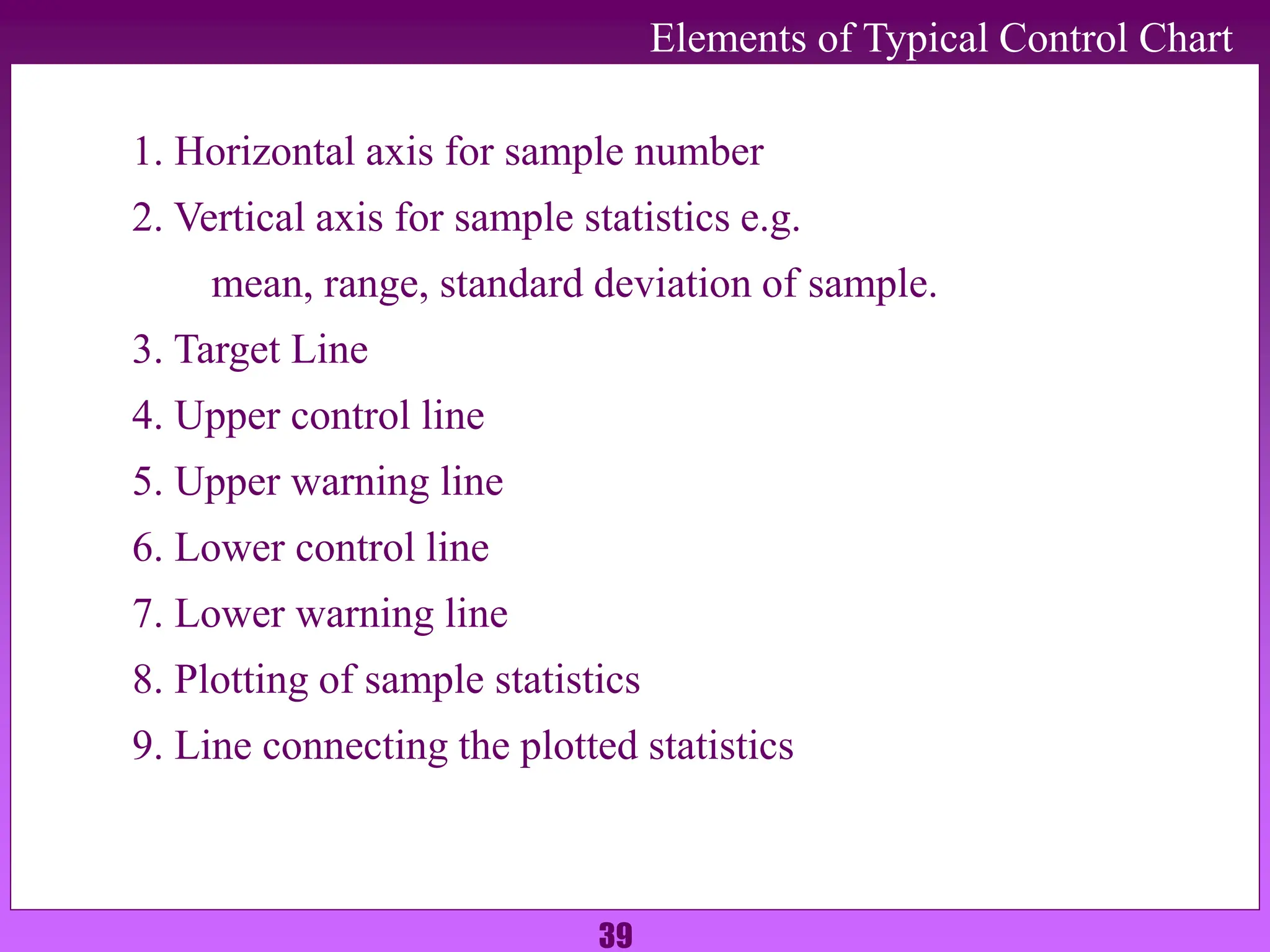
Elements of Typical Control Chart
1. Horizontal axis for sample number
2. Vertical axis for sample statistics e.g.
mean, range, standard deviation of sample.
3. Target Line
4. Upper control line
5. Upper warning line
6. Lower control line
7. Lower warning line
8. Plotting of sample statistics
9. Line connecting the plotted statistics
40
1 2 3 4 5
Target
Lower control line
Upper warning line
Lower warning line
Sample Number
Upper control line
Lower control line
Sample
Statistics
Elements of Typical Control Chart
41
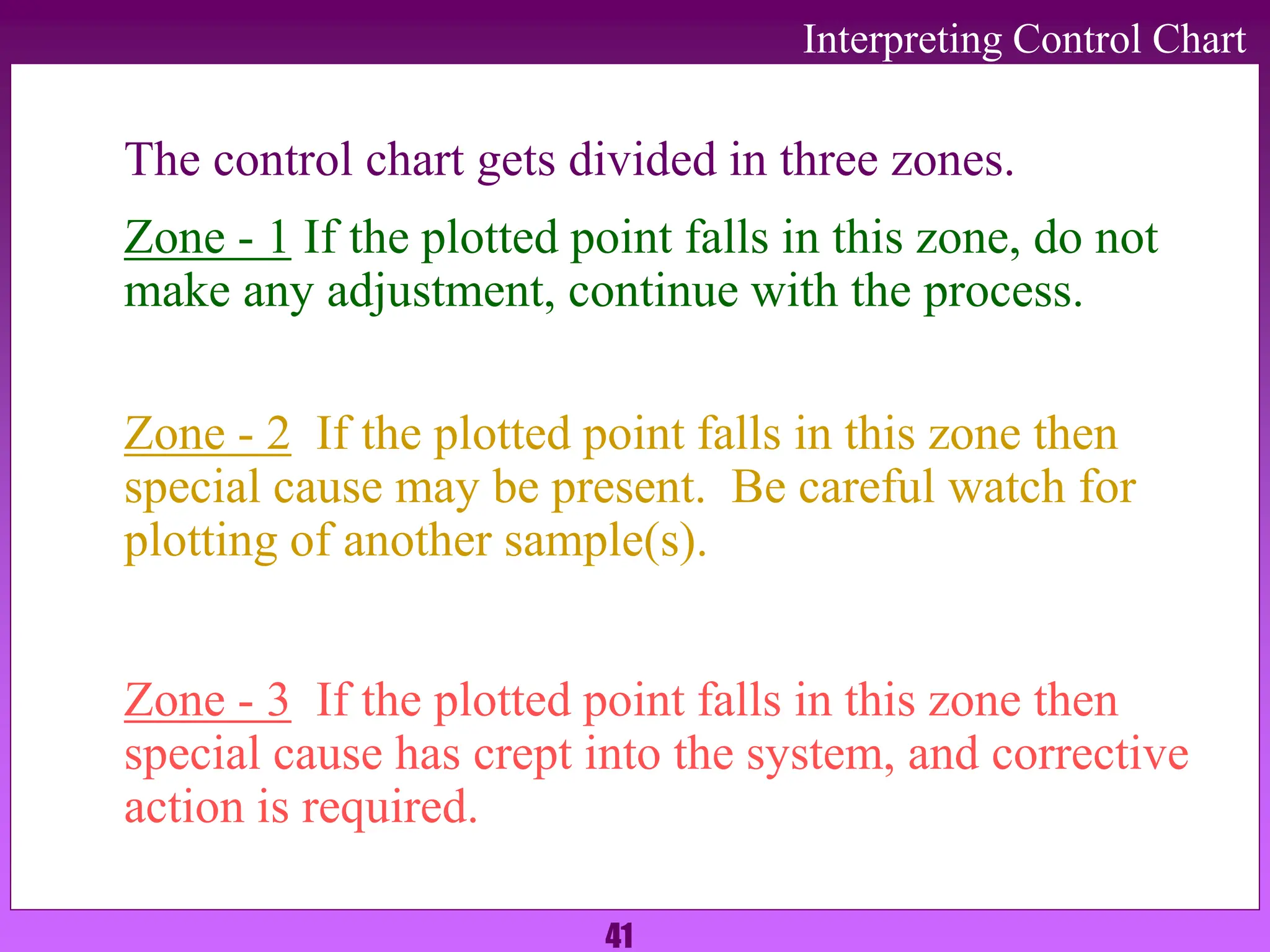
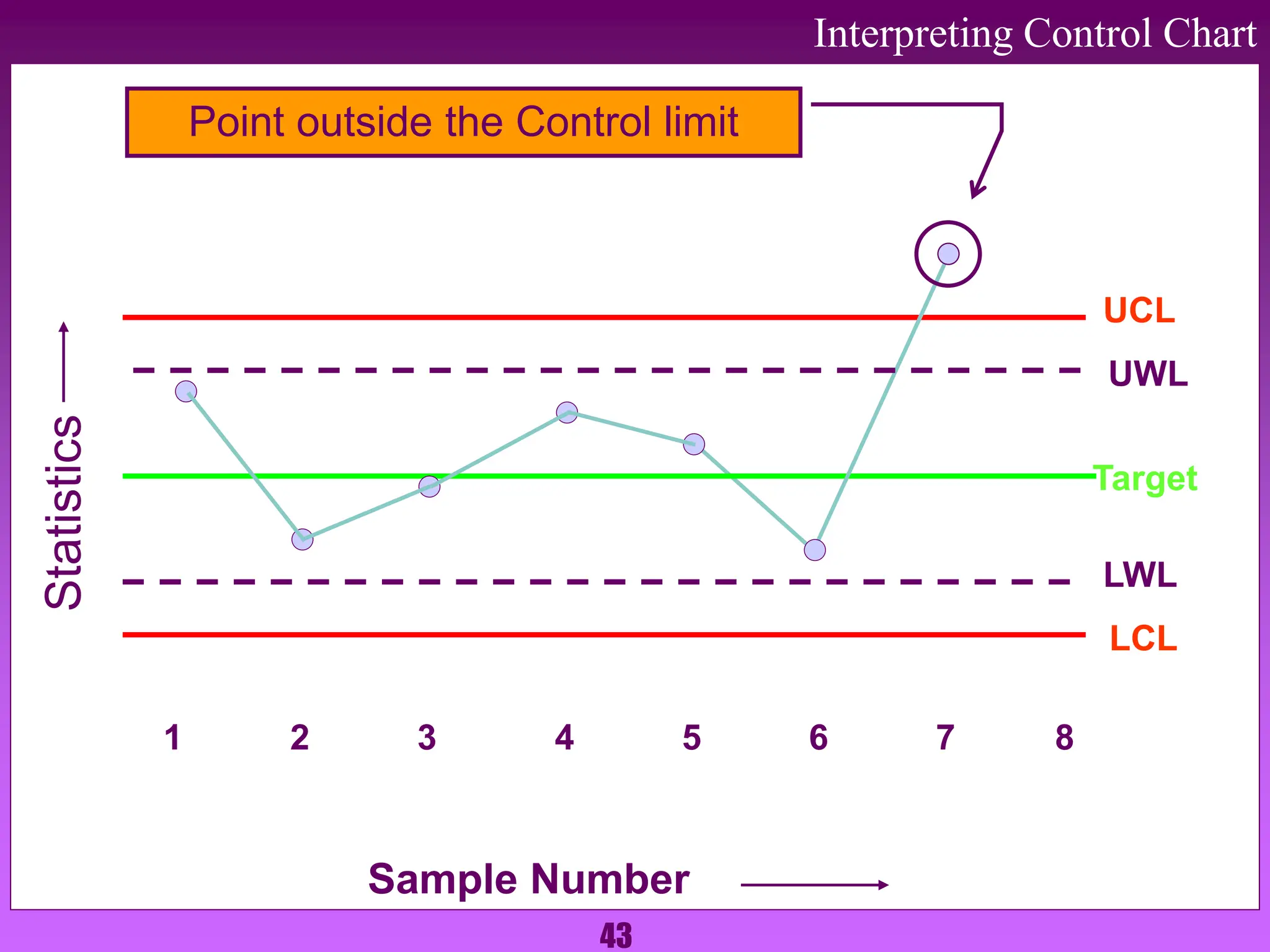
Interpreting Control Chart
The control chart gets divided in three zones.
Zone - 1 If the plotted point falls in this zone, do not
make any adjustment, continue with the process.
Zone - 2 If the plotted point falls in this zone then
special cause may be present. Be careful watch for
plotting of another sample(s).
Zone - 3 If the plotted point falls in this zone then
special cause has crept into the system, and corrective
action is required.
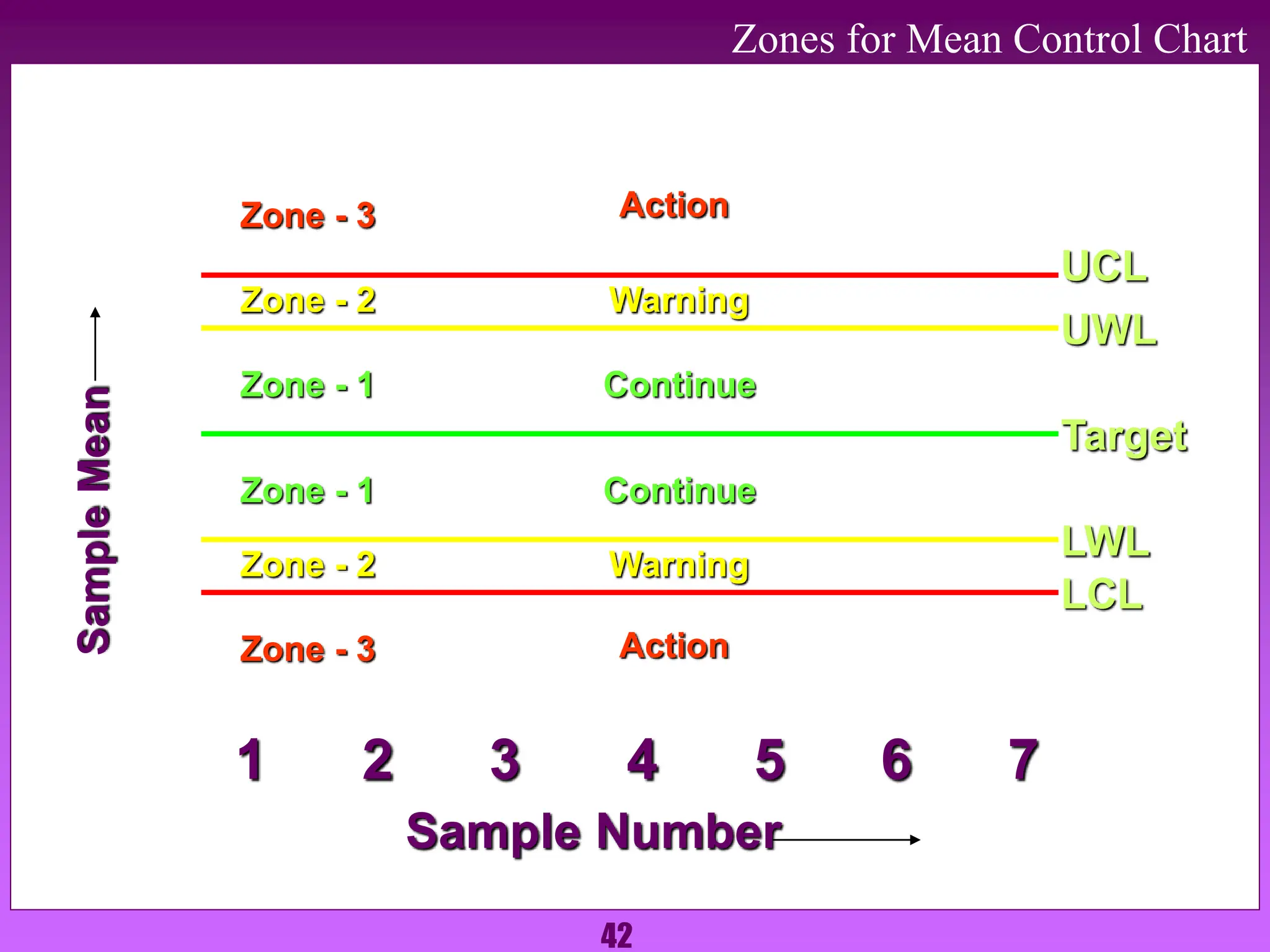
42
Zones for Mean Control Chart
1 2 3 4 5 6 7
Sample Number
UCL
Target
LCL
UWL
LWL
Zone - 3
Sample
Mean
Zone - 2
Zone - 3
Zone - 2
Zone - 1
Action
Action
Warning
Warning
Continue
Continue
Zone - 1
43
UCL
1 2 3 4 5 6 7 8
Sample Number
Statistics
UWL
LCL
Target
LWL
Interpreting Control Chart
Point outside the Control limit
44
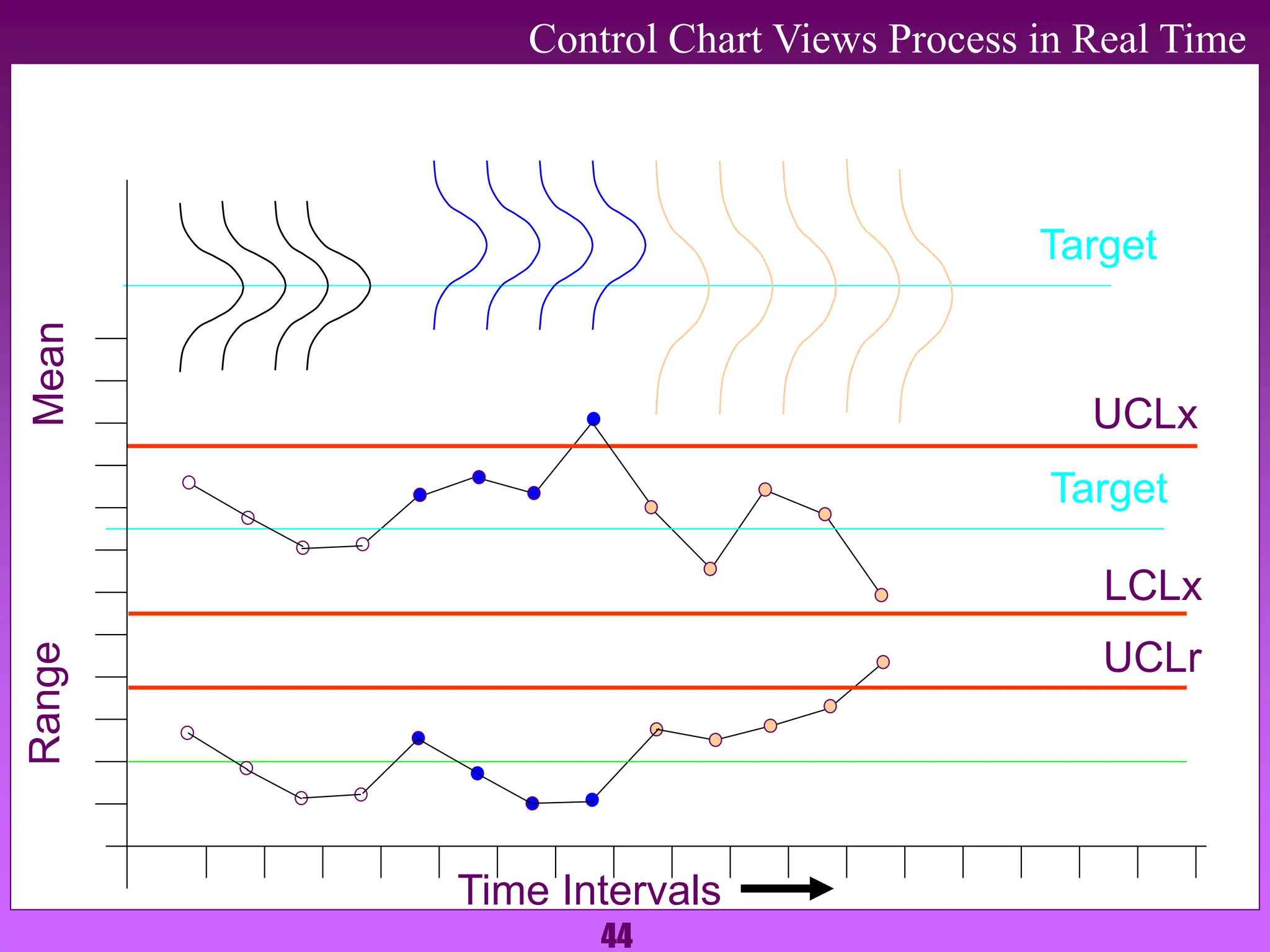
Control Chart Views Process in Real Time
Time Intervals
Range
Mean
LCLx
Output of the process in real time
Target
Target
UCLx
UCLr
45
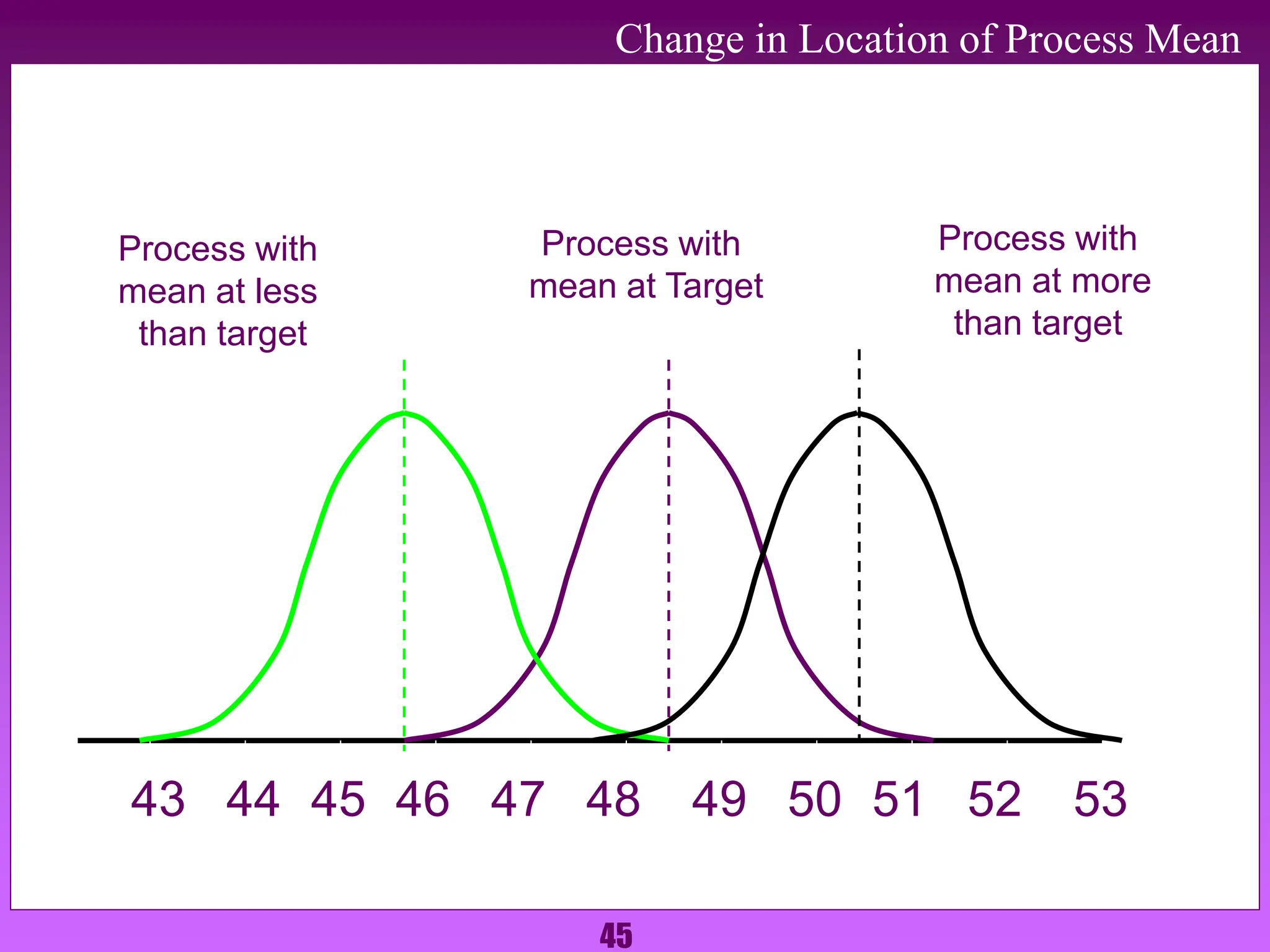
Change in Location of Process Mean
43 48 49 50 51 52 53
44 45 46 47
Process with
mean at Target
Process with
mean at more
than target
Process with
mean at less
than target
46
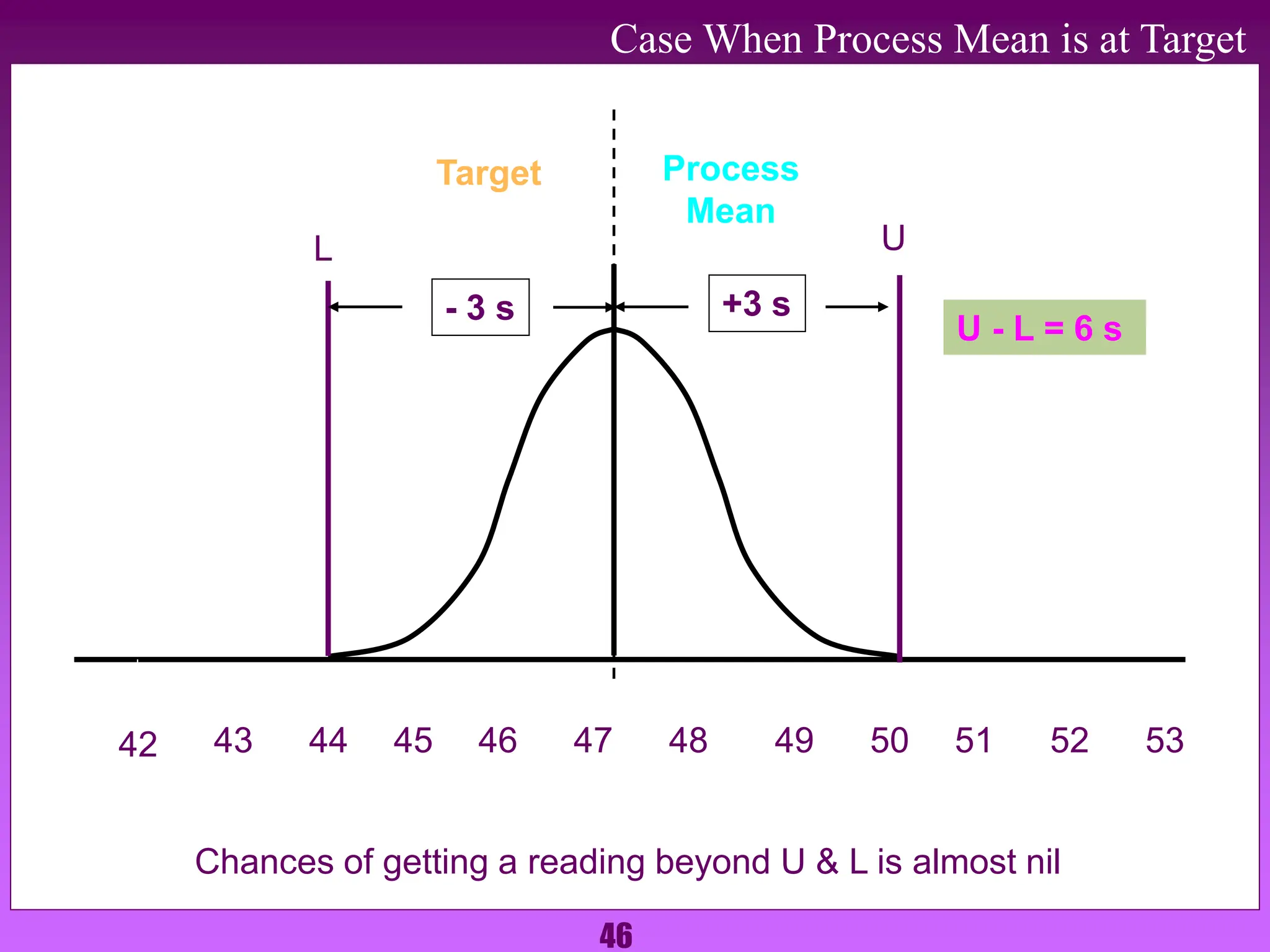
Case When Process Mean is at Target
43 48 49 50 51 52 53
44 45 46 47
Target Process
Mean
Chances of getting a reading beyond U & L is almost nil
42
U
L
- 3 s +3 s
U - L = 6 s
47
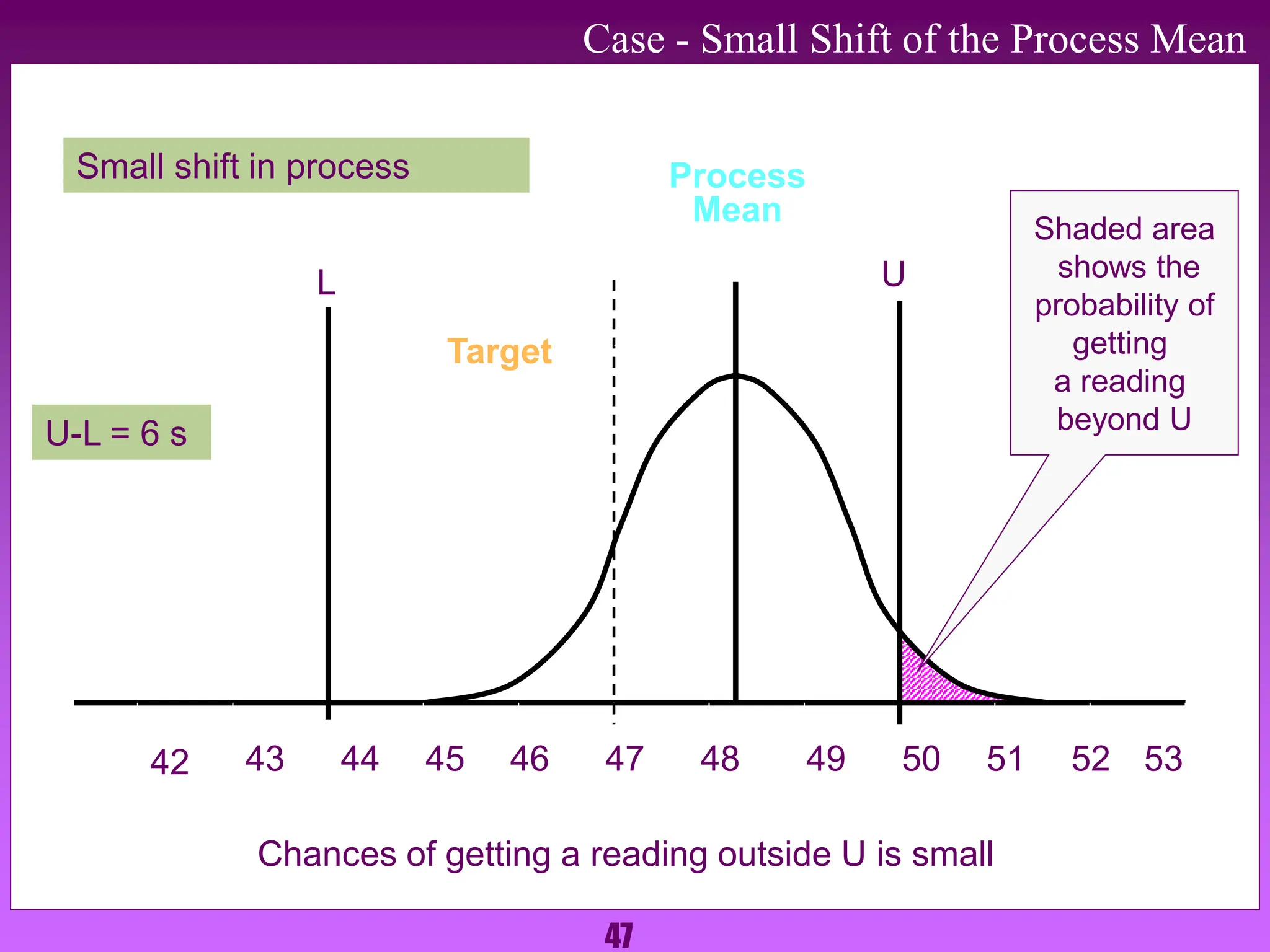
Case - Small Shift of the Process Mean
43 48 49 50 51 52 53
44 45 46 47
Target
Process
Mean
Chances of getting a reading outside U is small
Small shift in process
42
Shaded area
shows the
probability of
getting
a reading
beyond U
U
L
U-L = 6 s
48
Process
Mean
Case - Large Shift of the Process Mean
43 48 49 50 51 52 53
44 45 46 47
Target
Chances of getting a reading outside U is large
Large shift in process
42
Shaded area
shows the
probability of
getting
a reading
beyond U
U
L
U-L = 6 s
49
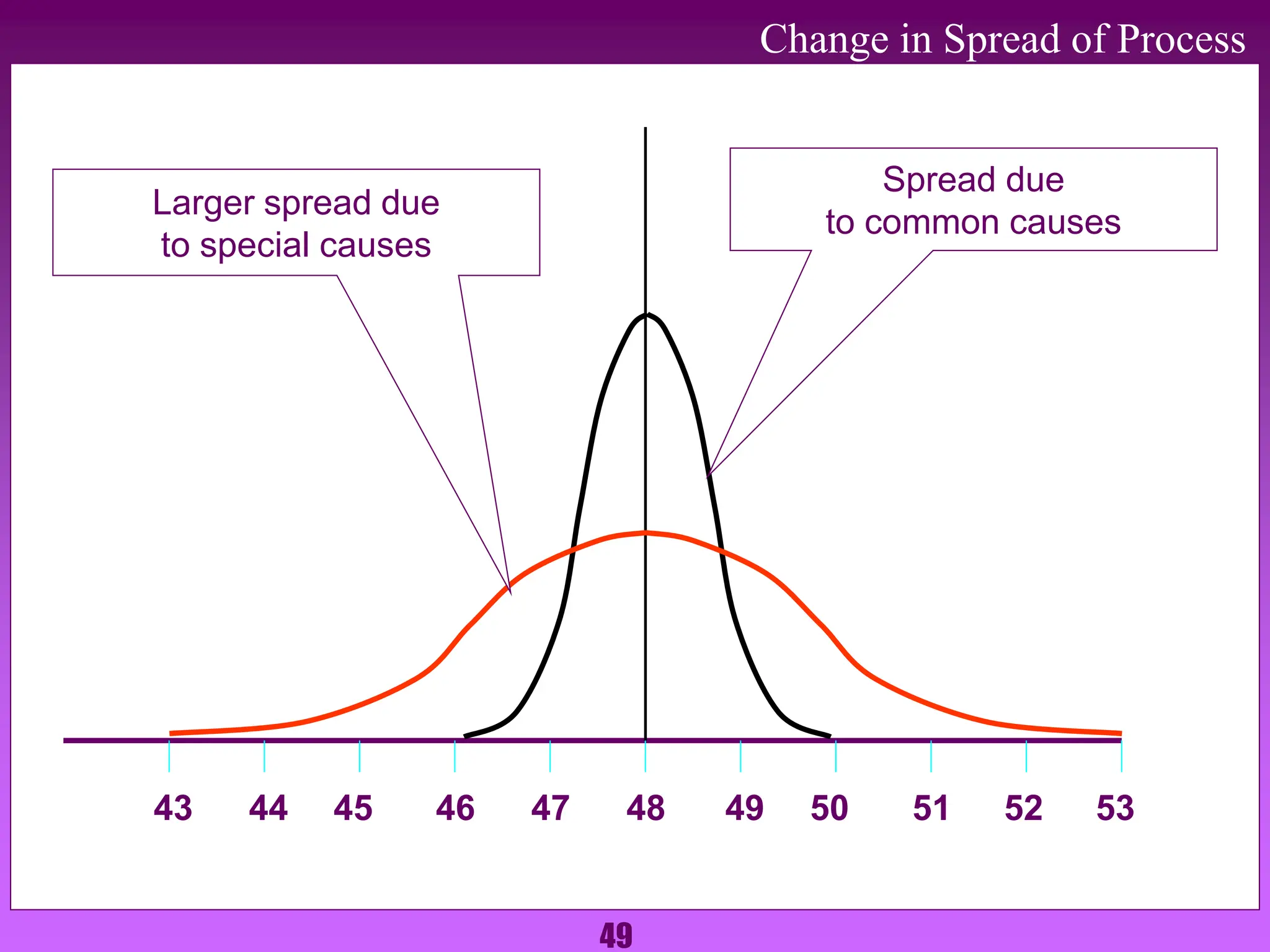
Change in Spread of Process
43 48 49 50 51 52 53
44 45 46 47
Larger spread due
to special causes
Spread due
to common causes
50
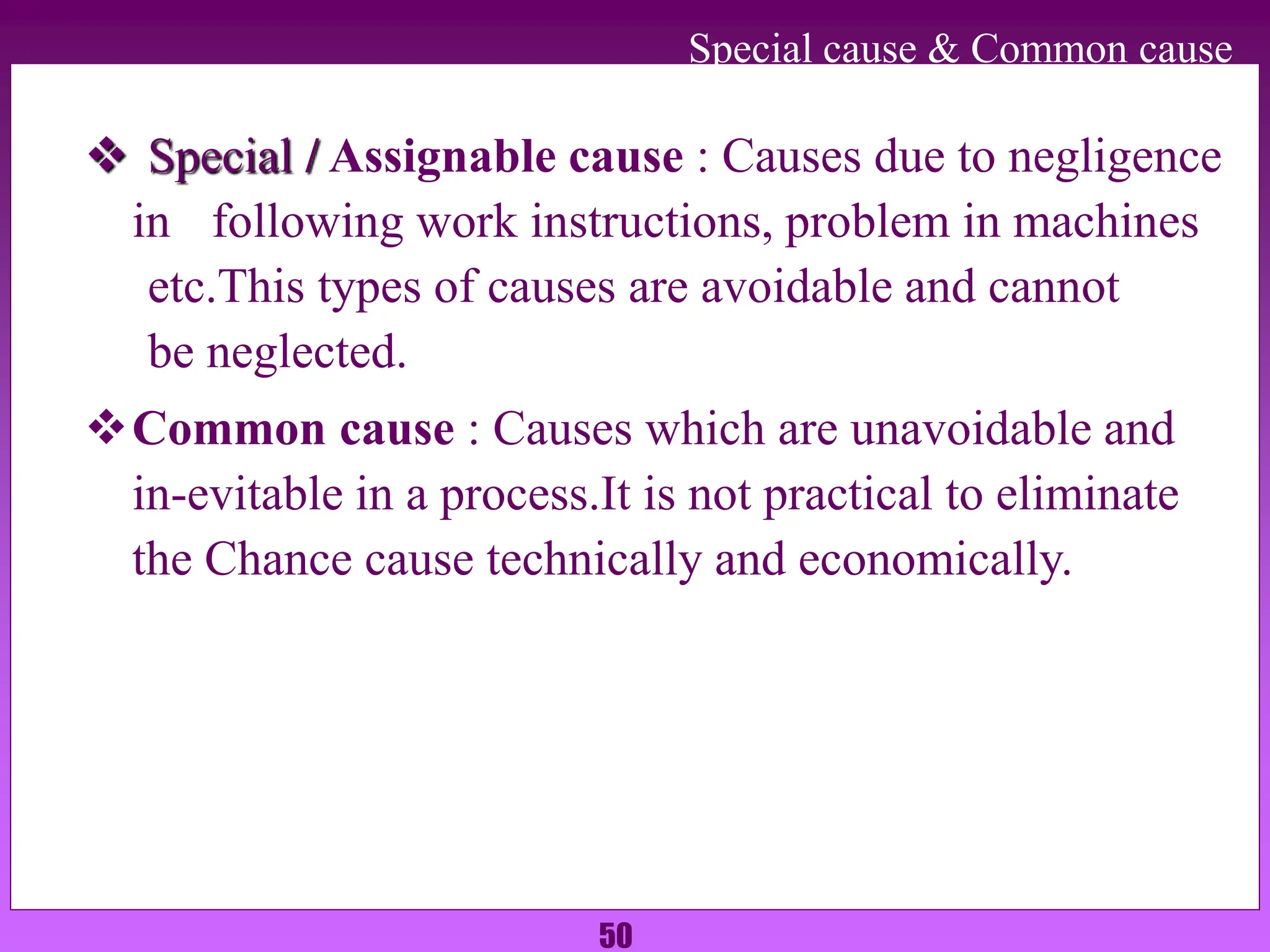
Special cause & Common cause
 Special / Assignable cause : Causes due to negligence
in following work instructions, problem in machines
etc.This types of causes are avoidable and cannot
be neglected.
Common cause : Causes which are unavoidable and
in-evitable in a process.It is not practical to eliminate
the Chance cause technically and economically.
51
Most Commonly Used Variable Control Charts
 To track the accuracy of the process
- Mean control chart or x-bar chart
 To track the precision of the process
- Range control chart
52
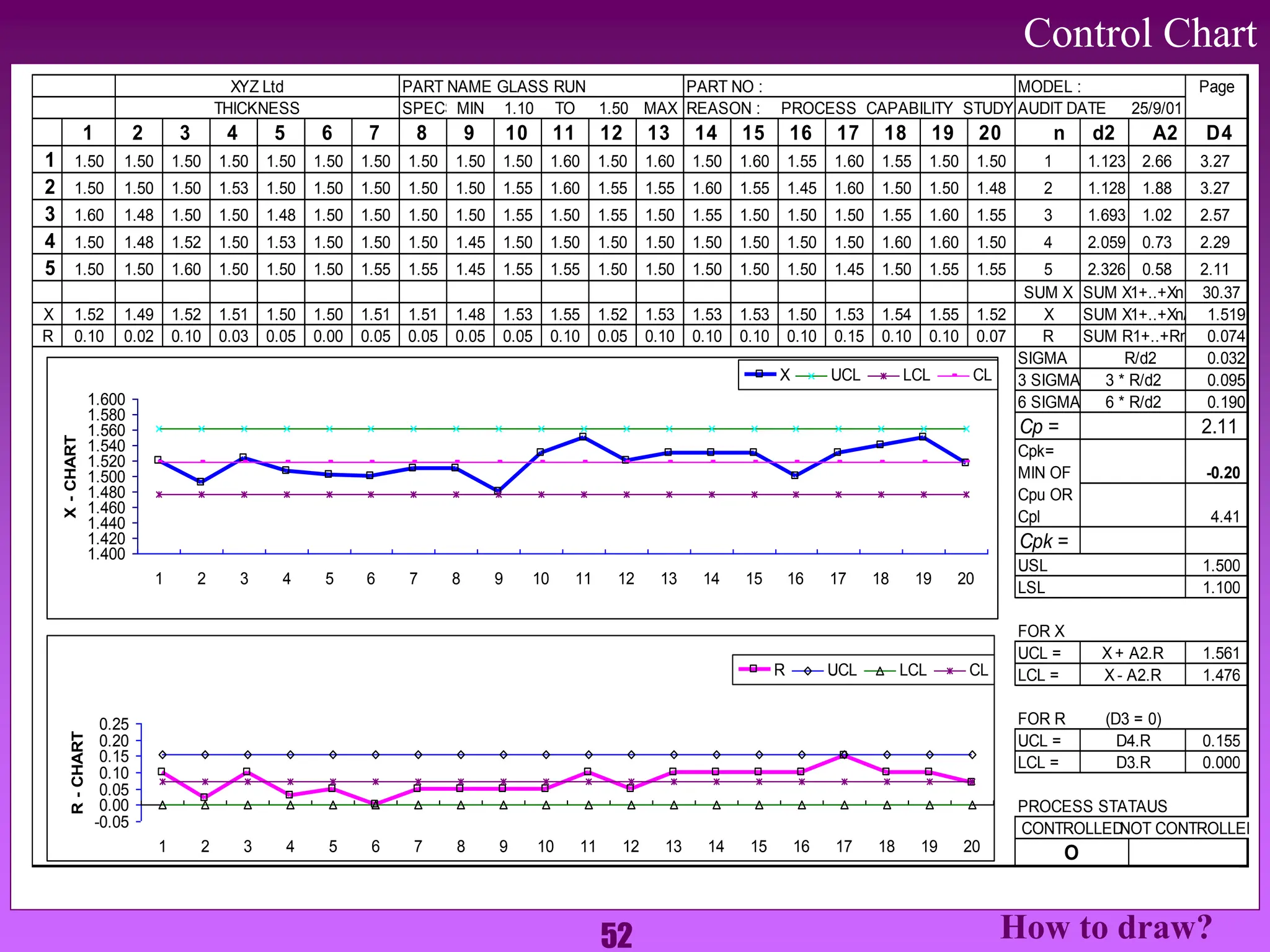
Control Chart
PART NAME :
GLASS RUN PART NO : MODEL : Page
THICKNESS SPECS :
MIN 1.10 TO 1.50 MAX REASON : PROCESS CAPABILITY STUDY AUDIT DATE 25/9/01
1 2 3 4 5 6 7 8 9 10 11 12 13 14 15 16 17 18 19 20 n d2 A2 D4
1 1.50 1.50 1.50 1.50 1.50 1.50 1.50 1.50 1.50 1.50 1.60 1.50 1.60 1.50 1.60 1.55 1.60 1.55 1.50 1.50 1 1.123 2.66 3.27
2 1.50 1.50 1.50 1.53 1.50 1.50 1.50 1.50 1.50 1.55 1.60 1.55 1.55 1.60 1.55 1.45 1.60 1.50 1.50 1.48 2 1.128 1.88 3.27
3 1.60 1.48 1.50 1.50 1.48 1.50 1.50 1.50 1.50 1.55 1.50 1.55 1.50 1.55 1.50 1.50 1.50 1.55 1.60 1.55 3 1.693 1.02 2.57
4 1.50 1.48 1.52 1.50 1.53 1.50 1.50 1.50 1.45 1.50 1.50 1.50 1.50 1.50 1.50 1.50 1.50 1.60 1.60 1.50 4 2.059 0.73 2.29
5 1.50 1.50 1.60 1.50 1.50 1.50 1.55 1.55 1.45 1.55 1.55 1.50 1.50 1.50 1.50 1.50 1.45 1.50 1.55 1.55 5 2.326 0.58 2.11
SUM X SUM X1+..+Xn 30.37
X 1.52 1.49 1.52 1.51 1.50 1.50 1.51 1.51 1.48 1.53 1.55 1.52 1.53 1.53 1.53 1.50 1.53 1.54 1.55 1.52 X SUM X1+..+Xn/n 1.519
R 0.10 0.02 0.10 0.03 0.05 0.00 0.05 0.05 0.05 0.05 0.10 0.05 0.10 0.10 0.10 0.10 0.15 0.10 0.10 0.07 R SUM R1+..+Rn/n 0.074
SIGMA R/d2 0.032
3 SIGMA 3 * R/d2 0.095
6 SIGMA 6 * R/d2 0.190
Cp = 2.11
Cpk=
MIN OF -0.20
Cpu OR
Cpl 4.41
Cpk =
USL 1.500
LSL 1.100
FOR X
UCL = X + A2.R 1.561
LCL = X - A2.R 1.476
FOR R (D3 = 0)
UCL = D4.R 0.155
LCL = D3.R 0.000
PROCESS STATAUS
CONTROLLED
NOT CONTROLLED
XYZ Ltd
O
-0.05
0.00
0.05
0.10
0.15
0.20
0.25
1 2 3 4 5 6 7 8 9 10 11 12 13 14 15 16 17 18 19 20
R
-
CHART
R UCL LCL CL
1.400
1.420
1.440
1.460
1.480
1.500
1.520
1.540
1.560
1.580
1.600
1 2 3 4 5 6 7 8 9 10 11 12 13 14 15 16 17 18 19 20
X
-
CHART
X UCL LCL CL
How to draw?
86
Summary of Effect of Process Shift
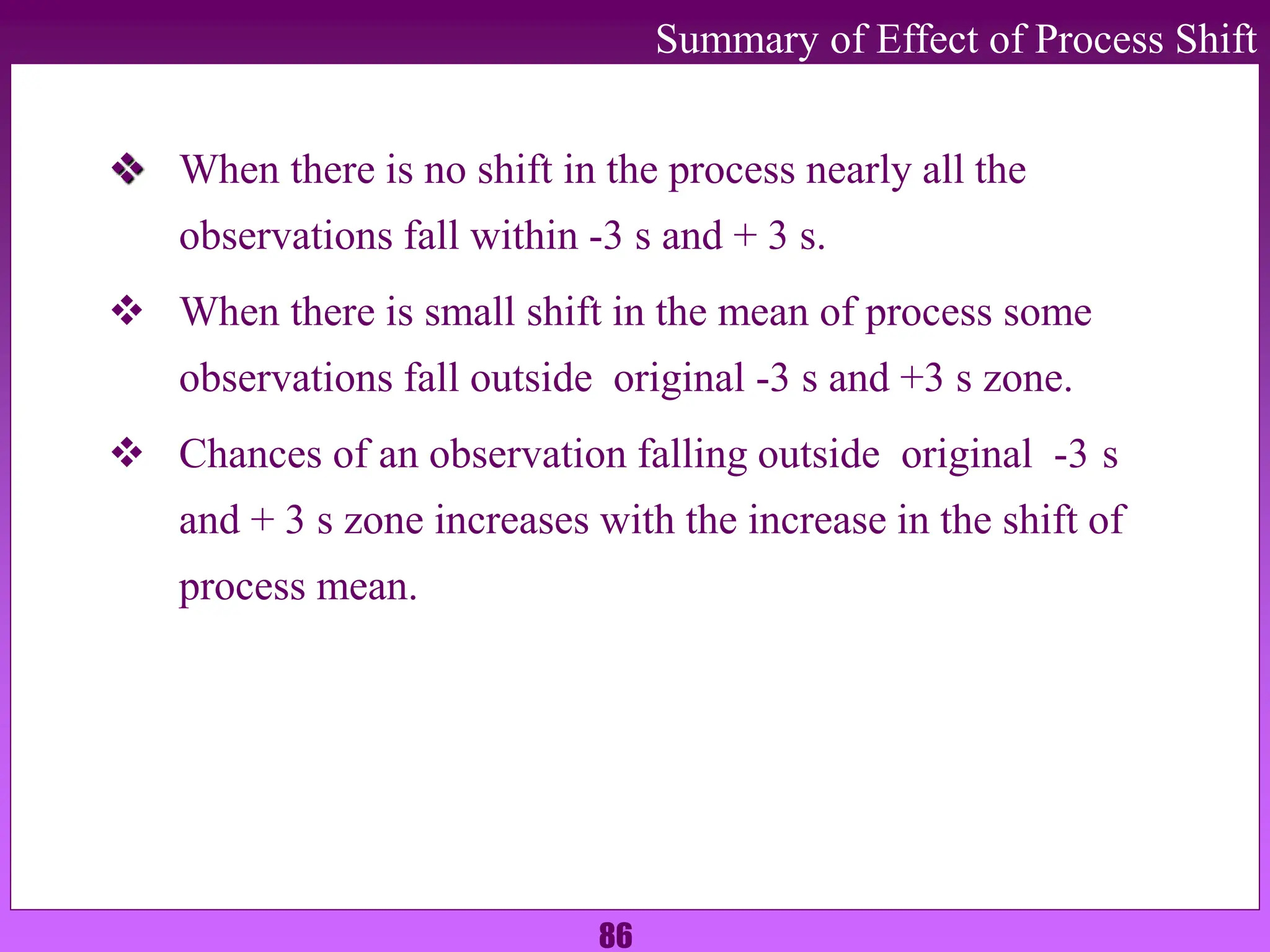
 When there is no shift in the process nearly all the
observations fall within -3 s and + 3 s.
 When there is small shift in the mean of process some
observations fall outside original -3 s and +3 s zone.
 Chances of an observation falling outside original -3 s
and + 3 s zone increases with the increase in the shift of
process mean.
87
Our Conclusion from Normal Distribution
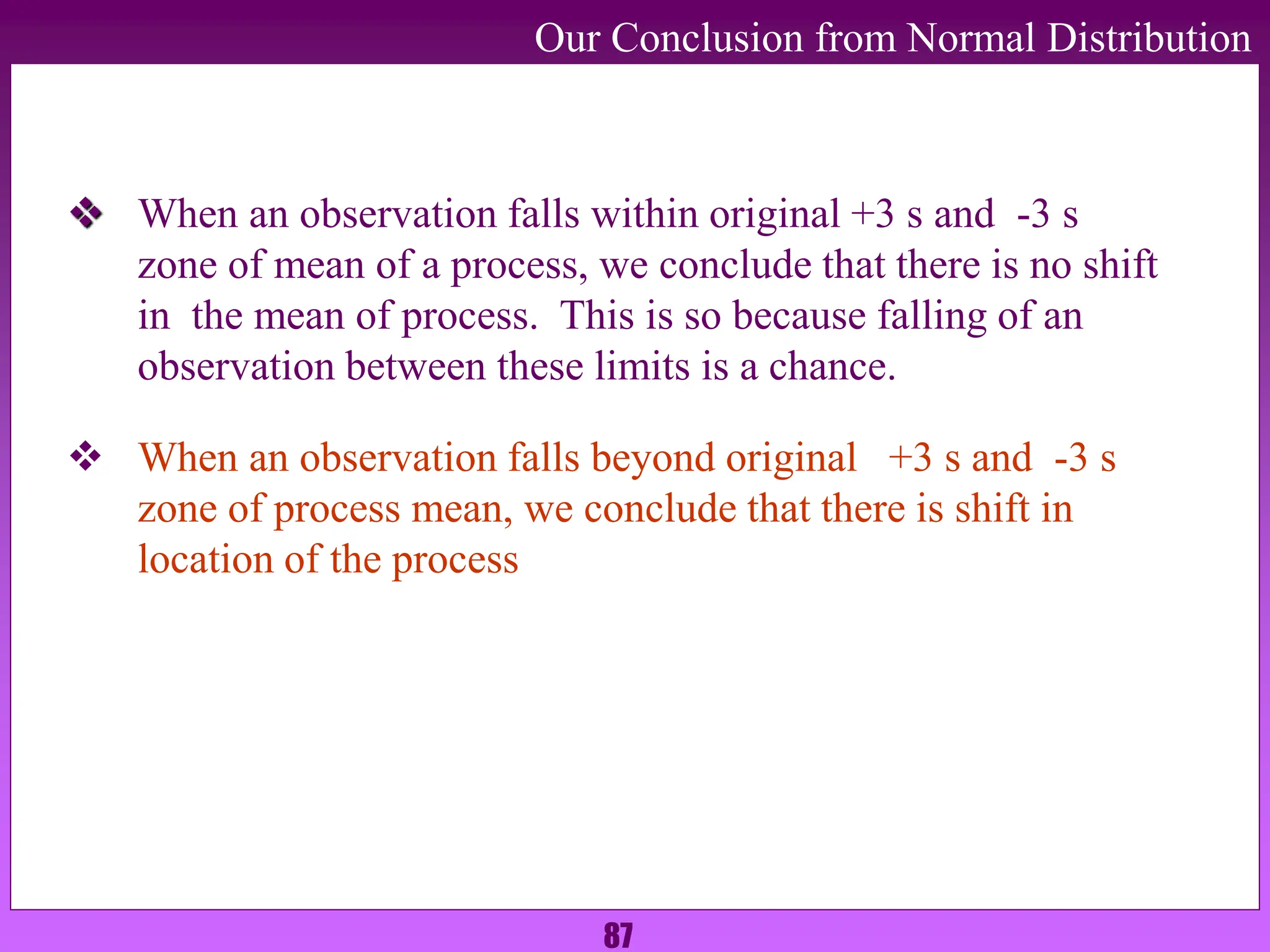
 When an observation falls within original +3 s and -3 s
zone of mean of a process, we conclude that there is no shift
in the mean of process. This is so because falling of an
observation between these limits is a chance.
 When an observation falls beyond original +3 s and -3 s
zone of process mean, we conclude that there is shift in
location of the process
88
Interpreting Control Chart
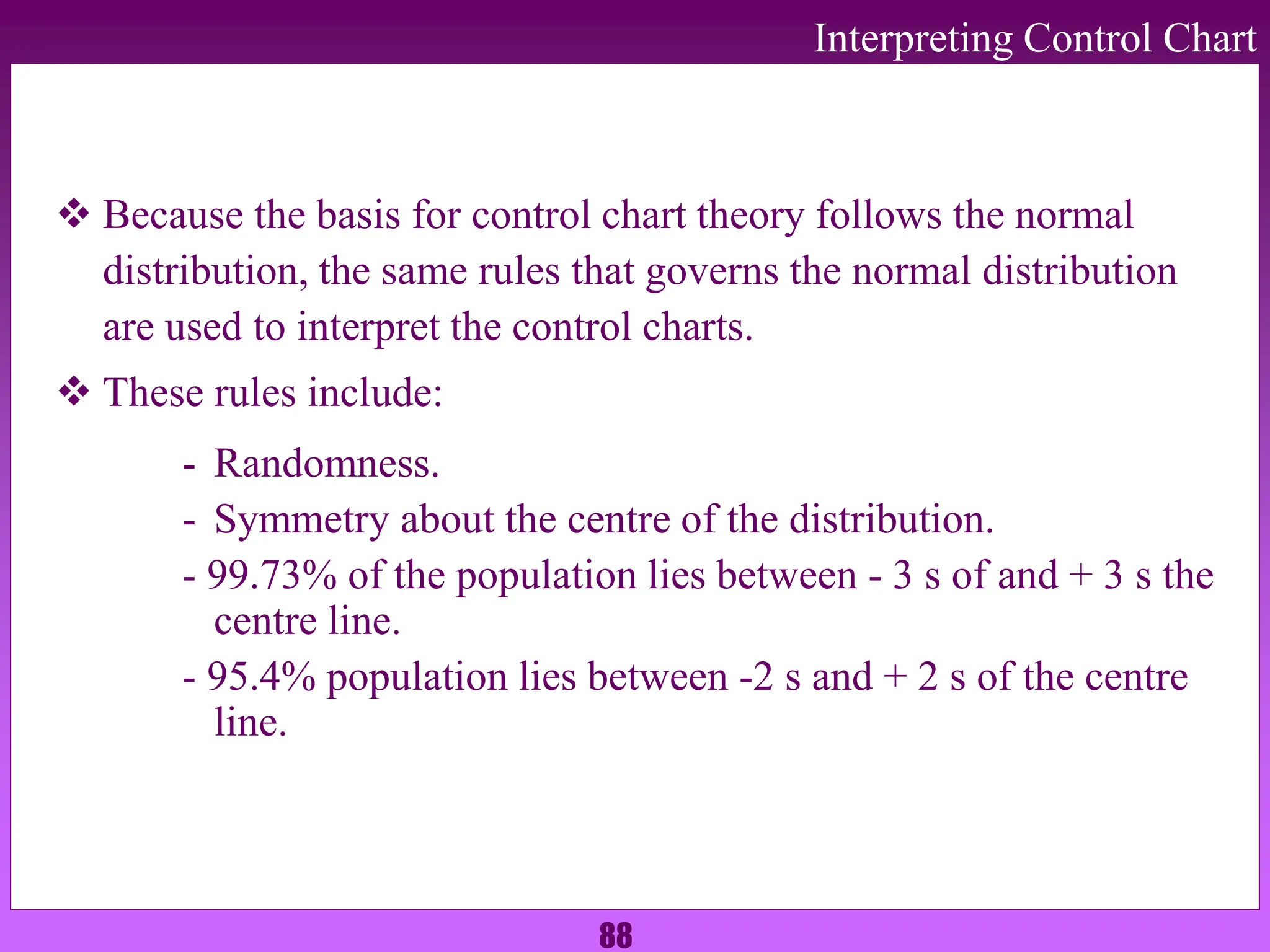
 Because the basis for control chart theory follows the normal
distribution, the same rules that governs the normal distribution
are used to interpret the control charts.
 These rules include:
- Randomness.
- Symmetry about the centre of the distribution.
- 99.73% of the population lies between - 3 s of and + 3 s the
centre line.
- 95.4% population lies between -2 s and + 2 s of the centre
line.
89
Interpreting Control Chart
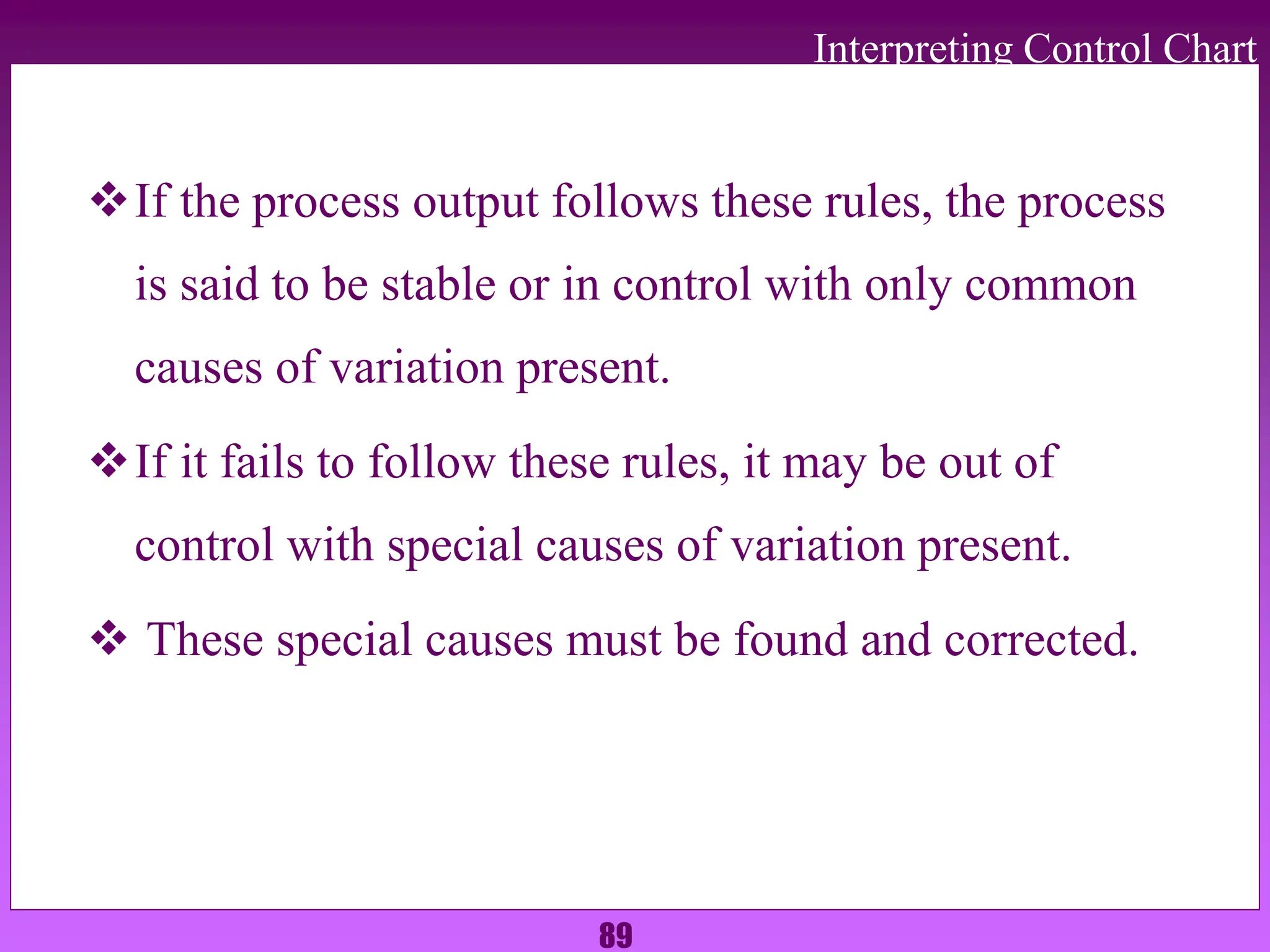
If the process output follows these rules, the process
is said to be stable or in control with only common
causes of variation present.
If it fails to follow these rules, it may be out of
control with special causes of variation present.
 These special causes must be found and corrected.
90
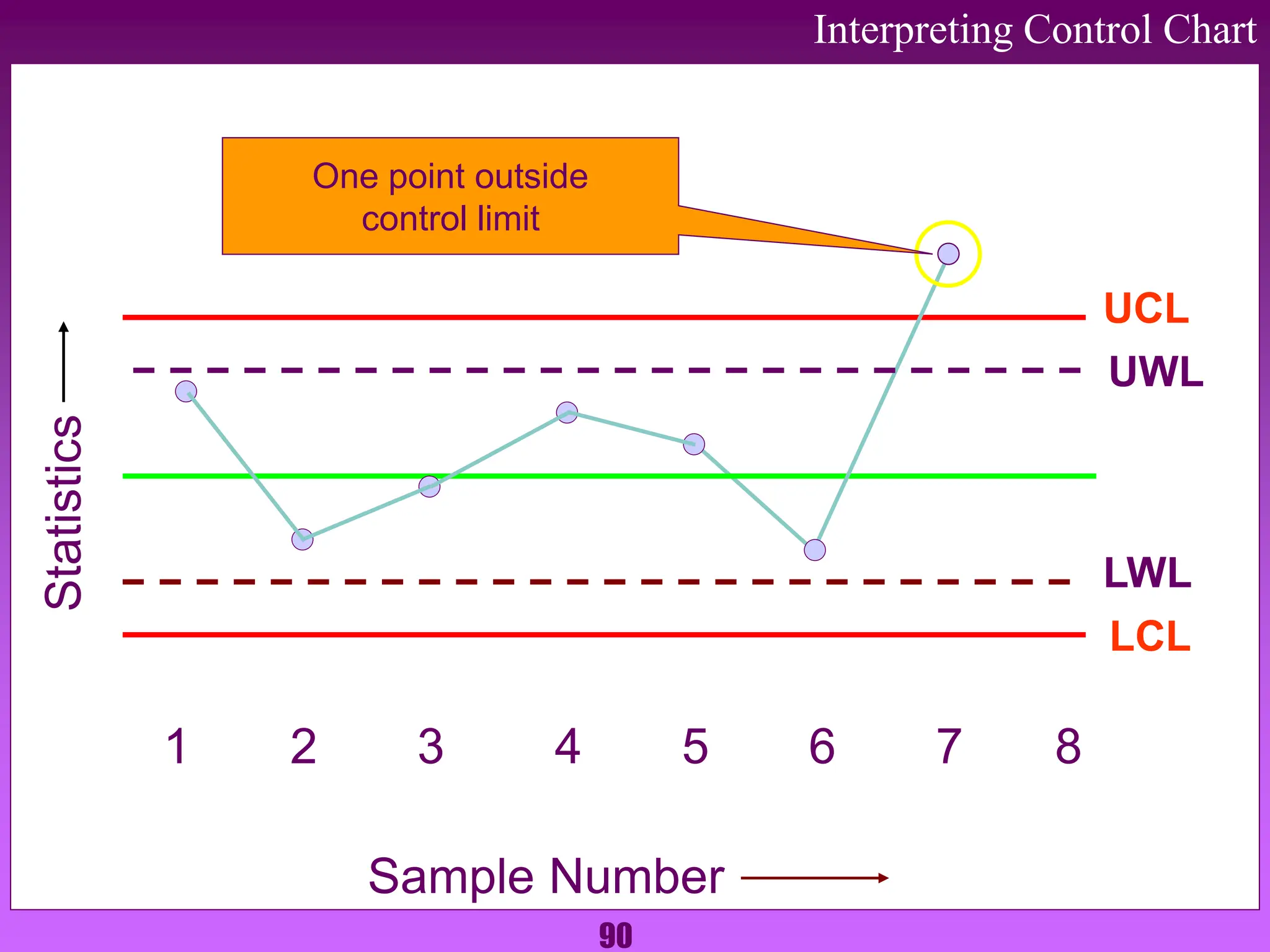
Interpreting Control Chart
UCL
1 2 3 4 5 6 7 8
Sample Number
Statistics
UWL
LCL
LWL
One point outside
control limit
91
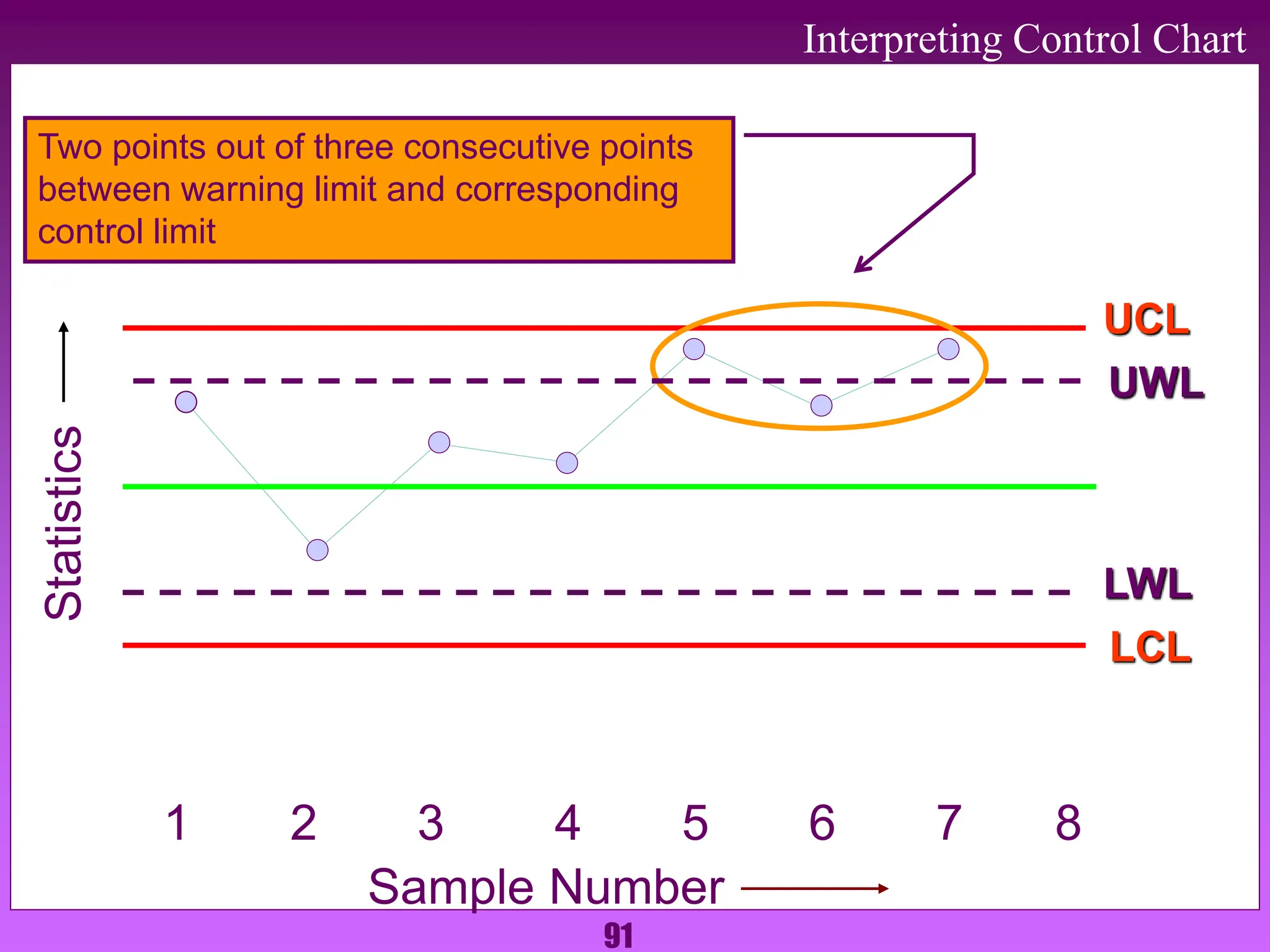
Interpreting Control Chart
UCL
1 2 3 4 5 6 7 8
Sample Number
Statistics
UWL
LCL
LWL
Two points out of three consecutive points
between warning limit and corresponding
control limit
92
Interpreting Control Chart
UCL
1 2 3 4 5 6 7 8
Sample Number
Statistics
UWL
LCL
LWL
Two consecutive points between warning limit and
corresponding control limit
93
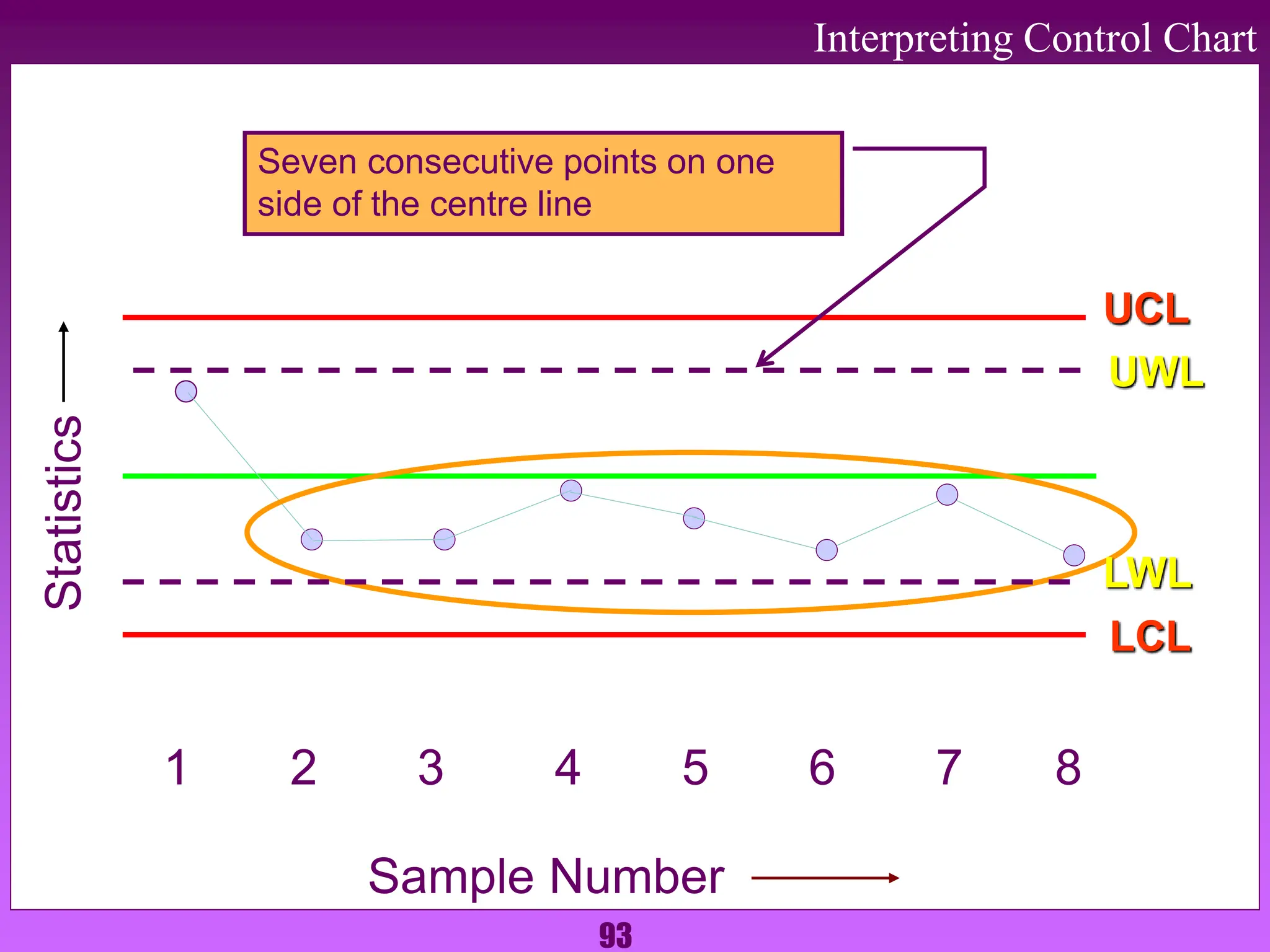
Interpreting Control Chart
UCL
1 2 3 4 5 6 7 8
UWL
LCL
LWL
Seven consecutive points on one
side of the centre line
Sample Number
Statistics
94
Interpreting Control Chart
UCL
1 2 3 4 5 6 7 8
Sample Number
Statistics
UWL
LCL
LWL
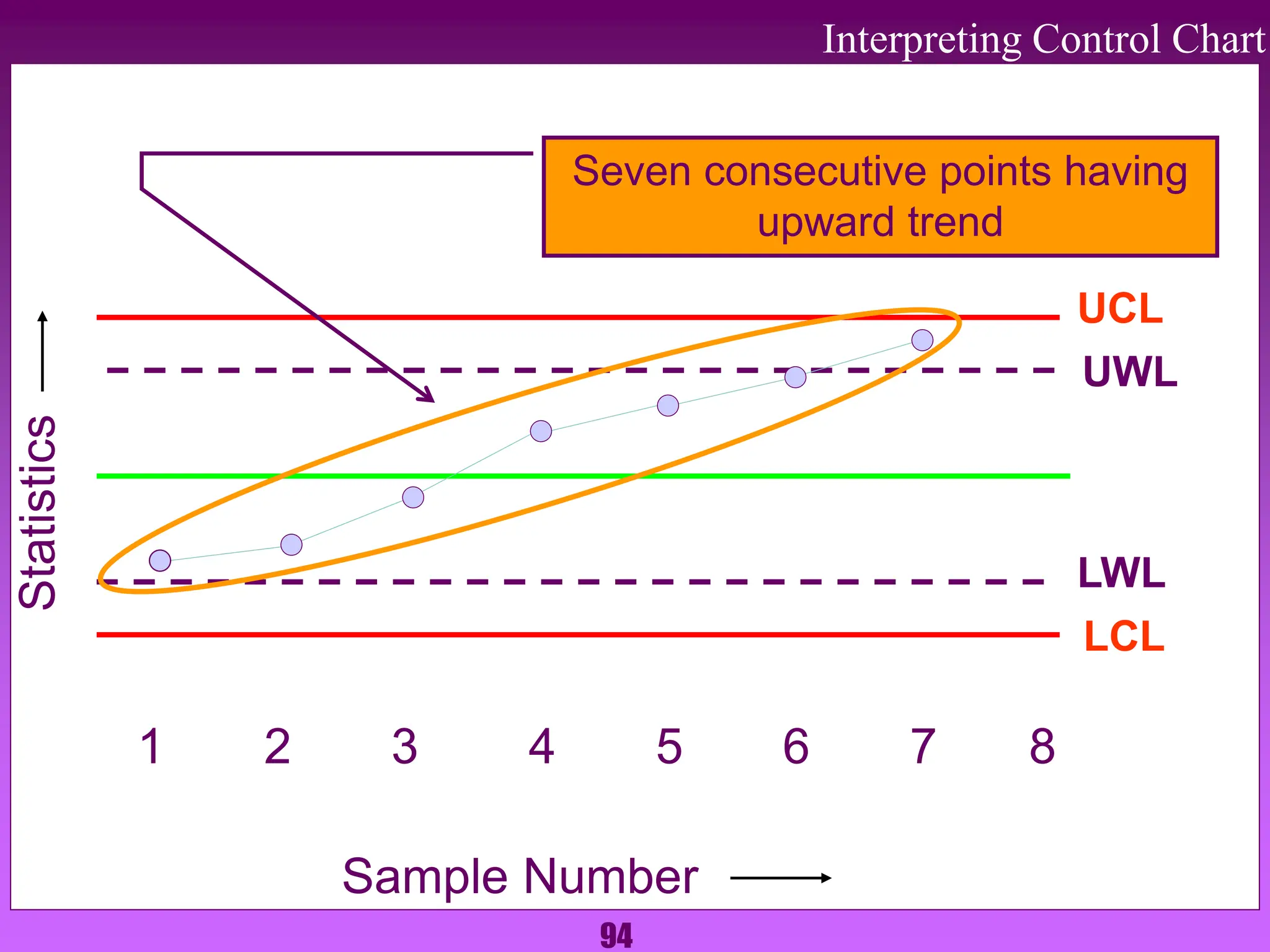
Seven consecutive points having
upward trend
95
Interpreting Control Chart
UCL
1 2 3 4 5 6 7 8
Sample Number
Statistics
UWL
LCL
LWL
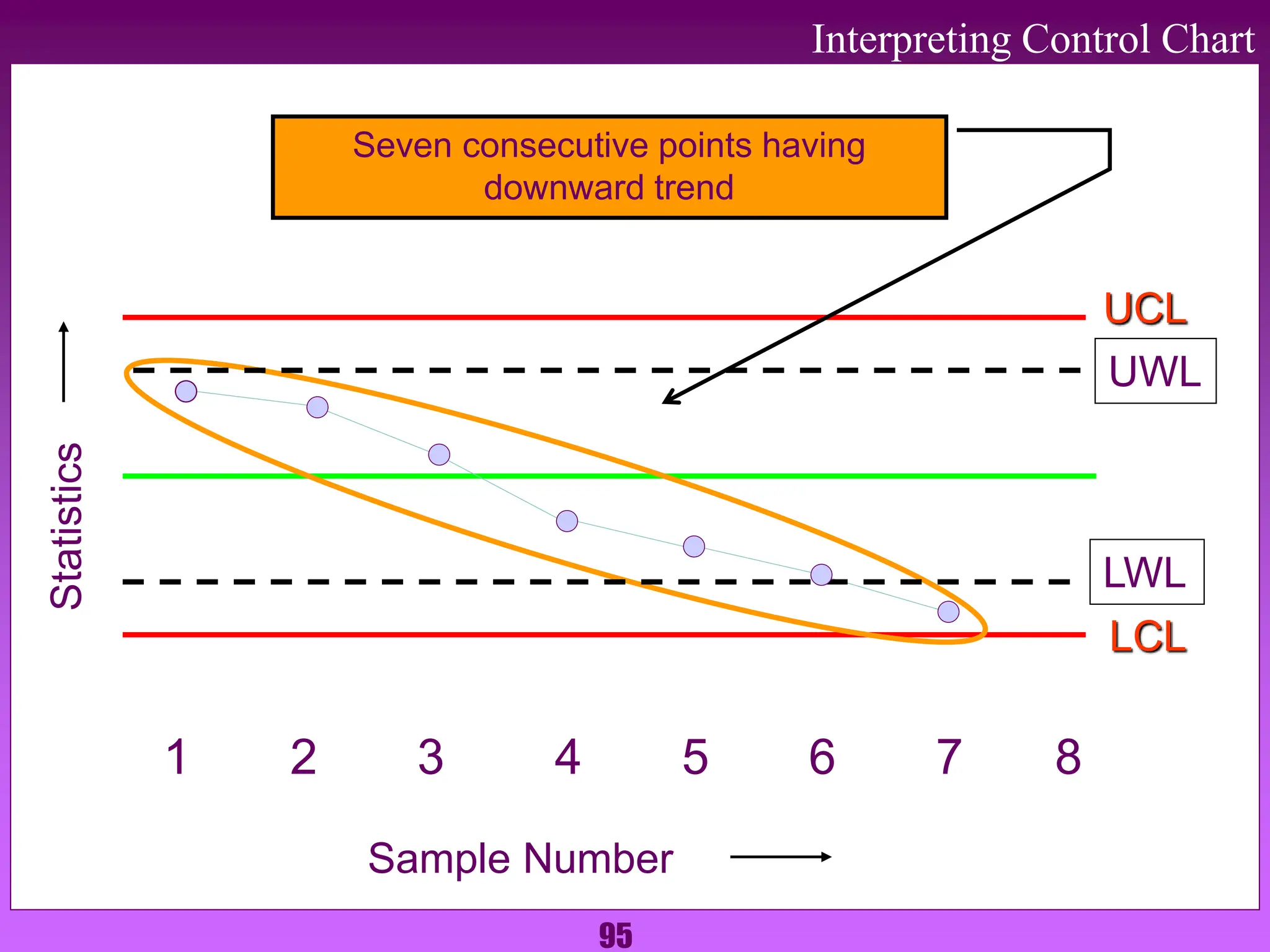
Seven consecutive points having
downward trend
96
Learning
 Concept and definition of “Quality”
 Importance of improving Quality as a tool for cost
reduction
 Importance of proper analysis of Quality problems
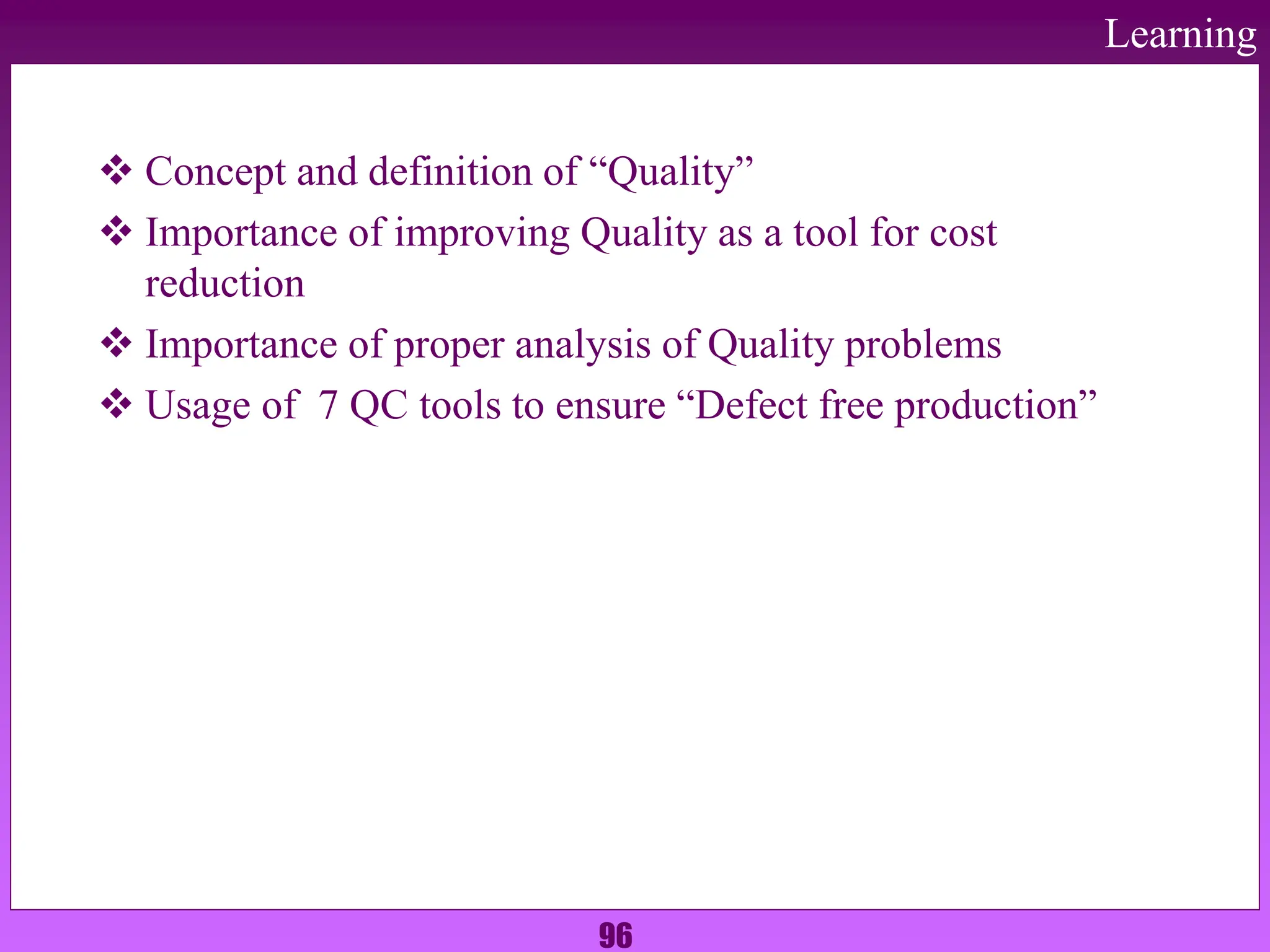
 Usage of 7 QC tools to ensure “Defect free production”
97
Thank You

7qc_tools_173.ppt for 7 QC tools implementation of the quality

  • 1.
  • 2.
    2 Quality A subjective termfor which each person has his or her own definition. In technical usage, quality can have two meanings: 1. The characteristics of a product or service that bear on its ability to satisfy stated or implied needs. 2. A product or service free from deficiencies.
  • 3.
    3 Can also betermed as ‘A measure of excellence’ Quality
  • 4.
    4  Quality -an essential and distinguishing attribute of something.  Attribute - an abstraction belonging to or characteristic of an entity  Appearance, visual aspect - outward or visible aspect of a thing  Attractiveness, attraction - the quality of arousing interest; being attractive or something that attracts;  Uncloudedness, clarity, clearness - the quality of clear water;  Ease, easiness, simplicity - freedom from difficulty or hardship or effort.  Suitability, suitableness - the quality of having the properties that are right for a specific purpose.  Excellence - the quality of excelling.  Characteristic - a distinguishing quality  Simpleness, simplicity - the quality of being simple or uncompounded Meaning of “Quality”
  • 5.
    5 Meaning of “Quality” Q= P E P = Performance or result E = Expectations
  • 6.
    6 Many people thinkthat quality costs money and adversely effects profits. But these costs are the costs of doing it wrong first time . Quality in the long run results in increased profitability. Quality, Cost & Profit relationship Cost
  • 7.
    7 Cost Quality and Profit: Traditional thinking
  • 8.
    8 Quality and Profit: Paradigm shift Cost
  • 9.
    9 1.Higher production dueto improved cycle time and reduced errors and defects 2.Increased use of machine and resources. 3.Improved material use from reduced scrap and rejects 4.Increased use of personnel resources 5.Lower level of asset investments required to support operations. 6.Lower service and support costs for eliminated waste, rework and non value added activities. QUALITY Higher productivity Increased profitability due to : •Larger sales •Lower production costs •Faster turnover Quality and Profit
  • 10.
    10 Quality and Profit Ifthe organization does not offer high quality product or service , it will soon go out of business . But just having high quality will not be enough , because your competitors will also have the high quality. To win , companies will need to offer high quality for a lower price than their competitors.This requires organizations to identify and reduce their quality costs High Quality Lower price C2A2C
  • 11.
    11  Offer highquality for a lower price than their competitors.  Reduce quality costs  Stop producing defective thru’  Process up-gradation  Improving quality of analysis to identify and eliminate root causes  Taking necessary countermeasure as when required  Usage of right analytical tools  Designing robust problem solving process CHELLANGES
  • 12.
    12 PROBLEM SOLVING PROCESS Evaluatingsolution (6) Implementing solution (5) Selecting & planning solution (4) Generating potential solutions (3) Analysing problem causes (2) Identifying & selecting problem (1) PROBLEM SOLVING PROCESS
  • 13.
    13 IDENTIFYING AND SELCTINGPROBLEM  Write Statement of the problem(s)  Define Gap Between Actual & target  Prioritize
  • 14.
    14 ANALYSIS PROBLEM ANDCAUSES  Collect Data  Sort symptoms & Causes (effects)  Brain Storm  Fishbone - cause & effect analysis  Prioritize
  • 15.
    15 GENERATING POTENTIAL SOLUTIONS Brainstorm  Build on each other’s ideas  Analysis potential helps & hinders
  • 16.
    16 SELECTING AND PLANNINGSOLUTION  Prioritize solutions  Clarify tasks / Action plan  Resource / Costs  Present proposals
  • 17.
    17 IMPLEMENTING SOLUTION  Establishcontrols  Maintain Commitments  Plan Contingencies
  • 18.
    18 EVALUATING SOLUTION  Monitorresults  Restart Process if necessary
  • 19.
    19 7 QC TOOLS Usedto identify,analyze and resolve problems Simple but very powerful tools to solve day to day work related problems Find solutions in a systematic manner Widely used by Quality Circle members world over
  • 20.
    20 Check sheets  Histograms Pareto charts  Cause & effect diagram (Ishikawa diagram)  Scatter plot  Defect concentration diagram  Control charts 7 QC TOOLS
  • 21.
    21 Check sheets areformats used to collect and organize data Data can be collected easily and concisely Data data is collected on the characteristic of interest. The right data could be captured with all necessary facts included e.g. as when it happened ? how many ? what customer ? CHECK SHEETS
  • 22.
    22 Check sheets forproduction process distribution Defective item check sheet Defect cause check sheet Check sheet for work station evaluation Check sheet for design information accuracy Check sheet for vendor reliability TYPES CHECK SHEETS
  • 23.
    23 CHECK SHEETS Type of defects CheckSub-Total Scratch 3 Dent 7 Flow mark 11 Short Shot 2 Total 23 Component name : ABC Date of Production:22-Aug-03
  • 24.
    24 Histogram is the“Frequency data” obtained from measurements displaying a peak around a certain value and represented in form of polls The variation of quality characteristics is called “Distribution” Purpose of drawing a Histogram is to understand the “Population” HISTOGRAM Population Sample
  • 25.
    25 12 23 43 27 9 0 50 1 160-170 170-180 180-190190-200 200-210 Histogram for distribution of Center Distance (mm) HISTOGRAM
  • 26.
    26 HISTOGRAM A HISTORYOF PROCESS OUT PUT 0 2 4 8 10 12 14 16 6 Frequency 47 48 49 50 51 52 53 54 kg Distribution
  • 27.
    27 Based on “80/20”rule (or ABC analysis) Pareto(V.Pareto,an Italian economist) discovered this universal law-80% of anything is attributed to 20% of its causes 80% of the wealth is held by 20% of the population. • 80% of our income goes into 20% of our needs. • 80% of road accidents occur on 20% of the road. • 80% of the absenteeism in a company is due to 20% of workmen “Significant few & in-significant many” PARETO CHART
  • 28.
    28 PARETO CHART Pareto analysisbegins by ranking problems from highest to lowest in order to fix priority  The cumulative number of problems is plotted on the vertical axis of the graph against the cause/phenomenon Pareto by Causes e.g. Man,Machine,Method etc Pareto by Phenomenon e.g.Quality,Cost,Delivery Tells about the relative sizes of problems indicates an important message about biggest few problems, if corrected, a large % of total problems will be solved
  • 29.
    29 63.8 81.4 96.2 100.0 0 500 1000 1500 2000 2500 3000 No of peices 0.0 10.0 20.0 30.0 40.0 50.0 60.0 70.0 80.0 90.0 100.0 Cum. Percentage DEFECT QTY2064.0 567.0 480.0 122.0 CUM % 63.8 81.4 96.2 100.0 SHORT SHOT SILVER SINK MARK FLASH PARETO ANALYSIS
  • 30.
    30 CAUSE n EFFECT(FISH BONE) DIAGRAM This diagram (resembles skeleton of a fish) helps to separate out causes from effects and to see problem in its totality It’s a systematic arrangement of all possible causes,generated thru’ brain storming This can be used to : Assist individual / group to see full picture.  Serve as a recording device for ideas generated.  Reveal undetected relationships between causes.  Discover the origin/root cause of a problem  Create a document or a map of a problem which can be posted in the work area.
  • 31.
    31 The problem categoriesconsidered are : Man, Machine, Method, Materials, Equipments & Environmental. EFFECT MACHINE METHOD ENVIRONMENT MAN MATERIAL EQUIPMENT CAUSE n EFFECT (FISH BONE) DIAGRAM
  • 32.
    32 SCATTER DIAGRAM The scatterdiagram is used for identifying the relationships and performing preliminary analysis of relationship between any two quality characteristics. Clustering of points indicate that the two characteristics may be related e.g. Increasing in component weight with increase in hold time during plastic injection molding ( + ve co-relation) Increase in toughness components with decreasing injection pressure (-ve co-relation) during molding
  • 33.
    33 SCATTER DIAGRAM (POSITIVECORRELATION) 0 10 20 30 40 50 60 70 80 90 100 0 5 10 XY (Scatter) 1
  • 34.
    34 SCATTER DIAGRAM (NEGATIVECORERLATION) 0 10 20 30 40 50 60 70 80 0 5 10 XY (Scatter) 1
  • 35.
    35 SCATTER DIAGRAM (NOCORERLATION) 0 10 20 30 40 50 60 70 80 0 5 10 XY (Scatter) 1
  • 36.
    36 DEFECT CONCENTRATION DIAGRAM This is used to understand the potential defect prone area of the parts produced  The “Concentration Diagram” check sheet carries the diagram of the problematic part,defects whenever observed to be updated in the same using tally marks  Based on the distribution of defects countermeasures are taken at process/system level  This tool is very useful to solve problems like Scratch, Dent,Breakage thru’ handling improvement  For plastic molded parts this tool is used to identify stress points,weak joints,effect of gate shape/position on the quality of parts etc.
  • 37.
    37 DEFECT CONCENTRATION DIAGRAM Componentname : XYZ Concentration diagram for Scratches produced ion 21-Aug-03 Total no of defective produced is 11 Nos Area of concern
  • 38.
    38 Control Chart Quality controlcharts, are graphs on which the quality of the product is plotted as manufacturing or servicing is actually proceeding. It graphically, represents the output of the process and uses statistical limits and patterns of plot, for decision making  Enables corrective actions to be taken at the earliest possible moment and avoiding unnecessary corrections. The charts help to ensure the manufacture of uniform product or providing consistent services which complies with the specification.
  • 39.
    39 Elements of TypicalControl Chart 1. Horizontal axis for sample number 2. Vertical axis for sample statistics e.g. mean, range, standard deviation of sample. 3. Target Line 4. Upper control line 5. Upper warning line 6. Lower control line 7. Lower warning line 8. Plotting of sample statistics 9. Line connecting the plotted statistics
  • 40.
    40 1 2 34 5 Target Lower control line Upper warning line Lower warning line Sample Number Upper control line Lower control line Sample Statistics Elements of Typical Control Chart
  • 41.
    41 Interpreting Control Chart Thecontrol chart gets divided in three zones. Zone - 1 If the plotted point falls in this zone, do not make any adjustment, continue with the process. Zone - 2 If the plotted point falls in this zone then special cause may be present. Be careful watch for plotting of another sample(s). Zone - 3 If the plotted point falls in this zone then special cause has crept into the system, and corrective action is required.
  • 42.
    42 Zones for MeanControl Chart 1 2 3 4 5 6 7 Sample Number UCL Target LCL UWL LWL Zone - 3 Sample Mean Zone - 2 Zone - 3 Zone - 2 Zone - 1 Action Action Warning Warning Continue Continue Zone - 1
  • 43.
    43 UCL 1 2 34 5 6 7 8 Sample Number Statistics UWL LCL Target LWL Interpreting Control Chart Point outside the Control limit
  • 44.
    44 Control Chart ViewsProcess in Real Time Time Intervals Range Mean LCLx Output of the process in real time Target Target UCLx UCLr
  • 45.
    45 Change in Locationof Process Mean 43 48 49 50 51 52 53 44 45 46 47 Process with mean at Target Process with mean at more than target Process with mean at less than target
  • 46.
    46 Case When ProcessMean is at Target 43 48 49 50 51 52 53 44 45 46 47 Target Process Mean Chances of getting a reading beyond U & L is almost nil 42 U L - 3 s +3 s U - L = 6 s
  • 47.
    47 Case - SmallShift of the Process Mean 43 48 49 50 51 52 53 44 45 46 47 Target Process Mean Chances of getting a reading outside U is small Small shift in process 42 Shaded area shows the probability of getting a reading beyond U U L U-L = 6 s
  • 48.
    48 Process Mean Case - LargeShift of the Process Mean 43 48 49 50 51 52 53 44 45 46 47 Target Chances of getting a reading outside U is large Large shift in process 42 Shaded area shows the probability of getting a reading beyond U U L U-L = 6 s
  • 49.
    49 Change in Spreadof Process 43 48 49 50 51 52 53 44 45 46 47 Larger spread due to special causes Spread due to common causes
  • 50.
    50 Special cause &Common cause  Special / Assignable cause : Causes due to negligence in following work instructions, problem in machines etc.This types of causes are avoidable and cannot be neglected. Common cause : Causes which are unavoidable and in-evitable in a process.It is not practical to eliminate the Chance cause technically and economically.
  • 51.
    51 Most Commonly UsedVariable Control Charts  To track the accuracy of the process - Mean control chart or x-bar chart  To track the precision of the process - Range control chart
  • 52.
    52 Control Chart PART NAME: GLASS RUN PART NO : MODEL : Page THICKNESS SPECS : MIN 1.10 TO 1.50 MAX REASON : PROCESS CAPABILITY STUDY AUDIT DATE 25/9/01 1 2 3 4 5 6 7 8 9 10 11 12 13 14 15 16 17 18 19 20 n d2 A2 D4 1 1.50 1.50 1.50 1.50 1.50 1.50 1.50 1.50 1.50 1.50 1.60 1.50 1.60 1.50 1.60 1.55 1.60 1.55 1.50 1.50 1 1.123 2.66 3.27 2 1.50 1.50 1.50 1.53 1.50 1.50 1.50 1.50 1.50 1.55 1.60 1.55 1.55 1.60 1.55 1.45 1.60 1.50 1.50 1.48 2 1.128 1.88 3.27 3 1.60 1.48 1.50 1.50 1.48 1.50 1.50 1.50 1.50 1.55 1.50 1.55 1.50 1.55 1.50 1.50 1.50 1.55 1.60 1.55 3 1.693 1.02 2.57 4 1.50 1.48 1.52 1.50 1.53 1.50 1.50 1.50 1.45 1.50 1.50 1.50 1.50 1.50 1.50 1.50 1.50 1.60 1.60 1.50 4 2.059 0.73 2.29 5 1.50 1.50 1.60 1.50 1.50 1.50 1.55 1.55 1.45 1.55 1.55 1.50 1.50 1.50 1.50 1.50 1.45 1.50 1.55 1.55 5 2.326 0.58 2.11 SUM X SUM X1+..+Xn 30.37 X 1.52 1.49 1.52 1.51 1.50 1.50 1.51 1.51 1.48 1.53 1.55 1.52 1.53 1.53 1.53 1.50 1.53 1.54 1.55 1.52 X SUM X1+..+Xn/n 1.519 R 0.10 0.02 0.10 0.03 0.05 0.00 0.05 0.05 0.05 0.05 0.10 0.05 0.10 0.10 0.10 0.10 0.15 0.10 0.10 0.07 R SUM R1+..+Rn/n 0.074 SIGMA R/d2 0.032 3 SIGMA 3 * R/d2 0.095 6 SIGMA 6 * R/d2 0.190 Cp = 2.11 Cpk= MIN OF -0.20 Cpu OR Cpl 4.41 Cpk = USL 1.500 LSL 1.100 FOR X UCL = X + A2.R 1.561 LCL = X - A2.R 1.476 FOR R (D3 = 0) UCL = D4.R 0.155 LCL = D3.R 0.000 PROCESS STATAUS CONTROLLED NOT CONTROLLED XYZ Ltd O -0.05 0.00 0.05 0.10 0.15 0.20 0.25 1 2 3 4 5 6 7 8 9 10 11 12 13 14 15 16 17 18 19 20 R - CHART R UCL LCL CL 1.400 1.420 1.440 1.460 1.480 1.500 1.520 1.540 1.560 1.580 1.600 1 2 3 4 5 6 7 8 9 10 11 12 13 14 15 16 17 18 19 20 X - CHART X UCL LCL CL How to draw?
  • 53.
    86 Summary of Effectof Process Shift  When there is no shift in the process nearly all the observations fall within -3 s and + 3 s.  When there is small shift in the mean of process some observations fall outside original -3 s and +3 s zone.  Chances of an observation falling outside original -3 s and + 3 s zone increases with the increase in the shift of process mean.
  • 54.
    87 Our Conclusion fromNormal Distribution  When an observation falls within original +3 s and -3 s zone of mean of a process, we conclude that there is no shift in the mean of process. This is so because falling of an observation between these limits is a chance.  When an observation falls beyond original +3 s and -3 s zone of process mean, we conclude that there is shift in location of the process
  • 55.
    88 Interpreting Control Chart Because the basis for control chart theory follows the normal distribution, the same rules that governs the normal distribution are used to interpret the control charts.  These rules include: - Randomness. - Symmetry about the centre of the distribution. - 99.73% of the population lies between - 3 s of and + 3 s the centre line. - 95.4% population lies between -2 s and + 2 s of the centre line.
  • 56.
    89 Interpreting Control Chart Ifthe process output follows these rules, the process is said to be stable or in control with only common causes of variation present. If it fails to follow these rules, it may be out of control with special causes of variation present.  These special causes must be found and corrected.
  • 57.
    90 Interpreting Control Chart UCL 12 3 4 5 6 7 8 Sample Number Statistics UWL LCL LWL One point outside control limit
  • 58.
    91 Interpreting Control Chart UCL 12 3 4 5 6 7 8 Sample Number Statistics UWL LCL LWL Two points out of three consecutive points between warning limit and corresponding control limit
  • 59.
    92 Interpreting Control Chart UCL 12 3 4 5 6 7 8 Sample Number Statistics UWL LCL LWL Two consecutive points between warning limit and corresponding control limit
  • 60.
    93 Interpreting Control Chart UCL 12 3 4 5 6 7 8 UWL LCL LWL Seven consecutive points on one side of the centre line Sample Number Statistics
  • 61.
    94 Interpreting Control Chart UCL 12 3 4 5 6 7 8 Sample Number Statistics UWL LCL LWL Seven consecutive points having upward trend
  • 62.
    95 Interpreting Control Chart UCL 12 3 4 5 6 7 8 Sample Number Statistics UWL LCL LWL Seven consecutive points having downward trend
  • 63.
    96 Learning  Concept anddefinition of “Quality”  Importance of improving Quality as a tool for cost reduction  Importance of proper analysis of Quality problems  Usage of 7 QC tools to ensure “Defect free production”
  • 64.