The SiLU Activation
Function:
Unlocking Neural
Network Potential
Exploring how the Sigmoid Linear Unit (SiLU) activation function
can enhance the performance and potential of neural networks
in various applications.
What is SiLU?
Novel Activation Function
The SiLU activation function is a
relatively new contender in the world
of neural network activation
functions, offering advantages over
more traditional options like ReLU.
Combines Sigmoid and
Linear
SiLU calculates the output by
multiplying the input value (x) by
the sigmoid of that same input
value, creating a smooth and non-
monotonic activation function.
Improved Expressiveness
The SiLU activation function allows
for more expressive representations
and enables smoother optimization
landscapes compared to traditional
activation functions.
Computational Complexity
Computing the exponential term in
the SiLU function requires
additional computation resources,
which could potentially slow down
training times.
The SiLU activation function is a promising new option that offers advantages over traditional activation
functions, making it a compelling choice for neural network architectures.
The SiLU Function
• The SiLU Activation Function
The SiLU (Sigmoid Linear Unit) activation function is
calculated by multiplying the input value (x) by the sigmoid
of that same input value. Mathematically, it's written as:
silu(x) = x * sigmoid(x), where sigmoid(x) = 1 / (1 + e^(-x)).
• Sigmoid Function
The sigmoid function squashes any number between
positive and negative infinity to a value between 0 and 1.
This allows the SiLU function to adaptively scale its inputs
based on their activation levels.
• Self-Gating Mechanism
The SiLU function applies the sigmoid function element-wise
to the input, and then multiplies the result by the original
input. This self-gating mechanism enables the function to
adaptively scale its inputs based on their activation levels.
• Advantages over ReLU
Compared to the ReLU activation function, which has a
sharp kink at zero, SiLU's curve is smooth and non-
monotonic, providing a more nuanced non-linearity that can
be beneficial for certain machine learning tasks. SiLU also
alleviates the 'dying ReLU' problem, where ReLU units can
get stuck in a state where their output is always 0, leading
to vanishing gradients during training.
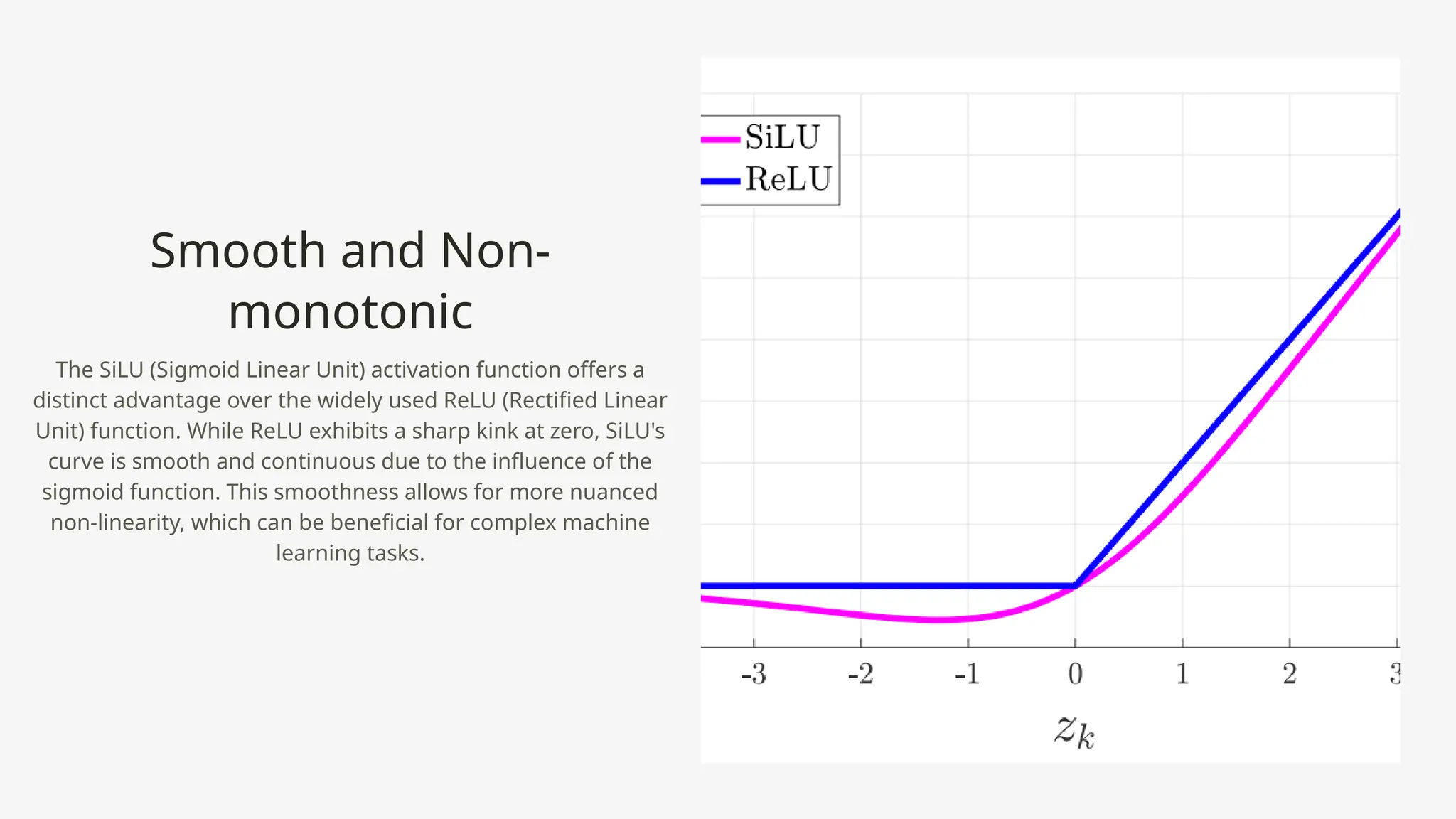
Smooth and Non-
monotonic
The SiLU (Sigmoid Linear Unit) activation function offers a
distinct advantage over the widely used ReLU (Rectified Linear
Unit) function. While ReLU exhibits a sharp kink at zero, SiLU's
curve is smooth and continuous due to the influence of the
sigmoid function. This smoothness allows for more nuanced
non-linearity, which can be beneficial for complex machine
learning tasks.
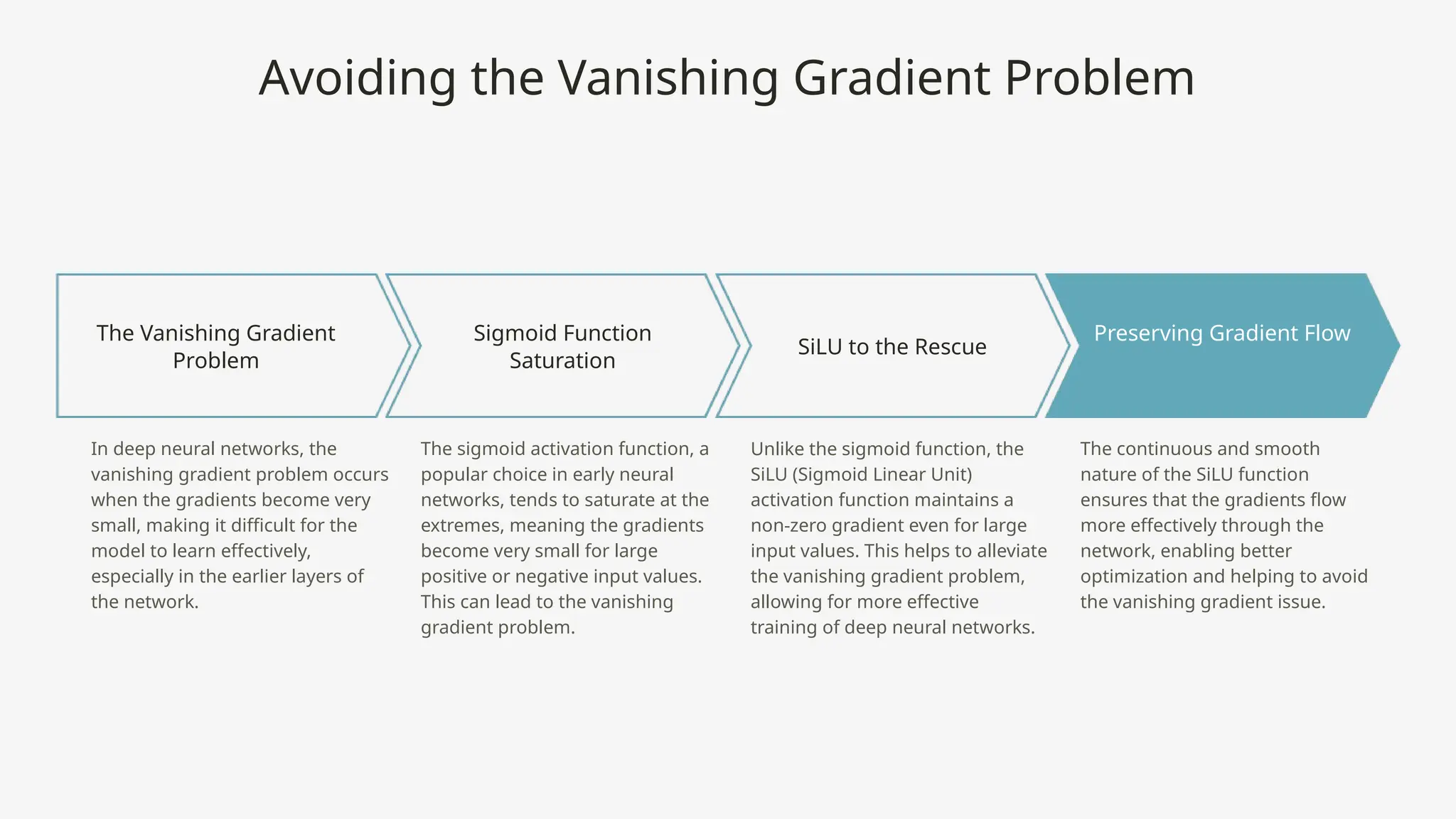
Avoiding the Vanishing Gradient Problem
The Vanishing Gradient
Problem
In deep neural networks, the
vanishing gradient problem occurs
when the gradients become very
small, making it difficult for the
model to learn effectively,
especially in the earlier layers of
the network.
Sigmoid Function
Saturation
The sigmoid activation function, a
popular choice in early neural
networks, tends to saturate at the
extremes, meaning the gradients
become very small for large
positive or negative input values.
This can lead to the vanishing
gradient problem.
SiLU to the Rescue
Unlike the sigmoid function, the
SiLU (Sigmoid Linear Unit)
activation function maintains a
non-zero gradient even for large
input values. This helps to alleviate
the vanishing gradient problem,
allowing for more effective
training of deep neural networks.
Preserving Gradient Flow
The continuous and smooth
nature of the SiLU function
ensures that the gradients flow
more effectively through the
network, enabling better
optimization and helping to avoid
the vanishing gradient issue.
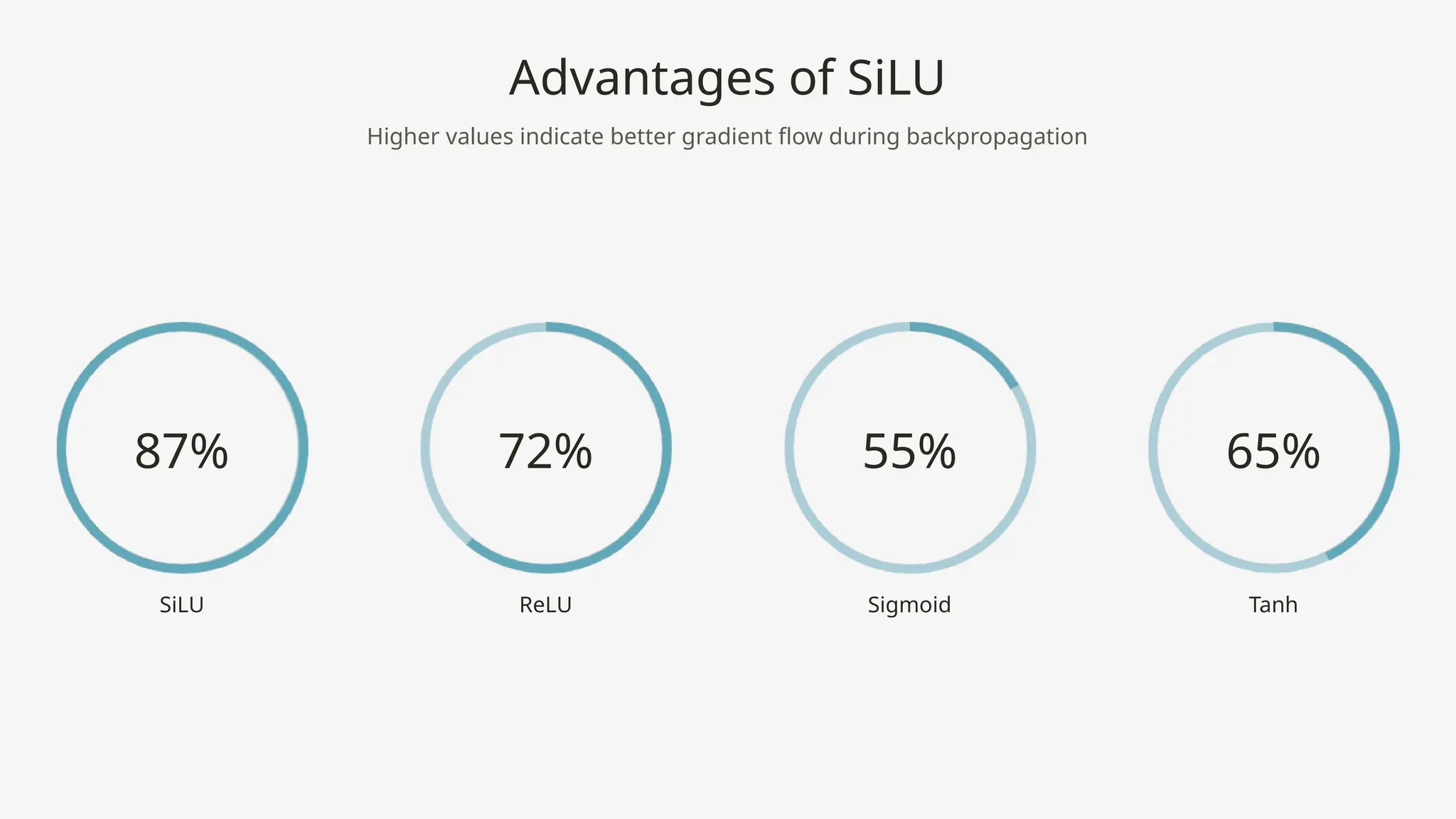
Advantages of SiLU
Higher values indicate better gradient flow during backpropagation
87%
SiLU
72%
ReLU
55%
Sigmoid
65%
Tanh
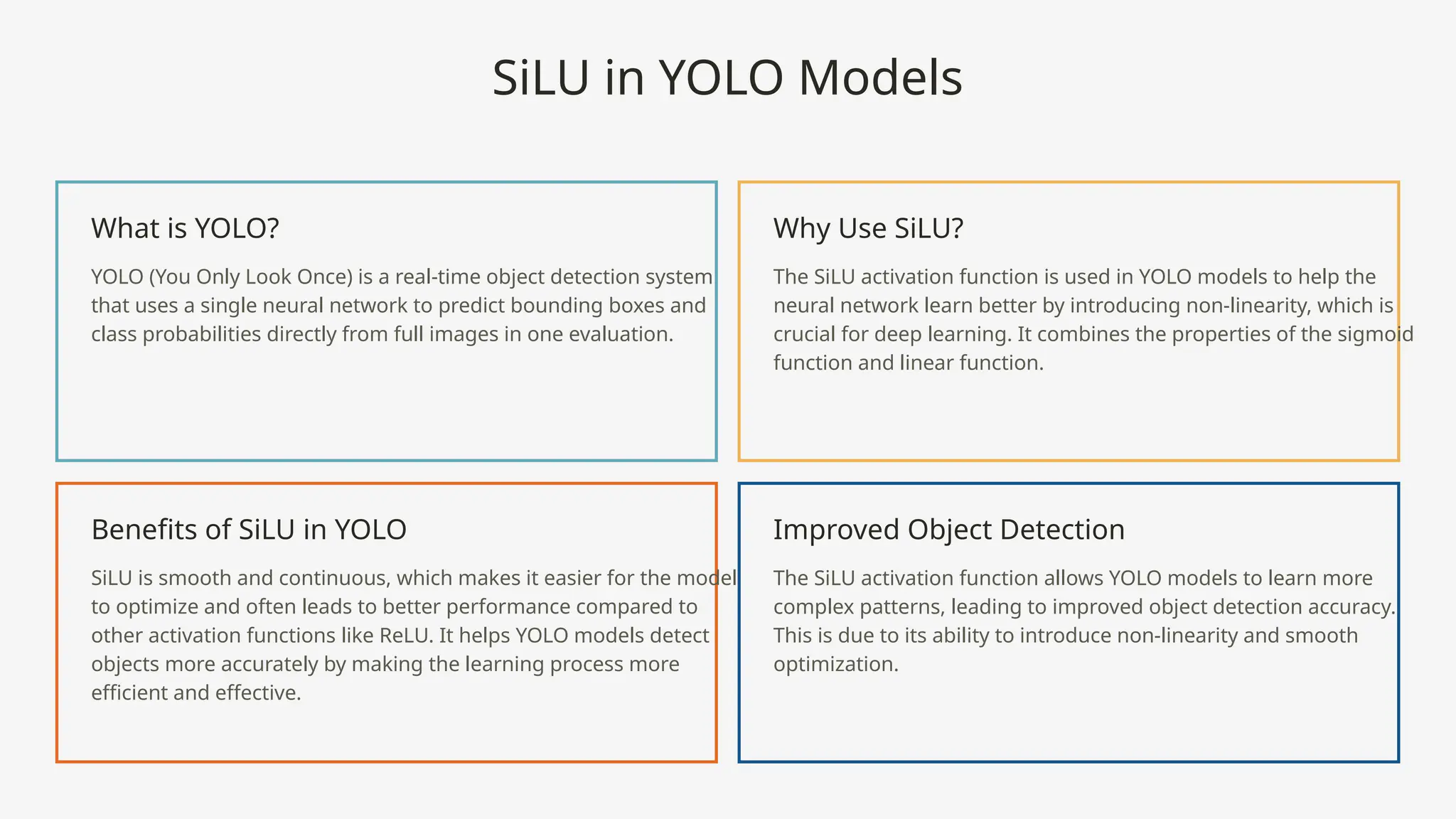
SiLU in YOLO Models
What is YOLO?
YOLO (You Only Look Once) is a real-time object detection system
that uses a single neural network to predict bounding boxes and
class probabilities directly from full images in one evaluation.
Why Use SiLU?
The SiLU activation function is used in YOLO models to help the
neural network learn better by introducing non-linearity, which is
crucial for deep learning. It combines the properties of the sigmoid
function and linear function.
Benefits of SiLU in YOLO
SiLU is smooth and continuous, which makes it easier for the model
to optimize and often leads to better performance compared to
other activation functions like ReLU. It helps YOLO models detect
objects more accurately by making the learning process more
efficient and effective.
Improved Object Detection
The SiLU activation function allows YOLO models to learn more
complex patterns, leading to improved object detection accuracy.
This is due to its ability to introduce non-linearity and smooth
optimization.
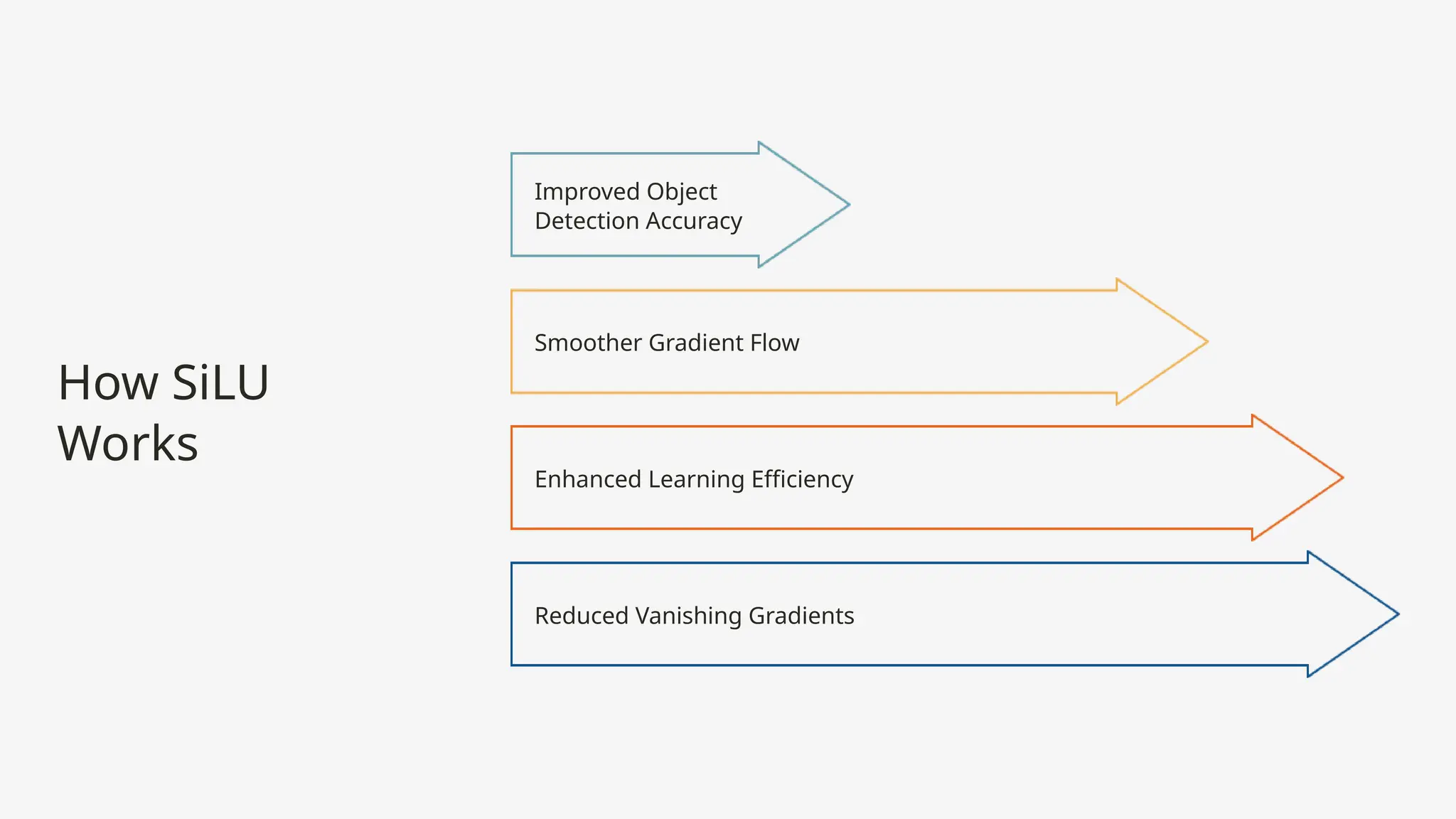
How SiLU
Works
Improved Object
Detection Accuracy
Smoother Gradient Flow
Enhanced Learning Efficiency
Reduced Vanishing Gradients
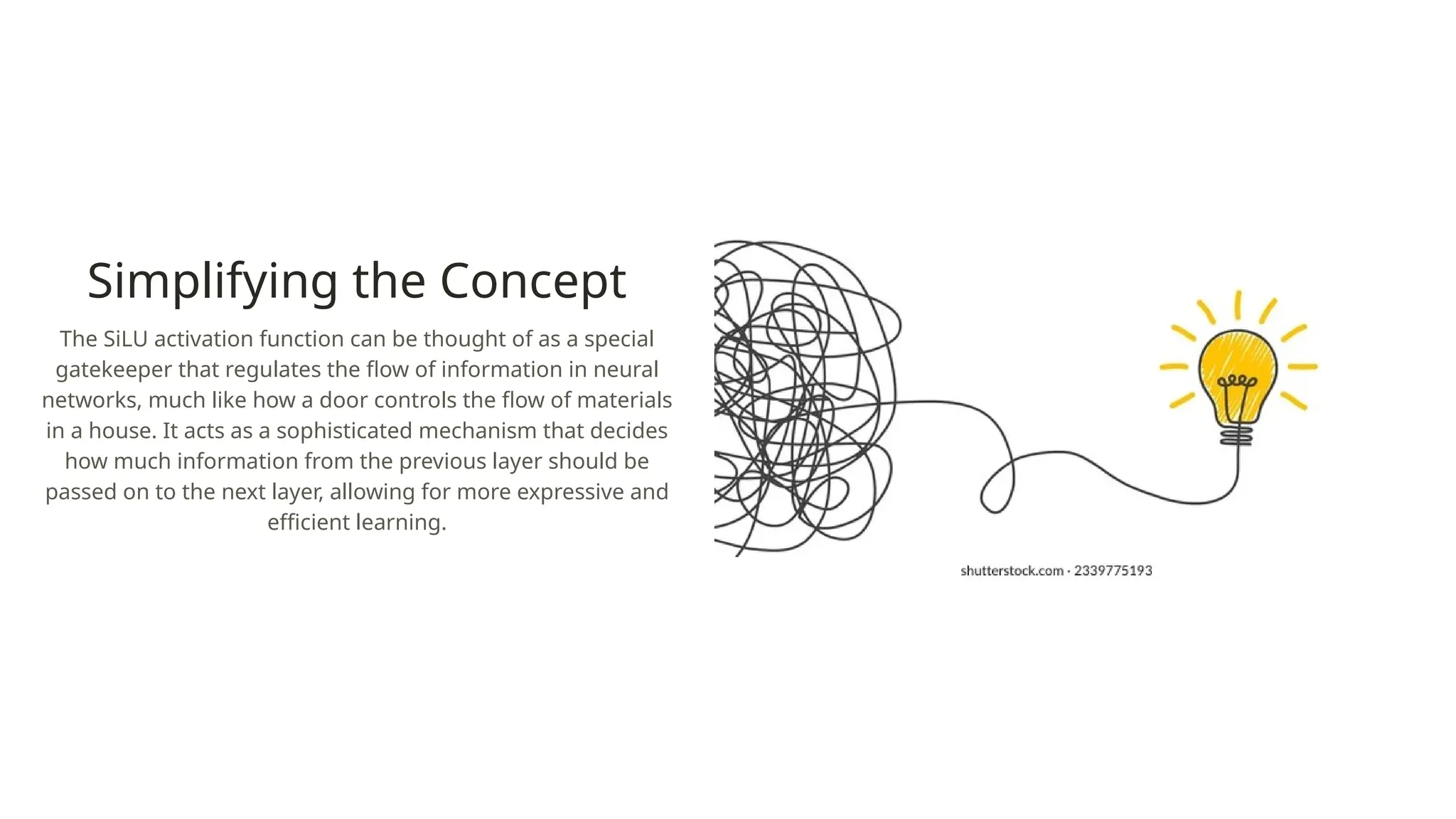
Simplifying the Concept
The SiLU activation function can be thought of as a special
gatekeeper that regulates the flow of information in neural
networks, much like how a door controls the flow of materials
in a house. It acts as a sophisticated mechanism that decides
how much information from the previous layer should be
passed on to the next layer, allowing for more expressive and
efficient learning.

[7] The SiLU Activation Function Unlocking Neural Network Potential.pptx

  • 1.
    The SiLU Activation Function: UnlockingNeural Network Potential Exploring how the Sigmoid Linear Unit (SiLU) activation function can enhance the performance and potential of neural networks in various applications.
  • 2.
    What is SiLU? NovelActivation Function The SiLU activation function is a relatively new contender in the world of neural network activation functions, offering advantages over more traditional options like ReLU. Combines Sigmoid and Linear SiLU calculates the output by multiplying the input value (x) by the sigmoid of that same input value, creating a smooth and non- monotonic activation function. Improved Expressiveness The SiLU activation function allows for more expressive representations and enables smoother optimization landscapes compared to traditional activation functions. Computational Complexity Computing the exponential term in the SiLU function requires additional computation resources, which could potentially slow down training times. The SiLU activation function is a promising new option that offers advantages over traditional activation functions, making it a compelling choice for neural network architectures.
  • 3.
    The SiLU Function •The SiLU Activation Function The SiLU (Sigmoid Linear Unit) activation function is calculated by multiplying the input value (x) by the sigmoid of that same input value. Mathematically, it's written as: silu(x) = x * sigmoid(x), where sigmoid(x) = 1 / (1 + e^(-x)). • Sigmoid Function The sigmoid function squashes any number between positive and negative infinity to a value between 0 and 1. This allows the SiLU function to adaptively scale its inputs based on their activation levels. • Self-Gating Mechanism The SiLU function applies the sigmoid function element-wise to the input, and then multiplies the result by the original input. This self-gating mechanism enables the function to adaptively scale its inputs based on their activation levels. • Advantages over ReLU Compared to the ReLU activation function, which has a sharp kink at zero, SiLU's curve is smooth and non- monotonic, providing a more nuanced non-linearity that can be beneficial for certain machine learning tasks. SiLU also alleviates the 'dying ReLU' problem, where ReLU units can get stuck in a state where their output is always 0, leading to vanishing gradients during training.
  • 4.
    Smooth and Non- monotonic TheSiLU (Sigmoid Linear Unit) activation function offers a distinct advantage over the widely used ReLU (Rectified Linear Unit) function. While ReLU exhibits a sharp kink at zero, SiLU's curve is smooth and continuous due to the influence of the sigmoid function. This smoothness allows for more nuanced non-linearity, which can be beneficial for complex machine learning tasks.
  • 5.
    Avoiding the VanishingGradient Problem The Vanishing Gradient Problem In deep neural networks, the vanishing gradient problem occurs when the gradients become very small, making it difficult for the model to learn effectively, especially in the earlier layers of the network. Sigmoid Function Saturation The sigmoid activation function, a popular choice in early neural networks, tends to saturate at the extremes, meaning the gradients become very small for large positive or negative input values. This can lead to the vanishing gradient problem. SiLU to the Rescue Unlike the sigmoid function, the SiLU (Sigmoid Linear Unit) activation function maintains a non-zero gradient even for large input values. This helps to alleviate the vanishing gradient problem, allowing for more effective training of deep neural networks. Preserving Gradient Flow The continuous and smooth nature of the SiLU function ensures that the gradients flow more effectively through the network, enabling better optimization and helping to avoid the vanishing gradient issue.
  • 6.
    Advantages of SiLU Highervalues indicate better gradient flow during backpropagation 87% SiLU 72% ReLU 55% Sigmoid 65% Tanh
  • 7.
    SiLU in YOLOModels What is YOLO? YOLO (You Only Look Once) is a real-time object detection system that uses a single neural network to predict bounding boxes and class probabilities directly from full images in one evaluation. Why Use SiLU? The SiLU activation function is used in YOLO models to help the neural network learn better by introducing non-linearity, which is crucial for deep learning. It combines the properties of the sigmoid function and linear function. Benefits of SiLU in YOLO SiLU is smooth and continuous, which makes it easier for the model to optimize and often leads to better performance compared to other activation functions like ReLU. It helps YOLO models detect objects more accurately by making the learning process more efficient and effective. Improved Object Detection The SiLU activation function allows YOLO models to learn more complex patterns, leading to improved object detection accuracy. This is due to its ability to introduce non-linearity and smooth optimization.
  • 8.
    How SiLU Works Improved Object DetectionAccuracy Smoother Gradient Flow Enhanced Learning Efficiency Reduced Vanishing Gradients
  • 9.
    Simplifying the Concept TheSiLU activation function can be thought of as a special gatekeeper that regulates the flow of information in neural networks, much like how a door controls the flow of materials in a house. It acts as a sophisticated mechanism that decides how much information from the previous layer should be passed on to the next layer, allowing for more expressive and efficient learning.