





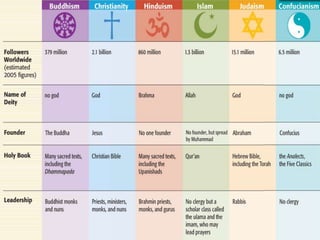
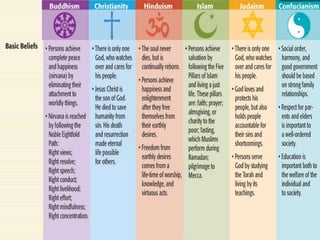
Religions& PatternsWorld HistoryMr. Taylor
Hinduism and Buddhism
Hinduism Evolves Over CenturiesCollection of beliefs that developed slowlyNo one founder with a single set of ideasReincarnation: reborn to new livesA soul’s good and bad deeds, karma, determines course of new lifeToday, Hindus choose own path to moksha — a state of perfect understandingWhy did Hinduism strengthenthe caste system?
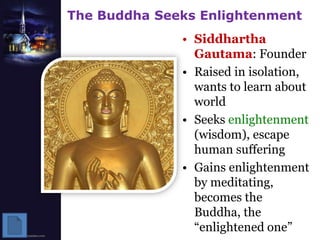
The Buddha Seeks EnlightenmentSiddhartha Gautama: FounderRaised in isolation, wants to learn about worldSeeks enlightenment (wisdom), escape human sufferingGains enlightenment by meditating, becomes the Buddha, the “enlightened one”
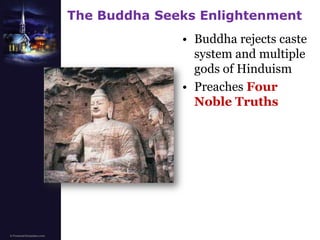
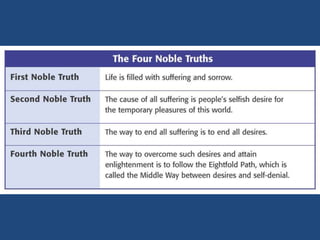
The Buddha Seeks EnlightenmentBuddha rejects caste system and multiple gods of HinduismPreaches Four Noble Truths
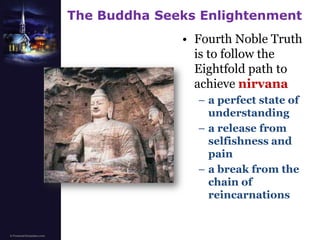
The Buddha Seeks EnlightenmentFourth Noble Truth is to follow the Eightfold path to achieve nirvanaa perfect state of understanding	a release from selfishness and paina break from the chain of reincarnations
The Buddha Seeks EnlightenmentBuddhism in IndiaSpreads to other parts of AsiaNever gains firm hold in India; Hinduism remains strongTrade and the Spread of Buddhismspreads by traders to:Sri Lanka, Burma, Thailand, SumatraChina, Korea, Japan
The Origins of Judaism
The Search for a Promised LandPalestine was region on eastern shores of MediterraneanHebrew people settled in Canaan, land promised to them by GodTorah, first five books of Hebrew Bible, tells early history of HebrewsIn Torah, God chose Abraham, a shepherd, to be father of Hebrew peopleHebrews are monotheists: one GodA mutual promise, covenant, is made between God and AbrahamAbraham promises to obey God, God promises protection
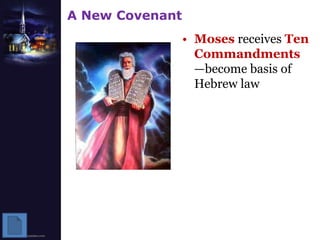
A New CovenantMoses receives Ten Commandments —become basis of Hebrew law
China & Confucianism
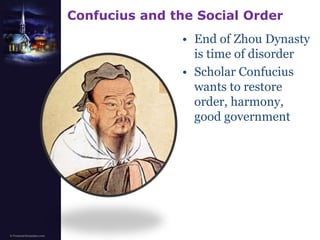
Confucius and the Social OrderEnd of Zhou Dynasty is time of disorderScholar Confucius wants to restore order, harmony, good government
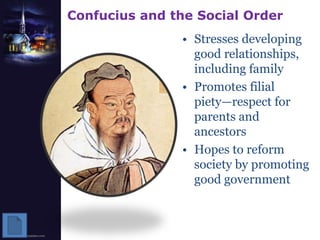
Confucius and the Social OrderStresses developing good relationships, including familyPromotes filial piety—respect for parents and  ancestorsHopes to reform society by promoting good government
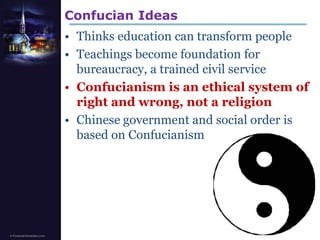
Confucian IdeasThinks education can transform peopleTeachings become foundation for bureaucracy, a trained civil serviceConfucianism is an ethical system of right and wrong, not a religionChinese government and social order is based on Confucianism
CHRISTIANITY
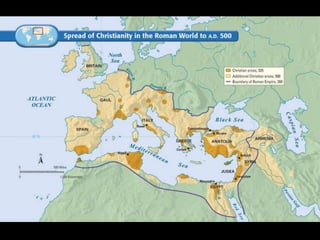
Paul’s MissionNever met Jesus, at first was an enemy of ChristianityReportedly had a vision of Christ. Spent the rest of his life spreading and Christ’s teachings.PaxRomana, which made travel and the exchange of ideas fairly safe, provided the ideal conditions for Christianity to spreadWrote influential letters, called Epistles, to groups of believers. Paul stressed that Jesus was the son of God who died for people’s sins. Ultimately, he wrote much of the New TestamentDeclared that Christianity should welcome all converts, Jew or Gentile (non-Jew) which enabled Christianity to become more than just a local religion.
Jewish RebellionIn A.D. 66, a band of Jews rebelled against Rome. In A.D. 70, the Romans stormed Jerusalem and destroyed the Temple complex. All that remained was a western portion of the wall, which today is the holiest Jewish shrine. About a half million Jews were killed in the course of this rebellion.The Jews made another attempt to break free of the Romans in A.D. 132. Another half-million Jews died in three years of fighting. Although the Jewish religion survived, the Jewish political state ceased to exist for more than 1,800 years. Most Jews were driven from their homeland into exile. This dispersal of the Jews is called the Diaspora.
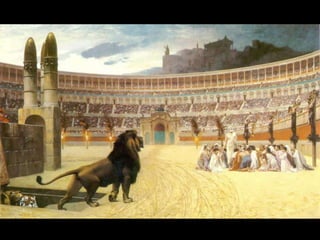
PersecutionChristians refused to worship Roman gods. This refusal was seen as opposition to Roman rule. By the second century, as the PaxRomanabegan to crumble, persecution of the Christians intensified. Thousands were crucified, burned, or killed by wild animals in the circus arenas.
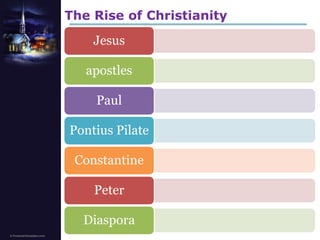
The Rise of Christianity
7 religion
7 religion
7 religion

7 religion

  • 1.
  • 3.
  • 4.
    Hinduism Evolves OverCenturiesCollection of beliefs that developed slowlyNo one founder with a single set of ideasReincarnation: reborn to new livesA soul’s good and bad deeds, karma, determines course of new lifeToday, Hindus choose own path to moksha — a state of perfect understandingWhy did Hinduism strengthenthe caste system?
  • 7.
    The Buddha SeeksEnlightenmentSiddhartha Gautama: FounderRaised in isolation, wants to learn about worldSeeks enlightenment (wisdom), escape human sufferingGains enlightenment by meditating, becomes the Buddha, the “enlightened one”
  • 8.
    The Buddha SeeksEnlightenmentBuddha rejects caste system and multiple gods of HinduismPreaches Four Noble Truths
  • 9.
    The Buddha SeeksEnlightenmentFourth Noble Truth is to follow the Eightfold path to achieve nirvanaa perfect state of understanding a release from selfishness and paina break from the chain of reincarnations
  • 13.
    The Buddha SeeksEnlightenmentBuddhism in IndiaSpreads to other parts of AsiaNever gains firm hold in India; Hinduism remains strongTrade and the Spread of Buddhismspreads by traders to:Sri Lanka, Burma, Thailand, SumatraChina, Korea, Japan
  • 15.
  • 16.
    The Search fora Promised LandPalestine was region on eastern shores of MediterraneanHebrew people settled in Canaan, land promised to them by GodTorah, first five books of Hebrew Bible, tells early history of HebrewsIn Torah, God chose Abraham, a shepherd, to be father of Hebrew peopleHebrews are monotheists: one GodA mutual promise, covenant, is made between God and AbrahamAbraham promises to obey God, God promises protection
  • 18.
    A New CovenantMosesreceives Ten Commandments —become basis of Hebrew law
  • 20.
  • 21.
    Confucius and theSocial OrderEnd of Zhou Dynasty is time of disorderScholar Confucius wants to restore order, harmony, good government
  • 22.
    Confucius and theSocial OrderStresses developing good relationships, including familyPromotes filial piety—respect for parents and ancestorsHopes to reform society by promoting good government
  • 23.
    Confucian IdeasThinks educationcan transform peopleTeachings become foundation for bureaucracy, a trained civil serviceConfucianism is an ethical system of right and wrong, not a religionChinese government and social order is based on Confucianism
  • 25.
  • 28.
    Paul’s MissionNever metJesus, at first was an enemy of ChristianityReportedly had a vision of Christ. Spent the rest of his life spreading and Christ’s teachings.PaxRomana, which made travel and the exchange of ideas fairly safe, provided the ideal conditions for Christianity to spreadWrote influential letters, called Epistles, to groups of believers. Paul stressed that Jesus was the son of God who died for people’s sins. Ultimately, he wrote much of the New TestamentDeclared that Christianity should welcome all converts, Jew or Gentile (non-Jew) which enabled Christianity to become more than just a local religion.
  • 29.
    Jewish RebellionIn A.D.66, a band of Jews rebelled against Rome. In A.D. 70, the Romans stormed Jerusalem and destroyed the Temple complex. All that remained was a western portion of the wall, which today is the holiest Jewish shrine. About a half million Jews were killed in the course of this rebellion.The Jews made another attempt to break free of the Romans in A.D. 132. Another half-million Jews died in three years of fighting. Although the Jewish religion survived, the Jewish political state ceased to exist for more than 1,800 years. Most Jews were driven from their homeland into exile. This dispersal of the Jews is called the Diaspora.
  • 30.
    PersecutionChristians refused toworship Roman gods. This refusal was seen as opposition to Roman rule. By the second century, as the PaxRomanabegan to crumble, persecution of the Christians intensified. Thousands were crucified, burned, or killed by wild animals in the circus arenas.
  • 32.
    The Rise ofChristianity